


Abstract
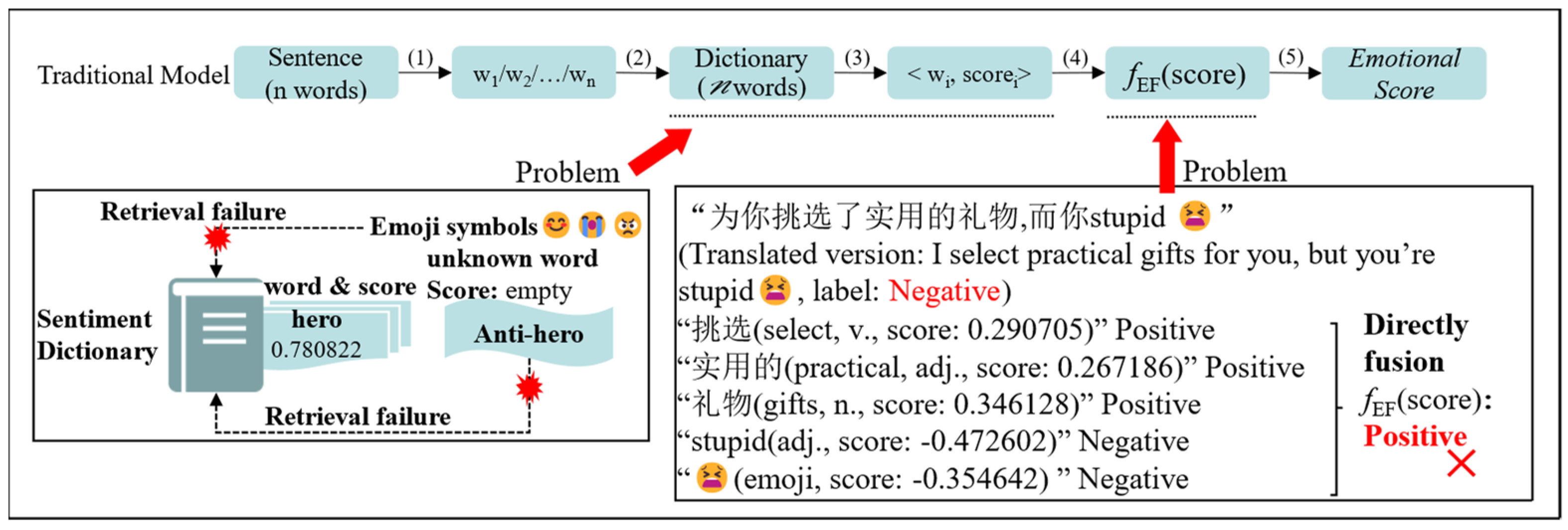
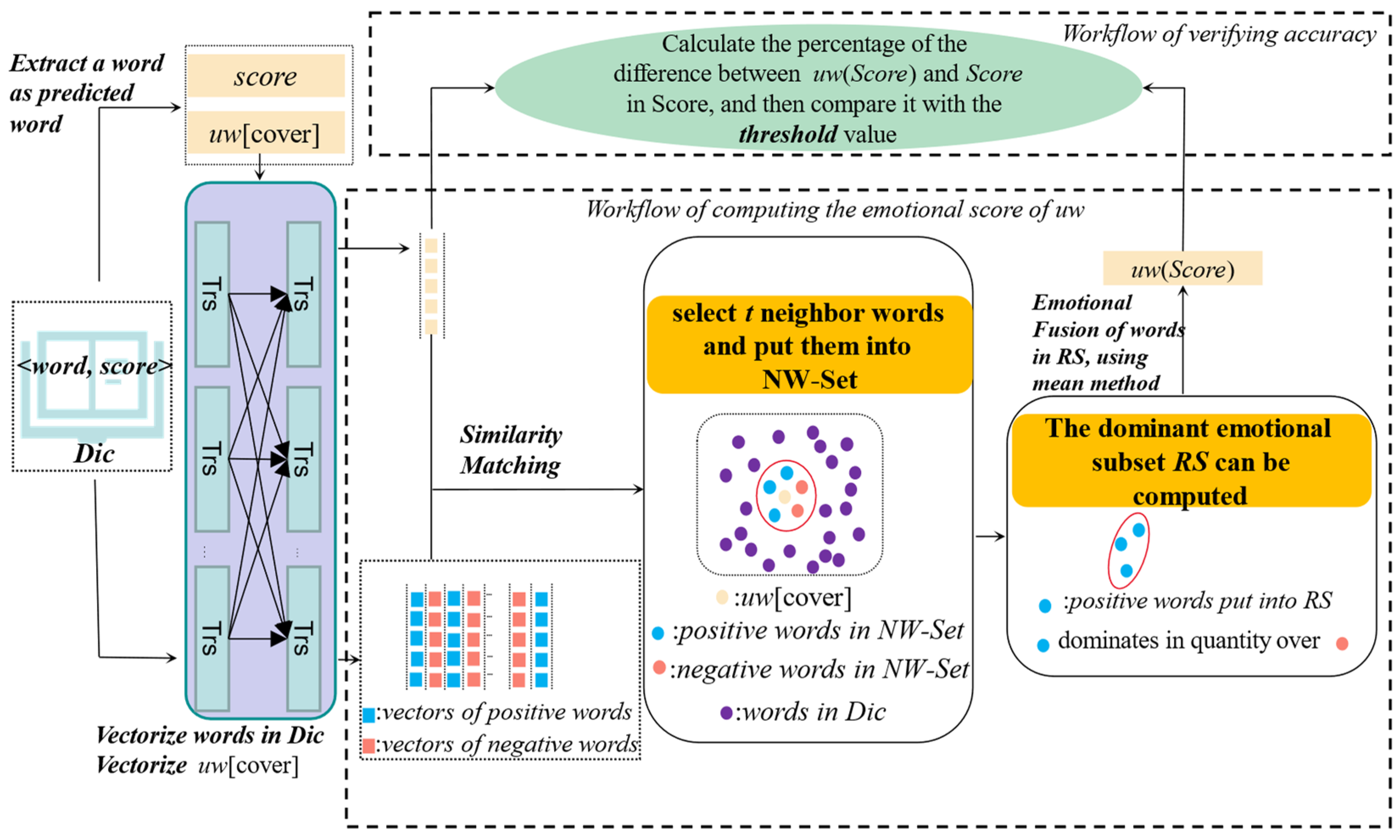
Heterogeneous corpora including Chinese, English, and emoji symbols are increasing on platforms. Previous sentiment analysis models are unable to calculate emotional scores of heterogeneous corpora. They also struggle to effectively fuse emotional tendencies of these corpora with the emotional fluctuation, generating low accuracy of tendency prediction and score calculation. For these problems, this paper proposes a Centrifugal Navigation-Based Emotional Computation framework (CNEC). CNEC adopts Emotional Orientation of Related Words (EORW) to calculate scores of unknown Chinese/English words and emoji symbols. In EORW, t neighbor words of the predicted sample from one element in the short text are selected from a sentiment dictionary according to spatial distance, and related words are extracted using the emotional dominance principle from the t neighbor words. Emotional scores of related words are fused to calculate scores of the predicted sample. Furthermore, CNEC utilizes Centrifugal Navigation-Based Emotional Fusion (CNEF) to achieve the emotional fusion of heterogeneous corpora. In CNEF, how the emotional fluctuation occurs is illustrated by the trigger angle of centrifugal motion in physical theory. In light of the corresponding relationship between the trigger angle and conditions of the emotional fluctuation, the fluctuation position is determined. Lastly, emotional fusion with emotional fluctuation is carried out by a CNEF function, which considers the fluctuation position as a significant position. Experiments demonstrate that the proposed CNEC effectively computes emotional scores for bilingual short texts with emojis on the Weibo dataset collected.
1. Introduction
Sentiment analysis (SA), also referred to as opinion mining, is an academic field aimed at extracting users’ views, attitudes, and emotions towards events of interest using specific rules and techniques applied to textual data. Sentiment analysis terminology was first mentioned in 2003, and emotional features related to specific topics from documents were extracted by Nasukawa and Yi [1]. The tasks of sentiment analysis are primarily classified into three levels: document-level, sentence-level, and aspect-level analysis. Additionally, the objective of sentiment analysis for customer reviews is a binary classification task that aims to determine the polarity of opinions and belongs to the sentence-level sentiment analysis category [2]. The task of multi-class text categorization [3] was presented, equal to the rating-inference problem. In addition, the focus of aspect-based sentiment analysis [4] is on the aspect words in the sentence, assigning polarity to all the aspects.
In the current situation of data expansion and AI agglomeration, SA as a part of AI is applied to the various walks of life. Sentiment analysis is utilized on movie reviews to perform fine-grained analysis to determine both the sentiment orientation and sentiment strength of the reviewer towards various aspects of a movie [4]. Besides, the identification and extraction of covert social networks represents a critical challenge within the realm of government security in the domain of e-government [5]. On the social platform, users’ opinions reflect on hot spot news or public messages. Moreover, the frequency of emojis in posted messages is increasing. Especially in response to hot events, posts containing emojis emerge one after another [6]. Furthermore, regarding emoji usage on social platforms, sarcasm detection is also a concern of researchers [7]. The architecture is trained using two embeddings, namely word and emoji embeddings, and combines an LSTM with the loss function of SVM for sarcasm detection.
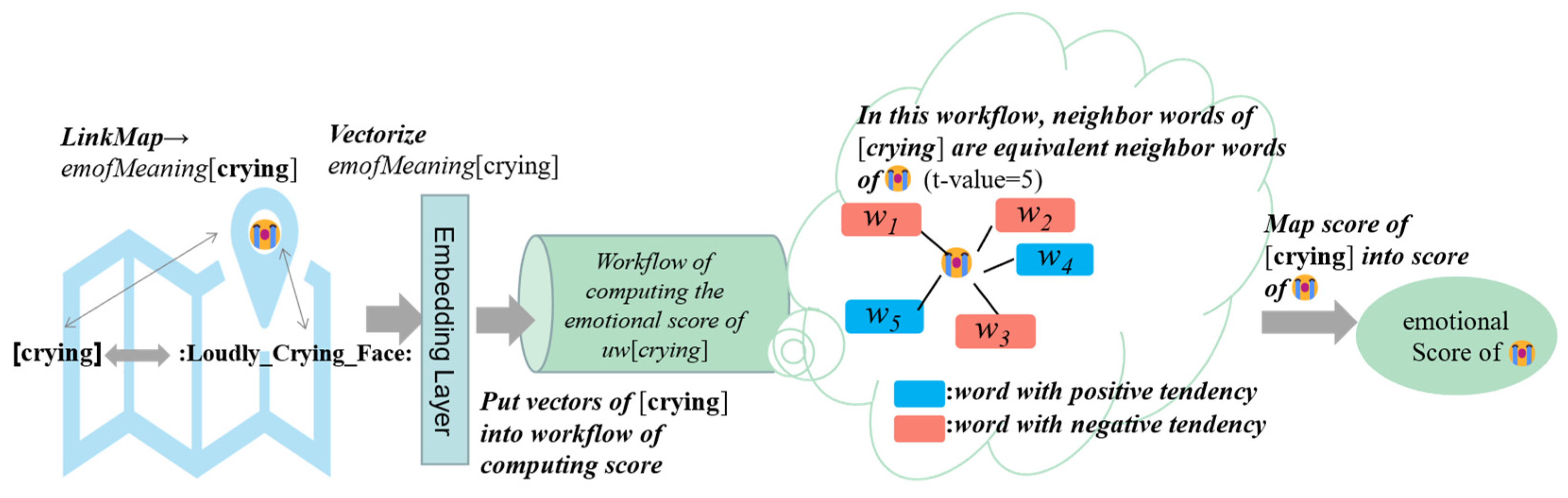
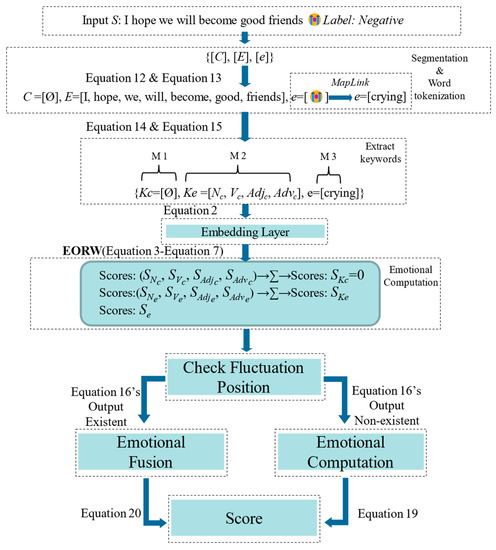
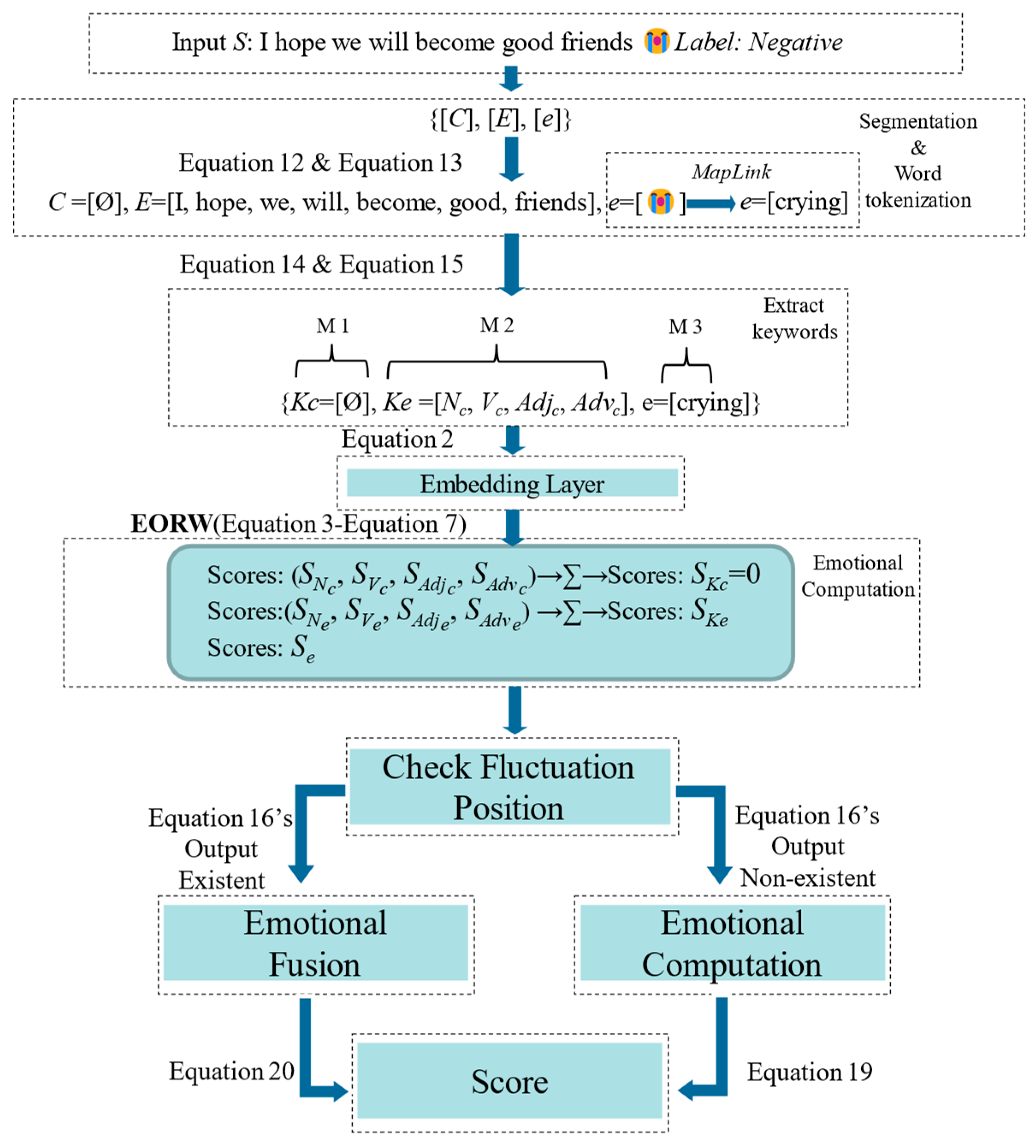
While sentiment analysis has been widely studied, most researchers have focused on analyzing a single corpus. This paper, however, presents a novel frame CNEC to perform the sentiment analysis of examining bilingual and emoji-containing text on social media platforms. CNEC employs the Emotional Orientation of Related Words (EORW) technique designed in previous work [8] to calculate emotional scores of Chinese phrases or English words. Additionally, the emoji is mapped to its true meaning in the form of a word by LinkMap. It is designed to associate text and emojis. Following that, emotional score of the emoji is calculated by EORW, driven by CNEC. In addition, CNEC utilizes the centrifugal motion framework in physics to describe emotional fluctuations. Then, CNEC uses CNEF to fuse emotional scores of different corpora to obtain the emotional score of the predicted text. Based on Maximum Density Dominance, emotional scores of texts free of emotional fluctuations can also be handled. The contribution to the field is unique at present, setting our approach apart from the existing literature.
2. Related Work
In response to traditional machine learning methods, Bayesian and support vector machines [9] are commonly used for sentiment analysis. In addition, a feature set selection method for social network sentiment analysis based on information gain, bigram, and object-oriented extraction methods was introduced. In order to solve the problem of performance degradation caused by aspect-based methods that cannot reasonably adapt the general vocabulary to the context of aspect-based datasets, Mohammad Erfan Mowlaei et al. [10] proposed two extended methods of dictionary generation methods for aspect-oriented problems—statistical methods and their previously proposed genetic algorithms, which fused the above vocabulary with prominent static words to classify the aspects in the comments. The ALGA algorithm was proposed [11] to address the task of polarity classification of Weibo emotions. This algorithm constructs an adaptive emotional vocabulary and seeks to identify the optimal emotional vocabulary for the task. An aspect-based hybrid approach to sentiment analysis that integrates domain vocabulary and rules was proposed [12] to analyze the entities of intelligent application reviews, extract important aspects from comments, achieve sentiment classification, and finally produce summary results, in order to understand the needs and expectations of their customers. A double feed-forward neural network [13] was used to pass output layer information to a two-layer neural network to optimize and process information for emotional classification.
A scholarly approach was developed to emphasize sarcasm, as outlined in the study [7]. This approach employed an architectural framework that integrated two types of embeddings: word embeddings and emoji embeddings. The framework leveraged the power of LSTM (Long Short-Term Memory) in conjunction with a loss function derived from SVM (Support Vector Machines). A deep learning framework [14] was proposed for analyzing product reviews on the YouTube social media platform, which could automatically collect, filter, and analyze reviews of a specific product from YouTube. Aminu Da’u et al. [15] proposed a recommendation system for the time-consuming problem and accuracy problem generated in the process of aspect-based opinion mining in user comments, which adopts a deep learning method based on aspect-weighted opinion mining. This method uses deep learning methods to extract aspects of products and underlying weighted user opinions from review text, and fuse them into extended collaborative filtering (CF) technology to improve the recommendation system. With the intention of catching up with the speed of streaming data generated on social media platforms and analyzing users’ emotions on topics, Ajeet Ram Pathak et al. [16] proposed a theme-level sentiment analysis model based on deep learning. The proposed model uses the online latent semantic index of regularization constraints to extract topics at the sentence level, and then applies the topic-level attention mechanism to the LSTM network for sentiment analysis. An improved sentiment analysis method [17] was presented to classify sentence type using BiLSTM-CRF and CNN for different types of emotions. This method divided sentences into different types and then performed sentiment analysis on each type of sentence. Bin Liang et al. [18] proposed a SenticNet-based graph convolutional network to build graph neural networks by integrating sentiment knowledge in SenticNet to enhance the dependent graph of sentences. On this basis, the sentiment enhancement graph model considers the dependence between contextual words and aspect words and the emotional information between opinion words and aspects. Since the influence of contextual intersentence associations was considered, an aspect-level sentiment analysis model [19] was proposed with aspect-specific contextual position information, which could extract the influence of the contextual association of each sentence in the document on the aspect sentiment polarity of individual sentences. A two-way LSTM (ET-Bi-LSTM) [20] emotion analysis model was designed for expression text integration in order to accurately classify the emotion of microblog comments with emoticons in microblog social networks. A model for predicting sentiment polarity on social media, which incorporates an emoji-aware attention-based GRU network, was proposed [21]. Bi-LSTM-SNP [22] was designed to address the challenge of capturing contextual semantic correlation between aspect word and content words more effectively. Except for the backbone model of LSTM, a graph convolutional neural network model [23,24,25,26] was widely used on aspect-level sentiment analysis. Moreover, based on ensemble learning, the sentiment analysis task was accomplished by combining the Bi-LSTM and Graph Convolutional Neural Network (GCN) techniques [27]. In addition, there are some works using fuzzy theory to perform the sentiment analysis [28,29,30].
4. Experiment
4.1. Dataset
To perform the computation of scores with expert knowledge, the sentiment dictionary with emotional scores is an essential tool. In this paper, the Boson dictionary including 114,767 words is utilized to retrieve emotional scores of words. In this dictionary, the format of data is [word][score]. The value range of scores is (−7, 7). In order to facilitate the calculation, scores in the dictionary are normalized to the region of [−1, 1].
We collect the short text dataset from Chinese platform WeiboWe imitate the dataset from github.com/SophonPlus/ChineseNlpCorpus to annotate our short text dataset, and extract the data that satisfies the task of this paper. Long texts over 50 words are deleted from the merged dataset, leaving about 903 texts with emoji. Data text has any combination of Chinese [C], English [E], and emojis [e], and the format of the texts = {[C, E, e] | [C, E] | [C, e] | [E, e]}, as shown in Table 3.
Table 3.
Instances of Dataset.
4.2. Experiment and Result
In this section, we perform two groups of experiments, containing the selection of t-value of EORW and Emotional Computation. Regarding the selection of t-value experiment, multiple iterations of experiments are conducted to determine the optimal value of t. In response to the experiment of Emotional Computation, the emotional scores of the sentences in the dataset are computed, and these scores are utilized to assess whether the tendencies align with the tendencies associated with the labels.
In the first experiment, two samples about words and the emoji about emotional computation are shown as follows.
As shown in Table 4, angry and fire are taken as examples (six decimal places are retained and t = 5). When uw is angry, NW-Set(angry) = {irate, enraged, indignant, incensed, annoyed}. Then, NW-Set(angry) is fed into Equation (4). However, MESi(angry) = {Ø} on account of the fact that the emotional scores of wi in NW-Set(angry) are consistent. As a result, Suw(angry) can be calculated by the first case of Equation (6). Conversely, the emotional tendencies of neighbors of fire as uw are inconsistent. NW-Set(fire) = {firing, alarm, destroyed, fumes, fired}. It is noteworthy that the emotional tendency of “fumes” in NW-Set is different from others. Therefore, MES1(fire) = {firing, alarm, destroyed, fired}, and MES2(fire) = {fumes}. Based on Equation (5), RS(fire) = MES1(fire). At last, Suw(fire) can be computed by the second case of Equation (6).
Table 4.
Results of emotional computation about words.
In Table 5, neighbor means t neighbor words of emofMeaning “crying” from the emoji 😭, Emotion represents the emotional score of neighbors of emofMeaning “crying”, and S stands for the final score of emofMeaning “crying” that is equal to the emoji 😭.
Table 5.
Emotional computation of emoji ‘loudly crying face’ (retaining six decimal places).
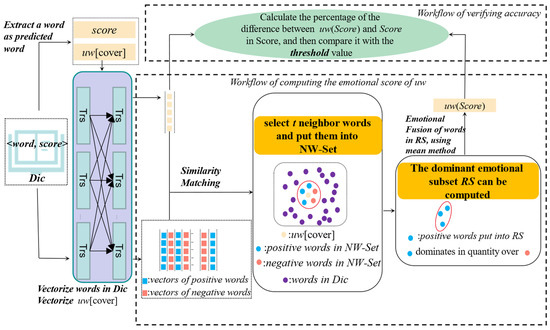
t-value of EORW. To accomplish the goal of computing the emotional score of uw and verify the feasibility of EORW, this paper covers up the emotional score of w in Dic to compare the emotional score calculated by EORW with the score stored in Dic.
For facilitating the test, the threshold is set to 30%. When the threshold T is lower than 30%, the result is computed correctly. T is denoted as Equation (22).
In this paper, the accuracy of a group is determined by the ratio of correctly computed words to the total number of words. In this condition, the symbol nccw is used to denote the number of words computed correctly, while N represents the total number of words in a given experimental group. The accuracy Acc is denoted as shown in Equation (23).
In addition, this paper chooses a moderate t-value. Five hundred words uw[cover] are generated from the dictionary Dic. Ten groups of experiments are conducted with different t values, where t belongs to the set = [3, 5, 7, 9, 11, 13, 15].
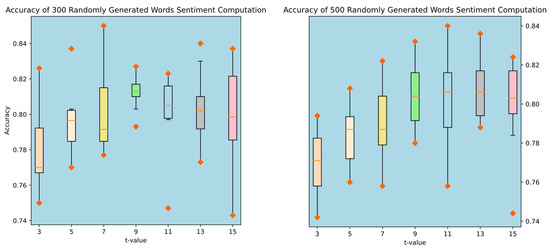
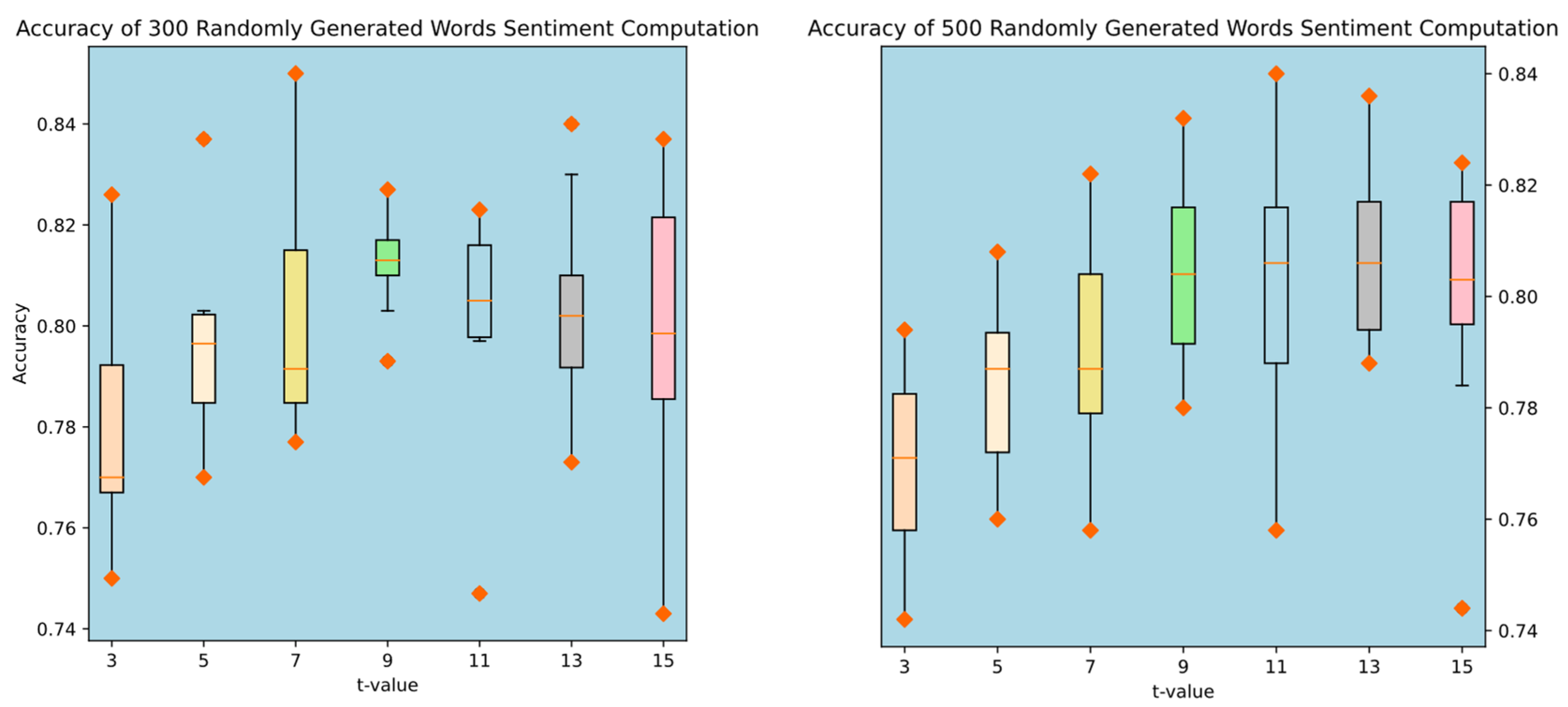
As shown in Figure 8, when 300 words are randomly generated, the overall accuracy is between 74.3% and 85%. When t is 9, the upper bound of accuracy is about 82.7% and the lower bound of accuracy is about 79.3%. When the t-value is equal to 9, accuracy becomes stable. When 500 words are randomly generated, the overall accuracy is between 74.2% and 84%. When t is 9, the upper bound of accuracy is about 83.2% and the lower bound of accuracy is about 78%. From what has been presented, the upper and lower bounds of accuracy are closer than other t when t is 9, which means that EORW is the most stable in this condition.
Figure 8.
The accuracies of emotional computation of 300 and 500 randomly generated words from the emotional dictionary. Different t-values are adopted. The various box plots with distinct colors illustrate different t-values aligned with their respective positions.
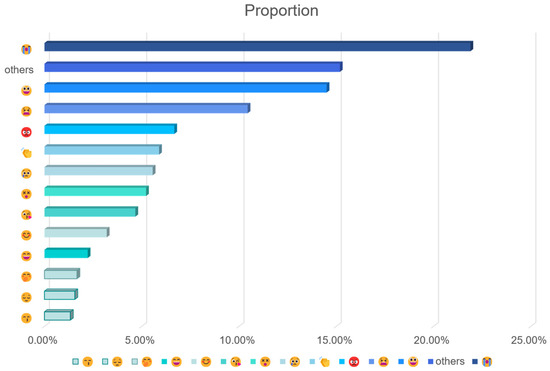
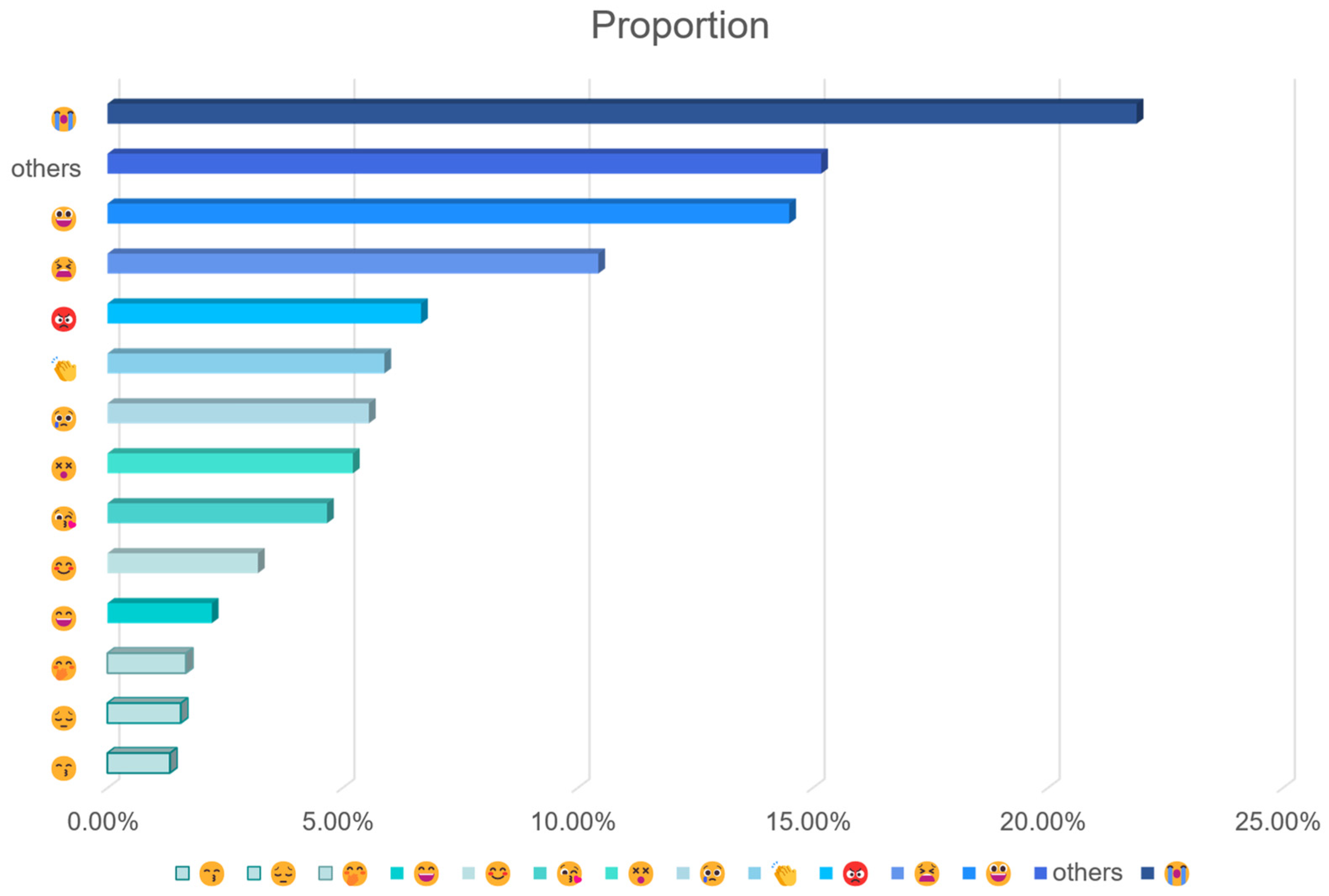
Proportion of emoji usage. This paper presents a statistical analysis of the proportion of emoji usage in the collected dataset, as depicted in Figure 9. In the collected data, the utilization rate of ’loudly crying face’ emoji has the highest usage frequency, accounting for 21% of the total. In contrast, it is obvious from Figure 9 that the ‘kiss’ emoji has a very low usage frequency, representing only 1.13% of the total. Additionally, other infrequently used emojis have been grouped into the “others” category, which accounts for approximately 15.18% of the total emoji usage.
Figure 9.
The proportion of emojis used in the dataset collected in this paper.
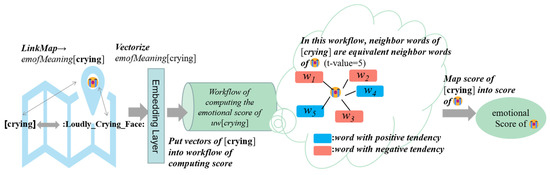
😭 in the bilingual sentence S is transformed to emofMeaning[crying]. The processing results of emotional scores of [crying] calculated are depicted in Table 5. As shown in Table 6, the emoji 😫 in the bilingual sentence S can be similarly computed.
Table 6.
The processing of emojis in the bilingual sentence S (retaining six decimal places).
Result of emotional computation. After eliminating disordered data, the remaining dataset consists of 903 texts where 601 data labels are positive and 302 data labels are negative. In addition, some marks with bad influence on the experiment are stripped from the dataset. Then, the dataset is fed into the computation model. As a result, the accuracy of the emotional computation reaches about 98.67%.
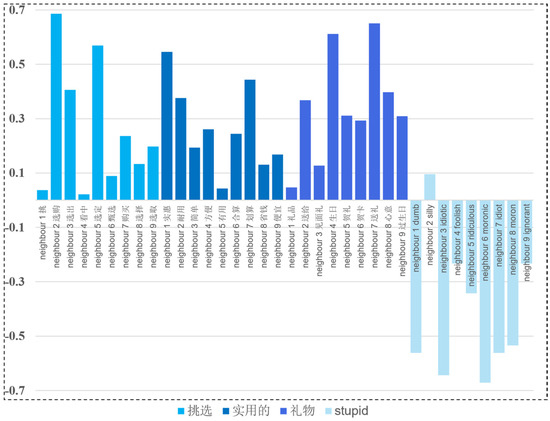
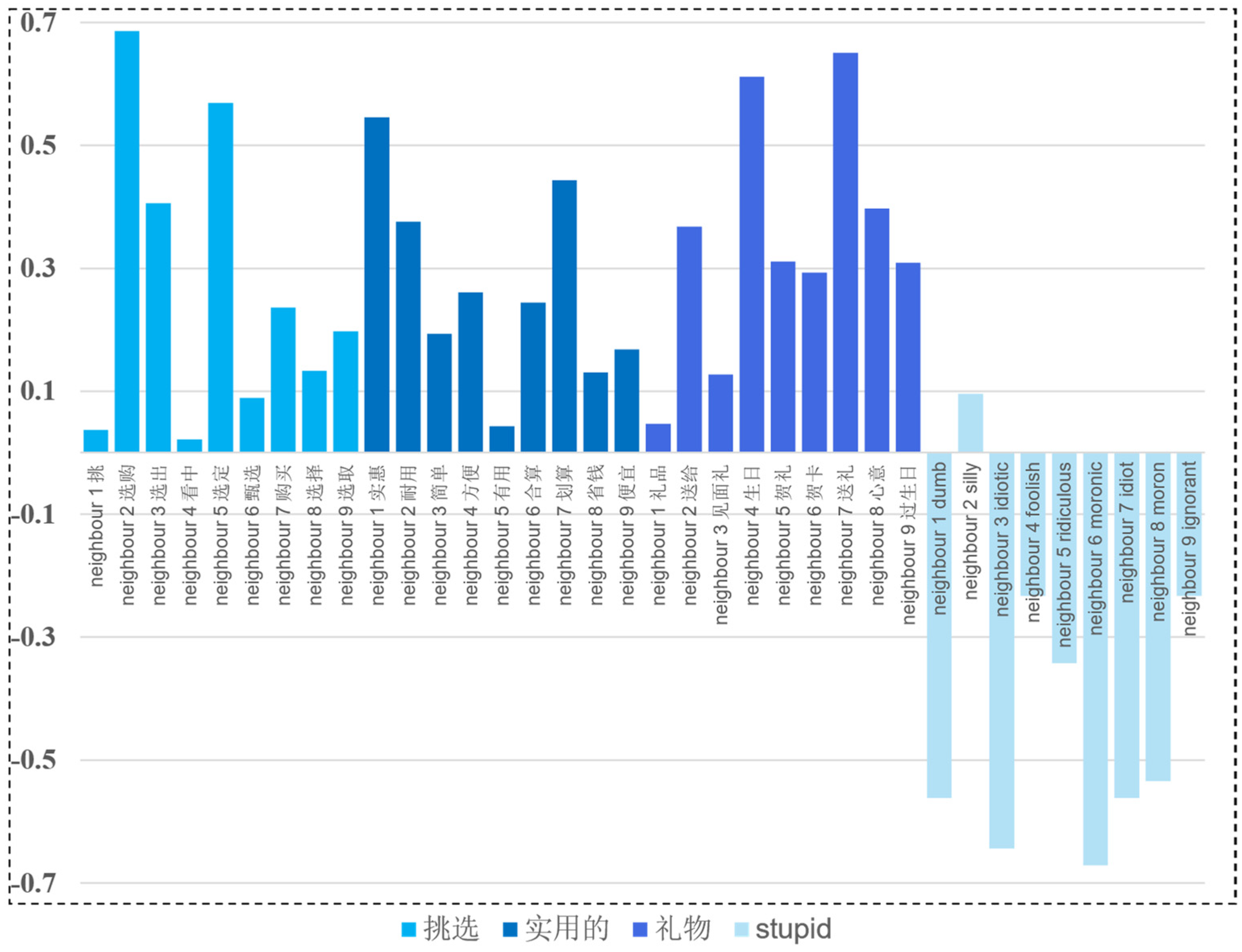
In the bilingual sentence S, Kc and Ke respectively harbor three keywords and one keyword. Each phrase has nine neighbors that have their own scores. The presence of a score above 0 indicates a positive tendency, while a score below 0 signifies a negative tendency. Through EORW, the dominant emotional set also named as RS can be computed. As a result, the emotional scores of the keywords can be calculated as shown in Table 7. As shown in Figure 10, the bilingual sentence S contains four keywords (Chinese phrases: 挑选 (translation: select); 实用的 (translation: practical); 礼物 (translation: gifts). English word: stupid).
Table 7.
Emotional scores of keywords in bilingual sentence S (retaining six decimal places).
Figure 10.
Emotional scores of neighbors of wi in Kc and neighbors of wk in Ke. This figure depicts that the bilingual sentence S has four keywords extracted respectively from Kc and Ke. In the Chinese element, The neighbors in NW-Set of select (Original Chinese: 挑选): {挑 (choose), 选购 (optional), 看中 (fancy), 选定 (pick out), 甄选 (pick), 购买 (purchase), 选择 (option), 选取 (select and extract)}; The neighbors in NW-Set of Practical (Original Chinese: 实用的): {实惠 (affordable), 耐用 (durable), 简单 (easy), 方便 (convenient), 有用 (useful), 合算 (be a bargain), 划算 (favorable), 省钱 (economical), 便宜 (cheap)}; The neighbors in NW-Set of Gifts (Original Chinese: 礼物): {礼品 (souvenirs), 送给 (give sb), 见面礼 (a gift such as is usually given to sb. on first meeting him), 生日 (birthday), 贺礼 (congratulatory gift), 贺卡 (congratulation card), 送礼 (give a present), 心意 (compliments or gifts), 过生日 (celebrate a birthday)}.
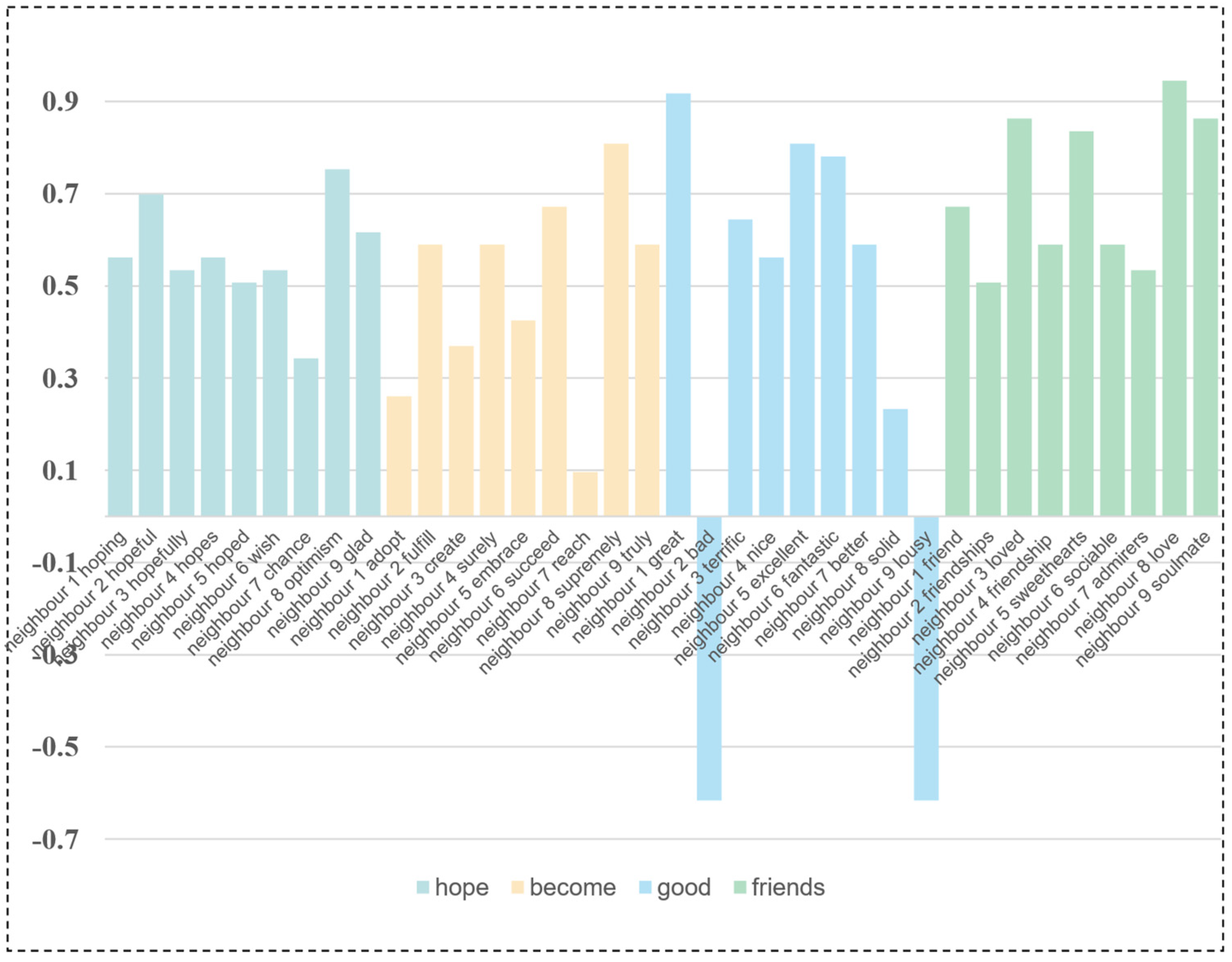
As depicted in Figure 11, the English sentence S has four keywords (hope, become, good, friends) extracted from Ke. According to EORW, RS can be computed. As a result, the emotional scores of the keywords can be calculated as shown in Table 8.
Figure 11.
Emotional scores of neighbors of wi in Ke. This figure depicts that the English sentence S has four keywords extracted from Ke.
Table 8.
Emotional scores of keywords in the English sentence S (retaining six decimal places).
According to Equation (22), the emotional score of the Chinese and English corpora can be respectively computed. Through Equation (16), fluctuation can be checked. Finally, in light of Equation (21), the result of the emotional fusion is computed. The emotional processing of the bilingual sentence and English sentence are noted in Table 9.
Table 9.
Results of emotional scores of different elements (retaining six decimal places).
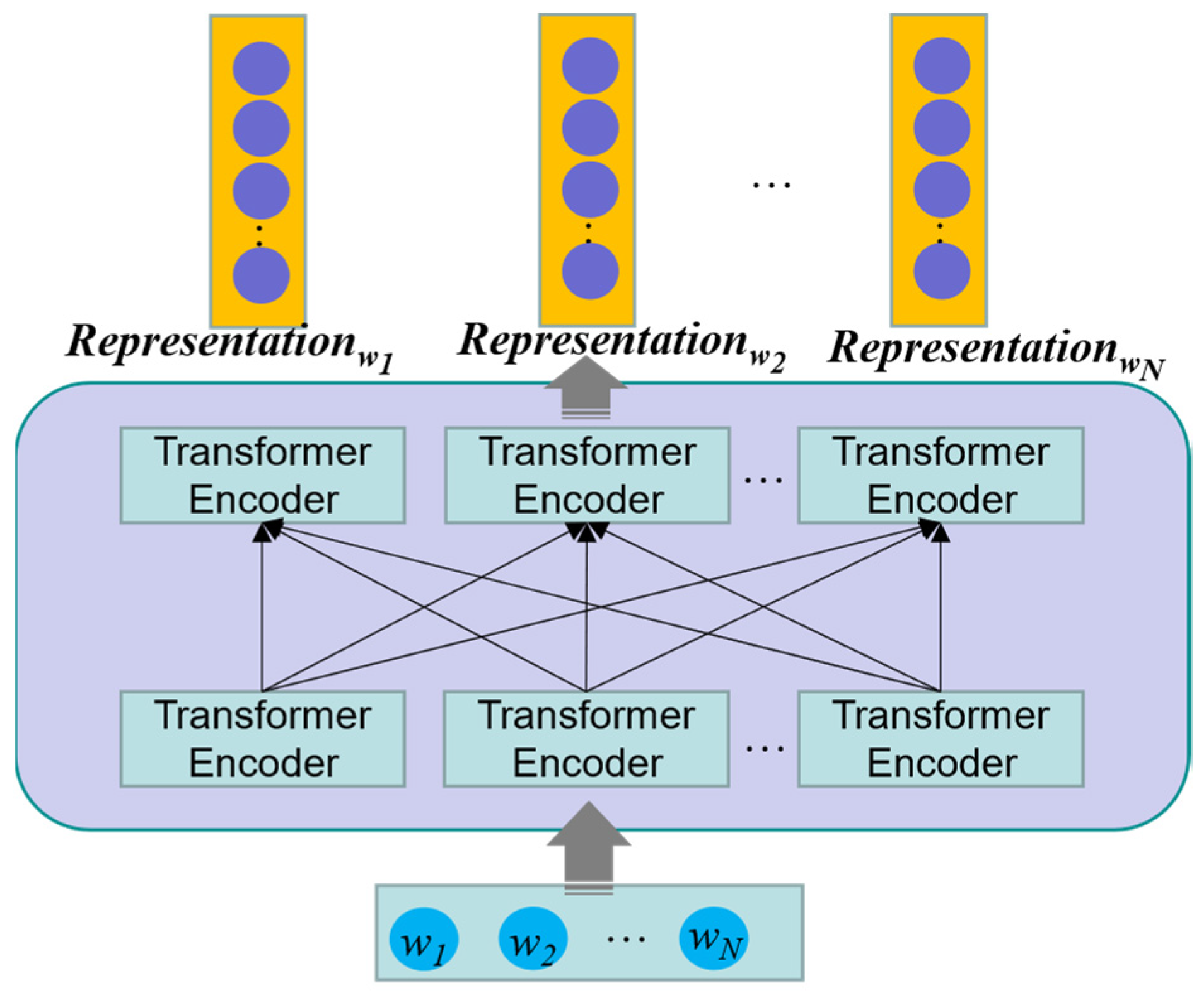
As demonstrated in Table 10, CNEC outperforms the average strategy by 1.11%. In addition, CNEC improves by 21.04% compared with the maximum-value method. In response to emotional fusion, CNEC has more competitive advantages. Furthermore, the experimental outcomes are compared by utilizing several prominent deep learning models that are frequently employed in the field, as shown in Table 11. The BERT model is built upon the BERT-base model, with a learning rate of 2 × 10⁻⁵, a batch size of 32, and a total of 5 training epochs. RoBERTa-base is adopted in this paper, with a learning rate of 2 × 10⁻⁵, a batch size of 16, and a total of 5 training epochs. In BERTprompting, BERT-base is also the backbone of this model, with a learning rate of 2 × 10⁻⁵, a batch size of 8, and a total of 5 training epochs. According to prompt learning, the BERTprompting’s template is designed as “How {} it was.”. For all methods, a cross-entropy loss is used for the loss function during training for the sentiment analysis, as shown in Equation (24).
where N denotes the number of samples, yi represents the true label of the i-th sample, and pi represents its probability.
Table 10.
Comparable accuracy of different emotional fusion methods.
Table 11.
Comparison of results on dataset with deep learning models.
5. Discussion
This paper pays attention to the computation of emotion scores aiming at bilingual short texts with emoji symbols. According to traditional methods or some deep learning elements, they cannot tackle the problem of computing scores of bilingual data incorporating emoji symbols. Moreover, mainstream approaches of deep learning just compute the score of a single corpus based on their own rules. This study employs three deep learning models to conduct a comparative analysis with the suggested approach. The BERT model’s pre-training data primarily consists of a vast English corpus, which poses limitations when dealing with texts that contain multiple languages and emojis. Nonetheless, by incorporating a template into BERT, its expressive capabilities are enhanced by approximately 5%. Conversely, the RoBERTa model, which excludes the NSP task and incorporates a larger training corpus, exhibits superior performance when handling extremely short sentences. However, these approaches excel primarily in classification tasks and do not effectively utilize existing knowledge that contains emotional scores for emotion scoring. On the contrast, the CNEC framework relies on the professional knowledge of the emotional dictionary and utilizes the EORW method to improve the defects of the emotional dictionary on bilingual data. Furthermore, CNEC drives EORW to compute emotional scores of emoji symbols. In addition, CNEC can illustrate emotional fluctuation. In addition, based on CNEF, the emotional fusion is utilized to compute the emotional score of bilingual short texts with emoji. The reason for utilizing centrifugal motion in this paper to illustrate the emotional fluctuation is due to the consistency of emotions within each part of a short text. If the emotion of a part fluctuates, it is akin to an object in circular motion suddenly lacking the centripetal force necessary to maintain its inertia, and thus moving centrifugally. The reason why the accuracy of the experiment can reach 98.67% is that these emotional tendencies of short texts are more explicit than those of long texts. Additionally, this dataset from Weibo doesn’t contain implicit emotion such as emojis with positive tendency used to express negative tendency. As a result, emotional scores of emojis or phrases are stationary for every sentence where they exist. Furthermore, the quantity of datasets with a bilingual corpus with emojis is limited, and most data involve a single language with emojis. Besides, as emotion dictionaries are constructed based on specific knowledge categories, selecting different emotion dictionaries may result in situations where a phrase has different emotional scores, which in turn imposes specific constraints on the emotional score range of the phrase.
In the future, how to tackle different implicit meanings of phrases and emojis is to be considered as the most significant point. In addition, how to classify emotions at a fine-grained level is also a matter of great importance in future work. It is also worth studying the issue of harmonizing the grading differences among different dictionaries for various fields as much as possible.
Author Contributions
Conceptualization, T.Y. and Z.L.; methodology, T.Y. and Z.L.; software, T.Y. and Z.L.; validation, Z.L. and Y.L.; formal analysis, T.Y.; investigation, J.Z.; resources, Z.L.; data curation, T.Y. and Z.L.; writing—original draft preparation, Z.L.; writing—review and editing, T.Y.; supervision, T.Y. All authors have read and agreed to the published version of the manuscript.
Funding
This work was supported by the Sichuan Science and Technology Program under Grant No. 2022YFG0322, China Scholarship Council Program (Nos. 202001010001 and 202101010003) and the Innovation Team Funds of China West Normal University (No. KCXTD2022-3).
Data Availability Statement
Not applicable.
Conflicts of Interest
The authors declare no conflict of interest.
References
- Nasukawa, T.; Yi, J. Sentiment analysis: Capturing favorability using natural language processing. In Proceedings of the 2nd International Conference on Knowledge Capture, Sanibel Island, FL, USA, 23–25 October 2003; pp. 70–77. [Google Scholar]
- Hu, M.; Liu, B. Mining and summarizing customer reviews. In Proceedings of the Tenth ACM SIGKDD International Conference on Knowledge Discovery and Data Mining, Seattle, DC, USA, 22–25 August 2004; pp. 168–177. [Google Scholar]
- Pang, B.; Lee, L. Seeing stars: Exploiting class relationships for sentiment categorization with respect to rating scales. arXiv 2005, arXiv:0506075. [Google Scholar]
- Thet, T.T.; Na, J.C.; Khoo, C.S. Aspect-based sentiment analysis of movie reviews on discussion boards. J. Inf. Sci. 2010, 36, 823–848. [Google Scholar] [CrossRef]
- Alguliyev, R.M.; Aliguliyev, R.M.; Niftaliyeva, G.Y. Extracting social networks from e-government by sentiment analysis of users’ comments. Electron. Gov. Int. J. 2019, 15, 91–106. [Google Scholar] [CrossRef]
- Li, M.; Ch’ng, E.; Chong, A.Y.L.; See, S. Multi-class Twitter sentiment classification with emojis. Ind. Manag. Data Syst. 2018, 118, 582. [Google Scholar] [CrossRef]
- Jain, D.K.; Kumar, A.; Sangwan, S.R. TANA: The amalgam neural architecture for sarcasm detection in indian indigenous language combining LSTM and SVM with word-emoji embeddings. Pattern Recognit. Lett. 2022, 160, 11–18. [Google Scholar] [CrossRef]
- Yang, T.; Liu, Z.; Chen, Q.; Ma, X.; Deng, H. Emotional Computation of Unfamiliar Word based on Emotional Orientation of Related Words. In Proceedings of the 2nd International Conference on Artificial Intelligence, Big Data and Algorithms, Nanjing, China, 17–19 June 2022. [Google Scholar]
- Le, B.; Nguyen, H. Twitter sentiment analysis using machine learning techniques. In Proceedings of the 3rd International Conference on Computer Science, Applied Mathematics and Applications-ICCSAMA, Hanoi, Vietnam, 19–20 December 2015; pp. 279–289. [Google Scholar]
- Mowlaei, M.E.; Abadeh, M.S.; Keshavarz, H. Aspect-based sentiment analysis using adaptive aspect-based lexicons. Expert Syst. Appl. 2020, 148, 113234. [Google Scholar] [CrossRef]
- Keshavarz, H.; Abadeh, M.S. ALGA: Adaptive lexicon learning using genetic algorithm for sentiment analysis of microblogs. Knowl.-Based Syst. 2017, 122, 1–16. [Google Scholar] [CrossRef]
- Alqaryouti, O.; Siyam, N.; Abdel Monem, A.; Shaalan, K. Aspect-based sentiment analysis using smart government review data. Appl. Comput. Inform. 2020. [Google Scholar] [CrossRef]
- Revathy, G.; Alghamdi, S.A.; Alahmari, S.M.; Yonbawi, S.R.; Kumar, A.; Haq, M.A. Sentiment analysis using machine learning: Progress in the machine intelligence for data science. Sustain. Energy Technol. Assess. 2022, 53, 102557. [Google Scholar] [CrossRef]
- Mai, L.; Le, B. Joint sentence and aspect-level sentiment analysis of product comments. Ann. Oper. Res. 2021, 300, 493–513. [Google Scholar] [CrossRef]
- Da’u, A.; Salim, N.; Rabiu, I.; Osman, A. Weighted aspect-based opinion mining using deep learning for recommender system. Expert Syst. Appl. 2020, 140, 112871. [Google Scholar]
- Pathak, A.R.; Pandey, M.; Rautaray, S. Topic-level sentiment analysis of social media data using deep learning. Appl. Soft Comput. 2021, 108, 107440. [Google Scholar] [CrossRef]
- Chen, T.; Xu, R.; He, Y.; Wang, X. Improving sentiment analysis via sentence type classification using BiLSTM-CRF and CNN. Expert Syst. Appl. 2017, 72, 221–230. [Google Scholar] [CrossRef]
- Liang, B.; Su, H.; Gui, L.; Cambria, E.; Xu, R. Aspect-based sentiment analysis via affective knowledge enhanced graph convolutional networks. Knowl.-Based Syst. 2022, 235, 107643. [Google Scholar] [CrossRef]
- Huang, B.; Guo, R.; Zhu, Y.; Fang, Z.; Zeng, G.; Liu, J.; Shi, Z. Aspect-level sentiment analysis with aspect-specific context position information. Knowl.-Based Syst. 2022, 243, 108473. [Google Scholar] [CrossRef]
- Li, X.; Zhang, J.; Du, Y.; Zhu, J.; Fan, Y.; Chen, X. A novel deep learning-based sentiment analysis method enhanced with Emojis in microblog social networks. Enterp. Inf. Syst. 2023, 17, 2037160. [Google Scholar] [CrossRef]
- Li, D.; Rzepka, R.; Ptaszynski, M.; Araki, K. Emoji-Aware Attention-based Bi-directional GRU Network Model for Chinese Sentiment Analysis. In Proceedings of the LaCATODA/BtG@ IJCAI, Macao, China, 24–29 August 2019; pp. 11–18. [Google Scholar]
- Huang, Y.; Liu, Q.; Peng, H.; Wang, J.; Yang, Q.; Orellana-Martín, D. Sentiment classification using bidirectional LSTM-SNP model and attention mechanism. Expert Syst. Appl. 2023, 221, 119730. [Google Scholar] [CrossRef]
- Gu, T.; Zhao, H.; He, Z.; Li, M.; Ying, D. Integrating external knowledge into aspect-based sentiment analysis using graph neural network. Knowl.-Based Syst. 2023, 259, 110025. [Google Scholar] [CrossRef]
- Zhao, M.; Yang, J.; Zhang, J.; Wang, S. Aggregated graph convolutional networks for aspect-based sentiment classification. Inf. Sci. 2022, 600, 73–93. [Google Scholar] [CrossRef]
- Zhou, T.; Law, K.M. Semantic Relatedness Enhanced Graph Network for aspect category sentiment analysis. Expert Syst. Appl. 2022, 195, 116560. [Google Scholar] [CrossRef]
- Xu, L.; Pang, X.; Wu, J.; Cai, M.; Peng, J. Learn from structural scope: Improving aspect-level sentiment analysis with hybrid graph convolutional networks. Neurocomputing 2023, 518, 373–383. [Google Scholar] [CrossRef]
- Xu, Y.; Yao, E.; Liu, C.; Liu, Q.; Xu, M. A novel ensemble model with two-stage learning for joint dialog act recognition and sentiment classification. Pattern Recognit. Lett. 2023, 165, 77–83. [Google Scholar] [CrossRef]
- Zhang, Y.; Liu, Y.; Li, Q.; Tiwari, P.; Wang, B.; Li, Y.; Pandey, H.M.; Zhang, P.; Song, D. CFN: A Complex-Valued Fuzzy Network for Sarcasm Detection in Conversations. IEEE Trans. Fuzzy Syst. 2021, 29, 3696–3710. [Google Scholar] [CrossRef]
- Qiu, J.; Ji, W.; Lam, H.-K. A New Design of Fuzzy Affine Model-Based Output Feedback Control for Discrete-Time Nonlinear Systems. IEEE Trans. Fuzzy Syst. 2023, 31, 1434–1444. [Google Scholar] [CrossRef]
- Khalifa, T.R.; El-Nagar, A.M.; El-Brawany, M.A.; El-Araby, E.A.G.; El-Bardini, M. A Novel Hammerstein Model for Nonlinear Networked Systems Based on an Interval Type-2 Fuzzy Takagi–Sugeno–Kang System. IEEE Trans. Fuzzy Syst. 2020, 29, 275–285. [Google Scholar] [CrossRef]
- Turney, P.D. Thumbs up or thumbs down? Semantic orientation applied to unsupervised classification of reviews. arXiv 2002, arXiv:0212032. [Google Scholar]
- Wang, H.; Liu, B.; Li, C.; Yang, Y.; Li, T. Learning with noisy labels for sentence-level sentiment classification. arXiv 2019, arXiv:1909.00124. [Google Scholar]

Disclaimer/Publisher’s Note: The statements, opinions and data contained in all publications are solely those of the individual author(s) and contributor(s) and not of MDPI and/or the editor(s). MDPI and/or the editor(s) disclaim responsibility for any injury to people or property resulting from any ideas, methods, instructions or products referred to in the content. |
© 2023 by the authors. Licensee MDPI, Basel, Switzerland. This article is an open access article distributed under the terms and conditions of the Creative Commons Attribution (CC BY) license (https://creativecommons.org/licenses/by/4.0/).