


Abstract
User Equipment (UE) is equipped with limited cache resources that can be utilized to offload data traffic through device-to-device (D2D) communications. Data caching at a UE level has the potential to significantly alleviate data traffic burden from the backhaul link. Moreover, in wireless networks, users exhibit mobility that poses serious challenges to successful data transmission via D2D communications due to intermittent connectivity among users. Users’ mobility can be exploited to efficiently cache contents by observing connectivity patterns among users. Therefore, it is crucial to develop an efficient data caching mechanism for UE while taking into account users’ mobility patterns. In this work, we propose a mobility-aware data caching approach to enhance data offloading via D2D communication. First, we model users’ connectivity patterns. Then, contents are cached in UE’ cache resources based on users’ data preferences. In addition, we also take into account signal-to-interference and noise ratio (SINR) requirements of the users. Hence, our proposed caching mechanism exploits connectivity patterns of users to perform data placement based on users’ own demands and neighboring users to enhance data offloading via cache resources. We performed extensive simulations to investigate the performance of our proposed mobility-aware data caching mechanism. The performance of our proposed caching mechanism is compared to most deployed data caching mechanisms, while taking into account the dynamic nature of the wireless channel and the interference experienced by the users. From the obtained results, it is evident that our proposed approach achieves 14%, 16%, and 11% higher data offloading gain than the least frequently used, the Zipf-based probabilistic, and the random caching schemes in case of an increasing number of users, cache capacity, and number of contents, respectively. Moreover, we also analyzed cache hit rates, and our proposed scheme achieves 8% and 5% higher cache hit rate than the least frequently used, the Zipf-based probabilistic, and the random caching schemes in case of an increasing number of contents and cache capacity, respectively. Hence, our proposed caching mechanism brings significant improvement in data sharing via D2D communications.
1. Introduction
An unprecedented growth has occurred in mobile data traffic due to the growing number of users and their ever increasing data demands. It is anticipated that data traffic will reach 77.5 exabytes/month in 2022, which is seven times more than in 2017 [1]. To address this challenge, ultra-dense wireless networks are proposed to improve network capacity [2]. However, ultra-dense network architecture may overburden constrained backhaul links with huge data traffic and adversely affect network performance. A solution to the aforementioned problem can be data caching at the network edge, e.g., base stations (BSs) or user equipment (UE). This approach has the potential to alleviate redundant data transmission burden from the backhaul links [3]. In addition, users can access their desired content from serving BS or neighboring UE through D2D links, which can enhance users’ quality of experience (QoE).
Caching at the UE level has the potential to relieve data traffic burden by data offloading via UE cache resources. In [4], the authors proposed a probabilistic content caching scheme for optimal data caching to improve data retrieval via D2D communications. In [5]. The authors exploited trilateral cooperation among users, BSs, and core networks to optimize selection of users for data caching and content placement. However, users have distinct and diverse data demands. Therefore, in [6], the authors exploited users’ individual content preferences by clustering the network to benefit cache-enabled D2D communications. The users were grouped based on their data preferences for an optimal data caching process to enhance the probability of successful data discovery. The cache-enabled D2D-assisted wireless networks can greatly reduce data traffic strain and successfully address the issue of content placement and content delivery. Therefore, in [7], the authors presented joint data delivery and content placement to improve D2D communications. A support vector machine was devised to determine data popularity profile. Moreover, a Hungarian algorithm was used to address the issue of optimal content distribution in an effort to raise the level of satisfaction. The obtained results demonstrated a significant increase in the cache hit ratio. Consequently, power conservation and reduction in latency was achieved. In [8], the authors focused on joint optimization of data caching and channel allocation. The authors proposed a two-step heuristic scheme to perform channel allocation in the first stage and data caching in the second stage. The obtained results demonstrate a significant advance in successful data delivery. In [9], the authors focused on maximizing data offloading via D2D communications. The authors proposed an efficient low complexity heuristic data caching mechanism. The obtained results showed an improvement in data access via cache-enabled D2D communications.
However, users have an intrinsic characteristic of mobility. The users’ locations vary with respect to time, which results in dynamic connectivity patterns among users. This dynamic connectivity among users can be exploited to improve the probability of data sharing among users. However, users exist within D2D communication range of each other for a small time period. This brings a serious challenge to optimize the mobility-aware data caching process for successful data transmission within a limited time period. In [10], the authors proposed an inter-contact model to characterize users’ mobility patterns to improve D2D communications. The users’ contact and inter-contact duration follow stochastic distributions. In [11], the authors proposed a cost-effective data caching scheme utilizing users’ mobility patterns. The mobile users have the potential to improve data sharing via UE cache resources. Moreover, in [12], the authors exploited pervasive user movements and the uneven distribution of data popularity profile for data placement in UE cache resources to improve D2D communications. In light of the above mentioned facts, it is necessary to utilize realistic users’ mobility patterns to design a mobility-aware data caching mechanism for UE. In Table 1, we provide a comparison of the above-discussed caching approaches.
Table 1.
A comparison of existing caching approaches.
Motivated by the abovementioned works, in this paper our objective is to design a mobility-aware data caching mechanism for UE while considering practical scenarios such as interference, users’ intermittent connectivity, and diverse data demands. To model the connectivity patterns among users, the timeline of a pair of mobile users is partitioned into contact and inter-contact duration. Both the contact and inter-contact duration follow exponential distributions. The contact duration represents the time duration of two mobile users existing within D2D communication range of each other. Moreover, an inter-contact duration represents the time interval between two contact durations. In addition, we take into account a realistic dynamic channel condition and users’ data demand. We compared our proposed caching mechanism with the most widely deployed Zipf-based probabilistic, random, and least frequently used caching schemes. In [13], the authors proposed random caching to optimize data caching to enhance successful data transmission. The authors exploited random caching in a mobility environment, and the obtained results demonstrated a significant gain in successful data transmission in a limited time period. In [14], the authors proposed the least frequently used data caching to improve cache hits. The least frequently used caching approach cached content based on the frequency of content requested, and content with low data request frequency are removed with contents that are highly demanded. The obtained results depict a significant gain in cache hits. In [15], the authors exploited Zipf-based probabilistic caching to improve data offloading via cache resources. The authors modeled stochastic geometry to derive probability of data requester association, data provider, data provider traffic load, and successful data offloading. The obtained results demonstrated significant accuracy of data placement and gain in data offloading via cache resources. The obtained results demonstrate a significant improvement in data offloading through cache resources due to devising users’ positioning to optimize data caching based on users’ own and neighboring users’ data preferences existing within D2D communication range. The main contributions are summarized as follows:
- First, we formulate a data caching mechanism for UE considering a realistic network scenario such as interference, users’ mobility, and diverse data demands. This makes it challenging to establish a realistic D2D communications environment.
- We maximize data offloading via cache resources through formulating the data offloading problem in D2D communications. Therefore, we formulate our data offloading problem into a submodular optimization problem over matroid constraint. Then, we propose a greedy algorithm that can guarantee (1-1/e)-optimal performance. Our problem formulation is constrained to achieve high data offloading via cache resources, taking into account limited cache resources, interference, and diverse data preferences.
- Extensive simulations are conducted by devising a real-world mobility data set. The obtained results demonstrate a significant improvement in D2D communications due to efficient data placement based on users’ connectivity patterns and data preferences.
Organization
The rest of this paper is organized in the following manner. In Section 2, we present the mobility model, the data caching model, and problem formulation. In Section 3, we formulate our optimization problem of data offloading via UE’ cache resources. In Section 4, a mobility-aware data caching scheme is proposed. In Section 5, we present simulation results and their discussion. Finally, Section 6 concludes this paper. Furthermore, Table 2 lists the key notations.
Table 2.
Notations.
2. System Model
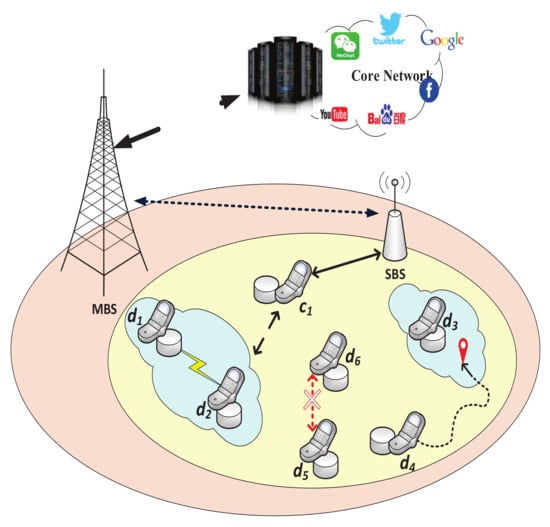
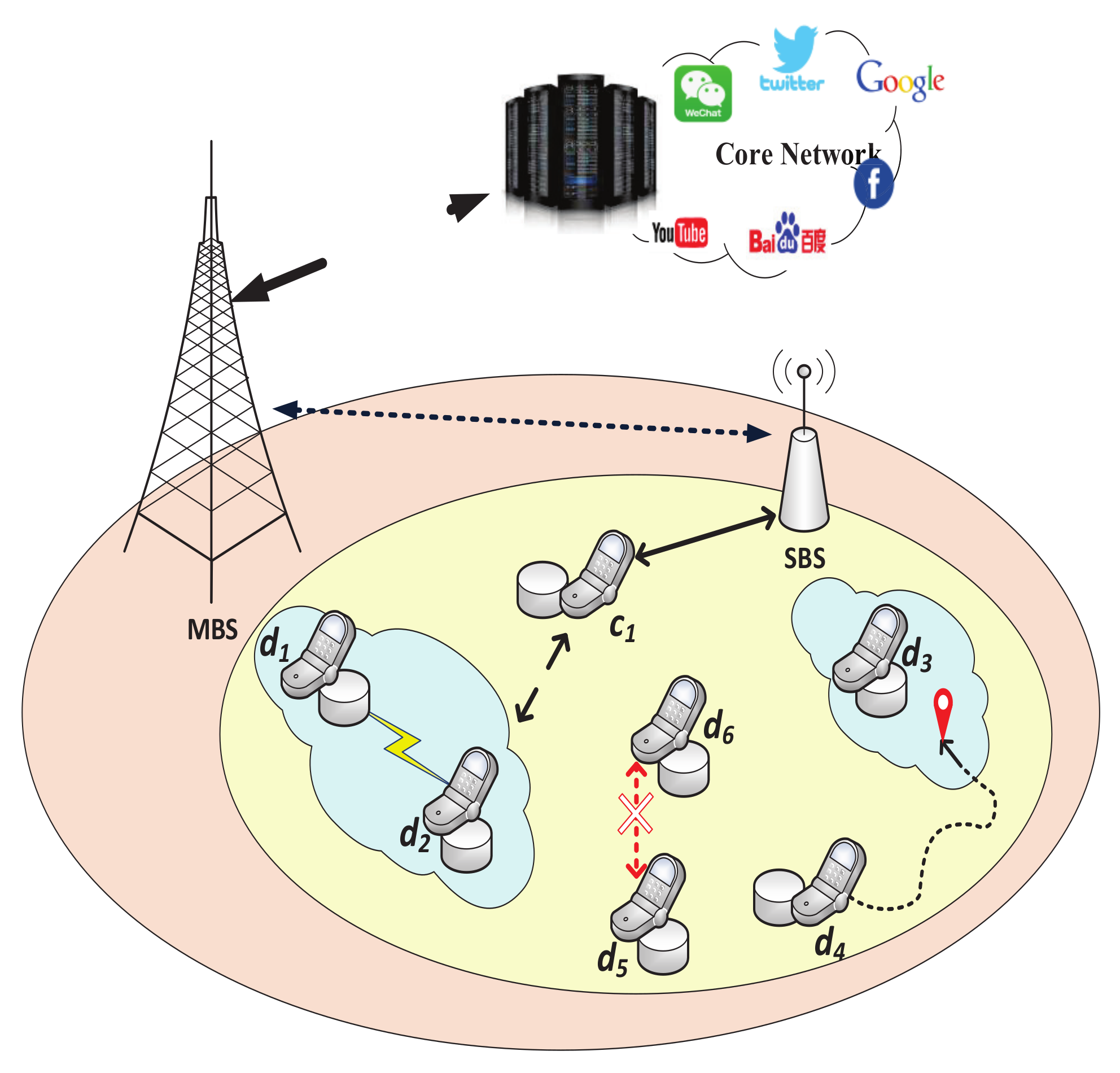
We consider a heterogeneous wireless network (HetNet) consisting of a small base station (SBS) and multiple mobile users as illustrated in Figure 1. Mobile users can access data from the core network through serving SBS or from proximity users by exploiting device-to-device (D2D) communication. The cellular users and D2D users will co-exist in a cell. The users operating in cellular mode and D2D mode are represented by the sets and , respectively. For D2D communications, the cellular users will share their spectrum resources with the D2D pairs. When two users i and j are within D2D communication range of each other, they can establish a D2D link and can perform data sharing, and a D2D pair is represented by .
Figure 1.
An illustration of cache-enabled D2D communications.
However, users are mobile and exhibit intermittent connectivity with each other. Therefore, it is of paramount significance that complete data delivery through the D2D link should be achieved within a certain time period . After , the content will be fetched from the core network through serving SBS to meet the demand of the content-requesting user, while posing a burden over the backhaul. The contact between users i and j in order to establish a D2D pair is represented by a random variable . If , then users i and j may establish a D2D link by utilizing the up-link channel resource of a cellular user .
We assume an orthogonal frequency-division multiplexing (OFDM) system with orthogonal channels, where each channel bandwidth is W. Moreover, D2D users operate in an underlay mode by spectrum sharing with cellular users. To ensure fairness, each D2D user can occupy only one subchannel to perform data communications [16]. The background noise follows an independent and identically distributed (i.i.d.) circularly symmetric complex Gaussian distribution with zero mean, and variance is equal to at each receiving user. For different frequency bands, the fading coefficients of the transmission links are i.i.d. Furthermore, we assume that fading coefficients do not vary within the duration of one time block .
We consider a Rayleigh fading channel and utilize the propagation path-loss model [17]. The data transmission rate of a D2D pair is evaluated as follows:
where W represents the bandwidth, is the transmitter power of D2D pair ; represents the path-loss exponent, and noise power is represented by . represents the distance between two users i and j of . The distance between an interfering cellular user and content receiver user j of is represented by . , and represents the channel fading coefficients of the channel between D2D pair and the channel between interfering cellular user and the receiver of D2D pair , respectively [18].
The utilization of spectral resources of a cellular user by is represented by a random variable . If , it indicates the resource block of cellular user is given to the D2D pair ; otherwise, it is equal to 0. In our system model, we consider that one D2D pair can utilize the spectrum resource of only one cellular user. Therefore, we have a constraint of , . We take into consideration that inter-cell interference can be managed by deploying efficient resource scheduling and power control mechanisms [19]. Therefore, we only focus on intra-cell interference of cellular users and D2D pairs. As mentioned earlier, when two users i and j exist within , they can directly share data through D2D communication. However, there is a constraint of receiving complete content with ; otherwise, failure of the D2D link occurs, and content will be fetched from the core network through serving SBS. Hence, to achieve successful data transmission, the data transmission rate should be . The evaluation of depends on the distance and signal-to-interference noise ratio (SINR) . For successful data transmission, the intra-cell interference should be , where is the threshold value.
Data Caching
We consider a data library containing a total of F contents. The index set of the data library is represented by , and the size of each content is equal to H. The contents are arranged in an ascending order based on the content popularity. The content popularity distribution follows a Zipf distribution with parameter [20], which is evaluated as follows:
The cache capacity of each user is . Each content is cached either completely or not at all. The content cache placement in the cache of user i is expressed as:
where and . When a user needs content, it first checks its own cache to fulfill its content demand. If the content is not cached by itself, then it finds the desired content in the cache of proximity users. If content is cached by another proximity user, then D2D communication is exploited to access the desired content. However, there is a deadline during which complete content should be obtained by the receiver through D2D links. The deadline time is greater than the time needed to completely download a content, i.e., . After finishing , the desired content will be fetched from the core network through serving SBS by posing a traffic burden on the network system.
Only a communication channel is used for the transmission of requested content f, and multiple channels cannot be occupied for the transmission of f. Moreover, a D2D transmitter cannot transmit content f to more than one receiver requesting f. After a successful transmission of the desired content, the corresponding content transmitter stays silent during the remaining time block. Then, the channel resource is allocated to other content demands in the next time blocks.
3. Problem Formulation
There is an intermittent connectivity between mobile users. If , two users i and j exist within , and a D2D pair is created. The time when two users create a D2D link is known as contact time, and contents can be shared. Moreover, when users i and j move out of , they can only share content at the next contact or the data-demanding user can obtain after from the core network through serving SBS. The time taken by two users i and j to come back into is known as inter-contact time () that is evaluated as:
where and are the positions of users i and j at time t; represents the distance evaluation between two users i and j of a D2D pair . is a time-dependent random variable that can be modeled as an exponential distribution with heterogeneous coefficient. If complete content is transmitted within , then the content transmission is considered successful; otherwise, content is fetched from the core network. Moreover, the contact rate between two users i and j of a is represented by . The contact rate follows a Poisson distribution with mean arrival rate , which varies for each content-receiving user. The maximization of successful content transmission ratio within is equivalent to maximizing the probability of successful content transmission through D2D links. The total amount of requested content f received through D2D communications during is represented by .
There can be two cases of D2D link between two users i and j at the time of data offloading. User i either knows user j is in contact or not, due to which there are two different cases of evaluation of the probability of successful transmission of content f that are represented by .
We set the time when data transmission is initiated by user i for data requesting user j through the D2D link , and the time just before is represented by .
- The time when users i and j come into D2D range of each other is represented by . If content f requested by user j is cached by user i (i.e., ), then a spectral resource is allocated to , and content f transmission to user j is initiated by user i. under the condition for is:For , we get . Thus, is derived as:Equation (7) holds if , and is greater than zero as well, i.e.,
- If both users i and j already exist within D2D communication range of each other, then we havefor and , therefore,
- Both cases can be represented as an array and defined as:We obtain
Thus, the success probability of receiving content f through D2D communication at dividing time t can be expressed as:
We formulate the data caching and resource allocation problem to optimize the success probability of data transmission through D2D communications. The problem is formulated in the following manner:
Our problem is a 0/1 knapsack problem, and it is hard to find an optimal solution. Therefore, we deploy a heuristic algorithm to find a sub-optimal solution.
4. Proposed Solution
Submodular optimization has a vast range of applications such as max-k-cover and max-cut problems [21]. Submodular optimization over a matroid constraint approach is deployed in a wireless network to minimize network delay [22]. In the following, we will discuss necessary definitions and properties of submodular set function and matroid constraint.
Matroids are structures for expressing a linear independence property for general sets. We require a finite ground set X. Moreover, matroid is a way to label a subset of X as independent.
Definition 1.
A matroid is a tuple , where represents a finite ground set and (the power set of ) is a collection of independent sets with the following properties:
- is a nonempty, ,
- is downward closed. If and , then ,
- If and , then s.t. .
4.1. Problem Reformulation
We reformulate our problem in terms of a submodular optimization problem over a matroid constraint. We define ground set . The cache placement is denoted as a subset of X, such as . Here, means user i caches content f (i.e., ), and means user i does not cache content f (i.e., ). Accordingly, our problem can be rewritten as:
We rewrite constraint in problem (14) as a matroid constraint.
Lemma 1.
Let include cached contents at user i. The constraint in problem (14) becomes equivalent to matroid constraint , where is as follows:
Constraint (24) is a typical partitioned matroid [23]. Therefore, we reformulate our problem as a submodular optimization problem over matroid constraint as follows:
4.2. Proposed Algorithm
The pseudo code of our proposed algorithm is given in Algorithm 1. Our proposed performs data caching based on data demands. In the beginning, a cache index set is initialized. We represent the set of elements that can be cached and added to the cache placement set Y by . Then, following users’ data demands from neighboring users within D2D range, contents are selected for caching. The priority value of every element defines the gain of including into Y as:
The main complexity of the proposed approach is determining the priority values by taking into consideration the data requests of users. In our proposed algorithm, first we initialize Y as an empty set (i.e., ), which means no content is cached. Then, in each iteration, an element of highest priority value is selected and placed in set Y with respect to the constraints (19)–(22). Moreover, is removed from the set . When the cache capacity of user is full, then all elements of set are removed from the set . This process continues until all contents are placed in the cache resources of users, or cache capacity of all the users is full. In this manner, contents are cached following users’ own and neighboring users’ data demands.
5. Performance Evaluation
In this section, we provide detailed discussion of our obtained results in comparison to the three state-of-the-art schemes. All simulation parameters are provided in Table 3. We have devised a realistic human walk mobility data set that is produced by Korea Advanced Institute of Science and Technology (KAIST), Korea. In simulation settings, we consider a small cell with area 250 m × 250 m that is governed by a small base station having transmission power of 30 dBm. Users are considered mobile, and their transmission power is set to 23 dBm. In our work, we considered D2D communication. Therefore, when two users are within a 20 m range of each other, then both the users can establish a D2D link. Unless otherwise stated, we consider the number of contents equal to 100 and capacity of each cache resource equal to 50 MB. Since we model the data popularity profile through Zipf distribution, we set popularity skewness parameter equal to one1. All simulations are performed with MATLAB R2018a. For performance evaluation, we have utilized three schemes as our baselines that are briefly discussed as follows:
- Random Caching: This scheme enables data caching without any information in a random fashion. All users cache contents with the same probability [13].
- Least Frequently Used: Contents are cached based on users’ data requests frequency of each content. Most frequently requested or used contents are cached in UE [14].
- Zipf-based probabilistic: Users’ cached contents based on the data request probability following Zipf distribution [15].
Table 3.
System parameters.
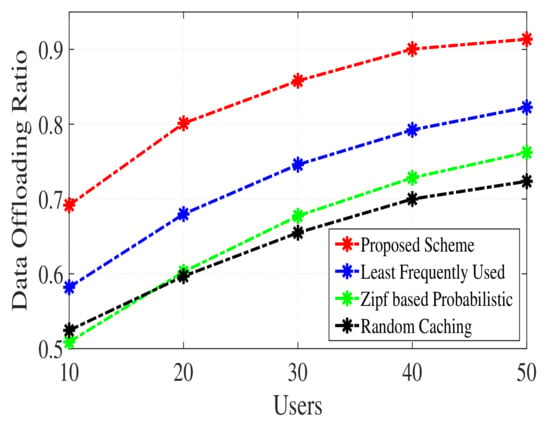
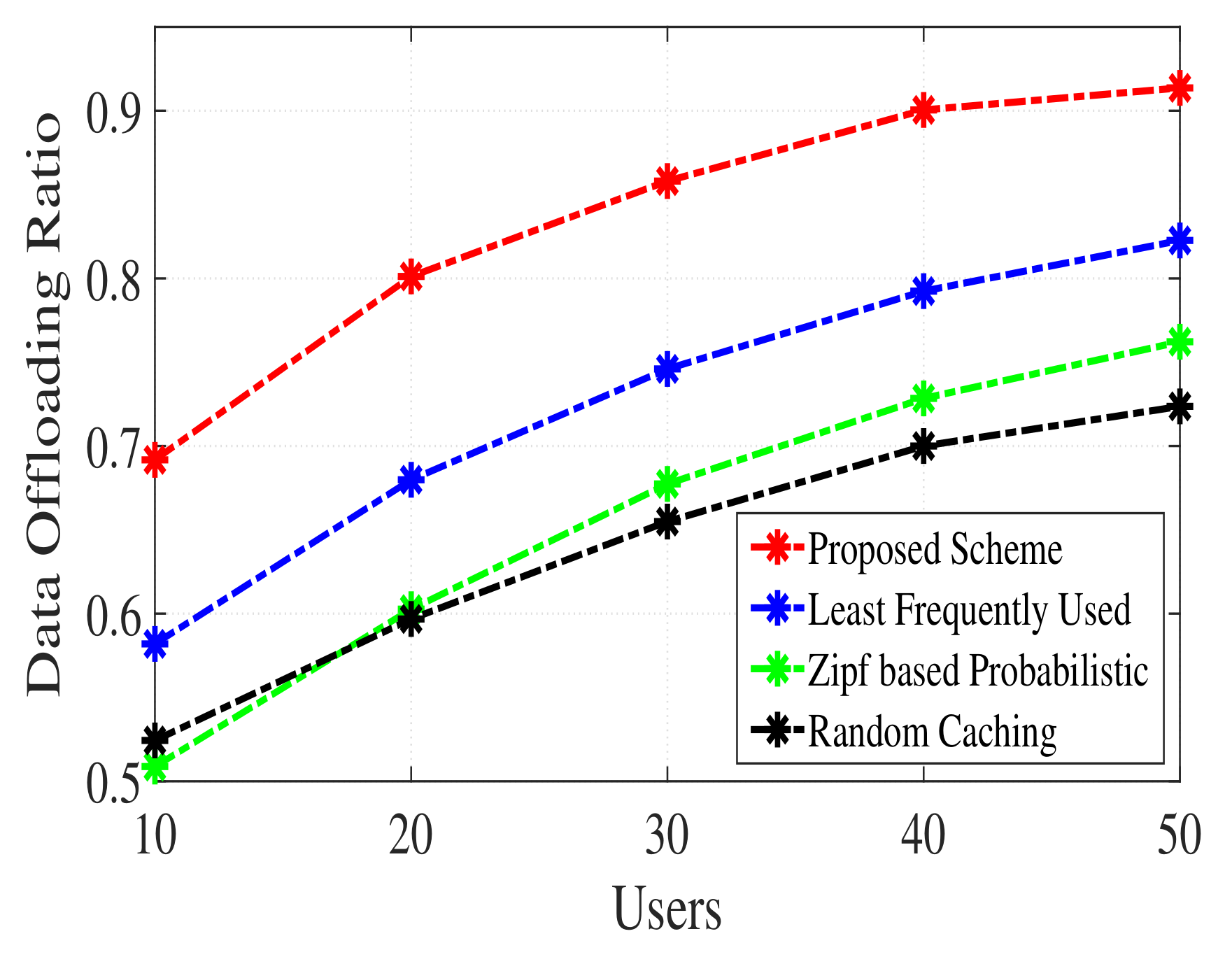
In Figure 2, we investigated the influence of increasing the number of users on the data offloading through D2D communications. The obtained results demonstrate an overwhelming situation, where more contents are offloaded through D2D communications with an increasing number of users. This rise in data offloading through D2D communications is due to the increasing probability of users’ connectivity and data sharing via D2D links. Hence, this approach facilitates high data rate and low latency in data access because contents can be obtained from the neighboring UE. Our proposed scheme achieves 14%, 26%, and 32% better performance than the least frequently used, the Zipf-based probabilistic, and the random caching schemes, respectively. It is evident that the proposed scheme exploits users’ mobility patterns effectively to improve data caching in UE, which results in a successful probability of data sharing via D2D links while taking into account limited duration of users’ connectivity among themselves.
Figure 2.
Data offloading ratio versus users with , MB, and Q = 0.4 GB.
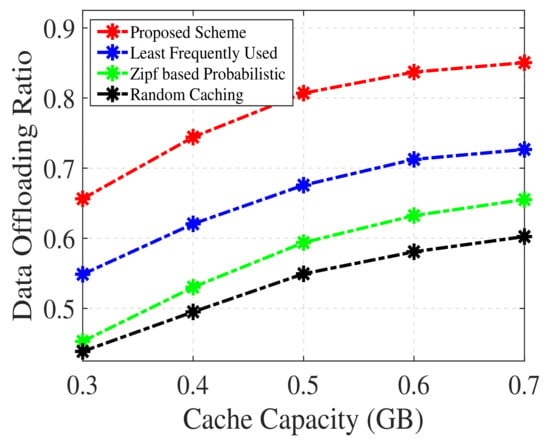
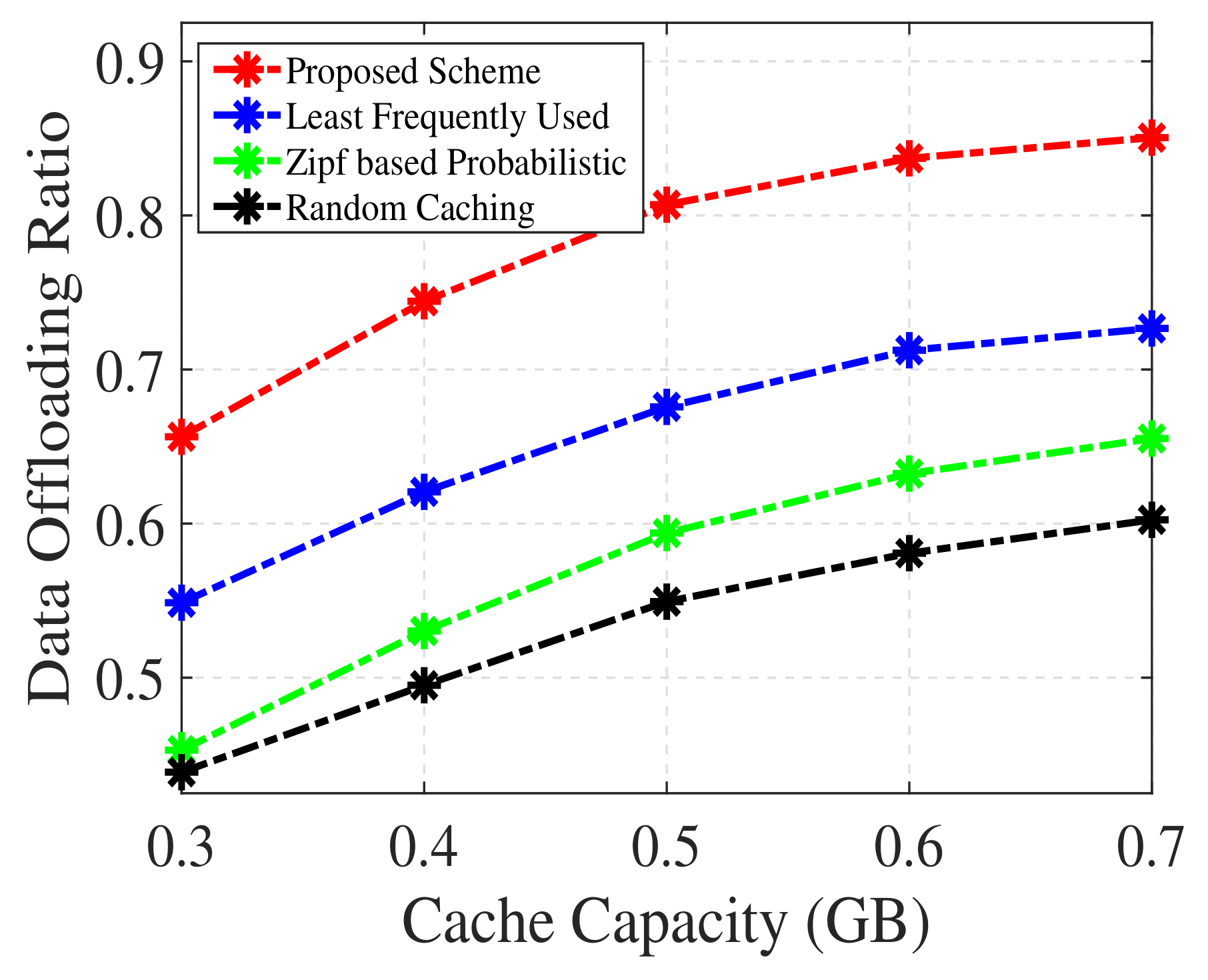
In Figure 3, the impact of increasing cache capacity of UE on the performance of data offloading via D2D communications is analyzed. It is evident from the obtained results that there is a significant growth in the data offloading via D2D links. This rise in data offloading is due to the fact that large cache resources can accommodate a large number of diverse contents, which can fulfill users’ data demands through the cache resources rather than data fetching from the core network. Our proposed caching scheme achieves 16%, 37%, and 47% higher data offloading than the least frequently used, the Zipf-based probabilistic, and the random caching schemes, respectively. From obtained results, it is evident that large cache capacity improves the opportunity of data access through D2D links.
Figure 3.
Data offloading ratio versus cache capacity with , MB.
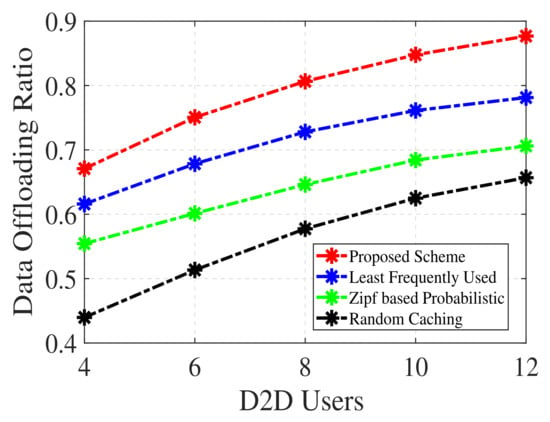
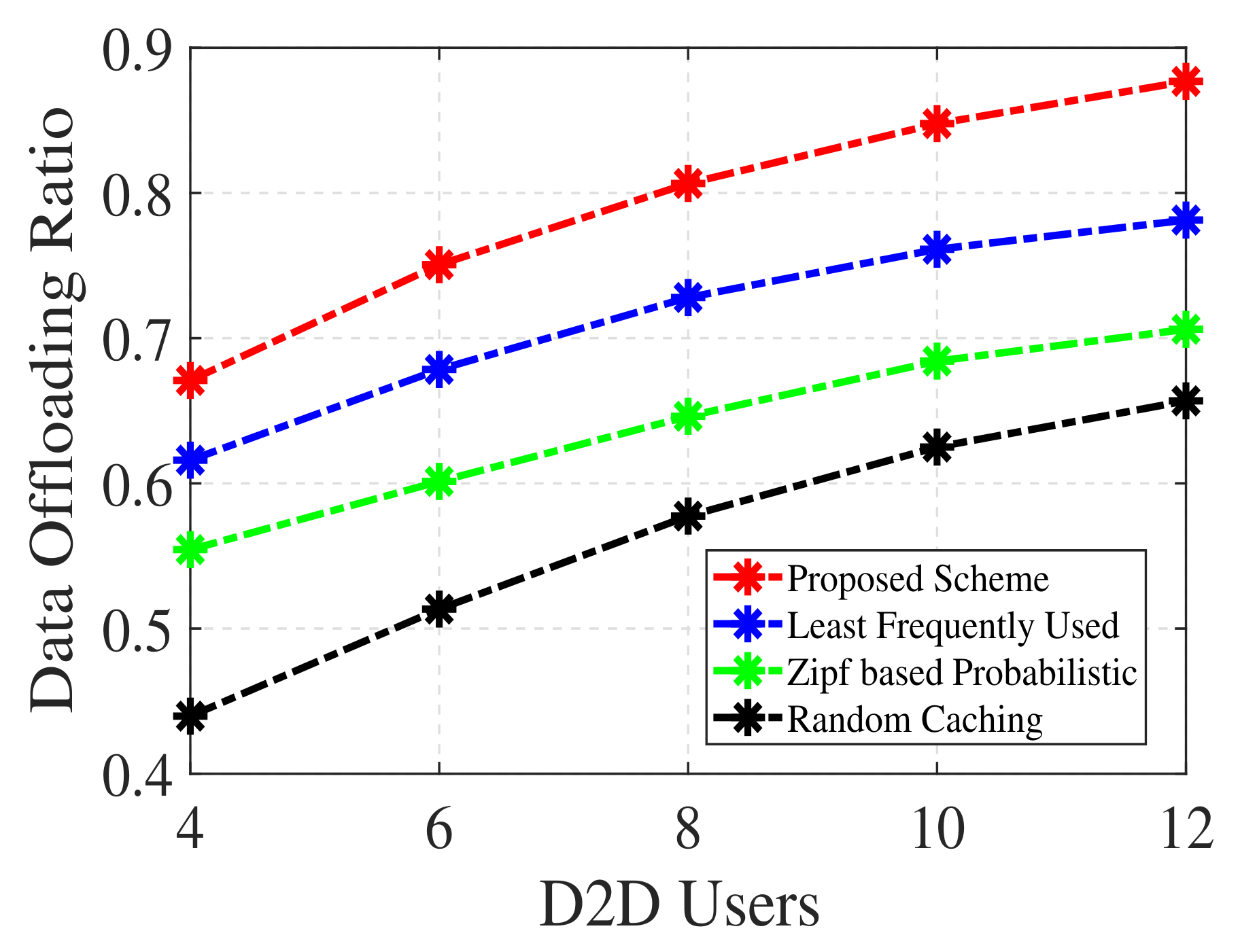
In Figure 4, the impact of users’ participation in D2D communications is observed on the network performance. It is evident from the obtained results that data offloading increases with increasing number of D2D pairs because more users are available to participate in D2D communications. Initially, data offloading increases due to growing D2D links. However, the trend stabilizes at a certain stage due to growing data demands with an increasing number of users. This causes data fetching from the core network, which halts data offloading gain.
Figure 4.
Data offloading ratio versus D2D users with , MB, and Q = 0.4 GB.
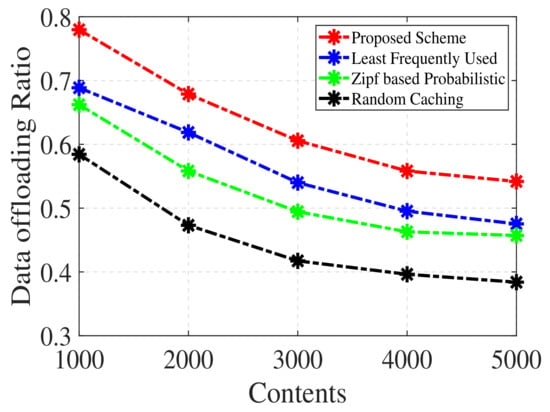
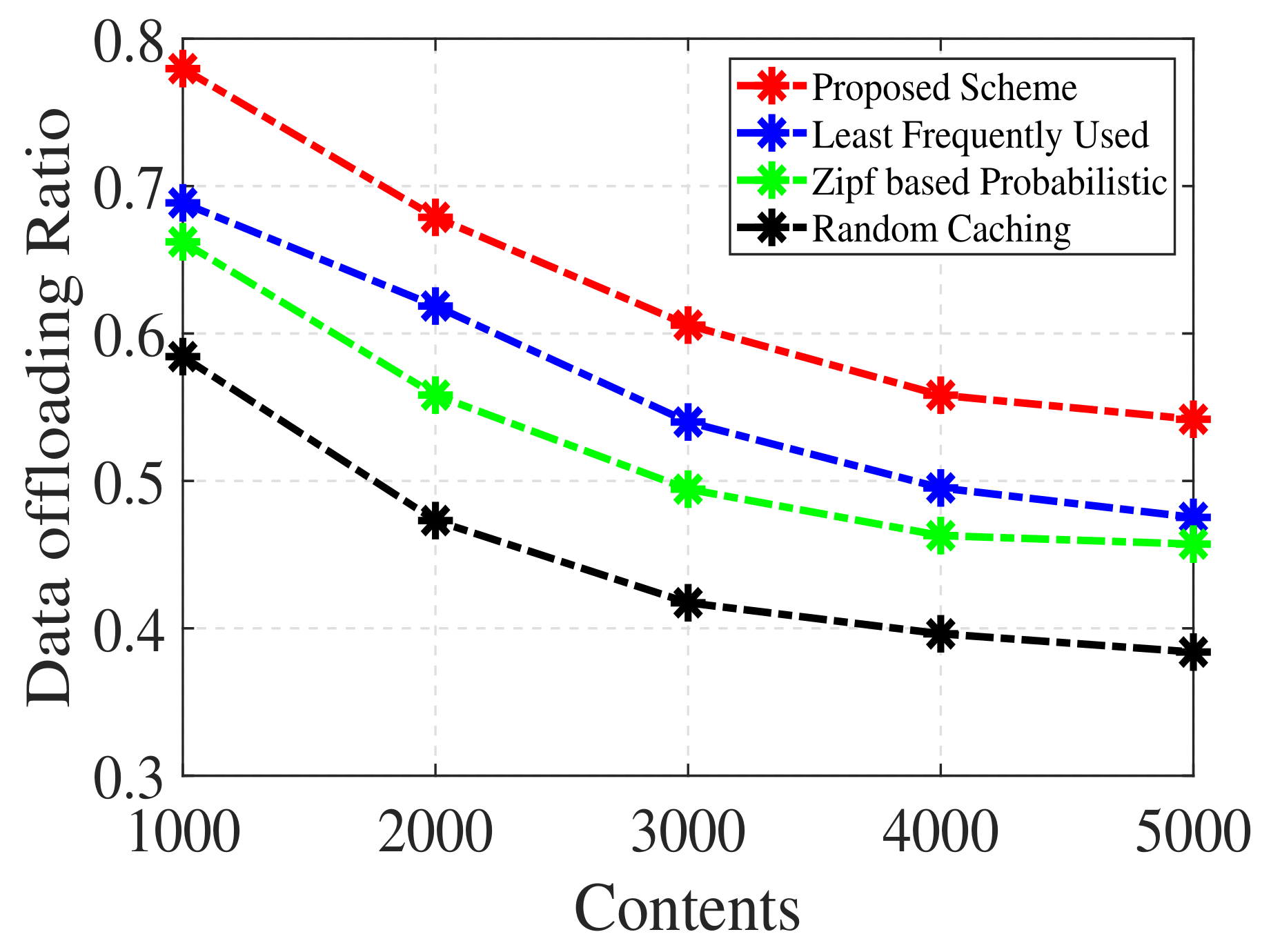
In Figure 5, we evaluate the impact of an increasing number of contents on the data offloading via D2D communications. It is evident from the obtained results that the data offloading ratio degrades for a large number of contents. It is because there is limited cache capacity of each UE, and all contents cannot be stored. Therefore, content demands are fulfilled by data access from the core network. However, our scheme utilizes users’ mobility patterns and their data demands for data caching, which increase the probability of data access via UE’ cache resources. As a result, our proposed scheme achieves 11%, 24%, and 48% performance gain than the least frequently used, the Zipf-based probabilistic, and the random caching schemes, respectively. This result demonstrates that despite limited cache capacity of UE, our proposed scheme maintains a higher data offloading ratio by handling growing data library size.
Figure 5.
Data offloading ratio versus contents with U = 50, MB, and Q = 1 GB.
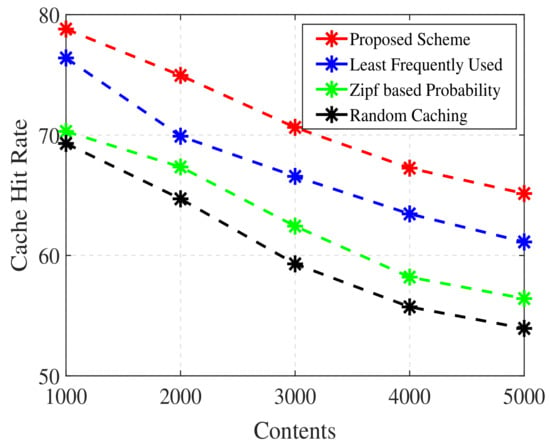
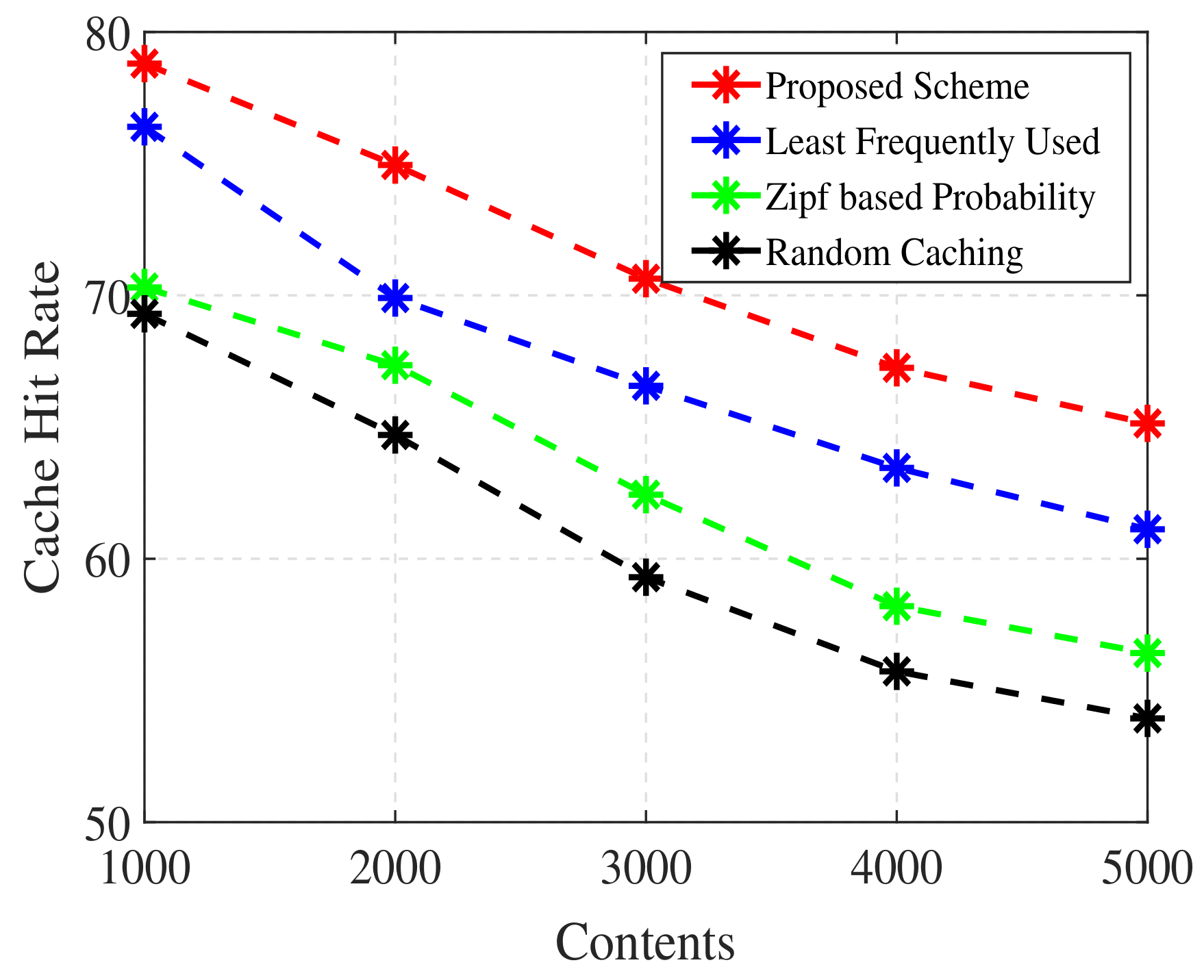
The effect of growing data library size on the obtained cache hit rate is shown in Figure 6. The obtained results demonstrate that cache hit rates of all the caching schemes is trended downward related to the increasing data library. Our proposed caching scheme outperforms three baseline schemes despite a decline in performance because our proposed scheme performs data caching based on users’ connections and data demands. For instance, our suggested caching scheme achieves 8%, 15%, and 20% higher cache hits than the least frequently used, the Zipf-based probabilistic, and the random caching schemes, respectively, when the data library size is equal to 3000. This substantial gain achieved by our proposed caching scheme is due to exploitation of mobility patterns and optimal data placement.
Figure 6.
Cache hit rate versus contents with U = 50, MB, and Q = 1 GB.
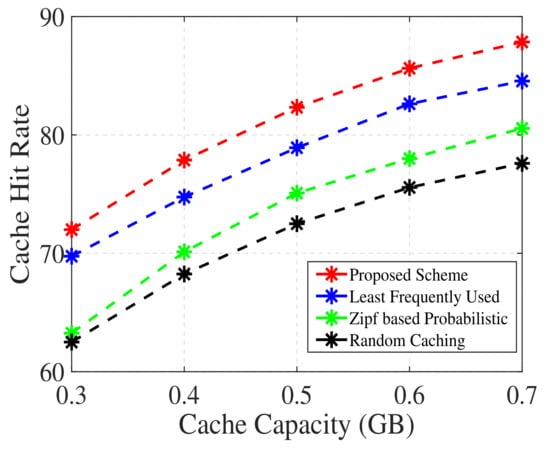
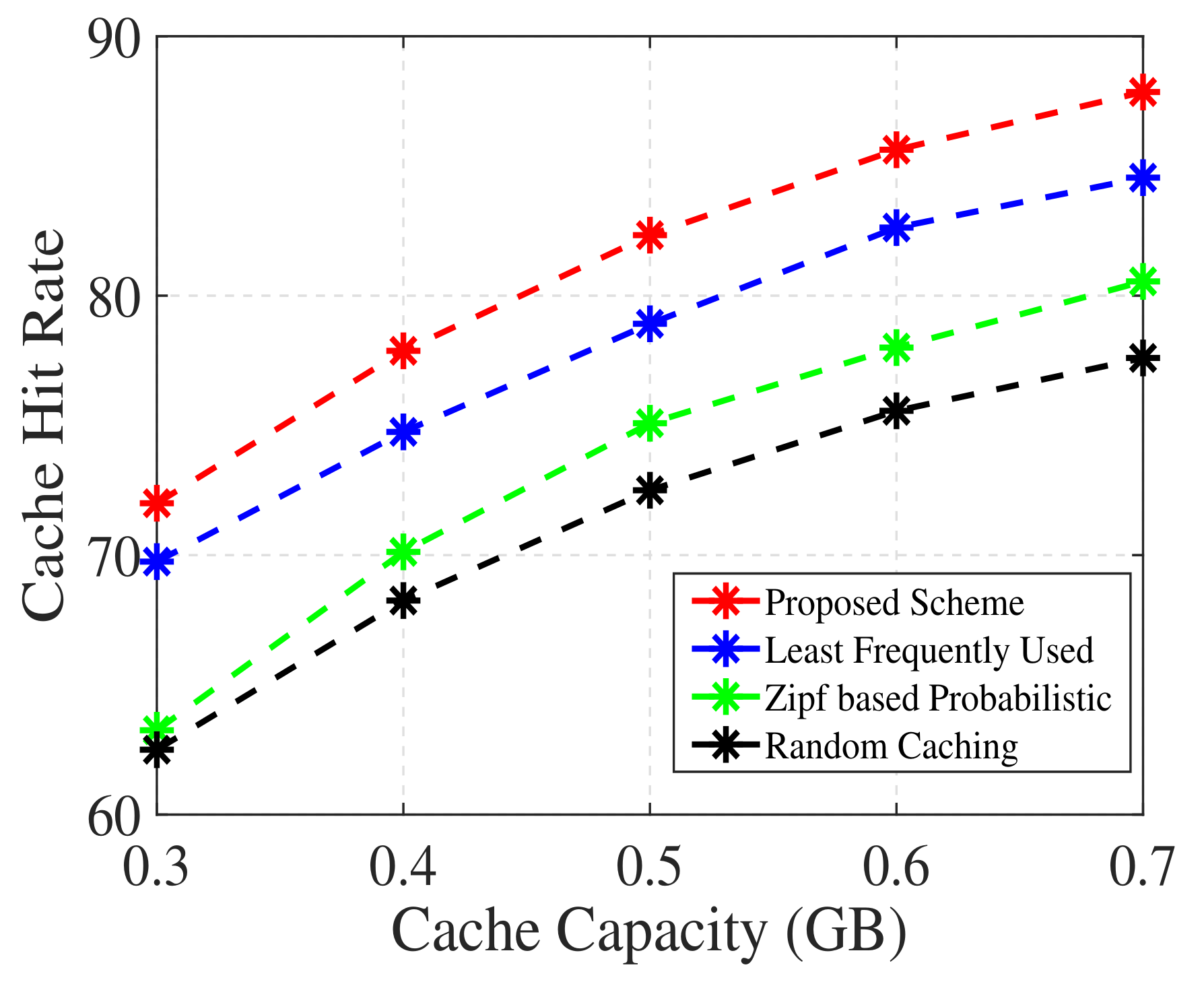
The effect of increasing cache capacity on the cache hit rate is shown in Figure 7. The obtained results show an increase in cache hits as cache capacity rises. This increase in cache hits is due to availability of a large number of contents in the cache resources to meet users’ data demands via cache-enabled D2D communications. For instance, our proposed caching technique achieves 5%, 11.4%, and 15.2% higher cache hit rates than the least frequently used, the Zipf-based probabilistic, and the random caching schemes, respectively, when the cache size is equal to 60. Hence, our proposed caching scheme is capable to precisely predict users’ data preferences while taking into account users’ data preferences, in comparison to the baseline schemes.
Figure 7.
Cache hit rate versus cache capacity with F = 100, MB.
6. Conclusions
We proposed data caching in UE based on users’ mobility patterns to improve data offloading through UE cache resources. An intermittent connectivity characteristic of mobile users was devised to perform data sharing among users via D2D links. However, mobility also brings the challenge of data sharing within a limited time period. Therefore, we designed a mobility-aware data caching scheme while taking into account users’ evolving connectivity patterns and diverse data demands. Our proposed approach also considered interference experienced by mobile users from each other. From simulation, the efficiency of our proposed approach was evident as it can achieve significant performance gain by exploiting real mobility traces of UE to optimize data caching in UE. In our future research work, we will focus on minimization of communication overhead by exploiting data caching in wireless networks. Moreover, we will devise deep reinforcement learning to optimize data caching at UE level based on feature extraction of data contents.
Author Contributions
Conceptualization and methodology, M.S., S.I. and M.A.; supervision, S.S., R.U., S.M., M.I. and M.A.; software, M.S. and S.I.; writing, M.S., S.I., A.B. and M.A.; review and editing, M.S., S.I., R.U., M.I., S.M., A.B. and M.A. All authors have read and agreed to the published version of the manuscript.
Funding
This research received no external funding.
Data Availability Statement
Not applicable.
Conflicts of Interest
The authors declare no conflict of interest.
References
- Cisco Visual Networking Index. Global Mobile Data Traffic Forecast Update, 2018–2023 White Paper. Available online: http://goo.gl/ylTuVx (accessed on 1 August 2022).
- Lyu, L.; Chen, C.; Zhu, S.; Cheng, N.; Tang, Y.; Guan, X.; Shen, X. Dynamics-aware and beamforming-assisted transmission for wireless control scheduling. IEEE Trans. Wirel. Commun. 2018, 17, 7690–7767. [Google Scholar] [CrossRef] [Scilit]
- Sun, R.; Wang, Y.; Cheng, N.; Lyu, L.; Zhang, S.; Zhou, H.; Shen, X. QoE-Driven transmission-aware cache placement and cooperative beamforming design in Cloud-RANs. IEEE Trans. Veh. Technol. 2020, 69, 636–650. [Google Scholar] [CrossRef] [Scilit]
- Ma, J.; Liu, L.; Song, H.; Shafin, R.; Shang, B.; Fan, P. Scalable Video Transmission in Cache-Aided Device-to-Device Networks. IEEE Trans. Wirel. Commun. 2020, 19, 4247–4261. [Google Scholar] [CrossRef] [Scilit]
- Wang, X.; Li, R.; Wang, C.; Li, X.; Taleb, T.; Leung, V.C.M. Attention-Weighted Federated Deep Reinforcement Learning for Device-to-Device Assisted Heterogeneous Collaborative Edge Caching. IEEE J. Sel. Areas Commun. 2021, 39, 154–169. [Google Scholar] [CrossRef] [Scilit]
- Lee, M.-C.; Molisch, A.F. Individual Preference Aware Caching Policy Design in Wireless D2D Networks. IEEE Trans. Wirel. Commun. 2020, 19, 5589–5604. [Google Scholar] [CrossRef] [Scilit]
- Ahmad, F.; Ahmad, A.; Hussain, I.; Muhammad, G.; Uddin, Z.; AlQahtani, S.A. Proactive Caching in D2D Assisted Multitier Cellular Network. Sensors 2022, 22, 5078. [Google Scholar] [CrossRef] [Scilit] [PubMed]
- Jaafar, W.; Mseddi, A.; Ajib, W.; Elbiaze, H. Content Caching and Channel Allocation in D2D-Assisted Wireless HetNets. IEEE Access 2021, 9, 112502–112515. [Google Scholar] [CrossRef] [Scilit]
- Abdolkhani, N.; Eslami, M.; Haghighat, J.; Hamouda, W. Optimal Caching Policy for D2D Assisted Cellular Networks with Different Cache Size Devices. IEEE Access 2022, 10, 99353–99360. [Google Scholar] [CrossRef] [Scilit]
- Passarella, A.; Conti, M. Analysis of individual pair and aggregate intercontact times in heterogeneous opportunistic networks. IEEE Trans. Mob. Comput. 2013, 12, 2483–2495. [Google Scholar] [CrossRef] [Scilit]
- Deng, T.; Ahani, G.; Fan, P.; Yuan, D. Cost-optimal caching for D2D networks with user mobility: Modeling, analysis, and computational approaches. IEEE Trans. Wireless Commun. 2018, 17, 3082–3094. [Google Scholar] [CrossRef] [Scilit]
- Cai, Y.; Chen, Y.; Ding, M.; Cheng, P.; Li, J. Mobility Prediction-Based Wireless Edge Caching Using Deep Reinforcement Learning. In Proceedings of the IEEE/CIC International Conference on Communications in China (ICCC), Xiamen, China, 28–30 July 2021; pp. 1036–1041. [Google Scholar]
- Chen, M.; Hao, Y.; Hu, L.; Huang, K.; Lau, V.K.N. Green and Mobility-Aware Caching in 5G Networks. IEEE Trans. Wirel. Commun. 2017, 16, 8347–8361. [Google Scholar] [CrossRef] [Scilit]
- Hasslinger, G.; Heikkinen, J.; Ntougias, K.; Hasslinger, F.; Hohlfeld, O. Optimum caching versus LRU and LFU: Comparison and combined limited look-ahead strategies. In Proceedings of the 16th International Symposium on Modeling and Optimization in Mobile, Ad Hoc, and Wireless Networks (WiOpt), Shanghai, China, 7–11 May 2018; pp. 1–6. [Google Scholar]
- Chen, Z.; Lee, J.; Quek, T.Q.S.; Kountouris, M. Cooperative caching and transmission design in cluster-centric small cell networks. IEEE Trans. Wirel. Commun. 2017, 16, 3401–3415. [Google Scholar] [CrossRef] [Scilit]
- Zhang, H.; Liao, Y.; Song, L. Device-to-device communications underlaying cellular networks in unlicensed bands. In Proceedings of the IEEE International Conference on Communications (ICC), Paris, France, 21–25 May 2017; pp. 1–6. [Google Scholar]
- Ahmed, M.; Shi, H.; Chen, X.; Li, Y.; Waqas, M.; Jin, D. Socially Aware Secrecy-Ensured Resource Allocation in D2D Underlay Communication: An Overlapping Coalitional Game Scheme. IEEE Trans. Wirel. Commun. 2018, 17, 4118–4133. [Google Scholar] [CrossRef] [Scilit]
- Zhao, Y.; Li, Y.; Cao, Y.; Jiang, T.; Ge, N. Social-Aware Resource Allocation for Device-to-Device Communications Underlaying Cellular Networks. IEEE Trans. Wirel. Commun. 2013, 14, 6621–6634. [Google Scholar] [CrossRef] [Scilit]
- Lei, L.; Zhong, Z.; Lin, C.; Shen, X. Operator controlled device-to-device communications in LTE-advanced networks. IEEE Wirel. Commun. 2012, 19, 96–104. [Google Scholar] [CrossRef] [Scilit]
- Niesen, U.; Maddah-Ali, M.A. Coded caching with nonuniform demands. In Proceedings of the IEEE Conference on Computer Communications Workshops (INFOCOM WKSHPS), Toronto, ON, Canada, 27 April–2 May 2014; pp. 221–226. [Google Scholar]
- Sun, R.; Wang, Y.; Lyu, L.; Cheng, N.; Zhang, S.; Yang, T.; Shen, X. Delay-Oriented Caching Strategies in D2D Mobile Networks. IEEE Trans. Veh. Technol. 2020, 69, 8529–8541. [Google Scholar] [CrossRef] [Scilit]
- Liu, J.; Bai, B.; Zhang, J.; Letaief, K.B. Cache Placement in Fog-RANs: From Centralized to Distributed Algorithms. IEEE Trans. Wirel. Commun. 2017, 16, 7039–7051. [Google Scholar] [CrossRef] [Scilit]
- Nemhauser, G.; Wolsey, L.; Fisher, M.L. An analysis of approximations for maximizing submodular set functions—I. Math. Program. 1978, 14, 265–294. [Google Scholar] [CrossRef] [Scilit]

Publisher’s Note: MDPI stays neutral with regard to jurisdictional claims in published maps and institutional affiliations. |
© 2022 by the authors. Licensee MDPI, Basel, Switzerland. This article is an open access article distributed under the terms and conditions of the Creative Commons Attribution (CC BY) license (https://creativecommons.org/licenses/by/4.0/).