


Abstract
Background: Atrophic acne scars are challenging to treat and have a negative psychological impact. Insulin has been tried as a topical adjuvant and stimulates fibroblast activity, collagen deposition, and keratinocyte migration. Objectives: To evaluate topical insulin for atrophic acne scars in terms of its effectiveness, safety, and patient-rated results. Methods: Five databases were searched for research on topical insulin, either alone or in conjunction with a procedure, without regard to the date. Records were screened, extracted, and evaluated in duplicate (RoB 2 or ROBINS-I) each by two independent researchers, using Covidence. Results: Fourteen studies with 619 patients, seven randomized and seven non-randomized, were qualified. All insulin arms improved from baseline (35.8% to 55.4%), but comparator arms mostly improved similarly; five studies, none at low risk of bias, favored insulin. Adverse effects were mostly local, minor, and transient, although one study reported systemic hypoglycemia-related symptoms; glucose monitoring was inconsistent, and satisfaction was high. Limitations: Meta-analysis was not possible due to heterogeneity in design, dosage, and outcome scales, and the small number of patients precludes certain conclusions. Conclusions: Although its superiority over current adjuncts has not been demonstrated, topical insulin appears to be an affordable, well-tolerated adjunct that may have a function where traditional therapies are unavailable; larger studies are needed.
1. Introduction
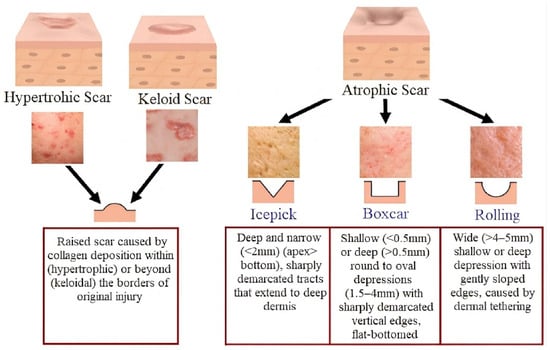
Acne vulgaris is among the most prevalent dermatologic conditions worldwide, affecting about 8% of the population and 85% of adolescents [1]. Acne can persist or lead to scarring, resulting in significant psychological burden, including anxiety, depression, and reduced quality of life [2]. Post-acne atrophic scars arise from an imbalance of collagen degradation and synthesis during healing [3] and are classified into three types: ice pick, rolling, and boxcar, with ice pick being the most common [4]. These atrophic subtypes, together with raised hypertrophic and keloid scars, are illustrated in Figure 1 [5].
Figure 1.
Classification of acne scars into raised (hypertrophic and keloid) and atrophic (ice pick, boxcar, and rolling) scars, with representative clinical images, schematic cross-sections, and defining features. Reproduced from Junayed et al. [5], published under a Creative Commons Attribution (CC BY 4.0) license.
There is no single definitive treatment for atrophic scars. Current options include microneedling, laser therapy, platelet-rich plasma, dermabrasion, subcision, punch excision, chemical peels, and tissue augmentation. These have been associated with improvements in scar appearance, but outcomes vary by scar subtype [6,7,8], and many require multiple sessions, carry significant side effects, and impose considerable cost [9].
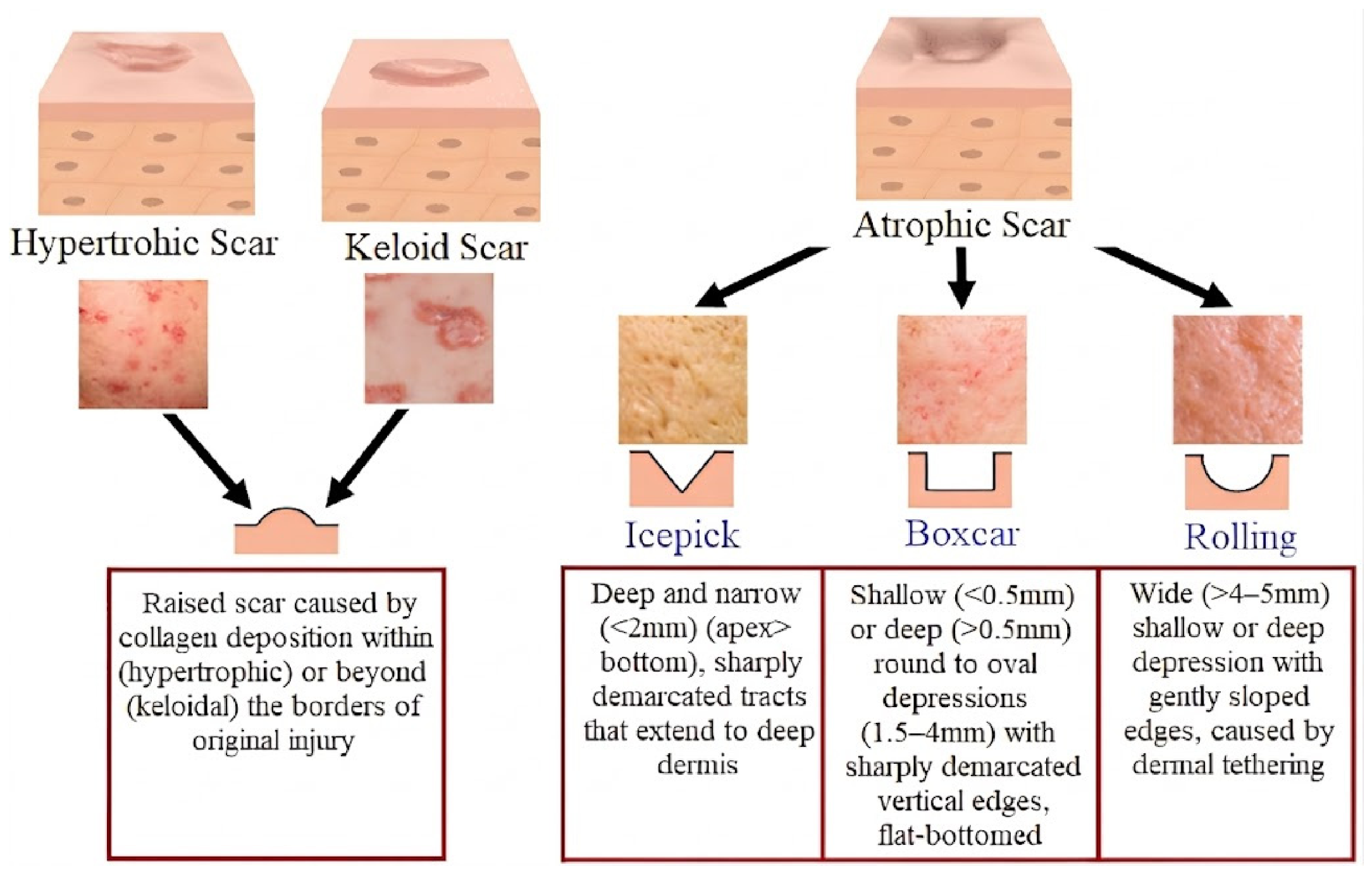
Insulin has been linked to scar treatment through its regenerative effects, including improved keratinocyte proliferation, fibroblast activity, and collagen deposition [10]. It also enhances vascular endothelial growth factor (VEGF) expression, promoting angiogenesis [11]. Topical insulin enhances wound healing through multiple intracellular signaling cascades: binding to the insulin receptor (IR) activates the PI3K-Akt pathway. In keratinocytes, this drives re-epithelialization by inhibiting GSK-3β, stabilizing β-catenin, and synthesizing laminin 332 and integrin α3β1 [12,13,14]. In endothelial cells, Akt phosphorylates eNOS, stimulating NO production, vasodilation, and upregulation of VEGF and FGF-R [13]. In fibroblasts, TGF-β1 upregulation promotes non-fibrotic repair through deposition of type 1 and 3 collagen with elastin [13,15] (Figure 2).
Figure 2.
Molecular mechanisms of topical insulin in cutaneous wound healing. Footnote: IR: Insulin receptor; RTK: receptor tyrosine kinase; IRS: insulin receptor substrates; PI3K: phosphoinositide 3-kinase; Akt: protein kinase B; GSK3β: glycogen synthase kinase 3 beta; mTOR: mammalian target of rapamycin; Ras: rat sarcoma; Raf: rapidly accelerated fibrosarcoma; MEK: mitogen-activated protein kinase kinase; ERK1/2: extracellular signal-regulated kinases 1/2; Grb2/SOS: growth factor receptor-bound protein 2/Son of sevenless; VEGF: vascular endothelial growth factor; eNOS: endothelial nitric oxide synthase; NO: nitric oxide; TGF-β: transforming growth factor beta; ECM: extracellular matrix; GAGs: glycosaminoglycans.
Previous systematic reviews have examined topical insulin as an adjunct to microneedling. This systematic review aimed to synthesize the current literature and assess the effectiveness of topical insulin as a treatment for post-acne atrophic scars, extending earlier syntheses by including randomized trials published in 2025 and 2026, by covering fractional CO2 laser and micro-fractional radiofrequency delivery in addition to microneedling, and by stratifying outcomes according to scar morphology, Fitzpatrick phototype, and patient-reported satisfaction [16,17].
2. Materials and Methods
The systematic review protocol was registered in PROSPERO under registration number CRD420251061005. It followed the Preferred Reporting Items for Systematic Reviews and Meta-Analyses (PRISMA 2020) guideline [18] (Supplementary Material S1).
2.1. Search Strategies
A comprehensive search was conducted across PubMed/MEDLINE, Embase, the Cochrane Central Register of Controlled Trials (CENTRAL), Scopus, and Google Scholar, without year restrictions. The initial search was run 13–27 May 2025 and updated on 7 September 2026, with the updated search date used for the final eligibility set. The updated search re-ran each strategy in full from database inception; its yield of 572 records therefore supersedes, rather than adds to, the 373 records of the initial search, and all 572 records, including the 148 retrieved from Google Scholar, were exported to Covidence (Veritas Health Innovation, Melbourne, Australia) and screened (Supplementary Material S2). Controlled vocabulary (MeSH in PubMed, Emtree in Embase) and free-text keywords were combined using Boolean operators to maximize sensitivity. All records were entered into Covidence [19], and duplicates were removed prior to screening (for the searching algorithm, refer to Supplementary Material S2).
2.2. Eligibility Criteria
PICO criteria were used to establish inclusion criteria (Supplementary Material S3). The studies had to be on the use of topical insulin as monotherapy or in combination, in patients with clinically diagnosed post-acne atrophic scars regardless of gender, age, race, severity, and duration of scars. The studies had to have a control or comparator group and report at least one of the outcomes defined in Section 2.3. Eligibility did not depend on the direction, magnitude, or statistical significance of study results. Only English-language papers were included.
2.3. Outcomes
The primary outcome was therapeutic efficacy assessed using validated physician-reported scar severity scales. Secondary outcomes included patient-reported satisfaction, scar-type and skin type-specific responses, and safety outcomes.
2.4. Data Extraction and Synthesis
Study screening and selection were performed in Covidence [19]. Two independent reviewers conducted screening and data extraction, with conflicts resolved by consensus. Extracted data items were study design and setting, sample size (enrolled and analyzed), participant age and sex, Fitzpatrick phototype, scar morphology, insulin preparation and dose, delivery modality, treatment interval and number of sessions, follow-up duration, physician-rated scar severity scales and scores, patient-reported satisfaction, and adverse events. Because the included studies applied eight different scar-grading instruments, a range of insulin doses, and three different procedural platforms, clinical and methodological heterogeneity precluded meta-analysis. The synthesis is therefore narrative, grouped by comparator: for each comparison, the direction and magnitude of the reported between-group effect are presented together with the authors’ reported test statistic.
The quality of the studies was determined using the Cochrane Handbook for Systematic Reviews of Interventions, version 6.5 [20]. Risk of Bias (RoB) 2 was applied to the RCTs [21], while ROBINS-I V2 was applied to non-RCTs [22]. Two independent reviewers evaluated each study, with conflicts resolved by consensus (Supplementary Material S4).
3. Results
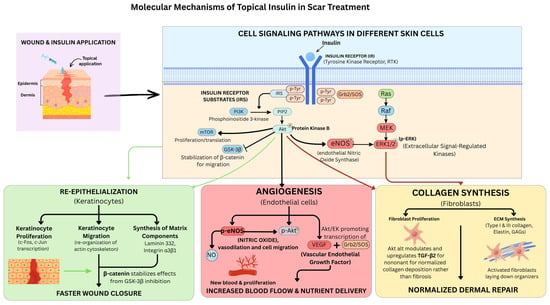
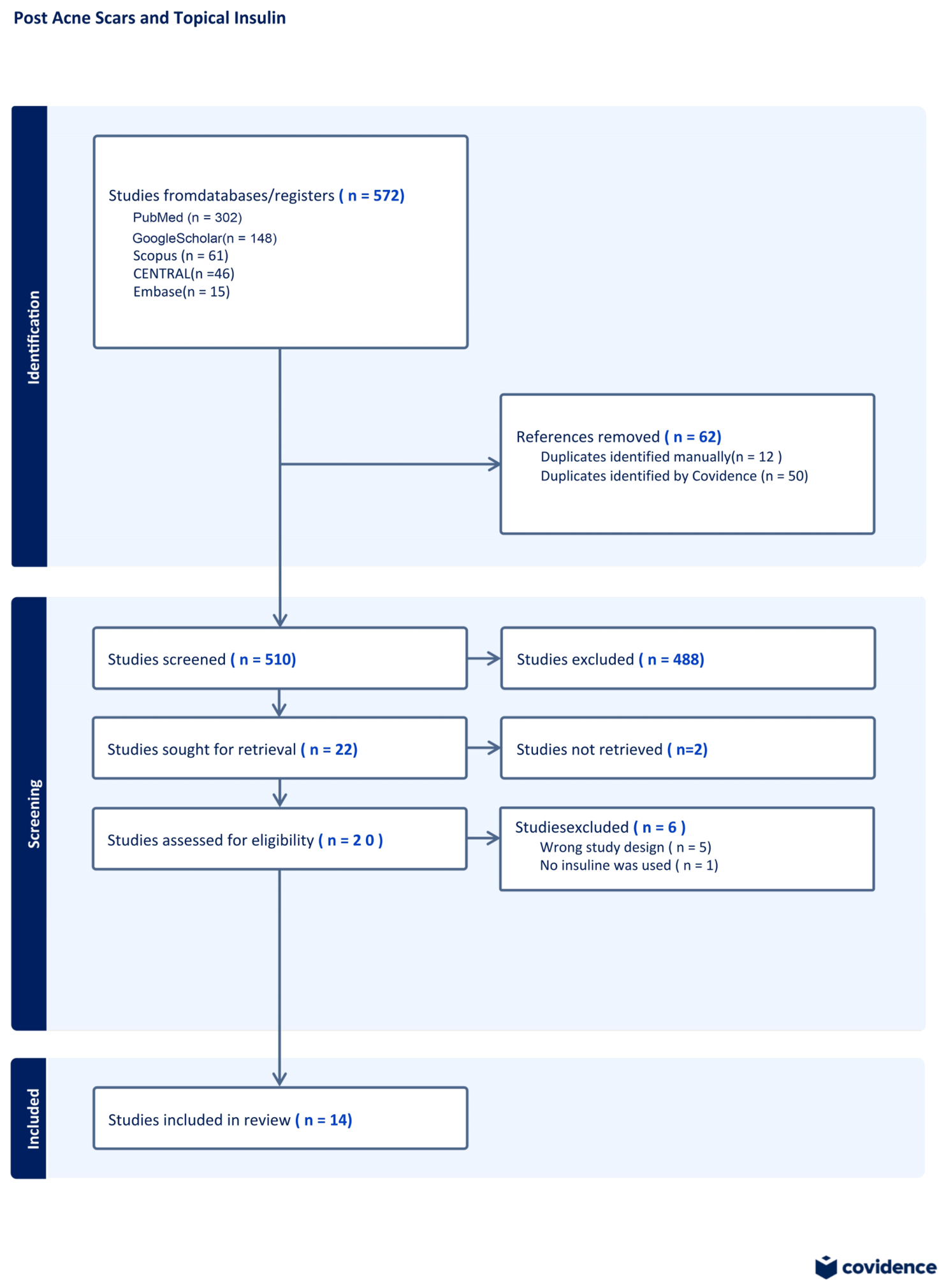
A total of 572 records were retrieved by the updated search (PubMed 302, Google Scholar 148, Scopus 61, CENTRAL 46, Embase 15; S2). After the removal of 62 duplicates, 510 records were screened by title and abstract, and 488 were excluded. Twenty-two reports were sought for retrieval, of which two could not be obtained, leaving 20 reports assessed for eligibility at full text. Six reports were excluded at full text, five due to incorrect study design and one due to wrong intervention, leaving 14 studies that met the eligibility criteria (Figure 3); no report was excluded on the basis of its results.
Figure 3.
PRISMA 2020 flow diagram illustrating the study selection process.
3.1. Demographics, Patient Characteristics, and Study Design
Of the 14 studies (Table 1), four were conducted in Egypt [23,24,25,26], three in Pakistan [27,28,29], three in India [30,31,32], and a single study in Thailand [33], Iran [34], Syria [7], and China [35]. The cohort comprised seven RCTs (four split-face) [23,24,27,32,33,34,35] and seven non-randomized comparative studies, of which six were split-face studies [25,26,28,29,30,31], and one was a prospective parallel-group study [7]. A total of 619 participants were included across all investigations, with sample sizes ranging from 16 [31] to 120 [7]. Since 10 of the 14 studies employed split-face designs, each participant received both the intervention and the comparator, one on each side of the face. The two sides of the same face are paired, within-person observations and cannot be treated as independent; the participant is therefore the unit of analysis, and between-side comparisons require paired methods. The original analyses of the 10 split-face studies accounted for this inconsistently: three used methods that account for pairing (paired tests [23,29] or a linear mixed-effects model [33]), four compared the sides with tests for independent samples [24,30,31,34], and three did not state the test used for the between-side comparison [25,26,28]. As this review did not re-analyze individual-level data, between-side p-values from these studies should be interpreted with caution. Acne scar types were reported in five studies [7,24,25,28,32], and the Fitzpatrick skin type was reported in 9/14 studies, mostly types III–IV. All studies evaluated topical insulin as monotherapy or adjunctive therapy; doses ranged from 10 IU [25,32] to 40–50 IU [29,34], with breaks of 3–4 weeks and time spans varying from 9 weeks [23] to 12 months [7]. All studies utilized regular human insulin; however, the concentration, volume applied, and treated surface area were reported inconsistently, and only a few studies mentioned the timing of application relative to the procedure, making the derivation of a standardized dose impossible.
Table 1.
An overview of included studies and their characteristics.
3.2. Risk of Bias in Included Studies
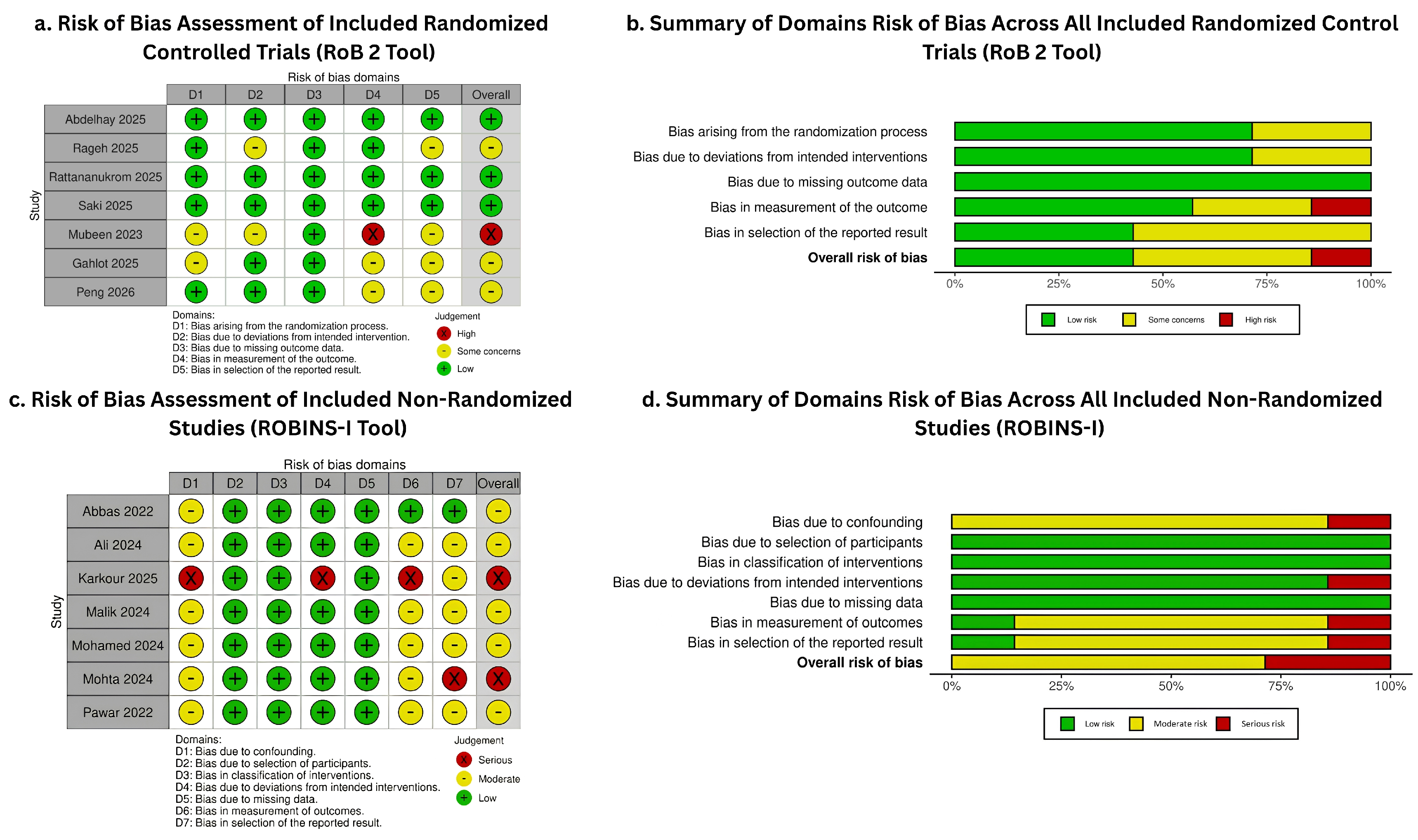
For RCTs: 3 out of 7 (42.9%) were judged to have an overall low risk of bias [23,33,34]. Rageh et al. (2025) [24], Gahlot and Hussain (2025) [32], and Peng et al. (2026) [35] had some concerns, while Mubeen et al. (2023) [27] was at high risk due to outcome measurement. The most common concern was selection of the reported result, affecting 4/7 RCTs [24,27,32,35], followed by measurement of the outcome, affecting 3/7 RCTs [27,32,35] (Figure 4).
Figure 4.
Risk of bias assessment of included studies [7,23,24,25,26,27,28,29,30,31,32,33,34,35]: randomized controlled trials (RoB 2) and non-randomized studies (ROBINS-I). Footnote: Risk of bias was assessed independently by two reviewers. For RCTs (a,b), the Cochrane RoB 2 tool was used, with risk levels categorized as low, some concerns, or high. For non-randomized studies (c,d), the ROBINS-I tool was used, with risk levels categorized as low, moderate, or serious. Domain-specific and overall risk of bias are presented for individual studies (a,c) and as summary proportions across all included studies (b,d). Disagreements were resolved by consensus or consultation with a third reviewer.
For non-RCTs: 5/7 (71.4%) had overall moderate risk of bias [25,26,28,29,31], and 2 (28.6%) had serious risk [7,30]. Confounding was the most frequent limitation, judged moderate in 6/7 studies (85.7%) and serious in the remaining study [7], so that all 7 non-randomized studies carried at least moderate concern for confounding (Figure 4).
3.3. Comparative Efficacy of Topical Insulin-Based Adjunct Therapies
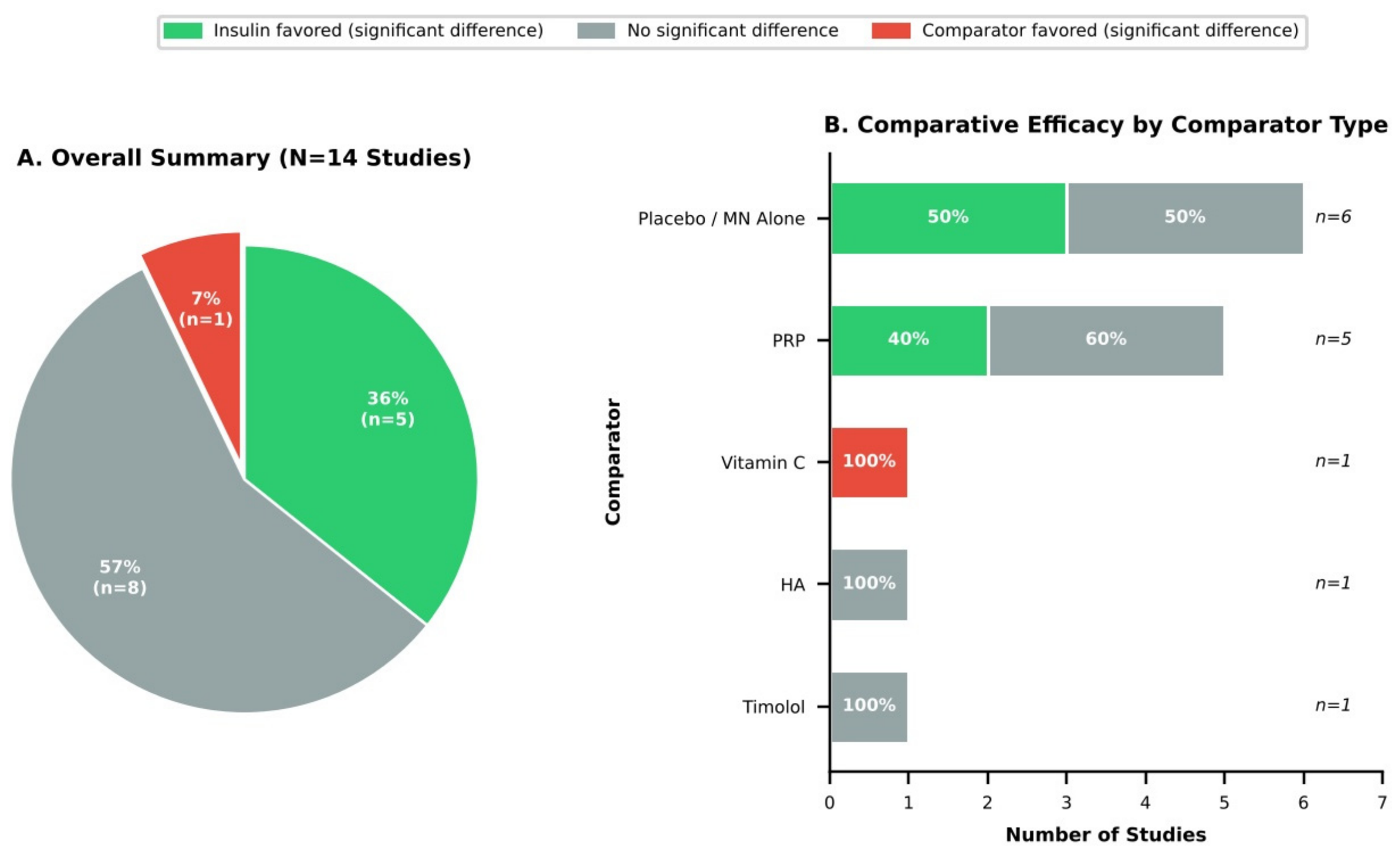
The Goodman and Baron grading scale and Acne Scar Assessment Scale were the most commonly used outcome measures (Table 2). In all 14 studies, topical insulin was used as an adjunct treatment, most commonly with microneedling. Rageh et al. (2025) [24] and Saki et al. (2025) [34] used topical insulin with fractional CO2 laser, while Rattananukrom et al. (2025) [33] used micro-fractional radiofrequency (Table 2, Figure 5).
Table 2.
Summary of study outcomes, efficacy, and significance.
Figure 5.
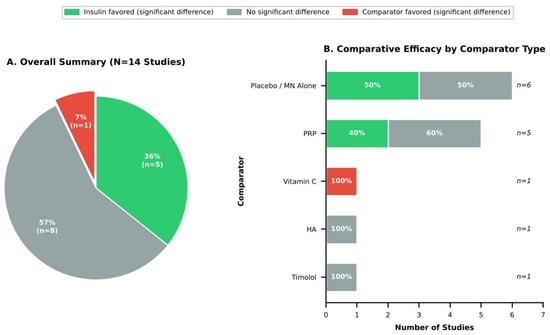
Comparative efficacy of insulin vs. other treatments for acne scarring. Footnote: Abbas et al. (2022) [25] was classified as favoring the comparator despite significant within-group improvement in both arms, as it is the only included study in which a comparator (Vitamin C) significantly outperformed insulin on any efficacy measure (SQGS, p = 0.0036); on ASAS, the two arms did not differ significantly. Mohta et al. (2024) [30] is shown with the studies reporting no significant difference only because the authors described similar improvement on both sides; as no between-group p-value was reported, its statistical significance could not be determined, while Peng et al. (2026) [35] is classified as favoring insulin due to a significant between-group difference in VISIA texture score, even though the overall response rate did not differ. “No significant difference” denotes the absence of a statistically significant between-group difference and does not imply equivalence.
3.3.1. Efficacy: Consistency of Baseline Improvement
Across procedural platforms (MN [n = 11], fractional CO2 [n = 2], radiofrequency [n = 1]), different comparators, and different grading measures, all 14 investigations demonstrated a substantial improvement from baseline (p < 0.05). The range of improvement was 35.8 ± 25.2% [23] to 55.4 ± 12.7% [27]. Regarding categorical outcomes, 50% of patients in Mubeen et al.’s research (2023) [27] improved significantly (>50%), and 63.3% of patients in Ali et al.’s research (2024) [28] achieved Grade 3 improvement (50–75%). These findings are in line with those from Karkour et al.’s study (2025) [7], where 50% of insulin-treated patients demonstrated a “good response” on the qualitative Goodman and Baron scale (Table 2). However, because insulin was always combined with a procedure and the comparator arms improved to a similar extent in most studies (Table 2), improvement from baseline reflects the combined treatment and cannot by itself be attributed to insulin; evidence for an insulin-specific effect rests on the between-group comparisons below (Section 3.3.2, Section 3.3.3 and Section 3.3.4).
3.3.2. Insulin vs. Placebo or MN Alone
Six studies compared insulin with placebo or microneedling alone. In four of these, the between-group difference was small and not statistically distinguishable [23,29,33,35]. In Malik et al. (2024) [29], both groups reduced quantitative Goodman and Baron scores by ~10 points, though insulin demonstrated shorter skin-healing time and better tolerability. Two non-randomized studies reported a between-group difference favoring insulin, at moderate [28] and serious [7] risk of bias, respectively: Ali et al. (2024) [28] found 63.3% of the insulin group achieved Grade 3 improvement (50–75%) vs. 66.7% of the MN-alone group showing no improvement (p < 0.001), and Karkour et al. (2025) [7] found 50% good response with insulin vs. 25% with placebo (p = 0.001) (Table 2). Peng et al. (2026) [35] found no significant difference in overall response rate between microneedling with insulin and microneedling alone (69.23% vs. 46.15%, p = 0.287), although the VISIA texture score improved significantly more with insulin (3.77 ± 1.25 vs. 2.23 ± 1.097, p = 0.020).
3.3.3. Insulin vs. Platelet-Rich Plasma (PRP)
Five studies compared insulin with PRP. Two reported a statistically significant between-group difference favoring insulin [27,32], one at high risk of bias [27] and one with some concerns [32]. Mubeen et al. (2023) [27] showed 55.4 ± 12.7% vs. 23.3 ± 16.8% reduction in scar severity (p = 0.001), with 50% of insulin patients achieving ‘marked’ improvement vs. 0% in the PRP group. Of the remaining three studies, two reported no significant between-group difference [24,31]; Mohta et al. (2024) [30] reported greater mean improvement with insulin (52% vs. 28%), but stated only that an unpaired comparison showed similar improvement on both sides, without reporting a between-group p-value, so the statistical significance of this comparison could not be determined. Pawar et al. (2022) [31] found no significant difference between insulin plus MN (45%) and PRP plus MN (26%), and Rageh et al. (2025) [24] found no significant intergroup difference (p = 0.794), though both treatments considerably reduced scarring (Table 2). Gahlot and Hussain (2025) [32] reported a significantly greater ASAS reduction with insulin than PRP (41.10 ± 11.86% vs. 25.32 ± 9.72%, p = 0.015), with >75% improvement on the SQGS in 36% vs. 8% of patients (p = 0.023).
3.3.4. Insulin vs. Other Active Comparators
Abbas et al. (2022) [25] found no significant difference between insulin and vitamin C on the ASAS, though vitamin C performed somewhat better on the SQGS (15.62 vs. 12.78, p = 0.0036), the only study showing comparator superiority. Mohamed et al. (2024) [26] found no significant difference between insulin (49.2% improvement) and hyaluronic acid (47.7%) with MN (p = 0.348). Saki et al. (2025) [34] found no significant differences between insulin plus laser, timolol plus laser, and laser alone at all scales (p > 0.05) (Table 2).
3.4. Outcomes by Scar Type and Skin Type
Rolling and boxcar scars seem to respond the most (Table 3). Mubeen et al. (2023) [27] demonstrated that 75% of patients with rolling scars exhibited significant improvement (p = 0.018), and both boxcar and ice pick scars displayed notable improvement (~50% significant). Mohamed et al. (2024) [26] demonstrated that there was no significant difference in % improvement for rolling (p = 0.250), boxcar (p = 0.992), or ice pick (p = 0.774) scars compared to hyaluronic acid. Pawar et al. (2022) [31] discovered that although quantitative assessments showed no differences in boxcar scars between groups, qualitative GAS significantly preferred insulin (p = 0.008). Gahlot and Hussain (2025) [32] similarly found a more favorable reaction in rolling and boxcar scars with insulin, whereas deep ice pick scars showed slight improvement in both categories.
Table 3.
Effect of topical insulin on atrophic acne scar outcomes according to scar morphology and the Fitzpatrick skin type: summary of evidence across included studies.
Ice pick scars showed the least responsiveness. Three studies indicated no major advantage compared to comparators (hyaluronic acid p = 0.774 [26], PRP p = 0.88 [31], PRP p = 0.9 [24]), while only Mubeen et al. (2023) [27] noted a significant result (p = 0.019), contradicting the other findings and originating from a study with a high risk of bias. According to Mubeen et al. (2023) [27], insulin was effective solely for Fitzpatrick skin type IV (p = 0.001) and exhibited no significant improvement in types V or VI. Saki et al. (2025) [34] discovered that only patients with Type II skin showed a notable enhancement in DLQI (p = 0.009). Karkour et al. (2025) [7] discovered that 90% of PIH cases were in Type III skin (p = 0.003) (Table 3).
3.5. Patient-Reported Outcomes and Satisfaction
Eight studies indicated satisfaction results; all demonstrated improvement, with four showing no significant statistical difference between insulin and the comparator [24,26,33,34]. Malik et al. (2024) [29] and Karkour et al. (2025) [7] demonstrated a notable difference that favored insulin. The only exception was Abbas et al.’s research (2022) [25], in which vitamin C was considerably favored (excellent response: 6.7% vs. 46.7%, p < 0.001). Rattananukrom et al. (2025) [33] found overall high scores (patient satisfaction 8.05 ± 1.80; self-perceived improvement 7.30 ± 1.50) with no significant differences among groups (p = 0.944) (Table 4). Gahlot and Hussain (2025) [32] found an ‘excellent’ satisfaction level in 48% of insulin-treated individuals compared to 8% in those receiving PRP (p = 0.0008).
Table 4.
An overview of qualitative key findings of intervention and comparators, and their statistical significance.
3.6. Side Effects and Adverse Effects
Topical insulin was generally well accepted in all studies, with no serious or lasting side effects. The most frequently observed side effect was temporary erythema, affecting nearly all patients [7,25], which typically resolved on the day of the procedure or the next day in most studies; Rageh et al. (2025) [24] found an average resolution time of 5.8–6.8 days. Malik et al. (2024) [29] demonstrated reduced average erythema scores when insulin was used compared to MN alone (1.82 ± 0.62 vs. 2.92 ± 1.08, p = 0.009). Temporary mild discomfort was noted in 10 studies (10–90% of patients). Gahlot and Hussain (2025) [32] observed erythema and edema in 8% of insulin-treated patients compared to 12% for PRP, while Peng et al. (2026) [35] noted erythema, edema, burning, and pain in every patient, with resolution occurring within 3 days to 2 weeks.
PIH was reported in 6 studies, occurring in 0–20.2% with no statistical significance; 90% of PIH cases in Karkour et al. (2025) [7] were in Fitzpatrick III (p = 0.003). Hypoglycemia symptoms were observed in 5 of the 119 insulin-treated patients in a trial (Karkour et al. (2025) [7]; 4.2% vs. 0% in the control group, p = 0.31), but none resulted in any complications or permanent effects; the symptoms were confirmed by a serum glucose measurement in that trial, and only a few studies reported monitoring blood glucose levels. In that study, adverse events were reported for the full cohort of 158 participants with different atrophic scar types (119 insulin, 39 control), rather than for the acne-scar subgroup of 120 participants included in Table 1 and Table 2; these events, including the hypoglycemia-related symptoms, therefore cannot be attributed specifically to patients with acne scars. No other systemic events were reported (Table 5).
Table 5.
A summary of reported adverse effects.
4. Discussion
This review partially supports our hypothesis. Topical insulin appears to be a well-tolerated, low-cost adjuvant in the management of post-acne atrophic scars, although its efficacy beyond that of the accompanying procedure remains uncertain. Across the 14 studies, all showed significant clinical improvement from baseline, but because comparator arms usually improved to a similar degree, this largely reflects the accompanying procedure. Between-group results varied: a minority demonstrated notable superiority, particularly for rolling and boxcar scars, although none of those comparisons came from a study at low risk of bias; half found no statistically significant difference from well-established alternatives, mainly PRP, which does not establish equivalence; and only one study showed slightly less efficacy than vitamin C [25].
In comparisons of insulin to placebo, some research indicated no significant difference, potentially due to an improper technique or dosage, or the suggestion that microneedling might be the primary therapeutic mechanism. Contamination in split-face designs, where insulin given to one side might be absorbed systemically and influence the opposite control side, skewing split-face comparisons toward the null, is another reason specific to this body of evidence. Compared with PRP, which has an established advantage in wound healing and scar remodeling [36], insulin showed no significant difference in two of five studies, while one did not report a between-group p-value [30] and a significant advantage in two, one at high risk of bias and one with some concerns [27,32]. Thus, while topical insulin contributes to clinical improvement, its superiority over other adjuvant therapies remains uncertain. It was used in conjunction with adjuvant delivery methods, such as fractional CO2, microneedling, or micro-fractional radiofrequency, in all included studies. These methods increase the effect through enhanced trans-epidermal delivery and synergistic remodeling [37,38].
Two systematic reviews that preceded ours successfully managed to combine data for the comparison of microneedling [16,17]. We have not combined data since the studies used for analysis used eight grading scales on three different procedural systems. The trade-off in this case is lower precision, and our findings should be viewed as indicative of this problem. Patient-related outcomes consistently revealed improvement and satisfaction; however, superiority to alternative methods has not been consistently shown. Outcome measures can be influenced by placebo effect, patient expectations [39,40], initial severity of scars [41], and previous treatment experience [42].
Most evidence showed that rolling and boxcar scars had the most consistent response, consistent with other microneedling studies. Rolling scars have a prominent fibrous component attaching the dermis to the underlying musculo-fascial layer [43]. Needle penetration disrupts these subdermal fibrotic strands and initiates a wound-healing cascade [44], potentiated by the healing effects of insulin. Boxcar scars, with their wide U-shaped base, may permit more localized insulin penetration to dermal fibroblasts, improving collagen remodeling [33,45]. In contrast, ice pick scars are deeper, narrower defects that often require more aggressive interventions such as punch excision or TCA CROSS [44,46]. Future studies should stratify by scar type to better assess insulin’s role.
Topical insulin appeared well tolerated, as reported adverse effects were largely limited to temporary local reactions, usually pain and erythema caused by the method of administration. PIH occurred bilaterally in split-face trials and was more common among people with Type III skin. The only side effect of a systemic nature was hypoglycemia occurring in five participants of one trial, whose safety data also included patients with scars other than acne scars. Because blood glucose was monitored in only a few studies, systemic absorption and the risk of hypoglycemia cannot be excluded, and these safety findings should be regarded as provisional.
Topical insulin has a notable economic advantage. Indicative figures place the cost per session using regular human insulin (~40 units) at approximately $25 [47], against $500 to $2500 per PRP treatment [48]. These are list estimates rather than the output of a costing study and exclude consumables, clinician time, and the number of sessions required, and no formal cost-effectiveness analysis of topical insulin for acne scarring has been published. Even allowing for this, the difference in order of magnitude suggests that insulin may be accessible in settings where PRP is not.
Topical insulin can serve as an adjunct or alternative when standard therapies are contraindicated (e.g., PRP in platelet dysfunction syndromes, critical thrombocytopenia, hemodynamic instability, or bloodstream infection) and in limited-resource settings. Further studies are needed to demonstrate its efficacy when combined with other treatments to achieve a synergistic effect.
The included studies were mostly of moderate quality, with high variability in design, comparators, and outcome measures, precluding meta-analysis. Only 7 of 14 studies were RCTs, and 71.4% of non-RCTs showed moderate bias. Our interpretation was therefore adjusted by risk-of-bias findings: because selective reporting affected 4 of 7 RCTs, outcome measurement 3 of 7 RCTs, and confounding all 7 non-RCTs, the apparent efficacy of topical insulin may have been overstated and was interpreted as suggestive rather than confirmatory. All three RCTs judged at low risk of bias found no significant difference between insulin and comparator, whereas no comparison favoring insulin arose from a study at low risk of bias. As a result, the three low-risk RCTs received more interpretive weight, and conclusions regarding superiority over PRP or vitamin C were purposefully framed as uncertain. Generalizability is limited by geographic concentration (Egypt, Pakistan, India) and dominance of Fitzpatrick skin types III–IV, although these phototypes account for most of the global population and bear a disproportionate scarring burden. Follow-up was short, ranging from 9 weeks to 12 months, with most studies not exceeding 6 months, and eight distinct scar scales were used. Ten of the 14 studies used split-face designs, whose paired structure was not consistently accounted for in the original analyses, and the small total number of patients means that the results cannot be considered conclusive. Eligibility was restricted to English-language publications, which may have excluded relevant evidence given the geographic distribution of the included studies. The lack of a consistent insulin dose (10–50 IU) limits standard protocol recommendations.
These results can be used as an evidence base from which future research can be developed. Large-scale, high-quality multicenter randomized controlled trials will have to be conducted with standard protocols and longer follow-ups. Future studies need to stratify based on scar type and also conduct dose-finding studies to identify the most appropriate concentrations and frequencies for the administration of insulin.
5. Conclusions
Clinical improvement of atrophic acne scars in relation to baseline was observed in all 14 studies reviewed here, irrespective of the mode of administration of insulin, although comparator arms improved similarly in most studies, so this improvement cannot be attributed to insulin alone. In three of the six studies comparing insulin with PRP or HA, insulin did not differ significantly from the comparator, and one further study reported no between-group p-value; this does not establish equivalence, and none of the studies reporting superiority were at low risk of bias. One study found vitamin C superior on one out of two assessment scales. Rolling and boxcar scars responded the most favorably, while ice pick scars responded poorly, as they do to most non-surgical options.
None of the 14 trials reported any serious adverse effects. Adverse events were predominantly transient and local; all patients experienced erythema after the procedure, while some experienced mild pain or edema. However, a systemic event was also reported: in one trial, whose safety data also covered scars other than acne scars, five patients experienced temporary hypoglycemia symptoms that resolved with oral sugar intake, and since only a few trials measured glucose levels routinely, the systemic absorption rate is poorly defined.
The evidence has real gaps. Only 7 of the 14 studies were RCTs. Dosing varied from 10 to 50 IU with no protocol consensus. Most patients were Fitzpatrick III or IV from a small group of countries, and follow-up rarely went past six months. Insulin is not ruled out by this, but it does indicate that the hypothesis is currently based on a small number of studies, most of which are small; given the limited number of patients, the results cannot yet be considered certain, and larger studies are needed.
Overall, topical insulin is a promising adjunct to microneedling, fractional CO2 laser, or radiofrequency, especially where PRP is unaffordable or not an option, but the evidence remains heterogeneous and limited by study design and risk of bias. The next step is multicenter RCTs with standardized dosing, longer follow-up periods, and stratification by scar type.
Supplementary Materials
The following supporting information can be downloaded at https://www.mdpi.com/article/10.3390/cosmetics13060286/s1. Supplementary Material S1: PRISMA 2020 checklist; Supplementary Material S2: Search strategy; Supplementary Material S3: PICO framework; Supplementary Material S4: Risk-of-bias assessment of studies evaluating topical insulin for atrophic acne scars.
Author Contributions
Conceptualization, A.A.Y.A. and A.A.-M.; methodology, A.A.Y.A., B.N., S.F., A.-A.K. and A.A.-M.; investigation, A.A.Y.A., A.H. and B.H.; resources, B.N. and S.F.; data curation, A.A.Y.A., A.H. and B.H.; writing—original draft preparation, A.A.Y.A., A.H., B.H., A.-A.K. and A.Z.; writing—review and editing, A.-A.K., S.F. and A.A.-M.; visualization, A.Z.; supervision, S.F. and A.A.-M.; project administration, A.A.Y.A. All authors have read and agreed to the published version of the manuscript.
Funding
This research received no external funding.
Institutional Review Board Statement
Not applicable. This study is a systematic review of previously published research and did not involve any new studies of human participants or animals performed by any of the authors.
Informed Consent Statement
Not applicable.
Data Availability Statement
No new data were created in this study. All data analyzed are contained within the published articles included in this review, which are listed in the reference list. The full search strategies and the eligibility framework are provided in the Supplementary Materials. Further details of the screening and extraction records held in Covidence are available from the corresponding author on reasonable request.
Acknowledgments
The authors would like to declare the use of generative AI and AI-assisted technologies in the manuscript preparation process. In finalizing the manuscript, the main author used Grammarly EDU (web-based version; Grammarly Inc., San Francisco, CA, USA) for grammar checking and Claude (Anthropic, San Francisco, CA, USA) for proofreading and for consistency and unification of language and structure, with no input into the scientific content of the paper. The authors take full responsibility for the contents of the paper. No generative AI tools were used to create or modify any figure; Figure 1 is reproduced from Junayed et al. [5] under a Creative Commons Attribution (CC BY 4.0) license, and all other figures are original and were produced by the authors.
Conflicts of Interest
The authors declare no conflicts of interest.
Abbreviations
The following abbreviations are used in this manuscript:
| Akt | Protein Kinase B |
| ASAS | Acne Scar Assessment Scale |
| CENTRAL | Cochrane Central Register of Controlled Trials |
| DLQI | Dermatology Life Quality Index |
| ECCA | Échelle d’Évaluation Clinique des Cicatrices d’Acné |
| ECM | Extracellular Matrix |
| eNOS | Endothelial Nitric Oxide Synthase |
| ERK1/2 | Extracellular Signal-Regulated Kinases 1/2 |
| FCL | Fractional Carbon Dioxide Laser |
| FGF-R | Fibroblast Growth Factor Receptor |
| GAGs | Glycosaminoglycans |
| GAS | Global Assessment Score |
| GBQGS | Goodman and Baron Quantitative Global Scarring Scale |
| Grb2/SOS | Growth Factor Receptor-Bound Protein 2/Son of Sevenless |
| GSGS | Goodman and Baron Qualitative Global Scarring Scale |
| GSK-3β | Glycogen Synthase Kinase 3 Beta |
| HA | Hyaluronic Acid |
| IR | Insulin Receptor |
| IRS | Insulin Receptor Substrates |
| IU | International Units |
| MEK | Mitogen-Activated Protein Kinase Kinase |
| MeSH | Medical Subject Headings |
| MFR | Microneedle Fractional Radiofrequency |
| MN | Microneedling |
| mTOR | Mammalian Target of Rapamycin |
| NO | Nitric Oxide |
| PI3K | Phosphoinositide 3-Kinase |
| PICO | Population, Intervention, Comparison, Outcome |
| PIH | Post-Inflammatory Hyperpigmentation |
| PRISMA | Preferred Reporting Items for Systematic Reviews and Meta-Analyses |
| PROSPERO | International Prospective Register of Systematic Reviews |
| PRP | Platelet-Rich Plasma |
| PTP1B | Protein Tyrosine Phosphatase 1B |
| Raf | Rapidly Accelerated Fibrosarcoma |
| Ras | Rat Sarcoma |
| RCT | Randomized Controlled Trial |
| RoB 2 | Risk of Bias 2 Tool |
| ROBINS-I | Risk of Bias in Non-Randomized Studies of Interventions |
| RTK | Receptor Tyrosine Kinase |
| SCAR-S | Scar Global Assessment Scale |
| SD | Standard Deviation |
| SQGS | Scar Quantitative Grading Scale |
| TCA CROSS | Trichloroacetic Acid Chemical Reconstruction of Skin Scars |
| TGF-β | Transforming Growth Factor Beta |
| VAS | Visual Analog Scale |
| VEGF | Vascular Endothelial Growth Factor |
References
- Guguluș, D.L.; Vâță, D.; Popescu, I.A.; Pătrașcu, A.I.; Halip, I.A.; Mocanu, M.; Solovăstru, L.G. The Epidemiology of Acne in the Current Era: Trends and Clinical Implications. Cosmetics 2025, 12, 106. [Google Scholar] [CrossRef] [Scilit]
- Layton, A.M.; Bettoli, V.; Delore, V.; Puentes, E.; Tan, J.K.L. The Burden of Acne Vulgaris on Health-Related Quality of Life and Psychosocial Well-Being Domains: A Systematic Review. Am. J. Clin. Dermatol. 2026, 27, 17–47. [Google Scholar] [CrossRef] [Scilit]
- Connolly, D.; Vu, H.L.; Mariwalla, K.; Saedi, N. Acne Scarring-Pathogenesis, Evaluation, and Treatment Options. J. Clin. Aesthetic Dermatol. 2017, 10, 12–23. [Google Scholar]
- Kravvas, G.; Al-Niaimi, F. A systematic review of treatments for acne scarring. Part 1: Non-energy-based techniques. Scars Burns Heal. 2017, 3, 2059513117695312. [Google Scholar] [CrossRef] [Scilit]
- Junayed, M.S.; Islam, M.B.; Jeny, A.A.; Sadeghzadeh, A.; Biswas, T.; Shah, A.F.M.S. ScarNet: Development and Validation of a Novel Deep CNN Model for Acne Scar Classification with a New Dataset. IEEE Access 2022, 10, 1245–1258. [Google Scholar] [CrossRef] [Scilit]
- Bhargava, S.; Cunha, P.R.; Lee, J.; Kroumpouzos, G. Acne Scarring Management: Systematic Review and Evaluation of the Evidence. Am. J. Clin. Dermatol. 2018, 19, 459–477. [Google Scholar] [CrossRef] [Scilit]
- Karkour, B.; Abu Ghedda, S.; Aljundi, R.; Sheikh Debs, S.; Farwati, R.; Ishkhanian, S. Efficacy and safety of microneedling with topical insulin compared with placebo in the treatment of atrophic scars: A prospective study and literature review. Skin Health Dis. 2025, 5, 263–272. [Google Scholar] [CrossRef] [Scilit]
- Hession, M.T.; Graber, E.M. Atrophic acne scarring: A review of treatment options. J. Clin. Aesthet. Dermatol. 2015, 8, 50–58. [Google Scholar]
- Rullan, P.P.; Olson, R.; Lee, K.C. A Combination Approach to Treating Acne Scars in All Skin Types: Carbolic Chemical Reconstruction of Skin Scars, Blunt Bi-level Cannula Subcision, and Microneedling—A Case Series. J. Clin. Aesthet. Dermatol. 2020, 13, 19–23. [Google Scholar]
- Wang, J.; Xu, J. Effects of Topical Insulin on Wound Healing: A Review of Animal and Human Evidences. Diabetes Metab. Syndr. Obes. 2020, 13, 719–727. [Google Scholar] [CrossRef] [Scilit]
- Lima, M.H.; Caricilli, A.M.; de Abreu, L.L.; Araújo, E.P.; Pelegrinelli, F.F.; Thirone, A.C.; Tsukumo, D.M.; Pessoa, A.F.M.; dos Santos, M.F.; de Moraes, M.A.; et al. Topical insulin accelerates wound healing in diabetes by enhancing the AKT and ERK pathways: A double-blind placebo-controlled clinical trial. PLoS ONE 2012, 7, e36974. [Google Scholar] [CrossRef] [Scilit]
- Weil, R.J. Incorporating molecular tools into early-stage clinical trials. PLoS Med. 2008, 5, e21. [Google Scholar] [CrossRef] [Scilit]
- AbdelKader, D.H.O.M.; Elgizawy, S.A.; Faheem, A.M.; McCarron, P.A. The Role of Insulin in Wound Healing Process: Mechanism of Action and Pharmaceutical Applications. J. Anal. Pharm. Res. 2016, 2, 1–6. [Google Scholar] [CrossRef]
- Liu, Y.; Petreaca, M.; Yao, M.; Martins-Green, M. Cell and molecular mechanisms of keratinocyte function stimulated by insulin during wound healing. BMC Cell Biol. 2009, 10, 1. [Google Scholar] [CrossRef] [Scilit]
- O’Kane, S.; Ferguson, M.W. Transforming growth factor beta s and wound healing. Int. J. Biochem. Cell Biol. 1997, 29, 63–78. [Google Scholar] [CrossRef] [Scilit]
- Albazee, E.; AlOtaibi, A.; Alsaffar, H.; Alraqum, F.F.; Alkhatlan, S.; Almutawaa, B.N.; Aziz, H.M. Microneedling with Topical Insulin Versus Microneedling with Platelet-rich Plasma for Post-Acne Scars: A Systematic Review and Meta-Analysis with Trial Sequential Analysis. Aesthetic Plast. Surg. 2026, 50, 6765–6779. [Google Scholar] [CrossRef] [Scilit]
- Aldoukhi, A.; Alhadeyah, M.; Alshamari, F.; Makhseed, A.; Abdelaziz, A. Effectiveness of Microneedling with or Without Insulin in Patients with Acne: A Systematic Review and Meta-Analysis. Cureus 2026, 18, e104021. [Google Scholar] [CrossRef] [Scilit]
- Page, M.J.; Moher, D.; Bossuyt, P.M.; Boutron, I.; Hoffmann, T.C.; Mulrow, C.D.; Shamseer, L.; Tetzlaff, J.M.; Akl, E.A.; Brennan, S.E.; et al. PRISMA 2020 explanation and elaboration: Updated guidance and exemplars for reporting systematic reviews. BMJ 2021, 372, n160. [Google Scholar]
- Kellermeyer, L.; Harnke, B.; Knight, S. Covidence and Rayyan. J. Med. Libr. Assoc. 2018, 106, 580–583. [Google Scholar] [CrossRef] [Scilit]
- Higgins, J.P.; Altman, D.G.; Gøtzsche, P.C.; Jüni, P.; Moher, D.; Oxman, A.D.; Savović, J.; Schulz, K.F.; Weeks, L.; Sterne, J.A.C.; et al. The Cochrane Collaboration’s tool for assessing risk of bias in randomised trials. BMJ 2011, 343, d5928. [Google Scholar] [CrossRef] [Scilit]
- Sterne, J.A.C.; Savović, J.; Page, M.J.; Elbers, R.G.; Blencowe, N.S.; Boutron, I.; Cates, C.J.; Cheng, H.Y.; Corbett, M.S.; Eldridge, S.M.; et al. RoB 2: A revised tool for assessing risk of bias in randomised trials. BMJ 2019, 366, l4898. [Google Scholar] [CrossRef] [Scilit]
- Sterne, J.A.; Hernán, M.A.; Reeves, B.C.; Savović, J.; Berkman, N.D.; Viswanathan, M.; Henry, D.; Altman, D.G.; Ansari, M.T.; Boutron, I.; et al. ROBINS-I: A tool for assessing risk of bias in non-randomised studies of interventions. BMJ 2016, 355, i4919. [Google Scholar] [CrossRef] [Scilit]
- Abdelhay, R.M.; Ali, M.S.; Gad, L.Z.; Mahran, N.M. Microneedling with Topical Insulin Versus Microneedling with Placebo in the Treatment of Postacne Atrophic Scars: A Randomized Control Trial. Dermatol. Surg. 2025, 51, 251–256. [Google Scholar] [CrossRef] [Scilit]
- Rageh, M.A.; Elrewiny, E.M.; Kadah, A.S.; Zakaria, H.B.; Abdelshakour, M.; Mohy, S.M.; Mahmoud, W.A.; Suliman, A.A.; Mohamed, A.A. Fractional CO2 laser with topical insulin versus PRP for atrophic acne scars: A randomized split-face study. Arch. Dermatol. Res. 2025, 317, 663. [Google Scholar] [CrossRef] [Scilit]
- Abbas, M.A.M.; Elgamal, E.; Zaky, M.S.; Elsaie, M.L. Microneedling with topical vitamin C versus microneedling with topical insulin in the treatment of atrophic post-acne scars: A split-face study. Dermatol. Ther. 2022, 35, e15376. [Google Scholar] [CrossRef] [Scilit]
- Mohamed, S.H.; Omar, G.A.; Hamdy, A.E. Microneedling with Topical Insulin Versus Microneedling with Non-Cross-Linked Hyaluronic Acid for Atrophic Post-Acne Scars: A Split-Face Study. Dermatol. Pract. Concept. 2024, 14, e2024183. [Google Scholar] [CrossRef] [Scilit]
- Mubeen, S.G.S.; Ghias, A. Comparison of outcome of microneedling with autologus platelet rich plasma verses microneedling with topical insulin in the treatment of post-acne atrophic scars. J. Pak. Assoc. Dermatol. 2023, 33, 1461–1468. [Google Scholar] [CrossRef] [Scilit]
- Ali, M.; Ahmed, N.; Khan, S.; Kiran, A. Simple Microneedling Versus Microneedling with Topical Insulin in the Treatment of Post Acne Atrophic Scars; A Split Face Comparative Study. J. Ayub Med. Coll. Abbottabad 2024, 36, 707–710. [Google Scholar] [CrossRef] [Scilit]
- Malik, S.; Tahir, M.; Ejaz, Q.; Kamal, K.; Kausar, S.; Sadaf, S. Comparison of Micro Needling plus Topical Insulin with Micro Needling Alone in Patients with Atrophic Acne Scars: A Split Face Study. Pak. Armed Forces Med. J. 2024, 74, 392–396. [Google Scholar] [CrossRef] [Scilit]
- Mohta, A.; Yadav, M.K.; Ghiya, B.C. Microneedling with autologous platelet-rich plasma versus topical insulin for treating postacne scars: A split-face comparison. J. Cutan. Aesthet. Surg. 2024, 17, 340–342. [Google Scholar] [CrossRef] [Scilit]
- Pawar, M.; Singh, M. Microneedling with autologous platelet-rich plasma versus microneedling with topical insulin in the treatment of postacne atrophic scars: A simultaneous split-face comparative study. J. Am. Acad. Dermatol. 2021, 84, 810–811. [Google Scholar] [CrossRef] [Scilit]
- Gahlot, S.; Hussain, S. Comparative study on the efficacy and safety of insulin versus autologous platelet-rich plasma (PRP) with microneedling in the treatment of atrophic post-acne scars. Indian J. Dermatol. Venereol. Leprol. 2025, 2025, 1–4. [Google Scholar] [CrossRef] [Scilit]
- Rattananukrom, T.; Tejapira, K.; Pomsoong, C.; Ratanapokasatit, Y.; Vachiramon, V. Efficacy of Microneedle Fractional Radiofrequency Combined with Topical Insulin for the Treatment of Facial Atrophic Acne Scars: A Split-Face, Double-Blinded, Randomized, Placebo-Controlled Trial. J. Cosmet. Dermatol. 2025, 24, e70033. [Google Scholar] [CrossRef] [Scilit]
- Saki, N.; Alavizadeh, S.; Parvizi, M.M.; Kamali, M. Fractional CO2 laser alone versus combined with topical timolol or insulin for acne Scar treatment: A randomized controlled clinical trial. Lasers Med. Sci. 2025, 40, 207. [Google Scholar] [CrossRef] [Scilit]
- Peng, J.; Yuan, D.; Pang, X.; Fu, Y.; Xin, Y.; Tan, L.; Zhao, B.; Chen, X.; Quan, Y.; Hou, S.; et al. A randomized trial of microneedling combined with insulin, bovine basic fibroblast growth factor gel and recombinant human acidic fibroblast growth factor for atrophic acne scars. Eur. J. Med. Res. 2026, 31, 1055. [Google Scholar] [CrossRef] [Scilit]
- Alser, O.H.; Goutos, I. The evidence behind the use of platelet-rich plasma (PRP) in scar management: A literature review. Scars Burns Heal. 2018, 4, 2059513118808773. [Google Scholar] [CrossRef] [Scilit]
- Ding, Z.; Pan, Z.; Tang, Y.; Wang, S.; Hua, H.; Hou, Z.; Zhou, B. Effectiveness and safety of the modified multiple mode procedures versus traditional multiple mode procedures on treating facial atrophic acne scars: A propensity score matching retrospective cohort study. Lasers Med. Sci. 2024, 39, 260. [Google Scholar] [CrossRef] [Scilit]
- Jaiswal, S.; Jawade, S. Microneedling in Dermatology: A Comprehensive Review of Applications, Techniques, and Outcomes. Cureus 2024, 16, e70033. [Google Scholar] [CrossRef] [Scilit]
- Sondermann, W.; Reinboldt-Jockenhöfer, F.; Dissemond, J.; Pfaar, O.; Bingel, U.; Schedlowski, M. Effects of Patients’ Expectation in Dermatology: Evidence from Experimental and Clinical Placebo Studies and Implications for Dermatologic Practice and Research. Dermatology 2021, 237, 857–871. [Google Scholar] [CrossRef] [Scilit]
- National Institutes of Health. Provider expectations may affect treatment outcomes. In NIH Research Matters; National Institutes of Health: Bethesda, MD, USA, 2019. [Google Scholar]
- Nguyen, A.; Li, R.; Galiano, R. Early Patient-Reported Outcomes as Predictors of Long-Term Scar Satisfaction: An Exploratory Cohort Study. Wound Repair Regen. 2025, 33, e70094. [Google Scholar] [CrossRef] [Scilit]
- Gahona, M.; Prada, S.A.; Chaparro, D. Patient satisfaction as a quality indicator in dermatological care: Cross-sectional study in two tertiary institutions with residency programs. An. Bras. Dermatol. 2025, 100, 501228. [Google Scholar] [CrossRef] [Scilit]
- Alegre-Sánchez, A.; Suárez-Valle, A.; Fernández-Nieto, D.; Lapeña, A.; Toro, E.M.; Bernárdez, C. Subdermal Laser-Assisted Scar Subcision (SLASS) Combined with Fractional CO2 Laser for Acne Scars: Efficacy Evaluation. J. Cosmet. Dermatol. 2025, 24, e70219. [Google Scholar] [CrossRef] [Scilit]
- Fabbrocini, G.; Annunziata, M.C.; D’Arco, V.; De Vita, V.; Lodi, G.; Mauriello, M.C.; Pastore, F.; Monfrecola, G. Acne scars: Pathogenesis, classification and treatment. Dermatol. Res. Pract. 2010, 2010, 893080. [Google Scholar] [CrossRef] [Scilit]
- Nazari, A. Advanced Techniques in Facial Scar Management. In Handbook of Oral and Maxillofacial Surgery and Implantology; Keyhan, S.O., Bohluli, B., Fallahi, H.R., Khojasteh, A., Fattahi, T., Eds.; Springer Nature: Cham, Switzerland, 2024; pp. 1–34. [Google Scholar]
- Zhang, M.; Liu, C.; Zhang, S.; Chu, R.; Ren, X. Advances in the treatment of acne scars. Front. Med. 2025, 12, 1643035. [Google Scholar] [CrossRef] [Scilit]
- Beran, D.; Gale, E.A.M.; Yudkin, J.S. The insulin market reaches 100. Diabetologia 2022, 65, 931–935. [Google Scholar] [CrossRef] [Scilit]
- Jones, I.A.; Togashi, R.C.; Thomas Vangsness, C., Jr. The Economics and Regulation of PRP in the Evolving Field of Orthopedic Biologics. Curr. Rev. Musculoskelet. Med. 2018, 11, 558–565. [Google Scholar] [CrossRef] [Scilit]


Disclaimer/Publisher’s Note: The statements, opinions and data contained in all publications are solely those of the individual author(s) and contributor(s) and not of MDPI and/or the editor(s). MDPI and/or the editor(s) disclaim responsibility for any injury to people or property resulting from any ideas, methods, instructions or products referred to in the content. |
© 2026 by the authors. Licensee MDPI, Basel, Switzerland. This article is an open access article distributed under the terms and conditions of the Creative Commons Attribution (CC BY) license.