


Abstract
This narrative review evaluates sweetpotato (Ipomoea batatas L.) leaves and pigmented roots as sources of cosmetic ingredients. The foliage, largely discarded after root harvest, is rich in caffeoylquinic acids (CQAs), including 3,4,5-tricaffeoylquinic acid, and purple- and orange-fleshed roots supply acylated anthocyanins and β-carotene. We distinguish evidence by material and model. Purified CQAs, mostly obtained from other plant sources, reduce UV-induced collagen degradation and inflammatory signaling in skin cells, whereas direct evidence for sweetpotato extracts is limited to spectrophotometric sun protection factor estimates, the increased UV absorbance of creams, and inhibition of bacterial growth and biofilm formation at concentrations above those tolerated by keratinocytes. Translation is constrained by the molecular size and polarity (di- and tri-CQAs, 516–679 Da), acyl migration and oxidation at near-neutral pH, pH-dependent anthocyanin color, and reliance on surrogate enzymes such as mushroom tyrosinase. We propose a tiered workflow with mandatory and claim-dependent steps covering extract specification, human-target assays, skin models, permeation, stability, non-animal safety assessments, and claim substantiation under United States and European Union rules. Current evidence supports positioning these extracts as antioxidant and SPF-supporting ingredients, not as UV filters or antimicrobial actives.
1. Introduction
Botanical extracts are among the most widely used cosmetic ingredients, yet many are marketed with a limited compositional definition and mechanistic support. Food crops with well-characterized phytochemistry offer a stronger starting point, because their marker compounds, natural variability, and dietary safety history are already documented. Sweetpotato (Ipomoea batatas L.) is a globally important staple whose roots and leaves contribute substantially to human nutrition [1,2]. People can harvest its foliage repeatedly during the season, yet in many regions, they discard it or use it as low-value feed after root harvest [3,4,5], despite its value as a nutritional and functional food [6].
This resource is abundant. At harvest, the fresh vine and leaf biomass is on the same order of magnitude as the root yield [5]. With global root production of about 85–90 million tonnes per year [7] and assuming 10–15% dry matter in the foliage, roughly 9–13 million tonnes of dry above-ground biomass become available each year, most of it discarded or used as low-value feed [3,4,5]. Because CQAs account for several per cent of the leaf dry weight, depending on the genotype [8,9], even a small fraction of this biomass would exceed the foreseeable cosmetic demand by orders of magnitude. The practical constraints are collection logistics and post-harvest stability, not supply.
Work from our laboratory established that sweetpotato leaves contain exceptionally high concentrations of polyphenols relative to major commercial vegetables [3]. The leaf phenolic fraction is dominated by caffeic acid and five caffeoylquinic acid (CQA) derivatives: chlorogenic acid, three dicaffeoylquinic acid (diCQA) isomers, and 3,4,5-tricaffeoylquinic acid (triCQA) [3,8,10]. This profile has since been confirmed in commercial cultivars in the United States, where leaves had the highest phenolic acid content of all tissues, and 3,5- and/or 4,5-diCQA predominated [9], as well as in cultivar surveys from China and elsewhere [11,12,13]. The foliar polyphenol composition differs substantially among genotypes; derivatives bearing multiple caffeoyl groups are consistently more active than monocaffeoyl forms [3,8,14], and shading and temperature modulate both the polyphenol and anthocyanin composition [15,16]. These properties position sweetpotato foliage as a candidate source of standardized, upcycled cosmetic actives whose composition can be managed through genotype selection and cultivation.
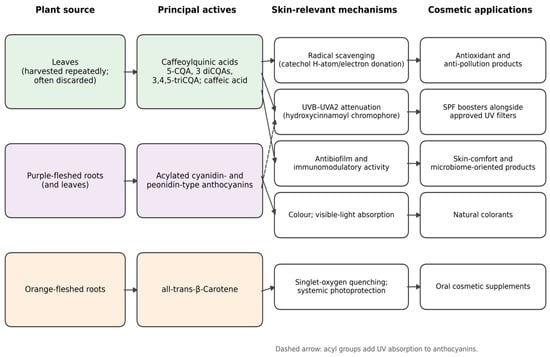
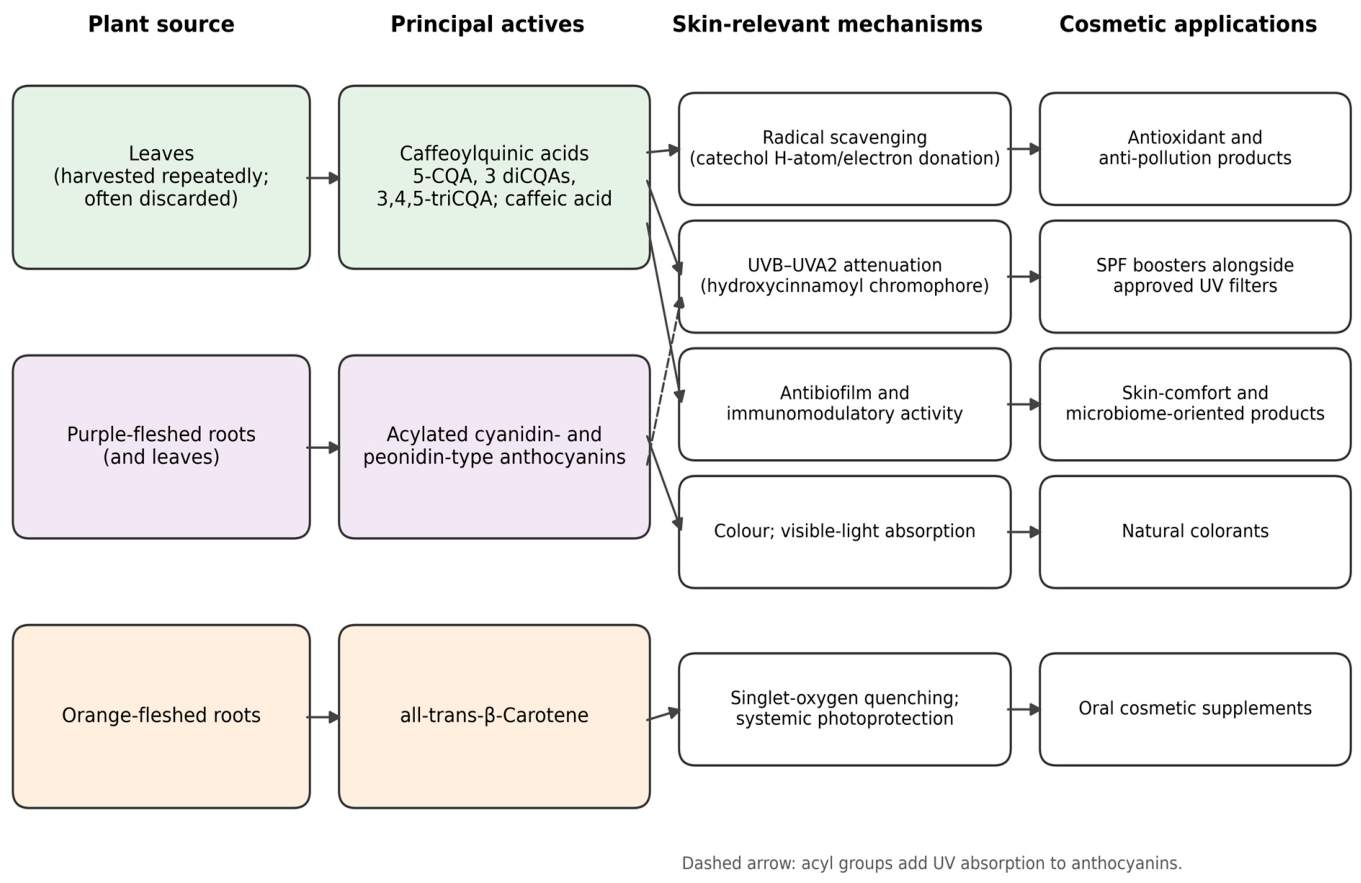
Researchers have only recently tested the cosmetic relevance of these compounds directly. Leaf extracts from 13 cultivars gave spectrophotometric sun protection factor (SPF) estimates that correlated with the antioxidant capacity [5], a CQA-rich leaf extract inhibited skin-relevant bacteria and biofilm formation, although at concentrations above those tolerated by keratinocytes [17], and purple sweetpotato anthocyanins increased the UV absorption of a cosmetic cream [18]. However, the phytochemical literature rarely addresses the questions that determine cosmetic performance: stability in the formulation, delivery across the stratum corneum, selectivity against human rather than surrogate targets, and the evidence required for safety and claims. This review addresses those questions and proposes a validation framework for moving sweetpotato actives from phytochemical promise to substantiated cosmetic use (Figure 1).
Figure 1.
Overview of sweetpotato-derived cosmetic actives, from the plant source, through principal compound classes and skin-relevant mechanisms, to cosmetic applications. Solid arrows indicate primary relationships; the dashed arrow indicates that hydroxycinnamoyl acyl groups contribute UV absorption to acylated anthocyanins.
Figure 1 provides a conceptual map of the review. It traces each compound class from its plant source to its principal skin-relevant mechanisms and, from there, to realistic cosmetic applications. Leaf CQAs connect to the widest range of mechanisms (radical scavenging, UV attenuation, and antibiofilm activity) and therefore to the broadest set of topical uses, whereas acylated anthocyanins contribute mainly to color and UV absorption, and β-carotene is linked chiefly to oral cosmetic supplements.
1.1. Scope and Approach
This is a narrative review; it does not follow a systematic-review protocol and was not registered. Web of Science Core Collection, Scopus, PubMed, and J-STAGE were searched for records published from January 2010 to 31 August 2026 (last search 31 August 2026). Search strings combined three concept blocks with Boolean AND: (i) source, “sweetpotato” OR “sweet potato” OR “Ipomoea batatas”; (ii) compound, “caffeoylquinic acid*” OR “chlorogenic acid” OR “dicaffeoylquinic” OR “tricaffeoylquinic” OR anthocyanin* OR “β-carotene”; (iii) application, skin OR cosmetic* OR photoprotect* OR “sun protection factor” OR tyrosinase OR melanogen* OR collagen OR antimicrobial OR biofilm OR stability OR permeation. Where sweetpotato-specific data were lacking (Section 3, Section 4 and Section 5), blocks (ii) and (iii) were searched without block (i). Studies published before 2010 that established compound structures, analytical methods, mechanisms, or regulatory principles were identified via the backward citation tracking of included papers. Inclusion criteria were peer-reviewed primary studies in English that (a) identified the tested material chemically (isomer-resolved CQAs, named anthocyanins or quantified β-carotene) or defined the sweetpotato extract by plant part, solvent, and genotype and (b) used a skin-relevant model (human skin cells, reconstructed or ex vivo skin, human volunteers) or a formulation-relevant physicochemical endpoint (UV absorbance, stability, permeation). Official regulatory texts and international standards were also included. Exclusion criteria were conference abstracts, non-peer-reviewed reports, chemically undefined “polyphenol-rich” extracts, and studies reporting only the total phenolic content or chemical antioxidant assays without a skin-relevant endpoint, unless cited to illustrate a methodological limitation. Records were screened by title and abstract and then assessed in full text by the author. Because the design is narrative, record counts are not reported and the risk of selection bias is acknowledged (Section 7.1); each skin-relevant study is instead classified by evidence class and appraised in Section 3. The review moves from composition (Section 2) through mechanisms (Section 3) and formulation constraints (Section 4) to a validation framework (Section 5), regulatory positioning (Section 6), and limitations and research priorities (Section 7).
1.2. What This Review Adds
Earlier reviews of sweetpotato leaves addressed nutrition and systemic health effects [3,4,6], and reviews of caffeoylquinic acids and anthocyanins addressed these classes across many plant sources [19,20,21]. This review adds four points specific to cosmetic use. First, it grades the skin-relevant evidence by source, separating sweetpotato extracts from isolated and surrogate compounds (Section 3). Second, it identifies what is specific to sweetpotato: a leaf rich in di- and tricaffeoylquinic acids, from which 3,4,5-triCQA can be purified preparatively [8,22], whereas most CQA sources, with coffee among them, are dominated by mono-CQAs; diacylated YGM anthocyanins stabilized by intramolecular copigmentation, which gives greater color and pH stability than the non-acylated anthocyanins of most berries [19,23]; the occurrence of CQAs, anthocyanins, and carotenoids in one crop whose leaves are a by-product; and the leaf CQA content, which varies several-fold with the genotype, growth stage, and environment [8,9,15,16], so that specifications must name the genotype and harvest stage. Third, it shows that the poly-acylation that gives these molecules their activity also makes them less permeable and more prone to acyl migration, so formulation and delivery decide whether they can be used. Fourth, it turns these constraints into a costed, gated validation workflow aligned with EU and US requirements (Section 5).
2. Phytochemistry of Sweetpotato Cosmetic Actives
2.1. Caffeoylquinic Acids
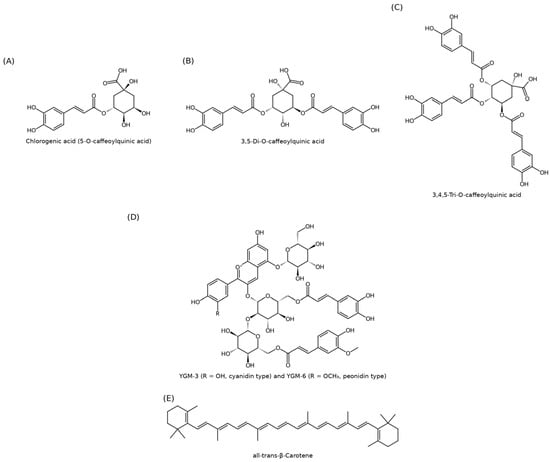
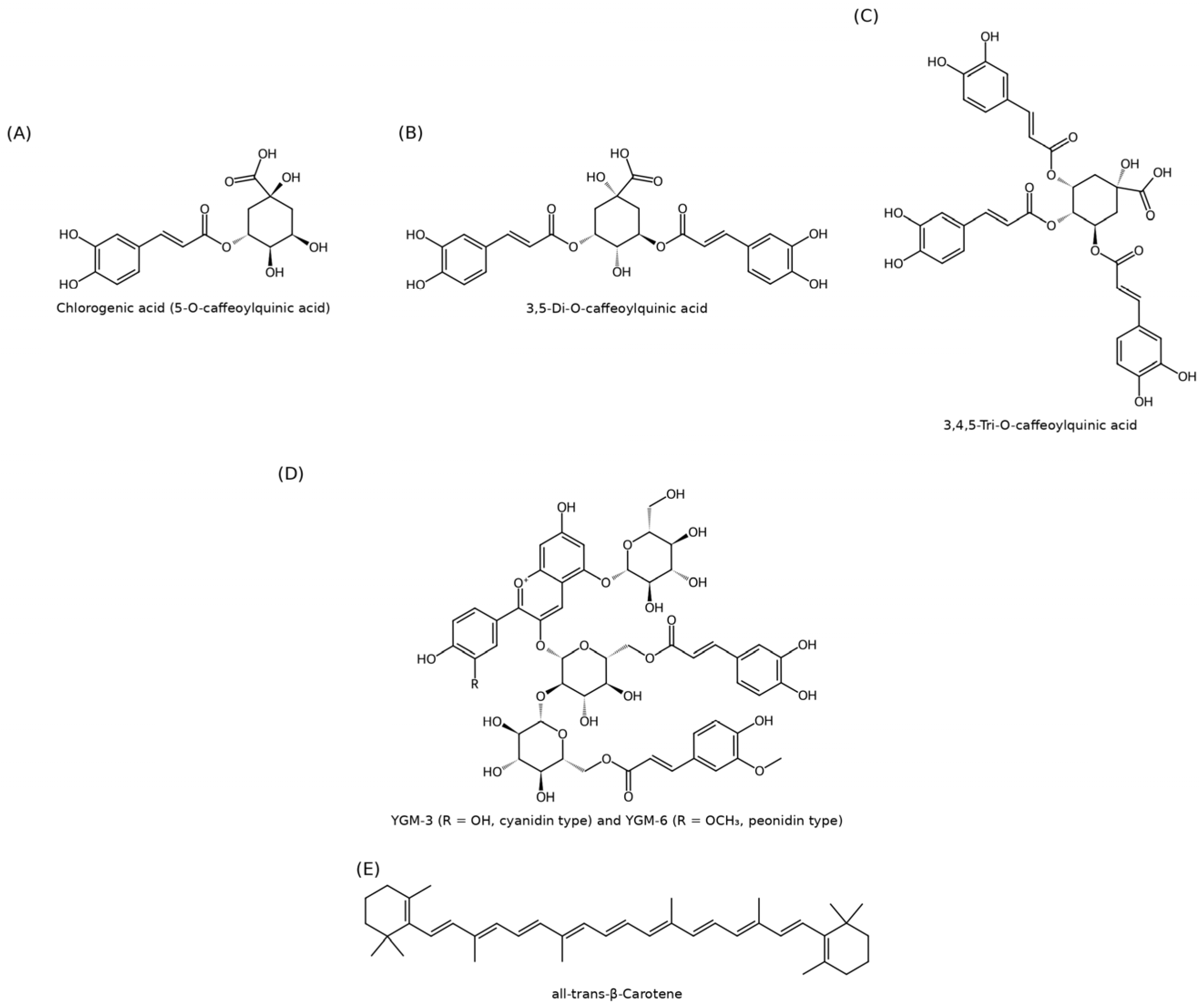
CQAs are esters of (−)-quinic acid with one to three caffeic acid units. Each caffeoyl unit adds a 3,4-dihydroxycinnamoyl group, combining a catechol ring with a conjugated α,β-unsaturated ester. Sweetpotato leaves contain chlorogenic acid, 3,4-, 3,5-, and 4,5-diCQA, and 3,4,5-triCQA, all of which have been isolated from sweetpotato leaves and structurally characterized [3,8,10] (Figure 2A–C). A simple, high-yield purification of 3,4,5-triCQA from sweetpotato leaves has been described, making this otherwise scarce compound accessible for ingredient development [22]. Each additional caffeoyl unit increases the molecular mass by 162.1 Da and increases the number of catechol groups. Activity follows the same order: antimutagenicity decreased in the order 3,4,5-triCQA > the three diCQAs > chlorogenic acid, consistent with a role for the number of caffeoyl groups [10,14].
Figure 2.
Structures of representative sweetpotato actives. (A) Chlorogenic acid (5-O-caffeoylquinic acid, IUPAC numbering); (B) 3,5-di-O-caffeoylquinic acid, representative of the three dicaffeoylquinic acid isomers in leaves; (C) 3,4,5-tri-O-caffeoylquinic acid; (D) the diacylated anthocyanins YGM-3 (R = OH, cyanidin type) and YGM-6 (R = OCH3, peonidin type), cyanidin or peonidin 3-O-[6-O-(E)-caffeoyl-2-O-[6-O-(E)-feruloyl-β-D-glucopyranosyl]-β-D-glucopyranoside]-5-O-β-D-glucopyranoside [24,25]; (E) all-trans-β-carotene. Structures were drawn from defined stereochemistry using RDKit; the calculated monoisotopic masses of the YGM-3 and YGM-6 cations (1111.29 and 1125.31 Da) agree with published mass spectra [26].
Figure 2 presents the structures of representative actives from each class. Panels A–C show how the stepwise addition of caffeoyl units to the quinic acid core increases both the number of catechol groups and the molecular size, from chlorogenic acid (one catechol) to 3,4,5-triCQA (three catechols). Panel D shows the diacylated root anthocyanins YGM-3 and YGM-6, which differ only in the 3′-substituent of the B-ring (hydroxyl in the cyanidin type, methoxyl in the peonidin type) and carry caffeoyl and feruloyl groups on the sophorose unit. Panel E shows all-trans-β-carotene, whose conjugated polyene chain accounts for both its antioxidant activity and its instability.
The positional nomenclature needs care. Under current IUPAC numbering, chlorogenic acid is 5-O-caffeoylquinic acid, whereas older literature designated it as 3-O-caffeoylquinic acid; the two systems interchange positions 3 and 5. The sweetpotato literature illustrates the problem: early isolation work reports the same compound as 3-mono-O-caffeoylquinic acid [10], while later HPLC methods for sweetpotato leaves report it as 5-O-caffeoylquinic acid [27]. Cosmetic specifications should therefore state the numbering system used and confirm isomer identity against authentic standards by the retention time and MS/MS fragmentation.
2.2. Acylated Anthocyanins
Sweetpotato leaves contain at least 15 anthocyanins, all acylated cyanidin and peonidin glycosides [3,28]. Purple-fleshed roots contain eight major pigments, designated, YGM-1a, -1b, -2, -3, -4b, -5a, -5b and -6. These are cyanidin and peonidin 3-sophoroside-5-glucosides that are mono- or diacylated with caffeic, ferulic, or p-hydroxybenzoic acid on the sophorose unit [24,25,29]. YGM-3 and YGM-6, the 3-(6,6′-caffeoylferuloylsophoroside)-5-glucosides of cyanidin and peonidin, are representative (Figure 2D). Cultivars differ markedly in their peonidin-to-cyanidin ratio and in their minor pigments [26]. This matters functionally, because the B-ring catechol of cyanidin-type pigments confers stronger antimutagenic activity than the methoxylated peonidin-type pigments [30].
Acylation with hydroxycinnamic acids adds a second chromophore in the UV region and allows intramolecular copigmentation, in which the acyl groups stack over the flavylium nucleus and protect it from hydration [19,23]. This structural basis explains the comparatively high color stability of acylated sweetpotato anthocyanins, which is relevant both to their use as natural colorants and to their persistence in the formulation.
2.3. Carotenoids
Orange-fleshed roots are rich in all-trans-β-carotene, and sweetpotato genotypes with different flesh colors differ widely in β-carotene, the phenolic content, and antioxidant capacity [31]. The extended polyene chain of β-carotene (Figure 2E) quenches singlet oxygen and scavenges lipid peroxyl radicals but also makes it highly lipophilic and sensitive to light, heat, and oxygen [32]. The principal compositional and physicochemical properties of the three compound classes are summarized in Table 1.
Table 1.
Principal sweetpotato actives: composition and physicochemical properties relevant to cosmetic use.
Table 1 highlights two features that recur throughout this review. First, all CQAs share essentially the same chromophore, with absorption near 325–330 nm, so their UV-attenuating capacity scales mainly with the number of caffeoyl units and with the concentration rather than with isomer identity. Second, molar mass increases almost twofold from chlorogenic acid (354 Da) to triCQA (679 Da) and exceeds 1100 Da for the acylated anthocyanins, which has direct consequences for skin delivery (Section 4.3). The table also contrasts the water-soluble, pH-sensitive phenolics with lipophilic, light-sensitive β-carotene, which require different formulation strategies. The permeation descriptors in Table 1 quantify the delivery problem: every CQA exceeds the usual limits for passive transcellular diffusion (topological polar surface area below about 140 Å2 and no more than five hydrogen-bond donors), and Potts–Guy estimates of the permeability coefficient fall two to three orders of magnitude below that of caffeic acid (Section 4.3).
3. Skin-Relevant Mechanisms and Current Evidence
3.1. Radical Scavenging and Photoaging Signaling
The catechol group of each caffeoyl unit donates a hydrogen atom or electron to reactive species, forming a resonance-stabilized phenoxyl (semiquinone) radical that can be further oxidized to an o-quinone. This matters because UV-generated reactive oxygen species activate mitogen-activated protein kinase (MAPK) and activator protein-1 (AP-1) signaling, which induces matrix metalloproteinases, including MMP-1, and suppresses procollagen synthesis, the central events in photoaging [34]. Plant polyphenols acting through radical scavenging and the modulation of these pathways reduce UV-induced inflammation, oxidative stress, and DNA damage in skin models [35].
Direct evidence now exists for individual sweetpotato CQAs. In human dermal fibroblasts, chlorogenic acid increased type I collagen expression, lowered MMP-1 and MMP-3 after UVA exposure, reduced reactive oxygen species and DNA damage, and restored transforming growth factor-β/Smad2/3 signaling [36]; comparable anti-inflammatory and anti-aging effects were reported in UV-exposed fibroblasts [37]. Neochlorogenic acid (3-CQA) reduced UVB-induced collagen degradation through the MAPK/AP-1 pathway and increased barrier proteins in fibroblasts and keratinocytes [38]. Most relevant to sweetpotato foliage, 3,4,5-triCQA, abundant in sweetpotato foliage but prepared in this study from Aconitum koreanum, inhibited the tumor necrosis factor-α-stimulated production of inflammatory mediators in keratinocytes by suppressing Akt and nuclear factor-κB signaling [39].
These cell studies used purified compounds from commercial sources, Adenocaulon himalaicum or Aconitum koreanum, at 3–200 µM in submerged monolayers (Table 2). They establish that molecules abundant in sweetpotato foliage can act on photoaging and inflammatory pathways. They do not establish that a sweetpotato extract has the same activity, for three reasons. First, the extract matrix may add to, antagonize, or mask effects. Second, effective concentrations have not been compared with those reachable in the viable epidermis from a topical product (Section 4.3). Third, no study has yet tested a standardized sweetpotato leaf extract in reconstructed or ex vivo human skin. Statements in this review about skin mechanisms therefore describe mechanistic plausibility, not demonstrated cosmetic efficacy.
Table 2.
Classification and appraisal of skin-relevant evidence for sweetpotato-derived actives.
Table 2 classifies every skin-relevant study cited in this review by tested material and source, model and exposure, the concentration and cytotoxicity window, and whether a formulation was tested and target exposure shown. Each study is assigned one of five evidence classes: E1, sweetpotato extract in a skin-relevant model; E2, compound isolated from sweetpotato in a skin-relevant model; E3, the same compound from another source in a skin-relevant model; E4, cell-free, optical, or non-skin model; E5, class-level extrapolation. Most mechanistic support falls in classes E3 and E4. Direct evidence for sweetpotato extracts in skin cells (E1) is limited to antibacterial, antibiofilm, and keratinocyte-cytokine endpoints, all at or above the cytotoxicity threshold. Throughout the text, mechanistic statements refer to these classes.
3.2. UV Attenuation and Sun Protection
The conjugated hydroxycinnamoyl chromophore absorbs strongly in the UVB–UVA2 region (Table 1), so CQA-rich extracts combine the attenuation of incident UV with scavenging of the reactive oxygen species that it generates. Leaf extracts from 13 sweetpotato cultivars had antioxidant capacities of 3.94–16.75 g Trolox equivalents per 100 g dry weight, and spectrophotometric SPF correlated positively with antioxidant capacity (r = 0.737, p = 0.004), reaching 24.65 in the most active cultivar [5]. Anthocyanins behave similarly: a cream containing only 0.61 mg of total purple sweetpotato anthocyanins per 100 g absorbed approximately 46% of incident UV, most effectively in the UVB range [18]. Notably, UV absorption was greatest near neutral pH, where the pigment turned greenish-yellow, illustrating the trade-off between photoprotective and aesthetic performance [18].
These values are preliminary. The SPF reported for leaf extracts was calculated with the Mansur equation from the absorbance of ethanolic solutions (10–700 µg mL−1) between 290 and 320 nm [5]. It therefore depends on the concentration and solvent, describes a solution rather than a film applied at 2 mg cm−2, and contains no UVA information. The anthocyanin data describe the UV absorbance of a cream, not SPF [18]. Spectrophotometric estimates agree poorly with in vivo values across commercial sunscreens [43]. A protection claim requires in vivo SPF of the finished product under ISO 24444:2019 [44] and UVA protection under ISO 24443:2021 [45] or a validated in vitro method such as ISO 23675:2024 [46], together with photostability testing. Two further constraints apply: anthocyanins absorb in the visible region and change color with pH, so UV-absorbing levels may be cosmetically unacceptable; caffeoyl esters also undergo UV-induced E→Z isomerization, so the chromophore’s photostability must be verified. Sweetpotato extracts are therefore best positioned as antioxidant and SPF-supporting ingredients in products whose UV protection comes from approved filters, not as stand-alone UV filters.
3.3. Antibacterial and Antibiofilm Activity and Keratinocyte Responses
A sweetpotato leaf extract profiled via uHPLC-DAD and LC–MS (predominantly cynarin, neochlorogenic acid, and spiraeoside) inhibited skin-relevant bacteria at minimum inhibitory concentrations (MICs) of 2.5–5 mg mL−1 [17]. These data must be interpreted against five distinct endpoints. (i) Growth inhibition (MIC) is not killing: a minimum bactericidal concentration was reached for Pseudomonas aeruginosa and methicillin-susceptible Staphylococcus aureus (5 mg mL−1) but not for methicillin-resistant S. aureus or Escherichia coli [17]. (ii) Biofilm prevention is not biofilm disruption: biofilm formation was reduced when the extract was present at ½ MIC from inoculation, whereas activity against established biofilms, which requires minimum biofilm eradication concentration or equivalent assays, was not tested. (iii) Preservation efficacy is a property of the finished product and can only be shown via challenge testing (ISO 11930 [47]). (iv) Microbiome modulation requires community-level data on skin, including selectivity between commensals such as S. epidermidis and opportunists such as S. aureus, and no such data exist. (v) Selectivity: the extract was non-cytotoxic to HaCaT keratinocytes only up to about 111 µg mL−1, 22–45-fold below its MICs, and alone, it increased keratinocyte IL-6 about fourfold [17]. Cynarin was also not among the principal CQAs in earlier leaf profiles [8,9,12], which underlines the extraction- and cultivar-dependent composition. The current evidence therefore supports no preservative, antimicrobial, anti-acne, or microbiome claim. At most, it justifies investigating biofilm-modulating fractions in skin models at non-cytotoxic concentrations.
3.4. Systemic Photoprotection by Carotenoids
Human intervention studies show that dietary β-carotene, alone or with other carotenoids, reduces UV-induced erythema [40,41]. A meta-analysis found that this protection depends on the duration of supplementation, requiring at least 10 weeks [42], and the protection achieved is considerably lower than that of topical sunscreens [32]. Carotenoid-rich sweetpotato fractions are therefore better suited to oral cosmetic supplements than to topical photoprotection claims.
4. Formulation and Delivery Constraints
4.1. Chemical Stability of Caffeoylquinic Acids
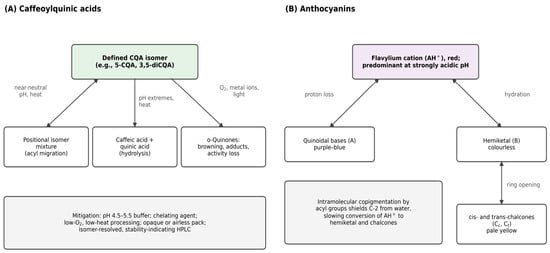
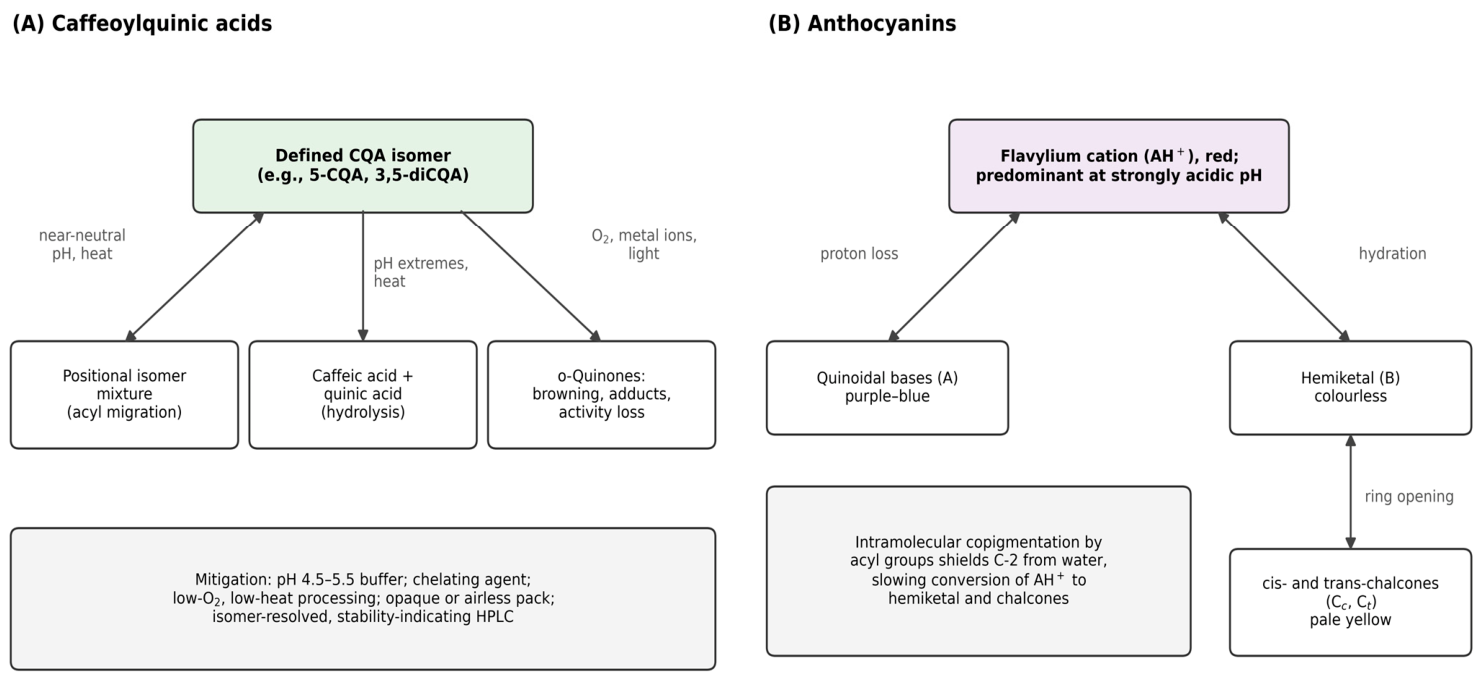
CQAs are chemically labile in aqueous formulations. At 37 °C, the degradation rate of chlorogenic acid increased progressively from pH 5.0 to 9.0 [48], and near-neutral and alkaline conditions convert 5-CQA into 3- and 4-CQA via intramolecular acyl migration, turning a defined isomer into an isomer mixture [49]. Hydrolysis releases caffeic and quinic acids, and catechol autoxidation to o-quinones, promoted by transition-metal ions and light, drives browning and activity loss [20] (Figure 3A). Co-antioxidants such as ascorbic acid and epigallocatechin gallate slow CQA degradation [48,49]. Formulations should therefore be buffered in the pH 4.5–5.5 range, which is also compatible with the skin surface pH, include a chelating agent and a co-antioxidant, be processed with minimal oxygen and heat exposure, and be packed in opaque or airless containers. Stability-indicating HPLC methods that quantify individual isomers are essential; total phenolic assays such as Folin–Ciocalteu cannot detect isomerization and respond to proteins, thiols, vitamins, and many other reducing substances [50].
Figure 3.
Principal instability pathways relevant to the formulation. (A) Caffeoylquinic acids undergo acyl migration, hydrolysis, and catechol oxidation; the main promoting conditions and mitigation measures are indicated [20,48,49]. (B) pH-dependent structural transformations of anthocyanins; acyl groups slow hydration of the flavylium cation through intramolecular copigmentation [21,23].
Figure 3 summarizes the main instability pathways that formulators must control. Panel A shows the three competing fates of a defined CQA isomer (acyl migration to positional isomers, hydrolysis to caffeic and quinic acids, and oxidation to o-quinones), the conditions that promote each, and the corresponding mitigation measures. Panel B, discussed in Section 4.2, shows the pH-dependent structural network of anthocyanins.
Table 3 presents a practical stability-testing scheme for CQA- and anthocyanin-containing formulations. It follows ISO/TR 18811:2018 for cosmetics [51] and adopts ICH Q1A(R2) storage conditions and ICH Q1B light exposure [52,53] as conservative, widely used defaults. Accelerated testing cannot replace real-time data for these actives. The degradation of chlorogenic acid at different pH values follows Weibull rather than simple first-order kinetics [48], and acyl migration produces isomers that remain active, so Arrhenius extrapolation from 40 to 45 °C predicts the loss of total CQA poorly and the isomer profile not at all. Isomer-resolved HPLC monitoring and a retained-activity assay are therefore integral to the scheme.
Table 3.
Stability-testing scheme for formulations containing sweetpotato CQAs and anthocyanins.
4.2. pH-Dependent Speciation of Anthocyanins
The red flavylium cation predominates only at strongly acidic pH. Across the pH range of most leave-on cosmetics, anthocyanins exist as networks of quinoidal bases, the colorless hemiketal, and chalcones, linked by proton-transfer, hydration, and ring-opening equilibria [19,21], so color and antioxidant behavior shift with the formulation pH (Figure 3B). Intramolecular copigmentation in acylated sweetpotato anthocyanins slows hydration and improves color retention [23] (Section 2.2). Nevertheless, verify color and UV absorption at the final product pH, under light exposure, and in contact with packaging, because the pH that maximizes UV absorption may give an unacceptable color [18].
4.3. Skin Delivery
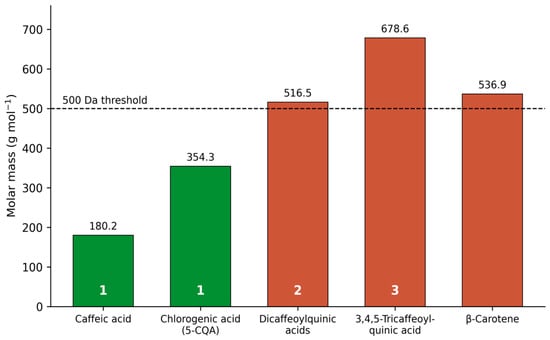
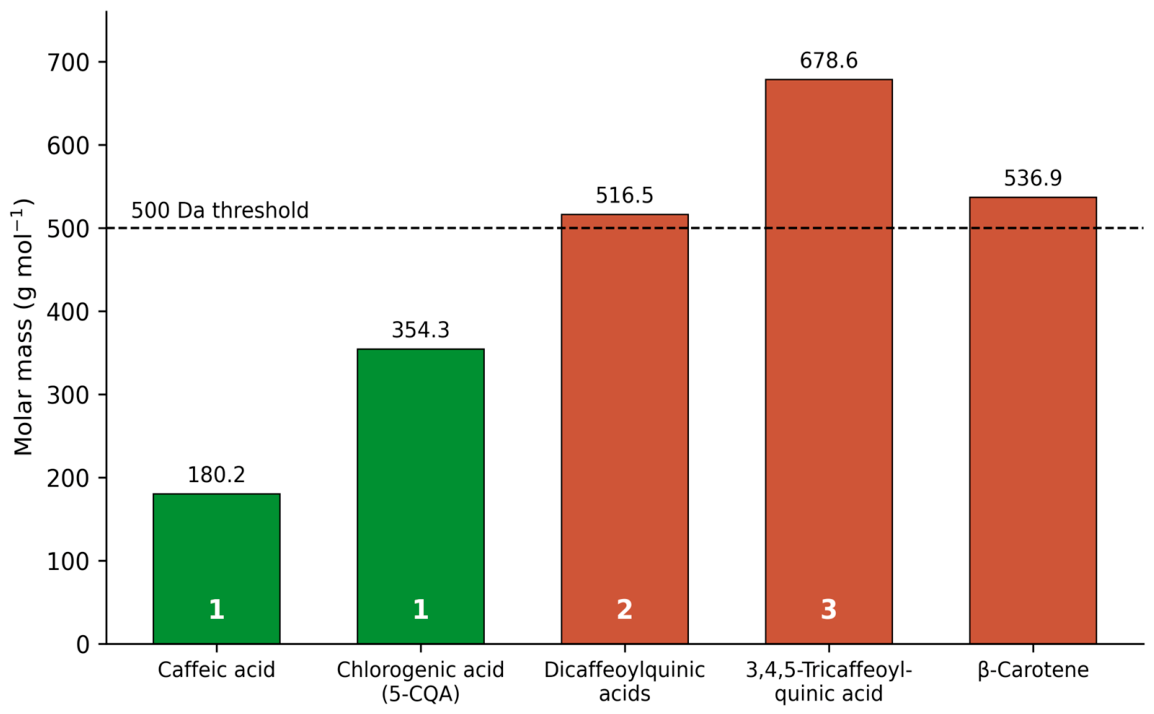
Chlorogenic acid (354 Da) falls below the approximately 500 Da threshold associated with stratum corneum permeation, whereas diCQAs (516 Da), triCQA (679 Da) and acylated anthocyanins (above 1000 Da for YGM-3 and YGM-6) exceed it (Table 1; Figure 4) [54]. All CQAs are also highly polar, and their quinic acid carboxyl group is largely ionized at a typical formulation pH, further limiting partitioning into intercellular lipids. The most active di- and tri-caffeoyl derivatives are therefore likely to act mainly at the skin surface and upper stratum corneum. This suits surface antioxidant, anti-pollution, and UV-attenuating functions. Claims involving viable-epidermis or dermal targets, such as melanocytes and fibroblasts, require either carrier systems (for example, liposomes, nanoemulsions, or cyclodextrin inclusion complexes) or direct permeation data. Franz diffusion cell studies on human skin (OECD Test Guideline 428), combined with tape stripping or quantitative confocal Raman spectroscopy, which has shown a good in vitro–in vivo correlation for a cosmetic active [55], are the appropriate tools.
Figure 4.
Molar masses of sweetpotato actives relative to the approximately 500 Da threshold associated with stratum corneum permeation [54]. Green bars fall below and red bars above the threshold; numbers inside the bars give the number of catechol groups per molecule. Acylated anthocyanin glycosides (above 1000 Da for YGM-3 and YGM-6) are omitted for clarity. Values were calculated from molecular formulae.
Figure 4 places the molar masses of the principal actives against the 500 Da threshold. Only caffeic acid and chlorogenic acid fall below it; the diCQAs, triCQA, and β-carotene lie above it, and the acylated anthocyanins, omitted from the plot for scale, exceed it by more than twofold. The figure also makes the central formulation trade-off explicit: the number of catechol groups, which drives antioxidant and anti-inflammatory potency, rises in step with the molecular size, so the most potent CQAs are the least likely to penetrate intact skin.
No quantitative skin-permeation data are available for any sweetpotato CQA or anthocyanin, and this is the largest gap between the mechanisms reviewed here and topical efficacy. Potts–Guy estimates [33] give log kp values of −5.3 to −4.9 cm h−1 for mono-, di-, and tricaffeoylquinic acids, two to three orders of magnitude below caffeic acid (Table 1). These values apply to the neutral species. With a carboxyl pKa of about 3.4, only about 2.5% of each CQA is un-ionized at pH 5.0 and about 0.8% at pH 5.5, the pH range of most leave-on products and of the skin surface. An order-of-magnitude illustration for 3,5-diCQA at 0.5% w/w (5 mg mL−1), assuming steady-state flux of the neutral species only, a 24 h exposure, distribution into 100 µm of viable epidermis (0.01 cm3 cm−2), and no clearance, gives a flux of 0.3–0.9 ng cm−2 h−1 and an upper-bound concentration of about 1–4 µM in the viable epidermis. Clearance and metabolism would lower this value, whereas permeation of the ionized species and follicular transport might raise it. Even so, it lies at or below the lower end of the concentrations at which CQAs act in skin-cell assays (3–200 µM; Table 2). The mechanisms in Section 3 therefore cannot be assumed to translate into topical effects at epidermal or dermal targets.
Until permeation is measured, unenhanced extracts should be positioned for surface-acting benefits: antioxidant protection of the formulation and of stratum corneum lipids, and support of UV protection provided by approved filters. Target-acting claims, which involve dermal collagen, MMP-1, melanocyte tyrosinase, or inflammatory signaling, should be made only for delivery systems shown to raise skin exposure. Candidate systems act by different mechanisms: phospholipid complexes raise the apparent lipophilicity through hydrogen bonding of the catechols to phosphate head groups; ethosomes and transfersomes fluidize stratum corneum lipids and favor follicular deposition; microemulsions and nanoemulsions raise thermodynamic activity in the vehicle; cyclodextrin inclusion complexes improve stability more than flux and protect against acyl migration and oxidation; and lipophilic esters of the quinic carboxyl or catechols act as prodrugs cleaved by epidermal esterases, although they create new chemical entities with their own safety dossier. Each system must be evaluated by OECD TG 428 [56] on human or porcine skin under finite-dose conditions (≤10 mg cm−2), with mass balance and isomer-resolved LC–MS/MS quantification in the epidermis, dermis, and receptor fluid, because acyl migration during permeation can interconvert isomers. Tape stripping or confocal Raman spectroscopy [55] can complement these studies where target exposure must be shown directly.
4.4. Raw-Material Quality and Safety by Material Type
Crude leaf extracts carry chlorophyll and its degradation products, which color formulations and include known photosensitizers such as pheophorbides. Decolorization and phototoxicity testing should therefore be part of ingredient development. Raw-material specifications should also set limits for pesticide residues, heavy metals, microbial load, and residual solvents, reflecting cultivation conditions and the extraction process.
Safety and quality requirements differ among crude extracts, enriched fractions, and isolated compounds, and Table 4 sets out the specification focus, dominant hazards, and testing emphasis for each material type.
Table 4.
Safety and quality considerations by material type.
For every material type, the specification should set limits for pesticide residues, via multi-residue LC–MS/MS and GC–MS/MS, because sweetpotato leaves are a field crop; heavy metals (Pb, Cd, As, Hg) via ICP-MS, consistent with Article 17 of Regulation (EC) No 1223/2009 on technically unavoidable traces [62]; residual solvents (ICH Q3C [60]), with dedicated limits and data for non-conventional solvents such as deep eutectic solvents and ionic liquids, which ICH Q3C does not cover; and microbiological quality (ISO 17516 [63]). Storage degradation products (caffeic acid, cis-isomers, and browning products) should be monitored under the scheme in Table 3. Batch-to-batch variability, which is driven by the genotype, environment, and harvest [8,15,16], should be controlled by marker ranges and chromatographic fingerprint similarity rather than by the total phenolic content. CQAs have no established record as contact allergens, but caffeic acid esters in propolis are recognized sensitizers and catechol-derived o-quinones are electrophilic. Sensitization potential should therefore be tested by a defined approach (OECD GL 497 [59]) rather than assumed to be absent.
5. A Tiered Validation Framework
We propose that evidence for sweetpotato actives progress through six tiers, each answering a distinct question (Table 5). Advancing to a later tier without completing earlier ones is the most common reason that botanical activity fails to translate into product performance.
Table 5.
Tiered validation framework for sweetpotato-derived cosmetic actives.
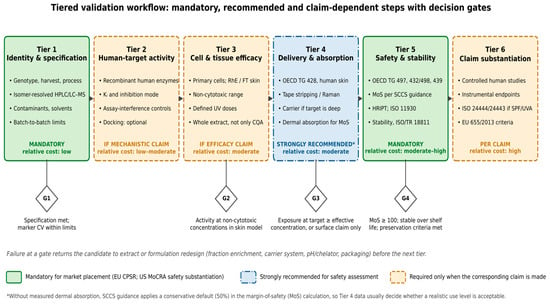
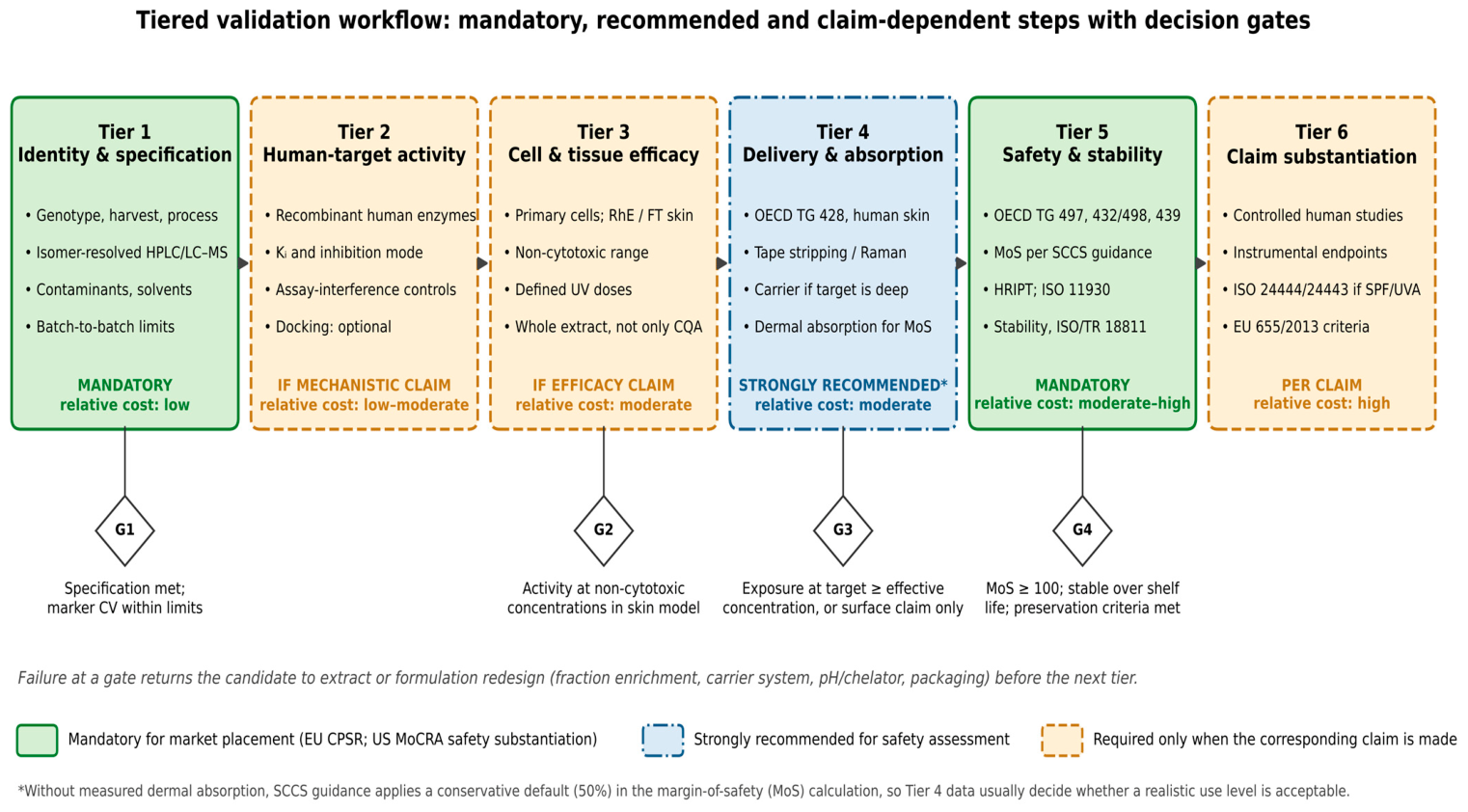
Table 5 sets out the six tiers, from extract characterization to claim substantiation. For each tier, it identifies the question to be answered, the recommended methods with supporting references, and the pitfall most often responsible for misleading data. Tiers 1 and 2 address the identity and mechanism, tiers 3 and 4 establish whether activity is retained in skin tissue and whether the active reaches its target, and tiers 5 and 6 provide the safety and efficacy evidence that regulators and consumers require. Table 5 also states each tier’s status and indicative relative cost. Tiers 1 and 5 are mandatory for any product, because the EU cosmetic product safety report and US MoCRA safety substantiation cannot be completed without them. Tier 4 is strongly recommended: it is not legally required, because a default dermal absorption of 50% can replace measured data in the margin-of-safety calculation [61], but that default often makes a realistic use level unacceptable. Tiers 2, 3, and 6 are required only when the corresponding claim is made. Figure 5 arranges the tiers as a gated workflow. Four go/no-go gates prevent investment in later tiers before earlier ones are passed: G1, specification met and marker variation within limits; G2, activity at non-cytotoxic concentrations in a skin model; G3, exposure at the target at or above the effective concentration, failing which claims are limited to surface action; and G4, margin of safety of at least 100, no sensitization or phototoxicity signal, stability over the shelf life and preservation criteria met.
Figure 5.
Gated validation workflow for sweetpotato-derived cosmetic actives. Solid green boxes are mandatory for market placement (EU cosmetic product safety report; US MoCRA safety substantiation); the dash-dot blue box (tier 4) is strongly recommended for the safety assessment; dashed orange boxes are required only when the corresponding claim is made. Each tier shows its principal methods and indicative relative cost. Diamonds G1–G4 are go/no-go gates with their acceptance criteria; failure at a gate returns the candidate to extraction or formulation redesign. Without measured dermal absorption, SCCS guidance applies a default of 50% in the margin-of-safety (MoS) calculation [61].
5.1. Enzyme Kinetics with Human Targets
Surrogate enzymes are a major source of misleading data. In a screen of 50,000 compounds against recombinant human tyrosinase, hydroquinone and arbutin inhibited the human enzyme only in the millimolar range, and kojic acid had an IC50 above 500 µmol L−1; the most potent human tyrosinase inhibitor identified had an IC50 of 1.1 µmol L−1 against the human enzyme but 108 µmol L−1 against mushroom tyrosinase [64]. Structural differences between the human enzyme and its fungal counterpart explain this divergence and now inform the design of genuine human tyrosinase inhibitors [67,68]. CQAs pose an additional problem: their catechol groups can act as substrates of tyrosinase diphenolase activity, so apparent inhibition in dopachrome-formation assays may reflect substrate competition or quinone chemistry. Confirm activity via product-specific HPLC or oxygen-consumption methods and then via melanin quantification in melanocytes or a pigmented reconstructed epidermis. The same principle applies to matrix enzymes: human neutrophil elastase and matrix metalloproteinase-1 are more relevant than porcine pancreatic elastase or bacterial collagenase.
Four mechanisms make mushroom-tyrosinase data unreliable for catechol-rich extracts. (i) Enzyme differences: mushroom tyrosinase (Agaricus bisporus) is a soluble cytosolic enzyme, whereas human tyrosinase is a glycosylated, membrane-bound melanosomal protein, and their active-site pockets differ enough that inhibitor potencies can diverge by two orders of magnitude [64,67,68]. (ii) Alternative substrates: CQAs carry catechols and are themselves substrates of the diphenolase activity of tyrosinase and related polyphenol oxidases; in dopachrome assays, they compete with L-DOPA and consume oxygen, which can look like inhibition. (iii) Redox interference: reducing catechols can reduce dopaquinone back to L-DOPA, and their own o-quinones can react with dopaquinone intermediates or thiols, both of which lower dopachrome absorbance at about 475 nm without inhibiting the enzyme; catechol substrates can also cause time-dependent inactivation of the enzyme. (iv) Optical and chelation effects: colored or turbid extracts absorb near 475 nm, and copper chelation produces non-specific inhibition. Minimum controls include enzyme-free and substrate-free blanks; extract alone with enzyme; parallel measurements of oxygen consumption or product via HPLC; separate monophenolase (L-tyrosine, with lag phase) and diphenolase (L-DOPA) assays; and a reference inhibitor. Activity should then be confirmed based on human tyrosinase (recombinant or melanocyte lysate) and finally by the melanin content in normal human epidermal melanocytes and in a pigmented reconstructed epidermis at non-cytotoxic concentrations. Accordingly, we classify mushroom-tyrosinase results as E4 (screening only) in Table 2.
Derive inhibition constants and modes via the global nonlinear fitting of initial-rate data to competitive, non-competitive, uncompetitive, and mixed models, using double-reciprocal plots only for visualization. Because the IC50 depends on the substrate concentration, it should be converted to an inhibition constant; for a competitive inhibitor, the Cheng–Prusoff relationship is as follows [65]:
where [S] is the substrate concentration and Km is the Michaelis constant under assay conditions.
5.2. Molecular Docking
Docking is useful for generating binding hypotheses but does not measure potency, and scoring functions correlate poorly with measured affinities across diverse targets [66]. Protocols should be validated by redocking a co-crystallized ligand to a root-mean-square deviation of 2.0 Å or less, should specify protonation states and treatment of the dicopper site in tyrosinase, and should declare the provenance of any homology or predicted model used in place of an experimental human structure. Test poses for stability via molecular dynamics and interpret them alongside experimental kinetic data.
5.3. Feasibility, Scale-Up, and Regulatory Burden
The tiers differ in cost by more than an order of magnitude, and their order is chosen so that the inexpensive, decisive tests come first (Table 5, Figure 5). Tier 1 standardization is relatively inexpensive and a precondition for everything else; once the method is developed, it becomes a routine batch-release assay. Post-harvest handling is the main cost driver at this stage, because polyphenol oxidase browning and thermal acyl migration between the harvest and extraction determine the CQA yield. Freeze-drying retains the most CQAs but is energy- and capital-intensive, whereas low-temperature hot-air drying retains a large share and is practical at an agricultural scale [69]. Aqueous-ethanol extraction meets residual-solvent limits (ICH Q3C [60]), and resin enrichment yields triCQA-rich fractions with high recovery [22]. Greener routes have already been demonstrated based on sweetpotato leaves, including natural deep eutectic solvent-based microwave-assisted extraction [70] and the ionic-liquid extraction of CQAs [71]; before using either for a cosmetic ingredient, its solvent residues must be shown to be safe.
Tier 2 enzyme kinetics and tier 3 cell studies are moderate in cost and needed only for claims that rely on a specific mechanism. Tier 4 permeation testing (OECD TG 428 [56]) is moderately expensive but often cheaper than the alternative, because without measured absorption, the SCCS default of 50% dermal absorption enters the margin-of-safety calculation and may make it fail [61]. Tier 5 safety is mandatory and, in the European Union, must be completed with non-animal methods [62]; in the United States, MoCRA requires facility registration, product listing, and adequate safety substantiation for each product, but no pre-market approval of the ingredient [72]. Tier 6 human testing is the most expensive and is required only for the specific claims made. The claim wording, not chemistry, decides the highest costs. A product claiming antioxidant protection of the formulation or skin conditioning remains within cosmetic regulation in both markets, whereas a claim of SPF, acne treatment, or antimicrobial action moves it into drug or biocide regulation (Section 6), with approval costs far above those of all six tiers combined.
6. Regulatory and Claims Considerations
The regulatory status is not a property of an ingredient. It depends on the market, the finished product’s composition, its intended use, and the wording of its claims, so regulatory positioning should shape the study design from the outset (Table 6). In the United States, a product is a cosmetic or a drug according to its intended use under sections 201(i) and 201(g)(1) of the Federal Food, Drug, and Cosmetic Act [73], and the claims made are the principal evidence of that intended use. Sunscreen and SPF claims make a product an over-the-counter drug governed by OTC Monograph M020 [74], and UV protection must be delivered by the active ingredients listed in that monograph; UV absorbance by a botanical extract does not make it a permitted sunscreen active. Claims to treat acne or kill pathogenic microorganisms are likewise drug claims. The Modernization of Cosmetics Regulation Act of 2022 [72] introduced safety substantiation and serious adverse event reporting (effective 29 December 2023) and facility registration and product listing (enforced from 1 July 2024), which increases the value of the ingredient-level safety data outlined in Table 5. In the European Union, only substances listed in Annex VI of Regulation (EC) No 1223/2009 [62] may be used as UV filters, and sunscreen labeling follows Commission Recommendation 2006/647/EC [75]. Antimicrobial or disease-related claims can move a product into the scope of medicinal products (Directive 2001/83/EC [76]) or biocidal products (Regulation (EU) No 528/2012 [77]), and borderline cases are assessed against the Commission’s borderline manual. Colorant use requires listing for the specific use in Annex IV (EU), which should be checked in the CosIng database or in 21 CFR Parts 73 and 74 (US) [78]; without such a listing, a color additive petition would be required in the United States.
Table 6.
Regulatory status of candidate claims for sweetpotato-derived ingredients and the evidence tiers (Table 5) required to support them.
Table 6 maps six candidate claims onto their regulatory status in the United States and the European Union and onto the evidence tiers from Table 5 needed to support them. Antioxidant and skin-comfort claims can be supported as cosmetic claims, SPF boosting is permissible only within a sunscreen whose protection derives from approved filters, acne and antimicrobial claims fall outside the cosmetic category, and colorant and oral-supplement uses are governed by separate listing and health-claim regimes.
In the European Union, Regulation (EC) No 1223/2009 [62] requires a cosmetic product safety report, restricts UV filters to those listed in its Annex VI, and prohibits animal testing of cosmetic ingredients and products, making the non-animal methods in Table 5 obligatory rather than optional. Claims must meet the common criteria of Commission Regulation (EU) No 655/2013 [79], including evidential support and truthfulness. For both markets, a specification linking the genotype, harvest stage, and extraction process to quantified marker compounds underpins the safety assessment and claim substantiation.
7. Research Priorities and Future Perspectives
7.1. Limitations of This Review
This is a narrative review. Although the search was structured and reported in Section 1.1, author judgment shapes the study selection and interpretation, and selection bias cannot be excluded. To limit this effect, we graded each skin-relevant study by evidence class and appraised the test material identity, concentration and units, cytotoxicity window in the same system, and formulation relevance and target exposure (Table 2). Most mechanistic support comes from compounds isolated from sweetpotato (E2), the same compounds from other sources (E3), or cell-free assays (E4); direct evidence from sweetpotato extracts in skin models (E1) is limited. Quantitative synthesis was not possible because endpoints (DPPH IC50, spectrophotometric SPF, MIC, MMP-1 expression, tyrosinase IC50) and units differ between studies. A systematic review should become feasible once skin-model studies of standardized sweetpotato extracts with common endpoints accumulate. Until then, the conclusions should be read as hypotheses ranked by evidence strength, not as demonstrated cosmetic efficacy.
7.2. Research Priorities
Several research priorities follow from the gaps identified in this review. First, standardized reference extracts are needed, specified by quantified CQA isomers and YGM-type anthocyanins and produced from defined genotypes and harvest stages; the efficient purification of 3,4,5-triCQA [22] makes certified reference material for the most active leaf compound feasible. Second, head-to-head kinetic studies of isolated CQAs and YGM pigments against recombinant human tyrosinase, human neutrophil elastase, and MMP-1 would establish whether the activity reported with surrogate enzymes is relevant to human skin [64,67,68]. Third, whole extracts should be tested at realistic use concentrations in reconstructed epidermis and ex vivo human skin, extending the purified-compound findings [36,37,38,39] to the ingredient that would actually be marketed.
Fourth, delivery systems that improve the skin availability of di- and tri-caffeoyl derivatives and protect them from acyl migration and oxidation should be developed and evaluated by permeation studies [54,55]. Fifth, in vivo SPF and UVA protection testing of finished products should confirm the SPF-boosting potential of CQA- and anthocyanin-rich fractions in combination with approved UV filters [43]. Sixth, current regulations require a complete non-animal safety dossier, including sensitization and phototoxicity data, before any sweetpotato leaf ingredient can be placed on the market [62,72,80]. Finally, because the leaf polyphenol and anthocyanin content respond to genotype and growing conditions [8,15,16,81,82], breeding and agronomic programs could develop dual-purpose cultivars that combine a high root yield with foliage enriched in triCQA, and a life-cycle assessment could quantify the sustainability benefit of upcycling leaf biomass that is currently discarded.
A cradle-to-gate life-cycle assessment under ISO 14040/14044 [83,84] is needed to quantify that benefit. Because the leaves are a by-product, economic allocation assigns most cultivation burdens to the roots, leaving collection, drying, and extraction as the dominant contributors. Drying a material with 85–90% moisture is likely to dominate energy use, so solar or low-temperature air drying should be compared with freeze-drying [69]; aqueous-ethanol extraction with solvent recovery avoids the burdens of chlorinated solvents; and avoided burdens (residue burning or decomposition) and possible soil-nutrient export from repeated leaf removal should both be included.
8. Conclusions
Sweetpotato foliage provides a renewable, well-characterized source of mono-, di-, and tri-caffeoylquinic acids, complemented by acylated anthocyanins and β-carotene from pigmented roots. Their catechol-bearing hydroxycinnamoyl chromophores explain the observed links between antioxidant capacity and UV attenuation; cell-based evidence supports the anti-photoaging and anti-inflammatory activity of individual CQAs, obtained mostly from other plant sources, and leaf extracts inhibit bacterial growth and biofilm formation only at concentrations above those tolerated by keratinocytes. The main barriers are not a lack of bioactivity but chemical lability, limited skin permeation of the most active derivatives, reliance on surrogate enzymes, and a shortage of skin-model, safety, and clinical data. Addressing these through isomer-resolved standardization, human-target kinetics, delivery studies, and regulation-aligned claim substantiation would make upcycled sweetpotato leaf biomass a credible source of evidence-based cosmetic actives. Quantitative permeation data are the most urgent need: the estimated permeability of di- and tricaffeoylquinic acids is low, so target-acting claims require delivery systems verified by OECD TG 428 studies. At present, direct evidence for sweetpotato extracts is limited to optical and in vitro data, and skin-cell evidence comes from purified compounds, mostly from other plant sources. The evidence therefore supports the development of standardized sweetpotato extracts as antioxidant and SPF-supporting ingredients. It does not yet support claims of UV filtration, antimicrobial or preservative activity, anti-acne action, microbiome modulation, or anti-aging efficacy in human skin; these require the tier 3–6 studies described in Section 5.
Funding
This research received no external funding.
Institutional Review Board Statement
Not applicable.
Informed Consent Statement
Not applicable.
Data Availability Statement
No new data were created or analyzed in this study. Data sharing is not applicable to this article.
Acknowledgments
The author has reviewed and edited the output and takes full responsibility for the content of this publication.
Conflicts of Interest
The author declares no conflicts of interest.
Abbreviations
The following abbreviations are used in this manuscript:
| AP-1 | activator protein-1 |
| CPSR | cosmetic product safety report |
| CQA | caffeoylquinic acid |
| diCQA | dicaffeoylquinic acid |
| HBD | hydrogen-bond donor |
| HPLC-DAD | high-performance liquid chromatography with diode-array detection |
| LCA | life-cycle assessment |
| LC–MS/MS | liquid chromatography–tandem mass spectrometry |
| MAPK | mitogen-activated protein kinase |
| MIC | minimum inhibitory concentration |
| MMP | matrix metalloproteinase |
| MoS | margin of safety |
| NF-κB | nuclear factor-κB |
| OECD TG | Organisation for Economic Co-operation and Development Test Guideline |
| ROS | reactive oxygen species |
| SPF | sun protection factor |
| TPSA | topological polar surface area |
| triCQA | tricaffeoylquinic acid |
| YGM | Yamagawamurasaki-type anthocyanin |
References
- Bovell-Benjamin, A.C. Sweet potato: A review of its past, present, and future role in human nutrition. Adv. Food Nutr. Res. 2007, 52, 1–59. [Google Scholar] [CrossRef] [Scilit]
- Wang, S.; Nie, S.; Zhu, F. Chemical constituents and health effects of sweet potato. Food Res. Int. 2016, 89, 90–116. [Google Scholar] [CrossRef] [Scilit]
- Islam, S. Sweetpotato (Ipomoea batatas L.) leaf: Its potential effect on human health and nutrition. J. Food Sci. 2006, 71, R13–R21. [Google Scholar] [CrossRef] [Scilit]
- Johnson, M.; Pace, R.D. Sweet potato leaves: Properties and synergistic interactions that promote health and prevent disease. Nutr. Rev. 2010, 68, 604–615. [Google Scholar] [CrossRef] [Scilit]
- Hong, J.; Mu, T.; Sun, H.; Richel, A.; Blecker, C. Valorization of the green waste parts from sweet potato (Ipomoea batatas L.): Nutritional, phytochemical composition, and bioactivity evaluation. Food Sci. Nutr. 2020, 8, 4086–4097. [Google Scholar] [CrossRef] [Scilit]
- Sun, H.; Mu, T.; Xi, L.; Zhang, M.; Chen, J. Sweet potato (Ipomoea batatas L.) leaves as nutritional and functional foods. Food Chem. 2014, 156, 380–389. [Google Scholar] [CrossRef] [Scilit]
- FAO. FAOSTAT: Crops and Livestock Products; Food and Agriculture Organization of the United Nations: Rome, Italy, 2025; Available online: https://www.fao.org/faostat/en/#data/QCL (accessed on 22 September 2026).
- Islam, S.; Yoshimoto, M.; Yahara, S.; Okuno, S.; Ishiguro, K.; Yamakawa, O. Identification and characterization of foliar polyphenolic composition in sweetpotato (Ipomoea batatas L.) genotypes. J. Agric. Food Chem. 2002, 50, 3718–3722. [Google Scholar] [CrossRef] [Scilit]
- Truong, V.D.; McFeeters, R.F.; Thompson, R.T.; Dean, L.L.; Shofran, B. Phenolic acid content and composition in leaves and roots of common commercial sweetpotato (Ipomea batatas L.) cultivars in the United States. J. Food Sci. 2007, 72, C343–C349. [Google Scholar] [CrossRef] [Scilit]
- Yoshimoto, M.; Yahara, S.; Okuno, S.; Islam, S.; Ishiguro, K.; Yamakawa, O. Antimutagenicity of mono-, di-, and tricaffeoylquinic acid derivatives isolated from sweetpotato (Ipomoea batatas L.) leaf. Biosci. Biotechnol. Biochem. 2002, 66, 2336–2341. [Google Scholar] [CrossRef] [Scilit]
- Zheng, W.; Clifford, M.N. Profiling the chlorogenic acids of sweet potato (Ipomoea batatas) from China. Food Chem. 2008, 106, 147–152. [Google Scholar] [CrossRef] [Scilit]
- Luo, C.; Wang, X.; Gao, G.; Wang, L.; Li, Y.; Sun, C. Identification and quantification of free, conjugate and total phenolic compounds in leaves of 20 sweetpotato cultivars by HPLC-DAD and HPLC-ESI-MS/MS. Food Chem. 2013, 141, 2697–2706. [Google Scholar] [CrossRef] [Scilit]
- Jung, J.K.; Lee, S.U.; Kozukue, N.; Levin, C.E.; Friedman, M. Distribution of phenolic compounds and antioxidative activities in parts of sweet potato (Ipomoea batata L.) plants and in home processed roots. J. Food Compos. Anal. 2011, 24, 29–37. [Google Scholar] [CrossRef] [Scilit]
- Islam, S.; Yoshimoto, M.; Yamakawa, O. Distribution and physiological functions of caffeoylquinic acid derivatives in leaves of sweetpotato genotypes. J. Food Sci. 2003, 68, 111–116. [Google Scholar] [CrossRef] [Scilit]
- Islam, S.; Yoshimoto, M.; Ishiguro, K.; Okuno, S.; Yamakawa, O. Effect of artificial shading and temperature on radical scavenging activity and polyphenolic composition in sweetpotato (Ipomoea batatas L.) leaves. J. Am. Soc. Hortic. Sci. 2003, 128, 182–187. [Google Scholar] [CrossRef] [Scilit]
- Islam, S.; Jalaluddin, M.; Garner, J.O.; Yoshimoto, M.; Yamakawa, O. Artificial shading and temperature influence on anthocyanin compositions in sweetpotato leaves. HortScience 2005, 40, 176–180. [Google Scholar] [CrossRef] [Scilit]
- Machado, M.; Silva, S.; Pintado, M.; Costa, E.M. Exploring the effects of sweet potato leaves on skin health—From antimicrobial to immunomodulator. Molecules 2026, 30, 855. [Google Scholar] [CrossRef] [Scilit]
- Chan, C.F.; Lien, C.Y.; Lai, Y.C.; Huang, C.L.; Liao, W.C. Influence of purple sweet potato extracts on the UV absorption properties of a cosmetic cream. J. Cosmet. Sci. 2010, 61, 333–341. [Google Scholar]
- Castañeda-Ovando, A.; Pacheco-Hernández, M.L.; Páez-Hernández, M.E.; Rodríguez, J.A.; Galán-Vidal, C.A. Chemical studies of anthocyanins: A review. Food Chem. 2009, 113, 859–871. [Google Scholar] [CrossRef] [Scilit]
- Upadhyay, R.; Mohan Rao, L.J. An outlook on chlorogenic acids—Occurrence, chemistry, technology, and biological activities. Crit. Rev. Food Sci. Nutr. 2013, 53, 968–984. [Google Scholar] [CrossRef] [Scilit]
- Pina, F.; Melo, M.J.; Laia, C.A.T.; Parola, A.J.; Lima, J.C. Chemistry and applications of flavylium compounds: A handful of colours. Chem. Soc. Rev. 2012, 41, 869–908. [Google Scholar] [CrossRef] [Scilit]
- Kurata, R.; Yahara, S.; Yamakawa, O.; Yoshimoto, M. Simple high-yield purification of 3,4,5-tri-O-caffeoylquinic acid from sweetpotato (Ipomoea batatas L.) leaf and its inhibitory effects on aldose reductase. Food Sci. Technol. Res. 2011, 17, 87–92. [Google Scholar] [CrossRef] [Scilit]
- Trouillas, P.; Sancho-García, J.C.; De Freitas, V.; Gierschner, J.; Otyepka, M.; Dangles, O. Stabilizing and modulating color by copigmentation: Insights from theory and experiment. Chem. Rev. 2016, 116, 4937–4982. [Google Scholar] [CrossRef] [Scilit]
- Goda, Y.; Shimizu, T.; Kato, Y.; Nakamura, M.; Maitani, T.; Yamada, T.; Terahara, N.; Yamaguchi, M. Two acylated anthocyanins from purple sweet potato. Phytochemistry 1997, 44, 183–186. [Google Scholar] [CrossRef] [Scilit]
- Terahara, N.; Shimizu, T.; Kato, Y.; Nakamura, M.; Maitani, T.; Yamaguchi, M.; Goda, Y. Six diacylated anthocyanins from the storage roots of purple sweet potato, Ipomoea batatas. Biosci. Biotechnol. Biochem. 1999, 63, 1420–1424. [Google Scholar] [CrossRef] [Scilit][Green Version]
- Truong, V.D.; Deighton, N.; Thompson, R.T.; McFeeters, R.F.; Dean, L.O.; Pecota, K.V.; Yencho, G.C. Characterization of anthocyanins and anthocyanidins in purple-fleshed sweetpotatoes by HPLC-DAD/ESI-MS/MS. J. Agric. Food Chem. 2010, 58, 404–410. [Google Scholar] [CrossRef] [Scilit]
- Okuno, S.; Ishiguro, K.; Yoshinaga, M.; Yoshimoto, M. Analysis of six caffeic acid derivatives in sweetpotato leaves by high-performance liquid chromatography using a short column. Jpn. Agric. Res. Q. 2010, 44, 415–420. [Google Scholar] [CrossRef] [Scilit]
- Islam, S.; Yoshimoto, M.; Terahara, N.; Yamakawa, O. Anthocyanin compositions in sweetpotato (Ipomoea batatas L.) leaves. Biosci. Biotechnol. Biochem. 2002, 66, 2483–2486. [Google Scholar] [CrossRef] [Scilit]
- Odake, K.; Terahara, N.; Saito, N.; Toki, K.; Honda, T. Chemical structures of two anthocyanins from purple sweet potato, Ipomoea batatas. Phytochemistry 1992, 31, 2127–2130. [Google Scholar] [CrossRef] [Scilit]
- Yoshimoto, M.; Okuno, S.; Yamaguchi, M.; Yamakawa, O. Antimutagenicity of deacylated anthocyanins in purple-fleshed sweetpotato. Biosci. Biotechnol. Biochem. 2001, 65, 1652–1655. [Google Scholar] [CrossRef] [Scilit]
- Teow, C.C.; Truong, V.D.; McFeeters, R.F.; Thompson, R.L.; Pecota, K.V.; Yencho, G.C. Antioxidant activities, phenolic and β-carotene contents of sweet potato genotypes with varying flesh colours. Food Chem. 2007, 103, 829–838. [Google Scholar] [CrossRef] [Scilit]
- Stahl, W.; Sies, H. β-Carotene and other carotenoids in protection from sunlight. Am. J. Clin. Nutr. 2012, 96, 1179S–1184S. [Google Scholar] [CrossRef] [Scilit]
- Potts, R.O.; Guy, R.H. Predicting skin permeability. Pharm. Res. 1992, 9, 663–669. [Google Scholar] [CrossRef] [Scilit]
- Fisher, G.J.; Kang, S.; Varani, J.; Bata-Csorgo, Z.; Wan, Y.; Datta, S.; Voorhees, J.J. Mechanisms of photoaging and chronological skin aging. Arch. Dermatol. 2002, 138, 1462–1470. [Google Scholar] [CrossRef] [Scilit]
- Nichols, J.A.; Katiyar, S.K. Skin photoprotection by natural polyphenols: Anti-inflammatory, antioxidant and DNA repair mechanisms. Arch. Dermatol. Res. 2010, 302, 71–83. [Google Scholar] [CrossRef] [Scilit]
- Xue, N.; Liu, Y.; Jin, J.; Ji, M.; Chen, X. Chlorogenic acid prevents UVA-induced skin photoaging through regulating collagen metabolism and apoptosis in human dermal fibroblasts. Int. J. Mol. Sci. 2022, 23, 6941. [Google Scholar] [CrossRef] [Scilit]
- Girsang, E.; Ginting, C.N.; Lister, I.N.E.; Gunawan, K.Y.; Widowati, W. Anti-inflammatory and antiaging properties of chlorogenic acid on UV-induced fibroblast cell. PeerJ 2021, 9, e11419. [Google Scholar] [CrossRef] [Scilit]
- Ahn, H.S.; Kim, H.J.; Na, C.; Jang, D.S.; Shin, Y.K.; Lee, S.H. The protective effect of Adenocaulon himalaicum Edgew. and its bioactive compound neochlorogenic acid against UVB-induced skin damage in human dermal fibroblasts and epidermal keratinocytes. Plants 2021, 10, 1669. [Google Scholar] [CrossRef] [Scilit]
- Lee, C.S.; Lee, S.A.; Kim, Y.J.; Seo, S.J.; Lee, M.W. 3,4,5-Tricaffeoylquinic acid inhibits tumor necrosis factor-α-stimulated production of inflammatory mediators in keratinocytes via suppression of Akt- and NF-κB-pathways. Int. Immunopharmacol. 2011, 11, 1715–1723. [Google Scholar] [CrossRef] [Scilit]
- Stahl, W.; Heinrich, U.; Jungmann, H.; Sies, H.; Tronnier, H. Carotenoids and carotenoids plus vitamin E protect against ultraviolet light-induced erythema in humans. Am. J. Clin. Nutr. 2000, 71, 795–798. [Google Scholar] [CrossRef] [Scilit]
- Heinrich, U.; Gärtner, C.; Wiebusch, M.; Eichler, O.; Sies, H.; Tronnier, H.; Stahl, W. Supplementation with β-carotene or a similar amount of mixed carotenoids protects humans from UV-induced erythema. J. Nutr. 2003, 133, 98–101. [Google Scholar] [CrossRef] [Scilit]
- Köpcke, W.; Krutmann, J. Protection from sunburn with β-carotene—A meta-analysis. Photochem. Photobiol. 2008, 84, 284–288. [Google Scholar] [CrossRef] [Scilit]
- Heinrich, U.; Tronnier, H.; Kockott, D.; Kuckuk, R.; Heise, H.M. Comparison of sun protection factors determined by an in vivo and different in vitro methodologies: A study with 58 different commercially available sunscreen products. Int. J. Cosmet. Sci. 2004, 26, 79–89. [Google Scholar] [CrossRef] [Scilit]
- ISO 24444:2019; Cosmetics—Sun Protection Test Methods—In Vivo Determination of the Sun Protection Factor (SPF). International Organization for Standardization: Geneva, Switzerland, 2019.
- ISO 24443:2021; Cosmetics—Determination of Sunscreen UVA Photoprotection In Vitro. International Organization for Standardization: Geneva, Switzerland, 2021.
- ISO 23675:2024; Cosmetics—Sun Protection Test Methods—In Vitro Determination of Sun Protection Factor. International Organization for Standardization: Geneva, Switzerland, 2024.
- ISO 11930:2019; Cosmetics—Microbiology—Evaluation of the Antimicrobial Protection of a Cosmetic Product. International Organization for Standardization: Geneva, Switzerland, 2019.
- Narita, Y.; Inouye, K. Degradation kinetics of chlorogenic acid at various pH values and effects of ascorbic acid and epigallocatechin gallate on its stability under alkaline conditions. J. Agric. Food Chem. 2013, 61, 966–972. [Google Scholar] [CrossRef] [Scilit]
- Wang, D.; Wang, J.; Sun, J.; Qiu, S.; Chu, B.; Fang, R.; Li, L.; Gong, J.; Zheng, F. Degradation kinetics and isomerization of 5-O-caffeoylquinic acid under ultrasound: Influence of epigallocatechin gallate and vitamin C. Food Chem. X 2021, 12, 100147. [Google Scholar] [CrossRef] [Scilit]
- Everette, J.D.; Bryant, Q.M.; Green, A.M.; Abbey, Y.A.; Wangila, G.W.; Walker, R.B. Thorough study of reactivity of various compound classes toward the Folin–Ciocalteu reagent. J. Agric. Food Chem. 2010, 58, 8139–8144. [Google Scholar] [CrossRef] [Scilit]
- ISO/TR 18811:2018; Cosmetics—Guidelines on the Stability Testing of Cosmetic Products. International Organization for Standardization: Geneva, Switzerland, 2018.
- ICH. Q1A(R2) Stability Testing of New Drug Substances and Products; International Council for Harmonisation: Geneva, Switzerland, 2003. [Google Scholar]
- ICH. Q1B Photostability Testing of New Drug Substances and Products; International Council for Harmonisation: Geneva, Switzerland, 1996. [Google Scholar]
- Bos, J.D.; Meinardi, M.M. The 500 Dalton rule for the skin penetration of chemical compounds and drugs. Exp. Dermatol. 2000, 9, 165–169. [Google Scholar] [CrossRef] [Scilit]
- Iliopoulos, F.; Caspers, P.J.; Puppels, G.J.; Lane, M.E. Franz cell diffusion testing and quantitative confocal Raman spectroscopy: In vitro–in vivo correlation. Pharmaceutics 2020, 12, 887. [Google Scholar] [CrossRef] [Scilit]
- OECD. Test No. 428: Skin Absorption: In Vitro Method. In OECD Guidelines for the Testing of Chemicals, Section 4; OECD Publishing: Paris, France, 2004. [Google Scholar]
- OECD. Test No. 432: In Vitro 3T3 NRU Phototoxicity Test. In OECD Guidelines for the Testing of Chemicals, Section 4; OECD Publishing: Paris, France, 2019. [Google Scholar]
- OECD. Test No. 498: In Vitro Phototoxicity—Reconstructed Human Epidermis Phototoxicity Test Method. In OECD Guidelines for the Testing of Chemicals, Section 4; OECD Publishing: Paris, France, 2021. [Google Scholar]
- OECD. Guideline No. 497: Defined Approaches on Skin Sensitisation. In OECD Guidelines for the Testing of Chemicals, Section 4; OECD Publishing: Paris, France, 2021. [Google Scholar]
- ICH. Q3C(R8) Impurities: Guideline for Residual Solvents; International Council for Harmonisation: Geneva, Switzerland, 2021. [Google Scholar]
- SCCS (Scientific Committee on Consumer Safety). The SCCS Notes of Guidance for the Testing of Cosmetic Ingredients and Their Safety Evaluation, 12th Revision; SCCS/1647/22; European Commission: Luxembourg, 2023. [Google Scholar]
- European Parliament and Council of the European Union. Regulation (EC) No 1223/2009 of the European Parliament and of the Council of 30 November 2009 on cosmetic products. Off. J. Eur. Union 2009, L342, 59–209. [Google Scholar]
- ISO 17516:2014; Cosmetics—Microbiology—Microbiological Limits. International Organization for Standardization: Geneva, Switzerland, 2014.
- Mann, T.; Gerwat, W.; Batzer, J.; Eggers, K.; Scherner, C.; Wenck, H.; Stäb, F.; Hearing, V.J.; Röhm, K.H.; Kolbe, L. Inhibition of human tyrosinase requires molecular motifs distinctively different from mushroom tyrosinase. J. Investig. Dermatol. 2018, 138, 1601–1608. [Google Scholar] [CrossRef] [Scilit]
- Cheng, Y.; Prusoff, W.H. Relationship between the inhibition constant (K1) and the concentration of inhibitor which causes 50 per cent inhibition (I50) of an enzymatic reaction. Biochem. Pharmacol. 1973, 22, 3099–3108. [Google Scholar] [CrossRef] [Scilit]
- Warren, G.L.; Andrews, C.W.; Capelli, A.M.; Clarke, B.; LaLonde, J.; Lambert, M.H.; Lindvall, M.; Nevins, N.; Semus, S.F.; Senger, S.; et al. A critical assessment of docking programs and scoring functions. J. Med. Chem. 2006, 49, 5912–5931. [Google Scholar] [CrossRef] [Scilit]
- Lai, X.; Wichers, H.J.; Soler-Lopez, M.; Dijkstra, B.W. Structure and function of human tyrosinase and tyrosinase-related proteins. Chem. Eur. J. 2018, 24, 47–55. [Google Scholar] [CrossRef] [Scilit]
- Roulier, B.; Pérès, B.; Haudecoeur, R. Advances in the design of genuine human tyrosinase inhibitors for targeting melanogenesis and related pigmentations. J. Med. Chem. 2020, 63, 13428–13443. [Google Scholar] [CrossRef] [Scilit]
- Jeng, T.L.; Lai, C.C.; Liao, T.C.; Lin, S.Y.; Sung, J.M. Effects of drying on caffeoylquinic acid derivative content and antioxidant capacity of sweet potato leaves. J. Food Drug Anal. 2015, 23, 701–708. [Google Scholar] [CrossRef] [Scilit]
- Zhang, Y.; Bian, S.; Hu, J.; Liu, G.; Peng, S.; Chen, H.; Jiang, Z.; Wang, T.; Ye, Q.; Zhu, H. Natural deep eutectic solvent-based microwave-assisted extraction of total flavonoid compounds from spent sweet potato (Ipomoea batatas L.) leaves: Optimization and antioxidant and bacteriostatic activity. Molecules 2022, 27, 5985. [Google Scholar] [CrossRef] [Scilit]
- Usuki, T.; Onda, S.; Yoshizawa-Fujita, M.; Rikukawa, M. Use of [C4mim]Cl for efficient extraction of caffeoylquinic acids from sweet potato leaves. Sci. Rep. 2017, 7, 6890. [Google Scholar] [CrossRef] [Scilit]
- United States Congress. Modernization of Cosmetics Regulation Act of 2022. In Consolidated Appropriations Act, 2023; Pub. L. No. 117-328, Division FF, Title III, Subtitle E.; United States Congress: Washington, DC, USA, 2022. [Google Scholar]
- United States Congress. Federal Food, Drug, and Cosmetic Act; 201(g)(1) and 201(i); 21 U.S.C. 321(g)(1) and 321(i); United States Congress: Washington, DC, USA, 1938.
- U.S. Food and Drug Administration. OTC Monograph M020: Sunscreen Drug Products for Over-the-Counter Human Use; FDA: Silver Spring, MD, USA, 2021.
- European Commission. Commission Recommendation 2006/647/EC of 22 September 2006 on the efficacy of sunscreen products and the claims made relating thereto. Off. J. Eur. Union 2006, L265, 39–43. [Google Scholar]
- European Parliament and Council of the European Union. Directive 2001/83/EC of 6 November 2001 on the Community code relating to medicinal products for human use. Off. J. Eur. Communities 2001, L311, 67–128. [Google Scholar]
- European Parliament and Council of the European Union. Regulation (EU) No 528/2012 of 22 May 2012 concerning the making available on the market and use of biocidal products. Off. J. Eur. Union 2012, L167, 1–123. [Google Scholar]
- Food and Drug Administration (FDA). Code of Federal Regulations (CFR) Citations for Color Additives, Food Ingredients and Packaging. Available online: https://www.fda.gov/food/ingredients-additives-gras-packaging-guidance-documents-regulatory-information/code-federal-regulations-cfr-citations-color-additives-food-ingredients-and-packaging (accessed on 22 September 2026).
- European Commission. Commission Regulation (EU) No 655/2013 of 10 July 2013 laying down common criteria for the justification of claims used in relation to cosmetic products. Off. J. Eur. Union 2013, L190, 31–34. [Google Scholar]
- European Parliament and Council of the European Union. Regulation (EC) No 1924/2006 of the European Parliament and of the Council of 20 December 2006 on nutrition and health claims made on foods. Off. J. Eur. Union 2006, L404, 9–25. [Google Scholar]
- Islam, S. Sweetpotatoes [Ipomoea batatas (L.) lam]: The superfood of the Next Century? An intensive review on their potential as a sustainable and versatile food source for future generations. CyTA—J. Food 2024, 22, 2397553. [Google Scholar] [CrossRef] [Scilit]
- Islam, S. Advanced molecular mechanisms underlying the anti-aging effects of Ipomoea batatas L. (sweet potato) leaves: Bioactive compounds, cellular pathways, and functional food applications. Crit. Rev. Food Sci. Nutr. 2026, 66, 1–27. [Google Scholar] [CrossRef] [Scilit]
- ISO 14040:2006; Environmental Management—Life Cycle Assessment—Principles and Framework. ISO: Geneva, Switzerland, 2006.
- ISO 14044:2006; Environmental Management—Life Cycle Assessment—Requirements and Guidelines. ISO: Geneva, Switzerland, 2006.

Disclaimer/Publisher’s Note: The statements, opinions and data contained in all publications are solely those of the individual author(s) and contributor(s) and not of MDPI and/or the editor(s). MDPI and/or the editor(s) disclaim responsibility for any injury to people or property resulting from any ideas, methods, instructions or products referred to in the content. |
© 2026 by the author. Licensee MDPI, Basel, Switzerland. This article is an open access article distributed under the terms and conditions of the Creative Commons Attribution (CC BY) license.