


Abstract
Organic waste is society’s largest under-exploited secondary carbon and nutrient resource, and what limits access to it is not microbiology. Existing reviews are organized along a single axis, one feedstock, one organism, or one product, and so cannot say which routes are closest to deployment. This review is organized instead around resource accessibility, classifying streams by the macromolecular class dominating their fermentable fraction rather than by industrial origin; no single product is its subject. Under PRISMA 2020, 19 PubMed/MEDLINE queries returned 7104 records; 81 sources were synthesized into a matrix of eight waste-stream classes, four microbial platforms and eight non-energy product families, scored on the European Commission technology readiness level scale. Reported performance is high, peaking at 27.4 g L−1 h−1 of lactic acid from cheese whey permeate, yet readiness tracks none of product value, resource abundance, or research volume. It tracks three determinants: feedstock variability, downstream cost share, and regulatory status. Industrial enzymes and organic acids reach TRL 7–9, natural pigments and biosurfactants only TRL 3–6, and life-cycle evidence shows that waste-derived does not imply low impact. Research effort, indexed by records retrieved under the study queries rather than total literature, is inversely related to reported feedstock availability. We propose a resource-side decision framework and a minimum reporting set for recovery accounting.
1. Introduction
The global waste problem is conventionally framed as disposal; framed as carbon supply, it looks different. The UN Environment Programme’s Global Waste Management Outlook 2024 places global municipal solid waste at 2.1 billion tonnes in 2020, projecting 3.8 billion tonnes by 2050 (a 56% rise), with 38% of the 2020 total (810 million tonnes) managed in uncontrolled ways [1]; the World Bank’s earlier What a Waste 2.0 assessment established the same order of magnitude on a 2016 base [2]. Food waste alone reached 1.05 billion tonnes in 2022; the 19% figure reported alongside it is the share of the food reaching retail, food service and household consumers that is discarded at those stages rather than eaten, and does not include losses earlier in the supply chain. Households account for 60% of that discarded mass [3]. These are not marginal streams. The chemical industry is the largest non-energy consumer of fossil carbon; global engineering assessments of its defossilization find carbon-neutral production technically attainable but requiring very large alternative-carbon mass flows and low-carbon energy inputs [4]. Organic waste is one of a small number of alternative carbon pools at that scale, alongside captured CO2, whose use in chemical production is bounded by the low-carbon electricity it requires [4], and purpose-grown biomass, whose delivered feedstock cost is borne by the converting process [5]. Waste carbon differs from both in its supply economics rather than in its quantity: it is already collected for disposal, so a feedstock purchase is replaced by the cost of making a variable, dilute stream usable. This comparison rests on gross tonnage, not usable carbon: organic waste is wet, dilute and heterogeneous, so recoverable product carbon is a small fraction of gross flux. Quantifying and enlarging that fraction is this review’s accessibility problem.
The compositional case is equally strong. Cheese whey, produced at more than 200 million tonnes annually, contains approximately 70% lactose, 14% protein and 9% minerals on a dry basis, with disposal-restricting biochemical oxygen demand [6]. Brewer’s spent grain constitutes 85% of brewing’s solid by-product stream and retains 74–78% of the original malt protein in insoluble form [7]. Poultry feathers represent approximately 7% of broiler live weight, implying on the order of one million tonnes annually in Brazil alone [8]. The same argument applies to the streams that dominate by tonnage rather than by concentration. Food waste supplies free and polymeric sugars, starch, protein and lipids in a single stream; agricultural residues supply lignocellulose; the organic fraction of municipal solid waste supplies a heterogeneous but fermentable mixture whose composition is set by the collection system; post-consumer textiles supply cellulose locked into synthetic blends; and algal biomass supplies protein and pigments, although it is cultivated rather than discarded and enters this review only through its waste-fed and post-extraction residue configurations (Section 3.8). In each case, waste is not depleted material but material whose value the incumbent processing route has rendered inaccessible.
Environmental biotechnology has historically treated these streams under a remediation logic: stabilize, reduce volume, recover energy, as in anaerobic digestion to biogas and composting, both mature and widely deployed, yet terminating carbon at its lowest-value destination. Food waste converted to methane yields a commodity fuel, whereas routing it through acidogenic fermentation and a polyhydroxyalkanoate-accumulating culture yields a polymer with a minimum selling price of 4.83 US$ kg−1, falling to 2.41 US$ kg−1 at 30% solids loading [9], a shift from treatment to valorization that defines the present field. That comparison is not settled by-product value alone. Anaerobic digestion is operationally simple, tolerant of variable feed, and deployable at the point of generation, so a farm or a processing plant can dispose of its own stream on site using infrastructure that already exists; polyhydroxyalkanoate production requires a dedicated fermentation and recovery train, and therefore collection, transport, and centralization of the feedstock. The higher-value route carries logistics and capital burdens that the incumbent route does not, and the comparison drawn here is between product values at the plant gate, not between delivered costs. Where those burdens dominate, as they often will for dispersed agricultural streams, anaerobic digestion remains the rational destination, and this review treats it as the benchmark a valorization route must beat rather than as a route to be displaced by default.
Microbial biotechnology enables this shift for a structural reason: converting waste organics directly into these product families requires heterogeneously catalyzed transformations, and reviews of the chemical industry’s resource-base transformation identify catalytic difficulty in operating on biomass, CO2 and plastic waste as a principal obstacle [10]. This constraint reflects feed tolerance in the reaction classes concerned, not a general limitation of heterogeneous catalysis, which operates industrially on impure feeds elsewhere and enables circular carbon wherever feed can be conditioned to the catalyst [10]. Microorganisms, by contrast, are evolved for heterogeneous inputs, operate at ambient temperature and pressure, tolerate water, and can be reprogrammed by strain engineering to redirect carbon toward different products [11,12]. Pseudomonas putida has been engineered to route waste-derived carbon toward cis,cis-muconic acid, adipic acid, and medium-chain-length polyhydroxyalkanoates [12]; Yarrowia lipolytica toward polyketides, terpenes, carotenoids, and polymers beyond its native lipid metabolism [13].
The literature on microbial waste valorization is large and growing but organized along a single axis at a time, food waste to biofuel, lignocellulose to ethanol, dairy waste to methane, polyhydroxyalkanoates or biosurfactants, leaving unaddressed the questions that determine investment and policy: which wastes support the widest product portfolio; which microbial platforms transfer across substrates without re-optimization; which waste–product pairings are near-commercial; and whether deployment barriers are substrate-specific or generic.
This review addresses microbial bioconversion of organic waste streams into non-energy, high-value bioproducts, covering eight waste-stream classes (food waste, agricultural residues, dairy side streams, brewery by-products, slaughterhouse and keratinous waste, organic fraction of municipal solid waste, textile waste, algal biomass), four microbial platform types (bacteria, yeasts, filamentous fungi, mixed consortia), and eight product families (bioplastics, biosurfactants, industrial enzymes, organic acids, pigments, microbial protein, biofertilizers, biostimulants). Microbial protein, used throughout in preference to the older term single-cell protein, means microbial biomass grown for use as food or feed protein rather than for a metabolite it secretes; it is treated as a platform output in Section 4 and as a product family in Section 5.6.
It explicitly does not cover: bioenergy as a terminal product (biogas, biodiesel and bioethanol appear only as co-products or as points of economic comparison); thermochemical routes (pyrolysis, gasification, hydrothermal liquefaction); purely chemical or physical extraction of native compounds from waste without microbial transformation; and inorganic waste streams. Biohydrogen is retained where dark fermentation functions as an acidogenic front-end whose effluent feeds a downstream product step, since in that configuration hydrogen is a co-product of a valorization cascade rather than the objective [14]. Two qualifications to the thermochemical exclusion, the retention of thermal and chemical operations used as pretreatment and the status of one out-of-scope comparator, are set out with the eligibility criteria in Section 2.4.
This review argues that technology readiness in microbial waste valorization is set not by substrate and only weakly by microorganism, but by three transferable determinants of resource accessibility, in fixed order: (i) feedstock variability, the compositional variability of the stream, governing whether a process runs without per-batch re-optimization; (ii) downstream cost share, the fraction of total cost in product recovery, governing whether high titer yields a viable product; and (iii) regulatory status, the approval position of the waste-derived product in its target market, governing whether a finished process can be sold. Where all three are favorable, as with industrial enzymes from solid-state fermentation on agricultural residues and organic acids from carbohydrate-rich food waste, technologies reach technology readiness level (TRL) 7–9. Where any one is unfavorable, the technology stalls regardless of laboratory performance: pigments on productivity and food-colorant regulation [15], biosurfactants on downstream purification [16,17], microbial protein on novel-food approval [18,19].
If this thesis holds, it has a direct consequence for research strategy: effort directed at incremental titer improvement in stalled systems has low expected return, while effort directed at feedstock standardization, integrated recovery, and regulatory dossier generation has high expected return. Section 7, Section 8, Section 9, Section 10 and Section 11 develop and test that claim.
2. Methodology
2.1. Protocol and Reporting Standard
This review followed the PRISMA 2020 statement (Preferred Reporting Items for Systematic Reviews and Meta-Analyses) and its 27-item checklist [20]. Every item is addressed in the completed checklist, with the section and page for each, in Supplementary File S1; compliance is not uniform, however, and the exceptions are named here rather than left to the checklist alone. Four items are not applicable, because no statistical synthesis was performed (items 13f, 20b and 20d) and no formal assessment of risk of bias due to missing results was made (item 14). Three items record a deviation rather than compliance: no protocol was prepared or made publicly available in advance, and the review was not registered in PROSPERO, INPLASY or elsewhere (items 24a and 24b), so no amendments to registered information arise; and risk of bias was assessed informally, against retraction status, the presence of replication and error estimates, and mass-balance support for performance claims, rather than with a validated instrument, none of the available instruments being applicable to process-engineering reports (item 11). A fourth deviation concerns the screening record and is set out in Section 2.6: the recurring reasons for exclusion at title and abstract were recorded in aggregate rather than counted, and are reported in descending order of frequency without counts. PRISMA 2020 asks for a single exclusion total at the title-and-abstract stage and reason-level counts at the full-text stage, both of which Section 2.6 and Figure 1 supply, so this is a limitation of the review’s internal records rather than an unmet checklist item. All four deviations are restated in Section 10. The PRISMA 2020 flow diagram appears as Figure 1, with all sources listed by reference number in Table A1 (Appendix A).
Figure 1.
PRISMA 2020 flow diagram for the study selection process, showing both the database arm and the sources identified outside the database search. The 19 queries of Table 1 returned 7104 records; one duplicate was removed, leaving 7103 screened. Title-and-abstract screening excluded 7017 records; 86 reports were sought, retrieved, and assessed in full, of which 9 were excluded for the reasons and in the counts shown, giving 77 included studies. Four institutional and methodological sources retrieved directly from the publishing organizations [1,2,3,21] enter through the other-methods arm, giving 81 synthesized sources in total, listed with their reference numbers in Table A1. The 55 contextual citations are identified as such in Table A1; they were not retrieved by the search, contribute no reported experimental results to any results table, and do not appear in this diagram.
2.2. Research Question
The review addresses one structured question: how do microbial bioconversion processes transform organic waste streams into high-value, non-energy bioproducts, and which waste–microorganism–product pipelines are closest to industrial implementation? It uses a PICO (Population, Intervention, Comparator, Outcome) structure adapted for process literature: Population = organic waste substrates; Intervention = microbial bioconversion (submerged fermentation, solid-state fermentation, acidogenic/anaerobic fermentation, mixed-culture enrichment); Comparator = alternative substrate, organism, or process configuration where reported; Outcomes = product identity, titer, yield, volumetric productivity, and demonstrated scale.
2.3. Information Sources and Search Strategy
Searches were executed on 29 July 2026 against PubMed/MEDLINE via the NCBI E-utilities interface. Nineteen structured queries combined a waste-stream, platform-organism, or product-class term (restricted to the Title field where sufficiently specific to risk high recall of irrelevant records) with a valorization, fermentation, or bioprocess term. The query set, with records returned by each, is reproduced in full in Table 1.
Table 1.
Search queries executed on PubMed/MEDLINE (29 July 2026) and records returned. Query strings are abbreviated; field tags are reproduced as executed.
Date limits were applied per query, generally restricting retrieval to 2018 onwards to reflect the field’s recent maturation, with earlier limits (2017) for the textile-waste and enzymatic-hydrolysis queries, whose foundational literature is slightly older. No language restriction was applied at the search stage, though all included records are in English. Results were ordered by PubMed relevance ranking. All records retrieved by the 19 queries proceeded to title/abstract screening, with no relevance-based truncation applied.
Four additional sources were identified outside the database search, through targeted retrieval from the publishing organizations: the World Bank What a Waste 2.0 global waste assessment [2], the United Nations Environment Programme Food Waste Index Report 2024 [3], the European Commission definition of the technology readiness level scale used throughout Section 7 [21], and the United Nations Environment Programme Global Waste Management Outlook 2024 [1].
Reliance on a single bibliographic database is a deliberate, acknowledged constraint on coverage. PubMed/MEDLINE was chosen because it is freely and programmatically queryable via NCBI E-utilities, making the 19 queries and their record counts on the stated date exactly reproducible; its controlled vocabulary and field tags support the Title-restricted strategy limiting recall on generic terms; and it indexes the applied microbiology, bioresource technology, waste management, and food science journals where the primary microbial bioconversion literature concentrates. However, comparative evaluations show no single system suffices for a multidisciplinary question, with PubMed/MEDLINE weaker than Scopus or Web of Science in engineering, environmental-assessment and policy literature [22,23]. Two partial compensations were applied: reference-list snowballing of included reviews, and targeted retrieval of institutional and methodological sources from publishing organizations. Records indexed only in engineering or sustainability-assessment databases were nonetheless missed, biasing coverage toward the biological and away from the process-engineering and assessment literature, which probably contributes to the small number of included studies reporting quantitative techno-economic or life-cycle assessment (Section 8 and Section 9). This limitation, restated in Section 10, bounds completeness but not internal validity.
2.4. Eligibility Criteria
Eligible records used an organic waste, residue, side stream, or by-product as principal substrate; reported a microbially mediated transformation of it; reported a non-energy product, or a process, economic or environmental assessment thereof; and were peer-reviewed primary research, systematic reviews, or narrative reviews offering synthesis otherwise unavailable. Methodological guidance documents and authoritative institutional statistical reports were eligible as context sources.
Exclusion criteria: Records were excluded if they (i) addressed only bioenergy as a terminal product, (ii) used refined or synthetic substrates exclusively, (iii) reported no microbial step, (iv) fell outside the waste-to-bioproduct scope, or (v) had been retracted.
Two qualifications to the exclusion of thermochemical routes are made explicit here, as both recur later. First, thermal, catalytic and chemical operations are retained when acting as pretreatment or depolymerization front-end to a microbial or enzymatic product-forming step: the organosolv and supercritical CO2 treatments (Section 6.1) and the chemo-enzymatic depolymerization of polyethylene terephthalate (Section 3.7) qualify on this basis, since the product-forming step is biological. Second, one wholly thermochemical–catalytic system, the reductive catalytic fractionation biorefinery of reference [5], is cited in Section 8 as an out-of-scope comparator whose techno-economic and life-cycle structure transfers to fermentation biorefineries, not as microbial-route evidence; it is excluded from every readiness assignment and not counted among included studies.
2.5. Selection Process, Data Extraction and Synthesis
Two authors independently screened titles and abstracts against the eligibility criteria, resolving discrepancies by discussion and consulting a third author where consensus was not reached. Records passing this stage underwent full-text assessment, again independently by both reviewers. From each included record, the following were extracted where reported: waste stream and stated composition; pretreatment; microorganism(s); fermentation mode; product(s); titer, yield and volumetric productivity; scale of operation; and any techno-economic or life-cycle result.
Because reported metrics are not commensurable across studies (Section 9), no meta-analysis or pooled effect estimate was attempted. Synthesis is narrative and matrix-based: results are tabulated by waste stream × platform × product, with readiness assessed qualitatively against the TRL scale (Section 7). Risk of bias was assessed informally, checking retraction status against PubMed retraction notices and the Retraction Watch Database, presence of replication and error estimates, and whether performance claims were supported by mass balance. Two retracted records were identified during eligibility assessment and excluded (Section 2.6).
2.6. Study Selection Outcome
The 19 database queries returned 7104 records in total, this being the sum of the per-query counts listed in Table 1. One record was retrieved by two separate queries and was removed as a duplicate, leaving 7103 unique records screened at title and abstract. Title/abstract screening excluded 7017 records. Eighty-six reports were sought and retrieved in full, all of which were assessed for eligibility. Nine reports were excluded at this stage, in the categories and counts shown in the “Reports excluded” box of Figure 1. Two were excluded as retracted publications (n = 2). The remaining seven were excluded as outside the review scope (n = 7), in three sub-categories. Not a waste substrate (n = 4): two studies of pigment production from purpose-cultivated microalgal biomass and two studies of the molecular physiology and expression toolkit of Yarrowia lipolytica conducted on defined media; all four were reassessed against inclusion criterion (i) during revision and excluded because the substrate was not an organic waste, residue, or side stream. No bioconversion component (n = 2): two structural-enzymology papers retrieved on a carotenoid keyword. Editorial without substantive content (n = 1): an editorial with no substantive waste-valorization content. These three sub-category labels and counts are those printed in Figure 1, and together with the two retracted records they account for all nine exclusions. Seventy-seven studies were included from the database search. Four further sources were included from organizational websites [1,2,3,21], giving 81 sources in total. All 81 are listed with their reference numbers in Table A1 (Appendix A), and the flow is shown in Figure 1.
Exclusion at the title-and-abstract stage was dominated by a small number of recurring reasons, reported in descending frequency. The largest category was a substrate that was refined, synthetic, or purpose-grown rather than a waste, residue, or side stream; this is why the highest-yielding queries, for microalgae (1503 records), Yarrowia lipolytica (868), and solid-state fermentation (843), contributed few included records. Second was that the only product reported was an energy carrier, removing most dark-fermentation and bioethanol retrievals. Third was microbial ecology, taxonomy, community description, or environmental monitoring with no production objective. Fourth was the absence of any microbial or enzymatic step, describing chemical, thermal, or physical processing alone. Fifth was a heterogeneous residue outside the waste-to-bioproduct scope, arising from keyword ambiguity, e.g., clinical, structural-biology, and analytical-chemistry papers retrieved on pigment and enzyme terms. Reason counts were not tallied prospectively at this stage and cannot be reconstructed, so Figure 1 reports only the aggregate for title-and-abstract screening (n = 7017), and the five reasons listed in this paragraph carry no counts. The reason-level counts that PRISMA 2020 requires are for full-text exclusions, and those are given in the preceding paragraph and in Figure 1. The absence of a screening-stage breakdown is recorded as a limitation in Section 10.
The synthesized evidence base comprises the 81 sources marked “Synthesized” in Table A1. The reference list additionally contains 55 contextual and background citations, marked “Contextual” in the same table, which support the framing of Section 1, the methodological justifications of this section, and the interpretation and discussion of the synthesized results. These were not retrieved by the database search and were therefore never candidates for inclusion, so no selection decision arose for them; they contribute no reported experimental result and are not counted in the PRISMA flow diagram. Every source that does contribute evidence was screened and assessed for eligibility: of the 81, 77 passed title-and-abstract screening and full-text eligibility assessment in the database arm, and the remaining four were sought, retrieved, and assessed for eligibility in the other-methods arm under the rule stated in Section 2.4, none being excluded. Figure 1 documents both arms. PRISMA 2020 scopes screening to the studies that contribute evidence to the synthesis; it does not require background, methodological, or interpretive citations to be screened, and entering them into the flow diagram would misreport it by counting records that were never candidates for inclusion. The boundary is therefore made checkable rather than asserted. Every reference in this review carries its role in Table A1; no source marked “Contextual” supplies a reported experimental result in any results table; and the flow diagram counts only the synthesized set. Only three contextual sources appear in a results table at all [24,25,26], and each is cited there for a methodological standard or for general platform biology rather than as evidence of a demonstrated process.
In summary, this review’s design is reproducible with explicit eligibility rules, but coverage is limited to a single database and synthesis is narrative: incommensurable metrics across included studies precluded meta-analysis, so no pooled estimate is offered. These limitations, plus the lack of prospective registration and a reason-level screening breakdown, are addressed in Section 10. Subsequent sections follow the evidence’s causal order: substrate (Section 3), platform (Section 4), product (Section 5), process (Section 6), readiness (Section 7), and sustainability (Section 8).
3. Classification of Waste Streams by Compositional Type
Waste streams are conventionally classified by industrial origin, but origin poorly predicts valorization potential; composition does. This section instead classifies streams by the macromolecular class dominating their fermentable fraction, examining which products that composition permits and the rate-limiting constraint involved. Table 2 summarizes the eight classes’ generation scale, composition, demonstrated products, and governing constraint.
Two objections to a compositional classification must be met at the outset, and only the first can be disposed of. The first is that many of these streams are compositionally variable, so a classification resting on composition appears to rest on an unstable property. What resolves this is the distinction between the dominant macromolecular class and the quantitative composition within it. The dominant class is stable: cheese whey permeate is a lactose stream in every dairy, brewer’s spent grain is an insoluble-protein-plus-lignocellulose stream in every brewery, and post-consumer textiles are cellulose locked into a synthetic blend, whatever the garment mix. What varies, often widely, is the proportion of each fraction, the moisture content, and the minor constituents, and that variation is precisely what this review identifies as the first determinant of resource accessibility (Section 7.2). Composition therefore does two distinct things here: the dominant class determines which products a stream can support, which is the organizing principle of this section, while variability within the class determines whether a process built on it runs without per-batch re-optimization. The names retained in Table 2 are the conventional origin-derived labels, because those are what the literature and the waste-management statistics use; the compositional class assigned to each is given alongside the label, and it is the class, not the label, that predicts the demonstrated product range in the fourth column.
The second objection is more serious, and this review cannot dispose of it. Classifying on composition presupposes that composition is measured and reported in a comparable way, and for organic waste it generally is not. Included studies report composition on inconsistent bases (wet mass, dry mass, total solids or volatile solids), by different analytical conventions, with fractions defined operationally by the method applied rather than chemically; and in many cases not at all (Table 3). Lignocellulosic biomass has standardized compositional analysis procedures, developed precisely because summative analyses proved irreproducible between laboratories [24], but there is no equivalent for wet, heterogeneous waste streams, and no expectation that a fermentation paper state the composition of the material it fermented. The consequence runs through the whole review. It is why the third column of Table 2 is headed composition as reported rather than composition; why the values in Table 4, Table 5, Table 6 and Table 7 cannot be compared row to row; why no meta-analysis was possible; and why the minimum reporting set proposed opens with substrate composition on a dry basis. It also means that a compositional classification is at present the best available organizing principle rather than a precise one, which is recorded among the limitations in Section 10. What the classification is and is not used for in the readiness assessment, and why the objection does not undermine Table 8, is set out in Section 7.1.
Three patterns in Table 2, invisible if streams are listed by industrial origin, organize the following subsections. First, dominant macromolecular class predicts accessible product range better than origin: food waste and dairy permeate, both carbohydrate-rich, together account for every product family except keratin biomaterials, whereas protein- and keratin-dominated streams support a narrow range regardless of tonnage. Second, governing constraints fall into three groups rather than being randomly distributed across the eight classes: compositional variability (food waste, organic fraction of municipal solid waste); physical or chemical recalcitrance (agricultural residues, brewer’s spent grain, keratinous waste, textile blends); and downstream separation cost (dairy side streams, algal biomass). These map onto the readiness gradient in Section 7 but not onto substrate abundance: the two largest streams fall into the least tractable group. Third, classes constrained by recalcitrance are exactly those where pretreatment, not fermentation, determines process economics, so Section 6.1 treats pretreatment as the principal cost lever for solid streams and largely irrelevant for soluble ones. Subsections below address each class and its constraint evidence.
Table 2.
Generation scale, composition and demonstrated product range of the eight waste-stream classes. Class names are the conventional origin-derived labels used by the literature and by waste-management statistics; the dominant macromolecular class on which the classification of Section 3 actually rests is given in parentheses beside each.
3.1. Food Waste, the Versatility Benchmark
Food waste is compositionally the most permissive substrate in this review, combining free and polymeric sugars, starch, proteins and lipids in a single stream whose fermentable fraction needs only mild pretreatment [28,29]. Its versatility is directly demonstrable: an integrated design converting 50 tonnes per day produced polyhydroxyalkanoates, biohydrogen, bioethanol and 2,3-butanediol simultaneously at a positive net present value, with the full output and financial figures in Table 9 [9]. No other stream reviewed here has been shown to support a four-product portfolio in one integrated design.
Halophilic archaeal production on food waste is the other distinctive case. Haloferax mediterranei accumulates polyhydroxyalkanoate at the highest levels reported here, and its spent saline medium was recycled over four batches, which matters because medium salt is a leading operating expense (Table 7) [30]. Levulinic acid supplementation raises copolymer yield only up to a threshold and depresses it above [31]; that non-monotonic response means a flask-scale supplementation strategy cannot be transferred without re-determining the inhibition threshold.
Food waste is also the leading substrate for lactic acid, where China alone generates over 100 million tonnes of food waste annually, and lactic acid is the target platform molecule [27]. Here, the limiting step has shifted decisively downstream: current constraints are low optical purity of L-(+)-lactic acid and the difficulty of separation and purification, not the fermentation itself [27].
Variability, not conversion efficiency, chiefly qualifies food-waste versatility: composition depends on season, geography, collection system, and pre-sorting. Household-level studies show composition varying between household types and over the year within one collection system [61]; biorefinery assessments identify this variability as the principal obstacle to continuous operation [62]. No included study validates a process across compositionally distinct batches from different sources; this is the pattern developed in Section 7.
3.2. Agricultural Residues, Pretreatment as the Governing Cost
Straw, corn stover, sugarcane bagasse, rice husk and olive pomace are abundant, cheap and lignocellulose-dominated, but their recalcitrance cannot be offset downstream [32], making pretreatment the determinant of process economics. Physical, chemical, biological and physicochemical pretreatments disrupt the cellulose–hemicellulose–lignin matrix differently; integrated combinations (steam explosion, liquid hot water, ammonia fiber expansion, CO2 explosion, wet air oxidation) outperform single methods, since none simultaneously removes lignin, solubilizes hemicellulose and decrystallizes cellulose [33].
On waste banknote paper, nitrogen explosive decompression outperformed dilute sulfuric acid for glucose, ethanol, and methane yields [34]; similarly, dilute-alkali pretreatment of rice straw yielded higher reducing sugar than acid pretreatment [35] (see Table 6).
Agricultural residues also enable on-site enzyme production, closing a cost loop: native filamentous fungi grown on corn stover produced enzymes with saccharification activity matching Table 6 [36], removing second-generation processing’s largest consumable cost.
The accessible feedstock base is wider than sugarcane- and corn-dominated literature suggests: babassu, tobacco, cassava, orange, cotton, soybean, potato and rice residues have all been characterized as second-generation ethanol feedstocks, with optimized pretreatment and mixed fermentation improving efficiency [37]. Hemicellulose enzymatic release most often limits sugar yield via substrate-specific accessory enzyme activities, making recalcitrance per-feedstock rather than generic [63]. Agricultural residues also serve as dark-fermentation substrates: Shewanella oneidensis MR-1 yielded 787.6 ± 69.3 mL H2 L−1 on willow hydrolysate within 12 h and Cellvibrio japonicus 851.6 ± 20.8 mL H2 L−1 on hay hydrolysate within 36 h, with acetic acid accumulating to 6.48 mmol L−1 as the principal S. oneidensis co-metabolite [38].
3.3. Dairy Side Streams, the Highest Volumetric Productivity Located in This Review
Cheese whey permeate gave the highest volumetric productivity located in this review, 27.4 g L−1 h−1 of lactic acid at 90.8% optical L purity, with a second operating point trading productivity for 98.3% purity; the conditions and the full set of values are tabulated in Table 7 [39]. Since studies differ in scale, culture mode, and analytical method, the figure is illustrative rather than a benchmark. Two results from that series carry beyond the number: 45 °C outperformed 50–55 °C for selectivity, contradicting the usual thermophilic assumption, and moving the set point from pH 6.5 to 5.5 inverted the stereochemistry to 93.2% optical D purity, an operational lever for isomer selection without changing strain.
The residual biomass, 90.3–98.6% enriched in lactic acid bacteria, is itself valorizable as a probiotic or protein ingredient, with Lactobacillus delbrueckii associated with the D-lactate regime and Streptococcus with the high-L-purity conditions; the projected effect of valorizing European cheese whey permeate at scale is given in the footnote to Table 9 [39].
Dairy streams support a product range well beyond lactic acid [64,65]. Polyhydroxyalkanoates have been obtained from cheese whey and scotta by both activated-sludge mixed cultures and pure isolates, the open cultures tolerating changing conditions without sterilization and the pure cultures performing better metabolically, a trade-off that recurs throughout this review [40]. Dark fermentation of cheese whey without pH control gave negligible hydrogen but 9.6 g L−1 lactic acid, so pH adjustment is dispensable for the acid and not for the gas [41], while anaerobic digestion of mozzarella whey and buttermilk showed lactic acid bacteria dominating until methanogens displaced them [42]. Two food applications complete the range: Yarrowia lipolytica grown on cheese whey accelerated cheese ripening and raised unsaturated fatty acid content, although only one of two strains gave the desired sensory outcome [43], and whey blended with sunflower seed press cake and fermented with lactic acid bacteria–yeast co-cultures improved storage stability without altering rheology or microstructure [44].
3.4. Brewery By-Products, Protein-Rich but Recalcitrant
Brewer’s spent grain, which is 85% of the solid by-product stream of brewing and retains 74–78% of the malt protein in insoluble form after mashing, is mostly used as low-quality feed or landfilled owing to its short shelf life [7,45]. Solid-state fermentation releases protein, amino acids, phenolics, and soluble sugars otherwise inaccessible [7].
Organosolv-pretreated substrate fermented with Aspergillus oryzae gave higher biomass protein content and yield than Neurospora intermedia (Table 6) [45]; tripling substrate loading raised ethanol yield but lowered protein content, indicating that intensified loading shifts carbon partitioning away from protein.
Brewer’s spent grain valorization need not be exclusively fermentative. Supercritical CO2 extraction (80 °C, 40 MPa) recovered 5.70 ± 0.07 g of lipophilic fraction per 100 g of substrate, improving cellulase hydrolysis through lipid removal and morphological change [46]. A 60% ethanol:water extraction maximized antioxidant capacity, with catechin and vanillin as the principal phenolics, and the extracts were non-genotoxic and safe up to 1 mg mL−1 [47]. Green extraction of its phenolics (p-coumaric, ferulic acids) exemplifies circular valorization alongside spent coffee grounds, burdock and willow [48].
3.5. Slaughterhouse and Keratinous Waste, the Most Under-Exploited Stream
Livestock keratin waste is a concentrated protein source, but its disulfide-crosslinked structure hinders valorization [49]. Beyond feed, fertilizer, and promising biosorbent use in farmland remediation [49], microbial keratinases offer a mild route to defined-composition hydrolysates, the most credible path beyond feather meal [66], with single-step bacterial conversion to keratinase and amino-acid hydrolysate demonstrated [67]. To illustrate the scale, Brazil slaughtered more than six billion chickens in 2021 and, with feathers accounting for approximately 7% of broiler live weight, this implies roughly one million tonnes of feather waste; keratin biomaterials also serve biomedical, pharmaceutical, chemical and engineering uses via biocompatibility and biodegradability [8].
This stream is the clearest instance in the review of a mismatch between substrate abundance and research intensity. The combined keratin and slaughterhouse query returned 140 records, against 1503 for microalgae and 868 for a single yeast genus (Table 1), an allocation of research effort inversely related to feedstock availability. Figure 2 plots retrieved records against reported feedstock scale for all eight stream classes.
Figure 2.
Research effort (PubMed records, Table 1) plotted against feedstock scale (Table 2) for the review’s eight waste-stream classes. The four largest-tonnage streams, municipal solid waste, food waste, cheese whey, and keratinous waste, show among the lowest record counts, while microalgae, a cultivated rather than discarded biomass, returns the most. Counts reflect Table 1′s PubMed/MEDLINE queries, indexing attention under this search rather than total literature or maturity. MSW, municipal solid waste; OFMSW, organic fraction of MSW. Original figure by the authors, from Table 1 and Table 2; nothing reproduced or adapted.
3.6. The Organic Fraction of Municipal Solid Waste, the Volatile Fatty Acid Platform
The organic fraction of municipal solid waste is inherently heterogeneous, making open mixed-culture acidogenic fermentation to volatile fatty acids appropriate: the product is a platform, not a single molecule, its composition steerable by operating conditions rather than strain selection [68]. This platform links to the rest of the review, as the same acids feed downstream polyhydroxyalkanoate accumulation and chain elongation [69,70].
Temperature is the primary lever, and two studies in Table 7 establish how it acts. Co-fermentation of the food and paper components peaked at 42 °C among the four set points tested, giving 2.1 times the paper-only and 1.42 times the food-only yield, with enhanced paper hydrolysis above 37 °C raising leachate alkalinity and stabilizing pH at 5.4–5.6 [51]. The absolute concentration reported alongside those ratios lies three orders of magnitude below comparable acidogenic systems and is most plausibly a typographical error in the original, as the footnote to Table 7 records; the relative enhancements, which are the result used here, are unaffected either way. In continuous co-fermentation of waste activated sludge and food waste, solubilization and fermentation yields peaked at different temperatures, and the product spectrum shifted with them, caproic acid accumulating uniquely at 45 °C (Figure 3, Table 7) [52].
Figure 3.
Volatile fatty acid spectrum versus temperature and organic loading rate in acidogenic fermentation of municipal and food waste, showing that operating conditions rather than strain selection determine platform composition. Data from [51,52,53,54]. Panel (A) (ref. [52]): waste activated sludge and food waste, 70:30 volatile solids, continuous co-fermentation; named acids do not sum to 100%; the remainder is shown as not reported. Panel (B) (ref. [53]): reports dominant products, not shares. Supporting results: 42 °C optimal for food–paper co-fermentation, giving 2.1× paper-only yield [51]; at pH 6.0, municipal and food waste both gave 9.8–11.5 g L−1, but alkaline conditions raised acetic acid to 91% of the spectrum for food waste only, with free ammonia suppressing the municipal stream [54]. VS, volatile solids.
Organic loading rate acts reversibly: raising it (see Table 7) shifted product profiles without compromising yield, reverting on reversal [53]. Methanogens from waste activated sludge consume acetic acid; higher loading only delays, not prevents, their growth.
pH is a partly independent lever, though its effect is substrate-dependent. At pH 6.0 and 3.5 d hydraulic retention time in semi-continuous digesters, the organic fraction of municipal solid waste gave 9.8–11.5 g L−1 volatile fatty acids. Under alkaline conditions (pH 9.5–10), solubilization increased for both substrates, but volatile fatty acid production rose only for source-separated food waste, with acetic acid reaching 91% of the spectrum; for the mechanically–biologically treated fraction, free-ammonia inhibition from digestion supernatant mixed in at the treatment plant suppressed the expected gain [54]. Since the substrates differ in origin, collection, composition, and upstream handling, this shows that shared waste-management category membership does not predict process response: the cause lies in upstream handling, not in fermentation. The combined effect of temperature and organic loading rate on the volatile fatty acid spectrum appears in Figure 3.
Digestate, the residue of this platform, is itself valorizable, and is treated as a product class in Section 5.7 rather than here.
3.7. Textile Waste, a Cellulose Stream Trapped in a Blend
Cellulose-rich textile waste is chemically attractive and physically difficult, because post-consumer garments are blends. Recycling strategies span concentrated and dilute acid hydrolysis, ionic liquids, and enzymatic hydrolysis, with the recognition that non-biodegradable polymer fractions should be recovered before organic recycling to avoid contaminating bioproducts with nano- and microplastics [58]. Blend separation is the step on which the whole route depends, and both chemical and enzymatic separation processes for mixed fiber fractions have advanced substantially [71,72].
Optimized hydrolysis of a cotton/polyethylene terephthalate blend, using sodium hydroxide (NaOH) pretreatment and cellulase, closely matched model predictions [56] (see Table 4 and Table 6 for values). Separately, chemo-enzymatic treatment of polyethylene terephthalate with cutinase yielded terephthalic acid at purity comparable to commercial-grade material [57]. A five-member polyethylene terephthalate-degrading microbial consortium revealed a novel PETase and extensive plastic-degradation gene content, alongside active polyhydroxyalkanoate biosynthesis from terephthalate monomers, indicating a viable route from mixed plastic waste to biopolymer [59] (Table 4 and Table 6).
3.8. Algal Biomass, High Product Value, Low Volumetric Productivity
Microalgae differ from every other stream considered here in that the biomass is cultivated rather than discarded, so the “waste” framing applies only where algal biomass is grown on waste-derived carbon or where spent biomass is valorized after primary extraction. Both configurations appear in the literature.
Why include a cultivated biomass in a review of waste valorization at all? Three reasons, stated here so that a reader who rejects them can discount the section. Algal biomass is retrieved more often than any other class in this review (1503 records, Table 1), so excluding it would leave the review’s central observation about the allocation of research effort unsupportable. It is also the only class whose waste status is contested rather than obvious, which makes it the sharpest available test of the review’s own inclusion criterion. And two genuinely waste-derived algal configurations exist and are included: biomass grown on a waste-derived carbon or nutrient stream, and the residue remaining after a primary extraction. Beach-cast macroalgae are a third and, in resource terms, the clearest case: the Sargassum inundations of the tropical Atlantic, the golden tides, deposit large quantities of unsolicited biomass on coastlines where removal is already a municipal cost, so the material arrives with the negative economic value that defines a waste stream, and its valorization has been examined specifically on those grounds [73]. No golden-tide study met the inclusion criteria applied here, which is itself informative given the tonnages involved; macroalgal residue after hydrocolloid extraction [60] remains the only macroalgal route in this review with included primary evidence.
Protein productivity potential is high in principle, 22–44 t protein ha−1 yr−1, with amino acid composition well matched to food and feed requirements, but current production scale is small and novel-food approval is required to broaden the species base [18]. Higher-value pigment applications of algal biomass are not treated in this review: the sources located for them use purpose-cultivated rather than waste-derived biomass and therefore do not satisfy inclusion criterion (i) of Section 2.4. That exclusion is not a statement about the technology. Astaxanthin from Haematococcus pluvialis is a long-established commercial product [74], and microalgal biostimulants and biofertilizers are sold for crop use [75]; both are excluded here on feedstock grounds alone, and both are marked as out-of-scope rather than left blank, so that the evidence matrix is not read as a statement about what is technically possible.
Two integration strategies link algae to waste streams. Dark fermentation effluent, rich in volatile fatty acids, provides low-cost carbon for microalgal cultivation, with spent biomass returned as feedstock, closing a carbon loop across fermentations [14]. Separately, macroalgal residue after hydrocolloid extraction serves as lactic acid feedstock: bacteria ferment seaweed hydrolysate sugars with yields comparable to single-sugar fermentations [60].
The algal literature occupies an anomalous, informative position in this review: it is the most heavily retrieved class (1503 records) yet the least clearly a waste stream, since in both configurations the biomass is cultivated and qualifies only via its carbon source or via post-extraction residue. The two configurations have opposite economics. Coupling to dark-fermentation effluent [14], or cultivation on untreated waste-derived liquid streams generally [76,77], addresses the binding cost constraint of heterotrophic algal cultivation and closes a carbon loop, but requires the resulting biomass to justify a second processing train and transfers non-sterile contamination risk into a slow-growing culture. Valorizing hydrocolloid-extraction residue [60] inverts this: carbon is already paid for by the primary product, so residue enters fermentation at near-zero allocated substrate cost, explaining why lactic acid yields on seaweed hydrolysates rival single-sugar fermentations despite feedstock complexity. Volumetric productivity, where algal systems compare poorly in Table 2, is thus the wrong criterion for a residue-derived substrate. The real constraints are the cost allocated by the primary process and, for food/feed uses, novel-food approval [18]. Neither is biological, situating algal biomass within the Section 7 framework and explaining its combination of highest research intensity and among the lowest readiness.
In summary, composition, not industrial origin, determines what a stream can become, but does not determine deployability. Across the eight classes, the recurring limitation is not the absence of a demonstrated product; each class has at least one, but the absence of a process validated against feedstock variability; no included study reports such validation for any class. Section 4 turns to the biological platform, asking which limitations organism choice can relieve, and which it cannot.
4. Microbial Platforms Organized by Functional Role
Taxonomic organization of the platform literature obscures the property that actually matters for process selection: what a given organism class can do with a heterogeneous substrate. This section is therefore organized functionally. Table 3 sets the four platform classes against substrate state, demonstrated product range, and the strengths and limitations reported for each.
Table 3.
Functional comparison of the four microbial platform classes.
4.1. Prokaryotes: The Widest Product Range, with Substrate Tolerance Set at Strain Rather than Class Level
Bacterial platforms offer the broadest product portfolio, but substrate tolerance is strain-specific, not class-wide, with most strains narrow. Pseudomonas putida is the exception, valorizing plastics, oils, food and agricultural waste into cis,cis-muconic acid, adipic acid and medium-chain-length polyhydroxyalkanoates, though limited industrially by pretreatment efficiency, cell-factory capability and synthetic biology tool practicality [12].
Thauera mechernichensis TL1, the first Thauera species reported to produce polyhydroxyalkanoate from food-waste anaerobic digestate, reached 23.98 ± 0.52 wt% (0.52 ± 0.02 g L−1) at an optimal carbon-to-nitrogen (C/N) ratio of 20, versus 57.43 ± 2.84 wt% on acetate and 50.94 ± 1.61 wt% on propionate, a ~2.4-fold digestate penalty [78]. Genome analysis confirmed phaA, phaB, phaC (Classes I/II), and phaJ; acetate yielded poly(3-hydroxybutyrate), while propionate and digestate yielded poly(3-hydroxybutyrate-co-3-hydroxyvalerate) [78].
Engineered E. coli overexpressing the C. necator H16 PHA operon on cabbage hydrolysate reached 26.0 wt% poly(3-hydroxybutyrate) of dry cell weight; adding 0.5 g L−1 malic acid, a native hydrolysate constituent, raised polymer content by 59.9% [79], showing that feedstock composition and process additives are not independent variables.
Halophilic archaea deserve separate treatment despite conventional grouping with bacteria. Haloferax mediterranei achieves the highest polyhydroxyalkanoate yields on food waste reported here [30,31], and its high-salt requirement confers contamination resistance that permits non-sterile operation, a substantial capital and operating saving, at the cost of corrosion-resistant equipment and a saline waste stream requiring management; medium recycling over four batches partially resolves the latter [30]. The principle generalizes beyond this genus: halophilic platforms are now used specifically to remove the sterilization step from low-value feedstock processing [89], and unsterile polyhydroxyalkanoate production from lignocellulosic hydrolysate has been demonstrated with alkali-halophilic strains [90].
Bacteria also dominate biosurfactant and hydrogen production. Pseudomonas azotoformans AJ15 grown by submerged fermentation on a bagasse–potato peel mixture produced a rhamnolipid-class glycolipid stable at 90 °C, at 6% salt and across a wide pH range, recovering up to 36.56% of trapped oil from a saline sand matrix [80]. From hydrocarbon-contaminated industrial waste in Qatar, 26 strains across 15 genera were isolated, of which Marinobacter sp. EXS14 showed the highest growth and biosurfactant production and degraded 90–100% of low- and medium-molecular-weight hydrocarbons and 60–80% of C35–C50 hydrocarbons [81]. For starch-rich industrial waste, the practical constraint on bacterial hydrogen production is that most hydrogen-producing bacteria do not secrete amylase, so a hydrolytic pretreatment to glucose and maltose is obligatory, and coupling anaerobic dark fermentation with photofermentation raises both yield and production rate above either alone [82].
4.2. Yeasts, Substrate Breadth and Genetic Tractability
Yeasts occupy middle ground: broader substrate tolerance than bacteria, better genetic tractability than filamentous fungi. Yarrowia lipolytica, the reference organism, exceeds its oleaginous reputation: beyond fatty acid–derived products, it has been directed to polyketides, terpenes, carotenoids, pentose-phosphate-derived products, polymers and nanoparticles [13]. Its tolerance of lipid- and lactose-rich waste is shown on cheese whey, growing as a fast-ripening cheese adjunct culture [43].
Conventional yeasts remain central where the substrate is simple. Saccharomyces cerevisiae grown on oat processing side stream produced microbial protein whose life-cycle profile is discussed in Section 8 [83], and Y. lipolytica grown on cheese whey has been applied directly as a cheese-ripening adjunct [43].
4.3. Filamentous Fungi, the Solid-State Specialists
Filamentous fungi suit solid-state fermentation of solid, wet lignocellulosic substrates better than bacteria or yeasts, owing to hyphal growth and secretory capacity. Aspergillus oryzae on organosolv-treated brewer’s spent grain gave the highest protein content in this review (44.8 ± 0.7%), outperforming Neurospora intermedia by 7–40% in biomass yield [45]. Rhizopus oryzae on potato peel waste (8% loading, 1–2 mm particles) gave 18.83 g L−1 ethanol and 3.14 g L−1 lactic acid (9.41 and 1.89 g L−1 d−1; yields 0.235 and 0.039 g g−1), ethanol exceeding lactic acid six-fold despite the organism’s canonical classification as a lactic acid producer [84].
Fungal enzyme production on waste is well developed (quantitative results in Table 4); solid-state fermentation on cheap residues yields multi-activity crude cocktails usable without purification [35,85]. The same platform underlies citric acid production by Aspergillus niger, the one product with an uninterrupted industrial history: patent analysis (1929–2018) shows a shift from submerged toward solid-state fermentation and greater use of waste substrates, with China holding roughly 75% of world export value in 2017 [86].
Solid-state fermentation is not the only mode available to this platform, and presenting it as such would misstate the options. Filamentous fungi are also cultivated submerged, at industrial scale, and submerged culture relieves several of the limitations set out above: heat and oxygen transfer are controllable rather than gradient-limited, pH and dissolved oxygen can be measured and held, the process is instrumented and scalable by established rules, and product recovery from a liquid broth is simpler than extraction from a moist solid matrix [25]. The substrate rather than the organism usually decides between them: a wet solid residue is fermented as received in solid-state mode, whereas a hydrolysate or process liquor, such as the organosolv liquor of Section 6.1, is fermented submerged, which is the mode used in the brewer’s spent grain work cited above [45]. Submerged culture carries its own constraint: fungal morphology, the balance between dispersed hyphae and pellets, governs broth rheology, oxygen transfer and productivity, and controlling it remains an active engineering problem rather than a solved one [26]. The comparison in Table 3 is therefore between substrate states, not between a capable and an incapable mode.
4.4. Mixed Microbial Consortia, Robustness at the Cost of Control
Mixed consortia trade product specificity for operational robustness, offering non-sterile growth, environmental stress tolerance, multi-step reactions, better substrate utilization and higher productivity [87]. For heterogeneous waste, this is decisive, as sterilizing wet, variable, low-value feedstock is often the largest avoidable operating cost.
Consortia can be steered without genetic modification. Cheese whey permeate [39] achieves 98.3% optical purity via temperature, pH, and retention time control. Pure isolates outperform consortia metabolically, while consortia outperform on plasticity and sterilization needs [40]. Consortium risk is documented: methanogen immigration via waste activated sludge diverts acetic acid, worst at 35 °C, where methanogen growth peaked [52,53].
Spatial structure is an under-recognized control variable. In multispecies aggregates and biofilms, kefir grains and kombucha among them, the physical organization of the community determines which metabolic interactions are realized, and hence the dynamics and evolutionary trajectory of the consortium [88]. Metabolic modeling now offers a route from descriptive community composition to designed consortia, by predicting which cross-feeding interactions a given member set can sustain [89,90,91]. Aggregate architecture is therefore a manipulable design parameter for waste-fed consortia, and it has not been systematically tested on any waste stream in this review.
In summary, the platform classes differ less in what they can make than in the substrate state they tolerate and the operating discipline required. Prokaryotes offer the widest product range on the narrowest substrate tolerance, a strain-level, not class-level, property; yeasts and filamentous fungi trade product breadth for substrate breadth, selected by whether the stream is soluble or solid; mixed consortia turn the heterogeneity that defeats the others into an advantage, at the cost of designed control. No platform relieves the first determinant: the 2.4-fold polymer penalty imposed on Thauera mechernichensis TL1 by real digestate relative to pure acetate [78] reflects the feedstock, not the organism. Platform choice thus sets achievable product range and sterility requirement, not readiness.
5. High-Value Products: A Comparative Assessment
5.1. Bioplastics, Polyhydroxyalkanoates
Polyhydroxyalkanoates are the most intensively studied non-energy product of waste bioconversion, and the best documented as to why they have not displaced petrochemical plastics. Production has been demonstrated from food waste [28,29,92,93], where scientometric analysis places polyhydroxyalkanoates alongside starch, cellulose and collagen as the principal biopolymer targets of fruit, vegetable and oily waste fractions [92], as well as from food-waste digestate [78], cabbage hydrolysate [79], cheese whey and scotta [40], kitchen waste [29], sugar-industry organic waste [94] and, via monomer assimilation, mixed plastic waste [59].
Reported accumulation spans 23.98 wt% on digestate [78], 26.0 wt% in engineered E. coli on cabbage hydrolysate [79] and 56.70% in H. mediterranei with levulinic acid supplementation [31]; the full range across organism–substrate pairs, and the dependence of copolymer composition on precursor choice, are shown in Figure 4 [31,78].
Figure 4.
Polyhydroxyalkanoate accumulation across organism–substrate pairs, showing yield penalty of real feedstock versus pure substrates and effect of precursor supplementation. Data from [31,78,79]; error bars are standard deviations from primary sources, where available. Monomer composition tracks carbon source: acetate gives poly(3-hydroxybutyrate); propionate, levulinic acid, and food-waste digestate give poly(3-hydroxybutyrate-co-3-hydroxyvalerate), with 3-hydroxyvalerate up to 18.55 mol%.
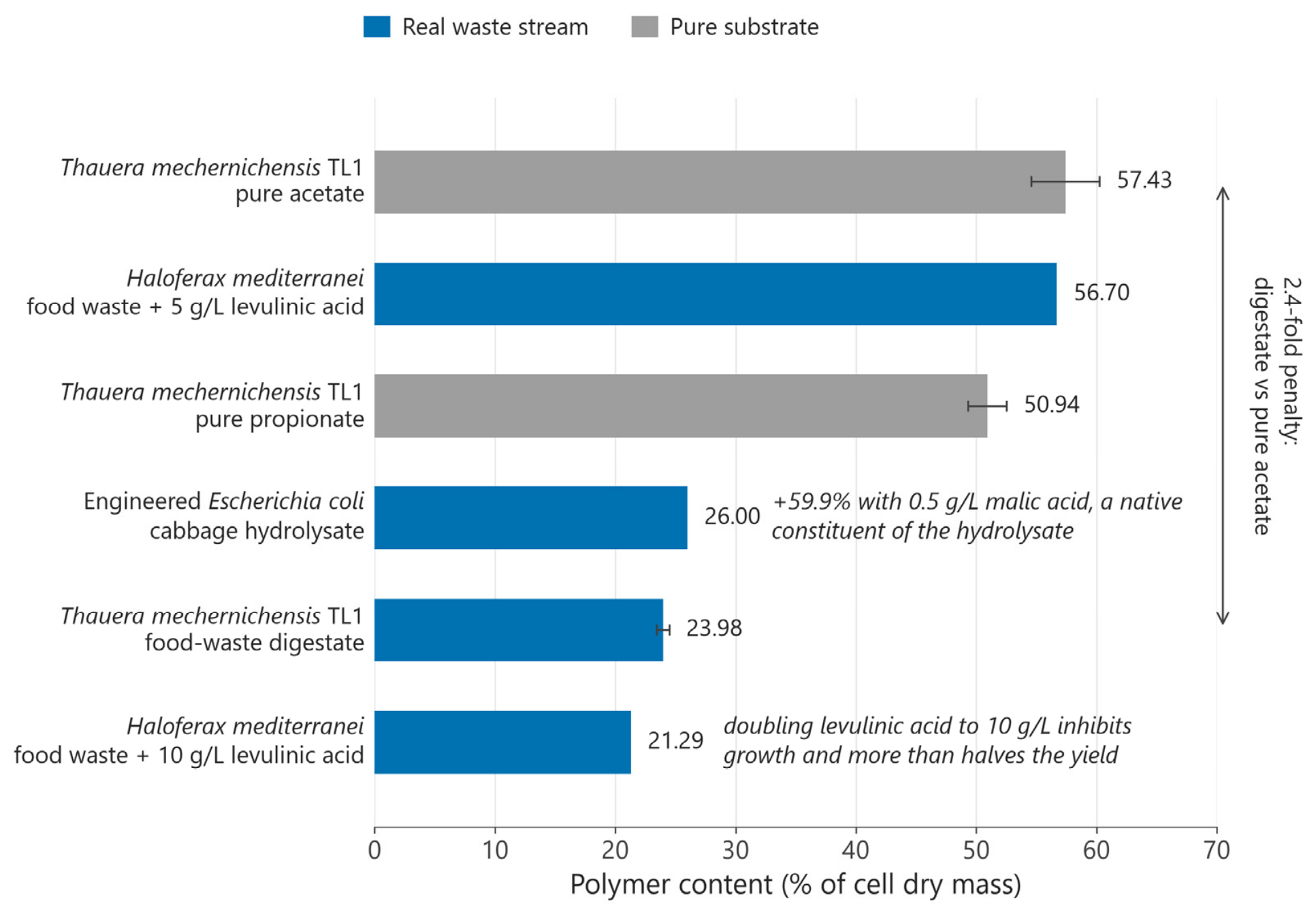
The barrier is unambiguous and economic. The minimum selling price of polyhydroxyalkanoates in an integrated food-waste process was 4.83 US$ kg−1, falling to 2.41 US$ kg−1 at 30% solids loading in hydrolysis [9]. Commodity polyolefins trade roughly an order of magnitude below the upper figure, so the economic case rests on co-product credits and on regulatory or procurement preference for biodegradable polymers rather than on cost parity [95]. Two components of that cost are recovery-side: extraction from the cell remains solvent-intensive and is where reported recoveries and purities diverge most between methods [96], and the life-cycle balance follows the extraction route and energy supply rather than the fermentation [97]. This is the first of several classes whose limiting cost lies downstream of the fermenter, the pattern developed in Section 7.
5.2. Biosurfactants
Biosurfactants match synthetic surfactants functionally, reducing surface and interfacial tension and forming micelles, while offering biodegradability, low toxicity, high selectivity, activity across extremes of temperature, pH and salinity, and low critical micelle concentration [16,98]. Their applications are established in enhanced oil recovery, wastewater treatment, marine and terrestrial bioremediation, and pharmaceuticals [98], and extend to food processing and agriculture where waste-derived production additionally satisfies waste-minimization and circularity objectives [99].
Production cost is up to twelve times that of chemical surfactants, with synthetic culture medium accounting for approximately 30% of that cost [17]; waste substrates address the medium component directly. Lactiplantibacillus plantarum ATCC 8014 (earlier Lactobacillus plantarum), grown on whey permeate and sugarcane molasses with 2.4 g L−1 yeast extract and 4.8% inoculum over 26 h, reduced the surface tension of water to 41.86 ± 0.24 mN m−1, further to 39.95 ± 0.35 mN m−1 after ultrasonication at 28 kHz and 100 W, not significantly different from synthetic-medium products; it showed antiviral activity against Newcastle disease virus [100]. The value of 39.95 mN m−1 is the one carried into Table 5. Bagasse–potato peel mixtures gave the highest yield among tested substrates, stable at 90 °C and 6% salinity [80].
Inducer strategy is the second lever and the least well characterized. Hydrophobic inducers, among them olive-oil-derived saturated and unsaturated fatty acids, proteins and vitamins, trigger biosurfactant metabolism and generally produce longer fatty acid chain lengths, but a systematic Scopus search over ten years located only thirteen documents correlating specific inducers with biosurfactant output [17]. The residual barrier is nonetheless downstream: substituting the medium removes the approximately 30% of cost it represents [17] and leaves purification as the dominant remaining term, and recovery from a foaming, surface-active broth is intrinsically harder than for a soluble metabolite [101,102]. No included study reports an integrated production–purification process at pilot scale.
Two qualifications should be attached to the figures above, because the biosurfactant evidence located under this review’s search is thinner than for the other product classes. The twelve-fold cost ratio and the 30% medium share are single-source estimates for specific glycolipid and lipopeptide processes [17], not sector-wide values; broader treatments of biosurfactant production economics report that the cost gap depends strongly on product, purity specification, and scale, and is narrowest for applications that tolerate crude or partly purified preparations [103]. The application claims should be read the same way: performance in enhanced oil recovery and bioremediation is documented at laboratory and field-trial scale for particular rhamnolipid and surfactin preparations rather than established generically for the class [104]. What the evidence does support without qualification is the direction of the constraint, which every source consulted here places downstream of the fermenter.
5.3. Industrial Enzymes
Industrial enzymes are, on the evidence assembled here, the most commercially advanced product class in waste bioconversion, for two structural reasons: solid-state fermentation on agricultural residues is intrinsically low-cost, and the product tolerates the crude formulation in which it is produced for many end uses.
Multi-enzyme cocktails are directly obtainable: the Penicillium sp. Y-21 tray-bioreactor process yields six activities simultaneously, usable directly as chicken feed additive without purification [85]. An alkaline lipase from Burkholderia gladioli BRM58833, produced by solid-state fermentation on wheat bran, showed high activity with broad pH, temperature, and organic-solvent stability, suiting synthesis and hydrolysis applications; full values are shown in Table 4 [105].
Cellulases for on-site saccharification close the second-generation cost loop [35,36], and enzymatic hydrolysis of textile blends [56] and chemo-enzymatic depolymerization of polyethylene terephthalate [57] extend the enzyme market into materials recycling.
Solid-state fermentation remains the least engineered mode considered. Traditional Chinese processes (vinegar, soy sauce, baijiu) exhibit complex coupled mass and heat transfer in three-phase systems, continued reliance on empirical practice, and active engineering frontiers in pretreatment, process-parameter detection, modeling, and equipment [106]; reactor design is a specific bottleneck, since heat removal and oxygen supply scale unfavorably in packed and tray configurations [107]. It also modifies substrate nutritional quality: on oats it liberates bound phenolics and peptides via microstructural modification, enriches protein with filamentous fungi, and reduces tannins and phytic acid [108]. Enzyme activities on waste substrates across included studies are shown in Table 4.
Table 4.
Enzyme activities obtained by microbial fermentation of waste substrates.
5.4. Organic Acids
Organic acids are the second most commercially advanced class, and the one where market competition rather than technology is the limiting factor.
Lactic acid is the flagship. It reaches 27.4 g L−1 h−1 from cheese whey permeate [39] and is producible from food waste [27], municipal organic waste in continuous operation [50], macroalgal hydrolysates [60], and potato peel waste [84]. Fermentation is preferred to chemical synthesis for a specific reason: polylactide requires an enantiomerically pure monomer, which chemical routes cannot deliver [60]. For municipal organic waste, the food- and lignocellulose-derived fractions are best treated separately, because their pretreatment and enzyme requirements differ and enzymatic hydrolysis is then rate-limiting [50]. The decisive development for readiness has been on the separation side rather than in the fermenter, with reactive distillation, emulsion liquid membrane and membrane separation routes now reaching polylactide-grade purity [50,109].
Succinic acid is a recognized bio-based building block whose fermentative production from renewable carbohydrate could displace petroleum routes; bioreactor design remains the principal efficiency lever, with detailed process configurations and modes summarized in Table 8 [110].
Citric acid is the mature case. More than 100 worldwide patents from 1929 to 2018 document a sustained technological transition from submerged to solid-state fermentation and toward waste substrates, driven by circular-economy demand [86].
5.5. Natural Pigments
Microbial production of pigments offers year-round, location-independent supply with bioactivity beyond color, and agro-industrial waste feedstocks address the cost barrier for astaxanthin, prodigiosin, canthaxanthin, lycopene and β-carotene from native and engineered bacteria, fungi and yeasts [111].
Waste substrates can transform pigment yields: 2% (w/v) soybean meal gave 496 mg L−1 crude violacein from Chromobacterium violaceum (1.62-fold the Luria-Bertani control); adding 100 mg L−1 L-tryptophan raised this to 1217 mg L−1 (3.96-fold), and Box–Behnken optimization reached 1504.5 mg L−1, the highest reported crude violacein yield from an agro-industrial waste substrate in shake-flask culture [112]. Carotenoid and lipid co-production on tea-waste hydrolysate [113] and solid-state prodigiosin fermentation [114] similarly rival defined-media yields, albeit at shake-flask or tray scale.
Despite a decade of research into green extraction, micro- and nanoencapsulation, and by-product valorization under biorefinery and circular-economy principles, the research-to-industry gap for natural carotenoid colorants remains wide, with commercially viable lutein plant sources still lacking [15]. This persistent gap, not any single yield figure, indicates laboratory gains have not displaced synthetic colorants [15,111].
5.6. Microbial Protein
Microbial protein, the microbial biomass itself used as food or feed rather than a secreted metabolite, has the longest commercial history of any product considered here, Pruteen as animal feed in the 1970s and Quorn for human nutrition from 1985, and it presents the clearest contemporary case, since protein demand is a binding constraint in food systems [19].
Microbial protein contains 30–80% protein (dry basis), versus 38.6% soy, 21.2% meat and 17.8% fish, supplying methionine, threonine and lysine [115]. The same source also quotes 3.28% for whole milk; because milk is a liquid product, that figure is expressed per unit of product as consumed rather than on a dry basis, so it is not commensurable with the values above and is not used as a comparator here. Waste substrates cut production cost by an estimated 35–75% [115]. Demonstrated routes include Aspergillus oryzae on organosolv-treated brewer’s spent grain at 44.8% protein [45], Saccharomyces cerevisiae on oat side stream [83], and microalgae at 22–44 t protein ha−1 yr−1 [18]. Hydrogen-oxidizing bacteria fix CO2 without light, needing far less land, freshwater, and minerals than agriculture or phototrophic biotechnology, with scale-up precedent from carbon monoxide and methane gas fermentation [116]; recovered-nitrogen microbial protein routes have been assessed for nutritional quality, safety, and yield [117].
The barriers are price, availability at scale, and regulation. Techno-economic and life-cycle analyses across production scenarios identify distinct technical hotspots per scenario, with affordability and productivity the priorities for innovation [19]; for microalgae specifically, novel-food approval is required before the usable species base can broaden [18]. The regulatory pathway is neither hypothetical nor uniformly prohibitive: yeast biomass of Yarrowia lipolytica has been assessed and found safe as a novel food under Regulation (EU) 2015/2283 [118], and mycoprotein has a four-decade market history with a documented environmental profile [119], so the constraint is the cost and duration of dossier generation for each new species–substrate combination rather than the absence of a route. Synthetic biology, genome engineering and biofoundry tools now allow rapid improvement of productivity and of nutritional and functional quality, but deploying genetic modification in feed and food applications introduces its own policy-control challenges [120].
5.7. Biofertilizers and Biostimulants
The soil-input class is where waste valorization most directly closes a nutrient loop, and where the product is a mixture rather than a molecule.
Acidifying anaerobic digestate (sulfuric, nitric, or phosphoric acid) before evaporative concentration yields solid ammonium salts that outperform both the unamended control and urea ammonium nitrate for plant growth, particularly ammonium phosphate (Table 5), though amended soils showed elevated Proteobacteria and denitrification genes [55], indicating nitrous oxide risk.
At system level, integrating fertilizer informatics (that is, algorithmic and data-analytic nutrient management) with circular-economy principles has been proposed to convert digestate into environmentally acceptable fertilizers under explicit assessment of environmental impact, cost efficiency and adaptability [121]. The wider digestate literature converges on the same conclusion from the process side: the value of digestate is realized only after separation and upgrading, and the choice of upgrading route determines both the nutrient form delivered and the residual environmental burden [122,123]. Keratin waste contributes both as a slow-release nitrogen source in feed and fertilizer applications and, prospectively, as a biosorbent for farmland soil remediation [49]. The waste–platform–product combinations for which evidence exists in the included literature are mapped in Figure 5, and the product classes are compared in Table 5.
Table 5.
Comparative summary of product classes from microbial waste bioconversion. The performance column reports the highest value located in the included literature for each pairing. These values were obtained on different substrates, at different scales and by different analytical methods, and are therefore illustrative of what has been demonstrated rather than benchmarks obtained under harmonized conditions; they should not be used to rank product classes against one another.
Figure 5.
Evidence matrix crossing the eight waste-stream classes against the eight product families, indicating the microbial platform demonstrated for each pairing. The matrix was constructed by the authors from Table 2, Table 3, Table 4, Table 5, Table 6, Table 7 and Table 8: each pairing was scored by locating, among the 81 synthesized sources, the strongest evidence reported for that waste stream and that product, and cells are populated from those sources alone. Cells distinguish primary experimental evidence, review-level or indirect evidence, and no evidence in the included literature; a cell in the last category means that no evidence was retrieved under the eligibility criteria of Section 2.4, not that the pairing is undemonstrated. Two pairings are marked separately as lying outside those criteria: microalgal pigments and microalgal biostimulants both reach commercial products [74,75], but the sources located for them use purpose-cultivated rather than waste-derived biomass and so fail inclusion criterion (i) (Section 3.8). Letters denote platform: B, bacteria; F, filamentous fungi; C, mixed consortia; blank where the source does not identify one clearly. No waste stream has been tested across the full product range, nor any product across the full stream range, which is direct evidence for research gap 9.2. MSW, municipal solid waste. Original work of the authors; no published figure was reproduced or adapted.
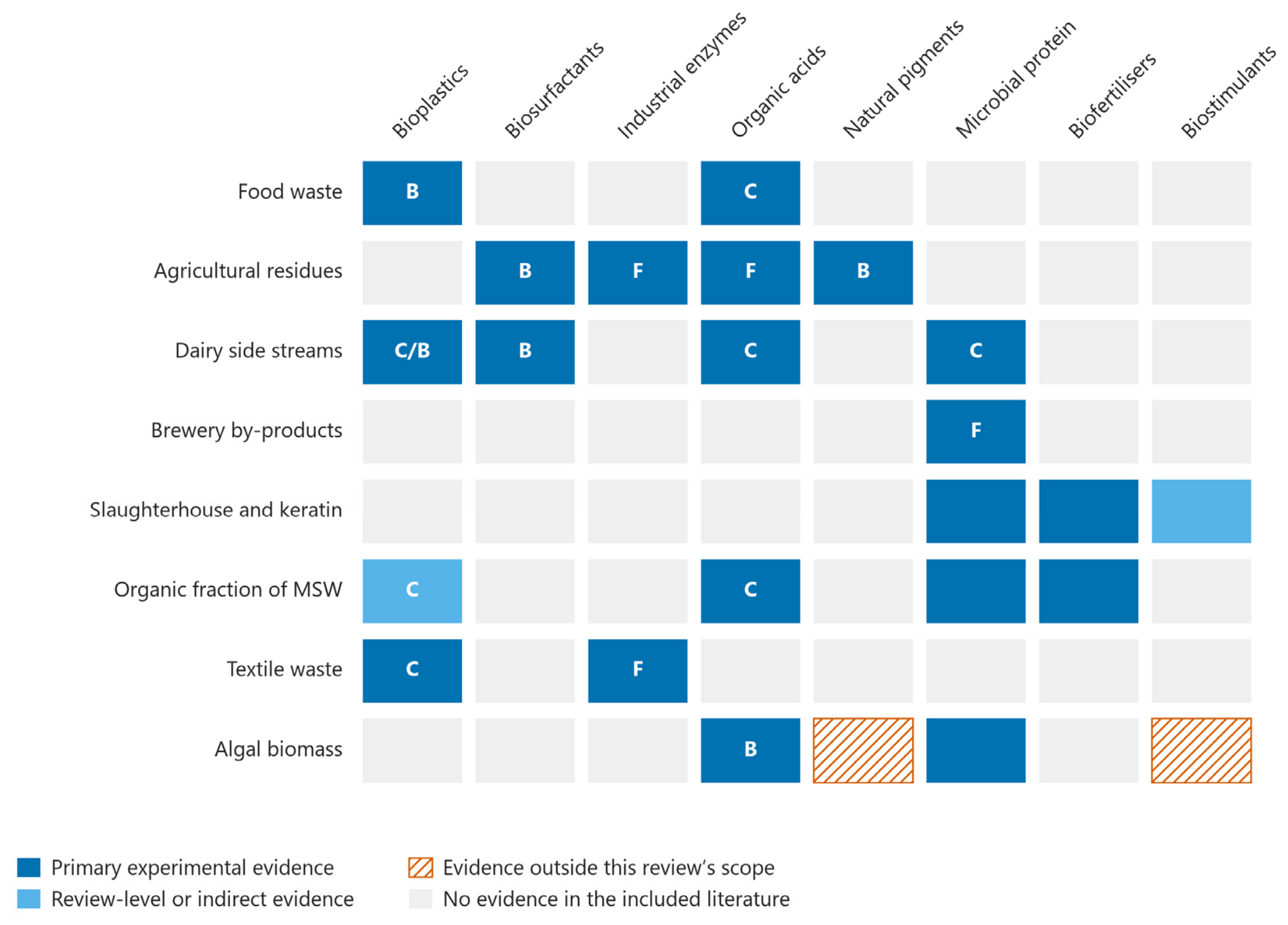
In summary, the eight product families are divided by where their limiting cost sits, not by worth. Enzymes and organic acids, tolerant of crude formulation or served by a mature separation train, have reached commercial operation; polyhydroxyalkanoates, biosurfactants and pigments, whose value is consumed by purification cost, have not, regardless of reported titers. Unit value is not predictive and is inversely associated with readiness: pigments carry the highest price and lowest maturity. What separates the classes is the downstream cost fraction and, for food- and feed-directed classes, the regulatory pathway, both taken up quantitatively in Section 7.
6. Process Optimization Strategies
6.1. Pretreatment
Pretreatment is the dominant cost and performance lever for solid, lignocellulosic streams and is largely irrelevant for soluble streams such as whey permeate, a distinction that itself explains much of the readiness gradient in Section 7. Physical, chemical, biological, and physicochemical methods act on different components of the lignin–hemicellulose–cellulose matrix, and integrated combinations outperform single methods because no one mechanism addresses all three [33]. Two results in this review specifically favor chemical-free options: nitrogen explosive decompression outperformed dilute acid for both ethanol and methane from cellulosic paper waste [34], and dilute alkali outperformed acid for rice straw saccharification [35]. Two treatments show that pretreatment need not be a pure cost. Organosolv pretreatment of brewer’s spent grain enables high-protein fungal cultivation on the resulting liquor, while yielding lignin and ethanol as co-products [45]. Supercritical CO2 extraction delivers a saleable lipid fraction and improves subsequent enzymatic hydrolysis [46]. In both cases, the step generates value rather than only consuming it. Table 6 collects the quantitative pretreatment outcomes reported in the included studies, together with the comparator against which each was benchmarked.
Two widely investigated physical pretreatments do not appear in Table 6, and their absence should be explained rather than left to inference. Ultrasound and microwave treatment are among the most studied physical routes for lignocellulose and for wet organic waste: ultrasonic cavitation disrupts particle structure and accelerates hydrolysis and subsequent bioconversion across a range of waste materials [124], and microwave heating delivers volumetric, selective heating that shortens treatment times and, in several comparisons, improves sugar release relative to conventionally heated acid or alkaline pretreatment [125]. Neither appears in Table 6 because the table reports only pretreatment outcomes quantified in the studies included under this review’s eligibility criteria, and the ultrasound and microwave literature was retrieved by the searches of Table 1 almost entirely in bioenergy configurations, which criterion (i) excludes. The absence is therefore a property of the retrieval, not a judgment on the methods, and it is one more instance of the single-database limitation recorded in Section 10. Where ultrasound does appear in an included study, it is as a post-fermentation processing step rather than a pretreatment, improving the surface activity of a biosurfactant preparation (Section 5.2) [100].
Table 6.
Quantitative pretreatment outcomes reported in the included literature.
6.2. Co-Cultures and Consortium Design
Co-culture suits substrates requiring sequential chemistries: lactic acid bacteria–yeast co-cultures stabilize blended side streams without altering physical structure [44]; symbiotic fermentation, nitrogen supplementation and optimized mixed-substrate formulation raise solid-state fermentation yields on brewer’s spent grain [7]; and consortium-based approaches broaden substrate utilization and improve stability [87]. Spatial structure within aggregates determines realized metabolic interactions, an unexploited design axis [88] that metabolic modeling of candidate members could render predictive [91].
6.3. Metabolic Engineering and Synthetic Biology
Two dominant strategies emerge: pathway transplantation, exemplified by expressing the Cupriavidus necator H16 polyhydroxyalkanoate operon in Escherichia coli [79], and classical strain improvement, still competitive, as with ethyl methanesulfonate mutagenesis producing the hyperactive Penicillium sp. Y-21 enzyme-cocktail strain [85]. For microbial protein, synthetic biology, genome engineering, and biofoundry technologies enable rapid modification of productivity and nutritional quality, though deployment carries regulatory consequences [120]; for Pseudomonas putida, available synthetic biology tools remain insufficiently practical for industrial application [12]. A third strategy, rarely applied to waste streams, engineers the community rather than the organism, using kinetic or stoichiometric models to specify a co-culture yielding a target acid spectrum from a defined feed [126].
Engineered and native organisms are not interchangeable once a process leaves the laboratory, and this review distinguishes them where the distinction carries consequences. Three follow from the use of a genetically modified organism rather than from its performance. First, containment: modified strains are handled under contained-use rules, which set requirements on reactor integrity, effluent inactivation, and waste-stream disposal that an open, non-sterile process on a waste feedstock cannot meet, so the mixed-culture and non-axenic configurations favored elsewhere in this review are closed to them [127]. Second, market authorization: where the product is destined for food or feed, the approval pathway for material derived from a modified organism differs in evidentiary burden and duration from that for a native one, which is the specific policy-control difficulty identified for microbial protein [120]. Third, downstream processing: removing recombinant DNA and host-cell protein to the level a regulator expects adds unit operations, and therefore cost, to a class of products whose limiting cost is already recovery. The engineered systems cited here are the operon-transplanted Escherichia coli of Section 4.1 [79] and the mutagenized Penicillium sp. Y-21 of Section 5.3 [85], the latter a classical mutant and not a recombinant organism; both are flagged as engineered in Table 3, Table 5 and Table 8 so that no readiness assignment is read across the two categories.
6.4. Fermentation Mode and Bioreactor Engineering
Fermentation mode selection is substrate-determined. Solid-state fermentation suits wet solid residues and is the mode of choice for filamentous fungi and enzyme cocktails [7,85,105,106,108]; submerged fermentation suits soluble streams; open continuous fermentation suits heterogeneous streams where mixed-culture robustness outweighs product specificity [39,49,51,52].
Individual control-variable effects are collected in Table 7 and are not restated here. Three are trade-offs rather than optima: dissolved oxygen separates growth from polymer accumulation [30], substrate loading separates ethanol yield from protein content [45], and pH separates lactic acid productivity from optical purity while selecting the enantiomer [39]. The temperature optima reported for mixed food and paper [51], for sludge–food co-fermentation [52], and for lactic acid from whey permeate [39] all fall between the mesophilic and thermophilic set points, so neither default suits these feedstocks.
Four further observations concern scale rather than set point. Fed-batch operation with pulsed precursor addition controls copolymer composition [31]; bioreactor design remains the principal lever for succinic acid after two decades of strain work [110]; tray bioreactors serve pilot-scale solid-state enzyme production, limited by heat and oxygen transfer rather than by biology [85,107]; and medium recycling applies to any high-salt process (Table 7) [30]. Underlying all of them is a scale effect the included studies omit: concentration and shear gradients in large bioreactors alter the cell’s actual environment, so set points transferred unchanged from laboratory vessels do not reproduce laboratory performance [128].
In summary, the optimization literature is quantitatively rich at the level of individual variables but almost silent on their interaction. Every Table 7 entry is single-factor or low-dimensional, several describe trade-offs rather than optima, and at least one response is non-monotonic: levulinic acid supplementation raises copolymer yield at 5 g L−1 but depresses it at 10 g L−1 [31]. Because these effects are substrate-specific, reported set points cannot transfer between streams; the field lacks not only further single-variable studies but also a model linking feedstock composition to operating set point. Model-aided specification of a defined co-culture targeting a product spectrum on food waste [126] demonstrates such a model is attainable; Section 11 names its development a priority direction.
Table 7.
Bioprocess control variables for which a quantified effect is reported in the included literature. The table is a catalog of single-variable effects, each valid only within the system that produced it. Because the entries were obtained on different substrates, with different organisms and in different fermentation modes, no row can be compared with another, and the settings listed are not transferable operating recommendations; the pattern the table supports is the one developed in the text: that the reported effects are substrate-specific and that the field has characterized variables individually rather than in interaction.
7. Technology Readiness Assessment
7.1. Framework and Method
Technology Readiness Levels are assessed against the European Commission scale, in which TRL 1–3 denotes basic principles through experimental proof of concept, TRL 4–6 denotes validation and demonstration in laboratory and relevant environments, and TRL 7–9 denotes system prototype demonstration in operational environment through to proven commercial operation [21].
Table 8 assignments reflect the highest demonstrated scale and evidence of operational deployment reported in the included literature, given as ranges to capture variation between waste–product pairings within a class. This is both the review’s principal interpretive contribution and its main methodological limitation: TRL assignment from published literature is inherently conservative, since industrial deployment is often unpublished, and is judgment-based rather than measured. Similar difficulties arise wherever the scale has been applied to biotechnological processes, where the published record supports an ordering but not a certified level [129,130]. Assignments should therefore be read as a comparative ordering, not certified readiness statements.
The decision rule is stated explicitly so any reader can re-derive assignments from the evidence column of Table 8. TRL 1–3 required proof-of-concept experiments at shake-flask, microplate, or bottle scale, with product formation but no controlled reactor operation. TRL 4–6 required operation in an instrumented bioreactor with controlled pH, temperature, or dissolved oxygen, on the real waste stream rather than a synthetic surrogate, with performance reported for at least one complete run; the upper band additionally required continuous or fed-batch operation, or demonstration above laboratory scale. TRL 7–9 required at least one of: documented production-scale operation; a market product derived from the route; or a full process design with capital and operating cost estimates built on demonstrated, not assumed, unit-operation performance.
Four conventions applied consistently in using that rule. First, where a class contained pairings meeting different criteria, the reported range spans them, with the lower bound reflecting the weakest well-evidenced pairing rather than the weakest pairing located. Second, regulatory approval status never raised or lowered a TRL, since regulatory position is treated as a separate determinant, though commercial sale was accepted as sufficient evidence for the upper band of a technical route; hence, microbial protein sits at 5–7 despite an unresolved approval pathway for waste-fed variants. Third, evidence from a non-waste feedstock could not support a waste-fed pipeline assignment, which is why the reductive catalytic fractionation system of Section 8 appears nowhere in Table 8. Fourth, where literature reported scale but not duration or mass balance, the pairing was held at the lower bound of the band its scale would otherwise justify.
One consequence of the second objection raised in Section 3 must be stated here, because it bounds what Table 8 and Figure 5 can be used for. The compositional classification does no quantitative work in either. It is used as an ordinal grouping only: it orders the presentation of Section 3, it groups pairings that share a governing constraint, and it supplies the row labels of Figure 5. Every readiness assignment in Table 8 is derived from the evidence column of that table for a named waste–product pairing, a specific substrate with a specific organism at a reported scale, by the decision rule above; no assignment is derived from the compositional class of a stream, and none from any comparison of compositions between streams. The same holds for Figure 5, whose cells are populated from the strongest evidence located for each named pairing among the 81 synthesized sources rather than from a compositional inference. Where a class contains pairings with different evidence, the assignment is reported as a range rather than averaged, which is the first of the four conventions above and exists precisely because the class is not a quantitative predictor.
What the classification therefore cannot support is equally definite. It cannot predict performance on a pairing for which no evidence was located, so no cell of Figure 5 and no row of Table 8 is filled by interpolation within a class. It cannot support the claim that two streams assigned to the same class will respond identically to the same process; the opposite was observed for two streams both routinely labeled municipal organic waste, and that observation is the direct evidence for the first determinant (Section 7.2). And it cannot rank streams quantitatively by suitability, which is why substrate composition on a dry basis opens the minimum reporting set of Table 10. The classification is a device for ordering evidence and locating bottlenecks; the readiness assignments rest on the evidence, not on the device.
Table 8.
Technology readiness assessment of microbial waste-to-product pipelines, assigned by the decision rule set out in Section 7.1.
7.2. What the Readiness Gradient Reveals
Table 8 is not ordered by-product value, substrate abundance, or research volume: pigments have the highest unit value and among the lowest readiness; microalgae attracted 1503 records, more than any other query, at TRL 3–5 for their highest-value product; keratin waste, with roughly one million tonnes generated annually in a single country [8], attracted 140 records from the combined keratin and slaughterhouse query. Record counts index research attention under Table 1′s queries within one database, not total literature or intrinsic maturity.
The ordering that does hold is by the three bottlenecks proposed in Section 1.
- Feedstock variability: TRL 7–9 pairings use either a compositionally consistent substrate (wheat bran, oilseed meal, dairy permeate) or a product tolerant of compositional drift (crude enzyme cocktail), whereas TRL 4–6 pairings use the most variable substrates reviewed, post-consumer textile blends and the organic fraction of municipal solid waste. Direct evidence comes from identical operating conditions producing opposite outcomes on two streams routinely grouped as municipal organic waste: alkaline pH improved volatile fatty acid production from source-separated canteen food waste but not from mechanically–biologically treated municipal organic waste, attributed to free ammonia carried over from anaerobic digestion supernatant at the treatment plant [54]. Since the two streams differ in origin, composition, and upstream handling, this does not show compositionally identical feedstocks behaving differently; rather, a waste-management category label fails to predict process response, the property that matters for a process expected to run on whatever the collection system delivers.
- Downstream cost share determines readiness. Where recovery is cheap or unnecessary, readiness is high: crude enzyme cocktails are sold unpurified [85], and digestate is applied as a mixture [55]. Where recovery dominates, readiness is low: biosurfactants are limited by purification after medium substitution removes only about 30% of cost [17,101]; for lactic acid, the limiting step shifts to separation and purification [27], with readiness rising as reactive distillation, emulsion liquid membrane and membrane separation routes reached polylactide-grade purity [50,109]. Polyhydroxyalkanoate economics are dominated by solids loading in hydrolysis, by-product pricing [9], and extraction [96].
- Microbial protein is technically mature and commercially sold since the 1970s, yet waste-fed variants sit at TRL 5–7 because approval, not fermentation, gates the market [18,19]; completed novel-food assessments for microbial biomass [118] show the gate is passable, with cost incurred per species–substrate combination. Natural pigments face food-colorant regulation atop a productivity deficit [15]. Enzymes for technical, non-food applications face the lightest regulatory burden and highest readiness.
- A corollary follows: when all three bottlenecks are simultaneously unfavorable, as for waste-derived food pigments, incremental yield gains cannot advance the technology; the 3.96-fold and 1.62-fold improvements reported for violacein on soybean meal [112] have not closed the sector-level research-to-industry gap [15]. Where the bottleneck is singular and identified, targeted intervention succeeds: medium recycling addressed halophilic polyhydroxyalkanoate salt costs [30]; on-site cellulase production addressed second-generation enzyme costs [36]. Figure 6 plots readiness against each bottleneck’s status.
Figure 6.
Technology readiness of waste-to-product pipelines plotted against the status of the three determinants proposed in Section 1: feedstock variability, downstream cost share, and regulatory status. Readiness assignments are those of Table 8, made by the decision rule of Section 7.1. Every pipeline whose stated bottleneck is downstream recovery is capped at TRL 7 or below, whereas market competition binds only pipelines already at TRL 6–9. Natural pigments carry the highest unit value in the review and the lowest readiness. Assignments are literature-derived judgments and are systematically conservative for technologies deployed commercially without publication. VFA, volatile fatty acids. This figure is original work of the authors, constructed from the readiness assignments of Table 8; no published figure was reproduced or adapted.
In summary, the readiness gradient is ordered by the three determinants and nothing else tested here. Pipelines whose bottleneck is downstream recovery sit at TRL 7 or below; those at TRL 7–9 use a compositionally stable substrate or sell a product tolerant of compositional drift; and regulatory position, not technical maturity, separates microbial protein and pigments from otherwise comparable enzyme and organic-acid routes. These literature-derived assignments are systematically conservative, since commercial deployment is often unpublished. This does not threaten the ordering: unpublished deployment would raise upper bands, widening the gradient, while the three determinants would still separate classes in the same sequence.
8. Sustainability Assessment
The size of this evidence base must be stated plainly, as it calibrates all that follows. Of 77 studies included, three report a quantitative economic or environmental assessment of a waste-fed process [9,83,131]. A fourth [5], on a thermochemical–catalytic system fed with virgin biomass, is retained only as an out-of-scope design comparator, on the grounds set out in Section 2.4. It is cited because it reports the internal cost and impact structure of an integrated biorefinery at a resolution no waste-fed study located here matches, and because the conclusions carried across from it concern solvent recovery and water removal, unit operations shared with fermentation biorefineries. It contributes no evidence on any microbial route, is excluded from Table 8 and from every count of included studies, and is flagged in Table 9 and its caption. This section thus reports substantially all the quantitative sustainability evidence located, and its conclusions are correspondingly provisional. The scarcity is partly an artifact of searching a single biomedical database (Section 2.3), since techno-economic and life-cycle studies of waste biorefineries appear extensively in engineering and environmental-assessment venues that PubMed/MEDLINE indexes incompletely; representative examples outside the retrieval set reach similar qualitative conclusions [132,133,134]. Regardless, this scarcity is itself a principal finding, developed as research gap 9.4 in Section 9.
8.1. What Life-Cycle Evidence Exists, and What It Shows
The environmental case for waste valorization is usually asserted rather than quantified, and the included life-cycle assessments show why that assertion needs care.
Yeast microbial protein from oat side stream was the clearest cautionary case: it outperformed soy protein concentrate only on land use, and underperformed most other novel proteins across the remaining impact categories (full figures in Table 9), while faring comparatively better against dry microalgal biomass on some measures [83]. Energy source, rather than biological conversion, was the determining factor.
Waste-derived feedstocks do not guarantee low impact: processes with substantial thermal or electrical demand for drying, distillation, or high-pressure operation have footprints dominated by energy use, as also found for polyhydroxyalkanoate production, where life-cycle balance depends on extraction route and energy supply rather than fermentation [97]. The out-of-scope comparator identified at the head of this section shows the same pattern with unusual resolution: lignin conversion accounted for 57% of installed capital, 77% of positive global warming potential and 43% of cumulative energy demand, with solvent recycling and distillation-based water removal alone demanding process heat equivalent to 73% of biomass energy content and 35% of operating cost, while hydrogen supply and catalyst recycling were minor [5]. Four implications follow for fermentation biorefineries: reduce operating pressure, minimize solvent loading, use condensed-phase separations, and utilize the whole product stream rather than burning residues.
Life-cycle assessments consistently show significant environmental benefits from seafood-waste biorefinery processing over disposal, though studies are not directly comparable given differing methods; high energy consumption must be reduced to realize this benefit [131] (Figure 7,Table 9).
Table 9.
Techno-economic and life-cycle evidence base of this review. The first, second and fourth entries assess waste-fed systems within the scope defined in Section 1. The third is an out-of-scope comparator (Section 2.4), excluded from the readiness assignments of Table 8 and from the counts of included studies.
Figure 7.
Life-cycle profile of yeast microbial protein produced from oat processing side stream, expressed relative to soy protein concentrate and to four novel protein comparators (A) across five impact categories (B). All data from ref. [83]. Against soy protein concentrate, the product achieved 61% lower land use but performed worse in every other assessed category; the source does not report those magnitudes individually, so they are not plotted. The determining variable was the energy source, not the biological conversion, and the moisture state of the feedstock alone moved global warming potential by 16.3% (original figure).
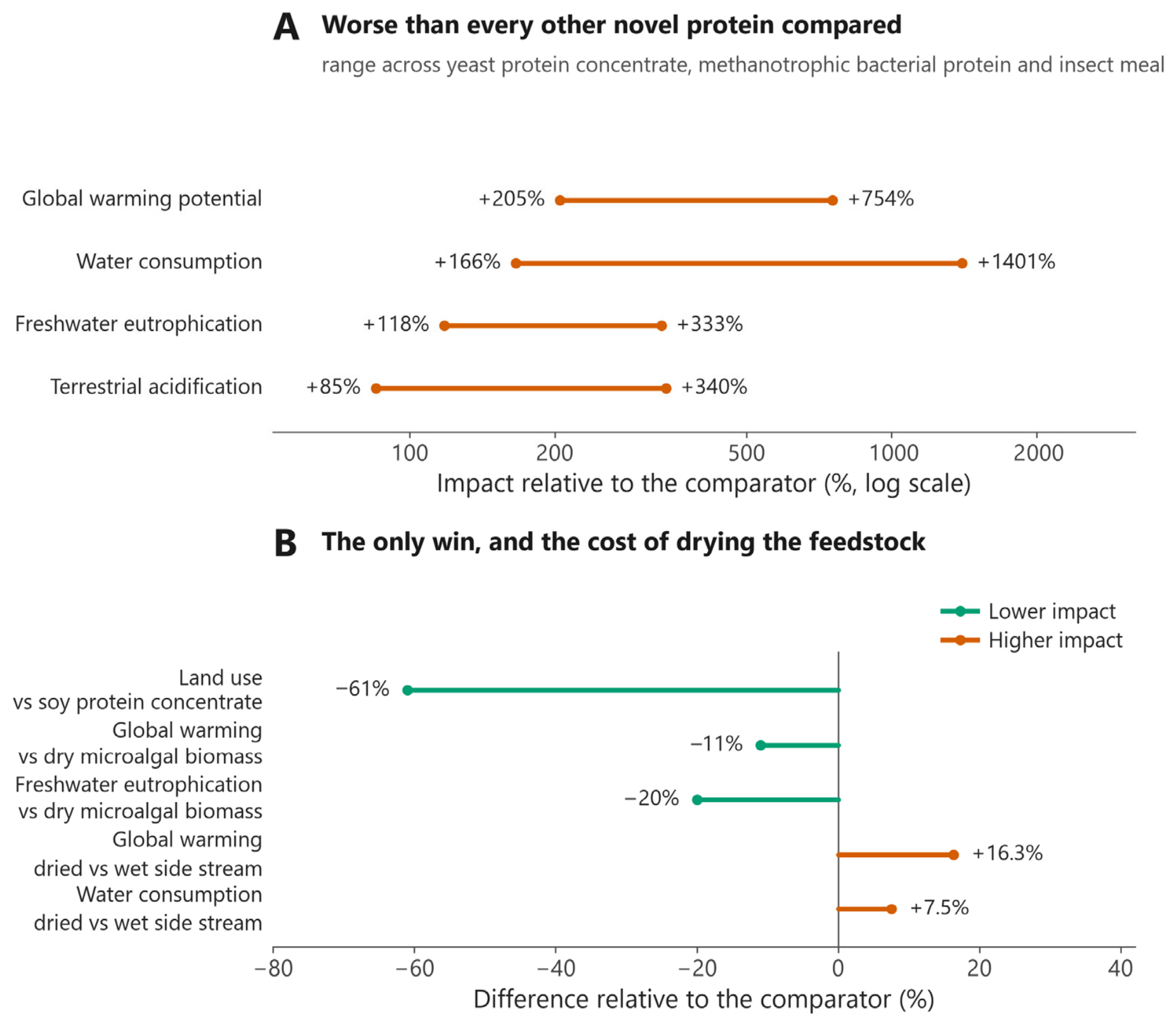
8.2. Circularity Indicators
Beyond the life-cycle impact categories, several included results bear on circularity in the resource-management sense, that is, on whether a route diverts a stream from disposal, returns a material to use within the same process, or recovers a nutrient that would otherwise be lost. The three groups below correspond to those three effects.
Landfill diversion and disposal-liability avoidance: valorization converts costly regulated whey disposal into revenue [6], diverts short-shelf-life brewer’s spent grain from landfill [45], and averts feather-disposal’s environmental and disease risks [8] (detail in Section 3 and Section 5).
- •
- Loop closure: Three explicit loop-closing configurations appear: on-site production of saccharification enzymes on the same residue they hydrolyze [36]; spent saline medium recycled across four consecutive polyhydroxyalkanoate batches without loss of product concentration or quality [30]; and dark-fermentation effluent feeding microalgal cultivation, with spent algal biomass returned as dark-fermentation feedstock after product extraction [14].
- •
- Nutrient recovery: Digestate acidification retains ammonium nitrogen that would otherwise volatilize, converting a loss into a fertilizer product with demonstrated agronomic performance [55], within a broader informatics-supported framework for circular nutrient management [121].
- •
- The cheese whey permeate projection reported above [39], and a second routing of sugar-industry organic waste to biodegradable packaging polymers, which reportedly lowers greenhouse gas emissions and energy use against petroleum-based packaging [94], both remain scenario projections rather than assessments.
In summary, the sustainability evidence located here is too sparse to support a general verdict but consistent enough to support two specific ones. First, the environmental case for a waste-fed process is decided by the energy supplied to it rather than the origin of its carbon: the one full life-cycle assessment of a waste-fed food product reviewed here returned an unfavorable verdict against every comparator except land use [83]. Second, circularity gains arise from cascades and internal recycling loops rather than single conversions, yet they remain demonstrated and unassessed: none of the three loop-closing configurations in Section 8.2 has undergone life-cycle or techno-economic analysis. Both conclusions rest on only three waste-fed assessments, so enlarging that evidence base should take priority over refining these conclusions.
9. Research Gaps
The nine gaps are stated as specific, addressable deficits, each with supporting evidence and a closing study design, collected with references in Table 10. The first concerns measurement: studies report titer as g L−1, wt% of dry cell weight, mol% of a comonomer, U g−1 dry solids, mg L−1, g per g chemical oxygen demand consumed, or g per g raw substrate, often only one metric, and frequently without substrate composition, mass balance, or error estimate. This incommensurability is the sole reason no meta-analysis was possible here. The closing action is adoption of the minimum reporting set specified with units and rationale in Table 11.
Table 10.
Proposed minimum reporting set for microbial waste-bioconversion studies.
Table 11.
Research gaps, the evidence establishing each, and the study design that would close it.
The remaining gaps follow from the evidence already presented. Comparability is absent: no study compares two or more waste streams under identical pretreatment, organism, reactor, and control conditions, with closest approaches comparing fractions of one stream [51], substrates within one industry [45], or platforms on one substrate [40]; a benchmark running a common platform organism on five compositionally distinct waste hydrolysates in parallel bioreactors under matched control would close it. Scale is limited by practice: the largest scales located are tray bioreactors [85] and continuous laboratory fermenters [52,53], while most pigment, biosurfactant and keratin results remain shake-flask, the constraint being incentives rather than technique.
Assessment remains scarce despite the scale of the feedstock: global municipal solid waste generation stood at 2.1 billion tonnes in 2020, projected to reach 3.8 billion tonnes by 2050, with 38% of the 2020 total managed in uncontrolled ways [1]. Yet only three of the 81 sources synthesized here provide a quantitative economic or environmental assessment of a waste-fed process [9,83,131], plus one adjacent virgin-biomass assessment [5]. Such analysis proves decisive where it exists: the food-waste polyhydroxyalkanoate techno-economic analysis identified solids loading as the dominant sensitivity [9], and the oat microbial protein life-cycle assessment reversed the intuitive environmental verdict [83]. This neglect extends to unit operations: purification is named the principal barrier for biosurfactants [17], lactic acid [27], and polyhydroxyalkanoates [9], yet upstream titer optimization continues to dominate the literature [102].
Biology is treated with a similar bias toward the familiar. Consortia demonstrably outperform pure cultures on robustness and non-sterile operability [40,87] and can be steered to 98.3% optical purity by physical parameters alone [39], yet consortium composition is usually reported descriptively rather than designed, and spatial structure [88] has not been manipulated on any waste stream in this review, leaving aggregate architecture and immigration control unexplored as design variables [91]. The molecular tools that might inform such design are used no more ambitiously: where genomics has been applied, it has been confirmatory rather than predictive, verifying pha gene presence after phenotype observation [78] or annotating a consortium after function was established [59], and predictive use of omics to select organisms for a defined waste composition does not appear anywhere in the corpus.
Beyond the reactor, the barriers most often deciding commercial fate are named but not analyzed: novel-food approval for microalgal protein [18], policy control of genetic modification in feed and food [120], and colorant regulation [15] are each identified as blocking, yet no included work maps approval pathways, timelines, or evidentiary requirements for waste-derived products across jurisdictions. Equally unaddressed is when a waste ceases legally to be a waste and on what criteria it may be marketed as a secondary raw material [135,136]. A comparative regulatory analysis for waste-derived food, feed, cosmetic and agricultural inputs in the EU, US and Asia-Pacific would address both.
A prior question is where research effort is directed. Table 1 shows 1503 microalgae records and 868 for a single yeast genus, versus 140 for keratinous waste and 21 for textile waste, despite these being large, growing, poorly managed streams [8,58]. Though these counts index attention within one database and query set rather than total literature, the disparity is robust to that qualification. This gap reflects funding rather than methodology, warranting targeted programs on under-researched high-volume streams.
The limitations of this review itself, which should be read alongside these gaps, are collected in Section 10.
10. Limitations of This Review
The gaps set out in Section 9 are properties of the field. The limitations below are properties of this review, and seven of them bear on how its conclusions should be read.
First, retrieval was confined to PubMed/MEDLINE, which under-indexes the engineering, life-cycle and policy literature (Section 2.3); the shortage of techno-economic and life-cycle studies reported in Section 8 is therefore partly a property of the search rather than of the field, so the comparative ordering offered here is more secure than any claim about the absolute size of the evidence base. Second, no protocol was prospectively registered in PROSPERO, INPLASY or elsewhere (Section 2.1). Third, reason-level counts were not retained at title-and-abstract screening, so only aggregate exclusions are reported (Section 2.6). Fourth, the technology readiness assignments are judgment-based, literature-derived, and systematically conservative, and are presented as a comparative ordering rather than as certified levels (Section 7.1). Fifth, risk of bias was assessed informally rather than with a validated instrument, no instrument being applicable to process-engineering reports (Section 2.1); the informal criteria applied are stated in Section 2.5.
Sixth, and most consequential for the organizing principle adopted here, the compositional classification of Section 3 rests on data that are not standardized. Composition is reported on inconsistent bases, by different analytical conventions, with fractions defined by the method applied rather than chemically, and in many studies not at all; no standardized compositional analysis procedure exists for wet heterogeneous waste comparable to those available for lignocellulose [24]. Assigning a stream to a dominant macromolecular class is robust to this, because the dominant class is a qualitative property of the stream. Quantitative comparison between streams is not, and neither is any attempt to predict process behavior from reported composition. Until composition is reported to a common standard, a compositional classification can order the field but cannot support the quantitative feedstock-to-set-point model named as a priority in Section 11. Section 7.1 states what the classification is and is not used for in the readiness assessment: it groups pairings, whereas every assignment rests on the evidence for a named pairing.
Seventh, coverage is uneven between streams and between products, and the unevenness follows the evidence rather than the authors’ preference. Dairy side streams, lactic acid and polyhydroxyalkanoates are treated at greater length than keratinous waste, textile waste, biosurfactants or pigments because the retrieved literature for them reports more quantitative results, at larger scale and with fuller process description; Table 1 and Figure 2 quantify that asymmetry, and gap 9.9 names it as a misallocation of research effort rather than a property of the resources themselves. The consequence for the reader is that confidence is not uniform across this review: statements about carbohydrate-rich soluble streams rest on several independent primary studies, whereas statements about keratinous and textile streams often rest on one or two, and we have marked the single-source claims in the text where they occur.
11. Conclusions
Organic waste of essentially every compositional class can be converted microbially into products of substantially higher value than energy. That much is established beyond reasonable doubt. What the literature has not supplied is a basis for choosing among the resulting options, and this review argues that the choice is governed by three transferable determinants of resource accessibility, feedstock variability, downstream cost share and regulatory status, rather than by the identity of the waste or of the organism. The readiness ordering of Table 8 follows those determinants and not product value, resource abundance or research volume.
The determinants impose a decision sequence in which each step constrains the next and the last constrains the first (Figure S1). Characterization comes first, and it must address variability across seasons, sources, and collection systems rather than mean composition. Pretreatment is then selected for the value it generates and not only for the accessibility it buys, since it is the largest single cost lever for solid streams and can deliver saleable co-products. Platform selection follows substrate state rather than product familiarity: filamentous fungi for wet solid residues, submerged culture for soluble streams and process liquors, open mixed cultures where heterogeneity favors robustness over specificity, and halophiles where sterility can be dispensed with. Bioprocess conditions are set for one product objective at a time, because growth and product formation are decoupled and because operating parameters select product identity and stereochemistry. The market and regulatory pathway comes last in the causal chain and must therefore be fixed first: identical technical maturity reaches TRL 7–9 in technical applications but not in food or feed.
Five directions follow, each addressed to one determinant. Integrated multi-product biorefineries should replace single-product processes as the default, since single-product design leaves most substrate carbon unmonetized. Process optimization should move from empirical to model-based, the open target being a predictive model mapping feedstock composition to operating set point; that model in turn depends on the standardized compositional reporting this review found to be absent. Synthetic biology should target waste-relevant operating conditions rather than titer, and should account for the containment, approval, and downstream consequences that engineered organisms carry. Consortium engineering deserves status as a design discipline in its own right, with aggregate architecture and immigration control treated as design variables. And development should be downstream-first, working back from the separation train to a broth designed for recovery, because purification dominates cost in precisely the classes that have stalled.
The argument yields a falsifiable prediction: a technology at TRL 4–6 advances only when one of the three determinants is directly relieved, and not from titer improvement alone. The violacein and lactic acid cases examined in Section 5 and Section 7 are, respectively, a negative and a positive instance. Testing the prediction prospectively matters, because the alternative, continued titer optimization where the barrier lies elsewhere, is the most economical explanation of a field with conspicuous technical success and very few commercial products.
Supplementary Materials
The following supporting information can be downloaded at https://www.mdpi.com/article/10.3390/resources15100131/s1, Figure S1: Integrated Waste → Platform → Bioprocess → Product → Market framework. Abbreviations: LCA, life cycle assessment; TEA, techno-economic analysis; TRL, technology readiness level; VFA, volatile fatty acids. Supplementary File S1: PRISMA 2020 Checklist.
Author Contributions
Conceptualization, A.E.; methodology, A.E. and M.H.; software, A.E. and A.B.; validation, A.E., M.T., A.A. and B.E.G.; formal analysis, A.E. and S.B.; investigation, A.E., E.M.B., M.H., A.B. and S.B.; resources, A.A. and M.A.; data curation, E.M.B., M.H. and M.T.; writing, original draft preparation, A.E.; writing, review and editing, A.E., E.M.B., M.T., B.E.G., A.A. and M.A.; visualization, A.B. and S.B.; supervision, M.A.; project administration, A.E. and M.A. All authors have read and agreed to the published version of the manuscript.
Funding
This research received no external funding.
Data Availability Statement
The original contributions presented in this study are included in the article/Supplementary Material. Further inquiries can be directed to the corresponding author.
Acknowledgments
During the preparation of this manuscript/study, the authors used Claude (Anthropic, San Francisco, CA, USA), Opus 4.6, accessed via the Claude Desktop application on 5 March 2026, for the purposes of language refinement. The authors have reviewed and edited the output and take full responsibility for the content of this publication.
Conflicts of Interest
The authors declare no conflicts of interest.
Abbreviations
The following abbreviations are used in this manuscript:
| 3HV | 3-hydroxyvalerate |
| COD | chemical oxygen demand |
| FPU | filter paper unit |
| LCA | life cycle assessment |
| MSP | minimum selling price |
| OFMSW | organic fraction of municipal solid waste |
| PET | polyethylene terephthalate |
| PHA | polyhydroxyalkanoate |
| PHB | poly(3-hydroxybutyrate) |
| PHBV | poly(3-hydroxybutyrate-co-3-hydroxyvalerate) |
| PRISMA | Preferred Reporting Items for Systematic Reviews and Meta-Analyses |
| TEA | techno-economic analysis |
| TRL | technology readiness level |
| VFA | volatile fatty acids |
| VS | volatile solids |
Appendix A
Table A1.
Every reference cited in this review, with its role. The 81 sources marked “Synthesized” constitute the evidence base of the systematic review: 77 were included from the database search and correspond to the “Studies included in review” box of the PRISMA 2020 flow diagram (Figure 1), and the remaining four [1,2,3,21] are the institutional and methodological sources retrieved from organizational websites outside the database search, as described in Section 2.3. The 55 sources marked “Contextual” were not retrieved by the database search and were therefore never candidates for inclusion, so no selection decision arose for them; they contribute no reported experimental resultnd are not counted in the PRISMA flow diagram; they support the framing of Section 1, the methodological justifications of Section 2, and the interpretation of the synthesized results. Source type follows the PubMed publication type where the record is indexed there and the authors’ assessment otherwise; “Not applicable” in the resource column means the source addresses no specific waste stream.
References
- United Nations Environment Programme. Global Waste Management Outlook 2024: Beyond an Age of Waste—Turning Rubbish Into a Resource; United Nations Environment Programme: Nairobi, Kenya, 2024. [Google Scholar]
- Kaza, S.; Yao, L.C.; Bhada-Tata, P.; Van Woerden, F. What a Waste 2.0: A Global Snapshot of Solid Waste Management to 2050; Urban Development Series; World Bank: Washington, DC, USA, 2018. [Google Scholar]
- United Nations Environment Programme. Food Waste Index Report 2024. Think Eat Save: Tracking Progress to Halve Global Food Waste; United Nations Environment Programme: Nairobi, Kenya, 2024. [Google Scholar]
- Kätelhön, A.; Meys, R.; Deutz, S.; Suh, S.; Bardow, A. Climate change mitigation potential of carbon capture and utilization in the chemical industry. Proc. Natl. Acad. Sci. USA 2019, 116, 11187–11194. [Google Scholar] [CrossRef] [Scilit]
- Bartling, A.W.; Stone, M.L.; Hanes, R.J.; Bhatt, A.; Zhang, Y.; Biddy, M.J.; Davis, R.; Kruger, J.S.; Thornburg, N.E.; Luterbacher, J.S.; et al. Techno-Economic Analysis and Life Cycle Assessment of a Biorefinery Utilizing Reductive Catalytic Fractionation. Energy Environ. Sci. 2021, 14, 4147–4168. [Google Scholar] [CrossRef] [Scilit]
- Malos, I.G.; Ghizdareanu, A.-I.; Vidu, L.; Matei, C.B.; Pasarin, D. The Role of Whey in Functional Microorganism Growth and Metabolite Generation: A Biotechnological Perspective. Foods 2025, 14, 1488. [Google Scholar] [CrossRef] [Scilit]
- Lock, T.J.; Mah, S.H.; Lai, Z.W. Versatile Applications of Brewer’s Spent Grain: Solid-State Fermentation and Nutritional Added Value. Appl. Biochem. Biotechnol. 2024, 196, 5508–5532. [Google Scholar] [CrossRef] [Scilit]
- de Q. Souza, G.E.; Burin, G.R.M.; de Muniz, G.I.B.; Alves, H.J. Valorization of Feather Waste in Brazil: Structure, Methods of Extraction, and Applications of Feather Keratin. Environ. Sci. Pollut. Res. 2023, 30, 39558–39567. [Google Scholar] [CrossRef] [Scilit]
- Rajendran, N.; Han, J. Techno-Economic Analysis of Food Waste Valorization for Integrated Production of Polyhydroxyalkanoates and Biofuels. Bioresour. Technol. 2022, 348, 126796. [Google Scholar] [CrossRef] [Scilit]
- Mürtz, S.D.; Palkovits, R. Contributions of heterogeneous catalysis enabling resource efficiency and circular economy. Philos. Trans. R. Soc. A 2024, 382, 20230264. [Google Scholar] [CrossRef] [Scilit]
- Timmis, K.; Ramos, J.L.; Verstraete, W. Microbial Biotechnology to Assure National Security of Supplies of Essential Resources: Energy, Food and Water, Medical Reagents, Waste Disposal and a Circular Economy. Microb. Biotechnol. 2022, 15, 1021–1025. [Google Scholar] [CrossRef] [Scilit]
- Son, J.; Lim, S.H.; Kim, Y.J.; Lim, H.J.; Lee, J.Y.; Jeong, S.; Park, C.; Park, S.J. Customized Valorization of Waste Streams by Pseudomonas putida: State-of-the-Art, Challenges, and Future Trends. Bioresour. Technol. 2023, 371, 128607. [Google Scholar] [CrossRef] [Scilit]
- Miller, K.K.; Alper, H.S. Yarrowia lipolytica: More than an Oleaginous Workhorse. Appl. Microbiol. Biotechnol. 2019, 103, 9251–9262. [Google Scholar] [CrossRef] [Scilit]
- Lacroux, J.; Llamas, M.; Dauptain, K.; Avila, R.; Steyer, J.-P.; van Lis, R.; Trably, E. Dark Fermentation and Microalgae Cultivation Coupled Systems: Outlook and Challenges. Sci. Total Environ. 2023, 865, 161136. [Google Scholar] [CrossRef] [Scilit]
- Rodriguez-Amaya, D.B.; Esquivel, P.; Meléndez-Martínez, A.J. Comprehensive Update on Carotenoid Colorants from Plants and Microalgae: Challenges and Advances from Research Laboratories to Industry. Foods 2023, 12, 4080. [Google Scholar] [CrossRef] [Scilit]
- Domínguez Rivera, A.; Martínez Urbina, M.A.; Lopez, Y.; Lopez, V.E. Advances on Research in the Use of Agro-Industrial Waste in Biosurfactant Production. World J. Microbiol. Biotechnol. 2019, 35, 155. [Google Scholar] [CrossRef] [Scilit]
- de Oliveira Schmidt, V.K.; de Souza Carvalho, J.; de Oliveira, D.; de Andrade, C.J. Biosurfactant Inducers for Enhanced Production of Surfactin and Rhamnolipids: An Overview. World J. Microbiol. Biotechnol. 2021, 37, 21. [Google Scholar] [CrossRef] [Scilit]
- Janssen, M.; Wijffels, R.H.; Barbosa, M.J. Microalgae Based Production of Single-Cell Protein. Curr. Opin. Biotechnol. 2022, 75, 102705. [Google Scholar] [CrossRef] [Scilit]
- Ye, L.; Bogicevic, B.; Bolten, C.J.; Wittmann, C. Single-Cell Protein: Overcoming Technological and Biological Challenges towards Improved Industrialization. Curr. Opin. Biotechnol. 2024, 88, 103171. [Google Scholar] [CrossRef] [Scilit]
- Page, M.J.; McKenzie, J.E.; Bossuyt, P.M.; Boutron, I.; Hoffmann, T.C.; Mulrow, C.D.; Shamseer, L.; Tetzlaff, J.M.; Akl, E.A.; Brennan, S.E.; et al. The PRISMA 2020 Statement: An Updated Guideline for Reporting Systematic Reviews. Br. Med. J. 2021, 372, n71. [Google Scholar] [CrossRef] [Scilit]
- European Commission. Horizon 2020 Work Programme 2014–2015. General Annexes, Annex G: Technology Readiness Levels (TRL); European Commission: Brussels, Belgium, 2014. [Google Scholar]
- Gusenbauer, M. Search where you will find most: Comparing the disciplinary coverage of 56 bibliographic databases. Scientometrics 2022, 127, 2683–2745. [Google Scholar] [CrossRef] [Scilit]
- Heintz, M.; Hval, G.; Tornes, R.A.; Byelyey, N.; Hafstad, E.; Næss, G.E.; Bakkeli, M. Optimizing the literature search: Coverage of included references in systematic reviews in Medline and Embase. J. Med. Libr. Assoc. 2023, 111, 599–605. [Google Scholar] [CrossRef] [Scilit]
- Sluiter, J.B.; Ruiz, R.O.; Scarlata, C.J.; Sluiter, A.D.; Templeton, D.W. Compositional Analysis of Lignocellulosic Feedstocks. 1. Review and Description of Methods. J. Agric. Food Chem. 2010, 58, 9043–9053. [Google Scholar] [CrossRef] [Scilit]
- Wösten, H.A.B. Filamentous fungi for the production of enzymes, chemicals and materials. Curr. Opin. Biotechnol. 2019, 59, 65–70. [Google Scholar] [CrossRef] [Scilit]
- Cairns, T.C.; Zheng, X.; Zheng, P.; Sun, J.; Meyer, V. Moulding the mould: Understanding and reprogramming filamentous fungal growth and morphogenesis for next generation cell factories. Biotechnol. Biofuels 2019, 12, 77. [Google Scholar] [CrossRef] [Scilit]
- Song, L.; Cai, C.; Chen, Z.; Lin, C.; Lv, Y.; Ye, X.; Liu, Y.; Dai, X.; Liu, M. Lactic Acid Production from Food Waste: Advances in Microbial Fermentation and Separation Technologies. Bioresour. Technol. 2024, 414, 131635. [Google Scholar] [CrossRef] [Scilit]
- Tsang, Y.F.; Kumar, V.; Samadar, P.; Yang, Y.; Lee, J.; Ok, Y.S.; Song, H.; Kim, K.-H.; Kwon, E.E.; Jeon, Y.J. Production of Bioplastic through Food Waste Valorization. Environ. Int. 2019, 127, 625–644. [Google Scholar] [CrossRef] [Scilit]
- Chavan, S.; Yadav, B.; Tyagi, R.D.; Wong, J.W.C.; Drogui, P. Trends and Challenges in the Valorization of Kitchen Waste to Polyhydroxyalkanoates. Bioresour. Technol. 2023, 369, 128323. [Google Scholar] [CrossRef] [Scilit]
- Wang, K.; Chen, C.; Zhang, R. Process Development of Polyhydroxyalkanoates Production by Halophiles Valorising Food Waste. Bioengineering 2022, 9, 630. [Google Scholar] [CrossRef] [Scilit]
- Priya, A.; Hathi, Z.; Haque, M.A.; Kumar, S.; Kumar, A.; Singh, E.; Lin, C.S.K. Effect of Levulinic Acid on Production of Polyhydroxyalkanoates from Food Waste by Haloferax mediterranei. Environ. Res. 2022, 214, 114001. [Google Scholar] [CrossRef] [Scilit]
- Abo, B.O.; Gao, M.; Wang, Y.; Wu, C.; Ma, H.; Wang, Q. Lignocellulosic Biomass for Bioethanol: An Overview on Pretreatment, Hydrolysis and Fermentation Processes. Rev. Environ. Health 2019, 34, 57–68. [Google Scholar] [CrossRef] [Scilit]
- Shukla, A.; Kumar, D.; Girdhar, M.; Kumar, A.; Goyal, A.; Malik, T.; Mohan, A. Strategies of Pretreatment of Feedstocks for Optimized Bioethanol Production: Distinct and Integrated Approaches. Biotechnol. Biofuels Bioprod. 2023, 16, 44. [Google Scholar] [CrossRef] [Scilit]
- Aghmashhadi, O.Y.; Rocha-Meneses, L.; Bonturi, N.; Orupõld, K.; Asadpour, G.; Garmaroody, E.R.; Zabihzadeh, M.; Kikas, T. Effect of Ink and Pretreatment Conditions on Bioethanol and Biomethane Yields from Waste Banknote Paper. Polymers 2021, 13, 239. [Google Scholar] [CrossRef] [Scilit]
- Boondaeng, A.; Keabpimai, J.; Trakunjae, C.; Vaithanomsat, P.; Srichola, P.; Niyomvong, N. Cellulase Production under Solid-State Fermentation by Aspergillus sp. IN5: Parameter Optimization and Application. Heliyon 2024, 10, e26601. [Google Scholar] [CrossRef] [Scilit]
- Castro-Ochoa, L.D.; Hernández-Leyva, S.R.; Medina-Godoy, S.; Gómez-Rodríguez, J.; Aguilar-Uscanga, M.G.; Castro-Martínez, C. Integration of Agricultural Residues as Biomass Source to Saccharification Bioprocess and for the Production of Cellulases from Filamentous Fungi. 3 Biotech 2023, 13, 43. [Google Scholar] [CrossRef] [Scilit]
- Faria, D.J.; de Carvalho, A.P.A.; Conte-Junior, C.A. Fermentation of Biomass and Residues from Brazilian Agriculture for 2G Bioethanol Production. ACS Omega 2024, 9, 40298–40314. [Google Scholar] [CrossRef] [Scilit]
- Vidal, A.; Mohiuddin, O.; Chance, E.; Serrano-Blanco, S.; Howard, T.P.; Muñoz-Muñoz, J.; Velasquez-Orta, S.; Rios-Solis, L. Biohydrogen Production through Dark Fermentation of Agricultural Waste: Novel Strain and Feedstock Characterisation. Bioresour. Technol. 2025, 434, 132839. [Google Scholar] [CrossRef] [Scilit]
- Delmoitié, B.; Sakarika, M.; Rabaey, K.; De Wever, H.; Regueira, A. Tailoring Non-Axenic Lactic Acid Fermentation from Cheese Whey Permeate Targeting a Flexible Lactic Acid Platform. J. Environ. Manag. 2025, 373, 123529. [Google Scholar] [CrossRef] [Scilit]
- Bosco, F.; Cirrincione, S.; Carletto, R.; Marmo, L.; Chiesa, F.; Mazzoli, R.; Pessione, E. PHA Production from Cheese Whey and “Scotta”: Comparison between a Consortium and a Pure Culture of Leuconostoc mesenteroides. Microorganisms 2021, 9, 2426. [Google Scholar] [CrossRef] [Scilit]
- Ribeiro, J.C.; Mota, V.T.; de Oliveira, V.M.; Zaiat, M. Hydrogen and Organic Acid Production from Dark Fermentation of Cheese Whey without Buffers under Mesophilic Condition. J. Environ. Manag. 2022, 304, 114253. [Google Scholar] [CrossRef] [Scilit]
- Pagliano, G.; Ventorino, V.; Panico, A.; Romano, I.; Pirozzi, F.; Pepe, O. Anaerobic Process for Bioenergy Recovery from Dairy Waste: Meta-Analysis and Enumeration of Microbial Community Related to Intermediates Production. Front. Microbiol. 2019, 9, 3229. [Google Scholar] [CrossRef] [Scilit]
- Gottardi, D.; Siroli, L.; Braschi, G.; D’Alessandro, M.; Vannini, L.; Patrignani, F.; Lanciotti, R. Surface Application and Impact of Yarrowia lipolytica Grown in Cheese Whey as Adjunct Culture for Innovative and Fast-Ripening Caciotta-like Cheeses. Int. J. Food Microbiol. 2025, 432, 111112. [Google Scholar] [CrossRef] [Scilit]
- Raak, N.; Mangieri, N.; Foschino, R.; Corredig, M. Shaping Future Foods through Fermentation of Side Streams: Microbial, Chemical, and Physical Characteristics of Fermented Blends from Sunflower Seed Press Cake and Cheese Whey. Foods 2023, 12, 4099. [Google Scholar] [CrossRef] [Scilit]
- Parchami, M.; Mahboubi, A.; Agnihotri, S.; Taherzadeh, M.J. Biovalorization of Brewer’s Spent Grain as Single-Cell Protein through Coupling Organosolv Pretreatment and Fungal Cultivation. Waste Manag. 2023, 169, 382–391. [Google Scholar] [CrossRef] [Scilit]
- Alonso-Riaño, P.; Melgosa, R.; Trigueros, E.; Illera, A.E.; Beltrán, S.; Sanz, M.T. Valorization of Brewer’s Spent Grain by Consecutive Supercritical Carbon Dioxide Extraction and Enzymatic Hydrolysis. Food Chem. 2022, 396, 133493. [Google Scholar] [CrossRef] [Scilit]
- Bonifácio-Lopes, T.; Vilas Boas, A.A.; Coscueta, E.R.; Costa, E.M.; Silva, S.; Campos, D.; Teixeira, J.A.; Pintado, M. Bioactive Extracts from Brewer’s Spent Grain. Food Funct. 2020, 11, 8963–8977. [Google Scholar] [CrossRef] [Scilit]
- Errico, M.; Coelho, J.A.P.; Stateva, R.P.; Christensen, K.V.; Bahij, R.; Tronci, S. Brewer’s Spent Grain, Coffee Grounds, Burdock, and Willow: Four Examples of Biowaste and Biomass Valorization through Advanced Green Extraction Technologies. Foods 2023, 12, 1295. [Google Scholar] [CrossRef] [Scilit]
- Chen, H.; Gao, S.; Li, Y.; Xu, H.-J.; Li, W.; Wang, J.; Zhang, Y. Valorization of Livestock Keratin Waste: Application in Agricultural Fields. Int. J. Environ. Res. Public Health 2022, 19, 6681. [Google Scholar] [CrossRef] [Scilit]
- Thygesen, A.; Tsapekos, P.; Alvarado-Morales, M.; Angelidaki, I. Valorization of Municipal Organic Waste into Purified Lactic Acid. Bioresour. Technol. 2021, 342, 125933. [Google Scholar] [CrossRef] [Scilit]
- Soomro, A.F.; Abbasi, I.A.; Ni, Z.; Ying, L.; Liu, J. Influence of Temperature on Enhancement of Volatile Fatty Acids Fermentation from Organic Fraction of Municipal Solid Waste: Synergism between Food and Paper Components. Bioresour. Technol. 2020, 304, 122980. [Google Scholar] [CrossRef] [Scilit]
- Perez-Esteban, N.; Vives-Egea, J.; Peces, M.; Dosta, J.; Astals, S. Temperature-Driven Carboxylic Acid Production from Waste Activated Sludge and Food Waste: Co-Fermentation Performance and Microbial Dynamics. Waste Manag. 2024, 178, 176–185. [Google Scholar] [CrossRef] [Scilit]
- Perez-Esteban, N.; Vives-Egea, J.; Dosta, J.; Astals, S.; Peces, M. Resilience towards Organic Load and Activated Sludge Variations in Co-Fermentation for Carboxylic Acid Production. Bioresour. Technol. 2024, 406, 131034. [Google Scholar] [CrossRef] [Scilit]
- Cheah, Y.-K.; Vidal-Antich, C.; Dosta, J.; Mata-Álvarez, J. Volatile Fatty Acid Production from Mesophilic Acidogenic Fermentation of Organic Fraction of Municipal Solid Waste and Food Waste under Acidic and Alkaline PH. Environ. Sci. Pollut. Res. 2019, 26, 35509–35522. [Google Scholar] [CrossRef] [Scilit]
- O’Connor, J.; Mickan, B.S.; Gurung, S.K.; Siddique, K.H.M.; Leopold, M.; Bolan, N.S. Enhancing Nutrient Recovery from Food Waste Anaerobic Digestate. Bioresour. Technol. 2023, 390, 129869. [Google Scholar] [CrossRef] [Scilit]
- Boondaeng, A.; Keabpimai, J.; Srichola, P.; Vaithanomsat, P.; Trakunjae, C.; Niyomvong, N. Optimization of Textile Waste Blends of Cotton and PET by Enzymatic Hydrolysis with Reusable Chemical Pretreatment. Polymers 2023, 15, 1964. [Google Scholar] [CrossRef] [Scilit]
- Quartinello, F.; Vajnhandl, S.; Volmajer Valh, J.; Farmer, T.J.; Vončina, B.; Lobnik, A.; Herrero Acero, E.; Pellis, A.; Guebitz, G.M. Synergistic Chemo-Enzymatic Hydrolysis of Poly(Ethylene Terephthalate) from Textile Waste. Microb. Biotechnol. 2017, 10, 1376–1383. [Google Scholar] [CrossRef] [Scilit]
- Wojnowska-Baryła, I.; Bernat, K.; Zaborowska, M. Strategies of Recovery and Organic Recycling Used in Textile Waste Management. Int. J. Environ. Res. Public Health 2022, 19, 5859. [Google Scholar] [CrossRef] [Scilit]
- Edwards, S.; León-Zayas, R.; Ditter, R.; Laster, H.; Sheehan, G.; Anderson, O.; Beattie, T.; Mellies, J.L. Microbial Consortia and Mixed Plastic Waste: Pangenomic Analysis Reveals Potential for Degradation of Multiple Plastic Types via Previously Identified PET Degrading Bacteria. Int. J. Mol. Sci. 2022, 23, 5612. [Google Scholar] [CrossRef] [Scilit]
- Nagarajan, D.; Chen, C.-Y.; Ariyadasa, T.U.; Lee, D.-J.; Chang, J.-S. Macroalgal Biomass as a Potential Resource for Lactic Acid Fermentation. Chemosphere 2022, 309, 136694. [Google Scholar] [CrossRef] [Scilit]
- den Boer, J.; Kobel, P.; den Boer, E.; Obersteiner, G. Food waste quantities and composition in Polish households. Waste Manag. Res. 2023, 41, 1318–1330. [Google Scholar] [CrossRef] [Scilit]
- Talekar, S.; Ekanayake, K.; Holland, B.; Barrow, C. Food waste biorefinery towards circular economy in Australia. Bioresour. Technol. 2023, 388, 129761. [Google Scholar] [CrossRef] [Scilit]
- Østby, H.; Várnai, A. Hemicellulolytic enzymes in lignocellulose processing. Essays Biochem. 2023, 67, 533–550. [Google Scholar] [CrossRef] [Scilit]
- Zotta, T.; Solieri, L.; Iacumin, L.; Picozzi, C.; Gullo, M. Valorization of cheese whey using microbial fermentations. Appl. Microbiol. Biotechnol. 2020, 104, 2749–2764. [Google Scholar] [CrossRef] [Scilit]
- Valdez Castillo, M.; Laxman Pachapur, V.; Brar, S.K.; Naghdi, M.; Arriaga, S.; Ávalos Ramirez, A. Yeast-driven whey biorefining to produce value-added aroma, flavor, and antioxidant compounds: Technologies, challenges, and alternatives. Crit. Rev. Biotechnol. 2020, 40, 930–950. [Google Scholar] [CrossRef] [Scilit]
- Nnolim, N.E.; Udenigwe, C.C.; Okoh, A.I.; Nwodo, U.U. Microbial Keratinase: Next Generation Green Catalyst and Prospective Applications. Front. Microbiol. 2020, 11, 580164. [Google Scholar] [CrossRef] [Scilit]
- Jana, A.; Kakkar, N.; Halder, S.K.; Das, A.J.; Bhaskar, T.; Ray, A.; Ghosh, D. Efficient valorization of feather waste by Bacillus cereus IIPK35 for concomitant production of antioxidant keratin hydrolysate and milk-clotting metallo-serine keratinase. J. Environ. Manag. 2022, 324, 116380. [Google Scholar] [CrossRef] [Scilit]
- Velghe, F.; De Wilde, F.; Snellinx, S.; Farahbakhsh, S.; Belderbos, E.; Peral, C.; Wiedemann, A.; Hiessl, S.; Michels, J.; Pierrard, M.A.; et al. Volatile fatty acid platform—A cornerstone for the circular bioeconomy. FEMS Microbiol. Lett. 2021, 368, fnab056. [Google Scholar] [CrossRef] [Scilit]
- Gottardo, M.; Bolzonella, D.; Adele Tuci, G.; Valentino, F.; Majone, M.; Pavan, P.; Battista, F. Producing volatile fatty acids and polyhydroxyalkanoates from foods by-products and waste: A review. Bioresour. Technol. 2022, 361, 127716. [Google Scholar] [CrossRef] [Scilit]
- Papa, G.; Pepè Sciarria, T.; Carrara, A.; Scaglia, B.; D’Imporzano, G.; Adani, F. Implementing polyhydroxyalkanoates production to anaerobic digestion of organic fraction of municipal solid waste to diversify products and increase total energy recovery. Bioresour. Technol. 2020, 318, 124270. [Google Scholar] [CrossRef] [Scilit]
- Andini, E.; Bhalode, P.; Gantert, E.; Sadula, S.; Vlachos, D.G. Chemical recycling of mixed textile waste. Sci. Adv. 2024, 10, eado6827. [Google Scholar] [CrossRef] [Scilit]
- Navone, L.; Moffitt, K.; Hansen, K.A.; Blinco, J.; Payne, A.; Speight, R. Closing the textile loop: Enzymatic fibre separation and recycling of wool/polyester fabric blends. Waste Manag. 2020, 102, 149–160. [Google Scholar] [CrossRef] [Scilit]
- Milledge, J.; Harvey, P. Golden Tides: Problem or Golden Opportunity? The Valorisation of Sargassum from Beach Inundations. J. Mar. Sci. Eng. 2016, 4, 60. [Google Scholar] [CrossRef] [Scilit]
- Shah, M.M.R.; Liang, Y.; Cheng, J.J.; Daroch, M. Astaxanthin-Producing Green Microalga Haematococcus pluvialis: From Single Cell to High Value Commercial Products. Front. Plant Sci. 2016, 7, 531. [Google Scholar] [CrossRef] [Scilit]
- Ronga, D.; Biazzi, E.; Parati, K.; Carminati, D.; Carminati, E.; Tava, A. Microalgal Biostimulants and Biofertilisers in Crop Productions. Agronomy 2019, 9, 192. [Google Scholar] [CrossRef] [Scilit]
- Wang, Z.; Wang, Z.; Wang, G.; Zhou, Z.; Hao, S.; Wang, L. Microalgae cultivation using unsterilized cattle farm wastewater filtered through corn stover. Bioresour. Technol. 2022, 352, 127081. [Google Scholar] [CrossRef] [Scilit]
- Xie, Y.; Zhang, Z.; Ma, R.; Liu, X.; Miao, M.; Ho, S.H.; Chen, J.; Kit Leong, Y.; Chang, J.S. High-cell-density heterotrophic cultivation of microalga Chlorella sorokiniana FZU60 for achieving ultra-high lutein production efficiency. Bioresour. Technol. 2022, 365, 128130. [Google Scholar] [CrossRef] [Scilit]
- Raunhan, R.; Jantharadej, K.; Mhuantong, W.; Chanprateep Napathorn, S.; Boonchayaanant Suwannasilp, B. Valorization of Food Waste Derived Anaerobic Digestate into Polyhydroxyalkanoate (PHA) Using Thauera mechernichensis TL1. Waste Manag. 2023, 171, 248–258. [Google Scholar] [CrossRef] [Scilit]
- Yang, J.E.; Jeon, H.S.; Kim, S.; Kim, Y.Y.; Kim, J.-C.; Kim, H.M.; Hwang, I.M.; Park, H.W. Valorization of Cabbage Waste as a Feedstock for Microbial Polyhydroxyalkanoate Production: Optimizing Hydrolysis Conditions and Polyhydroxyalkanoate Production. J. Agric. Food Chem. 2024, 72, 6110–6117. [Google Scholar] [CrossRef] [Scilit]
- Das, A.J.; Kumar, R. Utilization of Agro-Industrial Waste for Biosurfactant Production under Submerged Fermentation and Its Application in Oil Recovery from Sand Matrix. Bioresour. Technol. 2018, 260, 233–240. [Google Scholar] [CrossRef] [Scilit]
- Al-Marri, S.; Eldos, H.I.; Ashfaq, M.Y.; Saeed, S.; Skariah, S.; Varghese, L.; Mohamoud, Y.A.; Sultan, A.A.; Raja, M.M. Isolation, Identification, and Screening of Biosurfactant-Producing and Hydrocarbon-Degrading Bacteria from Oil and Gas Industrial Waste. Biotechnol. Rep. 2023, 39, e00804. [Google Scholar] [CrossRef] [Scilit]
- Das, S.R.; Basak, N. Molecular Biohydrogen Production by Dark and Photo Fermentation from Wastes Containing Starch: Recent Advancement and Future Perspective. Bioprocess Biosyst. Eng. 2021, 44, 1–25. [Google Scholar] [CrossRef] [Scilit]
- Kobayashi, Y.; El-Wali, M.; Guðmundsson, H.; Guðmundsdóttir, E.E.; Friðjónsson, O.H.; Nordberg Karlsson, E.; Roitto, M.; Tuomisto, H.L. Life-Cycle Assessment of Yeast-Based Single-Cell Protein Production with Oat Processing Side-Stream. Sci. Total Environ. 2023, 873, 162318. [Google Scholar] [CrossRef] [Scilit]
- Ozer Uyar, G.E.; Uyar, B. Potato Peel Waste Fermentation by Rhizopus oryzae to Produce Lactic Acid and Ethanol. Food Sci. Nutr. 2023, 11, 5908–5917. [Google Scholar] [CrossRef] [Scilit]
- Cai, Y.; Yang, G. Enzyme Cocktail with Hyperactive Lipase through Solid-State Fermentation by the Novel Strain Penicillium Sp. Y-21. Sci. Rep. 2023, 13, 14527. [Google Scholar] [CrossRef] [Scilit]
- Amato, A.; Becci, A.; Beolchini, F. Citric Acid Bioproduction: The Technological Innovation Change. Crit. Rev. Biotechnol. 2020, 40, 199–212. [Google Scholar] [CrossRef] [Scilit]
- Khedkar, M.; Bedade, D.; Singhal, R.S.; Bankar, S.B. Mixed Culture Cultivation in Microbial Bioprocesses. Adv. Biochem. Eng. Biotechnol. 2025, 189, 9–69. [Google Scholar] [CrossRef] [Scilit]
- Michielsen, S.; Vercelli, G.T.; Cordero, O.X.; Bachmann, H. Spatially Structured Microbial Consortia and Their Role in Food Fermentations. Curr. Opin. Biotechnol. 2024, 87, 103102. [Google Scholar] [CrossRef] [Scilit]
- Liu, C.; Baffoe, D.K.; Zhan, Y.; Zhang, M.; Li, Y.; Zhang, G. Halophile, an essential platform for bioproduction. J. Microbiol. Methods 2019, 166, 105704. [Google Scholar] [CrossRef] [Scilit]
- Luo, C.B.; Li, H.C.; Li, D.Q.; Nawaz, H.; You, T.T.; Xu, F. Efficiently unsterile polyhydroxyalkanoate production from lignocellulose by using alkali-halophilic Halomonas alkalicola M2. Bioresour. Technol. 2022, 351, 126919. [Google Scholar] [CrossRef] [Scilit]
- Faust, K. Microbial Consortium Design Benefits from Metabolic Modeling. Trends Biotechnol. 2019, 37, 123–125. [Google Scholar] [CrossRef] [Scilit]
- Gautam, K.; Vishvakarma, R.; Sharma, P.; Singh, A.; Gaur, V.K.; Varjani, S.; Srivastava, J.K. Production of Biopolymers from Food Waste: Constrains and Perspectives. Bioresour. Technol. 2022, 361, 127650. [Google Scholar] [CrossRef] [Scilit]
- Giwa, A.S.; Shafique, E.; Ali, N.; Vakili, M. Recent Advances in Food Waste Transformations into Essential Bioplastic Materials. Molecules 2024, 29, 3838. [Google Scholar] [CrossRef] [Scilit]
- Jayasekara, S.; Dissanayake, L.; Jayakody, L.N. Opportunities in the Microbial Valorization of Sugar Industrial Organic Waste to Biodegradable Smart Food Packaging Materials. Int. J. Food Microbiol. 2022, 377, 109785. [Google Scholar] [CrossRef] [Scilit]
- Rosenboom, J.G.; Langer, R.; Traverso, G. Bioplastics for a circular economy. Nat. Rev. Mater. 2022, 7, 117–137. [Google Scholar] [CrossRef] [Scilit]
- Getino, L.; García, I.; Cornejo, A.; Mateos, R.; Ariza-Carmona, L.M.; Sánchez-Castro, N.; Moran, J.F.; R. Olivera, E.; Chamizo-Ampudia, A. The Effectiveness of Polyhydroxyalkanoate (PHA) Extraction Methods in Gram-Negative Pseudomonas putida U. Polymers 2025, 17, 150. [Google Scholar] [CrossRef] [Scilit]
- Nitkiewicz, T.; Wojnarowska, M.; Sołtysik, M.; Kaczmarski, A.; Witko, T.; Ingrao, C.; Guzik, M. How sustainable are biopolymers? Findings from a life cycle assessment of polyhydroxyalkanoate production from rapeseed-oil derivatives. Sci. Total Environ. 2020, 749, 141279. [Google Scholar] [CrossRef] [Scilit]
- Ng, Y.J.; Lim, H.R.; Khoo, K.S.; Chew, K.W.; Chan, D.J.C.; Bilal, M.; Munawaroh, H.S.H.; Show, P.L. Recent Advances of Biosurfactant for Waste and Pollution Bioremediation: Substitutions of Petroleum-Based Surfactants. Environ. Res. 2022, 212, 113126. [Google Scholar] [CrossRef] [Scilit]
- Sundaram, T.; Govindarajan, R.K.; Vinayagam, S.; Krishnan, V.; Nagarajan, S.; Gnanasekaran, G.R.; Baek, K.-H.; Rajamani Sekar, S.K. Advancements in Biosurfactant Production Using Agro-Industrial Waste for Industrial and Environmental Applications. Front. Microbiol. 2024, 15, 1357302. [Google Scholar] [CrossRef] [Scilit]
- Behzadnia, A.; Moosavi-Nasab, M.; Mohammadi, A.; Babajafari, S.; Tiwari, B.K. Production of an Ultrasound-Assisted Biosurfactant Postbiotic from Agro-Industrial Wastes and Its Activity against Newcastle Virus. Front. Nutr. 2022, 9, 966338. [Google Scholar] [CrossRef] [Scilit]
- Pott, R.W.M.; Von Johannides, J. Process Development in Biosurfactant Production. Adv. Biochem. Eng. Biotechnol. 2022, 181, 195–233. [Google Scholar] [CrossRef] [Scilit]
- Berensmeier, S. Downstream processing of bioproducts. Eng. Life Sci. 2021, 21, 548. [Google Scholar] [CrossRef] [Scilit]
- Sarubbo, L.A.; Silva, M.D.G.C.; Durval, I.J.B.; Bezerra, K.G.O.; Ribeiro, B.G.; Silva, I.A.; Twigg, M.S.; Banat, I.M. Biosurfactants: Production, properties, applications, trends, and general perspectives. Biochem. Eng. J. 2022, 181, 108377. [Google Scholar] [CrossRef] [Scilit]
- Nikolova, C.; Gutierrez, T. Biosurfactants and Their Applications in the Oil and Gas Industry: Current State of Knowledge and Future Perspectives. Front. Bioeng. Biotechnol. 2021, 9, 626639. [Google Scholar] [CrossRef] [Scilit]
- Martins, P.A.; Pacheco, T.F.; de Camargo, B.R.; De Marco, J.L.; Salum, T.F.C. Solid-State Fermentation Production and Characterization of an Alkaline Lipase from a Newly Isolated Burkholderia gladioli Strain. Prep. Biochem. Biotechnol. 2022, 52, 70–79. [Google Scholar] [CrossRef] [Scilit]
- Jin, G.; Zhao, Y.; Xin, S.; Li, T.; Xu, Y. Solid-State Fermentation Engineering of Traditional Chinese Fermented Food. Foods 2024, 13, 3003. [Google Scholar] [CrossRef] [Scilit]
- Arora, S.; Rani, R.; Ghosh, S. Bioreactors in solid state fermentation technology: Design, applications and engineering aspects. J. Biotechnol. 2018, 269, 16–34. [Google Scholar] [CrossRef] [Scilit]
- Green, S.; Eyres, G.T.; Agyei, D.; Kebede, B. Solid-State Fermentation: Bioconversions and Impacts on Bioactive and Nutritional Compounds in Oats. Compr. Rev. Food Sci. Food Saf. 2024, 23, e70070. [Google Scholar] [CrossRef] [Scilit]
- Alexandri, M.; Schneider, R.; Venus, J. Membrane Technologies for Lactic Acid Separation from Fermentation Broths Derived from Renewable Resources. Membranes 2018, 8, 94. [Google Scholar] [CrossRef] [Scilit]
- Ferone, M.; Raganati, F.; Olivieri, G.; Marzocchella, A. Bioreactors for Succinic Acid Production Processes. Crit. Rev. Biotechnol. 2019, 39, 571–586. [Google Scholar] [CrossRef] [Scilit]
- Grewal, J.; Wołacewicz, M.; Pyter, W.; Joshi, N.; Drewniak, L.; Pranaw, K. Colorful Treasure from Agro-Industrial Wastes: A Sustainable Chassis for Microbial Pigment Production. Front. Microbiol. 2022, 13, 832918. [Google Scholar] [CrossRef] [Scilit]
- Gohil, N.; Bhattacharjee, G.; Gayke, M.; Narode, H.; Alzahrani, K.J.; Singh, V. Enhanced Production of Violacein by Chromobacterium violaceum Using Agro-Industrial Waste Soybean Meal. J. Appl. Microbiol. 2022, 132, 1121–1133. [Google Scholar] [CrossRef] [Scilit]
- Qi, F.; Shen, P.; Hu, R.; Xue, T.; Jiang, X.; Qin, L.; Chen, Y.; Huang, J. Carotenoids and lipid production from Rhodosporidium toruloides cultured in tea waste hydrolysate. Biotechnol. Biofuels 2020, 13, 74. [Google Scholar] [CrossRef] [Scilit]
- dos Santos, R.A.; Rodríguez, D.M.; da Silva, L.A.R.; de Almeida, S.M.; de Campos-Takaki, G.M.; de Lima, M.A.B. Enhanced production of prodigiosin by Serratia marcescens UCP 1549 using agrosubstrates in solid-state fermentation. Arch. Microbiol. 2021, 203, 4091–4100. [Google Scholar] [CrossRef] [Scilit]
- Salazar-López, N.J.; Barco-Mendoza, G.A.; Zuñiga-Martínez, B.S.; Domínguez-Avila, J.A.; Robles-Sánchez, R.M.; Villegas Ochoa, M.A.; González-Aguilar, G.A. Single-Cell Protein Production as a Strategy to Reincorporate Food Waste and Agro by-Products Back into the Processing Chain. Bioengineering 2022, 9, 623. [Google Scholar] [CrossRef] [Scilit]
- Pander, B.; Mortimer, Z.; Woods, C.; McGregor, C.; Dempster, A.; Thomas, L.; Maliepaard, J.; Mansfield, R.; Rowe, P.; Krabben, P. Hydrogen Oxidising Bacteria for Production of Single-Cell Protein and Other Food and Feed Ingredients. Eng. Biol. 2020, 4, 21–24. [Google Scholar] [CrossRef] [Scilit]
- Van Peteghem, L.; Matassa, S.; Rabaey, K.; Sakarika, M. Microbial protein from recovered nitrogen: Nutritional quality, safety, and feasibility assessment. Sci. Total Environ. 2023, 892, 164525. [Google Scholar] [CrossRef] [Scilit]
- EFSA Panel on Nutrition, Novel Foods and Food Allergens (NDA); Turck, D.; Castenmiller, J.; de Henauw, S.; Hirsch-Ernst, K.I.; Kearney, J.; Maciuk, A.; Mangelsdorf, I.; McArdle, H.J.; Naska, A.; et al. Safety of Yarrowia lipolytica yeast biomass as a novel food pursuant to Regulation (EU) 2015/2283. EFSA J. 2019, 17, e05594. [Google Scholar] [CrossRef] [Scilit]
- Souza Filho, P.F.; Andersson, D.; Ferreira, J.A.; Taherzadeh, M.J. Mycoprotein: Environmental impact and health aspects. World J. Microbiol. Biotechnol. 2019, 35, 147. [Google Scholar] [CrossRef] [Scilit]
- Balagurunathan, B.; Ling, H.; Choi, W.J.; Chang, M.W. Potential Use of Microbial Engineering in Single-Cell Protein Production. Curr. Opin. Biotechnol. 2022, 76, 102740. [Google Scholar] [CrossRef] [Scilit]
- Chojnacka, K.; Chojnacki, M. Nutrient Recovery from Anaerobic Digestate: Fertilizer Informatics for Circular Economy. Environ. Res. 2024, 245, 117953. [Google Scholar] [CrossRef] [Scilit]
- Dutta, S.; He, M.; Xiong, X.; Tsang, D.C.W. Sustainable management and recycling of food waste anaerobic digestate: A review. Bioresour. Technol. 2021, 341, 125915. [Google Scholar] [CrossRef] [Scilit]
- Kumar, S.; Posmanik, R.; Spatari, S.; Ujor, V.C. Repurposing anaerobic digestate for economical biomanufacturing and water recovery. Appl. Microbiol. Biotechnol. 2022, 106, 1419–1434. [Google Scholar] [CrossRef] [Scilit]
- Bundhoo, Z.M.A.; Mohee, R. Ultrasound-assisted biological conversion of biomass and waste materials to biofuels: A review. Ultrason. Sonochem. 2018, 40, 298–313. [Google Scholar] [CrossRef] [Scilit]
- Aguilar-Reynosa, A.; Romaní, A.; Rodríguez-Jasso, R.M.; Aguilar, C.N.; Garrote, G.; Ruiz, H.A. Microwave heating processing as alternative of pretreatment in second-generation biorefinery: An overview. Energy Convers. Manag. 2017, 136, 50–65. [Google Scholar] [CrossRef] [Scilit]
- Regueira, A.; Turunen, R.; Vuoristo, K.S.; Carballa, M.; Lema, J.M.; Uusitalo, J.; Mauricio-Iglesias, M. Model-aided targeted volatile fatty acid production from food waste using a defined co-culture microbial community. Sci. Total Environ. 2023, 857, 159521. [Google Scholar] [CrossRef] [Scilit]
- Schmidt, M.; de Lorenzo, V. Synthetic bugs on the loose: Containment options for deeply engineered (micro)organisms. Curr. Opin. Biotechnol. 2016, 38, 90–96. [Google Scholar] [CrossRef] [Scilit]
- Nadal-Rey, G.; McClure, D.D.; Kavanagh, J.M.; Cornelissen, S.; Fletcher, D.F.; Gernaey, K.V. Understanding gradients in industrial bioreactors. Biotechnol. Adv. 2021, 46, 107660. [Google Scholar] [CrossRef] [Scilit]
- Sales, J.C.S.; Santos, A.G.; de Castro, A.M.; Coelho, M.A.Z. A critical view on the technology readiness level (TRL) of microbial plastics biodegradation. World J. Microbiol. Biotechnol. 2021, 37, 116. [Google Scholar] [CrossRef] [Scilit]
- Fruehauf, H.M.; Enzmann, F.; Harnisch, F.; Ulber, R.; Holtmann, D. Microbial Electrosynthesis-An Inventory on Technology Readiness Level and Performance of Different Process Variants. Biotechnol. J. 2020, 15, e2000066. [Google Scholar] [CrossRef] [Scilit]
- Yusoff, M.A.; Mohammadi, P.; Ahmad, F.; Sanusi, N.A.; Hosseinzadeh-Bandbafha, H.; Vatanparast, H.; Aghbashlo, M.; Tabatabaei, M. Valorization of Seafood Waste: A Review of Life Cycle Assessment Studies in Biorefinery Applications. Sci. Total Environ. 2024, 952, 175810. [Google Scholar] [CrossRef] [Scilit]
- Ioannidou, S.M.; Filippi, K.; Kookos, I.K.; Koutinas, A.; Ladakis, D. Techno-economic evaluation and life cycle assessment of a biorefinery using winery waste streams for the production of succinic acid and value-added co-products. Bioresour. Technol. 2022, 348, 126295. [Google Scholar] [CrossRef] [Scilit]
- Teigiserova, D.A.; Hamelin, L.; Tiruta-Barna, L.; Ahmadi, A.; Thomsen, M. Circular bioeconomy: Life cycle assessment of scaled-up cascading production from orange peel waste under current and future electricity mixes. Sci. Total Environ. 2022, 812, 152574. [Google Scholar] [CrossRef] [Scilit]
- Arfelli, F.; Maria Pizzone, D.; Cespi, D.; Ciacci, L.; Ciriminna, R.; Salvatore Calabrò, P.; Pagliaro, M.; Mauriello, F.; Passarini, F. Prospective life cycle assessment for the full valorization of anchovy fillet leftovers: The LimoFish process. Waste Manag. 2023, 168, 156–166. [Google Scholar] [CrossRef] [Scilit]
- Ragossnig, A.M.; Schneider, D.R. Circular economy, recycling and end-of-waste. Waste Manag. Res. 2019, 37, 109–111. [Google Scholar] [CrossRef] [Scilit]
- Schreck, M.; Wagner, J. Incentivizing secondary raw material markets for sustainable waste management. Waste Manag. 2017, 67, 354–359. [Google Scholar] [CrossRef] [Scilit]
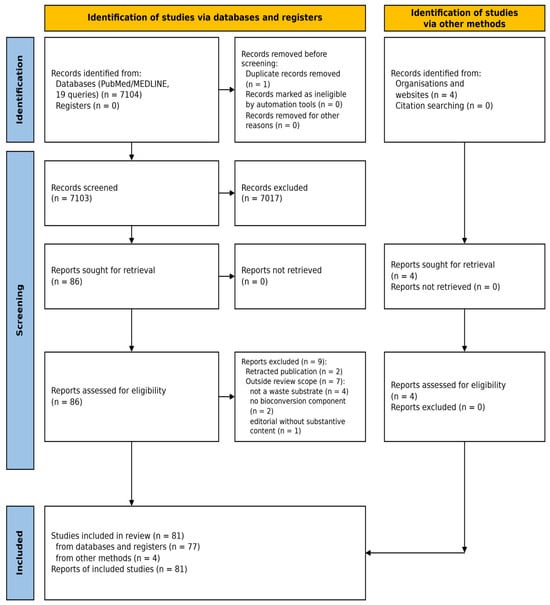
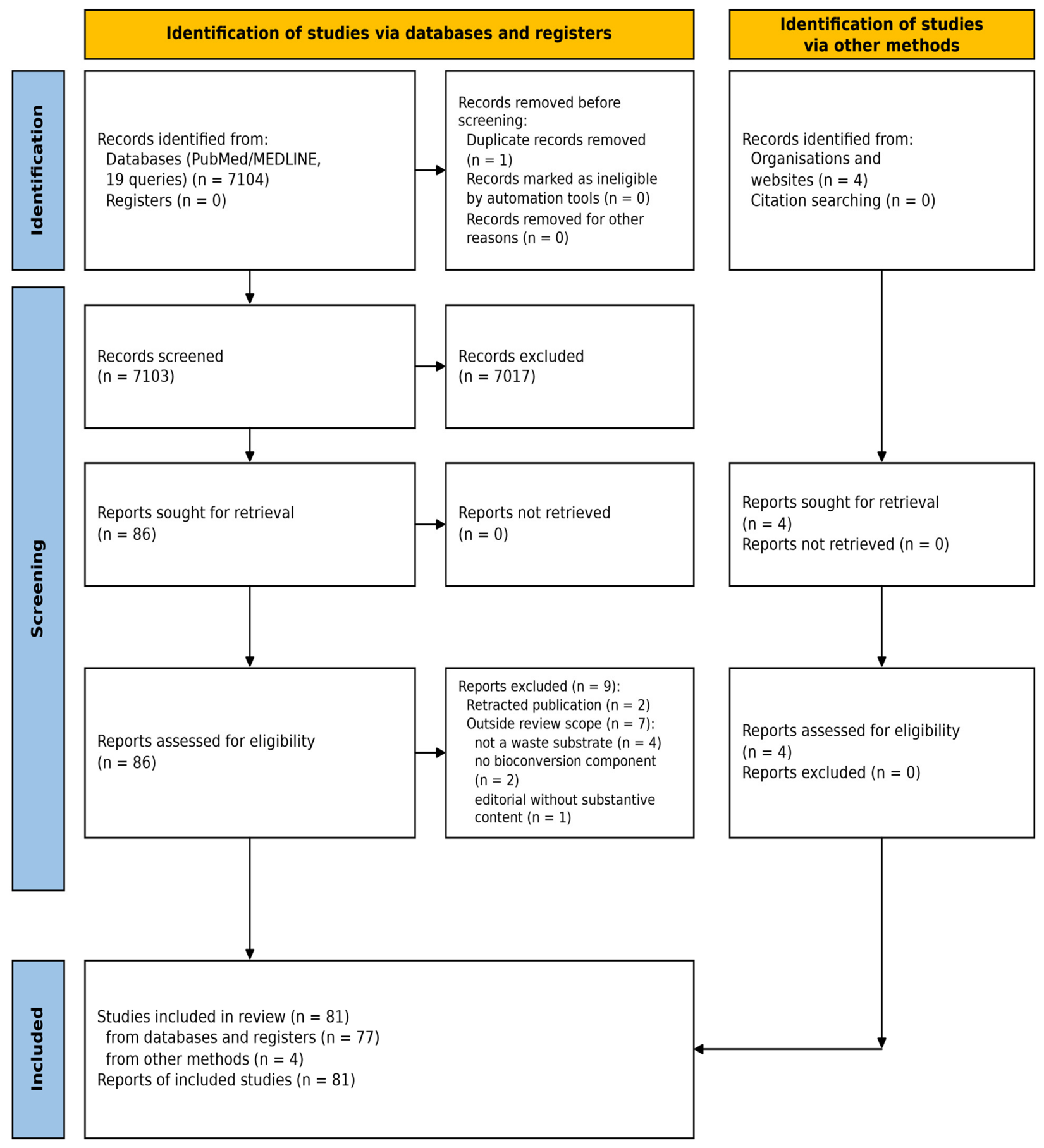
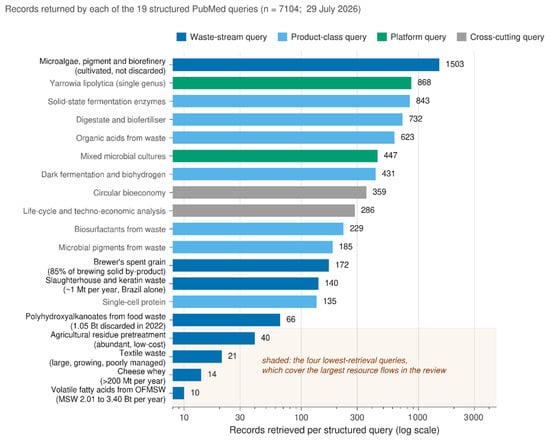
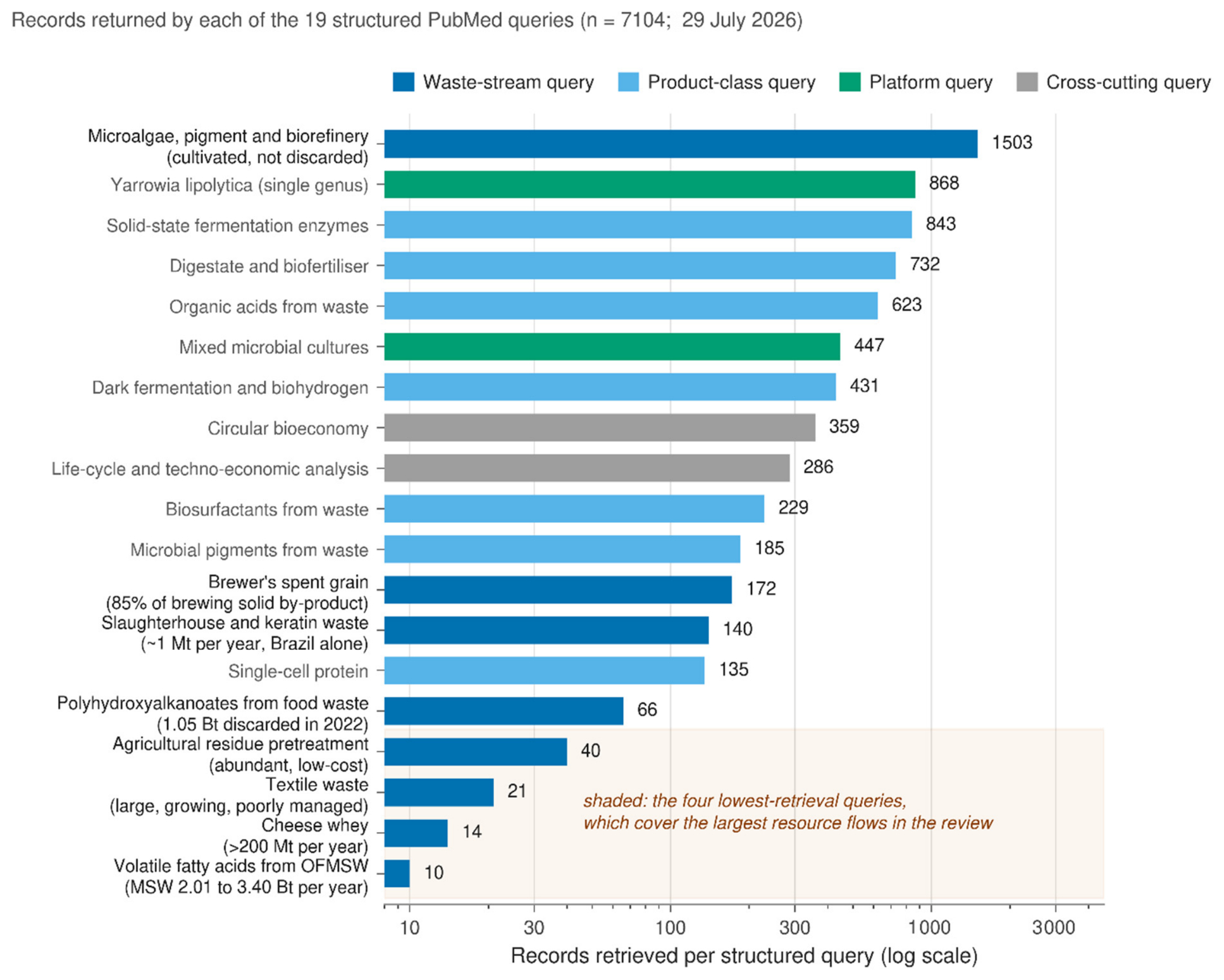
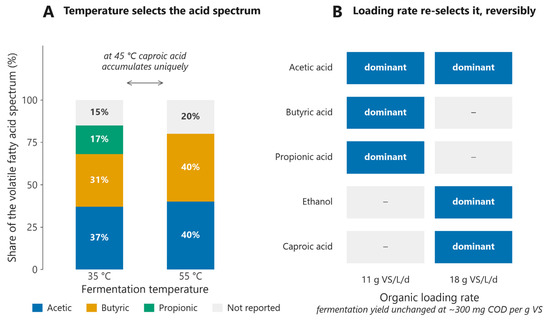
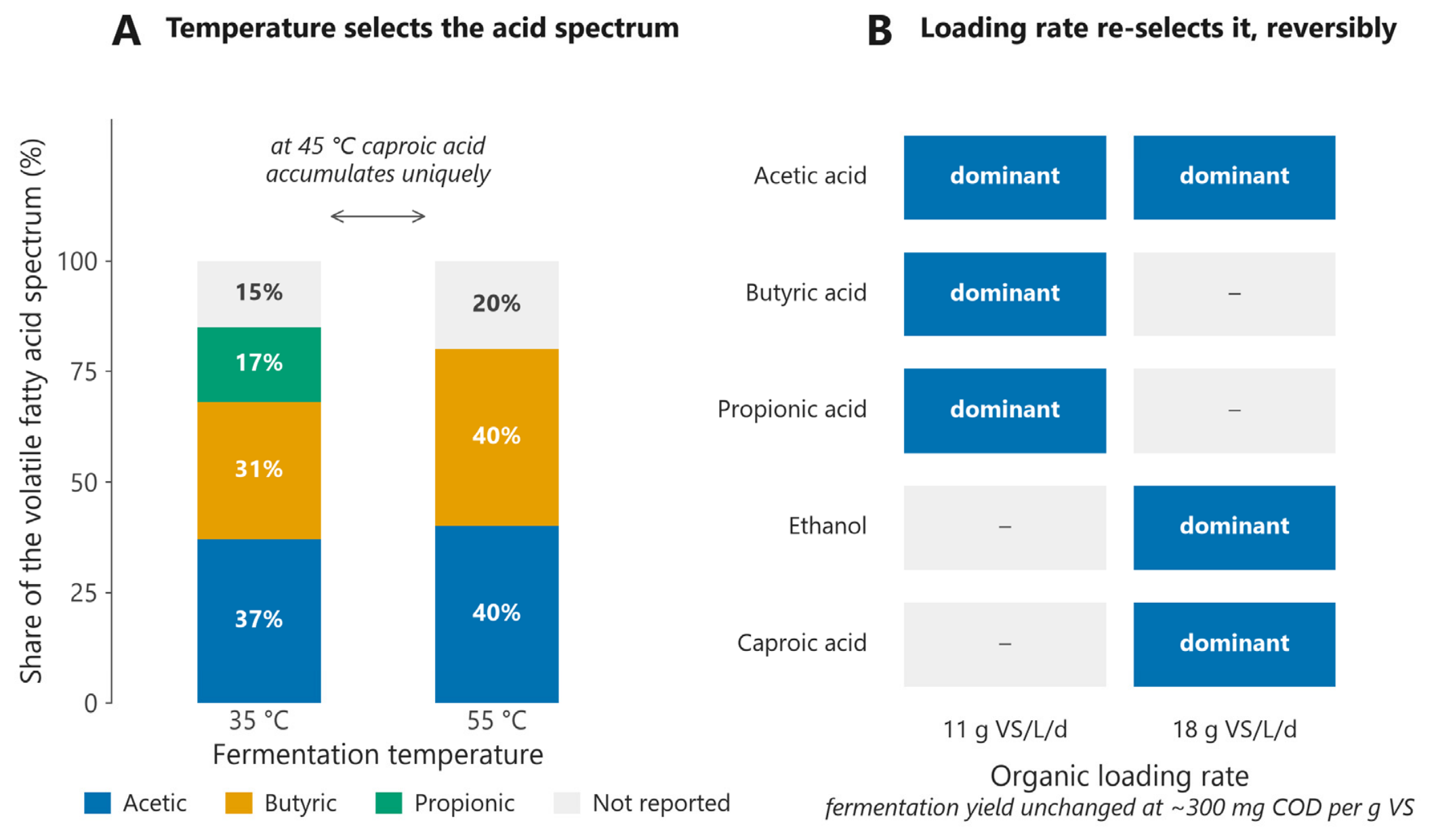
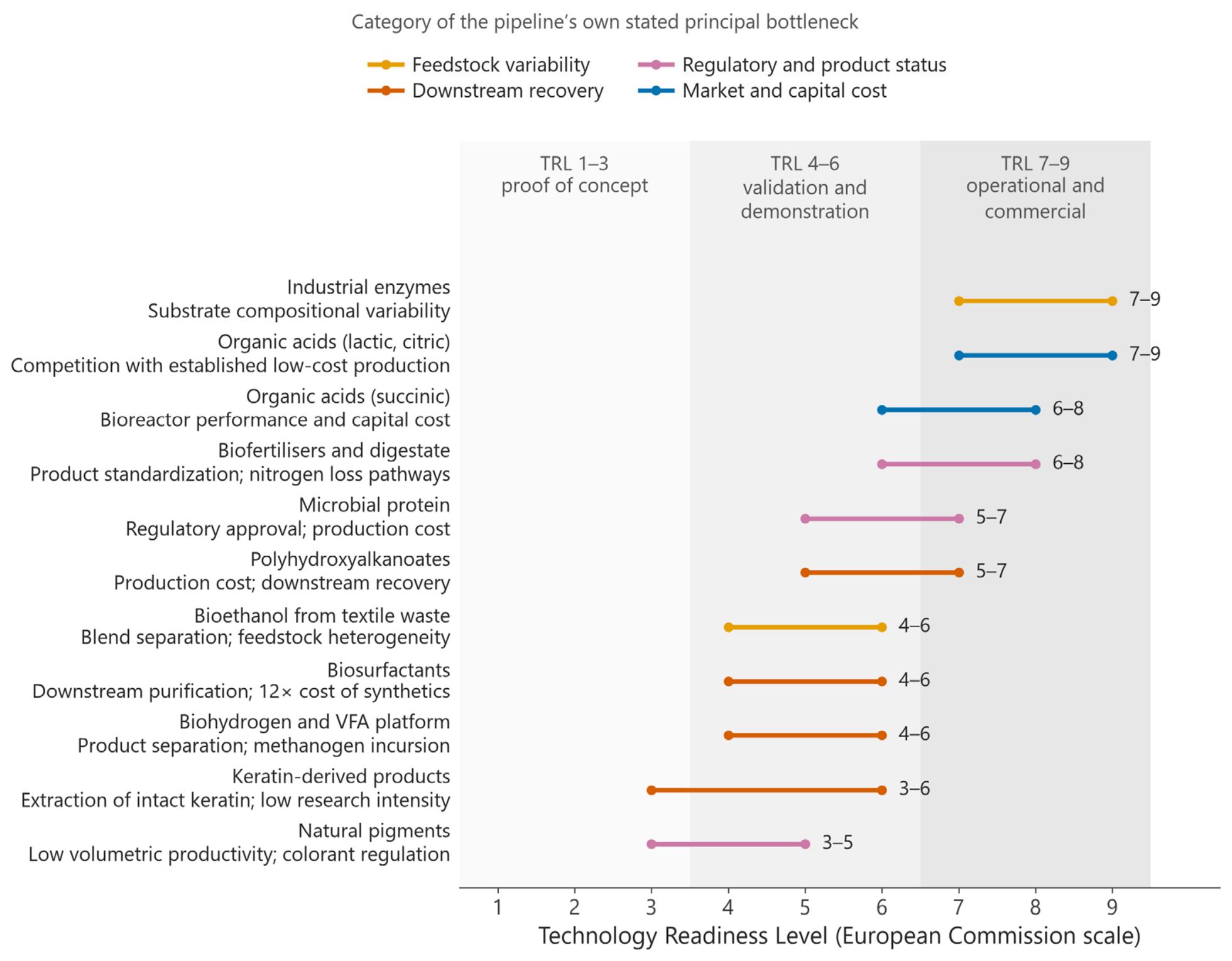
Disclaimer/Publisher’s Note: The statements, opinions and data contained in all publications are solely those of the individual author(s) and contributor(s) and not of MDPI and/or the editor(s). MDPI and/or the editor(s) disclaim responsibility for any injury to people or property resulting from any ideas, methods, instructions or products referred to in the content. |
© 2026 by the authors. Licensee MDPI, Basel, Switzerland. This article is an open access article distributed under the terms and conditions of the Creative Commons Attribution (CC BY) license.