


Abstract
Although circular strategies in construction can substantially reduce environmental impacts (EI), their effectiveness depends on aligning technological capacities with socio-economic conditions, requiring a future-oriented assessment. This study quantifies the EI of steel-frame and autoclaved aerated concrete (AAC) structures under various circular end-of-life scenarios, including multiple future lifecycles in Poland. A prospective consequential life cycle assessment (LCA) was conducted, integrating Shared Socioeconomic Pathways (SSP) for sensitivity analysis. The inventory was based on literature, spatial analysis, and expert input. Two methodological challenges were identified: lack of material quality differentiation in LCA databases, limiting reuse modelling, and difficulties in defining robust functional units across multifunctional technologies. Results indicate substantial mitigation potential from AAC recycling, particularly in single-family housing. EI of concrete recycling depends on distances and substitution of energy-intensive materials. High-quality recovery is critical for steel (>70% recycling or reuse). SSP modelling revealed the ‘crediting paradox’, highlighting the need for clear methodological boundaries.
1. Introduction
The construction industry is one of the four sectors with the highest ecological overshoot, with building construction and demolition (C&D) accounting for nearly one-third of global material use and, together with operation, about 40% of GHG emissions [1]. Due to population growth, an increase in construction intensity is anticipated, and the evolving building requirements cannot be met with scarce raw materials, calling for sustainable solutions using secondary building materials [2]. As reported by the European Commission, the construction sector accounts for 50% of all extracted materials, while greater material efficiency and a move to a circular economy could save 80% of linked GHG emissions [3]. Although the circular economy is gaining mainstream attention, global circularity continues to decline, calling for system-thinking [1]. In the construction sector, circular strategies (CSs) can mitigate environmental impact (EI) by reducing material consumption through better data-driven design, maximizing the reuse of buildings and building materials, and the application of recycled materials wherever feasible [4].
Recognized up-front strategy design for disassembly (DfD) supports the reuse of building materials at their end of life (EoL) by particular solutions incorporated at the design stage [5]. Key DfD recommendations consider durability of materials, reversibility of connections, and thorough documentation of materials used [6,7]. Although reversible construction technologies facilitating circularity exist (e.g., steel-frame structures), their application is mostly limited to industrial buildings, whereas residential buildings predominantly apply ‘traditional’ construction strategies, such as lightweight concrete blocks, and less often timber frame or prefabricated expanded clay-concrete technology [8]. Other strategies supporting circularity include the use of low-impact materials, as well as modularity, prefabrication, standardization, durability, and application of secondary building materials [5]. These strategies are interconnected, with some facilitating the implementation of others; for instance, components designed for disassembly are often prefabricated and modular. Combining multiple CSs can amplify environmental benefits [9,10], but their growing complexity and strong context dependence [11] make reliable comparison of construction approaches challenging.
Life cycle assessment (LCA) quantifies EIs across the life cycle of a product or service- from material extraction, production, use, maintenance, and the EoL phase. The evolution of LCA [11] broadened its scope to include multiple environmental, social, and economic dimensions, as well as forward-looking approaches such as prospective LCA (PLCA) [12]. This comprehensive perspective allows the evaluation of business models and construction strategies across multiple life cycles [13], making it particularly suited for assessing CS. However, LCA studies comparing various CSs in the construction industry show large inconsistencies, making cross-study comparisons difficult. This is due to several factors. First, the complexity of LCA allows for varying methodological choices at each stage, including the modelling approach (attributional vs. consequential), database, impact categories, and system boundaries [11]. Second, while incorporating CSs such as reuse or recycling strongly affects the final environmental score [14], no standard exists for defining the number, duration, or type of future cycles. Third, EI depends on context-specific conditions—for instance, demountable connections provide advantages only if reuse is guaranteed, e.g., through take-back schemes [15]. Consequently, the results are highly sensitive not only to the temporal and socio-economic context, underscoring the need for clear definitions of both processes and time frames, but also to the adopted sequence of arbitrary methodological choices. Only a coherent set of LCA methodological choices enables reliable result comparison between varied construction technologies.
Scope of the study:
This study uses pre-defined LCA of multiple future life cycles used for timber [16], to analyze steel-frame (SF) and autoclaved aerated concrete (AAC) structures, analyzed over a 250-year timespan and combined with various future scenarios. These scenarios encompass diverse CS and life cycle iterations, compared against a business-as-usual (BAU) approach, within a selected context aligned with Shared Socioeconomic Pathways (SSPs) [17]. The LCA based on current datasets is compared to the PLCA, which is recommended for the evaluation of building elements, due to their extensive time horizon, as highlighted by Bruhn et al. [18] and Passarelli [19]. Using the prospective SSP LCA methodology in sensitivity analysis enables a comprehensive evaluation of the current and future environmental, social and economic impacts associated with different strategies. The SF structure was selected due to the relatively consistent environmental performance of prefabrication technologies, which are less influenced by context-specific conditions [11]. Conversely, AAC represents a prevailing technology in the Polish construction sector, serving as a typical BAU example [8].
2. Methods
2.1. LCA: Goal and Scope
The aim of this research is threefold: first, to identify which EoL strategy is most environmentally beneficial for SF, and AAC reinforced by concrete frame; second, to compare the two technologies under analogous future scenarios; third, to evaluate the adopted LCA of multiple life cycles. The functional unit is defined as “a structural element 2.50 m high as a part of a wall with a load-bearing capacity of at least 20 kN/m per meter exterior wall for 250 years, applied in a small-scale, double-storey residential building in Poland”. This definition allows for a comparison of different technologies based on their load-bearing function. However, AAC inherently provides secondary services, as it also serves as a base for wall finishes. To ensure comparability, OSB sheathing was added to the SF structure, although it plays no structural or load-bearing role. Since these elements are embedded within the wall and protected from external conditions, maintenance, repairs, and refurbishment are excluded. As its technical lifespan (TL) exceeds that of the building, replacement is not considered in the assessment, leading to the exclusion of stage B under EN 15804. Recycling and reuse are accounted for through boundary extensions, following a consequential LCA approach (as outlined in Section 2.2, “LCA Methods”).
2.2. LCA: Methods
The adopted LCA methodology [16], aligns as closely as possible with ISO 14040 [20] and the International Reference Life Cycle Data System Handbook [21]. Given the relevance of the results to researchers, designers and policymakers alike, a consequential LCA was adopted [22]. The ReCiPe 2016 Midpoint (H) impact assessment method was used to quantify EIs, ensure the clarity of the results, and prevent burden-shifting, while the Hierarchical (H) perspective was selected as it is recognized as suitable for scientific modelling [23]. To facilitate the comparison of results, the ReCiPe normalization factors, which standardize all category indicators into the average annual per capita emissions (unit: person equivalents), are applied.
Additionally, a sensitivity analysis is conducted for each technology, incorporating the development of scenarios and their evaluation through both static and PLCA. Various reuse and recycling scenarios linked to relevant SSP variants capture the dynamics of foreground and background systems. The foreground dynamics involves tailoring recycling processes with specific timespans, while the background dynamics are addressed by aligning each scenario with appropriate SSP. PLCA, which assesses a single point in the future, was selected as the most appropriate method, with points defined separately for each scenario (refer to Section 2.3.1). Processes occurring after 2100 exceed the SSP dataset and are assumed constant thereafter, following the LCAbyg methodology [18].
The prospective versions of the Ecoinvent 3.9 database were developed with the premise v1.8.0 software, which integrates Ecoinvent inventories with data from integrated assessment models (IAMs), specifically REMIND [24,25]. For more information on IAMs, SSPs and RCPs, refer to the description in [16].
2.3. LCA Inventory
The Ecoinvent Consequential 3.9.1 database was used for the background processes. The foreground data for processes is based on literature sources listed separately for each scenario. Context-specific aspects, such as transport distances, energy/material sources and efficiency yields, were adapted to the Polish location based on inputs from experts, manufacturers and spatial distribution of industrial facilities. Additionally, transport distances were cross-verified using AI-assisted spatial queries for comparison. A precise description of the inventory can be found in Supplementary Files S1 and S2, alongside the underpinning structural calculations in Supplementary File S3.
2.3.1. Scenario Development
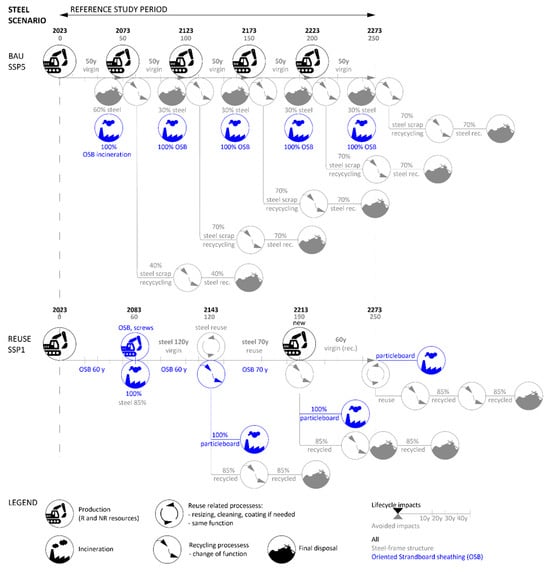
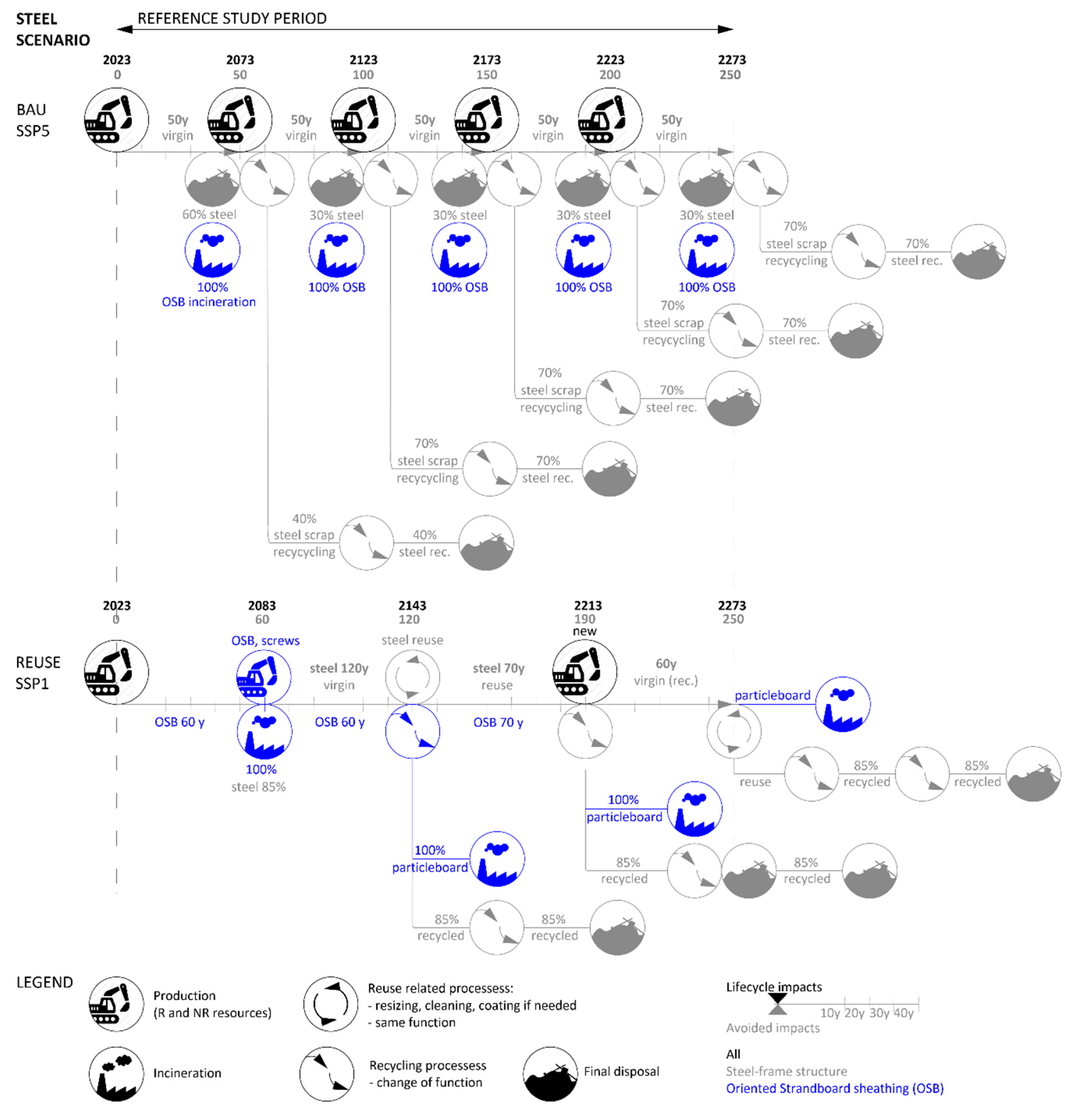
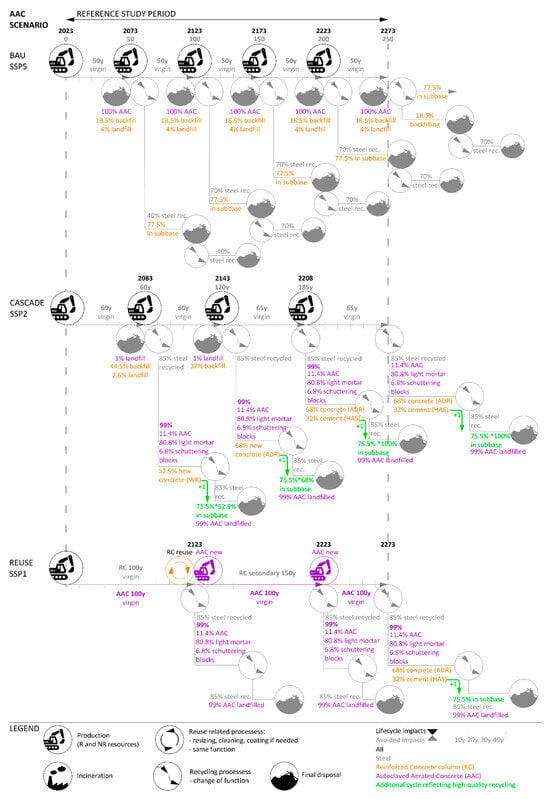
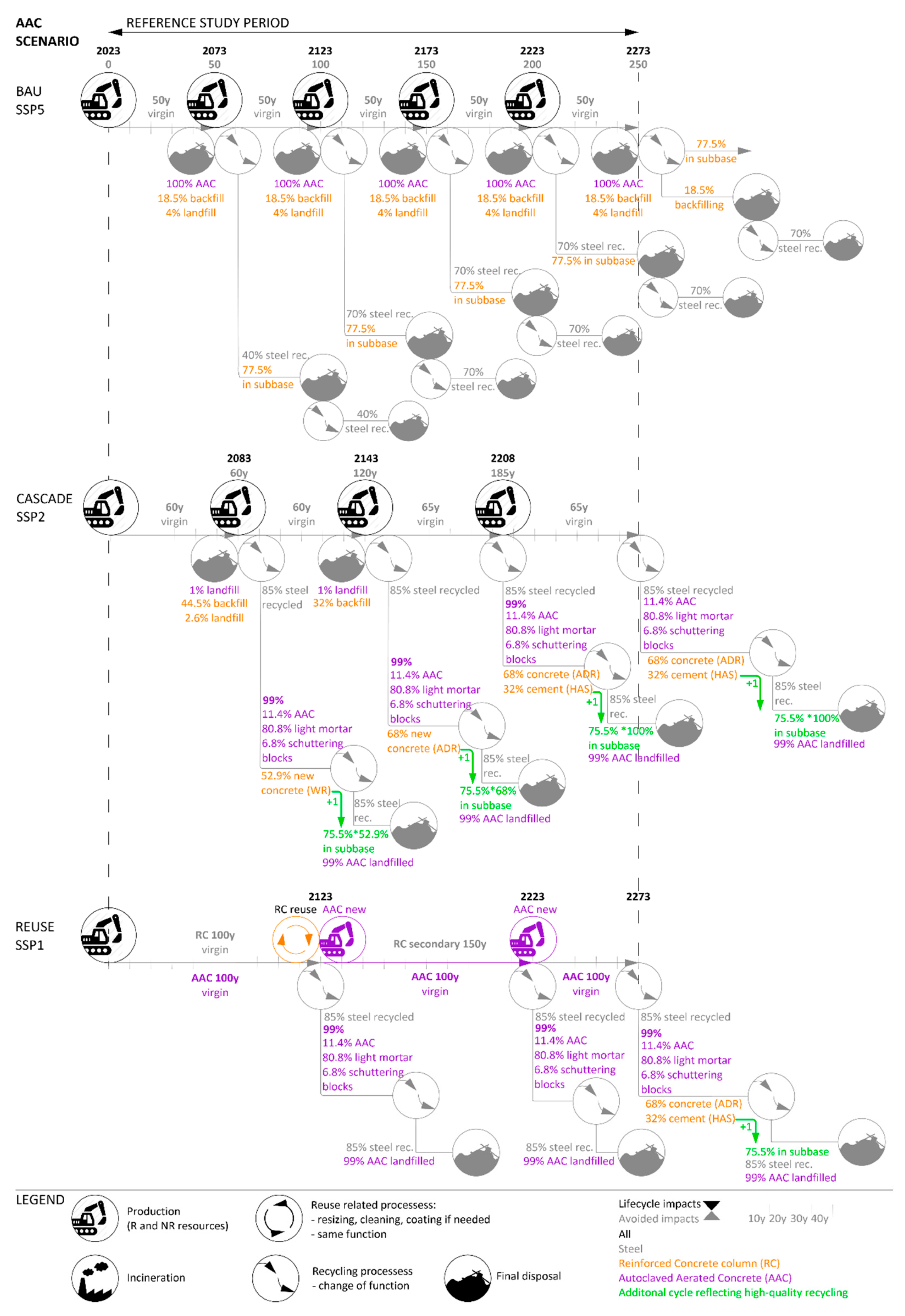
Scenarios aligned with the lifespan of elements are presented in Figure 1 and Figure 2, while the detailed process flow diagrams for each scenario are available in the Supplementary File S1 (Figures S1–S5). Future scenarios developed for timber were adapted, following the PESTEL approach [26] and the stepwise scenario-based inventory modelling for PLCA proposed by Langkau [27]. They represent (1) an optimistic pathway SSP1 (REUSE), (2) a balanced sustainable pathway SSP2 (CASCADING) and (3) the worst-case resource-intensive pathway SSP5 (BAU). A detailed breakdown of the scenarios for each technology is presented below.
Figure 1.
Scenarios for steel-frame, depicting varied end-of-life variants aligned with expected lifespans. Two subsequent steel-recycling cycles are anticipated to reflect the ‘multiplicity’ of recycling processes.
Figure 2.
End-of-life scenarios for autoclaved aerated concrete wall reinforced with concrete frame. After the initial application, the elements are either landfilled, used as backfill, or recycled. The benefits of advanced concrete recycling are modeled by adding one extra life cycle (marked in green), reflecting the material’s recovery potential (e.g., in new concrete elements).
2.3.2. Steel BAU (SSP5)
Economic Background
For this scenario linked with fossil-fueled development (SSP5), a 50-year service life (SL) is assumed throughout the entire 250-year time horizon, in accordance with current DGNB guidelines [28]. In the Polish context, 40% of steel is salvaged for recycling, as defined by Ferek [29] and reported by Poland in 2010 [30]. According to the International Energy Agency (IEA) [31], although global steel-recycling rates across all sectors reach approximately 85%, reinforcing steel falls on the lower end, with recycling rates of only 50–60% worldwide. New construction waste management regulations in Poland (2025) require precise segregation of construction site waste. This is vital for steel, as achieving the 70% recycling target set by the Waste Framework Directive (WFD) 2008/98/EC is complicated by mixed waste streams and the resulting poor quality of secondary material.
Scenario Assumptions
Considering both current recycling rates and the targets set by the WFD, we assume that 40% of steel will be recycled at EoL in the first cycle, with a higher rate of 70% assumed for steel recycling from the second cycle onwards. The remaining demolition steel is expected to undergo final disposal based on the data from the Ecoinvent Database for Europe. Although steel is theoretically infinitely recyclable, this study considers a maximum of two consecutive recycling cycles for construction steel (limited due to performance constraints and contamination), each assumed to have the same efficiency.
2.3.3. Steel CASCADE (SSP2)
Single-family housing is characterized by low cubic volume, resulting in a limited length of structural elements. In the case of welded steel structures not designed for disassembly, the elements must be cut, which is a time- and energy-consuming process. As a result, the retrieved elements are predominantly too short to enable further structural applications (based on expert discussions). Consequently, alternative cascading pathways, such as extending the SL of products through repurposing, are deemed unlikely and are not explicitly considered in this study. Instead, the REUSE scenario incorporates increased steel-recycling rates.
2.3.4. Steel REUSE (SSP1)
Economic Background
In SSP1, increased material efficiency and structural innovations (e.g., reversible joints) are assumed to prolong product life and enable the reuse of high-strength, lightweight steel [32]. The first lifecycle is defined with an extended SL of 120 years [33]. The TL of OSB, the main sheathing material, ranges from 60 years (SBI:2013) to 75 years when used as a structural element such as frame sheathing [34]. To align the lifespan of the OSB with that of the steel structure, the first two cycles are set to two consecutive OSB technical lifespans of 60 years each. This results in a total SL of 120 years, after which the steel enters the reuse pathway. A second SL of 70 years is then anticipated for both OSB and steel, enabling the steel to be utilized for a total of 190 years and approaching its maximum TL of 200 years (SBI:2013). In 2213, a new structure is introduced, lasting 60 years to complete the 250-year time horizon. After this period, a second reuse of steel, owing to its remaining TL, and subsequent recycling processes are assumed.
Material reuse involves element sourcing, a demanding process of selective deconstruction, reconditioning and transport [35]. Melella et al. [36] documented the full process of structural steel reuse in Italy, which includes: disassembly on-site (removal of connections, ground transportation and loading/lifting), transport to the transformation centre (storage, cutting, cleaning), transport to galvanizing/sandblasting plants for corrosion protection, and final return to the transformation centre for storage, packaging and future use. Similarly, Kanyilmaz et al. highlight that the upfront carbon impact of reuse results from the use of heavy equipment, transport, and the energy needed to process and deliver dismantled materials to a new construction site [35].
Based on expert input, if the building’s history is known (e.g., fire exposure, accidental actions), simplified on-site tests such as bending analysis can replace full steel qualification, with samples sent to a mill only if needed. No cutting or drilling is required, as the column is used at full length. The next step involves transportation to a sandblasting facility, followed by galvanization. In Poland, these two processes are typically carried out at separate locations. The sandblasting process for the steel surface is modeled based on input data for wet blasting described by Peng [37], identified as the most comparable process available in the literature.
After reuse, steel is expected to be recycled, with scrap processed in electric arc furnaces (EAF) using much less energy than primary production (1.3–6.0 GJ/t vs. 15–24 GJ/t) [38]. When powered by renewable energy, EAF can produce nearly zero-emission steel [39]; however, transitioning from blast furnace and basic oxygen furnace technologies requires a stable supply of post-consumer scrap [32]. While the implementation of zero-carbon steel policies promotes secondary production and increases global demand for steel scrap [38], its availability and quality remain limited.
Currently, according to the IEA, 70% of steel is produced from primary resources, while only 30% comes from recycled steel scrap [31]. A literature review revealed significant discrepancies in the reported share of secondary steel production in Europe, with estimates ranging from 44% to nearly 100%. Wörtler et al. [40] demonstrated that by 2050, the limited availability of post-consumer scrap will allow a maximum of 44% of steel demand to be met via the EAF recycling route, aligning with data from the IEA [31]. Dworak et al. [41] estimate a 55% share of secondary steel production in Europe under current practices, consistent with the 57% reported by the European Steel Technology Platform [42]. However, Dworak also argues that the scrap potential could exceed 75% by 2050 provided that alloy sorting is improved. Watari et al. [39] suggest that by 2050, EoL scrap generated in the European Union could fully meet its steel demand; however, this study does not account for quality variations. Dworak [41] predicts a decline in secondary scrap quality, as the construction sector—expected to hold up to 80% of in-use steel stock by 2050—will be its primary source. Policies promoting alloy sorting are thus crucial to maximize post-consumer scrap use and prevent an oversupply of low-quality material. Even with such measures in place, scrap contamination is projected to cap the share of secondary steel at a maximum of 77% [41], or 85% [43].
Scenario Assumptions
In the REUSE scenario, a bolted structure is assumed to allow selective disassembly. By 2083 (the first EoL stage), supportive policies and improved technologies are expected to achieve an 85% recycling rate, consistent with current global recycling levels [31] and the predictions of Xylia et al. [43]. The remaining 15% is assumed landfilled, in line with Coelho et al. [44].
Based on literature review and expert input, fasteners and plates are assumed recycled at EoL, while dismantled structural elements are sent to an inspection facility, reflecting standard on-site practice, where screw and plate inspection is too time-consuming. In our case, retrieved steel elements constitute 82.9% of the structure, lower than literature-reported reuse ratios of up to 90% for steel structures with reversible connections [36,45]. This is due to the small building volume and short column, which increase the share of plates and screws relative to total steel mass. In the dismantling stage, the removal of connections is disregarded due to its minor impacts, whereas ground transportation and lifting of elements are modeled based on the Melella dataset [36]. After transportation, inspection, and sandblasting, steel is considered comparable to a newly manufactured product and therefore suitable for reuse. Following its SL extension through reuse, the structural elements are directed to recycling processes.
2.3.5. AAC BAU (SSP5)
Economic Background
Throughout the entire 250-year period, a 50-year SL is assumed, analogous to the steel BAU scenario.
Since the analyzed wall system comprises reinforced concrete (RC) structural cores infilled with AAC blocks, distinct EoL assumptions are applied to each material fraction. According to the Polish Central Statistical Office (2016), about 77.5% of non-hazardous mineral C&D wastes was recycled, 18.5% used for backfilling, and 4% landfilled [46]. Hazardous waste (0.08%) is excluded from consideration. Since more recent data [47] are less specific, the assumptions for RC recycling are based on the 2016 figures. The vast majority of mineral waste recycling follows a low-grade route, ending up in road bases [48] or building subbases (expert input). Volk et al. [49] state that post-demolition (pd) AAC is currently mainly disposed of in landfills or used in low-grade applications such as backfilling. This aligns with the EPD [50], which assumes that all AAC blocks will be landfilling at the EoL stage.
Scenario Assumptions
Since the BAU scenario is linked with SSP-5, no significant changes in recycling rates are envisaged, except for steel elements (concrete reinforcement and OSB screws), whose recycling follows the assumptions made for the steel structure, i.e., a 40% rate in 2073 and 70% in 2123 and onwards. Both RC and AAC are modeled with constant recycling/landfill rates throughout all future cycles. The RC is modeled as recycled into subbases at 77.5%, 18.5% is assumed to be directed to backfilling, and 4% is considered landfilled, while the entire pd-AAC is assumed to be landfilled.
2.3.6. AAC CASCADE (SSP2)
Economic Background
In this middle-pathway scenario, an average building SL of 63 years [33] is assumed, which corresponds to the average lifetime of steel in the building sector (65 years) [41]. This value is subsequently rounded to 60 years for the first two cycles and 65 years for the last two cycles (as depicted in Figure 2).
According to Zhang et al. [48], in the wet recovery process, washed gravel (4–22 mm) suitable for concrete manufacturing accounts for only 52.9% of the total pd-concrete rubble, while the remainder consists of 42.5% sieved sand that is unsuitable for high-grade applications, and 2.6% landfilled sludge. In the advanced dry recovery (ADR) process—which can be performed at the construction site—concrete is crushed into a 12–22 mm fraction (20%) for new concrete, while the remaining 80% is further broken and classified into 4–12 mm high-grade aggregates (48%) and 32% polluted sand for landfill or earthwork. Furthermore, the heating-air classification system (HAS), validated at TRL 6–7, enables the high-grade application of fine fractions, including polluted sand [51]. As a result, dehydrated and purified fine and ultrafine fractions can be used in cement-based products, replacing up to 5% of ordinary cement (CEMII).
Regarding the AAC component, specific material properties determine its recycling potential. Pd-AAC aggregates contain 25% granules (>2 mm) and 75% fines [52]. Impurities constitute only low one-digit mass percentage of pd-AAC [49], thus we assume that 99% V can be recycled. According to Gyurkó [53], 100% of natural aggregates in the production of lightweight concrete (LWC) or shuttering elements (no-fines concrete) could be replaced with recycled pd-ACC aggregates. The share of pd-AAC constitutes 60–81% of input share of a new LWC (according to Gyurkó and Volk respectively), and 20–36% of new shuttering blocks (Gyurkó and Volk, respectively). Fines can be processed into pd autoclaved aerated powder (pd-AAP) and used, e.g., as cement substitution. Stemmermann et al. [52], demonstrated that up to 25% of Portland cement can be replaced with recycled belite cement clinker derived from pd-AAC in AAC production. However, this closed-loop recycling option is energy-intensive, and the probability of setting up the needed facility is low, due to its high costs [54]. Volk et al. [55] conducted an LCA analysis, identifying the most environmentally beneficial use of pd-AAC as its closed-loop recycling into new AAC production, where pd-AAP substitutes sand, quicklime, cement, and anhydrite. This was followed by the application of pd-AAC in shuttering blocks, light mortar, and LWC. Additionally, Volk analyzed Germany’s pd-AAC availability in 2022 and adjusted recycling options based on projected utilization in construction materials, estimating that 11.5% could be used in AAC, 6.9% in shuttering blocks, and 40.8% in both LWAC (as gravel) and light mortar (as powder). In Poland, the construction sector’s production report [56] categorizes only concrete and mortars. In 2022, 4.799 million tons of ‘mortar and plaster’ were produced, significantly surpassing the 2.70 million tons produced in Germany. Specific data on concrete products, such as AAC or shuttering blocks, were not identified.
Scenario Assumptions
For the CASCADE scenario, wet recovery of RC with a 52.9% recycling rate is assumed at the EoL of the first cycle. This established treatment [57] improves recycling quality and aligns with European Commission recommendations [58]. For future lifecycles, the ADR process is expected to enable a 68% high-value recycling rate. Finally, at the EoL of the third lifecycle (2208, fine and ultrafine fractions are anticipated to be utilized via HAS, enabling 99% concrete recycling. Since the Ecoinvent database does not differentiate between high-quality recycled gravel and unsorted crushed concrete, the benefits of advanced recycling are modeled by adding one extra life cycle. In this approach, pd-concrete is credited twice with avoided sand and gravel quarrying, reflecting its potential for high-grade recycling (e.g., in new concrete), even though new concrete production is not explicitly modeled (marked as green on Figure 2). After the second theoretical life cycle, the material follows the BAU recycling route (low-grade applications) providing a final credit for avoided quarrying operations. For pd-AAC, high-quality recycling proportions are adopted from Volk’s study: 11.5% into AAC and 6.9% into shuttering blocks. The remaining 81.6% is assigned to light mortar production—a share higher than Volk’s, reflecting the greater mortar and plaster production in Poland versus Germany. Following recycling, AAC content at the second EoL stage is assumed to be landfilled.
2.3.7. AAC REUSE (SSP1)
While the expected TL of concrete elements is 300 years, the TL of AAC is only 100 years [33]. The average anticipated SL of the building is 120 years. As the average anticipated SL of the building is 120 years, we assume the first building will last 100 years to align with the AAC’s TL. A new building will then be constructed in 2123, with an extended SL of 150 years. Thus, only one complete building reconstruction is required. During this process, the RC will be reused, while AAC blocks are replaced every 100 years. To enable future reuse of RC elements, a minimal intervention approach is adopted: installation of plastic pipes within precast concrete beams for embedding bolted connections, in accordance with Peikko White Paper [59]. At the EoL, nuts and the grout pad are anticipated to be removed, modeled in the LCA by demolition hammer energy use. Unlike steel, the RC condition is usually assessed on-site by visual inspection. However, due to typical reuse triggers (investor change/project scope), we assume transport of the columns to and from the storage facility, reflecting common practice. The direct reuse of complete AAC blocks is assumed infeasible due to extraordinary economic effort and time [53]. Although CE guidelines recommend using weaker mortars to facilitate separation, this is mostly unrealistic due to the strength demand the wall must deliver. Therefore, only the reuse of RC is foreseen. AAC follows an optimized recycling, analogous to the CASCADE scenario.
3. Results
To identify the most relevant impact categories, a threshold of 0.2 person/year equivalents (PEq) was applied, resulting in the selection of freshwater ecotoxicity potential (FETP), marine ecotoxicity potential (METP), terrestrial ecotoxicity potential (TETP), freshwater eutrophication potential (FEP), and human toxicity potential (carcinogenic HTPs and non-carcinogenic HTPnc), while global warming potential (GWP) was included due to its environmental significance (Table S3, Supplementary File S1).
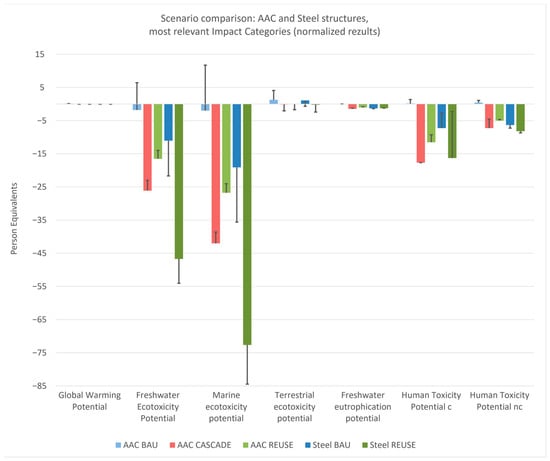
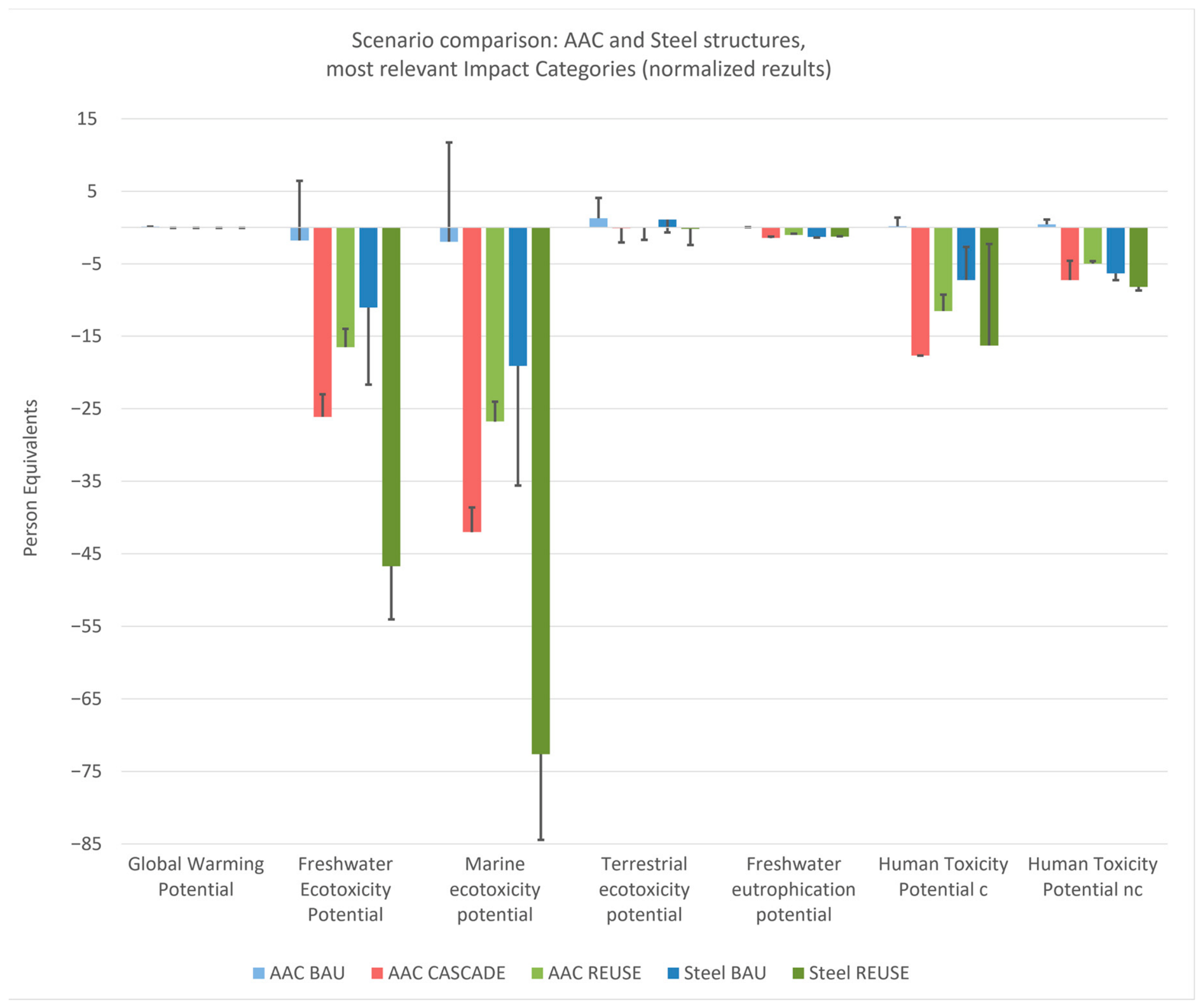
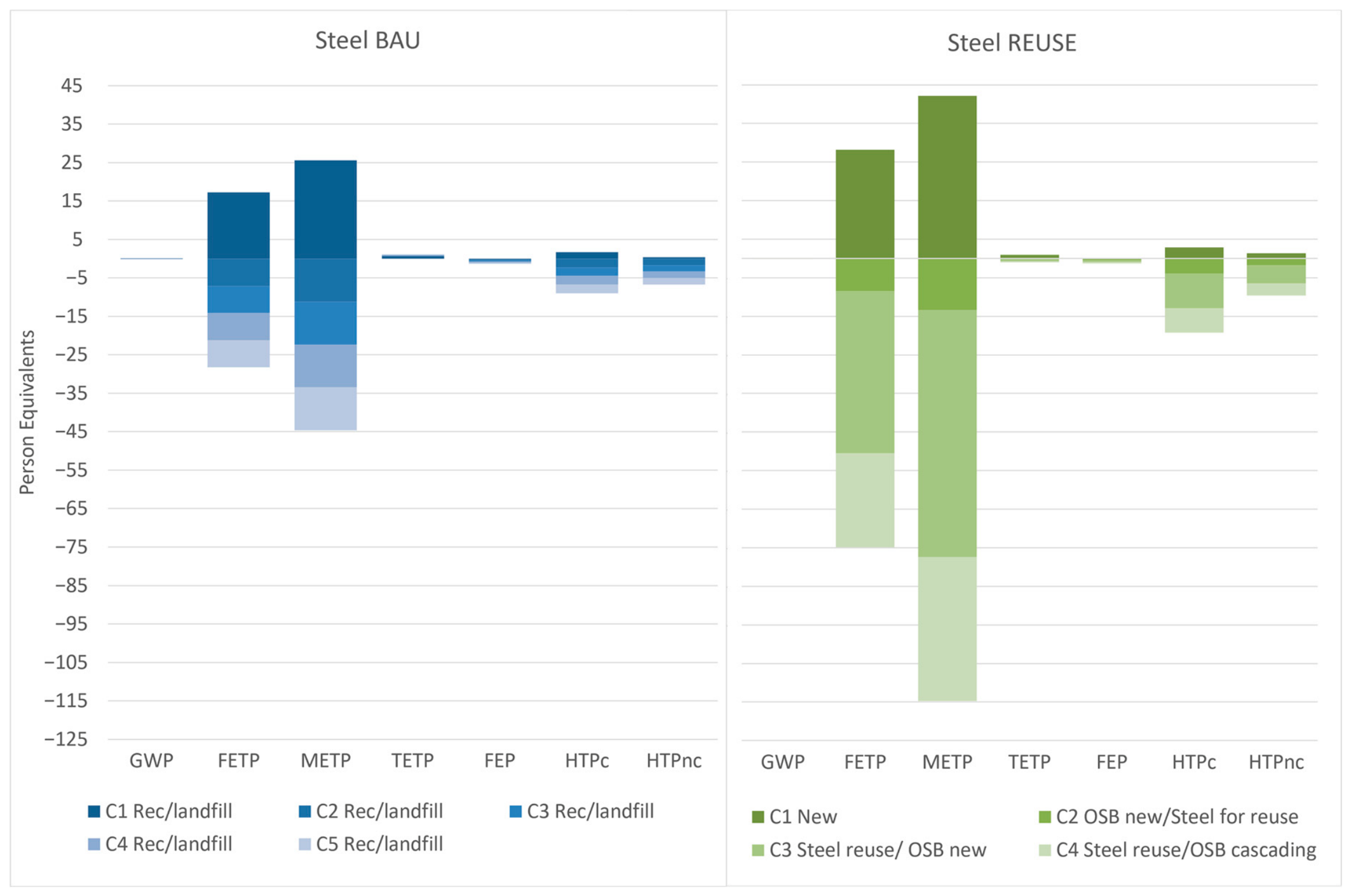
As shown in Figure 3, although the BAU scenario is the most environmentally burdensome for both structures, it shows mostly minimal impacts in the case of AAC and predominantly avoided impacts for steel. CASCADE is the most beneficial for AAC structure, while the REUSE scenario yields the highest impact savings for steel.
Figure 3.
Normalized results for the most relevant impact categories of each scenario, for both steel and AAC structures. The error bars represent the results for subvariants integrated with SSPs, i.e., BAU with SSP-5 base, CASCADE with SSP-2 base, and REUSE with SSP-1 base, respectively.
In the following sections, figures comparing all scenarios for the steel and AAC structures—including the breakdown of each life cycle—are presented, alongside separate diagrams detailing single processes for each scenario.
Steel structure
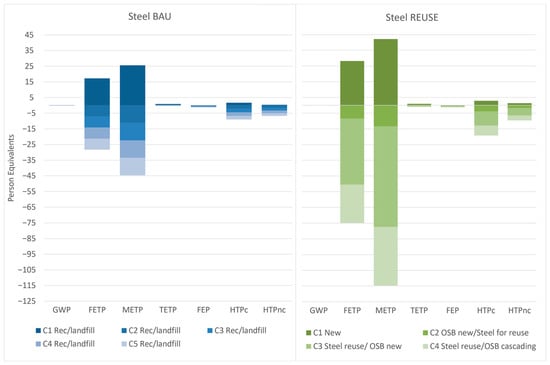
In the BAU scenario for steel, avoided impacts come solely from steel recycling. Since only a 40% recycling rate is assumed for the first cycle, these gains do not offset the negative input from the construction phase (Figure 4 and Figure 5). However, from the second cycle onwards, 70% of the steel is recycled and undergoes a second recycling process, enabling higher environmental gains than the burdens induced by the construction.
Figure 4.
Results for predefined impact categories of the steel-frame scenarios, showing the total results over 250 years, with multiple life-cycles indicated by gradations in color intensity.
The environmental benefits of steel reuse are only marginally higher than those achieved through recycling. The first cycle of the REUSE scenario exhibits the highest EI (Figure 6) because it is not offset by any subsequent processes, neither by recycling as in the BAU scenario, nor by the impact savings from reuse, since these benefits are attributed to the second cycle. The most beneficial is the third REUSE cycle, since the construction relies on reused steel, thus incorporating minimal initial impacts while simultaneously including two recycling processes at the EoL, which generate high impact savings ().
AAC structure
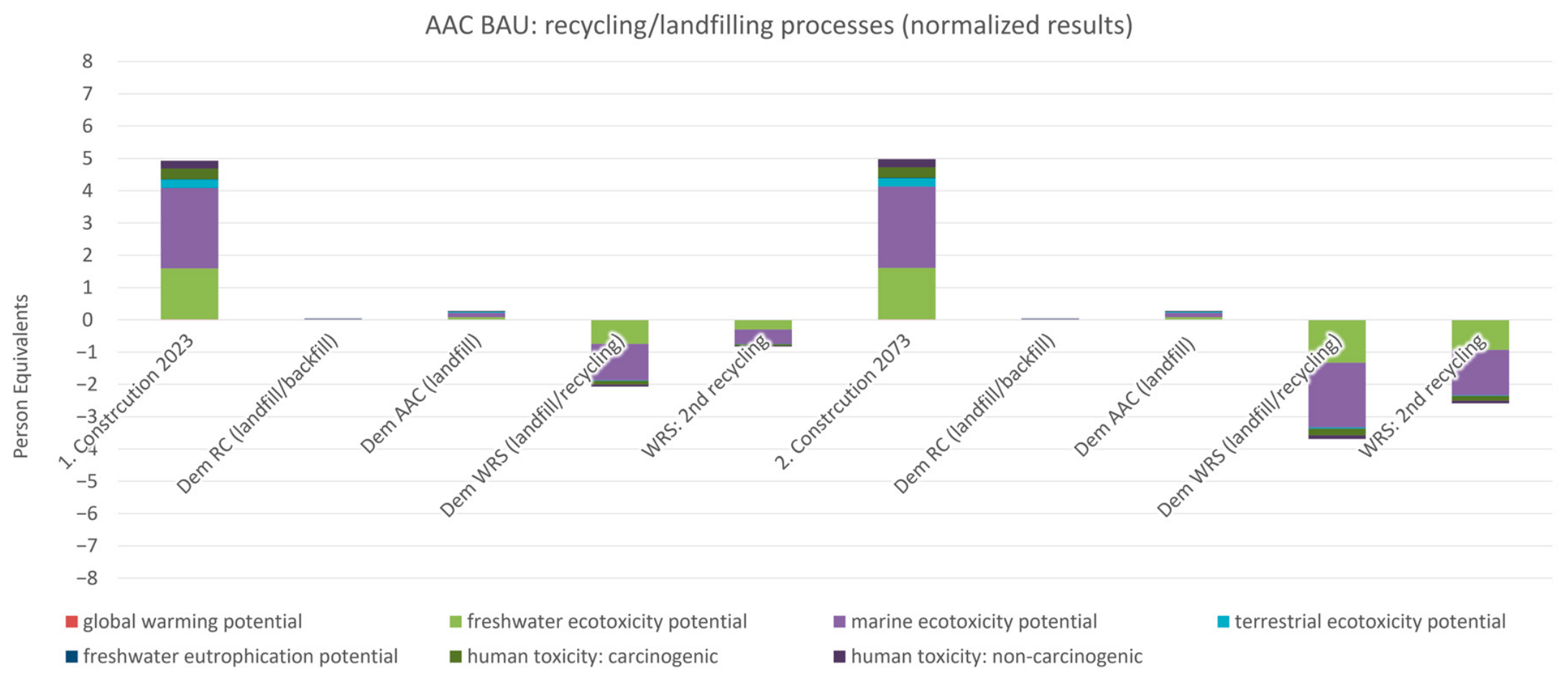
In the BAU scenario, concrete columns undergo low-grade recycling, while AAC wall infills are landfilled, both resulting in minimal environmental burdens (Figure 7 and Figure 8). The only source of impact reduction stems from reinforcing steel recycling, which increases in subsequent cycles, leading to limited impact savings for overall structure from the second life cycle onwards.
The CASCADE scenario represents the greatest benefits. The main difference between cycles lies in the optimization of the RC recycling, as steel and AAC recycling remains constant. As depicted in Figure 9, the optimization of RC recycling has a minimal influence on resulting impacts; gains come predominantly from AAC recycling.
Wet recycling of concrete, anticipated for the first cycle’s EoL, shows a higher EI than the BAU recycling process. This stems from the longer transport distances of pd-concrete, accounting for 70 km in CASCADE (construction site to a recycling centre), compared to 30.5 km in BAU (construction site to a sorting facility). The application of AD-recycling supplemented with HAS is the most environmentally beneficial approach, owing to the partial substitution of cement, even though recycled ultrafine particles used for cement production constitute only 6.4% of the pd-concrete (Figure S7, Supplementary File S1). AAC recycling shows great potential for minimizing environmental burdens. Due to the substantially lower density (350–550 kg/m3), compared to app. 2420 kg/m3 for structural concrete, the negative impacts from transportation are marginal. Concurrently, gains from assumed substitutions, predominantly clay substitution, are substantial (Supplementary File S1, Figures S8–S10).
Figure 5.
Results for predefined impact categories of the steel-frame BAU scenario, depicting the most relevant processes within the first and second life cycles; cycles 3–5 are identical to cycle 2.
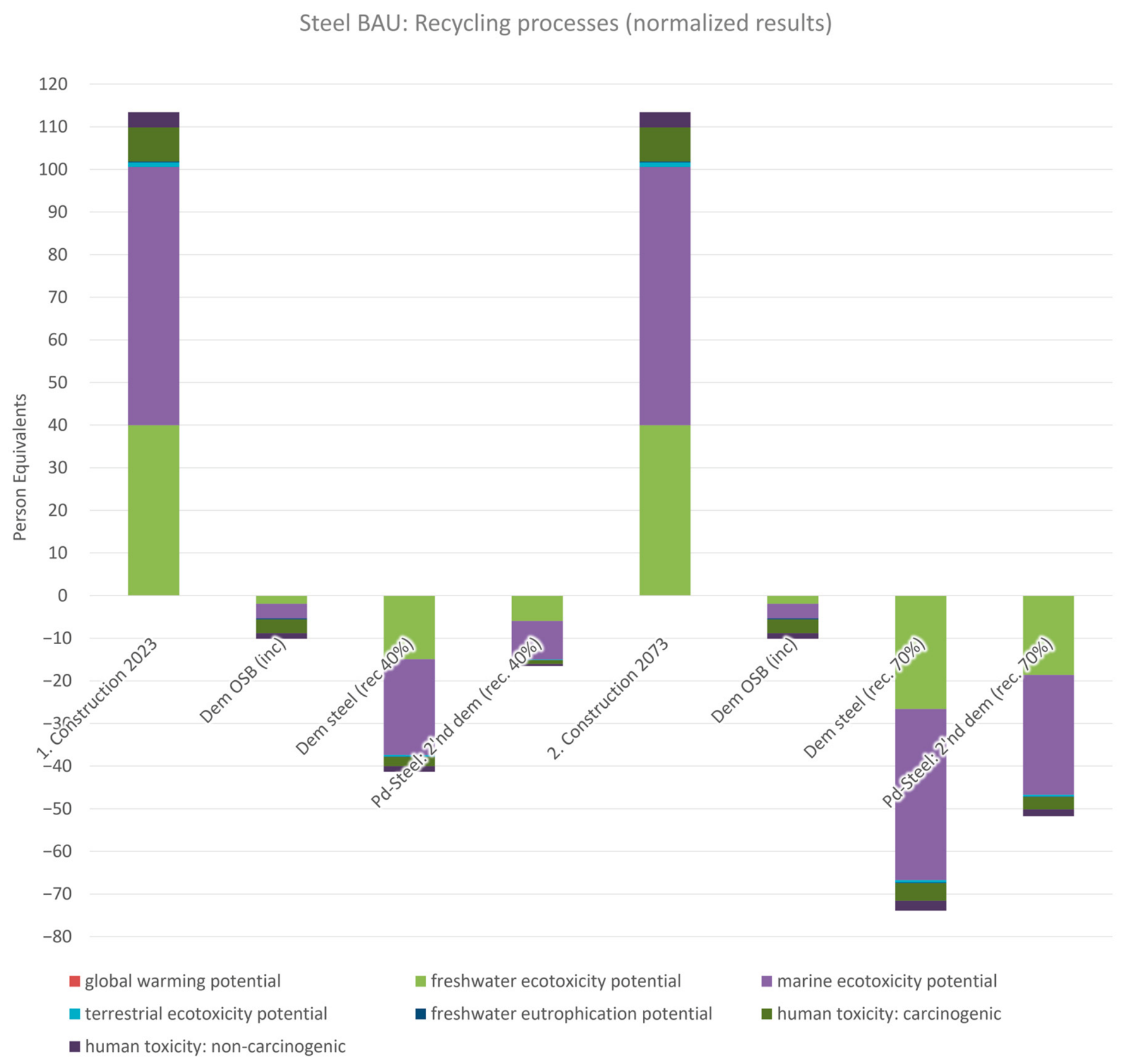
Figure 6.
Results for the predefined impact categories of the steel-frame REUSE scenario, depicting the most relevant processes across all four cycles.
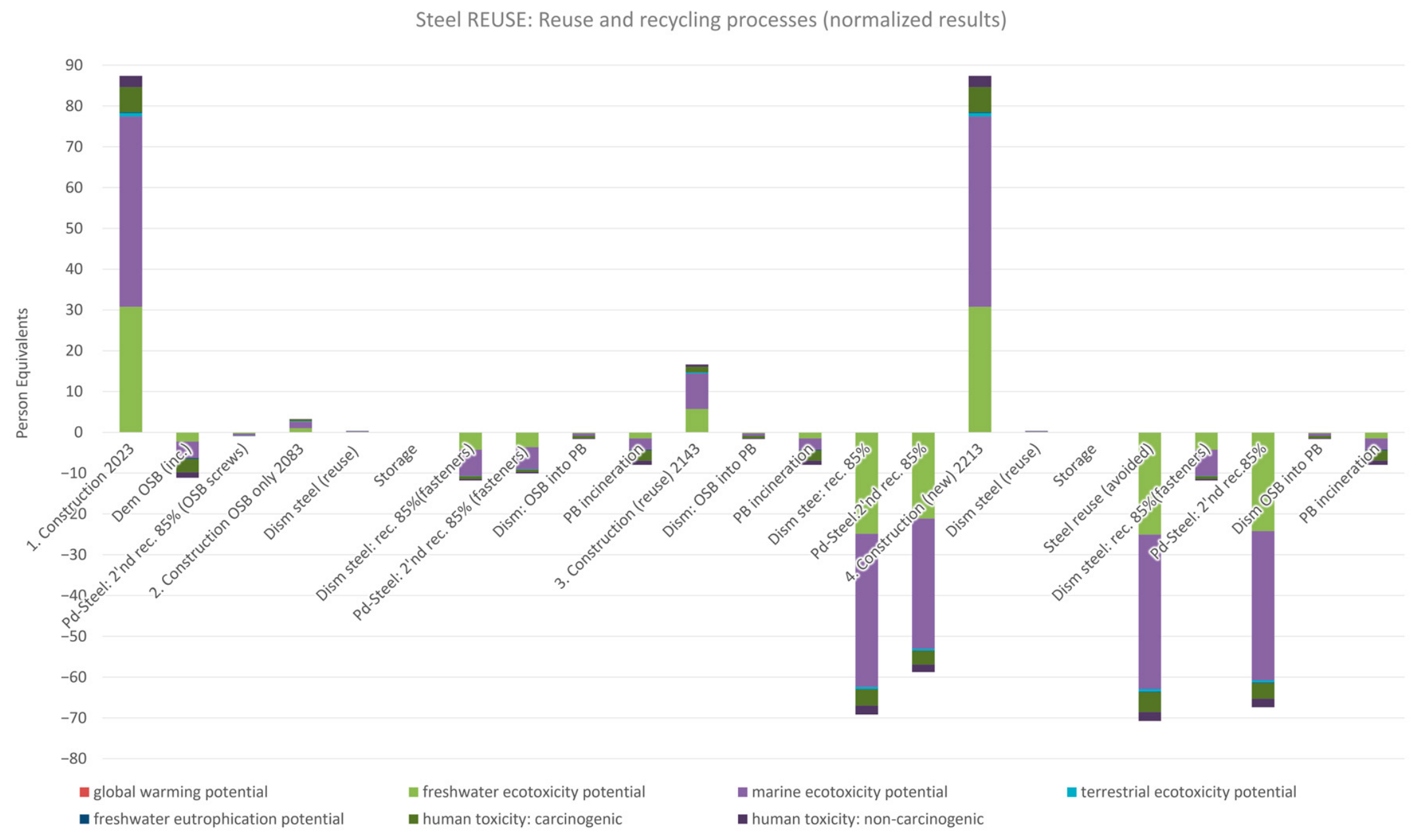
Figure 7.
Results for predefined impact categories of the AAC structure scenarios, showing the total results over 250 years, with multiple life-cycles indicated by gradations in color intensity.
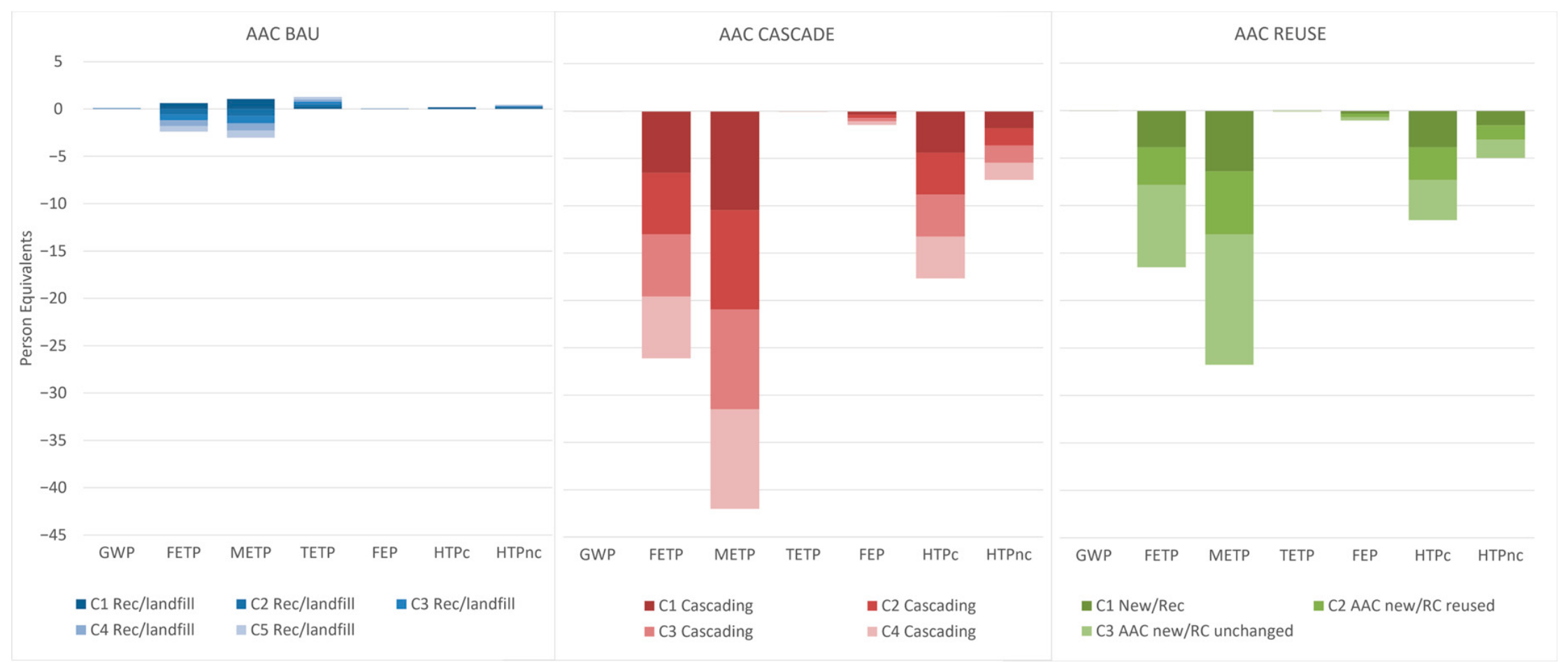
Figure 8.
Results for predefined impact categories of the AAC structure BAU scenario, depicting the most relevant processes for the first and second life cycles; cycles 3–5 are identical to cycle 2.
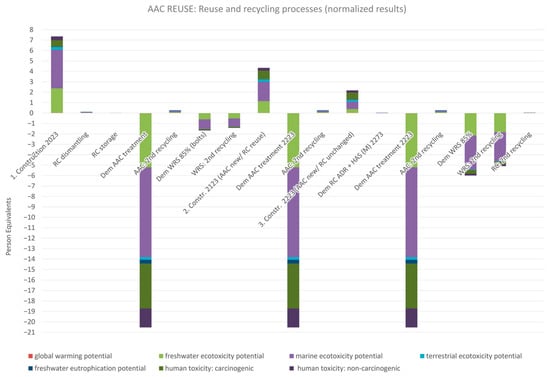
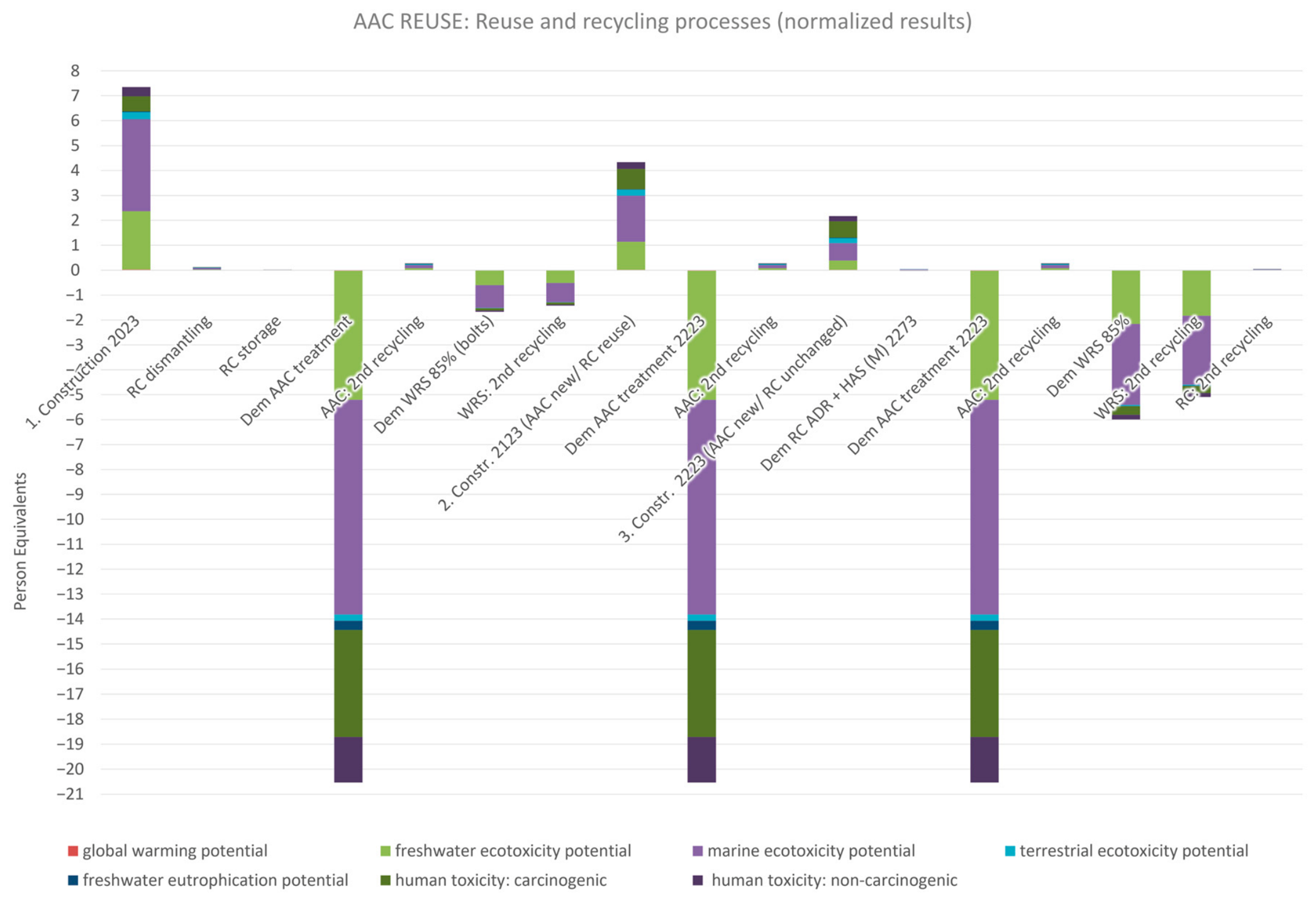
The REUSE scenario, based on the reuse of concrete columns, demonstrates lower environmental benefits compared to the CASCADE scenario. This outcome stems from the limited contribution of RC to the overall EI—predominantly driven by steel reinforcement and AAC blocks (Figure 10). Consequently, a lower number of cycles results in limited avoided impacts induced by AAC and steel recycling, leading to minimized overall net environmental gains.
Figure 9.
Results for predefined impact categories of the AAC structure CASCADE scenario, depicting the most relevant processes for the first three cycles; cycle 4 is identical to cycle 3.
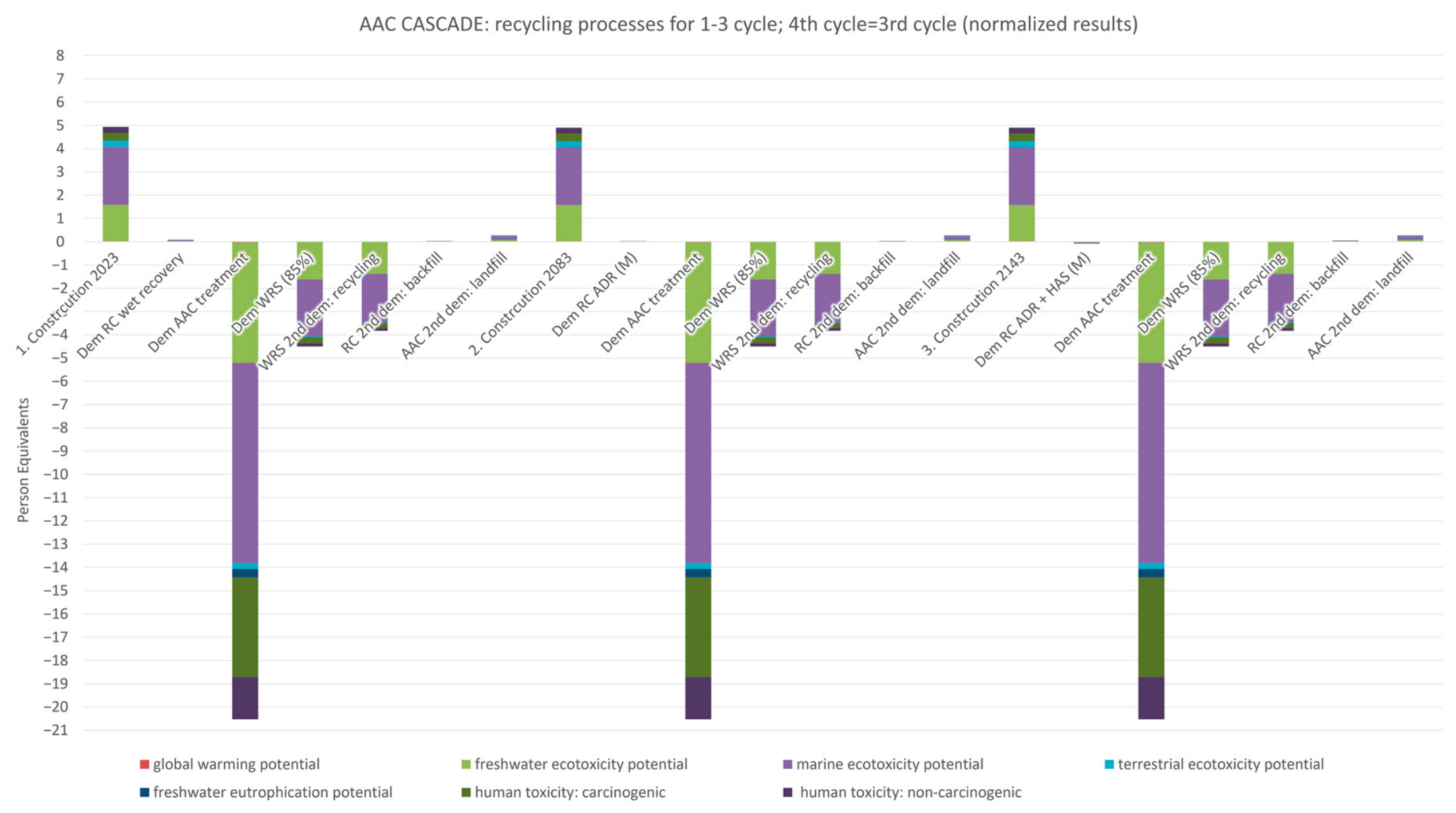
Figure 10.
Results for predefined impact categories of the AAC structure REUSE scenario, depicting the most relevant processes for all three cycles.
SSP sensitivity
In general, most SSP-aligned scenarios follow patterns similar to the static LCA.
Most differences between static and SSP-based LCA results show the AAC structure, where future scenarios depict higher EIs across most impact categories (except GWP and TETP for CASCADE/REUSE). Greater impacts in future cycles of the AAC structure are primarily driven by the construction stage, attributed to AAC block production, which is projected to exhibit ≈445% higher impacts after 2100. Currently, heat generated during AAC production substitutes electricity, resulting in avoided impacts and thus partially offsetting the overall EI of AAC production. However, by 2100, largely decarbonized electricity (even under SSP5) means heat no longer provides substitution credits, instead contributing to higher EIs, particularly ecotoxicity (Figures S11 and S12, Supplementary File S1).
Small differences are observed in transportation and machinery operation (e.g., demolition equipment), where future SSP-aligned scenarios induce increased EIs in global warming potential, freshwater, marine, and terrestrial ecotoxicity potentials—most notably in SSP-2. This increase appears to be largely driven by the background production pathways for synthetic diesel and hydrogen, which involve energy-intensive synthesis processes (such as carbon capture and electrolysis) and high material requirements (e.g., copper, nickel, and rare earth elements) for fuel production and energy-supply infrastructure. Furthermore, as observed from the LCA results, SSP-2 exhibits the highest impacts, which can be partly attributed to its reliance on agricultural feedstocks (e.g., rapeseed oil for biodiesel blendstocks), introducing additional environmental penalties from fertilizer and pesticide runoff during biomass cultivation.
The steel-frame structure demonstrates improved environmental performance, with HTPc being the only deviation (Figure 3). This improvement predominantly stems from the impact savings of OSB incineration, which yields higher environmental benefits in SSP-1 and SSP-5 than in the static scenario. This behavior can be explained by two main factors: first, heat recovery from OSB substitutes virgin biomass extraction across European markets, generating widespread resource-saving credits; second, although coal and lignite co-generation remain among the displaced heat sources in SSP-1, future scenarios eliminate the heavy electricity replacement penalty present in the static model. Because the surrounding electricity grid is deeply decarbonized, replacing any lost co-generated power no longer incurs the substantial environmental burden that previously offset the net gains of heat recovery.
For the steel components themselves, the construction stage exhibits slightly lower environmental impacts, while the recycling process yields reduced environmental savings—both trend lines being primarily driven by the anticipated decarbonization of the background energy supply. Furthermore, although SSP-1 models a higher proportion of secondary steel input (19.4% iron scrap compared to 15.4% in the static LCA), the resulting environmental gains appear to be partially counterbalanced by background database assumptions regarding energy-intensive alloy additives (such as ferronickel), which are included in the dataset to maintain strict material quality standards.
4. Discussion
Generally, avoiding gravel/sand quarry operation does not lead to significant environmental gains. As concrete manufacturers in Poland are predominantly located nearby a gravel pit (10–30 km), long transport distances (assumed 70 km), between a construction site and wet recycling facilities hinder gains from high-quality off-site concrete recycling. Thus, on-site concrete recycling is preferred, even for low-grade applications like subbase filling. However, should recycling become a widespread practice—thereby reducing transport distances to processing facilities—these environmental trade-offs could shift favorably. Advanced on-site processing proved environmentally sound only when recycled content substitutes energy-intensive products such as cement, pointing toward eco-efficiency of complete concrete recycling (such as ADR + HAS), compliant with Zhang et al. [48]. Furthermore, while the datasets in this study reflect technologies capable of recovering high-grade concrete aggregates, further research into the long-term structural performance and durability of recycled-aggregate concrete is required to fully verify its technical and environmental viability over the building lifecycle.
Conversely, AAC recycling revealed significant environmental gains, owing to crediting from clay substitution. However, since clay is not a primary ingredient of shuttering blocks or light mortar, alternative mix designs should be analyzed to confirm these benefits. Notably, the maximized recycling benefit identified for light mortar contradicts Volk’s finding that AAC is the optimal recycling option [55], despite both studies employing consequential LCA and comparable databases (Ecoinvent 3.6 vs. 3.9).
Although the study conducted revealed marginal advantage of steel reuse over recycling, contrary to [45], reuse enables steel life prolongation through an additional cycle of material recovery, improving the overall EI of steel structure. However, assuming steel recycling could be repeated endlessly, a high-quality recycling process could potentially lead to the same gains as reuse. In this study, recovered steel (sorted and shredded) is treated as a low-alloyed steel scrap equivalent, ready to enter the electric arc furnace smelting and forming process. However, evaluating multiple closed-loop high-quality recycling cycles would require more detailed investigations into additional energy and environmental burdens, such as those associated with re-smelting or the addition of alloying elements (e.g., ferronickel) required to guarantee specific structural performance.
Accurately bounding equivalent elements remains a key LCA methodological challenge, as systems with differing secondary functions (e.g., steel + OSB vs. AAC) inevitably influence whole-assembly performance in non-comparable ways: although OSB was added to the SF structure to provide a base for wall finishes, its thermal and airtightness properties differ from AAC. The Ecoinvent database demonstrates limited capacity for CS due to a lack of material quality variation, hindering precise reuse modelling for both sand/gravel and steel. Our methodology addressed this by adding an additional lifecycle, assuming incorporation of recycled concrete into new products, and assigning credits for the subsequent recycling. However, for concrete, gains from avoided quarrying operations were confirmed to be smaller than the negative impacts from transportation and processing [60]. Consequently, life prolongation, even with high-quality recycling (ADR), revealed none or only minimal environmental benefit. This minimal gain stems from the database limitation of applying the same material for varied uses (e.g., backfilling and new products) despite different performance requirements. This limitation similarly affects steel: the EI difference between ‘steel, low-alloyed’ (assumed as recycled input in line with Ecoinvent EA modelling) and ‘steel, low-alloyed, hot rolled’ was found to be marginal, resulting in no significant advantage of reuse over recycling. These LCA methodological and data limitations align with modelling challenges observed in other industry sectors [61].
Furthermore, the designed processes rely on individual studies due to limited available LCA documentation. However, Liu et al. [62] revealed that energy and material consumption data for specific processes vary considerably, highlighting the need for further practice-based research and data.
5. Conclusions
The LCA conducted on steel and AAC structures across BAU, REUSE, and CASCADE scenarios, supplemented by sensitivity analysis incorporating SSP data, provides insights into the EI consequences of the adopted strategies and LCA methodological limitations hindering comparison of sustainable strategies.
The efficiency of steel’s circularity is contingent upon both EoL processing and initial design. Crucially, enhancing recycling efficiency allows for a higher amount of steel in subsequent cycles. While a 40% recycling rate maintains a negative impact, achieving 70% recycling (including two subsequent recoveries) ensures credits surpass negative construction impacts. Hence, high material quality is vital to ensure subsequent recovery cycles (reuse/high-quality recycling) and requires either enhanced recycling facilities (alloy-sorting) or improved up-front strategies, such as DfD.
The optimal EoL strategy for RC elements is highly dependent on local transport logistics. Specifically, the environmental benefits of wet recovery (−0.020 PEq) are offset by transportation burdens (0.069 PEq) and processing impacts (0.013 PEq). Reuse should be primarily envisaged in dense urban areas where the probability of a nearby destination minimizes transport distances. Where local reuse is unavailable, on-site recycling is recommended, even for low-grade applications like subbases. Future research should focus on high-value, complete on-site concrete recycling (e.g., ADR + HAS technologies, which enabled net savings of −0.072 PEq in this study), which offers substantial benefits by enabling recycled content to substitute energy-intensive products like cement.
AAC recycling revealed significant environmental potential, achieving a net avoided impact of −20.629 PEq. Due to its substantially lower density compared to RC, transportation-related burdens are positively influenced. Moreover, the substantial mass amount of AAC in modern construction enables high, avoidable impacts resulting from clay substitution (assumed in shuttering blocks and light mortar). Given the importance of lightweight concrete, such as AAC, in construction sectors like single-family housing, two steps are crucial to secure long-term environmental benefits: recycling facilities must be developed proactively to address future quantities of pd-AAC, and further research must accurately confirm environmental benefits based on commonly used mixtures reflecting local construction practices.
Applying LCA to circular construction strategies inevitably requires complex system modelling, which amplifies uncertainties and limits comparability. Multifunctionality at the element level, e.g., load bearing, and insulation or air tightness, further complicates defining functionally equivalent elements, particularly when comparing frame and massive technologies. Consequently, even rigorously structured consequential LCAs may struggle to provide fully comparable results, underscoring the need for clearer methodological guidance for multi-life CS. Current LCA databases offer limited capacity for modelling circular scenarios due to insufficient material-quality differentiation, constraining accurate representation of reuse and high-grade recycling. The applied strategy of adding a second recycling cycle to address this limitation risks overstating the associated environmental impacts and is not universally suited for all materials. To ensure reliable assessment of CS, both methodological and data improvements are needed. Prospective SSP-based modelling shows that future AAC cycles exhibit higher impacts (up to +445% post-2100) as substitution benefits diminish with energy decarbonization. Conversely, consequential crediting generated substantial net benefits—e.g., clay substitution in AAC and repeated steel credits—reflecting a known modelling artefact where avoided production may produce unrealistic negative burdens. These paradoxes highlight the urgent need to redefine credit allocation rules and system boundaries in circular LCA.
Supplementary Materials
The following supporting information can be downloaded at: https://www.mdpi.com/article/10.3390/resources15100130/s1, Supplementary FIle S1: Figure S1: Process flow diagram for the steel-frame structure under the BAU scenario (SSP5).; Figure S2:Process flow diagram for the steel-frame structure under the REUSE scenario (SSP1); Figure S3: Process flow diagram for the AAC structure under the BAU scenario (SSP5); Figure S4: Process flow diagram for the AAC structure under the CASCADE scenario (SSP2); Figure S5 Process flow diagram for the AAC structure under the REUSE scenario (SSP1); Figure S6 Figure depicting processes for steel columns including both virgin production and the assumed reuse pathway; Figure S7: Results for predefined impact categories of varied concrete recycling processes, including low-grade recycling of the BAU scenario and high-grade recycling within the CASCADE scenario; Figure S8: Individual stages in the recycling process of reinforced concrete within the CASCADE scenario (normalized results); Figure S9: Contribution of individual stages to the recycling process of (1) reinforced concrete in the BAU scenario and (2) AAC blocks in the CASCADE scenario (normalized results); Figure S10: The figure illustrates the normalized environmental impacts from substitutionin three pd-AAC recycling routes (shuttering block, light mortar, and AAC-blocks). The upper chart presents the total environmental impacts aligned with the assumed recycled fraction, reflecting the calculated mass distribution of pd-AAC input into each product across the studied scenarios.The lower chart presents the theoretical potential of environmental gains, normalized to 1kg of pd-AAC input for each recycling route, allowing for a direct comparison of their intrinsic recycling efficiency; Figure S11: Single processes for construction phase in the BAU scenario, encompassing both the static LCA scenario (Ecoinvent current) and the prospective LCA scenario for the year 2100 (Ecoinvent + SSP-5); Figure S12: Main processes driving the substantial difference in Freshwater Ecotoxicity impacts between the static Ecoinvent scenario and the prospective SSP5-linked scenario for 2100. Table S1: Assumed transport distances for all scenarios included in the Life Cycle Inventory; Table S2: LCI for recycling processes of AAC, based on Volk et al., 2023 [55]; Table S3: Results for all scenarios and impact categories, presented in the unified Person Equivalent unit, after normalization [16,36,55,59,63,64,65,66]. Supplementary File S2: Activity Browser Data. Supplementary File S3: Structural Calculations.
Author Contributions
A.K.-G. contributed to the study conceptualization and design, material preparation, data collection and analysis, and original draft of the manuscript. S.R. conducted structural design and calculations, provided practice-oriented input, and reviewed the article with respect to structural aspects. All authors commented on previous versions of the manuscript. All authors have read and agreed to the published version of the manuscript.
Funding
The Wrocław University of Science and Technology Doctoral School Scholarship was funded by the Polish Ministry of Education and Science.
Data Availability Statement
The original contributions presented in this study are included in the article/Supplementary Material. Further inquiries can be directed to the corresponding author.
Acknowledgments
During the preparation of this manuscript, the authors utilized the Google Gemini (Google LLC, Mountain View, CA, USA) and GPT-5 for text refinement and language revision. The authors additionally utilized AI-assisted support to estimate typical distances between production/processing facilities and construction sites in Poland, subsequently verified with Google Maps (Google LLC: Mountain View, CA, USA) and expert input. The authors reviewed and edited all content and take full responsibility for the published article.
Conflicts of Interest
The authors declare no conflict of interest.
References
- Circularity Gap Report. 2024. Available online: www.deloitte.com (accessed on 29 September 2026).
- Boros, A.; Tőzsér, D. The Emerging Role of Plant-Based Building Materials in the Construction Industry—A Bibliometric Analysis. Resources 2023, 12, 124. [Google Scholar] [CrossRef] [Scilit]
- Severin, A.; Michaliková, M. Sustainable and circular construction A Policy Brief from the Policy Learning Platform for a greener Europe. In Sustainable Construction: Building a Circular Future 4; Interreg Europe: Lille, France, 2024. [Google Scholar]
- Building Materials and the Climate: Constructing a New Future. United Nations Environment Programme, & Yale Center for Ecosystems + Architecture 2023. Available online: https://wedocs.unep.org/20.500.11822/43293 (accessed on 20 September 2023).
- Eberhardt, L.C.M.; Birkved, M.; Birgisdottir, H. Building design and construction strategies for a circular economy. Archit. Eng. Des. Manag. 2020, 18, 93–113. [Google Scholar] [CrossRef] [Scilit]
- Crowther, P. Designing for Disassembly to Extend Service Life and Increase Sustainability Architectural disassembly. In Proceedings of the 8th International Conference on Durability of Building materials and Components NRC–CNRC, Vancouver, BC, Canada, 30 May–3 June 1999. [Google Scholar]
- O’Grady, T.; Minunno, R.; Chong, H.Y.; Morrison, G.M. Design for disassembly, deconstruction and resilience: A circular economy index for the built environment. Resour. Conserv. Recycl. 2021, 175, 105847. [Google Scholar] [CrossRef] [Scilit]
- Kręt-Grześkowiak, A.; Baborska-Narożny, M. Investigation of stakeholder perspectives and mobile app potential to mainstream CE strategies in single family housing sector. Environ. Impact Assess. Rev. 2026, 117, 108229. [Google Scholar] [CrossRef] [Scilit]
- van Stijn, A.; Wouterszoon Jansen, B.; Gruis, V.; van Bortel, G.A. Towards implementation of circular building components: A longitudinal study on the stakeholder choices in the development of 8 circular building components. J. Clean. Prod. 2023, 420, 138287. [Google Scholar] [CrossRef] [Scilit]
- van Stijn, A.; Eberhardt, L.C.M.; Jansen, B.W.; Meijer, A. Environmental design guidelines for circular building components based on LCA and MFA: Lessons from the circular kitchen and renovation façade. J. Clean. Prod. 2022, 357, 131375. [Google Scholar] [CrossRef] [Scilit]
- Kręt-Grześkowiak, A.; Baborska-Narożny, M. Guidelines for disassembly and adaptation in architectural design compared to circular economy goals—A literature review. Sustain. Prod. Consum. 2023, 39, 1–12. [Google Scholar] [CrossRef] [Scilit]
- Arvidsson, R.; Tillman, A.M.; Sandén, B.A.; Janssen, M.; Nordelöf, A.; Kushnir, D.; Molander, S. Environmental Assessment of Emerging Technologies: Recommendations for Prospective LCA. J. Ind. Ecol. 2018, 22, 1286–1294. [Google Scholar] [CrossRef] [Scilit]
- Yılmaz, Y.; Seyis, S. Mapping the scientific research of the life cycle assessment in the construction industry: A scientometric analysis. Build. Environ. 2021, 204, 108086. [Google Scholar] [CrossRef] [Scilit]
- Lam, W.C.; Claes, S.; Ritzen, M. Exploring the Missing Link between Life Cycle Assessment and Circularity Assessment in the Built Environment. Buildings 2022, 12, 2152. [Google Scholar] [CrossRef] [Scilit]
- Malabi Eberhardt, L.C.; van Stijn, A.; Kristensen Stranddorf, L.; Birkved, M.; Birgisdottir, H. Environmental design guidelines for circular building components: The case of the circular building structure. Sustainability 2021, 13, 5621. [Google Scholar] [CrossRef] [Scilit]
- Kręt-Grześkowiak, A.; Bruhn, S.; Jensen, A.A.V.; Birkved, M. Quantifying the environmental impact of structural timber across multiple future lifecycles. Discov. Appl. Sci. 2024, 6, 197. [Google Scholar] [CrossRef] [Scilit]
- Riahi, K.; Van Vuuren, D.P.; Kriegler, E.; Edmonds, J.; O’neill, B.C.; Fujimori, S.; Bauer, N.; Calvin, K.; Dellink, R.; Fricko, O.; et al. The Shared Socioeconomic Pathways and their energy, land use, and greenhouse gas emissions implications: An overview. Glob. Environ. Change 2017, 42, 153–168. [Google Scholar] [CrossRef] [Scilit]
- Bruhn, S.; Sacchi, R.; Cimpan, C.; Birkved, M. Ten questions concerning prospective LCA for decision support for the built environment. Build. Environ. 2023, 242, 110535. [Google Scholar] [CrossRef] [Scilit]
- Passarelli, R.N.; Mouton, B.J. Embodied life cycle impacts of lightweight building methods for affordable houses in the USA: Comparison of conventional, circular, and regenerative strategies. J. Build. Eng. 2023, 77, 107513. [Google Scholar] [CrossRef] [Scilit]
- Standard’s ISO 14040:2006; Environmental Management—Life Cycle Assessment—Principles and Framework. ISO: Geneva, Switzerland, 2006.
- ILCD Handbook: Framework and Requirements for LCIA Models and Indicators, 1st ed.; Publications Office of the European Union: Luxembourg, 2010. [CrossRef] [PubMed]
- Hauschild, M.Z.; Rosenbaum, R.K.; Olsen, S.I. Life Cycle Assessment; Springer International Publishing: Cham, Switzerland, 2018. [Google Scholar] [CrossRef] [Scilit]
- Huijbregts, M.A.J. ReCiPe 2016 A harmonized life cycle impact assessment method at midpoint and endpoint level Report I: Characterization. Int. J. Life Cycle Assess. 2017, 22, 138–147. [Google Scholar]
- Stehfest, E.; van Vuuren, D.; Kram, T.; Bouwman, L.; Alkemade, R.; Bakkenes, M.; Biemans, H.; Bouwman, A.; den Elzen, M.; Janse, J.; et al. Integrated Assessment of Global Environmental Change with IMAGE 3.0: Model Description and Policy Applications; PBL Netherlands Environmental Assessment Agency: The Hague, The Netherlands, 2014; ISBN 978-94-91506-71-0. Available online: https://www.pbl.nl/en/publications/integrated-assessment-of-global-environmental-change-with-image-30-model-description-and-policy-applications (accessed on 9 July 2025).
- REMIND (REgional Model of Investment and Development). Available online: https://www.pik-potsdam.de/en/institute/departments/transformation-pathways/models/remind/remind (accessed on 12 November 2025).
- Issa, D.T.; Chang, A.V.; Issa, D.T. Sustainable Business Strategies and PESTEL Framework. GSTF Int. J. Comput. 2010, 1, 73–80. [Google Scholar] [CrossRef] [Scilit]
- Langkau, S.; Steubing, B.; Mutel, C.; Ajie, M.P.; Erdmann, L.; Voglhuber-Slavinsky, A.; Janssen, M. A stepwise approach for Scenario-based Inventory Modelling for Prospective LCA (SIMPL). Int. J. Life Cycle Assess. 2023, 28, 1169–1193. [Google Scholar] [CrossRef]
- Framework for Carbon Neutral Buildings and Sites. 2020. Available online: www.dgnb.de (accessed on 5 July 2025).
- Ferek, B.; Harasymiuk, J.; Tyburski, J. Recycling and reuse of chosen kinds of waste materials in a building industry. In IOP Conference Series: Materials Science and Engineering; Institute of Physics Publishing: Bristol, UK, 2016. [Google Scholar] [CrossRef] [Scilit]
- Herczeg, M.; McKinnon, D.; Milios, L.; Klaassens, E.; Svatikova, K.; Rotterdam, O.W. Resource Efficiency in the Building Sector Final Report Client: DG Environment. 2014. Available online: www.ecorys.nl (accessed on 11 August 2025).
- International Energy Agency. Iron and Steel Technology Roadmap Towards More Sustainable Steelmaking Part of the Energy Technology Perspectives Series. 2020. Available online: www.iea.org/t&c/ (accessed on 24 June 2025).
- Gajdzik, B.; Wolniak, R.; Grebski, W. Process of Transformation to Net Zero Steelmaking: Decarbonisation Scenarios Based on the Analysis of the Polish Steel Industry. Energies 2023, 16, 3384. [Google Scholar] [CrossRef] [Scilit]
- Aagaard, N.-J.; Brandt, E.; Aggerholm, S.; Haugbølle, K. Levetider af Bygningsdele ved Vurdering af Bæredygtighed og Totaløkonomi; SBI 2013:30; SBI forlag: Kopenhagen, Danmark, 2013. [Google Scholar]
- Spear, M. The benefits of circular economy approaches in the wood panels industry on the magnitude of harvested wood product (hwp) carbon storage. In Proceedings of the International Panel Products Symposium, Llandudno, UK, 3–4 October 2023. [Google Scholar]
- Kanyilmaz, A.; Birhane, M.; Fishwick, R.; del Castillo, C. Reuse of Steel in the Construction Industry: Challenges and Opportunities. Int. J. Steel Struct. 2023, 23, 1399–1416. [Google Scholar] [CrossRef] [Scilit]
- Melella, R.; Di Ruocco, G.; Sorvillo, A. Circular construction process: Method for developing a selective, low co2eq disassembly and demolition plan. Sustainability 2021, 13, 8815. [Google Scholar] [CrossRef] [Scilit]
- Peng, S.; Li, T.; Tang, Z.; Shi, J.; Zhang, H. Comparative life cycle assessment of remanufacturing cleaning technologies. J. Clean. Prod. 2016, 137, 475–489. [Google Scholar] [CrossRef] [Scilit]
- Harvey, L.D.D. Iron and steel recycling: Review, conceptual model, irreducible mining requirements, and energy implications. Renew. Sustain. Energy Rev. 2021, 138, 110553. [Google Scholar] [CrossRef] [Scilit]
- Watari, T.; Giurco, D.; Cullen, J. Scrap endowment and inequalities in global steel decarbonization. J. Clean. Prod. 2023, 425, 139041. [Google Scholar] [CrossRef] [Scilit]
- Wörtler, M.F.; Schuler, G.J.F.; Voigt, N.; Schmidt, T.; Dahlmann, P.; Lüngen, H.B.; Ghenda, J.-.T. Steel’s Contribution to a Low-Carbon Europe 2050: Technical and Economic Analysis of the Sector’s CO2 Abatement Potential; The Boston Consulting Group & Steel Institute VDEh: Düsseldorf, Germany, 2013; Available online: https://web-[assets.bcg.com/img](https://assets.bcg.com/img)-src/Steel_Contribution_June_2013_tcm9-97801.pdf (accessed on 20 July 2026).
- Dworak, S.; Rechberger, H.; Fellner, J. How will tramp elements affect future steel recycling in Europe?—A dynamic material flow model for steel in the EU-28 for the period 1910 to 2050. Resour. Conserv. Recycl. 2022, 179, 106072. [Google Scholar] [CrossRef] [Scilit]
- ESTEP. The European Steel Technology Platform Sets Its Vision to Enhance Circular Economy. Available online: https://www.estep.eu/Press/Circular-Economy (accessed on 23 August 2025).
- Xylia, M.; Silveira, S.; Duerinck, J.; Meinke-Hubeny, F. Weighing regional scrap availability in global pathways for steel production processes. Energy Effic. 2018, 11, 1135–1159. [Google Scholar] [CrossRef] [Scilit]
- Coelho, A.M.G.; Pimentel, R.; Ungureanu, V.; Hradil, P.; Kesti, J. European Recommendations for Reuse of Steel Products in Single-Storey Buildings 2020. Available online: www.steelconstruct.com (accessed on 16 July 2025).
- Broniewicz, E.; Dec, K. Environmental Impact of Demolishing a Steel Structure Design for Disassembly. Energies 2022, 15, 7358. [Google Scholar] [CrossRef] [Scilit]
- Central Statistical Office. ‘Environemnt 2016’ Statistical Information and Elaboratatios. Warsaw. 2016. Available online: www.stat.gov.pl (accessed on 18 September 2025).
- Statistics Poland. Environment 2024’ Statistical Analyses; Statistics Poland: Warsaw, Poland, 2024. [Google Scholar]
- Zhang, C.; Hu, M.; Dong, L.; Gebremariam, A.; Miranda-Xicotencatl, B.; Di Maio, F.; Tukker, A. Eco-efficiency assessment of technological innovations in high-grade concrete recycling. Resour. Conserv. Recycl. 2019, 149, 649–663. [Google Scholar] [CrossRef] [Scilit]
- Volk, R.; Steins, J.J.; Stemmermann, P.; Schultmann, F. Comparison of different post-demolition autoclaved aerated concrete (AAC) recycling options. In Proceedings of the IOP Conference Series: Earth and Environmental Science, Berlin, Germany, 20–23 September 2022. [Google Scholar] [CrossRef] [Scilit]
- Peña, C.A. Environmental Product Declaration: Autoclaved Aerated Concrete. 2021. Available online: www.environdec.com (accessed on 21 June 2025).
- Moreno-Juez, J.; Vegas, I.J.; Gebremariam, A.T.; García-Cortés, V.; Di Maio, F. Treatment of end-of-life concrete in an innovative heating-air classification system for circular cement-based products. J. Clean. Prod. 2020, 263, 121515. [Google Scholar] [CrossRef] [Scilit]
- Stemmermann, P.; Volk, R.; Steins, J.J.; Beuchle, G. Recycling belite cement clinker from post-demolition autoclaved aerated concrete—Assessing a new process. Resour. Conserv. Recycl. 2024, 203, 107404. [Google Scholar] [CrossRef] [Scilit]
- Gyurkó, Z.; Jankus, B.; Fenyvesi, O.; Nemes, R. Sustainable applications for utilization the construction waste of aerated concrete. J. Clean. Prod. 2019, 230, 430–444. [Google Scholar] [CrossRef] [Scilit]
- Steins, J.J.; Ruck, M.; Volk, R.; Schultmann, F. Optimal design of a post-demolition autoclaved aerated concrete (AAC) recycling network using a capacitated, multi-period, and multi-stage warehouse location problem. J. Clean. Prod. 2024, 474, 143580. [Google Scholar] [CrossRef] [Scilit]
- Volk, R.; Steins, J.J.; Kreft, O.; Schultmann, F. Life cycle assessment of post-demolition autoclaved aerated concrete (AAC) recycling options. Resour. Conserv. Recycl. 2023, 188, 106716. [Google Scholar] [CrossRef] [Scilit]
- Główny Urząd Statystyczny. Produkcja Wyrobów Przemysłowych w Latach 2019–2023. 2024. Available online: http://www.stat.gov.pl (accessed on 15 September 2025).
- Technische Universität. Interreg North-West Europe. 2020. Available online: https://orbiserver.uni.lu/bitstream/10993/45711/1/ConferenceBooklet_final_18.05.20.pdf (accessed on 29 September 2026).
- Pacheco, J.N.; De Brito, J.; Lamperti, M.; Eur, T.; Tornaghi, M.L. Use of Recycled Aggregates in Concrete: Opportunities for Upscaling in Europe; Publications Office of the European Union: Luxembourg, 2023. [Google Scholar] [CrossRef] [PubMed]
- Yrjölä, J. Dismount and Reuse of Precast Concrete Structures (White Paper); Sustainability & Research, Peikko Group Corporation: March 2022. Available online: https://www.peikko.com/blog/new-white-paper-dismount-and-reuse-of-precast-concrete-structures/ (accessed on 29 September 2026).
- Abouhamad, M.; Abu-Hamd, M. Life Cycle Assessment Framework for Embodied Environmental Impacts of Building Construction Systems. Sustainability 2021, 13, 461. [Google Scholar] [CrossRef] [Scilit]
- Husmann, J.; Beylot, A.; Perdu, F.; Pinochet, M.; Cerdas, F.; Herrmann, C. Towards consistent life cycle assessment modelling of circular economy strategies for electric vehicle batteries. Sustain. Prod. Consum. 2024, 50, 556–570. [Google Scholar] [CrossRef] [Scilit]
- Liu, X.; Asghari, V.; Lam, C.M.; Hsu, S.C.; Xuan, D.; Angulo, S.C.; John, V.M.; Basavaraj, A.S.; Gettu, R.; Xiao, J.; et al. Discrepancies in life cycle assessment applied to concrete waste recycling: A structured review. J. Clean. Prod. 2024, 434, 140155. [Google Scholar] [CrossRef] [Scilit]
- Li, J.; Huang, R.; Chen, Z.; Sun, X.; Yu, D. Utilization Potential of Aerated Concrete Block Powder andCoffee Grounds Ash in Green-Growing Concrete. Materials 2024, 17, 3027. [Google Scholar] [CrossRef] [Scilit]
- Rafiza, A.R.; Chan, H.Y.; Thongtha, A.; Jettipattaranat, W.; Lim, K.L. An Innovative Autoclaved Aerated Concrete (AAC) with Recycled AAC Powder for Low Carbon Construction. In IOP Conference Series: Earth and Environmental Science; IOP Publishing: Bristol, UK, 2019; ISBN 17551315. [Google Scholar] [CrossRef] [Scilit]
- Adams, K.; Hobbs, G. Final Report: Wastage Rates for Blocks and Ready Mixed Concrete; Mineral Products Association: London, UK, 2023; Available online: https://aircrete.co.uk/MPAMasonry/media/root/assets/MPA-Wastage-Desk-Final-report-01-06-23v3.pdf (accessed on 29 September 2026).
- John, A.0.; Itodo, D.E. Professionals’ views of material wastage on construction sites and cost overruns. Organ. Technol. Manag. Constr. Int. J. 2013, 5, 747–757. [Google Scholar] [CrossRef] [Scilit]
Disclaimer/Publisher’s Note: The statements, opinions and data contained in all publications are solely those of the individual author(s) and contributor(s) and not of MDPI and/or the editor(s). MDPI and/or the editor(s) disclaim responsibility for any injury to people or property resulting from any ideas, methods, instructions or products referred to in the content. |
© 2026 by the authors. Licensee MDPI, Basel, Switzerland. This article is an open access article distributed under the terms and conditions of the Creative Commons Attribution (CC BY) license.