


Abstract
Massive Multiple-Input Multiple-Output (MIMO) is a key enabling technology for fifth-generation (5G) and beyond wireless communication systems because of its ability to greatly enhance both spectral efficiency (SE) and energy efficiency (EE). However, maximizing these two performance metrics simultaneously remains a challenging multi-objective optimization problem due to the conflicting effects of the transmit power, antenna deployment, and circuit power consumption. This paper investigates the EE–SE trade-off in a downlink Massive MIMO system with Minimum Mean Square Error (MMSE) channel estimation (CE) and different linear combining and precoding techniques. A power optimization framework based on transmit power allocation and antenna configuration is analyzed to identify operating points that maximize EE while maintaining high SE. Performance analysis of the number of base station (BS) antennas in MIMO systems, user equipment density, transmit power, and inter-cell interference on system performance is evaluated through numerical simulations. The results demonstrate that appropriately selecting the number of transmit antennas and optimizing the transmit power significantly improve the EE–SE trade-off. Furthermore, although increasing the number of antennas enhances SE, EE exhibits a non-monotonic behavior because of the additional circuit power required by the radio-frequency hardware. The findings confirm that MMSE-based CE provides higher spectral efficiency than the MR, ZF, RZF, and S-MMSE schemes, albeit at increased computational complexity, offering useful design guidelines for energy-efficient Massive MIMO networks.
1. Introduction
Even if the old MIMO system could be improved in terms of spectrum utilization and reliability, a number of significant issues have arisen as network requirements have begun to shift toward 5G and beyond MIMO technology. The MIMO system could not keep up with these expanding demands [1]. As a result, the MIMO system had a few flaws that needed to be addressed. These issues demonstrate that standard MIMO has reached its ‘limit’, necessitating the transition to Massive MIMO. In Ref. [2], Massive MIMO is a practical way to improve the SE of cellular networks by deploying arrays of antennas with thousands or hundreds of components that are active at the BS and employing coherent beamforming. These systems are typically designed with an order of magnitude more BS antennas (N) than scheduled users (K), since the users’ channel vectors are likely to be nearly orthogonal. However, it has not been proven that this general rule actually maximizes the SE. The relationship between the N and other system characteristics, and the ideal number of scheduled users, K*, was investigated by the author in this study. In Ref. [3], the efficiencies of the two most often used linear precoding techniques for secure downlink multiuser Massive MIMO—Zero-forcing (ZF) and matching filter (MF) precoders—are investigated when a passive eavesdropper with many antennas is present. Three performance measures are taken into consideration by the authors: the feasible ergodic secrecy rate, the secrecy EE and the secrecy SE, assuming both ideal and non-ideal CSI. The trade-off between SSE and SEE is also examined. Additionally, the authors found strict lower limitations on the potential MF and ZF ergodic secrecy rate precoding schemes. The obtained lower bounds make it feasible to comprehend the trade-off between the SSE and SEE. In Ref. [4], balancing EE and SE in single-cell Massive MIMO downlink transmission was tested by the author using statistical CSIT. He aimed to create an EE–SE balance through maximizing the resource efficiency (RE) of the system. The author initially found a good solution for the eigenvectors of various user terminals in order to show that the beam domain is favorable for executing in Massive MIMO downlink, with RE optimum transmission. This insight simplifies the precoding design for RE optimization for a power allocation issue. In Ref. [5], the author concentrated on using non-coherent convex optimization to minimize power. The author suggested using Massive MIMO networks in combination with small cell access (SCA) points to improve SE in a macro cell context. He suggested a brand-new, low-complexity, non-convex RZF beamforming method for soft cell coordination and power optimization. The total power utilization includes both static and dynamic power allocation. As a result, while upholding Quality of Service (QOS) limitations, overall power consumption must be optimized and minimized.
In Ref. [6], in order to improve energy efficiency at full SE, the author proposed an adaptive optimization technique employing a genetic algorithm (GA) optimizer. The shift in the number of active users determines the number of efficient antennas, which is in accordance with the suggested GA scheme that maximizes the EE in the Massive MIMO system. The simulation findings showed that the method of optimization was able to maximize the 5G Massive MIMO platform’s EE as well as the efficiency of the trade-off process. In Ref. [7], to enhance the Massive MIMO system’s performance, the author looked at the trade-off between preserving maximum SE in large-scale MIMO antennas and the amount of resources demanded to precisely predict the channel employing pilots to prevent interference. The author proposed a technique to address the issue of efficient resource allocation strategies in Massive MIMO. For frequency reuse for pilot signals, the Zadoff–Chu sequence was used to optimize the allocation of resources and lessen interference for users utilizing the same frequencies in different cells. The outcomes demonstrated that applying the resource optimization technique enhances spectrum efficiency performance. In Ref. [8], the EE–SE trade-off was described by the author as a multi-objective optimization (MOO) issue. The obtained EE–SE relations are used to analyze the characteristics of the EE–SE Pareto frontier. To fix the difficult MOO issue, the author developed two methods: the algorithm for WS-PSO and NBI-PSO. The outcomes of the simulation indicate that NBI-PSO provides more uniformly distributed optimization solutions than using WS-PSO, and both methods can reach Pareto-optimal solutions as determined by the EE–SE trade-off analysis. In Ref. [9], the author discussed the possibility of using Filter Bank Multicarrier (FBMC) modulation in place of Massive MIMO in future 5G wireless networks. In this research, OFDM and FBMC are compared. While the former is the multiplexing method used in 4G networks, the latter is one of the most promising alternatives to swap out OFDM in 5G grids. The SE of the uplink in a single-cell Massive MIMO system is assessed in this comparison. In Ref. [10], in order to improve the SE in each cell and ultimately raise the throughput performance of the system, the author looked at a Massive MIMO system. Because these variables are interdependent, the author was trying to determine the optimal SE, average cell density, and available bandwidth values to optimize the throughput. Similarly, an SE optimization model was created to boost antenna array gain and broadcast power. The suggested model additionally takes into account the incident angles of both the desired and interfering users, as well as the inter-user interference from nearby cells.
In Ref. [11], the author examined a non-convex problem in Massive MIMO systems with several cells. The author originally proposed a unique optimization procedure based on the weighted MMSE method utilizing polynomial stationary point analysis. Using this method and deep learning, he then trained a neural network to execute the pilot power control and combined data in less than a millisecond, which makes it appropriate for online optimization for practical multi-cell Massive MIMO systems. In Ref. [12], a bidirectional dynamic network (BDN) with Massive MIMO, which enables simultaneous DL and UL transmission, was studied by the author. In both the BDN and DTDD systems, under imperfect CSI, the closed-form formulas for the downlink evaluation of reachable rates with maximum ratio transmission (MRT) and ZF beamforming, as well as the uplink reachable rates with maximum ratio combination (MRC) and zero-forcing (ZF) receivers, are derived. Numerical analyses demonstrate that the closed-form formulations and simulation results in the BDN and DTDD systems agree quite well. Furthermore, in terms of SE, BDN performs better than DTDD. In terms of SE, ZF performs better than MRC and MRT. In Ref. [13], the emerging cell system innovation for increased information rate correspondence is called MIMO. The BS may use a large number of communication reception devices thanks to the radio wire cluster, which is electrically steerable and useful for shaft framing. The spectral proficiency is the primary criterion for boosting throughput. The system’s performance is assessed through simulation under several actual constraints and conditions, including the quantity of base station (BS) antennas, the amount of dynamic clients, and the length of the restricted soundness block. In Ref. [14], recent studies on Massive MIMO have shown that the maximum value of the sum SE can occur when a certain number of consumers are served. The author showed that providing service to all users simultaneously results in the highest total SE until it reaches its maximum value. These results were based on the application of several antennas at the BS, Shannon capacity estimates, or perfect CSI. Contrary to the previously published results, the author showed that by optimizing the modulation scheme, by lowering the maximum number of users prior to the total SE reaching its maximum value, it is possible to obtain the largest sum SE with a feasible number of antennas. In Ref. [15], by employing various antenna array configurations, the author examined the DL SE of Massive MIMO systems and enhanced their performance by reducing interference among users brought on by non-orthogonality among channel vectors. Assuming that the base station employs linear precoding and is aware of the channel state information in advance, an investigation is conducted into the evaluation of the aggregate SE of a single-cell Massive MIMO system. Every user is supposed to have a random distribution under the mm wave channel paradigm. Simulation studies that look at a range of subarray antenna designs show that three subarray antenna configurations efficiently suppress inter-user interference when compared to other subarray configurations. In Ref. [16], the author aimed to optimize the power control and SE of cell-free Massive MIMO systems. Both UL and DL transmission were covered in the research. The optimization model incorporates joint SE and power control in Massive MIMO systems. The ensemble methodology is based on the neighborhood field optimization method. Its superiority is verified by comparing the developed ensemble methodology with the Newton method, gradient descent method, and genetic algorithm. Comprehensive simulations are used to investigate the joint optimization of SE and power control. Multiple wireless sensors are considered in order to model the distinct technical requirements for Massive MIMO deployment. In Ref. [17], an overview of the various facets of I-mMIMO systems was the author’s goal. First, the CM-MIMO’s features and difficulties are determined. Second, the most recent efforts to use machine learning for a different CM-MIMO system function are presented. Third, I-mMIMO implementation and standardization efforts are analyzed. Last, future directions for I-mMIMO-capable application systems are explored. The purpose of this study was to encourage readers to keep up with new advancements. In Ref. [18], for upcoming LTE band 46 terminals in 5G systems, the author proposed a novel eight-port MIMO antenna array. The antenna features a big channel capacity, good isolation, and a straightforward design. The design uses zigzag slot antennas for radiation and has a net size of 150 × 80 × 1.6 mm3. Additionally, the dumbbell slots and self-decoupling techniques are used to provide space and pattern diversities that enhance the isolation value of the radiators. In Ref. [19], investigating the integration of reconfigurable intelligent surfaces (RISs) with MIMO systems is the primary goal of this systematic literature review (SLR). It addresses energy-saving techniques, beamforming optimization, and methods for boosting system capacity. The author explored current advancements in MIMO systems based on RISs, including optimization techniques, theoretical models, and real-world implementation difficulties. The emphasis is on phase-shift optimization, power allocation, and hybrid beamforming, demonstrating the critical role that RISs play in enhancing MIMO performance for both 5G and 6G networks, according to the research findings, making it a revolutionary technology for upcoming wireless networks. In Ref. [20], in order to create ELAA on building facades, the author described a MATLAB R 2023a-based simulator that was verified by mathematical modeling of the system. The method takes into account a situation in which user terminals (UTs) are evenly dispersed throughout the building face’s BS antenna array coverage area, creating a random uniform LOS channel. The Interference Reduction Factor and the radiation pattern are also considered. This solution is notable for its practical and original approach, which uses Massive MIMO technology to successfully solve spatial restrictions in highly populated areas. Recent studies have also investigated energy-efficient communication techniques for emerging 6G networks by integrating advanced MIMO architectures with other enabling technologies. Ezekiel proposed an enhanced energy transfer framework integration of IoT-enabled cyber-physical systems into 6G edge grids based on the integration of wireless power transfer (WPT), MIMO, and non-orthogonal multiple access (NOMA). Their study demonstrated that combining MIMO transmission with energy harvesting and efficient resource allocation strategies can improve the energy transfer efficiency and support the requirements of future IoT applications. However, the study mainly focused on the energy transfer performance in WPT-MIMO-NOMA systems, while the impact of the CE accuracy and the trade-off between SE and EE in Massive MIMO cellular networks remain important research challenges. Therefore, further investigation is required to optimize Massive MIMO systems by considering CE, antenna deployment, and hardware-related power consumption [21].
In Ref. [22], the authors proposed an energy-efficient user association and resource allocation approach for Massive MIMO systems with full-duplex C-RAN capability. Their work formulated the joint optimization of user association, throughput maximization, and energy consumption minimization as a multi-objective optimization problem. By employing an ϵ-constraint-based optimization framework and a memorization–minimization approach, the authors obtained Pareto-optimal solutions that demonstrate the trade-off between EE and SE in full-duplex C-RAN Massive MIMO networks. However, their study primarily focused on user association and resource allocation optimization, while the impact of CE techniques and the relationship between CE accuracy, computational complexity, and EE–SE performance in conventional Massive MIMO systems remain insufficiently explored. In Ref. [23], the author investigated how to improve EE in Massive MIMO systems designed for high-density Internet of Things (IoT) networks. That paper proposed the use of extensive reference signal (RS) reuse to support a large number of IoT devices and developed analytical EE metrics to determine optimal system parameters, including the number of BS antennas, connected IoT devices, and coverage area. In Ref. [24], the author presented a deep-learning-based framework to jointly improve EE and communication security in cell-free Massive MIMO (CF m-MIMO) networks for Internet of Things (IoT) applications. Unlike conventional cellular architectures, cell-free Massive MIMO uses multiple distributed APs to cooperatively serve IoT devices, enhancing coverage, reliability, and spectral efficiency. However, maintaining both low energy consumption and strong security remains a significant challenge because IoT devices have limited power and computational resources. In Ref. [25], the author suggested an end-to-end method based on a convolutional neural network (CNN) power allocation framework for cell-free Massive MIMO (CF-mMIMO) networks. The objective is to improve SE while maintaining high EE by jointly optimizing power allocation from the central processing unit (CPU) to distributed APs and from the APs to user equipment (UEs). Unlike conventional approaches that treat these two allocation stages independently, the proposed framework performs integrated optimization in a single deep-learning model. In Ref. [26], the author analyzed the effects of hardware impairments on downlink CE performance, focusing on the resulting error floors under different estimation methods, including the Linear Minimum Mean Square Error (LMMSE) and Normalized Mean Square Error (NMSE) approaches. Furthermore, the research examines the combined impact of nonlinear hardware impairments at both the BS and UE on the downlink performance of a single-cell Massive MIMO system operating in a Gaussian angular distribution with uniformly distributed nominal angles. The proposed estimation techniques are evaluated and compared with state-of-the-art LMMSE and MMSE estimators, demonstrating their effectiveness under practical hardware impairment conditions.
To address these research gaps, this paper presents a comprehensive analysis of the EE–SE trade-off in a downlink Massive MIMO system employing MMSE CE. The proposed study jointly investigates the effects of the transmit power, the number of BS antennas, and the number of UEs on system performance while evaluating the computational complexity of different linear combining techniques. This integrated analysis provides practical insights into selecting suitable antenna configurations and receiver processing methods that improve both the SE and EE in future 5G and beyond wireless communication systems. The following is a summary of this work’s main contributions:
- This work introduces a unified framework that integrates analytical modeling and simulation approaches in Massive MIMO systems using MMSE CE.
- The combined effects of the transmit power, the number of BS antennas, and the number of active users on EE and spectral efficiency are systematically investigated.
- A comparative performance analysis of MMSE, S-MMSE, MR, RZF, and ZF combining schemes is performed in terms of spectral efficiency, energy efficiency, and computational complexity under identical simulation conditions.
- The impact of increasing the number of antennas on both the SE improvement and circuit power consumption is analyzed to identify practical operating points that maximize EE.
- Extensive simulation results provide design guidelines for selecting antenna configurations and receiver combining schemes that achieve an effective balance between EE and SE in Massive MIMO systems.
The individual components considered in this study—including MMSE channel estimation, conventional linear combining schemes, spectral efficiency analysis, and energy efficiency modeling—are established techniques in the Massive MIMO literature. The novelty of this work therefore does not rely on proposing a new channel estimator or combining algorithm. Instead, the main contribution is an integrated EE–SE analysis that explicitly connects channel estimation quality, antenna deployment, user loading, transmit power, circuit power consumption, and receiver computational complexity within a common simulation framework. In particular, this study uses a derivative-based characterization of the EE function to identify the transmit-power operating point at which the marginal SE gain is balanced by the marginal power cost. This analytical characterization is then combined with a systematic evaluation of different antenna-to-user configurations and combining schemes. The resulting analysis provides insight into how the SE gains obtained through MMSE-based processing should be balanced against its additional computational and hardware-related power consumption. Thus, this study complements previous works that separately investigate EE–SE optimization, antenna/user scaling, power allocation, or combining by examining their interaction under a common channel estimation and power consumption framework.
The rest of this paper is organized as follows. The result is shown in Section 2, Section 3 discusses the numerical results and simulations, including the impact of CE, the number of base station antennas, and the quantity of user equipment on the EE–SE trade-off. Material and methods are discussed in Section 4. This work is finally concluded in Section 5, which summarizes the main conclusions and suggests future research topics.
2. Results
In order to verify theoretical studies, compare system performance with various parameter settings, and evaluate the efficacy of the suggested algorithm, the simulation results are presented in this part.
The following assumptions are considered throughout the analysis: K single-antenna UEs are served by each BS, which has M antennas. The wireless channel follows an uncorrelated Rayleigh fading model. Perfect synchronization is assumed within each coherence block. MMSE CE is employed at the BS. Maximum ratio (MR) combining is initially considered to derive the analytical expressions, while other combining schemes (ZF, RZF, S-MMSE, and Massive MMSE) are evaluated in the simulation section. AWGN with variance σ2 is assumed.
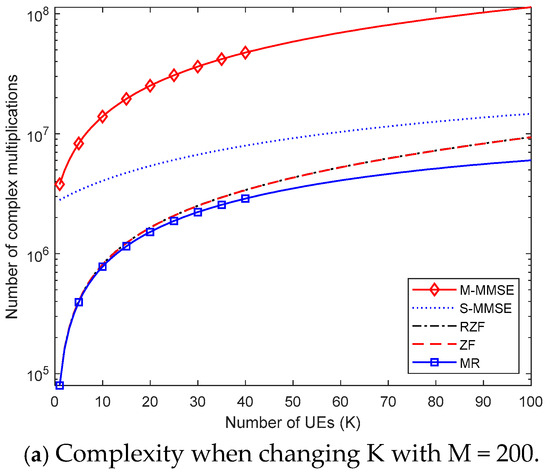
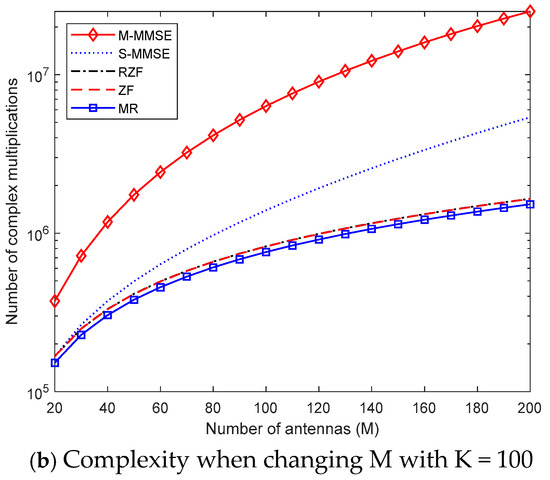
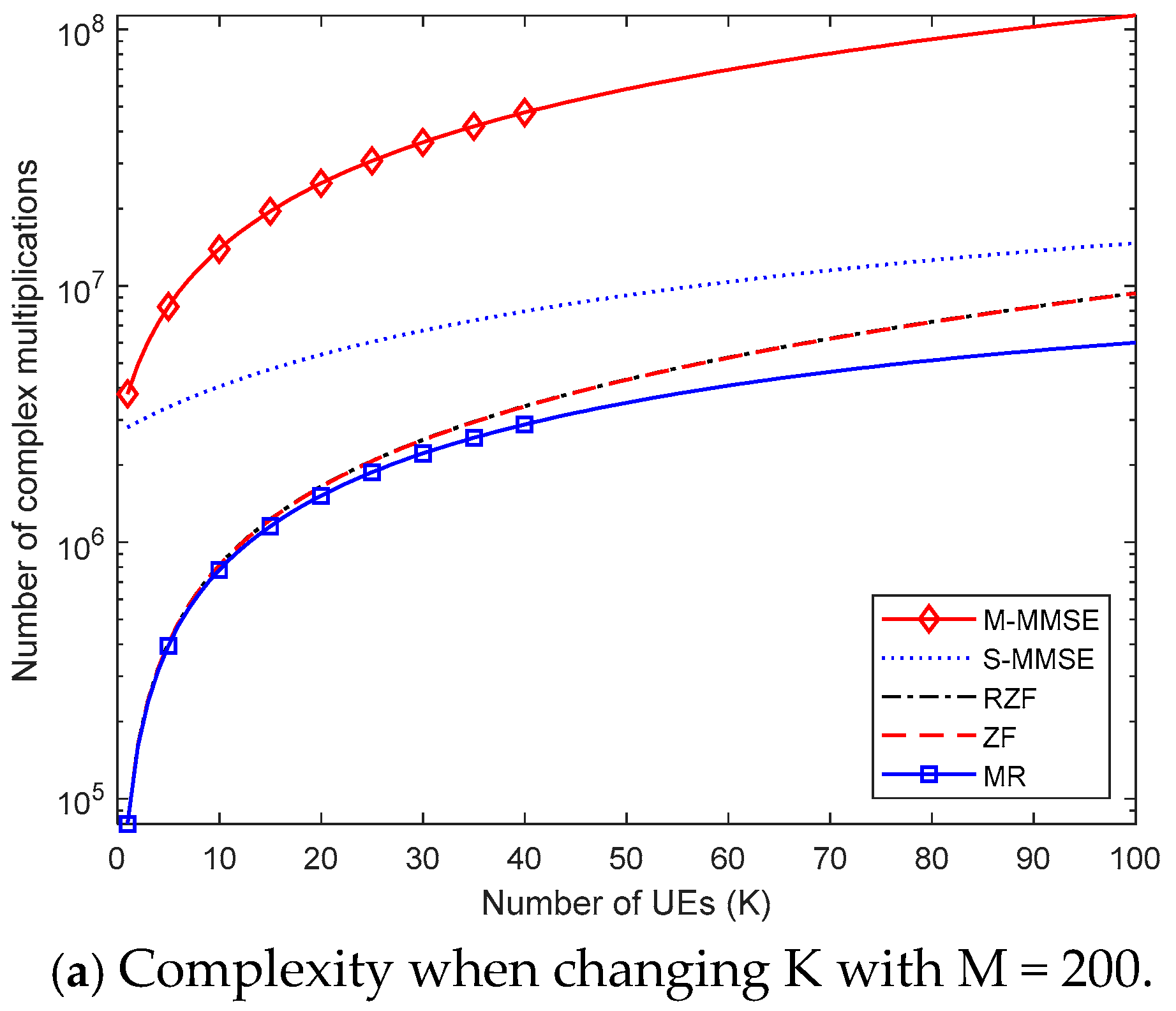
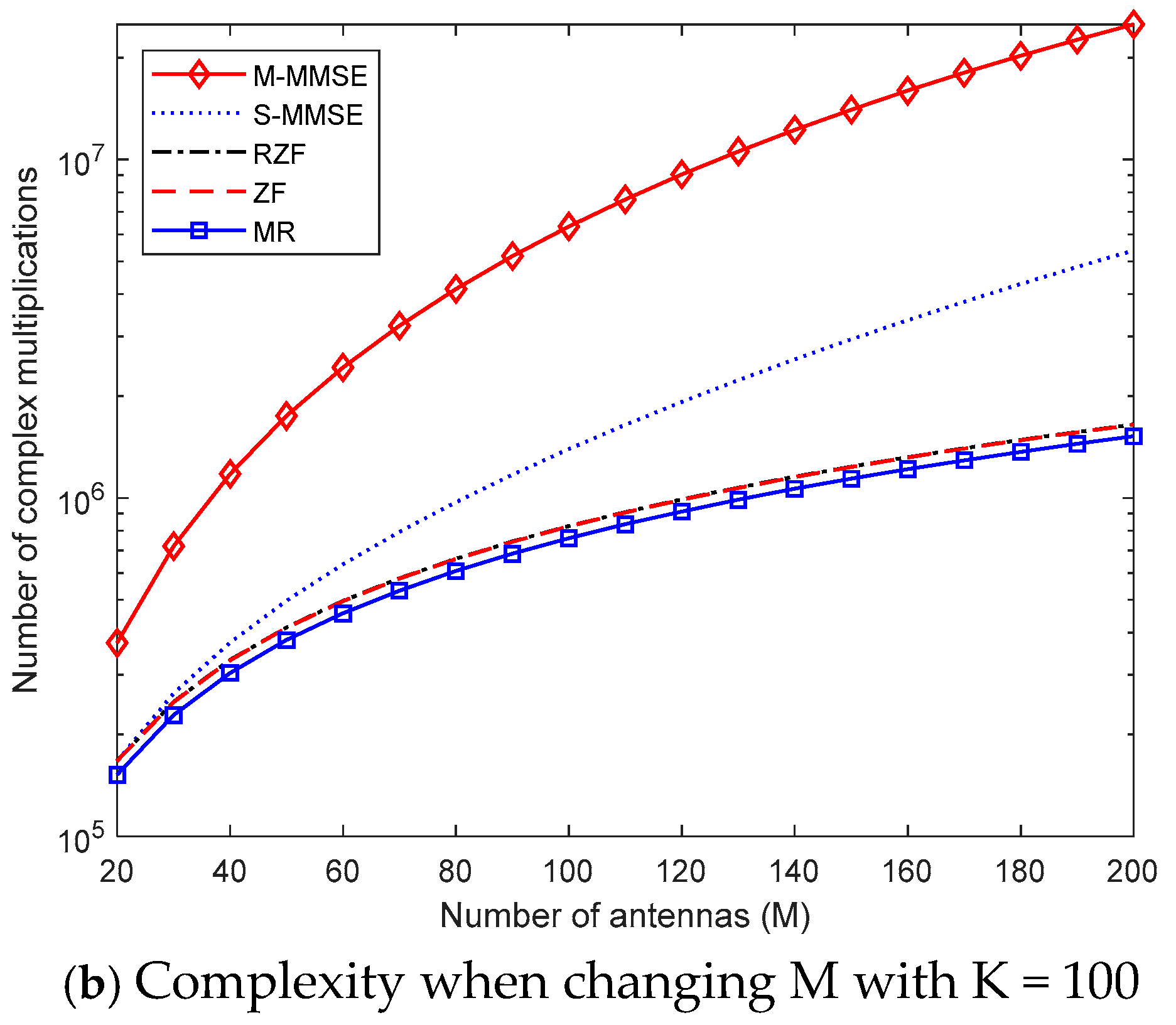
Figure 1 provides a complexity benchmark for different combining schemes as the number of UEs and BS antennas varies. Although the complexity trends of these algorithms are known, this analysis is included to quantify the computational cost associated with the considered schemes and to support the subsequent EE–SE trade-off evaluation. The computational complexity of the considered combining schemes can be characterized by their dominant matrix operations. For MR combining, the main operation is the multiplication between the received signal and the channel matrix, resulting in a complexity order of O(MK). For ZF and RZF combining, the computation requires the inversion of a K × K matrix, giving a complexity order of O(MK2 + K3). MMSE-based combining requires the inversion of an M × M covariance matrix, resulting in a complexity order of O(M3 + M2K). Therefore, increasing the number of antennas M or users K increases the computational burden, with MMSE-based schemes being more computationally demanding than ZF, RZF, and MR.
Figure 1.
When employing various combining strategies, the number of complex multiplications per coherence block.
We examine a data transfer scenario with L = 50 cells and τu = 400-K samples. We suppose that each cell in Figure 1a has K ∈ [1, 100] and M = 200. In contrast, Figure 1b assumes that K = 100 and that M ranges from 10 to 200. A logarithmic scale is used for the vertical axes. As the number of UEs, BSs, and antennas increases, all combining solutions become more challenging. Massive MMSE is undoubtedly the most complicated, with S-MMSE coming in second. Because inter-cell CEs are not included in the computation, utilizing S-MMSE reduces the complexity by 20–60% when compared to Massive MMSE, as shown in Figure 1a. Figure 1b illustrates the complexity drop of 22–45% for K = 10. Compared to Massive MMSE and S-MMSE, which invert larger Mj × Mj matrices, RZF and ZF are less challenging since they invert smaller Kj × Kj matrices. This feature reduces the complexity by 78–90% when compared to M-MMSE, as Figure 1a illustrates. Lastly, because no matrix inverses are computed, all operations can be parallelized in the implementation, giving MR the lowest computational complexity. Only when the number of UEs is large does the complexity decrease substantially in the number of multiplications compared to RZF and ZF; for instance, using MR instead of RZF saves just 10% of the complexity when K = 10. Table 1 displays the simulation parameters. By boosting broadcast power, adding more BS antennas, or supporting more UEs per cell, a cell’s SE can be increased. All of these choices have the potential to lower EE because they unavoidably increase the network’s PC, either directly or indirectly (by utilizing extra equipment). This is not always the case, though. In practice, these tactics can raise SE and EE at the same time under certain operating circumstances. The influence of various networks and the EE–SE trade-off configurations and operational circumstances are then investigated in more detail. We concentrate on the two-cell Wyner model’s UL (L = 2) depicted in Figure 2 to make things straightforward (similar findings may be achieved for the DL). We exclusively examine uncorrelated Rayleigh fading channels over a bandwidth, assuming that the BSs have M antennas, full channel information, and MR combining.
Table 1.
Simulation parameters.
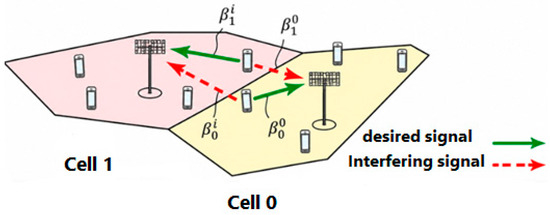
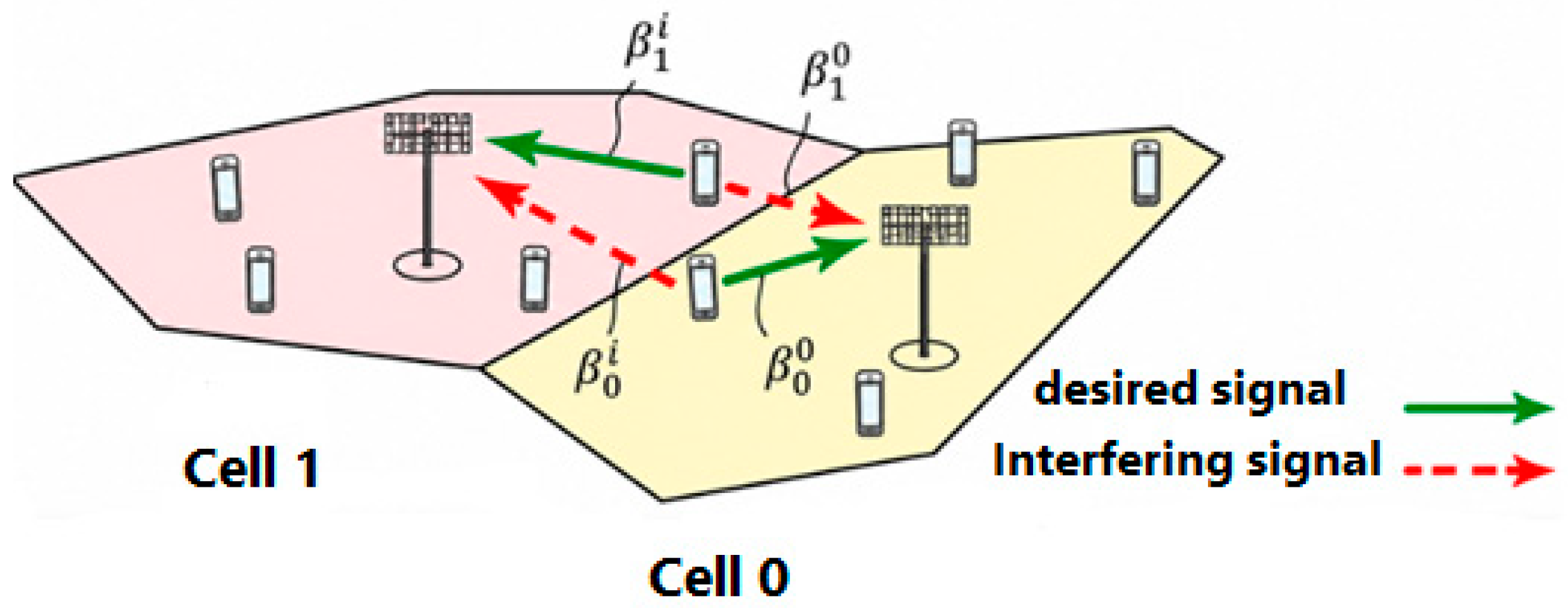
Figure 2.
An illustration of a two-cell network’s intended and interfering UL signals.
The simulation parameters were selected to represent a reference sub-6-GHz Massive MIMO cellular scenario while maintaining a tractable simulation environment. The adopted parameter ranges are consistent with commonly used Massive MIMO evaluation settings reported in the literature. In particular, the BS antenna number and number of simultaneously served UEs are varied to investigate the antenna-to-user scaling behavior, while the nominal transmit power is selected to represent a practical UE/BS operating range for cellular-system evaluation. The path-loss exponent α = 3.76 represents a non-line-of-sight cellular propagation environment and is used consistently throughout the simulations. The receiver noise power is selected according to the assumed bandwidth and receiver noise conditions. The coherence block parameters are selected to capture the finite channel estimation and data transmission resources available within a coherence interval. Some parameters, including the number of cells and the simulation area, are primarily selected to provide a controlled multi-cell reference scenario rather than to represent one specific commercial deployment. Sensitivity to the principal parameters is subsequently investigated through variations in M, K, transmit power, circuit power, and inter-cell interference.
The Wyner model states that each UE in cell 1 has the same β10 and β11 values and that each UE in cell 0 has the same average channel gain (β00) from its serving BS and β01 from the other-cell BS. Assume that cell 1 is not transmitting any interference signals and that cell 0 has a single active UE (K = 1). The Wyner model is intentionally adopted because it is a standard benchmark in Massive MIMO research. Using this common framework enables a fair comparison of different CE and combining techniques while isolating the effects of antenna configuration, transmit power, and user density on the EE–SE trade-off.
Equation (1) thus provides a plausible SE of the UE in cell 0, which is:
where β00 represents the active user equipment’s average channel gain, σ2 is the noise power, and p is the transmit power. The superscript “NLoS” was removed because the LoS problem is not discussed here. We distinguish between two situations in the PC computation to estimate the effect of M on the EE: (i) the CP raise caused by several BS antennas is disregarded; and (ii) the CP raise is taken into consideration. Assume for the moment that the fixed power PFIX makes up all of cell 0’s CP, i.e., CP0 = PFIX. Consequently, cell 0’s corresponding EE is
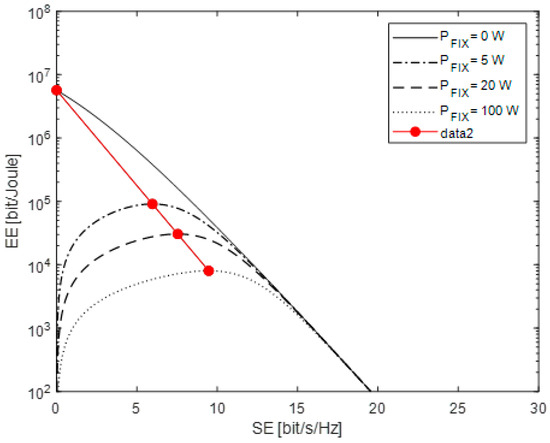
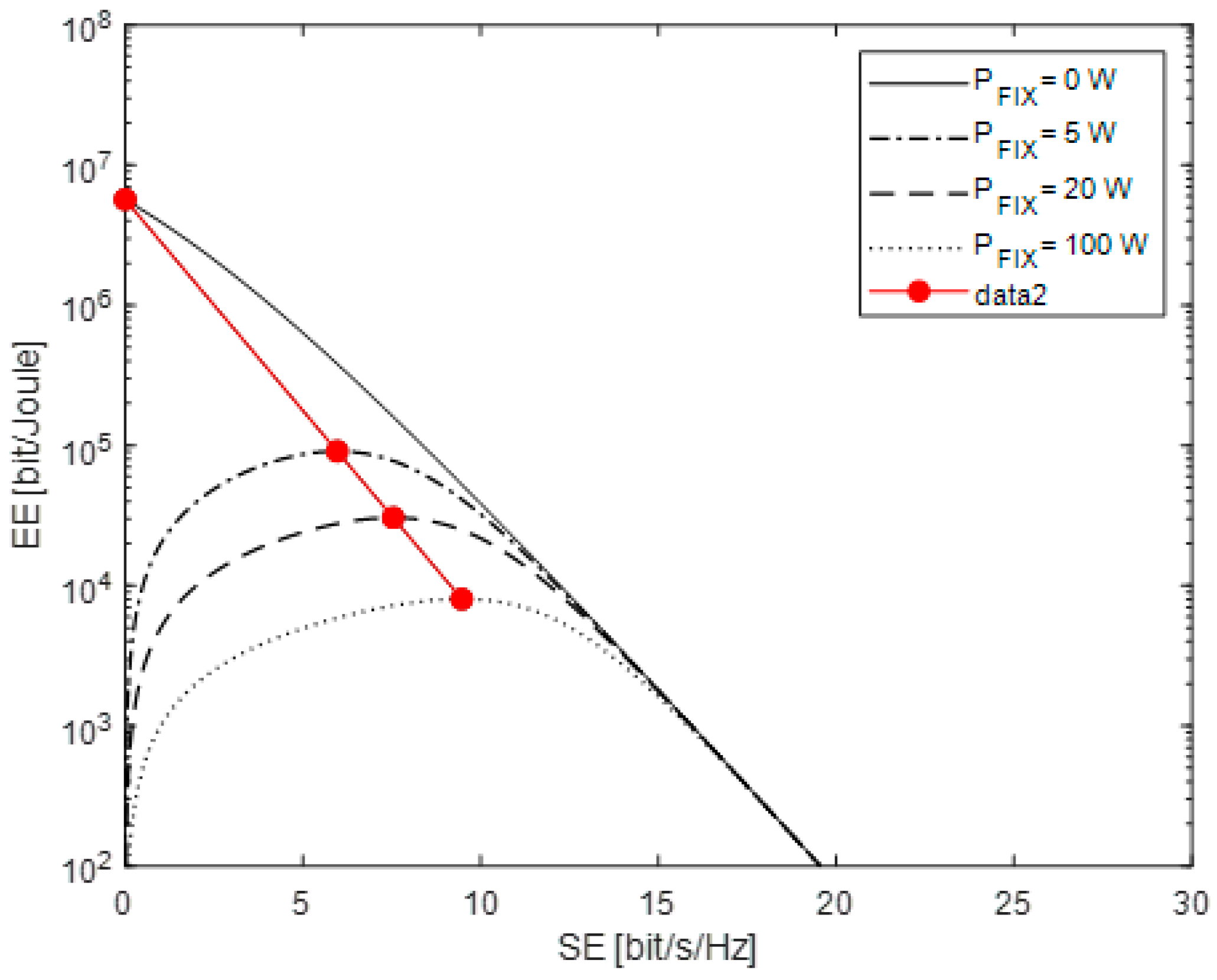
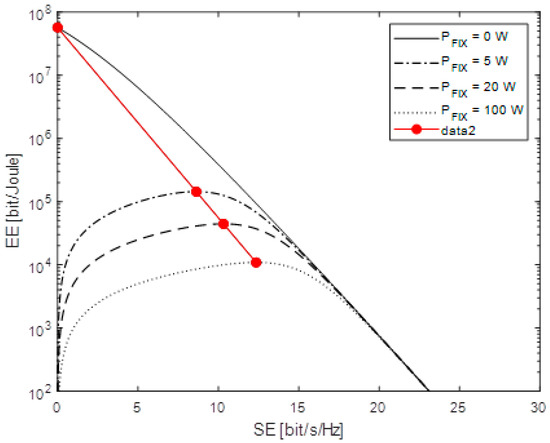
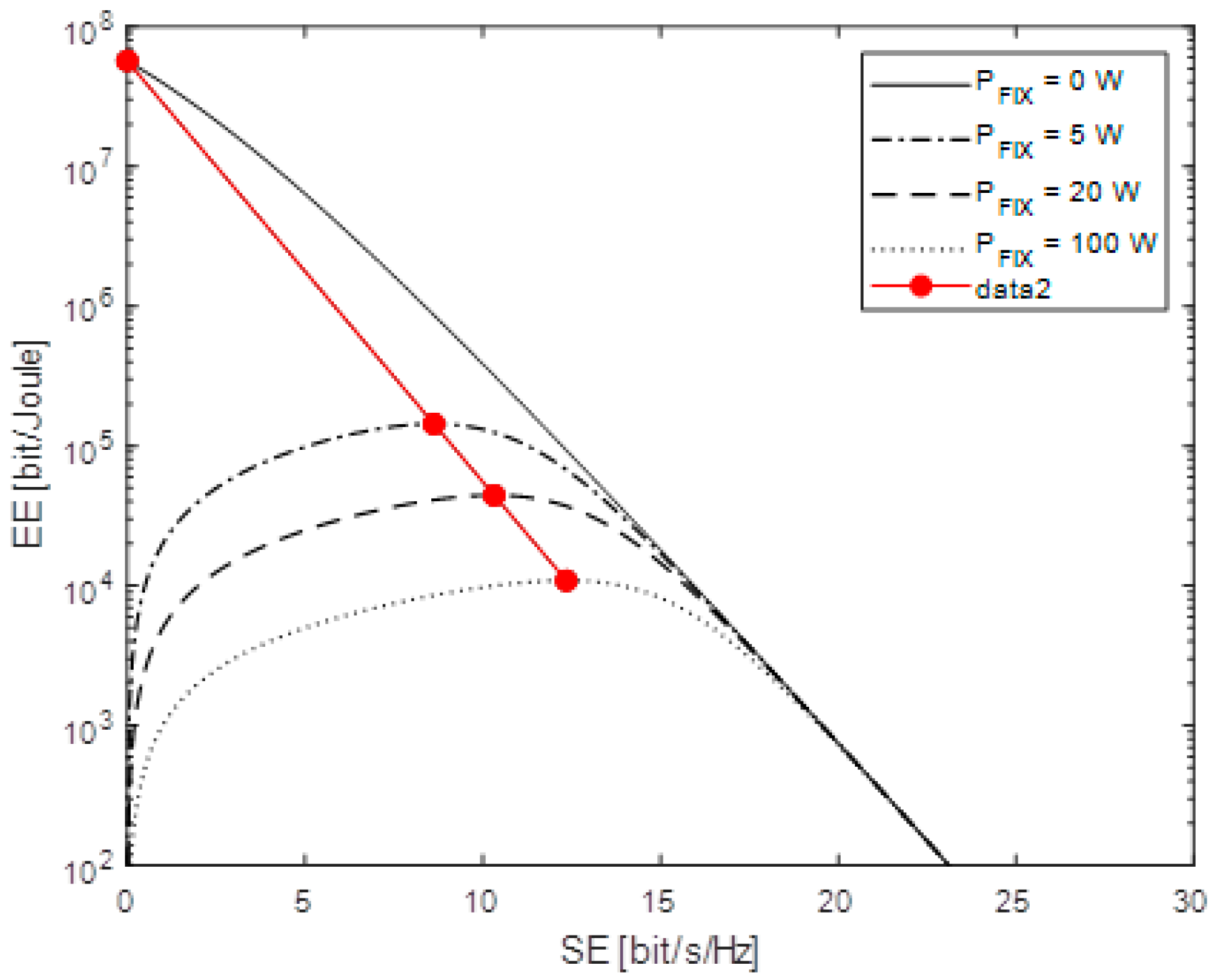
When SE0 takes greater values, Figure 3 shows the EE versus SE for M = 100, B = 100 KHz, σ2/β00 = −6 dBm, μ = 0.1, and PFIX ∈ (0, 5, 20, 100) W. Figure 3 further demonstrates how the EE–SE curve flattens as the PFIX levels rise, enabling a larger range of SE values to achieve almost the same EE. Equation (2) involves taking the derivative of EE0 with respect to SE0 and equating it to zero in order to have an analytical comprehension of the EE-optimal position. To determine the operating point that provides the best balance between EE and SE, this work analyzes the first-order derivative of the EE function with respect to the transmit power. Instead of using exhaustive search or iterative optimization algorithms, the derivative is employed to identify the transmit power at which EE reaches its maximum value.
Figure 3.
Using M = 100, B = 100 kHz, σ2/β00 = −6 dBm, and μ = 0.1, the SE and EE relationships in (4) for different CP = PFIX values are presented. The red dots indicate where on each curve EE0 achieves its maximum.
The EE is defined as
where Pt is the transmit power, PC is the total circuit power consumption, B is the system bandwidth, and SE(Pt) denotes the achievable SE as a function of the transmit power. The optimal operating point is obtained by differentiating the EE expression with respect to the transmit power,
The optimal transmit power Pt is determined by satisfying
This condition identifies the point where any additional increase in the transmit power no longer produces a proportional increase in the spectral efficiency. Beyond this point, the additional consumed power exceeds the achievable throughput gain, causing the overall energy efficiency to decrease. Therefore, the first-order derivative is not proposed as a new optimization algorithm but rather as an analytical tool for identifying the energy-efficient operating point of the Massive MIMO system. This derivative-based analysis is subsequently combined with MMSE CE and different linear combining schemes (MR, ZF, RZF, S-MMSE, and Massive MMSE) to investigate their influence on the EE–SE trade-off under various antenna configurations and user densities. When SE0 takes greater values, Figure 4 shows the EE versus SE for M = 100, B = 100 KHz, σ2/β00 = −6 dBm, μ = 1, and PFIX ∈ (0, 5, 20, 100) W. Figure 4 further demonstrates how the EE–SE curve flattens as the PFIX levels rise, enabling a larger range of SE values to achieve a nearly identical EE. We accept the derivative of EE0 in (7) with regard to SE0 and equal it with zero in order to have an analytical comprehension of the EE-optimal position.
Figure 4.
SE and EE connection in (4) for distinct CP = PFIX values when μ = 1, M = 100, B = 100 kHz, and σ2/β00 = −6 dBm. The red dots indicate the locations on each curve where EE0 reaches its maximum.
We observe that the following identity is met by the maximum EE (referred to as EE*) and its equivalent SE (referred to as SE*):
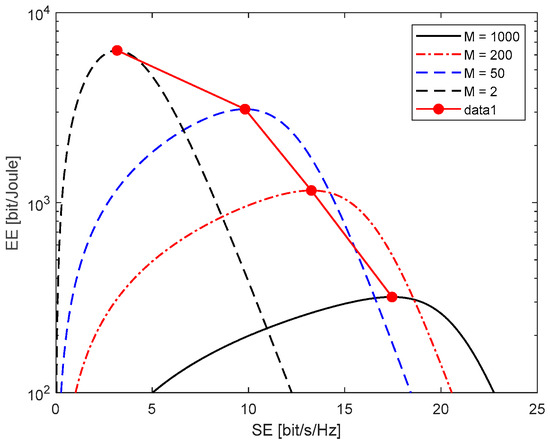
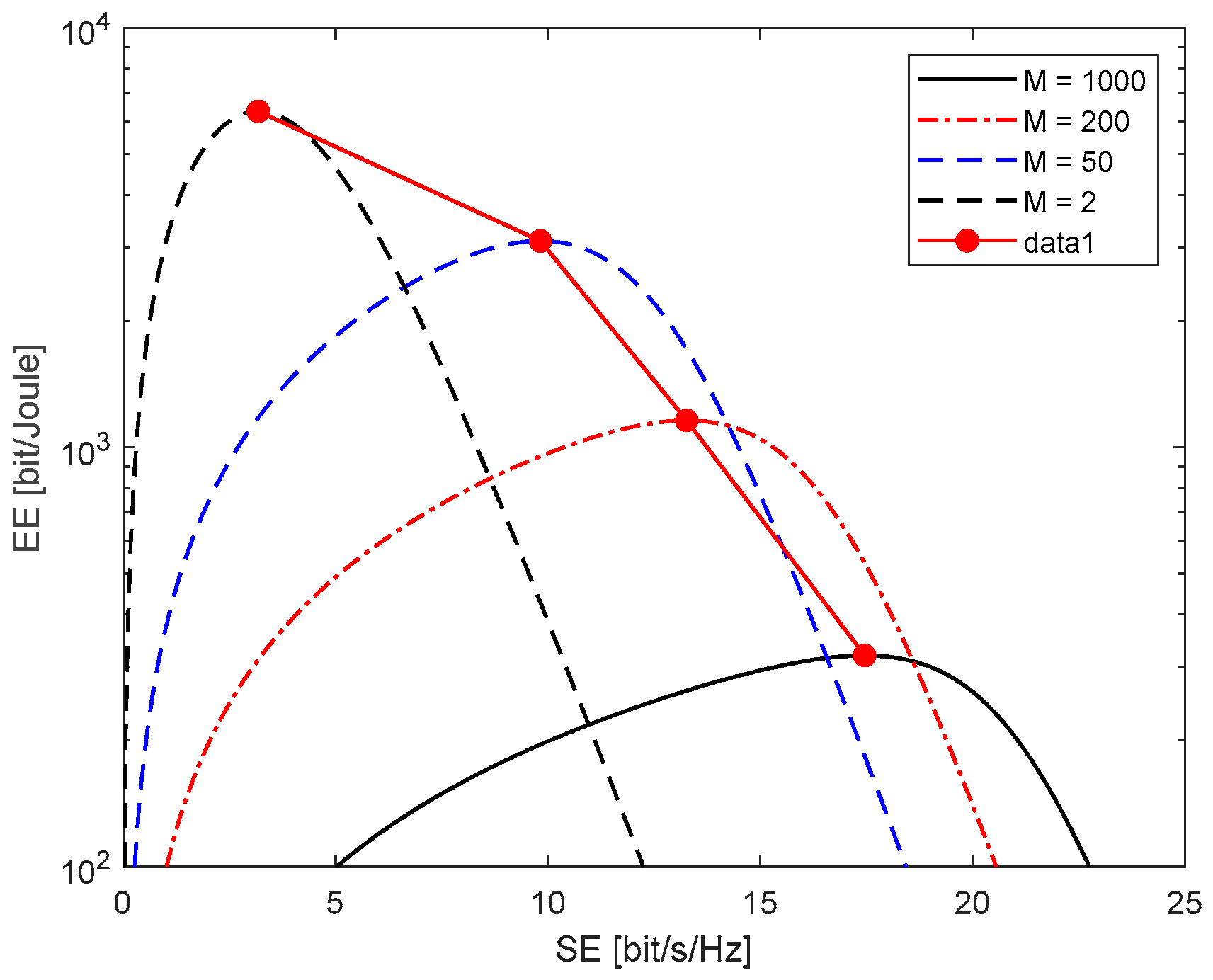
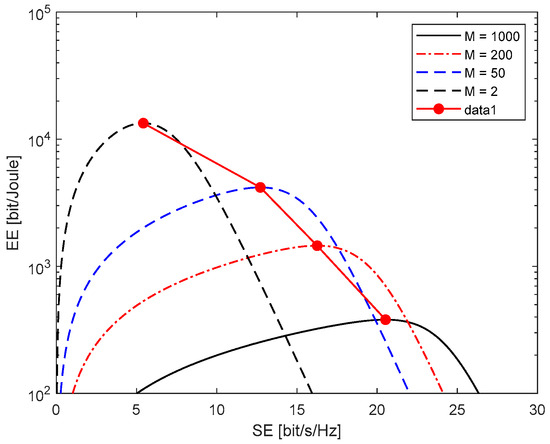
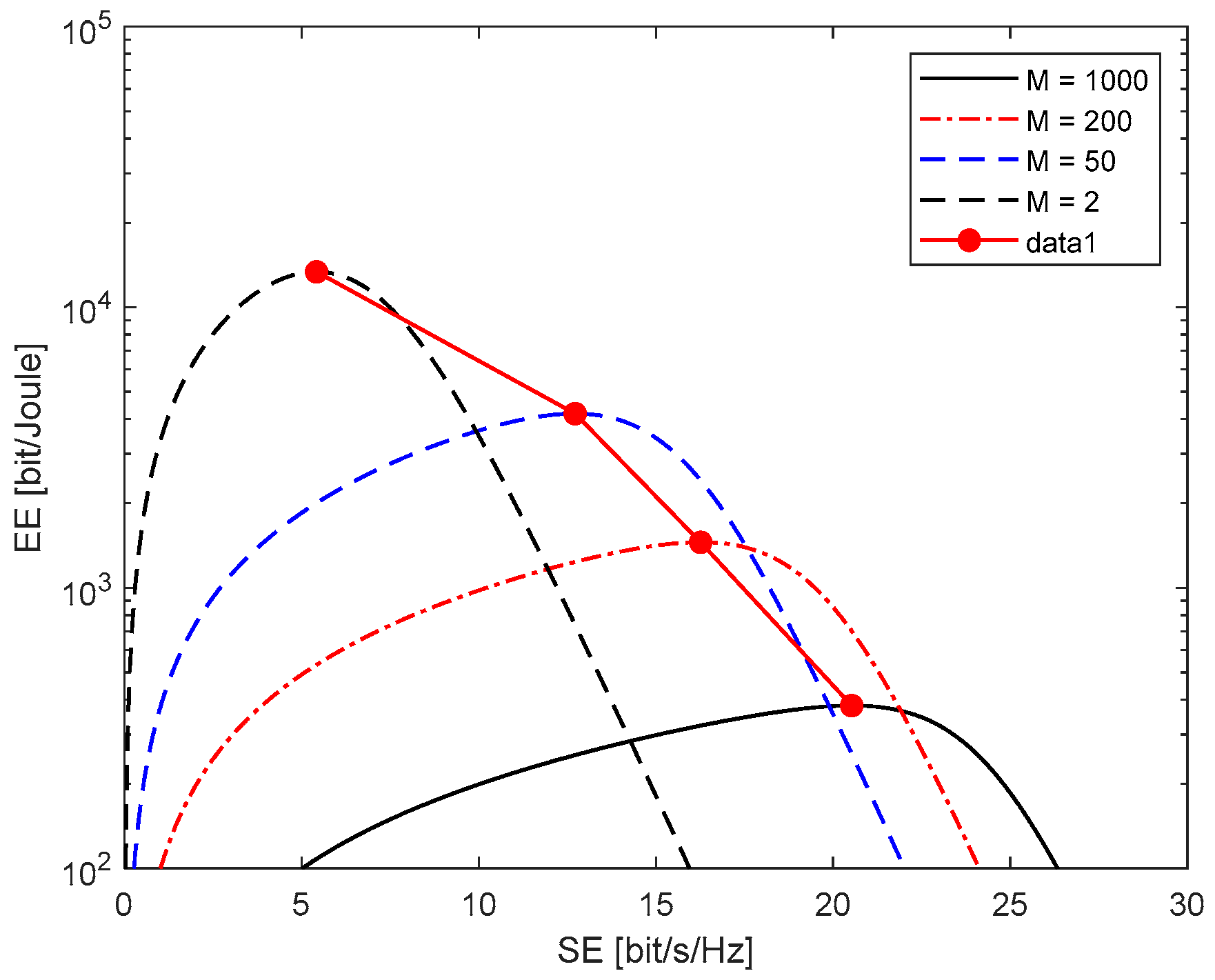
The identity (8) shows that log2(EE*) and SE* have a linear connection. This reliance is depicted as a red trade-off line in Figure 3. This suggests that a linear SE loss may be incurred in order to get an exponential EE gain, as seen in Figure 3 and Figure 4. This can be clarified as follows: a higher PFIX allows for increased SE prior to transmitting power (2SE*− 1), and (M − 1)/Vn in (8) becomes a limiting factor for EE. The effect of M for PFIX = 20 W, B = 100 kHz, σ2/β00 = −6 dBm, and μ = 0.1 is displayed in Figure 5. As the data indicate, both EE and SE increase with M. Both SE* and EE* increase as M increases. If the CP fails to take into consideration the extra power used by numerous antennas, this happens improperly. The red dots show the locations on each curve where the EE peaks. Figure 6 illustrates the impact of M, for PFIX = 20 W, B = 100 kHz, σ2/β00 = −6 dBm, and μ = 1. As the data indicate, both EE and SE grow with M. Both SE* and EE* increase as M increases. If the CP fails to account for the additional power required by numerous antennas, this happens improperly. The red dots show the locations on each curve where the EE peaks. We investigated the potential benefits of SDMA for EE by examining the two-cell Wyner model with K single-antenna UEs in each cell and their respective strength β = β01/β00 = β01/β11 of inter-cell interference. Next, if MR combining is employed at the base station with flawless channel expertise, there is a UL SE for every UE.
Figure 5.
EE and SE connection in (4) for various M values for PFIX = 20 W, B = 100 kHz, σ2/β00 = −6 dBm, and μ = 0.1.
Figure 6.
EE and SE relation in (4) for various M values when B = 100 kHz, σ2/β00 = −6 dBm, and PFIX = 20 W.
Cell 0’s matching EE is:
We have assumed that the sum SE in cell 0 is KSE0 and that the overall transmit power is (1/μ) p. To take into consideration the extra CP utilized by every active UE, we have estimated that:
where PUE takes into consideration the electricity needed by the circuit components (DAC, mixer, and filter) of each unique antenna UE. By calculating EE0’s derivative with respect to SE0 in Equation (8) and equating it to zero, the following expression is produced:
It produces the SE*, which optimizes the EE. The outcome of inserting this phrase into (8) is:
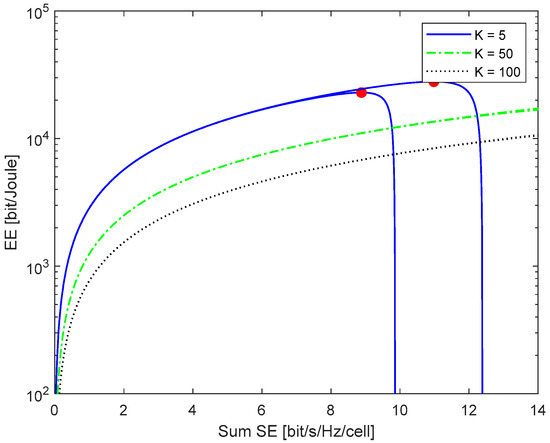
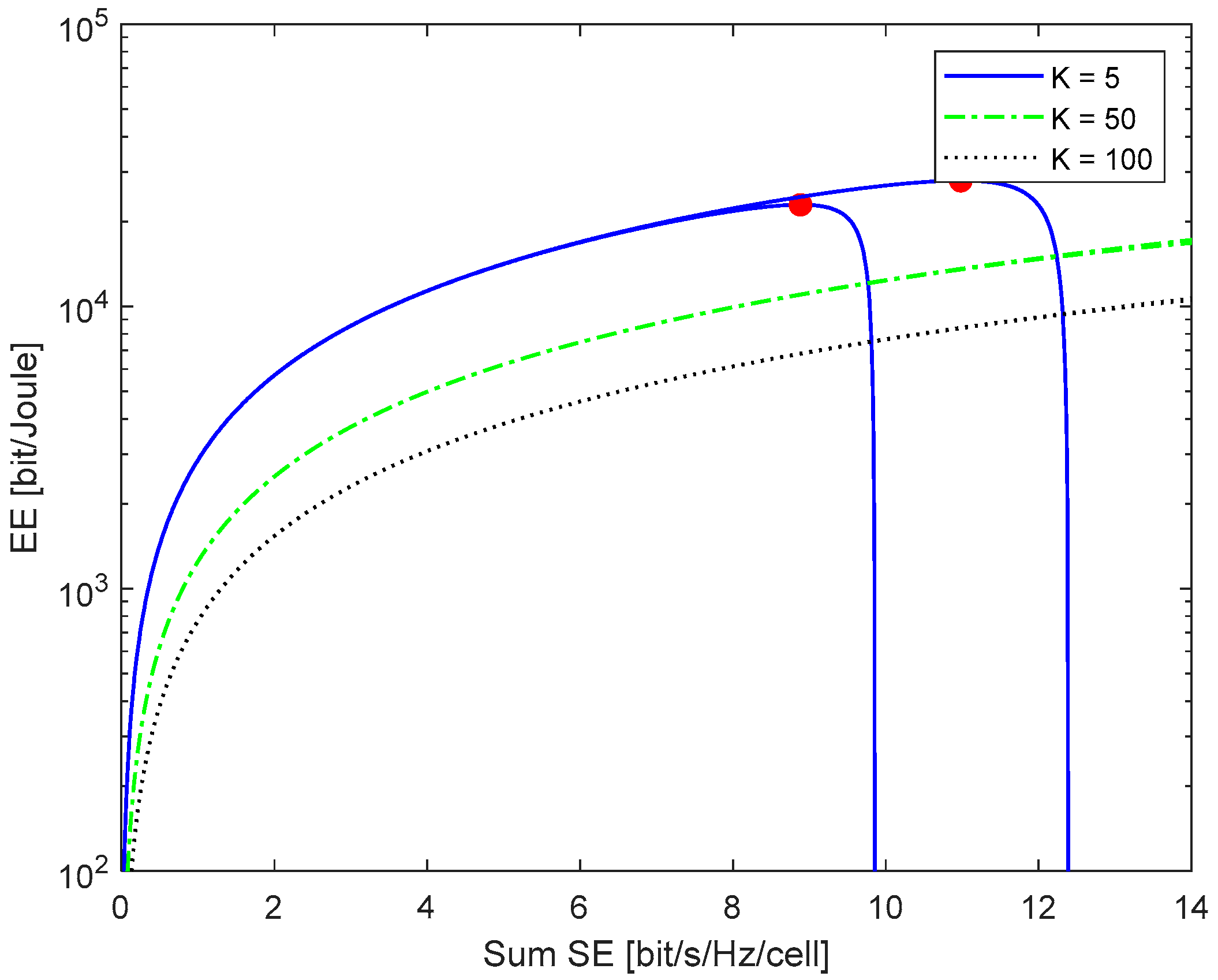
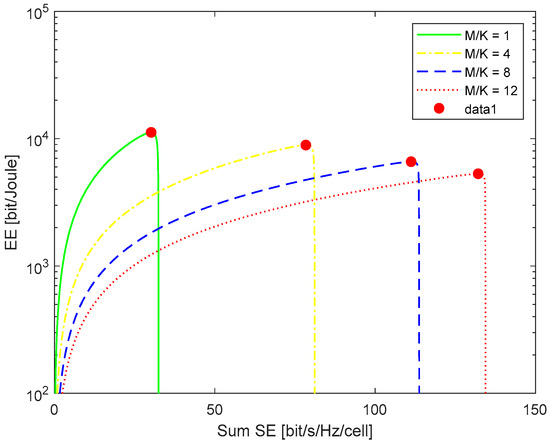
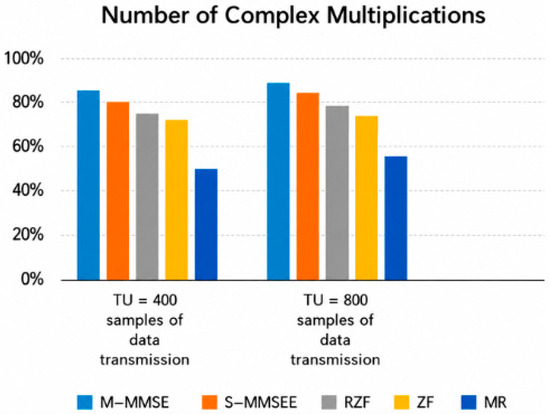
With the exception of the additional factors brought on by intra- and inter-cell interference, the formula in (14) is comparable to Equation (9). In contrast to Equation (10), interference prevents the solution of Equation (15) from being provided in closed form. Here, we measure how the EE–SE trade-off is affected by the number of UEs K and the inter-cell interference’s relative strength (β). The EE of cell 0 is shown in Figure 7 as a function of the sum SE for K = {5, 50, 100} and β = −15 dB or −3 dB. Additionally, M = 10, B = 100 kHz, μ2/β0 = −6 dBm, μ = 0.1, PFIX = 10 W, PBS = 5 W, and PUE = 1 W are the assumed values. EE and SE are negatively impacted by increasing β because the inter-cell interference factor K β in Equation (9) grows linearly with β. In contrast, the EE*–SE* trade-off curve is a unimodal function of K; for the given setup, K = 50 delivers the maximum value. This is due to the fact that, in the case of M = 10, each additional UE boosts the PC by PUE = 1 W, while the sum SE is a steadily growing function of K. For a certain total SE, the degradation in EE increases as K or β increases. Figure 8 displays the EE of cell 0 for various antenna–UE ratio M/K settings at K = 40. The sum SE in Figure 8 increases monotonically with the ratio of antenna to UE M/K, but a unimodal function of M/K is EE*. For the arrangement under consideration, it increases until M/K = 4, after which it gradually falls as M/K increases. In conclusion, maintaining a large number of UEs while expanding the quantity of BS antennas could enhance the network EE if the costs and advantages of deploying more RF hardware are suitably balanced. Compared to Massive MMSE and other techniques, Figure 9 demonstrates that shortening a coherence block from 800 to 400 samples decreases the complexity by 5–10%.
Figure 7.
BER versus SE for different values of K. The red dots indicate the specific SE values corresponding to the marked points on the K = 5 curve. Add up the SE and EE relation in Equation (11) for distinct values of the inter-cell interference β when M = 10, PFIX = 10 W, PBS = 5 W, PUE = 1 W, B = 100 kHz, σ2/β00 = −6 dBm, and μ = 0.1.
Figure 8.
When K = 40, β = −10 dB, PFIX = 10 W, PBS = 5 W, PUE = 1 W, B = 100 kHz, σ2/β00 = −6 dBm, and μ = 0.1, add up the SE and EE relations in (11) for different antenna–UE ratio M/K values.
Figure 9.
The quantity of complicated multiplications for various schemes.
3. Discussion
This study investigated the EE and SE trade-off in downlink Massive MIMO systems by considering the effects of CE, antenna deployment, user scheduling, and power consumption. A comprehensive analysis was conducted to evaluate how the number of base station antennas, active user equipment, transmit power, and circuit power influence system performance. The results demonstrate that increasing the number of base station antennas can significantly improve the spectral efficiency by enhancing the spatial multiplexing capability and reducing interference. However, the improvement in energy efficiency depends on achieving an appropriate balance between the SE gain and the additional circuit power required by the increased hardware complexity. The obtained results indicate that an optimum antenna-to-user ratio exists, where the maximum EE can be achieved while maintaining high SE performance. Furthermore, the comparison of different combining techniques shows that MMSE-based CE and combining provide superior spectral efficiency performance compared with the MR, ZF, and RZF schemes, although this improvement comes with increased computational complexity. The complexity analysis confirms that simpler methods, such as MR and ZF, require fewer computational resources, while MMSE approaches provide better performance under realistic channel conditions. The proposed analysis of the EE–SE trade-off demonstrates that the system parameters, including the circuit power, interference level, and the number of served users, have a significant impact on the optimal operating point. Therefore, future Massive MIMO deployments should consider joint optimization of antenna selection, power allocation, and CE accuracy to achieve efficient operation. Overall, this work provides useful insights into the design of energy- and spectrum-efficient Massive MIMO networks and highlights the importance of balancing the hardware complexity, CE accuracy, and achievable system capacity in future 5G and beyond wireless communication systems. Despite the obtained improvements in EE and SE, this study has some limitations. This analysis mainly considers idealized channel conditions and does not fully address practical impairments such as hardware nonlinearities, mobility effects, synchronization errors, and advanced pilot contamination scenarios. In addition, the computational complexity of MMSE-based CE and combining remains a challenge for large-scale real-time implementations. The comparison is conducted under identical simulation parameters, including the number of BS antennas, the number of active users, transmit power, bandwidth, and channel conditions. The results demonstrate how each combining scheme performs under the same operating conditions and identify the scenarios in which MMSE CE provides superior EE–SE performance despite its higher computational complexity as shown in Table 2. To provide a quantitative comparison of the considered combining schemes, Table 2 reports their SE, EE, and computational complexity under an identical reference configuration. The results confirm that MR provides the lowest computational complexity, whereas ZF and RZF provide higher SE by mitigating intra-cell interference. S-MMSE and M-MMSE achieve further performance gains by exploiting additional interference and channel information, but their increased matrix-processing requirements result in higher computational complexity. Consequently, the highest SE does not necessarily correspond to the highest EE, particularly when the computational complexity and associated energy consumption are taken into account.
Table 2.
Combining schemes.
4. Materials and Methods
4.1. System Model
A multi-cell downlink Massive MIMO system is considered, where each BS is equipped with M antennas and simultaneously serves K single-antenna UEs. The wireless channel is assumed to experience independent Rayleigh fading, and CSI is obtained through pilot-based transmission using MMSE CE. This study considers both intra-cell and inter-cell interference in evaluating the system performance. The received signal at the k-th user can be expressed as:
where hk denotes the channel vector, x is the transmitted signal, and nk represents additive white Gaussian noise.
4.2. Channel Estimation (CE)
Pilot symbols are transmitted during the CE phase to estimate the propagation channel between the BS and each UE. The MMSE estimator is adopted because it effectively minimizes the mean square estimation error while exploiting the second-order channel statistics. The estimated channel is expressed as
where R is the channel covariance matrix, pp denotes the pilot transmit power, Yp is the received pilot signal, and σ2 is the noise variance. The estimated CSI is subsequently employed for the implementation of the MR, ZF, RZF, S-MMSE, and M-MMSE combining schemes.
4.3. Energy and Spectral Efficiency Analysis
The spectral efficiency (SE) is computed according to Shannon’s capacity expression as
where SINR denotes the signal-to-interference-plus-noise ratio.
The EE is defined as
where the total power consumption includes the transmit power, fixed circuit power, BS hardware power, and UE circuit power.
EE = Throughput Total/Power Consumption
4.4. EE–SE Optimization
The objective of the proposed analysis is to identify the operating point that maximizes EE while maintaining a high SE. This optimization is formulated as
subject to transmit power limits, antenna constraints, and user scheduling constraints. The optimization investigates the influence of the transmit power, number of BS antennas, number of users, and inter-cell interference on the achievable EE–SE trade-off.
4.5. Performance Evaluation Procedure
The overall analysis consists of the following steps:
- Generate a multi-cell Massive MIMO network with the parameters listed in Table 1.
- Estimate the wireless channel using MMSE estimation.
- Apply the MR, ZF, RZF, S-MMSE, and M-MMSE combining techniques.
- Compute the achievable SINR for each user.
- Calculate the spectral efficiency.
- Compute the corresponding energy efficiency by including the transmit and circuit power consumption.
- Repeat the simulations for different values of M, K, transmit power, and interference levels.
- Compare the EE–SE trade-offs of all combining schemes.
5. Conclusions
From a practical perspective, the results provide useful guidelines for designing Massive MIMO networks by identifying the appropriate balance between the number of antennas, active users, transmit power, and circuit power consumption. The findings can assist network designers in selecting efficient antenna configurations and CE techniques to achieve improved energy and spectrum utilization in future cellular networks. A cellular network’s EE, which quantifies the quantity of bits that are effectively transferred per unit of energy (bit/Joule), is a helpful metric for striking a balance between power consumption and throughput. When a commensurate number of antennas (M) are used to prevent growing interference, multiplexing K UEs per cell leads to significant SE improvements. Increasing the number of antennas increases the network’s SE and CP, making it hard to achieve a comparable result for EE. At a particular antenna–UE ratio (M/K), the EE is at its greatest. In our study, we successfully improved the SE per cell inside a Massive MIMO system framework by applying several combining and pre-coding approaches along with MMSE CE. Due to its greater potential for raising the average sum of the SE per cell, the channel estimator was selected above S−MMSE MR, RZF, and ZF. Our research used MMSE CE, which outperformed the MR, RZF, and ZF estimators in terms of SE per cell despite its processing cost. All combining strategies become more complex when additional UEs and BS antennas are added. The most complex is the Massive MMSE, which is followed by S-MMSE, RZF, ZF, and MR, in that order.
Future work will focus on extending the proposed EE–SE optimization framework to emerging Internet of Things (IoT) and Industrial Internet of Things (IoT) networks, where Massive MIMO is expected to support massive device connectivity while satisfying stringent energy efficiency, reliability, and latency requirements. In particular, integrating channel-aware decision fusion techniques with Massive MIMO can improve distributed sensing and data aggregation performance in dense IoT deployments [27]. Furthermore, investigating adaptive CE, machine learning-assisted resource allocation, and joint communication and sensing techniques may further enhance the scalability and efficiency of next-generation wireless systems. Another promising research direction is the integration of the proposed framework with reconfigurable intelligent surfaces (RISs), cell-free Massive MIMO, and extremely large-scale MIMO (XL-MIMO) architectures for beyond-5G and 6G networks. These extensions could provide additional improvements in coverage, spectral efficiency, and energy efficiency while supporting the diverse requirements of future intelligent wireless applications [28].
Funding
This research received no external funding.
Data Availability Statement
The results presented in this study were obtained through simulations based on the system model and parameters described in the manuscript. The simulation data and codes are available from the corresponding author upon reasonable request.
Acknowledgments
The author would like to thank Palestine Technical University Kadoorie (PTUK) for funding this research.
Conflicts of Interest
The author declares no conflicts of interest.
Abbreviations
| 5G | Fifth-Generation Mobile Network |
| 6G | Sixth-Generation Mobile Network |
| CE | Channel Estimation |
| BS | Base Station |
| BDN | Bidirectional Dynamic Network |
| CP | Circuit Power |
| CSI | Channel State Information |
| CSIT | Channel State Information at the Transmitter |
| DAC | Digital-to-Analog Converter |
| DL | Downlink |
| DTDD | Dynamic Time Division Duplex |
| EE | Energy Efficiency |
| EE* | Maximum Energy Efficiency |
| ELAA | Extremely Large Aperture Array |
| FBMC | Filter Bank Multicarrier |
| FBMC-OQAM | Filter Bank Multicarrier with Offset Quadrature Amplitude Modulation |
| GA | Genetic Algorithm |
| LoS | Line-of-Sight |
| LTE | Long-Term Evolution |
| Ma-MIMO | Massive Multiple-Input Multiple-Output |
| MIMO | Multiple-Input Multiple-Output |
| M-MMSE | Multi-cell Minimum Mean Square Error |
| MMSE | Minimum Mean Square Error |
| MRC | Maximum Ratio Combining |
| MR | Maximum Ratio |
| MRT | Maximum Ratio Transmission |
| NBI-PSO | Normal Boundary Intersection–Particle Swarm Optimization |
| NLoS | Non-Line-of-Sight |
| OFDM | Orthogonal Frequency Division Multiplexing |
| Pareto | Pareto Optimality |
| PC | Power Consumption |
| PFIX | Fixed Circuit Power |
| PBS | Base Station Circuit Power |
| QoS | Quality of Service |
| RE | Resource Efficiency |
| RF | Radio Frequency |
| RIS | Reconfigurable Intelligent Surface |
| RZF | Regularized Zero Forcing |
| SCA | Small Cell Access |
| SDMA | Space Division Multiple Access |
| SE | Spectral Efficiency |
| SE* | Spectral Efficiency at Maximum EE |
| SEE | Secrecy Energy Efficiency |
| SINR | Signal-to-Interference-plus-Noise Ratio |
| S-MMSE | Single-cell Minimum Mean Square Error |
| SSE | Secrecy Spectral Efficiency |
| UL | Uplink |
| UE | User Equipment |
| WS-PSO | Weighted Sum Particle Swarm Optimization |
| XL-MIMO | Extremely Large-Scale Multiple-Input Multiple-Output |
| ZF | Zero Forcing |
References
- Björnson, E.; Hoydis, J.; Sanguinetti, L. Massive MIMO Networks: Spectral, Energy, and Hardware Efficiency. In Foundations and Trends® in Signal Processing; Now Publishers Inc.: Hanover, MA, USA, 2017; Volume 11, pp. 154–655. [Google Scholar]
- Bjornson, E.; Larsson, E.G.; Debbah, M. Optimizing Multi-Cell Massive MIMO for Spectral Efficiency: How Many Users Should Be Scheduled? In Proceedings of the IEEE Global Conference on Signal and Information Processing (Global SIP), Atlanta, GA, USA, 3–5 December 2014. [Google Scholar]
- Al-nahari, A.; Sakran, H.; Su, W.; Tarbosh, S. Energy and spectral efficiency of secure massive MIMO downlink systems. IET Commun. 2019, 13, 1364–1372. [Google Scholar] [CrossRef] [Scilit]
- You, L.; Xiong, J.; Wang, W.; Gao, X. Spectral Efficiency and Energy Efficiency Tradeoff in Massive MIMO Downlink Transmission with Statistical CSIT. IEEE Trans. Signal Process. 2019, 68, 2645–2659. [Google Scholar] [CrossRef] [Scilit]
- Rayi, P.; Prasad, M.V.S. Optimization of Energy and Spectral Efficiency of Massive MIMO-Small Cell System. In Proceedings of the 2015 International Conference on Smart Technologies and Management for Computing, Communication, Controls, Energy and Materials (ICSTM), Avadi, India, 6–8 May 2015. [Google Scholar]
- Salah, I.; Mourad, M.; Rahouma, K.; Hussein, A. Energy efficiency optimization in adaptive massive MIMO networks for 5G applications using genetic algorithm. Opt. Quantum Electron. 2022, 54, 1–11. [Google Scholar] [CrossRef] [Scilit]
- Misso, A. Enhanced resource allocation strategies to improve the spectral efficiency in massive MIMO systems. J. Electr. Syst. Inf. Technol. 2024, 11, 2–16. [Google Scholar] [CrossRef] [Scilit]
- Liu, Z.; Du, W.; Sum, D. Energy and spectral efficiency tradeoff for massive MIMO systems with transmit antenna selection. IEEE Trans. Veh. Technol. 2016, 66, 4453–4457. [Google Scholar] [CrossRef] [Scilit]
- Jose, F.; Lolis, L.; Mafra, S.; Ribeiro, E. Spectral Efficiency Analysis in Massive MIMO using FBMC-OQAM Modulation. J. Microw. Optoelectron. Electromagn. Appl. 2018, 17, 1–10. [Google Scholar] [CrossRef] [Scilit]
- Arshad, J.; Rehman, A.; Rehman, A.U.; Ullah, R.; Hwang, S.O. Spectral Efficiency Augmentation in Uplink Massive MIMO Systems by Increasing Transmit Power and Uniform Linear Array Gain. Sensors 2020, 20, 4982. [Google Scholar] [CrossRef] [Scilit] [PubMed]
- Chien, T.; Bjornson, E.; Larsson, E.G. Sum Spectral Efficiency Maximization in Massive MIMO Systems: Benefits from Deep Learning. In Proceedings of the IEEE International Conference on Communications (ICC), Shanghai, China, 20–24 May 2019. [Google Scholar]
- Lv, Q.; Li, J.; Zhu, P.; You, X. Spectral Efficiency Analysis for Bidirectional Dynamic Network with Massive MIMO under Imperfect CSI. IEEE Access 2018, 6, 43660–43671. [Google Scholar] [CrossRef] [Scilit]
- Naraiah, R.; Tiwarib, M.; Krishna, P.; González, A. Spectral Efficiency Improvement Techniques in Massive MIMO for 5G Communications. Turk. J. Comput. Math. Educ. 2021, 12, 1457–1465. [Google Scholar] [CrossRef] [Scilit]
- Hasan, W.; Harris, P.; Doufexi, A.; Beach, M. Real-Time Maximum Spectral Efficiency for Massive MIMO and Its Limits. IEEE Access 2018, 6, 46122–46133. [Google Scholar] [CrossRef] [Scilit]
- Rajmane, R.S.; Sudha, V. Spectral Efficiency Improvement in Massive MIMO Systems. In Proceedings of the TEQIP III Sponsored International Conference on Microwave Integrated Circuits, Photonics and Wireless Networks (IMICPW), Tiruchirappalli, India, 22–24 May 2019. [Google Scholar]
- Zgang, X.; Qi, H.; Zhang, X.; Han, L. Spectral Efficiency Improvement and Power Control Optimization of Massive MIMO Networks. IEEE Access 2021, 9, 11523–11532. [Google Scholar] [CrossRef] [Scilit]
- Elijah, O.; Rahmim, S.A.; New, W.; Leow, H.; Cumanan, K.; Geok, T. Intelligent Massive MIMO Systems for Beyond 5G Networks: An Overview and Future Trends. IEEE Acess 2022, 10, 102532–102563. [Google Scholar] [CrossRef] [Scilit]
- Al-Muttairi, A.; Ameen, M. Eight-Element MIMO System for Future 5G Applications Based on Modified Rectangular Slot with Enhanced Isolation. Int. J. Commun. Antenna Propag. IRECAP 2024, 14, 303–312. [Google Scholar] [CrossRef] [Scilit]
- Mustika, S.; Muladi, M.; Widiyaningtyas, T. Systematic Literature Review MIMO Capacity Maximization in RIS. Int. J. Commun. Antenna Propag. IRECAP 2025, 15, 90–111. [Google Scholar] [CrossRef] [Scilit]
- Castillo, M.; Altamirano, C.; Orozco, N. Extremely Large Aperture Arrays Simulator for Calculating the IRF in Practical Scenarios for Massive MIMO Systems. Int. J. Commun. Antenna Propag. IRECAP 2023, 134, 311–323. [Google Scholar] [CrossRef] [Scilit]
- Ezekiel, A.E.; Okafor, K.C.; Tersoo, S.T.; Alabi, C.A.; Abdulsalam, J.; Imoize, A.L.; Jogunola, O.; Anoh, K. Enhanced Energy Transfer Efficiency for IoT-Enabled Cyber-Physical Systems in 6G Edge Networks with WPT-MIMO-NOMA. Technologies 2024, 12, 119. [Google Scholar] [CrossRef] [Scilit]
- Sharma, S.; Yoon, W. Energy-Efficient User Association with Multi-Objective Optimization for Full-Duplex C-RAN Enabled Massive MIMO Systems. Electronics 2025, 14, 4197. [Google Scholar] [CrossRef] [Scilit]
- Lee, B.M. Leveraging Massive MIMO for Enhanced Energy Efficiency in High-Density IoT Networks. Mathematics 2024, 12, 3539. [Google Scholar] [CrossRef] [Scilit]
- Vaziri, A.; Moghaddam, P.S.; Shoeibi, M.; Kaveh, M. Energy-Efficient Secure Cell-Free Massive MIMO for Internet of Things: A Hybrid CNN–LSTM-Based Deep-Learning Approach. Future Internet 2025, 17, 169. [Google Scholar] [CrossRef] [Scilit]
- Choi, Y.-J.; Yu, J.-H.; Seo, S.-H.; Choi, S.-G.; Jeong, H.-Y.; Kim, J.-E.; Baek, M.-S.; You, Y.-H.; Song, H.-K. CNN-Based End-to-End CPU-AP-UE Power Allocation for Spectral Efficiency Enhancement in Cell-Free Massive MIMO Networks. Mathematics 2025, 13, 1442. [Google Scholar] [CrossRef] [Scilit]
- Daraghma, R. Impact of Hardware Impairments in Multi-Cell Massive MIMO for 5G Networks. In Proceedings of the 13th International Conference on Electrical and Electronics Engineering (ICEEE), Antalya, Turkey, 27–29 April 2026. [Google Scholar]
- Lee, B.M.; Yang, H. Massive MIMO with Massive Connectivity for Industrial Internet of Things. IEEE Trans. Ind. Electron. 2019, 67, 5297–5306. [Google Scholar] [CrossRef] [Scilit]
- Ciuonzo, D.; Salvo Rossi, P.; Dey, S. Massive MIMO Channel-Aware Decision Fusion. IEEE Trans. Signal Process. 2015, 63, 604–619. [Google Scholar] [CrossRef] [Scilit]

Disclaimer/Publisher’s Note: The statements, opinions and data contained in all publications are solely those of the individual author(s) and contributor(s) and not of MDPI and/or the editor(s). MDPI and/or the editor(s) disclaim responsibility for any injury to people or property resulting from any ideas, methods, instructions or products referred to in the content. |
© 2026 by the author. Licensee MDPI, Basel, Switzerland. This article is an open access article distributed under the terms and conditions of the Creative Commons Attribution (CC BY) license.