


Highlights
Please indicate how your work links to systems science via your contributions to systems practice, theory, and or methodology.
- •
- This study adopts a systems perspective by considering public health interventions as embedded in wider healthcare systems, with effects extending across interconnected clinical, social, economic, and environmental dimensions
- •
- It contributes to systems methodology by integrating benefit categories, valuation approaches, and institutional VSL references into a structured decision-support framework.
What are the main findings and/or the implications of the main findings?
- •
- The analysis identified 14 recurring categories of intangible benefits in public health cost–benefit analysis and systematized the principal approaches used to assign them monetary values.
- •
- Official guidance addresses intangible benefits unevenly, often identifying them indirectly through valuation methods rather than through a structured benefit framework, limiting consistency across appraisals.
Abstract
Cost–benefit analysis (CBA) is a primary tool for appraising public investments, yet its reliability weakens when interventions generate benefits that are intangible and difficult to monetize. The challenge is acute in public health, where outcomes such as reduced mortality and morbidity, improved quality of life, and greater accessibility rarely have market prices and are therefore often omitted or inconsistently valued. Official CBA guidelines acknowledge these effects but treat them in a fragmented and largely indirect manner, offering limited consolidated guidance on their identification and monetary valuation. This study addresses that gap through a structured comparative analysis of a corpus of 18 official CBA guidance documents issued by governments and international organizations. The resulting methodological reference framework integrates three components: a structured classification of the intangible benefits recurrently associated with health interventions, a systematization of the methodological approaches used for their monetization, and a comparative overview of the use of the value of a statistical life across regulatory contexts. An illustrative correspondence between benefit categories and monetization approaches is derived, indicative rather than prescriptive, since the appropriate technique depends on the intervention, the data available, and the institutional setting. By consolidating guidance currently dispersed across institutional documents, the framework supports more transparent and comparable appraisals of interventions dominated by non-market effects.
1. Introduction
Cost–benefit analysis (CBA) is one of the principal tools for appraising public investments in the infrastructure, environmental, and social sectors. Because it expresses costs and benefits in monetary terms, it can place otherwise heterogeneous projects on a common scale and compare them directly. This becomes problematic when a project’s main effects resist monetization, as is the case for public health interventions. Investments in healthcare services, prevention, access to care, and the organization of territorial healthcare are undertaken largely for outcomes that carry no market price, such as reduced mortality and morbidity, improved quality of life, and broader social well-being. When these effects are left out because they are hard to quantify, the appraisal reflects only part of a project’s social value, and the comparison it supports is correspondingly incomplete.
The difficulty is not only technical. Assigning a monetary value to a life saved or to an improvement in health raises ethical and theoretical objections that remain unresolved [1,2,3,4], and a recurring concern is that evaluators respond by leaving hard-to-quantify benefits out of the analysis, reducing CBA to a partial comparison of costs [5,6]. Where several valuation methods coexist, they often produce divergent and hardly comparable estimates [7,8,9,10,11], which further erodes the standing of CBA as a guide to public choices.
These weaknesses have become harder to ignore since the COVID-19 pandemic, which exposed the limited capacity of many health systems to absorb sudden surges in demand and drew attention to aging infrastructure, uneven provision across regions, and an over-reliance on hospital-centered care [12,13,14,15]. Italy illustrates the pattern well. About 82% of its healthcare facilities were built before 1990 and show marked deficiencies in maintenance, technological adequacy, and energy performance [16,17], while the uneven distribution of facilities and hospital beds continues to limit equitable access to care [18]. Successive reforms of the National Health Service, though aimed at efficiency, have in practice deepened territorial inequalities [19,20,21], and the pandemic made the case for strengthening community-based services and modernizing infrastructure difficult to postpone [22].
Meeting these needs requires large public investment under tight fiscal constraints. Through Next Generation EU and the National Recovery and Resilience Plans, the European Union has directed substantial funding into such priorities [23], and to guide its allocation, the European Commission issued the Economic Appraisal Vademecum, which recommends economic evaluation, and among its tools, CBA alongside cost-effectiveness analysis (CEA) and cost–utility analysis (CUA) [24].
These techniques differ chiefly in how they express the benefits of an intervention, and the distinction matters for what follows. CEA measures outcomes in natural units, such as life-years gained, and compares alternatives through an incremental cost-effectiveness ratio. Within CUA, outcomes are expressed in quality-adjusted life years (QALYs), a metric that integrates both the duration and quality of life into a unified index. Both therefore compare interventions within the health domain but leave benefits in non-monetary terms. In contrast, CBA requires all relevant effects to be converted into monetary units, enabling the direct comparison of costs and benefits and facilitating the evaluation of interventions across different sectors. However, this approach is accompanied by the necessity to assign values to outcomes that are not commensurate with market prices [25,26].
Throughout this study, intangible benefits are understood as effects of an intervention that increase individual or collective welfare without being exchanged in any market, and which therefore carry no observable price. Reduced mortality and improved quality of life are the clearest instances in the health domain. The guidance documents examined use the expressions “intangible benefits” and “non-market effects” largely interchangeably, and they are used in the same sense here. Expressing such effects in monetary terms requires dedicated valuation techniques, two of which recur throughout this study. Contingent valuation (CV) is a stated-preference technique in which a survey elicits the respondents’ willingness to pay for a hypothetical improvement. The value of a statistical life (VSL) is the aggregate willingness to pay for a small reduction in mortality risk, and converts changes in the risk of death into monetary terms. Both are examined in detail in Section 3.
Governments and international organizations have responded with methodological guidelines for conducting CBA, yet these documents treat intangible benefits unevenly and in a dispersed way. They acknowledge the importance of non-market effects and describe valuation techniques, but they seldom set out, in one place, which benefits a health intervention generates, which methods are available to value non-market effects, and how a parameter as consequential as the VSL is applied. No consolidated reference brings these strands together, which leaves practitioners without common ground and weakens the comparability of the CBAs of public health interventions and other projects dominated by non-market effects. Because a health intervention’s effects propagate across the interrelated components of the healthcare system, from the individual patient to the community and the wider society, this dispersed treatment captures only part of the system that the appraisal is meant to evaluate, and CBA is the instrument through which such system-level decisions are ultimately taken.
This fragmentation is a gap of a different order from the difficulties discussed earlier. Those are open questions for non-market valuation as a field of research, which the present study does not set out to resolve. Fragmentation instead concerns the way official guidance organizes and transmits knowledge that the valuation research has already produced. Existing research has largely examined individual valuation techniques and their theoretical foundations, or applied them to specific interventions, whereas the guidance itself, that is, what public institutions actually prescribe to those who carry out appraisals, has received far less attention.
This study takes that guidance as its object of analysis and develops a methodological reference framework that consolidates what official guidance leaves scattered. It draws on a structured comparative analysis of a purposively selected corpus of 18 official CBA guidance documents issued by governments and international organizations across different geographical and sectoral contexts, from which recurring categories of intangible benefits, recommended monetization approaches, and institutional uses of the VSL are extracted and reorganized. The study is guided by the following overarching research question: How do official CBA guidelines address the identification and monetary valuation of intangible benefits associated with public health interventions?
To answer this question, the study pursued three objectives: (i) to develop a structured classification of the economic benefits of interventions affecting public health and social well-being that are often overlooked because they are hard to monetize; (ii) to systematize the principal methodological approaches used for the monetization of non-market effects, highlighting their strengths and limitations; and (iii) to provide a comparative overview of how the VSL is applied across different regulatory contexts.
From these three systematizations, an illustrative correspondence between benefit categories and monetization approaches is then derived. By bringing benefits, monetization approaches, and VSL practice into one structure, the framework is intended to make CBAs of complex public investments more transparent and more comparable, and to support both the practitioners who prepare them and the decision-makers who interpret their results.
The remainder of the paper is organized as follows. Section 2 describes the documentary corpus and the analytical methodology. Section 3 presents the three systematizations of intangible benefits, monetization approaches, and the VSL. Section 4 discusses the implications and limitations and outlines future research. Section 5 concludes.
2. Materials and Methods
This study analyzed official CBA guidance documents issued by governments and international organizations through a comparative documentary analysis. These documents constitute the methodological reference adopted by public administrations when conducting the economic appraisal of publicly funded interventions and therefore provide an appropriate basis for examining how intangible benefits are identified and monetized within institutional CBA practice. Rather than determining, from empirical evidence, which benefits are generated by public health interventions, the analysis examines a defined corpus of official guidance to identify the recurring methodological approaches adopted in public-sector appraisal, which distinguishes it from systematic or scoping reviews aimed at synthesizing the scientific literature. The resulting framework should therefore be interpreted as a synthesis of institutional appraisal practice that complements, rather than replaces, the evidence provided by the academic literature on non-market valuation.
2.1. Documentary Corpus and Selection Criteria
The documentary corpus was assembled using explicit inclusion criteria. Documents were eligible for inclusion if they consisted of official CBAs or economic appraisal guidance issued, commissioned, or formally endorsed by a government, public authority, or international organization; provided operational guidance for identifying and/or monetizing the benefits generated by publicly funded projects, including non-market effects; addressed either general public investment appraisal or health-related economic evaluation; and were publicly available in English. Where multiple editions of the same guidance document were available, only the most recent version was retained.
Documents were excluded if they dealt exclusively with CEA or CUA without addressing monetary valuation, consisted solely of financial, procurement, or budgeting manuals, or did not provide methodological guidance on the treatment of intangible or non-market effects. Because official CBA guidance is issued as institutional documentation rather than as academic literature, and is therefore largely not indexed in bibliographic databases, candidate documents were not retrieved through keyword searches of academic search engines but were identified by directly searching the official publication catalogues and websites of the relevant institutions, namely ministries of finance, treasury departments, public authorities responsible for economic appraisal, and international organizations. This targeted search was complemented by backward reference tracing of the retrieved documents. The corpus was assembled during 2025 and updated in July 2026. In cases where a document had been revised in the interim, the most recent edition was retained.
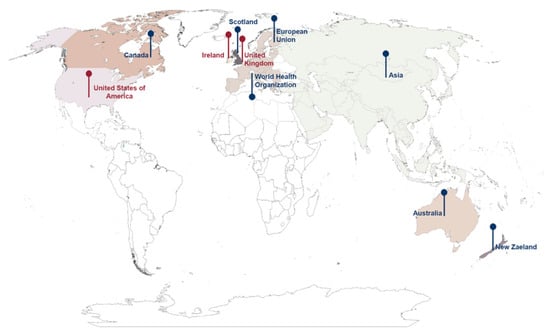
Applying these criteria reduced a broader initial set of candidate documents to a final corpus of 18 official guidance documents [27,28,29,30,31,32,33,34,35,36,37,38,39,40,41,42,43,44]. The size of the corpus reflects the nature of the source from which it is drawn, since official appraisal guidance is issued by a limited number of institutions and only a small set of jurisdictions publish and maintain it in English. Although not intended to be exhaustive, the resulting corpus captures methodological diversity across institutional and geographical contexts while remaining suitable for detailed comparative analysis. The geographical composition of the corpus is an outcome of these criteria rather than a prior selection of jurisdictions. The documents retained originated from Asia, Australia, Canada, Ireland, New Zealand, the United Kingdom, Scotland, the United States, the European Union, and the World Health Organization (Figure 1).
Figure 1.
Geographical distribution of the official CBA guidance documents included in the documentary corpus. Note: Authors’ own elaboration based on the geographical origin of the 18 documents in the corpus. Figure produced with Photoshop.
In federal systems, appraisal responsibilities are often distributed across several institutions, which can give rise to more than one guidance document. In Australia, the individual states publish their own economic appraisal guidance within the broader national framework, while in the United States, the corpus includes two sets of guidelines: the reference guidance developed by the Harvard School of Public Health for government use, and that issued by the Millennium Challenge Corporation for appraising development investments. Of the 18 documents, eleven provide general methodological guidance for conducting CBAs and are the principal source for analyzing monetization approaches, and the remaining seven address health or health-related interventions [30,37,39,40,41,42,44], providing the primary basis for identifying the benefit categories specific to this sector. For each document, Table 1 reports the issuing country or organization, the authoring institution, the publication year, and the application domain.
Table 1.
Official CBA guidance documents included in the analysis. Note: Authors’ own elaboration based on the official guidance documents listed. Table produced with Microsoft Excel.
2.2. Data Extraction and Documentary Analysis
Each guidance document was examined using a structured data extraction template developed to address the objectives of the study. The examination first focused on identifying the categories of economic benefits associated with interventions affecting human health. These benefit categories were extracted and recorded for each guidance document.
The documents were then examined to identify the approaches recommended for assigning monetary values to these benefits, and more generally, to other non-market effects, together with the strengths and limitations reported for each approach. Finally, each document was examined for references to the value of a statistical life (VSL) and the value of a statistical life year (VSLY). A value was extracted only where the document associates a figure with the parameter, since several documents discuss VSL as a concept without indicating a reference value. Values were recorded together with the year of estimation and the source attributed to them by the document, and were drawn for the most part from the body of the text rather than from summary tables.
The extraction template was defined in advance from the objectives of the study, and the same categories of information were sought in every document. No separate piloting exercise was carried out, since the template was not intended to be adjusted during the analysis. Data extraction was performed by the first author. Cases requiring interpretative judgement, particularly when classifying benefit categories or monetization approaches, were subsequently reviewed and discussed with the co-authors until consensus was reached. Coding was performed by a single coder, so no measure of inter-coder agreement applied, and consistency rested instead on the uniform application of the template and on the consensus review of interpretative cases. Because the corpus consists of publicly available documents and Table 2 and Table 3 report, for each benefit category and each monetization approach, the specific documents in which it appears, every coding decision can be traced back to its source and verified independently.
Table 2.
Economic benefits relevant for the economic-financial evaluations of health-related projects. Note: Authors’ own elaboration based on the 18 official guidance documents analyzed. Table produced with Microsoft Excel. × indicates that the corresponding economic benefit is explicitly identified or considered in the respective guideline.
Table 3.
Methodological approaches used for the monetization of intangible benefits in CBAs. Note: Authors’ own elaboration based on the 18 official guidance documents analyzed. Table produced with Microsoft Excel. × indicates that the corresponding economic benefit is explicitly identified or considered in the respective guideline.
The extracted information was organized into three comparative matrices reporting (i) the categories of intangible benefits associated with health-related interventions (Table 2), (ii) the monetization approaches recommended for non-market effects (Table 3), and (iii) the VSL and VSLY values reported in the guidance documents (Table 4).
Table 4.
VSL values reported in the analyzed guidelines. Note: Authors’ own elaboration based on the VSL values reported in the analyzed guidance documents. Table produced with Microsoft Excel.
3. Results
3.1. Systematization of the Economic Benefits Associated with Health-Related Interventions
The complexity of CBAs in the healthcare sector stems largely from the multidimensional nature of the determinants of community well-being, which is the primary objective that health interventions pursue. Environmental, clinical, socioeconomic, and behavioral factors interact and shape population health, and this makes it difficult to isolate and precisely quantify the positive effects of a specific project [45,46].
The guidelines examined indicate that evaluators must consider both the direct and indirect benefits of an intervention, accounting not only for the benefits accruing to the individuals directly involved, but also for those affecting third parties and the wider community. The “Guide to Cost–Benefit Analysis of Health Capital Projects” issued by the New South Wales Government [30], for instance, stresses the need to assess the full range of benefits a health intervention generates for patients, families, caregivers, healthcare personnel, the health system, and the community as a whole. Given this heterogeneity and the multiplicity of stakeholders, some guidelines introduce a conceptual categorization of benefits. The New South Wales guide proposes a classification into (i) direct or indirect; (ii) financial or non-financial; (iii) quantifiable or qualitative; (iv) tangible or intangible; and (v) economic, social, or environmental. A similar scheme appears in the Benefit–Cost Analysis guide of the Centers for Disease Control and Prevention (CDC) [42], a United States public health agency, where benefits are grouped into direct (e.g., medical expenses saved), indirect (e.g., increased productivity) and intangible (e.g., psychological well-being and quality of life). Among the guidelines analyzed, however, only these two explicitly attempt to structure the categories of benefit typically associated with health-related interventions. This limited effort at conceptual classification is itself a relevant gap, because clarifying the macro-categories of benefit supports the transparency and comparability of CBAs [47].
A further issue concerns the extent to which benefits are explicitly identified within the guidelines. The majority of documents do not include a dedicated section listing the economic benefits produced by health interventions. Benefits are more often mentioned indirectly, within the discussion of monetization approaches. Only a few documents enumerate them explicitly. One is the Economic Appraisal Vademecum 2021–2027 of the European Commission [43], which provides indications for the economic evaluation of interventions across several sectors, including healthcare, where it identifies ten potential economic benefits of a health project. The Guide to Economic Appraisal Technical Guide of the Assessment Framework of Infrastructure Australia [29] likewise lists the benefits typically associated with the construction of new health facilities, and the Guide to Cost–Benefit Analysis of Health Capital Projects of the New South Wales Government [30] details the economic benefits to be considered when appraising the construction of new hospitals. The distinction between the conceptual categorization of benefits and their explicit identification within the guidelines is central to the aim of this study. Working from both dimensions, the analysis extracts, reorganizes, and systematizes the economic benefits recurrently associated with health-related interventions.
The results of the documentary analysis are reported in Table 2, which sets out the economic benefits that should be identified, measured, and monetized when drafting a CBA for a health-related intervention. The table summarizes the 14 recurring benefits derived from the guidelines examined and reports, for each, the documents in which it is referenced. A benefit was recorded as referenced where the document names it as an effect of the intervention, whether in a dedicated section listing benefit categories or within the discussion of the techniques used to monetize them. Since both cases identify the benefit, they are recorded in the same way in the table.
The 14 benefits are associated with different types of health intervention. Economic evaluations inform investment decisions across a range of typologies, from the introduction of technologies for treating specific pathologies, initiatives to modify harmful social behaviors, prevention programs, and organizational reforms, to strategies for improving the efficiency of national health systems. Evaluation is also central to decisions on healthcare infrastructure, where capital investment in the construction or renovation of hospital facilities has multiple consequences and directly affects the provision of care, for instance, by altering patient flows or enabling new models of care. The principle emerging from the documents is that every healthcare intervention modifies the existing care delivery system and generates incremental economic benefits.
The systematization shows that the primary objective of health interventions is the improvement of individual health, chiefly through reductions in mortality and morbidity. Sixteen of the guidelines examined identified “Reduced mortality” as the principal benefit of a health intervention. This outcome may be achieved through several strategies, including (i) screening programs that enable disease prevention and/or early treatment; (ii) new emergency centers that provide timely care and thereby reduce avoidable deaths; (iii) low-complexity health facilities that relieve pressure on hospitals; and (iv) innovative technologies that improve the effectiveness of care.
Closely related is “Reduced morbidity”, cited by 12 guidelines and understood as the reduction in the incidence and prevalence of disease in the population, a key indicator for public health planning [48]. Beyond these clinical outcomes, 7 guidelines identified “Improved quality of life and psychological well-being”, since access to an effective healthcare system reduces patients’ physical suffering as well as the psychological distress affecting patients, families, and caregivers. The European Commission emphasizes, in this respect, that greater effectiveness in care provision, enabled by better facilities, timely treatment, and appropriate organization of services, strengthens overall well-being and reinforces community trust in the health system [43]. A third effect, “Productivity increase”, appeared in 6 guidelines and points to the role of health investment in strengthening human capital, since improvements in health directly affect individuals’ capacity to take part in social and economic activities, and thus economic productivity and growth [49].
The analysis also shows that while many benefits are common across intervention types, a stronger association emerges between certain benefits and investment in healthcare infrastructure. “Reduced transport costs (to access care)” and “Increased accessibility” are particularly relevant to territorial investment decisions, since better accessibility lowers the barriers created by the uneven spatial distribution of facilities and specialized services, which often impose significant costs on communities [50]. “Improved quality of hospital design”, in turn, underlines the role of design quality in improving both building functionality and the alignment of healthcare real-estate assets with current environmental sustainability requirements. Hospitals have a considerable environmental footprint, given high levels of waste, water consumption, and greenhouse-gas emissions [51], so redevelopment projects may generate indirect benefits related to environmental sustainability, which should also enter the CBA. The remaining benefits identified in the corpus recurred in a smaller number of documents and concerned reduced healthcare expenditure, reduced hospitalizations, reduced emergency-room overcrowding, reduced waiting times, reduced adverse effects, and an increased supply of services meeting previously unmet demand.
The systematization carried out in this research brings out the heterogeneity of the benefits generated by health interventions. For each benefit, establishing a clear cause-and-effect relationship between the project and its outcomes is necessary for a robust and transparent economic-financial evaluation.
3.2. Systematization of Monetization Approaches for Intangible Benefits
Public policies across different sectors (health, transport, environment) aim to improve collective well-being by generating a wide range of benefits, many of which are intangible. When such benefits lack a reference market, their inclusion in CBAs requires alternative valuation methods. The analysis of the 18 guidelines considered in this research revealed the recurrent use of a defined set of approaches for translating intangible benefits into monetary terms. Table 3 summarizes the methods most frequently recommended across the documents examined for the monetization of benefits in CBAs.
Health policies generate a wide range of effects on communities. The main benefits, as set out in the systematization of economic advantages, include (i) reduced mortality, (ii) reduced morbidity, and (iii) improved psychological well-being and quality of life. The debated, and still unresolved, question concerns how to attach a monetary value to these outcomes. In CBA, the monetization of a project’s effects is generally based on available market prices; for intangible benefits, which have no reference market in which the good is exchanged, alternative methods become necessary. Across the guidelines analyzed, the most recurrent reference approach is the estimation of willingness to pay (WTP) or willingness to accept (WTA). In health interventions, WTP estimates the maximum amount individuals would pay to reduce the risk of mortality or illness, while WTA estimates the compensation required to accept an increased risk [52,53]. These values can be derived through two main methodological families, stated preference (SP) and revealed preference (RP) [54,55].
RP techniques assess the economic value of intangible assets by observing consumers’ purchasing behavior in markets similar to the one being estimated [56,57]. The guidelines most frequently apply three RP techniques: the Hedonic Price Method, the Travel Cost Method, and Defensive Expenditure.
The Hedonic Price Method, cited in 16 guidelines, is commonly applied through hedonic wage analysis [58], which assumes that wages incorporate compensation for occupational health risks. Income is treated as a function of several factors, including the worker’s individual characteristics, working conditions, and the health risks associated with the job. The assumption is that, ceteris paribus, jobs associated with greater health risks (accidents or fatalities) are paid more than less risky ones [59], so that the method estimates the additional income an individual would accept for an increase in the risk of mortality or illness at work [60]. The empirical literature notes several limitations of this approach, arising, for instance, from (i) imperfect labor-market conditions, (ii) the incomplete information workers may have about the risks they face, and (iii) differences in risk perception.
The Travel Cost Method, cited in 13 guidelines, is typically applied where accessibility is at stake. The literature uses it to value effects such as reduced waiting times and improved access to care. In the absence of a local service, a community bears high costs in time and travel expenses to reach the nearest adequately equipped facility, so a new health program or hospital reduces the costs borne by users by providing a previously absent service. The literature applies this method to the monetization of several health interventions: (i) the introduction of health screening programs [61]; (ii) the development of telemedicine systems [62]; and (iii) the estimation of the economic impact of initiatives to improve the accessibility and availability of health facilities [63]. Operationally, the method requires systematic data collection on the expenses that users incur to reach a service comparable to the one under evaluation, including transport costs (public and private) and the value of the time spent, understood as an opportunity cost. These data support the monetization of the benefits deriving from greater accessibility, so that effects that are qualitative in nature can be integrated into the CBA.
The Defensive Expenditure approach infers value from the costs individuals incur to prevent or mitigate identified risks. For instance, expenditure on safety equipment can be interpreted as an indicator of WTP for risk reduction. The Canadian CBA Guide offers an example from the domain of road safety, where the purchase of helmets is used to infer individuals’ valuation of a reduction in mortality risk.
Alongside these techniques, the guidelines identify the estimation of the COI, a cost-based approach that assesses the economic burden a pathology imposes on the community through the identification, measurement, and valuation of the costs that the disease and its comorbidities generate [64]. The traditional approach requires the valuation of direct costs (healthcare expenses for treatment), indirect costs (the individual’s productivity loss due to ill health), and intangible costs (the reduction in quality of life) [65]. The method is strongly debated, the literature underlines the difficulty of calculating all direct, indirect, and intangible costs of a disease, and notes that the approach neglects physical and mental pain and discomfort, which typically accompany a pathological condition.
Alongside RP techniques, WTP is frequently derived through SP methods, chiefly contingent valuation (CV) and, to a lesser extent, choice modeling (CM). CV is the most widely recommended monetization approach across the corpus, cited in 17 out of the 18 guidelines, whereas CM is cited in only 4 and is among the least cited methods examined.
CV is used extensively in the economic evaluation of interventions across several sectors, including health, the environment, infrastructure, and education. It entails a questionnaire describing a hypothetical market in which the good to be evaluated can be exchanged, with the aim of determining the respondent’s WTP for an intervention that could generate, for example, a reduction in mortality or morbidity [66]. Despite its wide use, CV remains subject to considerable criticism. Respondents may state amounts that do not reflect their actual spending power, with higher-income individuals tending to declare larger values than poorer groups and thereby biasing aggregate results [67,68]. The hypothetical market may also lack realism, a problem compounded by the potential ambiguity of the questions.
CM, or discrete choice experiments, is another established stated-preference technique, used to elicit patterns of community preference through surveys. Respondents choose among a set of alternative interventions, on the assumption that they will opt for the one from which they expect the greatest utility [69].
In complex settings such as the economic evaluation of health interventions, a further approach is the benefit transfer method, in which economic evaluations of already-implemented projects serve as proxies for the analysis to be performed. The evaluator reviews the reference outcomes to assess their quality and applicability to the case at hand and, where necessary, introduces adjustments reflecting differences in (i) the characteristics of the intervention, (ii) the political context, and (iii) the cultural and socioeconomic specificities of the beneficiary community.
The last approach identified in the guidelines is the human capital approach, cited by 6 of the documents. It estimates the monetary value of benefits such as reduced mortality and morbidity on the premise that a person affected by a pathology is less productive for society because of absence from work, so that the value of a life is associated with the output the individual could produce. The approach raises several ethical objections [6], work is an imperfect market, and wages reflect inequalities due to discrimination of various kinds, including gender and ethnicity [24]; moreover, the method disregards both the value of a life not spent in paid work and the value of the lives of those outside the labor force, such as pensioners.
The documentary analysis shows that despite the variety of methods available, the guidelines consistently recommend prioritizing WTP estimates derived from RP techniques wherever possible, since these rest on observed behavior rather than hypothetical declarations. At the same time, the documents acknowledge that certain benefits may remain non-monetizable, and in such cases, they recommend complementing the CBA with technical reports or with multi-criteria analysis (MCA) to account for the excluded effects. Taken together, the analysis identifies a structured set of monetization approaches recurrently adopted at the international level for incorporating intangible benefits into CBAs. Each method has specific strengths and limitations, and its appropriate selection depends on the characteristics of the intervention under evaluation. This systematization constitutes the second pillar of the framework developed in this research, complementing the systematization of recurring benefits.
3.3. The Role of VSL as an Institutional Valuation Parameter
The systematization of recurring benefits in Section 3.1 showed that reduced mortality is the primary objective of health-related interventions. Mortality reduction, however, is not exclusive to the health sector: infrastructure and environmental policies, including those that reduce pollution or improve transport safety, also contribute significantly to protecting public health and averting population risk. Across these domains, CBA remains the evaluation tool adopted by public administrations, so whenever a reduction in mortality is among a project’s expected effects, evaluators must monetize it. One of the most widely used parameters for this purpose is the value of a statistical life (VSL) [70].
In the literature, VSL is defined as the monetary value individuals attach to a small change in their own risk of death, a notion distinct from the value they would assign to the risk of certain death [71]. The term “statistical” reflects the probabilistic nature of the parameter: the estimated value refers not to identified lives but to statistical ones, as when the probability of death falls from 3 to 2 in a sample of 10,000 people. VSL is generally estimated through the WTP approach, using both RP and SP techniques [72]. Everyday choices, such as driving behavior, lifestyle, or the acceptance of risky work, reveal implicit trade-offs between income and safety, and these observed behaviors allow WTP to be estimated through RP methods based on real market data; SP techniques, in turn, estimate WTP through questionnaires that simulate hypothetical risk-reduction scenarios. Once WTP is known, VSL is obtained as VSL = WTP/Δp, where Δp is the reduction in mortality risk associated with the intervention [73], estimated from empirical evidence or statistical data on similar initiatives.
The “Reference Case Guidelines for Benefit-Cost Analysis in Global Health and Development” of the Harvard T.H. Chan School of Public Health [40] provides an illustrative calculation. For an intervention that reduces individual mortality risk (Δp) by 1 in 10,000 across a sample of 40,000 individuals, with an average WTP of USD 300 for that risk reduction, the VSL is given by Equation (1):
Beyond the ethical debate on monetizing mortality reduction, the literature and the guidelines raise further methodological issues. One concerns the dependence of WTP on age and health status: older individuals, or those with chronic conditions, may report lower WTP because of reduced life expectancy or a lower perceived utility of additional life years [74]. To address this, the value of a statistical life year (VSLY) adjusts VSL for the expected remaining life years of the individuals affected, dividing the VSL by the average number of remaining years, suitably discounted. On this logic, VSL equals the present value of an individual’s future life years weighted by the annual probability of survival, which assumes a constant value for each remaining year [75]; accordingly, the WTP for reducing fatal risk follows the life cycle, rising in youth, peaking in mid-life, and declining thereafter, in parallel with income and consumption [76].
Although widely used in official appraisal, VSL raises several difficulties. Viscusi (2012) [77] notes that SP estimates tend to be lower than RP estimates: RP data reflect actual choices made by individuals aware of the risks they face, as in the hedonic wage method, whereas SP data express WTP to avoid hypothetical risks that may not be perceived as concrete. Because of this variability, the VSL values used in CBA are generally drawn from the consolidated literature or set by government agencies and international organizations, such as the Organization for Economic Co-operation and Development (OECD). The Harvard guidelines [40] illustrate how different methods yield divergent figures: the OECD recommends a VSL of USD 3 million, derived from a meta-analysis of SP studies, whereas U.S. agencies suggest USD 9–10 million, based on RP studies. VSL estimates therefore need to be updated periodically to reflect new research.
A further issue is the dependence of VSL on the income of the reference population. Because VSL reflects the trade-off between spending on the reduction in a fatal risk and other expenditure, it cannot be identical for individuals with different incomes; in general, WTP per unit of risk reduction, and hence VSL, decreases as income falls. This matters especially for benefit transfer, where values estimated in one context are transferred to another, such as a developing country, to appraise a similar project. The transferred VSL must then be adjusted for its income elasticity [78], which requires an estimate of the income of the reference population, an estimate of the income of the target population, and the average elasticity of VSL to income over the relevant range. The Harvard guidelines give the formula generally used to transfer VSL across contexts, reported in Equation (2):
where VSLreference is the data related to a context of known socio-economic characteristics, VSLtarget is the value to be estimated, and elasticity represents the VSL variation level for income. Hammitt and Robinson (2011) [79] note that in the United States, elasticity is generally taken to be between 0.4 and 0.6, while for appraisals in low-income countries, a value of 0.1 is assumed. The guidelines were then examined to identify whether they provided official VSL references. The guidance of 4 countries (Australia, Canada, New Zealand, the United Kingdom) reported six VSL values and two VSLY estimates, summarized in Table 4.
For each value, Table 4 reports the year of estimation, which matters because VSL should reflect the inflation affecting a national economy over time; within a single country, moreover, different methods yield different values. Canada is a case in point: its guidance reports both a VSL of USD 6.11 million (2004), drawn from the scientific literature, and a value of USD 6.1 million (1999) estimated by the United States Environmental Protection Agency (EPA). Australia likewise reports two values: USD 4.5 million (2018/2019), from the Australian Office of Best Practice Regulation, and USD 3.5 million (2007), from the scientific literature. In the United Kingdom, the value reported in the Green Book [38] and attributed to the Department for Transport (2002)for the appraisal of infrastructure policies is applied across all projects that may reduce mortality. Beyond the values reported in the guidelines, a check of the EPA website shows that its most recent VSL update dates to 2006, at USD 7.4 million.
The evidence shows that despite the methodological and ethical difficulties of its estimation, VSL is a central institutional parameter for monetizing mortality reduction in CBA. The variability of values, the need for adjustment, and the dependence on methodological choice all confirm the importance of identifying clearly how the parameter is used within official guidance. Within this research, the analysis of VSL references forms the third pillar of the framework, alongside the systematization of benefits and of valuation methods, clarifying how the most consequential intangible benefit, mortality reduction, is operationally valued in CBAs at the international level.
4. Discussion
The research question that guided this study asked how official CBA guidelines address the identification and monetary valuation of intangible benefits associated with public health interventions. The comparative analysis returned a consistent answer. Guidelines acknowledge these benefits but rarely identify them explicitly, addressing them mostly within discussions of monetization techniques, and they recommend valuation methods with markedly uneven frequency, converging on a few approaches while leaving the treatment of the VSL to diverge across regulatory contexts. The effects that carry the greatest weight for social value are therefore those that institutional guidance treats least systematically.
A health intervention is not a self-contained project but a component embedded within a wider healthcare system, whose effects propagate across interrelated clinical, social, economic, and environmental subsystems and across successive boundaries, from the individual patient to the family, the community, and society as a whole. Read in these terms, the fragmentation documented in this study reflects more than an editorial shortcoming of the guidelines. It amounts to a partial representation of the system under evaluation, since when intangible effects are dispersed within the discussion of monetization techniques, or omitted because they resist quantification, the appraisal boundary is drawn more narrowly than the boundary of the system whose value the appraisal is meant to capture, and the resulting decision rests on an incomplete account of the intervention’s systemic consequences.
The three components of the proposed framework address this misalignment from complementary angles. The systematization of benefits (Section 3.1) widens the appraisal boundary by making explicit the fourteen recurring effects that health interventions generate across subsystems, the systematization of monetization approaches (Section 3.2) relates the nature of each effect to the family of methods capable of expressing it in monetary terms, and the comparative analysis of the VSL (Section 3.3) clarifies how the single most consequential intangible effect, mortality reduction, is operationalized across institutional contexts.
Read together, these components support a correspondence between benefit categories and the methodological approaches used for their monetization, set out in Table 5. The correspondence follows a single criterion rather than a separate judgement for each category. Where an effect is revealed through observable behavior, revealed-preference techniques apply. Where it leaves no behavioral trace, stated-preference techniques are required. Where it corresponds to identifiable resource use or to participation in the labor market, cost-based and human-capital approaches are appropriate. Where no primary estimate is available for the context under appraisal, values are imported through benefit transfer.
Table 5.
Illustrative correspondence between benefit categories and methodological approaches used for the monetization of intangible benefits. Note: Authors’ own elaboration. The correspondences are indicative rather than prescriptive and follow from the nature of each effect and from the applicability conditions of each method described in Section 3.2. They are not prescriptions found as such in any individual guidance document. Table produced with Microsoft Excel.
Among the fourteen categories, only mortality reduction has been consolidated into an institutional reference value. It is operationalized through the VSL, whose estimation rests on the same revealed-preference and stated-preference techniques employed elsewhere in the framework, and which official guidance has translated into published figures, as reported in Section 3.3. For the remaining categories, guidance recommends methods without establishing reference values, so that the resulting estimates depend on choices made by individual evaluators and remain difficult to compare across appraisals.
The correspondence set out in Table 5 is illustrative rather than prescriptive. Methodological approaches are not benefit-specific, and the appropriate technique depends on the characteristics of the intervention, the data available, and the institutional setting, so a rigid correspondence would misrepresent the flexibility that sound appraisal requires. The table indicates which approaches are ordinarily suited to each category, not which must be adopted in a given case. Establishing structured, intervention-contingent relationships, validated through application to real interventions, remains a priority for future work.
The framework is intended to support practitioners preparing a CBA of an intervention with significant non-market effects, and its use follows a sequence of steps. The starting point is the screening of the fourteen benefit categories in Table 2 against the intervention under appraisal, retaining those that the intervention plausibly generates and recording the reasons for excluding the others, so that the appraisal boundary is set explicitly rather than by default. For each retained category, a demonstrable causal relationship between the intervention and the effect must then be established, verifying at the same time that the retained categories do not overlap, since several of them capture related consequences and may otherwise be counted twice. A methodological approach is then selected for each retained benefit, using Table 5 as an indicative starting point and Table 3 to identify the approaches most frequently recommended in official guidance, subject to the data available and to the requirements of the applicable institutional setting. Where mortality reduction is among the retained benefits, the VSL reference value established in the relevant jurisdiction applies, with attention to the year of estimation, and where a value is transferred from another context, to its adjustment for income as set out in Section 3.3. The categories retained, the approaches selected, and the parameters applied are finally recorded together with the reasons for each choice, so that the appraisal can be scrutinized and compared with others. Organized in this way, the framework makes explicit the choices an appraisal requires without replacing the judgement of the evaluator, which remains necessary at each step.
Several limitations bound the scope of these findings. The framework is grounded in a purposively selected corpus of official, English-language guidance and is not intended to be exhaustive. It synthesizes institutional appraisal practice and complements, rather than replaces, the evidence accumulated in the academic literature on non-market valuation. Its basis is documentary rather than empirical, so its operational value remains to be tested through application to real interventions across different territorial contexts. Because the analysis is a documentary classification exercise, the extraction and coding of benefit categories and valuation methods were performed by the first author, with interpretative cases resolved through discussion with the co-authors rather than through independent double-coding. The structured extraction template and consensus review were intended to promote consistency, but the absence of a second independent coder is a limitation, and the resulting classification is best read as one defensible organization of the guidance rather than the only possible one. Finally, the marked variability of VSL estimates across regulatory frameworks, together with their dependence on income and methodological choice, means that any transfer of values between contexts must be handled with care and cannot be standardized on the basis of current guidance alone.
5. Conclusions
This study contributes to the effort to improve methodological consistency in the application of CBAs to public interventions that generate intangible benefits, with particular reference to the healthcare sector. Through the comparative analysis of 18 internationally recognized guidance documents adopted by public administrations, it develops a methodological reference framework that consolidates three elements ordinarily addressed in isolation: a systematization of the economic benefits recurrently associated with health-related interventions, a systematization of the monetization approaches most frequently recommended for non-market effects, and a comparative overview of the institutional use of the VSL. From these three systematizations, the study also derives an illustrative correspondence between benefit categories and the approaches available to monetize them. By bringing together what official guidance presents in a dispersed manner, the framework offers evaluators and public decision-makers a structured reference that supports the identification of intangible benefits and the selection of valuation approaches, and with them, the transparency, consistency, and comparability of appraisals of interventions whose value is dominated by non-market effects.
The framework also delineates an agenda for further research. The most immediate development is to move beyond the illustrative correspondence proposed here toward structured, intervention-contingent relationships between benefit categories and methodological approaches. These relationships should be validated through application and should be capable of supporting the selection of monetization approaches in specific appraisal settings. Beyond this, applying the framework to real case studies would test its adaptability across territorial contexts and intervention types. Broadening its evidentiary base by integrating institutional guidance with systematic evidence from the academic literature would strengthen the treatment of co-benefits that current guidance addresses only marginally, such as educational, distributional, and intergenerational effects. This perspective also highlights the importance of incorporating sustainability considerations into the economic assessment of public interventions [80,81]. Investigating the adjustment and possible harmonization of VSL estimates would address the heterogeneity observed across regulatory frameworks. Finally, integrating CBA with multi-criteria analysis would allow effects that remain difficult to monetize to be incorporated within a more comprehensive, system-level assessment of public investment [82]. Taken together, these directions position the framework as a foundation for aligning the appraisal of health-related public investment more closely with the systemic scope of the effects it seeks to evaluate.
Author Contributions
Conceptualization, A.R., M.R.G. and P.M.; methodology, A.R. and F.D.L.; validation, F.D.L., M.L. and P.M.; formal analysis, A.R.; investigation, A.R.; data curation, A.R. and M.L.; writing—original draft preparation, A.R.; writing—review and editing, F.D.L., P.M., M.R.G. and M.L.; visualization, A.R. and F.D.L.; supervision, M.R.G. and P.M.; project administration, M.R.G. All authors have read and agreed to the published version of the manuscript.
Funding
This research received no external funding.
Institutional Review Board Statement
Not applicable.
Informed Consent Statement
Not applicable.
Data Availability Statement
This study analyzed publicly available official guidance documents, which are listed in Table 1 and in the reference list. All data extracted and systematized from these documents are contained within the article. No new data were created.
Acknowledgments
During the preparation of this manuscript, the authors utilized a generative AI-based assistant (a large language model) to translate the text. The authors reviewed and edited the output and accept full responsibility for the content of this publication.
Conflicts of Interest
The authors declare no conflicts of interest.
Abbreviations
The following abbreviations are used in this manuscript:
| CBA | Cost–Benefit Analysis |
| CEA | Cost-Effectiveness Analysis |
| CM | Choice Modeling |
| COI | Cost of Illness |
| CUA | Cost-Utility Analysis |
| CV | Contingent Valuation |
| EPA | Environmental Protection Agency (United States) |
| MCA | Multi-Criteria Analysis |
| OECD | Organization for Economic Co-operation and Development |
| RP | Revealed Preference |
| SP | Stated Preference |
| VSL | Value of Statistical Life |
| VSLY | Value of a Statistical Life Year |
| WTA | Willingness to Accept |
| WTP | Willingness to Pay |
References
- Hansson, S.O. Philosophical problems in cost–benefit analysis. Econ. Philos. 2007, 23, 163–183. [Google Scholar] [CrossRef] [Scilit]
- Pinheiro, M.; Ivandic, I.; Razzouk, D. The economic impact of mental disorders and mental health problems in the workplace. In Mental Health Economics; Razzouk, D., Ed.; Springer: Cham, Switzerland, 2017; pp. 415–430. [Google Scholar]
- Culyer, A.J.; Chalkidou, K. Economic evaluation for health investments en route to universal health coverage: Cost-benefit analysis or cost-effectiveness analysis? Value Health 2019, 22, 99–103. [Google Scholar] [CrossRef] [Scilit] [PubMed]
- Winkler, M.S.; Krieger, G.R.; Divall, M.J.; Cissé, G.; Wielga, M.; Singer, B.H.; Tanner, M.; Utzinger, J. Untapped potential of health impact assessment. Bull. World Health Organ. 2013, 91, 298–305. [Google Scholar] [CrossRef] [Scilit] [PubMed]
- Fischhoff, B. The realities of risk-cost-benefit analysis. Science 2015, 350, aaa6516. [Google Scholar] [CrossRef] [Scilit] [PubMed]
- Zarnke, K.B.; Levine, M.A.; O’Brien, B.J. Cost-benefit analyses in the health-care literature: Don’t judge a study by its label. J. Clin. Epidemiol. 1997, 50, 813–822. [Google Scholar] [CrossRef] [Scilit] [PubMed]
- Juni, M.H.; Faisal, I.; Rosliza, A.M. Valuation of impacts in cost benefit analysis. Int. J. Public Health Clin. Sci. 2017, 4, 51–60. [Google Scholar]
- Asplund, D.; Eliasson, J. Does uncertainty make cost-benefit analyses pointless? Transp. Res. Part A Policy Pract. 2016, 92, 195–205. [Google Scholar] [CrossRef] [Scilit]
- Volden, G.H. Assessing public projects’ value for money: An empirical study of the usefulness of cost–benefit analyses in decision-making. Int. J. Proj. Manag. 2019, 37, 549–564. [Google Scholar] [CrossRef] [Scilit]
- Turner, H.C.; Archer, R.A.; Downey, L.E.; Isaranuwatchai, W.; Chalkidou, K.; Jit, M.; Teerawattananon, Y. An introduction to the main types of economic evaluations used for informing priority setting and resource allocation in healthcare: Key features, uses, and limitations. Front. Public Health 2021, 9, 722927. [Google Scholar] [CrossRef] [Scilit] [PubMed]
- Park, M.; Jit, M.; Wu, J.T. Cost-benefit analysis of vaccination: A comparative analysis of eight approaches for valuing changes to mortality and morbidity risks. BMC Med. 2018, 16, 139. [Google Scholar] [CrossRef] [Scilit] [PubMed]
- Kooli, C. COVID-19: Public health issues and ethical dilemmas. Ethics Med. Public Health 2021, 17, 100635. [Google Scholar] [CrossRef] [Scilit] [PubMed]
- Filip, R.; Puscaselu, R.G.; Anchidin-Norocel, L.; Dimian, M.; Savage, W.K. Global challenges to public health care systems during the COVID-19 pandemic: A review of pandemic measures and problems. J. Pers. Med. 2022, 12, 1295. [Google Scholar] [CrossRef] [Scilit] [PubMed]
- Parotto, E.; Lamberti-Castronuovo, A.; Censi, V.; Valente, M.; Atzori, A.; Ragazzoni, L. Exploring Italian healthcare facilities response to COVID-19 pandemic: Lessons learned from the Italian Response to COVID-19 initiative. Front. Public Health 2023, 10, 1016649. [Google Scholar] [CrossRef] [Scilit] [PubMed]
- Barra, C.; Lagravinese, R.; Zotti, R. Exploring hospital efficiency within and between Italian regions: New empirical evidence. J. Product. Anal. 2022, 57, 269–284. [Google Scholar] [CrossRef] [Scilit] [PubMed]
- Amatucci, F.; Furnari, A.; Cusumano, N.; Vecchi, V. Strategie di gestione e valorizzazione del patrimonio immobiliare delle Aziende del SSN. In Rapporto Oasi 2021; EGEA: Milan, Italy, 2021; pp. 743–769. [Google Scholar]
- Associazione Nazionale Costruttori Edili (ANCE). Indagine Conoscitiva Sulla Ristrutturazione Edilizia e L’Ammodernamento Tecnologico del Patrimonio Sanitario Pubblico, Anche nel Quadro della Missione 6 del PNRR. Available online: https://ance.it/wp-content/uploads/allegati/230322_Edilizia_Sanitaria_REV2.pdf (accessed on 28 January 2025).
- Matranga, D.; Maniscalco, L. Inequality in healthcare utilization in Italy: How important are barriers to access? Int. J. Environ. Res. Public Health 2022, 19, 1697. [Google Scholar] [CrossRef] [Scilit] [PubMed]
- Ricciardi, W.; Tarricone, R. The evolution of the Italian national health service. Lancet 2021, 398, 2193–2206. [Google Scholar] [CrossRef] [Scilit] [PubMed]
- Anessi-Pessina, E.; Cantù, E. Whither managerialism in the Italian national health service? Int. J. Health Plan. Manag. 2021, 21, 327–355. [Google Scholar]
- Mafrolla, E.; D’amico, E. Patients’ mobility as an indicator for (in) efficiency: A panel data analysis on Italian health care authorities. Health Econ. Rev. 2013, 3, 3. [Google Scholar] [CrossRef] [Scilit] [PubMed]
- Jazieh, A.R.; Kozlakidis, Z. Healthcare transformation in the post-coronavirus pandemic era. Front. Med. 2020, 7, 429. [Google Scholar] [CrossRef] [Scilit] [PubMed]
- European Commission. Available online: https://commission.europa.eu/strategy-and-policy/recovery-plan-europe_it (accessed on 29 January 2025).
- Drummond, M.F.; Sculpher, M.J.; Claxton, K.; Stoddart, G.L.; Torrance, G.W. Methods for the Economic Evaluation of Health Care Programmes; Oxford University Press: Oxford, UK, 2015. [Google Scholar]
- Barton, P.; Bryan, S.; Robinson, S. Modelling in the economic evaluation of health care: Selecting the appropriate approach. J. Health Serv. Res. Policy 2004, 9, 110–118. [Google Scholar] [CrossRef] [Scilit] [PubMed]
- Angevine, P.D.; Berven, S. Health economic studies: An introduction to cost-benefit, cost-effectiveness, and cost-utility analyses. Spine 2014, 39, S9–S15. [Google Scholar] [PubMed]
- Asian Development Bank. Cost-Benefit Analysis for Development: A Practical Guide; Asian Development Bank: Mandaluyong, Philippines, 2013; Available online: https://www.adb.org/documents/cost-benefit-analysis-development-practical-guide (accessed on 29 July 2026).
- Department of Finance and Administration. Handbook of Cost-Benefit Analysis; Financial Management Reference Material No. 6; Commonwealth of Australia: Canberra, Australia, 2006. Available online: https://www.atap.gov.au/sites/default/files/Handbook_of_CB_analysis.pdf (accessed on 29 July 2026).
- Infrastructure Australia. Guide to Economic Appraisal: Technical Guide of the Assessment Framework; Infrastructure Australia: Sydney, Australia, 2021. Available online: https://www.infrastructureaustralia.gov.au/guide-economic-appraisal (accessed on 29 July 2026).
- New South Wales Government. Guide to Cost-Benefit Analysis of Health Capital Projects; NSW Government: Sydney, Australia, 2026. Available online: https://www1.health.nsw.gov.au/pds/ActivePDSDocuments/GL2026_006.pdf (accessed on 29 July 2026).
- NSW Treasury. TPG23-08 NSW Government Guide to Cost-Benefit Analysis; NSW Treasury: Sydney, Australia, 2023. Available online: https://www.nsw.gov.au/departments-and-agencies/nsw-treasury/documents-library/tpg23-08 (accessed on 29 July 2026).
- Queensland Government. Project Assessment Framework: Cost-Benefit Analysis; Queensland Treasury: Brisbane, Australia, 2024. Available online: https://www.treasury.qld.gov.au/policies-and-programs/economy/assessing-evaluating-projects/project-assessment-framework/ (accessed on 29 July 2026).
- Department of Treasury and Finance. Economic Evaluation for Business Cases: Technical Guidelines; State Government of Victoria: Melbourne, Australia, 2013. Available online: https://www.dtf.vic.gov.au/business-case (accessed on 29 July 2026).
- Treasury Board of Canada Secretariat. Canadian Cost-Benefit Analysis Guide: Regulatory Proposals; Government of Canada: Ottawa, ON, Canada, 2007. Available online: https://www.tbs-sct.canada.ca/rtrap-parfa/analys/analys-eng.pdf (accessed on 29 July 2026).
- Department of Public Expenditure and Reform. The Public Spending Code—A Guide to Economic Appraisal: Carrying Out a Cost Benefit Analysis; Government of Ireland: Dublin, Ireland, 2012. Available online: https://www.gov.ie/en/department-of-public-expenditure-infrastructure-public-service-reform-and-digitalisation/publications/the-public-spending-code/ (accessed on 29 July 2026).
- The Treasury. Guide to Social Cost Benefit Analysis; New Zealand Government: Wellington, New Zealand, 2015. Available online: https://www.treasury.govt.nz/publications/guide/guide-social-cost-benefit-analysis (accessed on 29 July 2026).
- HM Treasury. The Green Book—Supplementary Guidance: Health; HM Treasury: London, UK, 2013. Available online: https://www.gov.uk/government/publications/green-book-supplementary-guidance-health (accessed on 25 July 2026).
- HM Treasury. The Green Book: Central Government Guidance on Appraisal and Evaluation; HM Treasury: London, UK, 2020. Available online: https://www.gov.uk/government/publications/the-green-book-appraisal-and-evaluation-in-central-government (accessed on 25 July 2026).
- Scottish Government; NHSScotland. Scottish Capital Investment Manual; Health Infrastructure and Sustainability: Edinburgh, UK, 2009. Available online: https://www.scim.nhs.scot/scottish-capital-investment-manual/ (accessed on 25 July 2026).
- Robinson, L.A.; Hammitt, J.K.; Cecchini, M.; Chalkidou, K.; Claxton, K.; Cropper, M.; Eozenou, P.H.-V.; de Ferranti, D.; Deolalikar, A.B.; Guanais, F.; et al. Reference Case Guidelines for Benefit-Cost Analysis in Global Health and Development; Harvard, T.H., Ed.; Chan School of Public Health: Boston, MA, USA, 2019; Available online: https://cdn1.sph.harvard.edu/wp-content/uploads/sites/2447/2019/05/BCA-Guidelines-May-2019.pdf (accessed on 25 July 2026).
- Millennium Challenge Corporation. Health Sector Cost-Benefit Analysis Guidance; MCC: Washington, DC, USA, 2023. Available online: https://www.mcc.gov/resources/doc/guidance-health-sector-cost-benefit-analysis/ (accessed on 25 July 2026).
- Centers for Disease Control and Prevention. Benefit-Cost Analysis; POLARIS Program; CDC: Atlanta, GA, USA, 2024. Available online: https://www.cdc.gov/polaris/php/economics/cost-benefit.html (accessed on 20 July 2026).
- European Commission. Economic Appraisal Vademecum 2021–2027: General Principles and Sector Applications; Publications Office of the European Union: Luxembourg, 2021; Available online: https://op.europa.eu/en/publication-detail/-/publication/cf2c28fe-484e-11ed-92ed-01aa75ed71a1/language-en (accessed on 25 July 2026).
- Hutton, G.; Rehfuess, E. Guidelines for Conducting Cost-Benefit Analysis of Household Energy and Health Interventions; World Health Organization: Geneva, Switzerland, 2006; Available online: https://iris.who.int/server/api/core/bitstreams/8808c3cb-1d9f-4d36-9b08-d5c3a8fbc9a4/content (accessed on 25 July 2026).
- Hallett, J.; Crawford, G.; Pollard, C.; Hannelly, T. Behavioural, nutritional and environmental determinants and public health. In Public Health: Local and Global Perspectives; Cambridge University Press: Melbourne, Australia, 2016. [Google Scholar]
- Cambon, L.; Alla, F. Current challenges in population health intervention research. J. Epidemiol. Community Health 2019, 73, 990–992. [Google Scholar] [CrossRef] [Scilit] [PubMed]
- Zwikael, O. Benefits classification to enhance project value creation. Int. J. Proj. Manag. 2024, 42, 102574. [Google Scholar] [CrossRef] [Scilit]
- Crimmins, E.M.; Beltrán-Sánchez, H. Mortality and morbidity trends: Is there compression of morbidity? J. Gerontol. Ser. B Psychol. Sci. Soc. Sci. 2011, 66, 75–86. [Google Scholar] [CrossRef] [Scilit] [PubMed]
- Berger, M.L.; Howell, R.; Nicholson, S.; Sharda, C. Investing in healthy human capital. J. Occup. Environ. Med. 2003, 45, 1213–1225. [Google Scholar] [CrossRef] [Scilit] [PubMed]
- Steenbruggen, R.A.; Maas, M.J.; Hoogeboom, T.J.; Brand, P.L.; van der Wees, P.J. A framework to improve quality of hospital-based physiotherapy: A design-based research study. BMC Health Serv. Res. 2023, 23, 34. [Google Scholar] [CrossRef] [Scilit] [PubMed]
- Tajani, F.; Sica, F.; Morano, P.; Locurcio, M.; Roma, A. An Evaluation Method of the Building Decarbonization Process at the International Level. In International Conference on Computational Science and Its Applications; Springer: Cham, Switzerland, 2024; pp. 126–142. [Google Scholar]
- Voelckner, F. An empirical comparison of methods for measuring consumers’ willingness to pay. Mark. Lett. 2006, 17, 137–149. [Google Scholar] [CrossRef] [Scilit]
- Bala, M.V.; Mauskopf, J.A.; Wood, L.L. Willingness to pay as a measure of health benefits. Pharmacoeconomics 1999, 15, 9–18. [Google Scholar] [CrossRef] [Scilit] [PubMed]
- Breidert, C.; Hahsler, M.; Reutterer, T. A review of methods for measuring willingness-to-pay. Innov. Mark. 2006, 2, 8–32. [Google Scholar]
- Locurcio, M.; Morano, P.; Acquafredda, T.; Torre, C.M. The Role of Financial and Economic Analyses to Support Healthcare Interventions. In International Symposium: New Metropolitan Perspectives; Springer: Cham, Switzerland, 2024; pp. 355–365. [Google Scholar]
- Boyle, K.J. Introduction to revealed preference method. In A Primer on Nonmarket Valuation; Springer: Cham, Switzerland, 2003; pp. 259–267. [Google Scholar]
- Mendelsohn, R. An examination of recent revealed preference valuation methods and results. Rev. Environ. Econ. Policy 2019, 13, 267–282. [Google Scholar] [CrossRef] [Scilit]
- Majumder, A.; Madheswaran, S. Compensating wage differential and value of statistical life: A meta-analysis. Indian J. Labour Econ. 2017, 60, 527–548. [Google Scholar] [CrossRef] [Scilit]
- Liu, J.T.; Hammitt, J.K.; Liu, J.L. Estimated hedonic wage function and value of life in a developing country. Econ. Lett. 1997, 57, 353–358. [Google Scholar] [CrossRef] [Scilit]
- Arabsheibani, G.R.; Marin, A. Stability of Estimates of the Compensation for Danger. J. Risk Uncertain. 2000, 20, 247–269. [Google Scholar] [CrossRef] [Scilit]
- Clarke, P.M. Cost–benefit analysis and mammographic screening: A travel cost approach. J. Health Econ. 1998, 17, 767–787. [Google Scholar] [CrossRef] [Scilit] [PubMed]
- Wootton, R.; Bahaadinbeigy, K.; Hailey, D. Estimating travel reduction associated with the use of telemedicine by patients and healthcare professionals: Proposal for quantitative synthesis in a systematic review. BMC Health Serv. Res. 2011, 11, 185. [Google Scholar] [CrossRef] [Scilit] [PubMed]
- Weiss, D.J.; Nelson, A.; Vargas-Ruiz, C.A.; Gligorić, K.; Bavadekar, S.; Gabrilovich, E.; Bertozzi-Villa, A.; Rozier, J.; Gibson, H.S.; Shekel, T.; et al. Global maps of travel time to healthcare facilities. Nat. Med. 2020, 26, 1835–1838. [Google Scholar] [CrossRef] [Scilit] [PubMed]
- Jo, C. Cost-of-illness studies: Concepts, scopes, and methods. Clin. Mol. Hepatol. 2014, 20, 327. [Google Scholar] [CrossRef] [Scilit] [PubMed]
- Byford, S.; Torgerson, D.J.; Raftery, J. Cost of illness studies. BMJ 2000, 320, 1335. [Google Scholar] [CrossRef] [Scilit] [PubMed]
- Bayoumi, A.M. The measurement of contingent valuation for health economics. Pharmacoeconomics 2004, 22, 691–700. [Google Scholar] [CrossRef] [Scilit] [PubMed]
- Carson, R.T. Contingent valuation: A user’s guide. Environ. Sci. Technol. 2000, 34, 1413–1418. [Google Scholar] [CrossRef] [Scilit]
- Gafni, A. Economic evaluation of health-care programmes: Is CEA better than CBA? Environ. Resour. Econ. 2006, 34, 407–418. [Google Scholar] [CrossRef] [Scilit]
- Hall, J.; Viney, R.; Haas, M.; Louviere, J. Using stated preference discrete choice modeling to evaluate health care programs. J. Bus. Res. 2004, 57, 1026–1032. [Google Scholar] [CrossRef] [Scilit]
- Kniesner, T.J.; Viscusi, W.K. The value of a statistical life. In Forthcoming, Oxford Research Encyclopedia of Economics and Finance; Vanderbilt Law Research Paper No. 19-15; Oxford University Press: New York, NY, USA, 2019. [Google Scholar]
- Viscusi, W.K. The value of individual and societal risks to life and health. In Handbook of the Economics of Risk and Uncertainty; North-Holland: Amsterdam, The Netherlands, 2014; Volume 1, pp. 385–452. [Google Scholar]
- Bellavance, F.; Dionne, G.; Lebeau, M. The value of a statistical life: A meta-analysis with a mixed effects regression model. J. Health Econ. 2009, 28, 444–464. [Google Scholar] [CrossRef] [Scilit] [PubMed]
- Hultkrantz, L.; Svensson, M. The value of a statistical life in Sweden: A review of the empirical literature. Health Policy 2012, 108, 302–310. [Google Scholar] [CrossRef] [Scilit] [PubMed]
- Alberini, A.; Cropper, M.; Krupnick, A.; Simon, N.B. Does the value of a statistical life vary with age and health status? Evidence from the US and Canada. J. Environ. Econ. Manag. 2004, 48, 769–792. [Google Scholar] [CrossRef] [Scilit]
- Robinson, L.A. Policy monitor how US government agencies value mortality risk reductions. Rev. Environ. Econ. Policy 2007, 1, 283–299. [Google Scholar] [CrossRef] [Scilit]
- Aldy, J.E.; Viscusi, W.K. Age differences in the value of statistical life: Revealed preference evidence. Rev. Environ. Econ. Policy 2007, 1, 241–260. [Google Scholar] [CrossRef] [Scilit]
- Viscusi, W.K. What’s to know? Puzzles in the literature on the value of statistical life. J. Econ. Surv. 2012, 26, 763–768. [Google Scholar] [CrossRef] [Scilit]
- Doucouliagos, H.; Stanley, T.D.; Viscusi, W.K. Publication selection and the income elasticity of the value of a statistical life. J. Health Econ. 2014, 33, 67–75. [Google Scholar] [CrossRef] [Scilit] [PubMed]
- Hammitt, J.K.; Robinson, L.A. The income elasticity of the value per statistical life: Transferring estimates between high and low income populations. J. Benefit-Cost Anal. 2011, 2, 1–29. [Google Scholar] [CrossRef] [Scilit]
- Morano, P.; Tajani, F.; Di Liddo, F.; Amoruso, P. A feasibility analysis of energy retrofit initiatives aimed at the existing property assets decarbonisation. Sustainability 2024, 16, 3204. [Google Scholar] [CrossRef] [Scilit]
- Tajani, F.; Cerullo, G.; Stara, F.; Sica, F. Multidimensional models for building decarbonization pathways. Bus. Strategy Environ. 2026, 35, 5598–5618. [Google Scholar] [CrossRef] [Scilit]
- Guarini, M.R.; Battisti, F.; Chiovitti, A. A methodology for the selection of multi-criteria decision analysis methods in real estate and land management processes. Sustainability 2018, 10, 507. [Google Scholar] [CrossRef] [Scilit]

Disclaimer/Publisher’s Note: The statements, opinions and data contained in all publications are solely those of the individual author(s) and contributor(s) and not of MDPI and/or the editor(s). MDPI and/or the editor(s) disclaim responsibility for any injury to people or property resulting from any ideas, methods, instructions or products referred to in the content. |
© 2026 by the authors. Licensee MDPI, Basel, Switzerland. This article is an open access article distributed under the terms and conditions of the Creative Commons Attribution (CC BY) license.