


Highlights
Please indicate how your work links to systems science via your contributions to systems practice, theory, and/or methodology.
- This study conceptualizes land-border port transformation as a two-tier governance architecture in which regional public-goods supply, cross-jurisdictional coordination, and county-level absorption jointly shape livelihood outcomes.
- It develops a two-tier analytical framework by decomposing port economic development into a regional synergy component and a county response component, offering a systems-oriented method for evaluating border-port reforms.
What are the main findings and/or the implications of the main findings?
- Using panel data from seven Guangxi border counties from 2008 to 2023, the study finds that regional synergy is more strongly associated with rural income growth than county response, with industrial-structure upgrading serving as the most prominent transmission channel.
- Port-size heterogeneity suggests that large ports benefit more from coordinated regional upgrading, whereas medium and small ports require differentiated strategies, niche-based development, and targeted support for sustainable transformation.
Abstract
The transformation of land-border ports from transit channels into regional hubs is increasingly seen as a way to support inclusive growth in frontier regions. Yet port expansion does not automatically improve local livelihoods. Whether port-led development is associated with income gains for rural residents in border counties depends on how cross-jurisdictional public goods are supplied, coordinated, and absorbed. Drawing on collective-action theory and regional public-goods theory, this study develops a two-tier analytical framework that distinguishes regional synergy from county response. Using panel data for seven counties along the China–Vietnam border in Guangxi from 2008 to 2023 and supplementary field research, we apply two-way fixed-effects models, control-function checks, mediation tests, and port-size heterogeneity analysis. Three main findings emerge. First, regional synergy and county response, proxied by Region_BPEDI and Dev_BPEDI, are both positively associated with the logarithm of rural per-capita disposable income in border counties. A one-standard-deviation comparison shows that the estimated association of Region_BPEDI is about 2.5 times that of Dev_BPEDI. Second, industrial-structure upgrading shows the strongest mediating pattern, while infrastructure connectivity and financial development depend more on cross-tier coordination. Third, large ports such as Dongxing and Pingxiang are better positioned to benefit from regional synergy, whereas medium and small ports rely more on niche-based differentiation. The results suggest that hub-oriented border transformation may benefit from multi-level institutional collaboration, place-based industrial matching, and tailored financial instruments. Field evidence also indicates that smart customs clearance, low-carbon logistics, and cross-border environmental coordination are becoming important sustainability dimensions of regional synergy. The study provides a diagnostic framework for evaluating border-port reforms along the Belt and Road and ASEAN economic corridors.
1. Introduction
The geography of global production is being reorganised. Re-globalisation, near-shoring and friend-shoring have reshaped cross-border flows and encouraged many developing economies to treat regional cooperation and cross-border infrastructure as important instruments for sustainable growth [1,2,3]. In this process, border zones are no longer merely geographic peripheries. They increasingly function as hubs that connect domestic value chains with neighbouring markets [4,5]. However, the economic benefits brought about by trade expansion are not evenly distributed. In the absence of effective institutional arrangements and inclusive policies, trade benefits may be concentrated in a few hubs and difficult to effectively transmit to border areas and ordinary residents [6,7].
China provides a useful setting in which to examine this tension. Land-border ports differ from coastal ports, which are often embedded in mature urban systems and dense production networks. Most land-border ports are located in fiscally constrained frontier counties with limited public services and weak industrial bases [5,8,9]. Driven by the Belt and Road Initiative (BRI) and the Regional Comprehensive Economic Partnership Agreement (RCEP), the trade scale of these ports has grown rapidly. Guangxi is a typical example. Despite the rapid growth of trade between Guangxi and Vietnam, border-market trade still involves local residents only to a limited extent, and the gap between the per capita disposable income of rural residents in border counties and the national average still exists [10,11]. The port area seems to be active, but its connection with the hinterland and the transmission of trade dividends to downstream residents are still weak.
The overall statistics illustrate this paradox. From 2010 to 2023, the cross-border trade between Guangxi and Vietnam increased by more than three times, and key ports such as Pingxiang and Dongxing accounted for more than half of Guangxi’s land-border throughput. However, during the same period, the per capita disposable income of rural residents in seven border counties was about 12 percentage points lower than the Guangxi average for a long time. This contrast between rapid trade expansion and slow income convergence echoes findings from other border regions: the benefits of openness depend heavily on supporting systems and complementary investment [7,12]. Therefore, the explanation of this gap cannot rely solely on overall trade indicators but must focus on the institutional structure that transforms flow into livelihood improvement.
Port transformation also has an environmental dimension. Land-border ports concentrate freight transport, customs operations, warehousing, and cross-border logistics, all of which may increase energy consumption, vehicle emissions, and land-use pressure. As China advances its carbon-peaking and carbon-neutrality goals, land-border port transformation should not be evaluated only through trade expansion and income growth. Smart customs clearance, low-carbon logistics, environmental-standard coordination and cross-border ecological governance are also becoming relevant. For frontier regions, sustainable port transformation therefore involves a dual task: improving the local absorption of trade dividends while preventing port-led growth from creating new environmental and governance burdens.
National policy responses have included border development plans, targeted fiscal transfers and special support programmes. Yet cross-regional transport networks, harmonised customs rules and regional industrial layouts have strong externalities and public-good attributes. Such goods are difficult for any single layer of government to provide alone [13,14]. Border development is therefore not only an economic issue. It also involves multi-level governance, fiscal coordination and the supply of regional public goods. Re-examining border income mechanisms from a cross-tier coordination perspective is thus both theoretically meaningful and practically important.
The existing literature can be grouped into four strands. The first examines the income effects of trade openness, showing that trade agreements, border trade, and regional integration may expand market access and improve resource allocation [8,15,16]. These effects, however, depend on local industrial bases and institutional quality, and some studies report widening disparities [17,18]. The second strand focuses on border-support policies and public transfers. Such policies can improve household welfare, but they may also raise concerns about spillovers, persistent regional gaps, and weak long-run incentives [10,11,19]. The third strand highlights transmission mechanisms, including transport corridors, industrial absorption and financial access [9,20,21,22,23,24,25,26]. The fourth strand examines the environmental sustainability of port development. Existing studies show that port infrastructure expansion and rising cargo throughput may increase energy use, emissions and ecological pressure, while smart-port technologies, low-carbon logistics and environmental governance can improve port sustainability [27,28,29,30,31,32,33]. However, this literature focuses mainly on coastal ports or aggregate port systems. Less is known about how land-border ports in underdeveloped frontier regions combine income growth, governance coordination and environmental sustainability.
In short, trade openness, policy support and enabling conditions appear to be jointly necessary, but the coordination logic that connects them remains insufficiently modelled. Three gaps are particularly important. First, previous studies seldom distinguish the relative weight of supra-county coordination and in-county absorption when explaining border income. Second, the regional public-good nature of border-port reforms—covering customs rules, cross-border roads, digital ports and environmental coordination—has rarely been integrated into empirical analysis of household outcomes. Third, the implications of port size remain underexplored, especially in terms of how large and small ports absorb coordination benefits while facing different environmental pressures and governance capacities. Addressing these gaps is important for designing realistic and sustainable hub-oriented reforms in border frontier counties.
Two methodological concerns further motivate this study. Most research on border development relies on aggregate trade or GDP indicators that conflate cross-county spillovers with autonomous local effort. This makes it difficult to assign policy levers between provincial-level coordination and county-level implementation [13,14,34]. Recent studies of Chinese borderlands and the Greater Mekong Subregion have therefore called for empirical designs that distinguish institutional architecture from local endowments [5,8,9]. The two-tier decomposition introduced here responds to this call by separating a supra-county component of port performance from an in-county residual.
Building on these observations, this paper develops a two-tier “regional synergy–county response” framework and examines how each tier is associated with the income trajectory of rural residents in border counties. The study makes three contributions. Theoretically, it extends the linear “channel–industry–income” logic by introducing a public-goods and collective-action perspective, recasting port transformation as a process of “regional synergy–county response–inclusive income growth”. Empirically, using panel data for seven Guangxi border counties from 2008 to 2023, it constructs a Border-Port Economic Development Composite Index (BPEDI) and decomposes it into Region_BPEDI and Dev_BPEDI to distinguish supra-county and in-county components. Methodologically, it combines fixed-effects panel estimation, control-function checks, two-step mediation analysis, and field-research triangulation. Together, these elements provide tier-specific policy implications and a potentially transferable diagnostic tool for hub-economy transitions in frontier regions.
The remainder of the paper is organised as follows. Section 2 develops the theoretical framework and hypotheses. Section 3 describes the study area, variables, and empirical models. Section 4 presents the baseline, endogeneity, robustness, mediation, and heterogeneity results. Section 5 discusses the findings in relation to the wider literature, and Section 6 concludes with policy implications and directions for future research.
2. Theoretical Framework and Hypotheses
2.1. A Two-Tier Driving Framework
Cross-border infrastructure, customs harmonisation and unified logistics standards exhibit non-rivalry and non-excludability across neighbouring counties. Their provision is therefore vulnerable to under-supply and coordination failures [35,36]. Institutional collective-action theory underlines that robust coordination devices and credible commitments across jurisdictions are decisive for overcoming these dilemmas [13,37,38]. The transition from a transit channel to a regional hub is likely to depend on the efficient supply of such cross-border regional public goods, and therefore relies on a multi-tier governance architecture rather than on county-level effort alone.
Green governance in land-border ports also has regional public-good attributes. Smart customs systems, paperless clearance, low-carbon logistics standards and cross-border environmental coordination cannot be supplied effectively by a single county. They require higher-level coordination across customs authorities, transport departments, environmental regulators and neighbouring border jurisdictions. In this sense, green governance is treated in this paper as an institutional dimension of regional synergy rather than as an independent econometric channel.
On this basis, we propose a two-tier driving framework. Regional synergy denotes top-level design, resource pooling and institutional innovation organised by provincial-level and supra-county authorities. It establishes the enabling conditions through which external dividends become accessible. County response, by contrast, refers conceptually to how local governments and local actors mobilise place-based information and endowments to absorb and recombine those conditions into operational outcomes. The two tiers complement each other, but their leverage differs. Because regional public goods sit upstream of local absorption, we expect regional synergy to show a stronger association with rural income in border counties than county response.
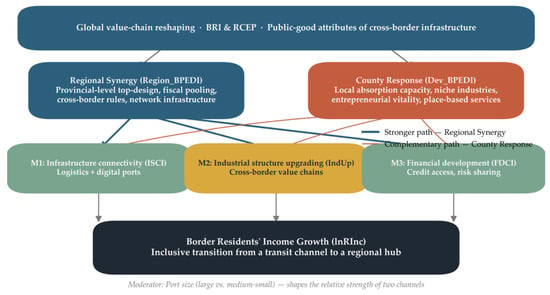
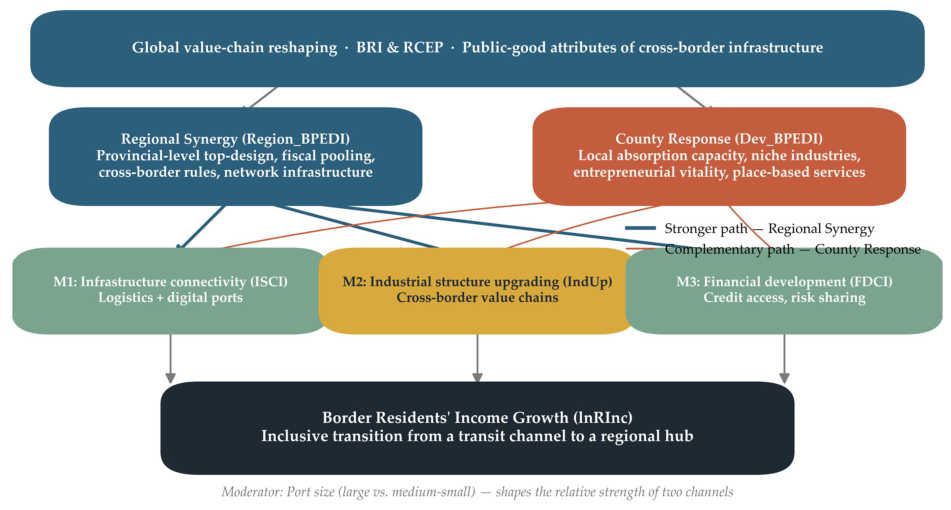
This logic resonates with the regional public-goods literature. Cross-border roads, customs platforms and digital corridors are non-rival across counties and confer benefits to firms and residents irrespective of their administrative location [14,35]. They are also costly to coordinate. Misalignment between fiscal incentives and shared obligations creates the classic free-rider problem [36,38]. Empirical work on Chinese trans-regional governance shows that hierarchical anchoring devices, such as joint commissions and shared performance evaluations, raise the credibility of inter-jurisdictional commitments [13]. The two-tier framework adopts this insight, treating regional synergy as the supply-side environment of cross-county public goods and county response as the local absorption side through which such conditions may be linked to local livelihoods. Figure 1 summarises the two-tier driving framework and illustrates the links among regional synergy, county response, and rural income in border counties.
Figure 1.
Two-tier driving framework: regional synergy and county response jointly transmit port reforms into income growth. Note: Source: Authors’ own elaboration based on the theoretical framework. Software: Microsoft PowerPoint.
Hypothesis 1 (H1).
Both regional synergy and county response are expected to be positively associated with rural income in border counties, with regional synergy showing the stronger association.
2.2. Theoretical Mediating Mechanisms
2.2.1. Infrastructure Connectivity
Infrastructure is the connective tissue of any spatial economy. Transaction-cost theory implies that integrated transport and information networks lower exchange costs and improve factor allocation [20,39,40]. In land-border settings, regional synergy is essential for assembling expressways, cross-border railways, smart-port platforms and single-window customs systems with strong network externalities [22,23,41]. County governments tend to fine-tune connectors, last-mile roads and node-level logistics, where their absorption capacity matters most. Both tiers shape connectivity, but the systemic infrastructure that produces the largest spillovers belongs to the regional tier. From a sustainability perspective, infrastructure connectivity increasingly involves digital and low-carbon upgrading. Smart-port platforms, paperless customs clearance, and intelligent inspection systems can reduce waiting time, paperwork, and vehicle idling, while low-carbon logistics improves the environmental performance of port operations. These improvements further depend on regional coordination because standards, funding and cross-border procedures exceed the authority of individual counties.
Hypothesis 2 (H2).
Infrastructure connectivity is expected to constitute a mediating pathway between port transformation and rural income, with a stronger mediating pattern for regional synergy than for county response.
2.2.2. Industrial Structure Upgrading
Border-port economic transformation involves a structural recomposition from low-margin transit activities towards high-value processing, cross-border services and platform industries [42,43]. Border counties typically feature short industrial chains and small market radii, which limits their independent upgrading capacity [5,8,9]. Regional synergy provides external momentum through value-chain planning, anchor projects and inter-provincial industrial alliances. County response is most evident in targeted attraction, park construction and tailored services that translate regional opportunities into local employment and tax revenues. The bulk of the upgrading impulse, however, originates in regional coordination.
Hypothesis 3 (H3).
Industrial structure upgrading is expected to constitute a mediating pathway between port transformation and rural income, with a stronger mediating pattern for regional synergy than for county response.
2.2.3. Financial Development
Information asymmetries, collateral scarcity and risk aversion weigh heavily on credit access in border regions [44,45]. Cross-county risk pooling, policy guarantees and credit-reference systems can ease these frictions [25,26]. Such institutional supports typically require coordination beyond county authority. County governments may still intervene with micro-credit schemes and interest subsidies, yet these tools rarely change institutional risk assessments. Financial mediation is therefore expected to be more responsive to regional synergy than to county response.
Hypothesis 4 (H4).
Financial development is expected to constitute a mediating pathway mainly for regional synergy, whereas its mediating role for county response is expected to be limited.
The three mediators jointly form a coherent transmission ladder. Connectivity reduces the effective distance between border counties and the broader value chain. Industrial upgrading translates that proximity into productive employment. Finance underwrites the working capital and investment risk that allow industry to scale. Stronger regional synergy may increase the effectiveness of each rung in this ladder, while county response may influence how rapidly local actors climb it. The empirical section tests this sequencing both jointly and channel-by-channel.
2.3. Heterogeneous Effects of Port Size
Port hierarchies emerge from differences in regulatory status, fiscal endowment and industrial agglomeration [46]. Large hubs are more likely to internalise network effects and may absorb coordination benefits more efficiently [47,48]. Medium and small ports face binding infrastructure, approval, and labour-market constraints, which make differentiation and specialisation more decisive. Port size thus moderates the relative strength of the two tiers. Port size may also shape sustainability capacities. Large ports face more concentrated environmental pressure from dense passenger and cargo flows, but they usually possess stronger fiscal and technical capacity to pilot smart-port and low-carbon logistics measures. Medium and small ports, by contrast, are more dependent on regional support for digital upgrading, environmental monitoring, and cross-border governance.
Hypothesis 5 (H5).
The association between port transformation and rural income is expected to vary by port size: large ports are expected to show stronger synergy-related income associations, whereas medium and small ports are expected to rely more on differentiated local development strategies.
3. Materials and Methods
3.1. Study Area and Data Sources
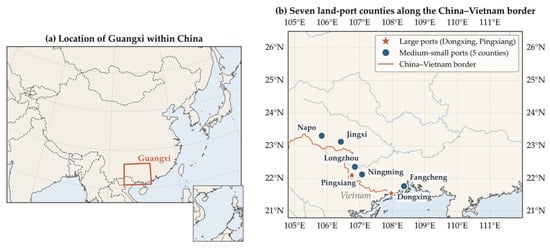
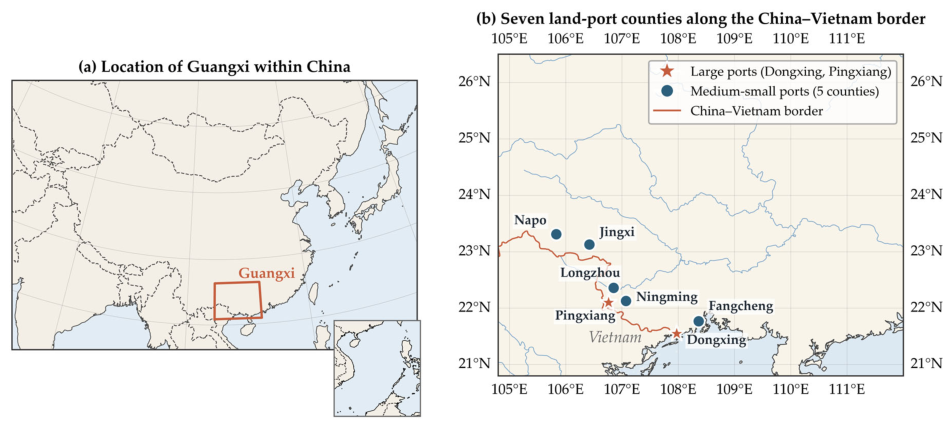
We assemble county-level panel data for seven land-border counties in Guangxi that share an official land port with Vietnam: Dongxing City, Fangchenggang District, Pingxiang City, Longzhou County, Ningming County, Jingxi City, and Napo County. Daxin County is excluded because of substantial missing data. The sample covers 16 years from 2008 to 2023, yielding 112 county-year observations. The small number of counties reflects the institutional and geographic structure of Guangxi’s China–Vietnam land-border port system, as well as the availability of consistent county-year data. The sample should therefore be understood as a bounded regional case rather than as a random sample of all border regions. Figure 2 shows the geographic distribution of the sample counties and their port-size classification. Dongxing and Pingxiang are classified as large ports based on multi-year averages of the Border-Port Economic Development Composite Index.
Figure 2.
Study area. Panel (a) locates Guangxi within China; the inset map shows the South China Sea region. Panel (b) maps the seven land-port counties along the China–Vietnam border. Note: Source: Authors’ own elaboration based on public geographic information and county-level port information. Visualisation software: R version 4.4.1.
Data come from multiple authoritative sources. Indicators of port activity originate from the China Port Yearbook (2008–2022) and 2023 public disclosures of Nanning Customs. County-level income, fiscal, demographic, and education statistics are drawn from the Guangxi Statistical Yearbook and official bulletins released by county statistical bureaus. A handful of missing annual observations are imputed through linear interpolation to preserve consistency.
The quantitative dataset is complemented by field research conducted between May and October 2025 in Dongxing, Dongzhong (Fangcheng) and Aidian (Ningming). The fieldwork included on-site observations of port areas, logistics facilities, industrial parks and border-market activities, as well as the collection of publicly available local policy materials and administrative documents. These materials are used as a triangulation device rather than as an independent source of causal identification. Observations in Dongxing helped interpret how a large port may absorb regional coordination through customs facilitation, smart inspection systems, and logistics upgrading. Field materials from Dongzhong and Aidian provided contextual evidence on the constraints faced by medium and small ports, including limited approval authority, weak industrial absorption and dependence on higher-level infrastructure support. These qualitative materials were linked to the quantitative analysis by helping interpret the mediating patterns of infrastructure connectivity, industrial-structure upgrading, and financial development, as well as the port-size heterogeneity observed in the regression results. Because the fieldwork sites do not cover all sample counties, these materials are used only for contextual triangulation and should not be interpreted as independent evidence for all ports in the sample. No personally identifiable information is reported in this study.
A clarification is needed regarding the role of green governance in the empirical design. The econometric analysis focuses on the association between port transformation and rural income, together with the economic channels through which this association may operate. Green governance is not directly included as a quantitative variable because county-level statistics do not provide continuous, comparable indicators for cross-border environmental standards, green customs procedures, or ecological compensation arrangements. Existing environmental-governance research also suggests that governance performance involves policy implementation, interdepartmental coordination, technology adoption and institutional design, which cannot be fully captured by carbon or energy indicators alone [49,50,51]. Therefore, this study uses field research materials to provide contextual evidence on smart customs clearance, low-carbon logistics, and cross-border environmental coordination.
3.2. Variables
3.2.1. Explained Variable
The dependent variable is the natural logarithm of rural per capita disposable income (lnRInc) in each border county. Following Sun [52], border inhabitants are interpreted as permanent residents of border counties. This study focuses on rural residents because they constitute a large share of the permanent population in Guangxi’s border counties and are more directly exposed to livelihood changes generated by border trade, logistics employment, agricultural processing, and cross-border market participation. Rural per-capita income captures the income status of the demographic majority in these counties and is the most consistently reported measure across both pre- and post-pandemic years. Accordingly, the empirical results should be interpreted as evidence on rural residents’ income in border counties rather than on the income of all border residents.
3.2.2. Core Explanatory Variables
We first construct a Border-Port Economic Development Composite Index (BPEDI) from four normalised indicators that capture the throughput and circulation of a land port [34,47,48,53]: foreign-trade value (Trade), cross-border cargo volume (Cargo), inbound and outbound passenger flow (Pass), and inbound and outbound vehicle flow (Vehicle). Weights are obtained through Shannon’s entropy method [54]. Following the logic of neighbouring-port spillovers and previous work on Guangxi border-port coordination [34,53], we decompose BPEDI into two components.
The first component, Region_BPEDI, is calculated as the leave-one-out average BPEDI of the other six border counties. It captures the external development level of the regional border-port system faced by county i. Because cross-county port infrastructure, customs facilitation, and logistics networks generate spillovers beyond administrative boundaries, this variable is used as a proxy for the regional environment of port-system coordination. It does not directly observe intergovernmental coordination actions, but approximates the regional port-system conditions under which such coordination and spillovers may operate.
The second component, Dev_BPEDI, is defined as the difference between county i’s own BPEDI and Region_BPEDI. It measures the county-specific deviation from the regional benchmark and is interpreted as a proxy for local absorption or relative county-level port performance. This variable should not be understood as a direct measure of local government effort.
The conceptual validity of this decomposition rests on the networked nature of land-border port systems. Region_BPEDI does not directly measure formal intergovernmental coordination agreements or specific policy actions. Instead, it captures the external port-system environment faced by a county after excluding its own port performance. In a border-port system where customs facilitation, logistics corridors, transport infrastructure, and market flows generate cross-county spillovers, the leave-one-out regional average provides a proxy for supra-county synergy and shared system conditions. Dev_BPEDI, by contrast, captures the deviation of a county’s own port performance from this regional benchmark. It is therefore interpreted as a relative county response or local absorption capacity, rather than as a direct measure of local government effort. This interpretation is consistent with the theoretical framework, but both variables should be understood as proxy indicators rather than direct observations of governance behaviour.
3.2.3. Mediating Variables
Three mediators capture the transmission channels identified in Section 2. The infrastructure-connectivity index (ISCI) combines the logarithm of fixed-asset investment with the logarithm of broadband subscribers per 10,000 residents through principal component analysis, following studies on transport connectivity, digital infrastructure and regional development [20,22,23,34,55,56].
The industrial-structure upgrading coefficient (IndUp) is constructed according to the structural-transformation logic of Chenery and Kuznets [42,43], defined as the weighted sum of sector-i value shares with weights equal to the sector index, where higher values indicate a more service-intensive structure.
The financial-development composite index (FDCI) integrates a scale dimension and an efficiency dimension through PCA, consistent with the finance-growth and financial-inclusion literature [25,44,45].
3.2.4. Control Variables
Controls include the logarithm of per-capita GDP (lnPGDP) for baseline economic capacity, the inverted teacher-student ratio (StuTeachRa) for education quality, hospital beds per 100 residents (HosBeds) for healthcare provision, and the fiscal expenditure-to-GDP ratio (FiscalExp) for government capacity. All monetary variables are deflated to 2010 constant prices to ensure comparability across years.
There are two design choices that need to be briefly explained: The teacher-student ratio is inverted so that higher values indicate better human-capital provision, allowing the variable to be interpreted in the same direction as the other controls. The fiscal expenditure ratio reflects not only the scale of local governments but also their autonomy. In border areas with large central transfer payments, this indicator reflects more the implementation capacity than the financial autonomy of local governments [19]. After using alternative scaling (such as per capita financial expenditure) for sensitivity testing, the qualitative results did not change.
3.3. Empirical Models
The empirical strategy is designed in light of the small regional panel used in this study. Although the dataset contains 112 county-year observations, it covers only seven border counties. This structure reflects the limited number of land-border port counties in Guangxi and the availability of consistent county-level data over the study period. Therefore, the estimates should be interpreted as within-region associations over time, rather than as results that can be directly generalised to all border regions. Because the number of county clusters is limited, statistical inference should also be read cautiously. For this reason, the analysis emphasizes the consistency of coefficient signs, relative magnitudes, and empirical patterns across the baseline regressions, robustness checks, mediation tests, heterogeneity analysis, and field-based triangulation.
The empirical models are chosen to match the two-tier theoretical framework and the structure of the county-year panel dataset. The two-way fixed-effects model is used as the baseline specification because it controls for time-invariant county characteristics and common year shocks. The mediation models examine whether infrastructure connectivity, industrial-structure upgrading, and financial development are consistent with the transmission channels proposed in the theoretical framework. The heterogeneity model tests whether the association between port transformation and rural income differs by port size. Finally, the control-function approach is used as a diagnostic check for potential endogeneity arising from reverse feedback or omitted local policy effort. Given the observational design and the limited number of counties, the empirical results are interpreted as context-specific associations rather than definitive causal effects.
3.3.1. Baseline Model
To examine the associations between regional synergy, county response, and rural income in border counties, we specify a two-way fixed-effects panel model:
lnRInc_it = β0 + β1·Region_BPEDI_it + β2·Dev_BPEDI_it + Σ γ_k·Control_{k,it} + μ_i + λ_t + ε_it.
Here μ_i absorbs time-invariant county heterogeneity and λ_t controls for year-specific macro shocks. Standard errors are clustered at the county level. Robustness checks vary the explanatory measures, replace controls, lag the regressors by one year, and exclude the 2020–2022 pandemic period.
3.3.2. Mediation Model
Building on Baron and Kenny [57] and adopting Jiang’s [58] two-step procedure for panel mediation, we estimate the following:
where M_it is in {ISCI, IndUp, FDCI} and X_it is in {Region_BPEDI, Dev_BPEDI}. A significant θ1 is interpreted as evidence consistent with a potential transmission channel; comparing magnitudes across X_it helps identify tier-specific differences in the mediating pattern.
M_it = θ0 + θ1·X_it + Σ γ_k·Control_{k,it} + μ_i + λ_t + ε_it,
3.3.3. Heterogeneity Model
To test H5, we add a large-port dummy (Large = 1 for Dongxing and Pingxiang, 0 otherwise) and its interactions with the two core regressors. To mitigate collinearity from year dummies, we consolidate year effects into two policy windows: the BRI-deepening period (2015–2019) and the RCEP and post-pandemic recovery period (2020–2023). We obtain the following:
lnRInc_it = β0 + β1·Region_BPEDI_it + β2·Dev_BPEDI_it + β3·(Region_BPEDI × Large)_it +
β4·(Dev_BPEDI × Large)_it + Σ γ_k·Control_{k,it} + δ1·D1_t + δ2·D2_t + μ_i + ε_it.
β4·(Dev_BPEDI × Large)_it + Σ γ_k·Control_{k,it} + δ1·D1_t + δ2·D2_t + μ_i + ε_it.
3.3.4. Control-Function Specification
Border-port activity may be jointly determined with income through unobserved local policy effort. We address this concern using the control-function approach [59]. For Region_BPEDI, we use the one-period lag of the other counties’ average BPEDI as the instrument (IV_Region). For Dev_BPEDI, we use the two-period lag of own BPEDI (IV_Dev). The first-stage residuals are then inserted into the baseline equation. A non-significant residual coefficient does not provide strong evidence that the baseline estimates are affected by the endogeneity concern addressed in this control-function specification.
4. Empirical Results
4.1. Descriptive Statistics and Dynamic Patterns
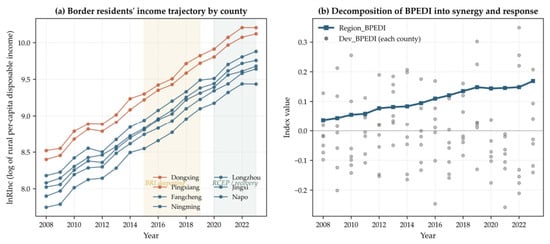
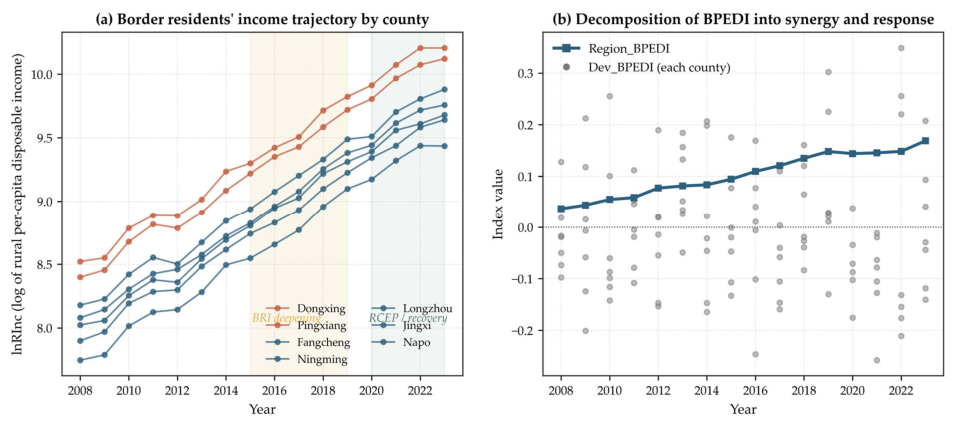
Table 1 reports descriptive statistics. The standard deviation of Region_BPEDI (0.047) is markedly smaller than that of Dev_BPEDI (0.126), indicating that supra-county synergy is more evenly shared, whereas individual counties diverge in their absorption capacity. Figure 3 illustrates these dynamics. Panel (a) traces rural per-capita disposable income for each county: Dongxing and Pingxiang remain above the rest of the sample for most of the period, while Napo and Jingxi are in a lower range. Panel (b) decomposes BPEDI into two components at the regional and county levels: the regional synergy index continued to rise during the deepening period of the BRI (2015–2019) and the RCEP and recovery period (2020–2023), reflecting the improvement of the regional port system environment. Dev_BPEDI fluctuates around the zero point, showing the relative position of each county in the system.
Table 1.
Descriptive statistics of core variables (N = 112).
Figure 3.
Dynamics of border residents’ income and the BPEDI decomposition, 2008–2023. Panel (a) shows lnRInc trajectories; panel (b) reports the regional synergy index together with county response indices. Note: Source: Authors’ calculations using data described in Section 3.1. Visualisation software: R version 4.4.1.
There are two trends worth noting. During the sample period, the income gap between large ports and other sample ports widened by about 0.4 logarithm points, which is generally consistent with the growth trend of Region_BPEDI. On the other hand, the dispersion of Dev_BPEDI has only increased slightly, indicating that the local outperformance of the county is synchronised with the region’s momentum, rather than being significantly ahead of the regional trend. Both patterns are consistent with the sequencing proposed in Section 2 and also provide a basis for the next formal regression analysis.
4.2. Baseline Regression
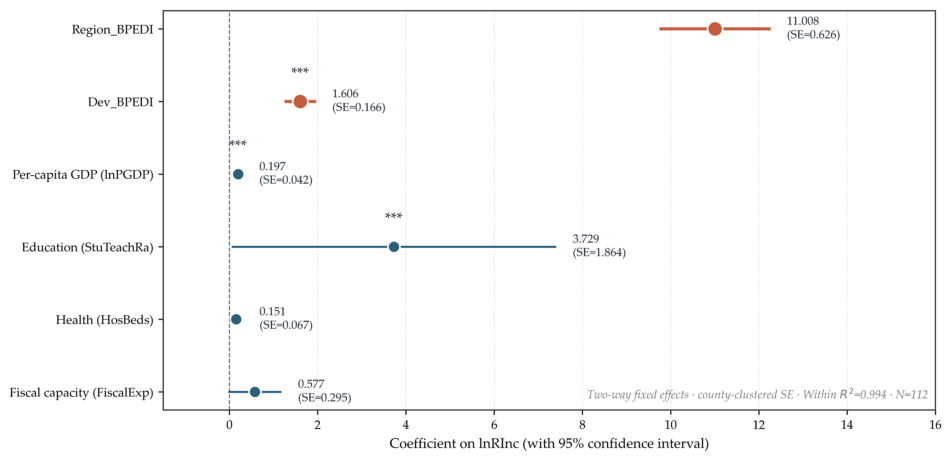
Table 2 presents the baseline results. Column (3) reports the full specification, which includes county fixed effects, year fixed effects, and county-clustered standard errors. The Hausman test supports the use of fixed effects, and the mean variance-inflation factor of 1.17 indicates that multicollinearity is not a serious concern. Both core variables are positively related to the income of rural residents in border counties. Among them, the unstandardised coefficient of Region_BPEDI is greater than that of Dev_BPEDI. Since the two variables have different distributions, we also compare their one-standard-deviation associations. On this basis, the estimated association between Region_BPEDI and lnRInc is about 2.5 times that of Dev_BPEDI. This result is broadly consistent with H1 and suggests that the regional port-system environment has a stronger estimated association with rural income in border counties than county-specific deviations from the regional benchmark.
Table 2.
Baseline regression: regional synergy and county response on lnRInc.
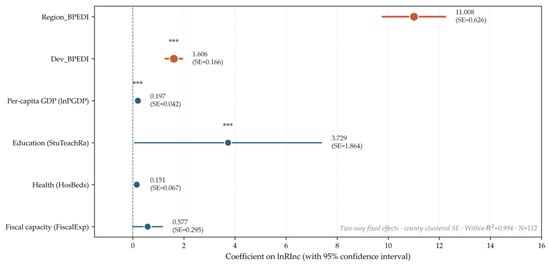
From the economic point of view, the estimated magnitudes are meaningful, but they should be read with caution. BPEDI is a normalised composite index, and the sample is limited in size; therefore, the coefficients should not be interpreted as precise causal elasticities. Specifically, a one-standard-deviation increase in Region_BPEDI is associated with an increase of about 0.52 log points in lnRInc, whereas the corresponding estimate for Dev_BPEDI is about 0.20 log points. This comparison suggests that the regional component has a stronger standardised association with rural income in border counties than the county-level component. Among the control variables, the coefficient of the education quality variable StuTeachRa is the largest, which is consistent with the human capital mechanism emphasised by the existing research [19]. Per-capita GDP, hospital provision and fiscal capacity also enter with positive signs, indicating that in addition to port transformation, the local economic base and public service supply are also related to the growth of rural income. To make the relative magnitudes of the two core estimates more transparent, Figure 4 reports the baseline coefficient estimates and their 95% confidence intervals.
Figure 4.
Forest plot of baseline coefficients with 95% confidence intervals. Regional synergy shows a stronger estimated association than county response. Note: Source: Authors’ estimations based on Table 2. *** denotes significance at the 1% level. Visualisation software: R version 4.4.1.
4.3. Endogeneity Test
Table 3 reports the control-function results. The first-stage F-statistic of 120.54 lies far above conventional weak-instrument thresholds. The residual term in the second stage carries an insignificant coefficient (p = 0.862). This result does not provide strong evidence that the baseline estimates are affected by the endogeneity concern addressed in this control-function specification. The magnitudes of the core regressors remain broadly consistent with the baseline.
Table 3.
Endogeneity test using the control-function approach.
The choice of instruments deserves clarification. The leave-one-out lag of regional BPEDI captures coordination shocks that originate in neighbouring counties and propagate through the shared port system. Such shocks are assumed to affect a county’s expected synergy environment without directly determining its own current income, which is the exclusion restriction required for the instrument [59]. The two-period lag of own BPEDI for the Dev_BPEDI channel is intended to reduce contemporaneous reverse feedback while preserving the persistence of local development trajectories.
4.4. Robustness Analysis
Four robustness exercises are reported in Table 4. Column (1) replaces the entropy-weighted BPEDI with cross-border trade volume; the stronger association of the regional component persists. Column (2) substitutes the control set with total GDP and household consumption; the core coefficients remain stable. Column (3) introduces one-period lags of the core regressors to attenuate reverse-causality concerns. Column (4) drops the 2020–2022 pandemic years to address external shocks. Across all four specifications, the qualitative conclusion holds: Region_BPEDI remains more strongly associated with rural income in border counties than Dev_BPEDI.
Table 4.
Robustness checks.
Several additional patterns are consistent with this conclusion. The lagged specification in column (3) yields the largest synergy coefficient, suggesting that the association between the regional component and rural income may operate with a time lag. Excluding the COVID-19 window in column (4) modestly attenuates the magnitude but preserves the rank ordering between regional synergy and county response. The stronger association of the supra-county component therefore does not appear to be driven solely by the unusual policy environment during the pandemic period.
4.5. Mediating Mechanisms
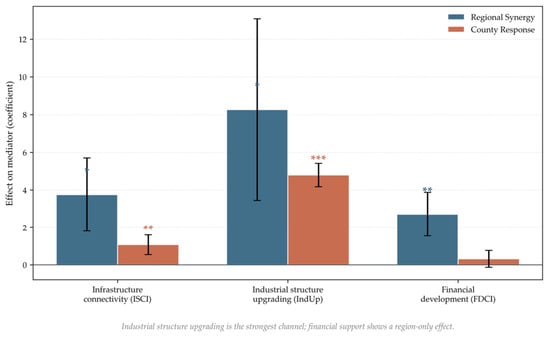
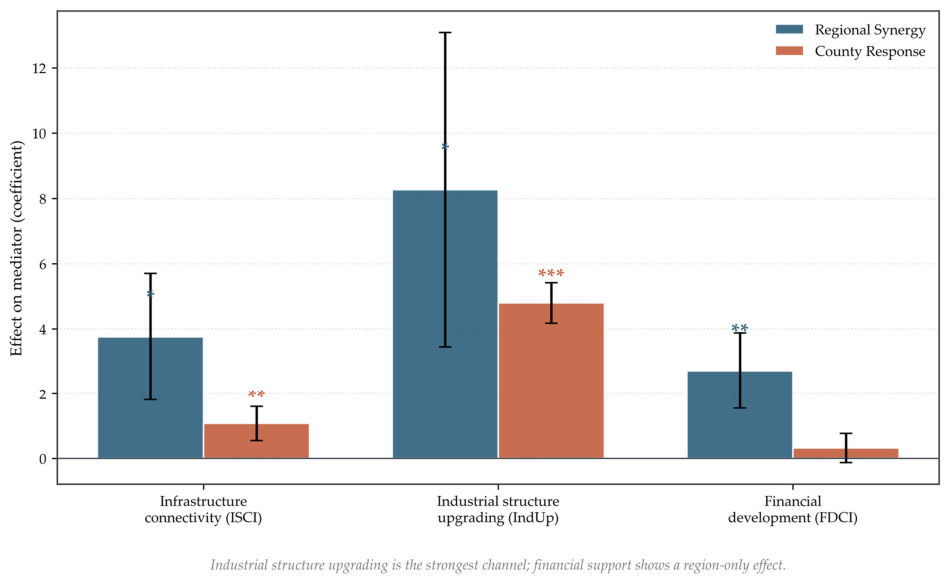
Table 5 reports tier-specific mediation patterns. Industrial structure upgrading shows the strongest mediating pattern. Region_BPEDI is associated with an 8.265-unit increase in IndUp, while Dev_BPEDI is associated with a 4.797-unit increase. Field research suggests that local industrial upgrading is often constrained by land-use ceilings, fiscal-incentive limits, and cross-border labour rules that exceed county-level authority. This evidence is consistent with the larger Region_BPEDI coefficient in the IndUp equation reported in Table 5. Without supra-county coordination, port throughput may be less likely to be associated with deep industrial linkages. The mediation pattern for infrastructure connectivity is consistent: Region_BPEDI has an estimated coefficient of 3.755, while the county-response channel is smaller. Cross-border roads, customs digitalisation, and standard harmonisation typically demand inter-governmental or international negotiation, which counties cannot supply alone [22,23].
Table 5.
Mediation tests by tier.
The field materials help interpret this quantitative pattern. In Dongxing, on-site observations showed that infrastructure upgrading is increasingly combined with sustainability-oriented practices, including electronic documents, paperless customs procedures, and intelligent inspection systems. These measures may improve clearance efficiency while reducing paperwork and vehicle waiting time. More importantly for the mediation results, they are consistent with the interpretation that the infrastructure channel is more closely associated with Region_BPEDI than with Dev_BPEDI: such practices require common technical standards, coordinated funding, and administrative procedures that usually exceed the authority of a single county.
Financial development shows the weakest mediating pattern. Region_BPEDI is positively associated with FDCI, with an estimated coefficient of 2.713 at the 5% level, but the county-response coefficient fails to reach conventional significance. Field research also indicates that border financial markets remain constrained by collateral scarcity and risk-screening bottlenecks. Until industry and infrastructure deepen further, the financial channel may be difficult to activate through purely local instruments. Figure 5 visualises the asymmetry between the two tiers across the three mediators.
Figure 5.
Mediation channels by tier. The estimated mediating patterns differ across infrastructure connectivity, industrial-structure upgrading, and financial development. Note: Source: Authors’ estimations based on Table 5. *, ** and *** denote significance at the 10%, 5%, and 1% levels, respectively. Visualisation software: R version 4.4.1.
Three observations emerge from the mediator results. First, the ranking of channel strengths matches the public-goods sequencing predicted by the theoretical framework. Industry shows the strongest mediating pattern; infrastructure follows; and finance, which may mature only when productive collateral becomes available, shows the weakest pattern. Second, the gap between regional and county coefficients is largest where institutional thresholds bind. Third, the weaker financial channel suggests the possible limits of local subsidies when systemic risk pricing remains unresolved [25,45].
These patterns suggest that hub-oriented reforms are unlikely to rely on a single channel alone; complementary investments across the three layers may be needed to strengthen the association between port transformation and rural income growth.
4.6. Heterogeneity Across Port Sizes
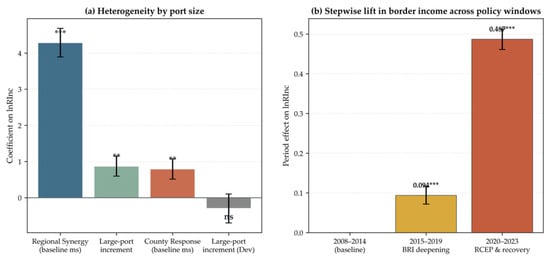
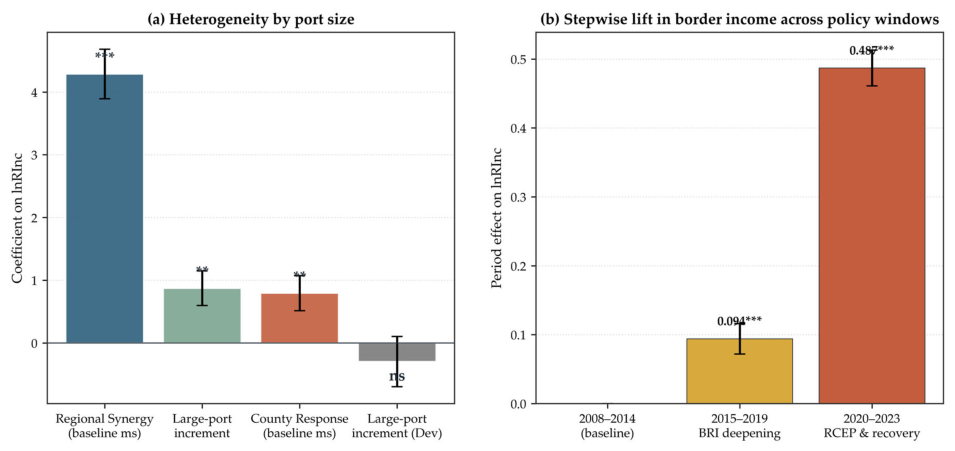
Table 6 summarises the heterogeneity results. For medium and small ports, the estimated coefficients of Region_BPEDI and Dev_BPEDI are 4.287 and 0.795, respectively. The coefficient on the interaction (Region_BPEDI × Large) is 0.874 and significant at the 5% level. This suggests that the Region_BPEDI–lnRInc association is approximately 20% stronger in large ports than in medium and small ports. The interaction term (Dev_BPEDI × Large) is statistically indistinguishable from zero. This pattern suggests that, after a port reaches a higher level of agglomeration, income-related associations may be more closely linked to coordinated upgrading than to purely local effort.
Table 6.
Heterogeneity by port size and policy windows.
The field materials provide contextual support for the heterogeneity result in Table 6. Dongxing, the largest port visited during the fieldwork, helps contextualise why large ports may show a stronger Region_BPEDI–income association. Its constraints are less related to traffic volume alone and more related to cross-border rules, land approval, customs procedures, and value-chain anchoring. These issues cannot be addressed by county-level action alone and therefore help explain why the interaction term between Region_BPEDI and the large-port dummy is positive and significant.
Among medium and small ports, the picture is more differentiated. Ports such as Dongzhong and Aidian still face infrastructure, approval-authority, and industrial-absorption constraints. A subset of niche ports has nonetheless captured phases of rapid growth through speciality-product corridors or tourism-oriented services. Medium and small ports often lack the fiscal and technical capacity to implement smart-port upgrading, environmental monitoring and low-carbon logistics independently. Their sustainable transformation is therefore likely to depend more heavily on regional support for digital upgrading, green logistics pilots and cross-border governance capacity. Their experience suggests that replicating the large-port model is rarely optimal. These observations help explain why the heterogeneity results point to differentiated development paths across port sizes rather than a uniform large-port model.
Period dummies are associated with stepwise increases in lnRInc during the BRI-deepening (2015–2019) and RCEP and recovery (2020–2023) windows, with coefficients of 0.094 and 0.487, respectively. These period estimates suggest that lnRInc is higher in the BRI-deepening and RCEP and recovery windows than in the pre-2015 baseline period. Figure 6 displays both heterogeneity dimensions.
Figure 6.
Heterogeneity by port size and policy windows. Large ports show an additional synergy-related association; lnRInc increases more rapidly during the BRI-deepening and RCEP recovery periods. Note: Source: Authors’ estimations based on Table 6. ** and *** denote significance at the 5% and 1% levels, respectively. Visualisation software: R version 4.4.1.
The size-by-period pattern carries a further governance lesson. Large ports appear to show a stronger Region_BPEDI–income association because they are better able to attract complementary investment and absorb institutional reforms, whereas medium and small ports rely more on the regional architecture to compensate for limited internal capacity. The proportional gain for medium-small ports increased relative to their pre-2015 baseline, but this diffusion remains uneven and contingent on local absorption capabilities [8,9,47].
5. Discussion
The results point to a consistent pattern: the income association of land-border port transformation is not shaped by county-level port performance alone. It is more closely related to the interaction between regional port-system conditions and local absorption capacity. In this sense, regional synergy appears to provide the broader institutional and infrastructural setting, while county response reflects how local actors use these conditions to support livelihoods. The following discussion interprets these findings in relation to the hypotheses, the wider literature and the sustainability implications of land-border port transformation.
The findings are broadly consistent with the five hypotheses. H1 is supported, as both Region_BPEDI and Dev_BPEDI are positively associated with rural income, with Region_BPEDI showing the stronger standardised association. The mediation results are also consistent with H2–H4: infrastructure connectivity and industrial-structure upgrading show positive mediating patterns for both tiers, with larger Region_BPEDI coefficients, while financial development is significantly associated with Region_BPEDI but not with Dev_BPEDI. Among the three channels, industrial-structure upgrading provides the clearest mediating pattern. H5 is supported by the heterogeneity results, which show a stronger Region_BPEDI–income association in large ports and indicate that medium and small ports rely more on differentiated local strategies.
First, the findings extend the conventional “channel–industry–income” logic in border-trade studies. Cross-border roads, railways and digital customs platforms generate externalities that often exceed county boundaries [20,21,22,23]. However, these externalities do not automatically become wage income, self-employment income or local business opportunities. They need to be connected with industrial parks, cross-border services, labour markets and credit arrangements [5,25]. The two-tier framework therefore reframes port reform as a process in which regional public goods and local absorption jointly shape income-related outcomes. This adds a governance perspective to studies that focus mainly on aggregate trade growth or household-level income variation [8,16,18,24].
Second, the results speak to the role of place-based effort. Existing studies have emphasised the importance of local leadership, investment attraction, and institutional quality [9,10,19]. Our evidence is consistent with this view: Dev_BPEDI has a positive and significant coefficient, and the heterogeneity analysis shows that medium and small ports often rely on differentiated development strategies. The key point, however, is that local effort appears more effective when it is embedded in a stronger regional architecture. Where supra-county coordination is weak, county-level policies may have fewer resources, platforms, and institutional conditions to mobilise. This interpretation is consistent with the institutional collective-action literature, which stresses the importance of credible inter-jurisdictional commitments [13,37,38].
Third, the mechanism results help explain why regional synergy is more strongly associated with rural income in border counties. Industrial-structure upgrading shows the largest estimated mediating pattern. Field research suggests that land-use constraints, fiscal-incentive limits and cross-border labour rules are important bottlenecks for local industrial deepening. These constraints often exceed the authority of individual counties. Infrastructure connectivity shows a similar pattern, since customs digitalisation, road connections and standard harmonisation usually require coordination across departments and jurisdictions [22,23,41]. The financial channel is weaker, but it remains more responsive to Region_BPEDI than to Dev_BPEDI. This suggests that credit expansion in border areas depends not only on local subsidies, but also on broader risk-sharing, guarantee, and information systems [25,45].
The sustainability discussion adds another layer to the analysis. Port transformation should not be reduced to throughput expansion. In land-border regions, the coordination arrangements that are linked to local income outcomes may also matter for environmental governance. Smart customs clearance, paperless procedures and low-carbon logistics can reduce transaction costs while improving environmental performance. Yet these measures require common standards, shared data systems and cross-border administrative coordination. Regional synergy is therefore relevant not only to income-related outcomes but also to the institutional conditions needed for greener port operations.
The heterogeneity results also show why port size matters for policy design. For large ports such as Dongxing and Pingxiang, the main constraints are no longer basic traffic volume. They are more often related to rule harmonisation, land approval, labour mobility and value-chain anchoring. These ports have stronger fiscal and technical capacity, which makes it easier for them to pilot smart customs and low-carbon logistics. Still, such pilots require regional and cross-border support. Medium and small ports face a different set of constraints. Some still need better basic connectivity and stronger industrial absorption capacity, while others may build opportunities around speciality-product corridors or tourism-related services. A uniform reform package is therefore unlikely to fit all port tiers.
Compared with the existing literature, this paper contributes by distinguishing the upstream role of regional public-goods provision from the downstream role of county-level absorption in explaining rural income associations in land-border port regions. This distinction helps interpret why similar trade expansion may be associated with different livelihood outcomes across border counties. It also suggests that border-port development should be evaluated not only as a transport or trade issue but also as a governance problem involving coordination, absorption, and public-goods provision.
Several limitations should be noted. First, the sample is limited to seven border counties in Guangxi, which restricts statistical generalisation. The estimated coefficients should not be interpreted as universal magnitudes applicable to all land-border regions. The broader relevance of the study lies in the analytical distinction between supra-county regional public-goods provision and county-level absorption. This distinction may be useful for examining other land-border corridors where port transformation depends on both cross-jurisdictional coordination and local absorption capacity. However, the empirical magnitudes and specific mechanisms need to be re-examined in different institutional and geographic contexts. Second, Region_BPEDI and Dev_BPEDI remain proxy measures, even though they are constructed to reflect the regional and county-level components of port development. Third, the non-experimental panel design and the small number of county clusters limit causal identification and statistical inference, despite the use of control-function checks. Future research could extend the analysis to other Chinese border regions, such as Yunnan and Xinjiang, exploit clearer policy shocks, and use household- or firm-level data to examine distributional outcomes more directly.
Green-governance indicators also remain difficult to measure consistently at the county level. This study therefore uses field evidence, rather than a separate econometric channel, to discuss smart customs clearance, low-carbon logistics and cross-border environmental coordination. Future work could build comparable green-port indicators and combine them with spatial econometric or quasi-experimental designs to examine how port transformation is associated with income, environmental performance and governance capacity across different border regions [60,61].
6. Conclusions and Policy Implications
Using a two-tier analytical framework that distinguishes regional synergy from county response, this paper examines how land-border port transformation is associated with rural income in seven counties along the China–Vietnam border from 2008 to 2023. The empirical strategy combines fixed-effects regression, control-function checks, two-step mediation analysis, port-size heterogeneity tests, and field-research triangulation. The findings offer five related implications.
First, regional synergy shows a stronger association with rural income in border counties than with county response. Hub-oriented transformation may therefore benefit from institutional collaboration across levels of government. Provincial and central agencies should coordinate customs procedures, port planning, transport networks and industrial layouts. Regular cross-tier platforms, such as joint committees linking Nanning Customs, the Provincial Development and Reform Commission and county governments, could help turn ad-hoc coordination into a more stable governance mechanism.
Second, industrial-structure upgrading shows the strongest mediating pattern. Border counties with stronger industrial bases should develop cross-border processing zones supported by appropriate land-use, taxation and logistics policies. Counties with weaker industrial bases should give priority to connectivity, vocational training and public services. These foundations would make it easier to absorb future industrial transfers when they emerge. Such sequencing may also reduce the risk that port flows remain merely transit traffic, with limited local value capture.
Third, infrastructure connectivity is more likely to work well when it is coordinated above the county level. Cross-border roads, smart-port systems and customs digitalisation should be treated as regional public goods rather than as isolated county projects. Implementation could follow a staged approach: removing cross-jurisdictional bottlenecks first, then improving port throughput and digital capacity, and finally strengthening institutional alignment through harmonised customs procedures and shared data systems.
Fourth, financial support requires both macro- and micro-level instruments. At the macro level, policy-finance institutions, regional credit-reference systems and guarantee schemes can help ease credit constraints in border regions. At the micro level, differentiated products—such as micro-loans for border traders, interest-subsidised loans and order-based pledges for SMEs, and supply-chain finance for established firms—can better match the varied risk profiles of border enterprises.
Fifth, port-size heterogeneity calls for differentiated policy packages. Large ports should focus on rule-based opening, integrated industrial corridors and international logistics. Medium and small ports should make greater use of location-specific resources, cultivate niche industries and avoid homogeneous competition with major hubs. Across port tiers, policy sequencing should move from connectivity and industrial absorption towards financial support and institutional opening.
Green governance should also be embedded in the process of port transformation. For large ports, policy should prioritise smart customs systems, paperless clearance, low-carbon logistics and cross-border environmental coordination. For medium and small ports, regional governments should provide technical assistance and fiscal support for digital upgrading, environmental monitoring and green logistics pilots. This approach may help align income growth with the broader goal of sustainable frontier development.
Taken together, the analysis views port transformation as a process that combines the provision of regional public goods with local absorption. Future policy design should maintain a stable regional architecture while allowing county-level strategies to remain flexible, thereby improving the conditions for inclusive income growth as land-border ports move from channels to hubs.
Two implementation routes deserve particular attention. The first concerns evaluation. Tier-aware indicators that separate cross-county synergy from in-county execution should complement conventional trade and GDP statistics so that performance reviews reward the right behaviour at the right level. The second concerns knowledge transfer. As China deepens cross-border partnerships with ASEAN economies through the BRI and RCEP, the Guangxi experience may inform corridor-level governance in Yunnan, Xinjiang and other frontier regions. Treating border-port reform as a regional public-goods issue, rather than a purely local opening project, helps place inclusive income growth at the centre of the reform agenda and may better align frontier development with sustainable and inclusive globalisation.
Author Contributions
Conceptualization, methodology, software, validation, formal analysis, L.L. and S.C.; investigation, data collection, numerical analysis, data curation, L.L., S.C. and X.Y.; writing—original draft preparation, S.C. and L.Z.; writing—review and editing, L.L., S.C., L.Z. and X.L.; visualization, L.Z.; project administration, L.L. and S.C.; supervision, funding acquisition, L.L. All authors have read and agreed to the published version of the manuscript.
Funding
This work was supported by the 2023 Major Project of the Key Research Base for Humanities and Social Sciences in Universities of the Ministry of Education [No. 23JJD850001]; the National Social Science Fund of China [No. 25XSH029]; the Guangxi Philosophy and Social Science Research Project [No. 24SHF020]; and the 2026 Special Research Project of Guangxi University on Forging a Strong Sense of Community for the Chinese Nation.
Institutional Review Board Statement
Not applicable.
Informed Consent Statement
Not applicable.
Data Availability Statement
The original contributions presented in this study are included in the article. Further inquiries can be directed to the corresponding author.
Acknowledgments
We thank the local departments and institutions in Dongxing, Fangchenggang, and Ningming for their support during the field research. All views and remaining errors are our own.
Conflicts of Interest
The authors declare no conflicts of interest.
References
- World Trade Organization. World Trade Report 2023: Re-Globalization for a Secure, Inclusive and Sustainable Future; WTO: Geneva, Switzerland, 2024. [Google Scholar] [CrossRef] [Scilit]
- World Bank. The World Development Report 2020: Trading for Development in the Age of Global Value Chains; World Bank: Washington, DC, USA, 2020. [Google Scholar]
- Asian Development Bank. The Greater Mekong Subregion Economic Cooperation Program Strategic Framework 2030; ADB: Manila, Philippines, 2021. [Google Scholar]
- Coe, N.M.; Yeung, H.W.C. Global production networks: Mapping recent conceptual developments. J. Econ. Geogr. 2019, 19, 775–801. [Google Scholar] [CrossRef] [Scilit]
- Liang, S. International Regional Economic Integration and the Development of China’s Borderland Economies; Springer Nature: Singapore, 2024. [Google Scholar] [CrossRef] [Scilit]
- United Nations Conference on Trade and Development. The Geneva Consensus for a just and sustainable economic order: Political declaration. In Proceedings of the United Nations Conference on Trade and Development Sixteenth Session; United Nations: Geneva, Switzerland, 2025. [Google Scholar]
- Yeung, H.; Huber, J. Has China’s Belt and Road Initiative Positively Impacted the Economic Complexity of Host Countries? Empirical Evidence. Struct. Change Econ. Dyn. 2024, 69, 246–258. [Google Scholar] [CrossRef] [Scilit]
- Okabe, M. Economic Development of Land-Border Regions under ASEAN Economic Integration. J. Asian Econ. 2025, 96, 101864. [Google Scholar] [CrossRef] [Scilit]
- Kudo, T. Border Area Development in the Greater Mekong Subregion (GMS): Turning the Periphery into the Center of Growth; ERIA Working Paper DP-2009-15; Economic Research Institute for ASEAN and East Asia: Jakarta, Indonesia, 2009; Available online: https://www.eria.org/ERIA-DP-2009-15.pdf (accessed on 13 August 2026).
- Zhang, X.; Zuo, X.; Chen, X. Open Doors: The Impact of Border Reforming and Opening Policies on the Regional Border Economies of China. Int. Stud. Econ. 2023, 18, 527–546. [Google Scholar] [CrossRef] [Scilit]
- Ning, J.; Chen, W.; Yuan, Q.; Wu, G. Widening or Narrowing: How Support Policies in Border Ethnic Regions Shape Urban-Rural Income Inequality. Appl. Econ. 2025, 1–17. [Google Scholar] [CrossRef] [Scilit]
- Bird, J.; Lebrand, M.; Venables, A.J. The Belt and Road Initiative: Reshaping Economic Geography in Central Asia? J. Dev. Econ. 2020, 144, 102441. [Google Scholar] [CrossRef] [Scilit]
- Feiock, R.C. The Institutional Collective Action Framework. Policy Stud. J. 2013, 41, 397–425. [Google Scholar] [CrossRef] [Scilit]
- Gamper, C.; Charbit, C. Coordination of Infrastructure Investment Across Levels of Government; International Center for Public Policy Working Paper No. 14–16; Andrew Young School of Policy Studies, Georgia State University: Atlanta, GA, USA, 2014; Available online: https://scholarworks.gsu.edu/items/d38e4b18-fe71-41d4-8352-885a8593a506 (accessed on 13 August 2026).
- Ge, Y.; He, Y.; Jiang, Y.H.; Yin, X.P. Border Trade and Regional Integration. Rev. Dev. Econ. 2014, 18, 300–312. [Google Scholar] [CrossRef] [Scilit]
- Adam, H.L.; Larch, M.; Stadelmann, D. Trade Agreements and Subnational Income of Border Regions. Econ. Inq. 2023, 61, 1034–1052. [Google Scholar] [CrossRef] [Scilit]
- Le, M.S.; Su, J.-J.; Nguyen, J. Trade Liberalisation, Poverty, and Inequality in Vietnam: A Quantile Regression Approach. Appl. Econ. 2019, 51, 3971–3981. [Google Scholar] [CrossRef] [Scilit]
- Ngo, N.A.; Lee, H. Income Inequality, Poverty, and Trade Liberalization: Evidence from the Vietnam–US Bilateral Trade Agreement. Res. Econ. 2025, 79, 101054. [Google Scholar] [CrossRef] [Scilit]
- Bie, Q.; Li, C.; Zhou, S. Evaluation of the Effectiveness of Border Policies in Dehong Prefecture of Yunnan, China. Sustainability 2014, 6, 5284–5299. [Google Scholar] [CrossRef] [Scilit]
- Loumeau, G. Regional Borders, Commuting, and Transport Network Integration. Rev. Econ. Stat. 2025, 107, 1573–1587. [Google Scholar] [CrossRef] [Scilit]
- Quium, A. Transport Corridors for Wider Socio–Economic Development. Sustainability 2019, 11, 5248. [Google Scholar] [CrossRef] [Scilit]
- Liu, Y.; Tong, S.; Liu, W. Beyond Bulk Freight: How the Cross-Border Rail Infrastructure Reshapes Regional Value Chains. Transp. Policy 2026, 179, 103992. [Google Scholar] [CrossRef] [Scilit]
- Liu, Y.; Tong, S.; Ma, X.; Liu, W.; Miao, Y. Enhancing Cross-Border Rail Connectivity: A Quasi-Natural Experiment on Boosting Regional Innovation Performance through the China-Laos Railway. Res. Transp. Bus. Manag. 2026, 67, 101640. [Google Scholar] [CrossRef] [Scilit]
- Li, Q.; Yang, D. Study on the Impact of Digital Inclusive Finance on Farmers’ Income Increase in Border Areas of Ruili City. Highlights Bus. Econ. Manag. 2025, 60, 456–466. [Google Scholar] [CrossRef] [Scilit]
- Liu, S.; Li, Y.; Huang, K.; Zhao, C.; Jin, G. The Impact of Financial Openness on Regional Economic Growth: The Mediating Role of Foreign Trade. Financ. Res. Lett. 2025, 86, 108599. [Google Scholar] [CrossRef] [Scilit]
- Seti, T.M.; Mazwane, S.; Christian, M. Financial Openness, Trade Openness, and Economic Growth Nexus: A Dynamic Panel Analysis for Emerging and Developing Economies. J. Risk Financ. Manag. 2025, 18, 78. [Google Scholar] [CrossRef] [Scilit]
- Shi, J.; Ye, J.; Chen, J.; Pang, C.; She, S.; Xu, J.; Jiang, H.; Chen, X. Synergistic Control of Greenhouse Gas and Air Pollutant Emissions from Ships in Global Container Ports. Transp. Res. Part E Logist. Transp. Rev. 2026, 206, 104561. [Google Scholar] [CrossRef] [Scilit]
- Nguyen, P.N. Ship Emissions and Social Costs at Southeast Asian Container Ports. Transp. Saf. Environ. 2025, 7, tdaf067. [Google Scholar] [CrossRef] [Scilit]
- Kostidi, E.; Lyridis, D. Decarbonizing Ports for a Sustainable Future: Challenges and Strategies. Tech. Ann. 2024, 1, 39896. [Google Scholar] [CrossRef] [Scilit]
- Mitrousi, K.A. Customs: Global Border Authorities as Pillars in Mitigating Climate Change and Transitioning to Global Green Energy. Bord. Glob. Rev. 2024, 6, 136–145. [Google Scholar] [CrossRef] [Scilit]
- Acciaro, M.; Ghiara, H.; Cusano, M.I. Energy Management in Seaports: A New Role for Port Authorities. Energy Policy 2014, 71, 4–12. [Google Scholar] [CrossRef] [Scilit]
- Hoang, A.T.; Foley, A.M.; Nižetić, S.; Huang, Z.; Ong, H.C.; Ölçer, A.I.; Pham, V.V.; Nguyen, X.P. Energy-Related Approach for Reduction of CO2 Emissions: A Critical Strategy on the Port-to-Ship Pathway. J. Clean. Prod. 2022, 355, 131772. [Google Scholar] [CrossRef] [Scilit]
- Halpe, P.; Adams, M.; Walker, T.R. Challenges and Opportunities for Ports in Achieving Net-Zero Emissions in Maritime Transport. Transp. Res. Interdiscip. Perspect. 2025, 30, 101379. [Google Scholar] [CrossRef] [Scilit]
- Yeon, J.-I.; Hwang, S.; Jun, B. Ports as Catalysts: Spillover Effects of Neighbouring Ports on Regional Industrial Diversification and Economic Resilience. Reg. Stud. 2023, 58, 981–998. [Google Scholar] [CrossRef] [Scilit]
- Samuelson, P.A. The Pure Theory of Public Expenditure. Rev. Econ. Stat. 1954, 36, 387–389. [Google Scholar] [CrossRef] [Scilit]
- Olson, M. The Logic of Collective Action: Public Goods and the Theory of Groups, 2nd ed.; Harvard University Press: Cambridge, MA, USA, 1971. [Google Scholar] [CrossRef] [Scilit]
- Ostrom, E. Governing the Commons: The Evolution of Institutions for Collective Action; Cambridge University Press: Cambridge, UK, 2015. [Google Scholar]
- Kim, S.Y.; Swann, W.L.; Feiock, R.C. Collective Learning and Institutional Collective Action in Fragmented Governance. In Knowledge for Governance; Glückler, J., Herrigel, G., Handke, M., Eds.; Springer: Cham, Switzerland, 2020; pp. 351–373. [Google Scholar] [CrossRef] [Scilit]
- Coase, R.H. The Nature of the Firm. Economica 1937, 4, 386–405. [Google Scholar] [CrossRef]
- Williamson, O.E. The Economic Institutions of Capitalism: Firms, Markets, Relational Contracting; Free Press: New York, NY, USA, 1985. [Google Scholar]
- Mau, K.; Xu, M.; Zheng, Y. International Transport Infrastructure and Regional Economic Development; GSBE Research Memoranda no. 001; Maastricht University, Graduate School of Business and Economics: Maastricht, The Netherlands, 2025; Volume no. 001. [Google Scholar] [CrossRef] [Scilit]
- Chenery, H.B. Structural Change and Development Policy; Oxford University Press: New York, NY, USA, 1979. [Google Scholar]
- Kuznets, S. Modern Economic Growth: Rate, Structure, and Spread; Yale University Press: New Haven, CT, USA, 1966. [Google Scholar]
- Leyshon, A.; Thrift, N. Geographies of Financial Exclusion: Financial Abandonment in Britain and the United States. Trans. Inst. Br. Geogr. 1995, 20, 312–341. [Google Scholar] [CrossRef] [Scilit]
- Beck, T.; Demirgüç-Kunt, A.; Levine, R. Finance, Inequality and the Poor. J. Econ. Growth 2007, 12, 27–49. [Google Scholar] [CrossRef] [Scilit]
- Fujita, M.; Krugman, P.; Mori, T. On the evolution of hierarchical urban systems. Eur. Econ. Rev. 1999, 43, 209–251. [Google Scholar] [CrossRef] [Scilit]
- Wu, J.; Lu, J.; Zhang, L.; Fan, H. Spatial Heterogeneity among Different-Sized Port Communities in Directed-Weighted Global Liner Shipping Network. J. Transp. Geogr. 2024, 114, 103781. [Google Scholar] [CrossRef] [Scilit]
- Pérez, I.; González, M.M.; Trujillo, L. Do Specialisation and Port Size Affect Port Efficiency? Evidence from Cargo Handling Service in Spanish Ports. Transp. Res. Part A Policy Pract. 2020, 138, 234–249. [Google Scholar] [CrossRef] [Scilit]
- Rodrigues, K.T.; Ensslin, S.R. Environmental Performance Evaluation in Ports: A Literature Review and Future Research Guidelines. Marit. Econ. Logist. 2023, 26, 241–260. [Google Scholar] [CrossRef] [Scilit]
- Falfushynska, H. A Multidimensional Assessment of CO2-Intensive Economies Through the Green Economy Index Framework. Environments 2025, 12, 195. [Google Scholar] [CrossRef] [Scilit]
- Charłampowicz, J.; Grzelakowski, A.S. The Policy Governance Pathways to Environmental Performance in Baltic Ports. Res. Transp. Bus. Manag. 2026, 66, 101635. [Google Scholar] [CrossRef] [Scilit]
- Sun, B. The formation and evolution of the concept of “border people” in national development. Guangxi Ethn. Stud. 2022, 1, 95–102. (In Chinese) [Google Scholar]
- Leng, Y. Research on the Economic Coordinated Development of Guangxi Border Ports and Border Cities. Master’s Thesis, Guangxi University, Nanning, China, 2023. (In Chinese) [Google Scholar]
- Shannon, C.E. A mathematical theory of communication. Bell Syst. Tech. J. 1948, 27, 379–423. [Google Scholar] [CrossRef] [Scilit]
- World Bank. World Development Report 2016: Digital Dividends; World Bank: Washington, DC, USA, 2016. [Google Scholar]
- Bertschek, I.; Briglauer, W.; Hüschelrath, K.; Kauf, B.; Niebel, T. The Economic Impacts of Broadband Internet: A Survey. Rev. Netw. Econ. 2015, 14, 201–227. [Google Scholar] [CrossRef] [Scilit]
- Baron, R.M.; Kenny, D.A. The moderator-mediator variable distinction in social psychological research: Conceptual, strategic, and statistical considerations. J. Personal. Soc. Psychol. 1986, 51, 1173–1182. [Google Scholar] [CrossRef] [PubMed]
- Jiang, T. Mediation and moderation effects in causal inference empirical research. China Ind. Econ. 2022, 100–120. (In Chinese) [Google Scholar] [CrossRef]
- Wooldridge, J.M. Control Function Methods in Applied Econometrics. J. Hum. Resour. 2015, 50, 420–445. [Google Scholar] [CrossRef] [Scilit]
- Gu, X.; Zhu, Y.; Zhang, J. Toward Sustainable Port Development: An Empirical Analysis of China’s Port Industry Using an ESG Framework. Humanit. Soc. Sci. Commun. 2023, 10, 944. [Google Scholar] [CrossRef] [Scilit]
- Su, X.; Wang, S. Impact of China’s Free Trade Zones on the Innovation Performance of Firms: Evidence from a Quasi-Natural Experiment. Humanit. Soc. Sci. Commun. 2024, 11, 17. [Google Scholar] [CrossRef] [Scilit]

Disclaimer/Publisher’s Note: The statements, opinions and data contained in all publications are solely those of the individual author(s) and contributor(s) and not of MDPI and/or the editor(s). MDPI and/or the editor(s) disclaim responsibility for any injury to people or property resulting from any ideas, methods, instructions or products referred to in the content. |
© 2026 by the authors. Licensee MDPI, Basel, Switzerland. This article is an open access article distributed under the terms and conditions of the Creative Commons Attribution (CC BY) license.