


Highlights
Please indicate how your work links to systems science via your contributions to systems practice, theory, and or methodology.
- The article introduces the Allostatic Viability Principle (AVP) as a new systems concept for personalized preventive health, integrating systems medicine, epigenetics, microbiota, precision nutrition, salutogenesis and AI-supported biomarker interactions.
- It advances systems practice and methodology by operationalizing boundary, exchange, feedback and correctability through measurable indicators, accountable actors, review triggers and revision pathways.
What are the main findings and the implications of the main findings?
- Responsible precision health depends not only on prediction accuracy, but on integrating population norms, individual multi-omic trajectories, patient-defined goals and shared decision-making within correctable learning systems.
- The concept of algorithmic deafness identifies a central risk of AI use: systems may process biomarker and patient data continuously while lacking clinician override, patient appeal, audit and model recalibration mechanisms.
Abstract
Precision health is often presented as the expansion of measurement, prediction and personalization: more biomarkers, more omics layers, more digital traces and more artificial intelligence. Yet data density does not by itself produce orientation, responsibility or better care. This Perspective introduces the Allostatic Viability Principle (AVP) as a systems framework for responsible precision health. Drawing on the biological logic of allostasis and the systems concept of viability, the AVP argues that health systems remain responsible not by freezing static parameters, but by preserving their capacity for regulated openness, feedback-sensitive adjustment and accountable correction. The framework is operationalized through four interdependent system functions: boundary, exchange, feedback and correctability. It further distinguishes population-based biomarker norms from individual trajectories and patient-defined health objectives. The biological analogy is used as a conceptual lens: it does not provide a blueprint for institutional design, but helps to identify when precision health systems remain responsive, and when they become closed, noisy or uncorrectable. The Perspective integrates systems theory, epigenetic and microbiome regulation, precision nutrition, allostatic load, salutogenesis, evolutionary developmental biology, digital health and AI governance. The paper argues that precision health becomes responsible only when biomarkers, AI outputs and patient-reported outcomes are embedded in correctable, goal-concordant and institutionally accountable learning systems.
1. Introduction: Precision Health and the Problem of Responsible Order
Precision health emerged from the promise that health care can move from reactive treatment toward earlier recognition, individualized prevention, and more precise intervention. The precision medicine agenda emphasized new taxonomies of disease, genomic stratification and knowledge networks capable of linking molecular mechanisms with clinical decision-making [1,2,3]. Systems medicine and P4 medicine extended this promise by framing health care as predictive, preventive, personalized and participatory, and by emphasizing multi-level integration rather than isolated disease categories [4,5].
The central problem, however, is that precision is not identical with responsible action. Responsibility here refers to the obligation of health systems to translate data into decisions that are clinically meaningful, ethically defensible, socially fair and institutionally accountable. It also requires attention to the person for whom the decision is made: their baseline, vulnerability, preferences, resources and own objectives for health and daily life. Health systems can generate more data while remaining poor at transforming feedback into learning. Biomarkers may reveal risks without changing care pathways; AI systems may improve prediction while amplifying bias; performance indicators may proliferate while clinicians and patients experience less meaning, less trust and less room for judgment. Complexity science has long warned that health care behaves as a complex adaptive system rather than as a linear machine [6,7].
This article therefore asks a systems question: what kind of order allows precision health to become responsible rather than merely data-intensive? The proposed answer is the Allostatic Viability Principle (AVP), which is operationalized as an open-order framework. It interprets precision health through four connected system functions: boundary, exchange, feedback, and correctability. Boundaries protect integrity; exchange enables selective interaction; feedback links actions to consequences; correctability turns signals into revision of practice, rules, thresholds, guidelines, incentives and institutional learning.
Correctability is introduced here as a distinct systems concept. Feedback is a signal. Learning is the interpretation of signals. Adaptation is a response. Correctability is more demanding: it denotes the capacity of a system to transform feedback into accountable revision of decisions, models, procedures and boundaries. A system may collect feedback and still remain uncorrectable if no actor has the authority, obligation or procedural pathway to change what the feedback reveals. Box 1 summarizes this distinction by contrasting feedback, learning, adaptation, and correctability and by specifying the diagnostic question associated with each.
Box 1. From feedback to correctability: conceptual distinction.
Feedback. Minimal function: A signal about effects or consequences; Diagnostic question: What is the system hearing?
Learning. Minimal function: Interpretation of feedback; Diagnostic question: How is the signal understood and weighted?
Adaptation. Minimal function: A behavioral or procedural response; Diagnostic question: What changes in practice?
Correctability. Minimal function: Accountable revision of decisions, models, thresholds or boundaries; Diagnostic question: Who can change the system, under which rules, and based on what evidence?
The framework is deliberately cautious. Living systems are not treated as normative authorities. A cell does not prescribe how a health system should be organized, and an organism cannot determine institutional ethics. The biological comparison is useful in a narrower sense: it helps clarify how a system can maintain integrity without becoming rigid. Living systems remain viable because they protect boundaries, exchange selectively with their environment, process feedback, and adjust when regulation fails. In this sense, the analogy points to a systems problem rather than to a social prescription: responsible order is neither unrestricted openness nor rigid closure, but regulated openness with the capacity for correction.
This paper makes five contributions. First, it introduces the Allostatic Viability Principle as an integrative name for this open-order logic. Second, it connects biological regulation with health system responsibility without collapsing one level into the other. Third, it defines correctability as a missing bridge between feedback, evaluation, and institutional learning. Fourth, it operationalizes the framework through indicators, corrective mechanisms and multi-omic application examples. Fifth, it shows why epigenetics, microbiota, allostatic load, salutogenesis, Evo-Devo and digital health all point toward the same systems lesson: responsible precision health requires not only better prediction, but better correction.
2. Conceptual Approach and Framework Development
This manuscript is a conceptual Perspective and does not report new empirical data. It develops an integrative framework across literatures that are often discussed separately: systems theory, systems thinking in health care, precision health, epigenetics, microbiome research, precision nutrition, allostasis, salutogenesis, Evo-Devo, and responsible AI. Such framework-oriented synthesis is appropriate when a field is rich in data but lacks an integrative vocabulary for linking levels of analysis and practice [8,9,10,11].
The literature selection was purposive and framework-oriented. Sources were selected for their conceptual relevance to systems, regulation, feedback, adaptation, institutional learning or health system complexity. Biological sources were included when they illustrated regulated plasticity rather than genetic or technological determinism. Governance and AI sources were included when they clarified how data, rules and institutions can either improve or block corrective learning. Existing work in systems thinking for healthcare demonstrates the relevance of causal loops, realist evaluation and multi-stakeholder action frameworks for complex problems [12,13,14].
The proposed model is also connected to the learning health system tradition, which emphasizes continuous learning from care delivery, real-world evidence, feedback infrastructures and the translation of evidence into improved practice [15,16]. It is further aligned with guidance on complex interventions, which emphasizes context, adaptation, implementation and evaluation rather than simple linear causality [17].
No claim of exhaustive coverage is made. The aim is not to replace systematic reviews of precision medicine, digital health or health system performance. The aim is to construct a coherent conceptual framework that can be used by systems researchers, health informaticians, clinicians and institutional decision-makers to ask whether precision health tools strengthen or weaken responsible system learning.
3. From Biological Regulation to Health System Correctability
Living systems are ordered, but their order is not rigid. A cell maintains a boundary, exchanges matter and information, responds to signals and repairs damage. Tissues coordinate differentiated cells, and organisms integrate nervous, immune, endocrine, metabolic and behavioral processes. Across these levels, stability is not achieved by control alone, but by regulated interaction.
The analogy is useful only if its limits are kept visible. It does not tell health systems what they ought to value, how resources should be distributed or which interventions are just. It does not replace ethics, law, professional responsibility or public accountability. Its value is more modest and more precise: it helps formulate the question of how a system remains sensitive to consequences without dissolving into noise or closing itself against reality.
Health systems are hybrid systems. They contain biological bodies, digital infrastructures, clinical professions, regulatory agencies, markets, patient experiences and public values. Decisions cannot therefore be derived from one layer alone. A biomarker can indicate risk, but it cannot decide whether an intervention is proportionate, acceptable or meaningful for a particular person. A guideline can standardize care, but it cannot anticipate every biography, vulnerability, preference or social constraint. A predictive model can identify statistical patterns, but it cannot absorb responsibility for the consequences of acting on them.
This is also why patient-centered care and shared decision-making are not optional additions to precision health. They are part of the system architecture. A population-derived threshold may indicate an average risk, but the decision to act on it must still be translated into the patient’s goals, fears, resources and life situation. Care becomes precise in a responsible sense only when measurement, clinical judgment and patient objectives are brought into the same feedback loop [18,19].
Precision health therefore requires translation across levels. Molecular signals must be interpreted in clinical context; clinical recommendations must be weighed against patient goals and lived circumstances; institutional procedures must remain open to feedback from outcomes, errors and patient experience. Without this translation, precision health may become technically more exact while becoming practically less responsive.
The open-order concept should therefore be understood as a conceptual lens, not as a normative doctrine. It does not ask health systems to imitate nature. Nor does it assume that more data, more biomarkers, more digital tools or more powerful algorithms will automatically make health care more responsible. These tools can improve care only if they are embedded in systems that can interpret signals, weigh values, detect unintended consequences and change course when necessary. The central question is therefore not simply how much a system can measure, but whether it can protect what must be protected, allow meaningful exchange, register the consequences of its own actions, and revise its categories, thresholds, incentives and procedures when they become misleading. In this sense, open order shifts the focus from prediction and control to feedback, judgment and correctability.
4. The Allostatic Viability Principle: Boundary, Exchange, Feedback and Correctability
The Allostatic Viability Principle (AVP) is introduced here to name the open-order logic developed in this paper. It is not an additional mechanism beside boundary, exchange, feedback and correctability. Rather, it is the integrative principle that connects them: a precision health system remains viable and responsible when it can protect integrity, enable selective exchange, register consequences, and translate feedback into accountable correction.
The term draws on the systems concept of viability in organizational cybernetics [20] and on the biological framework of allostasis, understood as stability through adaptive change [21,22]. The AVP states that a health system’s long-term viability and responsibility depend not on freezing static parameters, but on its capacity for continuous, systemic adjustment. Just as a living organism maintains organismal viability by shifting internal set points to limit allostatic load, a responsible precision health system secures institutional viability through correctability: the procedural and accountable capacity to revise algorithms, clinical thresholds and care pathways when reality pushes back. Operating under the AVP protects the system against the dual pathologies of technocratic closure, or dogmatic stasis, and informational overload, or system dissolution.
The first component is boundary. Boundaries define what belongs to a system, what must be protected, and what counts as legitimate access. In biological systems, membranes, epithelial barriers and immune tolerance protect system identity while remaining selectively permeable. In health systems, boundaries include privacy, informed consent, clinical indication, professional standards, regulatory approval and the distinction between research, care and commerce. For example, genomic or microbiome data should not circulate without consent, clinical purpose and governance; at the same time, excessive data silos can prevent responsible research, continuity of care and learning across institutions. A good boundary therefore does not simply close the system. It protects integrity while allowing justified access.
The second component is exchange. Exchange is the selective movement of matter, energy, information or meaning across boundaries. In biology, exchange includes nutrient uptake, waste removal, endocrine signaling, neural communication, and immune surveillance. In precision health, exchange includes interoperability, data sharing, clinician-patient communication, cross-sector collaboration and the translation of omics data into clinically meaningful contexts. For example, a continuous glucose monitor, a microbiome profile or an epigenetic marker becomes useful only if the information can move into a care context where it is understandable, clinically interpretable and connected to action. Exchange without interpretation is only data transfer. Meaningful exchange requires translation.
The third component is feedback. Feedback connects actions with consequences. In biology, feedback can be hormonal, metabolic, immune, neural or epigenetic. In health systems, feedback includes clinical outcomes, adverse events, patient-reported outcome measures, longitudinal biomarkers, implementation data and real-world evidence. For example, a dietary recommendation based on a glycemic risk profile should not end with the recommendation itself. The system should be able to observe whether the intervention improves metabolic markers, whether the patient can actually follow it, whether unintended anxiety or burden occurs, and whether the recommendation works similarly across social groups. Feedback is the condition under which a system becomes aware of its own effects.
The fourth component is correctability. Feedback alone is insufficient. Systems can collect data and still fail to learn. Signals may be filtered, ignored, overinterpreted, or absorbed into symbolic reporting. Correctability is the capacity to transform feedback into accountable change: revised thresholds, updated guidelines, safer algorithms, altered incentives, professional learning, patient communication, or regulatory adaptation. For example, if an AI-based risk model repeatedly overestimates risk in one patient group, or if a biomarker threshold produces many false positives, a correctable system must have a pathway for audit, recalibration, clinician override, patient appeal and guideline revision. Without such pathways, feedback remains information without consequence.
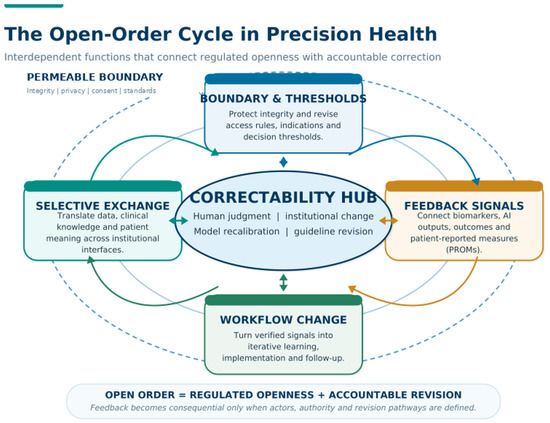
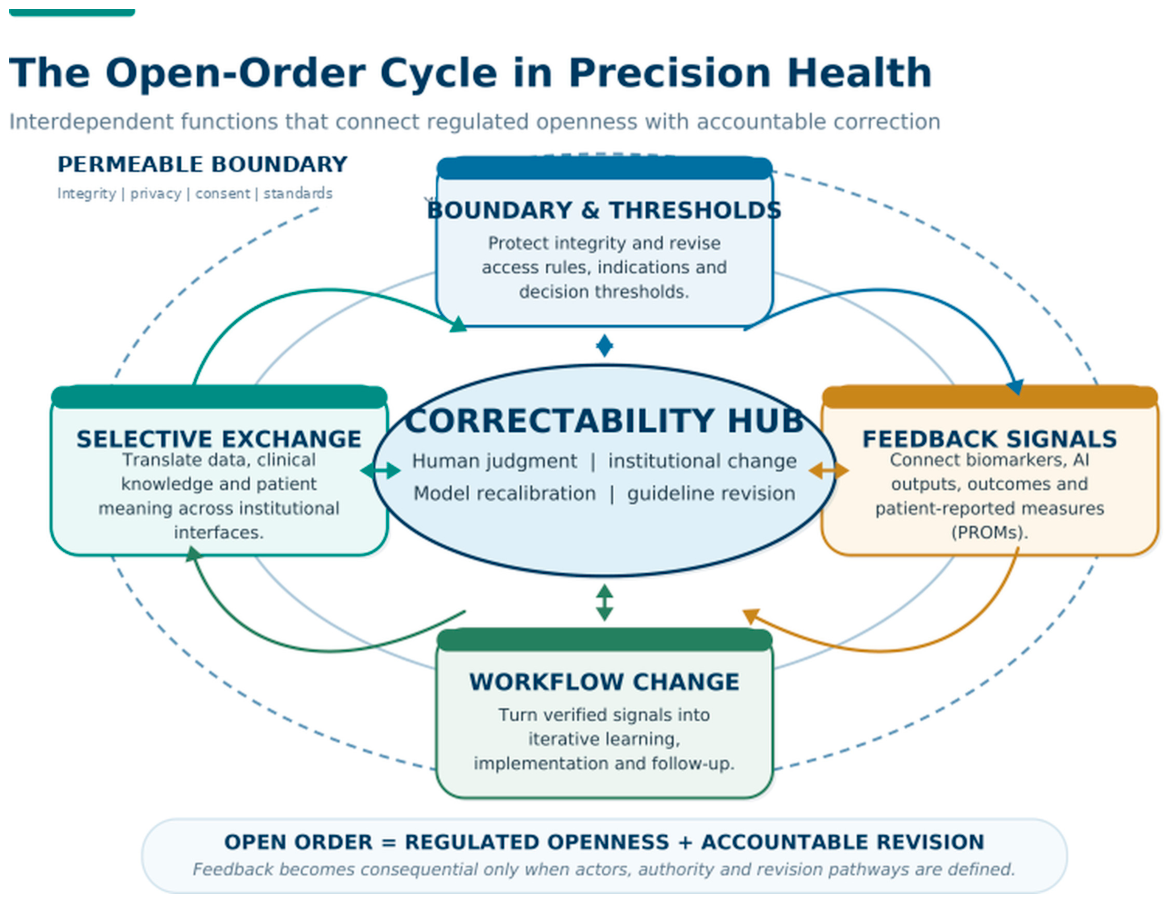
Under the AVP, the four dimensions should not be read as a linear sequence. They are mutually dependent. Boundaries without exchange become exclusion. Exchange without boundaries becomes noise or exploitation. Feedback without correctability becomes symbolic reporting. Correctability without stable boundaries becomes arbitrary revision. Responsible precision health, understood through the AVP, requires all four functions to operate together: protection without isolation, exchange without overload, feedback without ritualization, and correction without instability. Figure 1 visualizes this interdependent open-order cycle and the central role of correctability in translating feedback into accountable change.
Figure 1.
The open-order cycle in precision health. A permeable boundary protects integrity; selective exchange permits information, matter, and meaning to cross levels; feedback loops connect interventions with outcomes; a correctability hub translates feedback into human judgment, institutional change, algorithm revision, and guideline adaptation. The dashed ellipse denotes the permeable system boundary. Arrowheads indicate direction of influence; the colors distinguish the boundary, exchange, feedback and workflow/correction pathways and do not encode magnitude. AI, artificial intelligence; PROMs, patient-reported outcome measures.
5. Levels of Order: From Cell to Health System
Precision health requires multi-level translation. Molecular signals are important because health and disease are shaped by gene regulation, cellular stress, metabolism, inflammation, immune function, and tissue repair. The hallmarks of aging and the hallmarks of health illustrate that biological states emerge from interacting networks rather than from isolated variables [23,24]. However, molecular signals become clinically and socially meaningful only when translated across higher levels.
At the cellular level, precision health asks how metabolism, DNA repair, mitochondrial function, proteostasis, senescence and gene expression are regulated. At the tissue and organismal level, it asks how these processes interact with immune responses, endocrine rhythms, nervous regulation, sleep, movement and nutrition. At the personal level, it must consider biography, preferences, suffering, goals and values. At the institutional level, it must address data governance, reimbursement, professional roles, clinical workflow, public trust and regulatory accountability.
This multi-level view protects precision health from reductionism. A molecular profile does not automatically define a person. A risk score does not automatically define an intervention. A digital trace does not automatically define health behavior. Precision health must therefore be understood as a translation architecture rather than as a mere expansion of measurement.
A key translation problem concerns biomarkers and reference intervals. Many laboratory markers are interpreted against population-derived reference intervals: they describe what is statistically common in a reference group, not what is necessarily optimal or meaningful for a particular person [25]. This population perspective is indispensable for safety, comparability and diagnostic orientation. Yet it can also obscure individual trajectories. A value that remains inside the population interval may represent a relevant shift for one person, while a value outside the interval may sometimes reflect context, method, medication, pregnancy, training status, diet or stable biological individuality rather than disease. Biological variation theory therefore distinguishes population variation from within-person variation and supports interpretation through longitudinal change, reference-change values and individual baselines [26].
Longitudinal and multi-omic profiling strengthens this point. Individual baselines can reveal deviations that are invisible in one-time population comparison, while repeated measurements can also detect transient responses to infection, stress, medication, sleep loss or lifestyle change [27]. The aim is not to replace population norms with purely individual norms. That would risk overfitting, false alarms and unnecessary interventions. Responsible precision health needs both: population-level anchors for validity and equity, and individual trajectories for context-sensitive interpretation.
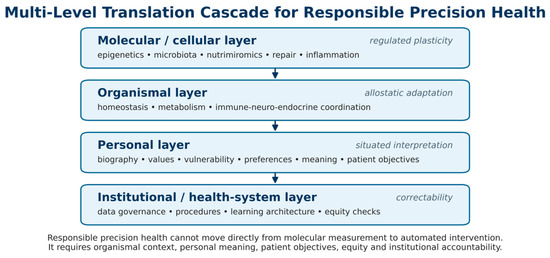
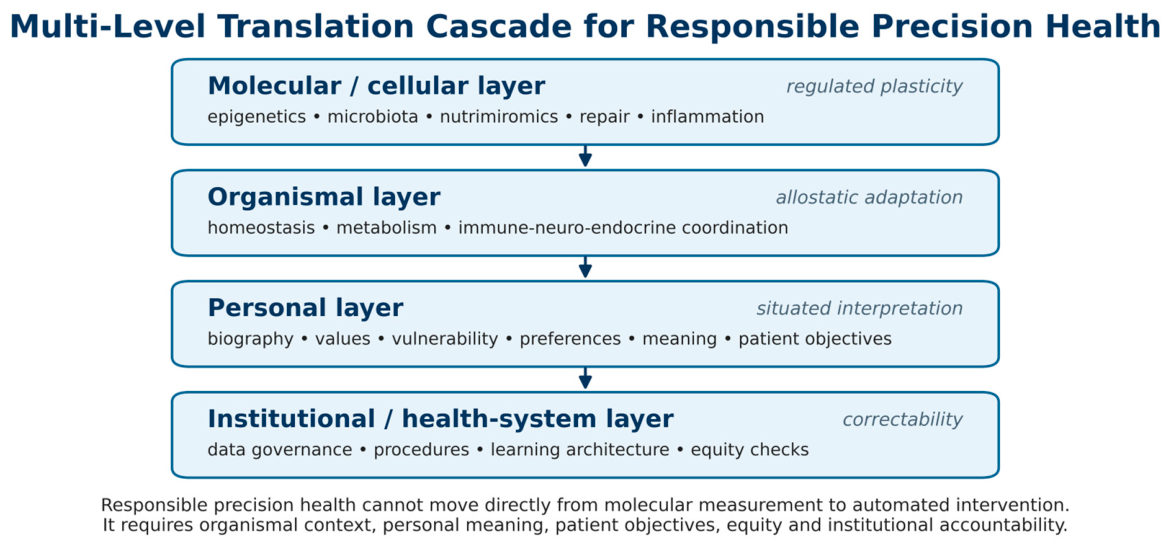
Health systems often fail precisely at the translation points between levels. A laboratory marker may be scientifically valid but clinically ambiguous. A clinical recommendation may be reasonable but socially inaccessible. A digital platform may be technically interoperable but institutionally unactionable. A biomarker threshold may describe a population norm but miss what matters for a patient who wants to preserve mobility, cognition, fertility, work ability, social eating, athletic performance, or simply a tolerable daily routine. The system’s task is therefore not only to connect data, but to connect levels of meaning, responsibility, patient objectives, and correction. Figure 2 maps this translation cascade from molecular signals through organismal regulation and personal meaning to institutional accountability.
Figure 2.
Multi-level translation cascade for precision health. Molecular signals require translation through organismal regulation, personal meaning, patient objectives, and institutional accountability. The figure illustrates why responsible precision health cannot move directly from molecular measurement to automated intervention without contextual, goal-sensitive and correctable interpretation. Downward arrows indicate successive translation across levels; they do not imply simple one-way or linear causation.
6. Epigenetics, Microbiota and Systems Health: Regulation Rather than Determinism
This multi-level perspective becomes especially concrete in epigenetics, microbiota research and personalized nutrition. These fields show why precision health cannot be reduced to genomic prediction or isolated biomarkers. Biological states are regulated across levels: genes are expressed in cellular contexts; metabolism responds to nutrition, stress, sleep and physical activity; microbial metabolites shape immune and epigenetic pathways; and lifestyle factors influence regulatory networks over time.
Epigenetics is a central example of this regulated biological plasticity. Waddington’s concept of the epigenotype and later definitions of epigenetics emphasized that phenotypes arise through regulatory processes that do not simply mirror DNA sequence [28,29]. Broader evolutionary and systems perspectives have similarly challenged gene-centered determinism by emphasizing multi-level regulation, developmental context, and organism-environment interactions [30,31].
This is central for precision prevention. If biological risk is shaped not only by DNA sequence, but also by changeable biological conditions, prevention must focus not only on inherited susceptibility, but also on modifiable contexts such as nutrition, stress, sleep, inflammation, microbiota-derived metabolites and physical activity. These factors influence molecular pathways, gene expression and immune-metabolic regulation over time. The diet-gut microbiota-epigenetics axis illustrates this multi-level logic: food components and microbial metabolites can affect inflammatory, metabolic and regulatory networks, thereby linking lifestyle, microbial ecology and gene regulation [32,33,34].
Personalized nutrition provides a practical example. Large inter-individual differences in postprandial glycemic responses show that identical meals can produce different metabolic effects in different persons, depending on microbiome composition, clinical variables and lifestyle context [35]. Reviews of personalized nutrition emphasize that genotype alone is insufficient and that metabolic phenotype, lifestyle, microbiota and social context must be integrated [36]. Integrative approaches linking genetics, epigenetics, gut microbiota and metabolic-type classification further support this multi-level view [37,38]. In this paper, precision health therefore includes precision nutrition as a core preventive pathway, not as a secondary lifestyle add-on.
Nutrimiromic and microRNA-based approaches add a further layer. Circulating microRNAs may reflect inflammatory, metabolic and lifestyle-sensitive regulation and have been explored as signatures related to diet, sex, age and biological aging [39,40]. These signals are not static instructions. They are dynamic, context-dependent readouts of changing biological conditions. In practical terms, dynamic biomarkers are not commands; they are feedback signals that require interpretation, follow-up and clinical humility.
For precision health systems, the implication is clear: dynamic biomarkers are feedback signals, not commands. A miRNA model, epigenetic clock or microbiome profile should therefore be used to support interpretation, monitoring and learning, not to produce unchallengeable risk labels. Turning fluid epigenetic or microbiome-related signals into fixed algorithmic verdicts would be a systems error. Such an interpretation would confuse a context-dependent biological condition with a stable biological identity, thereby overlooking temporal variation, reversibility, patient goals and the need for longitudinal clinical interpretation.
The practical implication is that precision health should move from determinism to regulated plasticity. The question is not simply what a biomarker predicts relative to a population norm. The question is whether the marker improves feedback for this person, whether it changes a decision responsibly, whether the decision can be evaluated against the patient’s own health objectives, and whether the system can correct itself when the marker proves misleading, noisy, or context-dependent. Box 2 illustrates this principle using methylation- and miRNA-based biological age clocks as feedback instruments rather than personal verdicts.
Box 2. Example: methylation and miRNA-based clocks as feedback instruments, not personal verdicts.
Methylation-based biological age clocks and emerging miRNA-based clocks illustrate both the promise and the risk of precision health biomarkers. DNA methylation clocks estimate biological age or age acceleration from patterns of CpG methylation that are statistically associated with chronological age, mortality risk or healthspan-related phenotypes [21,22,41,42,43]. miRNA-based clocks and nutrimiromic signatures add another layer by capturing circulating regulatory signals that may reflect inflammatory, metabolic, nutritional and lifestyle-sensitive processes [44,45].
Their value lies in making otherwise invisible biological regulation measurable. A methylation clock may suggest that biological aging processes are accelerated relative to a reference population. A miRNA-based model may indicate altered immune-metabolic or lifestyle-related regulation. However, such scores are not direct measures of a person’s destiny, nor are they neutral definitions of what is normal for the individual. They are statistical comparisons with reference populations and model assumptions. Their meaning depends on age, sex, tissue or sample type, cellular composition, ancestry, medication, inflammatory status, sleep, nutrition, physical activity, smoking, alcohol, psychosocial stress and comorbidities.
For the patient, the central question is therefore not simply: Is my biological age higher or lower than expected? A more responsible question is: What does this marker add to the understanding of my current health trajectory, my risks, my capacities and my goals? A person who aims to preserve mobility, cognitive function, metabolic flexibility or quality of life may need a different interpretation of the same marker than a person focused mainly on disease-risk reduction or athletic performance. Biomarker guidance should therefore connect the score with personal objectives, clinical context and feasible lifestyle pathways.
In an open-order system, methylation and miRNA clocks should be used as feedback instruments. They may help to identify biological stress, monitor change over time, support shared decision-making and evaluate whether an intervention is moving the person in a desired direction. Their proper role is to inform a learning loop: interpret the marker, relate it to the patient’s goals and circumstances, act proportionately, reassess longitudinally and revise the pathway when the signal proves noisy, misleading or clinically irrelevant.
7. Allostasis, Evolution and Evo-Devo: Adaptation Through Regulatory Change
A useful bridge between biological regulation and health system design is allostasis. Homeostasis denotes the dynamic regulation of physiological variables within viable ranges and may itself include context-sensitive adjustments around defended values. Allostasis emphasizes a further aspect of regulation: anticipatory, context-dependent coordination across multiple systems, including the allocation and reallocation of resources in response to predicted demands. The distinction is therefore not simply static versus dynamic regulation, but primarily regulation within viable ranges versus anticipatory and distributed adjustment to context. During infection, stress, fasting, exercise, or sleep loss, the body mobilizes energy, alters hormone secretion, changes immune activity, and reallocates resources. In this sense, allostasis describes stability through context-sensitive change [44,45].
This adaptive flexibility is necessary. A stress response, inflammatory signal or metabolic shift is not pathological simply because it deviates from baseline. It becomes problematic when it is too intense, too prolonged, poorly resolved or repeatedly activated without sufficient recovery. Allostatic load describes this cumulative biological burden: the wear and tear that arises when adaptive responses become chronic, excessive or poorly coordinated across systems [46].
Salutogenesis adds the complementary question of how health is generated and maintained, not only how disease emerges. Antonovsky’s concept of sense of coherence emphasizes that people cope better when life and bodily signals are experienced as comprehensible, manageable and meaningful [47,48]. This is relevant for precision health because a marker does not speak to a passive organism alone. It is interpreted by a person who asks whether the signal makes sense, whether action is manageable, and whether the recommended change fits a meaningful life. In this way, allostasis links adaptive biological regulation to system dynamics, while salutogenesis and coherence link regulation to resources, interpretation and patient objectives.
This distinction is crucial for precision health. Technocratic precision health often seeks to optimize static metrics: lower this number, raise that score, classify this risk. Living biology, however, operates through rhythms, thresholds, context and adaptive trade-offs. A glucose spike, inflammatory signal or stress response is not always pathological in isolation; it becomes problematic when timing, duration, context and recovery are dysregulated. A salutogenic view further reminds us that the same measurement may have different meaning depending on whether a person has the resources, understanding and motivation to respond constructively.
Correctability can therefore be understood as the institutional equivalent of allostatic regulation. A responsible health system does not maintain stability by freezing rules, models or indicators. It maintains stability by changing them when feedback reveals mismatch, overload or unintended harm. Just as biological systems achieve stability through adaptive regulation, health systems should achieve reliability through iterative correction. This is the biological-institutional bridge that gives the Allostatic Viability Principle its practical meaning: stability is preserved through accountable adjustment rather than through rigid fixation.
Evolutionary developmental biology sharpens this point. Evolution does not always proceed by inventing entirely new parts. Major morphological and functional changes often arise through altered regulation of existing developmental programs: changes in timing, location, expression and interaction of regulatory switches [49,50,51,52]. The systemic translation is direct yet cautious: health systems do not necessarily need a new AI department, a new omics clinic or a new bureaucratic layer for every innovation. They often need to rewire the regulatory switches of existing data flows so that clinical feedback, patient experience and real-world evidence can trigger institutional change.
This Perspective helps distinguish innovation from mere structural accumulation. Health systems often respond to new challenges by adding separate AI units, omics clinics, data registries, dashboards, committees or administrative layers. Such additions may expand technical capacity, but they do not necessarily improve learning. An open-order system asks a different question: does a new tool change how feedback is received, interpreted and translated into correction?
The Evo-Devo analogy gives precision health a sharper institutional lesson. Transformative change often depends less on adding new units than on changing when, where and how existing structures are activated. In system terms, correctability is not achieved by expanding the technical architecture alone, but by improving the regulatory wiring that allows data, clinical experience and patient feedback to trigger timely revision of pathways, thresholds, models and guidelines.
8. Digital Precision Health: AI, Biomarkers and Algorithmic Deafness
Digital health and AI expand the technical possibilities of precision health. Machine learning can support pattern recognition, risk stratification, imaging interpretation, triage, monitoring and decision support [53,54,55]. Digital systems can connect care across settings, integrate longitudinal data and detect changes before clinical disease becomes visible. For complex and chronic conditions, such capabilities are potentially transformative.
At the same time, digital precision health can produce technocratic closure. A system closes technocratically when measurement is mistaken for understanding, prediction for responsibility, and algorithmic output for judgment. Bias in population health algorithms, the ethical challenges of machine learning in medicine and the insufficiency of principles alone for AI governance have been widely discussed [56,57,58]. WHO guidance similarly emphasizes governance, transparency, accountability, data protection, human oversight and regulatory capacity for AI in health [59,60].
Algorithmic deafness denotes a system condition in which data-driven outputs are continuously generated but cannot be institutionally contested, corrected or translated into accountable pathway change. It occurs when an automated decision loop is internally optimized for data processing but lacks mechanisms for clinician override, patient appeal, error reporting, or model revision. The system may become statistically responsive and institutionally deaf at the same time. It hears the dataset but not the patient; it updates the score but not the pathway.
The open-order framework translates these concerns into evaluation criteria. A digital precision health tool should be assessed according to whether it strengthens legitimate boundaries, improves meaningful exchange, enhances feedback quality and increases correctability. Boundary criteria include privacy, consent, proportionality, cybersecurity and regulatory oversight. Exchange criteria include interoperability, clinical interpretability and communication between patients, clinicians and institutions. Feedback criteria include linkage between predictions, outcomes, adverse events and patient-reported experience. Correctability criteria include model updating, auditability, override mechanisms, appeal pathways and guideline revision.
This declarative framing replaces a purely rhetorical assessment of digital tools. The question is not whether AI is good or bad in general. The question is which system functions it improves and which it weakens. AI can open a system when it reveals previously invisible risks and supports better care. It can close a system when it creates data silos, opaque authority, administrative burden or automated decisions that clinicians and patients cannot contest. Algorithmic deafness is the ultimate pathology of a technocratically closed system, directly opposing the principles of an open order.
9. Operationalizing the Open-Order Framework in Precision Health Systems
Operationalization is essential if the framework is to be useful for systems researchers, health informaticians and institutional decision-makers. Health system performance frameworks increasingly emphasize people-centeredness, resilience, digital transformation, equity and learning across countries and institutions [61]. However, performance measurement itself can become a closed system if indicators are collected without meaningful correction.
This is a Goodhart-style risk: once a measure becomes a target, it can cease to function as a good measure of the underlying reality [62]. In precision health, the risk is not only that metrics are wrong. The risk is that metrics become institutionally successful while clinically or socially misleading. Readmission rates, algorithmic risk scores, app engagement, data-completeness indicators, or biological age estimates can all become targets that optimize reporting rather than health.
Table 1 proposes a preliminary matrix for translating the AVP/open-order dimensions into health-system equivalents, risks of closure, indicators and corrective mechanisms. The matrix is not intended as a finalized measurement instrument. It is a design scaffold for future empirical work, implementation studies and institutional self-assessment. It also illustrates a key claim of the paper: system performance cannot be judged only by the presence of data flows, but by the presence of corrective pathways.
Table 1.
(A). AVP/open-order dimensions, biological archetypes, health system equivalents and pathologies of closure. (B). Possible indicators and corrective mechanisms for the AVP/open-order framework.
Operationalization pathway: from dimensions to accountable revision
The tables are intended to be used within a five-step operationalization pathway rather than as a stand-alone checklist. First, the unit of application and the relevant system boundary must be specified—for example, an AI-supported risk tool in primary care, an omics-guided prevention service or an institutional learning pathway. Second, the relevant actors, data interfaces, patient-defined objectives and equity constraints are mapped. Third, a small set of indicators is selected across boundary, exchange, feedback, correctability and equity/access, with a documented baseline, target or acceptable range, data source, review interval and responsible owner. Fourth, pre-specified review triggers connect observed deviations to an authorized corrective action, such as model recalibration, threshold revision, workflow redesign, consent amendment or patient appeal. Fifth, the effects of the correction are reassessed, including unintended burden, disparities and goal concordance, thereby restarting the learning cycle.
A minimum implementation record should therefore answer five questions: What is being monitored? Whose goals and outcomes count? What deviation triggers review? Who has the authority and responsibility to revise the system? How will the consequences of that revision be evaluated? This distinguishes operationalization from simple measurement. An indicator becomes part of the AVP framework only when it is linked to a decision rule, an accountable actor, a revision pathway and follow-up.
At pilot stage, the framework can be applied as an institutional self-assessment. A multidisciplinary team selects one bounded use case, maps the five dimensions, identifies the weakest link, defines one or two correction triggers and documents the resulting change. Comparative implementation studies can then test whether systems with explicit correction pathways respond more rapidly, safely and equitably than systems that collect similar indicators without defined authority for revision. Box 3 summarizes the resulting five-step AVP operationalization protocol. Box 4 illustrates its application in a multi-omic metabolic health scenario by contrasting technocratic closure with an open-order pathway.
Box 3. Five-step AVP operationalization protocol.
1. Define the use case and system boundary.
2. Map actors, interfaces, patient goals and equity constraints.
3. Specify indicators, baselines, review intervals and owners.
4. Define review triggers, authority and corrective actions.
5. Reassess outcomes, unintended effects and goal concordance, then iterate.
Box 4. Systemic translation in action: multi-omic metabolic health.
Technocratic closure. A patient tracks continuous glucose monitoring and microbiome data through a commercial platform. A proprietary algorithm flags a high postprandial glycemic risk score and generates strict dietary mandates. If biological-age or metabolic markers do not improve because chronic psychosocial stress, sleep disruption, medication effects, work schedules, or financial constraints remain unmeasured, the system interprets the result as poor adherence or inadequate patient effort. The platform compares the patient mainly with population-derived or proprietary norms, while the patient’s own baseline, values, and objectives remain weakly represented. Data remain siloed inside the platform, invisible to primary care, and the scoring weights remain unauditable. System failure is externalized as individual failure.
Open-order pathway. The same multi-omic data are collected under interoperable standards and interpreted in clinical consultation. The risk signal is translated through organismal context, longitudinal baseline, biography and patient goals. The patient may not aim at maximal optimization, but at reducing cardiometabolic risk while preserving energy, social eating, work routines or mental stability. If aggregate feedback shows that a threshold produces frequent false positives, anxiety, inequitable recommendations or poor goal-concordance, an institutional review is triggered. Automated alerts are recalibrated, clinical communication is revised, and guideline thresholds are updated. The system learns not only from the data point, but from the consequences of using it.
10. Responsible Health Systems as Open Orders
A responsible health system is not a system that never makes mistakes. It is a system that can recognize, disclose, learn from, and correct mistakes. This distinction is central to public trust. Systems lose trust not only when errors occur, but when they appear unable or unwilling to process errors openly.
The open-order framework also clarifies the role of values and patient objectives. Health systems must balance early detection with overdiagnosis, privacy with data sharing, prevention with autonomy, efficiency with dignity, personalization with equity, and innovation with evidence. For an individual patient, the relevant objective may not be maximal risk reduction at any cost. It may be preserving cognition, mobility, fertility, work ability, social participation, psychological stability, or a tolerable daily routine. Evidence-based medicine itself has been criticized when evidence hierarchies become detached from patient complexity and professional judgment [65]. The reproducibility crisis and the high risk of false-positive findings in some areas of biomedical research further show that knowledge systems need correction, not only production [66].
Equity must be treated as a system property, not as an afterthought. Precision health can widen inequality if high-resolution diagnostics, digital literacy and tailored prevention are available mainly to privileged groups. Social determinants of health shape exposure, vulnerability, access and the capacity to act on recommendations [67]. Therefore, boundaries and correctability must include equity checks: who receives access to precision diagnostics, who bears the burden of monitoring, who can appeal algorithmic classifications, and who benefits from institutional learning.
In this sense, correctability is not only technical. It is ethical and institutional. Institutions that manage common goods require rules, monitoring, graduated responses and mechanisms for collective learning [68]. Science and technology governance likewise require humility about uncertainty, limits and unintended consequences [69]. Responsible precision health therefore depends on human-in-the-loop structures that are not tokenistic: clinicians, patients, regulators and researchers must be able to challenge models, reinterpret data and revise practice.
This perspective distinguishes personalization from individualized responsibilization. Personalization can mean tailoring care to individual biology, biography and circumstances. But it can also become individualized responsibility, shifting systemic burdens onto patients through dashboards, scores and moralized prevention. An open-order approach insists that precision health remain embedded in institutional responsibility: data should support better care and goal-concordant decisions, not merely transfer risk management to individuals.
11. Discussion: From Prediction to Correctability
The central contribution of this paper is the Allostatic Viability Principle (AVP), with correctability as its decisive operational bridge between biological regulation and responsible health system design. Systems thinking often emphasizes feedback, but feedback is not enough. A dashboard can display worsening inequalities without changing reimbursement. An adverse-event report can be filed without redesigning workflow. A biomarker can indicate risk without creating an actionable care pathway. Correctability asks whether feedback changes the system in ways that can themselves be evaluated.
This concept has implications for biomarker development. New tests should be evaluated not only by analytical validity, predictive performance and biological plausibility, but by whether they improve decisions for the person concerned, reduce harm, alter pathways responsibly and remain open to revision. Biomarkers should be interpreted in relation to population reference intervals, individual baselines, biological variation, clinical context and patient-defined objectives. It also has implications for AI governance. Algorithms should be evaluated not only by accuracy metrics, but by auditability, interpretability, override options, equity monitoring, goal concordance and the time required to correct models when performance drifts.
The framework also extends the learning health system concept. Learning health systems already emphasize the integration of data, practice and continuous improvement [15,16]. The open-order framework adds a sharper diagnostic question: does learning remain accountable, value-sensitive and correctable, or does it become symbolic reporting? A system that learns only within the categories it already accepts may improve efficiency while losing sensitivity to what those categories exclude.
The paper also clarifies why precision health must be more than a technical project. Epigenetics, microbiota, allostasis, and Evo-Devo all show that living systems are regulated through context-sensitive feedback. Digital technologies can make this regulation visible, but they can also flatten it into dashboards and classifications. Responsible precision health requires epistemic humility: biomarkers and models are instruments of interpretation, not substitutes for judgment.
The framework has limitations. First, it is conceptual and requires empirical testing in concrete settings. Second, biological analogies must remain limited; health systems include values, power, law and language in ways that cells do not. The framework should therefore be understood as a tool for asking better systems questions, not as a direct model for institutional design. Third, the preliminary indicators in Table 1 require validation, prioritization and adaptation across health system contexts. Fourth, correctability may itself conflict with stability when systems revise too frequently, creating uncertainty or implementation fatigue. This risk has a biological analog: viable organisms do not change chaotically after every signal, but correct within relatively stable corridors of regulation, a principle related to homeostasis, allostasis and Waddingtonian canalization [21,22,28,46]. The AVP therefore does not imply permanent flexibility; it is disciplined adaptive revision within stable but revisable boundaries.
Future research could translate the framework into survey instruments, institutional audits, implementation studies and system dynamics models. It could test whether correctability indicators predict safer adoption of AI, better use of biomarkers, higher patient trust or more equitable precision prevention pathways. It could also compare closed and open-order implementations of the same digital tool across health system contexts.
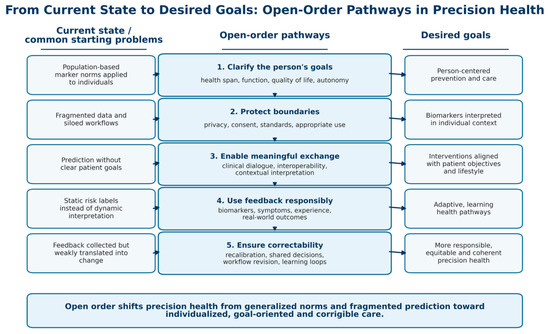
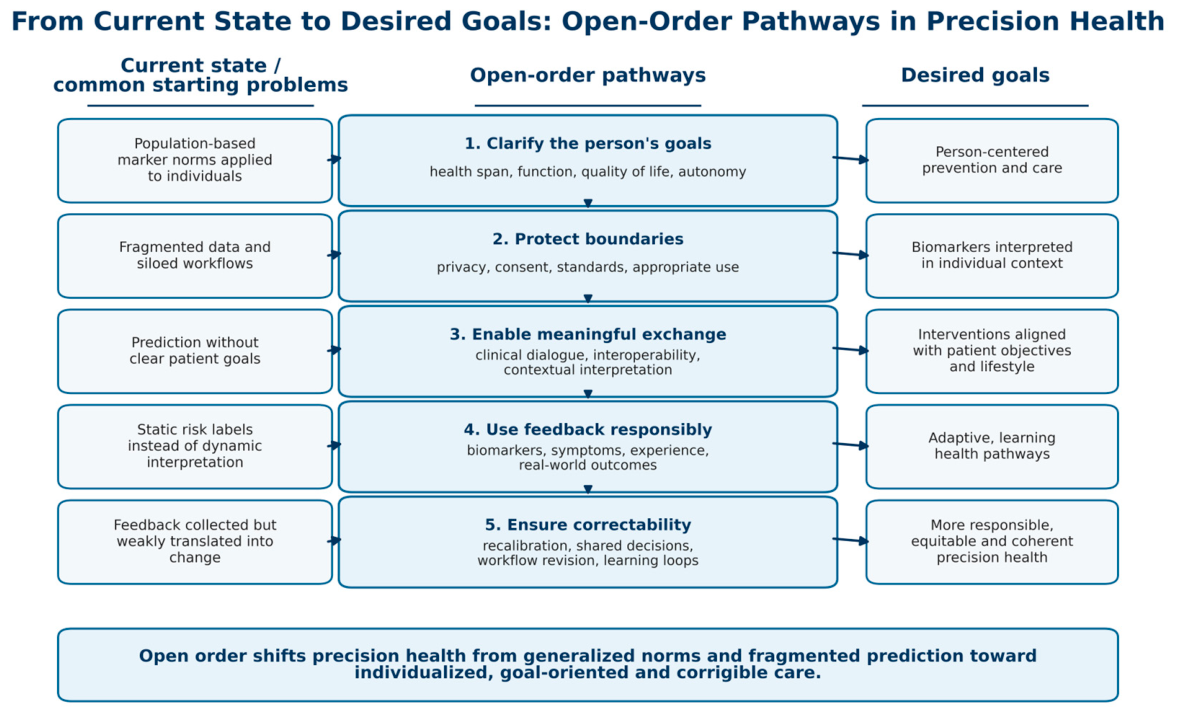
Figure 3 summarizes the translational logic of the AVP/open-order framework: precision health becomes responsible not by accumulating more data alone, but by moving from generalized norms and fragmented prediction toward individualized, goal-oriented and corrigible care.
Figure 3.
From current state to desired goals: open-order pathways in precision health. The figure summarizes how precision health can move from generalized marker norms, fragmented data flows and weakly translated feedback toward person-centered, goal-oriented and corrigible care. The transition depends on clarifying the person’s goals, protecting boundaries, enabling meaningful exchange, using feedback responsibly and ensuring correctability. Horizontal arrows indicate the proposed transition from current problems through open-order pathways to desired goals; the aligned rows show corresponding relationships rather than a strictly temporal sequence.
12. Conclusions
Precision health can develop along at least two system trajectories. One trajectory is technocratic: it expands measurement, prediction and optimization while leaving responsibility fragmented. It produces more biomarkers, more omics layers, more digital traces and more automated recommendations, but it may fail to clarify who must act, who can contest a decision, who monitors unintended harms and who is responsible for correction.
The other trajectory is responsible and systemic. It treats data not as an endpoint, but as part of a learning architecture. In such a system, biomarkers, AI tools, patient-reported outcomes and real-world evidence are valuable only insofar as they improve interpretation, support clinical judgment, respect patient values, reveal unintended consequences and trigger correction when thresholds, models or pathways become misleading. Population norms remain important, but they are not the same as the norm of this person. Precision health becomes responsible when prediction is connected to accountable learning and to the patient’s own objectives for health and life.
Living systems are useful for this argument because they show a basic systems principle: stability does not require rigidity. Viable systems remain stable by protecting boundaries, allowing selective exchange, processing feedback, and correcting regulation when conditions change. Health systems require analogous but not identical functions: privacy and professional standards; interoperability and communication; outcome and experience feedback; and institutional pathways that allow models, guidelines, thresholds and procedures to be revised. In this sense, the AVP suggests that precision health should not be judged only by how much it can measure, but by how well it can remain open to accountable correction.
The proposed Allostatic Viability Principle thus shifts precision health from measurement alone toward accountable learning. Precision health is mature only when predictions can be interpreted with patients, tested against real-world consequences, and revised when they no longer fit the person, the evidence, or the pathway. Without correctability, precision health risks becoming precise without becoming responsible.
Funding
This research received no external funding. The article processing charge (APC) was funded by the University of Vienna.
Institutional Review Board Statement
Not applicable. This is a conceptual Perspective and does not involve human participants or new empirical data.
Informed Consent Statement
Not applicable.
Data Availability Statement
No new data were created or analyzed in this study. Data sharing is not applicable to this article.
Acknowledgments
Open Access Funding by the University of Vienna.
Conflicts of Interest
The author declares no conflict of interest.
References
- National Research Council. Toward Precision Medicine: Building a Knowledge Network for Biomedical Research and a New Taxonomy of Disease; National Academies Press: Washington, DC, USA, 2011. [Google Scholar]
- Collins, F.S.; Varmus, H. A new initiative on precision medicine. N. Engl. J. Med. 2015, 372, 793–795. [Google Scholar] [CrossRef] [Scilit]
- Ginsburg, G.S.; Phillips, K.A. Precision medicine: From science to value. Health Aff. 2018, 37, 694–701. [Google Scholar] [CrossRef] [Scilit]
- Hood, L.; Flores, M. A personal view on systems medicine and the emergence of proactive P4 medicine: Predictive, preventive, personalized and participatory. New Biotechnol. 2012, 29, 613–624. [Google Scholar]
- Auffray, C.; Chen, Z.; Hood, L. Systems medicine: The future of medical genomics and healthcare. Genome Med. 2009, 1, 2. [Google Scholar] [CrossRef] [Scilit] [PubMed]
- Plsek, P.E.; Greenhalgh, T. Complexity science: The challenge of complexity in health care. BMJ 2001, 323, 625–628. [Google Scholar] [CrossRef] [Scilit] [PubMed]
- Paina, L.; Peters, D.H. Understanding pathways for scaling up health services through the lens of complex adaptive systems. Health Policy Plan. 2012, 27, 365–373. [Google Scholar] [PubMed]
- von Bertalanffy, L. General System Theory: Foundations, Development, Applications; George Braziller: New York, NY, USA, 1968. [Google Scholar]
- Miller, J.G. Living Systems; McGraw-Hill: New York, NY, USA, 1978. [Google Scholar]
- Meadows, D.H. Thinking in Systems: A Primer; Chelsea Green Publishing: White River Junction, VT, USA, 2008. [Google Scholar]
- Checkland, P. Systems Thinking, Systems Practice; Wiley: Chichester, UK, 1981. [Google Scholar]
- Beer, S. Diagnosing the System for Organizations; Wiley: Chichester, UK, 1985. [Google Scholar]
- Khayal, I.S. A systems thinking approach to designing clinical models and healthcare services. Systems 2019, 7, 18. [Google Scholar] [CrossRef] [Scilit]
- Thelen, J.; van Belle, S.; Mwisongo, A.; Ager, A.; Mokalake, E.; Mupara, L.M.; Seitio-Kgokgwe, O.; Zafar, S.; Cobos Muñoz, D. Development of the Systems Thinking for Health Actions framework. Glob. Health Res. Policy 2023, 8, 7. [Google Scholar] [CrossRef] [Scilit] [PubMed]
- Ehteshami, F.; Cassidy, R.; Tediosi, F.; Fink, G.; Cobos Muñoz, D. Combining Theory-Driven Realist Approach and Systems Thinking to Unpack Complexity of Type 2 Diabetes and Hypertension Management in Low- and Middle-Income Countries: Protocol for a Realist Review. Systems 2024, 12, 16. [Google Scholar] [CrossRef] [Scilit]
- Institute of Medicine. Best Care at Lower Cost: The Path to Continuously Learning Health Care in America; National Academies Press: Washington, DC, USA, 2013. [Google Scholar]
- Friedman, C.P.; Rubin, J.C.; Sullivan, K.J. Toward an information infrastructure for global health improvement. Yearb. Med. Inform. 2017, 26, 16–23. [Google Scholar] [CrossRef] [PubMed]
- Skivington, K.; Matthews, L.; Simpson, S.A.; Craig, P.; Baird, J.; Blazeby, J.M.; Boyd, K.A.; Craig, N.; French, D.P.; McIntosh, E.; et al. A new framework for developing and evaluating complex interventions: Update of Medical Research Council guidance. BMJ 2021, 374, 104705. [Google Scholar]
- Institute of Medicine. Crossing the Quality Chasm: A New Health System for the 21st Century; National Academies Press: Washington, DC, USA, 2001. [Google Scholar]
- Elwyn, G.; Frosch, D.; Thomson, R.; Joseph-Williams, N.; Lloyd, A.; Kinnersley, P.; Cording, E.; Tomson, D.; Dodd, C.; Rollnick, S.; et al. Shared decision making: A model for clinical practice. J. Gen. Intern. Med. 2012, 27, 1361–1367. [Google Scholar] [CrossRef] [Scilit] [PubMed]
- López-Otín, C.; Blasco, M.A.; Partridge, L.; Serrano, M.; Kroemer, G. Hallmarks of aging: An expanding universe. Cell 2023, 186, 243–278. [Google Scholar] [CrossRef] [Scilit] [PubMed]
- López-Otín, C.; Kroemer, G. Hallmarks of health. Cell 2021, 184, 33–63. [Google Scholar] [CrossRef] [Scilit] [PubMed]
- CLSI. Defining, Establishing, and Verifying Reference Intervals in the Clinical Laboratory; Approved Guideline, 3rd ed.; CLSI document C28-A3; Clinical and Laboratory Standards Institute: Wayne, PA, USA, 2008. [Google Scholar]
- Fraser, C.G. Biological Variation: From Principles to Practice; AACC Press: Washington, DC, USA, 2001. [Google Scholar]
- Chen, R.; Mias, G.I.; Li-Pook-Than, J.; Jiang, L.; Lam, H.Y.K.; Chen, R.; Miriami, E.; Karczewski, K.J.; Hariharan, M.; Dewey, F.E.; et al. Personal omics profiling reveals dynamic molecular and medical phenotypes. Cell 2012, 148, 1293–1307. [Google Scholar] [CrossRef] [Scilit] [PubMed]
- Waddington, C.H. The epigenotype. Endeavour 1942, 1, 18–20. [Google Scholar]
- Bird, A. Perceptions of epigenetics. Nature 2007, 447, 396–398. [Google Scholar] [CrossRef] [Scilit] [PubMed]
- Jablonka, E.; Lamb, M.J. Evolution in Four Dimensions: Genetic, Epigenetic, Behavioral, and Symbolic Variation in the History of Life; MIT Press: Cambridge, MA, USA, 2005. [Google Scholar]
- Noble, D. The Music of Life: Biology Beyond Genes; Oxford University Press: Oxford, UK, 2006. [Google Scholar]
- Li, D.; Wang, P.; Wang, P.; Hu, X.; Chen, F. Diet-gut microbiota-epigenetics in metabolic diseases: From mechanisms to therapeutics. Biomed. Pharmacother. 2022, 153, 113290. [Google Scholar] [CrossRef] [Scilit] [PubMed]
- Lin, X.; Han, H.; Wang, N.; Wang, C.; Qi, M.; Wang, J.; Liu, G. The gut microbial regulation of epigenetic modification in obesity. Int. J. Mol. Sci. 2024, 25, 7175. [Google Scholar] [CrossRef] [Scilit] [PubMed]
- DeLucas, M.; Moreira-Rosario, A.; Silva, C.; Serra, F. The impact of diet on miRNA regulation and its implications for human health. Nutrients 2024, 16, 770. [Google Scholar] [CrossRef] [Scilit] [PubMed]
- Zeevi, D.; Korem, T.; Zmora, N.; Israeli, D.; Rothschild, D.; Weinberger, A.; Ben-Yacov, O.; Lador, D.; Avnit-Sagi, T.; Lotan-Pompan, M.; et al. Personalized nutrition by prediction of glycemic responses. Cell 2015, 163, 1079–1094. [Google Scholar] [CrossRef] [Scilit] [PubMed]
- Ordovas, J.M.; Ferguson, L.R.; Tai, E.S.; Mathers, J.C. Personalised nutrition and health. BMJ 2018, 361, bmj.k2173. [Google Scholar] [CrossRef] [Scilit] [PubMed]
- Haslberger, A.G.; Gressler, S. Epigenetics and Human Health: Linking Hereditary, Environmental and Nutritional Aspects; Wiley-VCH: Weinheim, Germany, 2010. [Google Scholar]
- Lilja, S.; Gessner, D.; Schnitzler, C.; Stephanou-Rieser, N.; Aumueller, E.; Hippe, B.; Remely, M.; Haslberger, A.G. Personalized nutrition and classification of metabolic types based on genetics, epigenetics and gut microbiota. J. Endocrinol. Metab. 2017, 4, 198–205. [Google Scholar]
- Pointner, A.; Prayer, C.; Schneider, J.; Hippe, B.; Haslberger, A.G. Lifestyle-driven variations in nutrimiromic microRNA signatures: Influence of diet, sex and age. Life 2024, 14, 390. [Google Scholar] [PubMed]
- Schneider, J.; Prayer, C.; Steil, M.; Biazid, M.; Pointner, A.; Haslberger, A.G.; Hippe, B. MiRNA-3Age: A microRNA-based biological age model and its modulation by lifestyle and nutrition. Front. Nutr. 2025, 12, 1659730. [Google Scholar] [CrossRef] [Scilit] [PubMed]
- Horvath, S.; Raj, K. DNA methylation-based biomarkers and the epigenetic clock theory of ageing. Nat. Rev. Genet. 2018, 19, 371–384. [Google Scholar] [CrossRef] [Scilit] [PubMed]
- Bell, C.G.; Lowe, R.; Adams, P.D.; Baccarelli, A.A.; Beck, S.; Bell, J.T.; Christensen, B.C.; Gladyshev, V.N.; Heijmans, B.T.; Horvath, S.; et al. DNA methylation aging clocks: Challenges and recommendations. Genome Biol. 2019, 20, 249. [Google Scholar] [CrossRef] [Scilit] [PubMed]
- Quach, A.; Levine, M.E.; Tanaka, T.; Lu, A.T.; Chen, B.H.; Ferrucci, L.; Ritz, B.; Bandinelli, S.; Neuhouser, M.L.; Beasley, J.M.; et al. Epigenetic clock analysis of diet, exercise, education, and lifestyle factors. Aging 2017, 9, 419–446. [Google Scholar] [CrossRef] [Scilit] [PubMed]
- Levine, M.E.; Lu, A.T.; Quach, A.; Chen, B.H.; Assimes, T.L.; Bandinelli, S.; Hou, L.; Baccarelli, A.A.; Stewart, J.D.; Li, Y.; et al. An epigenetic biomarker of aging for lifespan and healthspan. Aging 2018, 10, 573–591. [Google Scholar] [CrossRef] [Scilit] [PubMed]
- Lu, A.T.; Quach, A.; Wilson, J.G.; Reiner, A.P.; Aviv, A.; Raj, K.; Hou, L.; Baccarelli, A.A.; Li, Y.; Stewart, J.D.; et al. DNA methylation GrimAge strongly predicts lifespan and healthspan. Aging 2019, 11, 303–327. [Google Scholar] [CrossRef] [Scilit] [PubMed]
- Sterling, P.; Eyer, J. Allostasis: A new paradigm to explain arousal pathology. In Handbook of Life Stress, Cognition and Health; Fisher, S., Reason, J., Eds.; John Wiley & Sons: New York, NY, USA, 1988; pp. 629–649. [Google Scholar]
- McEwen, B.S. Protective and damaging effects of stress mediators. N. Engl. J. Med. 1998, 338, 171–179. [Google Scholar] [CrossRef] [Scilit] [PubMed]
- Guidi, J.; Lucente, M.; Sonino, N.; Fava, G.A. Allostatic load and its impact on health: A systematic review. Psychother. Psychosom. 2021, 90, 11–27. [Google Scholar] [CrossRef] [Scilit] [PubMed]
- Antonovsky, A. Unraveling the Mystery of Health: How People Manage Stress and Stay Well; Jossey-Bass: San Francisco, CA, USA, 1987. [Google Scholar]
- Lindström, B.; Eriksson, M. Salutogenesis. J. Epidemiol. Community Health 2005, 59, 440–442. [Google Scholar] [CrossRef] [Scilit] [PubMed]
- West-Eberhard, M.J. Developmental Plasticity and Evolution; Oxford University Press: Oxford, UK, USA, 2003. [Google Scholar]
- Carroll, S.B. Evo-devo and an expanding evolutionary synthesis: A genetic theory of morphological evolution. Cell 2008, 134, 25–36. [Google Scholar] [CrossRef] [Scilit] [PubMed]
- Gilbert, S.F.; Epel, D. Ecological Developmental Biology: Integrating Epigenetics, Medicine, and Evolution; Sinauer Associates: Sunderland, MA, USA, 2009. [Google Scholar]
- Pigliucci, M.; Müller, G.B. (Eds.) Evolution: The Extended Synthesis; MIT Press: Cambridge, MA, USA, 2010. [Google Scholar]
- Rajkomar, A.; Dean, J.; Kohane, I. Machine learning in medicine. N. Engl. J. Med. 2019, 380, 1347–1358. [Google Scholar] [CrossRef] [Scilit] [PubMed]
- Kelly, C.J.; Karthikesalingam, A.; Suleyman, M.; Corrado, G.; King, D. Key challenges for delivering clinical impact with artificial intelligence. BMC Med. 2019, 17, 195. [Google Scholar] [CrossRef] [Scilit] [PubMed]
- Topol, E. Deep Medicine: How Artificial Intelligence Can Make Healthcare Human Again; Basic Books: New York, NY, USA, 2019. [Google Scholar]
- Obermeyer, Z.; Powers, B.; Vogeli, C.; Mullainathan, S. Dissecting racial bias in an algorithm used to manage the health of populations. Science 2019, 366, 447–453. [Google Scholar] [CrossRef] [Scilit] [PubMed]
- Vayena, E.; Blasimme, A.; Cohen, I.G. Machine learning in medicine: Addressing ethical challenges. PLoS Med. 2018, 15, e1002689. [Google Scholar] [CrossRef] [Scilit] [PubMed]
- Mittelstadt, B. Principles alone cannot guarantee ethical AI. Nat. Mach. Intell. 2019, 1, 501–507. [Google Scholar] [CrossRef] [Scilit]
- World Health Organization. Ethics and Governance of Artificial Intelligence for Health: WHO Guidance; World Health Organization: Geneva, Switzerland, 2021. [Google Scholar]
- World Health Organization. Regulatory Considerations on Artificial Intelligence for Health; World Health Organization: Geneva, Switzerland, 2023. [Google Scholar]
- OECD. Rethinking Health System Performance Assessment: A Renewed Framework; OECD Publishing: Paris, France, 2024. [Google Scholar]
- Goodhart, C.A.E. Problems of monetary management: The U.K. experience. In Monetary Theory and Practice: The UK Experience; Macmillan: London, UK, 1984; pp. 91–121. [Google Scholar]
- Wilkinson, M.D.; Dumontier, M.; Aalbersberg, I.J.; Appleton, G.; Axton, M.; Baak, A.; Blomberg, N.; Boiten, J.W.; da Silva Santos, L.B.; Bourne, P.E.; et al. The FAIR Guiding Principles for scientific data management and stewardship. Sci. Data 2016, 3, 160018. [Google Scholar] [CrossRef] [Scilit] [PubMed]
- Health Level Seven International. HL7 FHIR Release 4: Fast Healthcare Interoperability Resources; HL7 International: Ann Arbor, MI, USA, 2019. [Google Scholar]
- Greenhalgh, T.; Howick, J.; Maskrey, N. Evidence based medicine: A movement in crisis? BMJ 2014, 348, g3725. [Google Scholar] [CrossRef] [Scilit] [PubMed]
- Ioannidis, J.P.A. Why most published research findings are false. PLoS Med. 2005, 2, e124. [Google Scholar] [CrossRef] [Scilit] [PubMed]
- Marmot, M. Social determinants of health inequalities. Lancet 2005, 365, 1099–1104. [Google Scholar] [CrossRef] [PubMed]
- Ostrom, E. Governing the Commons: The Evolution of Institutions for Collective Action; Cambridge University Press: Cambridge, UK, 1990. [Google Scholar]
- Jasanoff, S. Technologies of humility: Citizen participation in governing science. Minerva 2003, 41, 223–244. [Google Scholar] [CrossRef] [Scilit]

Disclaimer/Publisher’s Note: The statements, opinions and data contained in all publications are solely those of the individual author(s) and contributor(s) and not of MDPI and/or the editor(s). MDPI and/or the editor(s) disclaim responsibility for any injury to people or property resulting from any ideas, methods, instructions or products referred to in the content. |
© 2026 by the author. Licensee MDPI, Basel, Switzerland. This article is an open access article distributed under the terms and conditions of the Creative Commons Attribution (CC BY) license.