


Abstract
In response to intensifying environmental pressures and the rapid pace of digital transformation, firms are increasingly turning to artificial intelligence (AI) as a tool to support sustainable development. Using panel data from Chinese A-share-listed manufacturing firms from 2016 to 2023, this study examines the relationship between AI adoption and two forms of green innovation: green product innovation and green process innovation. The results reveal that AI adoption is positively associated with both forms of green innovation, with a stronger association observed for green product innovation. The relationship between AI adoption and green innovation also varies across organizational and market contexts. CEO turnover weakens the association between AI adoption and green product innovation but strengthens its association with green process innovation. Market competition further strengthens the positive association between AI adoption and both types of green innovation. Further heterogeneity tests indicate that these associations tend to be more pronounced among high-tech firms and smaller firms. This study provides new evidence on the relationship between AI adoption and different forms of green innovation. It further clarifies the organizational and market conditions under which AI is more closely linked to corporate green transformation.
1. Introduction
Against the backdrop of escalating environmental challenges and the growing importance of sustainable development, firms face the critical challenge of balancing economic performance with ecological responsibility [1,2]. In this context, green innovation represents an important strategy for firms to maintain long-term competitiveness while reducing environmental burdens. However, green innovation is typically associated with long development periods, high investment requirements, and significant uncertainty, which may undermine companies’ motivation to continue pursuing green innovation. Therefore, stimulating and sustaining corporate green innovation necessitates a deeper understanding of its underlying drivers.
Simultaneously, artificial intelligence (AI), as a vital catalyst of digital transformation, is rapidly expanding from operational applications into domains with greater strategic and innovative orientation [3,4,5]. Its growing prevalence in corporate activities signifies that AI has become an important technological condition associated with corporate green transformation. However, although previous research has increasingly recognized the strategic significance of AI, the relationship between AI adoption and green innovation remains insufficiently understood.
A further complication is that green innovation is not a homogeneous construct. The term encompasses technologies, procedures, or systems designed to reduce environmental pollution and conserve energy and materials [6,7]. Prior studies suggest that green innovation falls broadly into two categories: green product innovation (PROD) versus green process innovation (PROC) [8,9]. It is essential to distinguish between these two forms, as they differ in terms of strategic orientation, resource requirements, and implementation logic [10,11]. Accordingly, a more specific question arises: whether AI adoption is associated with these two forms of green innovation in similar ways, or whether such associations are domain-specific.
Existing research has increasingly examined the connection between artificial intelligence and green innovation, with a prevailing consensus that AI may be closely linked to sustainable innovation within businesses. Scholars have further explored boundary conditions in this relationship, such as regulatory pressure [12], industry competition [13,14], and executive factors [15,16]. Nevertheless, there remain two significant limitations in the existing research. First, most existing studies treat green innovation as a homogeneous concept, failing to adequately account for the differences between the two types of green innovation. Consequently, it remains unclear whether AI adoption is associated with these two forms of green innovation in different ways. Second, although the moderating factors identified in previous studies are valuable for reference, insufficient consideration has been devoted to how internal governance dynamics and external competitive environments jointly condition the relationship between AI adoption and different categories of green innovation. These gaps limit our understanding of whether AI adoption is associated with different forms of green innovation and under what conditions such associations become stronger or weaker.
To address these issues, this study draws on dynamic capabilities theory as the overarching analytical lens [17,18]. Given that organizations need to coordinate multiple organizational functions when responding to environmental and technological changes, this study also incorporates a systems perspective, viewing the organization as a complex adaptive system [19]. Within this framework, AI is conceptualized as a tool of cybernetic management that may strengthen information processing, feedback, coordination, and adaptive control [20]. This systematically grounded explanation further clarifies the organizational mechanisms through which artificial intelligence supports green innovation. AI facilitates firms in transforming dispersed environmental, market, and operational information into feedback for product development and process improvement. CEO turnover and market competition are further conceived as two boundary conditions that shape the effectiveness of these AI-enabled adaptive mechanisms across different green innovation domains.
Within this framework, this study examines the association between AI adoption and two types of green innovation using data on Chinese A-share-listed manufacturing firms from 2016 to 2023. Concretely, this study employs annual report text analysis to extract the frequency of AI-related keywords and construct a firm-level AI adoption index. Further assessment of two types of green innovation is achieved through content analysis, and these metrics are combined with CEO turnover data and market competition indicators.
This study makes three main contributions. First, it distinguishes between green product innovation and green process innovation, thus yielding more detailed insights into the association between AI and different forms of green innovation. Second, this study broadens the scope of the theory of dynamic capabilities to encompass AI-driven green innovation, adopting a perspective that is grounded in systems analysis. Third, this study integrates CEO turnover and market competition within a cohesive analytical framework and identifies the boundary conditions under which AI adoption is more closely associated with green innovation.
The subsequent sections of this document are organized accordingly. Section 2 develops theory and research hypotheses. Section 3 introduces the research design, data sources, variable assessments, and empirical models. Section 4 reports the empirical findings, including the baseline regressions, moderation analyses, robustness checks, endogeneity tests, and heterogeneity analyses. Section 5 concludes the paper and discusses practical implications and limitations.
2. Theory and Hypotheses
2.1. AI and Two Types of Green Innovation
2.1.1. Dynamic Capabilities Theory
Successfully navigating the green transition requires more than the adoption of new technologies. Companies need to identify emerging environmental demands, respond to evolving competitive and regulatory pressures, and continuously adapt their internal resources and organizational practices to support sustainability [21]. Green innovation is therefore inherently characterized by uncertainty, cross-functional coordination, as well as the need to balance environmental value creation with market competitiveness [22,23]. Dynamic capabilities theory offers a suitable framework for understanding how firms convert technological investments into green innovation-related outcomes. Rather than attributing competitive advantage solely to the possession of valuable resources, this theory emphasizes firms’ capacity to sense opportunities and threats, seize emerging opportunities through strategic responses, along with restructuring internal and external resources to adapt to the changing environments [24].
The operation of dynamic capabilities is inherently systemic. Sensing, seizing, and reconfiguring do not occur within isolated organizational units. Instead, they depend on the continuous coordination of information and resources, including R&D, production, supply chain, and marketing. From this perspective, a firm can be viewed as a complex adaptive system in which organizational activities interact and adapt to changes in market, technological, and environmental demands [25]. This systemic characteristic is critical for green innovation, as the transition to sustainable development requires firms to align external environmental demands with internal product development, production processes, and environmental management practices.
In this systemic process, AI can support dynamic capabilities by functioning as a tool of cybernetic management. Cybernetic management emphasizes information processing, monitoring, feedback, coordination, and adaptive control [26]. These functions are closely related to the microfoundations of dynamic capabilities. First, AI may enhance sensing by helping firms identify environmental risks, market signals, and technological opportunities from dispersed internal and external data. Second, AI may support seizing by transforming complex information into actionable feedback for managerial decision-making, which helps firms evaluate alternative technological pathways and allocate resources more effectively. Third, AI may facilitate reconfiguring by improving coordination across organizational functions and supporting adjustments in product development, production processes, and environmental management routines.
This logic suggests that AI should not be viewed merely as a generic digital technology. Its strategic value depends on how firms embed AI-enabled information processing, feedback, and coordination into organizational routines that support green value creation and long-term competitive renewal [27]. When AI is integrated into dynamic capability processes, it helps firms transform fragmented environmental, market, and operational information into adaptive responses for green innovation [28,29]. However, these AI-enabled capabilities may generate different outcomes across innovation domains. Green product innovation usually involves exploratory search, market demand, and knowledge integration, whereas green process innovation is more closely tied to existing production systems and operational efficiency. Therefore, distinguishing the two types of green innovation is necessary for understanding how AI contributes to different forms of green innovation.
2.1.2. AI and Green Product Innovation
Green product innovation entails the creation or modification of products in ways that reduce environmental hazards across the product life cycle while preserving or enhancing market value [30]. Previous research indicates that this form of innovation is far from limited to the launch of entirely new green products, but also encompasses improvements in product design, the use of sustainable materials, and enhancements in recyclability and durability [31]. In essence, green product innovation adopts a life-cycle perspective, targeting the alleviation of environmental burdens arising from production, utilization, disposal, reuse and recycling.
This form of innovation places particularly stringent demands on a company’s ability to integrate environmental insights with product development. Recognizing the necessity for more eco-friendly products is inadequate. Companies must also determine which environmental attributes matter to customers, which technical solutions are feasible, and how to integrate these elements into commercially viable products [32]. This process relies on the firm’s ability to integrate market, technical, and environmental knowledge across product development activities.
AI can enhance these capabilities in several ways. First, AI enhances a company’s sensing capabilities by enabling it to interpret environmental signals within massive volumes of structured and unstructured data and uncover latent green demands. This helps firms identify product opportunities that might otherwise remain difficult to detect. Second, AI may strengthen a firm’s ability to evaluate and act on such opportunities by supporting the screening of alternative materials, product designs, and technological pathways. It also accelerates the experimentation workflow, compressing timelines from concept generation to design selection [33]. Third, AI may support knowledge reconfiguration by facilitating the integration and reorganization of fragmented knowledge. This is particularly crucial for green product innovation, since eco-friendly products often depend on the effective coordination of customer value, technical feasibility, and ecological performance. In this sense, AI not only improves information efficiency but also helps firms transform fragmented knowledge inputs into viable green product solutions. Therefore, we propose a hypothesis:
H1a.
AI adoption is positively associated with green product innovation.
2.1.3. AI and Green Process Innovation
Green process innovation entails refining production processes, operational procedures, and related technologies to alleviate the environmental footprint of manufacturing [34]. Existing research frames it as a proactive environmental governance strategy, implemented primarily throughout the manufacturing phase rather than subsequent to completion. More specifically, it encompasses reducing resource consumption, adopting clean manufacturing technologies and recycled materials, and incorporating pollution control or process support systems. Compared with green product innovation, green process innovation is more closely embedded in production activities because it focuses on improving the environmental efficiency of existing operational arrangements.
The implementation logic of green process innovation differs from that of green product innovation. The primary challenge lies not in identifying new market opportunities, but in diagnosing inefficiencies embedded within existing operations and translating those observations into cleaner, more efficient production arrangements. Companies need to identify points of resource waste, sources of emissions, and components of the production system that can be adjusted without compromising production stability [35]. This requires tight coordination between analysis and execution, as well as aligning environmental goals with process control, equipment use, and workflow management practices. In other words, green process innovation depends to a greater extent on operational feasibility.
AI offers a distinct yet complementary pathway to support such innovation. First, through real-time monitoring of energy consumption, material usage, equipment status, and process bottlenecks, AI helps firms identify operational inefficiencies. This enables companies to detect environmental risks and operational losses with greater precision. Second, AI supports timely and data-driven insights in scheduling, process control, and resource allocation. These capabilities may help firms identify opportunities for cleaner production and process optimization. Third, AI can facilitate workflow redesign and adjustments to production logic, thereby integrating environmental goals more systematically into routine manufacturing decisions [36]. Through this approach, AI supports not only isolated process improvements but also more sustained, process-driven green upgrades.
In summary, AI enhances the potential for firms to transform operational data, process diagnostics, and environmental targets into more efficient and cleaner production outcomes. Therefore, this study proposes the following hypothesis:
H1b.
AI adoption is positively associated with green process innovation.
2.1.4. Heterogeneity Across the Two Innovation Domains
The above analysis further suggests that the association between AI adoption and green innovation may differ across the two innovation domains. Although both are significant dimensions of green innovation and may interact in practice, previous research indicates that they diverge in their innovation priorities and implementation logic [37].
This distinction can be further understood from the perspective of firm adaptation. Green product innovation is more closely associated with external opportunity search and new knowledge recombination. It requires firms to interpret green market demand, respond to environmental requirements, and transform technological knowledge into new product attributes. These activities provide extensive opportunities for AI to support adaptive exploration and knowledge integration across organizational activities. Green process innovation also benefits from AI, but it is more closely tied to existing production systems. Process improvements typically require adjustments to equipment conditions, workflow scheduling, and operational practices. Therefore, while AI provides valuable diagnostic information, companies may still encounter stronger constraints when translating such information into actual process changes [38]. In light of the above analysis, we propose a hypothesis:
H1c.
The positive association between AI adoption and green product innovation is stronger than that between AI adoption and green process innovation.
2.2. Hypotheses on Moderating Roles
The foregoing analysis suggests that the innovation value of AI is contingent rather than automatic [17]. This study conceptualizes CEO turnover and market competition as two boundary conditions that shape the relationship between AI adoption and the two types of innovation. CEO turnover signifies the internal governance stability required for capability coordination, while market competition reflects differences in external competitive pressure. Examining these two factors helps clarify the conditions under which AI adoption is more closely associated with green innovation.
2.2.1. The Moderating Role of CEO Turnover
CEO turnover represents a significant organizational event that reshapes leadership priorities, resource allocation, and strategic initiatives [39]. Previous research has established that inadequately structured succession processes frequently intensify the performance pressures experienced by newly appointed CEOs and exacerbate the cognitive limitations arising from a lack of familiarity with the company’s unique resources [40]. Simultaneously, additional research indicates that CEO turnover can also catalyze the disruption of strategic inertia, prompting firms to abandon entrenched practices and direct attention toward new priorities [41]. These insights imply that CEO turnover may shape the relationship between AI adoption and green innovation differently across innovation domains.
For green product innovation, CEO turnover is likely to weaken the positive association between AI adoption and green product innovation. This pattern may be explained by the exploratory nature of green product innovation, as well as by the organizational continuity required for AI-related insights to be translated into tangible product outcomes [42]. While AI can enhance a company’s ability to support environmentally oriented product development, these benefits only materialize when the company maintains stable strategic commitment, cumulative learning, and coordinated decision-making across organizational units. In practice, newly appointed CEOs need to quickly establish their legitimacy and demonstrate their competence, which may make them less willing to sustain initiatives that involve uncertainty and prolonged timelines [43]. Furthermore, CEO turnover may also interrupt ongoing learning processes, thereby undermining the consistency required to sustain AI-supported innovation efforts. Consequently, even when AI remains available as a technological capability, CEO turnover may reduce the extent to which AI adoption is associated with green product innovation. Given the above analysis, we hypothesize:
H2a.
CEO turnover negatively moderates the relationship between AI adoption and green product innovation.
For green process innovation, CEO turnover may strengthen the positive association between AI adoption and green process innovation. Existing research suggests that CEO turnover may disrupt strategic continuity and increase organizational uncertainty. Yet little attention has been paid to whether leadership transitions also reshape the way companies leverage digital technologies in operational transformation [44,45]. This issue is particularly relevant in the context of AI adoption. Feedback produced by AI does not automatically lead to green process innovation. Its value depends on whether the CEO recognizes operational issues, allocates organizational resources, and supports changes to established production practices.
CEO turnover may facilitate this conversion process. Newly appointed CEOs may face pressure to demonstrate managerial effectiveness within a relatively short period. They may therefore focus more on improvements that are easier to observe and evaluate, such as efficiency enhancement, cost reduction, energy saving, and cleaner production [46]. Meanwhile, the new CEO, being less constrained by past management commitments, may be inclined to reassess existing production arrangements [47]. When AI provides diagnostic insights into operational inefficiencies, CEO turnover may increase the likelihood that such insights are used to justify process adjustments. Therefore, despite the potential for instability, CEO turnover may make companies more disposed to translate AI-based diagnostics into cleaner and more efficient production outcomes. Based on this, we propose the following hypothesis:
H2b.
CEO turnover positively moderates the relationship between AI adoption and green process innovation.
2.2.2. The Moderating Role of Market Competition
Market competition constitutes not merely a contextual circumstance, but an external pressure that shapes firms’ incentives to pursue strategic renewal, redeploy resources, and reconfigure organizational activities [48]. Intensified competition may increase uncertainty and short-term performance pressure, but it may also heighten firms’ demand for differentiation and efficiency improvement. Existing research further indicates that competition may either suppress long-term capability investments or strengthen the conversion of strategic resources into breakthrough outcomes, depending on core innovation objectives and value realization mechanisms [49,50]. Overall, market competition acts as a conditional factor that shapes how AI-enabled capabilities are linked to green innovation outcomes.
This study argues that market competition strengthens the positive association between AI adoption and green product innovation. In fiercely competitive markets, firms experience heightened pressure to differentiate their products and adapt swiftly to evolving customer preferences. This pressure prevents companies from relying solely on existing product architectures or established market positions, thereby compelling them to pursue new opportunities for green products and overcome path-dependent innovation practices [51]. Simultaneously, intense competition compresses product lifecycles and magnifies the demand for immediate market insights alongside the rapid integration of technical and environmental knowledge [52]. Under these circumstances, AI emerges as particularly valuable, adept at processing fragmented information and integrating knowledge from customers, technology, and the environment into feasible product concepts [53]. Consequently, we propose a hypothesis:
H3a.
Market competition positively moderates the relationship between AI adoption and green product innovation.
With respect to green process innovation, intense market competition may further strengthen the positive association between AI adoption and green process innovation. Distinct from green product innovation, competition operates more through operational discipline than through product differentiation. Amid intensifying competition, companies confront tighter cost constraints and an urgent imperative to enhance the efficiency and responsiveness of their production systems [54]. This external pressure may increase the value of AI in enabling real-time process visualization, identifying operational inefficiencies, improving energy utilization, and supporting more precise production control. Competition has also raised the cost of inefficiency, motivating firms to deploy AI in fields like process monitoring, predictive maintenance, and resource allocation [55]. From this perspective, market competition does not merely accelerate internal transformation within firms but rather intensifies the practical necessity of leveraging AI in support of cleaner, leaner, and more efficient production outcomes. Hence, we propose the hypothesis:
H3b.
Market competition positively moderates the relationship between AI adoption and green process innovation.
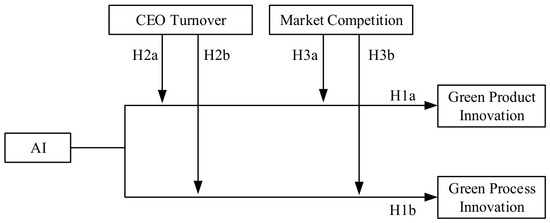
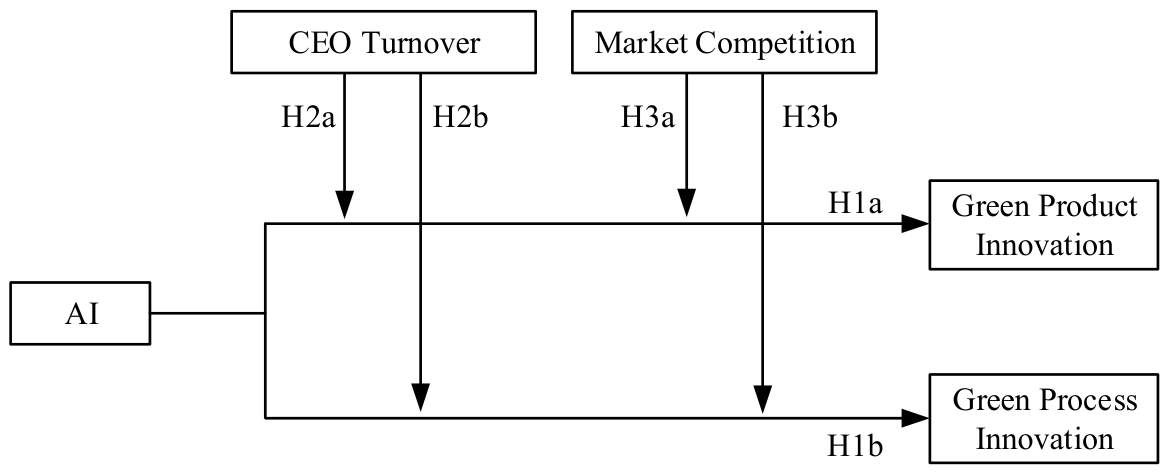
Building on the above analysis, this study establishes a theoretical framework for the transmission mechanisms between AI and the two types of green innovation, as illustrated in Figure 1.
Figure 1.
Transmission Mechanism Model from AI and Two Types of Green Innovation.
3. Econometric Model and Data
3.1. Sample Description
The sample covers manufacturing companies listed on the Chinese A-share market from 2016 to 2023. Manufacturing firms are selected because they are central to both AI applications and the green transition, while also confronting environmental and competitive pressures. Their annual reports, CSR reports, and financial and governance data are relatively comprehensive, which helps improve variable availability and sample comparability. We then exclude ST-designated firms and observations with missing key variables to enhance data quality and the reliability of the empirical analysis. The final sample includes 8645 firm-year observations.
The data are obtained from multiple authoritative sources. The CSMAR database provides financial and operational information on companies. Macroeconomic and industry data are obtained through the Wind Financial Terminal. The frequency data for AI-related terms are derived from text analysis of corporate annual reports. Two forms of green innovation were evaluated based on information disclosed in Corporate Social Responsibility Reports. Continuous variables are winsorized at the 1st and 99th percentiles to reduce the influence of outliers. This study employs Stata 18.0 and Python 3.8 for data processing.
3.2. Variable Measurement
3.2.1. Independent Variable
The independent variable is firm-level AI adoption, operationalized through an AI-related textual index derived from corporate annual reports. Following prior studies on AI innovation at the firm level and text-based measurement, this study constructs the index using Python-based text mining techniques [56,57,58,59]. The keyword dictionary is designed to capture three types of AI-related expressions: core AI technologies, AI methods, and clearly AI-based applications. Core AI technology terms include expressions such as “artificial intelligence”, “machine learning”, “deep learning”, “neural network”, and “natural language processing”. AI method-related terms include expressions such as “AI algorithm”, “algorithmic model”, and “intelligent algorithm”. AI-based application terms are retained only when the surrounding context clearly indicates the use of AI-related technologies. The frequencies of these AI-related terms are then aggregated at the firm-year level and transformed as ln (1 + frequency). This index captures the extent to which firms incorporate AI-related technologies into strategic narratives and organizational activities. A higher value indicates stronger disclosed engagement with AI in operations, decision-making, and innovation activities.
3.2.2. Dependent Variables
Following Xie et al., this study employs a content-analysis method to assess two types of green innovation at the firm-year level based on firms’ CSR reports [60]. To capture the essential dimensions of these two constructs more comprehensively, this study developed a set of systematic measurement indicators. Green process innovation is coded across five dimensions, including resource and energy reduction, adoption of recycling and cleaner process technologies, upgrading of equipment and production processes, green process planning systems, and environmental process R&D or pollution-control investment. Green product innovation is measured across four aspects, including the development of environmentally friendly products, eco-design improvements, green labels and packaging, and product recycling or take-back practices. Each item is coded on a three-point scale ranging from 0 to 2, where 0 indicates no relevant disclosure, 1 indicates general disclosure without specific implementation details, and 2 indicates substantive disclosure with detailed evidence. The final score for each construct is calculated as the average of the corresponding coded items. Detailed coding rules and examples are reported in Appendix B. To assess coding reliability, the two authors independently reviewed a randomly selected subsample of CSR reports using the same coding manual. The Krippendorff’s alpha values for PROD and PROC were 0.789 and 0.827, respectively, indicating acceptable coding consistency.
3.2.3. Moderator Variables
Market competition captures the intensity of external competitive pressure faced by firms and is proxied by a competition indicator derived from the Herfindahl–Hirschman Index (HHI) at the industry-year level. Following prior studies that use the Herfindahl–Hirschman Index to measure industry competition [48,61], we first calculate HHI based on firms’ sales shares within each industry-year. Specifically, the market competition variable is derived as follows:
where Nj,t denotes the number of firms in industry j in year t, Salesi,jt is the sales revenue of firm i in industry j in year t, and Salesj,t is the total sales revenue of industry j in year t. Industries are classified according to the China Securities Regulatory Commission (CSRC) industry classification. Since HHI is calculated at the industry-year level, the market competition value assigned to each firm reflects the competitive environment of the industry to which it belongs in a given year. A higher HHI indicates that market shares are concentrated among fewer firms, suggesting a more concentrated market structure and weaker competitive pressure. To align the variable with the theoretical meaning of market competition, we reverse-code HHI to construct MC. Thus, a larger MC value reflects a more competitive industry environment faced by the firm in a given year [49].
In the context of Chinese listed firms, this study defines top executive turnover broadly as changes in either the board chair or the general manager. Given the structure of Chinese firms, these two roles collectively represent the company’s executive leadership. The board chair is typically responsible for supervising the formulation of major strategic priorities and long-term resource allocation, while the general manager is more directly accountable for operational execution and routine management decisions. Considering that AI-driven green innovation thrives both on strategic coherence and implementation capacity, a change in either of these roles may reshape an enterprise’s commitment to AI adoption and the trajectory of its green transition. CEO turnover is measured using a dummy variable that takes the value of 1 if either the board chair or the general manager changes during a given year, and 0 otherwise [62].
3.2.4. Control Variables
This study includes a set of firm-level control variables to account for observable differences across firms that may be related to both AI adoption and green innovation. Firm size (Size), captured by the natural logarithm of total assets, reflects differences in corporate resource endowments and organizational innovation capacity. Financial leverage (Lev), expressed as the debt-to-assets ratio, captures financial pressure and debt constraints that may influence firms’ engagement in green innovation. Fixed asset ratio (FA), calculated as fixed assets divided by total assets, accounts for differences in asset structure and production rigidity. Management expense ratio (MER) is defined as management expenses divided by total sales revenue and reflects management cost intensity and organizational efficiency. Firm age (Age), calculated as the natural logarithm of the number of years since establishment, captures accumulated experience, established routines, and organizational capabilities. Ownership concentration (Top1), represented by the equity stake of the largest shareholder, reflects the influence of controlling shareholders on strategic decision-making and long-term innovation incentives.
In addition, because the key variables in this study are constructed from corporate textual information, we further control for several disclosure-related factors. Annual report length (ARL), measured as the natural logarithm of one plus the total number of words in the annual report, is included to reduce the possibility that the AI measure is mechanically affected by the length of annual reports. CSR report length (CSRL), measured as the natural logarithm of one plus the total number of words in the CSR report, is included to account for differences in the amount of sustainability disclosure across firms. We also control for generic digital disclosure (Generic), measured as the natural logarithm of one plus the frequency of broad digitalization terms excluded from the refined AI dictionary. This control helps distinguish AI-related adoption from firms’ general digitalization narratives. Table 1 describes the main variables, their symbols, and their measurements.
Table 1.
Variable descriptions.
3.3. Empirical Model Description
Using a two-way fixed-effects regression model, this study examines the association between AI adoption and the two types of green innovation. To reduce concerns related to time-invariant firm characteristics and common yearly shocks, we employ firm and year fixed effects. Firm-level fixed effects (μi) capture unobservable, time-invariant firm characteristics, such as organizational culture, management style, and other persistent attributes that may influence green innovation. Year fixed effects (λt) are used to control for unobservable shocks that vary over time but are common across firms, such as macroeconomic conditions, environmental regulations, and digital transformation policies. The benchmark model is formulated below:
where PRODi,t indicates green product innovation by enterprise i at year t, and PROCi,t refers to the green process innovation by enterprise i at year t. AIi,t signifies AI adoption, while Controlsi,t indicates control variables. εi,t captures the idiosyncratic error term. We incorporate interaction terms into the baseline model to examine the moderating roles:
where Moderatori,t is operationalized as CEO turnover when testing H2a and H2b, and as market competition when testing H3a and H3b. In the entire model, α0 and β0 are the constant terms, while i and t refer to the corporate and time dimensions.
4. Empirical Results
4.1. Descriptive Statistical Analysis
Table 2 summarizes the distributional characteristics of the main variables. The mean values of PROD and PROC are respectively 0.559 and 1.070, demonstrating that process-oriented green practices are disclosed more frequently than product-oriented ones in the sample firms. This pattern is plausible because green process innovation is more closely tied to routine production and cost management, which may make it easier for firms to implement and report. Conversely, green product innovation typically requires longer development cycles and involves greater technological uncertainty. The standard deviations of PROD and PROC, at 0.640 and 0.570, further suggest that firms differ considerably in their green innovation engagement. The mean value of AI is 0.642, with a standard deviation of 0.812, suggesting substantial variation in AI-related disclosure across firms. This variation indicates that while a portion of firms have been more proactive in integrating AI into their strategies and operations, many others remain at an early stage of adoption. The mean CEO turnover rate is 0.094, indicating that CEO changes occur in a relatively small but non-negligible proportion of firm-year observations. Market competition (MC) has a mean of 0.818 and a standard deviation of 0.188, reflecting the variation in external competitive pressures among firms.
Table 2.
Descriptive statistics.
Table 3 presents the Pearson correlation matrix. The correlation results provide preliminary evidence that is broadly consistent with the proposed associations. AI is positively correlated with both PROD and PROC, and both correlations are statistically significant at the 1% level. Specifically, the correlation between AI and PROD is 0.125, while the correlation between AI and PROC is 0.079. These results suggest that AI-related disclosure is positively associated with both types of green innovation disclosure, with a relatively stronger correlation for green product innovation. The correlation between PROD and PROC is 0.299, indicating that the two types of green innovation are related but still distinct. In addition, most correlations among the explanatory variables are moderate. The relatively high correlation between AI and Generic is 0.262, suggesting that AI-related disclosure is related to general digital disclosure. Furthermore, we also examined multicollinearity using variance inflation factors. The maximum VIF value is 1.375, which is well below the conventional threshold of 10, suggesting that multicollinearity is unlikely to be a serious concern.
Table 3.
Correlation matrix.
4.2. Baseline Regression
Table 4 reports the benchmark regression results. The coefficient on AI is positive and statistically significant in both the PROD and PROC regressions. After including fixed effects as well as a set of controls, the coefficient on AI is 0.0918 in the PROD model and 0.0476 in the PROC model, both significant at the 1% level. These results support H1a and H1b and indicate that AI adoption is positively associated with both forms of green innovation.
Table 4.
Benchmark regression results.
To examine whether this positive association differs between green product innovation and green process innovation, Table 5 reports a formal coefficient-difference test based on a stacked specification. The coefficient on AI captures its association with PROC, while the coefficient on the interaction term between AI and the product dummy captures the additional association with PROD. The results show that the difference in AI coefficients is positive and statistically significant, supporting H1c. This finding suggests that AI adoption is more strongly associated with green product innovation than with green process innovation.
Table 5.
Coefficient difference test for H1c.
4.3. Moderating Roles
4.3.1. Moderating Role of CEO Turnover
Table 6 examines how CEO turnover conditions the association between AI adoption and the two forms of green innovation. In the PROD model, the coefficient for AI × CEO turnover is negative and statistically significant (−0.0728, p < 0.01), suggesting that CEO turnover weakens the positive association between AI adoption and green product innovation. This result supports H2a. One possible explanation is that green product innovation often depends on long-term strategic continuity, cumulative technological learning, and sustained resource commitment, whereas CEO turnover may interrupt these conditions and reduce the extent to which AI-related activities are associated with green product innovation. In the PROC model, the coefficient of AI × Turnover is significantly positive (0.0677, p < 0.01), suggesting that CEO turnover strengthens the positive association between AI adoption and green process innovation, thereby supporting H2b. This pattern is consistent with the view that green process innovation is more closely related to operational efficiency, cost reduction, and process optimization. After leadership changes, new CEOs may be more likely to emphasize efficiency adjustments, making AI-related activities more closely associated with green process improvements.
Table 6.
Interaction results for CEO turnover.
4.3.2. Moderating Role of Market Competition
Table 7 extends the analysis to the external competitive environment by assessing the moderating role of market competition. The interaction term between AI and market competition is positive and statistically significant in both the PROD model (0.0883, p < 0.05) and the PROC model (0.0930, p < 0.05), supporting H3a and H3b. These results suggest that market competition strengthens the positive association between AI adoption and both forms of green innovation. This evidence is consistent with the argument that competitive pressure increases firms’ incentives to deploy AI-related capabilities in support of green product differentiation and process-oriented environmental improvement. In this context, market competition can be understood as an external feedback mechanism that encourages firms to coordinate AI-enabled information processing with adaptive product and process adjustments.
Table 7.
Interaction results for market competition.
4.3.3. Comparison of Moderating Roles
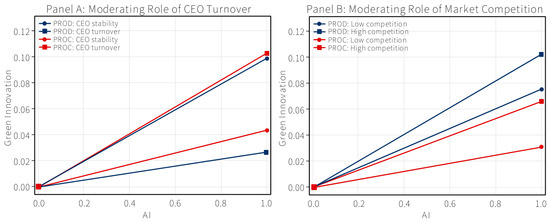
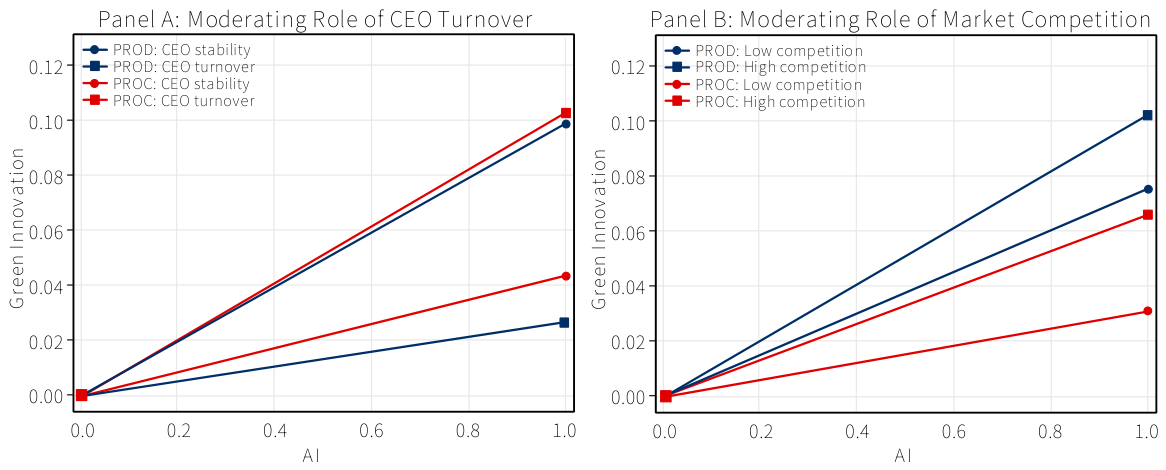
Figure 2 visualizes the moderating roles of CEO turnover and market competition on the relationship between AI and the two forms of green innovation. In Panel A, the marginal association between AI adoption and green product innovation decreases from 0.0980 under CEO stability to 0.0252 under CEO turnover, whereas the corresponding association with green process innovation increases from 0.0418 to 0.1095. This pattern suggests that CEO turnover may weaken the continuity of strategic priorities, knowledge accumulation, and resource commitment required for AI adoption to be associated with green product innovation. At the same time, leadership change may shift managerial attention toward operational adjustment and efficiency improvement, thereby making AI adoption more closely associated with green process innovation.
Figure 2.
Slope chart of conditional associations. (Panel A) plots the association between AI adoption and two forms of green innovation under CEO stability (Turnover = 0) and CEO turnover (Turnover = 1), based on the interaction estimates described in Table 6. (Panel B) plots this association at low and high levels of market competition, where market competition (MC) is mean-centered for graphical presentation and evaluated at one standard deviation below and above the mean, according to the estimates presented in Table 7 and the descriptive statistics in Table 2.
In Panel B, market competition is centered around its mean, and the marginal associations are evaluated at one standard deviation below and above the mean. Under this specification, the marginal association between AI adoption and green product innovation increases from 0.0759 to 0.1091, while the corresponding association with green process innovation increases from 0.0309 to 0.0659. Taken together, these results suggest that CEO turnover changes how AI adoption is associated with different types of green innovation by reshaping managerial attention and resource coordination within the firm. In contrast, market competition reinforces the positive association between AI adoption and both green product innovation and green process innovation by increasing external pressure for technological upgrading and environmental responsiveness.
4.4. Robustness Tests
To further examine the stability of the baseline findings, we conduct four robustness checks. The results are reported in Table 8.
Table 8.
Robustness checks.
First, we replace the baseline AI measure with a purified AI index (AI_Pure). This index retains only purified AI technical terms, such as “artificial intelligence”, “machine learning”, “deep learning”, “neural network”, “natural language processing”, while excluding broader application-oriented or generic digitalization expressions. Columns (1) and (2) show that the coefficients remain positive and statistically significant for both green product innovation and green process innovation, suggesting that the baseline findings are not driven by broad digital disclosure.
Second, we use alternative measures of green innovation. In Column (3), green product innovation is alternatively measured by green patent applications, which provide externally observable evidence of green product technological activities. In Column (4), green process innovation is alternatively proxied by ISO14001 environmental management system certification, which reflects externally recognized environmental management and process improvement practices [63]. The results remain consistent with the baseline findings.
Third, we adopt fractional probit models as an alternative estimation method. Since the CSR-based green innovation scores are bounded between 0 and 2, we divide PROD and PROC by their maximum possible value to obtain bounded fractional scores in the range from 0 to 1 [64,65,66]. Columns (5) and (6) report the average marginal effects from the fractional probit models. The coefficients of AI remain positive and statistically significant, suggesting that the baseline associations are not sensitive to the use of a linear specification for bounded dependent variables.
Fourth, we include industry-year fixed effects to control for unobserved industry-level shocks that change over time. Because AI-related disclosure and green innovation may be jointly affected by industry-level conditions that vary over time, this specification helps absorb common shocks within each industry-year and provides a stricter test of the baseline association. Columns (7) and (8) show that the positive association between AI and green innovation remains statistically significant after replacing year fixed effects with industry-year fixed effects.
4.5. Endogeneity Test
Although the two-way fixed-effects model and robustness checks alleviate some endogeneity concerns, reverse causality may still remain if firms with stronger green innovation capabilities are also inclined to leverage AI. As a supplementary check, we use the industry-level average AI adoption (Industry AI), excluding the focal firm, as an instrumental variable. As shown in Table 9, the first-stage coefficient on the instrumental variable is positive and significant, and the first-stage F-statistic is 340.51, indicating that the instrument has strong explanatory power for AI adoption. In the second stage, the fitted value of AI remains positively associated with both PROD and PROC. The estimated coefficients are 0.0746 for PROD (p < 0.05) and 0.0709 for PROC (p < 0.05). These results are consistent with the benchmark findings and provide further support for the positive association between AI adoption and the two forms of green innovation. Given that industry-level AI adoption may also reflect common industry dynamics, regulatory environments, and disclosure practices, the IV estimates are interpreted as complementary evidence for the robustness of the baseline associations. Overall, the results suggest that the observed association between AI adoption and green innovation is unlikely to be driven solely by the baseline model specification.
Table 9.
Instrumental-variable (2SLS) results.
4.6. Heterogeneity Analysis
4.6.1. Heterogeneity Test by Technological Level
This study further examines whether the association between AI adoption and green innovation varies with firms’ technological attributes. Based on the qualification recognition of high-tech firms, listed firms are divided into high-tech and non-high-tech groups, and group regressions are conducted. The results are shown in Table 10.
Table 10.
Heterogeneity analysis by technological level.
AI adoption is positively and significantly associated with both green product innovation and green process innovation in the two subsamples. However, the coefficients are larger for high-tech firms. Specifically, for green product innovation, the coefficient of AI is 0.1192 in the high-tech group and 0.0856 in the non-high-tech group, with a group-difference p-value of 0.082. For green process innovation, the coefficient is 0.0715 for high-tech firms and 0.0419 for non-high-tech firms. These results provide suggestive evidence that the positive association between AI adoption and green innovation is stronger among high-tech firms. This pattern is consistent with the view that high-tech firms generally possess stronger technological capabilities, richer knowledge bases, and greater absorptive capacity. These characteristics may enable them to integrate AI-related information processing and knowledge recombination more effectively into green product development and green process innovation.
4.6.2. Heterogeneity Test by Firm Size
Firm size may influence the extent to which companies can translate AI into green innovation outcomes. Large firms typically possess more abundant resources and mature innovation ecosystems, which may facilitate the application of AI in green innovation. However, they may also face greater organizational inertia and more complex decision-making procedures. In contrast, small firms generally contend with tighter resource constraints. For these firms, AI adoption may help reduce information search costs and partially compensate for limited internal R&D resources.
To examine the heterogeneity, the sample is divided into large-firm and small-firm groups based on the median value of firm size, and separate regression analyses were performed for each group. As depicted in Table 11, AI adoption is positively and significantly associated with both types of green innovation in these two subsamples. However, the association is more pronounced among small firms, where the difference between the two groups is statistically significant. This pattern is consistent with the view that AI adoption may be particularly valuable for firms with relatively limited internal resources. For small firms, AI-related information processing and knowledge integration can partly substitute for resource-intensive search and coordination mechanisms, thereby helping them identify green innovation opportunities more efficiently.
Table 11.
Heterogeneity analysis by firm size.
5. Research Conclusions and Prospects
5.1. Conclusions
Existing research has increasingly recognized the innovation value of AI, yet its role in firms’ green transformation remains insufficiently differentiated. In particular, insufficient attention has been paid to whether AI is associated with different domains of green innovation in the same way, and under what conditions these associations are amplified or diminished. Navigating the dual pressures of digital transformation and sustainable development, this study addresses these questions by examining the relationship between AI adoption and green product innovation and green process innovation, while further incorporating CEO turnover and market competition as boundary conditions into the analysis. Using panel data from Chinese A-share listed firms from 2016 to 2023 and a two-way fixed-effects model, this study provides a more nuanced understanding of how AI adoption is related to different forms of green innovation.
First, AI adoption is positively associated with the two types of green innovation. This finding suggests that AI may function as an important enabling capability for companies pursuing green transformation. It is linked not only to environmentally conscious product development but also to cleaner and more efficient process upgrades.
Second, the role of AI varies across the two types of green innovation. The positive association between AI adoption and green product innovation is stronger than that between AI adoption and green process innovation. This finding suggests that the value of AI depends on the nature of the innovation activities it supports. When core objectives focus more on information processing, opportunity identification, and knowledge integration, AI appears to be more closely associated with green innovation. However, when innovation outcomes remain narrowly tied to existing production conditions and implementation feasibility, the association is relatively weaker.
Third, CEO turnover conditions the relationship between AI adoption and the two green innovation domains through different organizational mechanisms. Specifically, CEO turnover weakens the positive association between AI adoption and green product innovation, as leadership changes often disrupt product development initiatives underway, reduce the continuity of long-term resource allocation, and undermine the cross-functional coordination required to advance AI-supported product endeavors. In contrast, CEO turnover strengthens the positive association between AI adoption and green process innovation, since new leadership tends to prioritize initiatives with clear operational benefits, thereby facilitating the application of AI in process optimization and operational adjustment. This finding suggests that CEO turnover does not merely modify the general innovation outcomes of AI but rather conditions the domain in which AI adoption is more strongly associated with green innovation activities characterized by different time horizons and implementation logics.
Fourth, market competition serves as a positive moderating factor in the dynamic between AI adoption and both forms of green innovation. Facing heightened competition, firms encounter intensified pressure to update their products, improve efficiency, and adapt to evolving environmental and market demands. Consequently, AI adoption becomes more closely associated with green differentiation and cleaner production.
Fifth, the heterogeneity analyses suggest that the association between AI and green innovation varies across firm types. In particular, the estimated coefficients are generally larger for high-tech firms and for smaller firms, and the formal group-difference tests further support these heterogeneous patterns.
5.2. Practical Implications
The findings offer several implications for businesses, policymakers, and investors.
For businesses, AI should not be deployed as a generic digital tool. Instead, its use should be closely aligned with the specific domains of green innovation that firms seek to improve. When the objective is green product innovation, companies should place greater emphasis on applying AI to market insights, product design, and the integration of technical and customer knowledge. Should the focus shift to green process innovation, attention should be directed toward process monitoring, predictive maintenance, workflow optimization, and improvements in energy and material efficiency. Meanwhile, companies should recognize that the relationship between AI adoption and green innovation is contingent on governance and market conditions. Companies committed to strengthening green product innovation should maintain stable strategic commitment and persistent cross-functional coordination, while those pursuing process upgrades can leverage reorganization periods to accelerate AI-enabled operational improvements. Amid increasingly competitive markets, companies should proactively deploy AI to simultaneously support green differentiation and efficiency enhancements.
For policymakers, the results suggest that digital transformation policies and green development policies should be linked more closely. Instead of promoting AI adoption and green innovation as separate agendas, policy support should encourage their joint implementation through digital infrastructure development, data governance improvement, and targeted support for enterprise-level intelligent upgrading. In addition, because the association between AI adoption and green innovation varies across firms and innovation domains, policy design should remain differentiated, particularly with respect to firm size, technological capability, and competitive environment. More broadly, policymakers should support not only the diffusion of AI technologies, but also the organizational and institutional conditions that allow firms to use them effectively. This includes bolstering digital talent development, improving conditions for enterprise capacity building, and creating a policy environment that transforms AI into substantive green innovation rather than merely symbolic digital applications.
For investors, the findings imply that the evaluation of firms’ AI strategies should move beyond simple technology adoption signals. AI-related disclosures, digital rhetoric, or announcements of intelligent transformation do not necessarily indicate that firms can generate substantive green innovation outcomes. Investors should pay closer attention to whether AI is being translated into concrete innovation activities, whether the resulting innovation is concentrated in green product innovation or green process innovation, and whether the governance and market conditions are conducive to such translation. In particular, leadership stability, organizational coordination, and market pressure may shape the direction and strength of the association between AI adoption and green innovation. Investors can therefore improve their assessment of firms’ long-term green growth potential by considering not only AI adoption itself, but also the organizational and environmental conditions under which AI is deployed. In this sense, AI should be evaluated as a contingent strategic capability rather than a standalone metric for innovation quality.
5.3. Limitations and Future Research
This study is subject to several constraints, which serve to identify avenues for future investigations.
First, the key variables in this study are constructed from textual and disclosure-based information. While this approach is appropriate for large-sample empirical analysis and allows us to capture firms’ strategic attention to AI and green innovation, it may not fully reflect the depth and effectiveness of actual AI implementation. Such measures may also be affected by firms’ disclosure practices, managerial incentives, and reporting preferences. Although this study conducts a series of robustness checks and endogeneity tests, some endogeneity concerns may remain. Accordingly, the empirical findings should be interpreted as conditional associations rather than definitive causal effects. Future research could improve measurement validity and strengthen causal identification by combining text-based indicators with more direct evidence, such as AI-related patents, digital investment, project-level AI applications, patent quality indicators, environmental certifications, environmental investment records, or field survey data.
Second, the sample is confined to Chinese A-share listed firms. Although this context is appropriate for examining AI-driven green transformation, the generalizability of the findings may still be constrained by China’s regulatory environment, manufacturing structure, and the characteristics of listed firms. Future studies may extend the scope of analysis to non-listed firms, small firms, and firms in other economies.
Third, this study treats AI adoption in a relatively broad sense and does not differentiate among specific types of AI technologies. As AI continues to evolve, emerging forms such as generative AI and industry-specific intelligent systems may be associated with different innovation outcomes. Future research could therefore examine whether different AI technologies are associated with the two types of green innovation in distinct ways, and whether these associations extend to broader outcomes such as environmental performance and long-term competitive advantage.
Author Contributions
Conceptualization, X.W.; methodology, W.W.; software, X.W.; validation, X.W. and W.W.; formal analysis, X.W.; investigation, W.W.; resources, W.W.; data curation, X.W.; writing—original draft preparation, X.W.; writing—review and editing, W.W. and X.W.; visualization, X.W.; supervision, W.W.; project administration, W.W.; funding acquisition, W.W. All authors have read and agreed to the published version of the manuscript.
Funding
This research was funded by the National Natural Science Foundation of China, grant numbers 72072047 and 72472039.
Data Availability Statement
The datasets used in the current study are available from the corresponding author upon reasonable request. The data are not publicly available because they are part of an ongoing research project and may be used in follow-up studies.
Conflicts of Interest
The authors declare no conflicts of interest.
Appendix A. AI Keyword Dictionary and Index Construction Rules
Table A1.
AI keyword dictionary and index construction rules.
Appendix B. Coding Rules and Examples
Table A2.
Coding rules for green product innovation.
Table A3.
Coding rules for green process innovation.
Table A4.
Examples of coded items.
References
- Chotia, V.; Cheng, Y.; Agarwal, R.; Vishnoi, S.K. AI-enabled green business strategy: Path to carbon neutrality via environmental performance and green process innovation. Technol. Forecast. Soc. Change 2024, 202, 123315. [Google Scholar] [CrossRef] [Scilit]
- Tian, H.; Zhao, L.; Yunfang, L.; Wang, W. Can enterprise green technology innovation performance achieve “corner overtaking” by using artificial intelligence?—Evidence from Chinese manufacturing enterprises. Technol. Forecast. Soc. Change 2023, 194, 122732. [Google Scholar] [CrossRef] [Scilit]
- Barile, D.; Secundo, G. Orchestrating an open innovation ecosystem enabled by an AI–based platform: A case study of collaboration between NTT DATA and start-ups. J. Innov. Knowl. 2026, 17, 101036. [Google Scholar] [CrossRef] [Scilit]
- Zhou, Z.; Zhou, X.; Zhang, X.; He, Q. Not all sparks ignite the same flame: Firm AI innovation and ESG performance. J. Bus. Res. 2025, 201, 115738. [Google Scholar] [CrossRef] [Scilit]
- Li, Y. How AI adoption shapes ESG performance in manufacturing: The mediating role of digital transformation. Financ. Res. Lett. 2026, 94, 109672. [Google Scholar] [CrossRef] [Scilit]
- Guo, R.; Lv, S.; Liao, T.; Xi, F.; Zhang, J.; Zuo, X.; Cao, X.; Feng, Z.; Zhang, Y. Classifying green technologies for sustainable innovation and investment. Resour. Conserv. Recycl. 2020, 153, 104580. [Google Scholar] [CrossRef] [Scilit]
- Tariq, A.; Badir, Y.F.; Tariq, W.; Bhutta, U.S. Drivers and consequences of green product and process innovation: A systematic review, conceptual framework, and future outlook. Technol. Soc. 2017, 51, 8–23. [Google Scholar] [CrossRef] [Scilit]
- Gupta, H.; Barua, M.K. A framework to overcome barriers to green innovation in SMEs using BWM and Fuzzy TOPSIS. Sci. Total Environ. 2018, 633, 122–139. [Google Scholar] [CrossRef] [Scilit] [PubMed]
- Chen, J.; Bai, J.; Mirza, N.; Umar, M. Investing in intelligence: The impact of AI adoption and investment intensity on supply chain efficiency of green firms. Technol. Forecast. Soc. Change 2026, 227, 124631. [Google Scholar] [CrossRef] [Scilit]
- Rahman, M.; Rodríguez-Serrano, M.Á.; Hossain, M.T.B. When corporate environmentalism backfires: Unpacking the double-edged effect of environmental product innovation on firm growth. J. Bus. Res. 2025, 201, 115670. [Google Scholar] [CrossRef] [Scilit]
- Marzi, G.; Balzano, M. Artificial intelligence and the reconfiguration of NPD teams: Adaptability and skill differentiation in sustainable product innovation. Technovation 2025, 145, 103254. [Google Scholar] [CrossRef] [Scilit]
- Steinhauser, S.; Borst, L. Rethinking national health innovation systems for AI: Emphasizing trust building and user-integration. Technol. Forecast. Soc. Change 2026, 228, 124691. [Google Scholar] [CrossRef] [Scilit]
- Kwon, S.; Porter, A.L. Use of exclusive data for corporate research on machine learning and artificial intelligence: Implications for innovation and competition policy. Technol. Soc. 2025, 81, 102820. [Google Scholar] [CrossRef] [Scilit]
- Huang, Y.; Feng, Y.; Wang, K.; Hou, Q. Supplier changes, operational risk and enterprise green innovation: Moderation role of market competition. J. Bus. Ind. Mark. 2026, 41, 191–212. [Google Scholar]
- Cai, C.; Huang, S.; Li, D. CEOs’ green governance abilities and corporate green innovation. Res. Int. Bus. Financ. 2026, 88, 103442. [Google Scholar] [CrossRef] [Scilit]
- Wang, X.; Zhang, X.; Zhang, S. Communist CEOs and corporate sustainability: Unpacking the interplay of ideology, innovation, and power. Technol. Forecast. Soc. Change 2026, 224, 124502. [Google Scholar] [CrossRef] [Scilit]
- Teece, D.J. Explicating dynamic capabilities: The nature and microfoundations of (sustainable) enterprise performance. Strateg. Manag. J. 2007, 28, 1319–1350. [Google Scholar] [CrossRef] [Scilit]
- Van Tran, D.; Van Nguyen, P.; Dinh, N.T.T.; Huynh, T.N.; Van Ma, K. Exploring the impact of social capital on business performance: The role of dynamic capabilities, open innovation and government support. J. Open Innov. Technol. Mark. Complex. 2024, 10, 100416. [Google Scholar] [CrossRef] [Scilit]
- Anderson, P. Complexity theory and organization science. Organ. Sci. 1999, 10, 216–232. [Google Scholar] [CrossRef] [Scilit]
- Wiener, N. Cybernetics: Or Control and Communication in the Animal and the Machine; MIT Press: Cambridge, MA, USA, 1948. [Google Scholar]
- Miozza, M.; Alimehmeti, G.; Paletta, A. The interplay of eco-innovation and stakeholder engagement: Driving sustainability-oriented business practices. J. Environ. Manag. 2025, 396, 128194. [Google Scholar] [CrossRef] [Scilit]
- Bai, T.; Xu, D.; Nasir, M.A. A digital path to carbon neutrality: Heterogeneous green innovations and their spatial impact for Chinese cities. Technol. Forecast. Soc. Change 2026, 228, 124679. [Google Scholar] [CrossRef] [Scilit]
- Liu, M.; Xu, K.; Zhai, L. Bank-firm common ownership, green credit and enterprise green technology innovation: Evidence from Chinese credit markets. Energy Econ. 2024, 140, 108014. [Google Scholar] [CrossRef] [Scilit]
- Teece, D.J.; Pisano, G.; Shuen, A. Dynamic capabilities and strategic management. Strateg. Manag. J. 1997, 18, 509–533. [Google Scholar] [CrossRef] [Scilit]
- Nahar, S. Modeling the effects of artificial intelligence (AI)-based innovation on sustainable development goals (SDGs): Applying a system dynamics perspective in a cross-country setting. Technol. Forecast. Soc. Change 2024, 201, 123203. [Google Scholar] [CrossRef] [Scilit]
- Leonard, A. The Viable System Model and Its Application to Complex Organizations. Syst. Pract. Action Res. 2009, 22, 223–233. [Google Scholar] [CrossRef] [Scilit]
- Cristache, N.; Croitoru, G.; Florea, N.V. The influence of knowledge management on innovation and organizational performance. J. Innov. Knowl. 2025, 10, 100793. [Google Scholar] [CrossRef] [Scilit]
- Jiao, A.; Lu, J.; Ren, H.; Wei, J. The role of AI capabilities in environmental management: Evidence from USA firms. Energy Econ. 2024, 134, 107653. [Google Scholar] [CrossRef] [Scilit]
- Pi, S.; Ma, X.; Wang, J. “Learning by changing”: A dual-case study on the knowledge orchestration in developing enterprise situated-AI capabilities. Technol. Forecast. Soc. Change 2026, 228, 124667. [Google Scholar] [CrossRef] [Scilit]
- Huang, Y.-C.; Chen, C.T. Exploring institutional pressures, firm green slack, green product innovation and green new product success: Evidence from Taiwan’s high-tech industries. Technol. Forecast. Soc. Change 2022, 174, 121196. [Google Scholar] [CrossRef] [Scilit]
- Liu, Y.; Wang, N.; Andersén, J.; Huang, W. A market-focused RBV on green product innovation: Detailing the relationships between market responsiveness, green product innovation and new product performance. J. Bus. Res. 2026, 208, 116068. [Google Scholar] [CrossRef] [Scilit]
- Tao, Z. How environmental corporate social responsibility affects green product innovation in China high-pollution industry: The mediating role of green entrepreneurial orientation. Innov. Green Dev. 2026, 5, 100330. [Google Scholar] [CrossRef] [Scilit]
- Ye, D.; Yuan, R.; Luo, J.; Liu, M.J.; Yannopoulou, N. Responsible artificial intelligence (AI) for responsible innovation in Chinese manufacturing: From the affordance–actualization theory. Technol. Forecast. Soc. Change 2025, 221, 124349. [Google Scholar] [CrossRef] [Scilit]
- Teng, Z.; Guo, C.; Zhao, Q.; Mubarik, M.S. Antecedents of green process innovation adoption: An AHP analysis of China’s gas sector. Resour. Policy 2023, 85, 103959. [Google Scholar] [CrossRef] [Scilit]
- Mallioris, P.; Aivazidou, E.; Bechtsis, D. Predictive maintenance in Industry 4.0: A systematic multi-sector mapping. CIRP J. Manuf. Sci. Technol. 2024, 50, 80–103. [Google Scholar] [CrossRef] [Scilit]
- Agrawal, R.; Majumdar, A.; Kumar, A.; Luthra, S. Integration of artificial intelligence in sustainable manufacturing: Current status and future opportunities. Oper. Manag. Res. 2023, 16, 1720–1741. [Google Scholar] [CrossRef] [Scilit]
- Rehman, S.; Asif, T.; Nasir, A.; Ullah, A.; Noor, N. Harnessing knowledge management for green product competitive advantage with green process innovation as a mediator. J. Open Innov. Technol. Mark. Complex. 2024, 10, 100274. [Google Scholar] [CrossRef] [Scilit]
- Wang, M.; Li, Y.; Li, J.; Wang, Z. Green process innovation, green product innovation and its economic performance improvement paths: A survey and structural model. J. Environ. Manag. 2021, 297, 113282. [Google Scholar] [CrossRef] [Scilit]
- Brick, I.E.; Palia, D.; Qiao, Y. Impact of internal governance on investment policy: Evidence from CEO voluntary turnovers. J. Corp. Financ. 2024, 89, 102676. [Google Scholar] [CrossRef] [Scilit]
- Choi, Y.; Benner, M. Shifting gears: Role of CEO turnover on shifts between exploration and exploitation. J. Bus. Res. 2025, 191, 115254. [Google Scholar] [CrossRef] [Scilit]
- Cvijanović, D.; Gantchev, N.; Li, R. CEO succession roulette. Manag. Sci. 2023, 69, 5794–5815. [Google Scholar] [CrossRef] [Scilit]
- Yu, L.; Lv, H.; Fung, A.; Feng, K. CEO turnover shock and green innovation: Evidence from China. Int. Rev. Econ. Financ. 2024, 92, 894–908. [Google Scholar] [CrossRef] [Scilit]
- Yoo, S.-H.; Kim, D.; Jin, B. CEO turnover and innovation: Exploring the advisory role of inventor top management team members. Technovation 2025, 142, 103190. [Google Scholar] [CrossRef] [Scilit]
- Jenter, D.; Kanaan, F. CEO turnover and relative performance evaluation. J. Financ. 2015, 70, 2155–2184. [Google Scholar] [CrossRef] [Scilit]
- Toksoz, T.; Demirkan, S.; Demirkan, I.; Mishra, B. Managerial ability, CEO overconfidence, and firm value. J. Bus. Res. 2026, 212, 116229. [Google Scholar] [CrossRef] [Scilit]
- Ralf, W.; Nidthida, L.; Francesco, C.; Saad, K. How do CEOs seek advice from CMOs vs. CTOs in radical innovation decision making under uncertainty? Res. Policy 2025, 54, 105324. [Google Scholar] [CrossRef] [Scilit]
- Aras, C. Negative performance feedback and chief innovation officer adoption in top management teams: The role of CEO characteristics. J. Bus. Res. 2026, 215, 116310. [Google Scholar] [CrossRef] [Scilit]
- Wang, C.; Zhang, X.; Tao, Y.; Zhang, K. Artificial intelligence, dynamic capabilities, and innovation resilience: The contingent roles of market competition intensity and technological turbulence. J. Innov. Knowl. 2026, 16, 101004. [Google Scholar] [CrossRef] [Scilit]
- Ma, X.; Ma, X.; Fei, W.; Jiang, Q.; Qin, W. Is more always better? Investor-firm interactions, market competition and innovation performance of firms. Technol. Forecast. Soc. Change 2025, 210, 123856. [Google Scholar] [CrossRef] [Scilit]
- Wan, Q.; Ye, J.; Zheng, L.; Tan, Z.; Tang, S. The impact of government support and market competition on China’s high-tech industry innovation efficiency as an emerging market. Technol. Forecast. Soc. Change 2023, 192, 122585. [Google Scholar] [CrossRef] [Scilit]
- Wang, N.; Mogi, G. Deregulation, market competition, and innovation of utilities: Evidence from Japanese electric sector. Energy Policy 2017, 111, 403–413. [Google Scholar] [CrossRef] [Scilit]
- Taylor, A. The next generation: Technology adoption and integration through internal competition in new product development. Organ. Sci. 2010, 21, 23–41. [Google Scholar] [CrossRef] [Scilit]
- Harmancioglu, N.; Sääksjärvi, M.; Hultink, E.J. Cannibalize and combine? The impact of ambidextrous innovation on organizational outcomes under market competition. Ind. Mark. Manag. 2020, 85, 44–57. [Google Scholar] [CrossRef] [Scilit]
- Cozzolino, A.; Rothaermel, F.T. Discontinuities, competition, and cooperation: Coopetitive dynamics between incumbents and entrants. Strateg. Manag. J. 2018, 39, 3053–3085. [Google Scholar] [CrossRef] [Scilit]
- Xie, Y.; Lin, B. Can vertical integration drive the sustainable development of the renewable energy industry? The roles of environmental policy and market competition. J. Environ. Manag. 2025, 390, 126368. [Google Scholar] [CrossRef] [Scilit]
- Li, C.; Xu, Y.; Zheng, H.; Wang, Z.; Han, H.; Zeng, L. Artificial intelligence, resource reallocation, and corporate innovation efficiency: Evidence from China’s listed companies. Resour. Policy 2023, 81, 103324. [Google Scholar] [CrossRef] [Scilit]
- Igna, I.; Venturini, F. The determinants of AI innovation across European firms. Res. Policy 2023, 52, 104661. [Google Scholar] [CrossRef] [Scilit]
- Fang, L.; Li, Z. Corporate digitalization and green innovation: Evidence from textual analysis of firm annual reports and corporate green patent data in China. Bus. Strategy Environ. 2024, 33, 3936–3964. [Google Scholar] [CrossRef] [Scilit]
- Hussain, M.; Yang, S.; Maqsood, U.S.; Zahid, R.M.A. Tapping into the green potential: The power of artificial intelligence adoption in corporate green innovation drive. Bus. Strategy Environ. 2024, 33, 4375–4396. [Google Scholar] [CrossRef] [Scilit]
- Xie, X.; Huo, J.; Zou, H. Green process innovation, green product innovation, and corporate financial performance: A content analysis method. J. Bus. Res. 2019, 101, 697–706. [Google Scholar] [CrossRef] [Scilit]
- Michaelides, P.G.; Tsionas, E.G.; Konstantakis, K.N.; Xidonas, P. The impact of market competition on CEO salary in the US energy sector. Energy Policy 2019, 132, 32–37. [Google Scholar] [CrossRef] [Scilit]
- von Meyerinck, F.; Romer, J.; Schmid, M. CEO turnover and director reputation. J. Financ. Econ. 2025, 163, 103971. [Google Scholar] [CrossRef] [Scilit]
- ISO 14001:2015; Environmental Management Systems—Requirements with Guidance for Use. International Organization for Standardization: Geneva, Switzerland, 2015.
- Harrison, J.S.; Boivie, S.; Stern, I.; Porac, J. Inventor CEO involvement and firm exploitative and exploratory innovation. Strateg. Manag. J. 2024, 45, 2227–2256. [Google Scholar] [CrossRef] [Scilit]
- Papke, L.E.; Wooldridge, J.M. Econometric methods for fractional response variables with an application to 401(k) plan participation rates. J. Appl. Econom. 1996, 11, 619–632. [Google Scholar] [CrossRef] [Scilit]
- Papke, L.E.; Wooldridge, J.M. Panel data methods for fractional response variables with an application to test pass rates. J. Econom. 2008, 145, 121–133. [Google Scholar] [CrossRef] [Scilit]

Disclaimer/Publisher’s Note: The statements, opinions and data contained in all publications are solely those of the individual author(s) and contributor(s) and not of MDPI and/or the editor(s). MDPI and/or the editor(s) disclaim responsibility for any injury to people or property resulting from any ideas, methods, instructions or products referred to in the content. |
© 2026 by the authors. Licensee MDPI, Basel, Switzerland. This article is an open access article distributed under the terms and conditions of the Creative Commons Attribution (CC BY) license.