


Abstract
This study analyzes a balanced panel of 41 Yangtze River Delta cities from 2006 to 2021 to assess whether and why economic growth has decoupled from industrial pollution. Furthermore, this study proposes a two-dimensional decoupling framework that combines Tapio elasticity with development stages, quantifies driver contributions using an LMDI–Tapio decomposition, and estimates spatial β-convergence in pollution intensity. Key findings include the following: (1) By 2021, all YRD cities exhibit decoupling, with heterogeneity across pollutants and cities. (2) Technological progress effect is the dominant enabler of decoupling, while economic development poses a significant barrier. (3) Industrial sulfur dioxide, smoke and dust intensity, and the composite industrial pollution index show notable spatial β-convergence, with smoke and dust intensity converging most rapidly. The results inform technology-focused policies and cross-city coordination in the YRD.
1. Introduction
Since the Industrial Revolution, environmental pollution associated with industrialization has always accompanied economic growth, constituting a perennial challenge that constrains the sustainable progress of human society. With the aggravation of climate change and the warning of typical ecological crises, countries are increasingly aware of coordinating economic growth with ecological and environmental development [1]. Maintaining economic growth while effectively preventing and controlling pollution has become a crucial issue for the international community.
Following reform and opening-up, China prioritized rapid growth, often at the expense of environmental quality. While central to value creation, the industrial sector also concentrates resource use and emissions. Achieving green, sustainable development requires stringent environmental governance and continuous improvements in resource efficiency.
The Yangtze River Delta (YRD) region ranks among China’s most industrialized and prosperous areas in terms of industrial development, covering an area of only 3.6% of the country but generating about 25% of the country’s GDP and about 25% of the country’s industrial added value. The YRD region plays a pivotal role in the overarching layout of China’s regional development and is a national strategic demonstration zone for integrated green development. However, regional industrial pollution control still faces challenges, with wastewater COD emissions of 342,100 tons and SO2 emissions of 187,900 tons in 2023, and pressure to reduce emissions remains substantial. Therefore, examining the dynamic evolutionary relationship between regional economic growth and environmental pollution and identifying the decoupling state of industrial pollution emissions and spatial convergence characteristics is necessary.
This study aims to answer the following research questions:
- (1)
- What are the static and dynamic two-dimensional decoupling states of YRD cities, and how do they evolve across Five-Year Plan periods?
- (2)
- Which drivers contribute most to decoupling and by how much, over time and across cities?
- (3)
- Do industrial emission intensities exhibit spatial β-convergence, at what rates and half-lives, and what are the spatial spillovers?
Specifically, the contributions of this study are the following:
- (1)
- This study extends the classic Tapio framework into a two-dimensional decoupling model that jointly considers decoupling status and development stage. Also, it proposes a transparent scoring scheme to evaluate static status and dynamic transitions across Five-Year Plan periods.
- (2)
- This study constructs the Logarithmic Mean Divisia Index (LMDI) model to quantify how economic development effect, industrial structure effect, technological progress effect, and population size affect drive decoupling, addressing the mechanisms behind decoupling status changes.
- (3)
- This study applies spatial β-convergence analysis to explore the spatial convergence patterns of industrial pollution emission intensity across the YRD, clarify the convergence differences and trends of different pollutant emission intensities, and explicitly account for intercity spillovers often neglected in non-spatial convergence studies.
The Tapio decoupling model has been widely applied to diagnose the relationship between economic growth and environmental pressure across carbon footprint [2,3,4], water resources [5], agriculture [6], and energy [7]. Empirical studies have documented diverse decoupling patterns under varying contexts—from weak decoupling dominating Turkey’s electricity sector [8], to an improvement-then-deterioration trajectory for municipal solid waste in Chinese cities [9], to a spiral evolution across multiple decoupling states in China’s cultivated land use [10]. The framework has further been extended to regional carbon effects [11], water–energy–food systems [12], and the decoupling roles of global value chains versus domestic production [13]. Across these applications, the common analytical focus has been on classifying the elasticity relationship between environmental pressure and economic growth. The potential to jointly consider decoupling status and the stage of economic development—which may fundamentally shape the implications of a given decoupling state—remains an area worthy of further exploration.
Beyond diagnosing the decoupling state, understanding the driving forces is essential to inform why a particular state emerges. The LMDI decomposition method [14] has become a recognized approach for this purpose, with applications ranging from firm-level manufacturing emissions in Nigeria [15] to macro-level carbon footprint pressure in China [16] and ecological footprint decoupling across Chinese provinces [17]. By integrating LMDI with the Tapio framework, studies have consistently identified opposing forces at work: economic activity and population growth tend to boost emissions, while technological innovation, energy intensity reduction, and industrial structure improvement facilitate decoupling [7,16,17,18]. These contributions have significantly advanced the understanding of what drives decoupling. What has received relatively less attention is whether these driving forces ultimately narrow or widen environmental disparities across regions—a question that links decoupling drivers to their spatial consequences.
The convergence framework provides a natural tool for examining this spatial question. Convergence analysis has been extensively applied to carbon emissions and greenhouse gases, with studies identifying multiple convergence clubs across countries [19] and regions [20] as well as β-convergence in pollution-carbon coordination at the provincial level [21]. Methodological advances have further incorporated spatial factors [22] and quantile regression [23] to capture regional interdependence and heterogeneity. Despite these developments, the application of convergence analysis to industrial pollutant emission intensity remains limited, and explicit treatment of spatial spillovers—particularly relevant in densely interconnected urban agglomerations such as the YRD—is still relatively uncommon.
Taken together, these three research streams—decoupling diagnosis, driver decomposition, and spatial convergence—have largely developed in parallel. Existing decoupling analyses of individual cities have depicted positive progress. Although such ‘point-based’ success has been documented, could it potentially mask the risk of regional ‘surface-level’ development imbalance? In other words, is the green transformation of the Yangtze River Delta urban agglomeration an overall, balanced ‘common prosperity’ or a structural, gap-perpetuating ‘Matthew effect’? Answering this question requires an integrated framework that traces the full chain from decoupling status to driving forces to spatial patterns of emission intensity, which remains to be systematically explored. Building on this observation, this study brings together two-dimensional decoupling, LMDI decomposition, and spatial β-convergence analysis within a unified framework to examine the growth–pollution nexus across 41 YRD cities.
2. Materials and Methods
2.1. Data Sources and Description
This study intends to examine the decoupling status of economic growth and pollution emissions from industrial firms, the underlying drivers of decoupling transitions, and the trend of convergence of the intensity of industrial pollution emissions in 41 cities in YRD during the period of 2006–2021. The study period began in 2006, which marked the start of China’s 11th Five-Year Plan. This plan was the first to set binding pollution reduction targets and link environmental performance to officials’ evaluation, compelling YRD cities to strengthen industrial pollution control. This policy shift made 2006 a natural starting point for examining the growth–pollution decoupling in the region. The Yangtze River Delta (YRD), which comprises 41 cities across Shanghai, Jiangsu, Zhejiang, and Anhui, epitomizes China’s economic strength through high-intensity industrialization and export-oriented urbanization [24]. As one of China’s most economically developed regions, the YRD has also experienced severe environmental pollution and ecological degradation. In recent years, guided by national strategies, the YRD has advanced industrial upgrading and technological innovation and implemented stringent environmental regulation, thereby promoting coordinated economic and environmental development. Research on the growth–pollution nexus in the YRD is therefore both representative and instructive.
We used the following data:
Population size indicators. This study used permanent resident figures for each urban jurisdiction, as systematically compiled in the China Urban Statistical Yearbook, to represent population size.
Economic indicators. GDP and added value of industry data were obtained from statistical yearbooks and bulletins of individual provinces and prefecture-level cities. To eliminate the effect of inflation on prices and empirically assess real economic growth, real GDP and real value added of industry were converted using 2006 as the base period.
Industrial pollution emission indicators. This study selected industrial wastewater, sulfur dioxide, and industrial smoke and dust emissions as industrial pollution emission indicators derived from the China Industrial Economy Statistical Yearbook and other provincial and municipal statistical yearbooks and bulletins. This study standardized pollutant series using min–max scaling and averaged them with equal weights to construct a composite industrial pollution index. This equal-weighting approach was adopted for its transparency and ease of interpretation. Since the three pollutants were all core targets under China’s environmental regulatory system and there was no established consensus on their relative environmental importance, assigning equal weights avoided introducing subjective judgments and provided a straightforward composite measure of overall industrial pollution pressure. Simple averaging across indicators were employed in established environmental indices such as the Environmental Vulnerability Index on similar grounds, namely that it is readily understood and more complex weighting models do not necessarily offer advantages in expressing or utilizing the index [25].
Industrial pollution emission intensity indicators. Industrial pollution intensity was defined as emissions per unit of real industrial value added (e.g., tons per million CNY in 2006 prices).
Table 1 demonstrates the descriptive statistics of the underlying data.
Table 1.
Descriptive statistics of the underlying data.
2.2. Two-Dimensional Decoupling Model
The Tapio decoupling framework has been widely adopted to classify the relationship between economic growth and environmental pressure using the elasticity between pollution emissions and GDP to distinguish states such as strong decoupling, weak decoupling, and expansive negative decoupling. However, an identical decoupling state may carry fundamentally different implications depending on the economic context in which it occurs. Strong decoupling in an advanced economy with mature environmental regulation may signal genuine green transformation, whereas the same state in a less developed economy could reflect deindustrialization rather than sustainable decoupling. Conventional applications of the Tapio model, which evaluate decoupling along a single elasticity dimension, may overlook this heterogeneity. To capture such contextual differences, this study extended the Tapio framework into a two-dimensional model that jointly evaluated decoupling status and the level of economic development, thereby providing a more nuanced basis for cross-city comparison and policy formulation. The decoupling elasticity between economic growth and industrial pollution emissions is expressed as follows:
Here, represents the decoupling index. and denote industrial emissions and real GDP for the year , and denote industrial emissions and real GDP for the base period, denotes the difference in industrial emissions between the current and the base period, and denotes the difference in GDP between the current and the base period.
In this study, the level of economic development was categorized into four states based on Gross National Income (GNI) per capita using the World Bank’s criteria: low economic level (L), lower-middle (LM) level, upper-middle (HM) level, and high economic level (H). This study classified cities using the 2020 classification criteria, with the specific thresholds shown in Table 2. Due to the lack of GNI statistics at the city level in China, this study used per capita GDP as a proxy for per capita GNI to classify cities into corresponding economic development groups. To convert per capita GDP denominated in RMB into USD, this study uses the average annual exchange rate for 2020 (USD 1 ≈ RMB 6.8976).
Table 2.
Criteria for classifying economic levels.
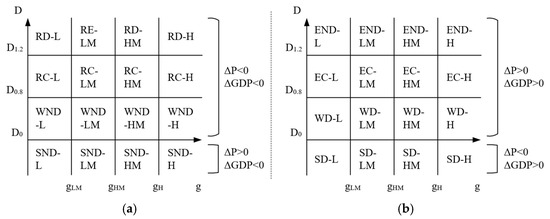
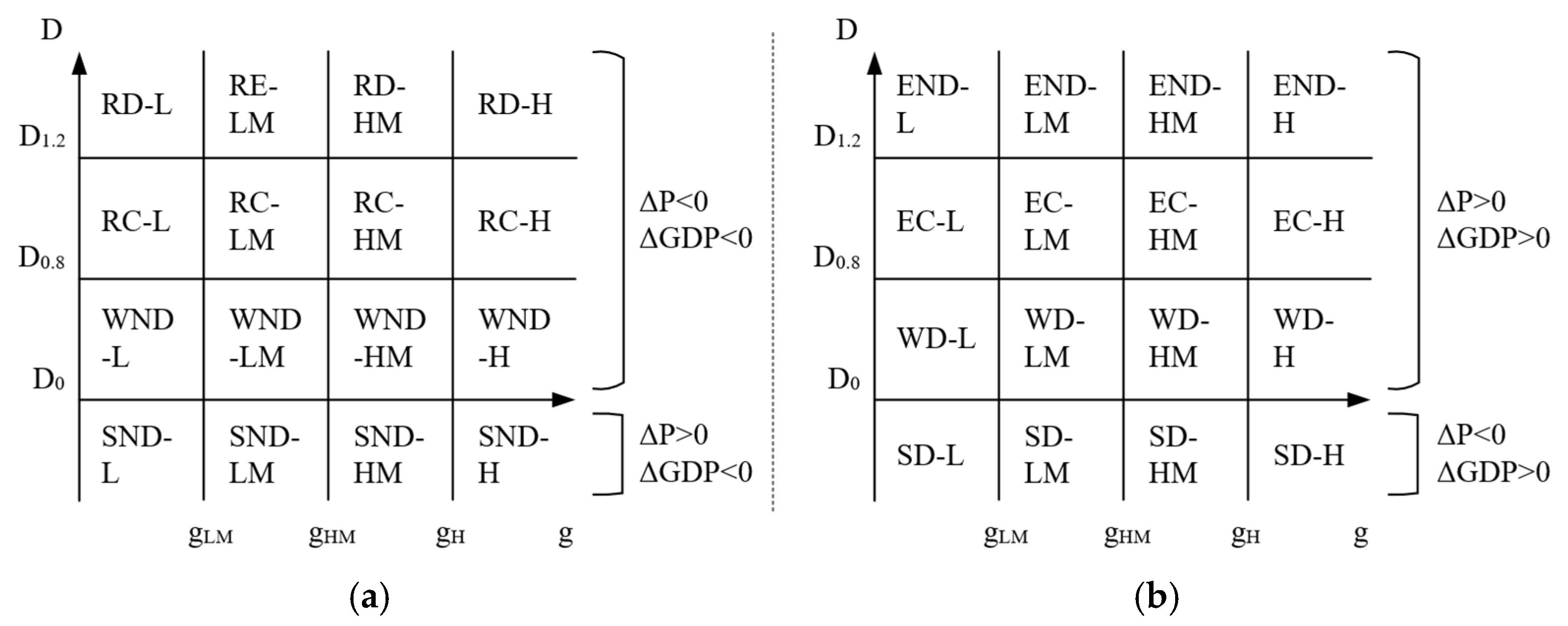
Combined with the eight decoupling states of the Tapio model, the two-dimensional decoupling model yielded 32 distinct states, as shown in Figure 1. Figure 1a illustrates the two-dimensional decoupling states under economic recession scenarios (ΔGDP < 0), while Figure 1b presents those under economic growth scenarios (ΔGDP > 0). To facilitate comparison of these 32 states, this study adopted the decoupling scoring framework developed by Song et al. [26], assigning a score to each two-dimensional decoupling state. As presented in Table 3, the judgment and scoring criteria for the two-dimensional decoupling states are clearly indicated.
Figure 1.
State classification in a two-dimensional decoupling model. (a) Two-dimensional decoupling states under economic recession scenarios (ΔGDP < 0); (b) Two-dimensional decoupling states under economic growth scenarios (ΔGDP > 0).
Table 3.
Judgment criteria and scoring criteria for two-dimensional decoupling status.
In the scoring framework developed by Song et al. [26], for decoupling states corresponding to the same level of economic development, the score was reduced by 1 point for each step upward along the vertical axis. For decoupling states corresponding to the same Tapio decoupling state, the score was increased by 1 point for each step to the right along the horizontal axis. The use of 1-point increments ensured the scoring system’s simplicity, transparency, and equidistance.
SD is the most desirable decoupling state within the economic growth context, where economic growth accompanies decreasing pollution emissions, and its score was set to 6. WD is weaker than SD, and its score was set to 5. EC and END were set as 4 and 3 points, following the same rule. Meanwhile, based on the one-dimensional decoupled state scores, the score of the two-dimensional decoupled state also rose as the economic level increased. Taking SD as an example, the scores for SD-L, SD-LM, SD-HM, and SD-H were 3, 4, 5, and 6, respectively. This reflected the varying degrees of difficulty in achieving strong decoupling across different levels of economic development. Achieving strong decoupling at high economic levels requires overcoming greater economic inertia, relying on more advanced technologies and stricter environmental regulations; therefore, such achievements are more valuable and were assigned higher scores.
2.3. Decomposition Model
This paper chose the economic development effect, industrial structure effect, technological progress effect, and population size effect as the driving factors to examine the crucial influencing elements and decoupling path.
To conduct a more in-depth evaluation of the influence degree and effectiveness of the decoupling drivers, integrating the LMDI decomposition model and the Tapio decoupling model can not only reflect the drivers that cause changes in industrial pollution emissions over some time and explore the mechanism of the role of changes in the state of decoupling but also intuitively demonstrate the efforts needed to realize the link between industrial pollution emissions. Moreover, it also quantifies the effort required to achieve decoupling. Drawing on prior work [27,28], combined with the KAYA constant equation, the LMDI model for decomposing the industrial pollution emission is as follows:
where is the year, is the industrial pollution emission, represents the industrial added value, denotes the gross domestic product, and signifies the number of resident populations. is the technological progress effect, is the industrial structure effect, denotes the economic development effect, and is the population size effect.
The resulting decomposition of the value of the change in industrial pollution emissions from year to year into the combined effect of the four drivers is expressed as follows:
In the formula, is the change of technological progress effect, is the change of industrial structure effect, is the change of economic development effect, and is the change of population size effect.
Applying the LMDI model, the formula for the driving effect of each factor can be obtained after eliminating the unexplained residual term:
By associating Equation (1) with Equation (3), the decoupling index of industrial pollution emissions and economic growth can be decomposed into decoupling indices for the four drivers:
where represents the decoupling index of the technological progress effect, denotes the decoupling index of the industrial structure effect, denotes the decoupling index of the economic development effect, and denotes the decoupling index of the population size effect.
2.4. Spatial Convergence of Industrial Pollution Emission Intensity in the Yangtze River Delta
Paying attention to the spatial correlation of decoupling holds substantial significance in a densely connected urban agglomeration such as the YRD. Due to the mutual influence of economic activities and technological diffusion between regions, the decoupling status of a city may affect neighboring areas through spatial spillover effects; for instance, emission reduction technologies adopted in high-emission cities may drive similar improvements in surrounding areas. However, conventional β-convergence models that do not account for such spatial dependence may fail to capture the full dynamics of regional pollution convergence. It is therefore essential to incorporate spatial effects when analyzing the convergence of industrial emission intensity in the YRD.
Before analyzing the spatial convergence, this paper utilized the spatial autocorrelation index Moran’s I to examine the spatial correlation of industrial emission intensity within the YRD.
where denotes the count of cities in the YRD, denotes the industrial emission intensity of i-th city, denotes the mean industrial emission intensity of all cities, and denotes the spatial adjacency weight matrix. Moran’s I ranges from −1 to 1, where a higher absolute value denotes a stronger spatial correlation [29].
The β-convergence model is well-established and includes absolute β-convergence and conditional β-convergence. Absolute β-convergence occurs when less developed regions grow rapidly to close the gap with more advanced regions. Conditional β-convergence indicates that after accounting for external factors, each city’s industrial emission intensity will eventually converge to its steady-state levels. The specific formula is as follows:
In the formula, represents the emission intensity of in , is the constant term, is the convergence coefficient, denotes the spatial weight matrix as above, signifies the spatial autoregressive coefficient, is the error term, and is the control variable affecting the emission intensity. If passes the significance test, it indicates a β-convergence trend of industrial emission intensity in the YRD, and its convergence rate is and the half-life cycle is . Otherwise, it indicates a divergent trend.
2.5. Methodological Limitations
Several limitations of the methodology should be acknowledged. First, the composite industrial pollution index was constructed using min–max normalization and equal weighting of three pollutant indicators. This approach treated each pollutant as equally important and did not account for differences in environmental toxicity or policy priority. Alternative weighting schemes based on environmental impact assessment could be explored in future research. Second, the LMDI decomposition attributed changes in industrial pollution emissions to four predetermined drivers. Other potentially relevant factors, such as energy structure, environmental regulation intensity, and foreign direct investment, were not explicitly captured in this framework. Third, the conditional β-convergence model included a selected set of control variables, which may not exhaust all factors influencing industrial emission intensity convergence (e.g., environmental regulation intensity, foreign direct investment). Fourth, industrial wastewater intensity was excluded from the spatial convergence analysis because its Moran’s I was not statistically significant for most years, indicating no significant spatial autocorrelation and thus violating the spatial econometric model assumption. These limitations notwithstanding, the integrated framework proposed in this study provided a coherent approach for examining the growth–pollution nexus in urban agglomerations.
3. Results
3.1. Decoupling Index Between Economic Growth and Industrial Pollution
This section examines the decoupling relationship between economic growth and industrial pollution emissions across 41 YRD cities from two perspectives. The first is a static assessment that evaluates the overall decoupling status over the entire 2006–2021 period, using 2006 as the base period. The second is a dynamic analysis that traces the evolution of decoupling across three sub-periods corresponding to China’s Five-Year Plans for National Economic and Social Development—the 11th Five-Year Plan (2006–2011), the 12th Five-Year Plan (2011–2016), and the 13th Five-Year Plan (2016–2021)—classifying each city’s trajectory into distinct path types and computing total scores. The results are organized by pollutant—industrial wastewater, industrial SO2, industrial smoke and dust, and the composite industrial pollution index.
3.1.1. Static Decoupling Status
Table 4 presents the static two-dimensional decoupling status of each city over the 2006–2021 period.
Table 4.
Static two-dimensional decoupling status by pollutant in YRD cities, 2006–2021.
For industrial wastewater, 20 of the 41 cities (48.8%) were in the SD-H state. All cities had achieved decoupling by 2021, with differences only in the decoupling index and economic development level. The five cities with the smallest decoupling indices were Hangzhou, Bengbu, Wenzhou, Lishui, and Lu’an in that order, with relatively strong decoupling status. However, except for Hangzhou, the remaining four cities had not yet reached a high economic development level. Among strongly decoupled cities, Chuzhou and Huaibei exhibited the largest decoupling indices and were in a non-significantly strong decoupling state, indicating a possibility of transforming into weak decoupling. Among weakly decoupled cities, Lianyungang, Tongling, Jiaxing, and Hefei had the smallest decoupling indices, suggesting a tendency toward strong decoupling.
For industrial SO2, 23 cities (56.1%) were in SD-H and the remaining 18 cities in SD-HM. All cities experienced economic growth and reduced SO2 emissions. Among strongly decoupled cities, the five with the smallest decoupling indices—with the exception of Wenzhou—had reached a high economic development stage. Fuyang and Bozhou were in an insignificantly strong decoupling state, indicating a possibility of transforming into weak decoupling.
For industrial smoke and dust, 22 cities (53.7%) were in SD-H and 17 cities (41.5%) in SD-HM. Wuhu was in WD-H, and Fuyang was in WD-HM. All cities had realized decoupling by 2021. The five cities with the smallest decoupling indices were Huainan, Shanghai, Shaoxing, Huaibei, and Bengbu. Ma’anshan, Bozhou, and Xuancheng had the largest decoupling indices among strongly decoupled cities, indicating a risk of transitioning to weak decoupling. Wuhu and Fuyang, the two weakly decoupled cities, had relatively small decoupling indices, suggesting a tendency toward strong decoupling.
For the composite industrial pollution index, 23 cities (56.1%) were in SD-H and 18 cities (43.9%) in SD-HM. All cities had achieved decoupling. The five cities with the smallest decoupling indices were Shanghai, Wenzhou, Huainan, Taizhou, and Huaibei. Except for Shanghai and Taizhou, the remaining three cities had not yet reached a high economic development stage. Fuyang had the largest decoupling index (−0.04) and faced a risk of reverting to weak decoupling.
To test the robustness of the decoupling determination results with respect to the selection of weights for the composite industrial pollution index, this study conducted a sensitivity analysis, as shown in Table 5. The results show that 40 out of 41 cities maintained SD under all three alternative weighting schemes. Only one city, Wuhu, changed from SD under the baseline to WD under Scheme C. No city changed under Scheme A or Scheme B.
Table 5.
Sensitivity analysis of decoupling status under alternative pollutant weighting schemes, 2006–2021.
3.1.2. Dynamic Decoupling Trajectories
Table 6 summarizes the path types and total scores across the three Five-Year Plan periods.
Table 6.
Dynamic decoupling path types and total scores by pollutant in YRD cities across three stages, 2006–2021.
For industrial wastewater, most cities showed a desirable decoupling trend. The decoupling trend increased in 26 cities, of which 12 cities had a score of 5 in the final stage, although their economic development had not yet reached an advanced stage. The decoupling trend remained unchanged in seven cities, including Shanghai, Wuxi, Suzhou, Wenzhou, Quzhou, Lishui, and Huangshan. Among them, Shanghai, Wuxi, and Suzhou had stable decoupling status and high economic development speed and quality. The decoupling trend fluctuated in six cities: Suqian, Shaoxing, Jinhua, Zhoushan, Wuhu, and Ma’anshan. Tongling and Xuancheng showed a downward trend, with the decoupling process regressing.
For industrial SO2, 34 cities showed an upward trend. Lianyungang and Suqian scored 5 in the final stage, though their economic development had not yet reached a high level. Suzhou and Bozhou made notably greater progress, moving from END-LM in the first stage to SD-HM in the final stage. Six cities maintained an unchanged trajectory, among which Shanghai, Wuxi, and Suzhou achieved the highest score of 6 in all stages. Chizhou was the only city with a declining trend, from strong to weak decoupling.
For industrial smoke and dust, 36 cities had increasing decoupling trends and improved decoupling status. Shanghai, which maintained SD-H status across all stages for both industrial wastewater and industrial SO2, transitioned from WD-H to SD-H in the dynamic decoupling of industrial smoke and dust. Huaibei remained stable in SD-HM, indicating stable decoupling but without reaching a high economic development level. Four cities—Suzhou, Lianyungang, Huangshan, and Chizhou—showed fluctuating trends. Overall, pollution reduction and environmental governance in the YRD have been quite effective, with the vast majority of cities showing a desirable decoupling trend.
For the composite industrial pollution index, 33 cities (80.5%) had an increasing trend, indicating that the decoupling status continued to improve. Among them, 13 cities, including Lianyungang and Suqian, scored 5 in the final stage, though their economic development had not yet reached a high level. Eight cities maintained an unchanged trend, among which Shanghai, Wuxi, and Suzhou achieved the highest score of 18 across all stages. Wenzhou, Huainan, and five other cities each scored 15, indicating stable decoupling but without a breakthrough in economic growth. Overall, the decoupling of the industrial pollution index showed a positive trajectory across YRD cities.
3.1.3. Heterogeneity Analysis by Province
To further reveal the regional differences in decoupling status within the YRD, this section aggregates the static decoupling states and dynamic path types of the composite industrial pollution index by province (Shanghai, Jiangsu, Zhejiang, and Anhui). The results are presented in Table 7.
Table 7.
Decoupling heterogeneity by province.
In terms of static decoupling status, a clear gradient exists across provinces. Shanghai achieves SD-H. In Jiangsu, 11 of the 13 cities (84.6%) reach SD-H, with only Lianyungang and Suqian in SD-HM, making it the best-performing province overall. In Zhejiang, 7 of the 11 cities (63.6%) reach SD-H, while Wenzhou, Jinhua, Quzhou, and Lishui remain in SD-HM. In Anhui, only 4 of the 16 cities (25.0%) reach SD-H—namely Hefei, Wuhu, Ma’anshan, and Tongling—while the remaining 12 cities are in SD-HM, indicating that although these cities have achieved decoupling, their economic development has not yet reached the high-income stage.
In terms of dynamic trajectories, all cities across the three provinces exhibit Rising or Unchanged paths, with no Declining or Fluctuating cases. The average total score declines from Jiangsu (16.1) to Zhejiang (15.7) to Anhui (13.3), consistent with the gradient observed in the SD-H proportions, further confirming the descending pattern of “Shanghai–Jiangsu–Zhejiang–Anhui” within the YRD. Overall, a clear provincial gradient exists within the YRD: Shanghai and Jiangsu lead in both the depth and stability of decoupling, Zhejiang performs well overall but with slight internal differentiation, and Anhui lags behind in both the SD-H proportion and average score, indicating considerable room for improvement. This heterogeneity suggests that within the YRD’s integrated development framework, differentiated environmental governance and industrial upgrading policies tailored to each province’s development stage remain necessary.
3.2. Empirical Analysis of Decomposition of the Decoupling Index
3.2.1. Decomposition of Drivers of Decoupling of Industrial Wastewater
- Time dimension analysis.
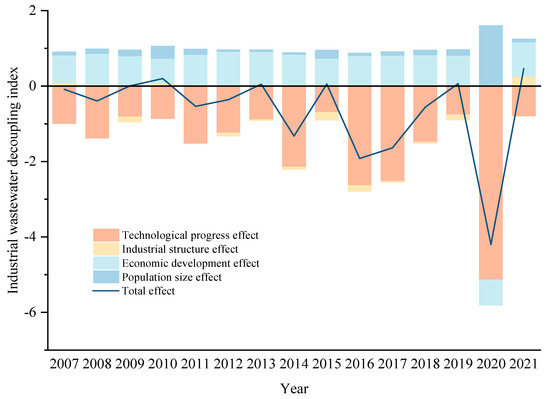
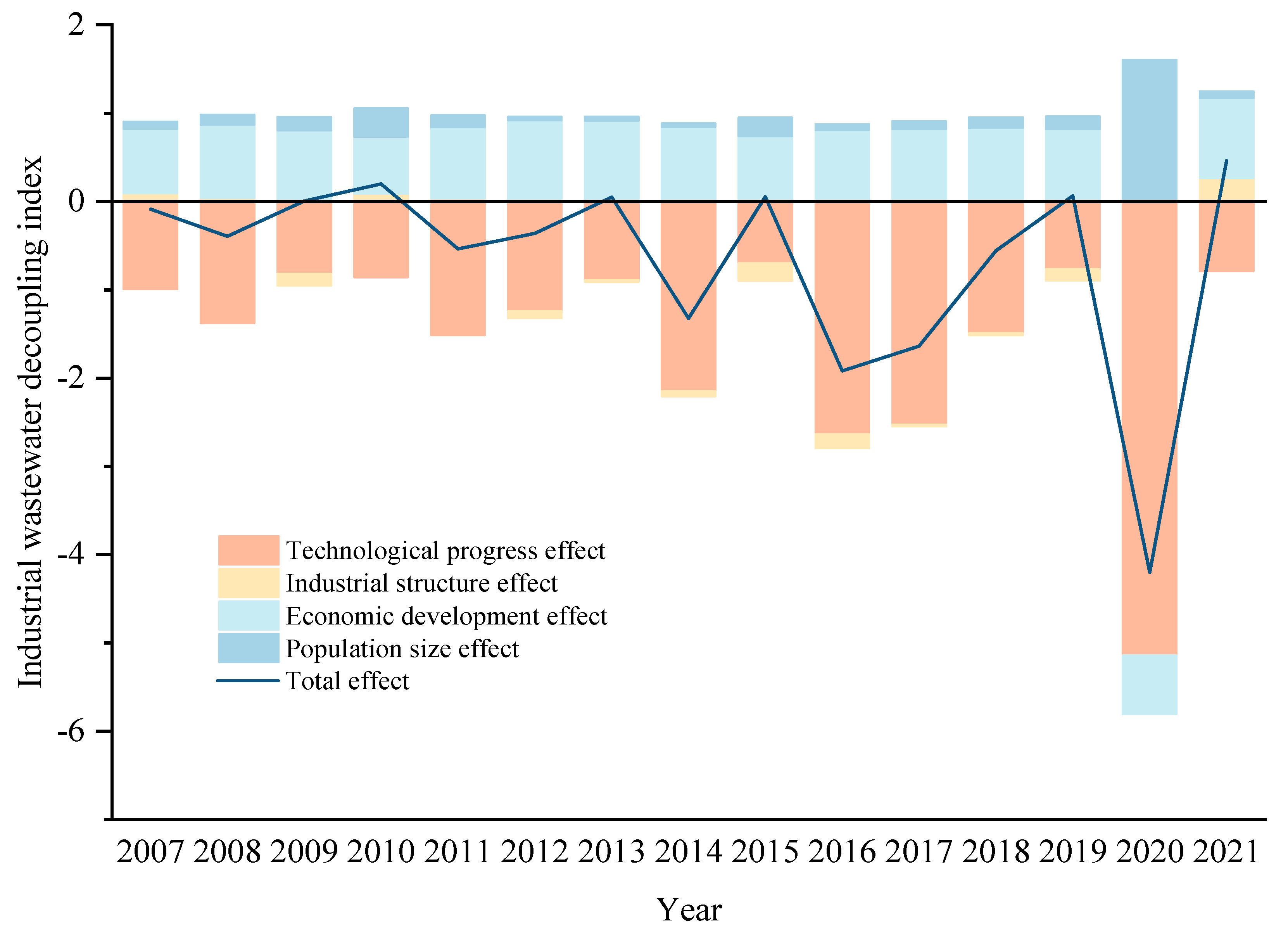
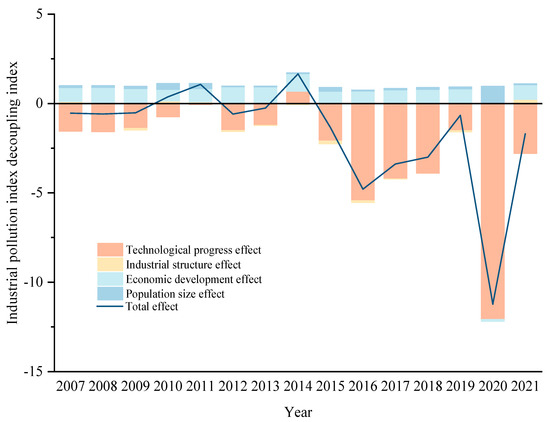
Equations (2)–(10) are used to factorize the decoupling index of economic growth and industrial wastewater emission in the YRD region from 2007 to 2021, and the driving factors are derived. Figure 2 shows the decomposition results.
Figure 2.
The decomposition of the decoupling index of industrial wastewater in the YRD.
The technological progress effect has the greatest impact as a contributing factor to decouple industrial wastewater discharges. According to the calculation of the study period, its average contribution rate reached 54.9%, the decoupling of industrial wastewater discharge caused by the technological progress effect presented a strong decoupling tendency, and the decoupling index fluctuates within the range of −5.1 (2015)~−0.7 (2020). The decoupling contribution rate was the greatest in 2016, reaching 71.9%.
The economic development effect inhibits the decoupling of industrial wastewater discharges, with an average contribution of 34.4% from 2007 to 2021. Except for 2020, the economic development effect is relatively average, fluctuating from 0.64 to 0.92. However, in 2020, the economic development effect spurred the decoupling of industrial wastewater discharges.
The population size effect also inhibits decoupling, but its annual average contribution rate is 6.55%, much smaller than the economic development effect. The decoupling effort of the industrial structure effect is smaller.
The industrial structure effect contributes less significantly to the decoupling process. Like the technological progress effect, it has been facilitating a decoupling effect for most years because of the active adjustment of the industrial configurations in YRD cities and the economy’s transition to high-quality development.
- 2.
- Spatial dimension analysis.
Due to city-specific heterogeneity within the YRD region, further analysis of the decomposition effect is needed in the context of local conditions. Table 8 shows the outcomes. From the viewpoint of each city, for the decoupling of industrial wastewater emissions, the technological progress effect has the greatest influence and is always the dominant force for decoupling. While the industrial structure effect and the population size effect vary among different cities, the economic development effect plays an inhibiting role in decoupling. It found that the industrial structure effects of Wuxi, Suzhou, and 18 cities in Anhui province inhibited decoupling. In contrast, the industrial structure effects of other cities promote decoupling. Anhui province’s industrial structure retains substantial room for optimization, and the high proportion of industrial output value will lead to excessive industrial pollution emissions. The population size effect exerts a positive influence on decoupling in cities such as Lu’an, Anqing, Yancheng, Suzhou, Chizhou, Fuyang, Huaian, Huangshan, Xuancheng, Bozhou, Huaibei, Chuzhou, and Taizhou.
Table 8.
The decomposition of the decoupling index of industrial wastewater by city.
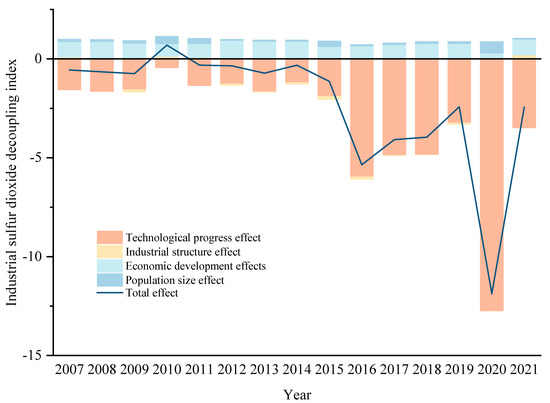
3.2.2. Decomposition of Drivers of Decoupling of Industrial SO2 Emissions
- Time dimension analysis.
As shown in Figure 3, the absolute value of the decomposition contribution of the industrial sulfur dioxide emission driver is roughly the same order of magnitude as that of industrial wastewater emission decoupling. However, the industrial structure effect is 0.012, which plays a weak inhibiting influence on industrial sulfur dioxide decoupling. The technological progress effect is −3.18, and the annual average decoupling contribution rate reaches 67.5%, playing a substantial positive role. The economic development effect is 0.74, and its annual average decoupling contribution rate is 24.8%, playing a negative inhibiting role. The population size effect also inhibits decoupling, with a decomposition effect of 0.15 and an average annual contribution to decoupling of 4.9%.
Figure 3.
The decomposition of the decoupling index of industrial SO2 in the YRD.
- 2.
- Spatial dimension analysis.
As shown in Table 9, for the decoupling of industrial sulfur dioxide emissions, the industrial structure and population size effects have different directions between cities. Analyzed from the provincial level, the decoupling index decomposition of Shanghai, Jiangsu, Zhejiang, and Anhui provinces are −0.48, −0.29, −0.36, and −0.26, respectively, which shows that the decoupling contribution of Shanghai is the largest. Shanghai has a better economic foundation and is at the forefront of industrial pollution prevention and control in the YRD. Although Anhui province shows a strong decoupling trend, its contribution to the decoupling of the YRD is the smallest. Anhui province has rapid economic development, but there is still much room for development in preventing and controlling industrial pollution. It should further reduce the proportion of high-energy-consuming and high-emission industries while gradually optimizing the industrial structure.
Table 9.
The decomposition of the decoupling index of industrial sulfur dioxide by city.
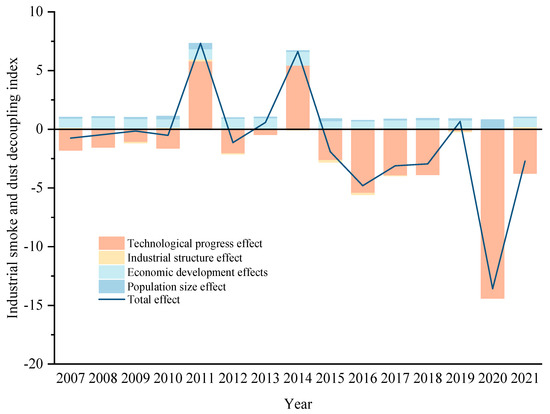
3.2.3. Decomposition of Drivers of Decoupling of Industrial Smoke and Dust
- Time dimension analysis.
Figure 4 shows that the fluctuation of the decoupling index for industrial smoke and dust emissions is mainly associated with the technological progress effect. The technological progress effect’s annual average decoupling decomposition index is −2.1, and the annual average decoupling contribution rate reaches 66.9%, which generally contributes positively to decoupling. However, in 2011 and 2014, the decoupling decomposition index of the technological progress effect was 5.8 and 5.5, respectively, which in turn caused an increase in the decoupling index of industrial smoke and dust emission, indicating that industrial smoke and dust emission per unit of industrial output value in the corresponding years increased significantly compared with that of the previous year, and there is enormous room for decoupling improvement. The economic development effect, having an average contribution rate of 27% from 2007 to 2021, shows that it inhibits decoupling.
Figure 4.
The decomposition of the decoupling index of industrial smoke and dust in the YRD.
- 2.
- Spatial dimension analysis.
Table 10 shows that for the decoupling of industrial smoke and dust emissions, the technological progress effect is the most influential and is always the main factor contributing to decoupling. Regarding the technological progress effect, the six cities with the largest contribution to the decoupling index decomposition are Wuhu City, Huaibei City, Huainan City, Huangshan City, Tongling City, and Wenzhou City. As far as the industrial structure effect is concerned, the six cities with the largest contribution to the decoupling index decomposition are, in descending order, Shanghai, Quzhou, Huzhou, Zhoushan, Hangzhou, and Jinhua. Wuhu City has the largest total decoupling effect index.
Table 10.
The decomposition of the decoupling index of industrial smoke and dust by city.
3.2.4. Decomposition of Drivers of Decoupling of the Industrial Pollution Index
- Time dimension analysis.
Figure 5 shows that the most substantial influence on industrial pollution emission decoupling is the technological progress effect, whose average contribution rate reached 61.2% during the study period, the most significant factor promoting decoupling. The decoupling of industrial pollution emissions caused by the technological progress effect shows a pronounced decoupling trend, and the decoupling decomposition index is the largest in 2014, which is 0.69, indicating that the decoupling index fluctuates in the initial period when there is not enough attention paid to pollution emission control. The economic development effect is the primary factor inhibiting the decoupling of industrial wastewater discharges, exhibiting a 28.8% average annual contribution; its decoupling decomposition index fluctuates from −0.11 to 0.98.
Figure 5.
The decomposition of the decoupling index of the industrial pollution index in the YRD.
- 2.
- Spatial dimension analysis.
Table 11 shows that regarding technological progress effects, the six cities with the largest contribution to the decoupling index are Wuhu, Huainan, Huaibei, Taizhou, Shanghai, and Shaoxing. The six cities with the smallest contribution to the decoupling index are Zhoushan, Hefei, Huaian, Taizhou, Nantong, and Suqian. Although the technological progress effects of these cities have shown a strong decoupling, there is still room for progress and optimization when compared with cities with economic and environmental excellence. The direction of the industrial structure effect varies among cities, with 18 cities, accounting for 43.9% of the total, experiencing a decline in industrial pollution index decoupling. Suzhou and Wuxi have a high level of industrialization and higher industrial output value, corresponding to increased industrial pollution emissions.
Table 11.
The decomposition of the decoupling index of the industrial pollution index by city.
3.3. β-Convergence of Industrial Emission Intensity Analysis
3.3.1. Absolute Beta Convergence Test
- Spatial correlation test.
Table 12 shows that the Moran’s I of industrial sulfur dioxide in the YRD since 2010 is positive and has remained statistically significant (p < 0.05). The Moran’s I shows an increasing trend over time, indicating that the industrial sulfur dioxide intensity exhibits significant spatial agglomeration, and the inter-city emission linkages show progressive intensification. The Moran’s I of industrial smoke and dust intensity demonstrates significant positive values (p < 0.01), suggesting that industrial smoke and dust intensity showed significant spatial aggregation during the study period. The Moran’s I of industrial pollution index intensity was greater than 0. The p-values were less than 0.01 in 2010 and later, indicating that the intensity of the industrial pollution index in the YRD has a positive spatial correlation. It is reasonable to include the spatial effect in the traditional convergence model. The industrial wastewater intensity failed to pass the significance level test in most years, so only the industrial sulfur dioxide intensity, industrial smoke and dust intensity, and the industrial pollution index intensity are analyzed spatially in the following.
Table 12.
Moran’s I of industrial pollution intensity.
- 2.
- Spatial econometric modeling tests for absolute beta convergence.
Selecting an appropriate spatial measurement model is a prerequisite for examining the industrial emission intensity in the YRD, so before the absolute β-convergence test, it is necessary to synthesize the outcomes of the LM, Wald, and LR tests to select an appropriate spatial measurement model [30].
As Table 13 reveals, the LM of industrial sulfur dioxide emission intensity is significant, the Robust LM-error is 0.258, the Wald and LR test results reject the original hypothesis, and the Log Likelihood value of the SDM model is the largest, which indicates that the SDM can not be degraded to the SAR and SEM. Therefore, a comprehensive analysis of the SDM is the most suitable for studying the convergence of industrial sulfur dioxide emission intensity. For industrial smoke and dust emission intensity, the Robust LM test shows that SDM is better than SAR and SEM, and both Wald and LR test results are significant, so this study chooses SDM to study the convergence mechanism of industrial smoke and dust emission intensity. Robust LM-lag and Robust LM-error were insignificant for the industrial pollution index intensity. However, both Wald and LR test results rejected the original hypothesis. Moreover, the Log Likelihood value of the SDM model was the largest, so SDM was selected for the comprehensive analysis to explore the spatial convergence mechanism of the industrial pollution index intensity. In addition, the Hausman test of the three indicated that the fixed effects model outperformed the random effects model.
Table 13.
The suitability test for the spatial Durbin model with absolute β-convergence.
- 3.
- Analysis of absolute β-convergence results.
Table 14 reports the absolute β-convergence test results for industrial emission intensity under the estimation of the two-way stationary spatial Durbin model. As shown in Table 14, the convergence coefficients β for industrial sulfur dioxide intensity, industrial smoke and dust intensity, and industrial pollution index intensity are all significantly negative at the 1% confidence level. This indicates a clear absolute β-convergence trend in industrial pollution intensity across the YRD. Without considering differences in economic, social, or other influencing factors among regions, those with initially lower industrial pollution intensity show faster growth rates in reducing pollution compared to more developed regions. Eventually, all regions are expected to converge to the same steady-state equilibrium value. Estimates of the half-life cycle indicate that without additional policy interventions, it would take approximately 24 to 29 years for the gap in industrial emission intensity among cities in the YRD to be reduced by half. Compared with the industrial sulfur dioxide intensity and the industrial pollution index intensity, the industrial smoke and dust intensity has a faster convergence rate and will be the first to reach the equilibrium steady state. In addition, the spatial autoregressive coefficients of industrial sulfur dioxide intensity and industrial smoke and dust intensity are significantly positive at the 1% level, and the spatial autoregressive coefficients of industrial pollution index intensity are 0.103, indicating that the industrial emission intensity has a positive radiating effect on the neighboring areas.
Table 14.
Spatial absolute β-convergence test for industrial pollution intensity.
3.3.2. Conditional β-Convergence Test and Analysis of Results
- Spatial econometric modeling tests for conditional β-convergence.
According to the convergence theory, absolute β-convergence is known to be conditional on similar economic and social development levels of each region, but this assumption is difficult to realize in an actual situation.
Table 15 shows that the Robust LM-error for industrial sulfur dioxide emission intensity is not significant, and both Wald and LR tests reject the original hypothesis, so the comprehensive analysis of fixed effects SDM is most appropriate for the conditional β-convergence study of industrial sulfur dioxide emission intensity. For industrial smoke and dust emission intensity, the LM test showed that the Robust LM-error was not significant, and SEM was better than SAR; the Wald test results accepted the original hypothesis that SDM could be simplified to SEM, so this study chose fixed-effects SEM for the research on the conditional β-convergence mechanism of industrial smoke and dust emission intensity. While neither the Robust LM-lag nor Robust LM-error reached statistical significance for industrial pollution index intensity, the LR test was significant at the 1% confidence level. Moreover, the Log Likelihood value of the SDM model was the largest. The SDM was selected for the comprehensive analysis to investigate the spatial conditional β-convergence mechanism of the industrial pollution index intensity. In addition, the Hausman test demonstrated that the fixed effects model outperformed the random effects model.
Table 15.
Spatial Durbin model applicability tests for conditional β-convergence.
- 2.
- Analysis of the conditional β-convergence result.
Table 16 reports the findings of the conditional β-convergence test. Based on the results, it is clear that the convergence coefficients β demonstrate statistically significant negative values (p < 0.01) across all three pollution indicators: industrial sulfur dioxide intensity, industrial smoke and dust intensity, and industrial pollution index intensity, indicating that there is significant conditional β-convergence; controlling for the initial level and the economic and social characteristics of the cities, the industrial emission intensity in the YRD will tend to converge towards their respective steady-state levels. Estimates of the half-life cycle indicate that given the influence of economic and social conditions such as industrial structure, economic development, and population size, it will take approximately 23 to 26 years for the gap in industrial emission intensity among cities in the YRD to be reduced by half. Overall, the conditional β-convergence coefficient has a larger absolute value than the absolute β-convergence coefficient, and the relevant economic and social conditions, such as industrial structure, economic development, and population size, can increase the convergence rate of industrial emission intensity in the YRD.
Table 16.
Results of spatial conditional β-convergence test for industrial pollution intensity.
4. Discussion
This study analyzes the decoupling relationship between economic growth and industrial pollution emissions across YRD cities by constructing a two-dimensional decoupling model, identifies the key factors driving decoupling through LMDI decomposition, and examines the spatial convergence characteristics of industrial pollution emission intensity. The findings hold important implications for sustainable green development in the YRD region.
Regarding decoupling status, the results show that with 2006 as the base period, all cities in the YRD achieved a decoupling status between economic growth and industrial pollution emissions by 2021, with decoupling continuing to improve in most cities. This finding is consistent with existing studies such as Zhang et al. [31], who documented a shift from weak to strong decoupling in the Yangtze River Economic Belt. However, existing studies typically treat strong decoupling as a uniformly desirable outcome. By incorporating economic development stages into the decoupling classification, our two-dimensional framework reveals that strong decoupling in a high-income city differs fundamentally from that in an upper-middle-income city—a nuance that avoids simplistic cross-city comparisons and informs stage-appropriate policies.
Beyond diagnosing the decoupling status, the LMDI decomposition reveals the driving forces behind these patterns. Technological progress emerged as the primary enabler of decoupling, while economic development remained the foremost inhibiting factor—a finding that aligns with Zhang et al. [32] and others [33,34,35,36]. However, these driver-focused studies typically examine driving forces in isolation. By linking driver decomposition with spatial convergence analysis, our study expands this understanding by showing that technological progress, despite its dominant role at the city level, exhibits limited spatial spillovers. This implies that left to market forces alone, technological progress may inadvertently widen rather than narrow the environmental gap between leading and lagging cities.
The spatial convergence analysis further reveals that industrial SO2 intensity, industrial smoke and dust intensity, and the composite industrial pollution index intensity all exhibit significant spatial agglomeration and both absolute and conditional β-convergence trends. The significant spatial autoregressive coefficients indicate positive spatial spillovers, meaning that emission reduction in one city can benefit neighboring areas. This evidence of spatial interdependence directly challenges the conventional point-based governance paradigm, which implicitly assumes that each city can pursue emission reductions independently. Instead, our findings call for a shift toward networked, collaborative governance—such as cross-city technology platforms and joint pollution prevention mechanisms—that actively leverage spatial spillovers to accelerate regional convergence.
The findings of this study can be contextualized by comparing the YRD with other major urban agglomerations in China. The Central Plains Urban Agglomeration reached strong decoupling only in 2015 after prolonged weak decoupling [37], while urban agglomerations in the Yellow River Basin have recently experienced regressions from weak decoupling to growing connection [38]—a pattern observed in only a few YRD cities. The Beijing–Tianjin–Hebei urban agglomeration exhibits a persistent economic–environmental imbalance, with production-oriented cities bearing high emission intensity to sustain consumption in core cities [39,40]. In contrast, the YRD appears to have achieved a more coordinated decoupling trajectory, likely owing to earlier industrial upgrading and more integrated cross-city environmental governance. These comparisons suggest that the YRD experience may offer valuable lessons for other urban agglomerations still navigating the growth–pollution tension.
The above findings carry several policy implications. First, given that the economic development effect remains the primary obstacle to decoupling, policy formulation should extend beyond promoting green technologies to include industrial restructuring—particularly for cities where the industrial structure effect is negative (see Table 8, Table 9, Table 10 and Table 11). For these cities, reducing the share of high-emission industries is as urgent as improving emission efficiency. Second, the heterogeneity in decoupling drivers across cities cautions against uniform policy prescriptions. Cities such as Shanghai and Huaibei achieve decoupling primarily through technological progress, whereas cities with declining populations benefit from the population size effect. Policy instruments should be tailored to each city’s specific driver profile. Third, the significant spatial autoregressive coefficients in the convergence models indicate that conventional point-based governance—where each city independently pursues emission reduction—has limited efficiency. A shift toward a networked governance model is essential, featuring cross-city technology-sharing platforms and joint pollution prevention and control mechanisms that leverage positive spatial spillovers to accelerate regional convergence.
5. Conclusions
This study, through the integration of decoupling, decomposition, and convergence analysis, examines the relationship between economic growth and industrial pollution emissions across 41 YRD cities from 2006 to 2021 and further explores the decoupling status, driving mechanisms, and spatial convergence characteristics of industrial pollution emission intensity. The main conclusions are as follows.
First, by 2021, all YRD cities had achieved decoupling between economic growth and industrial pollution emissions. In terms of static status, the majority of cities were in strong decoupling with high or upper-middle economic development levels. In terms of dynamic trajectories, most cities showed continuous improvement across the three Five-Year Plan periods, while a few cities exhibited fluctuating or declining trends.
Second, technological progress is the dominant enabler of decoupling, while economic development remains the primary barrier. The effects of industrial structure and population size vary in direction across cities. Overall, the decoupling contributions of the four drivers rank as technological progress, economic development, population size, and industrial structure.
Third, industrial SO2 intensity, industrial smoke and dust intensity, and the composite industrial pollution index all exhibit significant spatial agglomeration as well as absolute and conditional β-convergence trends. Among them, industrial smoke and dust intensity converges most rapidly. Significant spatial spillovers are also identified.
Several limitations should be noted. First, the equal-weighting approach in constructing the composite pollution index is a simplification; future work could explore weighting schemes based on environmental impact or policy priorities. Second, the LMDI decomposition was conducted along time and city dimensions; extending this to sub-regional and provincial levels would be valuable. Third, the conditional β-convergence model includes only selected control variables, and future research could incorporate additional socioeconomic factors to improve robustness and precision.
Author Contributions
Conceptualization, D.S. and X.L. (Xiaona Li); methodology, J.D., X.L. (Xuemei Li) and Y.S.; software, J.D., X.L. (Xuemei Li) and Y.S.; validation, D.S. and X.L. (Xiaona Li); formal analysis, J.D., X.L. (Xuemei Li) and Y.S.; investigation, D.S. and X.L. (Xiaona Li); resources, D.S. and X.L. (Xiaona Li); data curation, J.D., X.L. (Xuemei Li) and Y.S.; writing—original draft preparation, J.D., X.L. (Xuemei Li) and Y.S.; writing—review and editing, J.D., X.L. (Xuemei Li), Y.S., X.L. (Xiaona Li) and D.S.; visualization, J.D., X.L. (Xuemei Li) and Y.S.; supervision, D.S. and X.L. (Xiaona Li); project administration, D.S. and X.L. (Xiaona Li); funding acquisition, D.S. and X.L. (Xiaona Li). All authors have read and agreed to the published version of the manuscript.
Funding
This study was funded by the Postgraduate Research and Practice Innovation Program of Jiangsu Province (KYCX25_4158), the National Social Science Fund of China (24BGL209), and the Key Research Base of Universities in Jiangsu Province for Philosophy and Social Science “Research Center for Green Development and Environmental Governance”, which is highly appreciated by researchers of this study. The views and opinions expressed in this article are those of the authors and do not necessarily reflect the views of the funding agencies.
Data Availability Statement
The data and materials are available on request from the corresponding author.
Conflicts of Interest
The authors declare no conflicts of interest.
References
- Xiao, L.; Liu, J.; Ge, J. Dynamic game in agriculture and industry cross-sectoral water pollution governance in developing countries. Agric. Water Manag. 2021, 243, 106417. [Google Scholar] [CrossRef] [Scilit]
- Yang, F.; Shi, L.; Gao, L. Probing CO2 emission in Chengdu based on STRIPAT model and Tapio decoupling. Sustain. Cities Soc. 2023, 89, 104309. [Google Scholar] [CrossRef] [Scilit]
- Simbi, C.H.; Lin, J.; Yang, D.; Niu, X.; Banda, J.; Liu, J. Decomposition and decoupling analysis of carbon dioxide emissions in African countries during 1984–2014. J. Environ. Sci. 2021, 102, 85–98. [Google Scholar] [CrossRef] [Scilit]
- Kouyakhi, N.R. CO2 emissions in the Middle East: Decoupling and decomposition analysis of carbon emissions, and projection of its future trajectory. Sci. Total Environ. 2022, 845, 157182. [Google Scholar] [CrossRef] [Scilit]
- Qin, X.; Hu, X.; Xia, W. Investigating the dynamic decoupling relationship between regional social economy and lake water environment: The application of DPSIR-Extended Tapio decoupling model. J. Environ. Manag. 2023, 345, 118926. [Google Scholar] [CrossRef] [Scilit] [PubMed]
- Hu, J.; Chi, L.; Xing, L.; Meng, H.; Zhu, M.; Zhang, J.; Wu, J. Decomposing the decoupling relationship between energy consumption and economic growth in China’s agricultural sector. Sci. Total Environ. 2023, 873, 162323. [Google Scholar] [CrossRef] [Scilit] [PubMed]
- Yasmeen, R.; Padda, I.U.H.; Shah, W.U.H. Untangling the forces behind carbon emissions in China’s industrial sector—A pre and post 12th energy climate plan analysis. Urban Clim. 2024, 55, 101895. [Google Scholar] [CrossRef] [Scilit]
- Ozdemir, A.C. Decomposition and decoupling analysis of carbon dioxide emissions in electricity generation by primary fossil fuels in Turkey. Energy 2023, 273, 127264. [Google Scholar] [CrossRef] [Scilit]
- Wang, K.; Zhu, Y.; Zhang, J. Decoupling economic development from municipal solid waste generation in China’s cities: Assessment and prediction based on Tapio method and EKC models. Waste Manag. 2021, 133, 37–48. [Google Scholar] [CrossRef] [Scilit]
- Wu, Y.; Yuan, C.; Liu, Z.; Wu, H.; Wei, X. Decoupling relationship between the non-grain production and intensification of cultivated land in China based on Tapio decoupling model. J. Clean. Prod. 2023, 424, 138800. [Google Scholar] [CrossRef] [Scilit]
- Wang, X.; Zheng, Z.; Jia, W.; Tai, K.; Xu, Y.; He, Y. Response Mechanism and Evolution Trend of Carbon Effect in the Farmland Ecosystem of the Middle and Lower Reaches of the Yangtze River. Agronomy 2024, 14, 2354. [Google Scholar] [CrossRef] [Scilit]
- Anser, M.K.; Yousaf, Z.; Usman, B.; Nassani, A.A.; Qazi Abro, M.M.; Zaman, K. Management of water, energy, and food resources: Go for green policies. J. Clean. Prod. 2020, 251, 119662. [Google Scholar] [CrossRef] [Scilit]
- Zheng, J.; Wu, S.; Li, S.; Li, L.; Li, Q. Impact of global value chain embedding on decoupling between China’s CO2 emissions and economic growth: Based on Tapio decoupling and structural decomposition. Sci. Total Environ. 2024, 918, 170172. [Google Scholar] [CrossRef] [Scilit] [PubMed]
- Ang, B.W. Decomposition analysis for policymaking in energy: Which is the preferred method? Energy Policy 2004, 32, 1131–1139. [Google Scholar] [CrossRef] [Scilit]
- Abam, F.I.; Inah, O.I.; Nwankwojike, B.N. Impact of asset intensity and other energy-associated CO2 emissions drivers in the Nigerian manufacturing sector: A firm-level decomposition (LMDI) analysis. Heliyon 2024, 10, e28197. [Google Scholar] [CrossRef] [Scilit] [PubMed]
- Tian, L.; Chai, J.; Zhang, X.; Pan, Y. Spatiotemporal evolution and driving factors of China’s carbon footprint pressure: Based on vegetation carbon sequestration and LMDI decomposition. Energy 2024, 310, 133299. [Google Scholar] [CrossRef] [Scilit]
- Xin, M.; Guo, H.; Li, S.; Chen, L. Can China achieve ecological sustainability? An LMDI analysis of ecological footprint and economic development decoupling. Ecol. Indic. 2023, 151, 110313. [Google Scholar] [CrossRef] [Scilit]
- Raza, M.Y.; Wang, W.; Javed, Q. Decoupling effect and driving factors of transport CO2 emissions: Modeling and prediction of energy and environmental factors towards Vision-2035 in a developing economy. Energy Strategy Rev. 2025, 59, 101750. [Google Scholar] [CrossRef] [Scilit]
- Akram, V.; Ali, J. Global disparities of greenhouse gas emissions in agriculture sector: Panel club convergence analysis. Environ. Sci. Pollut. Res. 2021, 28, 55615–55622. [Google Scholar] [CrossRef] [Scilit] [PubMed]
- Nie, C.; Lee, C.-C. Synergy of pollution control and carbon reduction in China: Spatial–temporal characteristics, regional differences, and convergence. Environ. Impact Assess. Rev. 2023, 101, 107110. [Google Scholar] [CrossRef] [Scilit]
- Ren, X.; Xiao, Y.; Xiao, S.; Jin, Y.; Taghizadeh-Hesary, F. The effect of climate vulnerability on global carbon emissions: Evidence from a spatial convergence perspective. Resour. Policy 2024, 90, 104817. [Google Scholar] [CrossRef] [Scilit]
- Ivanovski, K.; Awaworyi Churchill, S. Convergence and determinants of greenhouse gas emissions in Australia: A regional analysis. Energy Econ. 2020, 92, 104971. [Google Scholar] [CrossRef] [Scilit]
- Xie, Q.; Ma, D.; Raza, M.Y.; Tang, S.; Bai, D. Toward carbon peaking and neutralization: The heterogeneous stochastic convergence of CO2 emissions and the role of digital inclusive finance. Energy Econ. 2023, 125, 106841. [Google Scholar] [CrossRef] [Scilit]
- Wu, W.; Zhang, T.; Xie, X.; Huang, Z. Regional low carbon development pathways for the Yangtze River Delta region in China. Energy Policy 2021, 151, 112172. [Google Scholar] [CrossRef] [Scilit]
- SOPAC. Building Resilience in SIDS: The Environmental Vulnerability Index; Technical Report; SOPAC: Suva, Fiji, 2005. [Google Scholar]
- Song, Y.; Sun, J.; Zhang, M.; Su, B. Using the Tapio-Z decoupling model to evaluate the decoupling status of China’s CO2 emissions at provincial level and its dynamic trend. Struct. Change Econ. Dyn. 2020, 52, 120–129. [Google Scholar] [CrossRef] [Scilit]
- Loo, B.P.; Li, L. Carbon dioxide emissions from passenger transport in China since 1949: Implications for developing sustainable transport. Energy Policy 2012, 50, 464–476. [Google Scholar] [CrossRef] [Scilit]
- Yang, X.; Xu, H.; Su, B. Factor decomposition for global and national aggregate energy intensity change during 2000–2014. Energy 2022, 254, 124347. [Google Scholar] [CrossRef] [Scilit]
- Zhang, P.; Hao, Y. Rethinking China’s environmental target responsibility system: Province-level convergence analysis of pollutant emission intensities in China. J. Clean. Prod. 2020, 242, 118472. [Google Scholar] [CrossRef] [Scilit]
- Koley, M.; Bera, A.K. To use, or not to use the spatial Durbin model?—That is the question. Spat. Econ. Anal. 2024, 19, 30–56. [Google Scholar] [CrossRef] [Scilit]
- Zhang, Y.; Sun, M.; Yang, R.; Li, X.; Zhang, L.; Li, M. Decoupling water environment pressures from economic growth in the Yangtze River Economic Belt, China. Ecol. Indic. 2021, 122, 107314. [Google Scholar] [CrossRef] [Scilit]
- Zhang, H.; Xu, T.; Zhang, C. Decoupling study on industrial water use and economic development in Yangtze River Delta region. Resour. Ind. 2022, 24, 115–125. [Google Scholar]
- Dawid, S.; Vinardell, S.; Valderrama, C. Can green economic growth and carbon emission reduction coexist? A decoupling study in the energy sector. J. Clean. Prod. 2026, 549, 147867. [Google Scholar] [CrossRef] [Scilit]
- Saglam, M.S.; Yilanci, V.; Kongkuah, M. Decoupling economic growth and carbon emissions: A time-varying analysis of the environmental kuznets curve hypothesis in France (1890–2019). Environ. Dev. Sustain. 2025. [Google Scholar] [CrossRef] [Scilit]
- Udeagha, M.C.; Ngepah, N. The asymmetric effect of technological innovation on CO2 emissions in South Africa: New evidence from the QARDL approach. Front. Environ. Sci. 2022, 10, 985719. [Google Scholar] [CrossRef] [Scilit]
- Leal, P.A.; Marques, A.C.; Fuinhas, J.A. Decoupling economic growth from GHG emissions: Decomposition analysis by sectoral factors for Australia. Econ. Anal. Policy 2019, 62, 12–26. [Google Scholar] [CrossRef] [Scilit]
- Luo, H.; Li, L.; Lei, Y.; Wu, S.; Yan, D.; Fu, X.; Luo, X.; Wu, L. Decoupling analysis between economic growth and resources environment in Central Plains Urban Agglomeration. Sci. Total Environ. 2021, 752, 142284. [Google Scholar] [CrossRef] [Scilit]
- Zhang, Z.; Wang, W.; Chen, J.; Han, C.; Zhang, L.; Lv, X.; Yang, L.; Cui, G. Spatial Association and Driving Factors of the Carbon Emission Decoupling Effect in Urban Agglomerations of the Yellow River Basin. Land 2025, 14, 1838. [Google Scholar] [CrossRef] [Scilit]
- Li, X.; Lu, Z.; Hou, Y.; Zhao, G.; Zhang, L. The coupling coordination degree between urbanization and air environment in the Beijing (Jing)-Tianjin (Jin)-Hebei (Ji) urban agglomeration. Ecol. Indic. 2022, 137, 108787. [Google Scholar] [CrossRef] [Scilit]
- Sun, Y.; Wang, Y.; Zhang, Z. Economic environmental imbalance in China—Inter-city air pollutant emission linkage in Beijing–Tianjin–Hebei (BTH) urban agglomeration. J. Environ. Manag. 2022, 308, 114601. [Google Scholar] [CrossRef] [Scilit]

Disclaimer/Publisher’s Note: The statements, opinions and data contained in all publications are solely those of the individual author(s) and contributor(s) and not of MDPI and/or the editor(s). MDPI and/or the editor(s) disclaim responsibility for any injury to people or property resulting from any ideas, methods, instructions or products referred to in the content. |
© 2026 by the authors. Licensee MDPI, Basel, Switzerland. This article is an open access article distributed under the terms and conditions of the Creative Commons Attribution (CC BY) license.