


Abstract
With the rapid expansion of rural tourism in China, high-quality development has become a key concern for academics and policymakers. Existing studies have focused primarily on economic and industrial growth, with limited attention paid to development quality from the perspective of resident well-being. Using panel data from 30 Chinese provinces from 2012 to 2022, this study establishes a multidimensional evaluation framework for high-quality rural tourism. We employed the entropy weight method, Theil index, and quadratic assignment procedure analysis to examine its level, regional differences, and driving factors. The findings revealed that: (1) the overall level of rural tourism development remained relatively low but rose steadily from 0.064 (2012) to 0.150 (2022) (134.38% cumulative growth), driven by supply-side improvements and demand-side expansion. (2) Pronounced regional inequalities existed: eastern provinces had higher overall levels but larger internal gaps, whereas central/western provinces had lower overall levels but smaller internal differences, with intra-regional disparities accounting for over 66% of the national inequality. (3) The tourism market and transportation were universal key drivers, but the underlying mechanisms differed: the ecological environment exerted greater influence in the east, while public services and living standards were more critical in the central/western regions. By incorporating resident well-being into a systemic analytical framework, this study reconceptualizes high-quality rural tourism as an adaptive socio-ecological system shaped by multilevel interactions among the economy, society, and the environment. The results provide empirical evidence and systemic governance insights for promoting balanced and sustainable rural tourism development.
1. Introduction
Against the backdrop of rapid urbanization in China [1], urban–rural development gaps have been continuously widening, accompanied by persistent regional imbalances [2]. In this context, rural tourism has emerged as a vital strategy for advancing rural revitalization and fostering coordinated urban–rural development [3,4]. In the Chinese context, rural tourism serves not only as a pillar industry for boosting farmers’ income and upgrading rural infrastructure, but also as a critical means of satisfying the rising demand for an enhanced quality of life and promoting common prosperity [5]. In 2023, China’s rural tourism sector received more than 3 billion tourist visits and provided direct employment to over 30 million individuals. With an annual growth rate of approximately 15%, it has grown into a trillion-yuan industry and is among the most dynamic, resilient, and promising segments of China’s tourism market [6]. Nevertheless, the rapid expansion of rural tourism has resulted in ecological pressure, social tension, and inequitable benefit-sharing mechanisms [7]. To mitigate these challenges, accurate forecasting and in-depth analysis of tourists’ spatiotemporal distribution patterns are essential for tourism destinations [8,9]. Furthermore, the Chinese government has emphasized that the development of rural tourism in the new era should be centered on fulfilling people’s aspirations for an improved quality of life [10].
Research on the high-quality development of rural tourism has predominantly concentrated on four core dimensions: conceptual connotations, measurement frameworks, and research methods and influencing factors. Scholars have examined rural tourism development through multiple lenses, such as cultural–tourism integration [11] and carrying capacity evaluation [12]. A general consensus has been reached that rural tourism should not be dominated merely by economic growth; instead, it should holistically integrate social, cultural, and ecological values [13]. Drawing on the theory of sustainable development, scholars have argued that high-quality rural tourism must achieve a dynamic balance among economic efficiency, environmental protection, and social welfare [14]. By emphasizing cultural identity and community participation, other scholars regard rural tourism not only as an economic activity but also as a crucial carrier for cultural inheritance and community cohesion [15]. These theoretical perspectives provide a strong foundation for constructing comprehensive evaluation systems for high-quality rural tourism development. In terms of measurement research, the academic community has gradually shifted from relying on single economic indicators (e.g., tourism revenue and visitor volume) to multidimensional evaluation frameworks that incorporate social development, ecological quality, and resident participation [16].
Regarding research methods and influencing factors, scholars have adopted various quantitative approaches, such as the entropy method, analytic hierarchy process, and spatial lag model, to construct composite evaluation indices across economic, social, and environmental dimensions [17,18]. Despite these advancements, critical research gaps remain. First, existing evaluation studies overemphasize economic scale and industrial benefits while paying insufficient attention to resident well-being. This has resulted in a mismatch between the quantitative expansion and qualitative improvement in rural tourism [19]. Scholars have explored resident well-being from individual, interpersonal, and social system dimensions [20] and identified influencing factors, including social psychology, family relations, and working environments [21].
Under the government-led and enterprise-driven development model, local residents gain only a small share of tourism income, mainly through homestays, retail, land rent, or employment, making farmers secondary beneficiaries [22]. In addition, although tourism promotes economic growth, it triggers several problems, such as price increases, environmental degradation, cultural impacts, and waste accumulation, which erode the quality of life of local residents [23]. Local governments primarily evaluate tourism performance based on fiscal revenue and collective income, with little regard for resident happiness [24]. From the perspective of well-being, high-quality rural tourism requires multi-objective coordination of the economy, society, and environment and therefore requires rigorous and comprehensive evaluation frameworks [25]. Second, research on regional differences is predominantly descriptive and superficial and lacks a systematic empirical analysis of their internal formation mechanisms. This limits the theoretical and practical value of such studies for promoting balanced regional development [26]. Third, although existing studies have investigated the driving factors of rural tourism, most analyses focus on single dimensions (e.g., ecology or economy) and neglect systematic interactions among transportation, service systems, ecology, and market factors [27].
The concept of “well-being” has different interpretations across disciplines. Classical philosophy perceives it as the pursuit of a good life, social sciences define it as a sense of life satisfaction, and psychology often refers to it as subjective well-being [28]. In this study, resident well-being refers specifically to their subjective sense of happiness and satisfaction derived from the objective conditions created by rural tourism. As a “happiness industry,” rural tourism constitutes an important pathway to enhance resident well-being. It influences both the material and spiritual aspects of residents’ lives through economic, social, and environmental dimensions [29]. However, resident well-being does not necessarily increase in proportion to the economic growth of rural tourism. Given the negative externalities, such as environmental degradation, social pressures, and cultural disruptions, that may accompany rapid tourism development, this study incorporates economic, social, and environmental dimensions into the evaluation framework of high-quality rural tourism development. This approach aligns with the political economy perspective, which interprets high-quality development as the coordinated pursuit of multiple objectives. Accordingly, a theoretical framework for high-quality rural tourism development is constructed from the perspective of resident well-being.
Against this backdrop, this study adopts a systems perspective, conceptualizing rural tourism development as an integrated socio-ecological system consisting of interdependent economic, environmental, and social well-being subsystems. The integration of the entropy method, Theil index, and quadratic assignment procedure (QAP) analysis enables a multilevel systemic investigation of rural tourism across 30 Chinese provinces during 2012–2022, capturing overall development dynamics, decomposing regional disparities, and identifying driving mechanisms. Its core objectives are threefold: (1) dynamically assess the overall level of high-quality rural tourism in China from the perspective of resident well-being; (2) reveal the spatial patterns and sources of regional disparities and distinguish between intra- and inter-regional contributions; and (3) identify and compare cross-regional driving mechanisms and explore their dynamic temporal evolution.
2. Materials and Methods
2.1. Study Area
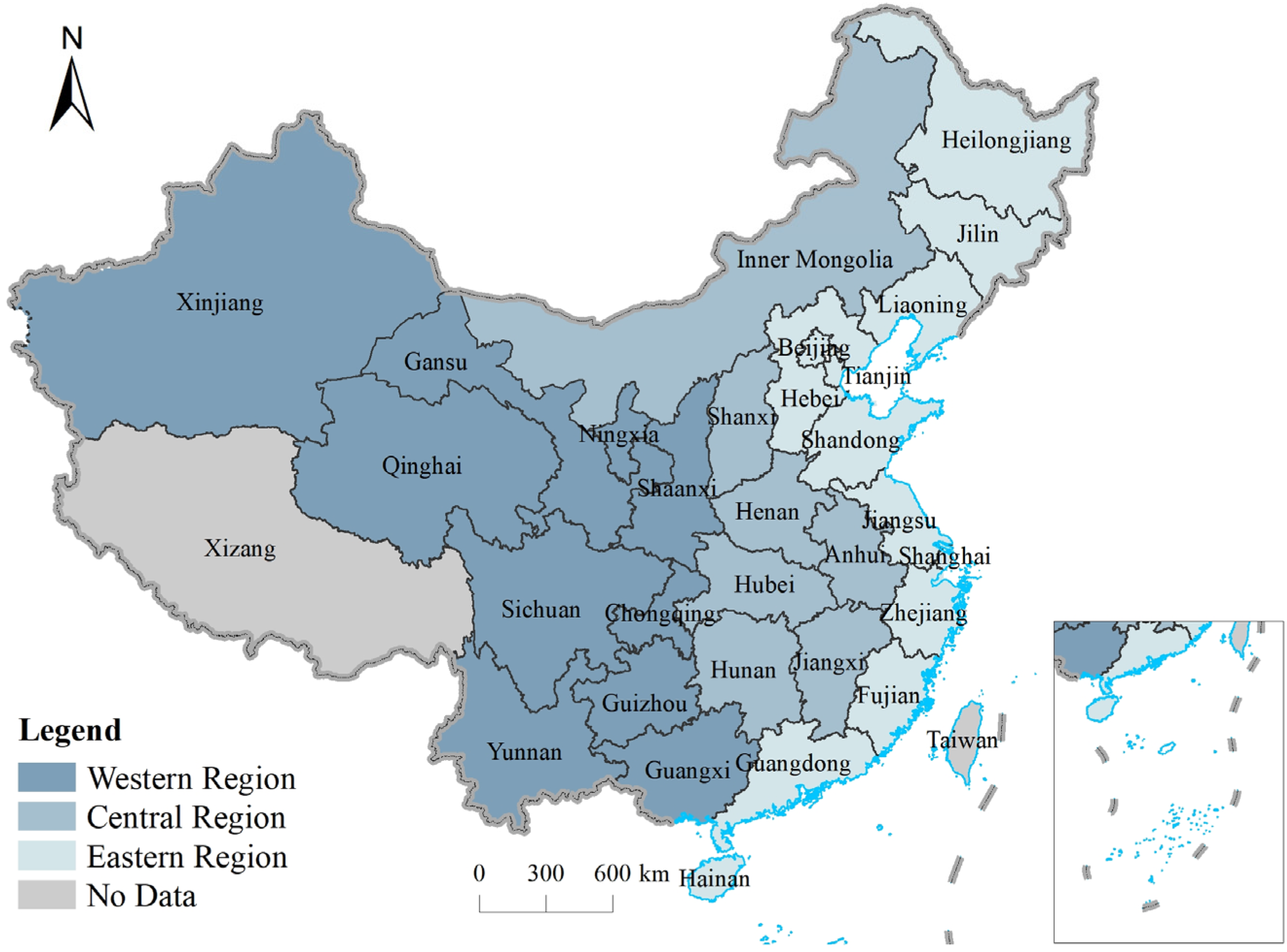
China features a pronounced urban–rural dual structure and substantial regional disparities in socioeconomic development and resource endowments, rendering it a representative case for examining rural tourism and resident well-being (Figure 1). Since the 1980s, rural tourism has grown rapidly under policy incentives and rising urban–rural demand, becoming a pillar of rural revitalization.
Figure 1.
Scope of the study area.
Commonly partitioned into eastern, central, and western zones, China exhibits distinct tourism conditions: the economically advanced east provides strong infrastructure support for rural tourism, the central region holds potential for integrated development amid industrial transition, and the resource-rich west is limited by inadequate infrastructure and accessibility. These disparities generate heterogeneous developmental trajectories and exacerbate spatial imbalances. Against this backdrop, investigating rural tourism in China from the perspective of resident well-being is critical for addressing developmental contradictions and promoting coordinated, balanced, and sustainable high-quality growth in rural tourism.
2.2. Research Methods
Methodologically, this study integrated quantitative system analysis tools. The entropy method measures internal variability and information uncertainty, the Theil index decomposes systemic disparities into intra- and inter-regional components, and QAP analysis captures network-based interdependencies among multiple driving subsystems. Collectively, these methods form a holistic systemic analytical framework, enabling an in-depth exploration of the complex structural characteristics and multifaceted interaction mechanisms underlying rural tourism development.
2.2.1. Entropy Method
The entropy method is used to assess the degree of dispersion of an indicator, where entropy reflects the level of uncertainty associated with the indicator [30]. In this study, the entropy method was applied to obtain the entropy values, information utility values, and weights of the indicators, which were then used to calculate comprehensive scores for high-quality rural tourism development across 30 provinces in China. The formula is as follows:
where represents the level of high-quality rural tourism development in a province, municipality, or autonomous region; is the standardized value of the indicator; and denotes the weight assigned to indicator .
2.2.2. Theil Index
The Theil index is employed to measure both intra- and inter-regional disparities [31,32]. It enables the identification of overall disparities in high-quality rural tourism development in China, as well as the direction and magnitude of changes over time. Moreover, it allows for the assessment of the relative contributions of different regions to overall inequality. The Theil index is defined as follows:
where denotes the Theil index; represents the high-quality rural tourism development level of province within region ; is the total development level across all 30 provinces; and denotes the total development level of region .
Intra-regional disparities can be calculated formulas follows:
Inter-regional disparity (measured by the Theil index) is calculated as follows:
In addition, and represent the contribution rates of intra- and inter-regional disparities to the overall disparity, respectively. Furthermore, intra-regional differences can be further decomposed into contributions from the eastern, central, and western regions of China, according to the following formula:
2.2.3. Quadratic Assignment Procedure Analysis
QAP is a method for comparing the similarity of elements across two or more matrices, thereby identifying the correlations between them. It uses a nonparametric test with random permutations of coefficients to assess significance [33]. QAP is particularly suitable for analyzing relational data, as it addresses common problems in conventional multivariate statistical analyses, such as autocorrelation and multicollinearity. When the high-quality rural tourism development of different regions is regarded as an actor, the disparities between regions can be considered relationships among actors, and the collection of these disparities forms a relational data matrix [34].
In this study, the disparity matrix of high-quality rural tourism development was designated as the dependent variable, and eight relational matrices, representing the ecological environment, tourism market, tourism industry, transportation infrastructure, tourism attractions, resident living standards, public services, and social welfare projects, were defined as independent variables. Drawing on these relational matrices, a quantitative relational model was constructed to empirically examine the intrinsic driving mechanisms underlying regional disparities in the development of high-quality rural tourism across China.
The standard QAP proposed by Dekker et al. [35] was adopted, which includes two main stages: QAP correlation to examine the bivariate relationships between matrix variables, and QAP multiple regression to explore the combined effects of driving factors on regional development differentials. In total, 2000 random permutations were performed to generate the reference distribution for significance testing, a setting widely recognized as reliable for ensuring the stability of statistical results. This procedure allowed us to identify the key driving forces and their heterogeneous influences while accounting for the relational structure of regional interdependencies.
2.3. Data Sources
The data used in this study were obtained from multiple authoritative statistical yearbooks and official reports, including the China Statistical Yearbook, China Agricultural Yearbook, China Rural Statistical Yearbook, China Environmental Statistical Yearbook, China Tourism Statistical Yearbook, China Urban–Rural Construction Statistical Yearbook, China Regional Economic Statistical Yearbook, China Tertiary Industry Statistical Yearbook, and China Civil Affairs Statistical Yearbook. Provincial-level statistical yearbooks, tourism bulletins, and official releases from the Ministry of Ecology and Environment were also consulted.
2.4. Construction of the Index System
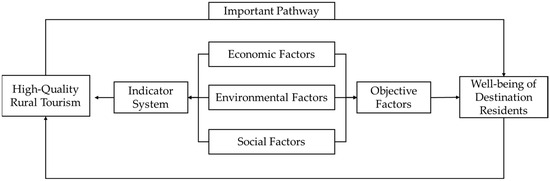
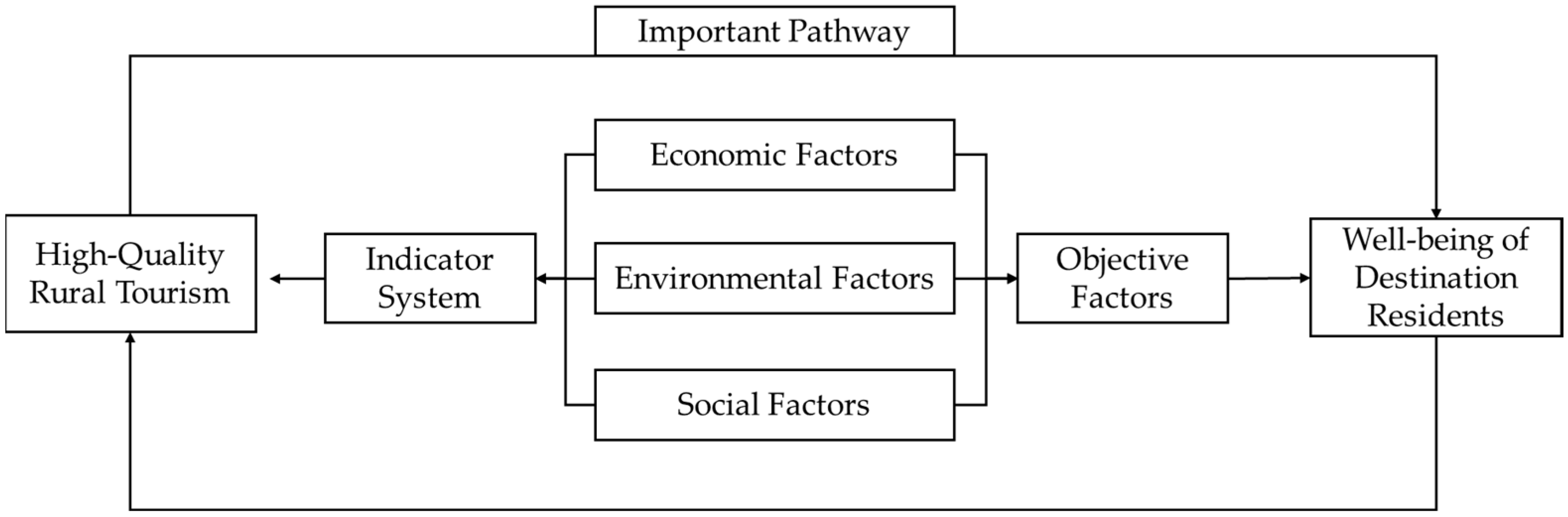
Based on the perspective of destination resident well-being, this study selected a factor system composed of three subsystems—economic, environmental, and social—that affect high-quality rural tourism (Figure 2). The internal relationship is that high-quality rural tourism is an important means of improving the well-being of destination residents. The well-being of destination residents can, in turn, improve the quality of rural tourism. Under this framework, the well-being of destination residents was only used as a criterion for the selection of factors affecting high-quality rural tourism in the early stages; the well-being of residents was not introduced into the subsequent analysis. The three core factors influencing high-quality rural tourism examined in this study—economic, environmental, and social factors—each exert an influence on the overall standard of rural tourism development.
Figure 2.
Theoretical framework for high-quality rural tourism development from the perspective of resident well-being.
Based on the three dimensions—economic, environmental, and social—an evaluation index system for high-quality rural tourism development was established, focusing on eight key aspects: ecological environment, tourism market, tourism industry, transportation, tourism attractions, living standards, public services, and social welfare projects. The selection of indicators was closely aligned with their relevance to resident well-being: (1) Ecological environment. The rural ecological environment is the physical basis of resident well-being and serves as an external trigger for happiness [36]. Indicators included green coverage (X1), environmental governance (X2), and sanitation (X3). (2) Tourism market. Tourism market demand is critical to the tourism industry. Since rural tourism demand primarily comes from urban residents [37], urban population (X4) and urban consumption capacity (X5) were selected. (3) Tourism industry. As a “happiness industry,” rural tourism directly affects the subjective well-being of both visitors and residents [38]. The indicators include industry revenue (X6), brand development (X7), reception capacity (X8), and employment absorption (X9). (4) Transportation. Rural transportation facilities (X10) are essential for accessibility and affect the daily mobility of both self-driving tourists and residents [39]. (5) Tourism attractions. Natural (X11) and cultural resources (X12) enrich tourists’ experiences and enhance their recreational satisfaction [40]. (6) Living standards. Rural tourism contributes to higher household income (X13) and consumption levels (X14) [41]. (7) Public services. Rural tourism can improve basic conditions such as information services (X15), healthcare (X16), social security (X17), and community services (X18) [42], all of which are closely associated with resident subjective well-being [43]. (8) Social welfare projects. Investments in rural construction and service facilities (X19 and X20) were selected to capture improvements in infrastructure and living conditions [44]. (See Table 1, where the weights are obtained using the Entropy Method from Section 2.2.1).
Table 1.
Evaluation index system for high-quality rural tourism development from the perspective of resident well-being.
3. Results
3.1. Evaluation of High-Quality Rural Tourism Development in China
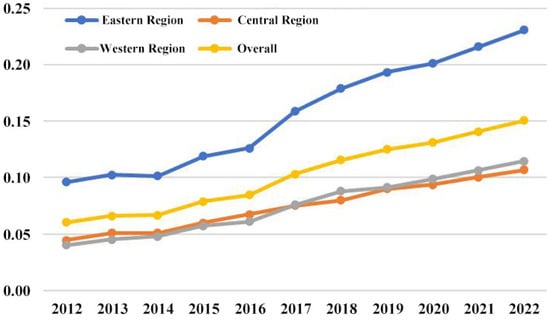
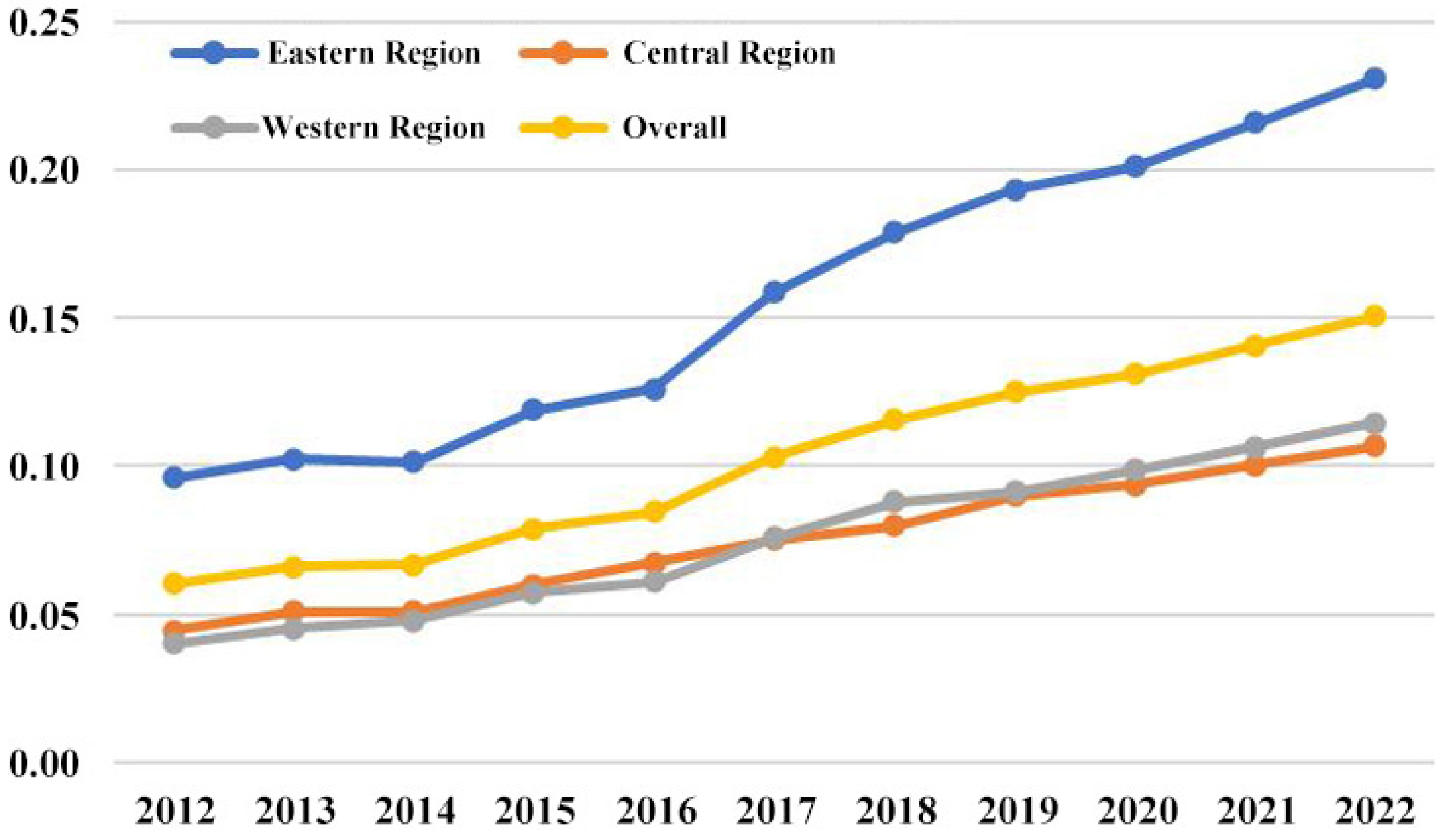
Based on the entropy method and indicator weights, comprehensive scores for high-quality rural tourism development were calculated for 30 provinces in China from 2012 to 2022 (Figure 3). The results showed that the overall national score increased from 0.064 in 2012 to 0.150 in 2022, representing a cumulative growth of approximately 134% and exhibiting a sustained upward trend. This indicates that, although the overall level remains relatively low, significant improvements have been achieved from the perspective of resident well-being.
Figure 3.
Trends in high-quality rural tourism development in China and its eastern, central, and western regions for 2012–2022.
At the regional level, the scores of the eastern provinces were consistently higher than the overall average, ranging from 0.096 to 0.230, indicating a stable growth trajectory. In contrast, the scores of the central and western provinces were all below the overall average, with only minor differences between them. This pattern reflects the advantages of the eastern region, where a strong economic foundation, locational benefits, and policy support facilitated a higher level of rural tourism development. In contrast, constraints on resource endowment and infrastructure have limited the growth of the central and western provinces. Therefore, efforts to advance high-quality rural tourism development from the perspective of resident well-being must not only raise the overall level across regions, but also address the persistent imbalance, particularly by accelerating progress in the central and western regions.
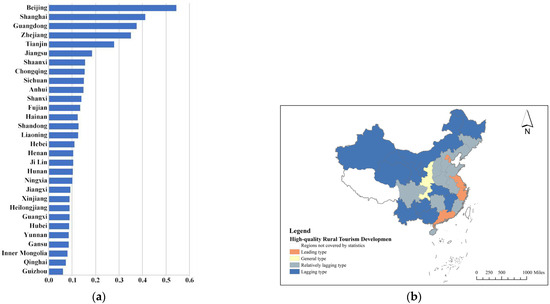
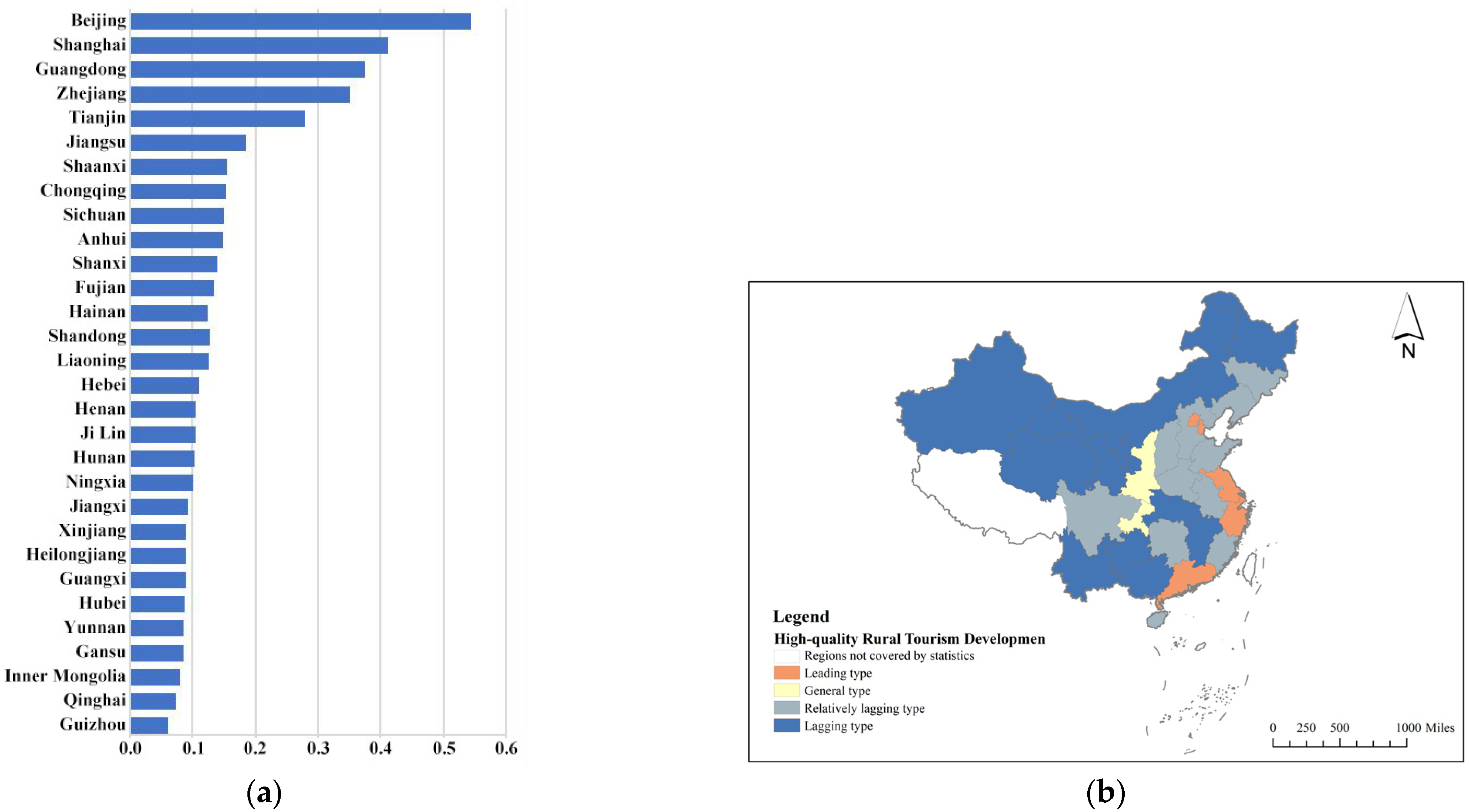
At the provincial level, the scores in 2022 ranged from 0.06 to 0.54, with significant disparities (mean E = 0.16, standard deviation (SD) = 0.090) (Figure 4a). Following the classification criteria of mean and SD, the 30 provinces were grouped into four categories (Figure 4b): (1) Leading type (>E + 0.5SD), comprising six provinces concentrated in the eastern region, including Beijing, Shanghai, Guangdong, Zhejiang, Tianjin, and Jiangsu; (2) General type (between E and E + 0.5SD), comprising two provinces, Shaanxi and Chongqing, which performed above average but below the leading group; (3) Relatively lagging type (between E − 0.5SD and E), comprising 11 provinces, including Sichuan, Anhui, Shanxi, Fujian, Hainan, Shandong, Liaoning, Hebei, Henan, Jilin, and Hunan, all below average with room for improvement; and (4) Lagging type (<E − 0.5SD), comprising 11 provinces, including Ningxia, Jiangxi, Xinjiang, Heilongjiang, Guangxi, Hubei, Yunnan, Gansu, Inner Mongolia, Qinghai, and Guizhou, of which 8 are located in the western region. In total, the relatively lagging and lagging provinces accounted for 22 of the 30 provinces (73.3%). This indicates that the overall pattern of high-quality rural tourism development in China is still dominated by low- and medium-level development, and that significant regional disparities persist: a few provinces lead, while the majority remain underdeveloped.
Figure 4.
Provincial-level of high-quality rural tourism development in China, 2022. (a) Scores of high-quality rural tourism development in China. (b) Classification of high-quality Rural Tourism Development in China.
3.2. Regional Disparities in High-Quality Rural Tourism Development
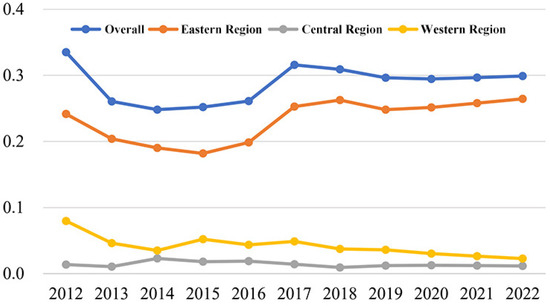
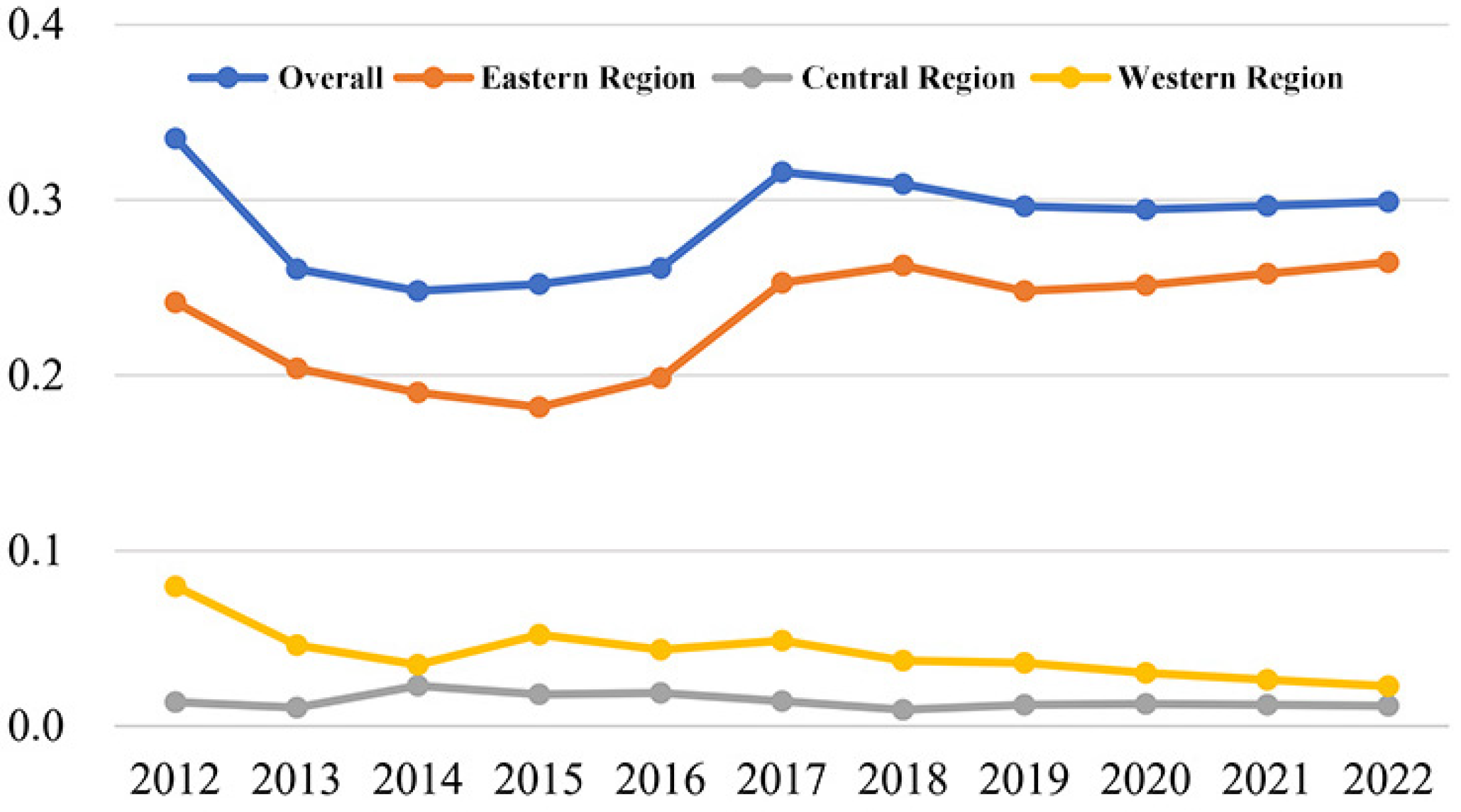
The Theil index was employed to further analyze regional disparities (Figure 5). The results showed that the overall disparity level was 0.335 in 2012, declined to a minimum of 0.248 in 2014, and rose to 0.299 in 2022, indicating only limited fluctuations. This suggests that, although overall development improved during the study period, substantial interregional differences have persisted.
Figure 5.
Intra-regional disparities in high-quality rural tourism development in China’s eastern, central, and western regions.
In terms of regional differences, the internal disparity in the eastern region was the greatest, with an average Theil index of 0.232, showing a trend of first decreasing and then increasing, which is consistent with the overall trend. The internal disparity in the central region was the smallest, with an average value of 0.014, and fluctuations throughout the study period were relatively small. The average value in the western region was 0.042, showing a gradually decreasing trend over time. These results indicate that developmental imbalance is most prominent in the eastern region, whereas the internal disparities in the central and western regions are relatively smaller.
Regarding the contributions to overall disparity, intra-regional differences accounted for more than 66% of the national total and remained relatively stable throughout the study period, whereas inter-regional differences contributed less than 33%, playing a secondary role (Table 2). Among all regions, regional differences in the eastern region contributed the most to the degree of national inequality, followed by the western region, whereas the contribution of the central region was the smallest. This indicates that narrowing intra-regional disparities, particularly within eastern provinces, is critical for improving the overall balance of rural tourism development in China, although inter-regional differences should not be overlooked.
Table 2.
Contributions of regional disparities to overall inequality in high-quality rural tourism development in China, 2012–2022.
3.3. Analysis of the Driving Factors of Regional Disparities in High-Quality Rural Tourism Development
3.3.1. Quadratic Assignment Procedure Correlation Analysis
Given the potential problem of multicollinearity among explanatory variables, this study employed UCINET 6 software to conduct a QAP correlation test between disparities in high-quality rural tourism development and differences in explanatory variables (Table 3). The results showed that, in the eastern region, where rural infrastructure is well-developed, disparities in factors such as public welfare projects had no significant impact on disparities in rural tourism development. In the western region, differences in the ecological environment and living standards did not have significant effects. These findings indicate that differences in developmental stages and basic conditions across regions may weaken the marginal effects of certain factors, thereby reducing their explanatory significance.
Table 3.
The quadratic assignment procedure (QAP) correlation analysis between high-quality rural tourism development and explanatory variables in China and its three regions.
3.3.2. QAP Regression Analysis
Building on the correlation analysis, QAP regression was further applied to examine the impact of the eight explanatory variables on disparities in high-quality rural tourism development at both the national and regional levels (Table 4). The results indicate that, nationwide, the top five factors driving disparities are, in order of importance: tourism market, transportation conditions, tourism attractions, ecological environment, and tourism industry. At the regional level, the main drivers differ. In the eastern region, the tourism market, ecological environment, transportation conditions, tourism attractions, and public welfare programs were the dominant factors. The various factors influencing the eastern region are relatively balanced but weak in intensity. Efforts should focus on improving the quality of the tourism industry and enhancing its prosperity to overcome development bottlenecks.
Table 4.
QAP regression results for the national sample and the three major regions.
In the central region, public services, transportation conditions, tourism markets, prosperity, and public welfare projects were key drivers. In the central region, public services and transportation conditions had a significant impact. It is necessary to continuously improve the supply of public services and transportation infrastructure to further unlock the potential of tourist attractions. In the western region, disparities were primarily shaped by the tourism market, transportation conditions, public services, tourism industry, and public welfare programs. In the western region, the coefficients of the tourism industry and the tourism market were the highest. Therefore, efforts should focus on upgrading the tourism industry and expanding the market, while simultaneously consolidating the advantages of transportation conditions. Among these, the tourism market and transportation conditions emerged as common key factors nationwide and across all regions, whereas other drivers exhibited region-specific effects. In conclusion, the tourism industry, tourism market, tourist attractions, and transportation conditions are the key factors driving the development of target variables across the country (including all regions). Among them, the tourism industry exhibited the strongest influence, particularly in the western region, which may be related to the realization of the region’s tourism development potential.
Rural tourism is primarily driven by nearby urban residents, and the size of the urban population and their income levels determine the potential of the tourism market, serving as critical factors in promoting high-quality rural tourism development. In addition, transportation accessibility directly affects the ease of entry into rural areas; inadequate transportation infrastructure restricts tourist inflow, thereby reducing market catchment areas. Moreover, the ecological environment plays a particularly important role in the eastern region, reflecting the increasing demand of visitors from economically developed areas for high-quality rural ecological conditions. In contrast, in the central and western regions, public service factors ranked among the most influential, indicating that local healthcare, elderly care, and other welfare and service systems remain underdeveloped. The lack of supporting services has become a key constraint on the advancement of rural tourism. These findings indicate that, although common driving factors must be addressed, differentiated strategies tailored to the specific characteristics of different regions are also crucial for promoting balanced and sustainable development.
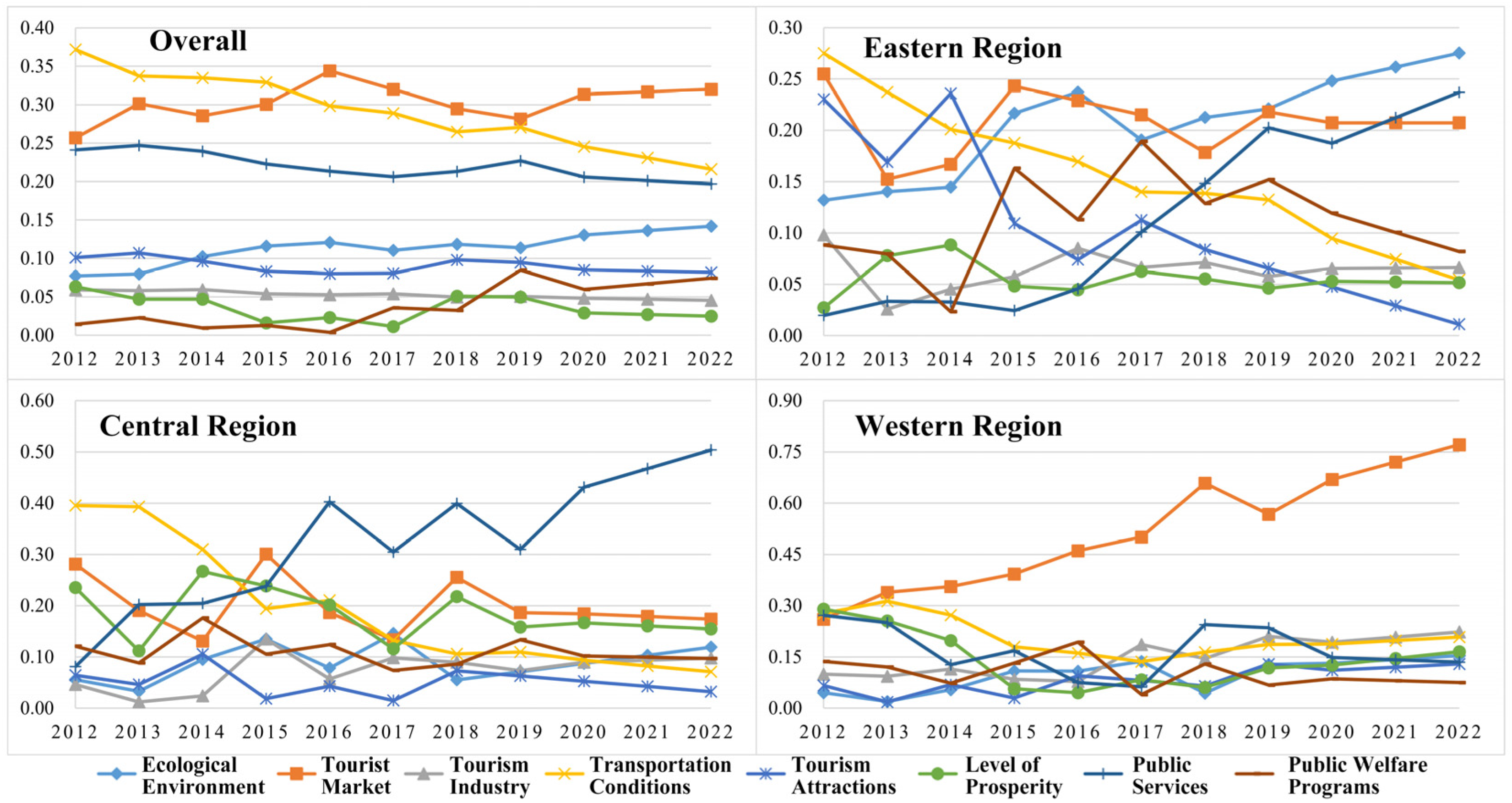
Further analysis of the standardized regression coefficients for the driving factors across the study period (Figure 6) revealed several notable trends. Nationwide, disparities in the ecological environment, tourism industry, tourism attractions, and living standards remained relatively stable; differences in transportation conditions showed a clear narrowing trend, whereas disparities in public services and public welfare projects slightly widened. This indicates that improvements in national transportation infrastructure have reduced disparities in accessibility, while differences in rural public services and welfare projects continue to widen.
Figure 6.
Temporal evolution of QAP regression coefficients for national and regional disparities in high-quality rural tourism development.
In the eastern region, disparities in the tourism market, tourism industry, and living standards remained stable, whereas the differences in tourism attractions and transportation conditions narrowed. However, gaps in public services, the ecological environment, and public welfare projects widened, suggesting that although basic conditions are converging, inequalities in public services and environmental quality are becoming new sources of imbalance. In the central region, disparities in the ecological environment, tourism market, tourism industry, tourism attractions, living standards, and public welfare projects remained relatively stable. Transportation condition disparities have declined significantly, whereas disparities in public services have increased notably, highlighting that unequal provision of public services has become a new bottleneck for development. In the western region, disparities in the ecological environment, tourism industry, tourism attractions, public services, and public welfare projects remained relatively stable. Differences in tourism markets expanded, while disparities in transportation conditions and living standards narrowed, reflecting improvements in rural road construction and household living standards. However, growing divergence in market demand continues to widen regional gaps.
4. Discussion
4.1. Regional Patterns and Key Drivers of High-Quality Rural Tourism Development
Although China’s overall level of high-quality rural tourism development remains low, it has exhibited a steady upward trend. This pattern aligns with existing studies that highlight the long-term lag in public service provision for rural tourism [45,46]. By incorporating resident well-being into the analytical framework, this study further reveals that economic growth is not linearly associated with welfare improvements, and that tourism expansion does not automatically translate into synchronized gains in well-being. The “low but rising” trend reflects two opposing forces: continuous investment in tourism and transportation infrastructure has improved supply capacity and accessibility, while tourism benefits are disproportionately captured by external investors and intermediaries, with public services and ecological carrying capacity failing to keep pace [47], thus constraining improvements in both subjective and objective well-being.
Regionally, the eastern region presents a higher development level but greater internal disparity, whereas the central and western regions remain at lower levels with smaller internal gaps, which is consistent with documented patterns of regional imbalance [48,49]. The Theil index decomposition shows that intra-regional disparity accounts for more than 66% of total inequality, representing the dominant source. The “high level, large gap” structure in eastern China arises from strong locational and resource advantages combined with uneven industrial governance, ecological constraints, and public service allocation. In contrast, the “low level, small gap” pattern in central and western China reflects common weaknesses in market scale, consumption capacity, and service provision.
An analysis of driving forces confirmed that tourism market demand and transportation accessibility serve as core drivers nationwide, supporting the consensus that market and accessibility conditions underpin rural tourism development [49,50]. This study further identifies distinct regional heterogeneity: ecological differences play a stronger role in the east, public service gaps are more critical in the central and western regions, and market divergence is widening in the west. Market and accessibility factors act as “amplifiers”: improved accessibility rapidly stimulates tourism demand; however, insufficient ecological and public service capacity may trigger negative feedback effects, such as environmental degradation and reduced resident satisfaction, forming a “growth–degradation” cycle.
From a systematic perspective, unbalanced development reflects a misalignment among economic, ecological, and social subsystems. Therefore, high-quality and well-being-oriented development requires strengthened coordination and interactive feedback across subsystems. The lag in public services, ecological protection, and resident well-being has become a key constraint. To achieve sustainable improvement, strategies must extend beyond scale expansion and infrastructure investment and instead strengthen public service equalization, ecological conservation, and welfare enhancement.
4.2. Policy Implications
Despite continuous growth, high-quality rural tourism development remains constrained by structural imbalances, including insufficient public services, uncoordinated ecological protection, and limited improvements in resident well-being. A comprehensive governance framework is needed to shift from growth-oriented expansion to well-being-centered, inclusive, and sustainable development.
(1) Nationally, resident well-being indicators should be integrated into performance evaluation and funding allocation systems for rural tourism. A monitoring system combining subjective well-being and objective outcomes should be established.
(2) Cross-departmental coordination should be strengthened among transport, culture and tourism, ecology, civil affairs, and health sectors to avoid infrastructure-only development and to improve the integration of transportation, public services, and ecological protection.
(3) Regionally, the central and western regions should enhance service capacity through targeted subsidies and support for local businesses. The eastern region should implement ecological carrying capacity controls and balanced improvements in public services. The western region should expand markets and develop differentiated cultural tourism products.
(4) At the community level, benefit-sharing mechanisms should be established through cooperatives, equity participation, and dedicated public service funds. Community participation and digital platforms should be used to increase the local share of tourism income and reduce intermediation.
In summary, high-quality rural tourism development relies on a multi-level, adaptive governance system that dynamically coordinates policy inputs, infrastructure, ecological capacity, and resident well-being.
4.3. Limitations and Future Research
This study has some limitations. The methodological approach focuses on cross-sectional comparisons and correlation analysis, with limited identification of causal mechanisms. Future studies may adopt system dynamics models or multilevel regression approaches to examine interactions and dynamic evolution among driving factors. Additionally, future research should consider recalibrating high-quality rural tourism indicators using population size or other variables as denominators prior to Theil Index calculation. Finally, this study focused on the provincial scale; future research could extend to the county or village levels to better capture grassroots disparities and inform targeted policy responses.
5. Conclusions
This study constructed a well-being-oriented evaluation framework for high-quality rural tourism development. Using the entropy method, Theil index, and QAP analysis, we examined spatiotemporal patterns, regional disparities, and driving mechanisms across 30 Chinese provinces from 2012 to 2022. The main findings are as follows:
(1) China’s high-quality rural tourism development remains at a relatively low level but shows a continuous upward trend. However, economic expansion has not been fully and synchronously translated into improvements in resident well-being.
(2) Significant regional disparities are evident: the eastern region exhibits higher levels but greater inequality, whereas the central and western regions show lower levels with more homogeneous distributions. Intra-regional disparity dominates total inequality, contributing more than 66%.
(3) Market demand and transportation conditions constitute the primary driving forces. Ecological conditions strongly influence the eastern region, while disparities in public service provision predominate in the central and western regions.
(4) Transportation inequality has narrowed; however, disparities in public services, ecological conditions, and welfare have widened certain regions, creating new bottlenecks.
This study integrates multiple quantitative methods into a unified systemic framework and conceptualizes rural tourism as a complex socio-ecological system. It demonstrates that high-quality development requires systematic governance to coordinate economic, social, and ecological subsystems and balance efficiency, equity, growth, well-being, and sustainability. The findings provide empirical support for constructing balanced, resilient, and people-centered rural tourism systems in China.
Author Contributions
Conceptualization, H.S. and J.Y.; methodology, J.Y.; software, H.S.; validation, H.S. and J.Y.; formal analysis, H.S.; investigation, H.S.; resources, J.Y.; data curation, J.Y.; writing—original draft preparation, H.S. and J.Y.; writing—review and editing, H.S. and J.Y.; visualization, H.S.; supervision, J.Y.; project administration, H.S. and J.Y.; funding acquisition, J.Y. All authors have read and agreed to the published version of the manuscript.
Funding
This study was supported by the National Natural Science Foundation of China (Grant numbers 72102033 and 41771178).
Data Availability Statement
Data will be made available upon request.
Acknowledgments
The authors acknowledge all colleagues and friends who voluntarily reviewed the survey translation and the manuscript.
Conflicts of Interest
The authors declare no conflicts of interest.
References
- Bai, X.; Shi, P. China’s urbanization at a turning point-challenges and opportunities. Science 2025, 388, eadw3443. [Google Scholar] [CrossRef] [Scilit]
- Liu, Y.; Du, J.; Wang, Y.; Cui, X.; Dong, J.; Gu, P.; Hao, Y.; Xue, K.; Duan, H.; Xia, A.; et al. Overlooked uneven progress across sustainable development goals at the global scale: Challenges and opportunities. Innovation 2024, 5, 100573. [Google Scholar] [CrossRef] [Scilit] [PubMed]
- Wang, Y.; Bai, H. The impact and regional heterogeneity analysis of tourism development on urban-rural income gap. Econ. Anal. Policy 2023, 80, 1539–1548. [Google Scholar] [CrossRef] [Scilit]
- Chow, W.T. Integrating tourism with rural development. Ann. Tour. Res. 1980, 7, 584–607. [Google Scholar] [CrossRef] [Scilit]
- Gao, S.; Huang, S.; Huang, Y. Rural Tourism Development in China. Int. J. Tour. Res. 2009, 11, 439–450. [Google Scholar] [CrossRef] [Scilit]
- Zhu, Y.; Chai, S.; Chen, J.; Phau, I. How was rural tourism developed in China? Examining the impact of China’s evolving rural tourism policies. Environ. Dev. Sustain. 2023, 26, 28945–28969. [Google Scholar] [CrossRef] [Scilit]
- Liu, S.; Geng, Y.; Zhang, J.; Kang, X.; Shi, X.; Zhang, J. Ecological trap in tourism-urbanization: Simulating the stagnation and restoration of urbanization from the perspective of government incentives. Ecol. Econ. 2021, 185, 107054. [Google Scholar] [CrossRef] [Scilit]
- Liu, J.; Li, X.; Yang, Y.; Tan, Y.; Geng, T.; Wang, S. Short-and long-term prediction and determinant analysis of tourism flow networks: A novel steady-state Markov chain method. Tour. Manag. 2025, 109, 105139. [Google Scholar] [CrossRef] [Scilit]
- Liu, J.; Chen, J.; Law, R.; Wang, S.; Yang, L. Travel patterns and spatial structure: Understanding winter tourism by trajectory data mining. Asia Pac. J. Tour. Res. 2024, 29, 1351–1368. [Google Scholar] [CrossRef] [Scilit]
- Shen, S.; Wang, H.; Quan, Q.; Xu, J. Rurality and rural tourism development in China. Tour. Manag. Perspect. 2019, 30, 98–106. [Google Scholar] [CrossRef] [Scilit]
- Ningrum, L.; Abdullah, T. Negotiating modernization in village tourism amidst efforts to preserve traditional culture. J. Herit. Tour. 2025, 20, 661–682. [Google Scholar] [CrossRef] [Scilit]
- Baños-Pino, J.; Boto Garcia, D.; Zapico, E.; Mayor, M. Optimal carrying capacity in rural tourism: Crowding, quality deterioration, and productive inefficiency. Tour. Manag. 2024, 105, 104968. [Google Scholar] [CrossRef] [Scilit]
- Marzo, M.; Iglesias, M.; Vinzón, L. Sustainability indicators of rural tourism from the perspective of the residents. Tour. Geogr. 2015, 17, 586–602. [Google Scholar] [CrossRef] [Scilit]
- Lane, B.; Kastenholz, E. Rural tourism: The evolution of practice and research approaches—Towards a new generation concept? J. Sustain. Tour. 2015, 23, 1133–1156. [Google Scholar] [CrossRef] [Scilit]
- Bramwell, B.; Lane, B. Critical research on the governance of tourism and sustainability Introduction. J. Sustain. Tour. 2011, 19, 411–421. [Google Scholar] [CrossRef] [Scilit]
- Zhu, W. The promotion path of high-quality development of rural tourism based on intelligent cloud platform system. Appl. Math. Nonlinear Sci. 2023, 9, 1–17. [Google Scholar] [CrossRef] [Scilit]
- Wang, C.; Zhang, G.; Zhai, Y. Integrating AHP-Entropy and IPA Models for Strategic Rural Revitalization: A Case Study of Traditional Villages in Northeast China. Buildings 2025, 15, 2475. [Google Scholar] [CrossRef] [Scilit]
- Li, H.; Xiang, C.; Shu, C.; Li, Y.; Wang, Y.; He, X. A Study on the Measurement and Influencing Factors of Subjective Well-being among Rural Tourism Destination Residents: A Case Study of Wulong Village in Langzhong City. West Forum Econ. Manag. 2023, 34, 86–96. [Google Scholar] [CrossRef]
- Wiranatha, A.; Suryawardani, I.G.A.; Purbanto, I.; Yudiastina, I.G.B.A.; Bantacut, T. A Conceptual Model of Rural Tourism in Bali to Build Up Global Competitiveness. Systems 2024, 12, 245. [Google Scholar] [CrossRef] [Scilit]
- Buffardi, A.; Levitas, A.; Taratula-Lyons, M.; Marks, D. OP39 Conceptions and drivers of resident wellbeing in urban London: A longitudinal perspective. J. Epidemiol. Community Health 2025, 79, A19. [Google Scholar] [CrossRef] [Scilit]
- Ye, A.; Li, S.; Ren, Q. How does Rural-to-Urban Migration Influence Subjective Well-being? Analysis Based on CFPS Data. Popul. Res. 2025, 49, 117–132. Available online: https://rkyj.ruc.edu.cn/EN/Y2025/V49/I2/117 (accessed on 17 April 2026).
- Hwang, J.; Lee, S. The effect of the rural tourism policy on non-farm income in South Korea. Tour. Manag. 2015, 46, 501–513. [Google Scholar] [CrossRef] [Scilit]
- An, W.; Alarcón, S. How Can Rural Tourism Be Sustainable? A Systematic Review. Sustainability 2020, 12, 7758. [Google Scholar] [CrossRef] [Scilit]
- Cheng, L.; Xu, J. Benefit-sharing and residents’ subjective well-being in rural tourism: An asymmetric approach. J. Destin. Mark. Manag. 2021, 21, 100631. [Google Scholar] [CrossRef] [Scilit]
- Croes, R.; Shapoval, V.; Rivera, M.; Bąk, M.; Zientara, P. Promoting residents’ happiness through a human-centric approach to tourism city development. Int. J. Tour. Cities 2024, 10, 905–924. [Google Scholar] [CrossRef] [Scilit]
- Yan, X.; Luo, M.; Zhong, C. Evaluation of rural tourism development level based on entropy-weighted grey correlation analysis: The case of Jiangxi Province. Grey Syst. Theory Appl. 2023, 13, 677–700. [Google Scholar] [CrossRef] [Scilit]
- Zou, Q.; Sun, J.; Luo, J.; Cui, J.; Kong, X. Spatial Patterns of Key Villages and Towns of Rural Tourism in China and Their Influencing Factors. Sustainability 2023, 15, 13330. [Google Scholar] [CrossRef] [Scilit]
- Vitali, V.; Moran, J.A. The Pursuit of Happiness: Cultural and Psychological Considerations. In Happiness and Wellness—Biopsychosocial and Anthropological Perspectives; IntechOpen: London, UK, 2022. [Google Scholar]
- Kim, K.; Uysal, M.; Sirgy, M.J. How does tourism in a community impact the quality of life of community residents? Tour. Manag. 2013, 36, 527–540. [Google Scholar] [CrossRef] [Scilit]
- Chen, M.; Lu, D.; Zha, L. The comprehensive evaluation of China’s urbanization and effects on resources and environment. J. Geogr. Sci. 2010, 20, 17–30. [Google Scholar] [CrossRef] [Scilit]
- Emami Meybodi, M.; Owjimehr, S. The nexus of climate policy uncertainty, renewable energy and energy inequality under income disparities. Energy Strategy Rev. 2024, 53, 101381. [Google Scholar] [CrossRef] [Scilit]
- Xiao, L.; Wang, Y.; Guo, R. Regional Differences and Changes in High-quality Development of Rural Tourism from the Perspective of Nostalgia: A Study based on the Yellow River Basin. Tour. Trib. 2021, 11, 13–25. [Google Scholar] [CrossRef]
- Zhou, X.; Wang, P.; Zhu, B. Exploring the drivers of China’s carbon price spatial correlation network structure. Appl. Energy 2025, 396, 126244. [Google Scholar] [CrossRef] [Scilit]
- Zhou, X.; Chen, X.; Wang, T.; Huang, J.; Zhou, G. Towards low-carbon and resilient cities: Coordinated development and its driving factors in 29 Chinese cities. Sustain. Cities Soc. 2025, 131, 106790. [Google Scholar] [CrossRef] [Scilit]
- Dekker, D.; Krackhardt, D.; Snijders, T.A. Sensitivity of MRQAP Tests to Collinearity and Autocorrelation Conditions. Psychometrika 2007, 72, 563–581. [Google Scholar] [CrossRef] [Scilit]
- Chen, Y.; Ying, J.; Zhang, Y.; Feng, Y.; Chen, X.; Zhou, X. A systematic review of urban green spaces affecting subjective well-being: An explanation of their complex mechanisms. Ecol. Indic. 2025, 178, 113786. [Google Scholar] [CrossRef] [Scilit]
- Jiao, X.; Chen, J.L.; Li, G.; Liu, T. From tourism demand to destination competitiveness: A spatial spillover perspective. Tour. Manag. 2025, 111, 105236. [Google Scholar] [CrossRef] [Scilit]
- Liang, W.; Ahmad, Y.; Mohidin, H.H.B. Spatial pattern and influencing factors of tourism based on POI data in Chengdu, China. Environ. Dev. Sustain. 2024, 26, 10127–10143. [Google Scholar] [CrossRef] [Scilit]
- Hopkins, D. Sustainable mobility at the interface of transport and tourism. J. Sustain. Tour. 2019, 28, 129–143. [Google Scholar] [CrossRef] [Scilit]
- Wang, T.; Wang, L.; Ning, Z. Spatial pattern of tourist attractions and its influencing factors in China. J. Spat. Sci. 2018, 65, 327–344. [Google Scholar] [CrossRef] [Scilit]
- He, T.; Li, W. Revisiting tourism’s additional impact on income. Tour. Econ. 2019, 27, 149–167. [Google Scholar] [CrossRef] [Scilit]
- Zamani-Farahani, H.; Musa, G. Residents’ attitudes and perception towards tourism development: A case study of Masooleh, Iran. Tour. Manag. 2008, 29, 1233–1236. [Google Scholar] [CrossRef] [Scilit]
- Matarrita-Cascante, D. Changing Communities, Community Satisfaction, and Quality of Life: A View of Multiple Perceived Indicators. Soc. Indic. Res. 2010, 98, 105–127. [Google Scholar] [CrossRef] [Scilit]
- Huang, Y.; Liang, H.; Khan, A.; Lyu, J. Balancing constructability and tourist experience: A comprehensive approach to tourist attraction construction. J. Destin. Mark. Manag. 2024, 33, 100920. [Google Scholar] [CrossRef] [Scilit]
- Zhang, X.; Gao, N.; Wang, L. Spatiotemporal evolution and function of the coordination level of the multi-system of rural tourism public service in China. Arid Land Geogr. 2022, 45, 298–309. [Google Scholar] [CrossRef]
- Sun, J.; Zhang, L.; Luo, Y. Development of rural tourism resources in China under the goal of common prosperity: Current situation, problems and the development path. J. Nat. Resour. 2023, 38, 318–334. [Google Scholar] [CrossRef] [Scilit]
- Liu, J.; Wang, S.; Law, R.; Chen, J.; Yang, L. Growing threat of marine tourism activities to whales: Evidence from vessel trajectory big data mining. J. Sustain. Tour. 2025, 34, 104–123. [Google Scholar] [CrossRef] [Scilit]
- Zhang, Y.; Hao, Y.; Guo, Y. Regional imbalance of rural tourism development from the perspective of common prosperity: Theoretical connotation, key issues and measurement system. J. Nat. Resour. 2023, 38, 403–418. [Google Scholar] [CrossRef] [Scilit]
- Du, J.; Zhao, B.; Feng, Y. Spatial distribution and influencing factors of rural tourism: A case study of Henan Province. Heliyon 2024, 10, e29039. [Google Scholar] [CrossRef] [Scilit] [PubMed]
- Paulino, I.; Zaragozí, B.; Medina-Chavarria, M.; Gutiérrez, A. The role of service and transport infrastructures in shaping tourist visitation patterns in the Ebro Delta. Appl. Mobil. 2025, 10, 130–152. [Google Scholar] [CrossRef] [Scilit]

Disclaimer/Publisher’s Note: The statements, opinions and data contained in all publications are solely those of the individual author(s) and contributor(s) and not of MDPI and/or the editor(s). MDPI and/or the editor(s) disclaim responsibility for any injury to people or property resulting from any ideas, methods, instructions or products referred to in the content. |
© 2026 by the authors. Licensee MDPI, Basel, Switzerland. This article is an open access article distributed under the terms and conditions of the Creative Commons Attribution (CC BY) license.