


Abstract
Digital twins (DTs) enable innovation across industries. While business discourse promotes DTs as catalysts for new business models, the academic literature lacks a cohesive understanding of how DTs enable different types of business innovation and what distinguishes cross-organizational innovation from firm-level innovation. This paper conducts a systematic literature review of 60 articles, analyzing 25 business innovation cases through a typology derived from established frameworks extended to address cross-organizational innovation. Process innovation appeared in nearly all the cases (24 of 25), confirming DTs’ fundamental role as operational technology. Product innovation manifests in two patterns: the twin as offering and the twin enabling offerings. paradigm innovation appeared in over half of cases, taking context-specific forms including business model transformation, governance mechanisms, and organizational restructuring. Beyond-firm innovation clusters in healthcare, smart cities, sustainability transitions, and energy systems where cross-organizational coordination is required. Beyond-firm cases consistently co-occur with paradigm innovation and exhibit higher innovation type diversity than single-firm cases, suggesting that cross-boundary coordination requires accompanying organizational restructuring. The study contributes a Digital Twin Innovation Typology extending established frameworks to capture innovation no single firm can achieve alone. Practical implications address how domain context shapes innovation potential and coordination mechanisms required for beyond-firm innovation.
1. Introduction
Digital twins (DTs) are increasingly used in the design, operation, and management of products, services, and systems. A DT is a virtual representation of a real-world entity that enables real-time monitoring, simulation, and performance evaluation [1]. When combined with artificial intelligence (AI), DTs can support modeling, forecasting, and control applications in multiple domains.
The DT market is valued at USD 9.9 billion and is expected to reach USD 183 billion by 2031, supported by the development of reusable libraries and sector-specific configurations [2]. Using the ECB reference rate on 31 December 2025 (1 EUR = 1.175 USD), these correspond to €8.43 billion and €155.74 billion, respectively1. Business and technology reports describe DTs and AI as complementary technologies that may support the development of new business models [3]. According to Crunchbase [4], over 400 startups reference DTs in their core activities, and more than 25% of these also include AI capabilities.
In academic research, the relationship between DTs and business innovation has not been comprehensively addressed. Existing DT reviews reflect this pattern: classifying technical integration maturity within manufacturing [1], mapping application depth within single domains such as healthcare [5], and characterizing the DT concept’s architectural and definitional landscape [6]. None, however, examine DTs through a business innovation lens that identifies what types of innovation DTs enable or what distinguishes cross-boundary innovation from firm-level innovation. Beyond this theoretical gap, DT implementations are frequently custom-developed and adapted to individual use cases, requiring relevant resources and technical capabilities [2,7]. This limits access to organizations with such capacities and slows the development of standardized methods and models. Furthermore, the literature provides limited analysis of how small and medium-sized enterprises (SMEs), entrepreneurs, or startups might engage with DT-enabled innovation [5,8].
DT applications have gained visibility in domains such as healthcare, where they support disease management, personalized care, and population-level health monitoring [5,9]. Methodological challenges around multi-modal data integration and validation remain active areas of investigation in healthcare DT research [10]. These uses also extend to urban contexts, where smart city initiatives integrate DTs to coordinate actors and services across healthcare systems [11]. Adoption in such settings depends not only on technical feasibility but also on the development of viable business models that reflect the complexity of multi-actor ecosystems.
Other emerging contexts, such as the metaverse, are also being explored for their potential to support new forms of value creation and service delivery through DT-enabled platforms [12]. More broadly, DTs are being examined as components of product-service systems that integrate physical and digital value creation [13], and recent reviews have begun to map the relationship between DTs and innovation management processes [14]. The strategic role of DTs in innovation must therefore be considered within broader frameworks. Innovation theory distinguishes between product, service, process, and system-level innovation, and emphasizes the need for organizations to balance exploitation of current capabilities with exploration of new opportunities [15,16,17]. Business model design, ecosystem participation, and platform strategies influence how firms capture value from technologies such as DTs [18,19].
Across these domains, DT research has advanced within individual sectors and application areas but lacks a shared analytical framework for comparing innovation patterns across organizational and domain boundaries.
This study conducts a systematic literature review to examine the role of DTs in business innovation. It addresses two research questions:
- What types of business innovation are enabled with DTs?
- What distinguishes cross-boundary DT innovation from firm-level innovation?
Within-firm innovation refers to innovation attributable to a single organization, where the DT operates within that organization’s boundaries to change what is offered, how work is done, or how the organization is structured. Beyond-firm innovation refers to innovation requiring coordination across multiple organizations, where no single firm controls the full scope of the system being modeled and value creation depends on multi-organizational coordination mechanisms.
To address these questions, this study adopts a conceptual business innovation lens based on the Oslo Manual [15] and operationalized through Bessant and Tidd’s [20] four innovation types: product, process, paradigm, and position. This framework was selected because its domain-neutral categories enable systematic comparison of innovation patterns across the diverse sectors in which DTs are applied. Unlike sector-specific innovation frameworks, the 4Ps provide a common analytical language for identifying what changes when a DT is introduced, and whether that change concerns offerings (product), operations (process), organizational models (paradigm), or market positioning (position). Innovation is understood as the coordinated transformation of how value is created, delivered, and captured [21]. The framework also incorporates perspectives from value creation and appropriation literature, recognizing the role of ecosystems and digital platforms in technology-driven transformation [18,19].
2. Materials and Methods
This study employs systematic literature review combined with thematic analysis to examine DT-enabled business innovation. The following subsections detail the review process and the analytical framework used to categorize innovation types.
2.1. Systematic Literature Review
This study employs a systematic literature review methodology based on the evidence-based approach proposed by Tranfield et al. [22]. The review is structured into three phases: planning the review, conducting the review, and synthesizing and reporting the findings. The approach aims to ensure transparency, replicability, and methodological rigor in the analysis of scholarly contributions on DT-enabled business innovation.
The review process was guided by a search protocol that defined the scope, research questions, and inclusion and exclusion criteria [23,24]. To develop this protocol, a preliminary exploration of the literature was performed using platforms such as SciSpace. (Typeset, Inc., Bangaluru, India), ResearchRabbit (ResearchRabbit, Seattle, WA, USA), and ChatGPT (GPT-4o, OpenAI, San Francisco, CA, USA; used November 2024–February 2025). These tools assisted in identifying key terms and refining the focus of the search strategy. AI-assisted exploration was limited to the protocol development phase: identifying candidate search terms and surveying the breadth of the DT literature. The tools did not perform article selection, screening, or coding. No established guidelines for AI-assisted systematic review were available at the time of the study; the protocol was developed under supervisory committee guidance with transparency as the governing principle. The objective was to capture studies at the intersection of DT technologies and business innovation across sectors.
The search was carried out using the Web of Science Core Collection database, selected for its peer-reviewed content and coverage of multiple disciplines relevant to digital innovation, business models, and AI. The search terms used are presented in Table 1. The search string excluded terms associated with the established DT manufacturing literature, specifically ‘industrial,’ ‘industry,’ ‘Industry 4.0,’ ‘Industry 5.0,’ and ‘materials science.’ This exclusion reflects the study’s deliberate cross-sector scope: because existing DT reviews have concentrated on manufacturing and industrial applications [1], retaining these terms would have skewed the results toward a domain already well-characterized in the literature. The exclusion allowed the search to surface DT innovation research across healthcare, smart cities, energy, and other domains where the relationship between DTs and business innovation is less established. Only journal articles and review articles in English were considered. The search was performed in January and February 2025 and was not limited by publication date.
Table 1.
Search terms and criteria.
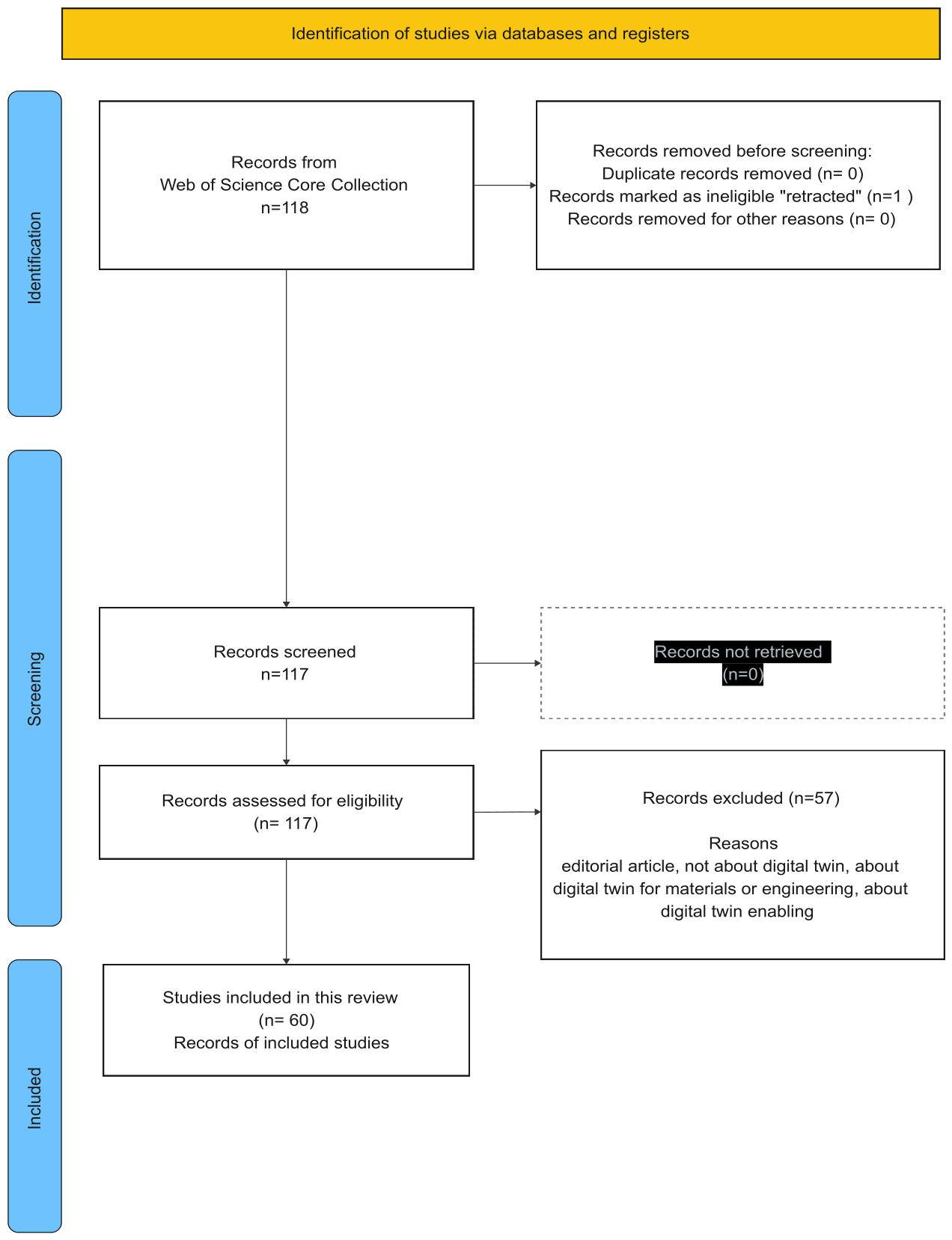
The initial search results were imported into EndNote. Screening was conducted by the first author in two stages following PRISMA guidelines [25]. At the title and abstract stages, articles were excluded if they did not directly address business innovation or DT application in a business context. Studies that focused exclusively on enabling technologies, engineering methods, or references to DTs without substantive analysis were also removed. At the full-text stage, remaining articles were assessed against the coding framework described in Section 2.2 and excluded where the connection between DTs and innovation outcomes was insufficient for thematic analysis. Borderline cases were discussed with the supervisory committee. The initial search retrieved 118 articles. Application of the exclusion criteria resulted in the removal of 58 articles (see Table 2), yielding a final sample of 60 articles for the analysis (Appendix A). The corresponding PRISMA flow diagram is provided in Appendix B. The use of a single reviewer for screening is acknowledged as a limitation; the structured coding framework and boundary rules were designed to reduce subjectivity in classification decisions.
Table 2.
Exclusion criteria and article counts.
Full-text articles included in the final sample were imported into NVivo for qualitative analysis. A structured coding framework was applied to extract data on research objectives, methods, theoretical perspectives, innovation types, and sectoral focus. Additional coding captured features of DT technology, forms of value creation, and types of business innovation. Generative AI (Claude, Anthropic) was used to verify consistency in the application of thematic codes manually assigned by the analyst in NVivo. AI-generated suggestions were treated as a verification input; all coding decisions were made by the analyst. The authors reviewed all outputs and take full responsibility for the final coding decisions.
Extracted data was organized into two datasets: all articles, and “business innovation” articles specifically linking DTs to business innovation. Descriptive statistics were used to report frequencies of DT use cases and types and features according to sectors and business value. Tables and charts were constructed to illustrate patterns across both datasets.
To complement the thematic coding in Nvivo 15 (Lumivero, Denver, CO, USA), a bibliometric assessment was performed using VOSviewer 1.6.20 (Leiden University, Leiden, The Netherlands) to generate co-authorship and keyword co-occurrence network analysis to identify key contributors and conceptual clusters.
2.2. Thematic Analysis Framework
Thematic analysis of the selected articles employed an innovation coding framework derived from the Oslo Manual typology [15] and operationalized through Bessant and Tidd’s [20] four innovation types: product, process, paradigm, and position. However, the Oslo Manual explicitly limits its scope to firm-level innovation, noting that it “does not cover industry- or economy-wide changes” [15]. Given that DT applications in domains such as healthcare, smart cities, and transportation frequently involve coordination across multiple organizations that cannot be attributed to any single firm, the framework was extended with a beyond-firm category to capture innovation requiring cross-organizational coordination mechanisms.
Several boundary rules guided application of the coding framework:
- Technical and business innovation were treated as mutually exclusive categories: articles were coded as technical only when they advanced DT capability without connecting that advancement to business value; any discussion linking DTs to business outcomes triggered coding using the five innovation types instead.
- Beyond-firm required evidence of multi-organizational coordination mechanisms, not merely multiple firms operating in a shared environment or systems exchanging data across enterprise boundaries.
- Technical interoperability between systems is distinct from organizations coordinating their activities to produce innovation outcomes that no single firm could achieve alone.
- Position was reserved for innovation in dedicated mechanisms through which offerings are communicated and positioned to customers; customer co-design or involvement in product development was coded as product, process, or paradigm depending on what the participation changed.
- Coding scope was adjusted according to DT centrality within each case. When the DT served as central enabler of the innovation discussed, all innovation types it enabled were coded. When the DT played a supporting role within broader technological or organizational change, coding was limited to the specific contribution the DT provided.
3. Results
The systematic review yielded 60 articles for analysis. This section presents descriptive statistics followed by thematic results examining how DTs enable business innovation.
3.1. Descriptive Statistics
This section presents descriptive data from the 60 articles included in the final sample. These results offer an overview of publication trends, disciplinary focus, research methods, and author networks relevant to DT-enabled business innovation.
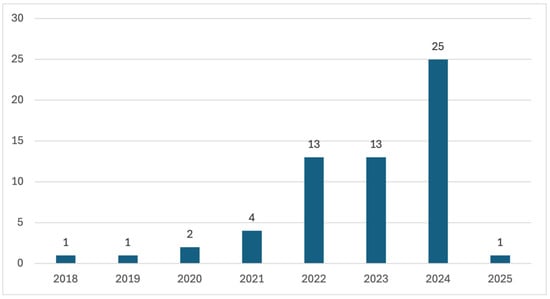
The number of publications addressing DTs and business innovation increased annually between 2018 and 2025. A significant increase occurred between 2023 and 2024, indicating growing academic interest in this topic. Figure 1 displays the number of articles published by year.
Figure 1.
Number of articles by year. Source: Own elaboration.
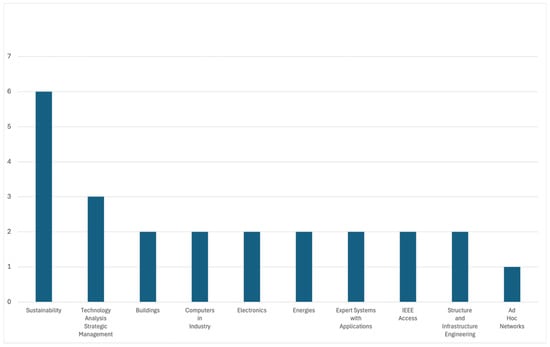
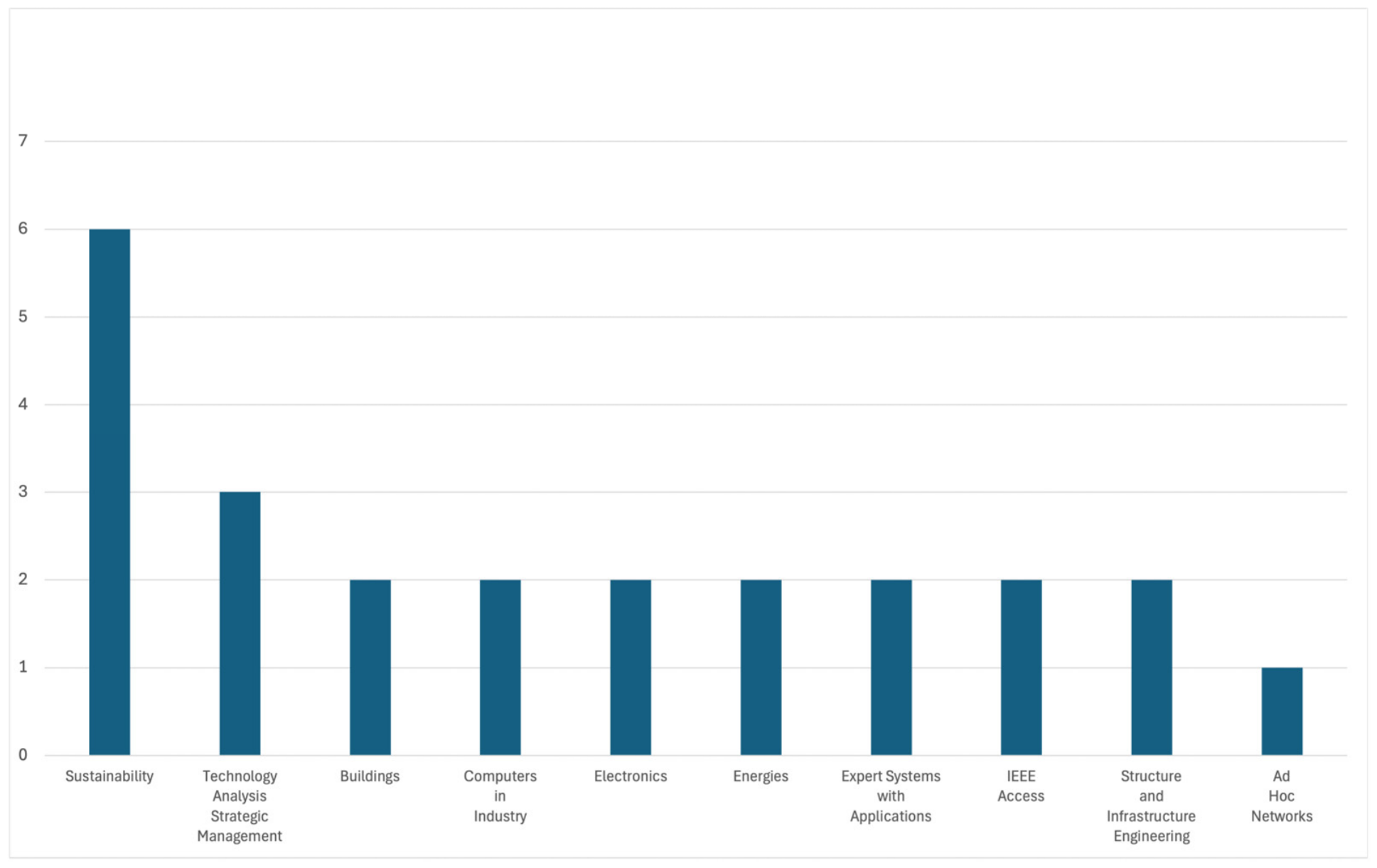
The articles were published across 46 different journals. The top 10 journals accounted for 40% of all publications, indicating moderate concentration within a small set of outlets. Figure 2 presents the journal distribution. We recognize that journal quality varies within our sample and that journals experienced shifts in academic standing; however, Web of Science indexing criteria provided a baseline quality threshold. Our systematic approach prioritized comprehensive coverage, important in innovations in emerging interdisciplinary domains like DT innovation.
Figure 2.
Distribution of articles published per top 10 journals. Source: Own elaboration.
Of the 60 articles, 53% are empirical, and the rest are conceptual. A breakout of the empirical articles shows that 36% employed quantitative methods, 28% used qualitative approaches, and 7% applied design science methods.
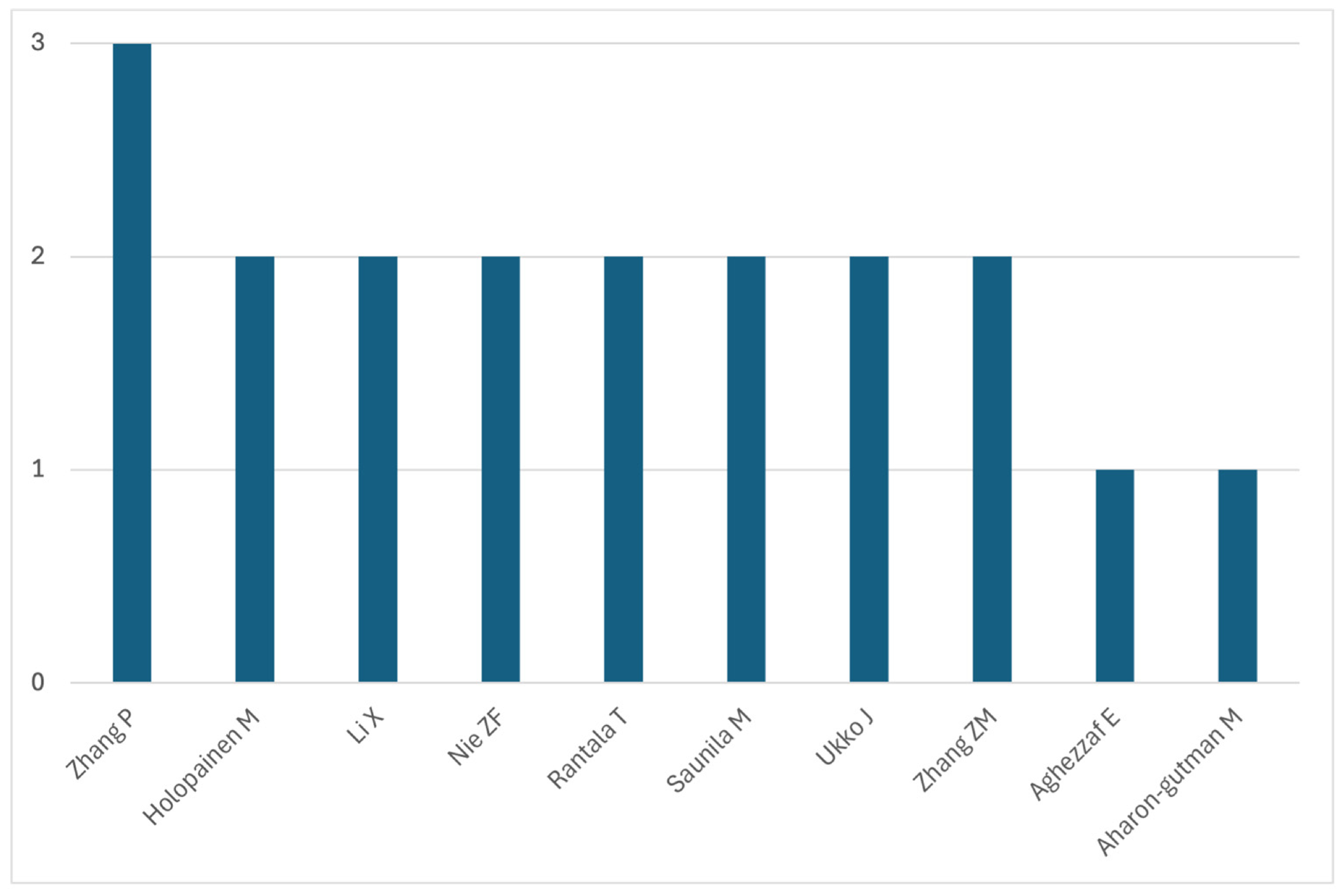
A total of 264 authors contributed to the 60 articles. Eight authors contributed to two or more publications, and P.F. Zhang authored three (see Figure 3). Co-authorship network analysis using VOSviewer revealed limited collaboration among contributors, with only seven author links forming three co-authorship clusters.
Figure 3.
Top 10 authors. Source: Own elaboration.
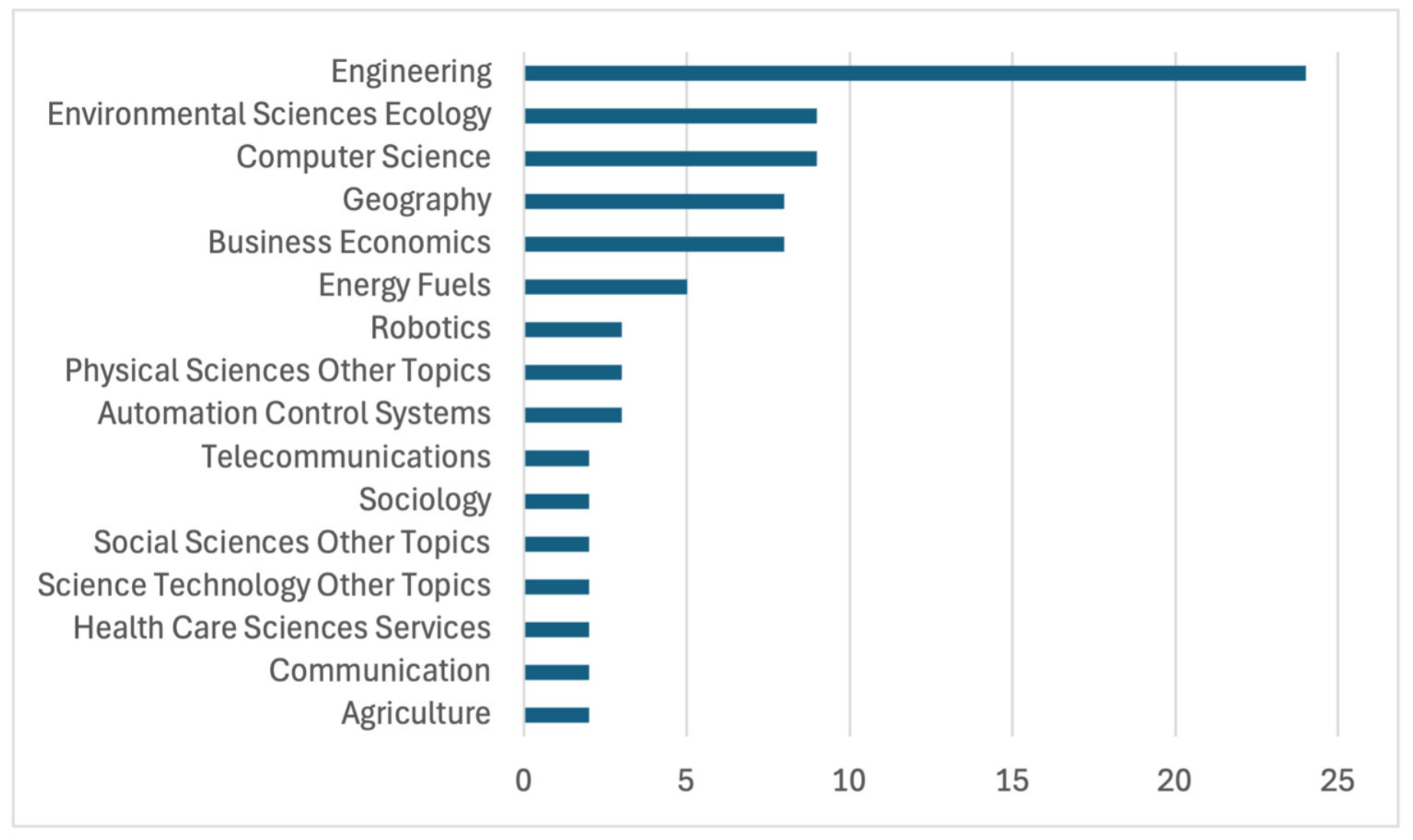
According to Web of Science classification, the articles span 27 research areas. The top areas include business, engineering, healthcare, computer science, and sustainability, reflecting the interdisciplinary scope of DT research. This disciplinary breadth reinforces the need for a cross-sector analytical framework, as addressed through RQ1, rather than domain-specific accounts of DT-enabled innovation. Figure 4 displays the research areas related to two or more articles.
Figure 4.
Top research areas. Source: Own elaboration.
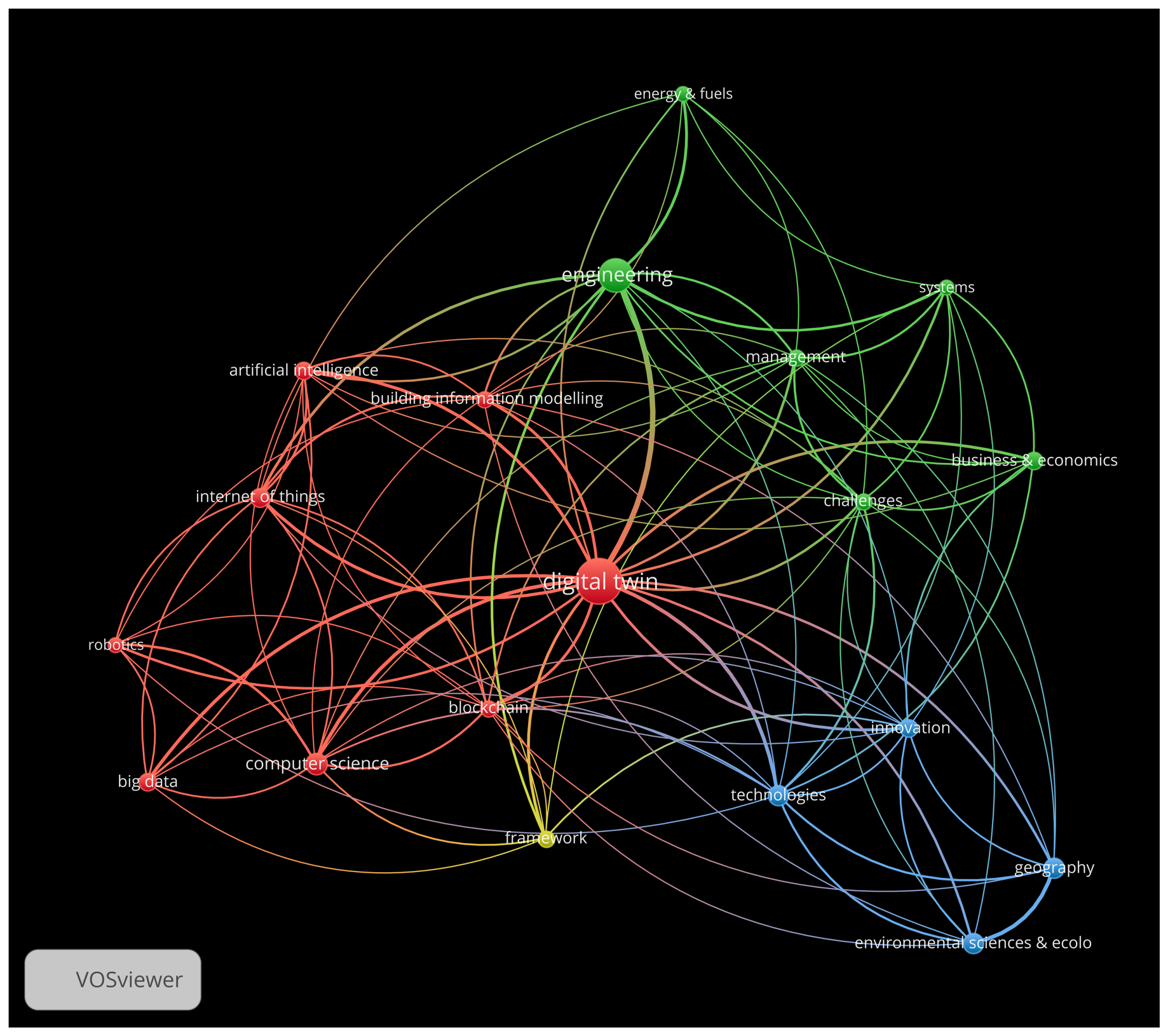
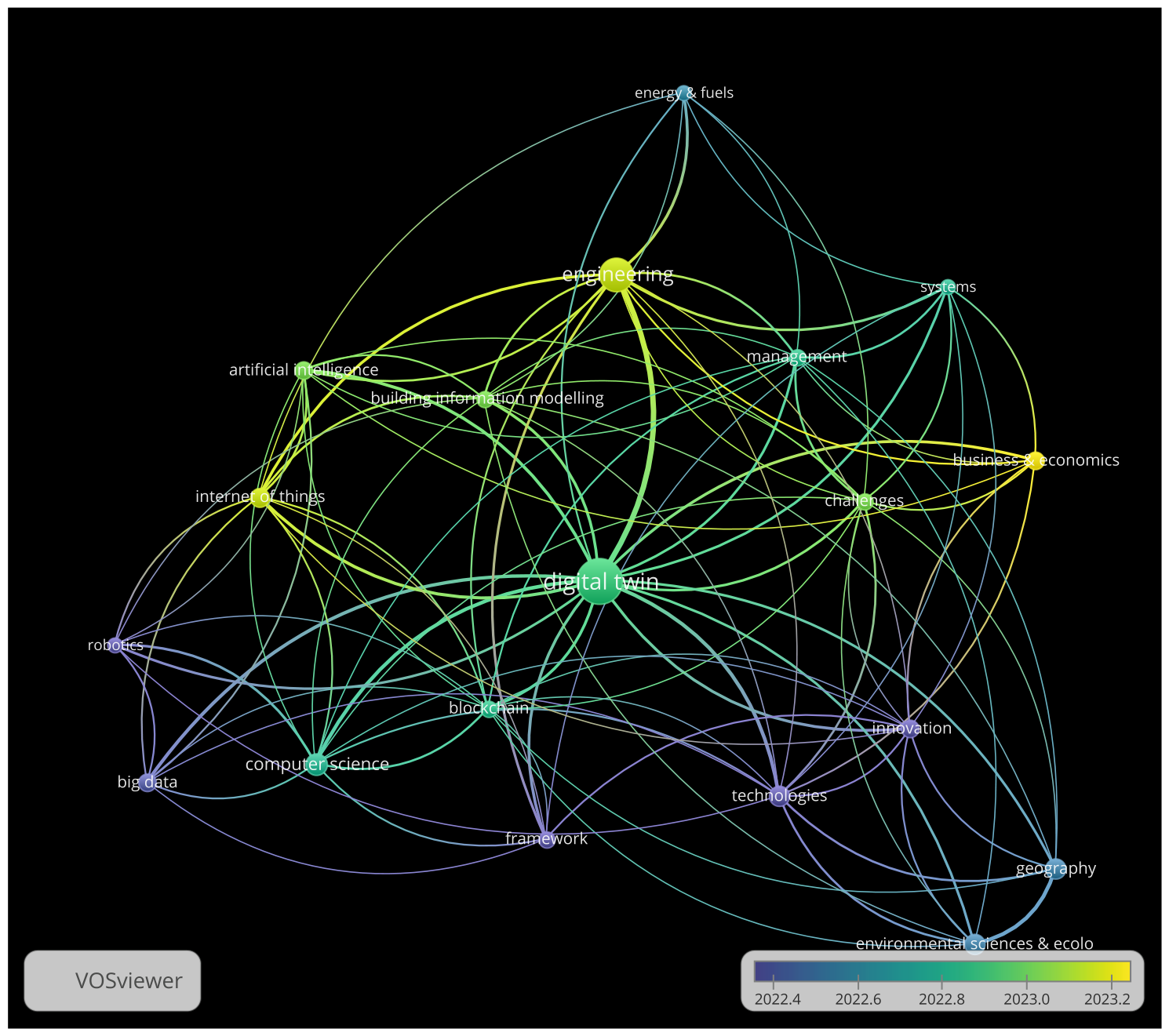
A keyword co-occurrence analysis using VOSviewer identified seven thematic clusters. These clusters correspond to focus areas such as “digital innovation,” “smart cities,” “healthcare,” and “sustainable development.” An overlay visualization shows a temporal shift toward recent emphasis on terms such as “innovation process” and “sustainability”. Figure 5 and Figure 6 illustrate the keyword co-occurrence network and its temporal overlay.
Figure 5.
Network analysis of keyword co-occurrences. Nodes represent keywords meeting the minimum co-occurrence threshold. Node size indicates occurrence frequency; colors indicate thematic clusters identified through VOSviewer clustering. Clustering was performed in VOSviewer using the default modularity-based algorithm [resolution = 1.0, minimum cluster size = 1], producing four clusters from 19 items. Source: Own elaboration.
Figure 6.
Temporal overlay of keyword co-occurrences (node color indicates average publication year of articles containing each keyword, ranging from violet [earlier years] to yellow [more recent publications]). Source: Own elaboration.
Application of the coding framework yielded three categories:
- Business innovation (n = 25): articles demonstrating business innovation enabled through DTs, connecting the technology to value creation through one or more innovation types.
- Technical innovation (n = 12): articles making technical contributions, advancing DT architecture, algorithms, or capabilities without discussion of business outcomes.
- Excluded (n = 23): articles excluded from thematic analysis due to insufficient connection between DTs and the innovation outcomes discussed.
That fewer than half the sample connected DTs explicitly to business innovation outcomes underscores the gap that RQ1 addresses: while DT research is growing rapidly, the relationship between DTs and business innovation remains underexplored.
3.2. Thematic Results
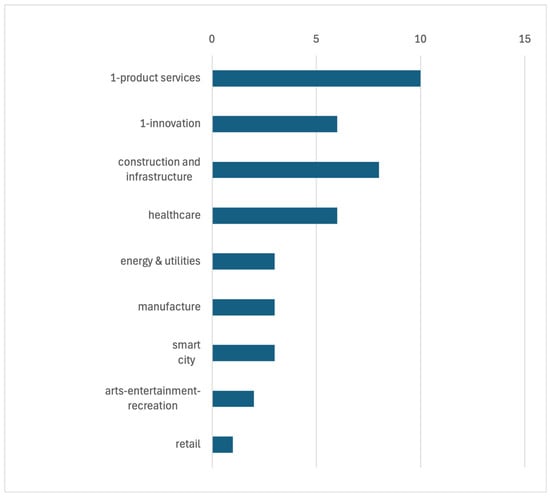
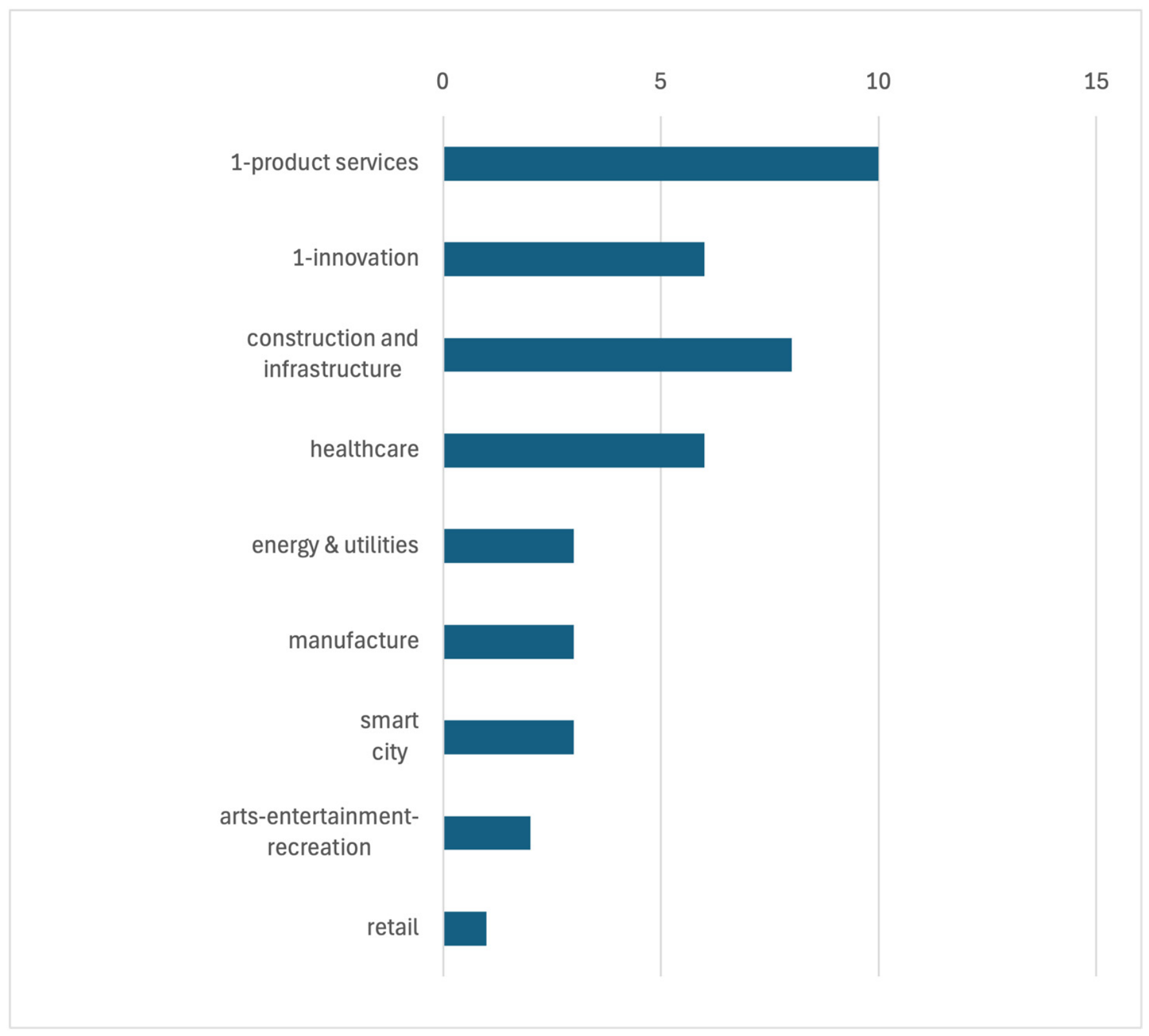
The 25 business innovation cases span both cross-sector applications (product-services and innovation) and sector-specific implementations, as shown in Figure 7.
Figure 7.
Business innovation digital twin application-use in articles. Source: Own elaboration.
Analysis revealed distinct patterns across innovation types. These patterns address RQ1 by identifying not only which innovation types DTs enable, but how the types combine and where they concentrate. Process innovation appeared in nearly all cases, confirming DTs’ fundamental role as operational technology. Product, paradigm, and beyond-firm innovation appeared in varying combinations depending on case scope and domain context.
Table 3 presents the innovation coding results grouped by innovation type combination. Each case was coded for the presence of product, process, paradigm, position and beyond-firm innovation based on the framework and boundary rules. Cases sharing the same combination are grouped together, sorted by type count descending. The sections that follow examine each innovation type in turn, with attention to how types combine and where domain-specific patterns emerge.
Table 3.
Business innovation cases—innovation type.
3.3. Process Innovation
Process innovation appeared in 24 of 25 cases, underscoring DTs’ key role as operational technology. The range of process innovation is illustrated by contrasting cases at opposite ends of the operational–strategic spectrum. At the operational end, Piras et al. (2024) describe a building management DT that consolidates architectural and plant elements into a unified digital model, enabling automated maintenance scheduling, IoT-driven energy optimization, and lifecycle cost reduction [46]. At the strategic end, Yan et al. (2022) present an enterprise DT system that supports management decision-making by providing continuous, data-driven adjustment across both operational and strategic timescales [40]. Between these cases, process innovation addressed production optimization, predictive maintenance, clinical workflow management, and infrastructure monitoring. The prevalence of process innovation suggests that operational improvement represents the baseline value proposition for DT implementation; differentiation among cases emerges through other innovation types.
3.4. Product Innovation
Product innovation appeared in 12 of 25 cases. Two distinct patterns emerged. In the first, the DT itself constitutes the offering. Yadykin et al. (2021) theorized this explicitly, describing how a digital representation of a physical asset functions as a new economic good that can be created, owned, and used by market participants within a cyber–physical system [41]. Other cases demonstrated this pattern in practice: patient twins providing personalized treatment capabilities [33], and virtual environments creating new tourism experiences [34]. In the second pattern, DT capabilities enable new offerings without the twin itself being the product. Carlsson et al. (2022) illustrate this through a traceability platform that links digital information to physical products, providing verifiable lifecycle data such as sustainability compliance and expected lifetime to support consumer decision-making [26]. Further cases in this pattern include manufacturing platforms that enable smart and customized products [27], consumer twins that inform sustainable product design [26], vendor twins that support new after-sales services including training and remote support [35,36], household twins that enable peer-to-peer energy trading [28], and logistics twins that enable new service offerings [12].
3.5. Paradigm Innovation
Paradigm innovation appeared in 13 of 25 cases. The variety of paradigm manifestations is illustrated by contrasting cases. Lehtola et al. (2022) describe a shift from isolated, application-specific urban models to a unified city DT that aggregates data and supports multiple front-end representations tailored to different city functions and stakeholders [31]. Papadonikolaki and Anumba (2024) present a different form: linking individual asset twins into a connected system-of-systems that supports cross-supply-chain collaboration and data-driven governance for Net Zero outcomes [32]. The first restructures how a single organization relates to its data; the second restructures how multiple organizations coordinate toward a shared objective. Unlike process, which manifests similarly across domains, paradigm shifts took distinct forms depending on context. Table 4 categorizes these manifestations.
Table 4.
Paradigm innovation categories.
Paradigm innovation co-occurred strongly with beyond-firm: eight of the nine beyond-firm cases also exhibited paradigm shifts. This pattern suggests that cross-organizational coordination cannot be achieved through process improvement alone; it requires new organizational arrangements to govern how multiple parties interact. This co-occurrence pattern speaks directly to RQ2, indicating that the shift from firm-level to cross-boundary innovation involves not just coordination across organizations but accompanying changes in how those organizations are governed.
3.6. Position Innovation
Position innovation appeared in only 2 of 25 cases. Both involved dedicated customer interface mechanisms: Haier’s Shunguang social platform for customer engagement [27] and a consumer DT serving as interface for sustainable product communication [26]. The low frequency reflects the coding boundary rule distinguishing position from other types of innovation. Customer co-design and participation in product development, while present in several cases, were coded as product, process, or paradigm depending on what the participation changed. Position was reserved for innovation in how offerings are communicated and positioned, not how they are created.
3.7. Beyond-Firm Innovation
Beyond-firm innovation appeared in 9 of 25 cases (36%). Unlike the other innovation types, beyond-firm clustered in specific domains rather than appearing evenly across the sample. Whether this concentration reflects structural characteristics of these domains or patterns in how researchers have studied DT applications is a question the data alone cannot resolve. The interpretation that follows treats the clustering as analytically meaningful while acknowledging the sampling limitation. Table 5 presents the cases by domain.
Table 5.
Beyond-firm innovation categories.
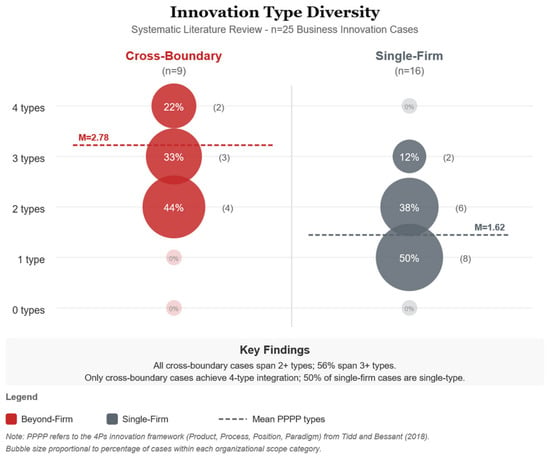
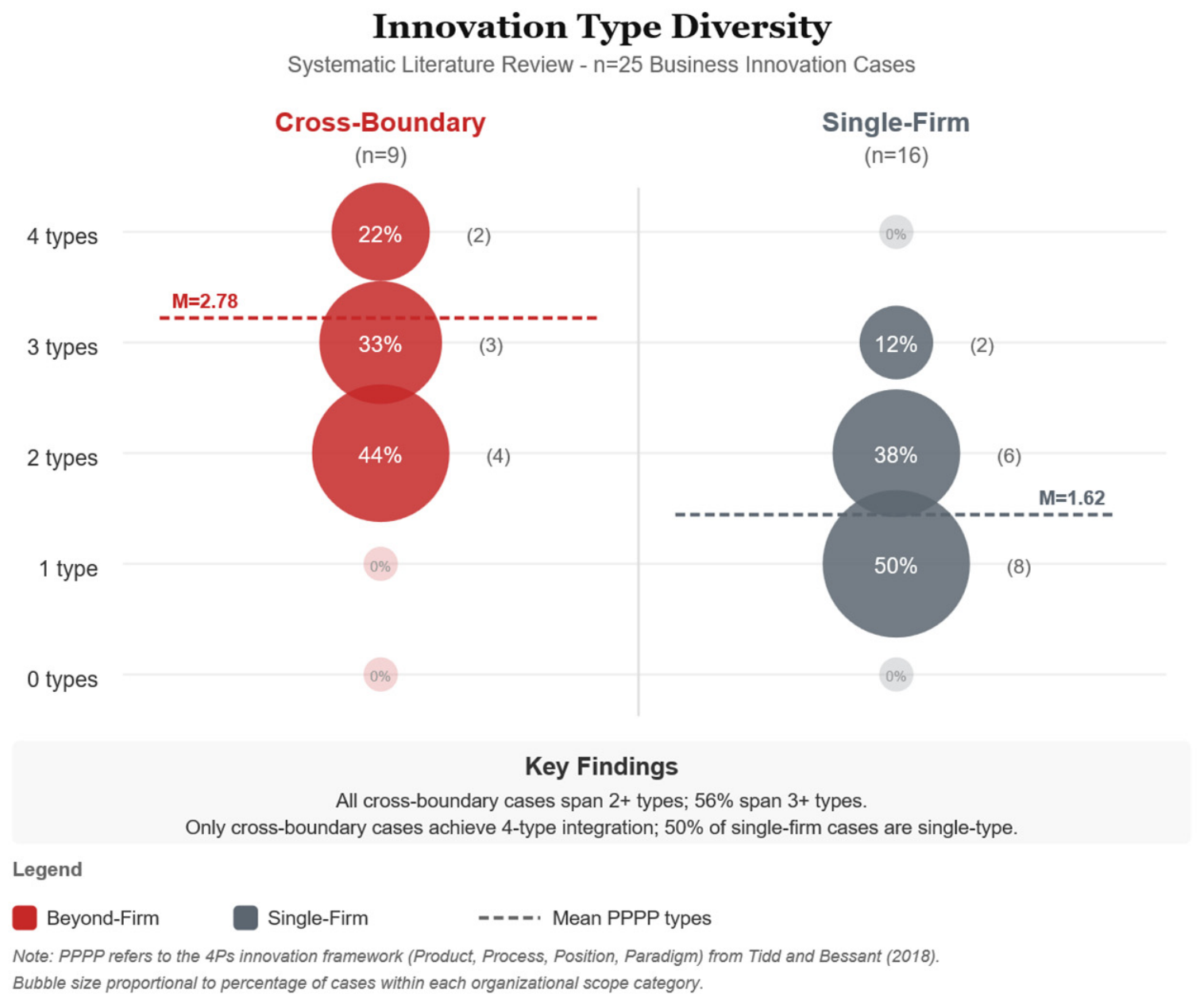
Beyond-firm exhibited strong co-occurrence with paradigm: eight of the cases also involved paradigm innovation. Beyond-firm cases also showed consistently higher innovation type diversity than single-firm cases. As illustrated in Figure 8, all beyond-firm cases exhibited three to five innovation types, while single-firm cases clustered at one or two types. Together, the paradigm co-occurrence and higher type diversity constitute the primary empirical distinction identified by RQ2: beyond-firm innovation is not simply firm-level innovation conducted across boundaries, but a qualitatively different pattern characterized by greater organizational complexity.
Figure 8.
Beyond-firm/single-firm grouping across beyond-firm and single-firm cases (n = 25). Bubble size is proportional to the percentage of cases within each organizational scope category; numbers in parentheses indicate case counts. Red bubbles represent beyond-firm cases (n = 9); grey bubbles represent single-firm cases (n = 16). Dashed lines mark the mean number of innovation types per case for each group (M = 2.78 for beyond-firm; M = 1.62 for single-firm). Percentages are rounded and may not sum to 100. Source: Own elaboration.
A further distinction emerged in lifecycle orientation. Beyond-firm cases modeled objects requiring continuous care rather than discrete product lifecycles. Healthcare twins monitor patients across episodes; urban twins track infrastructure over decades; transportation twins coordinate ongoing system operations. These objects do not follow the design–build–deploy–decommission sequence typical of manufacturing DTs.
4. Discussion
This study sets out to examine DT-enabled business innovation through systematic literature review. The analysis addressed two research questions.
4.1. Types of Innovation Enabled Through DTs (RQ1)
The analysis identified five innovation types enabled by DTs, addressing RQ1. Four correspond to the Oslo Manual [15] operationalized through Bessant and Tidd’s [20] product, process, paradigm, and position innovation. The fifth, beyond-firm, captures innovation that cannot be measured at the firm level because value creation spans multiple organizations. The patterns across these types show that the form of innovation a DT enables depends not only on the technology’s capabilities but on the organizational and institutional context in which the innovation occurs. The cases examined typically involve DTs operating alongside other digital technologies such as IoT, AI, and cloud computing. The innovation outcomes discussed here are attributed to DTs based on the role the DT plays as identified in each study, while recognizing that DTs rarely operate as isolated technologies.
The prevalence of process innovation (Section 3.3) reflects the architectural characteristics of DTs rather than just an observation about technology improving operations. DTs are built on real-time bi-directional information flow between physical systems and their digital models, combined with simulation capability, that maps directly onto process monitoring, optimization, and control. Unlike general digital transformation, which may digitize existing workflows without fundamentally changing how they are managed, DT-enabled process innovation operates through a dynamic representation of the physical system that supports prediction, scenario testing, and continuous adjustment. This capability requires no organizational restructuring, new market arrangements, or cross-boundary coordination to deliver value. Product, paradigm, and beyond-firm innovation each require something additional beyond the core DT capability: new economic arrangements, new organizational models, or new coordination mechanisms, respectively. Process innovation dominates because it requires only what the DT inherently provides. Organizations should therefore expect operational improvement as the baseline value proposition for DT investment; differentiation emerges through the other innovation types.
The two product innovation patterns identified in Section 3.4 carry different implications for value creation. When the DT itself is the offering, as in Yadykin et al.’s (2021) analysis of DTs as economic goods [41], the organization faces questions of ownership, exchange rights, and pricing for a new category of asset. This pattern implies market creation: the offering did not exist before the twin. When DT capabilities enable new offerings without the twin being the product, as in Carlsson et al.’s (2022) traceability platform [26], the product is sold through existing market channels but the basis of competition shifts. The DT introduces verifiable lifecycle data, such as sustainability compliance and expected lifetime, that reduces information asymmetry between producer and consumer. This changes competitive logic within the existing market rather than creating a new one. The distinction carries strategic significance: DT-as-product requires building new economic arrangements around a novel asset, while DT-enables-product requires repositioning within established markets.
The variety of paradigm innovation forms identified in Section 3.5 suggests that DTs do not drive a single type of organizational change. Unlike process innovation, where the DT’s architectural capabilities map directly onto operational improvement, paradigm innovation depends on the institutional context receiving the technology. Business model transformation in platform ecosystems (Li et al., 2020) [27] requires different organizational capabilities than governance restructuring in sustainability transitions (Papadonikolaki & Anumba, 2024) [32]. This context-dependence has implications for how organizations plan DT implementations: the paradigm shift a DT enables is not predictable from the technology alone but emerges from the interaction between the DTs role in the innovation and existing organizational and institutional arrangements.
The rarity of position innovation (Section 3.6) is itself an analytical finding. DT implementations frequently involve customer interaction, yet dedicated customer interface mechanisms appeared in only two cases. This suggests that customer engagement in DT contexts more often changes what is offered (product), how it is delivered (process), or how the organization is structured (paradigm), rather than how offerings are communicated and positioned. The coding boundary rule that produced this result has methodological value: future research applying innovation typologies to DTs should distinguish between customer involvement that changes the offering and customer involvement that changes its positioning.
4.2. Distinction Between Cross-Boundary DT Innovation and Firm-Level Innovation (RQ2)
The clustering of beyond-firm innovation in specific domains (Section 3.7) is not incidental. Healthcare, smart cities, sustainability transitions, platform ecosystems, and energy systems share a structural characteristic: institutional fragmentation. In each, value creation requires coordination among organizations that operate under different governance structures, incentive systems, and regulatory frameworks. Single-firm DT approaches face structural limitations in these settings because no one organization controls the full scope of the system being modeled. This explains both why beyond-firm innovation concentrates in these domains and why it consistently co-occurs with paradigm innovation: coordinating across institutional boundaries requires new organizational arrangements, not just improved processes. The DT literature has gravitated toward these domains, which may reflect both the practical significance of cross-organizational coordination in institutionally fragmented settings and the research attention these domains have attracted.
Beyond the domain clustering, two structural patterns distinguish beyond-firm from single-firm innovation (Section 3.7). The consistent co-occurrence with paradigm indicates that cross-organizational coordination is not achievable through process improvement alone; it demands new organizational arrangements to govern how multiple parties interact. The higher innovation-type diversity in beyond-firm cases suggests that crossing organizational boundaries introduces complexity that propagates across multiple innovation dimensions simultaneously. Where a single-firm DT implementation might improve one process without affecting organizational structure, a beyond-firm implementation cannot coordinate across organizations without also changing what is offered, how it is governed, and how participants relate to one another.
These patterns also point toward architectural questions that this study could not test. The co-occurrence of beyond-firm with paradigm innovation suggests that architecture and governance may be interdependent design choices in cross-organizational settings, a proposition warranting empirical investigation.
4.3. Theortetical Implications
This study makes three theoretical contributions: DT Innovation Typology, six-code framework, and DT-as-product vs. DT-enables-product distinction with boundary rules.
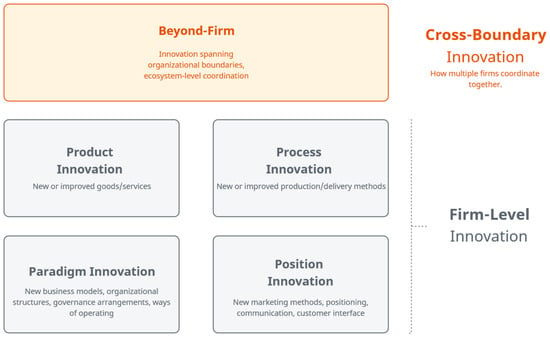
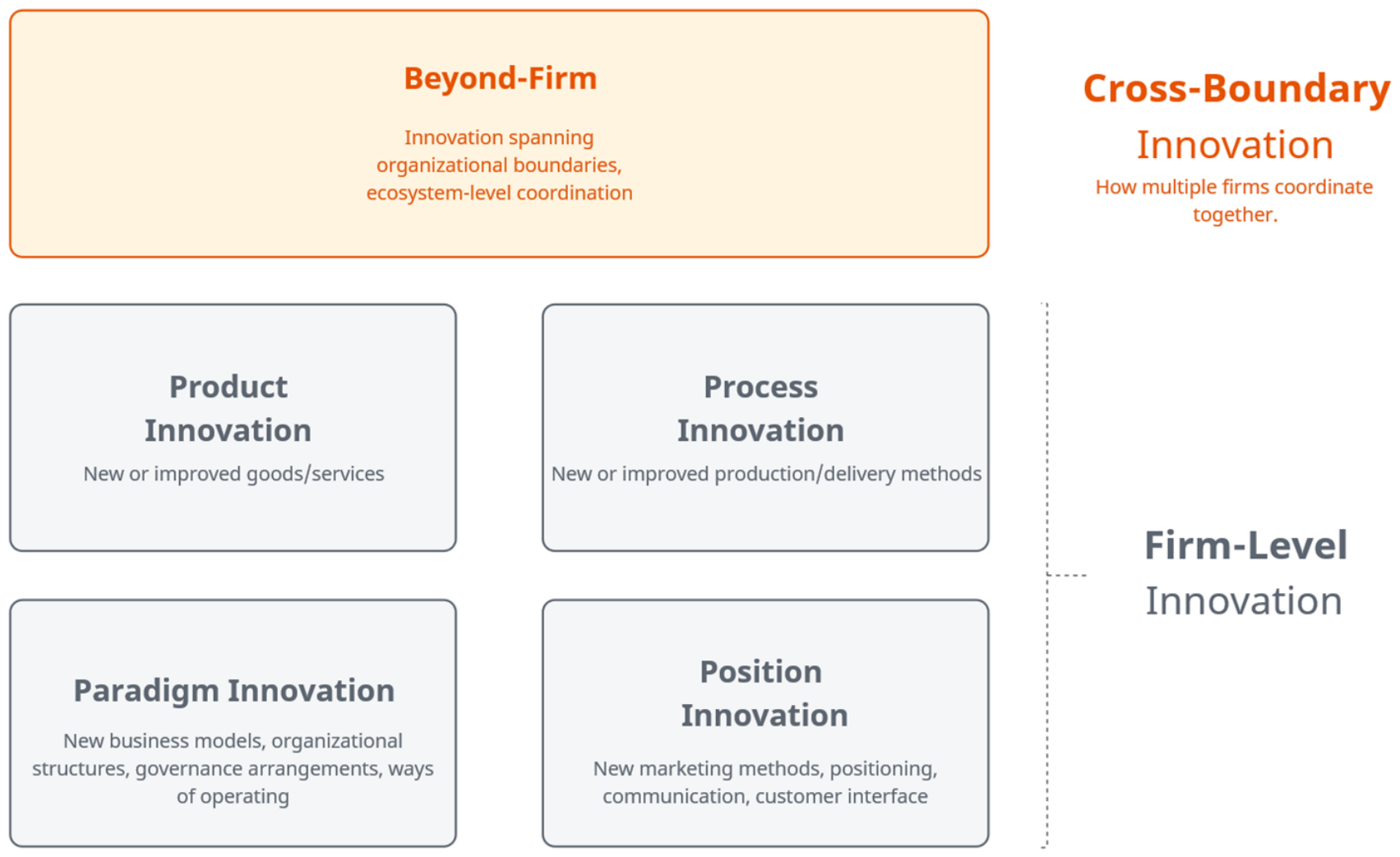
The DT Innovation Typology (Figure 9) extends the established innovation frameworks to address DT-enabled value creation. The typology builds on the Oslo Manual [15], operationalized through Bessant and Tidd’s [20] four innovation types: product, process, paradigm, and position. Following Teece [21], innovation is understood as the coordinated transformation of how value is created, delivered, and captured. The typology treats these dimensions as individually identifiable while recognizing their integration at the business model level. However, the Oslo Manual explicitly limits its scope to firm-level innovation, noting that it does not cover “industry- or economy-wide changes such as the emergence of a new market… or the reorganisation of an industry” [15]. This exclusion creates an analytical gap: DT applications in healthcare, smart cities, and energy systems frequently involve coordination across multiple organizations that cannot be attributed to any single firm. Bessant and Tidd [20] recognize that innovation often spans organizational boundaries through networked and open innovation approaches, but they do not operationalize cross-boundary coordination as a distinct analytical category. The beyond-firm addresses this gap, capturing value creation that requires multi-organizational coordination and that no single firm can achieve alone.
Figure 9.
DT Innovation Typology. The typology organizes six innovation codes into two groupings distinguished by organizational scope. The four firm-level categories (grey), product, process, paradigm, and position, are adapted from Bessant and Tidd’s 4Ps framework [20] and capture innovation attributable to a single organization. The beyond-firm category (orange) captures innovation spanning organizational boundaries and requiring cross-organizational coordination mechanisms that no single firm can achieve alone. The dashed line demarcates the boundary between firm-level and cross-boundary innovation. Source: Own elaboration.
The beyond-firm category connects DT innovation research to the broader literature on innovation ecosystems [19] and value co-creation across organizational boundaries [18]. While that literature has established the theoretical importance of ecosystem-level coordination, the DT Innovation Typology provides an empirical tool for identifying where such coordination occurs and what forms it takes in technology-enabled settings.
The second contribution is the six-code typology framework. The six codes are technical innovation (advances in DT capability without business application), and five types of business innovation: process, product, paradigm, position, and beyond-firm. The technical/business distinction is the first analytical decision: articles are coded as technical only when advances in DT architecture, algorithms, or capabilities are independent of business outcomes. Within business innovation, the five types are applied with explicit boundary rules, including the requirement that beyond-firm requires evidence of multi-organizational coordination mechanisms, not just technical interoperability. This framework provides a replicable methodology for classifying DT-enabled innovation across domains.
The third contribution is the distinction between DT-as-product and DT-enables-product within product innovation. As demonstrated in 4.1, these patterns involve different value creation logic: DT-as-product requires establishing new economic arrangements for a novel category of asset, while DT-enables-product operates through existing market structures but shift the basis of competition. The distinction provides researchers with a more precise analytical tool than treating all product innovation as a single category and offers practitioners a framework for understanding which strategic capabilities each pattern demands.
4.4. Practical Implications
The findings carry practical implications for managers and practitioners involved in DT investment and implementation.
First, process innovation is the baseline, not the differentiator. Organizations should expect operational improvement from DT deployment but should not treat it as a distinctive outcome. Differentiation comes through product, paradigm, or beyond-firm innovation.
Second, domain context shapes what is achievable. In institutionally fragmented domains such as healthcare, smart cities, and sustainability transitions, single-firm DT approaches face structural limitations. These domains require investment in coordination mechanisms, governance arrangements, and multi-stakeholder alignment alongside technology development.
Third, beyond-firm cases consistently exhibited paradigm co-occurrence and higher type diversity. This pattern suggests that cross-organizational coordination may require accompanying organizational restructuring rather than incremental extension of existing arrangements. Organizations pursuing beyond-firm innovation should anticipate the potential need for paradigm-level change.
Fourth, the distinction between DT-as-product and DT-enables-product implies different strategic paths. When the twin itself is the offering, organizations must address ownership, exchange, and economic arrangements. When twin capabilities enable offerings, existing market structures can be leveraged.
Finally, federated architectures that maintain organizational data sovereignty while enabling coordination may be better suited to beyond-firm domains than centralized approaches that assume single-firm control.
5. Conclusions
This study examined DT-enabled business innovation through a systematic literature review of 25 business innovation cases, developing a typology grounded in established innovation frameworks. The analysis addressed two research questions. For RQ1, the findings show that DTs enable all four Oslo Manual innovation types but in distinct patterns: process innovation appeared in nearly all cases, reflecting the technology’s core architectural capabilities; product innovation follows two different value creation logics; and paradigm innovation takes context-specific forms depending on the institutional setting. For RQ2, beyond-firm innovation emerged as a structurally distinct form, concentrated in institutionally fragmented domains, consistently co-occurring with paradigm innovation, and exhibiting higher innovation type diversity than single-firm cases.
The Digital Twin Innovation Typology extends the Oslo Manual and Bessant and Tidd’s framework by operationalizing innovation that spans organizational boundaries and that no single firm can achieve alone. The six-code analytical framework and its boundary rules provide researchers with a replicable tool for classifying DT-enabled innovation across domains. For practitioners, the typology offers a basis for distinguishing baseline operational outcomes from the higher-order innovation that requires organizational, market, or cross-boundary change. For the emerging literature connecting DTs to innovation ecosystems, the beyond-firm category provides a structured approach to identifying where ecosystem-level coordination occurs and what forms it takes.
Limitations and Future Reasarch
This study has limitations. First, the analysis draws on systematic literature review rather than primary empirical data. The findings describe patterns in how researchers have studied DT-enabled innovation, not direct observation of innovation outcomes. Empirical validation through case study or survey research would strengthen its utility.
Despite explicit boundary rules, coding was conducted by a single analyst, and the process remains interpretive. Different researchers applying the framework may reach different conclusions on borderline cases. While borderline cases were discussed with the supervisory committee, formal dual-coding was not employed. Replication studies testing inter-rater reliability would establish the framework’s robustness.
Beyond-firm innovation concentrated in healthcare, smart cities, sustainability transitions, and energy systems. These domains share structural characteristics, notably institutional fragmentation and multi-stakeholder governance, that provide a theoretical basis for the clustering. However, the concentration may also reflect where DT research has been most active or where cross-organizational framing is most common in the literature. Domains such as manufacturing or logistics may involve comparable cross-firm coordination that researchers have not framed in beyond-firm terms. Targeted empirical research in underrepresented domains would clarify whether the clustering reflects genuine domain requirements or disciplinary emphasis in the existing literature.
More broadly, the sample reflects the current concentration of DT research in large-organization settings. Few studies examined DT-enabled innovation in small and medium-sized enterprises or in sectors such as agriculture, education, or financial services. The findings, particularly the innovation type frequencies and combination patterns, may not generalize to contexts where organizational scale, resource availability, and technology maturity differ substantially.
The beyond-firm finding points toward architectural implications that this study could not test. Whether federated DT architectures better enable cross-organizational innovation than centralized approaches is an empirical question requiring comparative analysis.
The innovation outcomes identified in this study are attributed to DTs based on how each source article characterized the DT’s role. In practice, DTs operate alongside other digital technologies including IoT, AI, and cloud platforms. Disentangling the specific contribution of the DT from its broader technological context was beyond the scope of this review. Future empirical research using controlled comparisons or process tracing could clarify the distinct contribution of DTs relative to other digital technologies in enabling innovation outcomes.
The continuous care lifecycle pattern distinguishing beyond-firm domains warrants further examination. DT implementations following discrete product lifecycles may require fundamentally different coordination approaches than those supporting continuous object care. Understanding how lifecycle orientation shapes coordination requirements could inform both theory and practice.
Three directions warrant priority in future research. First, empirical validation of the typology through case study or survey research would move beyond the patterns identified in this review toward direct observation of DT-enabled innovation outcomes. Second, research in small and medium-sized enterprises would test whether the innovation patterns identified here, which derive predominantly from large-organization settings, hold in contexts where organizational scale, resource availability, and technology maturity differ substantially. Third, cross-industry comparative studies would clarify whether the beyond-firm concentration in healthcare, smart cities, and energy systems reflects genuine domain requirements or the current distribution of research attention.
Author Contributions
Conceptualization, N.G.J. and I.S.-A.; Methodology, N.G.J., I.S.-A., C.M. and D.F.M.T.; Investigation, N.G.J.; Visualization, N.G.J.; Writing—Original Draft Preparation, N.G.J.; Writing—Review and Editing, N.G.J., I.S.-A., C.M. and D.F.M.T.; Supervision, I.S.-A., C.M. and D.F.M.T. All authors have read and agreed to the published version of the manuscript.
Funding
This work was partially funded by Project Gestalt, Inc. (N.G.J.) and FCT—Fundação para a Ciência e a Tecnologia, IP, through CIDMA, Project UID/04106/2025 (D.F.M.T.). This work was also supported by NECE-UBI, Research Centre for Business Sciences, funded by FCT, project UID/04630/2025 and by CIMAD—Research Center on Marketing and Data Analysis (I.S.-A.).
Data Availability Statement
This study is based on publicly available literature cited in the References. The coding framework and analysis files are available from the corresponding author upon reasonable request.
Acknowledgments
We acknowledge the use of language generation tools including ChatGPT (GPT-4o, OpenAI, San Francisco, CA, USA), Claude (3.5 Sonnet, 3.5 Haiku, 3.7 Sonnet, Sonnet 4, Opus 4, Sonnet 4.5, Opus 4.5, Sonnet 4.6, Opus 4.6, Anthropic, San Francisco, CA, USA), Gemini (2.0 Pro, 2.5 Pro, 3 Pro, 3.1 Pro, Google, Mountain View, CA, USA), and GitHub Copilot (Microsoft, Redmond, WA, USA) to assist in restating and refining portions of the text. All content, research design, and analysis remain the authors’ original work.
Conflicts of Interest
Neil G. Jacobson holds an ownership interest in and is affiliated with Project Gestalt, Inc., which partially funded this work as disclosed in the Funding statement. The company had no role in the design of the study; in the collection, analyses, or interpretation of data; in the writing of the manuscript; or in the decision to publish the results. The remaining authors declare no conflicts of interest.
Appendix A. Articles Analyzed
- Awan, K.A.; Din, I.U.; Almogren, A.; Rodrigues, Jjpc. (MediTwin: A Web 3.0-Integrated Digital Twin for Secure Patient-Centric Healthcare in the Metaverse). 2024. Ieee Transactions on Consumer Electronics.
- Bertoni, M.; Bertoni, A. (Designing solutions with the product-service systems digital twin: What is now and what is next?). 2022. Computers in Industry.
- Bolton, R.N.; McColl-Kennedy, J.R.; Cheung, L.; Gallan, A.; Orsingher, C.; Witell, L.; Zaki, M. (Customer experience challenges: bringing together digital, physical and social realms). 2018. Journal of Service Management.
- Boulanger, S.O.M. (The Roadmap to Smart Cities: A Bibliometric Literature Review on Smart Cities’ Trends before and after the COVID-19 Pandemic). 2022. Energies.
- Brosinsky, C.; Naglic, M.; Lehnhoff, S.; Krebs, R.; Westermann, D. (A Fortunate Decision That You Can Trust: Digital Twins as Enablers for the Next Generation of Energy Management Systems and Sophisticated Operator Assistance Systems). 2024. Ieee Power & Energy Magazine.
- Calandra, D.; Oppioli, M.; Sadraei, R.; Jafari-Sadeghi, V.; Biancone, P.P. (Metaverse meets digital entrepreneurship: a practitioner-based qualitative synthesis). 2024. International Journal of Entrepe.
- Carlsson, R.; Nevzorova, T.; Vikingsson, K. (Long-Lived Sustainable Products through Digital Innovation). 2022. Sustainability.
- Chacón, R.; Ramonell, C.; Posada, H.; Sierra, P.; Tomar, R.; de la Rosa, C.M.; Rodriguez, A.; Koulalis, I.; Ioannidis, K.; Wagmeister, S. (Digital twinning during load tests of railway bridges—case study: the high-speed railway network, Extremadura, Spain). 2024. Structure and Infrastructure Engineering.
- Chatterjee, P.; Das, D.; Rawat, D.B. (Digital twin for credit card fraud detection: opportunities, challenges, and fraud detection advancements). 2024. Future Generation Computer Systems-the International Journal of Escience.
- Cho, M.K.; Martinez-Martin, N. (Epistemic Rights and Responsibilities of Digital Simulacra for Biomedicine). 2023. American Journal of Bioethics.
- Ciuriuc, A.; Rapha, J.I.; Guanche, R.; Domínguez-García, J.L. (Digital tools for floating offshore wind turbines (FOWT): A state of the art). 2022. Energy Reports.
- Cooper, R.G.; Brem, A.M. (Insights for Managers About AI Adoption in New Product Development). 2024. Research-Technology Management.
- Dayoub, B.; Yang, P.F.; Omran, S.; Zhang, Q.Y.; Dayoub, A. (Digital Silk Roads: Leveraging the Metaverse for Cultural Tourism within the Belt and Road Initiative Framework). 2024. Electronics.
- Diaz-Sarachaga, J.M. (May urban digital twins spur the New Urban Agenda? The Spanish case study). 2024. Sustainable Cities and Society.
- El Houda, Z.A.; Brik, B. (Next-power: Next-generation framework for secure and sustainable energy trading in the metaverse). 2023. Ad Hoc Networks.
- Fakhraian, E.; Semanjski, I.; Semanjski, S.; Aghezzaf, E. (Towards Safe and Efficient Unmanned Aircraft System Operations: Literature Review of Digital Twins’ Applications and European Union Regulatory Compliance). 2023. Drones.
- Faliagka, E.; Christopoulou, E.; Ringas, D.; Politi, T.; Kostis, N.; Leonardos, D.; Tranoris, C.; Antonopoulos, C.P.; Denazis, S.; Voros, N. (Trends in Digital Twin Framework Architectures for Smart Cities: A Case Study in Smart Mobility). 2024. Sensors.
- Fan, H.L.; Long, J.; Liu, L.M.; Yang, Z. (Dynamic Digital Twin and Online Scheduling for Contact Window Resources in Satellite Network). 2023. Ieee Transactions on Industrial Informatics.
- Firouzi, F.; Farahani, B.; Daneshmand, M.; Grise, K.; Song, J.S.; Saracco, R.; Wang, L.L.; Lo, K.L.; Angelov, P.; Soares, E.; Loh, P.S.; Talebpour, Z.; Moradi, R.; Goodarzi, M.; Ashraf, H.; Talebpour, M.; Talebpour, A.; Romeo, L.; Das, R.; Heidari, H.; Pasquale, D.; Moody, (Harnessing the Power of Smart and Connected Health to Tackle COVID-19: IoT, AI, Robotics, and Blockchain for a Better World). 2021. Ieee Internet of Things Journal.
- Giuffrè, M.; Shung, D.L. (Harnessing the power of synthetic data in healthcare: innovation, application, and privacy). 2023. Npj Digital Medicine.
- Gkoumas, K.; Stepniak, M.; Cheimariotis, I.; dos Santos, F.M. (New technologies for bridge inspection and monitoring: a perspective from European Union research and innovation projects). 2024. Structure and Infrastructure Engineering.
- Golinska-Dawson, P.; Sethanan, K. (Sustainable Urban Freight for Energy-Efficient Smart Cities-Systematic Literature Review). 2023. Energies.
- Holopainen, M.; Saunila, M.; Rantala, T.; Ukko, J. (Digital twins’ implications for innovation). 2024. Technology Analysis & Strategic Management.
- Hu, X.; Olgun, G.; Assaad, R.H. (An intelligent BIM-enabled digital twin framework for real-time structural health monitoring using wireless IoT sensing, digital signal processing, and structural analysis). 2024. Expert Systems with Applications.
- Huang, X.; Liu, Y.L. (Research and design of intelligent mine ventilation construction architecture). 2022. International Journal of Low-Carbon Technologies.
- Jameil, A.K.; Al-Raweshidy, H. (AI-Enabled Healthcare and Enhanced Computational Resource Management With Digital Twins Into Task Offloading Strategies). 2024. Ieee Access.
- Karagiannis, D.; Buchmann, R.A.; Utz, W. (The OMiLAB Digital Innovation environment: Agile conceptual models to bridge business value with Digital and Physical Twins for Product-Service Systems development). 2022. Computers in Industry.
- Klerkx, L.; Jakku, E.; Labarthe, P. (A review of social science on digital agriculture, smart farming and agriculture 4.0: New contributions and a future research agenda). 2019. Njas-Wageningen Journal of Life Sciences.
- Lai, Y. (Urban Intelligence for Carbon Neutral Cities: Creating Synergy among Data, Analytics, and Climate Actions). 2022. Sustainability.
- Laucelli, D.B. (A digital water strategy based on the digital water service concept to support asset management in a real system). 2023. Journal of Hydroinformatics.
- Lauer-Schmaltz, M.W.; Cash, P.; Hansen, J.P.; Das, N. (Human Digital Twins in Rehabilitation: A Case Study on Exoskeleton and Serious-Game-Based Stroke Rehabilitation Using the ETHICA Methodology). 2024. Ieee Access.
- Lehmann, J.; Granrath, L.; Browne, R.; Ogawa, T.; Kokubun, K.; Taki, Y.; Jokinen, K.; Janboecke, S.; Lohr, C.; Wieching, R.; Bevilacqua, R.; Casaccia, S.; Revel, G.M. (Digital Twins for Supporting Ageing Well: Approaches in Current Research and Innovation in Europe and Japan). 2024. Sustainability.
- Lehtola, V.V.; Koeva, M.; Elberink, S.O.; Raposo, P.; Virtanen, J.P.; Vahdatikhaki, F.; Borsci, S. (Digital twin of a city: Review of technology serving city needs). 2022. International Journal of Applied Earth Observation and Geoinformation.
- Li, X.; Cao, J.R.; Liu, Z.G.; Luo, X.G. (Sustainable Business Model Based on Digital Twin Platform Network: The Inspiration from Haier’s Case Study in China). 2020. Sustainability.
- Marvin, H.J.P.; Bouzembrak, Y.; Van der Fels-Klerx, H.J.; Kempenaar, C.; Veerkamp, R.; Chauhan, A.; Stroosnijder, S.; Top, J.; Simsek-Senel, G.; Vrolijk, H.; Knibbe, W.J.; Zhang, L.; Boom, R.; Tekinerdogan, B. (Digitalisation and Artificial Intelligence for sustainable food systems). 2022. Trends in Food Science & Technology.
- Meijer, C.; Uh, H.W.; el Bouhaddani, S. (Digital Twins in Healthcare: Methodological Challenges and Opportunities). 2023. Journal of Personalized Medicine.
- Miehe, R.; Horbelt, J.; Baumgarten, Y.; Bauernhansl, T. (Basic considerations for a digital twin of biointelligent systems: Applying technical design patterns to biological systems). 2020. Cirp Journal of Manufacturing Science and Technology
- Nie, Z.F.; Cao, G.Z.; Zhang, P.; Peng, Q.J.; Zhang, Z.M. (Multi-Analogy Innovation Design Based on Digital Twin). 2022. Machines.
- Nie, Z.F.; Zhang, P.; Wang, F.; Wang, Z.Z. (Sustainable innovation pathway for mechanical products by inducing characteristic parameters). 2021. Advanced Engineering Informatics.
- Otsu, K.; Maso, J. (Digital Twins for Research and Innovation in Support of the European Green Deal Data Space: A Systematic Review). 2024. Remote Sensing
- Papadonikolaki, E.; Anumba, C.J. (Mapping the Complexity of Net Zero Transition Through a System of Digital Twin Systems). 2024. Ieee Transactions on Engineering Management.
- Pavón, R.M.; Alberti, M.G.; Alvarez, A.A.A.; Cepa, J.J. (Bim-based Digital Twin development for university Campus management. Case study ETSICCP). 2025. Expert Systems with Applications.
- Piras, G.; Muzi, F.; Tiburcio, V.A. (Digital Management Methodology for Building Production Optimization through Digital Twin and Artificial Intelligence Integration). 2024. Buildings.
- Polyviou, A.; Pappas, I.O. (Chasing Metaverses: Reflecting on Existing Literature to Understand the Business Value of Metaverses). 2023. Information Systems Frontiers
- Ravid, B.Y.; Aharon-Gutman, M. (The Social Digital Twin:The Social Turn in the Field of Smart Cities). 2023. Environment and Planning B-Urban Analytics and City Science.
- Saunila, M.; Holopainen, M.; Nasiri, M.; Ukko, J.; Rantala, T. (Digital transformation with digital twins-distinct mechanisms of enabling and controlling uses). 2024. Technology Analysis & Strategic Management.
- Schindel, W.D. (Patterns in the Public Square: Reference Models for Regulatory Science). 2023. Annals of Biomedical Engineering.
- Torres, J.; San-Mateos, R.; Lasarte, N.; Mediavilla, A.; Sagarna, M.; León, I. (Building Digital Twins to Overcome Digitalization Barriers for Automating Construction Site Management). 2024. Buildings.
- van der Burg, S.; Kloppenburg, S.; Kok, E.J.; van der Voort, M. (Digital twins in agri-food: Societal and ethical themes and questions for further research). 2021. Njas-Impact in Agricultural and Life Sciences.
- Wang, H.X.; Zhang, P.; Zhang, Z.M.; Zhang, Y.C.; Wang, Y.R. (Product Innovation Design Process Model Based on Functional Genes Extraction and Construction). 2022. Applied Sciences-Basel.
- Wu, R.; Gao, L.; Lee, H.; Xu, J.; Pan, Y. (A Study of the Key Factors Influencing Young Users’ Continued Use of the Digital Twin-Enhanced Metaverse Museum). 2024. Electronics.
- Xin, C.; Wang, Y.S. (Digital twins and innovation management: a literature review, framework, challenge, and future direction). 2024. Technology Analysis & Strategic Management.
- Xu, R.; Yu, X.; Zhao, X. (Regional Economic Development Trend Prediction Method Based on Digital Twins and Time Series Network). 2023. Cmc-Computers Materials & Continua.
- Xu, Y.M.; Peralta, A.A.; Balta-Ozkan, N. (Vehicle-to-Vehicle Energy Trading Framework: A Systematic Literature Review). 2024. Sustainability.
- Yadykin, V.; Barykin, S.; Badenko, V.; Bolshakov, N.; de la Poza, E.; Fedotov, A. (Global Challenges of Digital Transformation of Markets: Collaboration and Digital Assets). 2021. Sustainability.
- Yan, J.H.; Li, X.; Ji, S.Y. (Design and Implementation of Workshop Virtual Simulation Experiment Platform Based on Digital Twin). 2024. Systems.
- Yan, M.R.; Hong, L.Y.; Warren, K. (Integrated knowledge visualization and the enterprise digital twin system for supporting strategic management decision). 2022. Management Decision.
- Yang, P.C.; Jeng, M.T.; Yarov-Yarovoy, V.; Santana, L.F.; Vorobyov, I.; Clancy, C.E. (Toward Digital Twin Technology for Precision Pharmacology). 2024. Jacc-Clinical Electrophysiology.
- Zhang, W. (The Impact of the Platform Economy on Urban-Rural Integration Development: Evidence from China). 2023. Land.
- Zhong, X.; Sarijaloo, F.B.; Prakash, A.; Park, J.; Huang, C.Y.; Barwise, A.; Herasevich, V.; Gajic, O.; Pickering, B.; Dong, Y. (A multidisciplinary approach to the development of digital twin models of critical care delivery in intensive care units). 2022. International Journal of Production Research.
Appendix B. PRISMA
Figure A1.
PRISMA 2020 [25] flow diagram showing identification, screening, eligibility, and inclusion phases of the systematic literature review. From 118 records identified, 58 were excluded, yielding 60 articles for thematic analysis (see Table 2 for exclusion criteria). Source: Own elaboration.
Note
| 1 | Converted using the ECB EUR/USD reference rate on 31 December 2025. All original values from Wadhwani [2] are in USD; euro equivalents are provided for reader convenience. |
References
- Kritzinger, W.; Karner, M.; Traar, G.; Henjes, J.; Sihn, W. Digital Twin in manufacturing: A categorical literature review and classification. In Proceedings of the IFAC-PapersOnLine, Online, 1 January 2018; pp. 1016–1022. [Google Scholar]
- Wadhwani, P. Digital Twin Market Size-by Application (Product Design & Development, Machine & Equipment Health Monitoring, Process Support & Service), by End Use (Manufacturing, Healthcare, Automotive, Aerospace & Defense, Energy) & Forecast, 2024–2032. Available online: https://www.gminsights.com/industry-analysis/digital-twin-market?gclid=CjwKCAjwmYCzBhA6EiwAxFwfgNlX8GcawmS0VIPFVgFLp5aV-VkUiDEu5_Hs0cZmvC7alVt6pHNZfhoC0W0QAvD_BwE (accessed on 1 March 2024).
- Cosmas, A.; Cruz, G.; Cubela, S.; Huntington, M.; Rahimi, S.; Tiwari, S. Digital Twins and Generative AI: A Powerful Pairing. Available online: https://www.mckinsey.com/capabilities/mckinsey-digital/our-insights/tech-forward/digital-twins-and-generative-ai-a-powerful-pairing (accessed on 10 June 2024).
- Crunchbase. Crunchbase Query Builder. Available online: https://www.crunchbase.com/search/organization.companies (accessed on 12 June 2024).
- Katsoulakis, E.; Wang, Q.; Wu, H.; Shahriyari, L.; Fletcher, R.; Liu, J.; Achenie, L.; Liu, H.; Jackson, P.; Xiao, Y.; et al. Digital twins for health: A scoping review. npj Digit. Med. 2024, 7, 77. [Google Scholar] [CrossRef] [Scilit]
- Allam, Z.; Jones, D.S. Future (post-COVID) digital, smart and sustainable cities in the wake of 6G: Digital twins, immersive realities and new urban economies. Land Use Policy 2021, 101, 105201. [Google Scholar] [CrossRef] [Scilit]
- Digital Twin Consortium. Digital Twin Consortium Working Groups. Available online: https://www.digitaltwinconsortium.org/working-groups/ (accessed on 23 February 2024).
- D’Hauwers, R.; Walravens, N.; Ballon, P. From an Inside-In Towards an Outside-Out Urban Digital Twin: Business Models and Implementation Challenges. ISPRS Ann. Photogramm. Remote Sens. Spat. Inf. Sci. 2021, 8, 25–32. [Google Scholar] [CrossRef] [Scilit]
- Sodiq Odetunde, B. Business model innovation in healthcare: A theoretical review of entrepreneurial strategies in the medical sector. Int. J. Biol. Pharm. Sci. Arch. 2024, 7, 148–157. [Google Scholar] [CrossRef] [Scilit]
- Meijer, C.; Uh, H.W.; el Bouhaddani, S. Digital Twins in Healthcare: Methodological Challenges and Opportunities. J. Pers. Med. 2023, 13, 1522. [Google Scholar] [CrossRef] [Scilit]
- Wolniak, R.; Gajdzik, B.; Grebski, M.; Danel, R.; Grebski, W.W. Business Models Used in Smart Cities-Theoretical Approach with Examples of Smart Cities. Smart Cities 2024, 7, 1626–1669. [Google Scholar] [CrossRef] [Scilit]
- Calandra, D.; Oppioli, M.; Sadraei, R.; Jafari-Sadeghi, V.; Biancone, P.P. Metaverse meets digital entrepreneurship: A practitioner-based qualitative synthesis. Int. J. Entrep. Behav. Res. 2024, 30, 666–686. [Google Scholar] [CrossRef] [Scilit]
- Bertoni, M.; Bertoni, A. Designing solutions with the product-service systems digital twin: What is now and what is next? Comput. Ind. 2022, 138, 3629. [Google Scholar] [CrossRef] [Scilit]
- Xin, C.; Wang, Y. Digital twins and innovation management: A literature review, framework, challenge, and future direction. Technol. Anal. Strateg. Manag. 2024, 36, 2228–2241. [Google Scholar] [CrossRef] [Scilit]
- Eurostat. The Measurement of Scientific, Technological and Innovation Activities Oslo Manual 2018 Guidelines for Collecting, Reporting and Using Data on Innovation; OECD publishing: Paris, France, 2018.
- Pisano, G.P. You Need an Innovation Strategy. Harv. Bus. Rev. 2015, 93, 44–54. [Google Scholar]
- Andriopoulos, C.; Lewis, M.W. Exploitation-Exploration Tensions and Organizational Ambidexterity: Managing Paradoxes of Innovation. Organ. Sci. 2009, 20, 696–717. [Google Scholar] [CrossRef] [Scilit]
- Amit, R.; Zott, C. Creating Value Through Business Model Innovation. Mit Sloan Manag. Rev. 2012, 53, 41–49. [Google Scholar]
- Jacobides, M.G.; Cennamo, C.; Gawer, A. Towards a theory of ecosystems. Strateg. Manag. J. 2018, 39, 2255–2276. [Google Scholar] [CrossRef] [Scilit]
- Tidd, J.; Bessant, J.R. Managing Innovation: Integrating Technological, Market and Organizational Change, 7th ed.; Wiley: Hoboken, NJ, USA, 2021; ISBN 978-1-119-71330-2. [Google Scholar]
- Teece, D.J. Business Models, Business Strategy and Innovation. Long Range Plann. 2010, 43, 172–194. [Google Scholar] [CrossRef] [Scilit]
- Tranfield, D.; Denyer, D.; Smart, P. Towards a methodology for developing evidence-informed management knowledge by means of systematic review. Br. J. Manag. 2003, 14, 207–222. [Google Scholar] [CrossRef] [Scilit]
- Saur-Amaral, I.; Soares, R.R.; Proença, J.F. Business model innovation: Towards a conceptual framework. Tour. Manag. Stud. 2018, 14, 80–93. [Google Scholar] [CrossRef] [Scilit]
- Saur-Amaral, I. Wisdom-of-the-crowds to enhance innovation: State of the art. J. Innov. Manag. 2015, 3, 71–89. [Google Scholar] [CrossRef] [Scilit]
- Page, M.J.; McKenzie, J.E.; Bossuyt, P.M.; Boutron, I.; Hoffmann, T.C.; Mulrow, C.D.; Shamseer, L.; Tetzlaff, J.M.; Akl, E.A.; Brennan, S.E.; et al. The PRISMA 2020 statement: An updated guideline for reporting systematic reviews. BMJ 2021, 372, n71. [Google Scholar] [CrossRef] [Scilit]
- Carlsson, R.; Nevzorova, T.; Vikingsson, K. Long-Lived Sustainable Products through Digital Innovation. Sustainability 2022, 14, 14364. [Google Scholar] [CrossRef] [Scilit]
- Li, X.; Cao, J.; Liu, Z.; Luo, X. Sustainable business model based on digital twin platform network: The inspiration from Haier’s case study in China. Sustainability 2020, 12, 936. [Google Scholar] [CrossRef] [Scilit]
- El Houda, Z.A.; Brik, B. Next-power: Next-generation framework for secure and sustainable energy trading in the metaverse. Ad Hoc Netw. 2023, 149, 3243. [Google Scholar] [CrossRef] [Scilit]
- Lehmann, J.; Granrath, L.; Browne, R.; Ogawa, T.; Kokubun, K.; Taki, Y.; Jokinen, K.; Janboecke, S.; Lohr, C.; Wieching, R.; et al. Digital Twins for Supporting Ageing Well: Approaches in Current Research and Innovation in Europe and Japan. Sustainability 2024, 16, 3064. [Google Scholar] [CrossRef] [Scilit]
- Firouzi, F.; Farahani, B.; Daneshmand, M.; Grise, K.; Song, J.; Saracco, R.; Wang, L.L.; Lo, K.; Angelov, P.; Soares, E.; et al. Harnessing the Power of Smart and Connected Health to Tackle COVID-19: IoT, AI, Robotics, and Blockchain for a Better World. IEEE Internet Things J. 2021, 8, 12826–12846. [Google Scholar] [CrossRef] [Scilit]
- Lehtola, V.V.; Koeva, M.; Elberink, S.O.; Raposo, P.; Virtanen, J.P.; Vahdatikhaki, F.; Borsci, S. Digital twin of a city: Review of technology serving city needs. Int. J. Appl. Earth Obs. Geoinf. 2022, 114, 2915. [Google Scholar] [CrossRef] [Scilit]
- Papadonikolaki, E.; Anumba, C.J. Mapping the Complexity of Net Zero Transition Through a System of Digital Twin Systems. IEEE Trans. Eng. Manag. 2024, 71, 13949–13962. [Google Scholar] [CrossRef] [Scilit]
- Giuffrè, M.; Shung, D.L. Harnessing the power of synthetic data in healthcare: Innovation, application, and privacy. npj Digit. Med. 2023, 6, 186. [Google Scholar] [CrossRef] [Scilit] [PubMed]
- Dayoub, B.; Yang, P.; Omran, S.; Zhang, Q.; Dayoub, A. Digital Silk Roads: Leveraging the Metaverse for Cultural Tourism within the Belt and Road Initiative Framework. Electronics 2024, 13, 2306. [Google Scholar] [CrossRef] [Scilit]
- Saunila, M.; Holopainen, M.; Nasiri, M.; Ukko, J.; Rantala, T. Digital transformation with digital twins-distinct mechanisms of enabling and controlling uses. Technol. Anal. Strateg. Manag. 2024, 36, 1323–1336. [Google Scholar] [CrossRef] [Scilit]
- Holopainen, M.; Saunila, M.; Rantala, T.; Ukko, J. Digital twins’ implications for innovation. Technol. Anal. Strateg. Manag. 2024, 36, 1779–1791. [Google Scholar] [CrossRef] [Scilit]
- Lauer-Schmaltz, M.W.; Cash, P.; Hansen, J.P.; Das, N. Human Digital Twins in Rehabilitation: A Case Study on Exoskeleton and Serious-Game-Based Stroke Rehabilitation Using the ETHICA Methodology. IEEE Access 2024, 12, 180968–180991. [Google Scholar] [CrossRef] [Scilit]
- Nie, Z.; Cao, G.; Zhang, P.; Peng, Q.; Zhang, Z. Multi-Analogy Innovation Design Based on Digital Twin. Machines 2022, 10, 652. [Google Scholar] [CrossRef] [Scilit]
- Torres, J.; San-Mateos, R.; Lasarte, N.; Mediavilla, A.; Sagarna, M.; León, I. Building Digital Twins to Overcome Digitalization Barriers for Automating Construction Site Management. Buildings 2024, 14, 2238. [Google Scholar] [CrossRef] [Scilit]
- Yan, M.R.; Hong, L.Y.; Warren, K. Integrated knowledge visualization and the enterprise digital twin system for supporting strategic management decision. Manag. Decis. 2022, 60, 1095–1115. [Google Scholar] [CrossRef] [Scilit]
- Yadykin, V.; Barykin, S.; Badenko, V.; Bolshakov, N.; de la Poza, E.; Fedotov, A. Global Challenges of Digital Transformation of Markets: Collaboration and Digital Assets. Sustainability 2021, 13, 10619. [Google Scholar] [CrossRef] [Scilit]
- Awan, K.A.; Din, I.U.; Almogren, A.; Rodrigues, J.J.P.C. MediTwin: A Web 3.0-Integrated Digital Twin for Secure Patient-Centric Healthcare in the Metaverse. IEEE Trans. Consum. Electron. 2024, 70, 5654–5661. [Google Scholar] [CrossRef] [Scilit]
- Karagiannis, D.; Buchmann, R.A.; Utz, W. The OMiLAB Digital Innovation environment: Agile conceptual models to bridge business value with Digital and Physical Twins for Product-Service Systems development. Comput. Ind. 2022, 138, 3631. [Google Scholar] [CrossRef] [Scilit]
- Nie, Z.F.; Zhang, P.; Wang, F.; Wang, Z.Z. Sustainable innovation pathway for mechanical products by inducing characteristic parameters. Adv. Eng. Inform. 2021, 49, 1349. [Google Scholar] [CrossRef] [Scilit]
- Pavón, R.M.; Alberti, M.G.; Alvarez, A.A.A.; Cepa, J.J. Bim-based Digital Twin development for university Campus management. Case study ETSICCP. Expert Syst. Appl. 2025, 262, 25696. [Google Scholar] [CrossRef] [Scilit]
- Piras, G.; Muzi, F.; Tiburcio, V.A. Digital Management Methodology for Building Production Optimization through Digital Twin and Artificial Intelligence Integration. Buildings 2024, 14, 2110. [Google Scholar] [CrossRef] [Scilit]
- Ravid, B.Y.; Aharon-Gutman, M. The Social Digital Twin:The Social Turn in the Field of Smart Cities. Environ. Plan. B-Urban Anal. City Sci. 2023, 50, 1455–1470. [Google Scholar] [CrossRef] [Scilit]
- Wang, H.X.; Zhang, P.; Zhang, Z.M.; Zhang, Y.C.; Wang, Y.R. Product Innovation Design Process Model Based on Functional Genes Extraction and Construction. Appl. Sci. 2022, 12, 12990. [Google Scholar] [CrossRef] [Scilit]
- Xu, Y.; Alderete Peralta, A.; Balta-Ozkan, N. Vehicle-to-Vehicle Energy Trading Framework: A Systematic Literature Review. Sustainability 2024, 16, 5020. [Google Scholar] [CrossRef] [Scilit]

Disclaimer/Publisher’s Note: The statements, opinions and data contained in all publications are solely those of the individual author(s) and contributor(s) and not of MDPI and/or the editor(s). MDPI and/or the editor(s) disclaim responsibility for any injury to people or property resulting from any ideas, methods, instructions or products referred to in the content. |
© 2026 by the authors. Licensee MDPI, Basel, Switzerland. This article is an open access article distributed under the terms and conditions of the Creative Commons Attribution (CC BY) license.