


Abstract
Although artificial intelligence (AI) capabilities have emerged as a critical driver of corporate innovation in the contemporary business landscape, how they facilitate ambidextrous green innovation (AGI) during the manufacturing sector’s green transition—and under what conditions these benefits are most pronounced—remains unclear. Drawing on the Resource-Based View (RBV) and Knowledge-Based View (KBV), this study investigates the mechanism by which AICs foster AGI through the mediating role of green knowledge management (GKM), while further examining how Human–Organization–Technology (HOT) fit moderates these pathways. An analysis of survey data from 238 Chinese manufacturing firms using PLS-SEM reveals that AICs significantly drive AGI, with GKM playing a pivotal mediating role. Furthermore, the study confirms that Human–Organization–Technology (HOT) fit acts as a boundary condition, moderating the impact of AICs on GKM. These findings clarify the underlying mechanisms and boundary conditions of AICs, offering actionable insights for manufacturers seeking to boost green innovation capabilities by optimizing HOT alignment and leveraging green knowledge management systems.
1. Introduction
Manufacturing enterprises are increasingly exposed to environmental turbulence and sustainability pressures. As tightly coupled socio-technical systems, these firms need to navigate the dual challenges of rapid technology iteration and stringent environmental regulations. In particular, the specialized nature of manufacturing and its long investment cycles make the pursuit of sustainable competitive advantage both urgent and difficult in practice [1,2]. Accordingly, the focus of organizational transformation has moved toward a capability-oriented view, emphasizing the role of digital empowerment in driving green outcomes. This shift highlights ambidextrous green innovation (AGI)—comprising exploitative green innovation (EIGI) and exploratory green innovation (ERGI)—not as isolated technical outputs, but as systemic capabilities shaped by information processing and organizational learning.
Artificial intelligence capabilities (AICs) are frequently positioned as the primary enablers of this transformation [3,4]. By improving data connectivity, visibility, and strategic decision-making, AICs provide the foundational engine for firms to sense and respond to environmental demands [5]. However, AI technology does not automatically translate into innovative outcomes; its efficacy depends on the organization’s ability to manage and internalize information [6,7]. Therefore, AICs rely on green knowledge management (GKM)—a cross-functional mechanism that converts massive environmental data into actionable green knowledge assets—to effectively empower ambidextrous innovation [8,9].
Despite these advances, existing studies provide an incomplete explanation of how AI-enabled resources translate into green innovation in manufacturing. Prior work often treats digitalization as a monolithic construct, offering limited insight into the internal conversion pathways through knowledge processes. Furthermore, the impact of AI is highly contingent on its alignment with the organizational environment. If the Human–Organization–Technology fit (HOT fit)—the boundary condition reflecting the congruence between analytical tools, employee skills, and organizational tasks—is neglected, the efficiency of converting AICs into green knowledge and innovation performance will be significantly undermined [10,11].
To address these gaps, this study develops and tests an integrated model linking AICs to AGI through GKM, distinguishing between exploitative and exploratory innovation routes. We further argue that HOT fit serves as a critical boundary condition that shapes how AI resources are converted into knowledge management advantages. Specifically, this study aims to answer three questions:
RQ1: Do AICs directly enhance EIGI and ERGI?
RQ2: Does GKM function as a mediating mechanism in the AICs-AGI relationship?
RQ3: Does HOT fit moderate the effect of AICs on GKM, thereby altering the strength of the mediation path?
Based on survey data collected from Chinese manufacturing managers, we adopt Partial Least Squares Structural Equation Modeling (PLS-SEM) with SmartPLS 4.0 to examine the hypothesized conceptual model.
The rest of this paper is structured as follows: Section 2 provides the theoretical foundation, while Section 3 develops the research hypotheses. Section 4 details the materials and methods employed in the study, followed by Section 5, which presents our empirical results. Finally, Section 6 offers a comprehensive discussion of the findings, including conclusions, implications, and limitations.
2. Theoretical Background
2.1. AI Capabilities
AI capabilities (AICs) refer to a firm’s capacity to leverage computational technologies for data-driven reasoning, autonomous learning, and decision support. AICs aim to foster sustainable organizational performance and societal value by catalyzing knowledge creation and optimizing business processes [12]. Viewed through the Resource-Based View (RBV), AICs are conceptualized as intangible strategic resources that confer a sustained competitive advantage by fostering knowledge creation, enhancing decision-making processes, and improving operational performance [13]. Specifically, AICs transcend mere technological infrastructure to encompass a business-spanning and proactive stance—the ability to integrate AI-derived actionable knowledge into cross-departmental processes in real time [14]. These capabilities empower enterprises to conduct production and operational activities with enhanced efficiency and agility. Furthermore, as the intersection of information systems and knowledge management, an organization’s ability to assimilate AI-generated insights into existing knowledge workflows is a critical determinant of corporate innovation. Recent research indicates that AI capabilities may foster corporate innovation by enhancing organizational information processing and knowledge integration capacities, driving growing scholarly interest in this domain. For instance, Mikalef and Gupta (2021) [4] contend that AI liberates employees from repetitive tasks through automation while leveraging deep data insights to transcend cognitive limitations, thereby stimulating organizational creativity. Focusing specifically on environmental sustainability, Kumar et al. (2025) [15] highlight that AI capabilities significantly enhance organizational data analysis, trend forecasting, and resource allocation, thereby optimizing decision-making and acting as a pivotal catalyst for green technology innovation. However, technological capacity does not automatically translate into innovation performance; its efficacy depends on the organization’s ability to manage and internalize this knowledge. Therefore, this study examines the impact of AI capabilities on corporate green innovation, where the management of green knowledge enables the conversion of digital technology advantages into internal green knowledge assets. This, in turn, drives corporate green innovation through the creation and application of knowledge.
2.2. Ambidextrous Green Innovation
Green innovation (GI) is defined as a systematic process of developing or refining products and technologies to facilitate energy conservation, pollution control, and waste recycling. Amidst escalating environmental regulations and market pressures, GI has become a strategic necessity for addressing ecological challenges while serving as a primary driver of organizational performance [16]. However, given the complexity of dynamic environmental demands, relying on a singular innovation trajectory is often insufficient to sustain long-term resilience and growth. Consequently, scholars advocate for the pursuit of balanced development through ambidextrous green innovation (AGI) [17]. AGI refers to a firm’s behavior of simultaneously pursuing exploitative green innovation and exploratory green innovation in order to effectively address environmental issues. Building on Chen et al. (2014) [18], exploitative green innovation (EIGI) leverages existing competencies to refine current products, whereas exploratory green innovation (ERGI) utilizes novel technical expertise to pioneer new green markets. This ambidextrous strategy allows firms to exploit current capabilities while simultaneously exploring latent opportunities, thereby reconciling short-term efficiency with long-term adaptability. Despite its evident advantages, the simultaneous pursuit of both innovation types presents significant resource allocation challenges from a Resource-Based View (RBV) perspective [19,20]. Since these two innovation modes frequently compete for limited resources, organizations often encounter a “duality paradox,” where prioritizing one leads to the detriment of the other. To resolve this resource bottleneck, this study posits that AI capabilities (AICs)—acting as a high-order strategic resource—can significantly expand information-processing boundaries and optimize resource utilization. Consequently, AICs serve as a critical mechanism for reconciling the inherent tensions within green innovation ambidexterity [21].
2.3. Green Knowledge Management
Knowledge management (KM) is widely recognized as a pivotal strategic resource for securing a sustained competitive advantage and achieving organizational success. In the context of escalating global emphasis on environmental sustainability, green knowledge management (GKM) has emerged as a critical research frontier. GKM encompasses a suite of coordinated organizational activities designed to systematically acquire, integrate, and apply knowledge centered on environmental objectives [22,23]. This involves leveraging critical information within an organization’s social structure to achieve productive utilization of corporate knowledge assets, thereby influencing green technological innovation and environmental performance. Grounded in the Resource-Based View (RBV) and Knowledge-Based View (KBV), organizations with robust GKM capabilities are better positioned to internalize environmental insights and develop green processes. Moving beyond mere information archival, GKM prioritizes inter-departmental coordination and the practical application of environmental knowledge [24]. Enterprises cannot rely solely on external data and information refinement. Instead, they need to leverage GKM to strengthen collaboration and coordination among value chain members, fostering the generation of green co-creation and innovation. Consequently, GKM serves as a high-order organizational capability that fosters cross-boundary knowledge integration and significantly augments green innovation outputs [25]. Existing research also indicates that effective GKM processes significantly strengthen enterprises’ capacity to create novel eco-products and eco-processes. The rapid proliferation of digital technologies, specifically artificial intelligence (AI), is instigating a profound paradigm shift in the operational models of GKM. Recent scholarship (e.g., Mancuso et al., 2025 [26]) highlights that the integration of Explainable AI (XAI) transforms KM from a static, linear repository into a dynamic, data-driven, and cyclical process. However, despite AI’s transformative impact on knowledge workflows, there remains a significant empirical gap regarding how AICs specifically drive organizational green innovation via the mediating mechanism of GKM. Given the volatility of contemporary business environments, it is imperative to investigate how AICs empower knowledge practices to enhance corporate green innovation performance.
2.4. Human–Organization–Technology (HOT) Fit
The Human–Organization–Technology (HOT) fit framework posits that organizational performance enhancement depends on the synergistic alignment of three core dimensions—human, organization, and technology—within a specific organizational context. A high degree of fit among these dimensions is a prerequisite for achieving optimal organizational effectiveness [26]. Within this framework, the human component pertains to individuals’ knowledge, skills, and behavioral characteristics; the organizational component encompasses formal and informal structures, leadership styles, and decision-making processes; and the technology component refers to the digital resources, databases, and ICT systems utilized by the firm [11,27]. In the context of artificial intelligence (AI), HOT fit is operationalized through three pairwise dimensions: data–tool fit, people–tool fit, and task–tool fit. These dimensions, respectively, emphasize compatibility between data characteristics and analytical tools, the alignment of employee competencies with tool usability, and the congruence between task requirements and tool functionalities. Applying HOT-fit theory to the study of AI capabilities (AICs) and green innovation is theoretically significant, as AI systems often exhibit higher autonomy and adaptive learning capabilities compared to traditional information systems [28]. These distinct attributes necessitate heightened alignment between individuals, organizations, and the evolving technological entity. At the individual level, employees need to move beyond operational mastery to develop trust and cognitive alignment for effective human–AI collaboration. At the organizational level, rigid structures are expected to evolve into agile, data-driven cultures that facilitate proactive information processing. Consequently, in AI-enabled green innovation ecosystems, the synergy among these elements is a critical determinant of corporate survival and adaptive capacity [29]. The strategic alignment of these dimensions not only optimizes AICs utilization but also dictates the efficiency with which AI-driven insights are internalized into organizational knowledge management processes.
3. Hypothesis Development
3.1. Effects of AICs on AGI
As a critical capability for identifying, integrating, and allocating strategic resources, AI capabilities (AICs) significantly bolster an organization’s capacity to explore novel and uncharted domains. Within the realm of exploratory green innovation (ERGI), enterprises primarily grapple with the profound complexity and unstructured nature of environmental information [28]. AICs-equipped organizations possess the analytical power to process vast volumes of unstructured data, identifying latent connections and emerging patterns that often elude human cognition. Such capabilities empower firms to transcend existing cognitive boundaries and broaden their strategic horizons. Following Mancuso et al. (2025) [26], AI facilitates the simulation of trial-and-error routines within virtual laboratories through advanced knowledge acquisition and creation mechanisms. This approach facilitates the screening of high-potential green innovation trajectories while minimizing the need for substantial physical capital investment. These forward-looking insights mitigate uncertainty in nascent green markets and accelerate the commercialization of disruptive green technologies. Simultaneously, AICs play a pivotal role in catalyzing exploitative green innovation (EIGI). By focusing on the refinement of established processes, AI extends beyond mere knowledge acquisition to the deep internalization of insights within specific business scenarios. Al Halbusi et al. (2025) [30] emphasize that advanced AICs enable firms to optimize technical resources via predictive maintenance and process refinement, effectively curtailing operational waste. This enables enterprises to fine-tune existing green designs with enhanced precision and cost-efficiency, thereby solidifying their exploitative innovation efforts. In summary, AICs foster AGI by simultaneously transcending cognitive constraints for exploration and optimizing resource allocation for exploitation. Based on this, the following hypothesis is proposed:
H1.
AICs positively influence AGI.
3.2. Effects of AICs on GKM
AI capabilities (AICs) revolutionize how enterprises acquire, integrate, and utilize environmental knowledge by bolstering data processing, pattern recognition, and decision-support functionalities, thereby providing the technological foundation for advancing green knowledge management (GKM) [31]. Building on Wang and Zhang (2024) [32], firms are required to derive environmental information from a broad spectrum of external channels, including customers and suppliers. AICs-enabled organizations possess the analytical prowess to process vast volumes of unstructured data, identifying valuable green insights amidst chaotic datasets, enabling enterprises to identify valuable green insights from chaotic data and lay the groundwork for subsequent knowledge management. Furthermore, AICs augment an organization’s capacity to interpret, internalize, and externalize green knowledge, converting fragmented insights into actionable intelligence. Mancuso et al. (2025) [26] demonstrate that AI technologies—specifically Explainable AI (XAI)—facilitate the externalization of tacit environmental knowledge through predictive analytics and visualization tools. Moreover, AICs significantly enhance the application efficiency of green knowledge, seamlessly embedding it into business processes to drive value creation. As emphasized by Wang and Zhang (2024) [32], the practical application of green knowledge in business activities, such as product design, is a prerequisite for value generation. AI lowers the barriers to knowledge application by leveraging simulation modeling and intelligent recommendation systems. Simultaneously, Al Halbusi et al. (2025) [30] suggest that AI-enabled knowledge management systems foster inter-departmental collaboration, ensuring that environmental insights are rapidly integrated into operational routines. Consequently, AICs not only expand green knowledge repositories but also catalyze knowledge flows and reconfigure organizational decision structures. In summary, AICs significantly advance corporate green knowledge management (GKM) by broadening acquisition channels, fostering deep internalization, and accelerating practical application. Based on this, the following hypothesis is proposed:
H2.
AICs positively influence GKM.
3.3. Effects of GKM on AGI
Grounded in the Resource-Based View (RBV), the capacity to achieve both exploitative and exploratory innovation in volatile environments hinges on a firm’s proficiency in identifying, integrating, and applying knowledge. Sahoo et al. (2023) [33] highlight that GKM transcends static information archival, functioning as a dynamic organizational capability that facilitates the dissemination of environmental best practices across business units via structured mechanisms. This inter-departmental knowledge flow deconstructs organizational silos, providing AGI with access to rich, heterogeneous strategic resources. Such a flow empowers enterprises to remain agile amidst external environmental shifts and proactively capitalize on emerging market opportunities. Furthermore, GKM drives ambidextrous green innovation (AGI) through a dual mechanism: optimizing the refinement of existing green knowledge while simultaneously enhancing the firm’s capacity to absorb and update external environmental intelligence [34,35]. On the one hand, EIGI emphasizes improving existing products and processes. As noted by Wang and Zhang (2024) [32], knowledge acquisition alone is insufficient; its translation into tangible business actions is a critical determinant of environmental performance. On the other hand, ERGI focuses on new markets and technologies. Firms need to continuously assimilate novel environmental insights from external stakeholders to revitalize their knowledge bases, identify emerging green demands, and catalyze breakthrough opportunities. In conclusion, GKM fosters the synergistic evolution of AGI by facilitating cross-boundary knowledge integration while providing the foundational intelligence required for both incremental refinement and radical exploration [36]. Based on this, the following hypothesis is proposed:
H3.
GKM positively influences AGI.
3.4. The Mediating Role of GKM
Grounded in the Knowledge-Based View (KBV), a firm’s technological resources need to be internalized into organizational knowledge assets to catalyze value creation. While AICs provide robust data processing power, the mere possession of technological capacity does not automatically translate into superior green innovation performance. The critical determinant is the organization’s ability to embed AI-driven insights into its core routines for acquiring, disseminating, and applying environmental knowledge. This study posits that green knowledge management (GKM) serves as a pivotal mediator between AICs and AGI. Specifically, traditional knowledge management is often constrained by human cognitive boundaries and limited information processing speeds. By leveraging automated algorithms and predictive analytics, AICs significantly augment the analytical throughput and efficiency of green knowledge practices, forming the technological foundation for efficient green knowledge management [37]. As GKM capabilities strengthen, firms can more effectively synthesize external environmental information to identify nascent green market opportunities and disruptive technological trends, thereby promoting exploration-driven green innovation. Simultaneously, they can rapidly integrate existing green knowledge into operational activities, such as product design and process refinement, driving exploitation-driven continuous improvement. Consequently, the impact of AICs on AGI is operationalized and amplified through the strategic mechanism of GKM. In summary, GKM mediates the relationship between AICs and AGI. Based on this, the following hypothesis is proposed:
H4.
GKM mediates the relationship between AICs and AGI.
3.5. The Moderating Role of HOT Fit
Synergistic alignment is a prerequisite for optimizing the organizational returns of technological investments. The Human–Organization–Technology (HOT) fit represents a critical boundary condition that dictates the transformation of technological resources into substantive organizational capabilities. In the complex landscape of digital transformation, an isolated technological advantage is insufficient to catalyze systemic change; rather, it is the synergistic alignment that creates value. Specifically, under conditions of high human–tool fit, employees’ digital literacy and algorithmic trust significantly enhance the efficiency of green knowledge management (GKM) [38,39]. When personnel possess digital skills and usage capabilities aligned with AI tools, coupled with necessary understanding and trust in algorithmic outputs, the friction in human–AI collaboration is minimized, facilitating the conversion of AI-driven insights into shareable and reusable green knowledge assets. In high task–tool fit scenarios, organizational workflows and task architectures are designed to seamlessly embed AI into decision-making routines. This alignment accelerates the integration of green knowledge into business actions, thereby amplifying the catalytic effect of AICs on GKM practices. Finally, a high data–tool fit ensures that data architecture and information quality align with AI’s analytical requirements, enabling systems to extract value from organizational databases efficiently. In summary, a high degree of HOT fit strengthens the positive influence of AICs on GKM, whereas low-fit scenarios introduce operational frictions that attenuate these benefits. Based on this, the following hypothesis is proposed:
H5.
HOT fit positively moderates the relationship between AICs and GKM.
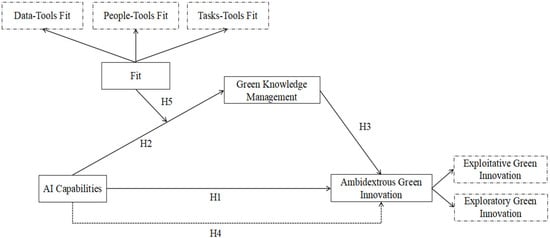
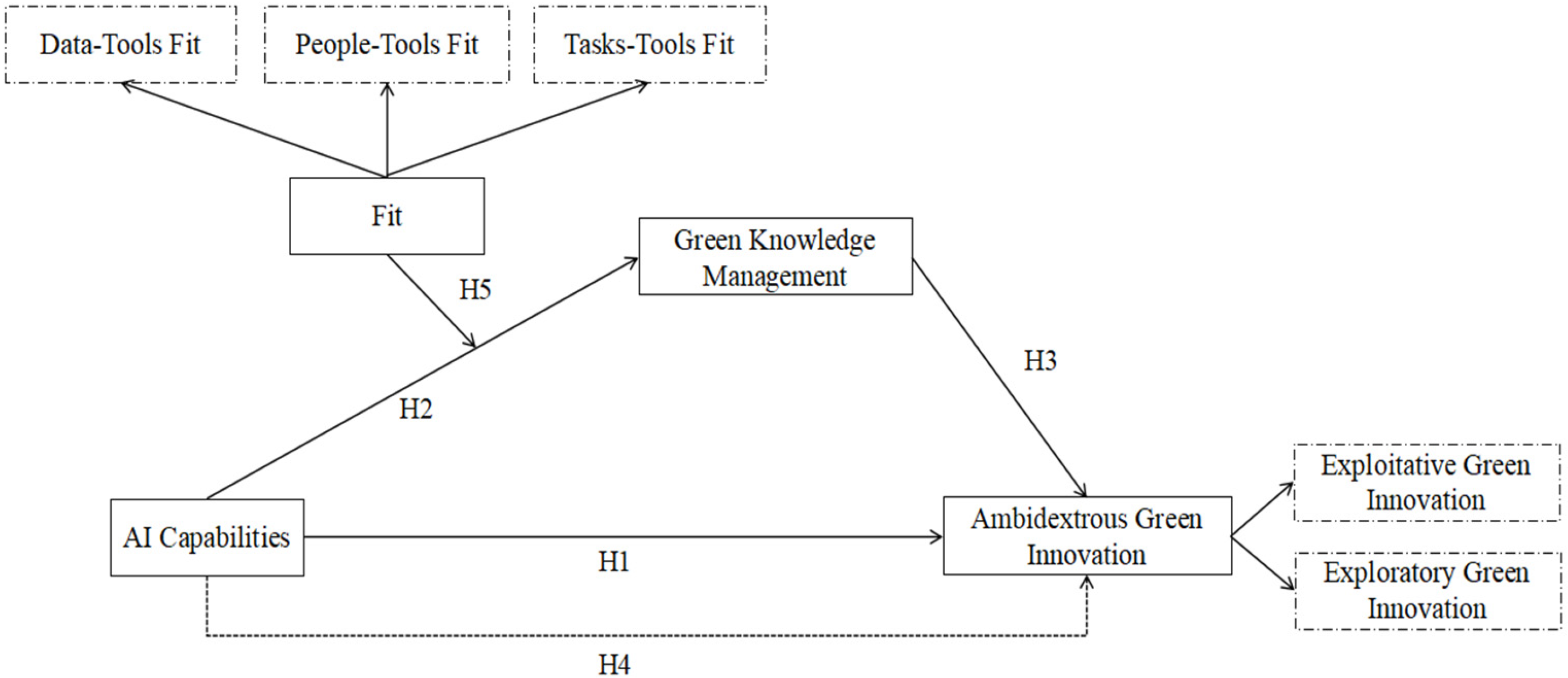
With all the above inputs, a conceptual framework has been developed, which is shown in Figure 1.
Figure 1.
The research model.
4. Materials and Methods
To elucidate the mechanisms through which AI capabilities (AICs) influence ambidextrous green innovation (AGI), this study develops theoretical hypotheses and employs a survey-based empirical methodology for validation. This quantitative design, predicated on rigorous statistical analysis, provides a robust framework for examining the structural relationships between the proposed constructs. Primary data were garnered through online questionnaires, ensuring the comprehensive capture of information relevant to the research objectives. Drawing upon the Resource-Based View (RBV) and Knowledge-Based View (KBV), this study utilizes a questionnaire-based approach to quantitatively analyze the interplay between AICs and AGI, thereby extending the relevant theoretical discourse. A questionnaire-based approach is particularly well suited to this study because it facilitates the operationalization of abstract constructs into measurable indicators, enables efficient data collection from a relatively large sample, and provides a reliable foundation for empirically testing the hypothesized relationships among variables.
4.1. Questionnaire Development
The questionnaire was developed to operationalize and measure the core theoretical constructs: AI capabilities (AICs), ambidextrous green innovation (AGI), Human–Organization–Technology (HOT) fit, and green knowledge management (GKM). All measurement items were adapted from well-validated scales in extant literature and tailored to the specific context of Chinese manufacturing enterprises. A five-point Likert scale (1 = strongly disagree; 5 = strongly agree) was used. To ensure robust reliability and validity, the study prioritized the adoption of mature scales, subjecting them to a rigorous adaptation process. First, content validity was verified by soliciting feedback from a panel of two experts, who assessed item clarity, relevance, and conceptual mapping. Second, to ensure linguistic precision, a standard back-translation procedure was implemented with the assistance of two doctoral students. This process involved translating items from English to Chinese and back to English to guarantee semantic equivalence. Finally, a pilot test conducted with managers from manufacturing enterprises confirmed the instrument’s readability and logical flow. The complete list of items and sources is reported in Table 1.
Table 1.
Constructs and indicators.
AI capabilities (AICs) were operationalized using a five-item scale adapted from Alwakid and Dahri (2025), which encapsulates the computational capacities enabling a firm to recognize, interpret, and learn from data to achieve strategic organizational and societal objectives [34]. Ambidextrous green innovation (AGI) is conceptualized as a reflective second-order construct, comprising two first-order dimensions: exploitative green innovation (EIGI) and exploratory green innovation (ERGI). Specifically, EIGI denotes the identification and utilization of a firm’s extant environmental knowledge and experience, whereas ERGI captures the exploration and acquisition of novel environmental insights, technical expertise, and skills. Both dimensions were measured using items adapted from Sahoo et al. (2024) and Shehzad et al. (2023), with each sub-dimension comprising four specific items [6,33].
Human–Organization–Technology (HOT) fit is conceptualized as a reflective second-order construct, measured through three first-order dimensions: data–tool fit (DTF), human–tool fit (HTF), and task–tool fit (TTF). DTF assesses the degree of congruence between an organization’s existing data infrastructure and the specific processing requirements of AI analytical tools. PTF captures the alignment between employees’ operational competencies, cognitive capacities, and technological functionalities. TTF reflects the matching between AI tool capabilities and the specific requirements of production tasks. This construct was operationalized using the scale developed by Wang et al. (2026), with each sub-dimension comprising three items [40].
Green knowledge management (GKM) represents the systematic process of acquiring, creating, storing, sharing, and applying environmental knowledge to drive sustainability performance. It was measured using a five-item scale adapted from Shehzad et al. (2023) [33].
Additionally, managerial demographic data were incorporated as control variables to account for potential variances stemming from individual differences and industry effects.
4.2. Sampling and Data Collection
The questionnaire design was based on an established framework and insights from prior research. The study focused on managers within China’s manufacturing enterprises, as they possess deeper understanding of their companies’ specific circumstances. Questionnaire design, sampling procedures, and distribution strictly adhered to empirical research standards to ensure data reliability and validity.
Data were collected through the Credamo platform, which enables targeted questionnaire distribution to eligible respondents based on predefined criteria. Registered users on the platform provide demographic and occupational information, allowing the system to identify potential eligible respondents. Before the formal survey, screening questions were used to ensure that participants were managers from Chinese manufacturing enterprises. To reduce potential response bias, the survey was conducted anonymously, respondents were informed that there were no right or wrong answers, and attention-check questions were included. Responses showing obvious regular patterns, duplicate submissions, or excessively short or long completion times were removed. During sample distribution, the survey platform was configured with a 5 km geographic spacing restriction to minimize the risk of duplicate responses from geographically proximate participants. During the data-cleaning stage, the research team used available IP information together with non-sensitive firm identifiers, such as firm size and other background characteristics, to help identify potentially duplicate responses and reduce the likelihood of repeated questionnaires originating from the same enterprise.
A total of 300 responses were initially obtained. After excluding 62 invalid responses, 238 valid questionnaires were retained, yielding an effective response rate of 79.3%. Table 2 presents the demographic characteristics of the respondents. In addition, a G*Power (3.1.9.6) analysis indicated that the minimum required sample size was 172 under a medium effect size (f2 = 0.15), a significance level of 0.05, a statistical power of 0.95, and 10 predictors. Therefore, the final sample size of 238 exceeded the minimum requirement for structural equation modeling.
Table 2.
Demographics of respondents.
5. Results
5.1. Preliminary Data Analysis
Given the multidimensional nature of the proposed framework, this study employed Partial Least Squares Structural Equation Modeling (PLS-SEM) to evaluate the hierarchical model. Compared with other approaches, PLS-SEM is well suited to hierarchical model estimation because it offers stronger explanatory capability while allowing for a more parsimonious analytical structure. In the present study, the model was specified as reflective, since the causal direction is assumed to proceed from the higher-order construct (second-order structure) to the lower-order dimensions (first-order constructs), and then to the observed measurement items. Following established guidelines for hierarchical modeling, PLS-SEM was therefore adopted to estimate the reflective research model [3,41].
Before conducting the formal model analysis, preliminary tests were carried out to confirm the appropriateness of the data. The results showed that all items satisfied the normality criteria: skewness values were within the acceptable range of −2 to 2, and kurtosis values were within the recommended range of −7 to 7. In addition, to assess the potential influence of common method variance, Harman’s single-factor test was performed. The test revealed that the first factor accounted for 37.90% of the total variance, which is below the threshold of 40%, suggesting that common method bias was not a serious concern in this study [42]. Therefore, no common method variance issue exists in this research.
In addition, we conducted competing model comparisons (see Appendix A), which showed that the proposed second-order structures of AGI and HOT fit provided a better model fit than the corresponding single-factor alternatives. These findings further support the appropriateness of treating AGI and HOT fit as second-order constructs in the subsequent analyses.
5.2. Measurement Model Assessment
The study employed SPSS 24.0 and Smart PLS 4.0 to assess the reliability, as well as the convergent and discriminant validity, of the measurement model. The descriptive statistics are shown in Table 3.
Table 3.
Measurement model.
To assess convergent validity, the study first examined Cronbach’s alpha (α) scores, with all dimensional structure scores ranging from 0.855 to 0.902, exceeding the benchmark of 0.70. Furthermore, standardized factor loadings for each item within these structures ranged from 0.773 to 0.923, all surpassing the 0.60 threshold and confirming unidimensionality. The average variance extracted (AVE) for each construct exceeded 0.50, ranging from 0.678 to 0.836. All composite reliability (CR) indices exceeded 0.70, ranging from 0.808 to 0.939. These findings indicate the measurement model possesses robust convergent validity.
Regarding discriminant validity, the study verified that the square root of the AVE for each construct exceeded the inter-construct correlation coefficients. Furthermore, discriminant validity was further assessed using the Heterogeneity Term–Homogeneity Term (HTMT) ratio. All HTMT values fell below the 0.90 threshold, as shown in Table 4, indicating substantial discriminant validity.
Table 4.
Analysis of discriminant validity and descriptive statistics.
Additionally, considering endogeneity issues, variance inflation factor (VIF) tests were conducted to examine potential multicollinearity [43]. The results showed that the VIF values for each item ranged from 1.814 to 3.703, well below the 5.0 threshold. Furthermore, the path coefficients between the primary constructs in the model did not change significantly after adding control variables. Therefore, endogeneity is not a significant concern in this study.
5.3. Structural Model Assessment
After ensuring the appropriateness of the measurement model, we further applied Smart PLS 4.0 software to validate the model fit (SRMR), coefficient of determination (R2), and predictive correlation coefficient (Q2), and path coefficient (β) to assess the overall structural model, where the significance (V-value) was determined based on the 5000 samples bootstrapping program. We constructed a structural equation model with gender, age, education level, working age, enterprise size, and ownership type as control variables, artificial intelligence capability as the independent variable, green knowledge management as the mediating variable, and dual green learning as the dependent variable to analyze the data.
First, the SRMR value of 0.053 falls below the 0.08 threshold, indicating good model fit. The R2 value for AGI is 0.39, indicating that the model explains 39.0% of the variance in AGI. The R2 value for GKM is 0.48, suggesting a moderate level of explanatory power. Furthermore, all Q-values for second-order constructs in the model were positive, signifying that the structural model exhibits strong predictive validity.
After validating the model’s soundness, subsequent analyses confirmed our research hypotheses. AICs exerted a significant positive effect on AGI (β = 0.272, p = 0.004), thus supporting H1. Similarly, AICs exhibited a significant positive effect on GKM (β = 0.513, p < 0.001), supporting H2. GKM demonstrated a significant positive effect on AGI (β = 0.427, p < 0.001), supporting H3. For a detailed analysis of the direct effect testing, please refer to Table 5.
Table 5.
Direct effect test.
To test H4, we examined the mediating role of GKM using the bootstrapping procedure (5000 samples) as suggested by Shi et al. (2022) [44]. Results indicate that AICs exert a significant indirect effect on AGI through GKM (β = 0.219, p < 0.001), with a 95% bias-corrected confidence interval of [0.112, 0.357], excluding zero. Crucially, AICs’s direct effect on AGI remained statistically significant (β = 0.272, p = 0.004). The coexistence of direct and indirect effects indicates a partial mediation effect [45]. While GKM serves as a key mechanism through which AICs enhance AGI, it is not the sole pathway. AICs may jointly drive green innovation via alternative mechanisms, thereby providing more nuanced support for H4. For details, please refer to the mediation effect testing in Table 6.
Table 6.
Mediation effect test.
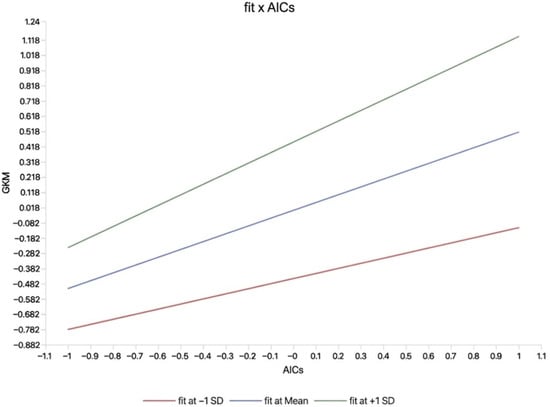
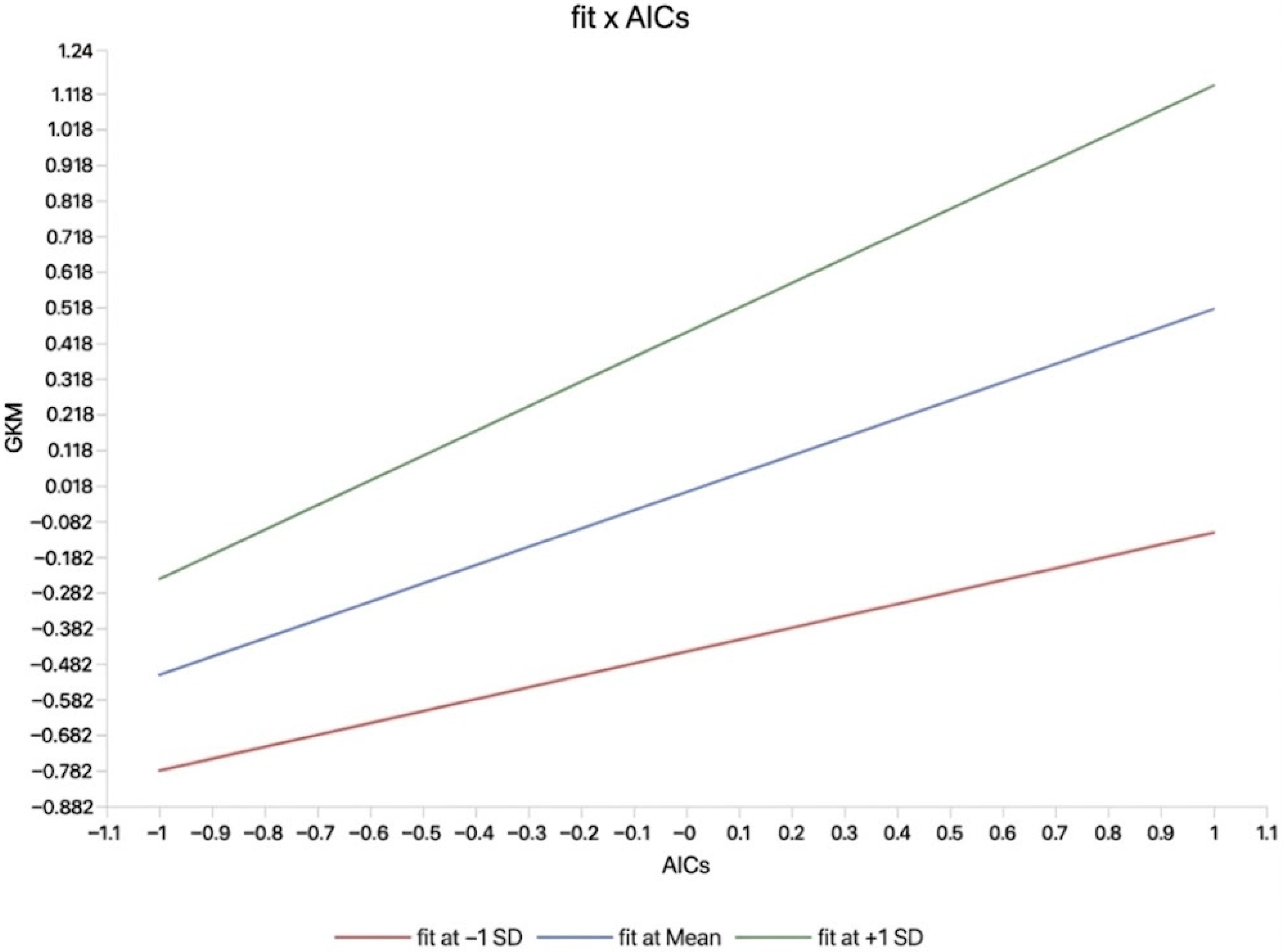
Subsequently, we examined the moderating effect of fit in the research model. Table 7 presents the path coefficients, standard deviations, T-statistics, and the coefficients of determination (R2) for both models. Drawing on Akter et al. (2016) [46]’s methodology, we created an interacting construct by multiplying AI capability with fit. To validate the estimated impact, we assessed the influence of AICs on GKM (β = 0.513, p < 0.001) and examined the interaction between AICs and fit on GKM (β = 0.179, p = 0.02). Furthermore, we employed an incremental F-test to compare the main model with the interaction model. Findings revealed that adding the moderator variable enhanced the model’s predictive power (ΔR2 = 0.210), with the moderation effect exhibiting a small effect size (f = 0.079, p < 0.05). To visualize the nature of this interaction, we plotted the simple slope in Figure 2. As shown, the slope representing the relationship between AICs and GKM is steepest under high-fit (Mean + 1 SD) conditions, whereas it becomes noticeably flatter under low fit (Mean − 1 SD). This pattern indicates that AICs’s positive effect on GKM significantly intensifies when organizational fit is high, while fit deficiency attenuates this effect. These findings fully support H5. Furthermore, this study incorporated personal-level attributes (e.g., gender, age, and education) and organizational-level characteristics (e.g., firm size, firm age, and ownership) as control variables to account for individual differences and firm-level heterogeneity. Structural equation modeling analysis revealed no significant influence of control variables on our research outcomes. A comparison between models with and without control variables revealed negligible fluctuations in the coefficient of determination (R2); for instance, the R2 for AGI changed marginally from 0.390 to 0.364. These statistical results confirm the robustness of the study’s core findings. These findings suggest, in the contemporary context of digitalization and green transformation, AICs and GKM—as core organizational capabilities—serve as significantly stronger predictors of AGI than either respondent demographics or structural organizational characteristics.
Table 7.
Assessment of the higher-order, reflective model.
Figure 2.
The moderating effect of fit on green knowledge management. Note: AICs = AI capabilities; GKM = green knowledge management; fit = human-organization–technology fit; × = moderation effect.
6. Discussion, Conclusions, Implications, and Limitations
6.1. Discussion
Drawing on the Resource-Based View (RBV) and the Knowledge-Based View (KBV), this study explores how manufacturing enterprises can foster ambidextrous green innovation. Utilizing a sample of 238 valid survey responses, the analysis examines the interrelationships between AICs, GKM, and AGI, while incorporating the moderating role of HOT fit [47,48]. The empirical results reveal the following key findings:
First, the results confirm positive correlations between AICs and AGI, AICs and GKM, and GKM and AGI (H1, H2, H3). These findings not only validate AI capabilities as key factors associated with corporate green transformation but also reveal knowledge management as a critical pathway. This aligns with studies by Al Halbusi et al. (2025) [30] and Kumar et al. (2025) [15], indicating that digital technologies are pivotal drivers of corporate innovation. AICs’s robust data analytics capabilities enable enterprises to efficiently identify environmental issues, optimize resource allocation, and support green decision-making, thereby positively correlating with corporate green innovation. Concurrently, AICs are significantly and positively associated with GKM, as it improves enterprises’ capacity to acquire, integrate, and apply both internal and external knowledge. Furthermore, GKM’s positive association with AGI further demonstrates that effective knowledge acquisition, sharing, and utilization constitute a critical mechanism for manufacturing enterprises to achieve synergistic development of exploratory and exploitative green innovation. Given the high complexity and uncertainty of GI—which requires both green innovation in new domains and continuous improvement based on existing knowledge—a robust green knowledge management system serves as a bridge between these two dimensions. It reduces knowledge conversion costs and is linked to higher innovation efficiency [49].
Second, the mediation effect indicates that GKM partially mediates the relationship between AICs and AGI (H4). This implies that the positive link between AI capabilities and AGI does not solely depend on the knowledge management pathway. Mechanistically, AICs are associated with improved enterprises’ data processing, intelligent analysis, and predictive capabilities, supporting faster identification of green innovation opportunities and facilitating exploratory and exploitative innovation. Simultaneously, AICs are positively associated with green knowledge acquisition and application, which support the development of the enterprise’s green knowledge management capabilities [50]. This is associated with higher internal utilization of green knowledge, is linked to lower knowledge conversion and cross-departmental collaboration costs, and contributes to knowledge support for AGI.
Finally, HOT fit strengthens the positive relationship between AICs and GKM. According to HOT-fit theory, high performance is often associated with the alignment and synergy among people, organization, and technology. Higher levels of alignment among people, organization, and technology are linked to a more effective synergy between AICs and GKM [39,51]. High task–tool fit supports the alignment between AIC and the enterprise’s green knowledge needs, contributing to the formation of usable green knowledge reserves. Additionally, high human–tool fit means employees possess the capability to understand and utilize AI tools, supporting the transformation of AI-generated content into organizational green knowledge assets. Moreover, high data–tool fit indicates that data quality, content, and structure are better suited for AI analysis, and are associated with higher efficiency in green knowledge acquisition, validation, and application from the source. Conversely, low fit—manifested in fragmented and low-quality data, mismatched tool capabilities with task requirements, and employee skill gaps—is negatively associated with green knowledge acquisition and application. This may limit the synergy between AICs and GKM, thereby potentially constraining the enterprise’s green innovation capabilities.
6.2. Conclusions
This study delves into the impact mechanism of artificial intelligence capabilities (AICs) on corporate dual-track green innovation (AGI) [52]. Through empirical analysis of manufacturing enterprises, the research concludes as follows: First, AICs serve as the core driver propelling enterprises toward dual-track green innovation. It is not only positively related to both exploitative and exploratory green innovation, but also indirectly supports AGI through its positive association with improved GKM levels. Second, GKM serves as a critical intermediary bridge between AICs and AGI, meaning that technological advantages need to be transformed into internal organizational knowledge assets to effectively support green innovation outputs [53,54]. Third, HOT fit demonstrates a significant positive moderating effect on the relationship between AICs and GKM, highlighting the boundary effects of synergistic collaboration among people, organizations, and technology in digital green transformation. This study not only enriches the application of Resource-Based View (RBV) and Knowledge-Based View (KBV) in AI contexts but also provides theoretical support for manufacturing enterprises to leverage AI technology to overcome green innovation bottlenecks.
6.3. Implications
6.3.1. Theoretical Implications
This study contributes to both the Resource-Based View (RBV) and the Knowledge-Based View (KBV) by showing that AI capabilities function not only as strategic digital resources, but also as enablers of green knowledge management (GKM) that support ambidextrous green innovation (AGI) [15,55]. By empirically testing the pathway “AI capabilities → Green knowledge management → Ambidextrous green innovation”, our research extends the arguments of RBV and KBV beyond traditional tangible resources. It positions AI capabilities as a key strategic resource and GKM as the core transformative mechanism to explain how manufacturing firms achieve AGI in specific contexts.
Second, this study operationalizes green innovation into two distinct forms—EIGI and ERGI—and examines their synergistic effects [56]. Dual-theory emphasizes both tension and complementarity between exploration and exploitation, positioning it as a second-order construct that embodies a higher-level organizational capability [16].
Third, RBV underscores resource scarcity and value, positioning HOT fit as a boundary condition. This indicates resources do not automatically translate into performance; AI capabilities are more likely to be absorbed, utilized, and transformed into green knowledge management advantages only when human, organizational, and technological elements synergistically align [57].
6.3.2. Managerial Implications
Integrating AI capabilities into China’s manufacturing sector provides crucial management insights for advancing AGI. Enterprises should leverage artificial intelligence appropriately, elevating it beyond pilot projects or localized automation to a strategic level. This requires sustained investment in data infrastructure, algorithms, computing power, and operational implementation capabilities to build a sustainable AI capability portfolio [58]. Particularly during the green transformation of manufacturing, AI capabilities should be deployed in scenarios that generate green value, accelerating green innovation outputs and enhancing transformation performance.
Second, AI value does not automatically translate into dual-track green innovation. Enterprises need to transform AI-generated insights into shareable and actionable organizational knowledge through green knowledge management [59]. This involves integrating internal and external green knowledge sources, establishing cross-departmental collaboration mechanisms, and applying AI analysis outcomes to operational processes. Only then can both exploratory and exploitative green innovation be supported.
Third, it is crucial for enterprises to prioritize the mutual alignment of people, organization, and technology. Research indicates that stronger alignment significantly enhances the impact of AI capabilities and green knowledge management, demonstrating that the effective conversion of AI capabilities into green knowledge management advantages largely depends on internal organizational coordination. Therefore, enhancing organizational alignment requires managers to pursue more effective resource allocation and strategic decision-making. Specifically, managers should select appropriate tools based on green business pain points, prioritizing high-value scenarios such as energy consumption optimization, emissions monitoring, process parameter optimization, and green supply-chain collaboration to avoid mismatches between technology and application contexts. Secondly, cultivating information management professionals is key to achieving alignment. Enterprises should address employee capability gaps in data literacy, AI tool usage, model result interpretation, and business transformation to enhance their ability to convert AI outputs into organizational green knowledge. Third, refining processes and institutional safeguards is essential for organizations to accelerate the internal dissemination and adoption of AI analysis outcomes. Finally, on the technical front, organizations should strengthen data governance and system integration, unify data definitions and standards, improve data quality and accessibility, and facilitate connectivity between organizational systems and AI platforms. This ensures data characteristics align with a tool′s technical requirements, thereby enhancing the efficiency of green knowledge extraction, validation, and application from the source.
6.4. Limitations and Future Research
This study has several limitations. First, the cross-sectional design restricts causal inference and fails to capture the dynamic evolution of AICs, GKM, and AGI during the interference cycle. Future research could adopt longitudinal or case-study designs to examine how AICs influence AGI development over time. Second, focusing on China’s manufacturing sector may limit the generalizability of findings, potentially constraining the external validity of conclusions due to contextual factors. During survey distribution, although respondents were screened through the survey platform based on predefined criteria, firms with higher AI integration may have been more inclined to participate, which may have introduced sample bias toward higher AI capabilities levels. Future research could expand to multinational, multi-industry samples and employ stratified sampling or multi-source longitudinal data to enhance the generalizability and robustness of conclusions. Third, although this study employed both procedural and statistical remedies to minimize common method bias, including anonymous responses, no right-or-wrong answer instructions, the removal of invalid questionnaires, and statistical tests, the use of single-source cross-sectional survey data means that common method bias cannot be entirely ruled out. Future research could employ multi-source data, time-lagged measurements, or more robust statistical remedies to further enhance the reliability of the findings. Finally, this study examined moderation effects across only three matching dimensions. Future research could explore additional moderating effects to clarify the boundary conditions of AICs and account for the practical influence of other organizational factors in investment decision-making.
Author Contributions
Conceptualization, W.L. and P.Z.; methodology, W.L.; software, P.Z.; validation, Y.C. and W.L.; formal analysis, P.Z.; investigation, P.Z.; resources, Y.C.; data curation, P.Z.; writing—original draft preparation, P.Z.; writing—review and editing, W.L. and Y.C.; visualization, Y.C.; supervision, Y.C.; project administration, W.L.; funding acquisition, W.L. All authors have read and agreed to the published version of the manuscript.
Funding
This research was funded by [the Key Project of the Beijing Education Science ‘14th Five-Year Plan’ (2023): Deep learning focused research on the development approach and application of higher-order thinking] grant number [BIAA23036]. And The APC was funded by [the Key Project of the Beijing Education Science ‘14th Five-Year Plan’ (2023): Deep learning focused research on the development approach and application of higher-order thinking].
Institutional Review Board Statement
The study was conducted in accordance with the Declaration of Helsinki and approved by the Ethics Committee of Beijing Forestry University (protocol code BJFUPSY-2026-011 and approved on 4 March 2026).
Informed Consent Statement
Informed consent was obtained from all subjects involved in the study.
Data Availability Statement
Dataset available on request from the authors.
Acknowledgments
The authors would like to express their sincere gratitude to all the participants who took the time to complete the questionnaires, as their contributions were essential to the success of this study.
Conflicts of Interest
The authors declare no conflicts of interest.
Abbreviations
The following abbreviations are used in this manuscript:
| AICs | AI capabilities |
| AGI | Ambidextrous green innovation |
| RBV | Resource-Based View |
| KBV | Knowledge-Based View |
| HOT fit | Human–Organization–Technology fit |
| GKM | Green Knowledge Management |
| ERGI | Exploratory green innovation |
| EIGI | Exploitative green innovation |
| DTF | Data-tools fit |
| PTF | People-tools fit |
| TTF | Tasks-tools fit |
| O | Original sample |
| M | Sample mean |
| SD | Standard deviation |
| β | Standardized path coefficient |
| Cls | Confidence intervals |
| n.a. | Not applicable |
Appendix A
Table A1.
Fit indices for competitive models.
References
- Holgado, M.; Niess, A. Resilience in global supply chains: Analysis of responses, recovery actions and strategic changes triggered by major disruptions. Supply Chain Manag. Int. J. 2023, 28, 1040–1059. [Google Scholar] [CrossRef] [Scilit]
- Christopher, M.; Peck, H. Building the Resilient Supply Chain. Int. J. Logist. Manag. 2004, 15, 1–14. [Google Scholar] [CrossRef] [Scilit]
- Gibson, C.B.; Birkinshaw, J. The Antecedents, Consequences, and Mediating Role of Organizational Ambidexterity. Acad. Manag. J. 2004, 47, 209–226. [Google Scholar] [CrossRef] [Scilit]
- Mikalef, P.; Gupta, M. Artificial intelligence capability: Conceptualization, measurement calibration, and empirical study on its impact on organizational creativity and firm performance. Inf. Manag. 2021, 58, 103434. [Google Scholar] [CrossRef] [Scilit]
- Jiao, A.; Lu, J.; Ren, H.; Wei, J. The role of AI capabilities in environmental management: Evidence from USA firms. Energy Econ. 2024, 134, 107653. [Google Scholar] [CrossRef] [Scilit]
- Sahoo, S.; Kumar, S.; Donthu, N.; Singh, A.K. Artificial intelligence capabilities, open innovation, and business performance—Empirical insights from multinational B2B companies. Ind. Mark. Manag. 2024, 117, 28–41. [Google Scholar] [CrossRef] [Scilit]
- Al-Emran, M. Beyond technology acceptance: Development and evaluation of technology-environmental, economic, and social sustainability theory. Technol. Soc. 2023, 75, 102383. [Google Scholar] [CrossRef] [Scilit]
- AL-Khatib, A.W. The impact of industry 4.0 capabilities on operational performance: The mediating effect of supply chain ambidexterity. TQM J. 2025, 37, 125–149. [Google Scholar] [CrossRef] [Scilit]
- Belhadi, A.; Kamble, S.; Gunasekaran, A.; Mani, V. Analyzing the mediating role of organizational ambidexterity and digital business transformation on industry 4.0 capabilities and sustainable supply chain performance. Supply Chain Manag. 2022, 27, 696–711. [Google Scholar] [CrossRef] [Scilit]
- Yusof, M.M.; Kuljis, J.; Papazafeiropoulou, A.; Stergioulas, L.K. An evaluation framework for Health Information Systems: Human, organization and technology-fit factors (HOT-fit). Int. J. Med. Inform. 2008, 77, 386–398. [Google Scholar] [CrossRef] [Scilit] [PubMed]
- Berglund, M.; Karltun, J. Human, technological and organizational aspects influencing the production scheduling process. Int. J. Prod. Econ. 2007, 110, 160–174. [Google Scholar] [CrossRef] [Scilit]
- Gupta, S.; Modgil, S.; Bhattacharyya, S.; Bose, I. Artificial intelligence for decision support systems in the field of operations research: Review and future scope of research. Ann. Oper. Res. 2022, 308, 215–274. [Google Scholar] [CrossRef] [Scilit]
- Makhloufi, L.; Laghouag, A.A.; Meirun, T.; Belaid, F. Impact of green entrepreneurship orientation on environmental performance: The natural resource-based view and environmental policy perspective. Bus. Strategy Environ. 2022, 31, 425–444. [Google Scholar] [CrossRef] [Scilit]
- Alavi, M.; Leidner, D.E. Review: Knowledge management and knowledge management systems: Conceptual foundations and research issues. MIS Q. 2001, 25, 107–136. [Google Scholar] [CrossRef] [Scilit]
- Kumar, S.; Kumar, V.; Chaudhuri, R.; Chatterjee, S.; Vrontis, D. AI capability and environmental sustainability performance: Moderating role of green knowledge management. Technol. Soc. 2025, 81, 102870. [Google Scholar] [CrossRef] [Scilit]
- Fernando, Y.; Chiappetta Jabbour, C.J.; Wah, W.X. Pursuing green growth in technology firms through the connections between environmental innovation and sustainable business performance: Does service capability matter? Resour. Conserv. Recycl. 2019, 141, 8–20. [Google Scholar] [CrossRef] [Scilit]
- Wang, C.H.; Juo, W.J. An environmental policy of green intellectual capital: Green innovation strategy for performance sustainability. Bus. Strategy Environ. 2021, 30, 3241–3254. [Google Scholar] [CrossRef] [Scilit]
- Chen, Y.S.; Chang, C.H.; Lin, Y.H. The determinants of green radical and incremental innovation performance: Green shared vision, green absorptive capacity, and green organizational ambidexterity. Sustainability 2014, 6, 7787–7806. [Google Scholar] [CrossRef] [Scilit]
- Wang, J.; Xue, Y.; Sun, X.; Yang, J. Green learning orientation, green knowledge acquisition and ambidextrous green innovation. J. Clean. Prod. 2020, 250, 119475. [Google Scholar] [CrossRef] [Scilit]
- Wang, J.; Xue, Y.; Yang, J. Boundary-spanning search and firms’ green innovation: The moderating role of resource orchestration capability. Bus. Strategy Environ. 2020, 29, 361–374. [Google Scholar] [CrossRef] [Scilit]
- Barney, J.B. Firm Resources and Sustained Competitive Advantage. In Advances in Strategic Management; Emerald Group Publishing Limited: Leeds, UK, 1991; Volume 17, pp. 3–10. [Google Scholar] [CrossRef] [Scilit]
- Ooi, K.B. TQM: A facilitator to enhance knowledge management? A structural analysis. Expert Syst. Appl. 2014, 41, 5167–5179. [Google Scholar] [CrossRef] [Scilit]
- Yusr, M.M.; Mokhtar, S.S.M.; Othman, A.R.; Sulaiman, Y. Does interaction between TQM practices and knowledge management processes enhance the innovation performance? Int. J. Qual. Reliab. Manag. 2017, 34, 955–974. [Google Scholar] [CrossRef] [Scilit]
- Abbas, J.; Sağsan, M. Impact of knowledge management practices on green innovation and corporate sustainable development: A structural analysis. J. Clean. Prod. 2019, 229, 611–620. [Google Scholar] [CrossRef] [Scilit]
- Lim, M.K.; Tseng, M.L.; Tan, K.H.; Bui, T.D. Knowledge management in sustainable supply chain management: Improving performance through an interpretive structural modelling approach. J. Clean. Prod. 2017, 162, 806–816. [Google Scholar] [CrossRef] [Scilit]
- Mancuso, I.; Petruzzelli, A.M.; Panniello, U.; Frattini, F. The role of explainable artificial intelligence (XAI) in innovation processes: A knowledge management perspective. Technol. Soc. 2025, 81, 102909. [Google Scholar] [CrossRef] [Scilit]
- Waseel, A.H.; Zhang, J.; Zia, U.; Mohsin, M.M.; Hussain, S. Leadership, knowledge dynamics and dual-path innovation: Unravelling the synergy in Pakistan’s manufacturing sector. J. Bus. Ind. Mark. 2024, 39, 2104–2122. [Google Scholar] [CrossRef] [Scilit]
- Ghasemaghaei, M.; Hassanein, K.; Turel, O. Increasing firm agility through the use of data analytics: The role of fit. Decis. Support Syst. 2017, 101, 95–105. [Google Scholar] [CrossRef] [Scilit]
- Wamba, S.F.; Queiroz, M.M.; Braganza, A. (Eds.) Artificial Intelligence in Operations Management; Springer: Cham, Switzerland, 2022. [Google Scholar]
- Al Halbusi, H.; Al-Sulaiti, K.I.; Alalwan, A.A.; Al-Busaidi, A.S. AI capability and green innovation impact on sustainable performance: Moderating role of big data and knowledge management. Technol. Forecast. Soc. Change 2025, 210, 123897. [Google Scholar] [CrossRef] [Scilit]
- Baquero, A. Linking green entrepreneurial orientation and ambidextrous green innovation to stimulate green performance: A moderated mediation approach. Bus. Process Manag. J. 2024, 30, 71–98. [Google Scholar] [CrossRef] [Scilit]
- Wang, S.; Zhang, H. Inter-organizational cooperation in digital green supply chains: A catalyst for eco-innovations and sustainable business practices. J. Clean. Prod. 2024, 472, 143383. [Google Scholar] [CrossRef] [Scilit]
- Shehzad, M.U.; Zhang, J.; Latif, K.F.; Jamil, K.; Waseel, A.H. Do green entrepreneurial orientation and green knowledge management matter in the pursuit of ambidextrous green innovation: A moderated mediation model. J. Clean. Prod. 2023, 388, 135971. [Google Scholar] [CrossRef] [Scilit]
- Alwakid, W.N.; Dahri, N.A. Harnessing AI capabilities and green entrepreneurial orientation for sustainable SME performance using SEM analysis approach. Technol. Soc. 2025, 83, 103007. [Google Scholar] [CrossRef] [Scilit]
- Chen, Y.S.; Chang, C.H.; Lin, S.H. Green transformational leadership and green performance: The mediation effects of green mindfulness and green self-efficacy. Sustainability 2014, 6, 6604–6625. [Google Scholar] [CrossRef] [Scilit]
- Sahoo, S.; Kumar, A.; Upadhyay, A. How do green knowledge management and green technology innovation impact corporate environmental performance? Understanding the role of green knowledge acquisition. Bus. Strategy Environ. 2023, 32, 551–564. [Google Scholar] [CrossRef] [Scilit]
- Mehmood, K.; Kautish, P.; Mehrotra, A.; Alofaysan, H.; Papa, A. Forging sustainable synergies: Unleashing fintech-driven supply chain collaboration for enhanced green supply chain performance. Technol. Forecast. Soc. Change 2025, 219, 124244. [Google Scholar] [CrossRef] [Scilit]
- Feroz, A.K.; Zo, H.; Chiravuri, A. Digital Transformation and Environmental Sustainability: A Review and Research Agenda. Sustainability 2021, 13, 1530. [Google Scholar] [CrossRef] [Scilit]
- Goodhue, D.L.; Thompson, R.L. Task-technology fit and individual performance. MIS Q. 1995, 19, 213–236. [Google Scholar] [CrossRef] [Scilit]
- Wang, J.; Shi, Y.; Jiang, X.; Venkatesh, V.G. How does artificial intelligence capacity enhance the production system resilience and operational performance? A human-organization-technology fit perspective. Int. J. Inf. Manag. 2026, 87, 103023. [Google Scholar] [CrossRef] [Scilit]
- Vial, G. Understanding digital transformation: A review and a research agenda. J. Strateg. Inf. Syst. 2019, 28, 118–144. [Google Scholar] [CrossRef] [Scilit]
- Podsakoff, P.M.; Organ, D.W. Self-reports in organizational research: Problems and prospects. J. Manag. 1986, 12, 531–544. [Google Scholar] [CrossRef] [Scilit]
- Li, Y.; Dai, J.; Cui, L. The impact of digital technologies on economic and environmental performance in the context of industry 4.0: A moderated mediation model. Int. J. Prod. Econ. 2020, 229, 107777. [Google Scholar] [CrossRef] [Scilit]
- Shi, S.; Leung, W.K.; Munelli, F. Gamification in OTA platforms: A mixed-methods research involving online shopping carnival. Tour. Manag. 2022, 88, 104426. [Google Scholar] [CrossRef] [Scilit]
- Armstrong, J.S.; Overton, T.S. Estimating nonresponse bias in mail surveys. J. Mark. Res. 1977, 14, 396–402. [Google Scholar] [CrossRef] [Scilit]
- Akter, S.; Wamba, S.F.; Gunasekaran, A.; Dubey, R.; Childe, S.J. How to improve firm performance using big data analytics capability and business strategy alignment? Int. J. Prod. Econ. 2016, 182, 113–131. [Google Scholar] [CrossRef] [Scilit]
- Farzaneh, M.; Wilden, R.; Afshari, L.; Mehralian, G. Dynamic capabilities and innovation ambidexterity: The roles of intellectual capital and innovation orientation. J. Bus. Res. 2022, 148, 47–59. [Google Scholar] [CrossRef] [Scilit]
- Kraus, S.; Vonmetz, K.; Orlandi, L.B.; Zardini, A.; Rossignoli, C. Digital entrepreneurship: The role of entrepreneurial orientation and digitalization for disruptive innovation. Technol. Forecast. Soc. Change 2023, 193, 122638. [Google Scholar] [CrossRef] [Scilit]
- Zhou, Q.; Dekkers, R.; Chia, R. Are James March’s ‘exploration’and ‘exploitation’separable? Revisiting the dichotomy in the context of innovation management. Technol. Forecast. Soc. Change 2023, 192, 122592. [Google Scholar] [CrossRef] [Scilit]
- Wang, Z.; Hou, M.; Luo, W. Green Knowledge Management and Green Technology Innovation: Roles of Green Organizational Identity and Incentive Environmental Regulation. Sustainability 2025, 17, 10781. [Google Scholar] [CrossRef] [Scilit]
- Venkatesh, V.; Morris, M.G.; Davis, G.B.; Davis, F.D. User acceptance of information technology: Toward a unified view. MIS Q. 2003, 27, 425–478. [Google Scholar] [CrossRef] [Scilit]
- Song, Y.; Zhang, L.; Dong, X.; Zhang, M. Can environmental regulation foster incremental enhancement and quality improvement in green technological innovation under the background of the digital development? Environ. Dev. Sustain. 2024, 27, 27781–27797. [Google Scholar] [CrossRef] [Scilit]
- Shen, Z.M.; Sun, Y. Strengthening supply chain resilience during COVID-19: A case study of JD.com. J. Oper. Manag. 2023, 69, 359–383. [Google Scholar] [CrossRef] [Scilit]
- Jiang, Y.; Feng, T.; Huang, Y. Antecedent configurations toward supply chain resilience: The joint impact of supply chain integration and big data analytics capability. J. Oper. Manag. 2024, 70, 257–284. [Google Scholar] [CrossRef] [Scilit]
- Mahdi, O.R.; Nassar, I.A.; Almsafir, M.K. Knowledge management processes and sustainable competitive advantage: An empirical examination in private universities. J. Bus. Res. 2019, 94, 320–334. [Google Scholar] [CrossRef] [Scilit]
- Raisch, S.; Birkinshaw, J. Organizational ambidexterity: Antecedents, outcomes, and moderators. J. Manag. 2008, 34, 375–409. [Google Scholar] [CrossRef] [Scilit]
- Melville, N.; Kraemer, K.; Gurbaxani, V. Review: Information technology and organizational performance: An integrative model of IT business value. MIS Q. 2004, 28, 283–322. [Google Scholar] [CrossRef] [Scilit]
- Duan, Y.; Edwards, J.S.; Dwivedi, Y.K. Artificial intelligence for decision making in the era of big data—evolution, challenges and research agenda. Int. J. Inf. Manag. 2019, 48, 63–71. [Google Scholar] [CrossRef] [Scilit]
- Chaudhuri, R.; Chatterjee, S.; Kraus, S.; Vrontis, D. Assessing the AI-CRM technology capability for sustaining family businesses in times of crisis: The moderating role of strategic intent. J. Fam. Bus. Manag. 2023, 13, 46–67. [Google Scholar] [CrossRef] [Scilit]

Disclaimer/Publisher’s Note: The statements, opinions and data contained in all publications are solely those of the individual author(s) and contributor(s) and not of MDPI and/or the editor(s). MDPI and/or the editor(s) disclaim responsibility for any injury to people or property resulting from any ideas, methods, instructions or products referred to in the content. |
© 2026 by the authors. Licensee MDPI, Basel, Switzerland. This article is an open access article distributed under the terms and conditions of the Creative Commons Attribution (CC BY) license.