1. Introduction
Ensuring the uninterrupted availability of essential medicines is a persistent challenge in public healthcare systems, especially in oncology services, where stockouts have direct clinical, ethical, economic, and, increasingly, environmental consequences [
1,
2]. Emergency replenishment often involves expedited logistics and additional packaging, which amplify the carbon footprint and pharmaceutical waste associated with reactive supply practices [
3]. Thus, inventory resilience is not only a matter of service continuity but also of sustainability in resource-constrained health systems [
4].
Public hospitals operate under structural constraints—limited budgets, rigid public procurement, fragmented information systems, and heterogeneous demand—that elevate vulnerability and complicate resilient and environmentally responsible inventory management [
1,
5]. These constraints hinder the adoption of proactive strategies that could simultaneously improve therapeutic continuity and reduce environmental externalities, aligning with global sustainability goals such as SDG 3 and SDG 12 [
6].
Recent advances in stochastic inventory management have emphasized the importance of explicitly modelling demand uncertainty, lead-time variability, and service-level trade-offs in healthcare supply chains. This body of work highlights the limitations of static policies and supports the adoption of adaptive, data-driven forecasting and inventory models [
7].
In parallel, risk-aware supply chain research has incorporated multi-dimensional risk factors—such as demand variability, supply uncertainty, and large-scale disruption effects—into analytical decision-making frameworks. These approaches increasingly rely on probabilistic modelling and structured risk-assessment methodologies to prioritize critical items and enhance supply chain viability [
8,
9].
Furthermore, the growing literature on data-driven decision support systems in hospital operations has demonstrated the value of integrating operational data, analytical modelling, and simulation-based approaches to support real-time decision-making and improve resource allocation. Recent systematic reviews highlight how data exploitation and AI-enabled clinical decision support systems can enhance the quality, robustness, and responsiveness of healthcare operations [
10,
11].
Over the last decades, scholarship in healthcare supply chains has advanced inventory optimization, demand forecasting, and efficiency-oriented policies [
12,
13]. Yet, much of this evidence remains disconnected from public-sector institutional realities and regulatory constraints, particularly in Latin American contexts, and rarely addresses the environmental dimension of supply chain decisions [
14]. This gap is consistent with prior work in Chilean hospital contexts, which shows the benefits and constraints of lot-sizing under stochastic demand [
15]. Three gaps motivate this study.
First, there is a lack of
end-to-end analytical approaches that explicitly integrate public procurement, inventory control, continuity of clinical care, and sustainability into a single operational governance framework. Studies typically treat inventory in isolation and overlook how procurement constraints, supplier performance, clinical risk, and environmental impact interact systemically [
1,
3,
5]. We address this by proposing an integrated, governance-oriented framework that links purchasing mechanisms, inventory behaviour, therapeutic continuity, and environmental performance via unified metrics, dashboards, and scenario-based evaluation.
Second, empirical evidence from public hospitals with real operational data—particularly in oncology and Latin America—remains limited. Prior work often uses simulated or private-sector datasets, hindering external validity for public systems with budget rigidities, regulatory requirements, and demand variability. Moreover, the environmental implications of reactive inventory policies, such as increased transport emissions and waste from emergency orders, are seldom quantified [
2,
14]. We contribute evidence from a high-complexity public oncology hospital in Chile (2023–2024), identifying operational stockout drivers (e.g., delayed tenders, supplier non-compliance, emergency purchases) and classifying them by institutional origin [
16,
17].
Third, there is a persistent gap between descriptive analytics and actionable decision support. While ABC–XYZ classification is widely used to characterise consumption value and demand variability, it is seldom translated into dynamic operational rules [
18,
19]. In practice, this yields static parameterisation, uniform service levels, and limited responsiveness to shifting risk—including environmental risk from inefficient replenishment. We close this gap by operationalising risk-informed policies that transform descriptive analysis into action: adaptive reorder points, safety stock adjustments, and alert thresholds tied to explicit service-level, economic, and sustainability implications.
Building on these gaps, we propose a
data-driven,
risk-informed framework for pharmaceutical inventory management in a public oncology hospital. Methodologically, we integrate descriptive analytics and ABC–XYZ classification with a continuous-review policy (
s,
Q) extended through a dynamic risk-based approach [
20,
21]. We construct a Logistic Risk Index (LRI) that combines demand variability, supply performance, and clinical criticality proxies, so that inventory parameters adjust to systemic risk for each medicine rather than uniform service levels. Scenario-based analyses compare the baseline configuration versus the risk-informed policy, assessing impacts on stockout exposure, replenishment timeliness, operational efficiency, and estimated environmental benefits [
5,
11]. In parallel, we operationalise
governance and decision support via actionable indicators, thresholds, and monitoring tools that strengthen coordination across clinical, logistical, and administrative teams [
22,
23].
In sum, the framework enables public health institutions to transition from reactive inventory management toward
risk-aware,
evidence-based governance, providing a transferable blueprint that supports service continuity, operational resilience, and sustainable resource allocation [
1,
4,
5].
From a methodological perspective, the primary contribution of this study is not the introduction of new individual analytical techniques but the integration of established inventory management methods into a unified, risk-informed governance framework. This integration enables a direct operational linkage between descriptive analytics (ABC–XYZ), multi-dimensional risk assessment (LRI), and inventory policy parameterization ((s, Q)), which is rarely addressed in a coherent and empirically grounded manner in the healthcare supply chain literature. In this context, the Logistic Risk Index (LRI) represents the central innovative component of the framework. Unlike traditional multi-criteria risk scoring approaches, which often rely on extensive expert elicitation or complex weighting schemes, the LRI is designed as a data-driven, interpretable, and operationally implementable composite indicator. It translates multiple sources of logistical and clinical risk into actionable inventory decisions, thereby bridging the gap between analytical modelling and institutional governance in public healthcare systems.
1.1. System Boundaries and Governance Architecture
Consistent with core systems and socio-technical perspectives [
24,
25,
26,
27,
28,
29], we conceptualize pharmaceutical inventory management as an integrated
ocio-technical system where analytical policies, institutional constraints, and governance routines interact within explicit operational boundaries.
1.1.1. System Boundary
The boundary of analysis includes: (i) Oncology Pharmacy (FO) and Central Pharmacy (FC) as operational nodes; (ii) procurement channels—CENABAST, public tender, and direct/urgent purchasing—with their lead-time distributions and service constraints; (iii) supplier performance under public procurement regulation; (iv) clinical demand patterns shaped by oncology protocols; and (v) environmental externalities associated with transport and packaging of replenishment orders. Following the systems canon, we emphasise feedback, stocks/flows, and decision rules as structural determinants of behaviour [
25,
26].
1.1.2. Information and Decision Flows
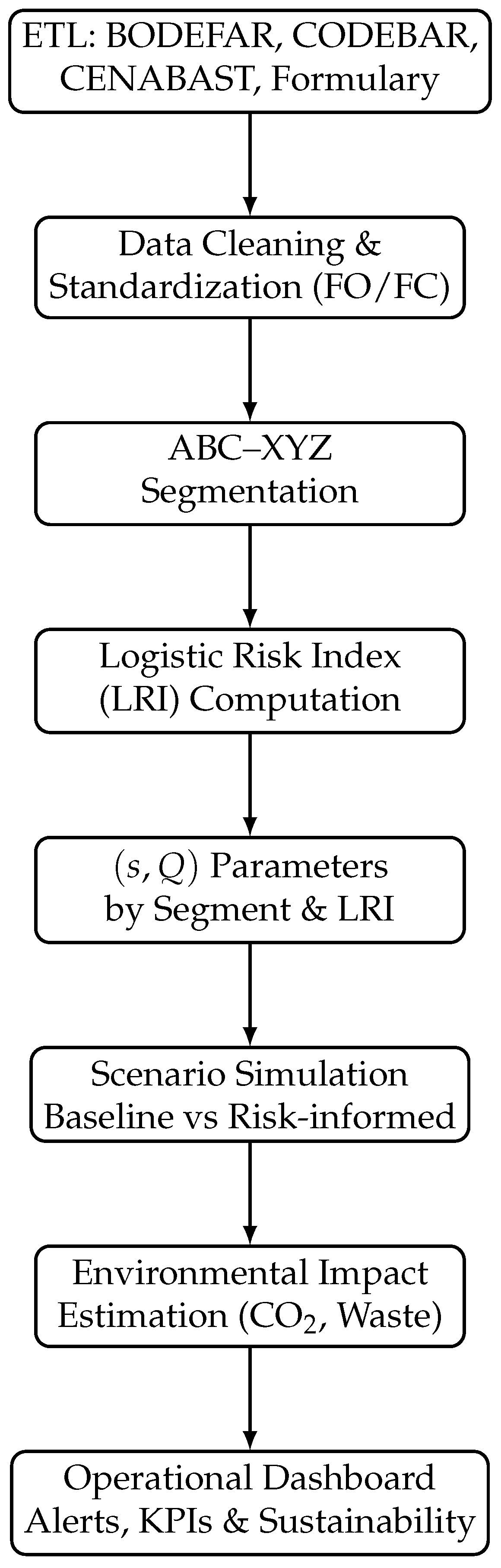
Information circulates bidirectionally among clinical services (treatment schedules), pharmacy operations (consumption, stock levels, reorder triggers), procurement (POs, supplier compliance), and administration (budget governance). Feedback loops are central: stockouts can trigger urgent purchasing, increasing carbon emissions and packaging waste and raising administrative burden, which tightens budget constraints and reinforces the need for proactive, risk-informed planning; conversely, improved visibility (ETL, dashboards) and differentiated service targets reduce stockout exposure and urgent orders, stabilising total logistics costs. This joint optimisation of the social and technical subsystems reflects sociotechnical design principles [
27] and viable governance structures [
28].
1.1.3. Governance and Analytics Layer
ABC–XYZ segmentation, the Logistic Risk Index (LRI), and continuous-review (
s,
Q) policies operate as decision rules within the governance layer: segmentation and LRI modulate service levels and alert thresholds; (
s,
Q) translates those targets into operational parameters per item and channel; and the dashboard provides continuous monitoring and auditability. This framing positions inventory decisions not as isolated calculations but as governance processes embedded in a system of interdependent clinical, logistical, administrative, and environmental objectives—coherent with systems thinking foundations and system safety/governance ideas in complex sociotechnical settings [
24,
29].
In this paper, the aim is to develop and empirically validate a data-driven, risk-informed governance framework for pharmaceutical inventory management in a public oncology hospital, explicitly linking inventory analytics, stochastic risk, and sustainability outcomes to the continuity of therapeutic service. The proposed approach integrates descriptive analytics, ABC–XYZ segmentation, a Logistic Risk Index (LRI), and a continuous-review inventory policy within a transparent decision-support and governance structure grounded in real operational data.
The remainder of the paper is organised as follows.
Section 2 presents the Materials and Methods, distinguishing between the empirical study design and data architecture (
Section 2.1) and the simulation-based evaluation framework (
Section 2.3). The empirical subsection details the institutional context, data sources, variable construction, ABC–XYZ segmentation, and the formulation of the Logistic Risk Index, while the simulation subsection describes the Monte Carlo design used to assess alternative inventory policies under stochastic demand and lead-time conditions.
Section 3 reports the Results, structured analogously into empirical findings (
Section 3.1) and simulation outcomes (
Section 3.2). The empirical results characterise portfolio asymmetries, procurement risk, and inventory parameter misalignment, whereas the simulation results quantify the effects of risk-informed policies on stockout exposure, service continuity, logistical costs, and environmental indicators.
Section 4 discusses the findings in relation to the existing literature, emphasising governance implications, economic trade-offs, and sustainability considerations. Finally,
Section 5 summarises the main contributions of the study and outlines directions for future research.
3. Results
3.1. Empirical Study
Study Scope and Portfolio Characterisation. The empirical analysis distinguishes between the Oncology Pharmacy (FO) and the Central Pharmacy (FC) to provide institutional context and comparative insight into portfolio structure and procurement dynamics between the years 2023 and 2024. While both units are analysed descriptively, the subsequent policy evaluation and simulation focus primarily on FO, given its disproportionate concentration of pharmaceutical expenditure, clinical criticality, and logistical risk. This targeted focus enables the proposed risk-informed framework to be evaluated in areas where inventory decisions have the greatest potential impact on therapeutic continuity and sustainability outcomes. As shown in
Table 2, FO manages a substantially smaller number of medicines than FC, yet concentrates the majority of total pharmaceutical expenditure.
In 2024, FO accounted for approximately CLP 5.76 billion, compared to CLP 0.82 billion in FC. This asymmetric distribution confirms the strategic relevance of FO as the focal unit for risk-based inventory analysis, since marginal deviations in inventory parameters may translate into disproportionately large financial and clinical impacts.
Integrated Data Structure. A unified analytical dataset was constructed at the individual medicine level by integrating consumption records, procurement transactions, inventory parameters, administrative cost structures, and operational event logs. For each medicine, the dataset includes monthly and annual demand, unit acquisition cost, procurement channel, lead time statistics, institutional reorder points, and recorded operational disruptions.
This integrated structure ensures full traceability between empirical data and the decision rules defined in the methodological framework.
Procurement Lead Time Structure. Lead time behaviour differs substantially across procurement modalities. After excluding extreme outliers, descriptive statistics were computed for valid observations (
Table 3). Purchases through CENABAST exhibited a median lead time of 29 days, whereas public tendering showed a longer median of 39 days and higher dispersion.
Additionally, the mismatch between planned consumption and actual delivery dates was significantly larger for tender-based procurement, highlighting structurally heterogeneous supply risks across channels.
ABC–XYZ Segmentation Results. The ABC–XYZ classification reveals a highly concentrated expenditure structure in the FO subunit. As reported in
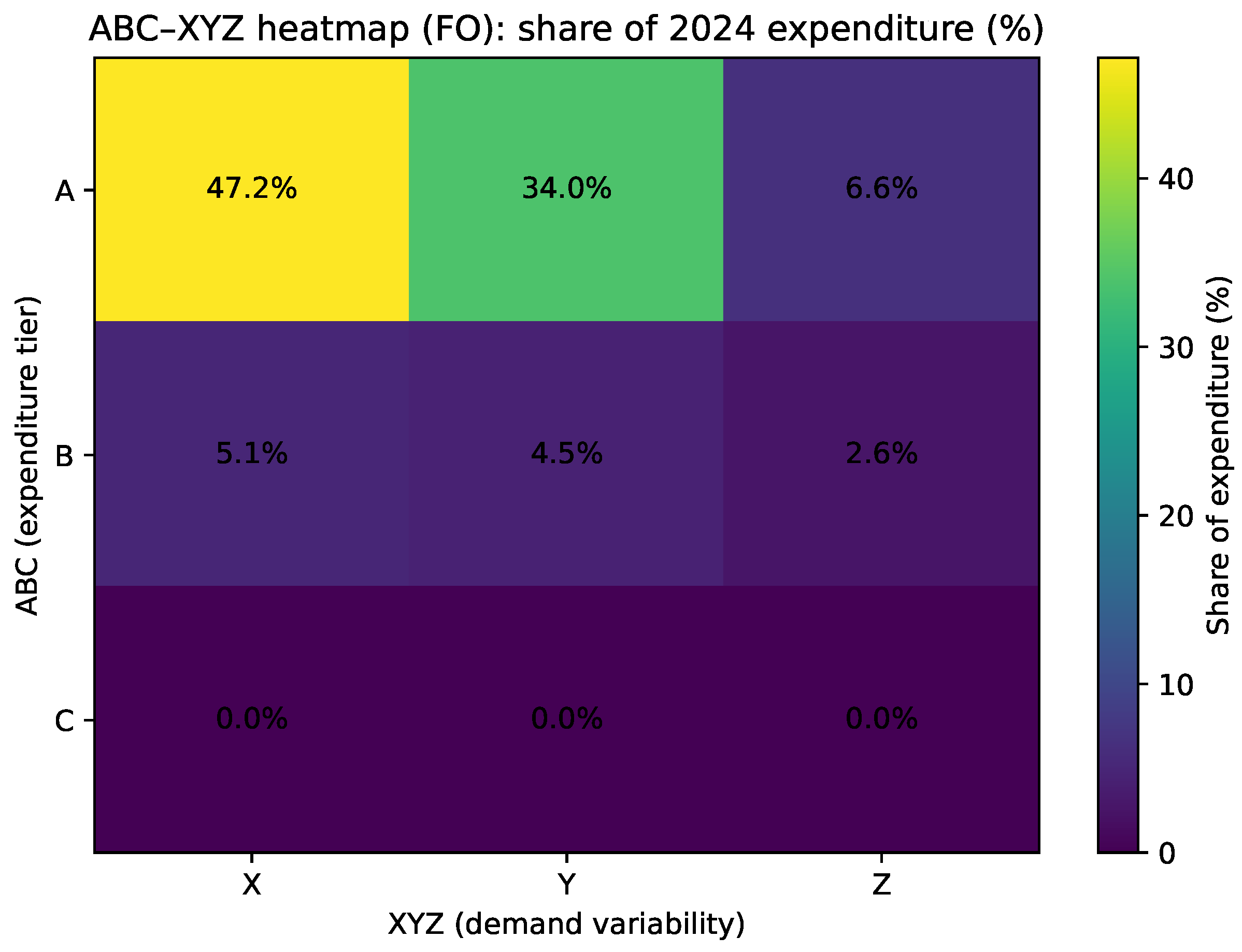
Table 4, segments AX and AY jointly account for more than 80% of total pharmaceutical expenditure in 2024, despite representing a minority of items.
Figure 2 provides a compact visualisation of the ABC–XYZ segmentation for FO, reporting each segment’s share of the total 2024 expenditure. The heatmap highlights expenditure concentration in the most economically critical classes and reveals the presence of variable-demand medicines in segments with lower monetary weight.
Segments AZ and BZ, although less significant in monetary terms, exhibit high demand variability, indicating potential operational instability. Comparable patterns, with lower absolute values, are observed in the FC subunit (
Table 5).
Logistic Risk Index Distribution. The Logistic Risk Index (LRI) was computed for all FO medicines using the weighted structure defined in the methodology.
Table 6 summarizes the resulting risk distribution, while
Table 7 reports the medicines with the highest LRI values.
High-risk medicines systematically combine large deviations in reorder parameters, elevated demand variability, structurally variable lead times, and recurrent operational events.
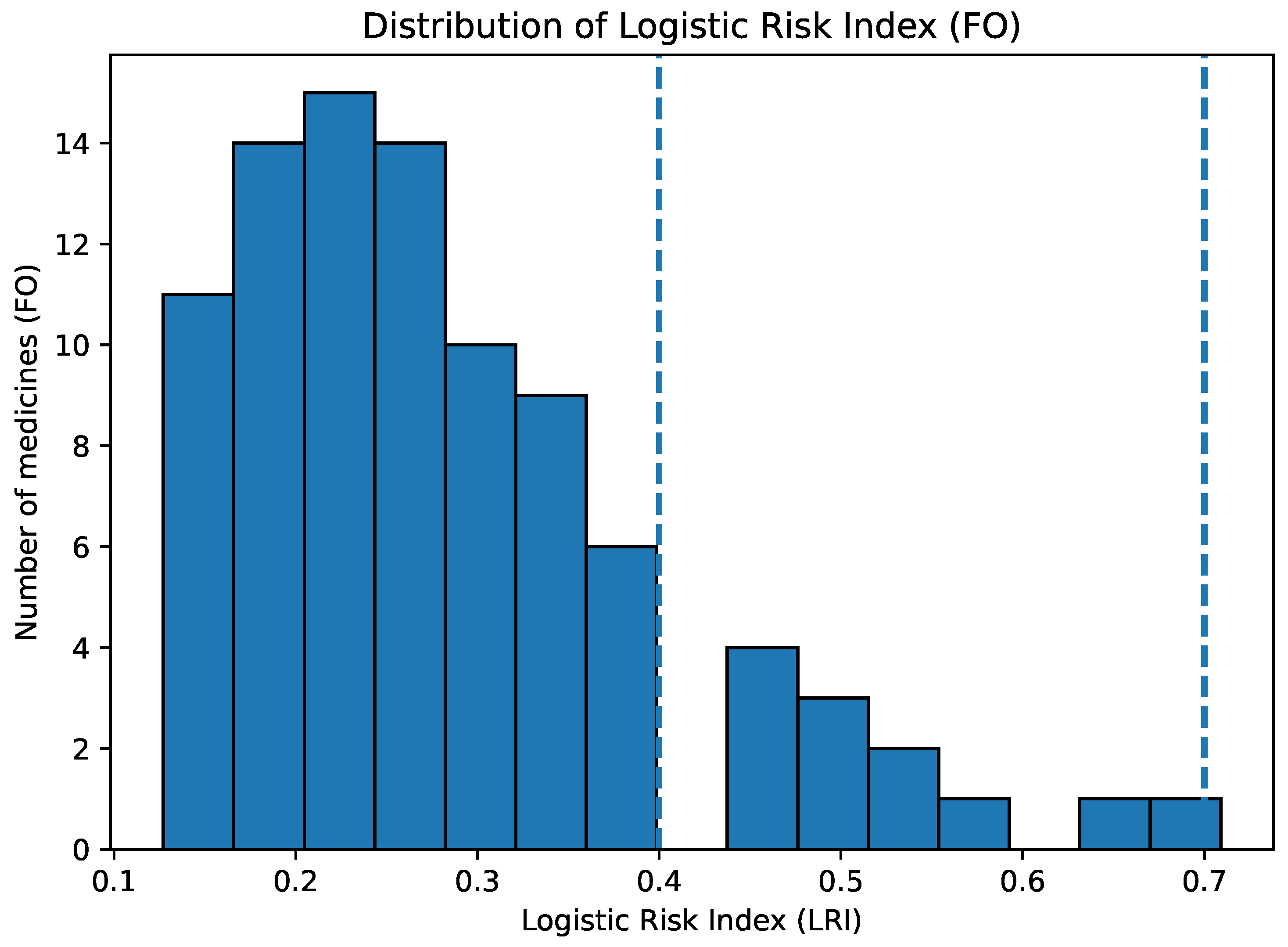
Figure 3 summarises the empirical distribution of the Logistic Risk Index (LRI) for FO medicines. The vertical thresholds at 0.40 and 0.70 correspond to the Low/Medium and Medium/High risk tiers, respectively, and visually support the risk-based screening and selection step described above.
Selection of Medicines for Policy Evaluation. Applying the selection criteria defined in
Section 2, a reduced subset of FO medicines was identified for detailed policy evaluation (
Table 8). Despite its limited size, this subset concentrates the highest levels of logistical vulnerability according to the composite risk metric.
Risk-Based Inventory Parameter Estimation. For the selected medicines, continuous review inventory parameters were recalculated using the proposed risk-adjusted framework.
Table 9 reports estimated safety stock levels, reorder points, and economic order quantities, together with their institutional counterparts.
The results reveal substantial misalignment between existing institutional parameters and analytically derived values, confirming the limitations of static inventory rules in heterogeneous, risk-prone hospital pharmaceutical environments. The magnitude of the differences between institutional and analytically derived reorder points (∆s) is primarily driven by three interacting factors. First, demand variability directly influences safety stock requirements, leading to higher reorder points for medicines with volatile consumption patterns. Second, parameter misalignment between institutional settings and analytically implied values (∆PR) contributes significantly to the observed gaps, particularly where existing reorder points do not reflect updated demand or lead-time conditions. Third, the incorporation of risk-based adjustments through the Logistic Risk Index (LRI) further amplifies these differences for medicines classified in higher-risk tiers.
In particular, for medicines such as Dexamethasone phosphate 4 mg, the large adjustment reflects a combination of substantial parameter misalignment and the integration of variability and risk dimensions that are not fully captured under static institutional policies. This highlights the limitations of uniform parameterization and reinforces the value of risk-informed inventory design.
Environmental Baseline and Potential Gains. Analysis of urgent order logs shows that the institutional baseline generated an average of 27.4 urgent orders per year for the FO portfolio. Under the risk-informed configuration, this figure would decrease to approximately 14.8 orders, representing a reduction of 12.6 urgent shipments annually. Applying the emission factor (50 kg CO2/order) and packaging waste proxy (2 kg/order), this translates into an estimated avoidance of 630 kg CO2 and 25 kg of packaging waste per year. These results confirm that operational improvements are accompanied by measurable sustainability gains, reinforcing the relevance of integrated socio-economic-environmental governance.
Having established the empirical behaviour of the portfolio and the LRI distribution, we now examine the robustness of LRI-driven prioritisation before propagating variants into the simulation.
3.1.1. Internal Validation
LRI tiers aligned coherently with descriptive risk markers. Items in Y/Z classes concentrated in the upper LRI terciles, and A/B expenditure segments accounted for the majority of High LRI cases, indicating that the index simultaneously captures operational variability and clinical–economic salience. At baseline, LRI was positively associated with stockout exposure and urgent-order frequency (positive rank correlations and significant median contrasts), supporting its operational face validity.
3.1.2. Weight Sensitivity (OAT and Global)
Under the OAT sensitivity analysis (±20% variation per weight), 6.6% of items changed risk tier, while the prioritised set remained highly stable (Jaccard similarity = 0.88). In the global sensitivity analysis (Dirichlet sampling, N = 10,000), median top-k stability reached 0.91, with a relatively narrow 5th–95th percentile range of 0.84–0.96. In global sensitivity (Dirichlet, N = 10,000), median top-k stability was high and the 5th–95th percentile band was narrow, indicating that prioritisation is robust to reasonable variations in judgment. Sensitivity was higher when amplifying “Events” or “ ∆PR,” consistent with their role as triggers for reparameterization of s/SS. Overall, the results indicate that the LRI is robust to reasonable variations in weight selection and that the resulting prioritisation and policy adjustments are not driven by a specific parameter configuration.
Table 10 summarises the main quantitative results of the sensitivity analysis, providing explicit evidence that LRI-based prioritisation remains stable across a wide range of plausible weighting configurations.
3.1.3. Scaling and Threshold Sensitivity
Replacing min–max with robust scaling (median + IQR) and shifting thresholds by ±0.05 yielded high prioritised-set stability; tier changes were concentrated near cut points. Across scenarios, items motivating the largest (s, SS, Q) adjustments under the continuous-review policy remained within the prioritised set in the large majority of cases, suggesting that intervention targeting is stable.
3.1.4. Operational Implications
Propagating LRI variants into the simulation (
Section 2.3) maintained reductions in stockout exposure and urgent orders within the previously reported ranges, with narrow 5th–95th percentile bands. Overall, the LRI is sufficiently robust to guide prioritisation and (
s,
Q) reparameterization in a public oncology setting without hinging on a unique set of weights or thresholds.
3.1.5. Intermittent Demand (Z-Class)
Applying the conservative treatment described in Methods did not materially affect prioritisation: Z-class items retained their original tiering, and (s, SS, Q) adjustments remained consistent with the main configuration.
3.2. Simulation Study Results
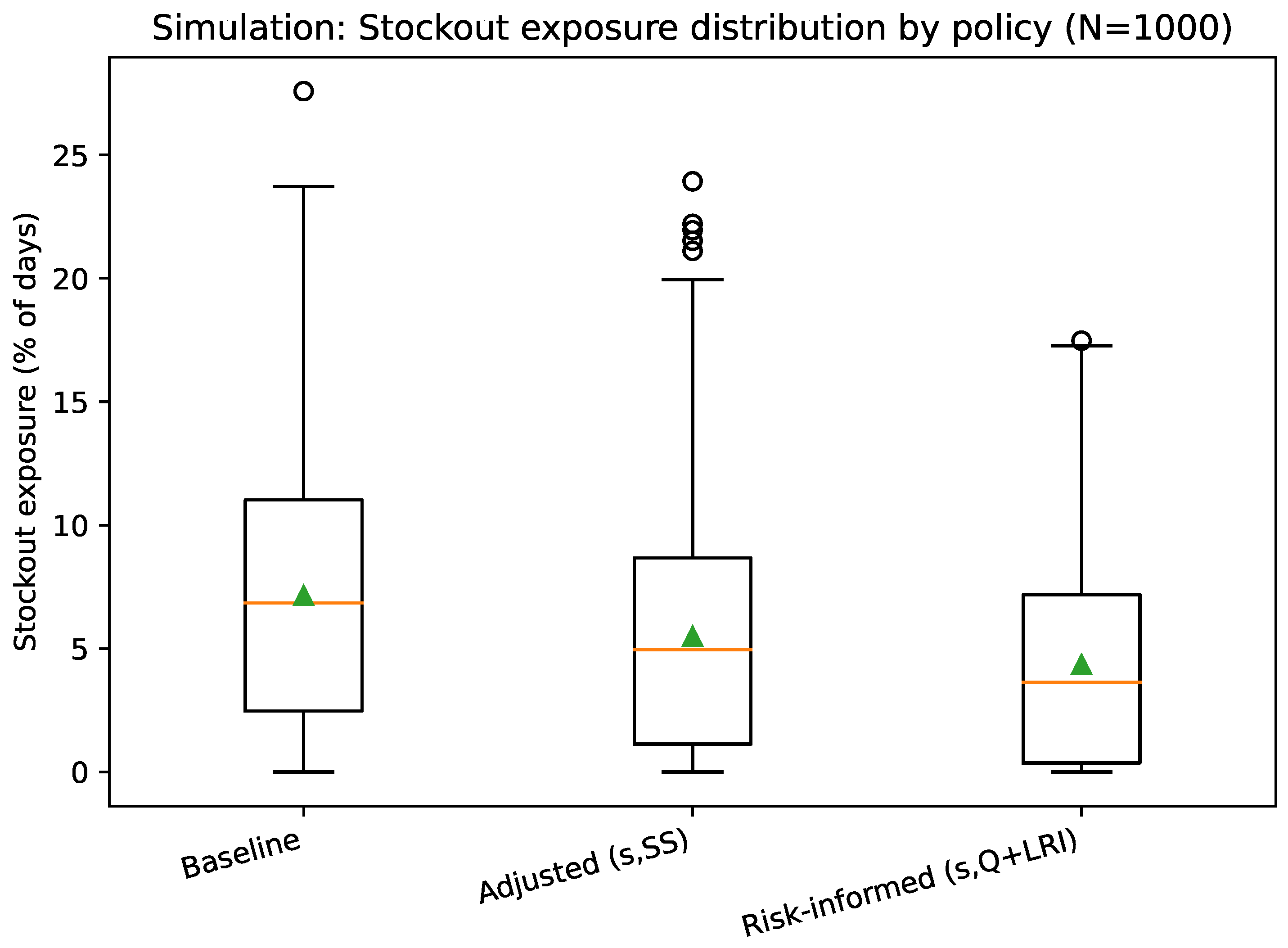
To assess the operational impact of the proposed risk-informed inventory framework, a simulation study was conducted comparing the institutional baseline policy with two alternative configurations: (i) an adjusted policy with updated reorder points and safety stock, and (ii) a fully risk-informed policy integrating ABC–XYZ segmentation and Logistic Risk Index (LRI) rules.
Table 11 summarises the main performance indicators obtained from 1000 Monte Carlo replications per scenario. Results are reported as mean values with 95% confidence intervals.
Relative to the baseline configuration, the adjusted policy reduces stockout exposure by approximately 28%, primarily through earlier reorder triggering for high-risk medicines. The fully risk-informed policy achieves a larger reduction of 46%, reflecting the combined effects of differentiated service levels, risk-based safety stock, and staggered replenishment by procurement channel.
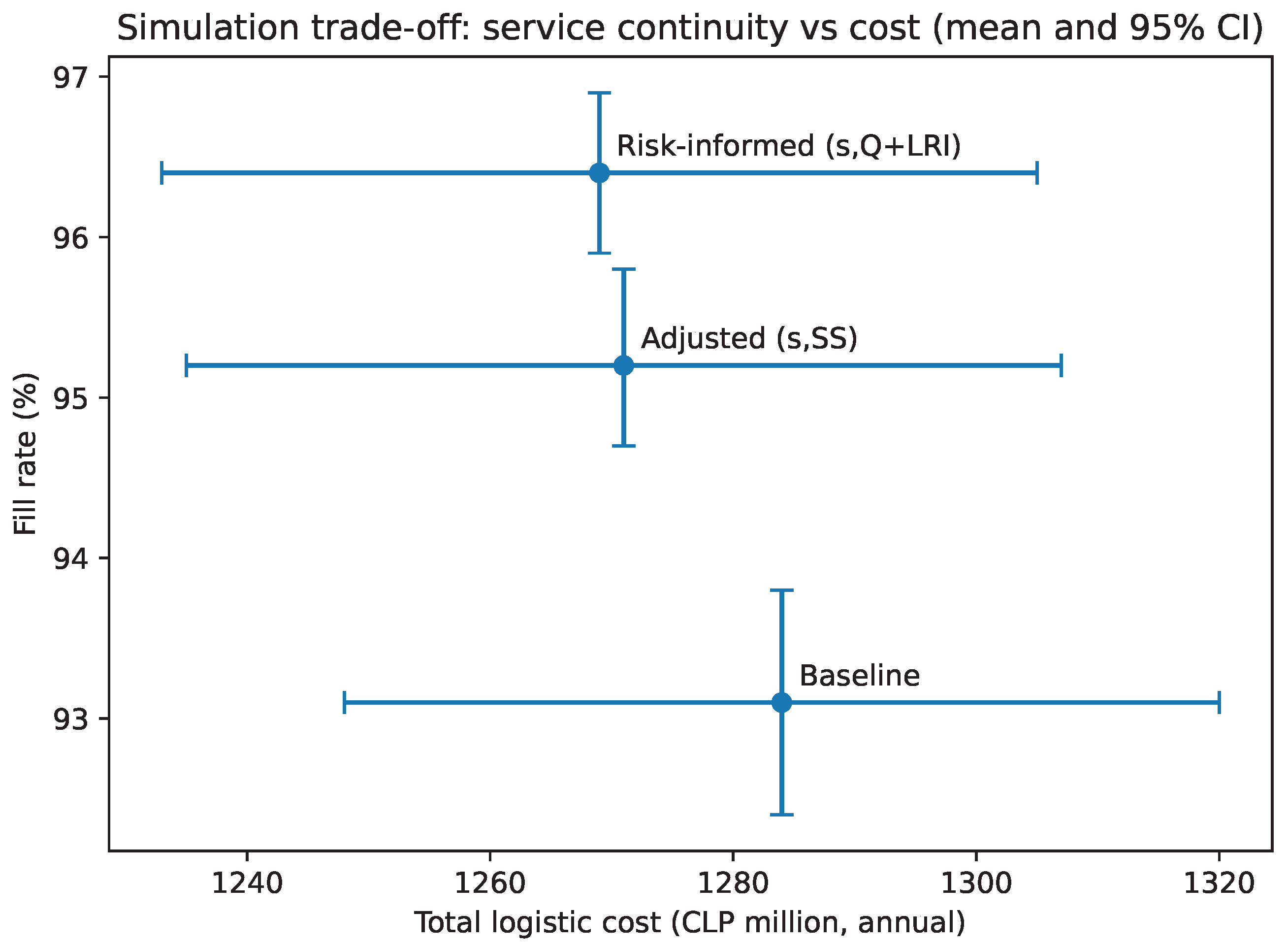
Service continuity, measured through fill rate, improves from 93.1% in the baseline scenario to 96.4% under the risk-informed policy. At the same time, the simulation shows a reduction in urgent and emergency orders, indicating lower administrative burden and improved procurement predictability.
While holding costs increase moderately under the risk-informed policy due to higher buffers for high-risk medicines, total logistics costs remain stable. The increase in holding cost is offset by reductions in emergency purchasing, wastage associated with reactive ordering, and service disruptions. Overall, the simulation confirms that risk-informed parameterisation can improve resilience and service continuity without compromising cost efficiency.
Figure 4 shows that the risk-informed policy consistently reduces stockout exposure across Monte Carlo replications, shifting the distribution toward lower values and mitigating tail risk.
Figure 5 summarises the cost–service relationship under each scenario. The risk-informed configuration achieves higher fill rates while maintaining total logistic costs within the confidence bounds of the baseline, supporting the claim of improved resilience without compromising cost efficiency.
Taken together, the simulation results provide quantitative evidence that the proposed risk-informed inventory framework could be useful for enhancing service continuity and operational resilience in a high-complexity public oncology setting. By explicitly linking demand variability, procurement risk, and clinical criticality to inventory parameters, the framework outperforms static institutional rules under realistic stochastic conditions.
Environmental Impact under Simulated Scenarios. The Monte Carlo simulation corroborates the environmental benefits of risk-informed policies. Compared to the baseline, the adjusted scenario reduces urgent orders by approximately 28%, while the fully risk-informed scenario achieves a 46% reduction. Using the same conversion factors, the optimised policy avoids nearly 630 kg CO
2 emissions and 25 kg of packaging waste annually for the FO portfolio. These indicators were consistent across 1000 replications, with narrow confidence intervals, confirming that sustainability improvements are statistically robust and directly linked to inventory governance decisions. See
Table 12.
Environmental Sensitivity
Varying the packaging and CO2 factors by ±50% preserved the qualitative conclusions: reductions in packaging units and avoided CO2 remained within the same order of magnitude, indicating that environmental results are robust to plausible variations in emission and waste coefficients.
4. Discussion
This study set out to bridge a persistent gap in public healthcare supply chain research: the lack of integrated, end-to-end analytical frameworks that connect empirical inventory behaviour, risk-aware optimisation, and institutional governance to the continuity of clinical care. Using real operational data from a high-complexity public oncology hospital, the results provide convergent empirical and simulation-based evidence that static, uniform inventory rules are structurally misaligned with the heterogeneous risk landscape of oncology pharmaceuticals [
1,
5]. Sensitivity analyses conducted on key parameters—including service-level targets (Z), lead-time distributions, demand variability, and holding cost assumptions—confirmed that the relative performance ranking of the evaluated inventory policies remains stable across plausible ranges. While absolute KPI values vary with parameter calibration, the risk-informed policy consistently outperforms the institutional baseline in terms of stockout exposure, service continuity, and reduction of urgent orders. This reinforces the robustness of the proposed framework under realistic operational uncertainty. Regarding external validity, although the empirical analysis is based on a single high-complexity public oncology hospital in Chile, the proposed framework is conceived as a modular and transferable governance structure rather than a context-specific solution. Its core components—ABC–XYZ segmentation, the Logistic Risk Index (LRI), and continuous-review (s, Q) policies—rely on standard operational inputs such as demand history, lead-time distributions, and procurement records, which are commonly available across healthcare systems.
Nevertheless, adaptation to local conditions remains essential. Differences in procurement structures (e.g., centralised vs. decentralised purchasing), regulatory environments, supplier reliability, and service-level priorities may influence parameter calibration, weight selection in the LRI, and policy thresholds. For example, systems characterised by shorter and more reliable lead times may require lower safety stock buffers, whereas highly regulated or fragmented procurement contexts may benefit from stronger weighting of supply-side risk dimensions.
Therefore, while numerical results and parameter values are inherently context-dependent, the underlying governance logic—linking descriptive analytics, risk assessment, and inventory policy design—remains broadly applicable across diverse healthcare supply chain configurations. This positions the framework as a scalable, adaptable decision-support tool for public health systems that could help enhance resilience, efficiency, and sustainability.
In addition, although the environmental parameters used in this study are simplified, they are consistent with typical ranges reported in healthcare logistics and are intended to provide decision-relevant signals rather than precise carbon accounting. The sensitivity analysis (±50%) confirms that the relative environmental benefits of the risk-informed policy remain stable across a wide range of plausible emission and packaging values, reinforcing the robustness of the conclusions under parameter uncertainty.
From descriptive analytics to actionable risk governance. The empirical findings confirm that pharmaceutical portfolios in oncology services are characterised by extreme asymmetry. Although the Oncology Pharmacy (FO) manages fewer medicines than the Central Pharmacy (FC), it concentrates the vast majority of pharmaceutical expenditure and clinical criticality. The ABC–XYZ segmentation reveals that a small subset of medicines (AX and AY) accounts for over 80% of total expenditure, while segments with high demand variability (AZ, BZ) persist even among lower-value items. These patterns reinforce prior evidence that expenditure-based prioritisation alone is insufficient for managing operational and clinical risk in hospital pharmacies [
18,
19].
The Logistic Risk Index (LRI) operationalises this insight by synthesising demand variability, supply performance, parameter misalignment, and proxies of clinical and economic importance into a single actionable metric. The observed concentration of high LRI values among medicines with both parameter misalignment and recurrent operational events demonstrates that risk emerges systemically rather than from isolated demand fluctuations. This supports the argument that descriptive tools such as ABC–XYZ become decision-relevant only when embedded within a broader risk-governance structure that translates classification into differentiated control rules [
5,
11].
Simulation evidence, therapeutic continuity, and sustainability. The simulation study provides quantitative validation of the proposed risk-informed framework under stochastic demand and lead-time conditions. Relative to the institutional baseline, both alternative scenarios reduce stockout exposure, but the fully risk-informed policy delivers the largest and most consistent improvements (up to a 46% reduction), with higher fill rates (93.1% → 96.4%) and shorter effective replenishment delays [
5,
11]. From a clinical perspective, these results are particularly relevant in oncology settings, where treatment interruptions compromise therapeutic efficacy and outcomes. Although patient-level outcomes are not explicitly modelled, lower stockout frequency and fewer urgent purchases constitute meaningful proxies of improved therapeutic continuity and reduced operational stress on clinical teams [
1].
Importantly, these operational gains are accompanied by measurable environmental benefits. The optimised scenario reduces urgent orders from 27.4 to 14.8 per year (FO), which—under the stated assumptions—translates into an estimated avoidance of approximately 630 kg of CO
2 emissions and 25 kg of packaging waste per year. The environmental indicators reported in this study should be interpreted as operational proxies rather than as a full life-cycle assessment of pharmaceutical supply chains. Estimates of avoided CO
2 emissions and packaging waste are derived from observed reductions in urgent orders, which are strongly associated with expedited transport modes and additional packaging requirements in public healthcare procurement. Although simplified, these proxies are appropriate for managerial decision support and governance purposes, as they translate inventory policy choices into tangible sustainability signals. Future research could extend this approach by incorporating more granular transport data, packaging life-cycle assessments, and multimodal logistics modelling. This finding aligns with the literature on green logistics and sustainability in healthcare supply chains, particularly regarding reduced emissions from expedited transportation and lower waste generation [
2,
3]. As a result, the proposed framework advances a triple-impact perspective (clinical, economic, and environmental) consistent with the Sustainable Development Goals (notably SDG 3 and SDG 12) [
6].
It is important to emphasise that the environmental indicators used in this study are not intended to represent a full life-cycle assessment (LCA), but rather simplified, decision-oriented proxies linking urgent procurement events to environmental impact. As such, the estimated reductions in CO2 emissions and packaging waste should be interpreted as indicative orders of magnitude rather than precise measurements.
In real healthcare supply chains, environmental impact is influenced by multiple interacting factors, including transport modes (e.g., air versus ground), delivery distances, supplier-specific logistics practices, and packaging configurations [
34,
35,
36]. These elements are not explicitly modelled in the present framework and therefore introduce variability that is not fully captured by the simplified coefficients.
Future research could extend this work by integrating more detailed logistics data and life-cycle assessment methodologies to refine environmental estimates and better capture the complexity of healthcare supply chain emissions and waste generation.
Economic trade-offs and governance implications. From an economic standpoint, the simulation reveals a critical trade-off: moderate increases in holding costs due to differentiated safety buffers are offset by reductions in urgent orders, reactive purchases, and operational disruptions, keeping total logistics costs broadly stable [
5]. Related analyses have shown that inventory cost savings correlate with supply chain success factors when governance mechanisms align analytics with managerial routines [
37]. Beyond technical optimisation, the primary contribution of this study lies in its governance framing. By integrating ABC–XYZ segmentation, LRI thresholds, and (
s,
Q) policies within a transparent analytical pipeline and an operational dashboard, the framework facilitates coordination among clinical, logistical, and administrative units. In doing so, it addresses common failures in public-sector supply chains, such as limited visibility, fragmented information, and rigid procurement rules [
1,
22]. The explicit definition of thresholds, alerts, and scenario-based evaluation aligns inventory management with institutional traceability and auditability requirements and can be readily extended to green supply chain practices in public hospitals [
3].
While the proposed framework is designed to support improved coordination between clinical services, pharmacy operations, and procurement management, these governance benefits should be interpreted as potential outcomes enabled by the analytical structure rather than directly observed effects within the scope of this study. The results of the simulation demonstrate improvements in operational indicators—such as reduced stockout exposure, improved service levels, and lower reliance on urgent orders—which create favourable conditions for enhanced coordination and decision-making. However, the actual realisation of these governance improvements depends on institutional adoption, integration into decision-support systems, and alignment with organisational processes. In practice, the framework can be implemented through dashboards, monitoring tools, and standardised decision rules that facilitate communication across functional units and support proactive inventory management. Future research could evaluate the real-world impact of such implementations on coordination, governance efficiency, and organisational performance.
Limitations and future research.
Several limitations should be acknowledged:
First, the study focuses on a single public oncology hospital, which may limit external generalizability. While the empirical analysis is based on a single high-complexity public oncology hospital in Chile, the contribution of this study lies primarily in the analytical structure and governance logic of the proposed framework rather than in the specific parameter values obtained. The end-to-end pipeline—combining data integration, ABC–XYZ segmentation, risk synthesis through the LRI, continuous-review inventory policies, and simulation-based validation—is transferable to other public hospital systems facing similar constraints. Context-specific calibration is required for demand patterns, procurement channels, and institutional priorities; however, the underlying decision-support architecture and risk-informed governance approach remain broadly applicable across public healthcare supply chains.
Second, while the simulation incorporates realistic stochastic structures, it relies on historical demand and lead-time patterns and does not explicitly model extreme systemic shocks.
Third, clinical outcomes are inferred indirectly through service-continuity proxies rather than patient-level data.
Future research could (i) extend the framework to multi-hospital networks with centralised coordination (e.g., channel-specific SLA calibration and LRI thresholds at the ministerial level), (ii) integrate real-time forecasting and adaptive learning mechanisms into the LRI, and (iii) link logistical indicators with clinical outcomes and more comprehensive environmental metrics, including packaging life-cycle assessment, multimodal transport, and safe waste disposal [
2,
11,
22]. Overall, the findings demonstrate that risk-informed inventory governance offers a viable and scalable pathway for strengthening therapeutic continuity, operational resilience, and sustainability in public healthcare systems [
1,
5]. Compared to existing stochastic inventory and risk-based prioritisation approaches, the proposed framework emphasises operational integration and governance applicability, bridging analytical modelling with decision-making processes in public healthcare environments.