


Abstract
Artificial intelligence (AI) has become a strategic resource for enhancing supply chain resilience in environments characterized by growing uncertainty and complexity. Building on the resource-based view (RBV) and organizational information processing theory (OIPT), this study examines how AI assimilation as a firm-level strategic capability improves supply–demand visibility and strengthens supply chain risk management (SCRM). Using survey data collected from 129 manufacturing firms in China, the proposed research framework is tested through structural equation modeling. The results show that AI assimilation significantly enhances both supply–demand visibility and SCRM, with visibility playing a partial mediating role in translating AI-enabled capabilities into more effective risk control. These findings indicate that AI contributes to resilience not merely through technological deployment but through its integration into organizational processes that support information processing and coordination. From a managerial perspective, the study suggests that firms should approach AI as an ongoing strategic capability development process rather than a one-time technological investment. By embedding AI into core supply chain functions such as production planning, inventory management, and demand forecasting, firms can improve visibility, anticipate disruptions, and shift toward more proactive and resilient risk management practices. This study advances the literature by integrating RBV and OIPT to explain the strategic mechanisms through which AI assimilation enhances visibility in SCRM, providing empirical evidence from a manufacturing context.
1. Introduction
Global supply chains faced unprecedented challenges in recent years. The COVID-19 pandemic exposed supply chain vulnerabilities, drawing widespread attention to their fragility. Simultaneously, escalating geopolitical tensions coupled with economic downturns and inflation further intensified the instability of supply chain operations [1]. In this highly volatile and uncertain environment, supply chain risk management (SCRM) is a critical strategic priority for enterprises striving to enhance their resilience and maintain their competitive advantage.
Existing studies propose various strategies for addressing SCRM challenges. Studies emphasize the importance of supply chain integration and interorganizational collaboration in improving risk governance capabilities [2,3]. Meanwhile, internal organizational strategies, such as building flexibility and fostering a risk management culture, along with supplier management strategies, such as diversified procurement, are key enablers of effective SCRM [4]. Among the various factors affecting SCRM effectiveness, supply chain visibility (SCV) is generally considered the essential capability for achieving agile responses and effective risk identification. SCV not only involves firms’ access to accurate, real-time information flows but also directly impacts their responsiveness to external shocks [5,6]. Yu and Goh [7] further argued that enhancing visibility not only reduces the risk of operational disruptions but also improves overall efficiency and optimizes resource allocation. However, despite its recognized importance, achieving comprehensive and real-time visibility remains challenging in practice. Information silos, fragmented systems, and data latency often constrain cross-organizational transparency [8,9]. More importantly, existing research tends to conceptualize visibility as a relatively unified construct, with limited differentiation between supply-side visibility and demand-side visibility (e.g., Refs. [10,11]). This aggregated treatment may overlook the distinct mechanisms through which different types of visibility contribute to SCRM effectiveness. Thus, although SCV is widely acknowledged as essential, its multidimensional structure and mediating role in digital risk governance require further clarification.
In this context, artificial intelligence (AI) introduces new momentum into supply chain digital transformation. Through advanced data processing and pattern recognition capabilities, AI enables real-time monitoring, intelligent forecasting, and automated response mechanisms [12,13], thereby enhancing sensing, early warning, and cross node coordination in complex supply networks. Although prior studies acknowledge the potential value of AI for SCRM, existing research largely focuses on functional applications or tool-level adoption. Considerably less attention has been devoted to AI assimilation, which reflects the extent to which AI is embedded, institutionalized, and routinized within organizational processes [14,15]. This distinction is theoretically important. Adoption captures initial investment decisions, whereas assimilation represents capability development and sustained organizational integration.
Two interrelated research gaps therefore remain. First, the literature insufficiently differentiates AI adoption from AI assimilation, leaving unclear how deep organizational embedding of AI translates into risk management capabilities. Second, although visibility is frequently discussed in digital supply chain research, its potential role as a dual-dimensional mediating mechanism linking AI assimilation to SCRM has not been systematically theorized or empirically validated. As a result, the mechanism through which AI assimilation enhances SCRM via differentiated visibility formation remains underdeveloped.
To address these layered gaps, this study integrates the resource-based view (RBV) and organizational information processing theory (OIPT). From the RBV perspective, AI assimilation represents a strategic process of resource orchestration and capability transformation. By embedding AI into forecasting, monitoring, and coordination routines, firms develop inimitable data-driven capabilities that strengthen risk governance and competitive advantage [1,14]. From the OIPT perspective, AI assimilation enhances information processing capacity and improves alignment between information requirements and processing capability under uncertainty [16]. In complex supply networks, differentiated supply and demand visibility reduce information asymmetry and facilitate proactive risk identification and response. Building on this theoretical foundation, this study examines how AI assimilation enhances SCRM through supply and demand visibility. Specifically, we address the following research questions:
RQ1: How does AI assimilation relate to SCV and SCRM?
RQ2: Does SCV mediate the relationship between AI assimilation and SCRM?
The contributions of this study are threefold. First, it develops and empirically validates a comprehensive model linking AI assimilation, SCV, and SCRM, thereby addressing the theoretical gap regarding how AI strengthens SCRM mechanisms. Second, by integrating RBV and OIPT, the study introduces a dual logic that combines resource development and information processing perspectives, enriching the theoretical understanding of digital risk governance in supply chains. Finally, from a practical standpoint, the findings reveal the pivotal role of AI assimilation in mitigating risks and fostering supply chain resilience, providing actionable insights for manufacturing firms seeking to build data-driven and resilience-oriented digital supply chains.
The remainder of this paper is organized as follows. Section 2 reviews the existing literature on SCRM, AI assimilation, and SCV, and develops the research hypotheses. Section 3 describes the methodological framework, including sample selection and measurement items. Section 4 presents the key empirical findings. Finally, Section 5 and Section 6 interpret the results, highlight the theoretical and practical contributions, discuss limitations, and offer suggestions for future research.
2. Literature Review and Hypothesis
2.1. Theoretical Background
This study develops an integrated theoretical framework grounded in the RBV and OIPT to explain how AI assimilation influences SCRM. Rather than viewing these two perspectives as parallel descriptive lenses, the present study treats them as complementary mechanisms that together clarify how technologically enabled organizational capabilities are translated into operational risk outcomes.
From the perspective of the RBV, sustainable competitive advantage does not arise simply from the possession of technological resources, but from the firm’s ability to integrate and deploy those resources in combination with complementary organizational capabilities. This view has been further extended by the dynamic capability perspective, which emphasizes the capacity of firms to reconfigure resources and coordinate organizational processes in response to environmental change [17]. Prior research shows that analytics and digital capabilities improve operational outcomes primarily when they are aligned with supply chain integration, flexibility, and related organizational complements rather than functioning as isolated technological assets [18,19]. Recent evidence on AI and organizational resilience similarly indicates that the effectiveness of AI depends on governance structures, coordination mechanisms, and broader organizational preparedness, suggesting that AI assimilation should be understood as an embedded and reconfigurable organizational capability rather than a standalone resource [20]. In supply chain contexts, AI assimilation continuously enhances the ability to predict, monitor, and evaluate resource demand and allocation, thereby enabling more intelligent and dynamic internal resource reconfiguration [14]. This process, in turn, strengthens the firm’s capacity to coordinate resources, align cross-functional processes, and respond effectively to environmental disruptions.
OIPT complements this capability perspective by explaining how embedded technological capabilities generate performance implications. The theory posits that organizations must develop sufficient information processing capacity to cope with task complexity and environmental uncertainty [16]. Within contemporary supply chains, dispersed partners, structural complexity, and disruption risks intensify information requirements. AI assimilation enhances the organization’s ability to collect, integrate, and analyze real-time data, thereby supporting more timely and informed operational decision making [15].
Within this integrated theoretical logic, SCV is conceptualized as a proximal information processing mechanism through which AI enabled organizational capabilities influence SCRM. AI driven forecasting, monitoring, and anomaly detection allow firms to identify demand fluctuations, supply disruptions, and logistics constraints in real time, which facilitates faster coordination and adaptive responses across the supply chain [1,21]. Prior studies also indicate that visibility is closely associated with interorganizational systems and collaborative information sharing among supply chain partners, highlighting the informational pathways through which digital capabilities contribute to agility and risk management outcomes [22]. At the same time, research on supply network structure shows that transparency and risk propagation are shaped by underlying network configurations across supply tiers, which implies that the effects of visibility are inherently bounded by structural conditions [23,24].
While both RBV and OIPT offer valuable insights, relying on either perspective alone provides only a partial explanation of how AI assimilation enhances SCRM. The RBV emphasizes resource orchestration and capability development but pays relatively limited attention to the information-processing mechanisms through which such capabilities operate under uncertainty. Conversely, OIPT highlights alignment between information-processing demand and capacity but does not fully account for how firms accumulate, embed, and transform strategic technological resources into sustained competitive advantage. Therefore, integrating RBV and OIPT enables a more comprehensive explanation of digital risk governance. This integration suggests a logical ‘resource–capability–performance’ pathway for the research framework. AI assimilation represents not only a strategic resource configuration process (RBV) but also an information-processing capacity enhancement mechanism (OIPT). In this RCP sequence, AI assimilation serves as the foundational strategic resource that builds differentiated supply and demand visibility as an organizational capability, which ultimately strengthens SCRM performance and effectiveness.
2.2. Supply Chain Risk Management
As global uncertainty has intensified in recent years, SCRM has attracted growing scholarly attention. Risk has been defined as the variability of possible outcomes, their likelihood of occurrence, and the subjective value attached to those outcomes [25]. In the supply chain context, Jüttner et al. [26] extend this view by defining supply chain risk as any risk affecting the flows of information, materials, and products from original suppliers to final customers. Ho et al. [27] further define SCRM as coordinated interorganizational activities that employ qualitative and quantitative risk management techniques to address unforeseen events at both macro and micro levels that may disrupt supply chain operations. Prior studies classify supply chain risks into endogenous and exogenous categories and further distinguish multiple dimensions such as supply, demand, control, information, environmental, and process risks [28,29,30]. Research on risk response has emphasized both strategic choices and organizational capabilities. For instance, dynamic knowledge management and organizational innovation have been shown to play a critical role in building resilient supply chains, highlighting the importance of internal adaptive mechanisms in risk management [31]. Moreover, effective SCRM requires alignment between operational flexibility and information transparency to mitigate the propagation of disruptions [32]. With the deepening of digital transformation, recent reviews increasingly incorporate technological perspectives, evaluating the role of emerging digital technologies in reshaping SCRM practices [33].
Despite this expanding body of work, several important gaps remain. Existing research often relies on specific cases or regional contexts, which constrains the generalizability of findings [34]. Moreover, although AI is gradually entering the SCRM domain, systematic theoretical explanation and robust empirical evidence regarding how AI related capabilities translate into improved risk management outcomes are still limited. Addressing these limitations, this study focuses on manufacturing firms in China to examine how AI assimilation influences SCRM and through which mechanisms these effects unfold, thereby providing both theoretical clarification and practical insight into SCRM in the digital era.
2.3. AI Assimilation in Supply Chain Risk Management
As market conditions continue to shift and uncertainty increases, businesses place greater demand on the flexibility and responsiveness of their supply chains. To enhance operational efficiency and improve SCRM, an increasing number of companies are adopting emerging technologies such as AI to optimize supply chain management (SCM). AI has distinct strengths in areas such as data analysis, demand forecasting, and process automation and is gradually becoming a key driver in the move toward intelligent supply chains [1,35].
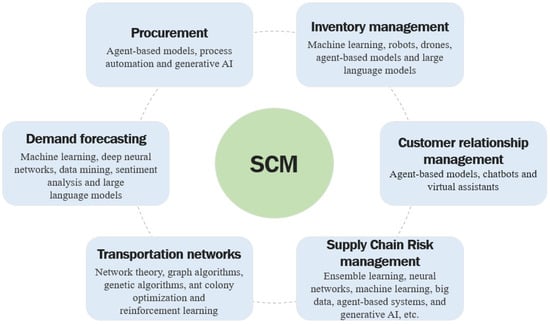
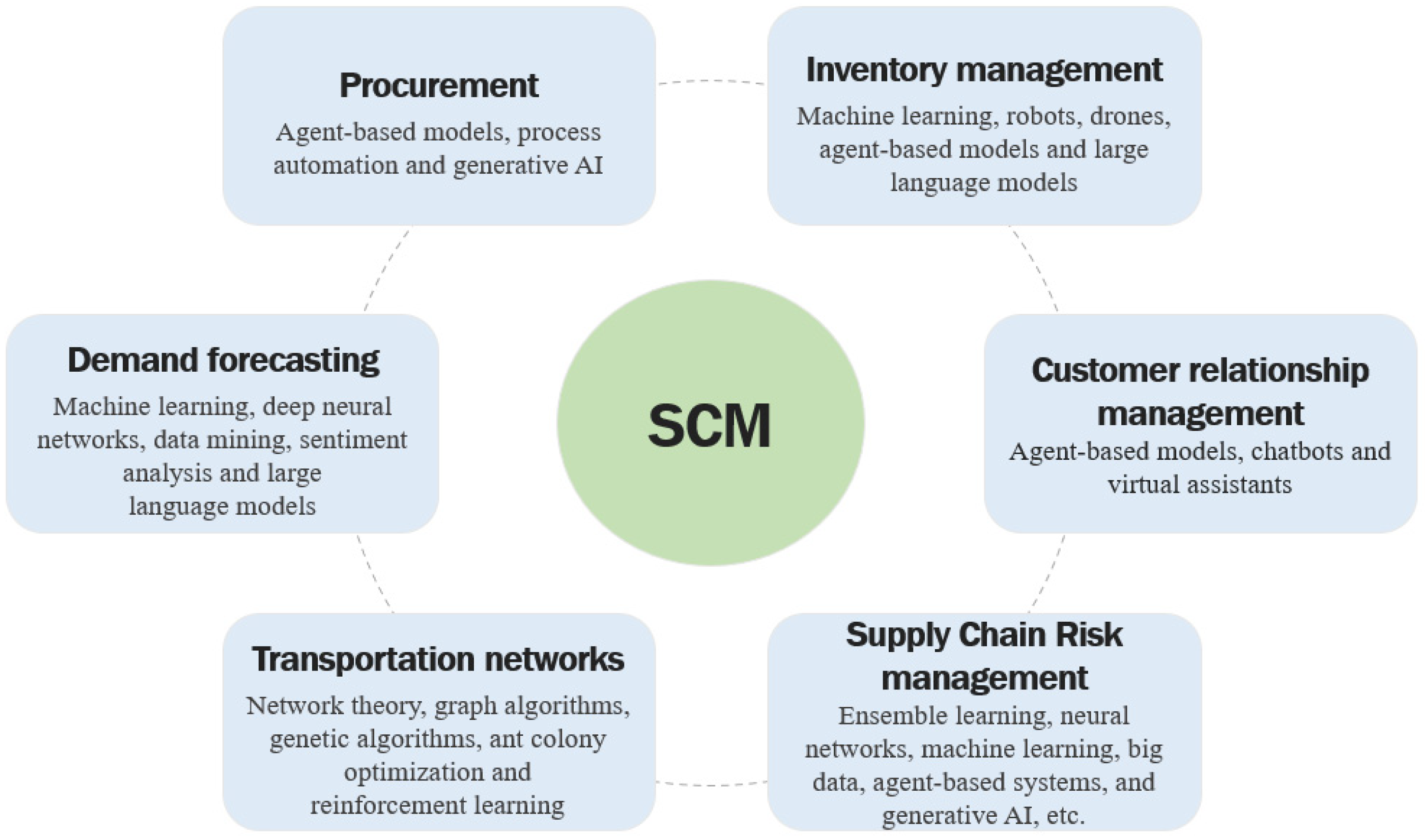
AI refers to the ability of systems to interpret external inputs accurately, extract patterns and insights through learning processes, and respond adaptively to achieve specific objectives [36]. As a broad concept, AI encompasses several core technologies, with those most commonly applied in supply chain contexts including machine learning, natural language processing, computer vision, expert systems, and robotics [37]. Building on prior research, Figure 1 outlines how various AI technologies are applied across different supply chain functions.
Figure 1.
AI applications across key SCM functions. Source: Adapted from Daios et al. [35].
Notably, AI has demonstrated significant potential in the field of SCRM. With continuous advances in computing power and data analytics technologies, the application of AI in supply chains has expanded from single functional support to multiple critical areas, including risk identification and assessment, risk propagation prediction, and intelligent decision support [33]. Prior research further indicates that AI can enhance firms’ understanding and forecasting of supply and demand dynamics, improve customer service quality, and promote communication and coordination among supply chain actors, thereby strengthening overall supply chain resilience in uncertain environments [1]. However, prior research also indicates that the mere introduction of AI technologies does not necessarily lead to significant improvements in organizational performance [38]. What proves more consequential is the extent to which AI related capabilities are meaningfully embedded within organizational processes and decision contexts, thereby enabling sustained value creation in business practice [39]. In this regard, AI assimilation places particular emphasis on the organizational embedding, routinization, and cross-functional integration of AI within core business processes, rather than simple adoption or occasional use of AI technologies. Early work by Purvis et al. [40] conceptualized assimilation as the breadth of technology use across organizational projects and work processes together with the routinization of such use in related activities. As the literature has progressed, AI assimilation has come to be viewed as a critical driver of operational efficiency, competitive agility, and long-term organizational viability [15,39]. Empirical evidence further indicates that AI assimilation significantly enhances organizational agility, customer agility, and firm performance [15], while more recent studies highlight its central role in addressing the growing complexity of contemporary global supply chains [14].
However, existing studies provide limited insight into the specific operational mechanisms through which AI assimilation translates into SCRM capability, particularly in manufacturing contexts characterized by persistent information asymmetry between supply and demand and rising environmental uncertainty. To address this gap, this study focuses on supply and demand visibility as a central mechanism and examines how AI assimilation enhances risk management capability in manufacturing supply chains.
2.4. Supply Chain Visibility
As supply chain networks become increasingly complex and interdependent, firms face growing uncertainty regarding demand fluctuations, supply disruptions, and operational coordination. Under such conditions, SCV has emerged as a critical organizational capability for obtaining timely and accurate information across supply chain processes and supporting informed decision making [7,34]. SCV is generally understood as the extent to which supply chain actors can access relevant and real-time information concerning demand, inventory, and operational activities throughout the supply chain. Prior research shows that enhanced visibility improves decision quality, operational continuity, and overall organizational performance [41,42].
Beyond operational benefits, SCV plays a fundamental informational role in managing supply chain uncertainty. Interorganizational collaboration, information sharing, and supply chain integration have been identified as key antecedents that enable higher levels of visibility and strengthen coordination among supply chain partners [11,43]. These relational and organizational mechanisms suggest that SCV reflects not only technological transparency but also the capacity of firms to process and utilize distributed information within complex supply networks.
From an information processing perspective, SCV reduces information asymmetry and enhances firms’ ability to detect, interpret, and respond to potential disruptions. Digital technologies further expand this capability. Blockchain improves transparency and traceability, the Internet of Things strengthens real-time monitoring across supply chain nodes, and AI enables predictive analytics and data-driven decision support [42,44]. Through these mechanisms, visibility supports proactive risk identification, faster response, and adaptive resource reconfiguration, which are essential for effective SCRM [5,45].
Despite these insights, existing research remains fragmented and provides limited theoretical clarity regarding how SCV functions as a mechanism linking digital capabilities to SCRM outcomes. Addressing this gap, the present study examines SCV as a core informational mechanism through which AI assimilation contributes to SCRM.
2.5. Hypothesis Development
Recently, increasing attention has been paid to the role of AI assimilation in strengthening SCRM. AI assimilation reflects the extent to which AI becomes organizationally embedded in core processes and decision routines, thereby enabling firms to systematically leverage data and analytics capabilities [40]. Through this organizational embedding, AI continuously enhances firms’ abilities to predict, monitor, and evaluate resource demand and allocation, facilitating more intelligent and dynamic internal resource reconfiguration [14]. This process further strengthens firms’ capacity to coordinate resources, integrate cross-functional processes, and respond effectively to environmental disruptions.
Building on these capabilities, AI assimilation supports more effective SCRM. By processing multidimensional data such as real-time market dynamics, operational conditions across supply chain nodes, and potential disruption signals, AI enabled systems provide more accurate and timely decision support [11]. In addition, AI driven data collaboration and recovery optimization enhance supply chain resilience and reduce the negative impacts of disruptions [45]. The integration of AI with big data analytics further enables decision makers to construct comprehensive risk profiles and respond rapidly to emerging threats, thereby improving resilience and reducing risk exposure [26]. Moreover, the routinized use of AI within organizational processes promotes intelligent automation, reduces human decision biases, and increases adaptive responsiveness in dynamic environments [30]. Taken together, these arguments suggest that AI assimilation, as an organizationally embedded capability for resource reconfiguration and intelligent decision support, plays a critical role in enhancing SCRM. Accordingly, we propose the following hypothesis:
H1:
AI assimilation has a positive effect on firms’ SCRM.
Barratt and Barratt [46] argued that firms must clearly understand both supply and demand characteristics, which originate from suppliers (supply visibility) and customers (demand visibility). Building on this dual perspective, this study conceptualizes SCV as a comprehensive construct that integrates both supply- and demand-side visibility, reflecting the overall transparency and coordination capability of a supply chain.
According to OIPT, when organizations operate under conditions of high uncertainty and task interdependence, they must align their information processing capacity with the level of information processing demand [16]. AI assimilation strengthens this capacity through data integration, enhanced analytical capabilities, and the embedding of intelligent processes, thereby improving the organization’s ability to acquire, interpret, and utilize large volumes of information [16,17]. At the operational level of the supply chain, this enhanced capability is reflected in greater visibility across both the supply and demand sides, enabling firms to identify risks more promptly, coordinate resources more effectively, and accelerate recovery.
Within this theoretical logic, AI assimilation is regarded as a key driver of SCV. With respect to demand visibility, AI integrates real-time market data, consumer behavior information, and historical sales records to support more accurate demand forecasting and dynamic adjustments in production and inventory, thereby reducing stockouts or overstocking and improving responsiveness and flexibility [47]. In terms of supply visibility, AI consolidates data from multiple supply chain nodes to enable real-time monitoring of production progress, logistics flows, and supplier inventory status, helping firms detect potential disruptions earlier and respond in a timely manner [43,48]. Based on this reasoning, the following hypotheses are proposed:
H2a:
AI assimilation has a positive effect on supply visibility.
H2b:
AI assimilation has a positive effect on demand visibility.
Owing to the acceleration of globalization, high dependence on suppliers, and uncertainties in demand fluctuations, supply chains today are more vulnerable to disruptions [49]. Nooraie and Parast [5] highlight that any type of risk negatively impacts supply chain efficiency, while appropriate investments in SCV can significantly mitigate these adverse effects. Their study demonstrates that enhanced SCV during disruptions effectively reduced the associated costs. Specifically, by integrating supply and demand risks, they find that investing in SCV as a risk mitigation strategy is essential for minimizing the severity of supply chain disruptions. Similarly, Messina et al. [49] stress that improved visibility across the supply chain is essential to efficiently manage the material, information, and financial flows required for risk mitigation.
Further research indicates that SCV is critical for enabling organizations to address unforeseen risks and disruptions, particularly for small and medium-sized enterprises [50]. Specifically, enhanced demand visibility allows firms to forecast changes in market demand more accurately. By dynamically adjusting production plans and inventory strategies, companies can reduce issues, such as overstocking or stockouts, thereby strengthening supply chain adaptability and responsiveness [47]. Improved supply visibility enables firms to monitor the operational status of various supply chain nodes in real-time, including supplier production progress, logistics conditions, and inventory levels. This visibility enables organizations to quickly detect potential supply risks, ensuring continuity and stability [43]. Overall, supply visibility helps reduce information asymmetry and improve decision consistency. This aligns with the central premise of OIPT, which posits that greater information-processing capacity enables firms to identify and respond to supply risks more effectively under uncertainty, thereby enhancing SCRM performance. Hence, we propose that:
H3a:
Enhancing supply visibility can significantly improve SCRM.
H3b:
Enhancing demand visibility can significantly improve SCRM.
Cross-boundary technologies, value-added networks linking suppliers and buyers, and a range of collaborative programs and practices jointly contribute to SCV [51]. These mechanisms enable firms to coordinate activities and pursue shared operational objectives through timely and accurate information exchange across the supply chain. Prior research emphasizes that effective SCV requires continuous access to critical operational information, including customer demand, inventory locations, transportation costs, and other logistical dimensions [6]. From the perspective of organizational information processing and resource orchestration, AI assimilation plays a central role in strengthening SCV. Rather than merely improving data processing efficiency, AI assimilation enhances the organizational capability to integrate, interpret, and mobilize multisource information in real-time [14,15]. Integrated intelligent systems allow firms to achieve more comprehensive visibility, anticipate potential risks, improve operational coordination, and optimize overall supply chain planning [5].
With regard to demand visibility, AI-enabled analytical capabilities support real-time interpretation of market signals and consumer behavior, thereby enabling more accurate anticipation of demand fluctuations and early identification of potential volatility [1,35,52]. Concerning supply visibility, AI assimilation facilitates the analysis of historical operational data and external environmental signals to anticipate possible disruptions and support forward-looking decision-making [14]. Collectively, these capability-enhancing mechanisms position SCV as a proximal information-processing pathway through which AI assimilation contributes to improved SCRM effectiveness. Accordingly, we propose the following hypotheses.
H4a:
Supply visibility positively mediates the effect of AI assimilation on SCRM.
H4b:
Demand visibility positively mediates the effect of AI assimilation on SCRM.
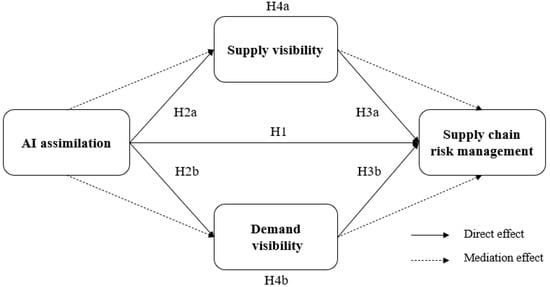
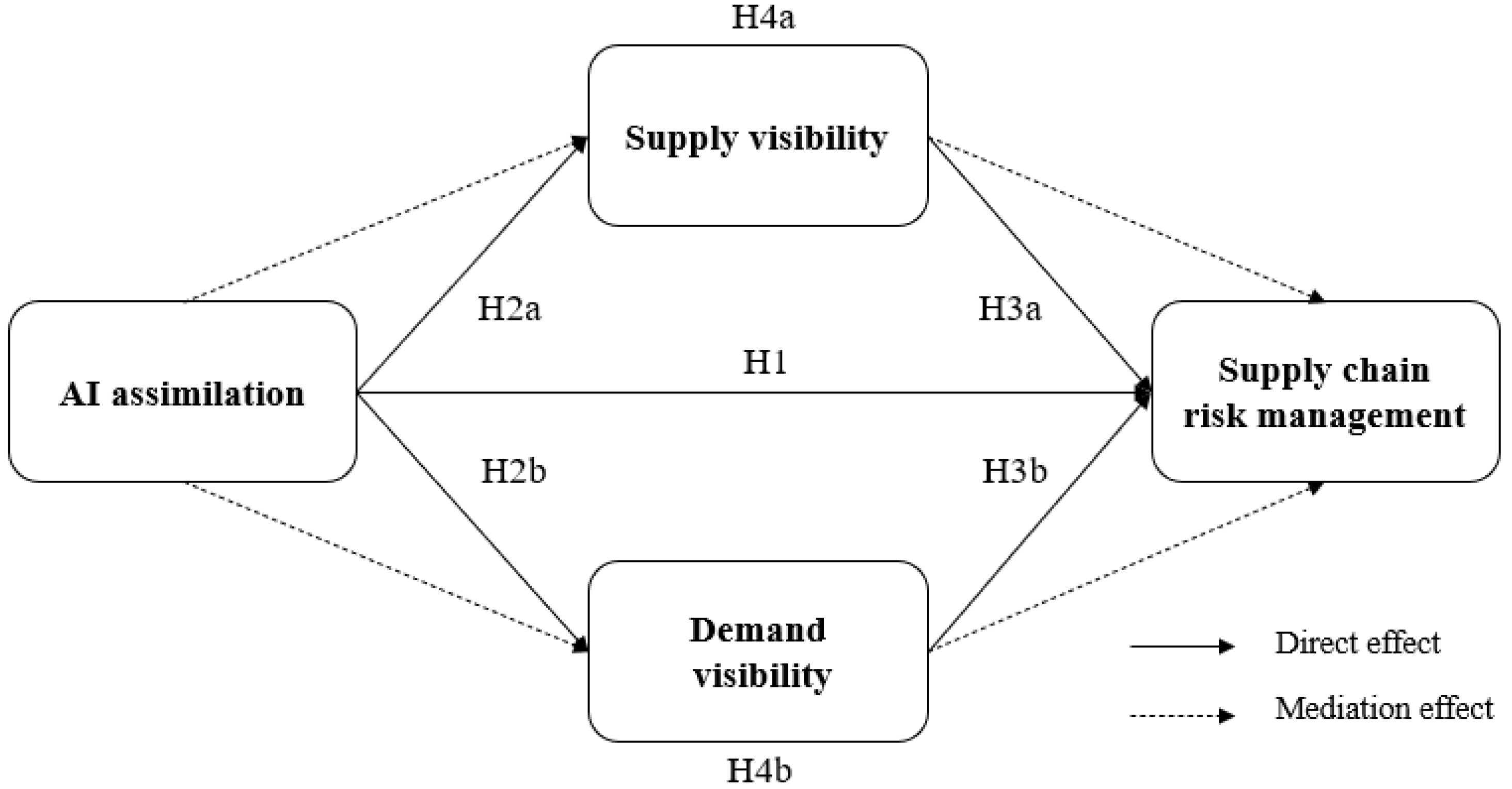
Accordingly, we analyze the research model depicted in Figure 2.
Figure 2.
Research model.
3. Methodology
3.1. Sample and Data Collection
We developed and modified the variable measurements and based on existing survey questionnaires. Table 1 presents the operational definitions of the relevant variables. We first developed an English version of the questionnaire, followed by a Chinese translation. Following evaluation by three domain experts, comprising one academic specialist in supply chain and two experienced practitioners from industry, the questionnaire was refined to improve expression and ensure greater clarity and interpretability. Apart from the general questions, we measured the variables using a five-point Likert scale, with 1 representing “strongly disagree” and 5 representing “strongly agree.”
Table 1.
Sample Characteristics.
In the manufacturing industry, supply chain networks are typically highly complex and involve multiple suppliers, production nodes, and distribution channels. This complexity makes SCV and risk management crucial. Manufacturing operations rely heavily on data, including production schedules, inventory management, and logistics information. The use of AI can significantly increase the timeliness and correctness of data, thereby increasing the robustness and transparency of the supply chain. Furthermore, manufacturing companies often face high-risk situations such as supply chain disruptions, demand fluctuations, and supply shortages, providing rich real-world scenarios and data to support SCRM research. Simultaneously, the characteristics of manufacturing supply chains are highly generalized, so insights from this industry may serve as a meaningful reference for improving supply chain strategies in other sectors. Therefore, this study focuses on Chinese manufacturing enterprises to further validate the research model and hypotheses through a survey of relevant companies.
The sampling frame was constructed using publicly available firm directories obtained from the China Machinery Industry Federation and the China Construction Machinery Association. After removing duplicate entries, the preliminary firm list was verified using the Tianyancha business information platform to confirm firm legitimacy and operational status. Firms with abnormal operating status (e.g., deregistered, suspended, or listed with business irregularities) were excluded from the sampling frame. The selected companies are located mainly in key manufacturing regions, such as the Yangtze River Delta, Pearl River Delta, and Bohai Economic Rim, and represent major industries, including machinery, electronics, and chemicals. To balance representativeness and practical feasibility, a combination of purposive sampling and convenience sampling was employed. Firms that had already adopted basic digital technologies in their operations were prioritized to ensure respondents were familiar with digital systems relevant to the research context. The survey targeted mid- to senior-level managers and employees involved in supply chain-related functions.
At the beginning of the data collection process, the research team contacted potential respondents by phone or email to clearly communicate the objectives of the study and ensure the confidentiality of the responses. After obtaining informed consent, we distributed the questionnaire via email. Before launching the formal survey, a one-week pilot test was conducted with ten manufacturing firms. Based on the feedback received, we refined the questionnaire to improve its clarity and logical flow. During the main survey stage, a total of 500 questionnaires were distributed. To improve the response rate, reminder emails and follow up telephone contacts were conducted two weeks after the initial distribution. A total of 141 responses were received, corresponding to a response rate of 28.2%. All returned questionnaires were then carefully screened, and 12 responses were excluded due to uniform answering patterns or substantial incompleteness. This procedure resulted in 129 valid questionnaires for subsequent analysis, yielding an effective response rate of 25.8%. Although the final sample size is 129, this level is generally acceptable for PLS-SEM analysis. In addition, firm-level surveys often face practical difficulties in obtaining responses, as companies tend to be cautious about disclosing internal information. Considering these constraints, the obtained sample size is regarded as sufficient for the present empirical analysis. As the study focuses exclusively on manufacturing firms and employs a unified email-based distribution procedure, response-rate differences across channels are not applicable. The sample was drawn from manufacturing enterprises located in major industrial regions in China, ensuring sectoral consistency in the analysis. The sample includes firms of varying sizes, as shown in Table 1, which mitigates concerns regarding excessive concentration in a single firm category. Table 1 summarizes the characteristics of the sample.
3.2. Measurement of Variables
In this study, AI assimilation is specified as the independent variable, supply visibility and demand visibility as mediating constructs, and SCRM as the dependent variable. Table 2 summarizes the operational definitions of the key variables. The measurement of AI assimilation was adapted from Lu et al. [14] and Wamba [15], capturing the extent to which AI technologies are embedded in organizational processes and routinely utilized to support decision-making and operational activities. The scales for supply visibility and demand visibility were derived from Hu et al. [53], with minor modifications to item wording to ensure contextual relevance and clarity for respondents. SCRM was measured using instruments adapted from Ding and Lee [31] and Chaudhuri et al. [54]. Unlike prior studies that primarily conceptualize SCRM as a bundle of managerial practices, this study refines the measurement to emphasize its outcome-oriented nature. In addition, firm size (measured by the number of employees) and sales revenue were included as control variables to account for potential firm-level differences that may influence SCRM. The detailed questionnaire items are provided in the Appendix A.
Table 2.
Operational Definitions of the Variables.
3.3. Bias Testing
To enhance the robustness and credibility of the findings, several procedures were employed to evaluate potential nonresponse bias. First, participation was encouraged by emphasizing the academic relevance of the study, assuring the anonymity of responses, and offering small incentives to increase response willingness and honesty. Following the logic of Armstrong and Overton [56], the returned questionnaires were subsequently divided into early and late response groups, with late respondents considered more representative of potential nonrespondents. Independent sample t tests were then conducted to compare the two groups across key organizational characteristics, including firm size and sales revenue. The results revealed no statistically significant differences between early and late respondents at conventional significance levels, suggesting that nonresponse bias is unlikely to pose a serious threat to the validity of the study’s conclusions.
Before testing the hypotheses, we examined the potential for common method bias. The total variance explained by the constructs reached 66.95%, exceeding the recommended threshold of 60% and indicating satisfactory measurement quality. Moreover, the first component accounted for only 18.873% of the total variance, which is well below the critical value of 40%. Based on Podsakoff et al. [57], these results indicate that common method bias is unlikely to pose a significant issue in this study. To further assess potential multicollinearity and common method bias, collinearity diagnostics were examined using the inner VIF values of the predictor constructs, following Kock’s [58] criterion. As shown in Table 3, all VIF values are below the recommended threshold of 3.3, indicating that multicollinearity and common method bias are unlikely to threaten the validity of the results. To further assess potential endogeneity, a Gaussian copula approach was applied for the key predictor (AI assimilation). The copula term was not statistically significant (p > 0.05), suggesting that endogeneity is unlikely to bias the estimated relationships [59].
Table 3.
Confirmatory Factor Analysis Results.
4. Empirical Analysis
We analyzed the data using IBM SPSS Statistics 29.0 and SmartPLS 4.0. First, we perform confirmatory factor analysis (CFA) to assess the validity of the measurement constructs. The results confirm that all the variables met the required reliability standards. The constructs show adequate convergent validity and statistical robustness, as we show in Table 3. The Average Variance Extracted (AVE) values for all constructs are above 0.5, and both Cronbach’s alpha (α) and composite reliability (C.R.) measures are higher than 0.7, indicating satisfactory internal consistency [60].
To evaluate discriminant validity, we applied both the heterotrait–monotrait (HTMT) ratio and the Fornell–Larcker criterion. According to the Fornell–Larcker criterion [61], the square root of the AVE for each construct should exceed its correlation with all other constructs. For the HTMT analysis, the HTMT values should be below the threshold of 0.85 or 0.90 [61,62]. In Table 4, the results of both methods confirm that the measurement model has adequate and discriminant validity.
Table 4.
Fornell–Larcker Criterion and HTMT.
Before analyzing the causal relationships in the research model, we evaluate the structural model. Considering that PLS-SEM is a variance-based structural equation modeling approach, we utilize R2 and f2 values to assess the explanatory power of the structural model. Specifically, the R2 value indicates the proportion of the variance in the endogenous variables explained by the exogenous latent variables. As shown in Table 5, the R2 value for SCRM is 0.186, indicating that AI assimilation, supply visibility, and demand visibility jointly explain 18.6% of the variance in SCRM. In addition, the R2 values for supply visibility and demand visibility are 0.107 and 0.155, respectively, suggesting that AI assimilation explains 10.7% of the variance in supply visibility and 15.5% of the variance in demand visibility. These values meet the significance threshold of ≥0.1 [63]. Although the explained variance is modest, such effect sizes are common in organizational and supply chain research that examines complex behavioral and capability-driven phenomena. Therefore, the statistically significant relationships observed in this study remain theoretically and practically meaningful. Additionally, the effect size (f2) quantifies the individual contribution of each exogenous latent variable to the explained variance (R2) of the endogenous latent variable. Following Chin [64]’s guidelines, we interpret effect sizes as small at f2 = 0.02, medium at 0.15, and large at 0.35. We find f2 values for the respective paths ranging from 0.018 to 0.183, either exceeding or approaching the 0.02 threshold, thereby confirming the good fit of the model. The model’s predictive relevance was assessed using the Q2 statistic. As shown in Table 5, all endogenous constructs exhibited Q2 values above zero (SV = 0.076, DV = 0.136, SCRM = 0.074), supporting the model’s predictive capability [60].
Table 5.
Hypothesis Testing and Results.
In this study, a one-tailed bootstrapping procedure with 5000 resamples was employed to test the statistical significance of the hypotheses. The use of a one-tailed test is appropriate because all hypotheses in the model are theoretically directional and predict positive relationships among the constructs. Drawing on the resource–capability–performance logic grounded in the RBV and OIPT, AI assimilation (resource) is expected to enhance supply and demand visibility (capability), which in turn improves SCRM (performance). Within this theoretical framework, the acquisition and deployment of strategic resources are expected to strengthen organizational capabilities and performance outcomes rather than weaken them. Therefore, the hypotheses were evaluated using a one-tailed test that focuses on the theoretically predicted direction of the relationships. Following established guidelines, a structural path is considered statistically significant when the t-value exceeds the critical threshold of 1.645 for a one-tailed test at the 5% significance level [65]. For H1 that AI assimilation positively affects SCRM, we find a β value of 0.204 and a p value of 0.018 < 0.05, thus supporting H1. For H2a and H2b, which predict that AI assimilation positively influences supply and demand visibility, the β values are 0.327 and 0.394, respectively, with p values below 0.001. Thus, H2a and H2b are supported. In addition, the results for H3a and H3b indicate that the corresponding β values are 0.194 and 0.143, with p values of 0.024 and 0.032, respectively. Since both p values are below 0.05, H3a and H3b are supported. With respect to the control variables, firm size measured by the number of employees has a significant positive relationship with SCRM (β = 0.140, p < 0.05). In contrast, sales revenue does not show a statistically significant effect on SCRM (β = −0.148, p > 0.05).
Finally, additional analyses were conducted to examine the mediating roles of supply and demand visibility. As shown in Table 6, both the total and specific indirect effects are statistically significant based on bootstrapped confidence intervals, with the 95% confidence intervals (LL and UL) not crossing zero. These findings provide support for H4a and H4b. Furthermore, the total variance accounted for (VAF) is approximately 37%, indicating partial mediation of supply–demand visibility in the relationship between AI assimilation and SCRM.
Table 6.
Mediating Mechanisms Analysis.
5. Discussion
Drawing on empirical evidence from Chinese manufacturing firms, this study examined how AI assimilation influences SCV and SCRM, with particular attention to the mediating roles of supply and demand visibility. The findings indicate that AI assimilation not only directly enhances firms’ SCRM capabilities but also indirectly improves supply chain coordination and resilience by strengthening visibility across both ends of the supply chain.
First, the results indicate that AI assimilation has a significant positive effect on the SCRM capabilities of manufacturing firms. This finding is consistent with prior research (e.g., Refs. [33,45]) and further highlights the strategic role of AI assimilation as a resource orchestration process rather than a standalone technological input. Within complex multi-tier manufacturing supply chains characterized by pervasive uncertainty and information asymmetry, AI assimilation enhances firms’ ability to integrate, interpret, and mobilize data resources in a timely manner. Through this process, firms develop adaptive capabilities that support the identification, prediction, and mitigation of supply disruptions and demand fluctuations, thereby strengthening overall risk prevention and control performance. This interpretation is also aligned with Sunmola et al. [50], who emphasized the importance of visibility-enabled resilience in managing supply chain disruptions.
Second, the findings demonstrate that AI assimilation significantly improves both supply and demand visibility. Beyond operational monitoring, this result suggests that AI assimilation facilitates the development of information-processing capabilities that enable firms to coordinate logistics, inventory, and market signals more effectively. In line with Kalusivalingam et al. [43], enhanced visibility contributes to operational optimization, cost reduction, and improved customer responsiveness. More importantly, from a dynamic capability perspective, real-time multisource data integration and insight generation function as proximal mechanisms through which AI assimilation translates into faster decision-making and stronger environmental adaptability. Further mediation analysis reveals that supply and demand visibility partially mediate the relationship between AI assimilation and SCRM. This implies that the effectiveness of AI in improving SCRM arises not only from its direct impact but also from an indirect mechanism that enhances information transparency and coordination efficiency across the supply network. Notably, the finding of partial rather than full mediation theoretically suggests that AI assimilation may influence SCRM through mechanisms beyond supply and demand visibility. Therefore, future research is encouraged to explore more comprehensive complementary pathways to more systematically reveal how AI assimilation translates into SCRM.
From a theoretical perspective, these results can be interpreted through the RBV and OIPT. From the RBV perspective, AI assimilation represents not merely a technological resource but a strategic asset capable of being embedded in organizational processes and transformed into relationship-specific capabilities. By reinforcing data governance, analytical competence, and cross-functional collaboration, AI assimilation helps firms develop rare and inimitable mechanisms of coordination and trust, which serve as foundations for sustained competitive advantage within multi-tier supply networks. From the OIPT perspective, AI assimilation enhances firms’ capacity to process complex information, allowing them to dynamically align information-processing needs with capabilities. This enables firms to proactively identify potential risks, reallocate resources, and formulate response strategies, shifting from passive adaptation to active management of uncertainty—thereby strengthening supply chain resilience and adaptability.
In comparison with previous studies, this research addresses a key theoretical inconsistency in the literature concerning the link between AI investment and firm performance. Some scholars have argued that the impact of AI adoption on performance is limited, largely because prior studies overlooked the presence of mediating mechanisms. By empirically validating the mediating role of supply and demand visibility, this study clarifies that AI influences SCRM not through a direct linear effect but via the enhancement of information transparency and decision consistency, which in turn strengthen coordination and responsiveness across the supply chain.
Building on these findings, this study proposes a new integrative theoretical perspective that conceptualizes AI assimilation as a dynamic process through which SCV is transformed into SCRM capability. This perspective synthesizes the core logics of the RBV and OIPT. The RBV emphasizes the development of rare and inimitable capabilities as the foundation of competitive advantage, whereas OIPT focuses on how organizations process information to cope with environmental uncertainty. The assimilation of AI reflects the dual coupling of these two logics: by integrating and leveraging AI technologies, firms can convert data-driven insights into real-time visibility across supply and demand, thereby strengthening their ability to anticipate, coordinate, and recover from disruptions. This integrated theoretical perspective reveals the underlying mechanism of AI empowerment. Beyond improving information-processing efficiency at the technological level, AI assimilation fosters inter-organizational trust and collaboration, transforming visibility into a relationship-specific capability. Such a dynamic evolutionary mechanism extends the inter-organizational applicability of the RBV and enriches the explanatory power of OIPT within the digital context. By systematizing the logical linkage among AI assimilation, visibility, and SCRM capability, this study offers a novel theoretical path for understanding how digital technologies enhance supply chain resilience through information flows and relational governance mechanisms.
Finally, the study provides several important managerial implications. Manufacturing firms should view AI assimilation as an ongoing capability-building process rather than a one-time technological investment. Managers should prioritize the development of robust data governance systems and cross-functional knowledge-sharing mechanisms. By improving visibility across both supply and demand sides, firms can achieve higher levels of information alignment and decision coordination, thereby minimize risks and maximize resilience in volatile market environments.
In summary, this study not only confirms the positive impact of AI assimilation on SCRM in manufacturing firms but also uncovers the internal mechanism through which visibility mediates this relationship. It enriches the theoretical application of RBV and OIPT in the context of digital manufacturing and provides a sound theoretical foundation for managerial practices aimed at achieving intelligent and resilient supply chain development in complex operational environments.
6. Conclusions
Focusing on Chinese manufacturing firms, this study provides empirical evidence that AI assimilation enhances SCRM through the improvement of supply and demand visibility. The findings indicate that AI assimilation enables firms to obtain, interpret, and utilize supply–demand information more effectively, which strengthens their ability to manage risks across supply chains.
6.1. Theoretical and Practical Implications
The findings carry both theoretical and practical significance. From a theoretical perspective, this study integrates the RBV and OIPT to propose a new integrative perspective that conceptualizes AI assimilation as a dynamic process through which SCV is transformed into risk management capability. This view reveals the dual role of AI in building organizational resources and aligning information-processing capacity with environmental demands. It extends the interorganizational applicability of the RBV and enriches the explanatory power of OIPT in the context of digital manufacturing, offering new insights into how AI enables value creation through enhanced information processing and relational coordination.
Furthermore, this study expands the theoretical boundary of AI assimilation research into the domain of SCM, moving beyond the traditional focus on technology adoption or operational efficiency. It positions AI as a strategic driver for developing organizational resilience rather than as a mere information-processing tool. By focusing on Chinese manufacturing firms, the study also provides localized insights into digital transformation, contributing to the understanding of how supply chain digitization unfolds in emerging economies.
From a managerial perspective, the study offers concrete guidance for building adaptive and effective SCRM capabilities in highly uncertain environments. Firms should view AI assimilation as a long-term process of capability development rather than a one-time technological investment. Managers are encouraged to strengthen data governance, foster cross-departmental collaboration, and enhance information sharing to achieve higher levels of supply–demand visibility and decision alignment, thereby minimizing risks and maximizing performance. Strategically, firms should deploy AI systems capable of real-time data collection, processing, and analysis to continuously monitor supply chains and anticipate potential disruptions, shifting from reactive responses to proactive and agile adjustments. Moreover, managers are advised to redefine the notion of visibility as a mechanism for coordinating resources, optimizing decision processes, and reinforcing organizational learning. By embedding AI deeply into key operational functions such as production planning, inventory management, and demand forecasting, firms can enhance operational flexibility and responsiveness. This, in turn, enables rapid recovery and resource reconfiguration in the face of disruptions, substantially reducing systemic risk and strengthening overall resilience.
However, it should be noted that despite the potential benefits of AI assimilation, managers should be aware of the practical challenges and tradeoffs associated with its implementation. Effective AI deployment requires sustained investment in data governance, employee training, and privacy and cybersecurity protection, which may increase short-term costs and organizational complexity [66,67]. Firms are therefore advised to adopt a phased implementation approach, such as pilot programs in selected supply chain functions, while continuously monitoring both performance improvements and potential unintended consequences. Such a balanced approach can help organizations realize the value of AI assimilation without introducing excessive operational or strategic risk.
In summary, this study not only verifies the critical role of AI assimilation in improving supply chain performance and resilience in the manufacturing sector but also clarifies the underlying mechanism through which visibility translates into risk management capability. It contributes to both theory and practice by offering a coherent framework for understanding how digital technologies can foster sustainable competitive advantage and resilience in the era of intelligent supply chains.
6.2. Limitations and Future Research Directions
Despite offering valuable theoretical and practical insights, this study has several limitations that should be acknowledged. First, the sample is restricted to manufacturing firms in China and is based on purposive and convenience sampling that emphasizes firms with basic digital infrastructure. These characteristics may constrain the generalizability of the findings. Future research could examine diverse national contexts and include firms with varying levels of digital maturity to further validate the proposed relationships. Second, this study focuses on clarifying the core mediating mechanism linking AI assimilation, SCV, and SCRM, and therefore does not incorporate moderating variables that capture contextual heterogeneity or boundary conditions. Given the complexity of SCM, additional mediating or moderating factors may also shape how AI assimilation influences SCRM through visibility. Future research is encouraged to introduce relevant moderators, such as environmental uncertainty or supply chain complexity, incorporate additional mediators, and adopt mixed or longitudinal approaches to explore how AI assimilation enhances SCRM through multiple pathways. Third, the study relies on a single respondent from each firm and cross sectional self-reported data, which may introduce response bias and limit causal inference. Future research could adopt multi-respondent and multi-source data designs and consider longitudinal or instrumental variable approaches to provide stronger evidence and enhance the robustness of the findings. Finally, although this study emphasizes the role of intelligent technologies in SCRM, we note that digital transformation is rarely driven by a single technology. Future studies should explore the synergistic integration of multiple technologies and examine how their combined implementation enhances SCV, agility, and resilience. In conclusion, although this study provides a solid foundation for understanding the strategic role of intelligent technologies in SCM, future research addressing these limitations will contribute to a more comprehensive understanding of how digital innovations function across diverse industrial and international contexts.
Author Contributions
Conceptualization, methodology, software, formal analysis, resources, writing—original draft preparation, J.D.; validation, investigation, visualization, Z.L.; Conceptualization, validation, writing—review and editing, supervision, E.-S.L. All authors have read and agreed to the published version of the manuscript.
Funding
This research received no external funding.
Institutional Review Board Statement
Ethical review and approval were waived for this study due to the research design and plan of this study are scientifically reasonable, fair and impartial, and will not cause harm or risk to participants. The study followed the principles of the Declaration of Helsinki and ensured that participants’ privacy and confidentiality were strictly protected.
Informed Consent Statement
Informed consent was obtained from all subjects involved in the study.
Data Availability Statement
Due to confidentiality considerations related to the participating organizations, the data used in this study are not publicly available. The data may be provided by the corresponding author upon reasonable request and in accordance with relevant ethical and confidentiality requirements.
Acknowledgments
During the preparation of this work, the author(s) used generative AI in order to improve the English language and grammatical accuracy, as well as to standardize the formatting of the references.
Conflicts of Interest
The authors declare no conflicts of interest.
Abbreviations
The following abbreviations are used in this manuscript:
| AI | Artificial Intelligence |
| AVE | Average Variance Extracted |
| CFA | Confirmatory Factor Analysis |
| C.R. | Composite Reliability |
| HTMT | Heterotrait-Monotrait Ratio |
| LL | Lower Limit |
| OIPT | Organizational Information Processing Theory |
| RBV | Resource Based View |
| SCM | Supply Chain Management |
| SCRM | Supply Chain Risk Management |
| SCV | Supply Chain Visibility |
| UL | Upper Limit |
| VAF | Variance Accounted For |
| VIF | Variance Inflation Factor |
Appendix A. Measurement
| Variable | Measurement Items | References |
| AI assimilation | 1. AI tools are used across all our business units. | Lu et al. [14]; Wamba [15] |
| 2. AI tools have permeated every facet of the supply chain’s daily operations. | ||
| 3. AI tools are employed for decision-making across all of our business units. | ||
| 4. AI tools play a pivotal role in supporting the development of new products and services. | ||
| Supply visibility | 1. Supplier inventory information is timely, accurate, complete, and in a useful format. | Hu et al. [53] |
| 2. The order information we receive from major suppliers is timely, accurate, complete, and in a useful format. | ||
| 3. The advanced shipment notice information we receive from major suppliers is timely, accurate, complete, and in a useful format. | ||
| 4. The information we have regarding finished goods’ location status in the distribution network (e.g., distribution centers and transportation) is timely, accurate, complete, and in a useful format. | ||
| Demand visibility | 1. The sales information we receive from major customers is timely, accurate, complete, and in a useful format. | Hu et al. [53] |
| 2. The forecast information we receive from major customers is timely, accurate, complete, and in a useful format. | ||
| 3. Customer inventory information is timely, accurate, complete, and in a useful format. | ||
| 4. The promotional information we receive from major customers is timely, accurate, complete, and in a useful format. | ||
| Supply chain risk management | 1. Our organization is able to effectively prevent or minimize supply chain disruptions. | Ding and Lee [31]; Chaudhuri et al. [54] |
| 2. Our organization is able to identify and address potential supply chain risks in a timely manner before they cause major disruptions. | ||
| 3. When disruptions occur, our organization is able to respond rapidly and maintain operational continuity in the supply chain. | ||
| 4. Our organization is able to recover quickly and effectively from supply chain disruptions with limited performance loss. |
References
- Beta, K.; Nagaraj, S.S.; Weerasinghe, T.D.B. The role of artificial intelligence on supply chain resilience. J. Enterp. Inf. Manag. 2025, 38, 950–973. [Google Scholar] [CrossRef] [Scilit]
- Munir, M.; Jajja, M.S.S.; Chatha, K.A.; Farooq, S. Supply chain risk management and operational performance: The enabling role of supply chain integration. Int. J. Prod. Econ. 2020, 227, 107667. [Google Scholar] [CrossRef] [Scilit]
- Ding, J.; Lee, E.S.; Lee, T. Dynamic knowledge management and supply chain integration: Driving innovation and resilience in Korean shipping SMEs. Asia Pac. Bus. Rev. 2025, 1–22. [Google Scholar] [CrossRef] [Scilit]
- Yang, J.; Xie, H.; Yu, G.; Liu, M. Antecedents and consequences of supply chain risk management capabilities: An investigation in the post-coronavirus crisis. Int. J. Prod. Res. 2021, 59, 1573–1585. [Google Scholar] [CrossRef] [Scilit]
- Nooraie, S.V.; Parast, M.M. A multi-objective approach to supply chain risk management: Integrating visibility with supply and demand risk. Int. J. Prod. Econ. 2015, 161, 192–200. [Google Scholar] [CrossRef] [Scilit]
- Hendricks, K.B.; Singhal, V.R. Supply chain disruptions and corporate performance. In Supply Chain Disruptions: Theory and Practice of Managing Risk; Zsidisin, G.A., Ritchie, B., Eds.; Springer: London, UK, 2011; pp. 1–19. [Google Scholar]
- Yu, M.C.; Goh, M. A multi-objective approach to supply chain visibility and risk. Eur. J. Oper. Res. 2014, 233, 125–130. [Google Scholar] [CrossRef] [Scilit]
- Somapa, S.; Cools, M.; Dullaert, W. Characterizing supply chain visibility: A literature review. Int. J. Logist. Manag. 2018, 29, 308–339. [Google Scholar] [CrossRef] [Scilit]
- Agrawal, T.K.; Kalaiarasan, R.; Olhager, J.; Wiktorsson, M. Supply chain visibility: A Delphi study on managerial perspectives and priorities. Int. J. Prod. Res. 2024, 62, 2927–2942. [Google Scholar] [CrossRef] [Scilit]
- Jiang, W.; Feng, T.; Wong, C.Y. How big data analytics capabilities drive supply chain resilience: The mediating roles of supply chain visibility and flexibility. Int. J. Phys. Distrib. Logist. Manag. 2025, 55, 505–539. [Google Scholar] [CrossRef] [Scilit]
- Baah, C.; Acquah, I.S.K.; Ofori, D. Exploring the influence of supply chain collaboration on supply chain visibility, stakeholder trust, environmental and financial performances: A partial least square approach. Benchmarking 2022, 29, 172–193. [Google Scholar] [CrossRef] [Scilit]
- Baryannis, G.; Validi, S.; Dani, S.; Antoniou, G. Supply chain risk management and artificial intelligence: State of the art and future research directions. Int. J. Prod. Res. 2019, 57, 2179–2202. [Google Scholar] [CrossRef] [Scilit]
- Chu, C.Y.; Park, K.; Kremer, G.E. A global supply chain risk management framework: An application of text-mining to identify region-specific supply chain risks. Adv. Eng. Inform. 2020, 45, 101053. [Google Scholar] [CrossRef] [Scilit]
- Lu, X.; Xu, X.; Sun, Y. Enhancing resilience in supply chains through resource orchestration and AI assimilation: An empirical exploration. Transp. Res. Part E 2025, 195, 103980. [Google Scholar] [CrossRef] [Scilit]
- Wamba, S.F. Impact of artificial intelligence assimilation on firm performance: The mediating effects of organizational agility and customer agility. Int. J. Inf. Manag. 2022, 67, 102544. [Google Scholar] [CrossRef] [Scilit]
- Galbraith, J.R. Designing Complex Organizations; Addison-Wesley Publishing Company: Reading, MA, USA, 1973. [Google Scholar]
- Teece, D.J.; Pisano, G.; Shuen, A. Dynamic capabilities and strategic management. Strateg. Manag. J. 1997, 18, 509–533. [Google Scholar] [CrossRef] [Scilit]
- Jiang, Y.; Feng, T.; Huang, Y. Antecedent configurations toward supply chain resilience: The joint impact of supply chain integration and big data analytics capability. J. Oper. Manag. 2024, 70, 257–284. [Google Scholar] [CrossRef] [Scilit]
- Raj, A.; Kumar, R.R.; Narayanan, S.; Kirca, A.H.; Jeyaraj, A. Analytics capability, supply chain capabilities, and operational performance: A meta-analytic investigation. J. Oper. Manag. 2025, 71, 786–805. [Google Scholar] [CrossRef] [Scilit]
- Han, M.; Shen, H.; Wu, J.; Zhang, X. Artificial intelligence and firm resilience: Empirical evidence from natural disaster shocks. Inf. Syst. Res. 2025, 36, 2116–2133. [Google Scholar] [CrossRef] [Scilit]
- Wang, M.; Jie, F.; Abareshi, A. The measurement model of supply chain uncertainty and risk in the Australian courier industry. Oper. Supply Chain Manag. Int. J. 2014, 7, 89–96. [Google Scholar] [CrossRef] [Scilit]
- Zhou, J.; Xu, T.; Chiao, Y.; Fang, Y. Interorganizational systems and supply chain agility in uncertain environments: The mediation role of supply chain collaboration. Inf. Syst. Res. 2024, 35, 184–202. [Google Scholar] [CrossRef] [Scilit]
- Gualandris, J.; Longoni, A.; Luzzini, D.; Pagell, M. The association between supply chain structure and transparency: A large-scale empirical study. J. Oper. Manag. 2021, 67, 803–827. [Google Scholar] [CrossRef] [Scilit]
- Wang, Y.; Li, J.; Wu, D.; Anupindi, R. When ignorance is not bliss: An empirical analysis of subtier supply network structure on firm risk. Manag. Sci. 2021, 67, 2029–2048. [Google Scholar] [CrossRef] [Scilit]
- March, J.G.; Shapira, Z. Managerial perspectives on risk and risk taking. Manag. Sci. 1987, 33, 1404–1418. [Google Scholar] [CrossRef] [Scilit]
- Jüttner, U.; Peck, H.; Christopher, M. Supply chain risk management: Outlining an agenda for future research. Int. J. Logist. Res. Appl. 2003, 6, 197–210. [Google Scholar] [CrossRef] [Scilit]
- Ho, W.; Zheng, T.; Yildiz, H.; Talluri, S. Supply chain risk management: A literature review. Int. J. Prod. Res. 2015, 53, 5031–5069. [Google Scholar] [CrossRef] [Scilit]
- Novak, D.C.; Wu, Z.; Dooley, K.J. Whose resilience matters? Addressing issues of scale in supply chain resilience. J. Bus. Logist. 2021, 42, 323–335. [Google Scholar] [CrossRef] [Scilit]
- Ganesh, A.D.; Kalpana, P. Future of artificial intelligence and its influence on supply chain risk management: A systematic review. Comput. Ind. Eng. 2022, 169, 108206. [Google Scholar] [CrossRef] [Scilit]
- Kleindorfer, P.R.; Saad, G.H. Managing disruption risks in supply chains. Prod. Oper. Manag. 2005, 14, 53–68. [Google Scholar] [CrossRef] [Scilit]
- Ding, J.; Lee, E.S. Improving the maritime supply chain resilience: The role of firms’ dynamic knowledge management and organizational innovation. J. Organ. Change Manag. 2024, 37, 1322–1339. [Google Scholar] [CrossRef] [Scilit]
- Tang, C.S. Perspectives in supply chain risk management. Int. J. Prod. Econ. 2006, 103, 451–488. [Google Scholar] [CrossRef] [Scilit]
- Shah, H.M.; Gardas, B.B.; Narwane, V.S.; Mehta, H.S. The contemporary state of big data analytics and artificial intelligence towards intelligent supply chain risk management: A comprehensive review. Kybernetes 2023, 52, 1643–1697. [Google Scholar] [CrossRef] [Scilit]
- Bak, O. Supply chain risk management research agenda: From a literature review to a call for future research directions. Bus. Process Manag. J. 2018, 24, 567–588. [Google Scholar] [CrossRef] [Scilit]
- Daios, A.; Kladovasilakis, N.; Kelemis, A.; Kostavelis, I. AI applications in supply chain management: A survey. Appl. Sci. 2025, 15, 2775. [Google Scholar] [CrossRef] [Scilit]
- Haenlein, M.; Kaplan, A. A brief history of artificial intelligence: On the past, present, and future of artificial intelligence. Calif. Manag. Rev. 2019, 61, 5–14. [Google Scholar] [CrossRef] [Scilit]
- Helo, P.; Hao, Y. Artificial intelligence in operations management and supply chain management: An exploratory case study. Prod. Plan. Control 2022, 33, 1573–1590. [Google Scholar] [CrossRef] [Scilit]
- Olan, F.; Arakpogun, E.O.; Suklan, J.; Nakpodia, F.; Damij, N.; Jayawickrama, U. Artificial intelligence and knowledge sharing: Contributing factors to organizational performance. J. Bus. Res. 2022, 145, 605–615. [Google Scholar] [CrossRef] [Scilit]
- Wahab, M.D.A.; Radmehr, M. The impact of AI assimilation on firm performance in small and medium-sized enterprises: A moderated multi-mediation model. Heliyon 2024, 10, e29580. [Google Scholar] [CrossRef] [Scilit]
- Purvis, R.L.; Sambamurthy, V.; Zmud, R.W. The assimilation of knowledge platforms in organizations: An empirical investigation. Organ. Sci. 2001, 12, 117–135. [Google Scholar] [CrossRef] [Scilit]
- Caridi, M.; Moretto, A.; Perego, A.; Tumino, A. The benefits of supply chain visibility: A value assessment model. Int. J. Prod. Econ. 2014, 151, 1–19. [Google Scholar] [CrossRef] [Scilit]
- Doe, P. Internet of things as an enabler of knowledge management in manufacturing firms: Does supply chain visibility mediate? J. Manuf. Technol. Manag. 2025, 36, 883–900. [Google Scholar] [CrossRef] [Scilit]
- Kalusivalingam, A.K.; Sharma, A.; Patel, N.; Singh, V. Enhancing supply chain visibility through AI: Implementing neural networks and reinforcement learning algorithms. Int. J. AI ML 2020, 1, 1–27. [Google Scholar]
- Malka, S.C.; Austin, L.C. Just how necessary are firms’ logistics capabilities for supply chain visibility? A necessary condition analysis. J. Strateg. Int. Stud. 2022, 16, 18–36. [Google Scholar] [CrossRef] [Scilit]
- Ivanov, D.; Dolgui, A.; Sokolov, B. The impact of digital technology and Industry 4.0 on the ripple effect and supply chain risk analytics. Int. J. Prod. Res. 2019, 57, 829–846. [Google Scholar] [CrossRef] [Scilit]
- Barratt, M.; Barratt, R. Exploring internal and external supply chain linkages: Evidence from the field. J. Oper. Manag. 2011, 29, 514–528. [Google Scholar] [CrossRef] [Scilit]
- Joel, O.S.; Oyewole, A.T.; Odunaiya, O.G.; Soyombo, O.T. Leveraging artificial intelligence for enhanced supply chain optimization: A comprehensive review of current practices and future potentials. Int. J. Manag. Entrep. Res. 2024, 6, 707–721. [Google Scholar] [CrossRef] [Scilit]
- Quantzig. AI Supply Chain Visibility: Unlock the Power of AI to Revolutionize Your Supply Chain. Available online: https://www.quantzig.com/ai-advanced-analytics/ai-the-next-big-thing-in-supply-chain-visibility-resources/ (accessed on 21 June 2025).
- Messina, D.; Santos, C.; Soares, A.L.; Barros, A.C. Risk and visibility in supply chains: An information management perspective. In Handbook of Research on Information Management for Effective Logistics and Supply Chains; Soares, A.L., Barros, A.C., Eds.; IGI Global: Hershey, PA, USA, 2017; pp. 34–57. [Google Scholar]
- Sunmola, F.; Burgess, P.; Tan, A.; Chanchaichujit, J.; Balasubramania, S.; Mahmud, M. Prioritising visibility influencing factors in supply chains for resilience. Procedia Comput. Sci. 2023, 217, 1589–1598. [Google Scholar] [CrossRef] [Scilit]
- Brusset, X. Does supply chain visibility enhance agility? Int. J. Prod. Econ. 2016, 171, 46–59. [Google Scholar] [CrossRef] [Scilit]
- Kagalwala, H.; Radhakrishnan, G.V.; Mohammed, I.A.; Kothinti, R.R.; Kulkarni, N. Predictive analytics in supply chain management: The role of AI and machine learning in demand forecasting. Adv. Consum. Res. 2025, 2, 142–149. [Google Scholar]
- Hu, M.; Jiang, S.; Huo, B. The impacts of supply visibility and demand visibility on product innovation: The mediating role of supply chain integration. Int. J. Logist. Manag. 2024, 35, 456–482. [Google Scholar] [CrossRef] [Scilit]
- Chaudhuri, A.; Boer, H.; Taran, Y. Supply chain integration, risk management and manufacturing flexibility. Int. J. Oper. Prod. Manag. 2018, 38, 690–712. [Google Scholar] [CrossRef] [Scilit]
- Gurtu, A.; Johny, J. Supply chain risk management: Literature review. Risks 2021, 9, 16. [Google Scholar] [CrossRef] [Scilit]
- Armstrong, J.S.; Overton, T.S. Estimating nonresponse bias in mail surveys. J. Mark. Res. 1977, 14, 396–402. [Google Scholar] [CrossRef] [Scilit]
- Podsakoff, P.M.; MacKenzie, S.B.; Lee, J.Y.; Podsakoff, N.P. Common method biases in behavioral research: A critical review of the literature and recommended remedies. J. Appl. Psychol. 2003, 88, 879–903. [Google Scholar] [CrossRef] [Scilit] [PubMed]
- Kock, N. Common method bias in PLS-SEM: A full collinearity assessment approach. Int. J. e-Collab. 2015, 11, 1–10. [Google Scholar] [CrossRef] [Scilit]
- Park, S.; Gupta, S. Handling endogenous regressors by joint estimation using copulas. Mark. Sci. 2012, 31, 567–586. [Google Scholar] [CrossRef] [Scilit]
- Hair, J.F.; Risher, J.J.; Sarstedt, M.; Ringle, C.M. When to use and how to report the results of PLS-SEM. Eur. Bus. Rev. 2019, 31, 2–24. [Google Scholar] [CrossRef] [Scilit]
- Fornell, C.; Larcker, D.F. Evaluating structural equation models with unobservable variables and measurement error. J. Mark. Res. 1981, 18, 39–50. [Google Scholar] [CrossRef] [Scilit]
- Henseler, J.; Ringle, C.M.; Sarstedt, M. A new criterion for assessing discriminant validity in variance-based structural equation modeling. J. Acad. Mark. Sci. 2015, 43, 115–135. [Google Scholar] [CrossRef] [Scilit]
- Falk, R.F. A Primer for Soft Modeling; University of Akron Press: Akron, OH, USA, 1992. [Google Scholar]
- Chin, W.W. The partial least squares approach to structural equation modeling. In Modern Methods for Business Research; Marcoulides, G.A., Ed.; Lawrence Erlbaum Associates: Mahwah, NJ, USA, 1998; pp. 295–336. [Google Scholar]
- Hair, J.F.; Hult, G.T.M.; Ringle, C.M.; Sarstedt, M. A Primer on Partial Least Squares Structural Equation Modeling (PLS-SEM), 3rd ed.; Sage: Thousand Oaks, CA, USA, 2022. [Google Scholar]
- Sinha, S.; Lee, Y.M. Challenges with developing and deploying AI models and applications in industrial systems. Discov. Artif. Intell. 2024, 4, 55. [Google Scholar] [CrossRef] [Scilit]
- Romeo, E.; Lacko, J. Adoption and integration of AI in organizations: A systematic review of challenges and drivers towards future directions of research. Kybernetes 2025, 55, 1286–1307. [Google Scholar] [CrossRef] [Scilit]

Disclaimer/Publisher’s Note: The statements, opinions and data contained in all publications are solely those of the individual author(s) and contributor(s) and not of MDPI and/or the editor(s). MDPI and/or the editor(s) disclaim responsibility for any injury to people or property resulting from any ideas, methods, instructions or products referred to in the content. |
© 2026 by the authors. Licensee MDPI, Basel, Switzerland. This article is an open access article distributed under the terms and conditions of the Creative Commons Attribution (CC BY) license.