


Highlights
Please indicate how your work links to systems science via your contributions to systems practice, theory, and/or methodology.
- The study conceptualizes Ecuador’s National Knowledge and Technology Transfer System as an interdependent coordination architecture shaped by structural drivers and stakeholder agency.
- The integration of MICMAC, MACTOR, and SMIC provides a systems-based foresight framework linking structural dependencies, stakeholder dynamics, and probabilistic futures for policy design.
What are the main findings and/or the implications of the main findings?
- Six interdependent drivers determine the structural behavior of Ecuador’s National Knowledge and Technology Transfer System.
- Only one probabilistically robust scenario emerged, indicating that partial modernization is considerably more plausible than comprehensive system transformation and that coordinated interventions are required across governance, innovation policy, firms’ absorptive capacity, public research, ecosystem development, and knowledge-transfer culture.
Abstract
National Knowledge and Technology Transfer Systems can be understood as functional coordination architectures nested within National Innovation Systems: they organize the interfaces through which knowledge is translated, exchanged, absorbed, used, and evaluated. This study examines which structural drivers govern Ecuador’s transfer system, how stakeholder power conditions action on those drivers, and which joint configurations are plausible toward 2040. A sequential French-school foresight design connected MICMAC, MACTOR, and SMIC-Prob-Expert through the same six strategic conditions. Eight competence-screened experts formed an intensive analytical workgroup and refined 33 candidate drivers to 30; within-panel agreement was very high (Kendall’s W = 0.929, p < 0.001). MICMAC identified six highly interdependent leverage variables: technological absorptive capacity, public STI policy, innovation ecosystem maturity, knowledge-transfer culture, national-system governance, and Technology Transfer Offices (OTTs). MACTOR showed that formal authority is concentrated in finance, planning, and productive-policy actors, whereas OTTs combine high structural importance with low actor power. SMIC generated 64 configurations. Scenario 111110 ranked first by lower bound, mean, median, and upper bound and was the only configuration represented in all eight contrasted solutions; it combines progress in five conditions without OTT consolidation. The results identify an authority–implementation gap and show why partial institutional modernization is more robust than comprehensive transformation. The contribution is a traceable, non-additive integration of structural salience, actor feasibility, and joint plausibility for long-term STI policy design.
1. Introduction
The ability to transform scientific knowledge into innovation has become a major determinant of productivity, competitiveness, and sustainable development in knowledge-based economies. Global research and development activity continues to expand [1], and approximately 3.7 million patent applications were filed worldwide in 2024 [2]. Yet the growth of scientific and technological output has not translated proportionally into productivity gains or socioeconomic value. Knowledge creates public and economic value only when institutional mechanisms enable its transfer, assimilation, adaptation, and productive use [3].
This challenge has substantially reshaped the field of knowledge and technology transfer. Early research predominantly conceived of technology transfer as a linear process centered on patents, licensing agreements, and the commercialization of scientific discoveries. Subsequent studies progressively expanded this perspective by incorporating organizational capabilities, knowledge management, communication processes, and the institutional conditions influencing successful transfer [4]. In particular, Sung and Gibson [5] demonstrated that technology transfer effectiveness depends not only on the characteristics of the transferred technology but also on behavioral factors such as communication, motivation, cultural distance, and ambiguity between knowledge producers and recipients. These findings marked an important transition from viewing transfer as a transactional process toward understanding it as an organizational and institutional capability.
A second stream of research shifted attention toward university–industry interactions. Rather than focusing exclusively on commercialization outcomes, scholars began examining how knowledge circulates through multiple actors, channels, and collaborative arrangements. López Mendoza and Mauricio Sanchez [6], in a systematic literature review, identified 15 technology transfer models, 15 transfer mechanisms, three principal transfer agents, 30 facilitating factors, and 21 barriers, concluding that no universal model adequately explains technology transfer across different institutional contexts. Similarly, Fabiano et al. [7] showed that transfer mechanisms vary according to the characteristics of the knowledge being exchanged, the actors involved, organizational settings, and disciplinary contexts. Their distinction between transfer channels and transfer processes further demonstrates that patents and licensing represent only a subset of a much broader range of formal, informal, relational, and multidirectional knowledge exchanges.
This conceptual evolution has also transformed the understanding of knowledge itself. Rather than distinguishing simply between technology producers and users, recent studies recognize that successful transfer depends on the interaction between codified knowledge, which can be documented and formally communicated, and tacit knowledge, which requires direct experience, social interaction, and organizational learning in order to become effectively transferable [8]. Consequently, knowledge transfer is increasingly understood as an iterative learning process rather than a one-way transaction, where the capacity of organizations to absorb, interpret, adapt, and apply knowledge becomes as important as the knowledge itself.
Building upon these advances, contemporary research increasingly adopts systemic perspectives. Instead of analyzing technology transfer as an isolated organizational function, recent studies conceptualize it as the outcome of dynamic interactions among organizations, institutions, governance arrangements, and policy instruments. Li et al. [9] synthesized this evolution by proposing an integrated conceptual framework in which technology transfer is explained through four interconnected dimensions: transfer types, antecedents, barriers, and outcomes. Likewise, Wang et al. [10] demonstrated that breakthrough innovation emerges not from isolated organizational capabilities but from complementary configurations of actors, institutional mechanisms, and knowledge-transfer processes operating simultaneously within innovation ecosystems. Collectively, these studies indicate that understanding technology transfer requires moving beyond individual organizations toward broader institutional systems capable of coordinating multiple actors and complementary resources.
National Innovation Systems (NIS) encompass the broad institutional network through which knowledge is produced, diffused, and used across an economy [11,12,13]. In this study, a National Knowledge and Technology Transfer System is a nested functional subsystem of the NIS, not a synonym for it. Its analytical boundary is drawn around five linked transfer functions: identifying and producing relevant knowledge; translating and protecting it; exchanging and intermediating it; absorbing, adapting, and using it; and evaluating outcomes to generate feedback. Organizations enter the system insofar as they perform, enable, finance, regulate, or use these functions. This boundary is narrower than the NIS, which also includes wider educational, macroeconomic, entrepreneurial, and innovation conditions, and broader than a catalogue of patents, licenses, agreements, or transfer offices [14,15,16,17].
Evidence from regional innovation systems reinforces this conclusion while revealing the persistence of substantial implementation gaps. Valencia Salazar and Becerra Rodríguez [18] proposed a measurement framework comprising 60 indicators to evaluate university knowledge transfer and found that, although the knowledge-generation subsystem achieved a score of 2.1/5, the application subsystem reached only 0.6/5, implying that merely 28.59% of the knowledge generated was ultimately absorbed by industry. These findings illustrate that generating scientific knowledge and establishing formal transfer channels do not necessarily guarantee innovation outcomes. Instead, effective knowledge transfer depends on absorptive capacity, institutional coordination, governance quality, and the ability to articulate multiple organizations within coherent innovation systems.
Despite these significant theoretical advances, important conceptual differences remain. One perspective continues to evaluate technology transfer primarily through measurable outputs such as patents, licenses, spin-offs, and university–industry agreements. Another increasingly interprets knowledge transfer as a systemic phenomenon emerging from the interactions among universities, public research organizations, governments, intermediary institutions, firms, financial organizations, and regulatory frameworks. While the first perspective offers relatively straightforward performance indicators, the second provides a more comprehensive explanation of how innovation systems function under conditions of institutional complexity. Nevertheless, Siegel et al. [19] argue that even this broader literature remains disproportionately focused on universities, leaving national laboratories, public research institutes, and system-level governance comparatively underrepresented despite their strategic relevance for national innovation performance.
This unresolved debate is particularly relevant for Ecuador, where an exceptionally high level of entrepreneurial activity coexists with limited innovation performance. According to the Global Entrepreneurship Monitor, Ecuador 2025, the country’s Total Early-stage Entrepreneurial Activity (TEA) reached 29.63%, positioning Ecuador second among 48 participating economies and first in Latin America. However, only 6.52% of the adult population owned established businesses, representing a reduction of approximately 51% compared with the previous year, while TEA itself declined from 33.37% in 2024 to 29.63% in 2025 [20]. These figures reveal that entrepreneurial dynamism has not translated into sustained business consolidation.
The structural nature of this challenge becomes even more evident when considering innovation-related indicators. According to the same report, 91.50% of early-stage entrepreneurs created their businesses because employment opportunities were scarce, 83.18% concentrated their activities in consumer-oriented sectors, only 3.54% introduced products or services considered new to domestic or international markets, and merely 2.91% implemented technological or process innovations. Furthermore, the transfer of research and development obtained only 3.14/10 in the National Entrepreneurial Context Index (NECI), remaining below Uruguay (4.28), El Salvador (3.45), and Chile (3.41) [20]. Although Ecuador improved its overall NECI score from 3.79 in 2024 to 4.04 in 2025 and advanced from 50th of 56 to 42nd of 53 participating economies, financing availability (2.89), access to finance (2.90), government programs (3.50), and tax-related policies (3.78) continued to perform poorly, despite comparatively stronger scores in physical infrastructure (5.77) and post-school entrepreneurial education (5.54) [20]. Collectively, these findings suggest that Ecuador’s principal challenge is not the creation of new firms itself but the institutional capacity to transform scientific knowledge into innovation, technology-based entrepreneurship, and long-term productive development.
The theoretical proposition advanced here is that a national transfer system operates as a coordination architecture: an institutional arrangement that aligns knowledge production, intermediation, absorptive demand, authority, resources, and feedback. This proposition explains how strong research organizations or formal transfer mechanisms can coexist with weak national outcomes when interfaces are misaligned [13,16]. It also locates knowledge-transfer culture more precisely. Unlike a generic innovation culture oriented toward creativity and experimentation, knowledge-transfer culture denotes the shared cross-institutional values, norms, incentives, and routines that legitimize outward engagement, reciprocity, trust, knowledge valorization, and use beyond the originating organization [15,21,22,23]. The construct is institutional rather than essentialist: it is assessed here as a system condition embedded in appraisal rules, partnership routines, mobility, and interorganizational experience, not as a population-level attribute of Ecuadorians. This interpretation is consistent with Ecuadorian firm-level evidence on financial, skills, market-information, and technology-information barriers to innovation [24].
A preliminary bibliometric exploration conducted in Scopus reinforces this observation. Although the query “knowledge and technology transfer” retrieved 436 indexed publications, indicating that knowledge transfer constitutes a mature research field, the number decreased substantially when the analytical focus shifted toward systemic perspectives. Specifically, “technology transfer system” returned 137 publications, “knowledge transfer system” 84, “national technology transfer” 49, and “national knowledge transfer” only 10. More importantly, the exact expressions “knowledge and technology transfer system” and “national knowledge and technology transfer” produced no indexed records. Rather than indicating a lack of research on technology transfer itself, this progressive reduction demonstrates that existing studies have concentrated predominantly on transfer mechanisms, organizations, or institutional arrangements while paying comparatively little attention to conceptualizing knowledge and technology transfer as an integrated national system.
The methodological landscape reveals a similar pattern of fragmentation. Existing research has employed qualitative case studies, systematic literature reviews, comparative institutional analyses, surveys, bibliometric studies, policy evaluations, and, to a lesser extent, system dynamics models. Prospectively oriented research remains comparatively limited despite the inherently dynamic nature of innovation systems. A review of 258 publications demonstrated that strategic foresight contributes to innovation management by strengthening organizational learning, anticipation, and future-oriented decision-making rather than directly generating innovation outcomes [25]. Complementing this evidence, Moqaddamerad and Ali [26], using data from 146 Finnish organizations, showed that foresight enhances business model innovation through sequential processes of sensemaking and organizational learning, highlighting its value as a capability for managing uncertainty.
Recent foresight research further emphasizes that anticipating complex systems requires approaches extending beyond conventional forecasting exercises. Dufva and Ahlqvist [27] conceptualize foresight as a systemic process integrating actors, cognitive structures, strategic objects, mediating events, organizational memory, and shared interpretations of the future. Hussain et al. [28] similarly argue that scenario-driven roadmapping strengthens long-term technological planning by connecting alternative environmental futures with technological trajectories and monitoring signals. From an open innovation perspective, Calof et al. [29] demonstrate that foresight networks improve organizations’ capacity to identify emerging technologies, integrate external knowledge, and respond proactively to disruptive change. Together, these studies suggest that prospective approaches are particularly appropriate for analyzing innovation systems characterized by multiple interacting actors and high structural uncertainty.
Because this construct contains three analytically distinct layers—relational structure, purposive agency, and conditional futures—no single foresight technique answers the full problem. MICMAC models reciprocal influence and dependence, but not who can mobilize change; MACTOR diagnoses actor power and alignment, but not the joint plausibility of future conditions; and SMIC-Prob-Expert evaluates interdependent event configurations, but requires a defensible prior reduction of the system. Their integration is therefore theory-driven rather than software-driven: each method operationalizes one layer, and a semantic-invariance protocol carries the same six conditions, from variables, to actor objectives, to time-bounded hypotheses. This follows the modular and complementary logic of strategic foresight [30,31,32,33]. Outputs remain analytically distinct and are cross-read rather than numerically fused.
This need is especially evident in Ecuador, where the Organic Code of the Social Economy of Knowledge, Creativity and Innovation explicitly links research, intellectual rights, innovation, and knowledge circulation [34], while authority and implementation capacity are distributed across multiple organizations. Previous Ecuadorian applications have examined sustainable territory, agrifood internationalization and innovation, and the entrepreneurial ecosystem [35,36,37,38]. This accumulated national experience supports procedural fit. More importantly, La Prospective supplies the formal grammar of structural, actor, and cross-impact analysis—not an imported substantive model of Ecuador. The empirical content is endogenous: the system boundary, institutional actors, operational definitions, legal setting, and 2040 hypotheses are Ecuador-specific. The method’s relational emphasis is therefore deliberately aligned with the coordination problem under investigation.
Accordingly, the objective is to explain the institutional futures of Ecuador’s National Knowledge and Technology Transfer System toward 2040 by linking structural leverage, actor feasibility, and probabilistic configurations. The study addresses three research questions:
RQ1. Which drivers exhibit the greatest combined influence and dependence in the national transfer system?
RQ2. How do stakeholder power and strategic positions condition the capacity to act on those drivers?
RQ3. Which joint configurations of the key conditions are most plausible toward 2040, and what policy architecture follows from them?
The contribution is thus not a new list of organizations or indicators, but a systems explanation of why transfer capacity depends on the alignment of functions and authority over time.
2. Materials and Methods
2.1. Research Design and Analytical Sequence
This study follows the French La Prospective tradition, in which structured tools formalize collective inquiry into complex systems and scenarios rather than functioning as mechanical forecasts [30,31,39]. Method choice was driven by the research problem: reciprocal system drivers required structural analysis; distributed institutional authority required actor analysis; and mutually conditional future events required probabilistic cross-impact analysis. This problem–method fit is consistent with evidence-, expertise-, interaction-, and context-sensitive selection principles [32,33]. The design uses the tradition as a relational grammar and localizes its substantive categories through Ecuadorian evidence and institutions.
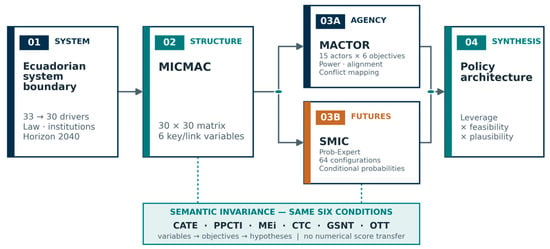
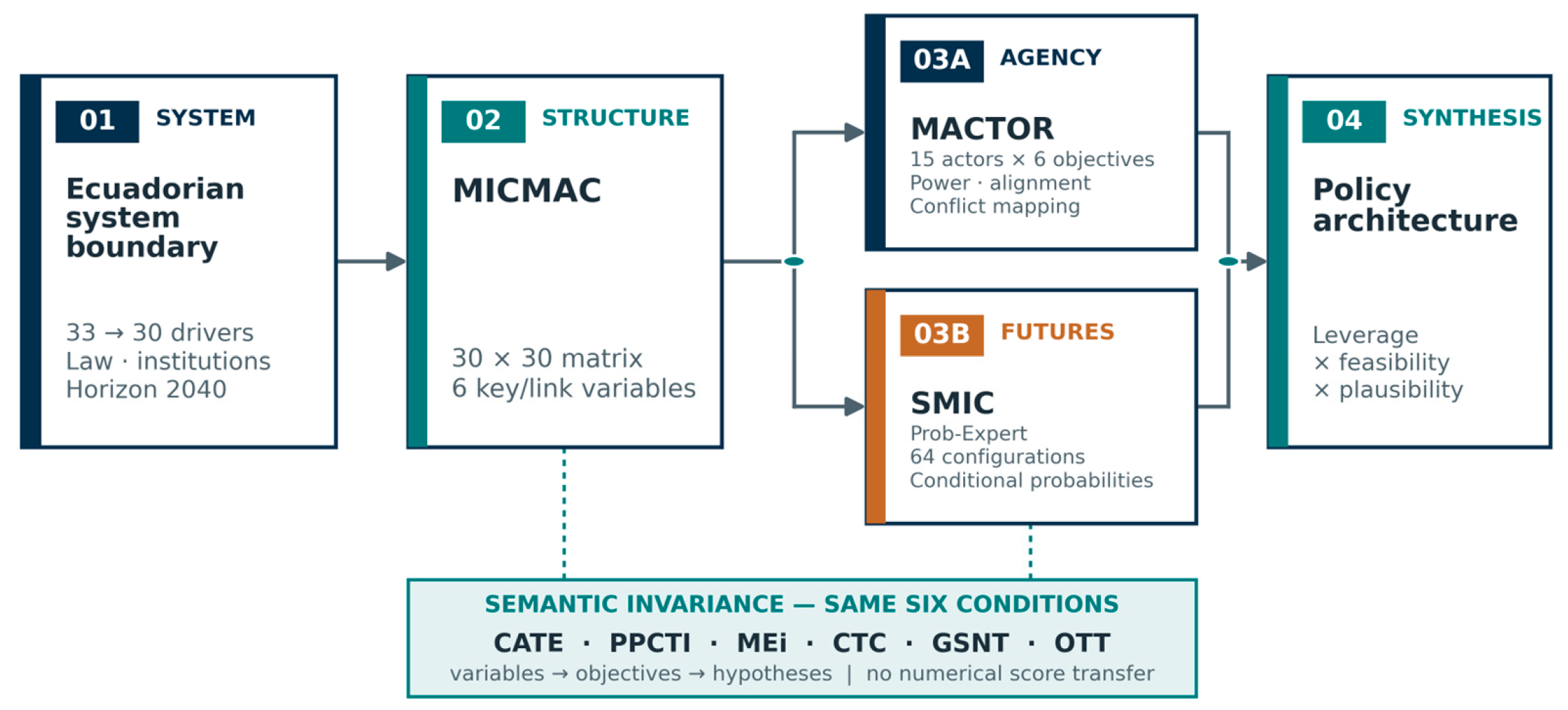
The analytical sequence used one invariant semantic object. MICMAC first classified all 30 retained drivers and identified six key variables. Those same six conditions were then expressed as strategic objectives for MACTOR and as positively framed, time-bounded binary hypotheses for SMIC-Prob-Expert. MACTOR diagnosed the authority, mobilization, convergence, and conflict surrounding the conditions; its scores were not inserted into SMIC. The final inference cross-reads three distinct evidence layers—structural salience, actor feasibility, and joint plausibility—under a common construct dictionary (Figure 1). This is an integrated chain of inference, not an additive index.
Figure 1.
Theory-driven analytical architecture. MICMAC models relational structure; MACTOR models actor feasibility; and SMIC-Prob-Expert models conditional futures. The invariant semantic core carries the same six conditions from variables to objectives and hypotheses; integration occurs by cross-reading the three evidence layers, without numerical score transfer. Solid gray arrows indicate the analytical sequence, while teal dashed connectors indicate semantic continuity across stages. Navy, teal, and copper distinguish the agency, structure/synthesis, and futures components, respectively.
Application to Ecuador was localized before calculation through the functional system boundary, national legal and policy setting, relevant institutional actors, operational definitions, and a 2040 horizon [33,34]. Prior Ecuadorian applications informed procedural feasibility and instrument adaptation [35,36,37,38]. Formal authority was analyzed because it is constitutive of the research question, while iterative elicitation and complete matrices retained disagreement long enough to test and revise judgments before aggregation.
2.2. Expert Selection
The panel was constituted as a criterion-based analytical workgroup for structured expert elicitation. Candidates completed an electronic competence questionnaire based on coefficient K, which combines self-assessed knowledge (Kc) and the evidential basis of that knowledge (Ka) [40]. The design criterion was epistemic relevance to the system and the capacity to complete intensive relational matrices, rather than demographic representation of an institutional population [41,42,43,44].
Panel size followed competence-based Delphi and structural-foresight practice, for which expertise relevance, judgment quality, and controlled iteration are more consequential than large-n sampling logic [30,41,42,43,44,45,46]. Gándara and Osorio specifically advise keeping a structural-analysis workgroup at no more than 12 participants to protect deliberative and matrix-quality performance [30]. The eight experts therefore fall within the recommended intensive-workgroup range. Only candidates with K > 0.80 were retained; the final n was an outcome of the competence screen rather than a quota fixed in advance. Following Cabero-Almenara et al. [40], K was classified as high (0.80 < K ≤ 1.00), moderate (0.50 < K ≤ 0.80), or low (K < 0.50).
The same workgroup participated across driver refinement, MICMAC, MACTOR, and SMIC. This continuity was a deliberate control against semantic drift: the meaning of each driver remained stable when translated into an actor objective and a future hypothesis. Validation within the design was procedural and convergent, combining a K > 0.80 entry criterion, iterative controlled feedback, very high rank concordance, explicit construct definitions, complete relationship matrices, consistency-adjusted SMIC solutions, and cross-solution robustness diagnostics. Reusing the workgroup therefore strengthens cross-stage traceability; it is not presented as independent replication.
2.3. System Understanding
System understanding combined an environmental scan, specialized literature, expected future changes, and prevailing stereotypes, following the analytical logic of Godet, Cruz and Medina [47,48]. The boundary followed the five transfer functions defined in Section 1 and was anchored in Ecuador’s institutional architecture [34]. Triangulation yielded 33 candidate drivers. Knowledge-transfer culture was kept distinct from generic innovation culture: the former concerned cross-institutional norms, incentives, reciprocity, trust, valorization, and outward use, whereas the latter concerned creativity, experimentation, and openness to innovation within organizations [15,21,22,23]. Ecuadorian evidence on financing, skills, market-information, and technology-information barriers informed the contextual interpretation of these routines [24].
2.4. Driver Refinement
Experts rated the relevance of the 33 candidate drivers on a five-point ordinal scale over successive consultation rounds. The predefined mean ≥ 2 and mode ≥ 1 rule was a conservative retention criterion for boundary completeness, not the study’s leverage-selection threshold. This follows the MICMAC principle that the initial variable inventory should be sufficiently exhaustive and should avoid premature exclusion of factors capable of direct or indirect influence [30,31]. Retaining 30 of 33 candidates was therefore an expected safeguard against specification loss. Substantive prioritization occurred in the subsequent 30 × 30 influence–dependence analysis, which reduced the scenario core from 30 variables to six.
Cronbach’s alpha (α = 0.808) is reported as a procedural consistency diagnostic, not as proof that heterogeneous system drivers form a unidimensional psychometric scale [49]. Construct validity instead rests on the function-based system boundary, explicit operational definitions, literature grounding, and subsequent relational testing. Kendall’s W assessed the stability of rank judgments within the competence-screened workgroup [50].
2.5. Structural Analysis
MICMAC (Matrix of Cross-Impact Multiplications Applied to a Classification) was used to identify the structural drivers governing system evolution [31]. The 30 retained drivers were coded and analyzed in LIPSOR MICMAC (Version 6.1.2), following the procedural sequence previously applied in Ecuadorian innovation foresight [36]. MICMAC is treated as a structured representation of expert judgments rather than a direct measurement of objective causality.
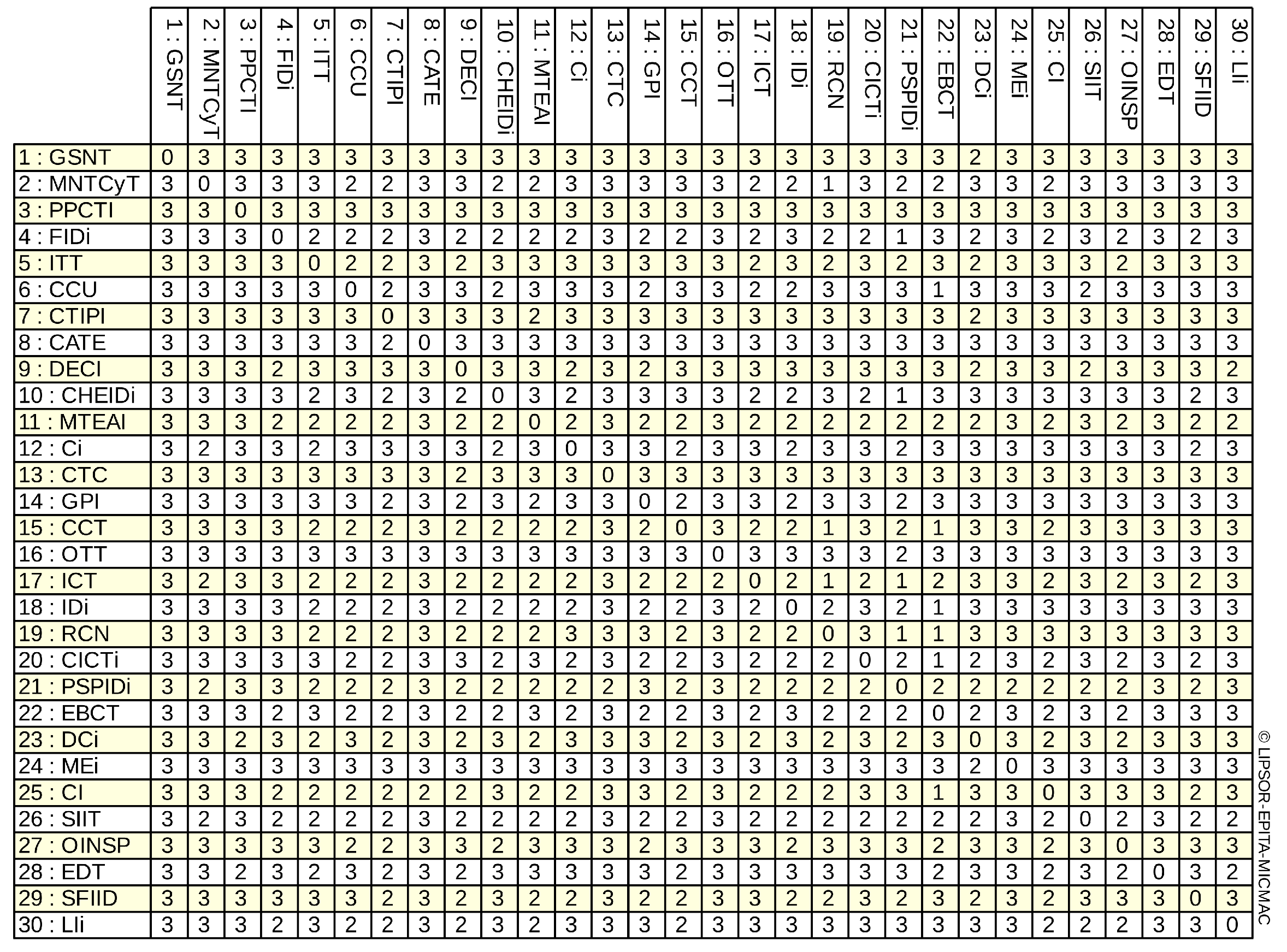
The analysis began with the construction of the Direct Influence Matrix, in which pairwise relationships between variables were assessed using a five-level scale: 0 (no influence), 1 (weak), 2 (moderate), 3 (strong), and P (potential influence). A total of 870 pairwise interactions were evaluated for the 30 drivers.
For auditability, the complete 30 × 30 Direct Influence Matrix underlying the structural analysis is reproduced in Appendix A.
The software subsequently generated the Indirect Influence/Dependence Map by propagating indirect effects through successive matrix multiplications, producing normalized influence and dependence scores that positioned each driver within the influence–dependence plane [51].
The rule for cross-stage selection was positional and explicit: only variables located in the MICMAC key quadrant—simultaneously high in influence and dependence on the indirect map—were advanced as the shared strategic conditions. This yielded six variables. The other 24 remained part of the system diagnosis but were excluded from binary scenario enumeration because they did not satisfy the structural-leverage criterion. The six-condition limit also preserved interpretability: six hypotheses generate 26 = 64 configurations, whereas 30 would generate 230 = 1,073,741,824; French-school manuals recommend a parsimonious core of approximately five or six hypotheses for SMIC scenario construction [30,31].
2.6. Stakeholder Analysis
MACTOR (Matrix of Alliances and Conflicts: Tactics, Objectives, and Recommendations) analyzed stakeholder influence and positions toward the six MICMAC-selected strategic conditions. This one-to-one reuse is the second step in the analytical handoff: structural variables become actor-relevant objectives without changing their core meaning [31,52]. The refined stakeholder matrices were analyzed in MACTOR software (Version 5.1.2).
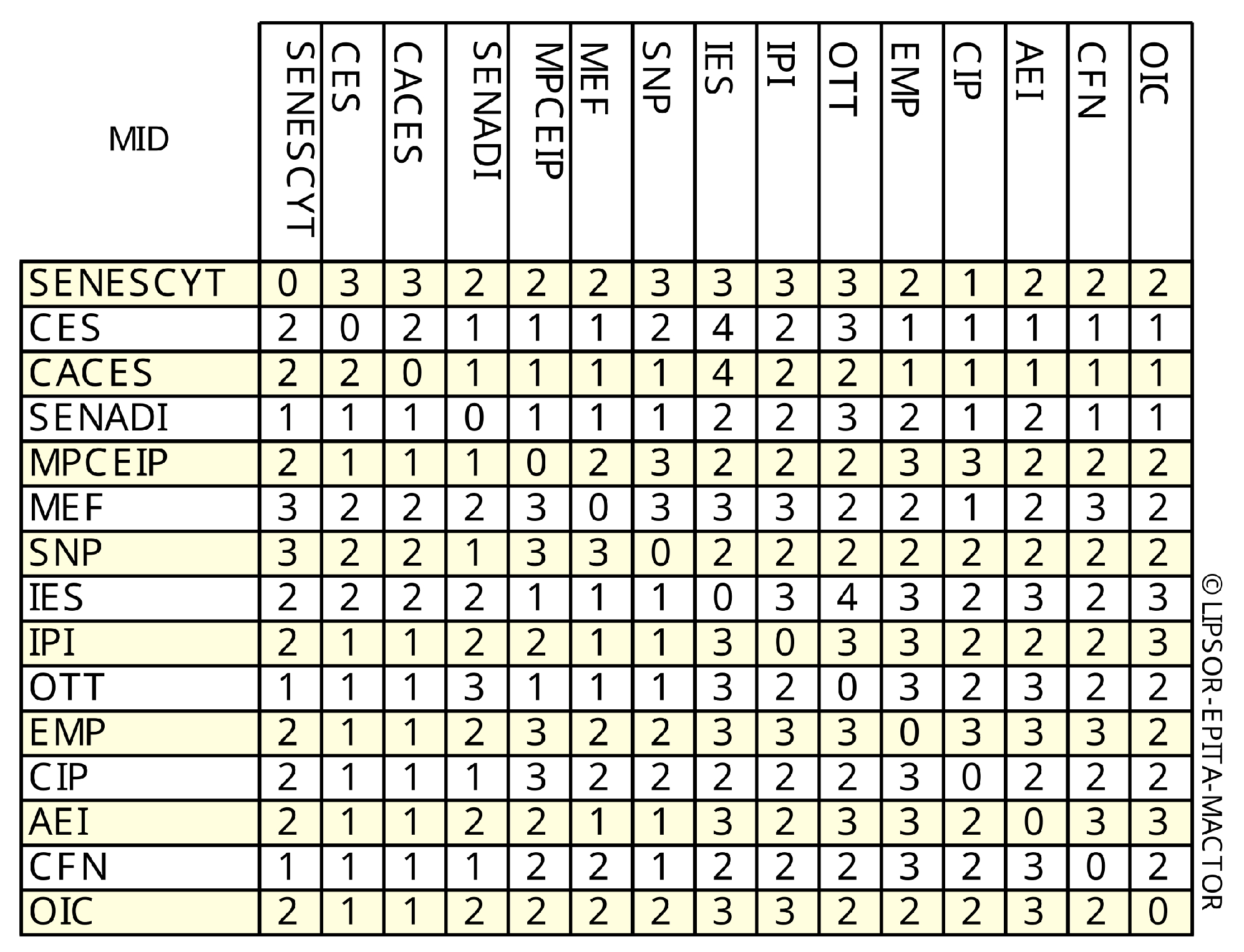
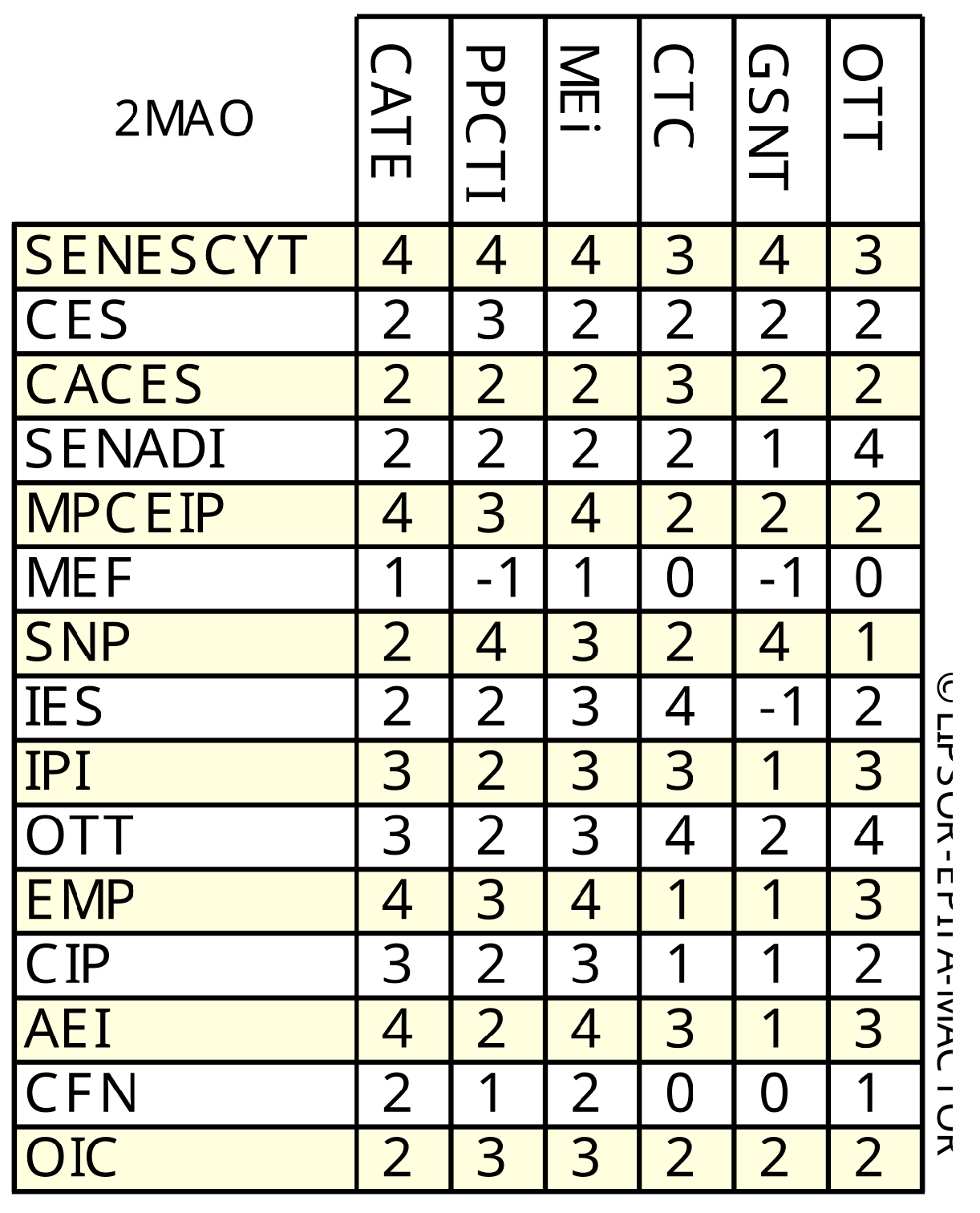
The analysis began with the construction of the Direct Influence Matrix, in which pairwise relationships among stakeholders were assessed using a five-level scale: 0 (no influence), 1 (processes), 2 (projects), 3 (mission), and 4 (existence). A total of 210 pairwise interactions were evaluated for the 15 stakeholders. Subsequently, the Valued Position Matrix (2MAO) was completed to assess each stakeholder’s position regarding the strategic objectives using the scale proposed by Mojica [53]: 0 (objective of little consequence); ±1 (affects operational processes); ±2 (affects projects); ±3 (affects the stakeholder’s mission); and ±4 (affects the stakeholder’s existence).
The complete 15 × 15 Direct Influence Matrix and the 15 × 6 Valued Position Matrix (2MAO) are reproduced in Appendix B and Appendix C, respectively.
MACTOR power, position, and mobilization outputs were interpreted as implementation-feasibility evidence. They were not used as weights or priors in SMIC; maintaining that separation prevents an unsupported numerical coupling, while allowing the actor analysis to explain why structurally important conditions may or may not be implemented.
2.7. Probabilistic Scenario Analysis
SMIC-Prob-Expert ranked the joint configurations of the same six conditions according to consistency-adjusted probabilities. Experts estimated simple, positive conditional, and negative conditional probabilities using an assisted Delphi questionnaire [30,54]. The analyses were performed in SMIC-Prob-Expert software (Version 5.0). This stage answers a different question from MICMAC and MACTOR: not which variables are structurally central or which actors support them, but which combinations of attainment and non-attainment remain jointly plausible.
Each MICMAC-selected variable was translated into one positively framed, time-bounded proposition specifying the institutional condition whose attainment by 2040 was evaluated. The same statements served as MACTOR objectives and SMIC hypotheses. In a six-digit scenario code, position i corresponds to Hi; 1 denotes attainment and 0 denotes non-attainment. This explicit coding provides the semantic bridge across methods.
The methodology began with the definition of a set of fundamental hypotheses, denoted as
For each hypothesis, the following probability measures were assigned:
Simple probabilities of occurrence over a given time horizon:
where
Positive conditional probabilities for each pair of hypotheses, considering
where P(Hi | Hj) is the probability that hypothesis Hi occurs given that hypothesis Hj has occurred.
Negative conditional probabilities for each pair of hypotheses, considering
where P(Hi | ¬Hj) is the probability that hypothesis Hi occurs given that hypothesis Hj has not occurred.
Given that expert judgments may exhibit inconsistencies with probability axioms, the Smic-Prob-Expert method systematically adjusts the initial probability inputs to ensure mathematical coherence by applying the following constraints:
Finally, considering that the study identified six key future events/hypotheses, the total number of possible scenarios was determined by
This calculation yielded 64 future alternatives, for which occurrence probabilities were systematically computed. Elasticity coefficients eij were also calculated to measure the effect of a variation in one hypothesis on another:
The complete consistency-adjusted matrices of realized effects, non-realized effects, and elasticities are reproduced in Appendix D.
2.8. Integration, Quality Controls, and Robustness Metrics
For each scenario s and contrasted consistency-adjusted solution k, let ps(k) denote the assigned joint probability. Five diagnostics summarize robustness across the eight solutions: lower bound Ls = mink ps(k); arithmetic mean Ms = (1/8)Σkps(k); median Qs = mediankps(k); upper bound Us = maxkps(k); and nonzero-solution coverage Cs = ΣkI[ps(k) > 0]. Ls and Us are model-solution extrema—not sampling confidence limits, forecast-error bands, or extrema of raw individual estimates. A scenario was considered structurally robust when its prominence did not depend on a single extremum but persisted across location, range, and coverage diagnostics.
3. Results
3.1. Expert Panel and Driver Refinement
Application of K > 0.80 retained eight high-competence experts, forming an intensive analytical workgroup within the size recommended for structural foresight [30]. The initial inventory contained 33 candidates; the conservative boundary-completeness screen retained 30 for MICMAC. The decisive prioritization was therefore not the 33-to-30 screen but the subsequent structural reduction from 30 variables to six key conditions.
Responses to the heterogeneous driver instrument produced Cronbach’s α = 0.808, a satisfactory procedural consistency diagnostic. Kendall’s W = 0.929 (df = 32, p < 0.001) indicates very high concordance among the eight competence-screened experts’ rankings (Table 1). Together with iterative feedback and the K threshold, these statistics support the stability of the elicited workgroup model; conceptual validity is supplied by the explicit system functions and variable definitions rather than by treating the inventory as a unidimensional scale [49].
Table 1.
Concordance test statistics for expert-based driver refinement.
3.2. Structural Configuration of the System
The retained driver set provides a system-level representation of the transfer process, ranging from upstream governance and public policy to absorptive capacity, commercialization, collaboration, financing, and performance evaluation. Table 2 presents the operational definitions and codes used throughout the MICMAC, MACTOR, and SMIC-Prob-Expert analyses.
Table 2.
Drivers retained for the structural analysis of Ecuador’s National Knowledge and Technology Transfer System.
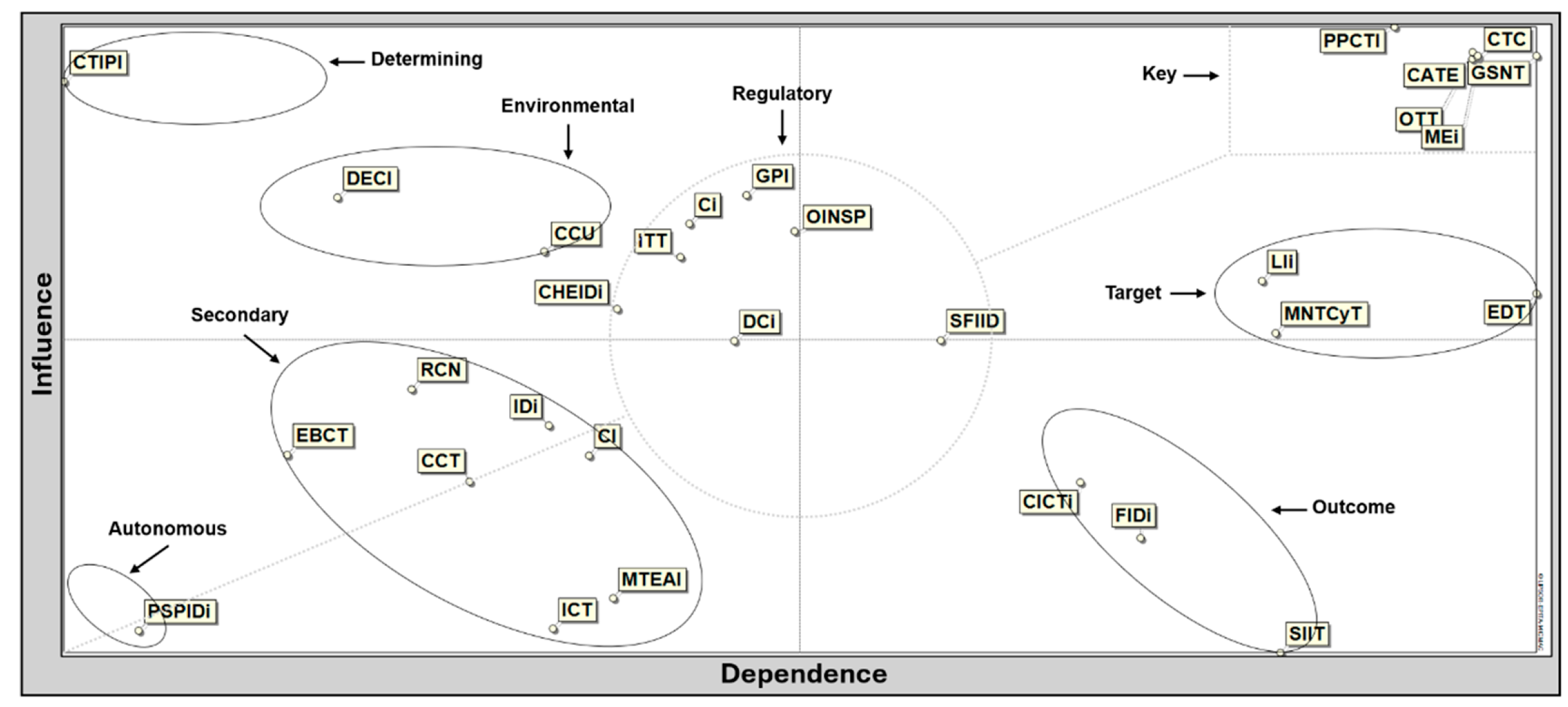
The indirect influence–dependence analysis revealed a strongly differentiated system rather than a uniformly connected set of factors. The most strategically significant positions are concentrated in a small number of drivers, while the remaining variables form regulatory, target, outcome, secondary, environmental, determining, and autonomous clusters.
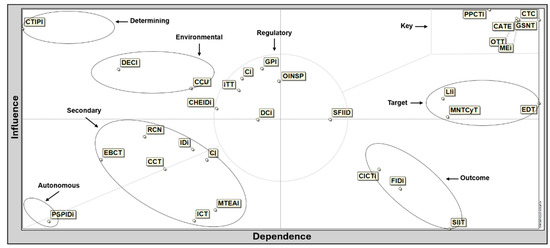
Six variables occupy the key quadrant: Technological Absorptive Capacity (CATE), Public Policies for Science, Technology and Innovation (PPCTI), Innovation Ecosystem Maturity (MEi), Knowledge Transfer Culture (CTC), Governance of the National Knowledge Transfer System (GSNT), and Technology Transfer Offices (OTT). Their joint high-influence/high-dependence position satisfied the predefined cross-stage selection rule. They are leverage points and sources of instability because changes can propagate broadly while remaining sensitive to feedback. The remaining 24 variables were not discarded from the system model; they remain visible in Table 2 and Figure 2 but did not enter the parsimonious binary scenario core.
Figure 2.
MICMAC indirect influence–dependence map for 30 drivers. The horizontal axis represents indirect dependence and the vertical axis indirect influence; labels use the codes in Table 2. Variables in the upper-right key quadrant satisfy the cross-stage selection criterion. The dashed lines are visual reference guides generated by MICMAC to locate the variables within the influence–dependence plane; they do not represent additional relationships or weights.
Key: Technological Absorptive Capacity (CATE), Public Policies for Science, Technology and Innovation (PPCTI), Innovation Ecosystem Maturity (MEi), Knowledge Transfer Culture (CTC), Governance of the National Knowledge Transfer System (GSNT), Technology Transfer Offices (OTT).
Target: Institutional Leadership for Innovation (LIi), Regulatory Framework for Knowledge and Technology Transfer (MNTCyT), Knowledge Transfer Performance Evaluation (EDT).
Outcome: International Collaboration in Science, Technology and Innovation (CICTi), Research, Development and Innovation Funding (FIDi), Scientific and Technological Intelligence Systems (SIIT).
Regulatory: Financial Sustainability of R&D Institutions (SFIID), Socio-Productive Orientation of Research (OINSP), Intellectual Property Management (GPI), Innovation Culture (Ci), Incentives for Technology Transfer (ITT), Availability of Innovation Capital (DCi), Highly Qualified Human Capital for R&D&I (CHEIDi).
Secondary: Science- and Technology-Based Entrepreneurship (EBCT), National Collaboration Networks (RCN), Technology Commercialization Capability (CCT), Digital Infrastructure for Innovation (IDi), Interinstitutional Trust (CI), Talent Mobility between Academia and Industry (MTEAI), Scientific and Technological Infrastructure (ICT).
Environmental: Business Demand for Knowledge and Innovation (DECI), Scientific Capacity of Universities (CCU).
Determining: Technological Capacity of Public Research Institutes (CTIPI).
Autonomous: Private Sector Participation in R&D&I (PSPIDi).
The rest of the map clarifies how this core is embedded in the wider system. Technological Capacity of Public Research Institutes (CTIPI) is the sole determining driver, reflecting high influence and limited dependence. Business Demand for Knowledge and Innovation (DECI) and Scientific Capacity of Universities (CCU) form the environmental group. Institutional Leadership for Innovation (LIi), the Regulatory Framework for Knowledge and Technology Transfer (MNTCyT), and Knowledge Transfer Performance Evaluation (EDT) appear as highly dependent target variables, whereas international collaboration (CICTi), R&D&I funding (FIDi), and scientific and technological intelligence systems (SIIT) are positioned as downstream outcomes. Private Sector Participation in R&D&I (PSPIDi) is the only autonomous variable, indicating weak structural integration with the dominant feedback mechanisms.
3.3. Stakeholder Power and Strategic Alignment
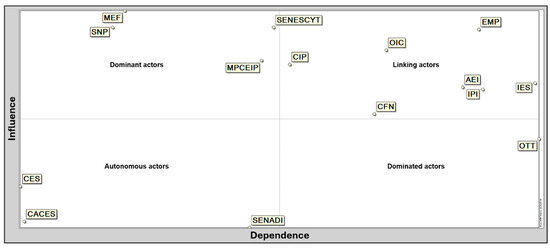
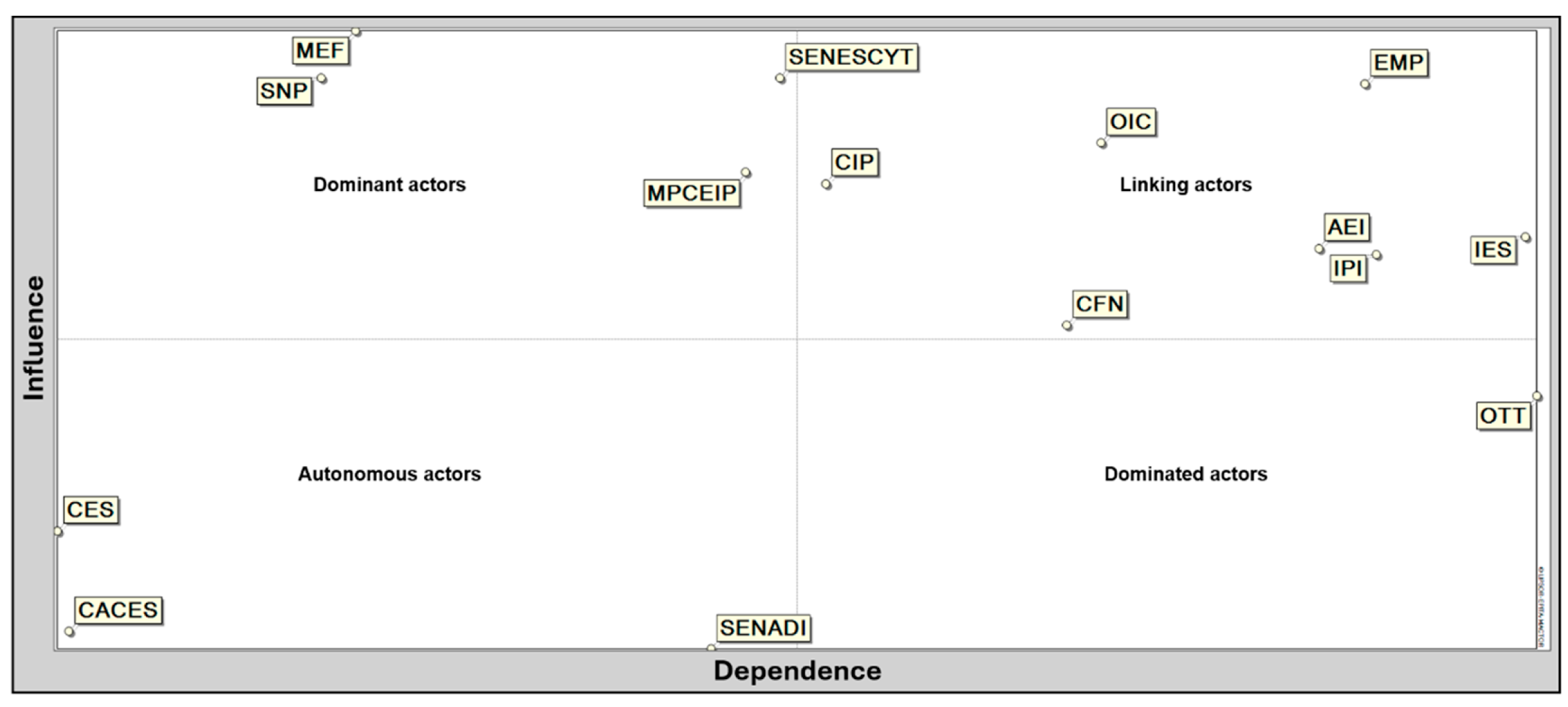
The MACTOR influence–dependence map (Figure 3) further shows that the ability to act on this structural core is unevenly distributed among the 15 stakeholders. The Ministry of Economy and Finance (MEF), the National Planning Secretariat (SNP), and MPCEIP occupy the dominant quadrant. SENESCYT lies close to the boundary between dominant and linking positions, whereas firms (EMP), OIC, CIP, AEI, public research institutes (IPI), higher education institutions (IES), and CFN are predominantly linking actors. These actors combine substantial influence with high dependence and are consequently central to coalition formation.
Figure 3.
MACTOR actor influence–dependence map. Horizontal position indicates dependence on other actors and vertical position indicates influence; the quadrants distinguish dominant, linking, dominated, and autonomous actors. Actor abbreviations are defined in the Abbreviations section. The dashed horizontal and vertical lines represent the influence and dependence reference thresholds used to define the four actor quadrants.
Technology Transfer Offices (OTT) occupy the dominated quadrant: they are highly dependent on other stakeholders but possess comparatively limited influence. CES, CACES, and SENADI appear as autonomous actors. This distribution reveals an important institutional asymmetry: OTT is a key structural driver in MICMAC, yet the actor responsible for operationalizing that function lacks equivalent strategic power in MACTOR.
For MACTOR and SMIC, the six selected variables were operationalized one-to-one as the 2040 statements in Table 3. Thus H1–H6 correspond, respectively, to CATE, PPCTI, MEi, CTC, GSNT, and OTT. The mapping preserves conceptual identity across stages: MACTOR assesses actor stakes and capacity around each condition, whereas SMIC assesses occurrence and conditional interdependence. No MACTOR score was numerically passed into SMIC.
Table 3.
Operationalization of the six SMIC-Prob-Expert hypotheses toward 2040.
The objective-level results show the strongest collective mobilization around H3 (43.3), followed by H1 (40.0), H2 (36.8), H6 (32.4), H4 (30.8), and H5 (26.1). No negative positions were recorded for H1, H3, H4, or H6. Disagreement was confined to H2 (−1.3) and H5 (−2.2), making governance the least mobilizing and most contested of the six hypotheses (Table 4).
Table 4.
Weighted stakeholder positions toward the six future hypotheses and their mobilization scores.
At the stakeholder level, SENESCYT recorded the highest aggregate mobilization (25.8), followed by SNP (20.1), MPCEIP (18.6), firms (16.9), and AEI (16.0). At the opposite end, MEF (5.2) and CFN (5.5) showed the lowest totals. MEF adopted negative positions toward both H2 and H5 (−1.3 in each case), while IES registered a negative position toward H5 (−0.9). Thus, the actor with the strongest dominant position in the influence–dependence map also showed the lowest overall commitment to the proposed systemic objectives.
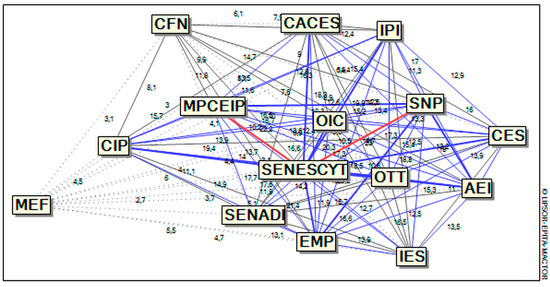
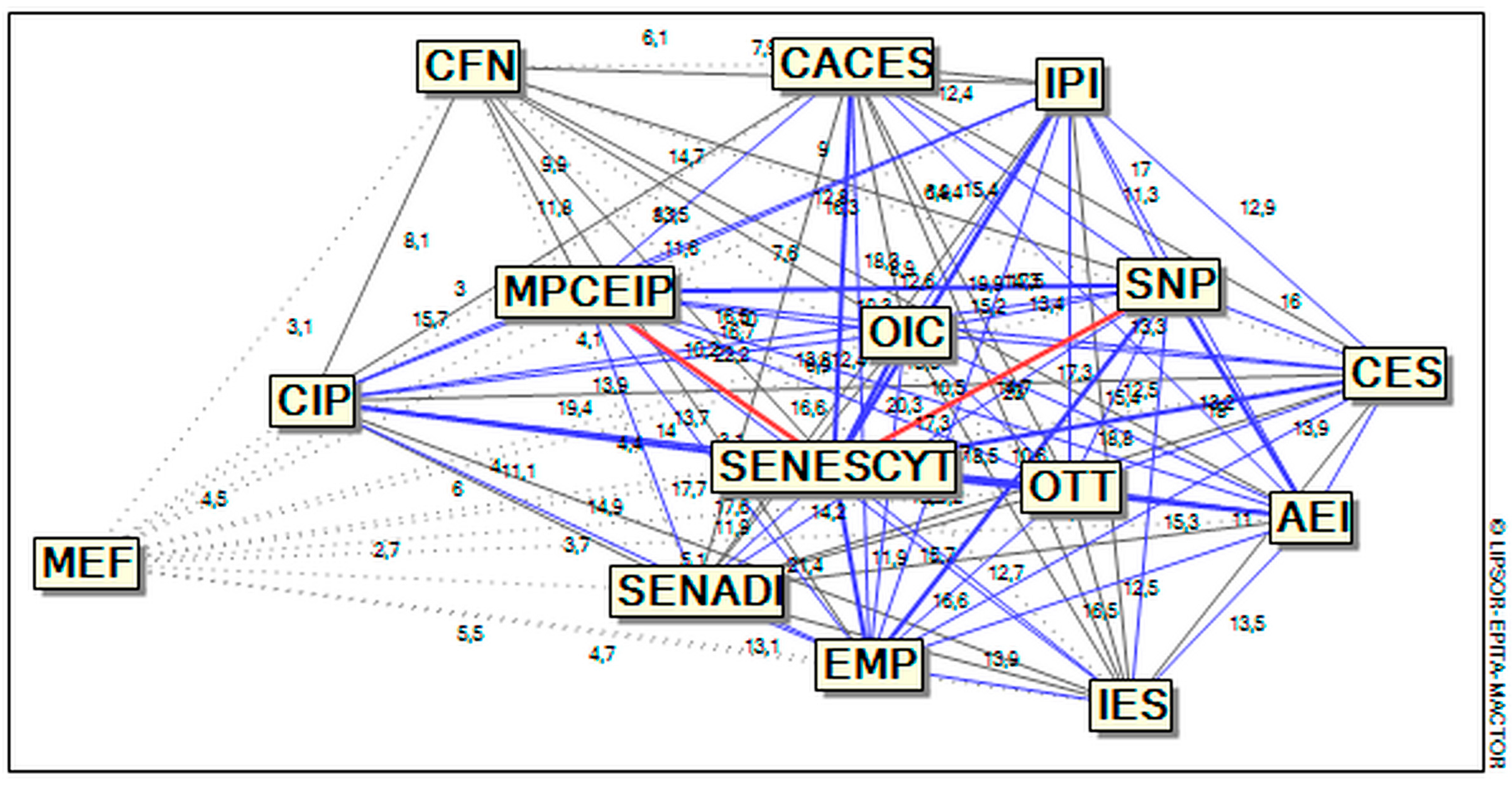
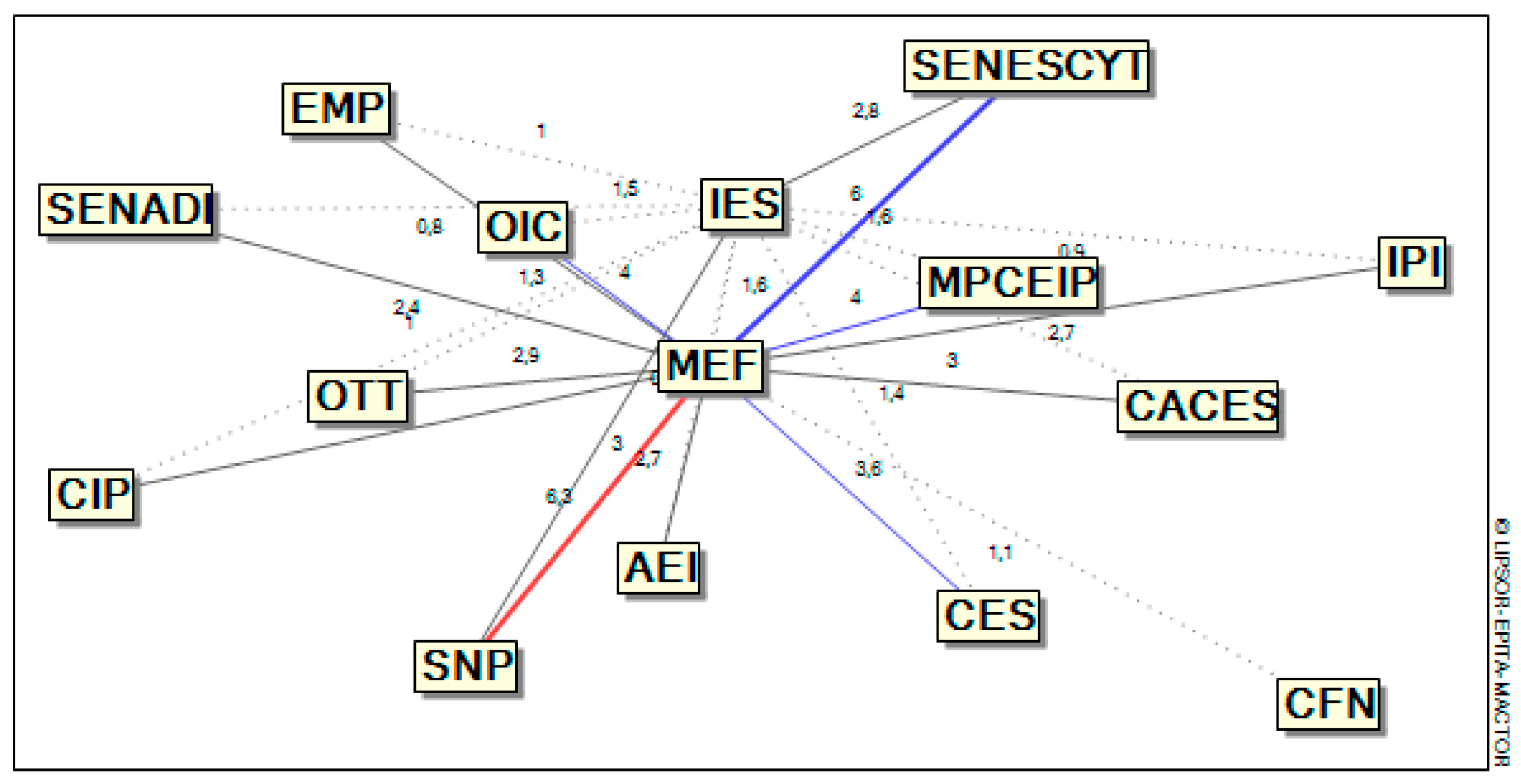
The third-order convergence network (Figure 4) is dense and connects most stakeholders through medium or relatively important convergences.. SENESCYT, OIC, OTT, SNP, MPCEIP, IPI, and firms occupy the most interconnected portion of the network, whereas MEF remains peripheral and is linked mainly through weak convergences.
Figure 4.
Third-order MACTOR convergence network. Links represent weighted convergence of actor positions across the six shared strategic objectives; denser connections identify potential coalition structure rather than observed collaboration. Dotted gray, solid black, blue, and red lines indicate progressively stronger convergence relationships, respectively; the numerical labels report the corresponding weighted convergence values.
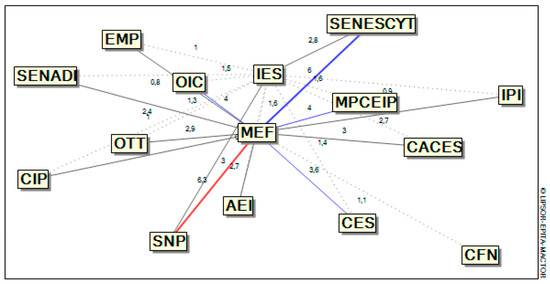
By contrast, Figure 5 shows that third-order divergences are concentrated primarily around MEF, indicating that strategic tension is localized at the fiscal-policy interface rather than distributed across the system.
Figure 5.
Third-order MACTOR divergence network. Links represent weighted opposition across the six objectives; the concentration around MEF localizes strategic tension at the fiscal-policy interface rather than indicating system-wide conflict. Dotted gray, black, blue, and red links indicate progressively stronger levels of divergence, while the numerical labels report the corresponding weighted divergence values.
In contrast to the distributed convergence structure, divergences are concentrated almost entirely around MEF. The most prominent tensions connect MEF with SENESCYT (7.6) and SNP (6.3), with additional divergences involving MPCEIP, AEI, IES, CES, CFN, OTT, and other system actors. The combination of a dense pro-change coalition and a finance-centered divergence structure indicates that stakeholder conflict is not generalized; it is concentrated at the interface between strategic ambition, public coordination, and fiscal authority.
3.4. Probabilistic Scenarios Toward 2040
The six binary hypotheses generated 64 possible scenarios. In each six-digit configuration, 1 denotes occurrence and 0 denotes non-occurrence of H1–H6, respectively. The SMIC extremum analysis compared the probability assigned to each scenario across the contrasted solutions generated after consistency adjustment. Accordingly, the reported minima and maxima are model-based probability bounds rather than confidence intervals or the lowest and highest individual expert estimates.
Before examining the joint configurations, the consistency-adjusted marginal probabilities were highest for technological absorptive capacity (CATE: 0.743), followed by knowledge transfer culture (CTC: 0.702), innovation ecosystem maturity (MEi: 0.674), Technology Transfer Offices (OTT: 0.672), public science, technology and innovation policies (PPCTI: 0.530), and national-system governance (GSNT: 0.515) (Table 5).
Table 5.
Consistency-adjusted marginal probabilities and aggregate SMIC elasticity coefficients.
The conditional-effect matrices identified the strongest mutually reinforcing relationship between public policy and governance. The probability of PPCTI increased from 0.530 to P(H2 | H5) = 0.750 when GSNT occurred, while the probability of GSNT increased from 0.515 to P(H5 | H2) = 0.729 when PPCTI occurred. Conversely, these probabilities fell to P(H2 | not H5) = 0.296 and P(H5 | not H2) = 0.274 when the corresponding condition was absent. Policy continuity and system governance therefore emerge as jointly configured rather than independently attainable institutional conditions.
The elasticity matrix further revealed an uneven sensitivity structure. The largest aggregate response sensitivities corresponded to OTT (1.328), CATE (1.321), CTC (1.129), and MEi (1.034), while PPCTI (0.451) and GSNT (0.450) were comparatively less responsive. The largest individual cross-elasticities were the response of CATE to MEi (e13 = −0.351), OTT to MEi (e63 = −0.345), CATE to OTT (e16 = −0.333), and CATE to CTC (e14 = −0.316). These coefficients describe probabilistic interdependence within the consistency-adjusted SMIC distribution and should not be interpreted as causal effects. The full matrices are reported in Appendix D.
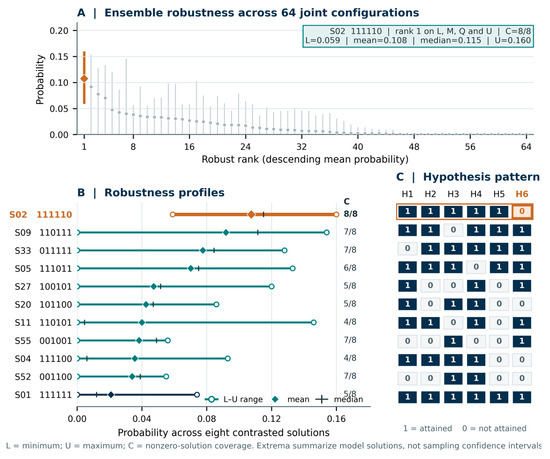
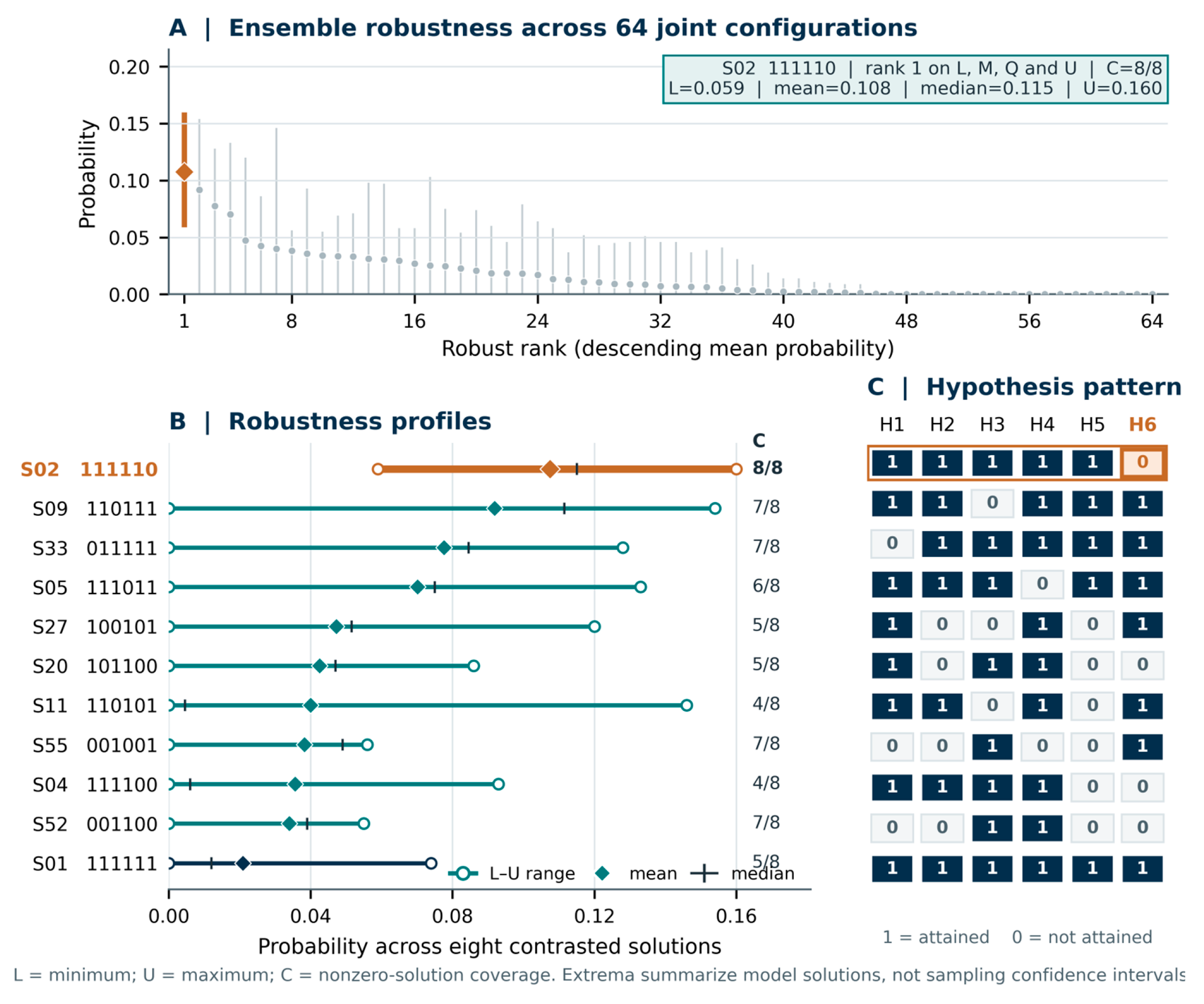
Figure 6 summarizes the robustness of the 64 scenario configurations across the eight contrasted consistency-adjusted solutions.
Figure 6.
Robustness architecture of 64 SMIC configurations across eight contrasted consistency-adjusted solutions. Panel (A) ranks all configurations by mean probability and shows each Ls–Us envelope; Panel (B) compares the ten leading means with fully favorable Scenario 01; Panel (C) aligns their H1–H6 attainment patterns. Copper identifies Scenario 02 (111110), which ranks first by Ls, Ms, Qs, and Us and uniquely has Cs = 8/8. H6 denotes OTT consolidation. Bounds are model extrema, not confidence intervals. Across the three panels, copper highlights Scenario 02 (111110); gray represents the remaining scenario probabilities in Panel (A); teal represents the other displayed robustness profiles in Panel (B); and, in Panel (C), navy and light gray denote hypothesis attainment (1) and non-attainment (0), respectively.
Scenario 02 (111110) has a robustness profile of Ls = 0.059, Ms = 0.108, Qs = 0.115, Us = 0.160, and Cs = 8/8. It is the only one of the 64 alternatives with both a positive lower bound and nonzero probability in all eight contrasted solutions, and it ranks first independently by lower bound, mean, median, and upper bound. Its dominance is therefore not an artifact of selecting one summary statistic. The configuration combines attainment of H1–H5 with non-attainment of H6: progress in absorptive capacity, public policy, ecosystem maturity, transfer culture, and national governance without corresponding OTT consolidation.
The next configurations by mean probability are Scenario 09 (110111; Ms = 0.092; Cs = 7/8), Scenario 33 (011111; Ms = 0.078; Cs = 7/8), and Scenario 05 (111011; Ms = 0.070; Cs = 6/8). Each has Ls = 0, so none matches the floor robustness of 111110. Public STI policy (H2) is present in four of the five scenarios with the highest upper bounds, while the cross-impact matrices identify H2 and national governance (H5) as the strongest reciprocal conditional pair. The ensemble therefore concentrates probability on coordinated but institutionally uneven advances rather than on isolated events.
The fully favorable Scenario 01 (111111) has Ls = 0, Ms = 0.021, Qs = 0.012, Us = 0.074, and Cs = 5/8; it ranks fourteenth by upper bound and twentieth by mean. Conversely, complete non-attainment (Scenario 64; 000000) receives zero probability in every solution. Overall, 47 scenarios have a nonzero upper bound and 17 remain at zero throughout. The distribution rules out neither transformation nor policy agency; it identifies the consolidation of the implementation interface represented by H6 as the differentiating condition between the robust partial pathway and comprehensive system transformation.
Across the six shared conditions, the results converge on a coordination-to-implementation gap: structural leverage is highly coupled, authority is concentrated upstream, and the uniquely robust scenario omits OTT consolidation. H6 is therefore not a peripheral weakness but the binding implementation condition separating coordinated partial modernization from the fully favorable configuration. This synthesis is interpreted in relation to RQ1–RQ3 in Section 4.
4. Discussion
4.1. Structural Leverage and Theoretical Contribution (RQ1)
RQ1 asked which drivers combine the greatest influence and dependence. MICMAC identifies CATE, PPCTI, MEi, CTC, GSNT, and OTT—six of 30 variables—as the reciprocal leverage core. This result supports the proposed distinction between a broad NIS and a transfer-specific coordination architecture. National transfer performance depends on aligning production, intermediation, absorption, authority, resources, and feedback; it cannot be inferred from patents, licenses, or the performance of one office alone [12,13,14,15,16,17]. High dependence also means that none of the six is a self-sufficient root cause: isolated interventions may be neutralized by feedback from the other conditions.
The wider MICMAC configuration locates the substantive disconnection. Public research technological capacity is determining, university scientific capacity is environmental, and private-sector R&D&I participation is autonomous. Ecuador can therefore expand knowledge supply without generating recurrent demand, co-investment, or application. This extends technology-transfer theory by locating the problem not only in channels and capabilities but in the national alignment of interfaces [10,13,14,15,17,18,19,55,56]. Ecuadorian firm evidence on finance, skills, market information, and technology information reinforces the relevance of the absorptive-demand interface [24].
4.2. Actor Power, Implementation, and Transfer Culture (RQ2)
RQ2 asked how actor power and positions condition action. MEF, SNP, and MPCEIP occupy dominant positions, while OTT is the sole dominated actor, despite OTT capability being a key structural driver. The mismatch constitutes an authority–implementation gap: organizations expected to translate and commercialize knowledge depend on actors that control finance, planning, regulation, and institutional incentives. The strongest divergences—MEF with SENESCYT and SNP—further locate the bottleneck at the interface between fiscal authority and STI ambition. The implication is not that OTTs are weak organizations to be blamed, but that their capability must be designed as a networked system instrument backed by actors controlling the policy mix [14,16,17,57,58].
Knowledge-transfer culture is central at the institutional level elicited. Its MICMAC position and adjusted marginal probability (0.702) show that cross-institutional norms, incentives, trust, reciprocity, and outward use operate as enabling system conditions. Culture is neither a residual explanation nor a substitute for formal institutions: appraisal rules, contracting routines, researcher mobility, repeated partner experience, and leadership reproduce it [15,21,22,23]. This mechanism-based interpretation links culture directly to governance instruments and is consistent with the collaboration and information barriers documented among Ecuadorian firms [24].
4.3. Probabilistic Futures and Policy Architecture (RQ3)
RQ3 asked which configurations are plausible toward 2040. Scenario 02 (111110) is uniquely robust (Ls = 0.059, Ms = 0.108, Qs = 0.115, Us = 0.160, and Cs = 8/8), ranking first on every location and extremum diagnostic. It combines attainment of H1–H5 with non-attainment of H6. By comparison, fully favorable 111111 has Ls = 0, Ms = 0.021, Us = 0.074, and Cs = 5/8. This finding does not naturalize incomplete transformation; it identifies OTT consolidation as the binding implementation condition that policy must actively shift if Ecuador is to move from a robust partial pathway to comprehensive system performance.
Policy should therefore be configured as a sequenced portfolio rather than a list of independent projects. First, fiscal and STI authorities must lock in the H2–H5 policy–governance complementarity. Second, that authority must capitalize a networked OTT implementation layer capable of shifting H6. Third, demand-side instruments must connect autonomous private R&D&I to public knowledge; transfer-oriented incentives and routines then stabilize H4. This portfolio logic is consistent with systemic-instrument, policy-mix, and transformative-system perspectives [16,17,34,57,58,59]. Table 6 translates the diagnosis into instruments, lead coalitions, and observable scenario signals.
Table 6.
Policy architecture derived from the integrated foresight diagnosis.
4.4. Methodological Contribution, Validation Scope, and Strengths
Methodologically, the contribution lies in a traceable handoff rather than the mere co-use of three software packages. MICMAC reduces the system through an explicit positional rule; the same six conditions organize MACTOR objectives and SMIC hypotheses; and the conclusion cross-reads structural salience, actor feasibility, and joint plausibility without numerical fusion. Strengths include a function-defined system boundary, one-to-one operationalization, a competence-screened workgroup, full MICMAC and MACTOR input matrices, consistency-adjusted SMIC outputs, and an explicit five-metric robustness test. This implements the modular, iterative logic emphasized in strategic foresight manuals and Latin American policy-foresight practice [30,31,32,33].
The principal limitations concern external transferability, not internal traceability. The eight-person workgroup is appropriate to intensive structural elicitation [30], but it does not estimate the prevalence of opinions across Ecuadorian institutions. Reusing the workgroup protects semantic continuity across methods, while an independently constituted panel would provide a stronger future test of transferability. MICMAC and MACTOR remain structured relational judgments, and SMIC extrema are model-based plausibility bounds rather than causal effects or sampling intervals. Within this scope, K > 0.80, W = 0.929, iterative feedback, complete matrices, coherence adjustment, and Scenario 02’s first-place ranking across Ls, Ms, Qs, Us, and Cs provide convergent evidence that the reported architecture is not driven by one instrument or one probability statistic.
Future research can extend rather than repair this design by repeating the elicitation with an independent panel, testing sensitivity to quadrant boundaries, preserving minority rationales, updating probabilities with longitudinal indicators, and comparing other Latin American systems. These extensions would distinguish Ecuador-specific relations from recurrent coordination architectures.
5. Conclusions
The three research questions each received a coherent answer. For RQ1, six mutually dependent drivers form the structural leverage core: CATE, PPCTI, MEi, CTC, GSNT, and OTT. For RQ2, authority is concentrated in finance, planning, and productive-policy actors, while OTTs combine high systemic importance with low actor power. For RQ3, 111110 ranks first by lower bound, mean, median, and upper bound and is uniquely present in all eight contrasted solutions. Together, these findings identify an authority–implementation gap and isolate OTT consolidation as the binding condition between robust partial modernization and comprehensive transformation.
The paper’s main theoretical contribution is to define the national transfer system as a functional coordination architecture nested within, but narrower than, the National Innovation System. Its methodological contribution is the explicit, non-additive handoff from 30 MICMAC variables to six shared MACTOR objectives and SMIC hypotheses, followed by a five-metric robustness assessment. The practical implication is a coordinated policy portfolio: align fiscal and STI governance, build a nationally connected OTT capability, stimulate firm absorption and demand, institutionalize transfer-oriented incentives and routines, and monitor the portfolio against scenario signals.
The claims are analytical generalizations from a competence-screened and auditable expert model, not population estimates or causal forecasts. External replication can test their transferability, while the internal inference is reinforced by semantic continuity, complete matrices, high concordance, SMIC coherence adjustment, and the cross-solution dominance of 111110. Ecuador’s decisive challenge toward 2040 is therefore not knowledge production alone, but whether actors with authority deliberately enable the interfaces that translate knowledge into sustained use.
Author Contributions
Conceptualization, C.-G.H.; methodology, C.-G.H.; validation, C.-G.H. and I.C.; formal analysis, C.-G.H.; investigation, C.-G.H.; data curation, C.-G.H.; writing—original draft preparation, C.-G.H.; writing—review and editing, C.-G.H. and I.C.; visualization, C.-G.H.; project administration, C.-G.H. All authors have read and agreed to the published version of the manuscript.
Funding
This research received no external funding.
Institutional Review Board Statement
Ethical review and approval were waived for this study because it involved non-invasive consultation with adult experts on institutional and policy matters, collected no sensitive personal, clinical, or biological data, and posed no foreseeable risk to participants. The study was conducted within the Universidad de Guayaquil competitive research project FCI-017-2023, institutionally approved under Resolution No. R-CSU-UG-SE34-313-14-09-2023 following an assessment that included ethical considerations. Consequently, no separate ethics certificate or protocol number was issued.
Informed Consent Statement
Informed consent was obtained from all participants involved in the study.
Data Availability Statement
The datasets supporting the findings are openly available at https://drive.google.com/drive/folders/1rdLP2FDmhgB04-2i5Z3JOcdjb1astpQU?usp=sharing (accessed on 26 July 2026). The shared materials include the finalized MICMAC, MACTOR, and SMIC-Prob-Expert inputs and analytical files. Complete MICMAC and MACTOR input matrices are reproduced in Appendix A, Appendix B and Appendix C, and consistency-adjusted SMIC effect and elasticity matrices in Appendix D. The archived package does not contain the item-level ratings for the three candidate drivers excluded during the preliminary 33-to-30 boundary screen; those distributions cannot be reconstructed reliably, and no post hoc values were created.
Acknowledgments
The authors gratefully acknowledge the eight experts who participated in the successive consultation rounds and provided the judgments that informed the refinement of the initial driver inventory and the inputs used in the MICMAC, MACTOR, and SMIC-Prob-Expert analyses. The authors reviewed and edited the output and take full responsibility for the content of this publication.
Conflicts of Interest
The authors declare no conflicts of interest.
Abbreviations
The following abbreviations are used in this manuscript:
| 2MAO | Valued Position Matrix |
| AEI | Alliance for Entrepreneurship and Innovation |
| CACES | Council for Quality Assurance in Higher Education |
| CATE | Technological Absorptive Capacity |
| CCT | Technology Commercialization Capability |
| CCU | Scientific Capacity of Universities |
| CES | Higher Education Council |
| CFN | National Finance Corporation |
| CHEIDi | Highly Qualified Human Capital for Research, Development and Innovation |
| CI | Interinstitutional Trust |
| Ci | Innovation Culture |
| CICTi | International Collaboration in Science, Technology and Innovation |
| CIP | Chamber of Industries and Production |
| CTC | Knowledge Transfer Culture |
| CTIPI | Technological Capacity of Public Research Institutes |
| DCi | Availability of Innovation Capital |
| DECI | Business Demand for Knowledge and Innovation |
| EBCT | Science- and Technology-Based Entrepreneurship |
| EDT | Knowledge Transfer Performance Evaluation |
| EMP | Firms |
| FIDi | Research, Development and Innovation Funding |
| GPI | Intellectual Property Management |
| GSNT | Governance of the National Knowledge Transfer System |
| ICT | Scientific and Technological Infrastructure |
| IDi | Digital Infrastructure for Innovation |
| IES | Higher Education Institutions |
| IPI | Public Research Institutes |
| ITT | Incentives for Technology Transfer |
| LIi | Institutional Leadership for Innovation |
| LIPSOR | Laboratoire d’Investigation en Prospective, Stratégie et Organisation |
| MACTOR | Matrix of Alliances and Conflicts: Tactics, Objectives, and Recommendations |
| MEF | Ministry of Economy and Finance |
| MEi | Innovation Ecosystem Maturity |
| MICMAC | Matrix of Cross-Impact Multiplications Applied to a Classification |
| MNTCyT | Regulatory Framework for Knowledge and Technology Transfer |
| MPCEIP | Ministry of Production, Foreign Trade, Investments and Fisheries |
| MTEAI | Talent Mobility between Academia and Industry |
| NECI | National Entrepreneurial Context Index |
| NIS | National Innovation Systems |
| OIC | International Cooperation Organizations |
| OINSP | Socio-Productive Orientation of Research |
| OTT | Technology Transfer Offices |
| PPCTI | Public Policies for Science, Technology and Innovation |
| PSPIDi | Private Sector Participation in Research, Development and Innovation |
| R&D | Research and Development |
| R&D&I | Research, Development and Innovation |
| RCN | National Collaboration Networks |
| RTOs | Research and Technology Organizations |
| SENADI | National Service of Intellectual Rights |
| SENESCYT | Secretariat of Higher Education, Science, Technology and Innovation |
| SFIID | Financial Sustainability of Research and Development Institutions |
| SIIT | Scientific and Technological Intelligence Systems |
| SMIC | Cross-Impact Matrices and Systems |
| SMIC-Prob-Expert | Probabilistic Expert version of the Cross-Impact Matrices and Systems method |
| SNP | National Planning Secretariat |
| SPSS | Statistical Package for the Social Sciences |
| TEA | Total Early-stage Entrepreneurial Activity |
Appendix A
Figure A1.
Complete 30 × 30 MICMAC Direct Influence Matrix used as input for the structural analysis. Source: LIPSOR MICMAC software, version 6.1.2.
Appendix B
Figure A2.
Complete 15 × 15 MACTOR Direct Influence Matrix (MID). Source: LIPSOR MACTOR software, version 5.1.2.
Appendix C
Figure A3.
Complete 15 × 6 MACTOR Valued Position Matrix (2MAO). Source: LIPSOR MACTOR software, version 5.1.2.
Appendix D
The following matrices reproduce the consistency-adjusted group outputs used to calculate the conditional effects and elasticity statistics reported in Section 3.4.
Table A1.
Effects of realized hypotheses: P(Hi | Hj) − P(Hi).
Table A2.
Effects of non-realized hypotheses: P(Hi | not Hj) − P(Hi).
Table A3.
SMIC elasticity matrix for a probability variation of 0.10.
References
- UNESCO Institute for Statistics. Research and Development (R&D); UIS Data Browser. Available online: https://databrowser.uis.unesco.org/ (accessed on 16 July 2026).
- World Intellectual Property Organization. World Intellectual Property Indicators 2025; WIPO: Geneva, Switzerland, 2025; Available online: https://www.wipo.int/edocs/pubdocs/en/wipo-pub-941-17-2025-en-world-intellectual-property-indicators-2025.pdf (accessed on 16 July 2026).
- Organisation for Economic Co-Operation and Development. OECD Science, Technology and Innovation Outlook 2023: Enabling Transitions in Times of Disruption; OECD Publishing: Paris, France, 2023. [Google Scholar] [CrossRef] [Scilit]
- Liu, S.; Fang, Z.; Shi, H.; Guo, B. Theory of Science and Technology Transfer and Applications; CRC Press: Boca Raton, FL, USA, 2016. [Google Scholar]
- Sung, T.K.; Gibson, D.V. Knowledge and technology transfer grid: Empirical assessment. Int. J. Technol. Manag. 2005, 29, 216–230. [Google Scholar] [CrossRef] [Scilit]
- López Mendoza, X.P.; Mauricio Sanchez, D.S. A systematic literature review on technology transfer from university to industry. Int. J. Bus. Syst. Res. 2018, 12, 197–225. [Google Scholar] [CrossRef] [Scilit]
- Fabiano, G.; Marcellusi, A.; Favato, G. Channels and processes of knowledge transfer: How does knowledge move between university and industry? Sci. Public Policy 2020, 47, 256–270. [Google Scholar] [CrossRef] [Scilit]
- Handoko, F.; Nursanti, E.; Harmanto, D.; Sutriono. The role of tacit and codified knowledge within technology transfer program on technology adaptation. ARPN J. Eng. Appl. Sci. 2016, 11, 5275–5282. [Google Scholar]
- Li, Q.; Lin, Y.; Zheng, X. Technology transfer in supply chains: An integrated conceptual framework. Ind. Manag. Data Syst. 2026, 126, 713–743. [Google Scholar] [CrossRef] [Scilit]
- Wang, H.; Zheng, L.J.; Zhang, J.Z.; Kumar, A.; Srivastava, P.R. Unpacking complementarity in innovation ecosystems: A configurational analysis of knowledge transfer for achieving breakthrough innovation. Technol. Forecast. Soc. Change 2024, 198, 122974. [Google Scholar] [CrossRef] [Scilit]
- Casadella, V. System—National innovation system: The primacy of interactions between economic actors. In Innovation Economics, Engineering and Management Handbook 1: Main Themes; Uzunidis, D., Kasmi, F., Adatto, L., Eds.; ISTE/Wiley: London, UK, 2021; pp. 351–356. [Google Scholar] [CrossRef] [Scilit]
- Organisation for Economic Co-Operation and Development. Managing National Innovation Systems; OECD Publishing: Paris, France, 1999. [Google Scholar] [CrossRef] [Scilit]
- Hekkert, M.P.; Suurs, R.A.A.; Negro, S.O.; Kuhlmann, S.; Smits, R.E.H.M. Functions of innovation systems: A new approach for analysing technological change. Technol. Forecast. Soc. Change 2007, 74, 413–432. [Google Scholar] [CrossRef] [Scilit]
- Bozeman, B. Technology transfer and public policy: A review of research and theory. Res. Policy 2000, 29, 627–655. [Google Scholar] [CrossRef] [Scilit]
- de Wit-de Vries, E.; Dolfsma, W.A.; van der Windt, H.J.; Gerkema, M.P. Knowledge transfer in university–industry research partnerships: A review. J. Technol. Transf. 2019, 44, 1236–1255. [Google Scholar] [CrossRef] [Scilit]
- Smits, R.; Kuhlmann, S. The rise of systemic instruments in innovation policy. Int. J. Foresight Innov. Policy 2004, 1, 4–32. [Google Scholar] [CrossRef] [Scilit]
- Klerkx, L.; Leeuwis, C. Establishment and embedding of innovation brokers at different innovation system levels: Insights from the Dutch agricultural sector. Technol. Forecast. Soc. Change 2009, 76, 849–860. [Google Scholar] [CrossRef] [Scilit]
- Valencia Salazar, J.D.; Becerra Rodríguez, F. Knowledge transfer in regional innovation systems: A perspective of measurement. In Proceedings of the 2023 9th International Conference on Innovation and Trends in Engineering (CONIITI), Bogotá, Colombia, 4–6 October 2023; IEEE: New York, NY, USA, 2023; pp. 7–12. [Google Scholar] [CrossRef] [Scilit]
- Siegel, D.S.; Bogers, M.L.A.M.; Jennings, P.D.; Xue, L. Technology transfer from national/federal labs and public research institutes: Managerial and policy implications. Res. Policy 2023, 52, 104646. [Google Scholar] [CrossRef] [Scilit]
- Amaya, A.; Barriga, A.; Espinoza, D.; Coronel, K.; Fernández, M.F.; Espinosa, M.P.; Armas, R. Global Entrepreneurship Monitor Ecuador 2025; Ediloja Cía. Ltda.: Loja, Ecuador, 2026. [Google Scholar]
- Alavi, M.; Kayworth, T.R.; Leidner, D.E. An empirical examination of the influence of organizational culture on knowledge management practices. J. Manag. Inf. Syst. 2005, 22, 191–224. [Google Scholar] [CrossRef] [Scilit]
- Perkmann, M.; Tartari, V.; McKelvey, M.; Autio, E.; Broström, A.; D’Este, P.; Fini, R.; Geuna, A.; Grimaldi, R.; Hughes, A.; et al. Academic engagement and commercialisation: A review of the literature on university–industry relations. Res. Policy 2013, 42, 423–442. [Google Scholar] [CrossRef] [Scilit]
- Bruneel, J.; D’Este, P.; Salter, A. Investigating the factors that diminish the barriers to university–industry collaboration. Res. Policy 2010, 39, 858–868. [Google Scholar] [CrossRef] [Scilit]
- Carvache-Franco, O.; Carvache-Franco, M.; Carvache-Franco, W. Barriers to innovations and innovative performance of companies: A study from Ecuador. Soc. Sci. 2022, 11, 63. [Google Scholar] [CrossRef] [Scilit]
- Adegbile, A.; Sarpong, D.; Meissner, D. Strategic foresight for innovation management: A review and research agenda. Int. J. Innov. Technol. Manag. 2017, 14, 1750019. [Google Scholar] [CrossRef] [Scilit]
- Moqaddamerad, S.; Ali, M. Strategic foresight and business model innovation: The sequential mediating role of sensemaking and learning. Technol. Forecast. Soc. Change 2024, 200, 123095. [Google Scholar] [CrossRef] [Scilit]
- Dufva, M.; Ahlqvist, T. Elements in the construction of future-orientation: A systems view of foresight. Futures 2015, 73, 112–125. [Google Scholar] [CrossRef] [Scilit]
- Hussain, M.; Tapinos, E.; Knight, L. Scenario-driven roadmapping for technology foresight. Technol. Forecast. Soc. Change 2017, 124, 160–177. [Google Scholar] [CrossRef] [Scilit]
- Calof, J.; Meissner, D.; Razheva, A. Overcoming open innovation challenges: A contribution from foresight and foresight networks. Technol. Anal. Strateg. Manag. 2018, 30, 718–733. [Google Scholar] [CrossRef] [Scilit]
- Gándara, G.; Osorio, F. Métodos Prospectivos: Manual para el Estudio y la Construcción del Futuro; Paidós: Mexico City, Mexico, 2017. [Google Scholar]
- Godet, M.; Durance, P. La Prospectiva Estratégica para las Empresas y los Territorios; Dunod: Paris, France, 2011. [Google Scholar]
- Popper, R. How are foresight methods selected? Foresight 2008, 10, 62–89. [Google Scholar] [CrossRef] [Scilit]
- Medina Vásquez, J.E.; Becerra, S.; Castaño, P. Prospectiva y Política Pública para el Cambio Estructural en América Latina y el Caribe; CEPAL: Santiago, Chile, 2014; ISBN 978-92-1-121863-3. [Google Scholar]
- Asamblea Nacional del Ecuador. Código Orgánico de la Economía Social de los Conocimientos, Creatividad e Innovación. Suplemento del Registro Oficial No. 899. 9 December 2016. Available online: https://www.gob.ec/regulaciones/codigo-organico-economia-social-conocimientos-creatividad-innovacion (accessed on 21 August 2026).
- Hernández, C.-G.; Bas, E. Scenarios for the Ecuadorian entrepreneurial ecosystem towards 2040. Eur. J. Futur. Res. 2026, 14, 5. [Google Scholar] [CrossRef] [Scilit]
- Hernández, C.-G.; Barragán-Ochoa, F.; Hurtado-Hurtado, J. Innovation scenarios for Ecuadorian agrifood network. Foresight STI Gov. 2023, 17, 67–79. [Google Scholar] [CrossRef] [Scilit]
- Hernández Ordóñez, C.G.; Cisneros Corrales, E.P. Estudio prospectivo: Escenarios para Santo Domingo como territorio sostenible al año 2040. Tsafiqui Rev. Cient. Cienc. Soc. 2020, 14, 37–54. [Google Scholar] [CrossRef] [Scilit]
- Hernández, C.G.; Hurtado Hurtado, J. Escenarios prospectivos pos pandemia para la internacionalización del sector agroalimentario de Ecuador al año 2035. Rev. Estud. Polít. Estratég. 2020, 8, 36–66. [Google Scholar]
- Ghazinoory, S.; Hosseini Golkar, M.; Saghafi, F.; Nozari, M. Scenario planning evolution in two parallel paths: French School vs. English School. Foresight STI Gov. 2026, 20, 28328. [Google Scholar] [CrossRef] [Scilit]
- Cabero-Almenara, J.; Romero-Tena, R.; Palacios-Rodríguez, A. Evaluation of teacher digital competence frameworks through expert judgement: The use of the expert competence coefficient. J. New Approaches Educ. Res. 2020, 9, 275–293. [Google Scholar] [CrossRef] [Scilit]
- Okoli, C.; Pawlowski, S.D. The Delphi method as a research tool: An example, design considerations and applications. Inf. Manag. 2004, 42, 15–29. [Google Scholar] [CrossRef] [Scilit]
- Morgan, M.G. Use (and abuse) of expert elicitation in support of decision making for public policy. Proc. Natl. Acad. Sci. USA 2014, 111, 7176–7184. [Google Scholar] [CrossRef] [Scilit] [PubMed]
- Hemming, V.; Burgman, M.A.; Hanea, A.M.; McBride, M.F.; Wintle, B.C. A practical guide to structured expert elicitation using the IDEA protocol. Methods Ecol. Evol. 2018, 9, 169–180. [Google Scholar] [CrossRef] [Scilit]
- Khodyakov, D.; Grant, S.; Kroger, J.; Bauman, M. RAND Methodological Guidance for Conducting and Critically Appraising Delphi Panels; RAND Corporation: Santa Monica, CA, USA, 2023. [Google Scholar] [CrossRef] [Scilit]
- Zartha-Sossa, J.W.; Montes-Hincapié, J.M.; Toro-Jaramillo, I.D.; Hernández-Zarta, R.; Villada-Castillo, H.S.; Hoyos-Concha, J.L. Método Delphi en estudios de prospectiva tecnológica: Una aproximación para calcular el número de expertos y aplicación del coeficiente de competencia experta ‘K’. Biotecnol. Sect. Agropecu. Agroind. 2017, 15, 105–115. [Google Scholar] [CrossRef] [Scilit]
- Landeta, J. Current validity of the Delphi method in social sciences. Technol. Forecast. Soc. Change 2006, 73, 467–482. [Google Scholar] [CrossRef] [Scilit]
- Cruz, P.; Medina, J. Selección de los métodos para la construcción de los escenarios de futuro. Entramado 2015, 11, 32–46. [Google Scholar] [CrossRef] [Scilit]
- Godet, M. De la Anticipación a la Acción; Marcombo: Barcelona, Spain, 1993. [Google Scholar]
- Sijtsma, K. On the use, the misuse, and the very limited usefulness of Cronbach’s alpha. Psychometrika 2009, 74, 107–120. [Google Scholar] [CrossRef] [Scilit] [PubMed]
- Ramírez Ríos, A.; Polack Peña, A.M. Estadística inferencial. Elección de una prueba estadística no paramétrica en investigación científica. Horiz. Cienc. 2020, 10, 191–208. [Google Scholar] [CrossRef] [Scilit]
- Benjumea-Arias, M.; Castañeda, L.; Valencia-Arias, A. Structural analysis of strategic variables through MICMAC use: Case study. Mediterr. J. Soc. Sci. 2016, 7, 11–19. [Google Scholar] [CrossRef] [Scilit]
- Winkowska, J.; Szpilko, D. Methodology for integration of smart city dimensions in the socialised process of creating city development. Eur. Res. Stud. J. 2020, 23, 524–547. [Google Scholar] [CrossRef] [Scilit]
- Mojica, F.J. La Construcción del Futuro: Concepto y Modelo de Prospectiva Estratégica, Territorial y Tecnológica; Universidad Externado de Colombia: Bogotá, Colombia, 2005. [Google Scholar]
- Salo, A.; Tosoni, E.; Roponen, J.; Bunn, D.W. Using cross-impact analysis for probabilistic risk assessment. Futur. Foresight Sci. 2022, 4, e103. [Google Scholar] [CrossRef] [Scilit]
- Hecklau, F.; Kidschun, F.; Kohl, H.; Tominaj, S. Analyzing the role of Research and Technology Organizations (RTOs) in National Innovation Systems (NIS). In Proceedings of the 16th European Conference on Management Leadership and Governance, Oxford, UK, 26–27 October 2020; Academic Conferences International Limited: Reading, UK, 2020; pp. 95–105. [Google Scholar] [CrossRef] [Scilit]
- Solovieva, Y.V.; He, M. Features of technology transfer systems of Asian region’s technology leaders. In Imitation Market Modeling in Digital Economy: Game Theoretic Approaches; Popkova, E.G., Ed.; Springer: Cham, Switzerland, 2022; pp. 308–314. [Google Scholar] [CrossRef] [Scilit]
- Flanagan, K.; Uyarra, E.; Laranja, M. Reconceptualising the ‘policy mix’ for innovation. Res. Policy 2011, 40, 702–713. [Google Scholar] [CrossRef] [Scilit]
- Wieczorek, A.J.; Hekkert, M.P. Systemic instruments for systemic innovation problems: A framework for policy makers and innovation scholars. Sci. Public Policy 2012, 39, 74–87. [Google Scholar] [CrossRef] [Scilit]
- Weber, K.M.; Rohracher, H. Legitimizing research, technology and innovation policies for transformative change: Combining insights from innovation systems and multi-level perspective in a comprehensive ‘failures’ framework. Res. Policy 2012, 41, 1037–1047. [Google Scholar] [CrossRef] [Scilit]

Disclaimer/Publisher’s Note: The statements, opinions and data contained in all publications are solely those of the individual author(s) and contributor(s) and not of MDPI and/or the editor(s). MDPI and/or the editor(s) disclaim responsibility for any injury to people or property resulting from any ideas, methods, instructions or products referred to in the content. |
© 2026 by the authors. Licensee MDPI, Basel, Switzerland. This article is an open access article distributed under the terms and conditions of the Creative Commons Attribution (CC BY) license.