


Abstract
The COVID-19 pandemic highlighted critical issues in health services and public policy, particularly in long-term care facilities across Canada. Failures in these facilities revolving around chronic underfunding, staffing shortages, inadequate infection control, and inconsistent regulatory oversight, underscore the need to rethink health service interventions, especially considering varying implementation contexts among provinces. The Ontario Long-Term Care COVID-19 Commission Final Report pointed to long-standing systemic issues as the primary causes of the sector’s failures. To explore this issue, a narrative review was conducted with findings indicating that the long-term care crisis in Canada cannot be solved by more privatization, regulation or efficiency measures, as these have contributed to the problem’s root causes. Ontario’s long-term care crisis stems from systemic misalignments in policy, structure and stakeholder dynamics, requiring a shift toward systems thinking and resident-centered care to build an equitable and sustainable long-term care sector. Ultimately, governments must lead a policy redesign that reflects shared responsibility, stakeholder interdependence, and public involvement, offering a model for broader healthcare reform.
1. Introduction
The COVID-19 pandemic brought several critical issues in health services and policy to the forefront of the long-term care (LTC) sector in Canada [1]. These challenges were not confined to a single province; rather, they emerged across multiple jurisdictions, as documented in reports from various provinces and territories [2,3,4,5]. In Canada, provincial and territorial governments are responsible for setting policy standards and enforcing regulations governing care delivery and outcomes in LTC settings. The province of Ontario reacted to the crisis by introducing the Fixing Long-Term Care Act in 2021 as the Ministry of Long-Term Care’s (MLTC) response to these systemic issues [6]. This response was echoed at the federal level, with the Government of Canada launching a public online consultation to inform the development of a Safe Long-Term Care Act [7], highlighting a broader commitment to reform across the country.
This commitment to reform has been driven by the catastrophic impact COVID-19 had on the Long-Term Care community as Canada’s LTC homes were disproportionately impacted by the COVID-19 pandemic. Across the country, LTC residents accounted for 3% of all COVID-19 cases and a staggering 43% of all COVID-19 deaths [8] (p. 1).
Systemic failings, including inadequate funding, fragmented oversight, chronic understaffing, weak infection control measures, and outdated infrastructure [9] left LTC homes fundamentally unprepared [10]. Despite years of warnings, the failure to address these universal shortcomings led to a devastating crisis [10]. Between 1 March 2020, and 15 August 2021, over 56,000 residents and 22,000 staff in Canada’s LTC and retirement homes were infected with COVID-19, resulting in more than 14,000 deaths among staff and residents [8] (p. 1). In Ontario alone, LTC homes accounted for over 80% of first wave deaths [10] while endemic structural deficiencies created conditions for the high toll.
This paper offers a narrative review utilizing an interpretive systems-thinking lens to synthesize evidence on the LTC sector in Canada. By organizing findings across micro, meso, and macro levels, we aim to identify leverage points for policy redesign while taking into consideration systemic misalignments.
2. Theoretical Framework: A Systems Thinking Lens
Systems thinking emphasizes the complex interactions and interdependencies among various stakeholders within a large system [11,12]. Specifically, it offers a lens through which to explore how different elements within a system are interconnected and how they influence one another [13].
Without this lens, policymakers often struggle to design interventions that fully optimize a system’s ability to deliver essential health services, as systems thinking can provide insight into interdependence while anticipating synergies and minimizing harmful emergent effects [13]. In the LTC sector, systems thinking is especially important as outcomes depend on how diverse stakeholders interact rather than individual actions. Guided by systems theory, this paper conceptualizes long-term care as a multilevel system, consisting of the micro-level (e.g., resident and family experiences), meso-level (e.g., organizational structures and operations), and macro-level (e.g., governance and policy) [12].
3. Methodology
3.1. The Benefit of a Narrative Review
The benefits of using narrative reviews to conduct research on the topic of long-term care are multiple, namely allowing for flexibility to aggregate information to inform new insights, enabling a better understanding of situational context, and integration of knowledge across disciplines with minimal restrictions to support decision-making.
Narrative reviews are designed to curate evidence without forcing inappropriate analytic aggregation [14], and, as such, are particularly effective in synthesizing knowledge (heterogeneous evidence) to foster deeper understanding [15]. In doing so, they tend to facilitate the exploration of perspectives often leading to new research questions [16,17]. This is especially important for post COVID-19 research in long-term care homes where systems-thinking has been limited [18] in opening space for new approaches to contribute to the dialogue in developing theoretical understanding [14].
Furthermore, narrative reviews are well suited to explore how contextual factors influence the link between intervention and outcome [19] (p. 1). The organization and delivery of long-term care is influenced by a number of context-specific factors which function asymmetrically [20,21,22], and thus, the integration of multi-faceted insights is critically important given that LTC interventions may yield mixed results owing to context or site-specific factors [14,23,24]. These factors include the deployment of strategic human resources, application of quality standards, system administration, experiences of residents, and facility design [22,25]. Thus, the contextual insights revealed by narrative reviews are especially useful for the study of topics within long-term care involving multiple funders, varied ownership models, and province-specific regulations [26], ultimately requiring detailed, contextual interpretation that supports new ways of thinking [16] and the need for integrative insights [14].
Finally, there is also evidence that both academics and policymakers are increasingly interested in ‘policy-friendly’ approaches to synthesizing evidence which seeks to illuminate issues and understand contextual influences on whether, why, and how interventions might work [19] (p. 1). There is growing recognition that narrative reviews are well-suited to inform public policy. This can be attributed to the notion that public policy decisions are often anchored in user experiences, values, and political perspectives, and therefore, represent more than just evidence-based conclusions [27,28]. This sentiment is reinforced in the work of Cairney and Kwiatkowski (2017) who suggest that policymakers rely on cognitive and emotional shortcuts to make decisions quickly in complex environments because they often lack the capacity to process detailed quantitative evidence [29]. Narrative data, reflective of a compendium of information from disparate sources, can therefore be effective in shaping our understanding of complex issues and thus facilitate decision-making in a more fulsome manner [29], rooted in interpretivist tradition [14]. Since narrative reviews enable greater understanding of complex phenomena, it is more probable that their results will equip policymakers with the key findings required to make effective decisions in health care systems [30]. However, it is noteworthy to mention that narrative reviews are not without limitations [16,31]. Most notably, they are open to selection bias, context-specificity, and limited reproducibility [31].
3.2. Scope and Purpose
As our aim is to address systemic problems inherent in long-term care, our approach will focus on themes and trends, rather than exhaustive coverage on the subject matter. In order to synthesize and identify key themes in the history and development of policy in the LTC sector and highlight the existing gaps that remain in these policies, we used an integrative and interpretive logic to integrate heterogeneous sources and provide context regarding what is known on how the long-term care sector operates.
Major academic databases (including MEDLINE, CINAHL, Scopus) and Canadian governmental and policy websites were searched for literature published primarily in the last decade, with emphasis on post COVID-19 evidence. Sources included peer-reviewed articles, commission reports, and grey literature relevant to long-term care in Canada. Themes were then identified through iterative reading and inductive thematic synthesis by the authors, who compared and refined categories through discussion until consensus was reached. This approach enabled the development of more nuanced, context-sensitive insights while facilitating exploration as to how and why systemic factors act as barriers or enablers to the achievement of policy directives [16,30,32].
3.3. Supplemental Source Selection
In addition to the identification of explanatory themes found through our narrative review, we further selectively sourced Canadian public sector materials, such as regulatory frameworks, policy briefs, and strategic plans, post-COVID-19 to inform our recommendations. Using both qualitative and quantitative information permitted a more robust review of materials and ultimately, the development of recommendations which more accurately reflect the system in which long-term care operates. This iterative review approach allowed us to identify both themes and plausible mechanisms for system shortcomings [14].
3.4. Causal Loop Diagram
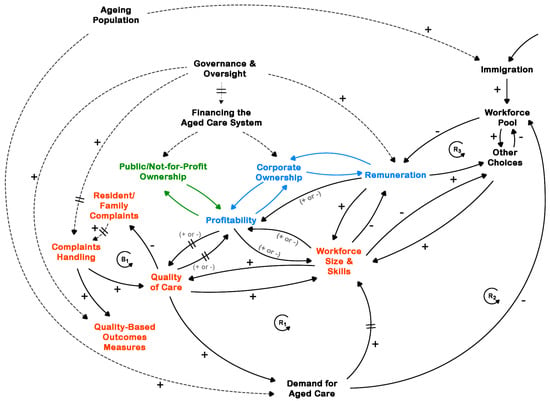
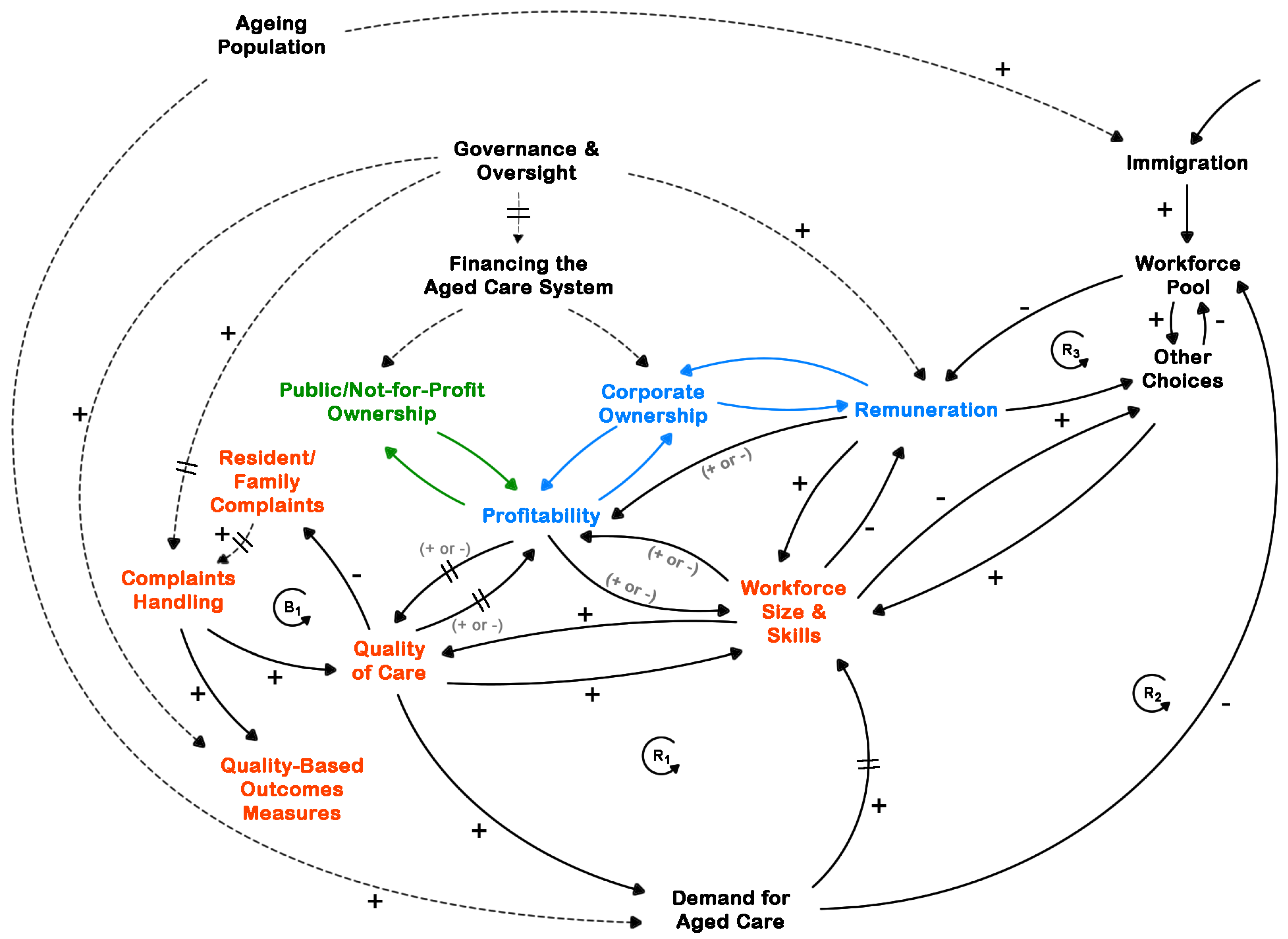
Based on key findings from the narrative review, a causal loop diagram (CLD) was developed to examine feedback structures shaping performance within the Canadian LTC system (see Figure 1). System boundaries, variables, and relationships were informed by the five themes the review identified, ensuring alignment between evidence and system structure. Links were assigned polarity (+/−) to reflect the direction of influence and feedback loops were identified and classified as balancing (B) or reinforcing (R), based on standard system dynamics conventions.
Figure 1.
Key System Components and their Interactions Impacting “Quality of Care” in the Canadian Long Term Care Sector. Macro-level components (external drivers and structural conditions—black), Meso-level components (financial and ownership-related variables—blue and green, respectively), and Micro-level components (workforce and care quality performance variables—red). System Feedback: R1, Workforce Size & Skills → Quality of Care → Demand for Aged Care → Workforce Size & Skills. R2, Workforce Pool → Remuneration → Workforce Size & Skills → Quality of Care → Demand for Aged Care → Workforce Pool. R3, Workforce Pool → Remuneration → Other Choices → Workforce Pool. B1, Quality of Care → Resident/Family Complaints → Complaints Handling → Quality of Care.
4. Results: Identified Themes
4.1. System Components at the Micro, Meso, and Macro Level
In the context of healthcare, systems are structured across multiple levels, namely: the micro-level, the meso-level, and the macro-level. Figure 1 illustrates, in broad terms, the intertwined relationships through which system components interact in LTC, generating patterns of behaviour that feed back into the system and shape subsequent interactions.
With respect to financing the aged-care system, two ownership models (public and corporate) are represented in the CLD as contextual structural factors. Ownership type, enabled through government policy settings, shapes incentive environments within the system and may influence the strength of balancing and reinforcing feedback loops under for-profit and not-for-profit arrangements. However, ownership-related dynamics are not a focus of the present analysis. While these dynamics are important to acknowledge, especially as they relate to the relationship between profitability and care quality, a detailed comparative examination of ownership models is beyond the scope of this manuscript and represents a potential area for future research.
The outer loops (represented by dashed arrows) capture contextual macro-level interdependencies that are slow in response to interventions (governance and policy change) or unchangeable (aging of the population). Despite their limited responsiveness, they are important drivers of the system (including ownership structures and their inherent prerogatives). Furthermore, balancing loops counteracting change and reinforcing loops amplifying change are highlighted in addition to the presence of delays that limit the effectiveness of corrective mechanisms; however, it should be noted that system behaviour is shaped by the interaction of these loops rather than from single isolated causes.
For instance, Figure 1 highlights the sustained system pressure created by an aging population, which drives increased demand for long-term care and places ongoing strain on the available workforce. Although remuneration, workforce size, and skills are intended to stabilize the system’s ability to deliver quality of care, their impact is limited by low pay, inadequate benefits, and competition from other employment sectors. Furthermore, governance and oversight appear to act as distal, system-level influences affecting financing and quality-based outcome measures, rather than as immediate feedback mechanisms and thus, their ability to counteract rapidly reinforcing dynamics is limited.
4.2. Theme 1: The Pursuit of Economic Goals
Over the past two decades, Canadian provinces and territories have become pressured to control escalating healthcare costs due to cuts to federal transfer payments and rising healthcare demands, which led to the partial privatization of the LTC sector [33]. In order to contain spending, workforce expenditure was reduced by a greater use of casual and part-time employees in private LTC facilities, who on average, receive lower pay compared to public LTCs [34] and no benefits or sick leave pay [35]. As such, the Canadian government, like many other Western governments, allowed aged care to pursue economic goals in the name of efficiency, euphemistically called “Efficiency through Contestability” [36], creating competition between economic efficiency and resident outcomes.
As illustrated in Figure 1, workforce dynamics in loop R3 are influenced by remuneration and other employment options, creating reinforcing pressures on the workforce pool. Limited incentives for retention and skill development reduce workforce capacity, which, when interacting with loop R2, can undermine care quality. Regarding a contextual factor within the diagram, profitability concerns can either limit or support investment in staffing and skill development, particularly in for-profit LTC facilities operating under private governance while relying on public funding. As indicated by the (+ or −) relationships surrounding this factor (which refer to outcomes based on extractive versus investive mindsets), these constraints can reduce workforce capacity and skill mix or improve working environment, staff retention and development. Prior to the COVID-19 pandemic this loop contributed to fragile staffing, as most facilities were poorly prepared. Under these conditions, economic incentives and labour shortages dominate system behaviour, while quality of care is weakened by delays and limited enforcement capacity, as surplus personnel trained for infectious disease control were not available.
Furthermore, because of the low barriers to becoming a Personal Support Worker (PSW) [37], many newcomers to Canada (immigration) work as PSWs in order to join the workforce quickly and obtain their Permanent Residency [38] while they retrain or credential to become a licensed professional. Thus, the precarious nature of the PSW labour market has also posed challenges for LTC employers in retaining staff [38]. To adjust, LTC managers shifted their focus from the provision of individualized needs-based resident care to optimally efficient standardized service delivery around the average resident [39], resulting in scant care and negative outcomes for residents [38,40].
4.3. Theme 2: Unprepared for the COVID-19 Pandemic
There was no doubt the COVID-19 pandemic negatively impacted the Canadian healthcare system. However, prior to COVID-19, structural dynamics (related to the constraint of workforce size and skill) resulted in minimal staffing buffers, fragmented employment across facilities, and limited capacity.
When sudden external increases in care complexity and infection risk were introduced by the pandemic, reinforcing loops (R1 and R2), which normally expand workforce capacity in response to demand, were unable to compensate for increasing workforce demands due to existing constraints on workforce size and skills. This may also have been influenced by competing healthcare options (loop R3) which offered safer and better paid jobs. As a result, this prevented performance stabilization and amplified system failure, which likely contributed to the disproportionate impact of COVID-19 on Canadian LTC facilities.
These pressures added to the collapse of the regulatory system, contributing to a crisis with more than 26,000 resident cases of severe illness and 6080 deaths during the first wave [41]. Due to the shortage of staffing during the COVID-19 pandemic in LTCs, the Ontario Government requested support from the Canadian Armed Forces and the Canadian Red Cross Society [42]. They also established a public inquiry ‘Ontario LTC COVID-19 Commission’ [43]. To gain ground on the issue during the pandemic, the MLTC instituted a temporary wage increase of $3 per hour for PSWs [44]. In addition, they hired more inspectors in LTCs and increased their powers to fine LTCs immediately in the case of non-compliance and infractions [45]. Furthermore, the MLTC proposed that new inspectors would have to be equipped to manage infection prevention and control.
The Ontario LTC COVID-19 Commission (2021) ultimately found the LTC sector was unprepared for the pandemic due to poor oversight [43]. Thus, LTCs in Canada have been characterized as experiencing ‘crisis upon crisis’ [46]. In hindsight, this is brought to stark attention by the fact that no organization, individual, or government will be held accountable for thousands of potentially preventable COVID-19 deaths in LTCs in Canada. Instead, blame has been attributed to ‘systemic vulnerabilities’ [47], which provide the framework for failings that are dispersed and difficult to correct; that is, a problem that is too entrenched and complicated to solve.
4.4. Theme 3: Lack of Transparency and Accountability
The physical, cognitive, and psychological burdens associated with caring for a vulnerable population are substantial and not well-documented [48]. Therefore, time and attention must be paid to ensure that clinical and allied health staff have adequate training, supports and resources to discharge their responsibilities in a safe and effective manner. Even though chronic understaffing is a well-documented issue in LTC, facilities are not required to disclose staffing ratios and staff qualifications/certifications; as a result, staffing levels, qualifications, and working conditions lack transparency [49]. A lack of accountability is a systemic issue at all levels: the macro-level (governance), the meso-level (organizational operations), and the micro-level (resident rights). Families often struggle to access information on resident violations, on reporting concerns, and in participating in care discussions for their loved ones [50]. Any interventions are based on complaint-based inspections that are at times incomplete and delayed [51]. As such, Figure 1 highlights pathways through which information about staffing and working conditions is indirectly conveyed through resident and family complaints, complaints handling processes, and quality-based outcome reporting. The model suggests that governance and oversight responses are largely reactive, with weak or delayed feedback. As illustrated by loop B1, delayed complaints processing, limited public reporting, and inconsistent enforcement reduce the system’s capacity and further weaken transparency, accountability, and care quality improvement. Thus, as a result of reactive rather than proactive actions, there exist missed opportunities for addressing systemic issues based on limited accountability for care quality and safety.
4.5. Theme 4: Lack of Facility-Level Collaboration
Silos exist between legislators, regulators, inspectors, and long-term care home operators because the current system design neither requires nor regulates collaboration between, or even within, its component parts [51]. Figure 1 emphasizes vertical relationships among workforce dynamics, care quality, demand, and oversight, while revealing limited feedback structures supporting horizontal collaboration across facilities. Workforce dynamics captured in reinforcing loop R3 indicate how the workforce pool is shaped by remuneration and alternative employment options, resulting in staff movement rather than coordinated staffing strategies. During COVID-19, LTC facilities were constrained by their inability to pool resources or coordinate infection control practices, while staff movement across facilities increased infection risk [3]. Thus, an absence of inter-facility cooperation contributes to uneven quality and system fragility across the sector. While the Fixing Long Term Care Act maintains a focus on regulatory compliance at the meso level, it fails to address external drivers which can facilitate or impair that compliance, including institutionalized silos of accountability [52].
4.6. Theme 5: Under-Representation of Resident and Family Voices
Underrepresentation of resident and family voices is a persistent issue that affects policy design, care quality, and equity, and thus, is a systemic issue impacting all three levels (micro, meso, macro) of LTC. Administrators, clinicians, or government officials rarely include those with lived experience in decision-making processes despite their insight being important to improving care [53]. Advocacy groups, resident councils, and staff speak on behalf of residents and families in LTC homes; however, advocacy groups are seen to lack legitimacy in the eyes of policymakers [54]. Additionally, resident councils often lack the resources to commit the time and work needed to provide an authentic representation of resident needs, especially as residents may face cognitive, physical, or emotional barriers to engagement [53]. As a result, authentic representation and diverse perspectives within the LTC population are obscured or diluted, especially from those that are racialized, disabled, or experience mental health challenges [55]. Their perspective is further silenced as families often encounter logistical challenges to participating on behalf of their loved ones or experience unclear pathways to influence decision-care [7,51]. While residents may communicate with facility inspectors and staff, without meaningful representation, they are reluctant to speak out on issues of care gaps and negative relational dynamics due to fear of repercussions within a paternalistic model of care [7,51]. As illustrated by Figure 1 (loop B1), complaints may influence care outcomes after quality has already declined, indicating that resident and family voices do not act as a proactive system driver. Based on this structure, it can be inferred that the dominance of economic and workforce variables over resident-centred feedback reinforce this imbalance. Notably, the balancing loop does not directly incorporate resident voice as their experience influences the system indirectly through complaints handling. This structural separation can provide insight into why balancing loops are reactive and failures persist despite regulatory oversight.
Despite the fact that long-term care homes embody the living spaces and therefore living conditions, of older adults, our review points to the need to amplify how, when, and where resident voices are heard so they may be better used to drive care delivery. Doing so would strengthen the ability of long-term care home operators to truly ensure a place of residence that is physically and psychologically safe, comfortable, and secure.
5. Discussion
5.1. Can the LTC Crisis Be Dissolved?
Currently, there are a total of 2076 LTC facilities in Canada, of which 54% are privately owned compared to the 46% which are publicly owned [56]. However, with an increasing elderly population, the demand for LTC is expected to rise by 2031, further compounding the problem if conditions do not change [56,57]. As reflected by the recent time of crisis, this may be a good opportunity to change course by working with all stakeholders, including government, for-profit and public operators, care providers, residents, and their families, to determine a more effective model for delivery of care [58]. Since these stakeholder groups represent a complex system, we propose change occur within a ‘systems thinking’ approach to allow for a re-thinking of policy in order to provide solutions and prevent another looming crisis.
As highlighted by our five themes, understanding the problem is essential but by no means sufficient to dissolve the systemic problems within the LTC sector [40,59]. Systems change experts, including Ackoff [60], challenge institutions to dissolve their problems by redesigning systems so that the problems no longer exist or to engage in what is more recently described as ‘systems shifting’ [61]. However, dissolving systemic problems requires an appreciation for the interactions amongst the parts of a system that determine its function [62].
Our narrative review ultimately allowed us to craft an interpretive analysis of the system, integrate findings from across a number of different contexts, and enhance our understanding of the complexities associated with LTC. This allowed our recommendations to emerge by means of inductive analysis. Further, the use of a narrative review and causal loop diagram facilitated a greater understanding that the properties of a system-as-a-whole are not present in its parts, which in turn entails the realization that improving parts of a system does not necessarily improve the overall system. In other words, simply providing more funding for selected services in Canada’s LTC system will not necessarily improve the system as a whole and may even perpetuate its existing failings. Attempting to manage the problem by identifying an optimal single-issue solution, while ignoring the broader context from which the problem arises, is unlikely to be effective, even if the solution to the specific issue is evidence-based [60]. The concept of ‘policy resistance’ is particularly relevant here as when solutions target only individual problems without accounting for systemic interdependencies, they may trigger new problems or unintended consequences, ultimately undermining the very improvements they intended to achieve [12,60,63]. As a result, solutions that appear effective in isolation may reinforce existing inefficiencies or even create new challenges.
Additionally, “stability and change should be understood in terms of the interaction of mechanisms, rather than presupposed as a constant” [64] (p. 13). Solving a problem without understanding the contextual reasons why the problem has arisen will always only be temporary and, thus, is an ineffective way to deal with problems in any dynamic system [60]. To put systems thinking design into practice, we must also keenly observe how power and resources flow at different levels within systems and the interrelationships between existing and new actors as systems shifts begin to take place [61].
5.2. How to ‘Fix’ Long-Term Care
The ‘Fixing Long-Term Care Act’ was designed to regulate Ontario’s LTC sector [6]. The Act proclaims, “The fundamental principle to be applied in the interpretation of this Act … is that a long-term care home is primarily the home of its residents and is to be operated so that it is a place where they (residents) may live with dignity and in security, safety and comfort and have their physical, psychological, social, spiritual and cultural needs adequately met.” [6] (p. 1).
In order to fully enact the ‘fundamental principle’ the Act proclaims, it is important to consider the micro, meso and macro-levels of the system. Meaningful and sustainable systems change or adaptation must reflect shared purpose and values, mutual trust, and equitable distribution of resources within and across each stakeholder group [11,58]. These conditions will spark collective movements at multiple levels and ensure that stakeholder participants can co-create better outcomes that truly meet the needs of vulnerable LTC residents and their families/caregivers. Hence, we will provide some guidance to support these needs as identified through our themes.
Additionally, the overall LTC ecosystem and key system components (see Figure 1) must be considered when setting in place recommendations for change. Work by Banerjee and Armstrong [65] highlights the constraints associated with LTC’s significant regulatory and compliance requirements, as well as the notion that enhanced standardization is synonymous with enhanced quality. The authors further argue that these reporting requirements take time away from direct care delivery and negate the relational aspects of care, while attention is shifted to administrative reports [65] (p. 1). In other words, the current regulatory framework, with its emphasis on standardization and compliance, structurally constrains the time, resources, and discretion that caregivers require to provide person-centered care [3,65]. As such, ‘fixing LTC’ requires enhancement to regulations that support relational care while reducing the burden of regulation [65].
5.3. Creating a Favourable Environment
In sum, successful organizational change requires, firstly, an agreement of what the system should achieve (high-quality, person-centered care that aligns with residents’ expressed aspirations) and, secondly, leadership that ensures that necessary changes seamlessly align across all levels of the system. A co-design approach will help generate solutions to the workforce challenges in LTC [9]. Systemic solutions must emerge from careful analysis of the interconnections and interdependencies within and across the functionally layered micro, meso, and macro levels. This is the only way to address concerns and foster an environment conducive to continuous quality improvement and innovation [66].
5.4. Recommendations at the Micro, Meso, & Systems Levels
The Ontario Long-Term Care Staffing Study’s Advisory Group [34] has advocated for comprehensive staffing strategies to address the workforce crisis in LTC. However, the workforce crisis in itself is a systemic problem requiring systemic solutions [67]. These strategies include investments to expand and strengthen the workforce by improving staff-to-resident ratios, providing enhanced supports, and creating opportunities for skills development [68]. Additionally, improving working conditions through competitive remuneration, flexible work schedules, effective leadership, and ongoing training and mentorship is critical to attracting and retaining staff. In response to the Auditor General of Ontario’s report [69], the Ministry, in collaboration with Ontario Health, has developed a multi-year plan to improve LTC through strategic priorities, including staffing, sustainability, and capital development. This is a move in the right direction; however, a systemic approach needs to be undertaken for lasting improvement. Attention should be given to feedback loops across the five key themes identified in the CLD (see Figure 1) to better understand why well-intentioned policy interventions have struggled to improve LTC quality.
Firstly, it is recommended that a bottom-up approach be used to include and gather perspectives from LTC residents, their families/caregivers, and all frontline providers and care staff to redesign the system. At the micro-level, the inclusion of resident and family voices in care delivery is imperative to adapt care and service delivery as residents’ needs can abruptly change during their end-of-life trajectory. What is also lacking in the Act are guidelines on how to effectively work with residents and their families/caregivers to improve residents’ health and quality of life.
At the meso-level, recommendations exist to improve collaboration and integration with the acute care system, including infection control capacity [35,70,71], and staffing [72]. This was included as the impact of COVID-19 showcased how low staffing levels could negatively impact the ability to deliver needed care, putting the health of residents and staff at risk [73]. The inadequate staffing of PSWs, registered nurses, and nurse practitioners invariably reduced both quality of care and infection control [74]. Attention needs to be given to systemic change, which requires retention of staff and fostering a sense of belonging in the workplace by promoting peer-to-peer learning, building community, and mitigating moral distress through self-compassion, acceptance-based approaches, and education and training [75]. Such measures can cultivate a culture of respect, recognition, and psychological safety while enhancing professional development and career advancement with higher retention rates.
At a macro-level, LTC facility licensees and their management teams must ensure safe and effective care and services delivery. Much of the ‘Fixing Long-Term Care Act’ includes regulations that focus on the meso-level, including quality of care and services, operations, funding, licensing, compliance and enforcement, and administration for LTCs while adhering to residents’ rights and needs [6]. However, the Act does not specifically address the need to work collaboratively among diverse stakeholders, including management, service providers, inspectors, and residents and their families. Table 1 highlights the challenges (supported by our identified themes), and key considerations that need to be addressed among diverse stakeholder groups in the system.
Table 1.
Consideration for Implementing Action Across System Levels.
We can begin by recognizing and prioritizing the understanding of linkages, relationships, interactions and interdependencies among the components of a system that give rise to the system’s observed behaviour [13]. In doing so, all system levels (micro, meso, and macro) need to be simultaneously considered, and recommendations should be made with a focus on positive resident outcomes. Table 2 presents potential redesign strategies.
Table 2.
Potential System Redesign.
5.5. Changing the Conditions Through Re-Thinking Policy
Dissolving the problems of LTCs firstly requires that the purpose of the LTC system be centered on delivery of care that focuses on residents’ desired quality of life and eventual dignity in dying [76]. As such, the Office of the Auditor General of Ontario has recommended that the MLTC develop targets to effectively measure the performance of LTCs in relation to quality of care and resident safety [69]. In addition, the government must set the conditions for a redesigned LTC system and its associated policies. We believe this should entail:
- (1)
- a labor force strategy that ensures all LTC personnel (irrespective of facility ownership) receive living wages, healthcare benefits, and paid sick days
- (2)
- an evidence-based dataset to determine and mandate minimum direct care staffing levels, nursing ratios, direct care hours, and full-time minimum employment requirements
- (3)
- a uniform accreditation process for all licensed LTC facilities to ensure that standards of care are being met, incidence reports are being addressed in a timely manner, and that there is adequate capacity for infection control (i.e., a quarantine space and readiness plan to respond to disease outbreaks)
- (4)
- an extension of the family medicine resident training program into LTC homes to permanently improve the links required to achieve a more seamless transition and consistent provision of resident care; and
- (5)
- the development of specialized outreach services, especially for dementia and mental health needs, by strengthening links to local healthcare networks and other programs such as Behavioural Support Ontario [10,26].
In addition, the importance of feedback to gather any concerns residents and their families may have in order to foster an environment that supports continuous quality improvement and innovation should be highlighted. This may be reinforced by enhancing the support and authority of resident and family councils.
To this end, the government must lead transformation by embracing new relational models involving stakeholder collaboration, with greater attention to accountability agreements, so positive outcomes of patient-centered care can be realized [77]. Additionally, a co-production approach could set the stage for locally adapted solutions while ensuring that the re-design and associated policies meet the needs of LTC residents and their families. ‘Adaptive organizations’ can readily identify leverage points that will transform organizational and behavioral patterns to maintain their shared purpose, goals and value focus, and thus, encourage affected stakeholders to develop adaptive solutions [3,40,62,78]. In addition to a deep sense of commitment to ameliorating current LTC systems and policies, a shared sense of this problem is essential to working together for productive change. Only a mutual appreciation of purpose, goals, and values amongst the stakeholders will allow for a smooth and seamless integrated functioning of the system-as-a-whole and facilitate ongoing adaptive redesign when faced with new challenges and unexpected events.
Although our analysis is anchored in the Canadian LTC context, several insights are transferable to other jurisdictions. Many high-income countries face similar patterns of fragmentation between the macro, meso, and micro levels, under-resourced workforces, limited resident and family representation, and policy resistance to structural reform. In contrast, elements that are specific to Canada (such as provincial-federal divisions and particular regulatory instruments) may limit direct transferability. Nonetheless, the systems-thinking principles and policy framework we have proposed can offer a conceptual template that may be adapted to diverse LTC systems. For policymakers and practitioners, our findings can be distilled into the following general practical recommendations:
- (1)
- identify misalignments between policy goals, financing, governance arrangements, and daily routines in LTC homes
- (2)
- co-design shared purpose and value agreements with residents, families, support staff, and providers, and
- (3)
- incorporate policy tools including workforce standards, accountability frameworks, and relational governance mechanisms to align incentives across micro, meso, and macro levels.
5.6. Knowledge Gained
The application of systems thinking to the LTC crisis reveals that increased privatization, regulation, and efficiency measures alone are not sufficient to create an effective, equitable, and sustainable LTC sector, particularly in the context of a rapidly aging population. Instead, a government-led redesign of the overarching systemic policy framework is essential to reconcile the interdependencies and priorities among diverse stakeholder groups, including residents and their families/caregivers, LTC service providers and staff, local hospital and/or community, and government. As illustrated by Figure 1, reinforcing loops driven by economic incentives and workforce size and skills dominate LTC system behaviour while the balancing loop associated with resident voice and care quality regulation is weak, delayed, and reactive. This imbalance helps explain longstanding quality challenges in the LTC sector and the system’s acute vulnerability to external shocks such as the COVID-19 pandemic.
What is critical for transformation is the establishment of a shared purpose and value agreement, grounded in mutual trust and equitable value distribution among stakeholder groups [58]. This foundation can catalyze collective action at multiple levels, engaging stakeholders in a unified effort to improve outcomes for vulnerable LTC users [9]. Addressing the systemic disconnect in the LTC sector requires dissolving the structural and relational barriers that perpetuate inefficiencies, including finance, governance, workforce, and care delivery challenges [60,79]. Only through this approach can effective and efficient processes be redesigned to support resident-centered care and value-added outcomes [80].
6. Limitations
An inherent limitation in the narrative review which we conducted is the possibility of having introduced selection bias. This may have occurred due to a lack of predefined protocol and use of a non-systematic search of the literature. In order to conduct a narrative review, we required flexibility to integrate content across various perspectives into a coherent understanding. Specifically, we sought to mitigate selection bias by incorporating diverse sources, including academic, policy, and grey literature, and by prioritizing evidence from mixed-methods studies. We also critically examined our interpretations against alternative explanations within the available evidence, ensuring that our conclusions reflected a balanced and comprehensive understanding of the literature. Additionally, although it has been noted that narrative reviews may lack reproducibility due to authors’ interpretive perspectives, we sought to address this limitation by transparently describing our literature selection process, thematic synthesis, and the databases consulted. Finally, while our findings are context-specific and most directly applicable to the Canadian LTC system, our systematic consideration of multiple perspectives strengthen the credibility and relevance of our insights for similar health care contexts.
7. Conclusions
Our findings underscore that the crisis in LTC is fundamentally rooted in a systemic misalignment of policies, practices, and stakeholder relationships. These misalignments have created structural barriers, such as fragmented resource flows and rigid organizational boundaries, as well as relational challenges including imbalanced power dynamics and weak interdependencies, which have undermined positive outcomes in the sector. To address these issues, governments must implement redesigned policy and regulatory frameworks that emphasize fairness, transparency, and accountability. These frameworks should aim to shift the structural and relational foundations of the LTC system, guided by a mental model that places resident-centered care at its core.
Our narrative review of the literature has highlighted that, in order to truly ‘fix’ long-term care, systems must be aligned across micro, meso and macro levels. Our current system is ‘managed’ through its component, and sometimes isolated, parts, leading to fragmentation, misalignment, diffusion of accountabilities and, ultimately, poor quality care for this population. Solutions should emerge from the long-term care system, as opposed to being externally prescribed with person-centered policy development being used to truly integrate the voice of residents and families in decision-making. Lastly, it has been revealed that the individual component parts of the long-term care system must center around a common purpose, vision and goals supported by accountability and governance frameworks that monitor and measure performance while allowing for the regular integration of iterative feedback. Finally, while this manuscript does not include a formal simulation, the CLD provides a structured representation of feedback processes at the micro, meso, and macro levels to help explain system challenges and offer a foundation for future modeling and policy analysis.
In sum, Ontario’s LTC crisis requires a transformative departure from conventional policy approaches rooted in privatization, narrow regulatory control, and efficiency-driven models. As the economist John Kay illustrated, the most successful organizations do not focus on efficiency and profit [81]. By adopting a systems thinking perspective, one that embraces complexity, encourages interdependence, and centers care around residents, policymakers can begin to reshape the sector. Our approach offers a clear roadmap for addressing deep-rooted systemic challenges and advancing a more effective, equitable, and sustainable LTC system that better serves Ontario’s most vulnerable populations. Finally, while the specific actions will vary by country, this systems-oriented approach can guide adaptation of our recommendations to other LTC and aged care systems.
Author Contributions
P.T.: conceptualization, writing original manuscript draft, methodology, data interpretation, formal analysis, manuscript revisions, table creation, writing/review and editing; J.S.: built on conceptual analysis, data interpretation, manuscript revisions, figure creation, writing, review and editing; G.L.: manuscript additions and revisions, data interpretation, table creation, writing, review and editing, and references; S.O.: review of literature, writing and review. All authors have read and agreed to the published version of the manuscript.
Funding
This research received no funding.
Data Availability Statement
No new data was created or analyzed in this manuscript. Data sharing is not applicable to this article.
Conflicts of Interest
The authors declare no conflicts of interest.
References
- Webster, P. COVID-19 Highlights Canada’s Care Home Crisis. Lancet 2021, 397, 183. Available online: https://www.thelancet.com/journals/lancet/article/PIIS0140-6736(21)00083-0/fulltext (accessed on 5 December 2025). [CrossRef] [Scilit] [PubMed]
- Béland, D.; Marier, P. COVID-19 and Long-Term Care policy for older people in Canada. J. Aging Soc. Policy 2020, 32, 358–364. [Google Scholar] [CrossRef] [Scilit]
- Canadian Labour Congress. Lessons from a Pandemic: Union Recommendations for Transforming Long-Term Care in Canada; Canadian Labour Congress: Ottawa, ON, Canada, 2020; Available online: https://canadianlabour.ca/lessons-from-2020/ (accessed on 4 January 2025).
- Drummond, D.; Sinclair, D.; Bergen, R.; COVID-19 Health Policy Working Group; School of Policy Studies, Queen’s University; Sussex Strategy Group. Aging Well; Queen’s University: Kingston, ON, Canada, 2020; Available online: https://www.queensu.ca/sps/sites/spswww/files/uploaded_files/publications/1%20Ageing%20Well%20Report%20-%20November%202020.pdf (accessed on 4 January 2025).
- Royal Society of Canada. Restoring Trust: COVID-19 and the Future of Long-Term Care; The Royal Society of Canada: Ottawa, ON, Canada, 2020; Available online: https://rsc-src.ca/en/COVID-19-policy-briefing/long-term-care/restoring-trust-COVID-19-and-future-long-term-care (accessed on 4 January 2025).
- Ministry of Long-Term Care. Fixing Long-Term Care Act; Ministry of Long-Term Care: Toronto, ON, Canada, 2021; Available online: https://www.ontario.ca/laws/statute/21f39 (accessed on 12 September 2024).
- Health Canada. Safe Long Term Care Act Engagement: What We Heard Report; Canada, 2024. Available online: https://www.canada.ca/en/health-canada/services/publications/health-system-services/engagement-what-we-heard-report.html (accessed on 4 January 2025).
- Canadian Institute for Health Information. COVID-19’s Impact on Long-Term Care; Canadian Institute for Health Information: Ottawa, ON, Canada, 2021; Available online: https://www.cihi.ca/en/covid-19-resources/impact-of-covid-19-on-canadas-health-care-systems/long-term-care# (accessed on 12 September 2024).
- Boamah, S.A.; Akter, F.; Karimi, B.; Havaei, F. Navigating Workforce Challenges in Long-Term Care: A Co-Design Approach to Solutions. Int. J. Environ. Res. Public Health 2025, 22, 520. [Google Scholar] [CrossRef] [Scilit]
- Lysyk, B. COVID-19 Preparedness and Management: Special Report on Pandemic Readiness and Response in Long-Term Care; Office of the Auditor General of Ontario: Toronto, ON, Canada, 2021; Available online: https://www.auditor.on.ca/en/content/specialreports/specialreports/COVID-19_ch5readinessresponseLTC_en202104.pdf (accessed on 12 September 2024).
- Hammond, D. Philosophical and ethical foundations of systems thinking. Triplec Commun. Capital. Crit. Open Access J. A Glob. Sustain. Inf. Soc. 1970, 3, 20–27. [Google Scholar] [CrossRef]
- Meadows, D. Thinking in Systems; Earthscan: London, UK, 2009. [Google Scholar]
- Alliance for Health Policy and Systems Research & World Health Organization. Systems Thinking for Health Systems Strengthening; World Health Organization: Geneva, Switzerland, 2009; Available online: https://iris.who.int/handle/10665/44204 (accessed on 12 September 2024).
- Greenhalgh, T.; Robert, G.; Macfarlane, F.; Bate, P.; Kyriakidou, O.; Peacock, R. Storylines of research in diffusion of innovations: A meta-narrative approach to systematic review. Soc. Sci. Med. 2005, 61, 417–430. [Google Scholar] [CrossRef] [Scilit]
- Cronin, P.; Ryan, F.; Coughlan, M. Undertaking a literature review: A step-by-step approach. Br. J. Nurs. 2008, 17, 38–43. [Google Scholar] [CrossRef] [Scilit]
- Sukhera, J. Narrative reviews: Flexible, rigorous, and practical. J. Grad. Med. Educ. 2022, 14, 414–417. [Google Scholar] [CrossRef] [Scilit] [PubMed]
- Ahmad, M.N. Narrative Literature reviews in Scientific Research: Pros and cons. Jordan J. Agric. Sci. 2025, 21, 1–4. [Google Scholar] [CrossRef] [Scilit]
- Chief Science Advisor. Dealing with the Fallout: Post-COVID Condition and its Continued Impact on Individuals and Society; Government of Canada: Ottawa, ON, Canada, 2024.
- Greenhalgh, T.; Wong, G.; Westhorp, G.; Pawson, R. Protocol—Realist and meta-narrative evidence synthesis: Evolving Standards (RAMESES). BMC Med. Res. Methodol. 2011, 11, 115. [Google Scholar] [CrossRef] [Scilit]
- Nguyen, T.C.; Tang, L.W.; Bryant, E.; Jobe, A.S.; Yu, A.J.; Sugiura, Y.; Bui, T. The neighborhood walk: Introducing first-year medical students to social determinants of health in underserved neighborhoods. BMC Med. Educ. 2025, 25, 163. [Google Scholar] [CrossRef] [Scilit] [PubMed]
- Carroll, Á.; Collins, C.; McKenzie, J.; Stokes, D.; Darley, A. Application of complexity theory in health and social care research: A scoping review. BMJ Open 2023, 13, e069180. [Google Scholar] [CrossRef] [Scilit]
- Estabrooks, C.A.; Armstrong, P.; Bourbonnais, A.; Donner, G.; Flood, C.M.; Keefe, J.; Pringle, D.; Silvius, J.; Straus, S.; Wolfson, M. Repair and Recovery in Long-Term Care: Restoring Trust in the Aftermath of COVID-19 (2020–2023); Royal Society of Canada: Ottawa, ON, Canada, 2024. [Google Scholar]
- Duan, Y.; Wang, J.; Lanham, H.J.; Berta, W.; Chamberlain, S.A.; Hoben, M.; Choroschun, K.; Iaconi, A.; Song, Y.; Perez, J.S.; et al. How context links to best practice use in long-term care homes: A mixed methods study. Implement. Sci. Commun. 2024, 5, 63. [Google Scholar] [CrossRef] [Scilit]
- Irwin, P.; Taylor, D.; Keefe, J.M. Provincial Policies Affecting Resident Quality of Life in Canadian Residential Long-term care. BMC Geriatr. 2023, 23, 362. [Google Scholar] [CrossRef] [Scilit] [PubMed]
- Pywell, E.; Ottley, K.M.; Dolatabadi, A.; Maza, J.; Lawrenz, K.; Hutchinson, J.; Ward, H.; Wickson-Griffiths, A.; Hunter, P.V. A Mixed-Methods scoping review of innovative long-term care facility design and associated outcomes. Innov. Aging 2025, 9, igaf034. [Google Scholar] [CrossRef] [Scilit] [PubMed]
- Estabrooks, C.A.; Straus, S.E.; Flood, C.M.; Keefe, J.; Armstrong, P.; Donner, G.J.; Boscart, V.; Ducharme, F.; Silvius, J.L.; Wolfson, M.C. Restoring trust: COVID-19 and the future of long-term care in Canada. FACETS 2020, 5, 651–691. [Google Scholar] [CrossRef] [Scilit]
- Fadlallah, R.; El-Jardali, F.; Nomier, M.; Hemadi, N.; Arif, K.; Langlois, E.V.; Akl, E.A. Using narratives to impact health policy-making: A systematic review. Health Res. Policy Syst. 2019, 17, 26. [Google Scholar] [CrossRef] [Scilit] [PubMed]
- McCrabb, S.; Hall, A.; Milat, A.; Bauman, A.; Hodder, R.; Mooney, K.; Webb, E.; Barnes, C.; Yoong, S.; Sutherland, R.; et al. Disseminating health research to public health policy-makers and practitioners: A survey of source, message content and delivery modality preferences. Health Res. Policy Syst. 2023, 21, 121. [Google Scholar] [CrossRef] [Scilit]
- Cairney, P.; Kwiatkowski, R. How to communicate effectively with policymakers: Combine insights from psychology and policy studies. Palgrave Commun. 2017, 3, 37. [Google Scholar] [CrossRef] [Scilit]
- Greenhalgh, T.; Thorne, S.; Malterud, K. Time to challenge the spurious hierarchy of systematic over narrative reviews? Eur. J. Clin. Investig. 2018, 48, e12931. [Google Scholar] [CrossRef] [Scilit]
- Ferrari, R. Writing narrative style literature reviews. Med. Writ. 2015, 24, 230–235. [Google Scholar] [CrossRef] [Scilit]
- Pawson, R.; Greenhalgh, T.; Harvey, G.; Walshe, K. Realist review—A new method of systematic review designed for complex policy interventions. J. Health Serv. Res. Policy 2005, 10, 21–34. [Google Scholar] [CrossRef] [Scilit]
- Armstrong, P.; Armstrong, H. The Privatization of Care: The Case of Nursing Homes; Routledge: New York, NY, USA, 2019. [Google Scholar]
- Ministry of Long-Term Care Staffing Study Advisory Group. Long-Term Care Staffing Study; Ministry of Long-Term Care: Toronto, ON, Canada, 2020; Available online: https://files.ontario.ca/mltc-long-term-care-staffing-study-en-2020-07-31.pdf (accessed on 12 September 2024).
- Armstrong, P.; Harrington, C.; McGregor, M. Staffing for Nursing Home Care: COVID-19 and Beyond; Longwoods Publishing: Toronto, ON, Canada, 2020; Available online: https://www.longwoods.com/content/26287/staffing-for-nursing-home-care-covid-19-and-beyond (accessed on 12 September 2024).
- Australian National Audit Office. Audits of the Financial Statements of Australian Government Entities for the Period Ended 30 June 2018: Auditor-General Report No. 19 2018-19; Australian National Audit Office: Canberra, Australia, 2018. [Google Scholar]
- Ministry of Long-Term Care. Become a Personal Support Worker; Ministry of Long-Term Care: Toronto, ON, Canada, 2024; Available online: https://www.ontario.ca/page/become-personal-support-worker (accessed on 5 January 2025).
- Zagrodney, K.; Saks, M. Personal support workers in Canada: The new precariat? Healthc. Policy 2017, 13, 31–39. [Google Scholar] [CrossRef] [Scilit]
- Ontario Health Coalition. Introduction to Health Policy Class at the University of Toronto. In Protecting the Public Interest in Toronto’s Long-Term Care Homes: A Review of the Evidence on Privatization; Ontario Health Coalition: Toronto, ON, Canada, 2012; Available online: https://www.ontariohealthcoalition.ca/wp-content/uploads/ltcreportmarch262012.pdf (accessed on 12 September 2024).
- Sturmberg, J.P. Health System Redesign. How to Make Health Care Person-Centered, Equitable, and Sustainable; Springer: Cham, Switzerland, 2018. [Google Scholar] [CrossRef] [Scilit]
- Canadian Institute for Health Information. The Impact of COVID-19 on Long-Term Care in Canada: Focus on the First 6 Months; report; Canadian Institute for Health Information: Ottawa, ON, Canada, 2021; Available online: https://www.cihi.ca/sites/default/files/document/impact-covid-19-long-term-care-canada-first-6-months-report-en.pdf (accessed on 12 September 2024).
- Government of Canada. Support for Long-Term Care Homes in Ontario Extended to Manage COVID-19 Outbreaks; Government of Canada: Ottawa, ON, Canada, 2021. Available online: https://www.canada.ca/en/public-safety-canada/news/2021/10/support-for-long-term-care-homes-in-ontario-extended-to-manage-covid-19-outbreaks.html (accessed on 12 September 2024).
- Ministry of Long-Term Care. Long-Term Care COVID-19 Commission: Final Report and Progress on Interim Recommendations; Ministry of Long-Term Care: Toronto, ON, Canada, 2021; Available online: https://www.ontario.ca/page/long-term-care-covid-19-commission-progress-interim-recommendations (accessed on 12 September 2024).
- Ministry of Long-Term Care. Published Plans and Annual Reports 2021–2022: Ministry of Long-Term Care; Long-Term Care: Toronto, ON, Canada, 2021; Available online: https://www.ontario.ca/page/published-plans-and-annual-reports-2021-2022-ministry-long-term-care (accessed on 12 September 2024).
- Ministry of Long-Term Care. Published Plans and Annual Reports 2024–2025: Ministry of Long-Term Care; Long-Term Care: Toronto, ON, Canada, 2024; Available online: https://www.ontario.ca/page/published-plans-and-annual-reports-2024-2025-ministry-long-term-care (accessed on 5 January 2025).
- Oldenburger, D.; Baumann, A.; Crea-Arsenio, M.; Deber, R.; Baba, V. COVID-19 Issues in Long-Term Care in Ontario: A document analysis. Healthc. Policy 2022, 17, 53–65. [Google Scholar] [CrossRef] [Scilit]
- Picard, A. Neglected No More: The Urgent Need to Improve the Lives of Canada’s Elders in the Wake of a Pandemic; Random House: Toronto, ON, Canada, 2021. [Google Scholar]
- Boamah, S.A.; Weldrick, R.; Havaei, F.; Irshad, A.; Hutchinson, A. Experiences of Healthcare Workers in Long-Term Care during COVID-19: A Scoping Review. J. Appl. Gerontol. 2022, 42, 1118–1136. [Google Scholar] [CrossRef] [Scilit]
- Registered Nurses’ Association of Ontario. Long-Term Care Systemic Failings: Two Decades of Staffing and Funding Recommendations; Registered Nurses’ Association of Ontario: Toronto, ON, Canada, 2020; Available online: https://rnao.ca/sites/rnao-ca/files/RNAO_LTC_System_Failings_June_2020_1.pdf (accessed on 12 September 2024).
- Ombudsman Ontario. Ombudsman Finds Delays, Inconsistencies and Lack of Transparency in Monitoring of Long-Term Care Homes; Ombudsman Ontario: Toronto, ON, Canada, 2010; Available online: https://www.ombudsman.on.ca/en/our-work/investigations/long-term-care (accessed on 12 September 2024).
- Lai, P. How enforcement shapes compliance with legal rules: The case of long-term care homes in Ontario. Can. J. Law Soc. Rev. Can. Droit Et Société 2024, 39, 110–131. [Google Scholar] [CrossRef] [Scilit]
- Graham, C.; Himick, D.; Nappert, P.-L. The dissipation of corporate accountability: Deaths of the elderly in for-profit care homes during the coronavirus pandemic. Crit. Perspect. Account. 2023, 99, 102595. [Google Scholar] [CrossRef] [Scilit]
- Hutchinson, M.; Gilhuly, J.; Ramsden, G.; Lee, C.; Tripp, D.; Collingwood, B.; Fineczko, J.; McAiney, C.; McGilton, K.S.; McVie, M.; et al. Listened to but Rarely Heard: A Scoping Review of Resident Engagement in the Organizational Design and Governance of their Long-Term Care Homes. Can. J. Aging La Rev. Can. Du Vieil. 2025, Oct 6, 1–13. [Google Scholar] [CrossRef] [Scilit] [PubMed]
- Staempfli, S.; Havaei, F.; Dawson, L.; Novek, S.; Slater, K.; Kaulius, M.; Ahmed, A. Raise Your Voice: How to increase the effectiveness of Resident and Family Councils in Long-Term Care Homes. Can. J. Aging La Rev. Can. Du Vieil. 2025, 44, 225–234. [Google Scholar] [CrossRef] [Scilit] [PubMed]
- Hande, M.J.; Keefe, J.; Taylor, D. Long-Term Residential Care Policy guidance for staff to support resident quality of life. Gerontol. 2020, 61, 540–551. [Google Scholar] [CrossRef] [Scilit]
- Canadian Institute for Health Information. Long-Term Care Homes in Canada: How Many and Who Owns Them; Canadian Institute for Health Information: Ottawa, ON, Canada, 2021; Available online: https://www.cihi.ca/en/long-term-care-homes-in-canada-how-many-and-who-owns-them (accessed on 4 January 2025).
- Yang, J. Demand for LTC and Home Care in Canada in 2019 and 2031; Statista: Hamburg, Germany, 2024; Available online: https://www.statista.com/statistics/1445708/ltc-and-home-care-demand-current-andforecastcanada (accessed on 4 January 2025).
- Sturmberg, J.P.; Taher, S. What We Mean By ‘Values in Healthcare’: The Importance of Reaching a Consensus. Cureus 2025, 17, e79034. [Google Scholar] [CrossRef] [Scilit]
- Sturmberg, J.P.; Tsasis, P.; Hoemeke, L. COVID-19—An Opportunity to Redesign Health Policy Thinking. Int. J. Health Policy Manag. 2022, 11, 409–413. [Google Scholar] [CrossRef] [Scilit]
- Ackoff, R.L. Systems thinking and thinking systems. Syst. Dyn. Rev. 1994, 10, 175–188. [Google Scholar] [CrossRef] [Scilit]
- Drew, C.; Winhall, J.; Robinson, C.; Design Council; The Point People. System Shifting Design: An Emerging Practice Explored; Design Council: London, UK, 2021; Available online: https://www.designcouncil.org.uk/fileadmin/uploads/dc/Documents/Systemic%2520Design%2520Report.pdf (accessed on 12 September 2024).
- Tsasis, P.; Agrawal, N.; Guriel, N. An embedded systems perspective in conceptualizing Canada’s healthcare sustainability. Sustainability 2019, 11, 531. [Google Scholar] [CrossRef] [Scilit]
- Tsasis, P.; Evans, J.M.; Owen, S. Reframing the challenges to integrated care: A complex-adaptive systems perspective. Int. J. Integr. Care 2012, 12, e190. [Google Scholar] [CrossRef] [Scilit] [PubMed]
- Wilson, J. The Intervening State. RSA J. 2021, 3, 10–15. [Google Scholar]
- Banerjee, A.; Armstrong, P. Centring Care: Explaining Regulatory Tensions in Residential Care for Older Persons. Stud. Political Econ. 2015, 95, 7–28. [Google Scholar] [CrossRef] [Scilit]
- Doerr, J. Measure What Matters: How Google, Bono, and the Gates Foundation Rock the World with OKRs; Portfolio/Penguin: London, UK, 2018. [Google Scholar]
- Sturmberg, J.P. A Systems Thinking Approach to Workforce Planning: The Need to Focus on the System’s Purpose. Systems 2025, 13, 1024. [Google Scholar] [CrossRef] [Scilit]
- Killett, A.; Burns, D.; Kelly, F.; Brooker, D.; Bowes, A.; La Fontaine, J.; Lathum, I.; Wilson, M.; O’Neill, M. Digging deep: How organisational culture affects care home residents’ experiences. Ageing Soc. 2016, 36, 160–188. [Google Scholar] [CrossRef] [Scilit]
- Auditor General of Ontario. Value-for-Money-Audit: Long-Term Care Homes Delivery of Resident-Centred Care; Auditor General of Ontario: Toronto, ON, Canada, 2023. Available online: https://www.auditor.on.ca/en/content/annualreports/arreports/en23/AR_LTCresidential_en23.pdf (accessed on 4 January 2025).
- Marrocco, F.N.; Coke, A.; Kitts, J. Second Interim Recommendations. Ontario’s Long-Term Care COVID-19 Commission. 2020. Available online: http://www.ltccommission-commissionsld.ca/ir/pdf/20201203_2nd_Interim_Letter-E.pdf (accessed on 12 September 2024).
- Registered Nurses’ Association of Ontario. Enhancing Community Care for Ontarians: ECCO Model 3.0; Registered Nurses’ Association of Ontario: Toronto, ON, Canada, 2020; Available online: https://rnao.ca/sites/default/files/2020-05/ecco-report-3.0.pdf (accessed on 12 September 2024).
- Patient Ombudsman. Honouring the Voices and Experiences of Long-Term Care Home Residents, Caregivers and Staff During the First Wave of COVID-19. 2020. Available online: https://www.patientombudsman.ca/Portals/0/documents/COVID-19-report-en.pdf (accessed on 4 January 2025).
- McGarry, B.E.; Grabowski, D.C.; Barnett, M.L. Severe staffing and personal protective equipment shortages faced by nursing homes during the COVID-19 pandemic. Health Aff. 2020, 39, 1812–1821. [Google Scholar] [CrossRef] [Scilit]
- Ritts, M. The Crisis of Privatized Care in Ontario; Healthy Debate: Toronto, ON, Canada, 2021; Available online: http://healthydebate.ca/opinions/crisis-privatized-care-in-ontario/ (accessed on 12 September 2024).
- Liu, X.; He, F.; Tian, T.; Zhang, J.; Ji, Y.; Zhong, Y. Self-compassion and work engagement among clinical nurses: The mediating role of moral resilience. Front. Public Health 2025, 13, 1507539. [Google Scholar] [CrossRef] [Scilit]
- Tsasis, P.; Bains, J. Chronic Disease: Shifting the focus of healthcare in Canada. Healthc. Q. 2009, 12, e1–e11. [Google Scholar] [CrossRef] [Scilit] [PubMed]
- Loeffler, E. Co-Production of Public Services and Outcomes; Palgrave Macmillan: London, UK, 2020. [Google Scholar]
- Heifetz, R. Leadership Without Easy Answers; Harvard University Press: Boston, MA, USA, 1998. [Google Scholar]
- Kania, J.; Kramer, M.; Senge, P.; Social Innovation Generation (SIG); Management Assistance Group; Foundation Strategy Group. The Water of Systems Change; Foundation Strategy Group: Boston, MA, USA, 2018; Available online: https://efc.issuelab.org/resources/30855/30855.pdf (accessed on 12 September 2024).
- Porter, M.E.; Teisberg, E.O. Redefining Health Care: Creating Value-Based Competition on Results; Harvard Business Press: Boston, MA, USA, 2006. [Google Scholar]
- Kay, J. Obliquity: Why Our Goals are Best Achieved Indirectly; Penguin Books: New York, NY, USA, 2010; p. 0143120557. [Google Scholar]

Disclaimer/Publisher’s Note: The statements, opinions and data contained in all publications are solely those of the individual author(s) and contributor(s) and not of MDPI and/or the editor(s). MDPI and/or the editor(s) disclaim responsibility for any injury to people or property resulting from any ideas, methods, instructions or products referred to in the content. |
© 2026 by the authors. Licensee MDPI, Basel, Switzerland. This article is an open access article distributed under the terms and conditions of the Creative Commons Attribution (CC BY) license.