


Simple Summary
Zokors are burrowing rodents that create soil mounds in alpine grasslands. These disturbances change vegetation and soil conditions, but their effects on soil microorganisms remain poorly understood. This study examined how different vegetation types on zokor mounds relate to soil properties and communities of bacteria and fungi on the Qinghai-Tibetan Plateau. We compared undisturbed grassland, newly formed bare mounds, and mounds dominated by Potentilla anserina and Leontopodium leontopodioides. The results showed that undisturbed grassland generally had higher soil water content, organic carbon, nitrogen, available phosphorus, and microbial biomass than the mounds. Microbial communities also differed among the mound types. Bacterial communities were more closely associated with changes in soil properties, while fungal communities showed more variable patterns and weaker relationships with the measured soil properties. The findings suggest that vegetation on zokor mounds is associated with different soil conditions and microbial communities, rather than a single uniform recovery pathway. Understanding these belowground changes can help improve the assessment and restoration of disturbed alpine grasslands by considering soil microorganisms alongside vegetation recovery.
Abstract
Vegetation succession on zokor (Eospalax baileyi) mounds illuminates microbial recovery in alpine grasslands, yet community assembly mechanisms remain unclear. We compared native grassland (CK), bare new mounds (NM), Potentilla anserina mounds (PM), and Leontopodium leontopodioides mounds (LM) on the Qinghai-Tibetan Plateau using sequencing, co-occurrence networks, null models, and redundancy analysis. CK had higher soil water content (SW), soil organic carbon (SOC), total nitrogen (TN), available phosphorus (AP), microbial biomass carbon (MBC), and microbial biomass nitrogen (MBN), but lower pH. LM had the lowest nutrient availability and highest pH. Co-occurrence network analysis showed more positive associations in CK and more negative associations in LM. Null-model analysis indicated stochastic predominance in bacterial and fungal assembly, although environmental filtering contributed significantly to bacterial structuring. Undominated processes prevailed in bacteria, while dispersal limitation was more prominent in fungal CK and LM. Bacterial βNTI was associated with SW, SOC, TN, TP, AK, MBC, and MBN, while fungal βNTI was associated with SOC, TN, AP, AK, MBC, and MBN. Redundancy analysis linked bacterial composition to AP, MBN, TP, SOC, and SW, whereas only AP significantly explained fungal composition. These findings indicate that vegetation-mediated resource changes accompany restructured mounds’ soil microbial co-occurrence patterns and assembly, informing alpine grassland restoration.
1. Introduction
The alpine grasslands of the Qinghai-Tibetan Plateau (QTP) are among the world’s most fragile ecosystems and are highly sensitive to climate change and anthropogenic disturbances [1]. Covering nearly one-quarter of the Plateau, these grasslands provide essential ecosystem services, including carbon sequestration and hydrological regulation for downstream populations [2,3]. However, recent decades have witnessed widespread grassland degradation characterized by declining ecosystem functions, biodiversity loss, and reduced forage productivity, threatening the long-term sustainability of alpine meadows [4]. Rodent activity has been identified as a major driver of alpine meadow degradation on the Plateau [5]. Degraded grasslands typically exhibit reduced vegetation cover and increased abundance of rodent-preferred weeds, creating positive feedback that promotes rodent population expansion and further accelerates ecosystem degradation [6,7].
The plateau zokor (Eospalax baileyi), an endemic subterranean rodent of the QTP, plays a pivotal ecological role through its extensive burrowing and foraging activities [8]. By transporting large quantities of subsoil to the surface, zokors create characteristic soil mounds that substantially alter soil moisture, temperature, and nutrient availability, thereby generating pronounced microsite heterogeneity across alpine meadows [9]. Although the widespread occurrence of zokor mounds is often regarded as an indicator of meadow degradation [10], their ecological effects are density-dependent. At moderate population densities, zokors function as ecosystem engineers by improving soil aeration, promoting plant diversity, and reducing runoff and soil erosion [11]. In contrast, excessive zokor populations destabilize alpine grasslands and accelerate ecosystem degradation [7,12].
Vegetation recovery on zokor mounds represents an important component of natural restoration in degraded alpine meadows. Following mound formation, pioneer species rapidly colonize newly exposed soils, and subsequent vegetation succession generates a mosaic of successional stages that promotes plant diversity and continually renews plant community composition [13,14,15]. Soil provides the physical substrate for vegetation establishment and a habitat for microorganisms that mediate organic matter decomposition and nutrient cycling, thereby influencing plant community development through resource availability [16,17]. Consequently, vegetation succession on zokor mounds is expected to modify soil nutrient availability and create distinct microbial habitats during meadow recovery.
Soil microorganisms are major biological drivers of organic matter decomposition and biogeochemical cycling, mediating key transformations of carbon, nitrogen, phosphorus, and other elements [18,19,20]. These microbial processes directly influence nutrient availability and plant–soil interactions, thereby shaping vegetation establishment, productivity, and recovery following disturbance. Beneficial microbial groups, such as nitrogen-fixing bacteria, phosphate-solubilizing microorganisms, and arbuscular mycorrhizal fungi, enhance nutrient availability and facilitate vegetation recovery, while microbial groups associated with plant diseases may impede vegetation recovery and contribute to grassland degradation [21,22]. Consequently, microbial community diversity and composition are increasingly recognized as sensitive indicators of soil quality and ecosystem recovery.
Beyond taxonomic diversity, soil microorganisms form complex co-occurrence networks comprising cooperative and competitive interactions that influence community stability and ecosystem resilience [23]. Grassland degradation can substantially reorganize microbial co-occurrence networks, with positive associations generally prevailing under favourable resource conditions and negative associations potentially increasing under nutrient limitation [23]. Meanwhile, community assembly theory distinguishes deterministic processes driven by environmental selection from stochastic processes governed by dispersal, ecological drift, and diversification, both of which collectively shape microbial biogeographic patterns [24,25]. Null-model approaches based on the β-nearest taxon index (βNTI) provide robust tools for quantifying the relative importance of these assembly processes in alpine and grassland ecosystems [25,26]. However, how vegetation succession on zokor mounds influences microbial interaction networks, community assembly mechanisms, and their relationships with soil nutrient dynamics remains largely unexplored.
Therefore, this study investigated how vegetation-associated differences among zokor mounds influence soil microbial community composition, co-occurrence networks, and community assembly in alpine meadows on the Qinghai-Tibetan Plateau. To address this objective, we compared soil microbial communities across three mound types distinguished by their dominant vegetation, comprising bare new mounds, Potentilla anserina-dominated mounds, and Leontopodium leontopodioides-dominated mounds, alongside adjacent undisturbed native grassland as a reference control. These types provide a space-for-time perspective for examining potential patterns associated with post-disturbance vegetation development, recognising that this substitution does not demonstrate temporal sequence. We hypothesized that: (1) vegetation-associated differences among mound types alter bacterial and fungal co-occurrence network patterns, with nutrient-rich native grassland favouring a higher proportion of positive associations and nutrient-poor zokor mound soil exhibiting a greater proportion of negative associations; and (2) stochastic processes predominate in bacterial and fungal community assembly, although environmental filtering also contributes to microbial community structuring in response to variation in soil resource availability. To test these hypotheses, we integrated molecular ecological network analysis, βNTI-based null models, and redundancy analysis to characterize microbial co-occurrence patterns, infer community assembly processes, and identify the key soil properties associated with microbial community composition.
2. Materials and Methods
2.1. Description of the Study Area
The experimental site is situated in Wanmao Town, Zhuoni County, Gannan Tibetan Autonomous Prefecture, Gansu Province, China (103°03′32.68″ E, 34°51′42.87″ N), at an elevation of 3040 m asl. There is a typical plateau continental climate with mean annual temperature of 2.3 °C, short frost-free period (105 days), and mean annual precipitation of 640 mm, which is highly seasonal, with around 40 days of rain from May to August and maximum precipitation in July. Long-term precipitation records indicate substantial interannual variability, with annual totals ranging from 400 to 800 mm. The study area is dominated by alpine meadow vegetation. The plant community is primarily composed of the dominant sedge Kobresia pygmaea (Cyperaceae), together with herbaceous species including Elymus nutans and Poa pratensis (Poaceae), Anemone rivularis (Ranunculaceae), Potentilla anserina and Potentilla fragarioides (Rosaceae), and Saussurea japonica (Asteraceae). These vegetation communities represent typical alpine meadow ecosystems of the QTP.
2.2. Experimental Design
The research was carried out in August 2022 in an alpine meadow with relatively flat and homogeneous topography and warm-season enclosure and cold-season grazing management on the Qinghai-Tibetan Plateau. Within this meadow, three zokor mound types under a moderate disturbance intensity were identified according to their dominant colonizing vegetation: mounds dominated by Potentilla anserina (PM), Leontopodium leontopodioides (LM), and bare, newly formed mounds (NM). Four mounds of each type were randomly selected as sampling units (n = 4 per type). Following the principle of spatial proximity, four additional reference plots (CK; n = 4) were selected in adjacent undisturbed native grassland within the same study area, where zokor activity was absent. Each reference plot was circular, with a diameter of approximately 50 cm, corresponding to the mean basal diameter of the selected mounds. Thus, the study comprised 16 sampling plots in total, with four replicates per type. Although the mound replicates represented separately selected physical mounds, inter-mound distances and zokor territory boundaries were not recorded or independently established. Consequently, spatial independence among the selected mounds was not assessed, and potential spatial dependence was not accounted for in the sampling design. Although these mound-associated vegetation types may represent different states of post-disturbance vegetation development, their chronological relationships and transitions were not directly monitored in this study. Accordingly, they were treated as distinct vegetation-associated mound types rather than confirmed successive stages of a temporal recovery sequence. This sampling design enabled comparisons of soil physicochemical properties and microbial characteristics among the three vegetation-associated mound types and the adjacent undisturbed native grassland.
2.3. Soil Sampling and Processing
Soil samples were taken on each circular plot at five randomly selected locations using a stainless-steel auger (2 cm diameter), and the 16 samples were thoroughly mixed and homogenized to form a single composite sample for each plot (four treatments × four replicates). Carefully, roots, plant residues, gravel and any other debris were removed from the soil, and the composite samples were placed through a 2 mm sieve and homogenized before subsampling. Three subsamples were then taken from each composite sample for various analyses. The first subsample was immediately placed in sterile centrifuge tubes, flash-frozen, and transported to the laboratory on dry ice and stored at −80 °C until microbial DNA extraction. The second subsample was stored in sealed polyethylene bags, transported under refrigerated conditions, stored at 4 °C and analysed within two weeks for soil water content (SW) and microbial biomass carbon (MBC) and nitrogen (MBN). The third subsample was air-dried at room temperature under well-ventilated conditions for physicochemical analyses. The air-dried soil was passed through a 2-mm sieve for the determination of soil pH, total phosphorus (TP), available phosphorus (AP), and available potassium (AK). For soil organic carbon (SOC) and total nitrogen (TN) analyses, a part of the soil was finely ground and passed through a 0.149-mm sieve.
2.4. Analysis of Soil Samples
2.4.1. Determination of Soil Physicochemical Properties
The soil water content (SW) was calculated using the oven-drying method at 105 °C for 24 h until a constant weight was reached. Soil pH was determined by a soil-water suspension (1:2.5 w/v) with a digital pH-meter (Mettler Toledo, Switzerland). The potassium dichromate oxidation method was used for soil organic carbon (SOC) measurement [27]. The microbial biomass carbon (MBC) and nitrogen (MBN) were measured by the chloroform fumigation-extraction method [28,29]. Extracts from the soil samples were used to determine the concentrations of organic carbon and nitrogen using the TOC/TN analyzer (Multi C/N 2100S, Analytik Jena, Jena, Germany). Total nitrogen (TN) was determined by Kjeldahl digestion [30], and total phosphorus (TP) by digestion with H2SO4-HClO4 [31]. Available potassium (AK) was extracted with 1 M ammonium acetate solution (1:10, w/v) and quantified by flame emission spectrophotometry [32], while available phosphorus (AP) was extracted with 0.5 M sodium bicarbonate solution (1:20, w/v) and quantified using the molybdenum blue colorimetric method [33].
2.4.2. Characterization of Soil Microbial Communities
Fresh soil samples were used for extraction of total DNA with the UltraClean™ Soil DNA Isolation Kit (MoBio Laboratories, Inc., Carlsbad, CA, USA). The integrity of the DNA was checked by 1% agarose gel electrophoresis, and DNA concentration and purity (A260/280 and A260/230) were measured with a NanoDrop® ND-2000 UV-Vis spectrophotometer (Thermo Fisher Scientific, Schwerte, Germany). After quality confirmation, the V3-V4 hypervariable region of the bacterial 16S rRNA gene was amplified with the primer pair 338F (5′-ACTCCTACGGGAGGCAGCA-3′) and 806R (5′-GGACTACHVGGGTWTCTAAT-3′) [34]. At the same time, we amplified the ITS1 region of the fungus with the primers ITS1F (5′-CTTGGTCATTTAGAGGAAGTAA-3′) and ITS2 (5′-GCTGCGTTCTTCATCGATGC-3′) [35,36]. The thermal cycling conditions for PCR were: initial denaturation for 5 min at 95 °C; 25 cycles of denaturation for 30 s at 95 °C; annealing for 30 s at 55 °C; extension for 40 s at 72 °C; followed by final extension for 7 min at 72 °C and holding at 4 °C. Triplicates were used to verify the reproducibility for each sample. Amplicons were purified from a 1.8% agarose gel and recovered using the Monarch® DNA Gel Extraction Kit (NEB, Ipswich, MA, USA) from pooled PCR products using the same sample. The purified amplicons were combined in equimolar amounts and sent to Beijing Biomarker Technologies Co., Ltd. (Beijing, China) for high-throughput sequencing on the Illumina NovaSeq 6000 platform.
Following sequencing, raw reads were subjected to quality control and filtering to remove low-quality sequences, primer sequences, and chimeric reads using Trimmomatic v0.33 and Usearch v10.0. After quality filtering, 2,209,410 bacterial 16S rRNA gene reads and 3,820,591 fungal ITS reads were retained; bacterial valid reads per sample ranged from 45,077 to 64,803, with an average read length of 423 bp. The resulting clean reads were processed using Usearch v10.0, and sequences were clustered into operational taxonomic units (OTUs) at a 97% sequence identity threshold using the UPARSE clustering algorithm. The 97% OTU-based approach was retained to maintain consistency with the established UPARSE-based bioinformatics workflow. This approach provided a standardized basis for characterizing broad patterns of bacterial and fungal community composition and diversity across the sampled treatments. Although amplicon sequence variant (ASV)-based methods provide higher sequence-level resolution by distinguishing exact sequence variants, the present study primarily focused on treatment-associated patterns of community composition and assembly rather than fine-scale sequence variation. Therefore, OTU clustering was considered appropriate for the objectives of this study, while recognizing its lower resolution in distinguishing closely related sequence variants compared with ASV-based approaches. Chimeric sequences were removed using Uchime2 (implemented in Usearch v10.0). Taxonomic assignments were performed against the RDP SILVA v132 reference database for bacterial sequences and the UNITE database v8.2 for fungal sequences, using the naive Bayesian classifier method with an 80% confidence threshold. The final bacterial and fungal OTU tables contained 20,661 and 5216 OTUs, respectively. Sequencing depth was evaluated using the number of retained reads per sample and rarefaction curves. To assess sampling completeness, Good’s coverage was calculated for each sample, with mean values of 0.978 for bacterial communities and 0.986 for fungal communities. For downstream diversity and community analyses, all samples were randomly rarefied to the minimum sequencing depth across samples before subsequent analyses. Bacterial taxa across all samples comprised 37 phyla, 90 classes, 259 orders, 499 families, 853 genera and 1018 species. Fungal taxa included 16 phyla, 58 classes, 138 orders, 319 families, 791 genera and 1369 species.
2.5. Data Processing and Statistical Analysis
Microsoft Excel 2010 was used for data organization and descriptive statistics of the soil physicochemical properties and characteristics of the microbial communities. The data were checked for normality with the Shapiro–Wilk test and homogeneity of variance with the Levene’s test prior to analyses. One-way analysis of variance (ANOVA) was performed with SPSS 26.0 (IBM Corp., Armonk, NY, USA) and multiple comparisons were made using Duncan’s multiple range test at p < 0.05. Values are given as mean ± SE. Microbial community composition, diversity analyses, and bioinformatics processing were performed by Beijing Biomarker Technologies Co., Ltd. (Beijing, China) using the BMKCloud bioinformatics platform. Microbial co-occurrence networks were constructed based on pairwise Spearman correlation coefficients among operational taxonomic units (OTUs), retaining only significant associations (|r| > 0.5, p < 0.05). Positive and negative correlations were interpreted as positive and negative co-occurrence associations, respectively, without assuming direct ecological interactions. Network construction and topological analysis were performed using the “igraph” package in R (v4.5.1; R Core Team) [37], and network visualization was conducted using Gephi version 0.9.2. Network topological properties, including node and link numbers, average degree, modularity, clustering coefficient, and graph density, were calculated separately for each treatment. Comparisons of these network properties among treatments were descriptive and not statistically tested. The β-nearest taxon index (βNTI) was calculated following [38]. Abundance-weighted β-mean nearest taxon distance (βMNTD) was calculated using the “comdistnt” function in the “picante” package [39], and observed βMNTD values were compared with a null distribution generated from 999 randomizations of taxa across the phylogenetic tree to derive βNTI values. Values of |βNTI| > 2 were considered indicative of deterministic assembly processes, while |βNTI| < 2 indicated that observed turnover did not deviate significantly from the null expectation, consistent with a predominance of stochastic processes [24,38]. To further partition stochastic assembly processes, the Raup-Crick metric based on Bray–Curtis dissimilarity (RCbray) was calculated using the “vegan” package [40]. Values of RCbray < −0.95 indicated homogeneous dispersal, RCbray > 0.95 indicated dispersal limitation, and −0.95 ≤ RCbray ≤ 0.95 represented undominated processes, including weak selection and ecological drift. Linear regression analyses were performed using the base “stats” package in R to evaluate relationships between βNTI values and soil environmental variables. Redundancy analysis (RDA) was performed to examine the relationships between microbial community composition and soil physicochemical and biological properties. Relative abundance of bacterial and fungal phyla was used as the response variable, while soil physicochemical and biological properties were used as the explanatory variables. RDA was performed using the OmicStudio online platform (https://www.omicstudio.cn/tool (accessed on 22 April 2026)), which is based on R and the "vegan" package (v2.5-7) [40,41]. The significance of each environmental variable was evaluated using the “envfit” function with 999 permutations, and the overall significance of the RDA model was assessed using a permutation test (999 permutations) based on the residual sum of squares. The proportion of variation explained was assessed using the coefficient of determination (R2). Variables with p < 0.05 were considered significant explanatory variables associated with microbial community composition. Final graphical editing of the RDA ordination plots was performed using Adobe Illustrator 2024 (Adobe Inc., San Jose, CA, USA).
3. Results
3.1. Soil Physicochemical and Biological Properties
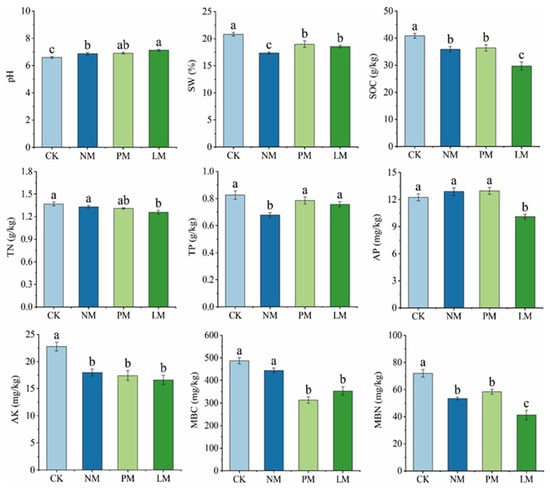
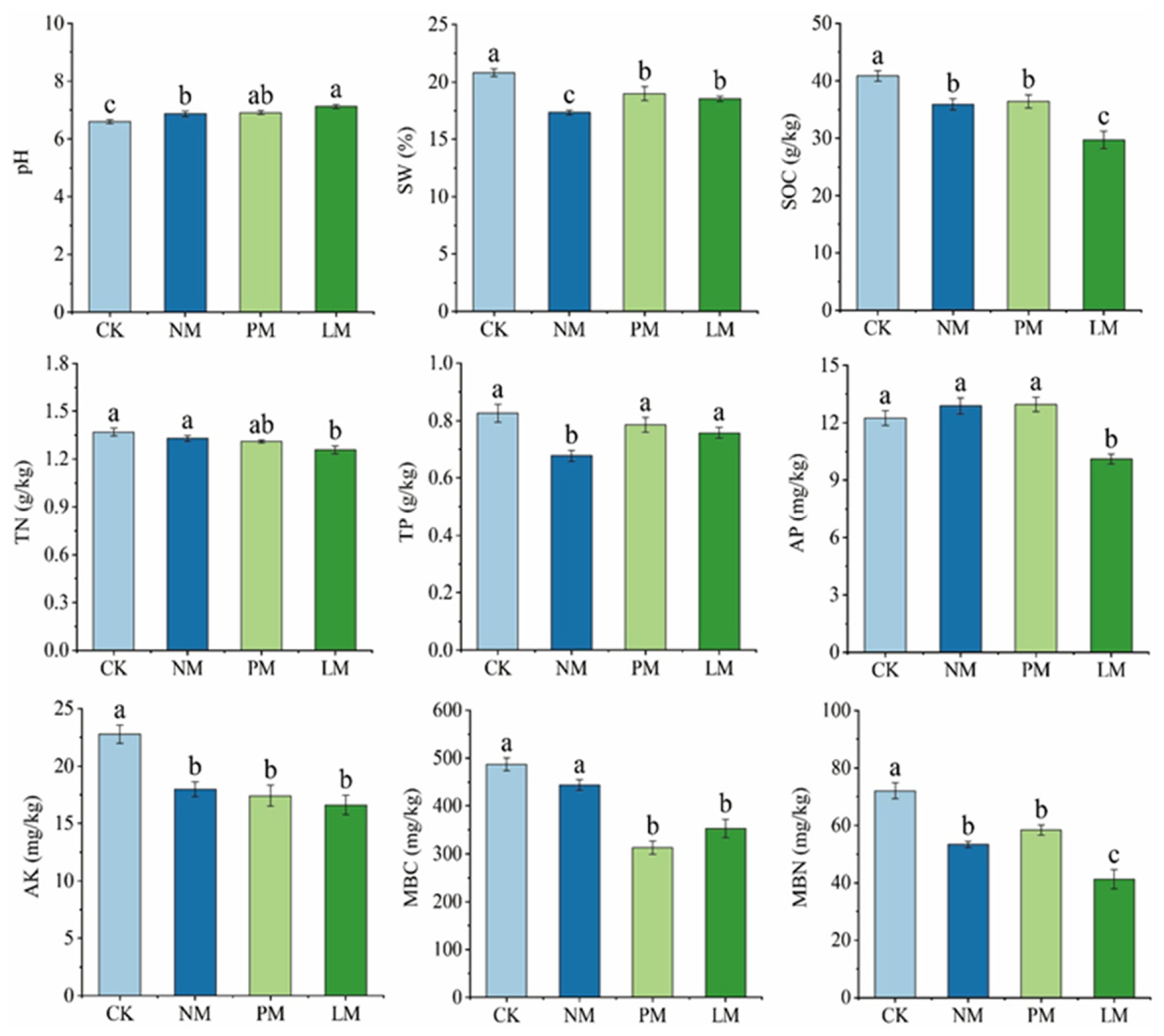
Soil physicochemical and biological properties differed significantly among treatments (Figure 1). Compared with the zokor mound treatments, CK exhibited higher SW, SOC, AK, and MBN, accompanied by lower soil pH (p < 0.05). MBC was significantly higher in CK than in PM and LM but did not differ significantly from NM. The Leontopodium-dominated mounds (LM) exhibited the lowest SOC and MBN among all treatments and significantly higher pH than CK and NM, but not significantly different from PM. TP was significantly lower in NM than in CK, PM, and LM, among which no significant differences were detected. AP was significantly lower in LM than in CK, NM, and PM, while these three treatments showed no significant differences. TN showed relatively limited variation among treatments, with LM exhibiting significantly lower TN than CK and NM. However, PM did not differ significantly from LM, CK, or NM. Overall, CK maintained the highest soil nutrient availability and microbial biomass status among the four treatments, while LM exhibited comparatively lower nutrient availability and microbial biomass, together with enhanced soil pH.
Figure 1.
Soil physicochemical and biological properties across zokor mound types and adjacent native grassland. Note: CK, native grassland; NM, bare new mounds; PM, Potentilla anserina-dominated mounds; LM, Leontopodium leontopodioides-dominated mounds. Soil properties include pH, soil water content (SW), soil organic carbon (SOC), total nitrogen (TN), total phosphorus (TP), available phosphorus (AP), available potassium (AK), microbial biomass carbon (MBC), and microbial biomass nitrogen (MBN). Bars represent mean ± standard error (SE; n = 4). Different lowercase letters indicate significant differences among treatments according to one-way ANOVA followed by Duncan’s multiple range test (p < 0.05).
3.2. Soil Microbial Community Structure and Composition
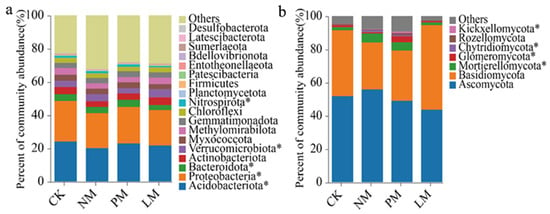
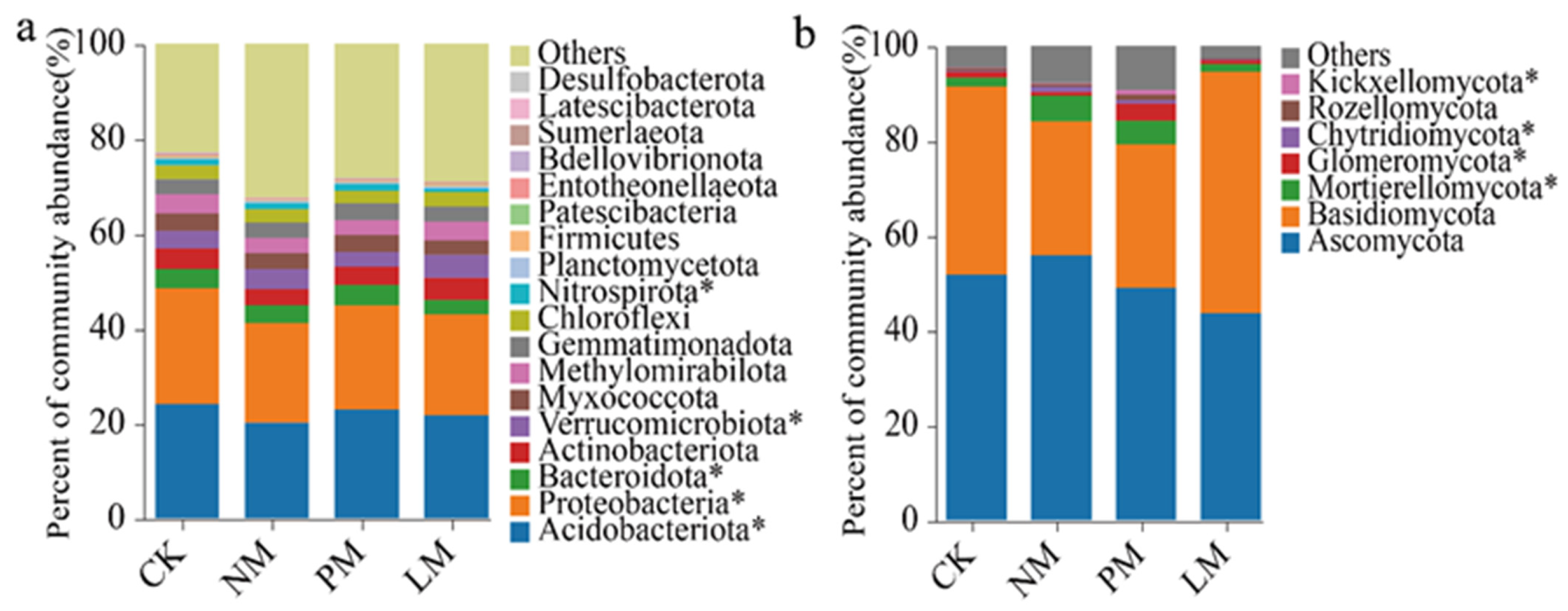
High-throughput sequencing revealed distinct taxonomic compositions of soil bacterial and fungal communities across the zokor mounds and native grassland under different vegetation types (CK, NM, PM, LM) (Figure 2). At the phylum level, Acidobacteria (19.69–24.99%) and Proteobacteria (20.69–24.79%) predominated across all treatments (Figure 2a). Compared with CK, the LM treatment significantly reduced the relative abundance of Nitrospirae (p < 0.05), while NM and PM showed no significant change relative to CK. Additionally, for fungal communities, Ascomycota (48.46%) and Basidiomycota (34.74%) were the predominant fungal phyla across all treatments (Figure 2b). Compared with CK, the PM and NM treatments significantly decreased the relative abundance of Basidiomycota (p < 0.05) while significantly increasing that of Mortierellomycota (p < 0.05). Additionally, NM significantly increased the relative abundance of Chytridiomycota relative to CK (p < 0.05).
Figure 2.
Relative abundance and composition of soil bacterial (a) and fungal (b) communities at the phylum level across zokor mound types and adjacent native grassland. Note: CK, native grassland; NM, bare new mounds; PM, Potentilla anserina-dominated mounds; LM, Leontopodium leontopodioides-dominated mounds.
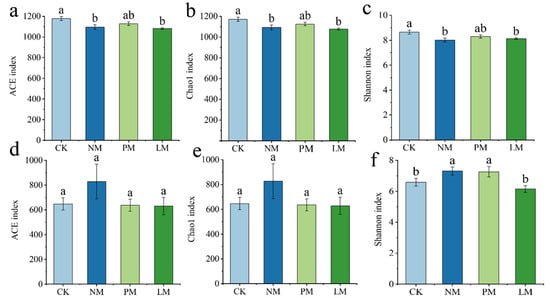
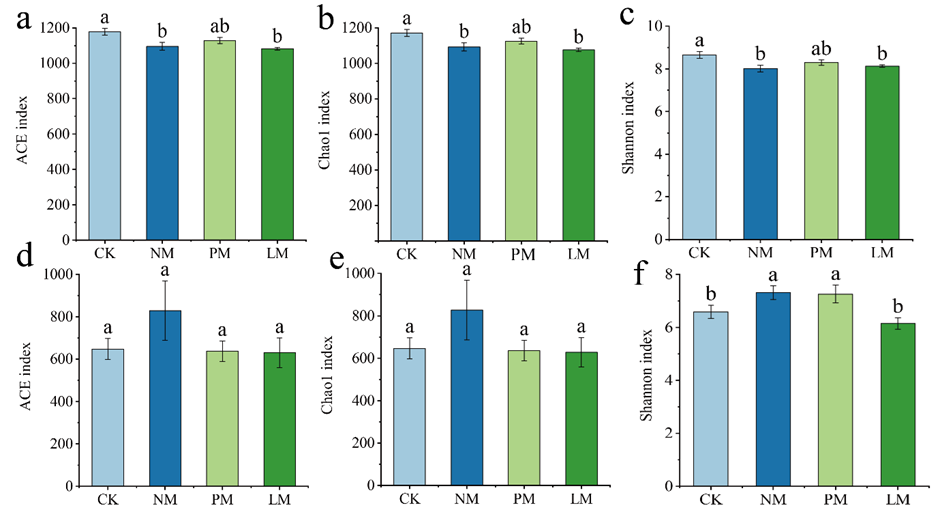
The bacterial α-diversity indices (ACE, Chao1, and Shannon) differed significantly among treatments (Figure 3a–c). Compared with CK, the NM and LM treatments exhibited significantly lower ACE, Chao1, and Shannon indices (p < 0.05), while the PM treatment did not differ significantly from CK, NM, or LM. For fungal communities, the ACE and Chao1 indices did not differ significantly among the four treatments (Figure 3d,e). In contrast, the Shannon index was significantly higher in the NM and PM treatments than in CK and LM (p < 0.05), while no significant difference was observed between CK and LM, or between NM and PM (Figure 3f).
Figure 3.
α-Diversity of soil bacterial (a–c) and fungal (d–f) communities across zokor mound types and adjacent native grassland. Note: CK, native grassland; NM, bare new mounds; PM, Potentilla anserina-dominated mounds; LM, Leontopodium leontopodioides-dominated mounds. (a,d) ACE index; (b,e) Chao1 index; (c,f) Shannon index. Different lowercase letters indicate significant differences among treatments (p < 0.05).
3.3. Soil Microbial Community Co-Occurrence Networks
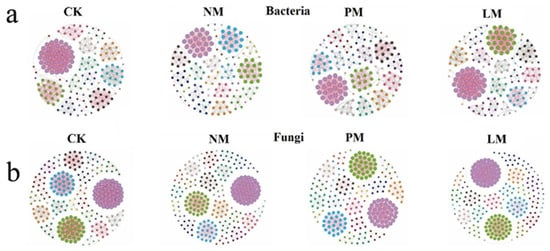
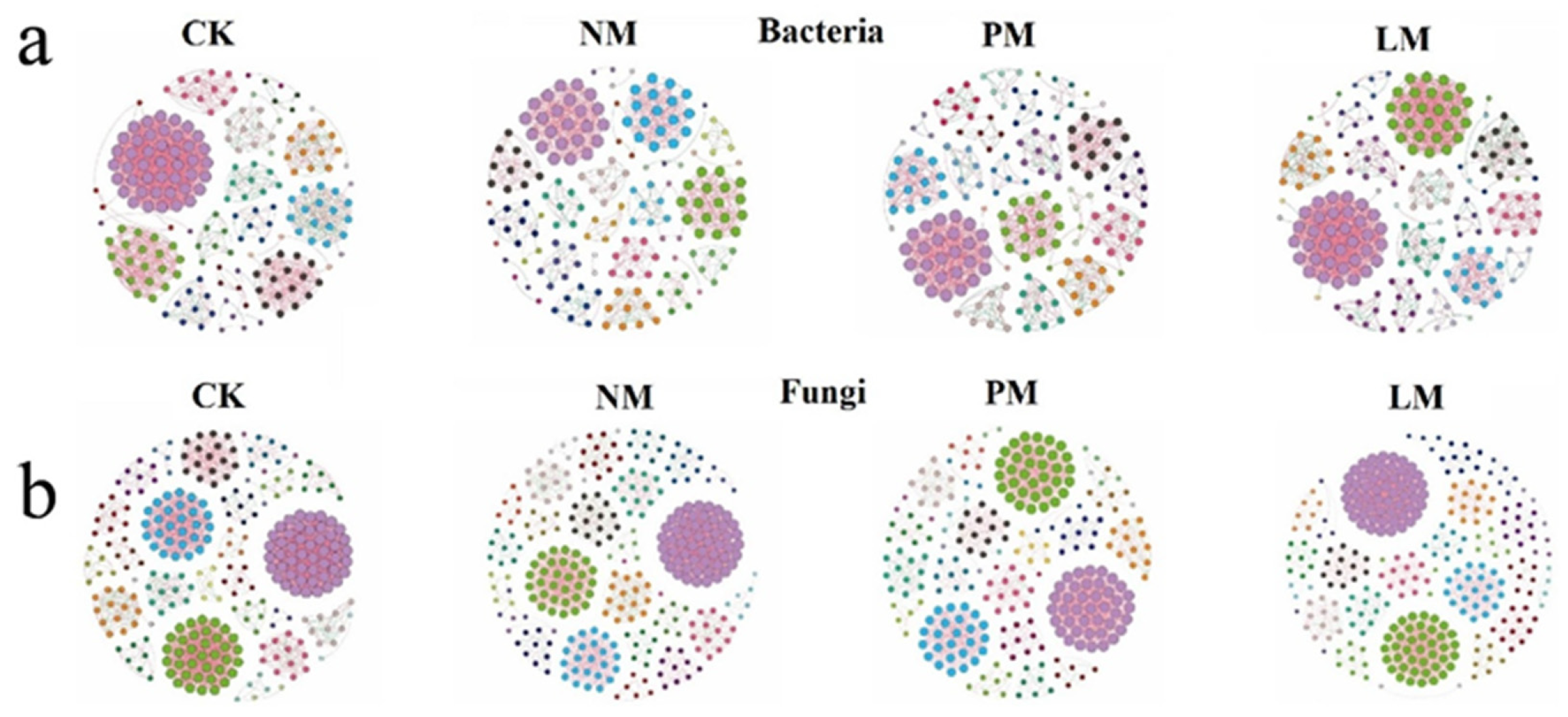
Bacterial and fungal co-occurrence networks exhibited numerical variation in their topological properties across the zokor mound types and native grassland (Figure 4a,b; Table 1). For bacterial communities, mound-associated networks contained more nodes and links than the native grassland (CK) network. The number of nodes was 170 in CK compared with 189, 175, and 191 in NM, PM, and LM, respectively, while the corresponding numbers of links were 1,112, 1,318, 1,329, and 1638. The LM network had the highest average degree (8.576) and graph density (0.045). In contrast, CK exhibited the lowest average degree (6.541), indicating reduced network connectivity. Moreover, the proportion of negative co-occurrence associations increased numerically from CK (14.21%) to NM (19.12%), PM (20.54%), and LM (24.73%), indicating an increasing proportion of negative bacterial co-occurrence associations across the vegetation-associated mound types.
Figure 4.
Co-occurrence networks of soil bacterial (a) and fungal (b) communities across zokor mound types and adjacent native grassland. Note: Networks represent CK, native grassland; NM, bare new mounds; PM, Potentilla anserina-dominated mounds; LM, Leontopodium leontopodioides-dominated mounds. Networks were constructed based on significant Spearman rank correlations among operational taxonomic units (OTUs) abundance profiles, with edges retained for associations with |R| > 0.5 and p < 0.05. Nodes represent OTUs, node size indicates connectivity (degree), and colours indicate network modules. Red and green edges represent significant positive and negative co-occurrence associations, respectively.
Table 1.
Topological properties of soil bacterial and fungal co-occurrence networks across zokor mound types and adjacent native grassland.
Fungal networks displayed a contrasting response. Compared with CK (298 nodes and 1927 links), all mound treatments exhibited fewer nodes and links, with NM, PM, and LM containing 257, 279, and 234 nodes and 1598, 1759, and 1222 links, respectively. The average degree remained comparable between CK and NM (7.889 and 7.882, respectively) and numerically higher in PM (7.959), while LM showed the highest graph density (0.037), despite having the fewest nodes and links. These patterns indicate that fungal network organization differed among mound types and the native grassland reference, with mound-associated networks generally containing fewer nodes and links while showing variable connectivity. Network modularity varied numerically among treatments, with bacterial networks ranging from 0.626 to 0.747 and fungal networks from 0.705 to 0.785. The highest modularity values were observed in NM (0.747) for bacteria and PM (0.785) for fungi. The proportion of positive fungal co-occurrence associations was 84.59% in CK and 80.54%, 82.09%, and 77.91% in NM, PM, and LM, respectively. Among the zokor mound-associated networks, PM exhibited the numerically highest proportion of positive fungal associations, indicating a relatively greater prevalence of positive co-occurrence patterns compared with NM and LM.
3.4. Soil Microbial Community Assembly Mechanisms
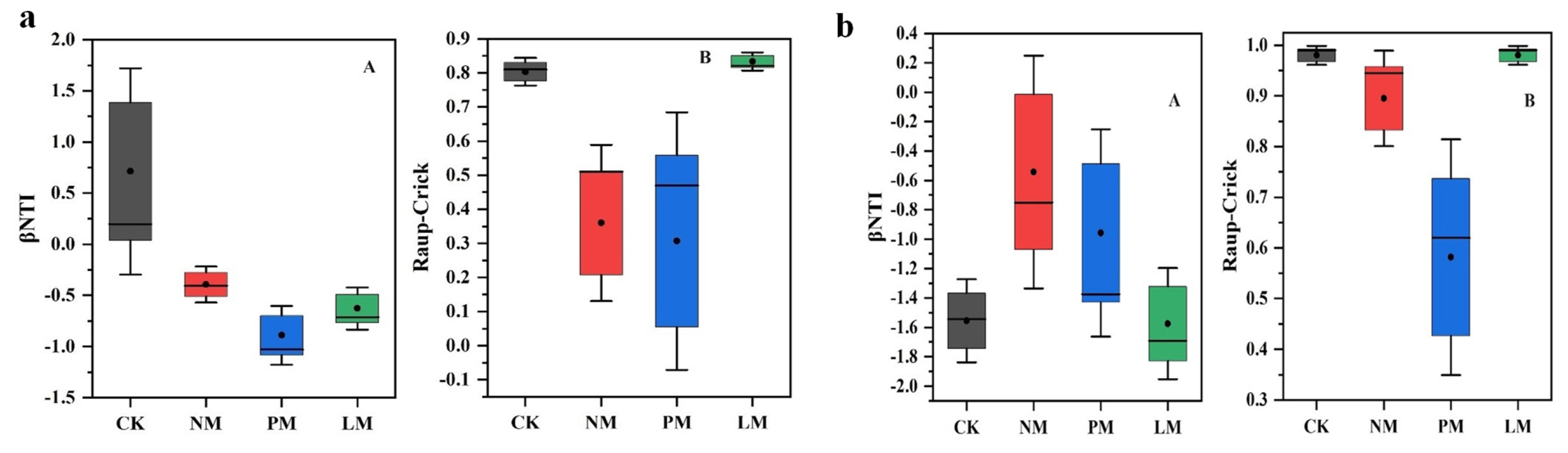
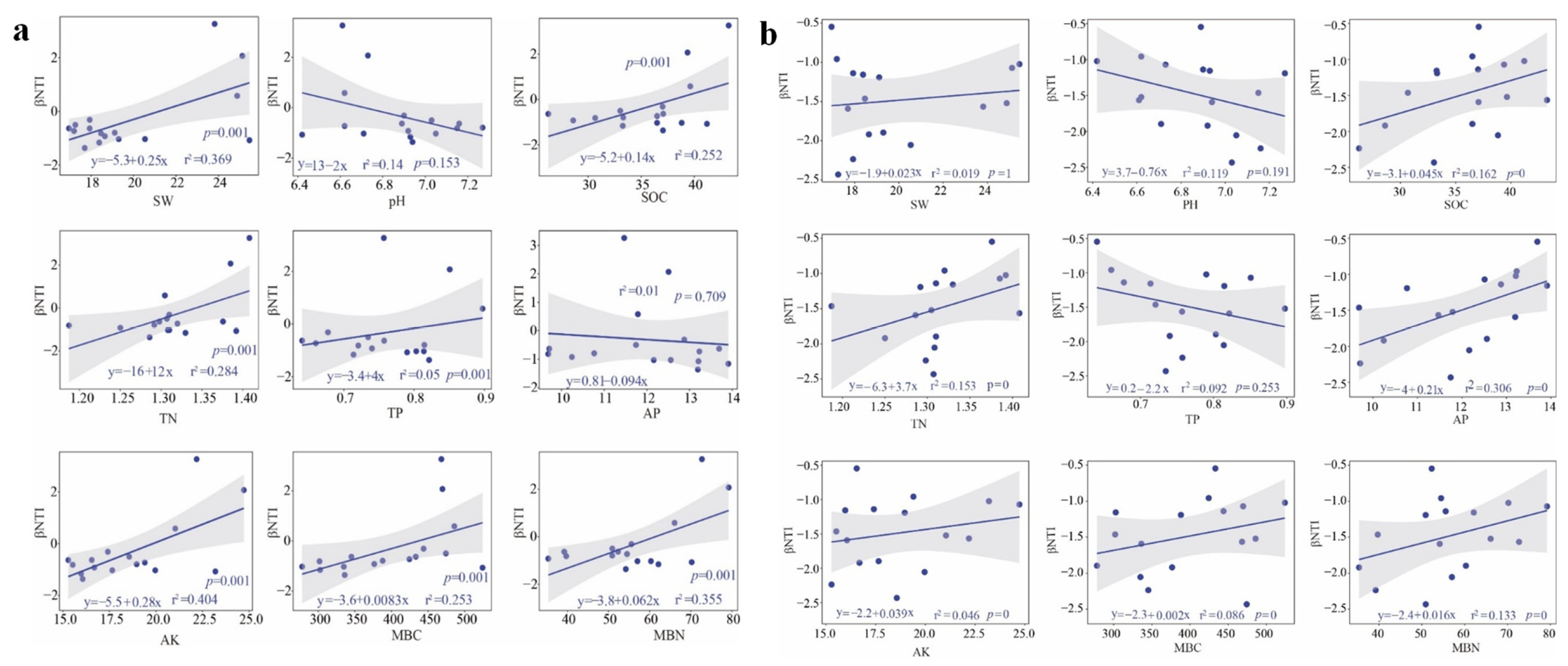
As indicated by βNTI values (Figure 5(aA,bA)), stochastic processes (|βNTI| < 2) are predominant in both bacterial and fungal community assembly across all vegetation-associated mound types (CK, NM, PM, and LM), although the bacterial community in CK exhibited greater variation in βNTI values, with some comparisons approaching the deterministic boundary (|βNTI| = 2). Further partitioning of these stochastic processes using the Raup-Crick metric (RCbray) under |βNTI| < 2 (Figure 5(aB,bB)) revealed that bacterial community assembly was primarily characterized by undominated processes across all treatments. In contrast, fungal community assembly exhibited distinct patterns among vegetation types, with dispersal limitation dominating in CK and LM, while undominated processes prevailed in PM. NM displayed an intermediate assembly pattern, with RCbray values approaching the dispersal-limitation threshold. Linear regression analyses further revealed significant associations between bacterial βNTI and SW, SOC, TN, TP, AK, MBC, and MBN (Figure 6a). Similarly, fungal βNTI showed significant associations with SOC, TN, AP, AK, MBC, and MBN (Figure 6b).
Figure 5.
Community assembly processes of soil bacterial (a) and fungal (b) communities across zokor mound types and adjacent native grassland inferred using null-model framework. Note: Within each panel, (A) presents β-nearest taxon index (βNTI) values, distinguishing deterministic (|βNTI| > 2) and stochastic (|βNTI| < 2) assembly processes, and (B) presents the Raup-Crick metric based on Bray–Curtis dissimilarity (RCbray), which further partitions stochastic processes into homogeneous dispersal (RCbray < −0.95), dispersal limitation (RCbray > 0.95), and undominated processes (−0.95 ≤ RCbray ≤ 0.95). Boxes represent the interquartile range, horizontal lines within boxes denote the medians, black dots indicate means, and whiskers represent the data range. CK, native grassland; NM, bare new mounds; PM, Potentilla anserina-dominated mounds; LM, Leontopodium leontopodioides-dominated mounds.
Figure 6.
Linear regression relationships between β-nearest taxon index (βNTI) values and soil physicochemical and biological properties, including soil water content (SW), pH, soil organic carbon (SOC), total nitrogen (TN), total phosphorus (TP), available phosphorus (AP), available potassium (AK), microbial biomass carbon (MBC), and microbial biomass nitrogen (MBN), for bacterial (a) and fungal (b) communities across zokor mound types and adjacent native grassland. Note: Solid lines represent fitted linear regressions, and shaded areas indicate 95% confidence intervals. Regression equations, coefficients of determination (R2), and P-values are shown for each relationship. p < 0.05 and 0.001 were considered statistically significant.
3.5. Relationships Between Soil Microbial Communities and Environmental Factors
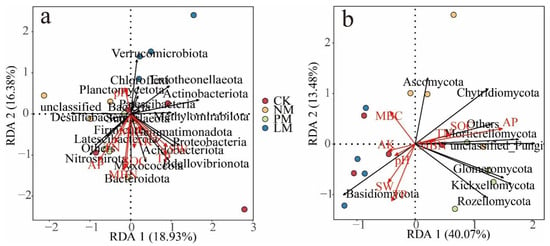
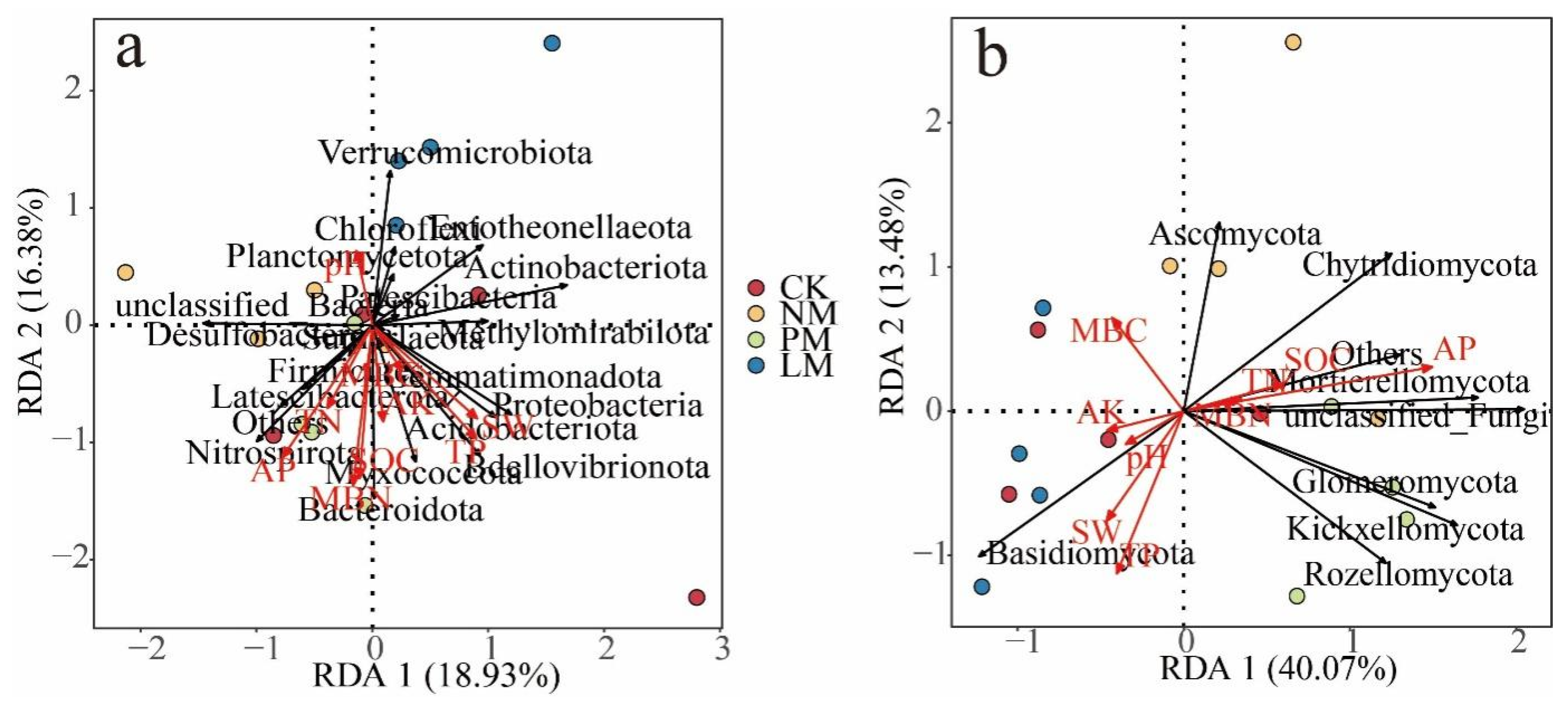
The RDA results indicated that 18.93% and 16.38% of the total variation in bacterial community composition was explained by RDA1 and RDA2, respectively (Figure 7a). The overall RDA model was statistically significant (F = 1.481, p = 0.021). AP (R2 = 0.504, p = 0.009), MBN (R2 = 0.479, p = 0.013), TP (R2 = 0.457, p = 0.019), SOC (R2 = 0.434, p = 0.027), and SW (R2 = 0.387, p = 0.034) were identified as significant explanatory variables associated with bacterial community composition. However, no significant correlation was found between bacterial community structure and pH, AK, MBC or TN (p > 0.05).
Figure 7.
Redundancy analysis ordination of phylum-level soil bacterial (a) and fungal (b) community composition in relation to soil physicochemical and biological properties across zokor mound types and adjacent native grassland. Note: Coloured points represent individual samples from CK (native grassland), NM (bare new mounds), PM (Potentilla anserina-dominated mounds), and LM (Leontopodium leontopodioides-dominated mounds). Red arrows represent soil physicochemical and biological properties (SW, soil water content; pH; SOC, soil organic carbon; TN, total nitrogen; TP, total phosphorus; AP, available phosphorus; AK, available potassium; MBC, microbial biomass carbon; and MBN, microbial biomass nitrogen), while black arrows represent the dominant bacterial phyla (a) and fungal phyla (b). Arrow length indicates the magnitude of the association between environmental variables or microbial phyla and community composition, while arrow direction indicates the direction of the relationship along the ordination axes. Significant explanatory variables (p < 0.05) are reported in the main text.
In contrast, for fungal communities, RDA1 and RDA2 explained 40.07% and 13.48% of the total variation, respectively (Figure 7b). The overall RDA model was not statistically significant (F = 1.647, p = 0.093), indicating that the measured environmental variables collectively did not explain a statistically significant proportion of variation in fungal community composition. Although only AP showed a strong individual association with the fungal ordination (R2 = 0.641, p = 0.001), this result represents an exploratory environmental association rather than evidence of an independently established environmental driver. TP showed a marginal association (R2 = 0.352, p = 0.059), while the fungal ordination was not significantly correlated with SW, pH, AK, MBC, MBN, TN or SOC (p > 0.05). Collectively, these findings indicate that bacterial community composition was more strongly associated with the measured soil properties than fungal community composition, suggesting a larger contribution of environmental filtering to bacterial structuring.
4. Discussion
4.1. Vegetation Succession on Zokor Mounds Drives Divergence in Soil Nutrient Status
Zokor burrowing restructures alpine meadow soils by exposing subsurface materials, disrupting root networks, and removing vegetation cover [42]. However, the resulting ecological changes do not follow a unidirectional degradation trajectory. Instead, subsequent vegetation colonization generates distinct soil conditions that reflect alternative recovery pathways rather than simple differences in disturbance intensity. In this study, native grassland (CK) maintained the highest overall soil resource availability, with significantly higher SW, SOC, AK, and MBN, together with relatively higher TN and MBC. These conditions likely reflect the sustained litter inputs, root turnover, and rhizosphere activity under continuous vegetation cover, which promote organic matter accumulation and nutrient cycling, thereby regulating ecosystem development and succession [43,44]. The lower pH observed in CK may also be associated with organic acid production during decomposition and root activity [45]. In contrast, bare new mounds (NM) exhibited lower SW and TP, potentially reflecting reduced vegetation-mediated water retention, nutrient uptake, and soil stabilization following disturbance [46,47].
Vegetation colonization subsequently generated divergent recovery pathways among mound types. Potentilla anserina-dominated mounds (PM) exhibited intermediate soil conditions, with TP, TN, and AP comparable to CK but decreased SW, AK, MBC, and MBN, indicating partial recovery of nutrient cycling without complete restoration of microbial biomass. As a rapidly spreading clonal pioneer species, P. anserina may accelerate soil recovery through vegetation establishment and increased litter, roots, and rhizosphere inputs, which can promote microbial recruitment and nutrient cycling [43,48]. Consistently, independent assessments within the same zokor mound system reported enhanced biological activity and nutrient cycling capacity in PM compared with NM and LM [45]. Conversely, LM exhibited the lowest SOC and MBN, decreased SW, AK, and MBC relative to CK, and the highest pH. This suggests that later vegetation colonization does not correspond to progressive soil fertility restoration. The conservative ecological strategy of Leontopodium, as illustrated by studies on L. alpinum, is associated with adaptation to open, nutrient-poor alpine environments [49], potentially resulting in lower organic matter inputs and slower nutrient accumulation compared with more productive pioneer species [50,51]. Importantly, NM, PM, and LM represent spatially distinct mound types classified by dominant vegetation, rather than successive stages directly observed over time. Although the observed patterns may be consistent with ecological changes associated with post-disturbance vegetation development, they should not be interpreted as confirmation of a specific temporal succession pathway. Space-for-time comparisons can provide useful insights into ecological development, but their temporal interpretation depends on the assumption that the compared sites follow a common trajectory, which requires independent validation [52,53]. Collectively, these findings demonstrate that vegetation identity is an important correlate of divergent soil resource conditions during zokor mound succession, providing the environmental context for microbial community restructuring.
4.2. Soil Nutrient Availability Regulates Microbial Diversity and Community Composition During Vegetation Succession
The contrasting soil resource conditions across zokor mound types were accompanied by distinct bacterial and fungal community responses. Bacterial α-diversity (ACE, Chao1, and Shannon) decreased significantly in NM and LM compared with CK, while PM exhibited an intermediate pattern. This response suggests that reduced resource availability, particularly decreased nitrogen and carbon, may constrain bacterial diversity through environmental filtering and the exclusion of taxa with greater substrate requirements [54]. Similar patterns of microbial diversity decline under grassland degradation and resource limitation have been reported in northern China and across different ecosystems [55,56]. Consistent with this nutrient-filtering mechanism, bacterial community composition shifted along the soil resource gradient. The dominance of Acidobacteria and Proteobacteria suggests the persistence of bacterial groups with contrasting resource-use strategies, potentially contributing to organic matter utilization and nutrient transformations under different soil resource conditions [54]. Microbial communities contribute to nutrient acquisition and soil productivity beyond their taxonomic composition. A previous study has demonstrated that selected rhizobium strains enhanced nodulation, nitrogen fixation-related performance, soil nutrient status, and legume yield under field conditions [57]. Although their agricultural system differs from the naturally assembled microbial communities examined here, their findings illustrate the potential functional contributions of specific microbial taxa to soil nutrient dynamics and productivity. Similarly, in the present study, the observed associations among microbial biomass, soil nutrient availability, and microbial community composition highlight the relevance of microbial communities to soil ecological conditions. The decreased abundance of Nitrospirota in LM further suggests that decreased nutrient conditions may influence the ecological niches of nitrifying microorganisms. Microbial responses to resource limitation may involve physiological and metabolic adaptations that support persistence under environmental stress. Recent work on beneficial plant-associated microorganisms may also enhance stress resilience through plant-microbe interactions, nutrient acquisition, and stress mitigation [58].
Moreover, fungal communities exhibited a contrasting diversity response. Although ACE and Chao1 did not differ significantly among treatments, Shannon diversity increased in NM and PM, suggesting that mound disturbance altered community evenness rather than total taxonomic richness. This pattern may reflect increased microsite heterogeneity during early vegetation recovery, as exposed mineral soil, decomposing plant materials, and pioneer vegetation create diverse habitats for fungal colonization. This response is consistent with the intermediate disturbance hypothesis, which proposes that moderate disturbance can enhance microbial diversity by preventing competitive exclusion and increasing habitat heterogeneity [59,60]. Changes in fungal composition further reflected differences among successional stages. At the phylum level, the decreased relative abundance of Basidiomycota and increased abundance of Mortierellomycota in NM and PM suggest a shift toward fungal groups associated with early-stage decomposition and opportunistic resource acquisition. Basidiomycota include taxa capable of decomposing complex organic substrates, whereas Mortierellomycota are commonly associated with rapid growth and disturbed conditions [61,62]. Furthermore, the increased abundance of Mortierellomycota may contribute to organic matter turnover and mineral phosphorus mobilization during early soil recovery [63]. Beyond these taxonomic shifts, the observed changes may have implications for soil biogeochemical functioning, particularly carbon decomposition and nitrogen and phosphorus cycling. However, taxonomic profiles alone cannot reliably establish microbial functional potential or activity, particularly in complex soil ecosystems [64,65]. This distinction is important because different microbial taxa may share overlapping metabolic capabilities, potentially contributing to functional redundancy and decoupling taxonomic restructuring from changes in functional potential [66,67].
4.3. Vegetation-Associated Differences Reshape Microbial Co-Occurrence Networks and Ecological Patterns
Microbial co-occurrence networks provide ecological insights into community association patterns beyond taxonomic composition. Positive associations may reflect shared environmental preferences, metabolic complementarity, or potential facilitative relationships, while negative associations may indicate contrasting environmental responses, niche differentiation, or potential competition under resource limitation [68]. However, these correlation-based networks should be interpreted as co-occurrence patterns rather than direct evidence of ecological interactions because they may integrate both biotic relationships and environmental filtering [69,70,71]. In the present study, bacterial and fungal networks exhibited contrasting structural responses across mound types, indicating that disturbance-driven changes in soil resources reorganized microbial ecological strategies rather than simply reducing community complexity.
The bacterial networks in mound soils showed increased connectivity and a greater proportion of negative co-occurrence associations, particularly in LM. This pattern suggests that nutrient-poor conditions may be associated with stronger negative co-occurrence patterns among bacterial taxa, potentially reflecting increased resource competition or niche differentiation. Nutrient availability is a known determinant of microbial coexistence and resource acquisition strategies [72], while experimental evidence indicates that increased resource availability can reduce negative bacterial associations and strengthen positive associations [73]. The highly connected LM bacterial network may represent a tightly constrained community of stress-tolerant taxa rather than a more stable system.
Fungal networks exhibited a different successional trajectory, characterized by reduced network size but variation in interaction quality among mound stages. The relatively higher proportion of positive associations maintained in PM potentially suggests the influence of its colonization on soil habitat heterogeneity and rhizosphere resource inputs. Pioneer vegetation can modify microbial habitats through root-derived carbon inputs and rhizosphere processes, influencing microbial community establishment and reorganization [43,74,75,76]. Similar studies have shown that vegetation restoration can restructure microbial networks by enhancing niche differentiation and strengthening cooperative associations among functionally complementary taxa [77]. In contrast, the lower proportion of positive fungal associations in NM and LM suggests that both early disturbance and later nutrient-limited succession may constrain positive interactions by reducing resource availability or habitat suitability. This network-level divergence suggests domain-specific responses in microbial community organization during zokor mound succession, providing a complementary perspective to the taxonomic and community assembly analyses.
4.4. Nutrient Availability Governs Deterministic and Stochastic Microbial Community Assembly
Understanding how environmental filtering and stochastic processes interact to regulate microbial community assembly is essential for interpreting microbial responses to environmental change. In the present study, although both bacterial and fungal communities were predominantly classified as stochastic according to βNTI, their relationships with soil properties differed substantially. Bacterial βNTI was significantly associated with SW, SOC, TN, TP, AK, MBC, and MBN, while fungal βNTI was associated with SOC, TN, AP, AK, MBC, and MBN. These relationships suggest that soil resource conditions were associated with variation in microbial phylogenetic turnover, despite the overall predominance of stochastic assembly. Furthermore, redundancy analysis revealed that bacterial community composition was significantly associated with AP, MBN, TP, SOC, and SW, while fungal community composition was significantly associated with AP. These findings indicate that, although stochastic processes predominated in the βNTI-based classification, environmental filtering also contributed to microbial community assembly, particularly through differences in soil resource availability.
The stronger environmental associations observed for bacterial βNTI may reflect the relatively rapid growth and resource-responsive characteristics of bacteria, which can facilitate population-level responses to changes in carbon and nutrient availability [54,78]. Recent experimental evidence has demonstrated that nutrient availability and microbial community size can jointly influence the balance between deterministic and stochastic assembly processes [79]. Similarly, previous research identified changes in soil organic matter as a key predictor of the type and relative influence of deterministic selection across successional stages in a salt-marsh chronosequence [80]. This finding provides a useful parallel to our results, in which bacterial βNTI was significantly associated with SOC, highlighting the potential importance of soil organic matter dynamics in shaping microbial community assembly. However, both nutrient-rich CK soils and nutrient-limited mound soils exhibited predominantly stochastic assembly in the present study, suggesting that resource availability alone was insufficient to explain the observed assembly patterns. This indicates that additional ecosystem-specific factors, particularly the recurrent physical disturbance associated with zokor burrowing, may also contribute to community turnover by influencing microbial dispersal and ecological drift. In contrast, fungal community assembly showed a comparatively stronger contribution of dispersal limitation in CK and LM, while undominated processes prevailed in PM, with NM exhibiting an intermediate pattern. The greater contribution of dispersal limitation to fungal assembly may be associated with its life-history characteristics, including relatively larger propagules, slower growth rates, and stronger dependence on specific host plants or microsites for establishment [81,82]. These characteristics may constrain fungal colonization across heterogeneous mound habitats.
While this study provides insights into the relationships between vegetation succession, soil properties, and microbial community assembly on zokor mounds, several limitations should be considered when interpreting the findings. First, soil sampling was conducted during a single season at one alpine meadow site, with four mound replicates per vegetation type. This limits the representation of seasonal and interannual dynamics, broader spatial variability, and the generalizability of the findings across alpine meadow ecosystems. Moreover, although NM, PM, and LM were distinguished by their dominant vegetation, their chronological relationships were not independently established, nor were transitions among these types monitored. Consequently, their interpretation as successional stages relies on a space-for-time perspective rather than direct temporal observations. Differences in mound history, initial disturbance conditions, and local environmental factors may also contribute to the observed patterns. Therefore, the proposed successional trajectory remains hypothetical and should not be interpreted as a confirmed chronological sequence.
Moreover, the observed associations between microbial community assembly patterns and soil properties do not establish direct causal relationships or independently confirm the mechanisms underlying community assembly. Similarly, correlation-based co-occurrence networks and null-model analyses provide statistical inferences about microbial associations and assembly processes but cannot establish direct ecological interactions or their underlying mechanisms. Network topological properties were also compared descriptively without formal network-level statistical testing. Thus, numerical differences among treatments should be interpreted with restraint and validated through replicated network construction and appropriate statistical comparisons. In addition, the relatively small number of sampling plots in relation to the environmental predictors may limit the explanatory stability of the RDA models. Because multicollinearity among predictors was not assessed, potential correlations among soil properties may have influenced individual soil-microbial associations, particularly those involving fungal communities.
Finally, bacterial 16S rRNA and fungal ITS amplicon sequencing primarily characterized taxonomic composition rather than microbial functional potential or activity. Moreover, the predominantly phylum-level interpretation may obscure substantial ecological and functional heterogeneity among lower taxonomic groups. Future studies should therefore incorporate genus-level characterization, indicator taxa identification, fungal ecological guild annotation, and appropriate functional prediction approaches to improve the resolution of microbial ecological roles. To address these limitations, future research should combine repeated monitoring of individual mounds, independent determination of mound ages, and geographically replicated sampling to validate the proposed vegetation-development relationships and resolve their temporal dynamics. Integrating functional metagenomics and other complementary multi-omics approaches would further help elucidate microbial functional potential, activity, and the ecological mechanisms underlying community restructuring following zokor disturbance.
5. Conclusions
Rodent-driven ecosystem engineering is an important but understudied driver of belowground succession in alpine grasslands. Using zokor mounds as a natural disturbance system, this study integrated soil properties, microbial community profiling, co-occurrence network analysis, and null-model approaches to examine how microbial communities differ among vegetation-associated mound types. Our findings reveal contrasting soil and microbial characteristics among these types, rather than a uniform pattern of recovery. Native grassland maintained the highest soil resource availability and microbial biomass, whereas Leontopodium-dominated mounds exhibited comparatively nutrient-limited conditions. With these contrasting environments, bacterial communities showed stronger associations with soil properties and, in descriptive network comparisons, a greater proportion of negative co-occurrence associations under nutrient-limited conditions, while fungal communities exhibited greater variation in inferred assembly processes and comparatively weaker associations with the measured soil properties. Although βNTI-based null-model analyses indicated that stochastic processes predominated in both microbial domains, significant associations between βNTI and soil properties, together with the RDA results, highlighted the concurrent contribution of environmental conditions to microbial community structuring. Collectively, these findings suggest that microbial recovery following disturbance reflects domain-specific ecological strategies rather than a uniform trajectory. These findings highlight the need for restoration of degraded alpine grassland on the Qinghai-Tibetan Plateau to consider microbial recovery as a multidimensional process shaped by resource dynamics, microbial co-occurrence patterns, and community assembly mechanisms, rather than relying solely on vegetation establishment or individual indicators of ecosystem recovery. Future research integrating long-term monitoring, manipulative experiments, and functional approaches will be essential to determine the temporal dynamics, stability and ecological consequences of these microbial community changes across broader alpine ecosystems.
Author Contributions
X.Z.: data curation, investigation, methodology, software, writing—original draft. L.N.: investigation, project administration, software, supervision, writing—review and editing. L.L.: investigation, methodology, software, writing—review and editing. I.A.: writing—review and editing, data curation, formal analysis, software, investigation. P.Q.: conceptualization, funding acquisition, methodology, writing—review and editing. All authors have read and agreed to the published version of the manuscript.
Funding
This research was funded by the National Natural Science Foundation of China (No. 42567006).
Institutional Review Board Statement
Not applicable.
Informed Consent Statement
Not applicable, as the study did not involve humans.
Data Availability Statement
The microbial DNA sequences of the 16 soil samples have been deposited in the SRA of the NCBI database under accession nos. NCBI: PRJNA988927 and SRA: SUB13582092. Other data presented in this study are available on request from the corresponding author.
Acknowledgments
During the preparation of this work, the author used ChatGPT (OpenAI, GPT-6) to improve language clarity and readability, enhance the academic presentation of the manuscript, and assist with formatting and organization. After using this tool, the author critically reviewed, verified, and edited all content as necessary and accepts full responsibility for the accuracy, integrity, and originality of the published work. The authors sincerely thank Qi Wang for his valuable comments and suggestions during the review of the manuscript, which helped improve its clarity and overall presentation.
Conflicts of Interest
The authors declare no conflicts of interest.
Abbreviations
The following abbreviations are used in this manuscript:
| CK | native grassland (control) |
| NM | bare new zokor mounds |
| PM | Potentilla anserina-dominated mounds |
| LM | Leontopodium leontopodioides-dominated mounds |
| AK | available potassium |
| AP | available phosphorus |
| SOC | soil organic carbon |
| SW | soil water content |
| TN | total nitrogen |
| TP | total phosphorus |
| MBC | microbial biomass carbon |
| MBN | microbial biomass nitrogen |
| RDA | redundancy analysis |
| βMNTD | beta mean nearest taxon distance |
| βNTI | beta nearest taxon index |
References
- Miehe, G.; Schleuss, P.M.; Seeber, E.; Babel, W.; Biermann, T.; Braendle, M.; Chen, F.; Coners, H.; Foken, T.; Gerken, T.; et al. The Kobresia pygmaea ecosystem of the Tibetan highlands–origin, functioning and degradation of the world’s largest pastoral alpine ecosystem: Kobresia pastures of Tibet. Sci. Total Environ. 2019, 648, 754–771. [Google Scholar] [CrossRef] [Scilit]
- Zhao, L.; Li, Y.; Xu, S.; Zhou, H.; Gu, S.; Yu, G.; Zhao, X. Diurnal, seasonal and annual variation in net ecosystem CO2 exchange of an alpine shrubland on Qinghai-Tibetan plateau. Glob. Change Biol. 2006, 12, 1940–1953. [Google Scholar] [CrossRef] [Scilit]
- Qiu, J. China: The third pole. Nature 2008, 454, 393–396. [Google Scholar] [CrossRef] [Scilit]
- Su, J.; Ji, W.; Sun, X.; Wang, H.; Kang, Y.; Yao, B. Effects of different management practices on soil microbial community structure and function in alpine grassland. J. Environ. Manag. 2023, 327, 116859. [Google Scholar] [CrossRef] [Scilit]
- Wang, Z.; Deng, Y.; Kang, Y.; Wang, Y.; Bao, D.; Su, J. Impacts of climate change and human activities on three Glires pests of the Qinghai-Tibet Plateau. Pest Manag. Sci. 2024, 80, 5233–5243. [Google Scholar] [CrossRef] [Scilit]
- Yu, L.; Chen, Y.; Sun, W.; Huang, Y. Effects of grazing exclusion on soil carbon dynamics in alpine grasslands of the Tibetan Plateau. Geoderma 2019, 353, 133–143. [Google Scholar] [CrossRef] [Scilit]
- Su, J.; Ji, W.; Li, H.; Yao, T.; Wang, J.; Nan, Z. Zokor disturbances indicated positive soil microbial responses with carbon cycle and mineral encrustation in alpine grassland. Ecol. Eng. 2020, 144, 105702. [Google Scholar] [CrossRef] [Scilit]
- An, K.; Yao, B.; Tan, Y.; Kang, Y.; Wang, Z.; Su, J. Spermatocytes are the terminals of germ cell differentiation in plateau zokor (Eospalax baileyi) during the non-breeding season. Integr. Zool. 2024, 20, 608–622. [Google Scholar] [CrossRef] [Scilit]
- Su, J.; Aryal, A.; Nan, Z.; Ji, W. Climate change-induced range expansion of a subterranean rodent: Implications for rangeland management in Qinghai-Tibetan Plateau. PLoS ONE 2015, 10, e0138969. [Google Scholar] [CrossRef] [Scilit]
- Guo, H.; Brunton, D.; Hegab, I.; Ali, A.; An, K.; Wang, Z.; Zhao, Z.; Ji, W.; Su, J. Anti-predator behavioral divergence between subterranean and aboveground foraging small mammals. Behav. Ecol. 2026, 37, arag075. [Google Scholar] [CrossRef] [Scilit]
- Zhu, P.; Chen, R.; Song, Y.; Liu, G.; Chen, T.; Zhang, W. Effects of land cover conversion on soil properties and soil microbial activity in an alpine meadow on the Tibetan Plateau. Environ. Earth Sci. 2015, 74, 4523–4533. [Google Scholar] [CrossRef] [Scilit]
- Zhou, H.; Yang, X.; Zhou, C.; Shao, X.; Shi, Z.; Li, H.; Su, H.; Qin, R.; Chang, T.; Hu, X.; et al. Alpine grassland degradation and its restoration in the Qinghai–Tibet plateau. Grasses 2023, 2, 31–46. [Google Scholar] [CrossRef] [Scilit]
- Lu, C.; Cheng, G.; Wang, G.; Meng, P.; Chen, C.; Xiao, R.; Yang, Z. Ecological restoration processes in pika mounds on the Qinghai-Tibet Plateau. Ecol. Eng. 2025, 212, 107517. [Google Scholar] [CrossRef] [Scilit]
- Niu, Y.; Yang, S.; Zhu, H.; Zhou, J.; Chu, B.; Ma, S.; Hua, R.; Hua, L. Cyclic formation of zokor mounds promotes plant diversity and renews plant communities in alpine meadows on the Tibetan Plateau. Plant Soil 2020, 446, 65–79. [Google Scholar] [CrossRef] [Scilit]
- Xiang, Z.; Bhatt, A.; Tang, Z.; Peng, Y.; Wu, W.; Zhang, J.; Wang, J.; Gallacher, D.; Zhou, S. Disturbance of plateau zokor-made mound stimulates plant community regeneration in the Qinghai-Tibetan Plateau, China. J. Arid Land. 2021, 13, 1054–1070. [Google Scholar] [CrossRef] [Scilit]
- Mohammadi, K.; Heidari, G.; Khalesro, S.; Sohrabi, Y. Soil management, microorganisms and organic matter interactions: A review. Afr. J. Biotechnol. 2011, 10, 19840. [Google Scholar] [CrossRef] [Scilit]
- Zhang, Q.; Lu, Y.; Zhang, C.; Yao, B.; Su, J. Effect of moderate livestock grazing on soil and vegetation characteristics in zokor mounds of different ages. Sci. Rep. 2023, 13, 12459. [Google Scholar] [CrossRef] [Scilit]
- Sokol, N.W.; Slessarev, E.; Marschmann, G.L.; Nicolas, A.; Blazewicz, S.J.; Brodie, E.L.; Firestone, M.K.; Foley, M.M.; Hestrin, R.; Hungate, B.A.; et al. Life and death in the soil microbiome: How ecological processes influence biogeochemistry. Nat. Rev. Microbiol. 2022, 20, 415–430. [Google Scholar] [CrossRef] [Scilit]
- Peñuelas, J.; Zheng, B.; Tariq, A.; Sardans, J. Microbial phosphorus cycling in terrestrial ecosystems. Nat. Rev. Microbiol. 2026, 24, 478–495. [Google Scholar] [CrossRef] [Scilit]
- Philippot, L.; Chenu, C.; Kappler, A.; Rillig, M.C.; Fierer, N. The interplay between microbial communities and soil properties. Nat. Rev. Microbiol. 2024, 22, 226–239. [Google Scholar] [CrossRef] [Scilit]
- Pii, Y.; Mimmo, T.; Tomasi, N.; Terzano, R.; Cesco, S.; Crecchio, C. Microbial interactions in the rhizosphere: Beneficial influences of plant growth-promoting rhizobacteria on nutrient acquisition process. A review. Biol. Fertil. Soils. 2015, 51, 403–415. [Google Scholar] [CrossRef] [Scilit]
- Che, R.; Wang, Y.; Li, K.; Xu, Z.; Hu, J.; Wang, F.; Rui, Y.; Li, L.; Pang, Z.; Cui, X. Degraded patch formation significantly changed microbial community composition in alpine meadow soils. Soil Tillage Res. 2019, 195, 104426. [Google Scholar] [CrossRef] [Scilit]
- Wu, X.; Yang, J.; Ruan, H.; Wang, S.; Yang, Y.; Naeem, I.; Wang, L.; Liu, L.; Wang, D. The diversity and co-occurrence network of soil bacterial and fungal communities and their implications for a new indicator of grassland degradation. Ecol. Indic. 2021, 129, 107989. [Google Scholar] [CrossRef] [Scilit]
- Stegen, J.C.; Lin, X.; Fredrickson, J.K.; Chen, X.; Kennedy, D.W.; Murray, C.J.; Rockhold, M.L.; Konopka, A. Quantifying community assembly processes and identifying features that impose them. ISME J. 2013, 7, 2069–2079. [Google Scholar] [CrossRef] [Scilit]
- Liu, N.; Hu, H.; Ma, W.; Deng, Y.; Wang, Q.; Luo, A.; Meng, J.; Feng, X.; Wang, Z. Relative importance of deterministic and stochastic processes on soil microbial community assembly in temperate grasslands. Microorganisms 2021, 9, 1929. [Google Scholar] [CrossRef] [Scilit]
- Wang, Y.; Lu, G.; Yu, H.; Du, X.; He, Q.; Yao, S.; Zhao, L.; Huang, C.; Wen, X.; Deng, Y. Meadow degradation increases spatial turnover rates of the fungal community through both niche selection and dispersal limitation. Sci. Total Environ. 2021, 798, 149362. [Google Scholar] [CrossRef] [Scilit]
- Yeomans, J.C.; Bremner, J.M. A rapid and precise method for routine determination of organic carbon in soil. Commun. Soil Sci. Plant Anal. 1988, 19, 1467–1476. [Google Scholar] [CrossRef] [Scilit]
- Vance, E.D.; Brookes, P.C.; Jenkinson, D.S. An extraction method for measuring soil microbial biomass C. Soil Biol. Biochem. 1987, 19, 703–707. [Google Scholar] [CrossRef] [Scilit]
- Brookes, P.C.; Landman, A.; Pruden, G.; Jenkinson, D.S. Chloroform fumigation and the release of soil nitrogen: A rapid direct extraction method to measure microbial biomass nitrogen in soil. Soil Biol. Biochem. 1985, 17, 837–842. [Google Scholar] [CrossRef] [Scilit]
- Bremner, J.M. Determination of nitrogen in soil by the Kjeldahl method. J. Agric. Sci. 1960, 55, 11–33. [Google Scholar] [CrossRef] [Scilit]
- Bender, M.R.; Wood, C.W. Total phosphorus in soil. In Methods of Phosphorus Analysis for Soils, Sediments, Residuals, and Waters; North Carolina State University: Raleigh, NC, USA, 2000; p. 45. [Google Scholar]
- Eckert, D.J.; Watson, M.E. Integrating the mehlich-3 extractant into existing soil test interpretation schemes. Commun. Soil Sci. Plant Anal. 1996, 27, 1237–1249. [Google Scholar] [CrossRef] [Scilit]
- Olsen, S.R. Estimation of Available Phosphorus in Soils by Extraction with Sodium Bicarbonate; US Department of Agriculture: Washington, DC, USA, 1954.
- Herlemann, D.P.; Labrenz, M.; Jürgens, K.; Bertilsson, S.; Waniek, J.J.; Andersson, A.F. Transitions in bacterial communities along the 2000 km salinity gradient of the Baltic Sea. ISME J. 2011, 5, 1571–1579. [Google Scholar] [CrossRef] [Scilit]
- Gardes, M.; Bruns, T.D. ITS primers with enhanced specificity for basidiomycetes-application to the identification of mycorrhizae and rusts. Mol. Ecol. 1993, 2, 113–118. [Google Scholar] [CrossRef] [Scilit]
- White, T.J.; Bruns, T.; Lee, S.J.W.T.; Taylor, J. Amplification and direct sequencing of fungal ribosomal RNA genes for phylogenetics. In PCR Protocols: A Guide to Methods and Applications; Academic Press: Cambridge, MA, USA, 1990; Volume 18, pp. 315–322. [Google Scholar]
- Csardi, G.; Nepusz, T. The igraph software package for complex network research. InterJournal Complex Syst. 2006, 1695., 1–9. [Google Scholar]
- Stegen, J.C.; Lin, X.; Konopka, A.E.; Fredrickson, J.K. Stochastic and deterministic assembly processes in subsurface microbial communities. ISME J. 2012, 6, 1653–1664. [Google Scholar] [CrossRef] [Scilit]
- Kembel, S.W.; Cowan, P.D.; Helmus, M.R.; Cornwell, W.K.; Morlon, H.; Ackerly, D.D.; Blomberg, S.P.; Webb, C.O. Picante: R tools for integrating phylogenies and ecology. Bioinformatics 2010, 26, 1463–1464. [Google Scholar] [CrossRef] [Scilit]
- Oksanen, J.; Blanchet, F.G.; Friendly, M.; Kindt, R.; Legendre, P.; McGlinn, D.; Minchin, P.R.; O’hara, R.B.; Simpson, G.L.; Solymos, P.; et al. Vegan: Community Ecology Package, Version 2.5-7; R Project for Statistical Computing; R Foundation for Statistical Computing: Vienna, Austria, 2020. [Google Scholar]
- ter Braak, C.J.F. CANOCO-a FORTRAN Program for Canonical Community Ordination by Correspondence Analysis, Principal Components Analysis and Redundancy Analysis, Version 2.1; Agricultural Mathematics Group: Wageningen, The Netherlands, 1988. [Google Scholar]
- Zhang, C.; Kang, Y.; Yao, B.; An, K.; Pu, Q.; Wang, Z.; Sun, X.; Su, J. Increased availability of preferred food and decreased foraging costs from degraded grasslands lead to rodent pests in the Qinghai-Tibet Plateau. Front. Ecol. Evol. 2022, 10, 971429. [Google Scholar] [CrossRef] [Scilit]
- Kardol, P.; Wardle, D.A. How understanding aboveground–belowground linkages can assist restoration ecology. Trends Ecol. Evol. 2010, 25, 670–679. [Google Scholar] [CrossRef] [Scilit]
- Wardle, D.A. A comparative assessment of factors which influence microbial biomass carbon and nitrogen levels in soil. Biol. Rev. 1992, 67, 321–358. [Google Scholar] [CrossRef] [Scilit]
- Zhang, X.; Nian, L.; Li, L.; Liu, X.; Wang, Q. Soil nematodes regulate ecosystem multifunctionality under different zokor mounds in Qinghai–Tibet alpine grasslands. Biology 2025, 14, 1200. [Google Scholar] [CrossRef] [Scilit]
- Gao, B.; Xiao, D.; Yang, K.; Sun, M.; Luo, S.; Zhang, W.; Wang, K. Increased vegetation disturbance intensity reduces soil nutrients while enhancing microbial network interactions. Front. Microbiol. 2025, 16, 1634424. [Google Scholar] [CrossRef] [Scilit]
- Walker, T.W.; Syers, J.K. The fate of phosphorus during pedogenesis. Geoderma 1976, 15, 1–19. [Google Scholar] [CrossRef] [Scilit]
- Williams, A.; de Vries, F.T. Plant root exudation under drought: Implications for ecosystem functioning. New Phytol. 2020, 225, 1899–1905. [Google Scholar] [CrossRef] [Scilit]
- Ischer, M.; Dubuis, A.; Keller, R.; Vittoz, P. A better understanding of the ecological conditions for Leontopodium alpinum Cassini in the Swiss Alps. Folia Geobot. 2014, 49, 541–558. [Google Scholar] [CrossRef] [Scilit]
- Cornwell, W.K.; Cornelissen, J.H.; Amatangelo, K.; Dorrepaal, E.; Eviner, V.T.; Godoy, O.; Hobbie, S.E.; Hoorens, B.; Kurokawa, H.; Pérez-Harguindeguy, N.; et al. Plant species traits are the predominant control on litter decomposition rates within biomes worldwide. Ecol. Lett. 2008, 11, 1065–1071. [Google Scholar] [CrossRef] [Scilit]
- Wright, I.J.; Reich, P.B.; Westoby, M.; Ackerly, D.D.; Baruch, Z.; Bongers, F.; Cavender-Bares, J.; Chapin, T.; Cornelissen, J.H.; Diemer, M.; et al. The worldwide leaf economics spectrum. Nature 2004, 428, 821–827. [Google Scholar] [CrossRef] [Scilit]
- Johnson, E.A.; Miyanishi, K. Testing the assumptions of chronosequences in succession. Ecol. Lett. 2008, 11, 419–431. [Google Scholar] [CrossRef] [Scilit]
- Walker, L.R.; Wardle, D.A.; Bardgett, R.D.; Clarkson, B.D. The use of chronosequences in studies of ecological succession and soil development. J. Ecol. 2010, 98, 725–736. [Google Scholar] [CrossRef] [Scilit]
- Fierer, N.; Bradford, M.A.; Jackson, R.B. Toward an ecological classification of soil bacteria. Ecology 2007, 88, 1354–1364. [Google Scholar] [CrossRef] [Scilit]
- Li, Y.; Zhao, L.; Hilal, M.G.; Guo, L.; Zhang, Y.; Ji, Y.; Jiang, X.; Hao, L.; Lin, K. Effects of grassland degradation on soil ecological stoichiometry and soil microbial community on the South of the Greater Khingan Mountains. Front. Microbiol. 2024, 15, 1438787. [Google Scholar] [CrossRef] [Scilit]
- Sun, Y.; Chen, H.Y.H.; Chen, X.; Hisano, M.; Chen, X.; Reich, P.B. Rising global temperatures reduce soil microbial diversity over the long term. Proc. Natl. Acad. Sci. USA 2025, 122, e2426200122. [Google Scholar] [CrossRef] [Scilit]
- Shah, I.; Sarim, K.M.; Sikka, V.K.; Dudeja, S.S.; Gahlot, D.K. Developed rhizobium strains enhance soil fertility and yield of legume crops in Haryana, India. J. Basic Microbiol. 2024, 64, e2400327. [Google Scholar] [CrossRef] [Scilit]
- Gahlot, K.D. Microbial strategies for drought stress mitigation-a sustainable frontier in plant resilience. Front. Plant Sci. 2025, 16, 1740879. [Google Scholar] [CrossRef] [Scilit]
- Connell, J.H. Diversity in tropical rain forests and coral reefs: High diversity of trees and corals is maintained only in a nonequilibrium state. Science 1978, 199, 1302–1310. [Google Scholar] [CrossRef] [Scilit]
- Kang, H.; Kim, S.; Song, K.; Kwon, M.J.; Lee, J. Intermediate disturbances enhance microbial enzyme activities in soil ecosystems. Microorganisms 2024, 12, 1401. [Google Scholar] [CrossRef] [Scilit]
- Tedersoo, L.; Bahram, M.; Põlme, S.; Kõljalg, U.; Yorou, N.S.; Wijesundera, R.; Ruiz, L.V.; Vasco-Palacios, A.M.; Thu, P.Q.; Suija, A.; et al. Global diversity and geography of soil fungi. Science 2014, 346, 1256688. [Google Scholar] [CrossRef] [Scilit]
- Ji, C.; Huang, J.; Yu, H.; Tian, Y.; Rao, X.; Zhang, X. Do the reclaimed fungal communities succeed toward the original structure in eco-fragile regions of coal mining disturbances? A case study in North China loess—Aeolian sand area. Front. Microbiol. 2022, 13, 770715. [Google Scholar] [CrossRef] [Scilit]
- Wang, Y.; Ren, Z.; Ma, P.; Wang, Z.; Niu, D.; Fu, H.; Elser, J.J. Effects of grassland degradation on ecological stoichiometry of soil ecosystems on the Qinghai-Tibet Plateau. Sci. Total Environ. 2020, 722, 137910. [Google Scholar] [CrossRef] [Scilit]
- Louca, S.; Polz, M.F.; Mazel, F.; Albright, M.B.; Huber, J.A.; O’Connor, M.I.; Ackermann, M.; Hahn, A.S.; Srivastava, D.S.; Crowe, S.A.; et al. Function and functional redundancy in microbial systems. Nat. Ecol. Evol. 2018, 2, 936–943. [Google Scholar] [CrossRef] [Scilit]
- Djemiel, C.; Maron, P.A.; Terrat, S.; Dequiedt, S.; Cottin, A.; Ranjard, L. Inferring microbiota functions from taxonomic genes: A review. GigaScience 2022, 11, giab090. [Google Scholar] [CrossRef] [Scilit]
- Chen, H.; Ma, K.; Lu, C.; Fu, Q.; Qiu, Y.; Zhao, J.; Huang, Y.; Yang, Y.; Schadt, C.W.; Chen, H. Functional redundancy in soil microbial community based on metagenomics across the globe. Front. Microbiol. 2022, 13, 878978. [Google Scholar] [CrossRef] [Scilit]
- Ramond, P.; Galand, P.E.; Logares, R. Microbial functional diversity and redundancy: Moving forward. FEMS Microbiol. Rev. 2025, 49, fuae031. [Google Scholar] [CrossRef] [Scilit]
- Tian, H.; Li, L.; Zhu, Y.; Wang, C.; Wu, M.; Shen, W.; Li, C.; Li, K. Soil fungal community and co-occurrence network patterns at different successional stages of black locust coppice stands. Front. Microbiol. 2025, 16, 1528028. [Google Scholar] [CrossRef] [Scilit]
- Goberna, M.; Verdú, M. Cautionary notes on the use of co-occurrence networks in soil ecology. Soil Biol. Biochem. 2022, 166, 108534. [Google Scholar] [CrossRef] [Scilit]
- Goberna, M.; Montesinos-Navarro, A.; Valiente-Banuet, A.; Colin, Y.; Gómez-Fernández, A.; Donat, S.; Navarro-Cano, J.A.; Verdú, M. Incorporating phylogenetic metrics to microbial co-occurrence networks based on amplicon sequences to discern community assembly processes. Mol. Ecol. Resour. 2019, 19, 1552–1564. [Google Scholar] [CrossRef] [Scilit]
- Carr, A.; Diener, C.; Baliga, N.S.; Gibbons, S.M. Use and abuse of correlation analyses in microbial ecology. ISME J. 2019, 13, 2647–2655. [Google Scholar] [CrossRef] [Scilit]
- Cui, Y.; Peng, S.; Rillig, M.C.; Camenzind, T.; Delgado-Baquerizo, M.; Terrer, C.; Xu, X.; Feng, M.; Wang, M.; Fang, L.; et al. Global patterns of nutrient limitation in soil microorganisms. Proc. Natl. Acad. Sci. USA 2025, 122, e2424552122. [Google Scholar] [CrossRef] [Scilit]
- Wang, C.; Shi, Z.; Li, A.; Geng, T.; Liu, L.; Liu, W. Long-term nitrogen input reduces soil bacterial network complexity by shifts in life history strategy in temperate grassland. Imeta 2024, 3, e194. [Google Scholar] [CrossRef] [Scilit]
- Ciccazzo, S.; Esposito, A.; Rolli, E.; Zerbe, S.; Daffonchio, D.; Brusetti, L. Different pioneer plant species select specific rhizosphere bacterial communities in a high mountain environment. SpringerPlus 2014, 3, 391. [Google Scholar] [CrossRef] [Scilit]
- Jones, D.L.; Nguyen, C.; Finlay, R.D. Carbon flow in the rhizosphere: Carbon trading at the soil–root interface. Plant Soil 2009, 321, 5–33. [Google Scholar] [CrossRef] [Scilit]
- Bever, J.D.; Platt, T.G.; Morton, E.R. Microbial population and community dynamics on plant roots and their feedbacks on plant communities. Annu. Rev. Microbiol. 2012, 66, 265–283. [Google Scholar] [CrossRef] [Scilit]
- Gao, C.; Xu, L.; Montoya, L.; Madera, M.; Hollingsworth, J.; Chen, L.; Purdom, E.; Singan, V.; Vogel, J.; Hutmacher, R.B.; et al. Co-occurrence networks reveal more complexity than community composition in resistance and resilience of microbial communities. Nat. Commun. 2022, 13, 3867. [Google Scholar] [CrossRef] [Scilit]
- Rousk, J.; Bååth, E. Growth of saprotrophic fungi and bacteria in soil. FEMS Microbiol. Ecol. 2011, 78, 17–30. [Google Scholar] [CrossRef] [Scilit]
- Bick, B.; Lumpi, T.; Lindström, E.S.; Langenheder, S. Linking nutrient availability and community size to stochasticity in microbial community assembly. FEMS Microbiol. Ecol. 2025, 101, fiaf110. [Google Scholar] [CrossRef] [Scilit]
- Dini-Andreote, F.; Stegen, J.C.; Van Elsas, J.D.; Salles, J.F. Disentangling mechanisms that mediate the balance between stochastic and deterministic processes in microbial succession. Proc. Natl. Acad. Sci. USA 2015, 112, E1326–E1332. [Google Scholar] [CrossRef] [Scilit]
- Zhang, G.; Wei, G.; Wei, F.; Chen, Z.; He, M.; Jiao, S.; Wang, Y.; Dong, L.; Chen, S. Dispersal limitation plays stronger role in the community assembly of fungi relative to bacteria in rhizosphere across the arable area of medicinal plant. Front. Microbiol. 2021, 12, 713523. [Google Scholar] [CrossRef] [Scilit]
- Bell-Dereske, L.P.; Benucci, G.M.N.; da Costa, P.B.; Bonito, G.; Friesen, M.L.; Tiemann, L.K.; Evans, S.E. Regional biogeography versus intra-annual dynamics of the root and soil microbiome. Environ. Microbiome. 2023, 18, 50. [Google Scholar] [CrossRef] [Scilit]

Disclaimer/Publisher’s Note: The statements, opinions and data contained in all publications are solely those of the individual author(s) and contributor(s) and not of MDPI and/or the editor(s). MDPI and/or the editor(s) disclaim responsibility for any injury to people or property resulting from any ideas, methods, instructions or products referred to in the content. |
© 2026 by the authors. Licensee MDPI, Basel, Switzerland. This article is an open access article distributed under the terms and conditions of the Creative Commons Attribution (CC BY) license.