


Simple Summary
Potato crops can be attacked by many different disease-causing organisms, including bacteria, viruses, fungi, and tiny worms. These diseases reduce harvests and worsen tuber quality, and some can spread quickly through soil, water, farm equipment, or seed potatoes. Farmers and regulators need a practical way to judge which threats are most serious so they can act early. This study developed a scoring method that rates how well each disease-causing organism can survive outside the potato plant—in water, in soil, and on objects such as tools, storage floors, and containers. We applied this method to 46 potato pathogens. The results showed that fungi and certain soil-dwelling bacteria pose the greatest risk because they can survive for a long time and remain capable of causing infection. Soil and contaminated equipment were more important than water for spreading these diseases. The risk scores also matched independent field data on how often tubers were actually infected. This simple scoring system can help authorities and growers prioritize monitoring and control measures, reduce disease spread, and support more stable potato production.
Abstract
This study is devoted to the quantitative assessment of the level of biological risk of the emergence and spread of infectious and parasitic potato diseases based on environmental stability parameters. The study examined the survival conditions of pathogens in soil, water systems, and on various environmental objects, classified according to the criterion of internal and external localization of pathogens. In this study, we conducted a scoring and rating analysis of the threats of potato infection by pathogens of bacterial, viral, helminth, and mycotic etiology, which pose a danger in terms of infection and death of plantings, significant yield losses, as well as deterioration of the quality of commercial and seed potato tubers. Particularly dangerous are species characterized by high survival in the external environment while retaining virulent properties. The developed system implied regular monitoring and updating of data on the emergence of pathogens with new forms of resistance. Phytosanitary control in the context of global trade requires systematization of available data on pathogens of infectious and parasitic potato diseases in order to promptly identify pathogens and prevent their further spread. The use of a scoring and rating approach increases the objectivity of phytosanitary risk assessment and can serve as a scientific basis for managerial decision-making aimed at reducing the epiphytotic potential of pathogens and ensuring stable potato production.
Keywords:
environmental stability; infectivity; pathogens; persistence; soil; survivability; virulence; water 1. Introduction
The environmental persistence of pathogens is directly linked to the mechanisms and routes of their transmission to plants and to their resistance to the plant’s immune response. This study is the third work in the series “Rating analysis of the level of biological risks of the emergence and spread of infectious and parasitic potato diseases.” The first work in the series was devoted to the quantitative assessment of the level of biological risk of the emergence and spread of infectious and parasitic potato diseases based on the parameters of transmission mechanisms and pathways of their pathogens [1]. The second study examined approaches to the quantitative assessment of the level of biological risk of the emergence and spread of infectious and parasitic potato diseases (IPPD) based on the parameters of pathogenicity and resistance in the host organism [2]. The present work continues the topic of scoring and rating analysis of threats of potato infection by pathogens of bacterial, viral, helminth, and mycotic etiology from the perspective of their environmental stability. The environmental stability of pathogens of infectious and parasitic potato diseases reflects their ability to survive outside the plant organism due to various mechanisms of adaptation to changing environmental conditions.
This study examines the environmental persistence of pathogens causing potato diseases, including in aquatic systems, soil, and various environmental objects (plant debris, tubers, manure, personnel clothing and personal protective equipment, agricultural implements and machinery, harvesting equipment, potato storage flooring, and containers and packaging materials) [1,2].
Dickeya solani and Dickeya dianthicola are characterized by low pathogenicity for three insect species (Drosophila melanogaster, Sitophilus oryzae, and Spodoptera littoralis) and can persist for some time in their living and dead bodies, posing a threat in terms of external introduction of diseases into previously unaffected territories [3,4,5,6,7,8,9,10].
Free-living inhabitants of water systems pose a threat to potato crops during irrigation, stormwater runoff during heavy rains, and flooding of fields during spring floods. At the same time, for some pathogens, total moisture (soil moisture and humidity combined) acts as a factor of spread; for example, amoeboids and plasmodia (several “fused” amoeboids) of the myxomycete (plasmodiophoromycete) Spongospora subterranea can move only under conditions of high soil moisture, including transportation with rainwater flows [11,12].
It should also be noted that for a number of pathogens of fungal etiology, total moisture is an essential factor for their growth, including: Helminthosporium solani [13,14], Synchytrium endobioticum [15,16], Rhizoctonia solani [17], Endomyces geotrichum (Geotrichum candidum) [18,19], Phytophthora infestans [20,21], Phoma exigua (Ophiobolus porphyrogonus) [22,23], Fusarium spp. (F. sambucinum, F. solani, F. avenaceum, F. oxysporum) [24,25], Pythium ultimum [26,27], Ascochyta lycopersici Brunaud (Didymella lycopersici) [28], Sclerotinia sclerotiorum [29], Erysiphe cichoracearum [30], Botrytis cinerea (Botryotinia fuckeliana) [31,32], and Passalora concors [33].
Pseudomonas aeruginosa is a bacterium with high adaptive plasticity to various environmental conditions. Bacteria of the genus Pseudomonas freely inhabit water systems and soil [34,35].
For the bacteria Clostridium perfringens [36] and Bacillus cereus [37], soil is the primary habitat. The spores of these bacteria can persist in soil for years: spores of Clostridium perfringens persist for more than 10 years, while spores of Bacillus cereus can persist for up to 30 years, maintaining virulence, the potential to germinate into vegetative (parental) forms, and the ability to colonize the host organism.
The potato rot nematode Ditylenchus destructor Thorne can persist in the form of an adult for several years by entering a state of anabiosis, while its eggs overwinter in the soil and become active under favorable conditions [38,39].
Cysts of Globodera rostochiensis [40,41] and Globodera pallida [40,41,42] can be transported by water flows without harm to the larvae, while in soil the larvae within cysts remain viable for up to 8–9 years. However, in the absence of a suitable host plant nearby, only a small proportion of larvae emerge from the cysts and subsequently die, while the rest remain in a state of anabiosis until more favorable conditions arise. Eggs and larvae of Meloidogyne hapla Chitwood [43] can overwinter in soil and in potato neoplasms together with the tuber.
Most viruses infecting potatoes are not typical inhabitants of soil and water systems; however, they are able to persist in living plant tissues, including planting material [44]. The only exception is Potato mop-top virus (PMTV), which is a symbiotic pathogen associated with the reproductive system of Spongospora subterranea. The possibility of such a symbiotic association is due to the unique characteristics of these pathogens.
Potato mop-top virus is a phytopathogen that causes disturbances in potato organogenesis (mop-top symptoms of leaves, shortening of internodes, and local necrotic processes caused by metabolic disruption). At the same time, the virus is completely harmless to Spongospora subterranea and is capable of symbiosis. Spongospora subterranea is a plasmodiophoromycete (combining morphophysiological features of fungi and bacteria) that causes powdery scab of potato. Due to this unique and rare combination, Potato mop-top virus and Spongospora subterranea form a unified system for the spread of infection. Spores of Spongospora subterranea carrying PMTV can persist in soil for up to 18 years, retaining virulent Potato mop-top virus [44,45].
The aim of the study is to conduct a quantitative assessment of the biological risk of potato infection by pathogens of infectious and parasitic diseases based on their resilience in the external environment. This includes their ability to survive outside the plant host, mechanisms of adaptation to changing conditions (total moisture, temperature, living vectors, soil, and water systems), as well as the duration of viability and virulence in dormant forms (spores, eggs, cysts).
Despite this body of literature [3,4,5,6,7,8,9,10,11,12,13,14,15,16,17,18,19,20,21,22,23,24,25,26,27,28,29,30,31,32,33,34,35,36,37,38,39,40,41,42,43,44,45], no previous study has combined these qualitative resilience descriptors into a quantitative, verifiable scoring system, nor tested whether such scores are consistent with independently collected field surveillance data. This gap motivates the present work. We hypothesize that a composite resilience score, derived systematically from literature-reported survival and virulence-retention parameters, will correlate significantly with independently recorded field infection levels, thereby providing a verifiable, rather than purely expert-based, basis for phytosanitary risk classification.
2. Materials and Methods
The resilience of pathogens of infectious and parasitic potato diseases in the external environment reflects their ability to survive outside the host organism through a variety of adaptive mechanisms to changing living conditions.
Analysis of studies by Russian and foreign researchers on the mechanisms of pathogen resilience [46,47,48,49,50,51,52,53,54,55,56,57,58,59,60,61,62], as well as our own previous research [63,64,65,66,67,68,69], allowed us to identify key patterns linking species-specific characteristics of pathogens with their level of environmental resilience.
The ability to survive, reproduce, and maintain infectivity (virulence) in a given habitat depends on the individual traits of the pathogens, their structure, physiology, and life cycle. The formation of biofilms and capsules facilitates the adaptation and survival of mature pathogen forms, while the production of cysts, spores, and eggs ensures the continuation of the life cycle and the generation of new individuals even after the death of the parent form.
For a comprehensive analysis, the study considered survival conditions in soil, water systems, and various environmental objects, classified according to two criteria: the internal presence of pathogens (in water, soil, plant residues, tubers, manure, and other organic and inorganic objects) and the external presence of pathogens (on agricultural tools, storage facility floors, burlap, crate surfaces, and other objects, including personal protective equipment, clothing, and footwear of personnel).
From the perspective of infecting healthy plants, the most dangerous are free-living soil inhabitants, which can cause disease in freshly planted crops and significantly impact future yields due to plant death and necrotic decay of tuber tissues. This group of pathogens can only be controlled through regular soil monitoring and testing for phytopathogens and parasites in cases of severe crop losses.
Free-living inhabitants of water systems pose a risk during irrigation, runoff from heavy rains, or flooding of fields during spring inundations.
Pathogens that persist on agricultural machinery, transport vehicles, as well as within seed material, plant residues, manure, mineral fertilizers, and other organic and inorganic objects that can facilitate pathogen entry into soil, pose a risk in terms of external introduction of diseases to previously healthy areas.
2.1. Data Collection
To assess the dependence of the spread of risk factors on the level of biological risk in terms of resilience parameters in the external environment, statistical data from the Rosselkhoztsentr on the volume of spread of seed tubers of pathogens characteristic of Russia in the period from 2020 to 2024 were analyzed in 76 constituent entities of the Russian Federation (Moscow Region, Kursk Region, Oryol Region, Ryazan Region, Voronezh Region, Kaluga Region, Belgorod Region, Smolensk Region, Lipetsk Region, Tver Region, Tula Region, Kostroma Region, Bryansk Region, Vladimir Region, Ivanovo Region, Yaroslavl Region, Kaliningrad Region, Arkhangelsk Region, Pskov Region, Vologda Region, Leningrad Region, Novgorod Region, Republic of Karelia, Republic of Komi, Republic of Adygea, Volgograd Region, Krasnodar Region, Astrakhan Region, Rostov Region, Republic of Kalmykia, Stavropol Territory, Chechen Republic, Republic of Dagestan, Republic of Karachay-Cherkessia, Republic of North Ossetia-Alania, Republic of Ingushetia, Republic of Kabardino-Balkaria, Samara Region, Republic of Tatarstan, Ulyanovsk Region, Penza Region, Republic of Mari-El, Chuvash Republic, Republic of Mordovia, Republic of Bashkortostan, Kirov Region, Perm Region, Nizhny Novgorod Region, Republic of Udmurtia, Saratov Region, Orenburg Region, Kurgan Region, Tyumen Region, Chelyabinsk Region, Sverdlovsk Region, Kemerovo Region, Irkutsk Region, Republic of Tuva, Altai Territory, Omsk Region, Novosibirsk Region, Republic of Khakassia, Krasnoyarsk Territory, Altai Republic, Tomsk Region, Amur Region, Primorsky Territory, Zabaykalsky Krai, Republic of Sakha (Yakutia), Republic of Buryatia, Khabarovsk Territory, Jewish Autonomous Okrug, Magadan Region, Murmansk Region, Tambov Region, and Sakhalin Region) [70,71,72,73,74,75].
2.2. Statistical Analysis
A brief characterization of biological risk factors in terms of resilience in the external environment is presented in Table 1.
Table 1.
Brief characterization of biological risk factors in terms of resilience in the external environment.
The authors used a comprehensive approach to conduct the study, including a literature review, statistical analysis, and expert assessments. Databases were created in Microsoft Excel to process the results.
As shown by the analysis of literature sources [3,4,5,6,7,8,9,10,11,12,13,14,15,16,17,18,19,20,21,22,23,24,25,26,27,28,29,30,31,32,33,34,35,36,37,38,39,40,41,42,43,44,45,46,47,48,49,50,51,52,53,54,55,56,57,58,59,60,61,62] and the results of our own studies [63,64,65,66,67,68,69], infectious and parasitic potato diseases are characterized by the following resilience parameters:
- Favorability of the considered habitat for pathogen activity;
- Survival in the considered habitat;
- Duration of virulence preservation in the considered habitat.
During the analysis, parameters for assessing the resilience factors of biological risk in the external environment were identified (Table 2).
Table 2.
Quantitative parameters for assessing the resilience of biological risk factors in the external environment.
Scoring of resilience parameters was performed by a panel of five experts from the author team based on a systematic review of the literature sources cited above and the authors’ own field observations accumulated in prior studies of the series. Discrepancies in individual assessments were resolved through iterative discussion among the authors until consensus was reached for each pathogen.
The assessment of the biological risk level based on resilience parameters in the external environment was carried out using the following formula:
Lenv = Lw + Ls + Lobj
Here, Lenv is the level of pathogen resilience risk in the external environment, Lw is the level of pathogen resilience in water, Ls is the level of pathogen resilience in soil, Lobj is the level of pathogen resilience among other environmental objects.
The level of biological risk based on resilience parameters in the external environment (Lenv) is characterized according to the following scale:
- <2 points—very low risk (VLR);
- 2 to <4—low risk (LR);
- 4 to <7—medium risk (MR);
- 7 to <10—high risk (HR);
- ≥10—very high risk (VHR).
In order to identify the influence of resilience in water, soil, and other environmental objects on the overall group risk level, their weighting coefficients were calculated using the following formulas:
λw = Lw/Lenv
λs = Ls/Lenv
λobj = Lobj/Lenv
Here, λw, λs, and λobj are the weighting coefficients for the levels of resilience in water, soil, and other environmental objects, respectively.
Calculations were performed in STATISTICA (StatSoft Inc., Tulsa, OK, USA, version 12). Statistical analysis was performed using Pearson’s linear correlation coefficient (r) to assess the relationship between biological risk scores and empirical pathogen prevalence data. The significance of correlation coefficients was evaluated using Student’s t-test:
Here, r is the sample Pearson correlation coefficient and n is the sample size. Statistical significance was set at p < 0.05.
To assess the robustness of the proposed risk classification scale, a sensitivity analysis was performed by shifting the category thresholds by ±1 point and re-classifying all 46 analyzed pathogens. The proportion of pathogens retaining their original risk category was used as an indicator of classification stability.
To further evaluate whether transmission-pathway risk provides independent explanatory power beyond environmental resilience, a multiple linear regression model was additionally fitted, with the average annual proportion of infected tubers as the dependent variable. Multicollinearity between predictors was assessed using the variance inflation factor.
3. Results
3.1. Distribution of Pathogens Across Environmental Resilience Risk Categories
Based on the analysis of resilience parameters of pathogens causing infectious and parasitic potato diseases in the external environment, a quantitative assessment of the biological risk level was obtained, the results of which are presented in Table 3.
Table 3.
Quantitative assessment of the biological risk level based on resilience parameters in the external environment (etiological groups).
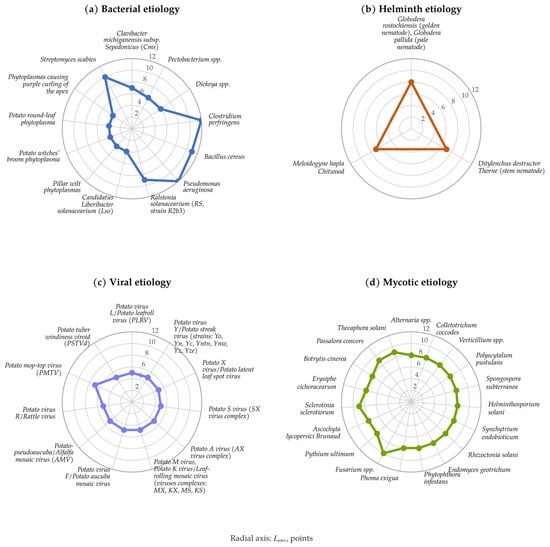
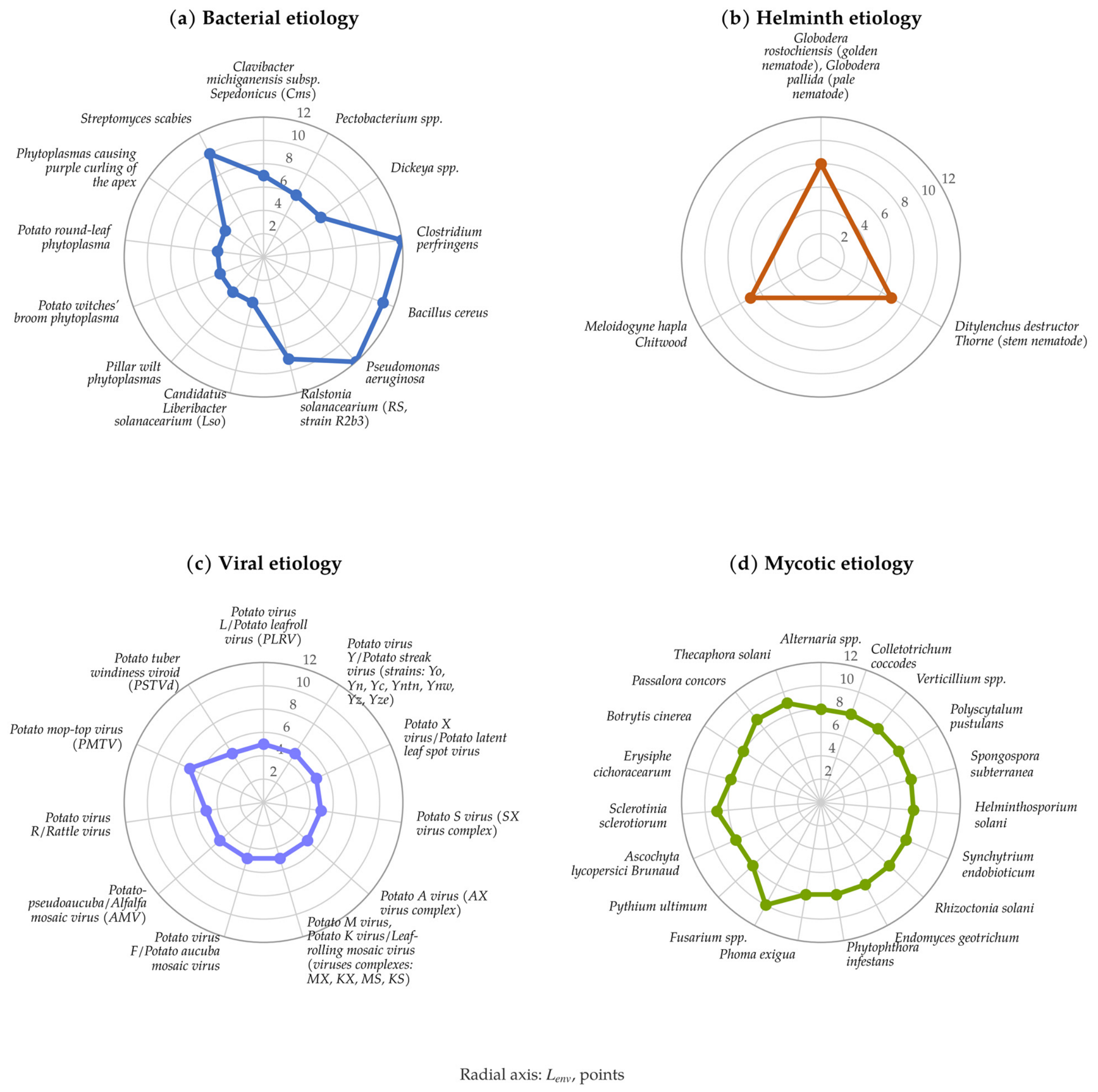
Based on the obtained data, graphical distributions of the biological risk level according to resilience parameters in the external environment for pathogens of different etiologies were constructed, as presented in Figure 1.
Figure 1.
Distribution of the biological risk level based on resilience parameters in the external environment for pathogens of (a) bacterial, (b) helminth, (c) viral and (d) mycotic etiology.
The distribution of the biological risk level based on resilience parameters in the external environment for pathogens of bacterial etiology is shown in Figure 1a.
The analysis of the data shows that for the largest share of bacterial IPPD pathogens (38.4%), a low level of risk based on resilience parameters in the external environment is characteristic. For 23.1% of pathogens, a medium level of risk is typical, while 15.4% are characterized by a high level of risk. A very high level of risk based on resilience parameters in the external environment is observed in 23.1% of IPPD pathogens of bacterial etiology.
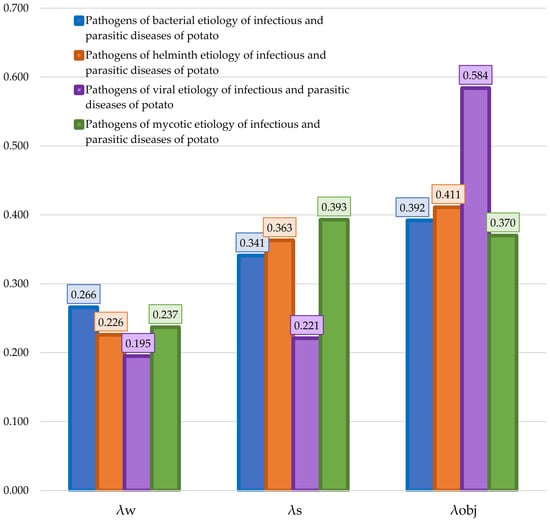
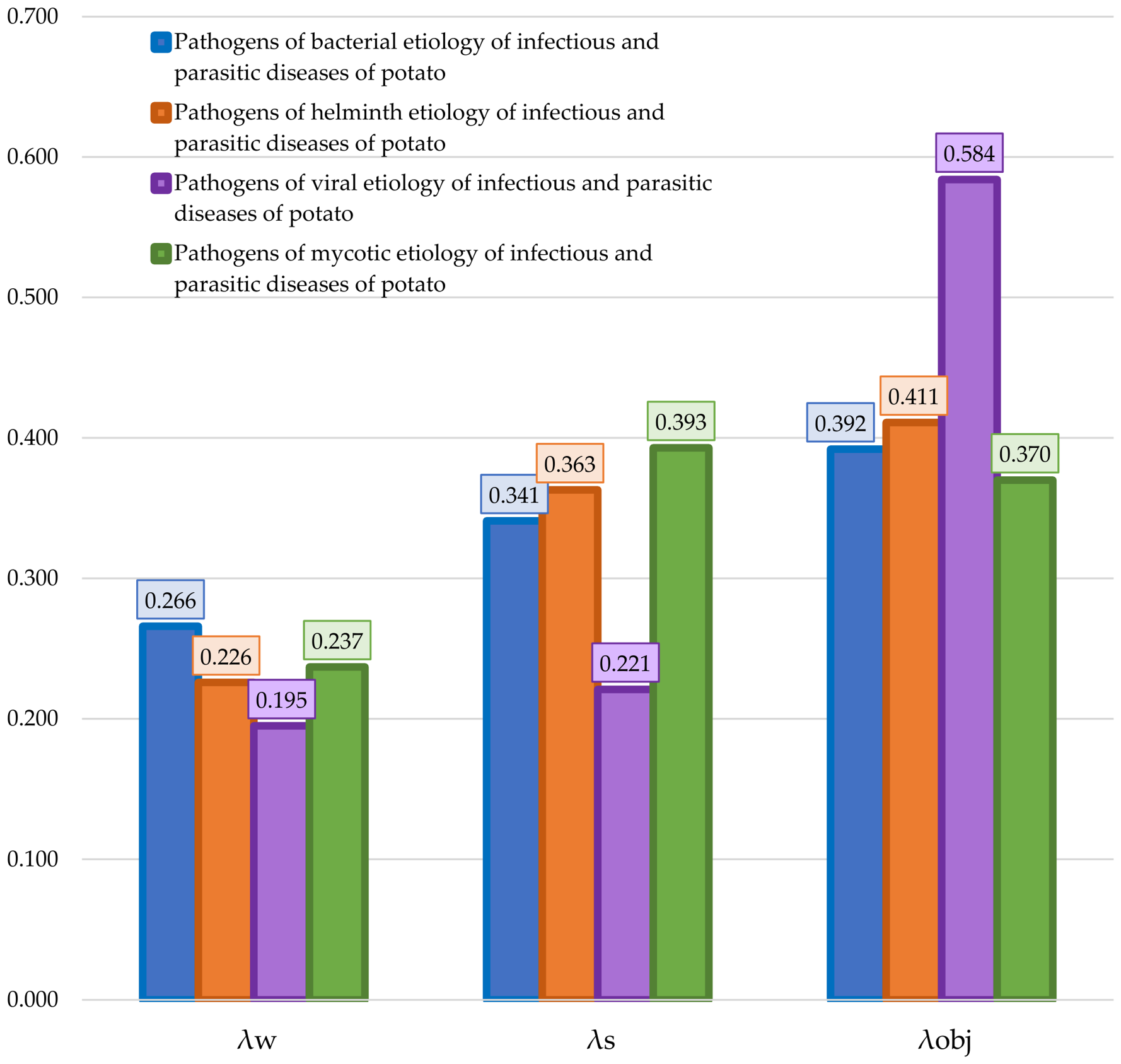
The average score for the group is 7.2. For the pathogens of IPPD of bacterial etiology, the weighting coefficients of resilience in water (λw = 0.266), in soil (λs = 0.341) and environmental objects (λobj = 0.392) fall within a relatively similar range.
The distribution of the biological risk level based on resilience parameters in the external environment for pathogens of helminth etiology is presented in Figure 1b.
The analysis shows that for 66.7% of pathogens of IPPD of helminth etiology, a medium level of risk bordering on high is characteristic (the average group score is 7.3), while the remaining 33.3% are characterized by a high level of risk based on resilience parameters in the external environment.
For the pathogens of IPPD of helminth etiology, the weighting coefficients of resilience in water (λw = 0.226), in soil (λs = 0.363) and environmental objects (λobj = 0.411) increase according to resilience characteristics, reflecting the importance of soil and various environmental objects, including agricultural equipment, containers, and storage facility floors, in pathogen persistence.
The distribution of the biological risk level based on resilience parameters in the external environment for pathogens of viral etiology is presented in Figure 1c.
The analysis shows that pathogens of IPPD of viral etiology are characterized by a medium level of risk based on resilience parameters in the external environment. The average score for the group is 5.2, corresponding to a medium risk level. For the pathogens of IPPD of viral etiology, the weighting coefficients of resilience in water (λw = 0.195), in soil (λs = 0.221) and environmental objects (λobj = 0.584) reflect the high importance of environmental objects in pathogen persistence.
The distribution of the biological risk level based on resilience parameters in the external environment for pathogens of mycotic etiology is presented in Figure 1d.
The analysis shows that pathogens of IPPD of mycotic etiology are characterized by a high level of risk based on resilience parameters in the external environment. The average score for the group is 8.3, corresponding to a high-risk level.
The weighting coefficients of resilience in water (λw = 0.237), in soil (λs = 0.393) and environmental objects (λobj = 0.370) reflect the high importance of soil in the persistence of mycotic IPPD pathogens.
The ratio of weighting coefficients of resilience in the external environment for IPPD pathogens is presented in Figure 2.
Figure 2.
Ratio of weighting coefficients of resilience in the external environment for IPPD pathogens.
As shown in Figure 2, soil and environmental objects are of greater importance for the persistence of IPPD pathogens than water systems. Special attention should be paid to viruses and viral complexes, which can persist for long periods in planting material, including in a latent form.
The quantitative assessment of the biological risk level based on resilience parameters in the external environment is presented in Table 4.
Table 4.
Quantitative assessment of the biological risk level based on resilience parameters in the external environment (Risk groups).
The analysis of the data shows that a low level of risk based on resilience parameters in the external environment is characteristic of 10.9% of the considered pathogens of infectious and parasitic diseases of potato, a medium level of risk is characteristic of 34.8%, a high level of risk of 47.8%, and a very high level of risk of 6.5% of the considered pathogens of IPPD.
3.2. Sensitivity Analysis of the Risk Classification Scale
Sensitivity analysis showed that a downward shift of the category thresholds preserved the original classification for 76.1% of pathogens (35 of 46), whereas an upward shift preserved classification for 41.3% of pathogens (19 of 46); 17.4% of pathogens (8 of 46) remained stable under both directions. The reduced stability under the upward shift reflects a cluster of pathogens with resilience scores located precisely at the original category boundaries (Lenv = 5 and Lenv = 8) rather than a systematic weakness of the scoring approach, indicating that classification instability is concentrated among borderline cases. Re-classification was performed on the pathogen-level data in Table 3.
The analysis of the data in Table 4 shows that there are certain patterns between resilience parameters in the external environment and the taxonomic affiliation of pathogens.
In the group with a low level of risk based on resilience parameters in the external environment, all pathogens of infectious and parasitic potato diseases have a bacterial etiology. Pathogens of viral, helminth, and mycotic etiology are absent in this group. The average score for the low-risk group is 4.
In the group with a medium level of risk based on resilience parameters in the external environment, the majority of pathogens of IPPD (68.75%) have a viral etiology, 18.75% have a bacterial etiology, and 12.50% have a helminth etiology. Pathogens of mycotic etiology are absent in this group. The average score for the medium-risk group is 5.63. It should be noted that this group included all analyzed representatives of viral etiology, which is due to the peculiarities of the vital activity of viruses and viral complexes.
In the group with a high level of risk based on resilience parameters in the external environment, the majority of pathogens of IPPD (86.36%) have a mycotic etiology, pathogens of bacterial etiology make up 9.09% and pathogens of helminth etiology make up 4.55%. Viral pathogens are absent in this group. The average score for the high-risk group is 8.36. This etiological distribution is associated with the high resilience of mycotic pathogens in the external environment.
In the group with a very high level of risk based on resilience parameters in the external environment, all pathogens of IPPD have a bacterial etiology. The average score for the very high-risk group is 11.67. This group is represented by particularly dangerous pathogens that are free-living inhabitants of the soil.
The analysis of the proportional etiological structure of pathogens of IPPD showed that mycotic pathogens pose the greatest danger in terms of resilience in the external environment. They account for 41.30% of all analyzed pathogens and form the largest share of the high-risk group.
3.3. Correlation, Regression, and Independent Field-Level Validation
It should be noted that there is a correlation between the risk level of infection with infectious and parasitic potato diseases based on transmission mechanisms and pathways (Ltr) and resilience in the external environment (Lenv), as presented in Table 5.
Table 5.
Relationship between the risk level of infection with infectious and parasitic potato diseases (IPPD) based on transmission mechanisms and pathways (Ltr) and resilience in the external environment (Lenv).
The analysis of the risk level of infection based on transmission mechanisms and pathways (Ltr) was presented by the authors in the first study of the series “Rating analysis of the level of biological risks of the emergence and spread of infectious and parasitic potato diseases” [1].
A very strong negative linear correlation was found between the risk level based on transmission mechanisms and pathways and the risk level based on environmental resilience, with r = −0.890, p = 0.0003. This finding is consistent with a compensatory survival strategy, whereby a reduced number of active transmission pathways is associated with increased environmental resilience. Given the limited sample size, this pattern warrants further verification on an expanded pathogen dataset in subsequent stages of the study.
The dynamics of infection of seed potato tubers by the main pathogens of infectious and parasitic diseases are presented in Table 6.
Table 6.
Dynamics of infection of seed potato tubers by the main pathogens of infectious and parasitic diseases.
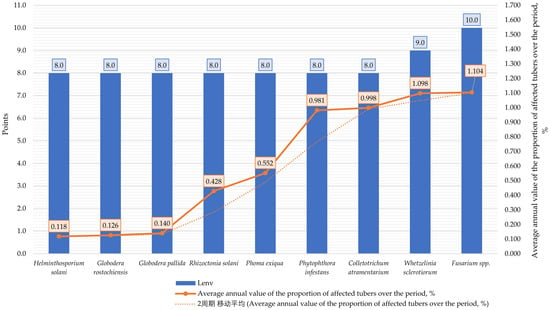
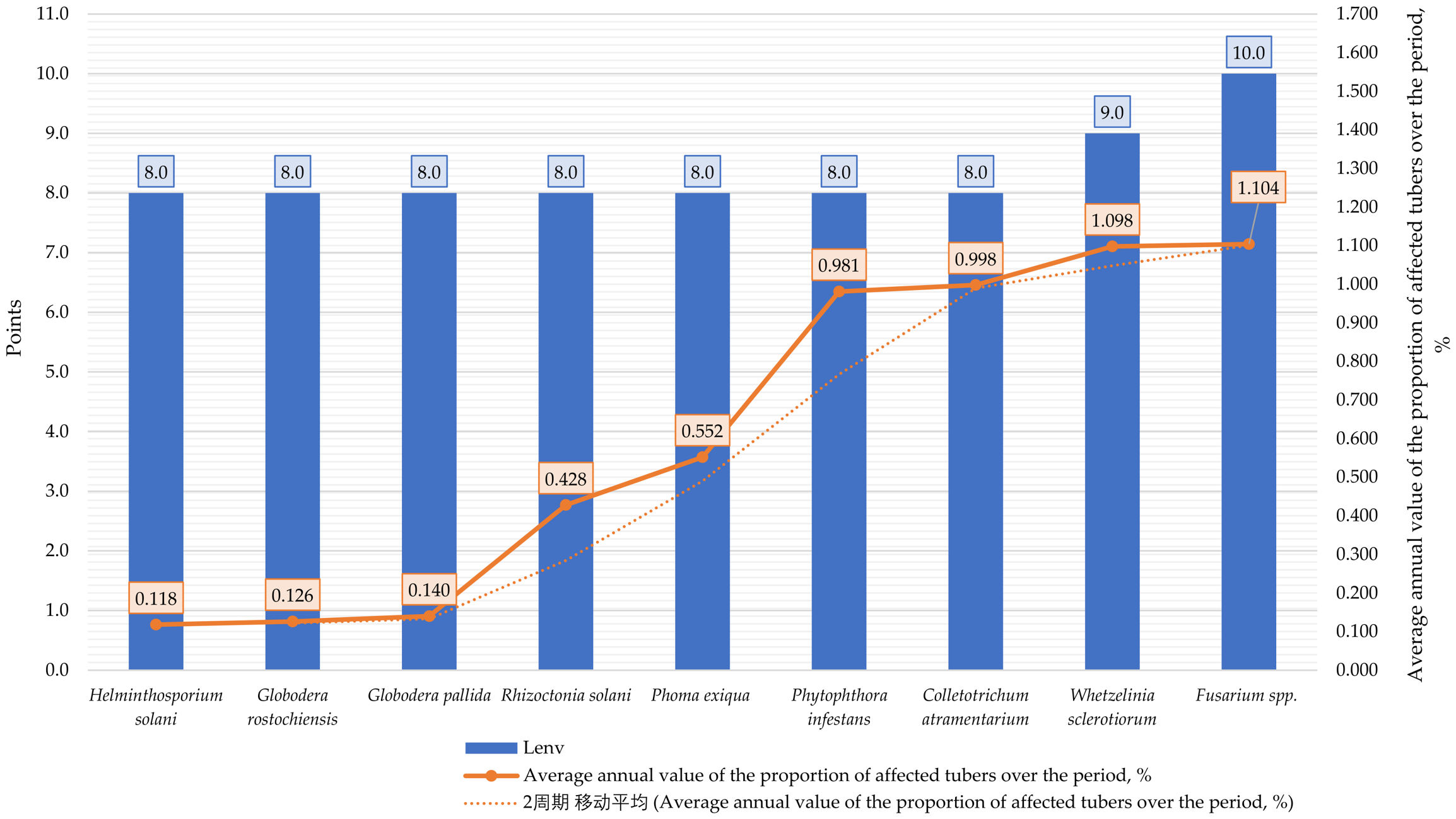
Using the presented statistical data and point values characterizing the level of biological risk according to the parameters of pathogenicity and resistance in the host organism, a diagram of the relationship between the level of biological risk and the proportion of tubers affected by the main pathogens of IPPD was constructed, presented in Figure 3.
Figure 3.
Correlation between the level of biological risk for the parameters of pathogenicity and resistance in the host organism and the average annual proportion of tubers affected by the main pathogens of infectious and parasitic diseases of potatoes.
The analysis of the data shows that among the pathogens of infectious and parasitic potato diseases registered in the Russian Federation over the past five years, the total proportion of infected seed tubers (PIT) was 6.647%, of which mycotic pathogens accounted for 6.381% and helminth pathogens for 0.266%.
The leading place in terms of the level of damage caused to seed potatoes is occupied by pathogens of Fusarium (dry rot of tubers)—fungi of the genus Fusarium: F. sambucinum, F. solani, F. avenaceum, F. oxysporum (PIT = 1.104%, Lenv = 10).
Total moisture is a key factor in the growth and transmission of these pathogens. Sharp fluctuations in temperature and humidity during storage are especially dangerous, as they lead to condensation on tubers. Fungi of the genus Fusarium are typical soil inhabitants capable of saprophytic growth on organic residues. Their spores overwinter in soil, infected tubers, and plant residues. These pathogens can persist on agricultural equipment, containers, transport, and in storage facilities if they are not properly cleaned and disinfected after use.
A high positive linear correlation was found between the biological risk level based on environmental resilience parameters and the average annual proportion of infected tubers for 2020–2024, with r = 0.765 across the 10 analyzed pathogens and p = 0.0038, confirming that higher environmental-resilience risk scores correspond to greater actual infection levels of planting material.
A multiple linear regression model was additionally fitted to evaluate whether transmission-pathway risk provides independent explanatory power beyond environmental resilience in predicting the average annual proportion of infected tubers. The model explained a moderate proportion of variance, with R2 = 0.612, F = 6.30, p = 0.023. However, only the environmental resilience score approached significance as an independent predictor, p = 0.084, while transmission-pathway risk did not, p = 0.693. This finding is consistent with the strong negative correlation between the two variables reported above and was further confirmed by a variance inflation factor of 4.80, indicating substantial multicollinearity between the predictors. It should be noted that these results suggest environmental resilience alone captures most of the predictive information relevant to field infection outcomes, supporting the univariate correlation model as the more parsimonious and interpretable choice for this dataset. The regression was fitted on the paired Ltr, Lenv, and PIT values listed in Table 5 and Table 6.
As a complementary check, field-level spread data from the same Rosselkhoztsentr monitoring reports were examined for five pathogens or pathogen groups with complete five-year records, including two foliar diseases not covered by the tuber-storage analysis, late blight and early blight, as well as an aggregate viral disease category are presented in Table 7 [70,71,72,73,74].
Table 7.
Validation against field-level spread (average for 2020–2024) for pathogens and groups of pathogens, based on monitoring data from Rosselkhoztsentr over five years.
The direction of association was consistent with the tuber-based analysis, with higher-Lenv pathogens showing greater field-level spread area (r = 0.827, p = 0.084), approaching but not reaching conventional statistical significance given the small number of pathogens with directly comparable field-level records.
4. Discussion
4.1. Comparison with Prior Literature and International Risk-Assessment Frameworks
The analysis of literature sources and research results conducted by us demonstrates the diversity of approaches and the depth of study of issues related to the resilience of potato disease pathogens in the external environment.
The proposed methodology for assessing the level of biological risk of the emergence and spread of infectious and parasitic potato diseases (IPPD) based on resilience parameters in the external environment takes into account the characteristics of 46 pathogens of bacterial, viral, helminth, and mycotic etiology.
The features of resilience of bacterial pathogens in the external environment were examined in the works of Matilla et al. [3], Pédron et al. [4], Ge et al. [5], Ma et al. [6], Crone et al. [34], and Urgancı et al. [35]. Notably, while Matilla et al. and Pédron et al. emphasized the epidemiological role of Dickeya spp. primarily through insect-mediated dispersal, the present analysis indicates that their environmental resilience score remains comparatively moderate (MR), suggesting that transmission-pathway diversity, rather than environmental persistence, is the dominant risk driver for this genus—a distinction with direct implications for the choice of preventive measures.
The resilience of helminth pathogens in the external environment was studied in the works of Ni et al. [38], Haraguchi et al. [39], Price et al. [40], Esquibet et al. [41], Wainer et al. [42], and Evlice et al. [43].
Notably, while these authors emphasize long-term cyst and egg dormancy as the primary survival strategy of potato cyst and root-knot nematodes, the comparatively moderate resilience score obtained in the present rating (MR, average 7.3) indicates that this dormancy capacity is concentrated specifically in soil, consistent with the elevated soil-resilience weighting coefficient reported in Section 3.1 (λs = 0.363), rather than reflecting broad persistence across water and other environmental objects.
The features of resilience of viral pathogens in the external environment were considered in the works of Ingram et al. [44], Della Bartola et al. [50].
Notably, unlike the bacterial, helminth, and mycotic groups, viral pathogens are entirely dependent on living plant tissue for persistence rather than free survival in soil or water. This dependence is directly reflected in the present results: viral pathogens occupy a narrow, medium-risk score range (MR, average 5.2) and show a disproportionately high weighting coefficient for persistence in environmental objects such as planting material (λobj = 0.584) relative to water or soil, underscoring that seed-tuber sanitation, rather than soil or water management, is the primary control point for this group.
The resilience of mycotic pathogens in the external environment was examined in the works of Kmoch et al. [14], Strydom et al. [11], and Tsror et al. [45].
Notably, the consistently elevated resilience scores observed across nearly all mycotic pathogens examined here (HR, average 8.3, the highest of the four etiological groups) corroborate reports by these authors that spore and sclerotia formation confer exceptional longevity in soil and on plant residues. Combined with the elevated soil-resilience weighting coefficient for this group (λs = 0.393, Section 3.1), this positions fungal pathogens as the etiological group of greatest concern for long-term field contamination, ahead of bacteria, helminths, and viruses.
It is worth noting that the proposed scoring approach is conceptually close to internationally recognized pest risk assessment frameworks, in particular the EPPO Prioritization Process and the USDA-APHIS Weed/Pest Risk Assessment, both of which also combine several weighted criteria into a single composite score. However, these frameworks are mainly aimed at evaluating the probability of introduction and establishment of a pest at the country or regional level, whereas the methodology proposed here treats environmental resilience as a separate, standalone risk dimension. This makes it possible to distinguish more precisely between pathogens that share similar transmission pathways but differ considerably in their ability to persist once outside the host organism.
It should be noted that although the methodology was developed and validated using data specific to potato production in the Russian Federation, the underlying scoring framework is not inherently crop-specific, since it is based on the duration of survival and retention of virulence in water, soil, and other environmental objects. In further studies, this approach could be adapted to other vegetatively propagated crops facing similar soil- and water-borne disease pressures, such as sugar beet or vegetable brassicas, provided that the resilience parameters specific to the pathogens of the target crop are re-evaluated accordingly.
4.2. Methodological Validity and Consistency with the Study Series
It should be noted that the practical integration of the methodology for identifying the biological risk of the emergence and spread of infectious and parasitic potato diseases involves a systematic assessment of pathogens not only in terms of environmental persistence, which is the subject of this work, but also an assessment of pathogens by the parameters of the nature of the course of the disease depending on the bioecological conditions of potato cultivation, which is the subject of further research within the study series “Rating Analysis of the Level of Biological Risks of the Emergence and Spread of Infectious and Parasitic Potato Diseases.”
The validity of the proposed scoring approach is further supported by its significant correlation with independent field infection data, r = 0.765, p = 0.0038 as shown in Section 3, indicating that the resilience-based scale meaningfully reflects actual epidemiological outcomes rather than representing an arbitrary expert construct.
4.3. Practical Implications: Regional Variation, Control Costs, and Climatic Sensitivity
It is worth noting that the proposed risk categories were derived using data specific to the Russian Federation and may benefit from regional recalibration when applied to potato-growing areas with different climatic conditions or pathogen strain compositions.
Substantial regional variation further illustrates the practical relevance of the proposed risk categories: while the national average proportion of infected tubers was 3.39% in 2020, individual regions such as the Republic of Khakassia showed proportions as high as 86.83%, indicating that local climatic and agrotechnical conditions can produce field outcomes more than an order of magnitude above the national mean [70].
The practical significance of high-resilience risk classification is further underscored by the scale of control measures involved: nationwide treatment areas against late blight alone ranged from approximately 214,000 to 453,000 hectares annually between 2020 and 2024, reflecting the substantial economic burden associated with high-risk pathogens and pointing to economic-loss modeling as a natural extension of the present methodology [70,71,72,73,74].
Annual monitoring reports consistently attribute year-to-year fluctuations in pathogen spread to prevailing weather conditions, with warm, humid periods repeatedly associated with accelerated disease development [70,71,72,73,74]. This observed sensitivity to climatic variables lends empirical support to climate-scenario modeling of pathogen risk as a direction for future research.
4.4. Quarantine Status of High-Risk Pathogens
According to Rosselkhoznadzor’s national quarantine phytosanitary status report, as of the end of 2023 established quarantine zones existed in Russia for the golden potato cyst nematode across 50 federal subjects and 340 municipal districts, covering 509.3 thousand hectares, and for potato wart disease, covering 639 hectares across four regions [75]. Notably, other pathogens assigned comparably high or higher resilience scores in the present classification, including Ralstonia solanacearum and Clavibacter michiganensis subsp. sepedonicus, had no established quarantine zones in Russia as of this reporting period, indicating their current absence or limited detection within national territory despite an inherently high biological risk profile based on resilience parameters alone.
5. Conclusions
Based on the analysis and assessment of the level of biological risk according to resilience parameters in the external environment, the following conclusions can be drawn:
1. Low level of risk based on resilience parameters in the external environment is characteristic of 10.9% of the considered pathogens of infectious and parasitic diseases of potato, a medium level of risk is characteristic of 34.8%, a high level of risk of 47.8%, and a very high level of risk of 6.5% of the considered pathogens of IPPD.
2. In the group with a low level of risk based on resilience parameters in the external environment, all pathogens of infectious and parasitic potato diseases have a bacterial etiology. Pathogens of viral, helminth, and mycotic etiology are absent in this group. The average score for the low-risk group is 4.
In the group with a medium level of risk based on resilience parameters in the external environment, the majority of pathogens of IPPD (68.75%) have a viral etiology, 18.75% have a bacterial etiology, and 12.50% have a helminth etiology. Pathogens of mycotic etiology are absent in this group. The average score for the medium-risk group is 5.63. It should be noted that this group included all analyzed representatives of viral etiology, which is due to the peculiarities of the vital activity of viruses and viral complexes.
In the group with a high level of risk based on resilience parameters in the external environment, the majority of pathogens of IPPD (86.36%) have a mycotic etiology, pathogens of bacterial etiology make up 9.09% and pathogens of helminth etiology make up 4.55%. Viral pathogens are absent in this group. The average score for the high-risk group is 8.36. This etiological distribution is associated with the high resilience of mycotic pathogens in the external environment.
In the group with a very high level of risk based on resilience parameters in the external environment, all pathogens of IPPD have a bacterial etiology. The average score for the very high-risk group is 11.67. This group is represented by particularly dangerous pathogens that are free-living inhabitants of the soil.
The analysis of the proportional etiological structure of pathogens of IPPD showed that mycotic pathogens pose the greatest danger in terms of resilience in the external environment. They account for 41.30% of all analyzed pathogens and form the largest share of the high-risk group.
3. The greatest danger to planting material in terms of resilience in the external environment is posed by typical soil-dwelling bacterial pathogens, as well as mycotic and viral pathogens of IPPD.
Typical soil-dwelling bacterial pathogens form the very high-risk group and are particularly dangerous due to their extreme resilience in the external environment, associated with spore and capsule formation.
4. Soil and environmental objects are more significant for the persistence of IPPD pathogens than water systems. The most dangerous in terms of infection of healthy plants are free-living soil inhabitants and pathogens capable of long-term survival in soil in the form of spores, eggs, cysts, and other dormant forms (including viral ones).
5. The analysis of the data shows that among the pathogens of infectious and parasitic potato diseases registered in the Russian Federation over the past five years, the total proportion of infected seed tubers (PIT) was 6.647%, of which mycotic pathogens accounted for 6.381% and helminth pathogens for 0.266%.
The leading place in terms of the level of damage caused to seed potatoes is occupied by pathogens of Fusarium (dry rot of tubers)—fungi of the genus Fusarium: F. sambucinum, F. solani, F. avenaceum, and F. oxysporum (PIT = 1.104%, Lenv = 10).
Practical integration of the methodology for identifying the biological risk of the emergence and spread of infectious and parasitic potato diseases involves a systematic assessment of pathogens not only by parameters of resistance in the external environment, which is the subject of this work, but also an assessment of pathogens by parameters of the nature of the course of the disease depending on the bioecological conditions of potato cultivation, which is the subject of further scientific research by the team of authors.
Taken together, these findings confirm the hypothesis formulated in the Introduction: the composite resilience score, derived systematically from literature-reported survival and virulence-retention parameters, correlates significantly with independently recorded field infection data, thereby providing a verifiable, rather than purely expert-based, basis for phytosanitary risk classification.
Author Contributions
Conceptualization, A.D.; methodology, software, validation, A.O. and N.P.; investigation, V.T.; resources, A.D. and N.P.; writing—original draft preparation, Y.L.; writing—review and editing, A.D., N.S. and V.T.; project administration, A.D.; funding acquisition, A.D. All authors have read and agreed to the published version of the manuscript.
Funding
The research was carried out with the support of the Ministry of Science and Higher Education of the Russian Federation in the form of subsidies in accordance with paragraph 4 of Article 78.1 of the Budget Code of the Russian Federation No. 075-15-2024-540 dated 24 April 2024 for a major scientific project “Development of nature-like technologies for managing properties and quality indicators of plants using biophotonics methods and digital systems”.
Institutional Review Board Statement
Not applicable.
Informed Consent Statement
Not applicable.
Data Availability Statement
The original contributions presented in this study are included in the article. Further inquiries can be directed to the corresponding author.
Conflicts of Interest
The authors declare no conflicts of interest.
References
- Dorokhov, A.S.; Sibirev, A.V.; Lyashchuk, Y.O.; Teterin, V.S.; Panferov, N.S. Methodology for assessing the level of biological risk of emergence and spread of infectious and parasitic diseases of potato by parameters of mechanisms and pathways of pathogen transmission. Front. Sustain. Food Syst. 2025, 9, 1614949. [Google Scholar] [CrossRef] [Scilit]
- Dorokhov, A.S.; Sibirev, A.V.; Teterin, V.S.; Lyashchuk, Y.O.; Panferov, N.S.; Ovchinnikov, A.Y. Methodology for assessing the level of biological risk of occurrence and spread of infectious and parasitic potato diseases based on pathogenicity and resistance parameters in the host organism. Front. Sustain. Food Syst. 2025, 9, 1714854. [Google Scholar] [CrossRef] [Scilit]
- Matilla, M.A.; Monson, R.E.; Salmond, G.P. Dickeya solani. Trends Microbiol. 2023, 31, 1085–1086. [Google Scholar] [CrossRef] [Scilit] [PubMed]
- Pédron, J.; Schaerer, S.; Kellenberger, I.; Van Gijsegem, F. Early emergence of Dickeya solani revealed by analysis of Dickeya diversity of potato blackleg and soft rot causing pathogens in Switzerland. Microorganisms 2021, 9, 1187. [Google Scholar] [CrossRef] [Scilit] [PubMed]
- Ge, T.; Ekbataniamiri, F.; Johnson, S.B.; Larkin, R.P.; Hao, J. Interaction between Dickeya dianthicola and Pectobacterium parmentieri in potato infection under field conditions. Microorganisms 2021, 9, 316. [Google Scholar] [CrossRef] [Scilit] [PubMed]
- Ma, X.; Frost, K.; Zhang, X.; Hao, J.; Swingle, B. First Report of Dickeya dianthicola Causing Potato Blackleg in Oregon. Plant Dis. 2025, 109, 1374. [Google Scholar] [CrossRef] [Scilit]
- Bolus, H.; Crocker, K.; Boekhoff-Falk, G.; Chtarbanova, S. Modeling neurodegenerative disorders in Drosophila melanogaster. Int. J. Mol. Sci. 2020, 21, 3055. [Google Scholar] [CrossRef] [Scilit] [PubMed]
- Rand, M.D.; Tennessen, J.M.; Mackay, T.F.; Anholt, R.R. Perspectives on the Drosophila melanogaster model for advances in toxicological science. Curr. Protoc. 2023, 3, e870. [Google Scholar] [CrossRef] [Scilit] [PubMed]
- Hemmati, S.A.; Shishehbor, P.; Stelinski, L.L. Life table parameters and digestive enzyme activity of Spodoptera littoralis (Boisd) (Lepidoptera: Noctuidae) on selected legume cultivars. Insects 2022, 13, 661. [Google Scholar] [CrossRef] [Scilit] [PubMed]
- El-Refaie, R.M.; Shaurub, E.S.H.; Abd-Allah, G.E.; Ebeid, A.A.; Abouelnaga, Z.S. Effect of four host plants on the life history and nutritional indices of Spodoptera Littoralis. Int. J. Trop. Insect Sci. 2024, 44, 1091–1101. [Google Scholar] [CrossRef] [Scilit]
- Strydom, R.F.; Wilson, C.R.; Tegg, R.S.; Balendres, M.A.; Van der Waals, J.E. Advancements in Spongospora subterranea: Current knowledge, management strategies, and research gaps. Potato Res. 2024, 67, 1497–1537. [Google Scholar] [CrossRef] [Scilit]
- Jayasinghe, S.K.; Moroz, N.; Yuan, P.; Kolomiets, M.V.; Tanaka, K. Salicylic acid plays a major role in potato defense against powdery scab pathogen, Spongospora subterranea f. sp. subterranea. Mol. Plant-Microbe Interact. 2025, 38, 599–609. [Google Scholar] [CrossRef] [Scilit] [PubMed]
- Massana-Codina, J.; Schnee, S.; Lecoultre, N.; Droz, E.; Dupuis, B.; Keiser, A.; de Werra, P.; Wolfender, J.; Gindro, K.; Schürch, S. Influence of abiotic factors, inoculum source, and cultivar susceptibility on the potato tuber blemish diseases black dot (Colletotrichum coccodes) and silver scurf (Helminthosporium solani). Plant Pathol. 2021, 70, 885–897. [Google Scholar] [CrossRef] [Scilit]
- Kmoch, M.; Loubová, V.; Veselská, M.; Jílková, B.; Víchová, J. Antifungal activity of essential oils on Helminthosporium solani causing potato silver scurf under in vitro and in vivo conditions. Agriculture 2023, 14, 66. [Google Scholar] [CrossRef] [Scilit]
- van de Vossenberg, B.T.; Prodhomme, C.; Vossen, J.H.; van der Lee, T.A. Synchytrium endobioticum, the potato wart disease pathogen. Mol. Plant Pathol. 2022, 23, 461–474. [Google Scholar] [CrossRef] [Scilit] [PubMed]
- Szajko, K.; Plich, J.; Przetakiewicz, J.; Sołtys-Kalina, D.; Marczewski, W. Comparative proteomic analysis of resistant and susceptible potato cultivars during Synchytrium endobioticum infestation. Planta 2020, 251, 4. [Google Scholar] [CrossRef] [Scilit] [PubMed]
- Steglińska, A.; Sulyok, M.; Janas, R.; Grzesik, M.; Liszkowska, W.; Kręgiel, D.; Gutarowska, B. Metabolite formation by fungal pathogens of potatoes (Solanum tuberosum L.) in the presence of bioprotective agents. Int. J. Environ. Res. Public Health 2023, 20, 5221. [Google Scholar] [CrossRef] [Scilit] [PubMed]
- Borman, A.M.; Abdolrasouli, A.; Johnson, E.M. Name changes for fungi of medical importance, 2022–2024. J. Clin. Microbiol. 2025, 63, e02041-24. [Google Scholar] [CrossRef] [Scilit] [PubMed]
- Nguyen, A.M.T. Cyproconazole: A New Citrus Postharvest Fungicide to Manage Major Decays Caused by Resistant Pathogens, and the Molecular Mechanism of Propiconazole Resistance in Geotrichum citri-aurantii. Doctoral dissertation, University of California, Riverside, CA, USA, 2025. [Google Scholar]
- Dong, S.M.; Zhou, S.Q. Potato late blight caused by Phytophthora infestans: From molecular interactions to integrated management strategies. J. Integr. Agric. 2022, 21, 3456–3466. [Google Scholar] [CrossRef] [Scilit]
- Volynchikova, E.; Kim, K.D. Biological control of oomycete soilborne diseases caused by Phytophthora capsici, Phytophthora infestans, and Phytophthora nicotianae in solanaceous crops. Mycobiology 2022, 50, 269–293. [Google Scholar] [CrossRef] [Scilit] [PubMed]
- Sultana, F.; Hossain, M.M. Diseases of Vegetables Caused by Phoma spp. In Phoma: Diversity, Taxonomy, Bioactivities, and Nanotechnology; Springer International Publishing: Cham, Switzerland, 2021; pp. 91–119. [Google Scholar] [CrossRef] [Scilit]
- Atik, O. Phoma Diseases: Identification, Epidemiology, and Strategies for Management. In Phoma: Diversity, Taxonomy, Bioactivities, and Nanotechnology; Springer International Publishing: Cham, Switzerland, 2021; pp. 121–134. [Google Scholar] [CrossRef] [Scilit]
- Xue, H.; Liu, Q.; Yang, Z. Pathogenicity, mycotoxin production, and control of potato dry rot caused by Fusarium spp.: A review. J. Fungi 2023, 9, 843. [Google Scholar] [CrossRef] [Scilit] [PubMed]
- Jia, R.; Kang, L.; Addrah, M.E.; Zhang, J.; Xu, L.; Zhang, Z.; Chen, W.; Liu, J.; Zhao, J. Potato wilt caused by co-infection of Fusarium spp. and Verticillium dahliae in potato plants. Eur. J. Plant Pathol. 2023, 165, 305–315. [Google Scholar] [CrossRef] [Scilit]
- Tsror, L.; Erlich, O.; Hazanovsky, M.; Marshak, G.; Segev, G.; Zig, U. Fungicide field treatments to control potato leak caused by Pythium ultimum. Am. J. Potato Res. 2021, 98, 115–121. [Google Scholar] [CrossRef] [Scilit]
- Usman Aslam, H.M.; Daniel, J.; Chikh-Ali, M. First report of Pythium ultimum causing Pythium leak disease in potatoes in Colorado. Plant Dis. 2025, 109, 1998. [Google Scholar] [CrossRef] [Scilit]
- Zhao, P.; Crous, P.W.; Hou, L.W.; Duan, W.J.; Cai, L.; Ma, Z.Y.; Liu, F. Fungi of quarantine concern for China I: Dothideomycetes. Persoonia-Mol. Phylogeny Evol. Fungi 2021, 47, 45–105. [Google Scholar] [CrossRef] [Scilit] [PubMed]
- Thomas, C.; Wilken, P.M.; Coetzee, M.P.; Visagie, C.M. Advancing the taxonomy of Sclerotinia (Helotiales, Sclerotiniaceae): A review and recommendations for an important plant-pathogenic genus. IMA Fungus 2026, 17, e175737. [Google Scholar] [CrossRef] [Scilit] [PubMed]
- Jiao, R.; Cai, Y.; He, P.; Munir, S.; Li, X.; Wu, Y.; Wang, J.; Xia, M.; He, P.; Wang, G.; et al. Bacillus amyloliquefaciens YN201732 produces lipopeptides with promising biocontrol activity against fungal pathogen Erysiphe cichoracearum. Front. Cell. Infect. Microbiol. 2021, 11, 598999. [Google Scholar] [CrossRef] [Scilit] [PubMed]
- Roca-Couso, R.; Flores-Félix, J.D.; Rivas, R. Mechanisms of action of microbial biocontrol agents against Botrytis cinerea. J. Fungi 2021, 7, 1045. [Google Scholar] [CrossRef] [Scilit] [PubMed]
- Singh, R.; Caseys, C.; Kliebenstein, D.J. Genetic and molecular landscapes of the generalist phytopathogen Botrytis cinerea. Mol. Plant Pathol. 2024, 25, e13404. [Google Scholar] [CrossRef] [Scilit] [PubMed]
- del Mar Martínez-Prada, M.; Curtin, S.J.; Gutiérrez-González, J.J. Potato improvement through genetic engineering. GM Crops Food 2021, 12, 479–496. [Google Scholar] [CrossRef] [Scilit] [PubMed]
- Crone, S.; Vives-Flórez, M.; Kvich, L.; Saunders, A.M.; Malone, M.; Nicolaisen, M.H.; Martínez-García, E.; Rojas-Acosta, C.; Gomez-Puerto, M.C.; Calum, H.; et al. The environmental occurrence of Pseudomonas aeruginosa. APMIS 2020, 128, 220–231. [Google Scholar] [CrossRef] [Scilit] [PubMed]
- Urgancı, N.N.; Yılmaz, N.; Alaşalvar, G.K.; Yıldırım, Z. Pseudomonas aeruginosa and its pathogenicity. Turk. J. Agric.-Food Sci. Technol. 2022, 10, 726–738. [Google Scholar] [CrossRef] [Scilit]
- Gohari, I.M.; Navarro, M.A.; Li, J.; Shrestha, A.; Uzal, F.; McClane, B.A. Pathogenicity and virulence of Clostridium perfringens. Virulence 2021, 12, 723–753. [Google Scholar] [CrossRef] [Scilit] [PubMed]
- Song, J.; Kong, Z.Q.; Zhang, D.D.; Chen, J.Y.; Dai, X.F.; Li, R. Rhizosphere Microbiomes of Potato Cultivated under Bacillus subtilis Treatment Influence the Quality of Potato Tubers. Int. J. Mol. Sci. 2021, 22, 12065. [Google Scholar] [CrossRef] [Scilit] [PubMed]
- Ni, C.; Zhang, S.; Li, H.; Liu, Y.; Li, W.; Xu, X.; Xu, Z. First report of potato rot nematode, Ditylenchus destructor Thorne, 1945 infecting Codonopsis pilosula in Gansu province, China. J. Nematol. 2020, 52, e2020-87. [Google Scholar] [CrossRef] [Scilit] [PubMed]
- Haraguchi, S.; Yoshiga, T. Potential of the fungal feeding nematode Aphelenchus avenae to control fungi and the plant parasitic nematode Ditylenchus destructor associated with garlic. Biol. Control 2020, 143, 104203. [Google Scholar] [CrossRef] [Scilit]
- Price, J.A.; Coyne, D.; Blok, V.C.; Jones, J.T. Potato cyst nematodes Globodera rostochiensis and G. pallida. Mol. Plant Pathol. 2021, 22, 495–507. [Google Scholar] [CrossRef] [Scilit] [PubMed]
- Esquibet, M.; Mwangi, J.M.; Kiewnick, S.; Wang, X.; Mimee, B.; Handayani, N.D.; Bert, W.; Helder, J.; Wainer, J.; Sakata, I.; et al. Europe as a secondary distribution hub in the worldwide invasion of the potato cyst nematode Globodera rostochiensis. Sci. Rep. 2024, 14, 13915. [Google Scholar] [CrossRef] [Scilit] [PubMed]
- Wainer, J.; Dinh, Q. Taxonomy, morphological and molecular identification of the potato cyst nematodes, Globodera pallida and G. rostochiensis. Plants 2021, 10, 184. [Google Scholar] [CrossRef] [Scilit] [PubMed]
- Evlice, E.; Toktay, H.; Yatkın, G.; Erdoğuş, F.D.; İmren, M. Population fluctuations of root-knot nematodes Meloidogyne chitwoodi and M. hapla under field conditions. Phytoparasitica 2022, 50, 233–242. [Google Scholar] [CrossRef] [Scilit]
- Ingram, J.T.; Mudrak, E.L.; Tran, L.; Curtis, M.; Mattupalli, C.; Gudmestad, N.C.; Charkowski, A.O.; Groves, R.L.; Babler, B.N.; Whitworth, J.L.; et al. A robust potato tuber tissue collection method to investigate potato virus Y, potato mop-top virus, and tobacco rattle virus localization patterns. Plant Dis. 2026, 110, 174–186. [Google Scholar] [CrossRef] [Scilit] [PubMed]
- Tsror, L.; Lebiush, S.; Erlich, O.; Blank, L. Aerial dispersal of Spongospora subterranea sp. f. subterranea, the causal agent of potato powdery scab. Eur. J. Plant Pathol. 2020, 158, 391–401. [Google Scholar] [CrossRef] [Scilit]
- A’Hara, D. Detection and identification of Phoma pathogens of potato. Methods Mol. Biol. 2015, 1302, 17–27. [Google Scholar] [CrossRef] [Scilit] [PubMed]
- Chhetri, P.; Dandurand, L.M.; Popova, I. Control of Globodera pallida Using Sinapis alba or 4-Hydroxybenzyl Alcohol with the Trap Crop Solanum sisymbriifolium or the Biofumigant Brassica juncea Seed Meal Extract. Plant Dis. 2023, 107, 1491–1498. [Google Scholar] [CrossRef] [Scilit] [PubMed]
- Citti, C.; Dordet-Frisoni, E.; Nouvel, L.X.; Kuo, C.H.; Baranowski, E. Horizontal Gene Transfers in Mycoplasmas (Mollicutes). Curr. Issues Mol. Biol. 2018, 29, 3–22. [Google Scholar] [CrossRef] [Scilit] [PubMed]
- Deb, D.; Khan, A.; Dey, N. Phoma diseases: Epidemiology and control. Plant Pathol. 2020, 69, 1203–1217. [Google Scholar] [CrossRef] [Scilit]
- Della Bartola, M.; Byrne, S.; Mullins, E. Characterization of Potato Virus Y Isolates and Assessment of Nanopore Sequencing to Detect and Genotype Potato Viruses. Viruses 2020, 12, 478. [Google Scholar] [CrossRef] [Scilit] [PubMed]
- Dorokhov, A.S.; Aksenov, A.G.; Sibirev, A.V.; Mosyakov, M.A.; Sazonov, N.V. Results of experimental studies of potato stem nematode removal by electrophysical action. Agrar. Sci. journal. 2023, 5, 120–131. (In Russian) [Google Scholar] [CrossRef] [Scilit]
- Dorokhov, A.S.; Aksenov, A.G.; Sibirev, A.V.; Mosyakov, M.A.; Sazonov, N.V. Justification of the innovative technology of phytovarietal cleaning in breeding and seed plantings of potatoes and vegetable crops. Agrar. Sci. Euro-North-East 2024, 25, 98–111. (In Russian) [Google Scholar] [CrossRef] [Scilit]
- Dutta, P.; Lõhmus, A.; Ahola, T.; Mäkinen, K. The Replicase Protein of Potato Virus X is Able to Recognize and Trans-Replicate Its RNA Component. Viruses 2024, 16, 1611. [Google Scholar] [CrossRef] [Scilit] [PubMed]
- Gu, W.; Chen, Y.; Xie, C.; Chen, Z.; Gao, H.; Zhu, Y.; Zhang, L.-H.; Liao, L. The cyclic di-GMP receptor YcgR links the second messenger with the putrescine quorum sensing system in modulation of Dickeya oryzae motility. mBio 2025, 16, e0101625. [Google Scholar] [CrossRef] [Scilit] [PubMed]
- Johnson, D.A.; Dung, J.K.S. Verticillium wilt of potato–the pathogen, disease and management. Can. J. Plant Pathol. 2010, 32, 58–67. [Google Scholar] [CrossRef] [Scilit]
- Joshi, J.R.; Yao, L.; Charkowski, A.O.; Heuberger, A.L. Metabolites from Wild Potato Inhibit Virulence Factors of the Soft Rot and Blackleg Pathogen Pectobacterium brasiliense. Mol. Plant Microbe Interact. 2021, 34, 100–109. [Google Scholar] [CrossRef] [Scilit] [PubMed]
- Karasev, A.V.; Gray, S.M. Continuous and emerging challenges of Potato virus Y in potato. Annu. Rev. Phytopathol. 2013, 51, 571. [Google Scholar] [CrossRef] [Scilit] [PubMed]
- Kate, A.; Tiwari, S.; Gujar, J.P.; Modhera, B.; Tripathi, M.K.; Ray, H.; Ghosh, A.; Mohapatra, D. Spotting of Volatile Signatures through GC-MS Analysis of Bacterial and Fungal Infections in Stored Potatoes (Solanum tuberosum L.). Foods 2023, 12, 2083. [Google Scholar] [CrossRef] [Scilit] [PubMed]
- Shi, Z.; Liang, Z.; Yang, Q.; Zhang, L.-H.; Wang, Q. Alarmone ppGpp modulates bacterial motility, zeamine production, and virulence of Dickeya oryzae through the regulation of and cooperation with the putrescine signaling mechanism. mSphere 2025, 10, e0068224. [Google Scholar] [CrossRef] [Scilit] [PubMed]
- Waleron, M.; Misztak, A.; Waleron, M.; Jonca, J.; Furmaniak, M.; Waleron, K. Pectobacterium polonicum sp. nov. isolated from vegetable fields. Int. J. Syst. Evol. Microbiol. 2019, 69, 1751–1759. [Google Scholar] [CrossRef] [Scilit] [PubMed]
- Wang, X.; Mandadi, K.; Peña, L.; Cao, M.; Zhou, C. Editorial: Evolutionary genomics of Candidatus Liberibacter spp. and their interactions with plant and insect-vector hosts. Front Microbiol. 2022, 13, 1025795. [Google Scholar] [CrossRef] [Scilit] [PubMed]
- Yu, Q.; Zaida, M.A.; Hughes, B.; Celetti, M. Discovery of Potato Rot Nematode, Ditylenchus destructor, Infesting Garlic in Ontario, Canada. Plant Dis. 2012, 96, 297. [Google Scholar] [CrossRef] [Scilit] [PubMed]
- Lyashchuk, Y.O.; Novak, A.I. Parasites as biological risk factors in food production. Theory Pract. Combat. Parasit. Dis. 2019, 20, 323–329. (In Russian) [Google Scholar] [CrossRef] [Scilit]
- Lyashchuk, Y.O.; Teterin, V.S.; Panferov, N.S.; Ovchinnikov, A.Y. Quantitative assessment of the level of biological risk for alimentary-related infections and invasions in the Ryazan region. Agrar. Sci. 2022, 6, 27–32. (In Russian) [Google Scholar] [CrossRef] [Scilit]
- Lyashchuk, Y.O.; Ovchinnikov, A.Y.; Ivanishchev, K.A.; Shchur, A.V. Assessment of the resistance of alimentary-related risk factors to the effects of chemical disinfectants. Agrar. Bull. Ural. 2022, 12, 54–61. [Google Scholar] [CrossRef] [Scilit]
- Lyashchuk, Y.O.; Novak, A.I.; Zakharova, O.A.; Kucher, D.E.; Musaev, F.A. Risk Assessment of Transmission of Pathogens of Infections and Human Invasions Through Food Products; MAX Press: London, UK, 2023; p. 292. (In Russian) [Google Scholar]
- Lyashchuk, Y.O.; Teterin, V.S.; Panferov, N.S.; Pekhnov, S.A.; Ovchinnikov, A.Y. Assessment of alimentary-related biological risk factors based on environmental stability parameters. Agrar. Sci. J. 2023, 55–62. (In Russian) [Google Scholar] [CrossRef] [Scilit]
- Lyashchuk, Y.O.; Teterin, V.S.; Panferov, N.S.; Pekhnov, S.A.; Ovchinnikov, A.Y. Rating analysis of the sensitivity of biorisk factors to the effects of chemical disinfectants in the context of food safety. Agrar. Sci. J. 2023, 7, 69–76. (In Russian) [Google Scholar] [CrossRef] [Scilit]
- Lyashchuk, Y.O.; Ovchinnikov, A.Y.; Kostrova, Y.B. Structural analysis of alimentary-related morbidity in the population caused by biological risk factors significant in the production and processing of food products. Agrar. Sci. J. 2023, 6, 75–82. (In Russian) [Google Scholar] [CrossRef] [Scilit]
- Govorov, D.N. (Ed.) Review of the Phytosanitary Condition of Agricultural Crops in the Russian Federation in 2020 and Forecast of the Development of Harmful Organisms in 2021; Rosselkhoztsentr: Moscow, Russia, 2021. [Google Scholar]
- Govorov, D.N. (Ed.) Review of the Phytosanitary Condition of Agricultural Crops in the Russian Federation in 2021 and Forecast of the Development of Harmful Organisms in 2022; Rosselkhoztsentr: Moscow, Russia, 2022. [Google Scholar]
- Govorov, D.N. (Ed.) Review of the Phytosanitary Condition of Agricultural Crops in the Russian Federation in 2022 and Forecast of the Development of Harmful Organisms in 2023; Rosselkhoztsentr: Moscow, Russia, 2023. [Google Scholar]
- Govorov, D.N. (Ed.) Review of the Phytosanitary Condition of Agricultural Crops in the Russian Federation in 2023 and Forecast of the Development of Harmful Organisms in 2024; Rosselkhoztsentr: Moscow, Russia, 2024. [Google Scholar]
- Zhivykh, A.V. (Ed.) Review of the Phytosanitary Condition of Agricultural Crops in the Russian Federation in 2024 and Forecast of the Development of Harmful Organisms in 2025; Rosselkhoztsentr: Moscow, Russia, 2025. [Google Scholar]
- Federal Service for Veterinary and Phytosanitary Surveillance (Rosselkhoznadzor). National Report on the Quarantine Phytosanitary Status of the Territory of the Russian Federation in 2023; Ministry of Agriculture of the Russian Federation: Moscow, Russia, 2024.

Disclaimer/Publisher’s Note: The statements, opinions and data contained in all publications are solely those of the individual author(s) and contributor(s) and not of MDPI and/or the editor(s). MDPI and/or the editor(s) disclaim responsibility for any injury to people or property resulting from any ideas, methods, instructions or products referred to in the content. |
© 2026 by the authors. Licensee MDPI, Basel, Switzerland. This article is an open access article distributed under the terms and conditions of the Creative Commons Attribution (CC BY) license.