


Simple Summary
MicroRNAs are ~23 nt, highly conserved non-coding RNA molecules involved in the regulation of target gene expression. Most of the microRNA-target prediction algorithms rely heavily on seed rules and evolutionary conservation. However, such strategies suffer from missing the non-canonical target sites. The aim of this study is to identify the general features of non-canonical targets and their interactions with microRNAs. We found that the bulge-targets were preferentially associated with the microRNAs containing CG dinucleotides in their seed region. This finding indicates that non-canonical targets could be rich due to high mutation frequency of CG within the target mRNAs. Multi-step validation, which included evolutionary, overexpression, correlation, and CLASH data analysis, supports the interactome between the microRNAs with CG dinucleotides in the seed region and their bugle targets. Thus, a major novelty of this work is the identification of a sequence motif, CG dinucleotides, in the seed region of microRNAs, is strongly correlated to bulge targeting patterns.
Abstract
MicroRNAs (miRNAs) are endogenous ~23 nt RNAs which regulate message RNA (mRNA) targets mainly through perfect pairing with their seed region (positions 2–7). Several instances of UTR sequence with an additional nucleotide that might form a bulge within the pairing region, can also be recognized by miRNA as their target (bugle-target). But the prevalence of such imperfect base pairings in human and their roles in the evolution are incompletely understood. We found that human miRNAs with the CG dinucleotides (CG dimer) in their seed region have a significant low mutation rate than their putative binding sites in mRNA targets. Interspecific comparation shows that these miRNAs had very few conservative targets with the perfect seed-pairing, while potentially having a subclass of bulge-targets. Compared with the canonical target (perfect seed-pairing), these bulge-targets had a lower negative correlation with the miRNA expression, and either were down-regulated in the miRNA overexpression experiment or up-regulated in the miRNA knock-down experiment. Our results show that the bulge-targets are widespread in the miRNAs with CG dinucleotide within their seed regions, which could in part explain the rare conserved targets of these miRNAs based on seed rule. Incorporating these bulge-targets, together with conservation information, could more accurately predict the entire targets of these miRNAs.
1. Introduction
MicroRNAs (miRNAs) are ~23 nucleotide RNAs that regulate eukaryotic gene expression post-transcriptionally [1]. MiRNAs use base-pairing to guide RNA-induced silencing complexes (RISCs) to specific message RNAs with fully or partly complementary sequences, primarily in the 3′ untranslated region [2]. The best characterized features determining animal miRNA-target recognition are six-nucleotide (nt) long seed sites, which perfectly complement the 5′ end of the miRNA (positions 2–7) [3]. This Watson-Crick seed pairing rule is sufficient on its own for predicting conserved targets above the noise of false-positive predictions in most miRNAs [4].
Most of the miRNA-target prediction algorithms rely heavily on seed rules and evolutionary conservation [5,6]. However, such strategies suffer from missing the non-canonical target sites [7]. Several biological studies have functionally validated the existence of imperfect binding sites [8,9,10]. The Ago HITS-CLIP was used to precisely map the miRNA-binding sites in both Caenorhabditis elegans [11] and mouse brains [7]. Among which, approximately one-quarter of the total binding sites did not follow the classical seed rules in mouse brains [7]. Further analysis revealed that the miR-124, one of the most abundant miRNAs in Ago complex in mouse brains, has plenty of non-canonical bulge sites. Recently, an improved CLIP-seq method, CLASH (cross linking, ligation and sequencing of hybrids), revealed around 60% of the seed interactions are non-canonical, containing bulged or mismatched nucleotides [12].
These studies strongly suggest the presence of non-canonical miRNA binding sites, but the general features of their interactions with miRNAs are largely unknown, partly due to the difficulty in determining how frequently such atypical sites are used in vivo and which kind of miRNAs might have high frequency of non-canonical binding.
Here, we analyzed a group of highly conserved miRNAs in vertebrate, but with relatively fewer conservative targets using the seed rule. We found that these miRNAs share a common feature that their seed region contains cytosine-guanine dinucleotides (hereafter refer as CG dimer). Cytosines at CG dimer are the intensive target of DNA methyltransferases in mammalian genome [13]. Spontaneous deamination of methylcytosine to thymine makes methylated cytosines unusually susceptible to mutation and/or consequent depletion [14,15]. These suggested that the lack of conserved targets for these miRNAs could be due to high evolving rate of CG-dimer within the mRNA targets. How these miRNAs and their targets cope with the CG dimer prone to mutation in the evolution? By preforming intraspecific/interspecific comparison, as well as functional and CLASH dataset analyses, we found that these miRNAs might have a subclass of targets with a bulge at the binding site compared with a fully seed-pairing. We showed that such non-canonical bulge-targets can be recognized and regulated by miRNAs. Taken together, our study uncovered a group of non-canonical miRNA targets, which have a bugle in pairing with the seed of miRNA, is widespread for miRNAs with CG dimer in the seed. This finding could increase the power for miRNA target prediction and expand our insight on the miRNA-target interaction.
2. Materials and Methods
2.1. MiRNA Sequences and 3′UTR Sequence Alignments
Mature miRNA sequences were obtained from the miRBase website (http://www.mirbase.org accessed on 9 October 2021) [16]. The broadly conserved and conserved miRNA list were obtained from TargetScanHuman (http://www.targetscan.org/cgi-bin/targetscan/data_download.vert80.cgi accessed on 9 October 2021). All miRNAs were categorized into three groups (vertebrate, mammal and primate conservative miRNA) using the miRNA Orthology Database (MirGeneDB [17] and miROrtho [18]) (Supplementary Table S1). Genomic coordinates of Ensembl human genes (hg19) were used to extract the human 3′UTR sequences and the corresponding aligned sequences from the 23-species alignment (Multiple alignment file) available at the UCSC Table browser. Only protein coding genes were included and when one gene has multiple RNA isoforms, only the one with the longest 3′UTR sequence was used in the analyses. TargetScan was used to look for the miRNAs’ canonical seed-targets based on seed rules.
2.2. Mutation Rate at miRNA and Target Region
We used the variants calling from human ‘1000 Genomes’ phase-3 dataset [19]. We annotated each variation using the software ANNOVAR [20], and calculated the minor allele frequencies (MAF) within the whole human population for each single nucleotide polymorphisms (SNPs). Next, The SNPs within the miRNAs and their targets were extracted. The number of mutations in CG dimer and other types of dinucleotides were calculated separately. The number of synonymous mutations at the nearby gene and the length of the gene were used to normalize the mutations in each MAF range.
2.3. Predictions of Seed and Bulge Target for Conservative CG Dimer miRNAs
The seed sequences for the CG dimer miRNAs were extracted to find three types of targets. Any coding gene’s 3′UTR containing a perfect complementary sequence was defined as a seed target. For the bulge-target, we allowed one extra nucleotide to exist between cytosine and thymine of a CG dimer. Randomly inserted single nucleotide in the seed sequences were used as control. The occurrences of the homologous target sites in different species were summed up for seed, bulge, and control separately as the target conservation rates.
2.4. MiRNAs and Target Expression Correlation Analysis
Twelve human brain prefrontal cortex samples’ miRNA (GSE29356) and coding gene transcriptome datasets (GSE22570) were used to check expression correlation. The Spearman method was used to calculate the correlation. The canonical seed-target and bulge-targets were compared with the randomly selected mRNA. The same number of genes was randomly selected 1000 times as the control group. To further validate the regulation roles of CG dimer miRNAs and bulge-targets, the in vitro miRNA overexpression datasets, including miR-126 in LM2 breast cancer cell (GSE23905), miR-184 in SY5Y (GSE26545), and miR-210 in MCF-7 cells and MDA-MB-231.cells (GSE25162), and the miRNA knock-down experiments, like miR-126 in MDA-MB-231 cells and miR-1204 in SUM159PT (GSE37185) were downloaded from GEO. The Mann-Whitney-Wilcoxon test was performed to test the seed- and bulge-targets expression change in the transfection experiments.
2.5. Confirm Bulge Target with Minimum Free Energy and CLASH Dataset
The RNAHybrid [21] was used to predict the minimum free energy for the miRNA-target duplex. The canonical seed-target and the bulge-target for each miRNA were compared with the randomly chosen mRNA as control.
For the CLASH dataset, the miRNA-mRNA interaction sequences were downloaded from the journal’s website in the supplementary data section [12]. In this published raw dataset, the crosslinked RNA-induced silencing complex (RISC) in HEK293 cells were immunoprecipitated. The miRNA and cognate mRNA target transcripts were ligated and sequenced together. The chimeric reads containing vertebrate conservative CG dimer miRNAs were extracted. The bulge-target was recognized if there was one extra nucleotide between the CG dimer. The original chimeric reads of miRNA and mRNA targets pairs were shuffled randomly. The scramble data were prepared by randomizing the nucleotide sequence of each chimeric reads, then remapped to the human hg19 genome. Both shuffled and scrambled data were used as random controls.
2.6. MiRNA and Targets Function Enrichment
We imported the broadly conserved miRNA and their canonical seed targets into the miEAA website (https://ccb-compute2.cs.uni-saarland.de/mieaa2/ accessed on 3 December 2021) [22] for functional enrichment analysis. For the bulge targets, we checked the functional enrichment for bulge targets of the vertebrate conservative miRNAs using the Metascape tool (https://metascape.org accessed on 7 December 2021) [23].
3. Results
3.1. MiRNA Containing CG Dimer Has Fewer Cononical Seed-Targets
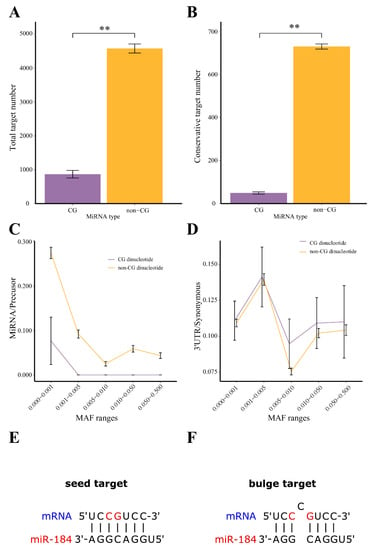
For all the human miRNA (n = 1917) annotated by miRBase [16], there are 346 miRNAs containing CG dimer at the seed region. On average, each CG miRNA has ~900 canonical targets while each non-CG containing miRNA has ~4500 targets (Figure 1A). Evolutionary conservation has been widely used to identify miRNA-binding sites together with the seed rule. The CG miRNAs have drastically fewer conservative target sites than the rest of the miRNAs (Wilcox test, p < 0.01, Figure 1B).
Figure 1.
The CG dimer miRNAs have fewer conservative canonical targets than the miRNAs without CG dimer. (A) The number of target genes found by TargetScan for miRNAs with CG dimer at seed region or miRNAs without CG dimer. ** p < 0.001. (B) The number of conservative target genes found by TargetScan for miRNAs with CG dimer or miRNAs without CG dimer. ** p < 0.001. (C) The mutation rate of CG dimer in miRNA. The x axis is the MAF range and the y axis is the normalized number of mutations. Accumulation of miRNA mutations were normalized by the number of synonymous mutations and the length of the nearby gene. The CG dimer miRNAs group (purple line) and non-CG miRNAs group (orange line). The y axis scale is multiplied by 1000. (D) The mutation rate of CG dimer in the canonical seed-targets’ binding sites. Accumulation of mutation at the binding sites within 3′UTR were normalized by synonymous mutations and the mean of the total target genes’ length in different MAF ranges (x axis) for the CG dimer group (purple line) and non-CG dimer group (orange line). The y axis scale is multiplied by 1000. (E) The canonical seed-target model of miRNA. The miR-184 seed sequence is used to illustrate a canonical seed-target match. The mRNA is highlighted in blue, the miRNA and CG dimer are highlighted in red. (F) The non-canonical bulge-target model of miRNA. The miR-184 seed sequence is used to illustrate a non-canonical target match with a bulge nucleotide between the CG dimer. The mRNA is highlighted in blue, the miRNA and CG dimer are highlighted in red.
The newly derived miRNAs in human could have a lower number of targets and conservative targets. So, we used the vertebrate conserved miRNAs defined by the miRNA Orthology Database (MirGeneDB [17] and miROrtho [18]). According to the target site conservative value (Table 1), these conserved miRNAs containing CG dimer in their seed region also have much fewer conservative target sites (mean = 28) than the rest of the miRNAs (mean = 282, Wilcox test, p < 0.01). For the mammal and primate conservative miRNAs defined by the Orthology Database, the same class of miRNAs with CG dimer in their seed region also have much fewer conservative target sites (Supplementary Tables S2 and S3) (Wilcox test, p < 0.01). All these results demonstrated that CG dimer miRNAs have very few targets, and even fewer conserved targets based on the seed rule in comparison with the other miRNAs.
Table 1.
Vertebrate conservative miRNA TargetScan result.
3.2. High Mutation Rate of CG Dimer at the miRNA Binding Site but Not at the miRNA Seed Region
To understand why the miRNAs with CG dimer have fewer conservative targets, we used the human ‘1000 Genomes’ project phase-3 data [19] to assess the mutation rate within miRNA and their canonical seed targets. The SNPs located within the miRNAs and their targets were extracted and the MAF of each SNPs were retrieved. We first compared the mutations for CG dimer to the non-CG dimers. The CG dimers have a low number of mutations at the low frequency range (MAF <0.001) and have no mutations at all for the rest of MAF range (Figure 1C). However, non-CG dinucleotides have a significant higher mutation than CG dimer in all frequency ranges (KS-test, p < 0.01, Figure 1C). The CG dimer at the targets UTR region, however, has a slightly higher mutation rates comparing with the non-CG dinucleotides (KS-test, p < 0.05, Figure 1D).
To compare the mutation rates between different genomic regions, we normalized the numbers of cytosines (C) converted to thymines (T) by the nearby genes’ neutral mutation number (synonymous mutation and gene length). The CG dimer within the miRNAs (<0.03) has significant lower number of C to T than the CG dimers of the binding sites at the target 3′UTR region (>1.25, KS-test, p < 0.01) (Figure 1C,D). In general, the CG dimers in mRNA targets have a high mutation rate, as opposed to the CG dimers in the miRNAs seed region. These results suggested that CG dimer miRNA have much fewer targets and conserved targets could be due to the high mutation rate of CG dimer within the mRNA targets.
3.3. Identification of Bulge Sites That Pair to miRNA Containing CG Dimer
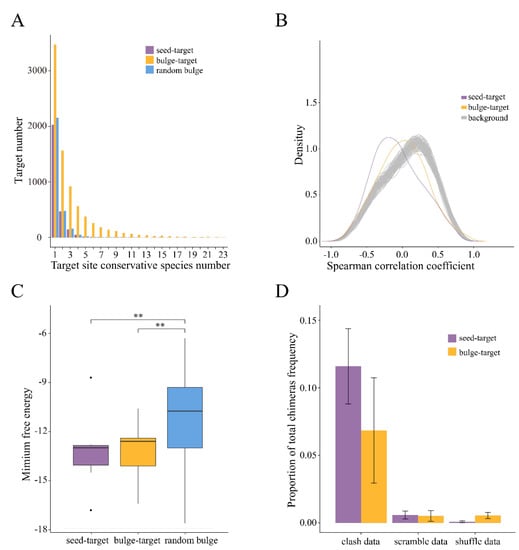
Based on the above results, we speculate that for CG dimer miRNA, beyond the targets predicted by the seed rule, there might be an additional group of targets that don’t have binding site with perfect paring with the seed. To test this, we allow one nucleotide insertion in every position in the seed region (Figure 1E,F) for all the vertebrate conserved miRNAs with CG dimer. Using these artificial seed sequences, we find that only the bulge site inserted between the CG dimer can increase the target number and conservation of the target sites (Figure 2A). In contrast, the random bulge at the target binding site did not increase the target number nor the conservation rate compared with the canonical seed-targets (Figure 2A).
Figure 2.
The CG dimer miRNAs and bulge-targets’ interactome. (A) Targets with bulge between CG dimer have higher conservative rate. The seed-targets and bulge-targets between CG dimer were compared to the random bulge control using conservation rates in 23 vertebrate species. The x axis is the conservation rates. The y axis is the number of targets for each conservation rates. (B) The CG dimer miRNA suppression of the bulge-targets expression. Cumulative distribution of correlation coefficient between CG dimer miRNAs and their targets expression level. (C) Minimum free energy between CG dimer miRNAs and seed-targets, bulge-targets, and random bulge targets. A boxplot was used to indicate the distribution of the minimum free energy for each interaction type. ** p < 0.001, compared with random bulge. (D) CLASH data validation of CG dimer miRNAs and bulge-targets interaction. The proportion of canonical seed interaction and non-canonical bulge interaction among real CLASH chimeras scramble and shuffle data.
3.4. Transcriptome-Wide Evidence for miRNA Repression through Bulge-Target Site
To further validate these bugle-targets, we used a dataset with matched mRNA and miRNA expression values across different human ages (human age series data) [24] to quantify the correlation between CG dimer miRNAs and their bulge target at transcript level. The bulge-targets are significantly more negatively correlated to their miRNAs’ expression than the background (Wilcox test, p < 0.01, Figure 2B), while slightly weaker than the seed-targets, indicating that the perfect seed-pairing remains have a stronger interaction (Figure 2B).
We also used public data on transcriptome changes after over-expression or knock-down individual CG dimer miRNAs from GEO. For miR-126, miR-210, and miR-184, all the bulge-targets were significantly down-regulated after overexpression (Table 2), and in the case of the knock-down experiment for miR-1204, the bulge-targets were also much more highly expressed compared with the control genes (Wilcox test, p < 0.01, Table 2).
Table 2.
Functional analyses of CG dimer miRNAs in the transfection data.
3.5. Minimum Free Energies of CG Bulge-Target Duplexes Are Significantly Lower Than the Random Bulges
We also compared the minimum free energy (MFE) between the canonical seed-targets, bulge-targets, and targets with random bulges using RNAhybrid [25]. The non-canonical bulge-targets have a significantly lower MFE compared with the targets with random bulge (Wilcox test, p < 0.05, Figure 2C). The subtle difference of MEF between seed-targets and bulge-targets indicates the bulge-targets form a strong duplex with miRNAs as the perfect seed-pairing (Figure 2C).
3.6. Validation of the Bulge Target Site by the CLASH Data
To allow direct mapping of miRNA-target interactions, we use the CLASH dataset [12] to validate our bulge-targets for the miRNAs containing CG dimer. Briefly, the RNA molecules present in AGO-associated miRNA-target duplexes were partially hydrolyzed, ligated, reverse transcribed, and subjected to illumina sequencing. Compared with the HITS-CLIP and PAR-CLIP dataset, CLASH technology generated a group of reads which contain the miRNAs and their target site sequence together (chimeric reads). In all the six independent CLASH experiments, we found 10 CG dimer miRNAs were detected in all the chimeric reads and eight miRNAs had, in total, 264 chimeric reads containing a bulge nucleotide between the CG dimer at the target site (Supplementary Table S4). For all miRNAs detected in the CLASH dataset, the non-canonical interactions (G.U pairs, all possible one nucleotide mismatch or bulge; non-canonical seed) were about 1.7-fold more than the perfect seed-targets. However, within the CG miRNA, only the bulge-targets between CG dimer, in comparison to randomized sequences, showed strong enrichment among all the interactions (Figure 2D). The chimeric reads strongly support the interaction between CG dimer miRNAs and bulge-targets.
4. Discussion
The aim of this study is to identify the general features of non-canonical miRNAs targets and their interactions with miRNA in the evolution. First, we found that the CG dimer miRNAs have surprisingly few conservative seed-targets, and these miRNAs that have been conserved over long periods of vertebrate evolution also have fewer new targets (unconservative target sites) than the other miRNAs. Therefore, we did not find evidence supporting the turnover of target sites. Selection in favor of new target sites appears to be rare: a former study found a strong signal of purifying selection against turnover of target sites [26], so the CG dimer miRNAs might exist as an alternative class of targets. Secondly, we found a significant higher CG mutation frequency at the miRNAs binding sites but not at the miRNA itself. This result suggests the mutations at the CG dimer miRNA target sites may be relatively frequent. It follows that the mutation at the binding sites might be neutral in some of these cases. This reinforces our initial hypothesis that these CG dimer miRNAs have bulge-nucleotides to tolerate target binding site mutation.
The chimeric reads from CLASH data strongly support the interaction between CG dimer miRNAs and bulge-targets. Compared with the seed-targets, however, these bulge-targets had a weaker negative correlation with the miRNA expression, indicating that the perfect seed-pairing remains have stronger interaction. This is consistent with structural accessibility of target sequences, total free energy of miRNA-target hybridization, and topology of base-pairing.
The lack of canonical seed-targets makes functional enrichment impossible for each CG dimer miRNA. This makes hard to predict the CG dimer miRNA function. Even pooling all the CG dimer miRNAs together, we only got fewer than one hundred seed-targets. The bulge-targets, however, were much more abundant than the seed-targets. So, we could successfully perform GO analysis for single CG dimer miRNAs. For instance, the bulge-targets for three CG dimer miRNAs (miR-126, miR-184, and miR-187) are functionally enriched in the synapse/neuron projection and the RHO GTPase cycle, indicating that fast evolved neuron cells [27,28] and GTP-GDP cycling [29,30] are most sensitive to the perturbation of seed complementary base-pairing and most receptive in accommodating evolutionary innovation, such as bulge-target recognition. Thus, a major novelty of this work is not only that the identification of a sequence motif, CG dimer, in the seed region of miRNAs, is strongly correlated to bulge targeting patterns, but also the improvement of functional enrichment for the targets for individual miRNAs.
5. Conclusions
Overall, we found that the bulge-targets were preferentially associated with the miRNAs containing CG dimer in their seed region. Multi-step validation, which included evolutionary, overexpression, correlation, and CLASH data analysis supports the possibility that within the miRNAs with CG dimer in the seed region, there is a group of targets containing a bugle in the binding site.
Supplementary Materials
The following supporting information can be downloaded at: https://www.mdpi.com/article/10.3390/biology11030478/s1. Table S1: All the 23 species which were used for miRNA and target conservation analysis; Table S2: Mammal conservative miRNA TargetScan result; Table S3: Primate conservative miRNA TargetScan result; Table S4: CLASH chimeras reads which the miRNA-bulge-target duplex were sequenced.
Author Contributions
Conceptualization, B.Z. and Z.Y.; validation, X.S., K.W. and P.Z.; formal analysis, W.D., B.Z. and Z.Y.; writing—original draft preparation, W.D., B.Z. and Z.Y.; writing—review & editing, B.Z., P.Z., Z.Y.; funding acquisition, P.Z., Z.Y. All authors have read and agreed to the published version of the manuscript.
Funding
This research was funded by the National Natural Science Foundation of China (32170487), the Youth Innovation Promotion Association, CAS (2018463), and the Natural Science Foundation of Gansu Province for Distinguished Young Scholar (20JR5RA547).
Institutional Review Board Statement
Not applicable.
Informed Consent Statement
Not applicable.
Data Availability Statement
Not applicable.
Acknowledgments
We thank the members of the Zheng Yan’s group from the Lanzhou University for helpful discussions. We thank the four anonymous reviewers for their valuable feedback and comments on the manuscript.
Conflicts of Interest
The authors declare no conflict of interest.
References
- Bartel, D.P. MicroRNAs: Genomics, Biogenesis, Mechanism, and Function. Cell 2004, 116, 281–297. [Google Scholar] [CrossRef] [Scilit]
- Brodersen, P.; Voinnet, O. Revisiting the Principles of MicroRNA Target Recognition and Mode of Action. Mol. Cell. Biol. 2009, 10, 141–148. [Google Scholar] [CrossRef] [Scilit] [PubMed]
- Bartel, D.P. MicroRNAs: Target Recognition and Regulatory Functions. Cell 2009, 136, 215–233. [Google Scholar] [CrossRef] [Scilit] [PubMed]
- Brennecke, J.; Stark, A.; Russell, R.B.; Cohen, S.M. Principles of MicroRNA-Target Recognition. PLoS Biol. 2005, 3, e85. [Google Scholar] [CrossRef] [Scilit]
- Ruby, J.G.; Stark, A.; Johnston, W.K.; Kellis, M.; Bartel, D.P.; Lai, E.C. Evolution, Biogenesis, Expression, and Target Predictions of a Substantially Expanded Set of Drosophila MicroRNAs. Genome Res. 2007, 17, 1850–1864. [Google Scholar] [CrossRef] [Scilit]
- Friedman, R.C.; Farh, K.K.H.; Burge, C.B.; Bartel, D.P. Most Mammalian MRNAs Are Conserved Targets of MicroRNAs. Genome Res. 2009, 19, 92–105. [Google Scholar] [CrossRef] [Scilit]
- Chi, S.W.; Hannon, G.J.; Darnell, R.B. An Alternative Mode of MicroRNA Target Recognition. Nat. Struct. Mol. Biol. 2012, 19, 321–327. [Google Scholar] [CrossRef] [Scilit]
- Ha, I.; Wightman, B.; Ruvkun, G. A Bulged Lin-4/Lin-14 RNA Duplex Is Sufficient for Caenorhabditis Elegans Lin-14 Temporal Gradient Formation. Genes Dev. 1996, 10, 3041–3050. [Google Scholar] [CrossRef] [Scilit]
- Vella, M.C.; Choi, E.-Y.; Lin, S.-Y.; Reinert, K.; Slack, F.J. The C. Elegans MicroRNA Let-7 Binds to Imperfect Let-7 Complementary Sites from the Lin-41 3’UTR. Genes Dev. 2004, 18, 132–137. [Google Scholar] [CrossRef] [Scilit]
- Didiano, D.; Hobert, O. Perfect Seed Pairing Is Not a Generally Reliable Predictor for MiRNA-Target Interactions. Nat. Struct. Mol. Biol. 2006, 13, 849–851. [Google Scholar] [CrossRef] [Scilit]
- Zisoulis, D.G.; Lovci, M.T.; Wilbert, M.L.; Hutt, K.R.; Liang, T.Y.; Pasquinelli, A.E.; Yeo, G.W. Comprehensive Discovery of Endogenous Argonaute Binding Sites in Caenorhabditis Elegans. Nat. Struct. Mol. Biol. 2010, 17, 173–179. [Google Scholar] [CrossRef] [Scilit]
- Helwak, A.; Kudla, G.; Dudnakova, T.; Tollervey, D. Mapping the Human MiRNA Interactome by CLASH Reveals Frequent Noncanonical Binding. Cell 2013, 153, 654–665. [Google Scholar] [CrossRef] [Scilit]
- Jabbari, K.; Bernardi, G. Cytosine Methylation and CpG, TpG (CpA) and TpA Frequencies. Gene 2004, 333, 143–149. [Google Scholar] [CrossRef] [Scilit]
- Walsh, C.P.; Xu, G.L. Cytosine Methylation and DNA Repair. Curr. Top. Microbiol. Immunol. 2006, 301, 283–315. [Google Scholar]
- Arnheim, N.; Calabrese, P. Understanding What Determines the Frequency and Pattern of Human Germline Mutations. Nat. Rev. Genet. 2009, 10, 478–488. [Google Scholar] [CrossRef] [Scilit]
- Griffiths-Jones, S.; Grocock, R.J.; van Dongen, S.; Bateman, A.; Enright, A.J. MiRBase: MicroRNA Sequences, Targets and Gene Nomenclature. Nucleic Acids Res. 2006, 34, D140–D144. [Google Scholar] [CrossRef] [Scilit]
- Fromm, B.; Domanska, D.; Høye, E.; Ovchinnikov, V.; Kang, W.; Aparicio-Puerta, E.; Johansen, M.; Flatmark, K.; Mathelier, A.; Hovig, E.; et al. MirGeneDB 2.0: The Metazoan MicroRNA Complement. Nucleic Acids Res. 2020, 48, D132–D141. [Google Scholar] [CrossRef] [Scilit]
- Gerlach, D.; Kriventseva, E.V.; Rahman, N.; Vejnar, C.E.; Zdobnov, E.M. MiROrtho: Computational Survey of MicroRNA Genes. Nucleic Acids Res. 2009, 37, D111–D117. [Google Scholar] [CrossRef] [Scilit]
- Sudmant, P.H.; Rausch, T.; Gardner, E.J.; Handsaker, R.E.; Abyzov, A.; Huddleston, J.; Zhang, Y.; Ye, K.; Jun, G.; Hsi-Yang Fritz, M.; et al. An Integrated Map of Structural Variation in 2,504 Human Genomes. Nature 2015, 526, 75–81. [Google Scholar] [CrossRef] [Scilit]
- Wang, K.; Li, M.; Hakonarson, H. ANNOVAR: Functional Annotation of Genetic Variants from High-Throughput Sequencing Data. Nucleic Acids Res. 2010, 38, e164. [Google Scholar] [CrossRef] [Scilit]
- Rehmsmeier, M.; Steffen, P.; Hochsmann, M.; Giegerich, R. Fast and Effective Prediction of MicroRNA/Target Duplexes. RNA 2004, 10, 1507–1517. [Google Scholar] [CrossRef] [Scilit] [PubMed]
- Kern, F.; Fehlmann, T.; Solomon, J.; Schwed, L.; Grammes, N.; Backes, C.; Van Keuren-Jensen, K.; Craig, D.W.; Meese, E.; Keller, A. MiEAA 2.0: Integrating Multi-Species MicroRNA Enrichment Analysis and Workflow Management Systems. Nucleic Acids Res. 2020, 48, W521–W528. [Google Scholar] [CrossRef] [Scilit]
- Zhou, Y.; Zhou, B.; Pache, L.; Chang, M.; Khodabakhshi, A.H.; Tanaseichuk, O.; Benner, C.; Chanda, S.K. Metascape Provides a Biologist-Oriented Resource for the Analysis of Systems-Level Datasets. Nat. Commun. 2019, 10, 1523. [Google Scholar] [CrossRef] [Scilit] [PubMed]
- Somel, M.; Liu, X.; Tang, L.; Yan, Z.; Hu, H.; Guo, S.; Jiang, X.; Zhang, X.; Xu, G.; Xie, G.; et al. MicroRNA-Driven Developmental Remodeling in the Brain Distinguishes Humans from Other Primates. PLoS Biol. 2011, 9, e1001214. [Google Scholar] [CrossRef] [Scilit]
- Jan, K.; Marc, R. RNAhybrid: microRNA target prediction easy, fast and flexible. Nucleic Acids Res. 2006, 34, W451–W454. [Google Scholar]
- Andrea, H.; Antonio, M. Pervasive Selection against MicroRNA Target Sites in Human Populations. Mol. Biol. Evol. 2020, 37, 3399–3408. [Google Scholar]
- Hu, G.; Li, J.; Wang, G.Z. Significant Evolutionary Constraints on Neuron Cells Revealed by Single-Cell Transcriptomics. Genome Biol. Evol. 2020, 12, 300–308. [Google Scholar] [CrossRef] [Scilit]
- Kristan, W.B. Early Evolution of Neurons. Curr. Biol. 2016, 26, R949–R954. [Google Scholar] [CrossRef] [Scilit]
- Hodge, R.G.; Ridley, A.J. Regulating Rho GTPases and Their Regulators. Nat. Rev. Mol. Cell Biol. 2016, 17, 496–510. [Google Scholar] [CrossRef] [Scilit]
- Villalonga, P.; Ridley, A.J. Rho GTPases and Cell Cycle Control. Growth Factors 2006, 24, 159–164. [Google Scholar] [CrossRef] [Scilit]

Publisher’s Note: MDPI stays neutral with regard to jurisdictional claims in published maps and institutional affiliations. |
© 2022 by the authors. Licensee MDPI, Basel, Switzerland. This article is an open access article distributed under the terms and conditions of the Creative Commons Attribution (CC BY) license (https://creativecommons.org/licenses/by/4.0/).