


Abstract
This study explores the influence of anion hydrogen-bond basicity, quantified by the Kamlet–Taft β parameter, on cellulose dissolution in imidazolium-based ionic liquids (ILs). A series of ILs sharing the common cation 1-benzyl-3-methylimidazolium were synthesized with varying anions, including chloride, acetate, formate, methoxyacetate, and methylphosphonate. The hydrogen-bond accepting ability (β) of each IL was experimentally determined and correlated with cellulose dissolution performance. Dissolution capability was evaluated by solubilizing 5 wt% cotton cellulose at 90 °C and monitoring under polarized light microscopy. Among the studied systems, 1-benzyl-3-methylimidazolium acetate (β = 1.01) demonstrated the highest dissolution efficiency, highlighting the critical role of strong hydrogen-bond basicity in disrupting the cellulose hydrogen-bonding network. To support the experimental observations, COSMO-RS simulations were conducted to probe the molecular-level interactions between anions and cellulose. Parameters such as anion size, theoretical density, viscosity, and surface charge density distribution were analyzed to elucidate their contributions to dissolution behavior. The regenerated cellulose was further characterized using scanning electron microscopy (SEM) and Fourier transform infrared (FTIR) spectroscopy.
1. Introduction
Over the past two decades, ionic liquids (ILs) have attracted significant attention as highly effective solvents for dissolving cellulose. Structurally, ILs are salts made up of organic cations and either inorganic or organic anions. Their physicochemical properties, such as non-flammability, negligible vapor pressure, high chemical and thermal stability, and recyclability, make them especially attractive for biomass processing. Most ILs exhibit melting points lower than 100 °C and are thus categorized as room-temperature ionic liquids [1,2]. Owing to these unique features, ILs have been widely used in cellulose technology, including dissolution, homogeneous functionalization, regeneration, and biomass fractionation [3,4,5,6,7,8,9,10,11,12]. Despite extensive studies, the dissolution mechanism of cellulose in ILs remains a subject of debate. Numerous investigations have explored the roles of individual ionic components in this process [13,14,15,16,17,18,19,20,21,22,23,24,25,26]. The prevailing consensus is that IL anions penetrate the crystalline cellulose matrix and disrupt the extensive hydrogen-bonding network through competitive hydrogen bonding [16,18,27]. In this interaction, the anion generally functions as a hydrogen bond acceptor, whereas the cation serves as a hydrogen bond donor, with the exact bonding dynamics determined by the structural characteristics of the individual IL components [18,27].
Many studies have shown that the physicochemical properties of ILs play a crucial role in cellulose dissolution. Key parameters influencing this process include Kamlet–Taft parameters, viscosity, conductivity, density, and melting point [27,28,29,30,31,32,33]. The Kamlet–Taft parameters characterize solvents by three descriptors: hydrogen-bond donor ability (α), hydrogen-bond acceptor ability (β), and dipolarity/polarizability (π*) [34,35,36]. Among these, the β parameter, which reflects the hydrogen-bond basicity of the anion, has been strongly correlated with cellulose solubility. The hydrogen-bond accepting ability of the anion plays a key role in interacting with the hydroxyl groups of cellulose, breaking the inter- and intramolecular hydrogen bonds [16,28]. Experimental evidence supports the importance of hydrogen-bond basicity in cellulose dissolution [28]. For instance, replacing the hydrogen atom in the acetate anion (CH3COO−) of 1-butyl-3-methylimidazolium acetate ([C4C1im][CH3COO]) with substituents -OH, -NH2, C6H5, and -SH led to a reduction in cellulose solubility [37]. Similarly, ILs containing strongly basic anions, such as carboxylates and phosphates, display superior solvation ability, whereas ILs with weakly basic, non-coordinating anions ([BF4]−, [PF6]−, [N(CN)2]−, [MeSO4]−, [HSO4]−, and [NTf2]−) are poor cellulose solvents [38,39,40,41].
Ionic liquids with different anions exhibit varying hydrogen-bond basicity, which significantly influences their ability to dissolve cellulose. For example, carboxylate- and phosphate-based anions display strong hydrogen-bond basicity and are considered highly effective solvents for cellulose [29,42]. Fukaya et al. reported that 1-allyl-3-methylimidazolium formate could dissolve greater amounts of cellulose at lower temperatures than 1-allyl-3-methylimidazolium chloride due to the formate anion’s hydrogen-bond basicity being 1.2 times higher than that of chloride [42]. Similarly, the effect of the β parameter on cellulose dissolution was investigated for 1-ethyl-3-methylimidazolium ([C2C1im]) salts containing methanesulfonate ([MeSO3]), methylsulfate ([MeOSO3]), and dimethylphosphate ([(MeO)2PO2]) anions [29]. The results showed that [C2C1im][(MeO)2PO2] (β = 1.00), with the highest hydrogen-bond acceptor capacity, dissolved cellulose more efficiently than [C2C1im][MeSO3] (β = 0.70) and [C2C1im][MeOSO3] (β = 0.61), which possess lower basicity. Furthermore, Xu et al. demonstrated a linear correlation between the β parameter of ILs and the solubility of microcrystalline cellulose (MCC) at 70 °C [37]. Despite these findings, relatively few systematic studies have directly investigated the influence of hydrogen-bond basicity on cellulose dissolution. Therefore, further research is required to elucidate the precise relationship between the β parameter of ILs and their cellulose dissolution capacity. COSMO-RS (Conductor-like Screening Model for Real Solvents) has been widely adopted to gain molecular-level understanding and to predict the performance of ILs in dissolving cellulose and related polysaccharides. COSMO-RS combines quantum-chemical surface charge density calculations with statistical thermodynamics to estimate key thermodynamic properties such as logarithmic activity coefficients (ln γ) and excess enthalpies (Hᵉ), which correlate with solvent affinity and solute solubility. Such descriptors enable systematic screening of thousands of IL candidates without exhaustive experimental testing. For example, Kahlen et al. used COSMO-RS to compute relative solubilities for over 2000 ionic liquid combinations and found good qualitative agreement with experimental cellulose solubility data, identifying that anion identity is the dominant factor controlling IL solvent power. Further computational studies have refined this approach by evaluating ln γ and Hᵉ for various ILs and showing that ln γ at infinite dilution in particular serves as a robust predictor for cellulose dissolution capability [43,44,45]. Beyond simple prediction, COSMO-RS has been successfully applied to guide practical fiber processing strategies. In the field of cellulose fiber functionalization, COSMO-RS screening has identified ILs such as 1-ethyl-3-methylimidazolium diethylphosphate ([Emim]DEP) with strong dissolution ability suitable for preparing antibacterial cellulose fibers, supporting both the incorporation of bioactive agents and fiber regeneration processes [46,47,48]. Similarly, COSMO-RS predictions have been correlated with nanocellulose production performance, where predicted solvent affinity descriptors help explain observed trends in nanocellulose yield and morphology when using IL-assisted dissolution routes [43,49,50]. Mechanistically, COSMO-RS analyses reinforce that hydrogen-bonding interactions between IL anions and cellulose hydroxyl groups are critical to dissolution, a conclusion consistent across studies of cellulose, hemicellulose, and other lignocellulosic fractions [43,49,51]. Integrating COSMO-RS with experimental validation enhances understanding of how structural features of both ionic liquids (e.g., anion basicity, cation structure) and solutes influence the thermodynamics of dissolution. This enables rational design of ILs optimized for the efficient and sustainable processing of cellulose fibers and related biomaterials [45,48,50].
To address this, a series of ionic liquids (ILs) based on the 1-benzyl-3-methylimidazolium ([BnzC1im]+) cation was synthesized with structurally diverse anions, including chloride, acetate, formate, methoxyacetate, and phosphonate see Figure S4. Their hydrogen-bond basicity (β) was experimentally determined and identified as a key parameter governing cellulose dissolution. The ability of these ILs to dissolve 5 wt% cotton cellulose at 90 °C was evaluated. To complement the experimental findings, COSMO-RS simulations were employed to elucidate the molecular origins of anion–cellulose interactions. Analysis of anion size, theoretical density, viscosity, and surface charge density distributions provides mechanistic insight into how anion structure governs disruption of the cellulose hydrogen-bonding network. Together, these results establish clear structure–property relationships and offer guiding principles for the rational design of next-generation cellulose-dissolving ionic liquids. To the best of our knowledge, this study is the first to systematically investigate the influence of hydrogen-bond basicity in aromatic-functionalized methylimidazolium ionic liquids (ILs) on cellulose solubility through both experimental and theoretical approaches. The findings offer valuable insights for the rational design of ILs with tailored properties to achieve efficient cellulose dissolution.
2. Materials and Methods
2.1. Ionic Liquids
1-Methylimidazole (Sigma, St. Louis, MO, USA, 98.9%), 1-Benzylimidazole (Sigma, 99%), 1-benzyl bromide (Sigma, St. Louis, MO, USA, 98%), 1-Benzyl chloride (Sigma, St. Louis, MO, USA, 98%), Amberlite IRA-400 chloride resin (Sigma, St. Louis, MO, USA,), acetic acid (Sigma, St. Louis, MO, USA, 99%), formic acid (Sigma, St. Louis, MO, USA, 95%), and methoxyacetic acid (Sigma, St. Louis, MO, USA, 98%) were used without further purification. The solvents THF and diethyl ether were distilled over Na/benzophenone. A solution of NaOH (1 M) was prepared by using 40 g of NaOH (Fisher, Pittsburgh, PA, USA). The gravitational columns were packed by using Celite (Fisher, Pittsburgh, PA, USA), sand ( Acros, Pittsburgh, PA, USA), aluminium oxide (60 A, activated, basic, 50–200 micron, Acros, Pittsburgh, PA, USA), and glass wool. Acetic acid, formic acid, and methoxyacetic acid were used for neutralization. After isolation, all ILs were dried under vacuum at 50 °C for 4 days. After drying the ILs, water content was measured (less than 1000 ppm) by using Karl Fisher titration (Karl Fisher METTLER TOLEDO C20 coulometric KF titrator, METTLER TOLEDO, Greifensee, Switzerland). After performing the AgNO3 test, the absence of halide impurities was confirmed. Other impurities were undetectable by NMR with a JEOL 400 MHz spectrometer (JEOL Ltd., Tokyo, Japan). Ionic liquid purity was evaluated using a combination of analytical techniques. Structural integrity and organic purity were confirmed by 1H NMR and 13C NMR spectroscopy. Water content was determined by Karl Fischer titration. Residual halide impurities were analyzed using the AgNO3 test, while trace organic impurities were assessed by HPLC [52], 1H, and 13C NMR, spectra obtained from a JEOL ECS 400 MHz spectrometer (JEOL Ltd., Tokyo, Japan). For 1H NMR spectra, tetramethylsilane (TMS, d = 0.00) or the residual protic solvent peak (for (CD3)2CO, d = 2.05, DMSO-d6, d = 2.50) and for 13C NMR spectra, tetramethylsilane (TMS, d = 0.00) or the residual solvent peak (for (CD3)2CO, d = 29.84, DMSO-d6, d = 39.50) served as shift references. Coupling constants (J) are reported in hertz (Hz).
2.1.1. Synthesis of Ionic Liquids
1-Benzyl-3-Methylimidazolium Chloride
A 250 mL two-neck Schlenk flask equipped with a magnetic stir bar was charged under nitrogen with 50 mL of acetonitrile, followed by the addition of 1-methylimidazole (11.50 mL, 144 mmol) and benzyl chloride (99%) (17.50 mL, 114 mmol) via syringes. The reaction mixture was stirred at 70 °C for two days. After the reaction went to completion, the crude product was isolated in a good yield of 91%. After purification, the pure compound was left under vacuum and solidified over time. The compound was characterized by 1H NMR and 13C NMR.
1H NMR (400 MHz; (DMSO-d6); TMS) 3.78 (s, 3H, N-CH3), 4.47 (s, 2H, N-CH2-), 7.35–7.45 (m, 5H), 7.70–7.80 (d, 2H, J = 12.0 Hz, NCHCHN), 9.55 (s, 1H, NCHN) ppm. 13C NMR (DMSO-d6, 100 MHz), 35.8 (N-CH3), 51.8 (N-CH2), 121.9 (NCHCHN), 123.5 (NCHCHN), 128, 129.2, 134.6 (aromatic), 137.80 (NCHN), ppm. Melting point 58 °C.
1-Benzyl-3-Methylimidazolium Phosphonate
A 250 mL two-neck Schlenk flask equipped with a magnetic stir bar was charged under nitrogen with 50 mL of THF, followed by the addition of 1-benzylimidazole (10 mL, 85 mmol) and dimethylphosphite (99%) (9.0 mL, 80 mmol) via syringes. The reaction mixture was stirred at 90 °C for two days. After the reaction reached completion, the solvent was removed and dried under vacuum for a prolonged period. The isolated oil was characterized by 1H and 13C NMR.
1H NMR (400 MHz; (CD3)2CO; TMS) 1.95 (-OCH3) 3.26 (d, J = 21 Hz 3H, PO-CH3), 3.90 (s, 3H, J = 7.0 Hz, N-CH3), 5.10 (t, 2H, J = 7.0 Hz, N-CH2), 6.09 (d, H, J = 550.0 Hz, P-CH3) 7.22–7.41 (m, 5H), 7.45 (d, 2H, J = 12.0 Hz, NCHCHN), 10.50 (s, 1H, NCHN) ppm. 13C NMR, (CD3)2CO, 100 MHz): 36.3 (N-CH3), 50.6.8 (N-CH2), 50.0 (POCH3, 121.6 (NCHCHN), 123.5 (NCHCHN), 138.8 (NCHN) ppm. 31P NMR, (CD3)2CO, 162 MHz) 3.9 ppm. FTIR (cm−1): 1190 (P=O), 1050 (P–O−).
1-Benzyl-3-Methylimidazolium Bromide
A 250 mL two-neck Schlenk flask equipped with a magnetic stir bar was charged under nitrogen with 50 mL of acetonitrile, followed by the addition of 1-methylimidazole (6.30 mL, 79.01 mmol) and benzyl bromide (99%) (9.97 mL, 82.96 mmol) via 10 mL syringes. The reaction mixture was stirred at room temperature overnight. After the reaction reached completion (progress was monitored by 1H NMR), the reaction flask was removed from the condenser, and the crude product was washed with 60 mL of hexane three times. The isolated crude product was dried under vacuum and dissolved in 60 mL of CH2Cl2. Approximately 2 to 3 g of activated carbon was added to this solution, which was then stirred overnight. The black slurry was removed from the stir plate and then filtered through a gravitational column that was packed with glass wool, 10 cm of aluminum oxide (activated, basic, 50–200 micron), and 5 cm of Celite 545. The excess solvent was removed using a rotary evaporator.(Buchi R100, New Castle, DE 19720, USA) The sample was dried under vacuum, and the compound was isolated, giving a yield of 91%. The pure compound, left under vacuum, solidified over time. 1H NMR and 13C NMR were used to characterize the compound.
Note that bromide ILs were converted to hydroxide by passing through the anion exchange column to generate hydroxides. Then, neutralization reactions were performed with acetic acid, formic acid, and methoxy-acetic acid to yield 1-benzyl-3-methylimidazolium acetate, 1-benzyl-3-methylimidazolium formate, and 1-benzyl-3-methylimidazolium methoxyacetate, respectively. The synthesized ILs were isolated and dried under vacuum for a prolonged period and characterized by 1H and 13C NMR.
1-Benzyl-3-Methylimidazolium Acetate
1H NMR (400 MHz; (DMSO-d6); TMS) 1.54 (s, 3H, CH3C=O), 3.86 (s, 3H, N-CH3), 4.57 (s, 2H, N-CH2-), 7.40–7.43 (m, 5H), 7.72–7.78 (d, 2H, J = 12.0 Hz, NCHCHN), 9.67 (s, 1H, NCHN) ppm. 13C NMR (DMSO-d6, 100 MHz): 26.0 (CH3C=O), 36.2 (N-CH3), 52.2 (N-CH2), 122.7 (NCHCHN), 124.0 (NCHCHN), 129, 129.4, 135.1 (aromatic), 138.10 (NCHN), 173.2 (C=O) ppm. FTIR (cm−1): 1560 (COO−),
1-Benzyl-3-Methylimidazolium Formate
1H NMR (400 MHz; (DMSO-d6); TMS) 1.90 (s, H, HC=O), 4.02 (s, 3H, N-CH3), 4.93 (s, 2H, N-CH2-), 7.20–7.38 (m, 5H), 8.5–9.16 (d, 2H, J = 12.0 Hz, NCHCHN), 9.20 (s, 1H, NCHN) ppm. 13C NMR (DMSO-d6, 100 MHz): 36.5 (N-CH3), 53.4 (N-CH2), 121.2 (NCHCHN), 122.8 (NCHCHN), 129.1, 129.5, 133.2 (aromatic), 140.2 (NCHN), 169.4 (C=O) ppm. IR FTIR (cm−1): 1610 (COO−)
1-Benzyl-3-Methylimidazolium Methoxyacetate
1H NMR (400 MHz; (DMSO-d6); TMS) 3.17 (s, 3H, CH3C=O), 3.67 (s, 3H, N-CH3), 3.87 (s, 2H, N-CH2-), 5.32 (s, 2H, O-CH2-CO), 7.20–7.24 (m, 5H), 8.10–8.20 (d, 2H, J = 12.0 Hz, NCHCHN), 9.8 (s, 1H, NCHN) ppm. 13C NMR (DMSO-d6, 100 MHz): 36.2 (N-CH3), 52.2 (N-CH2), 58.3 (O-CH3), 72.1 (O-CH2C=O), 122.7 (NCHCHN), 138.0 (NCHCHN), 128.7, 129.0, 134.1 (aromatic), 138.30 (NCHN), 175.6 (C=O) ppm. FTIR (cm−1): 1620 (C=O), 1170 (C–O–C)
2.1.2. Measurement of Beta (β) Parameter of Molecular Solvents
The β parameter quantifies the hydrogen-bond acceptability of a solvent and is measured via the solvatochromic comparison method, based on shifts in the absorption bands of two solvatochromic dyes. In this study, the dye pair employed was 4-nitroaniline (99%, Sigma-Aldrich, St. Louis, MO, USA,) and N, N-diethyl-4-nitroaniline (97%, Oakwood Chemical, Estill, SC, USA), used as received. A 1.0 × 10⁻³ M solution of each dye was first prepared in methanol. To prepare a dye/IL or dye/solvent solution, a measured volume of the dye stock solution was transferred to a clean vial, followed by 1 mL of the IL or solvent. For the dye/IL/solvent solution, equimolar amounts of IL or solvent were added to the dye solution. All sample preparations were performed inside an argon-filled glovebox to prevent moisture absorption. Methanol was then carefully evaporated under vacuum at 40 °C for a duration of 8 h. The dye concentration was adjusted to maintain an absorbance below 0.40 to prevent aggregation. Samples were loaded in a quartz cell of 1 mm path length, and absorption spectra were recorded using a Shimadzu UV-1800 spectrophotometer (Shimadzu Corporation, Kyoto, Japan). The β values were calculated from the wavelengths of maximum absorption (λmax) using Equations (1)–(3), where NA corresponds to 4-nitroaniline and DENA to N, N-diethyl-4-nitroaniline. The maximum absorption for N, N-diethyl-4-nitroaniline ranged from 402–412 nm, whereas 4-nitroaniline exhibited a maximum peak between 380 and 402 nm.
2.2. Cotton Cellulose
2.2.1. Dissolution of Cotton Cellulose in ILs
The cellulose used in this study was carded cotton fibers, received from the Fiber and Biopolymer Research Institute at Texas Tech University. The fibers were initially scoured, bleached, and air-dried. Subsequently, the cotton fibers were ground with a Wiley mill (Thomas Scientific, Swedesboro, NJ, USA) to pass through a 20-mesh screen and then oven-dried overnight at 105 °C prior to the dissolution experiments. Dissolution of cotton cellulose in the five ILs was performed following a recently established protocol [26].
2.2.2. Polarized Light Microscopy (PLM)
The dissolution state of cotton fibers in each ionic liquid was examined using a Nikon (ECLIPSE LV100POL) polarizing light microscope equipped with a 530 nm Lambda plate and two polarizing filters (polarizer and analyzer) (Nikon Instruments Inc., Tokyo, Japan). Representative samples from each solution were collected at 4 time intervals: prior to microwave heating, immediately after microwave heating, after 4 h, and 24 h at 90 °C. The solutions were thoroughly stirred before the samples were collected. Each sample was placed on a clean, dry glass slide and covered with a cover slip. Images of the representative samples were collected at room temperature using10× objective lens.
2.2.3. Regeneration of Cellulose from the Solutions
Each cellulose solution was cast onto a glass plate and gently pressed with the second glass plate to achieve uniform spreading of the mixture. The glass plates containing cellulose/IL mixtures were then immersed in deionized water to regenerate cellulose. Deionized water was replaced every 2 to 3 h over a period of 5 days to thoroughly remove the ILs from the regenerated cellulose. The regenerated cellulose materials were dried using a Labconco FreeZone freeze dryer (4.5 Liter Cascade Benchtop Freeze Dry System) (Kansas City, MO, USA) at a temperature of 102 °C and a pressure of 0.05 mbar for 3 days.
2.2.4. Material Characterization
Scanning Electron Microscopy
Regenerated cellulose samples were mounted on carbon discs without any prior coating. The surface morphology of freeze-dried, regenerated cellulose was analyzed by using a TM-1000 tabletop scanning electron microscope (SEM) (Hitachi, Tokyo, Japan) operated at an accelerating voltage of 15 kV.
Fourier Transform Infrared Spectroscopy
The FTIR spectra of freeze-dried, regenerated cellulose samples and hot-dried ground cotton fibers were recorded using a Spectrum 400 FTIR spectrometer (Perkin-Elmer, Shelton, CT, USA) equipped with a universal attenuated total reflectance (UATR) accessory and a ZnSe-diamond crystal. Prior to analysis, freeze-dried, regenerated cellulose samples and hot-dried cotton fibers were conditioned in the laboratory at 21 ± 1 °C and 65 ± 2% relative humidity for 2 days. A background scan of the clean Zn-diamond crystal was performed before the sample’s measurements. Each sample was placed directly on the clean Zn-diamond crystal without further preparation. The pressure arm of the instrument was used to apply a constant pressure to each sample, and the pressure was monitored by Perkin-Elmer software spectrum 10. The FTIR spectra for all samples were collected in the mid-IR range (650 to 4000 cm−1) at a spectral resolution of 4 cm−1 with 32 co-added scans. The baseline correction and normalization of each spectrum were performed by the Perkin-Elmer software.
2.3. Statistical Analysis
One-way analysis of variance (ANOVA) was conducted for regenerated cellulose obtained from each IL using STATISTICA (Version 13.3; 2017; TIBCO software, Palo Alto, CA, USA). Data for ANOVA was collected from three replicates of each regenerated cellulose sample.
2.4. COSMO-RS Analysis
All quantum chemical calculations were performed using the TURBOMOLE package within the COSMO framework (Karlsruhe, Germany). The molecular geometries of the ionic species were fully optimized in the gas phase using density functional theory at the BP86 level with the def-TZVP basis set. Subsequently, COSMO calculations were carried out using a conductor-like screening model to generate the σ-surfaces required for COSMO-RS analysis.
3. Results
3.1. Polarized Light Microscopy
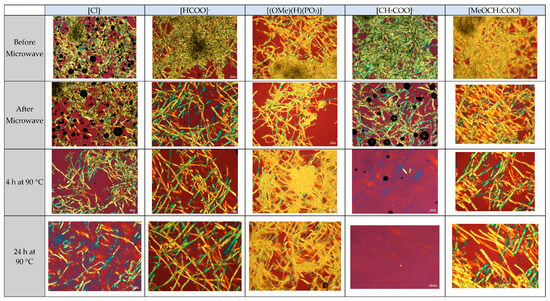
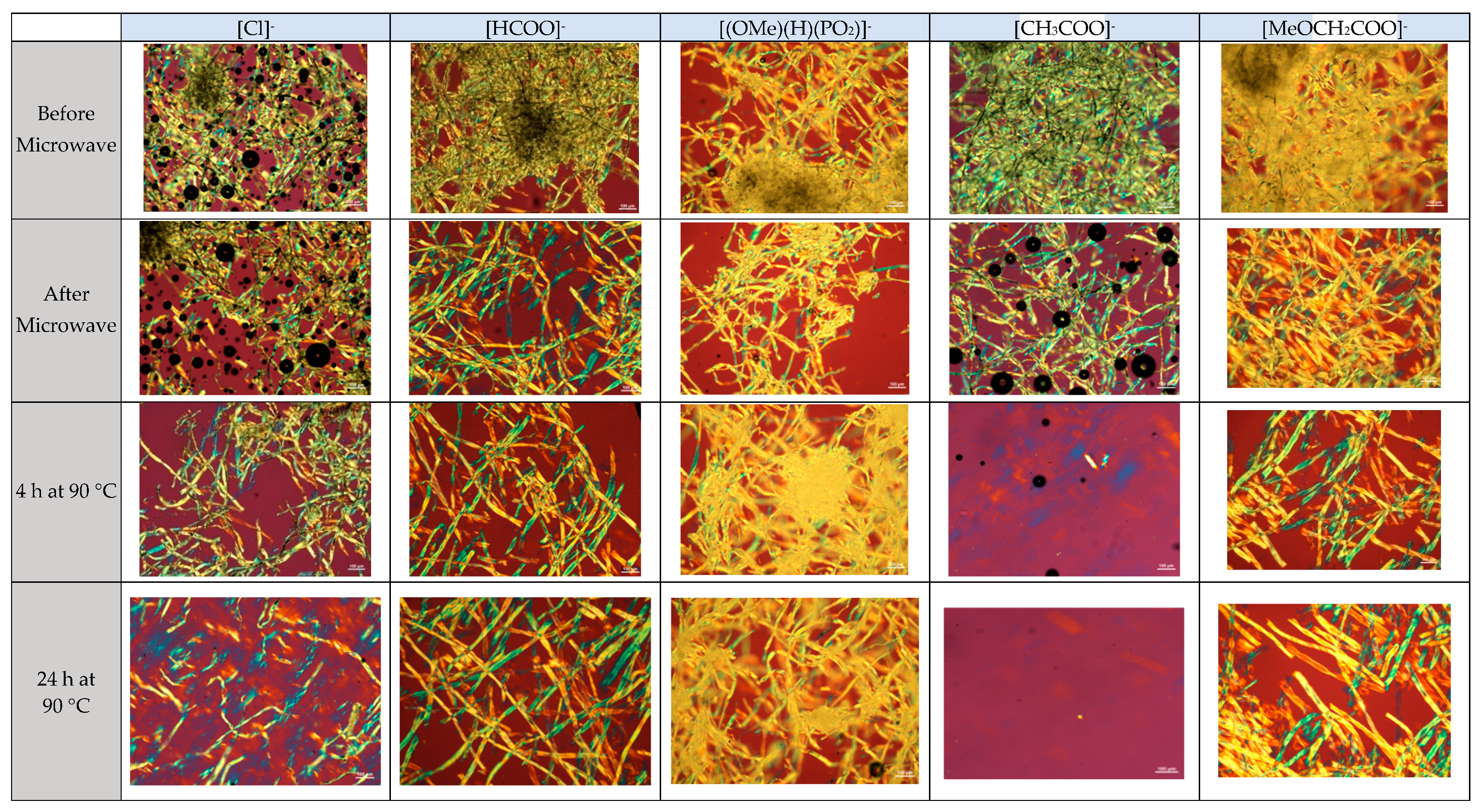
In this study, cotton-derived cellulose, which exhibits a higher degree of polymerization (DP) than microcrystalline cellulose (MCC), was selected as the cellulose source. Previous research on cellulose dissolution has primarily focused on MCC [29,37,53]. However, cellulose with an elevated DP presents greater challenges for solubilization in conventional solvents, such as N-methylmorpholine N-oxide (NMMO), with dissolution occurring more readily at elevated temperatures [27]. For the present experiments, 5 wt% cotton cellulose was added to vials containing ionic liquids (ILs). The mixtures were initially subjected to heat in a domestic microwave oven and subsequently transferred to a laboratory oven, where they were maintained at 90 °C for 24 h. Initial microwave heating is an important step, as shown by numerous studies where the heating efficiency of ILs was higher under microwaving [38,54]. The progress of the dissolution of cotton cellulose in ILs was monitored periodically using a polarized light microscope (PLM), and the PLM images are depicted in Figure 1.
Figure 1.
The PLM images of cotton cellulose in ILs at different time intervals of dissolution.
The analysis emphasizes birefringence, swelling behavior, and morphological changes in the fibers as key indicators for assessing the dissolution capability of the ionic liquids. These parameters offer direct visual evidence of the extent to which the ionic liquids interact with and progressively disrupt the cellulose structure over time. As illustrated in Figure 1, the investigated ionic liquids (ILs) demonstrated differing abilities to dissolve cotton cellulose. Prior to microwave pretreatment, numerous intact fibers were observed in all cotton/IL mixtures under crossed polarized light, reflecting the highly crystalline nature of native cellulose. The observed birefringence contrast arises from the interaction between plane-polarized light and the anisotropic structure of the cotton fibers, which causes the incident light to split into two orthogonally polarized components [55]. Cotton cellulose dissolution was markedly enhanced in [BnzC1im][CH3COO] under microwave heating, with partial dissolution observed after 4 h and complete dissolution achieved within 24 h. In contrast, [BnzC1im][HCOO], [BnzC1im][Cl], and [BnzC1im][MeOCH2COO] exhibited only limited solubility after 4 h at 90 °C, while no measurable changes were detected in [BnzC1im][(OMe)(H)(PO2)] under identical conditions. Polarized light microscopy revealed undispersed fiber aggregates in several systems, indicating incomplete dissolution. Under crossed polarized light, native cellulose fibers displayed strong birefringence, whereas dissolution resulted in loss of both birefringence and fibrillar structure. In [BnzC1im][(OMe)(H)(PO2)], fibers retained their elongated morphology and birefringence after 24 h at 90 °C, with no evidence of swelling or fragmentation, indicating limited solvent penetration and preservation of the native crystalline structure. Swelling was more pronounced in [Bnzim][Cl] than in [BnzC1im][HCOO] and [BnzC1im][MeOCH2COO] after 24 h; however, complete dissolution was not achieved in these systems, suggesting the persistence of crystalline domains. In contrast, no detectable swelling was observed in [BnzC1im][(OMe)(H)(PO2)] over the same period, consistent with its poor solvating ability toward cellulose. Regenerated cellulose obtained after dissolution was subsequently characterized by scanning electron microscopy (SEM) and Fourier-transform infrared (FTIR) spectroscopy to evaluate morphological and structural changes.
3.2. Scanning Electron Microscopy
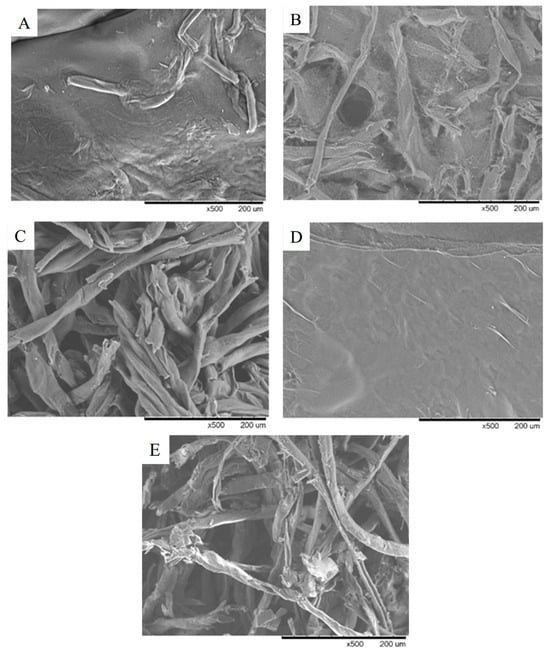
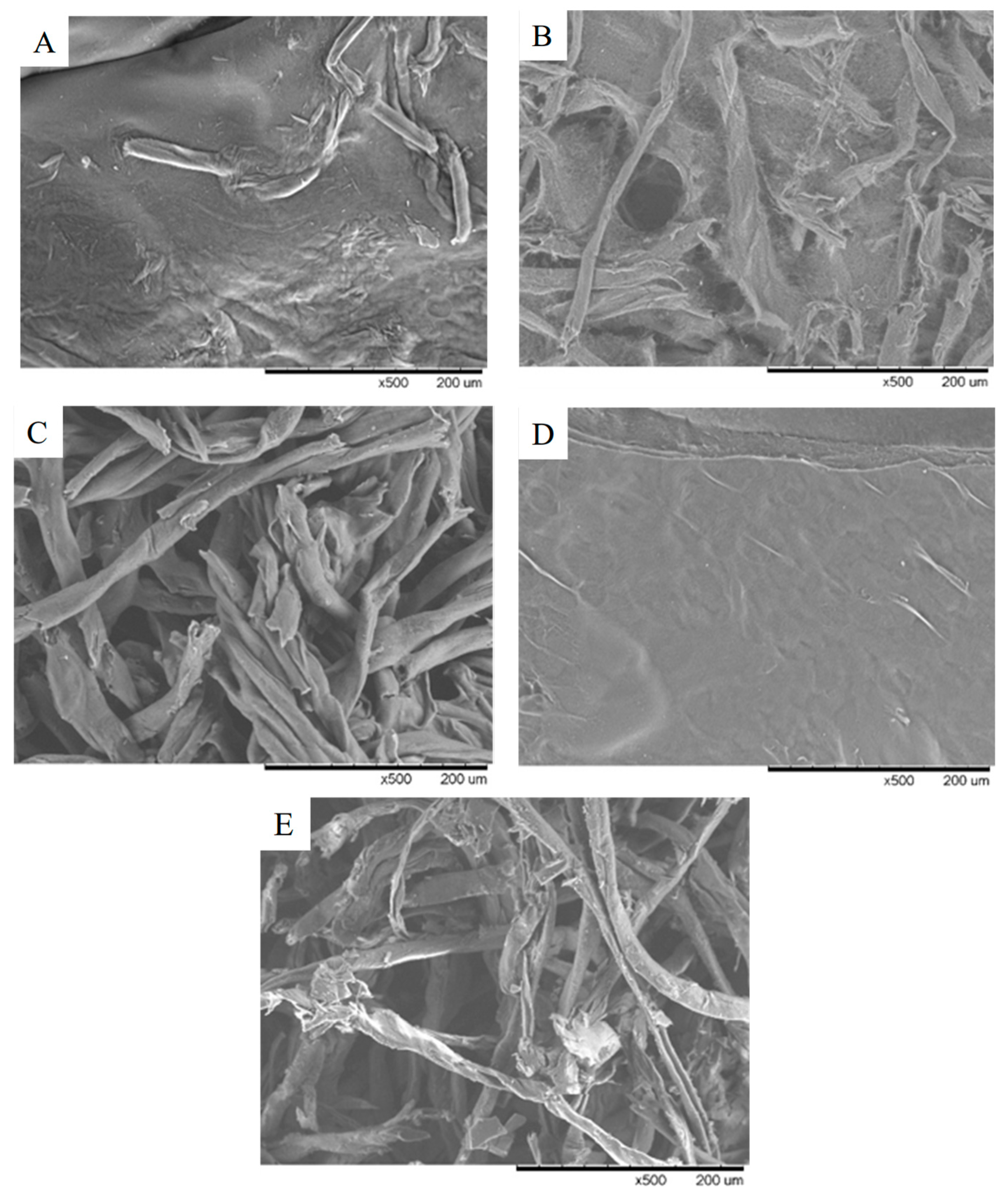
The surface morphologies of the regenerated cellulose materials were examined using scanning electron microscopy (SEM), and representative micrographs are shown in Figure 2. The surface structures varied significantly depending on the ionic liquids (ILs) used for dissolution. Cellulose regenerated from [BnzC1im][CH3COO] (Figure 2D) exhibited a uniform, nonporous surface with no visible undissolved fibers, indicating complete dissolution of cotton in the acetate-based IL, consistent with polarized light microscopy (PLM) observations. In contrast, cellulose regenerated from [BnzC1im][Cl] and [BnzC1im][HCO2] (Figure 2A,B) displayed rough, aggregated textures with fibers fused into a homogeneous macrostructure. Meanwhile, samples regenerated from [BnzC1im][(OMe)(H)(PO2)] and [BnzC1im][MeOCH2COO] were predominantly composed of undissolved cotton fibers, suggesting that these ILs are comparatively poor solvents for cellulose.
Figure 2.
Scanning electron micrographs of cellulose regenerated from [BnzC1im][Cl] (A), [BnzC1im][HCO2] (B), [BnzC1im][(OMe)(H)(PO2)] (C), [BnzC1im][CH3COO] (D), and [BnzC1im][MeOCH2COO] (E) in 500×.
3.3. FTIR Characterization
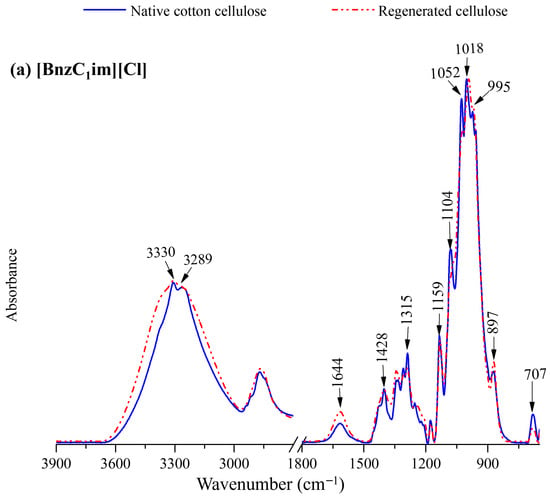
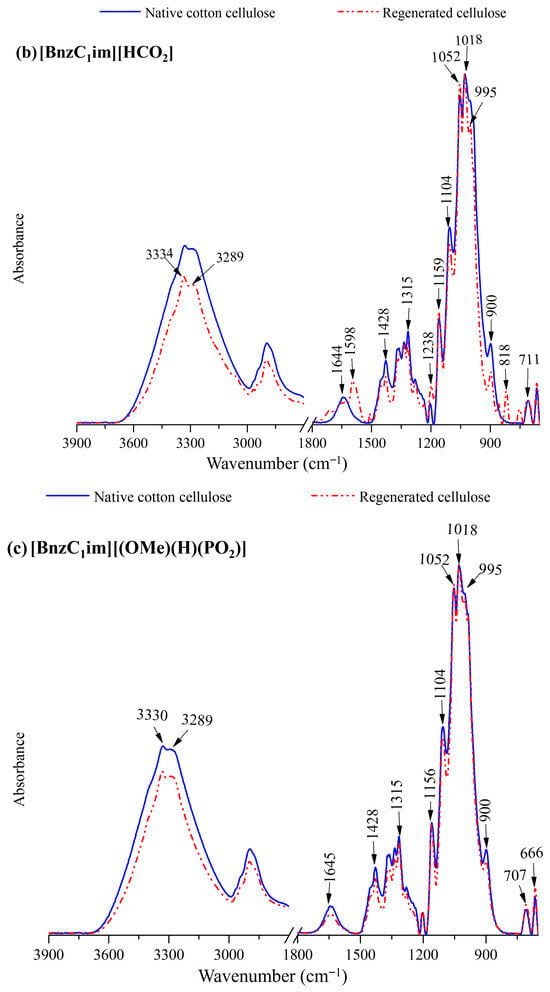
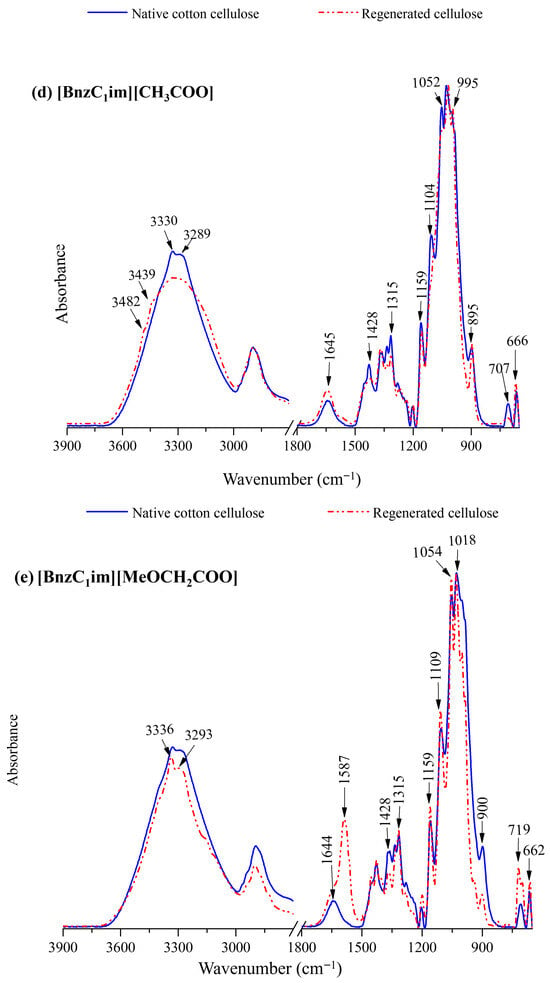
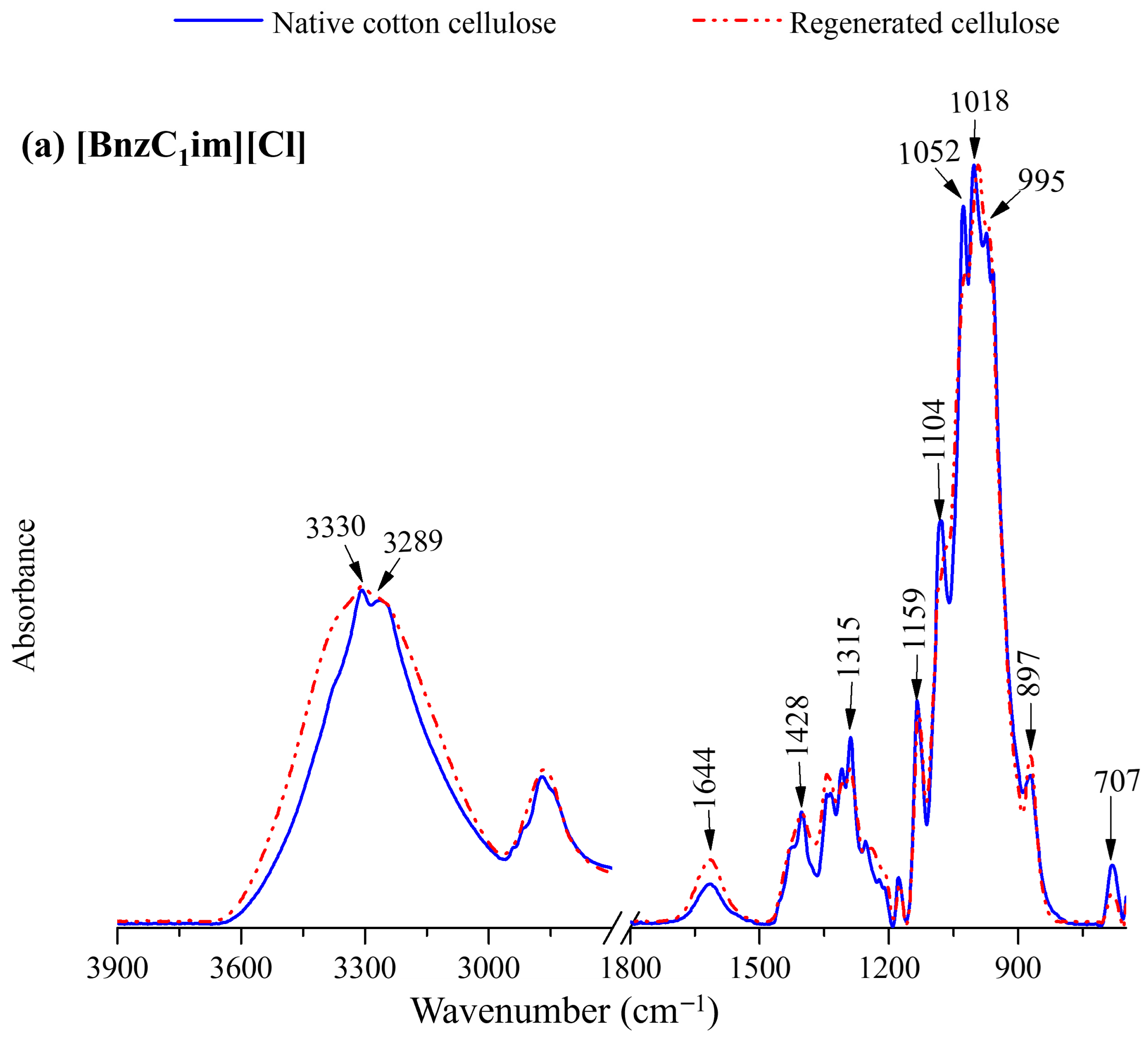
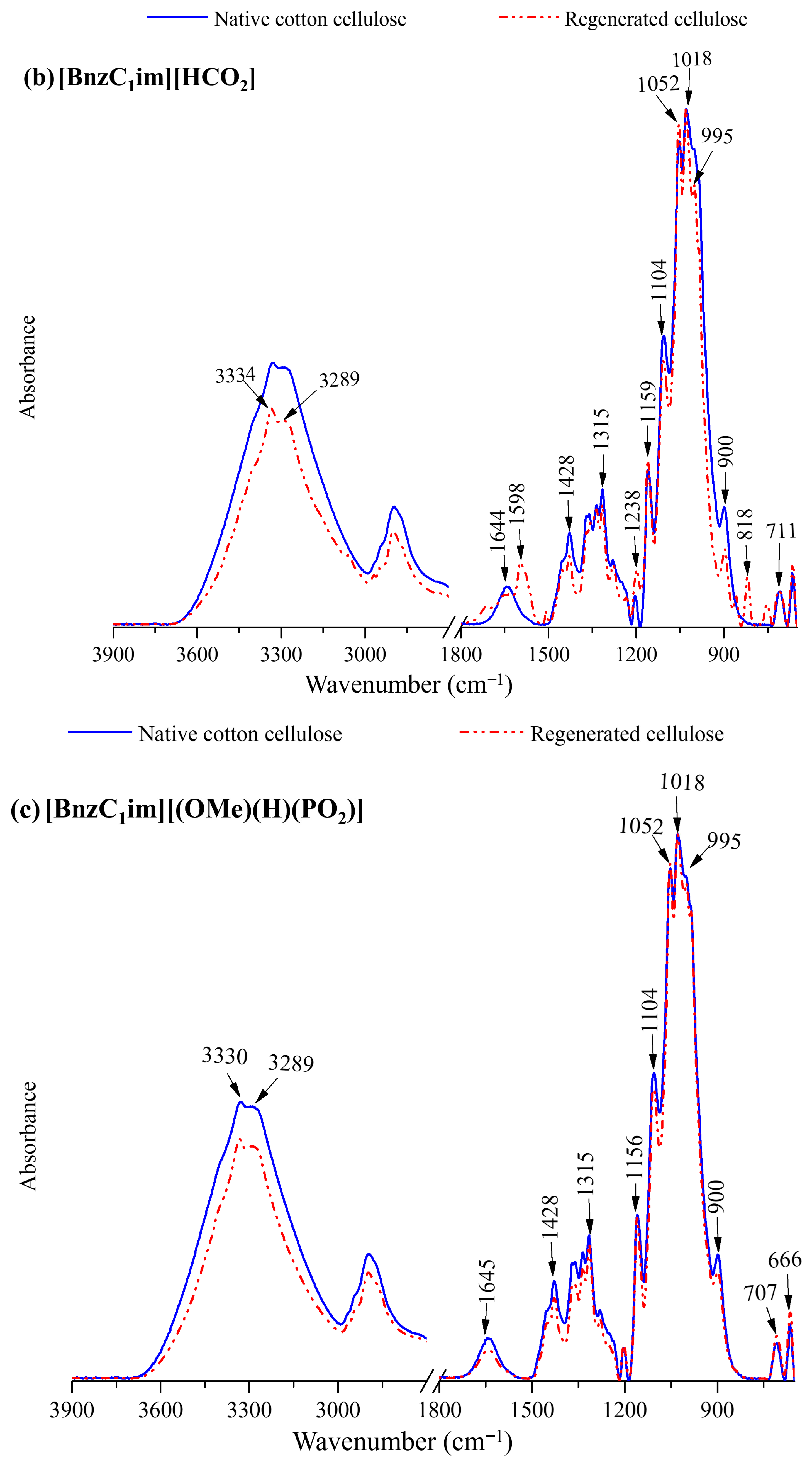
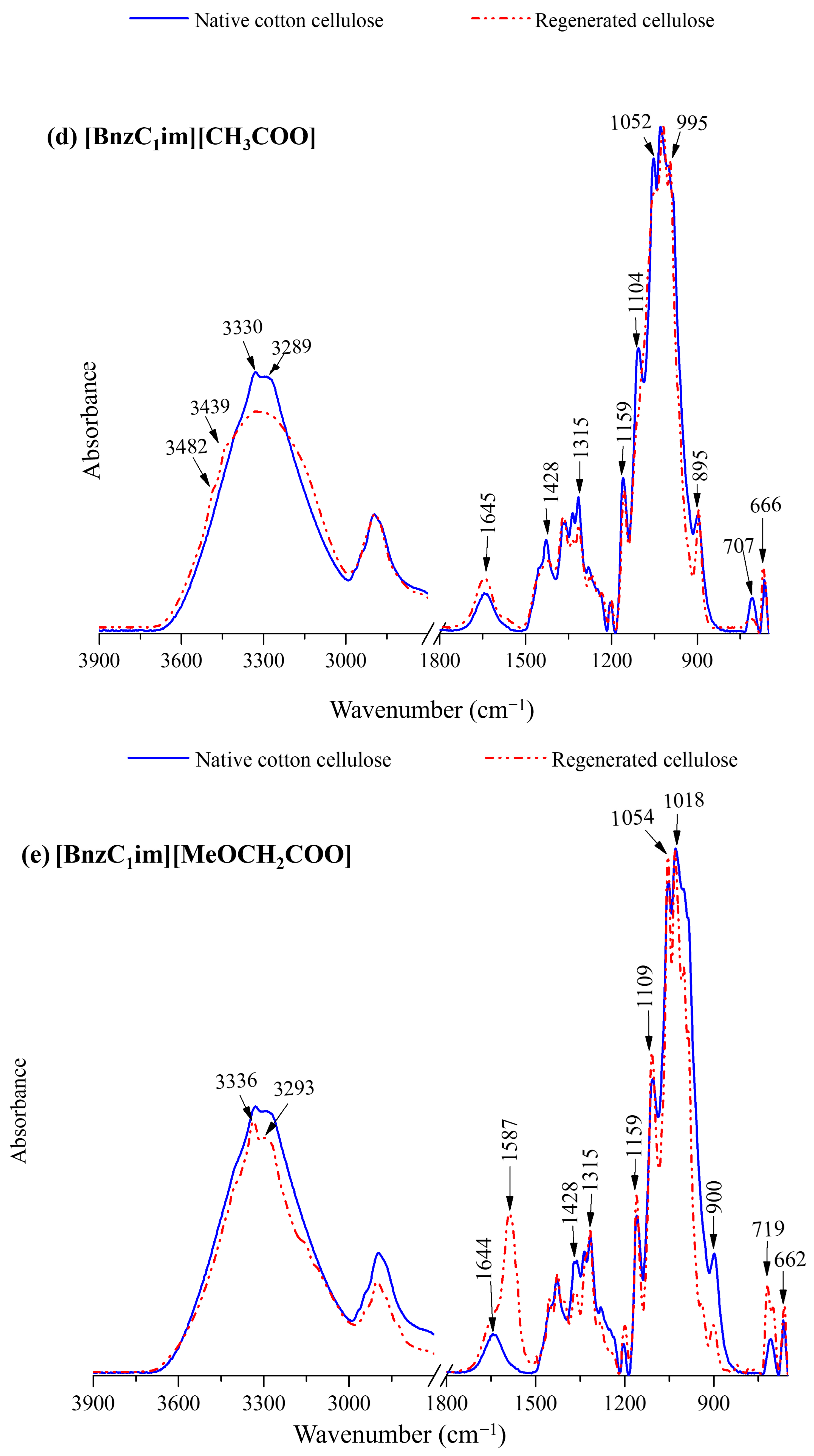
FTIR spectroscopy analyses were performed to investigate changes in the functional groups of native cotton cellulose following dissolution in various ILs and subsequent regeneration in deionized water. FTIR spectra of freeze-dried regenerated cellulose and hot-dried ground cotton fibers are illustrated in Figure 3. FTIR spectra of cellulose dissolved and regenerated from all ILs closely resemble that of native cotton cellulose, indicating that no chemical reactions occurred during dissolution and regeneration processes. However, there are a few changes in the FTIR spectra that were observed for cellulose regenerated, particularly from [BnzC1im][CH3COO] and [BnzC1im][Cl], compared to both hot-dried ground cotton fiber and cellulose regenerated from other ILs. The broad absorption band between 3700 and 3000 cm−1 in native cellulose corresponds to OH-stretching vibrations involved in hydrogen bonding [56]. For regenerated cellulose from [BnzC1im][CH3COO] and [BnzC1im][Cl] (Figure 3a,e), this region appeared broader compared to that of native cellulose. Moreover, two main vibrations, at 3330 cm−1 (intra-molecular hydrogen bonds) and 3289 cm−1 (inter-molecular hydrogen bonds), in the FTIR cellulose regenerated from [BnzC1im][CH3COO] shifted to higher wavenumbers and appeared at 3482 and 3439 cm−1, respectively. These shifts suggest disruption of the native cellulose hydrogen-bonding network during dissolution and regeneration. The vibration at 1428 cm−1 in native cellulose, attributed to CH2 scissoring, which is indicative of crystalline regions, was reduced and shifted to 1422 cm−1 in cellulose regenerated from [BnzC1im][CH3COO], reflecting the disruption of intra-molecular hydrogen bonds at the C6 position [27,56]. The CH2 rocking vibration at 1315 cm−1 and the C-O stretching vibration at 900 cm−1, associated with amorphous regions [57,58], also exhibited increased intensity and slight redshifts in cellulose regenerated from [BnzC1im][CH3COO] and [BnzC1im][Cl], indicating a more amorphous structure relative to native cellulose. The FTIR analysis indicates a complete dissolution of cotton cellulose in [BnzC1im][CH3COO] and a transformation from native cellulose Iβ crystalline structure to cellulose II during the dissolution and regeneration. The changes observed in the vibrations of cellulose regenerated from [BnzC1im][Cl] could be due to the partial dissolution of cotton cellulose in [BnzC1im][Cl], resulting in a mixture of cellulose Iβ and II crystalline structure [59]. In contrast, cellulose regenerated from less effective ILs; [BnzC1im][HCO2], [BnzC1im][(OMe)(H)(PO2)], and [BnzC1im][(OMe)(CH3COO)] showed minimal spectral changes, indicating preservation of the native cellulose Iβ structure. Minor additional peaks in the spectra of cellulose regenerated from [BnzC1im][HCO2] and [BnzC1im][(OMe)(CH3COO)] likely originated from residual ILs that were not completely removed during regeneration.
Figure 3.
FTIR spectra of regenerated cellulose from (a) [BnzC1im][Cl], (b) [BnzC1im][HCO2], (c) [BnzC1im][(OMe)(H)(PO2)], (d) [BnzC1im][CH3COO], and (e) [BnzC1im][MeOCH2COO].
The integrated intensity of the 896 cm−1 band in regenerated cellulose showed a highly significant dependence on the ionic liquid (IL) anion (F = 808.66, p < 0.000001; Table 1). Native cellulose and [BnzC1im][(OMe)(H)(PO2)] exhibited the lowest and statistically similar values (1.06 and 1.07, group a), consistent with limited structural disruption and high crystallinity. A progressive increase in intensity was observed for [Bnzim][MeOCH2COO] (1.83, b) and [Bnzim][HCOO] (2.60, c), indicating increasing amorphization. The highest values were recorded for [Bnzim][Cl] (3.47) and [Bnzim][CH3COO] (4.40), both in group d, reflecting the most effective cellulose dissolution. These trends agree with PLM and SEM results and confirm that the 896 cm−1 band intensity is a reliable indicator of IL dissolution efficiency.
Table 1.
Variance analysis: effect of different ILs in cellulose dissolution on the integrated intensity of the peak 896 cm−1 (I896).
3.4. Kamlet–Taft Beta Parameter
Table 2 summarizes the experimentally determined Kamlet–Taft hydrogen-bond basicity (β) parameters of the investigated ionic liquids, which span a range from 0.72 to 1.05. A clear dependence on anion structure is observed, with [BnzC1im][MeOCH2COO] exhibiting the highest β value (1.05 ± 0.01), followed by acetate (1.01 ± 0.02), phosphonate (0.98 ± 0.01), and formate (0.95 ± 0.01), while chloride shows the lowest basicity (0.72 ± 0.02). This trend is consistent with the increasing electron-donating ability and charge delocalization of the anions, which enhances their hydrogen-bond accepting strength. Such variations in β are known to strongly influence the ability of ionic liquids to disrupt the intermolecular hydrogen-bonding network in cellulose, thereby governing dissolution efficiency, in agreement with previous reports in the literature [60]. The Kamlet–Taft β parameters of the five ILs range from 0.72 to 1.05. Among them, [BnzC1im][OMeCH3COO] exhibits the highest hydrogen-bond basicity, while [BnzC1im][Cl] shows the lowest.
Table 2.
Experimentally determined Kamlet–Taft beta values of ionic liquids.
4. COSMO-RS-Derived Molecular Descriptors and Physicochemical Properties of Ionic Liquids and Electrostatic Potential (Surface Charge Density) Maps
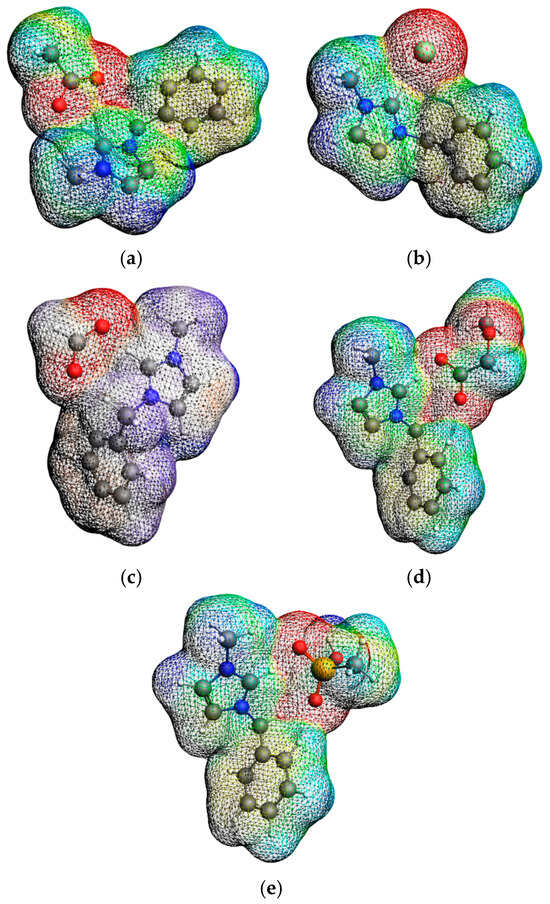
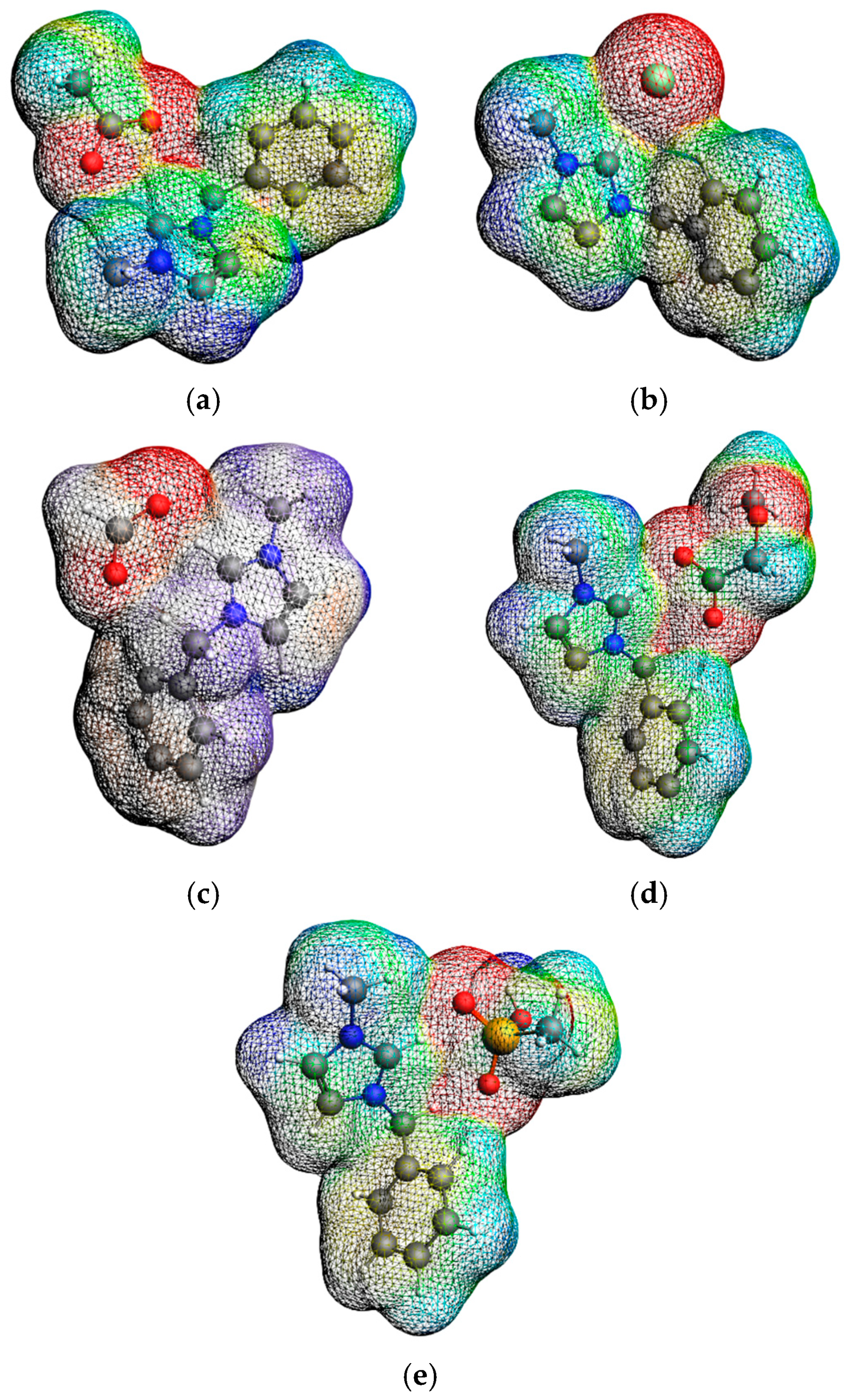
The electrostatic surface charge density maps of the investigated ionic liquids (ILs) provide valuable insight into their ability as hydrogen bond acceptors. As shown in Figure 4, regions of high negative charge (red) correspond to electron-rich sites capable of acting as hydrogen bond acceptors, which play a dominant role in disrupting the extensive hydrogen-bonding network within cellulose. Among the studied systems, the acetate-based IL ([BnzC1im][CH3COO]) exhibits a highly localized and intense negative charge on the oxygen atoms, indicating strong hydrogen bond basicity and a high propensity to interact with hydroxyl groups in cellulose. On the other hand, chloride is showing relatively low hydrogen bond acceptor ability, which is consistent with the experimentally determined hydrogen bond basicity trend. The electrostatic potential (surface charge density) maps are shown below.
Figure 4.
Surface charge density maps of the ionic liquids. (a) Acetate, (b) chloride, (c) formate, (d) methoxy acetate, and (e) phosphonate.
Additionally, the molecular size and physicochemical properties of the investigated ionic liquids were evaluated using the COSMO-RS approach, as shown in Table 3. Key descriptors, including COSMO surface area and COSMO volume, were obtained from quantum chemical calculations and provide a quantitative measure of the effective molecular size of each ionic liquid. These parameters are particularly useful for understanding steric effects and ion–solute interactions. In addition to molecular descriptors, bulk properties such as density and viscosity were included to assess their potential influence on mass transfer and dissolution behavior. The results show a clear increase in both COSMO surface area and volume with increasing anion size, following the trend:
chloride < formate < acetate < methylphosphonate < methoxyacetate
Table 3.
Molecular size and physicochemical properties of the investigated ILs.
5. Discussion
Although hydrogen-bond basicity (β) is widely recognized as a key parameter governing the cellulose dissolution capability of ionic liquids (ILs), the present results suggest that β alone does not fully account for dissolution performance. The measured β values of the synthesized ILs followed the order of [BnzC1im][MeOCH2COO] > [BnzC1im][CH3COO] > [BnzC1im][(OMe)(H)(PO2)] > [BnzC1im][HCO2] > [BnzC1im][Cl], indicating that [BnzC1im][MeOCH2COO] should possess the strongest hydrogen-bond basicity and, consequently, the highest efficiency for dissolving cotton cellulose. However, polarized light microscopy (PLM) observations over time revealed a contrasting trend. ILs such as [BnzC1im][CH3COO], [BnzC1im][Cl], and [BnzC1im][HCOO] exhibited superior dissolution capabilities compared to [BnzC1im][MeOCH2COO]. This discrepancy highlights that cellulose dissolution is a multifaceted process influenced not only by hydrogen-bond basicity but also by additional factors, including anion structure, steric effects, ion–cellulose interactions, and solvent dynamics. In particular, the relatively lower dissolution efficiency of [BnzC1im][MeOCH2COO], despite its higher β value, may be attributed to steric hindrance and reduced accessibility of the anion to cellulose hydroxyl groups. These findings emphasize the importance of considering a combination of physicochemical properties, rather than relying solely on β, when designing ILs for efficient cellulose dissolution.
Additionally, dissolution capacity was measured quantitatively, and the same trend was observed. A known mass of the cellulose–ionic liquid solution was precipitated in excess deionized water, and the regenerated cellulose was collected by vacuum filtration, washed with water and ethanol, dried under vacuum at 80 °C to a constant weight, and quantified gravimetrically; measurements were performed in triplicate, and the amount of dissolved cellulose was calculated as mean ± standard deviation. Among the investigated ionic liquids, [BnzC1im][CH3COO] exhibited the most pronounced cellulose dissolution at 90 °C, despite possessing only the second-highest β value. The superior performance of [BnzC1im][CH3COO] compared to [BnzC1im][MeOCH2COO] can be attributed to the smaller size and higher accessibility of the acetate anion. This structural advantage facilitates more effective interaction with the hydroxyl groups of cellulose and may enable simultaneous binding at multiple sites along the polymer chain. Such dual interaction mechanisms have been previously reported to enhance the disruption of intermolecular hydrogen bonding networks in cellulose, thereby significantly improving its solubility. Consequently, acetate-based ionic liquids demonstrate exceptional solvating capabilities, reinforcing the critical role of anion size and coordination behavior in cellulose dissolution processes. [8,22,61,62]. Additionally, dissolution kinetics are strongly influenced by the viscosity of the ILs [63]. Our findings are in close agreement with the observations reported by Ohno and co-workers, who showed that a higher hydrogen-bond basicity (β) of ionic liquids (ILs) does not necessarily translate into improved cellulose solubility. In their systematic study, microcrystalline cellulose (MCC) was examined in a series of [C2C1im]-based ILs, including [C2C1im][(OMe)(H)PO2] (β = 1.00), [C2C1im][(OMe)(Me)PO2] (β = 1.07), and [C2C1im][(OMe)2PO2] (β = 1.00). Despite the slightly higher β value of [C2C1im][(OMe)(Me)PO2], MCC exhibited greater solubility in [C2C1im][(OMe)(H)PO2]. This apparent discrepancy highlights that hydrogen-bond basicity alone is not the sole determinant of dissolution performance. Instead, physicochemical properties such as viscosity play a crucial role in governing the dissolution process. The lower viscosity of [C2C1im][(OMe)(H)PO2] likely facilitates improved mass transport and more efficient penetration of the solvent into the cellulose matrix, thereby enhancing disruption of the intermolecular hydrogen-bonding network within MCC. In contrast, the relatively higher viscosity of [C2C1im][(OMe)(Me)PO2] may hinder molecular mobility and slow down the dissolution kinetics, offsetting the potential advantage of its higher basicity [29]. These findings reinforce the notion that cellulose dissolution in ILs is governed by a delicate interplay between thermodynamic factors, such as hydrogen-bonding interactions, and kinetic or transport-related properties, including viscosity and diffusivity. Consequently, the design of effective IL solvents for cellulose processing should consider not only hydrogen-bond basicity but also the overall fluidity and transport characteristics of the system. Consistent with this broader framework, the PLM images presented in Figure 1 show that [BnzC1im][Cl] exhibits lower dissolution efficiency than [BnzC1im][CH3COO] but performs more effectively than [BnzC1im][HCOO]. These results align with earlier studies by Zavrel et al. and Zhao et al. [39,61]. Zavrel et al. reported that acetate-based imidazolium ILs dissolve cellulose more efficiently than chloride analogues, owing to the higher hydrogen-bond basicity of acetate. In contrast, Zhao et al. found that [C4C1im][Cl] outperforms [C4C1im][HCOO] at 110 °C, attributing this behavior to the smaller size of the chloride anion relative to formate [62]. Previous studies have further established that chloride is more effective than bromide or iodide for cellulose dissolution due to its smaller thermochemical radius and stronger coordinating ability [38,64]. Taken together, these results suggest that, despite possessing the lowest hydrogen-bond basicity among the ILs investigated, [BnzC1im][Cl] remains an effective solvent for cellulose. While other anions exhibit higher basicity, their larger size and associated steric hindrance can limit their ability to penetrate the dense, crystalline structure of cellulose. In contrast, the small, highly polar chloride anion can more readily access the intermolecular spaces between cellulose chains and effectively disrupt both inter- and intramolecular hydrogen bonds. Moreover, chloride ions tend to form comparatively weaker ion pairs with the cation, increasing the availability of free anions to interact with cellulose hydroxyl groups. In addition to viscosity and anion characteristics, IL density has also been identified as an important parameter influencing dissolution efficiency. ILs with lower densities generally require higher hydrogen-bond basicity to achieve effective cellulose dissolution, whereas ILs with moderate β values can still perform well if their density is sufficiently high [30]. In this context, 1-benzyl-3-methylimidazolium chloride emerges as one of the most effective ILs studied, as it combines relatively high density with low viscosity, as predicted by COSMO-RS. Its high density reflects strong intermolecular interactions and favorable solvation capacity, while its low viscosity promotes efficient mass transport. This balance between interaction strength and fluidity ultimately enhances its overall dissolution performance relative to the other ILs examined.
The IL [BnzC1im][HCOO] exhibited greater cellulose dissolution capacity compared to [BnzC1im][MeOCH2COO] and [BnzC1im][(OMe)(H)(PO)2], despite the latter possessing higher hydrogen-bond basicity. This enhanced performance can be attributed to the smaller size of the formate anion (HCOO−), which enables more effective penetration into the compact cellulose structure and facilitates disruption of its hydrogen-bonding network. These observations further confirm that although hydrogen-bond basicity is an important factor influencing cellulose dissolution, it cannot be considered the sole determinant of dissolution efficiency. Instead, the process is governed by a complex interplay of multiple physicochemical properties, including ion size, polarity, viscosity, density, and the nature of intermolecular interactions within the system. Together, these factors influence solvent–solute interactions, mass transport, and the overall thermodynamic and kinetic aspects of dissolution. Consequently, the rational design of ionic liquids (ILs) for cellulose processing should not rely on hydrogen-bond basicity alone as a predictive parameter. Rather, a comprehensive, systems-level approach is required—one that considers the combined effects of molecular structure and macroscopic properties. Such a holistic strategy will enable the development of more efficient ILs with optimized performance, ultimately advancing sustainable biomass processing and the design of next-generation cellulose-based materials.
6. Conclusions
In summary, this study demonstrates that hydrogen-bond basicity alone is insufficient to fully describe or predict cellulose dissolution in 1-benzyl-3-methylimidazolium-based ionic liquids. While acetate-based systems, with near-optimal hydrogen-bond basicity, exhibit superior performance, the notable effectiveness of chloride-based ILs highlights the critical role of complementary physicochemical properties. In particular, a smaller anion size, reduced steric hindrance, and greater availability of free ions significantly enhance the ability of the solvent to penetrate and disrupt the hydrogen-bonding network of cellulose. Moreover, macroscopic properties such as viscosity and density play a decisive role in governing dissolution kinetics by influencing mass transport and solvent accessibility. ILs that combine favorable interaction strength with high fluidity are better suited to facilitate efficient cellulose dissolution. These findings emphasize that the dissolution process is governed by a complex interplay between thermodynamic interactions and transport-related factors, rather than a single dominant parameter. Therefore, the rational design of ionic liquids for cellulose processing requires an integrated, systems-level approach that simultaneously considers hydrogen-bonding capability, ion size, ion-pairing behavior, steric effects, and transport properties. By adopting this comprehensive framework, it becomes possible to more effectively tailor IL structures for enhanced performance, thereby advancing the development of efficient, sustainable solvents for biomass processing and next-generation cellulose-based materials.
Supplementary Materials
The following supporting information can be downloaded at: https://www.mdpi.com/article/10.3390/fib14050052/s1, Figure S1: FTRI spectrum of 1-methyl-3-benzylimidazolium formate; Figure S2: FTRI spectrum of 1-methyl-3-benzylimidazolium acetate; Figure S3: FTRI spectrum of 1-methyl-3-benzylimidazolium methoxyacetate; Figure S4: Photographs of synthesized ILs (a) 1-benzyl-3-methylimidazoleum Chloride, (b) 1-benzyl-3-methylimidazoleum acetate, (c) 1-benzyl-3-methylimidazoleum formate, (d) 1-benzyl-3-methylimidazoleum methoxyacetate, (e) 1-benzyl-3-methylimidazoleum methylphosphonate.
Author Contributions
The authors contributed equally. Conceptualization, methodology, and resources, N.A. and E.L.Q.; investigation and data curation, N.D. and V.D.T.; original draft preparation, N.D. and V.D.T.; review and editing, N.A.; simulation studies, Z.Z. All authors have read and agreed to the published version of the manuscript.
Funding
This research was funded by Texas Tech University-BASF Project Revolution and MCNeese state university endowed professorship grants.
Data Availability Statement
The original contributions presented in this study are included in the article/Supplementary Material. Further inquiries can be directed to the corresponding authors.
Acknowledgments
The authors gratefully acknowledge Texas Tech University and McNeese State University for their support of this work.
Conflicts of Interest
The authors declare no conflicts of interest.
References
- Rogers, R.D.; Seddon, K.R. Ionic Liquids—Solvents of the Future? Science 2003, 302, 792–793. [Google Scholar] [CrossRef] [Scilit]
- Seddon, K.R. Ionic liquids for clean technology. J. Chem. Technol. Biotechnol. 1997, 68, 351–356. [Google Scholar] [CrossRef] [Scilit]
- Viswanathan, G.; Murugesan, S.; Pushparaj, V.; Nalamasu, O.; Ajayan, P.M.; Linhardt, R.J. Preparation of biopolymer fibers by electrospinning from room temperature ionic liquids. Biomacromolecules 2006, 7, 415–418. [Google Scholar] [CrossRef] [Scilit]
- Meli, L.; Miao, J.; Dordick, J.S.; Linhardt, R.J. Electrospinning from room temperature ionic liquids for biopolymer fiber formation. Green Chem. 2010, 12, 1883–1892. [Google Scholar] [CrossRef] [Scilit]
- Gericke, M.; Liebert, T.; Seoud, O.A.E.; Heinze, T. Tailored media for homogeneous cellulose chemistry: Ionic liquid/co-solvent mixtures. Macromol. Mater. Eng. 2011, 296, 483–493. [Google Scholar] [CrossRef] [Scilit]
- Gericke, M.; Fardim, P.; Heinze, T. Ionic Liquids—Promising but Challenging Solvents for Homogeneous Derivatization of Cellulose. Molecules 2012, 17, 7458–7502. [Google Scholar] [CrossRef] [Scilit] [PubMed]
- Heinze, T.; Schwikal, K.; Barthel, S. Ionic liquids as reaction medium in cellulose functionalization. Macromol. Biosci. 2005, 5, 520–525. [Google Scholar] [CrossRef] [Scilit] [PubMed]
- Kosan, B.; Michels, C.; Meister, F. Dissolution and forming of cellulose with ionic liquids. Cellulose 2008, 15, 59–66. [Google Scholar] [CrossRef] [Scilit]
- Fort, D.A.; Remsing, R.C.; Swatloski, R.P.; Moyna, P.; Moyna, G.; Rogers, R.D. Can ionic liquids dissolve wood? Processing and analysis of lignocellulosic materials with 1-n-butyl-3-methylimidazolium chloride. Green Chem. 2007, 9, 63–69. [Google Scholar] [CrossRef] [Scilit]
- Froschauer, C.; Hummel, M.; Iakovlev, M.; Roselli, A.; Schottenberger, H.; Sixta, H. Separation of hemicellulose and cellulose from wood pulp by means of ionic liquid/cosolvent systems. Biomacromolecules 2013, 14, 1741–1750. [Google Scholar] [CrossRef] [Scilit]
- Kilpeläinen, I.; Xie, H.; King, A.; Granstrom, M.; Heikkinen, S.; Argyropoulos, D.S. Dissolution of Wood in Ionic Liquids. J. Agric. Food Chem. 2007, 55, 9142–9148. [Google Scholar] [CrossRef] [Scilit]
- Sun, N.; Rahman, M.; Qin, Y.; Maxim, M.L.; Rodríguez, H.; Rogers, R.D. Complete dissolution and partial delignification of wood in the ionic liquid 1-ethyl-3-methylimidazolium acetate. Green Chem. 2009, 11, 646–655. [Google Scholar] [CrossRef] [Scilit]
- Youngs, T.G.A.; Holbrey, J.D.; Deetlefs, M.; Nieuwenhuyzen, M.; Costa Gomes, M.F.; Hardacre, C. A molecular dynamics study of glucose solvation in the ionic liquid 1,3-dimethylimidazolium chloride. ChemPhysChem 2006, 7, 2279–2281. [Google Scholar] [CrossRef] [Scilit] [PubMed]
- Youngs, T.G.A.; Hardacre, C.; Holbrey, J.D. Glucose solvation by the ionic liquid 1,3-dimethylimidazolium chloride: A simulation study. J. Phys. Chem. B 2007, 111, 13765–13774. [Google Scholar] [CrossRef] [Scilit] [PubMed]
- Youngs, T.G.A.; Holbrey, J.D.; Mullan, C.L.; Norman, S.E.; Lagunas, M.C.; D’Agostino, C.; Mantle, M.D.; Gladden, L.F.; Bowron, D.T.; Hardacre, C. Neutron diffraction, NMR and molecular dynamics study of glucose dissolved in the ionic liquid 1-ethyl-3-methylimidazolium acetate. Chem. Sci. 2011, 2, 1594–1605. [Google Scholar] [CrossRef] [Scilit]
- Remsing, R.C.; Swatloski, R.P.; Rogers, R.D.; Moyna, G. Mechanism of cellulose dissolution in the ionic liquid 1-n-butyl-3-methylimidazolium chloride: A 13C and 35/37Cl NMR relaxation study on model systems. Chem. Commun. 2006, 12, 1271–1273. [Google Scholar] [CrossRef] [Scilit]
- Remsing, R.C.; Hernandez, G.; Swatloski, R.P.; Massefski, W.W.; Rogers, R.D.; Moyna, G. Solvation of Carbohydrates in N, N′-Dialkylimidazolium Ionic Liquids: A Multinuclear NMR Spectroscopy Study. J. Phys. Chem. B 2008, 112, 11071–11078. [Google Scholar] [CrossRef] [Scilit]
- Zhang, J.; Zhang, H.; Wu, J.; Zhang, J.; He, J.; Xiang, J. NMR spectroscopic studies of cellobiose solvation in EmimAc aimed to understand the dissolution mechanism of cellulose in ionic liquids. Phys. Chem. Chem. Phys. 2010, 12, 1941–1947. [Google Scholar] [CrossRef] [Scilit] [PubMed]
- Gupta, K.M.; Hu, Z.; Jiang, J. Mechanistic understanding of interactions between cellulose and ionic liquids: A molecular simulation study. Polymer 2011, 52, 5904–5911. [Google Scholar] [CrossRef] [Scilit]
- Olsson, C.; Westman, G. Direct Dissolution of Cellulose: Background, Means and Applications. In Cellulose—Fundamental Aspects; InTech: Sydney, Australia, 2013; pp. 143–178. [Google Scholar] [CrossRef] [Scilit]
- Lu, B.; Xu, A.; Wang, J. Cation does matter: How cationic structure affects the dissolution of cellulose in ionic liquids. Green Chem. 2014, 16, 1326–1335. [Google Scholar] [CrossRef] [Scilit]
- Rabideau, B.D.; Agarwal, A.; Ismail, A.E. The role of the cation in the solvation of cellulose by imidazolium-based ionic liquids. J. Phys. Chem. B 2014, 118, 1621–1629. [Google Scholar] [CrossRef] [Scilit]
- Li, Y.; Liu, X.; Zhang, S.; Yao, Y.; Yao, X.; Xu, J.; Lu, X. Dissolving process of a cellulose bunch in ionic liquids: A molecular dynamics study. Phys. Chem. Chem. Phys. 2015, 17, 17894–17905. [Google Scholar] [CrossRef] [Scilit]
- Li, Y.; Wang, J.; Liu, X.; Zhang, S. Towards a molecular understanding of cellulose dissolution in ionic liquids: Anion/cation effect, synergistic mechanism and physicochemical aspects. Chem. Sci. 2018, 9, 4027–4043. [Google Scholar] [CrossRef] [Scilit] [PubMed]
- Payal, R.S.; Bejagam, K.K.; Mondal, A.; Balasubramanian, S. Dissolution of cellulose in room temperature ionic liquids: Anion dependence. J. Phys. Chem. B 2015, 119, 1654–1659. [Google Scholar] [CrossRef] [Scilit]
- Dissanayake, N.; Thalangamaarachchige, V.D.; Troxell, S.; Quitevis, E.L.; Abidi, N. Substituent effects on cellulose dissolution in imidazolium-based ionic liquids. Cellulose 2018, 25, 6887–6900. [Google Scholar] [CrossRef] [Scilit]
- Zhang, H.; Wu, J.; Zhang, J.; He, J. 1-allyl-3-methylimidazolium chloride room temperature ionic liquid: A new and powerful nonderivatizing solvent for cellulose. Macromolecules 2005, 38, 8272–8277. [Google Scholar] [CrossRef] [Scilit]
- Ohno, H.; Fukaya, Y. Task Specific Ionic Liquids for Cellulose Technology. Chem. Lett. 2009, 38, 2–7. [Google Scholar] [CrossRef] [Scilit]
- Fukaya, Y.; Hayashi, K.; Wada, M.; Ohno, H. Cellulose dissolution with polar ionic liquids under mild conditions: Required factors for anions. Green Chem. 2008, 10, 44–46. [Google Scholar] [CrossRef] [Scilit]
- Abe, M.; Kuroda, K.; Sato, D.; Kunimura, H.; Ohno, H. Effects of polarity, hydrophobicity, and density of ionic liquids on cellulose solubility. Phys. Chem. Chem. Phys. 2015, 17, 32276–32282. [Google Scholar] [CrossRef] [Scilit]
- Poole, C.F. Chromatographic and spectroscopic methods for the determination of solvent properties of room temperature ionic liquids. J. Chromatogr. A 2004, 1037, 49–82. [Google Scholar] [CrossRef] [Scilit] [PubMed]
- Zhang, H.; Xu, Y.; Li, Y.; Lu, Z.; Cao, S.; Fan, M.; Huang, L.; Chen, L. Facile cellulose dissolution and characterization in the newly synthesized 1,3-diallyl-2-ethylimidazolium acetate ionic liquid. Polymers 2017, 9, 526. [Google Scholar] [CrossRef] [Scilit] [PubMed]
- Rein, D.M.; Khalfin, R.; Szekely, N.; Cohen, Y. True molecular solutions of natural cellulose in the binary ionic liquid-containing solvent mixtures. Carbohydr. Polym. 2014, 112, 125–133. [Google Scholar] [CrossRef] [Scilit]
- Kamlet, M.J.; Taft, R.W. The Solvatochromic Comparison Method. I. The β-Scale Of Solvent Hydrogen-Bond Acceptor (HBA) Basicities. J. Am. Chem. Soc. 1976, 98, 377–383. [Google Scholar] [CrossRef] [Scilit]
- Taft, R.W.; Kamlet, M.J. The Solvatochromic Comparison Method. 2. The α-Scale of Solvent Hydrogen-Bond Donor (HBD) Acidities. J. Am. Chem. Soc. 1976, 98, 2886–2894. [Google Scholar] [CrossRef] [Scilit]
- Eyckens, D.J.; Demir, B.; Walsh, T.R.; Welton, T.; Henderson, L.C. Determination of Kamlet-Taft parameters for selected solvate ionic liquids. Phys. Chem. Chem. Phys. 2016, 18, 13153–13157. [Google Scholar] [CrossRef] [Scilit] [PubMed]
- Xu, A.; Wang, J.; Wang, H. Effects of anionic structure and lithium salts addition on the dissolution of cellulose in 1-butyl-3-methylimidazolium-based ionic liquid solvent systems. Green Chem. 2010, 12, 268–275. [Google Scholar] [CrossRef] [Scilit]
- Swatloski, R.P.; Spear, S.K.; Holbrey, J.D.; Rogers, R.D. Dissolution of cellose with ionic liquids. J. Am. Chem. Soc. 2002, 124, 4974–4975. [Google Scholar] [CrossRef] [Scilit]
- Zavrel, M.; Bross, D.; Funke, M.; Büchs, J.; Spiess, A.C. High-throughput screening for ionic liquids dissolving (ligno-)cellulose. Bioresour. Technol. 2009, 100, 2580–2587. [Google Scholar] [CrossRef] [Scilit]
- Wang, H.; Gurau, G.; Rogers, R.D. Ionic liquid processing of cellulose. Chem. Soc. Rev. 2012, 41, 1519–1537. [Google Scholar] [CrossRef] [Scilit]
- Li, Y.; Liu, X.; Zhang, Y.; Jiang, K.; Wang, J.; Zhang, S. Why Only Ionic Liquids with Unsaturated Heterocyclic Cations Can Dissolve Cellulose: A Simulation Study. ACS Sustain. Chem. Eng. 2017, 5, 3417–3428. [Google Scholar] [CrossRef] [Scilit]
- Fukaya, Y.; Sugimoto, A.; Ohno, H. Superior solubility of polysaccharides in low viscosity, polar and halogen-free 1,3-dialkylimidazolium formates. Biomacromolecules 2006, 7, 3295–3297. [Google Scholar] [CrossRef] [Scilit] [PubMed]
- Kahlen, J.; Masuch, K.; Leonhard, K. Modelling cellulose solubilities in ionic liquids using COSMO-RS. Green Chem. 2010, 12, 2172–2181. [Google Scholar] [CrossRef] [Scilit]
- Chu, Y.; Zhang, X.; Hillestad, M.; He, X. Computational prediction of cellulose solubilities in ionic liquids based on COSMO-RS. Fluid Phase Equilibria 2018, 475, 25–36. [Google Scholar] [CrossRef] [Scilit]
- Mohan, M.; Simmons, B.A.; Sale, K.L.; Singh, S. Multiscale molecular simulations for the solvation of lignin in ionic liquids. Sci. Rep. 2023, 13, 271. [Google Scholar] [CrossRef] [Scilit] [PubMed]
- Li, X.; Gao, H.; Zhou, L.; Nie, Y. Screening ionic liquids by the COSMO-RS method for the preparation of antibacterial cellulose fibers. ACS Sustain. Chem. Eng. 2021, 9, 15525–15536. [Google Scholar] [CrossRef] [Scilit]
- Pedersen, J.N.; Pérez, B.; Guo, Z. Stability of cellulase in ionic liquids: Correlations between enzyme activity and COSMO-RS descriptors. Sci. Rep. 2019, 9, 17479. [Google Scholar] [CrossRef] [Scilit] [PubMed]
- Zhao, J.; Zhou, G.; Fang, T.; Ying, S.; Liu, X. Screening ionic liquids for dissolving hemicellulose by COSMO-RS based on the selective model. RSC Adv. 2022, 12, 16517–16529. [Google Scholar] [CrossRef] [Scilit] [PubMed]
- Haron, G.A.S.; Mahmood, H.; Noh, M.H.B.; Moniruzzaman, M. Ionic liquid assisted nanocellulose production from microcrystalline cellulose: Correlation between cellulose solubility and nanocellulose yield via COSMO-RS prediction. J. Mol. Liq. 2022, 368, 120591. [Google Scholar] [CrossRef] [Scilit]
- Lv, Y.; Jia, W.; Cai, H.; Ma, L.; Zhang, Y.; Chen, M.; Sun, C.; Zhao, X. Study on the dissolution and recovery mechanism of bacterial cellulose by green ionic liquid designed based on COSMO-RS. Food Chem. 2026, 506, 148195. [Google Scholar] [CrossRef] [Scilit]
- Liu, Y.-R.; Thomsen, K.; Nie, Y.; Zhang, S.-J.; Meyer, A.S. Predictive screening of ionic liquids for dissolving cellulose and experimental verification. Green Chem. 2016, 18, 6246–6254. [Google Scholar] [CrossRef] [Scilit]
- Thakurathi, M.; Gurung, E.; Cetin, M.M.; Thalangamaarachchige, V.D.; Mayer, M.F.; Korzeniewski, C.; Quitevis, E.L. The Stokes-Einstein equation and the diffusion of ferrocene in imidazolium-based ionic liquids studied by cyclic voltammetry: Effects of cation ion symmetry and alkyl chain length. Electrochim. Acta 2018, 259, 245–252. [Google Scholar] [CrossRef] [Scilit]
- Egal, M.; Budtova, T.; Navard, P. The dissolution of microcrystalline cellulose in sodium hydroxide-urea aqueous solutions. Cellulose 2008, 15, 361–370. [Google Scholar] [CrossRef] [Scilit]
- Varma, R.S.; Namboodiri, V.V. An expeditious solvent-free route to ionic liquids using microwaves. Chem. Commun. 2001, 7, 643–644. [Google Scholar] [CrossRef] [Scilit]
- Robinson, P.C.; Bradbury, S. Qualitative Polarized-Light Microscopy; Oxford University Press: Oxford, UK, 1992; Volume 9. [Google Scholar]
- Abidi, N.; Cabrales, L.; Haigler, C.H. Changes in the cell wall and cellulose content of developing cotton fibers investigated by FTIR spectroscopy. Carbohydr. Polym. 2014, 100, 9–16. [Google Scholar] [CrossRef] [Scilit] [PubMed]
- Schwanninger, M.; Rodrigues, J.C.; Pereira, H.; Hinterstoisser, B. Effects of short-time vibratory ball milling on the shape of FT-IR spectra of wood and cellulose. Vib. Spectrosc. 2004, 36, 23–40. [Google Scholar] [CrossRef] [Scilit]
- Alonso-Simón, A.; García-Angulo, P.; Mélida, H.; Encina, A.; Álvarez, J.M.; Acebes, J.L. The use of FTIR spectroscopy to monitor modifications in plant cell wall architecture caused by cellulose biosynthesis inhibitors. Plant Signal. Behav. 2011, 6, 1104–1110. [Google Scholar] [CrossRef] [Scilit] [PubMed]
- Oh, S.Y.; Yoo, D.I.; Shin, Y.; Kim, H.C.; Kim, H.Y.; Chung, Y.S.; Park, W.H.; Youk, J.H. Crystalline structure analysis of cellulose treated with sodium hydroxide and carbon dioxide by means of X-ray diffraction and FTIR spectroscopy. Carbohydr. Res. 2005, 340, 2376–2391. [Google Scholar] [CrossRef] [Scilit]
- Welton, T. Room-temperature ionic liquids. Solvents for synthesis and catalysis. Chem. Rev. 1999, 99, 2071–2084. [Google Scholar] [CrossRef] [Scilit]
- Zhao, H.; Baker, G.A.; Song, Z.; Olubajo, O.; Crittle, T.; Peters, D. Designing enzyme-compatible ionic liquids that can dissolve carbohydrates. Green Chem. 2008, 10, 696–705. [Google Scholar] [CrossRef] [Scilit]
- Vitz, J.; Erdmenger, T.; Haensch, C.; Schubert, U.S. Extended dissolution studies of cellulose in imidazolium based ionic liquids. Green Chem. 2009, 11, 417–424. [Google Scholar] [CrossRef] [Scilit]
- Green, S.M.; Ries, M.E.; Moffat, J.; Budtova, T. NMR and Rheological Study of Anion Size Influence on the Properties of Two Imidazolium-based Ionic Liquids. Sci. Rep. 2017, 7, 8968. [Google Scholar] [CrossRef] [Scilit]
- Mäki-Arvela, P.; Anugwom, I.; Virtanen, P.; Sjöholm, R.; Mikkola, J.P. Dissolution of lignocellulosic materials and its constituents using ionic liquids-A review. Ind. Crops Prod. 2010, 32, 175–201. [Google Scholar] [CrossRef] [Scilit]

Disclaimer/Publisher’s Note: The statements, opinions and data contained in all publications are solely those of the individual author(s) and contributor(s) and not of MDPI and/or the editor(s). MDPI and/or the editor(s) disclaim responsibility for any injury to people or property resulting from any ideas, methods, instructions or products referred to in the content. |
© 2026 by the authors. Licensee MDPI, Basel, Switzerland. This article is an open access article distributed under the terms and conditions of the Creative Commons Attribution (CC BY) license.