


Abstract
The stable crosslinked structure of glass-fiber-reinforced epoxy composites in end-of-life wind turbine blades complicates their recycling and reuse. Mechanically ground blade powder can be incorporated into new epoxy systems, but its heterogeneous surface composition and limited compatibility with the matrix restrict its reinforcing efficiency. In this study, sequential NaOH activation and KH560 treatment were used to regulate the surface characteristics of recycled wind-turbine-blade powder. FTIR and direct powder XPS measurements revealed changes in the hydroxylated silicate environment and the introduction of KH560-associated organic and organosilicon surface species. Representative SEM observations showed greater resin attachment and a more integrated local powder-matrix morphology after sequential treatment. At a fixed recycled-powder loading of 40 phr, corresponding to approximately 28.4 wt% of the total uncured mixture, EP-KH560 achieved mean flexural and tensile strengths of 67.00 and 38.81 MPa, respectively. These values were 47.8% and 57.1% higher than those of the composite containing untreated powder. Under the fixed formulation and processing conditions investigated, the results demonstrate that sequential NaOH/KH560 treatment improves the interfacial compatibility and comparative mechanical performance of recycled wind-turbine-blade powder/epoxy composites.
1. Introduction
Wind energy has become one of the most important renewable energy technologies for reducing fossil energy consumption and carbon emissions. With the rapid growth of wind power installation, a large number of early wind turbines are approaching the end of their designed service life. Wind turbine blades are generally designed for long-term service under complex mechanical, thermal, ultraviolet, and humid environments. Therefore, they are mainly manufactured from glass-fiber-reinforced thermosetting polymer composites, especially glass fiber/epoxy composites, because these materials possess high specific strength, good fatigue resistance, excellent corrosion resistance, and dimensional stability [1,2,3]. However, the same crosslinked network that gives wind turbine blades their long service life also makes them difficult to recycle after retirement. It has been estimated that global wind turbine blade waste may reach tens of millions of tons by 2050, which makes the end-of-life management of blade composites an urgent environmental and industrial problem [4,5,6].
At present, the main disposal routes for retired wind turbine blades include landfilling, incineration, co-processing in cement kilns, mechanical recycling, thermal recycling, and chemical recycling [7,8,9,10]. Landfilling and incineration are simple but lead to resource loss and possible environmental risks. Thermal and chemical recycling can recover fibers or resin-derived products, but these methods often require high temperature, high pressure, organic solvents, catalysts, or complex separation processes, which limits their large-scale application [11,12,13,14]. In comparison, mechanical recycling is more practical. It converts waste blades into fiber-rich or resin-rich powders through cutting, crushing, and milling. The obtained powders can be used as fillers or secondary reinforcements in polymers, cementitious materials, asphalt, or other construction materials [15,16,17]. However, mechanical recycling is still regarded as a low-value route in many cases, because the recycled powders usually show irregular particle size, damaged fiber morphology, low surface activity, and poor compatibility with new polymer matrices [18,19,20]. For polymer composites, the interface between the filler and the resin matrix determines stress transfer, crack propagation, and final mechanical performance. Recycled wind turbine blade powder is a complex hybrid material composed of residual glass fibers, cured epoxy fragments, and inorganic silica-rich surfaces. When it is directly introduced into an epoxy matrix, weak interfacial adhesion can easily cause filler agglomeration, interfacial debonding, fiber pull-out, and premature crack growth. These defects reduce the reinforcing efficiency of recycled powder and limit their utilization at high loadings [21,22,23]. Therefore, the key scientific challenge is not only how to reuse the blade powder, but also how to rebuild an effective interface between the recycled thermoset composite powder and the new epoxy network.
Surface chemical modification provides a feasible route to solve this problem. Alkali treatment can etch the glass fiber surface and expose more silanol groups, which increases the surface polarity and provides reactive sites for subsequent coupling reactions [24,25]. Silane coupling agents are widely used to improve the interfacial adhesion between inorganic fillers and polymer matrices. Their hydrolyzable alkoxy groups can form Si-OH groups and further condense with hydroxyl groups on glass or silica surfaces to form Si-O-Si bonds. Meanwhile, their organic functional groups can interact or react with polymer chains, forming an organic–inorganic interfacial bridge [26,27,28,29]. Among them, 3-glycidyloxypropyltrimethoxysilane, also known as KH560, is especially suitable for epoxy systems because it contains both hydrolyzable silane groups and reactive epoxy groups. This bifunctional molecular structure allows KH560 to anchor onto hydroxylated glass-rich surfaces through siloxane condensation, while its glycidyl group may participate in, or become compatible with, the epoxy curing network, thereby promoting the formation of a strongly coupled organic–inorganic interphase [30,31,32,33]. Alkali activation and silane coupling are established approaches for modifying glass-fiber-containing materials. Previous studies have incorporated mechanically recycled wind-turbine-blade materials into thermoplastic matrices and evaluated the effects of silane and polymeric coupling agents on the interfacial compatibility and mechanical properties of the resulting composites [19]. The present study addresses a different material combination by introducing mechanically ground, heterogeneous blade powder into a thermosetting epoxy matrix composed of bisphenol F diglycidyl ether and sorbitol polyglycidyl ether. The use of FRP-0, FRP-NaOH, and sequentially treated FRP-KH560 at an identical loading of 40 phr enables a controlled comparison of the progressive surface-treatment effects under the same thermoset formulation and curing conditions. This matrix-specific comparison constitutes the principal scientific contribution of the study.
The objective of this study was to evaluate how sequential alkali and KH560 treatments affect the surface characteristics and compatibility of mechanically recycled wind-turbine-blade powder in a thermosetting epoxy matrix. The study specifically compared cleaned but chemically untreated powder, NaOH-treated powder, and sequentially NaOH/KH560-treated powder at an identical loading of 40 phr to determine the progressive effects of surface treatment on the flexural and tensile strengths of the resulting composites. The distinguishing feature of this work is the controlled application of this treatment sequence to a heterogeneous recycled blade powder incorporated into a bisphenol F diglycidyl ether/sorbitol polyglycidyl ether thermosetting system, in contrast to recent studies focused predominantly on thermoplastic matrices and orientation-assisted processing. This comparison provides a matrix-specific assessment of surface-treated recycled blade powder within a newly cured epoxy network.
2. Experimental Section
2.1. Materials
End-of-life wind-turbine-blade powder was supplied by Jinan Apollo Wood Plastic Composite Materials Co., Ltd., Jinan, China. According to the supplier’s batch documentation, the material was mechanically crushed from glass-fiber-reinforced epoxy blade waste. Its classification as an epoxy-based blade recyclate in this study was therefore based on the supplied batch information. The cleaned material was treated as a heterogeneous glass-fiber/resin powder containing silicate glass-fiber-rich particles and cured polymer fragments. After cleaning, the FRP-0 powder exhibited a volume-based particle-size distribution of approximately 0.36–200 μm. The characteristic particle diameters were D10 = 4.074 μm, D50 = 33.233 μm and D90 = 101.403 μm, while D[3,2] and D[4,3] were 8.869 and 44.953 μm, respectively. The complete particle-size distribution is provided in Figure S1.
Anhydrous ethanol, sodium hydroxide (NaOH, ≥99.5%), and distilled water were purchased from Sinopharm Chemical Reagent Co., Ltd., Shanghai, China. Methyl tetrahydrophthalic anhydride (MTHPA, ≥99%), 2-ethyl-4-methylimidazole (2E4MI, ≥99%), bisphenol F diglycidyl ether (BFDGE), sorbitol polyglycidyl ether (SPGE), and 3-glycidyloxypropyltrimethoxysilane (KH560, ≥97%) were purchased from Shanghai Macklin Biochemical Co., Ltd., Shanghai, China. All chemicals were used as received unless otherwise stated.
2.2. Preparation of Cleaned Wind Turbine Blade Powder
A batch of 5 g of the as-received wind turbine blade powder was dispersed in 50 mL of anhydrous ethanol, corresponding to a powder-to-ethanol ratio of 0.1 g mL−1. The suspension was ultrasonically treated for 10 min and then centrifuged at 600 rpm for 3 min. After removal of the supernatant, the collected sediment was redispersed in 50 mL of fresh anhydrous ethanol. The washing–centrifugation procedure was performed a total of 3 cycles. After the final cycle, the collected powder was dried in an air-circulating oven at 80 °C for 24 h and gently mixed every 2 h to promote uniform drying. The cleaned powder was denoted as FRP-0.
2.3. Alkali Activation of Wind Turbine Blade Powder
2.5 mL of NaOH (20 mol/L) was added to 200 mL of anhydrous ethanol to prepare the alkaline treatment medium. Subsequently, 10 g of FRP-0 powder was added. The suspension was treated at 50 °C for 1 h under mechanical stirring at 300 rpm. After treatment, the suspension was centrifuged at 600 rpm for 3 min, and the supernatant was removed. The recovered powder was then washed with 100 mL of distilled water per cycle and centrifuged under the same conditions. The washing procedure was repeated 3 times until the pH of the final supernatant reached 7, indicating that residual alkali and soluble reaction products had been removed. The washed powder was dried in an air-circulating oven at 80 °C for 24 h and denoted as FRP-NaOH. To facilitate comparison between direct silanization and sequential NaOH–KH560 treatment, a control sample designated as FRP-0/KH560 was prepared by applying the KH560-treatment procedure directly to dried FRP-0 powder without prior NaOH activation.
2.4. Silane Modification of Wind Turbine Blade Powder
For each modification batch, 20.0 g of dried FRP-NaOH powder and 1.0 g of KH560 were used. FRP-KH560 was prepared by applying KH560 treatment to FRP-NaOH as the second step of the sequential NaOH–KH560 surface-modification procedure. The KH560 dosage was 5.0 wt% relative to the dry mass of FRP-NaOH, corresponding to a KH560-to-powder mass ratio of 0.05:1. Two drops of 0.1 mol L−1 aqueous H2SO4 solution, with a combined volume of approximately 0.10 mL, were added to 100 mL of ethanol under stirring to establish an acidic ethanol/water medium. Subsequently, 1.0 g of KH560 was added to the acidic medium. The mixture was heated under atmospheric reflux for 1 h using an external heating bath maintained at 90 °C. The reaction vessel was equipped with a water-cooled condenser, and no external pressure was applied. Under these conditions, the ethanol-rich liquid phase refluxed at approximately 78–80 °C.
After the prehydrolyzed KH560 solution had cooled to room temperature, 1.0 mL of 20 mol L−1 aqueous NaOH solution was added over approximately 1 min. Immediately thereafter, 20.0 g of dried FRP-NaOH powder was introduced into the solution. The suspension was stirred at room temperature for 30 min at 500 rpm to promote the interaction and condensation of the hydrolyzed silane species with the powder surface. After treatment, the powder was collected by centrifugation at 4000 rpm for 3 min. The recovered powder was washed three times with 100 mL of ethanol per cycle and then three times with 100 mL of distilled water per cycle. Centrifugation at 4000 rpm was performed after each washing cycle. The washed powder was dried in an air-circulating oven at 80 °C for 24 h and denoted as FRP-KH560.
For the direct-silanization control, 20.0 g of dried FRP-0 powder was subjected to the same KH560 prehydrolysis, alkaline-condensation, centrifugation, washing, and drying procedures, without the preceding NaOH-activation step. The resulting powder was denoted as FRP-0/KH560. The nominal active-reagent input for the NaOH-activation stage was 2.00 g of NaOH per 10.0 g of FRP-0, corresponding to 20.0 wt% relative to the dry powder mass. During the KH560-treatment stage, 1.0 mL of 20 mol L−1 aqueous NaOH provided 0.80 g of NaOH per 20.0 g of powder, corresponding to 4.0 wt%, while the KH560 input was 1.00 g per 20.0 g of powder, corresponding to 5.0 wt%. Approximately 0.10 mL of 0.1 mol L−1 aqueous H2SO4 was used during prehydrolysis. These values represent nominal reagent inputs rather than net chemical consumption.
2.5. Preparation of Recycled Powder/Epoxy Composites
The epoxy matrix was prepared from sorbitol polyglycidyl ether (SPGE) and bisphenol F diglycidyl ether (BFDGE). SPGE is a commercial reaction-product mixture and therefore does not possess a unique molecular weight or fixed epoxy functionality. Its specified epoxy value was 0.52–0.63 eq per 100 g, corresponding to an EEW range of 158.73–192.31 g eq−1. The midpoint epoxy value of 0.575 eq per 100 g, corresponding to a nominal EEW of 173.91 g eq−1, was used for the stoichiometric calculation. BFDGE contains two epoxy groups and has a theoretical EEW of 156.18 g eq−1. MTHPA contains one anhydride group and has a theoretical AEW of 166.17 g eq−1.
A typical matrix formulation consisted of 17.3 g of SPGE, 28.5 g of BFDGE, 54.2 g of MTHPA, and 1.0 g of 2E4MI. The 17.3 g of SPGE and 28.5 g of BFDGE provided nominally 0.0995 and 0.1825 epoxy equivalents, respectively, giving a total epoxy content of 0.2820 eq. The 54.2 g of MTHPA provided 0.3262 anhydride equivalents. The nominal anhydride-to-epoxy equivalent ratio was therefore approximately 1.16:1. The same matrix formulation and equivalent ratio were used for EP-0, EP-NaOH, EP-0/KH560 and EP-KH560. The complete experimental workflow for recycled-powder cleaning, NaOH activation, direct and sequential KH560 treatment, and epoxy-composite fabrication, together with a schematic representation of the corresponding powder-surface evolution, is provided in Figure S2.
Five groups of specimens were prepared using the same epoxy formulation and curing procedure. Neat epoxy without recycled powder was denoted as EP. The composite containing untreated recycled powder was denoted as EP-0. The composite containing NaOH-treated powder was denoted as EP-NaOH. An additional composite was prepared using recycled powder directly modified with KH560 without prior NaOH treatment and was denoted as EP-0/KH560. The composite containing sequentially NaOH-activated and KH560-modified powder was denoted as EP-KH560. The powder content of all powder-containing composites was maintained at approximately 40 phr, corresponding to 28.4 wt% of the total uncured mixture. The recycled powder was gradually added into the epoxy resin under mechanical stirring to achieve homogeneous dispersion. After complete mixing, the composite mixture was subjected to vacuum degassing to reduce entrapped air before casting. The mixture was then transferred into a pretreated mold with a release agent and cured at 100 °C for 5 h. All composite formulations were processed using the same procedure to ensure comparable processing history and minimize the influence of processing-induced variations. After cooling to room temperature, the cured samples were demolded. The composites prepared with FRP-0, FRP-NaOH, FRP-0/KH560 and FRP-KH560 were denoted as EP-0, EP-NaOH, EP-0/KH560 and EP-KH560, respectively. The specimens for flexural testing, scanning electron microscopy, and X-ray photoelectron spectroscopy were cut into dimensions of 80 mm × 15 mm × 4 mm, 20 mm × 20 mm × 5 mm, and 80 mm × 10 mm × 4 mm, respectively. Tensile specimens were prepared using a dumbbell-shaped mold with a thickness of 2 mm. The specimens had an overall length of 75 mm, an overall shoulder width of 10 mm, a reduced-section width of 5 mm, a gauge length of 30 mm, a distance of 58 mm between the indicated shoulder reference positions, and a transition radius of 30 mm. The complete specimen geometry is illustrated in Figure S3. Mechanical testing was used to evaluate the effect of powder surface treatment on the properties of the recycled-powder/epoxy composites. The same matrix formulation, powder loading, processing procedure, and nominal curing schedule were applied to the corresponding comparison groups to provide a consistent basis for the mechanical evaluation.
2.6. Characterization
Fourier transform infrared spectroscopy was used to analyze the chemical structure of the recycled powders before and after surface modification. The spectra of FRP-0, FRP-NaOH, and FRP-KH560 were recorded using a Nicolet iS10 Fourier transform infrared (FTIR) spectrometer (Thermo Fisher Scientific, Waltham, MA, USA). The scanning range was 4000–500 cm−1. The characteristic absorption peaks of Si-O-Si, Si-OH, Si-C, C-H, and C-O-C groups were analyzed to evaluate the surface chemical changes in the powders. The volume-based particle-size distributions of FRP-0, FRP-NaOH, and FRP-KH560 were measured by laser diffraction under identical dispersion and measurement conditions (Figure S1). The powders were dispersed in ethanol before measurement. The particle and dispersant refractive indices were set to 1.520 and 1.360, respectively, and the absorption index was set to 0.1. The distributions were measured over an equivalent particle-diameter range of 0.020–2000 μm. The characteristic particle diameters D10, D50, and D90 were obtained from the cumulative volume distributions. Because the recycled powders contained irregular particles and short glass-fiber fragments, the laser-diffraction results are reported as equivalent spherical diameters and are not interpreted as direct fiber-length measurements. The fracture morphologies of the epoxy composites were observed using a QUANTA 250 FEG scanning electron microscope (Thermo Fisher Scientific, Waltham, MA, USA). The samples were fractured before observation to expose the internal morphology. The fracture surfaces were used to evaluate fiber pull-out, interfacial debonding, resin coverage, and powder–matrix adhesion. Before SEM observation, the sample surfaces were sputter-coated with a thin conductive layer to reduce charging. The flexural and tensile strengths of EP, EP-0, EP-NaOH, EP-0/KH560, and EP-KH560 were evaluated using a WDW-50 kN universal testing machine (Jinan Hensgrand Instrument, Jinan, China). The specimen geometry and three-point-bending configuration were based on ASTM D790-17 [34], and the loading rate was 2 mm min−1. Three valid flexural specimens were tested for each formulation. The tensile-specimen geometry and loading procedure were based on ASTM D638, and the loading rate was 1 mm min−1. Four valid tensile specimens were tested for each formulation. The results are reported as mean ± standard deviation. X-ray photoelectron spectroscopy was performed using an ESCALAB 250Xi spectrometer (Thermo Fisher Scientific, Waltham, MA, USA) with Al Kα radiation at a photon energy of 1486.6 eV. The binding-energy scale was referenced to the C 1s C–C/C–H component at 284.8 eV. Survey and high-resolution C 1s, O 1s, and Si 2p spectra were collected from the outer surfaces of the cured EP-0, EP-NaOH, and EP-KH560 composites. Additional high-resolution C 1s, O 1s, and Si 2p spectra were collected directly from FRP-0 and FRP-KH560 powders. Peak-envelope analysis was performed using Avantage software (version 5.9917, Thermo Fisher Scientific, Waltham, MA, USA). The spectra were interpreted comparatively in terms of overlapping carbon-, oxygen-, and silicon-containing chemical environments.
3. Results and Discussion
3.1. Surface Chemical Evolution of Recycled Wind Turbine Blade Powder
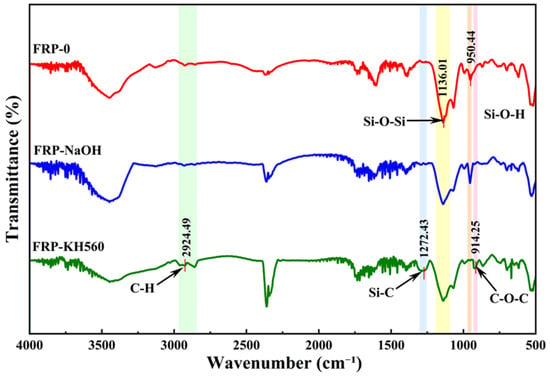
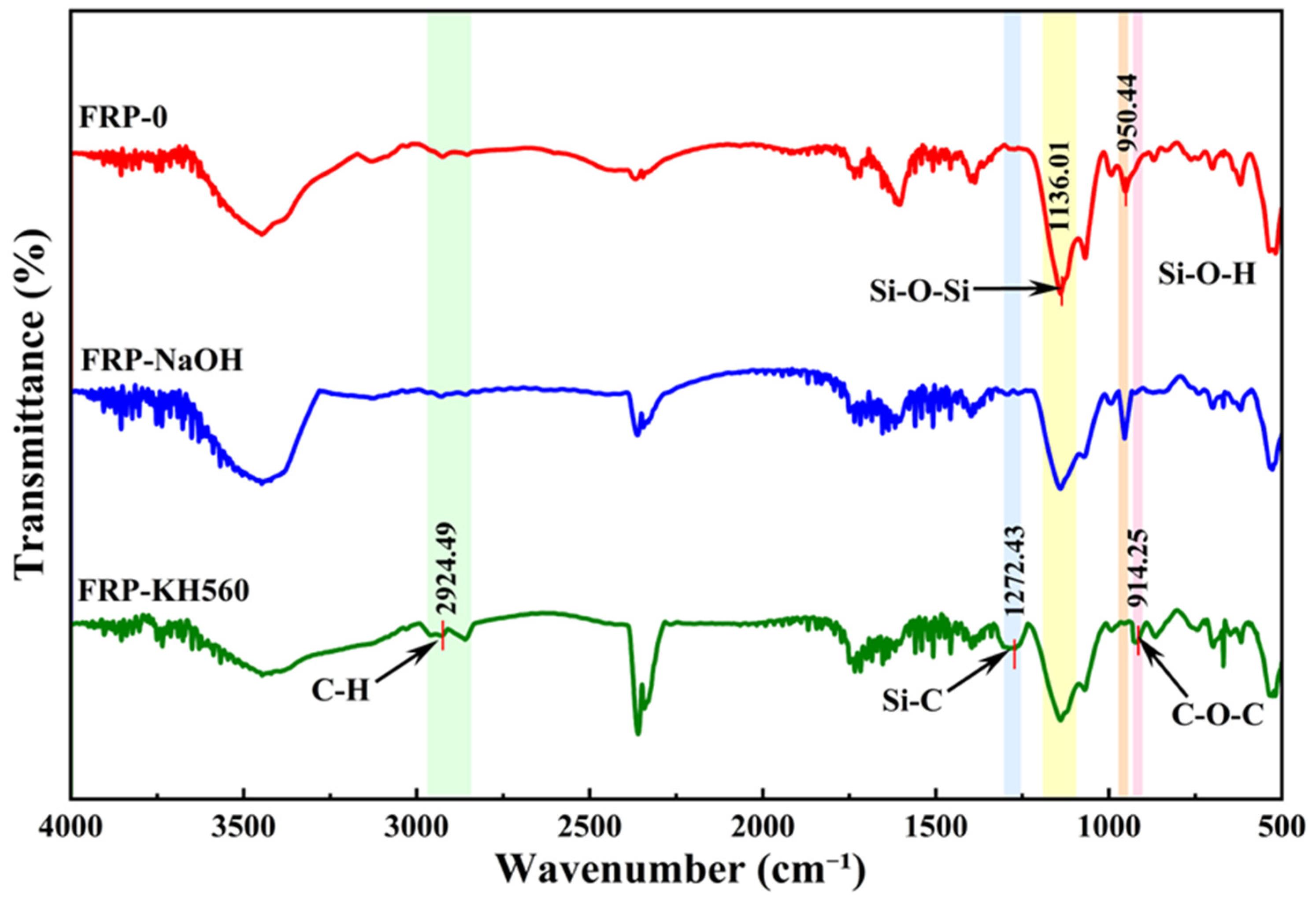
Figure 1 presents the FTIR spectra of the different samples, revealing the changes in characteristic functional groups after surface modification. The spectrum of FRP-0 exhibited a broad band centered near 1136 cm−1. In heterogeneous glass-fiber/epoxy materials, the region from approximately 900 to 1200 cm−1 contains overlapping contributions from asymmetric Si–O–Si stretching vibrations in the silicate glass and siloxane phases, as well as C–O and C–O–C stretching vibrations from residual epoxy resin and fiber-sizing components [35,36]. Therefore, the band near 1136 cm−1 was regarded as a silicate/siloxane-dominated composite band rather than a unique indicator of newly formed Si–O–Si bonds. The feature near 950 cm−1 may contain contributions from surface Si–OH and non-bridging Si–O groups [35,36]. Its relative increase after NaOH treatment is consistent with a change toward a more hydroxylated silicate surface environment. However, owing to the overlap of vibrations from the different blade components, this band cannot be used as a quantitative or exclusive measure of surface silanol groups. After KH560 treatment, changes were observed near 1136 and 950 cm−1, together with bands near 2924, 1272, and 914 cm−1. The band near 2924 cm−1 can be attributed mainly to the C–H stretching vibrations of the organic propyl and glycidyl groups. The band near 914 cm−1 is consistent with the characteristic vibration of the glycidyl/oxirane group of KH560 [35,36]. The band near 1272 cm−1 may contain contributions from organosilane-associated Si–C/Si–CH2 vibrations, but it may also overlap with C–O–C and C–H deformation vibrations from residual epoxy resin and fiber-sizing components [35,36]. Collectively, the FTIR results support the introduction of KH560-associated organic groups and modification of the silicate/siloxane surface environment.
Figure 1.
FTIR spectra of FRP-0, FRP-NaOH, and FRP-KH560 powders.
To directly examine the surface chemical changes in the recycled powder, high-resolution XPS spectra were additionally collected from FRP-0 and FRP-KH560 powders (Figure S4). The C 1s spectra showed a redistribution toward the C–O/C–O–C environment after sequential treatment, while the O 1s and Si 2p envelopes exhibited corresponding changes in their collective oxygen- and silicon-containing surface environments. Because the binding-energy ranges of silicate, siloxane, hydroxylated silicon, and organosilicon species overlap substantially, these spectral changes are interpreted qualitatively and are not assigned to a uniquely resolved Si–O–C bond. Together with the FTIR results, the direct powder XPS comparison supports the introduction of KH560-associated organic and organosilicon surface environments after sequential treatment.
3.2. Interfacial Morphology
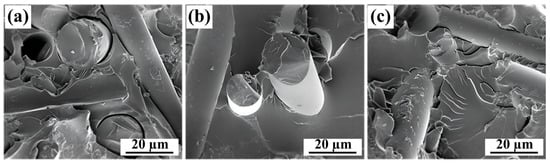
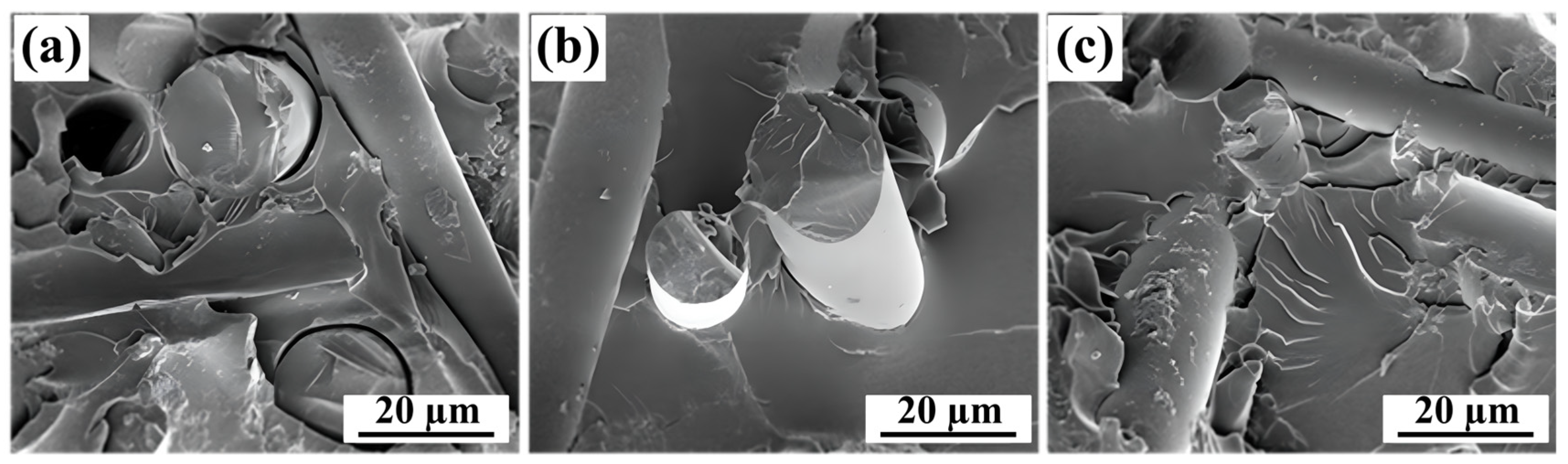
Representative fracture-surface regions of EP-0, EP-NaOH, and EP-KH560 were examined by SEM to qualitatively compare their local powder–matrix interfacial morphologies (Figure 2). Because the images represent selected microscopic fields, they are not used to quantify the overall powder dispersion or to establish a statistically general change in the composite failure mechanism. In the representative EP-0 region, exposed glass-fiber fragments and local gaps can be observed between the fibers and the surrounding matrix. The exposed fiber surfaces are relatively smooth, with little resin remaining on them. These features indicate weak interfacial adhesion between the untreated recycled powder and the epoxy matrix. Under external loading, the interface acts as the preferred crack propagation path, causing interfacial debonding and fiber pull-out before effective stress transfer can occur. In the representative EP-NaOH region, the fracture surface appears comparatively compact, with less evident fiber pull-out and some resin residues remaining on the exposed fiber surfaces. This suggests that alkali activation improves the interfacial wetting and bonding between the powder and the resin. The improvement is mainly attributed to the partial etching of the glass fiber surface and the generation of more Si–OH groups, which increase surface roughness, polarity, and hydrogen-bonding sites. However, local interfacial defects are still present, indicating that NaOH treatment mainly enhances secondary interactions rather than forming a strong chemical bridge. In the representative EP-KH560 region, the interface appears comparatively integrated, and portions of the exposed fiber and powder surfaces remain covered by epoxy resin. The observed fracture surface is also relatively rough and tortuous. These local morphological features are consistent with improved powder–matrix wetting and interfacial adhesion after KH560 modification. The morphological differences observed after KH560 treatment may be associated with improved wetting and compatibility between the recycled powder and the epoxy matrix. Although silane coupling can potentially promote interactions between the hydroxylated glass-rich surface and the organic resin, the SEM images themselves do not identify the chemical nature of the interfacial bonding. The possible participation of the KH560 glycidyl groups in the curing network is chemically plausible but remains an inferred mechanism under the present experimental conditions. Compared with the representative EP-0 region, the selected EP-KH560 region shows less evident local interfacial separation and greater resin attachment to the recycled powder surface. These features qualitatively support the improved interfacial adhesion inferred from the mechanical results. However, the available SEM images alone are insufficient to establish a general transition in the failure mechanism or to quantitatively determine the bulk void content, fiber pull-out density, particle dispersion, or interfacial resin coverage throughout the composites.
Figure 2.
Representative SEM images of selected fracture-surface regions of the recycled powder/epoxy composites: (a) EP-0, (b) EP-NaOH, and (c) EP-KH560.
3.3. Flexural Strength and Interfacial Reinforcement Mechanism
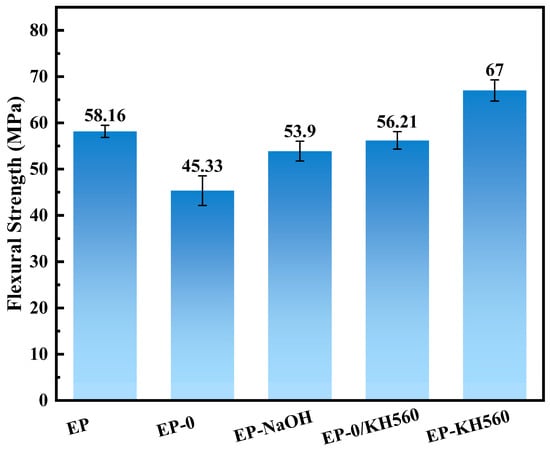
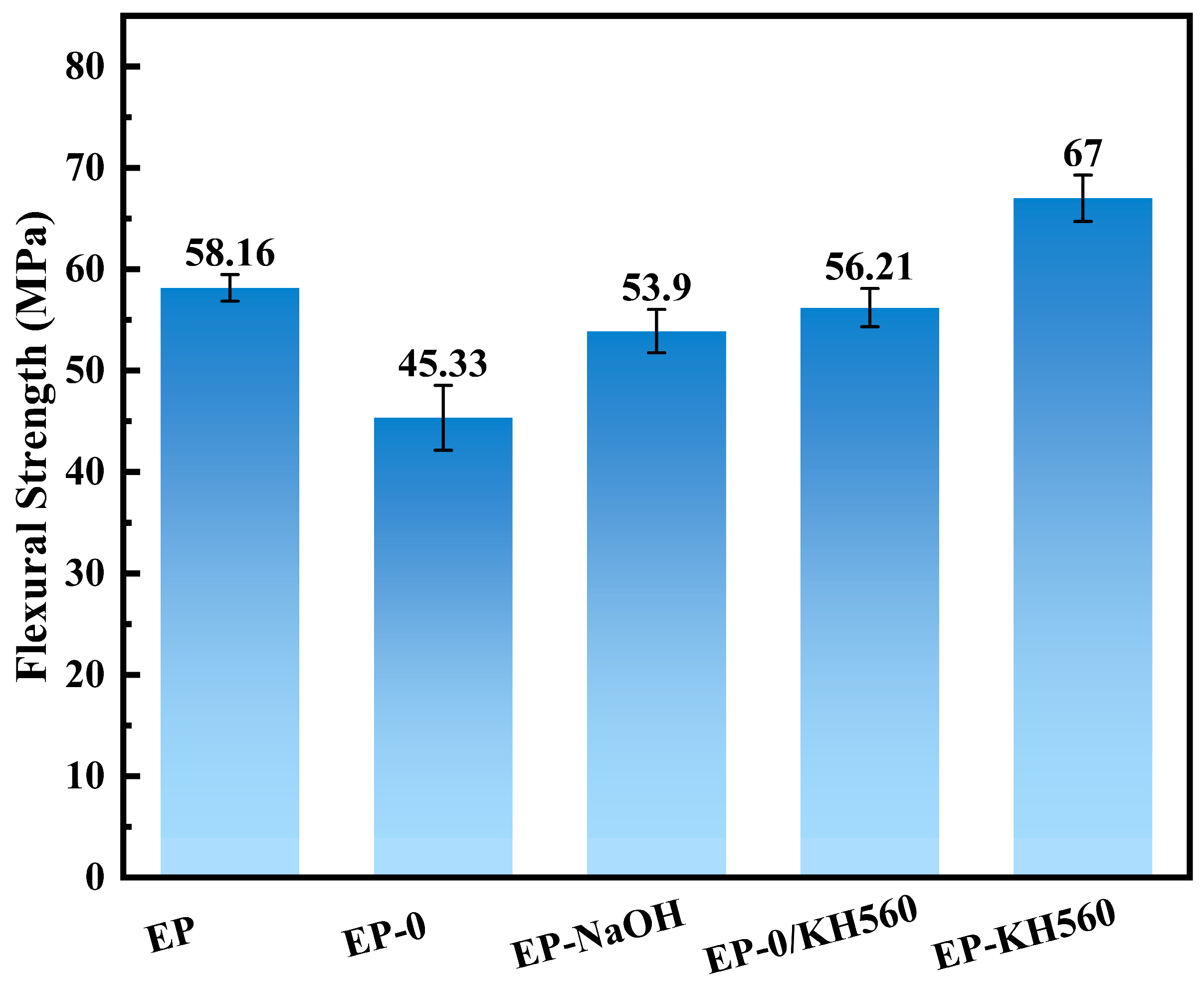
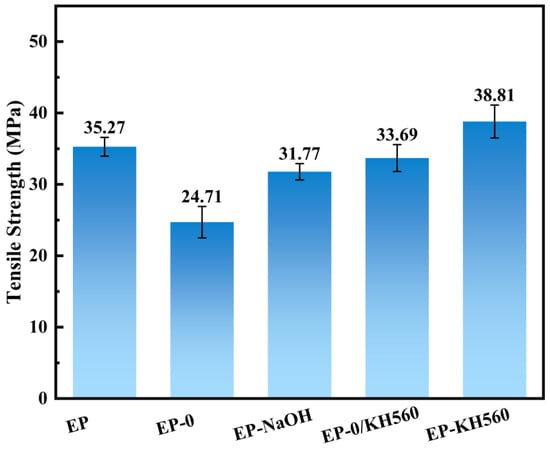
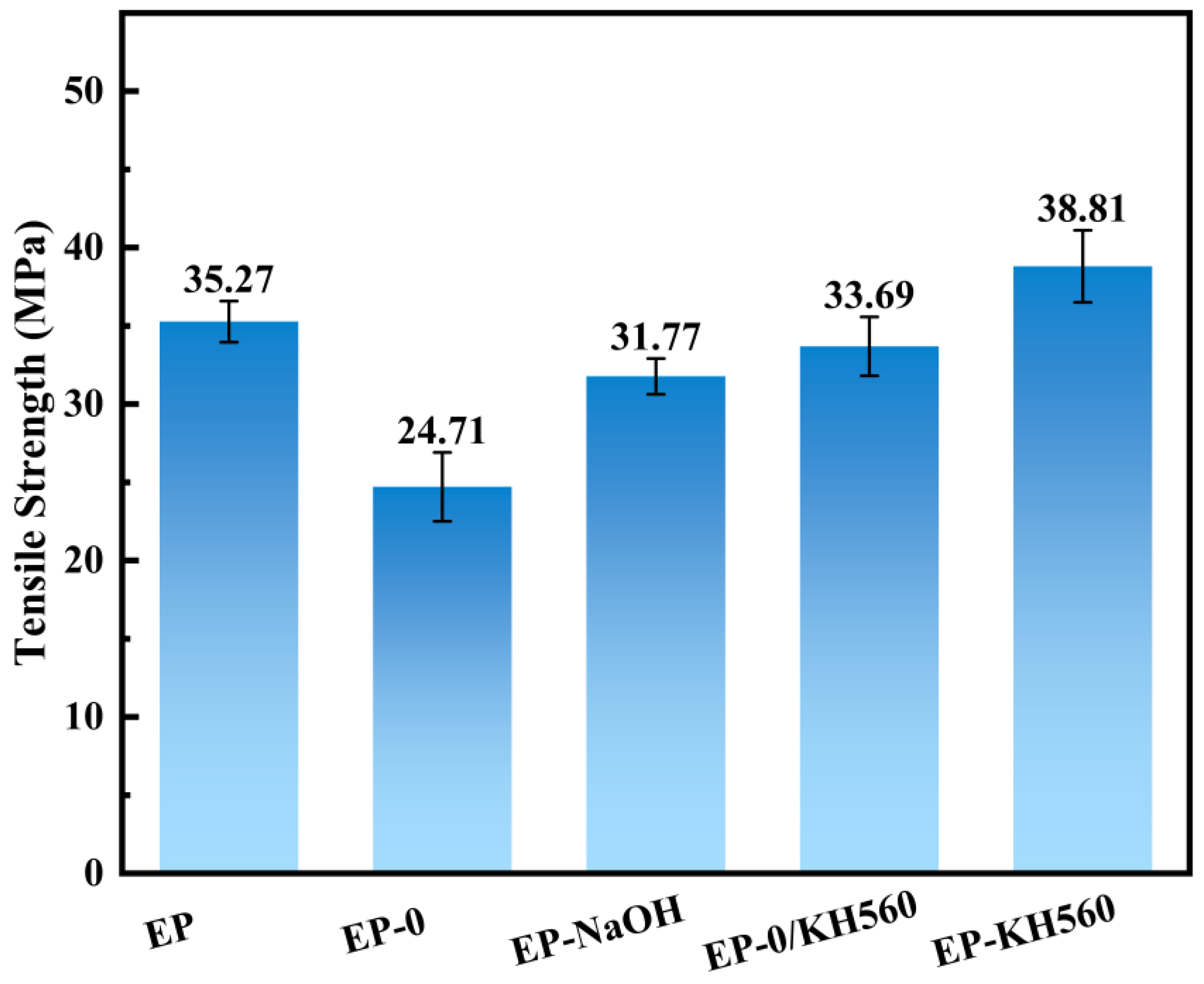
The mechanical properties of EP, EP-0, EP-NaOH, EP-0/KH560, and EP-KH560 are compared in Figure 3 and Figure 4. The comparison between EP and EP-0 evaluates the influence of recycled-powder incorporation. The comparison between EP-0 and EP-NaOH reflects the effect of NaOH activation, while that between EP-0 and EP-0/KH560 evaluates the effect of direct KH560 modification. Comparison of EP-0/KH560 with EP-KH560 further distinguishes the contribution of NaOH pretreatment before KH560 modification.
Figure 3.
Flexural strengths of EP, EP-0, EP-NaOH, EP-0/KH560, and EP-KH560 composites. Data are presented as mean ± standard deviation based on three valid specimens per formulation (n = 3).
Figure 4.
Tensile strengths of EP, EP-0, EP-NaOH, EP-0/KH560, and EP-KH560 composites. Data are presented as mean ± standard deviation based on four valid specimens per formulation (n = 4).
The measured flexural strength of the recycled powder/epoxy composites varied systematically with the surface treatment of the blade powder (Figure 3). EP-0 exhibited the lowest flexural strength, which is mainly caused by the weak interface between the untreated powder and the epoxy matrix. As suggested by the SEM observations, the untreated system contains evident interfacial gaps and fiber pull-out, so cracks can easily initiate and propagate along the powder-matrix boundary under bending stress. After NaOH treatment, the flexural strength increased to 53.9 MPa. This improvement is attributed to the alkali-induced activation of the powder surface. The FTIR results were consistent with a more hydroxylated silicate surface environment after NaOH treatment. These hydroxyl groups improve the surface polarity of the recycled powder and enhance its interaction with the epoxy matrix through hydrogen bonding and polar interactions. Meanwhile, surface etching may also improve mechanical interlocking at the interface. However, the interfacial bonding in EP-NaOH is still mainly based on secondary interactions, so the reinforcement effect remains limited. Among the investigated formulations, EP-KH560 exhibited the highest mean flexural strength of 67 MPa, which was 24.3% higher than the mean value of EP-NaOH and 47.8% higher than that of EP-0. Quantitatively, the mean flexural strength increased from 45.33 MPa for EP-0 to 53.90 MPa for EP-NaOH and 67.00 MPa for EP-KH560. These values correspond to increases of 18.9% and 47.8%, respectively, relative to EP-0. EP-KH560 also exhibited a 24.3% higher mean flexural strength than EP-NaOH. Because the matrix formulation, powder loading, curing schedule, and testing conditions were maintained consistently among the four powder-containing groups, the observed strength differences reflect the comparative effects of powder-surface treatment at the selected loading of 40 phr. This trend is consistent with the surface-chemical and local morphological differences described in Section 3.1 and Section 3.2.
3.4. Tensile Strength and Load-Transfer Behavior
The tensile strength results provide a further comparison of the effects of powder-surface treatment on the load-bearing capacity of the recycled powder/epoxy composites (Figure 4). Compared with EP-0, both EP-NaOH and EP-KH560 show clear improvement in tensile strength, indicating that surface modification effectively enhances the load-transfer efficiency between the recycled blade powder and the epoxy matrix. EP-0 exhibited the lowest tensile strength because the untreated powder has poor surface activity and weak compatibility with the resin. As shown in the SEM images, the weak interface causes fiber pull-out and interfacial debonding during fracture. Under tensile loading, these defects act as stress concentration sites and accelerate crack initiation. After NaOH treatment, the mean tensile strength increased relative to that of EP-0. This improvement is related to changes in the hydroxylated surface environment of the powder, as suggested by the FTIR results. These hydroxyl groups increase surface polarity and promote hydrogen bonding with the epoxy network. At the same time, alkali etching improves surface roughness and mechanical interlocking. These effects are especially beneficial under uniaxial tensile loading, because tensile failure is highly sensitive to interfacial defects and fiber-matrix slippage. The KH560-modified composite also exhibited a higher mean tensile strength than EP-0, reaching 38.81 MPa. The mean tensile strength increased from 24.71 MPa for EP-0 to 31.77 MPa for EP-NaOH and 38.81 MPa for EP-KH560. Relative to EP-0, these values represent increases of 28.6% and 57.1%, respectively, while EP-KH560 exhibited a further increase of 22.2% relative to EP-NaOH. The proportional tensile-strength improvement was greater than the corresponding flexural-strength increase for EP-NaOH, indicating that the tensile response was particularly sensitive to changes in local powder–matrix contact and interfacial defects. Compared with the flexural results, the tensile behavior also suggests that tensile strength is more sensitive to local defects, powder dispersion, and the balance between interfacial strength and interphase rigidity. In the present epoxy system containing 40 phr recycled powder, corresponding to approximately 28.4 wt% of the total uncured mixture, the tensile- and flexural-strength increases relative to EP-0 were 57.1% and 47.8%, respectively. The differences in the relative improvements reflect the combined effects of matrix type, recycled-powder content, powder-processing route, and composite-forming method. Overall, the flexural and tensile results show a consistent increase in the mean load-bearing strength of the composites after sequential powder-surface treatment under the selected 40 phr condition. A broader comparison of the recycled-material form, matrix system, processing route, recycled content, and reported mechanical properties in representative wind-turbine-blade recycling studies is provided in Table S1 [37,38,39].
3.5. Surface Elemental Composition of the Cured Composites
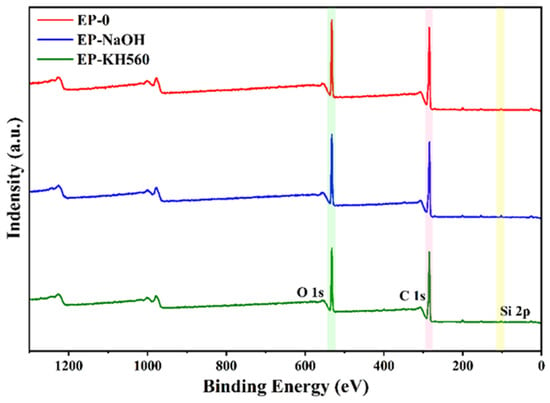
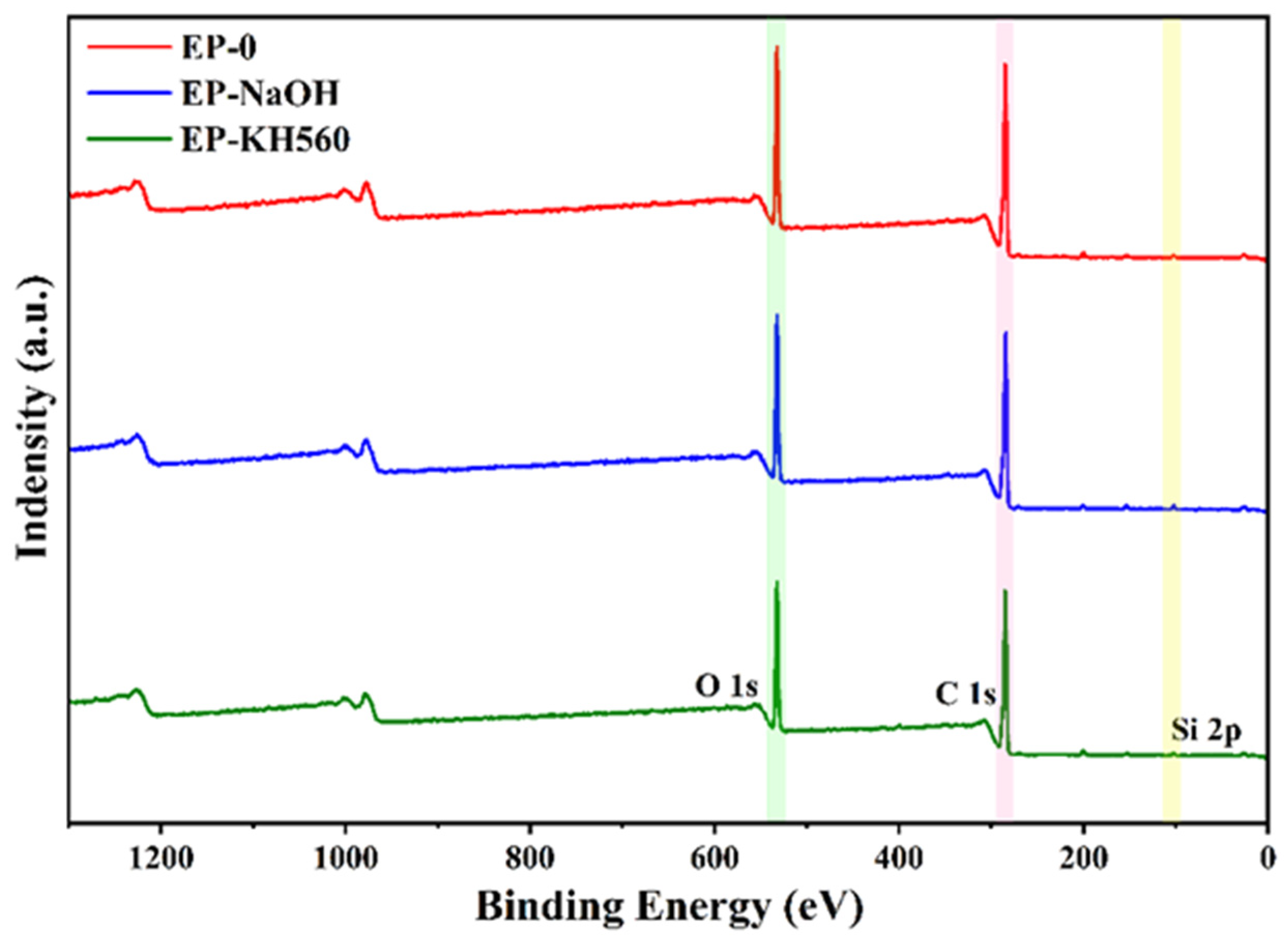
The XPS survey spectra collected from the outer surfaces of the cured EP-0, EP-NaOH, and EP-KH560 composites are shown in Figure 5. Conventional XPS provides elemental information from the outermost surface region; therefore, the spectra reflect the epoxy-rich composite surface together with exposed or near-surface recycled-powder components [33]. All three composites exhibited C 1s, O 1s, and Si 2p signals, corresponding to the cured organic matrix, oxygen-containing species, and silicon-containing components derived from the glass-rich recycled powder and silane treatment.
Figure 5.
XPS survey spectra collected from the outer surfaces of the cured EP-0, EP-NaOH, and EP-KH560 composites.
Variations in the apparent C 1s, O 1s, and Si 2p signals reflect differences in the local distribution of the organic matrix and silicon-containing components within the analyzed surface regions. Compared with EP-0 and EP-NaOH, EP-KH560 exhibited a modified Si 2p envelope, indicating a redistribution of silicon-containing species and a change in their collective chemical environments after sequential NaOH/KH560 treatment. The accompanying changes in the C 1s and O 1s envelopes suggest a corresponding redistribution of oxygen-containing carbon species and silicon–oxygen-related components near the composite surface. These spectral variations are consistent with the introduction of KH560-associated organic and organosilicon species on the recycled powder and the resulting modification of the local powder epoxy interphase. Collectively, the C 1s, O 1s, and Si 2p spectra indicate that sequential surface treatment altered the near-surface composition and chemical environment of the cured composites.
3.6. High-Resolution XPS Analysis of the Cured Composite Surfaces
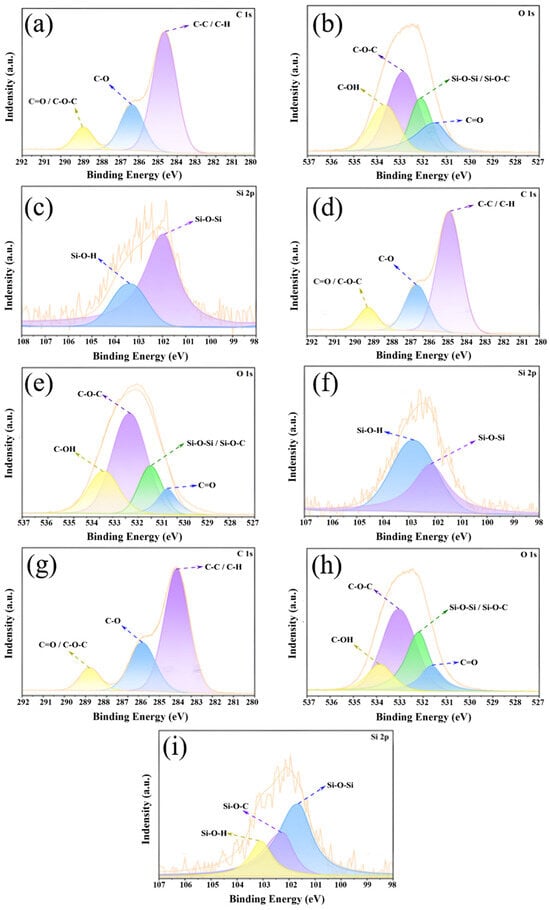
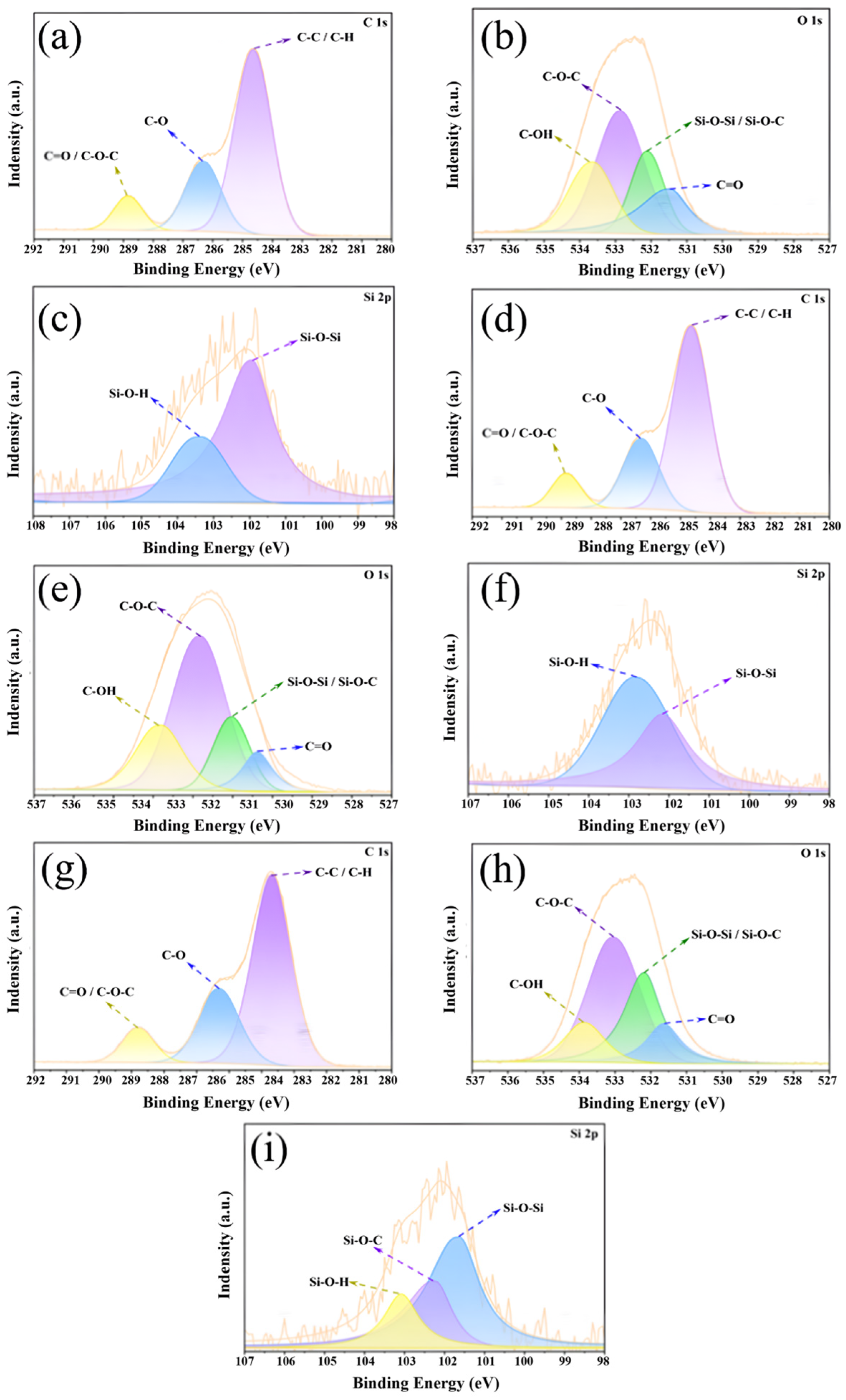
The high-resolution XPS spectra provide additional information on the carbon-, oxygen-, and silicon-containing chemical environments at the outer surfaces of the cured composites (Figure 6). The C 1s spectra contained a hydrocarbon-dominated component near 284.8 eV, primarily associated with C-C/C-H environments, together with higher-binding-energy contributions from oxygen-containing carbon environments. These components include overlapping contributions from C-O, C-O-C, O-C-O, and carbonyl-containing species in the cured epoxy matrix and surface-treatment-derived components. The modified C 1s envelope of EP-KH560 indicates a change in the distribution of oxygen-containing carbon environments after KH560 treatment.
Figure 6.
High-resolution XPS spectra collected from the outer surfaces of the cured EP-0, EP-NaOH, and EP-KH560 composites: (a–c) EP-0, (d–f) EP-NaOH, and (g–i) EP-KH560; (a,d,g) C 1s spectra, (b,e,h) O 1s spectra, and (c,f,i) Si 2p spectra. The fitted components represent overlapping carbon, oxygen, and silicon-containing chemical environments and are used for comparative envelope analysis.
The O 1s spectra contained overlapping contributions from oxygen-containing groups in the cured epoxy matrix, silicate glass, hydroxyl-containing species, and siloxane-containing components. Changes in the O 1s envelope after NaOH and KH560 treatments were consistent with a redistribution of the collective organic-oxygen and silicon–oxygen environments.
The Si 2p envelopes contained overlapping contributions from silicate, siloxane, hydroxylated silicon, and organosilicon environments associated with the glass-rich recycled powder and KH560 treatment. EP-KH560 exhibited a modified Si 2p envelope compared with EP-0 and EP-NaOH, indicating a change in the collective chemical environments of the surface-exposed silicon-containing species. Together, the C 1s, O 1s, and Si 2p envelopes indicate that the powder-treatment route affected the near-surface chemical environment of the cured composites.
4. Conclusions
In this study, mechanically recycled wind-turbine-blade powder was subjected to sequential NaOH and KH560 treatments and incorporated into an epoxy matrix at a fixed loading of 40 phr, corresponding to approximately 28.4 wt% of the total uncured mixture. FTIR showed changes in the hydroxylated silicate environment and the introduction of KH560-associated organic groups, while XPS revealed corresponding differences in the near-surface carbon, oxygen, and silicon environments of the cured composites. Representative SEM observations showed increased resin attachment and a more integrated local powder–matrix morphology after surface treatment.
At the selected powder loading, EP-KH560 achieved mean flexural and tensile strengths of 67.00 and 38.81 MPa, respectively, representing increases of 47.8% and 57.1% relative to EP-0. Under the fixed formulation and processing conditions investigated, these results establish a systematic relationship between recycled-powder surface treatment and the measured mechanical performance of the resulting epoxy composites.
Supplementary Materials
The following supporting information can be downloaded at: https://www.mdpi.com/article/10.3390/coatings16080965/s1, Figure S1: Volume-based equivalent particle-size distributions of FRP-0, FRP-NaOH, and FRP-KH560 measured by laser diffraction under identical dispersion conditions; Figure S2: (a) Experimental workflow, (b) schematic illustration of the recycled-powder surface modification and epoxy-composite fabrication processes; Figure S3. Dimensions of the dumbbell-shaped tensile specimen; Figure S4: High-resolution XPS spectra of the cleaned untreated FRP-0 powder and the sequentially NaOH/KH560-treated FRP-KH560 powder: (a, b) C 1s spectra; (c, d) O 1s spectra; and (e, f) Si 2p spectra, respectively. The fitted envelopes represent overlapping carbon-, oxygen-, and silicon-containing surface environments and are used for qualitative comparison; Table S1: Comparison of processing methods and mechanical properties reported for composites containing recycled wind-turbine-blade materials [37,38,39].
Author Contributions
H.Z.: Writing—review and editing, Writing—original draft, Investigation, Data curation. H.W.: Methodology, Writing—review and editing. H.Y.: Formal analysis, Data curation. All authors have read and agreed to the published version of the manuscript.
Funding
This research received no external funding.
Institutional Review Board Statement
Not applicable.
Data Availability Statement
The original contributions presented in this study are included in the article. Further inquiries can be directed to the corresponding author.
Conflicts of Interest
Hongwu Zhang, Huafeng Wei and Heng Yue were employed by Shandong Electric Power Industry Boiler and Pressure Vessel Inspection Center Co., Ltd. and State Grid Shandong Electric Power Research Institute. The authors declare that the research was conducted in the absence of any commercial or financial relationships that could be construed as a potential conflict of interest.
References
- Mishnaevsky, L., Jr.; Branner, K.; Petersen, H.N.; Beauson, J.; McGugan, M.; Sørensen, B.F. Materials for wind turbine blades: An overview. Materials 2017, 10, 1285. [Google Scholar] [CrossRef] [Scilit] [PubMed]
- Brøndsted, P.; Lilholt, H.; Lystrup, A. Composite materials for wind power turbine blades. Annu. Rev. Mater. Res. 2005, 35, 505–538. [Google Scholar] [CrossRef] [Scilit]
- Bassyouni, M.; Gutub, S.A. Materials selection strategy and surface treatment of polymer composites for wind turbine blades fabrication. Polym. Polym. Compos. 2013, 21, 463–472. [Google Scholar] [CrossRef] [Scilit]
- Liu, P.; Barlow, C.Y. Wind turbine blade waste in 2050. Waste Manag. 2017, 62, 229–240. [Google Scholar] [CrossRef] [Scilit] [PubMed]
- Jensen, J.P.; Skelton, K. Wind turbine blade recycling: Experiences, challenges and possibilities in a circular economy. Renew. Sustain. Energy Rev. 2018, 97, 165–176. [Google Scholar] [CrossRef] [Scilit]
- Cooperman, A.; Eberle, A.; Lantz, E. Wind turbine blade material in the United States: Quantities, costs, and end-of-life options. Resour. Conserv. Recycl. 2021, 168, 105439. [Google Scholar] [CrossRef] [Scilit]
- Paulsen, E.B.; Enevoldsen, P. A multidisciplinary review of recycling methods for end-of-life wind turbine blades. Energies 2021, 14, 4247. [Google Scholar] [CrossRef] [Scilit]
- Rani, M.; Choudhary, P.; Krishnan, V.; Zafar, S. A review on recycling and reuse methods for carbon fiber/glass fiber composites waste from wind turbine blades. Compos. Part B Eng. 2021, 215, 108768. [Google Scholar] [CrossRef] [Scilit]
- Dorigato, A. Recycling of thermosetting composites for wind blade application. Adv. Ind. Eng. Polym. Res. 2021, 4, 116–132. [Google Scholar] [CrossRef] [Scilit]
- Spini, F.; Bettini, P.; Feraboli, P. End-of-life wind turbine blades: Review on recycling strategies. Compos. Part B Eng. 2024, 275, 111290. [Google Scholar] [CrossRef] [Scilit]
- Pickering, S.J. Recycling technologies for thermoset composite materials—Current status. Compos. Part A Appl. Sci. Manuf. 2006, 37, 1206–1215. [Google Scholar] [CrossRef] [Scilit]
- Oliveux, G.; Dandy, L.O.; Leeke, G.A. Current status of recycling of fibre reinforced polymers: Review of technologies, reuse and resulting properties. Prog. Mater. Sci. 2015, 72, 61–99. [Google Scholar] [CrossRef] [Scilit]
- Pimenta, S.; Pinho, S.T. Recycling carbon fibre reinforced polymers for structural applications: Technology review and market outlook. Waste Manag. 2011, 31, 378–392. [Google Scholar] [CrossRef] [Scilit] [PubMed]
- Muzyka, R.; Sobek, S.; Korytkowska-Wałach, Ł.A.; Drewniak, Ł.; Sajdak, M. Recycling of both resin and fibre from wind turbine blade waste via small molecule-assisted dissolution. Sci. Rep. 2023, 13, 9270. [Google Scholar] [CrossRef] [Scilit] [PubMed]
- Kennerley, J.R.; Kelly, R.M.; Fenwick, N.J.; Pickering, S.J.; Rudd, C.D. The characterisation and reuse of glass fibres recycled from scrap composites by the action of a fluidised bed process. Compos. Part A Appl. Sci. Manuf. 1998, 29, 839–845. [Google Scholar] [CrossRef] [Scilit]
- Palmer, J.; Ghita, O.R.; Savage, L.; Evans, K.E. Successful closed-loop recycling of thermoset composites. Compos. Part A Appl. Sci. Manuf. 2009, 40, 490–498. [Google Scholar] [CrossRef] [Scilit]
- Duan, H.; Li, J.; Xu, Y. The recycling of comminuted glass-fiber-reinforced resin from decommissioned wind turbine blades. J. Air Waste Manag. Assoc. 2010, 60, 532–539. [Google Scholar] [PubMed]
- Kavaliauskas, Ž.; Kėželis, R.; Grigaitienė, V.; Marcinauskas, L.; Milieška, M.; Valinčius, V.; Uscila, R.; Snapkauskienė, V.; Gimžauskaitė, D.; Baltušnikas, A. Recycling of wind turbine blades into microfiber using plasma technology. Materials 2023, 16, 3089. [Google Scholar] [CrossRef] [Scilit] [PubMed]
- Mamanpush, S.H.; Li, H.; Englund, K.; Tabatabaei, A.T. Extruded fiber-reinforced composites manufactured from recycled wind turbine blade material. Waste Biomass Valorization 2020, 11, 3853–3862. [Google Scholar] [CrossRef] [Scilit]
- Luo, D.; Gao, D.; Chen, N.; Yang, S.; Wang, Q. Upcycling wind turbine blades into durable superhydrophobic materials through silanization and thiol—Ene chemistry. Chem. Eng. J. 2025, 507, 160323. [Google Scholar]
- Jin, F.L.; Li, X.; Park, S.J. Synthesis and application of epoxy resins: A review. J. Ind. Eng. Chem. 2015, 29, 1–11. [Google Scholar] [CrossRef] [Scilit]
- Pascault, J.P.; Williams, R.J.J. Epoxy Polymers: New Materials and Innovations; Wiley-VCH: Weinheim, Germany, 2010. [Google Scholar]
- May, C.A. Epoxy Resins: Chemistry and Technology, 2nd ed.; Marcel Dekker: New York, NY, USA, 1988. [Google Scholar]
- Gkaliou, K.; Christoforidis, A.; Bikiaris, D. Silane and silazane surface modification of recycled glass fibers. J. Appl. Polym. Sci. 2023, 140, e53388. [Google Scholar] [CrossRef] [Scilit]
- Sherif, G.; Chukov, D.I.; Tcherdyntsev, V.V.; Stepashkin, A.A.; Zadorozhnyy, M.Y.; Shulga, Y.M.; Kabachkov, E.N. Surface treatment effect on the mechanical and thermal properties of recycled glass fiber reinforced polymer composites. Polymers 2024, 16, 864. [Google Scholar] [PubMed]
- Plueddemann, E.P. Silane Coupling Agents, 2nd ed.; Springer: Berlin/Heidelberg, Germany, 1991. [Google Scholar]
- Xie, Y.; Hill, C.A.S.; Xiao, Z.; Militz, H.; Mai, C. Silane coupling agents used for natural fiber/polymer composites: A review. Compos. Part A Appl. Sci. Manuf. 2010, 41, 806–819. [Google Scholar] [CrossRef] [Scilit]
- Ishida, H. A review of recent progress in the studies of molecular and microstructure of coupling agents and their functions in composites, coatings and adhesive joints. Polym. Compos. 1984, 5, 101–123. [Google Scholar] [CrossRef] [Scilit]
- Arkles, B. Tailoring surfaces with silanes. Chemtech 1977, 7, 766–778. [Google Scholar]
- Thomason, J.L. The interface region in glass fibre-reinforced epoxy resin composites. Composites 1995, 26, 467–475. [Google Scholar] [CrossRef] [Scilit]
- Zinck, P.; Mäder, E.; Gerard, J.F. Role of silane coupling agent and polymeric film former for tailoring glass fiber sizings from tensile strength measurements. J. Mater. Sci. 2001, 36, 5245–5252. [Google Scholar] [CrossRef] [Scilit]
- Mittal, K.L. Silanes and Other Coupling Agents; CRC Press: Boca Raton, FL, USA, 2009. [Google Scholar]
- Briggs, D.; Grant, J.T. Surface Analysis by Auger and X-Ray Photoelectron Spectroscopy; IM Publications: West Sussex, UK, 2003. [Google Scholar]
- ASTM D790-17; Standard Test Methods for Flexural Properties of Unreinforced and Reinforced Plastics and Electrical Insulating Materials. ASTM International: West Conshohocken, PA, USA, 2017.
- Petersen, H.N.; Kusano, Y.; Brøndsted, P.; Almdal, K. Preliminary characterization of glass fiber sizing. In Proceedings of the 34th Risø International Symposium on Materials Science; Risø National Laboratory: Roskilde, Denmark, 2013; pp. 333–340. [Google Scholar]
- Casagrande, C.A.; Jochem, L.F.; Repette, W.L. Analysis of the 3-glycidoxypropyltrimethoxysilane (GPTMS) hydrolysis by infrared spectroscopy. Matéria 2020, 25, e-12811. [Google Scholar] [CrossRef] [Scilit]
- Tan, B.; Wang, X.; Pu, Z.; Yang, S.; Nie, M. Fabrication of high-strength waste-wind-turbine-blade-powder-reinforced polypropylene composite via solid-state stretching. Sustainability 2025, 17, 840. [Google Scholar] [CrossRef] [Scilit]
- Pławecka, K.; Przybyła, J.; Korniejenko, K.; Lin, W.-T.; Cheng, A.; Łach, M. Recycling of mechanically ground wind turbine blades as filler in geopolymer composite. Materials 2021, 14, 6539. [Google Scholar] [CrossRef] [Scilit] [PubMed]
- Pu, Z.; Yang, S.; Wang, Q. Recycling of waste wind turbine blades for high-performance polypropylene composites. J. Appl. Polym. Sci. 2024, 141, e55474. [Google Scholar] [CrossRef] [Scilit]
Disclaimer/Publisher’s Note: The statements, opinions and data contained in all publications are solely those of the individual author(s) and contributor(s) and not of MDPI and/or the editor(s). MDPI and/or the editor(s) disclaim responsibility for any injury to people or property resulting from any ideas, methods, instructions or products referred to in the content. |
© 2026 by the authors. Licensee MDPI, Basel, Switzerland. This article is an open access article distributed under the terms and conditions of the Creative Commons Attribution (CC BY) license.