


Highlights
For substrates with high-aspect-ratio nanochannels, an integrated simulation approach combining the finite volume method (FVM) and kinetic Monte Carlo (kMC) model is employed. This approach not only enables the determination of precursor partial pressure distributions within the channels, but also allows for the analysis of microscopic characteristics of the deposited films through kMC. A kMC model incorporating varying partial pressure conditions during the deposition process has been developed. The results indicate that, under the present conditions, the film structure at the nanochannels’ opening is superior to that at the bottom.
What are the main findings?
- The temporal profile of the precursor partial pressure influences the structure of the deposited thin film.
- Due to the influence of precursor partial pressure, the film deposited at the opening of the nanochannels is of higher quality than that at the bottom.
What are the implications of the main findings?
- The integrated simulation method combining kinetic Monte Carlo and the finite volume method is required for multiscale simulations.
- The regulation of gas delivery system operation in ALD reactors can be leveraged to optimize the thin film microstructure and therefore warrants further in-depth investigation.
Abstract
Atomic layer deposition (ALD) has become a versatile technique for atomic-level material synthesis and surface modification, with broad relevance in applications such as energy storage devices, integrated circuits, and membranes. The deposition is governed by a multitude of factors spanning multiple length/time scales, ranging from macroscopic transport phenomena to atomistic surface reactions. Owing to the intricate process coupling across these scales, a comprehensive evaluation of atomistic behavior under flow conditions remains highly challenging. To address this issue, a multiscale integrated simulation framework is developed in which precursor transport within high-aspect-ratio nanochannels is explicitly simulated using a finite volume method (FVM) and subsequently coupled with kinetic Monte Carlo (kMC) simulations to evaluate film growth characteristics. Based on the FVM results, the spatiotemporal distribution of precursor partial pressures along nanochannels is extracted and employed as input for a lattice-based kMC model, enabling atomistic resolution of the ALD process over the full deposition cycle. By coupling these two scales, key deposition metrics including step coverage and its temporal evolution under varying partial pressure conditions are quantitatively obtained, together with atomic-level smoothness and vacancy ratio. The kMC simulations further enable detailed visualization of film growth behavior on substrates under different precursor partial pressure environments. The results indicate that, within the microstructure, even when the overall precursor exposure is comparable, films formed near the entrance exhibit superior surface structure, as evidenced by higher atomic-level smoothness and reduced vacancy ratio, compared to those at the bottom. This study provides an engineering-feasible framework for evaluating atomistic film properties in ALD processes by consistently integrating fluid transport and surface reaction kinetics.
1. Introduction
Advanced semiconductor technology nodes have progressed from 3 nm to 2 nm and continue to evolve toward even smaller values, such as sub 2 nm nodes [1,2]. Under this trend, device architectures are becoming increasingly three-dimensional. Consequently, unprecedentedly stringent requirements have been imposed on thin film deposition technologies with respect to thickness controllability, film uniformity, and conformal coverage in high-aspect-ratio structures.
Atomic layer deposition (ALD) [3,4], as a representative thin film deposition technique, relies on self-limiting surface chemical reactions to achieve layer-by-layer atomic-scale growth. Owing to its sub-nanometer thickness controllability and excellent conformality, ALD has become one of the indispensable core processes in advanced semiconductor manufacturing. To satisfy these distinct processing requirements, controllable film deposition with different spatial distribution characteristics can be achieved through precise regulation of ALD process parameters. However, practical ALD processes are far from ideal and are generally governed by the coupled effects of precursor transport, surface reaction kinetics, and substrate morphology evolution [5,6].
Porous anodic aluminum oxide (AAO) is widely used as a model platform for studying ALD in high-aspect-ratio confined structures due to its ordered porous geometry and tunable dimensions [7,8]. Experimental studies have demonstrated that ALD enables highly conformal coating and precise composition control inside porous AAO [9]. ALD in high-aspect-ratio structures is found to be governed by coupled precursor transport and surface reaction kinetics [10]. Substrate-scale diffusion–reaction models [11,12] and multiscale CFD models [13] have been used to predict saturation profiles and infiltration depth in porous media and lateral high-aspect-ratio channels.
Fundamentally, deposition non-uniformity originates from the strong coupling between macroscopic transport phenomena and microscopic surface reactions. However, conventional experimental approaches are incapable of achieving in situ dynamic characterization of microscopic reaction processes, thereby imposing limits on achieving a comprehensive understanding of the underlying deposition mechanisms. Consequently, the development of numerical simulation approaches capable of describing ALD processes across multiple scales has become essential for establishing quantitative correlations among precursor properties, process parameters, surface reaction kinetics, and thin film morphologies, thus enabling precise process control and industrial optimization of ALD technology.
The kinetic Monte Carlo (kMC) method is capable of effectively describing the temporal evolution of discrete surface reaction events and reconstructing atomistic thin film growth processes, making it one of the mainstream approaches for investigating the microscopic deposition mechanisms of ALD. By constructing an event catalog containing all possible reaction events and their corresponding rate constants, the time evolution of the system can be simulated. Its earliest atomistic applications can be traced back to the simulation of radiation damage annealing processes conducted by Beeler in 1966 [14]. Over the following two decades, extensive studies and advances emerged in areas such as radiation damage annealing, surface adsorption, diffusion and growth, and statistical physics [15]. With continued advances in computational techniques, kMC has become a widely employed method for simulating the temporal evolution of discrete and stochastic chemical reaction events, particularly for mesoscale kinetic processes involving surface reactions, thin film growth, and lateral interactions between species [16]. Compared with molecular dynamics (MD), kMC adopts a coarse-grained treatment of atomic vibrational motions and focuses primarily on the occurrence probabilities and timescales of reaction events. Consequently, simulations over substantially longer timescales, ranging from seconds to even longer durations, can be achieved [17]. In recent years, significant progress has been achieved in both the algorithmic development and practical applications of kMC methods, including the development of distributed parallel kMC algorithms [18] and adaptive kMC approaches integrated with machine-learning-based interatomic potentials [19], both of which have substantially improved the efficiency and accuracy of complex-system simulations. The kMC method can reproduce ALD processes, particularly in studies focused on identifying reaction mechanisms, investigating interfacial defects, and interpreting transitions from covalent to ionic bonding characteristics [20]. Furthermore, by employing ordered lattice representations of the investigated systems, kMC can effectively reduce computational cost while maintaining high simulation accuracy.
However, single-scale simulations are insufficient to fully elucidate the influence mechanisms of deposition conditions on thin film growth behavior and microscopic film structure. To address this limitation, a multiscale coupling approach is proposed in which the contribution of precursor transport within high-aspect-ratio nanochannels is incorporated into kMC simulations to obtain atomistic deposition characteristics. At the macroscopic scale, the finite volume method (FVM) can effectively describe gas-phase transport and reaction behaviors, but it cannot capture microscopic surface kinetics. In contrast, the kMC method enables detailed characterization of surface reaction processes, while lacking an accurate description of realistic process environments. Therefore, a multiscale integrated simulation framework coupling macroscopic transport phenomena with microscopic surface reactions is established to investigate ALD behavior in complex structures. An FVM model for ZnO ALD in high-aspect-ratio structures is constructed by incorporating gas-phase diffusion and surface reaction equations. The model is capable of simulating Knudsen diffusion and reaction processes within nanochannels, thereby providing reliable boundary condition inputs for subsequent multiscale simulations. Based on the obtained transport information, the kMC model further reveals the effects of deposition conditions on film uniformity and microscopic film structure in high-aspect-ratio nanochannels.
This work focuses on ALD processes, develops an ALD kMC model and performs numerical simulations. It elucidates the differences in deposition behavior among ALD systems and establishes a multiscale simulation framework that integrates macroscopic flow field information with microscopic surface kinetics. This framework provides quantitative numerical insights into the microscopic mechanisms of ALD processes and offers theoretical guidance for the optimization and control of industrial-scale ALD technologies.
2. Computational Methodology
This study focuses on the ALD process in high-aspect-ratio nanochannels using the diethylzinc (DEZ) and water (H2O) precursor system as the model reaction chemistry. Since the chemisorption behavior of DEZ directly determines the penetration depth and concentration distribution of the resulting deposited layer, the DEZ half-ALD cycle of the ALD process was selected as the primary object of simulation [21]. The deposition substrate was modeled as a porous AAO structure in which ALD reactions occur inside the AAO nanochannels.
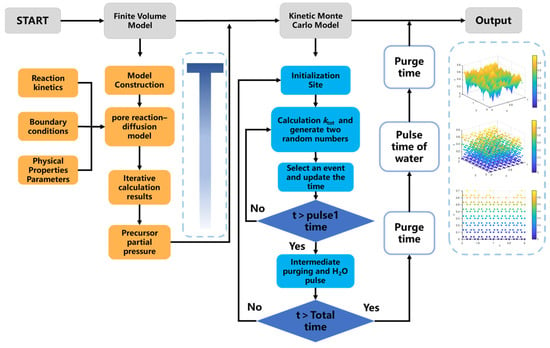
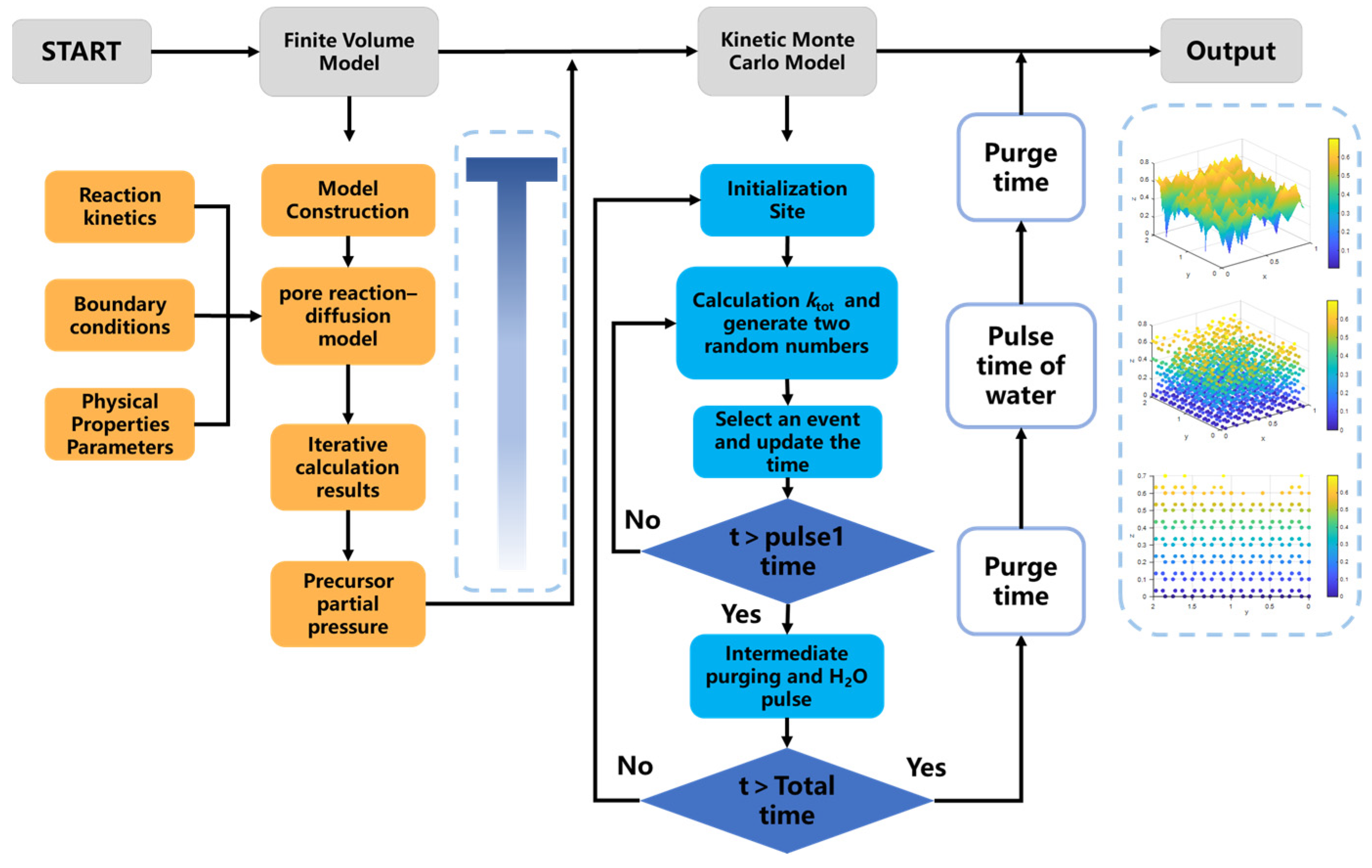
Based on the macroscopic transport model using the FVM and the microscopic reaction model employing kMC, an integrated simulation framework was established in this study to achieve cross-scale characterization and mechanistic analysis of ALD processes in high-aspect-ratio nanochannels. Figure 1 illustrates the workflow of the integrated simulation framework. The two simulation methods adopt different sources of reaction kinetics: the kinetic parameters in the FVM are derived from previous studies based on experimental fitting [21], while the kinetic data in the kMC method are taken from the work of Weckman et al. [22]. Nevertheless, under the same precursor exposure conditions, both methods yield similar growth per cycle (GPC).
Figure 1.
Simulation flowchart of the finite volume method (FVM) and kinetic Monte Carlo (kMC) model.
2.1. Finite Volume Method Model
The substrate-scale reaction and transport processes during the DEZ half-ALD cycle within microstructures were simulated, including the following aspects: (1) Surface elementary reactions. At the gas–solid interface inside the porous AAO, DEZ molecules first reversibly interact with surface hydroxyl groups to form a pre-adsorbed intermediate state (Equation (1)). Subsequently, an irreversible ligand-exchange reaction occurs, resulting in the formation of monoethylzinc (MEZ) species (Equation (2)). (2) The reaction and diffusion processes of DEZ within the nanochannels were investigated. Knudsen diffusion was considered to be the dominant transport mechanism inside the nanochannels. In the simulations, differences in hydroxyl group density and reaction activity between the AAO substrate and the deposited ZnO layer were neglected.
The deposition process at any location within the nanochannel model was described using a surface reaction model. By solving the differential equation set governing the system kinetics, the coupled diffusion–reaction process of gas molecules within the nanochannels was simulated.
The reactants consist of gaseous DEZ molecules, surface hydroxyl sites, and surface MEZ sites, while the products are surface MEZ species and ethyl groups. The reaction kinetics during the DEZ half-ALD cycle of the ALD process can be described by the following set of equations:
where Ci denotes the concentration of species i, gaseous compounds (e.g., DEZ(g)) with units of mol/m3, and surface-adsorbed species (e.g., adsorbed diethylzinc, DEZ*) with units of mol/m2. ka is the rate constant for the adsorption of DEZ onto surface hydroxyl groups, kd is the rate constant for the desorption of DEZ already adsorbed on hydroxyl sites, and kf denotes the reaction rate constant for the conversion of adsorbed DEZ into MEZ. DEZ* and MEZ* denote surface species adsorbed on the nanochannel walls. and are the porosity and tortuosity of the substrate, respectively. is the depth from the entrance. Dkn is the Knudsen diffusion coefficient. Detailed kinetic data can be found in Table S1 of Section S1.
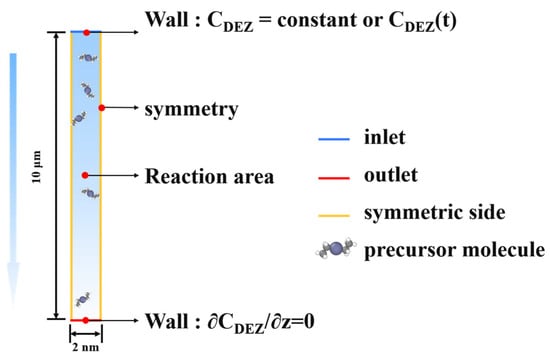
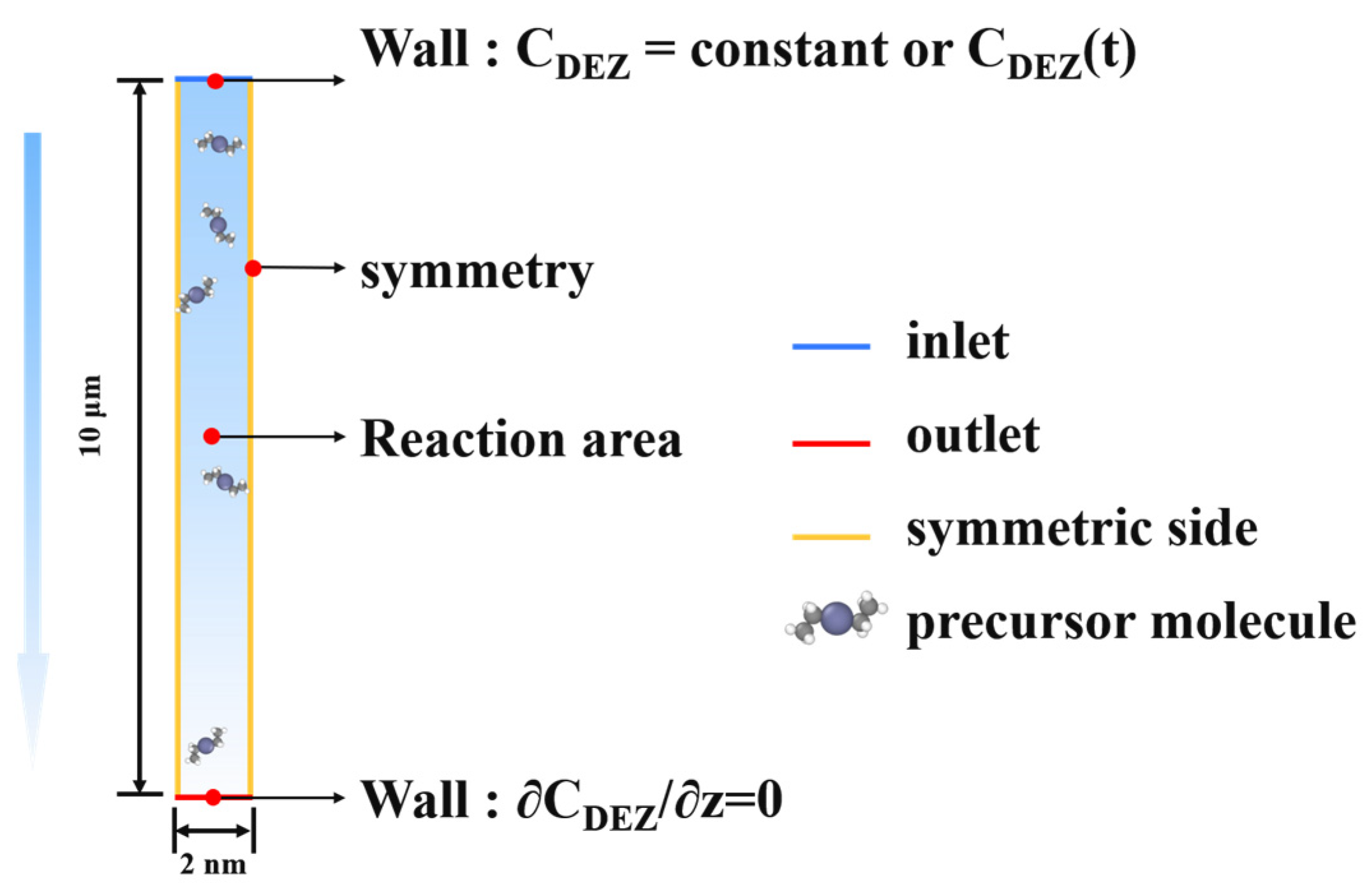
The FVM model adopts a one-dimensional approximation to describe transport within the channel, using cubic grid cells with a single dimension of 2 × 10⁻⁹ m, indicating that no lateral spatial discretization was performed. For the substrate-scale reaction–diffusion model, the computational domain consists of a one-dimensional channel with dimensions of 5 × 10−6 m × 2 × 10−9 m (length × width). It should be noted that the 2 nm width defined in the model does not represent the actual geometry. This 2 nm value refers specifically to the width of the computational grid employed in the simulation. The spatial resolution along the channel length is 1 × 10⁻⁷ m. The partial pressure of DEZ at the inlet was set to constants or changed with time, while the flux of DEZ at the opposite end of the channels was set to zero. The temperature was maintained at 398.15 K for the simulation. The surface hydroxyl concentration was assumed to be 7.8 sites/nm−2 [23]. A schematic illustration of the model is shown in Figure 2. First-order upwind spatial discretization schemes were employed for the four species, namely DEZ, OH, DEZ* and MEZ. The diffusion regime of DEZ molecules in nanochannels with a diameter of 50 nm was identified as Knudsen diffusion. The corresponding diffusion coefficients for the channels are presented in Section S2. The transient formulation was solved using a first-order implicit scheme, and the time step was determined to be 5 × 10⁻⁶ s through a time step independence analysis.
Figure 2.
Schematic of the finite volume method (FVM) model.
Our previous work [24] fully validated this model. In this study, we assume the nanochannel structure stays unchanged during one ALD cycle. We focus specifically on the precursor partial pressure at different depths, which is subsequently fed into the kMC model.
2.2. kinetic Monte Carlo Model
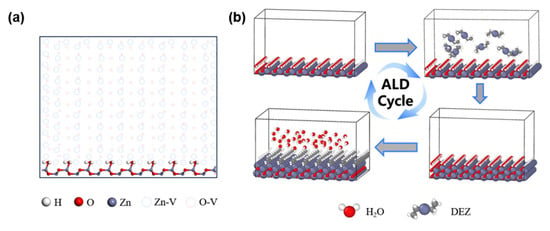
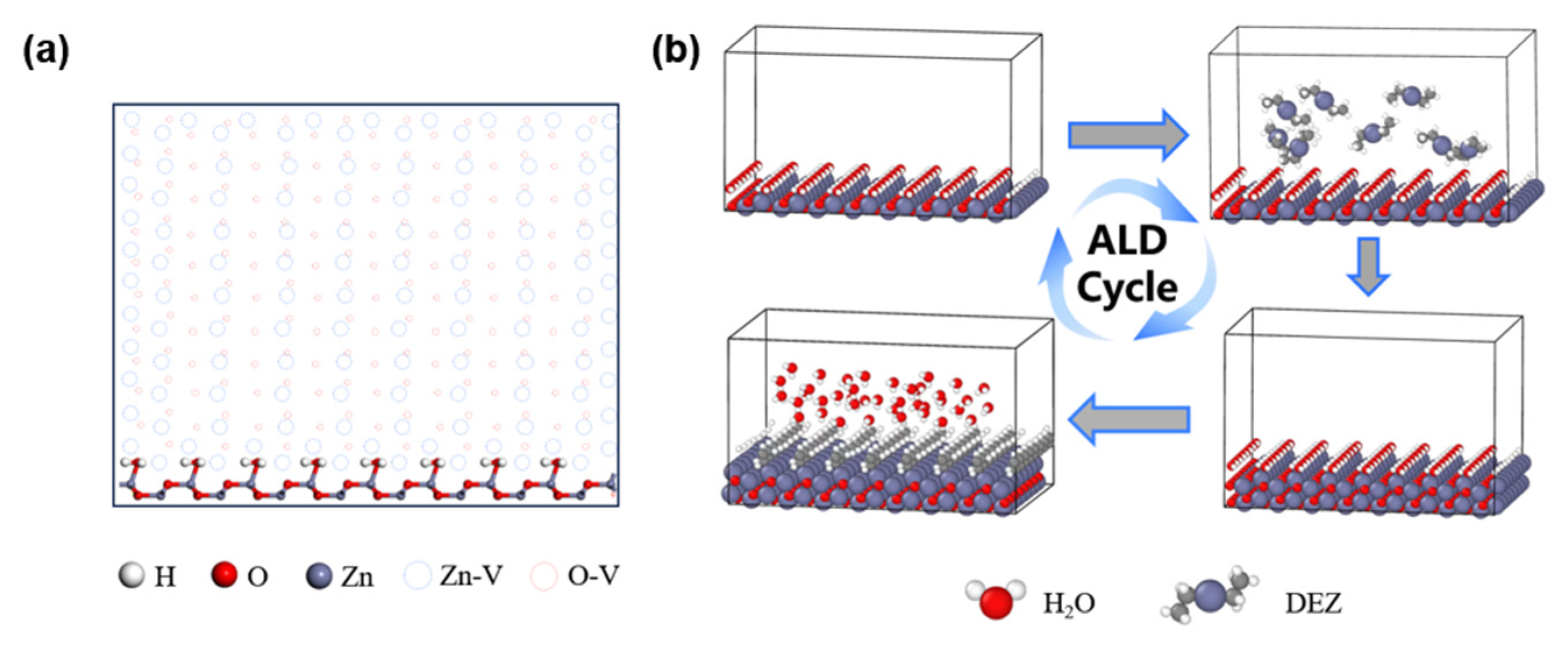
The kMC model in this work was developed based on the open-source software Stochastic Parallel PARticle Kinetic Simulator (SPPARKS, version 6 Sep 2023) [25]. An ALD kMC model was developed in this study. The kinetic parameters and model framework were adopted from the work of Timo Weckman and Mahdi Shirazi [22,26]. The first layer in Figure 3a represents the initial surface of the simulation, and the upper part displays the unoccupied zinc vacancies (Zn-v) and oxygen vacancies (O-v). Figure 3b presents a schematic illustration of the ALD process simulated using the kMC method. The model defines multiple types of surface reaction events and their corresponding rate expressions, with reaction rates evaluated using the Arrhenius equation. During the simulation, the state of lattice sites, coordination environments, and local structures are dynamically updated, enabling the description of key processes such as precursor adsorption, desorption, and surface reactions. Real-time statistics and outputs of surface species distributions and reaction event frequencies are performed, providing a robust data basis for quantitative analysis of deposition kinetics.
Figure 3.
Lattice schematic for kMC simulation and schematic of the atomic layer deposition (ALD) cycle: schematic diagram of the model (a); kMC simulation diagram of the ALD process (b).
Unlike the FVM, the reaction rates calculated using kMC correspond to elementary reactions. The adsorption rates of DEZ and H2O were calculated according to Equation (8), and the resulting values were fitted into the Arrhenius-form expression and incorporated into the simulation model. The active surface area was set to 0.176 nm2.
where P denotes the partial pressure of the corresponding gas species, m is the molecular weight of the gas species being adsorbed, and T denotes the temperature.
The initial sticking coefficient () is set to unity in this work to ensure that adsorption always proceeds. The sticking probability () is governed by surface coverage [27]: it decreases monotonically with increasing coverage, falling from unity to a value close to zero.
Reaction scenarios under different surface coverages have been distinguished, enabling the model to describe differences in deposition kinetics arising from varying surface coverage. Detailed information can be found in Section S3 of the Supporting Information.
The desorption rates (kdes) of the precursor and water molecules from the substrate surface are calculated using the Arrhenius equation:
A is the pre-exponential factor, which is set to kBT/h; h denotes the Planck constant; and kB denotes the Boltzmann constant.
The reaction rates for all other processes are also evaluated using the Arrhenius equation:
where ki denotes the rate constant of process i, while Ei (eV) represents the activation energy barrier of the corresponding process.
3. Results and Discussion
This work investigates the ALD process of the DEZ/H2O system within nanochannels based on a multiscale integrated simulation framework combining the FVM and kMC. The coupled mechanisms between precursor gas-phase diffusion and surface reactions are elucidated. The quantitative effects of precursor partial pressure and its temporal evolution on microscopic film structure, growth rate, and surface morphology are analyzed. Finally, a process optimization strategy involving a gradually decreasing precursor partial pressure during deposition is proposed.
3.1. Finite Volume Method Results
To obtain thin film deposition behavior under different operating conditions, the FVM model was used to simulate the precursor partial-pressure distribution along the depth of the nanochannels under various reaction conditions. It should be noted that the present FVM model does not explicitly distinguish the hydroxyl density and surface reactivity between the pristine AAO substrate and the newly deposited ZnO surface. This treatment is an engineering simplification.
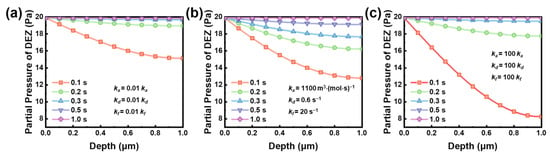
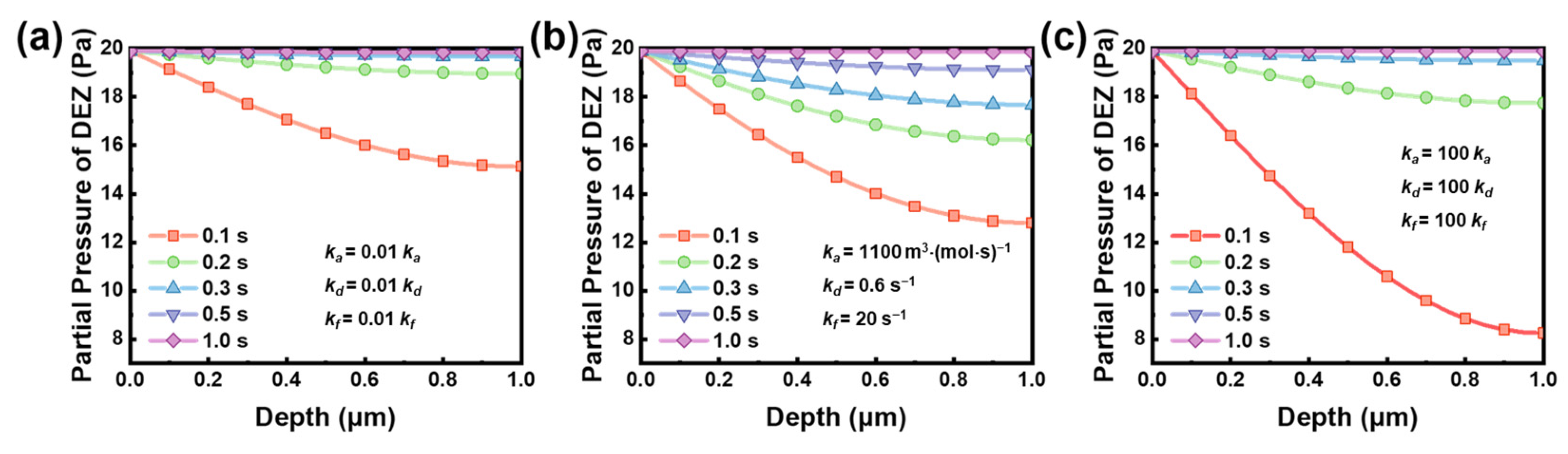
Figure 4 shows the spatial distributions of precursor partial pressure along the deep direction at different reaction rates and times. In semiconductor applications, uniform thin film deposition within high-aspect-ratio nanochannels is required [28,29], as insufficient uniformity would lead to fluctuations in device performance and even device failure [30]. As shown in Figure 4a, this case is characterized by a relatively smaller partial pressure gradient of DEZ along the channel depth. In such scenarios, the precursor is assumed to exhibit lower reactivity, which leads to a less pronounced pressure gradient within the channel. As shown in Figure 4b,c, the elevation of precursor reactivity leads to more severe uneven distribution of precursor partial pressure in the depth direction of channels. Based on previous studies [24], the baseline rate was obtained by fitting experimental data, and detailed kinetic parameters are summarized in Table S1 of Section S1.
Figure 4.
Precursor partial pressure distribution curves in nanochannels under various reaction rates, where the baseline rate is fitted from experimental data: (a) 0.01 times the baseline rate; (b) the baseline rate; and (c) 100 times the baseline rate.
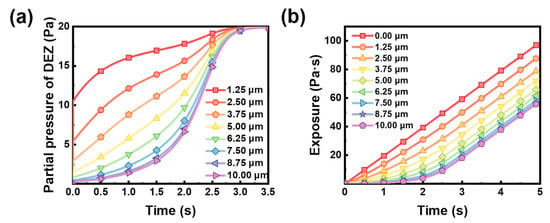
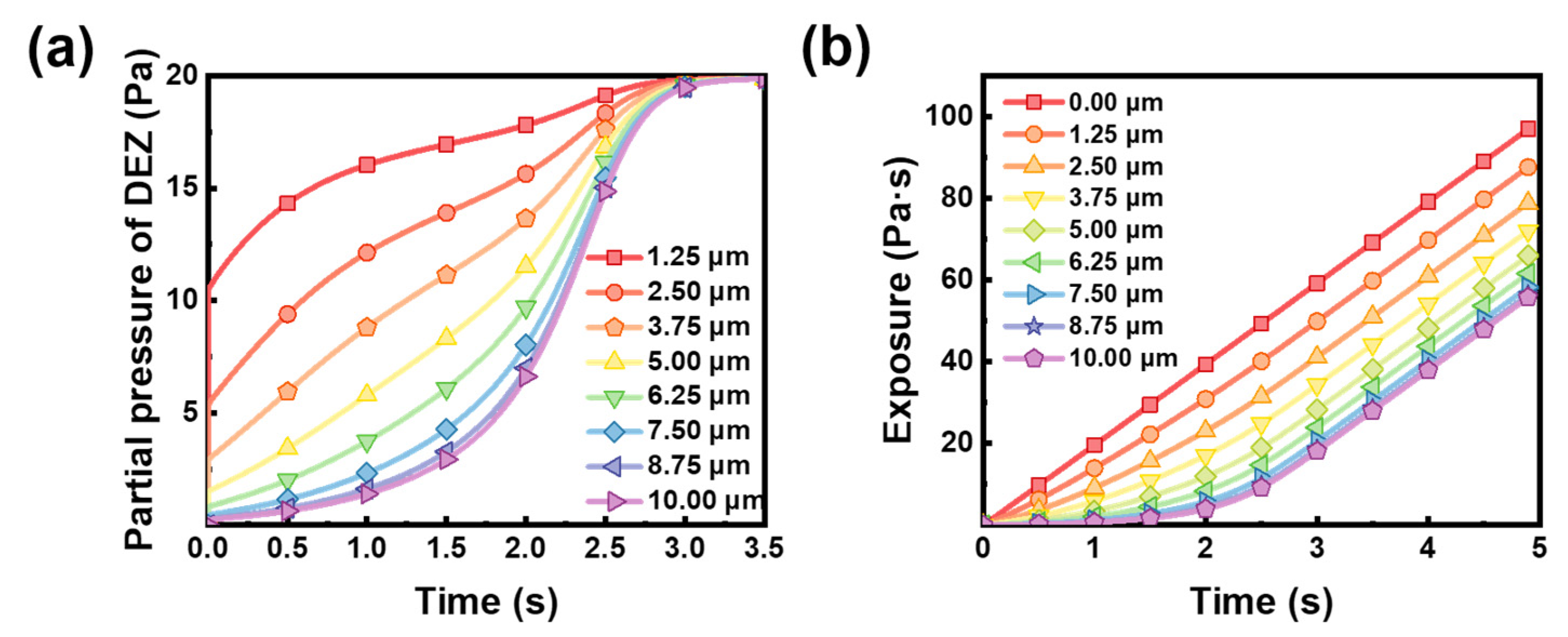
As illustrated in Figure 5a, eight monitoring points were selected along the depth direction of the 10 μm deep nanochannel to track the temporal evolution of DEZ partial pressure. These positions are located at depths of 1.25, 2.50, 3.75, 5.00, 6.25, 7.50, 8.75, and 10.00 μm from the channel opening. For the exposure analysis in Figure 5b, the channel opening at 0.00 μm was additionally included as a reference position, together with the eight internal monitoring points, to evaluate the cumulative precursor supply along the entire depth direction.
Figure 5.
(a) Temporal variation in diethylzinc (DEZ) partial pressure; (b) DEZ exposure along the depth direction of nanochannels.
Figure 5a shows that in nanochannels, the local precursor partial pressure at all depths increases with time, but with a pronounced spatial gradient: the entrance exhibits the fastest increase, while the bottom responds most slowly. This behavior originates from the effects of transport via diffusion and precursor consumption via surface reaction. In the early stage, precursor molecules are rapidly consumed by surface adsorption, whereas with increasing surface coverage the reaction rate decreases, leading to a gradual recovery of partial pressure. Meanwhile, diffusion limitation reduces precursor supply deep inside nanochannels, leading to reaction-limited behavior at the inlet and diffusion-limited kinetics in deeper regions.
Figure 5b further demonstrates that exposure increases with time but decreases monotonically along the depth, indicating strong spatial non-uniformity of precursor supply within the channel. This results in depth-dependent reaction environments that cannot be captured by a spatially averaged concentration. Therefore, spatially resolved FVM results are essential as inputs for subsequent kMC simulations to accurately describe atomic-scale deposition and structural evolution at nanochannels.
3.2. Validation of the kMC Model
Simulations of ALD processes at different temperatures are carried out using DEZ/H2O ALD. The simulation system for the DEZ model consists of 5120 lattice sites with a three-dimensional size of 8 × 41.7 × 58.0 Å. The number of executed events varies exponentially with simulation temperature, and the required simulation time ranges from several hundred seconds at extremely low temperatures to dozens of hours at high temperatures. Multiple simulations with distinct random seeds are performed for each operating condition. The presented GPC values are averaged from a set of parallel simulations.
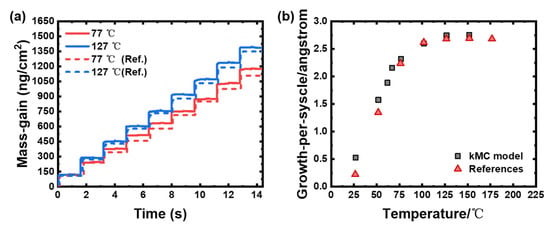
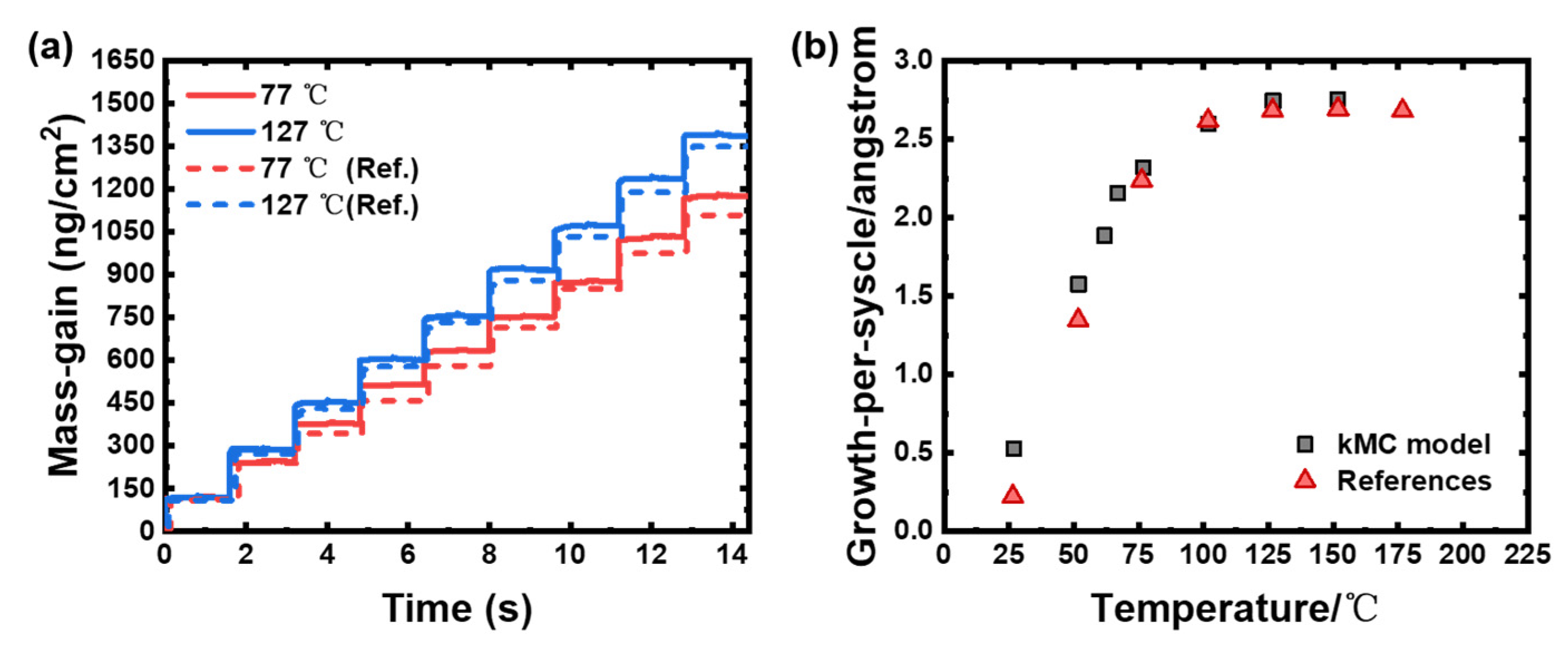
As shown in Figure 6, the simulation results are compared with those reported [22] in the literature. Figure 6a presents a comparison between the calculated film growth rate at different temperatures reported in the literature (dashed lines) and the corresponding simulation results of this study (solid lines). A reasonable stepwise growth trend between ALD cycles is observed, with a maximum deviation of less than 5%. Figure 6b compares the GPC data at different temperatures reported in the literature (triangular data points) with the simulation results of this study (square data points). The deviation between the simulated values and the literature data is also less than 5%.
Figure 6.
Comparison of DEZ/H2O ALD kMC simulation results with literature data [22]. (a) Mass deposition curves at various temperatures; (b) growth per cycle (GPC) curves.
Overall, the results of this study show good agreement with the literature, which validates the accuracy of the model.
3.3. Analysis of Microscopic Film Structure
To further investigate the microscopic characteristics of thin films within high-aspect-ratio nanochannels, kMC simulations were performed for the ALD process along the channel based on the spatial distribution of precursor exposure at different positions. The exposure profiles obtained from the FVM simulations were directly incorporated into the kMC framework, enabling a realistic representation of deposition non-uniformity arising from spatial variations in DEZ exposure during practical processing conditions. From a microscopic perspective, this approach allows analysis of atomic-level smoothness, vacant lattice site formation, and overall deposition behavior along the depth.
In this work, vacancies are defined as unoccupied lattice sites remaining in the deposited film after each ALD cycle. The vacancy ratio is statistically quantified based on reconstructed atomic configurations. The evolution of the vacancy ratio is governed by three key factors: incomplete precursor adsorption, insufficient surface saturation, and severe steric hindrance at local film regions throughout multi-cycle deposition. Quantitatively, the film vacancy ratio is defined as the ratio of vacant lattice sites to the total number of lattice sites inside the film:
where Nvacancy denotes the number of vacant sites within the film, and Ntotal represents the total number of lattice sites in the film.
Vacancies formed during deposition affect the bulk film density, which can be defined as the product of the density of a fully dense film () and (1 − vacancy ratio):
The atomic-level smoothness was evaluated using the root-mean-square Rq, as it is more sensitive to surface peaks and valleys. It is defined as follows:
where n represents the total number of surface sites, z is the z-coordinate of each site, and is the average z-coordinate of all surface sites.
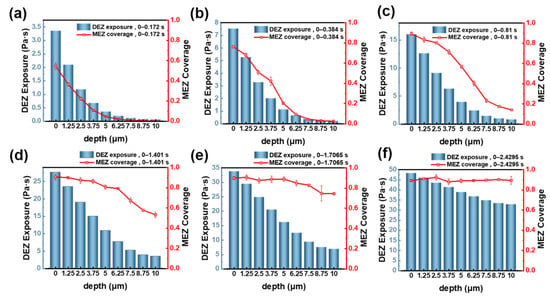
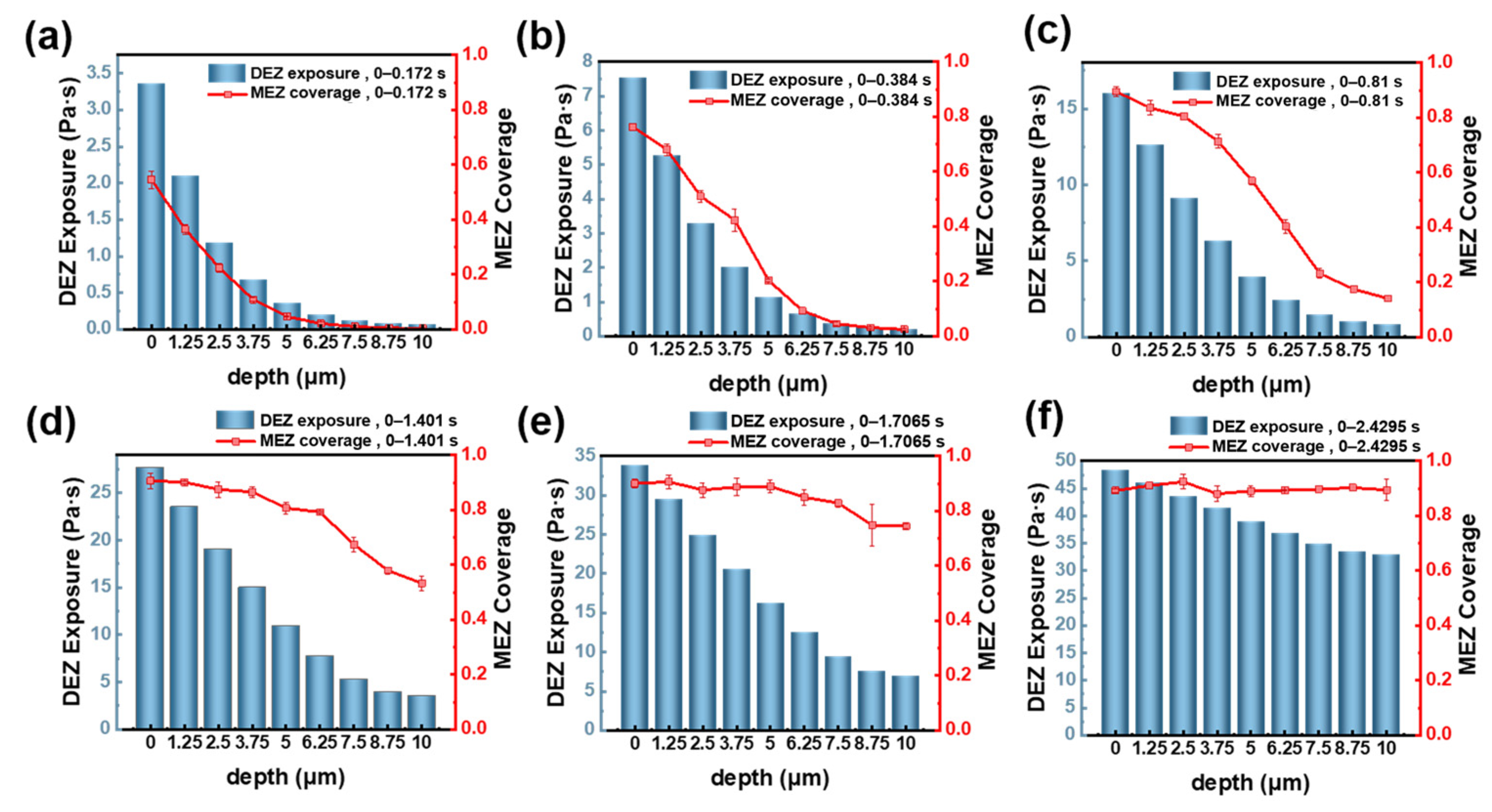
In the analysis of the simulation results, the density of the ZnO thin film was set to 5.62 g/cm3 [22,31], and the saturated GPC was set to 0.26 nm [22]. Figure 7a–f present the distributions of DEZ exposure (blue bars) and MEZ surface coverage (red curves) along nanochannel depth under six successive DEZ exposure durations ranging from 0.17 s to 2.43 s. For the shortest exposure time of 0.172 s (Figure 7a), DEZ exposure drops sharply from the inlet to the bottom, accompanied by a rapid decay of MEZ coverage along the depth. Severe diffusion limitation leads to extremely low precursor supply and minimal surface coverage in deep regions. When comparing Figure 7a–f, it can be seen that prolonged DEZ exposure continuously increases DEZ exposure at all depths. MEZ coverage at the inlet rapidly approaches saturation, narrowing coverage discrepancies along the channel. Diffusion-driven spatial inhomogeneity is mitigated, and nanochannel inner surfaces are supplied with sufficient precursor exposure.
Figure 7.
Relationship between film deposition at different depths of nanochannels and exposure at different times: (a) 0.172 s, (b) 0.384 s, (c) 0.81 s, (d) 1.401 s, (e) 1.7065 s, and (f) 2.4295 s.
Under insufficient exposure conditions, the process is diffusion-limited, leading to incomplete precursor penetration and non-uniform coverage. As exposure time increases, the system transitions into a reaction-limited regime, where enhanced precursor transport enables improved conformality. At sufficiently long exposure times, nearly saturated adsorption is achieved along the entire depth, resulting in highly conformal ALD growth governed by self-limiting surface chemistry.
To investigate the relationship between deposition processes and thin-film microstructures, this paper separately examines the effects of two key process parameters, namely deposition temperature and precursor partial pressure, on film structures.
3.4. Effect of Deposition Temperature on Thin Film Structure
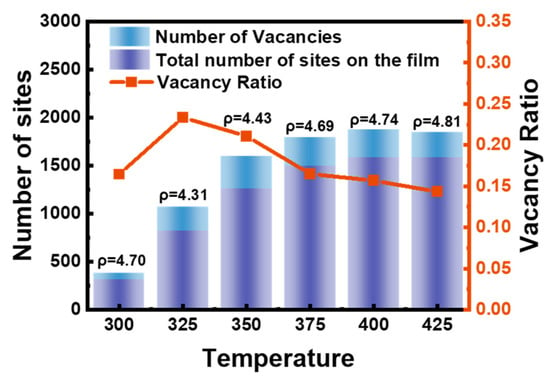
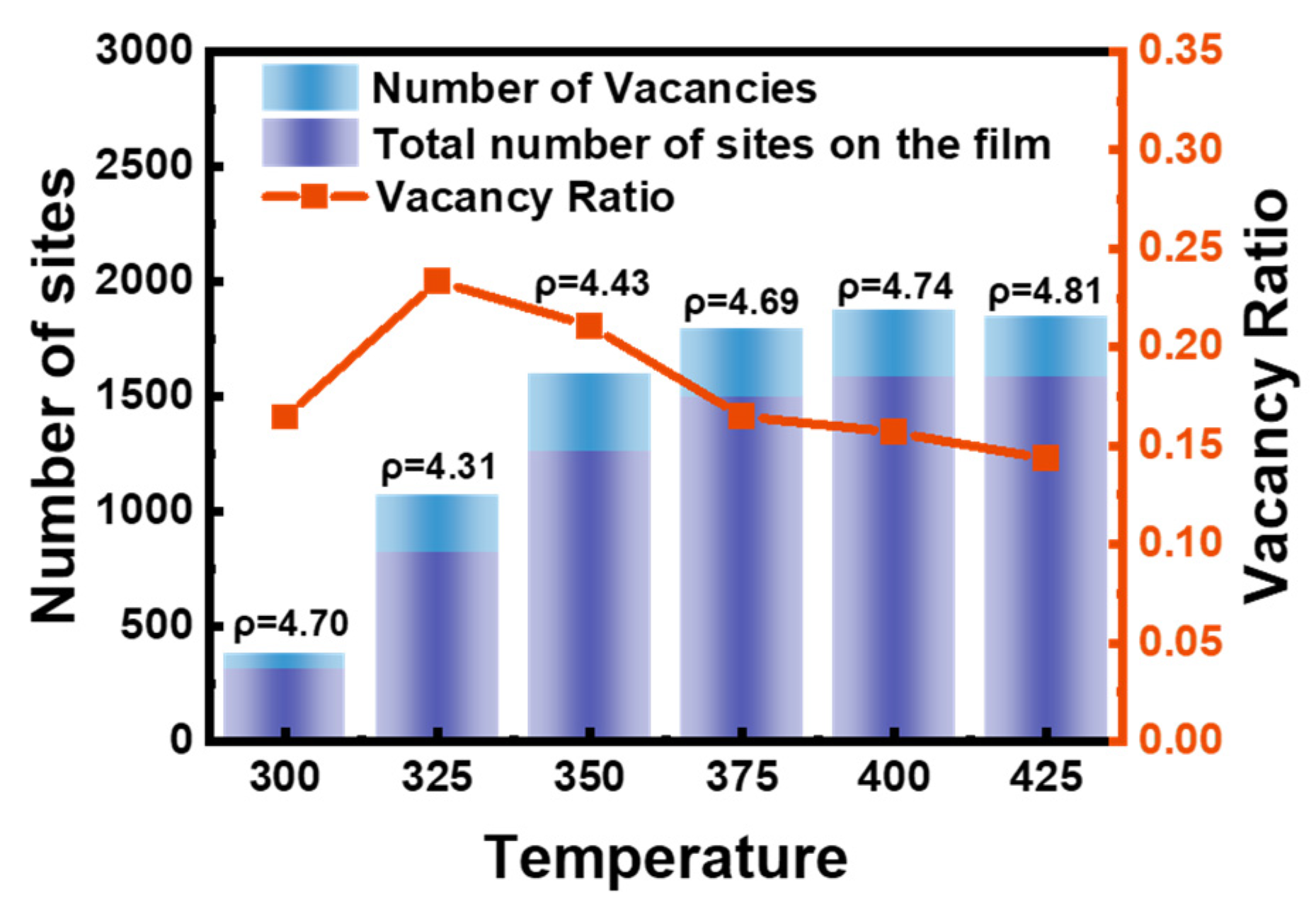
The kMC results under different temperatures were further analyzed. Figure 8 shows the number of vacancies of deposited films under various temperatures from kMC simulations, indicating that vacancy formation is mainly controlled by temperature [32]. Starting from 300 K, the film structure gradually improves with increasing temperature until reaching a stable growth regime. This temperature range is commonly referred to as the ALD process window [4,22]. From 300 K to 350 K, the film structure increases progressively, while the vacancy ratio ranges from approximately 0.16 to 0.23. With further temperature increase, although the change in overall film structure becomes less pronounced, the vacancy ratio continues to decrease, reaching approximately 15% at 425 K.
Figure 8.
Vacancy ratio under different temperatures via kMC simulation.
3.5. Effect of Precursor Partial Pressure on Thin Film Structure
In practical operating conditions, precursor partial pressure has a significant impact on thin film deposition; therefore, simulations assuming a constant partial pressure are insufficient to accurately represent real processes. In both temporal and spatial ALD configurations, the precursor partial pressure at the substrate surface varies to a certain extent over time. This variation leads to corresponding changes in the deposition results, while the evolving surface state of the substrate also influences the deposition process. Accordingly, a simulation framework capable of adapting to dynamically varying precursor partial pressures was developed in this study.
To account for substrate-dependent effects, previously simulated structures were directly used as initial configurations for subsequent deposition steps by constructing lattice data files that preserve atomic site coordinates and coordination states from earlier cycles.
The reverse deposition sequence was also investigated. Specifically, deposition was first conducted for three ALD cycles at 10 Pa, followed by an additional ALD cycle at 5 Pa using the previously formed film surface as the substrate. Finally, deposition was continued for three ALD cycles at 1 Pa, while continuously inheriting the site and coordination information from the preceding layers. The atomic-level smoothness and vacancy ratio of the thin films were characterized at each stage.
The film morphology evolution is governed by a history-dependent kinetic process, where precursor partial pressure determines the instantaneous adsorption rate, while vacant lattice sites exhibit cumulative inheritance across ALD cycles, leading to a strong coupling between deposition sequence and surface stabilization or atomic-level smoothness.
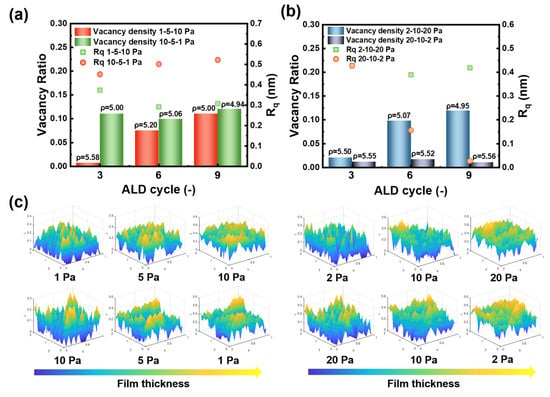
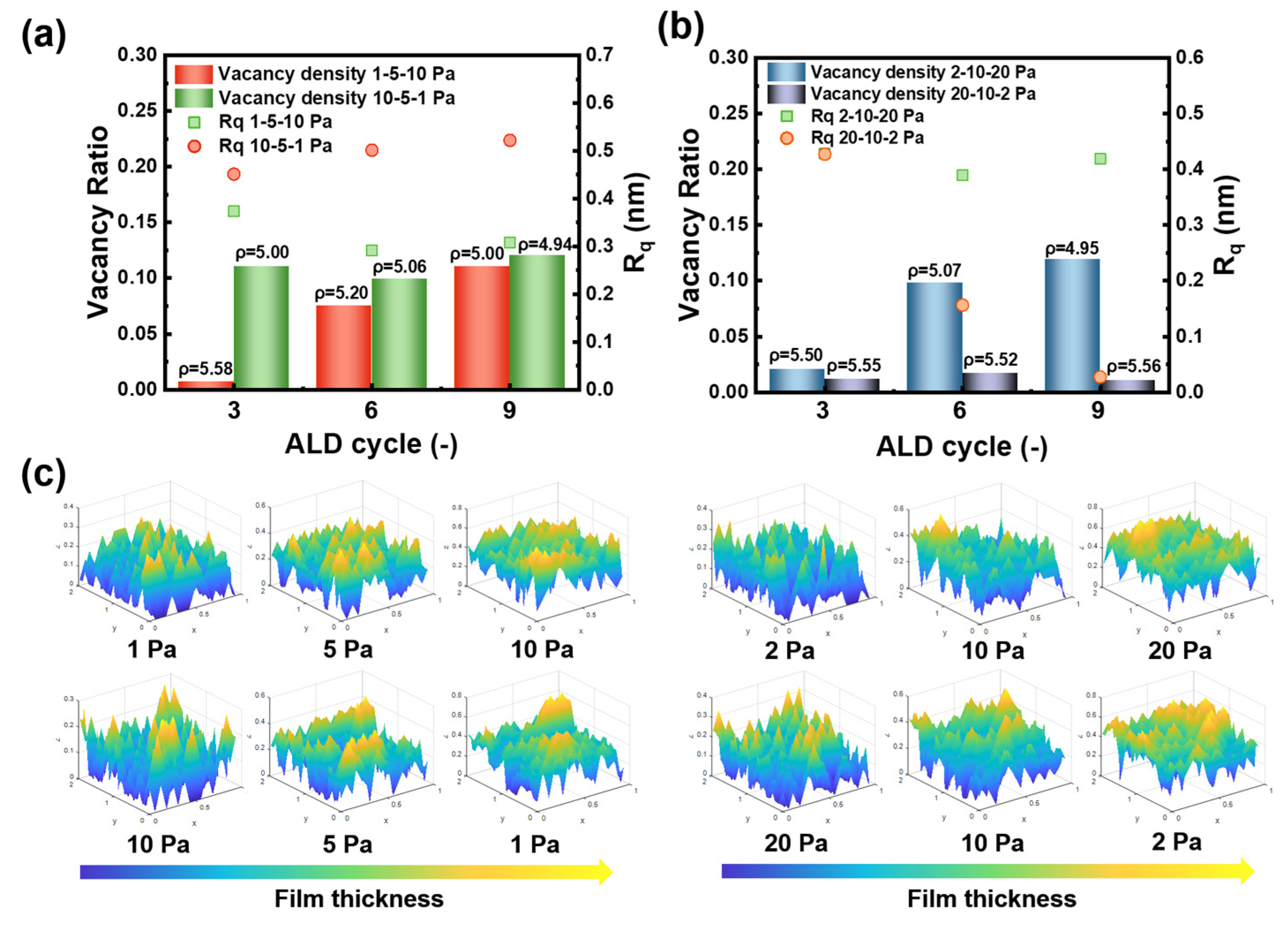
Figure 9a shows that under a gradually increasing pressure sequence, the vacancy ratio increases continuously while atomic-level smoothness decreases. In contrast, a decreasing pressure sequence results in only minor variations in both the vacancy ratio and smoothness, maintaining values close to those of deposition on an initially flat substrate.
Figure 9.
Vacancy ratio, film density (g/cm3), and atomic-level smoothness of thin films. (a) Results of three ALD cycles of sequential deposition on substrates under operating pressures of 1, 5 and 10 Pa. (b) Results of three ALD cycles of sequential deposition on substrates under operating pressures of 2, 10 and 20 Pa. (c) Three-dimensional surface vector plots of simulation results at each stage.
Figure 9b corresponds to the operating condition with doubled precursor partial pressure, while all other parameters remain identical to those in Figure 9a. With increasing pressure, the vacancy ratio rises whereas smoothness shows limited variation. In the case of decreasing pressure, the vacancy ratio remains low and stable, while atomic-level smoothness gradually decreases to 0.027 nm. This behavior has implications for ALD inside the microstructure where the nanochannel entrance and bottom can correspond to decreasing and increasing precursor partial pressure, respectively. Notably, under comparable exposure conditions, films deposited at the channel bottom possess lower surface smoothness and a higher vacancy ratio relative to those grown near the channel inlet.
Figure 9c presents the corresponding surface morphologies. Under the increasing-pressure sequence, atomic-level smoothness evolves moderately in the initial stage but deteriorates progressively with increased protrusions and higher Rq. In contrast, the decreasing-pressure sequence maintains relatively stable surface morphology throughout deposition, with fewer protrusions. After nine ALD cycles, a highly uniform thin film with a low vacancy ratio is obtained.
The optical properties of devices are strongly influenced by the microstructure and surface morphology of thin films [33]. Variations in atomic-level smoothness can affect the functional performance of thin films in practical applications. For instance, ZnO films grown on rough ZnO buffer layers have been reported to exhibit enhanced optical quality [34], providing valuable insights for the fabrication of optoelectronic and light-emitting devices.
Deposition under different operating conditions can lead to significant variations in atomic-level smoothness. A higher precursor partial pressure corresponds to a higher adsorption rate, which promotes surface chemical reactions and facilitates the formation of complete monolayer coverage. In contrast, a lower precursor partial pressure results in reduced adsorption rates and fewer adsorbed molecules within the same reaction time. Moreover, for surface sites with pronounced steric hindrance, a low precursor partial pressure may be insufficient to enable adsorption, thereby reducing atomic-level smoothness.
In multi-cycle ALD processes, the temporal sequence of precursor partial pressure serves as a critical parameter for regulating thin-film structure and surface morphology. Vacant lattice sites exhibit a pronounced cumulative effect over successive deposition cycles. A descending pressure sequence (from high to low precursor partial pressure) induces a self-planarization effect on the film surface, effectively suppressing vacancy accumulation and increasing atomic-level smoothness. In particular, under a pressure sequence of 20 to 10 to 2 Pa, low vacancy ratio and smooth ALD films can be achieved.
In contrast, for the step-up pressure scheme where precursor partial pressure rises gradually from low to high, the thin film exhibits elevated vacancy ratio throughout deposition, which impedes the fabrication of highly uniform films.
4. Conclusions
In this study, a multiscale simulation framework combining kMC and FVM was developed to investigate the ALD process of the DEZ/H2O system in high-aspect-ratio nanochannels. The results show that film growth is governed by the coupled effects of precursor diffusion and surface reaction, leading to a spatial gradient in precursor partial pressure along the nanochannel depth. The evolution of precursor distribution strongly depends on deposition conditions, which in turn regulate film structure. A decreasing precursor partial pressure sequence promotes uniform adsorption and results in a low vacancy ratio and high atomic-level smoothness.
Furthermore, the kMC model enables quantitative evaluation of growth per cycle, vacancy ratio and atomic-scale morphology by statistically tracking atomic deposition sites, while FVM is used to analyze gas-phase transport behavior. This coupled simulation framework confirms the self-limiting nature of the ALD process and provides a predictive tool for optimizing deposition processes in high-aspect-ratio structures.
Supplementary Materials
The following supporting information can be downloaded at https://www.mdpi.com/article/10.3390/coatings16080898/s1, Table S1: Values of standard reaction model parameters; Table S2: Model Parameters and Diffusion Type; Table S3: Assignment of reaction energy barriers for different nearest-neighbor coverages in the kMC model. Figure S1: Jumping and diffusion process of particles on a two-dimensional lattice. Blue represents vacant sites, orange represents occupied sites, and red denotes reactive sites. Particle diffusion can only occur when the target site is vacant [16]. Refs. [35,36,37,38] are cited in Supplementary Materials file.
Author Contributions
Conceptualization, Z.L. and L.Z.; methodology, Z.L., H.Y. and L.Z.; software, Z.L., Y.C., H.Y. and L.Z.; validation, Z.L., Y.Y., H.Y. and L.Z.; formal analysis, Z.L., Y.Y., Y.C., H.Y. and L.Z.; investigation, Z.L., Y.Y., Y.C., H.Y. and L.Z.; data curation, Z.L., Y.Y., H.Y. and L.Z.; writing—original draft preparation, Z.L., H.Y. and L.Z.; writing—review and editing, L.Z., H.Y. and L.Z.; supervision, H.Y. and L.Z.; project administration, H.Y. and L.Z.; funding acquisition, L.Z. and H.Y. All authors have read and agreed to the published version of the manuscript.
Funding
This work was financially supported by the National Key Research and Development Program of China (2025YFH0102604), the National Natural Science Foundation of China (22078091; 22278132), and Shanghai Pujiang Program (2022PJD016). Part of ALD multiscale simulations was conducted on the Atomic Layer Deposition Process Simulation Platform, which is supported by the Atomic-level Manufacturing Program from the Ministry of Industry and Information Technology (China).
Institutional Review Board Statement
Not applicable.
Informed Consent Statement
Not applicable.
Data Availability Statement
The data presented in this study are not publicly available due to privacy and confidentiality restrictions. The raw data supporting the conclusions of this article are available from the corresponding author upon reasonable request.
Conflicts of Interest
The authors declare no conflict of interest.
Abbreviations
The following abbreviations are used in this manuscript:
| ALD | atomic layer deposition |
| GAA | gate-all-around |
| kMC | kinetic Monte Carlo |
| MD | molecular dynamics |
| FVM | finite volume method |
| DEZ | diethylzinc |
| AAO | anodic aluminum oxide |
| MEZ | monoethylzinc |
| GPC | growth per cycle |
References
- Yeap, G.; Lin, S.; Shang, H.; Lin, H.; Peng, Y.; Wang, M.; Wang, P.; Lin, C.; Yu, K.; Lee, W.; et al. 2nm Platform Technology featuring Energy-efficient Nanosheet Transistors and Interconnects co-optimized with 3DIC for AI, HPC and Mobile SoC Applications. In Proceedings of the IEEE International Electron Devices Meeting (IEDM), San Francisco, CA, USA, 7–11 December 2024. [Google Scholar]
- Bao, R.; Oniki, Y.; He, X.; Isobe, Y.; Hundekar, P.; Matsuyama, S.; Mignot, S.; Kawamoto, S.; Ramirez, A.V.; Abe, H.; et al. Advanced Multi-Vt Enabled by Selective Layer Reductions for 2 nm Nanosheet Technology and Beyond. In Proceedings of the 2024 IEEE International Electron Devices Meeting (IEDM), San Francisco, CA, USA, 7–11 December 2024. [Google Scholar]
- Johnson, R.W.; Hultqvist, A.; Bent, S.F. A brief review of atomic layer deposition: From fundamentals to applications. Mater. Today 2014, 17, 236–246. [Google Scholar] [CrossRef] [Scilit]
- George, S.M. Atomic Layer Deposition: An Overview. Chem. Rev. 2010, 110, 111–131. [Google Scholar] [CrossRef] [Scilit] [PubMed]
- Puurunen, R.L. Surface chemistry of atomic layer deposition: A case study for the trimethylaluminum/water process. J. Appl. Phys. 2005, 97, 121301. [Google Scholar] [CrossRef] [Scilit]
- Elliott, S.D. Atomic-scale simulation of ALD chemistry. Semicond. Sci. Technol. 2012, 27, 10. [Google Scholar] [CrossRef] [Scilit]
- Chen, M.; Nijboer, M.P.; Kovalgin, A.Y.; Nijmeijer, A.; Roozeboom, F.; Luiten-Olieman, M.W.J. Atmospheric-pressure atomic layer deposition: Recent applications and new emerging applications in high-porosity/3D materials. Dalton Trans. 2023, 52, 10254–10277. [Google Scholar] [CrossRef] [Scilit] [PubMed]
- Weber, M.; Julbe, A.; Ayral, A.; Miele, P.; Bechelany, M. Atomic Layer Deposition for Membranes: Basics, Challenges, and Opportunities. Chem. Mater. 2018, 30, 7368–7390. [Google Scholar] [CrossRef] [Scilit]
- Elam, J.W.; Xiong, G.; Han, C.Y.; Wang, H.H.; Birrell, J.P.; Welp, U.; Hryn, J.N.; Pellin, M.J.; Baumann, T.F.; Poco, J.F.; et al. Atomic Layer Deposition for the Conformal Coating of Nanoporous Materials. J. Nanomater. 2006, 2006, 064501. [Google Scholar] [CrossRef] [Scilit]
- Gonsalves, C.; Velasco, J.A.; Yim, J.; Järvilehto, J.; Vuorinen, V.; Puurunen, R.L. Simulated conformality of atomic layer deposition in lateral channels: The impact of the Knudsen number on the saturation profile characteristics. Phys. Chem. Chem. Phys. 2024, 26, 28431–28448. [Google Scholar] [CrossRef] [Scilit] [PubMed]
- Heikkinen, N.; Lehtonen, J.; Puurunen, R.L. An atomic layer deposition diffusion-reaction model for porous media with different particle geometries. Phys. Chem. Chem. Phys. 2024, 26, 7580–7591. [Google Scholar] [CrossRef] [Scilit] [PubMed]
- Haimi, E.; Philip, A.; Velasco, J.A.; Gao, F.; Karppinen, M.; Puurunen, R.L. Atomic layer deposition of zinc oxide films on lateral high-aspect-ratio test structures using diethylzinc and water as precursors. J. Vac. Sci. Technol. A 2026, 44, 9. [Google Scholar] [CrossRef] [Scilit]
- Li, Z.S.; Chen, Y.X.; Nie, Y.F.; Yang, F.; Liu, X.; Gao, Y.; Shan, B.; Chen, R. Multiscale computational fluid dynamics modelling of spatial ALD on porous li-ion battery electrodes. Chem. Eng. J. 2024, 479, 147486. [Google Scholar] [CrossRef] [Scilit]
- Beeler, J.R. Displacement Spikes in Cubic Metals. I. a-Iron, Copper, and Tungsten. Phys. Rev. 1966, 150, 470–487. [Google Scholar] [CrossRef] [Scilit]
- Bortz, A.B.; Kalos, M.H.; Lebowitz, J.L. A new algorithm for Monte Carlo simulation of Ising spin systems. J. Comput. Phys. 1975, 17, 10–18. [Google Scholar] [CrossRef] [Scilit]
- Andersen, M.; Panosetti, C.; Reuter, K. A Practical Guide to Surface Kinetic Monte Carlo Simulations. Front. Chem. 2019, 7, 24. [Google Scholar] [CrossRef] [Scilit] [PubMed]
- Kim, S.; An, H.; Oh, S.; Jung, J.; Kim, B.; Nam, S.K.; Han, S. Atomistic kinetic Monte Carlo simulation on atomic layer deposition of TiN thin film. Comput. Mater. Sci. 2022, 213, 111620. [Google Scholar] [CrossRef] [Scilit]
- Savva, G.D.; Benson, R.L.; Christidi, I.A.; Stamatakis, M. Exact distributed kinetic Monte Carlo simulations for on-lattice chemical kinetics: Lessons learnt from medium- and large-scale benchmarks. Philos. Trans. R. Soc. A-Math. Phys. Eng. Sci. 2023, 381, 18. [Google Scholar] [CrossRef] [Scilit] [PubMed]
- Yokaichiya, T.; Ikeda, T.; Muraoka, K.; Nakayama, A. On-the-fly kinetic Monte Carlo simulations with neural network potentials for surface diffusion and reaction. J. Chem. Phys. 2024, 160, 9. [Google Scholar] [CrossRef] [Scilit] [PubMed]
- Mazaleyrat, G.; Estève, A.; Jeloaica, L.; Djafari-Rouhani, M. A methodology for the kinetic Monte Carlo simulation of alumina atomic layer deposition onto silicon. Comput. Mater. Sci. 2005, 33, 74–82. [Google Scholar] [CrossRef] [Scilit]
- Zhuang, L.W.; Corkery, P.; Lee, D.T.; Lee, S.; Kooshkbaghi, M.; Xu, Z.L.; Dai, G.C.; Kevrekidis, I.G.; Tsapatsis, M. Numerical simulation of atomic layer deposition for thin deposit formation in a mesoporous substrate. AIChE J. 2021, 67, 12. [Google Scholar] [CrossRef] [Scilit]
- Weckman, T.; Shirazi, M.; Elliott, S.D.; Laasonen, K. Kinetic Monte Carlo Study of the Atomic Layer Deposition of Zinc Oxide. J. Phys. Chem. C 2018, 122, 27044–27058. [Google Scholar] [CrossRef] [Scilit]
- Knazdtgelit, H.; Ratnasamy, P. Catalytic Aluminas: Surface Models and Characterization of Surface Sites. Catal. Rev. Sci. Eng. 1978, 17, 31–70. [Google Scholar] [CrossRef] [Scilit]
- Gu, H.; Lee, D.T.; Corkery, P.; Miao, Y.R.; Kim, J.S.; Yuan, Y.C.; Xu, Z.L.; Dai, G.; Parsons, G.N.; Kevrekidis, I.G.; et al. Modeling of deposit formation in mesoporous substrates via atomic layer deposition: Insights from pore-scale simulation. AIChE J. 2022, 68, 13. [Google Scholar] [CrossRef] [Scilit]
- Mitchell, J.A.; Abdeljawad, F.; Battaile, C.; Garcia-Cardona, C.; Holm, E.A.; Homer, E.R.; Madison, J.; Rodgers, T.M.; Thompson, A.P.; Tikare, V.; et al. Parallel simulation via SPPARKS of on-lattice kinetic and Metropolis Monte Carlo models for materials processing. Model. Simul. Mater. Sci. Eng. 2023, 31, 47. [Google Scholar] [CrossRef] [Scilit]
- Shirazi, M.; Elliott, S.D. Atomistic Kinetic Monte Carlo Study of Atomic Layer Deposition Derived from Density Functional Theory. J. Comput. Chem. 2014, 35, 244–259. [Google Scholar] [CrossRef] [Scilit] [PubMed]
- Yanguas-Gil, A.; Elam, J.W. Self-Limited Reaction-Diffusion in Nanostructured Substrates: Surface Coverage Dynamics and Analytic Approximations to ALD Saturation Times. Chem. Vap. Depos. 2012, 18, 46–52. [Google Scholar] [CrossRef] [Scilit]
- Aguinsky, L.F.; Rodrigues, F.; Reiter, T.; Klemenschits, X.; Filipovic, L.; Hössinger, A.; Weinbub, J. Modeling incomplete conformality during atomic layer deposition in high aspect ratio structures. Solid-State Electron. 2023, 201, 108584. [Google Scholar] [CrossRef] [Scilit]
- Kim, H.-M.; Kim, D.-G.; Kim, Y.-S.; Kim, M.; Park, J.-S. Atomic layer deposition for nanoscale oxide semiconductor thin film transistors: Review and outlook. Int. J. Extrem. Manuf. 2023, 5, 012006. [Google Scholar] [CrossRef] [Scilit]
- Kim, J.; Hwang, I.; Kim, B.; Lee, W.; Song, J.; Jung, Y.; Yoon, C. Deposition of HfO2 by Remote Plasma ALD for High-Aspect-Ratio Trench Capacitors in DRAM. Nanomaterials 2025, 15, 783. [Google Scholar] [CrossRef] [Scilit] [PubMed]
- Xia, B.; Ganem, J.J.; Briand, E.; Steydli, S.; Tancrez, H.; Vickridge, I. The carbon and hydrogen contents in ALD-grown ZnO films define a narrow ALD temperature window. Vacuum 2021, 190, 110289. [Google Scholar] [CrossRef] [Scilit]
- Li, H.J.; Wen, Y.W.; Ge, Y.; Ruan, Q.Y.; Lü, H.L.; Tan, W.L.; Yu, F.Z.; Liu, Z.; Cao, K.; Shan, B.; et al. Steric Hindrance and Film Quality in HfO2 Atomic Layer Deposition: Comparative Kinetic Monte Carlo Simulation of TEMA-Hf and HfCp(NMe2)3 Precursors. Chem. Mater. 2025, 37, 3969–3979. [Google Scholar] [CrossRef] [Scilit]
- Gan, X.W.; Wang, T.; Wu, H.; Liu, C. ZnO deposited on Si (111) with Al2O3 buffer layer by atomic layer deposition. Vacuum 2014, 107, 120–123. [Google Scholar] [CrossRef] [Scilit]
- Lee, J.Y.; Kim, C.R.; Heo, J.H.; Shin, C.M.; Park, J.H.; Lee, T.M.; Ryu, H.; Chang, J.H.; Son, C.S.; Shin, B.C.; et al. Effects of Buffer Layer Annealing on ZnO Thin Films Grown by using Atomic Layer Deposition. J. Korean Phys. Soc. 2009, 55, 2556–2559. [Google Scholar] [CrossRef] [Scilit]
- Weckman, T.; Laasonen, K. Atomic Layer Deposition of Zinc Oxide: Diethyl Zinc Reactions and Surface Saturation from First-Principles. J. Phys. Chem. C 2016, 120, 21460–21471. [Google Scholar] [CrossRef] [Scilit]
- Weckman, T.; Laasonen, K.E. Atomic Layer Deposition of Zinc Oxide: Study on the Water Pulse Reactions from First-Principles. J. Phys. Chem. C 2018, 122, 7685–7694. [Google Scholar] [CrossRef] [Scilit] [PubMed]
- Shirazi, M.; Elliott, S.D. Multiple Proton Diffusion and Film Densification in Atomic Layer Deposition Modeled by Density Functional Theory. Chem. Mater. 2013, 25, 878–889. [Google Scholar] [CrossRef] [Scilit]
- Eyring, H. The activated complex in chemical reactions. J. Chem. Phys. 1935, 3, 107–115. [Google Scholar] [CrossRef] [Scilit]
Disclaimer/Publisher’s Note: The statements, opinions and data contained in all publications are solely those of the individual author(s) and contributor(s) and not of MDPI and/or the editor(s). MDPI and/or the editor(s) disclaim responsibility for any injury to people or property resulting from any ideas, methods, instructions or products referred to in the content. |
© 2026 by the authors. Licensee MDPI, Basel, Switzerland. This article is an open access article distributed under the terms and conditions of the Creative Commons Attribution (CC BY) license.