


Abstract
Laser micro/nanoprocessing has emerged as an effective strategy for the fabrication of superhydrophobic and superamphiphobic surfaces owing to its high precision, broad material compatibility, and flexible processing capability. This review systematically summarizes recent advances in laser-based fabrication of functional wetting interfaces. The two primary processing pathways, laser ablation and laser-induced structuring, are comparatively discussed, with emphasis on the processing–structure–property relationships of metallic, polymeric, and ceramic substrates. Representative applications, including anti-icing and anti-frosting, anti-fogging, corrosion resistance, oil–water separation, and antibacterial surfaces, are further reviewed to highlight the engineering potential of laser-fabricated superhydrophobic interfaces. Despite significant progress, challenges related to processing efficiency, long-term durability, fabrication cost, and process controllability remain. Future research is expected to focus on intelligent process optimization, high-throughput manufacturing, environmentally friendly modification strategies, and multifunctional integration, thereby accelerating the transition of laser-fabricated superhydrophobic surfaces from laboratory research to large-scale industrial applications.
1. Introduction
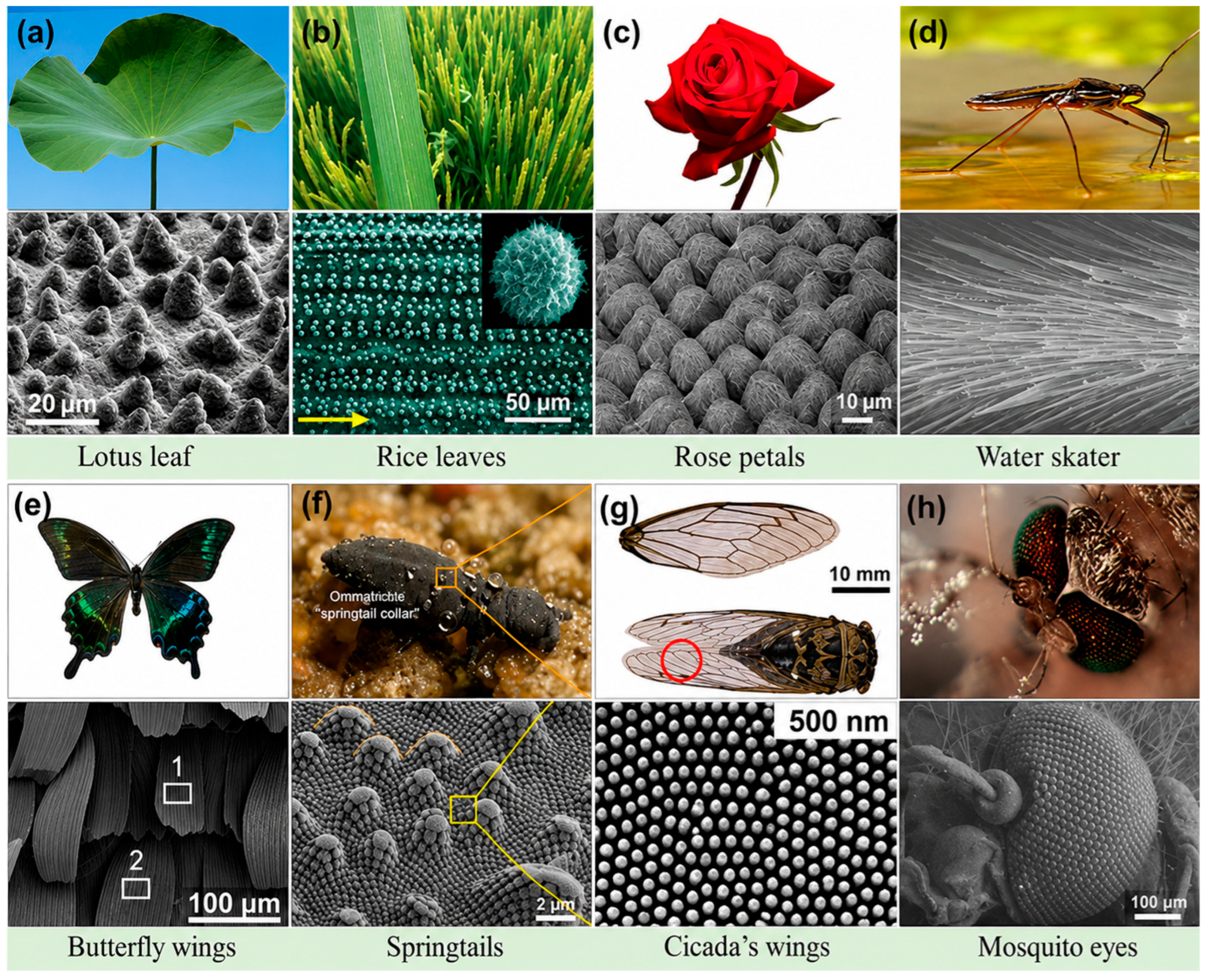
On lotus leaves, water droplets readily roll off without wetting the surface; water striders can locomote on water without sinking; and butterfly wings remain dry even after exposure to rain. These representative natural phenomena arise from a common interfacial property, namely superhydrophobicity. In general, a superhydrophobic surface is defined as a solid interface exhibiting a high contact angle (CA) and a low sliding angle (SA), thereby enabling pronounced water-repellent behavior. Beyond these examples, a variety of biological surfaces, including rose petals and rice leaves, exhibit similar wetting behavior (Figure 1).
Such natural architectures have inspired biomimetic surface design and driven extensive research into artificial superhydrophobic surfaces [1]. As a result, substantial progress has been achieved in both fundamental understanding and technological development. Owing to their multifunctional characteristics, including drag reduction [2], self-cleaning [3], antibacterial performance [4], corrosion resistance [5], and water or ice repellency, superhydrophobic surfaces exhibit broad application potential across diverse fields such as aerospace [6], marine engineering, electronics, and biomedicine. Consequently, superhydrophobic surfaces have emerged as an important research focus in surface engineering [7]. Developing reliable and scalable fabrication strategies is therefore essential for advancing both fundamental understanding and practical implementation.
To achieve superhydrophobicity, the intrinsic wettability of the substrate must be carefully considered. For intrinsically hydrophobic materials, the introduction of micro/nnanoscalesurface structures can further enhance water-repellent behavior, enabling the transition to a superhydrophobic state. In contrast, the fabrication of superhydrophobic surfaces on hydrophilic substrates typically relies on a combined strategy of hierarchical structure construction and low-surface-energy modification. Micro/nanoscale roughness is first generated to amplify surface topography, after which chemical modification is employed to lower the surface energy and stabilize the superhydrophobic state.
Conventional fabrication approaches, including template-assisted methods, coating techniques, and self-assembly processes, have been widely employed for this purpose [8]. However, conventional fabrication methods are often characterized by complex processing routes, stringent operating conditions, and potential environmental concerns. Furthermore, the resulting superhydrophobic surfaces frequently suffer from limited durability, especially under mechanical abrasion and variable temperature or humidity conditions. The associated degradation in wetting performance, together with the short service lifetime, significantly hinders practical application. As a result, these limitations remain a critical bottleneck restricting the transition of superhydrophobic surfaces from laboratory-scale studies to large-scale industrial implementation.
Laser processing has attracted considerable attention as an advanced manufacturing technology due to its high precision, non-contact nature, and flexibility in pattern design. Moreover, its applicability to diverse material systems makes it a promising alternative to conventional fabrication methods. Owing to these merits, laser-based approaches have been widely adopted for the fabrication of superhydrophobic surfaces. By tailoring key processing parameters, including laser power, scanning speed, and pulse frequency, complex micro/nanostructures can be precisely engineered on diverse substrates such as metals, ceramics, and polymers, enabling the realization of desired wetting behavior. Furthermore, subsequent surface modification can tailor the surface chemistry, thereby improving the stability and long-term durability of the superhydrophobic state.
Figure 1.
Bio-inspired hierarchical architectures for superhydrophobicity. Reproduced with permission [9]. Copyright 2025, Materials. Natural and biological surfaces, including lotus leaves, rice leaves, rose petals, and water striders (a–d), as well as butterfly wings, springtails, cicada wings, and mosquito eyes (e–h), exhibit diverse hierarchical micro/nanostructures that govern wetting, adhesion, and interfacial transport behavior. Annotations are used to guide interpretation: arrows indicate hierarchical or directional features, while highlighted regions mark representative micro/nanostructures. Scale bars are provided for quantitative comparison.
This review focuses on recent advances in laser-assisted fabrication of superhydrophobic surfaces. The mechanisms of laser-induced wettability regulation are briefly introduced, followed by a comparative analysis of processing–structure–property relationships across different material systems. Particular emphasis is placed on the influence of laser parameters on surface morphology, wettability, and functional performance. Finally, representative applications, current challenges, and future research directions are discussed. The current application status of laser-fabricated superhydrophobic surfaces is then summarized, and the existing challenges together with future development trends are highlighted. This work aims to provide a reference for both fundamental research and practical applications in this field.
2. Fundamentals of Wettability Theory
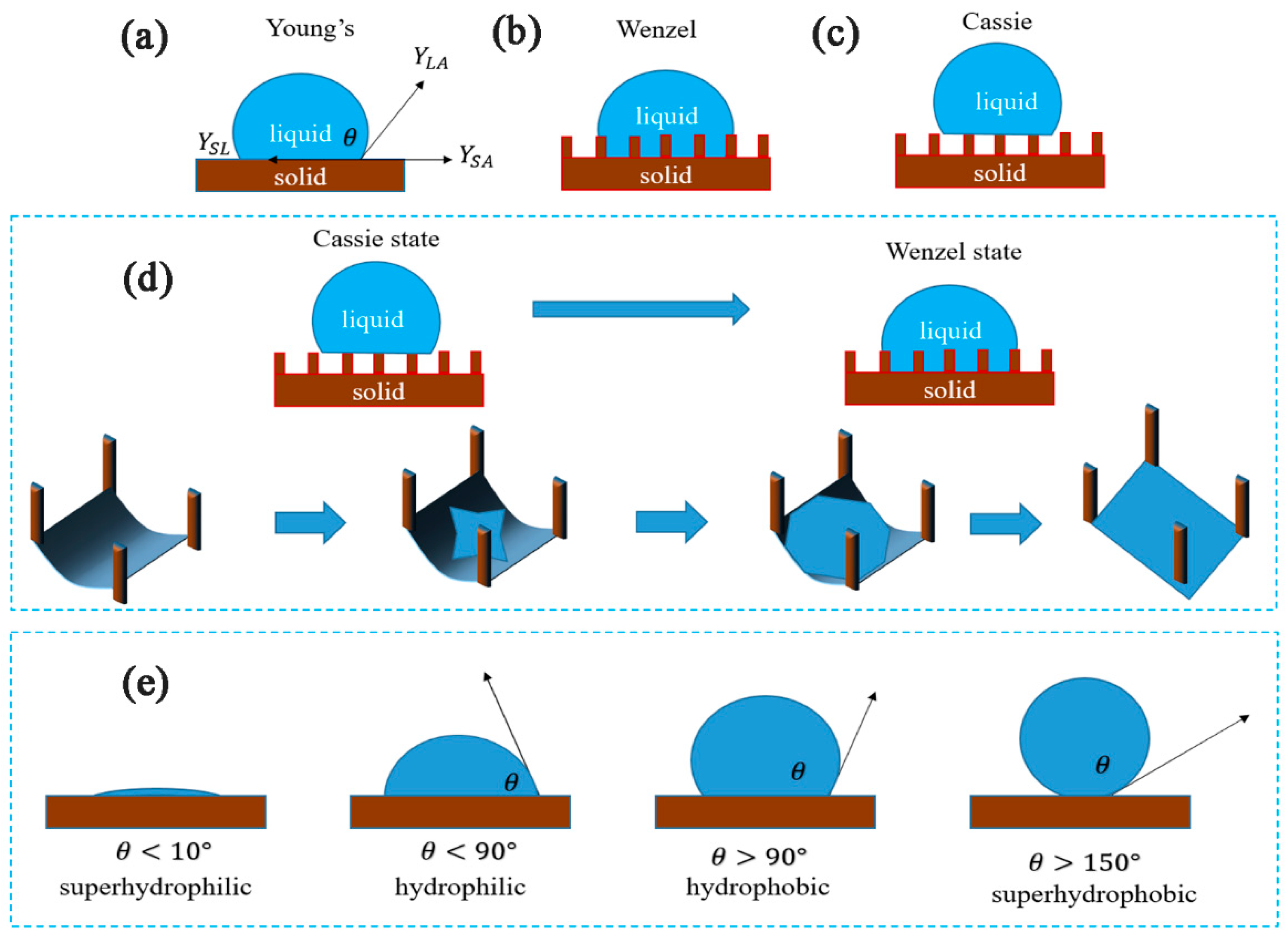
Wettability is governed by the interfacial interactions at the solid–liquid–vapor interface and is strongly influenced by both surface chemistry and micro/nanoscale morphology [10]. Classical wetting theories, including Young’s equation, the Wenzel model, and the Cassie–Baxter model, provide the fundamental framework for describing wetting behavior on solid surfaces. Among them, the Cassie–Baxter model is most relevant to superhydrophobic surfaces because trapped air pockets reduce the solid–liquid contact area and increase the apparent contact angle, which can be described by:
where f1 is the solid–liquid contact fraction. By minimizing the solid–liquid contact area and stabilizing the trapped air layer, hierarchical micro/nanostructures enable high contact angles and low droplet adhesion, which constitute the fundamental basis of superhydrophobicity. Representative wetting states are illustrated in Figure 2a–c.
Figure 2.
(a) Water droplet in Young’s state. (b) Water droplet in the Wenzel state. (c) Water droplet in the Cassie state. (d) Transition process from the Cassie to the Wenzel state. (e) Different states of water droplets on the surface.
Based on the wetting theories discussed above, surface wettability is commonly characterized by the contact angle (CA) and sliding angle (SA). In general, surfaces with CA > 90° are considered hydrophobic, whereas those with CA < 90° are classified as hydrophilic. Superhydrophobicity is typically defined by a CA exceeding 150° and an SA below 5° [11], as illustrated in Figure 2d. For superamphiphobic surfaces, which repel both water and low-surface-tension liquids, the oil contact angle (OCA) should also exceed 150°, with an oil sliding angle below 10°.
The concept of superhydrophobic surfaces is inspired by natural biological systems, including lotus leaves, rice leaves, mosquito legs, butterfly wings, and aquatic insects, all of which exhibit remarkable water-repellent behavior such as self-cleaning and facile droplet rolling. These characteristics are generally attributed to the synergistic effect of hierarchical micro/nanoscale surface structures and low-surface-energy chemistry on biological surfaces [12,13]. This structure–chemistry synergy has therefore become the fundamental design principle for the fabrication of artificial superhydrophobic surfaces.
The construction of hierarchical micro- and nanoscale surface architectures effectively reduces the solid–liquid contact fraction (f1), thereby facilitating the formation and stabilization of the Cassie–Baxter wetting state. In such multiscale structures, microscale features primarily act as geometric scaffolds that provide air entrapment cavities, while nanoscale textures further minimize the effective solid–liquid interfacial area and enhance the stability of the trapped air layer. Collectively, this hierarchical design significantly suppresses the energetically favorable transition from the Cassie–Baxter regime to the Wenzel state [14].
In parallel, low-surface-energy chemical modification imparts intrinsic hydrophobicity to the substrate, whereas the hierarchical micro/nanostructures construct a composite solid–air–liquid interface by stabilizing air pockets within surface asperities. The synergistic interplay between surface chemistry and multiscale roughness enables the realization of superhydrophobic behavior, typically characterized by water contact angles exceeding 150° and sliding angles below 10°.
This mechanistic understanding further provides a clear and practical design framework for laser-based micro/nanofabrication. By precisely tailoring the morphology, characteristic dimensions, and spatial distribution of surface structures via laser processing, and integrating appropriate low-surface-energy chemical functionalization, surface wettability can be systematically engineered, thereby enabling the fabrication of robust, high-performance superhydrophobic surfaces.
3. Principles and Characteristics of Laser Processing
Laser-based micro/nanofabrication has become a widely adopted strategy for fabricating superhydrophobic surfaces because it enables the direct and controllable construction of hierarchical micro/nanoscale structures on a broad range of materials. Compared with conventional fabrication methods, laser processing offers superior precision, design flexibility, and material versatility, making it particularly attractive for the scalable production of functional interfaces [15].
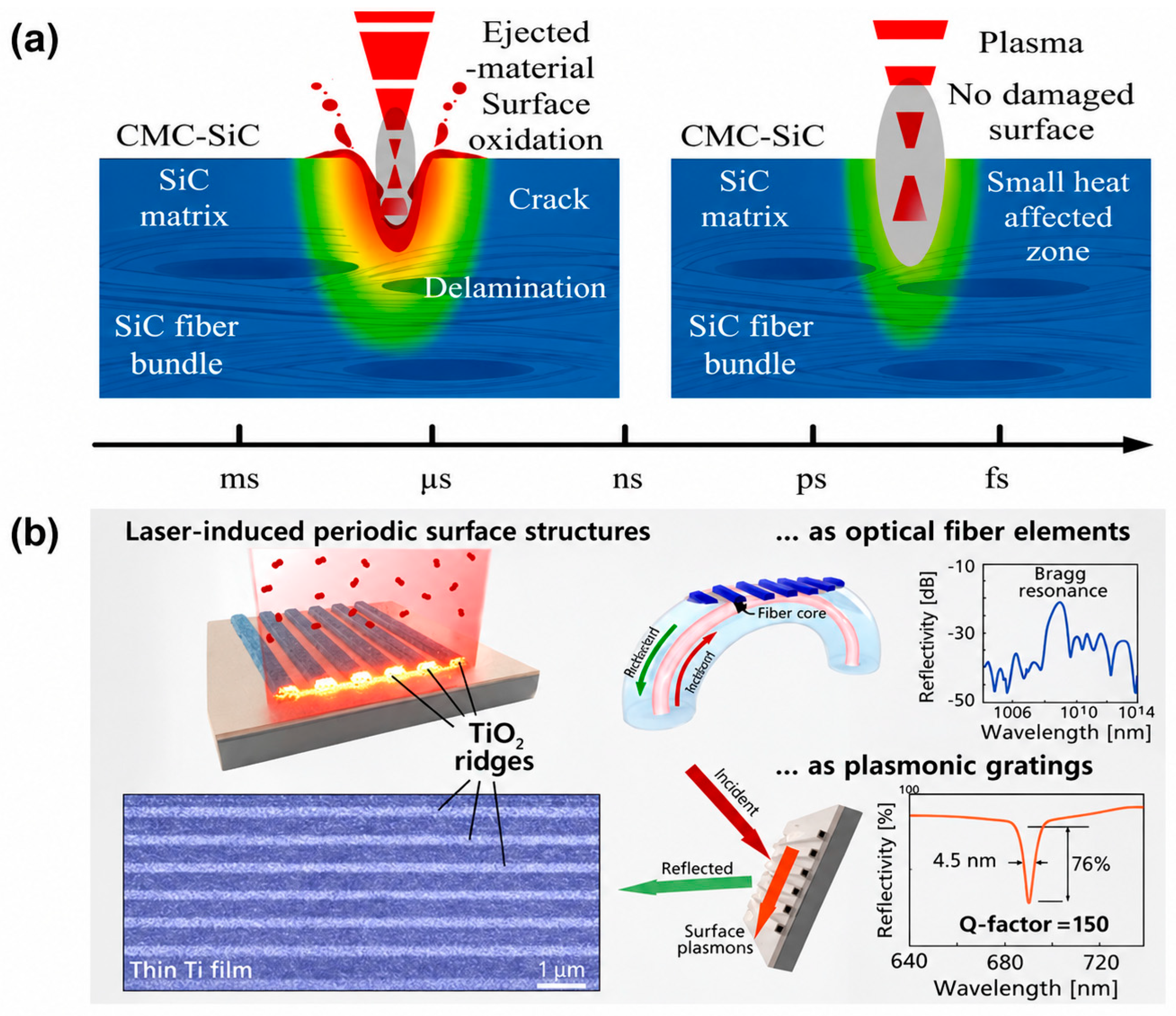
Depending on the dominant structure-formation mechanism, laser fabrication approaches for superhydrophobic surfaces can generally be divided into two categories: laser ablation and laser-induced structuring (Figure 3) [16,17]. A comparison of the two fabrication mechanisms is summarized in Table 1. While laser ablation primarily generates microscale roughness through material removal, laser-induced structuring produces ordered submicron or nanoscale features through surface reorganization. The combination of these two mechanisms enables the construction of hierarchical micro/nanoarchitectures that are essential for superhydrophobicity.
Table 1.
Comparison of the characteristics of laser ablation and laser-induced structuring for superhydrophobic surface fabrication.
When the laser fluence exceeds the material ablation threshold, localized material removal occurs through evaporation, melt expulsion, and plasma ejection, generating characteristic surface morphologies such as grooves, pillars, cones, and porous structures [18]. Owing to its high efficiency and broad applicability, laser ablation is widely used to construct microscale roughness that serves as the structural foundation for superhydrophobic surfaces.
In contrast to laser ablation, laser-induced structuring relies primarily on localized surface reorganization rather than substantial material removal. A representative example is laser-induced periodic surface structures (LIPSS), which generate highly ordered submicron or nanoscale textures through laser–matter interactions [19]. Owing to their small feature size and high structural regularity, these structures are particularly effective for tailoring surface wettability and interfacial properties.
In practical applications, laser-induced nanoscale textures are frequently combined with ablation-derived microscale features to construct hierarchical micro/nanoarchitectures. In such systems, laser ablation provides the microscale framework, whereas laser-induced structuring introduces nanoscale roughness, enabling synergistic enhancement of superhydrophobic performance and other surface functionalities. Compared with laser ablation, laser-induced structuring offers superior control over nanoscale morphology, whereas laser ablation is more suitable for rapid construction of microscale roughness. Consequently, the combination of both approaches has become a common strategy for fabricating high-performance superhydrophobic surfaces.
Figure 3.
(a) Schematic diagram comparing the damage mechanisms of CMC-SiC composites under different pulse width laser ablation. Reproduced with permission [20]. Copyright 2020, Applied Surface Science. (b) Schematic diagram of femtosecond laser-induced TiO2-LIPSS and its photonic applications. Reproduced with permission [21]. Copyright 2024, ACS Applied Materials & Interfaces.
4. Laser Micro/Nanoprocessing to Construct Superhydrophobic Surfaces of Different Materials
The fabrication strategy of laser-induced superhydrophobic surfaces depends strongly on substrate properties. Metals, polymers, and ceramics exhibit distinct optical absorption characteristics, thermal responses, and structural evolution behaviors under laser irradiation, resulting in different requirements for laser sources and processing parameters. Therefore, understanding the relationship between material properties, laser processing conditions, and resulting wettability is essential for rational surface design. The following sections summarize recent progress in metallic, polymeric, and ceramic substrates, highlighting the advantages, limitations, and suitable processing routes for each material category.
4.1. Laser Processing of Metal Superhydrophobic Surfaces
Metallic materials are widely used in aerospace, marine engineering, and chemical industries because of their high mechanical strength and chemical stability. Their interaction with laser irradiation is largely governed by optical absorptivity, which depends on laser wavelength, material properties, and surface condition. In general, ultraviolet lasers exhibit higher absorption efficiency than near-infrared lasers. Metal absorptivity, which is governed by laser wavelength, material properties, and surface condition, plays a critical role in laser processing. In general, metals absorb ultraviolet lasers more efficiently than near-infrared lasers.
Different laser sources exhibit distinct processing characteristics and are selected according to the optical properties of metallic substrates. Nanosecond fiber lasers provide a cost-effective solution for large-area processing of materials such as stainless steel and aluminum alloys. In contrast, ultrafast lasers offer superior precision and minimal thermal damage, making them particularly suitable for titanium alloys and highly reflective metals. Ultraviolet lasers generally exhibit higher absorption efficiency and processing accuracy, but their higher cost and lower throughput restrict their application to scenarios requiring exceptional structural fidelity. To facilitate practical selection of laser sources for different metallic substrates, Table 2 summarizes the relationship between substrate optical properties, laser wavelength and processing characteristics.
Table 2.
Light absorption characteristics of different metal materials for typical laser sources.
Table 2 reveals several general trends in laser processing of metallic substrates. First, metal absorptivity strongly depends on laser wavelength, with ultraviolet lasers generally exhibiting higher absorption efficiency than near-infrared lasers. Second, surface oxide layers can significantly enhance laser energy coupling by reducing reflectivity and increasing absorptivity. Third, highly reflective metals such as aluminum and copper often require ultrafast or short-wavelength laser sources to achieve efficient micro/nanostructuring. Consequently, nanosecond fiber lasers are commonly employed for stainless steel owing to their low cost and high efficiency, whereas femtosecond lasers are preferred for titanium alloys and highly reflective metals because of their superior precision and reduced thermal effects. These observations highlight that laser selection should be determined by both the optical properties of the substrate and the desired structural characteristics.
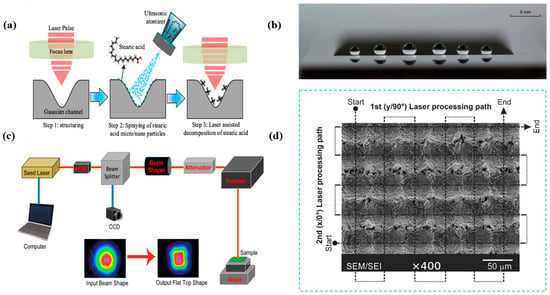
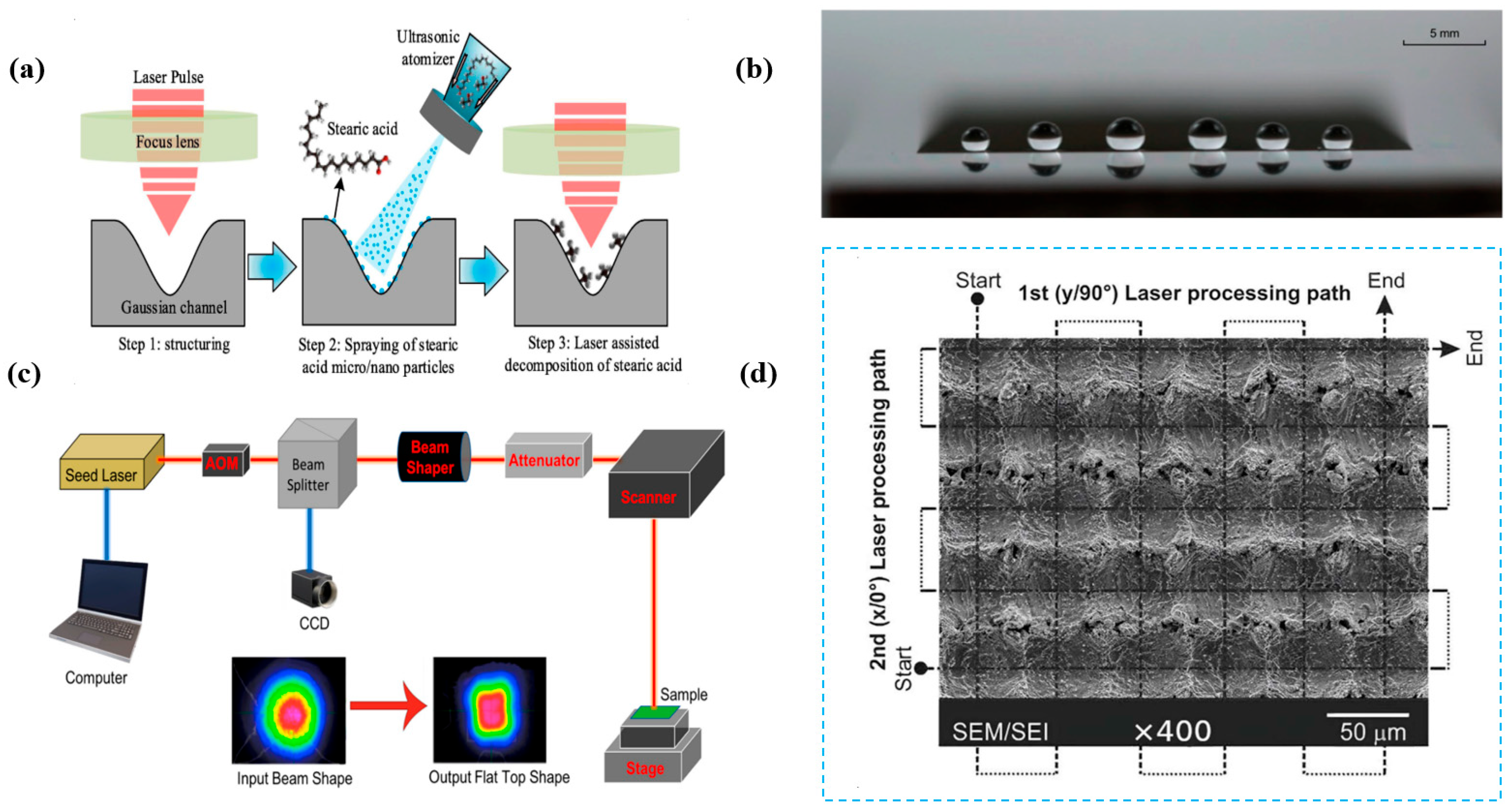
Stainless steel is one of the most extensively studied metallic substrates because its native Cr2O3 layer improves near-infrared laser absorption. Nanosecond fiber lasers can readily generate micron-scale pillar or groove structures, which after fluorosilane modification typically exhibit contact angles of 155–162° and excellent corrosion resistance. Titanium alloys are particularly suitable for ultrafast laser processing. Femtosecond lasers can generate laser-induced periodic surface structures (LIPSS) with characteristic periods of 200–800 nm, forming hierarchical micro/nanoarchitectures. Such structures typically exhibit contact angles above 160° and improved durability due to stabilization of the Cassie–Baxter state (Figure 4).
Figure 4.
(a) Coating prepared by laser texturing and laser-assisted decomposition of stearic acid. Reproduced with permission [5]. Copyright 2023, Coatings. (b) Water droplets rolled to the edge of the sample, exhibiting uniform superhydrophobic properties across a 3 × 3 cm structured metal surface. Reproduced with permission [29]. Copyright 2020, Applied Sciences. (c) The schematic of the experiment setup for the fabrication of nanostructures on a metal surface. Reproduced with permission [29]. Copyright 2020, Applied Sciences. (d) SEM micrographs of laser-textured surfaces with the direction of laser passes. Reproduced with permission [5]. Copyright 2023, Coatings.
Owing to the high reflectivity of aluminum, hybrid nanosecond–femtosecond strategies are frequently employed to construct hierarchical micro/nanostructures. After low-surface-energy modification, contact angles around 158° can be achieved, making these surfaces attractive for anti-icing and antifouling applications. Regardless of the substrate material, several common processing principles can be identified. Laser power determines structure depth, whereas scanning speed and pulse frequency influence feature density and uniformity. Excessive energy input may induce melting and structural collapse. In addition, inert-gas protection can suppress oxidation, while fluorosilane modification generally provides more stable hydrophobicity than fatty-acid-based treatments. These factors collectively govern the performance and durability of laser-fabricated superhydrophobic surfaces.
4.2. Laser Processing of Superhydrophobic Polymer Surfaces
Polymer materials are widely utilized in applications such as flexible electronics, biomedical devices, and self-cleaning packaging owing to their low density, flexibility, chemical stability, and ease of processing. Laser micro/nanofabrication provides an effective route for constructing hierarchical surface structures on polymer substrates, enabling controllable wettability and superhydrophobic performance.
Unlike metallic substrates, the laser processing of polymers is primarily governed by wavelength-dependent absorption and thermal stability. Ultraviolet lasers generally enable high-precision structuring through photochemical ablation, whereas near-infrared lasers mainly rely on photothermal effects and are more suitable for large-area processing with moderate precision requirements. Ultrafast lasers further minimize heat accumulation and material degradation, making them particularly attractive for heat-sensitive polymers and complex micro/nanostructuring applications.
Consequently, the selection of laser sources for polymers should be based on both absorption efficiency and thermal response. Representative laser–material matching relationships are summarized in Table 3. Regardless of the polymer type, excessive laser energy may induce over-ablation or chain degradation, while appropriate combinations of scanning speed and pulse frequency are essential for achieving uniform and dense micro/nanoscale structures.
Table 3.
Light absorption characteristics of different polymer materials for typical laser sources.
Table 3 reveals several common trends in the laser processing of polymer substrates. First, polymer absorptivity is highly wavelength-dependent and primarily determined by molecular structure and chemical composition. As a result, far-infrared CO2 lasers generally provide the highest processing efficiency, whereas ultraviolet ultrashort-pulse lasers offer superior precision and reduced thermal damage. Second, thermal sensitivity is a key factor governing process selection. Polymers with low thermal stability often require ultrafast laser processing to avoid melting, deformation, and heat-affected zones. Third, effective fabrication of superhydrophobic polymer surfaces relies on appropriate laser–material matching rather than simply increasing laser energy. Consequently, CO2 lasers are commonly employed for strongly infrared-absorbing polymers, while ultraviolet femtosecond lasers are preferred for precision micro/nanostructuring applications. These findings indicate that laser selection for polymer substrates should be determined by the combined consideration of optical absorption characteristics, thermal properties, and target surface functionalities.
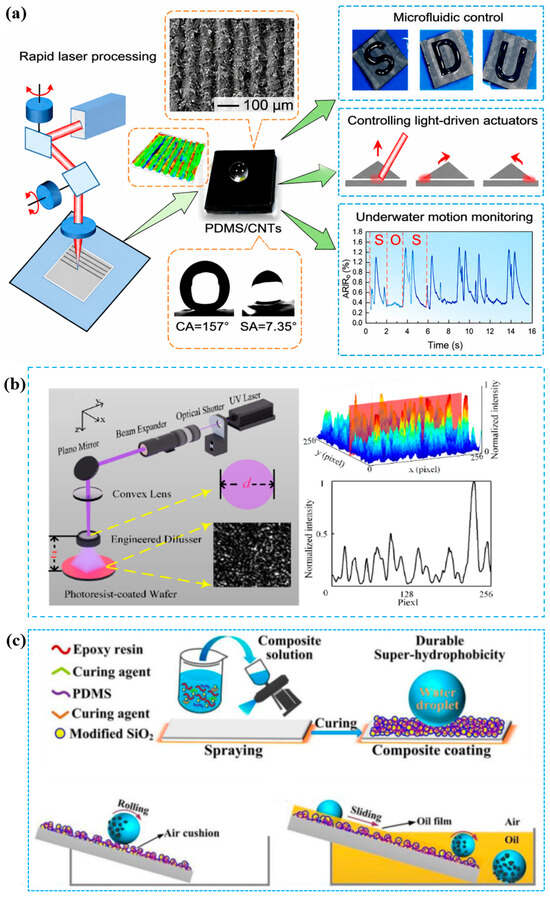
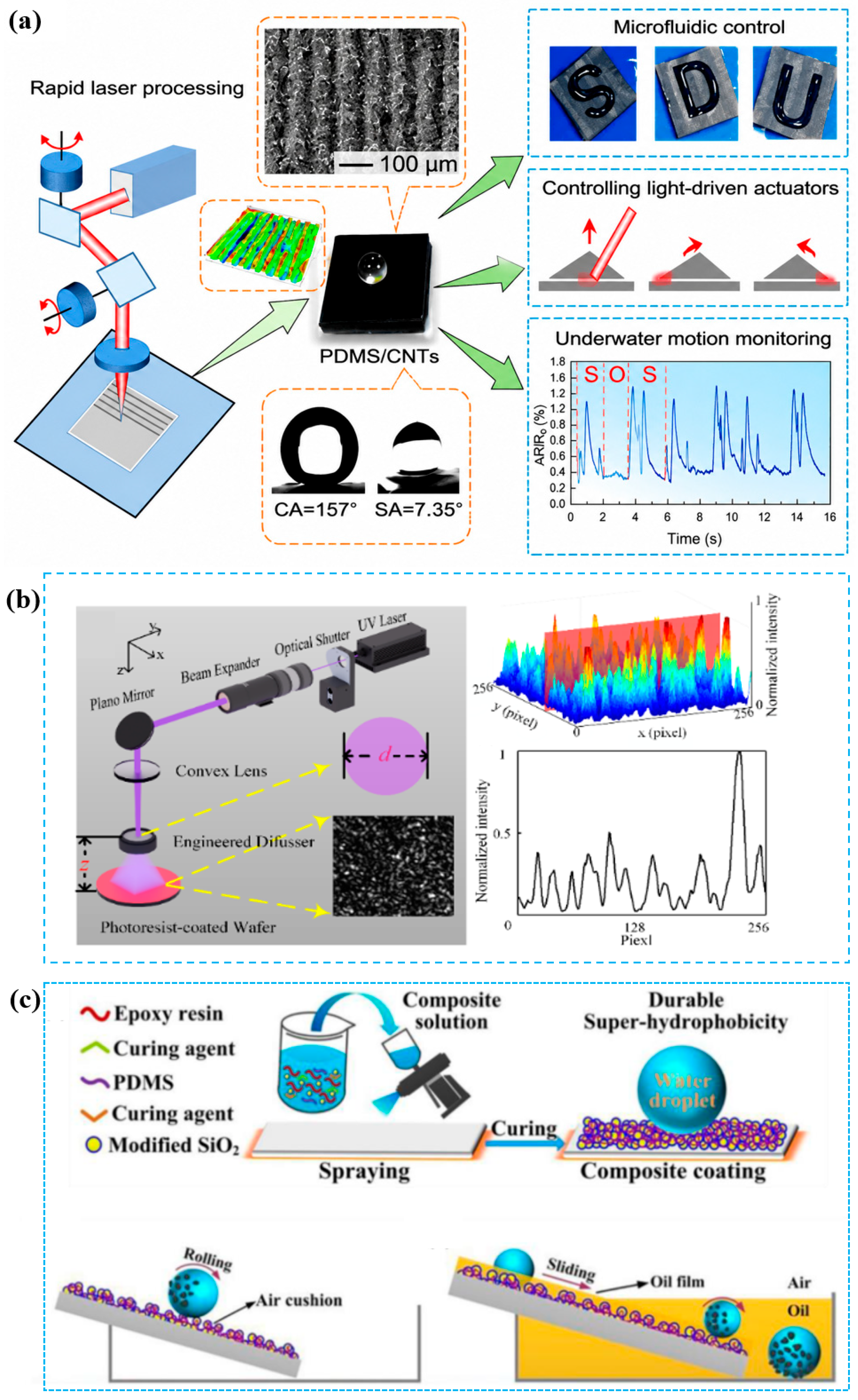
Representative studies illustrate these trends. Li et al. [38] fabricated lotus-leaf-inspired hierarchical structures on PVDF using direct laser patterning, achieving enhanced surface roughness and hydrophobicity. Dong et al. [39] demonstrated that picosecond laser-induced microgroove and microcavity structures on PDMS could produce contact angles above 150° with low contact-angle hysteresis. In addition, Mao et al. [40] combined laser speckle lithography with soft imprinting to achieve controllable wettability without additional low-surface-energy modification. Together, these studies demonstrate that laser processing provides a versatile platform for engineering polymer surface wettability through precise control of micro/nanoscale topography (Figure 5).
Figure 5.
(a) Rapid laser processing strategy for constructing micro/nanostructured surfaces and the resulting multifunctional PDMS/CNT composite interface. The fabricated surface exhibits superhydrophobicity with a water contact angle (CA) of 157° and a sliding angle (SA) of 7.35°, as well as a hierarchical micro/nanostructure observed by SEM. The as-prepared surface enables diverse functions including microfluidic manipulation, light-driven actuation, and underwater motion monitoring. Reproduced with permission [31]. Copyright 2025, ACS Applied Materials & Interfaces. (b) chematic of UV laser interference/beam shaping system for fabricating engineered diffusers and periodic surface structures, together with the corresponding surface intensity distribution and normalized profile. Reproduced with permission [40]. Copyright 2025, Optics Express. (c) Preparation process of durable superhydrophobic composite coatings via spraying and curing of epoxy resin/PDMS/SiO2-based composite solutions, illustrating the formation mechanism of hierarchical roughness and low-surface-energy interfaces. Reproduced with permission [41]. Copyright 2021, Coatings.
Overall, laser source selection for polymer substrates should be guided primarily by wavelength-dependent absorption characteristics and thermal stability. CO2 lasers are generally preferred for strongly infrared-absorbing polymers, whereas ultraviolet and ultrafast lasers are more suitable for precision micro/nanostructuring of heat-sensitive materials. These studies demonstrate that appropriate laser–material matching is the key to achieving controllable wettability and durable superhydrophobic performance on polymer surfaces.
4.3. Laser-Processed Ceramic Superhydrophobic Surface
Ceramic materials are widely used in aerospace, biomedical, and high-temperature engineering applications because of their high hardness, chemical stability, and thermal resistance. However, their intrinsic brittleness makes conventional mechanical machining unsuitable for fabricating precise micro/nanoscale structures. Laser micro/nanofabrication provides an effective non-contact approach for constructing functional surface architectures while minimizing mechanical damage.
The laser processing of ceramics is primarily governed by wavelength-dependent absorption characteristics and thermal sensitivity. Oxide ceramics generally exhibit higher absorption in the ultraviolet region, whereas non-oxide ceramics such as silicon carbide show relatively strong absorption in the near-infrared region. Consequently, ultraviolet and ultrafast lasers are most commonly employed for ceramic surface structuring. In particular, femtosecond lasers minimize thermal damage and crack formation through ultrafast energy deposition, while ultraviolet nanosecond lasers offer a practical balance between processing precision and manufacturing efficiency.
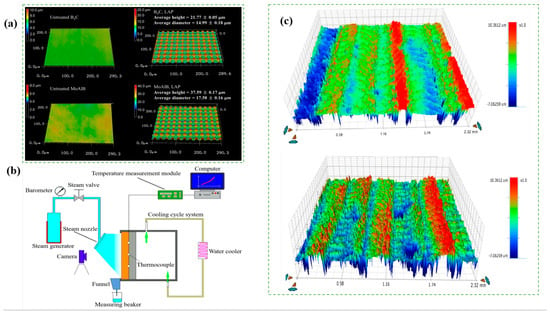
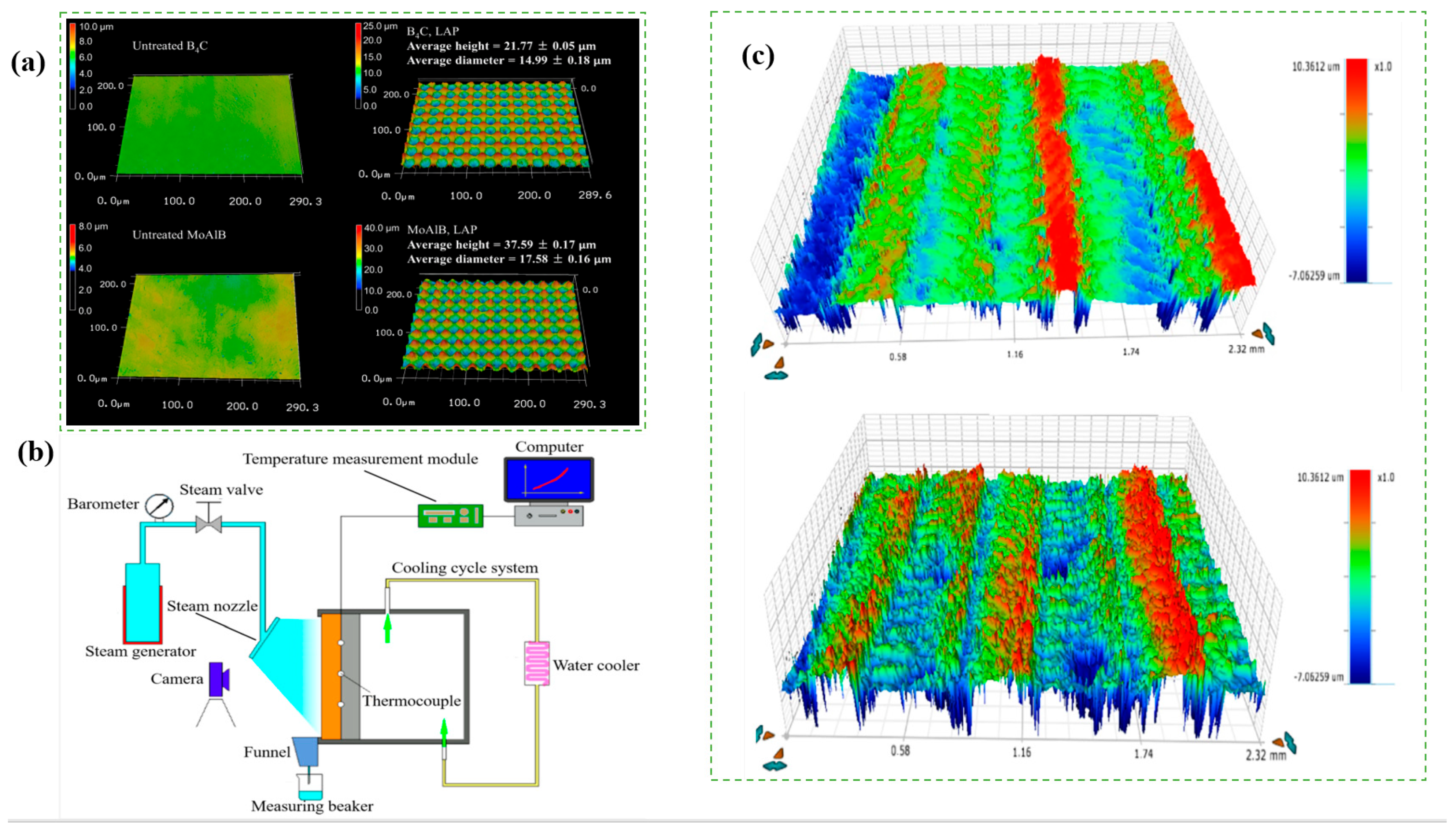
Representative studies illustrate these trends. Liu et al. [42] fabricated periodic micro/nanostructures on zirconia using a 355 nm ultraviolet laser and obtained durable superhydrophobicity after silicone-oil modification and heat treatment. Song et al. [43] and Fu et al. [44] further demonstrated that laser-induced hierarchical structures on silicon carbide could provide not only superhydrophobicity but also multifunctional properties, including anti-icing, self-cleaning, corrosion resistance, and long-term stability. These studies highlight the effectiveness of laser micro/nanostructuring for tailoring the wettability and functionality of ceramic surfaces (Figure 6).
Figure 6.
(a) 3D surface topographies of the untreated and laser-patterned (LAP) B4C and MoAlB samples. Reproduced with permission [45]. Copyright 2023, The American Ceramic Society. (b) Schematic diagram of the condensation experiment device. Reproduced with permission [46]. Copyright 2023, Crystals. (c) The three-dimensional surface profile of the samples. Reproduced with permission [46]. Copyright 2023, Crystals.
Similar to metallic and polymer substrates, processing parameters strongly influence the resulting surface morphology and wettability. Excessive laser energy may induce over-ablation, grain detachment, and crack formation, whereas appropriate combinations of scanning speed and pulse frequency facilitate the formation of uniform hierarchical structures while reducing thermal stress accumulation.
Overall, successful fabrication of superhydrophobic ceramic surfaces relies on appropriate matching between ceramic optical properties and laser characteristics. Ultraviolet lasers are generally advantageous for oxide ceramics, whereas femtosecond infrared lasers provide superior processing quality for brittle ceramic substrates. Current studies demonstrate that laser-induced hierarchical structures can simultaneously enhance wettability and multifunctional performance, making ceramics promising candidates for applications in biomedical engineering, high-temperature systems, and harsh-service environments.
5. Typical Applications of Laser Micro/Nanoprocessing on Superhydrophobic Surfaces
The practical value of laser-fabricated superhydrophobic surfaces lies in their ability to regulate interfacial interactions between solids, liquids, and surrounding environments. This capability has enabled a broad range of applications, including anti-icing and anti-frosting, transparent anti-fogging, corrosion resistance, oil–water separation, and antibacterial surfaces [47]. Although these applications target different functional requirements, they share a common design principle based on hierarchical micro/nanoscale structures and controlled surface chemistry. The following sections review recent progress in these representative application areas, with emphasis on performance enhancement mechanisms, key design strategies, and current limitations.
5.1. Anti-Icing/Frost-Resistant Functional Surface
Laser-based micro/nanofabrication has emerged as an effective strategy for constructing superhydrophobic anti-icing surfaces. Representative approaches, including direct laser writing (DLW), laser-induced periodic surface structures (LIPSS), and direct laser interference patterning (DLIP), generate hierarchical micro/nanoscale roughness that promotes stable air entrapment and suppresses ice nucleation. Combined with low-surface-energy modification, these surfaces typically exhibit contact angles above 150° and significantly reduced ice adhesion [48].
Current studies demonstrate that anti-icing performance is strongly governed by surface architecture. Laser-induced hierarchical structures can effectively prolong icing delay time, reduce ice adhesion, and suppress frost accumulation on both metallic and polymeric substrates. For instance, a Ti6Al4V wing model fabricated by DLIP achieved an approximately 80% reduction in anti-icing energy consumption during icing wind-tunnel tests, while laser-structured polymer surfaces maintained rapid droplet rebound and removal even under subzero conditions [49].
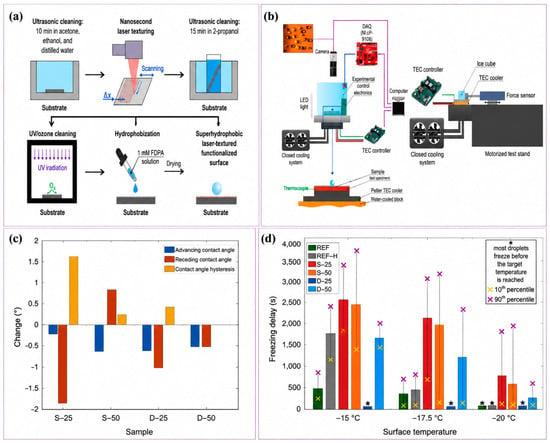
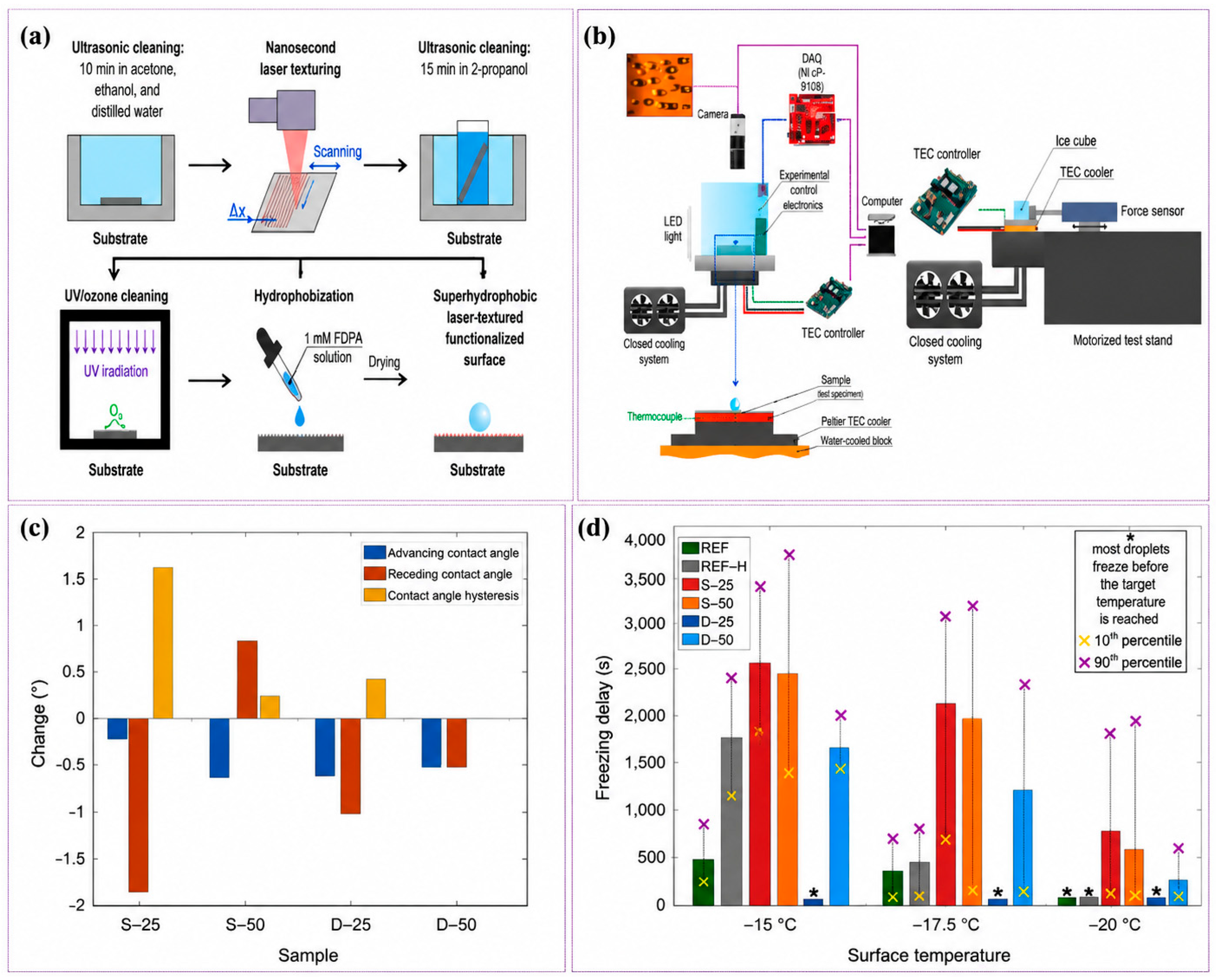
Representative studies have demonstrated several effective strategies for laser-fabricated anti-icing surfaces. Wang et al. [50] integrated photothermal functionality with hierarchical superhydrophobic structures to achieve delayed frosting and rapid deicing. Mei et al. [51] demonstrated that laser-textured Ti6Al4V surfaces can effectively suppress frost formation after wettability regulation. Može et al. [52] showed that combining laser structuring with fluorinated self-assembled monolayers significantly improves freeze–thaw durability and reduces ice adhesion. These studies collectively indicate that multifunctional design, hierarchical surface architecture, and durable surface chemistry are key factors governing anti-icing performance (Figure 7).
Figure 7.
(a) Surface functionalization procedure. Reproduced with permission [52]. Copyright 2025, Surfaces and Interfaces. (b) Schematic diagram of the customized experimental setup used to evaluate freezing delay, nucleation temperature, and ice adhesion strength. Reproduced with permission [52]. Copyright 2025, Surfaces and Interfaces. (c) Frost tests on cotton fabric surfaces and on MNPHP-based coated cotton fabrics. Reproduced with permission [52]. Copyright 2025, Dyeing and Finishing. (d) Average freezing delay recorded on six test surfaces at three different surface temperatures. Reproduced with permission [52]. Copyright 2025, Surfaces and Interfaces.
Collectively, these studies reveal several common design principles for laser-fabricated anti-icing surfaces. First, hierarchical micro/nanoscale structures are generally more effective than single-scale textures in delaying ice nucleation and reducing ice adhesion. Second, the combination of laser structuring and low-surface-energy modification remains the dominant strategy for achieving durable anti-icing performance. Third, multifunctional integration, including photothermal conversion, self-cleaning capability, and corrosion resistance, is becoming an important direction for improving practical applicability under harsh environmental conditions.
Despite substantial progress, several challenges remain for the practical deployment of laser-fabricated anti-icing surfaces. Current fabrication routes often involve multiple processing and modification steps, limiting production efficiency and large-scale manufacturing. In addition, insufficient coating adhesion and mechanical durability may lead to performance degradation under abrasion, erosion, or long-term environmental exposure. Future research should therefore focus on scalable fabrication strategies, enhanced structural robustness, environmentally friendly surface modification, and multifunctional surface integration.
5.2. Anti-Fog Functional Surface
Transparent materials are increasingly utilized in construction, automotive, and biomedical applications, where fogging can severely impair optical performance [53]. Various antifogging fabrication strategies have been developed, including sol–gel processing, self-assembly, photolithography, and laser micro/nanofabrication. Among these approaches, laser processing offers unique advantages in structural controllability, design flexibility, and compatibility with transparent substrates, making it a promising strategy for the development of durable antifogging surfaces [54].
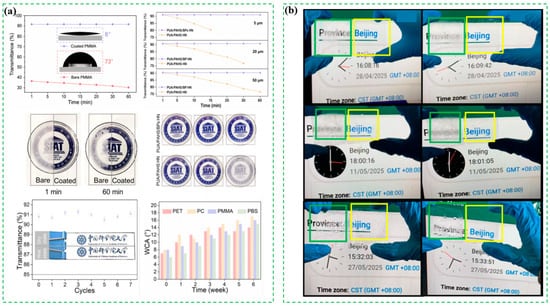
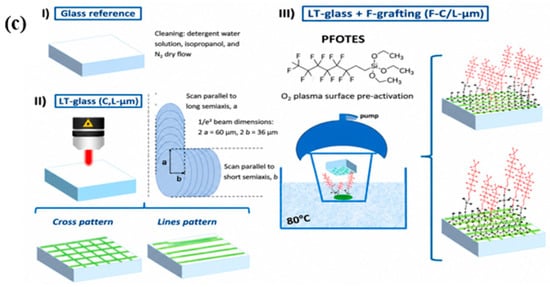
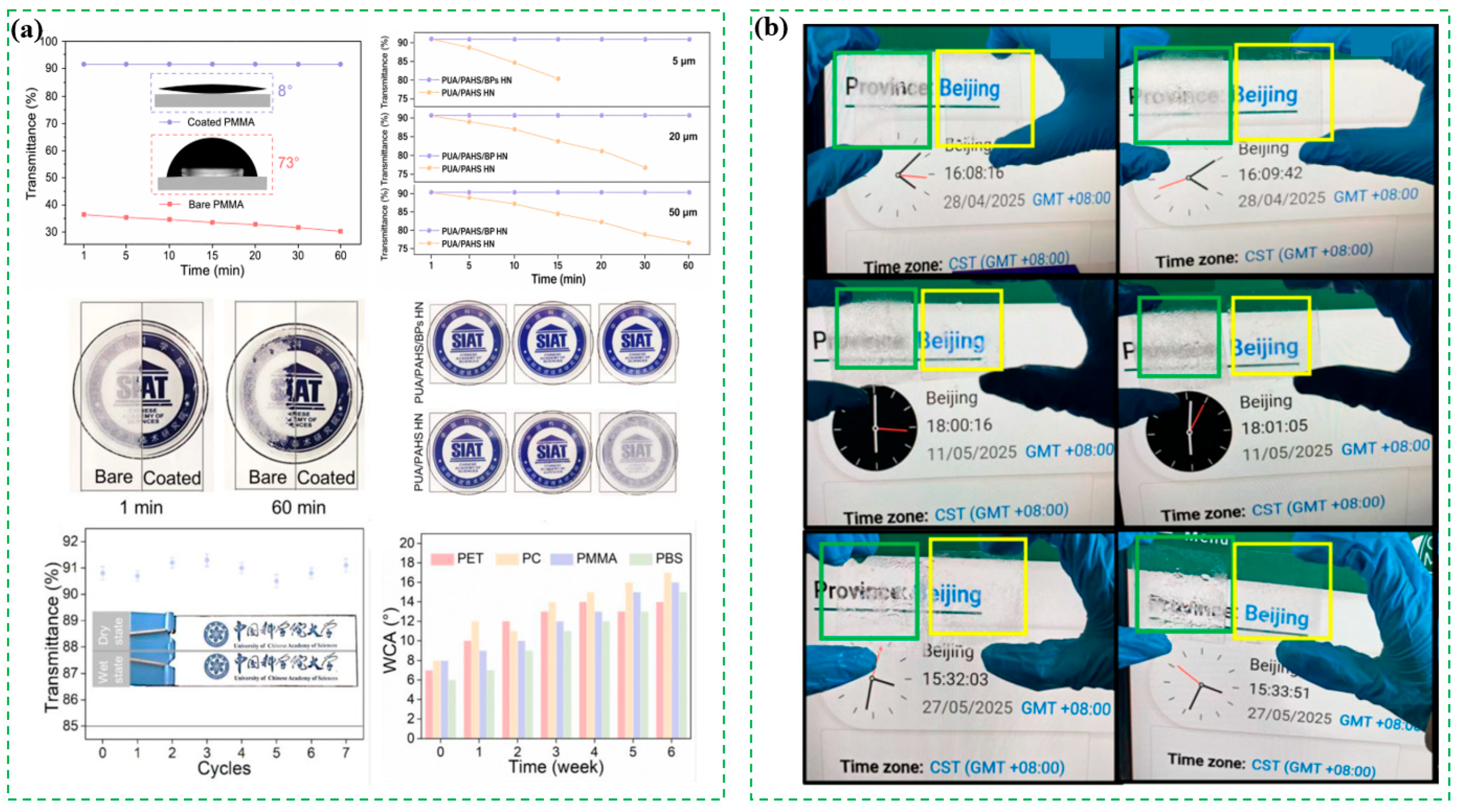
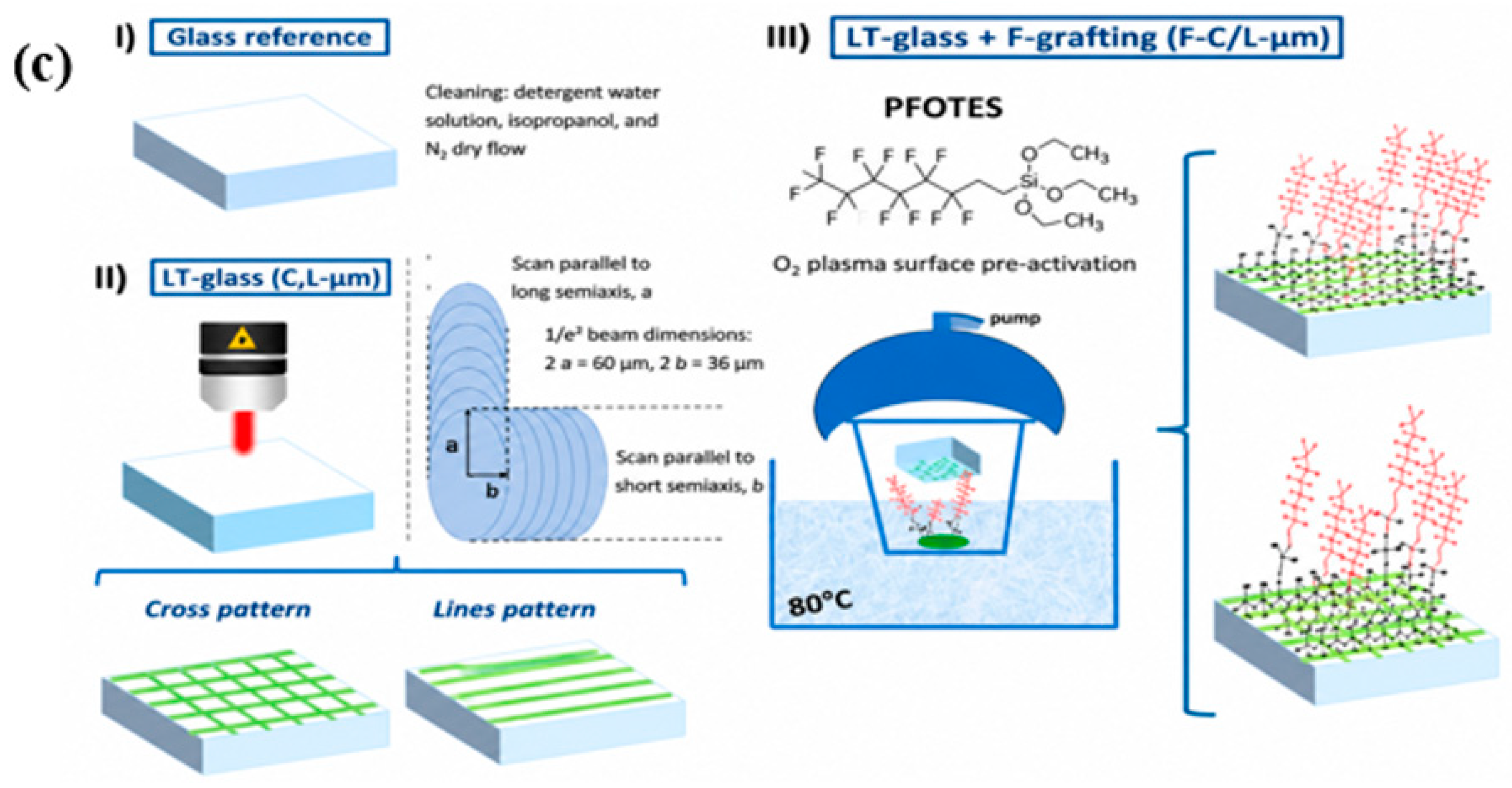
Representative studies have demonstrated diverse strategies for achieving transparent antifogging surfaces. Yu et al. [55] combined nanoscale roughness engineering with molecular grafting to obtain durable antifogging coatings with high transparency. Ding et al. [56] integrated superhydrophobicity with electrothermal regulation, enabling stable sensor operation under humid environments. Montes-Montañez et al. [57] employed femtosecond laser structuring and fluorosilane modification to achieve simultaneous antifogging, anti-icing, and self-cleaning functionalities on transparent glass substrates. These studies collectively indicate that the integration of surface micro/nanostructuring, wettability regulation, and multifunctional design is becoming a key direction for the development of advanced transparent interfaces (Figure 8).
Figure 8.
(a) Antifogging performances of BP hybrid polymer HN coating and nonhybrid polymer HN coatings. Reproduced with permission [58]. Copyright 2023, Nanomaterials. (b) The evolution of the antifogging effect of treated samples and reference glass during one-month outdoor exposure Reproduced with permission [59]. Copyright 2025, Coatings. (c) Experimental steps for preparing laser-treated and boron fluoride silicate glass. Reproduced with permission [57]. Copyright 2025, arXiv Preprint.
Overall, recent studies demonstrate that effective antifogging performance can be achieved through two main design strategies: superhydrophilic surfaces that promote rapid water-film formation and superhydrophobic surfaces that facilitate droplet removal. Laser micro/nanostructuring, often combined with chemical modification, enables precise control of surface wettability while maintaining high optical transparency. Furthermore, multifunctional integration, including anti-icing, self-cleaning, sensing, and UV-shielding capabilities, has emerged as an important development trend for transparent functional interfaces.
Despite these advances, several challenges continue to limit the practical deployment of antifogging transparent surfaces. Mechanical durability remains insufficient under long-term abrasion and environmental exposure, while performance degradation may occur under extreme conditions such as high humidity, temperature fluctuations, and chemical contamination. In addition, many existing fabrication routes still involve complex processing steps or costly surface modifiers, which hinder large-scale manufacturing. Future research should therefore focus on environmentally benign fabrication strategies, multifunctional surface integration, enhanced structural robustness, and scalable production technologies to facilitate broader implementation in aerospace, marine engineering, architectural glazing, and functional textiles.
5.3. Corrosion-Resistant Functional Surface
Corrosion remains a major challenge for metallic materials used in aerospace, marine engineering, and chemical industries, often resulting in structural degradation, economic losses, and reduced service life [60]. In recent years, laser micro/nanofabrication has emerged as an effective approach for corrosion protection by constructing hierarchical surface structures that promote superhydrophobicity. The trapped air layer and reduced solid–liquid contact area hinder the penetration of corrosive media, thereby suppressing electrochemical reactions and enhancing corrosion resistance [61,62]. Current research mainly focuses on combining laser-induced micro/nanostructuring with low-surface-energy modification to achieve durable corrosion-resistant surfaces on engineering alloys.
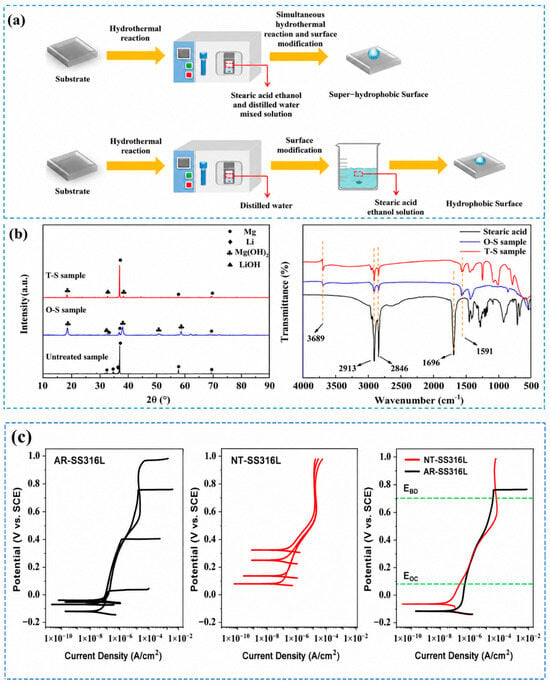
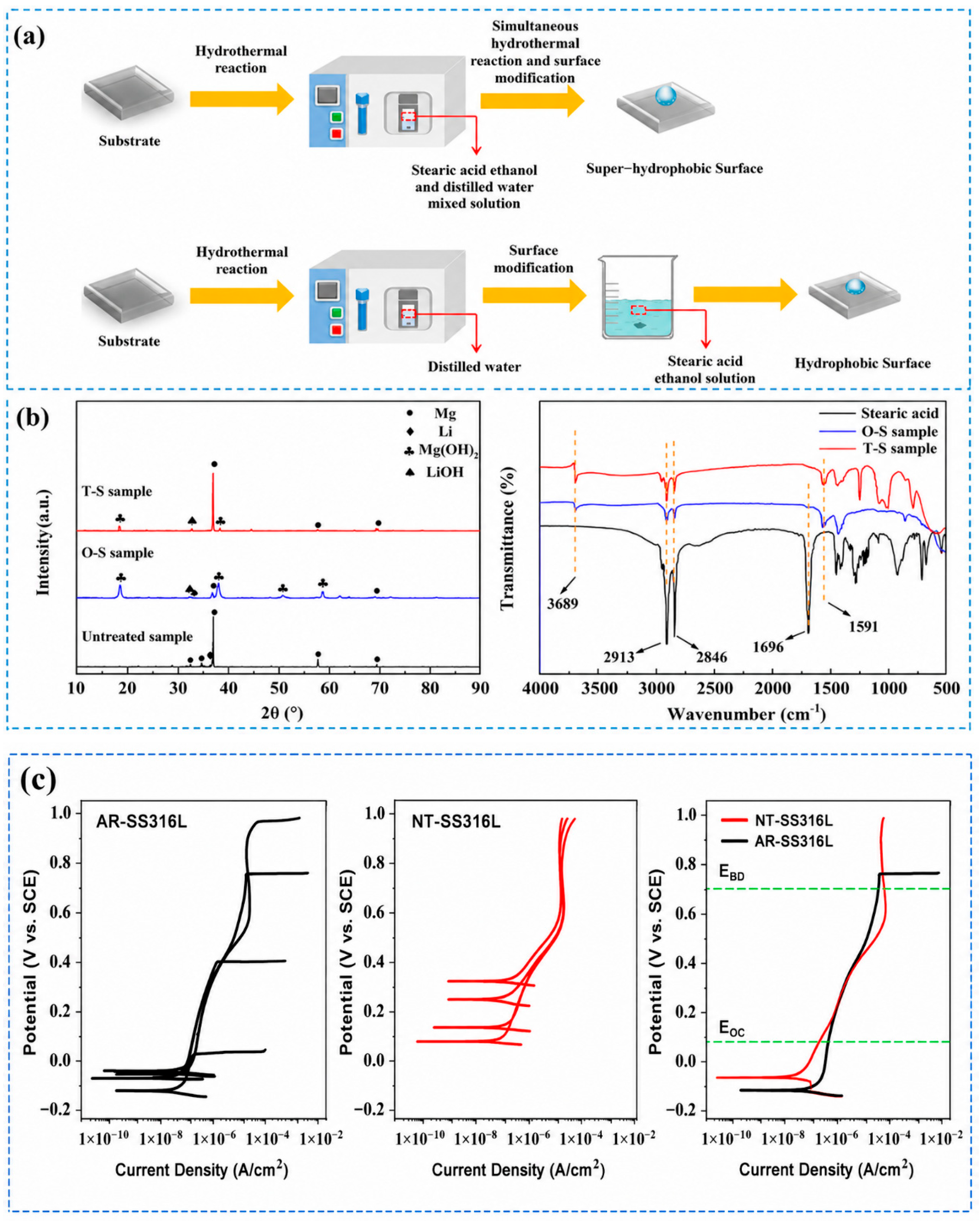
Recent studies have demonstrated that laser-fabricated superhydrophobic surfaces can substantially improve the corrosion resistance of engineering alloys (Figure 9). Most approaches combine laser-induced hierarchical micro/nanostructures with low-surface-energy modification to minimize electrolyte penetration and reduce electrochemical reactions. For steels and aluminum alloys, nanosecond laser texturing combined with fluorosilane modification typically produces contact angles above 150° and significantly lowers corrosion current density while also offering relatively high processing efficiency [63,64]. For lightweight Mg–Li alloys, one-step hydrothermal strategies integrating structure construction and hydrophobic modification have shown enhanced corrosion resistance and improved mechanical durability without requiring complex post-treatment processes [65].
Figure 9.
(a) Schematic diagram of coating preparation on Mg-9Li alloy by one-step hydrothermal method and two-step method. Reproduced with permission [65]. Copyright 2023, Journal of Magnesium and Alloys. (b) XRD patterns of substrate and coating samples and FT-IR spectra of stearic acid and coating samples. Reproduced with permission [65]. Copyright 2023, Journal of Magnesium and Alloys. (c) Potentiodynamic polarization curves of AR-SS316L and NT-SS316L specimens in Hank’s balanced salt solution. Reproduced with permission [66]. Copyright 2018, ACS Biomaterials Science & Engineering.
Overall, current corrosion-resistant surfaces rely primarily on the synergistic effect of hierarchical surface structures and low-surface-energy modification. Laser-assisted fluorosilane modification remains the dominant strategy for conventional engineering alloys, whereas integrated one-step fabrication methods are emerging as attractive alternatives for lightweight alloys because of their simplified processing and improved durability.
Despite significant progress, several challenges remain. The corrosion resistance of laser-fabricated superhydrophobic surfaces is highly sensitive to processing parameters, making large-scale reproducible manufacturing difficult. In addition, the widespread use of fluorinated modifiers raises concerns regarding cost and environmental sustainability. More importantly, mechanical wear and long-term environmental exposure can damage the micro/nanostructures, resulting in the loss of superhydrophobicity and corrosion protection. Future research should therefore focus on improving structural durability, developing fluorine-free modification strategies, and enabling scalable fabrication on complex engineering components.
5.4. Oil-Water Separation Functional Surface
Oil–water separation has attracted considerable attention because of the increasing environmental and economic impacts associated with oil contamination and spill incidents [67]. Conventional separation methods, such as filtration, flotation, and centrifugation, often suffer from low selectivity, high energy consumption, or limited reusability [68]. In recent years, laser-fabricated superhydrophobic/superoleophilic surfaces have emerged as a promising alternative, enabling efficient and selective oil transport through the synergistic effect of hierarchical micro/nanostructures and tailored surface wettability [69,70].
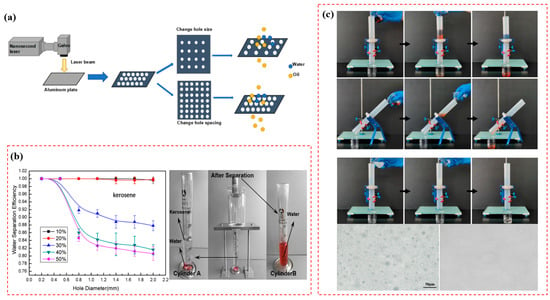
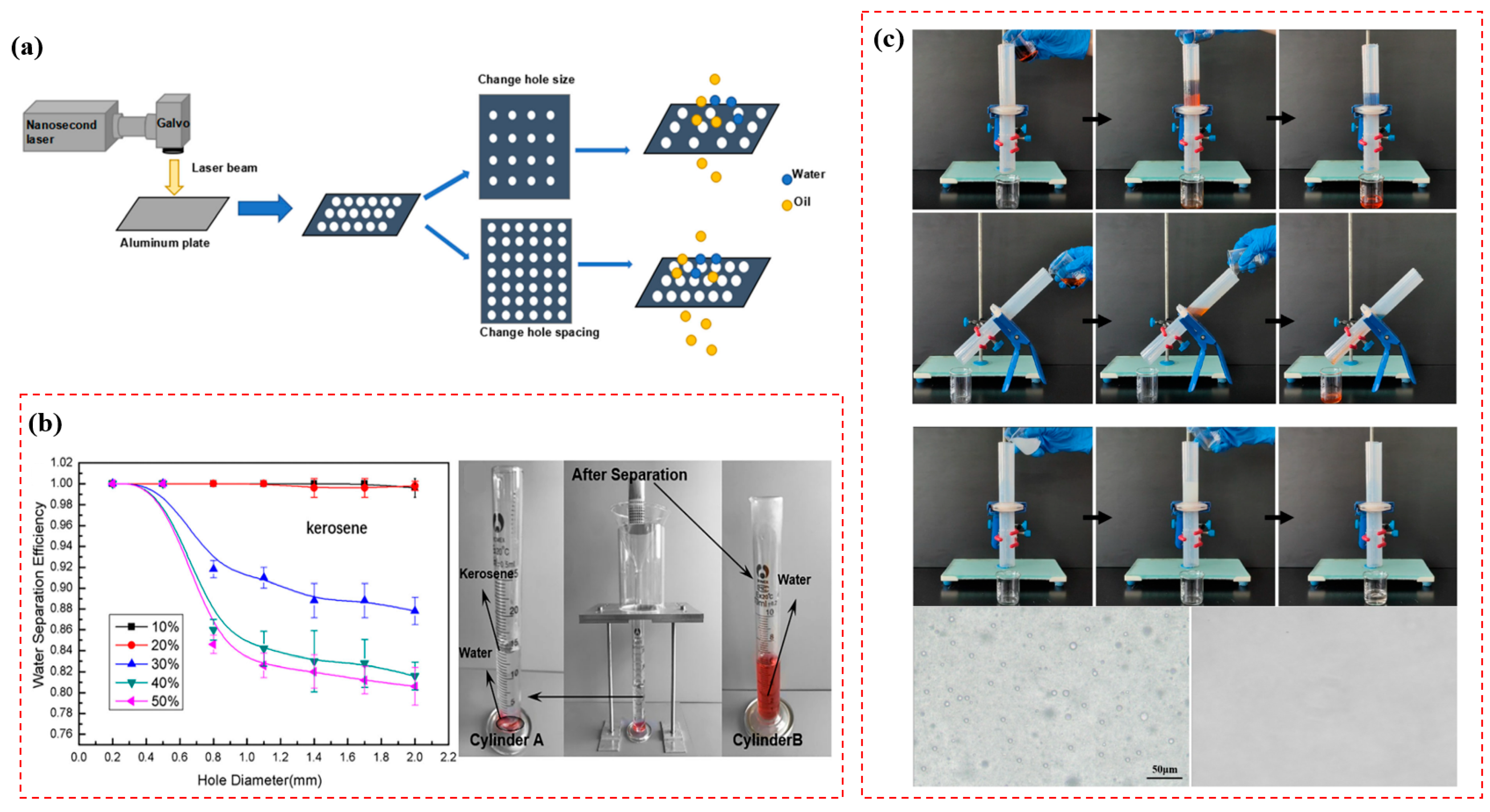
Recent studies have demonstrated that laser-fabricated superhydrophobic/superoleophilic porous materials can achieve highly efficient oil–water separation through selective wettability (Figure 10). Chen et al. [71] prepared porous aluminum surfaces by combining nanosecond laser machining with heat treatment, achieving separation efficiencies above 99% without external energy input. The separation performance was strongly dependent on pore geometry, indicating the importance of structural optimization for transport efficiency. Similarly, Liu et al. [72] fabricated laser-textured copper foam with superhydrophobic/superoleophilic properties, achieving separation efficiencies exceeding 90% in a single pass and over 96% using multilayer structures. In addition to high separation performance, the surface maintained its wettability after repeated separation cycles and mechanical durability tests. These studies demonstrate that laser-induced hierarchical structures can simultaneously provide high separation efficiency, low energy consumption, and good durability, highlighting their potential for environmental remediation applications.
Figure 10.
(a) Pore size and pore spacing can be adjusted by laser drilling. Reproduced with permission [71]. Copyright 2020, Environmental Science and Pollution Research. (b) Effect of pore size on the water separation efficiency of kerosene/water mixtures with a water content ranging from 10% to 50%. Reproduced with permission [71]. Copyright 2020, Environmental Science and Pollution Research. (c) Oil/water separation with sponge/TiO2/stearic acid. Reproduced with permission [73]. Copyright 2020, Coatings.
Overall, current oil–water separation studies mainly rely on porous substrates combined with laser-induced hierarchical micro/nanostructures to achieve selective transport of oil and water phases. Separation efficiency is governed not only by surface wettability but also by pore size, pore distribution, and structural connectivity. While most reported systems can achieve separation efficiencies above 90%, their performance remains strongly dependent on oil viscosity and feed composition. Consequently, optimizing structural design while maintaining long-term durability has become a key direction for future development.
Despite significant progress, several challenges remain. The performance of laser-fabricated oil–water separation materials is highly dependent on processing parameters, making reproducible large-scale manufacturing difficult. In addition, current systems often show limited effectiveness for high-viscosity oils and emulsified mixtures. Long-term durability under harsh environmental conditions also remains a major concern, particularly with respect to structural degradation and wettability loss. Future efforts should focus on scalable fabrication, improved environmental stability, and multifunctional surface designs capable of simultaneously providing separation, corrosion resistance, and antifouling performance.
5.5. Antibacterial Surface
Antibacterial surfaces have attracted increasing attention because bacterial adhesion and biofilm formation on material surfaces can lead to healthcare-associated infections and device failure [74]. Conventional antibacterial strategies often rely on antibiotics or biocidal agents, which may contribute to bacterial resistance and secondary contamination [75,76]. In recent years, laser-fabricated superhydrophobic surfaces have emerged as a promising alternative. By reducing liquid retention, protein adsorption, and bacterial adhesion, these surfaces can inhibit biofilm formation while their self-cleaning capability facilitates the removal of contaminants, offering a non-antibiotic strategy for antibacterial protection [77].
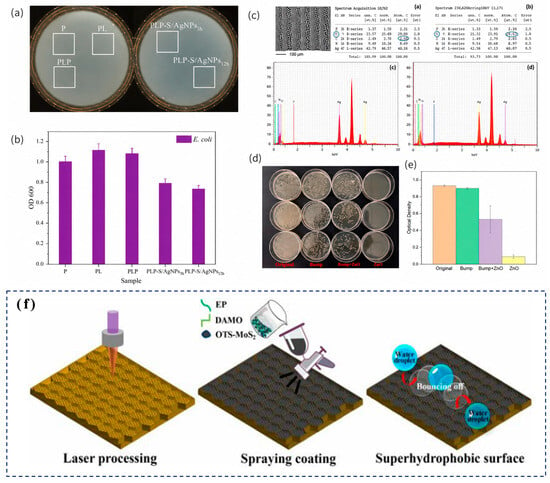
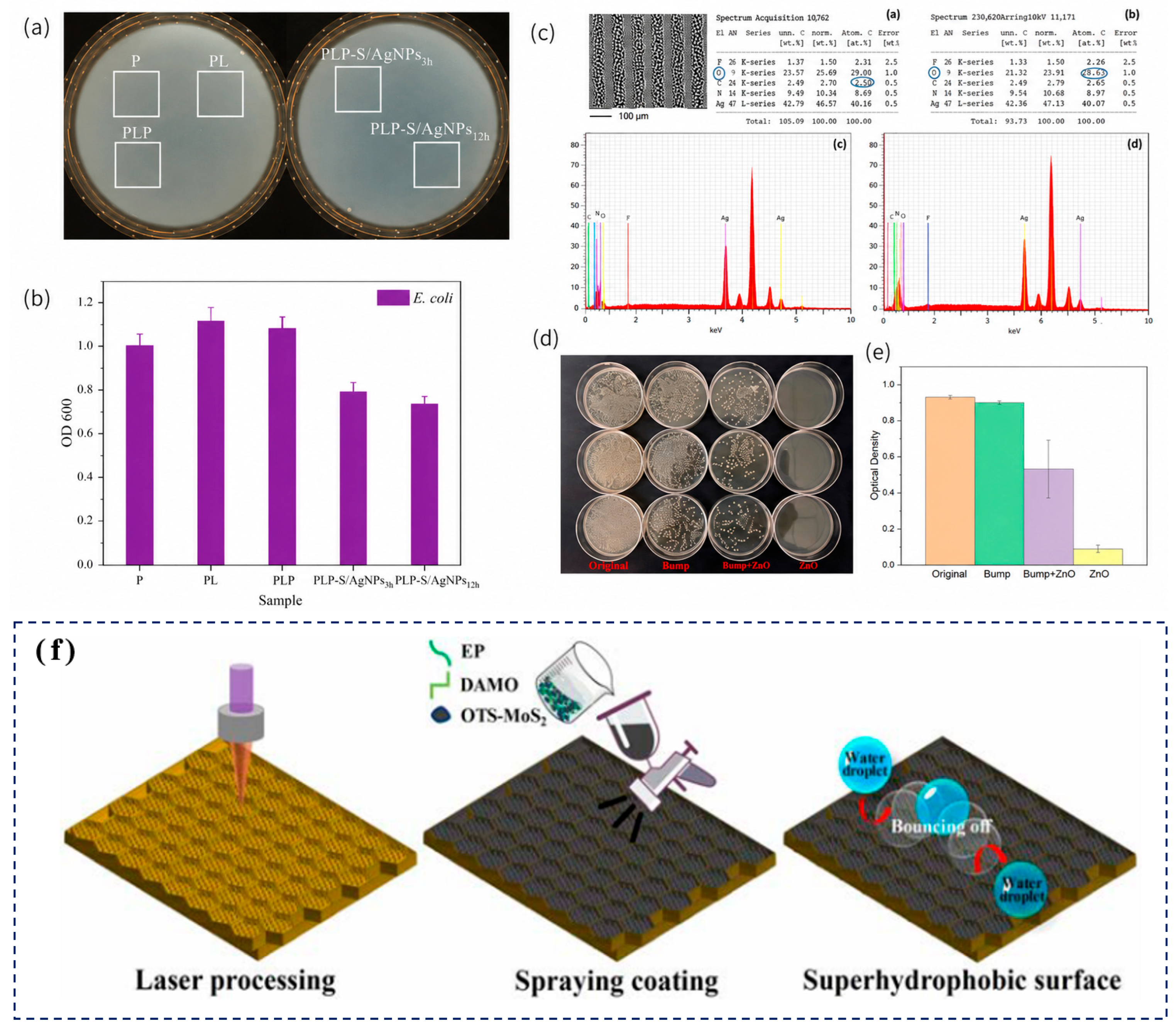
Recent studies have demonstrated that laser-fabricated antibacterial surfaces can be realized through both chemical-functionalization and structure-dominated approaches. Lan et al. [78] combined laser-induced micro/nanostructures with polydopamine-assisted composite modification to achieve simultaneous superhydrophobicity and antibacterial activity, effectively suppressing bacterial adhesion and biofilm formation. In contrast, Daskalova et al. [79] demonstrated that purely laser-generated multiscale topographies could inhibit bacterial attachment without any chemical treatment, highlighting the potential of morphology-driven antibacterial strategies. Furthermore, Wang et al. [80] integrated laser structuring with ZnO nanowire assembly, introducing active antibacterial functionality through Zn2+ release and reactive oxygen species generation while maintaining long-term superhydrophobicity. These studies indicate that laser-engineered antibacterial surfaces can be achieved through three main routes: superhydrophobic anti-adhesion, topography-induced mechanical inhibition, and chemically active antibacterial modification (Figure 11).
Figure 11.
(a) Surface images of different samples on viscous medium. Reproduced with permission [78]. Copyright 2023, Friction. (b) OD 600 values of bacterial solutions after soaking different samples. Reproduced with permission [78]. Copyright 2023, Friction. (c) SEM/EDS analysis and mass fraction (wt.%) corresponding values of different elements of laser-treated SS samples after 24 h of treatment at high temperature. Reproduced with permission [79]. Copyright 2023, Nanomaterials. (d) Bacterial growth on the surfaces of different structured samples and (e) optical density of bacteria. Reproduced with permission [80]. Copyright 2022, Sustainability. (f) Schematic diagram of the preparation process of biomimetic durable superhydrophobic surfaces. Reproduced with permission [81]. Copyright 2025, Jilin University.
Overall, current antibacterial surface designs can be categorized into three strategies: (i) superhydrophobic surfaces that reduce bacterial adhesion through minimized liquid–solid contact, (ii) biomimetic micro/nanotopographies that mechanically inhibit bacterial attachment or disrupt cell membranes, and (iii) multifunctional coatings incorporating antibacterial agents such as ZnO. Among these approaches, structure-based antibacterial surfaces are particularly attractive because they reduce reliance on chemical additives and may mitigate concerns regarding bacterial resistance. Future research is increasingly focusing on integrating antibacterial performance with durability, biocompatibility, and long-term environmental stability.
Despite significant progress, several challenges remain. The antibacterial performance of laser-fabricated surfaces is highly dependent on processing parameters, making large-scale reproducibility difficult. In addition, most reported strategies have been demonstrated only on simple metallic substrates and show limited adaptability to complex geometries and practical service environments. Long-term durability under mechanical wear and repeated sterilization also remains a major concern. Future efforts should focus on scalable fabrication, enhanced structural stability, and multifunctional antibacterial surfaces with improved biocompatibility and long-term reliability.
6. In Conclusions
This review summarizes recent progress in the fabrication of superhydrophobic and superamphiphobic surfaces through laser micro/nanostructuring. Current studies demonstrate that laser processing provides a versatile and highly controllable route for constructing hierarchical micro/nanoscale structures on metals, ceramics, and polymers, enabling the realization of diverse functionalities including anti-icing, anti-fogging, corrosion resistance, oil–water separation, and antibacterial performance.
Analysis of the reported studies reveals several common trends. Nanosecond lasers remain the most practical choice for large-area and cost-sensitive manufacturing because of their high processing efficiency and relatively low equipment cost. In contrast, femtosecond and picosecond lasers are better suited for precision structuring and the fabrication of complex hierarchical architectures due to their minimal heat-affected zones. The wettability and durability of functional surfaces are strongly governed by the synergistic effect of surface morphology and chemical modification, while hierarchical micro/nanostructures generally provide superior multifunctional performance compared with single-scale textures.
Despite significant advances, several challenges continue to limit large-scale implementation. Processing efficiency remains insufficient for industrial production, long-term durability under mechanical and environmental stresses is still inadequate, and many fabrication routes rely on fluorinated modifiers that raise cost and sustainability concerns. In addition, reproducible processing of large-area and complex-shaped components remains difficult.
Future research should focus on intelligent laser manufacturing enabled by artificial intelligence, high-throughput and parallel processing strategies, environmentally friendly fluorine-free surface modification, and the development of mechanically robust multifunctional interfaces. Continued progress in these areas is expected to accelerate the transition of laser-fabricated superhydrophobic surfaces from laboratory-scale demonstrations to practical applications in aerospace, marine engineering, energy systems, and biomedicine.
Author Contributions
Author Contributions: Conceptualization, M.H., Y.H. and M.L.; methodology, M.H., W.M. and Y.W.; formal analysis, M.H., G.L.; investigation, M.H., G.L., W.M.; resources, Y.H., M.L.; data curation, M.H., W.M.; writing—original draft preparation, M.H.; writing—review and editing, Y.H., M.L., G.L., Y.W.; visualization, M.H., W.M.; supervision, Y.H. and M.L.; project administration, Y.H.; funding acquisition, Y.H. and M.L. All authors have read and agreed to the published version of the manuscript.
Funding
This work was supported by the Natural Science Foundation of Shandong Province (ZR2022QE189, ZR2022QE161), the National Natural Science Foundation of China (No. 52575342), Sichuan Key Technology Engineering Research Center for All-electric Navigable Aircraft (Grant No. CAFUC2025KF17), Scientific Innovation Project for Young Scientists in Shandong Provincial Universities (2023KJ145).
Data Availability Statement
All data and figures presented in this review are derived from publicly published literature. The cited original data can be accessed via the corresponding DOIs listed in the References section. No new raw experimental data were generated in this review article.
Acknowledgments
The authors gratefully acknowledge the experimental platform support from Shandong Key Laboratory of High-Performance Precision Manufacturing and Hybrid Machining, and the technical assistance from all members of the Advanced Laser Manufacturing Research Group.
Conflicts of Interest
The authors declare no conflict of interest. The funding sponsors had no role in the design of the review; in the collection, analysis, or interpretation of cited literature; in the writing of the manuscript; or in the decision to publish this review.
References
- Jiang, H.-R.; Wen, I.-C.; Wang, K.-W.; Ko, P.-X.; Li, B.-W. Synergistic Integration of Superhydrophobic and Lubricant-Infused Surface for Enhanced Liquid Repellency. Langmuir 2025, 41, 23423–23431. [Google Scholar] [CrossRef] [PubMed]
- Jiang, G.-C.; Pan, R.; Chen, C.-H.; Hu, X.-Y.; Zhang, H.-J.; Zhong, M.-L. Ultrafast Laser Fabricated Drag Reduction Micro-nano Structures and Their Corrosion Resistance. Chin. J. Lasers 2020, 47, 0802005. [Google Scholar] [CrossRef]
- Rabajczyk, A.; Zielecka, M.; Klapsa, W.; Dziechciarz, A. Self-Cleaning Coatings and Surfaces of Modern Building Materials for the Removal of Some Air Pollutants. Materials 2021, 14, 2161. [Google Scholar] [CrossRef] [PubMed]
- Ren, G.-Y.; Tuo, Y.; Zheng, W.-J.; Qiao, Z.-T.; Ren, Z.-Z.; Zhao, Y.-L.; Shang, J.-F.; Chen, X.-D.; Gao, X.-H. Research Progress and Applications of Superhydrophobic Nanocoating Technology. Chem. Ind. Eng. Prog. 2024, 43, 4450–4463. [Google Scholar] [CrossRef]
- Emelyanenko, K.A.; Emelyanenko, A.M.; Boinovich, L.B. Laser Obtained Superhydrophobic State for Stainless Steel Corrosion Protection: A Review. Coatings 2023, 13, 194. [Google Scholar] [CrossRef]
- Song, N.; Benmeddour, A. Erosion Resistant Hydrophobic Coatings for Passive Ice Protection of Aircraft. Appl. Sci. 2022, 12, 9589. [Google Scholar] [CrossRef]
- Liu, M.-M.; Hou, Y.-Y.; Chen, T.-J.; Wu, Y.-L.; Zheng, H.-Y. Research Progress on Fundamental Theory and Preparation Technology of Superhydrophobic Anti-/De-Icing Materials. Mater. Prot. 2023, 56, 40–62. [Google Scholar] [CrossRef]
- Li, J.; Wang, Y.-K.; Shi, W.-T.; Guo, Y.-J.; Lu, Y.-N.; Fu, S.; Lu, Y.-Y. Research Progress in Laser Fabrication of Superhydrophobic Surfaces. Chem. Ind. Eng. Prog. 2025, 44, 1432–1444. [Google Scholar] [CrossRef]
- Wang, Y.-K.; Li, J.-S.; Song, H.-R.; Wang, F.-X.; Su, X.; Zhang, D.-H.; Xu, J. Biomimetic Superhydrophobic Surfaces: From Nature to Application. Materials 2025, 18, 2772. [Google Scholar] [CrossRef] [PubMed]
- Guo, Y.; Zhao, H. Femtosecond Laser Processed Superhydrophobic Surface. J. Manuf. Process. 2024, 109, 250–287. [Google Scholar]
- Liu, Y.; Wu, M.-Y.; Guo, C.-F.; Zhou, D.; Wu, Y.-C.; Wu, Z.-Z.; Lu, H.-F.; Zhang, H.-M.; Zhang, Z.-Y. A Review on Preparation of Superhydrophobic and Superoleophobic Surface by Laser Micromachining and Its Hybrid Methods. Crystals 2022, 13, 20. [Google Scholar] [CrossRef]
- Zhang, Y.-F.; Wu, H.; Yu, X.-Q.; Chen, F.; Wu, J. Microscopic Observations of the Lotus Leaf for Explaining the Outstanding Mechanical Properties. J. Bionic Eng. 2012, 9, 84–90. [Google Scholar] [CrossRef]
- Webb, H.K.; Crawford, R.J.; Ivanova, E.P. Wettability of Natural Superhydrophobic Surfaces. Adv. Colloid Interface Sci. 2014, 210, 58–64. [Google Scholar] [CrossRef] [PubMed]
- Quéré, D. Wetting and Roughness. Annu. Rev. Mater. Res. 2008, 38, 71–99. [Google Scholar] [CrossRef]
- Jia, X.-B.; Zhang, B.; Li, Q.-H.; Zhang, J.-H. Research Progress on Laser Fabrication of Metal Superhydrophobic Surfaces. China Mach. 2025, 22, 25–28. [Google Scholar]
- Fan, P.; Pan, R.; Zhong, M. Ultrafast Laser Enabling Hierarchical Structures for Versatile Superhydrophobicity with Enhanced Cassie–Baxter Stability and Durability. Langmuir 2019, 35, 16693–16711. [Google Scholar] [CrossRef] [PubMed]
- Guo, B.-S.; Sun, J.-Y.; Hua, Y.-H.; Zhan, N.-W.; Jia, J.-G.; Chu, K.-P. Femtosecond Laser Micro/Nano-Manufacturing: Theories, Measurements, Methods, and Applications. Nanomanuf. Metrol. 2020, 3, 26–67. [Google Scholar]
- Wang, L.-Z.; Fan, P.-X.; Zhang, H.-J.; Zhong, M.-L. Research Progress on Low-Temperature Cassie-State Stability of Laser-Fabricated Superhydrophobic Surfaces. Laser Optoelectron. Prog. 2025; advance online publication.
- Ahmmed, K.T.; Grambow, C.; Kietzig, A.-M. Fabrication of Micro/Nano Structures on Metals by Femtosecond Laser Micromachining. Micromachines 2014, 5, 1219–1253. [Google Scholar] [CrossRef]
- Zhai, Z.-Y.; Wei, C.; Zhang, Y.-C.; Cui, Y.-H.; Zeng, Q.-R. Investigations on the Oxidation Phenomenon of SiC/SiC Fabricated by High Repetition Frequency Femtosecond Laser. Appl. Surf. Sci. 2020, 502, 144131. [Google Scholar]
- Bronnikov, K.; Terentyev, V.; Simonov, V.; Fedyaj, V.; Simanchuk, A.; Babin, S.A.; Lapidas, V.; Mitsai, E.; Cherepakhin, A.; Zhang, J.; et al. Highly Regular Laser-Induced Periodic Surface Structures on Titanium Thin Films for Photonics and Fiber Optics. ACS Appl. Mater. Interfaces 2024, 16, 70047–70056. [Google Scholar] [CrossRef] [PubMed]
- Žemaitis, A.; Mimidis, A.; Papadopoulos, A.; Gečys, P.; Račiukaitis, G.; Stratakis, E.; Gedvilas, M. Controlling the Wettability of Stainless Steel from Highly Hydrophilic to Superhydrophobic by Femtosecond Laser-Induced Ripples and Nanospikes. RSC Adv. 2020, 10, 37956–37961. [Google Scholar] [PubMed]
- He, X.L.; Xiao, Q.; Xu, R. Study on the Influence of Femtosecond Laser Micromachining Technology on Surface Properties of Stainless Steel Materials. Aerosp. Mater. Technol. 2025, 55, 41–46. [Google Scholar]
- Zuo, P.; Zhu, D.; Li, F.; Tian, H.; Han, W.; Liu, T.-F.; Yu, K.; Zhou, J.; He, X.-G. Fabrication of Superhydrophobic Micro/Nanostructures of Titanium Alloy by Femtosecond Laser. ACS Omega 2025, 10, 33178–33191. [Google Scholar] [CrossRef] [PubMed]
- Li, B.-J.; Li, H.; Huang, L.-J.; Ren, N.-F.; Kong, X. Femtosecond Pulsed Laser Textured Titanium Surfaces with Stable Superhydrophilicity and Superhydrophobicity. Appl. Surf. Sci. 2016, 389, 585–593. [Google Scholar] [CrossRef]
- Sun, X.-Y.; Sun, S.-F.; Wang, H.-T.; Wang, J.; Liu, S.-G.; Wang, P.-P. Preparation and Process Optimization of Superhydrophobic 7075 Al Alloy Surface Based on Picosecond Laser Processing. Acta Mater. Compos. Sin. 2023, 40, 3583–3593. [Google Scholar] [CrossRef]
- Ha, J. Superhydrophilic Surface Creation and Its Temporal Transition to Hydrophobicity on Copper via Femtosecond Laser Texturing. Coatings 2024, 14, 1107. [Google Scholar] [CrossRef]
- Cao, J.-K.; Ma, B.-J.; Yang, Y.-B.; Li, L.-L.; Li, X.-Y. Femtosecond Laser Preparation of Terracotta Warrior-Like Pit Superhydrophobic Structure on Magnesium Alloy with Mechanical Durability and Corrosion Resistance. Langmuir 2023, 39, 10230–10239. [Google Scholar] [CrossRef] [PubMed]
- Liu, E.; Lee, H.J.; Lu, X. Superhydrophobic Surfaces Enabled by Femtosecond Fiber Laser-Written Nanostructures. Appl. Sci. 2020, 10, 2678. [Google Scholar] [CrossRef]
- Chakraborty, A.; Gottumukkala, N.R.; Gupta, M.C. Superhydrophobic Surface by Laser Ablation of PDMS. Langmuir 2023, 39, 11259–11267. [Google Scholar] [CrossRef] [PubMed]
- Guo, Y.; Zhao, H.; Zhao, G. Laser-Induced Superhydrophobic Polymer Surface for Droplet Manipulation, Controllable Light-Driven Actuator, and Underwater Motion Monitoring. ACS Appl. Mater. Interfaces 2025, 17, 12707–12719. [Google Scholar] [PubMed]
- Wang, B.; Song, J. Hydrophobic Prediction Model and Experimental Study of PMMA Surface Microstructure Prepared by Femtosecond Laser Direct Writing. Coatings 2022, 12, 1856. [Google Scholar] [CrossRef]
- Wang, B.-F.; Zhang, Y.-K.; Song, J.; Wang, Z.-W. Investigation and Prediction on Regulation of Hydrophobicity of Polymethyl Methacrylate (PMMA) Surface by Femtosecond Laser Irradiation. Coatings 2020, 10, 386. [Google Scholar] [CrossRef]
- Zhan, Y.-L.; Ruan, M.; Li, W.; Li, H.; Hu, L.-Y.; Ma, F.-M.; Yu, Z.-L.; Feng, W. Fabrication of Anisotropic PTFE Superhydrophobic Surfaces Using Laser Microprocessing and Their Self-Cleaning and Anti-Icing Behavior. Colloids Surf. A Physicochem. Eng. Asp. 2017, 535, 8–15. [Google Scholar]
- Dong, H.-Y.; Huang, X.; Wu, Z.-P.; Mao, A.-F.; Li, P.-Z.; Cui, B.; Silvain, J.-F.; Li, Y.-S.; Lu, Y.-F. Non-Sticky Superhydrophobicity on Polypropylene Surfaces Achieved via Single-Step Femtosecond Laser-Induced Processing in n-Hexadecane Liquid. Opt. Laser Technol. 2025, 181, 111843. [Google Scholar]
- Liang, J.; Bian, H.; Yang, Q.; Fang, Y.; Shan, C.; Bai, X.; Cheng, Y.; Yong, J.; Hou, X.; Chen, F. Femtosecond Laser-Patterned Slippery Surfaces on PET for Liquid Patterning and Blood Resistance. Opt. Laser Technol. 2020, 132, 106469. [Google Scholar] [CrossRef]
- Chen, L.; Nie, Q.-L.; Hu, T.; Bennett, P.; Zheng, Z.; Yang, Q.-B.; Liu, D. Hydrophobic Recovery of Femtosecond Laser Processed Silicone Rubber Insulator Surfaces. J. Appl. Polym. Sci. 2021, 138, 50835. [Google Scholar] [CrossRef]
- Li, J.-C.; Chen, Z.-D.; Han, D.-D.; Zhang, Y.-L.; Sun, H.-B. Laser Processing of Superhydrophobic Polyvinylidene Fluoride. Chin. J. Lasers 2021, 48, 0202002. [Google Scholar]
- Dong, S.Y.; Ji, L.F.; Gang, X. Picosecond Laser Fabrication of Superhydrophobic Polymer Micro/Nanostructures. Laser Optoelectron. Prog. 2020, 57, 111411. [Google Scholar]
- Mao, J.-K.; Xie, B.; Yuan, C.-P.; Wang, K.; Yan, Y.-X.; Ma, Y.-F.; Wang, M.; Jia, S.-T.; Chen, X.-Y.; Tong, Z.-M. Tailoring Surface Wettability through Laser Speckle Patterning. Opt. Express 2025, 33, 52477–52486. [Google Scholar] [CrossRef] [PubMed]
- Bai, Y.-X.; Zhang, H.-P.; Shao, Y.-Y.; Zhang, H.; Zhu, J. Recent Progresses of Superhydrophobic Coatings in Different Application Fields: An Overview. Coatings 2021, 11, 116. [Google Scholar] [CrossRef]
- Liu, C.; Zheng, J.-J.; Liu, X.-F.; Wang, Q.-H. Study on Composite Process and Mechanism of Laser Processing, Silicone Oil Modification and Heat Treatment for Superhydrophobic Zirconia Ceramic Surfaces. Chin. J. Lasers 2023, 50, 1602210. [Google Scholar]
- Song, X.-R.; Shi, Z.; Guo, X.-Z.; Li, Z.-A.; Fu, J.-J.; Wang, Q.-H. Properties and Mechanisms of Superhydrophobic Silicon Carbide Surfaces Prepared by Laser–Chemical Composite Processing. China Surf. Eng. 2025, 38, 86–103. [Google Scholar]
- Fu, J.-J.; Liu, C.; Song, X.-R.; Shi, Z.; Guo, X.-Z.; Li, Z.-A.; Wang, Q.-H. Laser Biomimetic Fabrication and Functional Characteristics of Superhydrophobic Silicon Carbide Surfaces. Chin. J. Lasers 2024, 51, 2002204–2002213. [Google Scholar]
- Ruiz, S.; Yoo, Y.-C.; Wadle, L.; Chen, X.; Li, N.; Lu, Y.-F.; Wohl, C.-J.; Wiesner, V.; Cui, B. Laser Ablative Patterning of B4C and MoAlB Ceramics for Hydrophobic Surfaces. J. Am. Ceram. Soc. 2023, 106, 5712–5722. [Google Scholar] [CrossRef]
- Lou, D.-Y.; Lu, G.-X.; Li, H.; Chen, P.-J.; Tao, Q.; Yang, Q.-B.; Liu, D. Laser Textured Superhydrophobic SiC Ceramic Surface and the Performance of Condensation Heat Transfer. Crystals 2023, 13, 840. [Google Scholar] [CrossRef]
- Wang, Q.J.; Chen, Q.M. Preparation Technologies and Applications of Superhydrophobic Surfaces. Polym. Mater. Sci. Eng. 2005, 21, 6–10. [Google Scholar] [CrossRef]
- Volpe, A.; Gaudiuso, C.; Ancona, A. Laser Fabrication of Anti-Icing Surfaces: A Review. Materials 2020, 13, 5692. [Google Scholar] [CrossRef] [PubMed]
- Alamri, S.; Vercillo, V.; Aguilar-Morales, A.-I.; Schell, F.; Wetterwald, M.; Lasagni, A.-F.; Bonaccurso, E.; Kunze, T. Self-Limited Ice Formation and Efficient De-Icing on Superhydrophobic Micro-Structured Airfoils through Direct Laser Interference Patterning. Adv. Mater. Interfaces 2020, 7, 2001231. [Google Scholar] [CrossRef]
- Wang, Y.-T.; Wu, M.-M.; Zhang, J.; Chen, C.; Jiang, L. Photothermal Hybrid Particle-Based Superhydrophobic Anti-Frost Coatings and Their Multifunctional Applications. Dye. Finish. 2025, 51, 49–53. [Google Scholar]
- Mei, H.K.; Wang, C.X.; Yang, G.F. Experimental Study on Frost Suppression Performance of Superhydrophobic Surfaces Prepared by Microsecond Laser Processing. Laser Infrared 2022, 52, 1468–1473. [Google Scholar]
- Može, M.; Rodič, P.; Štrus, T.; Štucin, M.; Shang, Y.-H.; Lovšin, R.; Kovač, N.; Jereb, S.; Hadžić, A.; Zupančič, M.; et al. Anti-Icing Performance and Anti-Corrosive Properties of Superhydrophobic Nanosecond-Laser-Textured Aluminum Surfaces with a Self-Assembled Monolayer Coating. Surf. Interfaces 2025, 72, 107016. [Google Scholar] [CrossRef]
- Lian, Z.-X.; Chen, X.-Y.; Ren, W.-F.; Xu, J.-K.; Tian, Y.-L.; Yu, H.-D. Research Progress in the Mechanism, Preparation, and Applications of Photothermal Anti-Fogging Coatings. J. Mater. Sci. 2025, 60, 8221–8252. [Google Scholar] [CrossRef]
- Jiang, Z.-Q.; Sun, Y.-X.; Yan, M.-M.; Qian, B.-G.; Jiang, A.-Y.; Zhang, X.; Bi, J.-L.; Tong, Y.-P.; Yu, L.-G.; Li, W.-H. Recent Advancements in Fabrication Strategies and Applications of Superhydrophobic Coatings. J. Mater. Sci. 2025, 60, 7826–7858. [Google Scholar] [CrossRef]
- Yu, X.-D.; Zhao, J.-L.; Wu, B.; Sun, C.-B.; Huang, S.-L.; Tian, X.-L. Highly Durable Antifogging Coatings Resistant to Long-Term Airborne Pollution and Intensive UV Irradiation. Mater. Des. 2020, 194, 108956. [Google Scholar] [CrossRef]
- Ding, Y.-R.; Zhang, H.-J.; Liu, R.-T.; Wang, Y.-F.; Wang, J.-J. Preparation of Flexible Porous Superhydrophobic Electrodes and Their Anti-Fogging Performance. J. Text. Res. 2025, 46, 169–176. [Google Scholar] [CrossRef]
- Montes-Montañez, L.; Nuñez-Galvez, F.; Sanchez-Villa, M.; Palomares, F.-J.; Borrás, A.; González-Elipe, A.-R.; López-Santos, C.; Rico, V.; Angurel, L.-A.; Koivuluoto, H.; et al. Laser Patterning of Superhydrophobic Transparent Glass Surfaces with Anti-Fogging and Anti-Icing Applications. arXiv 2025, arXiv:2510.21845. [Google Scholar]
- Wu, L.; Kang, Y.-H.; Deng, Y.-H.; Yang, F.; He, R.; Yu, X.-F. Long-Term Antifogging Coating Based on Black Phosphorus Hybrid Super-Hydrophilic Polymer Hetero-Network. Nanomaterials 2023, 13, 86. [Google Scholar] [CrossRef] [PubMed]
- Zhai, Z.-Z.; Zhang, F.-Y.; Gao, Y.-J.; Chen, L.-Z.; Liu, J.; Wang, Y.; Sun, C.-R.; Cui, H.-T. Laser Fabricated MgO–TiO2-Based Photocatalytic Antifogging and Self-Cleaning Surface in Air. Coatings 2025, 15, 1214. [Google Scholar] [CrossRef]
- Liu, Z.-J.; Fu, Y.-X.; Ren, L.-N.; Fu, Y.-X.; Yuan, Z.-T.; Yang, N.; Wang, H.-Y. Research Progress of Superhydrophobic Coatings in Corrosion Protection and Scale Prevention. Chem. Ind. Eng. Prog. 2023, 42, 2999–3011. [Google Scholar] [CrossRef]
- Jin, X.X.; Wurikaixi, A.Y.T. Research Progress of Numerical Models for Laser Cladding Technology. Mach. Des. Manuf. 2023, 3, 301–304. [Google Scholar]
- Mohamed, A.M.; Abdullah, A.M.; Younan, N.A. Corrosion Behavior of Superhydrophobic Surfaces: A Review. Arab. J. Chem. 2015, 8, 749–765. [Google Scholar] [CrossRef]
- Wang, Q.-H.; Wang, H.-X.; Wang, Z.-D.; Sun, G.-F. Fabrication of Multifunctional Surfaces by High-Efficiency Nanosecond Laser and Their Corrosion Resistance. Chin. J. Lasers 2021, 48, 1402018. [Google Scholar]
- Xing, Z.-H.; Shang, L.; Tan, Z.; Zhang, L. Research on Laser Processing Methods for Salt-Corrosion-Resistant Superhydrophobic Stainless Steel Surfaces. Mach. Des. Manuf. 2025, 6, 125–129. [Google Scholar]
- Wang, G.-W.; Song, D.; Qiao, Y.-X.; Cheng, J.-B.; Liu, H.; Jiang, J.-H.; Ma, A.-B.; Ma, X.-L. Developing Superhydrophobic and Corrosion-Resistant Coating on Magnesium–Lithium Alloy via One-Step Hydrothermal Processing. J. Magnes. Alloys 2023, 11, 1422–1439. [Google Scholar] [CrossRef]
- Jang, Y.; Choi, W.-T.; Johnson, C.-T.; García, A.-J.; Singh, P.-M.; Breedveld, V.; Hess, D.-W.; Champion, J.-A. Inhibition of Bacterial Adhesion on Nanotextured Stainless Steel 316L by Electrochemical Etching. ACS Biomater. Sci. Eng. 2018, 4, 90–97. [Google Scholar] [CrossRef] [PubMed]
- Guo, X.; An, Z.; He, J. One-Pot Synthesis of Superhydrophobic Hierarchical Oleate Anions Intercalated LDHs Modified Aluminum Mesh for Efficient Oil–Water Separation. Chem. Eng. Sci. 2025, 307, 121331. [Google Scholar]
- Rasouli, S.; Rezaei, N.; Hamedi, H.; Zendehboudi, S.; Duan, X. Superhydrophobic and Superoleophilic Membranes for Oil–Water Separation Application: A Comprehensive Review. Mater. Des. 2021, 204, 109599. [Google Scholar] [CrossRef]
- Su, R.-L.; Li, S.-M.; Wu, W.-L.; Song, C.; Liu, G.-Q.; Yu, Y. Recent Progress in Electrospun Nanofibrous Membranes for Oil/Water Separation. Sep. Purif. Technol. 2021, 256, 117790. [Google Scholar] [CrossRef]
- Wang, N.; Lu, Y.; Xiong, D.; Carmalt, C.-J.; Parkin, I.-P. Designing Durable and Flexible Superhydrophobic Coatings and Its Application in Oil Purification. J. Mater. Chem. A 2016, 4, 4107–4116. [Google Scholar] [CrossRef]
- Chen, L.; Huang, Y.; Yang, T.; Bennett, P.; Zheng, Z.; Yang, Q.; Liu, D. Laser-Structured Superhydrophobic/Superoleophilic Aluminum Surfaces for Efficient Oil/Water Separation. Environ. Sci. Pollut. Res. 2020, 27, 43138–43149. [Google Scholar] [CrossRef] [PubMed]
- Liu, C.; Yu, Z.-J.; Wang, T.-Y.; Ye, M.-Q.; Wang, Q.-H. Preparation and Performance of Oil–Water Separation Surfaces by Laser–Heat Treatment Composite Processing. Surf. Technol. 2024, 53, 216–229. [Google Scholar]
- Fan, S.-M.; Tang, L.-L.; Zhao, X.; Xu, G.-R.; Fan, W.-X. Facile Preparation of Durable Superhydrophobic Coating by Liquid-Phase Deposition for Versatile Oil/Water Separation. Coatings 2023, 13, 925. [Google Scholar] [CrossRef]
- Izadi, N.; Eshrati, B.; Etemad, K.; Mehrabi, Y.; Hashemi-Nazari, S.-S. Rate of the Incidence of Hospital-Acquired Infections in Iran Based on the Data of the National Nosocomial Infections Surveillance. New Microbes New Infect. 2020, 38, 100768. [Google Scholar] [CrossRef] [PubMed]
- Seyfi, J.; Goodarzi, V.; Wurm, F.-R.; Shojaei, S.; Jafari-Nodoushan, M.; Najmoddin, N.; Khonakdar, H.-A.; Baghersad, M.-H.; Uzun, L. Developing Antibacterial Superhydrophobic Coatings Based on Polydimethylsiloxane/Silver Phosphate Nanocomposites. Prog. Org. Coat. 2020, 149, 105944. [Google Scholar] [CrossRef]
- Wang, F.; Pi, J.; Song, F.; Feng, R.; Xu, C.; Wang, X.-L.; Wang, Y.-Z. A Superhydrophobic Coating to Create Multifunctional Materials with Mechanical, Chemical and Physical Robustness. Chem. Eng. J. 2020, 381, 122539. [Google Scholar] [CrossRef]
- Khan, M.-Z.; Militky, J.; Petru, M.; Tomková, B.; Ali, A.; Tören, E.; Perveen, S. Recent Advances in Superhydrophobic Surfaces for Practical Applications: A Review. Eur. Polym. J. 2022, 178, 111480. [Google Scholar] [CrossRef]
- Lan, L.; Di, Y.-L.; Wang, H.-D.; Huang, Y.-F.; Zhu, L.-N.; Li, X.-H. One-Step Modification Method of a Superhydrophobic Surface for Excellent Antibacterial Capability. Friction 2023, 11, 524–537. [Google Scholar] [CrossRef]
- Daskalova, A.; Angelova, L. Design of Surfaces with Persistent Antimicrobial Properties on Stainless Steel Developed Using Femtosecond Laser Texturing for Application in High-Traffic Objects. Nanomaterials 2023, 13, 2396. [Google Scholar] [CrossRef] [PubMed]
- Wang, B.; An, W.; Wang, L.; An, W.-Y.; Jiao, L.-S.; Zhang, H.-S.; Liu, S.-B. Superhydrophobic and Antibacterial Hierarchical Surface Fabricated by Femtosecond Laser. Sustainability 2022, 14, 12412. [Google Scholar] [CrossRef]
- Zhang, W.L. Preparation of Durable Biomimetic Superhydrophobic/Slippery Surfaces and Investigation of Their Corrosion Resistance and Antibacterial Properties. Ph.D. Thesis, Jilin University, Changchun, China, 2025. [Google Scholar]

Disclaimer/Publisher’s Note: The statements, opinions and data contained in all publications are solely those of the individual author(s) and contributor(s) and not of MDPI and/or the editor(s). MDPI and/or the editor(s) disclaim responsibility for any injury to people or property resulting from any ideas, methods, instructions or products referred to in the content. |
© 2026 by the authors. Licensee MDPI, Basel, Switzerland. This article is an open access article distributed under the terms and conditions of the Creative Commons Attribution (CC BY) license.