Review

Progress in Coating-Based High-Temperature Corrosion Protection for Utility Boilers: A Review
1
Shaanxi Weihe Power Station Co., Ltd., Xianyang 712085, China
2
College of Material Science and Engineering, Xi’an Shiyou University, Xi’an 710065, China
*
Author to whom correspondence should be addressed.
Coatings 2026, 16(7), 790; https://doi.org/10.3390/coatings16070790
Submission received: 10 June 2026 / Revised: 29 June 2026 / Accepted: 30 June 2026 / Published: 2 July 2026

Abstract

High-temperature corrosion severely impairs the service life of boiler heating tubes and threatens the safe and economical operation of thermal power units. With diversified fuels (coal, biomass and refuse-derived fuels) and continuously elevated operating parameters (steam temperature exceeding 620 °C for ultra-supercritical units), boiler heating surfaces are exposed to increasingly complex corrosive environments. High-temperature oxidation, sulfidation, chlorination, molten salt hot corrosion and deposit-induced multi-factor coupled corrosion coexist and exacerbate each other. This paper adopts a four-dimensional analytical framework of “mechanisms–technologies–materials–evaluation” to systematically summarize relevant research progress. From the perspective of corrosion mechanisms, the evolution of understandings from single high-temperature oxidation to multi-factor coupled corrosion is reviewed. In terms of surface coating technologies, seven mainstream processes including HVOF/HVAF spraying, plasma spraying, cold spraying, laser cladding and weld overlay are compared in terms of preparation characteristics and engineering applicability. For coating materials, twelve material systems such as NiCr alloys, MCrAlY, cermets, Fe-based amorphous/nanocrystalline alloys and high-entropy alloys are evaluated for their corrosion resistance under diverse service conditions. As for monitoring and evaluation, this work introduces full-range corrosion management technologies covering electrochemical monitoring, non-destructive testing, numerical simulation and life assessment. Finally, the paper discusses the application prospects of gradient coating design, AI-assisted material screening and digital twin technology, and points out key research gaps including long-term service reliability verification of coatings and quantitative prediction models for multi-factor coupled corrosion.

1. Introduction

Power plant boilers constitute the core equipment for thermal power generation and industrial heat supply, and their safe and economical operation is directly related to the reliability and cost of energy provision. Boiler heating surfaces are subjected to prolonged exposure to high-temperature flue gas environments, experiencing the combined effects of multiple degradation mechanisms including high-temperature oxidation, sulfidation, chlorination, molten salt hot corrosion, and solid particle erosion. Corrosion-induced failure has become one of the primary factors constraining the long-term safe operation of boilers [1]. With the ongoing global clean energy transition, the co-firing ratio of biomass fuels and waste-derived fuels in boilers has been steadily increasing, introducing substantial quantities of alkali metal chlorides and sulfates that further complicate the corrosive environment [2]. Concurrently, steam temperatures in ultra-supercritical units have been elevated to above 620 °C, and the higher tube-wall metal temperatures accelerate corrosion reaction kinetics, posing severe challenges to conventional protective measures [3].
In response to the above corrosion challenges, two primary protection strategies exist in engineering practice. The first is direct upgrading of tube base materials, replacing conventional low-alloy and common austenitic steels with high-Cr/Ni austenitic steels such as TP347H, HR3C, Super304H, and Sanicro 25, or FeCrAl ferritic heat-resistant steels, relying on the intrinsic alloying elements (Cr, Al, Mo, Nb) of the substrate to provide corrosion resistance without additional surface treatment. However, this approach has significant practical limitations: the procurement and welding costs of high-alloy tubes are typically 2–5 times those of conventional T91 steel, with narrow welding process windows prone to intergranular corrosion and hot cracking defects; during prolonged high-temperature service, active elements such as Cr and Al continuously consume toward the oxide scale, causing irreversible degradation of the substrate’s corrosion resistance; in the high-chlorine molten salt coupled corrosion environments of biomass and waste incineration boilers, even high-alloy substrates struggle to meet long-service-life requirements, and complete furnace tube replacement is economically prohibitive, generally limited to local high-corrosion zones for reinforcement [4]. In contrast, surface coating technology can deposit a dense corrosion-resistant protective layer on the surface of low-cost conventional heat-resistant steels such as T91 and 12Cr1MoVG, achieving comparable or even superior protection at a fraction of the cost of tube material upgrades, and currently represents the mainstream approach for large-scale corrosion mitigation in utility boilers.
It should be noted that boilers in actual operation endure frequent load-cycling start/stop, continuous fly ash deposition, and flue gas composition fluctuations—complex conditions that short-cycle accelerated laboratory experiments under static isothermal conditions can hardly replicate in full. Evaluating coating performance solely based on several hundred hours of small-specimen testing often overestimates the long-term protective effectiveness of coatings. Numerous engineering cases demonstrate that during field service, coatings encounter failure modes rarely observed in the laboratory, such as thinning at spray shadow zones, interfacial delamination under thermal cycling, and porosity-induced chlorine penetration, exhibiting substantial performance deviations from ideal specimens. Therefore, it is imperative to incorporate in situ measurement data from power plants, discuss the true applicability scope of different coatings, and narrow the gap between laboratory research and engineering application.
From an engineering practice perspective, high-temperature corrosion in boilers exhibits pronounced multi-factor coupling characteristics. In coal-fired boilers, sulfide and sulfate deposits constitute the principal corrosive media responsible for wall thinning of waterwall and superheater tubes. In biomass-fired boilers, the “active oxidation” mechanism induced by alkali metal chlorides such as KCl and NaCl is the dominant factor driving corrosion failure. In waste incineration boilers, multi-component molten salts containing chlorine, sulfur, and alkali metals render the corrosion behavior even more complex [5]. Although the corrosion environments of these three boiler types exhibit distinct characteristics, they collectively face the severe challenge of high-temperature corrosion. The unplanned shutdowns and tube replacement maintenance caused by corrosion each year result in enormous economic losses [6].
Significant research progress has been made in the high-temperature corrosion of boiler heating surfaces, yet several critical shortcomings remain at present, constraining further breakthroughs in anti-corrosion technology and improvements in engineering application effectiveness. First, the existing research lacks quantitative descriptions and a unified mechanistic framework for the synergistic effects of chlorides, sulfates, oxidizing atmospheres, water vapor, and solid particles at high temperatures; most experimental results are obtained under single-factor or simplified conditions, making it difficult to accurately extrapolate to complex industrial service environments [7]. Second, the compositional evolution processes of deposits under operating conditions—such as mutual conversion between chlorides and sulfates, molten salt-phase transitions, ash adhesion and re-deposition, and ash–metal oxide interfacial reactions—still lack effective support from in situ, real-time characterization techniques, leading to high uncertainties in the parameters of corrosion kinetic models that incorporate active oxidation and volatilization/dissolution–re-deposition pathways [8].
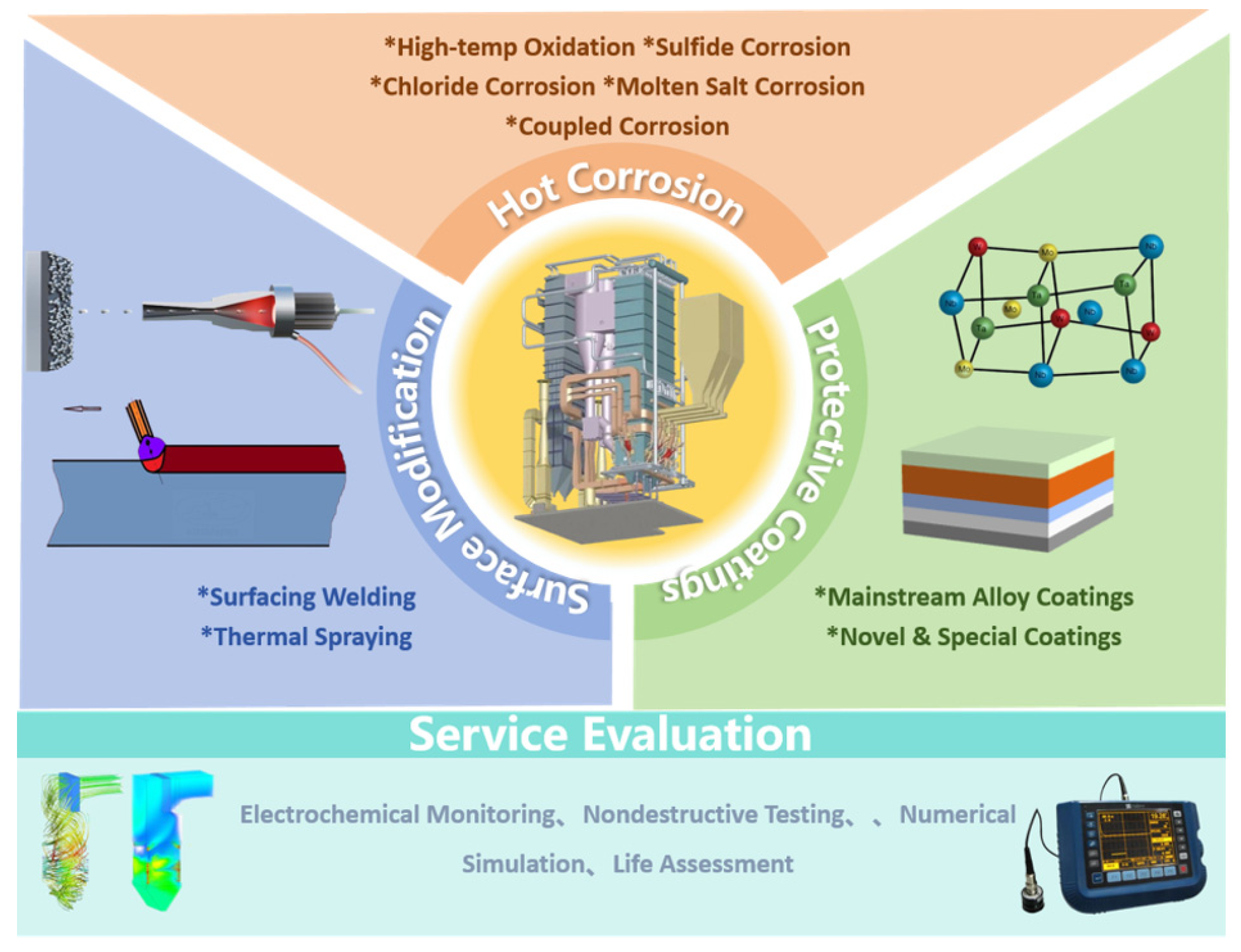
In response to these challenges, surface coating technologies have emerged as the core means of high-temperature corrosion protection for power plant boilers. Thermal spray coatings form dense protective layers on tube panel surfaces through physical deposition; laser cladding and weld overlay achieve high-bond-strength protection through metallurgical bonding; and diffusion coatings eliminate interfacial issues through in situ chemical heat treatment [9]. In terms of coating materials, the spectrum of protective material options has expanded considerably from conventional NiCr-based alloy coatings to novel systems including MCrAlY, cermets, Fe-based amorphous/nanocrystalline alloys, and high-entropy alloys (HEAs) [10]. The development of corrosion monitoring and lifetime assessment technologies has provided the technical foundation for transforming boiler corrosion protection from reactive maintenance to proactive management [11]. This paper establishes a four-dimensional analytical framework of “mechanisms–technologies–materials–evaluation,” with corrosion mechanisms as the fundamental driver, coating processes as the technical carrier, material systems as the performance core, and monitoring and evaluation as the engineering feedback loop, to systematically review the full-chain progress in high-temperature corrosion protection for power plant boilers from fundamental understanding to engineering application. This framework also serves to uniformly assess the technological maturity and applicability boundaries of each technical route, as illustrated in Figure 1.

2. High-Temperature Corrosion Mechanisms

Boiler heating surfaces in high-temperature flue gas environments are subjected to the progressive superposition of five categories of corrosion mechanisms: from the most fundamental high-temperature oxidation, through sulfidation and chlorination—two types of selective corrosion induced by corrosive gases—to accelerated hot corrosion caused by low-melting-point molten salts, and finally manifesting in engineering practice as a complex corrosion behavior involving multi-factor coupling beneath deposits. Understanding the synergistic and competitive relationships among these mechanisms constitutes the theoretical foundation for protective design.

2.1. High-Temperature Oxidation

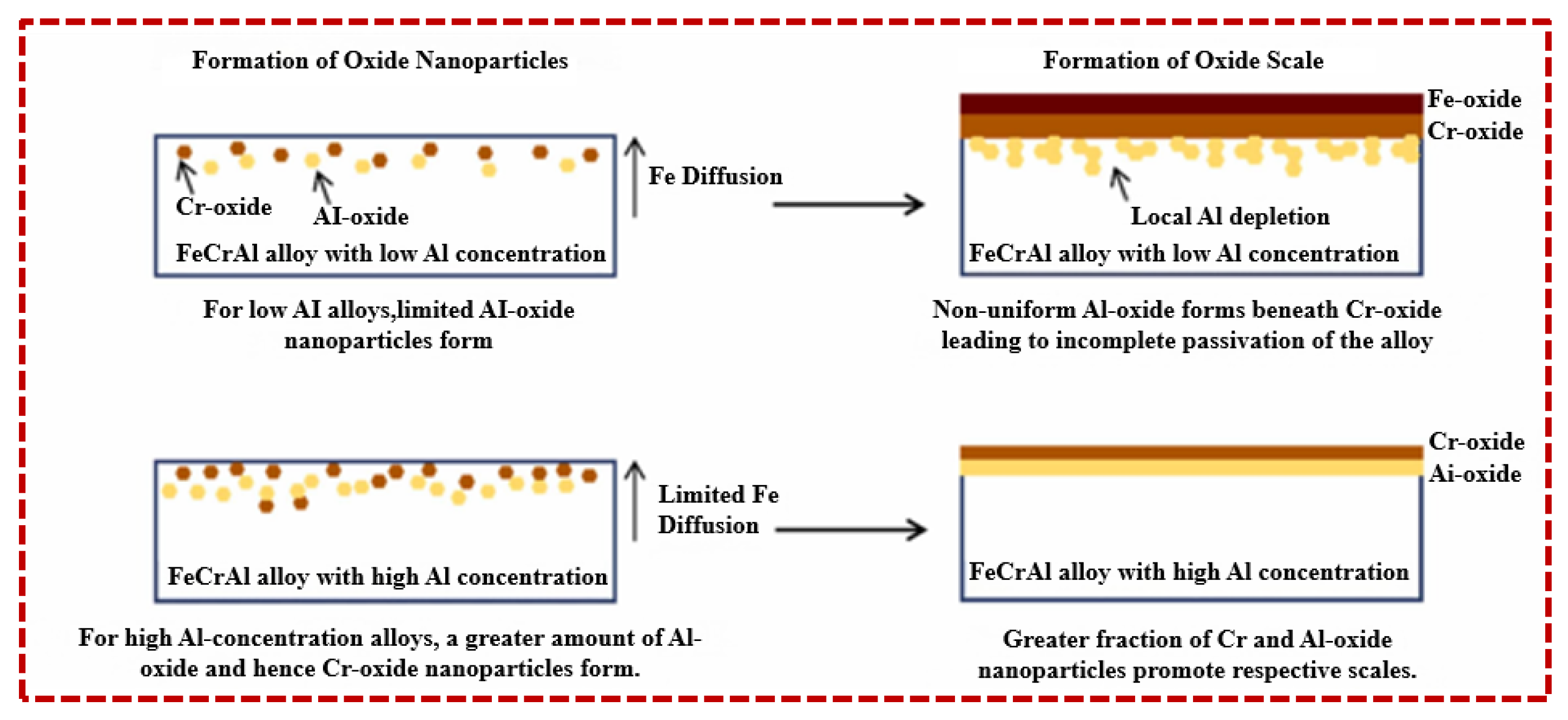
High-temperature oxidation is the most fundamental form of corrosion of boiler heating surfaces, and virtually all metallic materials undergo oxidation reactions in high-temperature oxygen-containing environments. The protectiveness of the oxide scale depends on its compactness, adhesion, and growth rate, with Cr and Al being the key alloying elements for forming protective oxide scales. For ferritic steels, austenitic steels, and nickel-based alloys commonly employed in boiler heating surfaces, the differences in oxidation resistance primarily arise from transitions in oxide scale type: when the Cr content is insufficient to form a continuous Cr2O3 scale, Fe-Cr spinel oxide layers grow relatively rapidly and are prone to spallation; when the Cr content exceeds a critical threshold (approximately 20 wt.%), a continuous and dense Cr2O3 scale can effectively impede inward oxygen diffusion [12]. Under the steam oxidation conditions of ultra-supercritical boilers, the Cr2O3 scale may volatilize at high steam partial pressures, forming gaseous CrO2(OH)2 products, leading to the consumption and degradation of the protective oxide scale [13], as illustrated in Figure 2. The Al content is equally critical for oxide scale protectiveness; when the Al content reaches a certain threshold, an α-Al2O3 scale can form, whose growth rate is substantially lower than that of the Cr2O3 scale, providing superior protection at elevated temperatures [14].

2.2. Sulfidation Corrosion

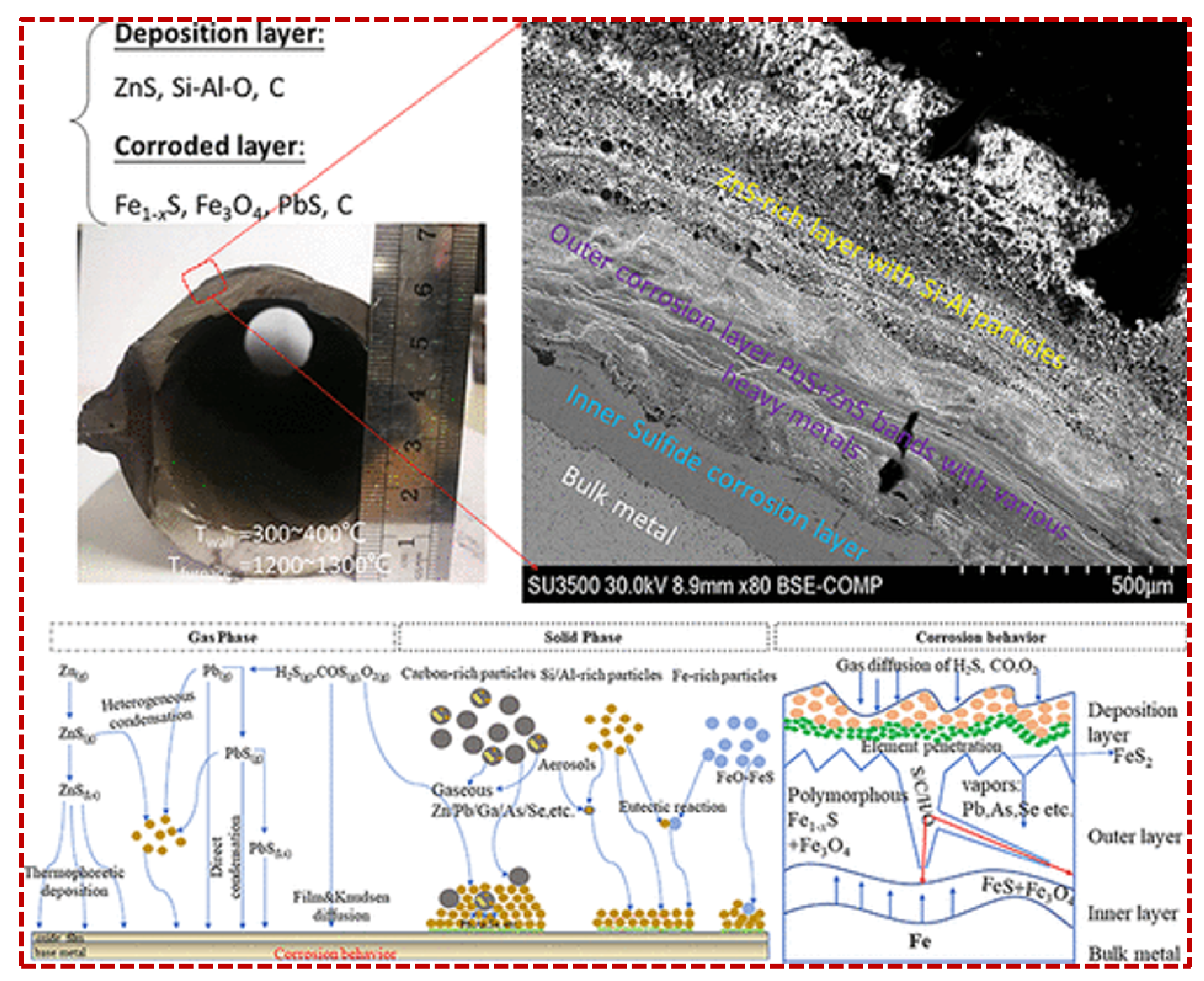
Sulfidation corrosion is one of the most typical forms of corrosion in coal-fired boilers, primarily originating from sulfur-containing gases such as SO2, SO3, and H2S generated during coal combustion. The severity of sulfide corrosion is closely correlated with the sulfur content of the fuel and the operating temperature [15], as shown in Figure 3. Sulfidation corrosion modes are primarily classified into sulfate-type and sulfide-type corrosion. Sulfate-type corrosion is initiated by the deposition of alkali metal sulfates on the tube-wall surface; molten sulfates dissolve the protective oxide scale, allowing sulfur to diffuse into the metal substrate and form metal sulfides. Sulfide-type corrosion results from the direct reaction of gaseous H2S with metals to form FeS and other sulfides. Sulfides typically possess high defect concentrations, through which oxygen and sulfur can rapidly diffuse inward, forming a loose and porous mixed sulfide–oxide layer that loses its protective character. Furthermore, the Ni-Ni3S2 low-melting-point eutectic formed by the reaction of Ni with S constitutes a critical mechanism responsible for catastrophic corrosion of nickel-based alloys in sulfur-containing environments [16].

2.3. Chlorine-Induced Corrosion

Chlorine-induced corrosion is the most destructive form of corrosion in biomass-fired and waste incineration boilers, with its core mechanism being the “active oxidation” cycle. Alkali metal chlorides in the fuel volatilize in the high-temperature flue gas and deposit on the tube-wall surface, subsequently reacting with the metal oxide scale to release Cl2 or HCl. Chlorine gas penetrates through the oxide scale to the oxide scale–metal interface, reacting with metallic elements to form volatile metal chlorides. These chlorides re-oxidize upon encountering higher oxygen partial pressures during outward diffusion, releasing Cl2 and thus establishing a cyclic catalytic effect of chlorine [17]. In this cycle, chlorine acts as a catalyst that continuously consumes metallic elements without itself being consumed; therefore, even extremely low chlorine concentrations can cause significant metal loss over extended durations [18]. Experimental studies have demonstrated that under KCl deposition conditions at 600 °C, HVAF-sprayed NiCr and NiAl coatings exhibit a certain degree of chlorine corrosion resistance, yet the formation of a Cr-rich oxide scale more effectively inhibits chlorine penetration [19]. Chlorine partial pressure, temperature, and alloy composition are the three key factors determining the chlorine-induced corrosion rate, among which temperature exerts the most pronounced influence: when the temperature exceeds 500 °C, the chlorine-induced corrosion rate increases exponentially [20].

2.4. Molten Salt Hot Corrosion

Molten salt hot corrosion is the most significant form of corrosion in oil-fired boilers and certain coal-fired boilers; its essence lies in the dissolution and destruction of protective oxide scales by low-melting-point alkali metal sulfate–vanadate melts. When the fuel contains impurities such as V, Na, and S, the combustion products form a Na2SO4–V2O5 system that can form a liquid phase in the temperature range of 550–700 °C. The molten salt dissolves protective oxide scales such as Cr2O3 and Al2O3, enabling the rapid diffusion of oxygen and sulfur toward the metal substrate [21]. Molten salt hot corrosion encompasses two modes: basic fluxing and acidic fluxing. Basic fluxing occurs when Na2O reacts with the oxide scale to form soluble salts, leading to continuous consumption of the oxide scale. Acidic fluxing involves the reaction of acidic components such as V2O5 and SO3 with the oxide scale to form low-melting-point eutectic compounds [22]. V2O5 plays a critical role in molten salt hot corrosion, not only lowering the melting point of the molten salt but also serving as an oxygen carrier to accelerate the oxidation process, exhibiting autocatalytic characteristics [23]. In boilers firing high-vanadium fuel oil, molten salt hot corrosion is the primary cause of superheater tube-wall thinning, with studies indicating that the corrosion rate can reach 1–2 orders of magnitude higher than that of simple oxidation.

2.5. Multi-Factor Coupled Corrosion Beneath Deposits

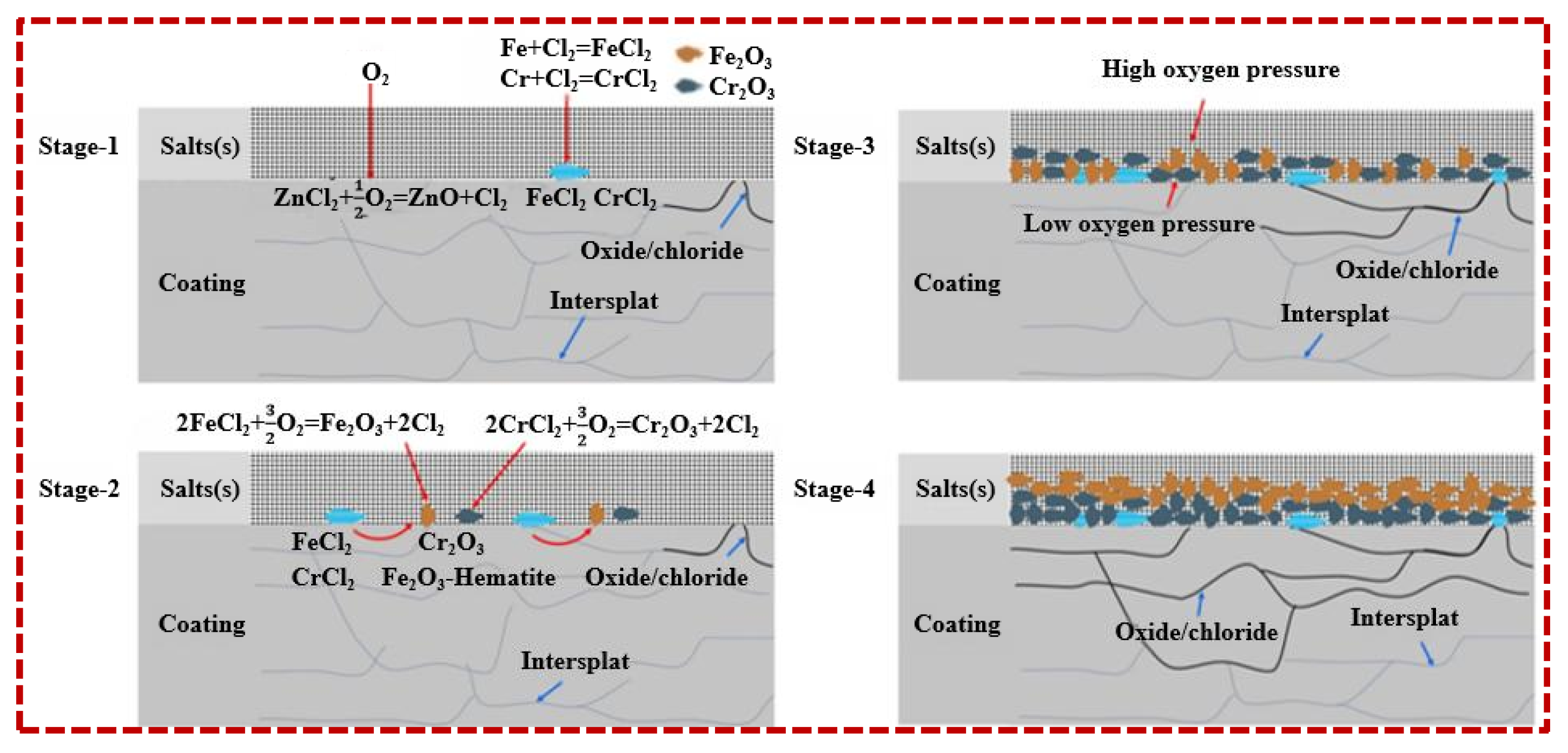
During actual boiler operation, flue-gas side deposits and corrosive gases act synergistically to create a multi-factor coupled corrosion environment that is far more complex than any single mechanism. The influence of deposits on corrosion is multi-dimensional. First, deposits form a physical barrier on the tube-wall surface, impeding heat transfer and causing tube-wall overheating, which accelerates corrosion reaction kinetics. Second, the local atmosphere within the deposit differs substantially from the mainstream flue gas; a low-oxygen, high-sulfur, high-chlorine microenvironment often forms at the deposit–metal interface, promoting sulfidation and chlorination corrosion. Third, alkali metal salts within the deposits form low-melting-point eutectic liquid phases, initiating molten salt hot corrosion while simultaneously serving as electrolytes to support electrochemical corrosion processes [24], as shown in Figure 4. In waste incineration boilers, the corrosion rate beneath deposits can reach 5–20 times the values predicted from single-factor laboratory experiments, clearly demonstrating the severity of coupling effects [25]. The interactive effects of oxidation–sulfidation–chlorination–hot corrosion mechanisms beneath deposits exhibit spatial and temporal non-uniformity, rendering quantitative prediction of corrosion behavior extremely challenging.
Current engineering protection practices are largely based on empirical extrapolation under “single-mechanism worst-case scenarios,” lacking a unified, calibratable model that integrates gas-phase chemistry, salt-phase thermodynamics, oxide scale growth/dissolution, and transport through porous deposits [26]. Second, the operational utility of critical threshold values is insufficient—for instance, the critical Cr/Al content ranges are strongly influenced by impurities and microstructure, necessitating conversion into online controllable indicators (e.g., controlling KCl flux on tube-wall surfaces to <0.1–0.2 g·m−2·h−1) [27,28]. Third, as operating conditions change, the dominant rate-controlling step shifts among oxide scale growth, dissolution, volatilization, and reaction control, leading to Arrhenius parameter mismatch [29]. Typical parameters for different corrosion mechanisms are summarized in Table 1.
Future protection design should focus on developing high-Cr (≥22–25 wt.%) and Al-rich alloys or coatings capable of forming stable α-Al2O3 scales, while simultaneously reducing deposition flux and wall temperature through operational controls, and establishing multi-component phase diagrams combined with reaction–diffusion coupled models to enable quantitative life prediction.

3. Surface Coating and Modification Technologies

Surface coating technologies constitute the core means of high-temperature corrosion protection for power plant boilers. Different processes form a complementary technological spectrum in terms of coating density, bond strength, material compatibility, and engineering cost. HVOF/HVAF and laser cladding represent two complementary technical routes of thermal spraying and high-energy beam modification, respectively: the former excels in high density and process flexibility, while the latter offers metallurgical bonding and customizability. Cold spraying and diffusion coatings further extend the technical space into low-temperature deposition and in situ modification.

3.1. High-Velocity Oxygen Fuel (HVOF)/High-Velocity Air Fuel (HVAF) Spraying

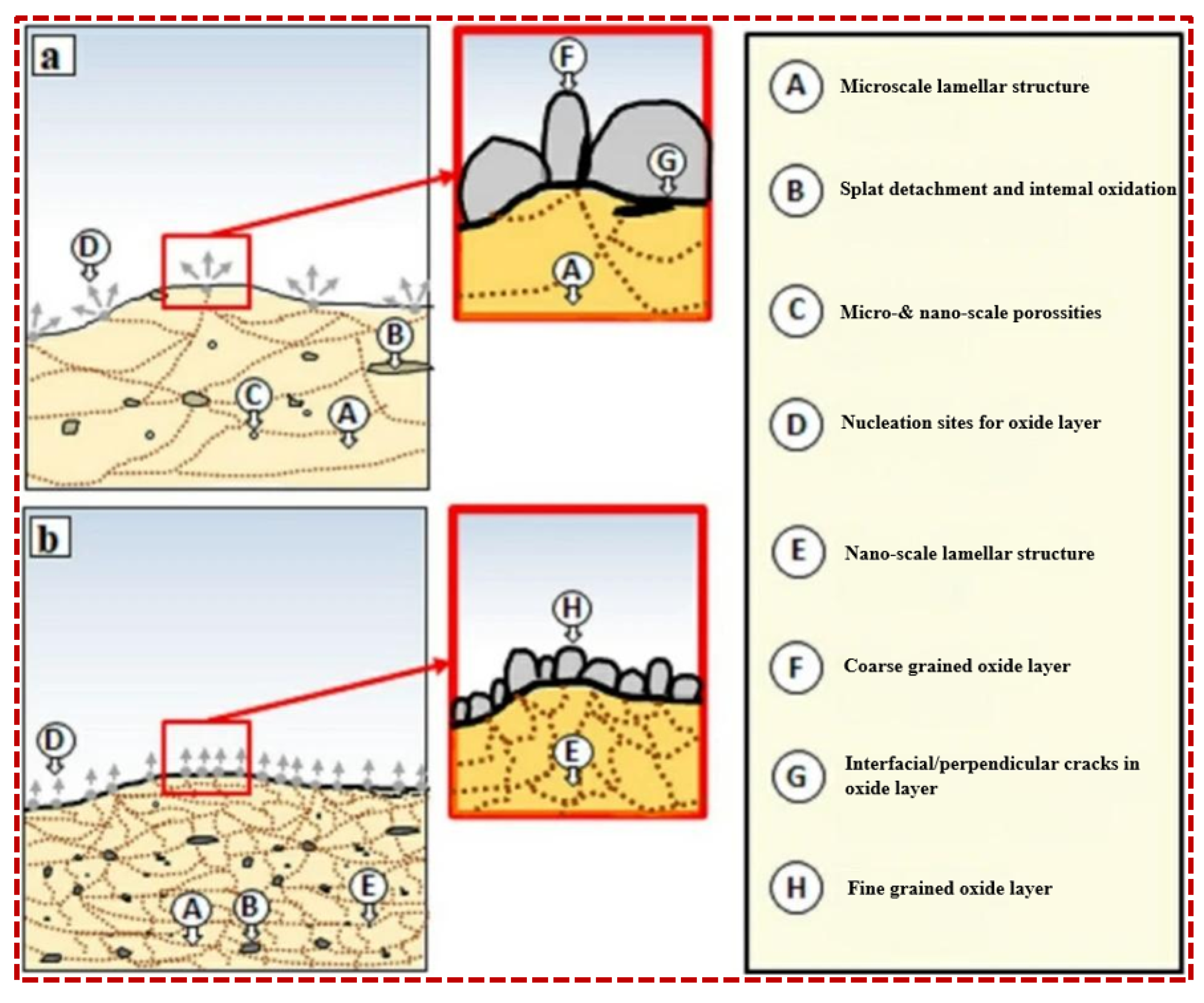
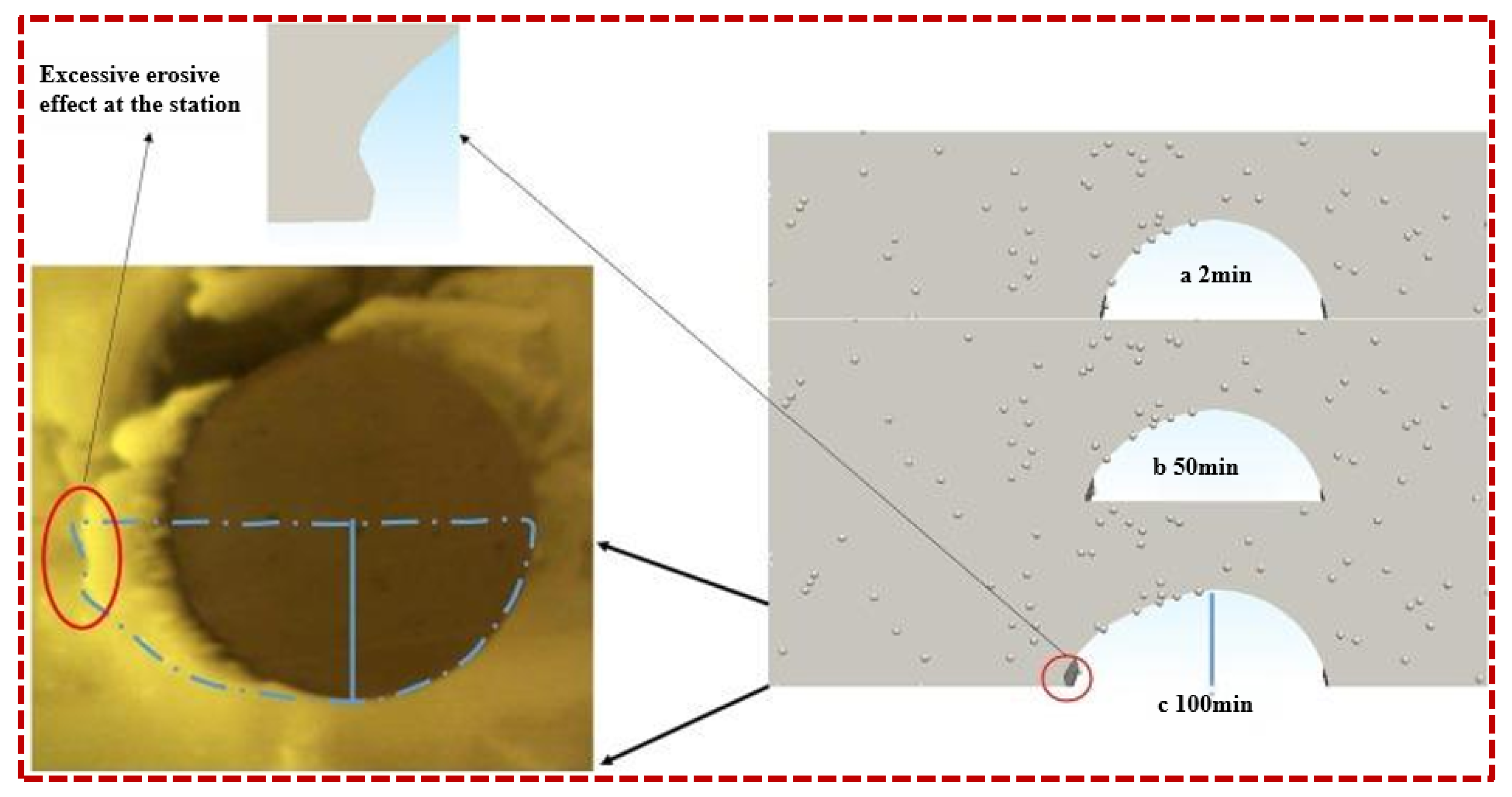
HVOF and HVAF technologies, by virtue of the high particle kinetic energy generated by supersonic flame jets and relatively low operating temperatures, are capable of producing highly dense coatings with a porosity below 1%, representing the most mature thermal spray processes currently available for corrosion-resistant coatings on boiler tube panels. HVOF employs oxygen–fuel combustion to generate a flame jet at approximately 2700–3000 °C, with particle velocities reaching 600–800 m/s. HVAF, by contrast, uses compressed air instead of pure oxygen, resulting in a lower flame jet temperature of approximately 1900–2200 °C, which further reduces oxidation and phase transformation of powder particles [30]. In comparative studies of NiCr and NiCrBSi coatings, HVAF-sprayed coatings exhibited superior corrosion resistance in an NaCl solution compared with APS- and HVOF-sprayed coatings of the same composition, primarily attributable to the lower flame jet temperature of HVAF reducing the oxidative consumption of Cr, thereby preserving higher effective Cr content in the coating for forming protective oxide scales [31]. Fuel type, spray distance, and powder particle size are the key parameters governing coating quality; optimization of these parameters can yield high-quality coatings with a porosity below 0.5% and bond strength exceeding 70 MPa [32], as illustrated in Figure 5. In on-site repair of boiler tube panels, portable HVOF/HVAF equipment enables in situ spraying; however, accessibility remains constrained by tube panel spacing and requires further improvement.

3.2. Atmospheric Plasma Spraying (APS)

APS technology meets the requirements for large-area coating deposition on boiler tube panels through high deposition efficiency and broad material compatibility; however, its inherent lamellar pore structure necessitates post-treatment via sealing or remelting to enhance corrosion resistance. APS employs a DC arc to heat Ar/H2 or Ar/He plasma gas to 10,000–15,000 °C; powder particles are heated to a molten or semi-molten state in the plasma jet and subsequently impact the substrate at high velocity, forming a characteristic lamellar stacked structure. The porosity of the coating typically ranges from 3% to 10%, and these pores may serve as pathways for corrosive media penetration in service environments [33]. To improve the corrosion resistance of APS coatings, researchers have developed various post-treatment techniques: organic or inorganic sealants can fill surface-connected pores, blocking permeation pathways for corrosive media; laser remelting or flame remelting can induce remelting and solidification of the coating, eliminating the lamellar structure and pores to achieve metallurgical bonding. Cyclic oxidation experiments on plasma-sprayed NiCrAlY/Cr3C2 composite coatings on T22 boiler steel demonstrated that sealant-treated coatings exhibited significantly lower oxidation mass gain rates at 900 °C compared with untreated coatings [34]. Another advantage of APS is its capability to deposit high-melting-point ceramic materials, such as YSZ thermal barrier coatings and rare-earth zirconate coatings, which are difficult to achieve with HVOF/HVAF [35].

3.3. Cold Spraying

Cold spraying, through low-temperature solid-state deposition, avoids the high-temperature oxidation and phase transformation issues inherent to conventional thermal spraying, providing a unique technical pathway for the application of temperature-sensitive coating materials in boilers. The principle of cold spraying involves preheating high-pressure gas to 400–1000 °C and then accelerating it to supersonic velocities through a Laval nozzle; powder particles, maintained in the solid state, are carried by the high-velocity gas to impact the substrate, achieving mechanical and metallurgical bonding between particles through severe plastic deformation [36]. Since the particles remain in the solid state throughout the entire process, cold-sprayed coatings fully retain the chemical composition and phase structure of the original powder, avoiding issues such as oxidation, decarburization, and phase transformation. However, the engineering application of cold spraying in boiler tube panel protection still faces several challenges: for high-hardness materials, the deposition efficiency of cold spraying is relatively low and the coating density is insufficient; although the bond strength of cold-sprayed coatings is acceptable in the as-sprayed condition, it may degrade during high-temperature service due to insufficient interfacial diffusion [37].

3.4. Detonation Gun Spraying and Arc Spraying

Detonation gun spraying and arc spraying occupy opposite ends of the cost–performance spectrum, forming complementary technical positions. Detonation gun (D-Gun) spraying utilizes the controlled detonation of oxygen–acetylene gas mixtures to generate pulsed shock waves, accelerating powder particles to extremely high velocities of 800–1200 m/s and yielding ultra-dense coatings with a porosity below 0.5% [38]. Erosion experiments on D-Gun-sprayed Cr3C2-25NiCr and WC-12Co coatings on ASTM A36 steel demonstrated that their erosion resistance surpassed that of HVOF-sprayed coatings of the same composition, attributable to the higher particle velocities leading to stronger inter-particle bonding and lower porosity. However, the equipment investment and operating costs of the D-Gun process are substantially higher than those of other thermal spray processes, and the limited spray area per pulse results in low production efficiency, making it difficult to meet the requirements for large-area coating deposition on boiler tube panels. Arc spraying, by contrast, meets the demands of large-area field operations through low cost and high efficiency. Studies on the application of arc-sprayed FeCr alloy and Fe-based coatings on boiler heat exchanger tubes have shown that the corrosion resistance of the coatings is comparable to that of HVOF coatings, while the cost is only 1/3 to 1/5 of the latter [39]. Nevertheless, arc-sprayed coatings typically exhibit relatively high porosity (5%–15%) and elevated oxide content, factors that constrain their long-term service performance in severe corrosive environments [40].

3.5. Laser Cladding and Surface Alloying

Laser cladding, through metallurgical bonding and extremely low dilution rates, achieves strong interfacial bonding between the coating and substrate, representing a key alternative technology for addressing the insufficient bonding strength of thermal spray coatings. It is particularly suitable for high-reliability protection of critical locations on boiler tube panels. Laser cladding utilizes a high-energy-density laser beam to form a melt pool on the substrate surface while simultaneously feeding powder or wire into the melt pool for melting. A micron-scale interdiffusion layer forms between the coating and substrate, and the bond strength far exceeds the mechanical bonding of thermal spray coatings, fundamentally eliminating the risk of coating delamination [41]. In high-temperature corrosion studies of Ni-20Cr-xSi alloy laser-clad layers, the coating with x = 3 wt.% Si exhibited optimal corrosion resistance in a NaCl-KCl-Na2SO4-K2SO4 mixed molten salt environment, attributable to Si promoting the formation and stabilization of the Cr2O3 oxide scale. Laser surface alloying is a variant of laser cladding: alloy powder is pre-placed on the substrate surface and then subjected to laser scanning melting, allowing alloying elements to diffuse in situ into the substrate surface to form a gradient–composition alloyed layer, offering unique advantages for improving the surface corrosion resistance of boiler tube panels [42]. Among process parameters, excessively low laser power results in insufficient powder melting, while excessively high power increases the dilution rate and the width of the heat-affected zone; scanning speed influences the cooling rate of the melt pool and the resulting microstructure; and the powder feed rate determines the coating thickness and compositional uniformity [43].

3.6. Weld Overlay and Weld Cladding

Weld overlay and weld cladding, characterized by millimeter-scale thickness and metallurgical bonding, offer irreplaceable protective advantages under ultra-severe coupled erosion–corrosion conditions, although a trade-off must be made regarding the effect of heat input on the substrate microstructure. In the corrosion protection of boiler tube panels, commonly employed weld overlay processes include automatic TIG welding, plasma transferred arc (PTA) welding, and laser cladding. Automatic TIG welding deposits nickel-based alloy welding wire such as Inconel 625 on the tube panel surface to obtain a corrosion-resistant cladding layer with a thickness of 2–5 mm [44]. Studies on the corrosion behavior of Inconel 625 cladding layers in NaCl-KCl and NaCl-KCl-Na2SO4 molten salts have shown that their excellent corrosion resistance is derived from the high Cr and Mo contents: Cr forms a protective oxide scale, while Mo enhances pitting resistance [45]. The key technical challenge in weld overlay cladding lies in dilution rate control, typically requiring a dilution rate below 10%. Laser cladding, owing to more concentrated heat input, can achieve lower dilution rates and narrower heat-affected zones, albeit at higher equipment cost and process complexity. The welding heat input may adversely affect the microstructure of the substrate, particularly fine-grained heat-resistant steels, causing grain coarsening and precipitate dissolution, necessitating a balance between protective efficacy and preservation of substrate properties.

3.7. Diffusion Coatings and Slurry Coatings

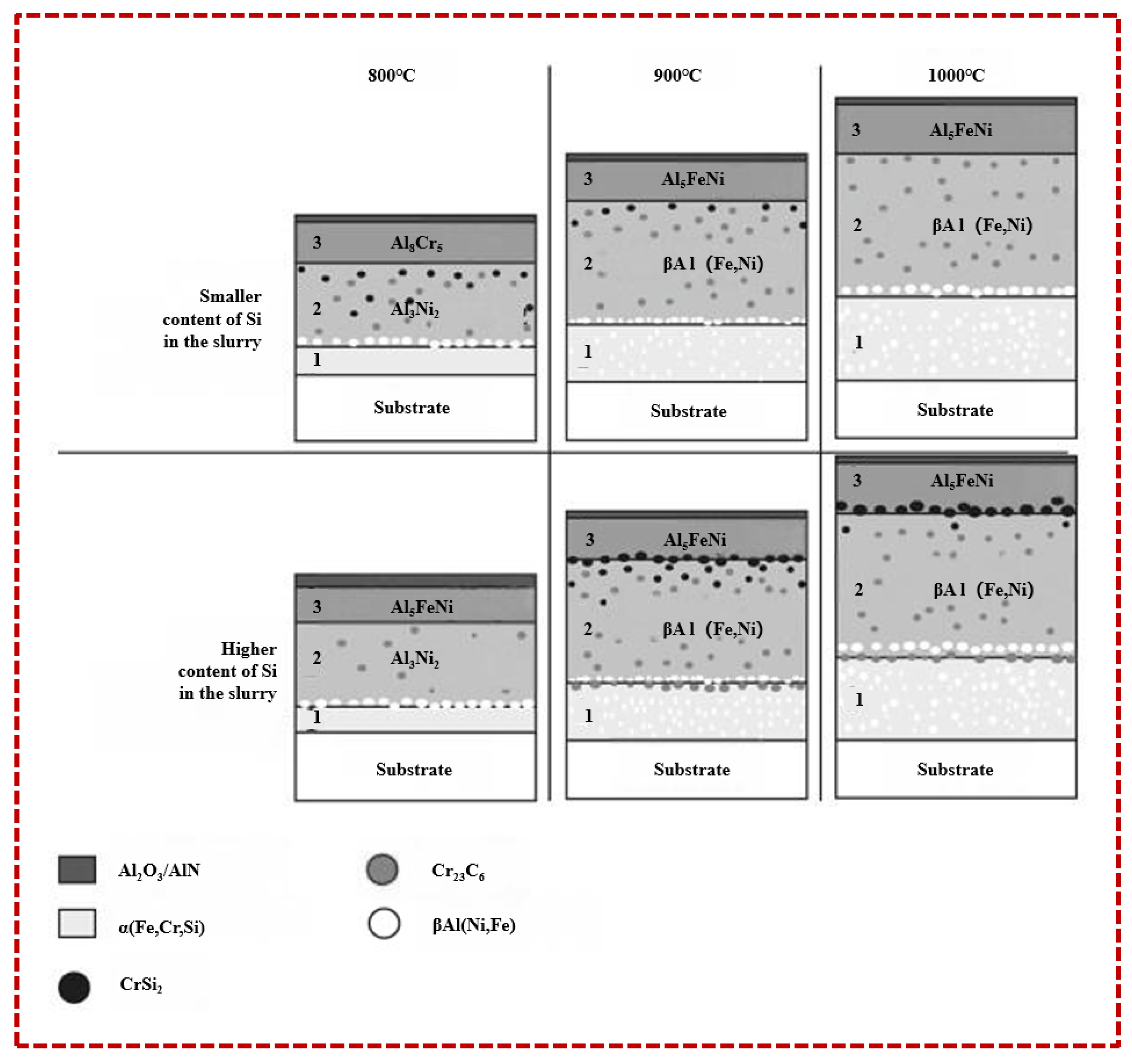
Diffusion coatings form gradient–composition layers through in situ chemical heat treatment, eliminating coating–substrate interfacial bonding issues. Aluminizing and co-diffusion techniques possess unique engineering applicability for resistance to high-temperature oxidation and sulfidation corrosion of boiler tube panels. The fundamental principle of diffusion coatings involves placing the workpiece in a medium containing the element to be diffused and, at elevated temperatures, enabling the element to enter the substrate surface through thermal diffusion, forming a diffusion layer with a graded compositional profile that lacks the physical interface characteristic of conventional coatings [46]. Aluminizing is the most commonly employed diffusion coating process; the FeAl or NiAl intermetallic compound layer formed selectively oxidizes at high temperatures to produce a dense α-Al2O3 scale, exhibiting excellent oxidation and sulfidation resistance. Boronizing, chromizing, and siliconizing processes each offer distinct advantages: boronized layers possess extremely high hardness, chromized layers perform exceptionally well in sulfur-containing environments, and siliconized layers exhibit good corrosion resistance in chlorine-containing environments. The slurry method is a low-cost implementation of diffusion coating: a slurry containing the source element powder, activator, and binder is applied to the workpiece surface, followed by diffusion treatment at elevated temperature after drying. Studies on Al-Si slurry coatings on austenitic heat-resistant cast steel have shown that the coating microstructure consists of an outer Al-Si layer and an inner diffusion layer, exhibiting good protective performance under oxidation conditions at 850 °C [47], as shown in Figure 6. Studies on the formation of Si diffusion layers on Fe and Fe-Cr alloys have demonstrated that Si diffusion layers can effectively improve corrosion resistance in molten salt environments, attributable to the reaction of Si with oxygen to form a dense protective SiO2 film [48].
Taking a comprehensive view of the technology maturity levels of various high-temperature protective coating processes for industrial boilers, HVOF/HVAF and APS processes are both mature and have achieved large-scale industrial application [49], with HVOF/HVAF being the preferred technology for high-end protection applications by virtue of their high coating density and excellent corrosion resistance [50], while APS dominates in large-area coating deposition and high-melting-point ceramic coating preparation scenarios [51]. In contrast, cold spraying in the field of boiler high-temperature protection remains at the R&D and preliminary application stage, with the core limiting factors being insufficient coating interfacial bond strength and poor high-temperature service stability [52,53]. Laser cladding has relatively high process maturity but is constrained by high equipment costs and low processing efficiency, being mostly used for localized reinforcement of critical components [54,55]. Diffusion coating processes such as aluminizing are mature and have low preparation costs, yet they struggle to achieve uniform, controllable coating preparation on complex-shaped workpiece surfaces [56].
Each process has significant application shortcomings and research directions requiring urgent breakthroughs: HVOF/HVAF spraying equipment has limited operational accessibility, making it difficult to penetrate the interior of tube panels for uniform spraying, with the corresponding research gap centered on the development of miniaturized, highly flexible spraying robot systems. The inherent pore structure of APS coatings means their corrosion resistance is highly dependent on subsequent sealing treatment, substantially increasing process complexity, creating an urgent need for the development of efficient, environmentally friendly sealing materials and online remelting techniques. The interfacial bond degradation mechanisms of cold-sprayed coatings under high-temperature service environments remain unclear, and the development of intermediate transition layer materials and compatible post-heat-treatment processes suitable for high-temperature conditions represents the current core research direction. The high heat input during laser cladding can readily induce substrate grain coarsening and microstructural degradation, with current research focused on optimizing process parameters to minimize the heat-affected zone and developing novel low-dilution-rate alloy powders.
Furthermore, the actual application potential of certain processes should be objectively and prudently assessed. The prospects of cold spraying in boiler high-temperature protection have been somewhat overhyped—while the process offers advantages such as low-temperature deposition and complete preservation of raw material intrinsic properties, boiler tubes must endure long-term service temperatures of 500–600 °C or even higher, and the coating interfaces formed by cold spraying, relying primarily on mechanical interlocking, are highly susceptible to failure under such high-temperature conditions. Without breakthroughs in key technologies for achieving metallurgical bonding strengthening, it will be difficult for cold spraying to replace HVOF/HVAF and laser cladding in the mainstream boiler protection market. Similarly, although detonation gun (D-Gun) spraying can produce coatings with extremely high density, its high production cost and low processing efficiency make large-scale deployment impractical, and it should not be over-promoted as a general-purpose boiler protection solution.

4. Corrosion-Resistant Coating Material Systems

Coating material systems for boiler high-temperature corrosion protection exhibit a multi-dimensional complementary development pattern, spanning from conventional NiCr alloys to high-entropy alloys and from cermets to Fe-based amorphous alloys. Material selection must be tailored to the dominant corrosion mechanisms in the service environment.

4.1. NiCr-Based Coatings

NiCr-based coatings employ the Cr2O3 oxide scale as a protective barrier and represent the most economical corrosion-resistant option in high-oxygen partial-pressure environments; however, the Cr content must exceed 20% to form a continuous protective oxide scale. The protective performance of NiCr binary alloy coatings in high-temperature oxidation and chlorination environments is closely correlated with the Cr content: the oxide scale of Ni-20Cr coatings consists of a mixed layer of NiO and Cr2O3, providing insufficient protection, whereas Ni-30Cr coatings can form a continuous Cr2O3 scale with a markedly reduced oxidation rate [57]. In actual rice husk combustion boiler environments, studies on the high-temperature corrosion resistance of HVOF-sprayed Ni25Cr coatings on 347H stainless steel demonstrated that the corrosion rate of the Ni25Cr coating was only 1/3 to 1/5 of that of the bare steel, with the continuity of the Cr2O3 scale in the coating being the key factor determining corrosion resistance. In chlorine-containing environments, the primary challenge faced by NiCr coatings is the reaction of Cr with Cl to form volatile CrCl2 or CrCl3, leading to a reduction in the effective Cr content and degradation of the protective oxide scale [58]. Multi-element alloy coatings such as NiCrMoAl, through the addition of Mo and Al, can provide more comprehensive protection in complex corrosive environments containing both chlorine and sulfur.

4.2. NiCrBSi Self-Fluxing Alloy Coatings

NiCrBSi self-fluxing alloys, through the incorporation of B and Si elements, achieve low-melting-point self-fluxing characteristics; after laser remelting or flame remelting, dense, pore-free, and metallurgically bonded coatings can be obtained, providing the dual functionality of corrosion and wear resistance. The mechanisms of B and Si in NiCrBSi alloys are multifaceted: B and Si lower the melting point of the alloy, enabling self-fluxing and densification of the coating through post-spray remelting; B and Si form hard boride and silicide phases with Ni and Cr, increasing the hardness and wear resistance of the coating; Si also participates in forming Cr2O3, supplementing the protectiveness of the oxide scale [59]. The microstructure of NiCrBSi coatings consists of a γ-Ni matrix, Ni3B, CrB, and Cr23C6 phases, in which hard phases are dispersed within a ductile matrix, forming a metal-matrix-composite-like microstructure [60]. Electrochemical corrosion studies in an NaCl solution have indicated that the corrosion resistance of NiCrBSi coatings is slightly inferior to that of NiCr coatings, attributable to localized corrosion susceptibility caused by Cr-depleted zones surrounding Cr-rich boride phases [61]. Under service conditions involving simultaneous corrosion and wear, the comprehensive performance of NiCrBSi coatings surpasses that of pure NiCr coatings.

4.3. MCrAlY Coatings

MCrAlY coatings achieve protection through the selective oxidation of Al to form an Al2O3 scale, supplemented by the synergistic effect of Cr to enhance hot corrosion resistance. They represent the alloy coating system with the best overall performance under coupled high-temperature oxidation and molten salt hot corrosion conditions. In MCrAlY coatings, Al is the core element for forming the protective Al2O3 scale, Cr serves as an auxiliary element, and Y functions as a reactive element improving oxide scale adhesion. NiCrAlY coatings achieve excellent oxidation resistance in high-temperature oxidizing environments through the formation of an α-Al2O3 scale; the addition of Cr reduces the critical Al content required for forming a continuous Al2O3 scale while simultaneously enhancing hot corrosion resistance in sulfur-containing environments [62]. CoCrAlY coatings exhibit superior high-temperature toughness and thermal fatigue resistance but slightly inferior oxidation resistance compared with NiCrAlY; NiCoCrAlY coatings combine the oxidation resistance of NiCrAlY with the toughness of CoCrAlY, representing the optimal MCrAlY system in terms of comprehensive performance [63]. Studies on the oxidation behavior of HVOF-sprayed NiCrAlY and NiCrAlY-20SiC composite coatings on T91 boiler tube steel have shown that the addition of SiC particles enhances the protectiveness of the oxide scale through the formation of SiO2; however, the oxidative consumption and interfacial reactions of SiC at high temperatures may lead to long-term coating performance degradation [64]. Studies on Pt-modified NiCoCrAlY coatings in high-temperature corrosion have indicated that the addition of Pt further promotes the selective formation of the Al2O3 scale and suppresses internal oxidation and internal nitridation within the coating [65].

4.4. Cr3C2-NiCr Cermet Coatings

Cr3C2-NiCr cermet coatings, through the synergistic action of hard carbide phases and a corrosion-resistant metallic phase, achieve superior comprehensive protective performance compared with pure metallic coatings under coupled high-temperature erosion–corrosion conditions on boiler tube panels. The hard Cr3C2 phase in the coating provides an erosion-resistant skeleton, while the NiCr metallic binder phase provides toughness and corrosion resistance [66]. The long-term stability of Cr3C2-NiCr coatings in high-temperature environments depends on the oxidation behavior of Cr3C2. At high temperatures, Cr3C2 undergoes oxidative decarburization, forming Cr2O3 and CO/CO2 gases; this leads to volumetric shrinkage of the carbide phase and increased coating porosity, while the released CO gas forms pores within the coating, providing pathways for further permeation of corrosive media [67]. The oxidative decarburization of Cr3C2 can be effectively retarded by optimizing spray process parameters, using HVAF instead of HVOF to reduce flame jet temperature and thereby minimize carbide decomposition, and adding nano-TiC reinforcement particles [68]. Cr3C2-NiCr coatings exhibit optimal comprehensive performance under erosion–corrosion conditions at 750–900 °C, with an upper service temperature limit of approximately 900 °C [69].

4.5. WC-Co/WC-CoCr Cermet Coatings

WC-Co/WC-CoCr coatings exhibit excellent erosion and corrosion resistance under low-to-intermediate temperature conditions; however, the oxidation and decarburization of WC at elevated temperatures (>500 °C) limit their long-term service, necessitating retardation of failure through Cr addition and process optimization. In WC-Co coatings, the WC hard phase provides exceptionally high erosion resistance, while the Co binder phase provides toughness. However, the thermal stability of WC in high-temperature oxygen-containing environments is relatively poor: oxidation commences at approximately 500 °C, forming WO3 and CoWO4, and the molar volume of WO3 is substantially larger than that of WC, causing coating expansion and cracking; simultaneously, the decarburization reaction of WC generates W2C and metallic W, with a concomitant decrease in coating hardness and wear resistance [70]. In WC-CoCr coatings, the addition of Cr serves dual functions: Cr dissolves in the Co binder phase, enhancing the corrosion resistance of the binder; Cr also reacts with WC to form Cr23C6, inhibiting the decarburization and oxidation of WC [71]. Compared with Cr3C2-NiCr coatings, WC-CoCr coatings exhibit superior erosion resistance under low-to-intermediate temperature conditions (<500 °C), whereas Cr3C2-NiCr coatings demonstrate better thermal stability and corrosion resistance at elevated temperatures [72]. In boiler applications, WC-CoCr coatings are suitable for components with relatively low metal temperatures, such as economizers and low-temperature superheaters, while Cr3C2-NiCr coatings are appropriate for high-temperature components such as high-temperature superheaters and reheaters.

4.6. Stellite Series Coatings

Stellite cobalt-based alloy coatings, through the dual advantages of the high-temperature hardness of the Co matrix and carbide strengthening phases, exhibit superior comprehensive wear and corrosion resistance compared with nickel-based alloys under high-temperature erosion conditions in boilers. The unique advantage of Stellite alloys lies in the retention of high hardness by the Co matrix at elevated temperatures: at 650 °C, the hardness of Co can still be maintained at more than 80% of its room-temperature hardness, whereas the hardness of Ni-based alloys has decreased significantly at the same temperature. The carbide strengthening phases in Stellite alloys exhibit good thermal stability at high temperatures [73]. Stellite-6 possesses high hardness and excellent erosion resistance, making it suitable for high-erosion areas such as boiler valves and tube panel elbows; Stellite-21 exhibits superior toughness and thermal fatigue resistance, making it appropriate for superheater tube panels subjected to frequent thermal cycling. Erosion behavior studies on SA213-T22 boiler steel have demonstrated that the erosion resistance of Stellite-6 coatings surpasses that of WC-12Co coatings, attributable to the absorption of impact energy through plastic deformation in Stellite alloys during erosion, whereas WC-Co coatings tend to undergo brittle fracture, leading to material loss [74]. Although the corrosion resistance of Stellite coatings in sulfur- and chlorine-containing environments is inferior to that of NiCr coatings, they possess irreplaceable advantages in erosion-dominated composite service conditions [75].

4.7. Fe-Based Amorphous/Nanocrystalline Coatings

Fe-based amorphous/nanocrystalline coatings, by virtue of the absence of grain-boundary corrosion pathways in the amorphous structure, exhibit superior corrosion resistance compared with conventional crystalline alloys in chlorine-containing corrosive environments, while simultaneously offering the advantage of low cost, making them an important development direction for boiler coating materials [76]. Amorphous alloys lack grain boundaries, dislocations, and secondary phases; these structural defects, which typically serve as preferential initiation sites for corrosion in crystalline alloys, are eliminated in amorphous materials, endowing amorphous coatings with excellent uniform corrosion resistance. In Fe-based amorphous/nanocrystalline coatings prepared by arc surface welding, the amorphous phase content reaches 60%–80%, and the self-corrosion current density of the coatings in chlorine-containing solutions is 1–2 orders of magnitude lower than that of the substrate. Studies on HVOF-sprayed Fe-based amorphous/nanocrystalline coatings in extreme corrosive environments have shown that the corrosion resistance of amorphous coatings in 3.5% NaCl solution surpasses that of 304 stainless steel and conventional NiCr coatings; however, the coating porosity exerts a significant influence on corrosion resistance [77], and the elimination of porosity can further enhance the corrosion resistance of amorphous coatings [78]. Studies on the corrosion resistance of detonation-gun-sprayed Fe-based amorphous coatings in chlorine-containing environments have demonstrated that the D-Gun process can produce amorphous coatings with porosity below 0.5%, exhibiting significantly superior corrosion resistance compared with HVOF-sprayed coatings of the same composition [79]. The primary limitations of Fe-based amorphous coatings are twofold: first, the crystallization of the amorphous phase during prolonged high-temperature service—when the temperature exceeds the crystallization temperature, the corrosion resistance of the coating deteriorates accordingly—and second, the brittleness associated with the high hardness of amorphous coatings, which may lead to cracking under thermal cycling and mechanical impact conditions [80].

4.8. High-Entropy Alloy (HEA) Coatings

High-entropy alloy coatings achieve thermodynamic stability through the high mixing entropy of multiple principal elements and retard high-temperature corrosion processes via the sluggish diffusion effect, representing a highly promising next-generation coating material for extreme boiler corrosion conditions; however, cost and process maturity remain the primary barriers to engineering implementation [81]. The core advantages of HEA coatings include: the high-entropy effect that promotes the formation of simple solid solution phases and suppresses the precipitation of brittle intermetallic compounds; the sluggish diffusion effect that reduces the diffusion rates of alloying elements at elevated temperatures, retarding oxide scale growth and degradation; the lattice distortion effect that strengthens the solid solution, enhancing coating hardness and wear resistance; and the cocktail effect that enables flexible tailoring of the comprehensive properties of multi-principal-element alloys through compositional design. In simulated boiler corrosive environments, studies on the hot corrosion behavior of AlCoCrFeNi-based HEA coatings have shown that AlCoCrFeNiZr coatings exhibit superior corrosion resistance compared with conventional NiCrAlY coatings in Na2SO4–V2O5 molten salt environments, attributable to the formation of a more stable (Al,Cr)2O3 composite oxide scale at high temperature by Al and Cr [82]. Studies on HVOF-sprayed gradient HEA coatings in simulated chlorine-containing waste incineration boiler environments have demonstrated that a gradient structural design—transitioning from a NiCrAl–ceramic composite underlayer through an HEA intermediate layer to an HEA–ceramic composite surface layer—can alleviate thermal mismatch stresses through a gradual layer-by-layer transition while ensuring functional complementarity among layers [83]. Studies on the corrosion resistance of Al-Fe-Co-Cr-Ni-Cu HEA coatings have indicated that the addition of Cu can improve corrosion resistance by increasing the electrode potential of the alloy; however, excessive Cu may lead to the precipitation of a Cu-rich phase, forming localized galvanic corrosion [84]. The primary challenges facing HEA coatings include: high powder fabrication costs, extremely limited long-term high-temperature service data, and an insufficient understanding of corrosion mechanisms in complex sulfur- and chlorine-containing environments.

4.9. FeCrAl/Alumina-Forming Alloy Coatings

FeCrAl/alumina-forming alloy coatings replace the conventional Cr2O3 scale with an Al2O3 scale, exhibiting lower oxidation rates and superior thermal cycling stability under high-temperature steam oxidation conditions in ultra-supercritical boilers, and constitute the core material solution for next-generation boiler tube protection [85]. In FeCrAl alloys, Al undergoes selective oxidation at high temperatures to form an α-Al2O3 scale, whose growth rate is 1–2 orders of magnitude lower than that of the Cr2O3 scale, and which retains excellent protectiveness at even higher temperatures (>1000 °C). The optimization of Cr and Al content ratios is key to FeCrAl alloy coating design: a Cr content of 10–15 wt.% can reduce the critical Al content required for forming a continuous Al2O3 scale through the third-element effect; an Al content of 4–6 wt.% can ensure long-term Al supply without causing alloy embrittlement due to excessive Al [86]. The addition of trace reactive elements such as Y, Hf, and Zr enhances oxide scale adhesion through the pegging effect and sulfur trapping effect, while simultaneously altering the oxide scale growth mechanism and reducing the formation of interfacial voids. The primary challenge facing the application of FeCrAl alloy coatings on boiler tube panels is the consumption and replenishment of the Al element; the effective lifetime of the coating depends on the Al diffusion rate and the coating thickness [87].

4.10. Intermetallic Compound Coatings

Intermetallic compound coatings (NiAl/FeAl/TiAl), with high Al content and ordered structures, provide excellent high-temperature oxidation resistance; in sulfur-containing environments, FeAl coatings also exhibit superior sulfidation resistance compared with NiCr alloys. However, their intrinsic brittleness limits their application under thermal cycling conditions [88]. In NiAl coatings (β-NiAl phase), the Al content ranges from 45 to 60 at.%, and a dense α-Al2O3 scale is formed through selective oxidation at high temperatures, with an extremely low oxidation rate. When the Al content falls below approximately 36 at.%, the β-NiAl phase transforms to the γ′-Ni3Al phase, and the oxide scale type transitions from Al2O3 to a mixed layer of NiO and Cr2O3, with a sharp decline in protectiveness. FeAl coatings exhibit a unique advantage in sulfur-containing environments: Al in FeAl preferentially reacts with S to form Al2S3, suppressing the formation of FeS low-melting-point eutectic [89]. To improve the toughness of intermetallic compound coatings, researchers have developed various strategies: the addition of trace B can enhance the grain-boundary cohesion of NiAl; the formation of a NiAl/γ dual-phase structure utilizes the ductile phase to toughen the brittle phase; and gradient coating designs introduce compositional gradient transition layers to alleviate thermal mismatch stresses [90]. The plasticity of NiAl and FeAl at room temperature is extremely low (fracture strain < 2%), and the cracking problem under thermal cycling conditions remains the core obstacle to engineering application [91].

4.11. Thermal Barrier Coatings (TBCs)

Thermal barrier coatings (TBCs) reduce the metal surface temperature of boiler tube panels through the thermal insulation effect of the ceramic topcoat, fundamentally retarding the rate of high-temperature corrosion. However, interfacial oxidation and thermal-mismatch-induced spallation under boiler thermal cycling conditions remain the primary bottlenecks to engineering application. TBCs typically consist of a ceramic topcoat and a metallic bond coat: the ceramic topcoat provides thermal insulation, with a thermal conductivity of approximately 1.5–2.5 W·m−1·K−1, only 1/10 to 1/20 of that of metals; the metallic bond coat serves as an oxidation- and corrosion-resistant barrier while also mitigating the thermal expansion coefficient mismatch between the ceramic topcoat and the metal substrate [92]. For ultra-supercritical boiler superheater tube panels, TBCs can reduce the metal temperature by 30–80 °C, yielding significant benefits for extending tube panel service life. However, TBCs in boilers face different service conditions compared with gas turbines: in boiler operation, the thermal cycling frequency is relatively low but the temperature fluctuation amplitude is large, and corrosive gases and deposits in the flue gas may penetrate the ceramic layer to reach the bond coat, accelerating bond coat oxidation and corrosion [93]. Studies on the long-term oxidation and thermal shock performance of nanostructured YSZ/NiCrAlY TBCs have shown that a less dense bond coat can release thermal stresses through plastic deformation, improving thermal cycling life, albeit at the expense of the oxidation resistance of the bond coat [94]. Rare-earth zirconates, as alternative materials to YSZ, exhibit lower thermal conductivity and superior high-temperature phase stability; however, their lower thermal expansion coefficient and fracture toughness remain obstacles to be overcome [95].

4.12. Enamel/Glass-Ceramic Coatings

Enamel/glass-ceramic coatings, through chemical inertness and a completely dense structure, provide absolute barrier protection in chlorine- and alkali-metal-containing environments that is difficult to achieve with other coating materials, representing a unique solution for the protection of tube panels in medium-to-low-temperature biomass-fired and waste incineration boilers [96]. Enamel coatings consist of an alkali metal silicate glass matrix and oxide fillers; after high-temperature sintering, they form a completely dense, pore-free glass layer with zero gas and liquid permeability. Although metallic coatings and cermet coatings can form oxide protective scales, these oxide scales still possess certain ionic and gaseous permeability, allowing chloride ions to penetrate through the oxide scale to reach the metal surface. By contrast, the glass network structure of enamel coatings completely blocks chlorine permeation pathways. Studies on the high-temperature steam oxidation behavior of enamel coatings on 16Mo3 low-alloy steel have demonstrated that enamel coatings can effectively protect the substrate from oxidation under steam conditions at 650 °C, and the diffusion reaction layer at the coating–substrate interface actually enhances interfacial bonding strength. The primary limitations of enamel coatings are: thermal expansion coefficient matching issues, which may lead to cracking under thermal cycling due to excessive compressive stress; and an upper service temperature limit governed by the glass softening point, typically not exceeding 700–800 °C [97], as shown in Figure 7. The above contents are shown in Table 2, which is a comparative summary of the performance of high-temperature corrosion protection coating systems for boilers.

5. Corrosion Monitoring and Lifetime Assessment

Corrosion monitoring and lifetime assessment constitute the key technical link enabling the transformation of boiler high-temperature corrosion protection from reactive maintenance to proactive management. Electrochemical monitoring provides real-time perception of corrosion rates; non-destructive testing evaluates residual wall thickness; numerical simulation reveals corrosion evolution patterns; and lifetime assessment integrates multi-source data to inform maintenance decision-making. Together, these four components form a progressive closed loop from monitoring to decision-making.

5.1. Electrochemical Corrosion Monitoring Techniques

Electrochemical monitoring techniques can provide real-time quantitative information on corrosion rates. In the monitoring of high-temperature corrosion in boilers, electrochemical noise (EN) technology holds unique engineering value owing to its sensitivity to localized corrosion. The EN technique acquires corrosion information by measuring the random fluctuations in potential and current between corroding electrodes. Its greatest advantage lies in the fact that it requires no external perturbation signal, enables online continuous monitoring, and exhibits higher sensitivity to localized corrosion than conventional electrochemical techniques such as linear polarization resistance (LPR) and electrochemical impedance spectroscopy (EIS) [109]. In boiler high-temperature corrosion monitoring, the challenges facing EN technology primarily involve the stability of reference electrodes in high-temperature molten salt systems and signal analysis methods, necessitating the development of specialized signal processing algorithms—including wavelet analysis and power spectral density analysis—to extract meaningful corrosion information [110]. LPR and EIS each have their respective characteristics: LPR enables quantitative assessment of corrosion rates but assumes uniform corrosion and is insensitive to localized corrosion; EIS can distinguish individual steps of the corrosion process but requires longer measurement times and is less suitable for real-time monitoring than EN. In practical boiler monitoring, a multi-technique combined strategy is typically adopted, employing EN technology as an online early-warning tool and LPR and EIS as periodic diagnostic instruments.

5.2. Non-Destructive Testing Techniques

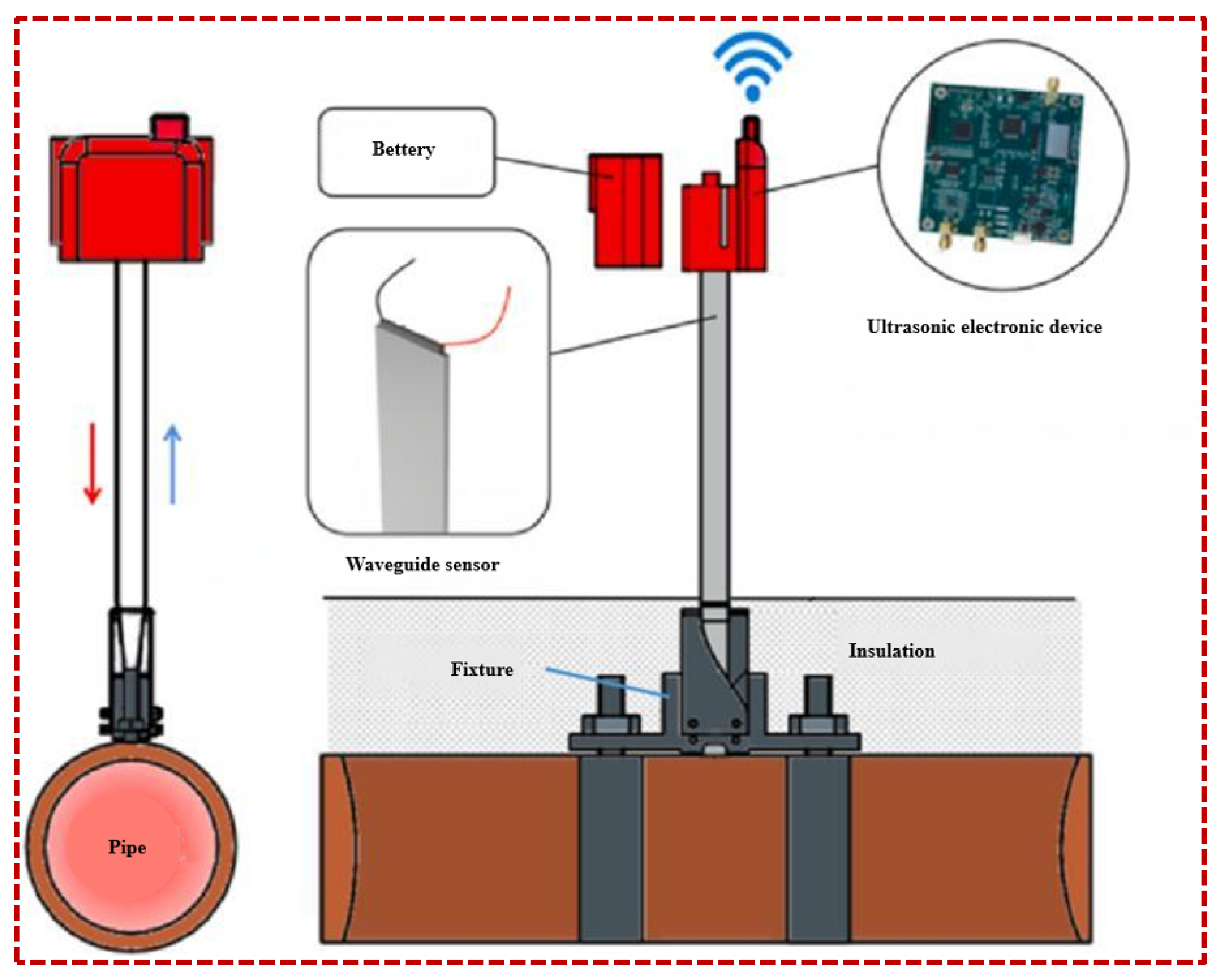
Ultrasonic thickness measurement and fiber Bragg grating (FBG) sensing constitute the two mainstream technologies for the non-destructive testing of boiler tube panel corrosion. The former excels in high precision and technological maturity, while the latter opens new technical avenues through distributed monitoring and online real-time capability [111], as shown in Figure 8. Recently developed online ultrasonic thickness monitoring systems, employing high-temperature piezoelectric transducers and waveguide rod designs, can continuously monitor wall thickness changes under tube-wall temperatures up to 500 °C, with a measurement accuracy of 0.01 mm. Nonlinear surface ultrasonic wave technology assesses microstructural changes and early damage in materials by detecting nonlinear effects (such as higher harmonics) during ultrasonic wave propagation, demonstrating higher sensitivity than conventional linear ultrasonic methods in the evaluation of high-temperature degradation of superheater tube panels [112]. Fiber Bragg grating (FBG) sensing technology offers advantages including small size, immunity to electromagnetic interference, multi-point series connection capability, and remote monitoring, making it particularly suitable for corrosion monitoring in spatially constrained and high-temperature, electromagnetically noisy boiler tube panel environments [113]. Electromagnetic acoustic transducers (EMATs) generate ultrasonic waves in metals through electromagnetic coupling, eliminating the need for couplants and making them suitable for high-temperature pipelines. Guided wave inspection utilizes ultrasonic guided waves propagating in pipelines to achieve long-distance single-point inspection. In boiler tube panels, non-destructive testing systems are typically deployed at critical locations with the highest corrosion risk, including superheaters, reheaters, and waterwalls.
Offline corrosion inspection during shutdown maintenance is a core component of full-cycle corrosion management for boiler tube panels. This field has now developed a relatively comprehensive standardization system, with mature common technical specifications supporting the operational procedures, accuracy calibration, and result evaluation of various inspection methods. Contact ultrasonic pulse-echo thickness measurement is the most classical approach for wall thinning inspection, with general technical requirements referenced in GB/T 11344-2021, ISO 16809:2021, ASTM E797/E797M-22, and the equivalently transposed EN ISO 16809:2021 standard within the EU. For rapid corrosion screening of insulated tube panels, pulsed eddy current testing can be conducted in accordance with GB/T 39188-2020, DL/T 1974-2019, ASTM E3082-21, and ISO 19858:2015, enabling qualitative and semi-quantitative assessments of wall thinning without insulation removal. Endoscopic inspection of internal tube-wall corrosion morphology and scaling conditions can reference DL/T 1604-2016, achieving visual qualitative identification of pitting, ulcerative corrosion, and creep damage. The general methodology for electrochemical offline polarization testing follows GB/T 24196-2009 and ASTM G59-23, with on-site electrochemical testing of thermal equipment also referencing the specialized guideline DL/T 1853-2018; corrosion product removal and corrosion rate calculation uniformly adhere to GB/T 16545-2015, effectively ensuring result comparability across different testing entities. Metallographic examination of microstructural aging and corrosion damage follows DL/T 884-2021; the inspection intervals, measurement point layout, and acceptance criteria for boiler heating surface tubes reference DL/T 438-2021 and DL/T 939-2017, while ASME B31.1 (Power Piping Code) imposes mandatory technical requirements on piping corrosion inspection and life assessment from the perspective of pressure equipment safety.

5.3. Numerical Simulation and Computational Techniques

Numerical simulation, through CFD flow coupling and thermodynamic calculations, enables the prediction of high-corrosion-risk zones during the boiler design stage, providing a quantitative basis for the strategic deployment of protective coatings and the optimization of maintenance strategies [114]. The fly ash deposition model is the core of CFD-based corrosion prediction, determining the location, thickness, and compositional distribution of deposits, which directly affect the accuracy of corrosion prediction. Deposition models based on inertial impaction and thermophoresis effects can already reasonably predict particle deposition rates; however, the adhesion, consolidation, and growth processes of deposits on tube walls still lack accurate physical models [115]. A unified slagging particle deposition model developed on the OpenFOAM platform, coupling thermophoretic forces with dynamic mesh technology, has achieved a more accurate simulation of particle deposition processes [116], as illustrated in Figure 9. Ash deposition growth simulation based on CFD dynamic mesh technology converts the increase in deposit thickness into mesh deformation, enabling direct simulation of the time-dependent deposit growth process [117]. The application of finite element methods in tube-wall stress–corrosion coupling analysis is also continuously advancing; by combining the corrosion rate distribution predicted by CFD with finite element stress analysis, the quantitative assessment of the remaining life of tube panels can be achieved.

5.4. Lifetime Assessment Methods

Lifetime assessment methods are evolving from the single Larson–Miller parameter approach toward multi-source data fusion health monitoring frameworks. Integrating online monitoring data, numerical simulation results, and historical maintenance records can significantly enhance the accuracy and reliability of remaining life predictions. The Larson–Miller parameter (LMP) method is the most classical approach for boiler tube panel life assessment. By converting operating temperature and service time into a unified thermal strength parameter, it predicts the remaining life based on material creep rupture data. The LMP expression is LMP = T(C + log t), where T is temperature (K), t is time (h), and C is a material constant [118]. The LMP method is simple and easy to use; however, it assumes that creep is the sole damage mechanism and neglects the effects of corrosion on wall thinning and stress increase. Studies on the lifetime assessment method for T92 steel superheater tubes based on oxide scale growth have demonstrated a quantitative relationship between the thickness of the internal oxide scale on the tube wall and service time and temperature. By measuring the oxide scale thickness, the equivalent service temperature and the consumed life fraction of the tube can be inversely determined [119], thereby correlating oxidation and creep damage. Multi-source data fusion health monitoring frameworks represent the latest development direction in lifetime assessment methods. Reliability assessment studies of ultra-supercritical boiler superheater tubes based on multi-source data analysis have shown that the probabilistic prediction of remaining life can be achieved by integrating wall thickness monitoring data, operating parameters, and corrosion model predictions. The development of health monitoring frameworks for supercritical pulverized coal-fired boilers has demonstrated that, by establishing digital twin models of critical boiler components and updating corrosion and creep damage states in real time, maintenance intervals and spare part management strategies can be optimized [120].

5.5. Comparative Long-Term Service Economic Benefits of Different Protective Coating Systems

Current coating performance evaluations are mostly based on laboratory isothermal corrosion or thermal shock tests within 1000 h, which substantially differ from actual service conditions in power plants involving thousands of hours of continuous operation, frequent thermal cycling, dynamic ash deposition, and coupled erosion–corrosion. In situ test results from different operating conditions demonstrate that coatings can indeed significantly extend the service life of heating surfaces, although the magnitude of improvement varies considerably across different processes and scenarios. Laboratory accelerated tests on superheater fireside sulfate-induced high-temperature corrosion in coal/biomass co-firing units, conducted at 650 °C under 1000 h ash-deposit corrosion conditions, compared the protective effectiveness of four coating types—Alloy625, NiCr, FeCrAl, and NiCrAlY—prepared by both HVOF and plasma spraying on T91 heat-resistant steel. All coatings exhibited some degree of metal corrosion loss; plasma-sprayed coatings showed overall superior corrosion resistance to HVOF due to a lower porosity, with NiCr coatings showing the least corrosion damage—HVOF-sprayed NiCr coating metal loss thickness after 1000 h was approximately 87 μm, compared with only 13 μm for plasma-sprayed NiCr. The corrosion damage ranking of coatings was: NiCrAlY > Alloy625 > FeCrAl > NiCr [121]. Regarding molten ash high-temperature corrosion of heat exchanger tubes in municipal solid waste incinerators, a simulated corrosion test platform at 873 K was established, and 10 Ni-, Co-, and Fe-based coatings prepared by HVOF were compared. Using molten ash adhesion and corrosion mass gain as evaluation criteria, a strong positive correlation between the two was confirmed, enabling their use for rapid corrosion resistance screening. The results demonstrated that iron-based coatings with higher iron content exhibited superior resistance to molten ash corrosion, and the optimal ternary alloy ratio for Ni/Co-based systems was identified as 60–20–20 (base metal–chromium–strengthening element Mo/W/Si/B), with elements such as Mo retarding the inward penetration of corrosive species (Na, K, S, Cl). Notably, NiCrMo coatings suppressed corrosion crack formation and produced a dense protective oxide film, providing experimental support for compositional optimization of corrosion-resistant coatings in waste incineration applications. Ramandhany et al. investigated the hot corrosion and particle erosion resistance of HVOF-sprayed Cr3C2-NiCr coatings in circulating fluidized bed boiler piping. Under the coupled conditions of 600 °C NaCl-KCl mixed chloride salt hot corrosion and 90° solid particle impingement erosion, Cr3C2-NiCr coatings prepared from mechanically ball-milled modified powders with dense, low-porosity microstructures exhibited significantly lower corrosion mass loss and erosion wear than those from unmodified powders. The dense and uniform coating microstructure could simultaneously block chloride salt penetration and particle impact cutting, substantially alleviating composite damage to the substrate piping [122].
From a full equipment life-cycle operations and maintenance perspective, high-temperature corrosion in boilers incurs enormous economic losses, while coating protection retrofits offer significant long-term input–output advantages. In coal-fired unit conditions, a single sulfidation-corrosion-induced tube burst in a 300 MW unit superheater can result in unplanned shutdown duration of up to 36 h, with combined costs including lost power generation revenue, spare parts replacement, emergency repair construction, and SCR catalyst restoration exceeding one million USD per incident. The corrosion losses in waste incineration boilers are even more pronounced, with units requiring complete superheater tube panel replacement every two years at a single-boiler tube procurement cost of 2–3 million USD, resulting in annual corrosion-related comprehensive losses exceeding ten million USD. Compared with the traditional high-frequency tube replacement maintenance model for bare tubes, the long-cycle economic benefits of various protective coatings are outstanding.

6. Future Perspectives

The future development of boiler high-temperature corrosion protection will revolve around three principal axes: extension of coating service life, intelligent material screening, and closed-loop integration of monitoring and protection. Gradient coating design, AI-assisted materials genomics approaches, and digital twin technologies represent the key directions for overcoming current technological bottlenecks.
In terms of extending coating service life, the performance evaluation periods for most current coatings under laboratory conditions range from hundreds to thousands of hours, far shorter than the design service life of 5–10 years or even longer for boiler tube panels. The long-term service behavior of coatings in actual boiler environments—including the consumption rates of Al and Cr elements, degradation mechanisms of oxide scales, diffusion evolution at the coating–substrate interface, and long-term interactions between deposits and coatings—still lacks sufficient experimental data and theoretical understanding. Establishing service performance transfer models from laboratory accelerated tests to engineering field conditions is a critical research task for advancing coating longevity [123]. Gradient coating design, through graded compositional and structural transitions, achieves thermal expansion coefficient matching, chemical composition gradation, and mechanical property variation from the substrate to the coating surface, effectively mitigating interfacial stress concentration and premature coating failure caused by abrupt compositional changes.
As a frontier direction for enhancing long-term coating service reliability, high-temperature self-healing coatings can autonomously restore protective layer integrity upon local thermal corrosion or thermal fatigue damage, overcoming the “damage equals failure” limitation of conventional coatings. Based on differences in repair mechanisms, existing research primarily follows two technical pathways: extrinsic carrier-based and intrinsic self-healing systems [124]. The first category, extrinsic carrier-based self-healing systems, involves pre-embedding microcapsules, hollow fibers, or porous nanocontainers loaded with active healing agents within the coating. When the coating develops microcracks under stress, the carrier structures rupture, releasing healing agents that react to generate protective products for crack healing—a mechanism that has been extensively validated in moderate-temperature corrosion systems [125]. However, under the high-temperature, sulfur- and chlorine-containing complex conditions of boilers, these systems commonly face issues of insufficient thermal stability of carrier wall materials, poor thermal expansion matching between healing products and the substrate, and the rapid decay of healing capability after repeated damage, with engineering validation oriented toward boiler high-temperature service environments remaining scarce. The second category, intrinsic self-healing systems, involves introducing excess active components such as Al, Cr, Si, or rare earth elements (La, Ce, Y) into the coating alloy composition, leveraging the selective oxidation and grain-boundary segregation characteristics of these elements at high temperatures to in situ generate continuous Al2O3, Cr2O3, or SiO2 protective films at damage sites, thereby achieving damage self-healing. Among these, high-entropy alloy coatings, through the synergistic effects of multiple principal elements, can maintain stable self-healing oxide layers over a wide temperature range, making them a research hotspot in the field of high-temperature protection in recent years. These systems require no additional carrier structures and offer better long-term high-temperature service compatibility, but face challenges including high healing activation thresholds, delayed response to early-stage micro-damage, and irreversible decline in healing capability as active elements are continuously consumed over service time. Overall, current self-healing coating research is predominantly focused on characterizing short-term crack healing effectiveness under laboratory conditions, with systematic understanding still lacking regarding the long-term self-healing evolution behavior under actual boiler operating conditions involving temperature fluctuations, stress–corrosion coupling, and synergistic flue gas–deposit effects. Furthermore, the introduction of self-healing functionality often negatively impacts the mechanical properties and thermal shock resistance of coatings, and the trade-off design between these aspects, along with the cost control of large-scale fabrication, constitutes the core bottleneck constraining the engineering application of this technology.
In terms of intelligent material screening, traditional trial-and-error material development approaches can no longer meet the demands for rapid optimization of multi-component coating materials for boiler high-temperature corrosion protection. AI-assisted material genomics approaches, through a closed-loop process of high-throughput computation, machine learning prediction, and critical experimental validation, can substantially accelerate the screening and optimization of corrosion-resistant coating materials. For multi-principal-element alloy systems with enormous compositional spaces, such as HEA coatings, machine-learning-based composition–property relationship modeling is an effective means of overcoming the combinatorial explosion bottleneck, with neural network models fitting the influence patterns of alloying element ratios on oxidation enthalpy, elemental diffusion coefficients, and oxide scale growth rates, enabling rapid identification of optimal compositional regions within compositional spaces of hundreds of thousands of candidates. Studies on the application of high-entropy alloy coatings for high-temperature oxidation protection of ultra-supercritical boiler tubes have demonstrated that, through compositional optimization, FeCoNiCrMo HEA coatings can achieve oxidation resistance superior to that of conventional MCrAlY coatings [126].
In terms of closed-loop integration of monitoring and protection, ongoing industrial digital transformation is progressively maturing the engineering application of IoT, online monitoring, and digital twin technologies, driving the paradigm shift in boiler corrosion protection from the traditional “periodic maintenance, post-event remediation” passive model toward a “real-time sensing–intelligent prediction–active protection” closed-loop management paradigm—an important development direction for full life-cycle management of industrial equipment in the context of the Fifth Industrial Revolution.
Online corrosion monitoring constitutes the sensing foundation for constructing the closed-loop system. For the extreme high-temperature, high-pressure, and strongly corrosive environment of boiler tube panels, multiple technical pathways adapted to different scenarios have been developed. Ultrasonic array thickness measurement and pulsed eddy current testing are the most widely applied wall thickness monitoring methods in power plants—the former offers mature technology and reliable data for periodic point-specific wall thickness detection, while the latter enables non-contact thickness measurement without insulation removal, suitable for spatially constrained tube panel areas. Specialized studies on insulated boiler tubes have confirmed that the detection error of pulsed eddy current technology for wall thinning can be controlled within 10%, but both methods have insufficient sensitivity to early-stage pitting and micro-damage, making it difficult to capture evolutionary signals during the corrosion initiation stage. Electrochemical monitoring techniques such as electrochemical noise and linear polarization resistance, through embedded electrodes, provide the real-time acquisition of corrosion current and potential fluctuations with high sensitivity to early uniform and localized corrosion responses, enabling quantitative characterization of corrosion rates. Studies have combined electrochemical noise sensors with kinetic models for online high-temperature corrosion monitoring of coal-fired boiler waterwalls, achieving dynamic estimation of corrosion scale thickness [127]. However, in high-temperature flue gas and molten deposit environments, the long-term stability of electrode materials and the reliability of insulation sealing structures still constrain large-scale engineering deployment. Distributed fiber optic sensing technology is a rapidly developing in situ monitoring direction in recent years. Among these, sapphire fiber Bragg grating sensors can withstand temperatures above 1000 °C and offer advantages of electromagnetic interference immunity and distributed deployment capability, having completed long-term temperature monitoring field deployment verification in commercial coal-fired and gas-fired boilers with good long-term operational stability [128,129]. Building on this technological foundation, by fabricating corrosion-sensitive coatings on the fiber surface, the wavelength shift caused by coating corrosion can be used to quantitatively retrieve the degree of corrosion while simultaneously acquiring temperature and strain parameters, enabling continuous sensing of corrosion state along the entire tube panel length—a highly promising technical route for boiler high-temperature corrosion monitoring. In addition, in situ Raman spectroscopy, high-temperature endoscopic imaging, and other techniques can directly identify corrosion product phases and surface morphology evolution, achieving visual characterization of the corrosion process, though currently mostly used in laboratory research and engineering pilot projects, with long-term online operational resistance to ash deposition and contamination still requiring further optimization.
The multi-source heterogeneous data generated by online monitoring provides the data foundation for AI-driven precise corrosion prediction. Corrosion evolution of materials in high-temperature molten salt environments exhibits significant nonlinear and temporal coupling characteristics. Traditional machine learning algorithms such as random forest, gradient boosting regression, and support vector regression are commonly applied to quantitative prediction of high-temperature corrosion rates and analysis of material corrosion behavior. For molten-salt-induced high-temperature corrosion scenarios in nuclear thermochemical cycles and concentrating solar power applications, a recent study constructed a multi-source fused small-sample corrosion dataset and systematically compared the predictive performance of seven regression model types, with results demonstrating that random forest regression and gradient boosting regression maintain excellent generalization accuracy under conditions of sample scarcity and multi-feature coupling, accurately reproducing the corrosion rate evolution patterns under the combined effects of multiple variables including service temperature, molten salt composition, substrate alloy ratio, coating preparation process, and corrosion duration, and better capturing the complex nonlinear interactions within the corrosion system compared with linear regression and support vector machine models [130]. With the continuous enrichment of monitoring data, neural network-based deep learning models are gradually being adopted in engineering applications. One study constructed a neural network model for predicting high-temperature corrosion rates of evaporators based on continuous monitoring data of flue gas composition near boiler waterwalls, confirming its effectiveness in capturing the dynamic influence of flue gas atmosphere fluctuations on the corrosion process, providing quantitative support for operational condition adjustments. Convolutional neural networks can automatically identify localized defects such as pitting and microcracks based on ultrasonic inspection images and surface morphology photographs, with identification efficiency and accuracy significantly superior to manual judgment. In recent years, physics-informed deep learning that embeds corrosion kinetics, elemental diffusion, and other mechanistic equations into neural network training has emerged as a research frontier. This method effectively reduces model dependence on labeled data, improves prediction generalization capability under extreme operating conditions, and to some extent resolves the pain point of insufficient extrapolation capability of purely data-driven models, with related research confirming its significantly higher accuracy in corrosion rate prediction compared with traditional data-driven models [131].
Digital twin technology provides the carrier for systematic integration of monitoring data, prediction models, and protection decisions, enabling the construction of digital mirrors in virtual space that map physical boiler tube panels in real time—a core tool for full life-cycle equipment management under industrial digital transformation. For coal-fired boiler waterwalls, a digital twin model has been constructed that integrates online monitoring data with structural mechanics simulation to achieve real-time assessment of tube panel expansion state and stress distribution, providing a systematic framework for multi-physics-field coupled health management of tube panels, within which the coupled assessment of corrosion evolution and stress distribution can be further integrated [132]. Specifically, through industrial IoT acquisition of online monitoring data, unit operating parameters, and historical maintenance records, the digital entity—driven by the fusion of corrosion kinetic mechanisms, numerical simulation, and AI surrogate models—evolves synchronously to enable real-time assessment of tube panel corrosion state, probabilistic prediction of remaining life, and corrosion evolution projection under different operating conditions. A remaining useful life prediction method based on one-dimensional convolutional neural networks and the bootstrap method has been validated in industrial heat exchanger tube corrosion scenarios, with prediction deviations from actual service life significantly smaller than those of traditional empirical methods, providing quantitative support for maintenance strategy formulation [133]. On this foundation, digital twin systems can dynamically optimize maintenance intervals and protection strategies, provide targeted recommendations for operational parameter adjustments, and ultimately form the complete “sensing–prediction–decision–execution” protection closed loop. Pilot applications of boiler tube panel corrosion digital twin systems have been implemented in some advanced power plants domestically and internationally, effectively reducing unplanned shutdown risks and maintenance costs. In the future, as active protection technologies such as self-healing coatings mature, digital twin systems can further achieve dynamic assessment and strategy regulation of protection effectiveness, promoting the upgrading of corrosion protection systems toward full life-cycle intelligent management.
Furthermore, the establishment of standardized evaluation methods for boiler corrosion protection tailored to different fuels and operating conditions, as well as the construction and sharing of long-term coating service databases, are of great significance for promoting the transformation of corrosion protection technology from empirical to scientific approaches.

7. Conclusions

1. High-temperature corrosion protection for power plant boilers has developed into a comprehensive technological system characterized by four-dimensional synergy of “mechanisms–technologies–materials–evaluation.” At the corrosion mechanisms level, the progressive understanding of high-temperature oxidation, sulfidation, chlorination, molten salt hot corrosion, and multi-factor coupled corrosion beneath deposits has been largely established. Experimental studies on individual mechanisms are relatively mature; however, quantitative prediction models for corrosion behavior under multi-factor coupled conditions remain underdeveloped. At the surface coating technology level, HVOF/HVAF has become the most mature thermal spray process for corrosion-resistant coatings on boiler tube panels, owing to its advantages in high density and process flexibility. Laser cladding provides an alternative solution for high-reliability protection of critical locations through its metallurgical bonding characteristics. Cold spraying and diffusion coatings have extended the technical space into low-temperature deposition and in situ modification, respectively. At the coating material systems level, a multi-dimensional complementary development pattern spanning from conventional NiCr alloys to high-entropy alloys and from cermets to Fe-based amorphous alloys has been established, with material selection requiring targeted matching to the dominant corrosion mechanisms in the service environment. At the corrosion monitoring and lifetime assessment level, electrochemical monitoring, non-destructive testing, numerical simulation, and lifetime assessment form a progressive closed loop from monitoring to decision-making, driving the transformation of corrosion protection from reactive maintenance toward proactive management.
2. Several critical bottlenecks persist in current research. Long-term service reliability validation data for coatings are severely insufficient: the performance evaluation of most coatings is based on short-term laboratory experiments, and service data at the 5–10-year scale in real boiler environments are extremely scarce. Quantitative prediction models for multi-factor coupled corrosion have not yet been established, and significant discrepancies exist between single-factor laboratory experimental results and actual corrosion rates in engineering practice. Standardized evaluation methods under engineering service conditions are lacking, and the comparability of coating performance data across different studies is inadequate. The long-term service performance and economic viability of novel material systems such as HEA coatings still require further validation. Addressing these bottlenecks necessitates close collaboration between academia and industry: conducting long-duration coating service performance validation under real boiler environments, developing quantitative prediction models for multi-factor coupled corrosion, and establishing a unified coating performance evaluation standard system. Such efforts will promote the efficient translation of boiler high-temperature corrosion protection technologies from laboratory research to engineering application.

Funding

This research received no external funding.

Institutional Review Board Statement

Not applicable.

Informed Consent Statement

Not applicable.

Data Availability Statement

No new data were created or analyzed in this study.

Conflicts of Interest

Author Lianmeng Wang, Ying Xu, Jianke Luo and Jiaowei Du were employed by Shaanxi Weihe Power Station Co., Ltd. The remaining authors declare that the research was conducted in the absence of any commercial or financial relationships that could be construed as a potential conflict of interest.

Nomenclature

HVOFHigh-Velocity Oxygen Fuel
HVAFHigh-Velocity Air Fuel
APSAtmospheric Plasma Spraying
D-GunDetonation Gun
PTAPlasma Transferred Arc
TIGTungsten Inert Gas Welding
HEAHigh-Entropy Alloy
MCrAlYM (Ni/Co/NiCo)–Chromium–Aluminum–Yttrium
TBCsThermal Barrier Coatings
YSZYttria Stabilized Zirconia
FBGFiber Bragg Grating
ENElectrochemical Noise
LPRLinear Polarization Resistance
EISElectrochemical Impedance Spectroscopy
CFDComputational Fluid Dynamics
LMPLarson–Miller Parameter
AIArtificial Intelligence

References

  1. Goyal, R.; Goyal, P. High temperature boiler steel corrosion protection with thermal spray coating powders and processes. AIP Conf. Proc. 2025, 3227, 020004. [Google Scholar] [CrossRef]
  2. Wu, D.; Yuan, Z.; Liu, S.; Zheng, J.; Wei, X.; Zhang, C. Recent Development of Corrosion Factors and Coating Applications in Biomass Firing Plants. Coatings 2020, 10, 1001. [Google Scholar] [CrossRef]
  3. Kumar, S.; Handa, A.; Chawla, V.; Grover, N.K.; Kumar, R. Performance of thermal-sprayed coatings to combat hot corrosion of coal-fired boiler tube and effect of process parameters and post-coating heat treatment on coating performance: A review. Surf. Eng. 2021, 37, 833–860. [Google Scholar] [CrossRef]
  4. Khantisopon, K.; Singh, S.; Jitputti, J.; Berndt, C.C.; Ang, A.S. High temperature corrosion resistant and anti-slagging coatings for boilers: A review. High Temp. Corros. Mater. 2024, 101, 1–55. [Google Scholar] [CrossRef]
  5. Lariot-Sánchez, C.; Rivas-Gutierrez, A.; Rodríguez-Machín, L.; Rubio-González, A.; Iturria-Quintero, P.J. Impact of Alkalis and Chlorides from Sugarcane Agriculture Residues on High Temperature Corrosion: A Review. Oxid. Met. 2022, 97, 451–475. [Google Scholar] [CrossRef]
  6. Bhagria, B.K.; Goyal, K.; Deepak, D. Review of Thermal Spray Coatings Perform in Protecting Boiler Steels Against Corrosion at High Temperatures. Mater. Sci. Res. India 2023, 20, 1–12. [Google Scholar] [CrossRef]
  7. Zhao, Z.; Yao, X.; Xu, K.; Li, J. High-temperature corrosion characteristics and mechanisms of heating surfaces under ash deposition conditions in coal/biomass Co-firing utility boilers. J. Energy Inst. 2025, 122, 102227. [Google Scholar]
  8. Niemi, J.; Engblom, M.; Laurén, T.; Yrjas, P.; Lehmusto, J.; Hupa, M.; Lindberg, D. Superheater deposits and corrosion in temperature gradient—Laboratory studies into effects of flue gas composition, initial deposit structure, and exposure time. Energy 2021, 228, 120494. [Google Scholar] [CrossRef]
  9. Sadeghi, E.; Markocsan, N.; Joshi, S. Advances in Corrosion-Resistant Thermal Spray Coatings for Renewable Energy Power Plants: Part II—Effect of Environment and Outlook. J. Therm. Spray Technol. 2019, 28, 1789–1850. [Google Scholar] [CrossRef]
  10. Singh, S.; Goyal, K.; Bhatia, R. A review on protection of boiler tube steels with thermal spray coatings from hot corrosion. Mater. Today Proc. 2022, 56, 379–383. [Google Scholar] [CrossRef]
  11. Liu, G.; Yang, X.; Yang, X.; Liang, K.; An, D.; Wu, D.; Ren, X. Typical Damage Prediction and Reliability Analysis of Superheater Tubes in Power Station Boilers Based on Multisource Data Analysis. Energies 2022, 15, 1005. [Google Scholar] [CrossRef]
  12. Chen, G.; Yang, H.; Sun, H.; Wang, F.; Wang, H.; Kong, Q.; An, X.; Zhang, Y.; Wang, J. Exploring the high-temperature steam oxidation behaviors of the lean-Cr (7–10 wt%) FeCrAl alloys. Corros. Sci. 2021, 194, 109927. [Google Scholar] [CrossRef]
  13. Roy, I.; Abouelella, H.; Rajendran, R.; Larsen, M.; Umretiya, R.; Hoffman, A.; Rebak, R.; Chikhalikar, A.S. Effect of Al concentration on Fe-17Cr alloy during steam oxidation at 400° C. Corros. Sci. 2023, 217, 111135. [Google Scholar] [CrossRef]
  14. Wang, H.; Ren, H.; Qiu, L.; Jiang, H.; Gao, Z.; Hu, X.; Pan, X.; Zhu, M.; Zhang, Y. Effect of Al content on 1200 °C steam oxidation behavior of Cr-based coatings on TZM alloy. Corros. Sci. 2023, 219, 111239. [Google Scholar] [CrossRef]
  15. Wang, Y.; Wang, X.; Wang, M.; Tan, H. Formation of Sulfide Deposits and High-Temperature Corrosion Behavior at Fireside in a Coal-Fired Boiler. Energy Fuels 2020, 34, 13849–13861. [Google Scholar] [CrossRef]
  16. Zhang, X.; Liu, H.; Chen, T.; Li, H.; Wang, G.; Wu, Y.; Yao, H. Alleviation of thermal corrosion caused by molten ash on heat-exchange tubes in MSW incinerators: Effects of Ni-, Co-, Fe-based HVOF coatings. Proc. Combust. Inst. 2020, 38, 5453–5461. [Google Scholar] [CrossRef]
  17. Sadeghimeresht, E.; Reddy, L.; Hussain, T.; Markocsan, N.; Joshi, S. Chlorine-induced high temperature corrosion of HVAF-sprayed Ni-based alumina and chromia forming coatings. Corros. Sci. 2017, 132, 170–184. [Google Scholar] [CrossRef]
  18. Jafari, R.; Sadeghimeresht, E.; Farahani, T.S.; Huhtakangas, M.; Markocsan, N.; Joshi, S. KCl-Induced High-Temperature Corrosion Behavior of HVAF-Sprayed Ni-Based Coatings in Ambient Air. J. Therm. Spray Technol. 2018, 27, 500–511. [Google Scholar] [CrossRef]
  19. Okoro, S.C.; Montgomery, M.; Frandsen, F.J.; Pantleon, K. Time and Temperature Effects on Alkali Chloride Induced High Temperature Corrosion of Superheaters during Biomass Firing. Energy Fuels 2018, 32, 7991–7999. [Google Scholar] [CrossRef]
  20. Chi, H.; Pans, M.A.; Bai, M.; Sun, C.; Hussain, T.; Sun, W.; Yao, Y.; Lyu, J.; Liu, H. Experimental investigations on the chlorine-induced corrosion of HVOF thermal sprayed Stellite-6 and NiAl coatings with fluidised bed biomass/anthracite combustion systems. Fuel 2020, 288, 119607. [Google Scholar] [CrossRef]
  21. Zhang, J.; Rahman, Z.U.; Wang, X.; Wang, Z.; Li, P.; Wang, Y.; Bate, D.; Zhao, K.; Tan, H. Hot corrosion behaviors of TP347H and HR3C stainless steel with KCl deposit in oxy-biomass combustion. J. Environ. Manag. 2020, 263, 110411. [Google Scholar] [CrossRef] [PubMed]
  22. Pan, P.; Zhou, W.; Zhao, Y.; Wang, Y.; Zhang, N. Hot corrosion behavior of an arc sprayed Fe-based amorphous coating in a simulated biomass firing environment. Corros. Sci. 2021, 194, 109938. [Google Scholar] [CrossRef]
  23. Prasad, M.K.; Rao, K.S.; Reddy, M.; Sreedhar, G. Hot Corrosion of SrTiO3 Perovskite in Na2SO4 + 50 wt.% V2O5 and Na2SO4 + 10 wt.% NaCl Environments at 900 °C. Int. J. Corros. 2018, 2018, 1–7. [Google Scholar] [CrossRef]
  24. Guo, H.; Fan, W.; Long, J.; Liu, Y. Influence of surface condition on the high-temperature corrosion of 12Cr1MoVG, T91, and TP347H steels in waste-to-energy boilers. Eng. Fail. Anal. 2023, 152, 107497. [Google Scholar] [CrossRef]
  25. Karuana, F.; Prismantoko, A.; Suhendra, N.; Darmawan, A.; Hariana, H.; Darmadi, D.B.; Muflikhun, M.A. Investigation of austenitic stainless steel corrosion resistance against ash deposits from co-combustion coal and biomass waste. Eng. Fail. Anal. 2023, 150, 107368. [Google Scholar] [CrossRef]
  26. Chikhalikar, A.S.; Godbole, E.P.; Poerschke, D.L. Stability of oxide-sulfate mixtures and implications for deposit-induced degradation of advanced alloys and coatings. Acta Mater. 2022, 237, 118184. [Google Scholar]
  27. Khantisopon, K.; Tharajak, J.; Nawarat, P.; Sanpo, N.; Ang, A.S.M. High-temperature corrosion investigations of deposit containing eutectic KCl-K2SO4 mixture on AISI 1015 and SS304 steels. Corros. Sci. 2022, 205, 110470. [Google Scholar] [CrossRef]
  28. Kingsbery, P.; Stephan-Scherb, C. Effect of KCl deposits in high-temperature corrosion on chromium-rich steels in SO2-containing atmosphere. Mater. Corros. 2022, 73, 758–770. [Google Scholar]
  29. Gruber, T.; Retschitzegger, S.; Scharler, R.; Obernberger, I. Dominating High Temperature Corrosion Mechanisms in Low Alloy Steels in Wood Chips Fired Boilers. Energy Fuels 2016, 30, 2385–2394. [Google Scholar] [CrossRef]
  30. Somervuori, M.; Varis, T.; Oksa, M.; Suhonen, T.; Vuoristo, P. Comparative Study on the Corrosion Performance of APS-, HVOF-, and HVAF-Sprayed NiCr and NiCrBSi Coatings in NaCl Solutions. J. Therm. Spray Technol. 2022, 31, 1581–1597. [Google Scholar] [CrossRef]
  31. Česánek, Z.; Lencová, K.; Schubert, J.; Antoš, J.; Mušálek, R.; Lukáč, F.; Palán, M.; Vostřák, M.; Houdková, Š. High-Temperature Corrosion Behavior of Selected HVOF-Sprayed Super-Alloy Based Coatings in Aggressive Environment at 800 °C. Materials 2023, 16, 4492. [Google Scholar] [CrossRef] [PubMed]
  32. Zhang, H.; Yang, L.; Wang, Q.; Wu, J.; Zhang, S.; Zeng, C. Hot corrosion behaviors of 921A alloy and HVAF-sprayed Fe-based amorphous coating covered with KCl–ZnCl2 salts. J. Iron Steel Res. Int. 2023, 30, 1537–1549. [Google Scholar] [CrossRef]
  33. Kumar, A.; Nayak, S.K.; Bijalwan, P.; Dutta, M.; Banerjee, A.; Laha, T. Mechanical and corrosion properties of plasma-sprayed Fe-based amorphous/nanocrystalline composite coating. Adv. Mater. Process. Technol. 2019, 5, 371–377. [Google Scholar] [CrossRef]
  34. Lakkannavar, V.; Yogesha, K.B.; Prasad, C.D.; Prasad, C. Investigation of Cyclic Oxidation and Hot Corrosion Behaviour of Plasma-Sprayed NiCrAlY/Cr3C2/h-BN/Mo Coatings on T22 Boiler Steel Alloy. J. Bio-Tribo-Corros. 2024, 10, 85. [Google Scholar] [CrossRef]
  35. Moskal, G. Microstructural characterization of plasma sprayed Ln2Zr2O7 thermal barrier coatings by electron microscopy methods. Microsc. Res. Tech. 2020, 83, 523–530. [Google Scholar] [CrossRef] [PubMed]
  36. Silvello, A.; Cavaliere, P.; Yin, S.; Lupoi, R.; Cano, I.G.; Dosta, S. Microstructural, Mechanical and Wear Behavior of HVOF and Cold-Sprayed High-Entropy Alloys (HEAs) Coatings. J. Therm. Spray Technol. 2022, 31, 1184–1206. [Google Scholar] [CrossRef]
  37. Lima, R.S.; Guerreiro, B.M.H.; Aghasibeig, M. Microstructural Characterization and Room-Temperature Erosion Behavior of As-Deposited SPS, EB-PVD and APS YSZ-Based TBCs. J. Therm. Spray Technol. 2018, 28, 223–232. [Google Scholar] [CrossRef]
  38. Shibe, V.; Chawla, V. Erosion Studies of D-Gun-Sprayed WC-12%Co, Cr3C2-25%NiCr and Al2O3-13%TiO2 Coatings on ASTM A36 Steel. J. Therm. Spray Technol. 2019, 28, 2015–2028. [Google Scholar] [CrossRef]
  39. Wu, W.; Lin, S. Wear and Corrosion Resistances of Arc-Sprayed FeCr Alloy and Fe-Based Coatings for Boiler Heat Exchanger Pipelines. J. Therm. Spray Technol. 2024, 33, 2068–2088. [Google Scholar] [CrossRef]
  40. Cheng, J.; Wu, Y.; Chen, L.; Hong, S.; Qiao, L.; Wei, Z. Hot Corrosion Behavior and Mechanism of High-Velocity Arc-Sprayed Ni-Cr Alloy Coatings. J. Therm. Spray Technol. 2019, 28, 1263–1274. [Google Scholar] [CrossRef]
  41. Chen, S.; Liu, Z.; Liu, F. High-Temperature Corrosion Characteristics of Ni-20Cr-xSi Alloy Laser Cladding Layer in NaCl-KCl-Na2SO4-K2SO4 Mixed Salt Environment. Coatings 2023, 13, 1320. [Google Scholar] [CrossRef]
  42. Hall, I. Evaluation of Advanced Weld Overlay, Thermal Spray, and Laser Clad Coatings in an Operating Waste-Wood Fired Biomass Boiler. Int. Therm. Spray Conf. 2019, 83799, 109–114. [Google Scholar] [CrossRef]
  43. Zhou, H.; Yang, Y.; Wang, D.; Li, Y.; Zhang, S.; Tai, Z. Powder flow simulation of a ring-type coaxial nozzle and cladding experiment in laser metal deposition. Int. J. Adv. Manuf. Technol. 2022, 120, 8389–8400. [Google Scholar] [CrossRef]
  44. Songya, T.; Saifan, A.; Pengqian, G.; Dawy, I.; Saleh, B. Development of an Automatic Welding System for the Boiler Tube Walls Weld Overlay. Metals 2020, 10, 1241. [Google Scholar] [CrossRef]
  45. Wang, X.; Liu, Z.; Cheng, K.; Shen, Y.; Li, J. Corrosion characteristics of Inconel 625 cladding layer and NiCrMoAl cladding layer in molten NaCl-KCl and NaCl-KCl-Na2SO4. Corros. Sci. 2023, 221, 111308. [Google Scholar] [CrossRef]
  46. Mahdavi, A.; Medvedovski, E.; Mendoza, G.L.; McDonald, A.; Mendoza, G. Corrosion Resistance of Boronized, Aluminized, and Chromized Thermal Diffusion-Coated Steels in Simulated High-Temperature Recovery Boiler Conditions. Coatings 2018, 8, 257. [Google Scholar] [CrossRef]
  47. Kochmańska, A.E. Microstructure of Al-Si Slurry Coatings on Austenitic High-Temperature Creep Resisting Cast Steel. Adv. Mater. Sci. Eng. 2018, 2018, 5473079. [Google Scholar] [CrossRef]
  48. Fukumoto, M.; Nakajima, K.; Sakuraba, T. Formation of Si Diffusion Layer on Fe and Fe–Cr Alloy and High-Temperature Corrosion Resistance in a Molten Salt. Oxid. Met. 2022, 97, 401–415. [Google Scholar] [CrossRef]
  49. Joshi, S.; Nylen, P. Advanced Coatings by Thermal Spray Processes. Technologies 2019, 7, 79. [Google Scholar] [CrossRef]
  50. Sadeghimeresht, E.; Markocsan, N.; Nylén, P. A Comparative Study on Ni-Based Coatings Prepared by HVAF, HVOF, and APS Methods for Corrosion Protection Applications. J. Therm. Spray Technol. 2016, 25, 1604–1616. [Google Scholar] [CrossRef]
  51. Vaßen, R.; Bakan, E.; Gatzen, C.; Kim, S.; Mack, D.E.; Guillon, O. Environmental Barrier Coatings Made by Different Thermal Spray Technologies. Coatings 2019, 9, 784. [Google Scholar] [CrossRef]
  52. Ashokkumar, M.; Thirumalaikumarasamy, D.; Thirumal, P.; Barathiraja, R. Influences of Mechanical, Corrosion, erosion and tribological performance of cold sprayed Coatings A review. Mater. Today Proc. 2021, 46, 7581–7587. [Google Scholar] [CrossRef]
  53. Azarmi, F.; Sevostianov, I. Comparative micromechanical analysis of alloy 625 coatings deposited by air plasma spraying, wire arc spraying, and cold spraying technologies. Mech. Mater. 2020, 144, 103345. [Google Scholar] [CrossRef]
  54. Verdi, D.; Garrido, M.A.; Múnez, C.J.; Poza, P. Cr3C2 incorporation into an Inconel 625 laser cladded coating: Effects on matrix microstructure, mechanical properties and local scratch resistance. Mater. Des. 2015, 67, 20–27. [Google Scholar] [CrossRef]
  55. Panteleenko, F.I.; Zheng, P. Progressive technologies of laser surfacing and gas-thermal spraying. Litiyo i Metall. (Foundry Prod. Metall.) 2024, 3, 61–65. [Google Scholar] [CrossRef]
  56. Kumar, S.; Kumar, M.; Handa, A. Combating hot corrosion of boiler tubes—A study. Eng. Fail. Anal. 2018, 94, 379–395. [Google Scholar] [CrossRef]
  57. Gada, H.; Mudgal, D.; Parvez, S.; Ahmad, B. Investigation of high temperature corrosion resistance of Ni25Cr coated and bare 347H SS in actual husk fired boiler atmosphere. Eng. Fail. Anal. 2019, 108, 104256. [Google Scholar]
  58. Hruska, J.; Mlnarik, J.; Cizner, J. High-Temperature Corrosion of Nickel-Based Coatings for Biomass Boilers in Chlorine-Containing Atmosphere. Coatings 2022, 12, 116. [Google Scholar] [CrossRef]
  59. Tabatabaei, F.S.K.; Ghasemi, B.; Mirzaee, O.; Azadi, M.; Tabatabaei, S.S.K. An Investigation on Microstructural and Electrochemical Characteristics of NiCrBSi/WCCoCr Composite Coatings in 3.5 wt.% NaCl Solution. J. Mater. Eng. Perform. 2023, 33, 4408–4421. [Google Scholar] [CrossRef]
  60. Banu, A.; Marcu, M.; Trusca, O.; Paraschiv, A.; Anghel, E.M.; Atkinson, I. Microstructural Characterization of NiCrFeSiBC Coating During Long-Term Isothermal Oxidation at 850 °C. J. Therm. Spray Technol. 2019, 28, 1275–1283. [Google Scholar] [CrossRef]
  61. Afsous, M.; Shafyei, A.; Soltani, M.; Eskandari, A. Characterization and Evaluation of Tribological Properties of NiCrBSi-Gr Composite Coatings Deposited on Stainless Steel 420 by HVOF. J. Therm. Spray Technol. 2020, 29, 773–788. [Google Scholar] [CrossRef]
  62. Jafari, R.; Sadeghi, E. High-temperature corrosion performance of HVAF-sprayed NiCr, NiAl, and NiCrAlY coatings with alkali sulfate/chloride exposed to ambient air. Corros. Sci. 2019, 160, 108066. [Google Scholar] [CrossRef]
  63. Hatami, E.; Hadavi, S.M.M.; Doolabi, D.S.; Bahamirian, M. High-Temperature Oxidation Behavior of a Silico-Aluminized MCrAlY Coating on a Ni-Based Superalloy. Oxid. Met. 2022, 97, 575–597. [Google Scholar] [CrossRef]
  64. Singh, G.; Bala, N.; Chawla, V. Oxidation Behaviour of HVOF Sprayed NiCrAlY and NiCrAlY-20SiC Coatings on T-91 Boiler Tube Steel. Prot. Met. Phys. Chem. Surf. 2020, 56, 134–150. [Google Scholar] [CrossRef]
  65. Li, Y.Y.; Jiang, Y.M.; Zhang, C.; Ji, H.Z.; Li, S.; Xu, N.; Bao, Z.B.; Zhu, S.L.; Wang, F.H. Enhancing the high-temperature corrosion resistance of HVOF-sprayed NiCoCrAlY coating in marine environment by Pt modification and pre-oxidation. J. Mater. Sci. Technol. 2024, 201, 222–235. [Google Scholar] [CrossRef]
  66. Sreenivasulu, V.; Manikandan, M. Hot corrosion studies of HVOF sprayed carbide and metallic powder coatings on alloy 80A at 900 °C. Mater. Res. Express 2018, 6, 036519. [Google Scholar] [CrossRef]
  67. Alroy, R.J.; Kamaraj, M.; Lakshmi, D.V.; Praveen, K.; Babu, P.S.; Sivakumar, G. Tailoring microstructural features of Cr3C2-25NiCr coatings through diverse spray variants and understanding the high-temperature erosion behavior. Tribol. Int. 2023, 188, 108810. [Google Scholar] [CrossRef]
  68. Du, J.; Qi, X.; Lu, H.; Hua, Y.; Li, Y.; Li, F. Interaction mechanisms and high-temperature erosion-oxidation performance of Cr3C2-NiCrCoMo/nano-TiC coatings. Ceram. Int. 2024, 50, 19945–19962. [Google Scholar] [CrossRef]
  69. Naik, K.R.; Kumar, R.K.; Saravanan, V.; Seetharamu, S.; Sampathkumaran, P. The study of Cr3C2-25NiCr and 35WC-Co/65NiCrBSi-based HVOF coatings for high-temperature erosion resistance application. Tribol.-Mater. Surf. Interfaces 2021, 16, 10–22. [Google Scholar] [CrossRef]
  70. Alam, M.S.; Das, A.K. Hot Corrosion Behavior of Plasma-Sprayed WC-CoCr Coatings on AISI 316L Steel Substrate in Na2SO4-25% NaCl Salt Environment. High Temp. Corros. Mater. 2023, 99, 415–430. [Google Scholar] [CrossRef]
  71. Kumar, N.; Choubey, V.K. Experimental Investigation on Hot Corrosion, Oxidation and Microstructure of WC Based Cermet HVOF Coating. High Temp. Corros. Mater. 2023, 101, 413–432. [Google Scholar] [CrossRef]
  72. Moghaddasi, M.; Bozorg, M.; Aghaie, E.; Bakhtiyari, H.; Torbati-Sarraf, H. Corrosion and Wear Analysis of High-Velocity Oxy-Fuel Sprayed WC-10Co-4Cr and Colmonoy-6 Coatings on Nickel-Aluminum Bronze Alloy Substrate. J. Mater. Eng. Perform. 2021, 30, 7564–7576. [Google Scholar] [CrossRef]
  73. Singh, P.K.; Yadav, P. Studies on Erosion and Oxidation Behaviour of Cobalt-Based Coatings. In Lecture Notes in Mechanical Engineering; Springer: Singapore, 2021; pp. 311–318. [Google Scholar] [CrossRef]
  74. Kiatisereekul, A.; Siripongsakul, T.; Fakpan, K. Erosion Behavior of Stellite-6 and WC-12Co Coatings on SA213-T22 Boiler Steel. Coatings 2023, 13, 1444. [Google Scholar] [CrossRef]
  75. Santacruz, G.; Takimi, A.S.; de Camargo, F.V.; Bergmann, C.P.; Fragassa, C. Comparative Study of Jet Slurry Erosion of Martensitic Stainless Steel with Tungsten Carbide HVOF Coating. Metals 2019, 9, 600. [Google Scholar] [CrossRef]
  76. Wang, B.; Jiang, M.; Xu, Y.; Hu, J.; Wang, J.; Zhou, C. Microstructure and Properties of Fe-based Amorphous/Nanocrystalline Coating Prepared by Arc Surface Welding. JOM 2019, 72, 665–672. [Google Scholar] [CrossRef]
  77. Nayak, S.K.; Kumar, A.; Sarkar, K.; Pathak, A.; Banerjee, A.; Laha, T. A Study on the Corrosion Inhibition of Fe-Based Amorphous/Nanocrystalline Coating Synthesized by High-Velocity Oxy-Fuel Spraying in an Extreme Environment. J. Therm. Spray Technol. 2019, 28, 1433–1447. [Google Scholar] [CrossRef]
  78. Nayak, S.K.; Kumar, A.; Sarkar, K.; Banerjee, A.; Laha, T. Mechanistic insight into the role of amorphicity and porosity on determining the corrosion mitigation behavior of Fe-based amorphous/nanocrystalline coating. J. Alloys Compd. 2020, 849, 156624. [Google Scholar] [CrossRef]
  79. Ning, W.; Zhai, H.; Xiao, R.; He, D.; Liang, G.; Wu, Y.; Li, W.; Li, X. The Corrosion Resistance Mechanism of Fe-Based Amorphous Coatings Synthesised by Detonation Gun Spraying. J. Mater. Eng. Perform. 2020, 29, 3921–3929. [Google Scholar] [CrossRef]
  80. Fals, H.C.; Orozco, M.S.; Lourençato, L.A.; Lima, C.R.C. Abrasive Wear Behavior of Fe-Based Amorphous/Nanocrystalline Coatings Deposited by High-Velocity Oxygen Fuel and Wire Arc Spray. J. Mater. Eng. Perform. 2022, 32, 2455–2462. [Google Scholar] [CrossRef]
  81. Veselkov, S.; Samoilova, O.; Shaburova, N.; Trofimov, E. High-Temperature Oxidation of High-Entropic Alloys: A Review. Materials 2021, 14, 2595. [Google Scholar] [CrossRef] [PubMed]
  82. Odabas, O.; Ozgurluk, Y.; Karaoglanli, A.C. Hot corrosion behavior of AlCoCrFeNiZr high entropy alloy (HEA) coating system exposed to Na2SO4-V2O5 salt. Mater. Today Commun. 2025, 45, 112289. [Google Scholar] [CrossRef]
  83. Chu, X.; Hu, S.; Dai, Z. High temperature chlorine corrosion resistance of gradient high entropy alloy coatings prepared by high-velocity-oxygen-fuel spraying. J. Phys. Conf. Ser. 2024, 2713, 012024. [Google Scholar] [CrossRef]
  84. Niu, X.; Luan, Z.; Mei, Y.; Yu, Y. The corrosion resistance of Al-Fe-Co-Cr-Ni-Cu high entropy alloy coatings. J. Phys. Conf. Ser. 2023, 2535, 012023. [Google Scholar] [CrossRef]
  85. Daradkeh, S.I.; Recalde, O.; Mousa, M.S.; Sobola, D.; Boll, T. Oxidation Behavior and Outward Diffusion of Al Along Oxide Grain Boundaries of FeCrAl Alloys Overdoped with Zr and Hf. High Temp. Corros. Mater. 2023, 101, 41–59. [Google Scholar] [CrossRef]
  86. Okoro, V.U.; Daub, K.; Nordin, H.; Persaud, S.Y. Comparing the Oxidation of FeCrAl Alloys in Isothermal and Cyclic High-Temperature Steam Environments. J. Nucl. Mater. 2023, 589, 154843. [Google Scholar] [CrossRef]
  87. Cakmak, E.; Gussev, M.N.; Cinbiz, M.N.; Field, K.; An, K. Micromechanical aspects of deformation and failure of advanced Iron-Chromium-Aluminum alloys. Materialia 2022, 26, 101592. [Google Scholar] [CrossRef]
  88. Yang, H.-Z.; Zou, J.-P.; Shi, Q.; Dai, M.-J.; Lin, S.-S.; Du, W.; Lv, L. Analysis of the microstructural evolution and interface diffusion behavior of NiCoCrAlYTa coating in high temperature oxidation. Corros. Sci. 2019, 153, 162–169. [Google Scholar] [CrossRef]
  89. Ssenteza, V.; Eklund, J.; Hanif, I.; Liske, J.; Jonsson, T. High temperature corrosion resistance of FeCr(Ni, Al) alloys as bulk/overlay weld coatings in the presence of KCl at 600 °C. Corros. Sci. 2022, 213, 110896. [Google Scholar] [CrossRef]
  90. Lu, J.; Chen, Y.; Zhang, H.; Zhao, C.; Zhao, X.; Guo, F.; Xiao, P. Superior oxidation and spallation resistant NiCoCrAlY bond coat via homogenizing the yttrium distribution. Corros. Sci. 2019, 159, 108145. [Google Scholar] [CrossRef]
  91. Chen, J.; Liu, Z.; Liu, H.; Lin, G.; Zhang, R.; Du, P.; Li, G. Effects of long-time annealing on the microstructures and shear tensile strengths of diffusion-bonded FeCrAl/N18 clad plates. Nucl. Mater. Energy 2022, 32, 101207. [Google Scholar] [CrossRef]
  92. Demir, H. The Effects on Thermal Efficiency of Yttria-Stabilized Zirconia and Lanthanum Zirconate-Based Thermal Barrier Coatings on Aluminum Heating Block for 3D Printer. Coatings 2021, 11, 792. [Google Scholar] [CrossRef]
  93. Shen, Z.; Liu, Z.; Mu, R.; He, L.; Liu, G. Y–Er–ZrO2 thermal barrier coatings by EB-PVD: Thermal conductivity, thermal shock life and failure mechanism. Appl. Surf. Sci. Adv. 2020, 3, 100043. [Google Scholar] [CrossRef]
  94. Badea, T.-A.; Condruz, M.-R.; Paraschiv, A. A Study on Long-Term Oxidation and Thermal Shock Performance of Nanostructured YSZ/NiCrAlY TBC with a Less Dense Bond Coat. Materials 2023, 16, 5294. [Google Scholar] [CrossRef] [PubMed]
  95. She, Y.; Guo, Y.; Tan, Z.; Liao, K. Na2SO4 + V2O5 Corrosion Behavior of BaNd2Ti3O10 for Thermal Barrier Coating Applications. Coatings 2020, 10, 901. [Google Scholar] [CrossRef]
  96. Boissonnet, G.; Rzad, E.; Troncy, R.; Dudziak, T.; Pedraza, F. High Temperature Oxidation of Enamel Coated Low-Alloyed Steel 16Mo3 in Water Vapor. Coatings 2023, 13, 342. [Google Scholar] [CrossRef]
  97. Ghadami, F.; Aghdam, A.S.R.; Ghadami, S. A comprehensive study on the microstructure evolution and oxidation resistance of conventional and nanocrystalline MCrAlY coatings. Sci. Rep. 2021, 11, 875. [Google Scholar] [CrossRef] [PubMed]
  98. Fu, C.; Li, Y.; Wang, Y.F. Microstructure and Corrosion Resistance of NiCr-Based Coatings in Simulated Coal-Fired Boiler Conditions. Oxid. Met. 2021, 95, 45–63. [Google Scholar] [CrossRef]
  99. Shuecamlue, S.; Taman, A.; Khamnantha, P.; Banjongprasert, C. Influences of flame remelting and WC-Co addition on microstructure, mechanical properties and corrosion behavior of NiCrBSi coatings manufactured via HVOF process. Surf. Interfaces 2024, 48, 104135. [Google Scholar] [CrossRef]
  100. Matthews, S.; James, B.; Hyland, M. The role of microstructure in the high temperature oxidation mechanism of Cr3C2–NiCr composite coatings. Corros. Sci. 2009, 51, 1172–1180. [Google Scholar] [CrossRef]
  101. Seitov, B.; Kurbanbekov, S.; Baltabayeva, D.; Kakimzhanov, D.; Katpayeva, K.; Temirbekov, A.; Bekbayev, S.; Mussakhan, N. Review of physical and mechanical properties, morphology, and phase structure in Cr3C2-NiCr composite coatings sprayed by HVOF method. Coatings 2025, 15, 479. [Google Scholar]
  102. Česánek, Z.; Schubert, J.; Houdková, Š.; Matikainen, V.; Koivuluoto, H.; Vuoristo, P. High Temperature Corrosion of Selected Thermally Sprayed Coatings Deposited by HVOF Technology. In International Thermal Spray Conference; Agarwal, A., Bolelli, G., Concustell, A., Lau, Y.-C., McDonald, A., Toma, F.-L., Turunen, E., Widener, C.A., Eds.; DVS Media GmbH: Düsseldorf, Germany, 2016; Volume 83768, pp. 777–782. [Google Scholar] [CrossRef]
  103. Qin, E.; Huang, Q.; Shao, Y.; Chen, G.; Ye, L.; Gu, Q.; Wu, S. The Characterization of Twin-Wire Arc-Sprayed FeCrBSi Coating and the Application in Sewage Sludge Boilers. J. Therm. Spray Technol. 2014, 23, 1493–1498. [Google Scholar] [CrossRef]
  104. Liu, K.; Lou, L.; Cai, Z.; Li, C.; Wang, H.; Li, C. High temperature oxidation behavior of NiCoCrAlFeY high entropy bond coating fabricated by high-speed laser cladding. Corros. Sci. 2024, 226, 111659. [Google Scholar] [CrossRef]
  105. Mei, L.; Liu, H.; Che, S.; Guo, C. Research progress and challenges in the development of high entropy protective coatings with high adaptability to extreme high-temperature environments. J. Alloys Compd. 2026, 1074, 189187. [Google Scholar] [CrossRef]
  106. Zhang, X.; Liu, H.; Chen, T.; Wang, G.; Li, H.; Hu, H.; Yu, Y.; Yao, H. Application of coatings to alleviate fireside corrosion on heat transfer tubes during the combustion of low-grade solid fuels: A review. Energy Fuels 2020, 34, 11752–11770. [Google Scholar] [CrossRef]
  107. Chen, M.; Zhu, S.; Wang, F. High temperature oxidation of NiCrAlY, nanocrystalline and enamel-metal nano-composite coatings under thermal shock. Corros. Sci. 2015, 100, 556–565. [Google Scholar] [CrossRef]
  108. Lakkannavar, V.; Yogesha, K.B.; Prasad, C.D.; Phanden, R.K.; G, S.; Prasad, S.C. Thermal spray coatings on high-temperature oxidation and corrosion applications—A comprehensive review. Results Surf. Interfaces 2024, 16, 100250. [Google Scholar] [CrossRef]
  109. Hardy, T.; Arora, A.; Pawlak-Kruczek, H.; Rafajłowicz, W.; Wietrzych, J.; Niedźwiecki, Ł.; Vishwajeet; Mościcki, K. Non-Destructive Diagnostic Methods for Fire-Side Corrosion Risk Assessment of Industrial Scale Boilers, Burning Low Quality Solid Biofuels—A Mini Review. Energies 2021, 14, 7132. [Google Scholar] [CrossRef]
  110. Hardy, T.; Kakietek, S.; Halawa, K.; Mościcki, K.; Janda, T. Determination of High Temperature Corrosion Rates of Steam Boiler Evaporators Using Continuous Measurements of Flue Gas Composition and Neural Networks. Energies 2020, 13, 3134. [Google Scholar] [CrossRef]
  111. Song, J.; Guo, D.; Jia, J.; Tu, S. A new on-line ultrasonic thickness monitoring system for high temperature pipes. Int. J. Press. Vessels Pip. 2022, 199, 104691. [Google Scholar] [CrossRef]
  112. Oh, S.; Yun, D.S.; Kim, J. Evaluation of High-Temperature Degradation of Platen Superheater Tube in Thermoelectric Power Plant Using Nonlinear Surface Ultrasonic Waves. Ultrasonics 2023, 136, 107162. [Google Scholar] [CrossRef] [PubMed]
  113. Sousa, I.; Pereira, L.; Mesquita, E.; Souza, V.L.; Araújo, W.S.; Cabral, A.; Alberto, N.; Varum, H.; Antunes, P. Sensing system based on FBG for corrosion monitoring in metallic structures. Sensors 2022, 22, 5947. [Google Scholar] [CrossRef] [PubMed]
  114. Simms, N.J.; Ekpe, B.; Riccio, C.; Mori, S.; Sumner, J.; Oakey, J.E. Approaches to Modeling Fireside Corrosion of Superheater/Reheater Tubes in Coal and Biomass Fired Combustion Power Plants. In Joint Epri—123HiMAT International Conference on Advances in High-Temperature Materials; ASM International: Almere, The Netherlands, 2019; Volume 2019, pp. 84680, 1014–1023. [Google Scholar] [CrossRef]
  115. Zhou, H.; Zhang, K.; Li, Y.; Zhang, J.; Zhou, M. Simulation of ash deposition in different furnace temperature with a 2D dynamic mesh model. J. Energy Inst. 2018, 92, 1743–1756. [Google Scholar] [CrossRef]
  116. Liu, X.; Xue, X.; Li, H.; Jin, K.; Zhang, L.; Zhou, H. A unified model of slagging particle deposition behavior with thermophoresis and dynamic mesh based on OpenFOAM. Fuel 2023, 347, 128360. [Google Scholar] [CrossRef]
  117. Zheng, Z.; Yang, W.; Yu, P.; Cai, Y.; Zhou, H.; Boon, S.K.; Subbaiah, P. Simulating growth of ash deposit in boiler heat exchanger tube based on CFD dynamic mesh technique. Fuel 2019, 259, 116083. [Google Scholar] [CrossRef]
  118. Muhajir, H.; Haryadi, G.D.; Widodo, A. Remaining Life Assessment of Superheater Tube in Boiler of Coal Fired Power Plant. MATEC Web Conf. 2018, 159, 02041. [Google Scholar] [CrossRef][Green Version]
  119. Li, J.; Wei, H.; Yuan, Z. Research on Remaining Life Evaluation Method of T92 Steel for Superheater Tube Based on Oxide Layer Growth. J. Fail. Anal. Prev. 2019, 19, 802–808. [Google Scholar] [CrossRef]
  120. Hedrick, K.; Omell, B.; Zitney, S.E.; Bhattacharyya, D. Development of a health monitoring framework: Application to a supercritical pulverized coal-fired boiler. Energy 2023, 290, 130153. [Google Scholar] [CrossRef]
  121. Hussain, T.; Dudziak, T.; Simms, N.J.; Nicholls, J.R. Fireside Corrosion Behavior of HVOF and Plasma-Sprayed Coatings in Advanced Coal/Biomass Co-Fired Power Plants. J. Therm. Spray Technol. 2013, 22, 797–807. [Google Scholar]
  122. Ramandhany, S.; Triyono, D.; Sugiarti, E.; Wismogroho, A.S.; Izzuddin, H.; Afandi, A.; Widayatno, W.B.; Desiati, R.D.; Sundawa, R.Y. Effect of Structure Density of Milled Powder on Hot Corrosion and Erosion Resistance of HVOF-Sprayed Cr3C2-NiCr Coating. J. Therm. Spray Technol. 2024, 33, 1075–1099. [Google Scholar]
  123. Faisal, N.H.; Rajendran, V.; Prathuru, A.; Hossain, M.; Muthukrishnan, R.; Balogun, Y.; Pancholi, K.; Hussain, T.; Lokachari, S.; Horri, B.A.; et al. Thermal spray coatings for molten salt facing structural parts and enabling opportunities for thermochemical cycle electrolysis. Eng. Rep. 2024, 6, e12947. [Google Scholar] [CrossRef]
  124. Montemor, M.F. Functional and smart coatings for corrosion protection: A review of recent advances. Surf. Coat. Technol. 2014, 258, 17–37. [Google Scholar] [CrossRef]
  125. Ma, Q.X.; Xu, L.; Fan, Y.; Wang, L.; Xu, J.N.; Zhao, J.; Chen, X.B. A multifunctional coating with active corrosion protection through a synergistic pH-and thermal-responsive mechanism. Small 2024, 20, 2406912. [Google Scholar] [PubMed]
  126. Liu, L.; Zhang, J.; Zhai, C.; Zheng, H. Addressing challenges in high-temperature oxidation of ultra-supercritical boiler tubes via FeCoNiCrMo high-entropy alloy coatings. Surf. Coat. Technol. 2023, 477, 130351. [Google Scholar] [CrossRef]
  127. Somayajula, C.S.; Bhattacharyya, D.; Hu, S.; Liu, X. Hot corrosion monitoring in boilers using a nonlinear estimator and electrochemical noise-based corrosion sensors. Ind. Eng. Chem. Res. 2023, 63, 394–409. [Google Scholar] [CrossRef]
  128. Yang, S.; Homa, D.; Heyl, H.; Theis, L.; Beach, J.; Dudding, B.; Acord, G.; Taylor, D.; Pickrell, G.; Wang, A. Application of sapphire-fiber-Bragg-grating-based multi-point temperature sensor in boilers at a commercial power plant. Sensors 2019, 19, 3211. [Google Scholar] [PubMed]
  129. Xu, X.; Tan, Q.; Li, Z.; Wu, J.; Li, H.; He, J.; He, Z.; Qin, Y.; Xu, T.; Ran, Z.; et al. Sapphire fiber Bragg gratings demodulated with cross correlation algorithm for long-term high-temperature measurement. IEEE Sens. J. 2024, 24, 7905–7911. [Google Scholar]
  130. Muthukrishnan, R.; Balogun, Y.; Rajendran, V.; Prathuru, A.; Hossain, M.; Faisal, N.H. Machine learning approach to investigate high temperature corrosion of critical infrastructure materials. High Temp. Corros. Mater. 2024, 101, 309–331. [Google Scholar] [CrossRef]
  131. Wei, J.; Zhu, L.; Chen, Y. A physics-guided deep learning framework for corrosion prediction using electromechanical impedance. Struct. Health Monit. 2025, 14759217251379565. [Google Scholar] [CrossRef]
  132. Luo, L.; Wang, W.; Lei, Z.; Bao, S.; Bassir, D.; Chen, G. Smart monitoring of the expansion state of boiler water walls in coal-fired power plants using a digital twin model. Proc. Est. Acad. Sci. 2025, 74, 149. [Google Scholar] [CrossRef]
  133. Belonsi, M.H.; De Lima, A.M.G.; Duarte, M.A.V.; Ferraresi, R.N.; Da Silva, W.C.D. A Methodology Based on 1D-CNN and Bootstrap Method to Estimate the Remaining Useful Life of Industrial Assets Suffering from Generalized Corrosion. Math. Probl. Eng. 2023, 2023, 4203541. [Google Scholar]
Figure 1. Technical roadmap of the review.
Coatings 16 00790 g001
Figure 2. Schematic representation of the corrosion mechanism in FeCrAl steam environment with low and high Al concentrations [13].
Coatings 16 00790 g002
Figure 3. Mechanism of sulfide corrosion [15].
Coatings 16 00790 g003
Figure 4. Schematic diagram of waste-to-energy boiler and ash sampling [24].
Coatings 16 00790 g004
Figure 5. Schematic of corrosion process of Fe-based amorphous coating covered by KCl–10% ZnCl2 at 450 °C in air for 40 h (in solid state) [32].
Coatings 16 00790 g005
Figure 6. A simplified model of the coatings. Effect of the silicon content in the slurry on the phase composition of the coatings [47].
Coatings 16 00790 g006
Figure 7. Schematic of the nucleation and growth of the oxide layer for the (a) conventional and (b) nanocrystalline MCrAlY coatings [97].
Coatings 16 00790 g007
Figure 8. Installation diagram of the ultrasonic thickness gauge [111].
Coatings 16 00790 g008
Figure 9. Probe shape changes with deposition under dynamic mesh technology and comparison with experimental shape [116].
Coatings 16 00790 g009
Table 1. Comparison of corrosion mechanism parameters.
Corrosion MechanismTypical Temperature Range (°C)Activation Energy Ea (kJ·mol−1)Typical Corrosion Rate (mm·y−1)Key Critical Threshold/Condition
High-Temperature Oxidation600–900150–350 (Cr2O3/Al2O3)<0.1Cr ≥ 20 wt.%; Al ≥ 4–6 wt.%
Sulfidation Corrosion600–70080–1500.1–1.0pH2S ≥ 10−3 atm; T > 640 °C (Ni eutectic)
Chlorine-Induced Corrosion>50060–1200.3–3.0KCl flux ≥ 0.1–0.5 g·m−2·h−1
Molten Salt Hot Corrosion550–70080–1400.3–5.0Na2SO4–V2O5 liquid formation; V2O5 activity elevation
Coupled Corrosion500–700Complex/Variable1.0–10.0Microenvironment beneath deposits; liquid fraction > 0.2
Future design directionsAll rangesHigh-Cr (≥22–25 wt.%) Al-rich alloys/coatings for stable α-Al2O3; deposit flux and wall temperature control via operational management; multi-component phase diagrams and reaction–diffusion coupled models for quantitative life prediction
Table 2. Comparative summary of high-temperature corrosion protective coating system performance for boilers.
Coating SystemPrimary Protection MechanismApplicable Temp. Range (°C)Advantageous ConditionsMajor Limitations/ChallengesTypical Application Scenarios
NiCrCr2O3 scale<800High O2 pressure, low costCr volatilization and scale degradation in Cl environmentsWaterwalls, low-T superheaters [98]
NiCrBSiDense metallurgical bond + hard phase<750Corrosion–wear coupledLocal Cr depletion → galvanic sensitivityFan blades, severe wear parts [99]
MCrAlYAl2O3 scale + Cr anti-S synergy<1000High-T oxidation, molten salt hot corrosionHigh cost, long-term Al consumptionHigh-T superheaters, reheaters
Cr3C2-NiCrCarbide erosion resistance + NiCr corrosion resistance750–900High-T erosion–corrosion coupledHigh-T decarburization → porosity increaseHigh-T convective tube panels, burner nozzles [100,101]
WC-CoCrWC ultra-hardness + Cr binder enhancement<500Low-to-mid-T severe erosion>500 °C WC oxidation/decomposition, coating crackingEconomizers, air preheaters [102]
StelliteCo matrix high-T hardness + carbide strengthening<650High-T erosion, thermal fatigueSulfidation/chlorination resistance < Ni-basedValve seats, elbow erosion zones
Fe-based AmorphousNo grain boundaries, uniform passivation<600 (crystallization limit)Cl-containing/acid dew-point corrosionHigh-T crystallization instability, brittleness, pore sensitivityBackpass, low-T corrosion zones [103]
High-Entropy AlloySluggish diffusion, multi-element synergistic film<900 (higher potential)Extreme complex corrosion, multi-field couplingHigh powder cost, limited engineering dataNext-gen USC boiler tube panels [104,105]
FeCrAlα-Al2O3 scale, extremely low growth rate>1000High-T steam oxidation, USC conditionsAl consumption and replenishment, brittleness controlUSC superheater tube protection [106]
Enamel/Glass-CeramicAbsolute glass-phase barrier<750Cl/alkali metal, low-to-mid-TCTE mismatch cracking, poor thermal shock resistanceBiomass boilers, WtE incinerators [107]
Thermal Barrier (TBC)Ceramic insulation, lower substrate T>1000 (surface)Ultra-high-T cooling protectionTGO growth at interface, thermal mismatch spallationSpecial high-T component local protection [108]
Intermetallic (NiAl/FeAl)High-Al ordered structure, Al2O3 scale<900High-T oxidation, sulfidation resistanceIntrinsic brittleness (εf < 2%), thermal cycling crackingSpecial oxidizing/sulfidizing environments
Disclaimer/Publisher’s Note: The statements, opinions and data contained in all publications are solely those of the individual author(s) and contributor(s) and not of MDPI and/or the editor(s). MDPI and/or the editor(s) disclaim responsibility for any injury to people or property resulting from any ideas, methods, instructions or products referred to in the content.