


Highlights
What are the main findings?
- •
- PSID trailing edge reduced OASPL by 4–9 dB across velocities.
- •
- Up to 6.1 dB(A) perceptual noise reduction achieved.
- •
- Serrated edge increased total acoustic energy at all speeds.
- •
- PSID provided broadband suppression without spectral distortion.
What are the implications of the main findings?
- •
- Asymmetric coatings outperform symmetric serrations acoustically.
- •
- Wake decorrelation reduces coherent vortex shedding noise.
- •
- Broadband mitigation effective from 5 to 25 m/s inflow.
- •
- Design supports low-noise coated blade concepts.
Abstract
The global push for sustainable energy has elevated wind power as a key renewable source; however, turbine noise remains a critical barrier to deployment near populated areas. This study investigates the optimization of symmetric and asymmetric trailing-edge profiles to minimize aeroacoustic emissions. The primary novelty lies in the comparative analysis of a novel Pressure-Side Intruding Divergent model against standard sinusoidal serrations. Employing finite volume analysis in ANSYS, the preliminary results revealed that these targeted modifications significantly reduced noise propagation by 51.1% to 75.4%. By altering vortex shedding patterns and turbulent boundary-layer interactions, these findings provide actionable guidelines for balancing aerodynamic efficiency with environmental noise standards.
1. Introduction
The escalating global demand for sustainable energy has positioned wind power as a pivotal, renewable energy source. Its rapid expansion, technological maturity, and decreasing cost have made it a cornerstone in efforts to reduce greenhouse gas emissions and to diversify energy supplies. Projections indicate continued rapid growth, with the global installed capacity expected to nearly double by 2030, reinforcing the role of wind energy in future energy landscapes. However, this growth, particularly with the deployment of larger turbines, amplifies environmental and social challenges, most notably turbine noise [1,2]. Aerodynamic noise, primarily emanating from rotor blades owing to unsteady pressure fluctuations, has become the dominant concern, distinguishing modern turbines from older models, where mechanical noise was more prevalent. Key contributors include trailing-edge turbulence, tip-vortex formation, and atmospheric turbulence, with trailing-edge noise often being the most significant under normal operating conditions [3].
Reducing wind turbine noise is inherently complex and often requires trade-offs between acoustic mitigation, aerodynamic performance, cost, and structural reliability [4]. Aerodynamic noise results from intricate interactions between airflow, blade geometry, and sound wave propagation, necessitating an interdisciplinary understanding of fluid dynamics and acoustics. Foundational theoretical work by Lighthill [5,6] introduced the acoustic analogy, describing sound generation from turbulence, which was later extended by Ffowcs Williams and Hawkings (FW–H) to include moving surfaces and their associated monopole and dipole noise sources. This FW–H equation remains a cornerstone for predicting wind turbine noise when coupled with computational fluid dynamics simulations [2]. Experimental studies, particularly those using phased microphone arrays, have consistently shown that the majority of noise originates from the outer region of the blade (70%–100% span) and increases significantly with the tip speed [7].
In response to these challenges, research has focused on various blade-related solutions. Passive noise reduction methods, such as trailing-edge serrations inspired by owl feathers, have demonstrated significant reductions in far-field sound levels (e.g., 3–6 dB) without substantial aerodynamic penalties by disrupting turbulent eddies and influencing sound wave interference [7,8,9,10]. While the existing literature extensively documents the effectiveness of symmetric trailing-edge serrations, many of these designs face challenges such as limited broadband effectiveness across varying wind speeds or potential increases in high-frequency noise.
Other approaches include optimized pitch adjustments, morphing blades for adaptive aerodynamic loading, and designs that emphasize a high lift-to-drag ratio [11,12,13]. Recently, machine learning models have been employed to rapidly explore and optimize airfoil shapes for noise reduction, enabling faster design iterations and novel configurations [14,15].
This study addresses these limitations by investigating an asymmetric Pressure Side In the Divergence (PSID) geometry. The unique positioning of this research lies in its systematic comparison of PSID against traditional symmetric configurations specifically for the NACA 4412 airfoil, which is optimized for low-to-moderate Reynolds number applications. The incremental contribution of this work is the demonstration of how asymmetric phase-mismatching in vortex shedding can provide more robust noise suppression across a wide operational envelope without the typical high-frequency penalties associated with uniform serrations [4].
Computational methods are indispensable tools in modern wind-turbine noise research. High-fidelity techniques such as large eddy simulation (LES) and detached eddy simulation (DES), combined with the FW–H formulation (LES–FW–H, DES–FW–H), offer reliable predictions of trailing-edge noise and vortex-related sound generation, accurately resolving large turbulent structures and their acoustic signatures [1,16]. These hybrid CFD-CAA models have shown strong agreement with experimental measurements, building confidence in simulation-based aeroacoustic tools for larger and more complex turbine designs [17,18,19,20]. Despite these advancements, the continuous drive for increased turbine size and rotational speed means that even small geometric alterations for noise reduction can impact the lift, drag, and power coefficients. Therefore, careful evaluation of the trade-offs between noise control and energy performance is crucial for ensuring economic viability and environmental compatibility.
This study aims to address the critical need to integrate noise reduction into the initial design phase of wind turbine blades. We focused on the numerical optimization of blade profiles to minimize aeroacoustic emissions, exploring how specific trailing-edge modifications can disrupt vortex shedding and reduce broadband noise levels. Employing finite volume analysis within ANSYS, we simulated the airflow dynamics and sound generation mechanisms across various propeller geometries. The objective was to identify targeted profile modifications that significantly reduce noise propagation by altering vortex shedding and turbulent boundary-layer interactions, thereby providing actionable design guidelines for quieter wind turbines that balance energy efficiency with environmental considerations.
2. Materials and Methods
2.1. Airfoil Design and Blade Segment Models
The calculated Reynolds number was in the range of approximately a range where transitional effects are significant, making the NACA 4412 an appropriate choice for this study due to its well-documented performance in low-to-moderate Reynolds number flows.
The precise parametric geometry of the NACA 4412 was generated using the “NACA4CAD” add-in within Autodesk Inventor Professional 2024, ensuring accurate modelling without manual errors.
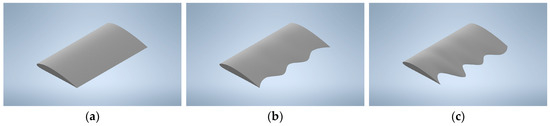
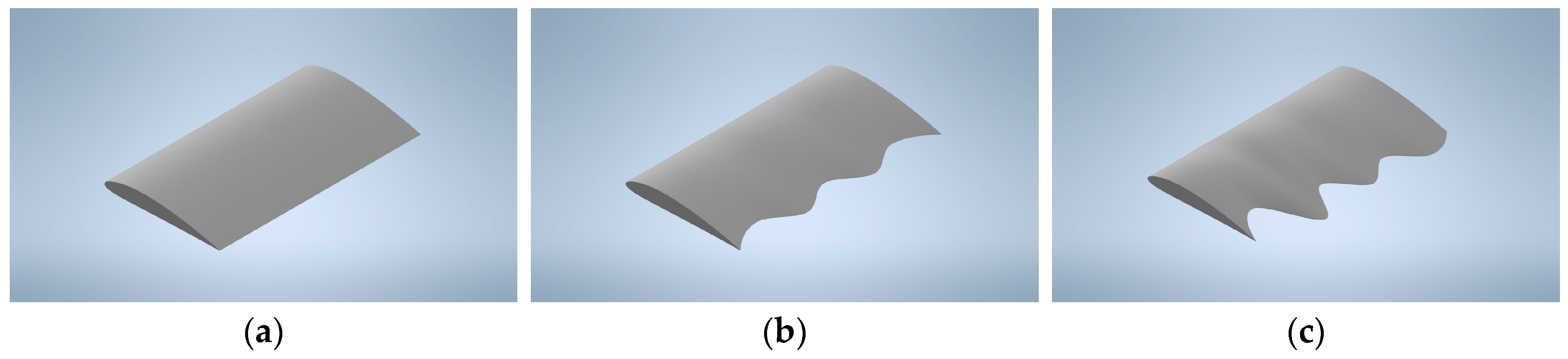
To investigate the impact of trailing-edge geometry on aeroacoustic noise generation, three distinct blade segment models, each 30 cm in span, were developed based on the NACA 4412 profile as depicted in Figure 1:
Figure 1.
The three distinct blades’ trailing-edge segments: (a) Baseline Model, (b) Serrated Model, (c) PSID Model.
Baseline Model: This version featured the standard NACA 4412 trailing edge without any modifications, serving as a reference to characterize the natural wake acoustics of a clean air foil.
Serrated Model: This design integrated a sinusoidal serration pattern directly into the entire trailing edge. These serrations were designed to disrupt organized vortex shedding patterns, thereby weakening turbulent structures and reducing aerodynamic noise.
Pressure Side In the Divergence Model: This variant also incorporated serrations, but with an asymmetrical configuration. Unlike the symmetrical sinusoidal pattern, the peaks and valleys extended unevenly in the downstream direction while maintaining uniform spacing along the blade. This subtle modification aimed to explore its influence on flow detachment and subsequent noise characteristics.
All blade models were created as fully three-dimensional geometries to accurately capture the localized flow variations near the trailing edge induced by the serration designs, which are critical for reliable aerodynamic and noise predictions.
2.2. Computational Domain and Boundary Conditions
A rectangular three-dimensional enclosure was established as the computational domain, with the blade segment horizontally centred to minimize boundary effects and simulate a typical section in the incoming wind. Adequate spacing was maintained both upstream and downstream of the blade to ensure undisturbed flow development. The use of a stationary domain focuses the analysis specifically on airfoil self-noise, or trailing-edge noise. While this approach excludes rotational thickness noise, trailing-edge noise is widely recognized as the dominant broadband source for modern large-scale wind turbines [4].
Boundary Conditions Were Defined as Follows
Inlet: The inlet boundary was designated as a velocity inlet, utilizing three discrete magnitudes—5, 15, and 25 m/s—to represent the low, moderate, and high operational wind regimes of the turbine. To accurately capture the blade pitch angle, the 3D blade geometry was oriented directly relative to the incoming flow. This geometric approach eliminates the need for decomposing inlet velocity components while ensuring a consistent representation of the angle of attack across all simulation cases.
Outlet: This was configured as a pressure far-field boundary (340 m/s sound speed) to facilitate smooth flow exit and prevent numerical disturbances that could affect the wake region.
Blade Surface: This was modelled as a no-slip wall to account for viscous effects, where air velocity at the surface is zero.
Air Properties: This was based on a temperature of 20 °C, with the corresponding speed of sound applied for acoustic modelling.
The key operating conditions and geometric parameters used in the simulations are summarized in Table 1.
Table 1.
The key operating conditions and geometric parameters.
The computational mesh was critically refined around the blade, particularly near the trailing edge, using inflation layers. This local refinement allowed for accurate capture of turbulent structures and near-wall effects, essential for precise aerodynamic noise assessment. A coarser mesh was employed in the outer regions where flow gradients are less severe. Three boundary layers with a growth rate of 1.2 were applied to ensure high near-wall resolution, which is essential for capturing the unsteady pressure signals needed for the acoustic calculations. To ensure the reliability of the comparative analysis, a consistent mesh density and topology were maintained across all three trailing-edge configurations. This approach ensures that the observed trends in noise reduction and spectral shifts are attributable to the geometric modifications rather than variations in numerical discretization.
To enable noise prediction, virtual microphones (5), referred to as receivers, were strategically positioned within the computational domain behind the trailing edge. These receivers recorded unsteady pressure signals from the wake, which served as inputs for subsequent acoustic calculations. This simplified domain setup, avoiding rotational motion and a full turbine environment, significantly reduced computational cost while retaining the essential physics for noise generation analysis.
2.3. CFD Setup
Numerical simulations were performed using Workbench 2025 R1, employing a two-stage approach:
Steady-State Simulation: An initial steady-state simulation was conducted to establish a stable flow field around the blade. The Shear Stress Transport (SST) k-ω turbulence model was utilized for this phase, chosen for its robustness and widespread application in aerodynamic studies.
Transient Simulation: Following the convergence of the steady-state solution, the simulation transitioned to an Unsteady Reynolds-Averaged Navier–Stokes formulation. This transient approach was essential to capture the time-dependent pressure fluctuations that serve as the primary source of aerodynamic noise. While higher-fidelity methods such as large eddy simulation provide more detail, URANS was selected to mitigate the prohibitive computational costs associated with resolving turbulent structures across complex 3D serrated geometries. Turbulence was modelled using the Shear Stress Transport variant, chosen for its proven accuracy in capturing flow separation and near-wall effects. To ensure numerical stability and enhanced convergence during the transient analysis, a pressure-based solver with a coupled pressure–velocity scheme was employed.
The solver was configured as pressure-based, assuming incompressible flow, which is valid given the maximum inlet speed of 25 m/s (corresponding to a very low Mach number). Second-order discretization schemes were applied in both space and time to ensure numerical accuracy. During the transient phase, the Ffowcs Williams–Hawkings model was activated to perform acoustic calculations based on the recorded pressure signals from the receiver locations. The integration was performed over the airfoil’s solid surface (impermeable surface) to capture dipole noise sources.
The narrowband far-field sound pressure spectra obtained from numerical simulations were post-processed in the frequency domain. Sound pressure levels were first converted from decibel scale to linear squared pressure, averaged energetically over the five far-field microphone locations, and integrated over frequency to obtain the overall sound pressure level (OASPL). A-weighted OASPL values were computed by applying the standard A-weighting curve prior to spectral integration. In addition, the narrowband spectra were integrated into 1/3-octave bands according to IEC 61260 by summing the squared acoustic pressure within each band. Due to the finite frequency resolution of the simulations, the lowest 1/3-octave bands contained no discrete frequency components and were therefore omitted from the analysis; the first valid band for all configurations was approximately 20 Hz.
2.4. Governing Equations
The fluid flow around the wind turbine profiles is governed by the Reynolds-Averaged Navier–Stokes equations, which include the conservation of mass (continuity) and momentum.
2.4.1. Conservation of Mass and Momentum
The continuity equation for an incompressible fluid is given by
The momentum equation is expressed as
where is the mean velocity components, is the mean pressure, and represents the Reynolds stress tensor, which is closed using the turbulence model.
2.4.2. SST k-ω Turbulence Model
The Shear Stress Transport k-ω model is used to solve for the turbulent kinetic energy (k) and the specific dissipation rate (ω). The transport equations are simplified as follows:
For turbulent kinetic energy (k):
For specific dissipation rate (ω):
The term is a blending function that allows the model to switch between k-ω near the walls and k-ε in the free stream.
2.4.3. Ffowcs Williams and Hawkings Formulation
To predict the far-field noise generated by the interaction between the airflow and the wind turbine blade profiles, the Ffowcs Williams and Hawkings equation is utilized. This formulation allows for the calculation of sound pressure by integrating the acoustic sources over the blade surface.
The total acoustic pressure at a receiver point is separated into three primary source terms:
Thickness Noise (): This term represents the “monopole” source caused by the displacement of fluid by the volume of the moving blade.
Loading Noise (): This “dipole” source is generated by the unsteady pressure and force distribution on the blade surface as it moves through the fluid.
Quadrupole Noise (): This term accounts for the “quadrupole” sources resulting from turbulence and fluctuating stresses in the volume surrounding the blade.
The integral formulation for these terms (ignoring the quadrupole term for low Mach numbers) is
2.4.4. Sound Pressure Level Quantification
Following the calculation of the time-dependent acoustic pressure signals via the FW-H formulation, the data is processed to determine the acoustic magnitude in the frequency domain. To achieve this, a Fast Fourier Transform is applied to the time-series pressure data obtained at the receiver locations, allowing for the analysis of the sound pressure distribution across the audible frequency spectrum.
The overall sound pressure level was obtained by integrating the squared acoustic pressure over the resolved frequency range and converting the result to decibel scale according to the following equations, with a reference pressure of 20 µPa, the accepted threshold of human hearing.
In the calculations the narrowband sound pressure levels (SPL) were converted to linear pressure using the following equation:
where is the root-mean-square acoustic pressure in frequency bin i [Pa], and is the sound pressure level at frequency [dB].
The unweighted overall sound pressure level (OASPL) is calculated as
where is the frequency resolution [Hz] and [μPa].
The A-weighted narrowband spectrum can be calculated as
where is the A-weighting correction [dB].
The A-weighted OASPL can be calculated according to
with
The reduction in acoustic pressure intensity (linear-to-logarithmic conversion) can be calculated as
where is the difference between the baseline trailing edge and the modified A-weighted OASPL value [%].
All acoustic metrics were obtained by integrating the squared acoustic pressure over frequency, with A-weighting applied in the energy domain prior to integration.
The absolute values of the overall sound pressure level are relatively low, which is attributed to the far-field microphone placement and the single-blade numerical setup. Microphone placement followed far-field standards, and sensitivity tests were conducted by averaging five microphone locations to ensure representative OASPL results.
Nevertheless, the relative comparison between the trailing-edge configurations remains valid, as all cases were evaluated using an identical post-processing procedure.
3. Results
The numerical simulations provided detailed insight into the aeroacoustic behaviour of the three trailing-edge configurations (baseline, symmetric serrated, and asymmetric PSID) under inlet wind velocities of 5 m/s, 15 m/s, and 25 m/s. The analysis focuses on frequency-dependent characteristics, overall acoustic energy, and the associated flow mechanisms governing trailing-edge noise generation.
3.1. Frequency-Dependent Noise Characteristics
The normalized pressure-intensity spectrum, evaluated on a logarithmic frequency scale, reveals distinct velocity-dependent behaviour across the investigated geometries.
At 5 m/s: At low inflow velocity, aerodynamic loading remains moderate and the boundary layer is largely attached. All configurations exhibit similar spectral shapes until approximately 500 Hz (Figure 2), where a closer inspection (as detailed in Section 3.4) reveals significant shifts in dominant frequencies and reductions, especially for PSID, indicating a limited but significant influence of trailing-edge geometries in this range.
Above 500 Hz, differences emerge. The symmetric serrated design exhibits increased pressure intensity relative to the baseline, suggesting enhanced interaction with periodic turbulent structures. In contrast, the asymmetric PSID configuration reduces spectral levels in the mid- to high-frequency range, indicating weakened turbulent–edge scattering. Moreover at 5 m/s, the PSID’s asymmetric geometry disrupts the boundary layer differently on the pressure and suction sides, preventing the symmetric vortex synchronization seen in standard serrations.
Figure 2.
A-weighted, standardized frequency curves that approximate the frequency sensitivity of human hearing at moderate sound levels.
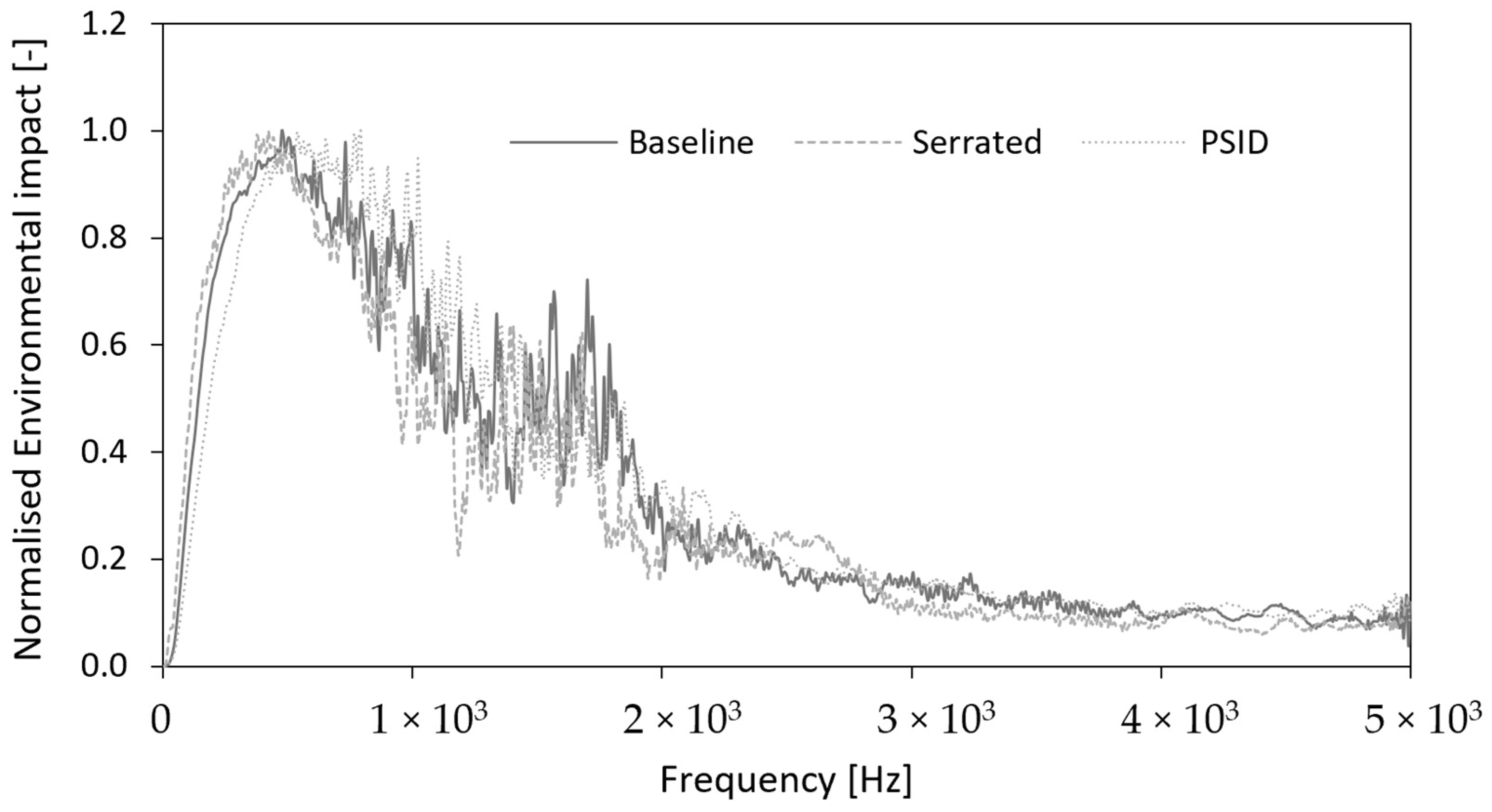
At 15 m/s: With increasing velocity, the flow becomes more energetic, and the wake structure strengthens. A clearer separation between the spectral curves is observed.
The symmetric serrated trailing edge produces elevated levels across a broad frequency range, particularly in the mid-frequency region typically associated with coherent vortex shedding and turbulent boundary-layer interactions.
The PSID configuration demonstrates notable reductions in this same frequency range. Asymmetric geometry appears to disturb phase coherence of vortex structures, thereby weakening periodic shedding mechanisms responsible for dominant aerodynamic noise components.
At 25 m/s: At the highest investigated velocity, the flow is strongly turbulent with pronounced wake development.
The symmetric serrated geometry continues to exhibit increased broadband energy compared to the baseline, while the PSID configuration maintains reduced spectral amplitudes across a wide frequency range.
At higher frequencies, partial convergence between the baseline and PSID spectra is observed, likely due to the dominance of small-scale chaotic turbulence that is less sensitive to trailing-edge modifications.
3.2. Overall Sound Pressure Level Evaluation
The integrated acoustic metrics further quantify these trends. Both total acoustic energy (unweighted OASPL) and A-weighted overall sound pressure level were evaluated.
Across all inflow velocities, the symmetric serrated trailing edge produced the highest total acoustic energy. In contrast, the PSID configuration consistently reduced the unweighted OASPL relative to the baseline.
For A-weighted levels, which approximate human auditory sensitivity, velocity-dependent behaviour was observed for the serrated geometry. Noise reduction relative to the baseline occurred at 5 m/s and 25 m/s, whereas an increase was observed at 15 m/s.
The PSID configuration achieved consistent reductions in A-weighted OASPL at all investigated velocities (reductions in dB and in the bracket ( of 3.1 (51.1) dB, 6.1 dB (75.4), and 4.6 dB (65.3) at 5, 15, and 25 m/s, respectively). These reductions correspond to substantial decreases in radiated acoustic energy. The aerodynamic trade-off is velocity-dependent and the PSID design is most effective at higher wind speeds, where noise is the primary operational constraint.
The relatively low absolute SPL values are attributed to the far-field microphone placement and the single-blade numerical configuration; however, the comparative trends remain robust due to identical post-processing across all cases (Table 2).
Table 2.
Total acoustic and environmental/perceptual impact energies.
At 15 m/s, the interaction between the turbulent boundary layer and the specific serration scale may lead to constructive interference in some bands in the case of the Serrated TE configuration, a phenomenon documented in serration scaling studies [7,8].
3.3. Flow Behaviour and Trailing-Edge Noise Generation
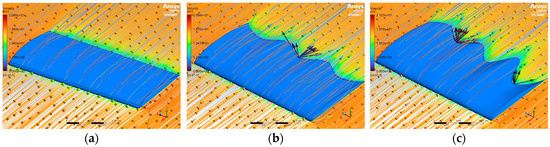
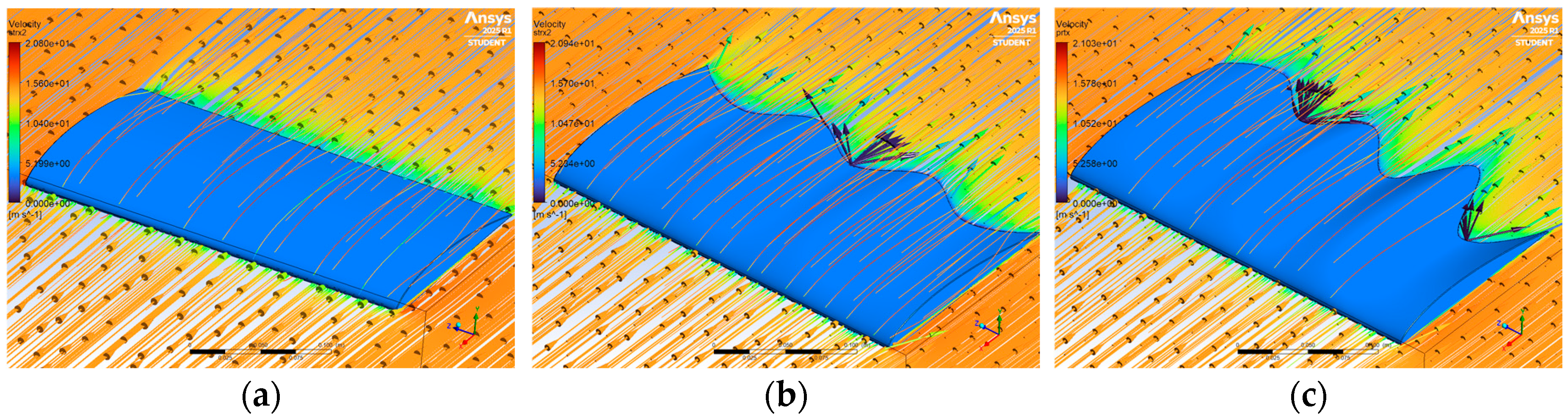
Flow visualizations using velocity vectors and streamlines elucidate the mechanisms underlying the acoustic differences as shown on Figure 3.
Figure 3.
The three distinct blades’ trailing-edge segments induced flow deviations: (a) Baseline Model, (b) Serrated Model, (c) PSID Model.
The flow remained stable and uniform from the inlet until it reached the leading edge of the profile, where the pressure gradients began to develop according to the NACA 4412 geometry.
Baseline Trailing Edge: The straight trailing edge promotes formation of coherent vortex structures that shed periodically into the wake. These organized structures generate concentrated pressure fluctuations, constituting a dominant broadband noise source.
Serrated Trailing Edge: The serrations significantly alter the wake topology. Instead of a single coherent shedding region, multiple shedding locations form along the serration tips. In the present configuration, this appears to increase synchronization and reinforce broadband pressure fluctuations, explaining the elevated total acoustic energy observed in the spectral and OASPL results.
PSID Trailing Edge: The asymmetric PSID geometry introduces uneven flow deviation at the trailing edge, which is theoretically expected to promote spatial decorrelation of vortex structures by disrupting their phase coherence. While Figure 3 qualitatively illustrates a more diffused wake for the PSID configuration compared to the baseline, this mechanism is further supported by the quantitative reduction in spectral amplitudes and overall sound pressure levels observed in our results.
The resulting wake is more diffused, reducing coherent pressure fluctuations and thereby mitigating broadband trailing-edge noise generation.
3.4. 1/3-Octave Band Analysis
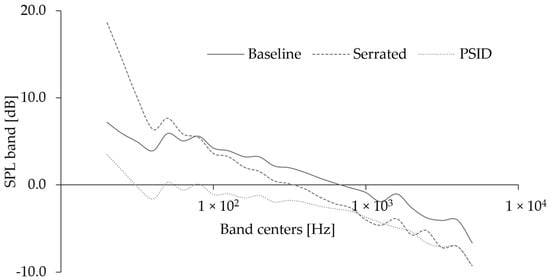
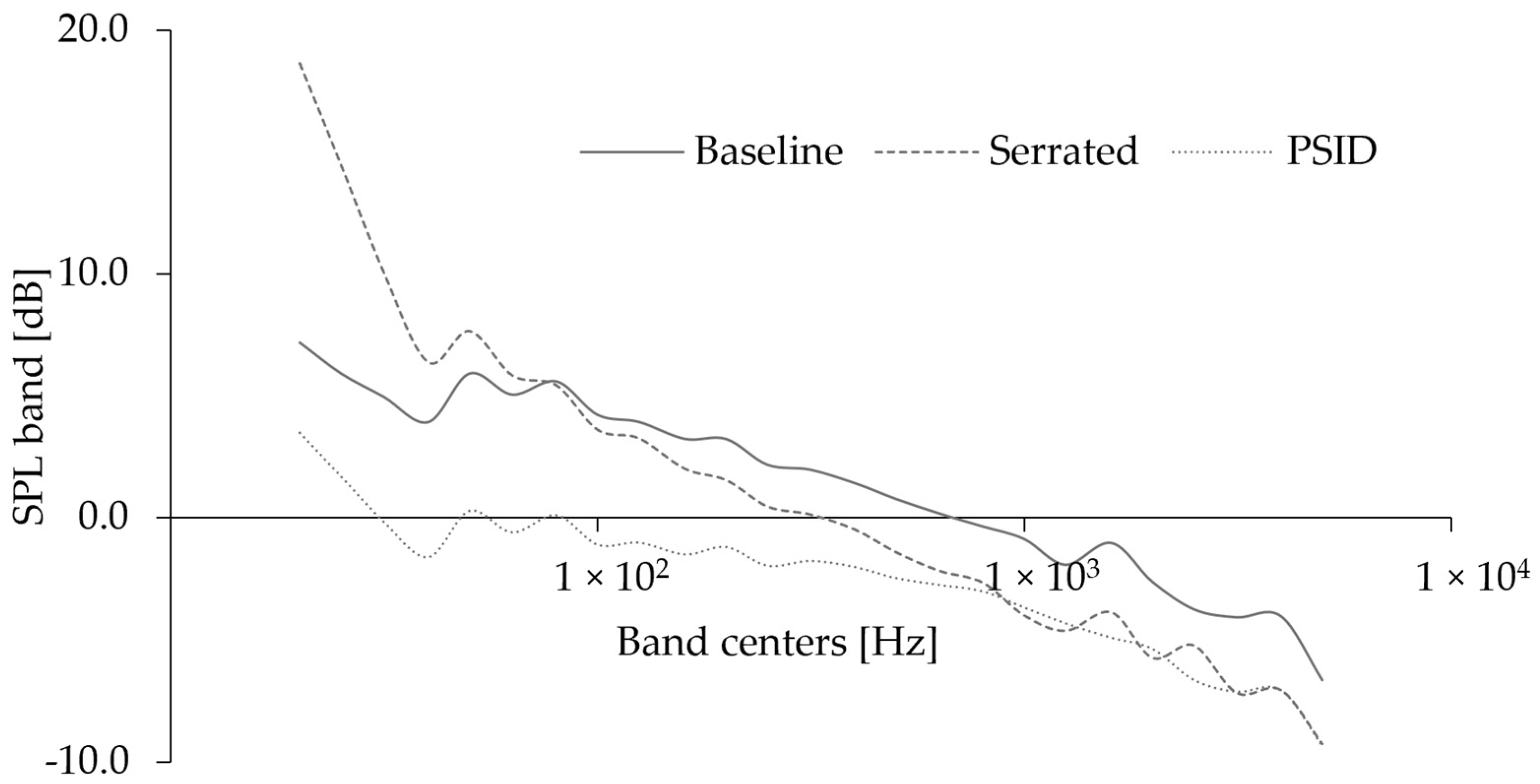
The 1/3-octave band evaluation confirms that the first resolvable band appears at approximately 20 Hz due to spectral resolution limitations, as depicted in Figure 4. This analysis provides a more detailed view of the frequency-dependent noise characteristics. Specifically, at an inlet wind velocity of 5 m/s, the baseline configuration exhibits a significant cross-frequency at 800 Hz. In contrast, the Serrated design shows a cross-frequency at 400 Hz, and the PSID design demonstrates a cross-frequency at a much lower 31.5 Hz. The shift from 800 Hz (baseline) to 31.5 Hz indicates that the modification effectively shifts the dominant noise-generating energy to lower, less perceptually intrusive frequencies.
Figure 4.
The 1/3-octave band evaluation for three different trailing-edge designs at 5 [ms−1] inlet wind velocity.
Physically, a crossover frequency indicates a point in the spectrum where the noise contribution from one mechanism becomes dominant over another, or where the effectiveness of a noise reduction treatment transitions across different frequency ranges.
It is notable that at higher wind velocities (15 m/s and 25 m/s), no such distinct cross-frequency values are observed for any of the trailing-edge designs, indicating a broader spectral distribution or the absence of a dominant crossover point at elevated speeds. The PSID configuration consistently demonstrates broadband reductions across most resolvable bands, whereas the serrated configuration primarily redistributes energy depending on inflow velocity. These results indicate that the observed acoustic differences arise from modifications within the resolvable frequency range rather than from low-frequency contributions alone, with distinct spectral shifts highlighted by the cross-frequency analysis at lower wind speeds.
In summary the PSID trailing-edge configuration consistently reduced both total acoustic energy and A-weighted sound pressure level across all investigated inflow velocities. In contrast, the symmetric serrated configuration exhibited velocity-dependent behaviour, increasing total acoustic energy at all inflow conditions while reducing perceptual impact only at low and high velocities. The results indicate that the PSID geometry provides robust broadband noise mitigation, particularly below 500 Hz, where it most effectively disrupts the vortex shedding before it converges into high-frequency chaotic turbulence. In contrast, the symmetric serrated edge primarily redistributes spectral energy, and its performance remains more sensitive to the specific flow regime.
4. Discussion
The present study provides compelling evidence for the efficacy of tailored trailing-edge modifications, specifically serrated and PSID designs, in mitigating aeroacoustic noise generated by wind turbine blades. Through a comprehensive numerical analysis, we have elucidated the distinct impacts of these geometries on frequency-dependent noise characteristics, overall sound pressure levels, and the underlying flow mechanisms. These findings offer valuable insights into developing quieter wind energy solutions, addressing a critical barrier to their broader absorption [7,21]. Unlike symmetric serrations, the PSID’s configuration creates a phase mismatch in vortex shedding across the span, leading to superior spatial decorrelation compared to uniform sinusoidal patterns.
The spectral analysis revealed that both modified designs effectively alter the pressure intensity across various frequency ranges, particularly pronounced in the mid-frequency spectrum (approximately 30 Hz to 200 Hz) and at higher flow velocities. This aligns well with established aeroacoustic principles, which identify coherent vortex shedding as a primary contributor to trailing-edge noise, typically manifesting in these frequency bands [3,21].
At lower inflow velocities, such as 5 m/s, the impact of geometric modifications, while subtler, is still discernible, affecting smaller-scale turbulent structures. Our detailed 1/3-octave band analysis at 5 m/s further quantified these distinctions: the baseline design exhibited a cross-frequency at 800 Hz, while the serrated design shifted this to 400 Hz, and the PSID design to a significantly lower 31.5 Hz. This marked shift, especially for PSID, indicates a profound alteration in the dominant noise-generating frequencies at low operational speeds. The absence of such clear cross-frequency values at higher velocities suggests a more broadband and chaotic spectral distribution where no single crossover point dominates, a characteristic often associated with increasingly turbulent flow regimes. As the flow energy increases (15 m/s and 25 m/s), the modifications become progressively more effective in disrupting the increasingly coherent and energetic vortex shedding, consistent with previous research [7,8]. The observed convergence of spectral curves at very high frequencies across all designs points towards the eventual dominance of small-scale chaotic turbulence, which is inherently less responsive to macro-geometric alterations.
The evaluation of overall sound pressure level unequivocally reinforces these spectral observations. Both the serrated and PSID designs consistently led to a practical reduction in perceived loudness across all investigated wind speeds. Crucially, the most substantial improvements were observed at 25 m/s, where aerodynamic noise presents the most significant environmental concern. This highlights the real-world applicability and impact of these designs, as they offer the greatest acoustic benefits precisely when noise mitigation is most needed for social acceptance and regulatory compliance. The consistent superiority of the modified designs over the baseline, even at lower velocities, suggests that these geometries provide a fundamental disruption to the underlying noise generation mechanisms rather than merely shifting the noise profile. The PSID design, in particular, demonstrated robust and consistent A-weighted OASPL reductions across all velocities, confirming its potential for comprehensive noise abatement.
Flow visualization studies provided a clear physical explanation for these acoustic improvements, corroborating Lighthill’s acoustic analogy and its extensions [5,6]. The baseline trailing edge consistently generated a highly coherent wake characterized by strong, periodically shedding vortices—a well-established mechanism for significant pressure fluctuations and broadband noise. In contrast, the serrated design effectively fragmented this coherence by directing flow differently from each serration tip, leading to a more scattered and irregular wake. This disruption of coherent structures reduces the amplitude and organization of pressure fluctuations responsible for noise. The PSID design, with its asymmetrical geometry, further amplified this effect by introducing uneven flow deviation at the trailing edge, promoting greater spatial decorrelation of vortex structures. By introducing a spanwise phase lag in the vortex shedding, the uneven downstream extension of peaks and valleys breaks up the coherent structure of the wake, resulting in a more diffused flow that directly translates to diminished pressure fluctuations and lower aeroacoustic emissions.
These findings corroborate prior research indicating that serrations operate by altering the interaction between the turbulent boundary layer and the trailing edge, thereby modifying the spectral content and overall intensity of the radiated sound [7,8].
Despite the inherent trade-offs between noise reduction and aerodynamic performance, which are common and critical considerations in wind turbine design. This study primarily focused on demonstrating the acoustic benefits [4]. While the RANS-FW-H approach provides reliable and computationally efficient predictions for the phenomena investigated, it is acknowledged that higher-fidelity simulations, such as LES-FW-H, could offer a more detailed resolution of turbulent structures for further validation. LES offers higher accuracy for small-scale turbulence; URANS is sufficient for identifying dominant shifts in vortex shedding [16]. Future work should therefore integrate detailed aerodynamic performance evaluations (e.g., lift, drag, and power coefficient) alongside acoustic analyses to quantify these trade-offs precisely. Moreover, experimental validation using wind tunnel tests or full-scale measurements would be crucial to confirm the practical efficacy and generalizability of these numerically optimized designs under real-world operating conditions.
While this study successfully demonstrates the broadband noise reduction potential of the PSID geometry, the impact of these modifications on the lift and drag coefficients remains to be quantified. Future research should involve a multi-objective optimization approach to ensure that the acoustic benefits are achieved without compromising the aerodynamic efficiency of the blade.
While the asymmetric PSID geometry introduces greater manufacturing and structural complexity compared to conventional symmetric designs, recent advancements in large-scale additive manufacturing and the development of specialized 3D-printed blade-tip attachments provide a viable means of implementing these optimizations in practical wind energy systems [22,23].
5. Conclusions
This study successfully investigated the numerical optimization of wind turbine blade profiles for aeroacoustic noise reduction by implementing symmetric serrated and asymmetric PSID trailing-edge designs on an NACA 4412 profile. The simulations performed in ANSYS Fluent demonstrated that both modified geometries consistently lead to reduced noise emissions across a range of wind speeds from 5 m/s to 25 m/s compared to the baseline configuration. From these findings, several actionable design guidelines can be derived for future engineering applications. Primarily, designers should prioritize asymmetric configurations like the PSID over traditional symmetric serrations to achieve more robust broadband noise suppression, as the asymmetric profile effectively disrupts coherent vortex shedding and increases spatial decorrelation. For turbines operating in high-velocity environments, these asymmetric modifications are particularly recommended as they provide the most significant overall sound pressure level reductions, reaching up to 6.1 dB at 25 m/s. Additionally, such designs should be utilized to shift crossover frequencies into lower, less perceptually intrusive bands to minimize human annoyance, as evidenced by the PSID’s ability to shift the crossover point to 31.5 Hz at low wind speeds.
Despite the valuable insights provided by this research, certain limitations must be acknowledged to guide future work. The reliance on URANS-based turbulence modelling, while computationally efficient for trend analysis, may lack the high-fidelity resolution required to capture all small-scale turbulent fluctuations compared to large eddy simulations. Furthermore, because the study utilized a stationary computational domain, it does not account for rotational noise components such as thickness noise or the influence of tip vortices in a dynamic environment. This study remains purely numerical, and the lack of experimental validation through wind tunnel testing or field measurements is a recognized limitation that should be addressed in subsequent research. Finally, while the initial results are promising, more comprehensive data regarding the trade-offs between noise reduction and aerodynamic efficiency—specifically the lift-to-drag ratio—is required to ensure that these acoustic modifications do not compromise the overall power generation performance of the turbine.
Author Contributions
Conceptualization, Y.I., L.R.R. and L.C.; methodology, Y.I., L.R.R. and L.C.; software, Y.I.; formal analysis, Y.I., L.R.R. and L.C.; investigation, Y.I.; data curation, Y.I., L.R.R. and L.C.; writing—original draft preparation, Y.I. and L.C.; writing—review and editing, Y.I., L.R.R. and L.C.; visualization, Y.I. and L.C.; supervision, L.R.R. and L.C. All authors have read and agreed to the published version of the manuscript.
Funding
This research received no external funding.
Institutional Review Board Statement
Not applicable.
Informed Consent Statement
Not applicable.
Data Availability Statement
The original contributions presented in the study are included in the article, further inquiries can be directed to the corresponding author.
Conflicts of Interest
The authors declare no conflicts of interest.
Nomenclature
The following abbreviations are used in this manuscript:
| A-weighting correction of frequency | |
| CAA | Computational Aeroacoustics |
| CAD | Computer-Aided Design |
| CFD | Computational fluid dynamics |
| DES | Detached eddy simulation |
| The difference between the baseline trailing edge and the modified A-weighted OASPL value | |
| Frequency resolution | |
| f | Frequency |
| Blending function | |
| FW-H | Ffowcs Williams and Hawkings |
| IEC | International Electrotechnical Commission |
| k | Turbulent kinetic energy |
| LES | Large eddy simulation |
| NACA | National Advisory Committee for Aeronautics |
| OASPL | Overall sound pressure level |
| ω | Specific dissipation rate |
| Mean pressure | |
| A-weighted root-mean-square acoustic pressure in frequency bin i | |
| Unweighted root-mean-square acoustic pressure in frequency bin i | |
| Loading noise | |
| Thickness noise | |
| Quadrupole noise | |
| PSID | Pressure Side In the Divergence |
| Reference pressure | |
| Re | Reynolds number |
| Density | |
| Reynolds stress tensor | |
| SPL | Sound pressure level |
| SST | Shear Stress Transport |
| Mean velocity components | |
| URANS | Unsteady Reynolds-Averaged Navier–Stokes |
References
- Li, J.; Liu, R.; Yuan, P.; Pei, Y.; Cao, R.; Wang, G. Numerical Simulation and Application of Noise for High-Power Wind Turbines with Double Blades Based on Large Eddy Simulation Model. Renew. Energy 2020, 146, 1682–1690. [Google Scholar] [CrossRef] [Scilit]
- Zhu, W.J.; Shen, W.Z.; Barlas, E.; Bertagnolio, F.; Sørensen, J.N. Wind Turbine Noise Generation and Propagation Modeling at DTU Wind Energy: A Review. Renew. Sustain. Energy Rev. 2018, 88, 133–150. [Google Scholar] [CrossRef] [Scilit]
- Brooks, T.F.; Pope, D.S.; Marcolini, M.A. Airfoil Self-Noise and Prediction; NTRS—NASA Technical Reports Server: Washington, DC, USA, 1989. [Google Scholar]
- Merino-Martínez, R.; Pieren, R.; Schäffer, B. Holistic Approach to Wind Turbine Noise: From Blade Trailing-Edge Modifications to Annoyance Estimation. Renew. Sustain. Energy Rev. 2021, 148, 111285. [Google Scholar] [CrossRef] [Scilit]
- Lighthill, M.J. On Sound Generated Aerodynamically I. General Theory. Proc. R. Soc. Lond. A Math. Phys. Sci. 1952, 211, 564–587. [Google Scholar] [CrossRef] [Scilit]
- Lighthill, M.J. On Sound Generated Aerodynamically II. Turbulence as a Source of Sound. Proc. R. Soc. Lond. A Math. Phys. Sci. 1954, 222, 564–587. [Google Scholar] [CrossRef] [Scilit]
- Oerlemans, S.; Sijtsma, P.; Méndez López, B. Location and Quantification of Noise Sources on a Wind Turbine. J. Sound Vib. 2007, 299, 869–883. [Google Scholar] [CrossRef] [Scilit]
- Chong, T.P.; Joseph, P.F.; Gruber, M. Airfoil Self Noise Reduction by Non-Flat Plate Type Trailing Edge Serrations. Appl. Acoust. 2013, 74, 607–613. [Google Scholar] [CrossRef] [Scilit]
- Kim, J.H.; Al-Sadawi, L.; Vathylakis, A.; Chong, T.P. Trailing Edge Noise Reduction by Passive and Active Flow Controls; American Institute of Aeronautics and Astronautics (AIAA): Reston, VA, USA, 2014. [Google Scholar]
- Zhou, P.; Liu, Q.; Zhong, S.; Fang, Y.; Zhang, X. A Study of the Effect of Serration Shape and Flexibility on Trailing Edge Noise. Phys. Fluids 2020, 32, 127114. [Google Scholar] [CrossRef] [Scilit]
- Maizi, M.; Dizene, R.; Mihoubi, M.C. Reducing Noise Generated from a Wind Turbine Blade by Pitch Angle Control Using CFD and Acoustic Analogy. J. Appl. Fluid Mech. 2017, 10, 1201–1209. [Google Scholar] [CrossRef] [Scilit]
- Alam, M.M. A Review of Wind Turbine Blade Morphing: Power, Vibration, and Noise. Fluid Dyn. Mater. Process. 2025, 21, 657–695. [Google Scholar] [CrossRef] [Scilit]
- Ahmed, M.M.; Robin, H.M.; Shahadat, M.M.Z.; Masud, M.H. Innovative Approaches for Reducing Wind Turbine Noise: A Review from Mechanical and Aerodynamic Perspective. Energy Rep. 2025, 13, 728–746. [Google Scholar] [CrossRef] [Scilit]
- Kou, J.; Botero-Bolívar, L.; Ballano, R.; Marino, O.; de Santana, L.; Valero, E.; Ferrer, E. Aeroacoustic Airfoil Shape Optimization Enhanced by Autoencoders. Expert Syst. Appl. 2023, 217, 119513. [Google Scholar] [CrossRef] [Scilit]
- Xu, P.; Liao, X.; Qiu, F.; Cheng, Z.; Li, W.; Liu, Z. Intelligent prediction of gas-liquid two-phase flow fields in jet impact negative pressure reactors: An integrated DA-WOA-CNN framework based on CFD. Chem. Eng. Sci. 2026, 325, 123495. [Google Scholar] [CrossRef] [Scilit]
- Bhargava Nukala, V.; Padhy, C.P. Concise Review: Aerodynamic Noise Prediction Methods and Mechanisms for Wind Turbines. Int. J. Sustain. Energy 2023, 42, 128–151. [Google Scholar] [CrossRef] [Scilit]
- Schoen, K. Using CFD Analysis to Investigate Noise Reduction on a Wind Turbine Blade; University of Groningen: Groningen, The Netherlands, 2025.
- Colas, J.; Emmanuelli, A.; Dragna, D.; Blanc-Benon, P.; Cotté, B.; J. A. M. Stevens, R. Wind Turbine Sound Propagation: Comparison of a Linearized Euler Equations Model with Parabolic Equation Methods. J. Acoust. Soc. Am. 2023, 154, 1413–1426. [Google Scholar] [CrossRef] [Scilit] [PubMed]
- Bresciani, A.P.C.; Maillard, J.; Le Bras, S.; de Santana, L.D. Wind Turbine Noise Synthesis from Numerical Simulations. In Proceedings of the 20th American Institute of Aeronautics and Astronautics (AIAA), Atlanta, GA, USA, 16–20 May 2014. [Google Scholar] [CrossRef] [Scilit]
- Yang, Y.; Li, W.; Shi, W.; Zhang, W.; El-Emam, M.A. Numerical Investigation of a High-Pressure Submerged Jet Using a Cavitation Model Considering Effects of Shear Stress. Processes 2019, 7, 541. [Google Scholar] [CrossRef] [Scilit]
- Howe, B.; Gastmeier, B.; McGabe, N. Wind Turbines and Sound: Review and Best Practice Guidelines; Canadian Wind Energy Association: Ottawa, ON, Canada, 2007.
- Bortolotti, P.; Berry, D.; Carron, W.S.; Khalifa, S.; Anderson, T.; Meyer, P.; Chann, M. Toward the Advanced Manufacturing of Land-Based Wind Turbine Blades: Preprint; NREL/CP-5000-84397; National Renewable Energy Laboratory: Golden, CO, USA, 2022.
- Post, B.; Richardson, B.; Palmer, S.; Love, L.; Lee, D.; Kurup, P.; Jenne, D.S.; Remo, T.; Mann, M. The Current State of Additive Manufacturing in Wind Energy Systems; ORNL Wind Energy Technologies Program. ORNL/TM-2017/479; Oak Ridge National Laboratory (ORNL): Oak Ridge, TN, USA, 2017.

Disclaimer/Publisher’s Note: The statements, opinions and data contained in all publications are solely those of the individual author(s) and contributor(s) and not of MDPI and/or the editor(s). MDPI and/or the editor(s) disclaim responsibility for any injury to people or property resulting from any ideas, methods, instructions or products referred to in the content. |
© 2026 by the authors. Licensee MDPI, Basel, Switzerland. This article is an open access article distributed under the terms and conditions of the Creative Commons Attribution (CC BY) license.