


Highlights
What are the main findings?
- A novel tri-component Ni-Mn-Co electrocatalyst was developed by electrodeposition.
- Enhanced HER activity was shown in alkaline fresh water, simulated seawater and natural seawater.
- NiMnCo/Ti-2 catalyst requires only 29 mV overpotential for the current density of 10 mA cm−2 in SSW.
- The 3D NiMnCo/Ti-2 catalyst exhibits high current retention and modest potential decline in CA & CP.
What are the implications of the main findings?
- Synergistic interaction between Ni, Mn and Co significantly enhances the catalytic HER performance.
- Higher ECSA compared to the geometric area of NiMnCo/Ti-2 is also ascribed to enhanced HER kinetics.
- Excellent catalytic activity and long-term stability feasibly support real-life seawater splitting.
Abstract
Electrocatalytic seawater splitting is an ideal strategy for the large-scale production of green hydrogen. Compared to scarce freshwater, oceanic seawater electrolysis represents a game-changer for the hydrogen economy. Herein, we report a cost-effective one-step synthesis of binder-free, self-supported 3D nickel–manganese–cobalt (NiMnCo) coatings on titanium (Ti) substrates and evaluated their electrocatalytic performance for the hydrogen evolution reactions (HERs) in alkaline media (1.0 M KOH), simulated seawater (SSW, 1.0 M KOH + 0.5 M NaCl) and alkaline natural seawater (ASW, 1.0 M KOH + natural seawater). These ternary coatings were electrodeposited on Ti substrates using an electrochemical deposition method via a dynamic hydrogen bubble template (DHBT) technique. The optimized ternary NiMnCo/Ti-2 electrocatalyst exhibited an enhanced HER activity in both alkaline and seawater media, achieving an ultra-low overpotential of 29, 59 and 66 mV to reach the benchmark current density of 10 mA cm−2 in SSW, ASW and 1.0 M KOH, respectively. This efficient 3D ternary NiMnCo/Ti-2 electrocatalyst demonstrated stable long-term performance at a constant potential of −0.23 V (vs. RHE) and a constant current density of 10 mA cm−2 for 50 h without any significant degradation. Furthermore, it exhibited long-term stability in alkaline electrolyte and simulated seawater during multi-step chronopotentiometric testing at variable current densities from 20 mA cm−2 to 100 mA cm−2 for 18 h. This superior performance can be attributed to its unique intermetallic structure and multi-component composition, which provides good Cl− resistance, electrochemical stability and synergistic effects among its constituents. Therefore, the optimized NiMnCo/Ti-2 electrocatalyst is a promising candidate for practical seawater electrolysis aiming at green hydrogen production.
1. Introduction
Limited fossil fuel-driven industrialization and the steadily increasing global energy demand due to burgeoning population growth pose significant challenges to human society as excessive consumption of fossil fuels not only depletes natural resources but also aggravates environmental pollution and accelerates global warming, climate change and other environmental complications [1,2,3,4,5]. Moreover, fossil fuel reserves are limited and geographically uneven; therefore, their drastic depletion could lead to energy shortfalls and geopolitical conflicts. In order to address both energy security and environmental sustainability by mitigating the emission of greenhouse gases, hydrogen (H2) can be considered as a key emerging substitute for fossil fuels which can serve as a promising energy carrier due to its high energy density (∼142 MJ kg−1) with zero carbon emissions, due to its high abundance on Earth, enabling large-scale production [6,7,8,9,10].
Hydrogen energy has received significant attention due to its numerous superiorities and can be produced from many different non-renewable conventional sources, e.g., coal, natural gas, biomass, etc. To date, steam reforming of fossil fuels remains the most economical approach to producing hydrogen at a scale of ∼2 USD kg−1 [11]. The primary global energy consumption by renewable energy increased from 28.82 EJ (Exajoule, 1018 Joules) in 2019 to 31.71 EJ in 2020, as reported by BP’s statistical review [12]. However, the conventional steam reforming production pathway has a relatively low conversion efficiency and leads to CO2 emissions, CO intermediates and coke due to incomplete combustion, which requires sophisticated technology and an extensive budget to mitigate through carbon capture and storage [13,14]. Therefore, global energy utilization must be fully decarbonized to alleviate the negative environmental impacts caused by non-renewable energy carriers and to achieve the Paris Agreement target set for minimizing emissions by 2050 [15,16]. The process of electrosynthesis of hydrogen through water electrolysis powered by renewable energy is considered a decarbonized energy source that is environmentally sustainable [17]. According to statistics, global hydrogen production stood at 90 Mt (million tons) in 2020 and is predicted to reach 530 Mt/year by 2050 to meet the Net Zero Emission Scenario of the International Energy Agency [18]. In the recent past, the U.S. Department of Energy also launched the ‘Hydrogen Shot’ program in June 2021 to reduce the cost of clean hydrogen to $1 per 1 kg in 1 decade (“1 1 1”) [19,20].
The process of green hydrogen production through water splitting comprises two key half-reactions: the anodic oxygen evolution reaction (OER) and the cathodic hydrogen evolution reaction (HER); however, it requires ca. 9 L of pure water stoichiometrically to produce 1 kg of hydrogen [21,22,23]. The overall electrocatalytic water splitting reaction requires a theoretical voltage of 1.23 V, corresponding to a thermodynamic Gibbs free energy of 237.2 kJ mol−1. However, practical water electrolysis in standard conditions usually needs a higher input of 1.48 V, and the process consumes additional energy to progress at a practical rate [24,25,26,27,28]. Therefore, the main technical bottleneck for electrochemical water electrolysis is to achieve exceptional hydrogen conversion efficiency and overcome the sluggish reaction kinetics of anodic OER, which makes the overall process of water splitting more energy-intensive. The industrial commercialization of hydrogen production is also constrained by its consumption of a large volume of limited freshwater reserves, but seawater is an ample natural resource, covering ∼97% of the total water reserve on Earth.
It is important to note that direct-feed seawater electrolysis (DFSE) would be the most practical, cost-effective approach for industrial-scale hydrogen production with high purity, but commercialization of DFSE is limited due to a competing chlorine evolution reaction (ClER) in the anode [29,30,31,32,33]. According to the Pourbaix diagram for the artificial seawater model at standard ambient temperature, the formation of hypochlorite and other by-products might take place during ClER at higher pH values, along with insoluble Mg/Ca hydroxide on the electrode surface, which can hinder the long-term durability of electrocatalysts [32,33,34]. Therefore, in recent decades, tremendous progress has been made in research and development to synthesize high-performance, durable electrocatalysts for electrocatalytic seawater splitting. However, today, for the commercialization of renewable, zero- or low-carbon green hydrogen, it is important to focus on the development of electrocatalysts for seawater electrolysis with enhanced activity, selectivity, and long-term stability along with anti-corrosion properties [35,36,37,38].
Nevertheless, the high cost of zero- to low-carbon green hydrogen energy remains the primary hurdle in seawater splitting, arising from the electrocatalysts employed as electrodes in water/seawater electrolyzers. State-of-the-art platinum group metal (PGM) catalysts exhibit outstanding electrocatalytic activity for water electrolyzers, whereas Pt and Pt-based catalysts are the benchmark electrocatalysts for HER [39,40,41,42,43]. However, the scarcity and high cost of precious PGM catalysts are the principal obstacles hindering their widespread application and large-scale commercialization. In recent years, the use of non-noble transition metal-based catalysts has been extended for HER with respect to water splitting and industrial electrolyzers, including transition-metal-based oxides [44,45,46], LDHs and hydroxides [47,48,49], sulfides [50,51], nitrides [52,53], phosphides [54,55], and alloys [56,57,58]. Among these, transition metal alloy electrocatalysts have drawn significant attention due to their ease of electronic and structural modification to improve the inherent electrocatalytic activity.
In general, several applicable techniques and methods have been used to synthesize electrocatalysts with enhanced electrocatalytic activity and structural integrity for long-term durability. The electrodeposition method is a facile, cost-effective method to fabricate binder-free 3D nano-micro architectures of different shapes and structural morphology, e.g., porous [59], nanosheets [60], nanotubes [61], nanocones [62] and nano-micro dendrites [63], etc. Such unique surface morphologies in electrocatalysts increase their active surface area and the number of active sites, resulting in the acceleration of electrolyte diffusion and improved electron transport efficiency [64,65]. An attractive feature of the electrodeposition method is the dynamic hydrogen bubble template (DHBT) technique through which moderate-to-high controllable current density is usually applied to synthesize electrocatalysts, and the formation of vigorous hydrogen bubbles acts as a dynamic template to regulate the surface and structural morphology [66]. For instance, Jiang et al. synthesized the trumpet-shaped Ru catalyst on amorphous cobalt support (T-Ru/a-Co) via the DHBT process, which requires only an overpotential of 49 mV to obtain a current density of 10 mA cm−2 for HER in alkaline media (1.0 M KOH) [67]. Another study conducted by Hassanizadeh et al. shows a Ni3S2@Cu@NF electrocatalyst synthesized via the DHBT method, where copper and nickel sulfide coatings were electrodeposited at a constant current density of 6 A cm−2 for only 5 s, forming a dendritic morphology with circular porous architecture with an average diameter of 9 μm in certain areas. Electrocatalysts fabricated by such a fast-forwarding, low-cost method have also demonstrated enhanced HER activity in alkaline media with 98 mV overpotential to achieve a current density of 10 mA cm−2 [68]. Furthermore, a nanoflower-like NiFeCo catalyst fabricated by a facile one-step DHBT electrodeposition method on carbonized wood also exhibited remarkable HER activity in 1.0 M KOH solution, requiring ultra-low overpotentials of 37 mV and 298 mV to achieve current densities of 10 mA cm−2 and 1000 mA cm−2 [69].
According to the aforementioned studies, cobalt (Co) is considered a promising transition metal for the design of alloyed electrocatalysts due to its natural abundance and cost-effectiveness. In addition, Co possesses unpaired electrons in its outer 3d orbitals, which can facilitate hydrogen adsorption through M–H bond formation, thereby promoting the hydrogen evolution reaction (HER).
Furthermore, the partially filled 3d orbitals of transition metals interact with neighboring atoms, leading to a shift in the d-band center and consequently tuning the adsorption energies of reaction intermediates through a synergistic effect. Compared to our previously reported NiMn system, the incorporation of cobalt introduces an additional level of electronic modulation and catalytic functionality. In particular, Co enhances electrical conductivity and increases the density of active sites by reducing charge-transfer resistance, while also improving redox flexibility. Meanwhile, manganese is expected to facilitate water dissociation in alkaline media. The combination of these effects results in improved HER kinetics, especially under alkaline and simulated seawater conditions [70,71,72].
Our previous studies demonstrated the superior HER activity and stability of bimetallic 3D NiMn coatings electrodeposited via a facile DHBT technique on Ti substrates in alkaline media [73] and simulated/alkaline seawater environments [74]. Building on these results, the present work extends the NiMn system by incorporating cobalt to develop a ternary NiMnCo electrocatalyst. This approach aims to further enhance catalytic performance, durability and practical applicability in alkaline, simulated seawater (SSW), and alkaline seawater (ASW) electrolytes.
2. Materials and Methods
2.1. Chemicals and Fabrication of Catalysts
All the chemicals used in the experiments were of analytical grade and used directly without further purification. Titanium (Ti) foils (0.127 mm thick) with a size of (1 × 1 cm) were cut, sanded to 1000 grit and degreased with ethanol to remove the native surface oxide layer. Subsequently, the Ti plates were washed with deionized water (DI) followed by their activation via pretreatment in diluted H2SO4 (1:1 vol.) at 70 °C. The electrocatalyst fabrication was carried out via electrodeposition by the DHBT technique in a two-electrode cell using a pair of two wire-connected platinum sheets (55 × 35 × 1 mm) as the anode and the pretreated Ti sheets as the cathode. To synthesize self-supported non-noble electrocatalysts, the chemical compositions of the formulated electrodeposition solution baths were composed of 0.2 M nickel sulfate hexahydrate (NiSO4·6H2O, >98%) as a source of nickel ions, 1.0 M manganese chloride tetrahydrate (MnCl2·4H2O, >99%) as a source of manganese ions, and variable concentrations of 0.1 M and 0.2 M cobalt nitrate hexahydrate [Co(NO3)2·6H2O, >98%] as a source of cobalt ions. In addition, 0.5 M (NH4)2SO4 was added as a modifier of the coating morphology, and 0.5 M H3BO3 was used as a pH stabilizer during the preparation of each solution bath. H2SO4 (96%), HCl (35%–38%), and KOH (85%) were purchased from Chempur Company (Karlsruhe, Germany). Moreover, two binary electrode compositions were also fabricated in a similar way to compare their catalytic activity as catalyst samples. All reagents were dissolved in ultrapure DI water with a resistivity of 18.2 MΩ·cm in acidic conditions (1.5 M H2SO4 and 1.0 M HCl).
The electrodeposition temperature was maintained at 25 °C and the pH of the solution was ca. 1. The fabrication was carried out in two steps: first, a constant current of 100 mA (50 mA cm−2) was applied to the Ti anode for 10 min, and second, a constant current of 200 mA (100 mA cm−2) was applied for 5 min. The compositions of the formulated solution baths and the electroplating conditions used for the fabrication of catalysts and catalyst samples are listed in Table 1.
Table 1.
The composition of the electrochemical baths and the electroplating condition parameters.
After electroplating, the catalyst samples and NiMnCo/Ti electrocatalysts were removed carefully, thoroughly rinsed with deionized water, air-dried at room temperature, marked, and cautiously stored for subsequent investigations. The synthesized electrocatalysts were denominated as NiMnCo/Ti-n (n = 1, 2), according to the molar concentrations of Co2+ ions in the solution baths (herein, we simplified the catalysts’ acronyms with integer numbers. The 3D NiMnCo/Ti-1 and NiMnCo/Ti-2 electrodes were electrochemically synthesized from the bath solutions with Co2+ ion concentrations of 0.1 M and 0.2 M), respectively. The natural seawater was collected from the Baltic Sea coastline (Klaipėda seashore region, Lithuania, 55°42′45″ N, 21°08′06″ E).
2.2. Characterization of Catalysts
To analyze the electrodes, scanning electron microscopy (SEM) using an SEM workstation TM 4000 Plus with an AZtecOne detector (Hitachi, Tokyo, Japan) was used to determine the microstructural surface morphology of the synthesized NiMnCo/Ti-1, NiMnCo/Ti-2 electrocatalysts and bimetallic catalyst samples. The microspherical surface morphology of the optimized ternary electrocatalyst was examined, and the size (diameter) of the deposited microspheres was measured using the ImageJ1.53K desktop application.
The loadings of Ni, Mn and Co on the Ti substrate were determined by inductively coupled plasma optical emission spectrometry (ICP-OES) analysis. The ICP-OES spectra were recorded using an Optima 7000DV spectrometer (Perkin Elmer, Waltham, MA, USA) at wavelengths of λNi 231.604 nm, λMn 257.610 nm and λCo 228.616 nm.
The XRD pattern of the investigated catalyst was recorded using a D2 PHASER X-ray diffractometer (Bruker, Karlsruhe, Germany) equipped with a LYNXEYE XE-T detector and Cu Kα radiation (λ = 1.54060 Å). The instrument was operated at 30 kV and 10 mA. Data were collected in step-scan mode with a step size of 0.051° (2θ) and a counting time of 1.3 s per step over a 2θ range of 5–90°. Phase identification was carried out using reference data from the Crystallography Open Database.
2.3. Electrochemical Measurements
Electrochemical investigations were carried out to determine the electrocatalytic HER performance of the catalyst via linear sweep voltammetry (LSV) using a potentiostat PGSTAT302 through Electrochemical Software (Nova 2.1.4, Metrohm Autolab B.V., Utrecht, The Netherlands). A three-electrode system, consisting of a saturated calomel electrode (SCE) as a reference electrode, a graphite rod as a counter electrode, and binder-free, directly deposited 3D binary catalyst samples, and ternary NiMnCo/Ti electrocatalysts with a geometric area of 2 cm2 were employed as working electrodes. All applied potentials in the three-electrode system corresponding to SCE were calibrated to the reversible hydrogen electrode (RHE) using the following equation:
ERHE = ESCE + 0.242 V + 0.059 V × pHsolution
The electrocatalytic activity of the synthesized electrocatalysts was investigated in alkaline media as well as simulated seawater (SSW) and alkaline natural seawater (ASW). The alkaline electrolyte was an aqueous 1.0 M KOH solution prepared by weighing an equivalent amount of KOH pellets and dissolving those in the required volume of DI water (pH∼14). In addition, the SSW was prepared by weighing 0.5 M equivalent of NaCl salt and 1.0 M equivalent of KOH pellets and dissolving them together in a measured volume of DI water (pH∼14), whereas the ASW was formulated by dissolving 1.0 M equivalent of KOH pellets in a certain volume of collected natural seawater, filtering out the cloudy insoluble metal hydroxides and collecting the clean filtrate (pH∼14).
The electrocatalytic activity for HER was evaluated by recording LSV polarization curves in all three electrolytes, 1.0 M KOH, SSW (1 M KOH + 0.5 M NaCl), and ASW (1 M KOH + natural seawater) at a temperature range from 25 °C to 75 °C. Prior to investigations, working electrolytes were deaerated with argon (Ar) for 20 min. The LSVs were recorded from the open circuit potential (OCP) to −0.43 V (vs. RHE) at a potential scan rate of 10 mV s−1. Moreover, the long-term stability of the fabricated optimum NiMnCo/Ti-2 electrocatalyst was evaluated by recording the chronoamperometry (CA) curves at a constant potential of −0.23 V (vs. RHE) and the chronopotentiometry (CP) curves at a constant current density of 10 mA cm−2 for 50 h under all three electrolytes. Moreover, the robustness and excellent durability of optimized 3D NiMnCo/Ti-2 electrocatalyst was also evaluated by a multi-step chronopotentiometry test with current densities ranging from 20 mA cm−2 to 100 mA cm−2 in alkaline media and SSW, indicating its sustainability, anti-corrosion property (resistance in Cl− ion-rich seawater), structural integrity and suitability for use in practical seawater splitting applications.
Furthermore, the electrochemically active surface area (ECSA) of NiMnCo/Ti-2 was determined by measuring the double-layer capacitance (Cdl), as outlined in the reference [75]. In summary, CVs were recorded at different scan rates within the non-Faradaic region of a 1.0 M KOH solution.
3. Results
3.1. Microstructure and Morphology Studies
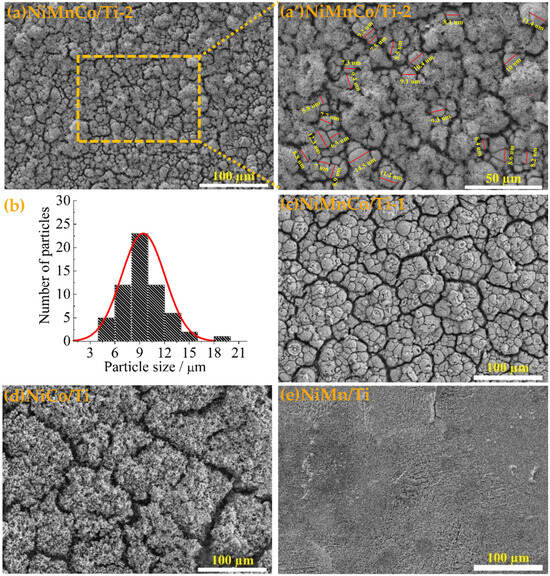
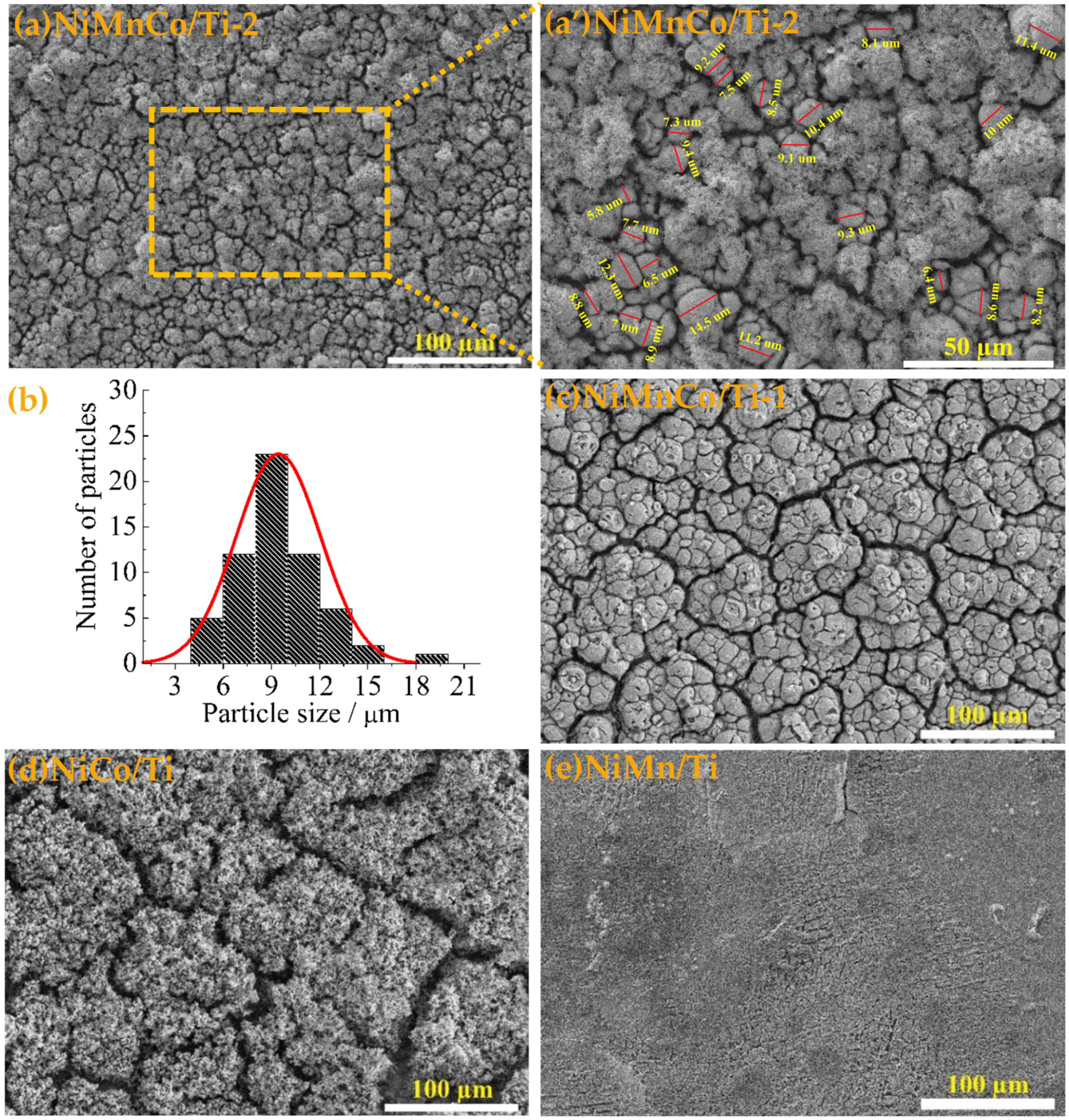
The enhanced electrocatalytic performance and superior long-term stability of the electrodes depend on the intrinsic and synergistic effects of the metal components, as well as their composition and the microstructural morphology of the electrocatalysts. The surface morphology of the optimized electrocatalyst was characterized by scanning electron microscopy (SEM), as shown in Figure 1. The SEM image of the NiMnCo/Ti-2 electrocatalyst reveals a cauliflower curd-shaped microspherical architecture directly deposited on the conductive Ti substrate via a facile one-step electrodeposition method. These densely packed microspheres uniformly cover the entire substrate surface (Figure 1a). A higher-magnification SEM image (Figure 1a’) and the corresponding particle distribution histogram (Figure 1b) further illustrate the distinct individual microspheres, each with diameters ranging from approximately 7–14 µm, evenly distributed across the surface.
Figure 1.
SEM images of synthesized 3D trimetallic NiMnCo/Ti-2 (a,a’), the particle size distribution histogram for 3D NiMnCo/Ti-2 electrocatalyst (b), 3D trimetallic NiMnCo/Ti-1 electrocatalysts (c), and bimetallic NiCo/Ti (d) and NiMn/Ti (e) catalyst samples.
Although the electrodeposition method using the DHBT technique is well known for the fabrication of micro/nano-porous foam/film-like architectures, it can actually generate a range of microstructures depending on how hydrogen bubbles nucleate, grow, coalesce, and detach during deposition. Therefore, electrodeposition using DHBT is a highly controlled, dynamic structure-directing process. In this study, relatively low current densities (50 and 100 mA cm−2) were applied deliberately to fabricate relatively compact (dense) structures by minimizing hydrogen bubble templating effects and promoting uniform nucleation across the surface.
The NiMnCo/Ti-1 electrocatalyst also exhibits a similar microspherical morphology; however, the grains appear less well-defined and more integrated into larger aggregates, as observed in Figure 1c. In contrast, the bimetallic NiCo/Ti sample shows a rough and porous clustered surface with finer granularity within each cluster (Figure 1d). Meanwhile, the NiMn/Ti electrode displays an uneven surface texture with noticeable variations in roughness (Figure 1e).
The ICP-OES analysis was used to determine the metal loadings of the synthesized electrocatalysts, and the results are summarized in Table 2. The 3D ternary NiMnCo/Ti-1 and NiMnCo/Ti-2 electrocatalysts contained approximately 15.7–19.6 wt.% Ni, 20.4–27.8 wt.% Mn, and 52.6–63.8 wt.% Co.
Table 2.
The metal loadings of different catalysts determined by ICP-OES analysis.
The individual metal loadings in the fabricated two-component and three-component electrocatalysts are subject to three critical criteria: reduction potential, complexation, and total ionic concentration of the solution baths. For example, the reduction potentials of Nickel (II) and cobalt (II) are comparable (−0.25 V and −0.28 V vs. SHE, respectively), but Nickel (II) forms a more stable ammine complex than cobalt (II), reducing the free Ni2+ concentration available for deposition. As a result, Co-loading dominates in the NiCo/Ti catalyst. Despite identical electrodeposition conditions, NiMnCo/Ti-2 shows slightly higher total metal loading than NiMnCo/Ti-1, with slightly lower but still comparable Co loading due to Ni’s more favorable deposition behavior.
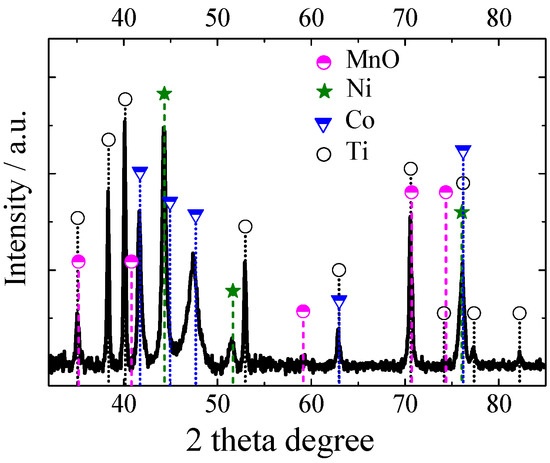
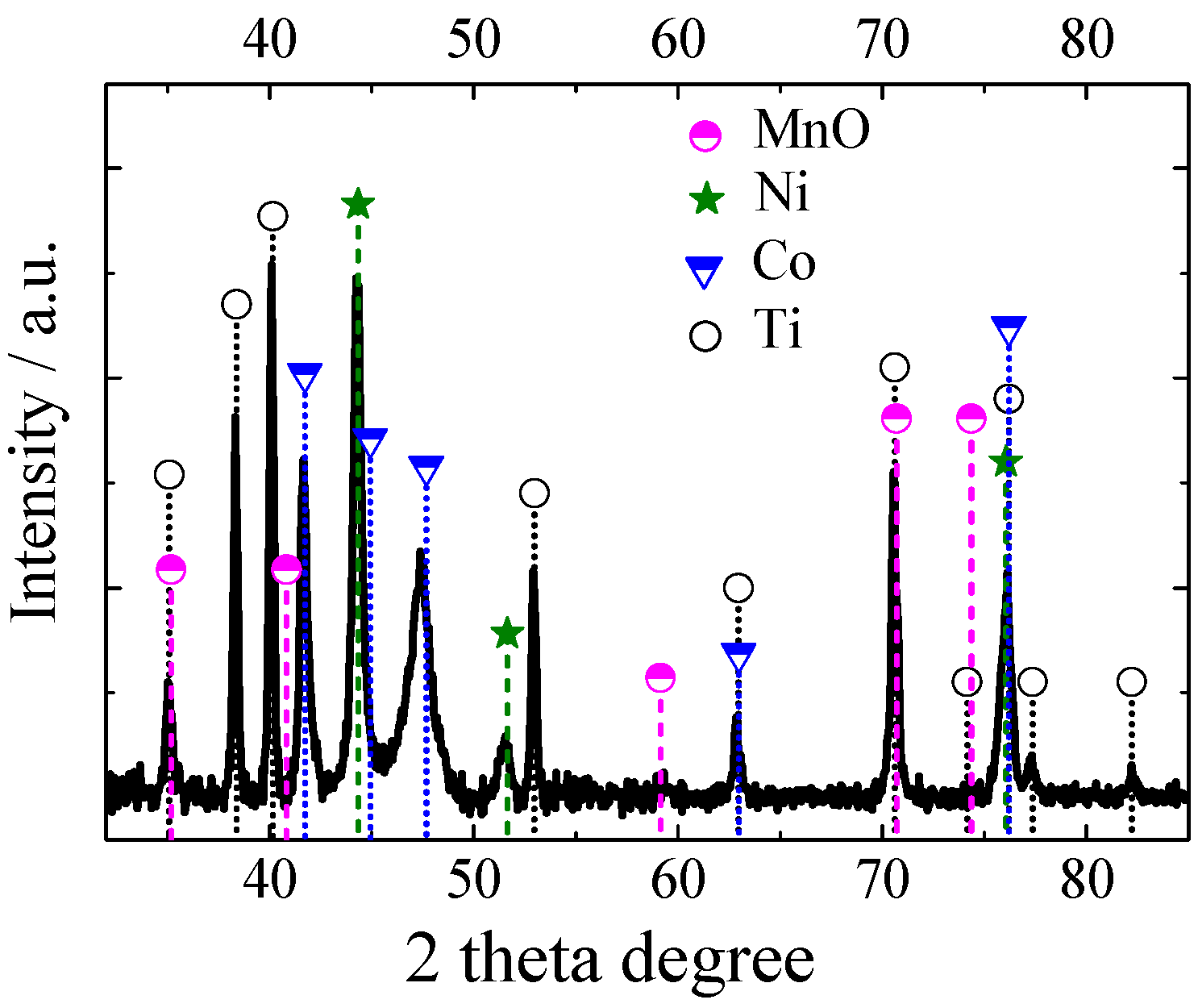
The crystal structure of the NiMnCo foam coating deposited on the Ti substrate was analyzed using X-ray diffraction (XRD). Figure 2 shows the XRD pattern of the NiMnCo/Ti-2 catalyst. As seen, the XRD pattern shows several distinct features that reflect both the porous metallic coating and the underlying substrate. The diffraction peaks of the face-centered cubic (fcc) phase of crystalline Ni (COD card No. 2100640, a = 3.5359 Å, space group Fm-3m) with 2θ of 44.3°, 51.6°, and 76.0°, corresponding to (111), (200), and (220) planes of crystalline Ni.
Figure 2.
XRD pattern of 3D NiMnCo/Ti-2 electrocatalyst. Symbols indicate positions of the XRD peaks of Ti (COD. No. 9008517), Ni (COD card No. 2100640), MnO (COD card No. 1010898), and Co (COD card No. 1512501).
Moreover, the pattern displayed peaks that corresponded to the phases of hexagonal close-packed (hcp) Co and fcc MnO. The Co peak was detected at 2θ approximately 47.7°, which is indexed to the (101) crystal plane (COD card No. 1512501, a = 2.4968 Å, c = 4.0308 Å, space group P 63/m m c), while the MnO peaks were observed at 2θ approximately 35.1°, 40.8°, 59.1°, and 70.7°, which are indexed to the (111), (200), (220), and (311) crystal planes, respectively (COD card No. 1010898, a = 4.415 Å, space group Fm-3m). Notably, the most abundant phase, as determined by XRD peak intensities, also includes contributions from the underlying Ti surface and corresponds to hcp titanium, exhibiting diffraction peaks at 2θ approximately 35.0°, 38.4°, 40.2°, 52.9°, 62.9°, 76.2°, 70.6°, 77.3° and 82.3°, which are in good agreement with the phase of Ti (COD card No. 9008517, a = 2.95 Å, c = 4.686 Å, space group P 63/m m c), corresponding to the lattice planes of (100), (002), (101), (102), (210), (103), (212), and (004), respectively. The XRD pattern indicates a predominantly nanocrystalline Ni-based solid solution structure, where Mn and Co are incorporated into the Ni lattice.
3.2. Electrocatalytic Investigations for HER
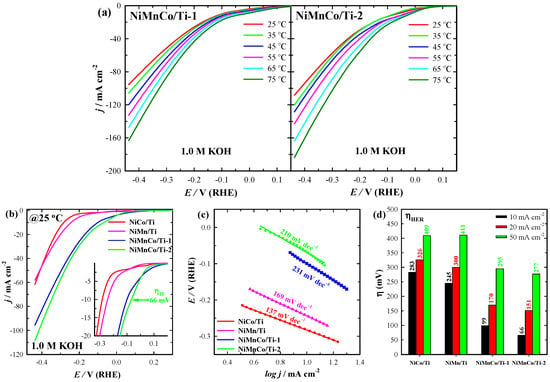
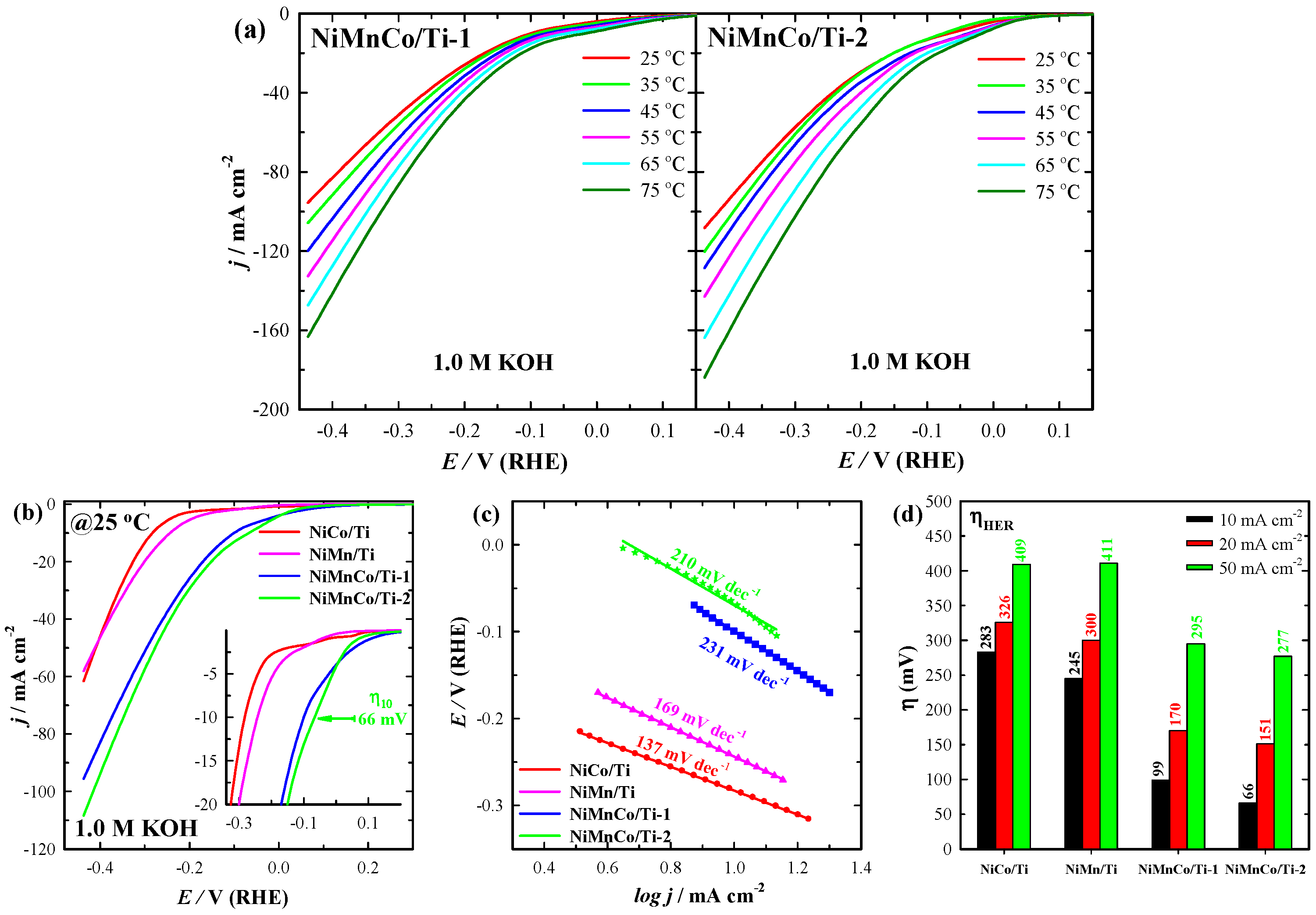
The electrocatalytic HER performance of the fabricated catalysts was initially investigated in an Ar-saturated alkaline medium (1.0 M KOH) by recording LSVs using a three-electrode electrochemical cell. An LSV investigation of as-prepared electrocatalysts was carried out at a potential scan rate of 10 mV s−1 from open-circuit potential (OCP) to −0.43 V (vs. RHE) in a temperature range from 25 °C to 75 °C, as shown in Figure 3a. Both electrodes were prepared at least three times using each respective solution bath, and the LSV analysis was conducted; the obtained results were recorded for each electrode to check the repeatability of performance.
Figure 3.
HER polarization curves of 3D NiMnCo/Ti catalysts in 1.0 M KOH at 10 mV s−1 potential scan rate and 25 to 75 °C temperature range (a). LSVs at 25 °C along with sample catalysts (b), the corresponding extracted Tafel plots (c), and the required overpotentials to reach the current densities of 10, 20 and 50 mA cm−2 (d).
The corresponding HER polarization curve of the self-supported 3D NiMnCo/Ti-2 catalyst clearly demonstrated enhanced catalytic activity over the NiMnCo/Ti-1 electrode, as different molar ratios of Co2+ ions (Table 1) in the solution baths and resultant variable Co-loading on both electrocatalysts (Table 2) strongly determine electrocatalytic performance. The current density increased ca. 1.7 times with the increase in temperature from 25 °C to 75 °C for both electrodes.
The polarization curves of the fabricated 3D NiMnCo/Ti-1, NiMnCo/Ti-2 electrocatalysts, along with two bimetallic catalyst samples, NiMn/Ti and NiCo/Ti (for comparison), were recorded at 25 °C and exhibited in Figure 3b.
The LSV plots demonstrated in Figure 3b were used to extract the corresponding Tafel plots for those fabricated electrodes and samples. The Tafel slope is a pivotal parameter in determining the electrochemical kinetics and the rate-determining step of a reaction. As shown in Figure 3c, the Tafel slope values were found to be 210, 231, 169 and 137 mV dec−1 for the synthesized 3D ternary NiMnCo/Ti-1, NiMnCo/Ti-2 electrocatalysts, and binary NiMn/Ti and NiCo/Ti sample electrodes, respectively. Moreover, the elevation of the column bars exhibited in Figure 3d denoted the required overpotentials to achieve the benchmark current densities of 10, 20, and 50 mA cm−2.
As demonstrated in Figure 3d, the NiMnCo/Ti-2 electrocatalyst exhibits superior HER activity in alkaline electrolyte (1.0 M KOH) with the required lowest overpotential of 66 mV to attain the benchmark current density of 10 mA cm−2 at 25 °C. Nevertheless, the electrocatalytic activity of NiMnCo/Ti-2 electrocatalyst outperforms its respective NiMnCo/Ti-1 electrocatalyst (η10 = 99 mV) and both fabricated binary NiMn/Ti (η10 = 245 mV) and NiCo/Ti (η10 = 283 mV) sample electrodes (Table 3). The data presented above indicate that the synthesized NiMnCo/Ti electrocatalysts, particularly NiMnCo/Ti-2, rank among the most effective Ni-based catalysts for HER, outperforming or showing comparable performance to the latest non-precious metal-based HER catalysts in alkaline media (Table 4).
Table 3.
Summarized electrochemical data of the investigated catalysts toward HER in alkaline media (1.0 M KOH).
Table 4.
Three-electrode water-splitting HER performance with recently reported state-of-the-art non-noble metal electrocatalysts in alkaline electrolyte (1.0 M KOH).
Though both binder-free, self-supported 3D NiMnCo/Ti-1 and NiMnCo/Ti-2 electrocatalysts exhibited outstanding performances as electrocatalysts towards HER in alkaline media using freshwater (DI water), thorough investigations were carried out to explore their electrocatalytic performance in more practical, feasible and natural resource-based seawater media. For the investigation, an artificial or mimic seawater electrolyte was formulated with a similar salinity (0.5~0.6 M) to that of natural seawater using 0.5 M NaCl with 1.0 M KOH (herein, simulated seawater, SSW), and alkaline seawater was prepared using natural seawater, as mentioned above (Section 2.3).
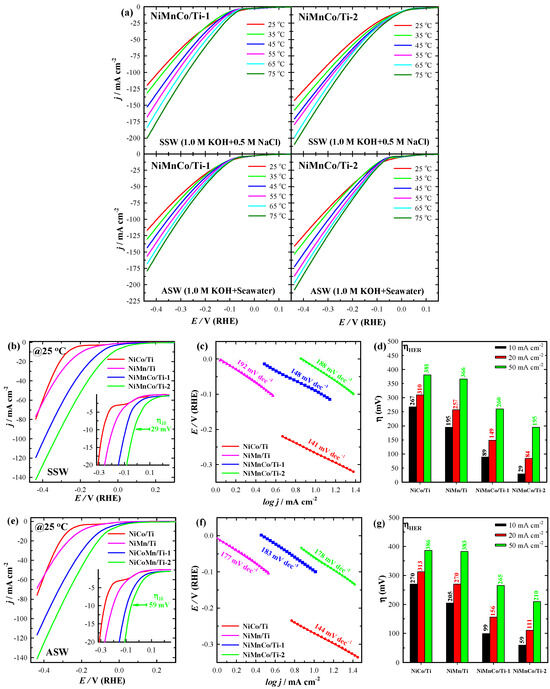
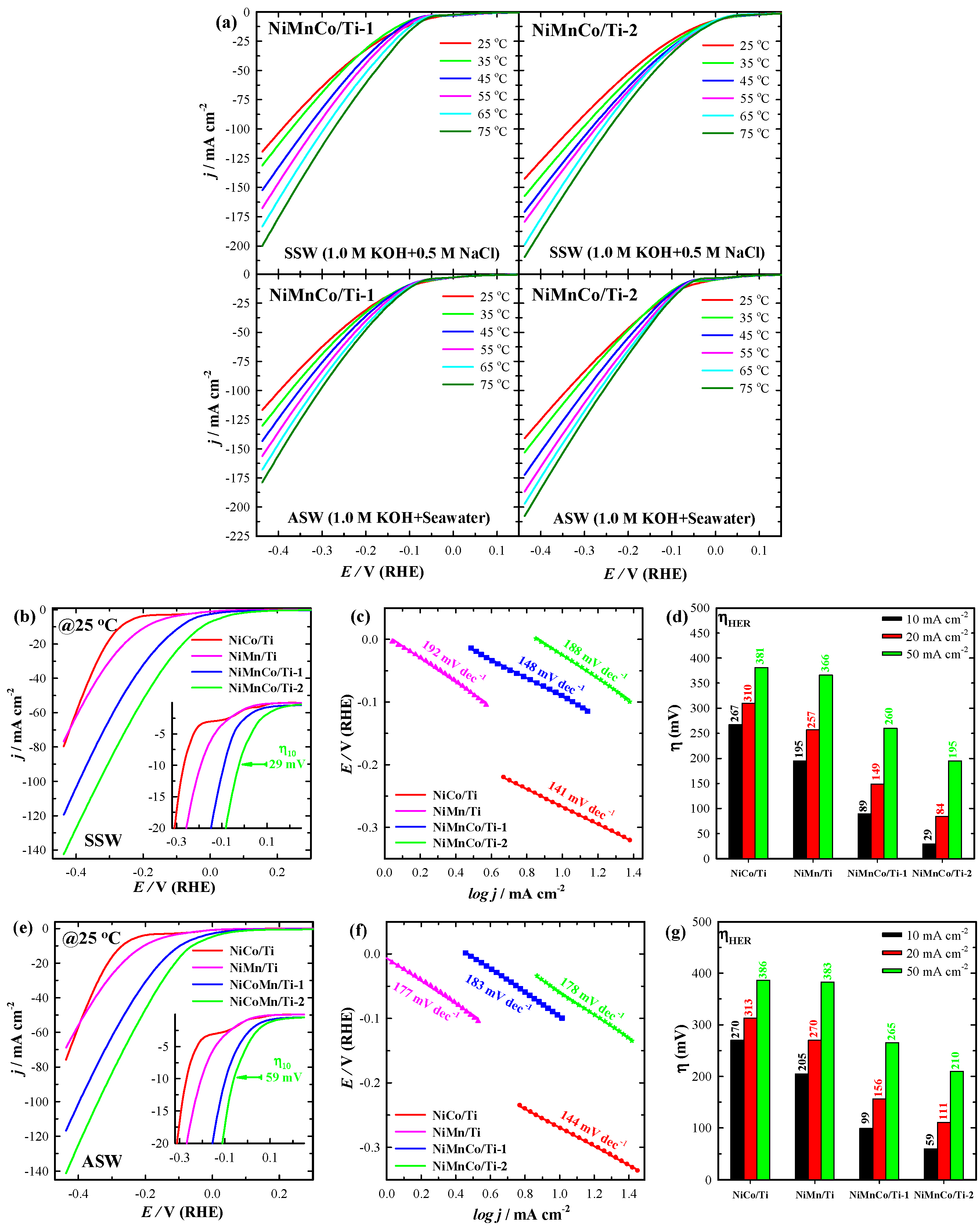
The electrocatalytic HER performance of the catalysts was evaluated by recording linear sweep voltammograms in Ar-deaerated SSW and ASW individually at a potential scan rate of 10 mV s−1 from open-circuit potential (OCP) to −0.43 V (vs. RHE) in a temperature range from 25 °C to 75 °C, as shown in Figure 4a. The reproducibility of the results was verified via monitoring LSVs of multiple (at least three) electrodes fabricated from identical bath solutions. Figure 4b shows the LSV curves of the obtained electrocatalysts and samples at 25 °C, from which the overpotentials achieved at different current densities can be determined in SSW. An impressive HER performance by the synthesized NiMnCo/Ti-2 electrocatalyst was recorded in formulated SSW requiring an ultra-low overpotential of 29 mV to reach the benchmark current density of 10 mA cm−2 (Table 5), which outperforms fabricated 3D NiMnCo/Ti-1 (η10 = 89 mV), NiMn/Ti (η10 = 195 mV) and NiCo/Ti (η10 = 267 mV) electrocatalysts. Furthermore, we also explored the Tafel slope of all fabricated electrocatalysts and catalyst samples, as shown in Figure 4c. The optimized NiMnCo/Ti-2 electrocatalyst presents a Tafel slope of 188 mV dec−1, whereas NiMnCo/Ti-1, NiMn/Ti and NiCo/Ti have Tafel slopes of 148, 192 and 141 mV dec−1, respectively. From the LSV curves, the overpotentials of each electrode to reach current densities of 10, 20, and 50 mA cm−2 in SSW were calculated, as exhibited with column bars in Figure 4d.
Figure 4.
HER polarization curves of 3D NiMnCo/Ti electrocatalysts in SSW and ASW at a potential scan rate of 10 mV s−1 in 25 to 75 °C temperature range (a), LSVs at only 25 °C temperature along with sample-catalysts (b,e), the corresponding extracted Tafel plots (c,f) and the required overpotentials to reaching the current densities of 10, 20 and 50 mA cm−2 (d,g) in SSW and ASW, respectively.
Table 5.
Summarized electrochemical data of the investigated catalysts toward HER in simulated seawater, SSW (1.0 M KOH + 0.5 M NaCl).
Comparing the HER activity in SSW, the polarization curves in ASW were also summarized and depicted in Figure 4e, at 25 °C, where the recorded current densities were marginally declined. Corresponding Tafel slopes of each electrode were extracted using the LSV plots and are demonstrated in Figure 4f. Tafel slope values of 178, 183, 177 and 144 mV dec−1 were derived for NiMnCo/Ti-2, NiMnCo/Ti-1, NiMn/Ti and NiCo/Ti, respectively (Table 6). The optimized NiMnCo/Ti-2 electrocatalyst demonstrated outstanding catalytic performance in adverse ASW, as the overpotential demand to attain the benchmark current densities of 10, 20, and 50 mA cm−2 was only 59, 111 and 210 mV, respectively. The comparison bar chart, as presented in Figure 4g, comprehensibly proves the astounding performance of the NiMnCo/Ti-2 electrocatalyst outperforming its respective synthesized electrodes. The data obtained in simulated or alkaline natural seawater (Table 7) suggest that the NiMnCo/Ti-2 electrocatalysts remain among the most effective Ni-based HER catalysts, performing on par with or even surpassing recent non-precious metal-based alternatives.
Table 6.
Summarized electrochemical data of the investigated catalysts toward HER in alkaline seawater, ASW (1.0 M KOH + natural seawater).
Table 7.
Comparison of three-electrode electrocatalytic HER performance of as-synthesized electrocatalyst in simulated/alkaline natural seawater with recently reported state-of-the-art non-noble metal electrocatalysts.
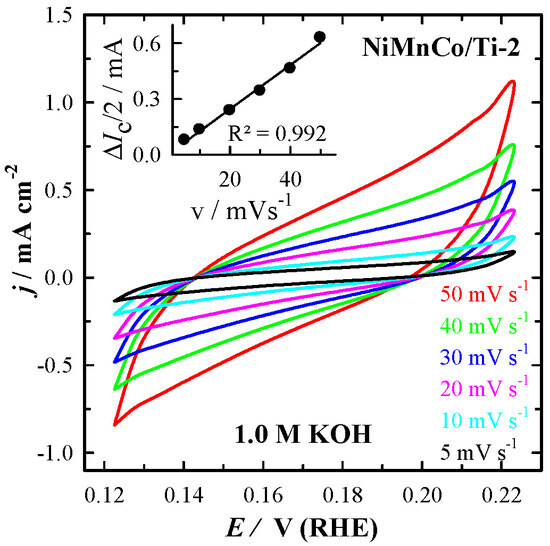
Furthermore, the electrochemically active surface area (ECSA) of the synthesized 3D NiMnCo/Ti-2 electrocatalyst was determined from the measurements of double-layer capacitance (Cdl) by recording CV curves in the 1.0 M KOH solution at various scan rates (5–50 mV s−1) in the non-faradaic region from 0.122 V to 0.232 V (vs. RHE) (Figure 5).
Figure 5.
CVs of NiMnCo/Ti-2 in N2-saturated 1.0 M KOH in the non-faradaic potential region at different scan rates. The inset represents capacitive current as a function of scan rate.
The charging current, Ic, of the electrodes at each scan rate was determined from the CVs via Equation (2):
Ic [A] = (Ianodic − Icathodic)OCP
Cdl values were evaluated by plotting a graph of charging current vs. scan rate and calculating the slope, as shown by Equation (3):
Slope = Cdl [F] = ΔIc [A]/Δν [V s−1]
Subsequently, the ECSA value for the optimized NiMnCo/Ti-2 electrocatalyst was calculated using the specific capacitance (Cs) value of 40 μF cm−2 [75] and Equation (4):
ECSA [cm2] = Cdl [μF]/Cs [μF cm−2]
RF = ECSA [cm2]/Ageo [cm2]
Cdl was found to be 11.88 mF, and the calculated ECSA value for NiMnCo/Ti-2 was 297 cm2, which is significantly larger than the geometric area (Ageo = 2 cm2) of the catalyst. Furthermore, the roughness factor (RF), calculated according to Equation (5), was 148.5, indicating a highly developed and roughened surface. This enhanced surface development suggests an increased density of electrochemically accessible active sites, which contributes to the improved electrocatalytic performance toward HER.
The enhanced HER performance of the NiMnCo/Ti-2 catalyst can be attributed to the synergistic interaction between Ni, Mn, and Co. Ni serves as the primary active site for hydrogen adsorption/desorption in alkaline media, while Mn facilitates OH− adsorption and removal from the active sites. Co improves electrical conductivity and accelerates water dissociation kinetics. From an energetic perspective, this synergy can be further understood in terms of the Gibbs free energy of hydrogen adsorption (ΔGH*), which is a key descriptor of HER activity. The benchmark HER electrode, Pt, has a ΔGH* value close to zero. The ΔGH* ≈ 0 eV indicates optimal H-binding on the catalyst surface, whereas ΔGH* < 0 suggests that H binds too strongly, slowing H2 desorption, and ΔGH* > 0 makes H-adsorption too difficult. As a result of the synergistic interaction, the ternary Ni-Mn-Co system brings ΔGH* closer to the optimal value (~0 eV): Ni provides primary hydrogen adsorption sites, Mn facilitates water dissociation, and Co promotes hydrogen recombination and desorption, collectively tuning the hydrogen adsorption free energy (ΔGH*) toward near-optimal values, thereby enhancing HER performance. Although Tafel slopes are higher in ASW and 1 M KOH due to additional kinetic barriers, such as mass transport limitations and multi-step proton/electron transfer, the combination of Ni-Mn-Co synergy and the 3D porous morphology ensures abundant active sites and efficient HER kinetics. Furthermore, the trimetallic system redistributes electrons and tunes the surface electronic structure to optimize reaction energetics. Ni has a relatively high d-band center and is more electronegative than Mn and Co, promoting strong H adsorption; the combination with Mn and Co shifts Ni’s d-band center downward, rendering the hydrogen adsorption step near thermoneutral and accelerating the overall kinetics. While the chlorine evolution reaction (ClER) is a key competing process in alkaline seawater electrolysis, it was not experimentally evaluated in this study. We note that in the Ni-Mn-Co system, Ni favors OER, and Mn incorporation is expected to reduce Cl− adsorption, potentially suppressing ClER; however, direct experimental confirmation is beyond the scope of this work.
3.3. Electrocatalytic Stability Studies for HER
The stability of electrocatalysts is crucial because it affects not only the efficiency but also the long-term economic viability, cost-effectiveness and scalability of industrial applications via electrochemical processes. As the direct electrolysis of seawater as a hydrogen source offers significant financial and environmental benefits compared to freshwater, seawater splitting faces major challenges due to the complex and harsh electrolyte conditions of seawater, including high salinity, the presence of chloride ions (Cl−), and other impurities leading to catalyst deactivation. This can seriously contribute to compromising the long-term durability of the electrode materials due to surface passivation and leaching. A stable catalyst ensures the desired reactions take place at a consistent rate for an extended period of time. Hence, the catalysts’ activity and selectivity should be maintained under reaction conditions for a longer time span without substantial degradation or deactivation.
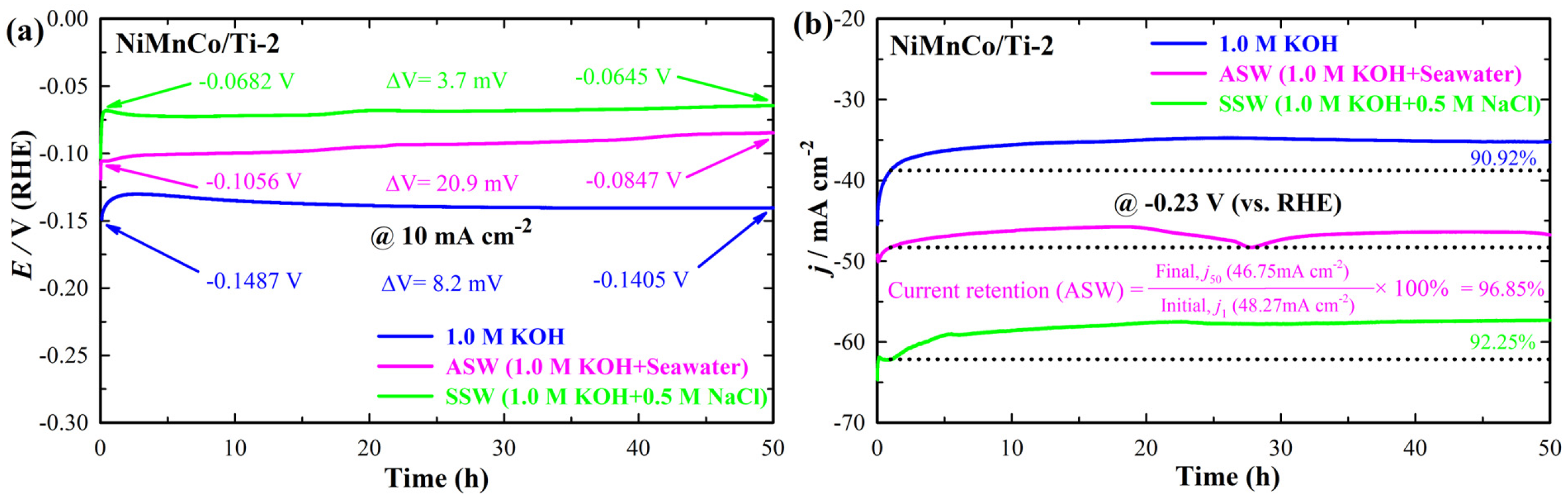
To address this critical factor and to evaluate the applicability of as-synthesized electrocatalysts for practical use with enhanced longevity, the stability of the optimized NiMnCo/Ti-2 catalyst was investigated by long-time operation assessments under all three reaction conditions. The durability of the optimized NiMnCo/Ti-2 electrocatalyst was evaluated by conducting long-time chronopotentiometry (CP) at a fixed current density of 10 mA cm−2 and chronoamperometry (CA) at a constant potential of −0.23 V (vs. RHE) for 50 h at 25 °C. Nevertheless, a multi-step CP analysis with current densities ranging from 20 mA cm−2 to 100 mA cm−2 was also carried out in 1.0 M KOH and simulated seawater for 18 h to prove the robust nature, sustainable durability and suitability of the synthesized catalyst for practical seawater-splitting applications. The findings, as demonstrated in Figure 6a, indicate that the NiMnCo/Ti-2 electrocatalyst exhibits superior electrocatalytic stability by chronopotentiometric analysis at a constant current density of 10 mA cm−2 for 50 h in an alkaline medium, ASW and SSW. It is noteworthy that the CP investigation performed in SSW results in an insignificant potential decline of only 3.7 mV after 50 h of continuous operation, whereas modest 8.2 mV and 20.9 mV potential fluctuations were recorded in 1.0 M KOH and ASW electrolyte, respectively.
Figure 6.
Chronopotentiometry (a) and chronoamperometry (b) plots of optimized NiMnCo/Ti-2 electrocatalyst at a constant current density of 10 mA cm−2 and at a fixed potential of −0.23 V (vs. RHE) for 50 h in 1.0 M KOH, alkaline seawater and simulated seawater, respectively.
Figure 6b illustrates the chronoamperometric investigations of the optimized NiMnCo/Ti-2 electrocatalyst at a static potential of −0.23 V (vs RHE) for 50 h in all three electrolytes where ca. 91%–97% of the current density was retained throughout the investigations. Such a negligible decline in current densities indicates that the electrocatalyst remained in good structural conditions without major corrosion and degradation even under aggressive seawater media.
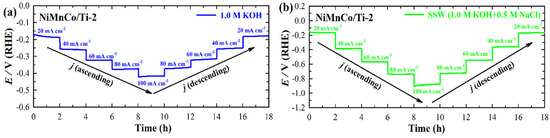
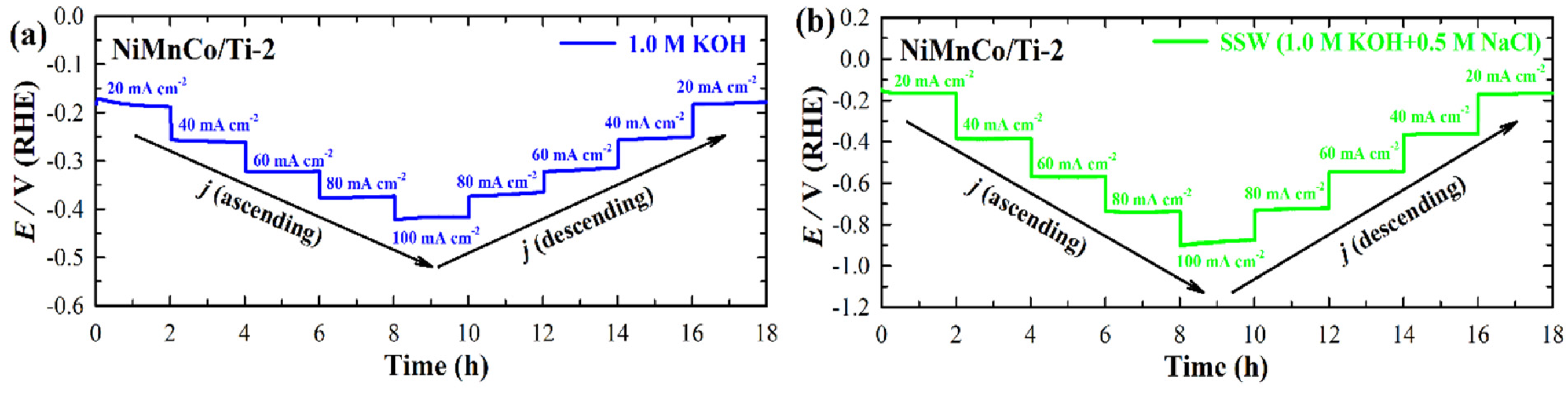
Finally, the long-term durability of the prepared optimized NiMnCo/Ti-2 electrocatalyst was investigated by multi-step chronopotentiometric investigations under alkaline media (Figure 7a) and SSW electrolyte (Figure 7b) to examine the longevity and scope of practical use for seawater electrolysis. These chronopotentiometric investigations were carried out by applying variable current densities (within a 2 h interval) from 20 mA cm−2 to 100 mA cm−2 for 18 h in consecutive ascending-descending order. The recorded results also vividly highlight the exceptional long-term stability and structural integrity of the optimized NiMnCo/Ti-2 electrocatalyst in these comparably adverse conditions.
Figure 7.
A multi-step chronopotentiometric analysis of optimized NiMnCo/Ti-2 electrocatalyst in 1.0 M KOH (a) and SSW (b) with variable current densities from 20 mA cm−2 to 100 mA cm−2 for 18 h.
The NiMnCo/Ti-2 catalyst exhibits Tafel slopes of 118 mV dec−1 in simulated seawater (SSW), 178 mV dec−1 in alkaline seawater (ASW), and 210 mV dec−1 in 1 M KOH. While the Volmer step is typically rate-determining at ~120 mV dec−1, the higher slopes observed in ASW and KOH reflect additional kinetic limitations, likely arising from mass transport effects, surface morphology, and multi-step electron/proton transfer processes. The electrochemically active surface area (ECSA), calculated from the double-layer capacitance (Cdl = 11.88 mF), is 297 cm2, substantially exceeding the geometric area of 2 cm2, confirming the formation of a highly accessible 3D porous structure via the DHBT electrodeposition process. Long-term stability tests, including chronoamperometry and chronopotentiometry for up to 50 h, show negligible current decay and no visible structural degradation, indicating that corrosion or leaching is minimal. Although the NiMnCo/Ti-2 electrocatalyst exhibits excellent structural integrity and negligible current decay under all tested conditions, trace leaching of metals such as Mn cannot be entirely ruled out, particularly under prolonged exposure to chloride-rich seawater. This represents a potential limitation for long-term applications and warrants further investigation. Collectively, the combination of the 3D morphology, high ECSA, and synergistic interactions among Ni, Mn, and Co accounts for the excellent HER kinetics and outstanding durability of NiMnCo/Ti-2 in both alkaline and seawater electrolytes.
4. Conclusions
In conclusion, we have developed a low-cost Ni-Mn-Co electrocatalyst via a simple one-step DHBT electrodeposition on a 3D titanium substrate, producing a highly accessible 3D cauliflower-like microspherical architecture. The optimized NiMnCo/Ti-2 electrode exhibits outstanding HER performance in alkaline, simulated seawater (SSW), and alkaline seawater (ASW), achieving ultra-low overpotentials of 66, 59, and 29 mV at 10 mA cm−2 and reaching 50 mA cm−2 at 277, 210, and 195 mV, respectively. The exceptional activity is attributed to the synergistic interactions among Ni, Mn, and Co, combined with the significantly enhanced electrochemically active surface area (ECSA = 297 cm2), which ensures a high density of accessible active sites. Long-term stability tests demonstrate that the NiMnCo/Ti-2 electrode retains above 90% of its initial current over 50 h, with minimal potential fluctuations, even under multi-step chronopotentiometry at high and variable current densities. Slight instabilities in ASW are ascribed to minor surface precipitates and electrolyte impurities, but the overall durability remains robust.
These results highlight that the NiMnCo/Ti-2 electrode is not only highly efficient and durable but also cost-effective, representing a promising candidate for large-scale green hydrogen production from real seawater. Its facile fabrication approach and excellent catalytic performance provide a compelling platform for the practical implementation of sustainable hydrogen generation technologies.
Author Contributions
Writing—original draft preparation, S.B.; methodology, S.B., D.U. and J.V.; formal analysis, S.B.; investigation, S.B., D.U. and. J.V.; data curation, L.T.-T.; writing—review and editing, E.N. and A.B.; visualization, L.T.-T.; supervision, A.B.; conceptualization, A.B. and E.N. All authors have read and agreed to the published version of the manuscript.
Funding
This research received no external funding.
Institutional Review Board Statement
Not applicable.
Informed Consent Statement
Not applicable.
Data Availability Statement
The data presented in this study are available on request from the corresponding author.
Conflicts of Interest
The authors declare no conflicts of interest.
Abbreviations
The following abbreviations are used in this manuscript:
| 3D | Three-dimensional |
| ASW | Alkaline Seawater (1.0 M KOH + natural seawater) |
| CA | Chronoamperometry |
| ClER | Chlorine Evolution Reaction |
| CP | Chronopotentiometry |
| CV | Cyclic Voltammetry |
| DHBT | Dynamic Hydrogen Bubble Template |
| DI | Deionized water |
| ECSA | Electrochemically active surface area |
| EJ | Exajoule (1018 Joules) |
| HER | Hydrogen Evolution Reaction |
| ICP-OES | Inductively Coupled Plasma Optical Emission Spectroscopy |
| LSV | Linear Sweep Voltammetry |
| OCP | Open Circuit Potential |
| OER | Oxygen Evolution Reaction |
| RHE | Reversible Hydrogen Electrode |
| SCE | Saturated Calomel Electrode |
| SEM | Scanning Electron Microscopy |
| SSW | Simulated Seawater (1.0 M KOH + 0.5 M NaCl) |
| Cdl | Double-layer capacitance |
| Cs | Specific capacitance |
| j | Current density (mA cm−2) |
| η | Overpotential (mV) |
References
- Laimon, M.; Yusaf, T. Towards energy freedom: Exploring sustainable solutions for energy independence and self-sufficiency using integrated renewable energy-driven hydrogen system. Renew. Energy 2024, 222, 119948. [Google Scholar] [CrossRef] [Scilit]
- Yusuf, B.A.; Yaseen, W.; Xie, M.; Zayyan, R.S.; Muhammad, A.I.; Nankya, R.; Xie, J.; Xu, Y. Recent advances in understanding and design of efficient hydrogen evolution electrocatalysts for water splitting: A comprehensive review. Adv. Colloid Interface Sci. 2022, 311, 102811. [Google Scholar] [CrossRef] [Scilit]
- Zhang, H.M.; Li, J. Strategies for overcoming seawater adverse effects on cathodic hydrogen evolution reaction electrocatalysts. Fuel 2024, 367, 131505. [Google Scholar] [CrossRef] [Scilit]
- Loh, J.Y.; Foo, J.J.; Yap, F.M.; Liang, H.; Ong, W.J. Unleashing the versatility of porous nanoarchitectures: A voyage for sustainable electrocatalytic water splitting. Chin. J. Catal. 2024, 58, 37–85. [Google Scholar] [CrossRef] [Scilit]
- Sun, H.; Xu, X.; Kim, H.; Jung, W.; Zhou, W.; Shao, Z. Electrochemical water splitting: Bridging the gaps between fundamental research and industrial applications. Energy Environ. Mater. 2022, 6, e12441. [Google Scholar] [CrossRef] [Scilit]
- Gong, Y.; Yao, J.; Wang, P.; Li, Z.; Zhou, H.; Xu, C. Perspective of hydrogen energy and recent progress in electrocatalytic water splitting. Chin. J. Chem. Eng. 2022, 43, 282–296. [Google Scholar] [CrossRef] [Scilit]
- Lv, X.W.; Tian, W.W.; Yuan, Z.Y. Recent advances in high-efficiency electrocatalytic water splitting systems. Electrochem. Energy Rev. 2023, 6, 23. [Google Scholar] [CrossRef] [Scilit]
- Bamba, J.N.; Dumlao, A.T.; Lazaro, R.M.; Matienzo, D.D.; Ocon, J. Green Hydrogen from Seawater Electrolysis: Recent Developments and Future Perspectives. Curr. Opin. Electrochem. 2024, 48, 101592. [Google Scholar] [CrossRef] [Scilit]
- Yang, F.; Luo, Y.; Yu, Q.; Zhang, Z.; Zhang, S.; Liu, Z.; Ren, W.; Cheng, H.M.; Li, J.; Liu, B. A durable and efficient electrocatalyst for saline water splitting with current density exceeding 2000 mA cm−2. Adv. Funct. Mater. 2021, 31, 2010367. [Google Scholar] [CrossRef] [Scilit]
- van Renssen, S. The hydrogen solution? Nat. Clim. Change 2020, 10, 799–801. [Google Scholar] [CrossRef] [Scilit]
- IEA. The Future of Hydrogen, IEA, Paris. 2019. Available online: https://www.iea.org/reports/the-future-of-hydrogen (accessed on 1 April 2026).
- British Petroleum. Statistical Review of World Energy 2021. 2021. Available online: https://www.bp.com/content/dam/bp/business-sites/en/global/corporate/pdfs/energy-economics/statistical-review/bp-stats-review-2021-full-report.pdf (accessed on 1 April 2026).
- Li, X.P.; Huang, C.; Han, W.K.; Ouyang, T.; Liu, Z.Q. Transition metal-based electrocatalysts for overall water splitting. Chin. Chem. Lett. 2021, 32, 2597–2616. [Google Scholar] [CrossRef] [Scilit]
- IEA. Global Hydrogen Review 2021, IEA, Paris. 2021. Available online: https://www.iea.org/reports/global-hydrogen-review-2021 (accessed on 1 April 2026).
- Robiou du Pont, Y.; Jeffery, M.L.; Gütschow, J.; Rogelj, J.; Christoff, P.; Meinshausen, M. Equitable mitigation to achieve the Paris Agreement goals. Nat. Clim. Change 2017, 7, 38–43. [Google Scholar] [CrossRef] [Scilit]
- Woods, P.; Bustamante, H.; Aguey-Zinsou, K.F. The hydrogen economy—Where is the water? Energy Nexus 2022, 7, 100123. [Google Scholar] [CrossRef] [Scilit]
- Chatenet, M.; Pollet, B.G.; Dekel, D.R.; Dionigi, F.; Deseure, J.; Millet, P.; Braatz, R.D.; Bazant, M.Z.; Eikerling, M.; Staffell, I.; et al. Water electrolysis: From textbook knowledge to the latest scientific strategies and industrial developments. Chem. Soc. Rev. 2022, 51, 4583–4762. [Google Scholar] [CrossRef] [Scilit]
- IEA. Net Zero by 2050: A Roadmap for the Global Energy Sector, IEA, Paris. 2021. Available online: https://www.iea.org/reports/net-zero-by-2050 (accessed on 1 April 2026).
- U.S. Department of Energy. US National Clean Hydrogen Strategy and Roadmap. Available online: https://www.hydrogen.energy.gov/docs/hydrogenprogramlibraries/pdfs/us-national-clean-hydrogen-strategy-roadmap.pdf?sfvrsn=c425b44f_5 (accessed on 1 April 2026).
- U.S. Department of Energy (DOE). Available online: https://www.energy.gov/sites/default/files/2021-06/factsheet-hydrogen-shot-introduction.pdf (accessed on 1 April 2026).
- Kumar, P.; Date, A.; Mahmood, N.; Das, R.K.; Shabani, B. Freshwater supply for hydrogen production: An underestimated challenge. Int. J. Hydrogen Energy 2024, 78, 202–217. [Google Scholar] [CrossRef] [Scilit]
- Beswick, R.R.; Oliveira, A.M.; Yan, Y. Does the green hydrogen economy have a water problem? ACS Energy Lett. 2021, 6, 3167–3169. [Google Scholar] [CrossRef] [Scilit]
- Oliveira, A.M.; Beswick, R.R.; Yan, Y. A green hydrogen economy for a renewable energy society. Curr. Opin. Chem. Eng. 2021, 33, 100701. [Google Scholar] [CrossRef] [Scilit]
- Jiao, S.; Fu, X.; Wang, S.; Zhao, Y. Perfecting electrocatalysts via imperfections: Towards the large-scale deployment of water electrolysis technology. Energy Environ. Sci. 2021, 14, 1722–1770. [Google Scholar] [CrossRef] [Scilit]
- Xu, Y.; Wang, C.; Huang, Y.; Fu, J. Recent advances in electrocatalysts for neutral and large-current-density water electrolysis. Nano Energy 2021, 80, 105545. [Google Scholar] [CrossRef] [Scilit]
- Li, Z.; Zhang, X.; Ou, C.; Zhang, Y.; Wang, W.; Dong, S.; Dong, X. Transition metal-based self-supported anode for electrocatalytic water splitting at a large current density. Coord. Chem. Rev. 2023, 495, 215381. [Google Scholar] [CrossRef] [Scilit]
- Wen, Q.; Zhao, Y.; Liu, Y.; Li, H.; Zhai, T. Ultrahigh-current-density and long-term-durability electrocatalysts for water splitting. Small 2022, 18, 2104513. [Google Scholar] [CrossRef] [Scilit] [PubMed]
- Chen, S.; Zhuo, Y.; Wang, X.; Li, S.; Lu, J.; Liu, D.; Pan, H.; Wang, Z. Advances of layered double hydroxide electrocatalysts for high-current-density alkaline water/seawater splitting. Coord. Chem. Rev. 2024, 510, 215832. [Google Scholar] [CrossRef] [Scilit]
- Wang, S.; Yang, P.; Sun, X.; Xing, H.; Hu, J.; Chen, P.; Ciu, Z.; Zhu, W.; Ma, Z. Synthesis of 3D heterostructure Co-doped Fe2P electrocatalyst for overall seawater electrolysis. Appl. Catal. B Environ. 2021, 297, 120386. [Google Scholar] [CrossRef] [Scilit]
- Park, Y.S.; Lee, J.; Jang, M.J.; Yang, J.; Jeong, J.; Park, J.; Kim, Y.; Seo, M.H.; Chen, Z.; Choi, S.M. High-performance anion exchange membrane alkaline seawater electrolysis. J. Mater. Chem. A 2021, 9, 9586–9592. [Google Scholar] [CrossRef] [Scilit]
- Zhang, Z.; Yang, H.; Zhang, F.; Zou, M.; Li, J.C.; Zhang, L.; Hou, P.X.; Shi, C.; Zhang, L.; Cheng, H.M.; et al. Green and efficient electrolysis of seawater using carbon nanotube-based hybrid films. Nano Energy 2024, 123, 109356. [Google Scholar] [CrossRef] [Scilit]
- Dresp, S.; Dionigi, F.; Klingenhof, M.; Strasser, P. Direct electrolytic splitting of seawater: Opportunities and challenges. ACS Energy Lett. 2019, 4, 933–942. [Google Scholar] [CrossRef] [Scilit]
- Tong, W.; Forster, M.; Dionigi, F.; Dresp, S.; Sadeghi Erami, R.; Strasser, P.; Cowan, A.J.; Farràs, P. Electrolysis of low-grade and saline surface water. Nat. Energy 2020, 5, 367–377. [Google Scholar] [CrossRef] [Scilit]
- Dionigi, F.; Reier, T.; Pawolek, Z.; Gliech, M.; Strasser, P. Design criteria, operating conditions, and nickel-iron hydroxide catalyst materials for selective seawater electrolysis. ChemSusChem 2016, 9, 962–972. [Google Scholar] [CrossRef] [Scilit]
- Liu, J.; Duan, S.; Shi, H.; Wang, T.; Yang, X.; Huang, Y.; Wu, G.; Li, Q. Rationally designing efficient electrocatalysts for direct seawater splitting: Challenges, achievements, and promises. Angew. Chem. 2022, 134, e202210753. [Google Scholar] [CrossRef] [Scilit]
- Song, S.; Wang, Y.; Tian, X.; Sun, F.; Liu, X.; Yuan, Y.; Li, W.; Zang, J. S-modified NiFe-phosphate hierarchical hollow microspheres for efficient industrial-level seawater electrolysis. J. Colloid Interface Sci. 2023, 633, 668–678. [Google Scholar] [CrossRef] [Scilit]
- Service, R.F. Seawater splitting could help green hydrogen grow. Science 2023, 379, 1075. [Google Scholar] [CrossRef] [Scilit] [PubMed]
- Sun, F.; Qin, J.; Wang, Z.; Yu, M.; Wu, X.; Sun, X.; Qiu, J. Energy-saving hydrogen production by chlorine-free hybrid seawater splitting coupling hydrazine degradation. Nat. Commun. 2021, 12, 4182. [Google Scholar] [CrossRef] [Scilit] [PubMed]
- Xu, H.; Zhao, Y.; He, G.; Chen, H. Race on engineering noble metal single-atom electrocatalysts for water splitting. Int. J. Hydrogen Energy 2022, 47, 14257–14279. [Google Scholar] [CrossRef] [Scilit]
- Nie, N.; Zhang, D.; Wang, Z.; Ge, S.; Gu, Y.; Yang, B.; Lai, J.; Wang, L. Stable p-block metals electronic perturbation in PtM@CNT (M=Ga, In, Pb and Bi) for acidic seawater hydrogen production at commercial current densities. Appl. Catal. B Environ. 2023, 322, 122100. [Google Scholar] [CrossRef] [Scilit]
- Hansen, J.N.; Prats, H.; Toudahl, K.K.; Secher, N.M.; Chan, K.; Kibsgaard, J.; Chorkendorff, I. Is there anything better than Pt for HER? ACS Energy Lett. 2021, 6, 1175–1180. [Google Scholar] [CrossRef] [Scilit]
- Park, S.; Lee, Y.L.; Yoon, Y.; Park, S.Y.; Yim, S.; Song, W.; Myung, S.; Lee, K.S.; Chang, H.; Lee, S.S.; et al. Reducing the high hydrogen binding strength of vanadium carbide MXene with atomic Pt confinement for high activity towards HER. Appl. Catal. B Environ. 2022, 304, 120989. [Google Scholar] [CrossRef] [Scilit]
- Guo, X.; Zhang, H.; Shen, Z.; Liu, X.; Xia, W.; Ma, M.; Cao, D. Construction and prospect of noble metal-based catalysts for proton exchange membrane water electrolyzers. Small Struct. 2023, 4, 2300081. [Google Scholar] [CrossRef] [Scilit]
- Jesudass, S.C.; Surendran, S.; Moon, D.J.; Shanmugapriya, S.; Kim, J.Y.; Janani, G.; Veeramani, K.; Mahadik, S.; Kim, I.G.; Jung, P.; et al. Defect engineered ternary metal spinel-type Ni-Fe-Co oxide as bifunctional electrocatalyst for overall electrochemical water splitting. J. Colloid Interface Sci. 2024, 663, 566–576. [Google Scholar] [CrossRef] [Scilit]
- Luo, Z.; Peng, Q.; Huang, Z.; Wang, L.; Yang, Y.; Dong, J.; Isimjan, T.T.; Yang, X. Fine-tune d-band center of cobalt vanadium oxide nanosheets by N-doping as a robust overall water splitting electrocatalyst. J. Colloid Interface Sci. 2023, 629, 111–120. [Google Scholar] [CrossRef] [Scilit]
- Gao, Z.; Wang, T.; Zeng, Z.; Guo, Z.; Xu, X.; Li, Y.; Lin, L.; Jia, R.; Han, S. Effect of oxygen vacancy on electrochemical performance of NiCo-layered double oxides as water splitting electrocatalyst. J. Alloys Compd. 2023, 963, 171273. [Google Scholar] [CrossRef] [Scilit]
- Ge, S.; Shen, X.; Gao, J.; Ma, K.; Zhao, H.; Fu, R.; Feng, C.; Zhao, Y.; Jiao, Q.; Li, H. Synergy of Mo doping and heterostructures in FeCo2S4@Mo-NiCo LDH/NF as durable and corrosion-resistant bifunctional electrocatalyst towards seawater electrolysis at industrial current density. Chem. Eng. J. 2024, 485, 150161. [Google Scholar] [CrossRef] [Scilit]
- Ma, Y.; Li, L.; Zhang, Y.; Jian, N.; Pan, H.; Deng, J.; Li, J. Nickel foam supported Mn-doped NiFe-LDH nanosheet arrays as efficient bifunctional electrocatalysts for methanol oxidation and hydrogen evolution. J. Colloid Interface Sci. 2024, 663, 971–980. [Google Scholar] [CrossRef] [Scilit] [PubMed]
- Manchuri, A.R.; Devarayapalli, K.C.; Kim, B.; Lim, Y.; Lee, D.S. Ti3C2 MXene nanosheets integrated cobalt-doped nickel hydroxide heterostructured composite: An efficient electrocatalyst for overall water-splitting. Green Energy Environ. 2025, 10, 854–868. [Google Scholar] [CrossRef] [Scilit]
- Khairy, M.; Mahmoud, K.G. In-situ growth of nanostructured nickel sulphides on nickel foam platform for boosting the electrocatalytic activity of overall water splitting. J. Alloys Compd. 2023, 935, 168056. [Google Scholar] [CrossRef] [Scilit]
- Premnath, K.; Madhavan, J.; Prasad, S.; Aljaafreh, M.J.; AlSalhi, M.S.; Loke, S.P. Ultra-efficient, low-cost and carbon-supported transition metal sulphide as a platinum-free electrocatalyst towards hydrogen evolution reaction at alkaline medium. Int. J. Hydrogen Energy 2022, 47, 41974–41983. [Google Scholar] [CrossRef] [Scilit]
- Lu, Y.; Li, Z.; Xu, Y.; Tang, L.; Xu, S.; Li, D.; Zhu, J.; Jiang, D. Bimetallic Co-Mo nitride nanosheet arrays as high-performance bifunctional electrocatalysts for overall water splitting. Chem. Eng. J. 2021, 411, 128433. [Google Scholar] [CrossRef] [Scilit]
- Li, Q.; Yang, P.; Liu, Y.; Xiao, W.; Xiao, Z.; Xu, G.; Wang, L.; Liu, F.; Wu, Z. In-situ construction of pomegranate-like nickel-vanadium nitride for hydrogen production through urea-assisted water-splitting. J. Alloys Compd. 2023, 968, 171861. [Google Scholar] [CrossRef] [Scilit]
- Li, A.; Zhang, L.; Wang, F.; Zhang, L.; Li, L.; Chen, H.; Wei, Z. Rational design of porous Ni-Co-Fe ternary metal phosphides nanobricks as bifunctional electrocatalysts for efficient overall water splitting. Appl. Catal. B Environ. 2022, 310, 121353. [Google Scholar] [CrossRef] [Scilit]
- Wang, X.; Wang, C.; Lai, F.; Sun, H.; Yu, N.; Geng, B. Self-supported CoFe-P nanosheets as a bifunctional catalyst for overall water splitting. ACS Appl. Nano Mater. 2021, 4, 12083–12090. [Google Scholar] [CrossRef] [Scilit]
- Yang, Y.; Lin, Z.; Gao, S.; Su, J.; Lun, Z.; Xia, G.; Chen, J.; Zhang, R.; Chen, Q. Tuning electronic structures of non-precious ternary alloys encapsulated in graphene layers for optimizing overall water splitting activity. ACS Catal. 2017, 7, 469–479. [Google Scholar] [CrossRef] [Scilit]
- Zhang, C.; Xu, Z.; Yu, Y.; Long, A.; Ge, X.; Song, Y.; An, Y.; Gu, Y. Ternary NiMoCo alloys and fluffy carbon nanotubes grown on ZIF-67-derived polyhedral carbon frameworks as bifunctional electrocatalyst for efficient and stable overall water splitting. Electrochim. Acta 2022, 424, 140613. [Google Scholar] [CrossRef] [Scilit]
- Yang, F.; Li, Z.; Zhu, F.; Chen, X.; Ge, S.; Yin, F.; Yang, F.F.; Yang, R.; Liu, Y.; Gao, L.; et al. Three-dimensional multi-channel structure NiCo alloy used for boosting efficient overall water splitting. Fuel 2024, 364, 131119. [Google Scholar] [CrossRef] [Scilit]
- Arshad, F.; ul Haq, T.; Khan, A.; Haik, Y.; Hussain, I.; Sher, F. Multifunctional porous NiCo bimetallic foams towards water splitting and methanol oxidation-assisted hydrogen production. Energy Convers. Manag. 2022, 254, 115262. [Google Scholar] [CrossRef] [Scilit]
- Darband, G.B.; Maleki, M.; Toghraei, A.; Shanmugam, S. Electrodeposition of self-supported transition metal phosphides nanosheets as efficient hydrazine-assisted electrolytic hydrogen production catalyst. Int. J. Hydrogen Energy 2023, 48, 4253–4263. [Google Scholar] [CrossRef] [Scilit]
- Huang, C.L.; Chuah, X.F.; Hsieh, C.T.; Lu, S.Y. NiFe alloy nanotube arrays as highly efficient bifunctional electrocatalysts for overall water splitting at high current densities. ACS Appl. Mater. Interfaces 2019, 11, 24096–24106. [Google Scholar] [CrossRef] [Scilit]
- Chen, Z.; Zhu, C.; Cai, M.; Yi, X.; Li, J. Growth and morphology tuning of ordered nickel nanocones routed by one-step pulse electrodeposition. Appl. Surf. Sci. 2020, 508, 145291. [Google Scholar] [CrossRef] [Scilit]
- Kazemi, Z.M.; Rouhaghdam, A.S.; Darband, G.B.; Maleki, M.; Han, D.; Shanmugam, S. Ultra-fast electrochemical preparation of Ni-Cu-Fe nano-micro dendrite as a highly active and stable electrocatalyst for overall water splitting. Electrochim. Acta 2023, 456, 142468. [Google Scholar] [CrossRef] [Scilit]
- Zhang, Y.; Cui, W.; Li, L.; Zhan, C.; Xiao, F.; Quan, X. Effect of aligned porous electrode thickness and pore size on bubble removal capability and hydrogen evolution reaction performance. J. Power Sources 2023, 580, 233380. [Google Scholar] [CrossRef] [Scilit]
- Weber, C.C.; Wrubel, J.A.; Gubler, L.; Bender, G.; De Angelis, S.; Büchi, F.N. How the porous transport layer interface affects catalyst utilization and performance in polymer electrolyte water electrolysis. ACS Appl. Mater. Interfaces 2023, 15, 34750–34763. [Google Scholar] [CrossRef] [Scilit]
- Yang, L.; Wang, L.; Xing, C.; Wang, C.; Chang, S.; Zhao, Z. Bubble-template assisted fast electrochemical deposition of 3-D ternary Ni-Cu-Co alloy as promising catalyst for electrochemical overall water splitting. Fuel 2024, 357, 129890. [Google Scholar] [CrossRef] [Scilit]
- Jiang, H.; Cong, N.; Jiang, H.; Tian, M.; Xie, Z.; Fang, H.; Han, J.; Ren, Z.; Zhu, Y. Dynamic hydrogen bubble template electrodeposition of Ru on amorphous Co support for electrochemical hydrogen evolution. Int. J. Hydrogen Energy 2023, 48, 21599–21609. [Google Scholar] [CrossRef] [Scilit]
- Hassanizadeh, E.; Mirjalili, M.; Moayed, M.H.; Darband, G.B. Ultra-fast electrodeposition of dynamic hydrogen bubble template nickel sulfide on a porous copper layer as an electrocatalyst toward hydrogen evolution reaction. Int. J. Hydrogen Energy 2024, 55, 729–739. [Google Scholar] [CrossRef] [Scilit]
- Qian, Y.; Hu, M.; Li, L.; Cao, S.; Xu, J.; Hong, J.; Liu, X.; Xu, J.; Guo, C. Dynamically assisted electrodeposition by hydrogen bubbles on carbonized wood: A NiFeCo nanoflower electrocatalyst for efficient hydrogen evolution. Fuel 2024, 361, 130653. [Google Scholar] [CrossRef] [Scilit]
- Qu, H.; Ma, Y.; Li, X.; Duan, Y.; Li, Y.; Liu, F.; Yu, B.; Tian, M.; Li, Z.; Yu, Y.; et al. Ternary alloy (FeCoNi) nanoparticles supported on hollow porous carbon with defects for enhanced oxygen evolution reaction. J. Colloid Interface Sci. 2023, 645, 107–114. [Google Scholar] [CrossRef] [Scilit]
- Ge, R.; Huo, J.; Li, Y.; Liao, T.; Zhang, J.; Zhu, M.; Ahamad, T.; Li, S.; Liu, H.; Feng, L.; et al. Electrocatalyst nanoarchitectonics with molybdenum-cobalt bimetallic alloy encapsulated in nitrogen-doped carbon for water splitting reaction. J. Alloys Compd. 2022, 904, 164084. [Google Scholar] [CrossRef] [Scilit]
- Liu, Q.; Yan, Z.; Gao, J.; Wang, E. Surface-oxidized iron-cobalt-nickel alloy with continuous variable composition for hydrogen and oxygen evolution reaction. ACS Sustain. Chem. Eng. 2022, 10, 14926–14934. [Google Scholar] [CrossRef] [Scilit]
- Barua, S.; Balčiūnaitė, A.; Vaičiūnienė, J.; Tamašauskaitė-Tamašiūnaitė, L.; Norkus, E. Bimetallic 3D Nickel-Manganese/Titanium Bifunctional Electrocatalysts for Efficient Hydrogen and Oxygen Evolution Reaction in Alkaline and Acidic Media. Coatings 2023, 13, 1102. [Google Scholar] [CrossRef] [Scilit]
- Barua, S.; Balčiūnaitė, A.; Upskuvienė, D.; Vaičiūnienė, J.; Tamašauskaitė-Tamašiūnaitė, L.; Norkus, E. 3D Nickel-Manganese bimetallic electrocatalysts for an enhanced hydrogen evolution reaction performance in simulated seawater/alkaline natural seawater. Int. J. Hydrogen Energy 2024, 79, 1490–1500. [Google Scholar] [CrossRef] [Scilit]
- Zabielaitė, A.; Balčiūnaitė, A.; Upskuvienė, D.; Šimkūnaitė, D.; Levinas, R.; Niaura, G.; Vaičiūnienė, J.; Jasulaitienė, V.; Tamašauskaitė-Tamašiūnaitė, L.; Norkus, E. Investigation of hydrogen and oxygen evolution on cobalt-nanoparticles-supported graphitic carbon nitride. Materials 2023, 16, 5923. [Google Scholar] [CrossRef] [Scilit]
- Yao, B.; Zhang, W.; She, L.; Ren, W.; Hou, L.; Fautrelle, Y.; Lu, X.; Yu, X.; Li, X. Controlled direct electrodeposition of crystalline NiFe/amorphous NiFe-(oxy) hydroxide on NiMo alloy as a highly efficient bifunctional electrocatalyst for overall water splitting. Chem. Eng. J. 2022, 446, 137420. [Google Scholar] [CrossRef] [Scilit]
- Wang, H.; Yan, Y.; Zhang, W.; Sun, S.; Yao, S. Preparation of Co(OH)2@NiFe/NF bifunctional electrocatalyst by electrodeposition for efficient water splitting. J. Solid State Chem. 2023, 323, 124048. [Google Scholar] [CrossRef] [Scilit]
- Wang, X.; Wang, J.; Zhang, J.; Wei, J.; Tong, X.; Xu, R.; Yang, L. Ultrafast fabrication of porous NF/Ni for water splitting in alkaline media. J. Power Sources 2024, 621, 235321. [Google Scholar] [CrossRef] [Scilit]
- Zhang, W.; Yin, Q.; Zhang, Y.; Peng, S.; Li, Y. Electrodeposited crystalline-amorphous Ni-Ni(OH)2 electrocatalysts for efficient hydrogen evolution via alkaline water splitting. J. Alloys Compd. 2023, 948, 169727. [Google Scholar] [CrossRef] [Scilit]
- Shen, Y.; Wu, P.; Wang, C.; Yuan, W.; Yang, W.; Shang, X. Electrodeposition of amorphous Ni-Fe-Mo composite as a binder-free and high-performance electrocatalyst for hydrogen generation from alkaline water electrolysis. Int. J. Hydrogen Energy 2023, 48, 33130–33138. [Google Scholar] [CrossRef] [Scilit]
- Yang, L.; Huang, L.; Yao, Y.; Jiao, L. In-situ construction of lattice-matching NiP2/NiSe2 heterointerfaces with electron redistribution for boosting overall water splitting. Appl. Catal. B Environ. 2021, 282, 119584. [Google Scholar] [CrossRef] [Scilit]
- Wang, X.; Xu, X.; Nie, Y.; Wang, R.; Zou, J. Electronic-state modulation of metallic Co-assisted Co7Fe3 alloy heterostructure for highly efficient and stable overall water splitting. Adv. Sci. 2023, 10, 2301961. [Google Scholar] [CrossRef] [Scilit]
- Zhang, S.; Tan, C.; Yan, R.; Zou, X.; Hu, F.L.; Mi, Y.; Yan, C.; Zhao, S. Constructing built-in electric field in heterogeneous nanowire arrays for efficient overall water electrolysis. Angew. Chem. Int. Ed. 2023, 62, e202302795. [Google Scholar] [CrossRef] [Scilit]
- Tan, W.; Liu, X.; Liu, W.; He, H.; Yang, Y. Galvanostatic electrodeposition of a self-supported Ni-Se-Lu/NF electrocatalyst for efficient alkaline hydrogen evolution reaction. Int. J. Hydrogen Energy 2024, 80, 270–279. [Google Scholar] [CrossRef] [Scilit]
- Zhang, H.M.; Li, J.; Gao, Y.; Sun, J.; Geng, S.; Meng, Y. High-valence Mo, Mn co-doped amorphous bimetallic sulfide for efficient overall alkaline water/seawater electrolysis. Fuel 2024, 371, 132111. [Google Scholar] [CrossRef] [Scilit]
- He, R.; Thangasamy, P.; Wu, J.; Yu, K.; Yu, X.; Tang, W.; Quiroz, D.; Alyones, D.; Chen, Z.; Luo, H.; et al. Synergistically coupling of trimetallic sulfides on Ni foam as porous self-supported electrodes for alkaline water splitting. Electrochim. Acta 2023, 470, 143342. [Google Scholar] [CrossRef] [Scilit]
- Hou, J.; Sheng, Y.; Bi, D.; Chen, N.; Lai, Q.; Liang, Y. Interface engineering of crystalline-amorphous heterostructures with strong electronic interactions for efficient alkaline overall water splitting. J. Alloys Compd. 2024, 977, 173447. [Google Scholar] [CrossRef] [Scilit]
- Sun, W.H.; Hua, Y.Q.; Zhang, X. Assembly of amorphous CoP electrocatalysts on flexible polyester textile for alkaline hydrogen evolution reaction. Int. J. Hydrogen Energy 2024, 63, 28–35. [Google Scholar] [CrossRef] [Scilit]
- Yang, F.; Dong, G.; Meng, L.; Liu, L.; Liu, X.; Zhang, Z.; Zhao, M.; Zhang, W. One-step electrodeposition of bifunctional MnCoPi electrocatalysts with wrinkled globular-flowers-like structure for highly efficient electrocatalytic water splitting. Int. J. Hydrogen Energy 2024, 77, 589–597. [Google Scholar] [CrossRef] [Scilit]
- Liao, S.; Zhang, Z.; Li, Y.; Zheng, Y.; Dang, D. Co/CoP@NC heterostructures as bifunctional catalysts to enhance the alkaline water splitting. Int. J. Hydrogen Energy 2024, 81, 624–631. [Google Scholar] [CrossRef] [Scilit]
- Lian, J.; Wu, Y.; Lu, Z.; Zang, Q. Cyclic voltammetry electrodeposition of self-standing Ni-Fe-Sn ternary alloys for accelerating alkaline hydrogen evolution. Int. J. Hydrogen Energy 2023, 48, 24295–24305. [Google Scholar] [CrossRef] [Scilit]
- Meng, L.; Xuan, H.; Wang, J.; Liang, X.; Li, Y.; Yang, J.; Han, P. One-step electrodeposition synthesis of bimetallic sulfides for highly efficient electrocatalytic water splitting. Int. J. Hydrogen Energy 2024, 51, 271–280. [Google Scholar] [CrossRef] [Scilit]
- Duan, D.; Gao, J.; Wang, Y.; Zhou, X.; Liu, S.; Wang, Y. Electrodeposition of copper-cobalt bimetallic phosphide on nickel foam as an efficient catalyst for overall water splitting. J. Electroanal. Chem. 2023, 939, 117478. [Google Scholar] [CrossRef] [Scilit]
- Ye, R.; Sheng, Z.; Yang, P.; Xu, L.; Tao, Y.; Wu, X.; Cui, X. Ni-doped CoFeP as high-efficient electrocatalysts for water-splitting. Electrochim. Acta 2024, 507, 145152. [Google Scholar] [CrossRef] [Scilit]
- Tian, X.; Wang, Y.; Sun, F.; Zhu, R.; Han, M.; Zang, J. In-situ activation of three-dimensional porous NiFe alloy: Synergistic NiFe hydroxide/alloy as composite active sites for efficiently catalyzing alkaline water splitting. J. Alloys Compd. 2024, 997, 174942. [Google Scholar] [CrossRef] [Scilit]
- Sun, J.; Qin, S.; Zhang, Z.; Li, C.; Xu, X.; Li, Z.; Meng, X. Joule heating synthesis of well lattice-matched Co2Mo3O8/MoO2 heterointerfaces with greatly improved hydrogen evolution reaction in alkaline seawater electrolysis with 12.4% STH efficiency. Appl. Catal. B Environ. 2023, 338, 123015. [Google Scholar] [CrossRef] [Scilit]
- Zhang, K.; Yang, E.; Zheng, Y.; Yu, D.; Chen, J.; Lou, Y. Robust and hydrophilic Mo-NiS@NiTe core-shell heterostructure nanorod arrays for efficient hydrogen evolution reaction in alkaline freshwater and seawater. Appl. Surf. Sci. 2023, 637, 157977. [Google Scholar] [CrossRef] [Scilit]
- Wang, J.; Tran, D.T.; Chang, K.; Prabhakaran, S.; Zhao, J.; Kim, D.H.; Kim, N.H.; Lee, J.H. Hierarchical Ni@CNTs-bridged MoxC/Ni2P heterostructure micro-pillars for enhanced seawater splitting and Mg/seawater battery. Nano Energy 2023, 111, 108440. [Google Scholar] [CrossRef] [Scilit]
- Feng, C.; Chen, M.; Zhou, Y.; Xie, Z.; Li, X.; Xiaokaiti, P.; Kansha, Y.; Abudula, A.; Guan, G. High-entropy NiFeCoV disulfides for enhanced alkaline water/seawater electrolysis. J. Colloid Interface Sci. 2023, 645, 724–734. [Google Scholar] [CrossRef] [Scilit] [PubMed]
- Liang, R.; Fan, J.; Lei, F.; Li, P.; Fu, C.; Lu, Z.; Hao, W. Fabrication of ultra-stable and high-efficient CoP-based electrode towards seawater splitting at industrial-grade current density. J. Colloid Interface Sci. 2023, 645, 227–240. [Google Scholar] [CrossRef] [Scilit] [PubMed]
- Logeshwaran, N.; Vijayapradeep, S.; Kim, A.R.; Sampath, P.; Ramakrishnan, S.; Poudel, M.B.; Kim, D.H.; Yoo, D.J. Study of engineering electronic structure modulated non-noble metal oxides for scaled-up alkaline blend seawater splitting. J. Energy Chem. 2023, 86, 167–179. [Google Scholar] [CrossRef] [Scilit]
- Sun, Z.; Chu, B.; Wang, S.; Dong, L.; Pang, Q.; Fan, M.; Zhang, X.; He, H.; Li, B.; Chen, Z. Hydrogen-bond induced and hetero coupling dual effects in N-doped carbon coated CrN/Ni nanosheets for efficient alkaline freshwater/seawater hydrogen evolution. J. Colloid Interface Sci. 2023, 646, 361–369. [Google Scholar] [CrossRef] [Scilit]
- Hao, X.; Yu, J.; Wang, W.; Zhang, H.; Cai, T.; Mu, L.; Shi, W.; She, G. Highly efficient electrocatalytic seawater splitting to produce hydrogen with an amorphous medium-entropy oxide electrocatalyst (Co0.40Ni0.30Mo0.17Re0.13)O. Int. J. Hydrogen Energy 2024, 76, 152–159. [Google Scholar] [CrossRef] [Scilit]
- Fang, C.; Li, R.; Wang, X.; Duan, F.; Lin, J.; Hu, Y.; Cui, Z. Defect-promoted nanoparticles-nanorod Ni-NiMoO4 heterogeneous nanostructures as efficient electrocatalysts to overall water/urea splitting in fresh/sea water. Chem. Eng. J. 2024, 484, 149498. [Google Scholar] [CrossRef] [Scilit]
- He, Z.M.; Zhang, C.X.; Guo, S.Q.; Xu, P.; Ji, Y.; Luo, S.W.; Qi, X.; Liu, Y.D.; Cheng, N.Y.; Dou, S.X.; et al. Mo-doping heterojunction: Interfacial engineering in an efficient electrocatalyst for superior simulated seawater hydrogen evolution. Chem. Sci. 2024, 15, 1123–1131. [Google Scholar] [CrossRef] [Scilit]
- Kalusulingam, R.; Ravi, K.; Mathi, S.; Yadhav, N.; Mikheykin, A.S.; Biradar, A.V.; Srinivasan, K.; Myasoedova, T.N. Bimetallic Ni-Fe nanoparticles encapsulated with biomass-derived N-doped graphitic carbon core-shell nanostructures an efficient bifunctional electrocatalyst for enhanced overall seawater splitting and human urine electrolysis. Mater. Today Sustain. 2024, 27, 100864. [Google Scholar] [CrossRef] [Scilit]
- Liu, M.; Zhao, H.; Du, X.; Zhang, X. Efficient hydrogen evolution reaction in alkaline seawater and urea using flower-like Co-NiP@VP/NF electrocatalyst. Fuel 2025, 381, 133717. [Google Scholar] [CrossRef] [Scilit]
- Ji, X.; Wang, H.; Cao, S.; Chen, P.; Tong, Y.; Ren, Y.; Wang, K.; Zhang, J.; Zhang, X.; Pang, X. Advanced multi-component FeCoCuAlMo intermetallic electrocatalysts for efficient and sustainable hydrogen evolution in alkaline freshwater and seawater. Int. J. Hydrogen Energy 2024, 89, 836–846. [Google Scholar] [CrossRef] [Scilit]
- Wang, H.; Chen, L.; Tan, L.; Liu, X.; Wen, Y.; Hou, W.; Zhan, T. Electrodeposition of NiFe-layered double hydroxide layer on sulfur-modified nickel molybdate nanorods for highly efficient seawater splitting. J. Colloid Interface Sci. 2022, 613, 349–358. [Google Scholar] [CrossRef] [Scilit]
- Jiang, B.; Li, J.; Tan, Z.; Zhang, K.; Jiang, N.; Ma, J.; Chen, Y. Dual active sites in Ce-Co-Ni heterostructure for efficient hydrogen evolution in alkaline and seawater media. J. Colloid Interface Sci. 2025, 700, 138400. [Google Scholar] [CrossRef] [Scilit]
- Shilpa, R.; Anand, A.C.; Sibi, K.S.; Kumar, S.S.; Rakhi, R.B. MnO2/MoS2 heterostructured self-standing bifunctional electrodes for efficient alkaline simulated seawater electrolysis. Int. J. Hydrogen Energy 2025, 117, 73–85. [Google Scholar] [CrossRef] [Scilit]
- Hussain, N.; Alsuwaidi, H.A.K.F.; Alawadhi, H.; Yashmin, F.; Guha, A.K.; Begum, S.; Ahmad, F.F.; Olabi, A.G.; Abdelkareem, M.A. A tricomponent low-cost composite material comprising bimetallic Cu-Ni nanoparticles anchored on 2D layered MoS2 as an electrocatalyst for hydrogen production through seawater splitting. J. Power Sources 2025, 630, 236180. [Google Scholar] [CrossRef] [Scilit]

Disclaimer/Publisher’s Note: The statements, opinions and data contained in all publications are solely those of the individual author(s) and contributor(s) and not of MDPI and/or the editor(s). MDPI and/or the editor(s) disclaim responsibility for any injury to people or property resulting from any ideas, methods, instructions or products referred to in the content. |
© 2026 by the authors. Licensee MDPI, Basel, Switzerland. This article is an open access article distributed under the terms and conditions of the Creative Commons Attribution (CC BY) license.