


Abstract
A sequenced ultrasonic atomization coupled with a pyrolysis process is developed to synthesize a series of cross-scale (Co/Cu)-NC catalysts. The catalysts demonstrate high metal utilization efficiency with a metal loading of 22.45 ± 0.07 wt%. Electrochemical evaluations for the oxygen reduction reaction (ORR) suggest that the best (Co/Cu)-NC catalysts are prepared with a Co/Cu ratio of 1/1 and a calcination temperature of 800 °C, which achieve a half-wave potential of 0.87 V and an electrochemical impedance spectroscopy semicircle radius as low as 30 ohms. Linear sweep voltammetry measurements indicate that (Co/Cu)-NC catalysts exhibit the highest current density. Under a potential of −0.73 V versus the reversible hydrogen electrode, (Co/Cu)-NC catalysts demonstrate long-term stability with the CO Faradaic efficiency of about 70% for catalyzing carbon dioxide reduction reaction (CO2RR). Overall, the above metrics identify CoCu-800 as the optimal bifunctional catalyst among the tested samples for ORR and CO2RR under the investigated conditions.
1. Introduction
In recent years, the increasing demand for energy and the rapid depletion of traditional fossil fuels have had significant adverse effects on environment. To address these challenges, transitioning to alternative, renewable, and clean energy sources has become a critical strategy. As part of this transition, efficient and environmentally friendly fuel cells have attracted considerable attention [1,2,3,4,5]. Notably, clean fuel cells, or hydrogen fuel cells, significantly rely on the oxygen reduction reaction (ORR) as a crucial process [6]. In parallel, the excessive use of fossil fuels and alcohol fuel cells has dramatically increased carbon dioxide emissions, exacerbating global warming and air pollution [7]. Techniques to recover and convert carbon dioxide are therefore essential to mitigate these pressing environmental issues. Among various approaches, electrocatalytic carbon dioxide reduction reaction (CO2RR) stands out for its environmental compatibility and energy efficiency when compared with other methods (e.g., photocatalysis and thermos-catalysis) [8]. As a result, developing high-performance multifunctional catalysts capable of simultaneously facilitating both ORR and CO2RR has become a pressing priority.
Platinum-group noble metals are well known as benchmark catalysts for ORR [9,10,11,12]. However, their high cost and limited scalability significantly restrict their widespread commercial use. As an alternative, transition metals (TMs), particularly iron-group elements, have drawn increasing attention as non-noble or non-precious metal catalysts due to their abundance and low cost. Among them, cobalt (Co)-based materials are among the most extensively studied TM-based catalysts for electrocatalytic ORR because of their ability to effectively adsorb key reactants, such as oxygen (O2), during the reaction process [13,14,15]. More importantly, Co can be stabilized as Co-Nx motifs in N-doped carbon after pyrolysis. Such Co-N-C catalysts have been widely recognized to deliver meaningful ORR activity and durability, providing a realistic non-noble pathway toward practical devices such as alkaline fuel cells and Zn-air batteries [15,16]. In addition, recent studies have demonstrated that copper (Cu)-containing catalysts and Cu-involved composites also possess notable ORR catalytic activity, highlighting their potential as another kind of viable TM catalyst [17,18,19,20,21]. For example, Cu(I)-N coordinated sites and atomically dispersed Cu-N-C configurations have been reported to exhibit competitive ORR kinetics in alkaline media, supporting Cu as an effective and earth-abundant alternative component [22,23]. Notably, combining Co and Cu in a single N-doped carbon host is further motivated by the possibility of Co-Cu electronic and coordination coupling: Cu can modulate the local nitrogen configuration and metal electronic structure, while Co contributes strong ORR active Co-Nx motifs, together offering a tunable platform to balance activity and durability beyond single-metal systems [24]. This shift from noble metals to non-noble or non-precious TMs represents a critical step toward cost-effective and scalable ORR catalyst development.
CO2RR, simultaneously, faces tremendous challenges, including high activation energy requirements and the generation of diverse, complex products. Among these complex products, carbon monoxide (CO) has gained considerable attention due to its high economic value [25,26]. As a result, the development of catalysts with both high activity and excellent CO selectivity has become a critical focus of research [27,28,29,30]. Among the various transition metals, Cu-based catalysts are of considerable interest due to their unique characteristics, such as a high electrochemically active surface area (ECSA) and an optimized local electronic structure [31]. However, due to the unique electronic properties of Cu, its catalytic products are diverse, ranging from C1 products like formic acid and CO to C2 products such as ethylene and ethanol [32]. Bimetallic catalysts are widely used to enhance the catalytic performance of the CO2RR, typically through structural optimization and tuning of surface acidic sites [33,34,35]. The reduction of CO2 to CO generally involves the formation of a *COOH intermediate, which then transforms into *CO and ultimately produces CO [36]. Studies show that incorporating Co into Cu-based catalysts effectively modulates the adsorption strength of intermediates, leading to stronger binding of *COOH and weaker binding of *CO [37,38,39,40]. This modulation promotes the formation of *COOH and the desorption of CO, thereby accelerating CO production and improving the catalyst’s selectivity for CO.
Up to now, significant attention has been given to the development of advanced catalysts [41], particularly those involving single-atom sites [42], sub-nanometer clusters (especially multi-element superatoms) [43], and nano-heterostructures [44]. These materials are believed to have great potential for enhancing catalytic efficiency and metal utilization. Single-atom catalysts offer high metal utilization and activity per metal atom [45], but they suffer from low density and significant metal loss during preparation [46], especially during acid washing processes. This results in reduced metal utilization in large-scale commercial applications [47]. In contrast, nanoparticles larger than 3 nm contain a smaller proportion of surface atoms with catalytic potential, which limits their effectiveness [48]. Sub-nanometer superatoms offer a promising alternative due to their high surface atom ratio and enhanced defect sites, which increase the density of active sites [49]. However, controlling the atomic structure, microstructure, and electronic properties of these materials, especially in multi-element systems, remains a challenge [50]. Current research in this area is still in its early stages. Additionally, achieving pure superatoms often leads to significant metal loss during post-synthesis processing, further reducing metal utilization in large-scale applications [51].
Therefore, we designed multi-scale copper–cobalt-supported carbon catalysts with the aim of achieving near-zero reactant waste during synthesis while maintaining high catalytic performance. Carbon materials are widely used as catalyst supports because of their low cost and high electrical conductivity. During processing, surface defects and unsaturated bonds can be introduced and serve as anchoring sites for dispersed and stable metal species. During thermal treatment, some metal elements react with carbon to form metal carbides, strengthening the interaction between the metal and the carbon support. This enhanced interaction not only stabilizes the catalysts but also improves their overall performance [52]. By integrating the advantages of CoCu bimetallic catalysts and carbon-based supports, this design offers a promising approach for achieving efficient and scalable ORR and CO2-to-CO conversion.
This study synthesized (Co/Cu)-NC catalysts with varying calcination temperatures and metal ratios using a modified sequential ultrasonic atomization and high-temperature pyrolysis process [53,54,55]. By integrating ultrasonic atomization with controlled hydrolysis conditions, this method not only achieves uniform particle distribution and dispersion but also minimizes metal precursor loss, offering a more sustainable synthesis route compared to conventional methods. Electrocatalytic evaluations revealed that the best catalysts can be obtained using a Co/Cu ratio of 1/1 and an annealing temperature of 800 °C after optimization of microstructures and synthesis kinetics, exhibiting superior ORR activity compared to other samples and commercial Pt/C. Furthermore, this catalyst demonstrated an impressive CO Faradaic efficiency (FE) of approximately 70% during CO2RR, and outstanding stability. These findings highlight the potential of (Co/Cu)-NC as a scalable and multifunctional catalyst platform for ORR and CO2RR.
2. Materials and Methods
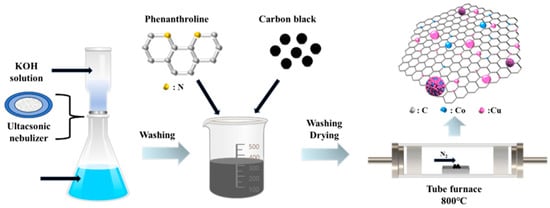
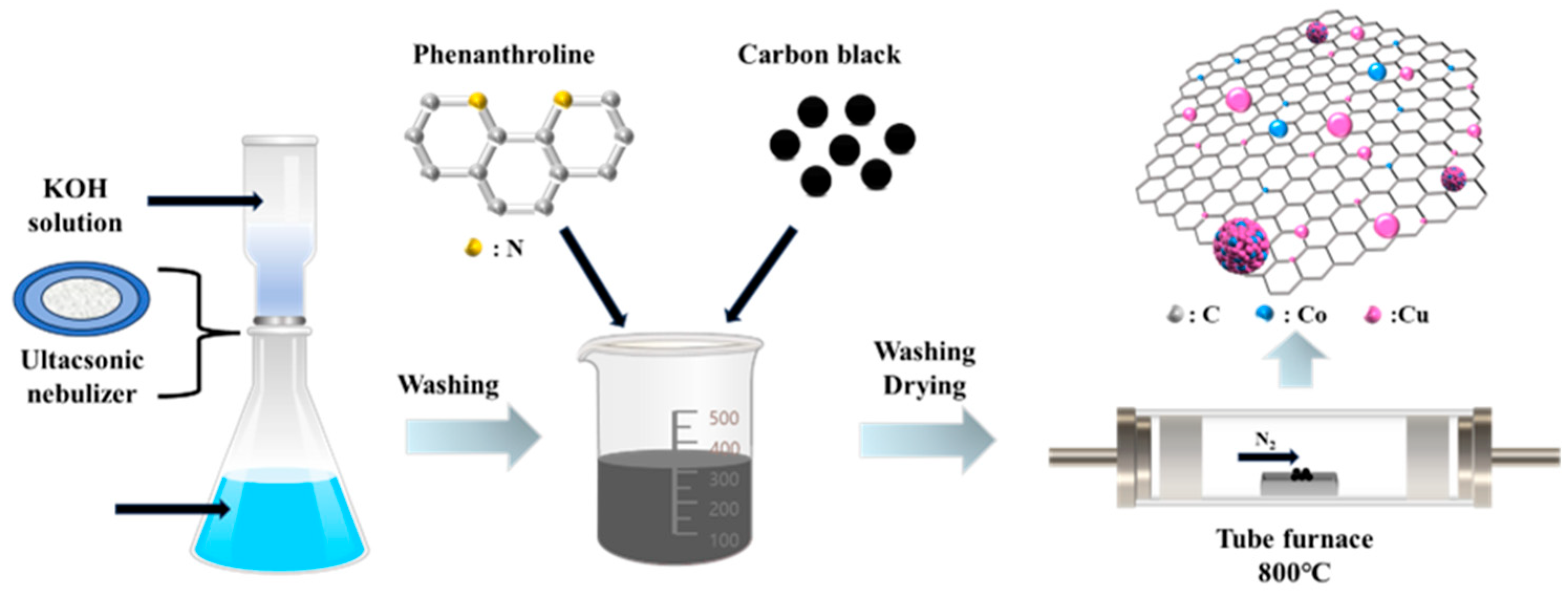
The (Co/Cu)-NC catalysts were synthesized via an ultrasonic atomization coupled with a temperature- and atmosphere-controlled pyrolysis process (Figure 1). Details of chemicals, synthesis, and electrochemical measurements of (Co/Cu)-NC catalysts are also included in the Supporting Information.
Figure 1.
Scheme of the ultrasonic atomization coupled with a pyrolysis process to synthesize (Co/Cu)-NC catalysts is a figure. Schemes follow the same formatting.
First, the alkaline solution is atomized into micron-sized droplets using ultrasonic atomization and sprayed into a salt solution to improve reaction uniformity. After centrifugation to obtain the gel, 1,10-phenanthroline and carbon black are added and stirred to ensure uniform mixing. The mixture then undergoes centrifugation, washing, and drying. Finally, the sample is stabilized by high-temperature calcination, yielding the desired material. In this experiment, to determine the optimal calcination temperature and element ratio for preparing (Co/Cu)-NC materials, samples with various Co/Cu ratios were synthesized at different calcination temperatures.
Samples are denoted as ComCun to indicate the precursor Co/Cu ratio of m/n (with CoCu representing 1/1 for simplicity). For the calcination-temperature series at Co/Cu = 1/1, samples are further labeled as CoCu-T, where T = 0, 400, 800, and 1000 denote the calcination temperature (°C); T = 0 refers to the uncalcined (dried) precursor.
3. Results
In this section, three samples with Co/Cu = 1/1, 3/7, and 7/3 (all annealed at 800 °C) were selected for detailed characterization. They are denoted as CoCu, Co3Cu7, and Co7Cu3.
3.1. Fundamental Characterization of the Catalysts
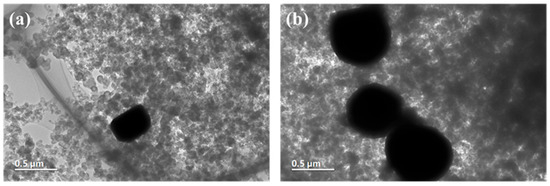
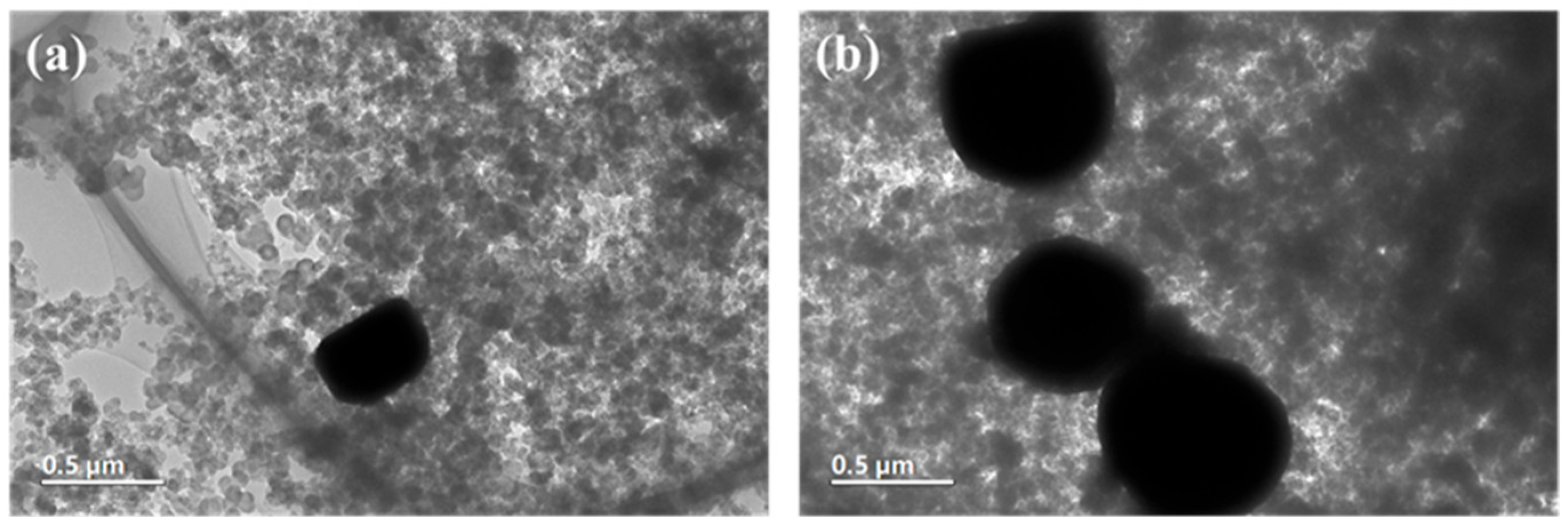
Scanning electron microscopy (SEM) images (Figure S1a,b) and transmission electron microscopy (TEM) images (Figure 2a,b) reveal the presence of relatively large metal particles with diameters around 300 nm in the (Co/Cu)-NC materials. Elemental mapping of two representative particles via energy-dispersive X-ray spectroscopy (EDS) (Figure S1c) indicates that these particles are primarily composed of copper, with a minor presence of cobalt. This phenomenon is attributed to the aggregation of metal species during high-temperature annealing, where the mobility of metal atoms leads to the formation of large particles. Previous studies have reported that, compared to cobalt, copper exhibits a higher tendency to agglomerate during pyrolysis [37], which is consistent with the observations in this work. Moreover, considering the efficient utilization of metal resources and the feasibility for large-scale production, no additional treatment was applied to remove the large particles. This approach minimizes metal waste and may allow the larger Cu-rich particles to provide auxiliary electrochemical contributions, primarily by offering additional conductive pathways and facilitating interfacial charge transfer, thereby improving the utilization of the highly dispersed sub-nanometer/nanometer interfaces.
Figure 2.
(a,b) TEM images of large particles in the CoCu sample.
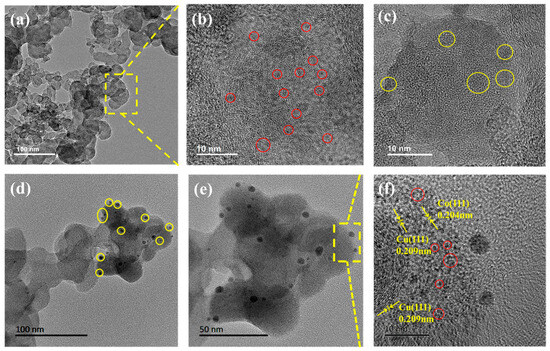
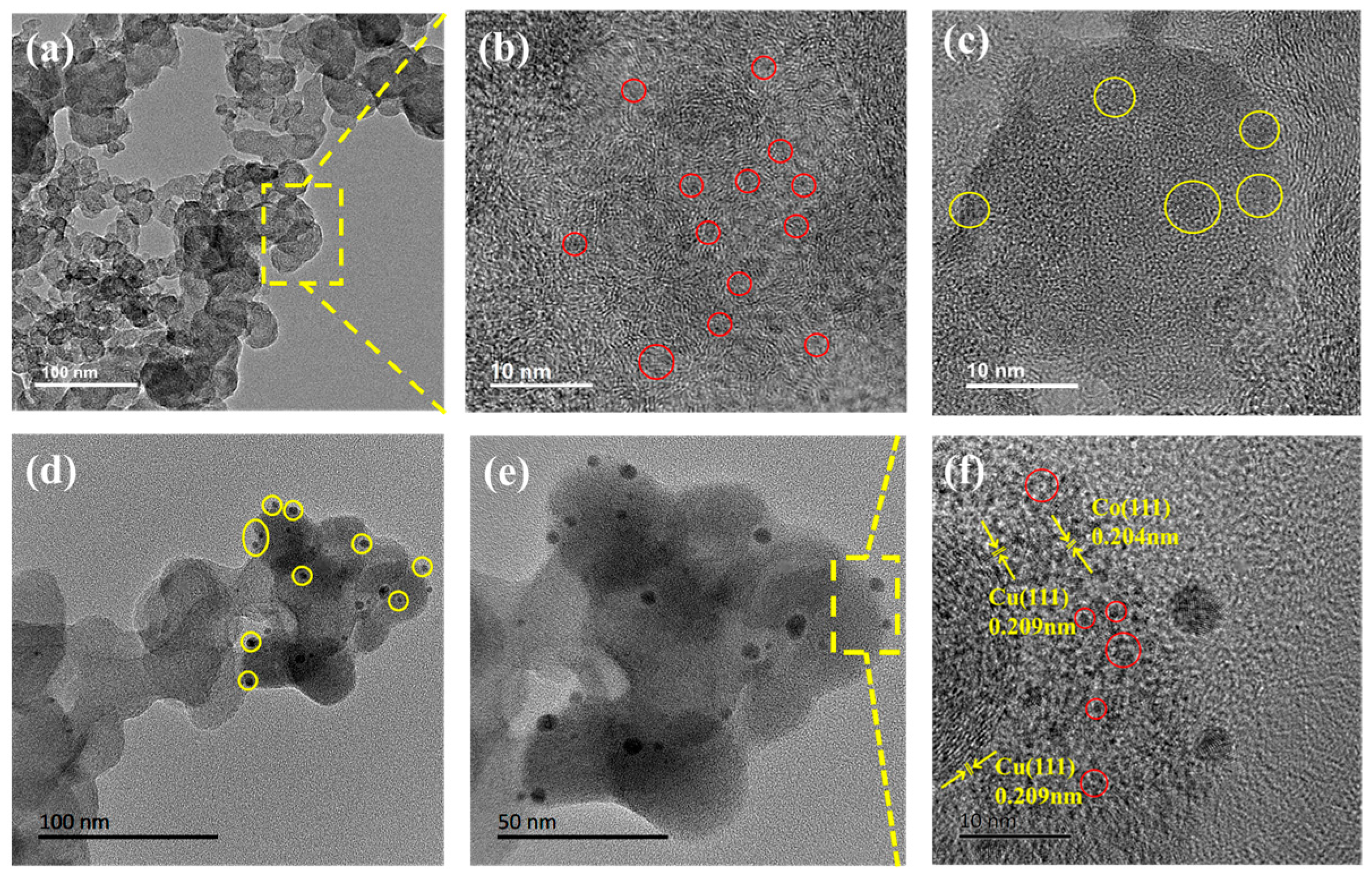
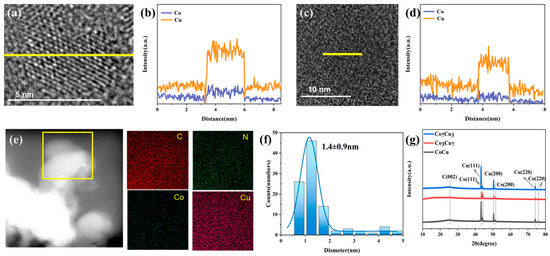
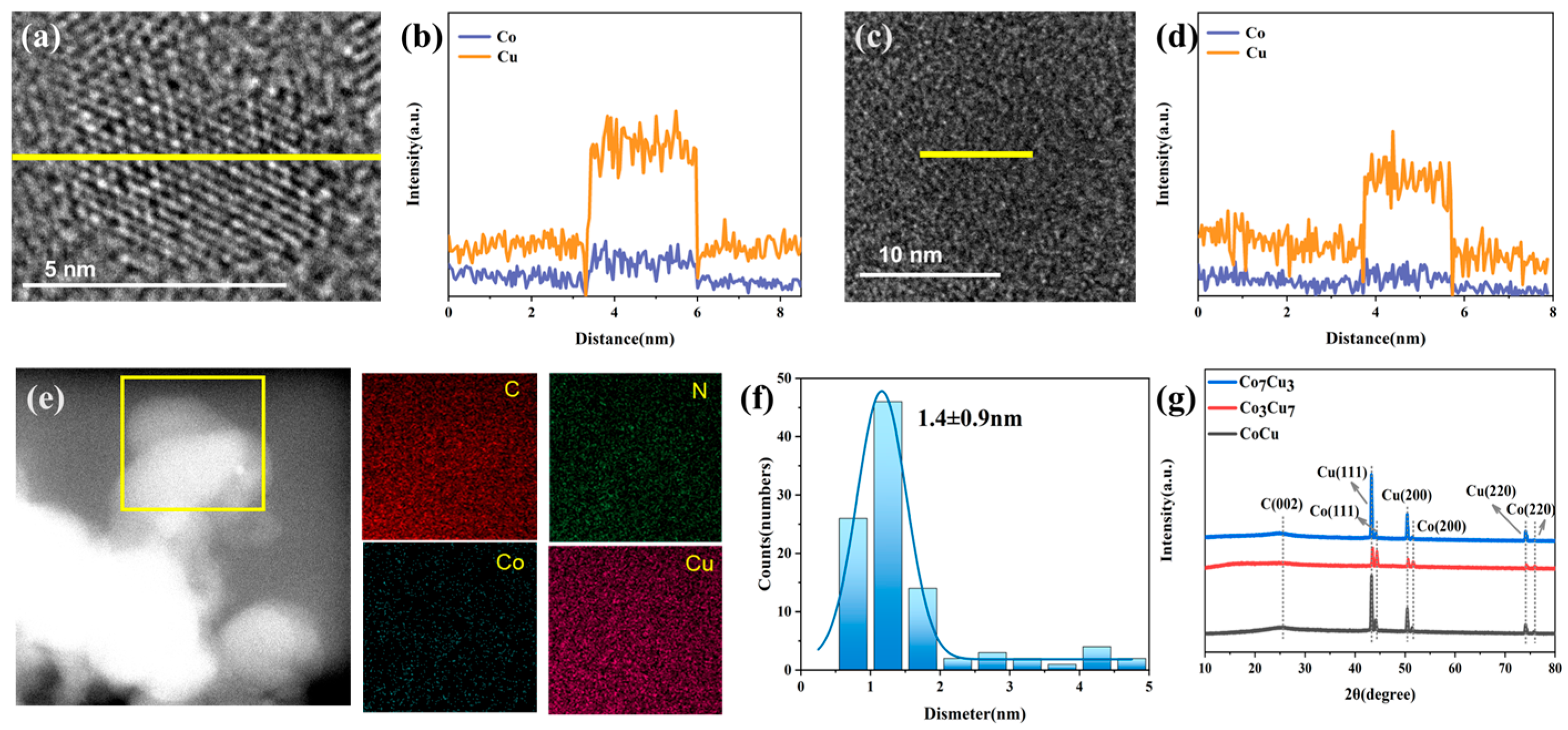
TEM images (Figure 3) suggest that, in addition to the presence of large metal particles, the (Co/Cu)-NC materials contain a population of superatoms with diameters around 1 nm (many less than 1.0 nm: red circles; or some at most 2.0 nm) (Figure 3b,f) and a few nanoparticles with diameters of approximately 3–5 nm (yellow circles) (Figure 3c,d). High-resolution transmission electron microscopy (HR-TEM) images further reveal that some nanoparticles are free, while others are supported on the assemblies (Figure 3f). Precise lattice fringe measurements, along with X-ray diffraction (XRD) results (Figure 4g) and comparison with PDF standard reference cards, indicate that the lattice plane with d = 2.04 Å corresponds to the (111) plane of Co (JCPDS:89-7093), while the lattice plane with d = 2.09 Å corresponds to the (111) plane of Cu (JCPDS:70-3038). EDS line scans were collected across representative nanoparticles (Figure 4a,b) as well as cluster-rich, sub-nanometer-dense regions (Figure 4c,d). Both Co and Cu signals are observed in these regions, with Cu generally exhibiting higher intensity. Here, the line scans are intended to provide qualitative or semi-quantitative evidence of co-localization and relative trends rather than rigorous, particle-level Cu/Co quantification. Consistently, EDS elemental maps (Figure 4e) reveal Co-Cu co-localization on the carbon support with an overall Cu-enriched distribution, which may arise from synthesis conditions favoring Cu deposition and partial Co loss or incomplete Co reduction during processing. Statistical analysis of >100 features yields an average diameter of 1.4 ± 0.9 nm (Figure 4f). Overall, the catalyst exhibits a hierarchical multi-scale architecture comprising cluster-rich sub-nanometer domains, nanometer-scale nanoparticles, and occasional larger Cu-rich particles dispersed on an N-doped carbon framework. These motifs are better viewed as a cooperative system rather than simply additive components: the sub-nanometer/nanometer features provide highly accessible interfacial sites, whereas the carbon framework and larger-scale motifs mainly help maintain electronic/ionic transport continuity and facilitate interfacial charge transfer, thereby improving the utilization of the small-scale interfaces.
Figure 3.
(a) Wide-viewed TEM images of region 1 of the CoCu sample, (b,c) the corresponding HR-TEM images of region 1 of the CoCu sample, (d,e) wide-viewed TEM images of region 2 of the CoCu sample, (f) the corresponding HR-TEM images of region 2 of the CoCu sample. (Dashed boxes: enlarged areas; yellow circles: nanoparticles; red circles: superatoms).
Figure 4.
(a) TEM image of an individual nanoparticle in the CoCu sample, (b) its corresponding EDS element line scanning, (c) TEM image of super-atom clusters in the CoCu sample, (d) its corresponding EDS element line scanning, and (e) STEM image of the CoCu sample with corresponding EDS elemental distribution, (f) statistical distribution of particle size, (g) XRD patterns of CoCu, Co3Cu7, and Co7Cu3 samples.
Subsequently, inductively coupled plasma optical emission spectrometry (ICP-OES) was conducted to quantitatively analyze the metal content in the (Co/Cu)-NC samples (Table S1). To ensure the accuracy and reproducibility of the results, each element was measured three times. The results show that the mass fractions of Cu and Co are 16.75 ± 0.05 wt% and 5.70 ± 0.02 wt%, respectively. These values are in good agreement with the morphological and structural analyses obtained from SEM, TEM, and XRD, further confirming the presence and distribution states of the metal species in the material. Notably, the total metal loading reaches 22.45 ± 0.07 wt%, indicating a highly efficient utilization of metal precursors and a substantial reduction in metal loss during the synthesis process. In contrast, conventional single-atom catalysts (SACs) generally suffer from low metal loading and inefficient precursor utilization, which leads to significant metal waste and limits their feasibility for practical industrial-scale applications. Therefore, the synthetic strategy developed in this work not only improves metal utilization but also offers excellent scalability and potential for real-world deployment.
The crystal phases of CoCu, Co3Cu7, and Co7Cu3 samples were characterized using XRD, with the results shown in Figure 4g. For all samples, a broad diffraction peak associated with the graphite (002) plane is observed at around 25.6°. Characteristic peaks of metallic Cu are observed at 43.32°, 50.44°, and 74.12°, corresponding to the (111), (200), and (220) crystal planes, respectively. Similarly, metallic Co peaks are identified at 44.35°, 51.67°, and 75.98°, associated with the same crystal planes. Additionally, the peaks corresponding to metallic Cu and metallic Co appear separately. Analysis of the binary phase diagram of the Co-Cu alloy reveals that Co-rich and Cu-rich phases exhibit phase separation over a wide range of temperatures and compositions [56]. This suggests that Co and Cu have limited miscibility and do not readily form a homogeneous alloy. Consequently, a Co-Cu alloy is not formed in the investigated material.
Raman spectroscopy was conducted on the above samples, with the results presented in Figure S2. Two peaks at ~1341 cm−1 and 1600 cm−1 correspond to the D-band and G-band of graphite, respectively. The ID/IG ratio reflects the structural disorder in graphite, which is increased with the presence of more and more defects or impurities [57,58]. The ID/IG ratios are 1.133, 1.220, and 1.323 for the CoCu, Co3Cu7, and Co7Cu3 catalysts, respectively. A lowest ID/IG ratio in the CoCu sample indicates this sample has the least concentration of defects or impurities [59], which favors increasing its electrical conductivity. Moderate defect levels can increase the number of active sites, enhancing catalytic performance, whereas excessive defects may reduce conductivity and structural stability, ultimately lowering efficiency [60,61]. Importantly, the variation of ID/IG among different Cu/Co ratios suggests that adjusting the Cu-Co composition is accompanied by a concurrent modulation of the carbon microstructure/defect environment rather than merely changing metal contents. Such a coupled change in the conductive/defect framework can influence interfacial charge transfer and the accessibility/utilization of metal-associated sites, providing a structural basis for the Cu-Co synergy observed electrochemically. Based on our findings in this article, the CoCu sample may appear to achieve the optimized balance between defect density and electrical conductivity, resulting in the most favorable overall catalytic performance among the three samples. This Raman-based trend alone, however, should be viewed as a supportive descriptor rather than a standalone proof of activity, and the catalytic ranking is ultimately established by the electrochemical metrics.
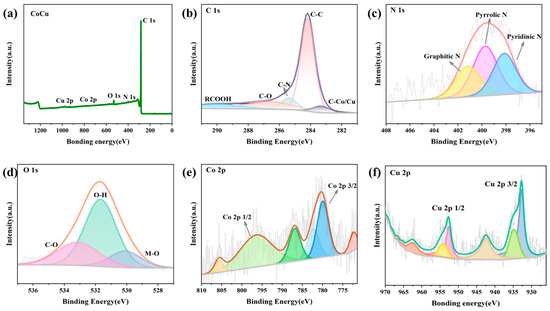
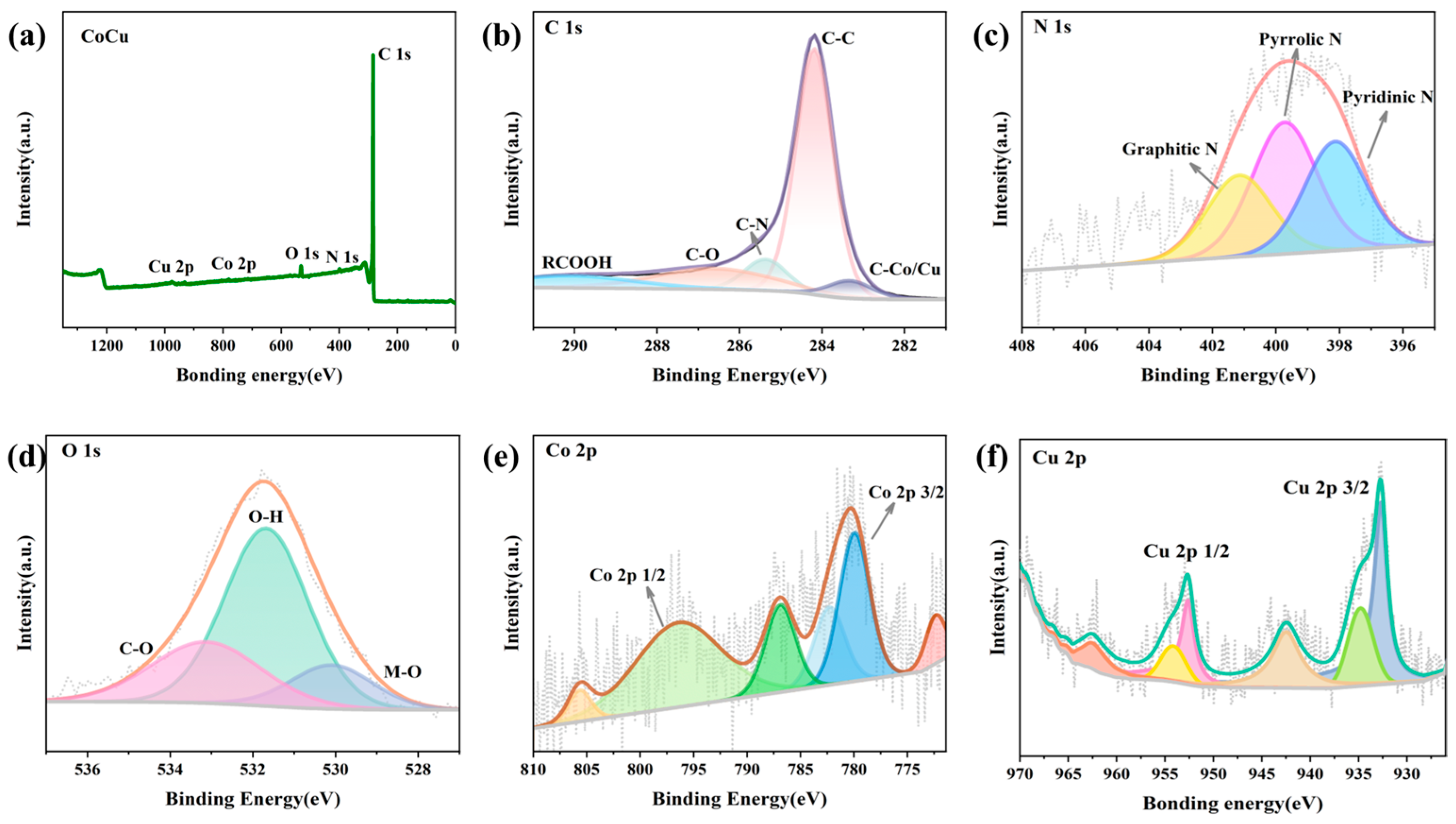
To investigate the elemental composition and electronic status of key elements, X-ray photoelectron spectroscopy (XPS) was performed for the CoCu (Figure 5), Co3Cu7 (Figure S3), and Co7Cu3 (Figure S4) samples. The XPS spectra identify all the constituent elements (C, N, O, Co, and Cu) in the three samples. The high-resolution XPS spectra of the five elements were analyzed sequentially via the theoretical area fitting process for different element valences and/or possible species. The C 1s XPS spectrum reveals four bonding states—C-C, C-N, C-Co/Cu, and C-O. These bonds are attributed to the addition of carbon black and 1,10-phenanthroline in the preparation and to the formation of bonds between carbon atoms and metal elements during pyrolysis. The high-resolution O 1s spectrum is fitted by three peaks: C-O, O-H and M-O (M = Co, Cu). For Co 2p, the main features at ~780.5 eV (Co 2p3/2) and ~795.6 eV (Co 2p1/2) are accompanied by additional multiplet/satellite contributions. Notably, the Co 2p1/2 region often appears broader than the 2p3/2 region because it represents an envelope of overlapping Co2+/Co3+ contributions together with multiplet splitting and shake-up satellites. For Cu 2p, the spectra exhibit the expected spin–orbit doublets, with the low-binding-energy components (e.g., ~933.1 eV for 2p3/2 and ~952.7 eV for 2p1/2) attributable to Cu0/Cu+, while the higher-binding-energy components (e.g., ~934.7 eV and ~954.1 eV) are consistent with Cu2+ related contributions. Where applicable, Cu2+ shake-up satellite features were also included and discussed to support the presence of Cu2+. The N 1s spectra were deconvoluted into pyridinic, pyrrolic, and graphitic N, and their proportions are summarized in Table 1 [62]. The pyridinic-N fraction decreases from 48.2% (Co7Cu3) to 33.3% (CoCu) and 30.4% (Co3Cu7). Therefore, the higher pyridinic-N fraction in the Co-rich sample implies more available M-N (M = Co/Cu) coordination sites and a modified local electronic environment because the lone-pair electrons of pyridinic N are more accessible for metal coordination [63]. Meanwhile, the Cu 2p line-shape comparison suggests that Co incorporation is accompanied by a redistribution of Cu surface chemical states, consistent with a more Cu0/Cu+-dominated character and an attenuated Cu2+-related signature in the Co-rich samples. Overall, N 1s together with Co 2p/Cu 2p indicate that varying the Cu/Co ratio simultaneously tunes the N-coordination environment and Cu electronic structure, thereby affecting interfacial charge transfer/kinetics in ORR and CO2RR.
Figure 5.
(a) XPS survey spectrum of the CoCu sample, (b) high-resolution C 1s spectrum, (c) high-resolution N 1s spectrum, (d) high-resolution O 1s spectrum, (e) high-resolution Co 2p spectrum, (f) high-resolution Cu 2p spectrum.
Table 1.
Proportions of Pyridinic Nitrogen, Pyrrolic Nitrogen, and Graphitic Nitrogen in CoCu, Co3Cu7, and Co7Cu3 samples.
3.2. Electrocatalytic Activity for the ORR
ORR electrocatalytic performance of the prepared samples was evaluated using a three-electrode system. The calcination temperatures for the enhanced catalytic performance were first optimized using samples with a constant Co/Cu ratio of 1/1. These samples were subjected to calcination at temperatures of 400 °C, 800 °C, and 1000 °C. Their ORR catalytic performance was evaluated.
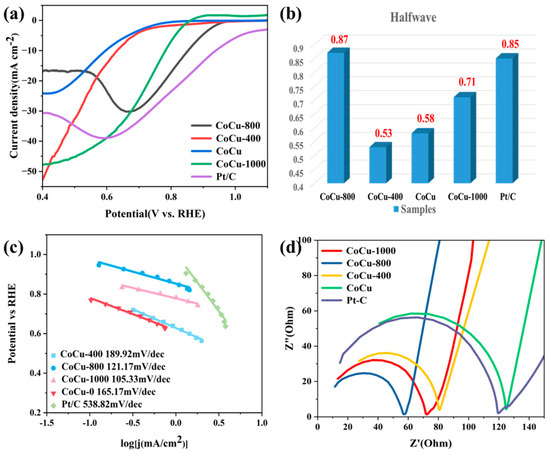
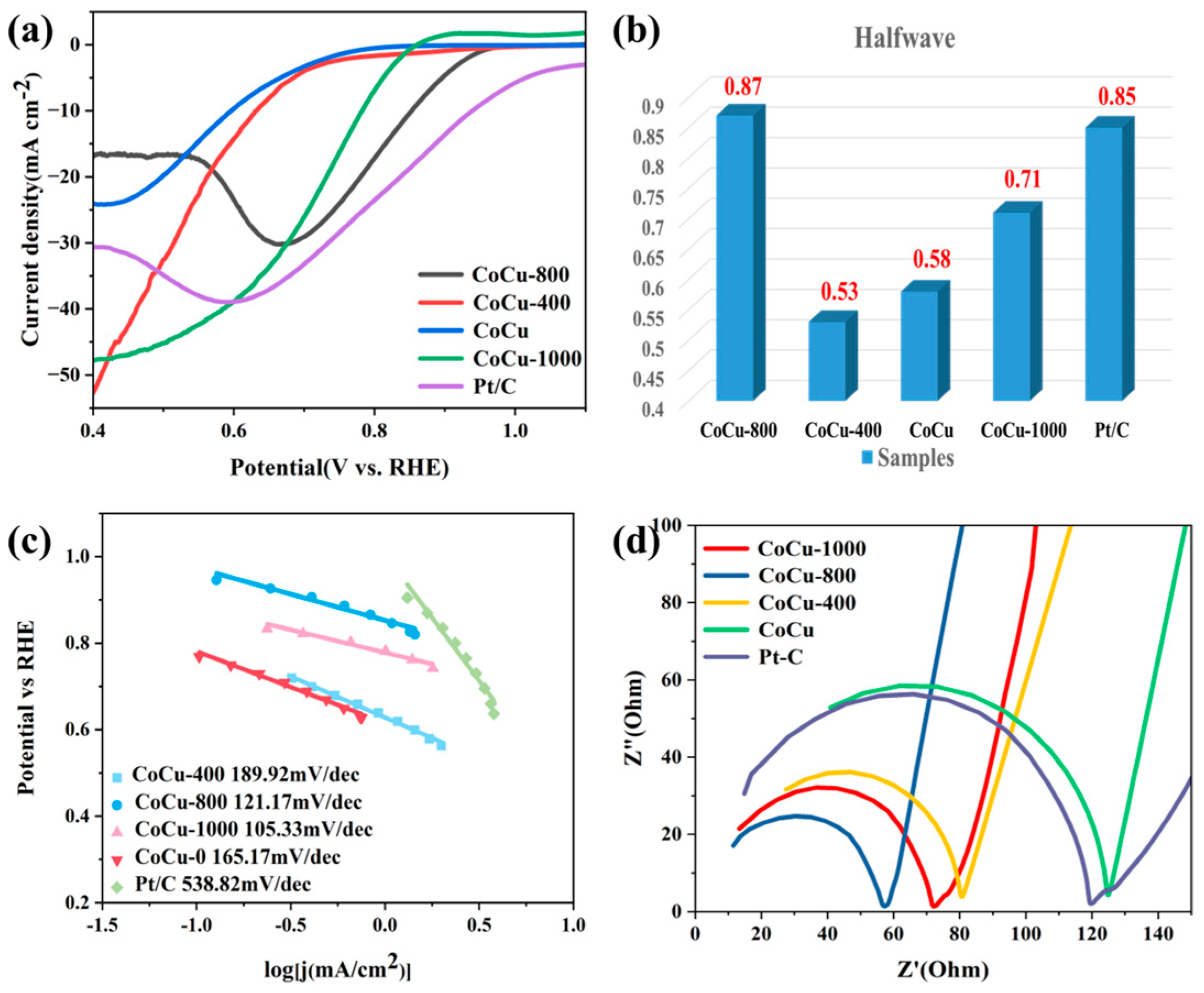
As shown in Figure 6, the linear sweep voltammetry (LSV) curves (Figure 6a) demonstrate that the unannealed sample and the samples annealed at 400 °C, 800 °C, and 1000 °C achieve half-wave potentials of 0.58 V, 0.53 V, 0.87 V and 0.71 V, respectively. Notably, only the 800 °C-annealed sample outperforms the commercial Pt/C catalyst, which has a half-wave potential of 0.85 V (Figure 6b). Furthermore, a lower Tafel slope indicates a less pronounced change in overpotential with increasing current density, suggesting enhanced electrocatalytic performance. The catalysts annealed at 800 °C (127.17 mV/dec) and 1000 °C (105.33 mV/dec) exhibit smaller Tafel slopes than the commercial Pt/C catalyst, indicating improved catalytic performance (Figure 6c). The electrochemical impedance spectroscopy (EIS) results indicate that, after calcination, the impedance arc radii of these samples are smaller than that of the commercial Pt/C catalyst. At calcination temperatures of 400 °C, 800 °C, and 1000 °C, the impedance radii are approximately 40 ohms, 30 ohms, and 35 ohms, respectively, with the smallest impedance radius observed at the 800 °C calcination temperature (Figure 6d). Thus, compared with Pt/C, the calcined samples exhibit more favorable interfacial charge-transfer/transport behavior under the investigated conditions, and CoCu-800 further shows the most pronounced transport advantage within the temperature series.
Figure 6.
Electrocatalytic performance for ORR of CoCu samples calcination at different temperatures: (a) LSV curves; (b) half-wave potential comparison; (c) Tafel slopes; (d) EIS results.
Considering these results, the 800 °C-annealed sample exhibits superior electrocatalytic activity and conductivity. It shows the highest half-wave potential, the smallest impedance radius, and a lower Tafel slope. These results surpass those of samples calcined at other temperatures and the commercial Pt/C nanocatalyst, highlighting its enhanced electrocatalytic performance. Thus, 800 °C is the most suitable calcination temperature. Furthermore, our study demonstrates that when synthesized at an optimal calcination temperature, multi-scale structures achieve superior metal utilization and significantly improve electrocatalytic performance through a simple and cost-effective method, achieving better performance than Pt/C catalyst.
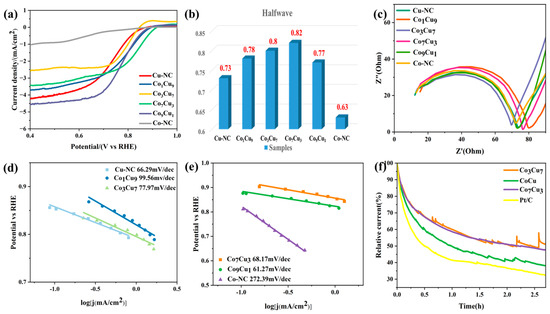
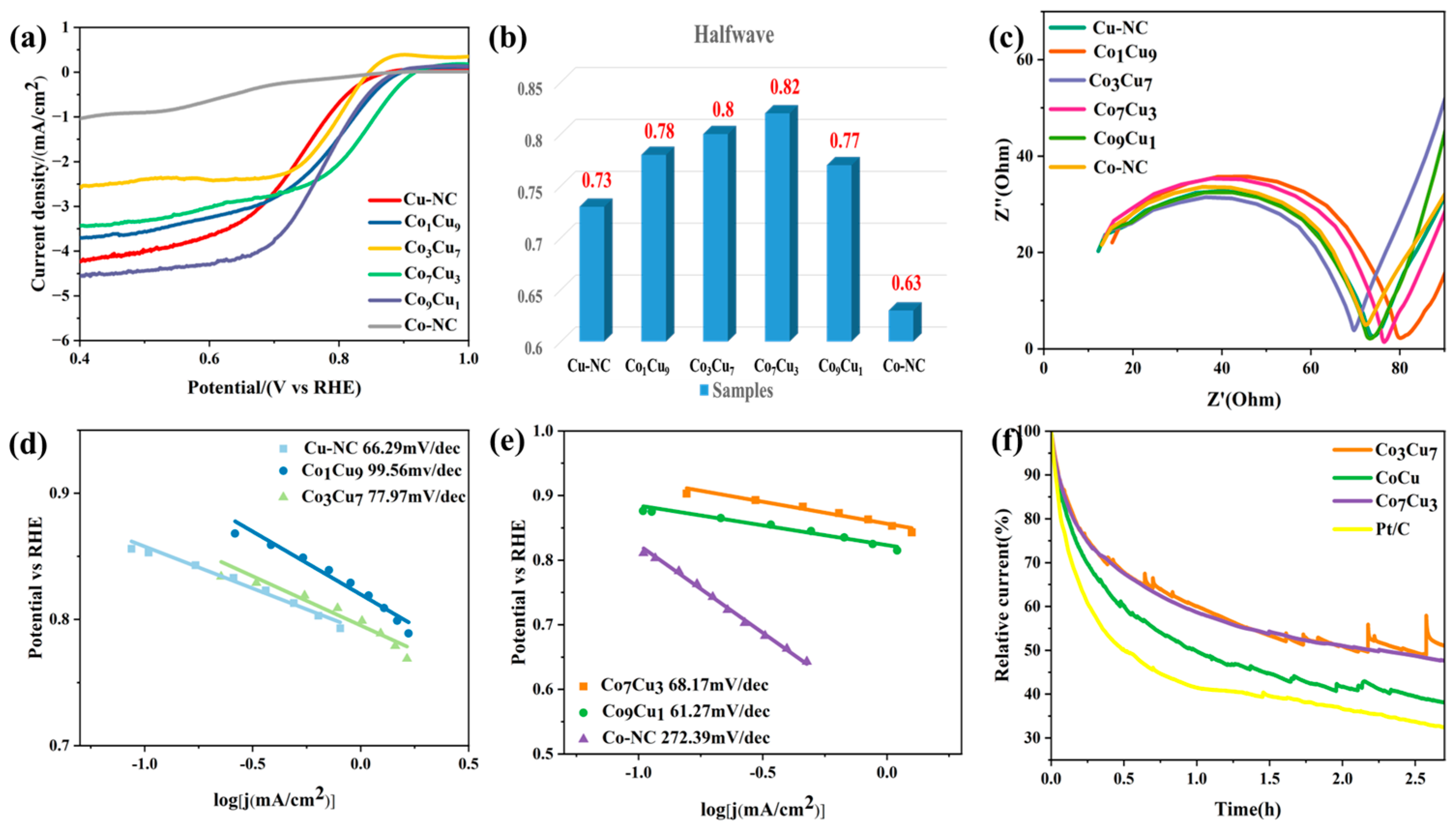
Then, to determine the optimal compositional ratio for ORR, CoxCuy-NC samples were synthesized with x/y ratios of 0/1, 1/9, 3/7, 7/3, 9/1, and 1/0 at a calcination temperature of 800 °C. The electrochemical performance of these samples is summarized in Figure 7. Analysis of the LSV curves (Figure 7a) shows that the half-wave potentials are 0.73 V for the Cu-NC sample, 0.78 V for the Co1Cu9 sample, 0.8 V for the Co3Cu7 sample, 0.82 V for the Co7Cu3 sample, 0.77 V for the Co9Cu1 sample, and 0.63 V for the Co-NC sample (Figure 7b), suggesting that samples with the CoCu ratio of 1/1 have the best performance. Notably, the monometallic controls (Cu-NC and Co-NC) show much lower E1/2 values (0.73 V and 0.63 V), whereas introducing both metals leads to a clear increase in E1/2 across the intermediate Co/Cu ratios (0.78–0.87 V). This comparison indicates that the ORR enhancement cannot be explained by a single-metal contribution alone and supports a Cu-Co coupled effect within the N-doped carbon framework. EIS indicates that the impedance of these samples is in the range of 70~80 ohms, and the Co3Cu7 sample shows the best performance (Figure 7c) at approximately 70 ohms, which suggests that CoCu has the lowest electron/ion transfer resistance and improved conductivity. Their Tafel slopes (Figure 7d,e) are smaller than those of the commercial Pt/C nanocatalyst under identical test conditions, indicating faster ORR kinetics and a reduced kinetic overpotential demand compared with the Pt/C catalyst. Among the tested samples, the Co9Cu1 sample exhibits the smallest Tafel slope of only 61.27 mV/dec, implying that its kinetic current increases more rapidly with potential and that the rate-determining electrochemical steps are more favorably promoted than on Pt/C catalyst. These results further demonstrate that under optimal Co/Cu ratios (Co/Cu = 1/1, 7/3 and 3/7), the catalysts exhibit enhanced ORR catalytic performance than Pt/C catalyst, owing to their distinct microstructural characteristics that can provide more accessible interfacial sites and more efficient charge-transfer/transport pathways than Pt/C, thereby strengthening the overall kinetic response reflected by the lower Tafel slopes.
Figure 7.
Electrocatalytic performance for ORR of CoCu samples with varying ratios: (a) LSV curves; (b) half-wave potential comparison; (c) EIS results; (d,e) Tafel slope analysis; (f) stability during ORR.
Stability, a critical factor in evaluating catalysts, is assessed for the Co3Cu7, CoCu, and Co7Cu3 samples, which exhibit superior activity (Figure 7f). After 10,000 s of operation at 0.85 V, the current retention of the Co3Cu7 and Co7Cu3 samples is approximately 50% of their initial values, while the CoCu sample retains about 40%. All these values surpass the performance of the commercial Pt/C nanocatalyst, which retains only 32%. The stability of CoCu is slightly lower than that of Co3Cu7 and Co7Cu3, likely due to its higher half-wave potential, which increases the catalyst surface’s reactivity. This heightened reactivity makes the catalyst more prone to degradation processes such as oxidation or corrosion [64], leading to a faster decline in catalytic activity even though it still outperforms Pt/C in current retention under the identical protocol.
The ORR electrocatalytic performance tests indicate that the multi-scale catalysts, synthesized via a modified sequential ultrasonic atomization and high-temperature pyrolysis process, exhibit favorable Tafel slopes and a lower EIS semicircle radius compared to conventional Pt/C nanocatalyst under varying temperature and elemental ratio conditions. Additionally, the catalysts demonstrate an excellent half-wave potential. Notably, the catalyst achieves the best ORR performance when the Co/Cu ratio is 1/1 and the calcination temperature is 800 °C. In line with this, the best ORR performer is also characterized by a smaller EIS semicircle and favorable kinetic metrics, suggesting that the overall ORR trend is governed by the combined effects of intrinsic site activity and interfacial charge-transfer/transport, rather than by a single descriptor. These results suggest that the engineered microstructure significantly enhances ORR electrocatalytic activity. Based on the combined N 1s quantification and the ORR trends of the monometallic controls versus the CoCu series, the ORR activity is most consistently attributed to Co-Nx-related sites coupled with the N-doped carbon environment, with Cu mainly acting as a synergistic regulator of the local electronic and interfacial charge-transfer properties rather than serving as the dominant ORR active phase.
3.3. Electrocatalytic Activity for the CO2RR
A study on the relationship between microstructure and ORR electrocatalytic performance of (Co/Cu)-NC catalysts at different Co/Cu ratios indicates that samples with Co/Cu ratio of 1/1 have the best overall EC performance. Therefore, the samples with Co/Cu ratio of 1/1 were selected, and their CO2RR electrochemical catalysis performance was evaluated after further optimization of the calcination effects at 400 °C, 800 °C, and 1000 °C, resulting in four types of samples.
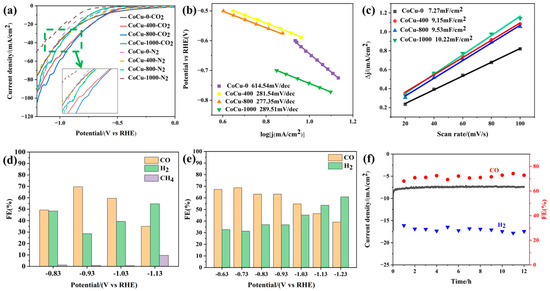
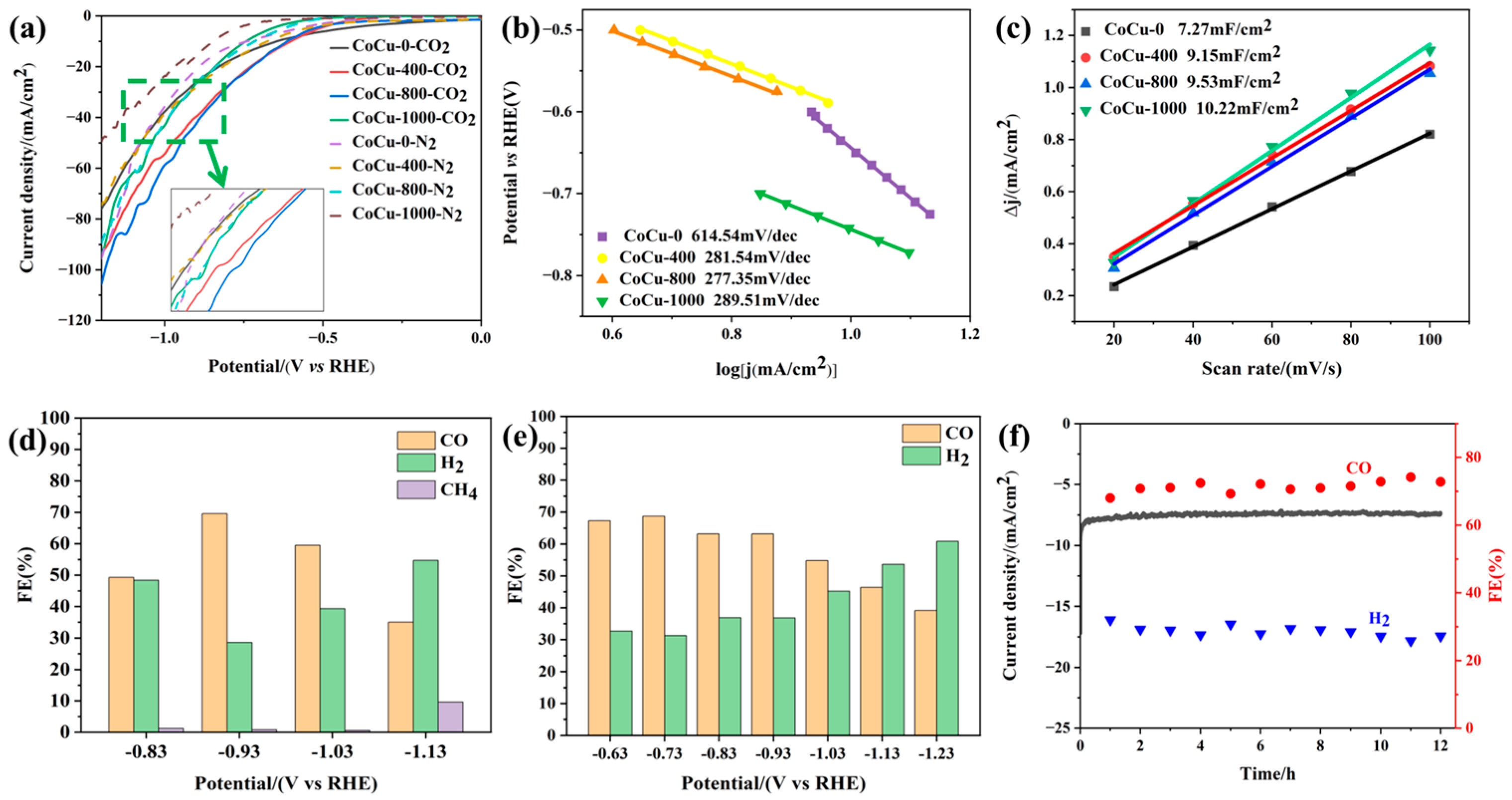
LSV tests were performed for all samples in CO2- and N2-saturated solutions, and the results are shown in Figure 8a. The current density for all samples is higher in CO2-saturated solutions than in N2-saturated ones, indicating additional CO2RR-related cathodic current relative to N2 [65]. Among these, the CoCu-800 sample exhibits the highest current density among the tested samples [65,66]. Tafel slopes, derived from the LSV curves (Figure 8b), are 614.54, 281.54, 277.35, and 289.51 mV/dec for the samples CoCu-0, CoCu-400, CoCu-800 and CoCu-1000, respectively. Among the samples, CoCu-800 has the lowest Tafel slope (277.35 mV/dec). Furthermore, the cyclic voltammetry (CV) testing (Figure S5) was used to evaluate the double-layer capacitance (Cdl) as an indicator of the electrochemical surface area. A larger Cdl therefore indicates a larger accessible interface, but it does not necessarily quantify the absolute density of catalytically effective active sites nor guarantee higher activity [67]. The test results show that the CoCu-1000 has the largest Cdl (ECSA proxy), with a Cdl value of 10.22 mF/cm2, followed by the CoCu-800 sample at 9.53 mF/cm2 (Figure 8c). Notably, although CoCu-1000 exhibits a slightly larger Cdl than CoCu-800, its catalytic activity is lower. This apparent discrepancy indicates that the accessible interface (ECSA proxy) is not the sole determinant of performance. These results suggest that CoCu-800 may possess a more favorable population of effective interfacial sites and higher intrinsic activity per accessible interface, consistent with its lower Tafel slope and higher CO2RR-related current response under the investigated conditions. Such behavior is reasonable for thermally treated carbon-supported metal catalysts, where increasing the pyrolysis temperature may change the local coordination/electronic environment of active motifs and thus the intrinsic activity, even if the electrochemically accessible interface increases. Overall, CoCu-800 delivers the highest CO2RR-related current response and the lowest Tafel slope among the tested catalysts, supporting its favorable CO2RR performance under the investigated conditions.
Figure 8.
Electrochemical performance of the CoCu sample for CO2RR: (a) LSV curves in CO2- and N2-saturated solutions; (b) Tafel slopes derived from the LSV data; (c) double-layer capacitance calculated from CV curves; (d) FE of gas-phase products for CoCu-800 measured using a GCE; (e) FE of gas-phase products for CoCu-800 measured using carbon paper as the working electrode; (f) stability test results for CoCu-800 at −0.73 V over 12 h.
To further evaluate its CO2RR performance, the product analysis during the catalytic reaction was conducted, whose results are presented in Figure 8d. For the CoCu-800 sample, the maximum FE for CO reaches 69.6% at a potential of −0.93 V. However, accumulation of CO2 bubbles on the electrode surface was clearly observed, possibly due to the limited working area of the glassy carbon electrode (GCE), which impeded gas release and caused unstable currents. To address this limitation, a carbon paper electrode with an effective area of 1 cm2 was used for gas-phase CO detection. With this electrode, the maximum FE for CO can reach 68.7% at a potential of −0.73 V (Figure 8e). The FE for CO obtained with the two electrodes shows no significant difference. Overall, the CO selectivity under the H-cell conditions is reasonable but not intended to represent an exceptional record value; instead, the key merits are the good reproducibility and electrode adaptability, as evidenced by the consistent FE for CO obtained on both GCE and carbon paper. However, when using the GCE, small amounts of methane are detected, with its production increasing significantly at −1.13 V. This is primarily because CO and H2 are major products. On the GCE, gas bubbles adhere to the surface, prolonging the coexistence of H2 and CO. This promotes secondary reactions between them, ultimately forming CH4 and H2O [68,69]. In contrast, the porous carbon paper electrode with a larger effective area facilitates faster bubble detachment and a more stable gas–liquid–solid interface, thereby improving CO2 mass transport and mitigating the local accumulation or residence of CO and H2 near the catalyst surface. As a result, the product distribution on carbon paper is dominated by the primary CO and H2 pathways, while the likelihood of secondary hydrogenation reactions leading to CH4 is suppressed. Therefore, the observed electrode-dependent shift in product distribution is mainly attributed to differences in local reaction environment and mass transport/bubble management, rather than a fundamental change in the intrinsic catalytic selectivity of the catalyst.
Catalyst stability, an essential performance metric, was further evaluated using the carbon paper electrode. A 12 h stability test for the CoCu-800 sample was conducted at a potential of −0.73 V (Figure 8f). The red dots represent CO evolution, while the blue triangles represent H2 evolution. The current density remains stable at approximately −7.3 mA/cm2 with minimal fluctuation. Meanwhile, the FE for CO is consistently maintained at around 70%, while the FE for H2 remains steady at approximately 30%. These results align well with the early findings, confirming the excellent stability and catalytic performance of the CoCu-800 sample under prolonged operation. This durability is rationalized by the multi-scale metal distribution in CoCu-800: ultrafinely dispersed Co/Cu species anchored on the N-doped carbon provide plentiful, stable reaction interfaces, while the coexisting larger metal-containing domains together with the hierarchical carbon framework maintain continuous charge-transfer/transport pathways and mechanical integrity, thereby suppressing metal redistribution or aggregation and improving resistance to electrochemical restructuring during extended electrolysis, which ultimately enables both steady current output and sustained CO selectivity.
The (Co/Cu)-NC material synthesized in this study demonstrates a high metal utilization efficiency while maintaining good yield and structural stability. According to previous reports, CoCu nanocatalysts and CoCu cluster catalysts generally exhibit lower overall catalytic performance compared to the materials developed in this work [37,39,70]. Although the yield is somewhat lower than that reported for certain Co-Cu dual-atom catalysts [38], the present system offers advantages in terms of synthetic simplicity, efficient precursor utilization, and scalability for mass production. Therefore, rather than emphasizing only activity metrics, this strategy highlights practical merits, including stable CO-selective operation during 12 h electrolysis with nearly constant current density and an FE for CO maintained at about 70%, a low-step and potentially cost-effective sequential ultrasonic atomization–pyrolysis synthesis, and improved resource and metal utilization evidenced by the relatively high total metal loading of 22.45 ± 0.07 wt% from ICP analysis; together, these attributes make the present system a resource-efficient and scalable CoCu platform that is promising for scale-up and practical implementation. Considering the TEM-EDS evidence for abundant Cu-rich sub-nanometer clusters and nanoparticles and the fact that Cdl does not directly track CO2RR activity across temperatures, the CO-selective CO2RR performance is most plausibly governed by Cu-based sub-nanometer and nanoscale surface sites with favorable local coordination and electronic states, whereas the large Cu-rich particles are more likely secondary contributors, for example, through conductivity or interfacial modulation, rather than being the primary active centers.
4. Conclusions
In summary, multi-scale (Co/Cu)-NC catalysts were synthesized with controlled Co/Cu ratios via an ultrasonic spray atomization method coupled with pyrolysis and calcination, achieving high metal utilization. In ORR, the CoCu sample (Co/Cu = 1/1) calcined at 800 °C shows the highest half-wave potential among the tested samples (0.87 V). Under the same testing conditions, its E1/2 exceeds that of commercial Pt/C. Further electrocatalytic CO2RR tests for the CoCu series annealed at various temperatures show that the sample annealed at 800 °C delivers the highest overall CO2RR response among the tested catalysts, maintaining a CO yield of approximately 70%. Overall, the above quantitative ORR and CO2RR results support the bifunctional performance of the CoCu-800 catalyst under the investigated conditions. By tuning the Co/Cu ratio and calcination temperature, the electrocatalytic metrics can be systematically optimized within this catalyst family. Importantly, beyond activity metrics, the CoCu-800 catalyst also demonstrates practical merits in stability and reproducibility, as evidenced by sustained operation with stable CO selectivity in CO2RR, and it maintains competitive durability trends in ORR compared with Pt/C under identical protocols. Moreover, the sequential ultrasonic spray atomization–pyrolysis route offers a streamlined and scalable synthesis, highlighting its potential for scale-up and cost-effective large-scale production. Generally, this method can be applied to synthesize multi-element and multi-scale catalysts for large-scale production economically.
Supplementary Materials
The following supporting information can be downloaded at https://www.mdpi.com/article/10.3390/coatings16020260/s1, Figure S1: SEM images and EDS scan of the CoCu; Table S1: ICP-OES of CoCu; Figure S2: Raman spectra of CoCu, Co3Cu7, and Co7Cu3; Figure S3: XPS of the Co3Cu7; Figure S4: XPS of the Co7Cu3; Figure S5: CV curves of CoCu-0, CoCu-400, CoCu-800, and CoCu-1000.
Author Contributions
Formal analysis, Investigation, Visualization, Data curation, Writing—original draft, L.S. Investigation and revising, W.S. and Y.W. Supervision, Funding acquisition, Conceptualization, Methodology, revising, Y.S. All authors have read and agreed to the published version of the manuscript.
Funding
This work is supported by the National Natural Science Foundation of China (Nos. 52471259, 51971029), the National S&T Major Project of China (No. 2018ZX10301201), and the BRICS STI Framework Programmed by NSFC (No. 51861145309). The authors also appreciate the project support of the “1125” Zhihui Zhengzhou Talent project of Henan province (Fund No. in USTB: 39080070).
Data Availability Statement
The data are available from the corresponding author upon reasonable request.
Conflicts of Interest
Author Yujun Song was employed by the company Zhengzhou Tianzhao Biomedical Technology Company Ltd. All authors declare that the research was conducted in the absence of any commercial or financial relationships that could be construed as a potential conflict of interest.
References
- Barbir, F.; Veziroǧlu, T.N.; Plass, H.J., Jr. Environmental damage due to fossil fuels use. Int. J. Hydrogen Energy 1990, 15, 739–749. [Google Scholar] [CrossRef] [Scilit]
- Wang, J.; Ye, H.; Song, Y. In-situ reaction-growth of PtNiX nanocrystals on supports for enhanced electrochemical catalytic oxidation of ethanol via continuous flow microfluidic process. Electrochim. Acta 2018, 278, 149–155. [Google Scholar] [CrossRef] [Scilit]
- Wang, J.; Wang, Z.; Li, S.; Wang, R.; Song, Y. Surface and interface engineering of FePt/C nanocatalysts for electro-catalytic methanol oxidation: Enhanced activity and durability. Nanoscale 2017, 9, 4066–4075. [Google Scholar] [CrossRef] [Scilit] [PubMed]
- Wang, J.; Song, Y. Magnetic field coupling microfluidic synthesis of Fe2Pt/C nanocatalysts for enhanced electrochemical catalytic oxidation of alcohol. Int. J. Hydrogen Energy 2020, 45, 13035–13044. [Google Scholar] [CrossRef] [Scilit]
- Ma, J.; Tong, X.; Wang, J.; Zhang, G.; Lv, Y.; Zhu, Y.; Sun, S.; Yang, Y.; Song, Y. Rare-earth metal oxide hybridized PtFe nanocrystals synthesized via microfluidic process for enhanced electrochemical catalytic performance. Electrochim. Acta 2019, 299, 80–88. [Google Scholar] [CrossRef] [Scilit]
- Carrette, L.; Friedrich, K.A.; Stimming, U. Fuel cells: Principles, types, fuels, and applications. Chemphyschem 2000, 1, 162–193. [Google Scholar] [CrossRef]
- Broecker, W.S.; Takahashi, T.; Simpson, H.J.; Peng, T. Fate of fossil fuel carbon dioxide and the global carbon budget. Science 1979, 206, 409–418. [Google Scholar] [CrossRef] [Scilit]
- Sullivan, B.P.; Krist, K.; Guard, H.E. Electrochemical and Electrocatalytic Reactions of Carbon Dioxide; Elsevier: Amsterdam, The Netherlands, 2012. [Google Scholar]
- Wang, Y.; Wang, D.; Li, Y. A fundamental comprehension and recent progress in advanced Pt-based ORR nanocatalysts. SmartMat 2021, 2, 56–75. [Google Scholar] [CrossRef] [Scilit]
- Gómez Marín, A.M.; Ticianelli, E.A. A reviewed vision of the oxygen reduction reaction mechanism on Pt-based catalysts. Curr. Opin. Electroche 2018, 9, 129–136. [Google Scholar] [CrossRef] [Scilit]
- Wu, J.; Yang, H. Platinum-based oxygen reduction electrocatalysts. Accounts Chem. Res. 2013, 46, 1848–1857. [Google Scholar] [CrossRef] [Scilit]
- Liu, J.; Jiao, M.; Lu, L.; Barkholtz, H.M.; Li, Y.; Wang, Y.; Jiang, L.; Wu, Z.; Liu, D.; Zhuang, L. High performance platinum single atom electrocatalyst for oxygen reduction reaction. Nat. Commun. 2017, 8, 15938. [Google Scholar] [CrossRef] [Scilit] [PubMed]
- Wang, Y.; Pegis, M.L.; Mayer, J.M.; Stahl, S.S. Molecular cobalt catalysts for O2 reduction: Low-overpotential production of H2O2 and comparison with iron-based catalysts. J. Am. Chem. Soc. 2017, 139, 16458–16461. [Google Scholar] [CrossRef] [Scilit] [PubMed]
- Wang, H.; Yin, F.; Li, G.; Chen, B.; Wang, Z. Preparation, characterization and bifunctional catalytic properties of MOF (Fe/Co) catalyst for oxygen reduction/evolution reactions in alkaline electrolyte. Int. J. Hydrogen Energy 2014, 39, 16179–16186. [Google Scholar] [CrossRef] [Scilit]
- Zitolo, A.; Ranjbar-Sahraie, N.; Mineva, T.; Li, J.; Jia, Q.; Stamatin, S.; Harrington, G.F.; Lyth, S.M.; Krtil, P.; Mukerjee, S. Identification of catalytic sites in cobalt-nitrogen-carbon materials for the oxygen reduction reaction. Nat. Commun. 2017, 8, 957. [Google Scholar] [CrossRef] [Scilit]
- Qu, X.; Yan, Y.; Zhang, Z.; Tian, B.; Yin, S.; Cheng, X.; Huang, R.; Jiang, Y.; Sun, S. Regulation strategies for FE-N-C and CO-N-C catalysts for the oxygen reduction reaction. Chemistry 2024, 30, e202304003. [Google Scholar] [CrossRef] [Scilit]
- Li, Z.; Yang, T.; Zhao, W.; Xu, T.; Wei, L.; Feng, J.; Yang, X.; Ren, H.; Wu, M. Structural modulation of Co catalyzed carbon nanotubes with Cu-Co bimetal active center to inspire oxygen reduction reaction. ACS Appl. Mater. Inter. 2019, 11, 3937–3945. [Google Scholar] [CrossRef] [Scilit]
- Wu, W.; Liu, Y.; Liu, D.; Chen, W.; Song, Z.; Wang, X.; Zheng, Y.; Lu, N.; Wang, C.; Mao, J. Single copper sites dispersed on hierarchically porous carbon for improving oxygen reduction reaction towards zinc-air battery. Nano Res. 2021, 14, 998–1003. [Google Scholar] [CrossRef] [Scilit]
- Du, C.; Gao, X.; Chen, W. Recent developments in copper-based, non-noble metal electrocatalysts for the oxygen reduction reaction. Chin. J. Catal. 2016, 37, 1049–1061. [Google Scholar] [CrossRef] [Scilit]
- Zhao, Y.; Chu, Y.; Ju, X.; Zhao, J.; Kong, L.; Zhang, Y. Carbon-supported copper-based nitrogen-containing supramolecule as an efficient oxygen reduction reaction catalyst in neutral medium. Catalysts 2018, 8, 53. [Google Scholar] [CrossRef] [Scilit]
- Paudel, D.R.; Pan, U.N.; Ghising, R.B.; Kandel, M.R.; Prabhakaran, S.; Kim, D.H.; Kim, N.H.; Lee, J.H. Multi-interfacial dendritic engineering facilitating congruous intrinsic activity of oxide-carbide/MOF nanostructured multimodal electrocatalyst for hydrogen and oxygen electrocatalysis. Appl. Catal. B Environ. 2023, 331, 122711. [Google Scholar] [CrossRef] [Scilit]
- Wu, H.; Li, H.; Zhao, X.; Liu, Q.; Wang, J.; Xiao, J.; Xie, S.; Si, R.; Yang, F.; Miao, S. Highly doped and exposed Cu (i)–N active sites within graphene towards efficient oxygen reduction for zinc-air batteries. Energy Environ. Sci. 2016, 9, 3736–3745. [Google Scholar] [CrossRef] [Scilit]
- Wang, J.; Wang, K.; Wang, F.; Xia, X. Bioinspired copper catalyst effective for both reduction and evolution of oxygen. Nat. Commun. 2014, 5, 5285. [Google Scholar] [CrossRef] [Scilit]
- Kuang, M.; Wang, Q.; Han, P.; Zheng, G. Cu, Co-embedded N-enriched mesoporous carbon for efficient oxygen reduction and hydrogen evolution reactions. Adv. Energy Mater. 2017, 7, 1700193. [Google Scholar] [CrossRef] [Scilit]
- Ling, K.; Men, F.; Wang, W.; Zhou, Y.; Zhang, H.; Ye, D. Carbon monoxide and its controlled release: Therapeutic application, detection, and development of carbon monoxide releasing molecules (CORMs) miniperspective. J. Med. Chem. 2017, 61, 2611–2635. [Google Scholar] [CrossRef] [Scilit] [PubMed]
- Rochette, L.; Cottin, Y.; Zeller, M.; Vergely, C. Carbon monoxide: Mechanisms of action and potential clinical implications. Pharmacol. Therapeut 2013, 137, 133–152. [Google Scholar] [CrossRef] [Scilit] [PubMed]
- Zhu, Y.; Yang, X.; Peng, C.; Priest, C.; Mei, Y.; Wu, G. Carbon-supported single metal site catalysts for electrochemical CO2 reduction to CO and beyond. Small 2021, 17, 2005148. [Google Scholar] [CrossRef] [Scilit] [PubMed]
- Liang, S.; Huang, L.; Gao, Y.; Wang, Q.; Liu, B. Electrochemical reduction of CO2 to CO over transition metal/N-doped carbon catalysts: The active sites and reaction mechanism. Adv. Sci. 2021, 8, 2102886. [Google Scholar] [CrossRef] [Scilit]
- Ju, W.; Bagger, A.; Hao, G.; Varela, A.S.; Sinev, I.; Bon, V.; Roldan Cuenya, B.; Kaskel, S.; Rossmeisl, J.; Strasser, P. Understanding activity and selectivity of metal-nitrogen-doped carbon catalysts for electrochemical reduction of CO2. Nat. Commun. 2017, 8, 944. [Google Scholar] [CrossRef] [Scilit]
- Wang, X.; Shi, H.; Szanyi, J. Controlling selectivities in CO2 reduction through mechanistic understanding. Nat. Commun. 2017, 8, 513. [Google Scholar] [CrossRef] [Scilit]
- Nguyen-Phan, T.; Wang, C.; Marin, C.M.; Zhou, Y.; Stavitski, E.; Popczun, E.J.; Yu, Y.; Xu, W.; Howard, B.H.; Stuckman, M.Y. Understanding three-dimensionally interconnected porous oxide-derived copper electrocatalyst for selective carbon dioxide reduction. J. Mater. Chem. A 2019, 7, 27576–27584. [Google Scholar] [CrossRef] [Scilit]
- Calle Vallejo, F.; Koper, M. Theoretical Considerations on the Electroreduction of CO to C2 Species on Cu (100) Electrodes. Angew. Chem. 2013, 52, 7282–7285. [Google Scholar] [CrossRef] [Scilit]
- Mistry, H.; Varela, A.S.; Kühl, S.; Strasser, P.; Cuenya, B.R. Nanostructured electrocatalysts with tunable activity and selectivity. Nat. Rev. Mater. 2016, 1, 16009. [Google Scholar] [CrossRef] [Scilit]
- Gao, J.; Xiong, Y.; Zhang, Q.; Jiang, Y.; Wang, J.; Zou, S.; Fu, M.; Wu, J.; Hu, Y.; Ye, D. 3D geometric modeling analysis of contact probability effect in carbon black oxidation over MnOx-CeO2 catalysts. Chem. Eng. J. 2020, 398, 125448. [Google Scholar] [CrossRef] [Scilit]
- Tao, F.F. Synthesis, catalysis, surface chemistry and structure of bimetallic nanocatalysts. Chem. Soc. Rev. 2012, 41, 7977–7979. [Google Scholar] [CrossRef] [Scilit] [PubMed]
- Vijay, S.; Ju, W.; Brückner, S.; Tsang, S.; Strasser, P.; Chan, K. Unified mechanistic understanding of CO2 reduction to CO on transition metal and single atom catalysts. Nat. Catal. 2021, 4, 1024–1031. [Google Scholar] [CrossRef] [Scilit]
- Yin, S.; Zhao, J.; Wu, S.; Wang, X.; Quan, Y.; Ren, J. Electrochemical reduction of CO2 to CO on bimetallic CoCu–N–C catalyst. J. Clean. Prod. 2022, 371, 133569. [Google Scholar] [CrossRef] [Scilit]
- Yi, J.D.; Gao, X.; Zhou, H.; Chen, W.; Wu, Y. Design of Co-Cu Diatomic Site Catalysts for High-efficiency Synergistic CO2 Electroreduction at Industrial-level Current Density. Angew. Chem. Int. Ed. 2022, 61, e202212329. [Google Scholar] [CrossRef] [Scilit]
- Ke, R.; Zhang, F.; Chen, D.; Ming, W.; Zhang, X.; Wang, Y.; Wang, Y. Copper and cobalt loading carbon as an efficient catalyst for the electroreduction CO2 to CO and hydrocarbons. Surf. Interfaces 2022, 31, 102005. [Google Scholar] [CrossRef] [Scilit]
- Xie, H.; Wang, T.; Liang, J.; Li, Q.; Sun, S. Cu-based nanocatalysts for electrochemical reduction of CO2. Nano Today 2018, 21, 41–54. [Google Scholar] [CrossRef] [Scilit]
- Liu, L.; Corma, A. Metal catalysts for heterogeneous catalysis: From single atoms to nanoclusters and nanoparticles. Chem. Rev. 2018, 118, 4981–5079. [Google Scholar] [CrossRef] [Scilit]
- Zhang, H.; Liu, G.; Shi, L.; Ye, J. Single-atom catalysts: Emerging multifunctional materials in heterogeneous catalysis. Adv. Energy Mater. 2018, 8, 1701343. [Google Scholar] [CrossRef] [Scilit]
- Sulaiman, K.O. Design and Structural Characterization of Monometallic and Bimetallic Clusters for Selective Heterogeneous Catalysis. Ph.D. Thesis, University of Saskatchewan, Saskatoon, SK, Canada, 2022. [Google Scholar]
- Jain, N.; Roy, A. Phase & morphology engineered surface reducibility of MnO2 nano-heterostructures: Implications on catalytic activity towards CO oxidation. Mater. Res. Bull. 2020, 121, 110615. [Google Scholar]
- Gawande, M.B.; Fornasiero, P.; Zbořil, R. Carbon-based single-atom catalysts for advanced applications. ACS Catal. 2020, 10, 2231–2259. [Google Scholar] [CrossRef] [Scilit]
- Chen, Y.; Ji, S.; Chen, C.; Peng, Q.; Wang, D.; Li, Y. Single-atom catalysts: Synthetic strategies and electrochemical applications. Joule 2018, 2, 1242–1264. [Google Scholar] [CrossRef] [Scilit]
- Jia, C.; Sun, Q.; Liu, R.; Mao, G.; Maschmeyer, T.; Gooding, J.J.; Zhang, T.; Dai, L.; Zhao, C. Challenges and Opportunities for Single-Atom Electrocatalysts: From Lab-Scale Research to Potential Industry-Level Applications. Adv. Mater. 2024, 36, 2404659. [Google Scholar] [CrossRef] [Scilit]
- Liu, Y.; Tsunoyama, H.; Akita, T.; Xie, S.; Tsukuda, T. Aerobic oxidation of cyclohexane catalyzed by size-controlled Au clusters on hydroxyapatite: Size effect in the sub-2 nm regime. Acs Catal. 2011, 1, 2–6. [Google Scholar] [CrossRef] [Scilit]
- Fernández, E.; Boronat, M. Sub nanometer clusters in catalysis. J. Phys. Condens. Matter 2018, 31, 13002. [Google Scholar] [CrossRef] [Scilit]
- Sharma, S.; Ansari, A. Metal and metal oxide sub nano cluster; emerging aspirant for catalytic applications. Results Chem. 2023, 5, 100982. [Google Scholar] [CrossRef] [Scilit]
- Chen, M.; Guo, C.; Qin, L.; Wang, L.; Qiao, L.; Chi, K.; Tang, Z. Atomically Precise Cu Nanoclusters: Recent Advances, Challenges, and Perspectives in Synthesis and Catalytic Applications. Nano-Micro Lett. 2025, 17, 83. [Google Scholar] [CrossRef] [Scilit]
- Fei, H.; Dong, J.; Feng, Y.; Allen, C.S.; Wan, C.; Volosskiy, B.; Li, M.; Zhao, Z.; Wang, Y.; Sun, H. General synthesis and definitive structural identification of MN4C4 single-atom catalysts with tunable electrocatalytic activities. Nat. Catal. 2018, 1, 63–72. [Google Scholar] [CrossRef] [Scilit]
- Ma, J.; Wang, L.; Deng, Y.; Zhang, W.; Wu, T.; Song, Y. Mass production of high-performance single atomic FeNC electrocatalysts via sequenced ultrasonic atomization and pyrolysis process. Sci. China Mater. 2021, 64, 631–641. [Google Scholar] [CrossRef] [Scilit]
- Ma, J.; Wu, Q.; Zhang, W.; Li, Y.; Lu, Y.; Liu, B.; Yang, F.; Song, Y. Synergetic contribution of Co3+/Co2+ and FeNC in CoFe@ CoFe2O4 toward efficient electrocatalysts for oxygen reduction reaction. Electrochim. Acta 2022, 432, 141224. [Google Scholar] [CrossRef] [Scilit]
- Wang, Y.; Liu, R.; Chen, T.; Wang, Z.; Liao, Q.; Song, Y. CoFe@[CoFe2O4/Fe (Co) Nx-C] nanoparticles prepared via an ultrasonic atomization coupling pyrolysis process and their magnetic and optical properties. J. Alloy Compd. 2024, 970, 172358. [Google Scholar] [CrossRef] [Scilit]
- Son, S.; Moon, J.; Kwon, H.; Asghari Rad, P.; Kato, H.; Kim, H.S. Novel Co-Cu-based immiscible medium-entropy alloys with promising mechanical properties. Metals 2021, 11, 238. [Google Scholar] [CrossRef] [Scilit]
- Pimenta, M.A.; Dresselhaus, G.; Dresselhaus, M.S.; Cancado, L.G.; Jorio, A.; Saito, R. Studying disorder in graphite-based systems by Raman spectroscopy. Phys. Chem. Chem. Phys. 2007, 9, 1276–1290. [Google Scholar] [CrossRef] [Scilit]
- Eckmann, A.; Felten, A.; Mishchenko, A.; Britnell, L.; Krupke, R.; Novoselov, K.S.; Casiraghi, C. Probing the nature of defects in graphene by Raman spectroscopy. Nano Lett. 2012, 12, 3925–3930. [Google Scholar] [CrossRef] [Scilit]
- Hwang, J.; Kuo, C.; Chen, L.; Chen, K. Correlating defect density with carrier mobility in large-scaled graphene films: Raman spectral signatures for the estimation of defect density. Nanotechnology 2010, 21, 465705. [Google Scholar] [CrossRef] [Scilit]
- Xie, C.; Yan, D.; Chen, W.; Zou, Y.; Chen, R.; Zang, S.; Wang, Y.; Yao, X.; Wang, S. Insight into the design of defect electrocatalysts: From electronic structure to adsorption energy. Mater. Today 2019, 31, 47–68. [Google Scholar] [CrossRef] [Scilit]
- Huang, C.; Xu, H.; Shuai, T.; Zhan, Q.; Zhang, Z.; Li, G. A review of modulation strategies for improving catalytic performance of transition metal phosphides for oxygen evolution reaction. Appl. Catal. B Environ. 2023, 325, 122313. [Google Scholar] [CrossRef] [Scilit]
- Wang, C.; Liu, Y.; Ren, H.; Guan, Q.; Chou, S.; Li, W. Diminishing the uncoordinated N species in Co-NC catalysts toward highly efficient electrochemical CO2 reduction. ACS Catal. 2022, 12, 2513–2521. [Google Scholar] [CrossRef] [Scilit]
- Li, Z.; Bu, Y.; Xie, S.; Ni, Y.; Yang, K.; Zeng, Z. Pyridinic Nitrogen Doping: A Versatile Approach for Precise Structure–Property Manipulations of Nanographenes. Chem. Mater. 2024, 36, 3058–3080. [Google Scholar] [CrossRef] [Scilit]
- Singh, H.; Zhuang, S.; Ingis, B.; Nunna, B.B.; Lee, E.S. Carbon-based catalysts for oxygen reduction reaction: A review on degradation mechanisms. Carbon 2019, 151, 160–174. [Google Scholar] [CrossRef] [Scilit]
- Liu, L.J.; Wang, Z.Y.; Wang, Z.Y.; Wang, R.; Zang, S.Q.; Mak, T.C. Mediating CO2 electroreduction activity and selectivity over atomically precise copper clusters. Angew. Chem. 2022, 134, e202205626. [Google Scholar] [CrossRef] [Scilit]
- Zhuang, S.; Chen, D.; Liao, L.; Zhao, Y.; Xia, N.; Zhang, W.; Wang, C.; Yang, J.; Wu, Z. Hard-sphere random close-packed Au47Cd2 (TBBT) 31 nanoclusters with a Faradaic efficiency of up to 96% for electrocatalytic CO2 reduction to CO. Angew. Chem. Int. Ed. 2020, 59, 3073–3077. [Google Scholar] [CrossRef] [Scilit] [PubMed]
- Connor, P.; Schuch, J.; Kaiser, B.; Jaegermann, W. The determination of electrochemical active surface area and specific capacity revisited for the system MnOx as an oxygen evolution catalyst. Z. Phys. Chem. 2020, 234, 979–994. [Google Scholar] [CrossRef] [Scilit]
- Liu, Z.; Nutt, M.A.; Iglesia, E. The effects of CO2, CO and H2 co-reactants on methane reactions catalyzed by Mo/H-ZSM-5. Catal. Lett. 2002, 81, 271–279. [Google Scholar] [CrossRef] [Scilit]
- Shen, J.; Kortlever, R.; Kas, R.; Birdja, Y.Y.; Diaz-Morales, O.; Kwon, Y.; Ledezma-Yanez, I.; Schouten, K.J.P.; Mul, G.; Koper, M.T. Electrocatalytic reduction of carbon dioxide to carbon monoxide and methane at an immobilized cobalt protoporphyrin. Nat. Commun. 2015, 6, 8177. [Google Scholar] [CrossRef] [Scilit]
- Wu, Z.; Wu, Z.; Zhao, Y.; Hou, L. Copper/Cobalt-Loaded Carbon Nanostructures as Catalysts for Electrochemical CO2 Reduction. ACS Appl. Nano Mater. 2024, 7, 10479–10489. [Google Scholar] [CrossRef] [Scilit]

Disclaimer/Publisher’s Note: The statements, opinions and data contained in all publications are solely those of the individual author(s) and contributor(s) and not of MDPI and/or the editor(s). MDPI and/or the editor(s) disclaim responsibility for any injury to people or property resulting from any ideas, methods, instructions or products referred to in the content. |
© 2026 by the authors. Licensee MDPI, Basel, Switzerland. This article is an open access article distributed under the terms and conditions of the Creative Commons Attribution (CC BY) license.