Magnetic Activated Carbon Functionalized with Polyaniline for Efficient Pb (II) Adsorption from Aqueous Solutions


Abstract
1. Introduction
2. Chemicals and Experimental Methods
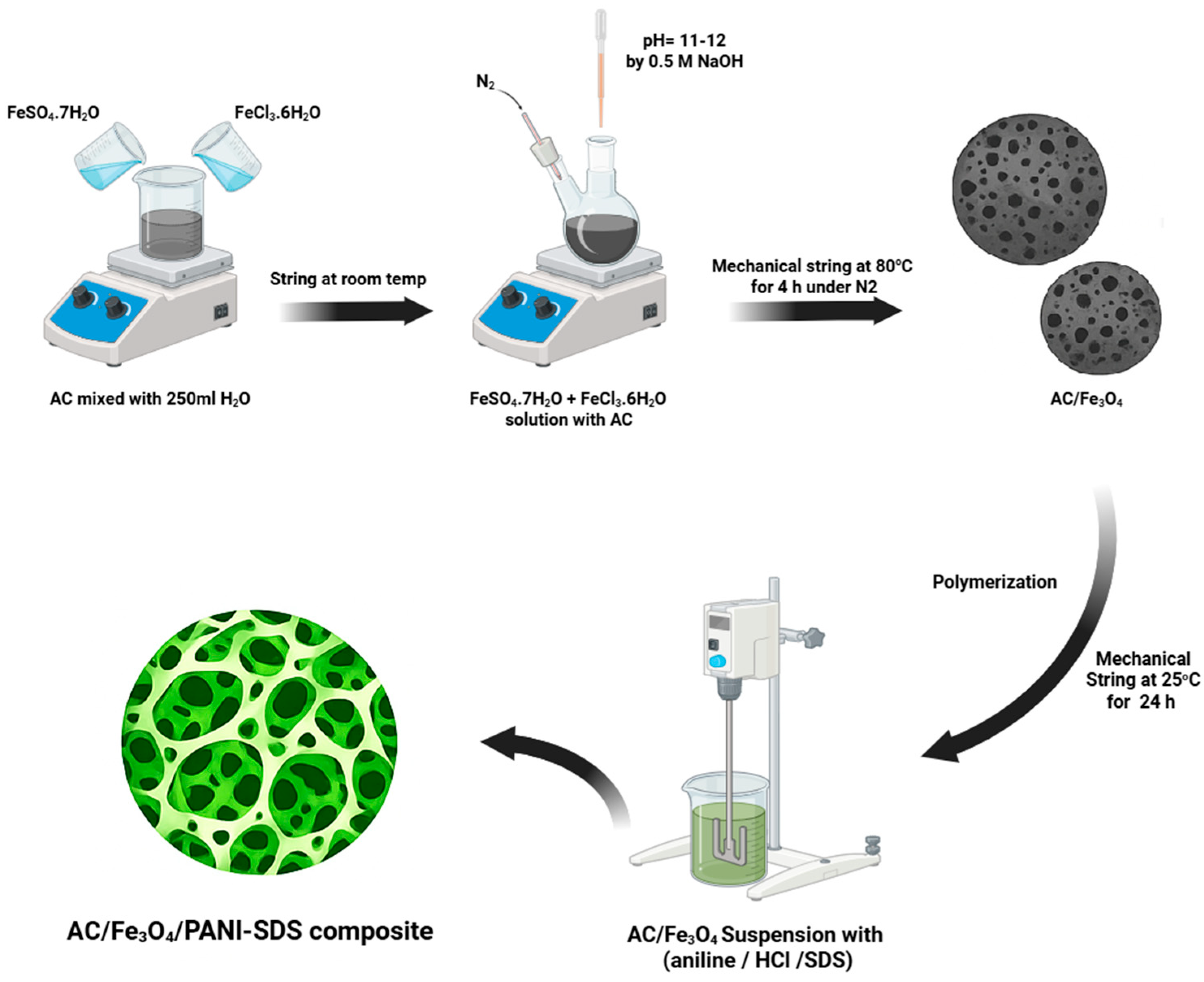
2.1. Synthesizing AC/Fe3O4/PANI-SDS Composite
2.2. Characterization Instruments
2.3. Adsorption Experiment
2.4. Kinetic Evaluation of the Adsorption Process
2.5. Evaluation of Adsorption Isotherms
2.6. Thermodynamics Study
2.7. Regeneration Study
3. Results and Discussion
3.1. Characterization of Adsorbent
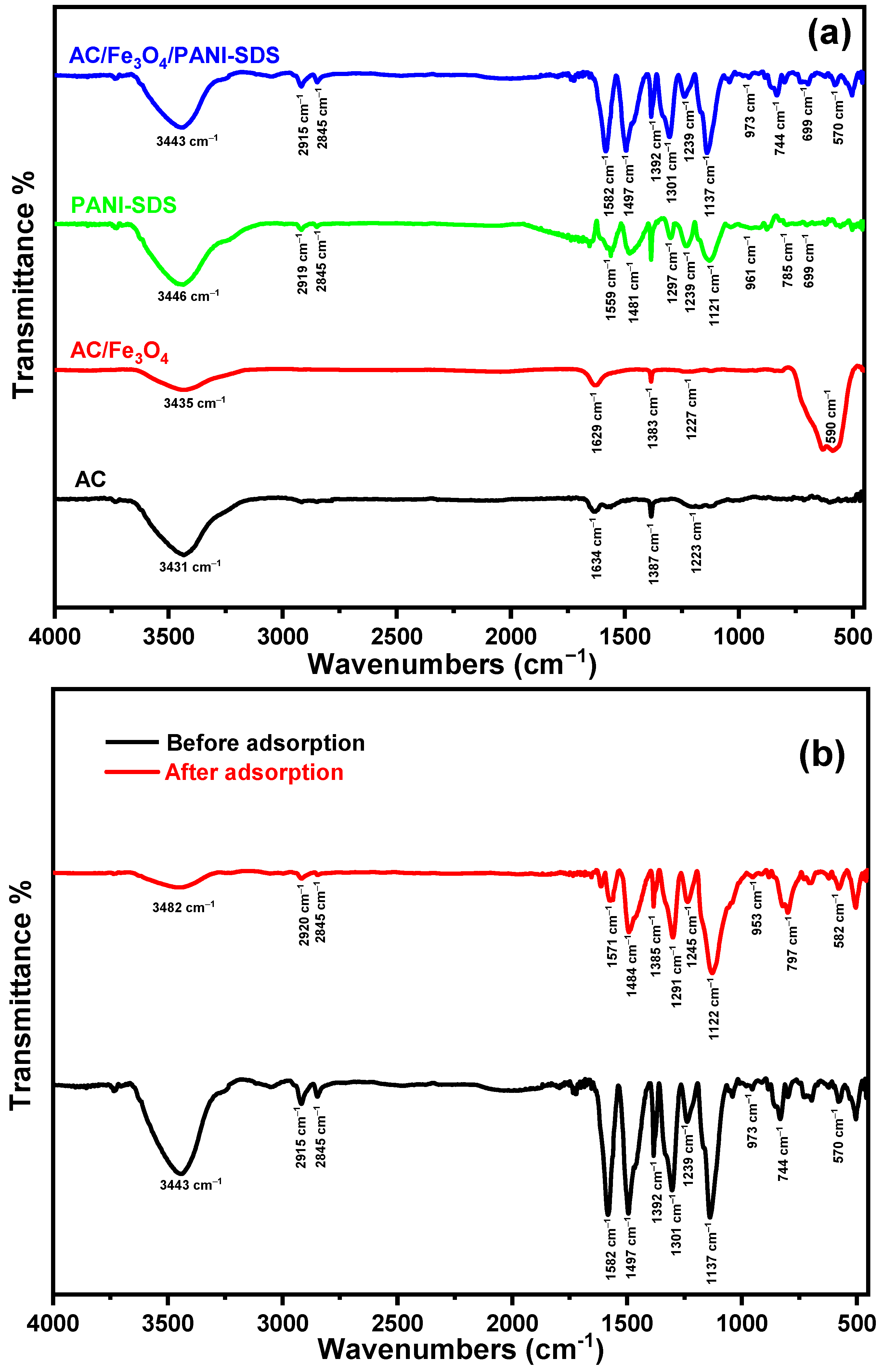
3.1.1. FT-IR Spectral Analysis
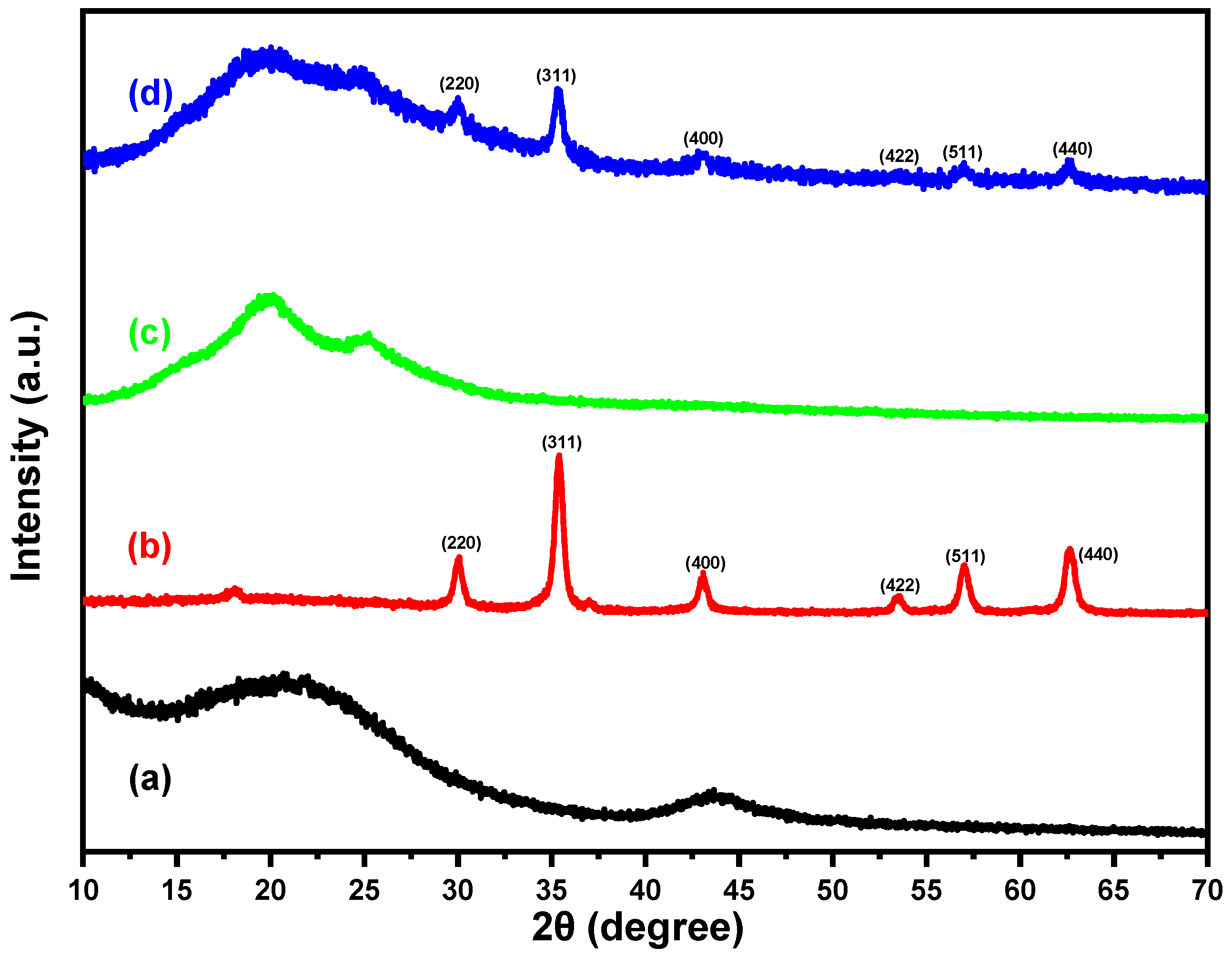
3.1.2. XRD Pattern Analysis
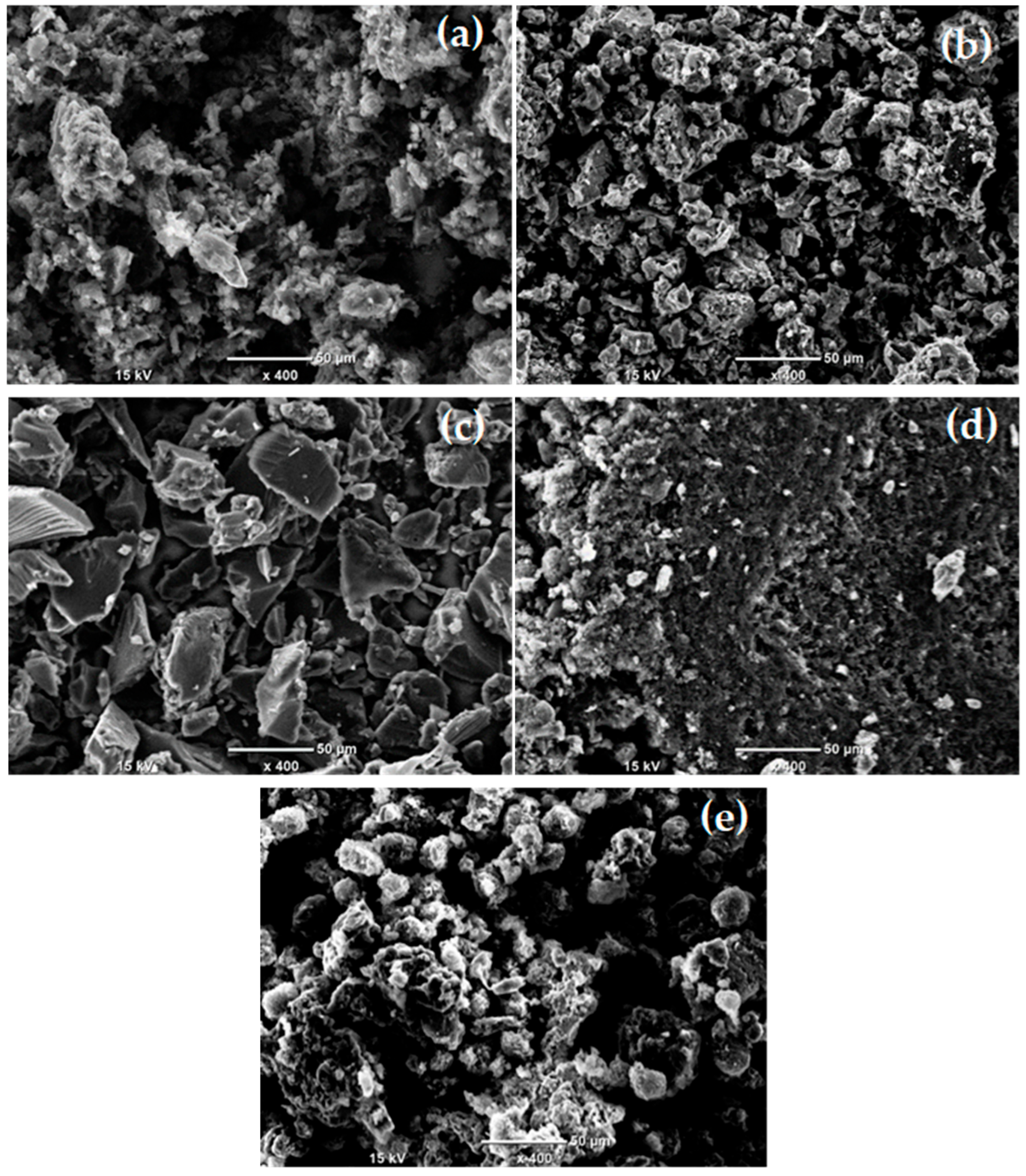
3.1.3. SEM Analysis
3.1.4. EDS Analysis
3.1.5. VSM Analysis
3.1.6. Surface Area and Pore Structure Analysis
3.2. Evaluation of Adsorption Behavior
3.2.1. Influence of Adsorbent Type
3.2.2. Interaction Time
3.2.3. Adsorbent Dosage
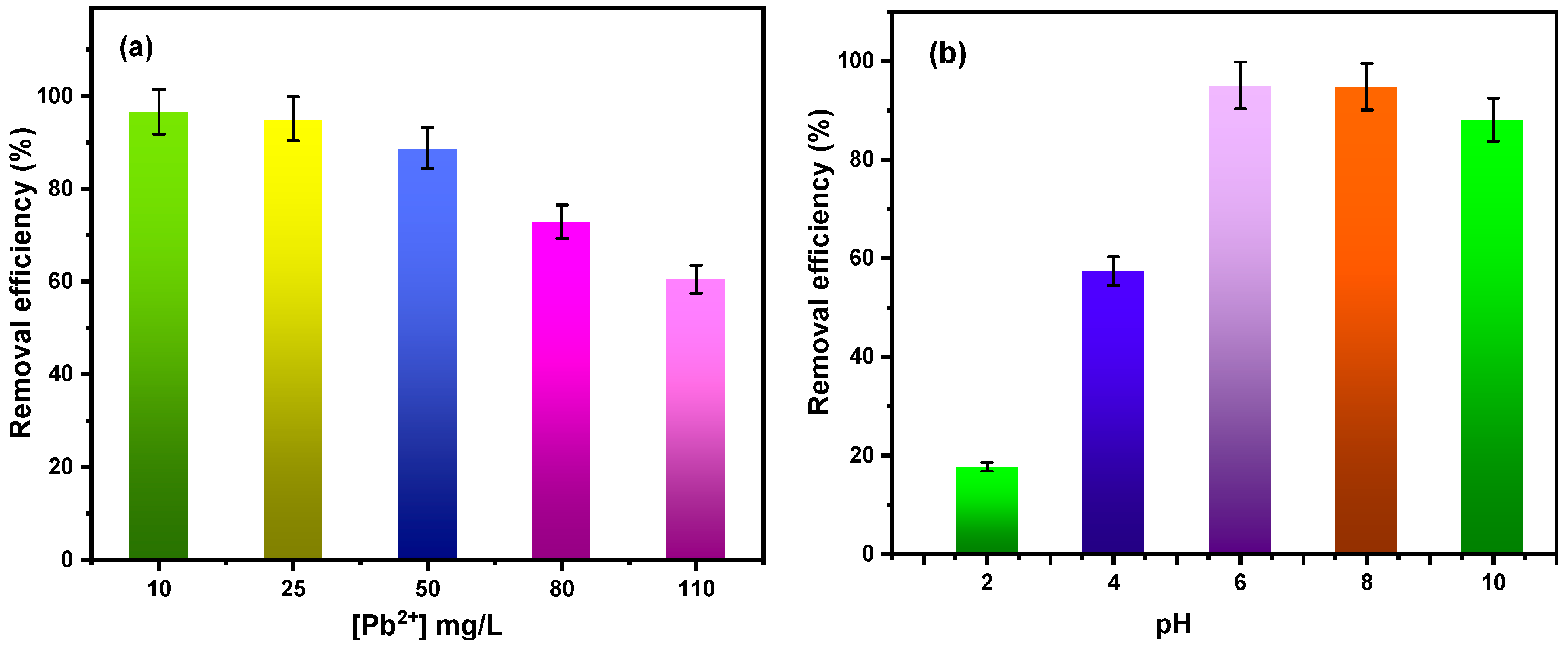
3.2.4. Initial Concentration
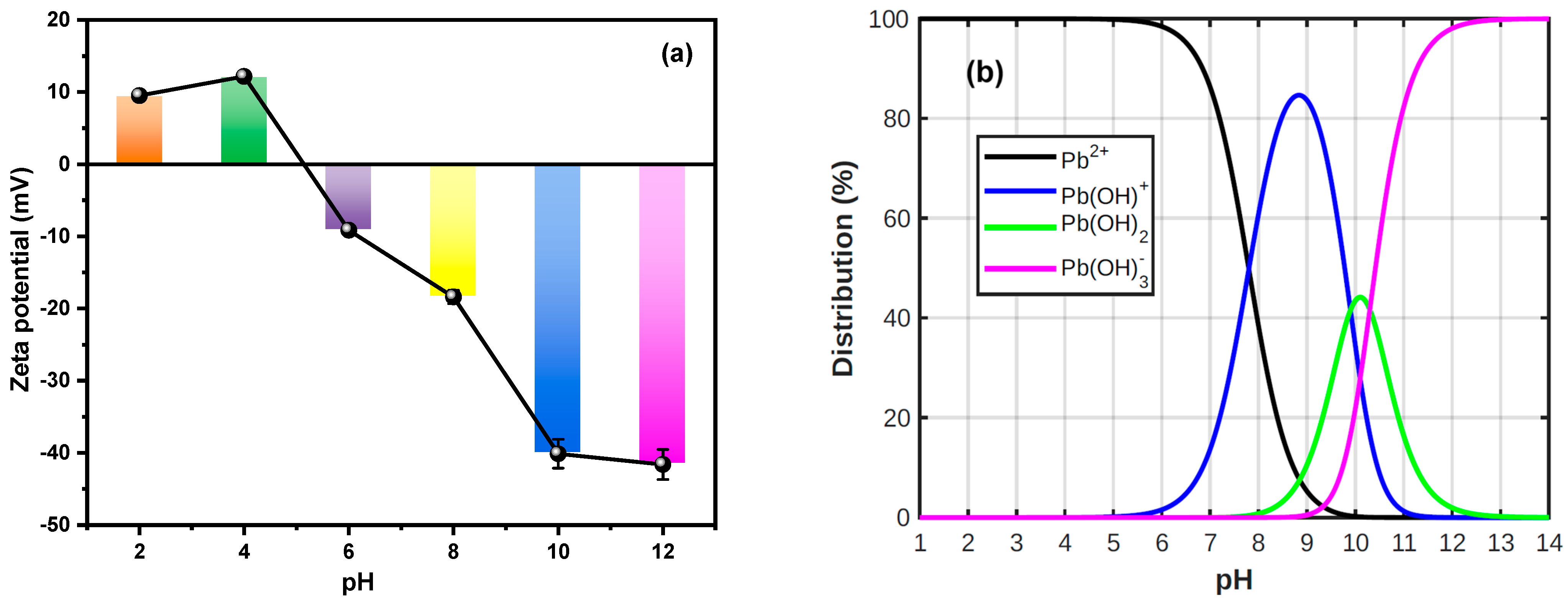
3.2.5. Solution pH and Zeta Potential
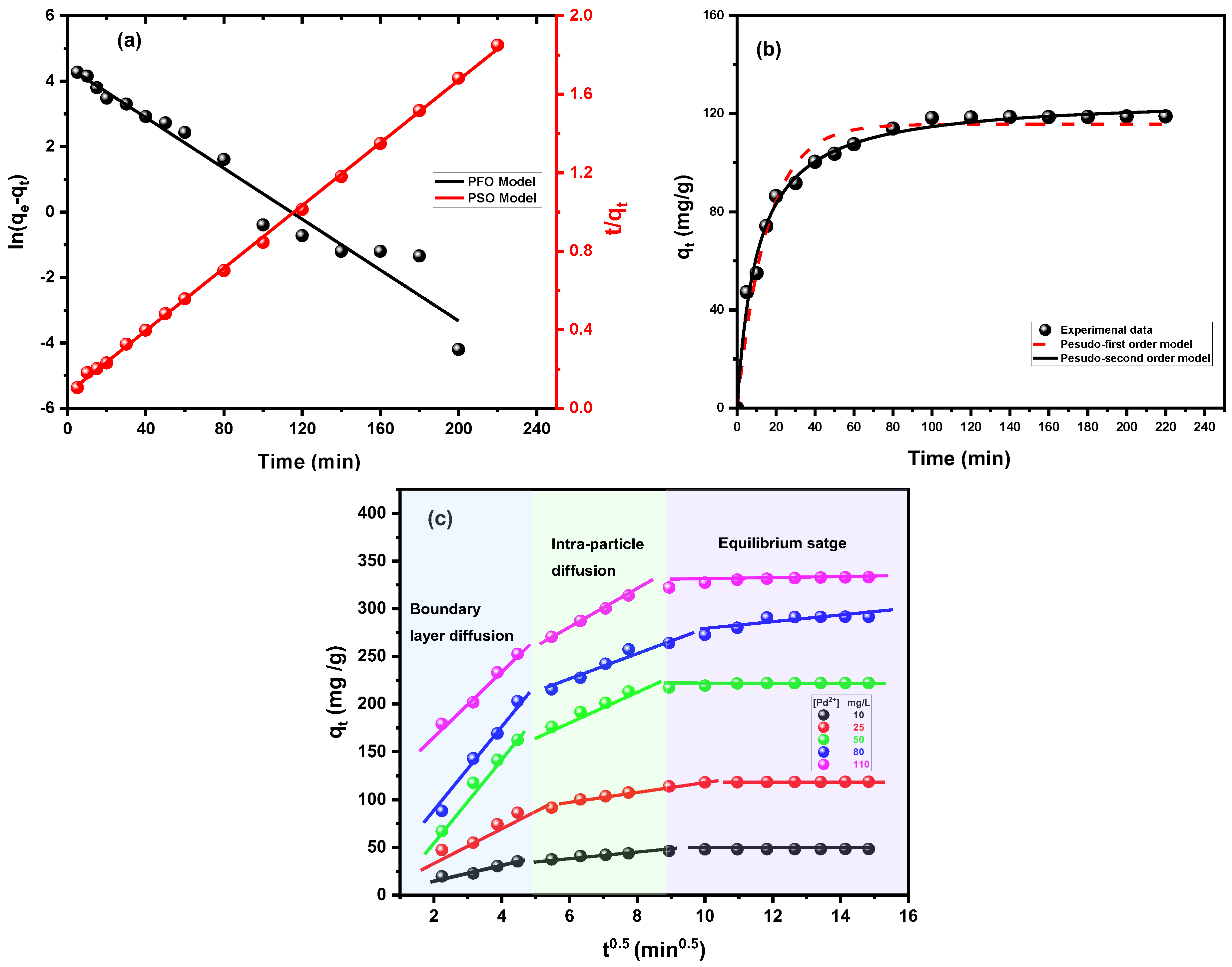
3.3. Adsorption Kinetics Analysis
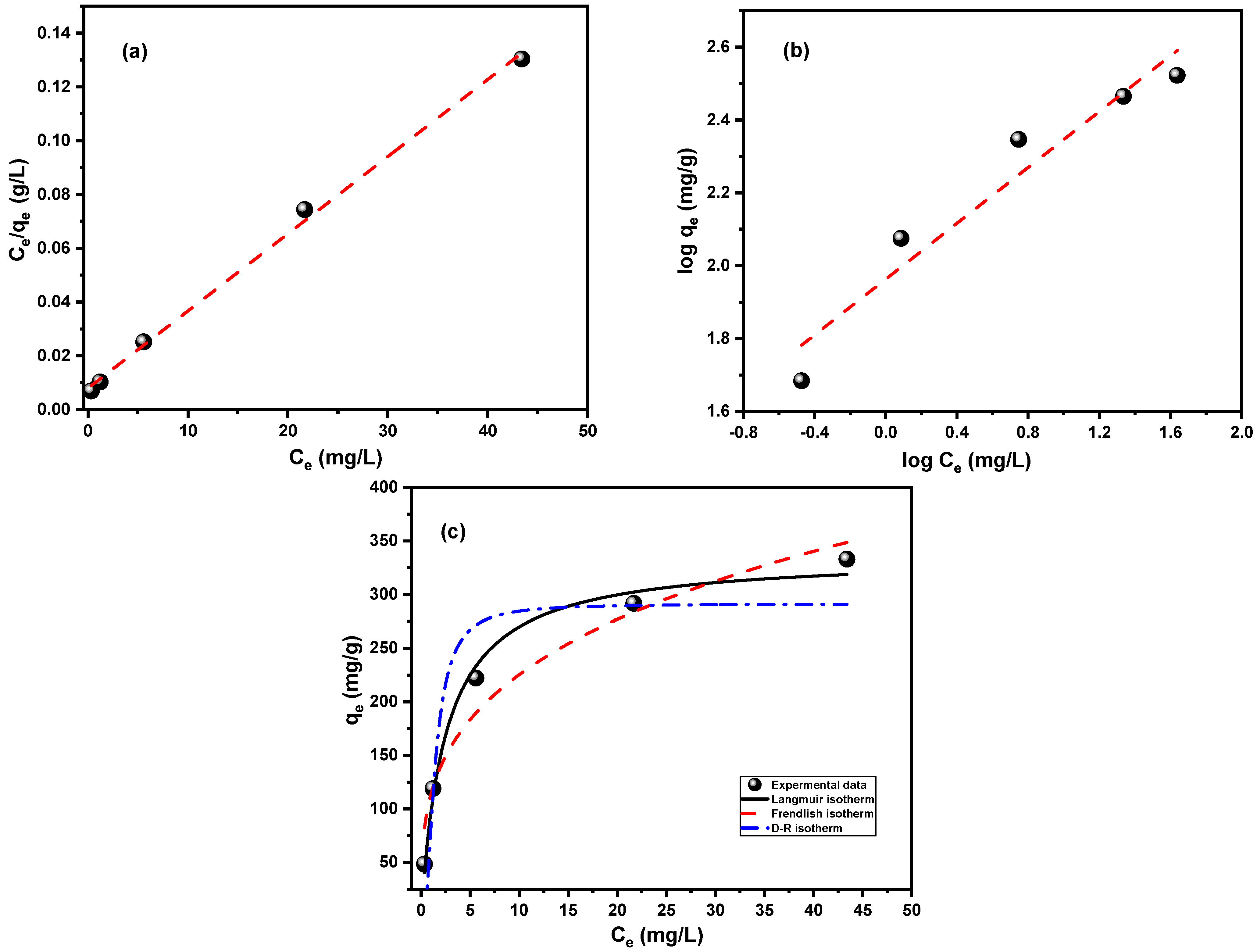
3.4. Adsorption Isotherm
3.5. Thermodynamic Parameters and Temperature Effect
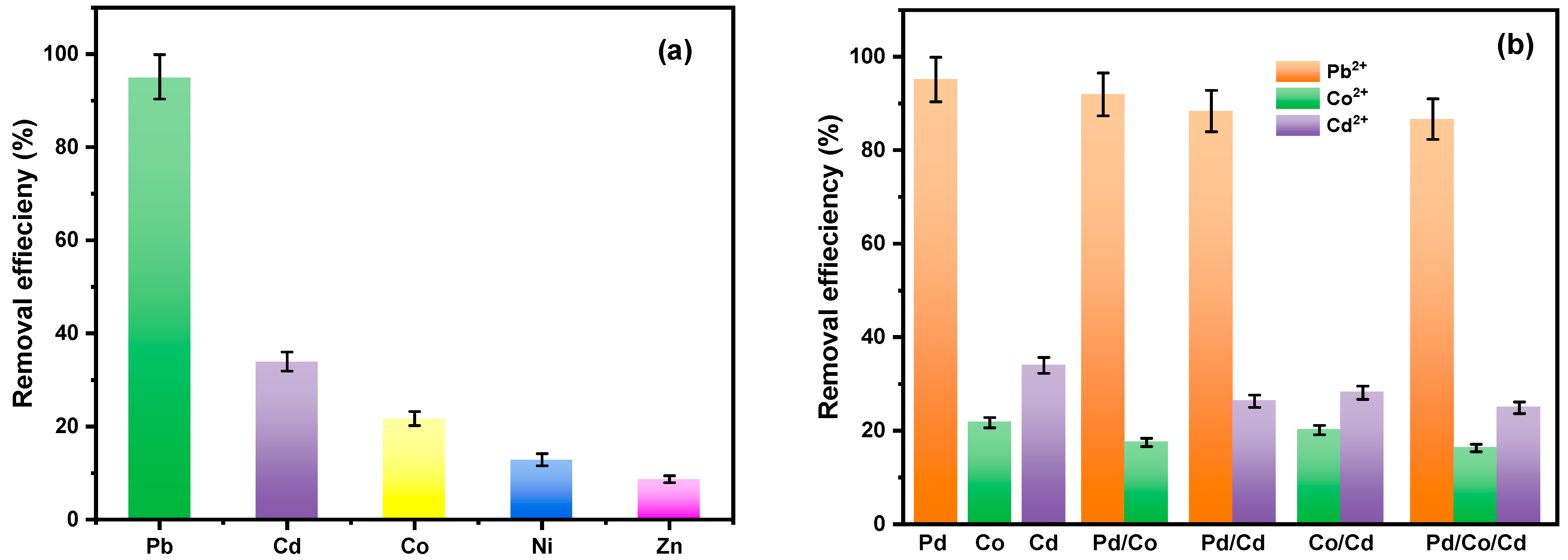
3.6. A Comparative Adsorption Study Toward Various Heavy Metal Ions
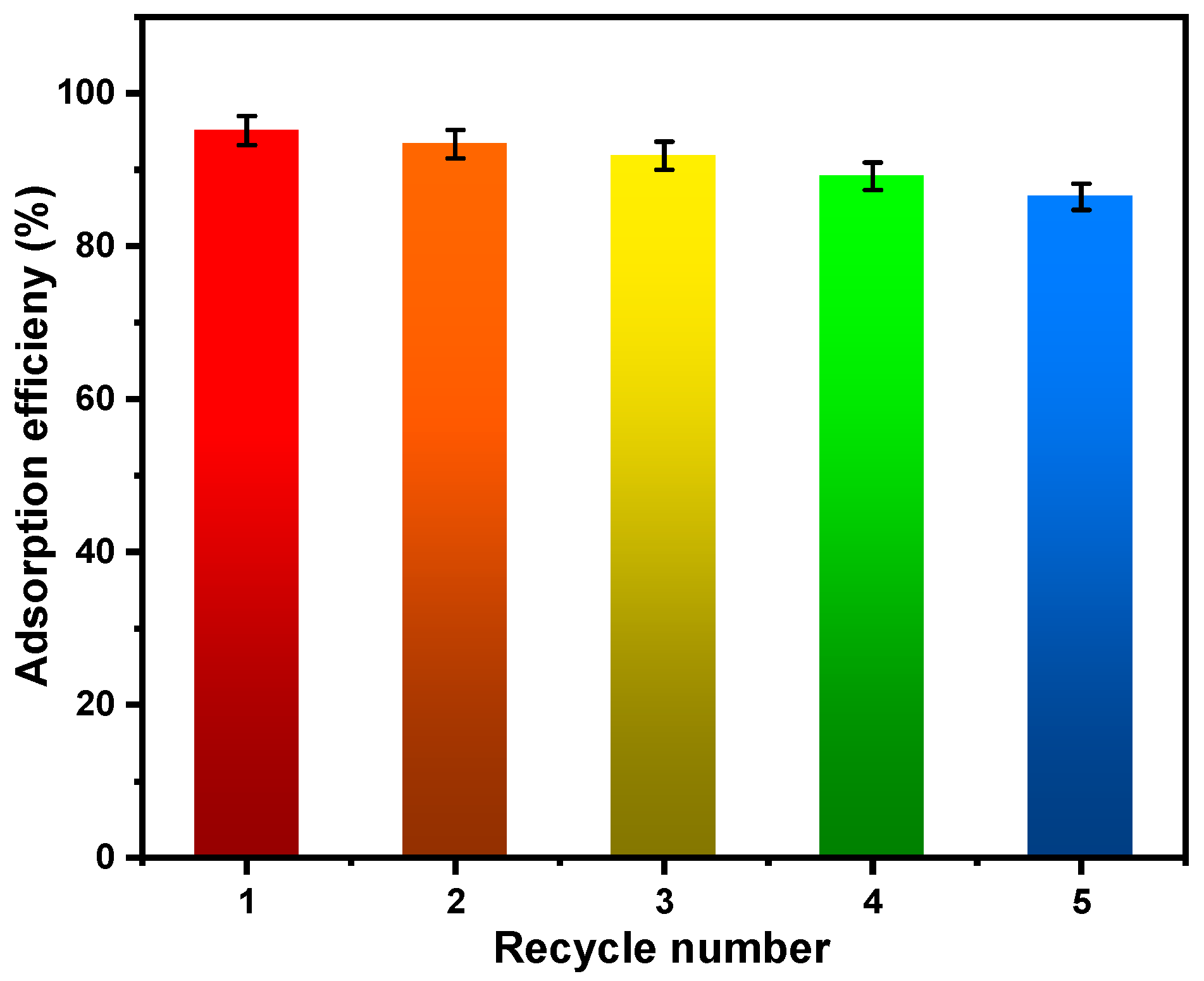
3.7. Reusability Study of the Adsorbent
3.8. Comparison Studies with Another Research

| Adsorbent Materials | Dose (g) | pH | Temp. (°C) | qmax (mg/g) | Removal% | Reference |
|---|---|---|---|---|---|---|
| Fe3O4/AC nanocomposite | 0.04 | 5–6 | 20 | 144.92 | 97.66 | [88] |
| Chitosan Poly (acrylic acid) porous polymer Nanocomposite | -- | 5 | 25 | 138.9 | -- | [89] |
| MCGO composite material | -- | 5 | 27 | 112.35 | 92.00 | [90] |
| Polyaniline/Fe3O4 | 0.03 | 9 | 25 | 111.11 | -- | [91] |
| Magnetic carbon (Fe3O4@Carbon) nanocomposites | 0.04 | 5.5 | 27 | 151.5 | 96.30 | [92] |
| Carbon magnetic nanocomposites | 1.0 | 5.9 | 25 | 83.54 | 84.50 | [93] |
| AC/Fe3O4/PANI-SDS | 0.01 | 6 | 25 | 348.39 | 95.12 | This work |
4. Conclusions
Author Contributions
Funding
Data Availability Statement
Conflicts of Interest
References
- Zuo, Z.; Zhang, H.; Gao, S.; Wang, C.; Chen, W.-T.; Hu, G. Recent progress in porous organic frameworks for electrochemical sensing of environmental pollutants. J. Environ. Chem. Eng. 2024, 12, 113263. [Google Scholar] [CrossRef]
- Yang, X.; Wan, Y.; Zheng, Y.; He, F.; Yu, Z.; Huang, J.; Wang, H.; Ok, Y.S.; Jiang, Y.; Gao, B. Surface functional groups of carbon-based adsorbents and their roles in the removal of heavy metals from aqueous solutions: A critical review. Chem. Eng. J. 2019, 366, 608–621. [Google Scholar] [CrossRef] [PubMed]
- Brennecke, D.; Duarte, B.; Paiva, F.; Caçador, I.; Canning-Clode, J. Microplastics as vector for heavy metal contamination from the marine environment. Estuar. Coast. Shelf Sci. 2016, 178, 189–195. [Google Scholar] [CrossRef]
- Kumar, V.; Dwivedi, S.K.; Oh, S. A critical review on lead removal from industrial wastewater: Recent advances and future outlook. J. Water Process Eng. 2022, 45, 102518. [Google Scholar] [CrossRef]
- Zulfiqar, U.; Farooq, M.; Hussain, S.; Maqsood, M.; Hussain, M.; Ishfaq, M.; Ahmad, M.; Anjum, M.Z. Lead toxicity in plants: Impacts and remediation. J. Environ. Manag. 2019, 250, 109557. [Google Scholar] [CrossRef]
- Ahamed, M.; Siddiqui, M.K.J. Environmental lead toxicity and nutritional factors. Clin. Nutr. 2007, 26, 400–408. [Google Scholar] [CrossRef]
- Naranjo, V.I.; Hendricks, M.; Jones, K.S. Lead Toxicity in Children: An Unremitting Public Health Problem. Pediatr. Neurol. 2020, 113, 51–55. [Google Scholar] [CrossRef]
- Saleh, T.A.; Mustaqeem, M.; Khaled, M. Water treatment technologies in removing heavy metal ions from wastewater: A review. Environ. Nanotechnol. Monit. Manag. 2022, 17, 100617. [Google Scholar] [CrossRef]
- Wang, Q.; Yu, J.; Chen, X.; Du, D.; Wu, R.; Qu, G.; Guo, X.; Jia, H.; Wang, T. Non-thermal plasma oxidation of Cu(II)-EDTA and simultaneous Cu(II) elimination by chemical precipitation. J. Environ. Manag. 2019, 248, 109237. [Google Scholar] [CrossRef]
- Zhao, C.; Ge, R.; Zhen, Y.; Wang, Y.; Li, Z.; Shi, Y.; Chen, X. A hybrid process of coprecipitation-induced crystallization-capacitive deionization-ion exchange process for heavy metals removal from hypersaline ternary precursor wastewater. Chem. Eng. J. 2019, 378, 122136. [Google Scholar] [CrossRef]
- Sun, Y.; Zhou, S.; Pan, S.-Y.; Zhu, S.; Yu, Y.; Zheng, H. Performance evaluation and optimization of flocculation process for removing heavy metal. Chem. Eng. J. 2020, 385, 123911. [Google Scholar] [CrossRef]
- Feng, X.; Long, R.; Wang, L.; Liu, C.; Bai, Z.; Liu, X. A review on heavy metal ions adsorption from water by layered double hydroxide and its composites. Sep. Purif. Technol. 2022, 284, 120099. [Google Scholar] [CrossRef]
- Youssif, M.M.; El-Attar, H.G.; Hessel, V.; Wojnicki, M. Recent Developments in the Adsorption of Heavy Metal Ions from Aqueous Solutions Using Various Nanomaterials. Materials 2024, 17, 5141. [Google Scholar] [CrossRef]
- Youssif, M.M.; El-Attar, H.G.; Małecki, S.; Włoch, G.; Czapkiewicz, M.; Kornaus, K.; Wojnicki, M. Mercury Ion Selective Adsorption from Aqueous Solution Using Amino-Functionalized Magnetic Fe2O3/SiO2 Nanocomposite. Materials 2024, 17, 4254. [Google Scholar] [CrossRef] [PubMed]
- Zango, Z.U.; Garba, A.; Haruna, A.; Imam, S.S.; Katsina, A.U.; Ali, A.F.; Abidin, A.Z.; Zango, M.U.; Garba, Z.N.; Hosseini-Bandegharaei, A.; et al. A systematic review on applications of biochar and activated carbon derived from biomass as adsorbents for sustainable remediation of antibiotics from pharmaceutical wastewater. J. Water Process Eng. 2024, 67, 106186. [Google Scholar] [CrossRef]
- Ni, B.-J.; Huang, Q.-S.; Wang, C.; Ni, T.-Y.; Sun, J.; Wei, W. Competitive adsorption of heavy metals in aqueous solution onto biochar derived from anaerobically digested sludge. Chemosphere 2019, 219, 351–357. [Google Scholar] [CrossRef] [PubMed]
- Gul, A.; Khaligh, N.G.; Julkapli, N.M. Surface modification of Carbon-Based Nanoadsorbents for the Advanced Wastewater Treatment. J. Mol. Struct. 2021, 1235, 130148. [Google Scholar] [CrossRef]
- Zadeh, K.K.; Jafari, D. Activated carbon/alginate/Fe3O4 magnetic nanocomposite as a superior functional material for removal of lead from aqueous media. Biomass Convers. Biorefin. 2024, 14, 19025–19043. [Google Scholar] [CrossRef]
- Mohamed, S.M.I.; Yılmaz, M.; Güner, E.K.; El Nemr, A. Synthesis and characterization of iron oxide-commercial activated carbon nanocomposite for removal of hexavalent chromium (Cr6+) ions and Mordant Violet 40 (MV40) dye. Sci. Rep. 2024, 14, 1241. [Google Scholar] [CrossRef]
- de Castro-Alves, L.; Yáñez-Vilar, S.; González-Goméz, M.A.; Garcia-Acevedo, P.; Arnosa-Prieto, Á.; Piñeiro-Redondo, Y.; Rivas, J. Understanding adsorption mechanisms and metal ion selectivity of superparamagnetic beads with mesoporous CMK-3 carbon and commercial activated carbon. Microporous Mesoporous Mater. 2024, 374, 113159. [Google Scholar] [CrossRef]
- Munagapati, V.S.; Wen, H.-Y.; Gollakota, A.R.K.; Wen, J.-C.; Lin, K.-Y.A.; Shu, C.-M.; Yarramuthi, V.; Basivi, P.K.; Reddy, G.M.; Zyryanov, G.V. Magnetic Fe3O4 nanoparticles loaded guava leaves powder impregnated into calcium alginate hydrogel beads (Fe3O4-GLP@CAB) for efficient removal of methylene blue dye from aqueous environment: Synthesis, characterization, and its adsorption performance. Int. J. Biol. Macromol. 2023, 246, 125675. [Google Scholar] [CrossRef] [PubMed]
- Aryee, A.A.; Mpatani, F.M.; Du, Y.; Kani, A.N.; Dovi, E.; Han, R.; Li, Z.; Qu, L. Fe3O4 and iminodiacetic acid modified peanut husk as a novel adsorbent for the uptake of Cu (II) and Pb (II) in aqueous solution: Characterization, equilibrium and kinetic study. Environ. Pollut. 2021, 268, 115729. [Google Scholar] [CrossRef] [PubMed]
- Goharrizi, F.S.; Ebrahimipour, S.Y.; Ebrahimnejad, H.; Fatemi, S.J. Magnetic Mesoporous Silica Functionalized with Amine Groups for Efficient Removal of Heavy Metals and Bacterial Inhibition. J. Clust. Sci. 2024, 35, 2419–2435. [Google Scholar] [CrossRef]
- Du, L.; Gao, P.; Liu, Y.; Minami, T.; Yu, C. Removal of Cr(VI) from Aqueous Solution by Polypyrrole/Hollow Mesoporous Silica Particles. Nanomaterials 2020, 10, 686. [Google Scholar] [CrossRef]
- Garud, H.B.; Patil, P.H.; Kulkarni, V.V.; Kalantre, V.A.; Burungale, S.H.; Jadhav, S.A. Polymer-grafted materials as surface-engineered adsorbents for water purification. JCIS Open 2024, 15, 100122. [Google Scholar] [CrossRef]
- Youssif, M.M.; Wojnicki, M. Efficacious Removal of Cd2+ and Pb2+ Ions from Wastewater Using a Novel Fe3O4/SiO2/PANI-SDBS Nanocomposite. Materials 2025, 18, 2083. [Google Scholar] [CrossRef]
- Kaveh, R.; Bagherzadeh, M. Simultaneous removal of mercury ions and cationic and anionic dyes from aqueous solution using epichlorohydrin cross-linked chitosan @ magnetic Fe3O4/activated carbon nanocomposite as an adsorbent. Diam. Relat. Mater. 2022, 124, 108923. [Google Scholar] [CrossRef]
- Akbari-Jonoush, Z.; Naseri, S.; Farzadkia, M.; Mohajerani, H.-R.; Shirzad-Siboni, M.; Yang, J.-K. Application of C14/SiO2–Fe3O4 and AC–Fe3O4 nanocomposite for U(VI) removal. Desalin. Water Treat. 2016, 57, 22519–22532. [Google Scholar] [CrossRef]
- Wadhawan, S.; Jain, A.; Nayyar, J.; Mehta, S.K. Role of nanomaterials as adsorbents in heavy metal ion removal from waste water: A review. J. Water Process Eng. 2020, 33, 101038. [Google Scholar] [CrossRef]
- Singh, S.; Kapoor, D.; Khasnabis, S.; Singh, J.; Ramamurthy, P.C. Mechanism and kinetics of adsorption and removal of heavy metals from wastewater using nanomaterials. Environ. Chem. Lett. 2021, 19, 2351–2381. [Google Scholar] [CrossRef]
- Dharmarathna, S.P.; Priyantha, N. Investigation of boundary layer effect of intra-particle diffusion on methylene blue adsorption on activated carbon. Energy Nexus 2024, 14, 100294. [Google Scholar] [CrossRef]
- Saadi, R.; Saadi, Z.; Fazaeli, R.; Fard, N.E. Monolayer and multilayer adsorption isotherm models for sorption from aqueous media. Korean J. Chem. Eng. 2015, 32, 787–799. [Google Scholar] [CrossRef]
- Mikolajczyk, A.P.; Fortela, D.L.B.; Berry, J.C.; Chirdon, W.M.; Hernandez, R.A.; Gang, D.D.; Zappi, M.E. Evaluating the Suitability of Linear and Nonlinear Regression Approaches for the Langmuir Adsorption Model as Applied toward Biomass-Based Adsorbents: Testing Residuals and Assessing Model Validity. Langmuir 2024, 40, 20428–20442. [Google Scholar] [CrossRef] [PubMed]
- Mohamad Yusop, M.F.; Abdullah, A.Z.; Ahmad, M.A. Amoxicillin adsorption from aqueous solution by Cu(II) modified lemon peel based activated carbon: Mass transfer simulation, surface area prediction and F-test on isotherm and kinetic models. Powder Technol. 2024, 438, 119589. [Google Scholar] [CrossRef]
- Freundlich, Z.H. Über die adsorption in lösungen. Phys. Chem. 1907, 57, 385–470. [Google Scholar] [CrossRef]
- Maceiras, R.; Feijoo, J.; Perez-Rial, L.; Alfonsin, V.; Falcon, P. Study of natural zeolites for hydrogen purification: CO2 adsorption capacity and kinetic mechanism. Fuel 2024, 376, 132732. [Google Scholar] [CrossRef]
- Su, G.; Yang, S.; Jiang, Y.; Li, J.; Li, S.; Ren, J.-C.; Liu, W. Modeling chemical reactions on surfaces: The roles of chemical bonding and van der Waals interactions. Prog. Surf. Sci. 2019, 94, 100561. [Google Scholar] [CrossRef]
- Khatibi, A.D.; Mahvi, A.H.; Mengelizadeh, N.; Balarak, D. Adsorption–desorption of tetracycline onto molecularly imprinted polymer: Isotherm, kinetics, and thermodynamics studies. Desalin. Water Treat. 2021, 230, 240–251. [Google Scholar] [CrossRef]
- Nandiyanto, A.B.D.; Santiuly Girsang, G.C.; Maryanti, R.; Ragadhita, R.; Anggraeni, S.; Fauzi, F.M.; Sakinah, P.; Astuti, A.P.; Usdiyana, D.; Fiandini, M.; et al. Isotherm adsorption characteristics of carbon microparticles prepared from pineapple peel waste. Commun. Sci. Technol. 2020, 5, 31–39. [Google Scholar] [CrossRef]
- Liu, X.; Wan, Y.; Liu, P.; Zhao, L.; Zou, W. Optimization of sulfamethazine sodium adsorption onto activated carbon-based Salix psammophila: Investigation of adsorption behavior and mechanism. J. Dispers. Sci. Technol. 2019, 40, 507–518. [Google Scholar] [CrossRef]
- Bai, Z.; Yang, Q.; Wang, J. Catalytic ozonation of sulfamethazine antibiotics using Ce0.1Fe0.9OOH: Catalyst preparation and performance. Chemosphere 2016, 161, 174–180. [Google Scholar] [CrossRef] [PubMed]
- Abkenar, S.D.; Khoobi, M.; Tarasi, R.; Hosseini, M.; Shafiee, A.; Ganjali, M.R. Fast Removal of Methylene Blue from Aqueous Solution Using Magnetic-Modified Fe3O4 Nanoparticles. J. Environ. Eng. 2015, 141. [Google Scholar] [CrossRef]
- Sandaruwan, C.; Herath, H.M.P.C.K.; Karunarathne, T.S.E.F.; Ratnayake, S.P.; Amaratunga, G.A.J.; Dissanayake, D.P. Polyaniline/palladium nanohybrids for moisture and hydrogen detection. Chem. Cent. J. 2018, 12, 93. [Google Scholar] [CrossRef] [PubMed]
- Chen, K.; He, J.; Li, Y.; Cai, X.; Zhang, K.; Liu, T.; Hu, Y.; Lin, D.; Kong, L.; Liu, J. Removal of cadmium and lead ions from water by sulfonated magnetic nanoparticle adsorbents. J. Colloid Interface Sci. 2017, 494, 307–316. [Google Scholar] [CrossRef]
- Noby, H.; El-Shazly, A.H.; Elkady, M.F.; Ohshima, M. Novel preparation of self-assembled HCl-doped polyaniline nanotubes using compressed CO2-assisted polymerization. Polymer 2018, 156, 71–75. [Google Scholar] [CrossRef]
- Han, M.G.; Cho, S.K.; Oh, S.G.; Im, S.S. Preparation and characterization of polyaniline nanoparticles synthesized from DBSA micellar solution. Synth. Met. 2002, 126, 53–60. [Google Scholar] [CrossRef]
- Yang, N.; Zhai, J.; Wan, M.; Wang, D.; Jiang, L. Layered nanostructures of polyaniline with graphene oxide as the dopant and template. Synth. Met. 2010, 160, 1617–1622. [Google Scholar] [CrossRef]
- Zuo, P.-P.; Feng, H.-F.; Xu, Z.-Z.; Zhang, L.-F.; Zhang, Y.-L.; Xia, W.; Zhang, W.-Q. Fabrication of biocompatible and mechanically reinforced graphene oxide-chitosan nanocomposite films. Chem. Cent. J. 2013, 7, 39. [Google Scholar] [CrossRef]
- Socrates, G. Infrared and Raman Characteristic Group Frequencies: Tables and Charts; John Wiley & Sons: Hoboken, NJ, USA, 2004. [Google Scholar]
- Masunga, N.; Tito, G.S.; Meijboom, R. Catalytic evaluation of mesoporous metal oxides for liquid phase oxidation of styrene. Appl. Catal. A Gen. 2018, 552, 154–167. [Google Scholar] [CrossRef]
- Remyamol, T.; John, H.; Gopinath, P. Synthesis and nonlinear optical properties of reduced graphene oxide covalently functionalized with polyaniline. Carbon 2013, 59, 308–314. [Google Scholar] [CrossRef]
- Geng, X.; He, D.-W.; Wang, Y.-S.; Zhao, W.; Zhou, Y.-K.; Li, S.-L. Synthesis and microwave absorption properties of graphene–oxide(GO)/polyaniline nanocomposite with Fe3O4 particles. Chin. Phys. B 2015, 24, 027803. [Google Scholar] [CrossRef]
- Wang, Z.; Han, J.-J.; Zhang, N.; Sun, D.-D.; Han, T. Synthesis of polyaniline/graphene composite and its application in zinc-rechargeable batteries. J. Solid State Electrochem. 2019, 23, 3373–3382. [Google Scholar] [CrossRef]
- Venkatesha, N.; Poojar, P.; Qurishi, Y.; Geethanath, S.; Srivastava, C. Graphene oxide-Fe3O4 nanoparticle composite with high transverse proton relaxivity value for magnetic resonance imaging. J. Appl. Phys. 2015, 117, 154702. [Google Scholar] [CrossRef]
- Safari, J.; Javadian, L. Chitosan decorated Fe3O4 nanoparticles as a magnetic catalyst in the synthesis of phenytoin derivatives. RSC Adv. 2014, 4, 48973–48979. [Google Scholar] [CrossRef]
- Rebekah, A.; Bharath, G.; Naushad, M.; Viswanathan, C.; Ponpandian, N. Magnetic graphene/chitosan nanocomposite: A promising nano-adsorbent for the removal of 2-naphthol from aqueous solution and their kinetic studies. Int. J. Biol. Macromol. 2020, 159, 530–538. [Google Scholar] [CrossRef]
- Kumar Prajapati, A.; Kumar Mondal, M. Green synthesis of Fe3O4-onion peel biochar nanocomposites for adsorption of Cr(VI), methylene blue and congo red dye from aqueous solutions. J. Mol. Liq. 2022, 349, 118161. [Google Scholar] [CrossRef]
- Wang, Y.; Chen, R.; Dai, Z.; Yu, Q.; Miao, Y.; Xu, R. Facile preparation of a polypyrrole modified Chinese yam peel-based adsorbent: Characterization, performance, and application in removal of Congo red dye. RSC Adv. 2022, 12, 9424–9434. [Google Scholar] [CrossRef]
- Saruchi; Kumar, V. Adsorption kinetics and isotherms for the removal of rhodamine B dye and Pb+2 ions from aqueous solutions by a hybrid ion-exchanger. Arab. J. Chem. 2019, 12, 316–329. [Google Scholar] [CrossRef]
- Tella, A.C.; Owalude, S.O.; Olatunji, S.J.; Adimula, V.O.; Elaigwu, S.E.; Alimi, L.O.; Ajibade, P.A.; Oluwafemi, O.S. Synthesis of zinc-carboxylate metal-organic frameworks for the removal of emerging drug contaminant (amodiaquine) from aqueous solution. J. Environ. Sci. 2018, 64, 264–275. [Google Scholar] [CrossRef]
- Wang, X.; Ou, H.; Huang, J. One-pot synthesis of hyper-cross-linked polymers chemically modified with pyrrole, furan, and thiophene for phenol adsorption from aqueous solution. J. Colloid Interface Sci. 2019, 538, 499–506. [Google Scholar] [CrossRef]
- Ren, L.; Lin, H.; Meng, F.; Zhang, F. One-step solvothermal synthesis of Fe3O4@Carbon composites and their application in removing of Cr (VI) and Congo red. Ceram. Int. 2019, 45, 9646–9652. [Google Scholar] [CrossRef]
- Heybet, E.N.; Ugraskan, V.; Isik, B.; Yazici, O. Adsorption of methylene blue dye on sodium alginate/polypyrrole nanotube composites. Int. J. Biol. Macromol. 2021, 193, 88–99. [Google Scholar] [CrossRef] [PubMed]
- Zhao, H.; Ouyang, X.-K.; Yang, L.-Y. Adsorption of lead ions from aqueous solutions by porous cellulose nanofiber–sodium alginate hydrogel beads. J. Mol. Liq. 2021, 324, 115122. [Google Scholar] [CrossRef]
- Hussain, S.; Salman, M.; Youngblood, J.P.; Farooq, U.; Yasmeen, S.; Al-Ahmary, K.M.; Ahmed, M. Enhanced adsorption of Congo red dye by CS/PEG/ZnO composite hydrogel: Synthesis, characterization, and performance evaluation. J. Mol. Liq. 2024, 411, 125704. [Google Scholar] [CrossRef]
- Xiang, D.; Zhu, R.; Chen, Y.; Zhu, M.; Wang, S.; Wu, Y.; Luo, J.; Fu, L. Preparation of amidoxime modified covalent organic framework for efficient adsorption of lead ions in aqueous solution. Chem. Eng. J. 2024, 492, 152292. [Google Scholar] [CrossRef]
- Bo, S.; Luo, J.; An, Q.; Xiao, Z.; Wang, H.; Cai, W.; Zhai, S.; Li, Z. Efficiently selective adsorption of Pb(II) with functionalized alginate-based adsorbent in batch/column systems: Mechanism and application simulation. J. Clean. Prod. 2020, 250, 119585. [Google Scholar] [CrossRef]
- Yan, H.; Hu, W.; Cheng, S.; Xia, H.; Chen, Q.; Zhang, L.; Zhang, Q. Microwave-assisted preparation of manganese dioxide modified activated carbon for adsorption of lead ions. Water Sci. Technol. 2020, 82, 170–184. [Google Scholar] [CrossRef]
- Wu, N.; Guo, H.; Xue, R.; Wang, M.; Cao, Y.; Wang, X.; Xu, M.; Yang, W. A free nitrogen-containing Sm-MOF for selective detection and facile removal of mercury(II). Colloids Surf. A Physicochem. Eng. Asp. 2021, 618, 126484. [Google Scholar] [CrossRef]
- Sarojini, G.; Venkateshbabu, S.; Rajasimman, M. Facile synthesis and characterization of polypyrrole–iron oxide–seaweed (PPy-Fe3O4-SW) nanocomposite and its exploration for adsorptive removal of Pb(II) from heavy metal bearing water. Chemosphere 2021, 278, 130400. [Google Scholar] [CrossRef]
- Yan, J.; Li, R. Simple and low-cost production of magnetite/graphene nanocomposites for heavy metal ions adsorption. Sci. Total Environ. 2022, 813, 152604. [Google Scholar] [CrossRef]
- Kumar, A.; Das, T.; Thakur, R.S.; Fatima, Z.; Prasad, S.; Ansari, N.G.; Patel, D.K. Synthesis of Biomass-Derived Activated Carbons and Their Immobilization on Alginate Gels for the Simultaneous Removal of Cr(VI), Cd(II), Pb(II), As(III), and Hg(II) from Water. ACS Omega 2022, 7, 41997–42011. [Google Scholar] [CrossRef]
- Ahmed, M.A.; Ahmed, M.A.; Mohamed, A.A. Facile adsorptive removal of dyes and heavy metals from wastewaters using magnetic nanocomposite of zinc ferrite@reduced graphene oxide. Inorg. Chem. Commun. 2022, 144, 109912. [Google Scholar] [CrossRef]
- Singh, M.; Rayaz, M.; Arti, R. Isotherm and kinetic studies for sorption of Cr(VI) onto Prosopis cineraria leaf powder: A comparison of linear and non-linear regression analysis. Environ. Prog. Sustain. Energy 2024, 43, e14259. [Google Scholar] [CrossRef]
- Alkurdi, S.S.A.; Al-Juboori, R.A.; Bundschuh, J.; Bowtell, L.; Marchuk, A. Inorganic arsenic species removal from water using bone char: A detailed study on adsorption kinetic and isotherm models using error functions analysis. J. Hazard. Mater. 2021, 405, 124112. [Google Scholar] [CrossRef] [PubMed]
- El-Sayed, M.M.H.; Elsayed, R.E.; Attia, A.; Farghal, H.H.; Azzam, R.A.; Madkour, T.M. Novel nanoporous membranes of bio-based cellulose acetate, poly(lactic acid) and biodegradable polyurethane in-situ impregnated with catalytic cobalt nanoparticles for the removal of Methylene Blue and Congo Red dyes from wastewater. Carbohydr. Polym. Technol. Appl. 2021, 2, 100123. [Google Scholar] [CrossRef]
- Saeed, T.; Naeem, A.; Din, I.U.; Farooq, M.; Khan, I.W.; Hamayun, M.; Malik, T. Synthesis of chitosan composite of metal-organic framework for the adsorption of dyes; kinetic and thermodynamic approach. J. Hazard. Mater. 2022, 427, 127902. [Google Scholar] [CrossRef]
- Arabkhani, P.; Asfaram, A. The potential application of bio-based ceramic/organic xerogel derived from the plant sources: A new green adsorbent for removal of antibiotics from pharmaceutical wastewater. J. Hazard. Mater. 2022, 429, 128289. [Google Scholar] [CrossRef]
- Samadi, A.; Xie, M.; Li, J.; Shon, H.; Zheng, C.; Zhao, S. Polyaniline-based adsorbents for aqueous pollutants removal: A review. Chem. Eng. J. 2021, 418, 129425. [Google Scholar] [CrossRef]
- Shahzad, A.; Aslibeiki, B.; Slimani, S.; Ghosh, S.; Vocciante, M.; Grotti, M.; Comite, A.; Peddis, D.; Sarkar, T. Magnetic nanocomposite for lead (II) removal from water. Sci. Rep. 2024, 14, 17674. [Google Scholar] [CrossRef]
- Afshar, A.; Sadjadi, S.A.S.; Mollahosseini, A.; Eskandarian, M.R. Polypyrrole-polyaniline/Fe3O4 magnetic nanocomposite for the removal of Pb(II) from aqueous solution. Korean J. Chem. Eng. 2016, 33, 669–677. [Google Scholar] [CrossRef]
- Al-Gailani, A.; Bongosia, J.G.; Hornsby, K.; Taylor, M.J. Maximising E-waste leachate adsorption: Multi-component isotherm models and mechanisms with scalable mesoporous sugarcane bagasse-derived biochar. J. Water Process Eng. 2025, 75, 107979. [Google Scholar] [CrossRef]
- Marcus, Y. Thermodynamics of solvation of ions. Part 5.—Gibbs free energy of hydration at 298.15 K. J. Chem. Soc. Faraday Trans. 1991, 87, 2995–2999. [Google Scholar] [CrossRef]
- Shannon, R.D. Revised effective ionic radii and systematic studies of interatomic distances in halides and chalcogenides. Acta Crystallogr. Sect. A 1976, 32, 751–767. [Google Scholar] [CrossRef]
- Mohan, D.; Pittman, C.U. Arsenic removal from water/wastewater using adsorbents—A critical review. J. Hazard. Mater. 2007, 142, 1–53. [Google Scholar] [CrossRef] [PubMed]
- Li, C.; Chen, Y.; Zhang, Z.; Liu, C.; Guo, F.; Ahmad, W.; Gao, P. Pros and cons of hole-selective self-assembled monolayers in inverted PSCs and TSCs: Extensive case studies and data analysis. Energy Environ. Sci. 2024, 17, 6157–6203. [Google Scholar] [CrossRef]
- Hajjaoui, H.; Soufi, A.; Boumya, W.; Abdennouri, M.; Barka, N. Polyaniline/Nanomaterial Composites for the Removal of Heavy Metals by Adsorption: A Review. J. Compos. Sci. 2021, 5, 233. [Google Scholar] [CrossRef]
- Priyan, V.V.; Kumar, N.; Narayanasamy, S. Toxicological assessment and adsorptive removal of lead (Pb) and Congo red (CR) from water by synthesized iron oxide/activated carbon (Fe3O4/AC) nanocomposite. Chemosphere 2022, 294, 133758. [Google Scholar] [CrossRef]
- Medina, R.P.; Nadres, E.T.; Ballesteros, F.C.; Rodrigues, D.F. Incorporation of graphene oxide into a chitosan–poly(acrylic acid) porous polymer nanocomposite for enhanced lead adsorption. Environ. Sci. Nano 2016, 3, 638–646. [Google Scholar] [CrossRef]
- Samuel, M.S.; Shah, S.S.; Bhattacharya, J.; Subramaniam, K.; Pradeep Singh, N.D. Adsorption of Pb(II) from aqueous solution using a magnetic chitosan/graphene oxide composite and its toxicity studies. Int. J. Biol. Macromol. 2018, 115, 1142–1150. [Google Scholar] [CrossRef]
- Sadeghi, M.M.; Rad, A.S.; Ardjmand, M.; Mirabi, A. Preparation of magnetic nanocomposite based on polyaniline/Fe3O4 towards removal of lead (II) ions from real samples. Synth. Met. 2018, 245, 1–9. [Google Scholar] [CrossRef]
- Kataria, N.; Chauhan, A.K.; Garg, V.K.; Kumar, P. Sequestration of heavy metals from contaminated water using magnetic carbon nanocomposites. J. Hazard. Mater. Adv. 2022, 6, 100066. [Google Scholar] [CrossRef]
- Muntean, S.G.; Halip, L.; Nistor, M.A.; Păcurariu, C. Removal of Metal Ions via Adsorption Using Carbon Magnetic Nanocomposites: Optimization through Response Surface Methodology, Kinetic and Thermodynamic Studies. Magnetochemistry 2023, 9, 163. [Google Scholar] [CrossRef]


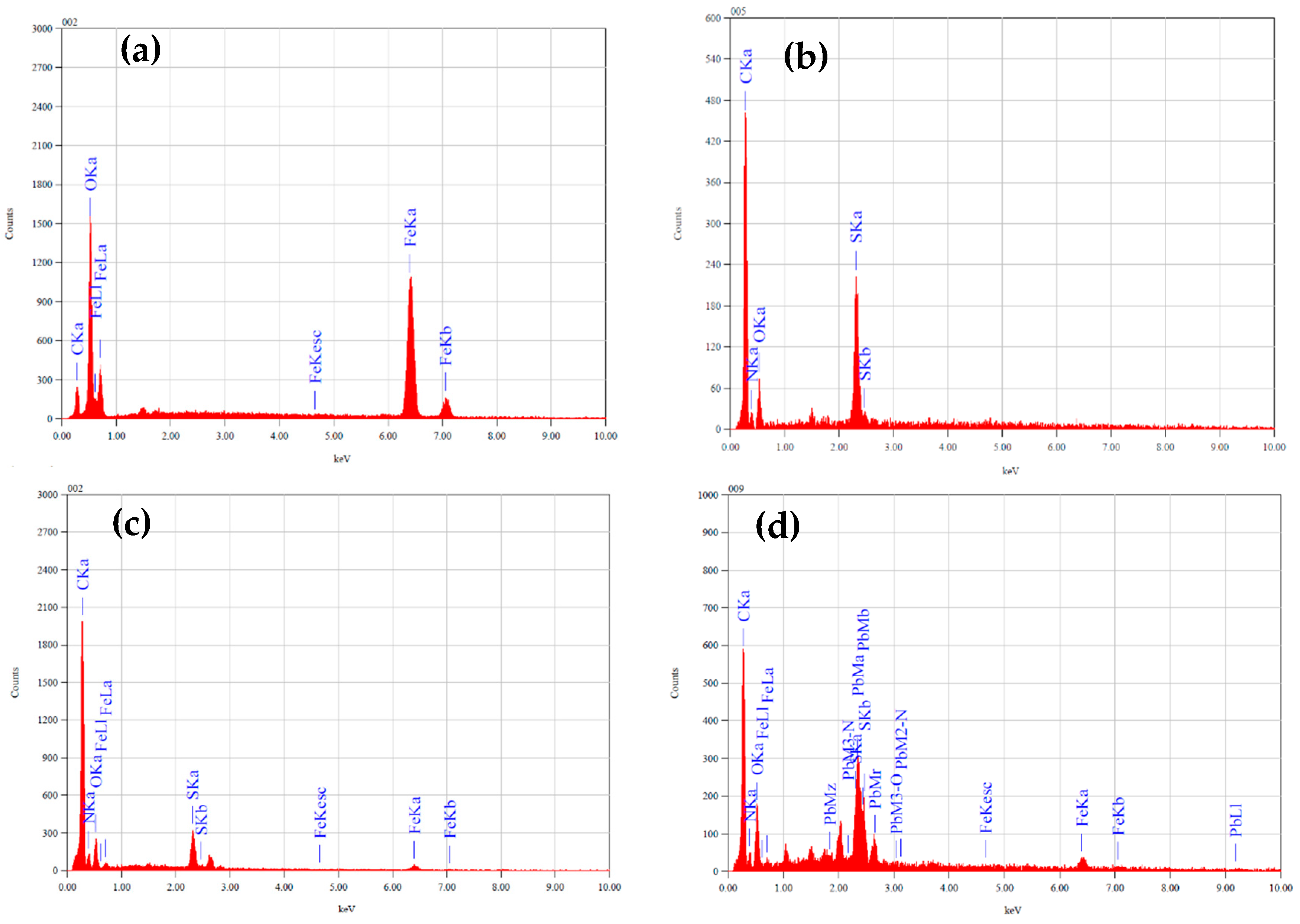
| Sample | Fe (%) | O (%) | N (%) | C (%) | S (%) | Pb (%) |
|---|---|---|---|---|---|---|
| AC/Fe3O4 | 69.05 | 23.78 | -- | 7.17 | -- | -- |
| PANI-SDS | -- | 17.63 | 24.67 | 49.84 | 7.86 | -- |
| AC/Fe3O4/PANI-SDS | 2.74 | 18.77 | 29.24 | 45.91 | 3.34 | -- |
| AC/Fe3O4/PANI-SDS after Pb2+ ion adsorption | 4.68 | 21.64 | 16.77 | 33.22 | 3.83 | 20.31 |
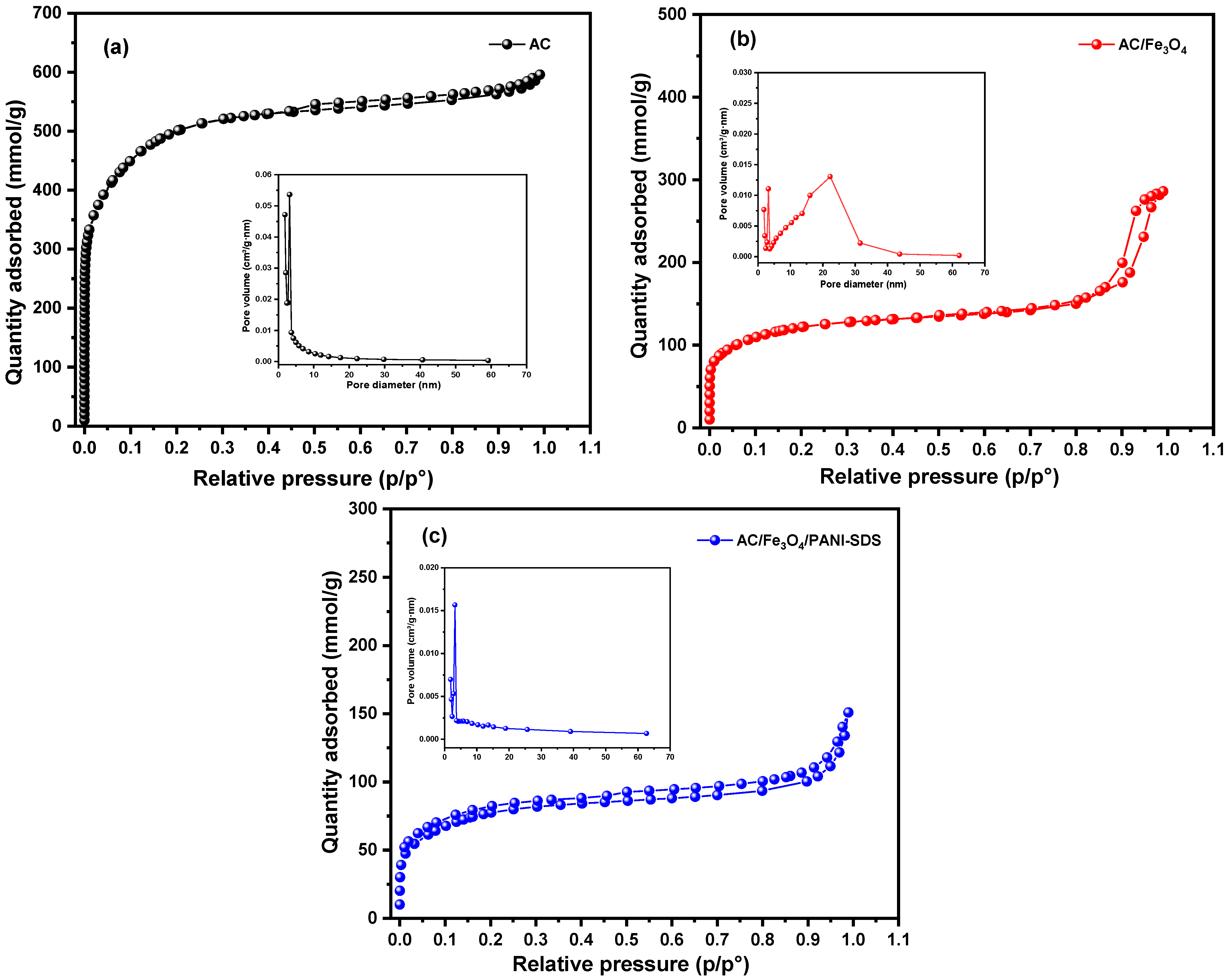
| Sample | AC | AC/Fe3O4 | AC/Fe3O4/PANI-SDS |
|---|---|---|---|
| BET surface area (m2/g) | 1844.52 | 444.92 | 284.63 |
| Total pore volume (cm3/g) | 0.7475 | 0.1639 | 0.1062 |
| Pore diameter (nm) | 5.41 | 15.94 | 13.35 |
| Pb2+ Ions (mg/L) | Pseudo-First-Order | Pseudo-Second-Order | Intraparticle Diffusion | ||||||||
|---|---|---|---|---|---|---|---|---|---|---|---|
| Linear Form | |||||||||||
| qe·exp (mg/g) | K1 (min−1) | R2 | qe·cal (mg/g) | K2 × 10−4 (g/mg min) | R2 | qe·cal (mg/g) | Kp1 (mg/g/min) | R2 | Kp2 (mg/g/min) | R2 | |
| 10 | 48.31 | 0.086 | 0.964 | 33.45 | 21.06 | 0.999 | 50.86 | 7.23 | 0.924 | 2.71 | 0.945 |
| 25 | 118.90 | 0.090 | 0.958 | 89.39 | 8.29 | 0.999 | 125.47 | 15.16 | 0.918 | 4.98 | 0.996 |
| 50 | 222.06 | 0.108 | 0.988 | 182.13 | 4.93 | 0.999 | 233.64 | 42.25 | 0.975 | 12.13 | 0.992 |
| 80 | 291.61 | 0.093 | 0.939 | 327.16 | 2.54 | 0.999 | 310.55 | 50.09 | 0.988 | 14.83 | 0.940 |
| 110 | 332.95 | 0.083 | 0.989 | 374.79 | 4.37 | 0.999 | 344.82 | 57.37 | 0.978 | 18.95 | 0.995 |
| Nonlinear form | |||||||||||
| 10 | 48.31 | 0.066 | 0.968 | 46.98 | 19.30 | 0.992 | 51.33 | - | - | - | - |
| 25 | 118.90 | 0.065 | 0.970 | 115.71 | 7.56 | 0.993 | 126.66 | - | - | - | - |
| 50 | 222.06 | 0.066 | 0.989 | 218.42 | 4.06 | 0.994 | 236.04 | - | - | - | - |
| 80 | 291.61 | 0.058 | 0.968 | 278.87 | 2.65 | 0.996 | 308.81 | - | - | - | - |
| 110 | 332.95 | 0.096 | 0.939 | 320.01 | 4.64 | 0.988 | 342.48 | - | - | - | - |
| Isotherm | Form | Parameter | Value |
|---|---|---|---|
| Langmuir | Linear form | KL (L mg−1) | 0.360 |
| qmax (mg g−1) | 348.39 | ||
| R2 | 0.996 | ||
| Nonlinear form | KL (L mg−1) | 0.402 | |
| qmax (mg g−1) | 336.80 | ||
| R2 | 0.986 | ||
| Freundlich | Linear form | 1/n | 0.383 |
| KF (mg g−1) | 91.81 | ||
| R2 | 0.915 | ||
| Nonlinear form | 1/n | 0.297 | |
| KF (mg g−1) | 113.60 | ||
| R2 | 0.940 | ||
| Dubinin–Radushkevich (D–R) | Linear form | qs (mg g−1) | 250.76 |
| E (KJ mol−1) | 18.36 | ||
| R2 | 0.843 | ||
| Nonlinear form | qs (mg g−1) | 291.20 | |
| E (KJ mol−1) | 13.87 | ||
| R2 | 0.886 |
| Temperature (°k) | ΔG° (kJ mol−1) | ΔH° (kJ mol−1) | ΔS° (J mol−1 K−1) |
|---|---|---|---|
| 298 | −11.34 | 47.94 | 198.65 |
| 303 | −12.13 | ||
| 308 | −13.21 | ||
| 313 | −14.30 |
Disclaimer/Publisher’s Note: The statements, opinions and data contained in all publications are solely those of the individual author(s) and contributor(s) and not of MDPI and/or the editor(s). MDPI and/or the editor(s) disclaim responsibility for any injury to people or property resulting from any ideas, methods, instructions or products referred to in the content. |
© 2026 by the authors. Licensee MDPI, Basel, Switzerland. This article is an open access article distributed under the terms and conditions of the Creative Commons Attribution (CC BY) license.
Share and Cite
Youssif, M.M.; Kornaus, K.; Wojnicki, M. Magnetic Activated Carbon Functionalized with Polyaniline for Efficient Pb (II) Adsorption from Aqueous Solutions. Coatings 2026, 16, 259. https://doi.org/10.3390/coatings16020259
Youssif MM, Kornaus K, Wojnicki M. Magnetic Activated Carbon Functionalized with Polyaniline for Efficient Pb (II) Adsorption from Aqueous Solutions. Coatings. 2026; 16(2):259. https://doi.org/10.3390/coatings16020259
Chicago/Turabian StyleYoussif, Mahmoud M., Kamil Kornaus, and Marek Wojnicki. 2026. "Magnetic Activated Carbon Functionalized with Polyaniline for Efficient Pb (II) Adsorption from Aqueous Solutions" Coatings 16, no. 2: 259. https://doi.org/10.3390/coatings16020259
APA StyleYoussif, M. M., Kornaus, K., & Wojnicki, M. (2026). Magnetic Activated Carbon Functionalized with Polyaniline for Efficient Pb (II) Adsorption from Aqueous Solutions. Coatings, 16(2), 259. https://doi.org/10.3390/coatings16020259