


Highlights
- A tannic acid-reinforced degradable network realizes synergistic antifouling via amphiphilic repellency, biocide killing, and dynamic surface detachment.
- The coating maintains high lap shear strength (>1.4 MPa) in seawater to guarantee reliable substrate adhesion.
- The material exhibits outstanding antifouling performance with drastically reduced P. tricornutum adhesion compared to commercial self-polishing coatings.
Abstract
Degradable coatings designed for static antifouling often face issues such as a limited range of antifouling strategies and insufficient adhesion to the substrate. To address these limitations, a tannic acid (TA) -reinforced polymer network is developed, which integrates three synergistic antifouling mechanisms: amphiphilic surface repellency, benzisothiazolinone antifoulant killing, and dynamic surface detachment. The antifouling test reveals that the network exhibits a BSA adsorption capacity of 1.14 ng·cm−2, and the adhesion of P. tricornutum reaches only 2 cells·mm−2, representing a 99.4% reduction compared with commercial self-polishing antifouling coatings. The introduction of TA resulted in the coating having a mass loss of 9.87% after 105 days of immersion, confirming its rapid surface renewal capability in static environments while retaining a lap shear strength exceeding 1.4 MPa in seawater. In addition, the PEC/EC50 values of the released antifoulant for P. tricornutum and Chlorella sp. are well below 1, indicating low environmental toxicity. This high-adhesion antifouling material provides a feasible strategy for the development of next-generation antifouling coatings applicable to shallow marine environments.
1. Introduction
Marine biofouling on stationary infrastructure in shallow seas triggers severe detrimental consequences, i.e., accelerated interfacial corrosion, clogged and leaking pipelines, and increased maintenance costs [1,2,3]. The commonly used commercial coatings, which rely heavily on rapid seawater flushing, provide inadequate protection under static conditions [4,5]. Hence, the development of antifouling coatings for near-shore environments is attracting considerable attention [6,7]. Degradable aliphatic polyesters with controllable ester hydrolysis appear to be a promising alternative material for static antifouling since they are capable of forming a dynamic surface without external force stimulation [8,9]. However, the overall antifouling performance and service lifetime of degradable polyester protective systems are governed by multiple coupled factors: ester hydrolysis kinetics, polymer crystallinity, crosslinking density, substrate adhesion, and surface physicochemistry. Balancing these properties remains a major bottleneck. Firstly, fast hydrolysis enables rapid surface renewal and strong antifouling activity but shortens coating longevity [10]. For example, Jackson et al. copolymerized 2-methylene-1,3-dioxepane with tert-butyl acrylate to obtain degradable poly(acrylic acid) [11]. The coating exhibited a mass loss of 27.5% after 28 days, which fails to meet the requirements for long-term antifouling performance. Secondly, high crystallinity improves mechanical robustness while promoting crack formation and delamination during progressive degradation [12,13,14].
Combination with other antifouling strategies, such as active antimicrobial agents [15,16] or passive fouling-resistant surfaces [17,18,19], may mitigate the demand for rapid consumption of the coating. Ai et al. constructed a degradable hyperbranched antifouling coating with good antibacterial activity by copolymerizing vinyl-functional Econea antifoulant with divinyl-functional poly(ε-caprolactone) [20]. The degradation rate of the coating is regulated by the amount of poly(ε-caprolactone) introduced. Chen et al. fabricated an antifouling network containing perfluoropolyether and caprolactone chains [21]. The antifouling performance of the coating improved significantly as the concentration of low surface energy components increased, reducing the adhesion of Vibrio alginolyticus, Nitzschia sp., and Navicula sp. by 99.99%, 84.6%, and 91.0%, respectively. Our previous work reported an amphiphilic degradable coating with covalently bonded antifoulants that enhanced the resistance to P. tricornutum attachment by 99.9% compared to the commercial self-polishing coating [22].
Mussel-inspired catechol derivatives, including caffeic acid, gallic acid, and tannic acid (TA), exhibit excellent adhesive properties and have attracted extensive research interest for tissue adhesion, underwater repairs, and functional coating enhancements [23,24,25]. These favorable characteristics arise from multifaceted interactions, such as extensive hydrogen bonding, noncovalent interactions, and covalent bonding with diverse chemical moieties via oxidation, nucleophilic addition, and Schiff base condensation [26,27]. Furthermore, previous studies reported that incorporating TA can suppress the crystallization of degradable polyesters due to its rigid molecular structure and abundant hydrogen-bond donors [11,28]. Hence, these attributes of TA address the intrinsic shortcomings of degradable coatings, and their combination is expected to improve the antifouling performance.
To improve the practical applicability of degradable coatings in shallow marine environments, a TA-reinforced amphiphilic degradable polymer network (CP-TAx) is developed through the polyaddition reaction of hexamethylene diisocyanate, TA, and an amphiphilic comb polymer with degradable side chains. The incorporation of TA is critical for improving coating adhesion and modulating chemical composition, wettability, morphology, and degradation rate. Additionally, the resulting coatings achieve excellent static antifouling performance through the synergistic combination of three mechanisms: fouling resistance, killing, and detachment. This work provides a feasible route toward strongly adhesive degradable coatings and holds promise for extending the service life of antifouling surfaces in shallow sea environments.
2. Materials and Methods
2.1. Materials
1,2-benzisothiazol-3(2H)-one (BIT), glycidyl methacrylate (GMA), 2-hydroxyethyl methacrylate (HEMA), Vinyl-2-pyrrolidone (NVP), 2,2,3,4,4,4-hexafluorobutyl acrylate (HFBA), ε-caprolactone (CL), Tin (II) 2-ethylhexanoate (Sn (Oct)2), hexamethylene diisocyanate (HDI), tannic acid (TA), acetone, N, N-dimethylformamide (DMF), methanol, sodium bicarbonate (NaHCO3), sodium chloride (NaCl), dichloromethane, magnesium sulfate (MgSO4), ethyl acetate and tetrahydrofuran (THF), bovine serum albumin (BSA) were from Sinopharm (Sinopharm Group Co., Ltd., Beijing, China) and used as received. 2,2-Azobisisobutyronitrile (AIBN) was purified by recrystallization from methanol. Phaeodactylum tricornutum was supplied by Guangyu Biotechnology Co., Ltd. (Jinan, Shandong, China). The JY525 commercial self-polishing coating, composed of hydrolyzable acrylic polymers, organic bioactive components, and mixed solvents, was acquired from Whale New Material Technology Co., Ltd. (Zibo, Shandong, China). Artificial seawater (ASW) was prepared per ASTM D1141-98.
2.2. Synthesis of 2-(2-Hydroxy-3-(2-methylprop-2-enoyloxy)propyl)-1,2-benzisothiazol-3(2H)-one (V-BIT)
BIT was selected as the functional component due to its outstanding marine antifouling activity. Meanwhile, the reactive secondary amine sites within its molecular structure allow chemical modification for subsequent covalent grafting onto polymer substrates, which avoids the problem of leaching and loss of antifoulants caused by simple physical blending [29]. The synthesis of V-BIT is conducted as follows. 1.51 g of BIT (10 mmol), 1.56 g of GMA (11 mmol), and 20 mL methanol were added to a flask. The mixture was then heated to 40 °C and left to react for 48 h with stirring. After the reaction, the solvent was removed by rotary evaporation. The crude product was dissolved in dichloromethane and washed sequentially three times with saturated NaHCO3 and NaCl solutions. The lower organic phase was dried over anhydrous magnesium sulfate before filtration. Finally, the product was separated and purified using a chromatographic column.
2.3. Synthesis of Amphiphilic Functional Polymer (AP)
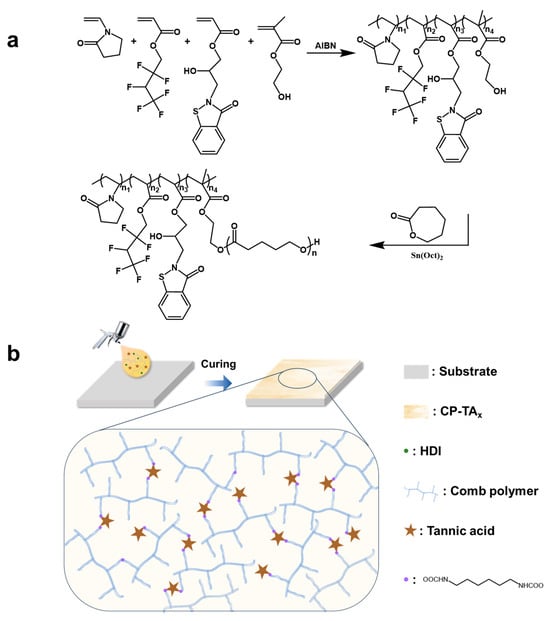
The amphiphilic copolymer obtained by copolymerization of HFBA and NVP endows the coating with micro/nanoscale topological morphology and chemical heterogeneity, which suppresses fouling adhesion [22]. As shown in Scheme 1a, AP was synthesized via free radical polymerization. Typically, HEMA, V-BIT, HFBA, and NVP were dissolved in 20 mL of THF in the molar ratio 1:1:4:4 under a nitrogen atmosphere, and then AIBN was added at 1% of the overall monomer amount. The flask was placed in an oil bath at 60 °C for 12 h, and the reaction mixture was quenched in an ice bath. The product AP was purified by hexane and then dried at 40 °C for 12 h under vacuum.
Scheme 1.
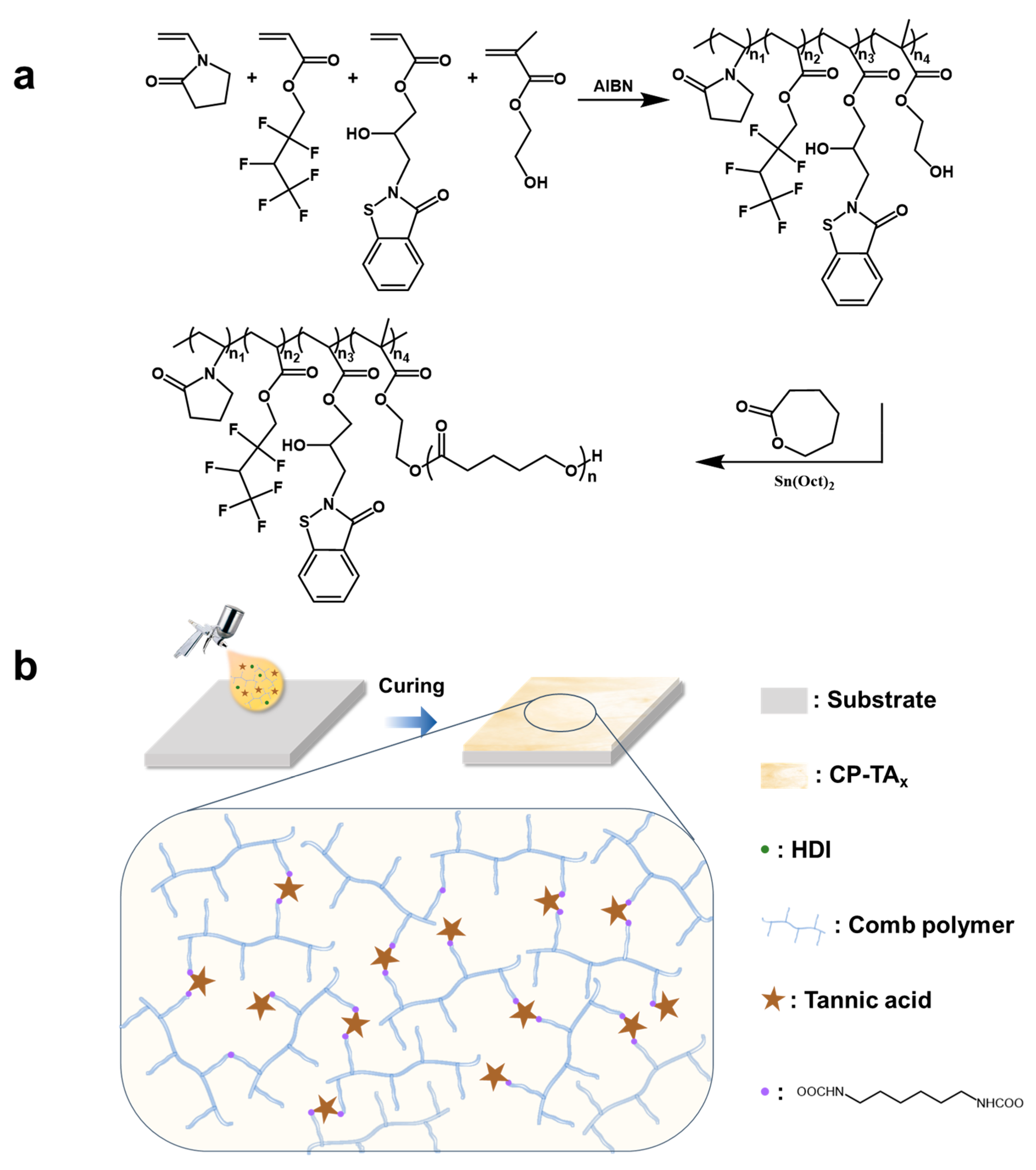
(a) Synthesis processes of amphiphilic functional polymer and comb polymer. (b) Schematic diagram of the fabrication process of coating.
2.4. Synthesis of Comb Polymer (CP)
Poly(ε-caprolactone) (PCL)was selected as the polymer side chains. Its hydrolytic degradability and low glass transition temperature endow the network with surface self-renewal capability, which is critical for marine fouling release [18,20]. In total, 2 g of AP, 2 g of ε-caprolactone, and 0.2 g of the catalyst Sn (Oct)2 were placed in 20 mL of DMF in a nitrogen atmosphere. The flask was placed in an oil bath at 120 °C for 24 h. The product CP was purified by ice-cold deionized water, and then subsequently freeze-dried for 12 h to remove the precipitating agent.
2.5. Preparation of Tannic Acid-Enhanced Antifouling Coatings (CP-TAx)
As shown in Scheme 1b, the CP and TA were dissolved in acetone, and then HDI and 0.02 g of DBTDL were added, after which the mixture was ultrasonicated for 15 min. The obtained mixture was then sprayed onto different substrates using a spray gun. The spraying pressure of the spray gun was 30 psi, and the spraying distance between the spray gun and substrate surface was 6 cm. The coatings were then allowed to cure for 6 h at 40 °C, and then dried at 80 °C for 2 h. TA was incorporated to enhance the interfacial adhesion between the coating and substrate and suppress the crystallization of PCL segments [23,24,25], while HDI, owing to its flexible alkylene chain, facilitates post-crosslinking of the coating. The composition of the coatings were shown in Table 1. For convenience, the prepared coatings were named CP-TAx (x = 0, 5%, 10%, 15%, 20%), where x represents the mass fraction of TA in the CP matrix.
Table 1.
Various CP-TAx coating proportion recipes.
2.6. Characterization of Coatings
The chemical structure was characterized by 1H nuclear magnetic resonance (1H NMR, Bruker Avance III 600 NMR, Bruker, Karlsruhe, Germany). Fourier transform infrared spectrometer (FTIR, Nicolet 8700, Thermo Fisher Scientific, Madison, WI, USA) with a scanning range of 4000–500 cm−1 and a spectral resolution of 8 cm−1, as well as X-ray photoelectron spectroscopy (XPS, Thermo Scientific Escalab 250Xi, Thermo Scientific, Witney, UK) using Mg Kα X-rays as the radiation source. Differential scanning calorimetry (DSC) thermograms were carried out on a DSC instrument (Perkin Elmer 8500, PerkinElmer, Shelton, CT, USA). All specimens were subjected to a heating cycle from −60 °C to 120 °C followed by a cooling scan back to −60 °C at a rate of 10 °C min−1 under nitrogen protection. To erase the thermal history of samples, all thermal data were acquired during the second heating run from −60 °C to 120 °C at 10 °C min−1 under a nitrogen atmosphere. The thermogravimetric (TG) properties of CP were determined using a TG analyzer (TG209F1, NETZSCH, Selb, Germany). Viscoelastic properties of the coatings were characterized using a DHR-1 rheometer (TA Instruments, New Castle, DE, USA). For uncured polymer solutions, rheological measurements were conducted on a Brookfield R/S plus rotational viscometer (USA). The shear rate was gradually increased from 0 to 400 s−1 over a 300 s testing period. The frequency sweep was performed on the sample over the frequency range of 0.1–100 rad/s with a fixed strain of 0.1% at 25 °C. The gel fraction was measured by Soxhlet extraction. The films were placed on the filter (W1) and dried at 60 °C overnight. The filter and dried polymer were weighed together (W2), after which a continuous extraction with THF under reflux in a Soxhlet apparatus was performed for 24 h. After this period, the wet filter was weighed again (W3) and then left to dry overnight. Finally, the weight of the dry sample was taken (W4). The gel content was calculated as the ratio of the weight of the insoluble polymer fraction to the weight of the initial sample, as shown in Equation (1):
Tensile tests of the coating were implemented on an electronic universal testing machine (Instron 5966, Instron, Norwood, MA, USA) equipped with a 10 kN load cell. Specimens were cut into dumbbell-shaped strips with dimensions of 30 mm × 10 mm × 0.2 mm. The stretching speed was set to 10 mm min−1. The adhesion performance of the coating was characterized via lap-shear test using an electronic universal material testing instrument (Instron 5966). The coating layer was sandwiched within the overlapping region (12.5 mm × 25 mm) between two substrate sheets. One end of the assembled specimen was fixed, while the other end was pulled at a constant rate of 10 mm min−1. All mechanical tests were performed at ambient temperature, and five parallel replicates were measured for each group to obtain the averaged results.
The surface roughness of the coatings was analyzed under an atomic force microscope (Bruker, Dimension Icon) in tapping and contacting mode with a scanning range of 10 μm2 × 10 μm2, and the root-mean-square (RMS) roughness values were calculated from the obtained AFM three-dimensional height images. The changes in surface roughness before and after coating degradation were measured using field emission scanning electron microscopy (FE-SEM, SU-8010, Hitachi High-Tech, Tokyo, Japan) with an acceleration voltage of 1 kV. The wettability of the coating surface was characterized at room temperature using a dynamic contact angle equipment (OCA40, Data Physics Instruments GmbH, Filderstadt, Germany). The Owens–Wendt method was applied to calculate the surface free energy of the coating surfaces. Test specimens with dimensions of 3 cm × 3 cm were immersed in artificial seawater (ASW). After 7 days of immersion, samples were taken out, and surface free water was rapidly removed before weighing. The EWC was calculated using Equation (2):
where W0 is the initial weight of the coating, and Wd is the weight of the coating after immersion in the ASW.
2.7. Degradation Experiment
Degradation assays were carried out in ASW at room temperature. 3 cm × 3 cm coating specimens were fastened onto a rotating disk with a rotation speed of 30 rpm. Specimens were retrieved every 7 days, thoroughly rinsed with deionized (DI) water, and dried in a vacuum oven until constant weight. Mass loss was calculated using Equation (3):
where W0 is the initial weight of the coating, and Wt is the weight of the coating after each degradation.
2.8. Release and Biocidal Activity Experiment of Antifoulants
3 μL of DMSO solution containing 3 mg mL−1 BIT or V-BIT was mixed with 3 mL of P. tricornutum suspension and added into 24-well plates. The plates were incubated in a climatic chamber at 16 °C with an illumination intensity of 3000 lx. Algal cell density was quantified every 2 h based on the absorbance of the culture medium. CP-TAx films (2 cm × 2 cm) were placed in Petri dishes filled with 20 mL ASW. The dishes were mounted on an orbital shaker operating at 30 rpm. At designated time intervals, the ASW medium containing released V-BIT was extracted with dichloromethane, and the concentration was quantified by UV–Vis spectrophotometry. For cumulative V-BIT release tests, coating samples were immersed in 20 mL ASW for up to 105 days. The medium was extracted and analyzed using UV–Vis spectrophotometry at scheduled time points.
2.9. Environmental Safety Experiment
The 96 h median effective concentration (EC50) was determined using growth inhibition tests on P. tricornutum and Chlorella sp. The algal cell density was measured at the start (0 h) and end (96 h) of the exposure period using a UV-Vis spectrophotometer. The specific growth rate (μ) over the 96 h test period was calculated according to Equation (4):
where t0 and t96 signify the start and end times of the test, respectively; N0 represents the initial cell density, and N96 represents the cell density at time t96.
The growth inhibition ratio (Iμi, %) was calculated using Equation (5):
where μi is the growth rate for test group i, and μc is the mean growth rate for the control group.
The 96 h EC50 (concentration causing a 50% reduction in the growth rate of algae) was determined by fitting the concentration-inhibition response data to a non-linear regression model.
To compare the measured release with ecotoxicity thresholds, the predicted environmental concentration (PEC) over a period of four days (96 h) in the test system was estimated using a simple mass-balance box model. The PEC (µg L−1) was calculated using Equation (6):
where R is the mean release rate of CP-TA10%, S is the hypothetical coating area (50 cm2), and V is the hypothetical tank volume (5 L).
2.10. Antifouling Experiment
The dynamic adsorption behavior of BSA protein onto coating surfaces was tracked by means of quartz crystal microbalance with dissipation (QCM-D) measurements at 25 °C. Polymer solutions were spin-coated onto quartz sensors (QSX-301, QSense, Västra Frölunda, Sweden), followed by thermal curing at 80 °C over 24 h. Deionized water and 1 mg/mL BSA protein solution were pumped over the modified sensor surface at a constant flow rate of 150 μL/min, while the shifts in resonance frequency (Δf) were continuously recorded. The areal adsorbed mass of proteins (Δm) on the sensor surface was calculated using the Sauerbrey equation (Equation (7)):
where C equals 17.1 ng/(Hz·cm2) for a 5 MHz quartz crystal sensor and the data were from the third overtone (n = 3).
Coated glass slides were immersed in Petri dishes filled with 20 mL of P. tricornutum suspension and incubated inside a climatic chamber at 16 °C for 14 days. After incubation, the slides were softly rinsed with ASW to wash away loosely bound P. tricornutum cells. Autofluorescence imaging (BX-51, Olympus, Tokyo, Japan) was employed to visualize diatom cells adhered to the coating surfaces. A hemocytometer was used to quantify the density of attached P. tricornutum cells. All results were collected from no less than three parallel replicates, with ten random measurement points examined on each specimen.
3. Results and Discussion
3.1. Synthesis and Basic Characterization of CP-TAx
As shown in Scheme 1b, the amphiphilic degradable antifouling coating (CP-TAx) with strong adhesion is achieved through the addition reaction of alcohol hydroxyl groups at the end of comb polymer (CP) chains and phenolic hydroxyl groups in tannic acid (TA) with isocyanate groups.
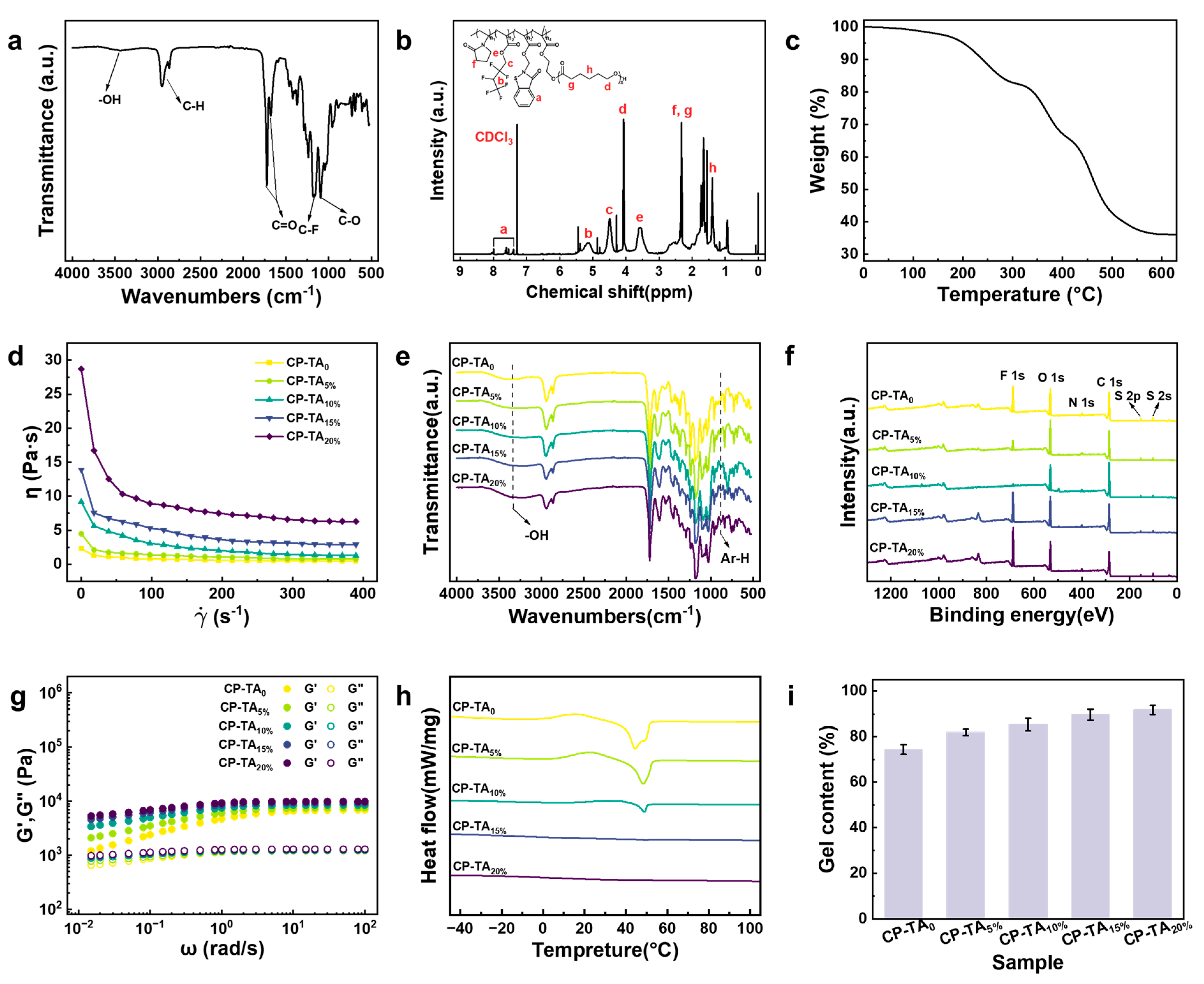
The chemical structure of CP is confirmed by the FT-IR and 1H NMR spectra. As shown in Figure 1a, the broad peak at 3400 cm−1 corresponds to the O–H stretching vibration. The peaks at 2930–2860 cm−1 correspond to saturated C−H vibrations from alkyl segments. The strong band at 1725 cm−1 corresponds to C=O stretching in the ester group, while the 1150–1200 cm−1 region belongs to the C−F stretching vibration. The 1000–1280 cm−1 region is assigned to C−O stretching. The absence of alkene C=C signals confirms the complete consumption of the monomer’s double bonds, leaving only negligible residual monomers. As shown in Figure 1b, the characteristic signal peaks in the range of 7.42–7.95 ppm are attributed to the substituted hydrogens on the benzene ring of benzoisothiazolinone [30]. The signal at 3.55 ppm is derived from the methylene absorption peak on the pyrrolidone ring adjacent to the N proton, and the signal at 5.13 ppm belongs to the fluoro-methylene proton. The signals at 4.07, 2.31, and 1.39 ppm are assigned to the methylene protons of the PCL segments [31,32]. Collectively, the above evidence confirms the successful synthesis of CP. Furthermore, the characteristic peaks at 3.55, 4.48, and 4.07 ppm exhibit an integral area ratio of 2:2:1. As each peak corresponds to a two-proton moiety, the molar ratio of pyrrolidone units, hexafluoroacrylate units, and PCL segments in the CP matches this ratio. However, the measured molar fraction of PCL segments is significantly lower than the theoretical value from the caprolactone feed ratio, mainly ascribed to steric shielding of side-hydroxyl ring-opening initiation sites by coiled linear amphiphilic functional polymer chains, which impedes the diffusion of caprolactone monomer and catalyst to the sites [33,34]. In the TG curve (Figure 1c), the CP exhibits continuous multi-stage thermal degradation. A slight loss of mass from 50 to 150 °C indicates the evaporation of moisture and solvent from within the coating. The first prominent weight loss occurs between 180 and 320 °C, originating from cleavage of pyrrolidone side groups. Continuous weight loss in the range of 330–420 °C is attributed to thermal decomposition of PCL side chains, with a total mass loss of ~23 wt%, and this value agrees well with the PCL fraction determined by NMR characterization. The mass reduction from 420 to 490 °C arises from deep scission of HFBA-fluorinated segments. Above 500 °C, the weight loss rate decreases markedly. Taken together, the multi-stage thermal degradation behavior is consistent with the designed molecular structure of CP.
Figure 1.
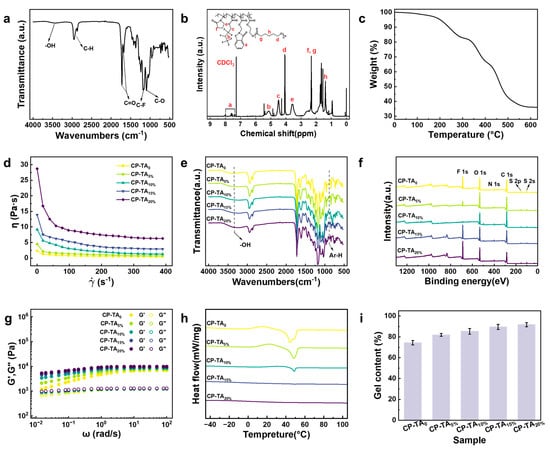
(a) FT-IR spectrum, (b) 1H NMR (600 MHz) spectrum, and (c) TGA curve of CP. (d) Flow curves of the CP-TAx coating solutions. (e) FT-IR spectrum and (f) XPS spectrum of CP-TAx coatings. (g) Storage modulus G′ and loss modulus G′′ as a function of frequency under a strain of 0.1 % for CP-TAx coatings. (h) DSC curves and (i) gel content of CP-TAx coatings.
Rheological properties are critical for the construction and film-forming performance of coatings [35]. As shown in Figure 1d, all CP-TAx exhibit typical shear-thinning behavior. The viscosity rises with increasing TA loading because tannic acid introduces abundant hydrogen bonds to form physical crosslinking networks, restricting the mobility of polymer chains. Such hydrogen-bonded networks are further confirmed by FTIR and will simultaneously regulate polymer crystallization, surface fluorine migration, and viscoelastic properties of the resulting coatings. Focusing on the FTIR spectrum in Figure 1e, the absence of the -N=C=O stretching vibration peak at 2270 cm−1 in all of the coatings suggested that the CP-TAx coatings are successfully cross-linked. As the amount of TA increases, the absorption peaks of the hydroxyl stretching vibration at 3340 cm−1 and the aromatic C-H out-of-plane bending vibration at 880 cm−1 continued to intensify. Further XPS surface elemental analysis shows that, as TA content increases, the surface F content initially decreases from 14.47% to 1.42%, subsequently rising to 19.72% (Figure 1f). Firstly, this non-monotonic variation is attributed to two competing mechanisms. At low TA content, TA provides an abundance of hydrogen bond acceptors that strengthen polymer interchain interactions. This inhibits the migration of fluorocarbon chains to the surface, which is induced by thermodynamic incompatibility. Secondly, when the TA content is excessively high, the increased hydrophilic fraction intensifies the thermodynamic incompatibility of the system. Consequently, the fluorocarbon chains migrate to the surface in order to reduce the free energy of the system [36,37].
Figure 1g presents the frequency dependence of viscoelastic behavior for the CP-TAx series. The storage modulus (G’) remains higher than the loss modulus (G”) across the entire tested frequency range, demonstrating the dominant elastic character of all CP-TAx samples. With increasing TA loading, the G’ values gradually rise, which can be attributed to the formation of more hydrogen-bonding crosslinking networks. CP-TA20% exhibits the highest G’ owing to the abundant dynamic hydrogen bonds introduced by high TA content. In contrast, CP-TA0 shows the lowest G’ in the absence of TA-mediated hydrogen crosslinks. As shown in Figure 1h, CP-TA0 coating exhibits a distinct melting endothermic peak between 40 and 60 °C, indicating that the PCL segments are able to partially form an ordered crystalline structure within the cross-linked network. With the TA content increased, the endothermic peak of CP-TAx coatings shifts toward higher temperatures, and the peak intensity gradually weakens. Neither the CP-TA15% nor the CP-TA20% coatings exhibit a melting endothermic peak, which is attributed to the rigid structure of TA and its abundance of hydrogen-bond donors significantly suppressing the ordered packing and crystal growth capability of the PCL segments [38]. The gel content gradually rises with increasing TA loading, where CP-TA20% reaches 91.7% (Figure 1i). Higher TA introduces more hydrogen-bonding crosslinking sites, promoting network formation. Collectively, the variation in TA content modulates the density of hydrogen-bonded networks, which accounts for the changes in rheology, viscoelasticity, PCL crystallization, crosslinking degree, and surface fluorine segregation observed in CP-TAx coatings.
3.2. Mechanical Performances of CP-TAx
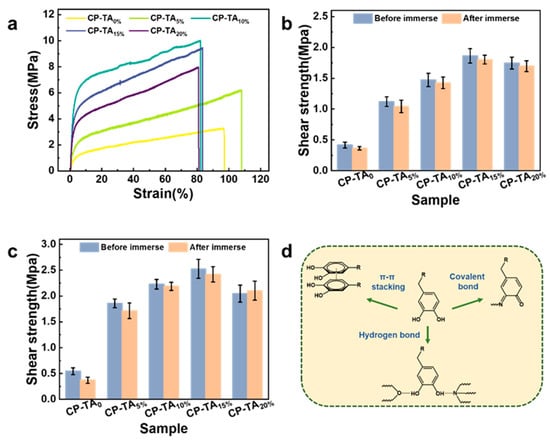
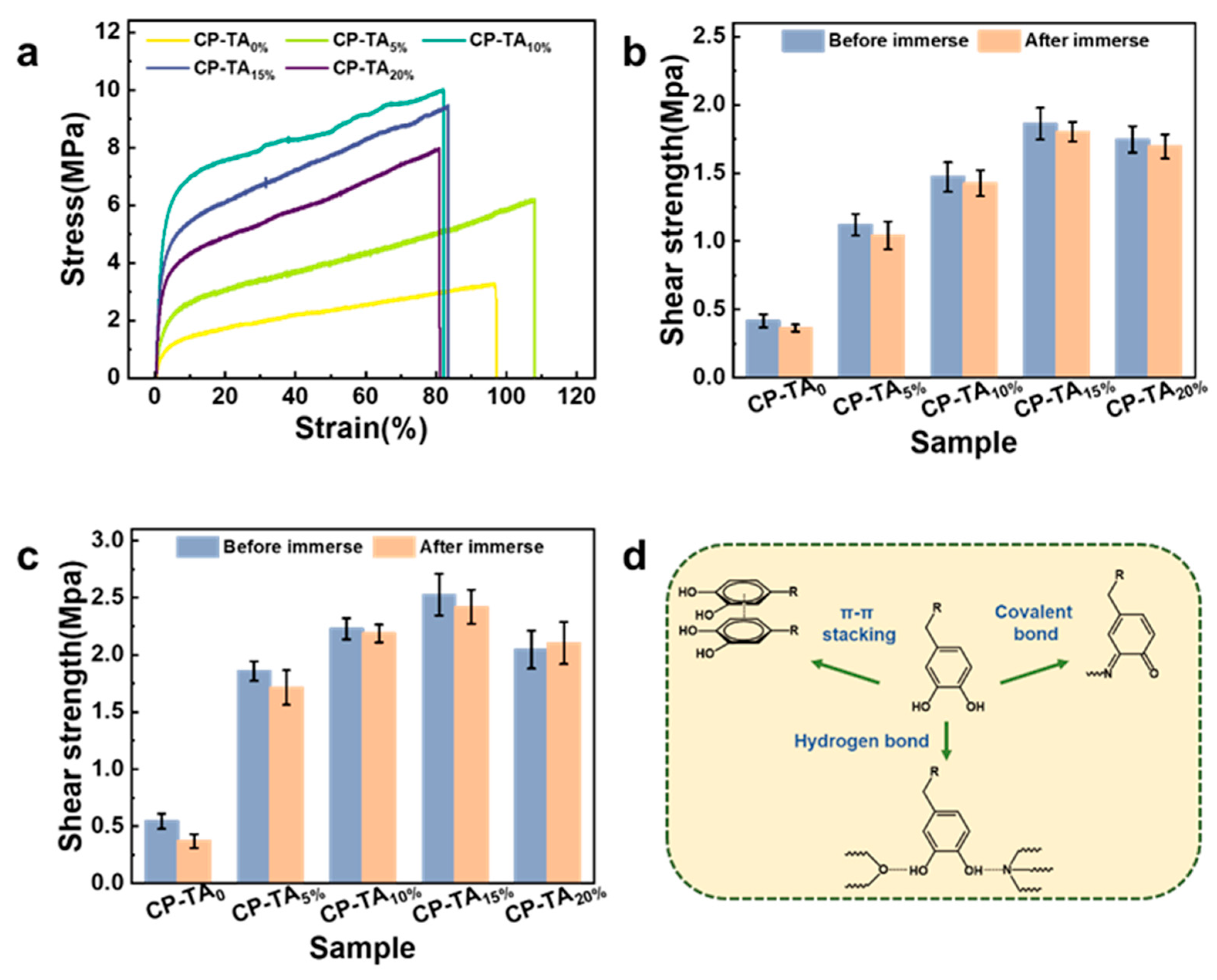
As shown in Figure 2a, the tensile strength of CP-TA0 coating is just 3.21 MPa, and its poor mechanical properties may lead to unexpected cracking and delamination during long-term underwater service. After adding a small amount of TA, the elongation at break and tensile strength of CP-TA5% coating increase to 107.7% and 6.21 MPa, respectively. This enhancement in mechanical properties is attributed to two synergistic effects: (i) the uniform dispersion of TA effectively fills micro-defects within the coating, mitigating stress concentration; (ii) the partially reversible hydrogen-bond network formed between TA and CP enables efficient load transfer and dissipates external energy [39]. With more TA introduced, the elongation at break of the coating decreased to 83.1% due to the limited mobility of the chain segments.
Figure 2.
(a) Stress–strain curves of CP-TAx coating. Tensile shear strength on (b) primed stainless steel and (c) glass of CP-TAx coating. (d) Schematic diagram of the bonding mechanism.
The durability of the coating in the marine environment is also dependent on its adhesion strength. As shown in Figure 2b, the lap shear strength of CP-TA10%, CP-TA15% and CP-TA20% coatings is above 1.4 MPa both before and after immersion in ASW. For polar substrates, like glass, CP-TA15% coating still exhibits the highest shear strength of 2.53 MPa, and retained 96% of its original shear strength after immersion (Figure 2c). In contrast, CP-TA0 coating shows lap shear strengths below 0.5 MPa on both the epoxy primer and the polar glass substrate. The experimental results above demonstrate that the introduction of TA significantly improves the adhesion strength of the coating. This is primarily attributed to the fact that TA, which is rich in catechol groups, can enhance the intermolecular forces between polymer/polymer and polymer/substrate through noncovalent interactions such as hydrogen bonding and π-π stacking, as well as through Michael addition and Schiff base reactions (Figure 2d) [40,41].
3.3. Surface Performances of CP-TAx
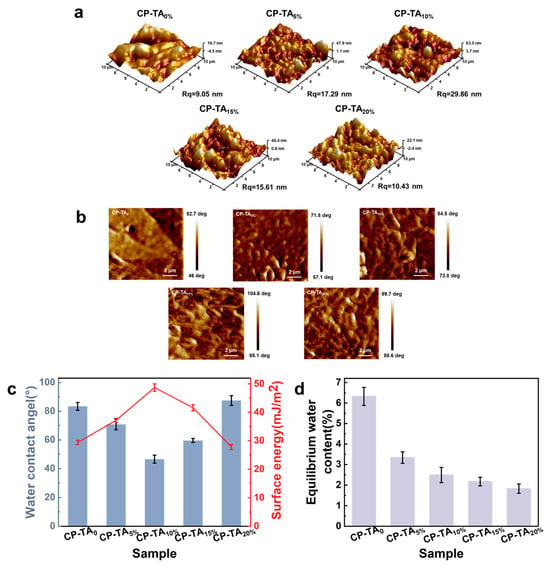
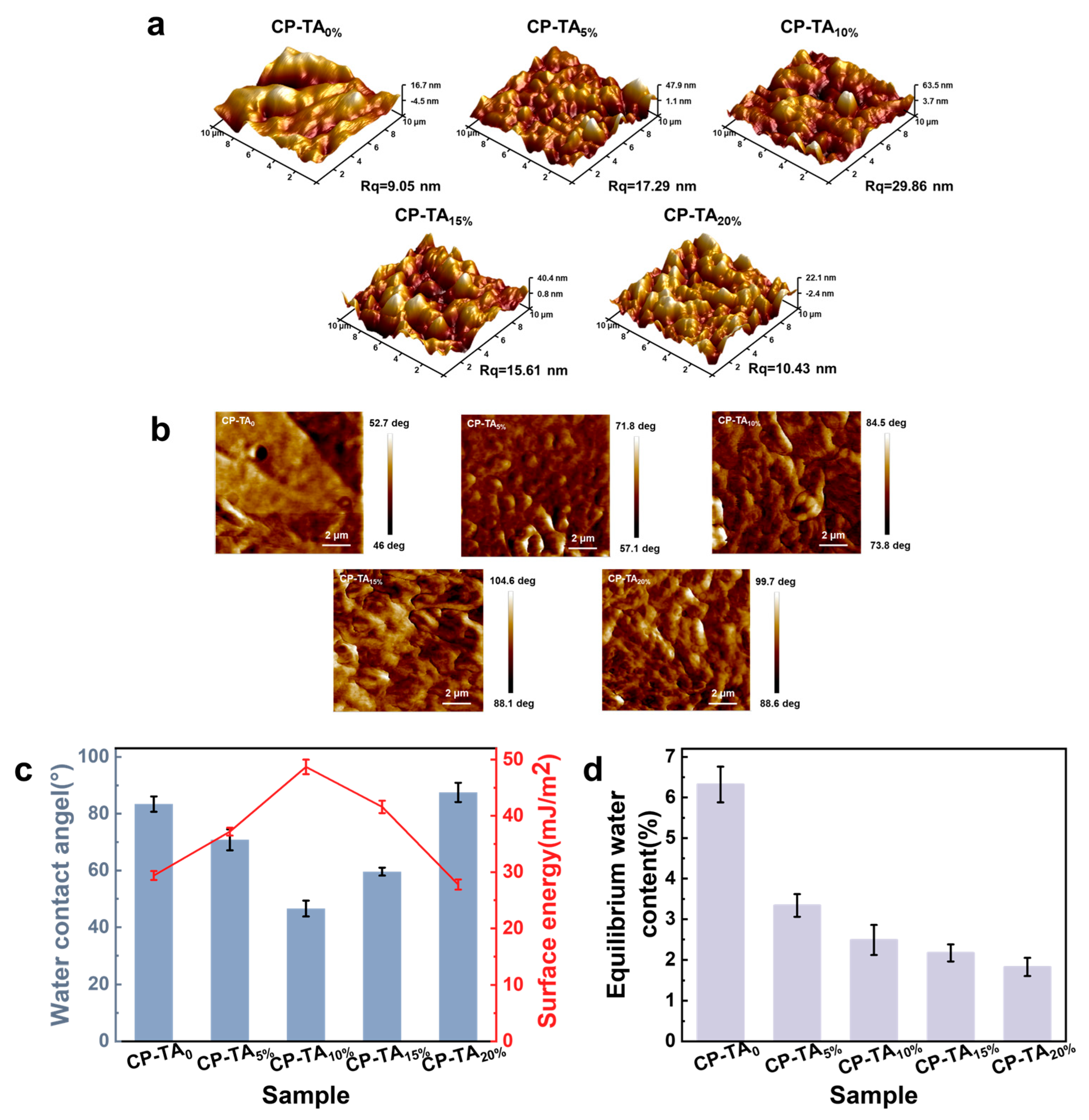
As shown in Figure 3a, the root mean square roughness (Rq) of the CP-TAx coatings increases from 9.05 nm to 29.86 nm, before decreasing to 10.43 nm, as TA content increases. The surface of the CP-TA15% coating exhibits denser and more pronounced nanoscale protrusions and depressions. AFM phase mode images of CP-TAx surfaces are shown in Figure 3b. For CP-TA5% and CP-TA10%, hydrophilic species with low phase lag dominate the surface (dark areas), whereas for CP-TA15% and CP-TA20%, hydrophobic species with high phase lag (bright areas) are more abundant. Incorporating TA modifies both the micro/nanotopography and the chemical heterogeneity of the CP-TAx coatings, which markedly affects their wettability and antifouling performance.
Figure 3.
AFM (a) morphology images and (b) phase images of CP-TAx coating. (c) WCA and surface energy of CP-TAx coating. (d) Equilibrium water content of CP-TAx coating.
As illustrated in Figure 3c, the WCA of the CP-TAx coatings decreases from 83.4° to 46.6°, before increasing to 87.5°, as TA content increases. This follows the same pattern as the variation in the F surface element and is governed by the combined effects of hydrogen bonding and thermodynamically driven molecular chain migration. Such chain migration behavior is consistent with the XPS surface fluorine results described in Figure 1f, further validating the competing thermodynamic effects induced by the hydrogen-bond network. CP-TA10% coating exhibits strong hydrophilicity, which is attributable to the high concentration of hydrophilic groups on its surface and the increased wettability resulting from its elevated surface roughness [42,43]. The surfaces of CP-TA0 and CP-TA20% coatings have a relatively high fluorine concentration, giving them surface energies of 29.4 mJ/m2 and 27.8 mJ/m2, respectively. These values are precisely within the optimal range (20–30 mJ/m2) for minimum bioattachment defined by the Baier curve [44]. The surface energy of the CP-TA20% coating reaches 48.7 mJ/m2, demonstrating that it differs from traditional amphiphilic coatings and is instead a hydrophilic coating. Furthermore, although the CP-TA10% coating exhibits strong hydrophilicity, its equilibrium water content is only 2.49%, whereas that of the CP-TA0 coating is as high as 6.32% (Figure 3d). The dense cross-linked network inhibits the diffusion and penetration of water molecules into the coating, demonstrating that the CP-TAx coatings containing TA exhibit excellent long-term underwater stability [45,46].
3.4. Antifouling Performances of CP-TAx
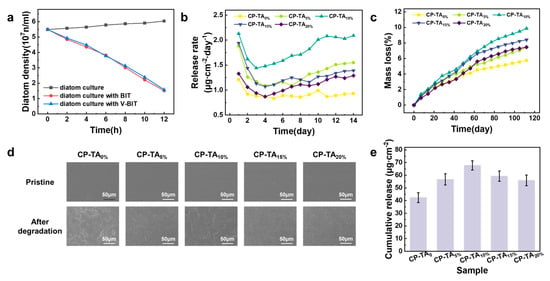
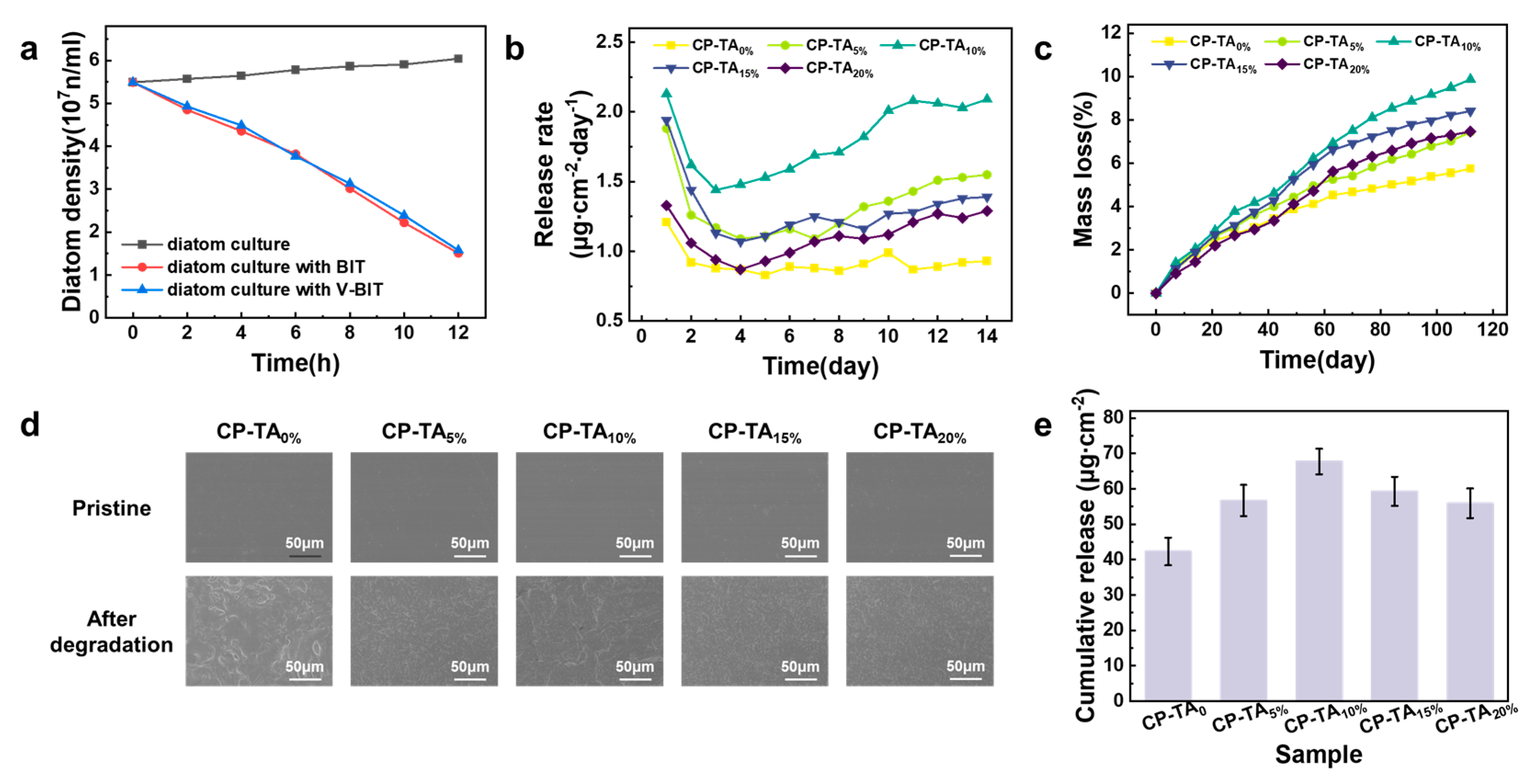
To verify the antifouling activity of V-BIT, P. tricornutum cell density is monitored over time in cultures containing V-BIT and BIT (Figure 4a). After 12 h, the diatom densities in the experimental and control groups decrease to 1.58 × 10⁷ cells/mL and 1.51 × 10⁷ cells/mL, respectively, with corresponding algal mortality rates of 28.7% and 27.4%. The algicidal activity of the two antifoulants is of the same order of magnitude, showing that the introduction of an N-methylacryloyloxymethyl group into the molecular structure barely affects the low bond energy antifouling core of the N-S bond, meaning that V-BIT still exhibits relatively superior antifouling activity [47]. While retaining potent algicidal activity as a monomer, V-BIT is covalently incorporated into the CP backbone, and its release behavior from CP-TAx coatings is governed by the hydrogen-bonded network density modulated by TA loading. In the 14-day static release experiment, all CP-TAx coatings are capable of continuously releasing V-BIT, demonstrating that the antifoulant monomer copolymerized into CP can be released through hydrolysis (Figure 4b). The release rate of CP-TAx coatings containing TA is higher than that of the CP-TA0 coating, demonstrating that TA effectively promotes the release of the antifoulant. It is worth noting that the release rate of the CP-TA10% coating increases once it becomes stable, indicating that it can inhibit the initial colonization of fouling organisms when immersed in water [48]. In addition, we evaluate the ecotoxicity of V-BIT by determining the half-maximal effective concentration (EC50) against P. tricornutum and Chlorella, and calculate the predicted environmental concentration (PEC) of the CP-TA10% coating (Table 2). The PEC/EC50 ratios against the two algae are shown to be only 0.064 and 0.009 by quantitative analysis. This suggests that the concentration of biocide entering the marine environment is significantly lower than the level at which growth inhibition or toxicity occurs in natural microalgae communities. Taken together, the TA-regulated hydrogen-bond network not only tailors the physical properties and surface chemistry of the CP-TAx coatings as described above, but also mediates the hydrolysis-triggered release of covalently bound V-BIT. The CP-TA10% formulation achieves a favorable balance between sustained antifouling release and low marine ecological risk.
Figure 4.
(a) The impact of BIT, V-BIT, and the control group on P. tricornutum. (b) Release rate of V-BIT from CP-TAx coating in modeled seawater environment. (c) Degradation rate of CP-TAx coating in a modeled seawater environment. (d) SEM test diagram of CP-TAx before and after degradation. (e) Cumulative release of V-BIT from CP-TAx coating in the seawater environment.
Table 2.
The EC50 values and PEC of V-BIT for P. tricornutum and Chlorella sp.
Aiming to probe the properties of the coatings after degradation, a 105-day trial is performed under simulated low-speed seawater flushing (Figure 4c). The degradation rates of all CP-TAx coatings are higher at the onset of testing but decline after 60 days. Due to its strong hydrophilicity, the CP-TA10% coating exhibits the fastest surface self-renewal rate, accompanied by a mass loss of 9.87% over the 105-day test period. In contrast, although the PCL segments in the CP-TA15% and CP-TA20% coatings are amorphous, their mass losses are lower than those of the CP-TA10% coating because of the surface fluorocarbon chains and the denser cross-linked structure. While the actual marine service environment is complicated by hydrodynamic shear force, sand erosion, successive biofouling/biofilm colonization, variable seawater temperature, salinity, and pH, as well as diverse in situ microbial metabolism, the simulated degradation processes can still reflect the sustainability of CP-TAx coatings to a certain extent. The changes in surface morphology also demonstrate the self-renewal process of the coating in simulated seawater, as shown in Figure 4d. The coatings show good surface flatness before degradation, with an increase in surface roughness observed after degradation. Given that no nanoscale micropores were observed, it can be concluded that the degradation process only occurs at the surface, while the internal network remains intact. However, since the dynamic behavior of the coating is determined by the PCL segments, insufficient incorporation of these segments into the CP will result in premature loss of sustained surface renewal capability during service.
The cumulative release of antifoulant underpins the sustainability of the coating’s active antifouling strategy in underwater environments (Figure 4e). The total amount released by the CP-TA10% coating is 67.8 μg·cm−2, which is approximately 60.3% higher than that released by the CP-TA0 coating. It demonstrates that introducing TA accelerates the hydrolysis and diffusion of the antifoulant, enhancing the ability of the coating to release the biocide actively and kill fouling organisms.
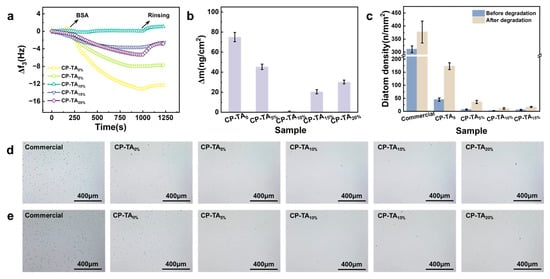
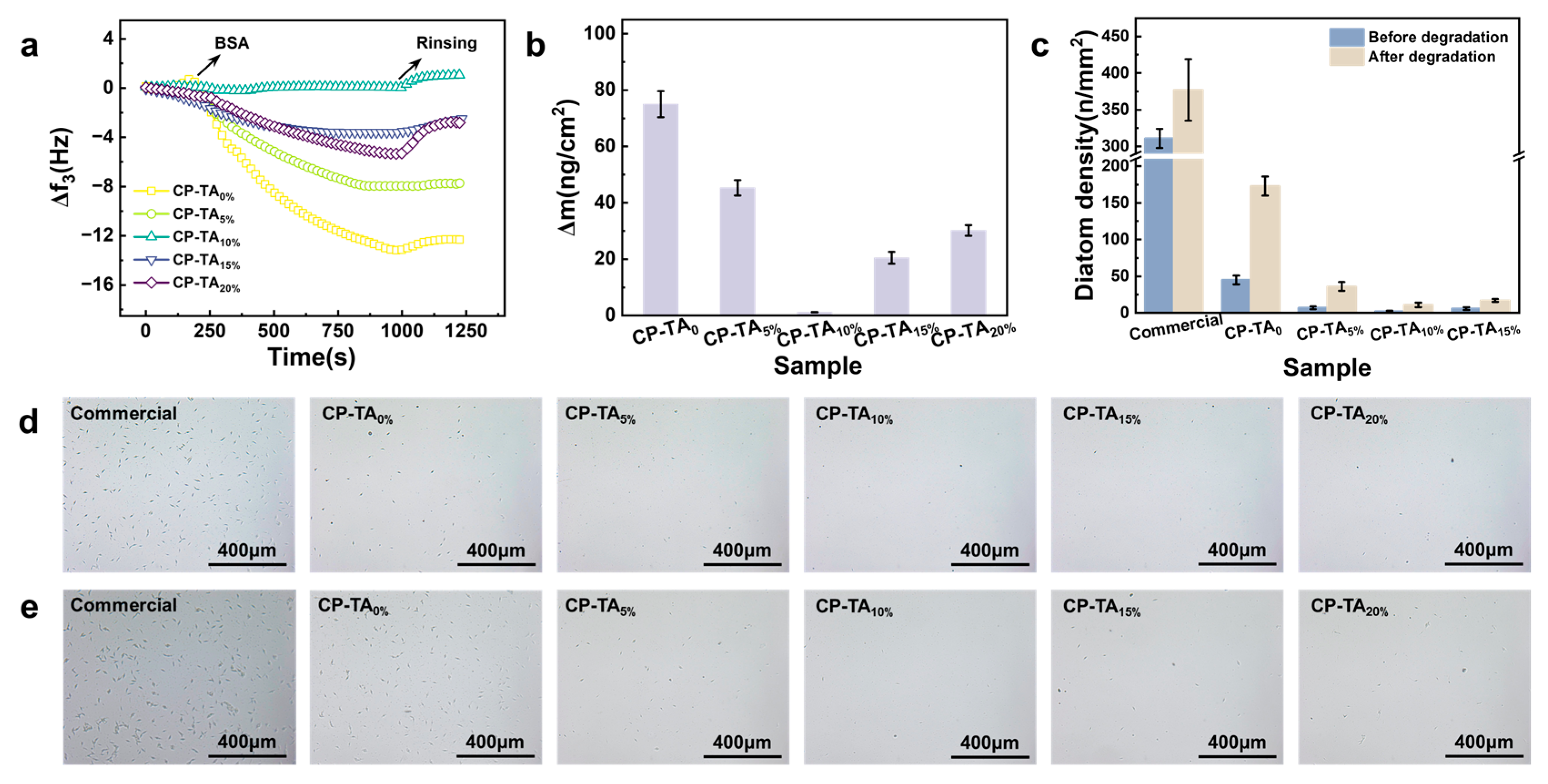
Due to the complexity of marine biofouling, effective antifouling strategies must focus on inhibiting the initial attachment of proteins and microalgae [49,50]. To this end, bovine serum albumin (BSA) is adopted as a model protein because of its notable adsorbability [51]. Figure 5a shows the time dependence of frequency shift (Δf3) during protein adsorption. After the BSA solution is introduced, the Δf3 value of the CP-TA10% coating remains virtually unchanged. Its BSA adsorption capacity (Δm) is only 1.14 ng·cm−2, which is 98.5% less than that of the CP-TA0 coating (Figure 5b). This is primarily attributable to the CP-TAx coating forming a stable hydration layer, which raises the energy required for proteins to displace the layer and adhere to the surface, thereby demonstrating exceptional inhibition of protein adhesion. Although the Δm values for the CP-TA15% and CP-TA20% coatings are less than 30 ng·cm−2, their Δf3 values fail to return to baseline after being rinsed with distilled water, which indicates that the BSA that is adsorbed onto the surfaces of the coatings is not promptly removed by the water flow.
Figure 5.
(a) Time dependence of frequency shift (Δf3) and (b) capacity (Δm) for the adsorption of BSA on CP-TAx coating by Quartz crystal microbalance with dissipation (QCM-D). (c) P. tricornutum density on CP-TAx coating surfaces before and after degradation, calculated by hemocytometer. (d) Microscope images of the attachment of P. tricornutum on CP-TAx coating after 14 days. (e) Microscope images of the attachment of P. tricornutum on CP-TAx coating after 105 days of degradation.
As shown in Figure 5c–e, all CP-TAx coatings are resistant to diatom adhesion, with the adhesion density of diatom cells on their surfaces consistently remaining below 50 cells/mm2. Among them, CP-TA10% coating exhibits the best antifouling performance, with a diatom density of only 2 cells/mm2 on its surface. This corresponds to a 99.4% reduction in diatom adhesion compared to the commercial coating. After 105 days of degradation, a significant number of algal cells are observed to be attached to the CP-TA0 coating, which is approximately 3.4 times higher than the level measured before degradation. The diminished antifouling performance of the CP-TA0 coating is attributed to the changes in its physicochemical properties. In contrast, the coating incorporating TA retains satisfactory anti-diatom adhesion performance after degradation. Specifically, the degraded CP-TA10% coating shows a diatom attachment density of 11 cells/mm2, corresponding to a 95.9% improvement in anti-adhesion efficiency relative to the degraded commercial coating. CP-TA10% exhibits outstanding antifouling performance, which can be mainly attributed to a triple-effect antifouling strategy. At the initial stage of underwater immersion, the hydrated layer formed on the hydrophilic surface effectively inhibits biofilm attachment. Once a small amount of fouling organisms adhere to the surface, the released BIT biocide can kill them and prevent stable colonization. Finally, dead foulants detach from the surface together with degraded coating fragments. In summary, this synergistic antifouling strategy suppresses biofouling formation from multiple dimensions.
4. Conclusions
In this study, we develop tannic acid-reinforced amphiphilic degradable polymer networks (CP-TAx) that integrate fouling-killing, fouling-resistance, and fouling-desorption for marine applications. The incorporation of TA not only improves mechanical strength and adhesion via hydrogen bonding and π–π stacking but also modulates surface wettability and antifoulant release. The CP-TA10% coating exhibits optimal performance, with ultralow protein adsorption (1.14 ng·cm−2) and diatom attachment (2 cells·mm−2), along with sustained covalent-bonded antifoulant release over 105 days of degradation. This TA-enhanced crosslinked design offers a promising strategy for long-lasting, environmentally benign antifouling coatings.
Author Contributions
Conceptualization, C.H. and X.L.; methodology, C.H.; validation, X.L.; investigation, X.L.; resources, C.H.; data curation, X.L.; writing—original draft preparation, X.L.; writing—review and editing, C.H.; visualization, X.L.; supervision, C.H.; project administration, C.H.; funding acquisition, C.H. All authors have read and agreed to the published version of the manuscript.
Funding
This work was supported by grants from the Fundamental Research Funds for the Central Universities.
Institutional Review Board Statement
Not applicable.
Informed Consent Statement
Not applicable.
Data Availability Statement
The original contributions presented in this study are included in the article. Further inquiries can be directed to the corresponding author.
Conflicts of Interest
The authors declare no conflicts of interest.
References
- Fitridge, I.; Dempster, T.; Guenther, J.; de Nys, R. The impact and control of biofouling in marine aquaculture: A review. Biofouling 2012, 28, 649–669. [Google Scholar] [CrossRef] [Scilit] [PubMed]
- Liu, P.; An, M.; He, T.; Li, P.; Ma, F. Recent Advances in Antibiofouling Materials for Seawater-Uranium Extraction: A Review. Materials 2023, 16, 6451. [Google Scholar] [CrossRef] [Scilit] [PubMed]
- Reyes, R.; del Norte-Campos, A.; Añasco, N.C.; Santander-de Leon, S.M.S. Biofouling development in marine fish farm influenced by net colour, immersion period and environmental conditions. Aquac. Res. 2020, 51, 3129–3138. [Google Scholar] [CrossRef] [Scilit]
- Dafforn, K.A.; Lewis, J.A.; Johnston, E.L. Antifouling strategies: History and regulation, ecological impacts and mitigation. Mar. Pollut. Bull. 2011, 62, 453–465. [Google Scholar] [CrossRef] [Scilit] [PubMed]
- Zhang, Y.; Zhang, X.; Man, J.; Cui, G.; Zou, Z.; Song, X.; Ji, M.; Li, J.; Li, J. Rapid fabrication of low surface energy silicone coatings and investigation of their drag-reducing, corrosion-resistant, and antifouling properties. Mater. Lett. 2025, 398, 138871. [Google Scholar] [CrossRef] [Scilit]
- Saputri, W.D.; Pratikno, H.; Sakinah, W.; Ma’ruf, B.; Ariyani, N.R.; Putera, E.Y.; Irawan, B.; Saiful, M.; Priyotomo, G. Marine biofouling in Indonesian tropical waters: A comprehensive review of taxonomic diversity and successional dynamics. Biofouling 2025, 41, 881–900. [Google Scholar] [CrossRef] [Scilit] [PubMed]
- Dong, G.; Wei, S.; Wang, B.; Wang, Y.; Shi, R.; Wang, X.; Liu, Z.; Guo, L.; Zhang, Y. Research progress on micro/nano materials and low surface energy modification in superhydrophobic coatings. Nano Mater. Sci. 2026, in press. [Google Scholar] [CrossRef] [Scilit]
- Xie, Q.; Pan, J.; Ma, C.; Zhang, G. Dynamic surface antifouling: Mechanism and systems. Soft Matter 2019, 15, 1087–1107. [Google Scholar] [CrossRef] [Scilit] [PubMed]
- Wang, M.; Ma, C.; Zhang, G. Dynamic Surface Antifouling Materials. Chin. J. Chem. 2023, 41, 2881–2888. [Google Scholar] [CrossRef] [Scilit]
- Gao, M.; Bing, W.; Wang, Z.; Fu, J.; Li, J. Bioinspired Magnetic-Responsive Microcolumn Arrays for Active/Passive Antifouling and Droplet Manipulation. ACS Appl. Mater. Interfaces 2025, 17, 68627–68638. [Google Scholar] [CrossRef] [Scilit] [PubMed]
- Jackson, A.W.; Mothe, S.R.; Ang, P.; Chennamaneni, L.R.; Herk, A.M.V.; Thoniyot, P. Backbone Degradable Poly (acrylic acid) Analogue via Radical Ring-Opening Copolymerization and Enhanced Biodegradability. Chemosphere 2022, 293, 133487. [Google Scholar] [CrossRef] [Scilit] [PubMed]
- Loriot, M.; Linossier, I.; Vallée-Réhel, K.; Faÿ, F. Influence of Biodegradable Polymer Properties on Antifouling Paints Activity. Polymers 2017, 9, 36. [Google Scholar] [CrossRef] [Scilit] [PubMed]
- Maan, A.M.C.; Hofman, A.H.; de Vos, W.M.; Kamperman, M. Recent Developments and Practical Feasibility of Polymer-Based Antifouling Coatings. Adv. Funct. Mater. 2020, 30, 2000936. [Google Scholar] [CrossRef] [Scilit]
- Ali, A.; Song, L.; Hu, J.; Jiang, J.; Rao, Q.; Shoaib, M.; Fahad, S.; Cai, Y.; Zhan, X.; Chen, F.; et al. Synthesis and characterization of caprolactone based polyurethane with degradable and antifouling performance. Chin. J. Chem. Eng. 2021, 34, 299–306. [Google Scholar] [CrossRef] [Scilit]
- Xu, H.; Wang, Y.; Ni, C.; He, G.; Li, X.; Jiang, X.; Yu, L. Degradable polylactic acid-reinforced acrylate polymer coating for marine antifouling. Prog. Org. Coat. 2024, 197, 108824. [Google Scholar] [CrossRef] [Scilit]
- Ma, C.; Zhang, W.; Zhang, G.; Qian, P.-Y. Environmentally Friendly Antifouling Coatings Based on Biodegradable Polymer and Natural Antifoulant. ACS Sustain. Chem. Eng. 2017, 5, 6304–6309. [Google Scholar] [CrossRef] [Scilit]
- Si, C.; Hu, G.; Jiang, W.; Sun, P.; Cao, J.; Ji, R.; Li, A.-M.; Zhang, Q. Hydrophobic Biodegradable Hyperbranched Copolymers with Excellent Marine Diatom Resistance. Biomacromolecules 2022, 23, 4327–4338. [Google Scholar] [CrossRef] [Scilit] [PubMed]
- Pan, J.; Mei, L.; Zhou, H.; Zhang, C.; Xie, Q.; Ma, C. Self-regenerating zwitterionic hyperbranched polymer with tunable degradation for anti-biofouling coatings. Prog. Org. Coat. 2022, 163, 106674. [Google Scholar] [CrossRef] [Scilit]
- Gong, X.; Hu, S.; Feng, M.; Tang, J.; Zhao, X.; Yang, W.; Sun, C.; Yu, B.; Zhou, F. Robust Hydration Effects in Self-Polishing Coatings for an Enhanced Static Antifouling Performance. ACS Appl. Polym. Mater. 2024, 7, 396–405. [Google Scholar] [CrossRef] [Scilit]
- Ai, X.; Mei, L.; Ma, C.; Zhang, G. Degradable hyperbranched polymer with fouling resistance for antifouling coatings. Prog. Org. Coat. 2021, 153, 106141. [Google Scholar] [CrossRef] [Scilit]
- Chen, Y.; Ye, H.; Zhao, X.; Li, P.; Chen, H.; Liu, H.; Zhang, H.; Li, W. Strategy for Fabricating Degradable Low-Surface-Energy Cross-Linked Networks with Excellent Anti-Fouling Properties. ACS Appl. Mater. Interfaces 2025, 17, 3995–4008. [Google Scholar] [CrossRef] [Scilit] [PubMed]
- Liang, X.; He, C. A crosslinked amphiphilic degradable antifouling coating with long-lasting underwater stability and controlled release of isothiazolinone. Prog. Org. Coat. 2026, 213, 109945. [Google Scholar] [CrossRef] [Scilit]
- Chen, C.; Yang, H.; Yang, X.; Ma, Q. Tannic acid: A crosslinker leading to versatile functional polymeric networks: A review. RSC Adv. 2022, 12, 7689–7711. [Google Scholar] [CrossRef] [Scilit] [PubMed]
- Zhang, C.; Wu, B.; Zhou, Y.; Zhou, F.; Liu, W.; Wang, Z. Mussel-inspired hydrogels: From design principles to promising applications. Chem. Soc. Rev. 2020, 49, 3605–3637. [Google Scholar] [CrossRef] [Scilit] [PubMed]
- Du, Q.; Hu, B.; Shen, Q.; Su, S.; Wang, S.; Song, G. Creating tough Mussel-Inspired underwater adhesives from plant catechyl lignin. Chem. Eng. J. 2024, 482, 148828. [Google Scholar] [CrossRef] [Scilit]
- Zhang, H.; Zhao, T.; Newland, B.; Liu, W.; Wang, W.; Wang, W. Catechol functionalized hyperbranched polymers as biomedical materials. Prog. Polym. Sci. 2018, 78, 47–55. [Google Scholar] [CrossRef] [Scilit]
- Faure, E.; Falentin-Daudré, C.; Jérôme, C.; Lyskawa, J.; Fournier, D.; Woisel, P.; Detrembleur, C. Catechols as versatile platforms in polymer chemistry. Prog. Polym. Sci. 2013, 38, 236–270. [Google Scholar] [CrossRef] [Scilit]
- Song, P.; Jiang, S.; Ren, Y.; Zhang, X.; Qiao, T.; Song, X.; Liu, Q.; Chen, X. Synthesis and characterization of tannin grafted polycaprolactone. J. Colloid Interface Sci. 2016, 479, 160–164. [Google Scholar] [CrossRef] [Scilit] [PubMed]
- Peng, K.; Dai, X.; Mao, H.; Zou, H.; Yang, Z.; Tu, W. Development of direct contact-killing non-leaching antimicrobial polyurethanes through click chemistry. J. Coat. Technol. Res. 2018, 15, 1239–1250. [Google Scholar] [CrossRef] [Scilit]
- Zhang, H.; Liu, L.; Hou, P.; Pan, H.; Fu, S. Polyisocyanide Quaternary Ammonium Salts with Exceptionally Star-Shaped Structure for Enhanced Antibacterial Properties. Polymers 2022, 14, 1737. [Google Scholar] [CrossRef] [Scilit] [PubMed]
- Dai, G.; Ai, X.; Mei, L.; Ma, C.; Zhang, G. Kill–Resist–Renew Trinity: Hyperbranched Polymer with Self-Regenerating Attack and Defense for Antifouling Coatings. ACS Appl. Mater. Interfaces 2021, 13, 13735–13743. [Google Scholar] [CrossRef] [Scilit] [PubMed]
- Dai, G.; Xie, Q.; Ma, C.; Zhang, G. Biodegradable Poly(ester-co-acrylate) with Antifoulant Pendant Groups for Marine Anti-Biofouling. ACS Appl. Mater. Interfaces 2019, 11, 11947–11953. [Google Scholar] [CrossRef] [Scilit] [PubMed]
- Song, X.; Yao, W.; Lu, G.; Li, Y.; Huang, X. tBHBMA: A novel trifunctional acrylic monomer for the convenient synthesis of PAA-g-PCL well-defined amphiphilic graft copolymer. Polym. Chem. 2013, 4, 2864–2875. [Google Scholar] [CrossRef] [Scilit]
- Cretu, A.; Gattin, R.; Brachais, L.; Barbier-Baudry, D. Synthesis and degradation of poly (2-hydroxyethyl methacrylate)-graft-poly (ε-caprolactone) copolymers. Polym. Degrad. Stab. 2004, 83, 399–404. [Google Scholar] [CrossRef] [Scilit]
- Zhou, Y.; Liu, C.; Gao, J.; Chen, Y.; Yu, F.; Chen, M.; Zhang, H. A Novel Hydrophobic Coating Film of Water-borne Fluoro-silicon Polyacrylate Polyurethane with Properties Governed by Surface Self-segregation. Prog. Org. Coat. 2019, 134, 134–144. [Google Scholar] [CrossRef] [Scilit]
- Yang, J.; Zhang, X.; Li, T.; Wang, Y.; Xia, B.; Jiang, J.; Chen, M.; Dong, W. A novel biodegradable poly(propylene carbonate) with enhanced thermal and mechanical properties by incorporating tannic acid. Polym. Adv. Technol. 2022, 33, 1341–1347. [Google Scholar] [CrossRef] [Scilit]
- Olonisakin, K.; Wen, A.; He, S.; Lin, H.; Tao, W.; Chen, S.; Lin, W.; Li, R.; Zhang, X.-X.; Yang, W. The Development of Biodegradable PBAT-Lignin-Tannic Acid Composite Film: Properties, Biodegradability, and Potential Barrier Application in Food Packaging. Food Bioprocess Technol. 2023, 16, 1525–1540. [Google Scholar] [CrossRef] [Scilit]
- Moraczewski, K.; Stepczyńska, M.; Raszkowska-Kaczor, A.; Szymańska, L.; Rytlewski, P. PLA/PCL Polymer Material for Food Packaging with Enhanced Antibacterial Properties. Polymers 2025, 17, 1134. [Google Scholar] [CrossRef] [Scilit] [PubMed]
- Sultan, U.; Giedrius, J.; Christopher, M.P.; Raul, F.; Arvydas, P.; Almontas, V.; Sandra, V.-Ž.; Justas, E. Advancing mechanical properties of thermoplastic biocomposites through tannic and gallic acids surface treatment of natural fiber reinforcements: A simulation and experimental study. J. Thermoplast. Compos. Mater. 2026, 39, 4352–4384. [Google Scholar] [CrossRef] [Scilit]
- Liang, K.; Qi, X.; Xiao, X.; Wang, L.; Zhang, J. Tannic Acid-Based Hyperbranched Polyurethane with Superior Mechanical Properties, Room-Temperature Self-Healability, and Ultrahigh Adhesion for Scalable Production. Macromolecules 2025, 58, 11216–11228. [Google Scholar] [CrossRef] [Scilit]
- Mu, D.; Xing, J. The preparation of double network hydrogel with high mechanical properties by photopolymerization under the green LED irradiation and enhancement of wet adhesion by tannic acid. Colloids Surf. A Physicochem. Eng. Asp. 2023, 671, 131656. [Google Scholar] [CrossRef] [Scilit]
- Zhang, J.; Li, B.; Zhou, Z.; Zhang, J. Durable Superhydrophobic Surfaces with Self-Generated Wenzel Sites for Efficient Fog Collection. Small 2024, 20, 2312112. [Google Scholar] [CrossRef] [Scilit] [PubMed]
- Li, Z.; Gao, Z.; Guo, P.; Hu, S.; Zhong, J. Geostructure-Induced Nonmonotonic Transition between Cassie and Wenzel States on Hydrophilic Substrates. Langmuir 2026, 42, 16744–16754. [Google Scholar] [CrossRef] [Scilit] [PubMed]
- Tian, L.; Wang, H.; Bing, W.; Jin, H.; Shang, Y.; Dong, S.; Yan, S.; Du, W. Exploring the antifouling performance of non-bactericidal and bactericidal film for combating marine biofouling. J. Taiwan Inst. Chem. Eng. 2021, 126, 270–277. [Google Scholar] [CrossRef] [Scilit]
- Luo, H.; Liu, Y.; Ruj, B.; Sun, L.; Wang, J.; He, Y. Preparation of degradable castor oil-based waterborne polyurethane with tannic acid as crosslinking agent and its application on leather surface coating. Int. J. Polym. Anal. Charact. 2022, 27, 52–70. [Google Scholar] [CrossRef] [Scilit]
- Zeng, N.; Wang, Y.; Liu, X.; Zhang, Y.; Huang, W. A mechanically strong, ultra-tough and room-temperature self-healing ionic conductive elastomer based on octopus-like physical cross-linker tannic acid and a robust polyurethane substrate. J. Mater. Chem. C 2025, 13, 8006–8019. [Google Scholar] [CrossRef] [Scilit]
- Ru, J.-C.; Zhao, X.-L.; Cao, Z.-H.; Chen, C.-Z.; Li, P.; Li, Z.-H. Acute Toxicity of a Novel anti-fouling Material Additive DCOIT to Marine Chlorella sp. Bull. Environ. Contam. Toxicol. 2022, 109, 1018–1022. [Google Scholar] [CrossRef] [Scilit] [PubMed]
- Goodes, L.R.; Dennington, S.P.; Schuppe, H.; Wharton, J.A.; Bakker, M.; Klijnstra, J.W.; Stokes, K.R. Fluorescence microscopy techniques for quantitative evaluation of organic biocide distribution in antifouling paint coatings: Application to model antifouling coatings. Biofouling 2012, 28, 613–625. [Google Scholar] [CrossRef] [Scilit] [PubMed]
- Long, L.; Wang, R.; Chiang, H.Y.; Ding, W.; Li, Y.-X.; Chen, F.; Qian, P.-Y. Discovery of Antibiofilm Activity of Elasnin against Marine Biofilms and Its Application in the Marine Antifouling Coatings. Mar. Drugs 2021, 19, 19. [Google Scholar] [CrossRef] [Scilit] [PubMed]
- Martell, L.; Bracale, R.; Carrion, S.A.; Purcell, J.E.; Lezzi, M.; Gravili, C.; Piraino, S.; Boero, F. Successional dynamics of marine fouling hydroids (Cnidaria: Hydrozoa) at a finfish aquaculture facility in the Mediterranean Sea. PLoS ONE 2018, 13, e0195352. [Google Scholar] [CrossRef] [Scilit] [PubMed]
- Xu, X.; Guo, S.; Vancso, G.J. Perceiving and Countering Marine Biofouling: Structure, Forces, and Processes at Surfaces in Sea Water Across the Length Scales. Langmuir 2025, 41, 7996–8018. [Google Scholar] [CrossRef] [Scilit] [PubMed]

Disclaimer/Publisher’s Note: The statements, opinions and data contained in all publications are solely those of the individual author(s) and contributor(s) and not of MDPI and/or the editor(s). MDPI and/or the editor(s) disclaim responsibility for any injury to people or property resulting from any ideas, methods, instructions or products referred to in the content. |
© 2026 by the authors. Licensee MDPI, Basel, Switzerland. This article is an open access article distributed under the terms and conditions of the Creative Commons Attribution (CC BY) license.