


Abstract
Antibiotic resistance is an emerging worldwide concern with serious repercussions in terms of morbi-mortality. Bearing in mind that the inadequate use of antibiotics, by healthcare staff as well as by the general population, is one of its main causes, a multidisciplinary approach is required to try to combat it. The aim of the present study was to determine nursing students’ knowledge and awareness of antibiotic use, resistance and stewardship. A cross-sectional design was used. A total of 578 nursing students from the University of Santiago de Compostela (Spain), ≥18 years old of both sexes were invited to complete the Spanish version of the questionnaire “Knowledge and awareness of the use, resistance and administration of antibiotics” between February and April 2019. Students had a low level of knowledge about antibiotics, 4.1 (CI95% = 3.4–4.8), especially in relation to antibiotic resistance. As the students were aware of this deficiency, the majority affirmed (>90%) that the current curriculum of nursing degree should have more training on antibiotics and infection control. Nursing staff play an important role in the rational use of antibiotics and as teachers of patients, so their training could be key in fighting antibiotic resistance.
1. Introduction
Antibiotics are medicines that fight bacterial infections. They can save lives if they are used correctly, but nowadays antibiotic resistance has become a real problem [1]. Infections by resistant microorganisms do not respond to treatment, so the duration of the disease is prolonged, and the risk of death increases. Moreover, if the treatment fails or if the response to treatment is slow, the patient is contagious for longer, which increases the likelihood of resistant microorganisms being transmitted to other people [2].
The emergence of antibiotic resistance is a natural biological phenomenon, and even though numerous factors have been identified as the cause of this, such as clustering and overcrowding or increased elderly population [2], one of the most important factors is the inadequate use of antibiotics [3], a very worrying situation especially for healthcare professionals with high rate of antibiotic prescription such as primary care dentists [4]. According to the World Health Organization (WHO), inadequate use of antibiotics includes the prescription of inappropriate antibiotics for a brief time, in low or insufficient doses and/or for diseases for which they are not indicated; likewise, excessive therapeutic dosage regimens are also considered inadequate uses of antibiotics [5]. In the specific case of Spain, the consumption of antibiotics for outpatients is above the European average, and in hospitals their prescription is increasing [6].
The inadequate use of antibiotics can be encouraged by self-medication, by the implementation of permissive policies in terms of regulation of the use of these drugs, by the relationship between the healthcare professional and the patient or by the knowledge and attitudes that one has towards them [7,8]. Regarding the latter, while it is true that a poor knowledge or negative attitude towards antibiotics leads inevitably to bad clinical practice, practical skills are not always a reflection of knowledge, a situation known as “theory–practice gap” [9].
To date, the studies which have evaluated the training that healthcare students have about infectious diseases, antimicrobial resistance and safe use of antibiotics have been mainly carried out in students of medicine [7,9] and pharmacy [10,11,12], besides students from other disciplines such as dentistry [13]. However, taking into account that the control of antibiotic resistance requires a multidisciplinary approach, and that nursing staff play a key role in the rational use of antibiotics, as teachers of patients, and as future drug prescribers in our country, the training of nurses could have an important impact in reducing the incidence of antibiotic resistance. Thus, the objective of this paper has been to determine the nursing students’ knowledge and awareness of antibiotic use, resistance and stewardship.
2. Results
2.1. Description of Sample
A total of 578 students of the Degree of Nursing from the University of Santiago de Compostela (152 of the first year, 133 of the second year, 145 of the third year and 148 of the fourth year) were invited to participate in the study, with a response rate of 59% (66% of the first year, 85% of the second year, 52% of the third year and 36% of the fourth year).
Table 1 shows the demographic characteristics of the participants. Most were women, <25 years old, without antibiotics training prior entering nursing but with family members/close friends working in health-related fields. The students’ favourite practice area to develop their professional activity was, in order of frequency: Emergency, Intensive Care Unit (ICU) and Reanimation Unit (RU); Pediatric nursing and Obstetric-gynecologic nursing.
Table 1.
Baseline characteristics of the study’s participants. All the results were expressed as n (%).
2.2. Knowledge and Awareness Regarding Antibiotic Use, Resistance and Stewardship
The answers to questions about students’ general knowledge (questions 8–19) and specific knowledge and awareness of antibiotics use, resistance and stewardship (questions 24–40) are shown in Table 2. In general, the students had good general knowledge of antibiotics; however, the aspects where there was a greater lack of knowledge were the following: cefotaxime is a cephalosporin (question 10) and antibiotics cannot treat influenza (question 19). On the contrary, the students showed a wide lack of knowledge in terms of antibiotic resistance, despite that 94.5% of the students stated they had heard about antibiotic resistance (question 20), and 45.2% that they had discussed antibiotic resistance topics during the nursing degree (question 21).
Table 2.
General and specific knowledge and awareness of antibiotics. All the results were expressed as n (%), except the variable OKS, which was presented as median and confidence interval. The correct answers have been highlighted in bold.
The questions with poorer results (<25% of correct answers) were: antibiotic resistance is a natural phenomenon (question 29), beta-lactamase is an enzyme produced by bacteria that can break down aminoglycosides (question 33) and bacteria may acquire efflux pumps that extrude the antibiotic from the cell (question 34).
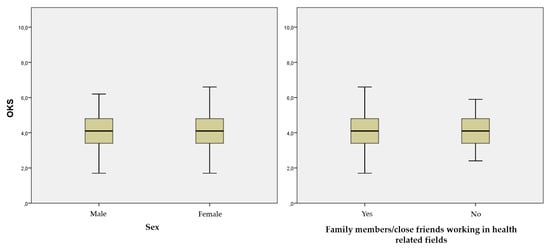
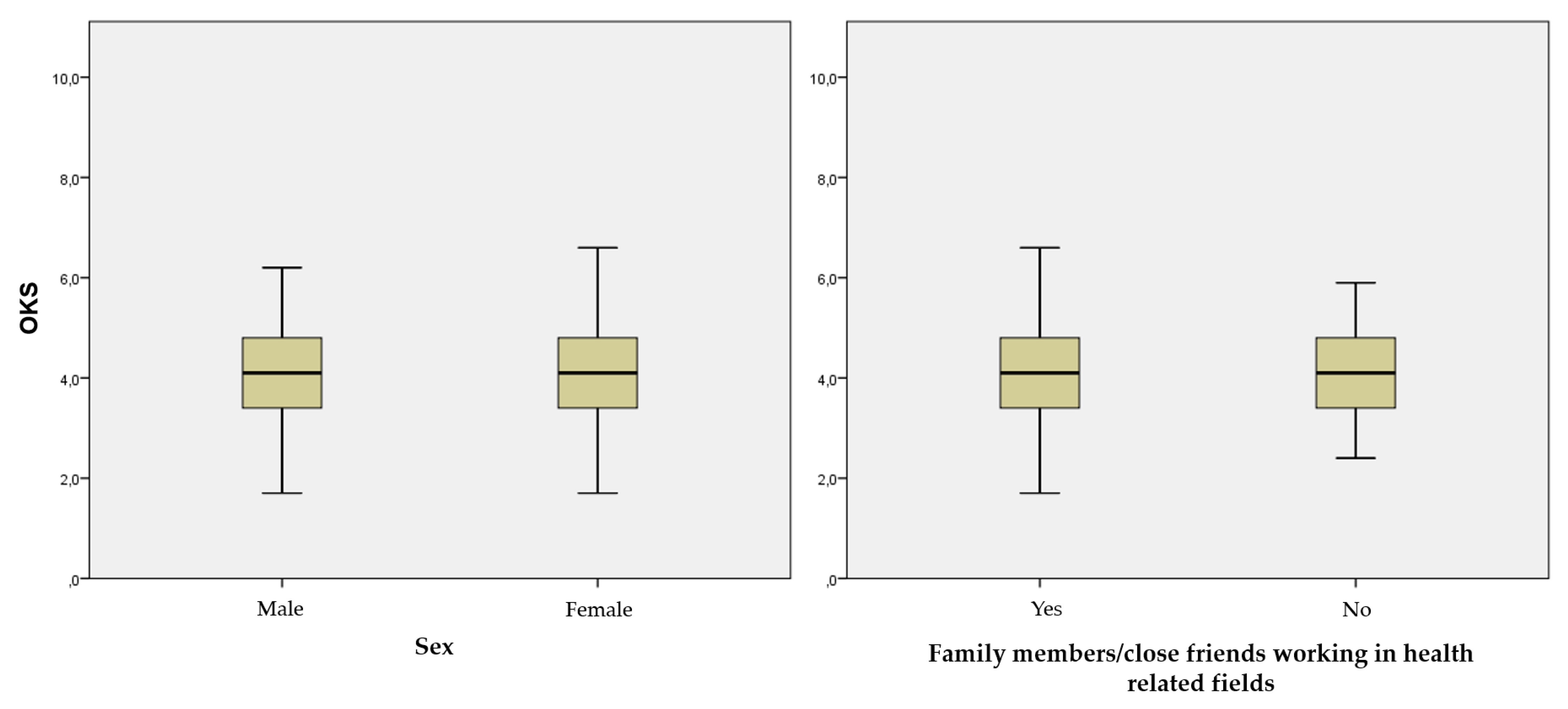
The overall median knowledge score (general and specific knowledge) was low (4.2 and 95% confidence interval 3.4–4.8), despite the fact that the scores improved during the degree (Table 2). On the contrary, no statistically significant differences were found between male and female students, or between students with or without family members/close friends working in health-related fields (Figure 1).
Figure 1.
Overall knowledge score (OKS) in accordance with the sex and the existence of family members/close friends working in health-related fields. The overall knowledge score (OKS) was determined according to what has been explained in “Data processing and statistical analysis”. Intergroup differences were analysed using the Mann–Whitney U test. No significant differences were observed (p > 0.05).
2.3. Perception of Education about Antibiotics
In spite of the 94.5% of students who acknowledged that they had at some point heard about antibiotic stewardship (question 22), only 60.1% remembered having discussed this subject during the training programme in the nursing degree (question 23). Moreover, the students admitted that they had great difficulties in selecting the best antibiotic for a specific infection, knowing how to establish an appropriate regimen of antibiotic therapy or being able to handle patients who demand antibiotic therapy when clearly it is not indicated (Table 3, questions 41, 42, 44). Likewise, the students, who are aware of these limitations, asserted that it would be interesting to have more education on antibiotics and infection control in the nursing degree, especially from the second year onwards (Table 3, questions 46, 47, 50). This idea was reiterated by several students by means of filling out the fifth section of the questionnaire (Table 4).
Table 3.
Perception about training on antibiotics received in the nursing degree. All the results were expressed as n (%).
Table 4.
Suggestions and opinions given by nursing students concerning the topics presented in the questionnaire.
2.4. Psychometric Validation
Validation of the questionnaire involved analysing its reliability (internal consistency and reproducibility) and validity. The Cronbach α value for the knowledge domain was 0.79, indicating acceptable internal consistency. Regarding the test–retest analysis (n = 15), the intraclass correlation coefficient for the 15 students who completed the questionnaire twice was excellent, 0.91 (95% confidence interval 0.87–0.93). On the other hand, content validity was demonstrated since the questionnaire was based on expert consensus.
3. Discussion
To our knowledge, this is the first study in the literature to analyse the knowledge and awareness of antibiotic use, resistance and stewardship in nursing students. The results have brought to light that while students know general aspects of antibiotics, they have scarce training in antibiotic resistance, an aspect that was confirmed by the students’ deficient perception on the education that they have received about this group of drugs in their degree. However, there should be noted that their knowledge improved with years of training. These results are very useful taking into account that most antibiotic resistance control strategies recommend education for the general population, with nursing staff playing an important role as teachers [14].
An alarming finding of this study is the high percentage of students who are ignorant of the inefficiency of antibiotics to treat viral infections or the typical symptomatology of a common cold, for example: cough, pain. However, this is not an isolated case, since both of these mistakes have been previously notified in different investigations which were carried out among the general population [7,8,15] as well as in healthcare staff [7,11,16]. This lack of knowledge of the indications of antibiotics highlights the need to strengthen this topic in curriculums of students enrolled in health degrees, as it has been referred to by students of medicine [17,18,19,20], pharmacy [10], nursing (current study) and dentistry [13], among other disciplines [13]. It should be important not only when they have to prescribe them, but also to educate the general population.
Antibiotic resistance has important economic consequences and negative repercussions in terms of morbi-mortality. A recent study has revealed that, if we do not take immediate proactive solutions to slow down the rise of antibiotic resistance, in the year 2050 it will be the cause of 10 million deaths and of a loss of 100 trillion USD of economic output [21]. These consequences stress the important need not only to develop new agents to combat multidrug-resistant bacteria [22,23] but also to implement measures to prevent or minimize antibiotic resistance, such as: changing the empiric therapy to the selected therapy in response to the availability of culture and sensitivity results [11], improving hand hygiene practices [18,24], prioritizing the prescription of narrow spectrum antibiotics [25], reducing the use of antibiotics in animals [25], not keeping leftover antibiotics [8], etc. These measures were barely identified correctly by nursing students, which could have important repercussions in clinical practice. We believe that the perception of this deficiency conjoined with the implications that the resistances result in, got students in health degrees, for example medicine [17,18,19,20], pharmacy [10], nursing (current study) and other disciplines [13] to consider that the education they had received during the degree was not enough.
To date, the studies evaluating knowledge [26,27] and/or awareness [27] of antibiotics in the area of nursing are limited, and the only study which included nursing students was carried out in a Malaysian university [26], so it is very difficult to make comparisons taking into account that the level of training for nurses stipulated in underdeveloped or developing countries is usually inferior to the training stipulated in developed countries [28]. The scarcity of studies about this topic, at least in our country, might be due to the lack of autonomy of nurses when prescribing antibiotics; however, in Spain this situation could change in the near future due to legislative changes that are being introduced. Even so, we cannot forget that the antibiotics administration is a direct responsibility of the nursing staff who have to take into account in clinical practice the biopharmaceutical properties of the antibiotics prescribed, because their effectiveness depends, among other aspects on their concentration and their time of administration [29]. According to students' perceptions, we think that they do not have, or at least they themselves think that they do not have the knowledge to carry out the appropriate use of the antibiotics in clinical practice.
Our study included several limitations. The main limitation of the current study was related to the participation. Despite the fact that it was higher than in other studies [10,18,24,30,31], it was decreasing as students advanced from year to year, which could be associated with the rate of class attendance (higher in the first years of the degree; fourth year students are an exception as they are in practicums all year round). In accordance with this, it would also have been useful to have used an online tool in order to distribute the questionnaire. Second, as students filled in questionnaires themselves, there may be some self-report bias. Third, another limitation of the study would include the absence of information regarding private university students’ knowledge and awareness of antibiotics, as there are not any private universities in Galicia. Because of this limitation, additional studies are needed to determine if the results from our study can be generalized to nursing students with other characteristics (e.g., students who are socioeconomically advantaged).
4. Materials and Methods
4.1. Design
An observational cross-sectional descriptive study was carried out.
4.2. Setting and Participants
All the nursing students of the University of Santiago de Compostela (USC, Galicia, Spain), one of the three public universities of Galicia, were invited to participate in the study. Although the students study pharmacology during the second year, we invited all the nursing students in order to use the results from the first course as baseline data and so to check if there was any improvement in knowledge from years of training. The investigation included students enrolled in a nursing course in the academic 2018–2019, of both sexes and 18 years or older who voluntarily accepted to participate. On the contrary, participants who had not studied all the years in the University of Santiago de Compostela were excluded.
The size of the study population was 578 at the time of the research. Keeping the expected frequency of all variables at 50%, the desirable sample size using a 95% confidence interval came out to be 294. However, after 15% inflation and rounding off, the final desired sample size was determined to be 340.
Fifteen days later a small group of 15 students (the same ones who did the pilot study in order to evaluate the clarity and ease of understanding of the questionnaire, see the section “Translation and transcultural adaptation”) repeated the questionnaire for the test–retest reproducibility study.
4.3. Translation and Transcultural Adaptation
Translation–backtranslation was the methodology used to make the semantic and cultural adaptation of the questionnaire “knowledge and awareness of antibiotic use, resistance and stewardship (KAAURS)” [10], following the guidelines of Beaton et al. [32] and Sperber et al. [33].
Two translations of the original version of the questionnaire KAAURS were done in Spanish by two bilingual people with wide experience in antimicrobial therapy. In order to verify the adequacy of the translations, these were revised by the investigator team, obtaining a unified version of the questionnaire in Spanish (Supplementary Materials Questionnaire). Then, the backtranslation process was conducted. Following the same procedure, the unified Spanish version was translated again into English by two people, who did not know the original version of the questionnaire. Conceptual and semantic equivalence was analysed for each one of the items. Finally, a pilot study was carried out with 15 students, who did not participate in the final study, in order to evaluate the clarity and ease of understanding of the items. They reported full comprehension of the questions and ease in completing the questionnaire, so no change was carried out.
4.4. Data Collection
The information was obtained from the Spanish version (Supplementary Materials Questionnaire) of the questionnaire KAAURS. The questionnaire consists of 50 closed-ended questions (dichotomous and multiple choice), mainly of only one answer, structured into 4 sections. The first section includes demographic data, the second section consists of questions in order to evaluate the general level of knowledge of antibiotics, the third section addresses specific knowledge and awareness regarding antibiotic resistance and stewardship, the fourth section assesses students' perceptions about the education they received on antibiotics, and the fifth section, that is optional allows students to give additional suggestions or opinions about the different topics covered in the study.
The questionnaires were anonymous and self-completed between February and April of 2019. Once the objectives and the purpose of the study were explained, the distribution of the questionnaires was carried out during class break.
4.5. Ethical and Legal Considerations
The use of the questionnaire KAAURS was authorized by the author of the original instrument Dr. Inácio. The study was performed with the approval of the Faculty of Nursing, University of Santiago de Compostela. Likewise, after explaining the procedure and the objective of the investigation, we obtained the student’s consent whose participation was completely voluntary. Pursuant to the Declaration of Helsinki and Data Protection Act (Organic Law 3/2018), data confidentiality was guaranteed at all times.
4.6. Data Processing and Statistical Analysis
The results were presented as number and percentage. The variable overall knowledge score (OKS) was estimated from the results regarding knowledge (questions 8–19 and 24–40), as it has been described by Inácio et al. [10]. Briefly, the questions regarding knowledge were dichotomized as “correct” and “incorrect”, then the percentage of correct answers for each student was estimated, representing this proportion on a scale between 0 (poor knowledge) and 10 (good knowledge).
Bivariate analysis was performed using Kruskal–Wallis test (for comparisons between the four years of study) and Mann–Whitney U test (for comparisons between genders and students with and without family member/close friend working in health-related fields).
In relation to psychometric properties of the questionnaire, the Cronbach α coefficient was calculated for the knowledge section (questions 8–19 and 24–40) and test–retest reproducibility was studied by intraclass correlation coefficient.
A p-value less than 0.05 was considered significant throughout the study. The software IBM SPSS Statistics (version 24) was used for the statistical processing of the data.
5. Conclusions
Future nurses have insufficient knowledge on antibiotics and infection control, so more educational activities are needed within the current nursing curriculum with the aim of achieving a better training level.
Supplementary Materials
The following are available online at https://www.mdpi.com/2079-6382/8/4/203/s1, Questionnaire: Cuestionario sobre conocimiento y conciencia de los estudiantes de Grado de Enfermería sobre el uso, resistencia y administración de antibióticos.
Author Contributions
Conceptualization, A.R.-B. and S.N.; Data curation, A.R.-B., E.M.D.-M., D.G.M.-M. and M.F.-G.; Formal analysis, A.R.-B. and S.N.; Investigation, A.R.-B. and S.N.; Methodology, A.R.-B., E.M.D.-M., D.G.M.-M., M.F.-G. and S.N.; Project administration, A.R.-B. and S.N.; Supervision, A.R.-B. and S.N.; Validation, E.M.D.-M., D.G.M.-M., M.F.-G. and S.N.; Visualization, D.G.M.-M. and S.N.; Writing – original draft, A.R.-B., D.G.M.-M. and S.N.; Writing – review & editing, A.R.-B., E.M.D.-M., M.F.-G. and S.N.
Funding
This research received no external funding.
Acknowledgments
The authors would like to thank João Inácio for giving us the opportunity to use his questionnaire, as well as all nursing students of the University of Santiago de Compostela for their participation in the study.
Conflicts of Interest
The authors declare no conflict of interest.
References
- Sabtu, N.; Enoch, D.A.; Brown, N.M. Antibiotic resistance: what, why, where, when and how? Br. Med. Bull. 2015, 116, 105–113. [Google Scholar] [CrossRef] [Scilit]
- Ventola, C.L. The antibiotic resistance crisis: part 1: causes and threats. PT. 2015, 40, 277–283. [Google Scholar]
- Costelloe, C.; Metcalfe, C.; Lovering, A.; Mant, D.; Hay, A.D. Effect of antibiotic prescribing in primary care on antimicrobial resistance in individual patients: systematic review and meta-analysis. BMJ 2010, 340, c2096. [Google Scholar] [CrossRef] [Scilit]
- Johnson, T.M.; Hawkes, J. Awareness of antibiotic prescribing and resistance in primary dental care. Prim. Dent. J. 2014, 3, 44–47. [Google Scholar] [CrossRef] [Scilit] [PubMed]
- World Health Organization. The world medicines situation 2011. Medicines prices, availability and affordability. Available online: http://apps.who.int/medicinedocs/documents/s20054en/s20054en.pdf?ua=1 (accessed on 4 October 2019).
- Plan Nacional Resistencia Antibióticos (PRAN). Mapas de Consumo. Available online: http://www.resistenciaantibioticos.es/es/profesionales/vigilancia/mapas-de-consumo (accessed on 4 October 2019).
- Jairoun, A.; Hassan, N.; Ali, A.; Jairoun, O.; Shahwan, M. Knowledge, attitude and practice of antibiotic use among university students: a cross sectional study in UAE. BMC Public Health 2019, 19, 518. [Google Scholar] [CrossRef] [Scilit] [PubMed]
- André, M.; Vernby, A.; Berg, J.; Lundborg, C.S. A survey of public knowledge and awareness related to antibiotic use and resistance in Sweden. J. Antimicrob. Chemother. 2010, 65, 1292–1296. [Google Scholar] [CrossRef] [Scilit] [PubMed]
- Scaioli, G.; Gualano, M.R.; Gili, R.; Masucci, S.; Bert, F.; Siliquini, R. Antibiotic use: a cross-sectional survey assessing the knowledge, attitudes and practices amongst students of a school of medicine in Italy. PLoS ONE 2015, 10, e0122476. [Google Scholar] [CrossRef] [Scilit] [PubMed]
- Inácio, J.; Barnes, L.M.; Jeffs, S.; Castanheira, P.; Wiseman, M.; Inácio, S.; Bowler, L.; Lansley, A. Master of pharmacy students’ knowledge and awareness of antibiotic use, resistance and stewardship. Curr. Pharm. Teach. Learn. 2017, 9, 551–559. [Google Scholar] [CrossRef] [Scilit]
- Rajiah, K.; Ren, W.S.; Jamshed, S.Q. Evaluation of the understanding of antibiotic resistance among Malaysian pharmacy students at public universities: an exploratory study. J. Infect. Public Health 2015, 8, 266–273. [Google Scholar] [CrossRef] [Scilit]
- Scuri, S.; Petrelli, F.; Tanzi, E.; Thi Thu, C.N.; Grappasonni, I. European university students of pharmacy: survey on the use of pharmaceutical drugs. Acta Biomed. 2019, 90, 83–91. [Google Scholar] [CrossRef] [Scilit]
- Dyar, O.J.; Hills, H.; Seitz, L.T.; Perry, A.; Ashiru-Oredope, D. Assessing the knowledge, attitudes and behaviors of human and animal health students towards antibiotic use and resistance: a pilot cross-sectional study in the UK. Antibiotics (Basel) 2018, 7, 10. [Google Scholar] [CrossRef] [Scilit] [PubMed]
- Courtenay, M.; Lim, R.; Deslandes, R.; Ferriday, R.; Gillespie, D.; Hodson, K.; Reid, N.; Thomas, N.; Chater, A. Theory-based electronic learning intervention to support appropriate antibiotic prescribing by nurses and pharmacists: intervention development and feasibility study protocol. BMJ Open. 2019, 9, e028326. [Google Scholar] [CrossRef] [Scilit] [PubMed]
- Ling Oh, A.; Hassali, M.A.; Al-Haddad, M.S.; Syed Sulaiman, S.A.; Shafie, A.A.; Awaisu, A. Public knowledge and attitudes towards antibiotic usage: a cross-sectional study among the general public in the state of Penang, Malaysia. J. Infect. Dev. Ctries. 2011, 5, 338–347. [Google Scholar] [CrossRef] [Scilit] [PubMed]
- Huang, Y.; Gu, J.; Zhang, M.; Ren, Z.; Yang, W.; Chen, Y.; Fu, Y.; Chen, X.; Cals, J.W.; Zhang, F. Knowledge, attitude and practice of antibiotics: a questionnaire study among 2500 Chinese students. BMC Med. Educ. 2013, 13, 163. [Google Scholar] [CrossRef] [Scilit]
- Abbo, L.M.; Cosgrove, S.E.; Pottinger, P.S.; Pereyra, M.; Sinkowitz-Cochran, R.; Srinivasan, A.; Webb, D.J.; Hooton, T.M. Medical students’ perceptions and knowledge about antimicrobial stewardship: how are we educating our future prescribers? Clin. Infect. Dis. 2013, 57, 631–638. [Google Scholar] [CrossRef] [Scilit]
- Dyar, O.J.; Pulcini, C.; Howars, P.; Nathwani, D.; ESGAP (ESCMID Study Group for Antibiotic Policies). European medical students: a first multicentre study of knowledge, attitudes and perceptions of antibiotic prescribing and antibiotic resistance. J. Antimicrob. Chemother. 2014, 69, 842–846. [Google Scholar] [CrossRef] [Scilit]
- Sánchez-Fabra, D.; Dyar, O.J.; Del Pozo, J.L.; Amiguet, J.A.; Colmenero, J.D.; Fariñas, M.D.C.; López-Medrano, F.; Portilla, J.; Praena, J.; Torre-Cisneros, J.; et al. Perspective of Spanish medical students regarding undergraduate education in infectious diseases, bacterial resistance and antibiotic use. Enferm. Infecc. Microbiol. Clin. 2019, 37, 25–30. [Google Scholar] [CrossRef] [Scilit]
- Wasserman, S.; Potgieter, S.; Should, E.; Constant, D.; Stewart, A.; Mendelson, M.; Boyles, T.H. South African medical students’ perceptions and knowledge about antibiotic resistance and appropriate prescribing: Are we providing adequate training to future prescribers? S. Afr. Med. J. 2017, 107, 405–410. [Google Scholar] [CrossRef] [Scilit]
- O’Neill, J. Tackling drug-resistant infections globally: final report and recommendations. Review on antimicrobial resistance 2016. Available online: https://amr-review.org/sites/default/files/160518_Final%20paper_with%20cover.pdf (accessed on 4 October 2019).
- Saeed, A.; Bosch, A.; Bettiol, M.; Nossa González, D.L.; Erben, M.F.; Lamberti, Y. Novel guanidine compound against multidrug-resistant cystic fibrosis-associated bacterial species. Molecules 2018, 23. [Google Scholar] [CrossRef] [Scilit]
- Surendran-Nair, M.; Lau, P.; Liu, Y.; Venkitanarayanan, K. Efficacy of selenium in controlling Acinetobacter baumannii associated wound infections. Wound Med. 2019, 26, 100165. [Google Scholar] [CrossRef] [Scilit]
- Dyar, O.J.; Howard, P.; Nathwani, D.; Pulcini, C.; ESGAP (the ESCMID [European Society of Clinical Microbiology, Infectious Diseases] Study Group for Antibiotic Policies). Knowledge, attitudes, and beliefs of French medical students about antibiotic prescribing and resistance. Med. Mal. Infect. 2013, 43, 423–430. [Google Scholar] [CrossRef] [Scilit] [PubMed]
- Agencia Española de Medicamentos y Productos Sanitarios (AEMPS). Strategic Action Plan to reduce the risk of selection and dissemination of antibiotic resistance. Available online: https://www.aemps.gob.es/publicaciones/publica/plan-estrategico-antibioticos/v2/docs/plan-estrategico-antimicrobianos-AEMPS.pdf (accessed on 4 October 2019).
- Satish Kumar, B.P.; Santhosh, Y.L.; Gulzar Ahamed, M.; Naveen, M.R. Survey on knowledge towards antibiotics among the nursing students. Int. J. Pharm. Pharm. Sci. 2011, 3, 227–229. [Google Scholar]
- Toska, A.; Geitona, M. Antibiotic resistance and irrational prescribing in paediatric clinics in Greece. Br. J. Nurs. 2015, 24, 28–33. [Google Scholar] [CrossRef] [Scilit] [PubMed]
- Kraft, M.; Kästel, A.; Eriksson, H.; Hedman, A.R. Global nursing-a literature review in the field of education and practice. Nurs. Open 2017, 4, 122–133. [Google Scholar] [CrossRef] [Scilit]
- Hurst, S.; Loi, C.M.; Brodfuehrer, J.; El-Kattan, A. Impact of physiological, physicochemical and biopharmaceutical factors in absorption and metabolism mechanisms on the drug oral bioavailability of rats and humans. Expert Opin. Drug Metab. Toxicol. 2007, 3, 469–489. [Google Scholar] [CrossRef]
- Justo, J.A.; Gauthier, T.P.; Scheetz, M.H.; Chahine, E.B.; Bookstaver, P.B.; Gallagher, J.C.; Hermsen, E.D.; DePestel, D.D.; Ernst, E.J.; Jacobs, D.M.; et al. Knowledge and attitudes of doctor of pharmacy students regarding the appropriate use of antimicrobials. Clin. Infect. Dis. 2014, 59 (Suppl. 3), S162–S169. [Google Scholar] [CrossRef] [Scilit]
- Minen, M.T.; Duquaine, D.; Marx, M.A.; Weiss, D. A survey of knowledge, attitudes, and beliefs of medical students concerning antimicrobial use and resistance. Microb. Drug Resist. 2010, 16, 285–289. [Google Scholar] [CrossRef] [Scilit]
- Beaton, D.; Bombardier, C.; Guillemin, F. Recommendations for the cross-cultural adaptation of the DASH & QuickDASH outcome measures. Available online: http://www.dash.iwh.on.ca/sites/dash/files/downloads/cross_cultural_adaptation_2007.pdf (accessed on 4 October 2019).
- Sperber, A.D.; Devellis, R.F.; Boehlecke, B. Cross-cultural translation: Methodology and validation. J. Cross Cult. Psychol. 1994, 25, 501–524. [Google Scholar] [CrossRef] [Scilit]

© 2019 by the authors. Licensee MDPI, Basel, Switzerland. This article is an open access article distributed under the terms and conditions of the Creative Commons Attribution (CC BY) license (http://creativecommons.org/licenses/by/4.0/).