


Abstract
Background and Aims: Helicobacter pylori is a major cause of chronic gastritis and peptic ulcer disease. The increasing global spread of antibiotic-resistant strains, particularly against amoxicillin and clarithromycin, poses a significant challenge to eradication therapies. Moreover, treatment-related adverse effects, often linked to antibiotic-induced intestinal dysbiosis, frequently lead to a poor patient compliance; this, in turn, promotes the persistence of resistant bacterial populations. Probiotics may mitigate these effects and improve treatment adherence. This study aimed to assess the genomic safety of new probiotics intended for adjuvant use in H. pylori eradication regimens. Methods: Whole-genome sequencing was performed on three probiotic strains: one of Lactobacillus acidophilus, and two of Bifidobacterium animalis subsp. lactis. Genomes were compared with corresponding wild-type reference strains to identify genetic variations and detect mobile genetic elements. Results: Comparative genomic analysis revealed differences between selected and wild-type strains. Importantly, no plasmids or transposons were identified, suggesting a reduced theoretical risk of horizontal transfer of antimicrobial resistance determinants. Genomic findings were consistent with in vitro phenotypic observations. Conclusions: Whole-genome sequencing provided a robust assessment of the safety profile of these strains. The absence of transferable resistance elements supports their potential use as probiotic candidates to improve tolerability and adherence to H. pylori eradication therapies, contributing to more effective treatment outcomes.
1. Introduction
Helicobacter pylori is a Gram-negative, microaerophilic bacterium capable of colonizing the gastric mucosa, where it is implicated in the pathogenesis of chronic gastritis and peptic ulcer disease. Moreover, persistent infection represents a major etiological factor in the onset of gastric mucosa-associated lymphoid tissue (MALT) lymphoma and gastric adenocarcinoma [1]. The global prevalence of infection remains remarkably high, affecting more than half of the world’s population, with considerable geographic variability linked to socioeconomic and environmental factors [2]. Despite the widespread implementation of established eradication regimens, the management of H. pylori infection continues to pose significant clinical challenges. Conventional treatment strategies, which typically consist of proton pump inhibitors in combination with multiple antibiotics, have shown a gradual decline in efficacy over time. This reduction in therapeutic success is primarily driven by the global emergence and spread of antibiotic-resistant strains, particularly those exhibiting resistance to clarithromycin and metronidazole. As a result, there is a pressing need to explore and develop alternative or adjunctive therapeutic approaches to enhance eradication rates [3]. In this context, the occurrence of treatment-related adverse effects, frequently associated with antibiotic-induced intestinal dysbiosis, represents an additional clinically relevant issue. Antibiotic therapy can profoundly alter the composition and diversity of the gut microbiota, leading to gastrointestinal symptoms such as diarrhea, nausea, and abdominal discomfort. These adverse events often result in poor patient compliance and premature discontinuation of eradication regimens. Such interruptions may, in turn, facilitate the survival and clonal expansion of resistant bacterial populations, thereby contributing to a self-perpetuating cycle of therapeutic failure and increasing the overall burden of antimicrobial resistance [4].
Notably, H. pylori colonization is commonly associated with a reduction in microbial diversity, resulting in an altered microbial equilibrium consistent with dysbiosis. Furthermore, the co-administration of probiotics during antibiotic therapy may mitigate intestinal dysbiosis, thereby reducing gastrointestinal side effects and improving treatment adherence. In recent years, increasing attention has been directed toward the potential role of probiotics as an adjunct to conventional antibiotic therapy. Probiotics are live microorganisms that, when administered in adequate amounts, confer a health benefit on the host through multiple mechanisms, including competitive exclusion of pathogenic bacteria, production of antimicrobial compounds, enhancement of epithelial barrier function, and modulation of host immune responses. The co-administration of probiotics during antibiotic treatment has been shown to mitigate intestinal dysbiosis, reduce the incidence and severity of gastrointestinal side effects, and improve overall patient adherence to therapy.
Consistently, a growing body of evidence indicates that probiotic supplementation may enhance H. pylori eradication rates while simultaneously decreasing treatment-associated adverse effects, with greater efficacy observed when probiotics are administered both prior to and throughout the eradication regimen [5]. However, the effectiveness of probiotic interventions appears to be strain-specific, underscoring the importance of carefully selecting probiotic candidates based on their functional properties and clinical safety profiles.
In this context, the use of specific probiotic strains represents a particularly promising strategy, as it ensures their viability and functional activity even during concomitant antibiotic exposure. Such characteristics are essential for maintaining their beneficial effects throughout the treatment course. Accordingly, this study outlines a comprehensive and systematic framework for the selection of optimal probiotic strains, integrating key criteria such as functional efficacy, tolerance to antibiotic exposure, innovation, safety, and translational potential. Through this rigorous approach, we aim to identify probiotic candidates with the capacity to enhance therapeutic outcomes in H. pylori infection and to support the development of more effective and sustainable treatment strategies.
The primary objective of the present study was to perform a preclinical genomic safety characterization of selected probiotic strains intended for potential adjuvant use during H. pylori eradication therapy, in accordance with current EFSA recommendations for probiotic safety assessment [6].
2. Results
Following the selection of the most appropriate bacterial strains for the production of the probiotic, an NGS sequencing analysis was carried out.
A total number of 26,464,762 reads resulted from sequencing, with an average number of 5,292,952 reads per sample. Following the application of the software trimmomatic v0.36, a total of 24,749,594 reads passed the quality control, with an average number of reads per sample of 4,949,918. Table 1 shows the detailed number of reads and the mean Phred score before and after the trimming.
Table 1.
Number of reads, mean Phred score and total base pairs per sample before and after trimming.
Overall, no contaminations were detected, with less than 5% of reads assigned to unexpected organisms (details are shown in Table 2).
Table 2.
Kraken2 program results. The percentage of classified and unclassified sequences, percentage of reads assigned to the expected species and the target species are shown.
The proportion of reads mapped to the reference genomes was 99%. These findings confirmed the high genomic consistency of the analysed strains and supported the reliability of downstream comparative analyses. The proportion of the reference genomes covered at least at 5× ranged between 99.59% and 99.99% with a median depth of 211–602×.
The Average Nucleotide Identity (ANI) was calculated between each sample and respective reference genome. The ANI analysis confirmed the taxonomic assignment of all strains while also supporting the presence of strain-level genomic differences relative to the parental reference genomes.
None of the samples was identified as a human pathogen using the program PathogenFinder v1.1. The probability of analyzed samples of being a human pathogen ranged between 0.20 and 0.23, and no pathogenic elements were found in the reconstructed consensus sequences. According to the PathogenFinder algorithm, probabilities closer to 1 are associated with a higher predicted pathogenic potential, whereas low probability scores support a non-pathogenic profile. As a reference, Salmonella enterica score corresponds to 0.94. In addition, none of the samples showed hit with at least 80% of identity and 70% of coverage with known virulence factors, included in the Virulence Factor Database (VFDB; Accessed on November 2023).
Therefore, the observed values were considered consistent with the safety profile expected for probiotic microorganisms intended for human use.
Through the obtained data, it was possible to point out that the wildtype genomes of the strains differ from those of the strains under study. Importantly, no plasmids, transposons, or other mobile genetic elements associated with horizontal gene transfer were identified. This finding is particularly relevant from a safety perspective, as it minimizes the theoretical risk of dissemination of antimicrobial resistance determinants to other microorganisms.
3. Discussion
Helicobacter pylori infection continues to represent a significant challenge in gastroenterological practice, with eradication failure remaining a frequent clinical concern. The success of current therapeutic regimens is primarily undermined by two closely interconnected factors: the increasing prevalence of antibiotic resistance and suboptimal patient adherence to treatment. In particular, the complexity and duration of eradication protocols, combined with the high incidence of gastrointestinal adverse effects (largely driven by antibiotic-induced disruption of the gut microbiota), often leads to poor compliance, thereby compromising therapeutic efficacy and further promoting the selection of resistant bacterial strains. In parallel, H. pylori infection itself profoundly reshapes the gastric microbiota, leading to reduced microbial diversity and pathogen dominance, while also exerting effects on the intestinal microbiome through alterations in the gastric environment and chronic inflammation [7]. Together, these processes support the existence of a bidirectional crosstalk between H. pylori and the gastrointestinal microbiota, resulting in a self-reinforcing cycle of dysbiosis that may favor bacterial persistence and reduce therapeutic efficacy, thus highlighting the usefulness of probiotic supplementation during eradication therapy.
The Maastricht VI Consensus provides indeed a strong recommendation (Level A2) for the use of specific probiotics to mitigate antibiotic-related side effects, thereby safeguarding patient compliance, while being more cautious regarding their role in directly increasing eradication rates (Level B2) [8]. This distinction highlights an ongoing debate regarding the primary mechanisms through which probiotics exert their beneficial effects in the context of H. pylori infection. Emerging evidence suggests that specific strains, such as Lactobacillus spp., Bifidobacterium spp., and Saccharomyces boulardii, not only have the ability to modulate microbiota composition counteracting or mitigating dysbiosis, but can also exert an inhibitory effect on H. pylori through competition for nutrients and adhesion sites, modulation of local and systemic immune responses, and the production of antimicrobial substances (bacteriocins) that inhibit pathogen growth and colonization [9,10].
Interestingly, a comprehensive meta-analysis of 45 randomized controlled trials demonstrated that while probiotic supplementation significantly improves eradication and reduces adverse events, it may not directly impact compliance rates in clinical trial settings. This suggests that the improved eradication success observed might also be attributed to the direct antagonistic effects of probiotics on H. pylori, rather than solely to better treatment adherence [11]. This apparent discrepancy raises the possibility that the observed therapeutic benefits may be driven, at least in part, by the direct antagonistic activity of probiotics against H. pylori, rather than solely by enhanced treatment adherence. Nevertheless, an important limitation of probiotic-based strategies lies in their susceptibility to concomitant antibiotic exposure, which may impair their viability and consequently reduce their functional efficacy during treatment. This aspect underscores the need for careful selection of probiotic strains capable of maintaining activity under antibiotic pressure.
In an in vitro study conducted by our group, five probiotic strains (L. casei, L. paracasei, L. acidophilus, B. animalis subsp. lactis and S. thermophilus) demonstrated direct antimicrobial activity against Helicobacter pylori, showing both bacteriostatic and bactericidal effects. The best results were obtained with Lactobacillus spp. [12]. Since Actinobacteria (Bifidobacterium spp.) tend to create transient colonies, which fluctuate in the gastric lumen and pass into the intestine, while Firmicutes (Lactobacillus spp. and Streptococcus spp.) seem capable to form stable colonies in the gastric mucosa [13], we hypothesized that Lactobacillus spp. and S. thermophilus can act directly in the stomach, while B. lactis may work in the intestine, preventing dysbiosis. Furthermore, as noted above, the bactericidal activity of probiotics against H. pylori is partially due to bacteriocins and, since their identity is not yet fully characterized, the use of a broad spectrum of bacteriocins rather than those produced by a single organism may provide a more effective adjunctive strategy in H. pylori treatment. Importantly, the present work should be considered a preclinical characterization study focused on the genomic safety and translational suitability of selected probiotic strains, rather than a clinical efficacy study. Based on these in vitro findings and the rationale described above, we chose Lactobacillus acidophilus and Bifidobacterium animalis subsp. lactis. Importantly, beyond the selection of two strains capable of tolerating antibiotic exposure, a key finding of our study was the absence of plasmids or transposable genetic elements, indicating a negligible risk of horizontal transfer of antibiotic resistance determinants.
With a focus on minimizing treatment failure, it is essential to develop co-adjuvants to therapy that provide clinicians with additional tools to prevent a drop in patient compliance due to the discomfort that may be caused by antibiotic therapy. Studying every component of eradication therapy in a systematic and standardized approach allows the implementation of probiotics in clinical practice to be made universally applicable. Although direct anti-Helicobacter pylori efficacy and patient outcomes were not evaluated in the present study, the obtained genomic data provide an essential preliminary framework for the future clinical development of these probiotic candidates. We also acknowledge that whole-genome sequencing alone cannot completely predict the biological behavior of probiotic strains in vivo, and that functional characterization remains essential for confirming clinical safety and efficacy.
4. Materials and Methods
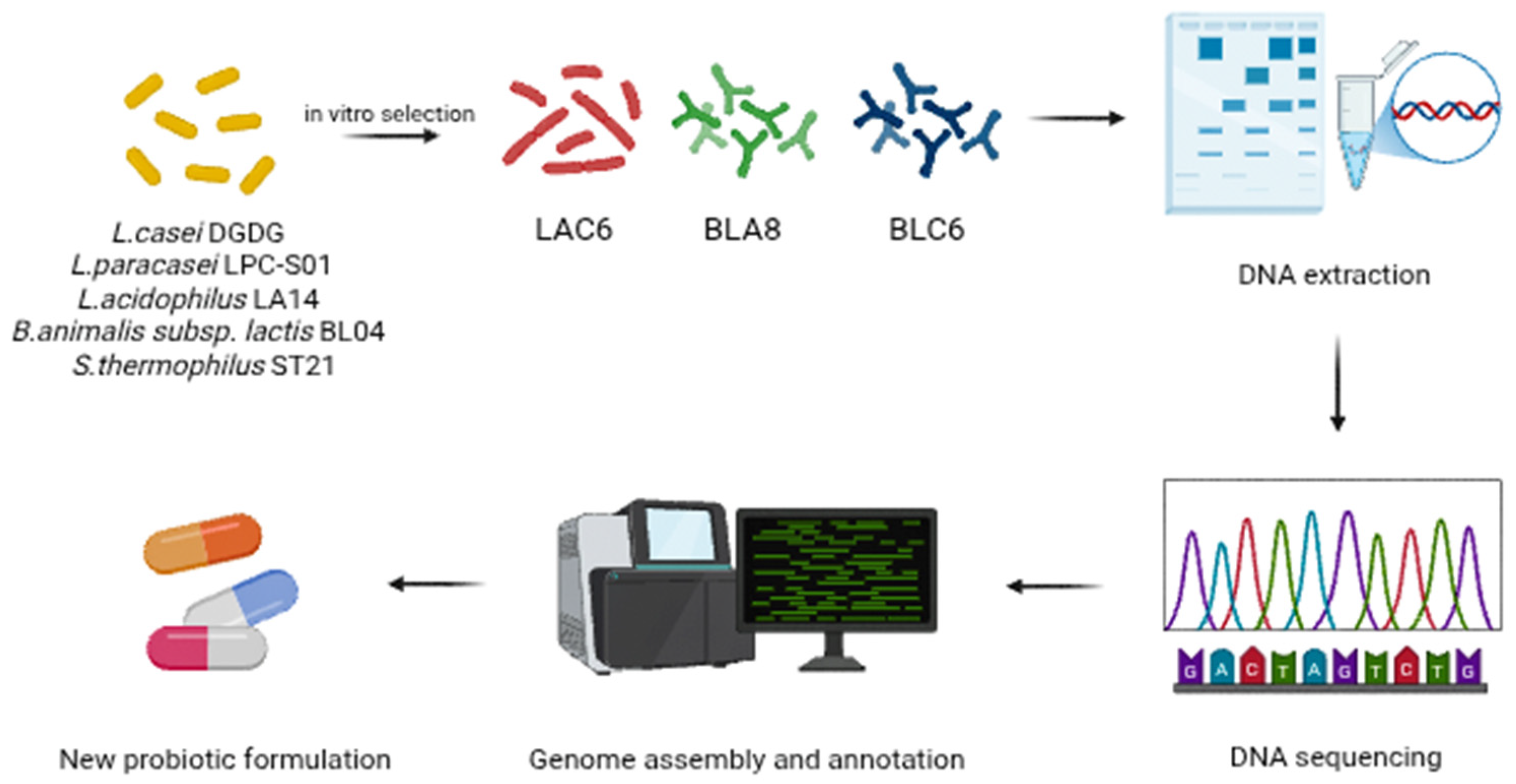
Five putative probiotic strains, Lactobacillus casei DGDG, Lactobacillus paracasei LPC-S01, Lactobacillus acidophilus LA14, Bifidobacterium animalis subsp. lactis BL04, and Streptococcus thermophilus ST21, were initially chosen according to their ecological origin, their ability to withstand acidic and bile conditions, and their presumed capacity to persist within the gastric and/or intestinal environment [12].
The selected strains were subsequently subjected to an in vitro evaluation of growth kinetics, with particular emphasis on both proliferation rate and biomass production under increasing levels of antibiotic pressure. Specifically, bacterial cultures were exposed to progressively higher concentrations of amoxicillin and clarithromycin. Particular attention was devoted to tolerance against these two antibiotics, as they represent cornerstone agents in standard first-line eradication regimens for H. pylori. Strains exhibiting sustained growth and stable biomass yield despite antibiotic exposure were considered the most suitable candidates for further investigation. The purpose of this screening procedure was not to determine minimum inhibitory concentrations (MICs), but rather to identify probiotic candidates capable of maintaining stable growth performance under antibiotic exposure, a relevant characteristic for potential co-administration during eradication therapy.
Following the screening procedure, three strains—two belonging to the Bifidobacterium animalis subsp. lactis group and one to the Lactobacillus acidophilus group—displayed the most favorable profile in terms of growth performance and antibiotic resilience. These strains were subsequently deposited and registered at the Istituto Zooprofilattico Sperimentale della Lombardia e dell’Emilia-Romagna (IZSLER; www.izsler.it accessed on 10 February 2026) and assigned the new strain designations LAC6, BLA8, and BLC6.
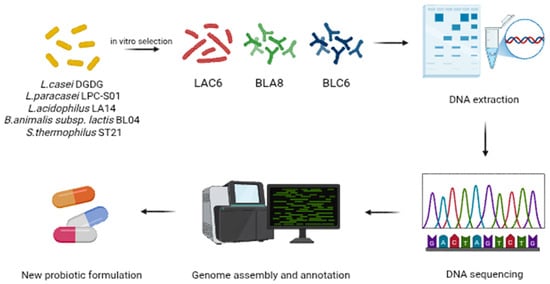
In order to accurately characterize these bacterial strains, whole-genome sequencing methods were used to investigate their novelty compared to standard probiotic strains and their safety for patients. In Figure 1, the proposed workflow is represented.
Figure 1.
Study workflow.
4.1. DNA Extraction and Sequencing
Total genomic DNA was extracted from 500 µL of four resistant strains of Bifidobacterium animalis subsp. lactis and 500 µL of two resistant strains of Lactobacillus using the NucleoSpin Tissue Kit (Macherey-Nagel GmbH & Co. KG, Düren, Germany). The DNA extraction was performed following the manufacturer’s instructions. The DNA concentration was then assessed using the Qubit® 4.0 Fluorometer and the DNA libraries were prepared in accordance with the Illumina Nextera XT DNA Library Prep Kit, following the manufacturer’s instructions (Illumina, San Diego, CA, USA). The libraries were then validated using the Fragment Analyzer™ High Sensitivity Small Fragment (Agilent Technologies, Santa Clara, CA, USA) and Qubit® 4.0 Fluorometer. Finally, the libraries were loaded onto an Illumina MiSeq platform and sequenced as follows: BL04-A8-C6, LA14 A8, LA14 C6 with a 2 × 300 paired-end V3 chemistry, and samples BL04 A8, BL04 C6 and BLAC33 with a 2 × 150 paired-end V2 chemistry.
4.2. Genome Assembly and Annotation
The quality of the demultiplexed samples was checked using the program FastQC v0.11.9 [14] and the raw sequences were pre-processed based on quality using the tool Trimmomatic v0.36 [15]. The reads were then aligned to the respective reference sequences (Accession numbers: GCF_000022705.1 and GCF_000389675.2 for BL04 and LA14 samples, respectively) using the program bwa mem v0.7.17 [16]. The duplicated reads were marked using the package MarkDuplicates of the program Picard v2.18. The variants were called using the tool HaplotypeCaller of the software GATK v4.0.1 and the genotypes were jointly called using the package GenotypeGVCF of the software GATK v4.0.1 [17]. The variants were then filtered based on quality using the tool VariantFiltration and were annotated using the program snpEff v4_3 [18]. Particular attention was devoted to the identification of mobile genetic elements, transferable antimicrobial resistance determinants, virulence factors and pathogenicity-associated sequences, in line with EFSA recommendations for the safety assessment of microorganisms intentionally used in the food and probiotic chain.
5. Conclusions
The obtained data provides a comprehensive overview of the safety, novelty, and reliability of the probiotic strains intended to be used. In our opinion, as probiotics are increasingly being used as an alternative to pharmaceuticals, it is essential to have a scientific and consistent methodology for developing this type of product. The advantages of a multidisciplinary approach, from basic biology to microbiology and genetics, provide clinicians with preliminary scientific evidence supporting the safety and potential translational applicability of selected probiotic strains.
The selection of probiotic strains in the laboratory provides an initial screening of the various options by observing the activity of interest in vitro.
Sequencing provides an objective and clear picture of potential safety issues. It also allows confirmation of phenotypic observations obtained in the laboratory and a deeper understanding of the results.
Author Contributions
Guarantor of the article: D.V., J.H. and N.F. conceived the study. I.M.S. and M.P. performed the microbiological analyses. C.L. performed molecular and bioinformatic analyses. I.M.S., M.P. wrote the manuscript. G.F., L.G., R.M., B.R., C.M., S.D.R. and G.M. critically reviewed the manuscript. All authors have read and agreed to the published version of the manuscript.
Funding
This research received no external funding.
Institutional Review Board Statement
The study was conducted in accordance with the Declaration of Helsinki, and approved by the local Ethics Committee (Protocol No. 193/2024/Sper/AOUBo).
Informed Consent Statement
Not applicable.
Data Availability Statement
The original contributions presented in this study are included in the article. Further inquiries can be directed to the corresponding author.
Conflicts of Interest
The authors declare no conflicts of interest.
References
- Hooi, J.K.Y.; Lai, W.Y.; Ng, W.K.; Suen, M.M.Y.; Underwood, F.E.; Tanyingoh, D.; Malfertheiner, P.; Graham, D.Y.; Wong, V.W.S.; Wu, J.C.Y.; et al. Global Prevalence of Helicobacter pylori Infection: Systematic Review and Meta-Analysis. Gastroenterology 2017, 153, 420–429. [Google Scholar] [CrossRef] [Scilit] [PubMed]
- Thung, I.; Aramin, H.; Vavinskaya, V.; Gupta, S.; Park, J.Y.; Crowe, S.E.; Valasek, M.A. Review article: The global emergence of Helicobacter pylori antibiotic resistance. Aliment. Pharmacol. Ther. 2016, 43, 514–533. [Google Scholar] [CrossRef] [Scilit] [PubMed]
- Savoldi, A.; Carrara, E.; Graham, D.Y.; Conti, M.; Tacconelli, E. Prevalence of Antibiotic Resistance in Helicobacter pylori: A Systematic Review and Meta-analysis in World Health Organization Regions. Gastroenterology 2018, 155, 1372–1382.e17. [Google Scholar] [CrossRef] [Scilit] [PubMed]
- Ruggiero, P. Use of probiotics in the fight against Helicobacter pylori. World J. Gastrointest. Pathophys. 2014, 5, 384–391. [Google Scholar] [CrossRef] [Scilit] [PubMed]
- Casas Deza, D.; Alcedo, J.; Lafuente, M.; López, F.J.; Perez-Aisa, Á.; Pavoni, M.; Tepes, B.; Jonaitis, L.; Castro-Fernandez, M.; Pabón-Carrasco, M.; et al. Probiotics Prescribed with Helicobacter pylori Eradication Therapy in Europe: Usage Pattern, Effectiveness, and Safety. Results From the European Registry on Helicobacter pylori Management (Hp-EuReg). Am. J. Gastroenterol. 2025, 120, 2644–2659. [Google Scholar] [CrossRef] [Scilit] [PubMed]
- EFSA Panel on Biological Hazards (BIOHAZ). Guidance on the characterization of microorganisms used as feed additives or as production organisms. EFSA J. 2018, 16, 5206. [Google Scholar]
- Li, Y.; He, C.; Lu, N. Impacts of Helicobacter pylori infection and eradication on gastrointestinal microbiota: An up-to-date critical review and future perspectives. Chin. Med. J. 2024, 137, 2833–2842. [Google Scholar] [CrossRef] [Scilit] [PubMed]
- Malfertheiner, P.; Megraud, F.; Rokkas, T.; Gisbert, J.P.; Liou, J.M.; Schulz, C.; Gasbarrini, A.; Hunt, R.H.; Leja, M.; O’Morain, C.; et al. Management of Helicobacter pylori infection: The Maastricht VI/Florence consensus report. Gut 2022, 71, 1724–1762. [Google Scholar] [CrossRef] [Scilit] [PubMed]
- Yuan, L.; Yang, C.; Han, Y.; Yang, F.; Tu, H. Beyond antibiotics: Probiotics as a promising ally against Helicobacter pylori. Front. Pharmacol. 2025, 16, 1620870. [Google Scholar] [CrossRef] [Scilit] [PubMed]
- Kesavelu, D.; Jog, P. Current understanding of antibiotic-associated dysbiosis and approaches for its management. Ther. Adv. Infect. Dis. 2023, 10, 20499361231154443. [Google Scholar] [CrossRef] [Scilit] [PubMed]
- Zhang, M.M.; Qian, W.; Qin, Y.Y.; He, J.; Zhou, Y.H. Probiotics in Helicobacter pylori eradication therapy: A systematic review and meta-analysis. World J. Gastroenterol. 2015, 21, 4345–4357. [Google Scholar] [CrossRef] [Scilit] [PubMed]
- Saracino, I.M.; Pavoni, M.; Saccomanno, L.; Fiorini, G.; Pesci, V.; Foschi, C.; Piccirilli, G.; Bernardini, G.; Holton, J.; Figura, N.; et al. Antimicrobial Efficacy of Five Probiotic Strains Against Helicobacter pylori. Antibiotics 2020, 9, 244. [Google Scholar] [CrossRef] [Scilit] [PubMed]
- Nardone, G.; Compare, D. The human gastric microbiota: Is it time to rethink the pathogenesis of stomach diseases? UEG J. 2015, 3, 255–260. [Google Scholar] [CrossRef] [Scilit] [PubMed]
- Andrews, S. FastQC: A Quality Control Tool for High Throughput Sequence Data. 2010. Available online: http://www.bioinformatics.babraham.ac.uk/projects/fastqc (accessed on 1 December 2025).
- Bolger, A.M.; Lohse, M.; Usadel, B. Trimmomatic: A flexible trimmer for Illumina sequence data. Bioinformatics 2014, 30, 2114–2120. [Google Scholar] [CrossRef] [Scilit] [PubMed]
- Li, H.; Durbin, R. Fast and accurate long-read alignment with Burrows-Wheeler transform. Bioinformatics 2010, 26, 589–595. [Google Scholar] [CrossRef] [Scilit] [PubMed]
- McKenna, A.; Hanna, M.; Banks, E.; Sivachenko, A.; Cibulskis, K.; Kernytsky, A.; Garimella, K.; Altshuler, D.; Gabriel, S.; Daly, M.; et al. The Genome Analysis Toolkit: A MapReduce framework for analyzing next-generation DNA sequencing data. Genome Res. 2010, 20, 1297–1303. [Google Scholar] [CrossRef] [Scilit] [PubMed]
- Cingolani, P.; Platts, A.; Wang, L.L.; Coon, M.; Nguyen, T.; Wang, L.; Land, S.J.; Lu, X.; Ruden, D.M. A program for annotating and predicting the effects of single nucleotide polymorphisms, SnpEff: SNPs in the genome of Drosophila melanogaster strain w1118; iso-2; iso-3. Fly 2012, 6, 80–92. [Google Scholar] [CrossRef] [Scilit] [PubMed]

Disclaimer/Publisher’s Note: The statements, opinions and data contained in all publications are solely those of the individual author(s) and contributor(s) and not of MDPI and/or the editor(s). MDPI and/or the editor(s) disclaim responsibility for any injury to people or property resulting from any ideas, methods, instructions or products referred to in the content. |
© 2026 by the authors. Licensee MDPI, Basel, Switzerland. This article is an open access article distributed under the terms and conditions of the Creative Commons Attribution (CC BY) license.