


Abstract
Objective: This study aimed to identify clinically modifiable and readily accessible predictors of 30-day mortality in a 10-year candidemia cohort and to assess temporal changes in Candida species distribution. Methods: We retrospectively evaluated 391 hospitalized adults with positive blood cultures for Candida spp. between January 2015 and March 2025. Only the first candidemia episode was included. Demographic characteristics, comorbidities, risk factors, laboratory parameters, antifungal therapy, and outcomes were recorded. Species identification was performed using conventional methods and the VITEK 2 system. Factors associated with 30-day mortality were analyzed using univariate and multivariate logistic regression models. Results: The mean age was 64.5 ± 17.7 years, and 56.3% of patients were male. Most patients (68.8%) were managed in the intensive care unit, and the 30-day mortality rate was 54%. Non-albicans Candida species accounted for 62.7% of isolates, with an increasing trend over time, particularly for Candida glabrata. Fluconazole susceptibility was 79%. In univariate analysis, advanced age, solid tumors, invasive mechanical ventilation, leukocytosis, thrombocytopenia, septic shock, intensive care unit admission, and failure to remove the central venous catheter were associated with mortality. Multivariate analysis identified advanced age, intensive care unit admission, septic shock, failure to remove the central venous catheter, leukocytosis, and thrombocytopenia as independent predictors of 30-day mortality. Conclusions: Candidemia remains a life-threatening infection with high mortality. Central venous catheter management and simple hematological parameters, particularly white blood cell and platelet counts, provide practical tools for early risk stratification. Although the rising prevalence of non-albicans Candida species may require updates in empirical therapy, prompt source control remains essential to improve survival.
1. Introduction
Candidemia is an important clinical condition that causes serious morbidity and mortality among hospital-acquired bloodstream infections. Recent data show that the annual prevalence can reach 7 per 100,000 [1,2]. Mortality rates vary across a wide range. Major risk factors include advanced age, shock or sepsis, and high organ failure scores. Intensive care admission, immunosuppression, and the presence of central venous catheters are also significant factors. Additionally, total parenteral nutrition and widespread antibiotic use are among the primary risk factors [3]. Delayed antifungal therapy has a significant negative impact on survival. Early and appropriate treatment plays a critical role in reducing mortality [4].
The virulence capacity and antifungal resistance profiles of Candida species strongly influence clinical outcomes. Infections caused by multidrug-resistant species such as Candida auris are associated with higher mortality rates [5]. Several studies have evaluated biomarkers such as β-D-glucan, mannan/anti-mannan, procalcitonin, and other inflammatory markers for diagnosis and prognosis. However, these biomarkers alone do not provide sufficient accuracy. They are more meaningful when interpreted together with clinical parameters [6,7,8,9,10,11].
Accurate identification of clinical and laboratory predictors of mortality in candidemia is essential for early risk stratification and guiding treatment strategies. This study aimed to evaluate clinical, laboratory, and microbiological predictors of 30-day mortality in a large candidemia cohort between January 2015 and March 2025. The detailed assessment of temporal changes in Candida species distribution over this decade makes this work one of the few comprehensive studies that address both long-term epidemiological trends and prognostic indicators.
2. Results
Baseline Characteristics
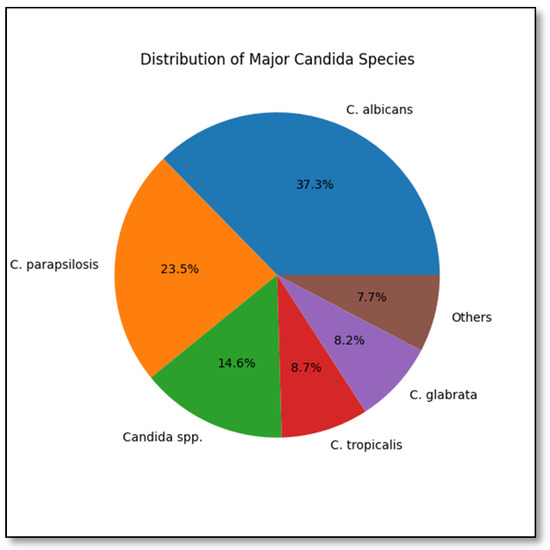
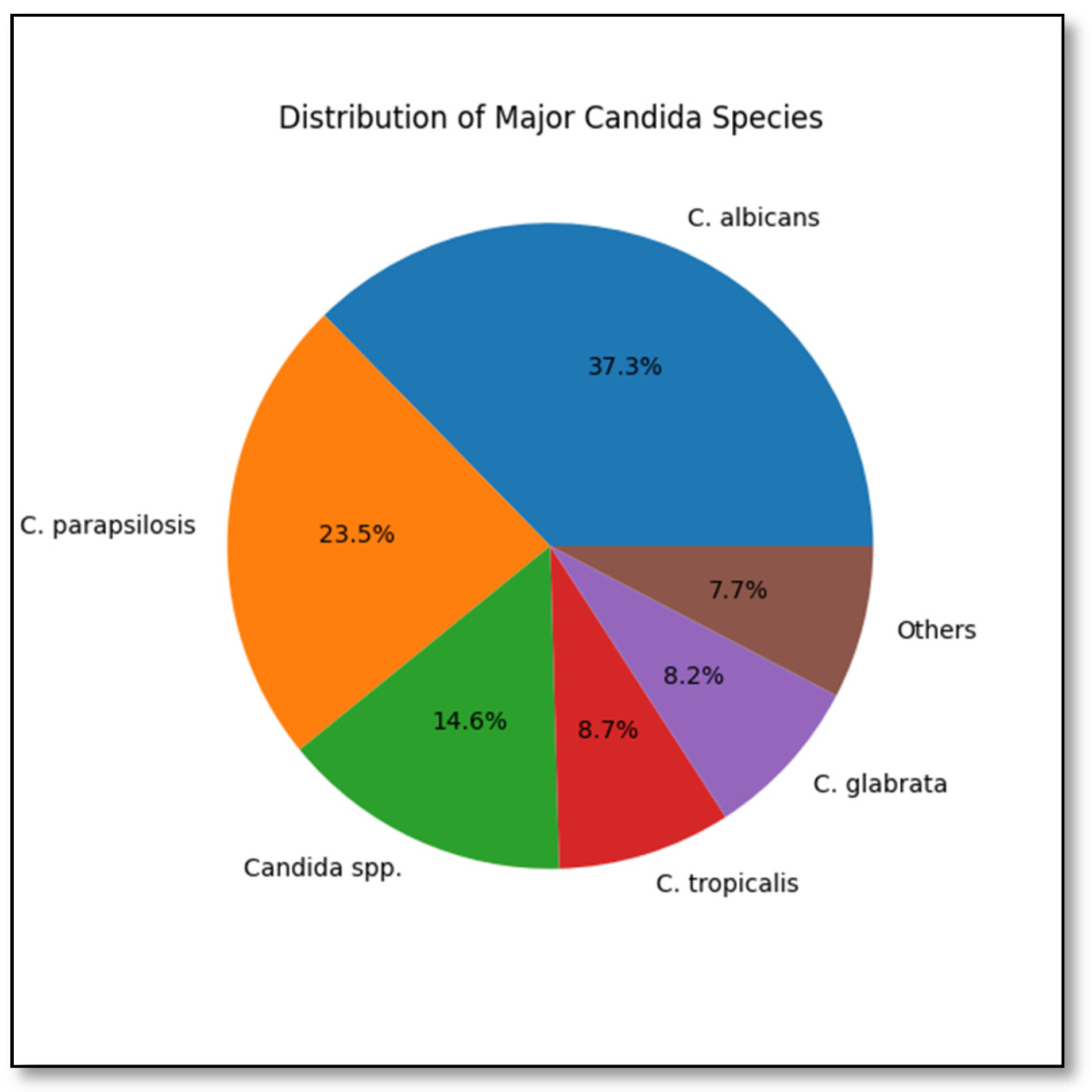
Among the cases included in the study, 43.7% were female, and 56.3% were male. The mean age was 64.5 ± 17.7 years. Most patients (93.1%) were Turkish citizens. Diabetes mellitus was the most common comorbidity (65.2%). Broad-spectrum antibiotic use was present in 95% of the cases. The mean hospital stay for patients diagnosed with candidemia was 28.4 ± 23.7 days. Additionally, 68.8% of the patients were followed in the intensive care unit. A second candidemia attack occurred in 1.5% of the cases. Concomitant bacteremia was detected in 68%. Ocular involvement was found in 23 patients who underwent eye examinations. Cardiac involvement was identified in 1% of those who underwent echocardiography. Regarding species distribution, non-albicans Candida species were dominant at a rate of 62.7%. The distribution of Candida species is summarized in Figure 1. Fluconazole susceptibility was 79%. Initial antifungal therapy was frequently started with azole group drugs (72.6%). The compatibility rate of empirical treatment with culture results was 86%. The 30-day mortality rate was 54% (Table 1).
Figure 1.
Distribution of major Candida species in the study cohort. The most frequently identified species were Candida albicans, C. parapsilosis, Candida spp., C. tropicalis, and C. glabrata. Less common species were grouped under “Others”.
Table 1.
Baseline demographic, clinical, and laboratory characteristics of patients with candidemia.
Patients were therefore categorized according to 30-day mortality, defined as all-cause mortality within 30 days of the index positive blood culture: those who died within 30 days (30-day mortality group) and those who survived (survivor group). In the 30-day mortality group, the mean age was significantly higher than in the survivor group (p < 0.05). Hypertension, the presence of solid cancer, and the use of invasive mechanical ventilation were also significantly more frequent in this group (p < 0.05). No significant differences were found between the groups regarding gender or nationality (p > 0.05). Similarly, diabetes mellitus and chronic heart or kidney diseases did not show significant differences. Hematological malignancy, use of immunosuppressive drugs or steroids, and pancreatitis were not significantly different. There were also no significant differences in chronic liver disease, total parenteral nutrition, or history of abdominal surgery. The presence of urinary or central catheters, history of hemodialysis, and use of broad-spectrum antibiotics also did not differ significantly between the groups (p > 0.05) (Table 2).
Table 2.
Comparison of demographic, clinical, and laboratory characteristics according to 30-day mortality in patients with candidemia.
In the mortality group, white blood cell count, neutrophil count, C-reactive protein, urea, creatinine, AST, and procalcitonin levels were significantly higher (p < 0.05). Platelet levels were significantly lower in the mortality group (p < 0.05). No significant differences were observed between groups in hemoglobin, lymphocyte count, or ALT levels (p > 0.05) (Table 2).
When other parameters were evaluated, the hospital stay duration at the time of candidemia was shorter in the mortal group (p < 0.05). The rate of second episodes and the rate of catheter replacement were also lower in the mortal group compared to the non-mortal group (p < 0.05). Intensive care unit admission, septic shock, and the presence of COVID-19 were significantly higher in the mortal group (p < 0.05). Additionally, 14-day mortality was significantly higher in this group (p < 0.05). No significant differences were found between the two groups regarding episode type or concomitant bacteremia (p > 0.05). Similarly, the distribution of Candida species and the presence of endocarditis or ocular involvement did not differ. Antifungal treatment options, fluconazole susceptibility, and the rate of death before receiving treatment were similar. Finally, there was no significant difference in the appropriateness of empirical therapy between the groups (p > 0.05) (Table 3).
Table 3.
Clinical characteristics, microbiological findings, and treatment-related variables according to 30-day mortality in patients with candidemia.
In the univariate logistic regression analysis, age, hypertension, and solid tumor/chemotherapy were associated with 30-day mortality (p < 0.05). Invasive mechanical ventilator use, white blood cell count, and neutrophil count were also significantly related to mortality. Additionally, platelet levels, C-reactive protein, urea, and AST were found to be associated with clinical outcomes. Other significant factors included the duration of hospital stay at the time of candidemia, ward type, and the presence of septic shock. Lack of catheter removal and the presence of COVID-19 were also associated with 30-day mortality (p < 0.05). No significant relationship was observed regarding procalcitonin and creatinine levels (p > 0.05).
In the multivariate analysis, several factors were identified as independent predictors of 30-day mortality (p < 0.05). These included age, white blood cell count, and platelet levels. The duration of hospital stay at the time of candidemia and admission to the intensive care unit were also independent markers. Additionally, the presence of septic shock and the failure to replace the catheter significantly predicted mortality (p < 0.05). Detailed results are presented in Table 4.
Table 4.
Univariate and multivariate logistic regression analysis of factors associated with 30-day mortality in patients with candidemia.
In the comparison based on Candida species, several differences were observed. Procalcitonin levels and the rate of concomitant bacteremia were significantly lower in the non-albicans Candida group compared to the albicans group (p < 0.05). The rate of catheter removal was also lower in the non-albicans Candida group compared to the albicans group (p < 0.05). Conversely, echinocandin treatment and the presence of COVID-19 were significantly higher in the non-albicans Candida group (p < 0.05). No significant differences were found regarding other parameters (p > 0.05) (Table 5 and Table 6).
Table 5.
Comparison of demographic, clinical, and laboratory characteristics between Candida albicans and non-albicans Candida groups.
Table 6.
Selected clinical, microbiological, and treatment-related characteristics according to Candida species in patients with candidemia.
When the temporal distribution was examined, the rates of C. albicans and C. famata decreased between 2020 and 2025 (p < 0.05). In contrast, the rates of Candida spp. and C. glabrata increased during the same period (p < 0.05). The distribution of other species did not show a significant difference between the periods (p > 0.05) (Table 7).
Table 7.
Temporal distribution of Candida species according to year of hospitalization.
3. Discussion
In this study, the 30-day mortality rate was 54.5%. This high rate is consistent with the 30–60% range reported in the literature [12,13]. This finding indicates a high-risk profile in our cohort. In the multivariate analysis, advanced age, intensive care unit admission, and septic shock were identified as independent prognostic markers. These results align with data from large-scale studies and meta-analyses [14,15,16]. Such reports emphasize that candidemia significantly increases mortality, especially in severely ill patients.
The evaluation of laboratory parameters revealed significant leukocytosis and neutrophilia in the mortal group. These patients also had increased CRP, procalcitonin (PCT), and urea/creatinine levels. These findings are consistent with studies reporting that systemic inflammation and renal dysfunction are associated with poor clinical outcomes in candidemia [17,18]. Notably, a low platelet level was identified as an independent prognostic marker. Thrombocytopenia has recently been defined as one of the biomarkers most strongly associated with a poor prognosis in candidemia. Our study clearly supports this relationship [17,18]. These parameters are easily accessible and effective tools. They can be used to identify high-risk patients early and to plan aggressive management strategies in intensive care.
In this study, the failure to remove the central venous catheter (CVC) was independently associated with mortality. The positive effect of catheter removal on prognosis was also identified. This finding is consistent with current evidence and international guidelines reporting that early catheter removal reduces mortality in catheter-related candidemia [19,20]. The decisive role of CVC management is clearly seen in the multivariate analysis of our study. This is particularly relevant for patients in intensive care units who require invasive procedures and total parenteral nutrition. The independent effect of timely catheter removal on clinical outcomes highlights the critical importance of catheter strategies in candidemia management once again.
Taken together, these findings highlight that advanced age, ICU admission, septic shock, failure to remove the central venous catheter, leukocytosis, and thrombocytopenia constitute the core determinants of 30-day mortality in candidemia. These findings provide a practical framework for early risk stratification and targeted clinical management.
The distribution of species showed that the rate of non-albicans Candida reached 62.7%. The increase in non-albicans Candida species between 2020 and 2025 is consistent with the epidemiological shift reported globally [21,22]. Increased invasive procedures and prolonged ICU stays during the COVID-19 pandemic played a key role in this trend. The rise in broad-spectrum antibiotic and steroid use also contributed to this increase. In our study, a significant increase was observed in unidentified Candida isolates during the 2020–2025 period. Routine identification of C. auris began at our center in 2025. Limitations in confirmatory methods in previous years suggest that this species might have been overlooked in some cases. Therefore, the increase in unidentified isolates is noteworthy. It remains uncertain whether this indicates early C. auris circulation. This trend emphasizes the importance of closely monitoring local epidemiological data and susceptibility patterns. Fluconazole susceptibility was 79% in our cohort. While this is a positive finding, the increase in non-albicans Candida species necessitates the updating of empirical treatment protocols.
Regarding treatment approaches, azole group antifungals were more frequently preferred as the initial choice. However, the use of echinocandins was higher in severe cases and when non-albicans Candida species were suspected. This approach is consistent with current guidelines, which recommend echinocandins as the first-line option for candidemia cases, particularly in critically ill patients [23,24].
During a significant part of the study period, the Health Implementation Communiqué (SUT) in our country included restrictions on the empirical use of echinocandins. This situation may have influenced our high rate of empirical fluconazole use. The restriction in question was removed around 2020. Since then, clinical access to echinocandins has become easier. Therefore, the frequent preference for fluconazole in empirical treatment reflects national reimbursement policies rather than our center’s clinical choice. In accordance with guideline recommendations, the use of echinocandins in severe patients is expected to increase following this regulation.
The high accuracy rate of 86% for empirical treatment according to culture results indicates that candidemia management at our center is generally successful. This finding serves as an important quality indicator. The association between COVID-19 positivity and mortality is consistent with the literature regarding the pandemic period. In COVID-19 patients, the frequency of invasive procedures and the need for ICU admission increased significantly. Furthermore, the use of broad-spectrum antibiotics and steroids rose markedly. These are the primary factors that increase both the risk of candidemia and mortality [25,26].
In our study, hypertension, the requirement for invasive mechanical ventilation, and the presence of a solid tumor/chemotherapy were associated with a mortal course. These findings parallel previous studies. The finding that chronic renal failure was not associated with mortality supports the results of a study conducted in our country. Although different results are reported in the literature on this subject, there is no definitive consensus [27,28,29].
In addition, part of our study period overlapped with the COVID-19 pandemic. During the pandemic, increased ICU admissions, invasive procedures, central venous catheter use, and corticosteroid therapy may have contributed to the development of candidemia [28,30]. A large systematic review and meta-analysis including COVID-19 patients reported a significant prevalence of candidemia among critically ill patients and highlighted the high associated mortality. These findings suggest that the COVID-19 pandemic may have had a potential impact on the epidemiology and clinical outcomes of candidemia [31].
Overall, this study has comprehensively demonstrated the clinical, laboratory, and management-based predictors of 30-day mortality due to candidemia in a large, 10-year cohort. Several parameters had independent prognostic significance. These included advanced age, thrombocytopenia, and admission to the intensive care unit. Septic shock and central venous catheter management were also critical markers. These findings provide a vital framework for early risk assessment and the correct direction of treatment strategies. The identification of easily accessible laboratory markers, such as WBC and platelets, as independent predictors is a key finding. This can contribute to the development of rapid and applicable risk classification in clinical practice. Furthermore, the independent effect of timely central venous catheter removal on mortality clearly demonstrates the importance of quality improvement initiatives regarding catheter management, especially in intensive care populations.
The significant increase in non-albicans species and the rise in unidentified isolates in recent years indicate new epidemiological dynamics in the post-COVID-19 era. These trends highlight the necessity of regularly updating local surveillance and antifungal susceptibility patterns. This study is among the few comprehensive cohorts in the literature that evaluate long-term epidemiological shifts alongside clinical and laboratory markers. The changes in non-albicans prevalence and the increase in unidentified isolates provide critical data. These findings serve as a warning for updating local treatment algorithms and strengthening infection control policies.
Future studies should focus on identifying high-risk patients at an earlier stage and improving preventive strategies for candidemia. The development of risk prediction models based on clinical and laboratory parameters may support early diagnosis and timely intervention. In addition, machine learning-based approaches may further enhance risk stratification and clinical decision-making.
This study has several limitations. First, its retrospective design and single-center setting may limit the generalizability of the findings and introduce potential selection and information bias. Additionally, full standardization of microbiological culture and antifungal susceptibility testing methods could not be ensured throughout the study period. The lack of routine molecular identification may have affected the accuracy of species-level classification in some isolates. Furthermore, some clinical variables and diagnostic evaluations, such as ophthalmological examinations, were not available for all patients, which may have influenced the assessment of certain complications.
Despite these limitations, this study has several strengths. It evaluates long-term epidemiological trends over a 10-year period and identifies clinically relevant prognostic markers. Moreover, the findings have practical implications for centers with similar patient populations.
4. Materials and Methods
4.1. Ethical Approval
The study was approved by the Clinical Research Ethics Committee of SBU Haseki Training and Research Hospital. The approval date is 25 June 2025, and the decision number is 109-2025. The study was conducted in accordance with the Declaration of Helsinki.
4.2. Study Design and Population
This study was conducted as a retrospective cohort study at the Department of Infectious Diseases and Clinical Microbiology, SBÜ Haseki Training and Research Hospital. Between January 2015 and March 2025, adult patients (≥18 years) who were hospitalized and had at least one blood culture positive for Candida spp. were included. For each patient, only the first episode of candidemia (index episode) was analyzed. In patients with multiple episodes, subsequent attacks were excluded from the analysis.
4.3. Inclusion and Exclusion Criteria
Adult patients aged 18 years or older, hospitalized, and with blood cultures positive for Candida species were included in the study. Only cases with complete access to clinical and laboratory data were analyzed. Patients younger than 18 years were excluded. Outpatients and patients referred from external centers were also excluded. Blood cultures with growth of yeasts or molds other than Candida species were not included. Cases with polymicrobial growth that were not clinically consistent with candidemia were excluded. Patients with missing data were also excluded from the study.
4.4. Definitions
Candidemia was defined as the growth of Candida spp. in at least one blood culture in a patient with clinical signs and symptoms. Candidemia detected within 30 days of the first isolation was considered the first episode. Cases occurring more than 30 days after the first isolation with negative blood cultures in between were evaluated as a second episode. Only the first episode of candidemia was included in the study. All-cause deaths occurring within 30 days following the date of Candida isolation in blood culture were defined as 30-day mortality. Steroid use was defined as systemic corticosteroid administration within the 7 days preceding the onset of candidemia. Ocular involvement was defined as the presence of chorioretinitis or endophthalmitis detected during ophthalmologic examination. Death before treatment was defined as patients who died after blood cultures were obtained but before empirical antifungal therapy could be initiated, either before the culture results became available or before treatment initiation.
4.5. Data Sources and Data Collection
Patient data were retrospectively obtained from the hospital information management system. Recorded variables included demographic characteristics such as age and sex. Sex was recorded as biological sex (male/female) based on the information documented in the patients’ medical records. The ward or intensive care unit of hospitalization was also documented. Underlying diseases were recorded, including diabetes mellitus, malignancy, cardiovascular disease, renal disease, and liver disease. Risk factors were identified for each case. These included mechanical ventilation, central venous catheter (CVC) use, total parenteral nutrition (TPN), chemotherapy, use of broad-spectrum antibiotics, hemodialysis, systemic corticosteroid therapy, abdominal surgery, neutropenia, and concomitant bacteremia. Laboratory parameters were also retrieved. The date of candidemia diagnosis was defined as the index day. Each patient was followed for 30 days after diagnosis. Mortality and clinical outcomes during this period were recorded. In our cohort, fluconazole was the only azole antifungal agent used for treatment.
4.6. Microbiological Investigations
Blood samples sent for culture were incubated at 35 °C for up to 7 days using the BacT/Alert 3D automated blood culture system (bioMérieux, Marcy l’Étoile, France). Bottles flagged as positive were subcultured onto 5% Sheep Blood Agar (Oxoid, Thermo Fisher Scientific, Basingstoke, UK), Sabouraud Dextrose Agar (SDA), and CHROMagar Candida (Oxoid Brilliance Candida Agar) and incubated aerobically at 37 °C for 24–48 h.
Yeast growth was confirmed by Gram staining. Preliminary identification was performed using colony morphology, germ tube testing, and conventional phenotypic methods. Species-level identification was carried out using the VITEK 2 Compact system (YST ID card, bioMérieux, Marcy l’Étoile, France).
For antifungal susceptibility testing, Candida isolates were adjusted to a 2.0 McFarland standard (range 1.8–2.2) in 0.45% sterile NaCl according to the manufacturer’s instructions and analyzed using the VITEK 2 Compact system (AST YS08 card, bioMérieux, Marcy l’Étoile, France). Results were interpreted according to the clinical breakpoints and epidemiological cutoff values (ECOFFs) defined by the Clinical and Laboratory Standards Institute (CLSI).
In this study, antifungal susceptibility refers to in vitro susceptibility testing of Candida isolates rather than clinical response to antifungal therapy. Isolates not identified to the species level were reported as Candida spp. and analyzed accordingly. All blood culture and antifungal susceptibility tests were performed in the central microbiology laboratory of our hospital, and the results were retrospectively retrieved from the hospital information system.
4.7. Laboratory Analyses
Complete blood counts, biochemical parameters, and procalcitonin levels were analyzed in the central laboratory of the institution. All analyses were performed using original reagents supplied by the manufacturers.
4.8. Statistical Analysis
Descriptive statistics are reported as mean ± standard deviation and/or median (minimum–maximum) for continuous variables and as numbers (percentages) for categorical variables. The distribution of variables was assessed using the Kolmogorov–Smirnov and Shapiro–Wilk tests. For comparisons between two groups, the Mann–Whitney U test was used for non-normally distributed continuous variables, while the chi-square test or Fisher’s exact test was applied for categorical variables, as appropriate. A two-sided p value < 0.05 was considered statistically significant. All analyses were performed using SPSS software, version 27.0 (IBM Corp., Armonk, NY, USA).
Variables associated with the primary outcome of 30-day mortality were first evaluated using univariable logistic regression analysis. Variables with a p value < 0.10 and/or those considered clinically relevant were subsequently included in a multivariable logistic regression model. A forward stepwise likelihood ratio (Forward LR) approach was applied in the multivariable analysis, and results are presented as odds ratios (ORs) with 95% confidence intervals (CIs) and p values.
5. Conclusions
This study clearly demonstrates the key clinical and laboratory markers associated with 30-day mortality in patients with candidemia. Advanced age, leukocytosis, and thrombocytopenia were identified as independent and strong predictors of mortality. Septic shock, intensive care unit admission, and failure to remove the central venous catheter were also significant independent risk factors. In addition, the increasing proportion of non-albicans Candida species highlights the need for continuous monitoring of local epidemiology and antifungal susceptibility patterns.
Our findings underscore the critical importance of early risk stratification, timely source control through catheter removal, and antifungal therapy guided by current resistance profiles in the management of candidemia. Collectively, these results provide a practical framework to support the development of evidence-based and standardized clinical protocols, particularly in intensive care settings.
The routinely available and structured predictors identified in this study provide a suitable foundation for future machine learning-based risk prediction models in candidemia, with the potential to support early clinical decision-making.
Author Contributions
Conceptualization, İ.Y.N.; methodology, İ.Y.N., E.Z. and M.Y.; investigation, S.A.; data curation, İ.Y.N., E.Z. and S.A.; formal analysis, İ.Y.N.; visualization, İ.Y.N.; writing—original draft preparation, İ.Y.N.; writing—review and editing, İ.Y.N., E.Z., S.A. and M.Y.; supervision, İ.Y.N. All authors have read and agreed to the published version of the manuscript.
Funding
This research received no external funding.
Institutional Review Board Statement
The study was conducted in accordance with the Declaration of Helsinki and approved by the Clinical Research Ethics Committee of SBU Haseki Training and Research Hospital (protocol code 109-2025, approved on 25 June 2025).
Informed Consent Statement
Patient consent was waived due to the retrospective nature of the study and the use of anonymized clinical data.
Data Availability Statement
The datasets generated and/or analyzed during the current study are not publicly available due to institutional and ethical restrictions related to patient confidentiality but are available from the corresponding author upon reasonable request.
Acknowledgments
The authors would like to thank the medical and administrative staff involved in the care of the patients and in data collection.
Conflicts of Interest
The authors declare that they have no conflicts of interest.
Abbreviations
The following abbreviations are used in this manuscript:
| CVC | Central venous catheter |
| ICU | Intensive care unit |
| CRP | C-reactive protein |
| PCT | Procalcitonin |
| TPN | Total parenteral nutrition |
| AST | Aspartate aminotransferase |
| ALT | Alanine aminotransferase |
| CLSI | Clinical and Laboratory Standards Institute |
| ECOFF | Epidemiological cutoff value |
| OR | Odds ratio |
| CI | Confidence interval |
| WBC | White blood cell count |
References
- Soriano, A.; Honore, P.M.; Puerta-Alcalde, P.; Garcia-Vidal, C.; Pagotto, A.; Gonçalves-Bradley, D.C.; Verweij, P.E. Invasive candidiasis: Current clinical challenges and unmet needs in adult populations. J. Antimicrob. Chemother. 2023, 78, 1569–1585. [Google Scholar] [CrossRef] [Scilit]
- Ferngren, G.; Yu, D.; Unalan-Altintop, T.; Dinnétz, P.; Özenci, V. Epidemiological patterns of candidaemia: A comprehensive analysis over a decade. Mycoses 2024, 67, e13729. [Google Scholar] [CrossRef] [Scilit] [PubMed]
- Dixit, D.; Jen, P.; Maxwell, T.D.; Smoke, S.; McCracken, J.A.; Cardinale-King, M.; Haribhakti, A.; Patel, P.; Cani, E.; Choi, S.C.; et al. Risk factors and clinical outcomes of candidemia associated with severe COVID-19. Crit. Care Explor. 2022, 4, e0762. [Google Scholar] [CrossRef] [Scilit]
- Andreev, S.S.; Narusova, P.O.; Chernov, A.A.; Dushkin, A.D.; Dukhanina, O.D.; Iskhakov, R.T.; Fomina, D.S.; Lysenko, M.A. Thirty-day mortality in invasive candidiasis and candidemia in a multidisciplinary hospital in Moscow, Russia. Curr. Med. Mycol. 2025, 11, 1590. Available online: https://pmc.ncbi.nlm.nih.gov/articles/PMC12536815/ (accessed on 31 March 2026).
- Gülten, E.; Çınar, G.; Sarıcaoğlu, E.M.; Akdemir, İ.; Yılmaz, A.Z.; Saldere, E.H.; Yörük, F. Candida auris vs. non-Candida auris candidemia in critically ill patients: Clinical outcomes, risk factors, and mortality. J. Fungi 2025, 11, 552. [Google Scholar] [CrossRef] [Scilit]
- Christner, M.; Abdennadher, B.; Wichmann, D.; Kluge, S.; Pepić, A.; Aepfelbacher, M.; Rohde, H.; Olearo, F. The added value of (1,3)-β-D-glucan for the diagnosis of invasive candidiasis in ICU patients: A prospective cohort study. Infection 2024, 52, 73–81. [Google Scholar] [CrossRef] [Scilit]
- Kokkoris, S.; Angelopoulos, E.; Gkoufa, A.; Christodouli, F.; Ntaidou, T.; Theodorou, E.; Dimopoulou, G.; Vasileiadis, I.; Kremmydas, P.; Routsi, C. Diagnostic accuracy of procalcitonin and its combination with other biomarkers for candidemia in critically ill patients. J. Clin. Med. 2024, 13, 3557. [Google Scholar] [CrossRef] [Scilit] [PubMed]
- Cabrera-Guerrero, J.P.; García-Salazar, E.; Hernandez Silva, G.; Chinney Herrera, A.; Martínez-Herrera, E.; Pinto-Almazán, R.; Frías-De-León, M.G.; Castro-Fuentes, C.A. Candidemia: An update on epidemiology, risk factors, diagnosis, susceptibility, and treatment. Pathogens 2025, 14, 806. [Google Scholar] [CrossRef] [Scilit]
- de Guadiana-Romualdo, L.G.; Botella, L.A.; Rojas, C.R.; Candel, A.P.; Sánchez, R.J.; Zamora, P.C.; Albaladejo-Otón, M.D.; Allegue-Gallego, J.M. Mortality prediction model from combined serial lactate, procalcitonin and calprotectin levels in critically ill patients with sepsis. Med. Intensiv. 2024, 48, 629–638. [Google Scholar] [CrossRef] [Scilit]
- Zhang, G.M.; Gu, Y.Y. Diagnostic value of procalcitonin, C-reactive protein-to-lymphocyte ratio, C-reactive protein and neutrophil-to-lymphocyte ratio for predicting bacteremia in ICU patients. J. Crit. Care 2024, 81, 154538. [Google Scholar] [CrossRef] [Scilit]
- Tunay, B.; Aydin, S. Investigation of inflammation-related parameters in patients with candidemia hospitalized in the intensive care unit. Sci. Prog. 2022, 105, 368504221124055. [Google Scholar] [CrossRef] [Scilit] [PubMed]
- Dai, Z.; Lan, X.; Cai, M.; Liao, Y.; Zhang, J.; Ye, N.; Lu, X.; Wang, J.; Xiao, Y.; Zhang, Y.; et al. Nineteen-year retrospective analysis of epidemiology, antifungal resistance and a nomogram model for 30-day mortality in nosocomial candidemia. Front. Cell. Infect. Microbiol. 2025, 15, 1504866. [Google Scholar] [CrossRef] [Scilit] [PubMed]
- Chen, X.; Shen, M.; Feng, Q.; Yang, G.; Tian, R.; Yao, S.; Zha, H. Epidemiological characteristics, antifungal susceptibility, and mortality factors of candidemia in adults (2016–2023). BMC Infect. Dis. 2025, 25, 726. [Google Scholar] [CrossRef] [Scilit]
- Klingspor, H.T.; Hällgren, A. Factors influencing outcomes in candidemia: A retrospective study of patients in a Swedish county. Mycoses 2024, 67, e13758. [Google Scholar] [CrossRef] [Scilit]
- Zhang, C.; Wu, S.; Chen, X.; Yang, H.; Feng, W.; Yuan, T.; Wang, Y. Clinical manifestations and treatment of candidemia caused by different Candida species. BMC Infect. Dis. 2024, 24, 1234. [Google Scholar] [CrossRef] [Scilit]
- Liu, T.; Sun, S.; Zhu, X.; Wu, H.; Sun, Z.; Peng, S. Epidemiology, clinical characteristics, and outcome in candidemia: A five-year retrospective analysis. BMC Infect. Dis. 2025, 25, 512. [Google Scholar] [CrossRef] [Scilit]
- Khan, S.; Cai, L.; Bilal, H.; Khan, M.N.; Fang, W.; Zhang, D.; Yao, F.; Wang, X.; Wang, Q.; Hou, B.; et al. Eleven-year retrospective analysis of candidiasis epidemiology, risk factors, and antifungal susceptibility. Sci. Rep. 2025, 15, 7240. [Google Scholar] [CrossRef] [Scilit]
- Li, Y.; Gu, C.; Yang, Y.; Ding, Y.; Ye, C.; Tang, M.; Liu, J.; Zeng, Z. Epidemiology, antifungal susceptibility, risk factors, and mortality of persistent candidemia. BMC Infect. Dis. 2023, 23, 369. [Google Scholar] [CrossRef] [Scilit]
- Salmanton-García, J.; Cornely, O.A.; Stemler, J.; Barać, A.; Steinmann, J.; Siváková, A.; Akalin, E.H.; Arikan-Akdagli, S.; Loughlin, L.; Toscano, C.; et al. Attributable mortality of candidemia: Results from the ECMM Candida III study. J. Infect. 2024, 89, 106229. [Google Scholar] [CrossRef] [Scilit]
- Cornely, F.B.; Cornely, O.A.; Salmanton-García, J.; Koehler, F.C.; Koehler, P.; Seifert, H.; Wingen-Heimann, S.; Mellinghoff, S.C. Attributable mortality of candidemia after introduction of echinocandins. Mycoses 2020, 63, 1373–1381. [Google Scholar] [CrossRef] [Scilit]
- Reizine, F.; Henry, J.; Desmedt, L.; Camus, C.; Coirier, V.; Arrive, F.; Burban, E.; Eustache, G.; Belleville, T.; Marc, A.; et al. Screening and risk factors for secondary localization during candidemia in ICU patients. Crit. Care 2025, 29, 281. [Google Scholar] [CrossRef] [Scilit]
- Meneghello, S.; Bernabè, G.; Di Pietra, G.; Di Sopra, S.; Del Vecchio, C.; Cattelan, A.M.; Castagliuolo, I.; Brun, P. Prevalence, species distribution and resistance of candidemia. J. Fungi 2024, 10, 707. [Google Scholar] [CrossRef] [Scilit]
- Cornely, O.A.; Sprute, R.; Bassetti, M.; Chen, S.C.; Groll, A.H.; Kurzai, O.; Lass-Flörl, C.; Ostrosky-Zeichner, L.; Rautemaa-Richardson, R.; Revathi, G.; et al. Global guideline for the diagnosis and management of candidiasis. Lancet Infect. Dis. 2025, 25, e280–e293. [Google Scholar] [CrossRef] [Scilit] [PubMed]
- Barantsevich, N.; Barantsevich, E. Diagnosis and treatment of invasive candidiasis. Antibiotics 2022, 11, 718. [Google Scholar] [CrossRef] [Scilit]
- Pyrpasopoulou, A.; Zarras, C.; Mouloudi, E.; Vakalis, G.; Ftergioti, A.; Kouroupis, D.; Papathanasiou, A.-I.; Iosifidis, E.; Goumperi, S.; Lampada, C.; et al. Changing epidemiology of Candida spp. bloodstream infections. Pathogens 2025, 14, 161. [Google Scholar] [CrossRef] [Scilit] [PubMed]
- Papadimitriou-Olivgeris, M.; Kolonitsiou, F.; Kefala, S.; Spiliopoulou, A.; Aretha, D.; Bartzavali, C.; Siapika, A.; Marangos, M.; Fligou, F. Increased incidence of candidemia during the COVID-19 pandemic. Braz. J. Infect. Dis. 2022, 26, 102353. [Google Scholar] [CrossRef] [Scilit] [PubMed]
- Özmerdiven, G.E.; İrvem, A.; Şahin, A.S. Risk analysis of candidemia and its effect on mortality in COVID-19 and non-COVID-19 patients. Iran. J. Microbiol. 2024, 16, 236–242. [Google Scholar] [CrossRef] [Scilit]
- Kayaaslan, B.; Eser, F.; Kaya Kalem, A.; Bilgic, Z.; Asilturk, D.; Hasanoglu, I.; Ayhan, M.; Tekce, Y.T.; Erdem, D.; Turan, S.; et al. Characteristics of candidemia in COVID-19 patients. Mycoses 2021, 64, 1083–1091. [Google Scholar] [CrossRef] [Scilit]
- Gebremicael, M.N.; Nuttall, J.J.C.; Tootla, H.D.; Khumalo, A.; Tooke, L.; Salie, S.; Muloiwa, R.; Rhoda, N.; Basera, W.; Eley, B.S. Candida bloodstream infection among hospitalized children in South Africa. BMC Infect. Dis. 2023, 23, 67. [Google Scholar] [CrossRef] [Scilit]
- Seagle, E.E.; Jackson, B.R.; Lockhart, S.R.; Georgacopoulos, O.; Nunnally, N.S.; Roland, J.; Barter, D.M.; Johnston, H.L.; A Czaja, C.; Kayalioglu, H.; et al. The Landscape of Candidemia During the Coronavirus Disease 2019 (COVID-19) Pandemic. Clin. Infect. Dis. 2022, 74, 802–811. [Google Scholar] [CrossRef] [Scilit]
- Srisurapanont, K.; Lerttiendamrong, B.; Meejun, T.; Thanakitcharu, J.; Manothummetha, K.; Thongkam, A.; Chuleerarux, N.; Sanguankeo, A.; Li, L.X.; Leksuwankun, S.; et al. Candidemia Following Severe COVID-19 in Hospitalised and Critical Ill Patients: A Systematic Review and Meta-Analysis. Mycoses 2024, 67, e13798. [Google Scholar] [CrossRef] [Scilit]

Disclaimer/Publisher’s Note: The statements, opinions and data contained in all publications are solely those of the individual author(s) and contributor(s) and not of MDPI and/or the editor(s). MDPI and/or the editor(s) disclaim responsibility for any injury to people or property resulting from any ideas, methods, instructions or products referred to in the content. |
© 2026 by the authors. Licensee MDPI, Basel, Switzerland. This article is an open access article distributed under the terms and conditions of the Creative Commons Attribution (CC BY) license.