


Abstract
Background: Systemic antifungal treatment in intensive care units (ICUs) is frequently initiated before microbiological confirmation. Earthquake-affected ICUs provide an important setting for examining antifungal decision-making under sudden patient surges and disrupted care processes. We compared initiation patterns across ordinary pre-pandemic, COVID-19, and earthquake-affected ICU cohorts. Methods: This retrospective single-center study included 566 adults receiving systemic antifungal therapy for suspected or blood-culture-confirmed Candida bloodstream infection: 256 ordinary pre-pandemic, 150 COVID-19, and 160 earthquake-affected patients. Initiation was classified as empirical, culture-guided, or same-day indeterminate using the recorded ICU days of treatment initiation and blood culture positivity. Initial antifungal class, documented infectious diseases consultation, and total treatment duration were compared. Thirty-day all-cause mortality after antifungal initiation was a secondary exploratory outcome. Results: Initiation patterns differed across cohorts (p < 0.001; Cramer’s V = 0.449). Empirical initiation occurred in 15.6%, 85.3%, and 69.4% of ordinary, COVID-19, and earthquake-affected patients, respectively. Echinocandins accounted for 96.0% of initial therapy in the COVID-19 cohort. Infectious diseases consultation was documented in 80.5%, 66.7%, and 19.4%, respectively. Median treatment durations were 8 (interquartile range, 6–10), 8 (4–14), and 6 (5–7) days (p < 0.001). After excluding 63 same-day cases, empirical initiation was not significantly associated with mortality after adjustment (adjusted odds ratio, 0.891; 95% confidence interval, 0.522–1.519; p = 0.671). Alternative same-day classifications also yielded nonsignificant associations. Conclusions: Recorded antifungal initiation timing and treatment patterns differed across the three ICU cohorts. These descriptive findings do not establish causal effects of healthcare context, treatment appropriateness, or equivalence between initiation approaches.
1. Introduction
Invasive candidiasis and candidemia remain important causes of morbidity and mortality among critically ill patients. However, early diagnosis of invasive candidiasis in the intensive care unit (ICU) remains challenging because clinical manifestations are often nonspecific, and microbiological confirmation may not yet be available when treatment decisions need to be made, partly because of the limited sensitivity of blood cultures [1,2]. The frequent coexistence of multiple risk factors in critically ill patients—including broad-spectrum antibiotic exposure, invasive devices, major surgery, immunosuppression, and organ dysfunction—may prompt initiation of antifungal therapy before microbiological confirmation in selected high-risk patients [1,2]. Conversely, minimizing unnecessary antifungal exposure is important to reduce drug-related toxicity, costs, and the selective pressure contributing to antifungal resistance [3,4]. Balancing timely initiation of appropriate therapy for suspected invasive fungal infection against avoidance of unnecessary antifungal use therefore remains a central challenge in antifungal and diagnostic stewardship in the ICU [1,2,3,4].
Decisions regarding antifungal initiation may be influenced not only by patient-level clinical characteristics but also by the healthcare context in which critical care is delivered. During the COVID-19 pandemic, the convergence of multiple factors associated with candidemia—including prolonged ICU stay, broad-spectrum antibiotic exposure, central venous catheterization, mechanical ventilation, dialysis, and immunomodulatory therapies—further complicated the diagnosis and management of invasive fungal infections in critically ill patients [5,6]. A recent systematic review and meta-analysis including 81 studies and 351,268 patients reported a pooled prevalence of COVID-19-associated candidemia of 4.33% among ICU patients and a mortality rate of 68.4% among ICU patients who developed candidemia [5]. During the COVID-19 period, heightened clinical uncertainty, increased workload, and concerns regarding fungal coinfections also posed challenges to antifungal stewardship, making the appropriateness of empirical antifungal use and the integration of microbiological diagnosis into treatment decisions particularly important [6].
Large-scale natural disasters may affect the organization of critical care services and infection management through multiple pathways. Following the earthquakes that struck southeastern Türkiye on 6 February 2023, large numbers of earthquake victims were transferred to tertiary referral centers in neighboring provinces, creating substantial challenges for infection management in the context of trauma-related tissue injury, invasive procedures, repeated surgical interventions, and extraordinary healthcare delivery conditions [7,8,9]. In a multicenter study of earthquake-affected adult ICU patients, microbiologically confirmed infections were identified in 50.5% of 107 patients, with multidrug-resistant organisms accounting for a substantial proportion of these infections [7]. Similarly, reports from different centers following the 2023 earthquakes highlighted the clinical importance of infections and antimicrobial resistance in the management of earthquake victims [8,9]. Collectively, these findings suggest that earthquake-affected critically ill populations may present distinct clinical and organizational characteristics relevant to infection management compared with patients treated under routine ICU conditions.
Despite growing attention to antifungal stewardship and the early management of invasive candidiasis in critically ill patients, variation in systemic antifungal initiation patterns across substantially different healthcare contexts remains insufficiently characterized [1,2,3,6]. The existing literature has focused predominantly on the epidemiology of invasive candidiasis, antifungal treatment following microbiological diagnosis, or antifungal stewardship practices under routine healthcare conditions [1,2,3]. Although the epidemiology of fungal infections and challenges related to antifungal stewardship during the COVID-19 period have been extensively addressed [5,6], studies involving critically ill patients affected by large-scale natural disasters have focused primarily on bacterial infections, multidrug-resistant organisms, and broader antimicrobial management [7,8,9]. Accordingly, evaluating key treatment-initiation decisions across different healthcare contexts—including the timing of antifungal initiation relative to microbiological confirmation, the interval from ICU admission to treatment initiation, the choice of initial antifungal class, and infectious diseases consultation—may provide a more comprehensive understanding of systemic antifungal initiation patterns.
The primary aim of this study was to characterize and compare patterns of systemic antifungal therapy initiation among adult ICU patients across three distinct healthcare contexts: an ordinary pre-pandemic ICU cohort, a COVID-19 ICU cohort, and an earthquake-affected ICU cohort. Specifically, we evaluated the timing of antifungal initiation relative to microbiological confirmation, the interval from ICU admission to antifungal initiation, the initial antifungal class selected, and infectious diseases consultation before or at the time of antifungal initiation. As a secondary and exploratory objective, we examined the association between antifungal initiation classification and 30-day all-cause mortality while accounting for selected clinical characteristics. Given the observational design and the fact that the cohorts represented distinct clinical populations and healthcare contexts, the mortality analysis was intended to explore potential associations rather than to estimate the causal treatment effects of different antifungal initiation approaches.
2. Results
2.1. Patient Selection and Cohort Characteristics
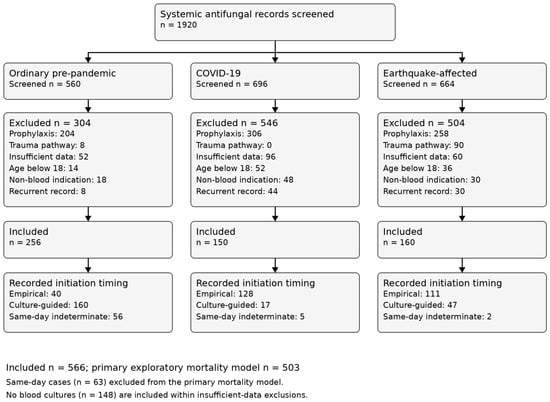
A total of 1920 records were screened, and 1354 were excluded: prophylaxis alone (n = 768), a distinct trauma-related antifungal treatment pathway (n = 98), insufficient data (n = 208), age <18 years (n = 102), antifungal treatment directed solely at fungal growth in non-blood specimens (n = 96), and recurrent eligible records (n = 82). The final cohort comprised 566 patients: 256 (45.2%) in the ordinary pre-pandemic cohort, 150 (26.5%) in the COVID-19 cohort, and 160 (28.3%) in the earthquake-affected cohort (Figure 1).
Figure 1.
Cohort selection and recorded antifungal initiation classification. Cohort-specific screening totals were calculated from excluded records and included patients. Patients without blood cultures (n = 148) were included within the insufficient-data exclusions. Only the first eligible systemic antifungal treatment episode per patient was retained. Same-day indeterminate cases (n = 63) were included in the descriptive cohort but excluded from the primary exploratory mortality model.
Cohort-specific exclusion totals were 304, 546, and 504 for the ordinary, COVID-19, and earthquake-affected cohorts, respectively. Adding the included patients yielded screening totals of 560, 696, and 664. Among the 208 insufficient-data exclusions, 148 patients lacked blood cultures: 35 ordinary, 66 COVID-19, and 47 earthquake-affected patients. Detailed exclusion counts are presented in Supplementary Table S3.
Clinical characteristics are summarized in Table 1. Median age was 66 years (IQR 55–77) in the ordinary cohort, 67 (58–78) in the COVID-19 cohort, and 69 (57–78) in the earthquake-affected cohort (p = 0.271). Admission SOFA scores had a median of 6 in each cohort (p = 0.454), whereas admission APACHE II scores differed across cohorts (p = 0.004). Candida scores, calculated using information available up to antifungal initiation, also differed (p < 0.001).
Table 1.
Clinical Characteristics of the Study Population According to ICU Healthcare Context.
Diabetes mellitus, septic shock, and systemic corticosteroid exposure before antifungal initiation differed across cohorts (all p < 0.001). No statistically significant differences were detected in new dialysis requirement at antifungal initiation (p = 0.759) or malignancy distribution (p = 0.156). Lactate levels differed across cohorts (p < 0.001), whereas CRP, procalcitonin, albumin, and creatinine levels did not show statistically significant differences (all p > 0.05).
2.2. Antifungal Initiation Patterns Across Healthcare Contexts
Among the 566 patients, antifungal initiation was classified as empirical in 279 (49.3%), culture-guided in 224 (39.6%), and same-day indeterminate in 63 (11.1%). The distribution differed across the three cohorts (Pearson’s χ2 = 228.69, df = 4, p < 0.001; Cramer’s V = 0.449) (Table 2).
Table 2.
Systemic Antifungal Initiation and Management Patterns According to ICU Healthcare Context.
In the ordinary pre-pandemic cohort, 40/256 patients (15.6%) were classified as empirical, 160/256 (62.5%) as culture-guided, and 56/256 (21.9%) as same-day indeterminate. In the COVID-19 cohort, the corresponding counts were 128/150 (85.3%), 17/150 (11.3%), and 5/150 (3.3%). In the earthquake-affected cohort, they were 111/160 (69.4%), 47/160 (29.4%), and 2/160 (1.3%), respectively.
2.3. Timing of Antifungal Initiation and Initial Treatment Characteristics
The median interval from ICU admission at our center to systemic antifungal initiation was 9 days (IQR 6–12) overall. Cohort-specific intervals were 9 (6–12) days in the ordinary pre-pandemic cohort, 8 (5–14) in the COVID-19 cohort, and 10 (8–12) in the earthquake-affected cohort (Kruskal–Wallis H = 6.085, df = 2, p = 0.048).
Initial antifungal class differed across cohorts (Pearson’s χ2 = 96.47, df = 4, p < 0.001; Cramer’s V = 0.292). Echinocandins were used in 141/256 ordinary patients (55.1%), 144/150 COVID-19 patients (96.0%), and 84/160 earthquake-affected patients (52.5%). Fluconazole was used in 106/256 (41.4%), 4/150 (2.7%), and 59/160 (36.9%), respectively. Voriconazole and amphotericin B together accounted for the remaining 28 courses.
Overall, initial agents were anidulafungin in 258 patients (45.6%), caspofungin in 111 (19.6%), fluconazole in 169 (29.9%), voriconazole in 18 (3.2%), and amphotericin B in 10 (1.8%). Micafungin was not used.
Total antifungal treatment duration was a median of 7 days (IQR 5–10; range 1–36) overall. Durations were 8 (6–10) days in the ordinary cohort, 8 (4–14) in the COVID-19 cohort, and 6 (5–7) in the earthquake-affected cohort (Kruskal–Wallis H = 41.404, df = 2, p < 0.001). Agent switching occurred in 11/566 patients (1.9%), all in the COVID-19 cohort (11/150, 7.3%), compared with none in the ordinary or earthquake-affected cohorts (exact p < 0.001).
Infectious diseases consultation before or at antifungal initiation was documented in 206/256 ordinary patients (80.5%), 100/150 COVID-19 patients (66.7%), and 31/160 earthquake-affected patients (19.4%) (Pearson’s χ2 = 156.86, df = 2, p < 0.001; Cramer’s V = 0.526).
A central venous catheter was present at antifungal initiation in 205/256 ordinary patients (80.1%), 132/150 COVID-19 patients (88.0%), and 142/160 earthquake-affected patients (88.8%) (Pearson’s χ2 = 7.47, df = 2, p = 0.024; Cramer’s V = 0.115). Treatment and consultation findings are summarized in Table 2.
2.4. Microbiological Findings and Candida Species Distribution
Candida growth in blood cultures was documented in 296/566 patients (52.3%), whereas 270 (47.7%) had no documented fungal blood culture growth during follow-up. Blood culture positivity occurred in 220/256 ordinary pre-pandemic patients (85.9%), 27/150 COVID-19 patients (18.0%), and 49/160 earthquake-affected patients (30.6%). These proportions describe the selected antifungal-treated cohort rather than candidemia prevalence among all ICU admissions.
Among the 296 culture-positive patients, positivity was recorded before antifungal initiation in 224 (75.7%), on the same ICU day in 63 (21.3%), and after initiation in 9 (3.0%). The nine patients with post-initiation positivity comprised four ordinary and five COVID-19 patients; none belonged to the earthquake-affected cohort. These patients remained classified as empirical. The 63 patients with same-day positivity remained in the indeterminate category because the within-day sequence could not be established.
Candida albicans was identified in 128/296 patients (43.2%), C. parapsilosis in 99 (33.4%), C. tropicalis in 55 (18.6%), C. glabrata in 12 (4.1%), and C. kefyr and C. krusei in one patient each (0.3%).
In the ordinary cohort, species counts were 108 C. albicans, 72 C. parapsilosis, 35 C. tropicalis, and five C. glabrata. In the COVID-19 cohort, counts were 17 C. albicans, three C. parapsilosis, and seven C. tropicalis. In the earthquake-affected cohort, counts were three C. albicans, 24 C. parapsilosis, 13 C. tropicalis, seven C. glabrata, one C. kefyr, and one C. krusei. Cohort-specific species counts are presented in Supplementary Table S4.
2.5. Exploratory Analysis of 30-Day Mortality
Thirty-day all-cause mortality after antifungal initiation was 365/566 (64.5%) in the full cohort. The primary exploratory mortality analysis excluded 63 same-day indeterminate cases and included 503 patients, of whom 325 (64.6%) died within 30 days.
Unadjusted mortality was 193/279 (69.2%) in the empirical group and 132/224 (58.9%) in the culture-guided group (p = 0.017). After adjustment, empirical initiation was not significantly associated with mortality compared with culture-guided initiation (aOR = 0.891; 95% CI 0.522–1.519; p = 0.671).
Compared with the ordinary pre-pandemic cohort, the COVID-19 cohort had higher adjusted odds of mortality (aOR = 7.240; 95% CI 3.505–14.956; p < 0.001). The earthquake-affected cohort estimate was 1.734 (95% CI 0.975–3.082; p = 0.061). Higher Candida score (aOR = 2.271; 95% CI 1.861–2.773; p < 0.001), new dialysis requirement at antifungal initiation (aOR = 3.559; 95% CI 1.798–7.043; p < 0.001), and solid malignancy (aOR = 2.059; 95% CI 1.041–4.071; p = 0.038) were associated with higher adjusted odds of mortality. Inverse associations were observed for admission APACHE II (aOR = 0.968; 95% CI 0.941–0.995; p = 0.022) and pre-initiation systemic corticosteroid exposure (aOR = 0.561; 95% CI 0.328–0.960; p = 0.035). Complete model estimates are presented in Table 3.
Table 3.
Exploratory Multivariable Logistic Regression Analysis of 30-Day All-Cause Mortality.
Cohort-specific mortality counts differed between initiation categories. In the ordinary cohort, deaths occurred in 31/40 empirical and 83/160 culture-guided patients; corresponding counts were 95/128 and 17/17 in the COVID-19 cohort, and 67/111 and 32/47 in the earthquake-affected cohort. All 17 culture-guided COVID-19 patients died. These outcome cells are presented in Supplementary Table S5.
Variance inflation factors ranged from 1.019 to 2.139, and tolerance values ranged from 0.467 to 0.982. VIFs were 1.575 for initiation classification, 1.607 for earthquake cohort, 2.139 for COVID-19 cohort, 1.105 for Candida score, and 1.046 for septic shock.
The overall model likelihood-ratio test was significant (χ2 = 122.555, df = 11, p < 0.001; Nagelkerke R2 = 0.297). The Hosmer–Lemeshow statistic was 11.728 (df = 8, p = 0.164). Apparent discrimination was AUC = 0.782 (95% CI 0.739–0.824), with classification accuracy of 75.5% at a probability threshold of 0.50.
2.6. Sensitivity Analyses of the Mortality Model
When all 63 same-day indeterminate cases were classified as culture-guided, the adjusted odds ratio for empirical versus culture-guided initiation was 0.766 (95% CI 0.455–1.287; p = 0.313). When all same-day cases were classified as empirical, the corresponding estimate was 1.155 (95% CI 0.739–1.806; p = 0.528).
In the 503-patient analysis excluding admission APACHE II while retaining the other covariates, the adjusted odds ratio for empirical versus culture-guided initiation was 0.916 (95% CI 0.540–1.552; p = 0.744). The COVID-19 versus ordinary cohort estimate was 7.433 (95% CI 3.627–15.231; p < 0.001), and the earthquake-affected versus ordinary cohort estimate was 1.800 (95% CI 1.017–3.186; p = 0.044).
Thus, no statistically significant adjusted association between initiation classification and mortality was detected under any of these specifications, although the point estimate changed direction between the two alternative same-day classifications. The earthquake cohort estimate crossed the conventional significance threshold when APACHE II was omitted. Mortality sensitivity results are summarized in Supplementary Table S2.
2.7. Sensitivity Analyses of Antifungal Initiation Classification
After excluding 63 same-day indeterminate cases, empirical initiation occurred in 40/200 ordinary pre-pandemic patients (20.0%), 128/145 COVID-19 patients (88.3%), and 111/158 earthquake-affected patients (70.3%). The distribution of empirical versus culture-guided initiation differed across cohorts (Pearson’s χ2 = 179.023, df = 2, p < 0.001; Cramer’s V = 0.597).
When all same-day cases were classified as empirical, the corresponding proportions were 96/256 (37.5%), 133/150 (88.7%), and 113/160 (70.6%) in the ordinary, COVID-19, and earthquake-affected cohorts, respectively (Pearson’s χ2 = 113.253, df = 2, p < 0.001; Cramer’s V = 0.447).
When all same-day cases were classified as culture-guided, empirical initiation occurred in 40/256 (15.6%), 128/150 (85.3%), and 111/160 (69.4%), respectively (Pearson’s χ2 = 219.863, df = 2, p < 0.001; Cramer’s V = 0.623).
Across all three specifications, empirical initiation remained more frequent in the COVID-19 and earthquake-affected cohorts than in the ordinary cohort. Detailed distributions are presented in Supplementary Table S1.
3. Discussion
Among ICU patients receiving systemic antifungal therapy for suspected or confirmed Candida bloodstream infection, recorded initiation patterns differed across the ordinary pre-pandemic, COVID-19, and earthquake-affected cohorts. Initiation classified as empirical was more frequent in the COVID-19 and earthquake-affected cohorts, whereas culture-guided initiation predominated in the ordinary cohort. Initial drug class, documented infectious diseases consultation, and total treatment duration also differed. The between-cohort pattern of initiation classification persisted when same-day cases were excluded or assigned to either binary category. These findings describe practice within selected antifungal-treated populations. They do not establish differences in prescribing rates among all ICU patients, the appropriateness of individual treatment decisions, or causal effects of pandemic or earthquake exposure.
Antifungal initiation in critically ill patients requires balancing timely treatment of suspected invasive candidiasis against unnecessary exposure when infection is unconfirmed. Diagnostic limitations and uncertainty about treatment indications complicate this balance [2,10]. In the multicenter evaluation by Logan et al., empirical treatment accounted for the largest share of antifungal consumption, and echinocandins were the most commonly prescribed class [11]. The international CanDi-Score study also identified clinical risk factors and durations of ICU exposures associated with candidemia, supporting assessment of risk as the ICU course evolves [12]. However, these studies evaluated clinical prescribing indications, antifungal consumption, or candidemia risk, whereas our classification relied on the recorded days of blood culture positivity and treatment initiation. Our empirical category therefore cannot be assumed to correspond directly to clinically adjudicated empirical or pre-emptive treatment in other studies. Its frequency describes initiation before recorded confirmation and does not, by itself, establish unnecessary or inappropriate antifungal use.
In the COVID-19 cohort, 85.3% of antifungal courses were classified as empirical, and echinocandins accounted for 96.0% of initial therapy. However, only 27/150 patients (18.0%) had documented Candida growth in blood cultures during follow-up, compared with 220/256 (85.9%) in the ordinary cohort. This difference in microbiological confirmation is important when interpreting the initiation patterns: a patient without documented blood culture positivity could not be classified as culture-guided. The observed contrast therefore reflects both the composition of the selected treated cohorts and the recorded relationship between results and treatment initiation. Studies of critically ill COVID-19 patients have described candidemia risk and challenges in antifungal management [5,6], but our data cannot determine whether perceived risk, diagnostic uncertainty, or other clinical factors caused the high proportion of initiation before confirmation. Likewise, negative blood cultures alone do not establish that treatment was unnecessary.
Bienvenu et al. reported increased voriconazole and caspofungin consumption during the COVID-19 pandemic in a study encompassing 14 ICUs; the increases exceeded the corresponding changes in invasive fungal disease incidence [13]. Machado et al. reported higher candidemia incidence among patients with COVID-19 than among those without COVID-19 [14], while Kayaaslan et al. identified ICU-related factors associated with candidemia in critically ill COVID-19 patients [15]. These studies provide context but use populations and denominators different from ours. Because our cohort comprised only antifungal-treated patients, neither the proportion classified as empirical nor the distribution of initial agents measures antifungal consumption or candidemia incidence across the ICU population. Echinocandins are a principal treatment class for invasive candidiasis in critically ill patients [10]; their predominance in our COVID-19 cohort therefore does not independently establish overuse. Crisis-period stock problems were reported at our institution, with available agents influencing initial selection, but stock availability and its contribution to individual prescribing decisions were not quantified.
In the earthquake-affected cohort, 69.4% of antifungal courses were classified as empirical, while echinocandins and fluconazole accounted for 52.5% and 36.9% of initial therapy, respectively. Blood culture positivity was documented in 49/160 patients (30.6%), again indicating a different microbiological composition from the ordinary cohort. Reports following the 2023 earthquakes in Türkiye have described infections and antimicrobial resistance among patients receiving emergency and intensive care [7,8,9]. However, this literature does not establish the reasons for antifungal initiation in our cohort. Transferred patients had received initial emergency care but no systemic antifungal therapy before arrival at our center. The interval measured from admission to our ICU consequently cannot quantify the total time from injury or illness onset to treatment. The median ICU-to-antifungal interval differed by only one day between the earthquake-affected and ordinary cohorts; the overall statistical comparison should not be interpreted as evidence of a clinically important treatment delay. The observed initiation pattern describes antifungal-treated earthquake-affected patients within a distinct disaster-care setting rather than a causal effect of earthquake exposure on prescribing.
Documented infectious diseases consultation before or at antifungal initiation occurred in 80.5% of ordinary, 66.7% of COVID-19, and 19.4% of earthquake-affected patients. Specialist involvement is relevant to antifungal management: Kobayashi et al. reported that consultation in patients with candidemia was associated with lower mortality and more frequent performance of recommended management procedures [16]. A population-based Canadian cohort likewise associated specialist consultation with greater implementation of selected candidemia management recommendations, although adherence varied across measures [17]. However, documented consultation in our study was not equivalent to all specialist involvement or drug authorization. Telephone advice could occur without a separately recorded consultation, and the institutional antifungal authorization workflow changed during the earthquake response, allowing subspecialists to initiate treatment without routing the drug report for infectious diseases specialist approval. Workload-related interruptions in laboratory–clinical communication could also affect when culture information was recognized, although patient-level notification times were unavailable. These distinctions limit interpretation of consultation rates across cohorts. The lower documented rate in earthquake care does not establish absence of specialist input, inappropriate prescribing, or poorer care, and our data do not demonstrate that consultation differences caused the observed initiation patterns.
Candida albicans accounted for 43.2% of blood culture isolates overall, followed by C. parapsilosis (33.4%) and C. tropicalis (18.6%). Species composition differed descriptively across cohorts: C. parapsilosis represented 72/220 culture-positive ordinary patients (32.7%), 3/27 COVID-19 patients (11.1%), and 24/49 earthquake-affected patients (49.0%). The small number of culture-positive COVID-19 patients limits interpretation of that cohort’s species proportions. Ramos-Martínez et al. described changes in candidemia epidemiology and fluconazole-resistant C. parapsilosis during the pandemic [18], but species identification alone cannot establish comparable resistance or transmission patterns in our setting. Antifungal susceptibility and molecular typing data were unavailable, precluding conclusions about resistance, clonal spread, or susceptibility-based treatment appropriateness. Furthermore, species identified after empirical initiation could not have informed the initial agent choice. These findings describe the microbiological composition of the treated cohorts and should not be used as a causal explanation for their prescribing differences.
The mortality analysis was secondary and exploratory. Although unadjusted mortality was higher in the empirical group, the adjusted association was not statistically significant (aOR = 0.891; 95% CI 0.522–1.519; p = 0.671). No significant association was detected when same-day cases were assigned to either initiation category or when admission APACHE II was omitted. Nevertheless, the point estimate changed direction between the alternative same-day classifications, and the confidence intervals remained compatible with clinically relevant associations in either direction. These results therefore do not establish equivalence or comparable treatment effectiveness. Pham et al. examined empirical and pre-emptive antifungal treatment and adjusted for the interval from admission to treatment initiation [19], but their clinical definitions and outcome differed from ours. In our study, culture-guided classification required documented positivity before treatment, creating a different pre-initiation selection process from that of empirical treatment. Follow-up from antifungal initiation and conventional covariate adjustment cannot eliminate this selection. Blood culture collection dates and susceptibility-based treatment appropriateness were unavailable, preventing analysis of culture-collection-to-effective-treatment timing. The findings should consequently be interpreted as adjusted associations within a selected treated cohort. In a multicenter retrospective cohort of critically ill patients with confirmed candidemia, early source control was associated with improved 14-day survival [20]. Our lack of intervention timing and susceptibility-based appropriateness data prevents an analogous assessment and leaves these management factors as potential sources of residual confounding.
Systemic corticosteroid exposure before antifungal initiation was associated with lower adjusted odds of mortality in the main-effects model, but this association should not be interpreted as a protective treatment effect. Steroid indication, dose, and duration were unavailable, limiting adjustment for differences between exposed and unexposed patients. The unadjusted associations also varied across cohorts: mortality was higher among steroid-exposed earthquake-affected patients but lower among exposed patients in the ordinary and COVID-19 cohorts. These comparisons involved small exposed subgroups, including only six deaths among 23 exposed ordinary patients and seven survivors among 31 exposed earthquake-affected patients. Steroid-by-cohort interaction estimates were therefore not retained as substantive findings in the revised analysis. Neither the pooled adjusted association nor the subgroup proportions establish benefit or harm from corticosteroid treatment.
The inverse association between admission APACHE II and mortality was contrary to the clinically expected direction and should not be interpreted as protective. Both APACHE II and SOFA characterized the first 24 h of ICU admission, whereas antifungal therapy generally began later. Neither score therefore captured illness severity at treatment initiation. Selection of patients who survived to receive antifungal therapy, changes in clinical condition during the intervening ICU stay, and residual confounding may have contributed to this finding. Omitting APACHE II did not materially alter the initiation-classification estimate, but the earthquake cohort association crossed the conventional significance threshold despite a similar point estimate, indicating sensitivity to model specification. The large adjusted COVID-19 association likewise cannot be attributed solely to healthcare context because severity at antifungal initiation and other relevant clinical factors were unmeasured. Low VIF values do not resolve these limitations or the sparse outcome cells, particularly the absence of survivors among the 17 culture-guided COVID-19 patients.
Total antifungal treatment duration differed across cohorts, with a median of 6 days in earthquake-affected patients and 8 days in both the ordinary and COVID-19 cohorts. However, duration alone cannot establish treatment adequacy or stewardship performance. Death, discharge, and treatment discontinuation may influence the observed duration, and reasons for stopping therapy were unavailable. Similarly, the 11 recorded agent switches, all in the COVID-19 cohort, could not be classified as escalation or de-escalation because their direction and rationale were not recorded. Dose information and susceptibility-based assessment of treatment appropriateness were also unavailable. The study therefore describes treatment duration and switching without demonstrating successful de-escalation, avoidance of unnecessary exposure, or adherence to recommended treatment courses. Evidence for biomarker-guided discontinuation is not uniform. De Pascale et al. found shorter empirical treatment with a beta-D-glucan-guided strategy in a single-center randomized trial, while emphasizing the need for larger safety studies [21]. In contrast, Erb et al. found no reduction in antifungal consumption using a beta-D-glucan/mannan termination algorithm in a small randomized study [22]. These findings do not validate short treatment courses in our cohort, where these biomarkers were unavailable and stopping decisions were not recorded.
A strength of this study is the examination of antifungal initiation across three distinct ICU cohorts within the same center, using a consistent patient ascertainment approach and equivalent laboratory and information systems. The analysis included patients treated for suspected fungemia despite negative blood cultures, rather than being restricted to culture-positive cases. Same-day episodes were retained as a separate category, acknowledging the limits of day-level records. Alternative classifications preserved the principal between-cohort distributional pattern, while mortality sensitivity analyses evaluated the effects of classification uncertainty and inclusion of admission APACHE II. Cohort-specific microbiological findings, initial agents, documented consultation, treatment duration, and switching provide complementary descriptions of practice. These strengths support the descriptive scope of the study without overcoming its selection and measurement limitations.
This study has several limitations. Its retrospective, single-center design limits generalizability, and the cohorts differed in patient characteristics and healthcare context. Because only antifungal-treated patients were included, prescribing incidence, consumption per patient-day, and candidemia prevalence among all ICU admissions could not be estimated. Calendar period and healthcare context were inseparable. Exclusion of 148 patients without blood cultures may have reduced representation of empirical treatment; their initiation categories could not be reliably determined. The exclusion of treatment directed solely at non-blood fungal findings and of the distinct trauma-related treatment pathway also limits applicability to broader ICU antifungal practice. PCR confirmation was not required for every patient in the COVID-19 cohort. The Candida-focused scope does not permit conclusions about COVID-associated pulmonary aspergillosis or trauma-associated mucormycosis.
Blood culture collection dates and within-day timestamps were unavailable. Recorded result timing did not establish when clinicians first received or recognized culture information, and same-day sequencing remained uncertain. Clinical empirical and pre-emptive indications could not be reliably distinguished by the timing classification. Non-culture fungal biomarkers were unavailable throughout the study, and the study did not systematically exclude aspergillosis. Telephone specialist input could be undocumented, while the earthquake-period authorization workflow further limited comparability of recorded consultation. Workload, communication interruptions, and drug availability were not quantified at patient level and cannot be established as causes of the observed patterns.
The exploratory mortality analyses were subject to confounding by indication, selection before antifungal initiation, and sparse subgroup outcome cells. Admission APACHE II and SOFA did not measure severity at antifungal initiation, and mechanical ventilation data were unavailable. Antifungal dose, susceptibility-based treatment appropriateness, and steroid indication, dose, and duration could not be evaluated. Catheter removal and total catheter duration were recorded, but the timing of removal relative to antifungal initiation was unavailable, preventing assessment of timely catheter source control. Other source-control measures were not comprehensively evaluated. Treatment duration could be influenced by death, discharge, or stopping decisions, and switching lacked direction and rationale. The sensitivity analyses addressed selected classification and model-specification uncertainties but did not eliminate temporal selection or residual confounding. Consequently, the mortality findings cannot establish causal treatment effects or equivalence between initiation approaches.
4. Materials and Methods
4.1. Study Design and Setting
This retrospective, single-center observational study was conducted in the adult intensive care units (ICUs) of Mersin City Training and Research Hospital, a tertiary referral center in southern Türkiye. Adults aged ≥18 years who initiated systemic antifungal therapy for suspected or confirmed Candida bloodstream infection during their ICU stay were evaluated across three predefined healthcare contexts.
The ordinary pre-pandemic cohort comprised eligible patients who initiated systemic antifungal therapy between 1 January 2017 and 10 March 2020. The COVID-19 cohort comprised eligible patients managed in dedicated COVID-19 ICUs between 11 March 2020 and 5 February 2023 for clinically suspected or laboratory-confirmed COVID-19. A positive SARS-CoV-2 polymerase chain reaction (PCR) result was not mandatory. Patients with negative or unavailable PCR results were eligible if they were managed for suspected COVID-19 on the basis of clinical assessment and characteristic chest computed tomography findings.
The earthquake-affected cohort comprised eligible adults identified in hospital records as directly affected by the earthquakes of 6 February 2023 and admitted to designated ICUs between 6 February and 30 April 2023. Membership required earthquake-related patient status and was not determined solely by admission during a post-earthquake calendar period. Transferred patients had received initial emergency care at field hospitals, including urgent procedures such as fasciotomy when required. No included earthquake-affected patient had received systemic antifungal therapy before transfer to our center.
For transferred patients, the interval from ICU admission to antifungal initiation was measured from admission to the ICU at our center. It therefore did not represent time from injury, illness onset, or initial admission to another healthcare facility.
The three cohorts represented distinct patient populations and healthcare contexts rather than interchangeable temporal samples of a homogeneous ICU population. Comparisons were intended to describe antifungal initiation patterns. Because healthcare context and calendar period were inseparable in this design, between-cohort differences were not interpreted as causal effects of COVID-19 or earthquake exposure.
4.2. Patient Selection and Data Collection
Patients receiving systemic antifungal therapy during an ICU stay were identified through the hospital information system. ICU clinical records and microbiology records were subsequently reviewed using the same ascertainment approach in all three cohorts. Screening did not begin with a list of culture-positive patients.
Eligible patients were adults treated for suspected fungemia or blood-culture-confirmed candidemia. Patients treated empirically for suspected fungemia were retained when blood cultures had been obtained but remained negative. Patients receiving antifungal therapy solely for fungal growth in urine or respiratory specimens were excluded. Non-blood Candida colonization documented in otherwise eligible patients could contribute to the Candida score but was not itself a criterion for inclusion or microbiological confirmation.
Systemic antifungal agents included fluconazole, caspofungin, anidulafungin, voriconazole, and amphotericin B. Treatment initiated on the day of ICU admission was eligible. Only the first eligible treatment episode per patient was included.
A total of 1920 records were screened, and 1354 were excluded: prophylaxis alone (n = 768), a distinct trauma-related antifungal treatment pathway (n = 98), insufficient data (n = 208), age < 18 years (n = 102), treatment directed solely at fungal growth in non-blood specimens (n = 96), and recurrent eligible records (n = 82). The final cohort comprised 566 patients.
In the ordinary, COVID-19, and earthquake-affected cohorts, respectively, exclusion counts were 204, 306, and 258 for prophylaxis; 8, 0, and 90 for the trauma-related pathway; 52, 96, and 60 for insufficient data; 14, 52, and 36 for age <18 years; 18, 48, and 30 for non-blood fungal indications; and 8, 44, and 30 for recurrent records. Total exclusions were therefore 304, 546, and 504. Together with the included patients, these counts yielded cohort-specific screening totals of 560, 696, and 664.
Within the 208 insufficient-data exclusions, 148 patients lacked blood cultures: 35 ordinary, 66 COVID-19, and 47 earthquake-affected patients. These patients were excluded because absence of fungal growth could not be distinguished from absence of blood culture assessment. They were not counted as an additional exclusion category. Other insufficient-data exclusions concerned records in which initiation timing, key clinical variables, or the outcome could not be reliably established.
Traumatic injury alone was not an exclusion criterion. The trauma-related exclusion applied when antifungal therapy was directed primarily at suspected fungal infection of wounds, burns, fasciotomy sites, or complex soft-tissue injuries rather than suspected or confirmed fungemia.
Data extracted from the hospital records included demographics, comorbidities, clinical and laboratory variables, microbiological findings, the recorded ICU days of fungal growth and antifungal initiation, initial antifungal agent, total antifungal treatment duration, agent switching, documented infectious diseases consultation, central venous catheter variables, dialysis requirement, systemic corticosteroid exposure before antifungal initiation, and 30-day vital status. Blood culture collection dates and within-day timestamps were unavailable. The patient selection process is presented in Figure 1.
4.3. Definitions and Antifungal Initiation Classification
Antifungal initiation was classified according to the relationship between the recorded ICU day of systemic antifungal initiation and the recorded ICU day of fungal growth in blood culture. The recorded result day was used as a proxy for microbiological confirmation timing; it did not establish the exact time at which the treating clinician became aware of the result. Final species identification was not used as the timing reference. Blood culture collection dates and within-day timestamps were unavailable.
Empirical initiation was defined as treatment started on an ICU day preceding the recorded day of fungal blood culture positivity, or treatment started for suspected fungemia when blood cultures remained negative during follow-up. Subsequent blood culture positivity did not change the initial classification.
Culture-guided initiation was defined as treatment started on an ICU day after fungal blood culture positivity had been recorded. This category indicated that a positive result preceded treatment in the available records; it did not independently verify clinician awareness or that the result was the sole reason for treatment initiation.
Same-day indeterminate initiation was defined as fungal blood culture positivity and antifungal initiation recorded on the same ICU day. Because their within-day sequence could not be established, these cases were retained as a separate category in the primary descriptive analysis.
These operational categories describe recorded microbiological-result timing rather than fully adjudicated clinical treatment indications. In particular, clinical empirical and pre-emptive treatment could not be distinguished reliably using timing alone. Prophylaxis was excluded during patient selection.
The primary descriptive analysis included all 566 patients: 279 classified as empirical, 224 as culture-guided, and 63 as same-day indeterminate. The primary exploratory mortality model excluded the 63 same-day cases and included 503 patients. Sensitivity analyses assigned all same-day cases to the empirical category and, separately, to the culture-guided category. These alternative classifications were evaluated for both between-cohort initiation patterns and adjusted mortality associations.
Fungemia was defined as fungal growth in at least one blood culture. Candidemia was defined as isolation of Candida spp. from at least one blood culture in a compatible clinical setting [1]. Only blood culture findings were used to determine microbiological confirmation for initiation classification. Catheter culture findings were considered supportive only when accompanied by positive blood cultures. Isolated catheter, urine, or respiratory culture positivity did not establish fungemia or culture-guided initiation.
4.4. Microbiological Assessment
Blood cultures were processed according to routine laboratory procedures using the BACTEC FX® and BacT/Alert® automated blood culture systems. Positive bottles underwent Gram staining and subculture onto appropriate media. Samples with suspected yeast growth were evaluated using Sabouraud dextrose agar and/or CHROMagar Candida®. Candida isolates were identified using conventional microbiological methods and the VITEK® 2 Compact system (bioMérieux, Marcy-l’Étoile, France), with additional conventional confirmation when required. Routine antifungal susceptibility testing was not performed during any of the three study periods; therefore, minimum inhibitory concentration and susceptibility results were unavailable.
Laboratory and hospital information systems and access to diagnostic methods were equivalent across the three cohorts, with no identified period-specific change in these systems. Beta-D-glucan, mannan, and galactomannan testing were unavailable in all three study contexts.
Although the technical infrastructure remained equivalent, the operational communication of culture results differed. During ordinary care, infectious diseases physicians and infection-control nurses obtained daily culture growth information from the laboratory before rounds, sometimes before formal report approval. During COVID-19 and earthquake care, increased workload interrupted or delayed this communication, and recognition of an approved result could occur later. Patient-level communication and acknowledgment times were not recorded. This institutional workflow description therefore cannot establish the reason for an individual treatment decision or explain the between-cohort differences causally.
The recorded day of fungal blood culture positivity was used for initiation classification. It should not be interpreted as the precise time of clinician notification, formal report approval, or final species identification.
The included antifungal courses were directed at suspected or confirmed Candida infection. No included course was identified as treatment for a clinical Aspergillus syndrome. However, the absence of galactomannan testing means that this finding should not be interpreted as systematic laboratory exclusion of aspergillosis. Non-blood culture findings were not used to establish fungemia or determine culture-guided initiation. The study did not assess the full spectrum of invasive fungal diseases, including mucormycosis; these inclusion criteria do not imply absence of mold infections among other ICU patients or earthquake victims.
4.5. Clinical Variables, Infectious Diseases Consultation, and Endpoints
Diabetes mellitus and chronic kidney disease were recorded as pre-existing comorbidities. Dialysis requirement was defined as a new requirement for intermittent hemodialysis or continuous renal replacement therapy present at systemic antifungal initiation, distinct from pre-existing chronic renal replacement therapy. Septic shock was assessed at systemic antifungal initiation and recorded as present or absent according to the Sepsis-3 criteria. Malignancy was categorized as hematologic malignancy, solid malignancy, or no malignancy based on the documented medical history, including both current and previous diagnoses. Clinical laboratory values in Table 1 were obtained from the closest reliable measurement before systemic antifungal initiation.
Systemic corticosteroid exposure was defined as documented systemic corticosteroid use before antifungal initiation. Topical and inhaled corticosteroids were not included. Steroid indication, dose, and duration were unavailable.
APACHE II and SOFA scores were determined using clinical and laboratory data from the first 24 h of ICU admission. They therefore characterized admission severity rather than severity at antifungal initiation. Corresponding scores at antifungal initiation were unavailable.
The Candida score was calculated retrospectively using information available up to antifungal initiation. Total parenteral nutrition, surgery, and multifocal Candida colonization each contributed one point, and severe sepsis contributed two points [23]. Multifocal colonization was assessed using urine and respiratory culture records available before treatment. Findings obtained after antifungal initiation were not incorporated retrospectively. The score was used to characterize patient risk rather than as a prospectively applied treatment rule. Its clinical overlap with septic shock was considered when interpreting the mortality model.
Infectious diseases consultation was defined as a documented specialist evaluation before or at antifungal initiation. Later consultations were not counted for this variable. Documented consultation was distinct from drug authorization: telephone discussion with an infectious diseases specialist could permit initiation without a separately recorded consultation. During the earthquake response, the institutional authorization workflow no longer routed antifungal drug reports for infectious diseases specialist approval, allowing initiation by subspecialists through the report process. Consequently, absence of a documented consultation did not establish absence of specialist input, and consultation rates were not interpreted as direct measures of treatment quality.
Central venous catheter presence was recorded at antifungal initiation. Catheter removal after fungal growth or antifungal initiation and total catheter duration were also recorded. However, the exact removal day relative to antifungal initiation was unavailable. Total catheter duration did not represent the duration already accrued at treatment initiation. These post-initiation variables were not entered as baseline covariates in the mortality model, and catheter removal was not treated as a comprehensive measure of source control.
The ICU-to-antifungal interval was calculated from admission to the ICU at our center to the first day of systemic antifungal therapy, with same-day initiation recorded as zero days. Total antifungal treatment duration included treatment across agent changes. Switching was recorded as present or absent; its direction and reason were unavailable, preventing classification as escalation or de-escalation. Antifungal dose information and mechanical ventilation data were unavailable in the analysis dataset.
4.6. Study Outcomes
The primary outcome was the distribution of systemic antifungal initiation classifications—empirical, culture-guided, and same-day indeterminate—across the ordinary pre-pandemic, COVID-19, and earthquake-affected ICU cohorts.
Secondary descriptive outcomes included the interval from ICU admission to antifungal initiation, initial antifungal agent and class, documented infectious diseases consultation before or at initiation, total antifungal treatment duration, agent switching, and central venous catheter presence at initiation. Blood culture positivity and Candida species distribution were described overall and by cohort. These microbiological proportions referred to the selected antifungal-treated population, not to all ICU admissions.
Thirty-day all-cause mortality was defined as death from any cause within 30 days after the first systemic antifungal initiation. Vital status at day 30 after initiation was verified for all included patients. Mortality was evaluated as a secondary exploratory outcome.
The primary adjusted mortality analysis excluded same-day indeterminate cases and included 503 patients. Additional sensitivity analyses classified all same-day cases as empirical and, separately, as culture-guided. A further sensitivity analysis omitted admission APACHE II from the model.
The mortality analyses assessed associations between recorded initiation classification and subsequent mortality. They were not designed to establish comparative treatment effectiveness, equivalence, or causal effects. The classification groups were subject to different selection processes before treatment initiation, which conventional adjustment and the specified sensitivity analyses could not eliminate.
4.7. Statistical Analysis
Statistical analyses were performed using IBM SPSS Statistics version 25.0 (IBM Corp., Armonk, NY, USA). Categorical variables were summarized as counts and percentages, and continuous variables as medians and interquartile ranges (25th–75th percentiles). Categorical comparisons used Pearson’s chi-square test or an exact test when cell counts were sparse. Continuous variables were compared across the three cohorts using the Kruskal–Wallis test. Where pairwise comparisons were undertaken, Bonferroni correction was applied.
The primary descriptive analysis compared the three-category initiation classification across cohorts. Cramer’s V quantified the association between healthcare context and initiation classification. Classification sensitivity analyses excluded same-day cases or assigned all such cases to either the empirical or culture-guided category. Total antifungal treatment duration was compared using the Kruskal–Wallis test, without duration-specific pairwise comparisons. Antifungal switching was compared using the Fisher–Freeman–Halton exact test.
Thirty-day mortality was analyzed as a secondary exploratory outcome. The primary binary logistic regression model included 503 patients after exclusion of 63 same-day indeterminate cases. Death was coded as 1 and survival as 0. The model included empirical versus culture-guided initiation, healthcare context, age, admission APACHE II, Candida score, septic shock, new dialysis requirement at antifungal initiation, malignancy category, and systemic corticosteroid exposure before antifungal initiation. Covariates were selected on clinical grounds rather than solely by univariable significance. Reference categories were culture-guided initiation, the ordinary pre-pandemic cohort, and no malignancy. SOFA was not entered simultaneously with APACHE II. Results were reported as adjusted odds ratios with 95% confidence intervals.
Mortality sensitivity analyses repeated the adjusted model with same-day cases assigned to each binary initiation category. Another model excluded admission APACHE II while retaining the remaining covariates. These analyses assessed classification and model-specification uncertainty; they did not resolve selection before treatment initiation or substitute for severity measurements at antifungal initiation.
Multicollinearity was assessed using variance inflation factors and tolerance for the model predictor set. Cohort-specific outcome cells were also examined to identify sparse subgroups. The Hosmer–Lemeshow test assessed model fit, and apparent discrimination was summarized using the receiver operating characteristic area under the curve with its 95% confidence interval. Model performance was not interpreted as evidence of causal validity or external predictive validity.
Steroid-by-cohort interaction estimates were not retained in the revised analysis because sparse outcome counts in the exposed subgroups and wide confidence intervals limited their interpretation.
A complete-case approach was used without imputation. All tests were two-sided, with p < 0.05 considered statistically significant, subject to adjustment for multiple pairwise comparisons where applicable. Nonsignificant mortality associations were not interpreted as evidence of equivalence between initiation categories.
4.8. Use of Generative AI
During manuscript revision, ChatGPT (GPT-6, OpenAI) was used to assist with language editing, organization of the text, preparation of SPSS syntax, and interpretation and presentation of statistical outputs. The authors performed the statistical analyses in IBM SPSS Statistics and reviewed the AI-assisted syntax, interpretations, and manuscript text against the study data and statistical outputs. The tool was not used to generate or impute patient data. The authors take full responsibility for the accuracy, integrity, and final content of the manuscript.
5. Conclusions
Among ICU patients receiving systemic antifungal therapy for suspected or confirmed Candida bloodstream infection, recorded initiation timing, initial drug class, documented infectious diseases consultation, and total treatment duration differed across ordinary pre-pandemic, COVID-19, and earthquake-affected cohorts. The between-cohort pattern of initiation classification persisted under alternative assignments of same-day cases. Exploratory mortality analyses did not identify a statistically significant adjusted association with initiation classification under the evaluated model specifications, but these findings do not establish equivalence or comparative treatment effectiveness. The observed patterns cannot be attributed causally to pandemic or earthquake exposure or used to determine individual treatment appropriateness. Prospective studies capturing clinical indications, severity at treatment initiation, precise microbiological and treatment timing, specialist input, drug availability, and subsequent treatment decisions are needed.
Supplementary Materials
The following supporting information can be downloaded at https://www.mdpi.com/article/10.3390/antibiotics15111083/s1. Table S1, sensitivity analyses for the classification of same-day indeterminate antifungal initiation. Table S2, sensitivity analyses of the association between initiation classification and 30-day mortality. Table S3, cohort-specific screening and exclusion counts. Table S4, Candida species distribution among blood culture-positive patients by cohort. Table S5, 30-day mortality by cohort and initiation classification in the primary analytical sample.
Author Contributions
Conceptualization, B.Ç.D. and M.U.; Methodology, B.Ç.D. and M.U.; Validation, M.U.; Formal Analysis, M.U.; Investigation, B.Ç.D. and M.U.; Data Curation, B.Ç.D. and M.U.; Writing—Original Draft Preparation, B.Ç.D. and M.U.; Writing—Review and Editing, B.Ç.D. and M.U.; Supervision, M.U. All authors have read and agreed to the published version of the manuscript.
Funding
This research received no external funding.
Institutional Review Board Statement
The study was conducted in accordance with the Declaration of Helsinki and approved by the Non-Interventional Clinical Research Ethics Committee of Mersin City Training and Research Hospital (Decision No. 215, 29 April 2026).
Informed Consent Statement
Patient consent was waived due to the retrospective nature of the study and the use of anonymized clinical data, as approved by the Ethics Committee.
Data Availability Statement
The data presented in this study are available on reasonable request from the corresponding author. The data are not publicly available due to institutional and patient privacy restrictions.
Acknowledgments
The authors acknowledge the use of ChatGPT (OpenAI, https://chatgpt.com/ (accessed on 13 October 2026)) for assistance with manuscript revision, language editing, SPSS syntax preparation, and interpretation and presentation of statistical outputs. All AI-assisted content was reviewed by the authors.
Conflicts of Interest
The authors declare no conflicts of interest.
Abbreviations
The following abbreviations are used in this manuscript: APACHE II, Acute Physiology and Chronic Health Evaluation II; aOR, adjusted odds ratio; AUC, area under the receiver operating characteristic curve; CI, confidence interval; COVID-19, coronavirus disease 2019; CRP, C-reactive protein; CVC, central venous catheter; df, degrees of freedom; ICU, intensive care unit; ID, infectious diseases; IQR, interquartile range; OR, odds ratio; ROC, receiver operating characteristic; SOFA, Sequential Organ Failure Assessment; VIF, variance inflation factor.
References
- Cornely, O.A.; Sprute, R.; Bassetti, M.; Chen, S.C.; Groll, A.H.; Kurzai, O.; Lass-Flörl, C.; Ostrosky-Zeichner, L.; Rautemaa-Richardson, R.; Revathi, G.; et al. Global guideline for the diagnosis and management of candidiasis: An initiative of the ECMM in cooperation with ISHAM and ASM. Lancet Infect. Dis. 2025, 25, e280–e293. [Google Scholar] [CrossRef] [Scilit] [PubMed]
- Martin-Loeches, I.; Cornely, O.A.; Denning, D.W.; Guinea, J.; Bassetti, M.; Maertens, J.; Hoenigl, M.; Kanj, S.S.; Slavin, M.; Ostrosky-Zeichner, L.; et al. Invasive candidiasis in intensive care medicine: Shaping the future of diagnosis and therapy. Intensive Care Med. 2025, 51, 2065–2078. [Google Scholar] [CrossRef] [Scilit] [PubMed]
- De Pascale, G.; Martin-Loeches, I.; Nseir, S. Antifungal stewardship in critically ill patients. Intensive Care Med. 2023, 49, 681–684. [Google Scholar] [CrossRef] [Scilit] [PubMed]
- Albahar, F.; Alhamad, H.; Abu Assab, M.; Abu-Farha, R.; Alawi, L.; Khaleel, S. The Impact of Antifungal Stewardship on Clinical and Performance Measures: A Global Systematic Review. Trop. Med. Infect. Dis. 2024, 9, 8. [Google Scholar] [CrossRef] [Scilit] [PubMed]
- Srisurapanont, K.; Lerttiendamrong, B.; Meejun, T.; Thanakitcharu, J.; Manothummetha, K.; Thongkam, A.; Chuleerarux, N.; Sanguankeo, A.; Li, L.X.; Leksuwankun, S.; et al. Candidemia Following Severe COVID-19 in Hospitalised and Critical Ill Patients: A Systematic Review and Meta-Analysis. Mycoses 2024, 67, e13798. [Google Scholar] [CrossRef] [Scilit] [PubMed]
- Kanj, S.S.; Haddad, S.F.; Meis, J.F.; Verweij, P.E.; Voss, A.; Rautemaa-Richardson, R.; Levy-Hara, G.; Chowdhary, A.; Ghafur, A.; Brüggemann, R.; et al. The battle against fungi: Lessons in antifungal stewardship from COVID 19 times. Int. J. Antimicrob. Agents 2023, 62, 106846. [Google Scholar] [CrossRef] [Scilit] [PubMed]
- Kaya, E.K.; Halacli, B.; Guven, G.; Yildirim, M.; Seven, A.E.; Gemcioglu, E.; Simsek, M.; Erdemir Sullu, B.; Yuksel, R.C.; Kaynar, A.S.; et al. Infections among adults hospitalized in intensive care after the 2023 earthquake in the southeastern part of Türkiye: A multi-center observational study. BMC Infect. Dis. 2025, 25, 35. [Google Scholar] [CrossRef] [Scilit] [PubMed]
- Rizk, A.; Abou Fayad, A.; Haraoui, L.P. Antimicrobial-Resistant Infections after Turkey/Syria Earthquakes, 2023. Emerg. Infect. Dis. 2023, 29, 1273–1275. [Google Scholar] [CrossRef] [Scilit] [PubMed]
- Çakın, Ö.; Yüce Aktepe, M.; Acar, S.; İbze, S. Kahramanmaraş-Pazarcık Earthquake 2023: Characteristics of Patients Presented to the Emergency Department of a Tertiary Hospital Far from the Region and Infection Characteristics in Hospitalized Patients. Prehospital Disaster Med. 2024, 39, 25–31. [Google Scholar] [CrossRef] [Scilit] [PubMed]
- Bartalucci, C.; Mezzogori, L.; Schiavoni, R.; Vena, A.; Giacobbe, D.R.; Bassetti, M. Antifungal treatment strategies in intensive care unit patients. Eur. J. Clin. Investig. 2026, 56, e70177. [Google Scholar] [CrossRef] [Scilit] [PubMed]
- Logan, C.; Hemsley, C.; Fife, A.; Edgeworth, J.; Mazzella, A.; Wade, P.; Goodman, A.; Hopkins, P.; Wyncoll, D.; Ball, J.; et al. A multisite evaluation of antifungal use in critical care: Implications for antifungal stewardship. JAC Antimicrob. Resist. 2022, 4, dlac055. [Google Scholar] [CrossRef] [Scilit] [PubMed]
- Kayaaslan, B.; Araz, H.; Zengin, H.Y.; Bulut, R.; Oktay, Z.; Tasbakan, M.; Istek, S.; Kartal, E.D.; Bayrak, O.; Kaya, A.; et al. Development of Candidaemia Score (CanDi-Score) in Decision of Early Empirical Antifungal Treatment for Patients in Intensive Care Unit: The International Prospective Observational ID-IRI Study. Mycoses 2026, 69, e70213. [Google Scholar] [CrossRef] [Scilit] [PubMed]
- Bienvenu, A.L.; Bestion, A.; Pradat, P.; Richard, J.C.; Argaud, L.; Guichon, C.; Roux, S.; Piriou, V.; Paillet, C.; Leboucher, G.; et al. Impact of COVID-19 pandemic on antifungal consumption: A multicenter retrospective analysis. Crit. Care 2022, 26, 384. [Google Scholar] [CrossRef] [Scilit] [PubMed]
- Machado, M.; Estévez, A.; Sánchez-Carrillo, C.; Guinea, J.; Escribano, P.; Alonso, R.; Valerio, M.; Padilla, B.; Bouza, E.; Muñoz, P. Incidence of Candidemia Is Higher in COVID-19 versus Non-COVID-19 Patients, but Not Driven by Intrahospital Transmission. J. Fungi 2022, 8, 305. [Google Scholar] [CrossRef] [Scilit] [PubMed]
- Kayaaslan, B.; Kaya Kalem, A.; Asilturk, D.; Kaplan, B.; Dönertas, G.; Hasanoglu, I.; Eser, F.; Korkmazer, R.; Oktay, Z.; Ozkocak Turan, I.; et al. Incidence and risk factors for COVID-19 associated candidemia (CAC) in ICU patients. Mycoses 2022, 65, 508–516. [Google Scholar] [CrossRef] [Scilit] [PubMed]
- Kobayashi, T.; Marra, A.R.; Schweizer, M.L.; Ten Eyck, P.; Wu, C.; Alzunitan, M.; Salinas, J.L.; Siegel, M.; Farmakiotis, D.; Auwaerter, P.G.; et al. Impact of Infectious Disease Consultation in Patients with Candidemia: A Retrospective Study, Systematic Literature Review, and Meta-analysis. Open Forum Infect. Dis. 2020, 7, ofaa270. [Google Scholar] [CrossRef] [Scilit] [PubMed]
- Bourassa-Blanchette, S.; Biesheuvel, M.M.; Lam, J.C.; Kipp, A.; Church, D.; Carson, J.; Dalton, B.; Parkins, M.D.; Barkema, H.W.; Gregson, D.B. Candidemia Treatment is Improved by Infectious Disease Consultation: A Population-Based Cohort Study. J. Assoc. Med. Microbiol. Infect. Dis. Can. 2024, 9, 129–139. [Google Scholar] [CrossRef] [Scilit] [PubMed]
- Ramos-Martínez, A.; Pintos-Pascual, I.; Guinea, J.; Gutiérrez-Villanueva, A.; Gutiérrez-Abreu, E.; Díaz-García, J.; Asensio, Á.; Iranzo, R.; Sánchez-Romero, I.; Muñoz-Algarra, M.; et al. Impact of the COVID-19 Pandemic on the Clinical Profile of Candidemia and the Incidence of Fungemia Due to Fluconazole-Resistant Candida parapsilosis. J. Fungi 2022, 8, 451. [Google Scholar] [CrossRef] [Scilit] [PubMed]
- Pham, H.T.; Castelino, R.L.; Kiser, T.H.; Truong-Nguyen, K.H.; Tran, M.H. Empirical versus pre-emptive antifungal therapies for invasive fungal infections in critically ill patients. BMC Infect. Dis. 2025, 25, 395. [Google Scholar] [CrossRef] [Scilit] [PubMed]
- Marangos, M.; Ioannou, P.; Senn, L.; Spiliopoulou, A.; Tzalis, S.; Kolonitsiou, F.; Valta, M.; Kokkini, S.; Pagani, J.L.; Stafylaki, D.; et al. Role of source control in critically ill candidemic patients: A multicenter retrospective study. Infection 2024, 52, 1733–1743. [Google Scholar] [CrossRef] [Scilit] [PubMed]
- De Pascale, G.; Posteraro, B.; D’Arrigo, S.; Spinazzola, G.; Gaspari, R.; Bello, G.; Montini, L.M.; Cutuli, S.L.; Grieco, D.L.; Di Gravio, V.; et al. (1,3)-β-D-Glucan-based empirical antifungal interruption in suspected invasive candidiasis: A randomized trial. Crit. Care 2020, 24, 550. [Google Scholar] [CrossRef] [Scilit] [PubMed]
- Erb, T.; Mihai, S.; Strauß, R.; Herbst, L.; Castellanos, I.; Diesch, K.; Cipa, F.; Bihlmaier, K.; Lang, A.-K.; Ganslmayer, M.; et al. β-(1→3)-D-glucan- and mannan-guided early termination of antifungal therapy in ICU patients: A randomized controlled study. Antimicrob. Agents Chemother. 2023, 67, e0072523. [Google Scholar] [CrossRef] [Scilit] [PubMed]
- León, C.; Ruiz-Santana, S.; Saavedra, P.; Galván, B.; Blanco, A.; Castro, C.; Balasini, C.; Utande-Vázquez, A.; González de Molina, F.J.; Blasco-Navalproto, M.A.; et al. Usefulness of the “Candida score” for discriminating between Candida colonization and invasive candidiasis in non-neutropenic critically ill patients: A prospective multicenter study. Crit. Care Med. 2009, 37, 1624–1633. [Google Scholar] [CrossRef] [Scilit] [PubMed]

Disclaimer/Publisher’s Note: The statements, opinions and data contained in all publications are solely those of the individual author(s) and contributor(s) and not of MDPI and/or the editor(s). MDPI and/or the editor(s) disclaim responsibility for any injury to people or property resulting from any ideas, methods, instructions or products referred to in the content. |
© 2026 by the authors. Licensee MDPI, Basel, Switzerland. This article is an open access article distributed under the terms and conditions of the Creative Commons Attribution (CC BY) license.