


Abstract
Background/Objectives: Essential oils (EOs) are volatile, biologically active compounds naturally extracted from aromatic plants. Known for their broad-spectrum antimicrobial properties, EOs are gaining increasing attention as potential alternative or complementary agents in clinical practice, especially in the face of rising antibiotic resistance. EOs act through multiple mechanisms, including disruption of microbial membranes, interference with enzyme activity, and inhibition of quorum sensing pathways, making them promising antimicrobial candidates against multidrug-resistant organisms (MDROs). Methods: In this study, the in vitro antimicrobial activity of seven essential oil batches, including Eucalyptus globulus, Lavandula hybrida, Melaleuca alternifolia, Pelargonium graveolens, Coriandrum sativum, Cymbopogon winterianus, and Cinnamomum zeylanicum, was evaluated against five reference strains and ten clinical strains mostly belonging to ESKAPE species, plus Stenotrophomonas maltophilia, Achromobacter xylosoxidans, and Burkholderia cepacia complex. Results: The tested EO batches displayed heterogeneous antimicrobial activity: Cinnamomum zeylanicum exhibited the strongest and broadest antibacterial effect, showing consistently low minimum inhibitory concentration (MIC) values across all tested strains, including carbapenemase-producing and non-fermenting Gram-negative bacteria. The remaining oils showed moderate-to-limited activity, particularly against Gram-negative strains. The two Klebsiella pneumoniae strains producing either KPC or NDM carbapenemases, and the Pseudomonas aeruginosa PAO-1 strain, showed the highest MIC values for all EOs, except for C. zeylanicum, for which MICs were 0.125 and 0.25% (v/v), respectively. Conclusions: The consistently low MIC values of the C. zeylanicum batch against the panel of tested strains suggested a potential for this essential oil and for its bioactive constituents as promising candidates against several MDROs.
1. Introduction
The rapid and continuous expansion of antimicrobial resistance represents one of the greatest challenges for modern medicine, with dramatic consequences for morbidity, mortality, and the sustainability of healthcare systems worldwide [1]. The emergence of multidrug-resistant (MDR) bacterial strains resistant to multiple classes of antibiotics, including last-resort agents, has drastically reduced therapeutic options, highlighting the urgent need to identify new molecules capable of overcoming extant resistance mechanisms [2,3,4].
In recent years, bioactive constituents of plant extracts have gained increasing attention due to their potential antimicrobial properties [5], which could help to curb the excessive use of broad-spectrum antibiotics and consequently to limit the emergence of new resistances. Among these, essential oils (EOs) have received particular interest [5].
EOs are complex mixtures of organic compounds produced as secondary metabolites and extracted from various plant parts, including flowers, buds, stems, seeds, bark, roots, and leaves. They play key ecological roles, contributing to plant defense through their antibacterial, antifungal, insecticidal, and antiviral activities [6]. In fact, many EOs exhibit well-documented antimicrobial activity [7]. They contain a wide range of bioactive constituents, including terpenes, phenols, and aldehydes, which are known to inhibit the growth of numerous pathogens [8]. The chemical complexity of EOs confers a multi-target mode of action, ranging from alteration of cell membranes to interference with essential metabolic pathways [6].
In this study, we evaluated the antimicrobial activity of several EOs against a collection of bacterial strains of clinical relevance, including multidrug-resistant organisms (MDROs) representative of some ESKAPE species and other difficult-to-treat Gram-negative species.
2. Materials and Methods
2.1. Essential Oils
The EOs investigated in this study were derived from Eucalyptus globulus (eucalyptus, EG), Lavandula hybrida (lavender, LH), Melaleuca alternifolia (tea tree, MA), Pelargonium graveolens (geranium, PG), Coriandrum sativum (coriander, CS), Cymbopogon winterianus (java citronella, CW), and Cinnamomum zeylanicum (cinnamon, CZ). The EOs were provided by Casalvento farmhouse (Castellina in Chianti, Siena, Italy) and were stored in brown glass bottles at room temperature. Gas chromatography–mass spectrometry (GC-MS) analyses of the tested steam-distilled essential oil batches were carried out by the producer. Operational parameters for GC–MS analysis, plant parts, geographical origins, and main chemical constituents of each oil batch are provided as Supplementary Data (Table S1).
2.2. Bacterial Strains
The bacterial strains used for testing the activity of EOs included 5 ATCC reference strains (methicillin-resistant Staphylococcus aureus ATCC 33591, vancomycin-resistant Enterococcus faecalis ATCC 51299, carbapenem-resistant KPC-3-producing Klebsiella pneumoniae ATCC BAA-2814, Acinetobacter baumannii ATCC 17978, Pseudomonas aeruginosa PAO-1 ATCC 15692) and 10 strains of clinical origin representative of clinically relevant MDR pathogens, with some belonging to ESKAPE species ([9,10,11,12,13,14,15,16], Table 1), including a methicillin- and linezolid-resistant S. aureus strain (AOUC-0915); a vancomycin-resistant Enterococcus faecium strain (333/27194); an NDM-1-producing K. pneumoniae strain resistant to cefiderocol (271/22216); an OXA-48-like-producing Escherichia coli strain (311/25445); a Proteus mirabilis strain co-producing OXA-48 and NDM (378/30873); a Serratia marcescens strain with an ESBL profile (376/30730); two Stenotrophomonas maltophilia strains resistant to trimethoprim/sulfamethoxazole (385/31448 and 351/28640); and two intrinsically multidrug-resistant strains of Achromobacter xylosoxidans (265/29789) and Burkholderia cepacia complex (246/20216), respectively. Clinical strains, not previously reported, were identified by MALDI-TOF MS (MALDI Biotyper® Sirius System, Bruker, Germany) and screened for resistance genes using real-time PCR (Allplex™ Entero-DR Assay, Seegene, Republic of Korea). Antimicrobial susceptibility testing was performed by broth microdilution using MICRONAUT-S ITGN or ITGP lyophilized MIC plates (E1-184-100 or E1-185-100, MERLIN Diagnostika, Bornheim, Germany). Detailed susceptibility profiles of the 10 clinical strains are provided in Supplemental Table S2.
2.3. In Vitro Susceptibility Testing to EOs
The solubilization of EOs in the culture medium was carried out in the presence of the surfactant Tween 80 10% (v/v), followed by sonication (120 W for 30 min at room temperature (Citizen Scale YJ 5120-1, Aczet Pvt. Ltd., Mumbai, India), as previously described [17]. The 10% (v/v) Tween 80 concentration was selected after preliminary evaluations at 0.5% and 10% (v/v) to yield a stable suspension and to remain lower than the 16% (v/v) concentration reported in a recent protocol for determining the MICs of EOs [18]. The stability of the stock EO 10% emulsions following sonication was confirmed visually by monitoring for phase separation, creaming, or droplet coalescence immediately post-preparation and throughout the 24 h incubation period at 37 °C. The MICs of EOs for bacterial strains were determined by the broth microdilution method according to the ISO 20776 guidelines [19]. Briefly, bacterial strains were grown overnight at 35 ± 1 °C for 18 h on Columbia blood agar plates (Thermo Fisher Scientific, Basingstoke, UK), and isolated colonies were resuspended in sterile saline to a turbidity of 0.5 McFarland. The suspension was then diluted in cation adjusted Mueller–Hinton Broth (CAMHB, Becton Dickinson and Company, Franklin Lakes, NJ, USA) supplemented with 10% (v/v) Tween 80 (Sigma-Aldrich, Merck KGaA, Darmstadt, Germany), and 50 μL of bacterial suspension was inoculated in the well of microtiter plates (Microtest 96-well plate, Sarstedt, Germany) at a final concentration of ~5 × 10⁵ CFU/mL, containing serial dilutions of the EOs in CAMHB supplemented with 10% (v/v) Tween 80. Tested EO concentrations ranged between 8% and 0.03% v/v. The final testing volume was 100 μL, and the final Tween 80 concentration was 10% (v/v). A growth control (CAMHB + inoculum, without EO) and a vehicle control (CAMHB + 10% Tween 80 + inoculum, without EO) were included for each strain to exclude any antimicrobial activity of 10% (v/v) Tween 80 [20]. A negative control (CAMHB + EO, without inoculum) was added as a sterility control in the experiments. The minimal inhibitory concentration (MIC) of EOs was defined as the lowest concentration inhibiting visible bacterial growth after 18 ± 2 h of static incubation at 35 ± 1 °C in microplates sealed to minimize evaporation and cross-contamination. MIC values were expressed as % (v/v) of the EO. For each EO, susceptibility testing was performed in three independent biological experiments. Results differing by no more than one 2-fold dilution were considered acceptable, and the modal MIC value was reported. In cases of discordant results (defined as values differing by more than one 2-fold dilution), the assay was repeated in a technical triplicate, and the modal value of the MIC results was reported.
3. Results
The seven EO batches showed markedly different antimicrobial activities against the panel of tested strains (Table 1). Overall, the tested batch of CZ oil was consistently the most active EO against both Gram-positive and Gram-negative bacteria.
Among Gram-positive cocci, CZ exhibited potent inhibitory activity, with the lowest MICs recorded in the study. Both methicillin-resistant S. aureus (MRSA) (mecA+) ATCC 33591 and the MRSA clinical isolate also resistant to linezolid (mecA+, cfr+, poxtA+) were inhibited at 0.06% v/v, while both vancomycin-resistant enterococci (VRE) showed somewhat higher CZ MICs (0.5% and 0.125%, respectively). The tested batches of CW, LH, PG, CS, and MA showed an overall lower activity (MIC range, 0.5–2%) against the two MRSA and the two VRE, while the activity of EG was even lower (MIC range, 1–4%).
Among Enterobacterales, CZ exhibited strong activity against all tested strains, including those exhibiting carbapenem resistance. OXA-48-producing E. coli showed a very low CZ MIC (0.06%), while KPC- and NDM-producing K. pneumoniae exhibited CZ MICs of 0.125%. Notably, the cefiderocol-resistant NDM-producing K. pneumoniae showed the highest MICs for all EOs (MA = 2%, others =≥ 8%), except for CZ. Other EOs showed extremely heterogeneous activity among the tested strains (Table 1).
CZ also exhibited remarkable activity against the tested Gram-negative non-fermenters, with MICs ranging between ≤0.03% for S. maltophilia and 0.25% for P. aeruginosa PAO-1.
Overall, the highest MICs were observed with CW (4–>8%) for all strains except S. maltophilia (0.5–1%). The other EOs showed lower MICs when tested against S. maltophilia (0.25–2%) compared to the strains of other species (1–>8%) (Table 1).
Table 1.
Minimal inhibitory concentrations (MICs) of EOs on a collection of Gram-negative and Gram-positive strains. Essential oils tested: Eucalyptus globulus (EG), Lavandula hybrida (LH), Coriandrum sativum (CS), Melaleuca alternifolia (MA), Pelargonium graveolens (PG), Cinnamomum zeylanicum (CZ), and Cymbopogon winterianus (CW).
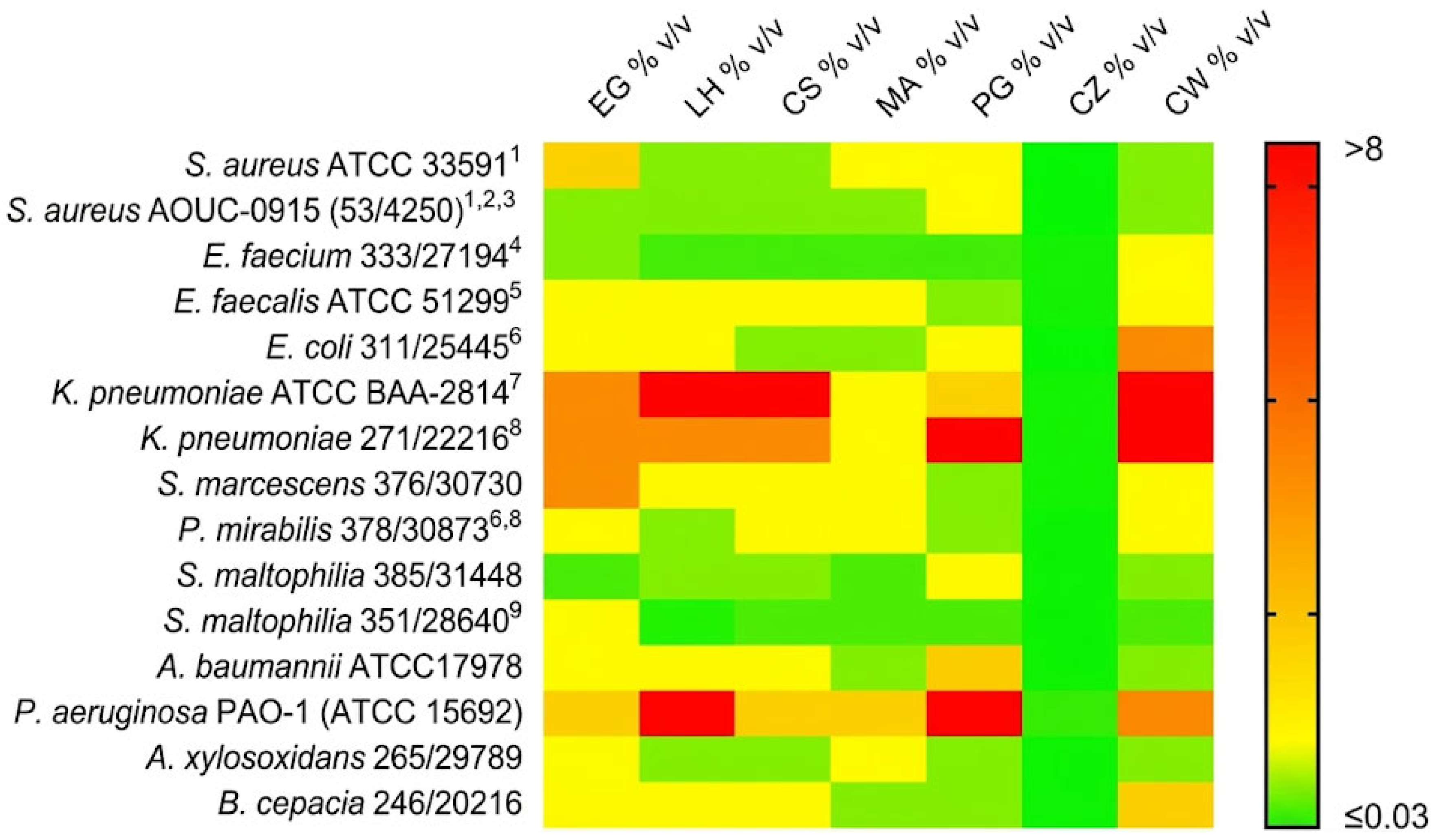
A heatmap visualization (Figure 1) allowed rapid comparison of the activity profiles of all EOs across the tested MDR pathogens. CZ showed the highest antibacterial activity (brightest green, lowest MICs) across all the tested strains.
Figure 1.
Heatmap of the antimicrobial activity of seven essential oil batches against the multidrug-resistant bacterial collections. Colors represent MIC values expressed in % v/v and transformed as log10 for visualization purposes: green/brighter colors correspond to lower MICs (higher activity), while red/darker colors indicate higher MICs (lower activity). Off-scale MIC values of ‘≤0.03’ and ‘>8’ were set to 0.03 and 16, respectively. The heatmap was constructed using GraphPad Prism (v 8.0). Essential oils tested: Eucalyptus globulus (EG), Lavandula hybrida (LH), Coriandrum sativum (CS), Melaleuca alternifolia (MA), Pelargonium graveolens (PG), Cinnamomum zeylanicum (CZ), and Cymbopogon winterianus (CW). Bacterial species and resistance profiles are indicated on the y-axis. Resistance determinants associated with each isolate are indicated as superscripts: mecA 1, cfr 2, poxtA 3, vanA 4, vanB 5, blaOXA-48-like 6, blaKPC 7, blaNDM 8, blaVIM 9.
4. Discussion
Thanks to their ability to affect multiple cellular processes critical for microbial survival, EOs represent promising candidates as antimicrobial agents or for potential use in combination with conventional antibiotics [21,22]. Although the antibacterial properties of several EOs have been previously reported [6,22], knowledge on their efficacy against clinically relevant MDROs, including members of the ESKAPE group, remains limited, and they have often been tested only with diffusion methods [23]. In this study, we assessed the antimicrobial activity of seven EO batches against a collection of MDROs, including some ESKAPE pathogens carrying different resistance determinants of major global concern, using a broth microdilution method.
The tested EOs exhibited heterogeneous antimicrobial activity against the panel of multidrug-resistant Gram-positive and Gram-negative strains. Overall, CZ showed the strongest and broadest activity across species, displaying consistently low MIC values. This broad-spectrum efficacy is consistent with previous studies highlighting the strong antimicrobial properties of cinnamon-derived oils, mainly attributed to cinnamaldehyde and eugenol [24,25,26]. These compounds are known to disrupt membrane integrity, induce leakage of intracellular contents, and interfere with essential metabolic pathways [5]. Indeed, mecA-, cfr-, poxtA-, vanA/B, blaKPC-, blaVIM-, and blaNDM-positive strains were inhibited at CZ concentrations as low as ≤0.03–0.25% (v/v). Moreover, non-fermenting Gram-negative pathogens such as S. maltophilia, A. baumannii, and P. aeruginosa, which represent major therapeutic challenges, were also inhibited by CZ at MIC ≤0.25% (v/v). The very low MIC values for S. maltophilia (≤0.03%) and A. baumannii (0.06%) are particularly noteworthy, as both species commonly exhibit resistance to most antimicrobial classes [14,27]. Therefore, our study supports the potential of CZ as an alternative antimicrobial against difficult-to-treat bacteria and reinforces the importance of further investigating cinnamon oil and its main components, cinnamaldehyde and eugenol, for possible clinical applications.
As for the other EOs, our findings confirmed that EOs differ markedly in their antimicrobial potential, allegedly depending on their chemical composition and the intrinsic resistance mechanisms of the target microorganisms, as observed also by other authors [28,29,30]. Their mechanism of action has yet to be fully elucidated, but it has been hypothesized to be due to loss of membrane integrity and function [5].
In our study, the MA batch exhibited interesting antimicrobial activity, ranking second among the tested EOs in broad-spectrum antibacterial activity against the Gram-positive and Gram-negative MDR bacteria tested. Although the MIC value (4%) against the P. aeruginosa PAO-1 strain was the highest observed in our panel, previous studies reported both bactericidal activity and antibiofilm properties of tea tree oil against this pathogen [31,32]. The antimicrobial activity of tea tree oil was likely dependent on the synergistic action of its constituent compounds, mainly terpinen-4-ol and terpineol (also detected in the batch tested in this study), whose lipophilicity and hydroxyl groups facilitate efficient cellular membrane penetration and biological interaction [33].
Finally, CS and LH showed good activity against the tested MRSA and VRE. Previous studies associated the antimicrobial activity with their major component, linalool, targeting the bacterial cytoplasmic membrane and the glutathione pathway [34,35,36].
While in vitro studies on essential oils in the microbiological field are increasing in number, research into their possible clinical applications is limited, and even more so is the analysis of their pharmacodynamic and pharmacokinetic properties in humans. Pharmacokinetic data in animals showed that terpenes were well absorbed after oral, transdermal, or inhalational administration and were largely metabolized in the liver into secondary metabolites, which were excreted mainly in the urine and to a lesser extent in the feces [37]. In humans, the most consistent data concerns the essential oil of E. globulus and its main component, 1,8-cineole [38,39], and to a lesser extent, linalool (the main component of the essential oil of L. hybrida) [40,41]. Despite the strong in vitro potency of CZ, limited pharmacokinetic data are available, mostly from animal models. Its primary constituent, cinnamaldehyde, undergoes rapid hepatic metabolism into cinnamic acid and hippuric acid, resulting in a low plasma half-life of the free compound after oral administration [42]. Careful consideration is therefore required before the possible in vivo application can be studied. First of all, the tissue and plasma concentrations detected for the main oil compounds or their secondary metabolites in humans are in the order of ng/mL, whereas the in vitro MICs of these oils are in the order of µg/mL. At present, studies on lipid-based nano/microscale delivery systems appear to be the most promising options to increase the bioavailability of the essential oils for in vivo application, although their clinical application in humans is still distant and unstudied [43]. A further consideration stems from the fact that, while the in vitro antibiotic activity of essential oils as a whole or of their main constituents is well documented, that of their secondary metabolites is scarce and not systematically studied. Secondary metabolites are the compounds most commonly measured in plasma or urine after oral administration; therefore, their in vitro antibiotic properties should be investigated to allow a more informed in vivo application. Despite the limitations outlined above, clinical studies exist that examine the effect of essential oils in the treatment of infections, mostly involving topical applications (e.g., cutaneous or mucosal); however, these data remain very limited in number and methodological quality [44]. Altogether, the in vivo use of essential oils in the microbiological field requires further pharmacokinetic and safety studies, as well as further investigation into the antimicrobial activity of the main metabolites excreted in urine and detectable in plasma after oral administration. At the same time, their possible topical application represents a promising area of research.
Our study provided an in vitro evaluation of the activity of several different EOs against a panel of clinically relevant bacterial pathogens, including some difficult-to-treat Gram-positive and Gram-negative members of ESKAPE species. However, this study also has some limitations that should be acknowledged: (i) the antimicrobial activity of the EOs was evaluated against a relatively small panel of representative strains, limiting the generalizability of the results across species and resistance mechanisms; (ii) the potential cidality of active compounds was not evaluated; (iii) interactions of EOs with conventional antimicrobial agents in terms of synergism, indifference, or antagonism of antimicrobial activity were not evaluated; (iv) the mechanism of antimicrobial action of EOs at the molecular level was not investigated. Investigation of these aspects was beyond the scope of this initial scoping work, but could be the subject of future studies with the most promising compounds identified in this work, such as CZ. Additionally, the identification of the main constituents responsible for antimicrobial activity will be essential to improve reproducibility, ensure batch-to-batch consistency, reduce the variability associated with the use of the complex EO mixture, and progress into clinical development.
5. Conclusions
These findings suggest that CZ could represent a promising strategy to tackle some clinically relevant antimicrobial-resistant pathogens and contribute to the development of new antimicrobial agents and strategies. Further research is needed to broaden the panel of species tested, assess safety profiles and potential synergistic effects with conventional treatments, and evaluate pharmacokinetic properties in view of potential clinical development.
Supplementary Materials
The following supporting information can be downloaded at: https://www.mdpi.com/article/10.3390/antibiotics15111071/s1, Table S1. Major constituents identified by GC-MS in steam-distilled essential oil batches tested for their antimicrobial activity in this study; Table S2. Phenotypic and molecular profile of clinical isolates included in this study.
Author Contributions
Conceptualization, A.M., A.A., F.P. and G.M.R.; Methodology, F.C., S.S. and M.C.; Software, F.C.; Formal analysis, F.C. and A.M.; Investigation, F.C., S.S., R.S. and T.P.; Resources, R.S., T.P., F.P. and G.M.R.; Data curation, F.C., S.S., A.A. and M.C.; Writing—original draft preparation, F.C., S.S., A.A. and M.C.; Writing—review and editing, M.C., A.A., A.B., F.P. and G.M.R.; Visualization, F.C.; Supervision, A.B., F.P. and G.M.R. All authors have read and agreed to the published version of the manuscript.
Funding
This work was supported by Centro di Medicina Integrativa—CRR per la Fitoterapia CERFIT, AOU Careggi (CR-CERFIT CUP: D11H25000010002).
Institutional Review Board Statement
Not applicable. The study utilized anonymized clinical strains collected during routine diagnostic activities, along with reference strains from public culture collections. No human subjects, patient personal data, or clinical interventions were directly involved in this research.
Informed Consent Statement
Not applicable.
Data Availability Statement
The data presented in this study, including replicate-level minimum inhibitory concentration (MIC) determinations and batch-specific GC–MS analytical profiles, are available on reasonable request from the corresponding author.
Conflicts of Interest
Roberto Spampatti and Tommaso Pelagatti, employed by the drugstore “Farmacia Tili”, provided the essential oils, produced at the farmhouse “Casalvento”. Neither Farmacia Tili nor Casalvento had any role in the design of the study; in the collection, analyses, or interpretation of data; in the writing of the manuscript; or in the decision to publish the results. All other authors declare no conflicts of interest relative to this research.
References
- Dakal, T.; Dhakar, R.; Ahuja, M.; Gadi, B.R.; Sharma, N.K. Mechanistic Basis of Multidrug Resistance: Current Status, Challenges, and Potential Solutions. J. Med. Surg. Public Health 2025, 8, 100224. [Google Scholar] [CrossRef] [Scilit]
- Miller, W.R.; Arias, C.A. ESKAPE Pathogens: Antimicrobial Resistance, Epidemiology, Clinical Impact and Therapeutics. Nat. Rev. Microbiol. 2024, 22, 598–616. [Google Scholar] [CrossRef] [Scilit] [PubMed]
- Rossolini, G.M.; Arena, F.; Pecile, P.; Pollini, S. Update on the Antibiotic Resistance Crisis. Curr. Opin. Pharmacol. 2014, 18, 56–60. [Google Scholar] [CrossRef] [Scilit] [PubMed]
- Terreni, M.; Taccani, M.; Pregnolato, M. New Antibiotics for Multidrug-Resistant Bacterial Strains: Latest Research Developments and Future Perspectives. Molecules 2021, 26, 2671. [Google Scholar] [CrossRef] [Scilit] [PubMed]
- Chouhan, S.; Sharma, K.; Guleria, S. Antimicrobial Activity of Some Essential Oils—Present Status and Future Perspectives. Medicines 2017, 4, 58. [Google Scholar] [CrossRef] [Scilit] [PubMed]
- Tariq, S.; Wani, S.; Rasool, W.; Shafi, K.; Bhat, M.A.; Prabhakar, A.; Shalla, A.H.; Rather, M.A. A Comprehensive Review of the Antibacterial, Antifungal and Antiviral Potential of Essential Oils and Their Chemical Constituents against Drug-Resistant Microbial Pathogens. Microb. Pathog. 2019, 134, 103580. [Google Scholar] [CrossRef] [Scilit] [PubMed]
- Swamy, M.K.; Akhtar, M.S.; Sinniah, U.R. Antimicrobial Properties of Plant Essential Oils against Human Pathogens and Their Mode of Action: An Updated Review. Evid.-Based Complement. Altern. Med. 2016, 2016, 3012462. [Google Scholar] [CrossRef] [Scilit] [PubMed]
- Ezzariga, N.; Moukal, A.; Asdadi, A.; Lemkhente, Z.; Moustaoui, F.; Kaaya, A.; Aghrouch, M. Evaluation of the Antimicrobial Activity of 20 Essential Oils and Their Combinations on Bacterial and Fungal Strains. Cureus 2025, 17, e79499. [Google Scholar] [CrossRef] [Scilit] [PubMed]
- Schaefler, S.; Perry, W.; Jones, D. Methicillin-Resistant Strains of Staphylococcus aureus Phage Type 92. Antimicrob. Agents Chemother. 1979, 15, 74–80. [Google Scholar] [CrossRef] [Scilit] [PubMed]
- Antonelli, A.; D’Andrea, M.M.; Brenciani, A.; Galeotti, C.L.; Morroni, G.; Pollini, S.; Varaldo, P.E.; Rossolini, G.M. Characterization of poxtA, a Novel Phenicol-Oxazolidinone-Tetracycline Resistance Gene from an MRSA of Clinical Origin. J. Antimicrob. Chemother. 2018, 73, 1763–1769. [Google Scholar] [CrossRef] [Scilit] [PubMed]
- Sung, K.; Khan, S.; Marasa, B.; Min, S.; Kweon, O.; Nawaz, M.; Cerniglia, C. Genomic Sequence of a Clinical Vancomycin-Resistant Reference Strain, Enterococcus faecalis ATCC 51299. Genome Announc. 2015, 3, e01495-15. [Google Scholar] [CrossRef] [Scilit] [PubMed]
- Lomovskaya, O.; Sun, D.; Rubio-Aparicio, D.; Nelson, K.; Tsivkovski, R.; Griffith, D.C.; Dudley, M.N. Vaborbactam: Spectrum of Beta-Lactamase Inhibition and Impact of Resistance Mechanisms on Activity in Enterobacteriaceae. Antimicrob. Agents Chemother. 2017, 61, e01443-17. [Google Scholar] [CrossRef] [Scilit] [PubMed]
- Coppi, M.; Antonelli, A.; Niccolai, C.; Bartolini, A.; Bartolini, L.; Grazzini, M.; Mantengoli, E.; Farese, A.; Pieralli, F.; Mechi, M.T.; et al. Nosocomial Outbreak by NDM-1-Producing Klebsiella pneumoniae Highly Resistant to Cefiderocol, Florence, Italy, August 2021 to June 2022. Eurosurveillance 2022, 27, 2200795. [Google Scholar] [CrossRef] [Scilit] [PubMed]
- Boncompagni, S.R.; Riccobono, E.; Cusi, M.G.; Di Pilato, V.; Rossolini, G.M. Evidence of Dissemination of a Clc-Type Integrative and Conjugative Element to Stenotrophomonas maltophilia, Mediating Acquisition of Sul1 and Other Resistance Determinants. Antimicrob. Agents Chemother. 2025, 69, e0155424. [Google Scholar] [CrossRef] [Scilit] [PubMed]
- Adams, M.D.; Goglin, K.; Molyneaux, N.; Hujer, K.M.; Lavender, H.; Jamison, J.J.; MacDonald, I.J.; Martin, K.M.; Russo, T.; Campagnari, A.A.; et al. Comparative Genome Sequence Analysis of Multidrug-Resistant Acinetobacter baumannii. J. Bacteriol. 2008, 190, 8053–8064. [Google Scholar] [CrossRef] [Scilit] [PubMed]
- Stover, C.K.; Pham, X.Q.; Erwin, A.L.; Mizoguchi, S.D.; Warrener, P.; Hickey, M.J.; Brinkman, F.S.L.; Hufnagle, W.O.; Kowalik, D.J.; Lagrou, M.; et al. Complete Genome Sequence of Pseudomonas aeruginosa PAO1, an Opportunistic Pathogen. Nature 2000, 406, 959–964. [Google Scholar] [CrossRef] [Scilit] [PubMed]
- Vanegas, D.; Abril-Novillo, A.; Khachatryan, A.; Jerves-Andrade, L.; Peñaherrera, E.; Cuzco, N.; Wilches, I.; Calle, J.; León-Tamariz, F. Validation of a Method of Broth Microdilution for the Determination of Antibacterial Activity of Essential Oils. BMC Res. Notes 2021, 14, 439, Correction in BMC Res. Notes 2022, 15, 53. https://doi.org/10.1186/s13104-022-05915-6. [Google Scholar] [CrossRef] [Scilit] [PubMed]
- Di Vito, M.; Mariotti, M.; Di Mercurio, M.; Coggiatti, D.; Rizzo, S.; Zhiri, A.; Bugli, F.; Sanguinetti, M.; Posteraro, B. Protocol for Determining Minimum Inhibitory Concentrations of Essential Oils against Bacterial Pathogens Using Broth Microdilution. STAR Protoc. 2026, 7, 104587. [Google Scholar] [CrossRef] [Scilit] [PubMed]
- ISO 20776-1:2006; Clinical Laboratory Testing and In Vitro Diagnostic Test Systems—Susceptibility Testing of Infectious Agents and Evaluation of Performance of Antimicrobial Susceptibility Test Devices—Part 1: Reference Method for Testing the In Vitro Activity of Antimicrobial Agents against Rapidly Growing Aerobic Bacteria Involved in Infectious Diseases. ISO: Geneva, Switzerland, 2006. Available online: https://www.iso.org/obp/ui/#iso:std:iso:20776:-1:ed-1:v1:en (accessed on 31 March 2026).
- Adewunmi, Y.; Namjilsuren, S.; Walker, W.D.; Amato, D.N.; Amato, D.V.; Mavrodi, O.V.; Patton, D.L.; Mavrodi, D.V. Antimicrobial Activity of, and Cellular Pathways Targeted by, p-Anisaldehyde and Epigallocatechin Gallate in the Opportunistic Human Pathogen Pseudomonas aeruginosa. Appl. Environ. Microbiol. 2020, 86, e02482-19. [Google Scholar] [CrossRef] [Scilit] [PubMed]
- Yammine, J.; Chihib, N.-E.; Gharsallaoui, A.; Dumas, E.; Ismail, A.; Karam, L. Essential Oils and Their Active Components Applied as: Free, Encapsulated and in Hurdle Technology to Fight Microbial Contaminations. A Review. Heliyon 2022, 8, e12472. [Google Scholar] [CrossRef] [Scilit] [PubMed]
- Puvača, N.; Milenković, J.; Galonja Coghill, T.; Bursić, V.; Petrović, A.; Tanasković, S.; Pelić, M.; Ljubojević Pelić, D.; Miljković, T. Antimicrobial Activity of Selected Essential Oils against Selected Pathogenic Bacteria: In Vitro Study. Antibiotics 2021, 10, 546. [Google Scholar] [CrossRef] [Scilit] [PubMed]
- Sakkas, H.; Gousia, P.; Economou, V.; Sakkas, V.; Petsios, S.; Papadopoulou, C. In Vitro Antimicrobial Activity of Five Essential Oils on Multi-Drug Resistant Gram-Negative Clinical Isolates. J. Intercult. Ethnopharmacol. 2016, 5, 212. [Google Scholar] [CrossRef] [Scilit] [PubMed]
- Friedman, M. Chemistry, Antimicrobial Mechanisms, and Antibiotic Activities of Cinnamaldehyde against Pathogenic Bacteria in Animal Feeds and Human Foods. J. Agric. Food Chem. 2017, 65, 10406–10423. [Google Scholar] [CrossRef] [Scilit] [PubMed]
- Alizadeh Behbahani, B.; Falah, F.; Lavi Arab, F.; Vasiee, M.; Tabatabaee Yazdi, F. Chemical Composition and Antioxidant, Antimicrobial, and Antiproliferative Activities of Cinnamomum zeylanicum Bark Essential Oil. Evid.-Based Complement. Altern. Med. 2020, 2020, 5190603. [Google Scholar] [CrossRef] [Scilit] [PubMed]
- Saki, M.; Seyed-Mohammadi, S.; Montazeri, E.A.; Siahpoosh, A.; Moosavian, M.; Latifi, S.M. In Vitro Antibacterial Properties of Cinnamomum zeylanicum Essential Oil against Clinical Extensively Drug-Resistant Bacteria. Eur. J. Integr. Med. 2020, 37, 101146. [Google Scholar] [CrossRef] [Scilit]
- Scoffone, V.C.; Trespidi, G.; Barbieri, G.; Arshad, A.; Israyilova, A.; Buroni, S. The Evolution of Antimicrobial Resistance in Acinetobacter baumannii and New Strategies to Fight It. Antibiotics 2025, 14, 85. [Google Scholar] [CrossRef] [Scilit] [PubMed]
- Razzouk, S.; Mazri, M.A.; Jeldi, L.; Mnasri, B.; Ouahmane, L.; Alfeddy, M.N. Chemical Composition and Antimicrobial Activity of Essential Oils from Three Mediterranean Plants against Eighteen Pathogenic Bacteria and Fungi. Pharmaceutics 2022, 14, 1608. [Google Scholar] [CrossRef] [Scilit] [PubMed]
- Moumni, S.; Elaissi, A.; Trabelsi, A.; Merghni, A.; Chraief, I.; Jelassi, B.; Chemli, R.; Ferchichi, S. Correlation between Chemical Composition and Antibacterial Activity of Some Lamiaceae Species Essential Oils from Tunisia. BMC Complement. Med. Ther. 2020, 20, 103. [Google Scholar] [CrossRef] [Scilit] [PubMed]
- Lis-Balchin, M.; Deans, S.G.; Eaglesham, E. Relationship between Bioactivity and Chemical Composition of Commercial Essential Oils. Flavour. Fragr. J. 1998, 13, 98–104. [Google Scholar] [CrossRef] [Scilit]
- Haines, R.R.; Putsathit, P.; Tai, A.S.; Hammer, K.A. Antimicrobial Effects of Melaleuca alternifolia (Tea Tree) Essential Oil against Biofilm-Forming Multidrug-Resistant Cystic Fibrosis-Associated Pseudomonas aeruginosa as a Single Agent and in Combination with Commonly Nebulized Antibiotics. Lett. Appl. Microbiol. 2022, 75, 578–587. [Google Scholar] [CrossRef] [Scilit] [PubMed]
- Brun, P.; Bernabè, G.; Filippini, R.; Piovan, A. In Vitro Antimicrobial Activities of Commercially Available Tea Tree (Melaleuca alternifolia) Essential Oils. Curr. Microbiol. 2019, 76, 108–116. [Google Scholar] [CrossRef] [Scilit] [PubMed]
- Carson, C.F.; Hammer, K.A.; Riley, T.V. Melaleuca Alternifolia (Tea Tree) Oil: A Review of Antimicrobial and Other Medicinal Properties. Clin. Microbiol. Rev. 2006, 19, 50–62. [Google Scholar] [CrossRef] [Scilit] [PubMed]
- Varona, S.; Rodríguez Rojo, S.; Martín, Á.; Cocero, M.J.; Serra, A.T.; Crespo, T.; Duarte, C.M.M. Antimicrobial Activity of Lavandin Essential Oil Formulations against Three Pathogenic Food-Borne Bacteria. Ind. Crops Prod. 2013, 42, 243–250. [Google Scholar] [CrossRef] [Scilit]
- Kačániová, M.; Galovičová, L.; Ivanišová, E.; Vukovic, N.L.; Štefániková, J.; Valková, V.; Borotová, P.; Žiarovská, J.; Terentjeva, M.; Felšöciová, S.; et al. Antioxidant, Antimicrobial and Antibiofilm Activity of Coriander (Coriandrum sativum L.) Essential Oil for Its Application in Foods. Foods 2020, 9, 282. [Google Scholar] [CrossRef] [Scilit] [PubMed]
- Long, N.; Qiu, M.; Zuo, Y.; Deng, H. Antimicrobial Activity and Metabolomic Analysis of Linalool Against Pathogenic Bacteria Methicillin-Resistant Staphylococcus aureus. Infect. Drug Resist. 2025, 18, 731–744. [Google Scholar] [CrossRef] [Scilit] [PubMed]
- Lesgards, J.-F.; Baldovini, N.; Vidal, N.; Pietri, S. Anticancer Activities of Essential Oils Constituents and Synergy with Conventional Therapies: A Review. Phytother. Res. 2014, 28, 1423–1446. [Google Scholar] [CrossRef] [Scilit] [PubMed]
- Juergens, L.J.; Worth, H.; Juergens, U.R. New Perspectives for Mucolytic, Anti-Inflammatory and Adjunctive Therapy with 1,8-Cineole in COPD and Asthma: Review on the New Therapeutic Approach. Adv. Ther. 2020, 37, 1737–1753. [Google Scholar] [CrossRef] [Scilit] [PubMed]
- MacKenzie, C.; Goerke, T.; Buecking, M.; Heidemann, M.; Leichtle, A.; Ringbeck, B.; Möllenkolk, F.; Ploch, M.; Bruchhage, K.-L.; Pries, R. Determination of Orally Administered 1,8-Cineol in Nasal Polyp Tissues from Chronic Rhinosinusitis Patients Using Gas Chromatography: Mass Spectrometry. Sci. Rep. 2023, 13, 3605. [Google Scholar] [CrossRef] [Scilit] [PubMed]
- Piccialli, I.; Roviello, G.; Magliocca, G.; Esposito, E.; Pannaccione, A. Exploring Linalool-Based Phytotherapy for Excitatory/Inhibitory Imbalance in Alzheimer’s Disease: A Review of Lavender and Cannabis Therapeutic Effects on Sleep, Seizures, and Cognition. Phytother. Res. 2026, 40, 2604–2631. [Google Scholar] [CrossRef] [Scilit] [PubMed]
- Debong, M.W.; N’Diaye, K.; Schöberl, D.; Yin, Y.; Lang, R.; Buettner, A.; Hofmann, T.; Loos, H.M. Linalool, 1,8-Cineole, and Eugenol Transfer from a Curry Dish into Human Urine. Mol. Nutr. Food Res. 2024, 68, e2300396. [Google Scholar] [CrossRef] [Scilit] [PubMed]
- Sharifi-Rad, J.; Dey, A.; Koirala, N.; Shaheen, S.; El Omari, N.; Salehi, B.; Goloshvili, T.; Cirone Silva, N.C.; Bouyahya, A.; Vitalini, S.; et al. Cinnamomum Species: Bridging Phytochemistry Knowledge, Pharmacological Properties and Toxicological Safety for Health Benefits. Front. Pharmacol. 2021, 12, 600139. [Google Scholar] [CrossRef] [Scilit] [PubMed]
- Kelidari, M.; Abdi-Moghadam, Z.; Sabzevar, T.E.; Khajenouri, M.; Shakeri, A. Preparation and Therapeutic Implications of Essential Oil-Based Nanoemulsions: A Review. Colloids Surf. B Biointerfaces 2025, 255, 114939. [Google Scholar] [CrossRef] [Scilit] [PubMed]
- Deyno, S.; Mtewa, A.G.; Abebe, A.; Hymete, A.; Makonnen, E.; Bazira, J.; Alele, P.E. Essential Oils as Topical Anti-Infective Agents: A Systematic Review and Meta-Analysis. Complement. Ther. Med. 2019, 47, 102224. [Google Scholar] [CrossRef] [Scilit] [PubMed]
Disclaimer/Publisher’s Note: The statements, opinions and data contained in all publications are solely those of the individual author(s) and contributor(s) and not of MDPI and/or the editor(s). MDPI and/or the editor(s) disclaim responsibility for any injury to people or property resulting from any ideas, methods, instructions or products referred to in the content. |
© 2026 by the authors. Licensee MDPI, Basel, Switzerland. This article is an open access article distributed under the terms and conditions of the Creative Commons Attribution (CC BY) license.