


Abstract
Background: Bedaquiline (BDQ) is critical for multidrug-resistant tuberculosis (MDR-TB) treatment, but emerging resistance threatens its efficacy. Detection of BDQ resistance relies on slow phenotypic drug-susceptibility testing (pDST), delaying treatment decisions. We determined the diagnostic accuracy of whole-genome sequencing (WGS) for predicting BDQ resistance against culture-based pDST. Methods: Mycobacterium tuberculosis isolates underwent BDQ pDST (1.0 µg/mL in MGIT) in a prospective study of patients with MDR-TB with additional resistance to fluoroquinolones or aminoglycosides in KwaZulu-Natal, South Africa (2018–2022). Isolates with single nucleotide polymorphisms showing a read depth of ≥10 and allele frequency of ≥0.7 were included. Isolates exhibiting phenotypic resistance underwent quantitative minimum inhibitory concentration (MIC) testing (ranging from 0.25 to 8.0 µg/mL) using the BACTEC MGIT 960 system. Diagnostic performance of WGS compared to MGIT-based pDST was assessed by calculating sensitivity, specificity, negative predictive value (NPV), and positive predictive value (PPV). Results: Analysis included 428 isolates: 88 phenotypically resistant isolates (87 with potential BDQ-resistance-associated variants (RAVs) and one wild-type) and 340 susceptible isolates (7 with potential RAVs and 333 wild-type). Presence of potential RAVs accurately predicted phenotypic resistance: sensitivity 98.9% (95% CI: 93.8–99.8), specificity 97.9% (95% CI: 95.8–99.0), PPV 92.6% (95% CI: 85.4–96.4), and NPV 99.7% (95% CI: 98.3–99.6). Among the 94 isolates with potential RAVs, we observed gene mutations in Rv0678 (88/94, 93.6%), pepQ (2/94, 2.1%), and Rv1979c (4/94, 4.3%). The median BDQ MIC for resistant isolates was 4.0 µg/mL [IQR:2.0–4.0 µg/mL]. Conclusions: Potential BDQ RAVs, predominantly in Rv0678, are strong predictors of BDQ phenotypic resistance, highlighting the potential use of genotypic catalogues to inform timely treatment decisions.
1. Introduction
Tuberculosis (TB) remains a profound global health crisis, with 10.7 million incident cases and 1.2 million deaths in 2024 [1]. The persistence of drug-resistant TB (DR-TB) presents a severe threat, fundamentally undermining standard DR-TB short-course chemotherapy. In 2024, an estimated 390,000 individuals developed multidrug-resistant or rifampicin-resistant TB (MDR/RR-TB), yet only 164,545 (42%) were diagnosed and received appropriate second-line treatment [1].
The introduction of bedaquiline (BDQ), a first-in-class diarylquinoline, prompted a recent shift from prolonged, toxic regimens to all-oral short-course therapies [2,3,4,5]. However, expansion of BDQ utilization has been accompanied by the emergence and dissemination of BDQ-resistant Mycobacterium tuberculosis (Mtb) strains [6,7]. Global meta-analyses indicate a BDQ resistance prevalence of 5.7% among people with RR-TB at baseline, before initiating treatment [8]. South African RR-TB national surveillance data identified BDQ resistance in 3.8% of patients at baseline and 2.3% among on-treatment samples [6]. A recent study conducted between 2023 and 2024 in the Western Cape, South Africa, showed BDQ resistance in 12% of baseline isolates and 41% of on-treatment isolates [9].
The molecular architecture of BDQ resistance is complex and distributed across multiple genetic loci [10,11] that span at least four primary candidate genes: atpE, mmpR5 (Rv0678), pepQ, and Rv1979c [11,12]. Mutations within atpE, the direct biochemical target of BDQ, definitively confer high-level resistance [13]; however, they account for less than 5% of clinical resistance [14]. Instead, evolutionary pressure selects overwhelmingly for loss-of-function mutations in Rv0678, present in >96% of phenotypically resistant isolates [15]. The genetic profile of Rv0678-mediated resistance is diverse, with over 200 mutations identified across its entire coding sequence and promoter regions [16,17,18]. The resulting phenotypic impact is highly variable, frequently generating intermediate phenotypes and clofazimine (CFZ) cross-resistance [16,19]. Mutations in accessory genes pepQ and Rv1979c are implicated in resistance, though infrequent, occurring in <5% of phenotypic resistant isolates [20,21].
Historically, DR-TB management relied heavily on empirical treatment, often resulting in the use of drugs to which the patient was already resistant. This approach suppresses susceptible Mtb subpopulations while simultaneously providing a competitive advantage to resistant Mtb mutants [22]. Thus, there is a need for diagnostic tools to rapidly detect BDQ resistance to guide treatment and prevent further emergence and spread of resistant strains. The diffuse mutational distribution across the 498-base-pair Rv0678 gene renders targeted, cartridge-based PCR probe technologies currently unfeasible. In addition, sequencing known candidate genes yields poor predictive values for many variants: an “any mutation” diagnostic approach for BDQ resistance candidate genes (Rv0678, atpE, atpB and pepQ) yields a modest sensitivity of 69% and a positive predictive value (PPV) of only 14% [23]. The modest sensitivity observed was due to the majority of isolates demonstrating an intermediate phenotype (minimum inhibitory concentration (MIC) at the critical concentration), likely resulting from heteroresistance. Operating a molecular assay with such low positive predictive value (PPV) would lead to over-diagnosis and the inappropriate withholding of a highly efficacious drug. The World Health Organization (WHO) has developed a comprehensive mutation catalogue for genotypic and phenotypic resistance calls for antitubercular drugs, including BDQ [17]. Even employing the stringent statistical criteria of the WHO mutation catalogue, the maximum achievable sensitivity for predicting phenotypic resistance using high-confidence mutations remains severely limited at approximately 49.4% [12,17].
Given the current difficulties in interpreting diverse non-target mutations, genomic sequencing cannot yet serve as a standalone proxy for phenotypic testing [24]. Consequently, the diagnosis of BDQ resistance remains heavily reliant on culture-based pDST, which is labour-intensive and can take up to eight weeks to provide results [25]. Developing rapid molecular diagnostics requires closing the gap in understanding the genotypic and phenotypic relationship. This involves expanding comprehensive predictive catalogues to accurately capture noncanonical resistance mutations, paired with standardized, quantitative MIC testing to resolve intermediate or borderline phenotypes. Although quantitative MIC testing is time-consuming and currently unsuitable for widespread programmatic use, it provides critical epidemiological and clinical insights into the spectrum of drug resistance, particularly for efflux-mediated mechanisms that often result in modest MIC elevations [26].
Current methods for detecting BDQ resistance are largely culture-based, and rapid resistance detection of BDQ will likely depend on granular understanding of genotypic-phenotypic relationships that underpin the genesis of phenotypic resistance. Global efforts aim to achieve this through a cumulative catalogue of mutations, curated under the WHO to inform the field implementation of sequencing-based drug susceptibility strategies. This strategy is limited by poor sensitivity and accuracy; however, there is limited genotypic-phenotypic data emanating from large, well-characterized clinical cohorts in TB endemic settings. We sought to determine the diagnostic accuracy of mutations occurring in BDQ resistance candidate genes for detecting MGIT-based phenotypic BDQ resistance in clinical Mtb isolates from a large cohort of patients with DR-TB in a high TB burden setting to strengthen the clinical implementation and utility of sequencing methods. In addition, we aimed to characterize the genotypic profiles underlying phenotypic BDQ resistance in this setting and to describe the spectrum of MICs of these isolates.
2. Results
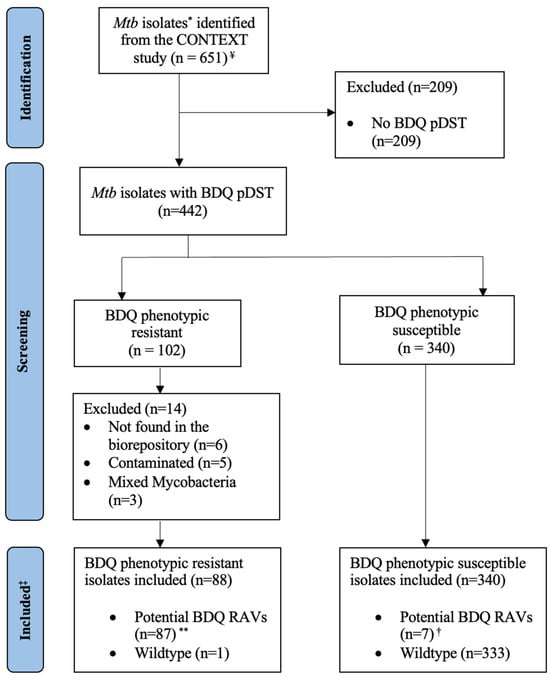
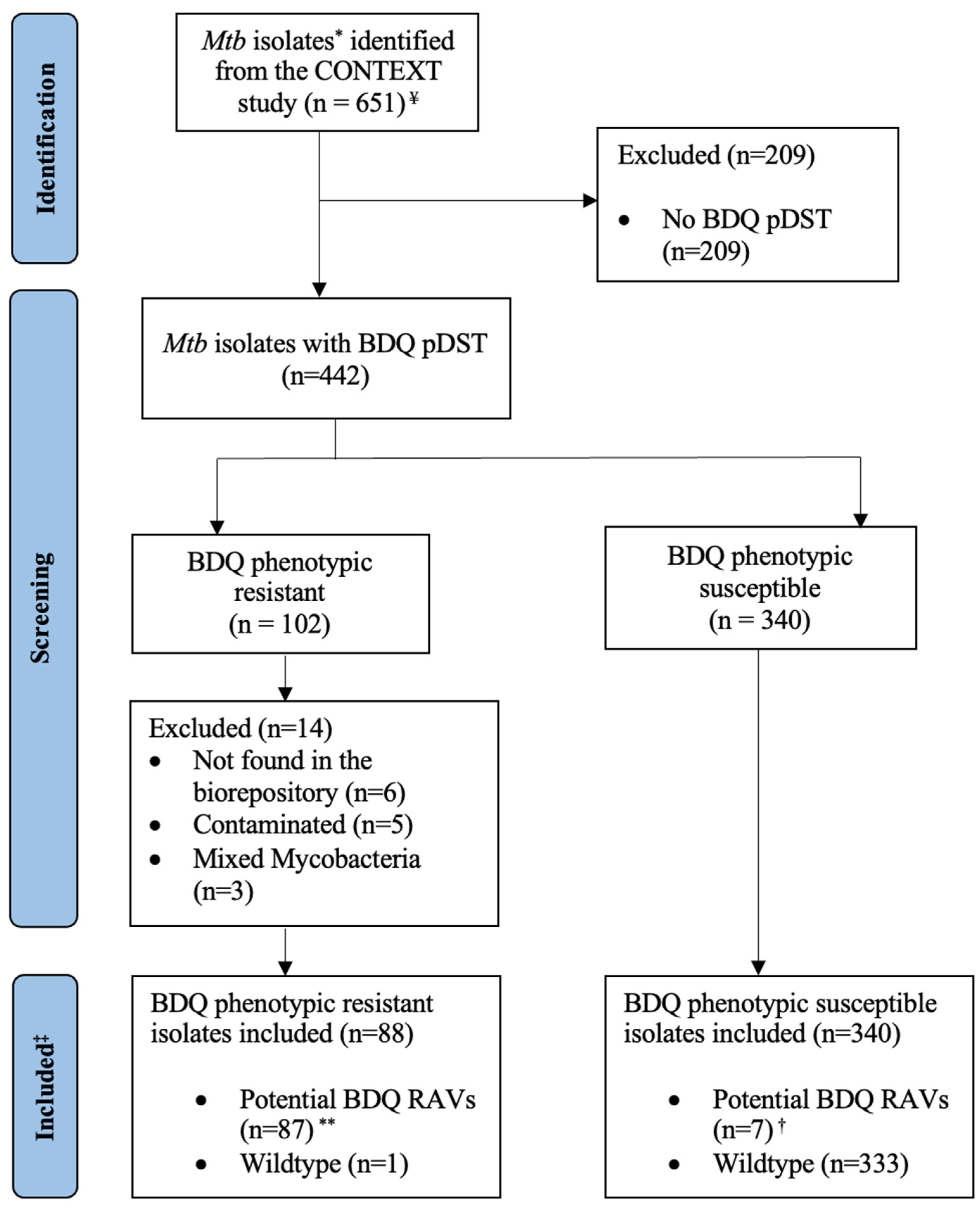
A total of 428 Mtb isolates from people with MDR-TB were included in this study. BDQ pDST identified 88 BDQ-resistant isolates and 340 BDQ-susceptible isolates. WGS revealed 94 isolates with potential BDQ resistance-associated variants (RAVs) (variants identified in genes previously implicated in BDQ resistance: atpE, Rv0678, pepQ, and Rv1979c), while the remaining 334 isolates possessed a wild-type genotype. Among the 88 phenotypically resistant isolates, the vast majority (87 isolates, 98.9%) possessed potential BDQ RAVs, and only 1 (1.1%) isolate was wild-type. Conversely, among the phenotypically susceptible isolates, 333 (97.9%) were wild-type, while 7 (2.1%) harboured potential BDQ RAVs. Bedaquiline MICs were performed for 95 isolates: all 88 isolates with BDQ phenotypic resistance and the 7 BDQ-susceptible isolates with potential BDQ RAVs.
In our primary analysis using all isolates included in this study (N = 428), the presence of a potential BDQ RAV was a strong predictor of phenotypic BDQ resistance (Table 1). The overall accuracy of a potential BDQ RAV for detecting phenotypic resistance was 98.1% (95% CI: 96.4–99.1). The markers demonstrated a sensitivity of 98.9% (95% CI: 93.8–99.8) and a specificity of 97.9% (95% CI: 95.8–99.0). Furthermore, the PPV was 92.6% (95% CI: 85.4–96.4), and the negative predictive value (NPV) was 99.7% (95% CI: 98.3–99.6) (Table 1). When we performed analysis using one isolate per participant (N = 418), the results were comparable to those of the primary analysis with a sensitivity, specificity, PPV and NPV of 98.7% (95% CI: 93.2–99.8), 98.2% (95% CI: 96.2–99.2), 92.9% (95% CI: 85.3–96.7) and 99.7% (95% CI: 98.3–99.9), respectively (Supplementary Table S1).
Table 1.
Diagnostic Performance of Potential BDQ RAVs for Predicting Phenotypic Bedaquiline Resistance.
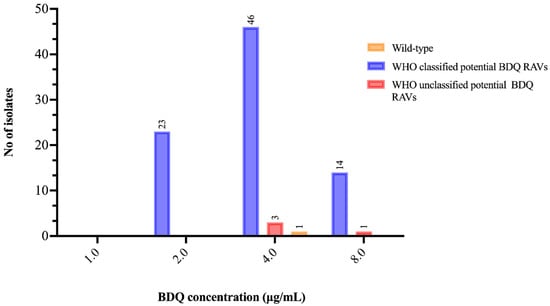
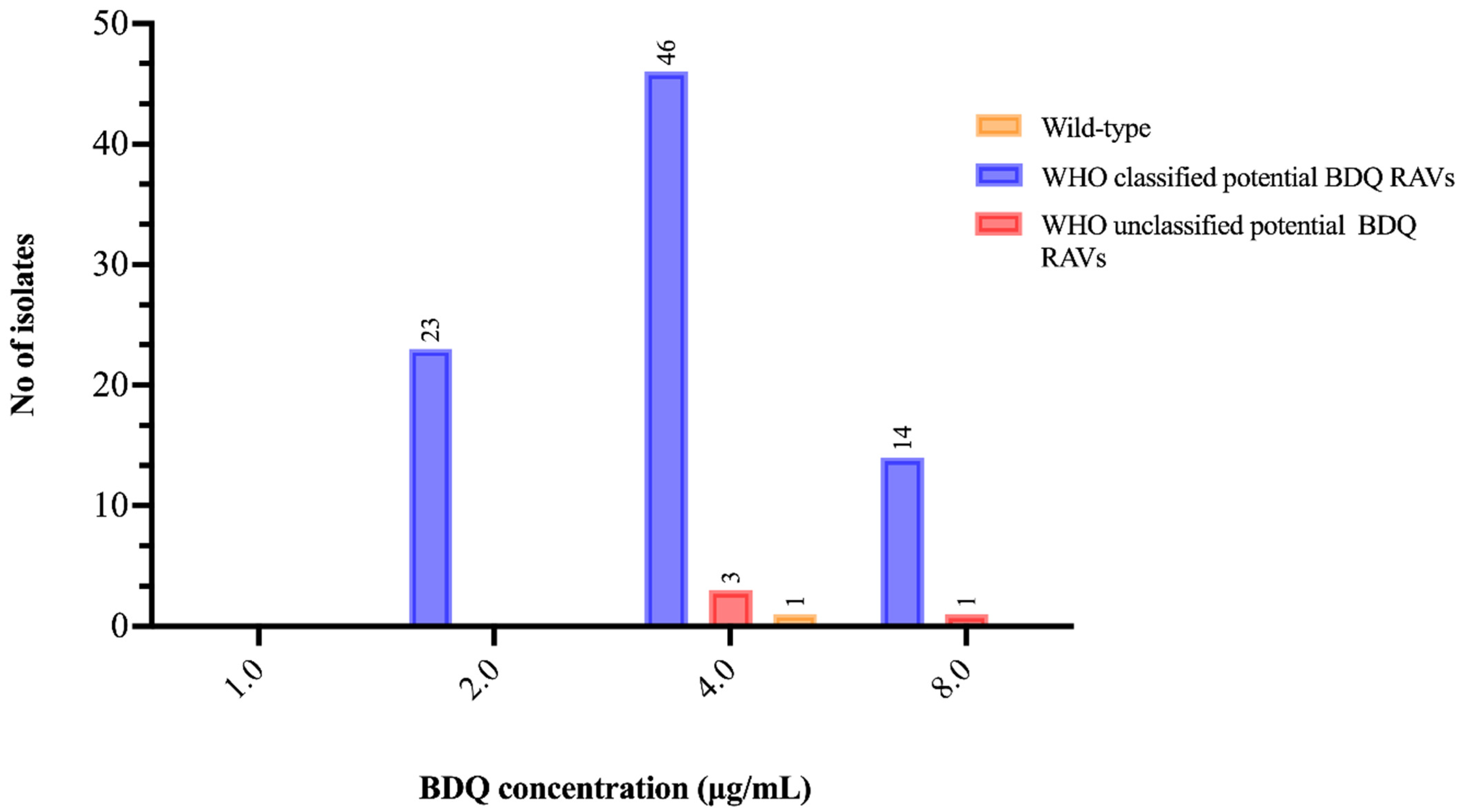
Based on the WHO catalogue of mutations (Version 2), the 94 isolates with potential BDQ RAVs were stratified into WHO-classified and noncanonical/unclassified variants (Table 2 and Supplementary Table S2). WHO-classified variants were identified in 87 isolates. Of these, 32 isolates had variants in the Rv0678 Asp47fs (n = 10), Glu49fs (n = 12), Ile67fs (n = 9), and Met146Thr (n = 1) associated with BDQ resistance (Table 2). Meanwhile, 38 isolates had variants with an interim determination of association with BDQ resistance. Of these 38 isolates, 3 [Pro48fs (n = 1), Leu95fs (n = 1) and Leu83fs (n = 1)] had a susceptible phenotype with MICs of ≤0.25, 1.0 and 1.0 μg/mL, respectively. Even though Glu138fs and Leu95fs are currently not listed in the WHO catalogue, they were categorized as associated with BDQ resistance of interim significance based on an expert rule that all frameshifts in Rv0678 be considered a marker for phenotypic BDQ resistance. Seventeen isolates contained Rv0678 and Rv1979c variants of uncertain significance, yet these isolates had MICs of 4.0–8.0 μg/mL, except for Met139Ile, where 1/4 isolates had an MIC at the CC (1.0 μg/mL) and were classified as phenotypically susceptible (Table 2). Therefore, of the 87 isolates with a WHO-classified variant, 83 (95.4%) were phenotypically resistant, and 4 (4.6%) were susceptible (Supplementary Table S2). Noncanonical variants were found in 7 isolates. Among these, 4 isolates were phenotypically resistant [Rv0678 upstream insertion (n = 1), Gly25Ser (n = 1), Val1Leu (n = 1), and Gly66Trp (n = 1)] (Table 2 and Figure 1), and 3 isolates were susceptible [Rv0678, c.-11C>A (n = 2), and Pro48Ser (n = 1).
Table 2.
Genotypic Profiling of Isolates by Bedaquiline Minimum Inhibitory Concentrations (MICs) and WHO Mutation Classification.
Figure 1.
Distribution of BDQ MICs amongst phenotypically resistant isolates, by genotypic profile; wild-type, WHO-classified potential RAVs and unclassified variants in BDQ resistance candidate genes (n = 88). There were no differences in MIC distribution between classified and unclassified variants; both had a median MIC of 4.0 µg/mL. No statistical significance was observed between groups (Mann–Whitney U test, p = 0.9). Abbreviations: BDQ, bedaquiline; MIC, minimum inhibitory concentration; RAV, resistance-associated variant; WHO, World Health Organization.
In a parallel analysis, we evaluated the performance of only WHO-classified potential BDQ RAVs and observed results that were similar to those obtained when using an “any potential RAV” approach (Supplementary Table S2). The overall accuracy of WHO-classified BDQ potential BDQ RAVs in predicting phenotypic resistance was 97.9% (95% CI: 96.1–99.0). The demonstrated sensitivity was 94.2% (95% CI: 87.4–97.6) and a specificity of 98.8% (95% CI: 97.0–99.5). Furthermore, the PPV was 95.4% (95% CI: 88.8–98.2), and the NPV was 98.5% (95% CI: 96.6–99.4).
Genotypic profiling using the WGS detailed in Table 2 highlights that 94 variants spanned several targets, including Rv0678 in 88 (93.6%) isolates, solely pepQ in 2 (2.1%), and Rv1979c in 4 (4.3%). Most Rv0678 variants were located within the coding region, spanning both DNA-binding and dimerisation domains, with a minority occurring at the promoter region (Supplementary Figure S1). Among the 88 isolates with Rv0678 variants, three had additional pepQ variants (3.4%), and two had atpE variants (2.3%). The most frequently observed WHO-classified variants, with an MIC range of 2–8 μg/mL, included Rv0678 Asp47fs (10/88, 11.4%), Glu49fs (12/88, 13.6%), Ile67fs (9/88, 10.2%), Leu32Ser (6/88, 6.8%), and Cys46fs (4/88, 4.5%). We observed two isolates with a pepQ variant (Val273fs) occurring alone, exhibiting MICs of 2 and 4 μg/mL, respectively. While Rv1979c variants are not a common mechanism of BDQ phenotypic resistance, four isolates with BDQ MICs of 2–4 μg/mL had Rv1979c variants with no mutations in the Rv0678, pepQ, or atpE genes (Glu38Asp and Arg409Gln, graded as of uncertain significance).
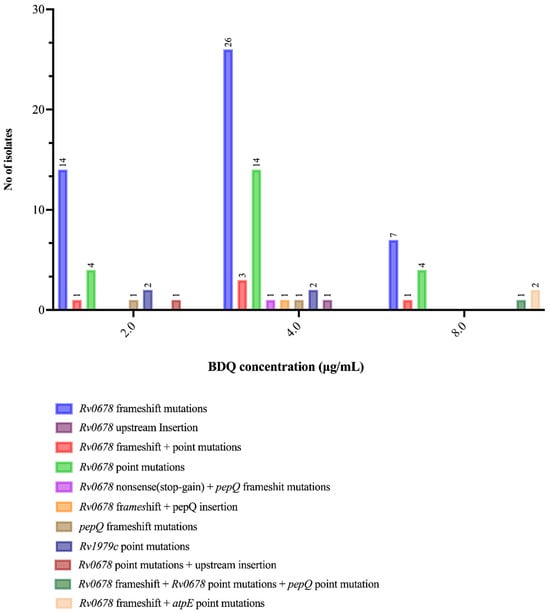
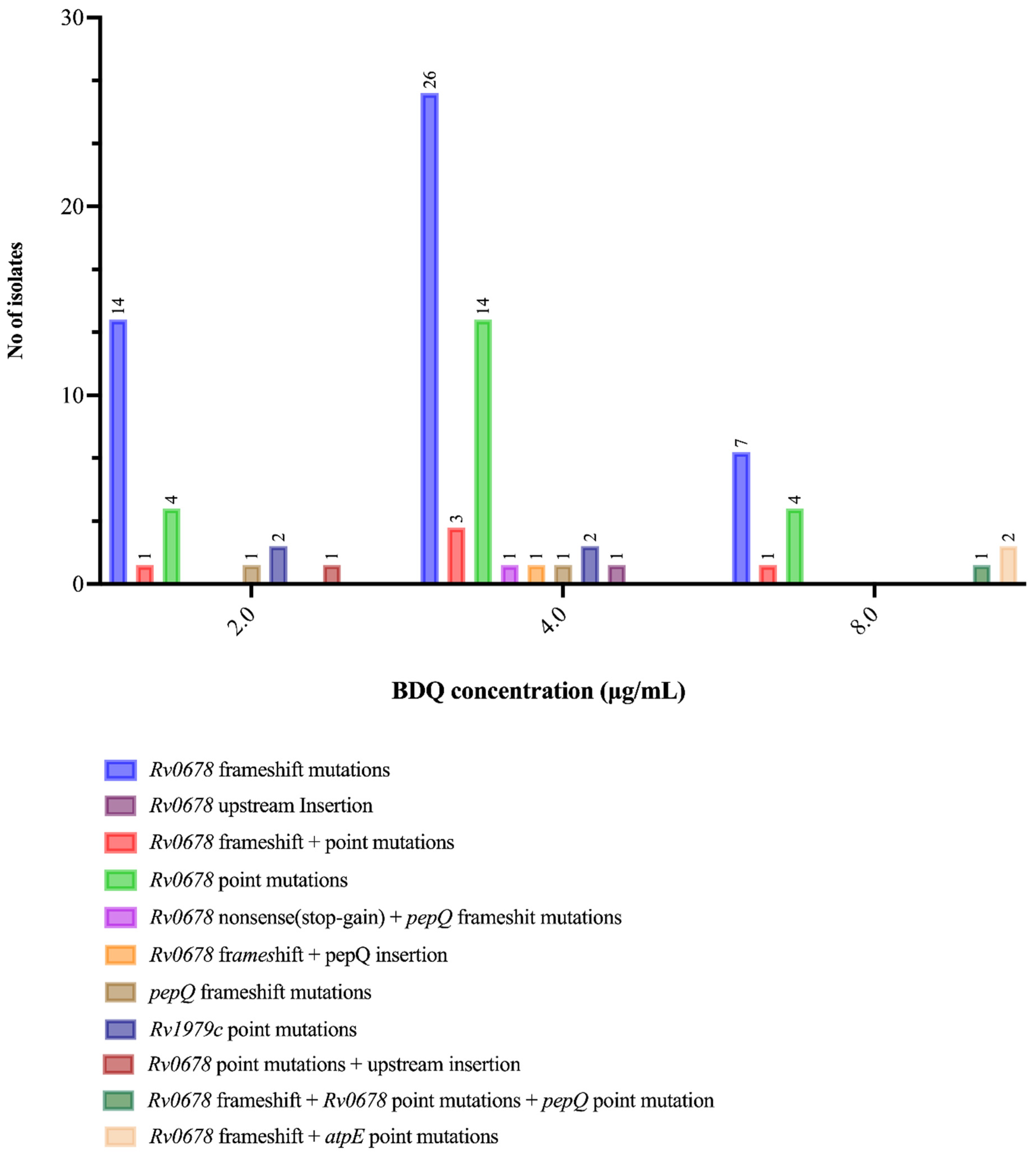
The distribution of BDQ MICs among the 88 phenotypically resistant isolates was mapped across concentrations ranging from 2.0 to 8.0 µg/mL (Figure 1 and Figure 2). Specifically, 23 (26.1%) isolates had an MIC of 2.0 µg/mL, 50 (56.8%) isolates (including the wild-type resistant isolate) had an MIC of 4.0 µg/mL, and 15 (17.1%) isolates had an MIC of 8.0 µg/mL. Distribution of BDQ MICs amongst phenotypically resistant isolates by genotypic profile (WHO-classified and noncanonical variants) in BDQ resistance-associated candidate genes is presented in Figure 1. Isolates with noncanonical potential RAVs had an MIC distribution of 4.0–8.0 µg/mL [interquartile range (IQR): 4.0–8.0 µg/mL], while WHO-classified potential RAVs had an MIC distribution of 2.0–8.0 µg/mL [IQR: 2.0–4.0 µg/mL]; both groups had a median of 4.0 µg/mL [IQR: 2.0–4.0 µg/mL]. No statistically significant difference was observed in the MIC distribution between groups (Mann–Whitney U, p = 0.9). Frameshift mutations in Rv0678 were the most common variants, occurring in 47/88 (53.4%) isolates, followed by point mutations, which occurred in 22 (25.0%) isolates (Figure 2).
Figure 2.
Bedaquiline phenotypically resistant isolates (n = 87) MIC distribution shown by type of mutation: frameshifts, point mutations, insertions, and nonsense.
Of the 88 isolates with BDQ phenotypic resistance, 86 (97.7%) were CFZ cross-resistant, and 2 (2.3%) remained susceptible to CFZ. Among the two isolates with BDQ phenotypic resistance and CFZ susceptibility, one had a variant in Rv0678 (Gly66Trp), and the other had dual variants in Rv0678 (Cys46fs and Asp47Glu). While there was no other isolate with the Gly66Trp variant, 3 other isolates with Cys46fs and Asp47Glu variants were resistant to CFZ.
3. Discussion
We found that potential BDQ RAVs are strong predictors of phenotypic resistance, achieving a sensitivity of 98.9% (95% CI: 93.8–99.8) and a PPV of 92.6% (95% CI: 85.4–96.4). This performance is exceptionally high compared to previous comprehensive analyses that have shown genomic sequencing of candidate genes yields a maximum sensitivity of 69% and a PPV of 14–26% for diagnosing clinical BDQ resistance [23]. Genomic methods have historically been considered insufficiently sensitive to serve as standalone diagnostic tools [23,27]. In contrast, our findings support the potential utility of genomic data in guiding the treatment of DR-TB in specific cohorts dominated by potentially highly fixed RAVs obtained using WGS. It has recently been shown that using WGS to select regimens achieves similar bacteriological and superior clinical efficacy compared to the standard of care [28]. Our findings provide locally contextualised genotypic-phenotypic mapping to support a change in practice in our setting where confirmatory pDST may no longer be required in the presence of variants restricted to Rv0678. This analysis demonstrates that, for novel drugs where genomic diagnostic sensitivity remains moderate, improving the understanding of the genetic basis underlying phenotypic resistance mechanisms is critical for future development of molecular methods and strengthening the clinical implementation and utility of sequencing methods [29].
Our genotypic profiling revealed that BDQ phenotypic resistance in 93% of isolates was driven by variants that were WHO-classified, with only 7% not classified. The second edition of the WHO mutation catalogue relies on highly conservative and rigorous statistical grading, achieving an overall sensitivity of only 49.4%. This conservative approach provides high confidence for the identified variants. The high proportion of phenotypically resistant isolates harbouring classified variants in our setting supports the idea that the current WHO catalogue may be sufficient in predicting phenotypic resistance in our clinical setting.
Our findings demonstrate that over 90% of phenotypic resistance to BDQ is attributable to mutations in the Rv0678 gene, with a smaller proportion exclusively linked to variants in the pepQ and Rv1979c genes. We identified a minor set of Rv0678 variants not currently included in the WHO catalogue of mutations, observed among isolates exhibiting phenotypic resistance. These variants showed a potential contribution to BDQ phenotypic resistance, though these finding still needs to be validated in other settings. Nonetheless, our findings are consistent with work by Steyn et al., where uncharacterised Rv0678 variants had a similar likelihood of being phenotypically resistant to BDQ regardless of inclusion in the catalogue [9]. The analysis of the unclassified variants was exploratory and should not be interpreted as a clinically validated diagnostic rule. One of the unclassified variants, Val1Leu, may contribute to BDQ phenotypic resistance since it disrupts the start codon, preventing transcription. However, since this mutation changes from GTG to TTG, a rare alternative start codon, transcription may still occur. Therefore, the functional impact of this mutation remains unclear, with no precise classification or categorization. We report unclassified BDQ RAVs in a minority of phenotypically susceptible isolates. Among these RAVs, c.-11C>A, an insertion upstream of Rv0678, has been reported to be associated with hypersensitivity to BDQ [6,13]. Furthermore, Rv0678 Met139Ile, which carries an uncertain significance classification, occurred in one of the susceptible isolates with an MIC of 1.0 μg/mL, while three other isolates with this mutation had MICs of >1.0 μg/mL.
Interestingly, we observed pepQ variants in five isolates. Three isolates harboured both a pepQ variant and an Rv0678 variant, with a 4-8-fold increase in BDQ MIC, while the remaining two isolates carried only a pepQ frameshift mutation (Val273fs) with a 2-4-fold increase in BDQ MIC. Mutations in the pepQ gene have been previously detected in phenotypically resistant isolates, suggesting a role in clinical resistance [20,30]. However, pepQ mutations are uncommon in clinical isolates. We also identified two isolates carrying both Rv0678 (Glu49fs) and atpE (Asp28Asn) variants conferring an 8-fold increase in BDQ MIC. Although the atpE variant is not yet classified in the WHO catalogue, it has previously been reported as being associated with BDQ susceptibility [31]. We also observed Rv1979c variants in four isolates, without concomitant mutations in other BDQ resistance candidate genes. These variants were associated with a 2-4-fold increase in BDQ MIC. Mutations in Rv1979c have been mostly associated with CFZ resistance; however, emerging evidence also implicates Rv1979c variants in BDQ resistance [11,18,32]. The variants observed in this study (Glu38Asp and Arg409Gln) have previously been documented with MICs below the CC for BDQ and CFZ resistance [16]. However, our data suggest that these Rv1979c variants may contribute to BDQ phenotypic resistance in clinical strains. Separate studies have also demonstrated an association between Rv1979c variants and BDQ phenotypic resistance [18,21]. Furthermore, one phenotypically resistant isolate exhibited an MIC of 4.0 μg/mL despite lacking mutation/s in any of the canonical candidate genes. A similar observation, where wild-type isolates were phenotypically resistant with MGIT MIC > 1.0 μg/mL, has been reported by Ismail and colleagues [18]. This genotype–phenotype discordance highlights the possibility that there may be uncharacterised or undetected mechanisms contributing to BDQ resistance [33]. Further investigation of phenotypically resistant, genotypically wild-type isolates is required, as they may provide an opportunity to identify novel resistance mechanisms. Although the PPV of the potential BDQ RAVs evaluated in this study was high, these findings should be carefully interpreted, as prevalence, distribution, and transmission of BDQ genetic variants, and their associated genetic backgrounds across geographic settings may result in nuanced genotypic-phenotypic relationships and therefore epidemiologically linked diagnostic performance.
A high proportion of isolates demonstrated cross-resistance between BDQ and CFZ, highlighting the widely described phenomenon and known shared mechanism of resistance [16,34,35]. The presence of rare cases in which discordances occur, specifically isolates that remain susceptible to CFZ despite BDQ resistance, suggests that the relationship between genotype and phenotype may be more complex than a single-mutation effect, requiring additional contextual factors to meaningfully elevate MICs.
To the best of our knowledge, this represents the first large-scale quantitative profiling of phenotypic BDQ resistance among Rv0678-mutated isolates within a single, contemporary, and highly characterized clinical cohort. Among this collection of phenotypically resistant isolates, we observed a range of BDQ MICs from 2.0 to 8.0 μg/mL, with 26% of isolates having a 2-fold increase in MICs (2.0 μg/mL) above the WHO-defined CC, 57% demonstrating a 4-fold increase in MICs (4.0 μg/mL), and 17% demonstrating an 8-fold increase in MICs (8.0 μg/mL), arising exclusively from the frameshift and substitution mutations in this collection of isolates. The BDQ MIC distribution in this cohort was characterized predominantly by modest 2- to 4-fold increases, notably lacking the high-level resistance (>8-fold) typically driven by target-based mutations [11,13,36,37,38]. Dose escalation has successfully overcome low- and intermediate-level resistance to drugs such as isoniazid and moxifloxacin [39] and may present a compelling clinical strategy for overcoming low-level BDQ resistance mediated by Rv0678. Modest elevation in MICs observed in this study does not imply that higher BDQ exposure would reliably overcome resistance; however, they do support efforts to explore BDQ dose optimization as a potential therapeutic strategy. Any consideration of optimised BDQ dosing in the presence of elevated BDQ MICs would require appropriate pharmacokinetic-pharmacodynamic evidence, and thorough safety and clinical evaluation. Currently, clinical evidence is limited, but modelling studies do suggest that higher BDQ exposure could improve bacterial clearance [13,40,41,42,43], highlighting the need for clinical trials evaluating the safety and efficacy of high-dose BDQ to establish whether this approach can overcome Rv0678-mediated efflux resistance and whether pipeline agents, such as DprE1 inhibitors, which share this exact cross-resistance vulnerability, can still be used effectively.
While we report one of the largest contemporary clinical datasets of BDQ-resistant isolates [7], our study has several limitations: the parent study focused on the transmission of MDR-TB and may have been enriched for additional resistance to FQs and/or aminoglycosides, potentially contributing to a narrow representation of a restricted number of circulating strains. However, we evaluated all clinical isolates from this cohort, which had systematic coverage of all second-line drug-resistant cases across a wide geographic region spanning over 90,000 km2 with a population of ~12 million people. The diagnostic performance of genotypic data reported in this study should be interpreted within the context of the parent study population, which selected Mtb isolates based on predefined criteria (RR/MDR-TB with additional resistance to fluoroquinolones or aminoglycosides). Consequently, these findings may not be readily generalizable to all populations or routine diagnostic settings, and further evaluation across diverse populations, resistance profiles, and laboratory settings is warranted. Treatment outcome data of participants that contributed isolates to the study are unknown, limiting our ability to correlate resistance amplification and treatment outcomes with phenotypic and genotypic data. We did not perform MIC measurements in replicates or in isolates with BDQ susceptibility and genotypic wild-type due to the labour intensity, costs, and infrastructure requirements associated with MIC experiments. However, we used standardised and validated methods under strict standard operating procedures within a well-established biosafety level 3 laboratory. Moreover, in all isolates, our MIC estimates were concordant with the overall phenotype of the isolate as determined by the national reference laboratory. Unlike previously published papers that showed a predominance of BDQ RAVs (up to 63%) driven by insertion or deletion mutants [18], only 3 of our isolates showed insertion mutations solely. It is important to note that insertion or deletion mutants often occur upstream of Rv0678 in susceptible isolates [18]. Additionally, traditional sequencing approaches can struggle to detect minority bacterial subpopulations (heteroresistance), which are common in Rv0678 and can lead to misclassification of the resistance phenotype. These limitations are mitigated in our study by the exceptionally high genotypic-phenotypic concordance observed, suggesting that the clinical isolates in our cohort possessed largely fixed, highly penetrant resistance mechanisms.
Even though our study is enriched for classified variants, the minority of unclassified variants suggest that novel resistance-associated variants are continuously emerging in clinical settings. Global scale-up of genotypic DST, alongside, not to the exclusion of, pDST testing, is required to continuously update the genotype–phenotype catalogues. Additionally, reference laboratories need to supplement the WHO mutation catalogue with newly identified variants of significance that are frequently observed within their specific epidemiologic context. While we support the use of intensified local genomic surveillance data to periodically update the WHO mutation catalogue, we highlight the need for concurrent phenotypic characterisation of newly identified variants to support understanding of their clinical and public relevance.
4. Methods and Materials
4.1. Study Design and Mtb Clinical Isolates Selection
This study was performed on stored Mtb clinical isolates obtained from participants enrolled in the CONTEXT study (BE059/18 & MOD002-IRB00098594), published elsewhere [7]. Briefly, CONTEXT was a population-based, prospective study of people with MDR-TB and second-line drug resistance [fluoroquinolones (FQs) and/or aminoglycosides] in KwaZulu-Natal, South Africa, from 2018 to 2022. In 2021, phenotypic testing was initiated for BDQ and CFZ at a critical concentration (CC) of 1.0 μg/mL for each drug, as per the WHO recommendation in MGIT [BACTEC™ MGIT 960™ (Becton, Dickinson and Company, Franklin Lakes, NJ, USA). All Mtb isolates enrolled in the CONTEXT study were shipped to the South African National Institute of Communicable Diseases for WGS.
This nested sub-study identified 651 Mtb isolates that had at least BDQ phenotypic testing at 1.0 μg/ml in MGIT and a valid genotypic profile (mutation read depth of ≥10), of which 442 had both phenotypic DST and WGS. Of the 442, 102 were BDQ phenotypically resistant, and 340 were phenotypically susceptible (Figure 3). Among 102 BDQ phenotypically resistant isolates, 14 were excluded: 6 were not found in the biorepository despite being in the database, 6 were contaminated, and 3 were mixed with mycobacteria other than tuberculosis. We finally included 428 Mtb isolates: 88 BDQ phenotypically resistant isolates contributed by 79 patients (i.e., 9 serial isolates: 7 individuals each contributed one serial isolate and one individual contributed 2 serial isolates). Among 340 BDQ phenotypically susceptible isolates, 338 patients contributed one isolate each, while one patient contributed a baseline and a serial isolate. All isolates with either (1) BDQ phenotypic resistance or (2) BDQ susceptibility but having variants in BDQ resistance candidate genes underwent BDQ MIC testing.
Figure 3.
The clinical Mtb isolates identified from the CONTEXT study database, screened and excluded, and the final number of isolates included in the final analysis and tested for BDQ MICs. Abbreviations: BDQ, bedaquiline; MIC, minimum inhibitory concentration; pDST, phenotypic drug susceptibility testing; RAV, resistance-associated variant. * Resistant to rifampicin and isoniazid with additional resistance to second-line drugs (fluoroquinolone or aminoglycoside); ¥ All isolates with at least one of BDQ phenotypic DST at a CC of 1.0 μg/mL or valid WGS (read depth of ≥10); ** Included 7 individuals who each contributed one serial isolate and one individual who contributed 2 serial isolates; † Included one individual who contributed 1 serial isolate; ‡ BDQ MIC testing was performed for all BDQ phenotypic resistant isolates and only 7 phenotypically susceptible isolates with potential BDQ RAVs.
4.2. Minimum Inhibitory Concentrations Testing
Bedaquiline powder was purchased from Merck Life Science (Pty) Ltd., Modderfontein, Johannesburg, South Africa, and was stored at −20 °C upon receipt. Stock concentrations to achieve final concentrations of 0.25, 0.5, 1.0, 2.0, 4.0 and 8.0 μg/mL in MGIT were made using dimethyl sulfoxide (Merck Life Science (Pty) Ltd., Modderfontein, Johannesburg, South Africa) and stored at −20 °C until use (not more than 6 months). Minimum inhibitory concentration testing and determination were performed using BACTEC™ MGIT 960™ (Becton, Dickinson and Company, Franklin Lakes, NJ, USA) within epicentre/TB Exist (Version 5.02A) as described previously [44,45,46,47]. Detailed methodology can be found in the Supplementary Material.
4.3. Whole Genome Sequencing Analysis
In the CONTEXT study, WGS for Mtb clinical isolates was conducted using the Illumina NextSeq platform (Illumina, Inc, San Diego, CA, USA) and Nextera DNA Flex Library Preparation kit (Illumina, Inc, San Diego, CA, USA). Raw sequencing reads were trimmed using Prinseq version 0.20.04, and non-Mtb (contaminant) reads were removed with Kraken [48,49]. The remaining reads were aligned to the H37Rv reference genome using BWA-MEM version 0.7.18 [50]. Single nucleotide polymorphisms (SNPs) with a read depth of ≥10 and an allele frequency of ≥0.7 were used to determine potential drug resistance-conferring mutations. Pilon version 1.24 was used to generate high-confidence variant calls from the resulting alignments, and variants within 50 base pairs of hypervariable PPE/PE gene families, repeat regions, and mobile elements [51,52]. We defined any mutation identified in the candidate genes (Rv0678, atpE, Rv1979c, and pepQ) as a potential BDQ RAV. We classified potential BDQ RAVs by referencing the WHO Mtb catalogue of mutations version 2: (1) associated with BDQ resistance, (2) associated with BDQ resistance interim, (3) uncertain significance, or (4) noncanonical potential RAVs (i.e., not classified).
5. Data Analysis
Diagnostic concordance between WGS–derived genotypic profiles and reference pDST for BDQ was assessed by cross-classifying isolates in a standard 2 × 2 contingency table. We reported sensitivity, specificity, PPV, NPV, and accuracy values. Sensitivity was defined as the proportion of phenotypically resistant isolates correctly identified by the presence of a potential BDQ RAV, while specificity was defined as the proportion of phenotypically susceptible isolates correctly identified as wild type. Overall diagnostic accuracy was calculated as the proportion of isolates correctly classified (true resistant and true susceptible) across the total analytic sample (N = 428). The estimated proportions for all the diagnostic performance metrics were accompanied by two-sided 95% confidence intervals (CIs), calculated using the Wilson score method. The distribution of BDQ MIC values was assessed for normality using the Shapiro–Wilk test. Because MIC values deviated significantly from normality, summary statistics are reported as medians with interquartile ranges (IQRs). The Mann–Whitney U test was then used to compare MIC distributions between isolates harbouring WHO-classified versus noncanonical (unclassified) potential BDQ RAVs. Statistical significance for all comparisons was defined as a two-sided p-value <0.05. All diagnostic accuracy metrics and confidence interval estimation were performed using R version 4.5.1 (R Foundation for Statistical Computing, Vienna, Austria) and GraphPad Prism version 10.6.0 (GraphPad Software, Boston, MA, USA).
6. Conclusions
In conclusion, our findings demonstrate a strong association between potential BDQ RAVs driven overwhelmingly by a diverse array of mutations throughout the Rv0678 gene and BDQ phenotypic resistance. These findings support the potential utility of genomic sequencing in predicting phenotypic BDQ resistance. We identified a range of WHO-classified and unclassified variants in the Rv0678, pepQ, and Rv1979c genes associated with elevated BDQ MICs. The minority of unclassified potential BDQ RAVs require further investigation in independent prospective cohorts in different geographical settings for global clinical translation evidence. These findings narrow the gap in our understanding of the genotypic–phenotypic correlations of BDQ resistance, a critical step toward the development of molecular diagnostic assays, the optimization of treatment strategies, and the prevention of further emergence of BDQ resistance. Integrating routine genomic surveillance with rapid phenotypic testing is imperative to guide the design of effective, personalized treatment regimens and to promptly interrupt the ongoing transmission of highly drug-resistant Mtb strains.
Supplementary Materials
The following supporting information can be downloaded at: https://www.mdpi.com/article/10.3390/antibiotics15111044/s1, Figure S1: Potential bedaquiline resistance-associated variants (BDQ RAVs) in the Rv0678 and associated minimum inhibitory concentrations (MICs). Dashed lines represent susceptible MICs, while solid lines represent resistant MICs, and variants associated with susceptible and resistant MICs are presented by dotted lines; Table S1: Diagnostic Performance of Potential BDQ RAV for Predicting Phenotypic Bedaquiline Resistance Using One Isolate Per Patient; Table S2: Classification of Potential BDQ RAV According to the WHO Mtb Catalogue of Mutations.
Author Contributions
Conceptualization, S.L.N., K.N. and R.P.; Methodology, S.L.N. and R.P.; Formal analysis, S.L.N., L.B.A., K.N. and R.P.; Investigation, S.L.N., K.N. and R.P.; Resources, K.N. and R.P.; Data curation, S.L.N., R.S., S.M., F.W., L.D., K.L., S.V.O., N.S.S. and B.M.; Writing—original draft, S.L.N., K.N. and R.P.; Writing—review and editing, S.L.N., R.S., L.B.A., K.L., N.S.S., B.M., N.R.G., K.N. and R.P.; Supervision, K.N. and R.P.; Funding acquisition, S.L.N., N.S.S., N.R.G., K.N. and R.P. All authors have read and agreed to the published version of the manuscript.
Funding
This study was funded by the European & Developing Countries Clinical Trials Partnership (EDCTP) Fellowships (TMA2018SF-2467), NIH National Institute of Allergy and Infectious Diseases (R01AI138646, P30AI168386, K24AI165099) and National Research Foundation Centre of Excellence (MND210624615487).
Institutional Review Board Statement
The CONTEXT study was approved by the University of KwaZulu-Natal Biomedical Research Committee (UKZN BREC) (BE059/18) and Emory University (MOD002-IRB00098594). This sub-study was approved by UKZN BREC (BREC/00005740/2023).
Informed Consent Statement
Informed consent was obtained from all subjects involved in the study.
Data Availability Statement
The original sequences data presented in this study are openly available at NCBI under accession number PRJNA1257273.
Acknowledgments
We acknowledge the CONTEXT study team at the CAPRISA Springfield Research site, study participants, the South African National Health Laboratory Service, the Centre for Tuberculosis, National and Supranational TB Reference Laboratory at the National Institute for Communicable Diseases, and the CAPRISA laboratory.
Conflicts of Interest
The authors declare no conflicts of interest.
References
- WHO. Global Tuberculosis Report 2025; WHO: Geneva, Switzerland, 2025; Available online: https://www.who.int/teams/global-programme-on-tuberculosis-and-lung-health/tb-reports/global-tuberculosis-report-2025 (accessed on 14 May 2026).
- WHO. Rapid Communication: Key Changes to the Treatment of Drug-Resistant Tuberculosis; WHO: Geneva, Switzerland, 2022; Available online: https://www.who.int/publications/i/item/WHO-UCN-TB-2022-2 (accessed on 25 June 2026).
- Conradie, F.; Diacon, A.H.; Ngubane, N.; Howell, P.; Everitt, D.; Crook, A.M.; Mendel, C.M.; Egizi, E.; Moreira, J.; Timm, J.; et al. Treatment of Highly Drug-Resistant Pulmonary Tuberculosis. N. Engl. J. Med. 2020, 382, 893–902. [Google Scholar] [CrossRef] [Scilit] [PubMed]
- Nyang’wa, B.-T.; Berry, C.; Kazounis, E.; Motta, I.; Parpieva, N.; Tigay, Z.; Solodovnikova, V.; Liverko, I.; Moodliar, R.; Dodd, M.; et al. A 24-week, all-oral regimen for rifampin-resistant tuberculosis. N. Engl. J. Med. 2022, 387, 2331–2343. [Google Scholar] [CrossRef] [Scilit] [PubMed]
- Diacon, A.H.; Pym, A.; Grobusch, M.P.; de Los Rios, J.M.; Gotuzzo, E.; Vasilyeva, I.; Leimane, V.; Andries, K.; Bakare, N.; De Marez, T.; et al. Multidrug-resistant tuberculosis and culture conversion with bedaquiline. N. Engl. J. Med. 2014, 371, 723–732. [Google Scholar] [CrossRef] [Scilit] [PubMed]
- Ismail, N.A.; Omar, S.V.; Moultrie, H.; Bhyat, Z.; Conradie, F.; Enwerem, M.; Ferreira, H.; Hughes, J.; Joseph, L.; Kock, Y.; et al. Assessment of epidemiological and genetic characteristics and clinical outcomes of resistance to bedaquiline in patients treated for rifampicin-resistant tuberculosis: A cross-sectional and longitudinal study. Lancet Infect. Dis. 2022, 22, 496–506. [Google Scholar] [CrossRef] [Scilit] [PubMed]
- Sobol, R.; Omar, S.V.; Brown, T.; Joseph, L.; Lutchminarian, K.; Tang, L.; Lan, Y.; Willis, F.; Campbell, A.; Warren, J.L.; et al. Transmission of Bedaquiline-resistant Mycobacterium tuberculosis in KwaZulu-Natal, South Africa. Am. J. Respir. Crit. Care Med. 2025, 212, 138–147. [Google Scholar] [CrossRef] [Scilit] [PubMed]
- Hu, X.; Wu, Z.; Lei, J.; Zhu, Y.; Gao, J. Prevalence of bedaquiline resistance in patients with drug-resistant tuberculosis: A systematic review and meta-analysis. BMC Infect. Dis. 2025, 25, 689. [Google Scholar] [CrossRef] [Scilit] [PubMed]
- Steyn, J.; Williams, J.; Naufal, F.; Limberis, J.; Grobbelaar, M.; Ismail, N.; Ghebrekristos, Y.; Opperman, C.J.; Nalyvayko, A.; Singh, S.; et al. Bedaquiline resistance in patients with Xpert MTB/RIF Ultra-tested rifampicin-resistant tuberculosis in the Western Cape, South Africa: A prospective study. Lancet Microbe 2026, 7, 101293. [Google Scholar] [CrossRef] [Scilit] [PubMed]
- Brown, T.S.; Tang, L.; Omar, S.V.; Joseph, L.; Meintjes, G.; Maartens, G.; Wasserman, S.; Shah, N.S.; Farhat, M.R.; Gandhi, N.R.; et al. Genotype–Phenotype Characterization of Serial Mycobacterium tuberculosis Isolates in Bedaquiline-Resistant Tuberculosis. Clin. Infect. Dis. 2023, 78, 269–276. [Google Scholar] [CrossRef] [Scilit] [PubMed]
- Kadura, S.; King, N.; Nakhoul, M.; Zhu, H.; Theron, G.; Köser, C.U.; Farhat, M. Systematic review of mutations associated with resistance to the new and repurposed Mycobacterium tuberculosis drugs bedaquiline, clofazimine, linezolid, delamanid and pretomanid. J. Antimicrob. Chemother. 2020, 75, 2031–2043. [Google Scholar] [CrossRef] [Scilit] [PubMed]
- Nguyen, T.V.A.; Anthony, R.M.; Bañuls, A.-L.; Nguyen, T.V.A.; Vu, D.H.; Alffenaar, J.-W.C. Bedaquiline resistance: Its emergence, mechanism, and prevention. Clin. Infect. Dis. 2018, 66, 1625–1630. [Google Scholar] [CrossRef] [Scilit] [PubMed]
- Andries, K.; Villellas, C.; Coeck, N.; Thys, K.; Gevers, T.; Vranckx, L.; Lounis, N.; de Jong, B.C.; Koul, A. Acquired resistance of Mycobacterium tuberculosis to bedaquiline. PLoS ONE 2014, 9, e102135. [Google Scholar] [CrossRef] [Scilit] [PubMed]
- Le Ray, L.F.; Aubry, A.; Sougakoff, W.; Revest, M.; Robert, J.; Bonnet, I.; Veziris, N.; Morel, F. atpE mutation in Mycobacterium tuberculosis not always predictive of bedaquiline treatment failure. Emerg. Infect. Dis. 2022, 28, 1062. [Google Scholar] [CrossRef] [Scilit] [PubMed]
- The CRyPTIC Consortium. Quantitative measurement of antibiotic resistance in Mycobacterium tuberculosis reveals genetic determinants of resistance and susceptibility in a target gene approach. Nat. Commun. 2024, 15, 488. [Google Scholar] [CrossRef] [Scilit] [PubMed]
- Nimmo, C.; Millard, J.; van Dorp, L.; Brien, K.; Moodley, S.; Wolf, A.; Grant, A.D.; Padayatchi, N.; Pym, A.S.; Balloux, F.; et al. Population-level emergence of bedaquiline and clofazimine resistance-associated variants among patients with drug-resistant tuberculosis in southern Africa: A phenotypic and phylogenetic analysis. Lancet Microbe 2020, 1, e165–e174. [Google Scholar] [CrossRef] [Scilit] [PubMed]
- WHO. Catalogue of Mutations in Mycobacterium Tuberculosis Complex and Their Association with Drug Resistance, 2nd ed.; WHO: Geneva, Switzerland, 2023; Available online: https://www.who.int/publications/i/item/9789240082410 (accessed on 17 January 2026).
- Ismail, N.; Rivière, E.; Limberis, J.; Huo, S.; Metcalfe, J.Z.; Warren, R.M.; Van Rie, A. Genetic variants and their association with phenotypic resistance to bedaquiline in Mycobacterium tuberculosis: A systematic review and individual isolate data analysis. Lancet Microbe 2021, 2, e604–e616. [Google Scholar] [CrossRef] [Scilit] [PubMed]
- Nimmo, C.; Millard, J.; Brien, K.; Moodley, S.; van Dorp, L.; Lutchminarain, K.; Wolf, A.; Grant, A.D.; Balloux, F.; Pym, A.S.; et al. Bedaquiline resistance in drug-resistant tuberculosis HIV co-infected patients. Eur. Respir. J. 2020, 55, 1902383. [Google Scholar] [CrossRef] [Scilit] [PubMed]
- Almeida, D.; Ioerger, T.; Tyagi, S.; Li, S.-Y.; Mdluli, K.; Andries, K.; Grosset, J.; Sacchettini, J.; Nuermberger, E. Mutations in pepQ confer low-level resistance to bedaquiline and clofazimine in Mycobacterium tuberculosis. Antimicrob. Agents Chemother. 2016, 60, 4590–4599. [Google Scholar] [CrossRef] [Scilit] [PubMed]
- Balgouthi, K.; AlMatar, M.; Saghrouchni, H.; Albarri, O.; Var, I. Mutations in Rv0678, Rv2535c, and Rv1979c confer resistance to bedaquiline in clinical isolates of mycobacterium tuberculosis. Curr. Mol. Pharmacol. 2024, 17, e18761429314641. [Google Scholar] [CrossRef] [Scilit] [PubMed]
- Dookie, N.; Ngema, S.L.; Perumal, R.; Naicker, N.; Padayatchi, N.; Naidoo, K. The Changing Paradigm of Drug-Resistant Tuberculosis Treatment: Successes, Pitfalls, and Future Perspectives. Clin. Microbiol. Rev. 2022, 35, e0018019. [Google Scholar] [CrossRef] [Scilit] [PubMed]
- Nimmo, C.; Bionghi, N.; Cummings, M.J.; Perumal, R.; Hopson, M.; Al Jubaer, S.; Naidoo, K.; Wolf, A.; Mathema, B.; Larsen, M.H.; et al. Opportunities and limitations of genomics for diagnosing bedaquiline-resistant tuberculosis: A systematic review and individual isolate meta-analysis. Lancet Microbe 2024, 5, e164–e172. [Google Scholar] [CrossRef] [Scilit] [PubMed]
- Ismail, N.A.; Omar, S.V.; Joseph, L.; Govender, N.; Blows, L.; Ismail, F.; Koornhof, H.; Dreyer, A.W.; Kaniga, K.; Ndjeka, N. Defining Bedaquiline Susceptibility, Resistance, Cross-Resistance and Associated Genetic Determinants: A Retrospective Cohort Study. EBioMedicine 2018, 28, 136–142. [Google Scholar] [CrossRef] [Scilit] [PubMed]
- Agarwal, A.; Kumar, N.; Kishore, K. Evaluation of manual Mycobacterium growth indicator tube for isolation and susceptibility testing of Mycobacterium tuberculosis for implementation in low and medium volume laboratories. Med. J. Armed Forces India 2018, 74, 220–226. [Google Scholar] [CrossRef] [Scilit] [PubMed]
- Kowalska-Krochmal, B.; Dudek-Wicher, R. The Minimum Inhibitory Concentration of Antibiotics: Methods, Interpretation, Clinical Relevance. Pathogens 2021, 10, 165. [Google Scholar] [CrossRef] [Scilit] [PubMed]
- Vīksna, A.; Sadovska, D.; Berge, I.; Bogdanova, I.; Vaivode, A.; Freimane, L.; Norvaiša, I.; Ozere, I.; Ranka, R. Genotypic and phenotypic comparison of drug resistance profiles of clinical multidrug-resistant Mycobacterium tuberculosis isolates using whole genome sequencing in Latvia. BMC Infect. Dis. 2023, 23, 638. [Google Scholar] [CrossRef] [Scilit] [PubMed]
- Van Rie, A.; Conceição, E.C.; Ndebele, F.; Wells, F.; Paulse, A.; Mekonnen, E.G.; Ngarega, M.; Trang, T.P.H.; Bohlela, S.; Sibeko, Z.; et al. Whole genome sequencing precision medicine strategy to shorten treatment for rifampicin-resistant tuberculosis (SMARTT): A pragmatic, randomised, single-blind phase 4 trial. Lancet Respir. Med. 2026, 14, 521–532. [Google Scholar] [CrossRef] [Scilit] [PubMed]
- Adlard, D.; Joseph, L.; Webster, H.; O’Reilly, A.; Knaggs, J.; Peto, T.E.; Crook, D.W.; Omar, S.V.; Fowler, P.W. An improved catalogue for whole-genome sequencing prediction of bedaquiline resistance in Mycobacterium tuberculosis using a reproducible algorithmic approach. Microb. Genom. 2025, 11, 001429. [Google Scholar] [CrossRef] [Scilit] [PubMed]
- Richard-Greenblatt, M.; Bagga, R.; Duncan, C.; Billick Maxime, J.; Song, H.; Sabur Natasha, F.; Escuyer, V.; Lam, K.; Brode, S.K. Acquisition of bedaquiline and clofazimine resistance in association with a novel loss-of-function mutation in the pepQ gene during treatment of multidrug-resistant tuberculosis. ASM Case Rep. 2025, 2, e00126-25. [Google Scholar] [CrossRef] [Scilit] [PubMed]
- Zimenkov, D.V.; Nosova, E.Y.; Kulagina, E.V.; Antonova, O.V.; Arslanbaeva, L.R.; Isakova, A.I.; Krylova, L.Y.; Peretokina, I.V.; Makarova, M.V.; Safonova, S.G.; et al. Examination of bedaquiline-and linezolid-resistant Mycobacterium tuberculosis isolates from the Moscow region. J. Antimicrob. Chemother. 2017, 72, 1901–1906. [Google Scholar] [CrossRef] [Scilit] [PubMed]
- Xu, J.; Wang, B.; Hu, M.; Huo, F.; Guo, S.; Jing, W.; Nuermberger, E.; Lu, Y. Primary Clofazimine and Bedaquiline Resistance among Isolates from Patients with Multidrug-Resistant Tuberculosis. Antimicrob. Agents Chemother. 2017, 61, e00239-17. [Google Scholar] [CrossRef] [Scilit] [PubMed]
- Roberts, L.W.; Malone, K.M.; Hunt, M.; Joseph, L.; Wintringer, P.; Knaggs, J.; Crook, D.; Farhat, M.R.; Iqbal, Z.; Omar, S.V. MmpR5 protein truncation and bedaquiline resistance in Mycobacterium tuberculosis isolates from South Africa: A genomic analysis. Lancet Microbe 2024, 5, 100847. [Google Scholar] [CrossRef] [Scilit] [PubMed]
- Shang, Y.; Chen, S.; Shi, W.; Nie, W.; Jing, W.; Huo, F.; Xue, Y.; Dong, L.; Jiang, G.; Huang, H.; et al. Bedaquiline resistance pattern in clofazimine-resistant clinical isolates of tuberculosis patients. J. Glob. Antimicrob. Resist. 2023, 33, 294–300. [Google Scholar] [CrossRef] [Scilit] [PubMed]
- Nimmo, C.; Ortiz, A.T.; Tan, C.C.; Pang, J.; Acman, M.; Millard, J.; Padayatchi, N.; Grant, A.D.; O’dOnnell, M.; Pym, A.; et al. Detection of a historic reservoir of bedaquiline/clofazimine resistance-associated variants in Mycobacterium tuberculosis. Genome Med. 2024, 16, 34. [Google Scholar] [CrossRef] [Scilit] [PubMed]
- Villellas, C.; Coeck, N.; Meehan, C.J.; Lounis, N.; de Jong, B.; Rigouts, L.; Andries, K. Unexpected high prevalence of resistance-associated Rv0678 variants in MDR-TB patients without documented prior use of clofazimine or bedaquiline. J. Antimicrob. Chemother. 2017, 72, 684–690. [Google Scholar] [CrossRef] [Scilit] [PubMed]
- Hartkoorn, R.C.; Uplekar, S.; Cole, S.T. Cross-resistance between clofazimine and bedaquiline through upregulation of MmpL5 in Mycobacterium tuberculosis. Antimicrob. Agents Chemother. 2014, 58, 2979–2981. [Google Scholar] [CrossRef] [Scilit] [PubMed]
- Pym, A.S.; Diacon, A.H.; Tang, S.-J.; Conradie, F.; Danilovits, M.; Chuchottaworn, C.; Vasilyeva, I.; Andries, K.; Bakare, N.; De Marez, T.; et al. Bedaquiline in the treatment of multidrug-and extensively drug-resistant tuberculosis. Eur. Respir. J. 2016, 47, 564–574. [Google Scholar] [CrossRef] [Scilit] [PubMed]
- Walsh, K.F.; Vilbrun, S.C.; Souroutzidis, A.; Delva, S.; Joissaint, G.; Mathurin, L.; Ocheretina, O.; Cremieux, P.; Pape, J.W.; Koenig, S.P. Improved outcomes with high-dose isoniazid in multidrug-resistant tuberculosis treatment in Haiti. Clin. Infect. Dis. 2019, 69, 717–719. [Google Scholar] [CrossRef] [Scilit] [PubMed]
- Lounis, N.; Gevers, T.; Villellas, C.; Andries, K. Mice infected with M. tuberculosis with Rv0678 mutations still benefit from bedaquiline treatment. IJTLD Open 2024, 1, 525–527. [Google Scholar] [CrossRef] [Scilit] [PubMed]
- Peterka, M.; Krieger, D.; Khatamzas, E.; Denkinger, C.M.; Köhler, N.; Lange, C.; Macholz, M.; Lübbert, C.; Daller, S.; Knappik, M.; et al. Safety of high dose bedaquiline treatment in patients with extensively drug-resistant tuberculosis. Eur. Respir. J. 2025, 67, 2501496. [Google Scholar] [CrossRef] [Scilit] [PubMed]
- Tanneau, L.; Karlsson, M.O.; Svensson, E.M. Understanding the drug exposure–response relationship of bedaquiline to predict efficacy for novel dosing regimens in the treatment of multidrug-resistant tuberculosis. Br. J. Clin. Pharmacol. 2020, 86, 913–922. [Google Scholar] [CrossRef] [Scilit] [PubMed]
- Svensson, E.M.; Karlsson, M.O. Modelling of mycobacterial load reveals bedaquiline’s exposure–response relationship in patients with drug-resistant TB. J. Antimicrob. Chemother. 2017, 72, 3398–3405. [Google Scholar] [CrossRef] [Scilit] [PubMed]
- Lempens, P.; Meehan, C.J.; Vandelannoote, K.; Fissette, K.; de Rijk, P.; Van Deun, A.; Rigouts, L.; de Jong, B.C. Isoniazid resistance levels of Mycobacterium tuberculosis can largely be predicted by high-confidence resistance-conferring mutations. Sci. Rep. 2018, 8, 3246. [Google Scholar] [CrossRef] [Scilit] [PubMed]
- Machado, D.; Perdigão, J.; Portugal, I.; Pieroni, M.; Silva, P.A.; Couto, I.; Viveiros, M. Efflux Activity Differentially Modulates the Levels of Isoniazid and Rifampicin Resistance among Multidrug Resistant and Monoresistant Mycobacterium tuberculosis Strains. Antibiotics 2018, 7, 18. [Google Scholar] [CrossRef] [Scilit] [PubMed]
- Perumal, R.; Khan, A.; Naidoo, K.; Ngema, S.L.; Nandlal, L.; Padayatchi, N.; Dookie, N. Mycobacterium tuberculosis Intra-Host Evolution Among Drug-Resistant Tuberculosis Patients Failing Treatment. Infect. Drug Resist. 2023, 16, 2849–2859. [Google Scholar] [CrossRef] [Scilit] [PubMed]
- Ngema, S.; Dookie, N.; Perumal, R.; Nandlal, L.; Naicker, N.; Peter Letsoalo, M.; O′DOnnell, M.; Khan, A.; Padayatchi, N.; Naidoo, K. Isoniazid resistance-conferring mutations are associated with highly variable phenotypic resistance. J. Clin. Tuberc. Other Mycobact. Dis. 2023, 33, 100387. [Google Scholar] [CrossRef] [Scilit] [PubMed]
- Schmieder, R.; Edwards, R. Quality control and preprocessing of metagenomic datasets. Bioinformatics 2011, 27, 863–864. [Google Scholar] [CrossRef] [Scilit] [PubMed]
- Wood, D.E.; Salzberg, S.L. Kraken: Ultrafast metagenomic sequence classification using exact alignments. Genome Biol. 2014, 15, R46. [Google Scholar] [CrossRef] [Scilit] [PubMed]
- Li, H.; Durbin, R. Fast and accurate short read alignment with Burrows–Wheeler transform. Bioinformatics 2009, 25, 1754–1760. [Google Scholar] [CrossRef] [Scilit] [PubMed]
- Walker, B.J.; Abeel, T.; Shea, T.; Priest, M.; Abouelliel, A.; Sakthikumar, S.; Cuomo, C.A.; Zeng, Q.; Wortman, J.; Young, S.K.; et al. Pilon: An integrated tool for comprehensive microbial variant detection and genome assembly improvement. PLoS ONE 2014, 9, e112963. [Google Scholar] [CrossRef] [Scilit] [PubMed]
- Eldholm, V.; Monteserin, J.; Rieux, A.; Lopez, B.; Sobkowiak, B.; Ritacco, V.; Balloux, F. Four decades of transmission of a multidrug-resistant Mycobacterium tuberculosis outbreak strain. Nat. Commun. 2015, 6, 7119. [Google Scholar] [CrossRef] [Scilit] [PubMed]

Disclaimer/Publisher’s Note: The statements, opinions and data contained in all publications are solely those of the individual author(s) and contributor(s) and not of MDPI and/or the editor(s). MDPI and/or the editor(s) disclaim responsibility for any injury to people or property resulting from any ideas, methods, instructions or products referred to in the content. |
© 2026 by the authors. Licensee MDPI, Basel, Switzerland. This article is an open access article distributed under the terms and conditions of the Creative Commons Attribution (CC BY) license.