


Abstract
Two decades after the first bold proclamations that nanomedicine would deliver “magic-bullet” therapies capable of cell-level targeting, the field stands at a crossroads. While some initial promises (improved delivery of poorly water-soluble drugs and enhanced efficacy and biocompatibility of nano-based devices) have been fulfilled, other early promises (active targeting, biodegradability, multifunctionality, triggered responses, real-time data output, and implantable sensors) remain only partially realized. This article will compare the properties of approved nano-based products to those of the ideal products, assess the shortcomings of existing nano-based products, and discuss critical issues in nanotoxicity (biodistribution and protein corona effects, immune interactions, and biopersistence) and the lack of data on product and end-of-life life cycle analyses. The role of in silico tools in the various steps of nanodrug and nano-based device development and manufacturing—areas in which these tools are the most established (nanocarrier design, prediction of cellular effects, chemical composition optimization, manufacturing, and signal interpretation)—is also addressed. Future goals include biodegradable targeted delivery systems, better tissue integration of implants, and implantable sensors. It is expected that, alongside careful physicochemical characterization of the nanoproduct, toxicity testing focused on nano-specific effects and life cycle analyses of production and end-of-life phases will facilitate the approval of nano-based products.
1. Introduction
The term “nanotechnology” was coined in 1974 by Norio Taniguchi to describe fabrication and control of matter at the atomic scale. K. Eric Drexler later popularized medical applications of nanotechnology in Engines of Creation (1986) [1]. Journals dedicated to nanoparticle research emerged in the 1990s (e.g., Advanced Materials) and expanded substantially in the early 2000s (e.g., Nano Letters, Nature Nanotechnology, International Journal of Nanoscience, Journal of Nanobiotechnology, Nanotechnology, Science and Applications, Nanomaterials), driven largely by academic work on medical nanoparticles [2]. The 15th anniversary of Nanomaterials provides a timely opportunity to compare early expectations for medical nanomaterials with products that have ultimately been approved.
Nanomedicines are medical products specifically formulated using nanotechnology tools and/or nanoscale materials for the prevention or treatment of human disease. They include nanodrugs and nano-enabled medical devices. A nanodrug can be defined as a therapeutic product in which nanotechnology is an integral part of the medicinal formulation or delivery system, and whose nanoscale properties materially affect the drug’s behavior (pharmacokinetics, biodistribution, stability, cellular uptake, or release). A nano-enabled device is a medical device whose function, performance, safety, or usability relies on engineered nanomaterials or nanoscale structures. The device may be diagnostic, therapeutic, or supportive. The types of nanoparticles used in devices typically differ from those used in drug products; drug formulations generally employ soft, biodegradable particles, whereas nano-enabled medical devices often contain non-biodegradable materials such as silver, gold, iron oxide, titanium, and hydroxyapatite [3].
The following text intends to provide a general overview of the development of nanoparticle-based medical products, including nanotoxicity and life cycle analysis (LCA), over the last 10-20 years. Individual underlying mechanisms are not discussed in detail.
2. Dreams and Reality in Nanomedicine
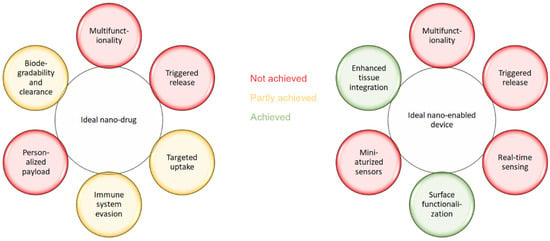
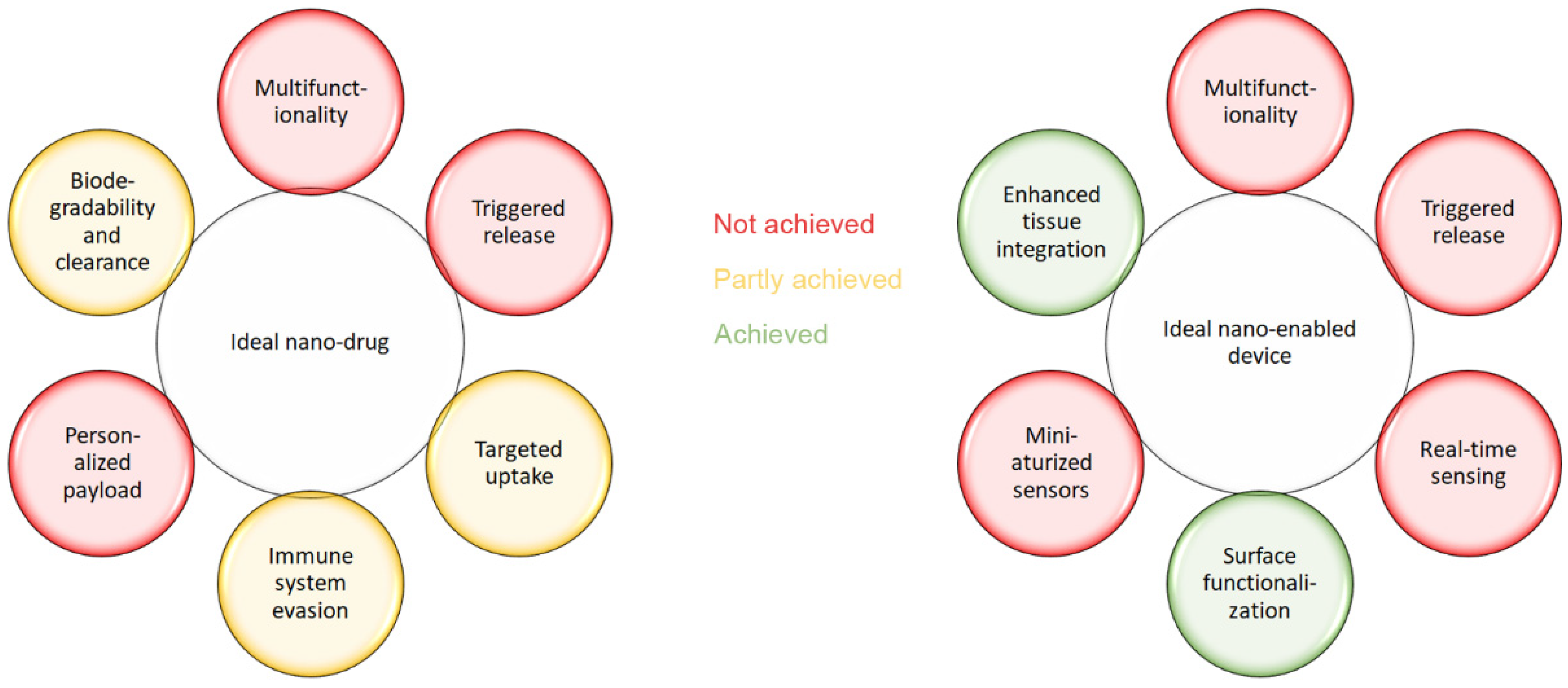
Early visions of nanoparticles in medicine imagined autonomous nanorobots patrolling the bloodstream, machines that repair DNA or mitochondria, in-body nanofactories synthesizing drugs on demand, nanoscale mechanical actuators, Global Positioning System (GPS) tracking of individual particles, or targeted uptake of theranostic particles for personalized treatment and recording of therapeutic efficacy [4]. Reality has followed a different path. Figure 1 compares early expectations with Food and Drug Administration (FDA)-approved nanomedicines and shows that some goals, e.g., triggered release and multifunctionality, could not be realized for both nanodrugs and nano-enabled devices.
Figure 1.
Color-coded parameters of ideal nanoproducts that were achieved (green), partially achieved (yellow), or not achieved (red).
2.1. Nanodrugs
Expectations for nanodrugs included longer circulation times, stabilization of labile drugs, improved targeting, reduced off-target toxicity, and controlled release. Although the protection of labile molecules and delivery of higher payloads with lower systemic toxicity were achieved, other goals proved to be more difficult than anticipated. Table 1 compares the features of ideal and FDA-approved products.
Table 1.
Comparison of ideal and FDA-approved nanodrugs. Parameters achieved in FDA-approved products are indicated in green, and missing parameters in red. Abbreviation: EPR, enhanced permeability and retention; PEG, polyethylene glycol.
Passive targeting via the enhanced permeability and retention (EPR) effect was thought to be sufficient for tumor targeting. In practice, EPR is highly variable between patients; reticuloendothelial system (RES) clearance is high, and tumor accumulation is often poor [5]. Active targeting (“magic bullets”) also underperformed in the clinic because of protein corona formation, heterogeneity of tumor markers, and limited in vivo targeting efficacy [6]. Stimuli-responsive “smart” nanoparticles are under development but face challenges from complex designs that can reduce in vivo stability and complicate regulatory approval [7].
The differences between idealized concepts and FDA-approved products are due to biological and pharmaceutical constraints. Access to organs—or to individual cells within tissues—is restricted by particle size, whereby particles may be too large to reach the intended target [8]. Furthermore, production proved more complex than anticipated. The requirements for reproducible purity, identity, and potency were more difficult to meet for nanodrugs, and the increased manufacturing complexity made scaling up more challenging and more costly. It also turned out that stability and shelf life are more critical for nanodrugs than for conventional drugs. Demonstrating product reproducibility, homogeneity, and stability created challenges for regulatory agencies reviewing such applications and issuing specific guidelines [9]. Drug release and carrier degradation proved to be less predictable than for conventional drugs. This is because nanoparticles adsorb macromolecules (e.g., protein corona), which can mask and modify release behavior [10]. Furthermore, release may occur at different locations—extracellularly or intracellularly (endosomes, lysosomes, cytosol). Tracking nanocarrier degradation is also difficult because multiple mechanisms are involved and the biological environment (pH, enzymes, reactive oxygen species (ROS) levels, protein corona) influences outcomes [11]. Small changes in formulation can have pronounced effects on nanocarrier degradation. Unanticipated immune responses, such as complement activation-related pseudoallergy (CARPA), present toxicological challenges. Moreover, the long-term toxicity of many inorganic nanoparticles remains uncertain [12]. High costs and only modest advantages over conventional therapies have further slowed the broad replacement of traditional drugs by nanodrugs [13]. Finally, clinical trial design—including patient selection and biomarkers—has had to be adapted for nanodrugs.
Although the originally envisioned multifunctional nanodrugs are not widely available, key goals have been achieved: reduced toxicity, fewer off-target effects, and increased stability and bioavailability. Although theranostic nanoparticles are not available, 99mTc-labeled sulfur colloid, albumin colloid, SnF2 and Re2S7 colloids, and iron oxide nanoparticles are used in clinical practice [14]. Clearance of nanodrugs by the RES was reduced by functionalization with polyethylene glycol (PEG).
2.2. Nano-Enabled Devices
Physical and biological constraints make the original vision of autonomous in vivo nanorobots impractical today. Key obstacles include biocompatibility (e.g., thrombosis risk), immunogenicity [15], propulsion limitations (chemical fuels such as H2O2 are unsuitable in vivo), and complex navigation in viscous fluids and tortuous vessels. Removal from the body (retrieval, biodegradation, or excretion) and good manufacturing practice (GMP)-compliant manufacture of billions of tiny devices with consistent performances are also major challenges [16].
From the production side, predominantly, insufficient stability against sterilization and cleaning poses problems that contribute to the failure of nano-enabled devices in clinical practice [17]. A particular issue for nano-enabled devices may be the nanowaste generated during mass production of medical devices [18]. Toxicity issues may arise when nanoparticles leaching from devices enter surrounding tissue or the systemic circulation. This is relevant for nanosensors, which may contain carbon-based nanoparticles such as graphene and carbon dots, whose cytotoxicity is less well established than that of nanocarriers [19].
Regulatory classification (drug/device/biologic/combination), trial design, informed consent, privacy (if sensing), and environmental release concerns further complicate translation.
An example of the unclear situation are iron oxide nanoparticles, which can be classified either as a “nanodrug” or as a “nano-enabled device.” When injected for imaging, they are regulated as nanodrugs; however, if they are used as an antimicrobial coating, they would be treated as a device.
Nevertheless, progress has been made: adding nanoparticles to medical devices has improved biocompatibility, reduced implant-associated infections, enhanced surface properties, and enabled capabilities such as targeted drug release and biosensing [20].
3. Marketed Nano-Enabled Products
Despite intense research activity, relatively few nanoparticle-containing products are on the market. Most approved nanodrugs are in oncology: among drugs approved for cancer from 1998 to 2022, 15 of 198 were nanodrugs [21]. These are mainly liposomal formulations, both PEGylated and non-PEGylated; inorganic and polymeric nanoparticles are less common [22]. Nanodrugs do not fail at markedly higher rates overall compared with conventional drugs: the phase-1-to-approval success rate in oncology nanomedicine was 7% (2008–2020) [23], compared with a 3.4% overall approval likelihood for conventional drugs (2000–2015), and 11.4% for the lead indication [24]. However, causes of failure differ: nanodrugs most often fail for lack of efficacy, whereas conventional drugs commonly fail because of off-target toxicity or a lack of effect [25]. Regulatory approval of nanodrugs is often more complex because manufacturing requires extensive characterization (size, polydispersity, surface chemistry, encapsulation efficiency, release kinetics, stability) and detailed absorption, distribution, metabolism and excretion (ADME) testing due to altered circulation times and immunogenicity risks [26].
Although lessons from one nanoparticle class do not always transfer to others, general design principles for optimal nanoparticles can be illustrated by nab-paclitaxel (Abraxane) [9]: (i) a narrow size distribution in a specific range (~130 nm) avoids rapid renal and mononuclear phagocyte system (MPS) clearance; (ii) near-neutral or slightly negative surface charge minimizes aggregation; (iii) non-covalent payload binding enables drug release; and (iv) amorphous drug incorporation increases apparent solubility. Abraxane underwent extensive process optimization to ensure reproducibility. Yet, since Abraxane’s approval in 2005, no second-generation albumin or protein nanoparticles have been widely approved. Protein nanocarriers face additional translation challenges—batch variability, sensitivity of protein conformation to pH/temperature/ionic strength, potential immunogenicity (even from human proteins), purification difficulties for recombinant proteins, instability during sterilization, and costly cold-chain storage.
Approved nano-enabled devices are mainly surface coatings and sensors. Nanotechnology has improved antibacterial properties, cellular responses, and electrical interfaces, particularly for local applications such as wound dressings and implants. In contrast to nanodrugs, there was no single “first uses”; rather, nanotechnology has driven gradual improvements to existing devices, and this process is still ongoing [27]. Device approval is often easier than drug approval because local action reduces systemic exposure, and device safety is guided by standardized tests (e.g., ISO 10993) and established biocompatibility endpoints [28]. Manufacturing and characterization are thus often less complex than for nanodrugs.
4. Types of Nanoparticles in Medicine
Recent reviews differ in the count of approved products, dependent on search methods, in the database clinicaltrials.gov. One review categorized 19 lipid-based, 17 polymeric + 2 protein-based, 15 nanocrystals, and 10 inorganic nanoparticles [29]; another listed 27 lipid-based, 27 polymeric, 25 nanocrystals, and 12 inorganic nanoparticles [30]. By 2025, roughly 91 approved nano-based products were on the market, compared to 1099 drugs approved by the FDA since 1995 (the year of the first approved nanodrug) [31,32].
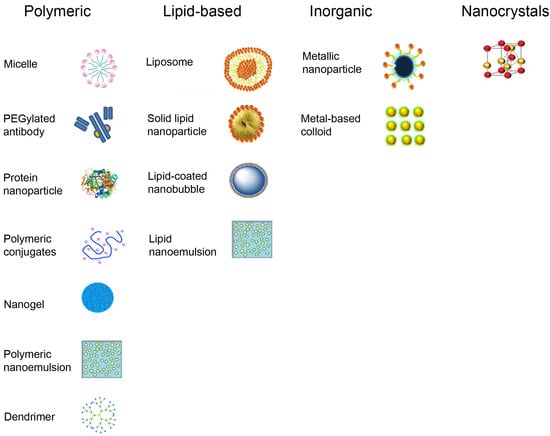
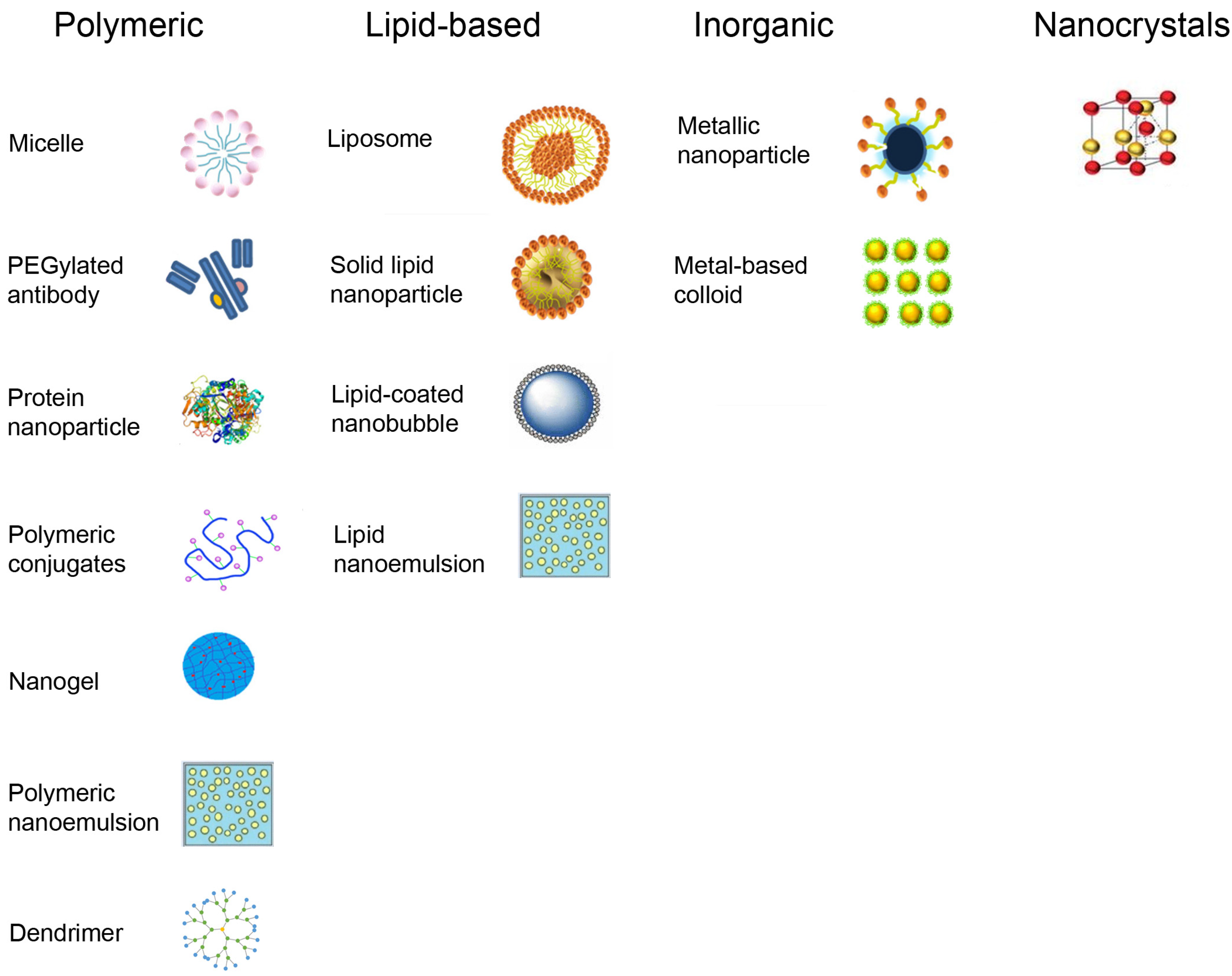
Approved nanodrugs comprises protein nanoparticles, polymeric conjugates, polymeric micelles, PEGylated formulations, polymeric nanogels, copolymeric nanospheres, and nanoemulsions (Figure 2). Inorganic nanoparticles include iron-based agents, hafnium oxide, silver, and metal-based colloids for imaging. Nanocrystals have been made from diverse compounds (fenofibrate, dantrolene sodium, methylphenidate hydrochloride, naproxen sodium, paliperidone palmitate, cabotegravir, and others).
Figure 2.
Types of nanoparticles found in approved nanodrugs and in nano-enabled medical devices.
FDA-approved nano-enabled devices contain silver, silica, zirconia, titanium, and hydroxyapatite nanoparticles [20] and are used in orthopedics, cardiovascular, and neurological devices. Ex vivo nanosensors generally contain gold nanoparticles.
5. Administration Routes
In 2020, most approved nanodrugs were administered by injection (IV 44%, IM 8%, SC 15%), with only ~15% oral [33]. By contrast, small-molecule drugs were predominantly oral (~60% in 2016) [34]. Similar data were reported for 2017 with 62% of drugs administered in oral form and 22% by injection, 8.7% cutaneous, 5% mucosal (buccal, sublingual, rectal, vaginal, ocular), and 1% by inhalation [35]. The main indication was in oncology, where IV administration is common; 61% of medications in the year 2020 were IV [36]. Oral nanodrugs are increasing due to patient convenience, and lipid-based carriers are adaptable to various routes (e.g., pulmonary Arikayce, ocular nanomicelles and nanoemulsions such as Cequa and Restasis, dermal nanoemulsions and nadosomes such as Ameluz) [37]. Lipid emulsions for oral use (e.g., Neoral) are not labeled as nanodrugs because they form colloids in the gut, rather than delivering preformed, stable nanoparticles to the systemic circulation. Nanocrystals show promise for oral use and IV administration because of favorable dissolution, lack of harsh solvents in manufacture, and manageable clearance; approved oral nanocrystal products include Rapamune, Emend, and Megace ES [38].
6. Key Achievements in Nanomedicine
6.1. Nanodrugs
Initially dominated by lipid-based carriers for small molecules, the range of clinically available nanoparticles now includes also biologic payloads [39,40]. Table 2 lists drugs, their descriptions, and indications, including also antibody conjugates that not all researchers have classified as nanodrugs [41].
Table 2.
Nano-based products used in the clinic. Years in brackets indicate the year of approval by the FDA. Abbreviation: AB, antibody; ATTR, Transthyretin amyloidosis; PEG, polyethylene glycol.
Nanodrugs, which have either lead to the development of more efficient products or advanced the understanding in the action of nanomedicines [30,42,43]:
- Adagen: first PEG-conjugated biologic providing reduced immunogenicity [44].
- Doxil (PEGylated liposomal doxorubicin): a first demonstration of stable encapsulation and improved tolerability [45].
- AmBisome: an amphotericin B liposomal formulation emphasizing stability and sterility [46].
- Mylotarg: increased efficacy by active targeting [47].
- Rapamune: improved oral bioavailability of the drug [48].
- Zevalin: improved radiation efficacy by active targeting [49].
- Abraxane: a solvent-free, albumin-bound formulation of paclitaxel [9,50].
- Ferumoxytol: first inorganic nanoparticle highlighting clearance and hypersensitivity concerns [51].
- Vyxeos: the first liposomal co-delivery formulation requiring controlled co-encapsulation ratios [42].
- Onpattro: the first clinical nanoparticle delivery of siRNA, underscoring biologic integrity and immunotoxicity concerns [42].
- mRNA lipid nanoparticle vaccines for coronavirus disease 2019 (COVID-19): demonstrated large scale GMP production, cold chain logistics, sequence integrity testing, and control of lipid impurities [42].
- Cabenuva: long-acting i.m. injectable product [52].
6.2. Nano-Enabled Devices
Nanosilver has been pivotal in antibacterial coatings for wound dressings (e.g., Acticoat), and in some dental and orthopedic products (e.g., Aquacel). Demonstrating controlled local release at efficacious, non-cytotoxic levels was key to approval [53]. Implants required additional focus on osseointegration and mechanical stability, and indwelling catheter coatings had to satisfy hemocompatibility requirements [54]. Silver coatings have been used for endotracheal tubes, intravenous catheters, urinary catheters, and surgical meshes; several products exist in these categories.
In addition to the first products of each kind as listed in Table 2, numerous products are available on the market as orthopedic, dental, and cardiovascular implants. They possess nanostructured surfaces and consist of titanium (Adaptix Interbody System, CON-DUIT, EIT Cellular Titanium), hydroxyapatite (Curiteva Porous PEEK Cervical Interbody Fusion System, Nanotite Dental Implants), silica and zirconia (Filtek Universal Restorative), ceramic nanohybrid resin composites (Pac-Dent Ceramic Nanohybrid Resin, Renamel NANO Plus), and polymer (COBRA PzF NanoCoated Coronary Stent System). More products are listed by Ma et al. [55]. The paclitaxel-coated balloon catheter uses drug-loaded nanoparticles (paclitaxel) on a device acting as a localized therapeutic delivery system [56].
Nano-enabled devices, which lead to the significant improvement of existing products:
- Colloidal gold-based test systems: markedly increased sensitivity [57].
- Silver-containing wound dressings: improved efficacy in wound and infection healing [53].
- Silver-coating of implants: improved antimicrobial effect [54].
- nanoLOCK: better osteogenesis [58].
- Gold or magnetic nanoparticle-based sensors: improved sensing [59].
7. Nanotoxicity
Toxicity mechanisms of nanodrugs and nano-enabled devices differ from conventional medical products (Table 3). Toxicity testing of nano-based products is more extensive because particle parameters—e.g., size, shape, surface area and functionalization, aggregation state, crystallinity, and porosity—impact biological effects. At the cellular level, this includes generation of ROS, release of metal ions (Ag+, Zn2+, and Cu2+), phagocytosis by phagocytes, and modulation of immune cell phenotypes [60]. Genotoxicity testing should be performed at an early stage because ROS and inflammation are known inducers of genotoxicity [61]. Since most nanoparticles are taken up by endocytosis, lysosomal dysfunction and lysosomal damage may occur.
Table 3.
Specific properties of nano-based products and consequences of toxicity testing.
At the organ level, specific biodistribution (EPR, RES accumulation), metabolization by ion release and oxidation, and decreased elimination (persistence after drug release, reduced renal clearance) are major causes of toxicity [62]. Marked effects are seen on the immune system because almost all immune cells are affected by nanoparticles [63]. Although some of these effects can be exploited for antitumor therapy, they are unwanted for other uses. These effects are mostly pro-inflammatory, for instance via the polarization of macrophages toward the M1 phenotype. Nanoparticles can also enhance antigen-presenting activity in dendritic cells, stimulate neutrophil degranulation, and increase or decrease T cell responses and natural killer cell activity. While initial effects are mainly pro-inflammatory, chronic nanoparticle exposure is more likely to induce myeloid-derived suppressor cells and an immunosuppressive milieu. PEGylation was initially believed to be the ideal coating to prevent nanoparticle uptake by phagocytes. However, it was shown that PEGylated liposomes can be subject to accelerated blood clearance through anti-PEG antibody formation or may induce hypersensitivity reactions by activation of the complement system, resulting in CARPA [64]. This finding has clinical relevance because anti-PEG antibodies were detected in 72% of human samples collected after 1999 [65]. Reproductive toxicity may occur due to oxidative stress, translocation of nanoparticles across placental barriers, and accumulation in reproductive organs [66]. After release from a device, nanoparticles show similar behavior to nanodrugs [67]. Dose calculation in this situation is difficult because high local doses and low systemic doses may occur. Release is the most likely during cleaning, sterilization, and disposal of nano-enabled devices.
The majority of in vitro and in vivo studies for nano-based products do not differ fundamentally from the testing of conventional drugs and devices [68]. However, several parameters are nano-specific and additional tests are suggested. These include dissolution to assess ion release, determination of the protein corona, intracellular localization of the particles, assessment of lysosomal function, inflammasome activation, phagocytosis testing, complement activation, neutrophil extracellular traps, and in vitro barrier translocation. In testing nano-enabled devices, the established guidelines for conventional devices can be used, but increased focus should be placed on particle/ion release, thrombocyte activation, and chronic inflammation. For assessment of biodistribution, biopersistence, and CARPA, in vivo experiments are needed. They should include markers for accumulation and chronic inflammation (e.g., study of RES organs, fibrosis, and granuloma formation). Specific analysis of inhalation exposure includes particle detection in BAL, neutrophil influx, and lung fibrosis.
Furthermore, interference with conventional assays may require adaptations. Exposure in physiological (protein-containing) solutions is recommended because the coating will influence cellular uptake and immune responses by opsonization. Conventional assays (e.g., for viability, immunoassays, ROS detection, lysosome function, etc.) should include controls for interference from light scattering and absorption, dye metabolism, and fluorescence quenching [69]. Advanced 3D cultures to assess permeation of epithelial barriers and induction of inflammation are recommended [70]. Testing for nanodrugs should determine carrier, unformulated drug, and formulation.
8. Life Cycle Assessment (LCA)
LCA is regulated in the ISO 14040/44 framework and includes (i) goal and scope, (ii) life cycle inventory, (iii) life cycle impact assessment, and (iv) life cycle interpretation [71]. The life cycle includes resources, production, utilization, disposal, and residues of nano-based products. Material discharged into the technosphere (wastewater treatment, waste incineration, recycling systems), the environment (water, soil, air), and living organisms (humans, animals, plants, fungi, microorganisms) are considered [72]. Thus far, LCA of nanomaterials in medicine has not been extensively studied, and LCA has been reported for only a few products (e.g., [73,74]).
For similar reasons as for toxicity, specialized approaches to traditional assessment methods are needed [75]. Whereas conventional materials are defined by chemical composition, for particles, size, shape, agglomeration, dissolved ions, and metabolization during production, use, sterilization, and disposal must be taken into account for nanomaterials [76]. Transformation of nanoparticles (e.g., aggregation, sedimentation, corona formation, surface changes) is more variable than biodegradation and volatilization of chemicals, and toxicity mechanisms, as mentioned in Section 7, are more complex.
Determination of the functional unit in nano-based medical products is difficult [77]. This was identified as a critical factor because in the LCAs concept, all inputs, outputs, and impacts are normalized to this parameter [71]. Since mass alone does not correlate with effects, other metrics such as particle number, total surface area, and reactive surface area should be indicated. Insufficient data on nanomaterial releases and transformations, high uncertainties in experimental measurements, and limited understanding of toxicity and exposure pathways have been identified as major limitations of LCA for nanomaterials in general. The life cycle includes production, utilization, and disposal, with the utilization stage having received the most attention in nanomedicine. Production of nanoparticles should also be considered because it can be highly energy consuming and lead to occupational exposure [78]. Further, environmental issues may arise from a lack of recycling or re-use. The use of green chemistry can positively impact sustainability and the environment. LCAs should be performed for every product separately, but there are specific aspects that differ between nanodrugs and nano-enabled devices (Table 4).
Table 4.
Differences in relevant LCA parameters between nanodrugs and nano-enabled devices.
9. Future Trends
9.1. Nano-Based Products
Ongoing and emerging clinical trials indicate future directions: more complex functionalization and loading of nanodrugs, receptor-targeted liposomes for the transferrin receptor, prostate-specific membrane antigen (PSMA), human epidermal growth factor 2 (HER2), and intracellularly targeted gold nanoparticle spherical nucleic acids (siRNA; NCT03020017). Functionalization remains limited because size, shape, and surface properties are tightly linked to biological behavior. Optimal size is fixed between 50 and 250 nm based on the finding that clearance by RES is most effective for non-PEGylated liposomes <50 nm and >250 nm [79]. Shape influences biological responses—for example, Doxil hypersensitivity was linked to ovoidal rather than spheroidal liposome shapes [80]. Surface PEGylation strongly affects circulation time (e.g., Myocet ~2.5 h vs. Doxil ~55 h) [81]. Increasing design complexity raises the risk of unpredictable interactions. Delivery across the blood–brain barrier remains an active research area; liposomes and exosome-coated particles show promise [82]. Personalized nanoparticle treatments with adaptable payloads are an emerging trend, but patient-specific optimization, high manufacturing costs, and production challenges are major barriers. In silico tools and exosome coatings are expected to accelerate progress [83].
Device coatings are evolving to improve tissue integration, bone regeneration, and angiogenesis, including silver-based antimicrobial and nano-hydroxyapatite coatings [84,85]. Trials are exploring intratumoral superparamagnetic iron oxide nanoparticles (Nanotherm) with alternating magnetic fields (NCT06271421), gold nanoshells with near-infrared therapy (AuroLase; NCT01679470), photoimmunotherapy with antibody-dye conjugates plus light activation (NCT03769506), hafnium oxide radiosensitizers (NBTXR3, approved in Europe as Hensify; NCT02379845), and ocular implants releasing biologics (NCT04576689). Early clinical studies of nanomotors and implantable nanosensors indicate potential for therapeutic micro- and nanosystems (e.g., a nanomotor platform for peri-implantitis is in a phase 0 trial [20]; energy-harvesting nanosensors for device powering are under development [86]). Prototypes combining sensors, power sources, and cameras have been reported [87].
9.2. Testing of Toxicity to Living Systems and LCA
Guidelines for the characterization of nanomaterials have been developed [88], which enable researchers to provide a comprehensive physicochemical characterization. With increased knowledge of the influence of these parameters on toxicity, more recent studies—beyond simple cytotoxicity screening—also include nano-specific toxicity data such as uptake, ROS production, and inflammation for the developed nanodrugs, and compare the effect to the payload alone (one example is [89]). Experts request LCAs not only for the use phase but also for production/manufacturing and recycling/reuse [90]. The use of green chemistry is increasing.
9.3. Use of In Silico Tools
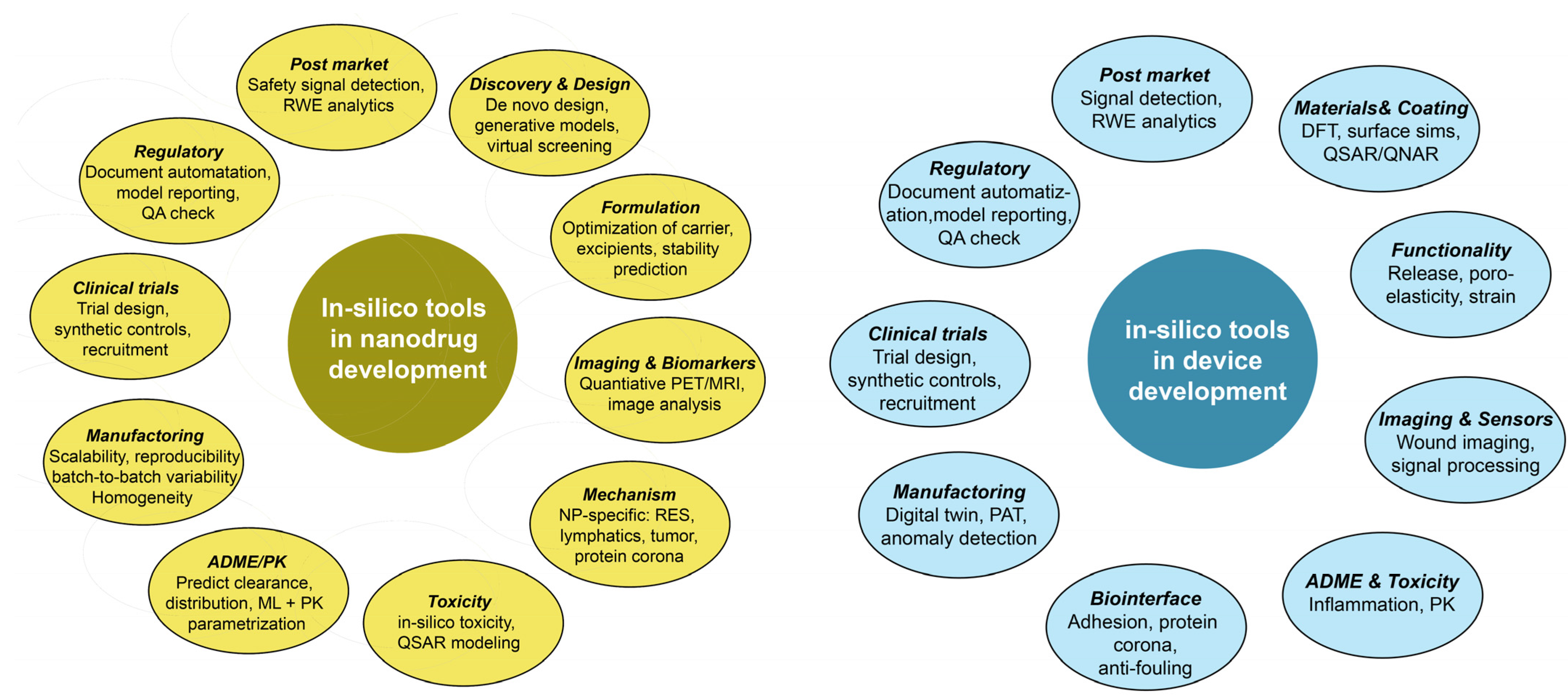
In silico tools, mechanistic models and AI are expected to increase the number of approved nanodrugs by supporting multiple steps throughout development (Figure 3). Here, AI denotes systems that perform tasks traditionally requiring human intelligence. Machine learning (ML) is a subfield of AI that employs statistical models to analyze large datasets and discover patterns. Within ML, deep learning (DL) is used far more often in nanodrug development than reinforcement learning (RL) [91]. Nevertheless, RL may prove useful for certain device applications, such as implant control, smart drug-delivery systems, or the navigation of nanorobots [92].
Figure 3.
Uses of in silico tools in nanodrug and nano-enabled device development. Abbreviations: ADME, absorption, distribution, metabolism, excretion; DFT, design for testing; ML, machine learning; PAT, process analytical technology; PBPK, physiologically based pharmacokinetic; PK, pharmacokinetics; QA, quality assessment; QSAR, quantitative structure–activity relationship; QNAR, quantitative nanostructure–activity relationship; RES, reticuloendothelial system; RWE, real-world evidence; sims, secondary-ion mass spectrometry.
Beyond materials identification, in silico tools may be useful in controlled manufacturing, safety and toxicity testing, ADME (absorption, distribution, metabolism, excretion) studies, clinical-trial design, and regulatory-submission support during later development phases [93,94].
The most established applications for nanodrugs are in nanocarrier design, e.g., prediction of particle size, polydispersity, drug-loading efficiency, agglomeration, and stability [95]. Descriptors allow the prediction of ROS generation, cytokine release, and inflammatory responses, which enables prediction of cytotoxicity, hemocompatibility, and immune activation [62]. Protein corona prediction is increasingly used to predict biodistribution, immunogenicity, and cellular uptake [96]. Various pharmacokinetic/pharmacodynamic (PK/PD) models—including hybrid mechanistic/ML approaches—can predict ADME behavior and inform first-in-human dosing and patient stratification for clinical trials [97]. Using existing databases, toxicity predictions are feasible and can help prioritize safety studies and reduce animal use. However, programs for the prediction of PK and biodistribution of nanomaterials are not yet mature because too few high-quality in vivo datasets are available. Multi-endpoint predictions and in vivo behavior forecasts for nanomedicines are available through both open-source and commercial software [98]. Although use in industrial scale-up is highly relevant, AI is currently used sparingly for this application. Examples of the use of AI in material identification, optimization, and biodistribution/tumor targeting of nanodrugs include the optimization of the lipid composition of nanocarriers for mRNA delivery systems by ML [99], the discovery of a new polymer that successfully delivered siRNA to lung cells in vivo [100], and the identification of critical parameters for the biodistribution of doxorubicin-loaded nanoparticles [101].
In silico tools also support the optimization of manufacturing, quality control, safety assessment, and regulatory support for nano-enabled devices. ML is particularly valuable for identification of optimal composition for the desired properties, process monitoring and optimization (improving coating functionality and mechanical strength), and sensor integration [91,102]. It also helps in signal interpretation and signal enhancement [103]. AI use in the control of nanorobots is promising but, currently, only early prototypes are available. AI is also used in wearable devices [104]. In contrast to nanodrugs, the use of AI in industrial nanofabrication and quality control is widespread [105]. Concrete examples of improved nano-enabled devices include designing geometries that yield desired electromagnetic responses for nanophotonics [106], manufacturing controls that improve yield and reproducibility of nanoscale features [107], and better identification of disease-specific signatures [108].
10. Conclusions
The initially proposed multifunctional nanoparticles and nanorobots have proven to be harder to realize than early expectations suggested. Over the past decade and a half, experience has focused objectives and refined design strategies. Future goals for nanodrugs include programmable nanosystems that deliver gene editors safely and transiently to specific cell types, enabling curative genetic therapies for diseases. Smart nanoparticles that sense intracellular states will improve cellular targeting and reduce off-target effects. Greater use of biodegradable carriers to avoid long-term persistence and environmental accumulation is expected. Ideally, the nanocarrier should be fully degraded immediately after the payload has been released. More nanodrugs are expected to be developed for oral administration. For nano-enabled devices, priorities include improved tissue integration (vascularized scaffolds, neuronal interfaces) and regenerative support, whereas implantable therapeutic networks based on nanosensors remain a longer-term vision.
Nanotoxicity testing of nano-based medical products has increased the focus on changes in particle parameters in physiological fluids and on assessing uptake in different cell types. Mode-of-action studies should include lysosomal function, ROS generation, pro-inflammatory activity, complement activation, genotoxicity, and barrier permeation in vitro. In vivo studies should look for chronic inflammation, accumulation in RES organs, and CARPA.
LCA should be performed not only with a focus on the use phase but should also include production and disposal. It is expected that green synthesis—where key parameters for the synthesis of Au, Ag, ZnO, iron oxide, Cu, Pd, and CuO nanoparticles are known—will have a positive impact [109].
Increased use of AI is expected for predicting protein corona formation, for industrial applications in nanodrug manufacturing, and for the control of biomedical robots for nano-enabled devices. The currently low use of AI in LCA and in predicting clinical outcomes is expected to increase. Reliable AI use depends on robust platforms and curated data repositories; resources such as NanoCommons, caNanoLab, Nanomaterial Registry, Nano-SolveIT, and the FDA Predictive Toxicology Roadmap will help develop the technology further [110].
Funding
This research received no external funding.
Data Availability Statement
No new data were created or analyzed in this study. This article is a literature review, and all information is derived from previously published sources.
Conflicts of Interest
Author Eleonore Fröhlich was employed by the company Research Center Pharmaceutical Engineering GmbH. The author declares that the research was conducted in the absence of any commercial or financial relationships that could be construed as a potential conflict of interest.
Abbreviations
The following abbreviations are used in this manuscript:
| ADME | Absorption, distribution, metabolism, excretion |
| AI | Artificial intelligence |
| ATTR | Transthyretin amyloidosis |
| CARPA | Complement activation-related pseudoallergy |
| COVID-19 | Coronavirus disease 2019 |
| DL | Deep learning |
| EPR | Enhanced permeability and retention |
| FDA | Food and drug administration agency |
| GMP | Good manufacturing practice |
| GPS | Global Positioning System |
| HER-2 | Human epidermal growth factor receptor 2 |
| HIV | Human immunodeficiency virus |
| IM | Intramuscular |
| IV | Intravenous |
| LCA | Life cycle assessment |
| ML | Machine learning |
| MPS | Mononuclear phagocyte system |
| PAT | Process analytical technology |
| PBPK | Physiologically based pharmacokinetic |
| PEG | Polyethylene glycol |
| PK/PD | Pharmacokinetic/pharmacodynamics |
| PSMA | Prostate specific membrane antigen |
| QSAR | Quantitative structure-activity relationship |
| QNAR | Quantitative nanostructure-activity relationship |
| RES | Reticuloendothelial system |
| RL | Reinforcement learning |
| ROS | Reactive oxygen species |
| RWE | Real world evidence |
| SC | Subcutaneous |
References
- Drexler, K. Engines of Creation: The Coming Era of Nanotechnology; Anchor Books: New York, NY, USA; Doubleday: New York, NY, USA, 1986. [Google Scholar]
- Bobo, D.; Robinson, K.J.; Islam, J.; Thurecht, K.J.; Corrie, S.R. Nanoparticle-Based Medicines: A Review of FDA-Approved Materials and Clinical Trials to Date. Pharm. Res. 2016, 33, 2373–2387. [Google Scholar] [CrossRef] [Scilit]
- Nelson, B.C.; Minelli, C.; Doak, S.H.; Roesslein, M. Emerging Standards and Analytical Science for Nanoenabled Medical Products. Annu. Rev. Anal. Chem. 2020, 13, 431–452. [Google Scholar] [CrossRef] [Scilit] [PubMed]
- Freitas, R. Nanomedicine, Volume I: Basic Capabilities; Landes Bioscience: Austin, TX, USA, 1999. [Google Scholar]
- Wilhelm, S.; Tavares, A.J.; Dai, Q.; Ohta, S.; Audet, J.; Dvorak, H.F.; Chan, W.C.W. Analysis of nanoparticle delivery to tumours. Nat. Rev. Mater. 2016, 1, 16014. [Google Scholar] [CrossRef] [Scilit]
- Attia, M.F.; Anton, N.; Wallyn, J.; Omran, Z.; Vandamme, T.F. An overview of active and passive targeting strategies to improve the nanocarriers efficiency to tumour sites. J. Pharm. Pharmacol. 2019, 71, 1185–1198. [Google Scholar] [CrossRef] [Scilit]
- Liu, D.; Yang, F.; Xiong, F.; Gu, N. The Smart Drug Delivery System and Its Clinical Potential. Theranostics 2016, 6, 1306–1323. [Google Scholar] [CrossRef] [Scilit]
- De Jong, W.H.; Hagens, W.I.; Krystek, P.; Burger, M.C.; Sips, A.J.; Geertsma, R.E. Particle size-dependent organ distribution of gold nanoparticles after intravenous administration. Biomaterials 2008, 29, 1912–1919. [Google Scholar] [CrossRef] [Scilit] [PubMed]
- Desai, N. Challenges in development of nanoparticle-based therapeutics. AAPS J. 2012, 14, 282–295. [Google Scholar] [CrossRef] [Scilit]
- Ewii, U.E.; Attama, A.A.; Olorunsola, E.O.; Onugwu, A.L.; Nwakpa, F.U.; Anyiam, C.; Chijioke, C.; Ogbulie, T. Nanoparticles for drug delivery: Insight into in vitro and in vivo drug release from nanomedicines. Nano TransMed 2025, 4, 100083. [Google Scholar] [CrossRef] [Scilit]
- Perrigue, P.M.; Murray, R.A.; Mielcarek, A.; Henschke, A.; Moya, S.E. Degradation of Drug Delivery Nanocarriers and Payload Release: A Review of Physical Methods for Tracing Nanocarrier Biological Fate. Pharmaceutics 2021, 13, 770. [Google Scholar] [CrossRef] [Scilit] [PubMed]
- Pallares, R.M.; Mottaghy, F.M.; Schulz, V.; Kiessling, F.; Lammers, T. Nanoparticle Diagnostics and Theranostics in the Clinic. J. Nucl. Med. 2022, 63, 1802–1808. [Google Scholar] [CrossRef] [Scilit]
- Gong, B.; Zhuang, J.; Ji, W.; Chen, X.; Li, P.; Cheng, W.; Chu, J.; Liang, W.; He, B.; Gao, J.; et al. The Long and the Short of Current Nanomedicines for Treating Alzheimer’s Disease. J. Transl. Int. Med. 2022, 10, 294–296. [Google Scholar] [CrossRef] [Scilit]
- Thakor, A.S.; Jokerst, J.V.; Ghanouni, P.; Campbell, J.L.; Mittra, E.; Gambhir, S.S. Clinically Approved Nanoparticle Imaging Agents. J. Nucl. Med. 2016, 57, 1833–1837. [Google Scholar] [CrossRef] [Scilit] [PubMed]
- Aliakbarzadeh, S.; Abdouss, M.; Fathi-karkan, S.; Rahdar, A.; Zarbanooei, P.; Kang, M.; Pandey, S. Micro-surgeons and nano-Pharmacists: The future of healthcare with medical nanorobots. J. Drug Deliv. Sci. Technol. 2025, 103, 106410. [Google Scholar] [CrossRef] [Scilit]
- Li, J.; Yu, J. Biodegradable Microrobots and Their Biomedical Applications: A Review. Nanomaterials 2023, 13, 1590. [Google Scholar]
- Vetten, M.; Yah, C.S.; Singh, T.S.; Gulumian, M. Challenges facing sterilization and depyrogenation of nanoparticles: Effects on structural stability and biomedical applications. Nanomed. Nanotech. Biol. Med. 2014, 10, 1391–1399. [Google Scholar] [CrossRef] [Scilit]
- Kumar Talreja, R.; Sable, H.; Chaudhary, V.; Kadian, S.; Singh, M.; Kumar, M.; Kishore, J.; Chaudhary, V.; Khosla, A. Review—Challenges in Lab-to-Clinic Translation of 5th/6th Generation Intelligent Nanomaterial-enabled Biosensors. ECS Sens. Plus 2024, 3, 041602. [Google Scholar] [CrossRef] [Scilit]
- Jin, J.; Guo, J.; Guo, J.; Li, D. Carbon-Based Biosensor in Point of Care Setting. Adv. Sens. Res. 2024, 3, 2400037. [Google Scholar] [CrossRef] [Scilit]
- Lin, C.; Huang, X.; Xue, Y.; Jiang, S.; Chen, C.; Liu, Y.; Chen, K. Advances in medical devices using nanomaterials and nanotechnology: Innovation and regulatory science. Bioact. Mater. 2025, 48, 353–369. [Google Scholar] [CrossRef] [Scilit]
- Fan, D.; Cao, Y.; Cao, M.; Wang, Y.; Cao, Y.; Gong, T. Nanomedicine in cancer therapy. Signal Transduct. Target. Ther. 2023, 8, 293. [Google Scholar] [CrossRef] [Scilit]
- Tracey, S.R.; Smyth, P.; Barelle, C.J.; Scott, C.J. Development of next generation nanomedicine-based approaches for the treatment of cancer: We’ve barely scratched the surface. Biochem. Soc. Trans. 2021, 49, 2253–2269. [Google Scholar] [CrossRef] [Scilit]
- Germain, M.; Caputo, F.; Metcalfe, S.; Tosi, G.; Spring, K.; Åslund, A.K.O.; Pottier, A.; Schiffelers, R.; Ceccaldi, A.; Schmid, R. Delivering the power of nanomedicine to patients today. J. Control. Release 2020, 326, 164–171. [Google Scholar] [CrossRef] [Scilit]
- Wong, C.H.; Siah, K.W.; Lo, A.W. Estimation of clinical trial success rates and related parameters. Biostatistics 2019, 20, 273–286. [Google Scholar] [CrossRef] [Scilit]
- Lin, A.; Giuliano, C.J.; Palladino, A.; John, K.M.; Abramowicz, C.; Yuan, M.L.; Sausville, E.L.; Lukow, D.A.; Liu, L.; Chait, A.R.; et al. Off-target toxicity is a common mechanism of action of cancer drugs undergoing clinical trials. Sci. Transl. Med. 2019, 11, eaaw8412. [Google Scholar] [CrossRef] [Scilit]
- U.S. Department of Health and Human Services. Drug Products, Including Biological Products, that Contain Nanomaterials Guidance for Industry; FDA-2017-D-0759; Food and Drug Administration: Silver Spring, MD, USA, 2022.
- Dias, M.; Zhang, R.; Lammers, T.; Pallares, R.M. Clinical translation and landscape of silver nanoparticles. Drug Deliv. Transl. Res. 2025, 15, 789–797. [Google Scholar] [CrossRef] [Scilit]
- ISO. Standards Catalogue. Available online: https://www.iso.org/standard/68936.html (accessed on 28 December 2025).
- Tenchov, R.; Hughes, K.J.; Ganesan, M.; Iyer, K.A.; Ralhan, K.; Lotti Diaz, L.M.; Bird, R.E.; Ivanov, J.M.; Zhou, Q.A. Transforming Medicine: Cutting-Edge Applications of Nanoscale Materials in Drug Delivery. ACS Nano 2025, 19, 4011–4038. [Google Scholar] [CrossRef] [Scilit]
- Desai, N.; Rana, D.; Patel, M.; Bajwa, N.; Prasad, R.; Vora, L.K. Nanoparticle Therapeutics in Clinical Perspective: Classification, Marketed Products, and Regulatory Landscape. Small 2025, 21, e2502315. [Google Scholar] [CrossRef] [Scilit]
- Wang, K.; Solovieva, Y. Analysis of the competitiveness of the biological pharmaceutical industry on the example of the United States. RUDN J. Econ. 2023, 31, 238–252. [Google Scholar] [CrossRef] [Scilit]
- U.S. Food & Drug Administration. Novel Drug Approvals for 2025. Available online: https://www.fda.gov/drugs/novel-drug-approvals-fda/novel-drug-approvals-2025 (accessed on 30 October 2025).
- Mazaleuskaya, L.L.; Muzykantov, V.R.; FitzGerald, G.A. Nanotherapeutic-directed approaches to analgesia. Trends Pharmacol. Sci. 2021, 42, 527–550. [Google Scholar] [CrossRef] [Scilit]
- Prasad, V.; De Jesús, K.; Mailankody, S. The high price of anticancer drugs: Origins, implications, barriers, solutions. Nat. Rev. Clin. Oncol. 2017, 14, 381–390. [Google Scholar] [CrossRef] [Scilit]
- Zhong, H.; Chan, G.; Hu, Y.; Hu, H.; Ouyang, D. A Comprehensive Map of FDA-Approved Pharmaceutical Products. Pharmaceutics 2018, 10, 263. [Google Scholar] [CrossRef] [Scilit] [PubMed]
- Moreira, A.; Bernardo, C.; Ramos, C.; Aguiar, P.; Alves da Costa, F. National trends in the use of oral chemotherapy over 13 years. Front. Pharmacol. 2022, 13, 909948. [Google Scholar] [CrossRef] [Scilit] [PubMed]
- Haddadzadegan, S.; Dorkoosh, F.A.; Bernkop-Schnurch, A. Oral delivery of therapeutic peptides and proteins: Technology landscape of lipid-based nanocarriers. Adv. Drug Deliv. Rev. 2022, 182, 114097. [Google Scholar] [CrossRef] [Scilit] [PubMed]
- McGuckin, M.B.; Wang, J.; Ghanma, R.; Qin, N.; Palma, S.D.; Donnelly, R.F.; Paredes, A.J. Nanocrystals as a master key to deliver hydrophobic drugs via multiple administration routes. J. Control. Release 2022, 345, 334–353. [Google Scholar] [CrossRef] [Scilit]
- Ventola, C.L. Progress in Nanomedicine: Approved and Investigational Nanodrugs. Pharm. Ther. 2017, 42, 742–755. [Google Scholar]
- Shan, X.; Gong, X.; Li, J.; Wen, J.; Li, Y.; Zhang, Z. Current approaches of nanomedicines in the market and various stage of clinical translation. Acta Pharm. Sin. B 2022, 12, 3028–3048. [Google Scholar] [CrossRef] [Scilit]
- Peer, D.; Karp, J.M.; Hong, S.; Farokhzad, O.C.; Margalit, R.; Langer, R. Nanocarriers as an emerging platform for cancer therapy. Nat. Nanotechnol. 2007, 2, 751–760. [Google Scholar] [CrossRef] [Scilit] [PubMed]
- Jia, Y.; Jiang, Y.; He, Y.; Zhang, W.; Zou, J.; Magar, K.T.; Boucetta, H.; Teng, C.; He, W. Approved Nanomedicine against Diseases. Pharmaceutics 2023, 15, 774. [Google Scholar] [CrossRef] [Scilit] [PubMed]
- Gao, Y.; Joshi, M.; Zhao, Z.; Mitragotri, S. PEGylated therapeutics in the clinic. Bioeng. Transl. Med. 2024, 9, e10600. [Google Scholar] [CrossRef] [Scilit]
- Alconcel, S.N.S.; Baas, A.S.; Maynard, H.D. FDA-approved poly(ethylene glycol)–protein conjugate drugs. Polym. Chem. 2011, 2, 1442–1448. [Google Scholar] [CrossRef] [Scilit]
- Barenholz, Y. Doxil®--the first FDA-approved nano-drug: Lessons learned. J. Control. Release 2012, 160, 117–134. [Google Scholar] [CrossRef] [Scilit]
- Barratt, G.; Bretagne, S. Optimizing efficacy of Amphotericin B through nanomodification. Int. J. Nanomed. 2007, 2, 301–313. [Google Scholar]
- Fu, Z.; Li, S.; Han, S.; Shi, C.; Zhang, Y. Antibody drug conjugate: The “biological missile” for targeted cancer therapy. Signal Transduct. Target. Ther. 2022, 7, 93. [Google Scholar] [CrossRef] [Scilit] [PubMed]
- Jeon, H.J.; Lee, H.E.; Yang, J. Safety and efficacy of Rapamune® (Sirolimus) in kidney transplant recipients: Results of a prospective post-marketing surveillance study in Korea. BMC Nephrol. 2018, 19, 201. [Google Scholar] [CrossRef] [Scilit]
- Parakh, S.; Lee, S.T.; Gan, H.K.; Scott, A.M. Radiolabeled Antibodies for Cancer Imaging and Therapy. Cancers 2022, 14, 1454. [Google Scholar] [CrossRef] [Scilit]
- Gradishar, W.J.; Tjulandin, S.; Davidson, N.; Shaw, H.; Desai, N.; Bhar, P.; Hawkins, M.; O’Shaughnessy, J. Phase III trial of nanoparticle albumin-bound paclitaxel compared with polyethylated castor oil-based paclitaxel in women with breast cancer. J. Clin. Oncol. 2005, 23, 7794–7803. [Google Scholar] [CrossRef] [Scilit]
- Ahmad, F.; Treanor, L.; McGrath, T.A.; Walker, D.; McInnes, M.D.F.; Schieda, N. Safety of Off-Label Use of Ferumoxtyol as a Contrast Agent for MRI: A Systematic Review and Meta-Analysis of Adverse Events. J. Magn. Reson. Imaging 2021, 53, 840–858. [Google Scholar] [CrossRef] [Scilit]
- Smith, G.H.R.; Henry, W.K.; Podzamczer, D.; Masiá, M.D.M.; Bettacchi, C.J.; Arasteh, K.; Jaeger, H.; Khuong-Josses, M.A.; Montes-Ramírez, M.L.; Stellbrink, H.J.; et al. Efficacy, Safety, and Durability of Long-Acting Cabotegravir and Rilpivirine in Adults With Human Immunodeficiency Virus Type 1 Infection: 5-Year Results From the LATTE-2 Study. Open Forum Infect. Dis. 2021, 8, ofab439. [Google Scholar] [CrossRef] [Scilit]
- Haugen, H.J.; Makhtari, S.; Ahmadi, S.; Hussain, B. The Antibacterial and Cytotoxic Effects of Silver Nanoparticles Coated Titanium Implants: A Narrative Review. Materials 2022, 15, 5025. [Google Scholar] [CrossRef] [Scilit] [PubMed]
- Mishra, R.; Minocha, S.; Goel, R.; Gaur, P.K.; Lata, K.; Singh, R. Bioconvergence: Advancing biosensors with nanotechnology for real-time health monitoring. Bull. Natl. Res. Cent. 2025, 49, 14. [Google Scholar] [CrossRef] [Scilit]
- Ma, X.; Tian, Y.; Yang, R.; Wang, H.; Allahou, L.W.; Chang, J.; Williams, G.; Knowles, J.C.; Poma, A. Nanotechnology in healthcare, and its safety and environmental risks. J. Nanobiotechnol. 2024, 22, 715. [Google Scholar] [CrossRef] [Scilit]
- Yeh, R.W.; Shlofmitz, R.; Moses, J.; Bachinsky, W.; Dohad, S.; Rudick, S.; Stoler, R.; Jefferson, B.K.; Nicholson, W.; Altman, J.; et al. Paclitaxel-Coated Balloon vs Uncoated Balloon for Coronary In-Stent Restenosis: The AGENT IDE Randomized Clinical Trial. JAMA 2024, 331, 1015–1024. [Google Scholar] [CrossRef] [Scilit]
- Chakraborty, U.R.; Black, N.; Brooks, H.G., Jr.; Campbell, C.; Gluck, K.; Harmon, F.; Hollenbeck, L.; Lawler, S.; Levison, S.; Mochnal, D.; et al. An immunogold assay system for the detection of antigen or antibody. Ann. Biol. Clin. 1990, 48, 403–408. [Google Scholar]
- Smith, W.R.; Hudson, P.W.; Ponce, B.A.; Rajaram Manoharan, S.R. Nanotechnology in orthopedics: A clinically oriented review. BMC Musculoskelet. Disord. 2018, 19, 67. [Google Scholar] [CrossRef] [Scilit]
- Gulati, S.; Yadav, R.; Kumari, V.; Nair, S.; Gupta, C.; Aishwari, M. Nanosensors in healthcare: Transforming real-time monitoring and disease management with cutting-edge nanotechnology. RSC Pharm. 2025, 2, 1003–1018. [Google Scholar] [CrossRef] [Scilit]
- Krishna, R.; Nagar, V.; Kaur, A.; Rai, A.R.; Awasthi, K.K.; Awasthi, G.; Sankhla, M.S. Toxicological Effects of Metal Nanoparticles Employed in Biomedicine: Biocompatibility, Clinical Trials, and Future Perspective. Macromol. Symp. 2024, 413, 2300057. [Google Scholar] [CrossRef] [Scilit]
- Yu, Z.; Li, Q.; Wang, J.; Yu, Y.; Wang, Y.; Zhou, Q.; Li, P. Reactive Oxygen Species-Related Nanoparticle Toxicity in the Biomedical Field. Nanoscale Res. Lett. 2020, 15, 115. [Google Scholar] [CrossRef] [Scilit]
- Calé, A.; Elblová, P.; Andělová, H.; Lunova, M.; Lunov, O. Analyzing Molecular Determinants of Nanodrugs’ Cytotoxic Effects. Int. J. Mol. Sci. 2025, 26, 6687. [Google Scholar] [CrossRef] [Scilit] [PubMed]
- Sau, S.; Dey, A.; Pal, P.; Das, B.; Maity, K.K.; Dash, S.K.; Tamili, D.K.; Das, B. Immunomodulatory and immune-toxicological role of nanoparticles: Potential therapeutic applications. Int. Immunopharmacol. 2024, 135, 112251. [Google Scholar] [CrossRef] [Scilit]
- Kozma, G.T.; Mészáros, T.; Vashegyi, I.; Fülöp, T.; Örfi, E.; Dézsi, L.; Rosivall, L.; Bavli, Y.; Urbanics, R.; Mollnes, T.E.; et al. Pseudo-anaphylaxis to Polyethylene Glycol (PEG)-Coated Liposomes: Roles of Anti-PEG IgM and Complement Activation in a Porcine Model of Human Infusion Reactions. ACS Nano 2019, 13, 9315–9324. [Google Scholar] [CrossRef] [Scilit] [PubMed]
- Yang, Q.; Jacobs, T.M.; McCallen, J.D.; Moore, D.T.; Huckaby, J.T.; Edelstein, J.N.; Lai, S.K. Analysis of Pre-existing IgG and IgM Antibodies against Polyethylene Glycol (PEG) in the General Population. Anal. Chem. 2016, 88, 11804–11812. [Google Scholar] [CrossRef] [Scilit]
- Wang, R.; Song, B.; Wu, J.; Zhang, Y.; Chen, A.; Shao, L. Potential adverse effects of nanoparticles on the reproductive system. Int. J. Nanomed. 2018, 13, 8487–8506. [Google Scholar] [CrossRef] [Scilit]
- Tabrizi, E.; Li, B. From innovation to application: Safety concerns in nanomaterial implant coatings. Nanomedicine 2025, 20, 1373–1376. [Google Scholar] [CrossRef] [Scilit]
- OECD. OECD Series on the Safety of Manufactured Nanomaterials and other Advanced Materials; OECD Publishing: Paris, France, 2018. [Google Scholar] [CrossRef] [Scilit]
- Fröhlich, E. Cellular targets and mechanisms in the cytotoxic action of non-biodegradable engineered nanoparticles. Curr. Drug Metab. 2013, 14, 976–988. [Google Scholar] [CrossRef] [Scilit]
- Fröhlich, E. Comparison of conventional and advanced in vitro models in the toxicity testing of nanoparticles. Artif. Cells Nanomed. Biotechnol. 2018, 46, 1091–1107. [Google Scholar] [CrossRef] [Scilit]
- ISO 14044:2006; Environmental Management—Life Cycle Assessment—Principles and Framework. International Standards Organization: Geneva, Switzerland, 2006. Available online: https://www.iso.org/obp/ui/en/#iso:std:iso:14040:ed-2:v1:en (accessed on 10 February 2025).
- Som, C.; Berges, M.; Chaudhry, Q.; Dusinska, M.; Fernandes, T.F.; Olsen, S.I.; Nowack, B. The importance of life cycle concepts for the development of safe nanoproducts. Toxicology 2010, 269, 160–169. [Google Scholar] [CrossRef] [Scilit]
- Pourzahedi, L.; Eckelman, M.J. Environmental Life Cycle Assessment of Nanosilver-Enabled Bandages. Environ. Sci. Technol. 2015, 49, 361–368. [Google Scholar] [CrossRef] [Scilit]
- Weyell, P.; Kurland, H.D.; Hülser, T.; Grabow, J.; Müller, F.A.; Kralisch, D. Risk and life cycle assessment of nanoparticles for medical applications prepared using safe- and benign-by-design gas-phase syntheses. Green Chem. 2020, 22, 814–827. [Google Scholar] [CrossRef] [Scilit]
- Zhao, J.; Castranova, V. Toxicology of nanomaterials used in nanomedicine. J. Toxicol. Environ. Health B Crit. Rev. 2011, 14, 593–632. [Google Scholar] [CrossRef] [Scilit] [PubMed]
- Zielińska, A.; Costa, B.; Ferreira, M.V.; Miguéis, D.; Louros, J.M.S.; Durazzo, A.; Lucarini, M.; Eder, P.; Chaud, M.V.; Morsink, M.; et al. Nanotoxicology and Nanosafety: Safety-By-Design and Testing at a Glance. Int. J. Environ. Res. Public Health 2020, 17, 4657. [Google Scholar] [CrossRef] [Scilit] [PubMed]
- Nizam, N.U.M.; Hanafiah, M.M.; Woon, K.S. A Content Review of Life Cycle Assessment of Nanomaterials: Current Practices, Challenges, and Future Prospects. Nanomaterials 2021, 11, 3324. [Google Scholar] [CrossRef] [Scilit] [PubMed]
- Dhingra, R.; Naidu, S.; Upreti, G.; Sawhney, R. Sustainable Nanotechnology: Through Green Methods and Life-Cycle Thinking. Sustainability 2010, 2, 3323–3338. [Google Scholar] [CrossRef] [Scilit]
- Woodle, M.C.; Matthay, K.K.; Newman, M.S.; Hidayat, J.E.; Collins, L.R.; Redemann, C.; Martin, F.J.; Papahadjopoulos, D. Versatility in lipid compositions showing prolonged circulation with sterically stabilized liposomes. Biochim. Biophys. Acta 1992, 1105, 193–200. [Google Scholar] [CrossRef] [Scilit]
- Mohamed, M.; Abu Lila, A.S.; Shimizu, T.; Alaaeldin, E.; Hussein, A.; Sarhan, H.A.; Szebeni, J.; Ishida, T. PEGylated liposomes: Immunological responses. Sci. Technol. Adv. Mater. 2019, 20, 710–724. [Google Scholar] [CrossRef] [Scilit]
- He, H.; Yuan, D.; Wu, Y.; Cao, Y. Pharmacokinetics and Pharmacodynamics Modeling and Simulation Systems to Support the Development and Regulation of Liposomal Drugs. Pharmaceutics 2019, 11, 110. [Google Scholar] [CrossRef] [Scilit]
- Liu, J.; Wang, T.; Dong, J.; Lu, Y. The blood-brain barriers: Novel nanocarriers for central nervous system diseases. J. Nanobiotechnol. 2025, 23, 146. [Google Scholar] [CrossRef] [Scilit]
- Fortune, A.; Aime, A.; Raymond, D.; Kumar, S. Nanotechnology in medicine: A double-edged sword for health outcomes. Health Nanotechnol. 2025, 1, 9. [Google Scholar] [CrossRef] [Scilit]
- Chen, M.Q. Recent Advances and Perspective of Nanotechnology-Based Implants for Orthopedic Applications. Front. Bioeng. Biotechnol. 2022, 10, 878257. [Google Scholar] [CrossRef] [Scilit] [PubMed]
- Soe, Z.C.; Wahyudi, R.; Mattheos, N.; Lertpimonchai, A.; Everts, V.; Tompkins, K.A.; Osathanon, T.; Limjeerajarus, C.N.; Limjeerajarus, N. Application of nanoparticles as surface modifiers of dental implants for revascularization/regeneration of bone. BMC Oral Health 2024, 24, 1175. [Google Scholar] [CrossRef] [Scilit] [PubMed]
- Quan, Y.; Wu, X.; Zhu, S.; Zeng, X.; Zeng, Z.; Zheng, Q. Triboelectric nanogenerators for clinical diagnosis and therapy: A report of recent progress. Med. Nov. Technol. Devices 2022, 16, 100195. [Google Scholar] [CrossRef] [Scilit]
- Kong, X.; Gao, P.; Wang, J.; Fang, Y.; Hwang, K.C. Advances of medical nanorobots for future cancer treatments. J. Hematol. Oncol. 2023, 16, 74. [Google Scholar] [CrossRef] [Scilit]
- Clogston, J. Parameters, Methods and Considerations for the Physicochemical Characterization of Colloidal Metal Nanoparticles. In National Cancer Institute’s Nanotechnology Characterization Laboratory Assay Cascade Protocols; National Cancer Institute, Ed.; National Cancer Institute: Bethesda, MD, USA, 2024. [Google Scholar] [CrossRef]
- Sunoqrot, S.; Abusulieh, S.; Dahabiyeh, L.A. Insights into the anticancer and anti-inflammatory activities of curcumin-loaded quercetin nanoparticles: In vitro bioassays coupled with synchrotron infrared microspectroscopy. Mater. Adv. 2025, 6, 1971–1987. [Google Scholar] [CrossRef] [Scilit]
- Kamyab, H.; Khalili, E.; Khademi, T.; Yuzir, A.; Taheri, M.M.; Rajendran, S.; Peñaherrera-Pazmiño, A.B. Advances in green synthesis of nanoparticles for biomedical applications: Antimicrobial, antiviral, and cancer therapies. Mater. Today Sustain. 2026, 33, 101287. [Google Scholar] [CrossRef] [Scilit]
- Yadavalli, V.K. The convergence of nanomanufacturing and artificial intelligence: Trends and future directions. Nanotechnology 2025, 36, 22. [Google Scholar] [CrossRef] [Scilit]
- Ali, Z.; Asparin, A.; Zhang, Y.; Mettee, H.; Taha, D.; Ha, Y.; Bhanot, D.; Sarwar, K.; Kiran, H.; Wu, S.; et al. Automatic design and optimization of MRI-based neurochemical sensors via reinforcement learning. Discov. Nano 2025, 20, 148. [Google Scholar] [CrossRef] [Scilit]
- Zhang, K.; Yang, X.; Wang, Y.; Yu, Y.; Huang, N.; Li, G.; Li, X.; Wu, J.C.; Yang, S. Artificial intelligence in drug development. Nat. Med. 2025, 31, 45–59. [Google Scholar] [CrossRef] [Scilit]
- Yang, K.; Gonzalez, D.; Woodhead, J.L.; Bhargava, P.; Ramanathan, M. Leveraging In Silico and Artificial Intelligence Models to Advance Drug Disposition and Response Predictions Across the Lifespan. Clin. Transl. Sci. 2025, 18, e70272. [Google Scholar] [CrossRef] [Scilit]
- Noury, H.; Rahdar, A.; Romanholo Ferreira, L.F.; Jamalpoor, Z. AI-driven innovations in smart multifunctional nanocarriers for drug and gene delivery: A mini-review. Crit. Rev. Oncol. Hematol. 2025, 210, 104701. [Google Scholar] [CrossRef] [Scilit] [PubMed]
- Ahmadi, M.; Ayyoubzadeh, S.M.; Ardekani, S.A.; Ghaedrahmat, Z.; Masoumi, N.; Farnia, M.M.; Ghorbani-Bidkorpeh, F. A review on protein corona formation on nanoparticles and prediction of its composition using artificial intelligence tools. Int. J. Pharm. 2025, 683, 126094. [Google Scholar] [CrossRef] [Scilit] [PubMed]
- Banaye Yazdipour, A.; Masoorian, H.; Ahmadi, M.; Mohammadzadeh, N.; Ayyoubzadeh, S.M. Predicting the toxicity of nanoparticles using artificial intelligence tools: A systematic review. Nanotoxicology 2023, 17, 62–77. [Google Scholar] [CrossRef] [Scilit]
- Akhtar, M.; Nehal, N.; Gull, A.; Parveen, R.; Khan, S.; Khan, S.; Ali, J. Explicating the transformative role of artificial intelligence in designing targeted nanomedicine. Expert Opin. Drug Deliv. 2025, 22, 971–991. [Google Scholar] [CrossRef] [Scilit] [PubMed]
- Maharjan, R.; Kim, K.H.; Lee, K.; Han, H.-K.; Jeong, S.H. Machine learning-driven optimization of mRNA-lipid nanoparticle vaccine quality with XGBoost/Bayesian method and ensemble model approaches. J. Pharm. Anal. 2024, 14, 100996. [Google Scholar] [CrossRef] [Scilit]
- Sieber-Schäfer, F.; Jiang, M.; Kromer, A.; Nguyen, A.; Molbay, M.; Pinto Carneiro, S.; Jürgens, D.; Burgstaller, G.; Popper, B.; Winkeljann, B.; et al. Machine Learning-Enabled Polymer Discovery for Enhanced Pulmonary siRNA Delivery. Adv. Funct. Mater. 2025, 35, e02805. [Google Scholar] [CrossRef] [Scilit]
- Chou, W.-C.; Chen, Q.; Yuan, L.; Cheng, Y.-H.; He, C.; Monteiro-Riviere, N.A.; Riviere, J.E.; Lin, Z. An artificial intelligence-assisted physiologically-based pharmacokinetic model to predict nanoparticle delivery to tumors in mice. J. Control. Release 2023, 361, 53–63. [Google Scholar] [CrossRef] [Scilit] [PubMed]
- Logakannan, K.P.; Guven, I.; Odegard, G.; Wang, K.; Zhang, C.; Liang, Z.; Spear, A. A review of artificial intelligence (AI)-based applications to nanocomposites. Compos. Part A 2025, 197, 109027. [Google Scholar] [CrossRef] [Scilit]
- Chakroborty, S.; Nath, N.; Sahoo, S.; Singh, B.P.; Bal, T.; Tiwari, K.; Hailu, Y.K.; Singh, S.; Kumar, P.; Chakraborty, C. A review of emerging trends in nanomaterial-driven AI for biomedical applications. Nanoscale Adv. 2025, 7, 3619–3630. [Google Scholar] [CrossRef] [Scilit] [PubMed]
- Kajornkasirat, S.; Sawangwong, C.; Puangsuwan, K.; Chanapai, N.; Phutthamongkhon, W.; Puttinaovarat, S. Integrating AI-Driven Predictive Analytics in Wearable IoT for Real-Time Health Monitoring in Smart Healthcare Systems. Appl. Sci. 2025, 15, 4400. [Google Scholar] [CrossRef] [Scilit]
- Sharma, P.K.; Chen, C.Y. AI-Integrated Micro/Nanorobots for Biomedical Applications: Recent Advances in Design, Fabrication, and Functions. Biosensors 2025, 15, 793. [Google Scholar] [CrossRef] [Scilit]
- Malkiel, I.; Mrejen, M.; Nagler, A.; Arieli, U.; Wolf, L.; Suchowski, H. Plasmonic nanostructure design and characterization via Deep Learning. Light Sci. Appl. 2018, 7, 60. [Google Scholar] [CrossRef] [Scilit]
- Kusne, A.G.; Yu, H.; Wu, C.; Zhang, H.; Hattrick-Simpers, J.; DeCost, B.; Sarker, S.; Oses, C.; Toher, C.; Curtarolo, S.; et al. On-the-fly closed-loop materials discovery via Bayesian active learning. Nat. Commun. 2020, 11, 5966. [Google Scholar] [CrossRef] [Scilit]
- Haick, H.; Tang, N. Artificial Intelligence in Medical Sensors for Clinical Decisions. ACS Nano 2021, 15, 3557–3567. [Google Scholar] [CrossRef] [Scilit]
- Saxena, R.; Kotnala, S.; Bhatt, S.C.; Uniyal, M.; Rawat, B.S.; Negi, P.; Riyal, M.K. A review on green synthesis of nanoparticles toward sustainable environment. Sustain. Chem. Clim. Action 2025, 6, 100071. [Google Scholar] [CrossRef] [Scilit]
- Han, Y.; Kim, D.H.; Pack, S.P. Nanomaterials in Drug Delivery: Leveraging Artificial Intelligence and Big Data for Predictive Design. Int. J. Mol. Sci. 2025, 26, 11121. [Google Scholar] [CrossRef] [Scilit] [PubMed]

Disclaimer/Publisher’s Note: The statements, opinions and data contained in all publications are solely those of the individual author(s) and contributor(s) and not of MDPI and/or the editor(s). MDPI and/or the editor(s) disclaim responsibility for any injury to people or property resulting from any ideas, methods, instructions or products referred to in the content. |
© 2026 by the author. Licensee MDPI, Basel, Switzerland. This article is an open access article distributed under the terms and conditions of the Creative Commons Attribution (CC BY) license.