


Abstract
In the present work, 1.92 wt% Pd/9.68 wt% CeO2/spherical mesoporous silica (denoted as 1.92Pd/9.68CeO2/KCC-1) and 1.96 wt% Pd/KCC-1 (denoted as 1.96Pd/KCC-1) catalysts were prepared. It was found that the 1.92Pd/9.68CeO2/KCC-1 sample exhibited an excellent catalytic activity for methane combustion, which was much better than that of the 1.96Pd/KCC-1 sample. In addition, the 1.92Pd/9.68CeO2/KCC-1 sample possessed good high-temperature stability and water resistance. The enhanced methane combustion performance of 1.92Pd/9.68CeO2/KCC-1 was mainly attributed to the good dispersion of Pd species and the stabilization of the active Pd2+ species and generation of more reactive oxygen species by CeO2 modification. This work offers new insights into developing methane combustion catalysts with low-temperature catalytic performance and high-temperature stability.
1. Introduction
Methane, as the primary component of natural gas, has been widely utilized in industries and transportation activities [1]. Natural gas-driven vehicles have been proven to be an alternative to gasoline- and diesel-powered vehicles, in which natural gas offers higher fuel efficiency and less pollutant emissions [2,3]. However, methane is the world’s second-largest greenhouse gas with high global warming potential and a short atmospheric lifetime [4,5]. Therefore, effectively reducing unburned methane emissions from vehicle exhaust has become a big challenge [6,7]. Strictly controlling methane emissions offers three environmental benefits of (i) mitigating global warming; (ii) promoting the economic value of energy resource utilization, and (iii) achieving synergistic pollution control.
Among numerous methane treatment methods, catalytic oxidation is considered one of the most environmentally friendly approaches due to its low energy consumption and high removal efficiency [8,9]. Up to now, a large number of studies have been conducted on methane combustion over the catalysts, including precious metal (e.g., Pd [10,11,12], Pt [13,14], and Au [15]) catalysts and non-noble metal (including Al [16,17], Co [18], and Ni [19,20]) catalysts. Among these catalysts, the supported Pd-based catalysts have been demonstrated to be the most efficient for methane combustion. However, the Pd nanoparticles (NPs) in supported Pd-based catalysts can be easily sintered at high temperatures, thus leading to deactivation of the catalysts.
Suitable support can prevent the thermal decomposition of PdOx and the sintering of Pd NPs at high temperatures, thereby enhancing the stability of the active PdOx phase. Examples include metal oxides [21,22,23,24], zeolites [25,26,27], mesoporous silica [28,29], and metal–organic frameworks (MOFs) [30,31], in which there are pore-confined structures that can effectively prevent the sintering and agglomeration of noble metals. Spherical mesoporous silica (KCC-1) is a silica material featuring an open mesoporous structure. KCC-1 possesses excellent properties (e.g., high surface area, regular pores, and good thermal stability), hence being widely employed as a support for various catalytic reactions [32,33]. This unique feature enhances the dispersion of noble metal NPs, the stability of supported noble metal catalysts, and the facilitation of reactants diffusion. Singh and Polshettiwar [34] found that compared to MCM-41, KCC-1 exhibited a higher surface area and a larger pore volume due to its distinctive tubular pore structure, thereby increasing the mass transfer efficiency. Hamid et al. [35] reported that KCC-1 possessed significantly higher basicity than MCM-41, demonstrating a fivefold higher catalytic activity than MCM-41 in CO2 methanation. It is evident that the spherical mesoporous structure of KCC-1 significantly increases the surface area, ensuring complete penetration of the loaded noble metal NPs into its pores, resulting in uniform and well-dispersed NPs that are beneficial for the enhancement in catalyst activity.
CeO2 is an abundant, cost-effective, and structurally stable rare-earth oxide, which has been widely used as a support for loading noble metal NPs due to its good thermal stability, large oxygen storage capacity, and unique redox property [36,37]. For instance, He et al. [38] introduced CeO2 nanoislands onto dendritic mesoporous SiO2 and selected Pt as the active component, and the as-obtained catalyst achieved a 1.5-fold increase in propane combustion efficiency at 210 °C compared to the CeO2-free counterpart. Tan et al. [39] investigated a core–shell catalyst featuring Pd/CeO2 loaded on a SiO2 shell for methane combustion, and observed that after seven recycles, 90% methane conversion was achieved over the core–shell catalyst at 385 °C. In comparison, the traditionally prepared Pd/CeO2 catalyst required a higher temperature (440 °C) to reach the same methane conversion. Feng et al. [40] prepared a highly dispersed platinum (Pt/CeOx/DMS) catalyst for CO oxidation, and claimed that the T90% for CO oxidation over Pt/CeOx/DMS was decreased by 16 °C compared to that over Pt/DMS, and the former maintained excellent catalytic performance even after 8 h of on-stream reaction at 500 °C. Therefore, doping CeO2 to KCC-1 can leverage its oxygen storage capacity to provide the additional active adsorbed oxygen species and enhance the interaction between noble metal NPs and CeO2, thereby improving both catalytic activity and stability of the supported noble metal catalysts.
In this work, we prepared a mesoporous KCC-1-supported palladium-based catalyst modified with ceria (1.92Pd/9.68CeO2/KCC-1) and made a comparison on catalytic methane combustion activity of 1.92Pd/9.68CeO2/KCC-1, 1.92Pd/KCC-1, and 10.23CeO2/KCC-1. Compared with traditional catalysts, the unique structure of KCC-1 enables CeO2 to attach more readily to the surface of the support during the modification process. This allows for the provision of more oxygen species to facilitate the methane oxidation, resulting in excellent catalytic activity at lower temperatures of the CeO2-doped sample. The physicochemical properties of these materials were characterized, and their catalytic activities, high-temperature stability, and water resistance for methane combustion were investigated in detail.
2. Experimental
2.1. Synthesis of KCC-1
The synthesis method described in the literature [41] was modified to some extent. First, KCC-1 with a specific morphology was synthesized using the hydrothermal method. A total of 1.6 g of hexadecyltrimethylammonium bromide and 0.96 g of urea were dissolved in 48 mL of deionized water to form Solution A. Concurrently, 2.4 mL of 1-pentanol and 4.3 mL of tetraethoxysilane were mixed in 48 mL of cyclohexane under stirring for 30 min to form Solution B. Then, Solution B was added dropwise to Solution A under stirring for 30 min. The resulting mixed solution was placed in a PTFE-sealed autoclave and heated in an oven at 120 °C for 4 h. After the products were centrifuged at 10,000 rpm, the resulting material was dried in an oven at 80 °C for 12 h, calcined in air and a muffle furnace at a heating rate of 5 °C/min from room temperature to 550 °C and maintained for 6 h, thus obtaining the KCC-1 support.
2.2. Preparation of Pd/CeO2/KCC-1
A total of 0.5 g of the KCC-1 support was added to 8 mL of deionized water. Then, 0.433 g of Ce(NO3)3·6H2O was added under stirring for 6 h. The mixture was transferred to a muffle furnace after rotary evaporation and calcined in air atmosphere at a ramp of 5 °C/min from room temperature to 400 °C and kept for 2 h, thus preparing the CeO2/KCC-1 catalyst. Pd was loaded using a polyvinyl alcohol (PVA)-protected NaBH4 reduction method. First, the PVA solution was stirred until a dense foam formed; then, 8.33, 12.49 or 16.66 mL (corresponding to theoretical Pd loadings of 0.5, 1.5, and 2.0 wt%) of the PdCl2 aqueous solution (2 g/L) was added under stirring for 1 h; finally, the NaBH4 solution was rapidly added under an ice-bath condition to ensure formation of the uniform solution color. Subsequently, 0.5 g of CeO2/KCC-1 was added to the above Pd-containing solution and stirred for 6 h. The mixture was filtered in vacuum and dried in an oven at 80 °C overnight. The dried sample was then transferred to a muffle furnace for calcination in an air atmosphere at a heating rate of 5 °C/min from room temperature to 500 °C and maintained for 2 h, hence obtaining the xPd/CeO2/KCC-1 (theoretical Pd loadings (x) = 0.5, 1.5, and 2.0 wt%) samples.
The method for the preparation of xPd/KCC-1 (theoretical Pd loadings (x) = 2.0 wt%) was identical to that for the preparation of xPd/CeO2/KCC-1 (theoretical Pd loadings (x) = 0.5, 1.5, and 2.0 wt%), except that KCC-1 was used as the support and Ce(NO3)3·6H2O was not added.
2.3. Catalyst Characterization
Physicochemical properties of all the samples were determined using the following techniques: inductively coupled plasma–atomic emission spectroscopy (ICP–AES), X-ray diffraction (XRD), scanning electron microscopy (SEM), transmission electron microscopy (TEM), high-angle annular dark field–scanning transmission electron microscopy (HAADF–STEM) and EDX element mappings, laser Raman spectroscopy (Raman), nitrogen adsorption–desorption (BET), X-ray photoelectron spectroscopy (XPS), hydrogen temperature-programmed reduction (H2-TPR), methane temperature-programmed reduction (CH4-TPR), methane temperature-programmed surface reaction (CH4-TPSR), and in situ diffuse reflectance infrared Fourier transform spectroscopy (in situ DRIFTS). The detailed measurement procedures are described in the Supplementary Materials.
2.4. Catalytic Activity Assessment
Catalytic activities of the samples for methane combustion were assessed at atmospheric pressure using continuous-flow fixed-bed quartz microreactor (6.0 mm in inner diameter). A thermocouple was positioned at the center of the catalyst bed to monitor the reaction temperature. Reactants and products were analyzed online using gas chromatography (GC-2010, Shimadzu, Japan) with a stable wax-DA column (30 m in length), a Carboxen 1000 column (3 m in length), and a flame ionization detector (FID). For testing, 0.05 g of the catalyst (40–60 mesh) was diluted with 0.25 g of quartz sand (40–60 mesh). The reactant mixture composition was (10,000 ppm CH4 + 20.0 vol% O2 + N2 (balance)). A total reactant mixture flow rate of 16.7 mL/min was passed through the reactor, arising a space velocity (SV) of approximately 20,000 mL/(g h). Before conducting the activity test, the catalyst was pretreated at 300 °C for 1 h with an oxygen flow of 20 mL/min. For the water-resistance test, a water vapor concentration of 5.0 vol% was generated using a water saturator at 37 °C. Under identical conditions, long-term stability testing was conducted at 370 °C and SV = 20,000 mL/(g h). Catalytic activity was evaluated by adopting the temperatures (T10%, T50%, and T90%) corresponding to methane conversions of 10, 50, and 90%. Methane conversion (XCH4) was calculated according to Equation (1):
where [cCH4]in and [cCH4]out represent the inlet and outlet methane concentrations, respectively.
XCH4 = ([cCH4]in − [cCH4]out)/[cCH4]in × 100%
Specific methane reaction rate (rCH4) and turnover frequency (TOFPd) were calculated according to Equations (2) and (3), respectively:
where [cCH4], F, T, mcat, LPd, R, MPd, and DPd are the methane concentration, total flow rate, temperature (298 K), catalyst mass, Pd loading, gas constant, Pd molecular weight, and Pd dispersion, respectively.
3. Results and Discussion
3.1. Crystal Phases and Textural Properties
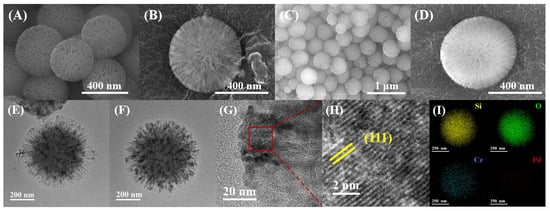
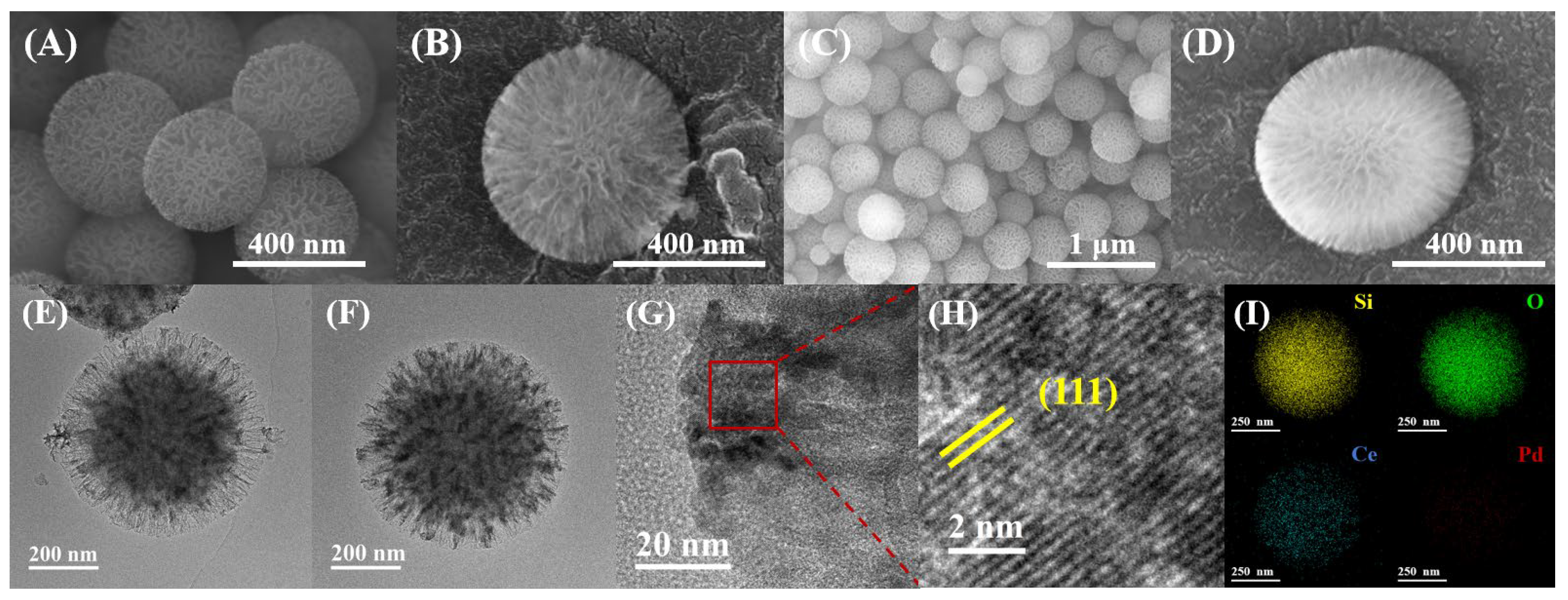
The actual loadings of Pd and CeO2 in the samples were determined using the ICP–AES analysis technique, as listed in Table 1. The actual contents of Pd and Ce in the Pd/CeO2/KCC-1 samples were 0.97 and 9.68 wt%, 1.44 and 9.68 wt%, and 1.92 and 9.68 wt%, respectively, while the Pd content in the Pd/KCC-1 sample was 1.96% and the actual Ce content in the CeO2/KCC-1 sample was 10.23 wt%. The overall morphology of KCC-1 was observed using the SEM technique. The as-prepared KCC-1 support exhibited a uniformly spherical porous structure with a diameter of approximately 400 nm (Figure 1A), confirming the successful synthesis of a high-surface-area support. Figure 1B–D shows SEM images of the 1.96Pd/KCC-1 and 1.92Pd/9.68CeO2/KCC-1 samples. The morphology remained unchanged after loading of Pd and CeO2. Additionally, KCC-1 (Figure 1A and Figure S1A) and 1.96Pd/KCC-1 (Figure 1B and Figure S1B) samples displayed the same morphology, with no significant variations in spherical particle size. The HAADF–STEM technique was further employed to investigate element distributions of the samples at the atomic scale. Figure 1E–H shows TEM images of the as-prepared 1.96Pd/KCC-1 and 1.92Pd/9.68CeO2/KCC-1 samples, which reveal a spherical framework extending from the center to the periphery. The particle sizes of the two samples were in the range of 300–400 nm. Additional TEM images of the 1.92Pd/9.68CeO2/KCC-1 sample are also shown in Figure S2. Upon magnification, CeO2 NPs were clearly visible, with the (111) interplanar spacing being measured to be 0.322 nm. It can be seen that there are Pd NPs uniformly dispersed on the sample surface, and the average Pd particle sizes in the 1.92Pd/9.68CeO2/KCC-1 and 1.96Pd/KCC-1 samples were 3.0 ± 0.7 and 5.0 ± 0.8 nm (Figure S3), respectively, which were obtained by statistically analyzing 100 Pd NPs on the TEM images of the two samples. In addition, the EDX elemental mappings (Figure 1I) demonstrate that both Ce and Pd are highly dispersed on the support surface.
Table 1.
Actual Pd and Ce contents, surface areas (SBET), average pore diameters, surface element compositions, and H2 consumption of the samples.
Figure 1.
SEM images of (A) KCC-1, (B) 1.96Pd/KCC-1 and (C,D) 1.92Pd/9.68CeO2/KCC-1, and (E) TEM image of 1.96Pd/KCC-1, and (F–H) TEM images and (I) EDX elemental mappings of 1.92Pd/9.68CeO2/KCC-1.
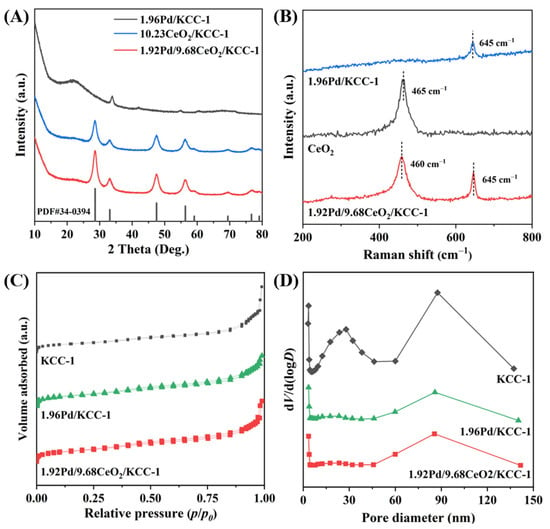
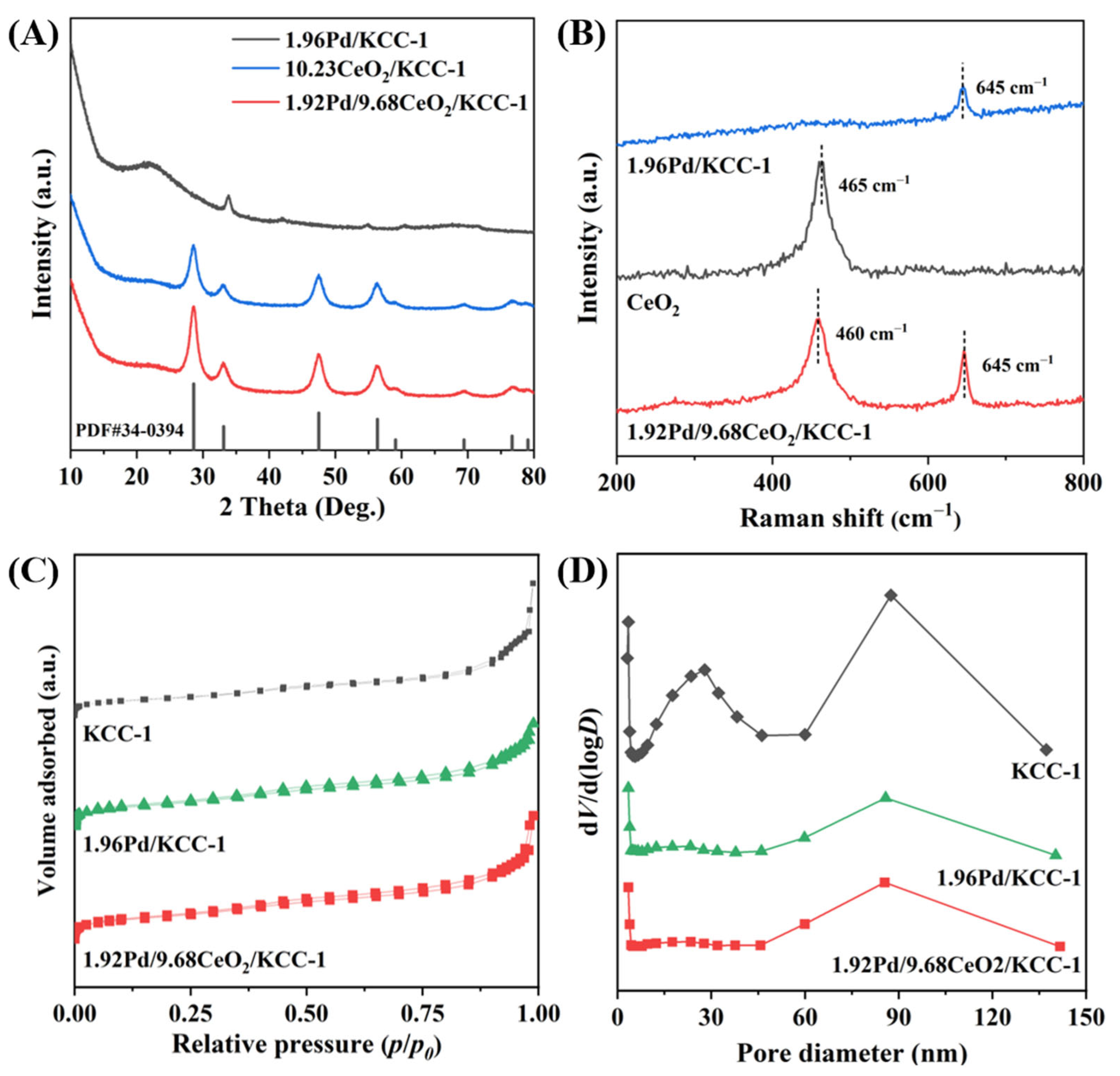
Crystal phase compositions of the samples were determined using the XRD technique. Figure 2A shows XRD patterns of the 1.92Pd/9.68CeO2/KCC-1, 1.96Pd/KCC-1, and 10.23CeO2/KCC-1 samples. The diffraction peaks of CeO2 appeared at 2θ = 28.5°, 33.5°, 47.5°, 56.3°, 59.1°, 69.4°, 76.7°, and 79.1°. A comparison in XRD patterns of the as-fabricated samples with that (JCPDS PDF# 34-0394 [42]) of the standard CeO2 sample reveals that the as-synthesized CeO2 sample is of a fluorite-type cubic structure [43]. It should be noted that there is a weak diffraction signal at 2θ = ca. 33.5° for the 1.96Pd/KCC-1 and 1.92Pd/9.68CeO2/KCC-1 samples, which could be assigned to the (110) crystal face of tetragonal PdO (JCPDS PDF# 41-1107). It is well-known that XRD is an effective tool to analyze the crystal structure of a bulk material. The Pd species in the 1.96Pd/KCC-1 and 1.92Pd/9.68CeO2/KCC-1 samples were present in the form of bulk PdO, but their surface Pd0 and Pd2+ compositions were different, as confirmed by the subsequent Pd 3d XPS results. According to the Scherrer formula, the Pd crystallite sizes in 1.92Pd/9.68CeO2/KCC-1 and 1.96Pd/KCC-1 were calculated to be 2.89 and 4.63 nm, respectively.
Figure 2.
(A) XRD patterns of 1.96Pd/KCC-1, 10.23CeO2/KCC-1, and 1.92Pd/9.68CeO2/KCC-1, (B) Raman spectra of CeO2, 1.96Pd/KCC-1, and 1.92Pd/9.68CeO2/KCC-1, and (C) nitrogen adsorption–desorption isotherms and (D) pore-size distributions of KCC-1, 1.96Pd/KCC-1, and 1.92Pd/9.68CeO2/KCC-1.
Figure 2B displays Raman spectra of the 1.92Pd/9.68CeO2/KCC-1, 1.96Pd/KCC-1, and CeO2 samples. No vibration bands of the KCC-1 support were detected within the scanned range. The characteristic band at 465 cm−1 originated from the F2g mode of oxygen atoms symmetrically vibrating around Ce in CeO2, which was attributable to the fluorite-type cubic CeO2 structure [44]. The characteristic band at 645 cm−1 was ascribed to the B1g vibration of the PdO phase induced by Pd loading. Therefore, the Raman spectra of the samples reveal that the characteristic bands at 645 and 465 cm−1 are due to the PdO and CeO2 species, respectively, which were confirmed by the subsequent XPS characterization results. After Pd loading, the band at 645 cm−1 was shifted toward a lower wavenumber, which is likely attributed to the pronounced interaction between Pd and CeO2 [45,46].
N2 adsorption–desorption isotherms and pore-size distributions of the samples were measured using the BET technique, as shown in Figure 2C,D and Table 1. All the samples exhibited an IV-typed isotherm, with a H3-typed hysteresis loop appearing at a relative pressure (p/p0) of 0.8–1.0, suggesting a stacked mesoporous architecture. Table 1 summarizes the surface areas and pore volumes of the samples. The surface areas of the KCC-1, 1.96Pd/KCC-1, 10.23CeO2/KCC-1, and 1.92Pd/9.68CeO2/KCC-1 samples were 555, 480, 367, and 304 m2/g, respectively, and the drop in surface area of the CeO2-loaded samples might be due to the partial blocking of mesoporous pores by CeO2 [29]. It should be pointed out that the xPd/9.68CeO2/KCC-1 samples with different Pd loadings (0.97Pd/9.68CeO2/KCC-1, 1.44Pd/9.68CeO2/KCC-1, and 1.92Pd/9.68CeO2/KCC-1) exhibited a close surface area (301–304 m2/g). Pore sizes of all the samples determined by the BJH method were in the range of 9–13 nm, confirming formation of a mesoporous structure [19]. It is noted that the macropores of about 30 and/or 90 nm stem from the aggregation of spherical KCC-1 particles in all the samples.
3.2. Reducibility, Surface Properties, and Adsorption–Desorption Behavior
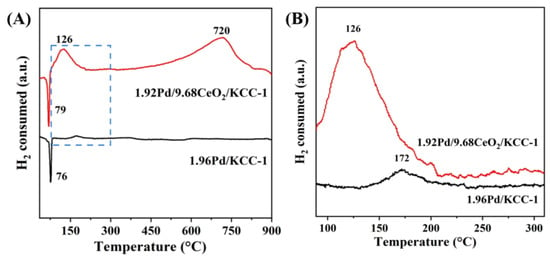
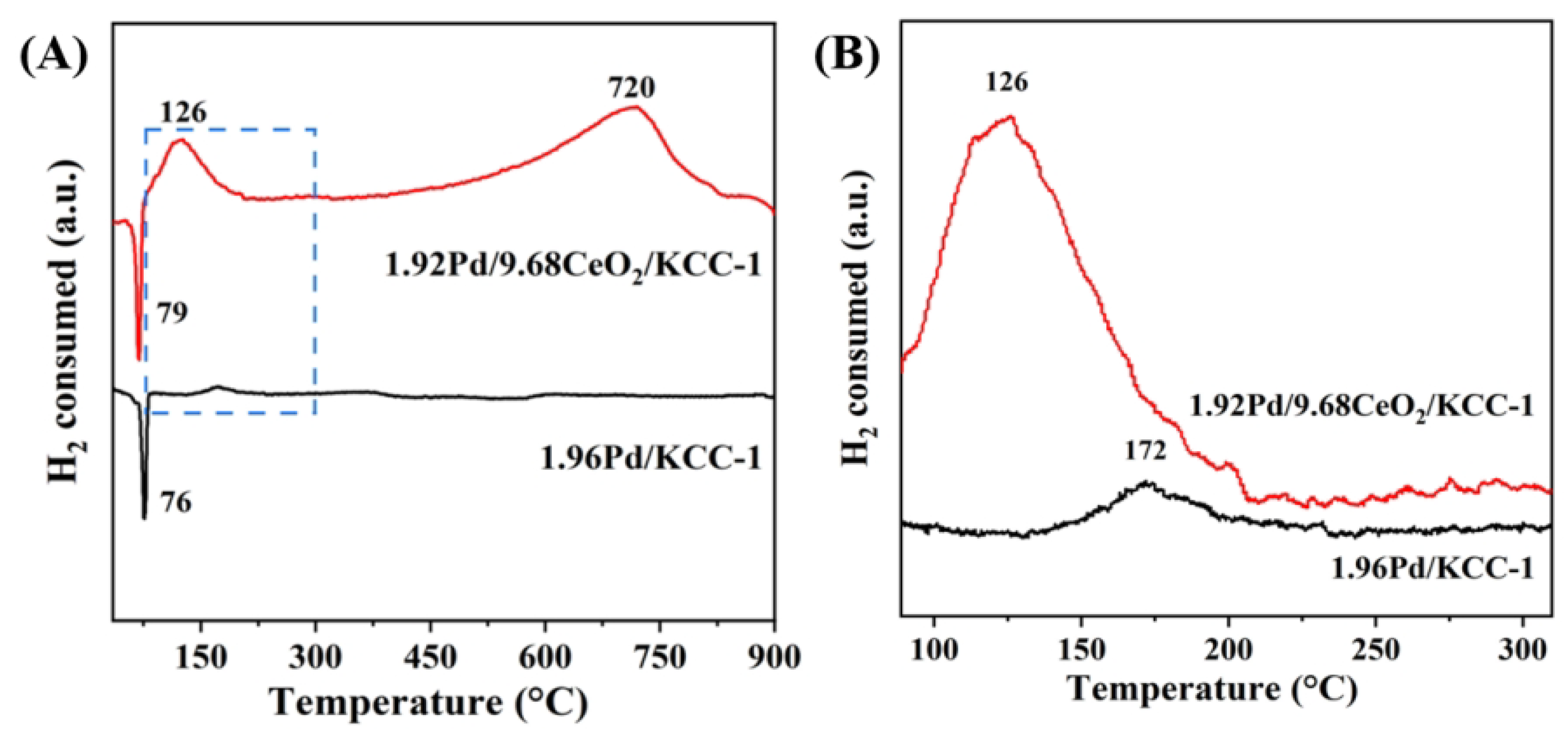
Reducibility of the samples was investigated using the H2-TPR technique, with their profiles being shown in Figure 3A. The reverse low-temperature reduction peak at 76 or 79 °C of the 1.96Pd/KCC-1 or 1.92Pd/9.68CeO2/KCC-1 sample stemmed from the desorption of hydrogen adsorbed at the Pd sites. For the 1.92Pd/9.68CeO2/KCC-1 sample, a reduction peak was observed at 126 °C, which was the removal of adsorbed oxygen species and the reduction of PdO. Comparing the peak at 172 °C due to the reduction of PdO for the 1.96Pd/KCC-1 sample (Figure 3B), the intensity of the peak at 126 °C for the 1.92Pd/9.68CeO2/KCC-1 sample was much stronger and its appearance temperature was lower by 46 °C, demonstrating that the doping of CeO2 favored the improvement in the low-temperature reducibility of the sample. There were the adsorbed oxygen species at the oxygen vacancies of CeO2 in 1.92Pd/9.68CeO2/KCC-1 and the atomic hydrogen species adsorbed on the Pd nanoparticles in the CeO2-doped KCC-1-supported Pd sample during the H2-TPR experiment favored the reduction of the adsorbed oxygen and PdO species, hence improving the low-temperature reducibility of the sample. The bigger reduction peak at 126 °C for the 1.92Pd/9.68CeO2/KCC-1 sample than that at 172 °C for the 1.96Pd/KCC-1 sample due to the reduction of PdO suggests that there is a much higher amount of Pd2+ species in the former than in the latter since the H2-TPR technique was used to determine the reduction behaviors of the bulk samples, although the surface Pd2+/(Pd0 + Pd2+) molar ratio on 1.92Pd/9.68CeO2/KCC-1 was slightly higher than that on 1.96Pd/KCC-1 (Table 1). Additionally, there was also a reduction peak at 720 °C for the 1.92Pd/9.68CeO2/KCC-1 sample, which was assigned to reduction of the Ce4+ to Ce3+ species [47]. Meanwhile, the peak at the high temperature was not observed for the 1.96Pd/KCC-1 sample without the doping of CeO2. The hydrogen consumption of the samples was determined through quantification of the reduction peaks in their H2-TPR profiles. The hydrogen consumption (0.171 mmol/gcat) of the 1.92Pd/9.68CeO2/KCC-1 sample was much higher than that (0.032 mmol/gcat) of 1.96Pd/KCC-1 sample (Table 1).
Figure 3.
(A) H2-TPR profiles and (B) partially enlarged H2-TPR profiles (in the range of 100–300 °C) of the 1.92Pd/9.68CeO2/KCC-1 and 1.96Pd/KCC-1 samples.
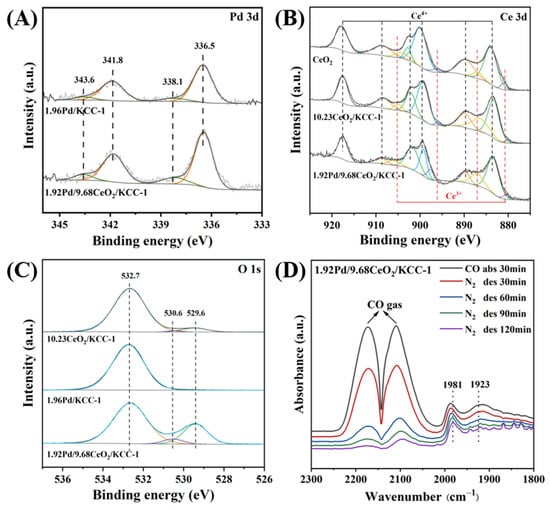
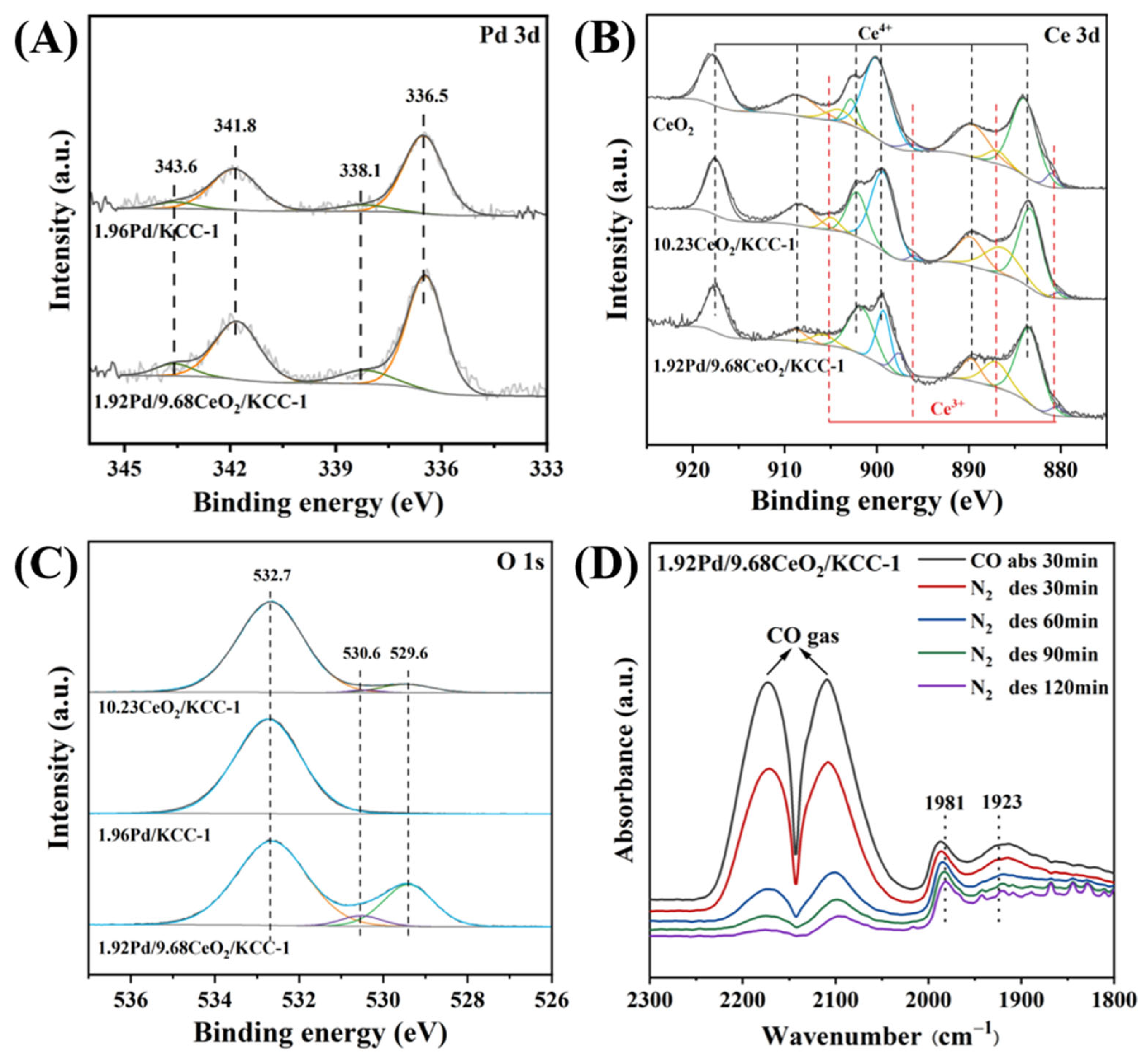
To investigate the relationship between surface properties (elemental compositions, metal valence states, and oxygen species) and catalytic performance of the samples, their O 1s, Ce 3d, and Pd 3d XPS spectra were recorded, as shown in Figure 4. The 1.92Pd/9.68CeO2/KCC-1 or 1.96Pd/KCC-1 sample exhibited an asymmetric peak in the Pd 3d XPS spectrum, which was decomposed into two components at binding energies (BEs) of 336.5 and 338.1 eV, corresponding to the surface Pd0 and Pd2+ species [48]. The Pd2+/(Pd0 + Pd2+) molar ratio (14.22) on 1.92Pd/9.68CeO2/KCC-1 was much higher than that (10.50) on 1.96Pd/KCC-1 (Table 1). Figure S4 shows Pd 3d XPS spectra of the x wt% Pd/9.68CeO2/KCC-1 samples at different Pd loadings. The Pd2+/(Pd0 + Pd2+) molar ratio on the surface of the supported Pd samples increased gradually from 12.49 to 14.22 with the rise in Pd loading from 0.97 to 1.92 wt%. An analysis on the Ce 3d XPS spectra reveals that there are the Ce 3d3/2 and Ce 3d5/2 final states. Six components at BEs of 883.3, 889.2, 899.6, 902.4, 908.7, and 917.9 eV were attributed to the surface Ce4+ species, whereas the two components at BEs of 880.7, 887.2, 896.1 and 905.2 eV were assigned to the surface Ce3+ species [49]. Since Ce exists in two distinct oxidation states, the formation of Ce3+ implies the generation of oxygen vacancies. That is to say, the CeO2-doped samples possess excellent oxygen storage and release capabilities. The Ce3+/(Ce3+ + Ce4+) molar ratio can be used to evaluate the concentration of Ce3+ on the sample surface by quantitatively analyzing the Ce3+ component peaks in Ce 3d XPS spectra of the samples. It is found that the surface Ce3+/(Ce3+ + Ce4+) molar ratio on 1.92Pd/9.68CeO2/KCC-1 is 24.16, higher than those (22.90 and 23.15) of the samples with other Pd loadings (see Table 1). A higher amount of Ce3+ species means a higher amount of oxygen vacancies, in which a more amount adsorbed oxygen species could be generated and the formed adsorbed oxygen species could facilitate stabilization of the active PdO phase, thereby enhancing the catalytic activity for methane combustion.
Figure 4.
(A) Pd 3d, (B) Ce 3d, and (C) O 1s XPS of the 1.92Pd/9.68CeO2/KCC-1, 1.96Pd/KCC-1, 10.23CeO2/KCC-1, and CeO2 samples, and (D) in situ CO-DRIFTS spectra of the 1.92Pd/9.68CeO2/KCC-1 sample.
For O 1s XPS spectra of the 1.92Pd/9.68CeO2/KCC-1, 1.96Pd/KCC-1, and 10.23CeO2/KCC-1 samples, there were three components at BEs of 529.6, 530.6, and 532.7 eV. The peak at a BE of 532.7 eV was due to the bridging oxygen (Si–O–Si) species in the SiO2 structure of the KCC-1 support. The other two peaks at BEs of 529.6 and 530.6 eV corresponded to the surface lattice oxygen (Olatt) and adsorbed oxygen (Oads) on the sample, respectively [50]. As can be seen from Table 1, the Oads/Olatt molar ratio (20.13) on 1.92Pd/9.68CeO2/KCC-1 was higher than that (17.66) on 10.23CeO2/KCC-1; furthermore, the Oads/Olatt molar ratios (18.01–20.13) on the xPd/9.68CeO2/KCC-1 (x = 0.97–1.92 wt%) samples were close. It should be noted that almost no Oads species are detected on the surface of the 1.96Pd/KCC-1 sample.
The precious metal loading state of the catalyst was investigated using in situ CO-DRIFTS characterization technique, as shown in Figure 4D. Two absorption bands at 1981 and 1923 cm−1 were observed for the 1.92Pd/9.68CeO2/KCC-1 sample, which were attributed to the CO adsorbed in a bridged configuration at the Pd site. Similarly, two absorption bands at 1983 and 1918 cm−1 were observed for the 1.96Pd/KCC-1 sample (Figure S5). The loaded Pd on 1.96Pd/KCC-1 might be mainly present in the form of clusters. After loading CeO2, the number of clusters increased, which was beneficial for the enhancement in methane combustion activity.
3.3. Catalytic Performance
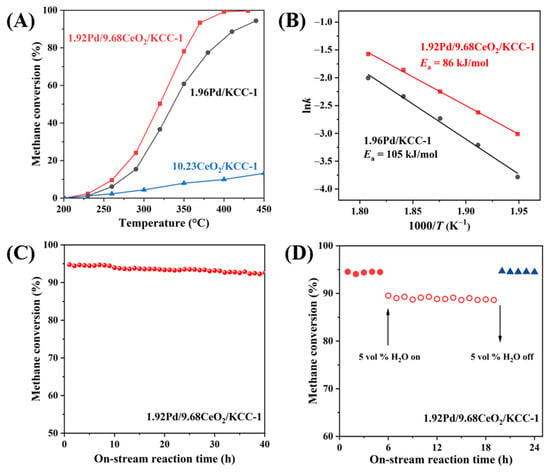
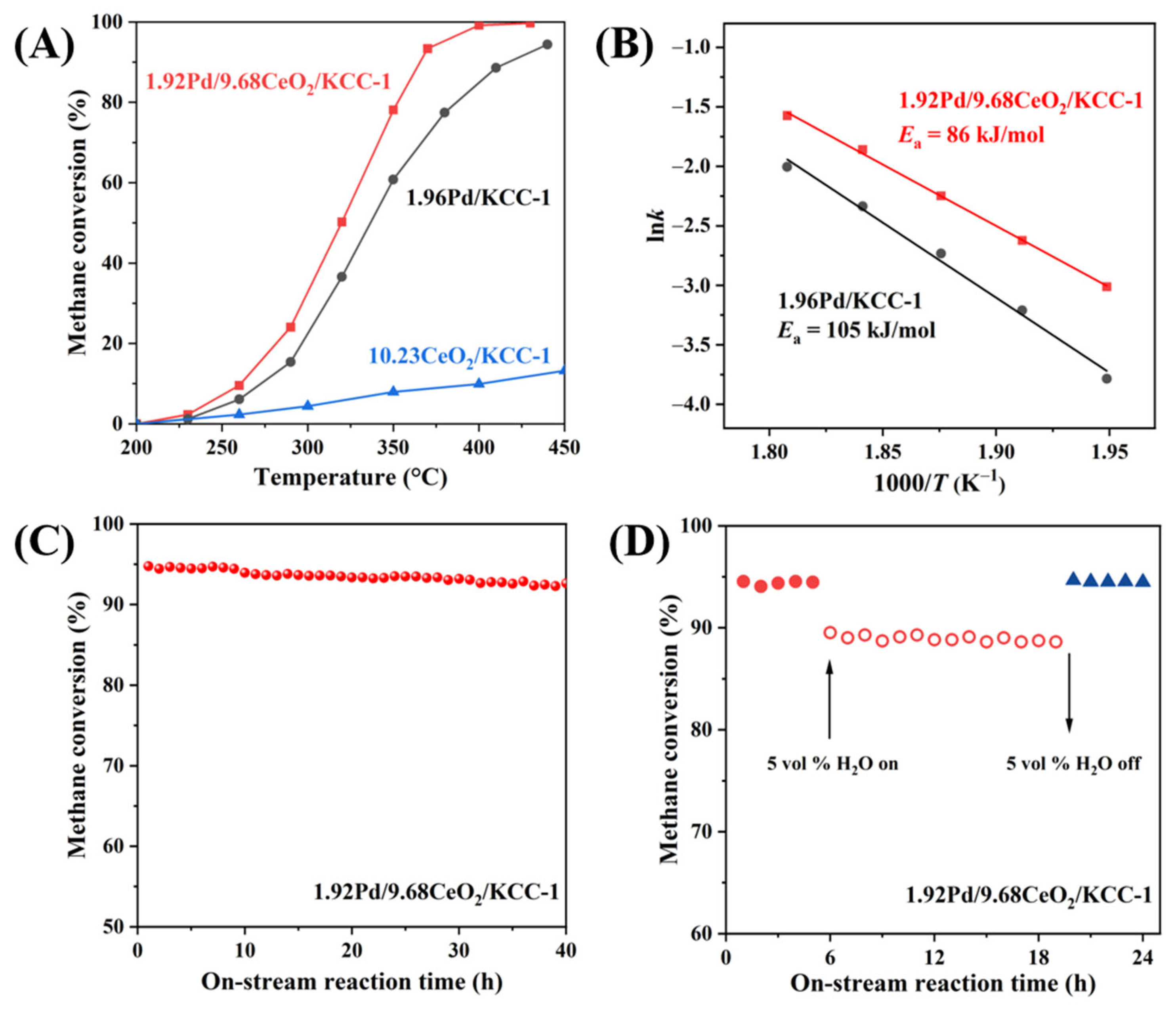
To compare catalytic activities of the samples, we use the reaction temperatures (T50% and T90%) required for achieving methane conversions of 50 and 90%, respectively. Figure S6 shows catalytic activities of the xPd/9.68CeO2/KCC-1 (x = 0.97, 1.44, and 1.92 wt%) samples for methane combustion under the conditions of (10,000 ppm CH4 + 20.0 vol% O2 + N2 (balance)) and SV = 20,000 mL/(g h). Methane conversion increased with increasing the Pd loading. Figure S7 shows catalytic activities of the 1.92Pd/yCeO2/KCC-1 (Ce loading (y) = 5.27, 9.68, and 18.81 wt%) samples for methane combustion. Apparently, the 1.92Pd/9.68CeO2/KCC-1 sample performed the best for methane combustion among the three samples with different Ce loadings. Therefore, the 1.92Pd/9.68CeO2/KCC-1 sample was selected for further investigation. The 1.92Pd/9.68CeO2/KCC-1 sample with a Pd loading (x) of 1.92 wt% exhibited the best methane combustion activity (T50% = 320 °C and T90% = 366 °C), which was better than that (T50% = 337 °C and T90% = 414 °C) over the Pd/KCC-1 sample, and significantly better than that over the 10.23CeO2/KCC-1 sample (results shown in Table 2 and Figure 5A).
Table 2.
Catalytic activities, specific reaction rates at 280 °C, apparent activation energies (Ea), Pd dispersion, and TOFPd at 280 °C of the samples for methane combustion.
Figure 5.
(A) Catalytic activity for CH4 combustion versus temperature over 10.23CeO2/KCC-1, 1.96Pd/KCC-1, and 1.92Pd/9.68CeO2/KCC-1, (B) lnk versus inverse temperature of 1.96Pd/KCC-1 and 1.92Pd/9.68CeO2/KCC-1 for methane combustion, (C) long-term stability of 1.92Pd/9.68CeO2/KCC-1 for methane combustion, and (D) effect of 5 vol% water vapor on methane combustion over 1.92Pd/9.68CeO2/KCC-1 at 370 °C and SV = 20,000 mL/(g h).
The Pd dispersion on the supported Pd samples was determined using the CO-pulse method via the adsorption of CO. The apparent activation energies (Ea), specific reaction rates, and turnover frequencies (TOFPd) of the samples for methane combustion were calculated based on the activity data, Pd loadings, and Pd dispersion, as summarized in Table 2. The Ea (86 kJ/mol) obtained over 1.92Pd/9.68CeO2/KCC-1 was lower than that (Ea = 105 kJ/mol) over 1.96Pd/KCC-1 (see also Figure 5B). The specific reaction rate at 280 °C and the TOFPd at 280 °C decreased in the order of 1.92Pd/9.68CeO2/KCC-1 (0.39 mmol/(gcat s) and 0.683 s−1) > 1.96Pd/KCC-1 (0.27 mmol/(gcat s) and 0.390 s−1), providing further evidence for the enhanced methane oxidation performance by ceria modification on Pd/KCC-1. To investigate the effects of Pd doping and CeO2 modification on the intrinsic activity of the sample, the specific rate at 280 °C of our best sample is compared with that of other Pd-based catalysts reported in the literature (Table S1). Obviously, 1.92Pd/9.68CeO2/KCC-1 sample exhibited better specific reaction rate at 280 °C (0.39 μmol/(gcat s)) than the 1.96Pd/KCC-1 sample, which was also higher than those (0.14–0.37 μmol/(gcat s)) over 0.55Pd/ZrO2, Pd/NiCo2O4, Pd/CeO2@SiO2, 0.97Pd/3DOM Ce0.7Zr0.3O2, and Pd-NF/Al2O3, but lower than that (0.96 μmol/(gcat s)) over Pd/NiCo2O4/NiAl2O4/γ-Al2O3 and that (0.75 μmol/(gcat s)) over 0.44PtPd2.2/ZrO2.
Shown in Figure 5C are the long-term stability test results obtained over the 1.92Pd/9.68CeO2/KCC-1 sample for CH4 oxidation at 370 °C and SV = 20,000 mL/(g h). Apparently, there were no significant declines in the measured methane conversions after 40 h of on-stream reaction. In other words, the 1.92Pd/9.68CeO2/KCC-1 sample exhibited good catalytic stability under the adopted reaction conditions. In the actual methane-containing emissions, there is the co-presence of methane and water, in which water can exert a negative effect on activity of a catalyst [51]. Consequently, it is necessary to examine the effect of moisture with a certain concentration on CH4 combustion of the typical sample, and the results are shown in Figure 5D. CH4 conversions remained almost unchanged under the water-free condition. However, introducing 5.0 vol% water vapor into the reaction system gave rise to a decrease in activity (CH4 conversion decreased from 95 to 88%). After 5.0 vol% water vapor was removed from the feedstock, CH4 conversions were recovered to approximately 95% and maintained stably in the subsequent reaction time. The slight deactivation of the 1.92Pd/9.68CeO2/KCC-1 sample induced by water vapor addition was reversible. That is to say, 1.92Pd/9.68CeO2/KCC-1 possessed good water resistance. Additionally, we performed the H2O-TPD experiments of the samples, and their profiles are illustrated in Figure S8. All the samples exhibited water desorption peaks within the range of 100–300 °C. In previous studies, such water-induced inhibition has been linked to the reaction of PdO + H2O → Pd(OH)2, thereby reducing the active phase of PdO [52]. The selected KCC-1 support played an important role in alleviating this negative effect, enabling the inner-layer PdO to maintain high reactivity.
3.4. In Situ DRIFTS Analysis
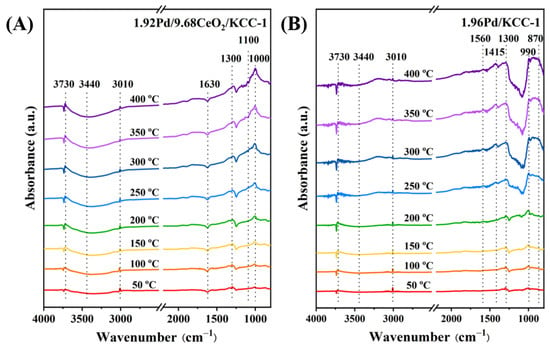
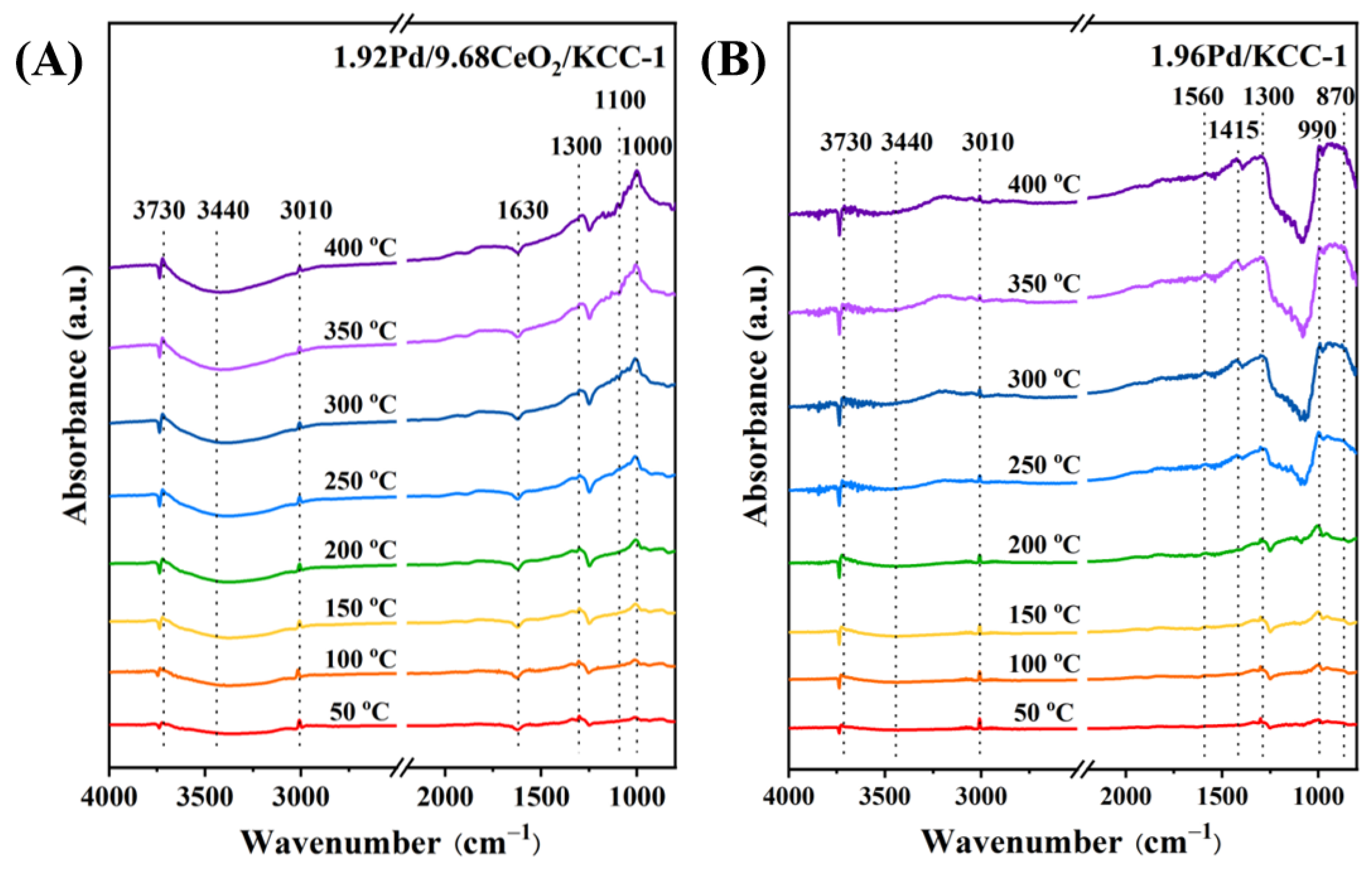
The adsorption and desorption of methane also play a key role in determining methane oxidation. To further investigate the dissociation process of methane on the sample surface, in situ DRIFTS technique was employed. After 1 h of oxygen pretreatment at 300 °C, the in situ DRIFTS spectra of CH4 oxidation over 1.96Pd/KCC-1 and 1.92Pd/9.68CeO2/KCC-1 with increasing temperature are shown in Figure 6. The absorption band at 3010 cm−1 was attributed to asymmetric stretching vibration of the C–H bond in CH4; the one at 3730 cm−1 corresponded to vibration of the hydroxyl group [53]; the ones at 3440 and 1630 cm−1 originated from vibrations of the adsorbed H2O formed during the methane oxidation process; the one between 1100 and 1300 cm−1 was ascribed to vibration of the –OOH species; the one at 1000 cm−1 was due to vibration of the O2− species; and the one at 1560 cm−1 was owing to vibration of the CO32− species [54]. Upon oxygen introduction, methane underwent a series of chemical reactions over the sample to be converted to –CH3O. During continuous oxygen supply, the intermediate products underwent deep oxidation to produce formate and carbonate [55]. These intermediates underwent complete oxidation, and the combustion process finally yielded to carbon dioxide and water. Concurrently, as the temperature rose, a gradual weakening in intensity of the methane absorption band was observed. By comparing the two catalysts, it can be observed that the catalyst doped with cerium oxide shows a faster change in the peak representing CO32−, indicating that the intermediate products attached to the surface of the catalyst can decompose more quickly (i.e., the intermediate products are consumed at an increased rate), thereby enabling methane to completely convert into carbon dioxide and water. This result indicates that methane is first activated, resulting in the cleavage of its C–H bonds. Subsequently, formate and carbonate species were accumulated on the sample surface and further oxidized to CO2 and H2O [56]. The above characterization results confirm the good ability of 1.92Pd/9.68CeO2/KCC-1 to activate C-H bonds in methane. Figure S9 shows in situ DRIFTS spectra of methane combustion over the 1.92Pd/9.68CeO2/KCC-1 sample under the conditions of (10,000 ppm CH4 + 20.0 vol% O2 + N2 (balance)), different time (20–180 min), and 400 °C. It can be observed that the intensity of the individual absorption bands undergo no significant changes, further demonstrating the good catalytic stability of 1.92Pd/9.68CeO2/KCC-1.
Figure 6.
In situ DRIFTS spectra of methane combustion over the (A) 1.92Pd/9.68CeO2/KCC-1 and (B) 1.96Pd/KCC-1 samples under the conditions of (10,000 ppm CH4 + 20.0 vol% O2 + N2 (balance)), different temperatures (50–400 °C), and reaction time = 10 min.
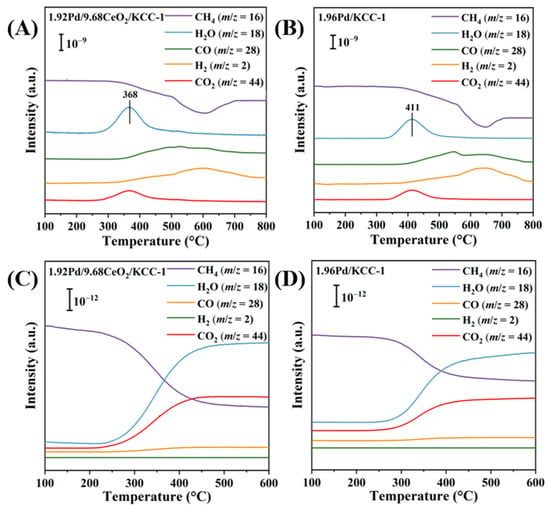
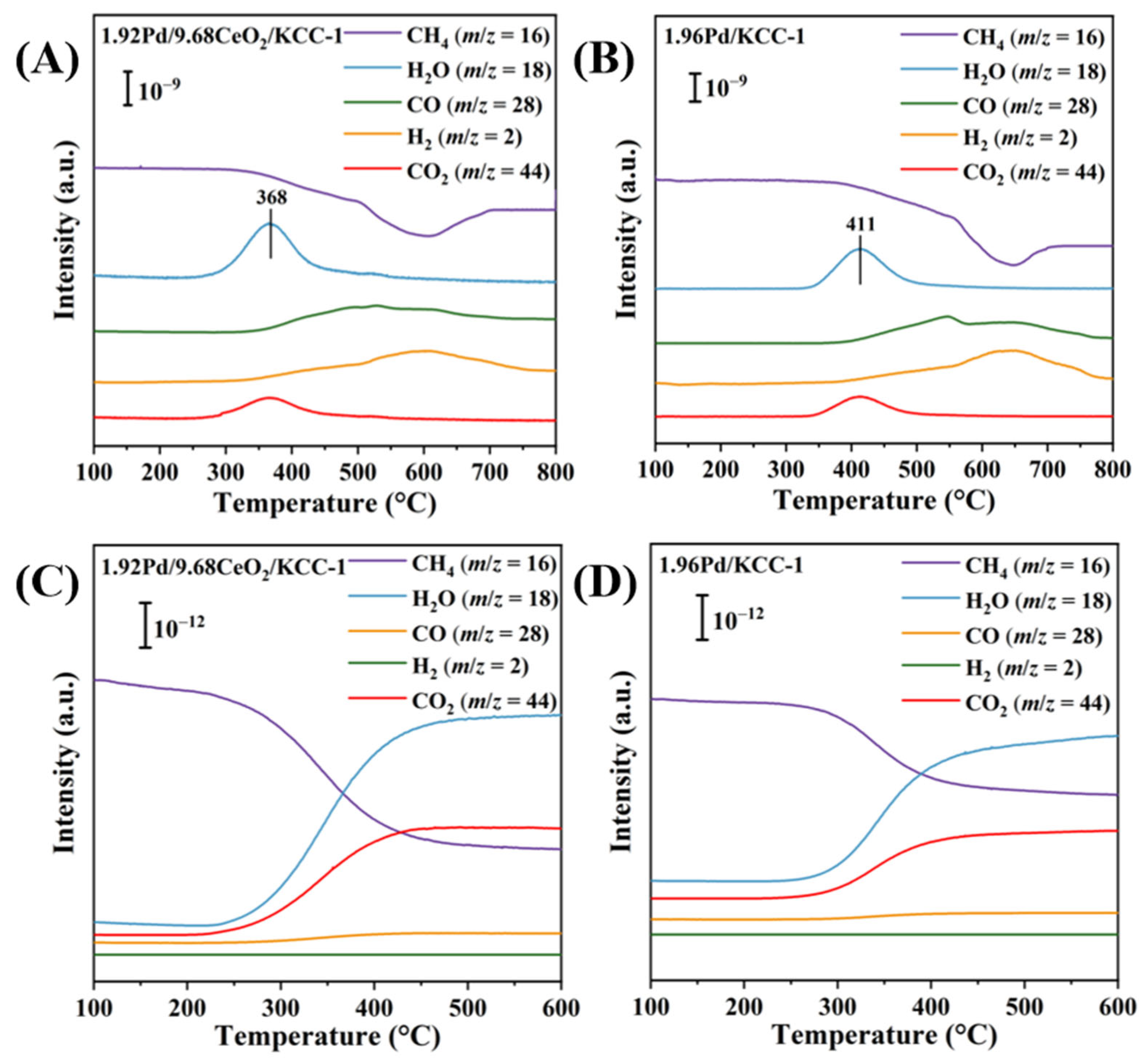
To investigate the effect of CeO2 doping on methane combustion activity, we conducted the CH4-TPR experiments of the 1.96Pd/KCC-1 and 1.92Pd/9.68CeO2/KCC-1 samples. As shown in Figure 7A,B, the intensity of the methane signal at 368 °C began to weaken, accompanied by CO2 generation, confirming that methane oxidation commenced around this temperature. Simultaneously collected signals reveal that the oxidation of methane on the sample surface yields CO2 and H2O as the final products. Following modification of the KCC-1-supported Pd sample with CeO2, the desorption peak due to water was shifted to a lower temperature (from 411 °C to 368 °C), which was associated with the reaction of the lattice oxygen in PdO of the 1.92Pd/9.68CeO2/KCC-1 sample that was stabilized by the adsorbed oxygen species formed at oxygen vacancies of CeO2, thereby generating more CO2. However, a slight increase in intensity of the signals due to CO and H2 after 400 °C was also observed, suggesting that methane dry reforming (CH4 + CO2 = CO + H2) [57] might occur on the sample surface.
Figure 7.
(A,B) CH4-TPR and (C,D) CH4-TPSR profiles of (A,C) 1.92Pd/9.68CeO2/KCC-1 and (B,D) 1.96Pd/KCC-1.
It has been well-known that methane contains four identical and symmetrical C–H bonds with a high bond energy of 439 kJ/mol. Consequently, the activation of methane molecules requires high temperatures. We performed the CH4-TPSR experiments with the 1.92Pd/9.68CeO2/KCC-1 and 1.96Pd/KCC-1 samples, and their results are shown in Figure 7C,D. Obviously, methane consumption increased with the rise in temperature. Furthermore, methane consumption rate over 1.92Pd/9.68CeO2/KCC-1 was higher than that over 1.96Pd/KCC-1, and simultaneously, the generated CO2 and H2O amounts over 1.92Pd/9.68CeO2/KCC-1 were higher than those over 1.96Pd/KCC-1. The results indicate that methane undergoes essentially complete combustion over the samples (i.e., no byproducts such as CO or H2 are formed) [58,59]. Moreover, the onset temperatures for CO2 formation over the samples aligned with their catalytic activities in the oxidation of methane. This correlation was consistent with the CH4-TPR characterization results.
4. Conclusions
1.92Pd/9.68CeO2/KCC-1 and 1.96Pd/KCC-1 were prepared. Pd NPs were highly dispersed on the surface of 1.92Pd/9.68CeO2/KCC-1, and the synergistic interaction between CeO2 and PdO further enhanced catalytic activity. 1.92Pd/9.68CeO2/KCC-1 showed the outstanding catalytic performance for methane combustion, which was much better than that over 1.96Pd/KCC-1. In addition, the 1.92Pd/9.68CeO2/KCC-1 sample exhibited good high-temperature stability. The enhanced methane combustion performance of 1.92Pd/9.68CeO2/KCC-1 was mainly associated with the good dispersion of Pd species, the stabilization of the active Pd2+ species, and the generation of more reactive oxygen species.
Supplementary Materials
The following supporting information can be downloaded at https://www.mdpi.com/article/10.3390/nano16040231/s1, S1. Content; S2. Chemicals; S3. Catalyst characterization procedures; Table S1: Catalytic activities (T50% and T90%) and specific reaction rates at 280 °C for methane combustion over the 1.92Pd/9.68CeO2/KCC-1 sample presented in this work and the Pd-based catalysts reported in the literature; Figure S1: Additional SEM images of the (A) KCC-1 and (B) 1.96Pd/KCC-1 samples; Figure S2: Additional TEM images of the 1.92Pd/9.68CeO2/KCC-1 sample; Figure S3: Pd particle-size distributions of the 1.92Pd/9.68CeO2/KCC-1 and 1.96Pd/KCC-1 samples; Figure S4: Pd 3d XPS spectra of the xPd/9.68CeO2/KCC-1 (x = 0.97, 1.44, and 1.92 wt%) samples; Figure S5: In situ CO-DRIFTS spectra of the 1.96Pd/KCC-1 sample; Figure S6: Methane conversion as a function of temperature for methane combustion over the xPd/9.68CeO2/KCC-1 (x = 0.97, 1.44, and 1.92 wt%) samples at SV = 20,000 mL/(g h); Figure S7: Methane conversion as a function of temperature over the 1.92Pd/yCeO2/KCC-1 (y = 5.27, 9.68, and 18.81 wt%) samples for methane combustion at SV = 20,000 mL/(g h); Figure S8: H2O-TPD profiles of the 1.96Pd@KCC-1 and 1.92Pd/9.68CeO2/KCC-1 samples; Figure S9: In situ DRIFTS spectra of methane combustion over the 1.92Pd/9.68CeO2/KCC-1 sample under the conditions of (10,000 ppm CH4 + 20.0 vol% O2 + N2 (balance)), different time (20–180 min), and 400 °C.
Author Contributions
Writing—original draft preparation, investigation, K.F.; investigation, formal analysis, J.T.; methodology, Z.H.; conceptualization validation, Y.L.; investigation, methodology, J.D.; investigation, L.J.; investigation, data curation, L.W.; data curation, Z.W.; writing—review and editing, methodology, supervision, project administration, H.D. All authors have read and agreed to the published version of the manuscript.
Funding
This work was financially supported by the National Key R&D Program of China (2022YFB3504101 and 2022YFB3506200), the National Natural Science Foundation of China (22322601 and 22425601), and the R&D Program of Beijing Municipal Education Commission (KZ202210005011).
Data Availability Statement
Data will be made available on request.
Conflicts of Interest
The authors declare no conflicts of interest.
References
- Lin, J.; Xu, Y.L.; Chen, X.H.; Huang, J.; Xu, H.; Zheng, Y. Electron promoted palladium-cobalt active sites for efficient catalytic combustion of methane. J. Clean. Prod. 2023, 385, 135744. [Google Scholar] [CrossRef] [Scilit]
- Huang, C.Y.; Shan, W.P.; Lian, Z.H.; Zhang, Y.; He, H. Recent advances in three-way catalysts of natural gas vehicles. Catal. Sci. Technol. 2020, 10, 6407–6419. [Google Scholar] [CrossRef] [Scilit]
- Wen, N.N.; Lin, R.; Su, Y.X.; Deng, W.; Zhou, H.; Zhao, B. SCR of NO with CH4 over Fe/Ga2O3-Al2O3 and the mechanism. J. Environ. Chem. Eng. 2021, 9, 105014. [Google Scholar] [CrossRef] [Scilit]
- Feng, X.B.; Jiang, L.; Li, D.Y.; Tian, S.; Zhu, X.; Wang, H.; He, C.; Li, K. Progress and key challenges in catalytic combustion of lean methane. J. Energy Chem. 2022, 75, 173–215. [Google Scholar] [CrossRef] [Scilit]
- Zhao, M.; Tian, X.J.; Wang, Y.L.; Wang, X.; Ciais, P.; Jin, Z.; Zhang, H.; Wang, T.; Ding, J.; Piao, S. Slowdown in China’s methane emission growth. Nat. Sci. Rev. 2024, 11, nwae223. [Google Scholar] [CrossRef] [Scilit]
- Zhou, X.; Han, K.; Li, K.; Pan, J.; Wang, X.; Shi, W.; Song, S.; Zhang, H. Dual-site single-atom catalysts with high performance for three-way catalysis. Adv. Mater. 2022, 34, 2201859. [Google Scholar] [CrossRef] [Scilit]
- Hayes, R.E.; Profic-Paczkowska, J.; Jędrzejczyk, R.; Mmbaga, J.P. Catalytic combustion of fugitive methane: Challenges and current state of the technology. Appl. Sci. 2025, 15, 10269. [Google Scholar] [CrossRef] [Scilit]
- Duan, H.M.; Kong, F.X.; Bi, X.Z.; Chen, L.; Chen, H.; Yang, D.; Huang, W. Catalytic combustion of methane over noble metal catalysts. ACS Catal. 2024, 14, 17972–17992. [Google Scholar] [CrossRef] [Scilit]
- Guo, M.X.; Luo, Y.M.; Zhao, Y.K.; Zhang, A.M.; Liu, Y.; Dai, H.; Deng, J.; Du, J. Noble metal catalysts dedicated to the methane emission control for lean-burn mobile sources: A review. Nano Res. 2026, 19, 94908316. [Google Scholar] [CrossRef] [Scilit]
- Tao, J.X.; Lin, H.X.; Deng, J.G.; Liu, Y.; Jing, L.; Hou, Z.; Wei, L.; Wang, Z.; Dai, H. Enhanced low-temperature catalytic activity and stability in methane combustion of Pd−CeO2 nanowires@SiO2 by Pt dispersion. Appl. Catal. B Environ. 2025, 360, 124554. [Google Scholar] [CrossRef] [Scilit]
- Cui, Y.R.; Zhu Chen, J.; Peng, B.; Kovarik, L.; Devaraj, A.; Li, Z.; Ma, T.; Wang, Y.; Szanyi, J.; Miller, J.T.; et al. Onset of high methane combustion rates over supported palladium catalysts: From isolated Pd cations to PdO nanoparticles. JACS Au 2021, 1, 396–408. [Google Scholar] [CrossRef] [Scilit] [PubMed]
- Tumbalova, K.; Zlatanova, Z.; Velinova, R.; Shipochka, M.; Markov, P.; Kovacheva, D.; Spassova, I.; Todorova, S.; Ivanov, G.; Nihtianova, D.; et al. Catalytic combustion of methane over Pd-modified La-Ce-Zr-Al catalyst. Materials 2025, 18, 2319. [Google Scholar] [CrossRef] [Scilit] [PubMed]
- Xiong, H.F.; Kunwar, D.; Jiang, D.; García-Vargas, C.E.; Li, H.; Du, C.; Canning, G.; Pereira-Hernandez, X.I.; Wan, Q.; Lin, S.; et al. Engineering catalyst supports to stabilize PdOx two-dimensional rafts for water-tolerant methane oxidation. Nat. Catal. 2021, 4, 830–839. [Google Scholar] [CrossRef] [Scilit]
- Zhang, X.F.; Liu, Y.X.; Deng, J.G.; Jing, L.; Wu, L.; Dai, H. Catalytic performance and SO2 resistance of zirconia-supported platinum-palladium bimetallic nanoparticles for methane combustion. Catal. Today 2022, 402, 138–148. [Google Scholar] [CrossRef] [Scilit]
- Wang, W.L.; Ji, C.L.; Liu, K.; Zhao, C.-G.; Li, W.; Xie, J. Dinuclear gold catalysis. Chem. Soc. Rev. 2021, 50, 1874–1912. [Google Scholar] [CrossRef] [Scilit]
- Friberg, I.; Sadokhina, N.; Olsson, L. The effect of Si/Al ratio of zeolite supported Pd for complete CH4 oxidation in the presence of water vapor and SO2. Appl. Catal. B Environ. 2019, 250, 117–131. [Google Scholar] [CrossRef] [Scilit]
- Zou, X.L.; Chen, J.F.; Rui, Z.B.; Ji, H. Sequential growth reveals multi-spinel interface promotion for methane combustion over alumina supported palladium catalyst. Appl. Catal. B Environ. 2020, 273, 119071. [Google Scholar] [CrossRef] [Scilit]
- Xiong, J.X.; Yang, J.; Chi, X.; Wu, K.; Song, L.; Li, T.; Zhao, Y.; Huang, H.; Chen, P.; Wu, J.; et al. Pd-promoted Co2NiO4 with lattice Co–O–Ni and interfacial PdO activation for highly efficient methane oxidation. Appl. Catal. B Environ. 2021, 292, 120201. [Google Scholar] [CrossRef] [Scilit]
- Li, Y.L.; Ying, J.W.; He, T.Y.; Li, G.; Zhang, H.; Huang, S.; Huang, T.; Liu, W.; Peng, H. Ultra-small Pt–Ni bimetallic nanoparticles confined in dendritic mesoporous silica with remarkable CO catalytic oxidation performance. Ind. Eng. Chem. Res. 2023, 62, 9159–9168. [Google Scholar] [CrossRef] [Scilit]
- Zou, X.L.; Rui, Z.B.; Ji, H.B. Core–shell NiO@PdO nanoparticles supported on alumina as an advanced catalyst for methane oxidation. ACS Catal. 2017, 7, 1615–1625. [Google Scholar] [CrossRef] [Scilit]
- Li, Q.; Wang, Y.; Si, W.; Peng, Y.; Li, J. Novel insights on the metal–support interactions of Pd/ZrO2 catalysts on CH4 oxidation. ACS Appl. Mater. Interfaces 2023, 15, 7959–7968. [Google Scholar] [CrossRef] [Scilit] [PubMed]
- Liu, Z.; Xu, G.Y.; Zeng, L.Y.; Shi, W.; Wang, Y.; Sun, Y.; Yu, Y.; He, H. Anchoring Pt-doped PdO nanoparticles on γ-Al2O3 with highly dispersed La sites to create a methane oxidation catalyst. Appl. Catal. B Environ. 2023, 324, 122259. [Google Scholar] [CrossRef] [Scilit]
- Huang, J.L.; Lin, J.; Chen, X.H.; Zheng, Y.; Xiao, Y.; Zheng, Y. Optimizing the microstructure of SnO2–CeO2 binary oxide supported palladium catalysts for efficient and stable methane combustion. ACS Appl. Mater. Interfaces 2022, 14, 16233–16244. [Google Scholar] [CrossRef] [Scilit] [PubMed]
- Toscani, L.M.; Curyk, P.A.; Zimicz, M.G.; Halac, E.B.; Saleta, M.E.; Lamas, D.G.; Larrondo, S.A. Methane catalytic combustion over CeO2-ZrO2-Sc2O3 mixed oxides. Appl. Catal. A Gen. 2019, 587, 117235. [Google Scholar] [CrossRef] [Scilit]
- Xie, K.Y.; Jiang, B.S.; Wang, Z.; Zuo, S.; Wang, Q. Study on the performance and sulfur tolerance mechanism of Pd/beta zeolite in catalytic combustion of toluene. J. Mater. Res. Technol. 2023, 25, 4543–4553. [Google Scholar] [CrossRef] [Scilit]
- Mortensen, R.L.; Noack, H.D.; Pedersen, K.; Mossin, S.; Mielby, J. Recent advances in complete methane oxidation using zeolite-supported metal nanoparticle catalysts. ChemCatChem 2022, 14, e202101924. [Google Scholar] [CrossRef] [Scilit]
- Wu, L.K.; Fan, W.; Wang, X.; Lin, H.; Tao, J.; Liu, Y.; Deng, J.; Jing, L.; Dai, H. Methane oxidation over the zeolites-based catalysts. Catalysts 2023, 13, 604. [Google Scholar] [CrossRef] [Scilit]
- Thomas, A.M.; Mohan, A.; Rout, L.; Nagappan, S.; Park, S.S.; Ha, C.-S. Pd nanoparticle incorporated mesoporous silicas with excellent catalytic activity and dual responsivity. Colloid. Surf. A Physicochem. Eng. Aspects 2020, 585, 124074. [Google Scholar] [CrossRef] [Scilit]
- Wang, X.L.; Alabsi, M.H.; Chen, X.Z.; Duan, A.; Xu, C.; Huang, K.-W. CO2 hydrogenation to methanol over PdZn catalysts on bimetallic modified dendritic mesoporous silica nanospheres. Chem. Eng. J. 2023, 476, 146596. [Google Scholar] [CrossRef] [Scilit]
- Wu, M.W.; Miao, M.; Li, W.Z.; Zhang, X.; Zhang, L.; Zhen, T.; Fu, Y.; Jin, J.; Yuan, L. Metal-organic framework-derived one-dimensional Pd@CeO2 catalysts with enhanced activity for methane oxidation. Fuel 2023, 331, 125575. [Google Scholar] [CrossRef] [Scilit]
- Andrade, L.S.; Lima, H.H.L.B.; Silva, C.T.P.; Amorim, W.L.N.; Poço, J.G.R.; López-Castillo, A.; Kirillova, M.V.; Carvalho, W.A.; Kirillov, A.M.; Mandelli, D. Metal–organic frameworks as catalysts and biocatalysts for methane oxidation: The current state of the art. Coord. Chem. Rev. 2023, 481, 215042. [Google Scholar] [CrossRef] [Scilit]
- Siang, T.J.; Jalil, A.A.; Hamid, M.Y.S.; Abdulrasheed, A.A.; Abdullah, T.A.T.; Vo, D.V.N. Role of oxygen vacancies in dendritic fibrous M/KCC-1 (M = Ru, Pd, Rh) catalysts for methane partial oxidation to H2-rich syngas production. Fuel 2020, 278, 118360. [Google Scholar] [CrossRef] [Scilit]
- Siang, T.J.; Jalil, A.A.; Hamid, M.Y.S. Bifunctional metal-free KAUST Catalysis Center 1 (KCC-1) as highly active catalyst for syngas production via methane partial oxidation. Mater. Today Chem. 2022, 23, 100684. [Google Scholar] [CrossRef] [Scilit]
- Singh, B.; Polshettiwar, V. Design of CO2 sorbents using functionalized fibrous nanosilica (KCC-1): Insights into the effect of the silica morphology (KCC-1 vs. MCM-41). J. Mater. Chem. A 2016, 4, 7005–7019. [Google Scholar] [CrossRef] [Scilit]
- Hamid, M.Y.S.; Firmansyah, M.L.; Triwahyono, S.; Jalil, A.A.; Mukti, R.R.; Febriyanti, E.; Suendo, V.; Setiabudi, H.D.; Mohamed, M.; Nabgan, W. Oxygen vacancy-rich mesoporous silica KCC-1 for CO2 methanation. Appl. Catal. A Gen. 2017, 532, 86–94. [Google Scholar] [CrossRef] [Scilit]
- Feng, X.L.; Liu, D.P.; Yan, B.L.; Shao, M.; Hao, Z.; Yuan, G.; Yu, H.; Zhang, Y. Highly active PdO/Mn3O4/CeO2 nanocomposites supported on one dimensional halloysite nanotubes for photoassisted Thermal catalytic methane combustion. Angew. Chem. Int. Ed. 2021, 60, 18552–18556. [Google Scholar] [CrossRef] [Scilit]
- Dong, C.Y.; Zhou, Y.; Ta, N.; Liu, W.; Li, M.; Shen, W. Shape impact of nanostructured ceria on the dispersion of Pd species. Chin. J. Catal. 2021, 42, 2234–2241. [Google Scholar] [CrossRef] [Scilit]
- He, F.; Rao, C.; Tao, S.Y.; Sun, L.; Yi, T.; Wang, H.; Hu, B.; Yang, X.; Zhang, Y. CeO2 nanoislands enhance the activity and stability of Pt nanoparticles supported on fibrous mesoporous SiO2 for catalytic combustion of propane. ACS Appl. Nano Mater. 2024, 7, 11609–11620. [Google Scholar] [CrossRef] [Scilit]
- Tan, L.Y.; Xiang, G.H.; Liu, Z.G. Thermally stable Pd/CeO2@SiO2 with a core–shell structure for catalytic lean methane combustion. Nanoscale 2024, 16, 6720–6728. [Google Scholar] [CrossRef] [Scilit]
- Feng, W.W.; Hou, Y.H.; Yan, J.; Li, G.; Zhang, H.; Huang, S.; Huang, T.; Liu, W.; Zhang, S.; Peng, H. Preparation of highly dispersed Pt catalyst by CeOx ‘islands’ modification of dendritic mesoporous SiO2: CO as a probe molecule. Catal. Today 2024, 437, 114721. [Google Scholar] [CrossRef] [Scilit]
- Kim, Y.E.; Lee, K.-Y.; Lee, M.S. Morphology-dependent wrinkled silica-supported Pd catalysts for hydrogenation of furfural under mild conditions. Catal. Today 2024, 426, 114392. [Google Scholar] [CrossRef] [Scilit]
- Swanson, H.E.; Morris, M.C.; Evans, E.H. Standard X-Ray Diffraction Powder Patterns; National Institute of Standards and Technology: Gaithersburg, MD, USA, 1966; Volume 1, p. 56. [Google Scholar]
- Li, X.; Pereira-Hernández, X.I.; Chen, Y.Z.; Xu, J.; Zhao, J.; Pao, C.-W.; Fang, C.-Y.; Zeng, J.; Wang, Y.; Gates, B.C.; et al. Functional CeOx nanoglues for robust atomically dispersed catalysts. Nature 2022, 611, 284–288. [Google Scholar] [CrossRef] [Scilit] [PubMed]
- Loridant, S. Raman spectroscopy as a powerful tool to characterize ceria-based catalysts. Catal. Today 2021, 373, 98–111. [Google Scholar] [CrossRef] [Scilit]
- Wei, D.Y.; Yue, M.F.; Qin, S.N.; Zhang, S.; Wu, Y.-F.; Xu, G.-Y.; Zhang, H.; Tian, Z.-Q.; Li, J.-F. In situ raman observation of oxygen activation and reaction at platinum–ceria interfaces during CO oxidation. J. Am. Chem. Soc. 2021, 143, 15635–15643. [Google Scholar] [CrossRef] [Scilit]
- Liao, Y.N.; He, L.F.; Man, C.G.; Chen, L.; Fu, M.; Wu, J.; Ye, D.; Huang, B. Diameter-dependent catalytic activity of ceria nanorods with various aspect ratios for toluene oxidation. Chem. Eng. J. 2014, 256, 439–447. [Google Scholar] [CrossRef] [Scilit]
- Jiang, D.; Wan, G.; Halldin Stenlid, J.; García-Vargas, C.E.; Zhang, J.; Sun, C.; Li, J.; Abild-Pedersen, F.; Tassone, C.J.; Wang, Y. Dynamic and reversible transformations of subnanometre-sized palladium on ceria for efficient methane removal. Nat. Catal. 2023, 6, 618–627. [Google Scholar] [CrossRef] [Scilit]
- Hou, Z.Q.; Lu, Y.; Liu, Y.X.; Liu, N.; Hu, J.; Wei, L.; Li, Z.; Tian, X.; Gao, R.; Yu, X.; et al. A general dual-metal nanocrystal dissociation strategy to generate robust high-temperature-stable alumina-supported single-atom catalysts. J. Am. Chem. Soc. 2023, 145, 15869–15878. [Google Scholar] [CrossRef] [Scilit]
- Lin, H.X.; Liu, Y.X.; Deng, J.G.; Jing, L.; Wang, Z.; Wei, L.; Hou, Z.; Tao, J.; Dai, H. Enhanced water resistance of Pd/3DOM Ce0.7Zr0.3O2 catalysts in methane combustion. Catal. Today 2024, 434, 114704. [Google Scholar] [CrossRef] [Scilit]
- Lam, E.; Larmier, K.; Wolf, P.; Tada, S.; Safonova, O.V.; Copéret, C. Isolated Zr surface sites on silica promote hydrogenation of CO2 to CH3OH in supported Cu catalysts. J. Am. Chem. Soc. 2018, 140, 10530–10535. [Google Scholar] [CrossRef] [Scilit]
- Wu, Y.; Yang, W.H.; Zhang, H.L.; Xu, H.; Jiao, Y.; Zhong, L.; Wang, J.; Chen, Y. Boosting methane combustion over Pd/Y2O3–ZrO2 catalyst by inert silicate patches tuning both palladium chemistry and support hydrophobicity. ACS Appl. Mater. Interfaces 2023, 15, 44887–44898. [Google Scholar] [CrossRef] [Scilit]
- Wang, W.Y.; Zhou, W.; Li, W.; Xiong, X.; Wang, Y.; Cheng, K.; Kang, J.; Zhang, Q.; Wang, Y. In-situ confinement of ultrasmall palladium nanoparticles in silicalite-1 for methane combustion with excellent activity and hydrothermal stability. Appl. Catal. B Environ. 2020, 276, 119142. [Google Scholar] [CrossRef] [Scilit]
- Wu, Y.; Chen, J.J.; Hu, W.; Zhao, K.; Qu, P.; Shen, P.; Zhao, M.; Zhong, L.; Chen, Y. Phase transformation and oxygen vacancies in Pd/ZrO2 for complete methane oxidation under lean conditions. J. Catal. 2019, 377, 565–576. [Google Scholar] [CrossRef] [Scilit]
- Chen, S.Y.; Li, S.D.; You, R.Y.; Guo, Z.; Wang, F.; Li, G.; Yuan, W.; Zhu, B.; Gao, Y.; Zhang, Z.; et al. Elucidation of active sites for CH4 catalytic oxidation over Pd/CeO2 via tailoring metal–support interactions. ACS Catal. 2021, 11, 5666–5677. [Google Scholar] [CrossRef] [Scilit]
- Hu, Z.; Wang, Z.; Guo, Y.; Wang, L.; Guo, Y.; Zhang, J.; Zhan, W. Total oxidation of propane over a Ru/CeO2 catalyst at low temperature. Environ. Sci. Technol. 2018, 52, 9531–9541. [Google Scholar] [CrossRef] [Scilit]
- Ruan, L.; Yan, Z.D.; Xiao, M.; Zhang, C.; Zhang, Y.; Jiang, M.; Chang, C.; Liu, Z.; Yan, Y.; Yu, Y.; et al. Incorporating Si into NiO support to facilitate oxygen activation for CH4 combustion. Appl. Catal. B Environ. 2025, 362, 124771. [Google Scholar] [CrossRef] [Scilit]
- Chen, J.J.; Giewont, K.; Walker, E.A.; Lee, J.; Niu, Y.; Kyriakidou, E.A. Cobalt-induced PdO formation in low-loading Pd/BEA catalysts for CH4 oxidation. ACS Catal. 2021, 11, 13066–13076. [Google Scholar] [CrossRef] [Scilit]
- Fan, W.; Hua, M.W.; Tao, J.X.; Wu, L.; Chu, P.; Hou, Z.; Jing, L.; Liu, Y.; Zi, X.; Deng, J.; et al. A novel strategy to enhance methane combustion performance and stability of flower-like Al2O3–supported Pd catalysts by modification with Co5Mn1Ox, LaCoO3, or Ce0.6Zr0.4O2. Ind. Eng. Chem. Res. 2025, 64, 20181–20194. [Google Scholar] [CrossRef] [Scilit]
- Jiang, D.; Khivantsev, K.; Wang, Y. Low-temperature methane oxidation for efficient emission control in natural gas vehicles: Pd and beyond. ACS Catal. 2020, 10, 14304–14314. [Google Scholar] [CrossRef] [Scilit]

Disclaimer/Publisher’s Note: The statements, opinions and data contained in all publications are solely those of the individual author(s) and contributor(s) and not of MDPI and/or the editor(s). MDPI and/or the editor(s) disclaim responsibility for any injury to people or property resulting from any ideas, methods, instructions or products referred to in the content. |
© 2026 by the authors. Licensee MDPI, Basel, Switzerland. This article is an open access article distributed under the terms and conditions of the Creative Commons Attribution (CC BY) license.