


Abstract
Crystallization temperature was tuned to control the crystal structure and relaxor behavior of Na0.5Bi5.5Ti4AlO18 films. This established a structure–property regulation pathway, enabling controlled transitions from ferroelectric, non-ergodic relaxor to ergodic relaxor states. Precise crystallization temperature control reduced grain size, thereby increasing both bulk resistivity and breakdown strength via suppressed conduction pathways. The Na0.5Bi5.5Ti4AlO18 film achieves outstanding energy storage performance when crystallized at 500 °C, delivering a recoverable energy density of 49.6 J/cm3 and an energy efficiency of 73.5% at an applied electric field of 2820 kV/cm. It also exhibits excellent thermal and frequency stability. Thus, crystallization temperature control is a direct, effective lever for optimizing dielectric energy storage films.
1. Introduction
Dielectric energy storage films (DESFs) have attracted considerable attention from both academic and industrial communities owing to their high power density and exceptional thermal and electrical stability—properties that render them highly suitable for pulsed power applications [1,2]. Enhancing the energy storage performance of DESFs requires simultaneous optimization of energy storage density (Ure) and efficiency (), governed by the fundamental relationships expressed in equations and [3,4,5,6,7]. Herein, under ideal conditions, simultaneously optimizing the DESFs’ maximum polarization (Pmax), residual polarization (Pr), and breakdown strength (Eb) represents the most effective strategy for achieving high energy storage density. However, a critical bottleneck in the practical deployment of DESFs is their Ure, which arises from the intrinsic trade-off between Pmax and Eb. Liu et al. realized a high energy storage density under moderate-to-low electric fields by engineering defect dipoles and tailoring their polarization behavior [8]. Sun et al. boosted the BNBT film’s energy storage density to 86 J/cm3 at 1700 kV/cm by engineering super-tetragonal nanostructures near the morphotropic phase boundary [9]. In contrast, enhanced energy storage density under high electric fields is commonly associated with elevated breakdown strength and delayed saturation polarization [2,10]. Tang et al. achieved high energy storage performance via La3+ doping, which widens the bandgap and suppresses domain interactions, enhancing both breakdown strength and relaxor ferroelectric(RFE) behavior [11]. Yang et al. achieved outstanding energy storage performance via multi-element doping, enabled entropy regulation in thin films [10]. Chemical heterogeneity provides a versatile strategy for concurrently tuning Pmax, Eb, and RFE behavior, thereby synergistically enhancing energy storage performance [10,11]. Energy storage performance can be regulated through multiple pathways beyond lattice modulation induced by chemical heterogeneity. Crystallization temperature serves as an alternative lattice modulation parameter that concurrently governs polarization magnitude, breakdown strength, and relaxor ferroelectric behavior, thereby enabling precise control over energy storage performance [12,13]. Cheng et al. tuned the monoclinic and tetragonal phase fractions and optimized nanoscale polar region size in KNN thin films by engineering thermal treatment parameters [12]. Hu et al. attained high energy storage density in PbZrO3 thin films by flash annealing, driven control of domain structure, and grain boundaries [13]. Therefore, crystallization temperature, being a critical processing parameter governing energy storage performance, warrants systematic investigation and deliberate optimization.
Na0.5Bi5.5Ti4AlO18 (NBTAO) relaxor ferroelectric films were rationally engineered by incorporating BiAlO3 perovskite structural motifs into the perovskite sublayers of Na0.5Bi4.5Ti4O15 ferroelectric films. As a representative bismuth-layer-structured ferroelectric (BLSF) film, it consists of periodically alternating perovskite layers and insulating layers [14,15]. Its general chemical formula is (Bi2O2)2+(Am−1BmO3m+1)2−, where m denotes the number of consecutive perovskite octahedral layers within the crystallographic unit cell. Crystallization temperature tuning enables a reversible from the ferroelectric state to the non-ergodic relaxor state to the ergodic relaxor state transition in NBTAO films, as confirmed by temperature-dependent dielectric properties and polarization-electric field (P–E) hysteresis measurements. Moreover, crystallization temperature serves as a critical parameter for tuning both grain size and carrier type, thereby enabling precise control over the material’s insulating behavior. Enhancing the Eb facilitates concurrent modulation of polarization magnitude, thereby postponing the onset of polarization saturation. This work establishes crystallization temperature-mediated synergistic control over the NBTAO film’s Eb, RFE behavior, and Pmax. The concurrent enhancement of Eb and RFE behavior, coupled with the postponement of polarization saturation, synergistically improves the energy storage performance of the NBTAO film. The NBTAO thin film exhibits a maximum energy storage density of 49.6 J/cm3 and an energy storage efficiency of 73% at a crystallization temperature of 500 °C. This corresponds to a twofold increase in energy storage density relative to the sample crystallized at 650 °C. The energy storage performance remains stable over a broad temperature range (20–160 °C) and across a wide frequency spectrum (1–100 kHz), demonstrating exceptional stability and dynamic robustness. Crystallization temperature serves as an effective and experimentally accessible parameter for tuning energy storage performance, thereby offering mechanistic insights and design principles for high-performance energy storage devices.
2. Experimental Section
The NBTAO films were fabricated via a sol-gel process integrated with oxygen plasma treatment and subsequently annealed at 450 °C, 500 °C, 550 °C, 600 °C, and 650 °C. NBTAO-450, NBTAO-500, NBTAO-550, NBTAO-600, and NBTAO-650 denote the NBTAO films annealed at 450 °C, 500 °C, 550 °C, 600 °C, and 650 °C, respectively. The plasma treatment optimizes film growth, minimizes defects, and increases uniformity [3,4,5,6].
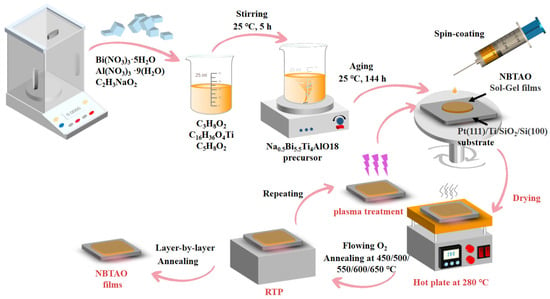
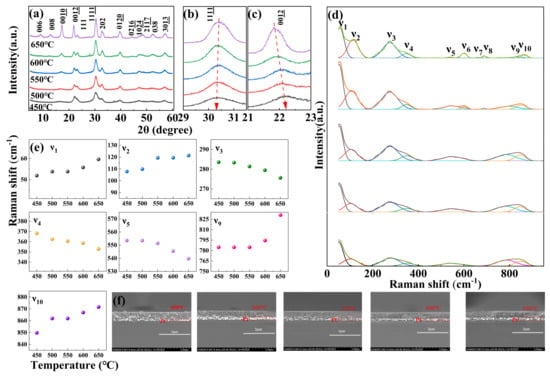
Further experimental details are provided in Figure 1, while the chemical reagents and instrumentation used are listed in Table 1 and Table 2, respectively. A 0.05 mol/L Na0.5Bi5.5Ti4AlO18 precursor solution is spin-coated onto Pt(111)/Ti/SiO2/Si(100) substrate at a rate of 7400 r/min. The wet film was dried (280 °C, 180 s, air) on a hot plate and then rapidly annealed at different temperatures (450 °C, 500 °C, 550 °C, 600 °C, and 650°, 180 s, O2) to crystallize. The Na0.5Bi5.5Ti4AlO18 film was fabricated by a layer-by-layer annealing technique. Each layer of Na0.5Bi5.5Ti4AlO18 film was treated with oxygen ion plasma for 180 s. Finally, the layer-by-layer annealing technique was repeated, and each layer was treated with oxygen ion plasma until the desired thickness of the Na0.5Bi5.5Ti4AlO18 film was reached.
Figure 1.
The flow chart of NBTAO precursor solution and layer-by-layer annealing with oxygen ions plasma treatment.
Table 1.
Source materials information.
Table 2.
Instrument information.
3. Results and Discussion
The structure information of the NBTAO films were analyzed employing X-ray diffraction and Raman spectroscopy. The analysis of the cross section was conducted using scanning electron microscopy (SEM). Disc-shaped electrodes with an area of 5 × 10⁻⁵ cm2 were fabricated on the surface using magnetron sputtering equipment with a custom mask. A high-temperature dielectric testing system was employed to measure the temperature and electric field dependence of the dielectric constant and dielectric loss of the film. Polarization-electric field (P–E), Pund, polarization–current (P–C) curves and leakage current were evaluated with a multiferroic testing system. The LCR digital bridge coupled with a high-temperature probing stage characterizes the impedance properties.
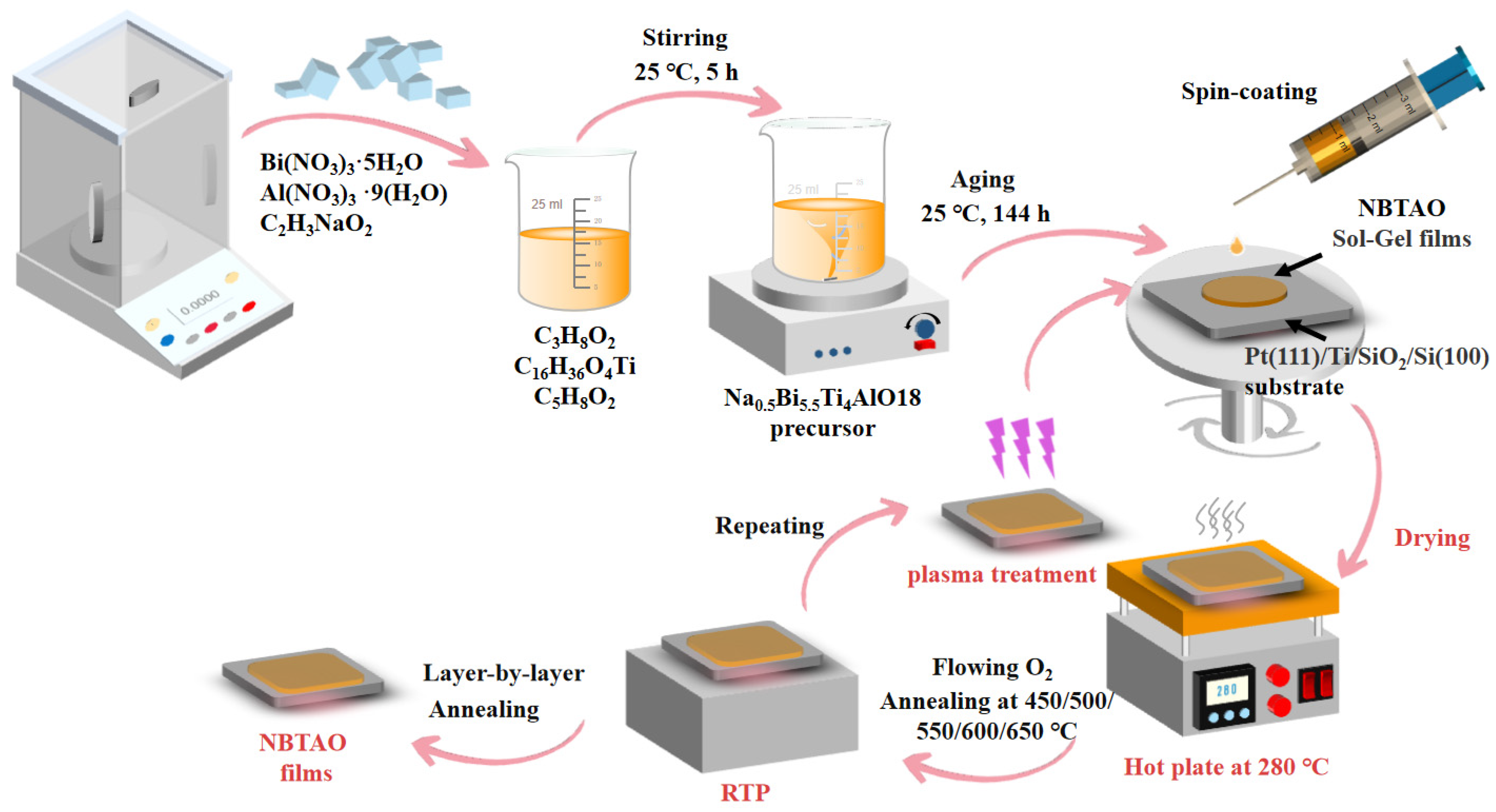
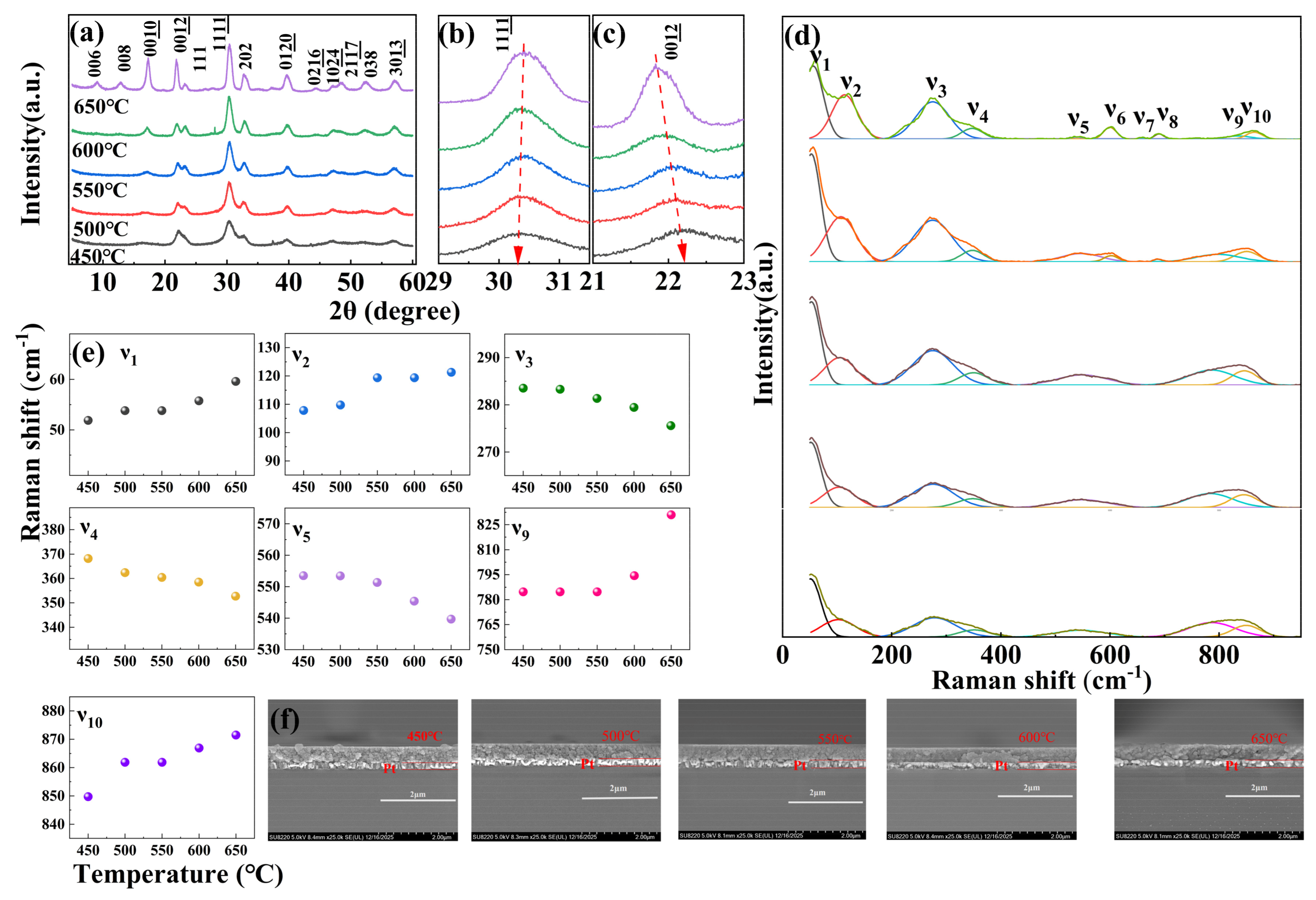
Figure 2 displays the XRD patterns of the NBTAO-450, NBTAO-500, NBTAO-550, NBTAO-600, and NBTAO-650 films. XRD confirms a pure five-layer BLSF structure, matching ICSD-150401 [4]. With decreasing crystallization temperature, the (1111) diffraction peak shifts to lower angles, whereas the (0012) diffraction peak shifts to higher angles, consistent with anisotropic lattice distortion characterized by a- or b-axis expansion and c-axis contraction. The full width at half maximum (FWHM) of the diffraction peaks increases monotonically as crystallization temperature decreases, consistent with grain refinement. The SEM surface images and grain-size distributions of NBTAO films at the corresponding annealing temperatures are presented in Figure S1. As can be observed from the figure, the grain size gradually diminishes and becomes finer as the annealing temperature decreases. Decreasing crystallization temperature induces diffraction peak merging and disappearance, indicating enhanced structural symmetry and a low- to high-symmetry transformation. The coexistence of crystalline-amorphous coexistence is observed in the NBTAO-450 film. Figure 2d displays the Raman shifts of the NBTAO-450, NBTAO-500, NBTAO-550, NBTAO-600, and NBTAO-650 films. The NBTAO-450, NBTAO-500, NBTAO-550, NBTAO-600, and NBTAO-650 films exhibit seven distinct vibrational modes. The ν1 and ν2 Raman modes originate from the vibrational motions of Bi3+ ions [3,14,15]. The Raman modes at ν3 and ν4 are assigned to torsional bending vibrations of the BO6 octahedra, whereas those at ν9 and ν10 arise from stretching vibrations along the BO6 octahedral chains linking adjacent (Bi2O2)2+ layers [16].
Figure 2.
(a) XRD pattern of NBTAO films. (b,c) Enlarged (1111) and (0012) diffraction peaks. (d) Raman spectra of NBTAO films. (e) Raman shifts of NBTAO films as a function of temperature. (f) SEM cross-sectional image of the NBTAO film.
Although Raman spectroscopy offers indirect evidence of structural evolution in the form of a superposition of multiple vibrational modes, the observed peak shifts and broadening serve as macroscopic manifestations of microscopic lattice dynamics, including BO6 octahedral distortions and cation displacements. These spectral alterations are intricately associated with lattice strain and a reduction in long-range order. With decreasing crystallization temperature, the ν1 and ν2 Raman modes exhibit a red shift, indicating a reduction in their vibrational frequencies, arising from a- or b-axis expansion. Moreover, softening of the ν2 Raman mode is evident in Figure 2e, indicating a progressive reduction in the orthorhombicity of the NBTAO films [17]. With decreasing crystallization temperature, the Raman-active modes ν3 and ν4 exhibit a systematic blue shift, i.e., a shift to higher wavenumbers, reflecting an increase in the vibrational frequency of the O-Ti-O bending mode within the BO6 octahedra. This trend implies a reduction in the magnitude of octahedral tilting distortions and a concurrent relaxation of the overall orthorhombic lattice distortion [18,19]. Moreover, a systematic blue shift of the ν5 Raman peak is observed upon decreasing the crystallization temperature, signifying an increase in the vibrational frequency of the three-dimensional torsional-bending coupled mode within the BO6 octahedra. This frequency upshift implies an enhancement of the effective force constant associated with this mode, thereby indicating a pronounced attenuation of torsional distortion in the BO6 octahedral [20,21,22]. The pronounced redshifts observed in the ν9 and ν10 vibrational modes are likely attributable to contraction along the c-axis [23]. With decreasing crystallization temperature, the Raman spectra of the NBTAO films exhibit systematic broadening-indicative of reduced lattice long-range order, diminished grain size, and enhanced RFE behavior [24,25]. Meanwhile, as crystallization temperature decreases, certain Raman modes merge and vanish, reflecting reduced crystallinity and degraded long-range lattice order in the NBTAO films. Figure 2f shows the SEM cross-sectional image of NBTAO films, demonstrating a fully dense microstructure without observable pores or interfacial voids. The thicknesses of NBTAO-450, NBTAO-500, NBTAO-550, NBTAO-600, and NBTAO-650 films are 432, 390, 406, 395, and 402 nm, respectively.
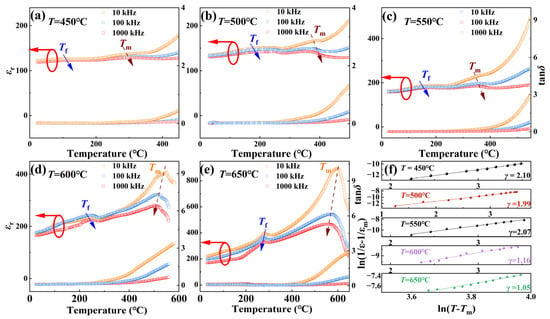
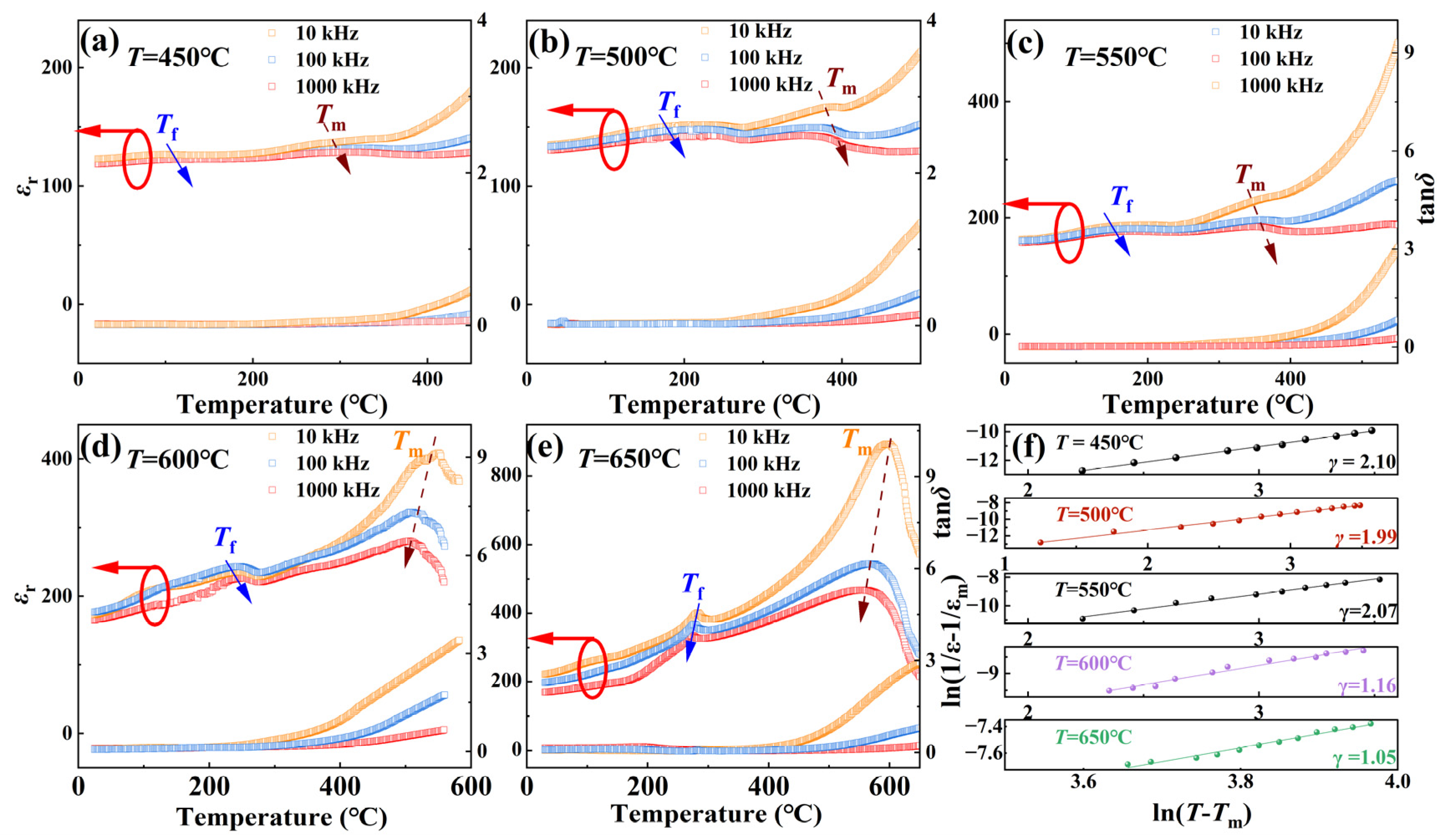
Figure 3a–e presents the temperature-dependent dielectric constant (εr) and loss tangent (tanδ) of NBTAO-450, NBTAO-500, NBTAO-550, NBTAO-600, and NBTAO-650 films measured across a range of frequencies. The Tf peak corresponds to the relaxation freezing temperature, a key signature of the transition from weak to strong RFE behavior [26]. As the crystallization temperature decreases, the Tf peak shifts to lower temperatures, indicating a strengthening of the material’s RFE behavior. The Tm peak corresponds to the ferroelectric-to-paraelectric phase transition temperature [27,28,29]. As Tm shifts progressively to lower temperatures, the NBTAO film’s RFE behavior strengthens. Concurrently, Raman spectroscopy indicates that a decrease in crystallization temperature enhances structural symmetry, specifically, tetragonality.
Figure 3.
Temperature-dependent dielectric characteristics of NBTAO films acquired at varying crystallization temperatures, along with the corresponding fitted γ parameters.
Frequency dispersion intensifies with decreasing crystallization temperature, reflecting enhanced RFE behavior. In the NBTAO-600 film, frequency dispersion is observed at Tf but absent at Tm; in the NBTAO-650 film, it is absent at both peaks. This likely reflects a structural evolution from the ferroelectric to the RFE phase upon decreasing crystallization temperature. To corroborate this interpretation, the relaxation coefficient γ was fitted by the Curie–Weiss law [3,4,26].
In the equation, C denotes the Curie constant and γ represents the relaxation diffusion coefficient. The Figure 3f show the relaxation diffusion coefficients γ for the NBTAO-450, NBTAO-500, NBTAO-550, NBTAO-600, and NBTAO-650 films, extracted from dielectric measurements at 10 kHz. The γ increases from ~1 to ~2 upon decreasing the crystallization temperature from 650 to 450 °C, signifying a structural evolution from the ferroelectric to the RFE phase. Low crystallization temperature suppresses long-range ferroelectric order and favors the emergence of dynamically disordered polar nanoregions (PNRs) [30]. Moreover, decreasing crystallization temperature reduces grain size and increases grain boundary density, both of which impede domain-wall motion and promote nucleation of antiparallel polarized domains, thereby enhancing the formation of disordered PNRs [31]. Crystallization temperature is a key process parameter for tailoring ferroelectric domain structure and thereby tuning RFE properties.
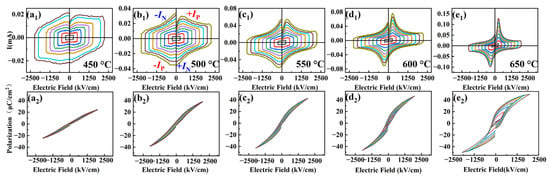
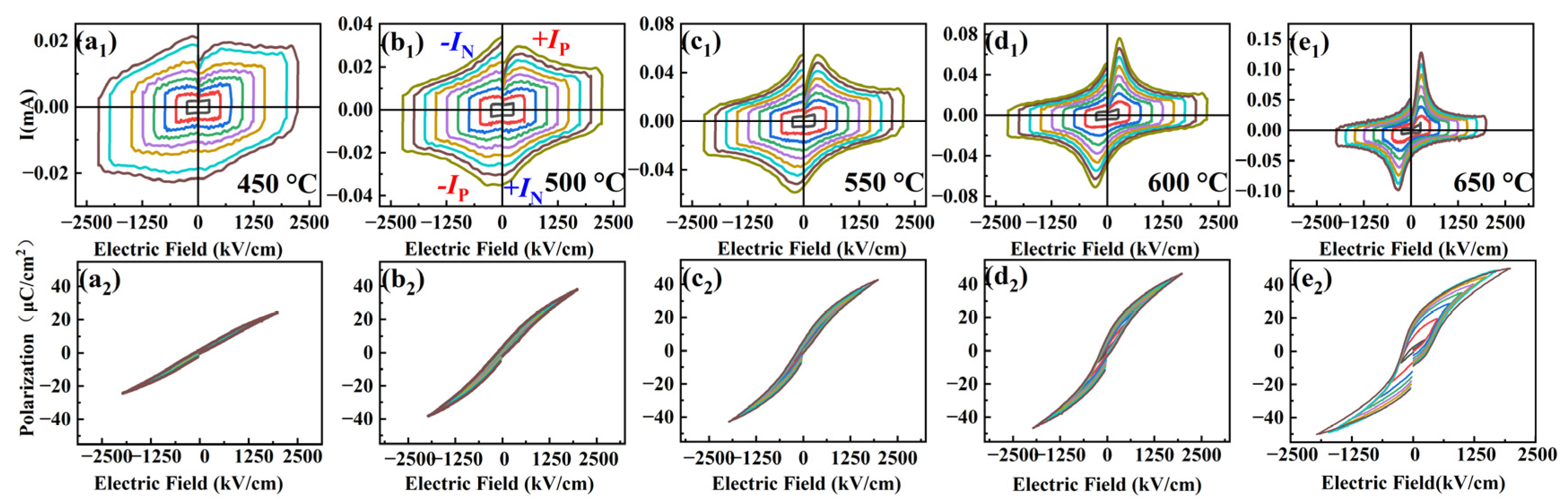
Figure 4 shows the P–C curves and P–E hysteresis loops of NBTAO-450, NBTAO-500, NBTAO-550, NBTAO-600, and NBTAO-650 films, revealing how crystallization temperature affects RFE behavior. The two reverse current peaks in Figure 4a1–e1, along with the temperature-dependent dielectric response, demonstrate that lowering the crystallization temperature drives a transformation from the ferroelectric (FE) state to a non-ergodic relaxor (NER) state. Moreover, Figure 4b1 reveals that a further reduction in crystallization temperature induces a distinct four-peak current response in the NBTAO film, signifying a transition of its relaxation behavior from the NER to the ergodic relaxor state (ER) [26]. The forward peak (+IP) corresponds to the electric-field-induced transition from the ER to FE state, driven by the alignment and growth of ER nanodomains into long-range-ordered FE domains, accompanied by a sharp rise in orientation polarization. The reverse peak (+IN) reflects domain collapse upon field removal, reverting to short-range random nanodomains and markedly reducing hysteresis [26]. As the crystallization temperature is further reduced, the distinct four-peak current response observed in Figure 4b1 progressively broadens and attenuates (Figure 4a1), signifying the emergence of phase coexistence between amorphous and crystalline domains, resulting in substantial suppression of both current peak amplitude and polarization intensity. A decrease in crystallization temperature drives a hierarchical structural phase transition in the film: sequential evolution from the FE state, through the NER state and the ER state, to a coexisting crystalline and amorphous phase state. This phenomenon is intimately linked to both the crystal structure phase transition from the orthorhombic to the tetragonal phase and the concomitant grain size reduction, factors that jointly govern domain structure evolution and exert dominant control over the observed behavior. As shown in Figure 4a2–e2, the P–E hysteresis loops measured under identical electric-field amplitudes further corroborate the aforementioned structural phase transition. The Pmax gradually diminishes with decreasing crystallization temperature and exhibits a pronounced reduction in the NBTAO-450 film. With decreasing crystallization temperature, the P–E hysteresis loops progressively narrow, and the Pr exhibits a monotonic decline. The coupled evolution of crystal structure and ferroelectric properties synergistically enhances the material’s energy storage performance.
Figure 4.
(a1–e1) The P–C curves of NBTAO-450, NBTAO-500, NBTAO-550, NBTAO-600, and NBTAO-650 films; (a2–e2) the P–E hysteresis loops at the same electric field.
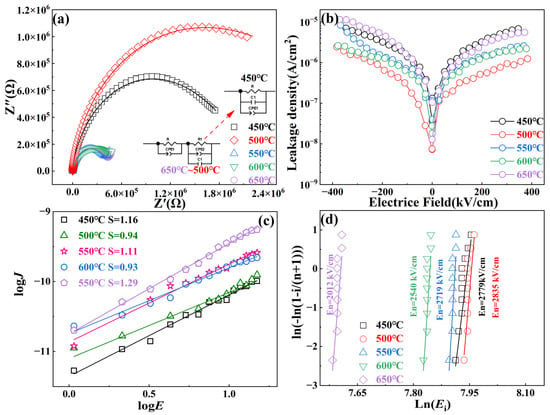
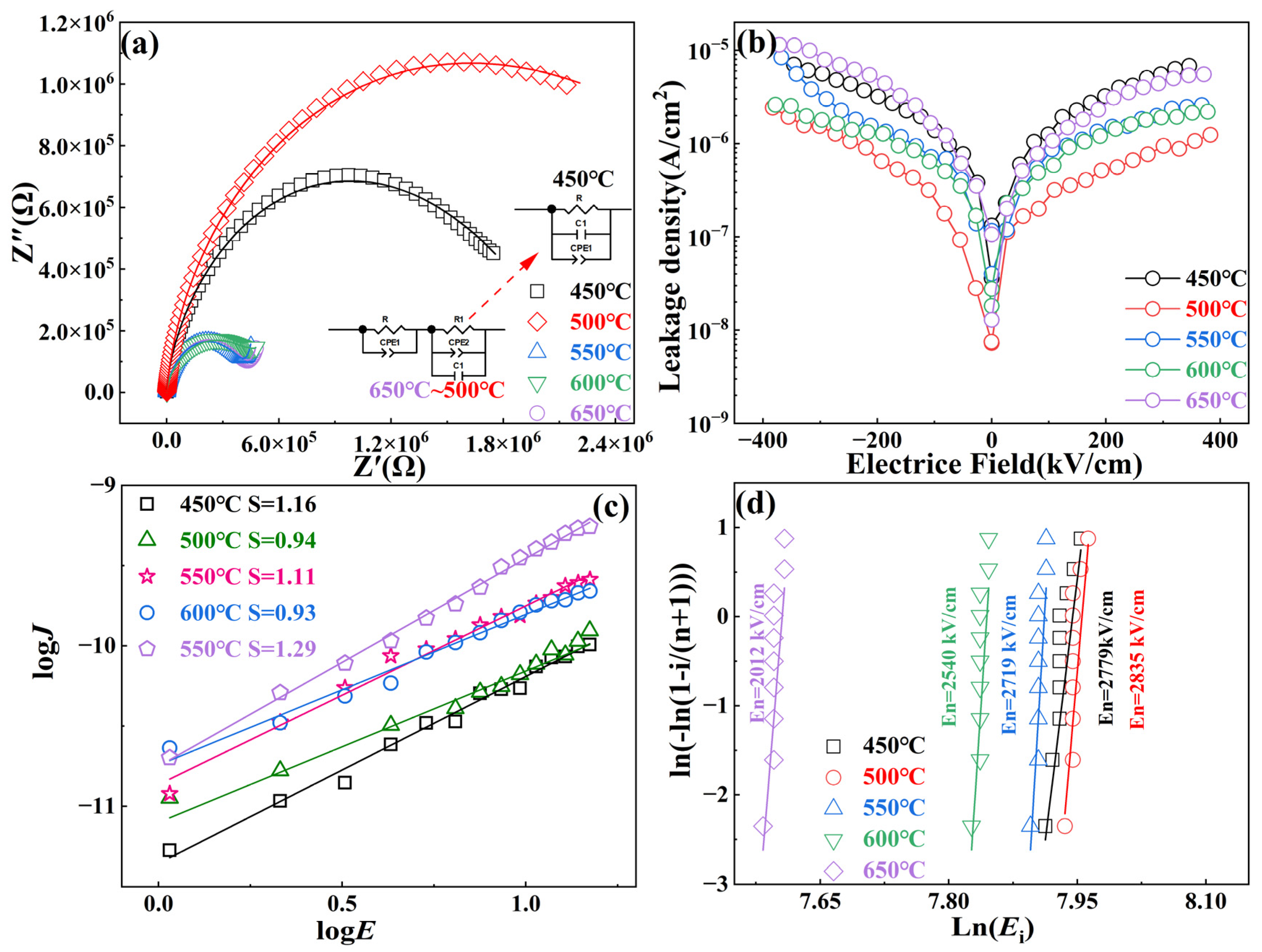
Breakdown strength, like RFE characteristics, critically affects energy storage performance. Figure 5a shows the complex impedance spectra of the NBTAO-450, NBTAO-500, NBTAO-550, NBTAO-600, and NBTAO-650 films, measured from 100 Hz to 1 MHz at 450 °C. The semicircles observed in the complex impedance spectra, appearing in the high-frequency, mid-frequency, and low-frequency regions, are conventionally ascribed to the electrode/film interface, grain boundaries, and grain interior, respectively [32]. The complex impedance of the NBTAO-500, NBTAO-550, NBTAO-600, and NBTAO-650 films exhibit a depressed semicircular feature, reflecting overlapping contributions from grain interior and grain boundary conduction processes. In contrast, the complex impedance spectra of NBTAO-450 film exhibit well-defined, near-ideal semicircular arcs, attributable solely to grain interior conduction, with a negligible contribution from grain boundaries.
Figure 5.
(a) Complex impedance results of NBTAO-450, NBTAO-500, NBTAO-550, NBTAO-600, and NBTAO-650 films; (b) leakage current density of the NBTAO films; (c) leakage current mechanism of the NBTAO films; and (d) Weibull distribution of NBTAO films.
Notably, under identical test conditions, a systematic decrease in crystallization temperature leads to a progressive increase in the diameter of the semicircular arc in the complex impedance spectrum, directly reflecting a pronounced enhancement in bulk resistance. However, the NBTAO-450 film exhibits an anomalous reduction in impedance arc diameter, a deviation attributed to excessive suppression of crystallinity during annealing, resulting in a heterogeneous microstructure comprising both crystalline domains and amorphous regions, which collectively promote defect formation. As shown in Figure 5a, the complex impedance spectra of NBTAO-450, NBTAO-500, NBTAO-550, NBTAO-600, and NBTAO-650 films, acquired at identical frequency ranges and under controlled DC bias conditions, were modeled using equivalent circuits implemented in Zview software(V3.3). The impedance response of the NBTAO film exhibits excellent agreement with the experimental spectra. Accordingly, the impedance data were modeled using an equivalent circuit comprising a series connection of R//C//CPE subcircuits and R//CPE at crystallization temperatures above 500 °C (inset of Figure 5a). Upon lowering the crystallization temperature, the dominant relaxation process simplifies to a single (R//C//CPE) subcircuit, where R denotes resistance, C denotes capacitance, and CPE denotes the constant phase element. High-density grain boundaries with elevated resistivity significantly enhance the electrical insulation performance of NBTAO film. An optimized crystallization temperature markedly improves the dielectric breakdown strength of films. However, an excessively low crystallization temperature will lead to an increase in defect density, thereby weakening the dielectric breakdown strength. The leakage current density–electric field characteristics in Figure 5b quantitatively demonstrate the improved insulation performance. At room temperature and an applied electric field of 370 kV/cm, NBTAO-500 film exhibits a leakage current density of 1.24 × 10⁻⁶ A/cm2, lower than that of NBTAO-650 (5.53 × 10⁻⁶ A/cm2). Upon further reduction of the crystallization temperature, the leakage current density of NBTAO-450 film exhibits an anomalous increase. Figure 5c summarizes the leakage conduction mechanism analysis, demonstrating that Ohmic conduction governs the leakage current response across all NBTAO films, which is characterized by ln(J) ∝ ln(E) with a slope of approximately 1, irrespective of crystallization temperature. Figure 5d summarizes the Weibull distribution-derived breakdown field strength (Eb) of all NBTAO films, with the NBTAO-500 sample exhibiting an Eb of 2835 kV/cm [33,34,35,36,37]. Lowering the crystallization temperature induces grain refinement, which increases the volumetric proportion of high-resistance grains and impedes long-range charge carrier transport, thereby elevating the intrinsic breakdown strength. Concurrently, high-density grain boundaries featuring elevated electrical resistance act as potent scattering centers for charge carriers (e.g., electrons and oxygen vacancies), retarding percolation-driven breakdown path formation. Collectively, these microstructurally engineered effects synergistically enhance the effective Eb.
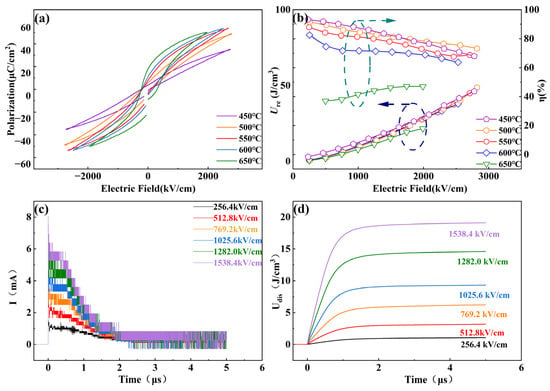
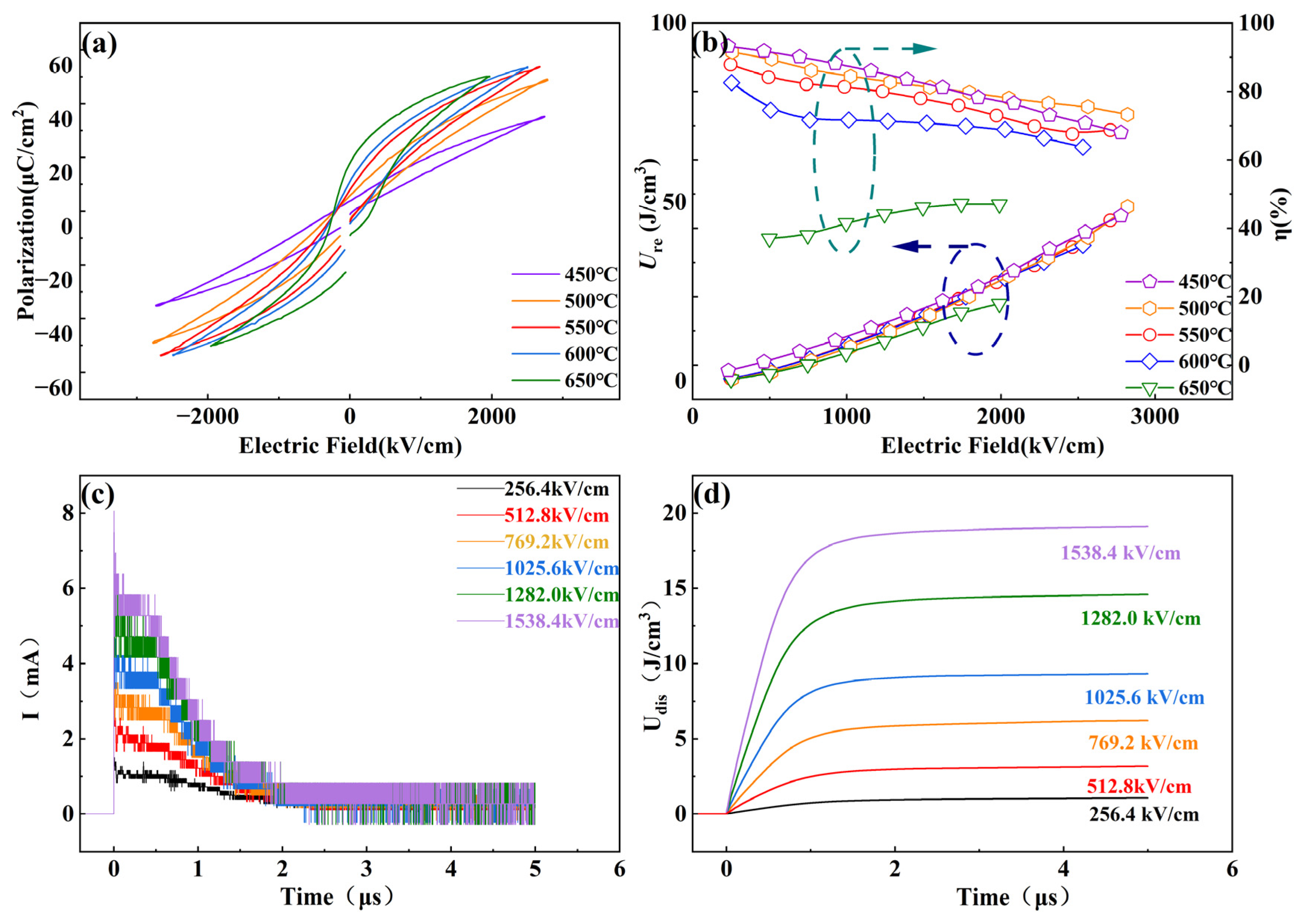
Figure 6a presents the P–E hysteresis loops of NBTAO-450, NBTAO-500, NBTAO-550, NBTAO-600, and NBTAO-650 films, measured at Eb. As the crystallization temperature decreases, the P–E hysteresis loops of the NBTAO films progressively narrow, reflecting enhanced RFE behavior induced by the lower crystallization temperature. The Pmax of NBTAO-450, NBTAO-500, NBTAO-550, NBTAO-600, and NBTAO-650 films are 35.1, 48.8, 53.8, 53.7 and 50.2 μC/cm2, respectively. The reduction in crystallization temperature enhances the Eb of the NBTAO films, thereby delaying the onset of saturation polarization and enabling effective retention of the Pmax. The Ure and η, calculated from the data in Figure 6a, are presented in Figure 6b. The NBTAO-500 film achieves the highest Ure and η at the maximum applied electric field, owing to the synergistic enhancement of dielectric relaxation behavior, breakdown strength, and resistance to polarization saturation. Ure and η reach 49.6 J/cm3 and 73.5%, respectively, at an applied electric field of 2820 kV/cm. While the NBTAO-450 film also exhibits favorable energy storage performance, its deteriorated insulation capability leads to a concurrent decline in both Ure and η. The energy density and efficiency of the NBTAO-500 film not only outperform those of NBTAO films annealed at other temperatures but also exceed those of previously reported representative lead-free material systems and Aurivillius-type films, as depicted in Figure S2 [4,13,14,21,38,39,40,41,42,43,44,45]. The discharge energy density (Udis) of the NBTAO-500 film was quantified via pulsed charge–discharge measurements. As shown in Figure 6c, the discharge current response of the NBTAO-500 film at room temperature exhibits a rapid rise under applied electric fields ranging from 256.4 to 1538.4 kV/cm, reaching its peak within <1.5 μs. Udis was calculated using the following equation:
Figure 6.
(a) P–E hysteresis loops measured at the maximum electric field. (b) The Ure and η of NBTAO-450, NBTAO-500, NBTAO-550, NBTAO-600, and NBTAO-650 films. (c) The discharge current curve of NBTAO-500 films at RT. (d) The Udis of NBTAO-500 films under different electric fields.
The load resistance is designated as R (2000 Ω), the volume as V, and the Udis is presented in Figure 6d. As the applied electric field increases from 256.4 to 1538.4 kV/cm, the peak discharge current (Imax) rises linearly, whereas Udis follows a parabolic trend, increasing from 1.02 to 19.0 J/cm3. Furthermore, the NBTAO-500 film enables ultrafast discharge, with full discharge completed within <1.5 μs across the entire field range. The deviation between Udis and Ure remains within ~10%, confirming the high fidelity of the indirect energy estimation method, in agreement with prior reports [25].
In practical applications, particularly those demanding high operational stability, dielectric energy storage capacitors require robust temperature and frequency stability.
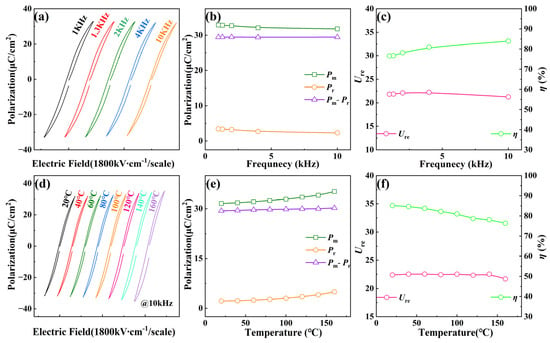
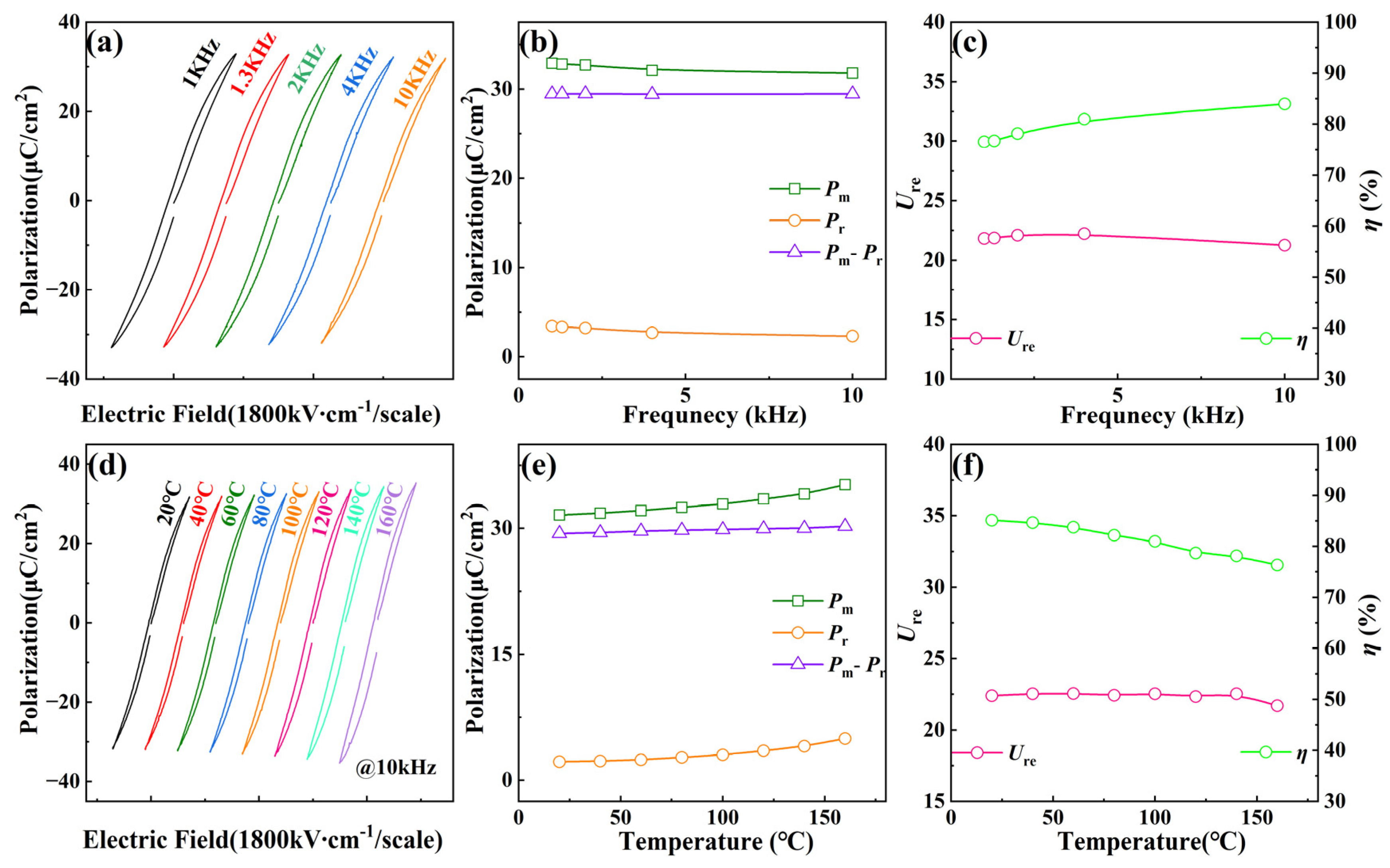
Figure 7a displays the P–E hysteresis loops of the NBTAO-500 film measured at 1754 kV/cm across a frequency range of 1~10 kHz. With increasing frequency, the loops exhibit progressively narrower shapes, reflecting reduced dielectric loss and enhanced high-frequency charge-discharge efficiency, consistent with the intrinsic dynamic response of relaxor ferroelectrics. As illustrated in Figure 7b, parameters Pm, Pr, and Pm–Pr exhibit negligible variation across the tested frequency range, confirming their outstanding frequency stability. Figure 7c presents the frequency-dependent energy storage performance of the NBTAO-500 film. Over the 1~10 kHz range, Ure remains nearly constant at approximately 21.8–21.3 J/cm3, while the η increases from 76.5% to 83.9%. These minimal variations confirm the film’s exceptional frequency stability. Figure 7d presents the P–E hysteresis loops of the NBTAO-500 film, measured from 20~160 °C under a constant applied electric field of 1754 kV/cm. As shown in Figure 7e, as temperature increases, the P–E hysteresis loops retain their narrow, slender morphology; concurrently, both the maximum polarization Pm and Pr exhibit slight increases, whereas the difference (Pm–Pr) remains virtually constant across the tested temperature range, demonstrating the exceptional thermal stability of the film’s polarization response. Figure 7f presents the temperature-dependent energy storage performance of the NBTAO-500 film. Over the 20~160 °C range, the Ure decreases modestly from 22.39 to 21.69 J/cm3, while the η declines from 85.1% to 77.5%. These minimal variations confirm the film’s exceptional thermal stability. The NBTAO-500 film demonstrates exceptional thermal stability across the tested temperature range. The results demonstrate that the NBTAO-500 film exhibits exceptional thermal and frequency stability. Across a broad range of temperatures and frequencies, it consistently maintains high Ure and η, underscoring its strong promise for energy storage applications.
Figure 7.
(a) P–E hysteresis loops of NBTAO-500 film at different frequencies; (b) Pm, Pr and Pm–Pr of NBTAO-500 film at different frequencies; (c) Ure and η of NBTAO-500 film at different frequencies; (d) P–E hysteresis loops of NBTAO-500 film at different temperatures; (e) Pm, Pr and Pm–Pr of NBTAO-500 film at different temperatures; and (f) Ure and η of NBTAO-500 film at different temperatures.
4. Conclusions
In summary, crystallization temperature was systematically tuned to tailor both the crystal structure and relaxor behavior of NBTAO films. A crystallization temperature-dependent structure property regulation pathway has been established, enabling systematic and controllable transitions from the ferroelectric state, through the non-ergodic relaxor state, to the ergodic relaxor state. Precise control of the crystallization temperature enables grain size reduction, which concurrently enhances the bulk resistivity and breakdown strength, two key dielectric properties intrinsically linked through suppressed conduction pathways. The NBTAO-500 film ultimately achieves excellent energy storage performance, delivering a Ure of 49.6 J/cm3 and an η of 73.5% at an applied electric field of 2820 kV/cm. The NBTAO-500 film also demonstrates excellent thermal and frequency stability. This establishes crystallization temperature control as a viable strategy for enhancing energy storage performance, thereby expanding the multidimensional optimization pathways for dielectric energy storage films.
Supplementary Materials
The following supporting information can be downloaded at https://www.mdpi.com/article/10.3390/nano16130802/s1, Figure S1: SEM surface images and particle size distributions of the Na0.5Bi5.5Ti4AlO18 film at different annealing temperatures; Figure S2: Comparison of Ure/E among different films.
Author Contributions
Q.L.: Conceptualization (supporting); Data curation (lead); Investigation (lead); Methodology (supporting); Supervision (supporting); Validation (supporting); Visualization (supporting), J.C.: Conceptualization (lead); Funding acquisition (lead); Methodology (lead); Resources (lead); Software (lead); Supervision (lead); Validation(lead); Visualization (lead); Writing-original draft (lead); Writing-review & editing (lead). All authors have read and agreed to the published version of the manuscript.
Funding
This research was funded by the Innovation and Entrepreneurship Training Program for Inner Mongolia University of Technology (Grant No. 2025096001); the Innovation and Entrepreneurship Training Program for Inner Mongolia Autonomous Region (Grant No. S202510128008); the National Natural Science Foundation of China (Grant No. 12364016); the Natural Science Foundation of Inner Mongolia Autonomous Region of China (2025YQ012); the Young Talents of Science and Technology in Universities of Inner Mongolia Autonomous Region (Grant No. NJYT25025). The APC was funded by Qiang Lv.
Data Availability Statement
The raw data supporting the conclusions of this article will be made available by the authors on request.
Conflicts of Interest
The authors declare no conflicts of interest.
References
- Shu, L.; Shi, X.M.; Zhang, X.; Yang, Z.Q.; Li, W.; Ma, Y.P.; Liu, Y.X.; Liu, L.S.; Cheng, Y.Y.S.; Wei, L.Y.; et al. Partitioning polar-slush strategy in relaxors leads to large energy-storage capability. Science 2024, 385, 204–209. [Google Scholar] [CrossRef] [Scilit] [PubMed]
- Pan, H.; Li, F.; Liu, Y.; Zhang, Q.H.; Wang, M.; Lan, S.; Zheng, Y.P.; Ma, J.; Gu, L.; Shen, Y.; et al. Ultrahigh-energy density lead-free dielectric films via polymorphic nanodoma in design. Science 2019, 365, 578–582. [Google Scholar] [CrossRef] [Scilit] [PubMed]
- Sun, R.; Chen, J.Y. Excellent low electric field energy storage properties in Bi5Mg0.5Ti3.45Zr0.05O15 films via ion pair engineering. Appl. Phys. Lett. 2025, 126, 183901. [Google Scholar] [CrossRef] [Scilit]
- Pang, S.J.; Liu, Q.L.; Tang, Z.H.; Bai, Y.; Ma, W.; Zhou, Y.P.; Guo, F.; Jia, X.; Guo, Y.Q.; Chen, J.Y. The intergrowth of ferroelectric and relaxor ferroelectric phases in Bi6-xLaxAlMg0.5Ti3.5O18 films achieves excellent energy storage properties. Appl. Phys. Lett. 2025, 127, 203902. [Google Scholar] [CrossRef] [Scilit]
- Zhou, Y.P.; Tang, Z.H.; Bai, Y.J.; Guo, F.; Chen, J.Y. Surface plasma treatment boosting antiferroelectricity and energy storage performance of AgNbO3 film. J. Eur. Ceram. Soc. 2024, 44, 2923–2933. [Google Scholar] [CrossRef] [Scilit]
- Dan, Y.; Tang, L.; Ning, W.; Hu, C.; Liu, L.; Fang, L. Enhancing energy storage performance in tungsten bronze ceramics utilizing site engineering. Microstructures 2025, 5, 2025050. [Google Scholar] [CrossRef] [Scilit]
- Zhao, L.; Zhang, F.; Hu, H. Recent advances in elevated-temperature flexible composite dielectrics for energy storage applications. Microstructures 2025, 5, 2025085. [Google Scholar] [CrossRef] [Scilit]
- Liu, Q.L.; Wang, Y.P.; Xing, L.L.; Tang, Z.H.; Wang, R.J.; Pang, S.J.; Guo, F.; Yao, R.N.; Zhou, Y.P.; Bai, Y.; et al. Ultra-high energy storage characteristics under low electric field in Sm-doped Bi5Mg0.5Ti3.5O15 films through defect dipole engineering. Chem. Eng. J. 2024, 498, 155804. [Google Scholar] [CrossRef] [Scilit]
- Sun, Y.L.; Zhang, L.; Huang, Q.W.; Chen, Z.B.; Wang, D.; Seyfouri, M.M.; Chang, S.L.Y.; Wang, Y.; Zhang, Q.; Liao, X.Z.; et al. Ultrahigh Energy Storage Density in Glassy Ferroelectric Thin Films under Low Electric Field. Adv. Sci. 2022, 9, 2203926. [Google Scholar] [CrossRef] [Scilit]
- Yang, B.B.; Zhang, Y.; Pan, H.; Si, W.L.; Zhang, Q.H.; Shen, Z.H.; Yu, Y.; Lan, S.; Meng, F.Q.; Liu, Y.Q.; et al. High-entropy enhanced capacitive energy storage. Nat. Mater. 2022, 21, 1074–1080. [Google Scholar] [CrossRef] [Scilit] [PubMed]
- Tang, Z.H.; Chen, J.Y.; Yang, B.; Zhang, M.; Cao, T.S.; Zhou, Y.P.; Zhao, S.F. Ultrahigh energy storage performances induced by weaker La-O orbital hybridization in (Na0.85K0.15)0.5Bi4.5−xLaxTi4O15 relaxor ferroelectric films. J. Phys. Chem. C 2021, 125, 4986–4994. [Google Scholar] [CrossRef] [Scilit]
- Cheng, Y.Y.S.; Shi, X.M.; Shu, L.; He, Q.Y.; Li, Y.Z.; Luo, J.; Wang, S.X.; Liu, Y.X.; Liu, L.S.; Wang, L.Z.; et al. Large linear high-frequency strain by interlocked monoclinic polar nanoregions. Nat. Mater. 2026, 25, 73–79. [Google Scholar] [PubMed]
- Li, Y.Z.; Song, K.P.; Zhu, M.X.; Li, X.Q.; Zeng, Z.W.; Luo, K.M.; Jiang, Y.X.; Zhang, Z.; Li, C.H.; Wang, Y.J.; et al. Flash annealing-engineered wafer-scale relaxor antiferroelectrics for enhanced energy storage performance. Sci. Adv. 2025, 11, eady2349. [Google Scholar] [CrossRef] [Scilit] [PubMed]
- Tang, Z.H.; Chen, J.Y.; Yang, B.; Zhao, S.F. Energy storage performances regulated by layer selection engineering for doping in multi-layered perovskite relaxor ferroelectric films. Appl. Phys. Lett. 2019, 114, 163901. [Google Scholar] [CrossRef] [Scilit]
- Zhou, Y.P.; Chen, J.Y.; Jiang, N.; Guo, F.; Yang, B.; Zhao, S.F. Energy storage performances of La doped SrBi5Ti4FeO18 films. Chem. Eng. J. 2022, 431, 133999. [Google Scholar] [CrossRef] [Scilit]
- Ramana, E.V.; Prasad, N.V.; Figueiras, F.; Laiaunie, L.; Arenal, R.; Otero-Irurueta, G.; Valente, M.A. The growth and improved magnetoelectric response of strain-modified Aurivillius SrBi4.25La0.75Ti4FeO18 thin films. Dalton Trans. 2019, 48, 13224–13241. [Google Scholar] [CrossRef] [Scilit]
- Liu, J.J.; Zou, G.T.; Jin, Y.R. Raman scattering study of Na0.5Bi4.5Ti4O15 and its solid solutions. J. Phys. Chem. Solids 1996, 57, 1653–1658. [Google Scholar] [CrossRef] [Scilit]
- Du, Y.L.; Zhang, M.S.; Chen, Q.; Yuan, Z.R.; Yin, Z.; Zhang, Q.A. Size effect and evidence of a size-driven phase transition in Bi4Ti3O12 nanocrystals. Solid State Commun. 2002, 124, 113–118. [Google Scholar] [CrossRef] [Scilit]
- Kojima, S.; Imaizumi, R.; Hamazaki, S.; Takashige, M. Raman scattering study of bismuth layer-structure ferroelectrics. Jpn. J. Appl. Phys. 1994, 33, 5559–5564. [Google Scholar] [CrossRef] [Scilit]
- Withers, R.L.; Thompson, J.G.; Rae, A.D. The crystal chemistry underlying ferroelectricity in Bi4Ti4O12, Bi3TiNbO9 and Bi2WO6. J. Solid State Chem. 1991, 94, 404–417. [Google Scholar] [CrossRef] [Scilit]
- Pang, S.J.; Liu, X.; Tang, Z.H.; Zhang, X.L.; Liu, Q.L.; Ma, W.; Bai, Y.; Chen, J.Y. Regulating the low electric field energy storage properties in Na0.5Bi5.5Mg0.5Ti4.5O18 films through layer engineering modulated configuration entropy and lattice distortion. J. Energy Storage 2026, 148, 120090. [Google Scholar] [CrossRef] [Scilit]
- Idink, H.; Srihanth, V.; White, W.B.; Subbarao, E.C. Raman study of low temperature phase transitions in bismuth titanate, Bi4Ti3O12. J. Appl. Phys. 1994, 76, 1819–1823. [Google Scholar] [CrossRef] [Scilit]
- Graves, P.R.; Hua, G.; Myhra, S.; Thompson, J.G. The Raman modes of the Aurivillius phases: Temperature and polarization dependence. J. Solid State Chem. 1995, 114, 112–122. [Google Scholar] [CrossRef] [Scilit]
- Liu, X.L.; Xia, H.R.; Han, H.; Wang, X.Q. Structural and dielectrical properties of bismuth titanate nanoparticles prepared by metalorganic decomposition method. J. Cryst. Growth 2004, 269, 499–504. [Google Scholar] [CrossRef] [Scilit]
- Amaechi, I.C.; Ruediger, A.; Pignolet, A. Phonon confinement and particle size effect on the low-frequency Raman mode of aurivillius phase Bi4Ti4O12 powders. RSC Adv. 2023, 13, 4917–4923. [Google Scholar] [CrossRef] [Scilit] [PubMed]
- Pang, S.J.; Zhou, Y.P.; Wang, R.J.; Tang, Z.H.; Wang, Y.P.; Yao, R.N.; Liu, Q.L.; Guo, F.; Chen, J.Y. High-energy storage properties in Mn3+ ions doped Bi4LaTi3Mg2/3Nb1/3O15 films: Achieved through the synergistic coupling of defect associate engineering and Jahn-Teller effect. J. Eur. Ceram. Soc. 2025, 45, 117494. [Google Scholar] [CrossRef] [Scilit]
- Dimza, V.; Popov, A.I.; Lace, L.; Kundzins, M.; Kundzins, K.; Antonova, M.; Livins, M. Effects of Mn doping on dielectric properties of ferroelectric relaxor PLZT ceramics. Curr. Appl. Phys. 2017, 17, 169–173. [Google Scholar] [CrossRef] [Scilit]
- Kim, I.H.; Kim, I.H.; Im, S.G.; Jang, K.O. A phenomenological study on temperature-concentration-electric field phase diagram of relaxor ferroelectrics PMN-PT single crystals. Phys. B 2022, 639, 413961. [Google Scholar] [CrossRef] [Scilit]
- He, C.J.; Wen, Y.; Wen, Y.Y.; Zhou, K.; Deng, C.; Li, Q.; Lu, Y.G. Optical Properties of PT-Based Relaxor Ferroelectric Crystals. Cryst. Res. Technol. 2023, 58, 2200197. [Google Scholar] [CrossRef] [Scilit]
- Zheng, X.J.; Lu, Y.G.; He, L.; Gong, Y.Q. Nanoscale domain switching in Bi3.15Eu0.85Ti3O12 thin films annealed at different temperature by scanning probe microscopy. Mater. Lett. 2008, 62, 440–442. [Google Scholar] [CrossRef] [Scilit]
- Anbusathaiah, V.; Nagarajan, V.; Aggarwal, S. High-resolution piezoresponse force microscopy investigation of imprint in ferroelectric thin films. Appl. Phys. Lett. 2006, 89, 132912. [Google Scholar] [CrossRef] [Scilit]
- Chen, X.Y.; Ou, B.; Liu, G.F.; Dai, Y.X.; Li, B.; Dai, Y.J. Simultaneous enhancement of piezoelectric performance and Curie temperature in high-temperature Bi4Ti3O12 piezoceramics through A/B site co-doping. J. Adv. Ceram. 2025, 14, 9221077. [Google Scholar] [CrossRef] [Scilit]
- Wang, Y.; Li, S.W.; Tong, Y.H.; Feng, Z.W.; Chao, X.L.; Yang, Z.P.; Liang, P.F.; Lu, J.B.; Wei, L.L. Simultaneous enhancement of energy storage and luminescent performances in Sr2-xSmxAg0.2Na0.8Nb5-xZrxO15 multifunctional ceramics. J. Adv. Dielectr. 2025, 15, 2450031. [Google Scholar] [CrossRef] [Scilit]
- Duan, L.S.; Wei, Y.L.; Xu, T.; Zhang, A.Q.; Zhang, Y.J.; Xu, Z.J.; Chu, R.Q. Effect of different rare-earth dopings of KNN-based transparent energy storage ceramics. J. Adv. Dielectr. 2025, 15, 2440018. [Google Scholar]
- Zhang, Y.X.; Tang, Z.H.; Feng, X.R.; Zhang, L.; Liu, Y.; Guo, F.; Chen, J.Y.; Men, X.; Zhou, Y.P. Excellent energy storage performance in Sm-doped Bi6Ti3FeAlO18 films via synergistic regulation of weakly coupled relaxor design and grain refinement. J. Adv. Dielectr. 2025, 11, 2550019. [Google Scholar] [CrossRef] [Scilit]
- Li, J.W.; Zhang, Y.; Li, Z.H.; Xie, A.W.; Tian, A.; Jiang, X.W.; Li, T.Y.; Xie, X.C.; Rahman, A.; Gao, X.; et al. Giant energy density with ultrahigh efficiency achieved in NaNbO3-based lead-free ceramics with polymorphic antiferrodistortive polarnanodomains. Chem. Eng. J. 2024, 498, 155803. [Google Scholar] [CrossRef] [Scilit]
- Chen, S.Q.; Ding, Y.W.; Mu, H.W.; Tian, W.K.; Deng, X.L.; Gao, R.L.; Cai, W.; Fu, C.L. Research progress on multilayer ceramic capacitors for energy storage: Review. J. Mater. Sci. Mater. Electron. 2025, 36, 77. [Google Scholar] [CrossRef] [Scilit]
- Peng, B.; Xie, Z.K.; Yue, Z.X.; Li, L.T. Improvement of the recoverable energy storage density and efficiency by utilizing the linear dielectric response in ferroelectric capacitors. Appl. Phys. Lett. 2014, 105, 052904. [Google Scholar] [CrossRef] [Scilit]
- Li, C.W.; Shi, L.W.; Yang, W.Y.; Zhou, Y.J.; Li, X.L.; Zhang, C.G.; Yang, Y.J. All polymer dielectric films for achieving high energy density film capacitors by blending poly(vinylidene fluoride-trifluoroethylene-chlorofluoroethylene) with aromatic polythiourea. Polymers 2020, 12, 3270. [Google Scholar] [CrossRef] [Scilit]
- Chen, J.; Wang, Y.F.; Yuan, Q.B.; Xu, X.W.; Niu, Y.J.; Wang, Q.; Wang, H. Multilayered ferroelectric polymer films incorporating low-dielectric-constant components for concurrent enhancement of energy density and charge-discharge efficiency. Adv. Energy Mater. 2018, 8, 1801089. [Google Scholar]
- Pan, H.; Zeng, Y.; Shen, Y.; Lin, Y.H.; Ma, J.; Li, L.; Nan, C.W. BiFeO3–SrTiO3 thin film as a new lead-free relaxor-ferroelectric capacitor with ultrahigh energy storage performance. J. Mater. Chem. A 2017, 5, 5920–5926. [Google Scholar] [CrossRef] [Scilit]
- Liu, M.; Gong, C.Z.; Wei, R.H.; Hu, L.; Dai, J.M.; Zhu, X.B.; Sun, Y.P. Energy storage in epitaxial multilayered BiFeO3/Na0.5Bi0.5TiO3/La0.7Sr0.3MnO3 thin films. J. Alloys Compd. 2023, 967, 171767. [Google Scholar] [CrossRef] [Scilit]
- Xiao, S.B.; Sun, H.J.; Sui, H.L. Boosting energy storage performance of 0.9(Na0.5Bi0.5)(Fe0.02Ti0.98)O3-0.1SrTiO3 relaxor ferroelectric thin film via modulating orientation factor. Mater. Lett. 2023, 349, 134865. [Google Scholar] [CrossRef] [Scilit]
- Luo, J.; Wang, J.; Zou, X.Y.; Gao, S. Ergodic relaxor ferroelectric BNT-based thin films for enhanced energy storage. J. Korean Ceram. Soc. 2026, 63, 254–261. [Google Scholar] [CrossRef] [Scilit]
- Meng, G.D.; She, J.Y.; Wang, C.L.; Wang, W.K.; Pan, C.; Cheng, Y.H. Sandwich-structured h-BN/PVDF/h-BN film with high dielectric strength and energy storage density. Polymers 2022, 10, 910305. [Google Scholar] [CrossRef] [Scilit]

Disclaimer/Publisher’s Note: The statements, opinions and data contained in all publications are solely those of the individual author(s) and contributor(s) and not of MDPI and/or the editor(s). MDPI and/or the editor(s) disclaim responsibility for any injury to people or property resulting from any ideas, methods, instructions or products referred to in the content. |
© 2026 by the authors. Licensee MDPI, Basel, Switzerland. This article is an open access article distributed under the terms and conditions of the Creative Commons Attribution (CC BY) license.