


Abstract
The design and manufacture of bifunctional electrocatalysts are of great significance in the electrolysis of water. Herein, porous organic polymers (POPs) of metal–N-heterocyclic carbene were synthesized from imidazolium borate ionic POPs and supported on a nickel foam surface (Pd–NHC/NF, Ag–NHC/NF, and Cu–NHC/NF). Among them, Pd–NHC/NF exhibited high activity for both hydrogen evolution reaction and oxygen evolution reaction. The oxygen evolution overpotential of Pd–NHC/NF was 245 mV with a Tafel slope of 83 mV dec−1; the hydrogen evolution overpotential was 139 mV with a Tafel slope of 94 mV dec−1 at 10 mA cm−2 in alkaline media. Additionally, the assembled Pd–NHC/NF||Pd–NHC/NF electrolyzer demonstrated excellent performance in electrocatalytic water-splitting, achieving a voltage of 1.55 V at 10 mA cm−2 and showing outstanding stability for over 90 h in the long-term test. The results highlighted the substantial capability of Pd–NHC as a bifunctional catalyst for electrocatalytic water-splitting.
1. Introduction
Hydrogen energy with high energy density and storability is regarded as a promising energy resource. Electrochemical water-splitting can be used for efficient and large-scale hydrogen generation [1,2]. Durable and efficient electrocatalysts are required to promote hydrogen evolution reaction (HER) and oxygen evolution reaction (OER) in large-scale water-splitting [3]. Presently, ruthenium oxide (RuO2) and iridium oxide (IrO2) are benchmark OER electrocatalysts, while platinum (Pt) is preferred for HER [4]. However, the high cost and scarce resources of precious metals limit their commercial-scale applications. Therefore, it is critical to control the amount of precious metals used.
Catalysts play an important role in reducing OER/HER overpotential and improving water electrolysis efficiency [5,6,7]. Transition metal-based oxides [8,9], metal complexes/coordination polymers [10,11], and layered double hydroxides [12] are widely used in OER. Meanwhile, phosphides [13], sulfides [14], and carbides [15] are promising HER catalysts. In order to improve the electrocatalytic activity and decomposition efficiency of water-splitting, a significant number of bifunctional electrocatalysts have been designed and synthesized. Various strategies have been adopted to optimize catalyst performance such as adjusting local electronic structures [16,17,18], enhancing charge transfer efficiency [19,20,21], and optimizing exposed active sites [22,23].
In recent years, nitrogen–heterocyclic carbenes (NHCs) have been widely used in the field of organometallic catalysis due to their simple synthesis, ease of handling, non-toxicity, robust stability, and tunable catalytic activity [24,25]. Because NHCs are strong σ-donors, metal complexes bound to NHCs typically exhibit inert M–NHC bonds, which enhance the overall stability [26,27]. To facilitate the separation and recovery, M–NHC catalysts have been immobilized on porous organic polymers (POPs) by virtue of their high surface area and tailor-made functional groups [28]. M–NHC catalysts have been employed to catalyze a range of chemical reactions, including cross-coupling [29], olefin metathesis [30], and hydrogenation reactions [31]. However, research on M–NHC functionalized coordination polymers in electrocatalysis remains limited. Introducing metal active sites via post-synthetic modification of imidazolium porous organic polymers and utilizing them for electrocatalytic water-splitting holds great significance.
Herein, a series of metal–N-heterocyclic carbene POPs were synthesized from imidazolium borate ionic POPs and supported on foam nickel (Pd–NHC/NF, Ag–NHC/NF and Cu–NHC/NF) as bifunctional electrocatalysts for electrocatalytic water-splitting. The POPs serve as multifunctional catalytic platforms in water-splitting reactions. Their porous architecture facilitates efficient mass transport and electrolyte accessibility, while the tunable coordination environment enables strong metal–ligand interactions that regulate the electronic structure of active sites. Such synergistic effects can optimize the adsorption energetics of key intermediates (*H, *OH, *O, *OOH), thereby enhancing HER and OER kinetics. In addition, the networks of POPs can stabilize dispersed metal species and prevent aggregation under electrochemical conditions, ensuring long-term catalytic durability. Among them, Pd–NHC/NF with Pd nanoparticles loaded in its matrix exhibited low overpotential of 245 mV (η10) for OER, and 139 mV (η10) for HER in alkaline medium. Additionally, the Pd–NHC/NF||Pd–NHC/NF electrolyzer demonstrated excellent activity, with a voltage of 1.55 V at 10 mA cm−2 and maintained high stability for overall water-splitting catalysis over a 90 h long-term (E-t) test.
2. Materials and Methods
2.1. Synthesis of BIM-ph
1,4-Bis(bromomethyl)benzene (151.0 mg, 0.50 mmol) was dissolved in 30 mL of CH3CN under N2 atmosphere and Na[B(IM)4] (307.8 mg, 1.17 mmol) was added. The mixture was heated to reflux for 48 h. The mixture was cooled to room temperature and subsequent filtration afforded a white precipitate. The precipitate was washed with acetonitrile (5 mL × 3) and EtOH (5 mL × 3) and then dried under vacuum to obtain a white solid (273.1 mg, 89%).
2.2. Synthesis of Pd–NHC
A reaction mixture of BIM-ph (33.2 mg, 0.04 mmol) and Pd(OAc)2 (36.0 mg, 0.16 mmol) in 25 mL of DMF was stirred and heated to reflux for 24 h under N2 atmosphere. After the reaction mixture was cooled to room temperature, the precipitate was collected by filtration, washed three times with acetone (5 mL × 3), and dried in a vacuum to obtain a dark grey solid (29.8 mg, 59%).
2.3. Synthesis of Ag–NHC
A mixture of BIM-ph (33.2 mg, 0.04 mmol) and Ag2O (19.0 mg, 0.08 mmol) was suspended in anhydrous acetonitrile (20 mL). The reaction mixture was stirred and heated at 70 °C under N2 atmosphere for 24 h in dark, protected from light. After cooling, the solid was filtered under anhydrous and oxygen-free conditions and washed with 10% NH3·H2O to remove residual Ag2O. The resulting precipitate was collected by filtration and washed with water (5 mL × 3) and EtOH (5 mL × 3) to obtain a grey solid (29.0 mg, 69%).
2.4. Synthesis of Cu–NHC
BIM-ph (33.2 mg, 0.04 mmoL) was dispersed in acetone under N2 atmosphere, and then CuCl (15.8 mg, 0.16 mmoL) and K2CO3 (44.2 mg, 0.32 mmoL) were added to the mixture. The resulting mixture was heated to reflux for 24 h. After cooling, the mixture was filtered under N2 protection and washed with acetone (5 mL × 3) and ethanol (5 mL × 3) to yield a yellow solid (16.7 mg, 39%).
2.5. Preparation of Pd–NHC/NF, Ag–NHC/NF, and Cu–NHC/NF
Foam nickel was treated by ultrasonication in acetone, distilled water, 0.2 mol L−1 NaBH4, and water for 30 min, and then dried at 70 °C. The preparation of the catalyst ink involved the dispersing of 5.0 mg Pd–NHC in a mixture of 145 μL of H2O, 335 μL of isopropanol, and 20 μL of nafion. The ink was subjected to ultrasonic treatment for 30 min to achieve a homogenized dispersion and then drop-casted onto the treated nickel foam to obtain Pd–NHC/NF; the loading mass of the catalyst was 1.2 mg cm−2.
Ag–NHC–NF and Cu–NHC–NF were prepared using the same method by replacing Pd–NHC with Ag–NHC and Cu–NHC, respectively.
2.6. Electrochemical Measurements
Electrochemical OER, HER, and water-splitting performance of the prepared catalysts were evaluated using an electrochemical workstation (CHI 660E, CHI Instruments, Shanghai, China) at room temperature (25 °C). The tests were conducted using a three-electrode system with an electrolyte of 1.0 mol L−1 KOH. The working electrode (Pd–NHC/NF, Ag–NHC/NF or Cu–NHC/NF) was prepared by coating Pd–NHC, Ag–NHC, or Cu–NHC onto nickel foam (NF, 0.25 cm−2), as shown above. A carbon rod with an area of 3.0 cm−2 was used as the counter electrode; a Hg/HgO electrode containing 1.0 mol L−1 KOH electrolyte was used as the reference electrode. The measured potential was referenced to the reversible hydrogen electrode (RHE) by applying the equation E (vs. RHE) = E (vs. Hg/HgO) + 0.059 × pH + 0.098. The scanning rate of LSV was 10 mV s−1. The Tafel slopes were determined by linearly fitting the experimental data using the Tafel equation, η = a + b log |j|, where η, b, and j correspond to overpotential, Tafel slope, and current density, respectively. EIS measurements were performed at 0.500 V for the OER and −0.132 V for the HER, with an AC voltage amplitude of 5 mV over a frequency range of 105 Hz–0.01 Hz. The double-layer capacitance (Cdl) at the solid–liquid interface was determined by cyclic voltammetry (CV) to estimate the ECSA. The measurements were carried out in the potential ranges of 1.10 to 1.20 V (vs. RHE) for OER and 0.10 to 0.20 V (vs. RHE) for HER to ensure negligible Faradic current on the working electrode. CV measurements were conducted at scanning rates of 20, 40, 60, 80, and 100 mV s−1. A 95% iR compensation was applied to all reported electrochemical data.
3. Results and Discussion
3.1. Preparation and Characterization
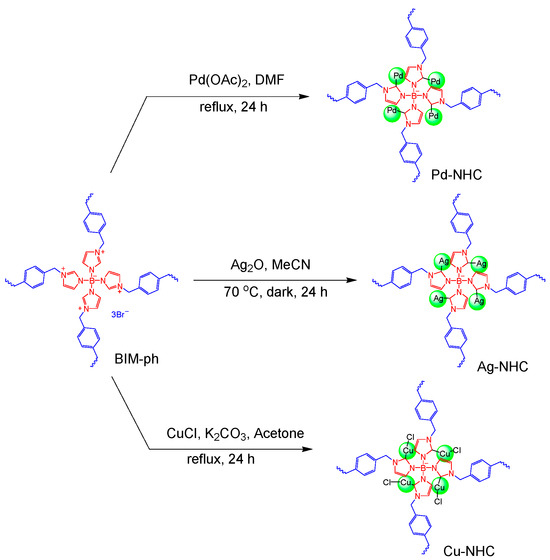
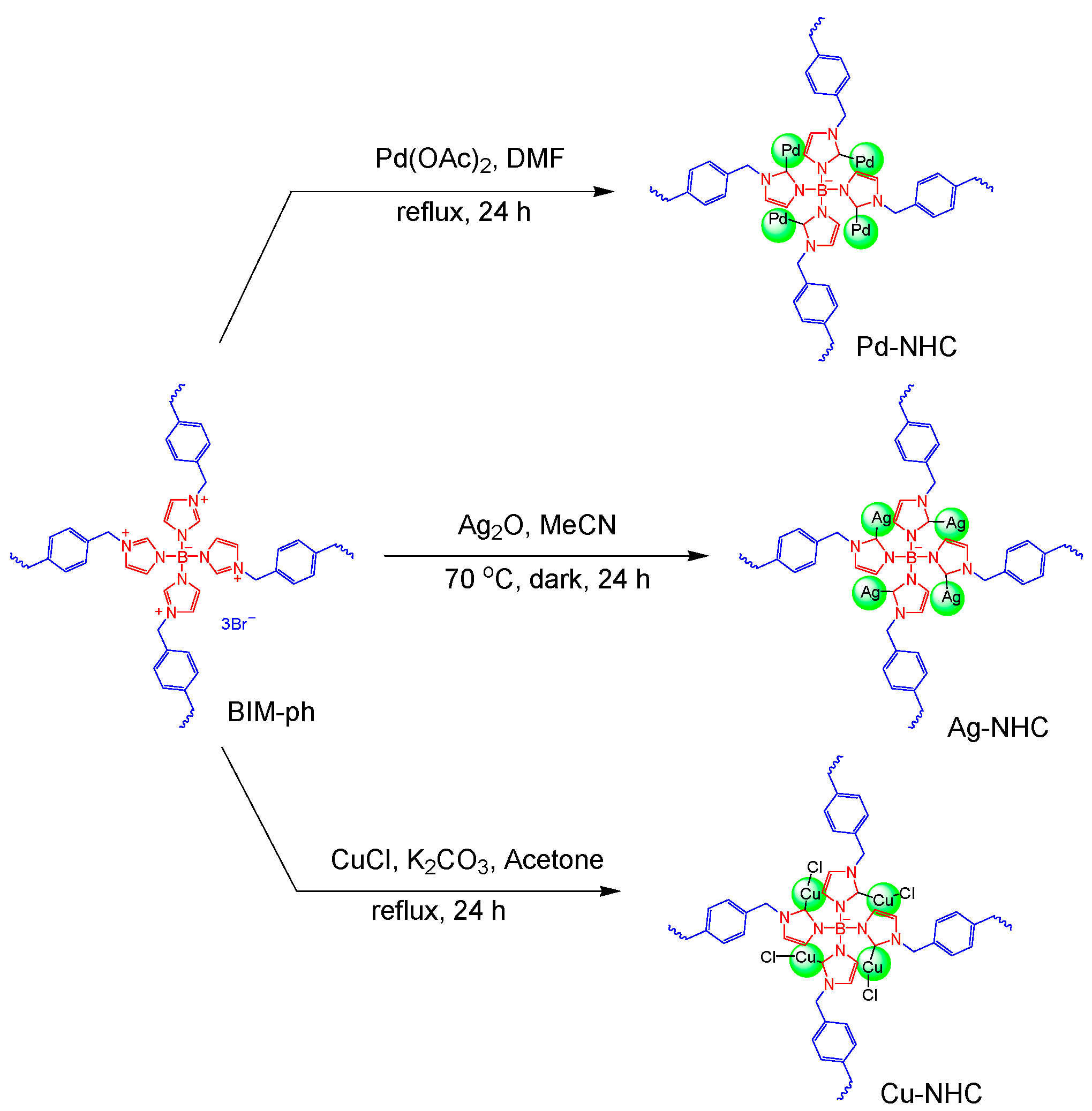
Metal N-heterocyclic carbene polymers (Pd–NHC, Ag–NHC and Cu–NHC) were prepared from an imidazolium borate ionic POP (Figure 1). First, sodium tetrakis(1-imidazolyl) borate (Na[B(IM)4]) was obtained by heating the mixture of imidazole and NaBH4 at 225 °C under an N2 atmosphere, according to previously reported procedures [32]. Then, Na[B(IM)4] reacted with 1,4-bis(bromomethyl)benzene via a solvothermal method to form imidazolium borate ionic POP with Br- as counterions (BIM-ph) [33]. BIM-ph is ionic POP with positively charged imidazolium groups and negatively charged borate groups. BIM-ph, as a precursor of NHC ligand, form stable metal–N-heterocyclic carbene polymers, Pd–NHC, Ag–NHC, and Cu–NHC, after complexation with Pd(OAc)2, Ag2O and CuCl (Figure 2). NHCs possess strong σ-donating ability and form stable M–NHC bonds upon coordination with metal ions (Pd2+, Ag+ and Cu+). The strong metal–carbene bonds endowed the metal–N-heterocyclic carbene polymers with excellent stability to air and moisture.
Figure 1.
Synthesis of Pd–NHC, Ag–NHC, and Cu–NHC.
Figure 2.
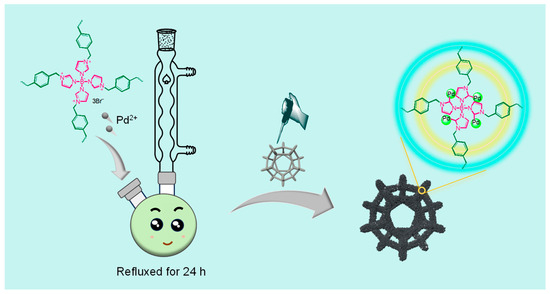
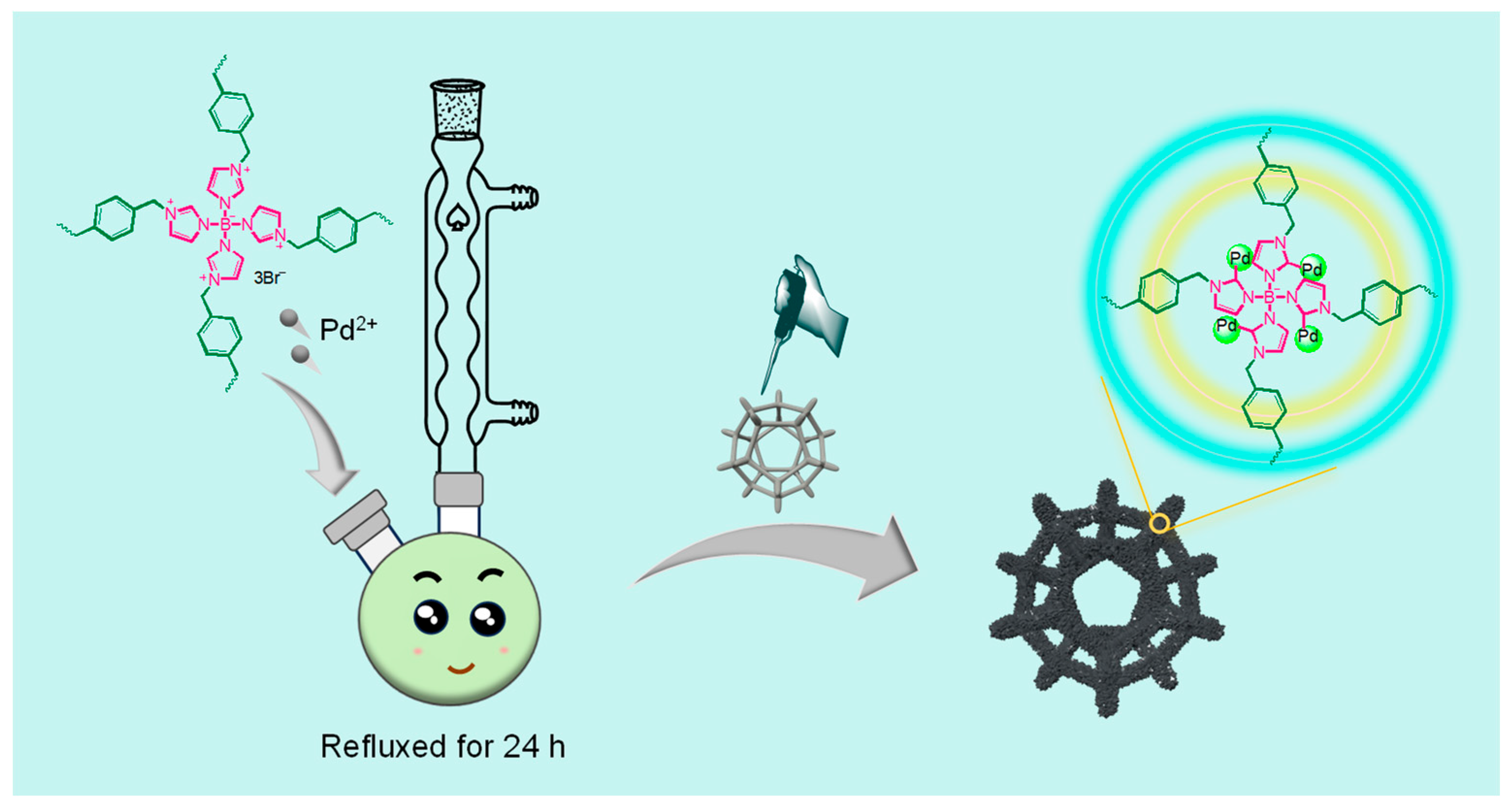
Schematic diagram of the fabrication process for Pd–NHC/NF.
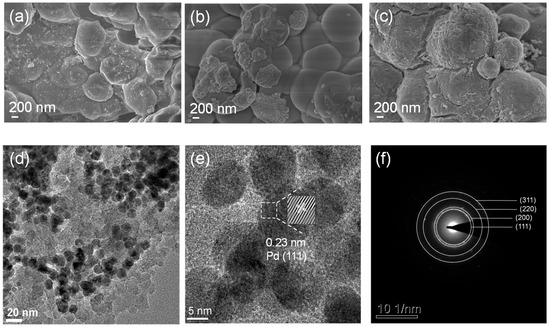
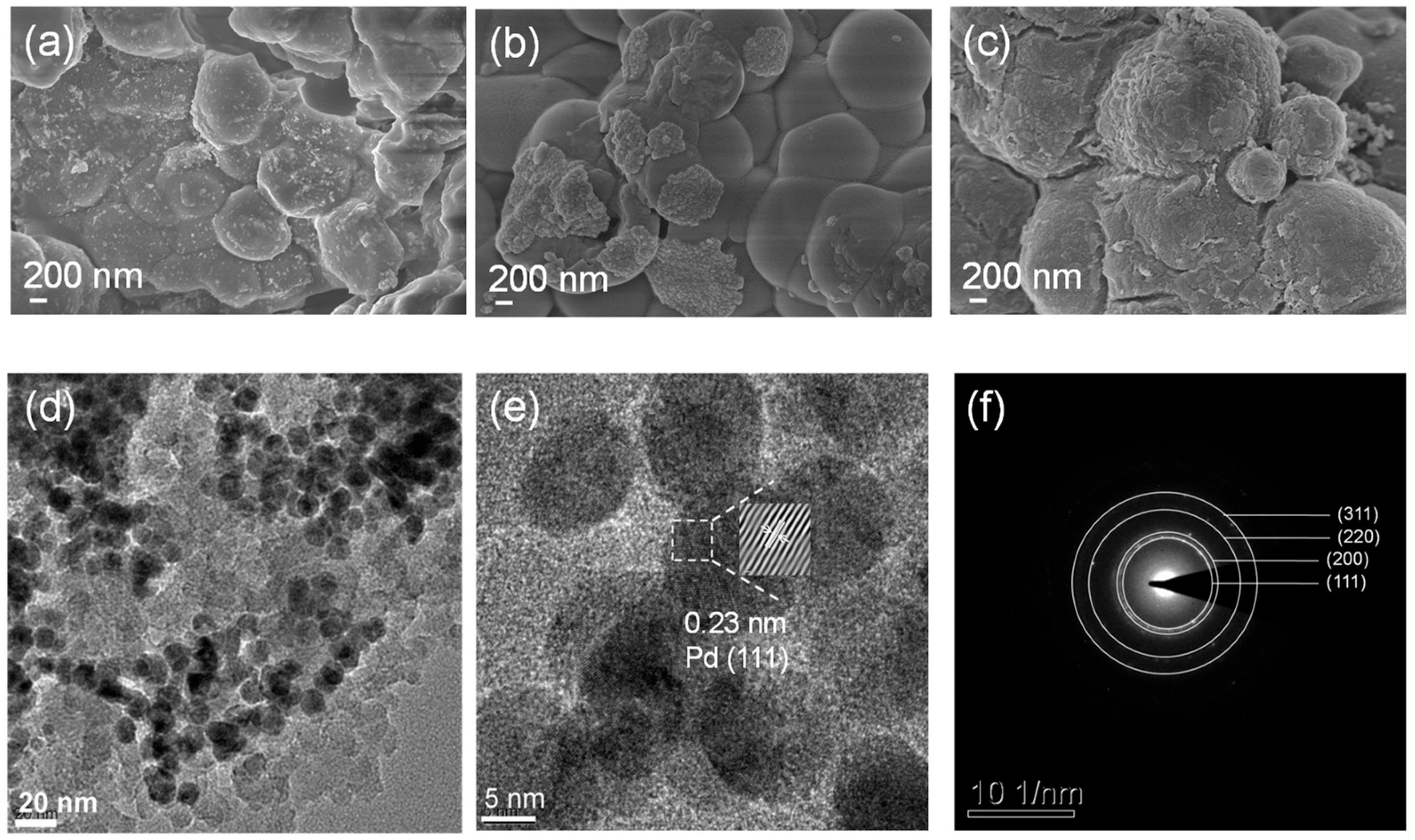
Scanning electron microscopy (SEM) was used to study the morphology (Figure 3). SEM revealed that Pd–NHC consisted of aggregated spherical particles of 1–1.2 μm. Ag–NHC also possessed a porous structure with aggregated spherical particles, measuring approximately 1.2 μm in diameter. Similarly, Cu–NHC had a morphology of aggregated spherical particles with a diameter of 2–2.4 μm. The morphology of Pd–NHC were also investigated by high-resolution transmission electron microscopy (TEM). TEM images revealed uniform distribution of Pd NPs with particles sized 10 to 15 nm immobilized within the Pd–NHC matrix. HR-TEM images revealed distinct lattice fringes. The interplanar spacing of 0.23 nm is attributable to the (111) planes of metallic Pd [34]. Additionally, selected-area electron diffraction (SAED) exhibited a polycrystalline ring pattern, which is consistent with the diffraction planes of metallic Pd and the standard reference data for palladium (JCPDS Card No. 05-0681) [35]. Furthermore, the palladium content of Pd–NHC was determined to be 9.74 wt% using inductively coupled plasma–optical emission spectrometry (ICP–OES).
Figure 3.
SEM images of: (a) Pd–NHC; (b) Ag–NHC; (c) Cu–NHC; (d) TEM image; (e) HR-TEM image; and (f) the corresponding SAED pattern of Pd–NHC.
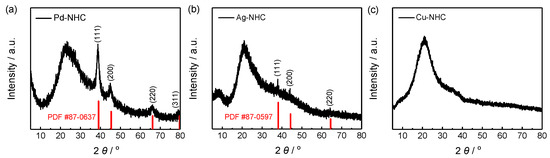
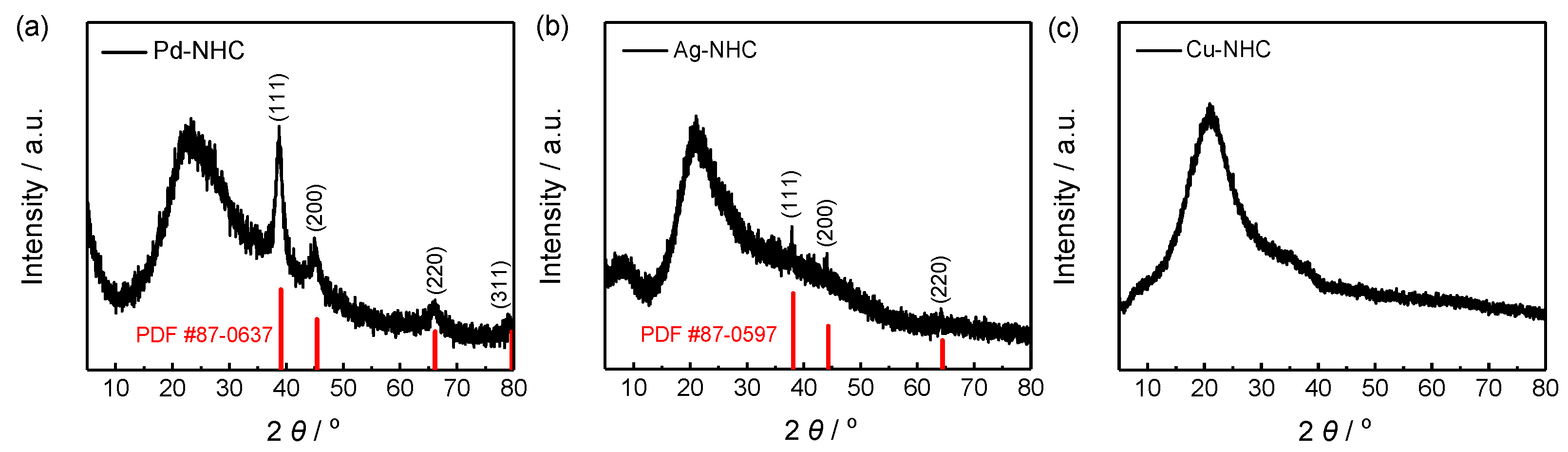
Powder X-ray diffraction (PXRD) of Pd–NHC revealed diffraction peaks at 39.06°, 45.41°, 66.17° and 79.60°, which are assigned to the (111), (200), (220) and (311) planes of Pd metal, respectively (JCPDS Card No.05-0681) [35], indicating that Pd2+ may be reduced to Pd0 in DMF (Figure 4). Ag–NHC exhibited weak diffraction peaks at 38.12°, 44.28° and 64.20°, assignable to the (111), (200) and (220) crystallographic planes of Ag metal, respectively (JCPDS Card No.87-0597) [36], indicating that a small amount of Ag+ may have been reduced to Ag0. Cu–NHC showed a broad peak at about 21°, suggesting its amorphous nature.
Figure 4.
XRD patterns of: (a) Pd–NHC; (b) Ag–NHC; and (c) Cu–NHC.
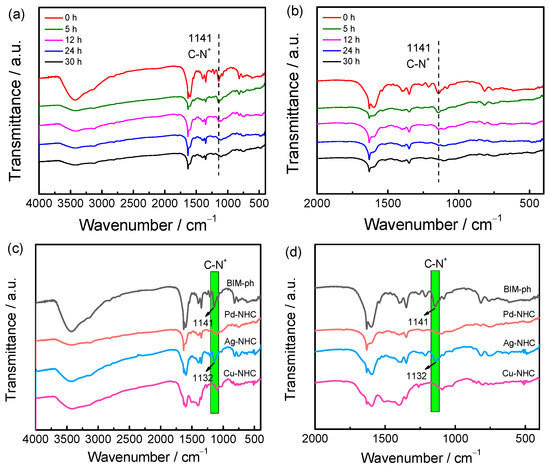
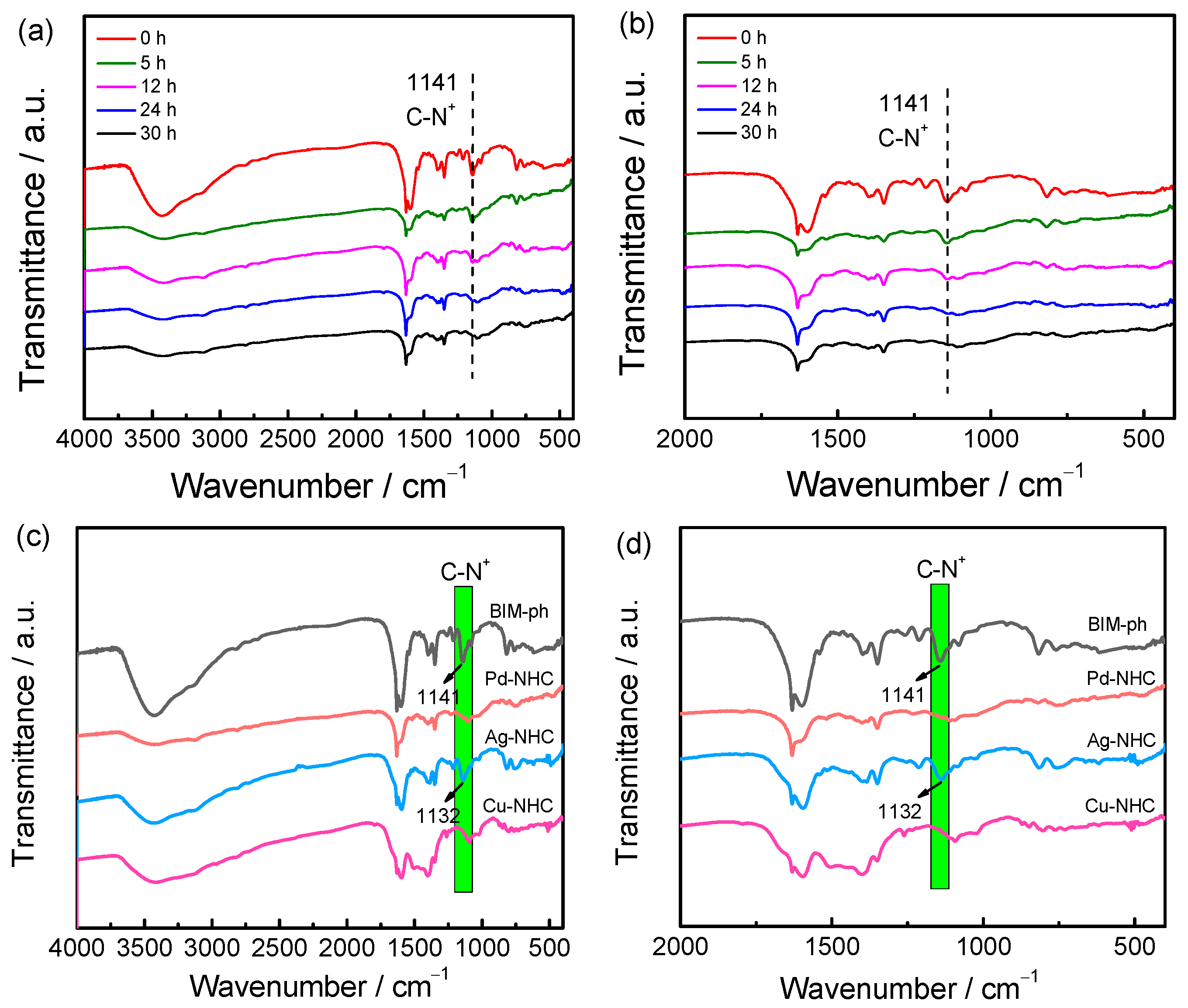
FT–IR spectroscopy was employed to monitor the formation of Pd–NHC at different reaction times (0, 5, 12, 24 and 30 h) (Figure 5). For BIM-ph, the band at 1141 cm−1 is attributed to the C–N+ stretching vibration of the imidazole ring [33,37,38,39]. The ex situ FT–IR spectra revealed gradual weakening of the imidazolium C–N+ bond as the reaction progressed, confirming the formation of metal–NHC complexes [40,41]. Similarly, the characteristic band at 1141 cm−1 corresponds to the imidazolium C–N+ stretching vibration for Cu–NHC, which was obviously weakened compared with BIM–ph, demonstrating the successful preparation of Cu–NHC polymers [42]. Additionally, the stretching frequency of the C–N+ bond decreases from 1141 cm−1 to 1132 cm−1 for Ag–NHC. The red shift is attributed to the metal–NHC bonding, probably resulting from charge delocalization within the particles due to reduced metal–ligand interfacial resistance [43].
Figure 5.
(a,b) Ex situ FT–IR spectra of Pd–NHC at different reaction times (0 h, 5 h, 12 h, 24 h and 30 h), and (c,d) FT–IR spectra of Pd–NHC, Ag–NHC, Cu–NHC and BIM-ph.
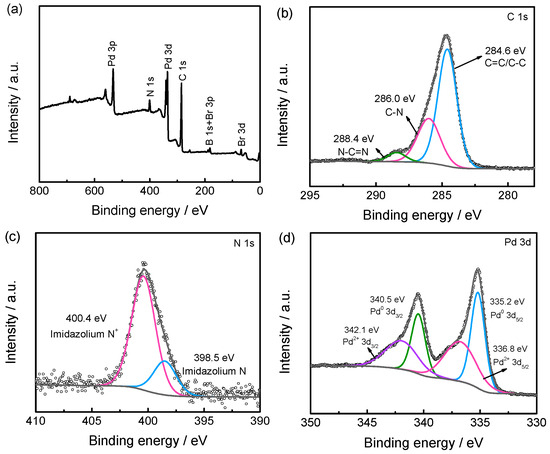
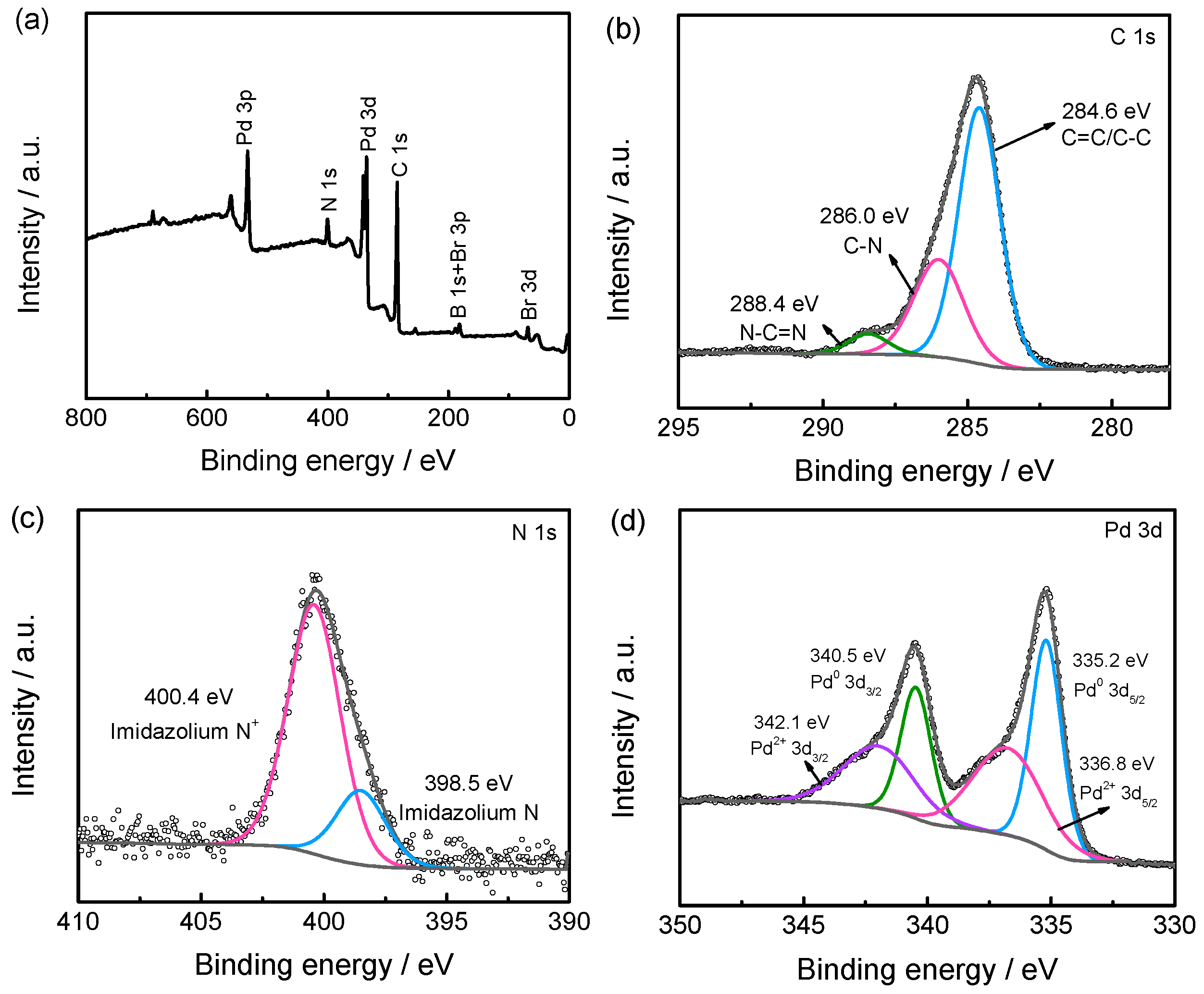
X-ray photoelectron spectroscopy (XPS) was employed to analyze the elements and determine the electronic properties of Pd–NHC (Figure 6). The high-resolution XPS C 1s spectrum consists of three deconvoluted peaks, which were assigned to C=C/C–C (284.6 eV), C=N (286.0 eV), and the sp2-hybridized carbon of the N–C=N group (288.4 eV) [44]. The resolution of the N 1s spectrum into two peaks suggests two chemically different types of nitrogen atoms, N–C (400.4 eV) and N=C (398.5 eV). The Pd 3d region consisted of two spin-orbit components of 3d5/2 and 3d3/2 [27]. Specifically, the chemical states of the palladium species in Pd–NHC were assessed. The Pd 3d region exhibited four distinct peaks of Pd0 and Pd2+, which were assigned to Pd2+ 3d5/2 at 336.8 eV, Pd2+ 3d3/2 at 342.1 eV, Pd0 3d5/2 at 335.2 eV, and Pd0 3d3/2 at 340.5 eV [25,45]. Compared with Pd(OAc)2, the binding energies of Pd2+ 3d5/2 and 3d3/2 in Pd–NHC showed negative shifts of 1.3 eV and 1.4 eV, respectively, demonstrating a strong chemical coordination interaction between Pd2+ and the N-heterocyclic carbene [46]. The presence of Pd0 indicated that a portion of Pd2+ was reduced during the coordination of the NHC ligand. As shown above, the Pd nanoparticles were also observed by XRD and TEM.
Figure 6.
(a) XPS survey spectrum; (b) C 1s; (c) N 1s; and (d) Pd 3d deconvoluted high-resolution XPS spectra of Pd–NHC.
3.2. Performance of Oxygen Evolution Reaction
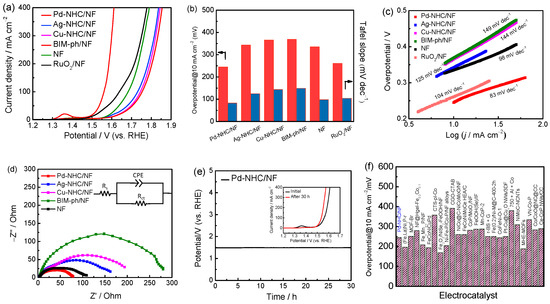
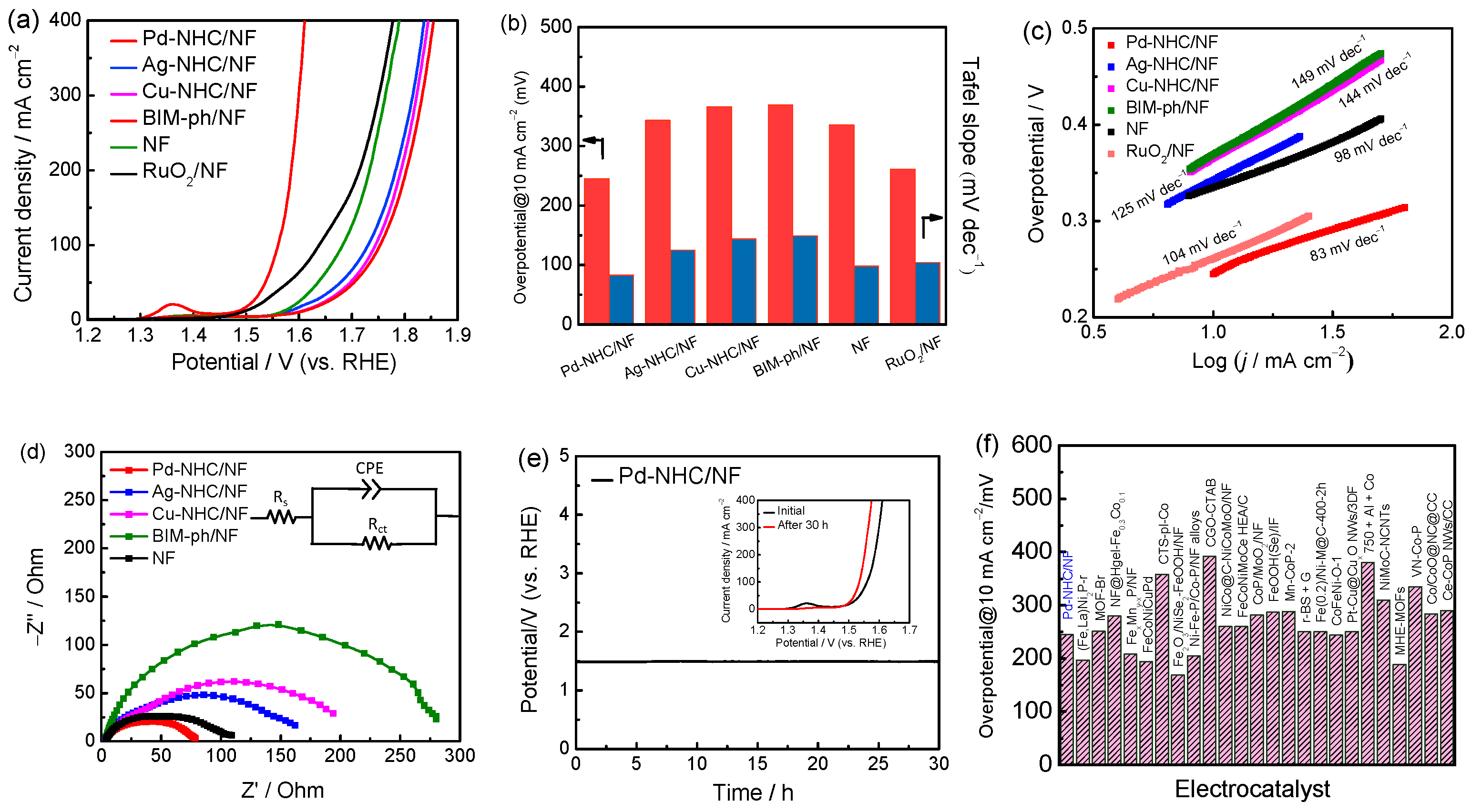
The OER catalytic activity of Pd–NHC, Ag–NHC and Cu–NHC, deposited on an NF electrode, was investigated with a sweep rate of 10 mV s−1 in 1.0 mol L−1 KOH as the electrolyte (Figure 7). BIM-ph/NF and RuO2/NF were studied as the control. A linear scanning voltammetry (LSV) test was carried out on the electrocatalysts. Pd–NHC/NF exhibited the highest activity for OER among all electrocatalysts, with the overpotential of 245 mV at a current density of 10 mA cm−2, surpassing Ag–NHC/NF (343 mV), Cu–NHC/NF (366 mV), BIM-ph/NF (369 mV), and commercial RuO2/NF (261 mV). By measuring the overpotentials at different current densities, the OER performance was further evaluated. The overpotentials required for Pd–NHC/NF to reach 100, 200, and 300 mA cm−2 were 331, 356 and 370 mV, respectively. In comparison, the overpotentials required for Ag–NHC/NF, Cu–NHC/NF, BIM-ph/NF, and RuO2/NF to reach 100 mA cm−2 were 501, 515, 524, and 408 mV, respectively, further demonstrating the superior OER performance of Pd–NHC/NF. Additionally, the mass activity of Pd–NHC was determined to be high, up to 85.56 mA mg−1 at the overpotential of 245 mV.
Figure 7.
(a) LSV curses of Pd–NHC/NF, Ag–NHC/NF, Cu–NHC/NF, BIM-ph/NF, and RuO2/NF in 1.0 mol L−1 KOH for OER; (b) summary of overpotential and Tafel slopes as histograms for Pd–NHC/NF, Ag–NHC/NF, Cu–NHC/NF, BIM-ph/NF, and RuO2/NF; (c) Tafel curves of Pd–NHC/NF, Ag–NHC/NF, Cu–NHC/NF, BIM-ph/NF, and RuO2/NF in 1.0 mol L−1 KOH; (d) Nyquist plots of Pd–NHC/NF, Ag–NHC/NF, Cu–NHC/NF, BIM-ph/NF, and RuO2/NF in 1.0 mol L−1 KOH for OER (inset shows the equivalent circuit diagram); (e) chronopotentiometry E-t curve of Pd–NHC/NF (inset illustrates the polarization curves recorded initially and after 30 h); and (f) comparison of overpotentials at 10 mA cm−2 with recently reported OER electrocatalysts.
The Tafel slope was determined to investigate the kinetic characteristics of electrocatalytic reactions. Pd–NHC/NF showed the Tafel slope of 83 mV dec−1, significantly smaller than Ag–NHC/NF (125 mV dec−1), Cu–NHC/NF (144 mV dec−1), BIM-ph/NF (149 mV dec−1), and RuO2/NF (104 mV dec−1). It indicates that Pd–NHC/NF has higher activity, as the OER process rate increases more significantly with increasing potential.
The OER process involves a complex four-electron transfer through a multi-step mechanism; the formation of each oxygen molecule requires the transfer of four electrons. The OER process in alkaline media involves three reaction intermediates, NHC–M–OH, NHC–M–O, and NHC–M–OOH, where NHC–M is the active metal center of the electrocatalysts [47,48]. The intermediates represent adsorbed oxygen species attached to the active metal center of M–NHC polymer. Typically, under electrochemical oxidation conditions, hydroxyl ions first initiate the formation of NHC–M–OH, followed by deprotonation and oxidation steps to form the NHC–M–O and NHC–M–OOH intermediates, culminating in the release of O2.
Electrochemical impedance spectroscopy (EIS) was used to further investigate the charge transfer resistance and kinetic behavior of Pd–NHC/NF, Ag–NHC/NF and Cu–NHC/NF in alkaline media with a testing frequency range of 0.01–105 Hz. EIS serves to elucidate the mechanism at electrode–electrolyte interfaces, where the components in the equivalent electrochemical circuit (EEC) correspond to their characteristics, solution resistance (Rs), double-layer capacitance (CPE), and charge transfer resistance (Rct). The EIS results show that the Rct of Pd–NHC/NF was 71.3 Ω, significantly lower than those of Ag–NHC/NF (148.3 Ω), Cu–NHC/NF (196.3 Ω), and BIM-ph/NF (279.2 Ω) (Figure 7d). The charge transfer impedance follows the order of Pd–NHC< Ag–NHC< Cu–NHC< BIM-ph. Among them, Pd–NHC has the smallest charge transfer resistance, indicating that it has the fastest electron transfer rate. Therefore, the favorable OER kinetics observed for Pd–NHC/NF may be attributed to the enhanced charge transfer ability [19,47,49].
A long-term durability test of Pd–NHC was conducted at 10 mA cm−2 for 30 h, during which it maintained a stable current density (Figure 7e). LSV indicates that the potential of Pd–NHC/NF had no significant change before and after the 30–h stability evaluation at 10 mA cm−2. Moreover, the potential decreased by only 1.17% at 50 mA cm−2, further demonstrating the excellent cycling stability of Pd–NHC/NF for OER.
To study the intrinsic OER electrocatalytic activity of the catalysts, cyclic voltammetry (CV) curves were recorded in the voltage range of 1.10–1.20 V (vs. RHE) (Figure S1). The electrochemical active area (ECSA) was evaluated by measuring the double-layer capacitance (Cdl). The Cdl of Pd–NHC/NF (8.2 mF cm−2) exceeded those of Ag–NHC/NF (5.6 mF cm−2), Cu–NHC/NF (5.2 mF cm−2), and BIM-ph/NF (3.2 mF cm−2). It indicates that Pd–NHC/NF possessed a larger electrochemically active area and higher density of active sites [50,51], in agreement with its excellent OER performance.
The activity of Pd–NHC/NF is superior to that of many previously reported OER catalysts, including POPs (Figure 7f, Table S1) [51,52,53,54,55,56,57,58,59,60,61,62,63,64,65,66,67,68,69,70,71,72,73,74]. In comparison, NF@Hgel-Fe0.3Co0.1 (hydrogel containing Fe and Co) demonstrated an overpotential of 280 mV at a current density of 10 mA cm−2 [52], THT-PyDAN (C=C bond-linked POP containing nitrogen and sulfur active sites) possessed an overpotential of 283 mV at 10 mA cm−2 [53], TDA-Trz-POP (nitrogen/sulfur-rich thiadiazole- and triazine-linked POP) revealed an overpotential of 410 mV at 10 mA cm−2 [54], and Au(I)–NHC dinuclear complex exhibited an OER overpotential of 1140 mV in 1.0 mol L−1 KOH [55]. The present study provides an innovative approach for boosting OER performance.
3.3. Performance of Hydrogen Evolution Reaction
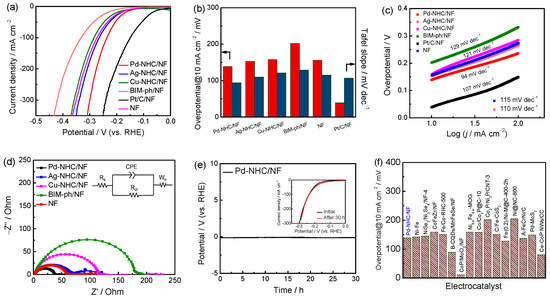
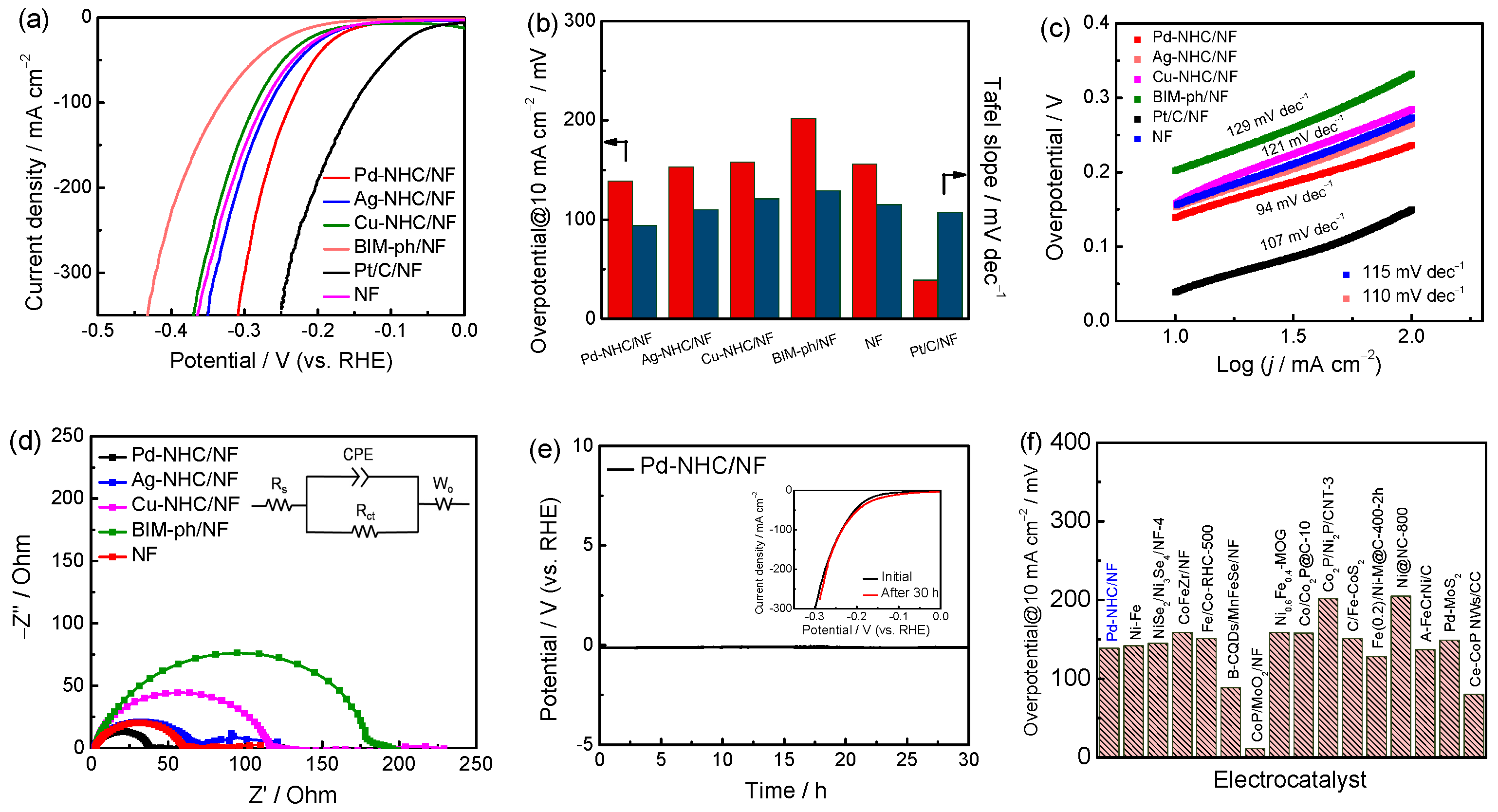
The HER performance of Pd–NHC, Ag–NHC, and Cu–NHC, deposited on an NF electrode, was studied in 1.0 mol L−1 KOH (Figure 8). According to the LSV test, the overpotential of Pd–NHC/NF (139 mV) was significantly lower than that of Ag–NHC/NF (153 mV), Cu–NHC/NF (158 mV), and BIM-ph/NF (202 mV) at 10 mA cm−2, suggesting that Pd–NHC/NF was more effective and needed less energy to promote HER reactions. The outstanding HER activity of Pd–NHC/NF may arise from the strong σ-donor ability of the NHC ligand, which forms strong Pd-C bonds with Pd2+ and exposes more active sites by the metal ions [47]. Furthermore, Pd–NHC/NF has a smaller Tafel slope, of 94 mV dec−1, than Ag–NHC/NF (110 mV dec−1), Cu–NHC/NF (121 mV dec−1), and BIM-ph/NF (129 mV dec−1). As the control, commercial Pt/C/NF exhibited an overpotential of 39 mV at 10 mA cm−2 with a Tafel slope of 107 mV dec−1. The Tafel slope of Pd–NHC/NF may arise from the Volmer–Heyrovsky mechanism of hydrogen electrochemical desorption, with the Heyrovsky step being the possible rate-determining step [7,75].
Figure 8.
(a) LSV curses of Pd–NHC/NF, Ag–NHC/NF, Cu–NHC/NF, BIM-ph/NF, and Pt/C/NF in 1.0 mol L−1 KOH for HER; (b) histograms of overpotential and Tafel slopes for Pd–NHC/NF, Ag–NHC/NF, Cu–NHC/NF, BIM-ph/NF, and Pt/C/NF; (c) Tafel curves of Pd–NHC/NF, Ag–NHC/NF, Cu–NHC/NF, BIM-ph/NF, and Pt/C/NF in 1.0 mol L−1 KOH; (d) Nyquist plots of Pd–NHC/NF, Ag–NHC/NF, Cu–NHC/NF, BIM-ph/NF, and Pt/C/NF in 1.0 mol L−1 KOH for HER (inset shows the equivalent circuit diagram); (e) E-t curve of Pd–NHC/NF (inset presents the corresponding polarization curves before and after chronopotentiometry measurements for 30 h); and (f) comparison of overpotentials at 10 mA cm−2 with recently reported HER electrocatalysts.
The electrode kinetics of the catalyst was studied through EIS measurement. The charge transfer resistance of Pd–NHC/NF (37.2 Ω) was lower than that of Ag–NHC/NF (67.8 Ω), Cu–NHC/NF (116.2 Ω), and BIM-ph/NF (179.0 Ω), indicating faster chemical reaction kinetics (Figure 8d). The long-term durability performance of Pd–NHC/NF was evaluated for 30 h at 10 mA cm−2 (Figure 8e). The LSV curves of Pd–NHC/NF before and after long-term stability testing were nearly superimposed, confirming its excellent durability.
The ECSA was evaluated based on the Cdl measured via CV. In Figure S2, Pd–NHC/NF exhibited the highest Cdl (1.5 mF cm−2), which is superior to those of Ag–NHC/NF (1.2 mF cm−2), Cu–NHC/NF (0.6 mF cm−2), and BIM-ph/NF (0.5 mF cm−2), indicating that Pd–NHC/NF had higher ECSA, meaning that it has a larger catalytic active area and more active sites.
Pd–NHC/NF exhibits competitive HER performance, which is comparable to many advanced electrocatalysts, including POPs (Figure 8f, Table S2) [76,77,78,79,80,81,82,83,84,85,86,87]. For example, Ni@COP (nickel-doped 2D covalent organic polymer) exhibited an overpotential (η10) of 290 mV and a Tafel slope of 112 mV dec−1 in 0.5mol L−1 H2SO4 [76], TPA-OMe (triphenylamine-based POP) demonstrated an overpotential (η10) of 353 mV in 0.5 mol L−1 H2SO4 [77], and SMCOP-4 (triazine-containing imine POP) indicated a HER overpotential of 139 mV at 10 mA cm−2 [78].
3.4. Performance of Overall Water-Splitting
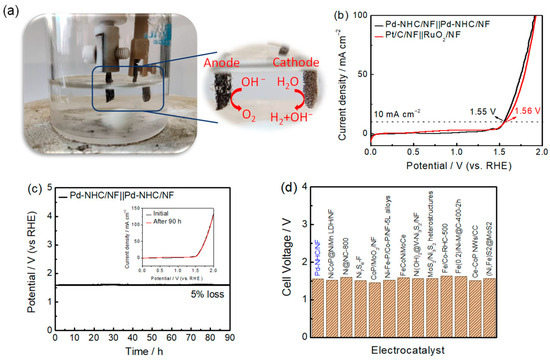
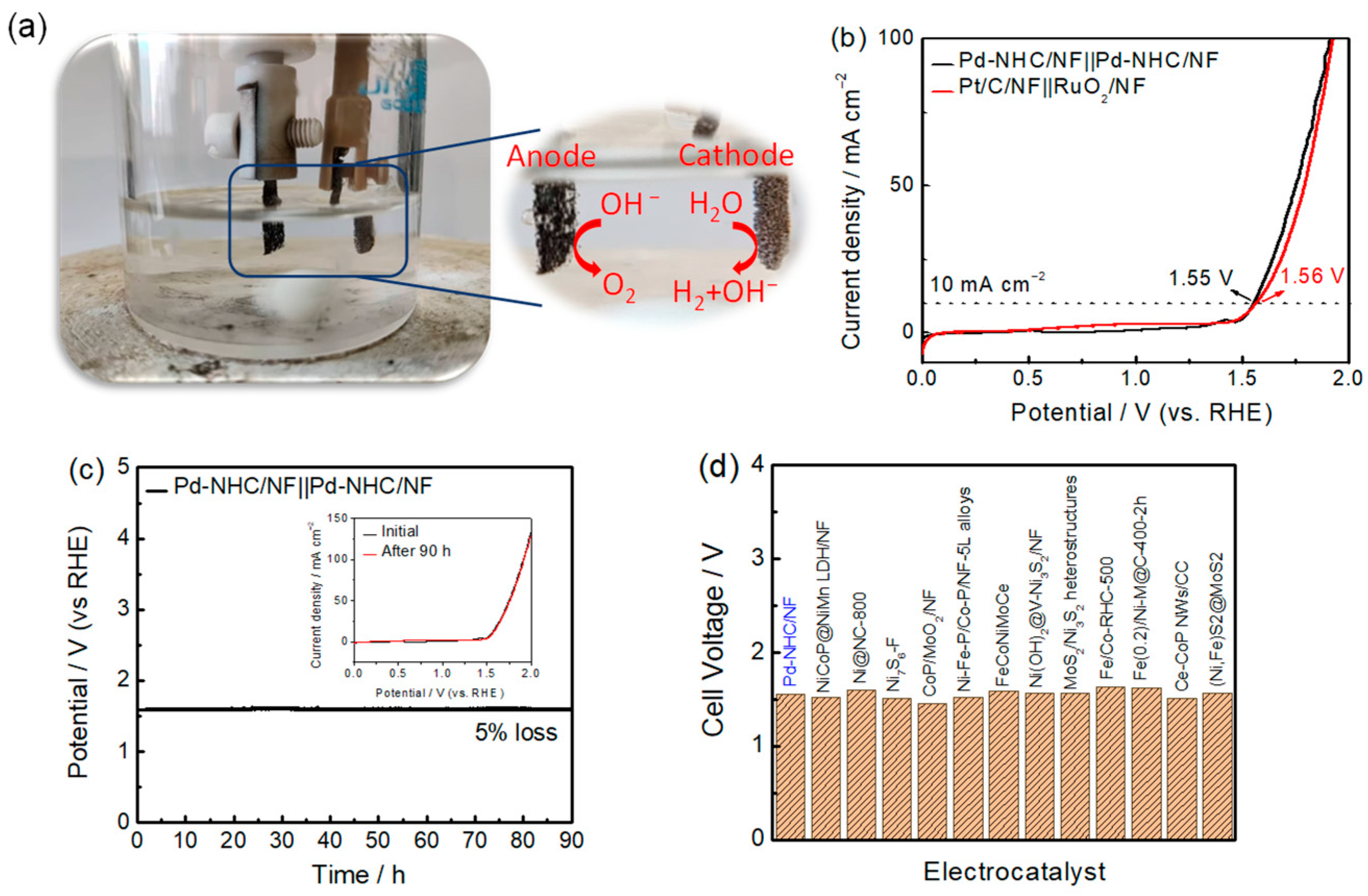
The above investigations indicate that the Pd–NHC/NF electrode exhibited excellent OER and HER activity and can be used as a bifunctional electrocatalyst. Pd–NHC/NF was subsequently used as anode and cathode in a two-electrode configuration to explore the overall water-splitting performance (Figure 9a). The Pd–NHC/NF||Pd–NHC/NF electrolyzer required a voltage of 1.55 V to achieve a current density of 10 mA cm−2 at in 1.0 mol L−1 KOH (Figure 9b), which is better than that of the benchmark Pt/C/NF||RuO2/NF (1.56 V) at 10 mA cm−2. For Pt/C/NF||RuO2/NF, commercial Pt/C and RuO2 were used as cathode and anode, respectively. Additionally, chronopotentiometry tests on the Pd–NHC/NF||Pd–NHC/NF electrode for overall water decomposition showed that the potential only increased by 5% after 90 h of electrolysis at a constant current density of 10 mA cm−2, demonstrating excellent stability (Figure 9c). The nearly overlapping LSV curves before and after the tests further confirmed its outstanding durability. Interestingly, the water-splitting activity of Pd–NHC/NF||Pd–NHC/NF surpasses and/or matches that of advanced catalysts reported in the literature for electrocatalytic water-splitting [17,88,89,90,91,92,93] such as NiTAPP–NiACQ (porphyrin POP cathode with a cell voltage of 1.59 V at 10 mA cm−2) [88], MoS2/Ni3S2 (heterostructure with a cell voltage of approximately 1.56 V at 10 mA cm−2) [89], Fe(0.2)/Ni-M@C-400-2h (iron-doped annealed Ni–MOF composite with a cell voltage of 1.62 V at 10 mA cm−2) [17], and so on (Figure 9d and Table S3).
Figure 9.
(a) Digital photograph of the Pd–NHC/NF||Pd–NHC/NF electrolyzer; (b) linear sweep voltammetric curves of Pd–NHC/NF(+)||Pd–NHC/NF(−) in the two-electrode system; (c) stability of Pd–NHC/NF(+)||Pd–NHC/NF(−) at 10 mA cm−2 (inset shows the LSV curves recorded initially and after 90 h of testing); and (d) cell voltage to reach 10 mA cm−2 with reported catalysts for the overall water-splitting performance in 1.0 mol L−1 KOH.
Further characterization was conducted to investigate the structural integrity of Pd–NHC after the long-term stability test using TEM, FT–IR, and XRD (Figure S3). TEM images indicated that the structure did not change. Pd NPs with a size distribution of 10–15 nm were uniformly dispersed within the Pd–NHC matrix.HR-TEM analysis showed lattice fringes with an interplanar spacing of 0.23 nm. Additionally, the SAED pattern obtained from the Pd–NHC region further confirmed its crystalline structure. In the FT–IR spectra, the band at 1630 cm−1 and 1141 cm−1 was assigned to the stretching vibrations of the C=N bond and the C-N+ bond within the imidazole ring, respectively. The XRD pattern of the spent Pd–NHC catalyst showed diffraction peaks at 2θ = 39.06°, 45.41°, 66.17° and 79.60°, which were assignable to the (111), (200), (220) and (311) Bragg reflections of metallic Pd (Pd0), respectively. This is consistent with that of the fresh catalyst, demonstrating that the Pd–NHC catalyst had excellent structural stability under the reaction conditions. The structural characteristics of Pd–NHC remained unchanged after electrocatalysis, suggesting that the material possesses excellent stability for electrocatalytic water-splitting.
To quantitatively assess the number and efficiency of active sites and provide further evidence for the superior electrocatalytic performance of Pd–NHC, turnover frequency (TOF) was determined in alkali electrolytes [4,94]. TOF was calculated using the equation, , where j is the measured current density at a specified overpotential, A is the geometric area of the NF working electrode (0.25 cm−2 in this work), zdenotes the amount of active sites available for catalysis, F is the Faraday constant (96,485 C mol−1), and n equals 4 for the OER or 2 for the HER. Pd–NHC showed OER activity with an overpotential of 245 mV to achieve 10 mA cm−2, corresponding to TOFOER of 0.024 s−1. Similarly, Pd–NHC required an overpotential of 139 mV to achieve 10 mA cm−2 for the HER, yielding TOFHER of 0.047 s−1. The remarkable electrocatalytic activity may be ascribed to the catalyst’s abundance of highly concentrated active sites, which facilitate the efficient adsorption and desorption of H+ and OH− ions.
4. Conclusions
To sum up, a series of metal–nitrogen heterocyclic carbenes supported on nickel foam (Pd–NHC/NF, Ag–NHC/NF, and Cu–NHC/NF) were developed as bifunctional electrocatalysts for efficient water electrolysis. Metal–nitrogen heterocyclic carbenes (M–NHCs) were synthesized from imidazolium borate ionic POP and metal ions (Pd2+, Ag+, and Cu+). The utilization of imidazolium borate ionic POP as NHC ligand leads to strongly bound M–NHC species with metal ions, facilitated by the strong electron-donating character of the NHCs. Among the materials, Pd–NHC with Pd NPs loaded in its networked matrix demonstrated superior performance in both the HER and the OER. To achieve a current density of 10 mA cm−2 in alkaline medium, Pd–NHC/NF exhibited a low OER overpotential of 245 mV in alkaline medium with a Tafel slope of 83 mV dec−1, and a low overpotential of 139 mV in HER with a Tafel slope of 94 mV dec−1. Moreover, Pd–NHC also demonstrated outstanding overall water-splitting activity (1.55 V at η10) on NF and exhibited exceptional durability, with no noticeable decay during a continuous 90-h E-t curve in alkaline medium. Overall, this work presents an efficient bifunctional electrocatalyst for efficient water-splitting.
Supplementary Materials
The following supporting information can be downloaded at: https://www.mdpi.com/article/10.3390/nano16120781/s1. Additional experimental details, electrocatalysis and characterization data. Table S1. Comparison of OER performance of Pd-NHC with those of reported electrocatalysts. Table S2. Comparison of HER performance of Pd-NHC with those of reported electrocatalysts. Table S3. Comparison of the overall water splitting performance with previously reported comparable electrocatalysts as electrolyzers. Figure S1. (a) CV curves of Pd-NHC/NF at various scan rates, (b) CV curves of Ag-NHC/NF at various scan rates, (c) CV curves of Cu-NHC/NF at various scan rates, (d) CV curves of BIM-ph/NF at various scan rates, (e) CV curves of RuO2/NF at various scan rates, (f) plots of ΔJ versus scan rate for Pd-NHC/NF, Ag-NHC/NF, Cu-NHC/NF, BIM-ph/NF and RuO2/NF at various scan rates. Figure S2. (a) CV curves of Pd-NHC/NF at various scan rates; (b) CV curves of Ag-NHC/NF at various scan rates; (c) CV curves of Cu-NHC/NF at various scan rates; (d) CV curves of BIM-ph/NF at various scan rates; (e) CV curves of Pt/C/NF at various scan rates; (f) plots of ΔJ versus scan rate for Pd-NHC/NF, Ag-NHC/NF, Cu-NHC/NF, BIM-ph/NF and Pt/C/NF at various scan rates. Figure S3. (a) TEM image, (b) HR-TEM image, and (c) the corresponding SAED pattern of Pd-NHC after long-term water splitting for 90 h. (d) FT-IR spectra and (e) powder XRD patterns of Pd-NHC before and after long-term water splitting for 90 h.
Author Contributions
S.M.: Investigation, Formal analysis, Data curation, Writing—original draft. Z.Y.: Investigation, Data curation. G.S.: Data curation. J.Z.: Conceptualization, Data curation, Writing—review and editing, Supervision. All authors have read and agreed to the published version of the manuscript.
Funding
This work was supported by the Guangdong Basic and Applied Basic Research Foundation (2025A1515011588).
Data Availability Statement
The original contributions presented in this study are included in the article. Further inquiries can be directed to the corresponding author.
Conflicts of Interest
The authors declare no conflicts of interest.
References
- Tiwari, A.P.; Yoon, Y.; Novak, T.G.; An, K.-S.; Jeon, S. Continuous network of phase-tuned nickel sulfide nanostructures for electrocatalytic water splitting. ACS Appl. Nano Mater. 2019, 2, 5061–5070. [Google Scholar] [CrossRef] [Scilit]
- Luo, C.; Liu, X.; Yang, K.; Xu, J.; Zhu, Z.; Tang, Z.; Shen, S.; Fan, J.; Luo, D.; Alshammari, N.A.H.; et al. Coordination structure engineering of Cu-based electrocatalysts for electrocatalytic water splitting. Coord. Chem. Rev. 2024, 516, 215936. [Google Scholar] [CrossRef] [Scilit]
- Chhetri, K.; Muthurasu, A.; Dahal, B.; Kim, T.; Mukhiya, T.; Chae, S.-H.; Ko, T.H.; Choi, Y.C.; Kim, H.Y. Engineering the abundant heterointerfaces of integrated bimetallic sulfide-coupled 2D MOF-derived mesoporous CoS2 nanoarray hybrids for electrocatalytic water splitting. Mater. Today Nano 2022, 17, 100146. [Google Scholar]
- Zhou, J.; Dou, Y.; Wu, X.-Q.; Zhou, A.; Shu, L.; Li, J.-R. Alkali-etched Ni(II)-based metal–organic framework nanosheet arrays for electrocatalytic overall water splitting. Small 2020, 16, 1906564. [Google Scholar]
- Al-Naggar, A.H.; Shinde, N.M.; Kim, J.-S.; Mane, R.S. Water splitting performance of metal and non-metal-doped transition metal oxide electrocatalysts. Coord. Chem. Rev. 2023, 474, 214864. [Google Scholar]
- Yu, H.; Li, J.; Gao, G.; Zhu, G.; Wang, X.; Lu, T.; Pan, L. Metal-organic frameworks derived carbon-incorporated cobalt/dicobalt phosphide microspheres as Mott–Schottky electrocatalyst for efficient and stable hydrogen evolution reaction in wide-pH environment. J. Colloid Interface Sci. 2020, 565, 513–522. [Google Scholar] [PubMed]
- Tran, D.T.; Le, H.T.; Doan, T.L.L.; Kim, N.H.; Lee, J.H. Pt nanodots monolayer modified mesoporous Cu@CuxO nanowires for improved overall water splitting reactivity. Nano Energy 2019, 59, 216–228. [Google Scholar]
- Xu, L.; Jiang, Q.; Xiao, Z.; Li, X.; Huo, J.; Wang, S.; Dai, L. Plasma-engraved Co3O4 nanosheets with oxygen vacancies and high surface area for the oxygen evolution reaction. Angew. Chem. Int. Ed. 2016, 55, 5277–5281. [Google Scholar]
- Abdelghafar, F.; Xu, X.; Jiang, S.P.; Shao, Z. Perovskite for electrocatalytic oxygen evolution at elevated temperatures. ChemSusChem 2024, 17, e202301534. [Google Scholar] [CrossRef] [Scilit] [PubMed]
- Okamura, M.; Kondo, M.; Kuga, R.; Kurashige, Y.; Yanai, T.; Hayami, S.; Praneeth, V.K.K.; Yoshida, M.; Yoneda, K.; Kawata, S.; et al. A pentanuclear iron catalyst designed for water oxidation. Nature 2016, 530, 465–468. [Google Scholar] [CrossRef] [Scilit] [PubMed]
- Khrizanforov, M.N.; Samorodnova, A.P.; Bezkishko, I.A.; Gainullin, R.R.; Kholin, K.V.; Gubaidullin, A.T.; Shekurov, R.P.; Miluykov, V.A. 2D coordination polymers of transition metals as catalysts for oxygen evolution reaction. Mater. Rep. Energy 2025, 5, 100334. [Google Scholar] [CrossRef] [Scilit]
- Wang, Y.; Xie, C.; Zhang, Z.; Liu, D.; Chen, R.; Wang, S. In situ exfoliated, N-doped, and edge-rich ultrathin layered double hydroxides nanosheets for oxygen evolution reaction. Adv. Funct. Mater. 2018, 28, 1703363. [Google Scholar]
- Zhang, Y.; Liu, Y.; Ma, M.; Ren, X.; Liu, Z.; Du, G.; Asiri, A.M.; Sun, X. A Mn-doped Ni2P nanosheet array: An efficient and durable hydrogen evolution reaction electrocatalyst in alkaline media. Chem. Commun. 2017, 53, 11048–11051. [Google Scholar]
- Yin, Y.; Zhang, Y.; Gao, T.; Yao, T.; Zhang, X.; Han, J.; Wang, X.; Zhang, Z.; Xu, P.; Zhang, P.; et al. Synergistic phase and disorder engineering in 1T-MoSe2 nanosheets for enhanced hydrogen-evolution reaction. Adv. Mater. 2017, 29, 1700311. [Google Scholar]
- Wan, J.; Wu, J.; Gao, X.; Li, T.; Hu, Z.; Yu, H.; Huang, L. Structure confined porous Mo2C for efficient hydrogen evolution. Adv. Funct. Mater. 2017, 27, 1703933. [Google Scholar] [CrossRef] [Scilit]
- Gupta, J.; Das, D.; Borse, P.H.; Sarada, B.V. In situ Pd-doped MoS2 nanosheets as an HER electrocatalyst for enhanced electrocatalytic water splitting. Sustain. Energy Fuels 2024, 8, 1526–1539. [Google Scholar]
- Srinivas, K.; Chen, Y.; Wang, B.; Yu, B.; Lu, Y.; Su, Z.; Zhang, W.; Yang, D. Metal–organic framework-derived Fe-doped Ni3Fe/NiFe2O4heteronanoparticle-decorated carbon nanotube network as a highly efficient and durable bifunctional electrocatalyst. ACS Appl. Mater. Interfaces 2020, 12, 55782–55794. [Google Scholar] [PubMed]
- Wei, M.; Zhang, D.; Wang, L.; Xiao, X.; Wang, S.; Song, M.; Zhao, S.; Wu, X. Amorphous–crystalline heterostructure with ample oxygen vacancy in situ evolved from heterojunction Ni(OH)2@V–Ni3S2/NF toward efficient water electrolysis. Energy Fuels 2023, 37, 16160–16171. [Google Scholar]
- Liu, Z.; Lu, Z.; Cao, Y.; Xie, J.; Hu, J.; Hao, A. Strongly coupled heterostructured CoP/MoO2 as an advanced electrocatalyst for urea-assisted water electrolysis. Inorg. Chem. 2024, 63, 2803–2813. [Google Scholar] [PubMed]
- Wang, P.; Qi, J.; Chen, X.; Li, C.; Li, W.; Wang, T.; Liang, C. Three-dimensional heterostructured NiCoP@NiMn-layered double hydroxide arrays supported on Ni foam as a bifunctional electrocatalyst for overall water splitting. ACS Appl. Mater. Interfaces 2020, 12, 4385–4395. [Google Scholar] [PubMed]
- Prakash, S.; Kamlesh; Tavar, D.; Bandyopadhyay, S.; Singhai, S.; Srivastava, A.K.; Singh, A. Graphene supported pillared Ni–Co metal–organic framework as an efficient electrocatalyst for the water oxidation reaction. ACS Appl. Energy Mater. 2023, 6, 8422–8433. [Google Scholar]
- Ye, Y.; Li, C.; Zhao, X.; Feng, H.; Chen, H. CoFe2O4 deposited on the rice husk-derived cordyceps-like SiC as an effective electrocatalyst for overall water splitting. Int. J. Hydrogen Energy 2024, 49, 723–733. [Google Scholar]
- Xu, W.; Wang, H. Earth-abundant amorphous catalysts for electrolysis of water. Chin. J. Catal. 2017, 38, 991–1005. [Google Scholar] [CrossRef] [Scilit]
- Ulu, Ö.D.; Kuruçay, A.; Ateş, B.; Özdemir, İ. Synthesis, characterization, invitro antibacterial, and anticancer studies of Ag(I)-N-heterocyclic carbene (NHC) complexes. Chem. Pap. 2023, 77, 423–435. [Google Scholar]
- Lin, H.; Gao, X.; Yao, H.; Luo, Q.; Xiang, B.; Liu, C.; Ouyang, Y.; Zhou, N.; Xiang, D. Immobilization of a Pd(II)-containing N-heterocyclic carbene ligand on porous organic polymers: Efficient and recyclable catalysts for Suzuki–Miyaura reactions. Catal. Sci. Technol. 2021, 11, 3676–3680. [Google Scholar]
- Kaeffer, N.; Liu, H.-J.; Lo, H.-K.; Fedorov, A.; Copéret, C. An N-heterocyclic carbene ligand promotes highly selective alkyne semihydrogenation with copper nanoparticles supported on passivated silica. Chem. Sci. 2018, 9, 5366–5371. [Google Scholar] [CrossRef] [Scilit] [PubMed]
- Bahadori, M.; Tangestaninejad, S.; Moghadam, M.; Mirkhani, V.; Mechler, A.; Mohammadpoor-Baltork, I.; Zadehahmadi, F. Metal organic framework-supported N-heterocyclic carbene palladium complex: A highly efficient and reusable heterogeneous catalyst for Suzuki-Miyaura C-C coupling reaction. Microporous Mesoporous Mater. 2017, 253, 102–111. [Google Scholar]
- Xu, S.; Song, K.; Li, T.; Tan, B. Palladium catalyst coordinated in knitting N–heterocyclic carbene porous polymers for efficient Suzuki–Miyaura coupling reactions. J. Mater. Chem. A 2015, 3, 1272–1278. [Google Scholar]
- Froese, R.D.J.; Lombardi, C.; Pompeo, M.; Rucker, R.P.; Organ, M.G. Designing Pd–N-heterocyclic carbene complexes for high reactivity and selectivity for cross-coupling applications. Acc. Chem. Res. 2017, 50, 2244–2253. [Google Scholar] [PubMed]
- Vougioukalakis, G.C.; Grubbs, R.H. Ruthenium-based heterocyclic carbene-coordinated olefin metathesis catalysts. Chem. Rev. 2017, 110, 1746–1787. [Google Scholar]
- Zhao, D.; Candish, L.; Paul, D.; Glorius, F. N-heterocyclic carbenes in asymmetric hydrogenation. ACS Catal. 2016, 6, 5978–5988. [Google Scholar] [CrossRef] [Scilit]
- Hamilton, B.H.; Kelly, K.A.; Malasi, W.; Ziegler, C.J. Tetrakis(imidazolyl)borate-based coordination polymers: Group II network solids, M[B(Im)4]2(H2O)2 (M = Mg, Ca, Sr). Inorg. Chem. 2003, 42, 3067–3073. [Google Scholar] [PubMed]
- Ma, S.; Chen, D.; Xu, J.; Ye, Z.; Zhang, J. Glassy carbon electrodes modified with Ru nanoparticles loaded in B-doped imidazolium porous organic polymers for hydrogen evolution reaction. Chem. Asian J. 2025, 20, e202401042. [Google Scholar] [PubMed]
- Zhang, Z.; Lu, J.; Zhang, B.; Shi, W.; Guob, Y.; Cui, F. Insight into the size effect of Pd nanoparticles on the catalytic reduction of nitrite in water over Pd/C catalysts. Environ. Sci. Nano 2020, 7, 2117–2129. [Google Scholar] [CrossRef] [Scilit]
- Odoom-Wubah, T.; Rubio, S.; Tirado, J.L.; Ortiz, G.F.; Akoi, B.J.; Huang, J.; Li, Q. Waste Pd/fish-collagen as anode for energy storage. Renew. Sustain. Energy Rev. 2020, 131, 109968. [Google Scholar]
- Panahi, P.N.; Alimohammadi, S.; Norouzi, F. Gas-phase photocatalytic degradation of a mixture of VOCs on Ag NPs decorated ZnO. ChemistrySelect 2024, 9, e202402234. [Google Scholar]
- Kandathil, V.; Siddiqa, A.; Patra, A.; Kulkarni, B.; Kempasiddaiah, M.; Sasidhar, B.S.; Patil, S.A.; Rout, C.S.; Patil, S.A. NHC-Pd complex heterogenized on graphene oxide for cross-coupling reactions and supercapacitor applications. Appl. Organomet. Chem. 2020, 34, e5924. [Google Scholar]
- Wang, Y.; Nie, J.; Lu, C.; Wang, F.; Ma, C.; Chen, Z.; Yang, G. Imidazolium-based polymeric ionic liquids for heterogeneous catalytic conversion of CO2 into cyclic carbonates. Microporous Mesoporous Mater. 2020, 292, 109751. [Google Scholar] [CrossRef] [Scilit]
- Yang, Z.-Z.; Zhao, Y.; Ji, G.; Zhang, H.; Yu, B.; Gao, X.; Liu, Z. Fluoro-functionalized polymeric ionic liquids: Highly efficient catalysts for CO2 cycloaddition to cyclic carbonates under mild conditions. Green Chem. 2014, 16, 3724. [Google Scholar]
- Lei, Y.; Lan, G.; Fan, M.; Li, G. Palladium coordinated in N-heterocyclic carbene-functionalized porousorganic polymer for efficient oxidative carbonylation of glycerol. Catal. Commun. 2020, 140, 106007. [Google Scholar]
- Let, S.; Dam, G.K.; Samanta, P.; Fajal, S.; Dutta, S.; Ghosh, S.K. Palladium-anchored N-heterocyclic carbenes in a porous organic polymer: A heterogeneous composite catalyst for eco-friendly C–C coupling. J. Org. Chem. 2022, 87, 16655–16664. [Google Scholar] [PubMed]
- Lei, Y.; Fan, M.; Lan, G.; Li, G. Copper supported on N-heterocyclic carbene-functionalized porous organic polymer for efficient oxidative carbonylation of methanol. Appl. Organomet. Chem. 2020, 34, e5794. [Google Scholar]
- Zhang, F.; Huang, L.; Zou, J.; Yan, J.; Zhu, J.; Kang, X.; Chen, S. Nitrile-functionalized ruthenium nanoparticles: Charge delocalization through Ru–N≡C interface. J. Nanopart. Res. 2017, 19, 106. [Google Scholar]
- Zhang, H.; Duan, X.; Han, M.; Liu, F.; Zhang, G.; Gao, K.; Liu, M. Experimental and theoretical investigations of zwitterionic hypercrosslinked polymers as robust catalysts for CO2 fixation under cocatalyst- and solvent-free conditions. Sep. Purif. Technol. 2025, 354, 128817. [Google Scholar]
- Yang, H.; Han, X.; Li, G.; Wang, Y. N-Heterocyclic carbene palladium complex supported on ionic liquid-modified SBA-16: An efficient and highly recyclable catalyst for the Suzuki and Heck reactions. Green Chem. 2009, 11, 1184–1193. [Google Scholar]
- Wu, F.; Huang, T.; Hu, Y.; Yang, X.; Ouyang, Y.; Xie, Q. Differential pulse voltammetric simultaneous determination of ascorbic acid, dopamine and uric acid on a glassy carbon electrode modified with electroreduced graphene oxide and imidazolium groups. Microchim. Acta 2016, 183, 2539–2546. [Google Scholar] [CrossRef] [Scilit]
- Vijayakumar, M.; Achar, G.; Yhobu, Z.; Malecki, J.G.; Nagaraju, D.H.; Keri, R.S.; Budagumpi, S. Augmenting the electrocatalytic activities of metal-N-heterocyclic carbene complexes as bifunctional electrocatalysts for hydrogen and oxygen evolution reactions by carbon composite strategy. Energy Fuels 2025, 38, 5421–5432. [Google Scholar]
- Suen, N.-T.; Hung, S.-F.; Quan, Q.; Zhang, N.; Xu, Y.-J.; Chen, H.M. Electrocatalysis for the oxygen evolution reaction: Recent development and future perspectives. Chem. Soc. Rev. 2016, 46, 337–365. [Google Scholar]
- Wu, Y.; Wang, L.; Bo, T.; Chai, Z.; Gibson, J.K.; Shi, W. Boosting hydrogen evolution in neutral medium by accelerating water dissociation with Ru clusters loaded on Mo2CTx MXene. Adv. Funct. Mater. 2023, 33, 2214375. [Google Scholar] [CrossRef] [Scilit]
- Chen, J.-B.; Ying, J.; Xiao, Y.-X.; Tian, G.; Dong, Y.; Shen, L.; de Torresi, S.I.C.; Symes, M.D.; Janiak, C.; Yang, X.-Y. Directed mass and electron transfer promoted by hierarchical porous Co–P–O leads to enhancement of the overall water splitting efficiency. ACS Catal. 2023, 13, 14802–14812. [Google Scholar]
- Wang, H.; Li, W.; Wu, J.; Wang, D.; Hou, D.; Sheng, M.; Guo, R. Interface-modified Ni–Fe–P/Co–P/NF alloys for electrocatalytic water splitting in alkaline solution. Energy Fuels 2023, 37, 19103–19112. [Google Scholar]
- Tang, C.; Thomas, B.; Ramírez-Hernández, M.; Mikmeková, E.M.; Asefa, T. Metal-functionalized hydrogels as efficient oxygen evolution electrocatalysts. ACS Appl. Mater. Interfaces 2022, 14, 20919–20929. [Google Scholar] [CrossRef] [Scilit] [PubMed]
- Sadhukhan, A.; Karmakar, A.; Koner, K.; Karak, S.; Sharma, R.K.; Roy, A.; Sen, P.; Dey, K.K.; Mahalingam, V.; Pathak, B.; et al. Functionality modulation toward thianthrene-based metal-free electrocatalysts for water splitting. Adv. Mater. 2024, 36, 2310938. [Google Scholar]
- Ghosh, A.; Mondal, M.; Manna, R.N.; Bhaumik, A. Targeted synthesis of a metal-free thiadiazolate based nitrogen and sulfur rich porous organic polymer for an unprecedented hydrogen evolution in the electrochemical water splitting. J. Colloid Interface Sci. 2024, 658, 415–424. [Google Scholar] [PubMed]
- Yhobu, Z.; Markandeya, G.B.; Małecki, J.G.; Srinivasa, H.T.; Keri, R.S.; Nagaraju, D.H.; Azam, M.; Al-Resayes, S.I.; Budagumpi, B. Pyridine-functionalized N-heterocyclic carbene gold(I) binuclear complexes as molecular electrocatalysts for oxygen evolution reactions. Appl. Organomet. Chem. 2022, 36, e6837. [Google Scholar]
- Wang, D.; Sun, Z.; Cui, W.; He, C.; Zhao, Z. Multi-interfacial nanosheet-intercalated structure with abundant oxygen vacancies promotes electrocatalytic oxygen evolution. Catal. Sci. Technol. 2024, 14, 5324–5330. [Google Scholar]
- Qi, Q.; Zhang, Y.; Zhang, C.; Liu, F.; Liu, R.; Hu, J. Halogen-modified iron-based metal−organic frameworks for remarkably improved electrocatalytic oxygen evolution. J. Phys. Chem. C 2024, 128, 1936–1945. [Google Scholar]
- Gong, G.; Zhou, J.; Guo, X.; Xie, R.; Zeng, X.; Zhang, M.; Wen, K.; Hu, T.; Shan, S.; Yao, K. Mn-mediated efficient oxygen evolution reaction on phosphorized NiFe electrocatalyst. Chem. Eng. J. 2025, 506, 159975. [Google Scholar]
- Wang, S.; Xu, B.; Huo, W.; Feng, H.; Zhou, X.; Fang, F.; Xie, Z.; Shang, J.K.; Jiang, J. Efficient FeCoNiCuPd thin-film electrocatalyst for alkaline oxygen and hydrogen evolution reactions. Appl. Catal. B 2022, 313, 121472. [Google Scholar]
- Lofek, M.; Wojtasik, M.; Markowski, J.; Stelmachowski, P. Exploring the potential of biochars for boosting electrocatalytic oxygen evolution reaction. Biomass Bioenergy 2025, 197, 107770. [Google Scholar] [CrossRef] [Scilit]
- Liu, S.; Wang, F.; Wang, J.; Wang, Z.; He, X.; Zhang, T.; Zhang, Z.; Liu, Q.; Liu, X.; Zhang, X. Dense heterogeneous interfaces boost the electrocatalytic oxygen evolution reaction. Appl. Catal. B 2024, 355, 124148. [Google Scholar] [CrossRef] [Scilit]
- Gao, H.; Yang, M.; Liu, X.; Dai, X.; Bao, X.-Q.; Xiong, D. Hydrothermal synthesized delafossite CuGaO2 as an electrocatalyst for water oxidation. Front. Optoelectron. 2022, 15, 8. [Google Scholar] [PubMed]
- Qian, G.; Chen, J.; Yu, T.; Luo, L.; Yin, S. N-doped graphene-decorated NiCo alloy coupled with mesoporous NiCoMoO nano-sheet heterojunction for enhanced water electrolysis activity at high current density. Nano-Micro Lett. 2021, 13, 77. [Google Scholar]
- Zhang, W.; Guo, R.; Yue, Q.; Huang, Y.; Zhang, G.; Guan, L. Preparation of high-entropy alloy bifunctional catalysts with rare earth Ce coordination and efficient water splitting research. Ionics 2024, 30, 3403–3416. [Google Scholar] [CrossRef] [Scilit]
- Niu, S.; Jiang, W.-J.; Wei, Z.; Tang, T.; Ma, J.; Hu, J.-S.; Wan, L.-J. Se-doping activates FeOOH for cost-effective and efficient electrochemical water oxidation. J. Am. Chem. Soc. 2019, 141, 7005–7013. [Google Scholar] [PubMed]
- Liu, Y.; Ran, N.; Ge, R.; Liu, J.; Li, W.; Chen, Y.; Feng, L.; Che, R. Porous Mn-doped cobalt phosphide nanosheets as highly active electrocatalysts for oxygen evolution reaction. Chem. Eng. J. 2021, 425, 131642. [Google Scholar] [CrossRef] [Scilit]
- Li, L.; Hagiwara, S.; Jiang, C.; Kusaka, H.; Watanabe, N.; Fujita, T.; Kuroda, F.; Yamamoto, A.; Miyakawa, M.; Taniguchi, T.; et al. Boron monosulfide as an electrocatalyst for the oxygen evolution reaction. Chem. Eng. J. 2023, 471, 144489. [Google Scholar] [CrossRef] [Scilit]
- Cao, Z.; Jiang, Z.; Li, Y.; Huang, C.; Li, Y. Metal-organic gel-derived multimetal oxides as effective electrocatalysts for the oxygen evolution reaction. ChemSusChem 2019, 12, 2480–2486. [Google Scholar] [PubMed]
- Sielicki, K.; Chen, X.; Mijowska, E. The role of aluminium in metal–organic frameworks derived carbon doped with cobalt in electrocatalytic oxygen evolution reaction. Mater. Des. 2023, 231, 112021. [Google Scholar] [CrossRef] [Scilit]
- Liu, H.-J.; Zhang, S.; Qiao, W.-Z.; Fan, R.-Y.; Liu, B.; Wang, S.-T.; Hu, H.; Chai, Y.-M.; Dong, B. Bimetallic metal-organic framework-derived bamboo-like N-doped carbon nanotube-encapsulated Ni-doped MoC nanoparticles for water oxidation. J. Colloid Interface Sci. 2024, 657, 208–218. [Google Scholar] [PubMed]
- Li, J.; Wang, B.; Wang, J.; Dai, Y.; Lv, X.; Dang, J. Entropy stabilization and metal–oxygen covalency optimization strategies for enhanced oxygen evolution electrocatalysis. J. Energy Chem. 2025, 103, 225–236. [Google Scholar]
- Yang, H.; Hu, Y.; Huang, D.; Xiong, T.; Li, M.; Balogun, M.-S.; Tong, Y. Efficient hydrogen and oxygen evolution electrocatalysis by cobalt and phosphorus dual-doped vanadium nitride nanowires. Mater. Today Chem. 2019, 11, 1–7. [Google Scholar] [CrossRef] [Scilit]
- Dai, K.; Zhang, N.; Zhang, L.; Yin, L.; Zhao, Y.; Zhang, B. Self-supported Co/CoO anchored on N-doped carbon composite as bifunctional electrocatalyst for efficient overall water splitting. Chem. Eng. J. 2021, 414, 128804. [Google Scholar]
- Li, S.; Chen, W.; Zhu, Y.; Guan, J.; Wang, L.; Guo, B.; Zhang, M. Modifying properties and endurance of CoP by cerium doping to enhances overall water splitting in alkaline medium. J. Electroanal. Chem. 2022, 922, 116748. [Google Scholar] [CrossRef] [Scilit]
- Markandeya, G.B.; Yhobu, Z.; Małecki, J.G.; Nagaraju, D.H.; Betageri, V.S.; Budagumpi, S. Palladium(II)-N-heterocyclic carbene complex-based electrocatalysts for hydrogen evolution reaction. Energy Fuels 2023, 37, 2237–2244. [Google Scholar]
- Samal, A.; Kori, D.K.K.; Jain, A.; Das, A.K. A nickel-doped two-dimensional covalent organic polymer (2D-COP) for electrocatalytic hydrogen evolution reaction. ACS Appl. Energy Mater. 2024, 7, 2715–2725. [Google Scholar]
- Kumar, M.; Singh, S.; Samanta, D.; Kar, K.K.; Ghorai, M.K. Electrocatalytic hydrogen evolution reaction (HER) with triphenylamine based metal-free conjugated porous organic polymers (POPs). Small 2025, 21, 2500502. [Google Scholar]
- Chakraborty, A.; Roy, S.; Hassan, S.; Porwal, P.; Sarkar, S.; Dar, M.A.; Roy, S.; Mukhopadhyay, S. A conjugated porous organic polymer as a metal-free bifunctional electrocatalyst for enhanced water splitting. Chem. Eur. J. 2025, 31, e202500003. [Google Scholar] [PubMed]
- Zhang, Z.; Wu, Y.; Zhang, D. Potentiostatic electrodeposition of cost-effective and efficient Ni-Fe electrocatalysts on Ni foam for the alkaline hydrogen evolution reaction. Int. J. Hydrogen Energy 2022, 47, 1425–1434. [Google Scholar]
- Tan, L.; Yu, J.; Wang, H.; Gao, H.; Liu, X.; Wang, L.; She, X.; Zhan, T. Controllable synthesis and phase-dependent catalytic performance of dual-phase nickel selenides on Ni foam for overall water splitting. Appl. Catal. B 2022, 303, 120915. [Google Scholar]
- Liu, W.; Jiang, K.; Hu, Y.; Li, Q.; Deng, Y.; Bao, J.; Lei, Y. Zr-doped CoFe-layered double hydroxides for highly efficient seawater electrolysis. J. Colloid Interface Sci. 2021, 604, 767–775. [Google Scholar] [PubMed]
- Zhang, W.; Guo, M.; Chai, D.-F.; Dong, G.; Bai, L.; Zhang, Z.; Zhang, X.; Guo, D. Heterogeneous interface of MnFeSe electrocatalyst for high-performance overall water splitting. Int. J. Hydrogen Energy 2025, 99, 485–493. [Google Scholar]
- Zhang, X.; Zhao, H.; Li, C.; Li, S.; Liu, K.; Wang, L. Facile coordination driven synthesis of metal-organic gels toward efficiently electrocatalytic overall water splitting. Appl. Catal. B 2021, 299, 120641. [Google Scholar] [CrossRef] [Scilit]
- Ding, Z.; Yu, H.; Liu, X.; He, N.; Chen, X.; Li, H.; Wang, M.; Yamauchi, Y.; Xu, X.; Amin, M.A.; et al. Prussian blue analogue derived cobalt-nickel phosphide/carbon nanotube composite as electrocatalyst for efficient and stable hydrogen evolution reaction in wide-pH environment. J. Colloid Interface Sci. 2022, 616, 210–220. [Google Scholar] [PubMed]
- Fang, B.; He, N.; Li, Y.; Lu, T.; He, P.; Chen, X.; Zhao, Z.; Pan, L. Prussian blue-derived hollow carbon-wrapped Fe-doped CoS2 nanocages as durable electrocatalyst for efficient hydrogen evolution. Electrochim. Acta 2023, 448, 142187. [Google Scholar]
- Xu, Y.; Tu, W.; Zhang, B.; Yin, S.; Huang, Y.; Kraft, M.; Xu, R. Nickel nanoparticles encapsulated in few-layer nitrogen doped graphene derived from metal-organic frameworks as efficient bifunctional electrocatalysts for overall water splitting. Adv. Mater. 2017, 29, 1605957. [Google Scholar]
- Song, L.; Xue, T.; Shen, Z.; Yang, S.; Sun, D.T.; Yang, J.; Hong, Y.; Su, Y.; Wang, H.; Peng, L.; et al. Metal-organic aerogel derived hierarchical porous metal-carbon nanocomposites as efficient bifunctional electrocatalysts for overall water splitting. J. Colloid Interface Sci. 2022, 621, 398–405. [Google Scholar] [PubMed]
- Wang, A.; Yang, X.; Wang, Q.; Dou, Y.; Zhao, L.; Zhu, W.; Zhao, W.; Zhu, G. Acenaphthenediimine complex-bridged porphyrin porous organic polymer with enriched active sites as a robust water splitting electrocatalyst. J. Colloid Interface Sci. 2024, 657, 748–756. [Google Scholar] [PubMed]
- Zhang, J.; Wang, T.; Pohl, D.; Rellinghaus, B.; Dong, R.; Liu, S.; Zhuang, X.; Feng, X. Interface engineering of MoS2/Ni3S2 heterostructures for highly enhanced electrochemical overall-water-splitting activity. Angew. Chem. Int. Ed. 2016, 55, 6702–6707. [Google Scholar]
- Hu, G.; Fu, W.; Lin, Y.; Yue, Y.; Wang, M.; Liu, P.; Li, Y.; Li, J.; Wei, L.; Zhao, X.; et al. Highly efficient nanoflower-like bifunctional electrocatalyst Co-W-BP/CF for overall water splitting. ACS Appl. Energy Mater. 2022, 5, 4259–4269. [Google Scholar]
- Zheng, X.; Sasikala, S.P.; Kim, Y.; Kim, T.-D.; Lee, G.S.; Kim, J.T.; Kim, S.O.; Prabhakaran, P. Dimension-engineered gold heterostructures with transition metal dichalcogenide for efficient overall water splitting. J. Colloid Interface Sci. 2025, 686, 516–524. [Google Scholar] [CrossRef] [Scilit] [PubMed]
- Li, S.; Guo, Y.; Wang, Z.; Zhao, D.; Guo, R.; Gao, Q.; Zhang, Z. A core–shell Pt–NiSe@NiFe-LDH heterostructure for bifunctional alkaline water splitting. Molecules 2025, 30, 4654. [Google Scholar] [PubMed]
- Liu, Y.; Jiang, S.; Li, S.; Zhou, L.; Li, Z.; Li, J.; Shao, M. Interface engineering of (Ni, Fe)S2@MoS2 heterostructures for synergetic electrochemical water splitting. Appl. Catal. B 2019, 247, 107–114. [Google Scholar]
- Anantharaj, S.; Karthik, P.E.; Noda, S. The significance of properly reporting turnover frequency in electrocatalysis research. Angew. Chem. Int. Ed. 2021, 60, 23051–23067. [Google Scholar] [CrossRef] [Scilit] [PubMed]
Disclaimer/Publisher’s Note: The statements, opinions and data contained in all publications are solely those of the individual author(s) and contributor(s) and not of MDPI and/or the editor(s). MDPI and/or the editor(s) disclaim responsibility for any injury to people or property resulting from any ideas, methods, instructions or products referred to in the content. |
© 2026 by the authors. Licensee MDPI, Basel, Switzerland. This article is an open access article distributed under the terms and conditions of the Creative Commons Attribution (CC BY) license.