


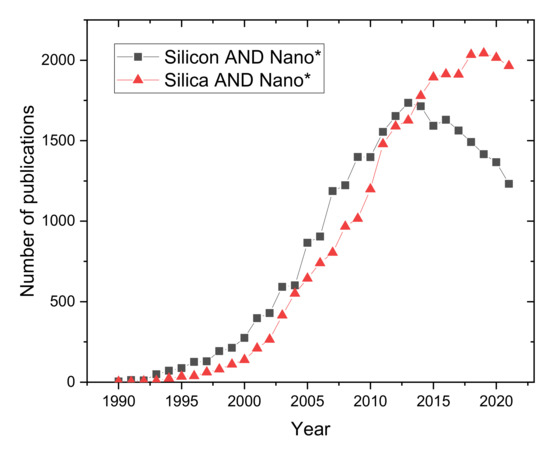
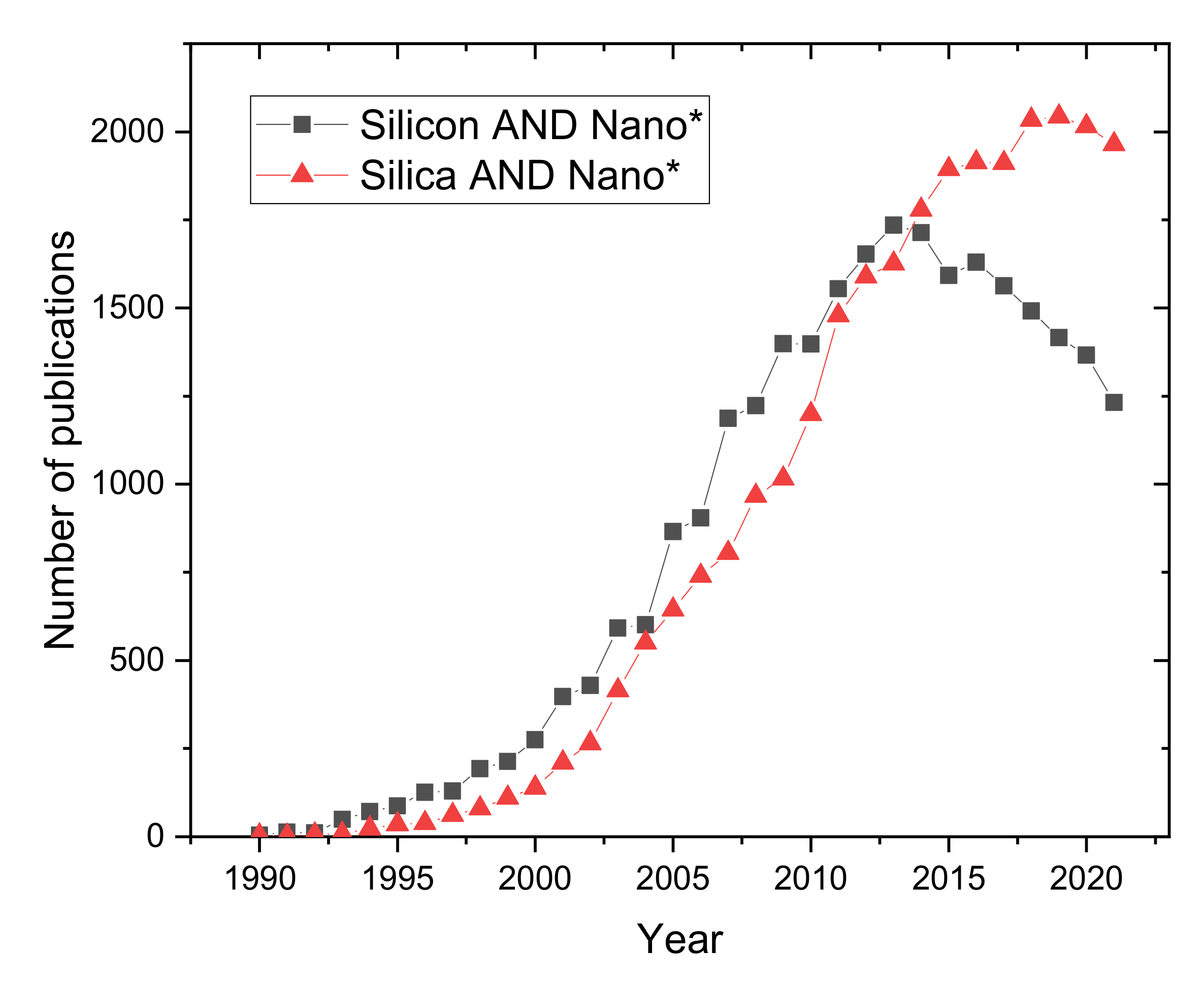
As depicted in Figure 1, studies on silicon and silica-based nanostructures first appeared in the early 1990s, and their numbers grew until the mid-2010s. Since then, the level of scientific research has decreased for silica-based nanostructures and started to decrease for silicon-based nanostructures. An extensive literature review of silicon-based nanostructures clearly shows that the major areas affected by the decline in the number of studies are “applied physics” and “engineering electrical electronic”, whereas numerous applied fields are the subject of increased interest, particularly the applications of energy.
Figure 1.
Number of articles published per year about silicon or silica nanostructures, based on a search using the keywords “Silicon AND Nano*” or “Silica AND Nano*” on the website Web of Science. The star * at the end of nano means that all words beginning with “nano” are considered in the search (nanoparticles, nanowires…).
For silicon nanostructures, such a decrease in research is a sign that structures and technologies have been mastered and that the most popular applications, such as electronic devices, have been explored. Research teams are now exploring new areas and applications for these nanostructures.
The purpose of this Special Issue is to bring together state-of-the-art innovations in the field and allow the emergence of novel ideas and concepts for silicon- and silica-based nanostructures. The three reviews in this Special Issue [1,2,3] offer an original view of the last 10 years of research on silicon nanostructures, especially for black silicon [1], bottom-up nanowires [2], and mesoporous silicon [3]. Most interestingly, these reviews outline the areas of interest for the future of these materials. In line with this, some studies [4,5,6,7,8,9,10] clearly illustrate the thematic shift of research into these materials, with a growing interest in eco-responsive areas, such as biomass synthesis [4], environmental sensors [5], batteries [6,7] or depollution [3].
In conclusion, we hope that the readers will enjoy the works and articles collated in this Special Issue, inspiring ideas and providing information to inform further studies of these fascinating nanomaterials, as well as generating new projects and topics.
Acknowledgments
I would like to thank all the authors who contributed their most recent research to this Special Issue. We would like to thank all those who contributed to the success of this Special Issue for their patience, help and dedication.
Conflicts of Interest
The authors declare no conflict of interest.
References
- Fan, Z.; Cui, D.; Zhang, Z.; Zhao, Z.; Chen, H.; Fan, Y.; Li, P.; Zhang, Z.; Xue, C.; Yan, S. Recent Progress of Black Silicon: From Fabrications to Applications. Nanomaterials 2021, 11, 41. [Google Scholar] [CrossRef] [Scilit] [PubMed]
- Arjmand, T.; Legallais, M.; Nguyen, T.T.T.; Serre, P.; Vallejo-Perez, M.; Morisot, F.; Salem, B.; Ternon, C. Functional devices from bottom-up Silicon nanowires: A review. Nanomaterials 2022, 12, 1043. [Google Scholar] [CrossRef] [Scilit]
- Mendiratta, S.; Ali, A. Recent Advances in Functionalized Mesoporous Silica Frameworks for Efficient Desulfurization of Fuels. Nanomaterials 2020, 10, 1116. [Google Scholar] [CrossRef] [Scilit] [PubMed]
- Sekar, S.; Lee, S. Derivation of Luminescent Mesoporous Silicon Nanocrystals from Biomass Rice Husks by Facile Magnesiothermic Reduction. Nanomaterials 2021, 11, 613. [Google Scholar] [CrossRef] [Scilit] [PubMed]
- Peerzade, S.; Makarova, N.; Sokolov, I. Ultrabright Fluorescent Silica Nanoparticles for Dual pH and Temperature Measurements. Nanomaterials 2021, 11, 1524. [Google Scholar] [CrossRef] [Scilit] [PubMed]
- Keller, C.; Desrues, A.; Karuppiah, S.; Martin, E.; Alper, J.; Boismain, F.; Villevieille, C.; Herlin-Boime, N.; Haon, C.; Chenevier, P. Effect of Size and Shape on Electrochemical Performance of Nano-Silicon-Based Lithium Battery. Nanomaterials 2021, 11, 307. [Google Scholar] [CrossRef] [Scilit] [PubMed]
- Nugroho, A.; Hawari, N.; Prakoso, B.; Refino, A.; Yulianto, N.; Iskandar, F.; Kartini, E.; Peiner, E.; Wasisto, H.; Sumboja, A. Vertically Aligned n-Type Silicon Nanowire Array as a Free-Standing Anode for Lithium-Ion Batteries. Nanomaterials 2021, 11, 3137. [Google Scholar] [CrossRef] [Scilit] [PubMed]
- Zheng, D.; Monasterio, M.; Feng, W.; Tang, W.; Cui, H.; Dong, Z. Hydration Characteristics of Tricalcium Aluminate in the Presence of Nano-Silica. Nanomaterials 2021, 11, 199. [Google Scholar] [CrossRef] [Scilit] [PubMed]
- El-Naggar, M.; Abdelsalam, N.; Fouda, M.; Mackled, M.; Al-Jaddadi, M.; Ali, H.; Siddiqui, M.; Kandil, E. Soil Application of Nano Silica on Maize Yield and Its Insecticidal Activity Against Some Stored Insects After the Post-Harvest. Nanomaterials 2020, 10, 739. [Google Scholar] [CrossRef] [Scilit] [PubMed]
- Akan, R.; Vogt, U. Optimization of Metal-Assisted Chemical Etching for Deep Silicon Nanostructures. Nanomaterials 2021, 11, 2806. [Google Scholar] [CrossRef] [Scilit] [PubMed]
Publisher’s Note: MDPI stays neutral with regard to jurisdictional claims in published maps and institutional affiliations. |
© 2022 by the author. Licensee MDPI, Basel, Switzerland. This article is an open access article distributed under the terms and conditions of the Creative Commons Attribution (CC BY) license (https://creativecommons.org/licenses/by/4.0/).