Review

Mechanisms of Antifungal Properties of Metal Nanoparticles

Department of Medicine, Division of Infectious Diseases, University of British Columbia, 410-2660 Oak St., Vancouver, BC V6H3Z6, Canada
*
Author to whom correspondence should be addressed.
Nanomaterials 2022, 12(24), 4470; https://doi.org/10.3390/nano12244470
Submission received: 16 November 2022 / Revised: 11 December 2022 / Accepted: 13 December 2022 / Published: 16 December 2022
(This article belongs to the Special Issue Development of Nanomaterials for Biomedical Applications)

Abstract

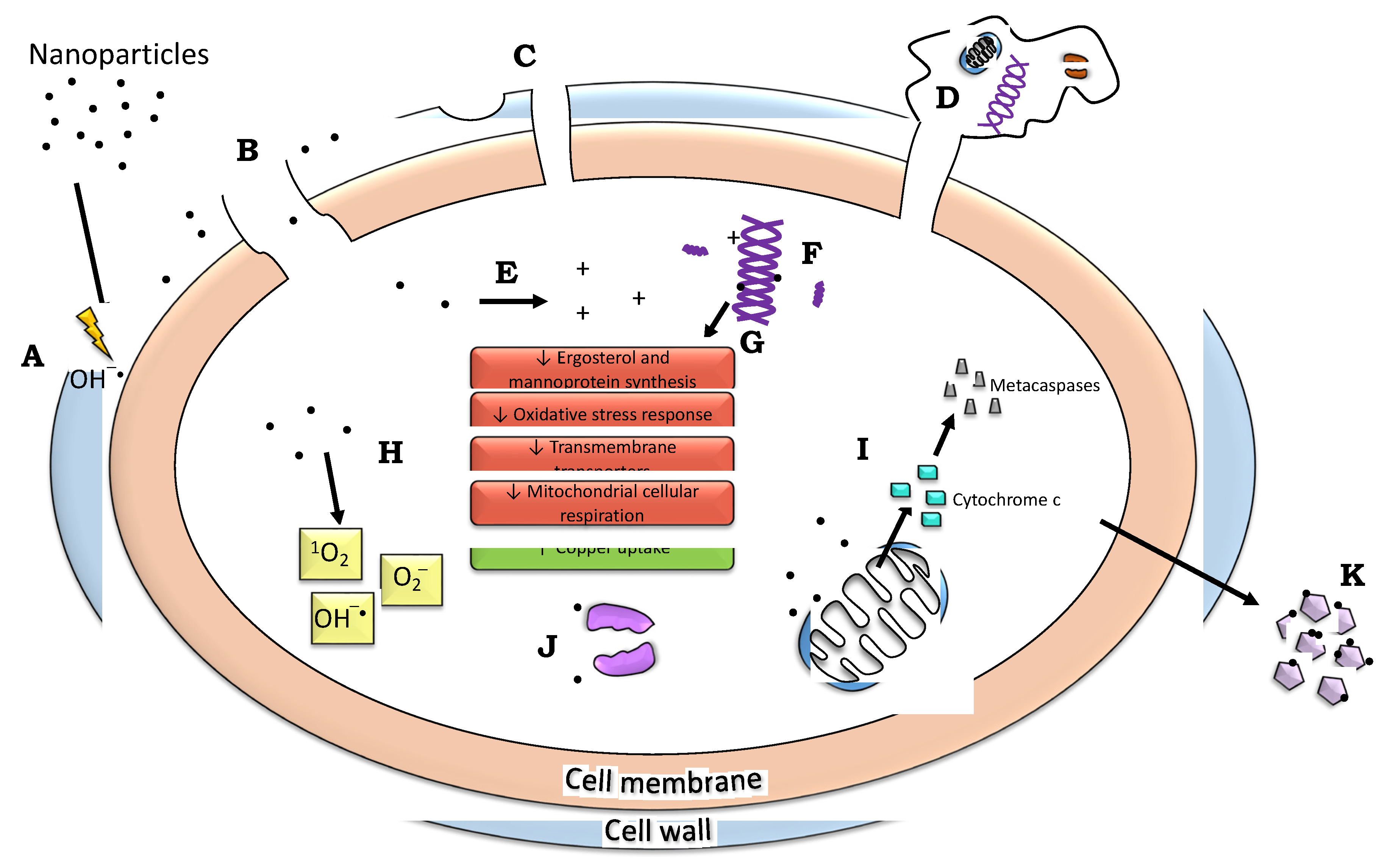
The appearance of resistant species of fungi to the existent antimycotics is challenging for the scientific community. One emergent technology is the application of nanotechnology to develop novel antifungal agents. Metal nanoparticles (NPs) have shown promising results as an alternative to classical antimycotics. This review summarizes and discusses the antifungal mechanisms of metal NPs, including combinations with other antimycotics, covering the period from 2005 to 2022. These mechanisms include but are not limited to the generation of toxic oxygen species and their cellular target, the effect of the cell wall damage and the hyphae and spores, and the mechanisms of defense implied by the fungal cell. Lastly, a description of the impact of NPs on the transcriptomic and proteomic profiles is discussed.
Keywords: nanoparticles; metals; ROS; mechanism of defense; fungi; transcriptomics; proteomics; gene regulation; antifungal resistance nanoparticles; metals; ROS; mechanism of defense; fungi; transcriptomics; proteomics; gene regulation; antifungal resistance