


Abstract
Based on the growing use of guided bone regeneration (GBR) for implant rehabilitation in atrophic alveolar ridges, the choice of barrier membrane remains a critical factor for clinical success. This review aimed to evaluate the clinical effectiveness of titanium-reinforced dense polytetrafluoroethylene (d-PTFE-Ti) membranes compared with resorbable collagen membranes in vertical ridge augmentation. A literature review was conducted using PubMed, Cochrane Library, and ScienceDirect databases. Clinical studies published since 2014 involving human subjects undergoing GBR procedures with either d-PTFE-Ti or collagen membranes were included. Nine studies met the inclusion criteria, including randomized clinical trials and cohort studies. The selected studies indicated that both membrane-based approaches were effective in promoting bone regeneration and enabling implant placement. Titanium-reinforced d-PTFE membranes may offer mechanical advantages in space maintenance and dimensional stability, particularly in larger vertical defects; however, the available comparative evidence did not demonstrate a consistent statistically significant superiority over collagen-based approaches. Within the limitations of the available evidence, both strategies appear to provide clinically predictable outcomes, and membrane selection should be individualized according to defect morphology and treatment requirements.
1. Introduction
The volumetric alteration of the maxillary and mandibular bone is a critical consequence of tooth loss, limiting rehabilitation with dental implants. Among the available techniques, guided bone regeneration (GBR) has become a widely documented and effective method for ridge augmentation, particularly in cases of significant vertical bone loss. The biological principle of GBR is based on the selective exclusion of epithelial and connective tissue cells, allowing osteogenic cells to colonize the defect and promote new bone formation [1]. The underlying biological mechanisms of GBR involve the creation and maintenance of a protected space, stabilization of the blood clot, and adequate vascularization of the graft, key factors for the formation of new bone [1]. The choice of membrane plays a central role in this process, as it directly influences the stability of the regenerative space, the predictability of the outcome, and the complication profile [2]. Various biomaterials have been studied to optimize periodontal and bone regeneration, with particular attention to the interaction between grafts and barrier membranes [3]. According to the literature, there are two main types of membranes: resorbable membranes, usually collagen-based, and non-resorbable membranes, such as d-PTFE, each with distinct characteristics in terms of stability, resorption time, and space-maintaining capacity [2,3]. The first non-resorbable membranes used clinically were expanded polytetrafluoroethylene (e-PTFE) membranes, with an open fibrous structure, which have the longest published follow-up data and are considered the “gold standard” for the treatment of advanced defects [4]. More recently, dense polytetrafluoroethylene (d-PTFE) membranes have been introduced; their compact structure offers greater resistance to bacterial penetration in cases of exposure, although it results in reduced tissue interaction with the membrane surface. Clinical studies demonstrate that the use of d-PTFE was effective in maintaining space and protecting the graft, promoting predictable bone gains in complex vertical augmentation cases. Vertical alveolar ridge augmentation presents additional challenges, as it requires greater graft stability and strict control of soft tissue invasion. Modern techniques, including the use of titanium-reinforced PTFE meshes, have shown promising results, with consistent vertical bone gains and an acceptable complication rate [5]. Despite the widespread use of resorbable collagen-based membranes, these have limitations in vertical procedures, mainly due to early resorption and a reduced capacity to maintain the space required for significant bone regeneration [5]. In this context, the aim of conducting the present study is, on one hand, the need to clarify the available scientific evidence regarding the clinical effectiveness of titanium-reinforced d-PTFE membranes in vertical bone augmentation procedures. Despite the growing number of publications in this field, the literature presents heterogeneous results regarding evaluation methods, follow-up periods, complication rates, and comparisons with resorbable collagen-based membranes. It therefore becomes relevant to gather, analyze, and critically discuss the current evidence in order to support therapeutic decision-making and the selection of the most appropriate biomaterial according to the characteristics of the bone defect. Thus, this systematic review aims to evaluate the clinical effectiveness and associated complications of the use of titanium-reinforced dense polytetrafluoroethylene (d-PTFE-Ti) membranes in guided bone regeneration (GBR) procedures for vertical augmentation of the alveolar ridge, predominantly in implant-related contexts. The secondary objective consists of comparing the clinical and regenerative performance of these d-PTFE-Ti membranes with that of resorbable collagen-based membranes in vertical bone augmentation. Beyond their barrier function, membrane selection is influenced by the biological and mechanical requirements of the defect. Recent reviews emphasize that an ideal GBR membrane should combine biocompatibility, cell occlusiveness, space maintenance, adequate handling, and controlled tissue integration. Non-resorbable PTFE-based barriers provide high structural stability, whereas collagen membranes offer favorable biocompatibility and avoid a second surgical procedure for membrane removal; however, their mechanical properties and degradation behavior may limit space maintenance in demanding defects [6,7,8]. Recent developments in resorbable membranes have therefore focused on cross-linking, multilayer structures, functional coatings, and other modifications intended to improve mechanical stability, degradation control, and biological activity [7,9]. In parallel, current biological research highlights that GBR outcomes depend not only on passive cell exclusion but also on the local immune environment. Macrophages may contribute to vascularization, osteogenic signaling, biomaterial degradation, and the transition from inflammation to tissue regeneration. The crosstalk between macrophages and mesenchymal stem cells may further coordinate inflammatory resolution and osteogenic processes during bone healing, supporting the relevance of membrane–host interactions in successful regeneration [10,11].
2. Materials and Methods
This systematic review was conducted and reported in accordance with the Preferred reporting Items for systematic Reviews and Meta-Analyses (PRISMA 2020) [12].
The study methodology, literature search, study selection process, data extraction, and reporting of results were performed following the PRISMA 2020 guidelines. The completed PRISMA 2020 Checklist is provided as Supplementary Materials Table S1.
2.1. PICOS’ Question
The following guiding question was defined according to the study design, population, intervention, comparison and outcomes: “What is the clinical effectiveness and what are the complications associated with the use of titanium-reinforced d-PTFE membranes in guided bone regeneration procedures for vertical augmentation of the alveolar ridge, compared with collagen-based resorbable membranes?”. The study protocol for this systematic review was registered on the International Prospective of Systematic Reviews (PROSPERO), under number CRD420261422623. Table 1 shows the ‘PICOS’ strategy used.
Table 1.
PICOS’ strategy.
2.2. Search Strategy
The literature search was conducted using the PubMed (via the National Library of Medicine), Cochrane, and ScienceDirect databases. The literature search was conducted between December 2024 and April 2025, with the final search performed in April 2025.
Studies published between 2014 and 2025 were considered eligible. This timeframe was predefined to focus on contemporary clinical evidence related to guided bone regeneration techniques and currently relevant membrane-based approaches for vertical alveolar ridge augmentation.
This study provides a fundamental contribution to the comparative assessment of the clinical and radiographic performance of GBR membranes, directly aligned with the primary objective of this systematic review, namely the evaluation of the clinical effectiveness and associated complications of d-PTFE-Ti membranes. It also provides essential comparative data for the secondary analysis contrasting these membranes with resorbable collagen membranes. The following keywords were used for the search: “guided bone regeneration”, “vertical ridge augmentation”, “d-PTFE membrane”, and “collagen membrane”.
2.3. Search Terms
An advanced search was performed in PubMed, Cochrane, and ScienceDirect using combinations of MeSH terms with an 11-year time restriction:
- -
- ((guided bone regeneration) AND (vertical ridge augmentation OR membrane OR biomaterial))
- -
- ((guided bone regeneration) AND (vertical ridge augmentation)) OR ((vertical ridge augmentation) AND (d-PTFE-Ti)) OR ((vertical ridge augmentation) AND (collagen membrane))
- -
- (titanium reinforced PTFE OR d-PTFE OR resorbable collagen membrane) AND (vertical ridge augmentation) AND (randomized clinical trial)
- -
- (“vertical ridge augmentation”) AND (“Polytetrafluoroethylene” OR d-PTFE OR “dense PTFE” OR “titanium-reinforced d-PTFE” OR “non-resorbable PTFE membrane”) AND (“Collagen”OR “collagen membrane”).
Table 2 shows the inclusion criteria employed.
Table 2.
Inclusion and exclusion criteria.
2.4. Study Selection
After removing duplicate articles, the initial stage of study selection was carried out by screening the titles and abstracts of the articles. Studies that did not meet the eligibility criteria were excluded. In the second stage of selection, the same eligibility criteria were applied to the remaining studies in full-text form. The study selection process was performed independently by two reviewers to enhance the reliability and reproducibility of the screening process. A two-stage screening method was used to ensure a rigorous and reliable selection of eligible studies. In the first stage, the two independent reviewers screened the titles and abstracts of all identified records according to the predefined inclusion and exclusion criteria. Each reviewer independently determined whether each record should be included, excluded, or retained for full-text assessment. In the second stage, the same two reviewers independently assessed the full texts of the studies that passed the initial screening against the predefined eligibility criteria. Any discrepancies between the two reviewers were resolved through discussion and, when consensus could not be reached, by consultation with a third reviewer.
2.5. Risk of Bias and Quality Assessment
The risk of bias analysis showed variability in the methodological quality of the included studies. Most randomized clinical trials presented a low to moderate overall risk of bias. The risk of bias assessment was performed using the Joanna Briggs Institute (JBI) guidance 2017 for each type of study (randomized controlled trials and cohort studies) (Table 3 and Table 4). The Joanna Briggs Institute (JBI) critical appraisal tools were selected because the included studies comprised different methodological designs, including randomized controlled trials and cohort studies. Questionnaire items in each type of research questionnaire were answered with the responses ‘Yes’ (Y), ‘No’ (N) or ‘Uncertain’ (UN). Unlike the Cochrane RoB 2 tool, which is specifically designed for randomized trials, the JBI provides design-specific appraisal checklists, allowing each study to be assessed according to its methodological characteristics within a consistent critical appraisal framework.
Table 3.
Risk of bias for Randomized Controlled Trials.
Table 4.
Risk of bias in cohort studies.
3. Results
3.1. Search Results
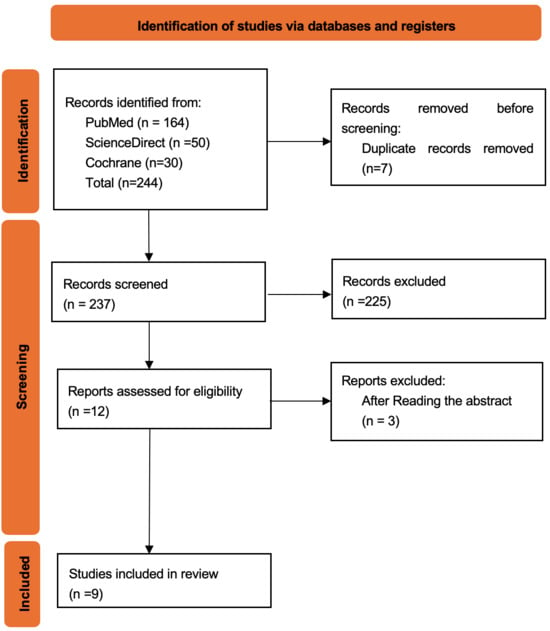
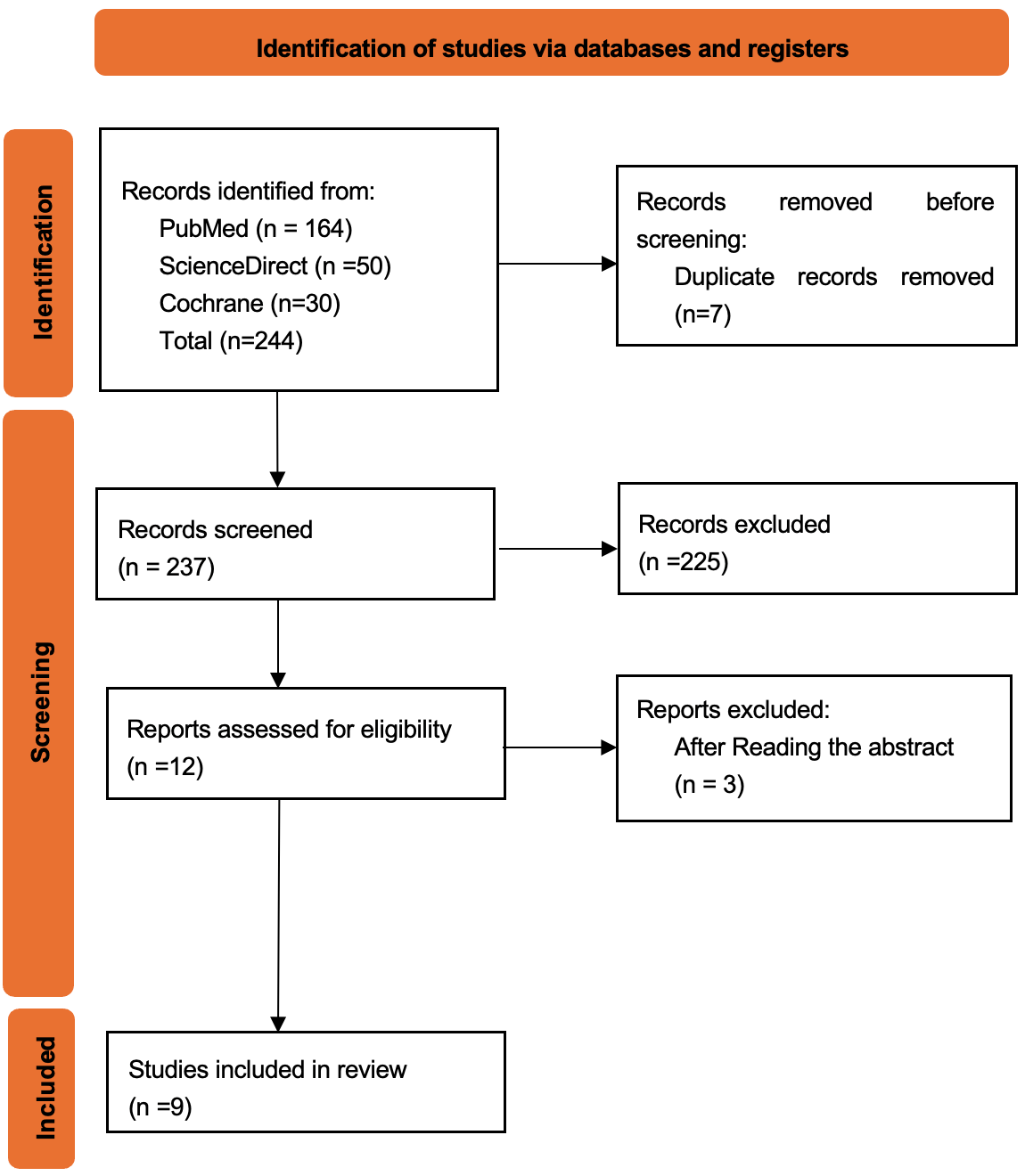
A total of 244 studies were initially identified. After removal of duplicates, records were screened based on titles and abstracts. Finally, 9 studies met the inclusion criteria and were included in the systematic review, all of which underwent full-text analysis, as illustrated in Figure 1.
Figure 1.
PRISMA flowchart summarizing the study identification and selection process.
3.2. Analysis of the Included Studies
A total of 9 clinical studies met the final eligibility criteria after excluding three studies that did not meet the final eligibility criteria (Arbab 2020, Mandarino 2018, and Scheyer 2016). The final selection included eight randomized clinical trials and one cohort study, published between 2014 and 2025, evaluating guided bone regeneration procedures relevant to vertical alveolar ridge augmentation. Sample sizes varied across studies, generally ranging from 22 to 40 patients. The included studies evaluated titanium-reinforced non-resorbable barriers, resorbable collagen membranes, titanium meshes associated with collagen membranes, and other membrane-based regenerative approaches. Several publications represented different analyses or follow-up periods of the same clinical trial; therefore, the number of participants reported across individual publications was not summed to avoid double-counting overlapping patient populations. Overall, the included studies provided a clinically relevant evidence base for evaluating regenerative outcomes, complication profiles, and the comparative performance of non-resorbable and resorbable membrane-based approaches in vertical ridge augmentation procedures.
3.3. Characterization of Sample Bias Risk
Quality assessments are shown in Table 1 for randomized controlled trials and Table 4 for cohort studies. The degree of quality of the studies on the relational index used and the number of positive responses to the questions are mostly high. Table 5 shows the main characteristics of the included studies.
Table 5.
The main characteristics of the included studies.
4. Discussion
The results of this review suggest that guided bone regeneration (GBR) can provide clinically relevant outcomes for alveolar ridge augmentation, particularly in the vertical dimension, thereby creating favorable conditions for implant-based rehabilitation. The available evidence indicates that both titanium-reinforced non-resorbable membranes and collagen-based resorbable approaches can promote bone regeneration, although differences may exist in their clinical behavior, stability, and complication profiles.
These findings are consistent with recent reviews of GBR biomaterials, which describe membrane performance as a balance between barrier function, mechanical stability, tissue integration, and clinical handling rather than as a single universally superior material characteristic [6,8]. Evidence syntheses focused on vertical bone regeneration similarly suggest that different membrane systems can support clinically relevant bone gain, while the certainty of direct comparisons remains limited by heterogeneity in techniques, defect characteristics, and outcome assessment [22].
From a biological perspective, the recent literature also suggests that regenerative outcomes are influenced by immune–stromal interactions within the healing environment. Macrophage polarization and macrophage–mesenchymal stem cell crosstalk may affect inflammatory resolution, vascularization, and osteogenic signaling, providing a biological framework for understanding why membrane properties and local tissue responses can influence bone regeneration [10,11].
In the studies included in this systematic review, several authors evaluated the performance of titanium-reinforced d-PTFE membranes compared with other barriers used in GBR. Randomized clinical trials reported that these membranes were capable of maintaining the regenerative space and achieving clinically relevant vertical bone gains, particularly in atrophic alveolar ridge areas intended for implant placement [15,17,18,19]. The vertical bone gain values reported in these studies support the clinical applicability of vertical augmentation techniques and highlight the importance of membrane stability and graft protection during the healing period.
Beyond vertical bone gain itself, some studies also assessed the medium- and long-term stability of regenerated bone. For example, long-term follow-up studies have shown that peri-implant bone levels can remain relatively stable over the years following initial regeneration [13,18]. These findings suggest that regeneration achieved with titanium-reinforced d-PTFE membranes not only increases bone volume but may also provide adequate structural stability for implant maintenance.
On the other hand, several studies have directly compared non-resorbable membranes with resorbable collagen membranes. Overall, the results indicate that both can achieve comparable levels of bone regeneration, although differences may exist regarding surgical handling, complication rates, and biological behavior during healing [14,15,17,21]. In particular, histological and histomorphometric studies have shown that regenerated areas may present similar percentages of newly formed bone between different membrane types, confirming the overall effectiveness of guided bone regeneration approaches [16].
Another relevant aspect observed in the studies analyzed concerns the complications associated with GBR procedures. Early membrane exposure is one of the most frequently reported complications in the literature and may partially compromise the regenerative process. However, several clinical trials indicate that titanium-reinforced d-PTFE membranes can present acceptable complication rates and, in some cases, even lower rates than those observed with other augmentation techniques, such as the use of titanium meshes [15,18,19].
More recent investigations have explored new approaches and materials to optimize bone regeneration outcomes, including the use of customized titanium meshes or the combination of different biomaterials [18]. These advances reflect the ongoing evolution of guided bone regeneration techniques and the search for solutions that improve clinical predictability, reduce complications, and maximize new bone formation. Therefore, it is important to further analyze in detail the main aspects related to the clinical outcomes obtained.
4.1. Clinical Effectiveness of d-PTFE-Ti Membranes in Vertical Bone Augmentation
The available evidence suggests that guided bone regeneration using titanium-reinforced dense polytetrafluoroethylene (d-PTFE-Ti) membranes can achieve clinically relevant outcomes in vertical alveolar ridge augmentation. The studies included in this review reported effective maintenance of the regenerative space and stabilization of the bone graft, with vertical bone gains that enabled subsequent implant placement.
Several randomized clinical trials have directly analyzed vertical bone gain achieved with d-PTFE-Ti membranes. In the study conducted by Cucchi et al. [15], which compared d-PTFE-Ti membranes with titanium meshes combined with collagen membranes, a similar mean vertical bone gain was observed between the two groups, with values close to 4 mm of vertical augmentation. These results indicate that both approaches were effective for vertical regeneration of the alveolar ridge. Although a lower surgical complication rate was reported in the d-PTFE-Ti group in this individual study, vertical bone gain was comparable between the two groups. This finding should therefore be interpreted as a potential difference in the complication profile rather than evidence of overall clinical superiority.
Comparable results were also observed in the study by Cucchi et al. [14], a subsequent work from the same group with a 1-year follow-up. In this study, the authors also reported vertical bone gains exceeding 4 mm, with no statistically significant differences between d-PTFE-Ti membranes and titanium meshes covered with collagen membranes. In addition, good stability of peri-implant tissues was observed, with marginal bone loss of less than 1 mm during the first year, indicating that the regenerated bone was able to adequately support the placed implants.
Long-term stability of the outcomes was confirmed in the study by Cucchi et al. [15] with a 3-year follow-up. The authors observed that the initial vertical bone gains remained stable over time, with mean values close to 4–5 mm of vertical augmentation in both the d-PTFE-Ti group and the titanium mesh with collagen membrane group. These findings support the medium-term stability of the regenerated bone.
Similar results were also described in the more recent randomized clinical trial conducted by Giragosyan et al. [20], which compared the use of d-PTFE-Ti membranes with customized 3D-printed titanium meshes. The authors observed comparable linear bone gains between the two groups, demonstrating that d-PTFE-Ti membranes can provide similar regenerative outcomes even when compared with advanced digitally designed rigid space-maintaining devices.
Although several studies included in this review focus specifically on vertical alveolar ridge augmentation, other works evaluated parameters related to bone stability. For example, the long-term study by Merli et al. [19], with a 6-year follow-up, analyzed changes in bone levels after vertical augmentation using either resorbable or titanium-reinforced barrier membranes. The authors observed minimal differences between groups, with an adjusted difference of only 0.15 mm, without statistical significance, indicating that the regenerated bone remained relatively stable over time.
In addition, histological and histomorphometric studies have provided further information on the quality of the regenerated bone. In the study by Cucchi et al. [16], histomorphometric analysis revealed that a significant proportion of the regenerated area was composed of newly formed bone, confirming that regeneration achieved through GBR does not merely reflect the presence of graft material, but rather the formation of vital bone tissue.
Overall, the studies included in this review indicate that titanium-reinforced d-PTFE membranes were associated with clinically relevant vertical bone gains, generally in the range of 4 to 5 mm, values considered clinically relevant for implant placement in atrophic alveolar ridges. Furthermore, these results demonstrate that the achieved bone gains can remain stable over time, reinforcing the clinical effectiveness of this approach in guided bone regeneration procedures.
4.2. Comparison Between d-PTFE-Ti Membranes and Collagen-Based Resorbable Membranes
The comparison between non-resorbable dense polytetrafluoroethylene membranes reinforced with titanium (d-PTFE-Ti) and resorbable collagen-based membranes has been widely investigated in the literature, as both are frequently used in guided bone regeneration procedures. The studies included in this review suggest that both approaches can achieve similar clinical outcomes in terms of bone regeneration, although they differ regarding graft stability and certain biological characteristics.
Several clinical trials have directly compared these two approaches in vertical bone augmentation procedures. In the study by Merli et al. [19], which evaluated changes in bone levels after vertical augmentation using either resorbable barriers or titanium-reinforced barriers, no statistically significant differences were observed between groups after a 6-year follow-up. The adjusted difference in bone level change was only 0.15 mm, indicating that both membranes were able to maintain stable outcomes over time.
Similar results were observed in studies assessing vertical bone regeneration associated with implant placement. In the randomized clinical trial conducted by Cucchi et al. [13], guided bone regeneration using d-PTFE-Ti membranes was compared with titanium meshes covered with collagen membranes. The authors reported similar vertical bone gains between both groups, demonstrating that both regenerative strategies can be effective in restoring atrophic alveolar ridges. However, the group treated with d-PTFE-Ti membranes showed a lower surgical complication rate, suggesting a potential clinical advantage of this approach.
These results were confirmed in the subsequent one-year follow-up study conducted by the same research group [14]. In this work, vertical bone gains were again comparable between d-PTFE-Ti membranes and titanium meshes associated with collagen membranes. In addition, hard and soft tissues showed good stability after one year, with peri-implant bone loss of less than 1 mm, indicating that both techniques were capable of providing adequate conditions for implant rehabilitation.
The long-term stability of the outcomes was also demonstrated in the three-year follow-up study by Cucchi et al. [15]. The authors observed that both d-PTFE-Ti membranes and titanium meshes covered with collagen membranes maintained stable vertical bone gains over time, with no significant differences between groups. These findings suggest that, from a regenerative effectiveness perspective, both approaches can be considered predictable.
In addition to clinical parameters, some studies also assessed the quality of the regenerated bone through histological and histomorphometric evaluation. In the study by Cucchi et al. [13], which compared guided bone regeneration using non-resorbable membranes with resorbable membranes associated with titanium meshes, no statistically significant differences were observed in the proportion of newly formed bone between groups. However, the PTFE membrane group showed a slightly higher proportion of newly formed bone, while the titanium mesh and collagen membrane group exhibited a slightly greater total bone area and a lower amount of soft tissue. According to the authors, this difference may be related to improved revascularization and mineralization of the graft associated with resorbable collagen membranes.
Other studies included in this review also directly compared regenerative approaches involving collagen membranes. In a recent randomized clinical trial conducted by Urban et al. [17], which evaluated the impact of collagen membrane use in vertical augmentation procedures with titanium-reinforced PTFE meshes, the results showed that the additional use of collagen membranes may contribute to better soft tissue protection and graft stabilization.
The studies included in this review indicate that both d-PTFE-Ti membranes and resorbable collagen membranes can provide comparable regenerative outcomes in terms of vertical bone gain. However, non-resorbable membranes offer certain advantages related to space maintenance and mechanical stability, whereas collagen membranes may promote better biological integration and graft revascularization. Therefore, the choice between these two approaches may depend on the characteristics of the bone defect, the surgical technique used, and the clinician’s experience.
The broader literature also supports an individualized approach to membrane selection. Titanium meshes and titanium-reinforced barriers are particularly relevant when rigid space maintenance is required, whereas minimally invasive concepts in vertical ridge augmentation aim to reduce surgical morbidity without compromising regenerative stability [23,24]. Recent reviews further support the clinical relevance of GBR for implant rehabilitation, while emphasizing that outcomes remain influenced by defect morphology, surgical design, implant-related factors, and the management of the soft tissues [25,26].
4.3. Complications Associated with d-PTFE-Ti and Resorbable Membranes
Although guided bone regeneration can provide clinically relevant regenerative outcomes, vertical bone augmentation procedures may be associated with different types of complications, particularly membrane exposure, infection, or partial failure of regeneration. The literature analyzed in this review shows that both non-resorbable titanium-reinforced d-PTFE membranes and resorbable collagen membranes present relatively low complication profiles, although some differences have been observed between the two biomaterial types.
Recent systematic reviews reinforce that wound dehiscence, membrane exposure, infection, and partial regenerative failure remain central complications of oral bone regeneration procedures [27,28,29]. Their clinical consequences may vary according to the timing and extent of exposure, the type of membrane, and the management strategy. Experimental developments in wound-closure materials also reflect the continuing need to improve soft-tissue stability and antibacterial protection in GBR procedures [30]. Accordingly, complication rates should be interpreted together with defect complexity, surgical technique, and membrane characteristics rather than as isolated indicators of the superiority of one biomaterial [29].
One of the most frequently reported complications in guided bone regeneration is early membrane exposure, which may occur during the healing period due to soft tissue tension or wound dehiscence. The study conducted by Cucchi et al. [13], which compared d-PTFE-Ti membranes with titanium meshes covered by collagen membranes, showed similar healing complication rates in both groups. However, a lower surgical complication rate was reported in the d-PTFE-Ti group, suggesting that this type of membrane may exhibit a more favorable clinical behavior.
Similar results were observed in the subsequent one-year follow-up study conducted by the same group [14]. In this work, the authors found that complications were comparable between both groups, with no statistically significant differences in postoperative complication rates. Furthermore, the stability of peri-implant tissues observed after one year of follow-up indicated that any initial complications did not significantly compromise the final regenerative outcome.
The long-term analysis performed by Cucchi et al. with a three-year follow-up [15] similarly confirmed that complication rates associated with both regenerative approaches remained relatively low. The authors observed that both d-PTFE-Ti membranes and titanium meshes combined with collagen membranes allowed predictable clinical outcomes, with no significant differences in complication incidence over the follow-up period.
Other studies have also evaluated the occurrence of complications associated with regenerative procedures. The randomized clinical trial conducted by Giragosyan et al. [20], which compared d-PTFE-Ti membranes with customized 3D-printed titanium meshes, showed similar complication rates, indicating that PTFE-based membranes remain a valid option even when compared with more recent technologies.
Non-resorbable membranes offer the advantage of better space maintenance due to their higher rigidity and structural stability. However, these membranes generally require a second surgical procedure for removal, which may increase treatment morbidity. In contrast, resorbable collagen membranes provide better biological integration and do not require surgical removal, although they may exhibit a reduced ability to maintain space in larger bone defects.
The choice between d-PTFE-Ti membranes and resorbable membranes should consider not only the regenerative potential of the material, but also clinical factors such as defect morphology, the need for space maintenance, and the surgeon’s experience. Overall, the studies included in this review indicate that both types of membranes can be used with acceptable levels of safety and clinical predictability in guided bone regeneration procedures.
Although peri-implantitis defects represent a different clinical indication from vertical ridge augmentation, network meta-analytic evidence also illustrates the broader heterogeneity of GBR protocols and reinforces the importance of matching regenerative strategies to defect configuration and treatment objectives [31].
4.4. Limitations
Despite our results, several methodological limitations must be considered when interpreting the data presented in this review. One of the main limitations relates to the heterogeneity of the outcomes assessed across the included studies. While some authors primarily evaluated vertical bone gain after guided bone regeneration [13,14,15,19], others focused on peri-implant marginal bone level changes over time [18,19]. This diversity of endpoints makes direct comparison between studies difficult and limits the ability to draw definitive conclusions regarding the superiority of one membrane type over another.
Another important limitation relates to differences in bone measurement methods. In the included studies, assessment of bone regeneration was performed using various approaches, including intraoperative clinical measurements, radiographic or tomographic analyses, and in some cases histological or histomorphometric evaluations [16]. These methodological variations may introduce differences in measurement accuracy and further complicate direct comparison of results across studies.
In addition, follow-up periods varied considerably among the included studies, which represents a relevant limitation in comparing outcomes. While some studies reported only short-term results with follow-up periods of approximately 6 months to 1 year [13,17,18], others evaluated medium-term outcomes with follow-up periods of around 1 to 3 years [14,15]. Furthermore, some studies provided long-term follow-up data of up to 6 years [19]. This temporal variability may influence the interpretation of the results, as additional bone changes particularly remodeling and marginal bone loss may occur after the initial healing period, making direct comparison between studies more challenging.
One other significant limitation relates to the relatively small sample sizes in several of the included studies. Many randomized clinical trials in the field of guided bone regeneration involve a limited number of patients, often fewer than fifty participants [13,14,15]. Although these studies provide valuable information on the effectiveness of regenerative techniques, small sample sizes may reduce the statistical power of the analyses and limit the generalizability of the findings to broader populations.
Finally, it should also be considered that some of the included studies evaluated combinations of different biomaterials and surgical techniques, such as the use of titanium meshes associated with collagen membranes or the use of bone grafts from different sources [13,14,15,17]. These variations may influence the observed regenerative outcomes and make it difficult to isolate the specific impact of the membrane type used.
Although the studies analyzed provide relevant evidence on the effectiveness of d-PTFE-Ti membranes and resorbable collagen membranes in guided bone regeneration procedures, these methodological limitations should be considered when interpreting the results. Future research with larger sample sizes, more standardized methodological protocols, and longer follow-up periods should be considered in order to clarify more definitively the relative role of these biomaterials in vertical bone augmentation.
5. Conclusions
In line with the primary objective of this review, the available evidence suggests that titanium-reinforced d-PTFE membranes can achieve clinically relevant vertical bone gains. Overall, the vertical bone augmentation values reported in the included studies ranged from approximately 4 to 5 mm, enabling implant rehabilitation in previously atrophic alveolar ridges. In addition, the available follow-up data suggest that the regenerated bone can remain relatively stable over time, with low levels of marginal bone loss reported in several studies.
In accordance with the secondary objective, the available evidence suggests that both d-PTFE-Ti membranes and resorbable collagen-based approaches can provide similar regenerative outcomes. Non-resorbable membranes may offer greater mechanical stability and space maintenance, whereas collagen membranes may provide advantages related to biological integration. Regarding complications, the available evidence does not support a definitive overall advantage of either approach.
The findings suggest that guided bone regeneration using titanium-reinforced d-PTFE membranes can provide clinically relevant outcomes for vertical alveolar ridge augmentation. However, the heterogeneity of the included studies particularly in terms of evaluated outcomes, measurement methods, follow-up periods, and sample sizes limits direct comparisons and the generalization of results. Therefore, future research with more standardized methodologies, larger sample sizes, and longer follow-up periods is required to confirm these findings and further optimize the clinical application of these techniques.
Supplementary Materials
The following supporting information can be downloaded at: https://www.mdpi.com/article/10.3390/jfb17080353/s1, Table S1: PRISMA checklist.
Author Contributions
Conceptualization, C.D. and C.R.; methodology, C.D., C.R. and R.C.; software, C.D. and C.R.; validation, C.D., C.R., A.S.V. and C.C.; formal analysis, C.D., C.R. and F.S.; investigation, C.D., C.R. and F.S.; resources, C.D., C.R., R.C., A.S.V., F.S. and C.C.; data curation, C.D. and C.R.; writing—original draft preparation, C.D. and C.R.; writing—review and editing, C.D., C.R. and C.C.; visualization, C.D., C.R., R.C., A.S.V., F.S. and C.C.; supervision, C.R. and R.C.; project administration, C.D. and C.R.; funding acquisition, C.D., C.R., R.C., A.S.V., F.S. and C.C. All authors have read and agreed to the published version of the manuscript.
Funding
This research received no external funding.
Institutional Review Board Statement
Not applicable.
Informed Consent Statement
Not applicable.
Data Availability Statement
The data can be accessed by contacting the corresponding author.
Conflicts of Interest
The authors declare no conflicts of interest.
Abbreviations
| GBR | Guided Bone Regeneration |
| VBG | Vertical Bone Gain |
| MBL | Marginal Bone Loss |
| d-PTFE | Dense Polytetrafluoroethylene |
| d-PTFE-Ti | Dense Polytetrafluoroethylene reinforced with Titanium |
| e-PTFE | Expanded Polytetrafluoroethylene |
| Ti | Titanium |
| RCT | Randomized Controlled Trial |
| VRA | Vertical Ridge Augmentation |
| CBCT | Cone Beam Computed Tomography |
References
- Liu, J.; Kerns, D.G. Mechanisms of guided bone regeneration: A review. Open Dent. J. 2014, 8, 56–65. [Google Scholar] [CrossRef] [Scilit] [PubMed]
- Kim, Y.K.; Ku, J.K. Guided bone regeneration. J. Korean Assoc. Oral Maxillofac. Surg. 2020, 46, 361–366. [Google Scholar] [CrossRef] [Scilit] [PubMed]
- Deng, Y.; Liang, Y.; Liu, X. Biomaterials for periodontal regeneration. Dent. Clin. N. Am. 2022, 66, 659–672. [Google Scholar] [CrossRef] [Scilit] [PubMed]
- Ghensi, P.; Stablum, W.; Bettio, E.; Soldini, M.C.; Tripi, T.R.; Soldini, C. Management of the exposure of a dense PTFE (d-PTFE) membrane in guided bone regeneration (GBR): A case report. Oral Implantol. 2017, 10, 335–342. [Google Scholar] [CrossRef] [Scilit]
- Urban, I.A.; Montero, E.; Amerio, E.; Palombo, D.; Monje, A. Techniques on vertical ridge augmentation: Indications and effectiveness. Periodontology 2000 2023, 93, 153–182. [Google Scholar]
- Mizraji, G.; Davidzohn, A.; Gursoy, M.; Gursoy, U.; Shapira, L.; Wilensky, A. Membrane barriers for guided bone regeneration: An overview of available biomaterials. Periodontology 2000 2023, 93, 56–76. [Google Scholar]
- Ren, Y.; Fan, L.; Alkildani, S.; Liu, L.; Emmert, S.; Najman, S.; Rimashevskiy, D.; Schnettler, R.; Jung, O.; Xiong, X.; et al. Barrier membranes for guided bone regeneration (GBR): A focus on recent advances in collagen membranes. Int. J. Mol. Sci. 2022, 23, 14987. [Google Scholar] [CrossRef] [Scilit] [PubMed]
- Yang, Z.; Wu, C.; Shi, H.; Luo, X.; Sun, H.; Wang, Q.; Zhang, D. Advances in barrier membranes for guided bone regeneration techniques. Front. Bioeng. Biotechnol. 2022, 10, 921576. [Google Scholar] [CrossRef] [Scilit] [PubMed]
- Gao, Y.; Wang, S.; Shi, B.; Wang, Y.; Chen, Y.; Wang, X.; Lee, E.-S.; Jiang, H.-B. Advances in modification methods based on biodegradable membranes in guided bone/tissue regeneration: A review. Polymers 2022, 14, 871. [Google Scholar] [CrossRef] [Scilit] [PubMed]
- Gou, M.; Wang, H.; Xie, H.; Song, H. Macrophages in guided bone regeneration: Potential roles and future directions. Front. Immunol. 2024, 15, 1396759. [Google Scholar] [CrossRef] [Scilit] [PubMed]
- Pajarinen, J.; Lin, T.; Gibon, E.; Kohno, Y.; Maruyama, M.; Nathan, K.; Lu, L.; Yao, Z.; Goodman, S.B. Mesenchymal stem cell-macrophage crosstalk and bone healing. Biomaterials 2019, 196, 80–89. [Google Scholar] [CrossRef] [Scilit] [PubMed]
- Liberati, A.; Altman, D.G.; Tetzlaff, J.; Mulrow, C.; Gøtzsche, P.C.; Ioannidis, J.P.A.; Clarke, M.; Devereaux, P.J.; Kleijnen, J.; Moher, D. The PRISMA statement for reporting systematic reviews and meta-analyses of studies that evaluate healthcare interventions: Explanation and elaboration. BMJ 2009, 339, b2700. [Google Scholar] [CrossRef] [Scilit] [PubMed]
- Cucchi, A.; Vignudelli, E.; Napolitano, A.; Marchetti, C.; Corinaldesi, G. Evaluation of complication rates and vertical bone gain after guided bone regeneration with non-resorbable membranes versus titanium meshes and resorbable membranes: A randomized clinical trial. Clin. Implant Dent. Relat. Res. 2017, 19, 821–832. [Google Scholar] [CrossRef] [Scilit] [PubMed]
- Cucchi, A.; Vignudelli, E.; Fiorino, A.; Pellegrino, G.; Corinaldesi, G. Vertical ridge augmentation (VRA) with Ti-reinforced d-PTFE membranes or Ti meshes and collagen membranes: 1-year results of a randomized clinical trial. Clin. Oral Implants Res. 2021, 32, 1–14. [Google Scholar] [CrossRef] [Scilit]
- Cucchi, A.; Bettini, S.; Ghensi, P.; Fiorino, A.; Corinaldesi, G. Vertical ridge augmentation with Ti-reinforced dense polytetrafluoroethylene (d-PTFE) membranes or Ti-meshes and collagen membranes: 3-year results of a randomized clinical trial. Clin. Implant Dent. Relat. Res. 2023, 25, 352–369. [Google Scholar] [CrossRef] [Scilit] [PubMed]
- Cucchi, A.; Sartori, M.; Parrilli, A.; Aldini, N.N.; Vignudelli, E.; Corinaldesi, G. Histological and histomorphometric analysis of bone tissue after guided bone regeneration with non-resorbable membranes vs. resorbable membranes and titanium mesh. Clin. Implant Dent. Relat. Res. 2019, 21, 693–701. [Google Scholar] [CrossRef] [Scilit] [PubMed]
- Urban, I.A.; Serroni, M.; Dias, D.R.; Baráth, Z.; Forster, A.; Araújo, T.G.; Saleh, M.H.A.; Cucchi, A.; Ravidà, A. Impact of collagen membrane in vertical ridge augmentation using Ti-reinforced PTFE mesh: A randomised controlled trial. J. Clin. Periodontol. 2025, 52, 575–588. [Google Scholar] [CrossRef] [Scilit] [PubMed]
- Strauss, F.J.; Schneider, D.; Jung, R.E.; Kraus, R.; Thoma, D.S.; Naenni, N. Hard and soft tissue contour changes following simultaneous guided bone regeneration at single peri-implant dehiscence defects using either resorbable or non-resorbable membranes: A 6-month secondary analysis of a randomized controlled trial. Clin. Oral Investig. 2025, 29, 231. [Google Scholar] [CrossRef] [Scilit] [PubMed]
- Merli, M.; Moscatelli, M.; Mariotti, G.; Rotundo, R.; Bernardelli, F.; Nieri, M. Bone level variation after vertical ridge augmentation: Resorbable barriers versus titanium-reinforced barriers. A 6-year double-blind randomized clinical trial. Int. J. Oral Maxillofac. Implants 2014, 29, 905–913. [Google Scholar] [CrossRef] [Scilit]
- Giragosyan, K.; Chenchev, I.; Ivanova, V. Linear bone gain and healing complication rate comparative outcomes following ridge augmentation with custom 3D printed titanium mesh vs. Ti-reinforced dPTFE: A randomized clinical trial. Folia Med. 2024, 66, 505–514. [Google Scholar] [CrossRef] [Scilit]
- Park, Y.; Choi, S.; Cho, K.; Lee, J. Dimensional alterations following vertical ridge augmentation using collagen membrane and three types of bone grafting materials: A retrospective observational study. Clin. Implant Dent. Relat. Res. 2017, 19, 742–749. [Google Scholar] [CrossRef] [Scilit] [PubMed]
- Zhang, M.; Zhou, Z.; Yun, J.; Liu, R.; Li, J.; Chen, Y.; Cai, H.; Jiang, H.B.; Lee, E.-S.; Han, J.; et al. Effect of different membranes on vertical bone regeneration: A systematic review and network meta-analysis. BioMed Res. Int. 2022, 2022, 7742687. [Google Scholar] [CrossRef] [Scilit] [PubMed]
- Xie, Y.; Li, S.; Zhang, T.; Wang, C.; Cai, X. Titanium mesh for bone augmentation in oral implantology: Current application and progress. Int. J. Oral Sci. 2020, 12, 37. [Google Scholar] [CrossRef] [Scilit]
- Urban, I.; Montero, E.; Sanz-Sánchez, I.; Palombo, D.; Monje, A.; Tommasato, G.; Chiapasco, M. Minimal invasiveness in vertical ridge augmentation. Periodontology 2000 2023, 91, 126–144. [Google Scholar]
- Quah, B.; Al Yousef, A.S.; Lai, C.W.M.; Wong, R.C.W.; Chew, R.J.J. Impact of implant design on outcomes of simultaneous guided bone regeneration for dehiscence defects: A systematic review and meta-analysis. J. Evid. Based Dent. Pract. 2024, 24, 102033. [Google Scholar] [CrossRef] [Scilit]
- Taghizadeh, E.; Negargar, S.; Nuroozi Larki, K.; Saberi Haghighi, R.; Shahoon, H. The role of guided bone regeneration in enhancing dental implant success. Galen Med. J. 2024, 13, e3681. [Google Scholar] [CrossRef] [Scilit] [PubMed]
- Tay, J.R.H.; Lu, X.J.; Lai, W.M.C.; Fu, J.H. Clinical and histological sequelae of surgical complications in horizontal guided bone regeneration: A systematic review and proposal for management. Int. J. Implant Dent. 2020, 6, 76. [Google Scholar] [CrossRef] [Scilit] [PubMed]
- Gaudimier, Z.; Tawfik, S.; Kerouanton, C.; Wulfman, C.; Flottes, Y. Oral bone regeneration and associated complications: A systematic review and meta-analysis. J. Stomatol. Oral Maxillofac. Surg. 2026, 127, 102606. [Google Scholar] [CrossRef] [Scilit] [PubMed]
- Cousiño, D.S.; Egido-Moreno, S.; Navarro, B.G.; Mejía, H.O.; Blanco-Carrión, A.; López-López, J. Failures and complications associated with resorbable and non-resorbable membranes in guided bone regeneration: A systematic review and meta-analysis. Med. Oral Patol. Oral Cir. Bucal 2026, 31, e511–e521. [Google Scholar]
- Xue, S.; Tang, N.; Zhou, C.; Fang, S.; Haick, H.; Sun, J.; Wu, X. Anti-wound dehiscence and antibacterial dressing with highly efficient self-healing feature for guided bone regeneration wound closure. Adv. Healthc. Mater. 2024, 13, e2304128. [Google Scholar] [CrossRef] [Scilit] [PubMed]
- Ramanauskaite, A.; Becker, K.; Cafferata, E.A.; Schwarz, F. Clinical efficacy of guided bone regeneration in peri-implantitis defects: A network meta-analysis. Periodontology 2000 2023, 93, 236–253. [Google Scholar] [CrossRef] [Scilit]

Disclaimer/Publisher’s Note: The statements, opinions and data contained in all publications are solely those of the individual author(s) and contributor(s) and not of MDPI and/or the editor(s). MDPI and/or the editor(s) disclaim responsibility for any injury to people or property resulting from any ideas, methods, instructions or products referred to in the content. |
© 2026 by the authors. Licensee MDPI, Basel, Switzerland. This article is an open access article distributed under the terms and conditions of the Creative Commons Attribution (CC BY) license.