




J. Intell., Volume 13, Issue 12 (December 2025) – 14 articles
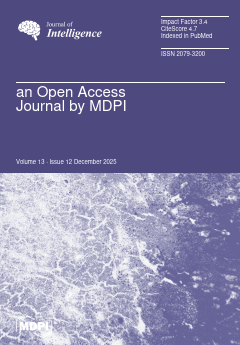
Cover Story (view full-size image):
Cognitive assessments are essential to research across multiple fields; however, most well-validated measures are costly and difficult to administer in large samples. The International Cognitive Ability Resource (ICAR) offers free, well-validated, self-administered cognitive measures online. In this study, we evaluate two ICAR measures, Puzzle Completion and Block Rotation, adapted for the NIH-Funded Mobile Toolbox (MTB), a remote smartphone assessment platform. Using 100 adults aged 18–82, we assessed reliability and construct validity against gold standards, including Raven's Progressive Matrices, the Mental Rotation Test, and the Woodcock Johnson-IV. The measures demonstrated internal consistency, test–retest reliability, and convergent validity with negligible practice effects, confirming that MTB preserves ICAR's psychometric integrity in a mobile format. View this paper
- Issues are regarded as officially published after their release is announced to the table of contents alert mailing list.
- You may sign up for e-mail alerts to receive table of contents of newly released issues.
- PDF is the official format for papers published in both, html and pdf forms. To view the papers in pdf format, click on the "PDF Full-text" link, and use the free Adobe Reader to open them.
Previous Issue
Next Issue
