

Validation of International Cognitive Ability Resource (ICAR) Implemented in Mobile Toolbox (MTB)

 , , , , and
Abstract
1. Introduction
- RQ1 (Reliability): Do the MTB ICAR measures demonstrate acceptable internal consistency and test–retest reliability?
- RQ2 (Construct Validity): Do the MTB ICAR measures show expected convergent validity with established “gold-standard” assessments of fluid reasoning and visual–spatial ability, and discriminant validity with a measure of verbal comprehension?
- RQ3 (Comparison to Existing Evidence): How do the psychometric properties of the MTB ICAR measures compare with those reported in prior ICAR validation studies using web- or lab-based administration formats?
2. Materials and Methods
2.1. Sample
2.2. Measures
2.2.1. ICAR Measures
2.2.2. External Gold Standard Measures
2.3. Procedure
2.4. Analysis
3. Results
4. Discussion
5. Conclusions
Author Contributions
Funding
Institutional Review Board Statement
Informed Consent Statement
Data Availability Statement
Conflicts of Interest
Abbreviations
| ICAR | International Cognitive Ability Resource |
| MTB | Mobile Toolbox |
| SAPA | Synthetic Aperture Personality Assessment |
| RPM | Raven’s Progressive Matrices |
| MRT | Mental Rotation Test |
| WJ-IV | Woodcock Johnson, Fourth Edition |
| PPVT-5 | Peabody Picture Vocabulary Test |
| 2PL | Two parameter logistic |
| IRT | Item Response Theory |
| ICC | Intraclass Correlation |
References
- Basso, Michael R., Robert A. Bornstein, and Jennifer M. Lang. 1999. Practice Effects on Commonly Used Measures of Executive Function Across Twelve Months. The Clinical Neuropsychologist 13: 283–92. [Google Scholar] [CrossRef] [Scilit]
- Boone, Alexander P., and Mary Hegarty. 2017. Sex differences in mental rotation tasks: Not just in the mental rotation process! Journal of Experimental Psychology: Learning, Memory, and Cognition 43: 1005. [Google Scholar] [CrossRef] [Scilit]
- Carpenter, Patricia A., Marcel A. Just, and Peter Shell. 1990. What one intelligence test measures: A theoretical account of the processing in the Raven Progressive Matrices Test. Psychological Review 97: 404. [Google Scholar] [CrossRef]
- Carroll, John B. 1993. Human Cognitive Abilities: A Survey of Factor-Analytic Studies. Cambridge: Cambridge University Press. [Google Scholar]
- Clark, Lee Anna, and David Watson. 1995. Constructing validity: Basic issues in objective scale development. Psychological Assessment 7: 309–19. [Google Scholar] [CrossRef]
- Cockcroft, Kate, and Nicky Israel. 2011. The Raven’s Advanced Progressive Matrices: A Comparison of Relationships with Verbal Ability Tests. South African Journal of Psychology 41: 363–72. [Google Scholar] [CrossRef] [Scilit]
- Cohen, Jacob. 2013. Statistical Power Analysis for the Behavioral Sciences. Abingdon: Routledge. Available online: https://www.taylorfrancis.com/books/mono/10.4324/9780203771587/statistical-power-analysis-behavioral-sciences-jacob-cohen (accessed on 1 November 2025).
- Cohen, Mark S., Stephen M. Kosslyn, Hans C. Breiter, Gregory J. DiGirolamo, William L. Thompson, Adam K. Anderson, Susan Y. Bookheimer, Bruce R. Rosen, and John W. Belliveau. 1996. Changes in cortical activity during mental rotation A mapping study using functional MRI. Brain 119: 89–100. [Google Scholar] [CrossRef] [Scilit] [PubMed]
- Condon, David M., and William Revelle. 2014. The International Cognitive Ability Resource: Development and Initial Validation of a Public-Domain Measure. Intelligence 43: 52–64. [Google Scholar] [CrossRef] [Scilit]
- Dunn, Lloyd M., and Leota M. Dunn. 1965. Peabody Picture Vocabulary Test–Third Edition. Available online: https://psycnet.apa.org/doiLanding?doi=10.1037/t15145-000 (accessed on 1 November 2025).
- Dworak, Elizabeth M., William Revelle, Philip Doebler, and David M. Condon. 2021. Using the International Cognitive Ability Resource as an open source tool to explore individual differences in cognitive ability. Personality and Individual Differences 169: 109906. [Google Scholar] [CrossRef] [Scilit]
- Farran, Emily K., Sarah McCarthy, Katie A. Gilligan-Lee, Kathryn E. Bates, and Catherine Gripton. 2024. Translating Research to Practice: Practitioner Use of the Spatial Reasoning Toolkit. Gifted Child Today 47: 202–15. [Google Scholar] [CrossRef] [Scilit]
- Fehringer, Benedict C. O. F. 2023. Different Perspectives on Retest Effects in the Context of Spatial Thinking: Interplay of Behavioral Performance, Cognitive Processing, and Cognitive Workload. Journal of Intelligence 11: 66. [Google Scholar] [CrossRef] [Scilit]
- Gershon, Richard C., Marti J. Sliwinski, Lara Mangravite, Jonathan W. King, Aaron J. Kaat, Michael W. Weiner, and Dorene M. Rentz. 2022. The Mobile Toolbox for monitoring cognitive function. The Lancet. Neurology 21: 589. [Google Scholar] [CrossRef] [Scilit]
- Gittler, Georg, and Judith Glück. 1998. Differential transfer of learning: Effects of instruction in descriptive geometry on spatial test performance. Journal of Geometry and Graphics 2: 71–84. Available online: https://www.academia.edu/download/31850236/diiferential_transfer_of_learning.pdf (accessed on 1 November 2025).
- Harris, Paul A., Jonathan Swafford, Emily S. Serdoz, Jessica Eidenmuller, Giovanni Delacqua, Vaishali Jagtap, Robert J. Taylor, Alexander Gelbard, Alex C. Cheng, Stephany N. Duda, and et al. 2022. MyCap: A flexible and configurable platform for mobilizing the participant voice. JAMIA Open 5: ooac047. [Google Scholar] [CrossRef] [Scilit]
- Harris, Paul A., Robert Taylor, Brenda L. Minor, Veida Elliott, Michelle Fernandez, Lindsay O’NEal, Laura McLeod, Giovanni Delacqua, Francesco Delacqua, Jacqueline Kirby, and et al. 2019. The REDCap consortium: Building an international community of software platform partners. Journal of Biomedical Informatics 95: 103208. [Google Scholar] [CrossRef] [Scilit]
- Harris, Paul A., Robert Taylor, Robert Thielke, Jonathon Payne, Nathaniel Gonzalez, and Jose G. Conde. 2009. Research electronic data capture (REDCap)—A metadata-driven methodology and workflow process for providing translational research informatics support. Journal of Biomedical Informatics 42: 377–81. [Google Scholar] [CrossRef] [Scilit]
- Hegarty, Mary. 2018. Ability and Sex Differences in Spatial Thinking: What Does the Mental Rotation Test Really Measure? Psychonomic Bulletin & Review 25: 1212–19. [Google Scholar] [CrossRef] [Scilit]
- Jankovski, Jovana, Ivana Zecevic, and Sinisa Subotic. 2017. A preliminary examination of the ICAR Progressive Matrices test of intelligence. Empirical Studies in Psychology 6. [Google Scholar]
- Kail, Robert. 1986. The impact of extended practice on rate of mental rotation. Journal of Experimental Child Psychology 42: 378–91. [Google Scholar] [CrossRef] [Scilit] [PubMed]
- Lakin, Joni M., Jonathan Wai, Paula Olszewski-Kubilius, Susan Corwith, Danielle Rothschild, and David H. Uttal. 2024. Spatial Thinking Across the Curriculum: Fruitfully Combining Research and Practice. Gifted Child Today 47: 170–77. [Google Scholar] [CrossRef] [Scilit]
- Mackintosh, Nicholas J., and Eric S. Bennett. 2005. What do Raven’s Matrices measure? An analysis in terms of sex differences. Intelligence 33: 663–74. [Google Scholar] [CrossRef] [Scilit]
- Nunnally, Jum C., and Ira H. Bernstein. 1994. Psychometric Theory. New York: McGraw-Hill. [Google Scholar]
- Obeid, Jihad S., Catherine A. McGraw, Brenda L. Minor, José G. Conde, Robert Pawluk, Michael Lin, Janey Wang, Sean R. Banks, Sheree A. Hemphill, Rob Taylor, and et al. 2013. Procurement of shared data instruments for research electronic data capture (REDCap). Journal of Biomedical Informatics 46: 259–65. [Google Scholar] [CrossRef] [Scilit]
- Peters, Michael, Bruno Laeng, Kerry Latham, Marla Jackson, Raghad Zaiyouna, and Chris Richardson. 1995. A redrawn Vandenberg and Kuse mental rotations test-different versions and factors that affect performance. Brain and Cognition 28: 39–58. [Google Scholar] [CrossRef] [Scilit]
- R Core Team. 2025. R: A Language and Environment for Statistical Computing. Vienna: R Foundation for Statistical Computing. Available online: https://www.R-project.org/ (accessed on 1 November 2025).
- Revelle, William, David M. Condon, Joshua Wilt, Jason A. French, Ashley Brown, and Lorien G. Elleman. 2016. Web and phone based data collection using planned missing designs. In Sage Handbook of Online Research Methods. Thousand Oaks: SAGE, pp. 578–95. [Google Scholar]
- Salthouse, Timothy A. 2019. Trajectories of normal cognitive aging. Psychology and Aging 34: 17. [Google Scholar] [CrossRef] [Scilit]
- Sánchez-Benavides, Gonzalo, Juan D. Gispert, Karine Fauria, José Luis Molinuevo, and Nina Gramunt. 2016. Modeling practice effects in healthy middle-aged participants of the Alzheimer and Families parent cohort. Alzheimer’s & Dementia: Diagnosis, Assessment & Disease Monitoring 4: 149–58. [Google Scholar] [CrossRef] [Scilit]
- Schneider, W. Joel, and Kevin S. McGrew. 2012. The Cattell-Horn-Carroll model of intelligence. In Contemporary Intellectual Assessment: Theories, Tests, and Issues, 3rd ed. New York: Guilford Press, pp. 99–144. [Google Scholar]
- Schrank, Fredrick Allen, Kevin S. McGrew, Nancy Mather, Barbara J. Wendling, and Erica M. LaForte. 2014. Woodcock-Johnson IV Tests of Cognitive Abilities. Rolling Meadows: Riverside. [Google Scholar]
- Shepard, Roger N., and Jacqueline Metzler. 1971. Mental Rotation of Three-Dimensional Objects. Science 171: 701–3. [Google Scholar] [CrossRef] [Scilit] [PubMed]
- Simmons, Alexandra, Kristen McGatlin, and Cindy Lustig. 2023. How well do online, self-administered measures correspond to in-lab assessments? A preliminary examination of three measures in healthy older adults. Neuropsychology 37: 424. [Google Scholar] [CrossRef] [Scilit] [PubMed]
- Uttal, David H., Kiley McKee, Nina Simms, Mary Hegarty, and Nora S. Newcombe. 2024. How can we best assess spatial skills? practical and conceptual challenges. Journal of Intelligence 12: 8. [Google Scholar] [CrossRef] [Scilit]
- Vandenberg, Steven G., and Allan R. Kuse. 1978. Mental Rotations, a Group Test of Three-Dimensional Spatial Visualization. Perceptual and Motor Skills 47: 599–604. [Google Scholar] [CrossRef] [Scilit] [PubMed]
- Waschl, Nicolette A., Ted Nettelbeck, and Nicholas R. Burns. 2017. The Role of Visuospatial Ability in the Raven’s Progressive Matrices. Journal of Individual Differences 38: 241–55. [Google Scholar] [CrossRef] [Scilit]
- Young, Stephanie R., and Timothy Z. Keith. 2020. An examination of the convergent validity of the ICAR16 and WAIS-IV. Journal of Psychoeducational Assessment 38: 1052–59. [Google Scholar] [CrossRef] [Scilit]
- Young, Stephanie R., Danika L. S. Maddocks, and Jamison E. Carrigan. 2021. The International Cognitive Ability Resource: A Free Cognitive Measure With Utility for Postsecondary Giftedness Research. Gifted Child Quarterly 65: 370–76. [Google Scholar] [CrossRef] [Scilit]
- Young, Stephanie Ruth. 2020. Valid Cognitive Ability Measures in the Public Domain: A Convergent Validity Study of the ICAR16 Using the WAIS-IV. Austin: The University of Texas at Austin. [Google Scholar]
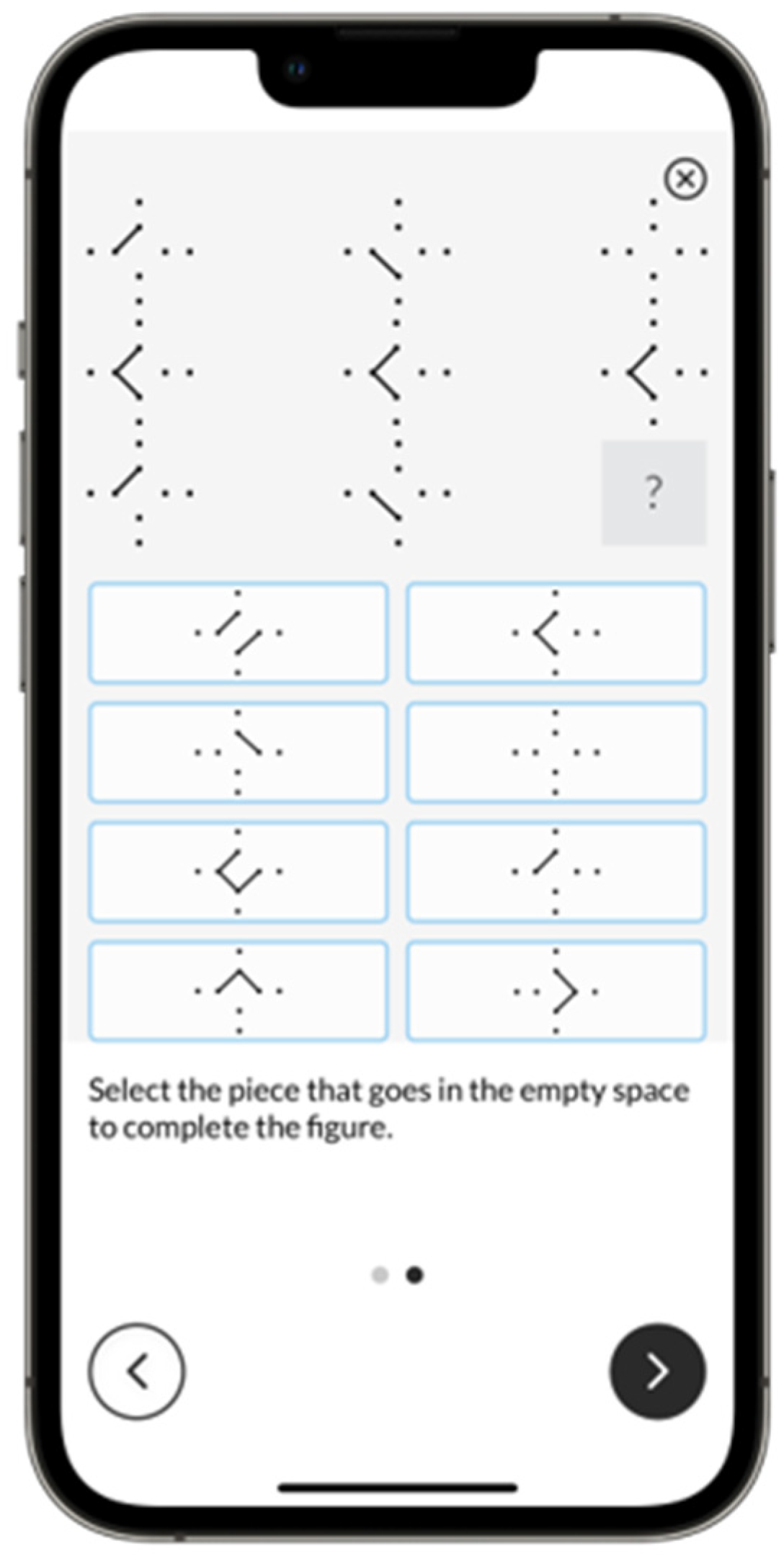
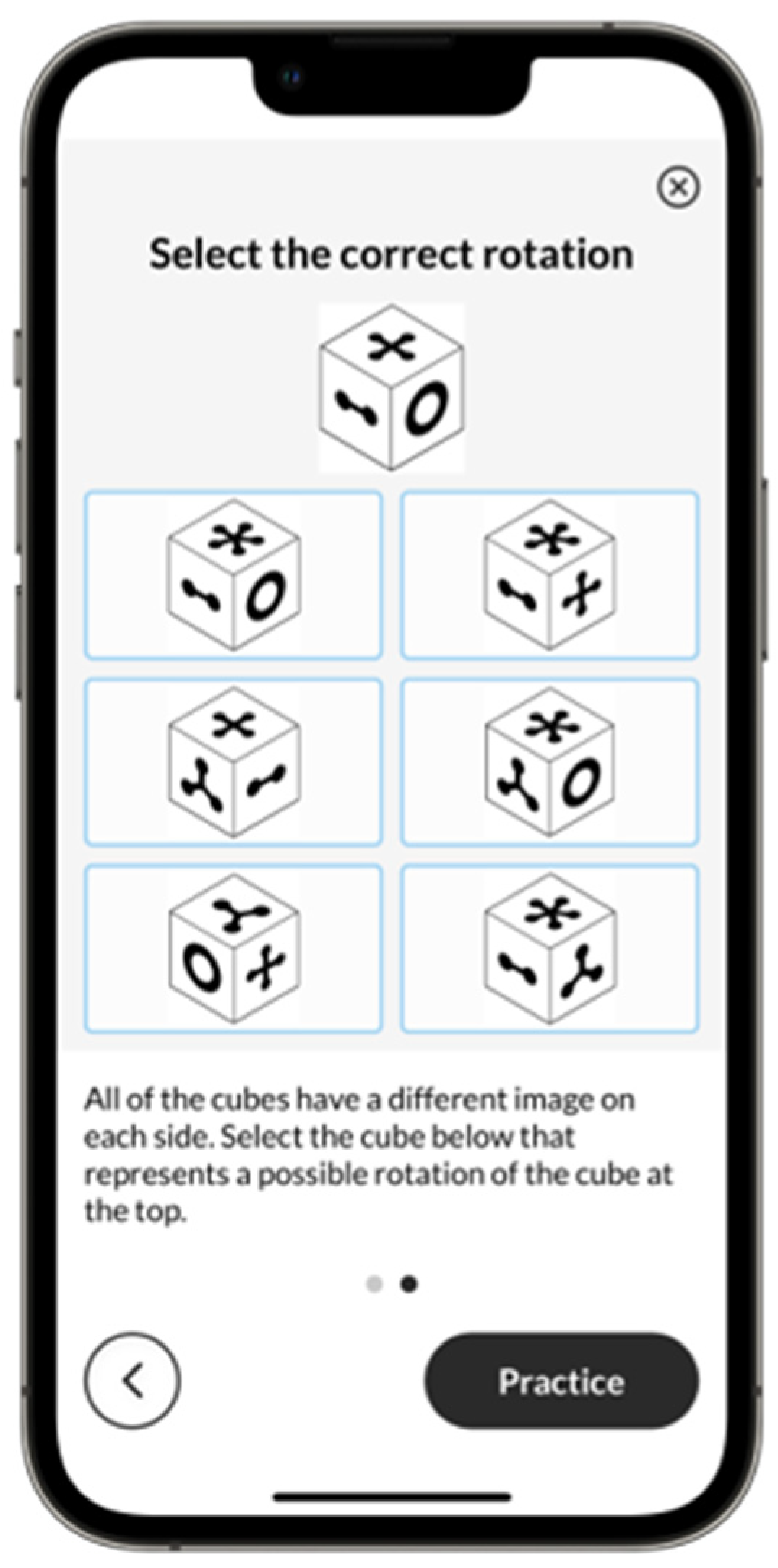

| Total Sample | 100 (%) |
|---|---|
| Gender | |
| Female | 54 |
| Male | 46 |
| Age Group | |
| 18–29 years old | 30 |
| 30–44 years old | 26 |
| 45–59 years old | 6 |
| 60–74 years old | 35 |
| 75+ years old | 3 |
| Operating System | |
| iPhone | 54 |
| Android | 46 |
| Race | |
| White | 64 |
| Black or African American | 20 |
| Asian | 1 |
| Multiracial | 1 |
| Other/Prefer Not to Say | 14 |
| Ethnicity | |
| Hispanic or Latino | 42 |
| Not Hispanic or Latino | 58 |
| Education | |
| Less than a High School | 2 |
| High School Diploma or GED | 33 |
| Some College or Trade School | 16 |
| 2-Year College Degree | 9 |
| Bachelor’s Degree | 26 |
| Graduate Degree | 14 |
| Puzzle Completion | Block Rotation | |||
| Statistic | N | Statistic | N | |
| Completion Time in Minutes | ||||
| Mean [Min, Max] | 9.95 [2.77, 23.85] | 95 | 9.95 [2.17, 40.86] | 91 |
| Reliability | ||||
| Internal Consistency | 0.88 | 95 | 0.81 | 91 |
| Average Inter-item correlation | 0.23 | 95 | 0.17 | 91 |
| Cronbach’s α | 0.90 | 95 | 0.93 | 91 |
| McDonald’s Total ωt | 0.90 | 95 | 0.89 | 91 |
| Test–Retest | 0.82 | 63 | 0.63 | 56 |
| ICC [95% CI] | 0.77 [0.64, 0.85] | 63 | 0.60 [0.40, 0.74] | 56 |
| Practice Effects | ||||
| Mean Difference T2-T1 [95% CI] | 0.001 [−0.309, 0.312] | 62 | 0.409 [−0.182, 1.001] | 56 |
| Cohen’s d | 0.000 | 62 | 0.204 | 56 |
| Age Correlation [95% CI] | −0.154 [−0.35, 0.045 ] | 95 | −0.404 [−0.559, −0.212 ] | 91 |
| MTB ICAR | Convergent Measures | Discriminant Measure | ||||
|---|---|---|---|---|---|---|
| BR | PC | MRT | WJ-Viz | Raven’s | PPVT-5 | |
| BR | 1 | |||||
| PC | 0.42 *** | 1 | ||||
| MRT | 0.46 *** | 0.36 *** | 1 | |||
| WJ-Viz | 0.51 *** | 0.31 ** | 0.63 *** | 1 | ||
| Raven’s | 0.39 *** | 0.39 *** | 0.55 *** | 0.60 *** | 1 | |
| PPVT-5 | 0.23 * | 0.18 | 0.39 *** | 0.31 ** | 0.44 *** | 1 |
Disclaimer/Publisher’s Note: The statements, opinions and data contained in all publications are solely those of the individual author(s) and contributor(s) and not of MDPI and/or the editor(s). MDPI and/or the editor(s) disclaim responsibility for any injury to people or property resulting from any ideas, methods, instructions or products referred to in the content. |
© 2025 by the authors. Licensee MDPI, Basel, Switzerland. This article is an open access article distributed under the terms and conditions of the Creative Commons Attribution (CC BY) license (https://creativecommons.org/licenses/by/4.0/).
Share and Cite
Young, S.R.; Kim, J.; McKee, K.; Doyle, D.R.; Novack, M.A.; Revelle, W.; Gershon, R.; Dworak, E.M. Validation of International Cognitive Ability Resource (ICAR) Implemented in Mobile Toolbox (MTB). J. Intell. 2025, 13, 154. https://doi.org/10.3390/jintelligence13120154
Young SR, Kim J, McKee K, Doyle DR, Novack MA, Revelle W, Gershon R, Dworak EM. Validation of International Cognitive Ability Resource (ICAR) Implemented in Mobile Toolbox (MTB). Journal of Intelligence. 2025; 13(12):154. https://doi.org/10.3390/jintelligence13120154
Chicago/Turabian StyleYoung, Stephanie Ruth, Jiwon Kim, Kiley McKee, Danielle Rothschild Doyle, Miriam A. Novack, William Revelle, Richard Gershon, and Elizabeth M. Dworak. 2025. "Validation of International Cognitive Ability Resource (ICAR) Implemented in Mobile Toolbox (MTB)" Journal of Intelligence 13, no. 12: 154. https://doi.org/10.3390/jintelligence13120154
APA StyleYoung, S. R., Kim, J., McKee, K., Doyle, D. R., Novack, M. A., Revelle, W., Gershon, R., & Dworak, E. M. (2025). Validation of International Cognitive Ability Resource (ICAR) Implemented in Mobile Toolbox (MTB). Journal of Intelligence, 13(12), 154. https://doi.org/10.3390/jintelligence13120154

