


Abstract
This study proposes an enhanced variant of the gold rush optimizer (GRO) algorithm, termed the complex-order gold rush optimizer (CoGRO) algorithm, to address two inherent theoretical limitations of the original GRO. First, GRO employs a random initialization strategy that lacks ergodicity and uniform coverage, leading to insufficient population diversity and a higher risk of premature convergence. Second, its position update mechanism relies solely on current-time information without incorporating historical search experience, which restricts the algorithm’s ability to model long-term dependencies and escape local optima in complex multimodal landscapes. To overcome these deficiencies, we introduce a chaotic LCS1 initialization to enhance population diversity through improved ergodic coverage, and we embed a complex-order derivative mechanism into the migration and collaboration updates to provide infinite memory capability. A comprehensive sensitivity analysis is conducted to examine the influence of control parameters on CoGRO’s performance, leading to the identification of an optimal parameter configuration. The effectiveness of the proposed algorithm is evaluated using the CEC2022 benchmark suite through ablation studies and comparative analyses with state-of-the-art algorithms. Experimental results on the CEC2022 benchmark suite comprising 12 test functions demonstrate that CoGRO significantly outperforms the original GRO, achieving an average solution accuracy improvement of 0.84% and an average standard deviation reduction of 67.6 across all 12 functions, with particularly notable improvements on hybrid and composition functions. Wilcoxon signed-rank tests confirm the statistical significance of these improvements (). These results confirm the feasibility and effectiveness of CoGRO as an improved optimization method for complex engineering problems.
1. Introduction
Intelligent optimization algorithms can generally be divided into four major categories: evolutionary algorithms, including Genetic Algorithm (GA) [1] and Differential Evolution (DE) [2]; swarm intelligence algorithms, such as Particle Swarm Optimization (PSO) [3] and Ant Colony Optimization (ACO) [4]; physics-based algorithms, for instance Simulated Annealing (SA) [5] and Gravitational Search Algorithm (GSA) [6]; and human-inspired algorithms, among which are Teaching–Learning-Based Optimization (TLBO) [7], Imperialist Competitive Algorithm (ICA) [8], and the recently proposed Gold Rush Optimizer. Among these classes, human-inspired algorithms simulate human social behaviors or historical events to drive the optimization search process. The Gold Rush Optimizer (GRO), formally introduced by Kamran Zolfi in 2023 [9], falls into this category. Motivated by the 19th-century North American Gold Rush, GRO establishes a multi-stage search framework by mimicking three core behaviors: migration, collaboration, and mining. Compared with other classical algorithms, GRO is characterized by its simple structure and ease of implementation while possessing strong global search ability that dynamically balances exploration and exploitation [10].
Nevertheless, despite its structural simplicity, GRO still exhibits noticeable shortcomings relative to other human-inspired algorithms including Teaching–Learning-Based Optimization (TLBO) and the Imperialist Competitive Algorithm (ICA). TLBO adopts a two-phase teacher-learner update mechanism that effectively balances exploration and exploitation [11], whereas ICA maintains population diversity through competition among imperialist colonies [12]. In comparison, GRO employs random initialization without ergodic coverage, which frequently leads to insufficient initial population diversity. Furthermore, its position updates rely solely on real-time information and ignore historical search experiences, making the algorithm susceptible to premature convergence into local optima. To alleviate such limitations in metaheuristic algorithms, various improvement strategies have been reported in the literature. For example, the random average marine predators algorithm [13] introduces stochastic averaging operations to balance exploration and exploitation during the search process. Weng et al. [14] proposed a hybrid sine cosine algorithm that incorporates vertical and horizontal crossover mechanisms with pattern search to enhance population diversity and accelerate convergence, effectively addressing the issues of local optima stagnation and slow convergence in the standard SCA. Nonlinear sine cosine and safe experimentation dynamics algorithms [15] adopt adaptive parameter adjustment and safety constraint mechanisms to avoid premature convergence. Polar bear optimization [16] has also been successfully applied to industrial computed tomography with incomplete data, demonstrating its effectiveness in handling real-world engineering problems. These methods provide meaningful references for algorithmic enhancement. In this study, we adopt a distinct yet complementary improvement scheme: chaotic LCS1 initialization to enrich population diversity, and complex-order derivatives to embed historical memory into position updates. These strategies can also be flexibly combined with the aforementioned methods in future research.
Despite its drawbacks, GRO is selected as the baseline algorithm in this work for two main reasons. First, unlike TLBO with its two-phase update rule and ICA with multiple empire-related parameters, GRO adopts a concise three-strategy framework with fewer control parameters, making it more convenient for theoretical analysis and structural modification. Second, recent studies have verified that GRO achieves competitive performance on both unimodal and multimodal optimization problems despite its simplicity, implying that its core search logic is inherently effective and that targeted improvements can further enhance its performance. Therefore, by addressing its two critical deficiencies—insufficient initialization diversity and lack of historical memory—we aim to elevate GRO to a performance level comparable to more advanced algorithms. This is the primary motivation of the present work.
Based on the above discussions, this paper proposes an improved complex-order Gold Rush Optimizer (CoGRO). The main contributions are summarized as follows:
- An initialization scheme based on LCS1 chaotic mapping is introduced to improve population diversity, enabling initial individuals to be distributed more uniformly within the search space and thus enhancing the starting quality of the global search.
- Complex-order derivatives are integrated into the migration and collaboration update stages of GRO, granting the algorithm long-term memory of historical search information and improving its adaptability and guidance precision in complex multimodal scenarios.
- In contrast to the original GRO, which uses random initialization and memoryless updates, the proposed CoGRO innovatively combines chaotic LCS1 initialization with complex-order derivative-based position updating. This hybrid mechanism helps maintain population diversity during the entire search process and supports effective escape from local optima. Extensive experiments on the CEC2022 benchmark functions show that CoGRO outperforms the original GRO and several state-of-the-art algorithms in both solution accuracy and convergence stability, verifying the effectiveness and universality of the proposed improvements.
The remainder of this paper is organized as follows. Section 2 introduces the basic theoretical definitions used in this study. Section 3 briefly reviews the standard GRO algorithm. Section 4 details the proposed improved strategies. Section 5 presents comprehensive experimental results and analyses of CoGRO. Finally, Section 6 concludes the main findings of this work.
2. Preliminary Mathematical Concepts
To ensure the rigor and reproducibility of the proposed algorithm, this section establishes the theoretical foundation for incorporating historical memory into the optimization process by introducing fundamental concepts from fractional calculus and complex-order derivatives. Fractional calculus extends traditional integer-order calculus and provides a powerful framework for modeling memory and hereditary effects. Among various definitions of fractional derivatives, the Grunwald–Letnikov (G-L) formulation is particularly well-suited for numerical implementation.
Definition 1
([17] (Grunwald-Letnikov Fractional Derivative)). For a function , its α-th order G-L derivative is defined as:
where is the order of the derivative, ; h is the step size; the binomial coefficient , and denotes the Gamma function.
In practical discrete-time systems, when the sampling period T is sufficiently small and the truncation order r is appropriately chosen, Equation (1) can be approximated as:
This discrete-time approximation is used for numerical implementation in the proposed algorithm.
Extending fractional derivatives to the complex domain yields complex-order derivative operators. The extension of the Grunwald–Letnikov formulation to complex orders is valid when the function is analytic and the parameters satisfy , which guarantees the decay of the series coefficients. Under these conditions, the Gamma function is well-defined for complex arguments, and the binomial coefficients exhibit the same rapid decay properties as in the real case, ensuring absolute convergence of the series [18,19]. With the sampling period adopted in this work, the truncation error introduced by limiting the summation to is bounded by , which is negligible for numerical implementation. The resulting complex-order derivative operators not only capture the attenuation of historical information but also introduce oscillatory behavior through the imaginary part, enabling a more nuanced balance between exploration and exploitation [17]. From the perspective of complex-order calculus, the derivative order can be further generalized to the conjugate complex pair , leading to the G-L formulation of the complex-order derivative:
This formulation preserves the memory characteristics of fractional-order derivatives while introducing frequency-domain selection and phase modulation mechanisms through the imaginary component.
Definition 2
([18] (Complex-Order Derivative Operators)). Based on the unified complex-order derivative operator defined above, we construct two real-valued conjugate operators for practical implementation. Let and . The two operators corresponding to the complex order are defined as:
where f is a real-valued function. Thus, and represent the real and imaginary parts of the complex-order derivative, respectively, ensuring that the position update remains in the real domain. Expanding f as a Taylor series around yields explicit expressions for
From Equations (6) and (7), it is evident that primarily governs the attenuation amplitude of historical information, while introduces phase modulation. Their combination enables refined control over the search trajectory.
3. Classic GRO Algorithm
The classical GRO algorithm [9] is inspired by the historical event of the 19th-century Gold Rush. By simulating the behavior of gold prospectors searching for gold deposits, it constructs a search mechanism comprising three strategies: migration, mining, and collaboration. During the iterative process of the algorithm, each prospector (i.e., search individual) updates its position by executing one of these three operations, thereby progressively approaching the global optimal solution within the solution space.
3.1. Migration
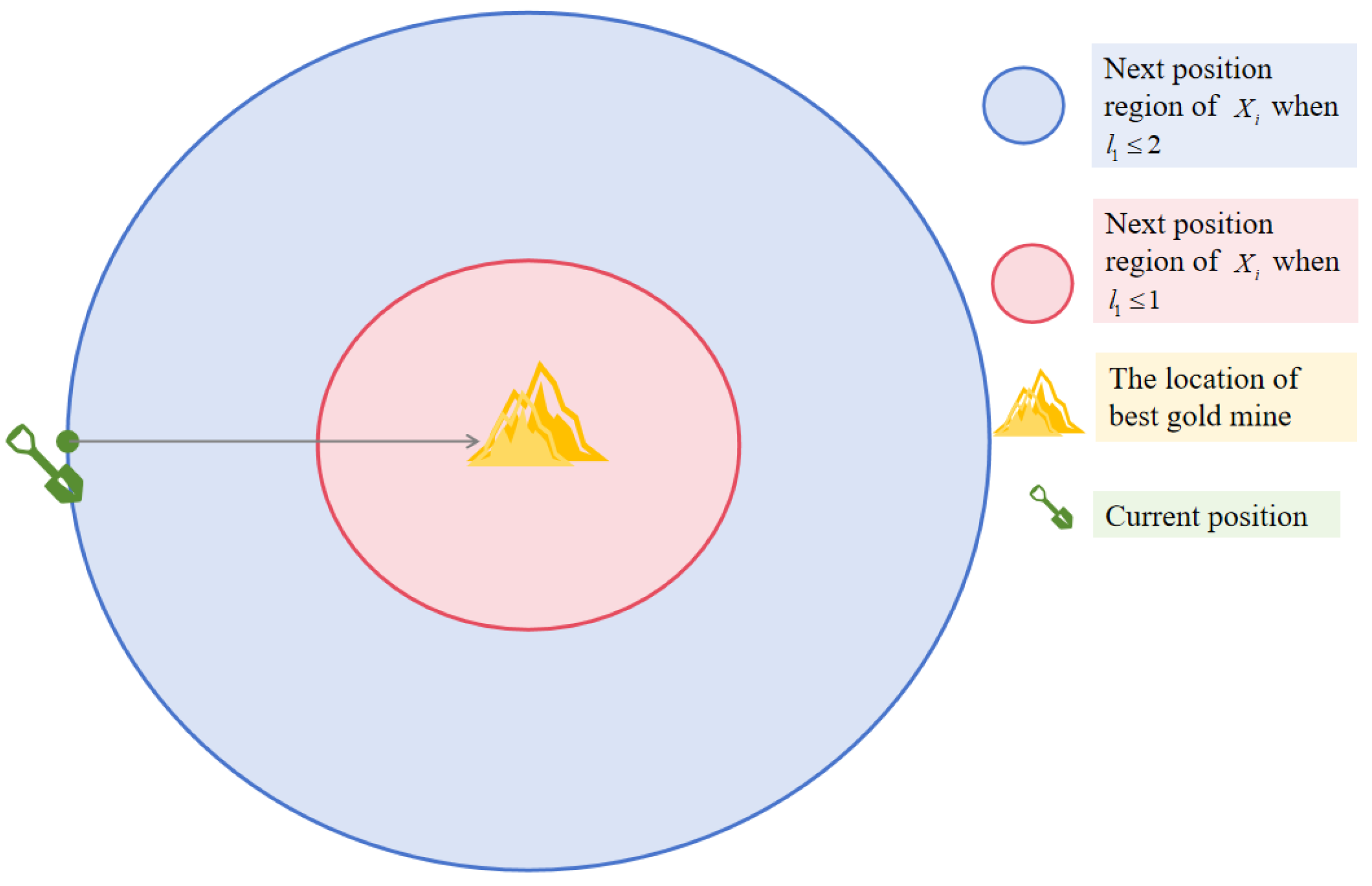
When a miner moves toward the current optimal gold deposit, the position update formula is:
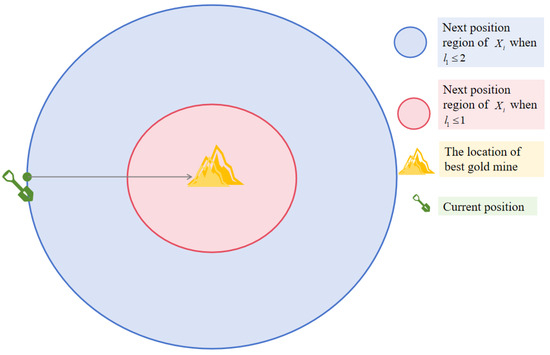
Here, denotes the current optimal prospector position, i.e., the optimal gold deposit location; represents the current position of the i-th prospector in the d-th dimension; is a random vector within the range ; and , where is a random vector in and is the convergence factor. Figure 1 illustrates the 2D schematic diagram of this migration process.
Figure 1.
Migration schematic diagram (2D).
3.2. Mining
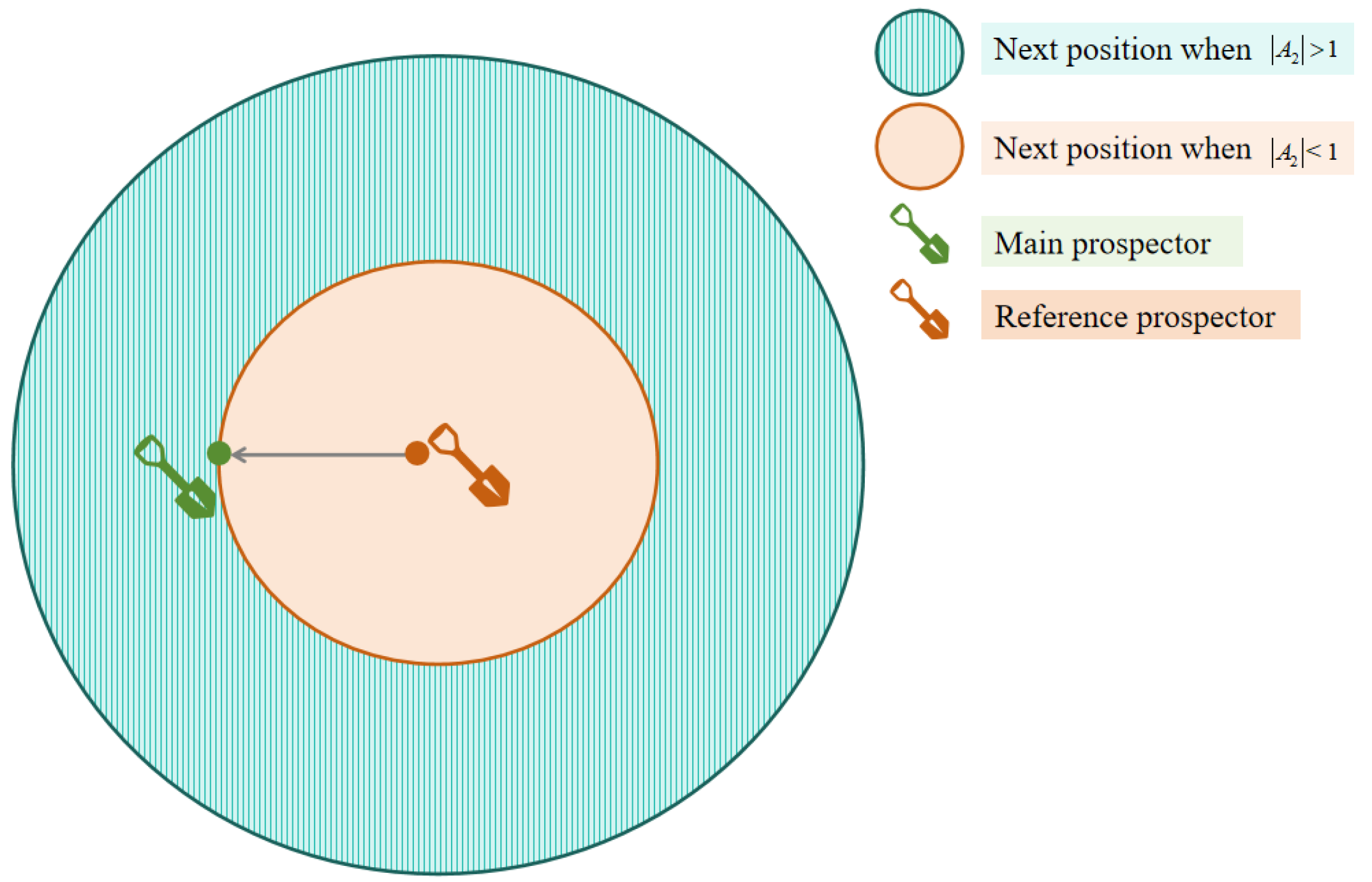
When a prospector performs local exploration near a randomly selected mining point, its position update formula is as follows:
Here, is a coefficient vector. When , the local exploitation strategy is executed; when , the random exploration strategy is executed. Figure 2 shows the 2D schematic diagram of this mining process.
Figure 2.
Mining schematic diagram (2D).
3.3. Collaboration
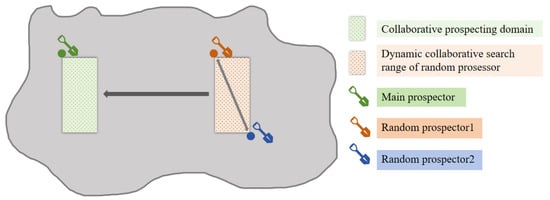
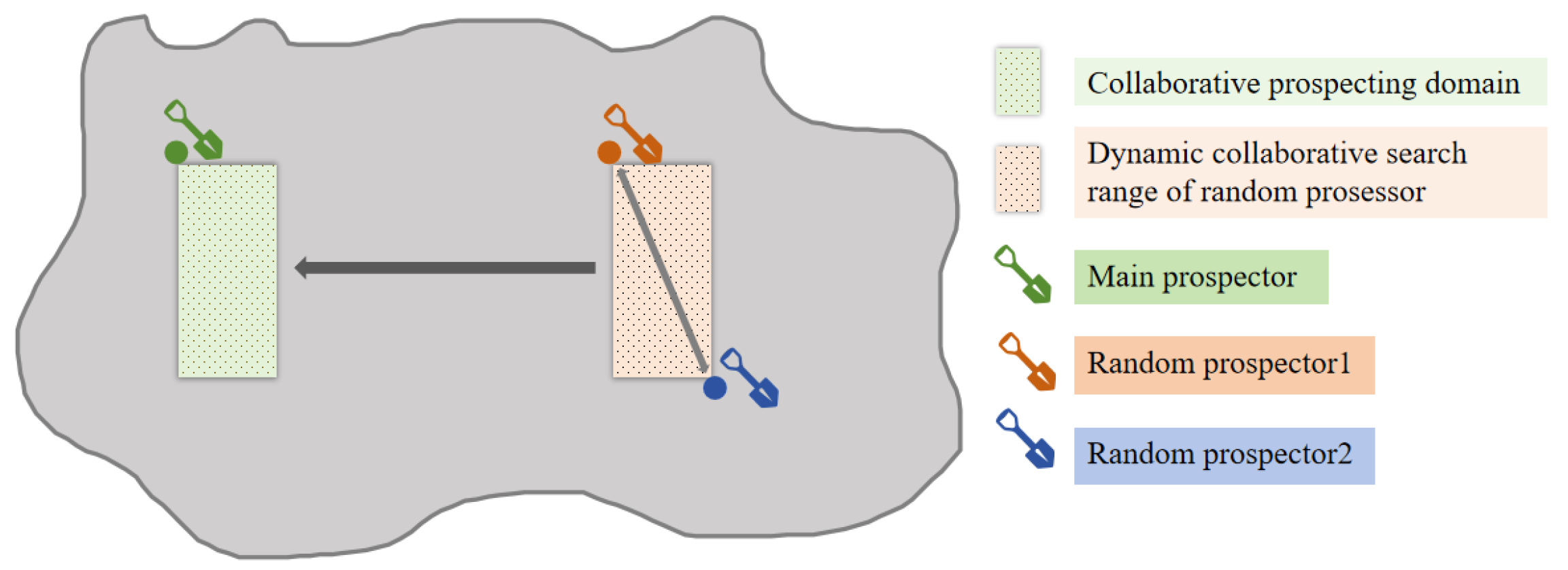
Two prospectors jointly determine the search area, while a third prospector searches randomly within this area:
where and denote the positions of the two randomly selected prospectors; is the random coefficient used for random search within the area. Figure 3 illustrates the 2D schematic diagram of this collaboration mechanism.
Figure 3.
Collaboration schematic diagram (2D).
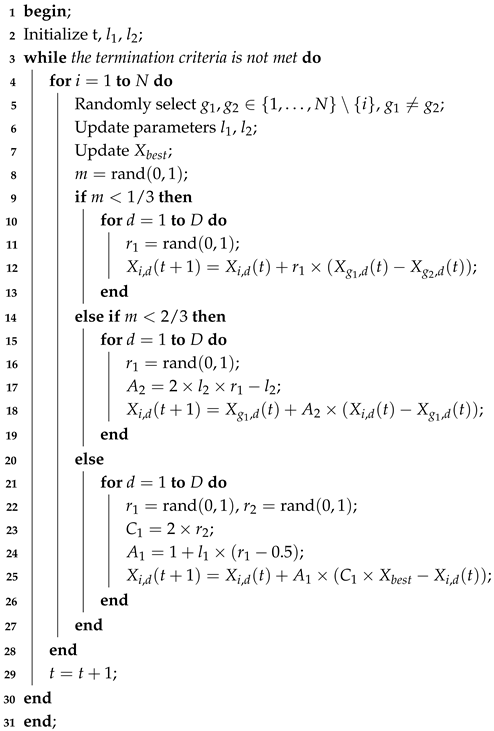
The pseudocode of the classical GRO algorithm is shown in Algorithm 1:
| Algorithm 1: Classical GRO algorithm. |
 |
4. The Proposed CoGRO Algorithm
4.1. Initialization Based on Chaotic LCS1
GRO suffers from uneven initial population distribution, which may cause the algorithm to easily get stuck in local optima [20] and exhibit low search efficiency. To generate a more uniformly distributed and diverse initial population [21], we incorporate chaos into the initialization process [22]. Leveraging the ergodicity [23], randomness [24], and sensitivity [25] to initial conditions of chaotic mappings, this approach effectively avoids issues such as population clustering and premature convergence that may arise from random initialization, thereby establishing a solid foundation for subsequent iterative searches. Among various chaotic mappings, LCS1 is a composite chaotic mapping, integrating the dynamic characteristics of both the Logistic and Sine mappings. Compared to traditional Logistic or Tent mappings, LCS1 exhibits more complex chaotic behavior and a more uniform ergodic distribution. This enables it to cover the solution space more comprehensively, thereby further enhancing population diversity and global exploration capabilities [26].
Therefore, we employ the LCS1 mapping to generate chaotic sequences for each explorer across dimensions, obtaining initial values with good exploratory properties through iterative computation:
where is the chaotic variable value at the n-th iteration, and is a hybrid control parameter that adjusts the complexity of the chaotic behavior. By combining the dynamics of both maps, the LCS1 generator produces chaotic sequences with more uniform distribution characteristics compared to traditional pseudo-random number generators.The uniform distribution property of LCS1 is supported by the Frobenius–Perron framework: Lawnik [27] proved that chaotic maps with constant Frobenius–Perron density generate uniformly distributed sequences, while Anikin et al. [28] established the general conditions for such behavior. As a composite map, LCS1 inherits favorable ergodic properties from its Logistic and Sine components [29]. During the population initialization phase, N chaotic sequences of different dimensions are first generated using Equation (11). These sequences are then mapped onto the decision variable’s search space via a linear transformation:
where N is the population size, D is the problem dimension, and are the lower and upper bounds of the d-th dimension, respectively, and is the chaotic value generated by the LCS1 map. This initialization strategy ensures that initial individuals are uniformly distributed across the solution space, thereby providing a solid foundation for subsequent global search by preventing premature clustering and enhancing the algorithm’s exploratory capacity from the very first generation.
The final initialization matrix is obtained as follows:
This process ensures that the initial population possesses sufficient randomness and spatial coverage while satisfying the constraints, thereby enhancing the classical GRO into a GRO incorporating chaotic initialization.
4.2. The Complex-Order Position Adaptation Laws
Although GRO features a simple structure and is easy to implement, it relies solely on current-time information during iterative updates, lacking the ability to remember and utilize historical search experience. This limitation restricts the algorithm’s capacity to model long-term dependencies in complex optimization environments. When confronted with multi-modal or high-dimensional problems, it tends to get stuck in local optima and exhibits reduced convergence efficiency.
As a generalization of fractional derivatives, complex-order derivatives possess infinite memory capacity and continuous state ranges. Recent studies have demonstrated that fractional-order operators inherently maintain population diversity and prevent premature convergence. Specifically, Yousri et al. [30] proved that the fractional-order memory mechanism enables effective sharing of best knowledge and historical experiences among search agents, with the explicit goal of escaping local solutions and avoiding immature convergence. Similarly, Fernandez et al. [31] established that fractional-order operators enhance convergence robustness and achieve a superior trade-off between exploration and exploitation through their intrinsic memory and non-local characteristics. The mathematical treatment of fractional systems with inherent delays or memory effects is crucial for stability, and the use of complex-order derivatives allows for a more nuanced modulation of this historical information during the optimization trajectory, analogous to the fractional differential transformation method applied to fractional delay differential equations [32].
As a natural extension of fractional-order calculus, complex-order derivatives inherit and further enhance these beneficial properties. They effectively capture historical information within particle trajectories, enabling the algorithm to balance current states with past paths during search. This enhances the ability to escape local optima, improving both solution accuracy and convergence efficiency.
The practical validity of combining fractional/complex-order operators with heuristic search has been demonstrated beyond optimization algorithm design. Recent studies have successfully applied such hybrid approaches to solve ill-posed inverse problems for fractional diffusion equations, where parameters such as derivative orders and boundary conditions are identified using metaheuristic algorithms [33]. This cross-domain success further supports the rationale for embedding complex-order mechanisms into the GRO framework.
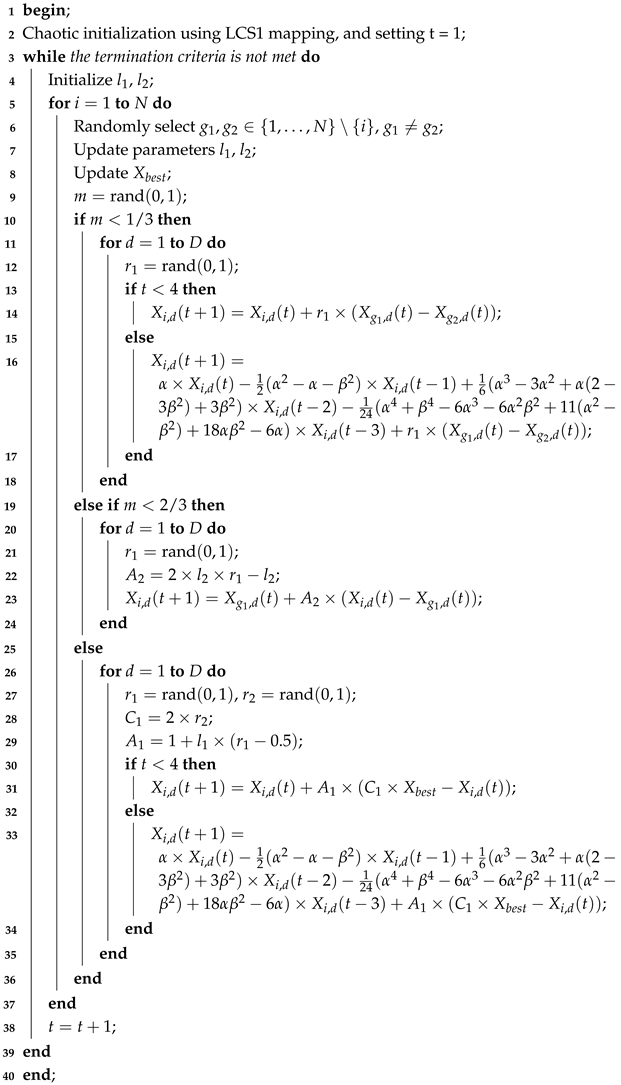
Therefore, based on the integer-order version of the gold rush optimizer incorporating chaotic initialization, we introduce new parameters and . By applying Equation (2) to refine the core formula of GRO, we derive the current complex-order gold rush optimizer—CoGRO. The specific improvements are as follows:
First, for the migration strategy: when the iteration count , the original integer-order gold rush optimizer formula is retained. When , Equation (8) is rewritten as:
On the left is the discrete version of the derivative with order . Setting yields the following expression:
The G-L definition based on fractional differentiation concepts [17] is:
From the perspective of complex order, the order of the position derivative can be further generalized to the conjugate complex pair , namely:
This approach not only preserves smoothness and memory effects but also introduces frequency-domain selection and phase modulation mechanisms, thereby enabling dynamic offset control over the evolution direction. Based on the first three terms of the differential in Equation (8), we derive the migration formula for complex-order GRO:
Similarly, we have applied the same improvements to the collaboration formula. When , we continue to use Equation (10); when , the collaboration formula is modified as follows:
Since the mining formula Equation (9) does not incorporate the previous position information into , it is not subject to multi-order optimization and retains the original formula. At this point, we have completed the complex-order improvement of the algorithm. It can be seen from Equations (18) and (19) that the position update of a particle depends not only on its own position at the previous moment but also incorporates historical state information up to , exhibiting short-memory characteristics. The choice of truncation depth is justified by the Taylor series expansion of the complex-order operators: the coefficients of the series decay rapidly as the order increases. For , the magnitude of the coefficient for the term is an order of magnitude smaller than that of the term, and the contribution of historical terms beyond becomes negligible. Therefore, retaining terms up to captures the dominant memory effects while maintaining computational efficiency. This feature helps maintain the diversity and uniform distribution of the population to a certain extent, laying the foundation for global search. It is worth noting that the position update at each moment is associated with the position data from the previous three moments, allowing the algorithm to dynamically adjust the optimization direction based on the particle’s historical motion trajectory, thereby enhancing the accuracy of local search and facilitating faster convergence to the global optimum.The pseudocode of the proposed CoGRO algorithm is shown in Algorithm 2.
| Algorithm 2: The proposed CoGRO algorithm. |
 |
5. Performance Test of the CoGRO
To comprehensively evaluate the optimization performance of the CoGRO algorithm and the effectiveness of its improvement mechanisms, four interrelated sets of numerical experiments are designed in this study: parameter sensitivity analysis, truncation depth analysis, ablation study, and comparative experiments.
5.1. Parameters’ Sensitivity Analysis of the CoGRO
To ensure the performance stability and the rationality of parameter selection for the proposed CoGRO algorithm, a systematic sensitivity analysis is conducted on its key control parameters, and . The experiments are carried out using the CEC2022 benchmark suite as the evaluation platform. This suite comprises 12 complex optimization problems with distinct mathematical characteristics (denoted as Function 1 to 12), which comprehensively reflect the algorithm’s performance on unimodal, multimodal, hybrid, and composition functions. The specific definitions and mathematical properties of the test functions are presented in Table 1.
Table 1.
Benchmark functions adopted from CEC2022.
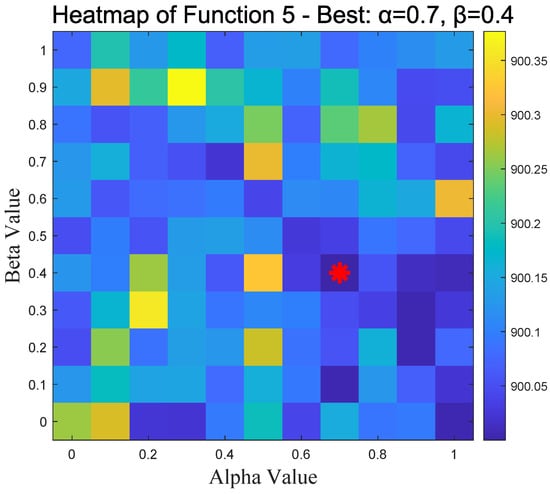
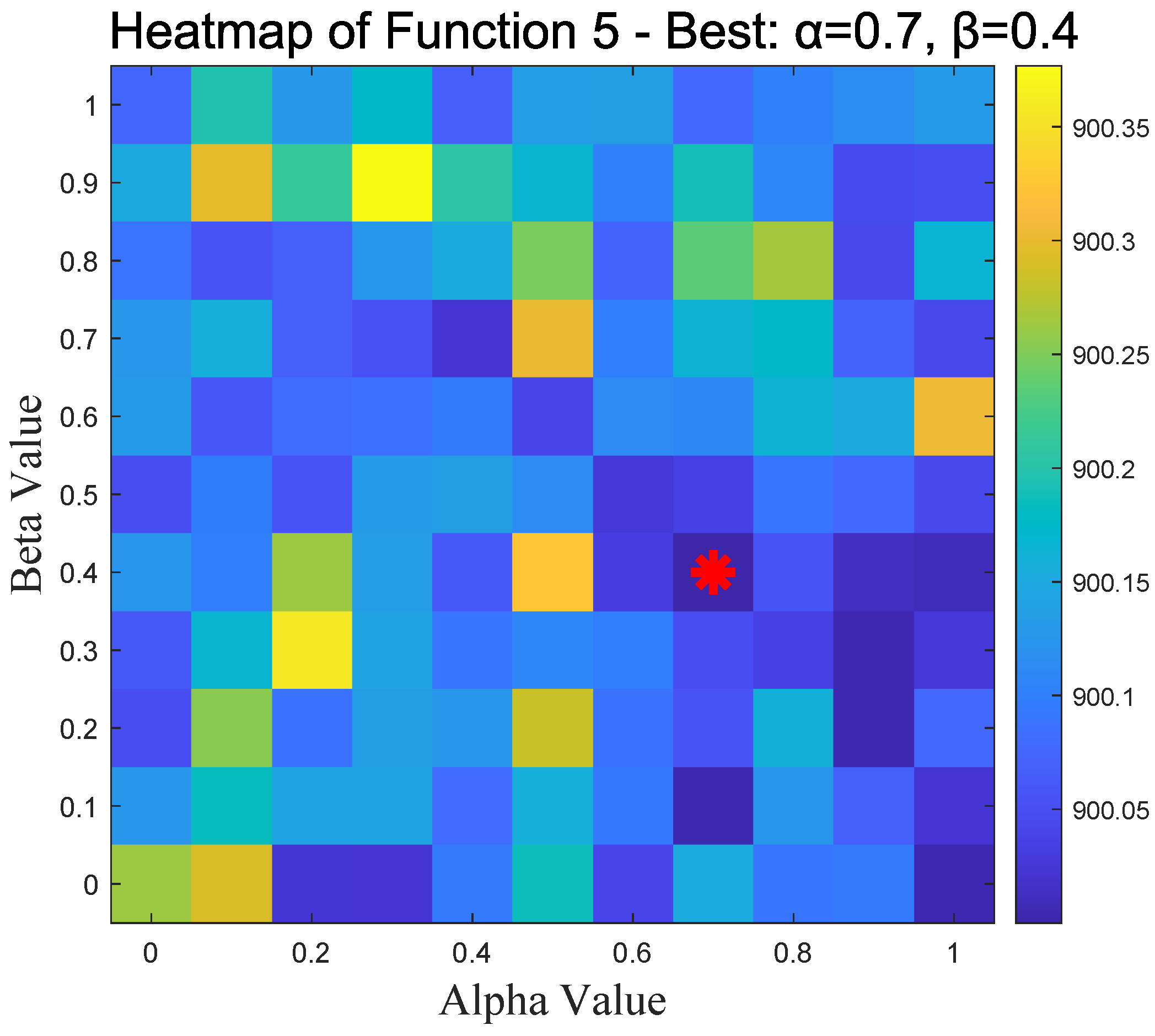
We conducted 121 test runs on each test function, varying and from 0 to 1 in increments of 0.1. Each experiment employed a population size of 30 particles, a maximum iteration count of (where D is the dimension, ), and was repeated 30 times. Evaluation is based on three metrics: Mean, Standard Deviation (std), and Minimum (min). The total computational cost is approximately function evaluations, which is acceptable given the offline nature of parameter tuning and is consistent with similar studies in the literature. The final results display the optimal parameter pairs adapted for each test function. Based on the comprehensive sensitivity analysis across all 12 test functions, CoGRO maintains competitive performance when ranges from 0.5 to 0.9 and ranges from 0 to 0.3. Below, we present the top five parameter combinations for Function 5 in Table 2 and the parameter sensitivity analysis heatmap in Figure 4. Detailed simulation results for all functions are available in Appendix A.
Table 2.
Top 5 Parameter Combinations for Function 5.
Figure 4.
Heatmap of Function 5.
As shown in the table, the optimal parameter combination is , which achieves a mean fitness of with a remarkably low standard deviation of . This indicates that the configuration not only delivers high solution accuracy but also demonstrates exceptional stability across repeated runs. Moreover, its minimum value exactly reaches the theoretical optimum of , further confirming its convergence reliability. The second-ranked combination attains the same mean fitness yet exhibits a standard deviation of —approximately two orders of magnitude higher than that of the top configuration. This contrast highlights that while several parameter pairs can yield comparable solution accuracy, they differ considerably in terms of algorithmic stability, underscoring the importance of considering both precision and robustness during parameter selection. The remaining top-ranked combinations suggest that configurations with low and high can also produce competitive results, albeit with slightly higher variability (standard deviations around ). This reflects a certain degree of complementarity between the two parameters—the phase modulation governed by can partially compensate for the memory attenuation controlled by .
As illustrated in the figure, the region around exhibits the deepest blue coloration, indicating that this parameter combination achieves the best performance on Function 5, while also confirming that parameter selection significantly influences algorithmic performance. Examining the axis reveals that when is held constant, increasing from 0 to 0.7 leads to progressive performance improvement, whereas values exceeding 0.8 result in slight degradation while maintaining relative stability. Along the axis, optimal performance concentrates in the moderate range of to , with either excessively high or low values causing marginal performance deterioration. The heatmap displays a distinct diagonal distribution pattern, suggesting an interaction between and : larger values require moderate values to achieve optimal performance, while smaller values can still yield acceptable results when paired with higher values. Finally, the predominantly light and uniform coloration across most regions indicates that the CoGRO algorithm maintains good robustness over a wide parameter range, with performance degradation occurring only in localized peripheral areas.
From the above parameter sensitivity analysis experiments, it can be seen that the real part controls the decay rate of historical information: a larger preserves more past information to enhance local exploitation, while a smaller emphasizes recent states to promote exploration. The imaginary part introduces an oscillatory component that periodically modulates memory contributions, thereby reducing directional correlation among particles and preventing synchronous convergence. As demonstrated in the complex-order PSO literature [18,19], the optimal parameter region is and , within which the algorithm achieves a balance between exploration and exploitation. The convergence curves in Appendix C confirm that the algorithm converges stably within this parameter range.
5.2. Truncation Depth Analysis
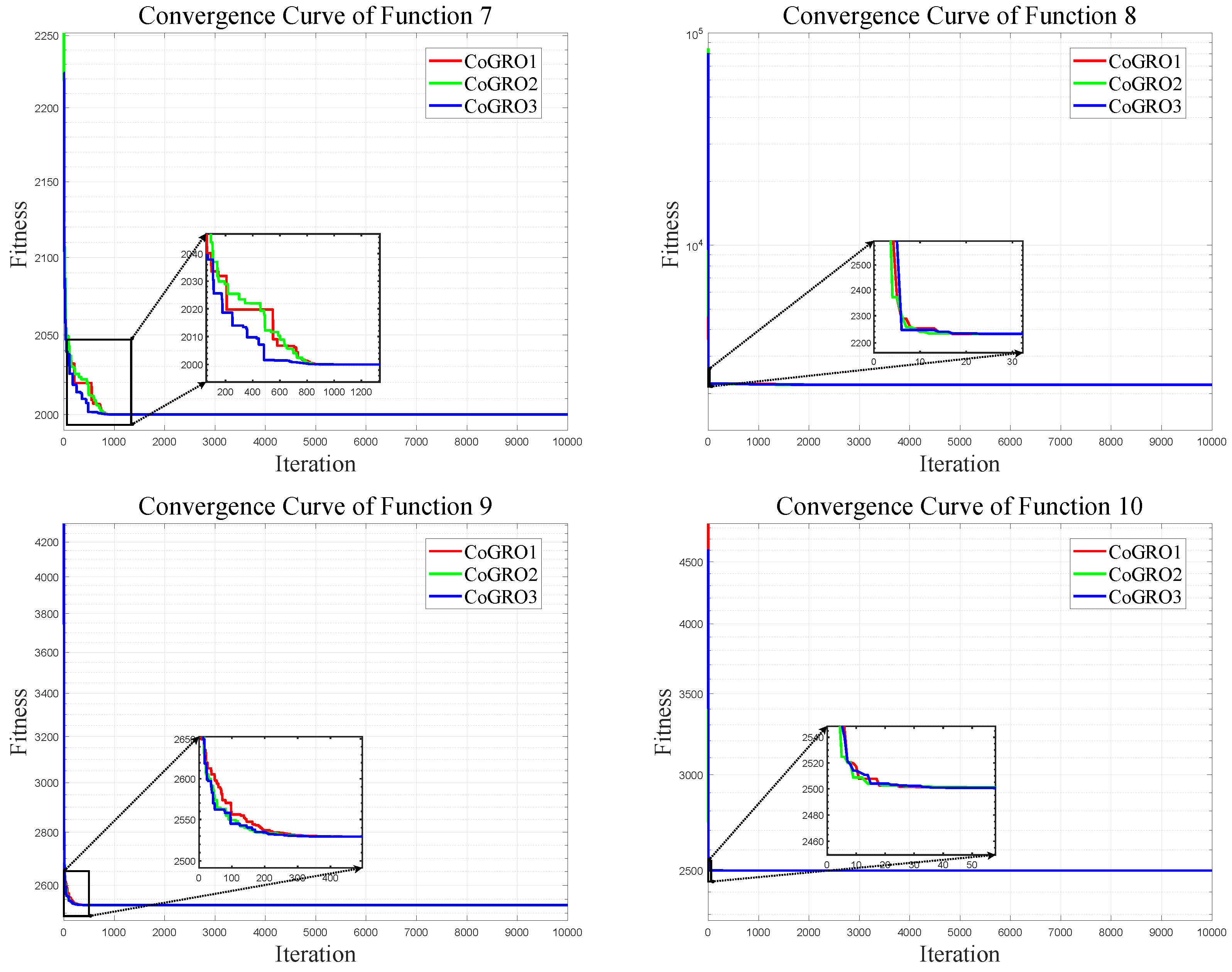
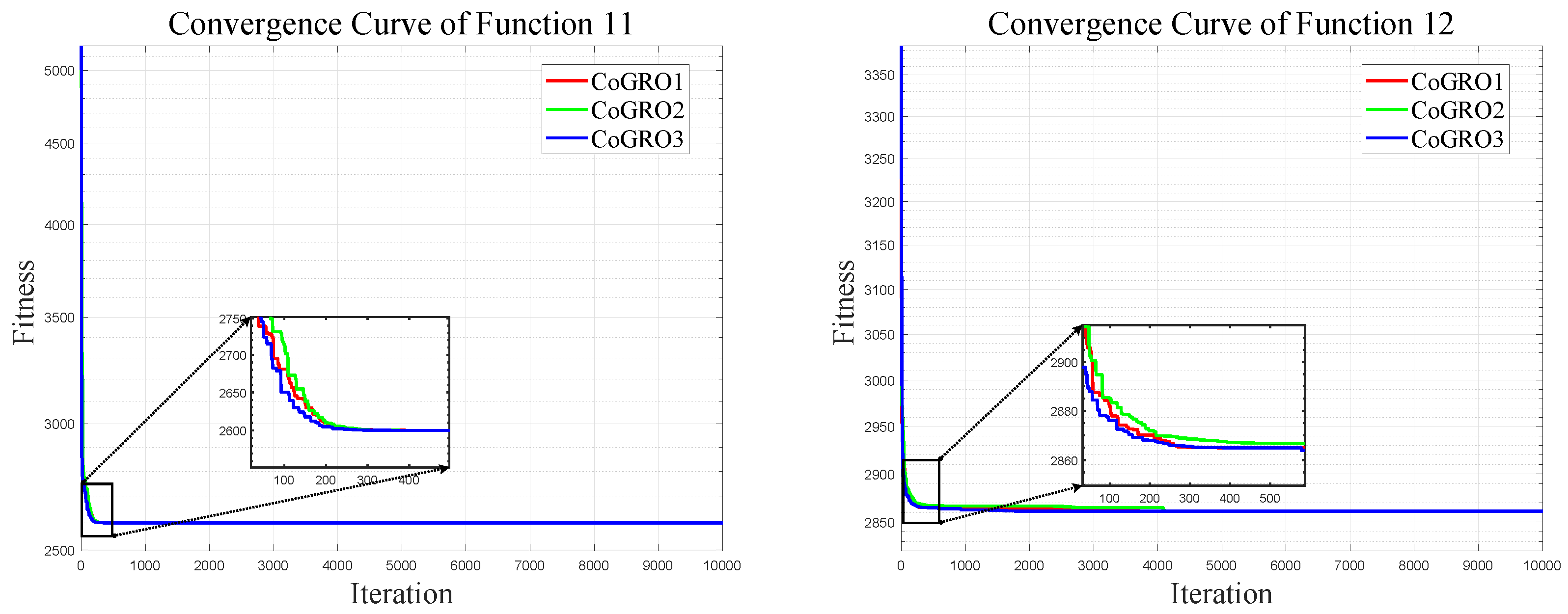
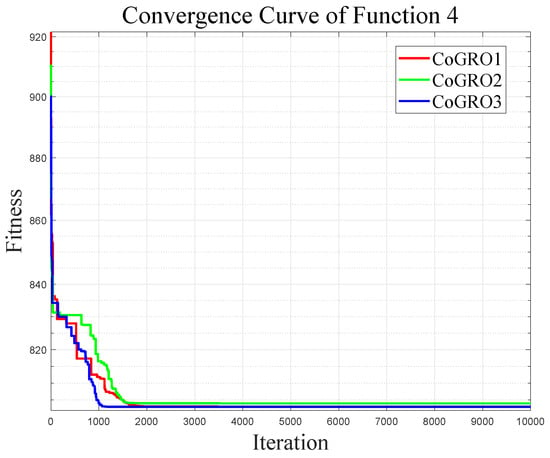
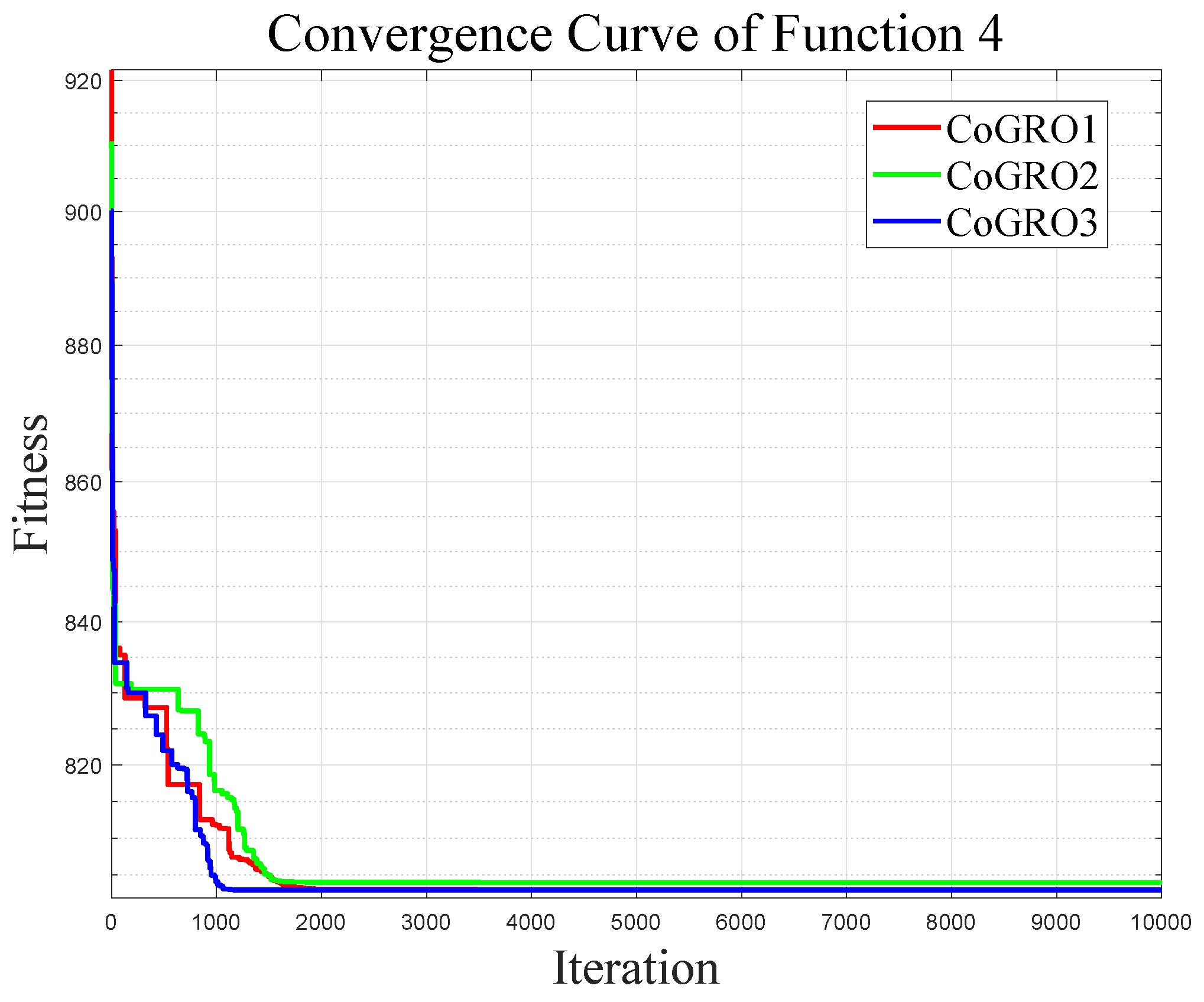
To quantitatively justify the choice of truncation depth in Equations (18) and (19), we conducted comparative experiments with different truncation depths on the CEC2022 benchmark suite. The algorithm with truncation depth 1 is denoted as CoGRO1, with depth 2 as CoGRO2, and with depth 3 as CoGRO3. Except for the truncation depth, all other parameter settings are identical among the three algorithms. All experiments were conducted at a fixed dimension of . To ensure fair comparison, universal algorithmic parameters were held constant across all methods. Specifically, the population size was set to , and the maximum number of iterations was set to . Each optimization result was obtained from 30 independent runs to ensure statistical reliability. The experimental results for Function 4 are presented in the Figure 5 and Table 3 below, and all detailed results are provided in Appendix B.
Figure 5.
Convergence Curve of Function 4.
Table 3.
Results of the truncation depth analysis for Function 4.
As shown in the results of Function 4, CoGRO3 achieves the optimal performance in terms of mean fitness, best fitness, and overall rank. Meanwhile, its convergence curve exhibits a faster descent rate, enabling the algorithm to converge to the vicinity of the optimal solution earlier and maintain stable performance thereafter. These results demonstrate that the complex-order improvement strategy significantly enhances the solution accuracy and convergence efficiency of the algorithm and enables a superior exploration–exploitation balance on this test function.
5.3. Ablation Study of CoGRO
An ablation study systematically removes or modifies specific components of a model to observe their impact on overall performance, thereby validating the contribution of each component to the model’s effectiveness. This approach functions as a controlled variable method. In this work, the complex-order gold rush optimizer (CoGRO) incorporates two key enhancements: the application of complex-order derivatives (Module A) and chaotic initialization (Module B). To evaluate the individual contribution of these modules, three ablated variants of CoGRO were developed: CoGRO-A (with Module A removed), CoGRO-B (with Module B removed), and CoGRO-AB (with both modules removed).
The performance of CoGRO, CoGRO-A, CoGRO-B, and CoGRO-AB was evaluated on the 12 benchmark functions from the CEC2022 test suite. All experiments were conducted at a fixed dimension of . To ensure fair comparison, universal algorithmic parameters were held constant across all methods. Specifically, the population size was set to , and the maximum number of iterations was set to . Each optimization result was obtained from 30 independent runs to ensure statistical reliability. Following the parameter sensitivity analysis in Section 5.3, the CoGRO and CoGRO-B algorithms adopted the optimal and parameter combinations for each respective function. For CoGRO-A and CoGRO, the LCS1 coupling coefficient was maintained at 0.7, with all other parameters consistent with the standard GRO algorithm. Algorithmic performance was assessed using three key metrics: mean, standard deviation, and minimum value. The comprehensive results are presented in Table 4. The experimental outcomes demonstrate that CoGRO-AB—the variant with both modules removed—exhibited the poorest performance. This finding substantiates the critical contribution of both Module A and Module B to the overall efficacy of the CoGRO algorithm. For a detailed exposition of the results, please refer to Appendix C.
Table 4.
Comparison Results.
5.4. Comparative Experiments
To validate the advantage of complex-order over fractional-order (), we first compare CoGRO with its fractional-order counterpart FGRO (i.e., CoGRO with ) under identical parameter configurations (, population size , maximum iterations ) without per-function parameter tuning. Table 5 presents the comparison results on CEC2022 Functions 1 to 12.
Table 5.
Comparison results of FGRO vs. CoGRO on CEC2022 Functions 1–12.
The results demonstrate that CoGRO outperforms FGRO on the majority of test functions, achieving higher solution accuracy and better stability. This confirms that introducing the imaginary part —i.e., extending fractional-order to complex-order—effectively enhances the algorithm’s global search capability and convergence reliability.
Having established the advantage of complex-order over fractional-order, we further evaluate CoGRO against several classical and state-of-the-art algorithms on the CEC2022 benchmark suite, including Particle Swarm Optimization (PSO), Grey Wolf Optimizer (GWO), Genetic Algorithm (GA), as well as two modern highly competitive algorithms: EA4eig and MadDE. To maintain fairness and scientific validity, all algorithms are configured with identical population sizes and termination criteria: the population size is set to , where denotes the problem dimension, and the maximum number of iterations is set to . The specific control parameters for each comparative algorithm are configured strictly following the recommendations in their respective original literature.
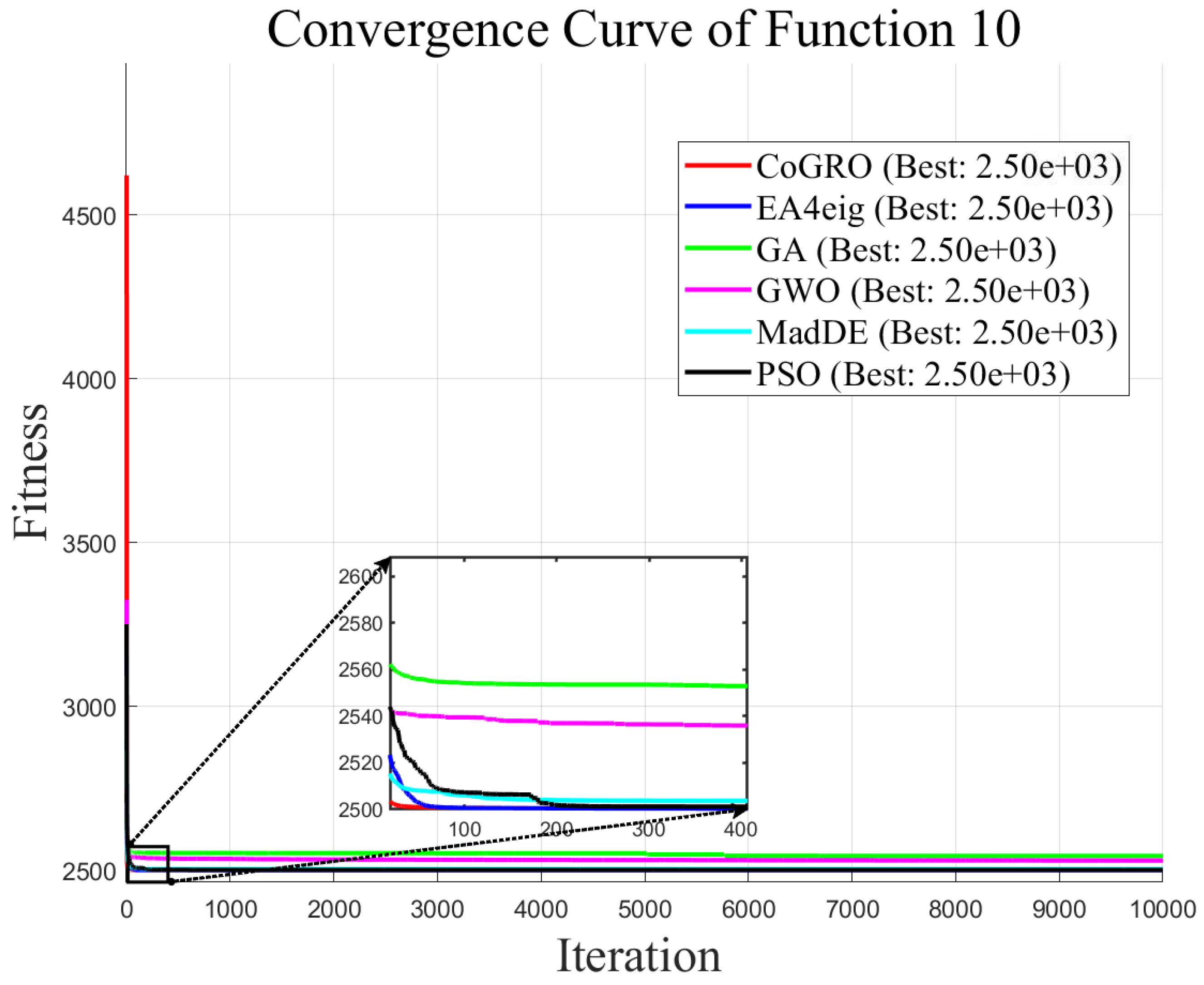
To mitigate the impact of stochastic variability on the experimental outcomes, each algorithm is independently executed 30 times on every test function. The best value (Best), mean (Mean), standard deviation (Std), Wilcoxon rank-sum test results (w-test), and average CPU time (Avg Time) obtained from the 30 runs are recorded as performance evaluation metrics. The mean value reflects the convergence accuracy of the algorithm, the standard deviation assesses its stability and robustness, the w-test evaluates the statistical significance of performance differences between algorithms, and the average CPU time measures the computational efficiency. Taking the unimodal Function 10 as an illustrative example, Table 6 summarizes the statistical results of the compared algorithms on this function, and Figure 6 depicts their average convergence curves. Complete experimental results and convergence curves for the remaining functions are presented in Appendix D.
Table 6.
Comparison Results of Function 10.
Figure 6.
Convergence curve of Function 10.
On Function 10, CoGRO matches the best value (2.50 ) and mean of EA4eig, MadDE, and PSO. CoGRO achieves the lowest standard deviation (2.77 ) among all algorithms, demonstrating the best convergence consistency and robustness. CoGRO (8.42 s) is slower than GA, PSO, GWO, and EA4eig but comparable to MadDE. Wilcoxon tests confirm CoGRO’s statistically significant performance. Overall, CoGRO reaches the global optimum with superior stability, offering clear advantages in accuracy and robustness despite slightly higher computational cost.
From Table 7, it can be seen that CoGRO achieves the highest number of best results (9 out of 12 functions), demonstrating superior overall performance. Compared to EA4eig, CoGRO shows comparable performance with a slight advantage (3 better, 3 worse, 6 equal) while significantly outperforming GA, GWO, and PSO (12 better, 0 worse). Although MadDE occasionally surpasses CoGRO (1 worse), it fails to achieve the best on any function, highlighting CoGRO’s robustness and effectiveness.
Table 7.
Summary of Wilcoxon test results.
6. Conclusions
This paper extends the classical GRO algorithm based on complex calculus theory, proposing the CoGRO algorithm, which integrates chaotic initialization and a complex-order update mechanism. The effectiveness of the key improvement strategies is systematically evaluated on the CEC2022 benchmark suite through parameter sensitivity analysis and ablation experiments. The results indicate that chaotic initialization significantly enhances population diversity, while the complex-order derivative operator endows the algorithm with long-term memory capabilities for historical information. Their combined effect effectively strengthens CoGRO’s global search accuracy and convergence stability. Furthermore, comparative experiments with classical algorithms, including PSO, GA, and GWO, confirm that CoGRO exhibits significant advantages in both solution accuracy and convergence efficiency. Although there is still room for improvement in local performance aspects such as convergence speed, CoGRO’s overall optimization capability is superior to that of several existing comparison algorithms. Future work will focus on introducing adaptive parameter adjustment mechanisms and validating the algorithm’s application in practical engineering optimization problems.
Author Contributions
Methodology, H.M.; software, X.W.; validation and data curation, L.Y. and X.L.; writing—original draft preparation, S.C.; writing—review and editing, T.W. and X.L.; supervision and project administration, T.W. All authors have read and agreed to the published version of the manuscript.
Funding
This research was funded by the opening project of the State Key Laboratory of Autonomous Intelligent Unmanned Systems (ZZKF2025-1-10).
Data Availability Statement
The original contributions presented in this study are included in the article. Further inquiries can be directed to the corresponding author.
Conflicts of Interest
The authors declare no conflicts of interest.
Appendix A
Table A1.
Top 5 parameter combinations for Functions 1–6.
Table A2.
Top 5 parameter combinations for Functions 7–12.
Figure A1.
Heatmap of Functions 1–6.
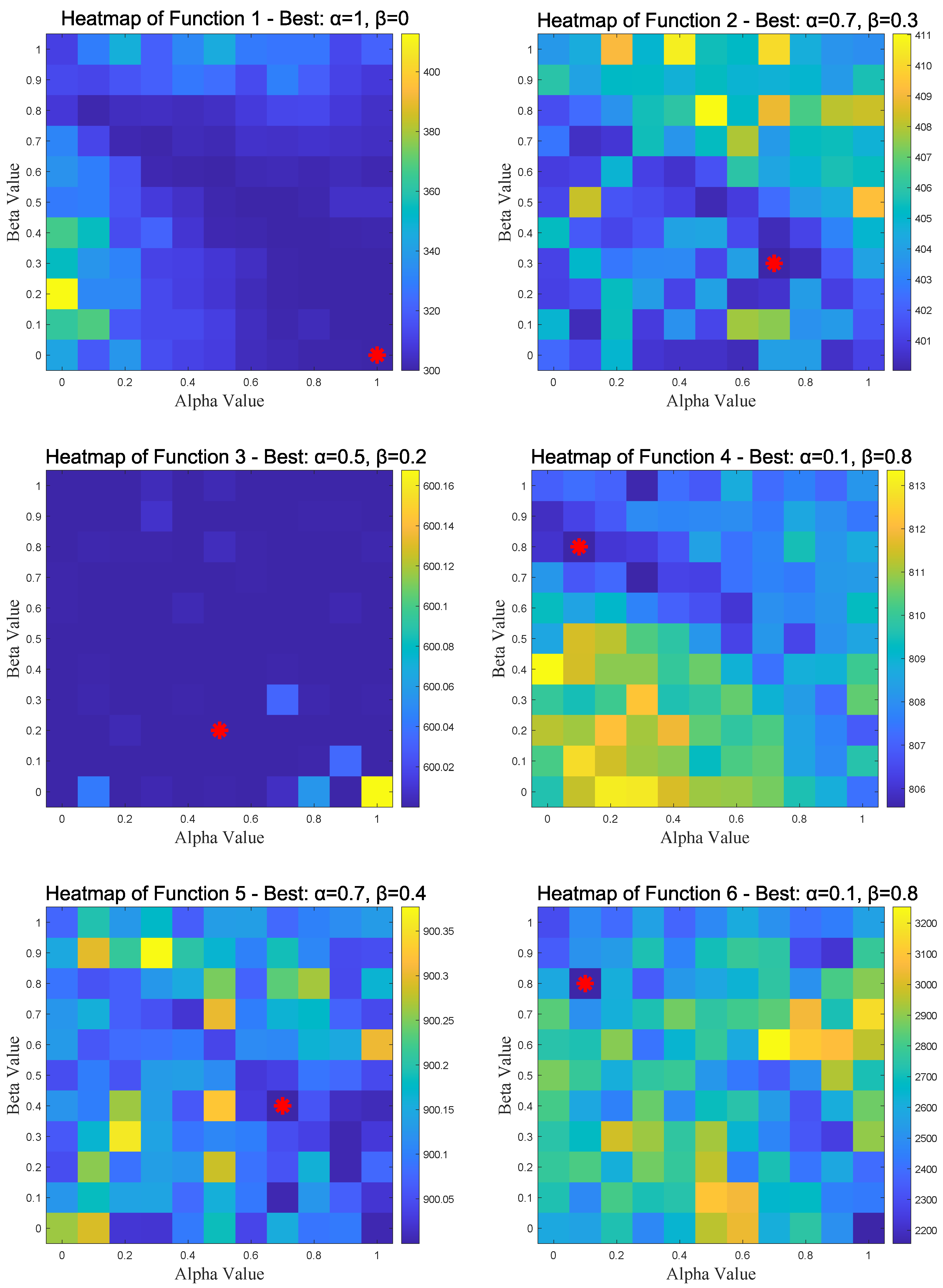
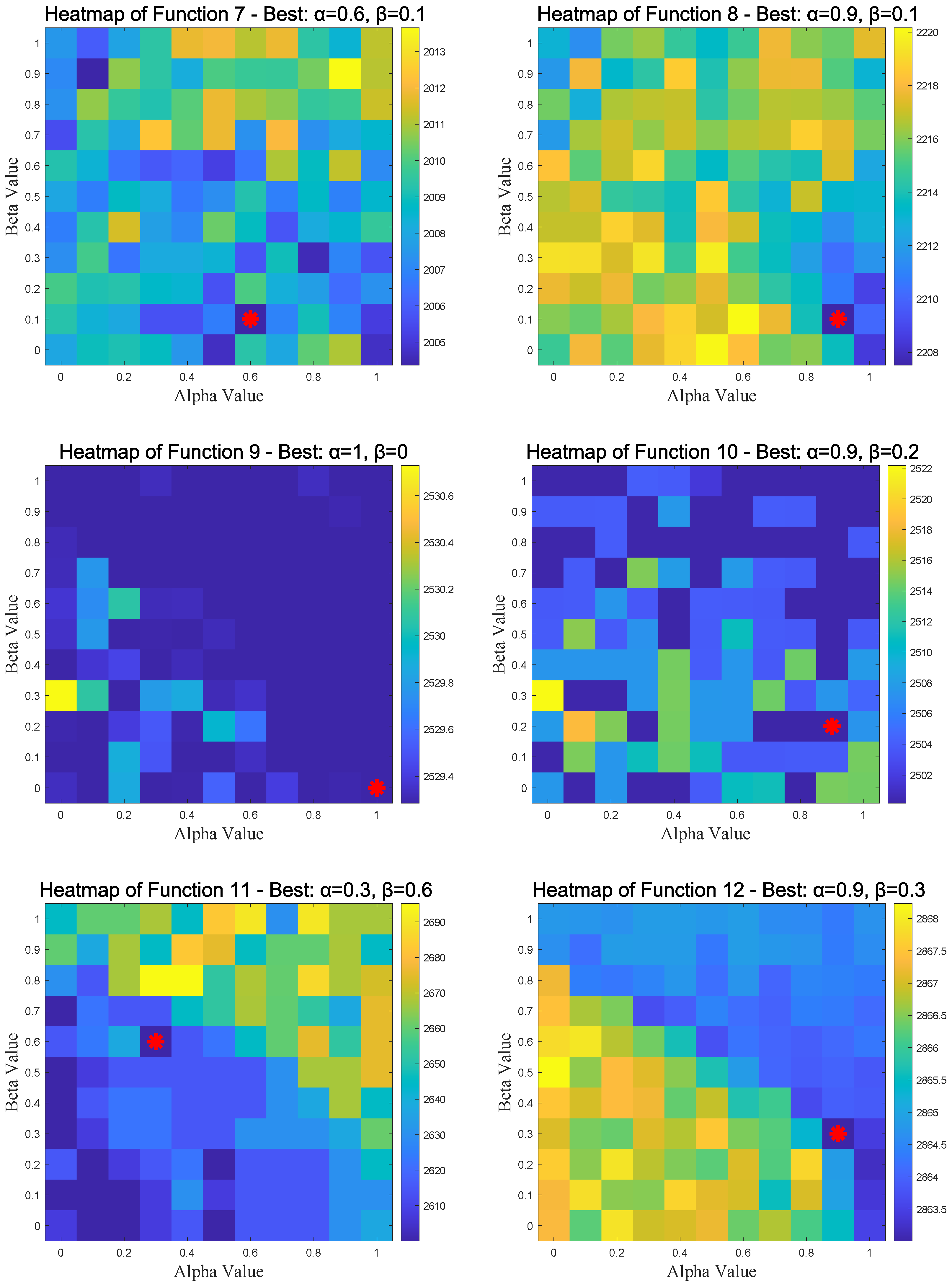
Figure A2.
Heatmap of Functions 7–12.
Appendix B
Table A3.
Results of the truncation depth analysis for Functions 1–6.
Table A4.
Results of the truncation depth analysis for Functions 7–12.
Figure A3.
Convergencecurve of Functions 1–6.
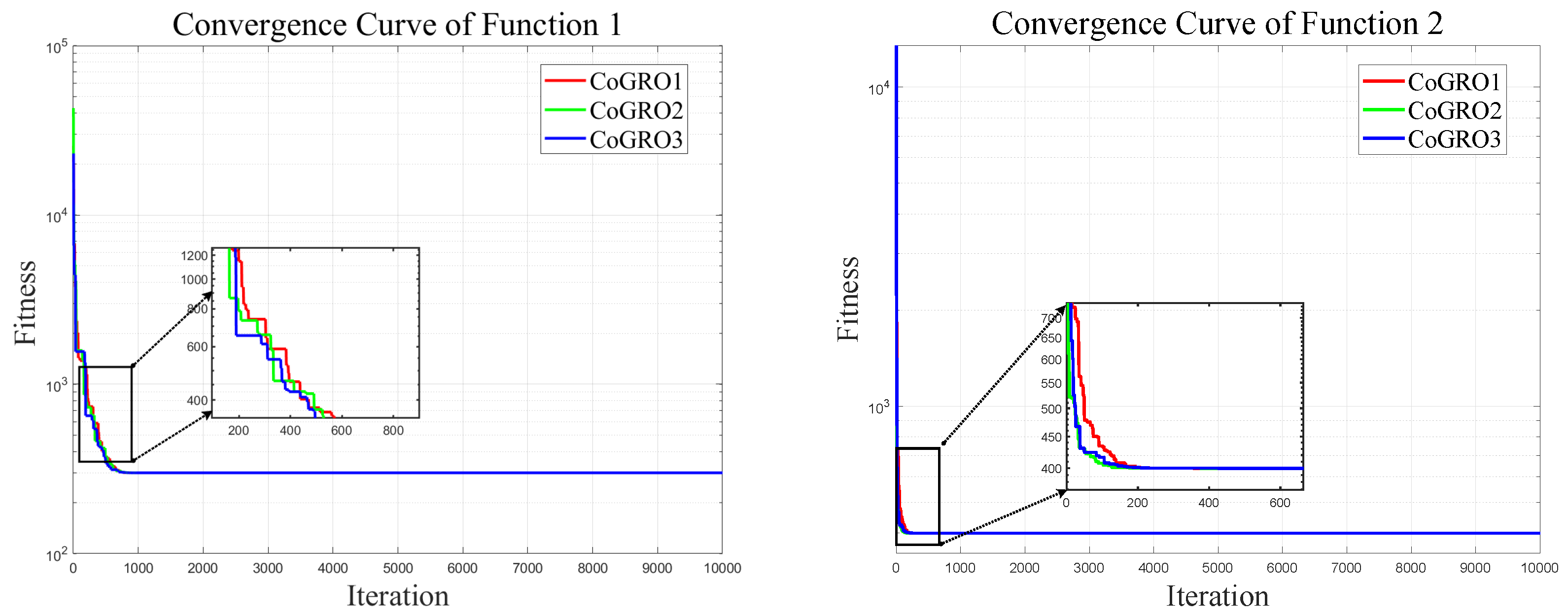
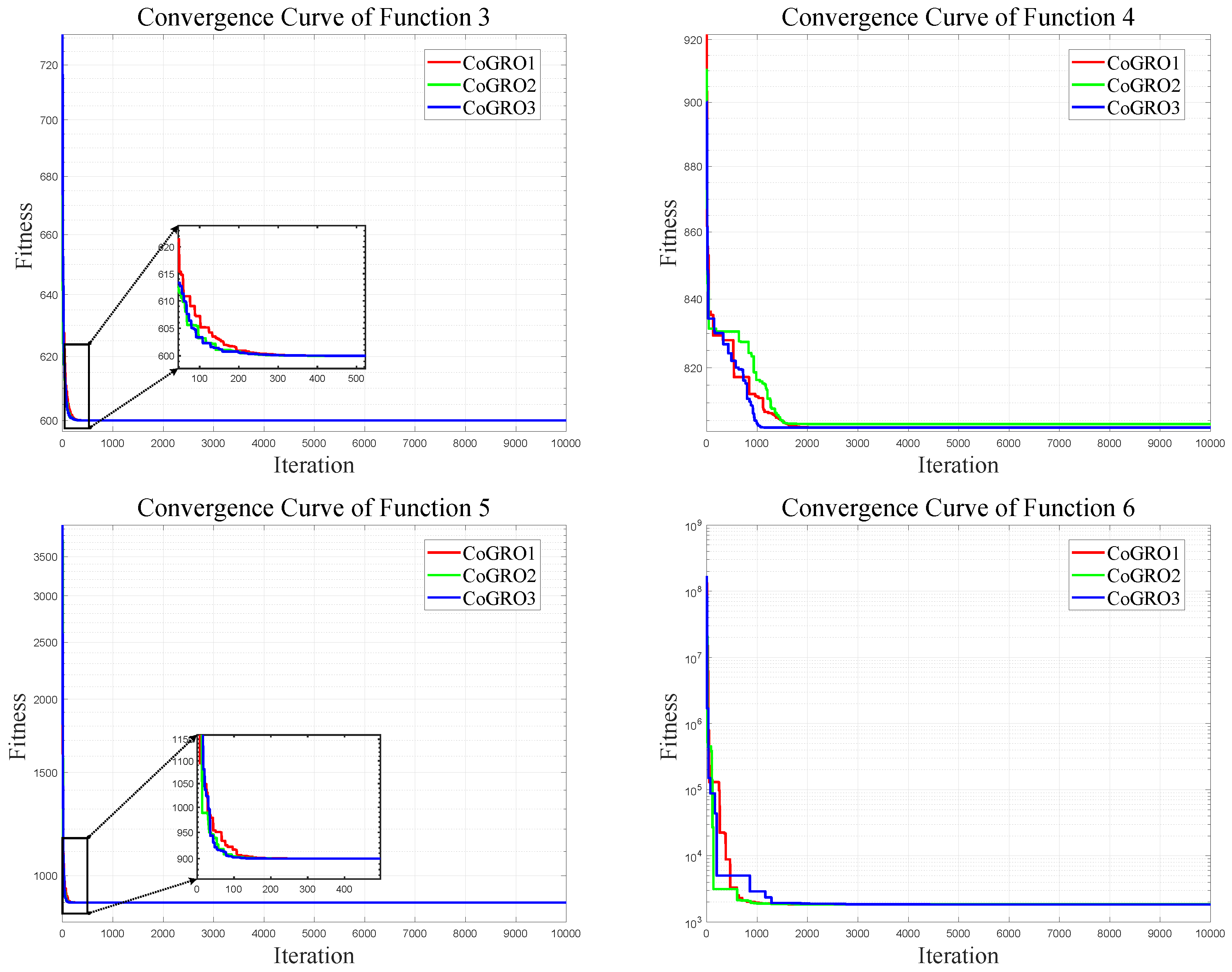
Figure A4.
Convergencecurve of Functions 7–12.
Appendix C
Table A5.
Results of the ablation study for Functions 1–6.
Table A6.
Results of the ablation study for Functions 7–12.
Appendix D
Table A7.
Comparison results of Functions 1–12.
Figure A5.
Convergence curve of Functions 1–6.
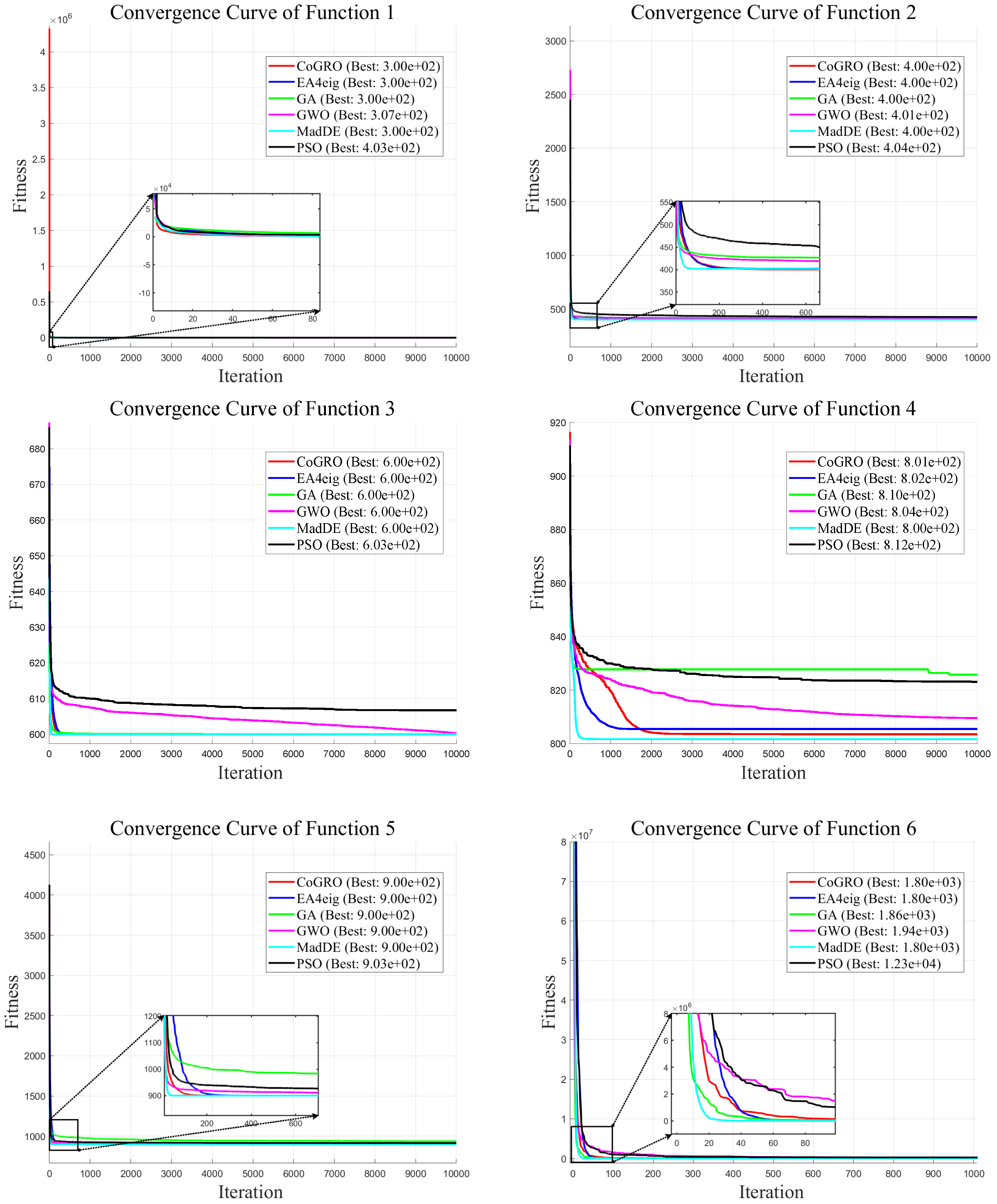
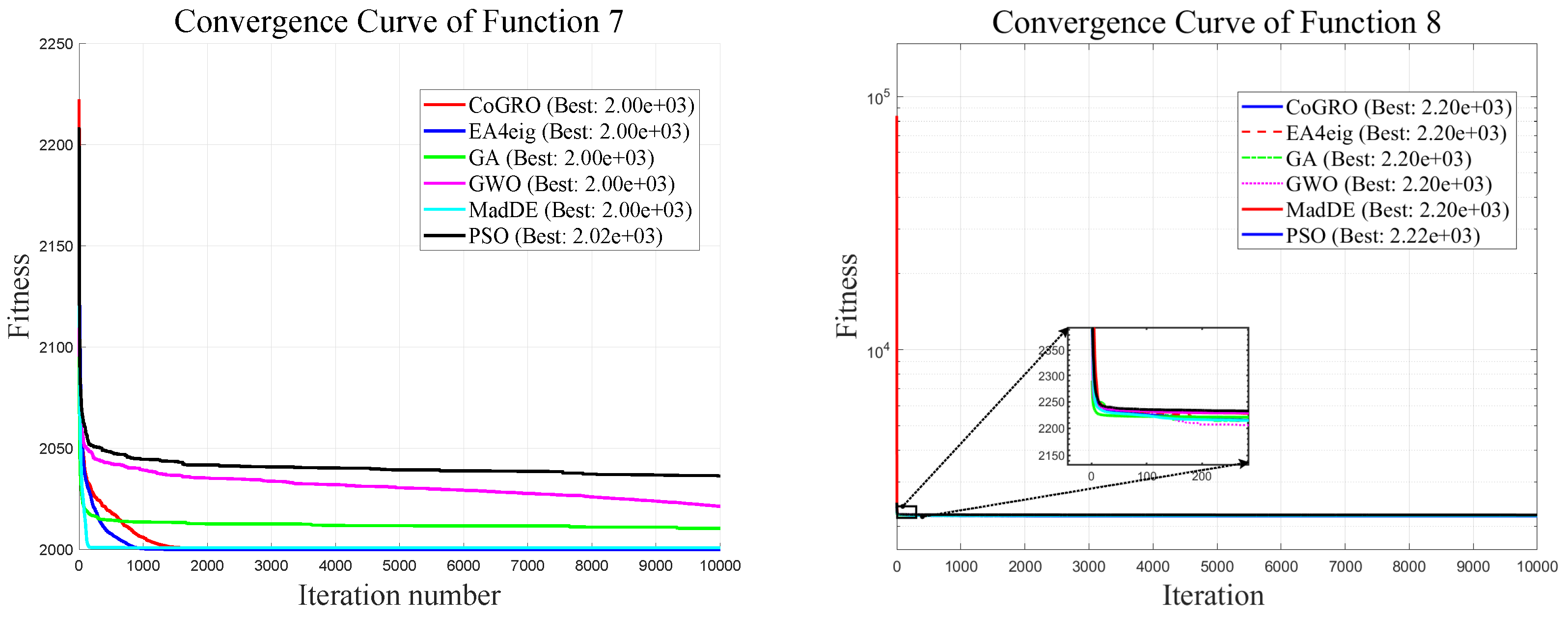
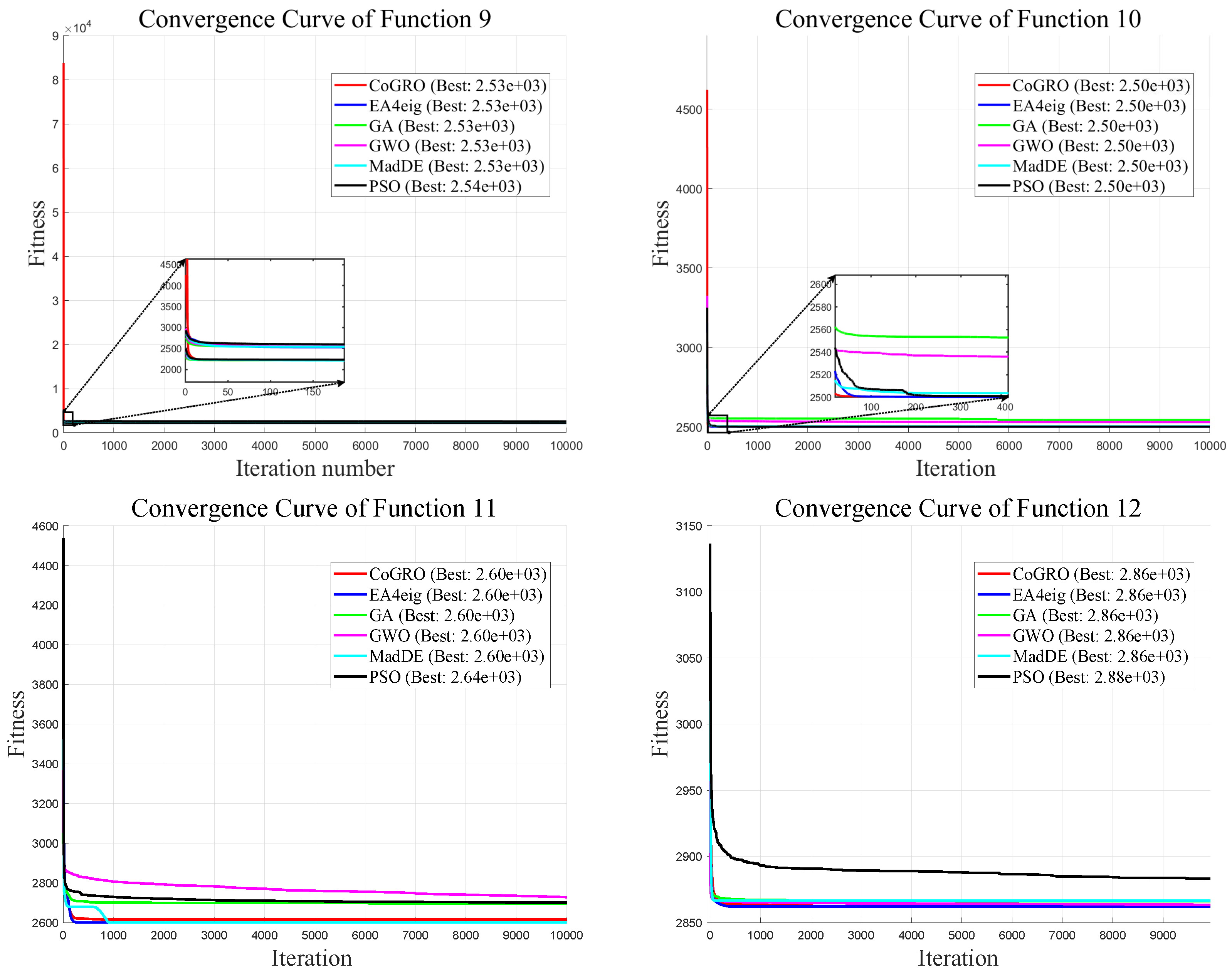
Figure A6.
Convergence curve of Functions 7–12.
References
- Al-Terkawi, L. Survey on distributed parallel genetic algorithms for large-scale data analysis. Computing 2026, 108, 6. [Google Scholar] [CrossRef] [Scilit]
- Brest, J.; Sepesy Maučec, M. Comparative study of modern differential evolution algorithms: Perspectives on mechanisms and performance. Mathematics 2025, 13, 1556. [Google Scholar] [CrossRef] [Scilit]
- Lyu, C.; Ma, Z.; Luo, X.; Shi, Y. Dynamic stochastic reorientation particle swarm optimization for adaptive latent factor analysis in high-dimensional sparse matrices. IEEE Trans. Knowl. Data Eng. 2025, 38, 222–234. [Google Scholar] [CrossRef] [Scilit]
- Abir, A.R.; Nayeem, M.A.; Rahman, M.S.; Arefeen, M.A. GTG-ACO: Graph Transformer Guided Ant Colony Optimization for learning heuristics and pheromone dynamics for combinatorial optimization. Swarm Evol. Comput. 2025, 99, 102147. [Google Scholar] [CrossRef] [Scilit]
- Tsoulos, I.G.; Charilogis, V.; Tsalikakis, D. Optimizing the Bounds of Neural Networks Using a Novel Simulated Annealing Method. AppliedMath 2026, 6, 23. [Google Scholar] [CrossRef] [Scilit]
- Hashemi, A.; Dowlatshahi, M.B.; Nezamabadi-Pour, H. Gravitational search algorithm: Theory, literature review, and applications. In Handbook of AI-based Metaheuristics; CRC Press: Boca Raton, FL, USA, 2021; pp. 119–150. [Google Scholar]
- Dastan, M.; Shojaee, S.; Hamzehei-Javaran, S.; Goodarzimehr, V. Hybrid teaching–learning-based optimization for solving engineering and mathematical problems. J. Braz. Soc. Mech. Sci. Eng. 2022, 44, 431. [Google Scholar] [CrossRef] [Scilit]
- Sadeghi Moghadam, M.; Parvin, H.; Bagheri Fard, K.; Yagoubian, S.H. Solving dynamic optimization problems with an Improved Imperialis Competition Algorithm. Signal Data Process. 2025, 22, 3–30. [Google Scholar] [CrossRef] [Scilit]
- Zolfi, K. Gold rush optimizer: A new population-based metaheuristic algorithm. Oper. Res. Decis. 2023, 33, 113–150. [Google Scholar] [CrossRef] [Scilit]
- Zhang, Y.; Adegboye, O.R.; Feda, A.K.; Agyekum, E.B.; Kumar, P. Dynamic gold rush optimizer: Fusing worker adaptation and salp navigation mechanism for enhanced search. Sci. Rep. 2025, 15, 15779. [Google Scholar] [CrossRef] [Scilit]
- Abaeifar, A.; Barati, H.; Tavakoli, A.R. Inertia-weight local-search-based TLBO algorithm for energy management in isolated micro-grids with renewable resources. Int. J. Electr. Power Energy Syst. 2022, 137, 107877. [Google Scholar] [CrossRef] [Scilit]
- Tang, Y.; Zhou, F. An improved imperialist competition algorithm with adaptive differential mutation assimilation strategy for function optimization. Expert Syst. Appl. 2023, 211, 118686. [Google Scholar] [CrossRef] [Scilit]
- Mohd Tumari, M.Z.; Ahmad, M.A.; Suid, M.H.; Ghazali, M.R.; Tokhi, M.O. An improved marine predators algorithm tuned data-driven multiple-node hormone regulation neuroendocrine-PID controller for multi-input–multi-output gantry crane system. J. Low. Freq. Noise Vib. Act. Control 2023, 42, 1666–1698. [Google Scholar] [CrossRef] [Scilit]
- Weng, X.; Xuan, P.; Heidari, A.A.; Cai, Z.; Chen, H.; Mansour, R.F.; Ragab, M. A vertical and horizontal crossover sine cosine algorithm with pattern search for optimal power flow in power systems. Energy 2023, 271, 127000. [Google Scholar] [CrossRef] [Scilit]
- Suid, M.; Ahmad, M. A novel hybrid of nonlinear sine cosine algorithm and safe experimentation dynamics for model order reduction. Autom. ČAsopis Za Autom. Mjer. Elektron. Računarstvo I Komun. 2023, 64, 34–50. [Google Scholar] [CrossRef] [Scilit]
- Połap, D.; Woźniak, M. Polar bear optimization algorithm: Meta-heuristic with fast population movement and dynamic birth and death mechanism. Symmetry 2017, 9, 203. [Google Scholar] [CrossRef] [Scilit]
- Chen, L.; Wu, X.; Lopes, A.M.; Wang, D.; Gu, P.; Zhu, M.; Chen, Y. Complex-Order Quantum-Behaved Particle Swarm Optimization with Double Jump-Out Strategy. IEEE Trans. Emerg. Top. Comput. Intell. 2025, 9, 3469–3487. [Google Scholar] [CrossRef] [Scilit]
- Machado, J.T.; Pahnehkolaei, S.M.A.; Alfi, A. Complex-order particle swarm optimization. Commun. Nonlinear Sci. Numer. Simul. 2021, 92, 105448. [Google Scholar] [CrossRef] [Scilit]
- Pahnehkolaei, S.M.A.; Alfi, A.; Machado, J.T. Particle swarm optimization algorithm using complex-order derivative concept: A comprehensive study. Appl. Soft Comput. 2021, 111, 107641. [Google Scholar] [CrossRef] [Scilit]
- Liu, W.; Dou, Z.; Yan, Y.; Zhou, T.; Chen, J. Research on Optimal Scheduling of the Combined Cooling, Heating, and Power Microgrid Based on Improved Gold Rush Optimization Algorithm. Electronics 2025, 14, 3135. [Google Scholar] [CrossRef] [Scilit]
- Peng, W.; Wu, R.; Wang, Y.; Wang, J. Improved Egret Swarm Optimization Algorithm with mixed multi-strategy for system evaluation. Math. Comput. Simul. 2026, 243, 362–381. [Google Scholar] [CrossRef] [Scilit]
- Lan, L.; Qi, Z. An enhanced parrot optimizer with multiple strategies for wireless sensor network node deployment. Sci. Rep. 2026, 16, 1285. [Google Scholar] [CrossRef] [Scilit]
- Tao, P.; Aihara, K.; Chen, L. Brain-Inspired Chaotic Graph Backpropagation for Combinatorial Optimization. In IEEE Transactions on Neural Networks and Learning Systems; IEEE: New York, NY, USA, 2026; pp. 1–13. [Google Scholar]
- Choi, H.; Kim, G.; Song, H.Y.; Shin, S.; Lee, C.; Noh, H. Some New Maximally Chaotic Discrete Maps. Entropy 2026, 28, 131. [Google Scholar] [CrossRef] [Scilit]
- Htiti, M.; Akharraz, I.; Ahaitouf, A. A novel one-dimensional chaotic map with improved sine map dynamics. Int. J. Electr. Comput. Eng. 2025, 15, 2128. [Google Scholar] [CrossRef] [Scilit]
- Serbet, F.; Kaya, T. New comparative approach to multi-level thresholding: Chaotically initialized adaptive meta-heuristic optimization methods. Neural Comput. Appl. 2025, 37, 8371–8396. [Google Scholar]
- Lawnik, M. Generation of Numbers with the Distribution Close to Uniform with the Use of Chaotic Maps. In International Conference on Simulation and Modeling Methodologies, Technologies and Applications; SCITEPRESS: Setúbal, Portugal, 2014; Volume 2, pp. 451–455. [Google Scholar]
- Anikin, V.; Arkadaksky, S.S.; Kuptsov, S.; Remizov, A.; Vasilenko, L. Lyapunov exponent for chaotic 1D maps with uniform invariant distribution. Bull. Russ. Acad. Sci. Phys. 2008, 72, 1684–1688. [Google Scholar] [CrossRef] [Scilit]
- Drmota, M.; Tichy, R.F. Sequences, Discrepancies and Applications; Springer: Berlin/Heidelberg, Germany, 2006. [Google Scholar]
- Yousri, D.; Abd Elaziz, M.; Oliva, D.; Abraham, A.; Alotaibi, M.A.; Hossain, M.A. Fractional-order comprehensive learning marine predators algorithm for global optimization and feature selection. Knowl.-Based Syst. 2022, 235, 107603. [Google Scholar] [CrossRef] [Scilit]
- Fernandez, E.; Victor, H.; Isabela, B.; Ricardo, C. The Role of Fractional Calculus in Modern Optimization: A Survey of Algorithms, Applications, and Open Challenges. Mathematics 2025, 13, 3172. [Google Scholar] [CrossRef] [Scilit]
- Yadav, S.K.; Methi, G. Application of fractional differential transform method and Bell polynomial for solving system of fractional delay differential equations. Partial Differ. Equ. Appl. Math. 2024, 12, 100971. [Google Scholar] [CrossRef] [Scilit]
- Brociek, R.; Goik, M.; Miarka, J.; Pleszczynski, M.; Napoli, C. Solution of inverse problem for diffusion equation with fractional derivatives using metaheuristic optimization algorithm. Informatica 2024, 35, 453–481. [Google Scholar] [CrossRef] [Scilit]

Disclaimer/Publisher’s Note: The statements, opinions and data contained in all publications are solely those of the individual author(s) and contributor(s) and not of MDPI and/or the editor(s). MDPI and/or the editor(s) disclaim responsibility for any injury to people or property resulting from any ideas, methods, instructions or products referred to in the content. |
© 2026 by the authors. Licensee MDPI, Basel, Switzerland. This article is an open access article distributed under the terms and conditions of the Creative Commons Attribution (CC BY) license.