
From Interfaces to Networks: Energetic Control of Specificity in Bacterial Two-Component Systems


 , and
, and
Abstract
1. Introduction
2. Materials and Methods
2.1. Identification of Two-Component Systems in Actinobacillus pleuropneumoniae
2.2. Computational Analyses of Cognate Orthologue Systems
2.2.1. Dataset Construction and MSA Processing
2.2.2. Coevolution Computation
2.3. Protein–Protein Interface and Specificity-Determining Amino Acids
2.3.1. Structural Modeling and Interface Definition
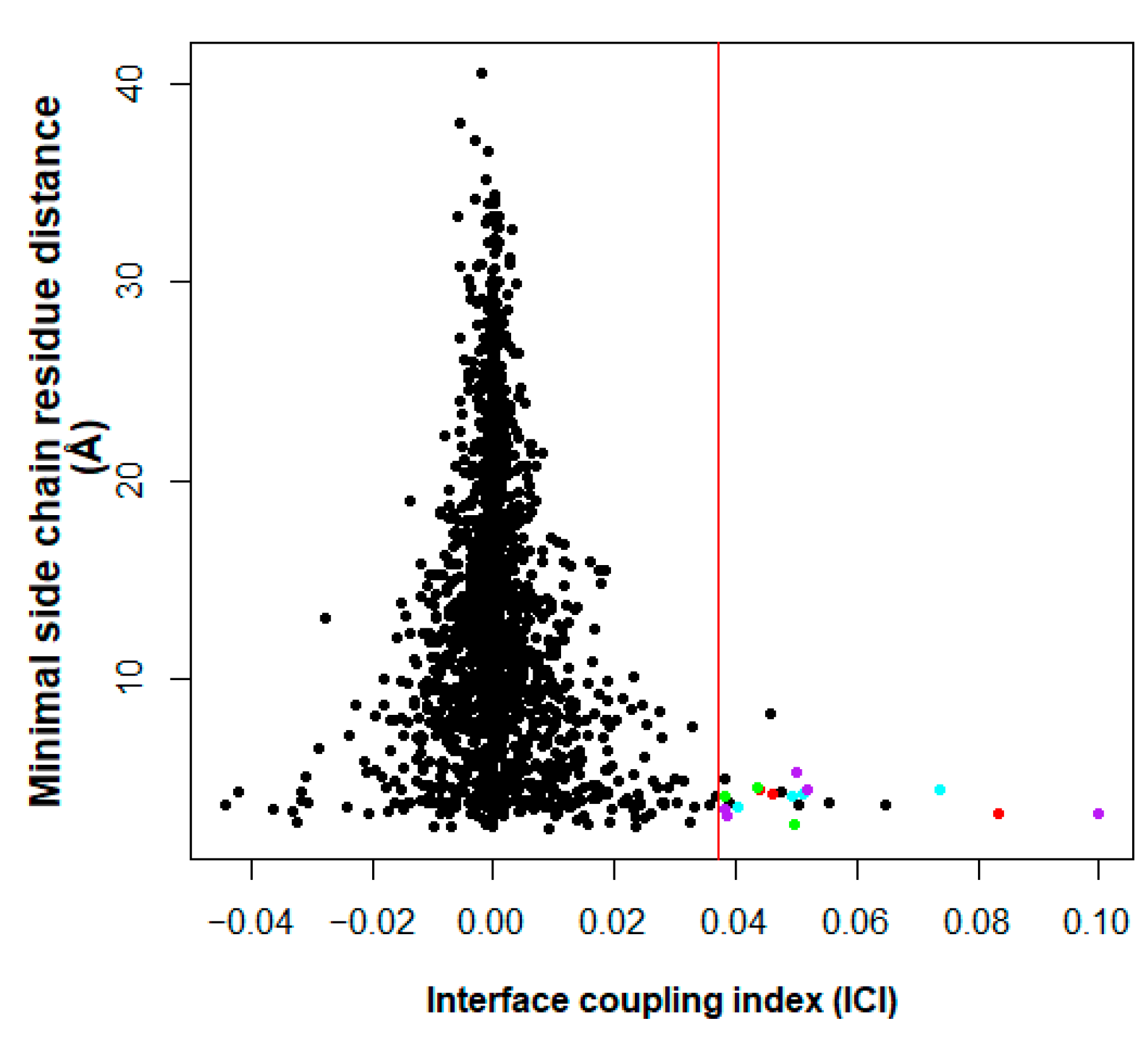
2.3.2. Interface Coupling Index (ICI)
2.4. Free Energy Calculation Using Umbrella Sampling
2.4.1. System Setup and Equilibration
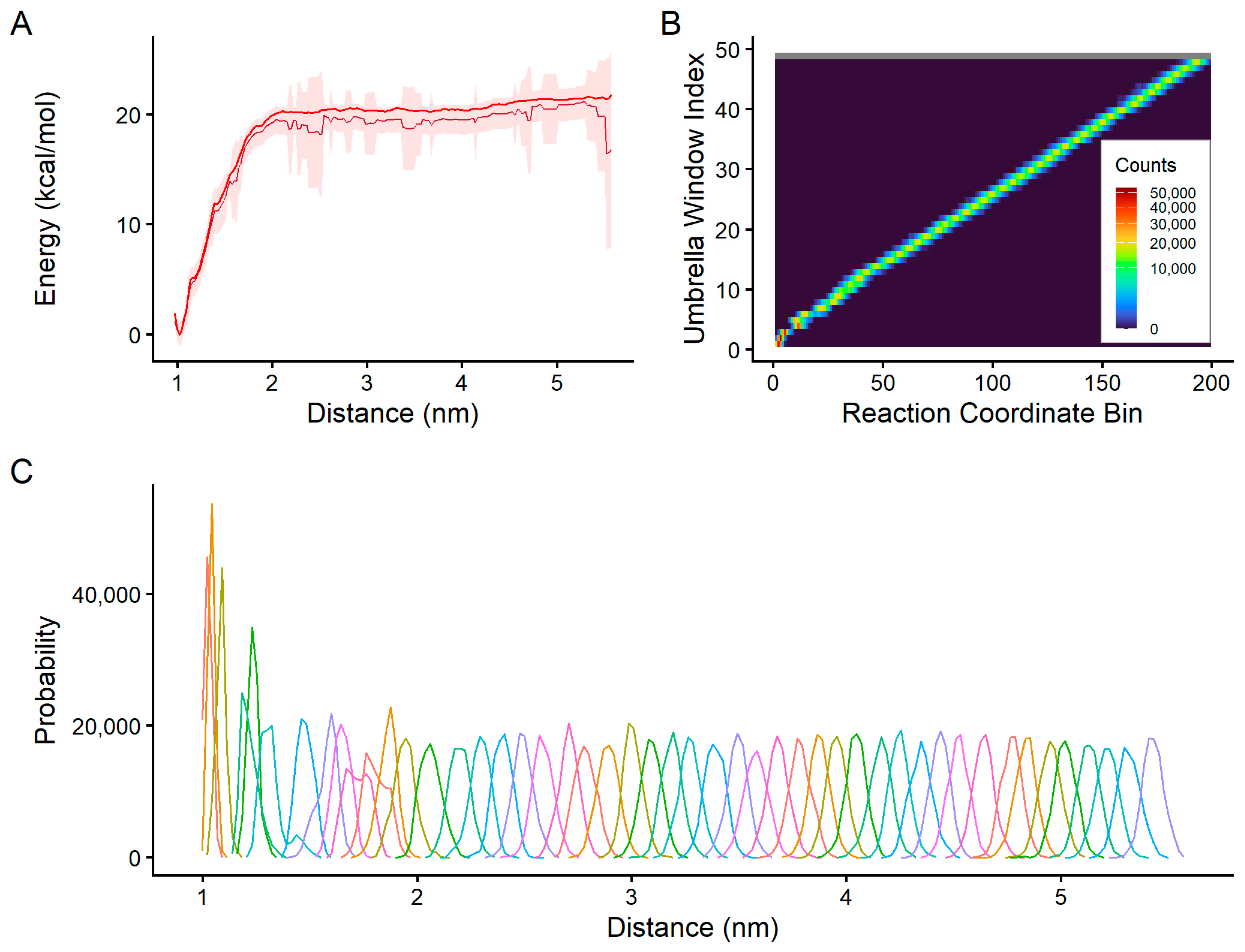
2.4.2. Umbrella Sampling and Potential Mean Force Reconstruction
3. Results
3.1. Two-Component Systems in Actinobacillus pleuropneumoniae
3.2. Specificity-Determining Amino Acids in Interaction Interfaces
3.3. Binding Energy of Wildtype and Mutant Cognate Systems from OISC
3.4. Non-Cognate Interaction Binding Energies of Wildtype Proteins
4. Discussion
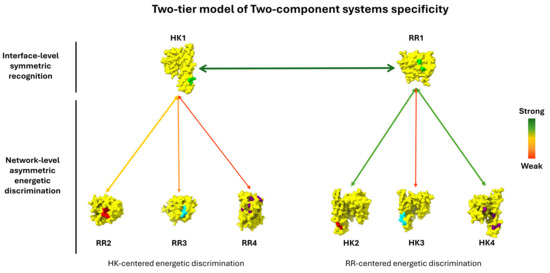
4.1. Interface-Level Discrimination and Symmetric Molecular Recognition
4.2. Network-Level Asymmetric Discrimination
4.3. Interplay Between Interface Symmetry and Network-Level Asymmetry
4.4. OISC and System-Wide Network Discrimination
4.5. TCSs’ Discrimination in Actinobacillus pleuropneumoniae
4.6. Limitations and Interpretation of Energetic Modeling
4.7. Implications for Network-Level Specificity and Future Directions
4.8. Similar Works
5. Conclusions
Supplementary Materials
Author Contributions
Funding
Data Availability Statement
Acknowledgments
Conflicts of Interest
Abbreviations
| App | Actinobacillus pleuropneumoniae |
| NAD | Nicotinamide adenine dinucleotide |
| TCS | Two-component system |
| HK | Histidine kinase |
| RR | Response regulator |
| DHp | Dimerization and histidine phosphotransfer |
| CA | Catalytic and ATP-binding |
| REC | Receiver domain |
| HPt | Histidine phosphotransfer domain |
| MSA | Multiple sequence alignment |
| MII | Modeled interaction interface |
| MI | Mutual information |
| MIp | Mutual information with average product correction |
| wMIp | Weighted mutual information |
| amd | Adjusted minimal distance |
| ICI | Interface coupling index |
| OISC | Orthologue interface specificity core |
| MD | Molecular dynamics |
| US | Umbrella sampling |
| WHAM | Weighted histogram analysis method |
| PMF | Potential mean force |
References
- Dubreuil, J.D.; Jacques, M.; Mittal, K.R.; Gottschalk, M. Actinobacillus pleuropneumoniae Surface Polysaccharides: Their Role in Diagnosis and Immunogenicity. Anim. Health Res. Rev. 2000, 1, 73–93. [Google Scholar] [CrossRef]
- Chiers, K.; De Waele, T.; Pasmans, F.; Ducatelle, R.; Haesebrouck, F. Virulence Factors of Actinobacillus pleuropneumoniae Involved in Colonization, Persistence and Induction of Lesions in Its Porcine Host. Vet. Res. 2010, 41, 65. [Google Scholar] [CrossRef]
- Hathroubi, S.; Fontaine-Gosselin, S.-È.; Tremblay, Y.D.N.; Labrie, J.; Jacques, M. Sub-Inhibitory Concentrations of Penicillin G Induce Biofilm Formation by Field Isolates of Actinobacillus pleuropneumoniae. Vet. Microbiol. 2015, 179, 277–286. [Google Scholar] [CrossRef]
- Sassu, E.L.; Bossé, J.T.; Tobias, T.J.; Gottschalk, M.; Langford, P.R.; Hennig-Pauka, I. Update on Actinobacillus pleuropneumoniae -Knowledge, Gaps and Challenges. Transbound. Emerg. Dis. 2018, 65, 72–90. [Google Scholar] [CrossRef] [PubMed]
- Soto Perezchica, M.M.; Guerrero Barrera, A.L.; Avelar Gonzalez, F.J.; Quezada Tristan, T.; Macias Marin, O. Actinobacillus pleuropneumoniae, Surface Proteins and Virulence: A Review. Front. Vet. Sci. 2023, 10, 1276712. [Google Scholar] [CrossRef]
- Foote, S.J.; Bossé, J.T.; Bouevitch, A.B.; Langford, P.R.; Young, N.M.; Nash, J.H.E. The Complete Genome Sequence of Actinobacillus pleuropneumoniae L20 (Serotype 5b). J. Bacteriol. 2008, 190, 1495–1496. [Google Scholar] [CrossRef]
- Xu, Z.; Zhou, Y.; Li, L.; Zhou, R.; Xiao, S.; Wan, Y.; Zhang, S.; Wang, K.; Li, W.; Li, L.; et al. Genome Biology of Actinobacillus pleuropneumoniae JL03, an Isolate of Serotype 3 Prevalent in China. PLoS ONE 2008, 3, e1450. [Google Scholar] [CrossRef] [PubMed]
- Bossé, J.T.; Chaudhuri, R.R.; Li, Y.; Leanse, L.G.; Fernandez Crespo, R.; Coupland, P.; Holden, M.T.G.; Bazzolli, D.M.; Maskell, D.J.; Tucker, A.W.; et al. Complete Genome Sequence of MIDG2331, a Genetically Tractable Serovar 8 Clinical Isolate of Actinobacillus pleuropneumoniae. Genome Announc. 2016, 4, e01667-15. [Google Scholar] [CrossRef]
- Zhan, B.; Angen, Ø.; Hedegaard, J.; Bendixen, C.; Panitz, F. Draft Genome Sequences of Actinobacillus pleuropneumoniae Serotypes 2 and 6. J. Bacteriol. 2010, 192, 5846–5847. [Google Scholar] [CrossRef]
- Xu, Z.; Chen, X.; Li, L.; Li, T.; Wang, S.; Chen, H.; Zhou, R. Comparative Genomic Characterization of Actinobacillus pleuropneumoniae. J. Bacteriol. 2010, 192, 5625–5636. [Google Scholar] [CrossRef]
- Li, G.; Xie, F.; Zhang, Y.; Wang, C. Draft Genome Sequence of Actinobacillus pleuropneumoniae Serotype 7 Strain S-8. J. Bacteriol. 2012, 194, 6606–6607. [Google Scholar] [CrossRef]
- Pereira, M.F.; Rossi, C.C.; De Carvalho, F.M.; De Almeida, L.G.P.; Souza, R.C.; De Vasconcelos, A.T.R.; Bazzolli, D.M.S. Draft Genome Sequences of Six Actinobacillus pleuropneumoniae Serotype 8 Brazilian Clinical Isolates: Insight into New Applications. Genome Announc. 2015, 3, e01585-14. [Google Scholar] [CrossRef]
- Donà, V.; Perreten, V. Comparative Genomics of the First and Complete Genome of “Actinobacillus porcitonsillarum” Supports the Novel Species Hypothesis. Int. J. Genom. 2018, 2018, 5261719. [Google Scholar] [CrossRef] [PubMed]
- Buettner, F.F.R.; Bendallah, I.M.; Bosse, J.T.; Dreckmann, K.; Nash, J.H.E.; Langford, P.R.; Gerlach, G.-F. Analysis of the Actinobacillus pleuropneumoniae ArcA Regulon Identifies Fumarate Reductase as a Determinant of Virulence. Infect. Immun. 2008, 76, 2284–2295. [Google Scholar] [CrossRef] [PubMed]
- Buettner, F.F.R.; Maas, A.; Gerlach, G.-F. An Actinobacillus pleuropneumoniae arcA Deletion Mutant Is Attenuated and Deficient in Biofilm Formation. Vet. Microbiol. 2008, 127, 106–115. [Google Scholar] [CrossRef] [PubMed]
- Liu, J.; Hu, L.; Xu, Z.; Tan, C.; Yuan, F.; Fu, S.; Cheng, H.; Chen, H.; Bei, W. Actinobacillus pleuropneumoniae Two-Component System QseB/QseC Regulates the Transcription of PilM, an Important Determinant of Bacterial Adherence and Virulence. Vet. Microbiol. 2015, 177, 184–192. [Google Scholar] [CrossRef]
- Auger, E.; Deslandes, V.; Ramjeet, M.; Contreras, I.; Nash, J.H.E.; Harel, J.; Gottschalk, M.; Olivier, M.; Jacques, M. Host-Pathogen Interactions of Actinobacillus pleuropneumoniae with Porcine Lung and Tracheal Epithelial Cells. Infect. Immun. 2009, 77, 1426–1441. [Google Scholar] [CrossRef]
- Deslandes, V.; Denicourt, M.; Girard, C.; Harel, J.; Nash, J.H.; Jacques, M. Transcriptional Profiling of Actinobacillus pleuropneumoniae during the Acute Phase of a Natural Infection in Pigs. BMC Genom. 2010, 11, 98. [Google Scholar] [CrossRef]
- Li, H.; Liu, F.; Peng, W.; Yan, K.; Zhao, H.; Liu, T.; Cheng, H.; Chang, P.; Yuan, F.; Chen, H.; et al. The CpxA/CpxR Two-Component System Affects Biofilm Formation and Virulence in Actinobacillus pleuropneumoniae. Front. Cell. Infect. Microbiol. 2018, 8, 72. [Google Scholar] [CrossRef]
- Yan, K.; Liu, T.; Duan, B.; Liu, F.; Cao, M.; Peng, W.; Dai, Q.; Chen, H.; Yuan, F.; Bei, W. The CpxAR Two-Component System Contributes to Growth, Stress Resistance, and Virulence of Actinobacillus pleuropneumoniae by Upregulating wecA Transcription. Front. Microbiol. 2020, 11, 1026. [Google Scholar] [CrossRef]
- Liu, F.; Yao, Q.; Huang, J.; Wan, J.; Xie, T.; Gao, X.; Sun, D.; Zhang, F.; Bei, W.; Lei, L. The Two-Component System CpxA/CpxR Is Critical for Full Virulence in Actinobacillus pleuropneumoniae. Front. Microbiol. 2022, 13, 1029426. [Google Scholar] [CrossRef]
- Liu, F.; Peng, W.; Yan, K.; Huang, J.; Yuan, F.; He, Q.; Chen, H.; Bei, W. CpxAR of Actinobacillus pleuropneumoniae Contributes to Heat Stress Response by Repressing Expression of Type IV Pilus Gene apfA. Microbiol. Spectr. 2022, 10, e02523-22. [Google Scholar] [CrossRef]
- Wan, J.; Zhang, R.; Jia, Y.; Xie, T.; Dai, L.; Yao, Q.; Zhang, W.; Xiao, H.; Gao, X.; Huang, J.; et al. The Two-Component System CpxAR Is Required for the High Potassium Stress Survival of Actinobacillus pleuropneumoniae. Front. Microbiol. 2023, 14, 1259935. [Google Scholar] [CrossRef] [PubMed]
- Zhang, Q.; Tang, H.; Yan, C.; Han, W.; Peng, L.; Xu, J.; Chen, X.; Langford, P.R.; Bei, W.; Huang, Q.; et al. The Metabolic Adaptation in Response to Nitrate Is Critical for Actinobacillus pleuropneumoniae Growth and Pathogenicity under the Regulation of NarQ/P. Infect. Immun. 2022, 90, e00239-22. [Google Scholar] [CrossRef] [PubMed]
- Zhang, Q.; Huang, Q.; Fang, Q.; Li, H.; Tang, H.; Zou, G.; Wang, D.; Li, S.; Bei, W.; Chen, H.; et al. Identification of Genes Regulated by the Two-Component System Response Regulator NarP of Actinobacillus pleuropneumoniae via DNA-Affinity-Purified Sequencing. Microbiol. Res. 2020, 230, 126343. [Google Scholar] [CrossRef] [PubMed]
- Li, L.; Zhu, J.; Yang, K.; Xu, Z.; Liu, Z.; Zhou, R. Changes in Gene Expression of Actinobacillus pleuropneumoniae in Response to Anaerobic Stress Reveal Induction of Central Metabolism and Biofilm Formation. J. Microbiol. 2014, 52, 473–481. [Google Scholar] [CrossRef]
- Li, L.; Xu, Z.; Zhou, Y.; Sun, L.; Liu, Z.; Chen, H.; Zhou, R. Global Effects of Catecholamines on Actinobacillus pleuropneumoniae Gene Expression. PLoS ONE 2012, 7, e31121. [Google Scholar] [CrossRef]
- Duan, B.; Peng, W.; Yan, K.; Liu, F.; Tang, J.; Yang, F.; Chen, H.; Yuan, F.; Bei, W. The QseB/QseC Two-Component System Contributes to Virulence of Actinobacillus pleuropneumoniae by Downregulating Apf Gene Cluster Transcription. Anim. Dis. 2022, 2, 2. [Google Scholar] [CrossRef]
- Yao, Q.; Xie, T.; Fu, Y.; Wan, J.; Zhang, W.; Gao, X.; Huang, J.; Sun, D.; Zhang, F.; Bei, W.; et al. The CpxA/CpxR Two-Component System Mediates Regulation of Actinobacillus pleuropneumoniae Cold Growth. Front. Microbiol. 2022, 13, 1079390. [Google Scholar] [CrossRef]
- Stock, J.B.; Stock, A.M.; Mottonen, J.M. Signal Transduction in Bacteria. Nature 1990, 344, 395–400. [Google Scholar] [CrossRef]
- Stock, A.M.; Robinson, V.L.; Goudreau, P.N. Two-Component Signal Transduction. Annu. Rev. Biochem. 2000, 69, 183–215. [Google Scholar] [CrossRef]
- Skerker, J.M.; Perchuk, B.S.; Siryaporn, A.; Lubin, E.A.; Ashenberg, O.; Goulian, M.; Laub, M.T. Rewiring the Specificity of Two-Component Signal Transduction Systems. Cell 2008, 133, 1043–1054. [Google Scholar] [CrossRef]
- Dunn, S.D.; Wahl, L.M.; Gloor, G.B. Mutual Information without the Influence of Phylogeny or Entropy Dramatically Improves Residue Contact Prediction. Bioinformatics 2008, 24, 333–340. [Google Scholar] [CrossRef] [PubMed]
- Jung, K.; Fried, L.; Behr, S.; Heermann, R. Histidine Kinases and Response Regulators in Networks. Curr. Opin. Microbiol. 2012, 15, 118–124. [Google Scholar] [CrossRef]
- Salazar, M.E.; Laub, M.T. Temporal and Evolutionary Dynamics of Two-Component Signaling Pathways. Curr. Opin. Microbiol. 2015, 24, 7–14. [Google Scholar] [CrossRef] [PubMed]
- Podgornaia, A.I.; Laub, M.T. Determinants of Specificity in Two-Component Signal Transduction. Curr. Opin. Microbiol. 2013, 16, 156–162. [Google Scholar] [CrossRef]
- Grebe, T.W.; Stock, J.B. The Histidine Protein Kinase Superfamily. In Advances in Microbial Physiology; Elsevier: Amsterdam, The Netherlands, 1999; Volume 41, pp. 139–227. ISBN 978-0-12-027741-4. [Google Scholar]
- Tremblay, Y.D.; Lévesque, C.; Segers, R.P.; Jacques, M. Method to Grow Actinobacillus pleuropneumoniae biofilm on a Biotic Surface. BMC Vet. Res. 2013, 9, 213. [Google Scholar] [CrossRef] [PubMed]
- Loera-Muro, V.M.; Jacques, M.; Tremblay, Y.D.N.; Avelar-González, F.J.; Loera Muro, A.; Ramírez-López, E.M.; Medina-Figueroa, A.; González-Reynaga, H.M.; Guerrero-Barrera, A.L. Detection of Actinobacillus pleuropneumoniae in Drinking Water from Pig Farms. Microbiology 2013, 159, 536–544. [Google Scholar] [CrossRef]
- Loera-Muro, A.; Avelar-González, F.J.; Loera-Muro, V.M.; Jacques, M.; Guerrero-Barrera, A.L. Presence of Actinobacillus pleuropneumoniae, Streptococcus suis, Pasteurella multocida, Bordetella bronchiseptica, Haemophilus parasuis and Mycoplasma hyopneumoniae; in Upper Respiratory Tract of Swine in Farms from Aguascalientes, Mexico. Open J. Anim. Sci. 2013, 3, 132–137. [Google Scholar] [CrossRef][Green Version]
- Loera-Muro, A.; Ramírez-Castillo, F.Y.; Moreno-Flores, A.C.; Martin, E.M.; Avelar-González, F.J.; Guerrero-Barrera, A.L. Actinobacillus pleuropneumoniae Surviving on Environmental Multi-Species Biofilms in Swine Farms. Front. Vet. Sci. 2021, 8, 722683. [Google Scholar] [CrossRef]
- Labrie, J.; Pelletier-Jacques, G.; Deslandes, V.; Ramjeet, M.; Auger, E.; Nash, J.H.E.; Jacques, M. Effects of Growth Conditions on Biofilm Formation by Actinobacillus pleuropneumoniae. Vet. Res. 2010, 41, 3. [Google Scholar] [CrossRef]
- Bossé, J.T.; Janson, H.; Sheehan, B.J.; Beddek, A.J.; Rycroft, A.N.; Simon Kroll, J.; Langford, P.R. Actinobacillus pleuropneumoniae: Pathobiology and Pathogenesis of Infection. Microbes Infect. 2002, 4, 225–235. [Google Scholar] [CrossRef] [PubMed]
- Jacques, M. Surface Polysaccharides and Iron-Uptake Systems of Actinobacillus pleuropneumoniae. Can. J. Vet. Res. 2004, 68, 81. [Google Scholar]
- Hälli, O.; Ala-Kurikka, E.; Wallgren, P.; Heinonen, M. Actinobacillus pleuropneumoniae Seroprevalence in Farmed Wild Boars in Finland. J. Zoo Wildl. Med. 2014, 45, 813–818. [Google Scholar] [CrossRef] [PubMed]
- Reiner, G.; Fresen, C.; Bronnert, S.; Haack, I.; Willems, H. Prevalence of Actinobacillus pleuropneumoniae Infection in Hunted Wild Boars (Sus Scrofa) in Germany. J. Wildl. Dis. 2010, 46, 551–555. [Google Scholar] [CrossRef][Green Version]
- Szurmant, H.; Bobay, B.G.; White, R.A.; Sullivan, D.M.; Thompson, R.J.; Hwa, T.; Hoch, J.A.; Cavanagh, J. Co-Evolving Motions at Protein−Protein Interfaces of Two-Component Signaling Systems Identified by Covariance Analysis. Biochemistry 2008, 47, 7782–7784. [Google Scholar] [CrossRef] [PubMed]
- Weigt, M.; White, R.A.; Szurmant, H.; Hoch, J.A.; Hwa, T. Identification of Direct Residue Contacts in Protein–Protein Interaction by Message Passing. Proc. Natl. Acad. Sci. USA 2009, 106, 67–72. [Google Scholar] [CrossRef]
- Burger, L.; Van Nimwegen, E. Accurate Prediction of Protein–Protein Interactions from Sequence Alignments Using a Bayesian Method. Mol. Syst. Biol. 2008, 4, 165. [Google Scholar] [CrossRef]
- Hopf, T.A.; Schärfe, C.P.I.; Rodrigues, J.P.G.L.M.; Green, A.G.; Kohlbacher, O.; Sander, C.; Bonvin, A.M.J.J.; Marks, D.S. Sequence Co-Evolution Gives 3D Contacts and Structures of Protein Complexes. eLife 2014, 3, e03430. [Google Scholar] [CrossRef]
- Ovchinnikov, S.; Kamisetty, H.; Baker, D. Robust and Accurate Prediction of Residue–Residue Interactions across Protein Interfaces Using Evolutionary Information. eLife 2014, 3, e02030. [Google Scholar] [CrossRef]
- Capra, E.J.; Perchuk, B.S.; Skerker, J.M.; Laub, M.T. Adaptive Mutations That Prevent Crosstalk Enable the Expansion of Paralogous Signaling Protein Families. Cell 2012, 150, 222–232. [Google Scholar] [CrossRef]
- Aakre, C.D.; Herrou, J.; Phung, T.N.; Perchuk, B.S.; Crosson, S.; Laub, M.T. Evolving New Protein-Protein Interaction Specificity through Promiscuous Intermediates. Cell 2015, 163, 594–606. [Google Scholar] [CrossRef] [PubMed]
- Capra, E.J.; Perchuk, B.S.; Lubin, E.A.; Ashenberg, O.; Skerker, J.M.; Laub, M.T. Systematic Dissection and Trajectory-Scanning Mutagenesis of the Molecular Interface That Ensures Specificity of Two-Component Signaling Pathways. PLoS Genet. 2010, 6, e1001220. [Google Scholar] [CrossRef]
- Capra, E.J.; Perchuk, B.S.; Ashenberg, O.; Seid, C.A.; Snow, H.R.; Skerker, J.M.; Laub, M.T. Spatial Tethering of Kinases to Their Substrates Relaxes Evolutionary Constraints on Specificity. Mol. Microbiol. 2012, 86, 1393–1403. [Google Scholar] [CrossRef] [PubMed]
- Stewart, R.C. Protein Histidine Kinases: Assembly of Active Sites and Their Regulation in Signaling Pathways. Curr. Opin. Microbiol. 2010, 13, 133–141. [Google Scholar] [CrossRef] [PubMed]
- Casino, P.; Rubio, V.; Marina, A. Structural Insight into Partner Specificity and Phosphoryl Transfer in Two-Component Signal Transduction. Cell 2009, 139, 325–336. [Google Scholar] [CrossRef]
- Mack, T.R.; Gao, R.; Stock, A.M. Probing the Roles of the Two Different Dimers Mediated by the Receiver Domain of the Response Regulator PhoB. J. Mol. Biol. 2009, 389, 349–364. [Google Scholar] [CrossRef]
- Galperin, M.Y. Diversity of Structure and Function of Response Regulator Output Domains. Curr. Opin. Microbiol. 2010, 13, 150–159. [Google Scholar] [CrossRef]
- Bourret, R.B. Receiver Domain Structure and Function in Response Regulator Proteins. Curr. Opin. Microbiol. 2010, 13, 142–149. [Google Scholar] [CrossRef]
- Marchler-Bauer, A.; Lu, S.; Anderson, J.B.; Chitsaz, F.; Derbyshire, M.K.; DeWeese-Scott, C.; Fong, J.H.; Geer, L.Y.; Geer, R.C.; Gonzales, N.R.; et al. CDD: A Conserved Domain Database for the Functional Annotation of Proteins. Nucleic Acids Res. 2011, 39, D225–D229. [Google Scholar] [CrossRef]
- Rangwala, S.H.; Kuznetsov, A.; Ananiev, V.; Asztalos, A.; Borodin, E.; Evgeniev, V.; Joukov, V.; Lotov, V.; Pannu, R.; Rudnev, D.; et al. Accessing NCBI Data Using the NCBI Sequence Viewer and Genome Data Viewer (GDV). Genome Res. 2021, 31, 159–169. [Google Scholar] [CrossRef]
- Capra, E.J.; Laub, M.T. Evolution of Two-Component Signal Transduction Systems. Annu. Rev. Microbiol. 2012, 66, 325–347. [Google Scholar] [CrossRef]
- Podgornaia, A.I.; Casino, P.; Marina, A.; Laub, M.T. Structural Basis of a Rationally Rewired Protein-Protein Interface Critical to Bacterial Signaling. Structure 2013, 21, 1636–1647. [Google Scholar] [CrossRef]
- Noriega, C.E.; Schmidt, R.; Gray, M.J.; Chen, L.-L.; Stewart, V. Autophosphorylation and Dephosphorylation by Soluble Forms of the Nitrate-Responsive Sensors NarX and NarQ from Escherichia coli K-12. J. Bacteriol. 2008, 190, 3869–3876. [Google Scholar] [CrossRef] [PubMed]
- Noriega, C.E.; Lin, H.; Chen, L.; Williams, S.B.; Stewart, V. Asymmetric Cross-regulation between the Nitrate-responsive NarX–NarL and NarQ–NarP Two-component Regulatory Systems from Escherichia coli K-12. Mol. Microbiol. 2010, 75, 394–412. [Google Scholar] [CrossRef] [PubMed]
- Waterhouse, A.M.; Procter, J.B.; Martin, D.M.A.; Clamp, M.; Barton, G.J. Jalview Version 2—A Multiple Sequence Alignment Editor and Analysis Workbench. Bioinformatics 2009, 25, 1189–1191. [Google Scholar] [CrossRef]
- Sievers, F.; Wilm, A.; Dineen, D.; Gibson, T.J.; Karplus, K.; Li, W.; Lopez, R.; McWilliam, H.; Remmert, M.; Söding, J.; et al. Fast, Scalable Generation of High-quality Protein Multiple Sequence Alignments Using Clustal Omega. Mol. Syst. Biol. 2011, 7, 539. [Google Scholar] [CrossRef]
- Senior, A.W.; Evans, R.; Jumper, J.; Kirkpatrick, J.; Sifre, L.; Green, T.; Qin, C.; Žídek, A.; Nelson, A.W.R.; Bridgland, A.; et al. Improved Protein Structure Prediction Using Potentials from Deep Learning. Nature 2020, 577, 706–710. [Google Scholar] [CrossRef] [PubMed]
- Yang, J.; Anishchenko, I.; Park, H.; Peng, Z.; Ovchinnikov, S.; Baker, D. Improved Protein Structure Prediction Using Predicted Interresidue Orientations. Proc. Natl. Acad. Sci. USA 2020, 117, 1496–1503. [Google Scholar] [CrossRef]
- Jumper, J.; Evans, R.; Pritzel, A.; Green, T.; Figurnov, M.; Ronneberger, O.; Tunyasuvunakool, K.; Bates, R.; Žídek, A.; Potapenko, A.; et al. Highly Accurate Protein Structure Prediction with AlphaFold. Nature 2021, 596, 583–589. [Google Scholar] [CrossRef]
- Evans, R.; O’Neill, M.; Pritzel, A.; Antropova, N.; Senior, A.; Green, T.; Žídek, A.; Bates, R.; Blackwell, S.; Yim, J.; et al. Protein Complex Prediction with AlphaFold-Multimer. bioRxiv 2021. [Google Scholar] [CrossRef]
- Pettersen, E.F.; Goddard, T.D.; Huang, C.C.; Meng, E.C.; Couch, G.S.; Croll, T.I.; Morris, J.H.; Ferrin, T.E. UCSF ChimeraX: Structure Visualization for Researchers, Educators, and Developers. Protein Sci. 2021, 30, 70–82. [Google Scholar] [CrossRef]
- Berendsen, H.J.C.; Postma, J.P.M.; Van Gunsteren, W.F.; Hermans, J. Interaction Models for Water in Relation to Protein Hydration. In Intermolecular Forces; Pullman, B., Ed.; The Jerusalem Symposia on Quantum Chemistry and Biochemistry; Springer: Dordrecht, The Netherlands, 1981; Volume 14, pp. 331–342. ISBN 978-90-481-8368-5. [Google Scholar]
- Robertson, M.J.; Tirado-Rives, J.; Jorgensen, W.L. Improved Peptide and Protein Torsional Energetics with the OPLS-AA Force Field. J. Chem. Theory Comput. 2015, 11, 3499–3509. [Google Scholar] [CrossRef]
- Dodda, L.S.; Cabeza de Vaca, I.; Tirado-Rives, J.; Jorgensen, W.L. LigParGen Web Server: An Automatic OPLS-AA Parameter Generator for Organic Ligands. Nucleic Acids Res. 2017, 45, W331–W336. [Google Scholar] [CrossRef] [PubMed]
- Páll, S.; Zhmurov, A.; Bauer, P.; Abraham, M.; Lundborg, M.; Gray, A.; Hess, B.; Lindahl, E. Heterogeneous Parallelization and Acceleration of Molecular Dynamics Simulations in GROMACS. J. Chem. Phys. 2020, 153, 134110. [Google Scholar] [CrossRef]
- Sawitzki, G. Computational Statistics; Chapman and Hall/CRC: Boca Raton, FL, USA, 2009; ISBN 978-1-4200-8681-2. [Google Scholar]
- Crooks, G.E.; Hon, G.; Chandonia, J.-M.; Brenner, S.E. WebLogo: A Sequence Logo Generator: Figure 1. Genome Res. 2004, 14, 1188–1190. [Google Scholar] [CrossRef]
- Honorato, R.V.; Trellet, M.E.; Jiménez-García, B.; Schaarschmidt, J.J.; Giulini, M.; Reys, V.; Koukos, P.I.; Rodrigues, J.P.G.L.M.; Karaca, E.; Van Zundert, G.C.P.; et al. The HADDOCK2.4 Web Server for Integrative Modeling of Biomolecular Complexes. Nat. Protoc. 2024, 19, 3219–3241. [Google Scholar] [CrossRef]
- Lemkul, J.A.; Bevan, D.R. Assessing the Stability of Alzheimer’s Amyloid Protofibrils Using Molecular Dynamics. J. Phys. Chem. B 2010, 114, 1652–1660. [Google Scholar] [CrossRef] [PubMed]
- Hub, J.S.; De Groot, B.L. Does CO2 Permeate through Aquaporin-1? Biophys. J. 2006, 91, 842–848. [Google Scholar] [CrossRef]
- Hub, J.S.; De Groot, B.L.; Van Der Spoel, D. G_wham—A Free Weighted Histogram Analysis Implementation Including Robust Error and Autocorrelation Estimates. J. Chem. Theory Comput. 2010, 6, 3713–3720. [Google Scholar] [CrossRef]
- Seshasayee, A.S.; Bertone, P.; Fraser, G.M.; Luscombe, N.M. Transcriptional Regulatory Networks in Bacteria: From Input Signals to Output Responses. Curr. Opin. Microbiol. 2006, 9, 511–519. [Google Scholar] [CrossRef]
- Goulian, M. Two-Component Signaling Circuit Structure and Properties. Curr. Opin. Microbiol. 2010, 13, 184–189. [Google Scholar] [CrossRef]
- Van Dijk, A.D.J.; Bonvin, A.M.J.J. Solvated Docking: Introducing Water into the Modelling of Biomolecular Complexes. Bioinformatics 2006, 22, 2340–2347. [Google Scholar] [CrossRef]
- Kastritis, P.L.; Visscher, K.M.; Van Dijk, A.D.J.; Bonvin, A.M.J.J. Solvated Protein–Protein Docking Using Kyte-Doolittle-based Water Preferences. Proteins Struct. Funct. Bioinforma. 2013, 81, 510–518. [Google Scholar] [CrossRef] [PubMed]
- Fisher, S.L.; Jiang, W.; Wanner, B.L.; Walsh, C.T. Cross-Talk between the Histidine Protein Kinase VanS and the Response Regulator PhoB. J. Biol. Chem. 1995, 270, 23143–23149. [Google Scholar] [CrossRef]
- Gao, R.; Stock, A.M. Molecular Strategies for Phosphorylation-Mediated Regulation of Response Regulator Activity. Curr. Opin. Microbiol. 2010, 13, 160–167. [Google Scholar] [CrossRef]
- Huynh, T.N.; Stewart, V. Negative Control in Two-Component Signal Transduction by Transmitter Phosphatase Activity: Transmitter Phosphatase in Two-Component Signalling. Mol. Microbiol. 2011, 82, 275–286. [Google Scholar] [CrossRef] [PubMed]
- Laub, M.T.; Goulian, M. Specificity in Two-Component Signal Transduction Pathways. Annu. Rev. Genet. 2007, 41, 121–145. [Google Scholar] [CrossRef]
- Siryaporn, A.; Perchuk, B.S.; Laub, M.T.; Goulian, M. Evolving a Robust Signal Transduction Pathway from Weak Cross-talk. Mol. Syst. Biol. 2010, 6, 452. [Google Scholar] [CrossRef] [PubMed]
- Huynh, T.N.; Chen, L.-L.; Stewart, V. Sensor–Response Regulator Interactions in a Cross-Regulated Signal Transduction Network. Microbiology 2015, 161, 1504–1515. [Google Scholar] [CrossRef]
- Typas, A.; Sourjik, V. Bacterial Protein Networks: Properties and Functions. Nat. Rev. Microbiol. 2015, 13, 559–572. [Google Scholar] [CrossRef] [PubMed]
- Jensen, R.B.; Wang, S.C.; Shapiro, L. Dynamic Localization of Proteins and DNA during a Bacterial Cell Cycle. Nat. Rev. Mol. Cell Biol. 2002, 3, 167–176. [Google Scholar] [CrossRef]
- Ryan, K.R.; Shapiro, L. Temporal and Spatial Regulation in Prokaryotic Cell Cycle Progression and Development. Annu. Rev. Biochem. 2003, 72, 367–394. [Google Scholar] [CrossRef]
- Batchelor, E.; Goulian, M. Imaging OmpR Localization in Escherichia coli. Mol. Microbiol. 2006, 59, 1767–1778. [Google Scholar] [CrossRef] [PubMed]
- Sourjik, V.; Armitage, J.P. Spatial Organization in Bacterial Chemotaxis. EMBO J. 2010, 29, 2724–2733. [Google Scholar] [CrossRef]
- Di Ventura, B.; Sourjik, V. Self-organized Partitioning of Dynamically Localized Proteins in Bacterial Cell Division. Mol. Syst. Biol. 2011, 7, 457. [Google Scholar] [CrossRef]
- Sommer, E.; Koler, M.; Frank, V.; Sourjik, V.; Vaknin, A. The Sensory Histidine Kinases TorS and EvgS Tend to Form Clusters in Escherichia coli Cells. PLoS ONE 2013, 8, e77708. [Google Scholar] [CrossRef]
- Siryaporn, A.; Goulian, M. Cross-talk Suppression between the CpxA–CpxR and EnvZ–OmpR Two-component Systems in E. coli. Mol. Microbiol. 2008, 70, 494–506. [Google Scholar] [CrossRef]
- Laub, M.T.; Biondi, E.G.; Skerker, J.M. Phosphotransfer Profiling: Systematic Mapping of Two-Component Signal Transduction Pathways and Phosphorelays. In Methods in Enzymology; Elsevier: Amsterdam, The Netherlands, 2007; Volume 423, pp. 531–548. ISBN 978-0-12-373852-3. [Google Scholar]
- Procaccini, A.; Lunt, B.; Szurmant, H.; Hwa, T.; Weigt, M. Dissecting the Specificity of Protein-Protein Interaction in Bacterial Two-Component Signaling: Orphans and Crosstalks. PLoS ONE 2011, 6, e19729. [Google Scholar] [CrossRef] [PubMed]
- Guckes, K.R.; Kostakioti, M.; Breland, E.J.; Gu, A.P.; Shaffer, C.L.; Martinez, C.R.; Hultgren, S.J.; Hadjifrangiskou, M. Strong Cross-System Interactions Drive the Activation of the QseB Response Regulator in the Absence of Its Cognate Sensor. Proc. Natl. Acad. Sci. USA 2013, 110, 16592–16597. [Google Scholar] [CrossRef]
- Lukat, G.S.; Stock, A.M.; Stock, J.B. Divalent Metal Ion Binding to the CheY Protein and Its Significance to Phosphotransfer in Bacterial Chemotaxis. Biochemistry 1990, 29, 5436–5442. [Google Scholar] [CrossRef]
- Needham, J.V.; Chen, T.Y.; Falke, J.J. Novel Ion Specificity of a Carboxylate Cluster Magnesium(II) Binding Site: Strong Charge Selectivity and Weak Size Selectivity. Biochemistry 1993, 32, 3363–3367. [Google Scholar] [CrossRef]
- Lamarche, M.G.; Wanner, B.L.; Crépin, S.; Harel, J. The Phosphate Regulon and Bacterial Virulence: A Regulatory Network Connecting Phosphate Homeostasis and Pathogenesis. FEMS Microbiol. Rev. 2008, 32, 461–473. [Google Scholar] [CrossRef]
- Crépin, S.; Chekabab, S.-M.; Le Bihan, G.; Bertrand, N.; Dozois, C.M.; Harel, J. The Pho Regulon and the Pathogenesis of Escherichia coli. Vet. Microbiol. 2011, 153, 82–88. [Google Scholar] [CrossRef]
- Santos-Beneit, F. The Pho Regulon: A Huge Regulatory Network in Bacteria. Front. Microbiol. 2015, 6, 402. [Google Scholar] [CrossRef]
- Rowland, M.A.; Deeds, E.J. Crosstalk and the Evolution of Specificity in Two-Component Signaling. Proc. Natl. Acad. Sci. USA 2014, 111, 5550–5555. [Google Scholar] [CrossRef]
- Barakat, M.; Ortet, P.; Jourlin-Castelli, C.; Ansaldi, M.; Méjean, V.; Whitworth, D.E. P2CS: A Two-Component System Resource for Prokaryotic Signal Transduction Research. BMC Genom. 2009, 10, 315. [Google Scholar] [CrossRef]
- Cai, S.J.; Inouye, M. EnvZ-OmpR Interaction and Osmoregulation in Escherichia coli. J. Biol. Chem. 2002, 277, 24155–24161. [Google Scholar] [CrossRef]
- Yoshida, T.; Cai, S.J.; Inouye, M. Interaction of EnvZ, a Sensory Histidine Kinase, with Phosphorylated OmpR, the Cognate Response Regulator. Mol. Microbiol. 2002, 46, 1283–1294. [Google Scholar] [CrossRef]
- Miyashiro, T.; Goulian, M. Stimulus-Dependent Differential Regulation in the Escherichia coli PhoQ–PhoP System. Proc. Natl. Acad. Sci. USA 2007, 104, 16305–16310. [Google Scholar] [CrossRef]
- Benson, D.A.; Cavanaugh, M.; Clark, K.; Karsch-Mizrachi, I.; Lipman, D.J.; Ostell, J.; Sayers, E.W. GenBank. Nucleic Acids Res. 2012, 41, D36–D42. [Google Scholar] [CrossRef]
- Martin, E.M.; Guerrero-Barrera, A.L.; Avelar-Gonzalez, F.J. Two-Component Systems in Pasteurellaceae and Their Roles in Virulence. Vet. Sci. 2025, 12, 1140. [Google Scholar] [CrossRef]




| MSAax | MSAay | AAx | AAy | MIIrx | MIIry | HKx | RRy | AAx | AAy | ICI | Mean | Distance | |
|---|---|---|---|---|---|---|---|---|---|---|---|---|---|
| SD | Å | ||||||||||||
| CpxAR | 388 | 778 | L | F | 7 | 31 | 266 | 103 | L | F | 0.0439 | 0.0079 | 4.4719 |
| 391 | 692 | A | L | 8 | 23 | 269 | 20 | A | L | 0.0462 | 4.2527 | ||
| 391 | 780 | A | D | 8 | 33 | 269 | 105 | A | D | 0.0835 | 3.2885 | ||
| NarQP | 739 | 1137 | K | D | 6 | 25 | 389 | 108 | K | D | 0.0435 | 0.0104 | 4.5475 |
| 740 | 1140 | I | P | 7 | 27 | 390 | 111 | I | T | 0.0383 | 4.1032 | ||
| 743 | 1140 | Q | P | 8 | 27 | 393 | 111 | S | T | 0.0497 | 2.7145 | ||
| PhoRB | 535 | 937 | T | I | 4 | 13 | 220 | 14 | T | I | 0.0493 | 0.0108 | 4.1379 |
| 536 | 937 | V | I | 5 | 13 | 221 | 14 | V | I | 0.0513 | 4.2781 | ||
| 540 | 940 | Y | M | 8 | 14 | 225 | 17 | Y | M | 0.0737 | 4.4342 | ||
| 543 | 944 | T | N | 10 | 16 | 228 | 21 | L | F | 0.0403 | 3.6431 | ||
| QseCB | 334 | 630 | S | I | 3 | 26 | 253 | 12 | S | I | 0.0518 | 0.0070 | 4.4570 |
| 334 | 674 | S | T | 3 | 32 | 253 | 53 | S | T | 0.0499 | 5.2943 | ||
| 344 | 727 | E | A | 10 | 41 | 263 | 104 | E | A | 0.0993 | 3.2464 | ||
| 345 | 633 | V | G | 11 | 28 | 264 | 15 | I | G | 0.0384 | 3.1168 | ||
| 516 | 677 | P | G | 17 | 28 | 411 | 56 | V | K | 0.0383 | 3.4844 |
| TCS | Windows (n) | ΔG (kcal/mol) | SD (kcal/mol) | ΔΔG (kcal/mol) |
|---|---|---|---|---|
| CpxAR wt | 48 | −21.84 | ±2.16 | +8.19 |
| CpxAR mut | 47 | −13.65 | ±2.84 | |
| NarQP wt | 56 | −24.96 | ±2.81 | +6.19 |
| NarQP mut | 52 | −18.77 | ±2.41 | |
| PhoRB wt | 51 | −20.05 | ±2.67 | +2.09 |
| PhoRB mut | 49 | −17.97 | ±1.66 | |
| QseCB wt | 50 | −17.76 | ±2.23 | −6.87 |
| QseCB mut | 48 | −24.64 | ±3.06 |
| CpxA | NarQ | PhoR | QseC | |
|---|---|---|---|---|
| CpxR | −21.84 ± 2.16 | −15.56 ± 3.17 | −23.63 ± 3.18 | −18.07 ± 2.70 |
| NarP | −18.47 ± 2.43 | −21.83 ± 2.81 | −9.41 ± 1.94 | −18.82 ± 2.45 |
| PhoB | −13.45 ± 3.68 | −10.66 ± 2.58 | −20.05 ± 2.67 | −8.55 ± 2.10 |
| QseB | −11.97 ± 1.82 | −8.29 ± 2.17 | −11.84 ± 2.59 | −17.78 ± 2.23 |
| TCS | OISC | Cognate | Mutation | Network-Level Behavior | |
|---|---|---|---|---|---|
| (Pairs) | Energetics | Effect | HK | RR | |
| CpxAR | 3 | Favorable | Destabilized | Gradually insulated | Permissive |
| NarQP | 3 | Highly favorable | Destabilized | Insulated | Permissive |
| PhoRB | 4 | Favorable | Mild destabilization | Partially insulated | Insulated |
| QseCB | 5 | Less favorable energetics | Stabilized | Permissive | Insulated |
Disclaimer/Publisher’s Note: The statements, opinions and data contained in all publications are solely those of the individual author(s) and contributor(s) and not of MDPI and/or the editor(s). MDPI and/or the editor(s) disclaim responsibility for any injury to people or property resulting from any ideas, methods, instructions or products referred to in the content. |
© 2026 by the authors. Licensee MDPI, Basel, Switzerland. This article is an open access article distributed under the terms and conditions of the Creative Commons Attribution (CC BY) license.
Share and Cite
Martin, E.M.; Guerrero-Barrera, A.L.; Avelar-Gonzalez, F.J.; Salinas-Gutierrez, R.; Jacques, M. From Interfaces to Networks: Energetic Control of Specificity in Bacterial Two-Component Systems. Computation 2026, 14, 123. https://doi.org/10.3390/computation14060123
Martin EM, Guerrero-Barrera AL, Avelar-Gonzalez FJ, Salinas-Gutierrez R, Jacques M. From Interfaces to Networks: Energetic Control of Specificity in Bacterial Two-Component Systems. Computation. 2026; 14(6):123. https://doi.org/10.3390/computation14060123
Chicago/Turabian StyleMartin, Eduardo M., Alma L. Guerrero-Barrera, F. Javier Avelar-Gonzalez, Rogelio Salinas-Gutierrez, and Mario Jacques. 2026. "From Interfaces to Networks: Energetic Control of Specificity in Bacterial Two-Component Systems" Computation 14, no. 6: 123. https://doi.org/10.3390/computation14060123
APA StyleMartin, E. M., Guerrero-Barrera, A. L., Avelar-Gonzalez, F. J., Salinas-Gutierrez, R., & Jacques, M. (2026). From Interfaces to Networks: Energetic Control of Specificity in Bacterial Two-Component Systems. Computation, 14(6), 123. https://doi.org/10.3390/computation14060123