


Abstract
The increasing deployment of off-grid photovoltaic–battery energy storage systems (PV–BESSs) has intensified operational demands on battery energy storage, particularly when second-life lithium-ion batteries are employed. Due to aging-induced increases in internal resistance and reduced thermal margins, second-life batteries are more vulnerable to high-current operation at a low state-of-charge (SOC), which aggravates heat generation and accelerates degradation. In this study, an SOC-dependent soft current limiting strategy is proposed that reshapes the discharge current reference under low-SOC conditions while maintaining fixed SOC limits, thereby targeting current-domain protection rather than SOC-boundary adaptation for reliable off-grid operation. The proposed method introduces two SOC thresholds to gradually derate the allowable discharge current, preventing abrupt current changes near the lower SOC bound. A unified MATLAB/Simulink-based framework is developed for a 24 h representative off-grid PV–BESS scenario using a second-order equivalent circuit model coupled with a lumped thermal model. Simulation results show that the proposed current shaping reduces low-SOC current stress and associated Joule heating, leading to moderated temperature rise, while only slightly affecting the unmet load under the tested conditions. These findings indicate that SOC-dependent current shaping can provide a control-oriented means to reduce low-SOC electro-thermal stress in second-life batteries within the studied off-grid PV–BESS framework.
1. Introduction
The rapid expansion of photovoltaic (PV) generation and residential energy storage has accelerated the deployment of off-grid and weak-grid PV–battery energy storage systems (PV–BESSs), particularly in remote and islanded areas [1,2,3]. Off-grid and weak-grid electrification has become a critical pathway to improve energy access and resilience in remote communities. In such scenarios, the intermittency of renewable generation and the lack of backup infrastructure make supply reliability strongly dependent on battery operation, particularly during prolonged low-irradiance periods. Therefore, battery-aware control is not only a performance issue but also a reliability-limiting factor for off-grid PV–BESS deployment. In this context, second-life lithium-ion batteries retired from electric vehicles are increasingly adopted due to their favorable cost-to-capacity ratio (typically 70–80% SOH) [1,2]. However, their aging-induced rise in resistance and reduced thermal margin make them more vulnerable to high-current operation, especially near low-SOC conditions. Second-life batteries exhibit heterogeneous aging characteristics, elevated internal resistance, and reduced thermal margins, which introduce additional operational challenges for off-grid applications [3].
In off-grid PV–BESSs, the battery operates as the sole energy buffer between intermittent PV generation and stochastic load demand [4,5,6]. As a result, the battery is frequently subjected to high discharge currents during peak load periods, as well as prolonged operation at low state-of-charge (SOC) during extended discharge intervals. For second-life batteries, aging-induced increases in internal resistance further amplify polarization losses and heat generation under high-current conditions, rendering low-SOC operation particularly critical from both thermal and degradation perspectives [7,8]. Without appropriate control, these operating conditions may accelerate capacity fade and compromise system reliability.
Conventional battery management strategies for PV–BESSs commonly rely on fixed SOC operating windows combined with hard current or power limits [9,10]. Fixed SOC windows constrain battery operation within predefined upper and lower bounds, while hard limiting mechanisms abruptly restrict current once a threshold is reached. Although these approaches are simple to implement, they exhibit inherent limitations. Fixed SOC windows do not account for the nonlinear relationship between SOC, terminal voltage, and current stress, especially in low-SOC regions where voltage declines sharply. Hard current limiting further introduces discontinuous control actions, which may lead to power mismatch, reduced load supply continuity, and undesirable transient responses.
Several strategies for alleviating excessive stress near harmful operating regions have been reported, such as adjusting battery operating margins according to temperature, health state, or operating conditions [11,12]. By redefining admissible SOC ranges, such approaches can effectively reduce exposure to unfavorable conditions and mitigate long-term degradation. However, these methods primarily act at the energy management level by modifying SOC boundaries, and they do not explicitly regulate instantaneous current behavior as the battery approaches critical SOC regions. Consequently, pronounced current peaks may still occur near SOC limits under rapidly varying load conditions, particularly for second-life batteries with elevated internal resistance.
More fundamentally, many existing strategies implicitly assume that battery degradation risk is dominated by SOC boundary violations, rather than by the current trajectory within the allowable SOC range. In practice, current-induced losses and heat generation can increase sharply as SOC decreases, even before the lower SOC boundary is reached. This effect is especially pronounced for second-life batteries, where increased internal resistance magnifies Joule losses and thermal accumulation under low-SOC operation [7,8]. These observations indicate that degradation risk is not solely governed by SOC limits but also by how battery current evolves as operation approaches these limits.
Recent studies have highlighted the role of current derating and SOC-aware battery operation in mitigating battery stress in off-grid and stand-alone energy systems [13,14,15]. These studies suggest that battery protection and energy availability are often coupled through operating constraints and control choices. However, the current trajectory shaping behavior near the low-SOC region remains insufficiently discussed, especially for second-life batteries in off-grid PV–BESS applications. In addition, most existing derating strategies are formulated as predefined rules or temperature-triggered reductions, and the resulting current trajectory shaping near the low-SOC region is rarely analyzed in a systematic manner. This limitation is particularly critical for off-grid PV–BESSs, where overly conservative derating may deteriorate supply continuity and increase the energy not supplied (ENS). Moreover, practical guidance on selecting SOC thresholds for progressive derating (i.e., defining a soft-knee region) remains limited for second-life batteries, whose internal resistance and thermal behavior deviate substantially from fresh cells.
Collectively, previous research suggests that battery current evolution in the low-SOC region is an important yet insufficiently examined control dimension, particularly for second-life batteries in off-grid PV–BESSs, where supply reliability must be maintained under elevated electro-thermal stress. This gap motivates the present study. Rather than modifying the admissible SOC window or applying abrupt current cutoffs, the proposed strategy introduces a continuous low-SOC current-shaping mechanism that progressively attenuates the allowable discharge current as SOC decreases. The objective is to reduce current peaks and thermal stress while preserving control smoothness and compatibility with existing fixed-window energy management logic.
Our previous work [16] addressed this application background from a different control perspective by proposing an SOH- and temperature-aware adaptive SOC boundary strategy, in which the admissible SOC operating window was dynamically adjusted according to battery condition. In contrast, the present study retains fixed SOC limits and focuses on current-domain protection by introducing SOC-dependent soft current limiting to regulate the discharge current trajectory within the allowable SOC range. Therefore, the novelty of this work does not lie in redefining SOC boundaries but in explicitly shaping low-SOC discharge current behavior and evaluating its electro-thermal implications under fixed operating limits.
Accordingly, this paper develops an SOC-dependent soft current limiting (SCL) strategy for second-life lithium-ion batteries in off-grid PV–BESSs and evaluates multiple soft-limiting threshold pairs within a unified electro-thermal simulation framework. The main contributions of this work are summarized as follows.
- An SOC-dependent soft current limiting mechanism is proposed to gradually derate the allowable discharge current using two SOC thresholds, enabling smooth current shaping near the lower SOC bound under fixed SOC limits without introducing abrupt transitions.
- A unified simulation framework is established for a representative off-grid PV–BESS scenario over a 24 h profile, enabling comparative evaluation of SOC behavior, battery dispatch, and stress-related indicators under different soft current limiting strategies.
- A comparative evaluation under fixed SOC limits is performed for multiple soft-limiting threshold pairs , explicitly quantifying the protection–availability trade-off using current-related stress/thermal indicators together with the system-level reliability metric (ENS), thereby providing comparative insight into threshold selection within the simulated framework.
The remainder of this paper is organized as follows. Section 2 presents the system configuration and battery modeling framework. Section 3 introduces the proposed soft current limiting strategy and its implementation. Section 4 discusses the simulation setup and comparative results, and Section 5 concludes the paper.
2. System Configuration and Battery Modeling
2.1. Off-Grid PV–BESS Configuration
This work considers a residential-scale off-grid PV–BESS operating under islanded conditions. In contrast to grid-connected configurations, the system has no external grid support and must rely entirely on local photovoltaic generation and on-site energy storage to balance supply and demand. Under such circumstances, the battery functions as the sole energy buffer, absorbing surplus photovoltaic power and compensating for generation shortfalls caused by solar intermittency and load variability [17,18,19].
The system architecture comprises a photovoltaic array, a battery energy storage unit, a direct-current (DC) bus, a bidirectional DC–DC power converter, and an aggregated household load connected through a common DC bus. The photovoltaic array injects power into the DC bus according to irradiance and temperature conditions, while the battery alternates between charging and discharging modes to maintain instantaneous power balance. Owing to the absence of grid support, power mismatches are directly reflected in the battery current, making current dynamics particularly sensitive to photovoltaic fluctuations and load transients [17,18].
In off-grid operation, the battery is frequently subjected to prolonged discharge intervals and repeated exposure to low SOC conditions, especially during periods of limited solar availability [19]. When second-life lithium-ion batteries are employed, these operating characteristics are further intensified by reduced usable capacity and increased internal resistance. Accordingly, battery current behavior under low-SOC conditions is treated as a key factor influencing both system reliability and battery stress.
To ensure a focused assessment of current-related control effects, the SOC operating limits are kept fixed throughout all simulations. This design choice allows the present study to isolate the impact of current shaping near low-SOC regions under consistent SOC operating constraints.
2.2. Battery Electrical Model
The electrical behavior of the second-life lithium-ion battery is represented using an equivalent-circuit-based battery model, which provides an effective compromise between model simplicity and computational efficiency for system-level analysis. ECM-based battery models are widely adopted in energy storage studies and control-oriented simulations, as they are capable of capturing the dominant voltage–current behavior while remaining suitable for long-duration time-domain analysis [20,21]. In the present study, this model is used as a representative control-oriented electrical description for comparative soft current limiting assessment.
In this study, a second-order ECM with two parallel resistor–capacitor (2RC) branches is adopted to describe the battery’s dynamic electrical behavior in a control-oriented manner. This model structure is used to reflect the dominant polarization and voltage relaxation effects of lithium-ion batteries under typical charge–discharge conditions, while avoiding unnecessary complexity for system-level control analysis [22,23]. The adopted formulation is intended to support comparative evaluation of different soft current limiting strategies rather than newly identified pack-specific electrical parameterization.
For control-oriented electrical interpretation, the battery terminal voltage can be written in the following equivalent-circuit form:
where denotes the SOC-dependent open-circuit voltage, is the battery current (defined as positive during discharge), represents the ohmic internal resistance, and denotes the polarization-related voltage component associated with the adopted equivalent-circuit representation [22]. In the present study, the OCV-SOC relationship is not newly identified from dedicated pack-level OCV measurements; instead, it is represented in a simplified literature-consistent manner within the adopted equivalent-circuit formulation for comparative control-oriented simulation.
The SOC evolution is represented using the Coulomb counting relationship:
where denotes the nominal battery capacity. In second-life lithium-ion batteries, the effective usable capacity is reduced compared with fresh cells due to prior service conditions, which in turn affects the allowable discharge behavior and system-level energy buffering capability. In addition, increased resistance-related stress under low-SOC operation is one of the key motivations for the current-shaping strategy examined in this study.
For the short-term comparative simulation horizon considered in this study, the electrical representation is used with fixed and representative parameter settings. Battery aging is therefore not explicitly updated during the simulation. Instead, second-life characteristics are reflected in a simplified manner through reduced nominal capacity, constrained SOC operation, and increased current-related stress sensitivity. This treatment is adopted to support internally consistent comparison among control strategies rather than detailed pack-specific electrical parameter identification.
2.3. Thermal Model and Current-Induced Heat Generation
Thermal behavior plays a critical role in the performance, reliability, and degradation of lithium-ion batteries, particularly for second-life cells with reduced thermal margins. To support a comparative assessment of current-related thermal tendency at the system level, a simplified lumped-parameter thermal model is adopted in this study. Specifically, a first-order formulation is used to represent the dominant temperature response in a control-oriented manner [24,25].
Under this simplified thermal model, the battery temperature response can be described by the following first-order energy-balance form [24,25]:
where denotes the lumped thermal capacitance of the battery, represents the equivalent thermal resistance between the battery and the ambient environment, is the ambient temperature, and denotes the internal heat-generation term in the simplified thermal representation [24]. In general, battery heat generation consists of multiple contributions (e.g., ohmic and polarization losses and, in some cases, reversible entropic heat), with irreversible terms being dominant under typical discharge operation [26,27].
Under the operating conditions considered in this study, the thermal comparison focuses on the dominant irreversible current-related contribution. Therefore, for comparative evaluation, the heat-generation tendency is approximated using Equation (4) [26,27]:
which highlights the quadratic dependence of current-related thermal stress on the battery current. For second-life lithium-ion batteries subject to increased resistance-related stress, identical power demands typically lead to higher currents and thus stronger -related heating tendency, exacerbating thermal stress, particularly in low-SOC operating regions. In the present simplified thermal treatment, reversible entropic heat is not explicitly included, since this treatment is intended primarily for comparative evaluation of current-related thermal tendency rather than detailed absolute temperature prediction.
The adopted thermal treatment is intended to capture relative temperature trends and comparative thermal impacts among different control strategies, rather than to predict absolute temperature limits or thermal runaway behavior. Over the short-term simulation horizon considered, thermal parameters are assumed to remain constant, which is consistent with the objective of isolating current-related control effects in system-level comparative analysis [24,25].
2.4. Modeling Assumptions and Simulation Framework
The overall PV–BESS and battery models are developed in MATLAB/Simulink (R2025b, MathWorks Inc., Natick, MA, USA), providing a unified environment for integrating photovoltaic generation profiles, load demand, electro-thermal battery dynamics, and energy management logic. Such system-level PV–BESS simulation frameworks have been widely adopted for evaluating control strategies in renewable-integrated energy storage systems [28], where simplified electro-thermal battery models are commonly employed to capture thermal behavior and aging-related effects [29].
Several modeling assumptions are introduced to focus the analysis on current-related control effects. First, SOC operating limits are fixed and identical for all compared strategies, ensuring that observed differences arise solely from variations in current regulation rather than from changes in usable SOC range. Second, battery aging is not explicitly updated during the simulation; instead, second-life characteristics are represented in a simplified manner through representative parameter values, such as reduced capacity and increased internal resistance. Third, detailed electrochemical reactions are neglected, as the objective of this work is comparative evaluation of control behavior rather than long-term lifetime prediction.
The simulation horizon represents a representative off-grid operating cycle, encompassing periods of photovoltaic surplus, load-driven discharge, and extended low-SOC operation. This duration is sufficient to reveal differences in battery current profiles, thermal response, and energy supply performance among competing strategies.
By adopting a consistent modeling framework and fixed SOC operating limits, the present study establishes a controlled baseline for investigating SOC-dependent soft current limiting strategies. SOH is treated as an initial condition characterizing second-life batteries, rather than a dynamic state variable in this study. The adopted battery and thermal treatments are therefore intended for comparative control evaluation rather than pack-specific electro-thermal validation. The present framework does not explicitly account for cell-to-cell variability or module imbalance in second-life EV battery packs. Therefore, the reported results should be interpreted as pack-level comparative trends.
3. SOC-Dependent Soft Current Limiting Strategy
3.1. Motivation for Soft Current Limiting
In off-grid PV–BESS operation, the battery current is directly driven by the instantaneous power imbalance between photovoltaic generation and load demand. Due to the absence of grid support, power mismatches are immediately reflected in the battery current response, making current transients particularly pronounced during PV fluctuations and load step changes.
Under low-SOC conditions, the battery terminal voltage decreases, such that meeting the same power demand requires a higher discharge current. For second-life lithium-ion batteries with elevated internal resistance, this effect becomes more severe, leading to disproportionate Joule losses and thermal stress even when the SOC remains within the allowable operating range. Therefore, battery degradation risk is associated not only with SOC boundary violations, but also with the current trajectory as SOC approaches critical low-SOC regions.
These observations motivate an SOC-dependent soft current limiting strategy that shapes discharge current smoothly near low SOC, aiming to reduce current peaks and associated thermal stress while maintaining supply continuity in off-grid applications. From a control perspective, this motivates the introduction of an SOC-dependent constraint on the allowable battery discharge current, rather than relying solely on fixed SOC boundaries or hard current cutoffs.
3.2. Definition of the Soft Current Limiting Region
To overcome the discontinuities of conventional hard current limiting, an SOC-dependent soft current limiting strategy is introduced. The key idea is to define a transition region near the lower SOC bound, within which the allowable discharge current is progressively reduced as the SOC decreases [30,31,32,33].
Two SOC thresholds are defined to characterize the soft current limiting region. The upper threshold, denoted as , represents the upper boundary at which soft current limiting starts to take effect. The lower threshold defines the end of the soft-limiting region and is constrained by Equation (5):
where is the fixed lower SOC operating limit used throughout the simulations. In this study, to ensure that the soft limiting region smoothly connects to the fixed lower SOC boundary.
The SOC domain is divided into three regions: (i) normal operation region (: no soft current limiting is applied; (ii) soft limiting region (: the allowable discharge current is gradually attenuated; and (iii) protection (), where conventional hard limits or shutdown logic can be enforced if required.
Similar SOC-based protection logic and fixed-window battery management strategies are widely adopted in off-grid and stand-alone PV–BESS applications to ensure operational safety and supply continuity [30,31].
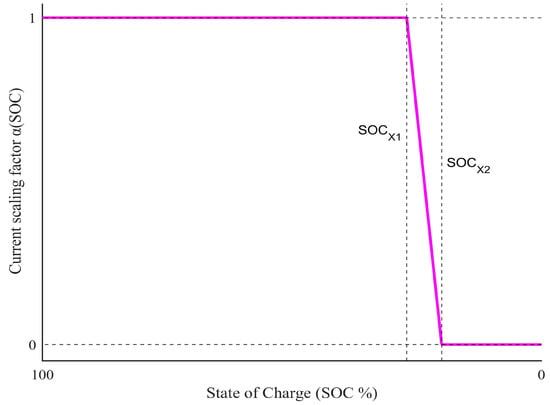
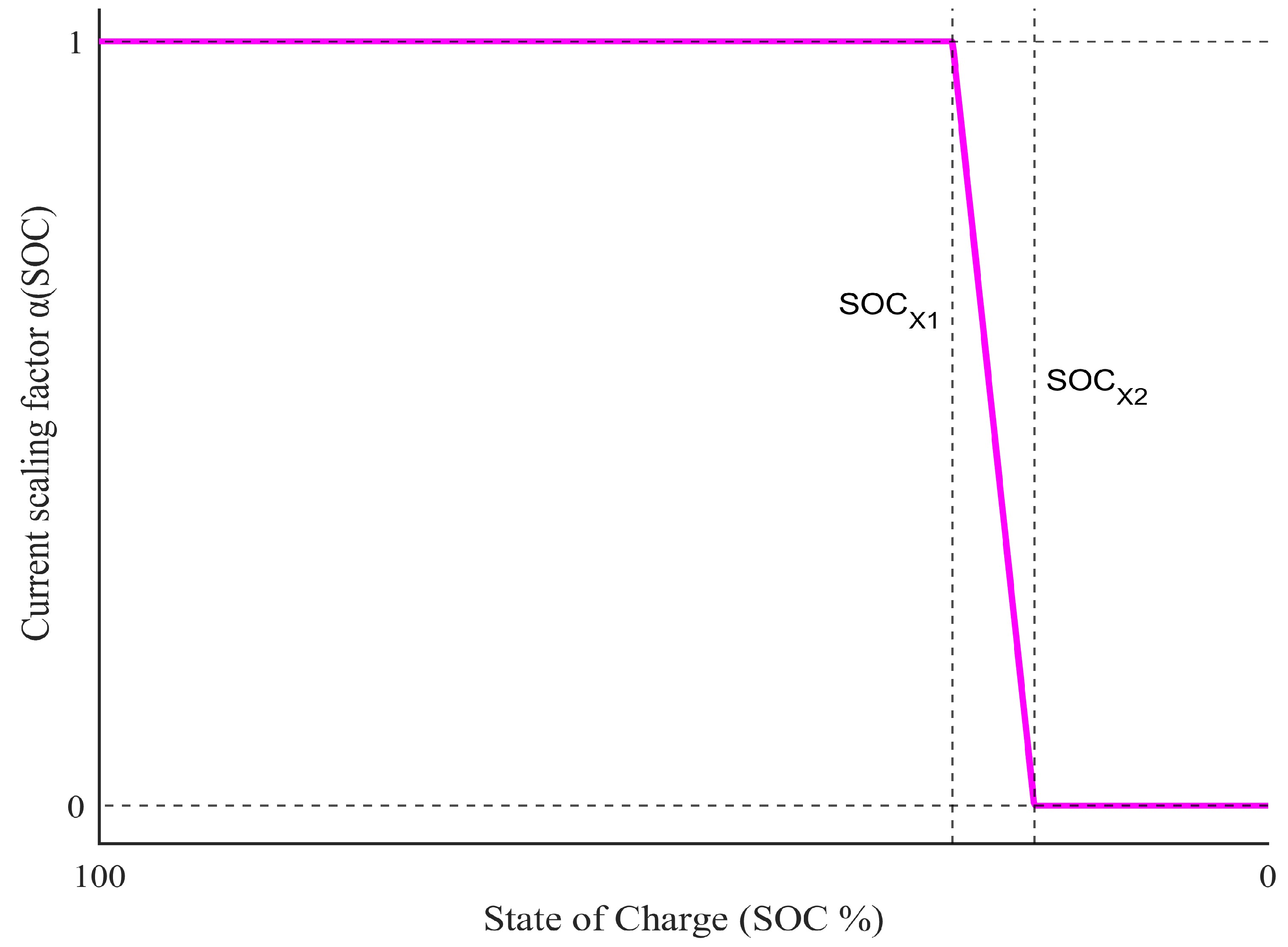
Figure 1 illustrates the proposed linear SOC-dependent soft-limiting gain α(SOC), where α(SOC) ∈ [0, 1] denotes the SOC-dependent current scaling factor. When the battery SOC is higher than the upper threshold , the scaling factor remains equal to unity, indicating that no current limitation is applied. As the SOC decreases from to , α(SOC) decreases linearly, resulting in a gradual reduction in the allowable discharge current. Once the SOC reaches the lower threshold , α(SOC) becomes zero, and battery discharge is effectively blocked.
Figure 1.
Linear SOC-dependent soft-limiting gain α(SOC) used for battery discharge current regulation. The magenta solid line denotes the soft-limiting gain α(SOC), and the dotted lines indicate the reference gain levels and the threshold positions and .
The selection of the two SOC thresholds is guided by practical off-grid operation requirements. Specifically, the upper threshold is chosen to initiate a gradual current derating before the battery approaches the critical low-SOC region, while the lower threshold is set equal to the protection bound to avoid deep discharge and ensure daily cycle sustainability. In this study, and are tuned to balance (i) thermal stress mitigation under high discharge demand and (ii) supply reliability under constrained battery power. A brief sensitivity comparison of different threshold pairs is presented to provide practical guidance for selecting the SOC thresholds.
It is important to note that the SOC thresholds and define the activation region of the soft current limiting mechanism, rather than specifying absolute current limits. The actual allowable discharge current within this region is determined by a separate SOC-dependent scaling applied to a predefined nominal maximum discharge current, as described in the following subsection. In addition, the lower SOC bound of 0.20 was retained in all cases because it represents a commonly adopted lifetime-preserving operating margin for lithium-ion batteries and allows a consistent comparison of different soft-limiting threshold pairs without introducing additional variability from changing the admissible SOC window.
3.3. SOC-Dependent Soft Current Limiting Function
Within the soft limiting region, the maximum allowable discharge current is defined as a continuous function of SOC. In this study, a normalized linear soft limiting function is adopted for clarity and ease of implementation.
In practical battery systems, the discharge current is subject to an upper bound determined by battery characteristics, converter ratings, and battery management system safety constraints. In this study, a nominal maximum allowable discharge current, denoted as , is defined as the baseline discharge current limit under normal operating conditions, i.e., outside the soft limiting region.
This value is determined by the battery model parameters and inverter/converter current ratings, and remains constant throughout the simulations.
A current scaling factor is defined as
Accordingly, the SOC-dependent maximum allowable discharge current is given by
where represents the SOC-dependent maximum allowable discharge current.
This formulation ensures a continuous attenuation of the discharge current limit as SOC decreases, avoiding abrupt transitions associated with conventional hard current limiting. By gradually reducing the allowable discharge current before critical SOC levels are reached, current peaks and associated thermal stress can be effectively mitigated.
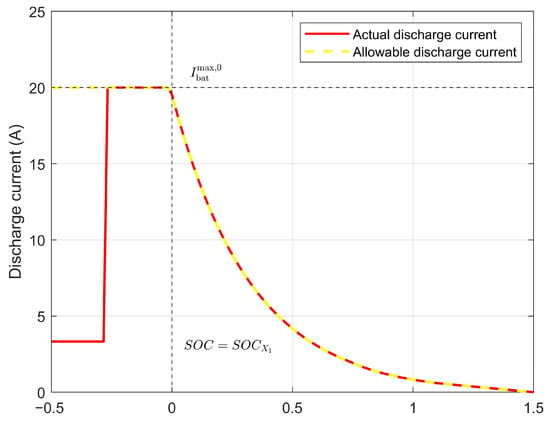
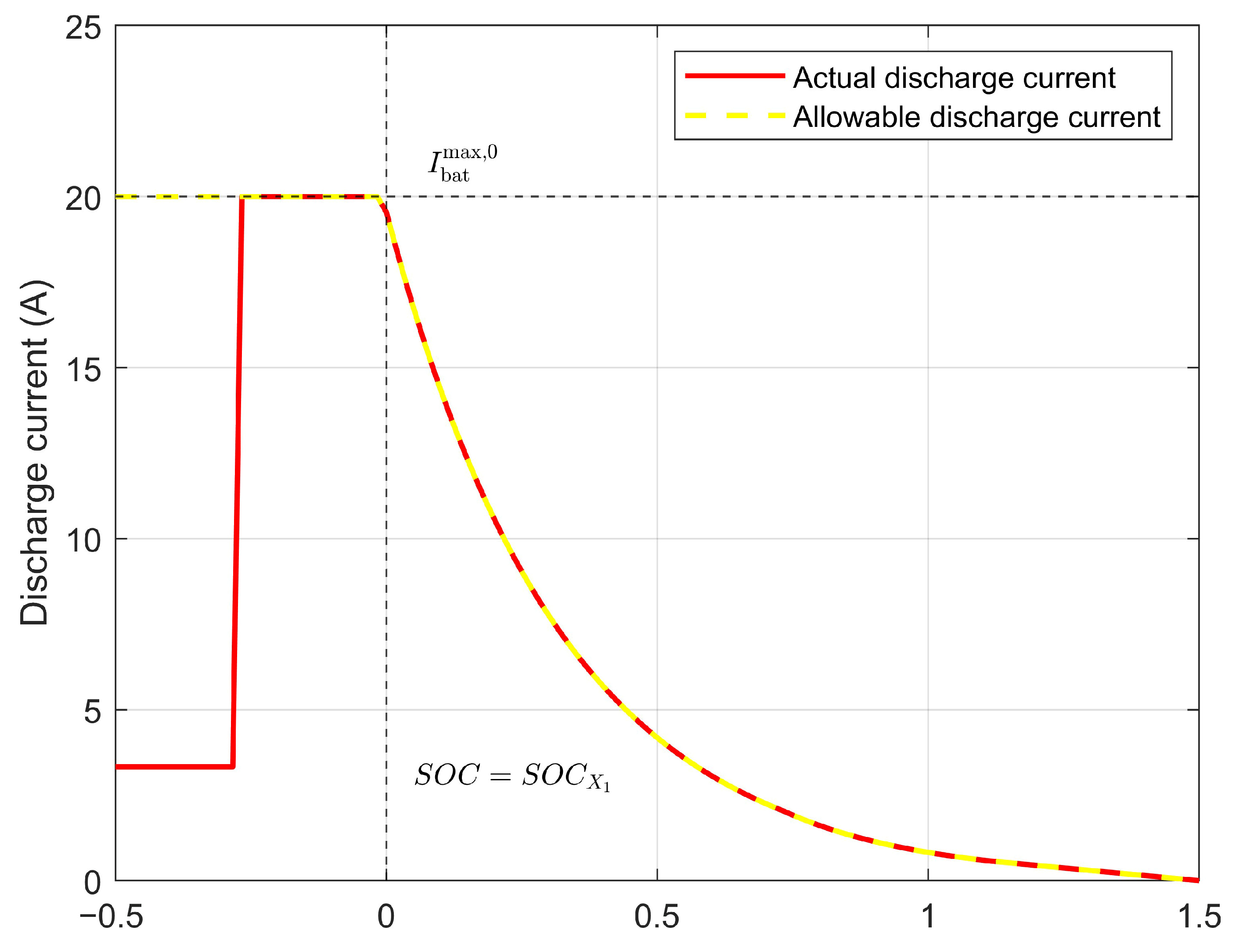
Figure 2 illustrates the time-domain activation of the proposed SOC-dependent discharge current limiting mechanism. Prior to the activation instant (t < 0), the discharge current follows the load demand and remains unconstrained as long as the battery SOC is above the upper soft-limiting threshold ). Once the SOC reaches (t = 0), the allowable discharge current begins to decrease continuously according to the SOC-dependent limiting function. Consequently, the actual discharge current is smoothly constrained by the allowable limit, avoiding abrupt current cut-off behavior.
Figure 2.
Activation of the SOC-dependent discharge current limit at the upper soft-limiting threshold .
For clarity, the actual discharge current shown in Figure 2 represents the battery current after applying the SOC-dependent current constraint, while the detailed computation of the unconstrained current reference and its integration into the control loop are described in Section 3.4.
3.4. Implementation in Off-Grid PV–BESS Control
The proposed soft current limiting strategy is integrated into the off-grid PV–BESS control framework as a supervisory constraint applied to the battery current reference. At each simulation time step, SOC is evaluated and the corresponding discharge current limit is updated accordingly.
Following the sign convention defined in Section 2, the battery current is defined as positive during discharge and negative during charge. In this section, the unconstrained discharge current demand is computed from the instantaneous power mismatch using the terminal voltage , and the discharge current is then constrained by the SOC-dependent soft-limit function, as shown in Equation (8):
where is the instantaneous battery power demand determined by the PV–load power imbalance. The constrained discharge current is finally obtained as
In Equation (9), denotes the constrained battery discharge current after applying the SOC-dependent soft-limit rule, while represents the unconstrained discharge current demand obtained from the instantaneous power mismatch between photovoltaic generation and load demand. Here, denotes the instantaneous battery terminal voltage used in the current calculation. In practical implementation, the proposed strategy can be implemented as a supervisory current-reference shaping layer above the fast inner current-control loop. Since it depends mainly on slowly varying quantities such as SOC, battery current, and terminal voltage, its update rate can be lower than the inner-loop sampling frequency, while moderate communication delay would mainly affect reference-adjustment smoothness rather than the overall protective logic.
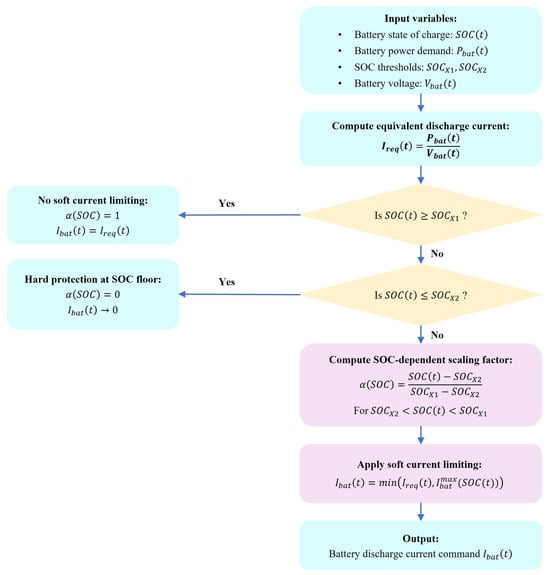
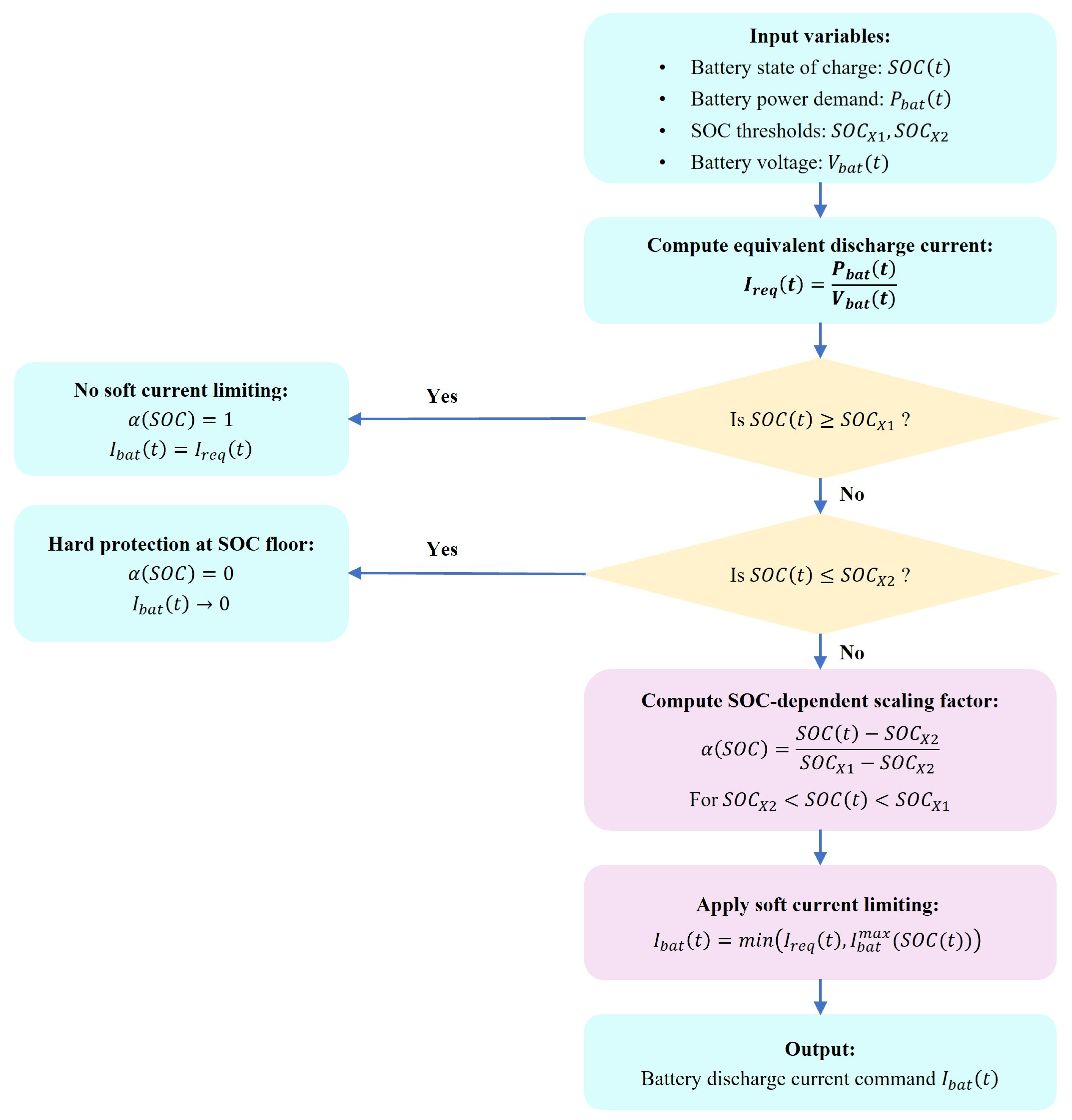
Figure 3 presents the implementation flow of the proposed SOC-dependent soft current limiting strategy. The controller first computes the equivalent discharge current based on the battery power demand and the instantaneous battery terminal voltage. The real-time battery SOC is then compared with two predefined thresholds, and . Depending on the SOC region, the discharge current is either fully allowed, linearly scaled using α(SOC), or completely blocked to ensure battery protection. This logic guarantees a smooth transition between normal operation and hard protection at low SOC. Specifically, the SOC-dependent allowable discharge current is generated according to within .
Figure 3.
Flowchart of the proposed SOC-dependent soft current limiting strategy.
This implementation requires no modification to the fixed SOC operating limits or the underlying energy management logic, making it compatible with existing fixed-window control architectures. By acting directly on discharge current rather than altering energy boundaries, the proposed method provides a dedicated protection layer that targets current-induced stress under low-SOC operation. This figure is intended to illustrate the activation mechanism of the proposed constraint, rather than to represent a specific operating condition or parameter setting.
3.5. Distinction from Existing Strategies
The proposed strategy is fundamentally different from conventional hard current limiting, which enforces an abrupt constraint once a predefined threshold is reached. In contrast, the proposed method introduces a continuous transition region near low SOC, improving control smoothness and reducing discharge current peaks.
Moreover, the proposed approach operates within fixed SOC operating limits and regulates how the discharge current evolves as SOC approaches critical low-SOC regions. This distinction forms the basis for the comparative evaluation presented in the following section.
Unlike SOC boundary adaptation strategies that modify energy availability, the proposed method preserves fixed SOC operating limits and introduces an additional current-domain protection layer, enabling direct mitigation of current-induced stress without altering system-level energy management.
4. Comparative Simulation Results and Discussion
4.1. Simulation Setup and Operating Scenario Design
Section 2 and Section 3 introduce the battery model and the soft current-limiting strategy in a formulation-oriented manner, without specifying a particular system scale. In this section, these models are instantiated in a representative residential off-grid PV–BESS to enable a quantitative and reproducible performance evaluation.
All simulations are conducted in MATLAB/Simulink over a 24 h operating horizon. This single-day cycle captures the key operating phases of off-grid PV–BESSs, including pre-sunrise battery-dominated discharge, PV-driven charging during daytime, and evening load support. Restricting the evaluation to a representative day isolates the impact of current-limiting control from long-term aging evolution and stochastic weather variations.
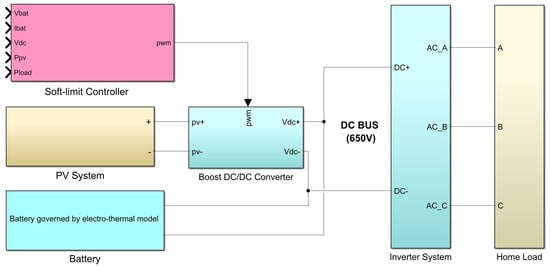
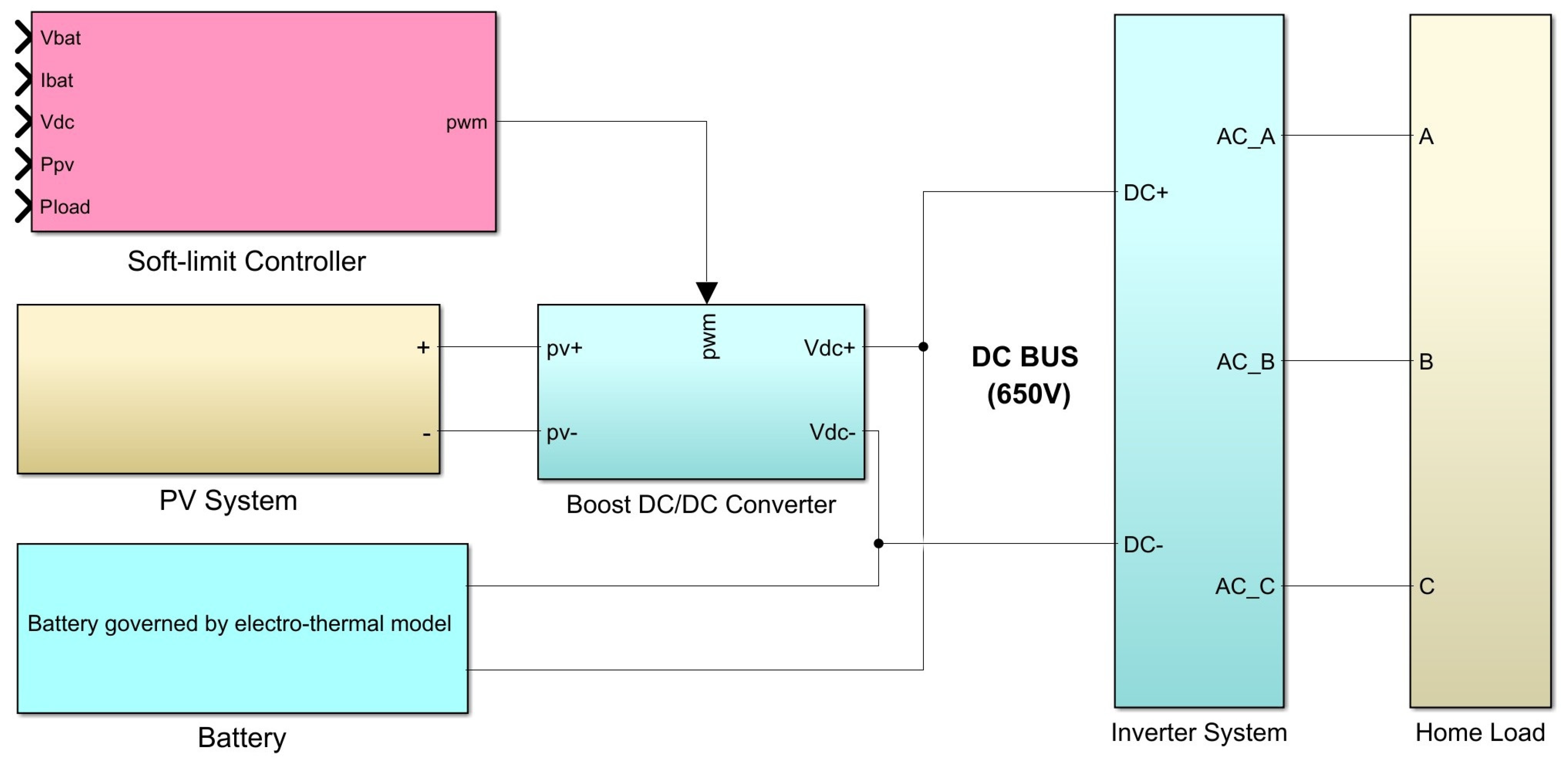
Figure 4 illustrates the overall architecture of the simulation. The system consists of a photovoltaic generation unit connected to a DC bus via a maximum power point tracking-controlled boost DC–DC converter, a battery pack governed by an electro-thermal model, a three-phase inverter, and a residential load. The proposed soft-limit controller monitors key electrical variables and modulates the battery-side current reference through the converter duty cycle. The DC bus voltage is regulated at 650 V, which is representative of small residential off-grid systems.
Figure 4.
Overall simulation architecture of the off-grid PV–BESS with the proposed soft-limit control.
All simulation cases share identical system ratings, battery parameters, and initial conditions. The battery pack is configured with a nominal voltage of 300 V and a nominal energy capacity of 30 kWh, corresponding to a typical second-life battery pack for residential applications. The battery is initialized at a mid-range state of charge to avoid immediate saturation or depletion at the start of the simulation. Fixed SOC limits are applied in all cases so that any observed differences in system behavior arise solely from the applied control strategies rather than from boundary inconsistencies. The key electrical, thermal, and operational parameters are summarized in Table 1.
Table 1.
Core simulation setup and model parameters.
The photovoltaic input is synthetically generated to represent a clear-day profile, with power production from 06:00 to 18:00 and a peak output of 10 kW around midday. This simplified profile provides a controlled charging opportunity while avoiding the unnecessary complexity associated with real irradiance data. The nominal battery voltage () is used only to characterize the system scale, while the current reference calculation relies on the instantaneous terminal voltage.
The residential load profile is deliberately designed to induce operating conditions that are critical for second-life batteries. As summarized in Table 2, a low base load is applied during nighttime hours, followed by a short-duration high-load period in the early morning when photovoltaic generation is absent. This interval forces the battery to supply the full demand and excites low-SOC, high-current discharge conditions. During the daytime, an extended moderate load overlaps with PV generation, allowing partial battery recovery, while a reduced evening load completes the daily cycle. The operating scenario is intentionally designed to excite low-SOC, high-current conditions in order to isolate and evaluate the effect of current regulation strategies.
Table 2.
Daily residential load profile used in the 24 h simulation.
Four control cases were investigated, and are summarized in Table 3. One baseline case (S0) operates without soft current limiting and relies solely on fixed SOC boundaries. The remaining cases (S1–S3) employ the proposed soft-limit strategy with different SOC thresholds for the onset of current limitation, while sharing the same termination threshold at the minimum SOC. Apart from this variation, all numerical settings remain unchanged across cases. The selected onset thresholds of 24%, 27%, and 30% represent narrow, medium, and wide soft-limiting windows above the common lower bound of 20%, respectively, and were chosen to enable a controlled comparison of progressively earlier current derating under fixed SOC operating limits.
Table 3.
Compared control cases.
Under this unified simulation setup, the effectiveness of the soft current-limiting strategy is evaluated from three complementary perspectives. First, electrical stress is assessed by the peak and RMS discharge currents, which directly reflect the severity of high-current operation at low SOC. Second, thermal stress is evaluated through the battery temperature response and cumulative heat exposure during low-SOC operation. Third, supply performance is quantified using the ENS when the battery reaches its lower SOC limit. Although ENS is used here as the primary reliability-related indicator, LPSP and LOLE are also commonly used in off-grid PV–BESS assessment. From a comparative viewpoint, lower ENS would generally be associated with improved LPSP and LOLE behavior, since these metrics reflect different aspects of supply shortfall. All performance indicators are computed over the same simulation horizon and under identical photovoltaic and load conditions, ensuring a fair and reproducible comparison among different control strategies.
4.2. Simulation Results and Performance Evaluation
In addition to the ENS, two current-related metrics are adopted to characterize battery stress: the peak discharge current and the root-mean-square current . The former reflects short-term electrical/thermal stress during high-demand events, while the latter indicates the overall current severity over the evaluation horizon.
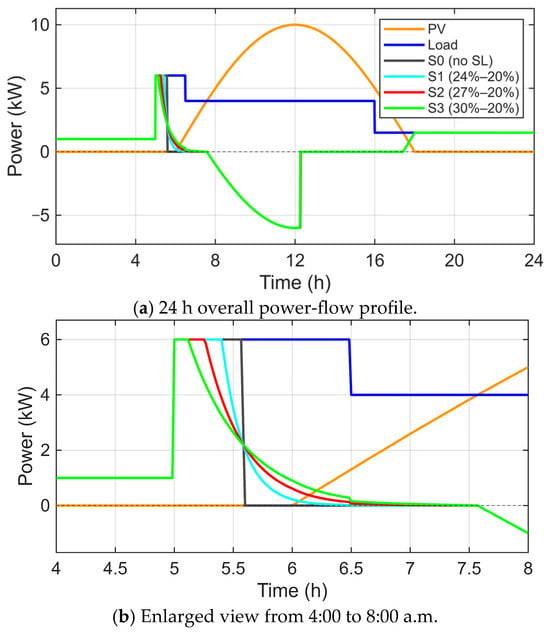
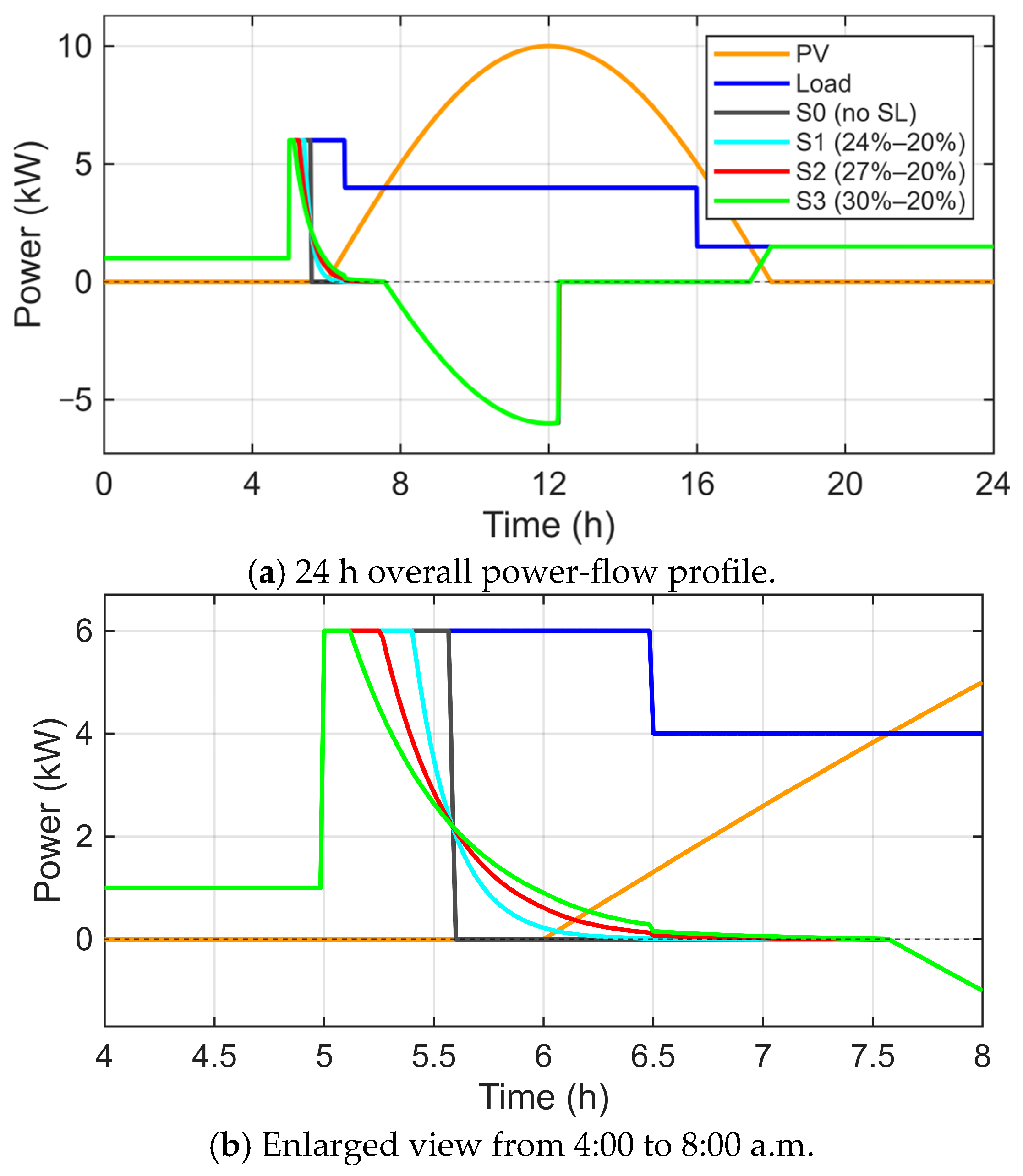
Figure 5 presents the 24 h power flow of the PV system, residential load, and battery under different control cases. During the early morning high-load interval, all cases experience battery-dominated discharge due to the absence of PV generation. In the baseline case S0, the battery power follows the load demand directly, resulting in an abrupt transition to high discharge power. In contrast, the soft-limit cases exhibit a progressively smoother reduction in battery discharge power as SOC decreases, with the effect becoming more pronounced as the soft-limit onset threshold increases from S1 to S3.
Figure 5.
Power-flow profiles under different soft current limiting strategies.
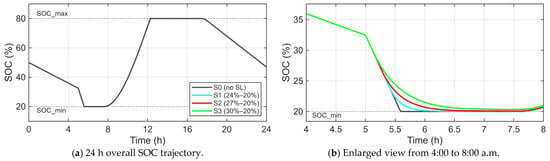
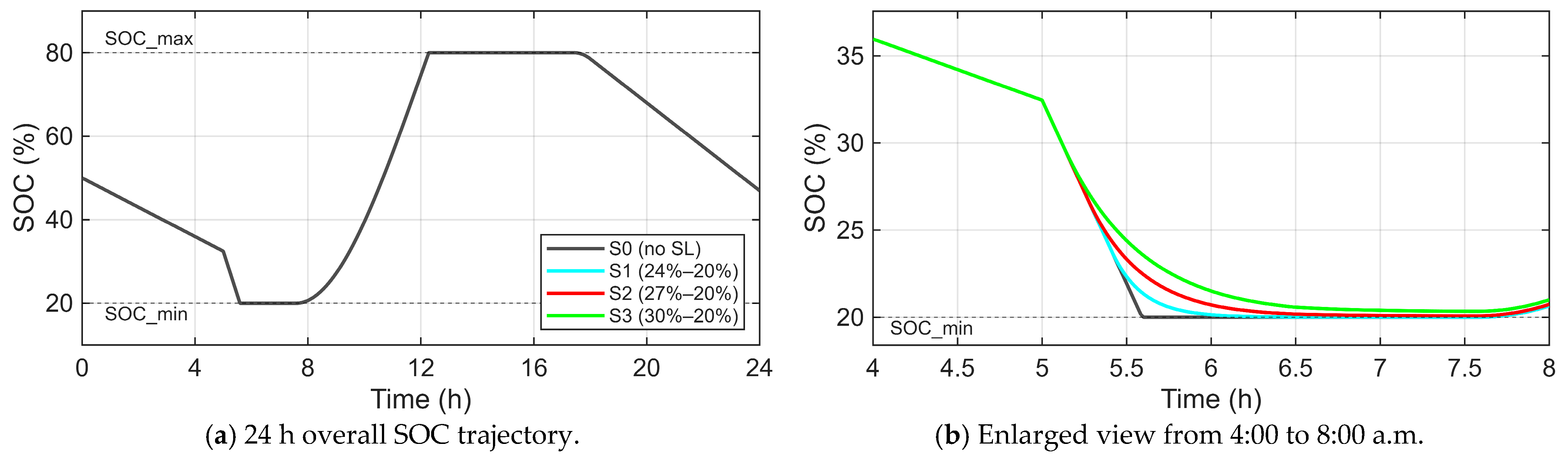
The corresponding SOC trajectories are shown in Figure 6. All cases start from an identical initial SOC and converge to the same minimum SOC of 20%, confirming that energy availability is not altered by the soft-limit strategy. However, the transient behavior near the minimum SOC differs significantly. The baseline case reaches the lower SOC bound more abruptly, whereas the soft-limit cases approach the minimum SOC more gradually, indicating reduced instantaneous discharge stress. The maximum SOC during daytime charging remains identical across cases, demonstrating that the soft-limit strategy does not restrict normal charging operation.
Figure 6.
SOC trajectories under different soft current limiting strategies.
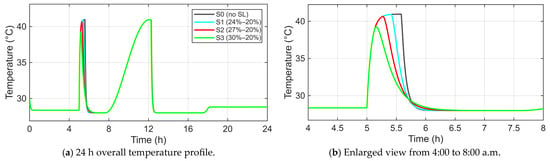
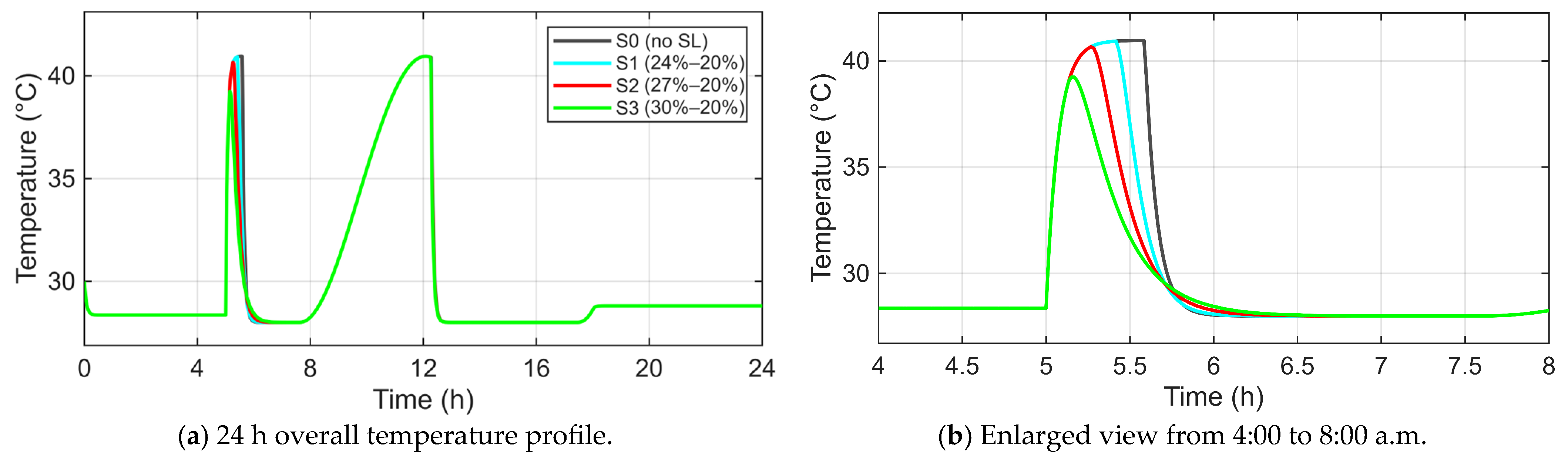
Figure 7 compares the battery temperature evolution predicted by the first-order thermal model. A pronounced temperature rise is observed during the early-morning high-current discharge interval. The baseline case S0 exhibits the highest peak temperature, exceeding 40 °C. In contrast, the peak temperature is progressively reduced in the soft-limit cases, with S3 showing the lowest temperature rise. This behavior directly reflects the reduction in Joule heating associated with smoother current profiles at low SOC.
Figure 7.
Battery temperature responses under different soft current limiting strategies.
Although the major current stress occurs in the early-morning interval, the battery temperature may continue to rise afterward because of thermal inertia in the first-order lumped thermal model. In addition, continued internal heat generation during the subsequent charging period, especially in the more conservative soft-limiting case, can delay the temperature peak toward noon.
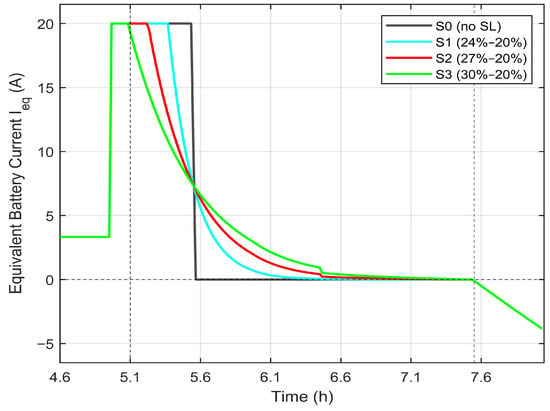
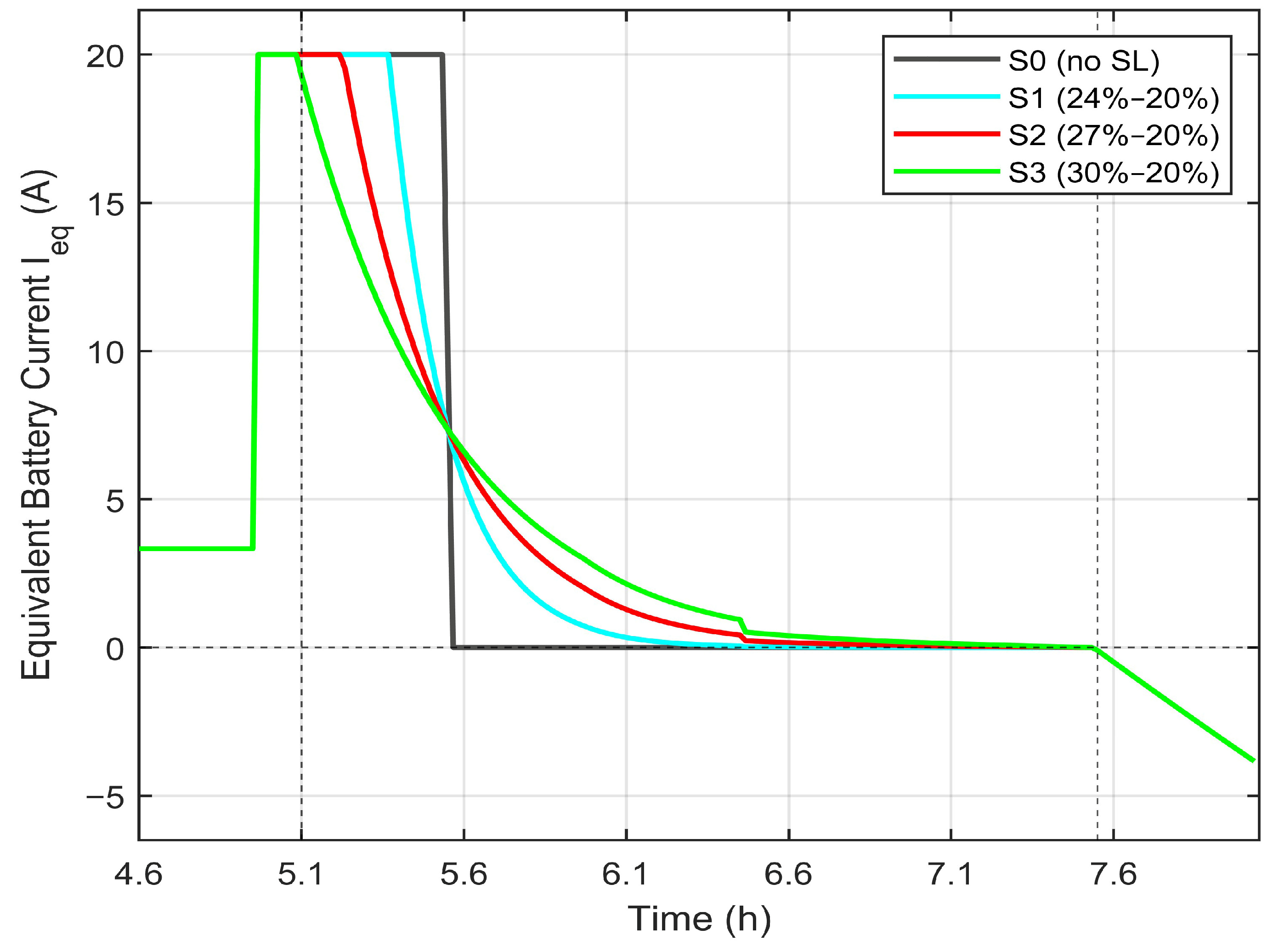
To further examine the current-limiting behavior, Figure 8 provides a zoomed view of the equivalent battery current during the unified low-SOC window (5.13–7.58 h). In S0, the equivalent discharge current remains at its maximum value until the minimum SOC is reached, followed by an abrupt cutoff. In contrast, the soft-limit cases exhibit a continuous and monotonic reduction in current as SOC decreases. A wider soft-limit window (S3) results in an earlier onset and a gentler current decay. In this paper, the equivalent discharge current is used as the evaluated current metric, and it corresponds to the applied battery discharge current after enforcing the SOC-dependent constraint during the considered window.
Figure 8.
Equivalent battery discharge current in the unified low-SOC window (5.13–7.58 h) under different soft current limiting strategies.
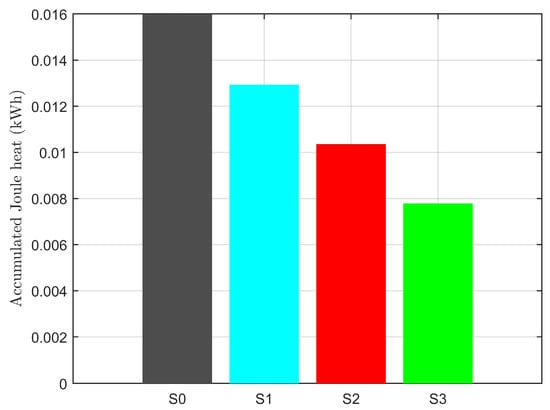
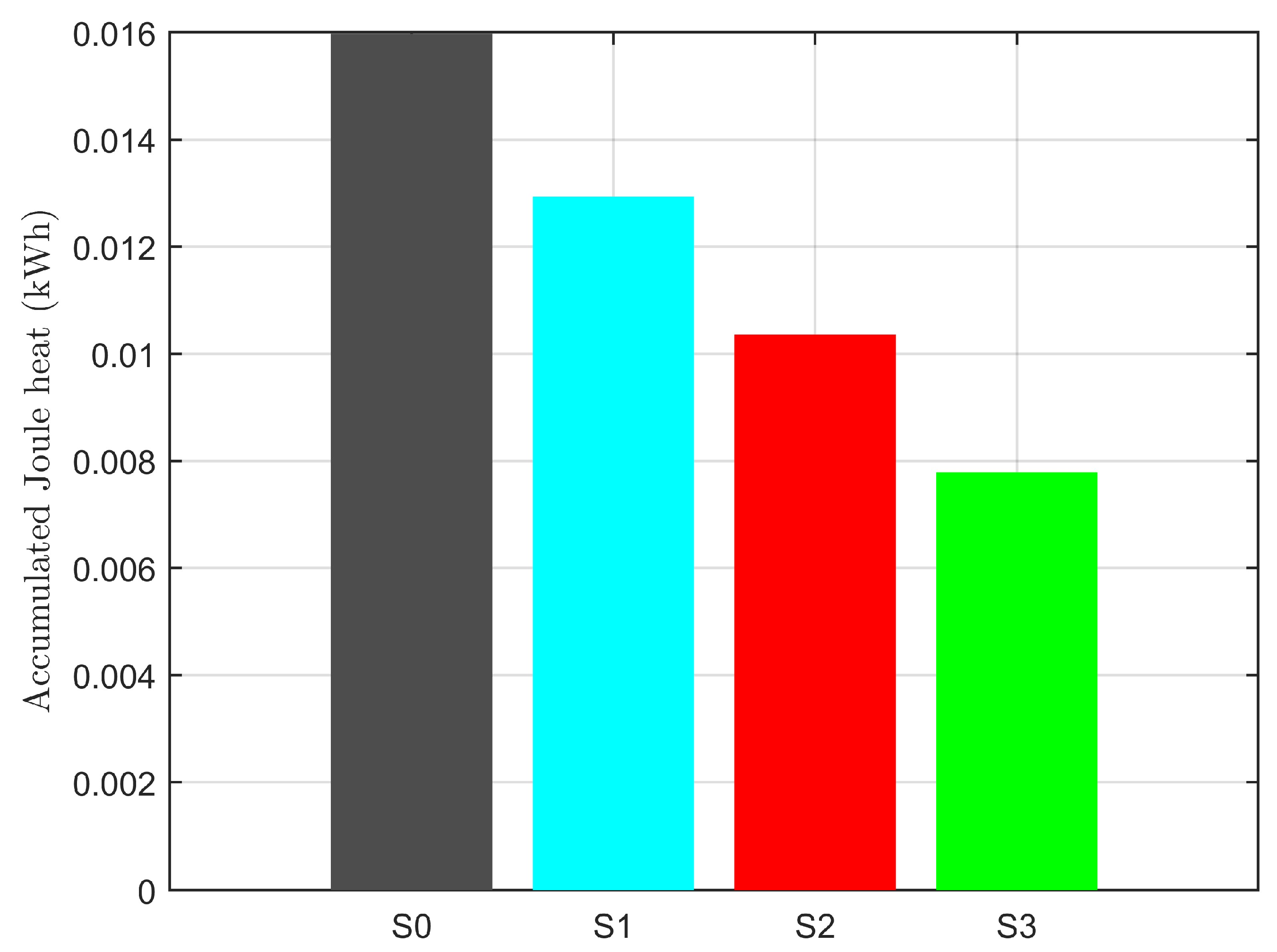
The cumulative impact of these current profiles is quantified in Figure 9, which shows the accumulated Joule heat within the unified low-SOC window. The baseline case exhibits the highest heat exposure (0.01598 kWh), while the soft-limit cases reduce this value to 0.01293 kWh (S1), 0.01036 kWh (S2), and 0.00779 kWh (S3), corresponding to a maximum reduction of approximately 51% relative to S0. This reduction provides a clear thermal benefit for second-life battery operation.
Figure 9.
Accumulated Joule heat in the unified low-SOC window.
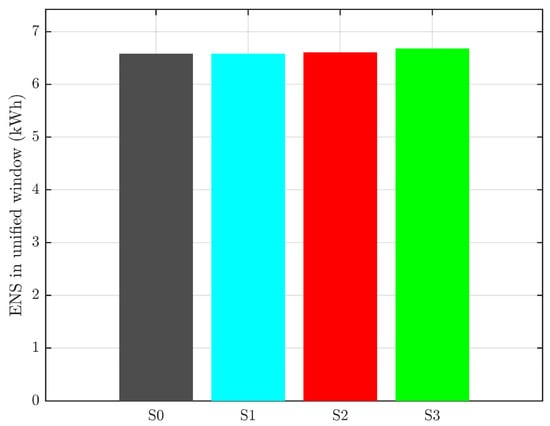
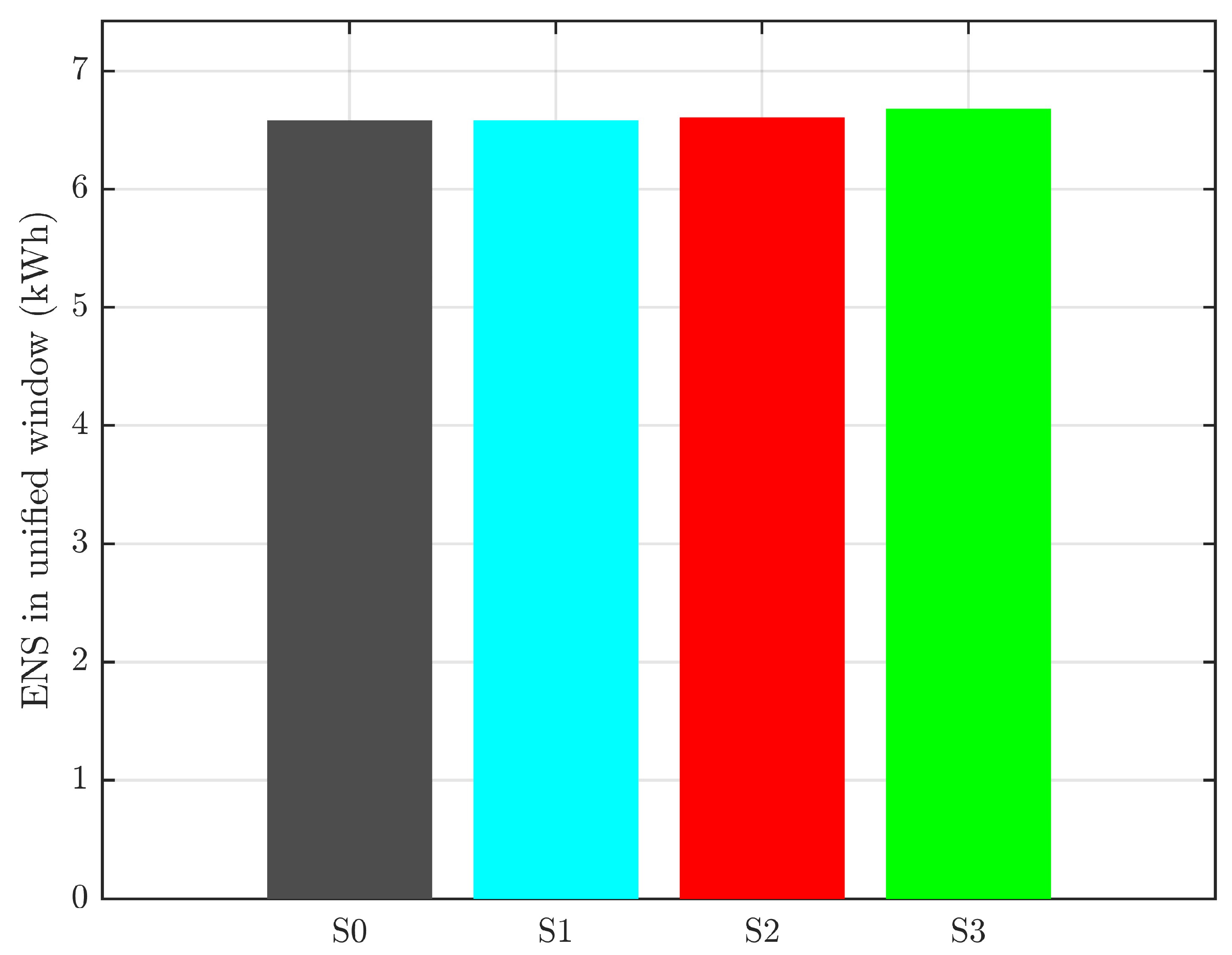
Figure 10 compares ENS within the same low-SOC window. All soft-limit cases exhibit a slight increase in ENS compared to the baseline. However, the absolute differences are small, with ENS increasing from 6.58 kWh in S0 to 6.68 kWh in S3. This indicates that the thermal benefits of soft limiting are achieved at the expense of only a marginal loss in short-term supply capability.
Figure 10.
Energy not supplied (ENS) in the unified low-SOC window.
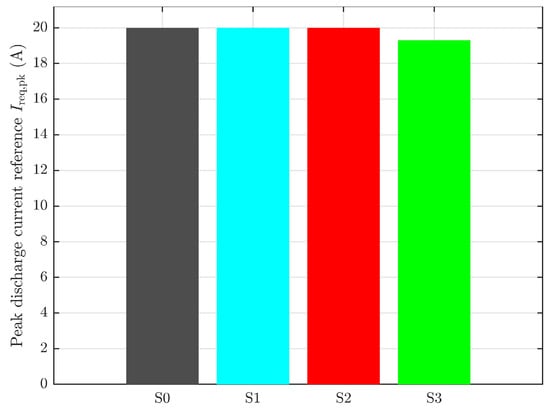
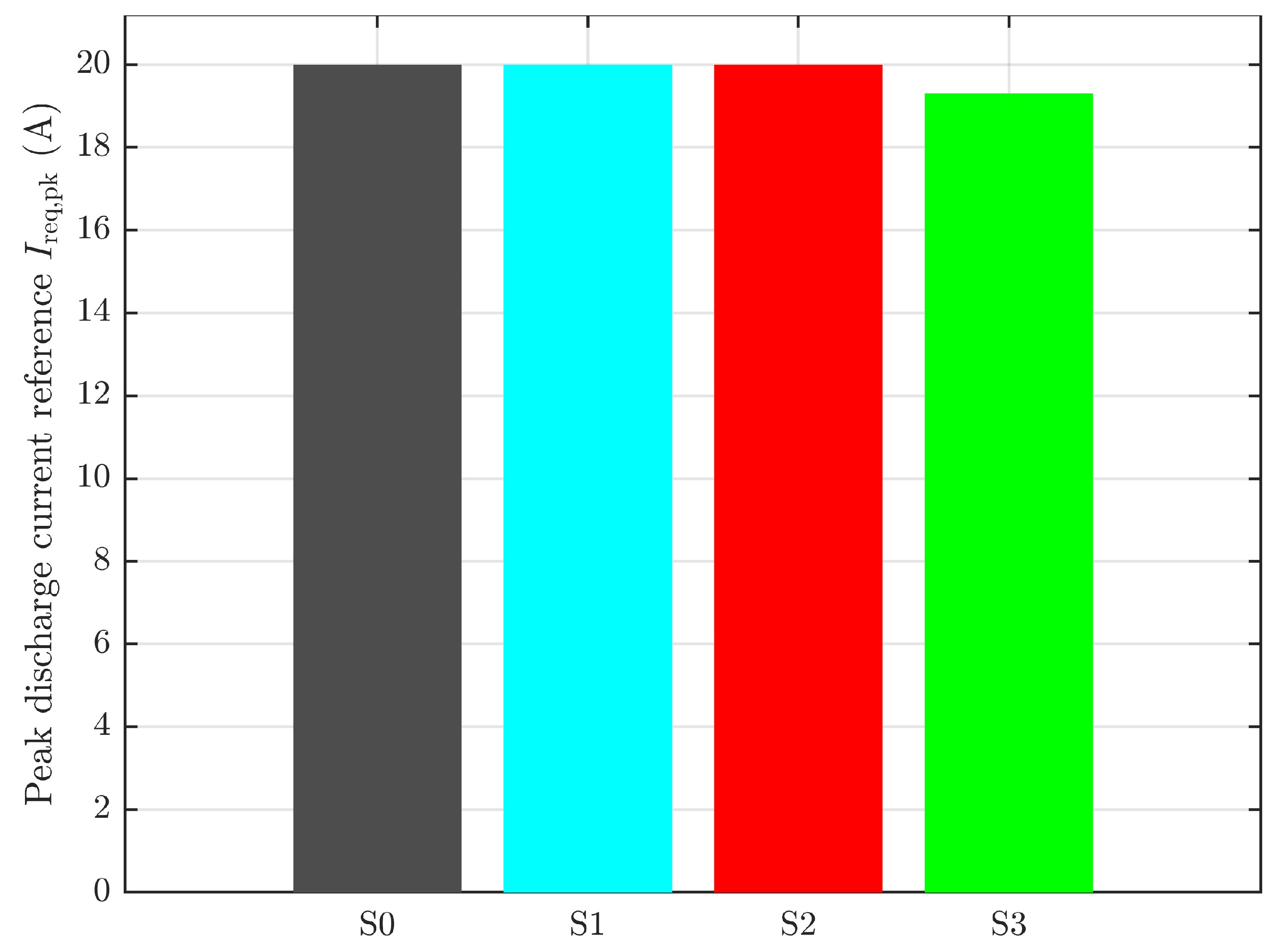
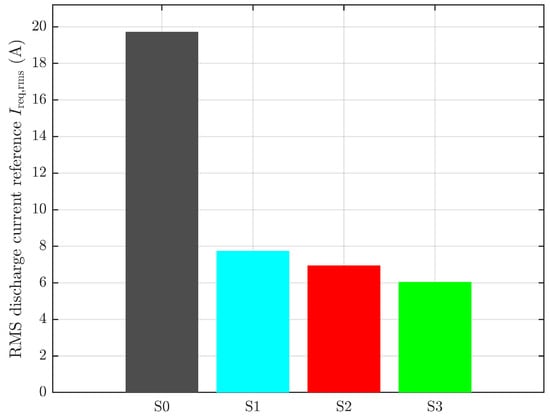
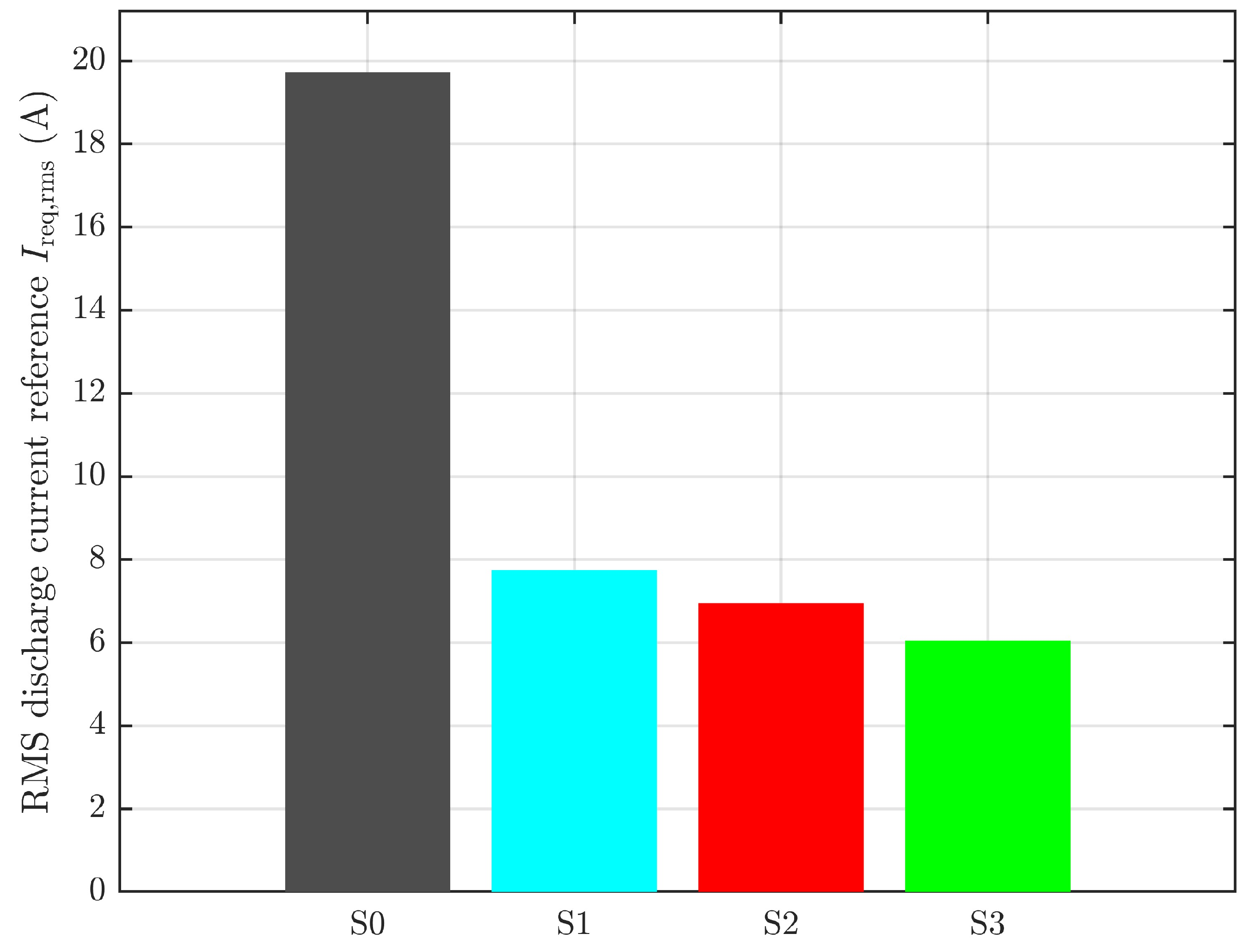
Figure 11 and Figure 12 summarize the peak and RMS discharge current metrics, respectively. While the peak current remains unchanged in S0–S2 (20 A) and is slightly reduced in S3 (19.3 A), the RMS current is significantly reduced by soft limiting, from 19.73 A in S0 to 7.75 A (S1), 6.95 A (S2), and 6.05 A (S3). This substantial reduction in RMS current explains the observed decrease in heat generation and temperature rise.
Figure 11.
Peak discharge current reference.
Figure 12.
RMS discharge current reference.
To provide a consolidated quantitative comparison, the key performance indicators extracted from the unified low-SOC window are summarized in Table 4. While all soft-limit cases maintain a similar peak discharge current of approximately 20 A, the RMS current is significantly reduced from 19.73 A in the baseline case (S0) to 6.05 A in S3. Correspondingly, the accumulated Joule heat decreases from 0.01598 kWh to 0.00779 kWh, representing a reduction of more than 50%. This thermal benefit is achieved at the cost of a modest increase in ENS, which rises from 6.582 kWh to 6.679 kWh. These results quantitatively confirm the trade-off between battery stress mitigation and supply performance enabled by the proposed soft-limit strategy.
Table 4.
Performance comparison of soft-limiting strategies in the unified low-SOC window (5.13–7.58 h).
Overall, the results demonstrate that the proposed soft current-limiting strategy effectively mitigates low-SOC, high-current stress in second-life batteries. By smoothing the discharge current near the minimum SOC, the strategy significantly reduces thermal exposure while maintaining comparable energy delivery. Among the investigated cases, wider soft-limit windows provide stronger thermal protection at the cost of a modest increase in ENS, highlighting a clear and tunable trade-off between battery protection and supply performance.
5. Conclusions and Outlook
5.1. Key Findings from Comparative Simulations
This study proposed an SOC-dependent soft current limiting strategy for second-life lithium-ion batteries in off-grid PV–BESSs. The comparative simulations show that the proposed method reduces peak and RMS discharge currents in low-SOC regions, thereby mitigating Joule heating and peak temperature rise. In addition, the strategy introduces only a limited increase in energy not supplied (ENS), indicating a tunable trade-off between battery protection and supply reliability.
Overall, the comparative simulations indicate that SOC-dependent soft current limiting is an effective control-oriented means of mitigating low-SOC, high-current stress in second-life batteries used in off-grid PV–BESSs within the present simulation framework.
5.2. Engineering Implications
The findings of this study have several control-oriented implications for the design and operation of off-grid PV–BESSs employing second-life lithium-ion batteries within the present simulation framework.
From an implementation viewpoint, the required online computation mainly consists of threshold comparison and evaluation of a simple SOC-dependent scaling rule based on quantities typically available in practical BMS/EMS implementations, and is therefore not expected to impose significant computational burden. For heterogeneous second-life battery packs, however, practical deployment would still require pack-specific threshold retuning and protection coordination, since the present framework does not explicitly resolve cell-to-cell variability or module imbalance. Accordingly, the present results should be interpreted as pack-level comparative guidance rather than direct heterogeneity-aware deployment rules.
First, the proposed soft current limiting strategy can, in principle, be integrated into battery management or energy management systems that already employ fixed SOC operating windows, subject to appropriate implementation verification and parameter retuning. Since the method regulates discharge current directly without altering SOC boundaries, it requires minimal modification to established control architectures and does not interfere with higher-level scheduling or power balance logic.
Second, the results highlight the importance of current trajectory shaping—rather than SOC limits alone—as a critical control dimension for second-life batteries. In practical systems where internal resistance is elevated and thermal margins are reduced, regulating discharge current near low SOC can provide substantial thermal protection even when energy availability must be preserved.
Third, the tunable nature of the soft-limiting window offers system designers a flexible means of balancing battery protection against supply performance. Depending on application priorities—such as maximizing battery lifetime, reducing thermal stress, or ensuring strict supply continuity—the soft-limiting onset threshold can be adjusted without redesigning the overall control framework.
These characteristics make the proposed strategy particularly suitable for residential and small-scale off-grid systems, where simplicity, robustness, and compatibility with existing hardware and control schemes are essential. Although the present study focuses on a residential-scale off-grid PV–BESS case, the proposed SOC-dependent current limiting principle is structurally scalable and can be extended to larger BESS installations through appropriate re-tuning of current limits, SOC thresholds, and thermal parameters.
5.3. Limitations and Future Work
Despite its demonstrated effectiveness, this study has several limitations that require future research to overcome. Although the present study does not explicitly quantify long-term battery lifetime, the observed reductions in RMS current and cumulative thermal exposure indicate a lower degradation tendency under repeated operation. Direct translation of these short-term stress reductions into lifetime extension remains beyond the scope of the present study.
First, the evaluation was conducted over a representative 24 h operating cycle, and battery aging was not explicitly updated during the simulation. While this approach is appropriate for isolating current-related control effects, future work should extend the analysis to long-term simulations incorporating coupled electro-thermal aging models to quantify lifetime benefits more directly. Moreover, the present study does not constitute a robustness analysis across weather conditions, load variability, SOH spread, temperature variation, parameter uncertainty, or multi-day operation. These aspects remain important directions for future work.
Second, a linear SOC-dependent soft limiting function was adopted for clarity and ease of implementation. Alternative nonlinear formulations or adaptive soft-limiting functions may further improve the trade-off between battery protection and energy availability and merit systematic investigation.
Third, the study focused on discharge current regulation near the lower SOC boundary. Extending the soft limiting concept to high-SOC charging regions, as well as considering interactions with real-time load forecasting or predictive energy management strategies, represents another promising direction.
Pack-specific parameter identification, including OCV–SOC characterization, RC parameter fitting, and thermal parameter estimation, as well as comparison between simulated and measured responses, was not included in the present study. Finally, experimental validation, hardware-in-the-loop testing, and prototype- or field-deployed system implementation were not included in the present study and remain important topics for future work.
Author Contributions
Conceptualization, H.W. and A.N.; methodology, H.W. and S.Y.; software, H.W.; validation, S.Y. and A.N.; formal analysis, H.W.; investigation, S.Y.; resources, P.C., H.W. and A.N.; data curation, H.W.; writing—original draft preparation, H.W.; writing—review and editing, H.W. and A.N.; visualization, H.W.; supervision, A.N.; project administration, P.C.; funding acquisition, P.C.; All authors have read and agreed to the published version of the manuscript.
Funding
This research was funded by Srinakharinwirot University Research Fund.
Data Availability Statement
The original contributions presented in this study are included in the article. Further inquiries can be directed to the corresponding author.
Conflicts of Interest
The authors declare no conflicts of interest.
Abbreviations
The following abbreviations are used in this manuscript:
| DC | Direct Current |
| ECM | Equivalent Circuit Model |
| ENS | Energy-Not-Served |
| HPPC | Hybrid Pulse Power Characterization |
| MPPT | Maximum Power Point Tracking |
| OCV | Open-Circuit Voltage |
| PV | Photovoltaic |
| PV–BESS | Photovoltaic–Battery Energy Storage Systems |
| RMS | Root-Mean-Square |
| SCL | Soft Current Limiting |
| SOC | State-of-Charge |
| SOH | State of Health |
| 2RC | Two Resistor–Capacitor (branches) |
References
- Sarker, M.T.; Haram, M.H.S.M.; Shern, S.J.; Ramasamy, G.; Al Farid, F. Second-Life Electric Vehicle Batteries for Home Photovoltaic Systems: Transforming Energy Storage and Sustainability. Energies 2024, 17, 2345. [Google Scholar] [CrossRef] [Scilit]
- Canals Casals, L.; Amante García, B.; Canal, C. Second Life Batteries Lifespan: Rest of Useful Life and Environmental Analysis. J. Environ. Manag. 2019, 232, 354–363. [Google Scholar] [CrossRef] [Scilit] [PubMed]
- Roslan, M.F.; Satpathy, P.R.; Prasankumar, T.; Ramachandaramurthy, V.K.; Mansor, M.; Walker, S.L. Second-Life Battery Energy Storage System for Energy Sustainability: Recent Advancements, Key Takeaways and Future Perspectives. J. Energy Storage 2025, 123, 116808. [Google Scholar] [CrossRef] [Scilit]
- Chennaif, M.; Maaouane, M.; Zahboune, H.; Elhafyani, M.; Zouggar, S. Tri-Objective Techno-Economic Sizing Optimization of Off-Grid and On-Grid Renewable Energy Systems Using Electric System Cascade Extended Analysis and System Advisor Model. Appl. Energy 2022, 305, 117844. [Google Scholar] [CrossRef] [Scilit]
- Shufian, A.; Mohammad, N. Modeling and Analysis of Cost-Effective Energy Management for Integrated Microgrids. Clean. Eng. Technol. 2022, 8, 100508. [Google Scholar] [CrossRef] [Scilit]
- Xiao, J.; Jiang, C.; Terzi, S.; Zheng, C.; Macchi, M. A Sustainable Echelon Re-Utilization and Recycling for Dynamic End-of-Life Electric Vehicle Battery Packs. J. Clean. Prod. 2025, 535, 147120. [Google Scholar] [CrossRef] [Scilit]
- Almousa, M.T.; Gomaa, M.R.; Ghasemi, M.; Louzazni, M. Gradient-Based Optimization for Parameter Identification of Lithium-Ion Battery Model for Electric Vehicles. Results Eng. 2024, 24, 102845. [Google Scholar] [CrossRef] [Scilit]
- Li, J.; Wang, D.; Deng, L.; Cui, Z.; Lyu, C.; Wang, L.; Pecht, M. Aging Modes Analysis and Physical Parameter Identification Based on a Simplified Electrochemical Model for Lithium-Ion Batteries. J. Energy Storage 2020, 31, 101538. [Google Scholar] [CrossRef] [Scilit]
- Dorronsoro, X.; de Castro, R.; Varela Barreras, J.; Garayalde, E.; Iraola, U. Battery Aging-Aware Adaptive Model Predictive Control Based on Coupled Semi-Empirical Electro-Thermal and Aging Models. Appl. Energy 2025, 401, 126494. [Google Scholar] [CrossRef] [Scilit]
- Semaoui, S.; Hadj Arab, A.; Bacha, S.; Azoui, B. The New Strategy of Energy Management for a Photovoltaic System without Extra Intended for Remote-Housing. Sol. Energy 2013, 94, 71–85. [Google Scholar] [CrossRef] [Scilit]
- AL-Jumaili, A.H.A.; Muniyandi, R.C.; Hasan, M.K.; Singh, M.J.; Paw, J.K.S.; Amir, M. Advancements in Intelligent Cloud Computing for Power Optimization and Battery Management in Hybrid Renewable Energy Systems: A Comprehensive Review. Energy Rep. 2023, 10, 2206–2227. [Google Scholar] [CrossRef] [Scilit]
- Jiang, C.; Wang, Y.; Sun, Z.; Li, M.; Chen, Z. Online Impedance-Based Temperature and States Co-Estimation for Sodium-Ion Batteries Using Fractional-Order Model. Energy 2025, 334, 137427. [Google Scholar] [CrossRef] [Scilit]
- Abed, M.; Reddy B, A.; Jyothsna, T.R.; Mohammed, N. Optimal Sizing and Performance Assessment of Stand-Alone PV Systems Using Optimum Hybrid Sizing Strategy. Results Eng. 2025, 25, 103793. [Google Scholar] [CrossRef] [Scilit]
- Sowe, J.; Varela Barreras, J.; Schimpe, M.; Wu, B.; Candelise, C.; Nelson, J.; Few, S. Model-Informed Battery Current Derating Strategies: Simple Methods to Extend Battery Lifetime in Islanded Mini-Grids. J. Energy Storage 2022, 51, 104524. [Google Scholar] [CrossRef] [Scilit]
- Jamroen, C.; Vongkoon, P. The Role of State-of-Charge Management in Optimal Techno-Economic Battery Energy Storage Sizing for Off-Grid Residential Photovoltaic Systems. J. Energy Storage 2023, 72, 108246. [Google Scholar] [CrossRef] [Scilit]
- Wang, H.; Ngaopitakkul, A.; Yoomak, S. SOH- and Temperature-Aware Adaptive SOC Boundaries for Second-Life Li-Ion Batteries in Off-Grid PV–BESSs. Computation 2026, 14, 47. [Google Scholar] [CrossRef] [Scilit]
- Lu, S.-D.; Liu, H.-D.; Wang, M.-H.; Wu, C.-C. A Novel Strategy for Multitype Fault Diagnosis in Photovoltaic Systems Using Multiple Regression Analysis and Support Vector Machines. Energy Rep. 2024, 12, 2824–2844. [Google Scholar] [CrossRef] [Scilit]
- Satpathy, R.; Pamuru, V. Off-Grid Solar Photovoltaic Systems. In Solar PV Power; Satpathy, R., Pamuru, V., Eds.; Academic Press: Cambridge, MA, USA, 2021; pp. 267–315. [Google Scholar] [CrossRef] [Scilit]
- Wieczorek, M.; Wodyk, S.; Poliszkiewicz, R.; Witaszek, P. The Influence of Current in Off-Grid PV Systems on Lead–Acid Battery Lifetime and Hybridization with LFP Battery as Solution. Energy Rep. 2023, 9, 766–773. [Google Scholar] [CrossRef] [Scilit]
- Dang, Q.; Wang, S.; Shi, K.; Gao, Z.; Fernandez, C.; Yu, M. Critical Review on Adaptive Modeling and Parameter Identification for State of Power Estimation in Lithium-Ion Batteries. J. Power Sources 2026, 663, 238937. [Google Scholar] [CrossRef] [Scilit]
- Guo, F.; Couto, L.D.; Trad, K.; Mulder, G.; Haghverdi, K.; Thenaisie, G. Optimizing Parameter Estimation for Electrochemical Battery Model: A Comparative Analysis of Operating Profiles on Computational Efficiency and Accuracy. J. Power Sources 2026, 665, 239044. [Google Scholar] [CrossRef] [Scilit]
- Tekin, M.; Karamangil, M.I. Comparative analysis of equivalent circuit battery models for electric vehicle battery management systems. J. Power Sources 2024, 86, 111327. [Google Scholar] [CrossRef] [Scilit]
- He, X.; Sun, B.; Zhang, W.; Fan, X.; Su, X.; Ruan, H. Multi-time scale variable-order equivalent circuit model for virtual battery considering initial polarization condition of lithium-ion battery. Energy 2022, 244, 123084. [Google Scholar] [CrossRef] [Scilit]
- Cao, R.; Zhang, X.; Yang, H.; Wang, C. Experimental study on heat generation characteristics of lithium-ion batteries using a forced convection calorimetry method. Appl. Therm. Eng. 2023, 219, 119559. [Google Scholar] [CrossRef] [Scilit]
- An, Z.; Jia, L.; Wei, L.; Dang, C.; Peng, Q. Investigation on lithium-ion battery electrochemical and thermal characteristic based on electrochemical–thermal coupled model. Appl. Therm. Eng. 2018, 137, 792–807. [Google Scholar] [CrossRef] [Scilit]
- Ghalkhani, M.; Bahiraei, F.; Nazri, G.-A.; Saif, M. Electrochemical–thermal model of pouch-type lithium-ion batteries. Electrochim. Acta 2017, 247, 569–587. [Google Scholar] [CrossRef] [Scilit]
- Yang, J.; Zhang, H.; Xu, Y.; Li, P. Analysis of heat generation in lithium-ion battery components and voltage rebound based on electrochemical and thermal coupled model. J. Energy Storage 2023, 72, 108554. [Google Scholar] [CrossRef] [Scilit]
- Häring, T.; Rosin, A.; Biechl, H. Using Common Household Thermal Storages to Support the PV- and Battery System in Nearly Zero Energy Buildings in Off-Grid Mode. Sustain. Energy Technol. Assess. 2019, 35, 12–24. [Google Scholar] [CrossRef] [Scilit]
- Bonkile, M.P.; Ramadesigan, V. Physics-Based Models in PV-Battery Hybrid Power Systems: Thermal Management and Degradation Analysis. J. Energy Storage 2020, 31, 101458. [Google Scholar] [CrossRef] [Scilit]
- Luthander, R.; Widén, J.; Nilsson, D.; Palm, J. Photovoltaic Self-Consumption in Buildings: A Review. Appl. Energy 2015, 142, 80–94. [Google Scholar] [CrossRef] [Scilit]
- Luo, Z.; Peng, J.; Tan, Y.; Yin, R.; Zou, B.; Hu, M.; Yan, J. A Novel Forecast-Based Operation Strategy for Residential PV-Battery-Flexible Loads Systems Considering the Flexibility of Battery and Loads. Energy Convers. Manag. 2023, 278, 116705. [Google Scholar] [CrossRef] [Scilit]
- Guo, Y.; Zhang, T.; Zhou, H.; Shen, S.; Bao, M.; Bao, H.; Wang, L.; Sun, S.; Li, F.; Wang, H. Study on Off-Grid Performance and Economic Viability of Photovoltaic Energy Storage Refrigeration Systems. Int. J. Refrig. 2025, 169, 391–404. [Google Scholar] [CrossRef] [Scilit]
- Jia, X.; Zhu, J.; Knapp, M.; Wang, X.; Yu, C.; Xu, W.; Wu, H.; Ehrenberg, H.; Wei, X.; Dai, H. A Review of Battery Failure: Classification, Mechanisms, Analysis, and Management. Renew. Sustain. Energy Rev. 2026, 225, 116126. [Google Scholar] [CrossRef] [Scilit]
- Quiles, E.; Roldán-Blay, C.; Escrivá-Escrivá, G.; Roldán-Porta, C. Accurate Sizing of Residential Stand-Alone Photovoltaic Systems Considering System Reliability. Sustainability 2020, 12, 1274. [Google Scholar] [CrossRef] [Scilit]
- Khatib, T.; Ibrahim, I.A.; Mohamed, A. A Review on Sizing Methodologies of Photovoltaic Array and Storage Battery in a Standalone Photovoltaic System. Energy Convers. Manag. 2016, 120, 430–448. [Google Scholar] [CrossRef] [Scilit]
- Abdel-Rahim, O.; Chub, A.; Vinnikov, D.; Blinov, A. DC Integration of Residential Photovoltaic Systems: A Survey. IEEE Access 2022, 10, 66974–67010. [Google Scholar] [CrossRef] [Scilit]
- Do, L.T.; Nguyen, T.N.; Tran, Q.T.; Duong, K.T. Economic Analysis of Solar Power Plant and Battery Energy Storage: Case Study of Binh Phuoc Province, Vietnam. Clean. Eng. Technol. 2025, 26, 100937. [Google Scholar] [CrossRef] [Scilit]
- Zhu, J.; Mathews, I.; Ren, D.; Li, W.; Cogswell, D.; Xing, B.; Sedlatschek, T.; Kantareddy, S.N.R.; Yi, M.; Gao, T.; et al. End-of-Life or Second-Life Options for Retired Electric Vehicle Batteries. Cell Rep. Phys. Sci. 2021, 2, 100537. [Google Scholar] [CrossRef] [Scilit]
- Białoń, T.; Niestrój, R.; Skarka, W.; Korski, W. HPPC Test Methodology Using LFP Battery Cell Identification Tests as an Example. Energies 2023, 16, 6239. [Google Scholar] [CrossRef] [Scilit]
- Pan, D.; Guo, H.; Tang, S.; Li, X.; Wang, Z.; Peng, W.; Wang, J.; Yan, G. Evaluating the Accuracy of Electro-Thermal Coupling Model in Lithium-Ion Battery via Altering Internal Resistance Acquisition Methods. J. Power Sources 2020, 463, 228174. [Google Scholar] [CrossRef] [Scilit]
- Nissing, D.; Mahanta, A.; van Sterkenburg, S. Thermal Model Parameter Identification of a Lithium Battery. J. Control Sci. Eng. 2017, 2017, 9543781. [Google Scholar] [CrossRef] [Scilit]

Disclaimer/Publisher’s Note: The statements, opinions and data contained in all publications are solely those of the individual author(s) and contributor(s) and not of MDPI and/or the editor(s). MDPI and/or the editor(s) disclaim responsibility for any injury to people or property resulting from any ideas, methods, instructions or products referred to in the content. |
© 2026 by the authors. Licensee MDPI, Basel, Switzerland. This article is an open access article distributed under the terms and conditions of the Creative Commons Attribution (CC BY) license.